
000000000x
42 Beiträge

000000000x
Melden
Nutzer blockieren
一个小目标
4 Following
1 Follower
1 Like gegeben
Beiträge
Alle
Videos
·
--
Übersetzung ansehen
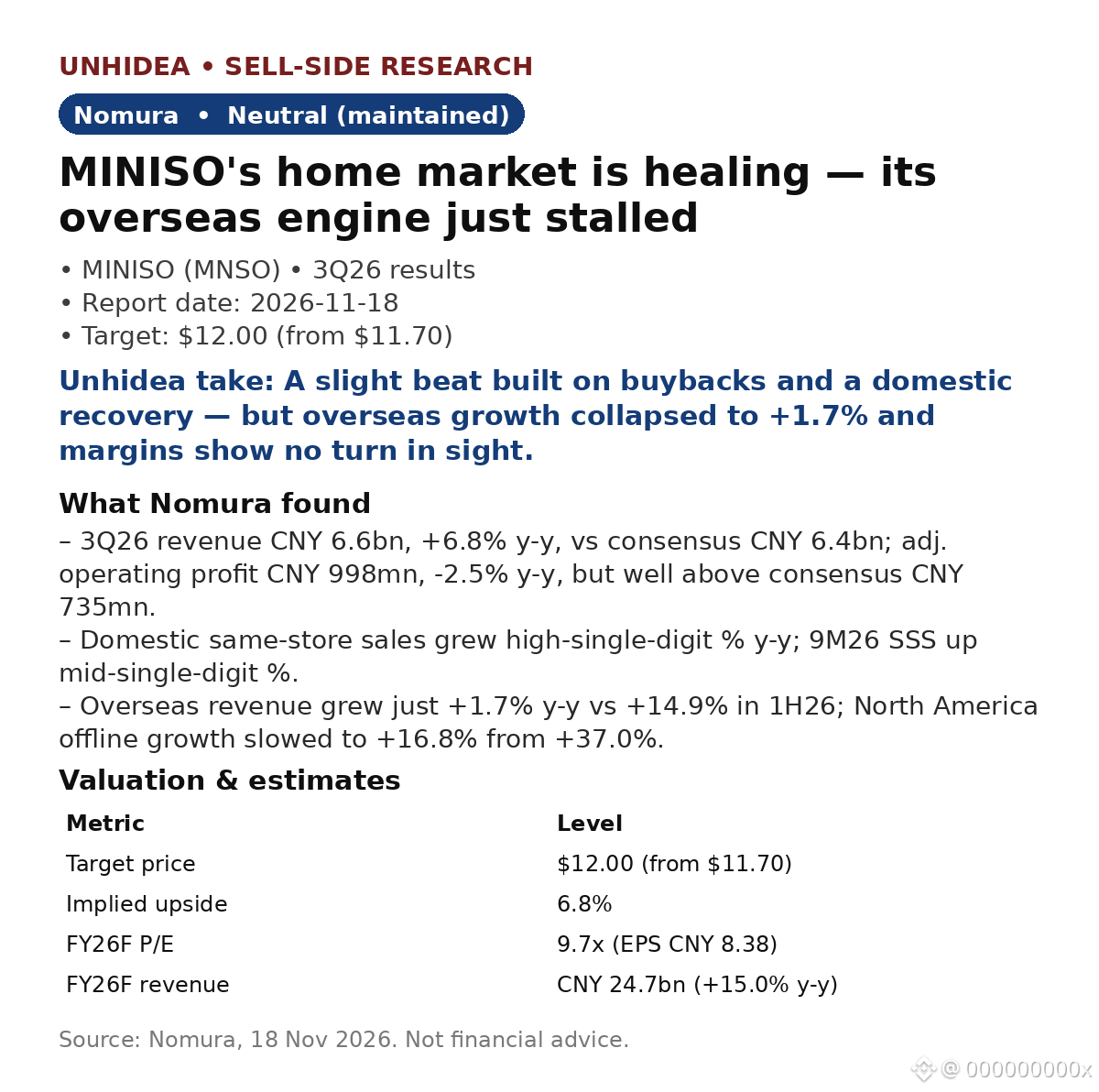
$MNSO: Nomura keeps Neutral — domestic recovery is real, but overseas growth just fell off a cliff
- 3Q26 revenue CNY 6.6bn, +6.8% y-y, ahead of consensus CNY 6.4bn; adj. operating profit CNY 998mn, -2.5% y-y but far above consensus CNY 735mn.
- Domestic same-store sales grew high-single-digit % y-y in 3Q26 (9M26: mid-single-digit %). The home market is healing.
- Overseas is the problem: revenue +1.7% y-y vs +14.9% in 1H26. North America offline growth slowed to +16.8% from +37.0%; overseas inventory hit 271 days (vs 212 a year ago).
- Margins: gross margin +0.6pp y-y, wiped out by sales & distribution costs +2.9pp y-y. Nomura sees no margin turnaround in 4Q26.
- Valuation: target $12.00 (from $11.70, 6.8% upside) at an unchanged 10.0x forward P/E; the stock trades at 9.7x FY26F P/E. FY26F revenue CNY 24.7bn, +15.0% y-y; FD normalized EPS CNY 8.38, -11.7% y-y.
Unhidea take: overseas was the growth story behind MINISO's premium — at +1.7% with 271 days of inventory, that story is on pause. Inventory ties up cash and forces discounting before it shows in margins.
Unhidea take: buybacks of >CNY 1bn (~4.5% of shares) are doing the heavy lifting while normalized EPS still falls 11.7% in FY26F. A cheap stock (9.7x) waiting for an overseas re-acceleration, not a turnaround yet.
Risks: domestic SSS slowdown, overseas uncertainty, intensifying competition.
Source: Nomura, 18 Nov 2026. Not financial advice.
$MNSO: Nomura keeps Neutral — domestic recovery is real, but overseas growth just fell off a cliff
- 3Q26 revenue CNY 6.6bn, +6.8% y-y, ahead of consensus CNY 6.4bn; adj. operating profit CNY 998mn, -2.5% y-y but far above consensus CNY 735mn.
- Domestic same-store sales grew high-single-digit % y-y in 3Q26 (9M26: mid-single-digit %). The home market is healing.
- Overseas is the problem: revenue +1.7% y-y vs +14.9% in 1H26. North America offline growth slowed to +16.8% from +37.0%; overseas inventory hit 271 days (vs 212 a year ago).
- Margins: gross margin +0.6pp y-y, wiped out by sales & distribution costs +2.9pp y-y. Nomura sees no margin turnaround in 4Q26.
- Valuation: target $12.00 (from $11.70, 6.8% upside) at an unchanged 10.0x forward P/E; the stock trades at 9.7x FY26F P/E. FY26F revenue CNY 24.7bn, +15.0% y-y; FD normalized EPS CNY 8.38, -11.7% y-y.
Unhidea take: overseas was the growth story behind MINISO's premium — at +1.7% with 271 days of inventory, that story is on pause. Inventory ties up cash and forces discounting before it shows in margins.
Unhidea take: buybacks of >CNY 1bn (~4.5% of shares) are doing the heavy lifting while normalized EPS still falls 11.7% in FY26F. A cheap stock (9.7x) waiting for an overseas re-acceleration, not a turnaround yet.
Risks: domestic SSS slowdown, overseas uncertainty, intensifying competition.
Source: Nomura, 18 Nov 2026. Not financial advice.
- 3Q26 revenue CNY 6.6bn, +6.8% y-y, ahead of consensus CNY 6.4bn; adj. operating profit CNY 998mn, -2.5% y-y but far above consensus CNY 735mn.
- Domestic same-store sales grew high-single-digit % y-y in 3Q26 (9M26: mid-single-digit %). The home market is healing.
- Overseas is the problem: revenue +1.7% y-y vs +14.9% in 1H26. North America offline growth slowed to +16.8% from +37.0%; overseas inventory hit 271 days (vs 212 a year ago).
- Margins: gross margin +0.6pp y-y, wiped out by sales & distribution costs +2.9pp y-y. Nomura sees no margin turnaround in 4Q26.
- Valuation: target $12.00 (from $11.70, 6.8% upside) at an unchanged 10.0x forward P/E; the stock trades at 9.7x FY26F P/E. FY26F revenue CNY 24.7bn, +15.0% y-y; FD normalized EPS CNY 8.38, -11.7% y-y.
Unhidea take: overseas was the growth story behind MINISO's premium — at +1.7% with 271 days of inventory, that story is on pause. Inventory ties up cash and forces discounting before it shows in margins.
Unhidea take: buybacks of >CNY 1bn (~4.5% of shares) are doing the heavy lifting while normalized EPS still falls 11.7% in FY26F. A cheap stock (9.7x) waiting for an overseas re-acceleration, not a turnaround yet.
Risks: domestic SSS slowdown, overseas uncertainty, intensifying competition.
Source: Nomura, 18 Nov 2026. Not financial advice.
MNSOUS-0,21%
12
·
--
Übersetzung ansehen
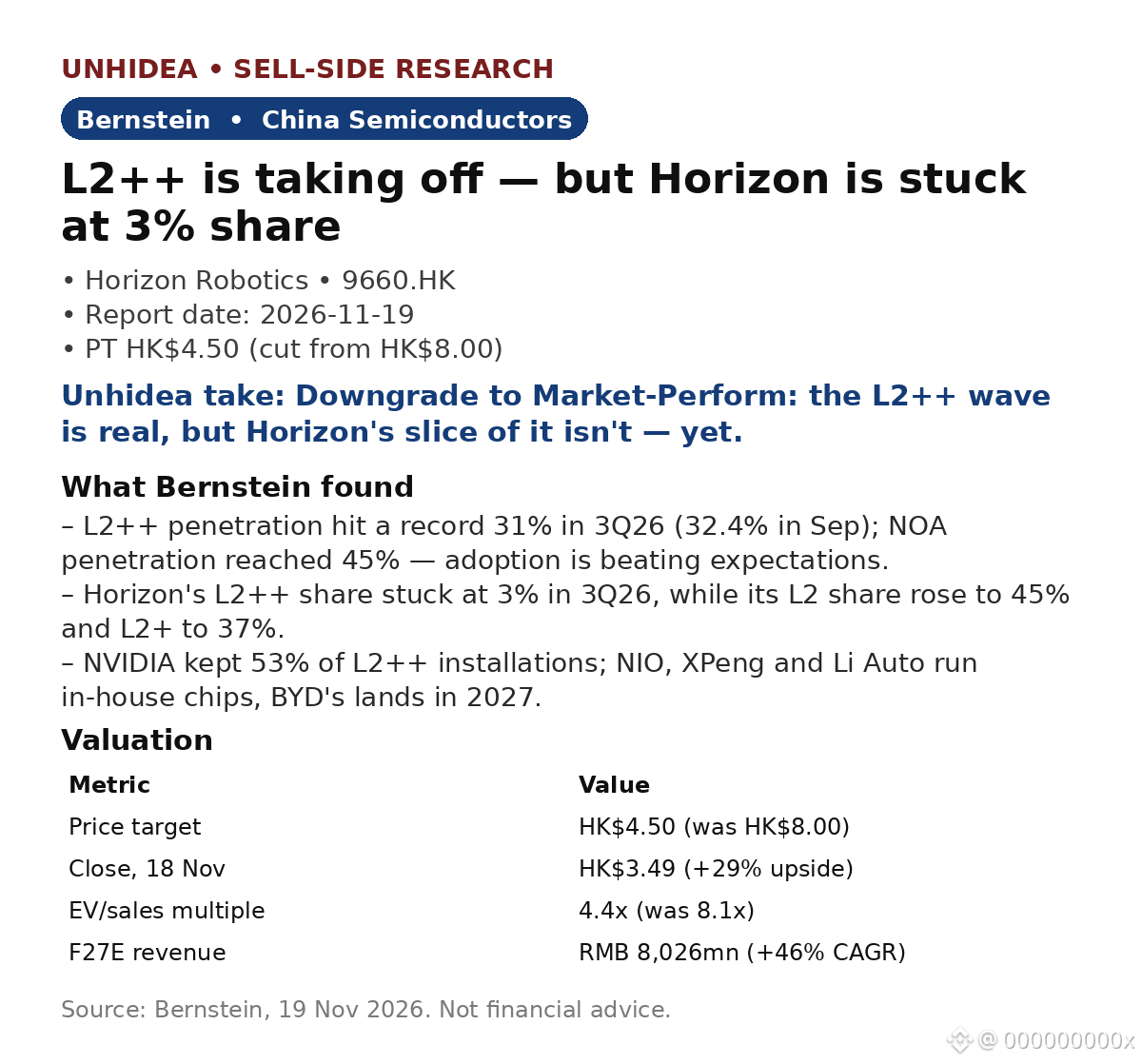
$9660.HK: Bernstein downgrades Horizon Robotics to Market-Perform, PT slashed HK$8.00 → HK$4.50 — L2++ is booming, but Horizon is missing it
- The wave is real: L2++ penetration hit a record 31% in 3Q26 (32.4% in September) and NOA reached 45% — adoption is running ahead of Bernstein's expectations.
- Horizon's slice isn't: its L2++ share stayed at 3% in 3Q26, even as L2 share rose to 45% and L2+ to 37%. Design wins and HSD-model sales keep missing.
- The squeeze: NVIDIA held 53% of L2++ installations in 3Q26; NIO, XPeng and Li Auto already run in-house chips, BYD's lands in 2027 and Chery is building its own.
- Headwinds on both sides: China PV sales fell 25% YoY in 3Q26, and Horizon is shifting toward a lower-visibility Licensing & Services model.
- Valuation: PT HK$4.50 is +29% vs the HK$3.49 close (18 Nov), on 4.4x EV/sales (was 8.1x) applied to 2BF revenue of RMB11.8bn. F27E revenue RMB8,026mn (+46.1% CAGR) — growth is not the problem, share is.
Unhidea take: the report frames this as a Horizon problem, but 31% penetration with NVIDIA at 53% says the merchant-chip race is consolidating around the incumbent — for every other merchant supplier, share is now won or lost at the OEM's in-house decision.
Unhidea take: if BYD's in-house SoC lands in 2027 as planned, Horizon's two key accounts (BYD, VW) become the whole thesis — watch design-win announcements, not quarterly revenue, as the leading indicator.
Risks: OEM in-house chips, weak China auto cycle, L2++ design-win conversion, licensing-model visibility.
Source: Bernstein, 19 Nov 2026. Not financial advice.
$9660.HK: Bernstein downgrades Horizon Robotics to Market-Perform, PT slashed HK$8.00 → HK$4.50 — L2++ is booming, but Horizon is missing it
- The wave is real: L2++ penetration hit a record 31% in 3Q26 (32.4% in September) and NOA reached 45% — adoption is running ahead of Bernstein's expectations.
- Horizon's slice isn't: its L2++ share stayed at 3% in 3Q26, even as L2 share rose to 45% and L2+ to 37%. Design wins and HSD-model sales keep missing.
- The squeeze: NVIDIA held 53% of L2++ installations in 3Q26; NIO, XPeng and Li Auto already run in-house chips, BYD's lands in 2027 and Chery is building its own.
- Headwinds on both sides: China PV sales fell 25% YoY in 3Q26, and Horizon is shifting toward a lower-visibility Licensing & Services model.
- Valuation: PT HK$4.50 is +29% vs the HK$3.49 close (18 Nov), on 4.4x EV/sales (was 8.1x) applied to 2BF revenue of RMB11.8bn. F27E revenue RMB8,026mn (+46.1% CAGR) — growth is not the problem, share is.
Unhidea take: the report frames this as a Horizon problem, but 31% penetration with NVIDIA at 53% says the merchant-chip race is consolidating around the incumbent — for every other merchant supplier, share is now won or lost at the OEM's in-house decision.
Unhidea take: if BYD's in-house SoC lands in 2027 as planned, Horizon's two key accounts (BYD, VW) become the whole thesis — watch design-win announcements, not quarterly revenue, as the leading indicator.
Risks: OEM in-house chips, weak China auto cycle, L2++ design-win conversion, licensing-model visibility.
Source: Bernstein, 19 Nov 2026. Not financial advice.
- The wave is real: L2++ penetration hit a record 31% in 3Q26 (32.4% in September) and NOA reached 45% — adoption is running ahead of Bernstein's expectations.
- Horizon's slice isn't: its L2++ share stayed at 3% in 3Q26, even as L2 share rose to 45% and L2+ to 37%. Design wins and HSD-model sales keep missing.
- The squeeze: NVIDIA held 53% of L2++ installations in 3Q26; NIO, XPeng and Li Auto already run in-house chips, BYD's lands in 2027 and Chery is building its own.
- Headwinds on both sides: China PV sales fell 25% YoY in 3Q26, and Horizon is shifting toward a lower-visibility Licensing & Services model.
- Valuation: PT HK$4.50 is +29% vs the HK$3.49 close (18 Nov), on 4.4x EV/sales (was 8.1x) applied to 2BF revenue of RMB11.8bn. F27E revenue RMB8,026mn (+46.1% CAGR) — growth is not the problem, share is.
Unhidea take: the report frames this as a Horizon problem, but 31% penetration with NVIDIA at 53% says the merchant-chip race is consolidating around the incumbent — for every other merchant supplier, share is now won or lost at the OEM's in-house decision.
Unhidea take: if BYD's in-house SoC lands in 2027 as planned, Horizon's two key accounts (BYD, VW) become the whole thesis — watch design-win announcements, not quarterly revenue, as the leading indicator.
Risks: OEM in-house chips, weak China auto cycle, L2++ design-win conversion, licensing-model visibility.
Source: Bernstein, 19 Nov 2026. Not financial advice.
NVDA-4,05%
LIUS-1,17%
125
·
--
Übersetzung ansehen
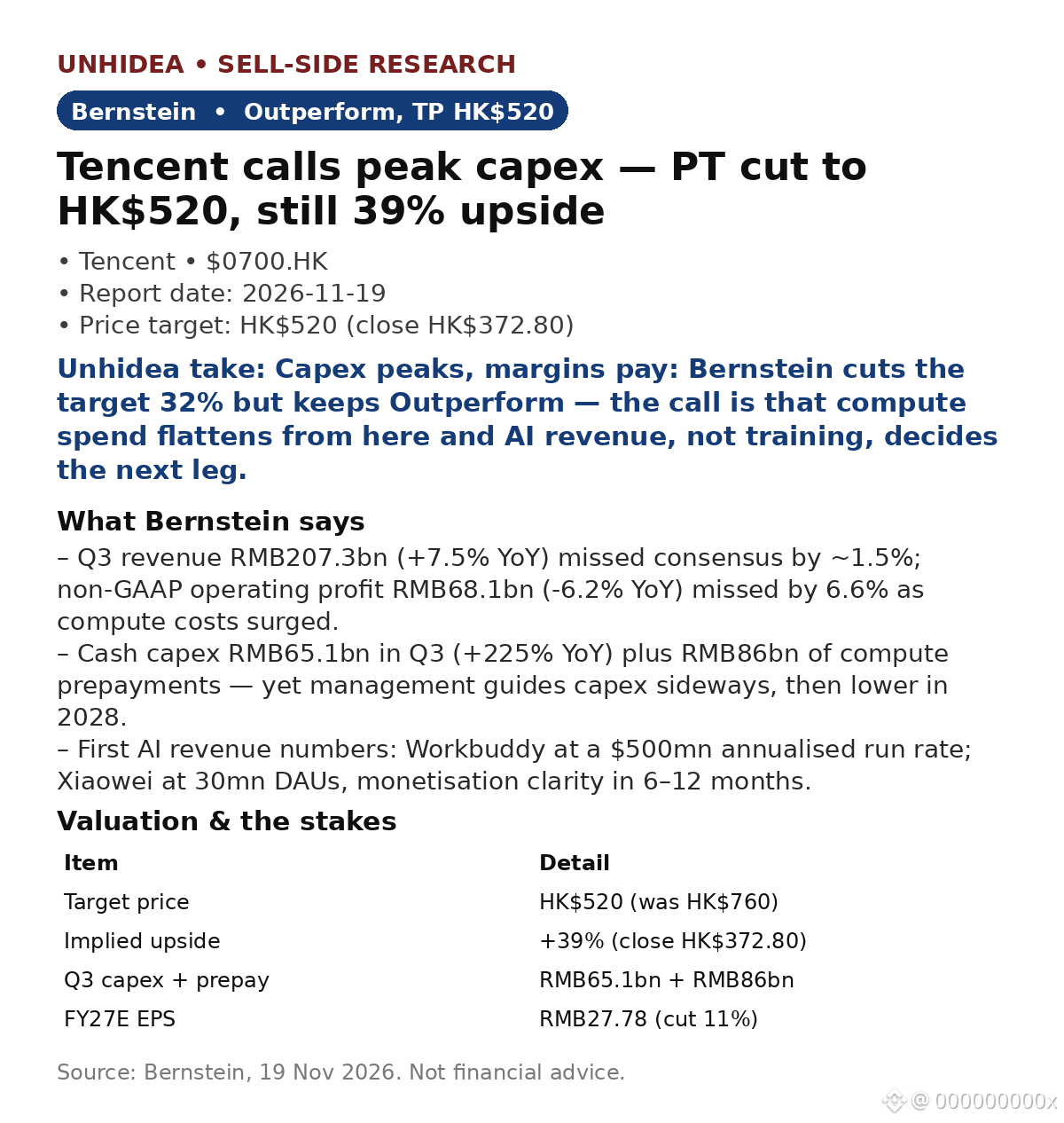
$0700.HK: Tencent calls peak capex — Bernstein keeps Outperform, PT HK$520 (cut from HK$760)
- Q3 revenue RMB207.3bn (+7.5% YoY), ~1.5% below consensus; non-GAAP operating profit RMB68.1bn (-6.2% YoY), 6.6% below consensus — compute costs did the damage.
- Capex is the story: RMB65.1bn in Q3 (+225% YoY) plus RMB86bn of compute prepayments — yet management says capex tracks sideways, then falls in 2028. Bernstein: the second name after Sony to call hardware costs unsustainable.
- The bill: bandwidth & server costs +132% YoY, non-staff R&D +152%. Ads still +18.8% to RMB43.0bn, gaming +4.6% to RMB66.5bn, FBS +9.4% to RMB63.7bn. Core operating profit ex-AI spend +8% to RMB83.3bn.
- First AI revenue numbers: Workbuddy at a $500mn annualised run rate; Xiaowei at 30mn DAUs, monetisation in 6–12 months. US chip curbs delay training, not inference revenue, Bernstein says.
- Valuation: PT HK$520 is +39% vs the HK$372.80 close (18 Nov), near the HK$370 52-week low, on ~11x trailing earnings after a 38% YTD slide; FY27E EPS cut 11% to RMB27.78.
Unhidea take: peak capex is the debate beyond Tencent — if a buyer of this scale flattens spend, the AI hardware cycle's duration is the question.
Unhidea take: Tencent trades at ~11x while the AI option is unpriced — Workbuddy and Xiaowei are the first hard numbers; if monetisation lands, Bernstein's 16x FY+1 multiple is the re-rating path.
Risks: US chip curbs, China macro, gaming comps, AI monetisation timing.
Source: Bernstein, 19 Nov 2026. Not financial advice.
$0700.HK: Tencent calls peak capex — Bernstein keeps Outperform, PT HK$520 (cut from HK$760)
- Q3 revenue RMB207.3bn (+7.5% YoY), ~1.5% below consensus; non-GAAP operating profit RMB68.1bn (-6.2% YoY), 6.6% below consensus — compute costs did the damage.
- Capex is the story: RMB65.1bn in Q3 (+225% YoY) plus RMB86bn of compute prepayments — yet management says capex tracks sideways, then falls in 2028. Bernstein: the second name after Sony to call hardware costs unsustainable.
- The bill: bandwidth & server costs +132% YoY, non-staff R&D +152%. Ads still +18.8% to RMB43.0bn, gaming +4.6% to RMB66.5bn, FBS +9.4% to RMB63.7bn. Core operating profit ex-AI spend +8% to RMB83.3bn.
- First AI revenue numbers: Workbuddy at a $500mn annualised run rate; Xiaowei at 30mn DAUs, monetisation in 6–12 months. US chip curbs delay training, not inference revenue, Bernstein says.
- Valuation: PT HK$520 is +39% vs the HK$372.80 close (18 Nov), near the HK$370 52-week low, on ~11x trailing earnings after a 38% YTD slide; FY27E EPS cut 11% to RMB27.78.
Unhidea take: peak capex is the debate beyond Tencent — if a buyer of this scale flattens spend, the AI hardware cycle's duration is the question.
Unhidea take: Tencent trades at ~11x while the AI option is unpriced — Workbuddy and Xiaowei are the first hard numbers; if monetisation lands, Bernstein's 16x FY+1 multiple is the re-rating path.
Risks: US chip curbs, China macro, gaming comps, AI monetisation timing.
Source: Bernstein, 19 Nov 2026. Not financial advice.
- Q3 revenue RMB207.3bn (+7.5% YoY), ~1.5% below consensus; non-GAAP operating profit RMB68.1bn (-6.2% YoY), 6.6% below consensus — compute costs did the damage.
- Capex is the story: RMB65.1bn in Q3 (+225% YoY) plus RMB86bn of compute prepayments — yet management says capex tracks sideways, then falls in 2028. Bernstein: the second name after Sony to call hardware costs unsustainable.
- The bill: bandwidth & server costs +132% YoY, non-staff R&D +152%. Ads still +18.8% to RMB43.0bn, gaming +4.6% to RMB66.5bn, FBS +9.4% to RMB63.7bn. Core operating profit ex-AI spend +8% to RMB83.3bn.
- First AI revenue numbers: Workbuddy at a $500mn annualised run rate; Xiaowei at 30mn DAUs, monetisation in 6–12 months. US chip curbs delay training, not inference revenue, Bernstein says.
- Valuation: PT HK$520 is +39% vs the HK$372.80 close (18 Nov), near the HK$370 52-week low, on ~11x trailing earnings after a 38% YTD slide; FY27E EPS cut 11% to RMB27.78.
Unhidea take: peak capex is the debate beyond Tencent — if a buyer of this scale flattens spend, the AI hardware cycle's duration is the question.
Unhidea take: Tencent trades at ~11x while the AI option is unpriced — Workbuddy and Xiaowei are the first hard numbers; if monetisation lands, Bernstein's 16x FY+1 multiple is the re-rating path.
Risks: US chip curbs, China macro, gaming comps, AI monetisation timing.
Source: Bernstein, 19 Nov 2026. Not financial advice.
114
·
--
Übersetzung ansehen
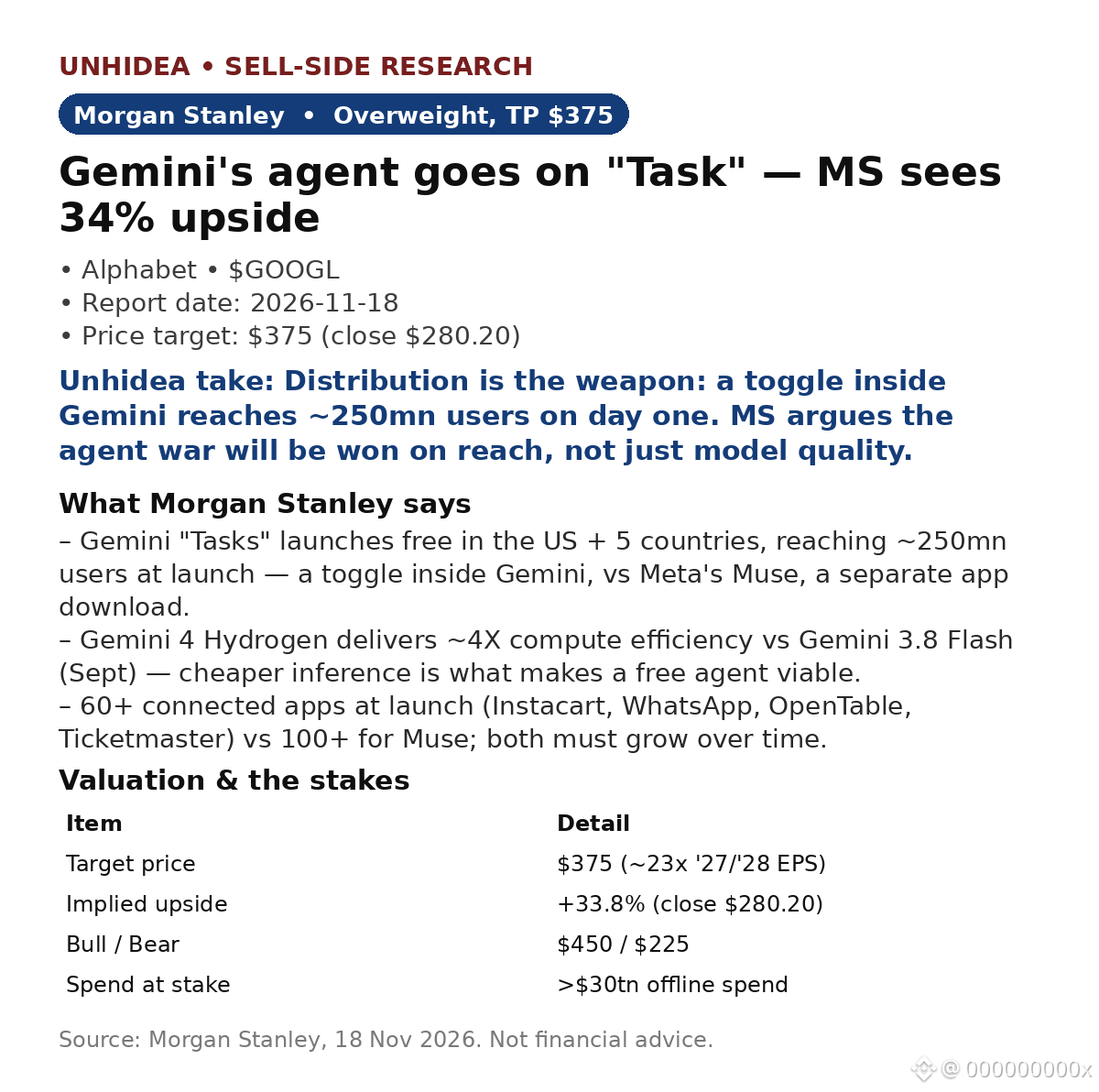
$GOOGL: Gemini's agent is now on "Task" — Morgan Stanley keeps Overweight, TP $375 (+34% vs $280.20 close on 17 Nov)
- "Tasks" rolls out free in the US + 5 countries to ~250mn users — a toggle inside Gemini (1bn+ MAUs), no download. Meta's Muse is a separate app with ~12mn MAUs (third-party data).
- Gemini 4 Hydrogen delivers ~4X compute efficiency vs Gemini 3.8 Flash (Sept). Meta targets a 10X cost gain for Muse in '27 — efficiency decides who can afford a free agent.
- 60+ connected apps at launch (Instacart, WhatsApp, OpenTable) vs 100+ for Muse. MS: agents that scale first win more business adoption — that favours Google.
- The catch: search monetizes ~20–40% of transaction value vs low-single-digit agentic commissions. If Tasks shifts queries without adding spend, it eats Google's best margin.
- MS sees >$30tn of offline spend up for grabs; bull $450, bear $225. Shares +0.8% to $282.44 on 18 Nov (post-report, Finnhub), ~31% below the $408.61 high.
Unhidea take: the agent war is a distribution war — a toggle in front of a billion users beats a download. The test is whether Tasks becomes a habit or a demo.
Unhidea take: watch search, not Tasks. If agentic shopping grows while search slows, the multiple compresses — MS's $375 assumes search stays durable.
Risks: search cannibalization, Meta/Amazon competition, AI capex/ROIC, regulation.
Source: Morgan Stanley, 18 Nov 2026. Not financial advice.
$GOOGL : Gemini's agent is now on "Task" — Morgan Stanley keeps Overweight, TP $375 (+34% vs $280.20 close on 17 Nov)
- "Tasks" rolls out free in the US + 5 countries to ~250mn users — a toggle inside Gemini (1bn+ MAUs), no download. Meta's Muse is a separate app with ~12mn MAUs (third-party data).
- Gemini 4 Hydrogen delivers ~4X compute efficiency vs Gemini 3.8 Flash (Sept). Meta targets a 10X cost gain for Muse in '27 — efficiency decides who can afford a free agent.
- 60+ connected apps at launch (Instacart, WhatsApp, OpenTable) vs 100+ for Muse. MS: agents that scale first win more business adoption — that favours Google.
- The catch: search monetizes ~20–40% of transaction value vs low-single-digit agentic commissions. If Tasks shifts queries without adding spend, it eats Google's best margin.
- MS sees >$30tn of offline spend up for grabs; bull $450, bear $225. Shares +0.8% to $282.44 on 18 Nov (post-report, Finnhub), ~31% below the $408.61 high.
Unhidea take: the agent war is a distribution war — a toggle in front of a billion users beats a download. The test is whether Tasks becomes a habit or a demo.
Unhidea take: watch search, not Tasks. If agentic shopping grows while search slows, the multiple compresses — MS's $375 assumes search stays durable.
Risks: search cannibalization, Meta/Amazon competition, AI capex/ROIC, regulation.
Source: Morgan Stanley, 18 Nov 2026. Not financial advice.
- "Tasks" rolls out free in the US + 5 countries to ~250mn users — a toggle inside Gemini (1bn+ MAUs), no download. Meta's Muse is a separate app with ~12mn MAUs (third-party data).
- Gemini 4 Hydrogen delivers ~4X compute efficiency vs Gemini 3.8 Flash (Sept). Meta targets a 10X cost gain for Muse in '27 — efficiency decides who can afford a free agent.
- 60+ connected apps at launch (Instacart, WhatsApp, OpenTable) vs 100+ for Muse. MS: agents that scale first win more business adoption — that favours Google.
- The catch: search monetizes ~20–40% of transaction value vs low-single-digit agentic commissions. If Tasks shifts queries without adding spend, it eats Google's best margin.
- MS sees >$30tn of offline spend up for grabs; bull $450, bear $225. Shares +0.8% to $282.44 on 18 Nov (post-report, Finnhub), ~31% below the $408.61 high.
Unhidea take: the agent war is a distribution war — a toggle in front of a billion users beats a download. The test is whether Tasks becomes a habit or a demo.
Unhidea take: watch search, not Tasks. If agentic shopping grows while search slows, the multiple compresses — MS's $375 assumes search stays durable.
Risks: search cannibalization, Meta/Amazon competition, AI capex/ROIC, regulation.
Source: Morgan Stanley, 18 Nov 2026. Not financial advice.
89
·
--
Übersetzung ansehen
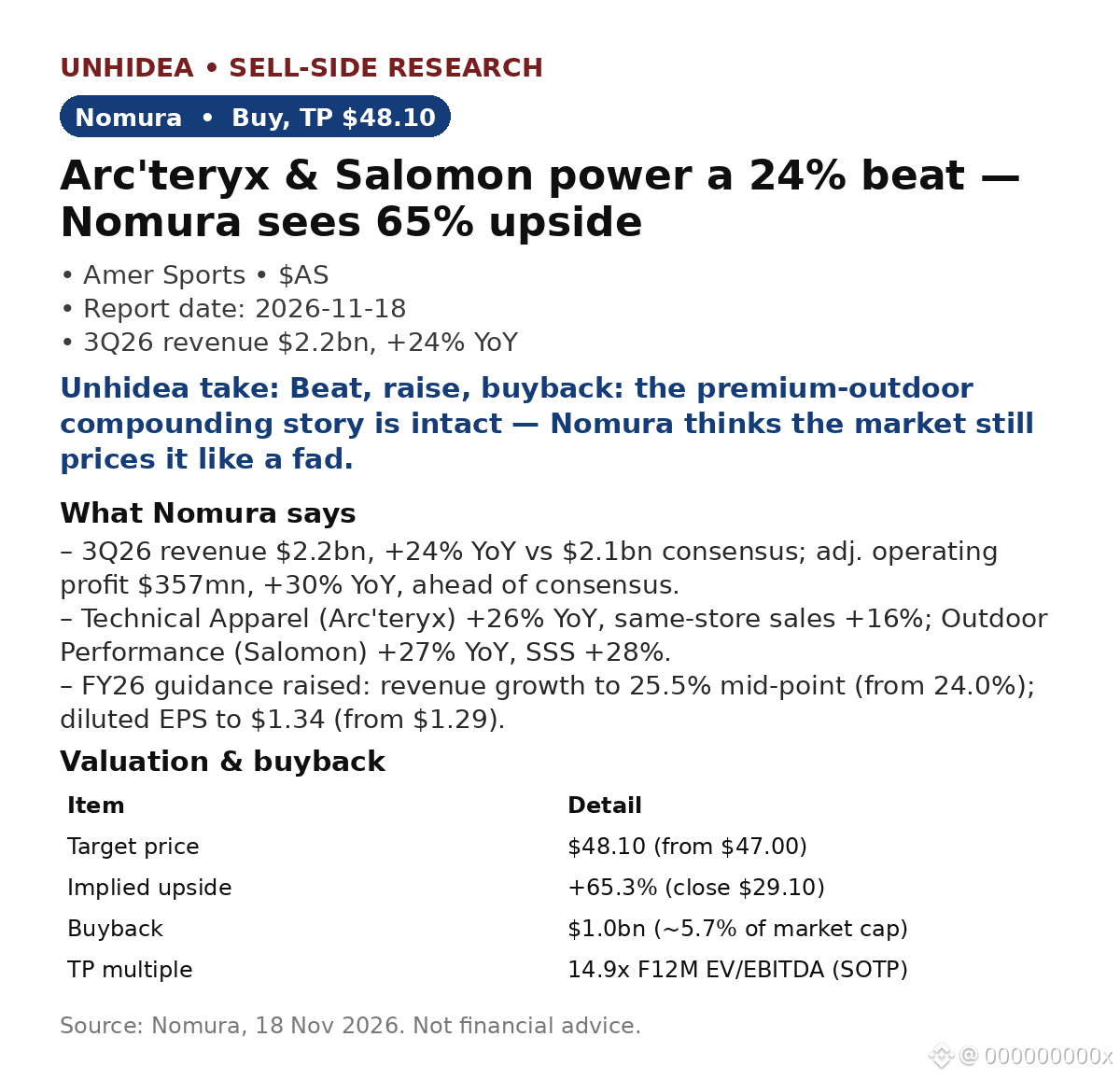
$AS: Arc'teryx & Salomon power a 24% beat — Nomura reiterates Buy, TP $48.10 (+65% upside)
- 3Q26 revenue $2.2bn, +24% YoY, vs $2.1bn consensus. Adj. operating profit $357mn, +30% YoY, ahead of consensus. Adj. EPS $0.42 vs $0.35 expected.
- Technical Apparel (Arc'teryx) +26% YoY, same-store sales +16%; Outdoor Performance (Salomon) +27% YoY, SSS +28%. Ball & Racquet +12%, but margin fell 2.1pp on Wilson investment.
- Guidance raised: FY26 revenue growth to 25.5% (from 24.0%); diluted EPS to $1.34 (from $1.29). A $1bn buyback (~5.7% of market cap) adds a floor.
- Shares +3.9% to $30.24 on 17 Nov while the S&P fell ~1%, then +2.3% to $30.95 on 18 Nov (post-report market data). SOTP target implies 14.9x forward EV/EBITDA.
Unhidea take: two brands growing 26–27% with DTC pricing power, plus a buyback floor — the market still prices Amer like a cyclical retailer; Nomura's 65% upside says brand platform.
Unhidea take: the Street is split — UBS cut its target to $56, Nomura holds $48.10, both Buy. That gap is the debate: what multiple for a 25% grower at 59.3% gross margin?
Risks: Wilson drag, DTC execution, tariffs/FX, premium-consumer slowdown.
Source: Nomura, 18 Nov 2026. Post-report prices: Finnhub/market data. Not financial advice.
$AS: Arc'teryx & Salomon power a 24% beat — Nomura reiterates Buy, TP $48.10 (+65% upside)
- 3Q26 revenue $2.2bn, +24% YoY, vs $2.1bn consensus. Adj. operating profit $357mn, +30% YoY, ahead of consensus. Adj. EPS $0.42 vs $0.35 expected.
- Technical Apparel (Arc'teryx) +26% YoY, same-store sales +16%; Outdoor Performance (Salomon) +27% YoY, SSS +28%. Ball & Racquet +12%, but margin fell 2.1pp on Wilson investment.
- Guidance raised: FY26 revenue growth to 25.5% (from 24.0%); diluted EPS to $1.34 (from $1.29). A $1bn buyback (~5.7% of market cap) adds a floor.
- Shares +3.9% to $30.24 on 17 Nov while the S&P fell ~1%, then +2.3% to $30.95 on 18 Nov (post-report market data). SOTP target implies 14.9x forward EV/EBITDA.
Unhidea take: two brands growing 26–27% with DTC pricing power, plus a buyback floor — the market still prices Amer like a cyclical retailer; Nomura's 65% upside says brand platform.
Unhidea take: the Street is split — UBS cut its target to $56, Nomura holds $48.10, both Buy. That gap is the debate: what multiple for a 25% grower at 59.3% gross margin?
Risks: Wilson drag, DTC execution, tariffs/FX, premium-consumer slowdown.
Source: Nomura, 18 Nov 2026. Post-report prices: Finnhub/market data. Not financial advice.
- 3Q26 revenue $2.2bn, +24% YoY, vs $2.1bn consensus. Adj. operating profit $357mn, +30% YoY, ahead of consensus. Adj. EPS $0.42 vs $0.35 expected.
- Technical Apparel (Arc'teryx) +26% YoY, same-store sales +16%; Outdoor Performance (Salomon) +27% YoY, SSS +28%. Ball & Racquet +12%, but margin fell 2.1pp on Wilson investment.
- Guidance raised: FY26 revenue growth to 25.5% (from 24.0%); diluted EPS to $1.34 (from $1.29). A $1bn buyback (~5.7% of market cap) adds a floor.
- Shares +3.9% to $30.24 on 17 Nov while the S&P fell ~1%, then +2.3% to $30.95 on 18 Nov (post-report market data). SOTP target implies 14.9x forward EV/EBITDA.
Unhidea take: two brands growing 26–27% with DTC pricing power, plus a buyback floor — the market still prices Amer like a cyclical retailer; Nomura's 65% upside says brand platform.
Unhidea take: the Street is split — UBS cut its target to $56, Nomura holds $48.10, both Buy. That gap is the debate: what multiple for a 25% grower at 59.3% gross margin?
Risks: Wilson drag, DTC execution, tariffs/FX, premium-consumer slowdown.
Source: Nomura, 18 Nov 2026. Post-report prices: Finnhub/market data. Not financial advice.
ASUS-0,25%
75
·
--
Übersetzung ansehen
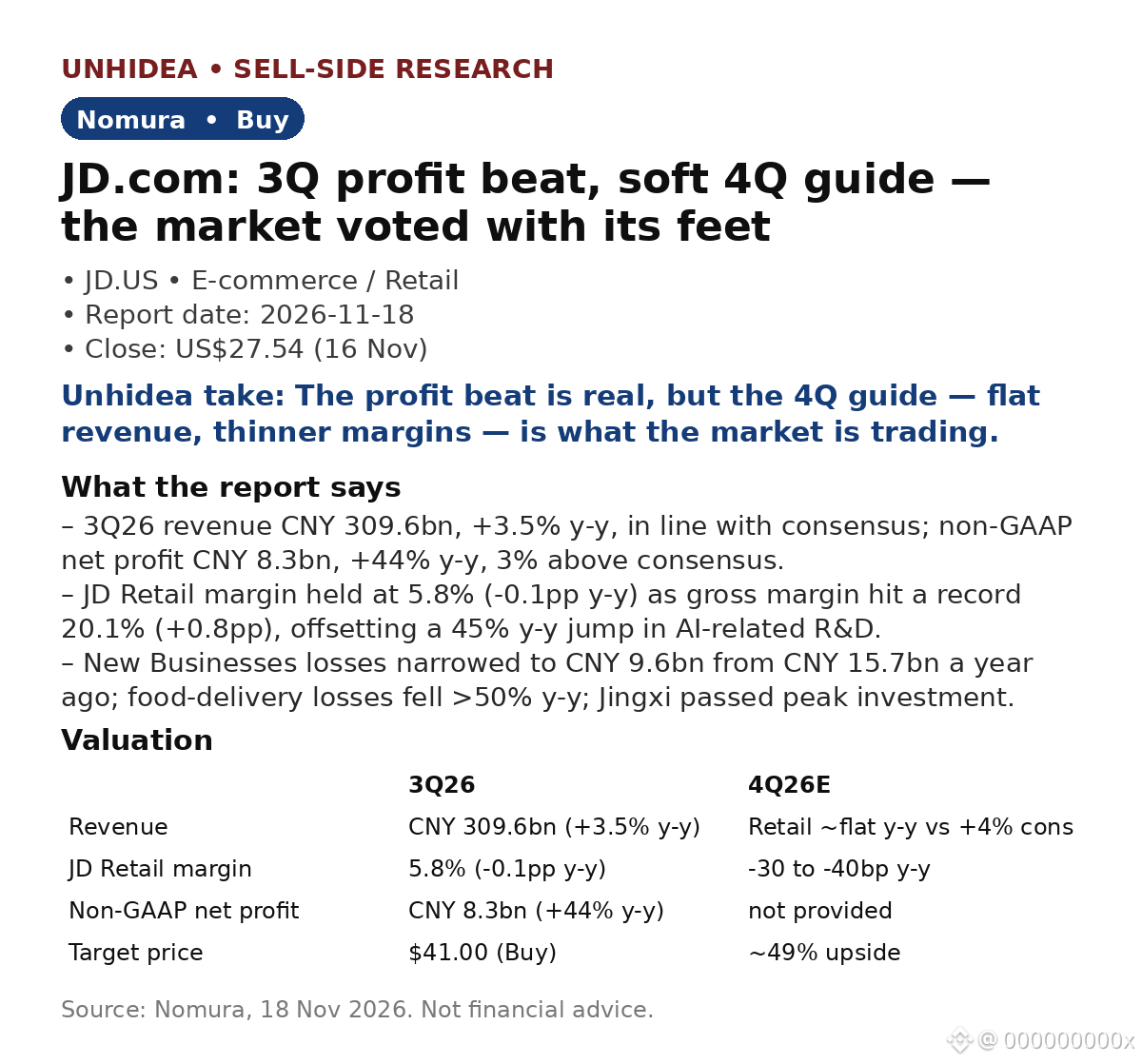
JD.com ($JD): Nomura stays Buy at $41 — a 3Q profit beat, a soft 4Q guide, and a market that voted with its feet
- 3Q26 revenue CNY 309.6bn, +3.5% y-y, in line; non-GAAP net profit CNY 8.3bn, +44% y-y, 3% above consensus; non-GAAP op profit CNY 7.3bn, 15% above consensus.
- JD Retail held a 5.8% margin (-0.1pp y-y); gross margin hit a record 20.1% (+0.8pp), offsetting a 45% y-y jump in AI R&D.
- New Businesses losses narrowed to CNY 9.6bn from CNY 15.7bn a year ago; food-delivery losses fell >50% y-y.
- But 4Q looks soft: JD Retail revenue seen flat y-y vs +4% consensus; margin -30 to -40bp y-y vs -10bp expected.
- Valuation: the $41 target implies 8.5x FY27E P/E vs 5.7x now — ~49% upside vs the $27.54 close on 16 Nov.
Unhidea take: the beat is real but backward-looking — the market is pricing the 4Q guide, not the 3Q print.
Unhidea take: JD's story is now margin discipline, not growth — shrinking losses matter more than a flat top line.
Market reaction: shares fell 7.7% on 17 Nov to $25.43, then 2.0% more on 18 Nov to $24.92 (Finnhub).
Risks: weak consumption; competition; CECONYOMY integration (deal closed 12 Nov).
Source: Nomura, 18 Nov 2026. Not financial advice.
JD.com ($JD): Nomura stays Buy at $41 — a 3Q profit beat, a soft 4Q guide, and a market that voted with its feet
- 3Q26 revenue CNY 309.6bn, +3.5% y-y, in line; non-GAAP net profit CNY 8.3bn, +44% y-y, 3% above consensus; non-GAAP op profit CNY 7.3bn, 15% above consensus.
- JD Retail held a 5.8% margin (-0.1pp y-y); gross margin hit a record 20.1% (+0.8pp), offsetting a 45% y-y jump in AI R&D.
- New Businesses losses narrowed to CNY 9.6bn from CNY 15.7bn a year ago; food-delivery losses fell >50% y-y.
- But 4Q looks soft: JD Retail revenue seen flat y-y vs +4% consensus; margin -30 to -40bp y-y vs -10bp expected.
- Valuation: the $41 target implies 8.5x FY27E P/E vs 5.7x now — ~49% upside vs the $27.54 close on 16 Nov.
Unhidea take: the beat is real but backward-looking — the market is pricing the 4Q guide, not the 3Q print.
Unhidea take: JD's story is now margin discipline, not growth — shrinking losses matter more than a flat top line.
Market reaction: shares fell 7.7% on 17 Nov to $25.43, then 2.0% more on 18 Nov to $24.92 (Finnhub).
Risks: weak consumption; competition; CECONYOMY integration (deal closed 12 Nov).
Source: Nomura, 18 Nov 2026. Not financial advice.
- 3Q26 revenue CNY 309.6bn, +3.5% y-y, in line; non-GAAP net profit CNY 8.3bn, +44% y-y, 3% above consensus; non-GAAP op profit CNY 7.3bn, 15% above consensus.
- JD Retail held a 5.8% margin (-0.1pp y-y); gross margin hit a record 20.1% (+0.8pp), offsetting a 45% y-y jump in AI R&D.
- New Businesses losses narrowed to CNY 9.6bn from CNY 15.7bn a year ago; food-delivery losses fell >50% y-y.
- But 4Q looks soft: JD Retail revenue seen flat y-y vs +4% consensus; margin -30 to -40bp y-y vs -10bp expected.
- Valuation: the $41 target implies 8.5x FY27E P/E vs 5.7x now — ~49% upside vs the $27.54 close on 16 Nov.
Unhidea take: the beat is real but backward-looking — the market is pricing the 4Q guide, not the 3Q print.
Unhidea take: JD's story is now margin discipline, not growth — shrinking losses matter more than a flat top line.
Market reaction: shares fell 7.7% on 17 Nov to $25.43, then 2.0% more on 18 Nov to $24.92 (Finnhub).
Risks: weak consumption; competition; CECONYOMY integration (deal closed 12 Nov).
Source: Nomura, 18 Nov 2026. Not financial advice.
JDUS+1,00%
4
·
--
Übersetzung ansehen
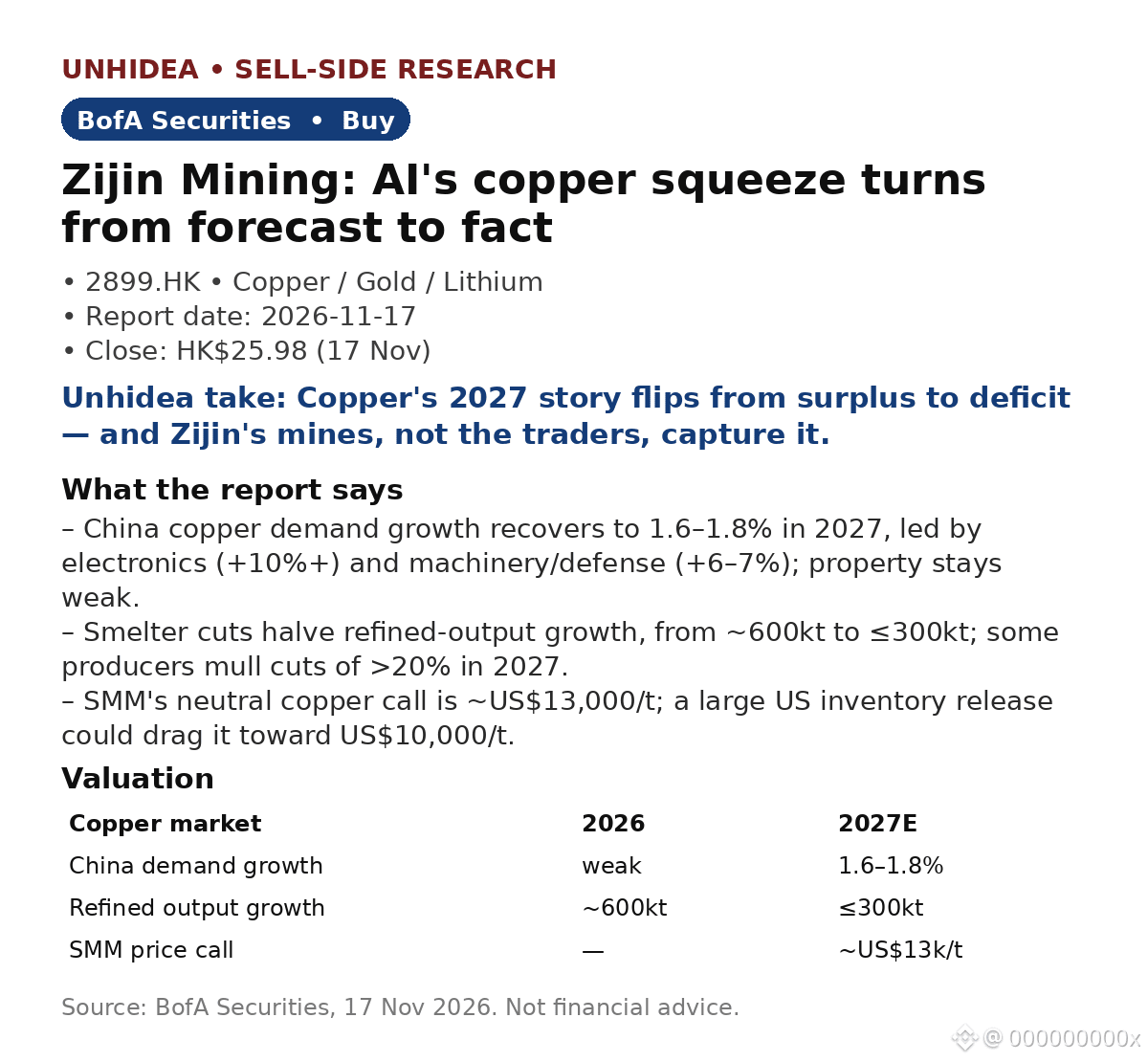
Zijin Mining (2899.HK): BofA stays Buy — China copper demand recovers as smelters cut
- China copper demand growth recovers to 1.6–1.8% in 2027, led by electronics (+10%+) and machinery/defense (+6–7%); property still weak.
- Smelter cuts halve refined-output growth, ~600kt to ≤300kt; SMM's neutral call is ~US$13,000/t, US inventory releases a risk toward US$10,000/t.
- Zijin keeps 2026 guidance (excl. ~50kt Kamoa-Kakula losses); existing mines deliver 1.40–1.45mnt in 2028 vs 1.50mnt target; Africa adds 300kt+.
- AI infra is the kicker: M8 CCL demand triples, 2.5mn to 7.5mn/month by end-2027; InP is >70% of Yunnan Germanium's net profit at >65% margin, orders locked thru 2027.
- Zijin rated Buy, HK$25.98 close on 17 Nov; price objective not restated in this note.
Unhidea take: copper is AI's forgotten bottleneck — the market debates GPUs while the metal wiring every data center flips from surplus to deficit.
Unhidea take: Zijin's edge is volume growth into a deficit — it grows while smelters shrink; in a tight market, tonnes beat multiples.
Risks: weak macro; US inventory releases; Kamoa-Kakula disruption.
Source: BofA Securities, 17 Nov 2026. Not financial advice.
Zijin Mining (2899.HK): BofA stays Buy — China copper demand recovers as smelters cut
- China copper demand growth recovers to 1.6–1.8% in 2027, led by electronics (+10%+) and machinery/defense (+6–7%); property still weak.
- Smelter cuts halve refined-output growth, ~600kt to ≤300kt; SMM's neutral call is ~US$13,000/t, US inventory releases a risk toward US$10,000/t.
- Zijin keeps 2026 guidance (excl. ~50kt Kamoa-Kakula losses); existing mines deliver 1.40–1.45mnt in 2028 vs 1.50mnt target; Africa adds 300kt+.
- AI infra is the kicker: M8 CCL demand triples, 2.5mn to 7.5mn/month by end-2027; InP is >70% of Yunnan Germanium's net profit at >65% margin, orders locked thru 2027.
- Zijin rated Buy, HK$25.98 close on 17 Nov; price objective not restated in this note.
Unhidea take: copper is AI's forgotten bottleneck — the market debates GPUs while the metal wiring every data center flips from surplus to deficit.
Unhidea take: Zijin's edge is volume growth into a deficit — it grows while smelters shrink; in a tight market, tonnes beat multiples.
Risks: weak macro; US inventory releases; Kamoa-Kakula disruption.
Source: BofA Securities, 17 Nov 2026. Not financial advice.
- China copper demand growth recovers to 1.6–1.8% in 2027, led by electronics (+10%+) and machinery/defense (+6–7%); property still weak.
- Smelter cuts halve refined-output growth, ~600kt to ≤300kt; SMM's neutral call is ~US$13,000/t, US inventory releases a risk toward US$10,000/t.
- Zijin keeps 2026 guidance (excl. ~50kt Kamoa-Kakula losses); existing mines deliver 1.40–1.45mnt in 2028 vs 1.50mnt target; Africa adds 300kt+.
- AI infra is the kicker: M8 CCL demand triples, 2.5mn to 7.5mn/month by end-2027; InP is >70% of Yunnan Germanium's net profit at >65% margin, orders locked thru 2027.
- Zijin rated Buy, HK$25.98 close on 17 Nov; price objective not restated in this note.
Unhidea take: copper is AI's forgotten bottleneck — the market debates GPUs while the metal wiring every data center flips from surplus to deficit.
Unhidea take: Zijin's edge is volume growth into a deficit — it grows while smelters shrink; in a tight market, tonnes beat multiples.
Risks: weak macro; US inventory releases; Kamoa-Kakula disruption.
Source: BofA Securities, 17 Nov 2026. Not financial advice.
53
·
--
Übersetzung ansehen
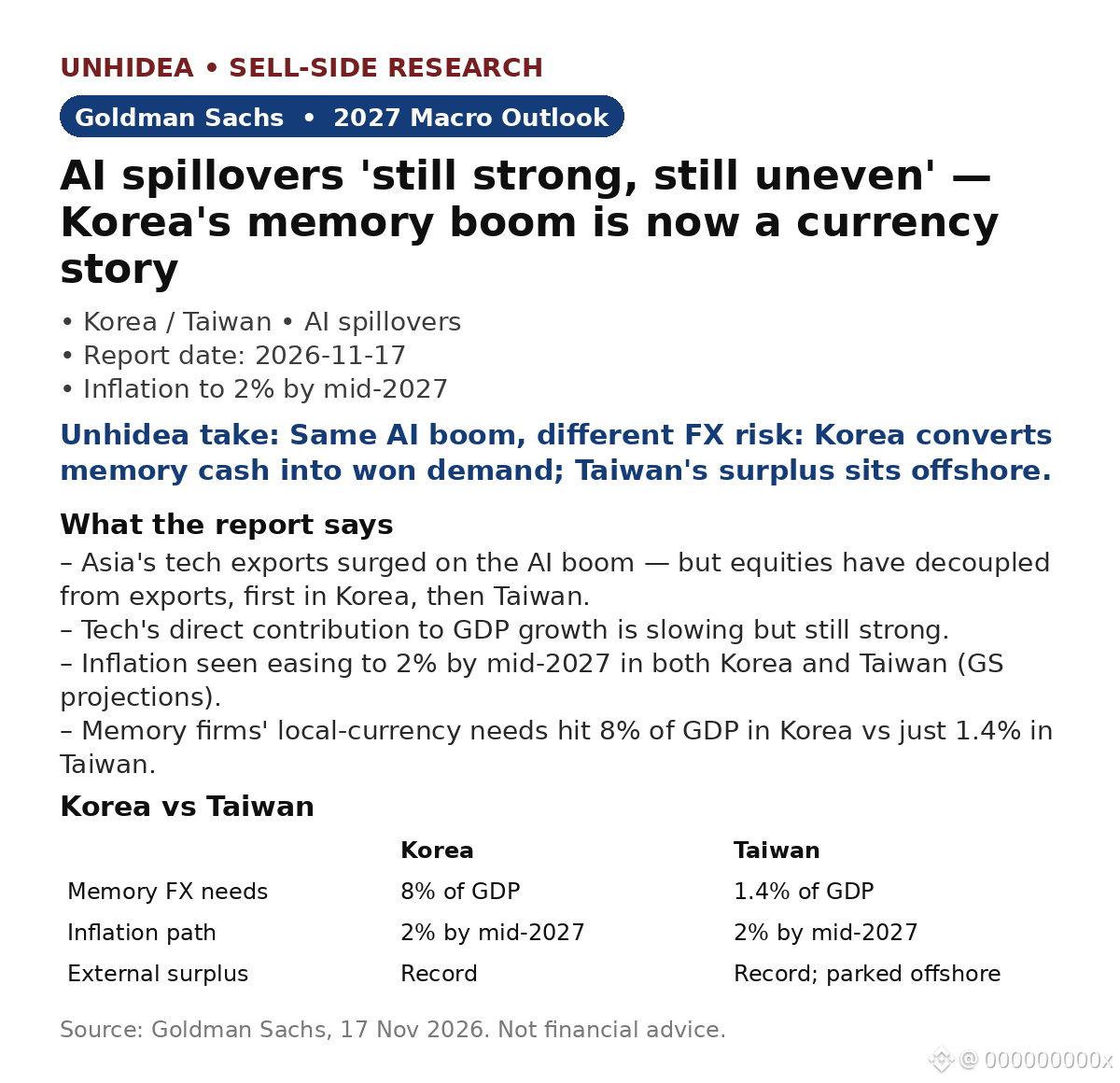
AI spillovers "still strong, still uneven": Goldman Sachs' 2027 Korea/Taiwan outlook — Samsung's memory windfall is now a currency story
- Asia's tech exports surged on the AI boom, but equities have decoupled from exports — first in Korea, then Taiwan. The index is no longer a clean read on the export cycle.
- Tech's direct contribution to GDP growth is slowing but still strong. Inflation is seen easing to 2% by mid-2027 in both Korea and Taiwan (GS projections).
- Memory companies' local-currency needs reach 8% of GDP in Korea vs just 1.4% in Taiwan. Korea converts the boom into won demand; Taiwan's record surplus is parked offshore.
- Post-report market news: Nvidia's FQ3 revenue was $115.84bn, +103% YoY vs ~$109bn expected, guiding ~$130bn vs ~$125bn expected — and Samsung and SK Hynix rallied in Korea after the print.
Unhidea take: the decoupling is the signal — Korea/Taiwan equities now trade the AI narrative and memory pricing, not export volumes. A soft export print no longer means a soft index, and vice versa.
Unhidea take: the 8% vs 1.4% gap is the real trade. Korea's won faces structural demand from memory cash conversion while Taiwan's surplus sits offshore — same AI boom, opposite FX pressure. Watch KRW, not just KOSPI.
Risks: AI capex cuts, memory price reversal, FX volatility, US-China export controls.
Source: Goldman Sachs, 17 Nov 2026. Not financial advice.
AI spillovers "still strong, still uneven": Goldman Sachs' 2027 Korea/Taiwan outlook — Samsung's memory windfall is now a currency story
- Asia's tech exports surged on the AI boom, but equities have decoupled from exports — first in Korea, then Taiwan. The index is no longer a clean read on the export cycle.
- Tech's direct contribution to GDP growth is slowing but still strong. Inflation is seen easing to 2% by mid-2027 in both Korea and Taiwan (GS projections).
- Memory companies' local-currency needs reach 8% of GDP in Korea vs just 1.4% in Taiwan. Korea converts the boom into won demand; Taiwan's record surplus is parked offshore.
- Post-report market news: Nvidia's FQ3 revenue was $115.84bn, +103% YoY vs ~$109bn expected, guiding ~$130bn vs ~$125bn expected — and Samsung and SK Hynix rallied in Korea after the print.
Unhidea take: the decoupling is the signal — Korea/Taiwan equities now trade the AI narrative and memory pricing, not export volumes. A soft export print no longer means a soft index, and vice versa.
Unhidea take: the 8% vs 1.4% gap is the real trade. Korea's won faces structural demand from memory cash conversion while Taiwan's surplus sits offshore — same AI boom, opposite FX pressure. Watch KRW, not just KOSPI.
Risks: AI capex cuts, memory price reversal, FX volatility, US-China export controls.
Source: Goldman Sachs, 17 Nov 2026. Not financial advice.
- Asia's tech exports surged on the AI boom, but equities have decoupled from exports — first in Korea, then Taiwan. The index is no longer a clean read on the export cycle.
- Tech's direct contribution to GDP growth is slowing but still strong. Inflation is seen easing to 2% by mid-2027 in both Korea and Taiwan (GS projections).
- Memory companies' local-currency needs reach 8% of GDP in Korea vs just 1.4% in Taiwan. Korea converts the boom into won demand; Taiwan's record surplus is parked offshore.
- Post-report market news: Nvidia's FQ3 revenue was $115.84bn, +103% YoY vs ~$109bn expected, guiding ~$130bn vs ~$125bn expected — and Samsung and SK Hynix rallied in Korea after the print.
Unhidea take: the decoupling is the signal — Korea/Taiwan equities now trade the AI narrative and memory pricing, not export volumes. A soft export print no longer means a soft index, and vice versa.
Unhidea take: the 8% vs 1.4% gap is the real trade. Korea's won faces structural demand from memory cash conversion while Taiwan's surplus sits offshore — same AI boom, opposite FX pressure. Watch KRW, not just KOSPI.
Risks: AI capex cuts, memory price reversal, FX volatility, US-China export controls.
Source: Goldman Sachs, 17 Nov 2026. Not financial advice.
420
·
--
Übersetzung ansehen
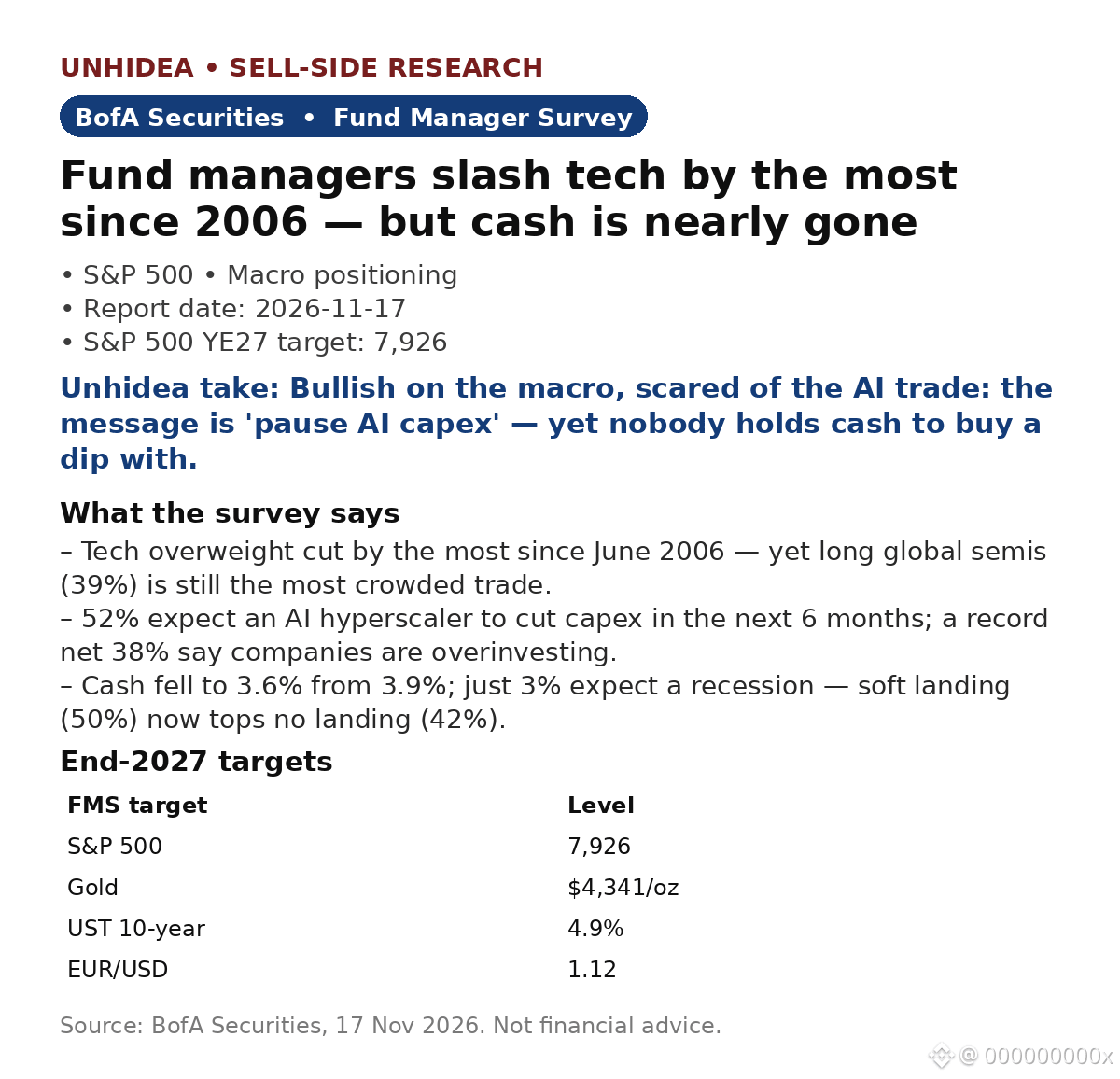
$SPX: BofA's fund manager survey — tech dumped by the most since 2006, yet cash is nearly gone
- Investors slashed tech overweight by the most since June 2006, but long global semis (39%) is still the most crowded trade. 193 managers, $526bn, surveyed 6–12 Nov.
- 52% expect an AI hyperscaler to cut capex in the next 6 months; a record net 38% say companies are overinvesting; only 16% want firms to boost capex — lowest since May 2020.
- Cash fell to 3.6% from 3.9%. BofA stays tactically risk-off: not enough "fear" to buy. Just 3% expect a recession; soft landing (50%) now tops no landing (42%) for the first time since June.
- Top tail risks: AI bubble (34%) and hyperscaler credit event (31%). 38% name AI hyperscaler bonds the most likely source of a systemic credit event, ahead of private credit (30%).
- End-2027 targets: S&P 500 7,926, gold $4,341/oz — a record net 23% call gold undervalued — UST 10y 4.9%, EUR/USD 1.12.
Unhidea take: the survey is long the AI trade and scared of it at the same time — 39% crowded long semis, 52% expecting a capex cut. That is a positioning trap, not a bubble call: the pain trade is a capex headline, not a recession.
Unhidea take: with cash at 3.6%, there is no dry powder left. BofA's "not enough fear to buy" means the next leg down, if it comes, has no natural buyers. Watch the 52%: it turns self-fulfilling the moment one hyperscaler blinks.
Risks: AI capex cuts, hyperscaler credit stress, sticky inflation, disorderly bond yields.
Source: BofA Securities, 17 Nov 2026. Not financial advice.
$SPX : BofA's fund manager survey — tech dumped by the most since 2006, yet cash is nearly gone
- Investors slashed tech overweight by the most since June 2006, but long global semis (39%) is still the most crowded trade. 193 managers, $526bn, surveyed 6–12 Nov.
- 52% expect an AI hyperscaler to cut capex in the next 6 months; a record net 38% say companies are overinvesting; only 16% want firms to boost capex — lowest since May 2020.
- Cash fell to 3.6% from 3.9%. BofA stays tactically risk-off: not enough "fear" to buy. Just 3% expect a recession; soft landing (50%) now tops no landing (42%) for the first time since June.
- Top tail risks: AI bubble (34%) and hyperscaler credit event (31%). 38% name AI hyperscaler bonds the most likely source of a systemic credit event, ahead of private credit (30%).
- End-2027 targets: S&P 500 7,926, gold $4,341/oz — a record net 23% call gold undervalued — UST 10y 4.9%, EUR/USD 1.12.
Unhidea take: the survey is long the AI trade and scared of it at the same time — 39% crowded long semis, 52% expecting a capex cut. That is a positioning trap, not a bubble call: the pain trade is a capex headline, not a recession.
Unhidea take: with cash at 3.6%, there is no dry powder left. BofA's "not enough fear to buy" means the next leg down, if it comes, has no natural buyers. Watch the 52%: it turns self-fulfilling the moment one hyperscaler blinks.
Risks: AI capex cuts, hyperscaler credit stress, sticky inflation, disorderly bond yields.
Source: BofA Securities, 17 Nov 2026. Not financial advice.
- Investors slashed tech overweight by the most since June 2006, but long global semis (39%) is still the most crowded trade. 193 managers, $526bn, surveyed 6–12 Nov.
- 52% expect an AI hyperscaler to cut capex in the next 6 months; a record net 38% say companies are overinvesting; only 16% want firms to boost capex — lowest since May 2020.
- Cash fell to 3.6% from 3.9%. BofA stays tactically risk-off: not enough "fear" to buy. Just 3% expect a recession; soft landing (50%) now tops no landing (42%) for the first time since June.
- Top tail risks: AI bubble (34%) and hyperscaler credit event (31%). 38% name AI hyperscaler bonds the most likely source of a systemic credit event, ahead of private credit (30%).
- End-2027 targets: S&P 500 7,926, gold $4,341/oz — a record net 23% call gold undervalued — UST 10y 4.9%, EUR/USD 1.12.
Unhidea take: the survey is long the AI trade and scared of it at the same time — 39% crowded long semis, 52% expecting a capex cut. That is a positioning trap, not a bubble call: the pain trade is a capex headline, not a recession.
Unhidea take: with cash at 3.6%, there is no dry powder left. BofA's "not enough fear to buy" means the next leg down, if it comes, has no natural buyers. Watch the 52%: it turns self-fulfilling the moment one hyperscaler blinks.
Risks: AI capex cuts, hyperscaler credit stress, sticky inflation, disorderly bond yields.
Source: BofA Securities, 17 Nov 2026. Not financial advice.
180
·
--
Übersetzung ansehen
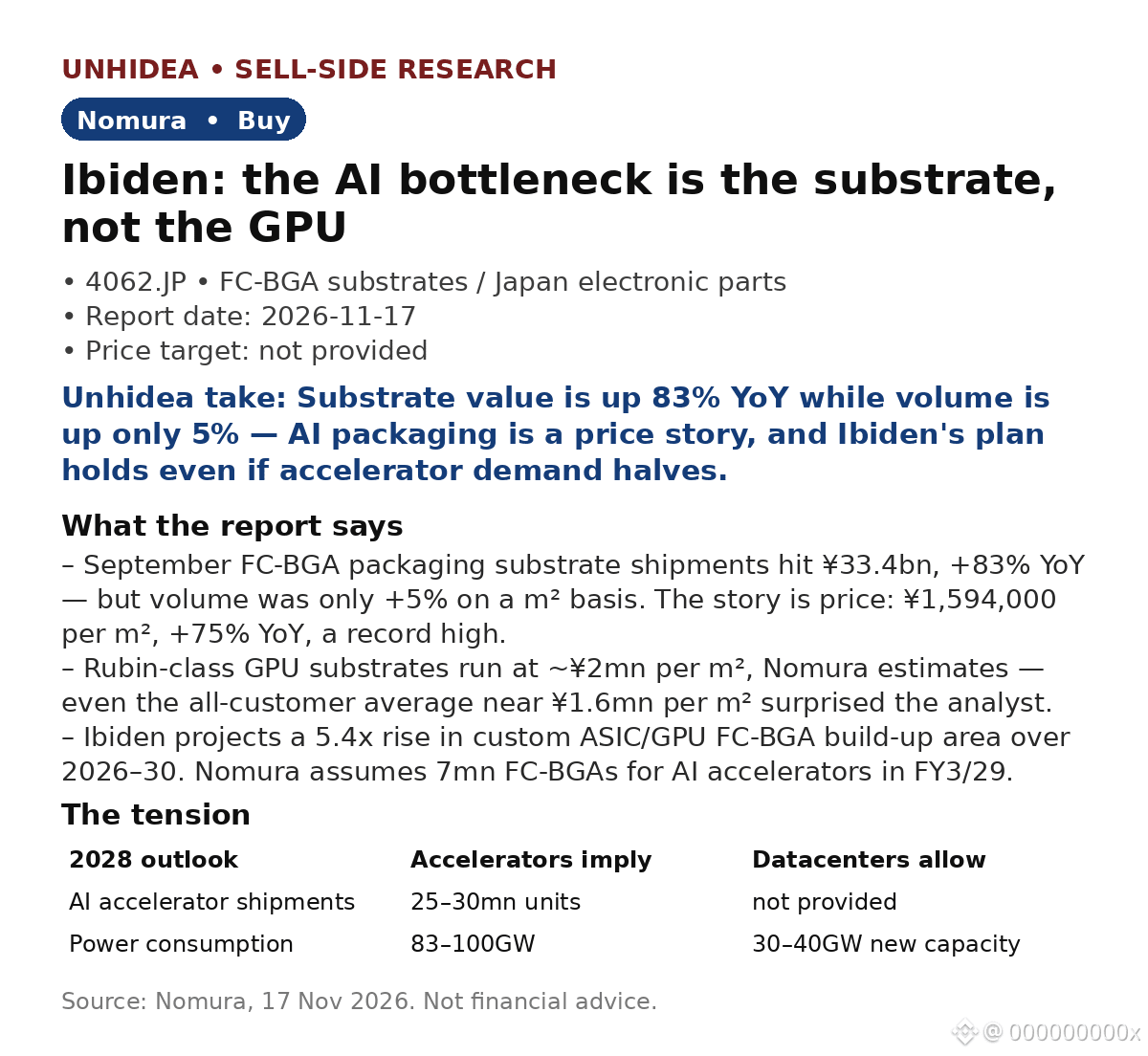
Ibiden (4062.JP): the AI bottleneck isn't the GPU — it's the substrate it sits on. Nomura rates it Buy as Japan's FC-BGA shipments jump 83% YoY.
- Sept FC-BGA substrates hit ¥33.4bn, +83% YoY — but volume only +5%. The story is price: ¥1,594,000/m², +75% YoY, a record. Rubin-class GPU substrates run ~¥2mn/m².
- Nomura's warning: 2028 accelerator forecasts (25–30mn units) imply 83–100GW of power — yet the market expects only 30–40GW of new US datacenter capacity in 2028. Something has to give.
- Ibiden projects a 5.4x rise in FC-BGA build-up area over 2026–30; Nomura assumes 7mn AI-accelerator FC-BGAs in FY3/29, achievable even if accelerator shipments halve to 12.5–15mn.
- Since the report: NVDA's FQ3 print (Nov 17) — revenue $115.84bn, +103% YoY, Q4 guide ~$130bn — demand vs the construction-delay worry. (Post-report market news.)
Unhidea take: substrates are where AI demand becomes a priced, physical bottleneck — value compounds on price and mix, not units.
Unhidea take: the question is no longer whether AI demand exists, but whether datacenters get built fast enough to house it. Ibiden's plan is sized for the bear case.
Risks: rival capacity could ease tight supply-demand; datacenter delays and tighter US export controls could cut accelerator demand.
Source: Nomura, 17 Nov 2026. Not financial advice.
Ibiden (4062.JP): the AI bottleneck isn't the GPU — it's the substrate it sits on. Nomura rates it Buy as Japan's FC-BGA shipments jump 83% YoY.
- Sept FC-BGA substrates hit ¥33.4bn, +83% YoY — but volume only +5%. The story is price: ¥1,594,000/m², +75% YoY, a record. Rubin-class GPU substrates run ~¥2mn/m².
- Nomura's warning: 2028 accelerator forecasts (25–30mn units) imply 83–100GW of power — yet the market expects only 30–40GW of new US datacenter capacity in 2028. Something has to give.
- Ibiden projects a 5.4x rise in FC-BGA build-up area over 2026–30; Nomura assumes 7mn AI-accelerator FC-BGAs in FY3/29, achievable even if accelerator shipments halve to 12.5–15mn.
- Since the report: NVDA's FQ3 print (Nov 17) — revenue $115.84bn, +103% YoY, Q4 guide ~$130bn — demand vs the construction-delay worry. (Post-report market news.)
Unhidea take: substrates are where AI demand becomes a priced, physical bottleneck — value compounds on price and mix, not units.
Unhidea take: the question is no longer whether AI demand exists, but whether datacenters get built fast enough to house it. Ibiden's plan is sized for the bear case.
Risks: rival capacity could ease tight supply-demand; datacenter delays and tighter US export controls could cut accelerator demand.
Source: Nomura, 17 Nov 2026. Not financial advice.
- Sept FC-BGA substrates hit ¥33.4bn, +83% YoY — but volume only +5%. The story is price: ¥1,594,000/m², +75% YoY, a record. Rubin-class GPU substrates run ~¥2mn/m².
- Nomura's warning: 2028 accelerator forecasts (25–30mn units) imply 83–100GW of power — yet the market expects only 30–40GW of new US datacenter capacity in 2028. Something has to give.
- Ibiden projects a 5.4x rise in FC-BGA build-up area over 2026–30; Nomura assumes 7mn AI-accelerator FC-BGAs in FY3/29, achievable even if accelerator shipments halve to 12.5–15mn.
- Since the report: NVDA's FQ3 print (Nov 17) — revenue $115.84bn, +103% YoY, Q4 guide ~$130bn — demand vs the construction-delay worry. (Post-report market news.)
Unhidea take: substrates are where AI demand becomes a priced, physical bottleneck — value compounds on price and mix, not units.
Unhidea take: the question is no longer whether AI demand exists, but whether datacenters get built fast enough to house it. Ibiden's plan is sized for the bear case.
Risks: rival capacity could ease tight supply-demand; datacenter delays and tighter US export controls could cut accelerator demand.
Source: Nomura, 17 Nov 2026. Not financial advice.
245
·
--
Übersetzung ansehen
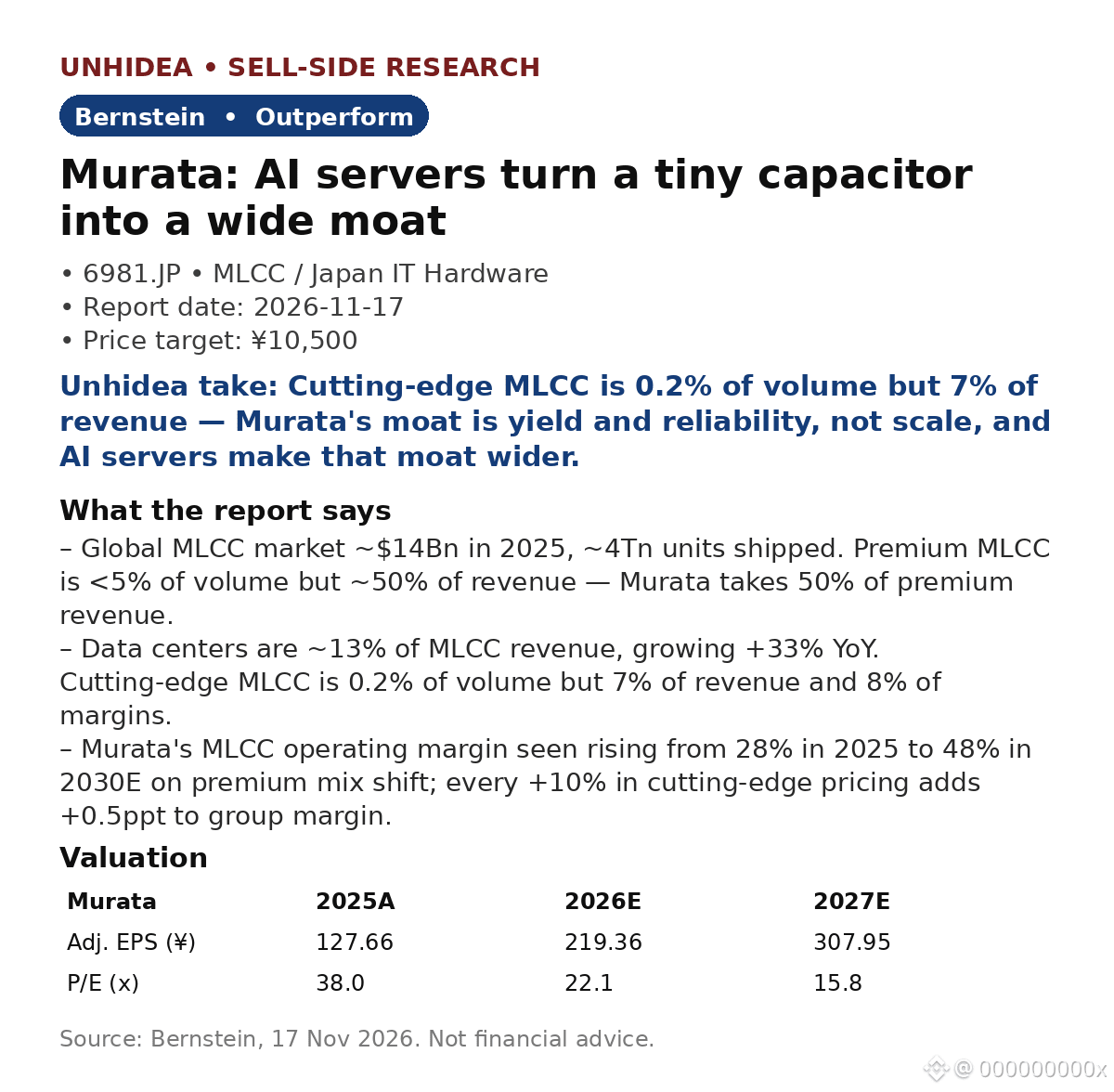
Murata (6981.JP): Bernstein sees ~116% upside as AI servers turn a tiny capacitor into a wide moat — target ¥10,500 vs ¥4,855 close on 16 Nov
- Global MLCC market ~$14Bn in 2025, ~4Tn units. Premium is <5% of volume but ~50% of revenue — Murata takes 50% of premium revenue.
- Data centers ~13% of MLCC revenue, +33% YoY. Cutting-edge MLCC: 0.2% of volume, 7% of revenue, 8% of margins.
- AI-server MLCCs must run 24/7 for 10+ years, near-zero failure — a bar most rivals can't clear at scale. Murata R&D is 9% of revenue vs 4–7% for peers.
- Mix shift, not price hikes: Murata MLCC margin seen rising 28% (2025) to 48% (2030E). Every +10% in cutting-edge pricing adds +0.5ppt to group margin.
- Bernstein reiterates Outperform, TP ¥10,500. Adj. EPS ¥219.36 in 2026E (+72% YoY), ¥307.95 in 2027E; 22.1x / 15.8x P/E.
Unhidea take: the AI trade has been about GPUs and power — but every AI rack needs thousands of MLCCs that cannot fail. Murata's edge is the boring, certified, yield-driven kind that compounds quietly.
Unhidea take: Bernstein gives China 5–10 years to catch up on premium MLCC. The AI buildout is happening now, and the qualified supplier list is effectively two names long — that window is the investment case.
Risks: Murata is reluctant to raise prices, so mix shift must deliver; an AI server slowdown or weak smartphone/auto demand would hit volumes.
Source: Bernstein, 17 Nov 2026. Not financial advice.
Murata (6981.JP): Bernstein sees ~116% upside as AI servers turn a tiny capacitor into a wide moat — target ¥10,500 vs ¥4,855 close on 16 Nov
- Global MLCC market ~$14Bn in 2025, ~4Tn units. Premium is <5% of volume but ~50% of revenue — Murata takes 50% of premium revenue.
- Data centers ~13% of MLCC revenue, +33% YoY. Cutting-edge MLCC: 0.2% of volume, 7% of revenue, 8% of margins.
- AI-server MLCCs must run 24/7 for 10+ years, near-zero failure — a bar most rivals can't clear at scale. Murata R&D is 9% of revenue vs 4–7% for peers.
- Mix shift, not price hikes: Murata MLCC margin seen rising 28% (2025) to 48% (2030E). Every +10% in cutting-edge pricing adds +0.5ppt to group margin.
- Bernstein reiterates Outperform, TP ¥10,500. Adj. EPS ¥219.36 in 2026E (+72% YoY), ¥307.95 in 2027E; 22.1x / 15.8x P/E.
Unhidea take: the AI trade has been about GPUs and power — but every AI rack needs thousands of MLCCs that cannot fail. Murata's edge is the boring, certified, yield-driven kind that compounds quietly.
Unhidea take: Bernstein gives China 5–10 years to catch up on premium MLCC. The AI buildout is happening now, and the qualified supplier list is effectively two names long — that window is the investment case.
Risks: Murata is reluctant to raise prices, so mix shift must deliver; an AI server slowdown or weak smartphone/auto demand would hit volumes.
Source: Bernstein, 17 Nov 2026. Not financial advice.
- Global MLCC market ~$14Bn in 2025, ~4Tn units. Premium is <5% of volume but ~50% of revenue — Murata takes 50% of premium revenue.
- Data centers ~13% of MLCC revenue, +33% YoY. Cutting-edge MLCC: 0.2% of volume, 7% of revenue, 8% of margins.
- AI-server MLCCs must run 24/7 for 10+ years, near-zero failure — a bar most rivals can't clear at scale. Murata R&D is 9% of revenue vs 4–7% for peers.
- Mix shift, not price hikes: Murata MLCC margin seen rising 28% (2025) to 48% (2030E). Every +10% in cutting-edge pricing adds +0.5ppt to group margin.
- Bernstein reiterates Outperform, TP ¥10,500. Adj. EPS ¥219.36 in 2026E (+72% YoY), ¥307.95 in 2027E; 22.1x / 15.8x P/E.
Unhidea take: the AI trade has been about GPUs and power — but every AI rack needs thousands of MLCCs that cannot fail. Murata's edge is the boring, certified, yield-driven kind that compounds quietly.
Unhidea take: Bernstein gives China 5–10 years to catch up on premium MLCC. The AI buildout is happening now, and the qualified supplier list is effectively two names long — that window is the investment case.
Risks: Murata is reluctant to raise prices, so mix shift must deliver; an AI server slowdown or weak smartphone/auto demand would hit volumes.
Source: Bernstein, 17 Nov 2026. Not financial advice.
4
·
--
Übersetzung ansehen
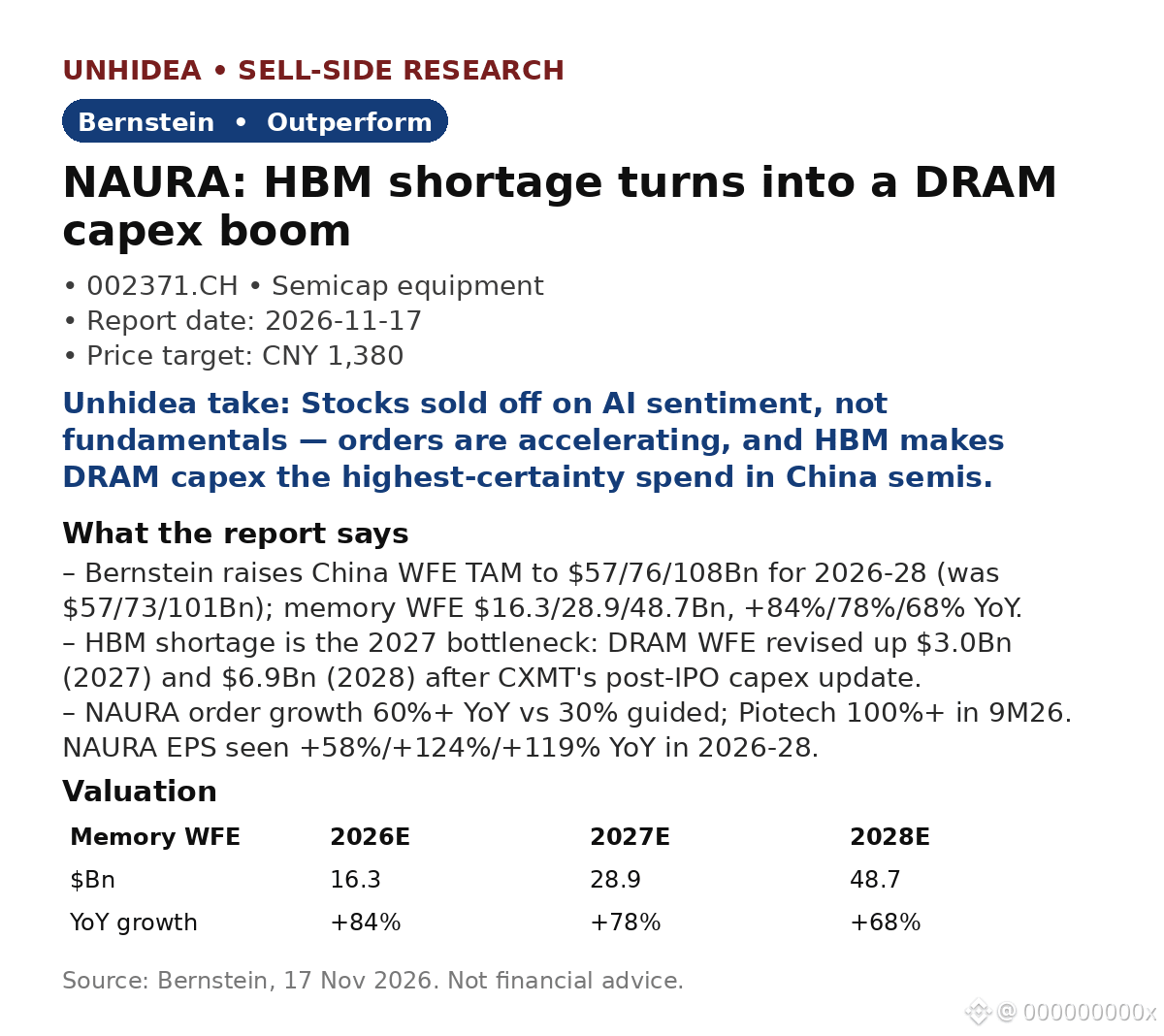
$NAURA: Bernstein's top pick as China's HBM shortage turns into a DRAM capex boom — target CNY 1,380 implies ~153% upside
- Bernstein raises China WFE TAM to $57/76/108Bn for 2026-28 (was $57/73/101Bn); memory WFE $16.3/28.9/48.7Bn, growing +84%/78%/68% YoY.
- HBM shortage is the 2027 bottleneck: DRAM WFE revised up $3.0Bn (2027) and $6.9Bn (2028) after CXMT's post-IPO capex update; YMTC DRAM expansion starts in 2027.
- NAURA order growth is 60%+ YoY vs 30% guided; EPS seen rising +58%/+124%/+119% YoY in 2026-28. Piotech orders 100%+ in 9M26.
- Localization steps up: mature-logic fabs' local-tool share jumps from <20% to 50%+ next year; Bernstein sees localization at 36%/49% in 2027/28.
- NAURA rated Outperform, target CNY 1,380 vs CNY 546.39 close on 16 Nov, at 32x 2028E P/E. AMEC CNY 660 and Piotech CNY 1,200, both Outperform.
Unhidea take: the market is pricing AI sentiment, not the order book — 60%+ order growth in a sector Bernstein says is "clearly not trading on fundamentals" is the disconnect; strong 1Q27 orders would be the re-rating trigger.
Unhidea take: HBM is the choke point that makes DRAM capex the most certain spend in semis — memory capacity can't be deferred if China wants AI self-sufficiency, so WFE is the purest localization play and NAURA's broadest portfolio captures the most of it.
Risks: no strong catalyst in 4Q26, near-term volatility; global AI sentiment.
Source: Bernstein, 17 Nov 2026. Not financial advice.
$NAURA: Bernstein's top pick as China's HBM shortage turns into a DRAM capex boom — target CNY 1,380 implies ~153% upside
- Bernstein raises China WFE TAM to $57/76/108Bn for 2026-28 (was $57/73/101Bn); memory WFE $16.3/28.9/48.7Bn, growing +84%/78%/68% YoY.
- HBM shortage is the 2027 bottleneck: DRAM WFE revised up $3.0Bn (2027) and $6.9Bn (2028) after CXMT's post-IPO capex update; YMTC DRAM expansion starts in 2027.
- NAURA order growth is 60%+ YoY vs 30% guided; EPS seen rising +58%/+124%/+119% YoY in 2026-28. Piotech orders 100%+ in 9M26.
- Localization steps up: mature-logic fabs' local-tool share jumps from <20% to 50%+ next year; Bernstein sees localization at 36%/49% in 2027/28.
- NAURA rated Outperform, target CNY 1,380 vs CNY 546.39 close on 16 Nov, at 32x 2028E P/E. AMEC CNY 660 and Piotech CNY 1,200, both Outperform.
Unhidea take: the market is pricing AI sentiment, not the order book — 60%+ order growth in a sector Bernstein says is "clearly not trading on fundamentals" is the disconnect; strong 1Q27 orders would be the re-rating trigger.
Unhidea take: HBM is the choke point that makes DRAM capex the most certain spend in semis — memory capacity can't be deferred if China wants AI self-sufficiency, so WFE is the purest localization play and NAURA's broadest portfolio captures the most of it.
Risks: no strong catalyst in 4Q26, near-term volatility; global AI sentiment.
Source: Bernstein, 17 Nov 2026. Not financial advice.
- Bernstein raises China WFE TAM to $57/76/108Bn for 2026-28 (was $57/73/101Bn); memory WFE $16.3/28.9/48.7Bn, growing +84%/78%/68% YoY.
- HBM shortage is the 2027 bottleneck: DRAM WFE revised up $3.0Bn (2027) and $6.9Bn (2028) after CXMT's post-IPO capex update; YMTC DRAM expansion starts in 2027.
- NAURA order growth is 60%+ YoY vs 30% guided; EPS seen rising +58%/+124%/+119% YoY in 2026-28. Piotech orders 100%+ in 9M26.
- Localization steps up: mature-logic fabs' local-tool share jumps from <20% to 50%+ next year; Bernstein sees localization at 36%/49% in 2027/28.
- NAURA rated Outperform, target CNY 1,380 vs CNY 546.39 close on 16 Nov, at 32x 2028E P/E. AMEC CNY 660 and Piotech CNY 1,200, both Outperform.
Unhidea take: the market is pricing AI sentiment, not the order book — 60%+ order growth in a sector Bernstein says is "clearly not trading on fundamentals" is the disconnect; strong 1Q27 orders would be the re-rating trigger.
Unhidea take: HBM is the choke point that makes DRAM capex the most certain spend in semis — memory capacity can't be deferred if China wants AI self-sufficiency, so WFE is the purest localization play and NAURA's broadest portfolio captures the most of it.
Risks: no strong catalyst in 4Q26, near-term volatility; global AI sentiment.
Source: Bernstein, 17 Nov 2026. Not financial advice.
2
·
--
Übersetzung ansehen
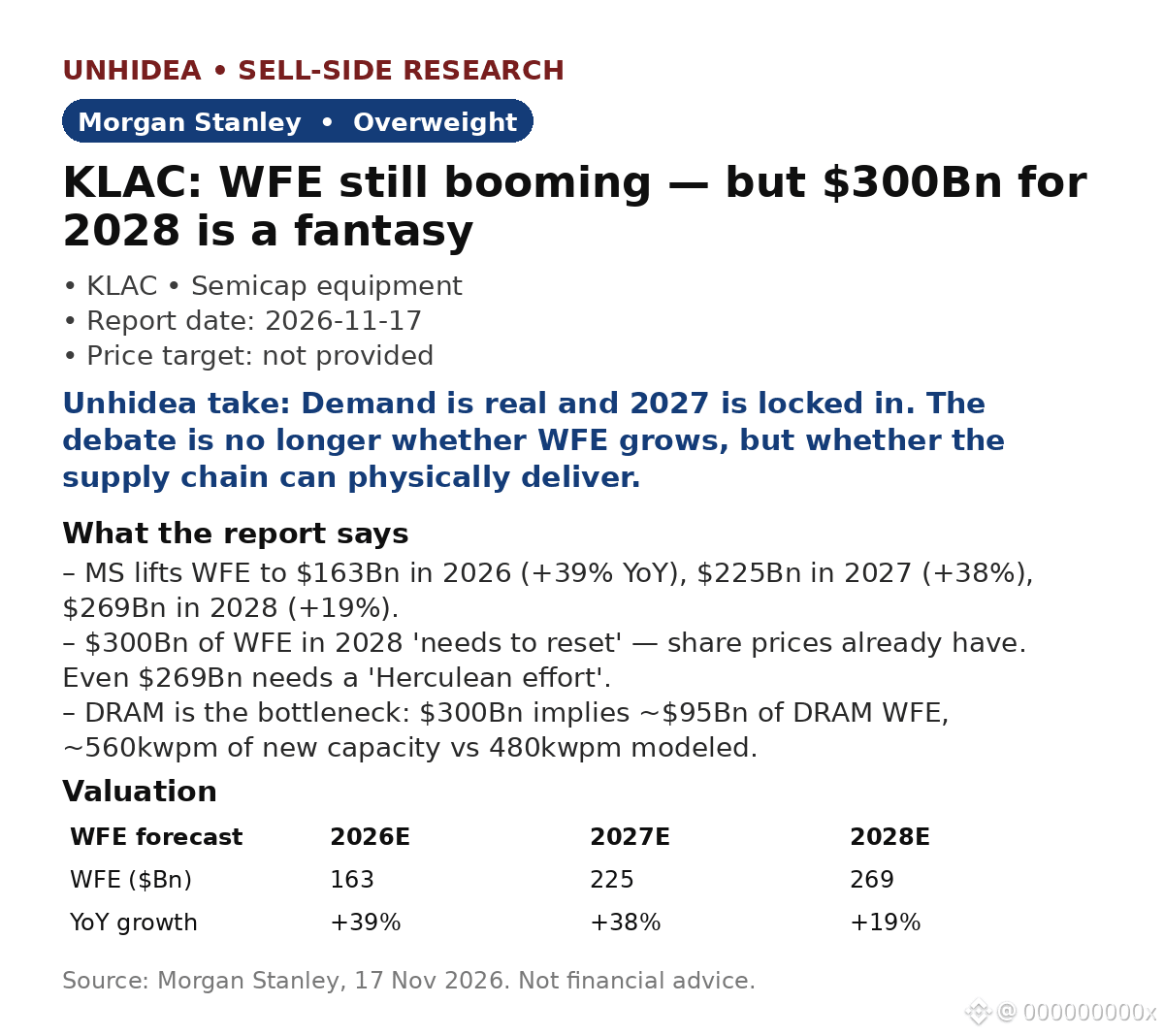
$KLAC: Morgan Stanley says the chip-equipment boom is real — but the $300Bn WFE dream for 2028 needs a reset
- MS lifts WFE to $163Bn in 2026 (+39% YoY), $225Bn in 2027 (+38%) and $269Bn in 2028 (+19%), up from $254Bn before.
- $300Bn in 2028 'needs to reset, as share prices have already done': expanding capacity 2.5x in 3 years is a stretch, and OEMs already miss shipments on component shortages.
- DRAM is the bottleneck: $300Bn implies ~$95Bn of DRAM WFE, needing ~560kwpm of new capacity vs 480kwpm modeled; NAND and mature logic would need >40% growth.
- Shipments are running at a $200–205Bn annualized WFE pace; the 2027 bull case has 'gradually materialized', incl. Intel spending $20Bn+ and ~500kwpm of DRAM greenfield adds.
- MS rates KLAC Overweight (no price target in this note); industry view In-Line.
- Since the report: NVIDIA beat FQ3 — $115.84Bn revenue vs ~$109Bn expected, adj EPS $2.68 vs $2.48, Q4 guide ~$130Bn (CNBC).
Unhidea take: the reset is about expectations, not demand — $269Bn in 2028 is still +19% growth; stocks fell because they were priced for $300Bn, not because fabs stopped ordering.
Unhidea take: the constraint has flipped from demand to physics — cleanroom space, components, 480kwpm vs 560kwpm. Every incremental wafer needs more inspection, so process-control demand scales with the ramp itself.
Risks: component shortages, DRAM pull-ins fading, further multiple compression.
Source: Morgan Stanley, 17 Nov 2026. Post-report news: CNBC. Not financial advice.
$KLAC : Morgan Stanley says the chip-equipment boom is real — but the $300Bn WFE dream for 2028 needs a reset
- MS lifts WFE to $163Bn in 2026 (+39% YoY), $225Bn in 2027 (+38%) and $269Bn in 2028 (+19%), up from $254Bn before.
- $300Bn in 2028 'needs to reset, as share prices have already done': expanding capacity 2.5x in 3 years is a stretch, and OEMs already miss shipments on component shortages.
- DRAM is the bottleneck: $300Bn implies ~$95Bn of DRAM WFE, needing ~560kwpm of new capacity vs 480kwpm modeled; NAND and mature logic would need >40% growth.
- Shipments are running at a $200–205Bn annualized WFE pace; the 2027 bull case has 'gradually materialized', incl. Intel spending $20Bn+ and ~500kwpm of DRAM greenfield adds.
- MS rates KLAC Overweight (no price target in this note); industry view In-Line.
- Since the report: NVIDIA beat FQ3 — $115.84Bn revenue vs ~$109Bn expected, adj EPS $2.68 vs $2.48, Q4 guide ~$130Bn (CNBC).
Unhidea take: the reset is about expectations, not demand — $269Bn in 2028 is still +19% growth; stocks fell because they were priced for $300Bn, not because fabs stopped ordering.
Unhidea take: the constraint has flipped from demand to physics — cleanroom space, components, 480kwpm vs 560kwpm. Every incremental wafer needs more inspection, so process-control demand scales with the ramp itself.
Risks: component shortages, DRAM pull-ins fading, further multiple compression.
Source: Morgan Stanley, 17 Nov 2026. Post-report news: CNBC. Not financial advice.
- MS lifts WFE to $163Bn in 2026 (+39% YoY), $225Bn in 2027 (+38%) and $269Bn in 2028 (+19%), up from $254Bn before.
- $300Bn in 2028 'needs to reset, as share prices have already done': expanding capacity 2.5x in 3 years is a stretch, and OEMs already miss shipments on component shortages.
- DRAM is the bottleneck: $300Bn implies ~$95Bn of DRAM WFE, needing ~560kwpm of new capacity vs 480kwpm modeled; NAND and mature logic would need >40% growth.
- Shipments are running at a $200–205Bn annualized WFE pace; the 2027 bull case has 'gradually materialized', incl. Intel spending $20Bn+ and ~500kwpm of DRAM greenfield adds.
- MS rates KLAC Overweight (no price target in this note); industry view In-Line.
- Since the report: NVIDIA beat FQ3 — $115.84Bn revenue vs ~$109Bn expected, adj EPS $2.68 vs $2.48, Q4 guide ~$130Bn (CNBC).
Unhidea take: the reset is about expectations, not demand — $269Bn in 2028 is still +19% growth; stocks fell because they were priced for $300Bn, not because fabs stopped ordering.
Unhidea take: the constraint has flipped from demand to physics — cleanroom space, components, 480kwpm vs 560kwpm. Every incremental wafer needs more inspection, so process-control demand scales with the ramp itself.
Risks: component shortages, DRAM pull-ins fading, further multiple compression.
Source: Morgan Stanley, 17 Nov 2026. Post-report news: CNBC. Not financial advice.
240
·
--
Übersetzung ansehen
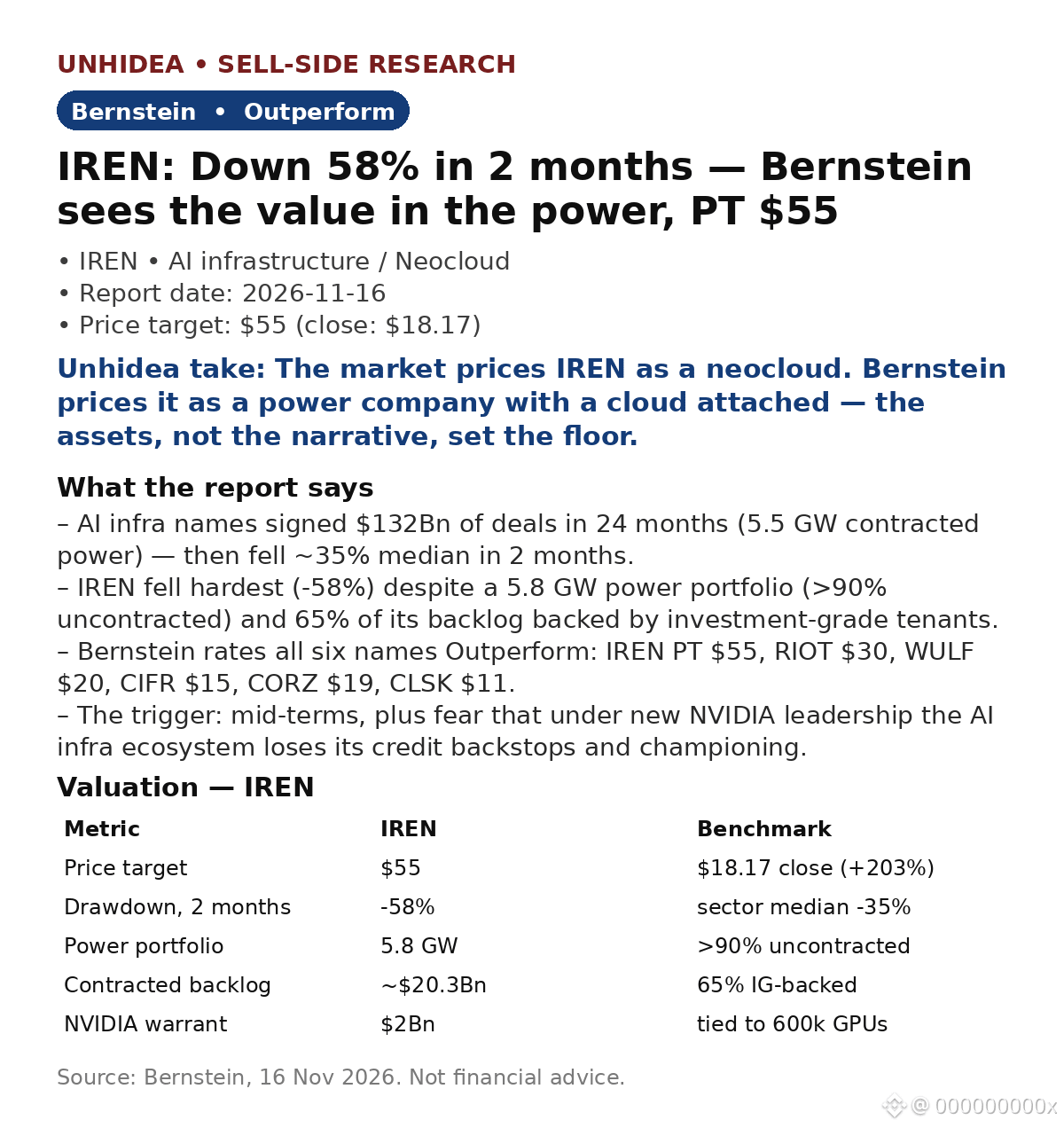
$IREN: Bernstein says the most-punished AI infra name is a power story — down 58% in 2 months, PT $55 (+203% vs the $18.17 close)
- The group signed $132Bn of AI deals in 24 months (5.5 GW) — then fell ~35% median in 2 months on mid-term nerves and fear new NVIDIA leadership ends the ecosystem's credit backstops.
- IREN fell hardest (-58%) though 65% of its ~$20.3Bn backlog is investment-grade backed; MSFT is the largest customer (48%), NVIDIA $3.4Bn.
- Its edge: 5.8 GW of power, >90% uncontracted — it can pace the cloud buildout or sell the power. Plus a $2Bn NVIDIA warrant tied to 600,000 GPUs.
- All six names rated Outperform (RIOT $30, WULF $20, CIFR $15, CORZ $19, CLSK $11); RIOT trades ~50% below contract value, WULF 22% below.
- Since the report: NVIDIA beat FQ3 — $115.84Bn revenue vs ~$109Bn expected, adj EPS $2.68 vs $2.48, Q4 guide ~$130Bn (CNBC).
Unhidea take: the market prices IREN's cloud execution risk as if the power were worthless — but power is the scarce asset, saleable even if the cloud stumbles.
Unhidea take: the 58% drawdown is opportunity and warning in one — the thesis needs IREN to execute the MSFT delivery without more delays.
Risks: cloud execution delays, spot GPU pricing, most CY27e capacity uncontracted, NVIDIA leadership transition.
Source: Bernstein, 16 Nov 2026. Post-report news: CNBC / Investing.com. Not financial advice.
$IREN : Bernstein says the most-punished AI infra name is a power story — down 58% in 2 months, PT $55 (+203% vs the $18.17 close)
- The group signed $132Bn of AI deals in 24 months (5.5 GW) — then fell ~35% median in 2 months on mid-term nerves and fear new NVIDIA leadership ends the ecosystem's credit backstops.
- IREN fell hardest (-58%) though 65% of its ~$20.3Bn backlog is investment-grade backed; MSFT is the largest customer (48%), NVIDIA $3.4Bn.
- Its edge: 5.8 GW of power, >90% uncontracted — it can pace the cloud buildout or sell the power. Plus a $2Bn NVIDIA warrant tied to 600,000 GPUs.
- All six names rated Outperform (RIOT $30, WULF $20, CIFR $15, CORZ $19, CLSK $11); RIOT trades ~50% below contract value, WULF 22% below.
- Since the report: NVIDIA beat FQ3 — $115.84Bn revenue vs ~$109Bn expected, adj EPS $2.68 vs $2.48, Q4 guide ~$130Bn (CNBC).
Unhidea take: the market prices IREN's cloud execution risk as if the power were worthless — but power is the scarce asset, saleable even if the cloud stumbles.
Unhidea take: the 58% drawdown is opportunity and warning in one — the thesis needs IREN to execute the MSFT delivery without more delays.
Risks: cloud execution delays, spot GPU pricing, most CY27e capacity uncontracted, NVIDIA leadership transition.
Source: Bernstein, 16 Nov 2026. Post-report news: CNBC / Investing.com. Not financial advice.
- The group signed $132Bn of AI deals in 24 months (5.5 GW) — then fell ~35% median in 2 months on mid-term nerves and fear new NVIDIA leadership ends the ecosystem's credit backstops.
- IREN fell hardest (-58%) though 65% of its ~$20.3Bn backlog is investment-grade backed; MSFT is the largest customer (48%), NVIDIA $3.4Bn.
- Its edge: 5.8 GW of power, >90% uncontracted — it can pace the cloud buildout or sell the power. Plus a $2Bn NVIDIA warrant tied to 600,000 GPUs.
- All six names rated Outperform (RIOT $30, WULF $20, CIFR $15, CORZ $19, CLSK $11); RIOT trades ~50% below contract value, WULF 22% below.
- Since the report: NVIDIA beat FQ3 — $115.84Bn revenue vs ~$109Bn expected, adj EPS $2.68 vs $2.48, Q4 guide ~$130Bn (CNBC).
Unhidea take: the market prices IREN's cloud execution risk as if the power were worthless — but power is the scarce asset, saleable even if the cloud stumbles.
Unhidea take: the 58% drawdown is opportunity and warning in one — the thesis needs IREN to execute the MSFT delivery without more delays.
Risks: cloud execution delays, spot GPU pricing, most CY27e capacity uncontracted, NVIDIA leadership transition.
Source: Bernstein, 16 Nov 2026. Post-report news: CNBC / Investing.com. Not financial advice.
487
·
--
Übersetzung ansehen
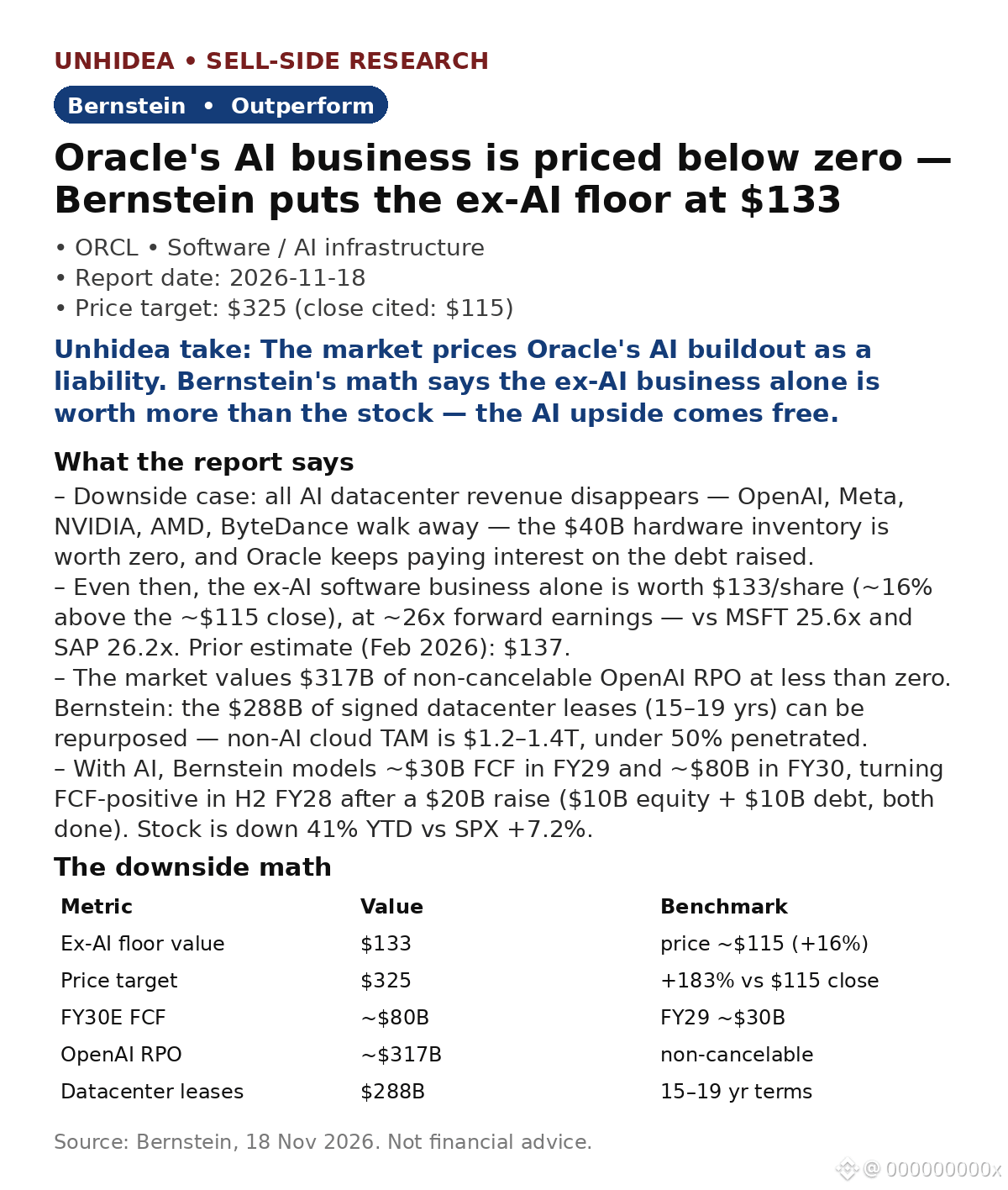
$ORCL: Bernstein says Oracle is worth $133 even if the AI buildout vanished — 16% above the $115 close — keeping Outperform, $325 target (+183%)
- Downside case: all AI datacenter revenue disappears — OpenAI, Meta, NVIDIA, AMD, ByteDance walk away — the $40B hardware is worth zero, and Oracle keeps paying the interest.
- Even then, the ex-AI software business alone is worth $133/share at ~26x forward earnings — in line with MSFT (25.6x) and SAP (26.2x). (Feb 2026: $137.)
- The market values $317B of non-cancelable OpenAI RPO at less than zero. The $288B of leases (15–19 yrs) can be repurposed — non-AI cloud TAM is $1.2–1.4T, under 50% penetrated.
- With AI, Bernstein models ~$30B FCF in FY29 and ~$80B in FY30, FCF-positive in H2 FY28 after a $20B raise ($10B equity + $10B debt, done).
Unhidea take: a mispricing story, not a growth story — ~16% protection to the ex-AI floor, AI optionality free.
Unhidea take: the $133 floor rests on the 26x multiple holding — if SaaS multiples compress, the floor falls too. Watch the multiple, not OpenAI headlines.
Risks: AI Winter, customers missing commitments, debt/interest burden, dilution.
Source: Bernstein, 18 Nov 2026. Not financial advice.
$ORCL : Bernstein says Oracle is worth $133 even if the AI buildout vanished — 16% above the $115 close — keeping Outperform, $325 target (+183%)
- Downside case: all AI datacenter revenue disappears — OpenAI, Meta, NVIDIA, AMD, ByteDance walk away — the $40B hardware is worth zero, and Oracle keeps paying the interest.
- Even then, the ex-AI software business alone is worth $133/share at ~26x forward earnings — in line with MSFT (25.6x) and SAP (26.2x). (Feb 2026: $137.)
- The market values $317B of non-cancelable OpenAI RPO at less than zero. The $288B of leases (15–19 yrs) can be repurposed — non-AI cloud TAM is $1.2–1.4T, under 50% penetrated.
- With AI, Bernstein models ~$30B FCF in FY29 and ~$80B in FY30, FCF-positive in H2 FY28 after a $20B raise ($10B equity + $10B debt, done).
Unhidea take: a mispricing story, not a growth story — ~16% protection to the ex-AI floor, AI optionality free.
Unhidea take: the $133 floor rests on the 26x multiple holding — if SaaS multiples compress, the floor falls too. Watch the multiple, not OpenAI headlines.
Risks: AI Winter, customers missing commitments, debt/interest burden, dilution.
Source: Bernstein, 18 Nov 2026. Not financial advice.
- Downside case: all AI datacenter revenue disappears — OpenAI, Meta, NVIDIA, AMD, ByteDance walk away — the $40B hardware is worth zero, and Oracle keeps paying the interest.
- Even then, the ex-AI software business alone is worth $133/share at ~26x forward earnings — in line with MSFT (25.6x) and SAP (26.2x). (Feb 2026: $137.)
- The market values $317B of non-cancelable OpenAI RPO at less than zero. The $288B of leases (15–19 yrs) can be repurposed — non-AI cloud TAM is $1.2–1.4T, under 50% penetrated.
- With AI, Bernstein models ~$30B FCF in FY29 and ~$80B in FY30, FCF-positive in H2 FY28 after a $20B raise ($10B equity + $10B debt, done).
Unhidea take: a mispricing story, not a growth story — ~16% protection to the ex-AI floor, AI optionality free.
Unhidea take: the $133 floor rests on the 26x multiple holding — if SaaS multiples compress, the floor falls too. Watch the multiple, not OpenAI headlines.
Risks: AI Winter, customers missing commitments, debt/interest burden, dilution.
Source: Bernstein, 18 Nov 2026. Not financial advice.
64
·
--
Übersetzung ansehen
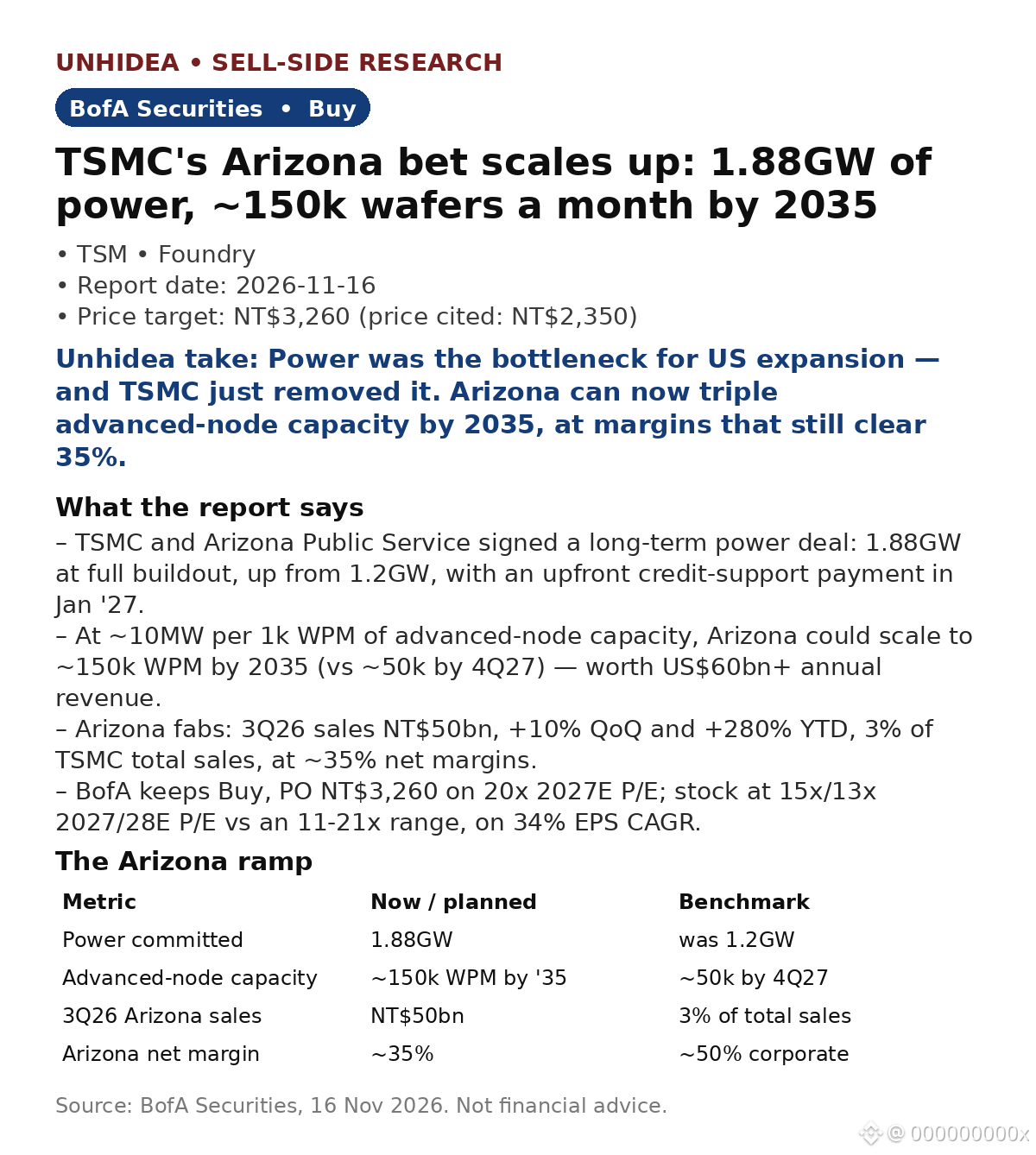
$TSM: BofA keeps Buy, NT$3,260 PT — ~39% above the NT$2,350 price cited — as an Arizona power deal unlocks a much bigger US buildout
- TSMC signed a long-term power deal with Arizona Public Service: 1.88GW at full buildout, up from 1.2GW, with an upfront credit-support payment in Jan '27.
- At ~10MW per 1k wafers/month of advanced-node capacity, BofA estimates Arizona can reach ~150k WPM by 2035 (vs ~50k by 4Q27), worth US$60bn+ a year — vs US$176bn TSMC revenue est. for 2026.
- Arizona fabs are already profitable: 3Q26 sales NT$50bn, +10% QoQ, +280% YTD, 3% of total sales, at ~35% net margins — below 43% in 1H26 and ~50% corporate.
- Valuation: 15x/13x 2027/28E P/E vs an 11-21x range, on 34% EPS CAGR; the PO is 20x 2027E P/E.
- Context (market news, after the report): Nvidia's FQ3 revenue was $115.8bn, +103% YoY.
Unhidea take: power, not demand, was the binding constraint on US chipmaking — a 1.88GW commitment turns Arizona from a showcase into a real second supply base.
Unhidea take: watch the margin bridge — 35% Arizona margins are the price of US resilience; how fast the gap to ~50% corporate closes is the story.
Risks: smartphone/consumer slowdown, Intel foundry ambitions, advanced-node execution, tariffs.
Source: BofA Securities, 16 Nov 2026. Not financial advice.
$TSM : BofA keeps Buy, NT$3,260 PT — ~39% above the NT$2,350 price cited — as an Arizona power deal unlocks a much bigger US buildout
- TSMC signed a long-term power deal with Arizona Public Service: 1.88GW at full buildout, up from 1.2GW, with an upfront credit-support payment in Jan '27.
- At ~10MW per 1k wafers/month of advanced-node capacity, BofA estimates Arizona can reach ~150k WPM by 2035 (vs ~50k by 4Q27), worth US$60bn+ a year — vs US$176bn TSMC revenue est. for 2026.
- Arizona fabs are already profitable: 3Q26 sales NT$50bn, +10% QoQ, +280% YTD, 3% of total sales, at ~35% net margins — below 43% in 1H26 and ~50% corporate.
- Valuation: 15x/13x 2027/28E P/E vs an 11-21x range, on 34% EPS CAGR; the PO is 20x 2027E P/E.
- Context (market news, after the report): Nvidia's FQ3 revenue was $115.8bn, +103% YoY.
Unhidea take: power, not demand, was the binding constraint on US chipmaking — a 1.88GW commitment turns Arizona from a showcase into a real second supply base.
Unhidea take: watch the margin bridge — 35% Arizona margins are the price of US resilience; how fast the gap to ~50% corporate closes is the story.
Risks: smartphone/consumer slowdown, Intel foundry ambitions, advanced-node execution, tariffs.
Source: BofA Securities, 16 Nov 2026. Not financial advice.
- TSMC signed a long-term power deal with Arizona Public Service: 1.88GW at full buildout, up from 1.2GW, with an upfront credit-support payment in Jan '27.
- At ~10MW per 1k wafers/month of advanced-node capacity, BofA estimates Arizona can reach ~150k WPM by 2035 (vs ~50k by 4Q27), worth US$60bn+ a year — vs US$176bn TSMC revenue est. for 2026.
- Arizona fabs are already profitable: 3Q26 sales NT$50bn, +10% QoQ, +280% YTD, 3% of total sales, at ~35% net margins — below 43% in 1H26 and ~50% corporate.
- Valuation: 15x/13x 2027/28E P/E vs an 11-21x range, on 34% EPS CAGR; the PO is 20x 2027E P/E.
- Context (market news, after the report): Nvidia's FQ3 revenue was $115.8bn, +103% YoY.
Unhidea take: power, not demand, was the binding constraint on US chipmaking — a 1.88GW commitment turns Arizona from a showcase into a real second supply base.
Unhidea take: watch the margin bridge — 35% Arizona margins are the price of US resilience; how fast the gap to ~50% corporate closes is the story.
Risks: smartphone/consumer slowdown, Intel foundry ambitions, advanced-node execution, tariffs.
Source: BofA Securities, 16 Nov 2026. Not financial advice.
154
·
--
Übersetzung ansehen
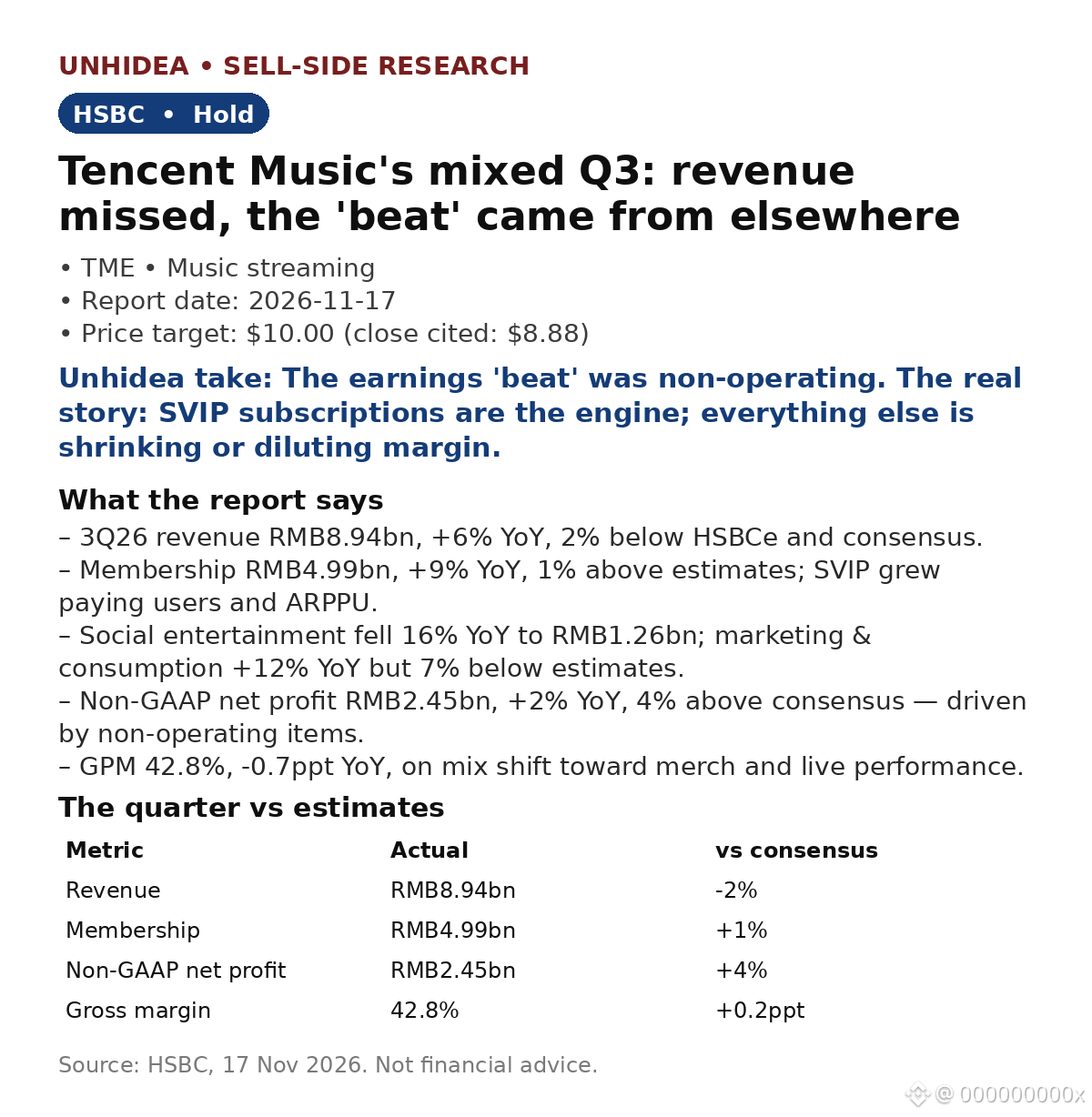
$TME: 3Q revenue missed — RMB8.94B, +6% YoY, 2% below Street — but HSBC keeps Hold, $10.00 PT
- Membership did the work: RMB4.99B, +9% YoY, 1% above estimates, with SVIP growing paying users and ARPPU.
- Social entertainment fell 16% YoY to RMB1.26B; marketing & consumption grew 12% but missed by 7%.
- Non-GAAP net profit RMB2.45B, +2% YoY, 4% above consensus — but the beat came from non-operating items, not the business.
- GPM 42.8%, -0.7ppt YoY, as merch and live performance took a bigger mix share.
- Buyback: 34.7m ADSs for ~$300M in Q3 — 2.1% of market cap in one quarter.
Valuation: $10.00 PT is ~13% above the $8.88 close cited (16 Nov).
Unhidea take: a "beat" built on non-operating items is not an operating beat — strip it out and the quarter was a miss, with non-GAAP operating profit flat YoY.
Unhidea take: TME is quietly becoming a subscription company — SVIP is the durable engine; judge it on membership ARPPU, not blended revenue.
Risks: Ximalaya integration costs, SE decline, margin mix pressure.
Source: HSBC, 17 Nov 2026. Not financial advice.
$TME: 3Q revenue missed — RMB8.94B, +6% YoY, 2% below Street — but HSBC keeps Hold, $10.00 PT
- Membership did the work: RMB4.99B, +9% YoY, 1% above estimates, with SVIP growing paying users and ARPPU.
- Social entertainment fell 16% YoY to RMB1.26B; marketing & consumption grew 12% but missed by 7%.
- Non-GAAP net profit RMB2.45B, +2% YoY, 4% above consensus — but the beat came from non-operating items, not the business.
- GPM 42.8%, -0.7ppt YoY, as merch and live performance took a bigger mix share.
- Buyback: 34.7m ADSs for ~$300M in Q3 — 2.1% of market cap in one quarter.
Valuation: $10.00 PT is ~13% above the $8.88 close cited (16 Nov).
Unhidea take: a "beat" built on non-operating items is not an operating beat — strip it out and the quarter was a miss, with non-GAAP operating profit flat YoY.
Unhidea take: TME is quietly becoming a subscription company — SVIP is the durable engine; judge it on membership ARPPU, not blended revenue.
Risks: Ximalaya integration costs, SE decline, margin mix pressure.
Source: HSBC, 17 Nov 2026. Not financial advice.
- Membership did the work: RMB4.99B, +9% YoY, 1% above estimates, with SVIP growing paying users and ARPPU.
- Social entertainment fell 16% YoY to RMB1.26B; marketing & consumption grew 12% but missed by 7%.
- Non-GAAP net profit RMB2.45B, +2% YoY, 4% above consensus — but the beat came from non-operating items, not the business.
- GPM 42.8%, -0.7ppt YoY, as merch and live performance took a bigger mix share.
- Buyback: 34.7m ADSs for ~$300M in Q3 — 2.1% of market cap in one quarter.
Valuation: $10.00 PT is ~13% above the $8.88 close cited (16 Nov).
Unhidea take: a "beat" built on non-operating items is not an operating beat — strip it out and the quarter was a miss, with non-GAAP operating profit flat YoY.
Unhidea take: TME is quietly becoming a subscription company — SVIP is the durable engine; judge it on membership ARPPU, not blended revenue.
Risks: Ximalaya integration costs, SE decline, margin mix pressure.
Source: HSBC, 17 Nov 2026. Not financial advice.
TMEUS+0,52%
51
·
--
Übersetzung ansehen
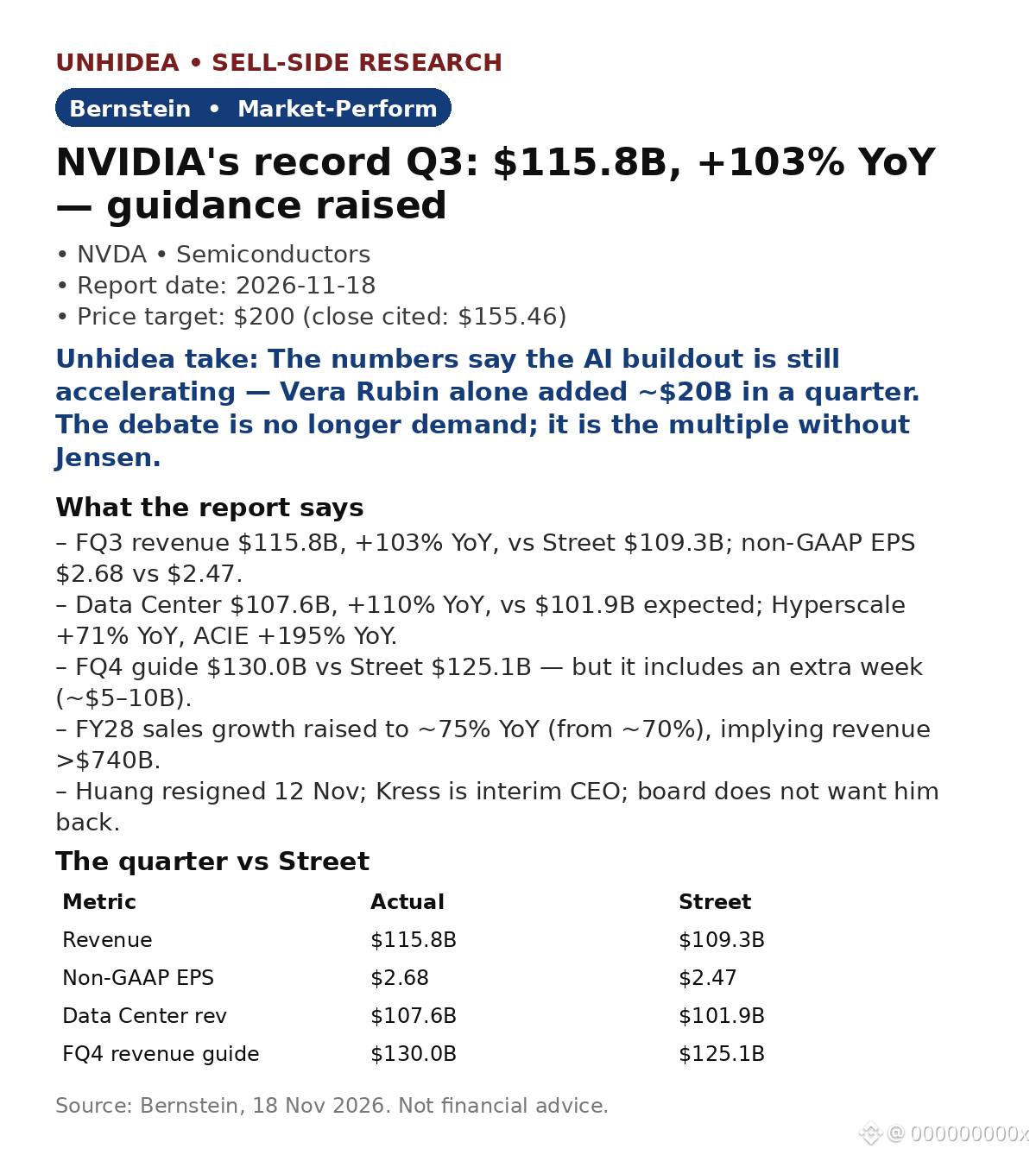
$NVDA: record Q3 — $115.8B revenue, +103% YoY — but Bernstein stays Market-Perform, $200 PT
FQ3 beat: revenue $115.8B (+103% YoY, +20% QoQ) vs Street $109.3B; EPS $2.68 vs $2.47. Data Center $107.6B, +110% YoY, vs $101.9B expected. Vera Rubin added ~$20B — the strongest ramp in company history.
- FQ4 guide $130B (±3%) vs Street $125.1B — but it includes an extra week (~$5–10B), so the normalized guide was likely light.
- FY28 sales growth raised to ~75% YoY (from ~70%), implying revenue >$740B, even with new BIS sanctions.
- Leadership: Huang resigned 12 Nov; Kress is interim CEO; the board does not want him back — near-term stable, long-term questions remain.
Valuation: $200 PT is ~29% above the $155.46 close cited (17 Nov); 52-week range $148.80–$243.37.
Unhidea take: the numbers say the AI buildout is still accelerating — Rubin alone did ~$20B in a quarter. The debate is no longer demand, it's the multiple without Jensen.
Unhidea take: ex the extra week, the Q4 guide is less heroic than the headline; the FY28 raise to ~75% is the real signal.
Risks: leadership transition, export controls, $390B supply commitments, margin trough.
Source: Bernstein, 18 Nov 2026. Not financial advice.
$NVDA : record Q3 — $115.8B revenue, +103% YoY — but Bernstein stays Market-Perform, $200 PT
FQ3 beat: revenue $115.8B (+103% YoY, +20% QoQ) vs Street $109.3B; EPS $2.68 vs $2.47. Data Center $107.6B, +110% YoY, vs $101.9B expected. Vera Rubin added ~$20B — the strongest ramp in company history.
- FQ4 guide $130B (±3%) vs Street $125.1B — but it includes an extra week (~$5–10B), so the normalized guide was likely light.
- FY28 sales growth raised to ~75% YoY (from ~70%), implying revenue >$740B, even with new BIS sanctions.
- Leadership: Huang resigned 12 Nov; Kress is interim CEO; the board does not want him back — near-term stable, long-term questions remain.
Valuation: $200 PT is ~29% above the $155.46 close cited (17 Nov); 52-week range $148.80–$243.37.
Unhidea take: the numbers say the AI buildout is still accelerating — Rubin alone did ~$20B in a quarter. The debate is no longer demand, it's the multiple without Jensen.
Unhidea take: ex the extra week, the Q4 guide is less heroic than the headline; the FY28 raise to ~75% is the real signal.
Risks: leadership transition, export controls, $390B supply commitments, margin trough.
Source: Bernstein, 18 Nov 2026. Not financial advice.
FQ3 beat: revenue $115.8B (+103% YoY, +20% QoQ) vs Street $109.3B; EPS $2.68 vs $2.47. Data Center $107.6B, +110% YoY, vs $101.9B expected. Vera Rubin added ~$20B — the strongest ramp in company history.
- FQ4 guide $130B (±3%) vs Street $125.1B — but it includes an extra week (~$5–10B), so the normalized guide was likely light.
- FY28 sales growth raised to ~75% YoY (from ~70%), implying revenue >$740B, even with new BIS sanctions.
- Leadership: Huang resigned 12 Nov; Kress is interim CEO; the board does not want him back — near-term stable, long-term questions remain.
Valuation: $200 PT is ~29% above the $155.46 close cited (17 Nov); 52-week range $148.80–$243.37.
Unhidea take: the numbers say the AI buildout is still accelerating — Rubin alone did ~$20B in a quarter. The debate is no longer demand, it's the multiple without Jensen.
Unhidea take: ex the extra week, the Q4 guide is less heroic than the headline; the FY28 raise to ~75% is the real signal.
Risks: leadership transition, export controls, $390B supply commitments, margin trough.
Source: Bernstein, 18 Nov 2026. Not financial advice.
35
·
--
$9868.HK: XPengs Autos im Ausland erzielen etwa doppelt so hohe Margen wie im Inland – laut Morgan Stanley finanzieren Exporte nun die Robotik-Wette. Übergewichten, Kursziel HK$70, 83 % Aufwärtspotenzial gegenüber dem Schlusskurs von HK$38.28 (17. Nov.).
Der durchschnittliche Verkaufspreis im Ausland liegt etwa 50 % über dem im Inland, bei rund doppelt so hoher Bruttomarge. MS erwartet, dass das Ausland im 4Q26 30 % des Umsatzes und mehr als die Hälfte des Bruttogewinns ausmacht und die Fahrzeug-Bruttomarge trotz eines höheren MONA-Anteils bei 12–13 % hält.
Die Produktion ist monatelang ausverkauft: L03 kommt auf über 20.000 Fahrzeuge pro Monat, L05 auf 10.000, bei Auftragsbeständen von mehr als 4 bzw. 2 Monaten. Damit sind die Auslieferungen auch in der saisonal schwachen 1Q27 gesichert.
Robotik ist der nächste Wachstumsschritt: Die F&E-Ausgaben für Autos bleiben mit etwa Rmb5bn stabil, während die F&E-Ausgaben für Robotik 2027 steigen. Angestrebt werden mehrere Milliarden Rmb Umsatz und Bruttogewinn, finanziert durch einen positiven freien Cashflow (jährliche Investitionen von Rmb3–4bn).
MS prognostiziert für 2027E einen Umsatz von Rmb103.3bn (+25 % gegenüber dem Vorjahr) und für 2028E den ersten Gewinn (EPS von Rmb0.23 gegenüber einem Verlust von Rmb0.37 im Jahr 2027E).
Einschätzung von Unhidea: Das Ausland ist der Margenmotor – jedes exportierte Auto leistet so viel wie zwei Autos im Inland. Die Robotik-Wette wird also durch Exporte finanziert, nicht durch Verwässerung.
Einschätzung von Unhidea: Beobachten, ob die Robotik 2027 tatsächlich Umsatz erzielt – bis dahin wird XPeng als Autobauer mit einer Robotik-Story bewertet.
Risiken: Wettbewerb; Cashflow-Druck; schwächere Nachfrage. Quelle: Morgan Stanley, 17. Nov. 2026. Keine Anlageberatung.
$9868.HK: XPengs Autos im Ausland erzielen etwa doppelt so hohe Margen wie im Inland – laut Morgan Stanley finanzieren Exporte nun die Robotik-Wette. Übergewichten, Kursziel HK$70, 83 % Aufwärtspotenzial gegenüber dem Schlusskurs von HK$38.28 (17. Nov.).
Der durchschnittliche Verkaufspreis im Ausland liegt etwa 50 % über dem im Inland, bei rund doppelt so hoher Bruttomarge. MS erwartet, dass das Ausland im 4Q26 30 % des Umsatzes und mehr als die Hälfte des Bruttogewinns ausmacht und die Fahrzeug-Bruttomarge trotz eines höheren MONA-Anteils bei 12–13 % hält.
Die Produktion ist monatelang ausverkauft: L03 kommt auf über 20.000 Fahrzeuge pro Monat, L05 auf 10.000, bei Auftragsbeständen von mehr als 4 bzw. 2 Monaten. Damit sind die Auslieferungen auch in der saisonal schwachen 1Q27 gesichert.
Robotik ist der nächste Wachstumsschritt: Die F&E-Ausgaben für Autos bleiben mit etwa Rmb5bn stabil, während die F&E-Ausgaben für Robotik 2027 steigen. Angestrebt werden mehrere Milliarden Rmb Umsatz und Bruttogewinn, finanziert durch einen positiven freien Cashflow (jährliche Investitionen von Rmb3–4bn).
MS prognostiziert für 2027E einen Umsatz von Rmb103.3bn (+25 % gegenüber dem Vorjahr) und für 2028E den ersten Gewinn (EPS von Rmb0.23 gegenüber einem Verlust von Rmb0.37 im Jahr 2027E).
Einschätzung von Unhidea: Das Ausland ist der Margenmotor – jedes exportierte Auto leistet so viel wie zwei Autos im Inland. Die Robotik-Wette wird also durch Exporte finanziert, nicht durch Verwässerung.
Einschätzung von Unhidea: Beobachten, ob die Robotik 2027 tatsächlich Umsatz erzielt – bis dahin wird XPeng als Autobauer mit einer Robotik-Story bewertet.
Risiken: Wettbewerb; Cashflow-Druck; schwächere Nachfrage. Quelle: Morgan Stanley, 17. Nov. 2026. Keine Anlageberatung.
Der durchschnittliche Verkaufspreis im Ausland liegt etwa 50 % über dem im Inland, bei rund doppelt so hoher Bruttomarge. MS erwartet, dass das Ausland im 4Q26 30 % des Umsatzes und mehr als die Hälfte des Bruttogewinns ausmacht und die Fahrzeug-Bruttomarge trotz eines höheren MONA-Anteils bei 12–13 % hält.
Die Produktion ist monatelang ausverkauft: L03 kommt auf über 20.000 Fahrzeuge pro Monat, L05 auf 10.000, bei Auftragsbeständen von mehr als 4 bzw. 2 Monaten. Damit sind die Auslieferungen auch in der saisonal schwachen 1Q27 gesichert.
Robotik ist der nächste Wachstumsschritt: Die F&E-Ausgaben für Autos bleiben mit etwa Rmb5bn stabil, während die F&E-Ausgaben für Robotik 2027 steigen. Angestrebt werden mehrere Milliarden Rmb Umsatz und Bruttogewinn, finanziert durch einen positiven freien Cashflow (jährliche Investitionen von Rmb3–4bn).
MS prognostiziert für 2027E einen Umsatz von Rmb103.3bn (+25 % gegenüber dem Vorjahr) und für 2028E den ersten Gewinn (EPS von Rmb0.23 gegenüber einem Verlust von Rmb0.37 im Jahr 2027E).
Einschätzung von Unhidea: Das Ausland ist der Margenmotor – jedes exportierte Auto leistet so viel wie zwei Autos im Inland. Die Robotik-Wette wird also durch Exporte finanziert, nicht durch Verwässerung.
Einschätzung von Unhidea: Beobachten, ob die Robotik 2027 tatsächlich Umsatz erzielt – bis dahin wird XPeng als Autobauer mit einer Robotik-Story bewertet.
Risiken: Wettbewerb; Cashflow-Druck; schwächere Nachfrage. Quelle: Morgan Stanley, 17. Nov. 2026. Keine Anlageberatung.
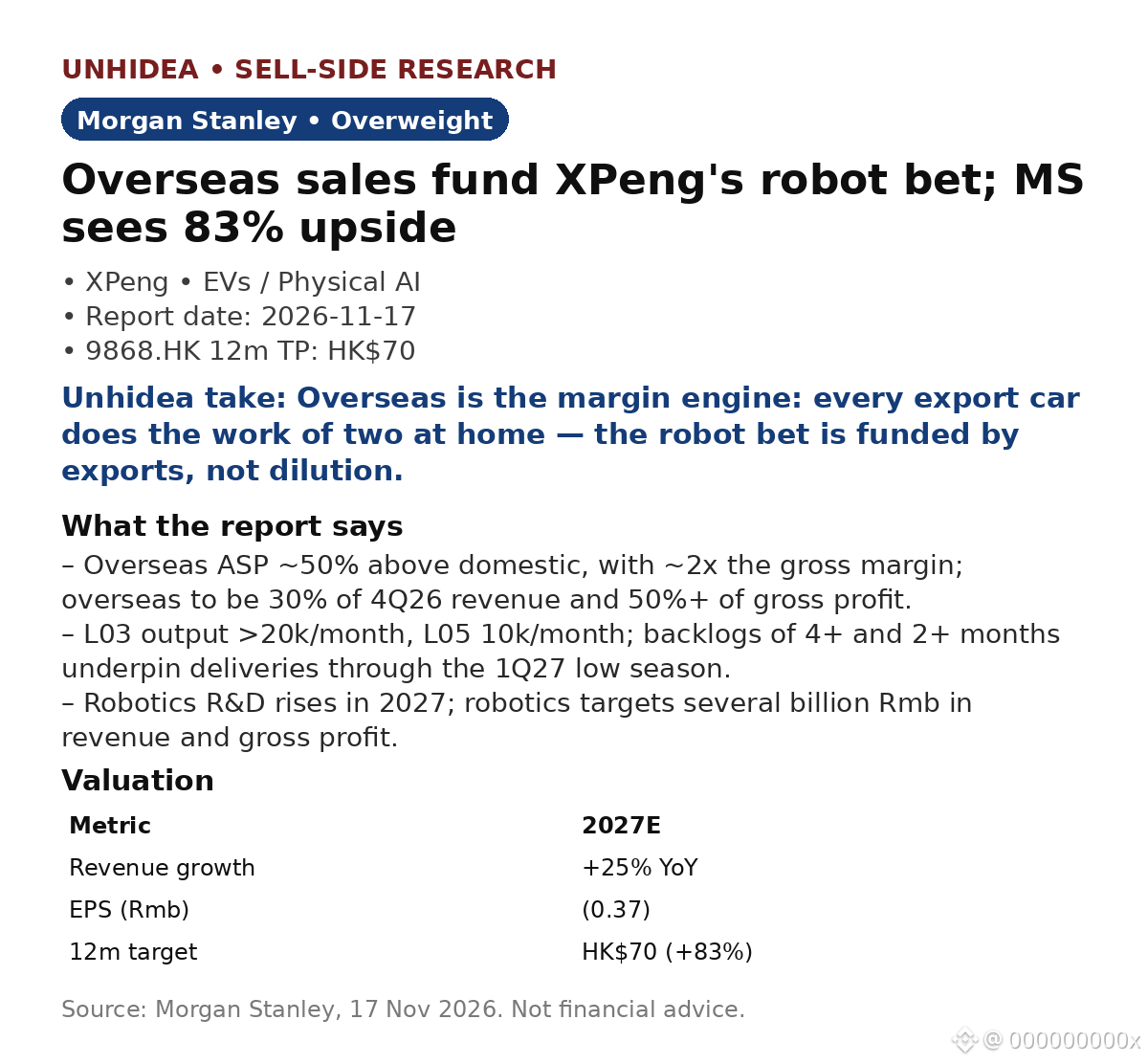
·
--
Goldman Sachs: Hesai ist keine reine Autozulieferer-Story mehr — Robotik macht inzwischen mehr als die Hälfte des Umsatzes aus und ist der höherwertige Geschäftsbereich.
GS bekräftigt die Kaufempfehlung für $HSAI mit einem 12-Monats-Kursziel von 28 US$, was einem Aufwärtspotenzial von 94 % entspricht. Die Robotik überschritt im 3Q26 die Marke von 50 % des Gesamtumsatzes; GS prognostiziert bis 2030E einen Anteil von 62 % und für 2025–30E ein Umsatz-CAGR von 32 %.
Aktuatormodule: Im 3Q26 wurden 23.000 Stück ausgeliefert, gegenüber 12.000 im 2Q26; für 2027E werden sechsstellige Stückzahlen angepeilt. Die EBIT-Marge im LiDAR-Geschäft erreichte im 3Q26 15,8 %, gegenüber 6,4 % im 1Q26, da sich die ADAS-Preise stabilisierten. KOSMO, im Oktober 2026 eingeführt, erzielt bereits wiederkehrende Umsätze — Pixar RenderMan ist ein Nutzer.
2027E: Umsatz +39 % (ADAS +27 % im Jahresvergleich gegenüber -5 % in 2026E; Nicht-ADAS +49 %), Non-GAAP-EBIT +145 % im Jahresvergleich, Marge 13 % gegenüber 7 %.
Nach dem Bericht: Nvidias Q3-Umsatz von 115,8 Mrd. US$ übertraf nach Börsenschluss am 17. November die Konsensschätzung. Dem Bericht zufolge ist Hesai ein wichtiger Zulieferer für Nvidias humanoide Plattform.
Einschätzung von Unhidea: Die Verschiebung des Produktmixes ist entscheidend — Robotik-LiDAR macht etwa 15 % der Stückzahlen, aber mehr als 50 % des LiDAR-Umsatzes aus. Damit wird die Gewinn- und Verlustrechnung nun von Robotern und nicht von Autos bestimmt.
Einschätzung von Unhidea: KOSMOs ARR im Blick behalten — wiederkehrende Umsätze mit räumlichen Daten könnten dazu führen, dass der Markt Hesai nicht länger als Hardwarezulieferer bewertet.
Risiken: langsamere LiDAR-Einführung; Preisdruck; politische Risiken. Quelle: Goldman Sachs, 17. November 2026. Keine Anlageberatung.
Goldman Sachs: Hesai ist keine reine Autozulieferer-Story mehr — Robotik macht inzwischen mehr als die Hälfte des Umsatzes aus und ist der höherwertige Geschäftsbereich.
GS bekräftigt die Kaufempfehlung für $HSAI mit einem 12-Monats-Kursziel von 28 US$, was einem Aufwärtspotenzial von 94 % entspricht. Die Robotik überschritt im 3Q26 die Marke von 50 % des Gesamtumsatzes; GS prognostiziert bis 2030E einen Anteil von 62 % und für 2025–30E ein Umsatz-CAGR von 32 %.
Aktuatormodule: Im 3Q26 wurden 23.000 Stück ausgeliefert, gegenüber 12.000 im 2Q26; für 2027E werden sechsstellige Stückzahlen angepeilt. Die EBIT-Marge im LiDAR-Geschäft erreichte im 3Q26 15,8 %, gegenüber 6,4 % im 1Q26, da sich die ADAS-Preise stabilisierten. KOSMO, im Oktober 2026 eingeführt, erzielt bereits wiederkehrende Umsätze — Pixar RenderMan ist ein Nutzer.
2027E: Umsatz +39 % (ADAS +27 % im Jahresvergleich gegenüber -5 % in 2026E; Nicht-ADAS +49 %), Non-GAAP-EBIT +145 % im Jahresvergleich, Marge 13 % gegenüber 7 %.
Nach dem Bericht: Nvidias Q3-Umsatz von 115,8 Mrd. US$ übertraf nach Börsenschluss am 17. November die Konsensschätzung. Dem Bericht zufolge ist Hesai ein wichtiger Zulieferer für Nvidias humanoide Plattform.
Einschätzung von Unhidea: Die Verschiebung des Produktmixes ist entscheidend — Robotik-LiDAR macht etwa 15 % der Stückzahlen, aber mehr als 50 % des LiDAR-Umsatzes aus. Damit wird die Gewinn- und Verlustrechnung nun von Robotern und nicht von Autos bestimmt.
Einschätzung von Unhidea: KOSMOs ARR im Blick behalten — wiederkehrende Umsätze mit räumlichen Daten könnten dazu führen, dass der Markt Hesai nicht länger als Hardwarezulieferer bewertet.
Risiken: langsamere LiDAR-Einführung; Preisdruck; politische Risiken. Quelle: Goldman Sachs, 17. November 2026. Keine Anlageberatung.
GS bekräftigt die Kaufempfehlung für $HSAI mit einem 12-Monats-Kursziel von 28 US$, was einem Aufwärtspotenzial von 94 % entspricht. Die Robotik überschritt im 3Q26 die Marke von 50 % des Gesamtumsatzes; GS prognostiziert bis 2030E einen Anteil von 62 % und für 2025–30E ein Umsatz-CAGR von 32 %.
Aktuatormodule: Im 3Q26 wurden 23.000 Stück ausgeliefert, gegenüber 12.000 im 2Q26; für 2027E werden sechsstellige Stückzahlen angepeilt. Die EBIT-Marge im LiDAR-Geschäft erreichte im 3Q26 15,8 %, gegenüber 6,4 % im 1Q26, da sich die ADAS-Preise stabilisierten. KOSMO, im Oktober 2026 eingeführt, erzielt bereits wiederkehrende Umsätze — Pixar RenderMan ist ein Nutzer.
2027E: Umsatz +39 % (ADAS +27 % im Jahresvergleich gegenüber -5 % in 2026E; Nicht-ADAS +49 %), Non-GAAP-EBIT +145 % im Jahresvergleich, Marge 13 % gegenüber 7 %.
Nach dem Bericht: Nvidias Q3-Umsatz von 115,8 Mrd. US$ übertraf nach Börsenschluss am 17. November die Konsensschätzung. Dem Bericht zufolge ist Hesai ein wichtiger Zulieferer für Nvidias humanoide Plattform.
Einschätzung von Unhidea: Die Verschiebung des Produktmixes ist entscheidend — Robotik-LiDAR macht etwa 15 % der Stückzahlen, aber mehr als 50 % des LiDAR-Umsatzes aus. Damit wird die Gewinn- und Verlustrechnung nun von Robotern und nicht von Autos bestimmt.
Einschätzung von Unhidea: KOSMOs ARR im Blick behalten — wiederkehrende Umsätze mit räumlichen Daten könnten dazu führen, dass der Markt Hesai nicht länger als Hardwarezulieferer bewertet.
Risiken: langsamere LiDAR-Einführung; Preisdruck; politische Risiken. Quelle: Goldman Sachs, 17. November 2026. Keine Anlageberatung.
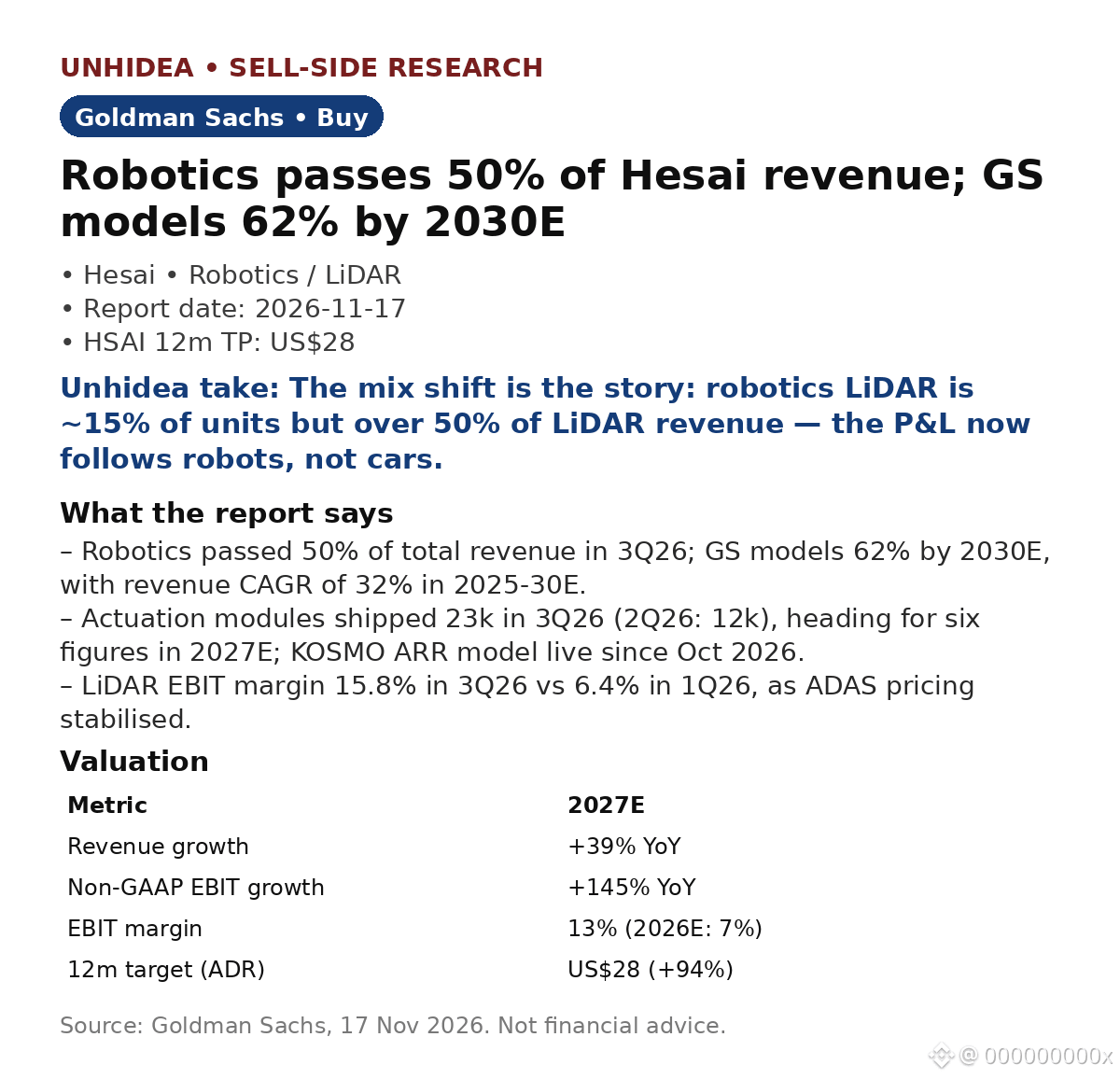
81
Anmelden und weiter Inhalte entdecken
Krypto-Nutzer weltweit auf Binance Square kennenlernen
⚡️ Bleib in Sachen Krypto stets am Puls.
💬 Die weltgrößte Kryptobörse vertraut darauf.
👍 Erhalte verlässliche Einblicke von verifizierten Creators.
E-Mail-Adresse/Telefonnummer
Trendthemen
BTCRemainsUnderPressureAfterHawkishFOMCMinutes
56,019 Aufrufe
725 Kommentare
FOMC-Protokoll | Fed-Protokoll zeigt: Fast alle Vertreter rechnen mit weiteren Zinserhöhungen, einige halten im Dezember einen größeren Schritt für möglich
Binance News
·48 Likes
·57.2k Aufrufe
AnthropicToDebutAfter$83IPOPricing
14,446 Aufrufe
74 Kommentare
NvidiaBoardReportedlySplitOverHuang’sReturn
18,556 Aufrufe
315 Kommentare