

Rokyo
870 Publicações

Rokyo
Denunciar
Bloquear Utilizador
Aberto ao trading

Detentor de BNB
Trader Frequente
5.5 ano(s)
122 A seguir
124 Seguidores
1.0K+ Gostaram
Publicações
Portfólio
·
--
Ver tradução
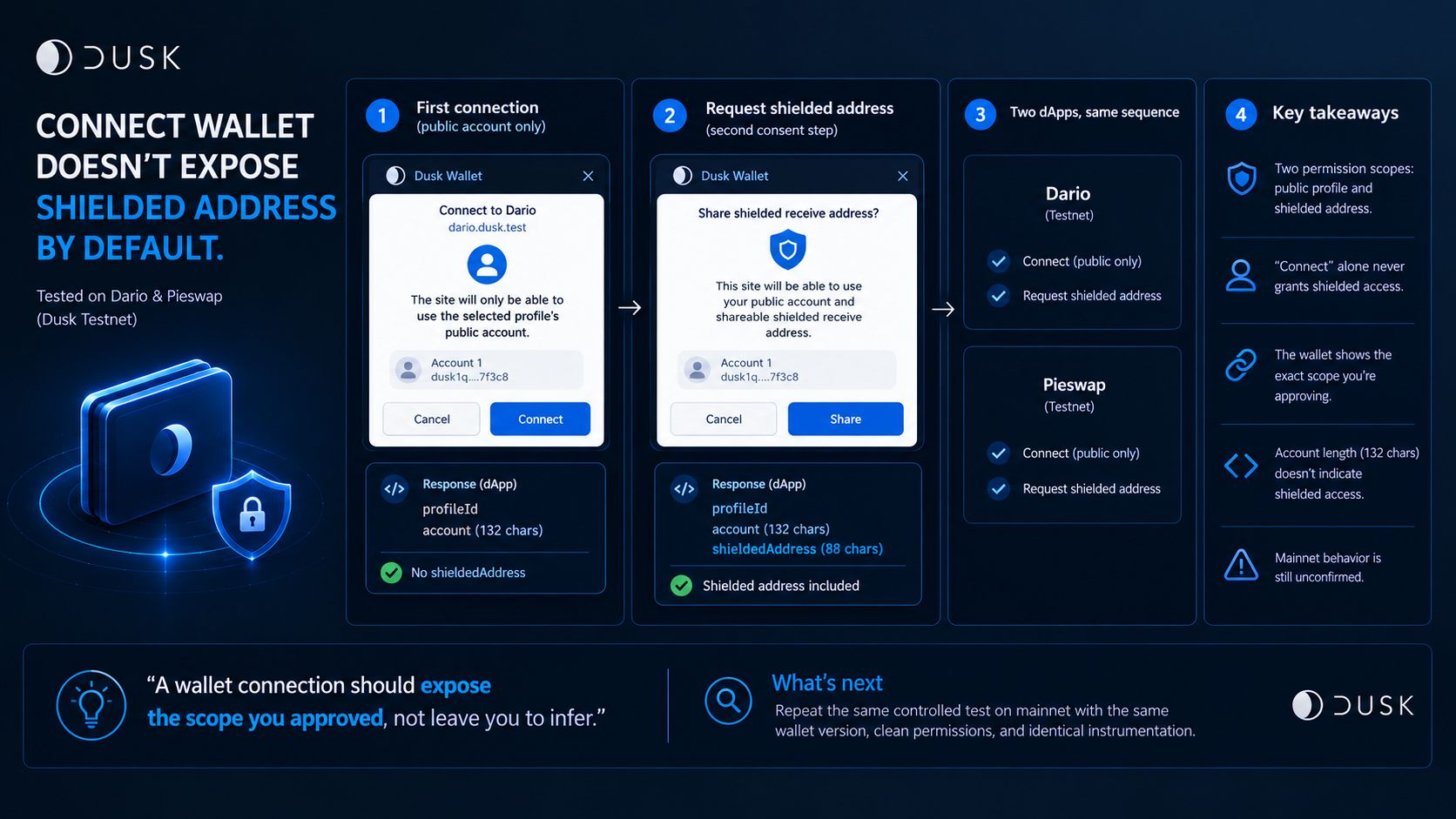
I wanted to know what "Connect Wallet" actually gives a dApp access to, so I tested the real flow on Dario and Pieswap on Dusk testnet. On both, the first connection returned only the profile ID and public account. The popup was explicit: "The site will only be able to use the selected profile's public account." Only when I requested the shielded receive address did a second consent step appear, and only then did the response include shieldedAddress. The popup changed too, naming the "shareable shielded receive address." Both integrations showed the same sequence.
Here's the flip: I was treating "Connect Wallet" as one permission event. It isn't. The controlled test separated public-account access from sharing the shielded receive address at the point of consent.
That separation puts part of the minimum-disclosure boundary in the wallet's consent flow, not entirely on the user to manage. In both tests, clicking "Connect" alone never granted the shielded-address scope; a dApp had to cross a separate consent step to get it.
I also got one thing wrong while investigating. I thought the 132-character account string might hint at shielded access. It doesn't. Both dApps returned the same account format on baseline, while shieldedAddress stayed absent until the explicit request.
There's still one unresolved question. An earlier Dario mainnet session behaved differently, but I haven't reproduced it under the same controlled conditions, so I'm not calling it a leak. I can only say the public-only permission boundary held across the two testnet integrations I checked, not that it is guaranteed across every environment.
"A wallet connection should expose the scope you approved, not leave you to infer it."
What I'd want to see next: the same controlled test on mainnet with the same wallet version, clean permissions, and identical instrumentation, to see whether the boundary holds across environments.
#dusk $DUSK @Dusk_Foundation
I wanted to know what "Connect Wallet" actually gives a dApp access to, so I tested the real flow on Dario and Pieswap on Dusk testnet. On both, the first connection returned only the profile ID and public account. The popup was explicit: "The site will only be able to use the selected profile's public account." Only when I requested the shielded receive address did a second consent step appear, and only then did the response include shieldedAddress. The popup changed too, naming the "shareable shielded receive address." Both integrations showed the same sequence.
Here's the flip: I was treating "Connect Wallet" as one permission event. It isn't. The controlled test separated public-account access from sharing the shielded receive address at the point of consent.
That separation puts part of the minimum-disclosure boundary in the wallet's consent flow, not entirely on the user to manage. In both tests, clicking "Connect" alone never granted the shielded-address scope; a dApp had to cross a separate consent step to get it.
I also got one thing wrong while investigating. I thought the 132-character account string might hint at shielded access. It doesn't. Both dApps returned the same account format on baseline, while shieldedAddress stayed absent until the explicit request.
There's still one unresolved question. An earlier Dario mainnet session behaved differently, but I haven't reproduced it under the same controlled conditions, so I'm not calling it a leak. I can only say the public-only permission boundary held across the two testnet integrations I checked, not that it is guaranteed across every environment.
"A wallet connection should expose the scope you approved, not leave you to infer it."
What I'd want to see next: the same controlled test on mainnet with the same wallet version, clean permissions, and identical instrumentation, to see whether the boundary holds across environments.
#dusk $DUSK @Dusk
Here's the flip: I was treating "Connect Wallet" as one permission event. It isn't. The controlled test separated public-account access from sharing the shielded receive address at the point of consent.
That separation puts part of the minimum-disclosure boundary in the wallet's consent flow, not entirely on the user to manage. In both tests, clicking "Connect" alone never granted the shielded-address scope; a dApp had to cross a separate consent step to get it.
I also got one thing wrong while investigating. I thought the 132-character account string might hint at shielded access. It doesn't. Both dApps returned the same account format on baseline, while shieldedAddress stayed absent until the explicit request.
There's still one unresolved question. An earlier Dario mainnet session behaved differently, but I haven't reproduced it under the same controlled conditions, so I'm not calling it a leak. I can only say the public-only permission boundary held across the two testnet integrations I checked, not that it is guaranteed across every environment.
"A wallet connection should expose the scope you approved, not leave you to infer it."
What I'd want to see next: the same controlled test on mainnet with the same wallet version, clean permissions, and identical instrumentation, to see whether the boundary holds across environments.
#dusk $DUSK @Dusk
1
2
95
·
--
Ver tradução
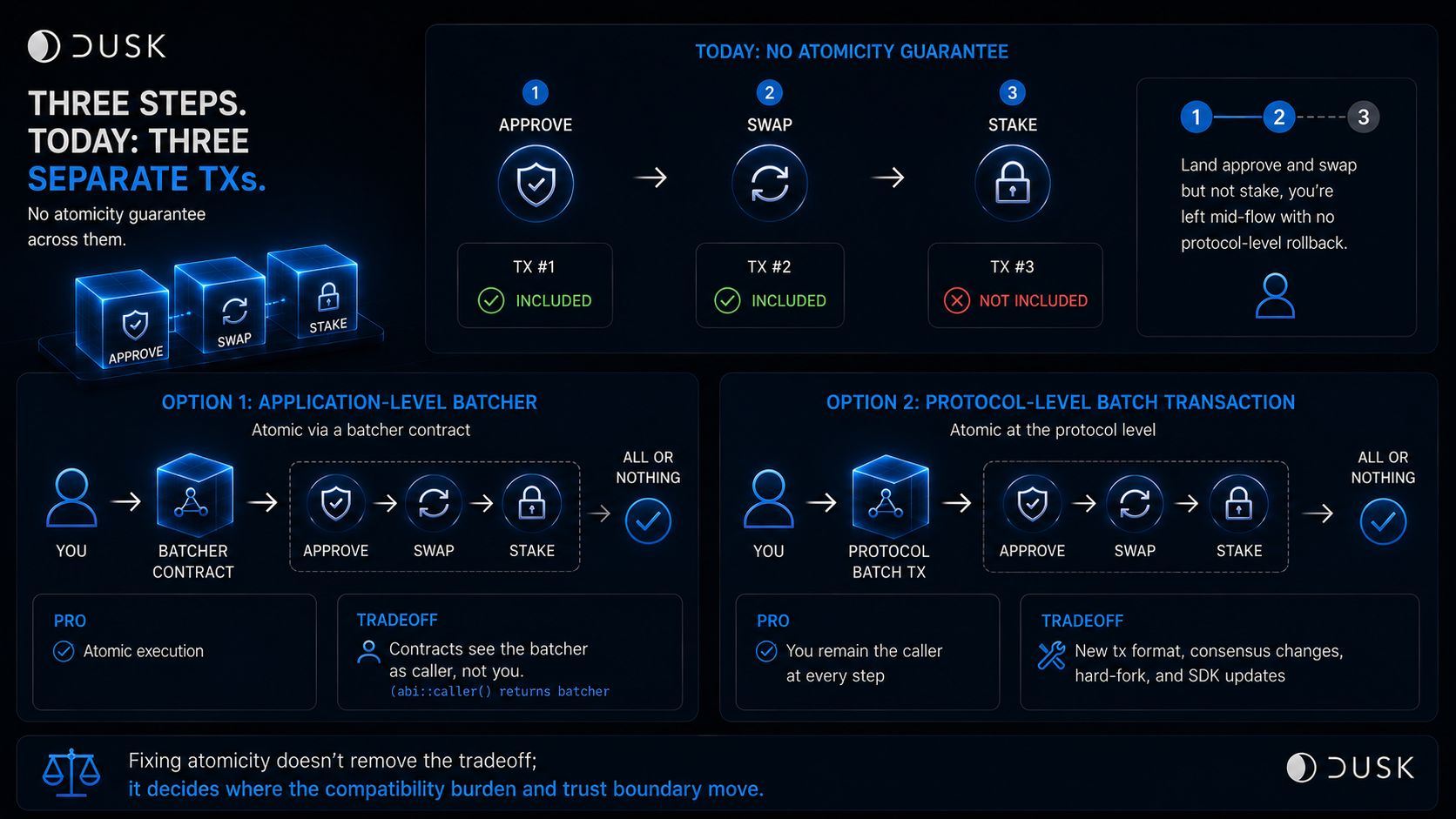
I assumed that if I wanted to do three things on-chain, approve, swap, then stake, the chain would treat that as one thing happening or not happening at all. An open issue in Dusk's own Rusk repository says that's not how it works today.
A Dusk transaction today carries a single optional operation: one contract call, one deploy, or one memo, with one value, one recipient, one nonce, one signature. So approve, swap, and stake become three separate transactions, each independently included or dropped. Dusk's issue states it plainly: there is no atomicity guarantee across them. Land approve and swap but not stake, and you're left mid-flow with no protocol-level rollback.
The problem isn't only that multi-step flows can stop halfway. Fixing that changes who has to absorb the compatibility cost.
A batcher contract makes the whole sequence atomic, because a failed sub-call reverts the outer transaction. But a target contract checking who's calling it directly would see the batcher, not you, unless that contract is already written to look past the immediate caller. A protocol-level batch transaction keeps you as the caller at every step, but it doesn't ship without a new transaction format, consensus changes, a hard-fork, and every wallet SDK catching up.
Adding batching doesn't remove the tradeoff. It decides whether the compatibility burden sits in application authorization or in the protocol stack.
"Fixing atomicity doesn't remove the tradeoff; it decides where the compatibility burden and trust boundary move."
What I'd actually want to watch: whether Dusk chooses the application-level batcher or the protocol-level transaction, and what existing authorization assumptions that choice forces developers to change.
#dusk $DUSK @Dusk_Foundation
I assumed that if I wanted to do three things on-chain, approve, swap, then stake, the chain would treat that as one thing happening or not happening at all. An open issue in Dusk's own Rusk repository says that's not how it works today.
A Dusk transaction today carries a single optional operation: one contract call, one deploy, or one memo, with one value, one recipient, one nonce, one signature. So approve, swap, and stake become three separate transactions, each independently included or dropped. Dusk's issue states it plainly: there is no atomicity guarantee across them. Land approve and swap but not stake, and you're left mid-flow with no protocol-level rollback.
The problem isn't only that multi-step flows can stop halfway. Fixing that changes who has to absorb the compatibility cost.
A batcher contract makes the whole sequence atomic, because a failed sub-call reverts the outer transaction. But a target contract checking who's calling it directly would see the batcher, not you, unless that contract is already written to look past the immediate caller. A protocol-level batch transaction keeps you as the caller at every step, but it doesn't ship without a new transaction format, consensus changes, a hard-fork, and every wallet SDK catching up.
Adding batching doesn't remove the tradeoff. It decides whether the compatibility burden sits in application authorization or in the protocol stack.
"Fixing atomicity doesn't remove the tradeoff; it decides where the compatibility burden and trust boundary move."
What I'd actually want to watch: whether Dusk chooses the application-level batcher or the protocol-level transaction, and what existing authorization assumptions that choice forces developers to change.
#dusk $DUSK @Dusk
A Dusk transaction today carries a single optional operation: one contract call, one deploy, or one memo, with one value, one recipient, one nonce, one signature. So approve, swap, and stake become three separate transactions, each independently included or dropped. Dusk's issue states it plainly: there is no atomicity guarantee across them. Land approve and swap but not stake, and you're left mid-flow with no protocol-level rollback.
The problem isn't only that multi-step flows can stop halfway. Fixing that changes who has to absorb the compatibility cost.
A batcher contract makes the whole sequence atomic, because a failed sub-call reverts the outer transaction. But a target contract checking who's calling it directly would see the batcher, not you, unless that contract is already written to look past the immediate caller. A protocol-level batch transaction keeps you as the caller at every step, but it doesn't ship without a new transaction format, consensus changes, a hard-fork, and every wallet SDK catching up.
Adding batching doesn't remove the tradeoff. It decides whether the compatibility burden sits in application authorization or in the protocol stack.
"Fixing atomicity doesn't remove the tradeoff; it decides where the compatibility burden and trust boundary move."
What I'd actually want to watch: whether Dusk chooses the application-level batcher or the protocol-level transaction, and what existing authorization assumptions that choice forces developers to change.
#dusk $DUSK @Dusk
1
2
94
·
--
Ver tradução
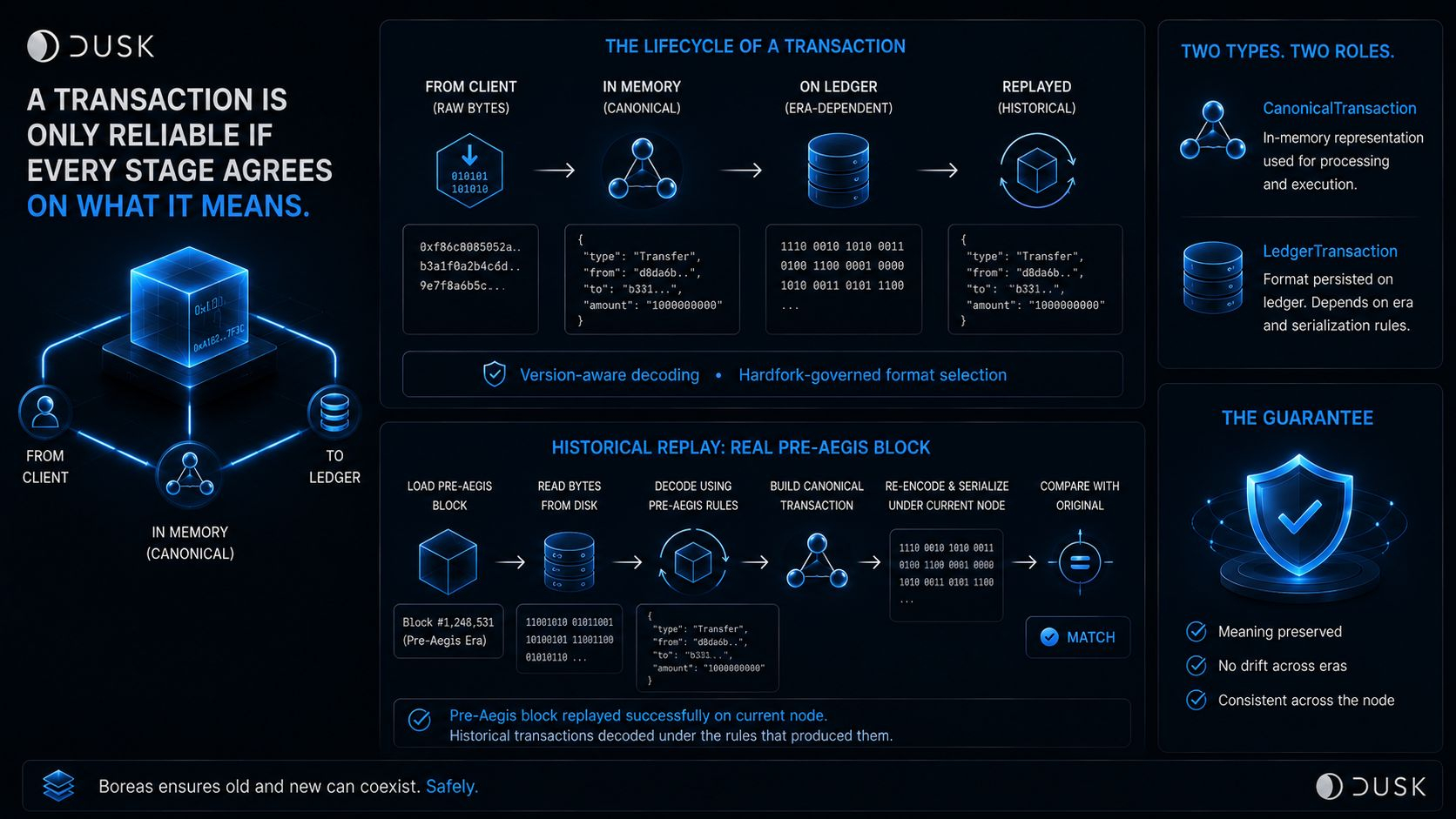
I assumed a transaction's meaning was fixed the moment its bytes existed: decode it once, get the same answer everywhere. Dusk's own Rusk changelog for the Boreas upgrade treats that as something that has to be engineered, not assumed.
Boreas added version-aware transaction decoding tied to a specific hardfork, plus hardfork-governed format selection for how old blocks get replayed. The codebase now has two explicitly separate types, CanonicalTransaction and LedgerTransaction, splitting the in-memory representation of a transaction from the format it's actually persisted in on the ledger. There's even a dedicated regression test just for decoding pre-Aegis-era transactions correctly during block serialization.
That only becomes necessary once transaction decoding has to account for different protocol eras and processing stages: fresh off the wire from a client, sitting in memory as a canonical object, replayed from a block that predates the current rules.
Which means a protocol upgrade isn't safe just because new transactions work under the new rules. It's only safe if those new rules don't silently break the ability to correctly replay old ledger state under the rules that produced it. That is the class of version-mismatch failure the historical-replay compatibility and hardfork-gated decoding are designed to prevent.
"A transaction is only reliable if every stage that touches it agrees on what it means."
What I'd actually want to see: a real pre-Aegis block replayed on a current node without changing how its historical transactions are decoded under the applicable rules, not just a passing regression test in isolation.
#dusk $DUSK @Dusk_Foundation
I assumed a transaction's meaning was fixed the moment its bytes existed: decode it once, get the same answer everywhere. Dusk's own Rusk changelog for the Boreas upgrade treats that as something that has to be engineered, not assumed.
Boreas added version-aware transaction decoding tied to a specific hardfork, plus hardfork-governed format selection for how old blocks get replayed. The codebase now has two explicitly separate types, CanonicalTransaction and LedgerTransaction, splitting the in-memory representation of a transaction from the format it's actually persisted in on the ledger. There's even a dedicated regression test just for decoding pre-Aegis-era transactions correctly during block serialization.
That only becomes necessary once transaction decoding has to account for different protocol eras and processing stages: fresh off the wire from a client, sitting in memory as a canonical object, replayed from a block that predates the current rules.
Which means a protocol upgrade isn't safe just because new transactions work under the new rules. It's only safe if those new rules don't silently break the ability to correctly replay old ledger state under the rules that produced it. That is the class of version-mismatch failure the historical-replay compatibility and hardfork-gated decoding are designed to prevent.
"A transaction is only reliable if every stage that touches it agrees on what it means."
What I'd actually want to see: a real pre-Aegis block replayed on a current node without changing how its historical transactions are decoded under the applicable rules, not just a passing regression test in isolation.
#dusk $DUSK @Dusk
Boreas added version-aware transaction decoding tied to a specific hardfork, plus hardfork-governed format selection for how old blocks get replayed. The codebase now has two explicitly separate types, CanonicalTransaction and LedgerTransaction, splitting the in-memory representation of a transaction from the format it's actually persisted in on the ledger. There's even a dedicated regression test just for decoding pre-Aegis-era transactions correctly during block serialization.
That only becomes necessary once transaction decoding has to account for different protocol eras and processing stages: fresh off the wire from a client, sitting in memory as a canonical object, replayed from a block that predates the current rules.
Which means a protocol upgrade isn't safe just because new transactions work under the new rules. It's only safe if those new rules don't silently break the ability to correctly replay old ledger state under the rules that produced it. That is the class of version-mismatch failure the historical-replay compatibility and hardfork-gated decoding are designed to prevent.
"A transaction is only reliable if every stage that touches it agrees on what it means."
What I'd actually want to see: a real pre-Aegis block replayed on a current node without changing how its historical transactions are decoded under the applicable rules, not just a passing regression test in isolation.
#dusk $DUSK @Dusk
7
3
84
·
--
Ver tradução
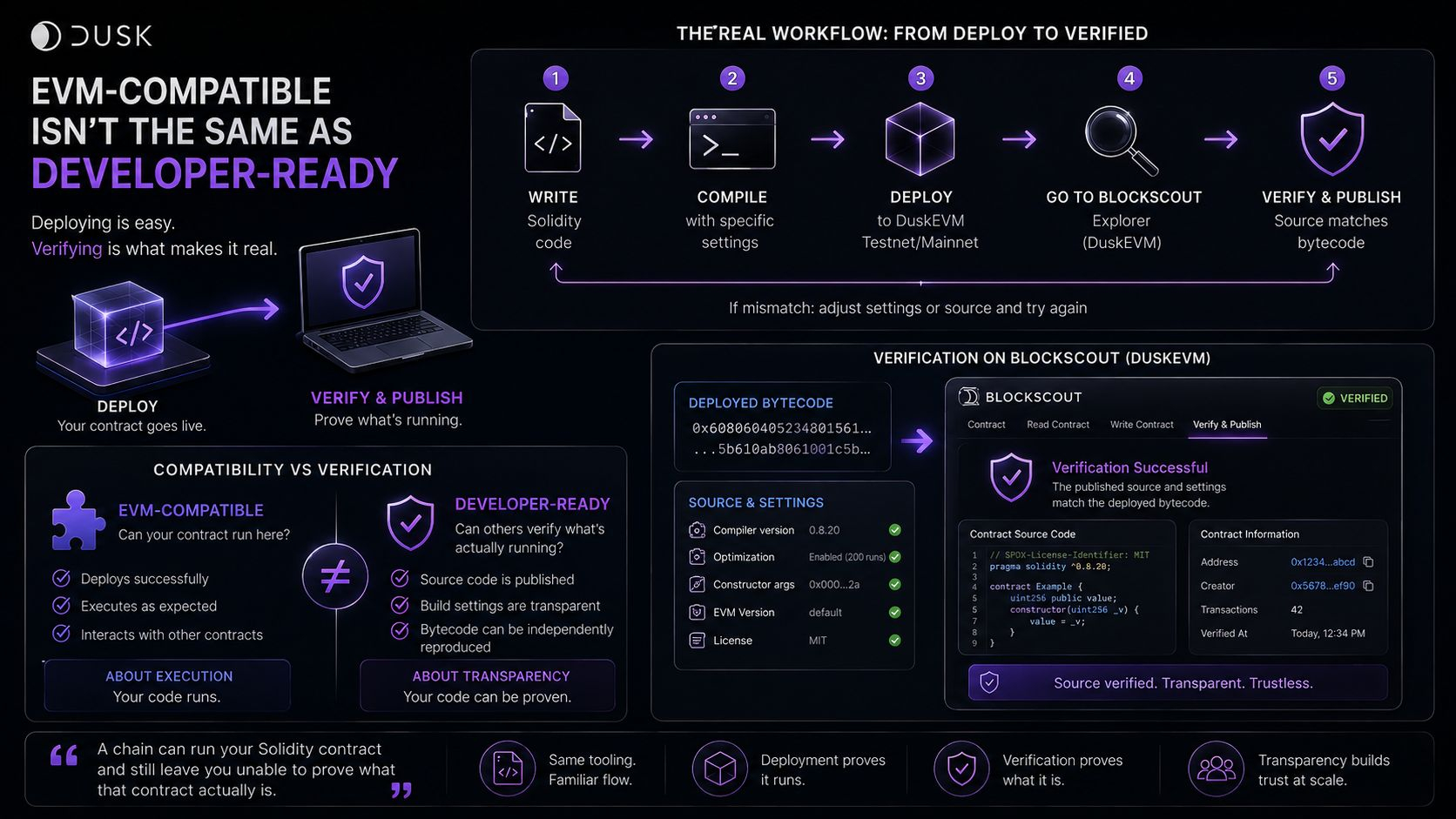
I assumed "DuskEVM supports Solidity" meant developers could show up with existing Ethereum tooling and be done. Dusk's own quickstart docs quietly add a step most people skip past: verifying the source.
Deploying is the easy part. DuskEVM uses Blockscout as its explorer, and getting a contract verified there, "Verify & Publish", means the relevant build settings, compiler version, optimizer configuration, source files, constructor arguments, have to reproduce the bytecode that's actually deployed.
That's a different bar than EVM compatibility. Deployment proves the code can run. Verification lets someone else check what's actually running. A contract can be deployed and functioning while still being unverified, leaving anyone else unable to independently check whether the published source actually matches what's live.
Which means "EVM-compatible" and "developer-ready" aren't quite the same claim. One is about whether your code runs here. The other is about whether an auditor, an institution, or a user can actually confirm what's running matches what's claimed.
"A chain can run your Solidity contract and still leave you unable to prove what that contract actually is."
What I'd want to see next: whether a contract deployed through the standard Solidity/Hardhat path can be reliably verified against its deployed bytecode, rather than merely deployed successfully.
#dusk $DUSK @Dusk_Foundation
I assumed "DuskEVM supports Solidity" meant developers could show up with existing Ethereum tooling and be done. Dusk's own quickstart docs quietly add a step most people skip past: verifying the source.
Deploying is the easy part. DuskEVM uses Blockscout as its explorer, and getting a contract verified there, "Verify & Publish", means the relevant build settings, compiler version, optimizer configuration, source files, constructor arguments, have to reproduce the bytecode that's actually deployed.
That's a different bar than EVM compatibility. Deployment proves the code can run. Verification lets someone else check what's actually running. A contract can be deployed and functioning while still being unverified, leaving anyone else unable to independently check whether the published source actually matches what's live.
Which means "EVM-compatible" and "developer-ready" aren't quite the same claim. One is about whether your code runs here. The other is about whether an auditor, an institution, or a user can actually confirm what's running matches what's claimed.
"A chain can run your Solidity contract and still leave you unable to prove what that contract actually is."
What I'd want to see next: whether a contract deployed through the standard Solidity/Hardhat path can be reliably verified against its deployed bytecode, rather than merely deployed successfully.
#dusk $DUSK @Dusk
Deploying is the easy part. DuskEVM uses Blockscout as its explorer, and getting a contract verified there, "Verify & Publish", means the relevant build settings, compiler version, optimizer configuration, source files, constructor arguments, have to reproduce the bytecode that's actually deployed.
That's a different bar than EVM compatibility. Deployment proves the code can run. Verification lets someone else check what's actually running. A contract can be deployed and functioning while still being unverified, leaving anyone else unable to independently check whether the published source actually matches what's live.
Which means "EVM-compatible" and "developer-ready" aren't quite the same claim. One is about whether your code runs here. The other is about whether an auditor, an institution, or a user can actually confirm what's running matches what's claimed.
"A chain can run your Solidity contract and still leave you unable to prove what that contract actually is."
What I'd want to see next: whether a contract deployed through the standard Solidity/Hardhat path can be reliably verified against its deployed bytecode, rather than merely deployed successfully.
#dusk $DUSK @Dusk
9
5
86
·
--
Ver tradução
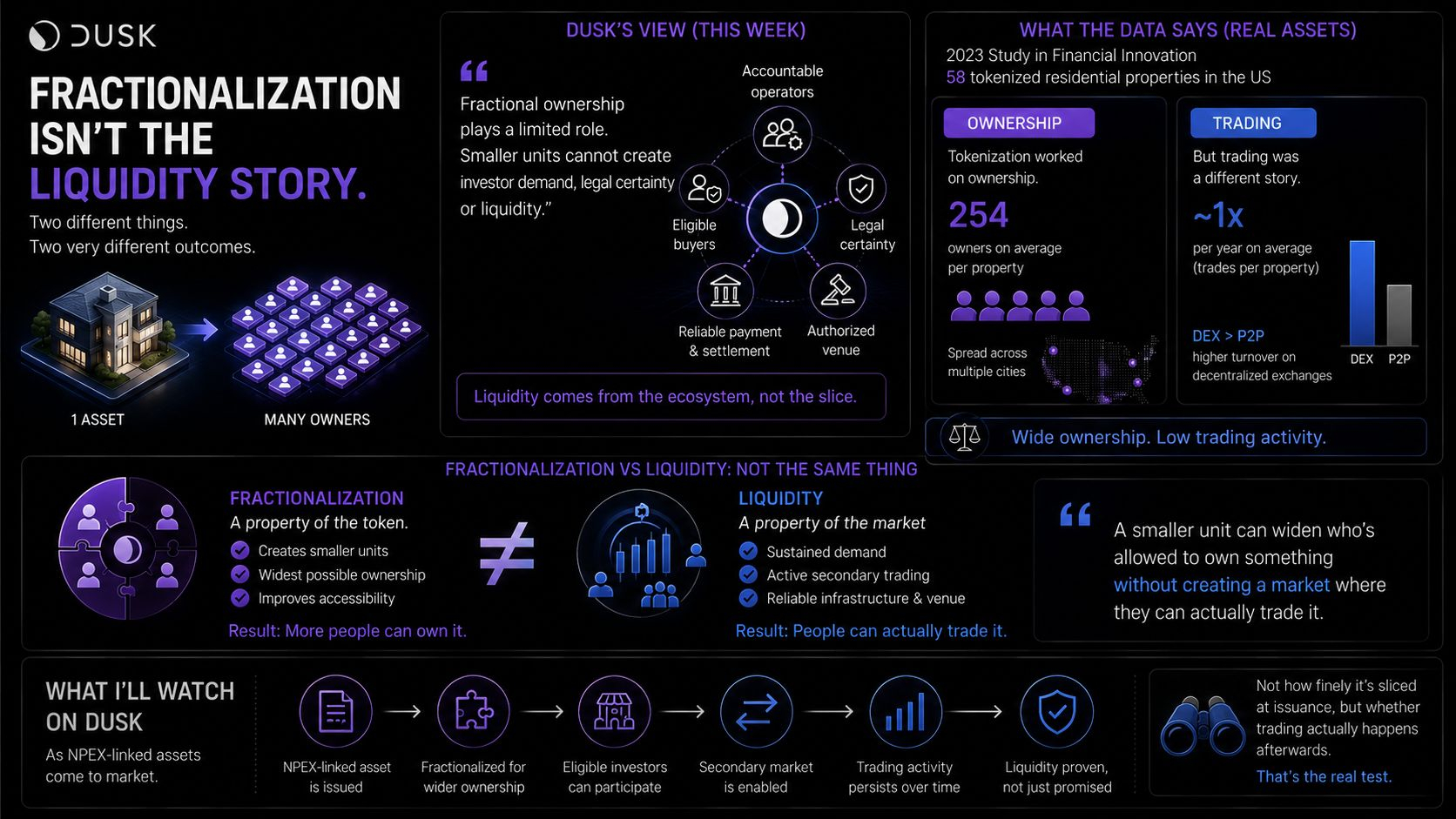
I assumed fractionalization was most of the liquidity story: split an asset into smaller pieces, and the pool of potential owners gets wider. Dusk's own writing on tokenization for SMEs, published this week, says that's a limited part of the picture, and an independent academic study of real tokenized assets shows why the gap matters.
Dusk says it plainly: "fractional ownership plays a limited role. Smaller units cannot create investor demand, legal certainty or liquidity." The value, they argue, comes from connecting the security to accountable operators, eligible buyers, reliable payment and settlement, and an authorized venue, not from how finely it's sliced.
A 2023 study published in Financial Innovation tested something close to this against real 58 tokenized residential properties in the US. On ownership, the results were clear: the average property had 254 separate owners. But on trading, the picture was different. Ownership changed hands about once a year on average, with properties on decentralized exchanges turning over more often than those traded peer-to-peer, though the yearly baseline stayed low either way.
Which means the two claims people conflate, "this asset is fractionalized" and "this asset is liquid," are actually describing two different things. Fractionalization is a property of the token. Liquidity is a property of the market around it.
"A smaller unit can widen who's allowed to own something without creating a market where they can actually trade it."
What I'd watch as NPEX-linked assets come onto Dusk: not how finely they're fractionalized at issuance, but whether secondary trading actually persists after that, the same gap the 58-property study found between wide ownership and active trading.
#dusk $DUSK @Dusk_Foundation
I assumed fractionalization was most of the liquidity story: split an asset into smaller pieces, and the pool of potential owners gets wider. Dusk's own writing on tokenization for SMEs, published this week, says that's a limited part of the picture, and an independent academic study of real tokenized assets shows why the gap matters.
Dusk says it plainly: "fractional ownership plays a limited role. Smaller units cannot create investor demand, legal certainty or liquidity." The value, they argue, comes from connecting the security to accountable operators, eligible buyers, reliable payment and settlement, and an authorized venue, not from how finely it's sliced.
A 2023 study published in Financial Innovation tested something close to this against real 58 tokenized residential properties in the US. On ownership, the results were clear: the average property had 254 separate owners. But on trading, the picture was different. Ownership changed hands about once a year on average, with properties on decentralized exchanges turning over more often than those traded peer-to-peer, though the yearly baseline stayed low either way.
Which means the two claims people conflate, "this asset is fractionalized" and "this asset is liquid," are actually describing two different things. Fractionalization is a property of the token. Liquidity is a property of the market around it.
"A smaller unit can widen who's allowed to own something without creating a market where they can actually trade it."
What I'd watch as NPEX-linked assets come onto Dusk: not how finely they're fractionalized at issuance, but whether secondary trading actually persists after that, the same gap the 58-property study found between wide ownership and active trading.
#dusk $DUSK @Dusk
Dusk says it plainly: "fractional ownership plays a limited role. Smaller units cannot create investor demand, legal certainty or liquidity." The value, they argue, comes from connecting the security to accountable operators, eligible buyers, reliable payment and settlement, and an authorized venue, not from how finely it's sliced.
A 2023 study published in Financial Innovation tested something close to this against real 58 tokenized residential properties in the US. On ownership, the results were clear: the average property had 254 separate owners. But on trading, the picture was different. Ownership changed hands about once a year on average, with properties on decentralized exchanges turning over more often than those traded peer-to-peer, though the yearly baseline stayed low either way.
Which means the two claims people conflate, "this asset is fractionalized" and "this asset is liquid," are actually describing two different things. Fractionalization is a property of the token. Liquidity is a property of the market around it.
"A smaller unit can widen who's allowed to own something without creating a market where they can actually trade it."
What I'd watch as NPEX-linked assets come onto Dusk: not how finely they're fractionalized at issuance, but whether secondary trading actually persists after that, the same gap the 58-property study found between wide ownership and active trading.
#dusk $DUSK @Dusk
2
2
79
·
--
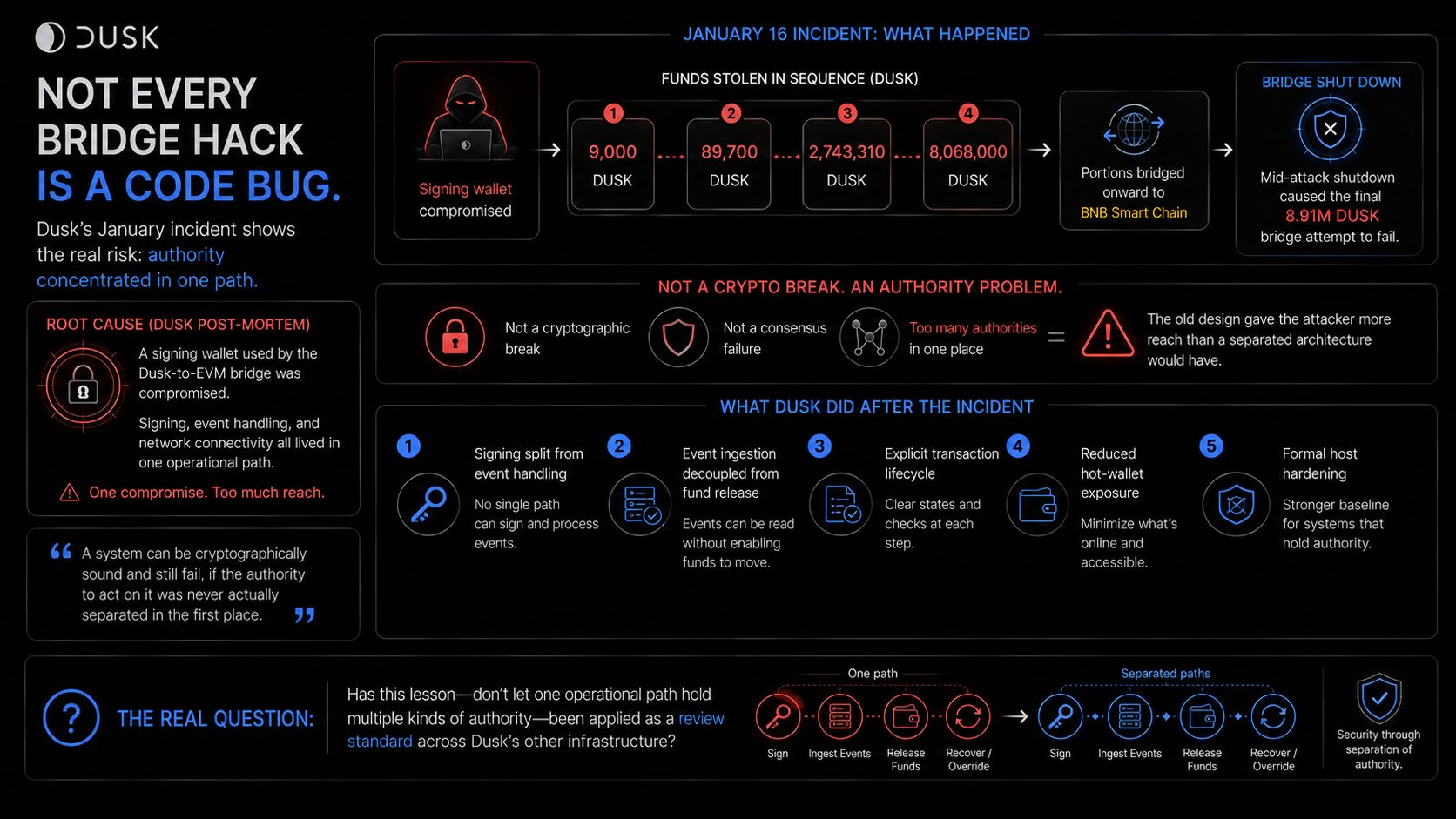
Eu presumi que um “bridge hack” significava que alguém encontrou um bug no código, uma falha na criptografia, algo que uma auditoria de segurança teria deixado passar. O próprio post-mortem da Dusk sobre o incidente na ponte de janeiro descreve algo diferente.
Em 16 de janeiro, um atacante comprometeu uma carteira de assinatura usada pela ponte Dusk-to-EVM, movendo fundos diretamente na Dusk antes de encaminhar parte deles adiante para a BNB Smart Chain. A Dusk desligou a ponte no meio do ataque, e foi isso que fez uma última tentativa de transferência de aproximadamente 8,9 milhões de DUSK falhar.
Isso não foi uma falha de consenso nem uma exploração de protocolo. A Dusk diz que a causa direta foi a comprometimento de chaves, e que o design antigo permitia que a carteira de assinatura, o tratamento de eventos e a conectividade de rede operassem todos dentro de um mesmo caminho. A fraqueza estava concentrada na autoridade operacional, não em uma criptografia fraca.
O redesenho que veio depois se resume a uma frase enterrada no post-mortem: “ingestion is no longer equivalent to spending”. Perceber que um evento aconteceu e ter a autoridade para liberar fundos por causa disso costumavam ser o mesmo passo. Agora não são mais. A ingestão de eventos passa por checkpointing e é enfileirada como um job; um processo separado e explícito é que, de fato, move os fundos contra ela.
“Um protocolo pode funcionar como foi projetado enquanto a camada operacional ao redor dele concede autoridade demais a um único caminho comprometido.”
O que eu realmente gostaria de ver: confirmação de que a ponte redesenhada de fato mantém a ingestão de eventos e a liberação de fundos em caminhos separados na prática, e não apenas na descrição, no post-mortem, da nova arquitetura.
#dusk $DUSK @Dusk_Foundation
Eu presumi que um “bridge hack” significava que alguém encontrou um bug no código, uma falha na criptografia, algo que uma auditoria de segurança teria deixado passar. O próprio post-mortem da Dusk sobre o incidente na ponte de janeiro descreve algo diferente.
Em 16 de janeiro, um atacante comprometeu uma carteira de assinatura usada pela ponte Dusk-to-EVM, movendo fundos diretamente na Dusk antes de encaminhar parte deles adiante para a BNB Smart Chain. A Dusk desligou a ponte no meio do ataque, e foi isso que fez uma última tentativa de transferência de aproximadamente 8,9 milhões de DUSK falhar.
Isso não foi uma falha de consenso nem uma exploração de protocolo. A Dusk diz que a causa direta foi a comprometimento de chaves, e que o design antigo permitia que a carteira de assinatura, o tratamento de eventos e a conectividade de rede operassem todos dentro de um mesmo caminho. A fraqueza estava concentrada na autoridade operacional, não em uma criptografia fraca.
O redesenho que veio depois se resume a uma frase enterrada no post-mortem: “ingestion is no longer equivalent to spending”. Perceber que um evento aconteceu e ter a autoridade para liberar fundos por causa disso costumavam ser o mesmo passo. Agora não são mais. A ingestão de eventos passa por checkpointing e é enfileirada como um job; um processo separado e explícito é que, de fato, move os fundos contra ela.
“Um protocolo pode funcionar como foi projetado enquanto a camada operacional ao redor dele concede autoridade demais a um único caminho comprometido.”
O que eu realmente gostaria de ver: confirmação de que a ponte redesenhada de fato mantém a ingestão de eventos e a liberação de fundos em caminhos separados na prática, e não apenas na descrição, no post-mortem, da nova arquitetura.
#dusk $DUSK @Dusk
Em 16 de janeiro, um atacante comprometeu uma carteira de assinatura usada pela ponte Dusk-to-EVM, movendo fundos diretamente na Dusk antes de encaminhar parte deles adiante para a BNB Smart Chain. A Dusk desligou a ponte no meio do ataque, e foi isso que fez uma última tentativa de transferência de aproximadamente 8,9 milhões de DUSK falhar.
Isso não foi uma falha de consenso nem uma exploração de protocolo. A Dusk diz que a causa direta foi a comprometimento de chaves, e que o design antigo permitia que a carteira de assinatura, o tratamento de eventos e a conectividade de rede operassem todos dentro de um mesmo caminho. A fraqueza estava concentrada na autoridade operacional, não em uma criptografia fraca.
O redesenho que veio depois se resume a uma frase enterrada no post-mortem: “ingestion is no longer equivalent to spending”. Perceber que um evento aconteceu e ter a autoridade para liberar fundos por causa disso costumavam ser o mesmo passo. Agora não são mais. A ingestão de eventos passa por checkpointing e é enfileirada como um job; um processo separado e explícito é que, de fato, move os fundos contra ela.
“Um protocolo pode funcionar como foi projetado enquanto a camada operacional ao redor dele concede autoridade demais a um único caminho comprometido.”
O que eu realmente gostaria de ver: confirmação de que a ponte redesenhada de fato mantém a ingestão de eventos e a liberação de fundos em caminhos separados na prática, e não apenas na descrição, no post-mortem, da nova arquitetura.
#dusk $DUSK @Dusk
6
4
11.5k
·
--
Ver tradução
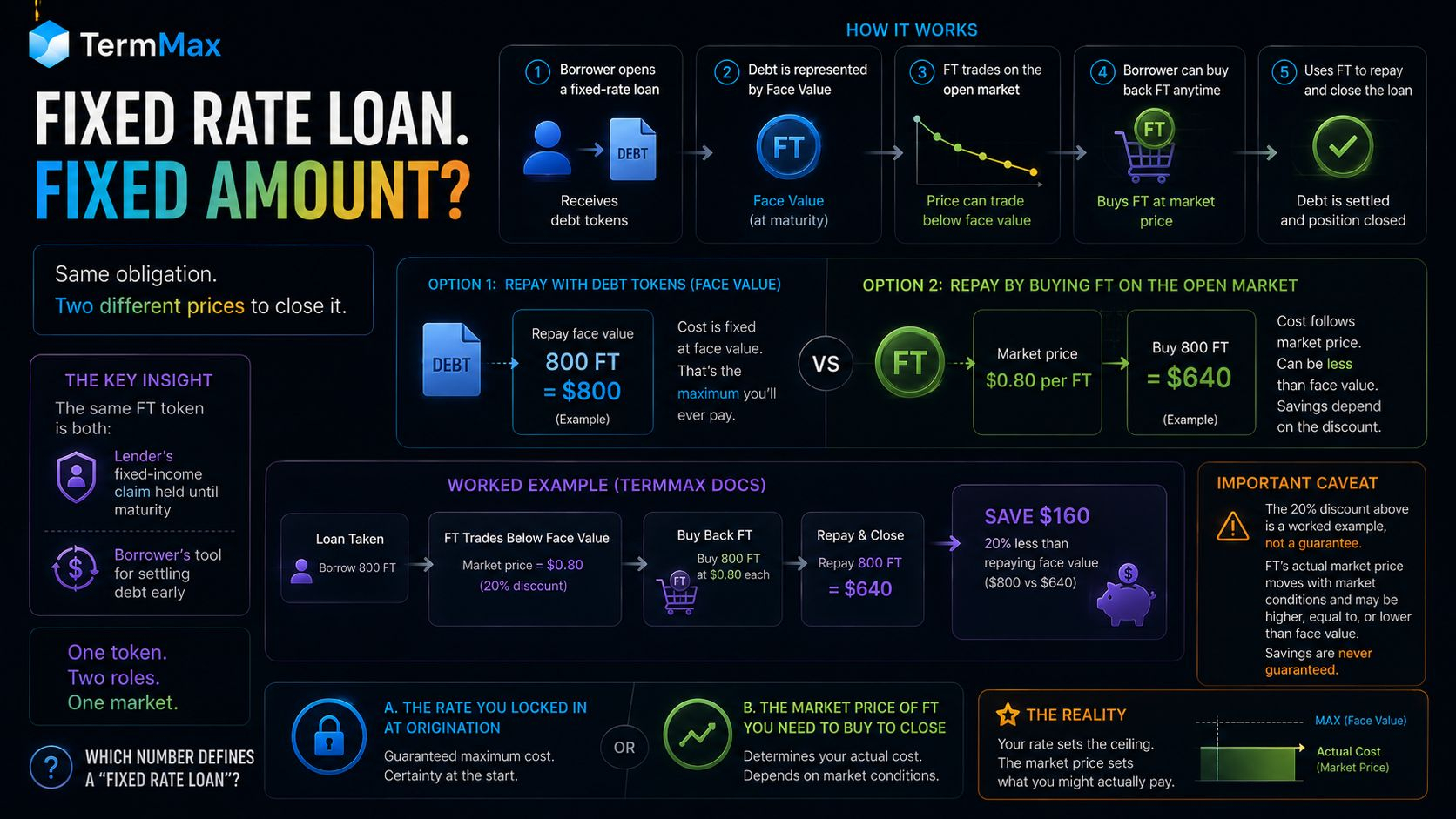
I assumed a fixed-rate loan on TermMax meant one number: whatever you borrowed, that's the fixed amount you eventually hand back. That's not the whole picture.
Here's the mechanic. When a borrower takes a loan, they receive debt tokens and can repay by returning that exact face value. But TermMax also lets them buy back FT, the token representing that same debt, from the open market instead. FT can trade below face value before maturity, and TermMax's worked example illustrates how that can lower the repayment cost. In that example, a borrower who owes 800 FT can buy them back at $0.80 each and settle the debt for $640, instead of repaying $800 directly. Same obligation, two different prices to close it.
That's not a rounding difference. It's a 20% gap between the contractual repayment amount and what closing the position can actually cost, depending on where FT happens to be trading that day.
Here's what that reveals: the same FT token is simultaneously the lender's fixed-income claim held until maturity, and the borrower's tool for settling debt early. The debt isn't a number that sits still between origination and maturity. It can have a market price before maturity, and that market price can move independently of the rate quoted at origination.
One caveat worth naming: TermMax's own documentation uses this 20% figure as a worked example, not a guaranteed market condition. FT's actual discount moves with market conditions and won't always be that wide.
So which number should actually define a "fixed-rate loan": the rate you locked in at origination, or the market price of the instrument you'd need to buy to close it?
#termmax @termmax
I assumed a fixed-rate loan on TermMax meant one number: whatever you borrowed, that's the fixed amount you eventually hand back. That's not the whole picture.
Here's the mechanic. When a borrower takes a loan, they receive debt tokens and can repay by returning that exact face value. But TermMax also lets them buy back FT, the token representing that same debt, from the open market instead. FT can trade below face value before maturity, and TermMax's worked example illustrates how that can lower the repayment cost. In that example, a borrower who owes 800 FT can buy them back at $0.80 each and settle the debt for $640, instead of repaying $800 directly. Same obligation, two different prices to close it.
That's not a rounding difference. It's a 20% gap between the contractual repayment amount and what closing the position can actually cost, depending on where FT happens to be trading that day.
Here's what that reveals: the same FT token is simultaneously the lender's fixed-income claim held until maturity, and the borrower's tool for settling debt early. The debt isn't a number that sits still between origination and maturity. It can have a market price before maturity, and that market price can move independently of the rate quoted at origination.
One caveat worth naming: TermMax's own documentation uses this 20% figure as a worked example, not a guaranteed market condition. FT's actual discount moves with market conditions and won't always be that wide.
So which number should actually define a "fixed-rate loan": the rate you locked in at origination, or the market price of the instrument you'd need to buy to close it?
#termmax @TermMax
Here's the mechanic. When a borrower takes a loan, they receive debt tokens and can repay by returning that exact face value. But TermMax also lets them buy back FT, the token representing that same debt, from the open market instead. FT can trade below face value before maturity, and TermMax's worked example illustrates how that can lower the repayment cost. In that example, a borrower who owes 800 FT can buy them back at $0.80 each and settle the debt for $640, instead of repaying $800 directly. Same obligation, two different prices to close it.
That's not a rounding difference. It's a 20% gap between the contractual repayment amount and what closing the position can actually cost, depending on where FT happens to be trading that day.
Here's what that reveals: the same FT token is simultaneously the lender's fixed-income claim held until maturity, and the borrower's tool for settling debt early. The debt isn't a number that sits still between origination and maturity. It can have a market price before maturity, and that market price can move independently of the rate quoted at origination.
One caveat worth naming: TermMax's own documentation uses this 20% figure as a worked example, not a guaranteed market condition. FT's actual discount moves with market conditions and won't always be that wide.
So which number should actually define a "fixed-rate loan": the rate you locked in at origination, or the market price of the instrument you'd need to buy to close it?
#termmax @TermMax
6
3
7.6k
·
--
Ver tradução
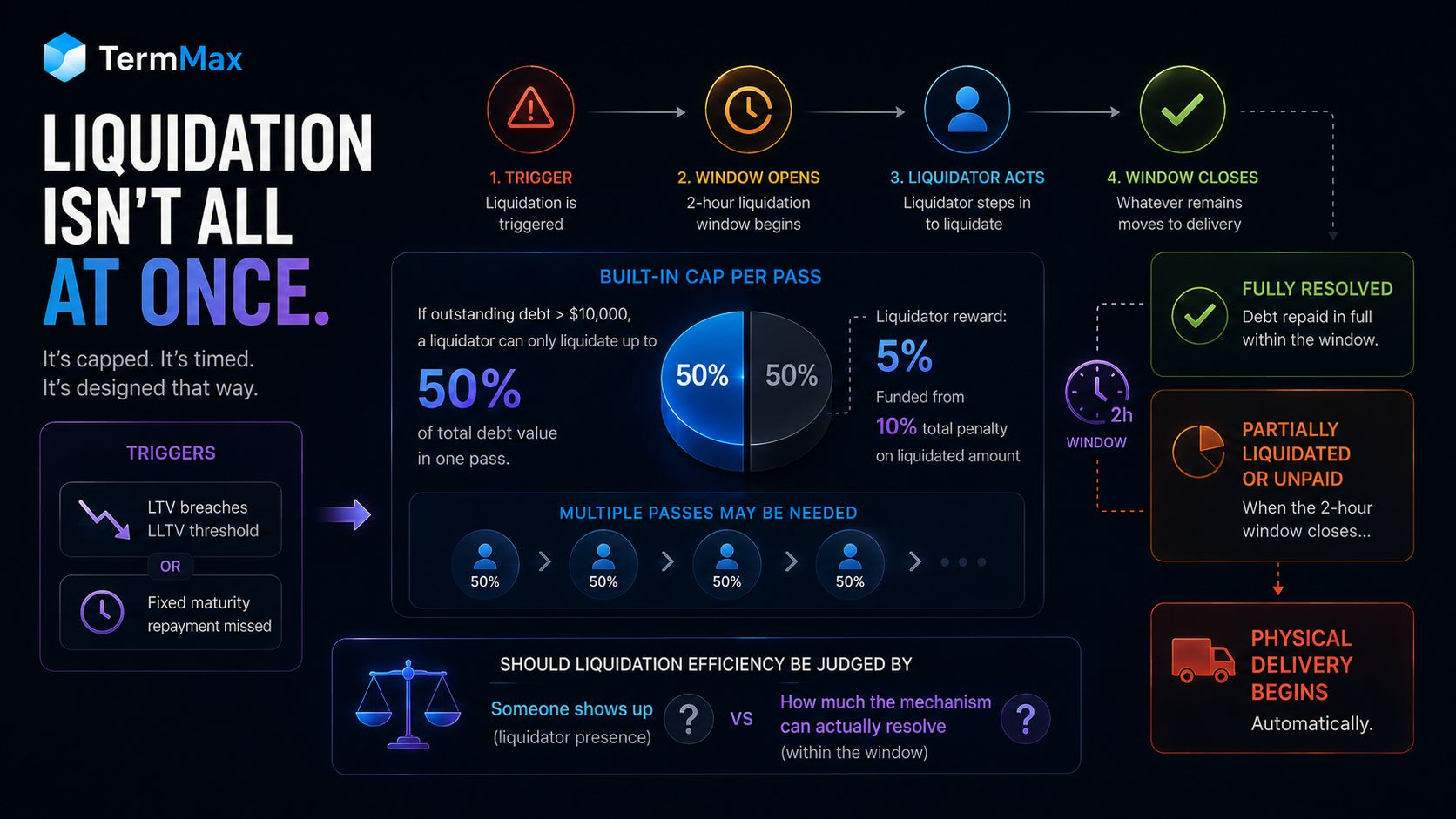
I assumed "liquidated" on TermMax meant a position was simply cleared once a liquidator stepped in. That's not quite how it works for larger positions.
Liquidation triggers when a loan's LTV breaches the LLTV threshold, or when a borrower misses the fixed maturity repayment, opening a two-hour liquidation window. But there's a cap built into the mechanism itself: if outstanding debt exceeds $10,000, a liquidator can only liquidate up to 50% of the total debt value in that pass.
So for a large enough position, the constraint isn't necessarily whether a liquidator wants to act. The protocol itself won't let any single liquidation clear the whole thing.
That changes what "partially liquidated" means. It's not necessarily evidence that liquidation demand was too thin or the market moved too fast. It can be an expected consequence of the mechanism itself. And if the loan is still unpaid or only partially liquidated when that two-hour window closes, physical delivery begins automatically.
The size of a position doesn't just affect how much is at risk. It can affect whether the liquidation process can fully resolve the position within its available window.
So should liquidation efficiency be judged by whether a liquidator shows up, or by how much of the position the mechanism can actually resolve before the window closes?
#termmax @termmax
I assumed "liquidated" on TermMax meant a position was simply cleared once a liquidator stepped in. That's not quite how it works for larger positions.
Liquidation triggers when a loan's LTV breaches the LLTV threshold, or when a borrower misses the fixed maturity repayment, opening a two-hour liquidation window. But there's a cap built into the mechanism itself: if outstanding debt exceeds $10,000, a liquidator can only liquidate up to 50% of the total debt value in that pass.
So for a large enough position, the constraint isn't necessarily whether a liquidator wants to act. The protocol itself won't let any single liquidation clear the whole thing.
That changes what "partially liquidated" means. It's not necessarily evidence that liquidation demand was too thin or the market moved too fast. It can be an expected consequence of the mechanism itself. And if the loan is still unpaid or only partially liquidated when that two-hour window closes, physical delivery begins automatically.
The size of a position doesn't just affect how much is at risk. It can affect whether the liquidation process can fully resolve the position within its available window.
So should liquidation efficiency be judged by whether a liquidator shows up, or by how much of the position the mechanism can actually resolve before the window closes?
#termmax @TermMax
Liquidation triggers when a loan's LTV breaches the LLTV threshold, or when a borrower misses the fixed maturity repayment, opening a two-hour liquidation window. But there's a cap built into the mechanism itself: if outstanding debt exceeds $10,000, a liquidator can only liquidate up to 50% of the total debt value in that pass.
So for a large enough position, the constraint isn't necessarily whether a liquidator wants to act. The protocol itself won't let any single liquidation clear the whole thing.
That changes what "partially liquidated" means. It's not necessarily evidence that liquidation demand was too thin or the market moved too fast. It can be an expected consequence of the mechanism itself. And if the loan is still unpaid or only partially liquidated when that two-hour window closes, physical delivery begins automatically.
The size of a position doesn't just affect how much is at risk. It can affect whether the liquidation process can fully resolve the position within its available window.
So should liquidation efficiency be judged by whether a liquidator shows up, or by how much of the position the mechanism can actually resolve before the window closes?
#termmax @TermMax
10
6
44
·
--
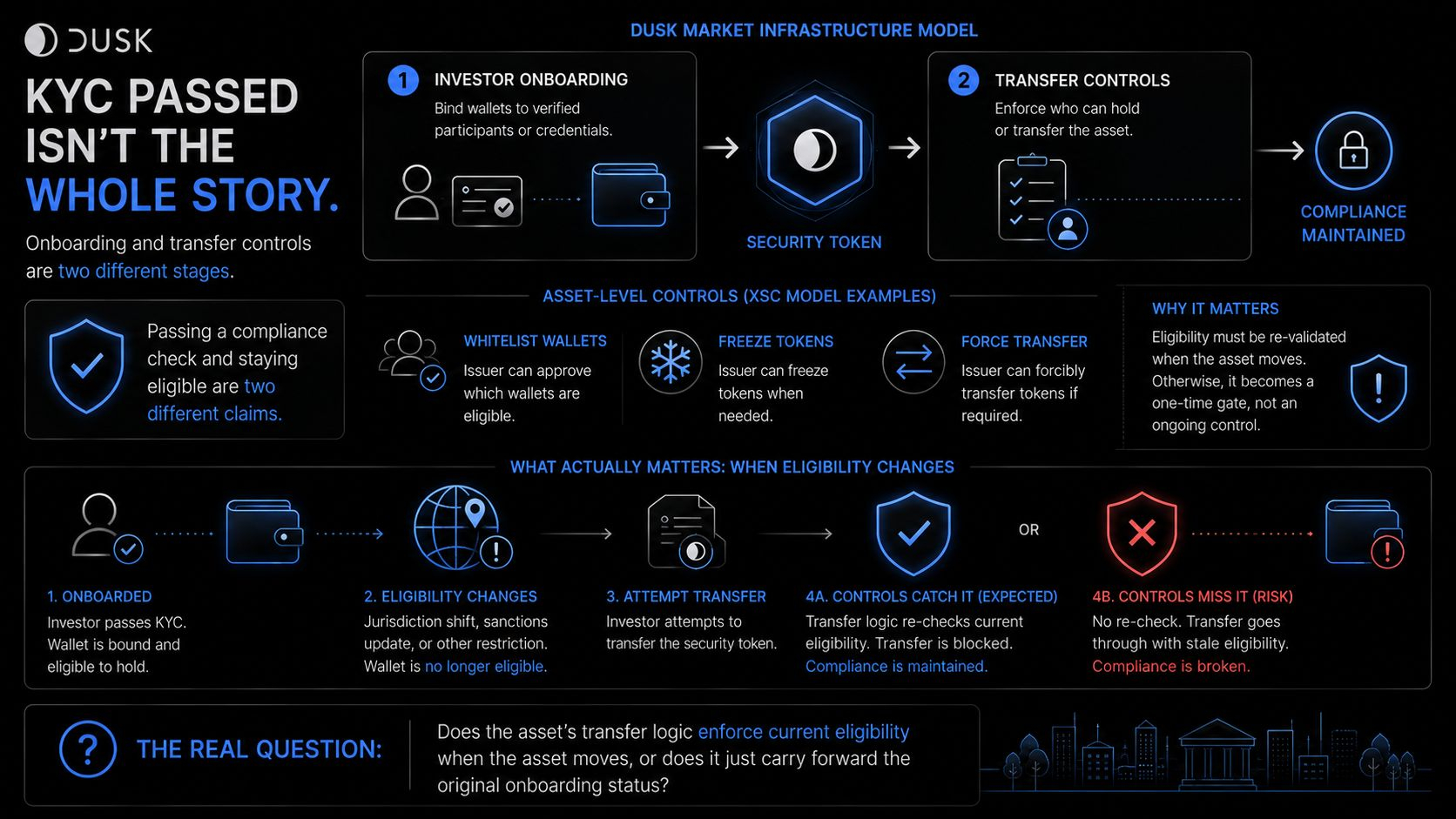
Respostas de KYC de quem foi qualificado no onboarding. Os controles de transferência determinam a resposta de quem ainda é elegível quando o ativo se move. O modelo de infraestrutura de mercado próprio da Dusk trata esses pontos como estágios separados, e a lacuna entre eles é a parte interessante.
A Dusk lista o onboarding de investidores, “vincular carteiras a participantes ou credenciais verificados”, separadamente dos controles de transferência, “impor quem pode manter ou transferir o ativo”. Um estabelece um estado inicial de elegibilidade. O outro é o que torna esse estado exequível quando o ativo de fato se move.
O material mais antigo da XSC vai além do onboarding: emissores podem colocar carteiras em lista de permissões e reter controles ao nível do ativo, como congelar ou forçar a transferência. Isso importa porque a elegibilidade não é apenas estabelecida uma vez. Ela precisa permanecer exequível após a decisão inicial.
Isso significa que “KYC aprovado” e “elegível para manter este ativo” são duas alegações diferentes que podem divergir silenciosamente. Uma carteira pode continuar verificada no sentido de identidade enquanto deixa de ser o tipo de detentor que este ativo específico tem permissão para ter. A aplicação de conformidade não termina no onboarding; ela precisa continuar no ciclo de transferência do ativo.
“Passar em uma verificação de conformidade e continuar elegível são duas alegações diferentes.”
Isso muda a pergunta de avaliação real. Não é “este ativo tem verificações de elegibilidade”. A questão real é se o estado atual de elegibilidade é imposto quando o ativo se move, ou se o status original do onboarding apenas é levado adiante.
O que eu realmente gostaria de ver: uma carteira cuja elegibilidade mude após o onboarding, por exemplo uma mudança de jurisdição, enquanto ainda detém o ativo; então, uma tentativa de transferência; e se a lógica de transferência do ativo captura essa mudança.
#dusk $DUSK @Dusk_Foundation
Respostas de KYC de quem foi qualificado no onboarding. Os controles de transferência determinam a resposta de quem ainda é elegível quando o ativo se move. O modelo de infraestrutura de mercado próprio da Dusk trata esses pontos como estágios separados, e a lacuna entre eles é a parte interessante.
A Dusk lista o onboarding de investidores, “vincular carteiras a participantes ou credenciais verificados”, separadamente dos controles de transferência, “impor quem pode manter ou transferir o ativo”. Um estabelece um estado inicial de elegibilidade. O outro é o que torna esse estado exequível quando o ativo de fato se move.
O material mais antigo da XSC vai além do onboarding: emissores podem colocar carteiras em lista de permissões e reter controles ao nível do ativo, como congelar ou forçar a transferência. Isso importa porque a elegibilidade não é apenas estabelecida uma vez. Ela precisa permanecer exequível após a decisão inicial.
Isso significa que “KYC aprovado” e “elegível para manter este ativo” são duas alegações diferentes que podem divergir silenciosamente. Uma carteira pode continuar verificada no sentido de identidade enquanto deixa de ser o tipo de detentor que este ativo específico tem permissão para ter. A aplicação de conformidade não termina no onboarding; ela precisa continuar no ciclo de transferência do ativo.
“Passar em uma verificação de conformidade e continuar elegível são duas alegações diferentes.”
Isso muda a pergunta de avaliação real. Não é “este ativo tem verificações de elegibilidade”. A questão real é se o estado atual de elegibilidade é imposto quando o ativo se move, ou se o status original do onboarding apenas é levado adiante.
O que eu realmente gostaria de ver: uma carteira cuja elegibilidade mude após o onboarding, por exemplo uma mudança de jurisdição, enquanto ainda detém o ativo; então, uma tentativa de transferência; e se a lógica de transferência do ativo captura essa mudança.
#dusk $DUSK @Dusk
A Dusk lista o onboarding de investidores, “vincular carteiras a participantes ou credenciais verificados”, separadamente dos controles de transferência, “impor quem pode manter ou transferir o ativo”. Um estabelece um estado inicial de elegibilidade. O outro é o que torna esse estado exequível quando o ativo de fato se move.
O material mais antigo da XSC vai além do onboarding: emissores podem colocar carteiras em lista de permissões e reter controles ao nível do ativo, como congelar ou forçar a transferência. Isso importa porque a elegibilidade não é apenas estabelecida uma vez. Ela precisa permanecer exequível após a decisão inicial.
Isso significa que “KYC aprovado” e “elegível para manter este ativo” são duas alegações diferentes que podem divergir silenciosamente. Uma carteira pode continuar verificada no sentido de identidade enquanto deixa de ser o tipo de detentor que este ativo específico tem permissão para ter. A aplicação de conformidade não termina no onboarding; ela precisa continuar no ciclo de transferência do ativo.
“Passar em uma verificação de conformidade e continuar elegível são duas alegações diferentes.”
Isso muda a pergunta de avaliação real. Não é “este ativo tem verificações de elegibilidade”. A questão real é se o estado atual de elegibilidade é imposto quando o ativo se move, ou se o status original do onboarding apenas é levado adiante.
O que eu realmente gostaria de ver: uma carteira cuja elegibilidade mude após o onboarding, por exemplo uma mudança de jurisdição, enquanto ainda detém o ativo; então, uma tentativa de transferência; e se a lógica de transferência do ativo captura essa mudança.
#dusk $DUSK @Dusk
26
8
102
·
--
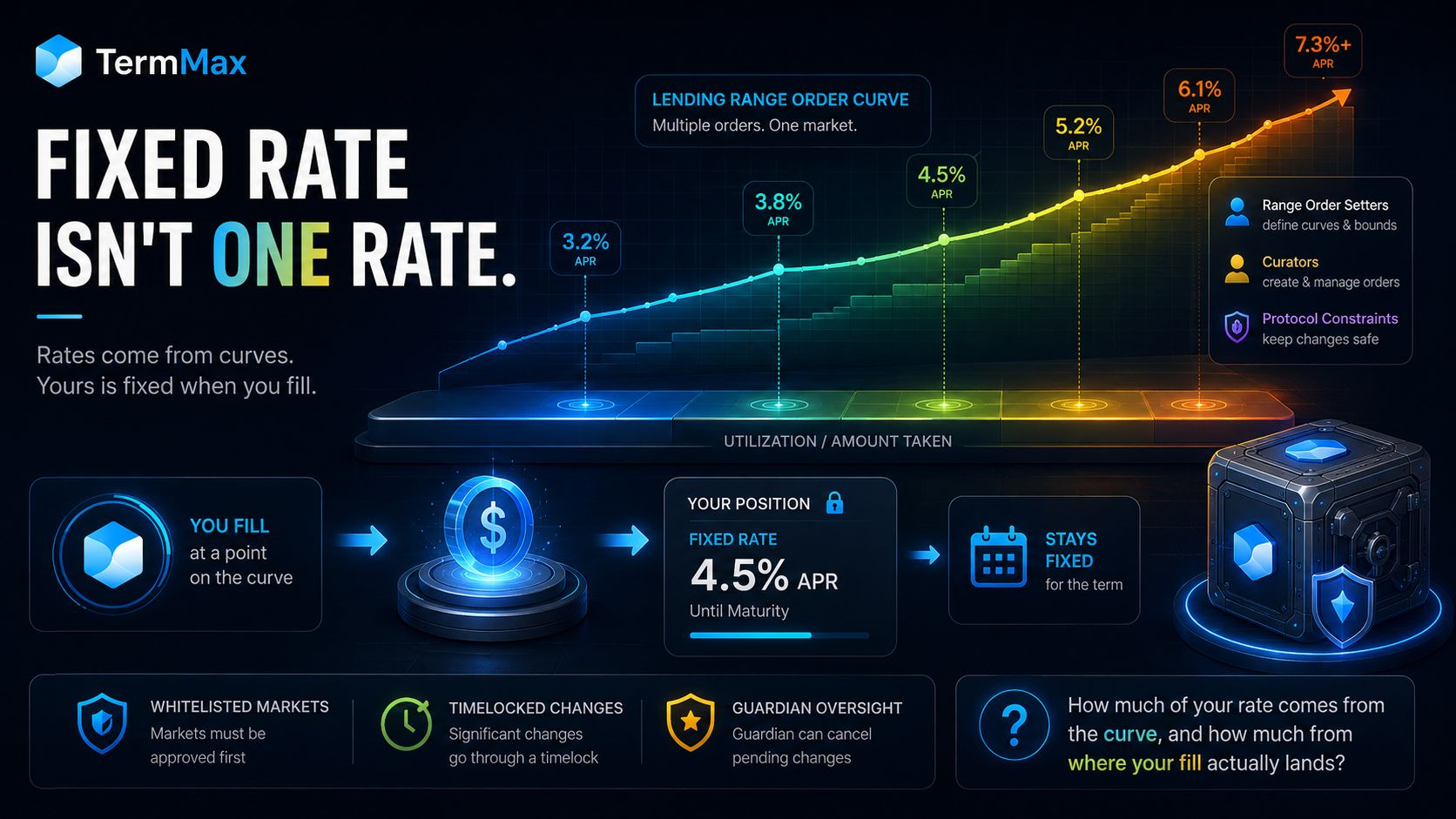
Eu assumi que “mercado de taxa fixa” significava uma única taxa: você sabe o número antes de transacionar, ponto final. Ao olhar mais de perto como o TermMax realmente precifica um empréstimo, essa suposição não se sustenta.
As taxas não são cotadas como um único número. Elas são definidas por meio de curvas. Em uma Ordem de Intervalo (Lending Range Order), a curva pode começar com uma taxa mais baixa e subir em etapas conforme mais da ordem é preenchida, de forma semelhante a um AMM que percorre diferentes níveis de preço em vez de oferecer um único preço. Um mercado pode manter várias ordens de intervalo ao mesmo tempo, então diferentes participantes podem preencher em pontos diferentes da curva.
Essa era a distinção que eu estava perdendo: o mercado não tem uma única taxa fixa. Cada posição executada recebe uma taxa fixa determinada por onde o seu preenchimento cai na curva. Depois de preenchida, essa taxa permanece fixa durante o prazo.
A curva também não é arbitrária em tempo de execução. As ações do Curator ficam dentro de restrições do protocolo, como mercados em lista de permissões e mudanças com timelock.
Então, quando o TermMax a chama de “mercado de taxa fixa”, a pergunta interessante não é apenas qual é a taxa fixa? É quanto dessa taxa é determinada pela curva e quanto depende de onde a sua liquidez de fato é preenchida?
#termmax @termmax
Eu assumi que “mercado de taxa fixa” significava uma única taxa: você sabe o número antes de transacionar, ponto final. Ao olhar mais de perto como o TermMax realmente precifica um empréstimo, essa suposição não se sustenta.
As taxas não são cotadas como um único número. Elas são definidas por meio de curvas. Em uma Ordem de Intervalo (Lending Range Order), a curva pode começar com uma taxa mais baixa e subir em etapas conforme mais da ordem é preenchida, de forma semelhante a um AMM que percorre diferentes níveis de preço em vez de oferecer um único preço. Um mercado pode manter várias ordens de intervalo ao mesmo tempo, então diferentes participantes podem preencher em pontos diferentes da curva.
Essa era a distinção que eu estava perdendo: o mercado não tem uma única taxa fixa. Cada posição executada recebe uma taxa fixa determinada por onde o seu preenchimento cai na curva. Depois de preenchida, essa taxa permanece fixa durante o prazo.
A curva também não é arbitrária em tempo de execução. As ações do Curator ficam dentro de restrições do protocolo, como mercados em lista de permissões e mudanças com timelock.
Então, quando o TermMax a chama de “mercado de taxa fixa”, a pergunta interessante não é apenas qual é a taxa fixa? É quanto dessa taxa é determinada pela curva e quanto depende de onde a sua liquidez de fato é preenchida?
#termmax @TermMax
As taxas não são cotadas como um único número. Elas são definidas por meio de curvas. Em uma Ordem de Intervalo (Lending Range Order), a curva pode começar com uma taxa mais baixa e subir em etapas conforme mais da ordem é preenchida, de forma semelhante a um AMM que percorre diferentes níveis de preço em vez de oferecer um único preço. Um mercado pode manter várias ordens de intervalo ao mesmo tempo, então diferentes participantes podem preencher em pontos diferentes da curva.
Essa era a distinção que eu estava perdendo: o mercado não tem uma única taxa fixa. Cada posição executada recebe uma taxa fixa determinada por onde o seu preenchimento cai na curva. Depois de preenchida, essa taxa permanece fixa durante o prazo.
A curva também não é arbitrária em tempo de execução. As ações do Curator ficam dentro de restrições do protocolo, como mercados em lista de permissões e mudanças com timelock.
Então, quando o TermMax a chama de “mercado de taxa fixa”, a pergunta interessante não é apenas qual é a taxa fixa? É quanto dessa taxa é determinada pela curva e quanto depende de onde a sua liquidez de fato é preenchida?
#termmax @TermMax
51
14
8.3k
·
--
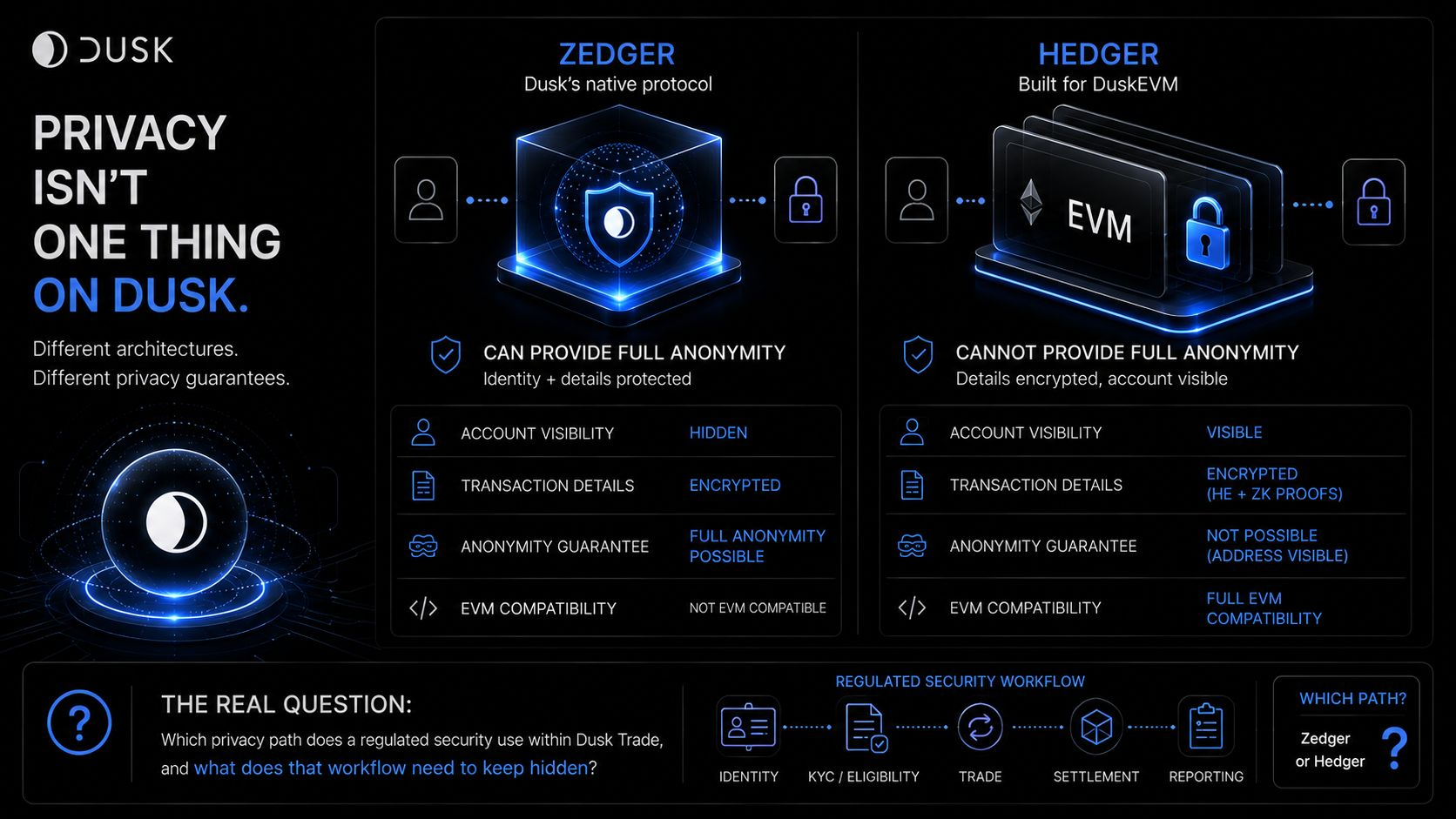
Pergunte à maioria das pessoas que estão avaliando uma cadeia de privacidade se ela é privada, e elas vão marcar uma caixa: sim ou não. Para a Dusk, essa é a pergunta errada, e a própria explicação da Dusk sobre a Hedger mostra por quê.
A Zedger, o protocolo nativo de privacidade da Dusk, consegue fornecer anonimato total. A Hedger, construída para a DuskEVM, não consegue. A Dusk diz isso de forma clara: o modelo baseado em contas da EVM impede o anonimato completo, enquanto a Hedger mantém os detalhes das transações criptografados usando criptografia homomórfica e provas de conhecimento zero, sem oferecer a mesma garantia de anonimato completo.
Isso não é um bug que a Dusk está escondendo. É a compensação que a arquitetura deixa explícita: compatibilidade com EVM vem com uma garantia de privacidade diferente daquela do anonimato total da Zedger.
Veja o que realmente muda quando essa compensação é feita. A diferença importante não é apenas se os detalhes das transações são criptografados. É a garantia de anonimato. Use o caminho da Zedger e o anonimato total está disponível. Use o caminho da Hedger compatível com EVM e a mesma garantia não existe. Mesma marca, mesma palavra "confidencial," garantia diferente por baixo.
Isso muda qual deveria ser a pergunta de fato para qualquer pessoa avaliando isso. Não "a Dusk oferece transações confidenciais". Ambos os caminhos oferecem fluxos de transações privadas, mas não fornecem a mesma garantia de anonimato. A pergunta real é se a garantia que um ativo regulado recebe realmente corresponde ao que o seu fluxo de trabalho precisa, em primeiro lugar.
"Privacidade que mantém os detalhes das transações confidenciais e privacidade que fornece anonimato total são duas garantias diferentes, mesmo quando um projeto publica as duas com a mesma palavra."
O que eu realmente gostaria de ver: qual caminho de privacidade uma segurança regulada de fato usa dentro da Dusk Trade e o que esse fluxo exige que o caminho mantenha oculto.
#dusk $DUSK @Dusk_Foundation
Pergunte à maioria das pessoas que estão avaliando uma cadeia de privacidade se ela é privada, e elas vão marcar uma caixa: sim ou não. Para a Dusk, essa é a pergunta errada, e a própria explicação da Dusk sobre a Hedger mostra por quê.
A Zedger, o protocolo nativo de privacidade da Dusk, consegue fornecer anonimato total. A Hedger, construída para a DuskEVM, não consegue. A Dusk diz isso de forma clara: o modelo baseado em contas da EVM impede o anonimato completo, enquanto a Hedger mantém os detalhes das transações criptografados usando criptografia homomórfica e provas de conhecimento zero, sem oferecer a mesma garantia de anonimato completo.
Isso não é um bug que a Dusk está escondendo. É a compensação que a arquitetura deixa explícita: compatibilidade com EVM vem com uma garantia de privacidade diferente daquela do anonimato total da Zedger.
Veja o que realmente muda quando essa compensação é feita. A diferença importante não é apenas se os detalhes das transações são criptografados. É a garantia de anonimato. Use o caminho da Zedger e o anonimato total está disponível. Use o caminho da Hedger compatível com EVM e a mesma garantia não existe. Mesma marca, mesma palavra "confidencial," garantia diferente por baixo.
Isso muda qual deveria ser a pergunta de fato para qualquer pessoa avaliando isso. Não "a Dusk oferece transações confidenciais". Ambos os caminhos oferecem fluxos de transações privadas, mas não fornecem a mesma garantia de anonimato. A pergunta real é se a garantia que um ativo regulado recebe realmente corresponde ao que o seu fluxo de trabalho precisa, em primeiro lugar.
"Privacidade que mantém os detalhes das transações confidenciais e privacidade que fornece anonimato total são duas garantias diferentes, mesmo quando um projeto publica as duas com a mesma palavra."
O que eu realmente gostaria de ver: qual caminho de privacidade uma segurança regulada de fato usa dentro da Dusk Trade e o que esse fluxo exige que o caminho mantenha oculto.
#dusk $DUSK @Dusk
A Zedger, o protocolo nativo de privacidade da Dusk, consegue fornecer anonimato total. A Hedger, construída para a DuskEVM, não consegue. A Dusk diz isso de forma clara: o modelo baseado em contas da EVM impede o anonimato completo, enquanto a Hedger mantém os detalhes das transações criptografados usando criptografia homomórfica e provas de conhecimento zero, sem oferecer a mesma garantia de anonimato completo.
Isso não é um bug que a Dusk está escondendo. É a compensação que a arquitetura deixa explícita: compatibilidade com EVM vem com uma garantia de privacidade diferente daquela do anonimato total da Zedger.
Veja o que realmente muda quando essa compensação é feita. A diferença importante não é apenas se os detalhes das transações são criptografados. É a garantia de anonimato. Use o caminho da Zedger e o anonimato total está disponível. Use o caminho da Hedger compatível com EVM e a mesma garantia não existe. Mesma marca, mesma palavra "confidencial," garantia diferente por baixo.
Isso muda qual deveria ser a pergunta de fato para qualquer pessoa avaliando isso. Não "a Dusk oferece transações confidenciais". Ambos os caminhos oferecem fluxos de transações privadas, mas não fornecem a mesma garantia de anonimato. A pergunta real é se a garantia que um ativo regulado recebe realmente corresponde ao que o seu fluxo de trabalho precisa, em primeiro lugar.
"Privacidade que mantém os detalhes das transações confidenciais e privacidade que fornece anonimato total são duas garantias diferentes, mesmo quando um projeto publica as duas com a mesma palavra."
O que eu realmente gostaria de ver: qual caminho de privacidade uma segurança regulada de fato usa dentro da Dusk Trade e o que esse fluxo exige que o caminho mantenha oculto.
#dusk $DUSK @Dusk
10
1
80
·
--
Ver tradução
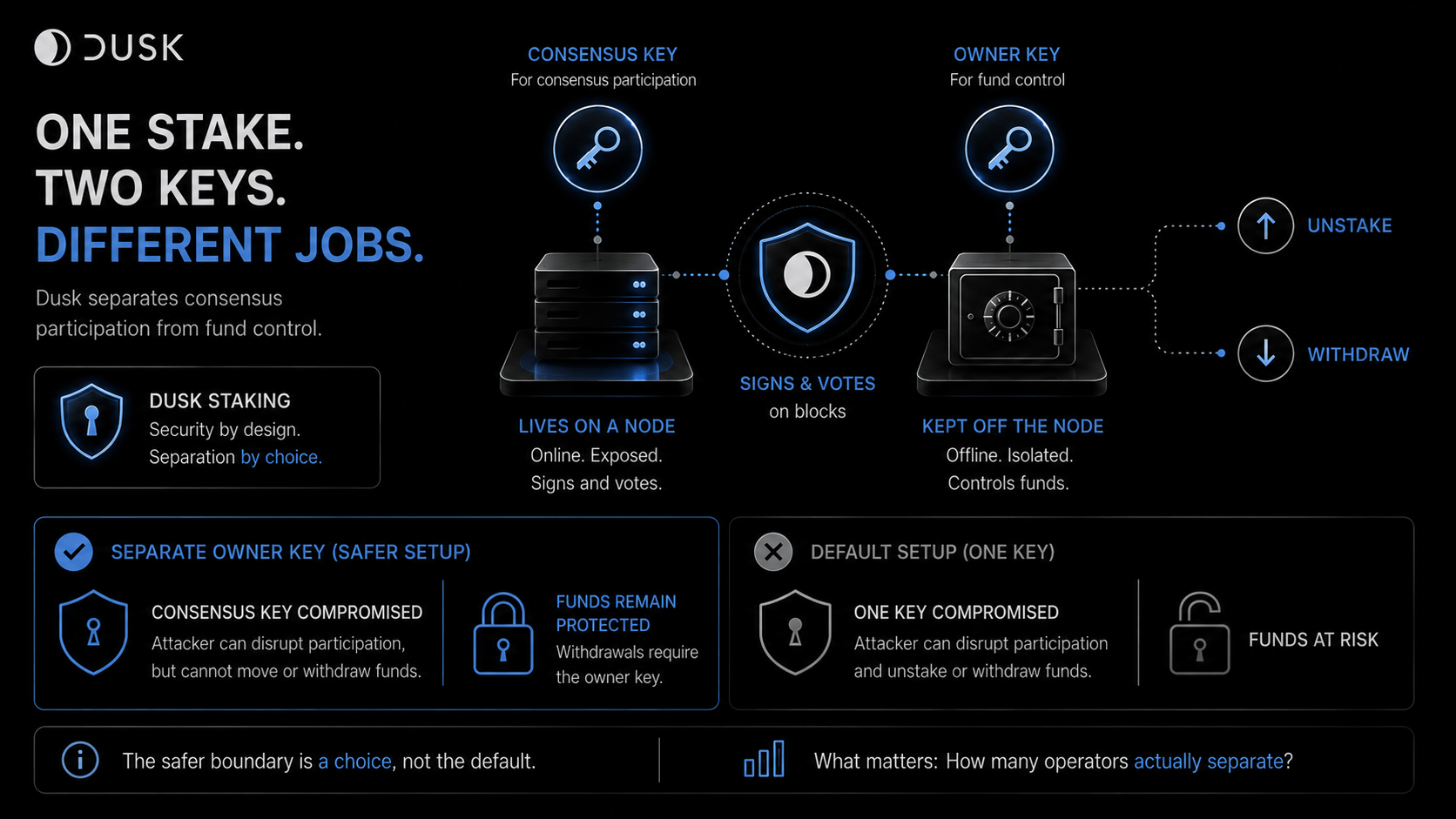
I assumed staking on a PoS chain meant one key controlling one thing: put DUSK in, get rewards out, same key handles it end to end.
Dusk's own operator docs split that in two.
The consensus key is the key a node uses to sign and vote in consensus. It has to live on an internet-connected node and participate as the validator operates. The owner key is separate: it's the key that can unstake or withdraw funds, and the docs say it doesn't need to touch the node at all.
The security benefit isn't simply that there are two keys. It's that the authority to participate in consensus and the authority to withdraw funds don't have to live in the same place. If the consensus key gets compromised because the server it's on gets breached, an attacker can interfere with consensus participation, but they still can't unstake or withdraw the stake. That authority never lived on the machine that's exposed to the internet in the first place. Which means the real security question isn't just how much is staked. It's where the authority to withdraw it actually sits relative to the machine that's exposed to attackers.
But there's a catch the docs don't hide: this separation isn't the default. If you stake without specifying a separate owner, the consensus key automatically becomes the owner too, one key, one boundary, back to the model I originally assumed. The safer setup is a choice an operator has to actively make, not something the protocol forces on them.
"A security boundary that has to be opted into is a different guarantee than one built into the default path, even when both are technically available."
What I'd actually want to know: how many active provisioners run with a separate owner key versus the default, because that would tell me whether the stronger boundary is actually being adopted, rather than merely being available.
#dusk $DUSK @Dusk_Foundation
I assumed staking on a PoS chain meant one key controlling one thing: put DUSK in, get rewards out, same key handles it end to end.
Dusk's own operator docs split that in two.
The consensus key is the key a node uses to sign and vote in consensus. It has to live on an internet-connected node and participate as the validator operates. The owner key is separate: it's the key that can unstake or withdraw funds, and the docs say it doesn't need to touch the node at all.
The security benefit isn't simply that there are two keys. It's that the authority to participate in consensus and the authority to withdraw funds don't have to live in the same place. If the consensus key gets compromised because the server it's on gets breached, an attacker can interfere with consensus participation, but they still can't unstake or withdraw the stake. That authority never lived on the machine that's exposed to the internet in the first place. Which means the real security question isn't just how much is staked. It's where the authority to withdraw it actually sits relative to the machine that's exposed to attackers.
But there's a catch the docs don't hide: this separation isn't the default. If you stake without specifying a separate owner, the consensus key automatically becomes the owner too, one key, one boundary, back to the model I originally assumed. The safer setup is a choice an operator has to actively make, not something the protocol forces on them.
"A security boundary that has to be opted into is a different guarantee than one built into the default path, even when both are technically available."
What I'd actually want to know: how many active provisioners run with a separate owner key versus the default, because that would tell me whether the stronger boundary is actually being adopted, rather than merely being available.
#dusk $DUSK @Dusk
Dusk's own operator docs split that in two.
The consensus key is the key a node uses to sign and vote in consensus. It has to live on an internet-connected node and participate as the validator operates. The owner key is separate: it's the key that can unstake or withdraw funds, and the docs say it doesn't need to touch the node at all.
The security benefit isn't simply that there are two keys. It's that the authority to participate in consensus and the authority to withdraw funds don't have to live in the same place. If the consensus key gets compromised because the server it's on gets breached, an attacker can interfere with consensus participation, but they still can't unstake or withdraw the stake. That authority never lived on the machine that's exposed to the internet in the first place. Which means the real security question isn't just how much is staked. It's where the authority to withdraw it actually sits relative to the machine that's exposed to attackers.
But there's a catch the docs don't hide: this separation isn't the default. If you stake without specifying a separate owner, the consensus key automatically becomes the owner too, one key, one boundary, back to the model I originally assumed. The safer setup is a choice an operator has to actively make, not something the protocol forces on them.
"A security boundary that has to be opted into is a different guarantee than one built into the default path, even when both are technically available."
What I'd actually want to know: how many active provisioners run with a separate owner key versus the default, because that would tell me whether the stronger boundary is actually being adopted, rather than merely being available.
#dusk $DUSK @Dusk
4
3
62
·
--
Ver tradução
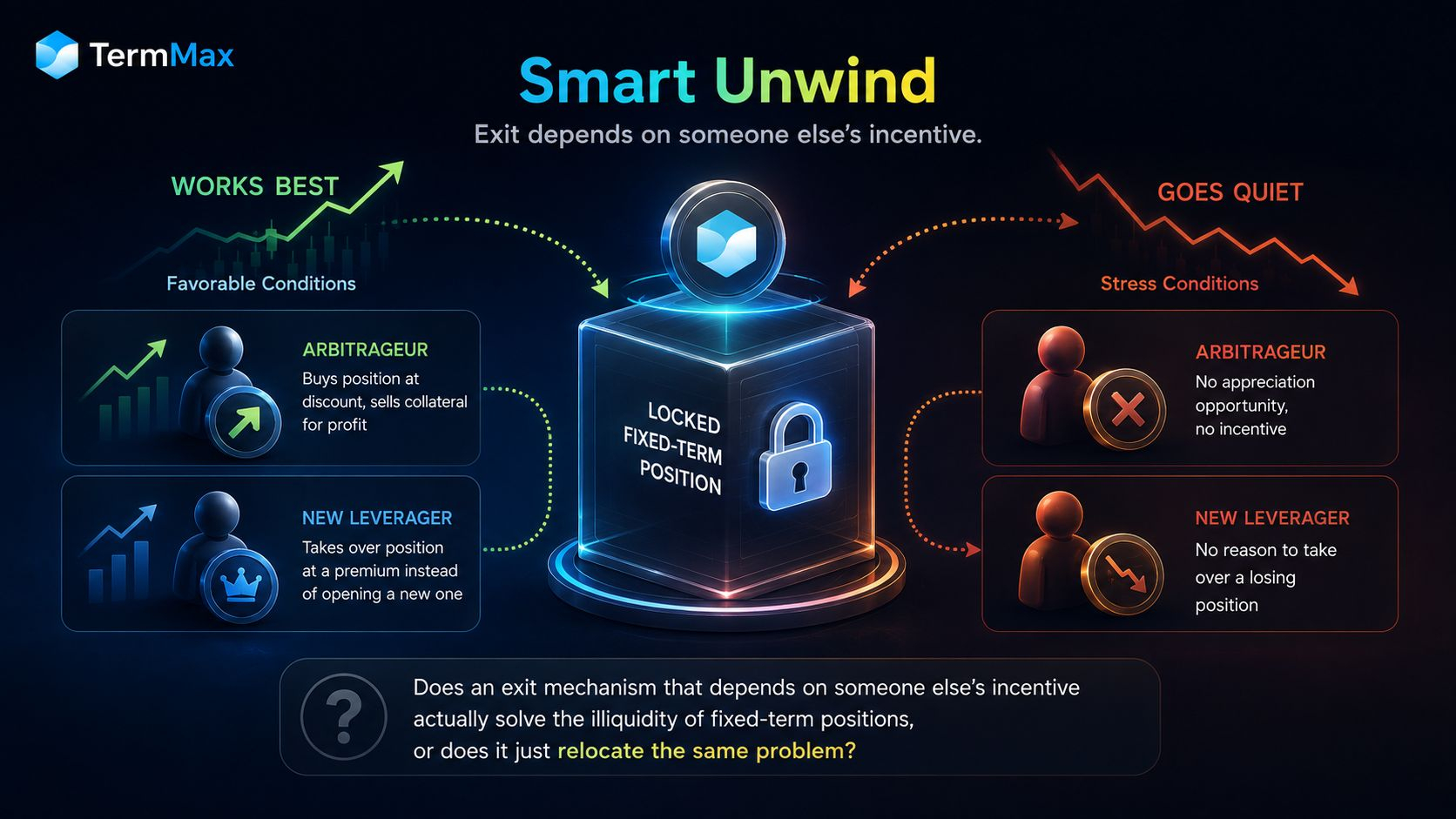
I assumed a locked fixed-term position meant exactly that: locked, full stop, until maturity. Then I found TermMax's Smart Unwind and assumed it simply solved that. It doesn't work the way I expected.
Smart Unwind doesn't pull exit liquidity from a pool. It works by making your position attractive enough that someone else wants to take it off your hands. A leverager sets a target APR or price. If the collateral appreciates enough, an arbitrageur buys the position at that fixed price and sells the collateral on the open market for a profit. If borrowing rates rise, a new leverager may take over the position at a premium instead of opening a fresh one.
So the protocol isn't guaranteeing the exit. The exit depends on someone else finding the trade attractive enough to take.
That's the part I hadn't considered: the conditions where a leverager most wants out, a falling collateral price or a stressed market, could plausibly be the conditions where an arbitrageur has no appreciation to capture and a new leverager has no reason to take over a losing position. The mechanism may work best exactly when you'd least need it, and go quiet exactly when you would.
Smart Unwind also isn't live yet, so none of this is observed behavior yet; it's only what the design implies.
Does an exit mechanism that depends on someone else's incentive actually solve the illiquidity of fixed-term positions, or does it just relocate the same problem to whoever needs to be found on the other side?
#termmax @termmax
I assumed a locked fixed-term position meant exactly that: locked, full stop, until maturity. Then I found TermMax's Smart Unwind and assumed it simply solved that. It doesn't work the way I expected.
Smart Unwind doesn't pull exit liquidity from a pool. It works by making your position attractive enough that someone else wants to take it off your hands. A leverager sets a target APR or price. If the collateral appreciates enough, an arbitrageur buys the position at that fixed price and sells the collateral on the open market for a profit. If borrowing rates rise, a new leverager may take over the position at a premium instead of opening a fresh one.
So the protocol isn't guaranteeing the exit. The exit depends on someone else finding the trade attractive enough to take.
That's the part I hadn't considered: the conditions where a leverager most wants out, a falling collateral price or a stressed market, could plausibly be the conditions where an arbitrageur has no appreciation to capture and a new leverager has no reason to take over a losing position. The mechanism may work best exactly when you'd least need it, and go quiet exactly when you would.
Smart Unwind also isn't live yet, so none of this is observed behavior yet; it's only what the design implies.
Does an exit mechanism that depends on someone else's incentive actually solve the illiquidity of fixed-term positions, or does it just relocate the same problem to whoever needs to be found on the other side?
#termmax @TermMax
Smart Unwind doesn't pull exit liquidity from a pool. It works by making your position attractive enough that someone else wants to take it off your hands. A leverager sets a target APR or price. If the collateral appreciates enough, an arbitrageur buys the position at that fixed price and sells the collateral on the open market for a profit. If borrowing rates rise, a new leverager may take over the position at a premium instead of opening a fresh one.
So the protocol isn't guaranteeing the exit. The exit depends on someone else finding the trade attractive enough to take.
That's the part I hadn't considered: the conditions where a leverager most wants out, a falling collateral price or a stressed market, could plausibly be the conditions where an arbitrageur has no appreciation to capture and a new leverager has no reason to take over a losing position. The mechanism may work best exactly when you'd least need it, and go quiet exactly when you would.
Smart Unwind also isn't live yet, so none of this is observed behavior yet; it's only what the design implies.
Does an exit mechanism that depends on someone else's incentive actually solve the illiquidity of fixed-term positions, or does it just relocate the same problem to whoever needs to be found on the other side?
#termmax @TermMax
4
2
70
·
--
Passei além do rótulo de “empréstimos com taxa fixa” da TermMax para ver o que está acontecendo de fato por baixo.
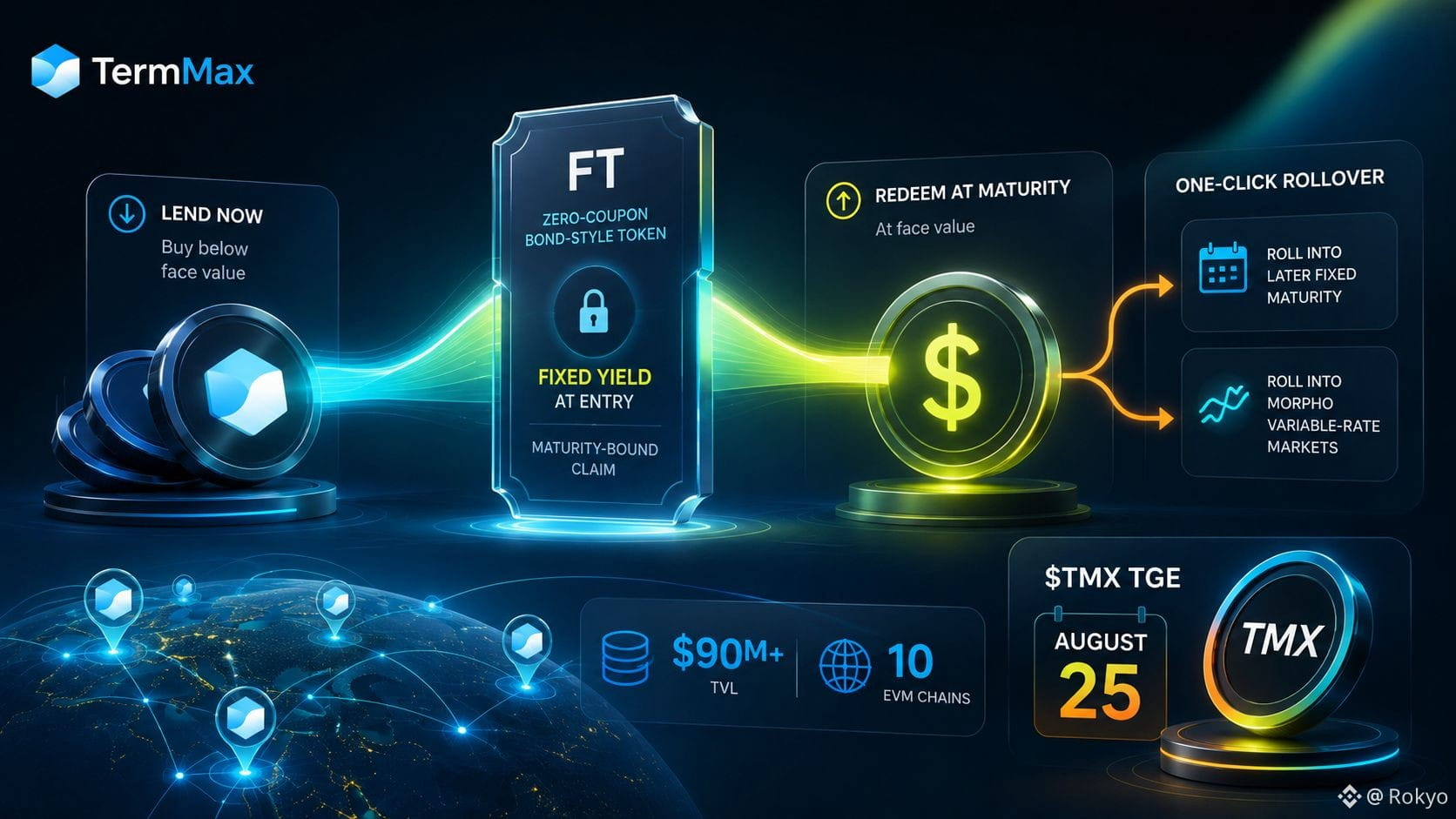
O mecanismo parece menos um pool de empréstimos com uma APY fixa e mais um mercado onchain de renda fixa. Seu FT é um token estilo título de cupom zero: credores o compram abaixo do valor de face e o resgatam ao par no vencimento, com o rendimento fixado na entrada. Isso muda a forma como penso sobre o produto: a taxa fixa não é apenas um parâmetro de um pool de empréstimos. Ela está embutida em uma reivindicação limitada por vencimento.
Em janeiro, o mesmo modelo de taxa fixa foi além de garantias nativas de cripto, avançando para títulos tokenizados, com o lançamento de empréstimos com taxa fixa contra as ações tokenizadas da Ondo Global Markets.
Uma taxa fixa remove a incerteza da taxa ao longo do prazo. Ela não remove a necessidade de refinanciar quando o prazo termina. A TermMax já tem rollover com um clique, para um vencimento fixo mais tarde ou para os mercados de taxa variável da Morpho; então o protocolo já projetou explicitamente essa etapa de refinanciamento. O que está bem documentado é a arquitetura; o que é escasso são dados sobre como esse caminho se comporta quando muitas posições precisam rolar ao mesmo tempo sob estresse.
Com US$ 90M+ de TVL em 10 cadeias EVM e o TGE do $TMX definido para 25 de agosto, é essa a parte que eu observaria em seguida.
#termmax @termmax
Passei além do rótulo de “empréstimos com taxa fixa” da TermMax para ver o que está acontecendo de fato por baixo.
O mecanismo parece menos um pool de empréstimos com uma APY fixa e mais um mercado onchain de renda fixa. Seu FT é um token estilo título de cupom zero: credores o compram abaixo do valor de face e o resgatam ao par no vencimento, com o rendimento fixado na entrada. Isso muda a forma como penso sobre o produto: a taxa fixa não é apenas um parâmetro de um pool de empréstimos. Ela está embutida em uma reivindicação limitada por vencimento.
Em janeiro, o mesmo modelo de taxa fixa foi além de garantias nativas de cripto, avançando para títulos tokenizados, com o lançamento de empréstimos com taxa fixa contra as ações tokenizadas da Ondo Global Markets.
Uma taxa fixa remove a incerteza da taxa ao longo do prazo. Ela não remove a necessidade de refinanciar quando o prazo termina. A TermMax já tem rollover com um clique, para um vencimento fixo mais tarde ou para os mercados de taxa variável da Morpho; então o protocolo já projetou explicitamente essa etapa de refinanciamento. O que está bem documentado é a arquitetura; o que é escasso são dados sobre como esse caminho se comporta quando muitas posições precisam rolar ao mesmo tempo sob estresse.
Com US$ 90M+ de TVL em 10 cadeias EVM e o TGE do $TMX definido para 25 de agosto, é essa a parte que eu observaria em seguida.
#termmax @TermMax
O mecanismo parece menos um pool de empréstimos com uma APY fixa e mais um mercado onchain de renda fixa. Seu FT é um token estilo título de cupom zero: credores o compram abaixo do valor de face e o resgatam ao par no vencimento, com o rendimento fixado na entrada. Isso muda a forma como penso sobre o produto: a taxa fixa não é apenas um parâmetro de um pool de empréstimos. Ela está embutida em uma reivindicação limitada por vencimento.
Em janeiro, o mesmo modelo de taxa fixa foi além de garantias nativas de cripto, avançando para títulos tokenizados, com o lançamento de empréstimos com taxa fixa contra as ações tokenizadas da Ondo Global Markets.
Uma taxa fixa remove a incerteza da taxa ao longo do prazo. Ela não remove a necessidade de refinanciar quando o prazo termina. A TermMax já tem rollover com um clique, para um vencimento fixo mais tarde ou para os mercados de taxa variável da Morpho; então o protocolo já projetou explicitamente essa etapa de refinanciamento. O que está bem documentado é a arquitetura; o que é escasso são dados sobre como esse caminho se comporta quando muitas posições precisam rolar ao mesmo tempo sob estresse.
Com US$ 90M+ de TVL em 10 cadeias EVM e o TGE do $TMX definido para 25 de agosto, é essa a parte que eu observaria em seguida.
#termmax @TermMax
2
1
101
·
--
Ver tradução
I expected the "eligibility checks" behind Dusk Trade to be something built specifically for trading. A compliance module bolted onto the exchange layer, the way most brokers build KYC into the platform itself.
That's not what's underneath it.
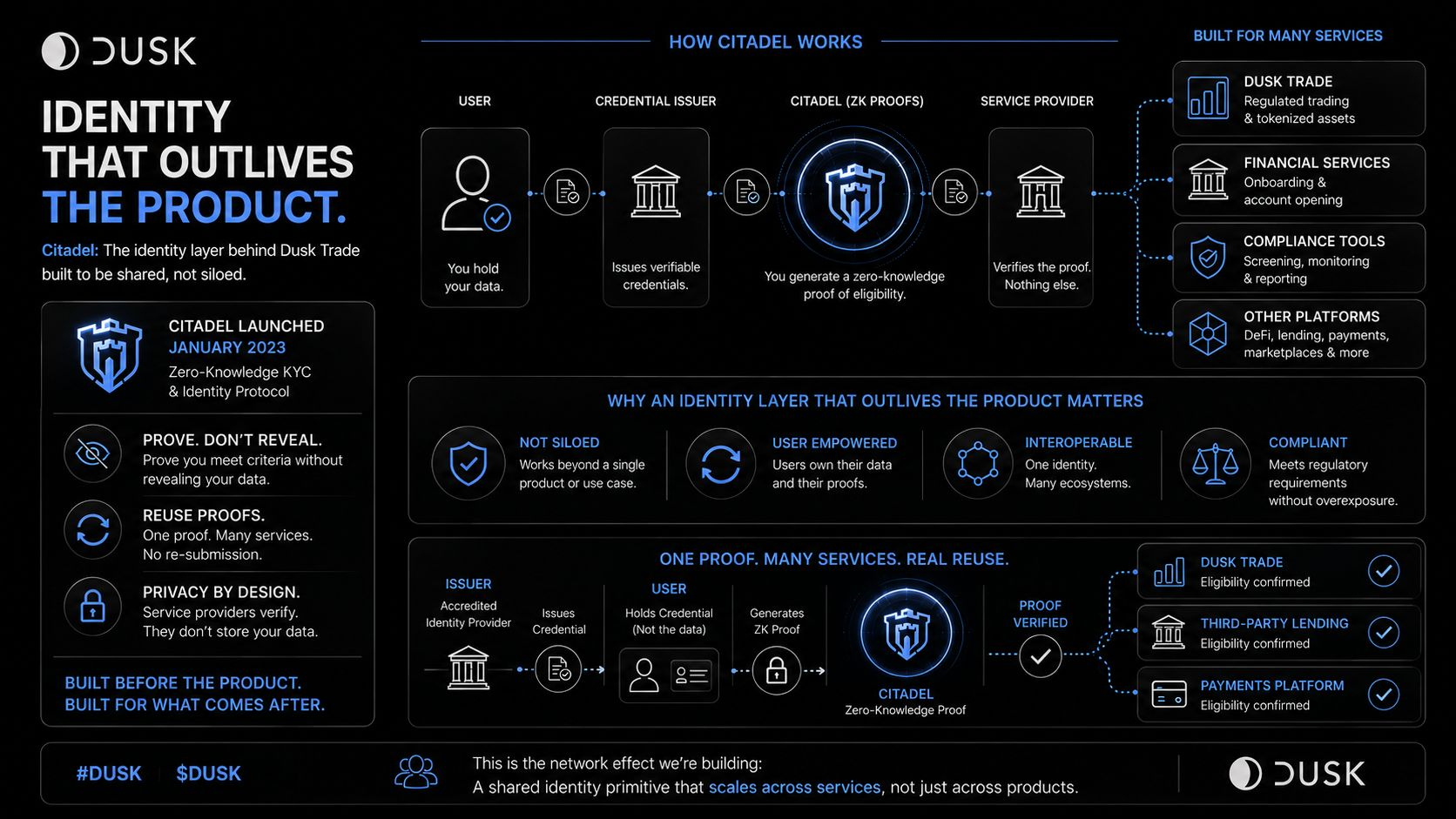
The identity layer Dusk Trade relies on is called Citadel, and it didn't start as a trading feature. Dusk launched it in January 2023 as a zero-knowledge KYC/identity protocol: prove you hold a valid credential without revealing what's in it, then reuse that proof across services instead of re-submitting your data every time.
That timing changes how I read "eligibility checks" in the docs. It looks less like bespoke compliance built for one product and more like an identity primitive that predates the product using it.
The interesting part is that Citadel was designed for service providers beyond a single trading workflow. Dusk described it as an identity layer that companies could tap into to verify whether someone meets their criteria without taking custody of all the underlying identity data.
"An eligibility check built for one product and an identity layer built to outlive the product are two different kinds of infrastructure, even when users experience both as 'proving who you are.'"
What I'd actually want to see: one credential proven through Citadel and accepted by another service provider outside Dusk Trade, the evidence that turns "shared identity primitive" from an architectural description into demonstrated cross-service reuse.
#dusk $DUSK @Dusk_Foundation
I expected the "eligibility checks" behind Dusk Trade to be something built specifically for trading. A compliance module bolted onto the exchange layer, the way most brokers build KYC into the platform itself.
That's not what's underneath it.
The identity layer Dusk Trade relies on is called Citadel, and it didn't start as a trading feature. Dusk launched it in January 2023 as a zero-knowledge KYC/identity protocol: prove you hold a valid credential without revealing what's in it, then reuse that proof across services instead of re-submitting your data every time.
That timing changes how I read "eligibility checks" in the docs. It looks less like bespoke compliance built for one product and more like an identity primitive that predates the product using it.
The interesting part is that Citadel was designed for service providers beyond a single trading workflow. Dusk described it as an identity layer that companies could tap into to verify whether someone meets their criteria without taking custody of all the underlying identity data.
"An eligibility check built for one product and an identity layer built to outlive the product are two different kinds of infrastructure, even when users experience both as 'proving who you are.'"
What I'd actually want to see: one credential proven through Citadel and accepted by another service provider outside Dusk Trade, the evidence that turns "shared identity primitive" from an architectural description into demonstrated cross-service reuse.
#dusk $DUSK @Dusk
That's not what's underneath it.
The identity layer Dusk Trade relies on is called Citadel, and it didn't start as a trading feature. Dusk launched it in January 2023 as a zero-knowledge KYC/identity protocol: prove you hold a valid credential without revealing what's in it, then reuse that proof across services instead of re-submitting your data every time.
That timing changes how I read "eligibility checks" in the docs. It looks less like bespoke compliance built for one product and more like an identity primitive that predates the product using it.
The interesting part is that Citadel was designed for service providers beyond a single trading workflow. Dusk described it as an identity layer that companies could tap into to verify whether someone meets their criteria without taking custody of all the underlying identity data.
"An eligibility check built for one product and an identity layer built to outlive the product are two different kinds of infrastructure, even when users experience both as 'proving who you are.'"
What I'd actually want to see: one credential proven through Citadel and accepted by another service provider outside Dusk Trade, the evidence that turns "shared identity primitive" from an architectural description into demonstrated cross-service reuse.
#dusk $DUSK @Dusk
3
1
88
·
--
Ver tradução
I expected "Dusk partners with Chainlink" to mean the usual pitch. A bridge. Tokens moving across chains. The standard interoperability story every project eventually announces.
That's part of it, but it's the smaller part.
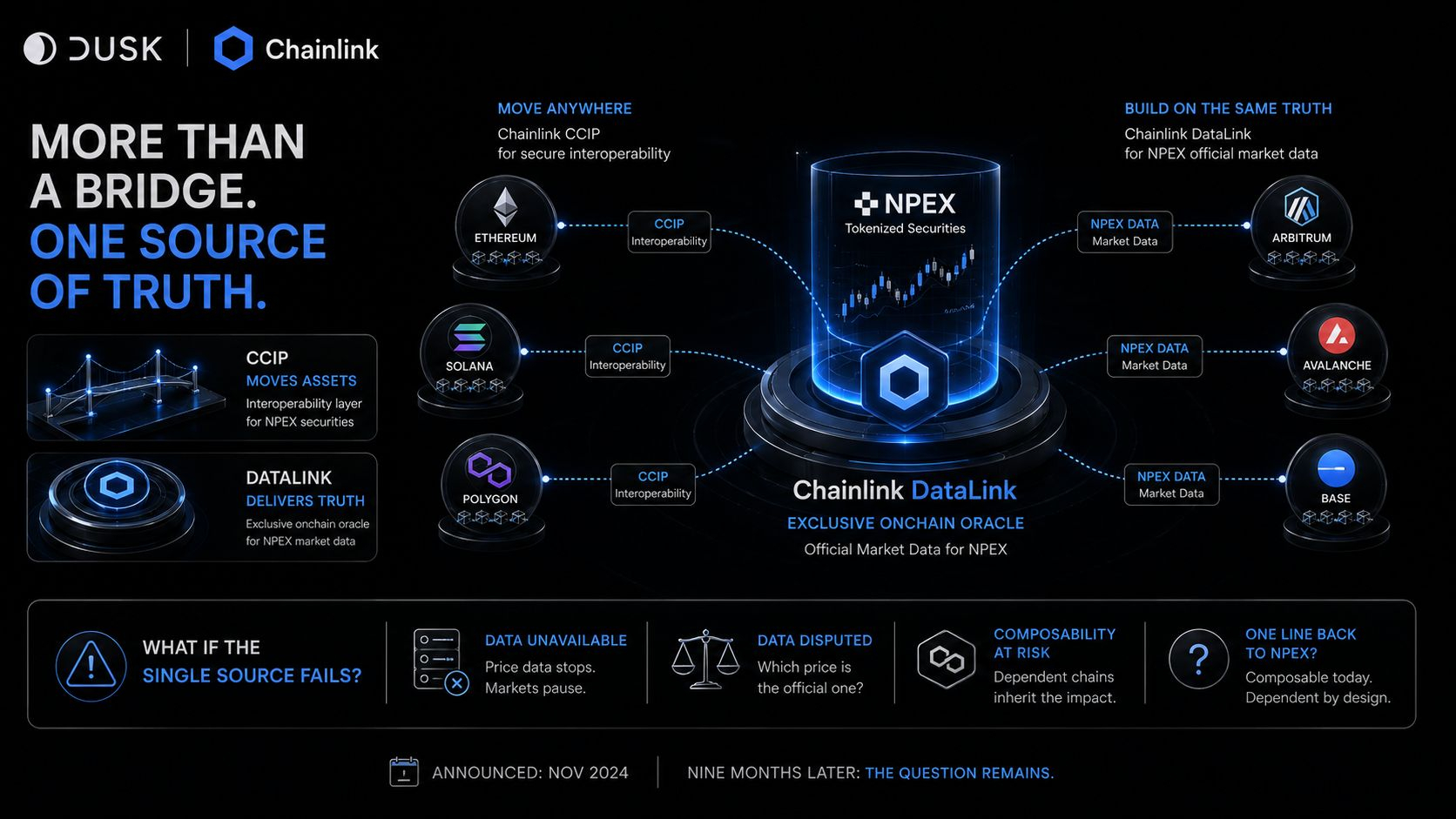
Announced back in November, the deal pairs Chainlink CCIP as the interoperability layer for NPEX's tokenized securities with something easy to skim past: Chainlink DataLink becoming the exclusive onchain data oracle for NPEX. Not one of several price feeds. The exclusive one. The same agreement also lets DUSK itself move natively between Ethereum and Solana through Chainlink's CCT standard, so the token gets the bridge story too.
Nine months on, that's the part worth separating out. CCIP lets an asset move across ecosystems. DataLink delivers the NPEX market data the receiving system can rely on. One is about reach. The other is about who gets to be believed. Any chain consuming that NPEX data is building on the same official market-data source.
I don't think that's automatically a flaw. Regulated markets already depend on authoritative market-data sources. But it does mean cross-chain composability here isn't completely neutral infrastructure. It's composability built around an exclusive source for NPEX's official market data, wherever that data eventually gets read.
"Being able to move an asset across chains and being the exclusive source for its official market data are two different kinds of power, even when one deal grants both."
What I'd actually want to know nine months in: what happens on the other chains if that exclusive NPEX data source becomes unavailable or disputed, and whether "composable" quietly means "dependent on one exclusive line back to NPEX."
#dusk $DUSK @Dusk_Foundation
I expected "Dusk partners with Chainlink" to mean the usual pitch. A bridge. Tokens moving across chains. The standard interoperability story every project eventually announces.
That's part of it, but it's the smaller part.
Announced back in November, the deal pairs Chainlink CCIP as the interoperability layer for NPEX's tokenized securities with something easy to skim past: Chainlink DataLink becoming the exclusive onchain data oracle for NPEX. Not one of several price feeds. The exclusive one. The same agreement also lets DUSK itself move natively between Ethereum and Solana through Chainlink's CCT standard, so the token gets the bridge story too.
Nine months on, that's the part worth separating out. CCIP lets an asset move across ecosystems. DataLink delivers the NPEX market data the receiving system can rely on. One is about reach. The other is about who gets to be believed. Any chain consuming that NPEX data is building on the same official market-data source.
I don't think that's automatically a flaw. Regulated markets already depend on authoritative market-data sources. But it does mean cross-chain composability here isn't completely neutral infrastructure. It's composability built around an exclusive source for NPEX's official market data, wherever that data eventually gets read.
"Being able to move an asset across chains and being the exclusive source for its official market data are two different kinds of power, even when one deal grants both."
What I'd actually want to know nine months in: what happens on the other chains if that exclusive NPEX data source becomes unavailable or disputed, and whether "composable" quietly means "dependent on one exclusive line back to NPEX."
#dusk $DUSK @Dusk
That's part of it, but it's the smaller part.
Announced back in November, the deal pairs Chainlink CCIP as the interoperability layer for NPEX's tokenized securities with something easy to skim past: Chainlink DataLink becoming the exclusive onchain data oracle for NPEX. Not one of several price feeds. The exclusive one. The same agreement also lets DUSK itself move natively between Ethereum and Solana through Chainlink's CCT standard, so the token gets the bridge story too.
Nine months on, that's the part worth separating out. CCIP lets an asset move across ecosystems. DataLink delivers the NPEX market data the receiving system can rely on. One is about reach. The other is about who gets to be believed. Any chain consuming that NPEX data is building on the same official market-data source.
I don't think that's automatically a flaw. Regulated markets already depend on authoritative market-data sources. But it does mean cross-chain composability here isn't completely neutral infrastructure. It's composability built around an exclusive source for NPEX's official market data, wherever that data eventually gets read.
"Being able to move an asset across chains and being the exclusive source for its official market data are two different kinds of power, even when one deal grants both."
What I'd actually want to know nine months in: what happens on the other chains if that exclusive NPEX data source becomes unavailable or disputed, and whether "composable" quietly means "dependent on one exclusive line back to NPEX."
#dusk $DUSK @Dusk
1
111
·
--
Eu costumava achar que tokenização e emissão nativa eram basicamente duas formas de colocar um ativo onchain. A própria página de comparação da Dusk mudou esse enquadramento. Elas não são dois graus da mesma coisa. São duas arquiteturas diferentes.
Pela definição da própria Dusk, a tokenização emite um token que representa um ativo ou uma reivindicação sobre ele, enquanto o ativo subjacente pode continuar vinculado a quais quer processos de custódia, registro e liquidação que já estivessem rodando fora da cadeia. O token é uma representação, não o próprio ativo subjacente. A emissão nativa remove essa camada: o ativo existe onchain como ele mesmo, e seu ciclo de vida, sendo emitido, transferido, atendido, liquidado, não precisa de um registro separado em algum lugar para apontar de volta.
O porém é que um token ainda pode depender de outro sistema permanecendo como fonte real da verdade. Se esse registro fora da cadeia atrasar ou falhar, a garantia do token só é tão forte quanto a conciliação que o sustenta.
É aqui que isso fica condicional. A comparação da própria Dusk diz que a emissão nativa pode reduzir a dependência de camadas separadas de custódia e registro, "dependendo da estrutura legal". Essa ressalva é a maior parte do trabalho nesta tese. O caso de eficiência não vem de a tecnologia existir. Ele depende de a estrutura legal permitir que o registro onchain suporte esse peso, em vez de continuar sendo apenas outra cópia do que é o real.
"Um token que representa um ativo e um ativo que existe como o token são promessas diferentes, mesmo quando ambos são vendidos como tokenização."
O que eu realmente gostaria de ver antes de chamar isso de verdadeiro: um título regulado em que o registro autoritativo viva onchain, e não uma camada de liquidação funcionando ao lado de um registro que ainda tenha a palavra final.
#dusk $DUSK @Dusk_Foundation
Eu costumava achar que tokenização e emissão nativa eram basicamente duas formas de colocar um ativo onchain. A própria página de comparação da Dusk mudou esse enquadramento. Elas não são dois graus da mesma coisa. São duas arquiteturas diferentes.
Pela definição da própria Dusk, a tokenização emite um token que representa um ativo ou uma reivindicação sobre ele, enquanto o ativo subjacente pode continuar vinculado a quais quer processos de custódia, registro e liquidação que já estivessem rodando fora da cadeia. O token é uma representação, não o próprio ativo subjacente. A emissão nativa remove essa camada: o ativo existe onchain como ele mesmo, e seu ciclo de vida, sendo emitido, transferido, atendido, liquidado, não precisa de um registro separado em algum lugar para apontar de volta.
O porém é que um token ainda pode depender de outro sistema permanecendo como fonte real da verdade. Se esse registro fora da cadeia atrasar ou falhar, a garantia do token só é tão forte quanto a conciliação que o sustenta.
É aqui que isso fica condicional. A comparação da própria Dusk diz que a emissão nativa pode reduzir a dependência de camadas separadas de custódia e registro, "dependendo da estrutura legal". Essa ressalva é a maior parte do trabalho nesta tese. O caso de eficiência não vem de a tecnologia existir. Ele depende de a estrutura legal permitir que o registro onchain suporte esse peso, em vez de continuar sendo apenas outra cópia do que é o real.
"Um token que representa um ativo e um ativo que existe como o token são promessas diferentes, mesmo quando ambos são vendidos como tokenização."
O que eu realmente gostaria de ver antes de chamar isso de verdadeiro: um título regulado em que o registro autoritativo viva onchain, e não uma camada de liquidação funcionando ao lado de um registro que ainda tenha a palavra final.
#dusk $DUSK @Dusk
Pela definição da própria Dusk, a tokenização emite um token que representa um ativo ou uma reivindicação sobre ele, enquanto o ativo subjacente pode continuar vinculado a quais quer processos de custódia, registro e liquidação que já estivessem rodando fora da cadeia. O token é uma representação, não o próprio ativo subjacente. A emissão nativa remove essa camada: o ativo existe onchain como ele mesmo, e seu ciclo de vida, sendo emitido, transferido, atendido, liquidado, não precisa de um registro separado em algum lugar para apontar de volta.
O porém é que um token ainda pode depender de outro sistema permanecendo como fonte real da verdade. Se esse registro fora da cadeia atrasar ou falhar, a garantia do token só é tão forte quanto a conciliação que o sustenta.
É aqui que isso fica condicional. A comparação da própria Dusk diz que a emissão nativa pode reduzir a dependência de camadas separadas de custódia e registro, "dependendo da estrutura legal". Essa ressalva é a maior parte do trabalho nesta tese. O caso de eficiência não vem de a tecnologia existir. Ele depende de a estrutura legal permitir que o registro onchain suporte esse peso, em vez de continuar sendo apenas outra cópia do que é o real.
"Um token que representa um ativo e um ativo que existe como o token são promessas diferentes, mesmo quando ambos são vendidos como tokenização."
O que eu realmente gostaria de ver antes de chamar isso de verdadeiro: um título regulado em que o registro autoritativo viva onchain, e não uma camada de liquidação funcionando ao lado de um registro que ainda tenha a palavra final.
#dusk $DUSK @Dusk
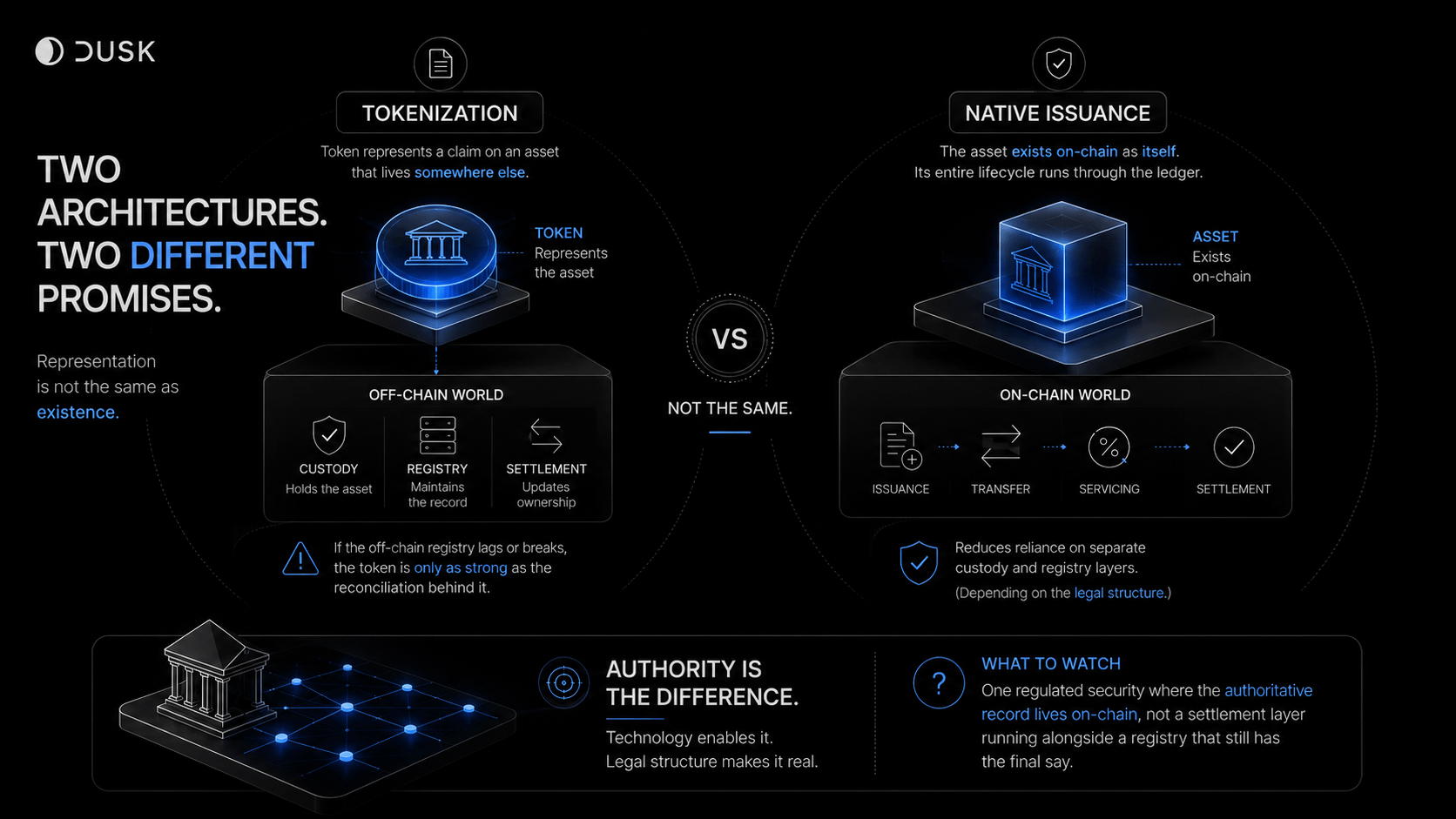
5
1
81
·
--
Ver tradução
I found myself staring at DuskEVM's testnet explorer, and the number that jumps out, 845,113 transactions against 282 wallet addresses, is almost the wrong one to focus on. That's roughly 3,000 transactions per address, a ratio that says less about adoption than the headline suggests.
The two most recent transactions both showed Value 0 DUSK: fees paid, no native value moved. The latest feed was tagged as an L1→L2 deposit. Not proof of what the other 845K look like, but enough to make me stop reading this as one number. What the explorer is actually showing first is network activity: the chain processing transactions. Whether any of it is economic activity, value actually changing hands for a reason, is a separate question the transaction count can't answer on its own.
That distinction matters because Dusk is ultimately positioning this infrastructure for regulated financial assets, which is exactly what Dusk's plan to bring €300M of NPEX assets onchain would eventually need to prove out. A busy chain and a chain carrying real settlement volume can produce an identical-looking stats page.
"Network activity is not the same claim as financial activity, even when both surface as one number on an explorer."
What I'd actually watch as the signal that this shifts from network activity to financial usage: how much of it represents actual economic value settled, once NPEX gives us something real to check it against.
#dusk $DUSK @Dusk_Foundation
I found myself staring at DuskEVM's testnet explorer, and the number that jumps out, 845,113 transactions against 282 wallet addresses, is almost the wrong one to focus on. That's roughly 3,000 transactions per address, a ratio that says less about adoption than the headline suggests.
The two most recent transactions both showed Value 0 DUSK: fees paid, no native value moved. The latest feed was tagged as an L1→L2 deposit. Not proof of what the other 845K look like, but enough to make me stop reading this as one number. What the explorer is actually showing first is network activity: the chain processing transactions. Whether any of it is economic activity, value actually changing hands for a reason, is a separate question the transaction count can't answer on its own.
That distinction matters because Dusk is ultimately positioning this infrastructure for regulated financial assets, which is exactly what Dusk's plan to bring €300M of NPEX assets onchain would eventually need to prove out. A busy chain and a chain carrying real settlement volume can produce an identical-looking stats page.
"Network activity is not the same claim as financial activity, even when both surface as one number on an explorer."
What I'd actually watch as the signal that this shifts from network activity to financial usage: how much of it represents actual economic value settled, once NPEX gives us something real to check it against.
#dusk $DUSK @Dusk
The two most recent transactions both showed Value 0 DUSK: fees paid, no native value moved. The latest feed was tagged as an L1→L2 deposit. Not proof of what the other 845K look like, but enough to make me stop reading this as one number. What the explorer is actually showing first is network activity: the chain processing transactions. Whether any of it is economic activity, value actually changing hands for a reason, is a separate question the transaction count can't answer on its own.
That distinction matters because Dusk is ultimately positioning this infrastructure for regulated financial assets, which is exactly what Dusk's plan to bring €300M of NPEX assets onchain would eventually need to prove out. A busy chain and a chain carrying real settlement volume can produce an identical-looking stats page.
"Network activity is not the same claim as financial activity, even when both surface as one number on an explorer."
What I'd actually watch as the signal that this shifts from network activity to financial usage: how much of it represents actual economic value settled, once NPEX gives us something real to check it against.
#dusk $DUSK @Dusk
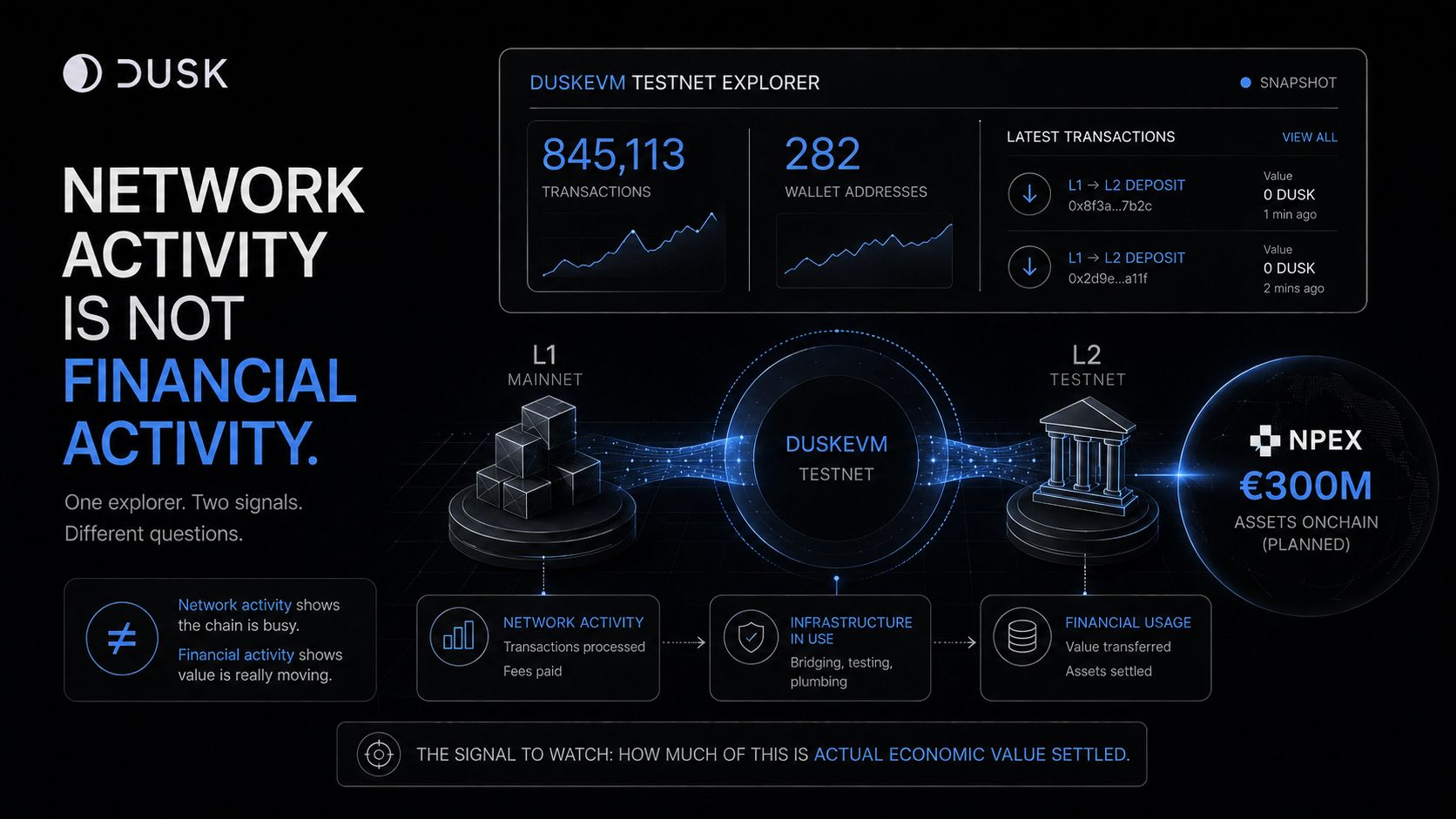
4
2
118
·
--
Verificado
Ver tradução
Dusk's own writeup on Hedger puts client-side proof generation at under 2 seconds. Read that twice before it landed. That's fast enough that "confidential has to be slower" stopped feeling like a safe assumption. Went digging into what's actually being proved that fast. DuskEVM's public testnet has been live since December, and a few days ago the Dusk Foundation opened it up for Solidity and Hardhat testing — that's the update I was actually reading about. The line that stopped me: eligibility is checked before access or transfer. I initially thought that was the interesting compliance part. Left it open in one tab while I got coffee, came back, reread it, and realized it wasn't. Dusk says participant data, balances and transfer amounts can remain encrypted. That's the part that actually caught me — the gap between proving you're allowed in and exposing what you're carrying once you are. The eligibility step checks out in the docs — it's clearly defined, not just a vague compliance claim. I still couldn't find a concrete example of what an authorized reviewer actually sees when that audit path is used. Checked the docs twice. A few days into this Solidity/Hardhat opening, curious whether that example shows up as things mature, or whether "auditable" just stays the word nobody has to demonstrate yet — here or on any chain making the same claim.
#dusk $DUSK @Dusk_Foundation
Dusk's own writeup on Hedger puts client-side proof generation at under 2 seconds. Read that twice before it landed. That's fast enough that "confidential has to be slower" stopped feeling like a safe assumption. Went digging into what's actually being proved that fast. DuskEVM's public testnet has been live since December, and a few days ago the Dusk Foundation opened it up for Solidity and Hardhat testing — that's the update I was actually reading about. The line that stopped me: eligibility is checked before access or transfer. I initially thought that was the interesting compliance part. Left it open in one tab while I got coffee, came back, reread it, and realized it wasn't. Dusk says participant data, balances and transfer amounts can remain encrypted. That's the part that actually caught me — the gap between proving you're allowed in and exposing what you're carrying once you are. The eligibility step checks out in the docs — it's clearly defined, not just a vague compliance claim. I still couldn't find a concrete example of what an authorized reviewer actually sees when that audit path is used. Checked the docs twice. A few days into this Solidity/Hardhat opening, curious whether that example shows up as things mature, or whether "auditable" just stays the word nobody has to demonstrate yet — here or on any chain making the same claim.
#dusk $DUSK @Dusk
#dusk $DUSK @Dusk
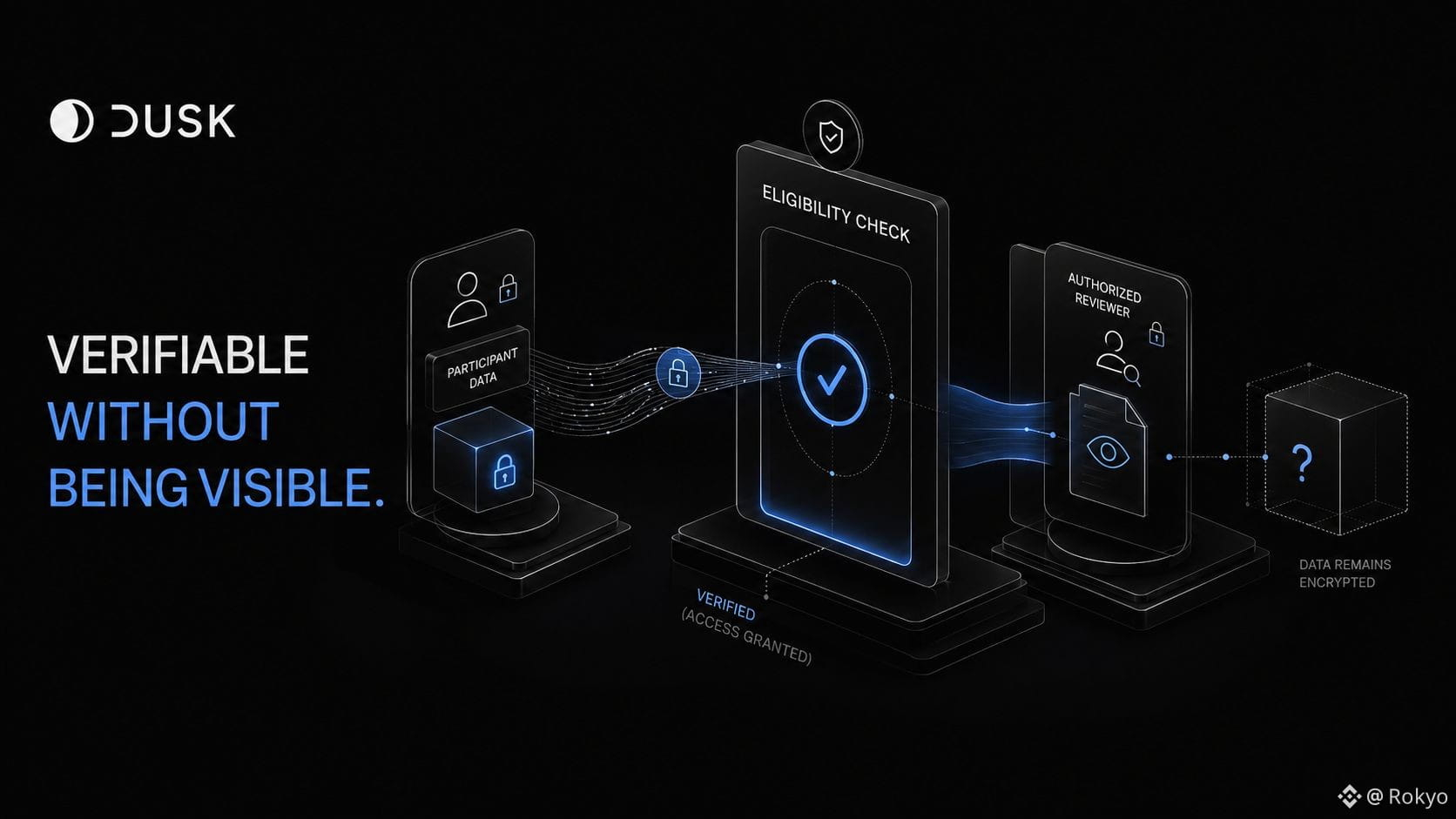
1
102
·
--
Puxei o gráfico do BABY esta noite só para ver quantos dias restavam antes do desbloqueio, e a contagem regressiva não foi o que mais chamou atenção.
10 de agosto. Cinco dias restantes. 136,11M de tokens, cerca de US$ 1,43M, 1,2% da oferta, indo principalmente para a equipe, conselheiros e investidores das rodadas iniciais — os mesmos números que qualquer pessoa acompanhando isso já sabe.
O que eu não tinha olhado de verdade eram os sete dias antes.
O BABY caiu cerca de 10,3% esta semana. O preço está por volta de US$ 0,0105, market cap perto de US$ 45M, ficando atrás do mercado cripto mais amplo, que basicamente está estável no mesmo período.
Minha primeira leitura foi: tudo bem, deve ser venda relacionada ao desbloqueio começando cedo.
Pode não ser. Pode ser uma condição mais ampla do mercado que não tem nada a ver com 10 de agosto. Eu não tenho como separar "pessoas se adiantando ao desbloqueio" de "o BABY só tendo uma semana ruim junto com todo o resto".
De qualquer forma, os tokens que caem nessas carteiras em 10 de agosto chegam a um preço que já está 10% menor do que estava uma semana antes.
Quem vendeu esta semana vendeu durante essa queda. Quem recebe o desbloqueio vende no que sobrar depois.
Lados diferentes dos mesmos cinco dias, absorvendo metades diferentes do movimento.
Eu não sei se esse padrão se mantém desta vez. Nada do que eu li detalha quanto dos desbloqueios passados de Babylon já estava precificado antes versus quanto foi reagido depois.
Se o preço já tinha se movido antes de o desbloqueio acontecer, o que o próprio dia do desbloqueio ainda revela?
@babylonlabs_io #baby $BABY
Puxei o gráfico do BABY esta noite só para ver quantos dias restavam antes do desbloqueio, e a contagem regressiva não foi o que mais chamou atenção.
10 de agosto. Cinco dias restantes. 136,11M de tokens, cerca de US$ 1,43M, 1,2% da oferta, indo principalmente para a equipe, conselheiros e investidores das rodadas iniciais — os mesmos números que qualquer pessoa acompanhando isso já sabe.
O que eu não tinha olhado de verdade eram os sete dias antes.
O BABY caiu cerca de 10,3% esta semana. O preço está por volta de US$ 0,0105, market cap perto de US$ 45M, ficando atrás do mercado cripto mais amplo, que basicamente está estável no mesmo período.
Minha primeira leitura foi: tudo bem, deve ser venda relacionada ao desbloqueio começando cedo.
Pode não ser. Pode ser uma condição mais ampla do mercado que não tem nada a ver com 10 de agosto. Eu não tenho como separar "pessoas se adiantando ao desbloqueio" de "o BABY só tendo uma semana ruim junto com todo o resto".
De qualquer forma, os tokens que caem nessas carteiras em 10 de agosto chegam a um preço que já está 10% menor do que estava uma semana antes.
Quem vendeu esta semana vendeu durante essa queda. Quem recebe o desbloqueio vende no que sobrar depois.
Lados diferentes dos mesmos cinco dias, absorvendo metades diferentes do movimento.
Eu não sei se esse padrão se mantém desta vez. Nada do que eu li detalha quanto dos desbloqueios passados de Babylon já estava precificado antes versus quanto foi reagido depois.
Se o preço já tinha se movido antes de o desbloqueio acontecer, o que o próprio dia do desbloqueio ainda revela?
@BabylonLabs_io #baby $BABY
10 de agosto. Cinco dias restantes. 136,11M de tokens, cerca de US$ 1,43M, 1,2% da oferta, indo principalmente para a equipe, conselheiros e investidores das rodadas iniciais — os mesmos números que qualquer pessoa acompanhando isso já sabe.
O que eu não tinha olhado de verdade eram os sete dias antes.
O BABY caiu cerca de 10,3% esta semana. O preço está por volta de US$ 0,0105, market cap perto de US$ 45M, ficando atrás do mercado cripto mais amplo, que basicamente está estável no mesmo período.
Minha primeira leitura foi: tudo bem, deve ser venda relacionada ao desbloqueio começando cedo.
Pode não ser. Pode ser uma condição mais ampla do mercado que não tem nada a ver com 10 de agosto. Eu não tenho como separar "pessoas se adiantando ao desbloqueio" de "o BABY só tendo uma semana ruim junto com todo o resto".
De qualquer forma, os tokens que caem nessas carteiras em 10 de agosto chegam a um preço que já está 10% menor do que estava uma semana antes.
Quem vendeu esta semana vendeu durante essa queda. Quem recebe o desbloqueio vende no que sobrar depois.
Lados diferentes dos mesmos cinco dias, absorvendo metades diferentes do movimento.
Eu não sei se esse padrão se mantém desta vez. Nada do que eu li detalha quanto dos desbloqueios passados de Babylon já estava precificado antes versus quanto foi reagido depois.
Se o preço já tinha se movido antes de o desbloqueio acontecer, o que o próprio dia do desbloqueio ainda revela?
@BabylonLabs_io #baby $BABY
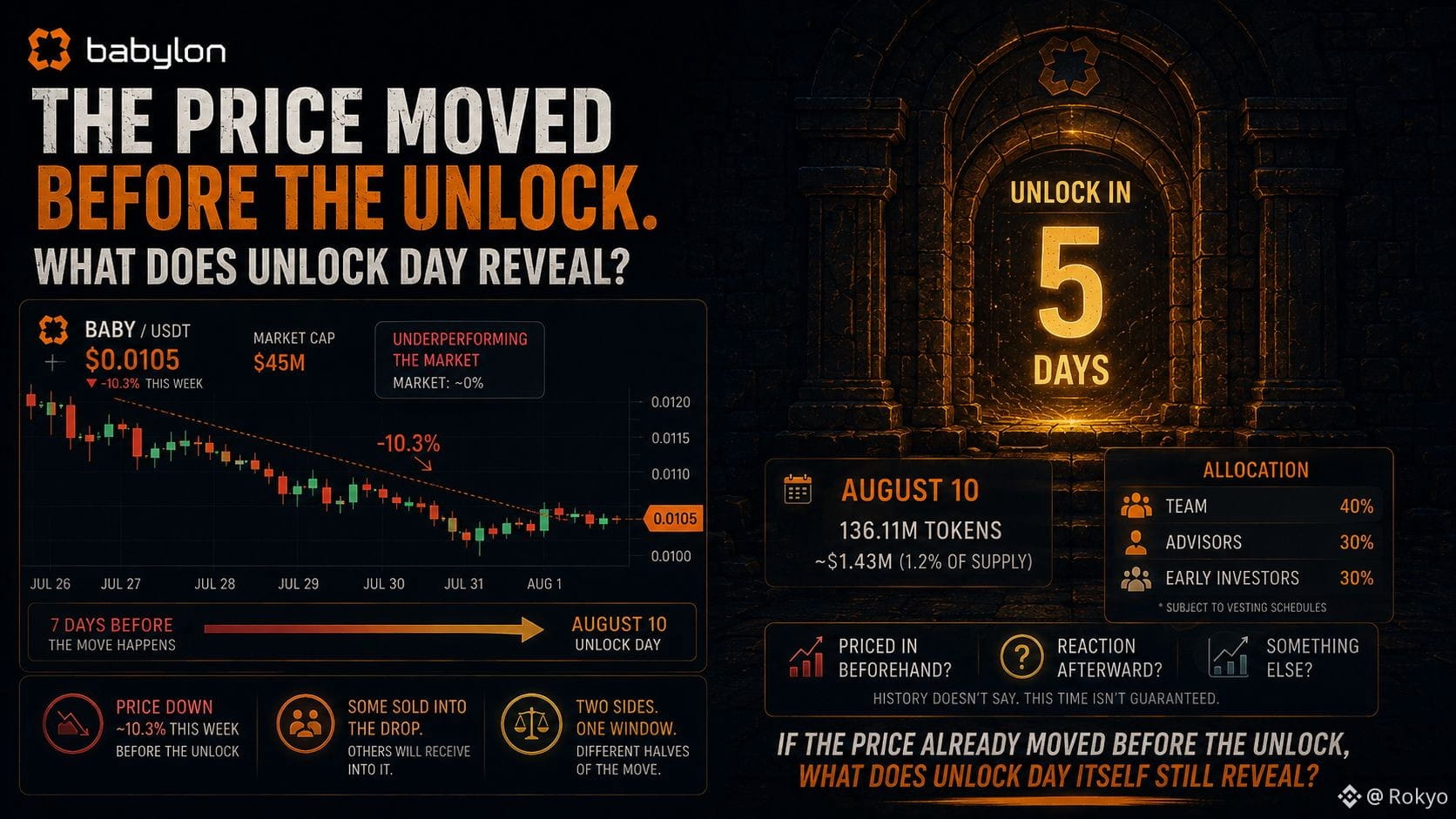
2
2
53
Inicia sessão para explorar mais conteúdos
Junta-te a utilizadores de criptomoedas de todo o mundo na Binance Square
⚡️ Obtém informações úteis e recentes sobre criptomoedas.
💬 Com a confiança da maior exchange de criptomoedas do mundo.
👍 Descobre perspetivas reais de criadores verificados.
E-mail/Número de telefone
Tópicos em Tendência
CircleMints500MUSDCOnSolana
5,906 visualizações
309 a discutir
💰 MASSIVO: Circle Minta US$ 500M em $USDC na Solana!
A Circle acabou de cunhar 500 Milhões de $USDC na Solana em 2 transações ($250M + $250M) em 25 de setembro, em apenas 5,5 horas! 🚀
Agora a Solana tem $7,48B+ de dominância em $USDC — mais de 50% do seu fornecimento total de stablecoins de $14,7B.
Por que Solana?
⚡️ Velocidade: 65k TPS
💸 Taxas baixas: $0,00025
🔥 Hub de DeFi: Jupiter, Raydium em alta
Este é um dos maiores mintings em um único dia & é um sinal claro de GRANDE demanda institucional pelo ecossistema da Solana.
Touro para $SOL? 👇
#Circle #USDC #Solana #Stablecoin #DeFi#circlemints500musdconsolana
True News
·8 gostos
·4.2k visualizações
PolymarketBankFailureBetsDrawFDICConcern
18,898 visualizações
531 a discutir
BlackRockBuildsTokenizedPortfoliosForOndo
14,538 visualizações
365 a discutir