

#onchainfinance
onchainfinance
102,629 views
764 Discussing
Hot
Latest
·
--
**📊 IPOs Are Moving On-Chain — Are You Ready?**
CZ recently dropped a bomb: "IPOs will move on-chain." 🚀
Think about it:
✅ No more waiting for brokers
✅ 24/7 trading, no closing bell
✅ Fractional ownership — buy $1 of any company
✅ Instant settlement, zero middlemen
Binance Research projects tokenized equities could hit **$349 BILLION by 2030** — up from just $4.4B today.
Projects like $BNB are at the center of this infrastructure shift, powering the ecosystem where tokenized assets will live.
Traditional finance took days to settle a trade.
On-chain? Seconds.
Are you positioning yourself early, or waiting for the mainstream to catch up? 👇
#Binance #RWA #TokenizedIPO #OnChainFinance
**📊 IPOs Are Moving On-Chain — Are You Ready?**
CZ recently dropped a bomb: "IPOs will move on-chain." 🚀
Think about it:
✅ No more waiting for brokers
✅ 24/7 trading, no closing bell
✅ Fractional ownership — buy $1 of any company
✅ Instant settlement, zero middlemen
Binance Research projects tokenized equities could hit **$349 BILLION by 2030** — up from just $4.4B today.
Projects like $BNB are at the center of this infrastructure shift, powering the ecosystem where tokenized assets will live.
Traditional finance took days to settle a trade.
On-chain? Seconds.
Are you positioning yourself early, or waiting for the mainstream to catch up? 👇
#Binance #RWA #TokenizedIPO #OnChainFinance
CZ recently dropped a bomb: "IPOs will move on-chain." 🚀
Think about it:
✅ No more waiting for brokers
✅ 24/7 trading, no closing bell
✅ Fractional ownership — buy $1 of any company
✅ Instant settlement, zero middlemen
Binance Research projects tokenized equities could hit **$349 BILLION by 2030** — up from just $4.4B today.
Projects like $BNB are at the center of this infrastructure shift, powering the ecosystem where tokenized assets will live.
Traditional finance took days to settle a trade.
On-chain? Seconds.
Are you positioning yourself early, or waiting for the mainstream to catch up? 👇
#Binance #RWA #TokenizedIPO #OnChainFinance
68

·
--
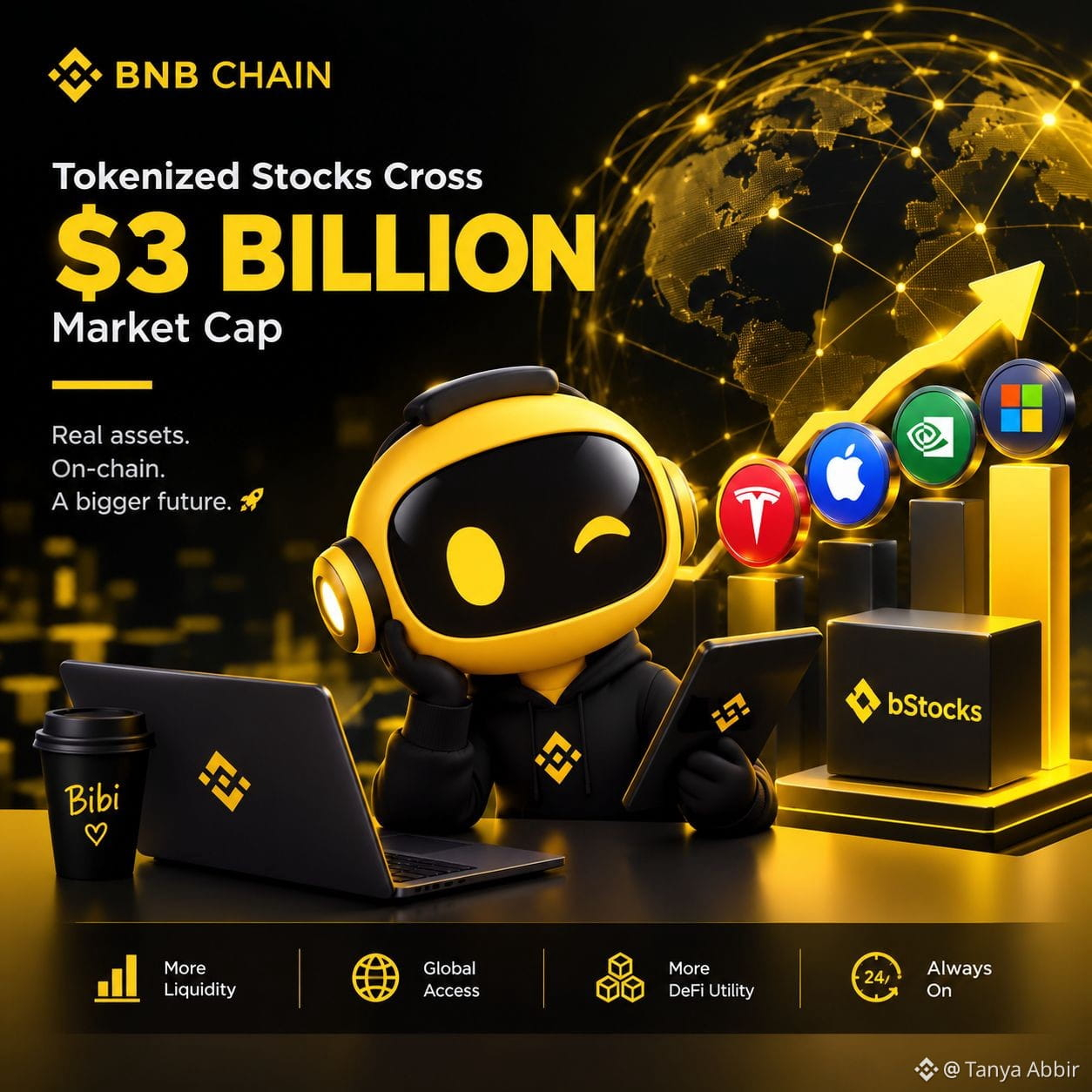
Tokenized stocks are no longer just about putting stocks on a blockchain.
The bigger story is what people are actually doing with them.
According to Binance Research, on-chain transfers of tokenized stocks including trading volume surpassed $100B in Q3 2026.
For perspective:
Q1: $6B
Q3: $100B+
That's more than just growth in supply.
It's a sign that tokenized equities are becoming part of actual on-chain activity.
And there's another interesting shift happening.
Tokenized stocks are starting to move beyond simply being held.
They can be transferred, traded and through the DeFi ecosystem, put to work as collateral or within liquidity markets.
That's the real power of tokenization.
A traditional stock position usually sits inside a brokerage account.
An on-chain representation can become part of a broader programmable financial ecosystem.
This is where BNB Chain becomes interesting.
BNB Chain has become the largest home for tokenized stocks, with around $1B in tokenized stock market cap and 1.8M holders as of mid September, according to Binance Research.
And sitting inside that ecosystem is bStocks.
Launched on BNB Chain in June, bStocks are 1:1 backed tokenized U.S. securities represented as BEP-20 tokens.
So the bigger story isn't:
Stocks are coming to crypto.
It's: Financial assets are becoming programmable.
The line between traditional finance and on-chain finance is getting thinner.
And we are watching that transition happen in real time. @Binance_Angels
#OnChainFinance
Tokenized stocks are no longer just about putting stocks on a blockchain.
The bigger story is what people are actually doing with them.
According to Binance Research, on-chain transfers of tokenized stocks including trading volume surpassed $100B in Q3 2026.
For perspective:
Q1: $6B
Q3: $100B+
That's more than just growth in supply.
It's a sign that tokenized equities are becoming part of actual on-chain activity.
And there's another interesting shift happening.
Tokenized stocks are starting to move beyond simply being held.
They can be transferred, traded and through the DeFi ecosystem, put to work as collateral or within liquidity markets.
That's the real power of tokenization.
A traditional stock position usually sits inside a brokerage account.
An on-chain representation can become part of a broader programmable financial ecosystem.
This is where BNB Chain becomes interesting.
BNB Chain has become the largest home for tokenized stocks, with around $1B in tokenized stock market cap and 1.8M holders as of mid September, according to Binance Research.
And sitting inside that ecosystem is bStocks.
Launched on BNB Chain in June, bStocks are 1:1 backed tokenized U.S. securities represented as BEP-20 tokens.
So the bigger story isn't:
Stocks are coming to crypto.
It's: Financial assets are becoming programmable.
The line between traditional finance and on-chain finance is getting thinner.
And we are watching that transition happen in real time. @Binance Angels
#OnChainFinance
The bigger story is what people are actually doing with them.
According to Binance Research, on-chain transfers of tokenized stocks including trading volume surpassed $100B in Q3 2026.
For perspective:
Q1: $6B
Q3: $100B+
That's more than just growth in supply.
It's a sign that tokenized equities are becoming part of actual on-chain activity.
And there's another interesting shift happening.
Tokenized stocks are starting to move beyond simply being held.
They can be transferred, traded and through the DeFi ecosystem, put to work as collateral or within liquidity markets.
That's the real power of tokenization.
A traditional stock position usually sits inside a brokerage account.
An on-chain representation can become part of a broader programmable financial ecosystem.
This is where BNB Chain becomes interesting.
BNB Chain has become the largest home for tokenized stocks, with around $1B in tokenized stock market cap and 1.8M holders as of mid September, according to Binance Research.
And sitting inside that ecosystem is bStocks.
Launched on BNB Chain in June, bStocks are 1:1 backed tokenized U.S. securities represented as BEP-20 tokens.
So the bigger story isn't:
Stocks are coming to crypto.
It's: Financial assets are becoming programmable.
The line between traditional finance and on-chain finance is getting thinner.
And we are watching that transition happen in real time. @Binance Angels
#OnChainFinance
2
104

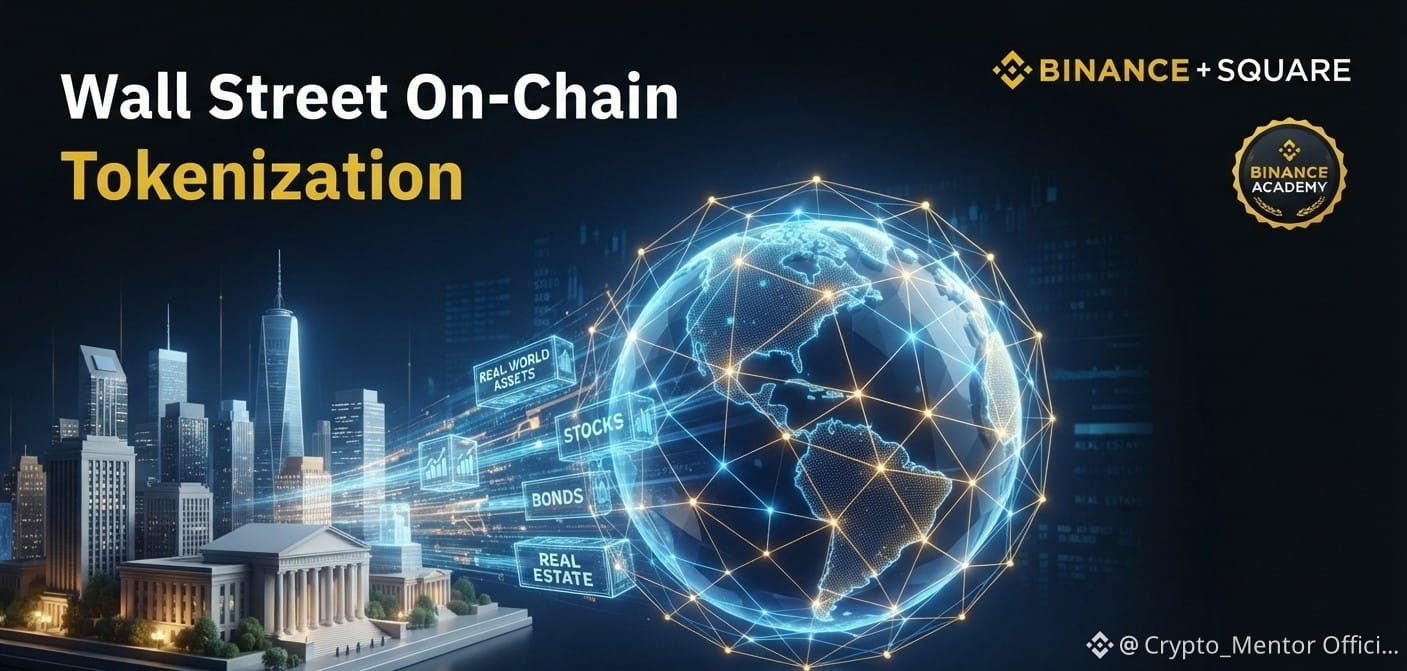
Wall Street On-Chain: Trend, Transition, or a Temporary Narrative? 🌐
The crypto market is no longer limited to just Bitcoin and altcoin price movements. A massive institutional shift is gradually taking shape: Tokenization.
$BTC
{spot}(BTCUSDT)
The race to represent and settle real-world assets (RWAs)—such as government bonds, funds, stocks, and real estate—on blockchain rails is heating up. According to public market trackers, the visible on-chain value of tokenized RWAs has already reached roughly $38B+ by 2026. Some broader industry estimates show an even larger total footprint for tokenized assets—however, it would be wrong to treat both figures as the same metric. (coinlaw.io)
$RWA
{alpha}(560x9c8b5ca345247396bdfac0395638ca9045c6586e)
3 big reasons for TradFi’s shift to the on-chain world:
⚡ 24/7 Market Access: Blockchain rails theoretically can enable transfers and settlement beyond traditional market hours.
$SOL
{future}(SOLUSDT)
⚡ Faster Settlement: Compared to legacy clearing cycles, the settlement process can be more efficient—though this will depend on product structure and regulation.
⚡ Programmable Finance: Smart contracts can help automate compliance rules, ownership transfers, and reporting workflows.
The Reality Check
With big narratives come big challenges too: regulatory compliance, legal ownership rights, secure custody, liquidity, interoperability, and investor protection are still key hurdles for institutional adoption.
)
💬 Big Question:
Will a meaningful part of traditional finance move to on-chain rails in the next few years—or will tokenization remain limited to hype and small pilots?
What do you think? Share your thoughts in the comments.
#TokenizationRevolution #RWA板块涨势强劲 #BlockchainNews #Web3Revolution #OnChainFinance
Wall Street On-Chain: Trend, Transition, or a Temporary Narrative? 🌐
The crypto market is no longer limited to just Bitcoin and altcoin price movements. A massive institutional shift is gradually taking shape: Tokenization.
$BTC
The race to represent and settle real-world assets (RWAs)—such as government bonds, funds, stocks, and real estate—on blockchain rails is heating up. According to public market trackers, the visible on-chain value of tokenized RWAs has already reached roughly $38B+ by 2026. Some broader industry estimates show an even larger total footprint for tokenized assets—however, it would be wrong to treat both figures as the same metric. (coinlaw.io)
$RWA
3 big reasons for TradFi’s shift to the on-chain world:
⚡ 24/7 Market Access: Blockchain rails theoretically can enable transfers and settlement beyond traditional market hours.
$SOL
⚡ Faster Settlement: Compared to legacy clearing cycles, the settlement process can be more efficient—though this will depend on product structure and regulation.
⚡ Programmable Finance: Smart contracts can help automate compliance rules, ownership transfers, and reporting workflows.
The Reality Check
With big narratives come big challenges too: regulatory compliance, legal ownership rights, secure custody, liquidity, interoperability, and investor protection are still key hurdles for institutional adoption.
)
💬 Big Question:
Will a meaningful part of traditional finance move to on-chain rails in the next few years—or will tokenization remain limited to hype and small pilots?
What do you think? Share your thoughts in the comments.
#TokenizationRevolution #RWA板块涨势强劲 #BlockchainNews #Web3Revolution #OnChainFinance
The crypto market is no longer limited to just Bitcoin and altcoin price movements. A massive institutional shift is gradually taking shape: Tokenization.
$BTC
The race to represent and settle real-world assets (RWAs)—such as government bonds, funds, stocks, and real estate—on blockchain rails is heating up. According to public market trackers, the visible on-chain value of tokenized RWAs has already reached roughly $38B+ by 2026. Some broader industry estimates show an even larger total footprint for tokenized assets—however, it would be wrong to treat both figures as the same metric. (coinlaw.io)
$RWA
3 big reasons for TradFi’s shift to the on-chain world:
⚡ 24/7 Market Access: Blockchain rails theoretically can enable transfers and settlement beyond traditional market hours.
$SOL
⚡ Faster Settlement: Compared to legacy clearing cycles, the settlement process can be more efficient—though this will depend on product structure and regulation.
⚡ Programmable Finance: Smart contracts can help automate compliance rules, ownership transfers, and reporting workflows.
The Reality Check
With big narratives come big challenges too: regulatory compliance, legal ownership rights, secure custody, liquidity, interoperability, and investor protection are still key hurdles for institutional adoption.
)
💬 Big Question:
Will a meaningful part of traditional finance move to on-chain rails in the next few years—or will tokenization remain limited to hype and small pilots?
What do you think? Share your thoughts in the comments.
#TokenizationRevolution #RWA板块涨势强劲 #BlockchainNews #Web3Revolution #OnChainFinance
206 Atlas:
$38B is negligible against TradFi’s $100T+ universe. Focus on custody and liquidity hurdles, not just settlement speed.
3
1
182

·
--
Here's what happened when the SEC opened a door for tokenized stocks onchain.
Every trader knows the frustration of watching names like Nvidia run while their crypto sits isolated in a wallet. Switching between a brokerage and DeFi still takes days and costs real money, and more than a few people have already been rugged by fake tokenized share projects with nothing behind them.
This looks a lot like the Bitcoin ETF moment. Those products pulled in tens of billions within months of going live. Tokenized stocks could go further with 24/7 trading and the ability to use actual shares as DeFi collateral. $ONDO already proved the model with tokenized treasuries at scale. Most serious experiments settle on $ETH, and $LINK oracles would be what keeps the onchain price honest against the real close.
The 2018 security token wave died from pure regulatory hostility. This time the SEC is writing the rules instead of just suing. That is the difference that actually matters.
Where do you think this goes from here?
#TokenizedStocks #RWA #OnchainFinance
Here's what happened when the SEC opened a door for tokenized stocks onchain.
Every trader knows the frustration of watching names like Nvidia run while their crypto sits isolated in a wallet. Switching between a brokerage and DeFi still takes days and costs real money, and more than a few people have already been rugged by fake tokenized share projects with nothing behind them.
This looks a lot like the Bitcoin ETF moment. Those products pulled in tens of billions within months of going live. Tokenized stocks could go further with 24/7 trading and the ability to use actual shares as DeFi collateral. $ONDO already proved the model with tokenized treasuries at scale. Most serious experiments settle on $ETH , and $LINK oracles would be what keeps the onchain price honest against the real close.
The 2018 security token wave died from pure regulatory hostility. This time the SEC is writing the rules instead of just suing. That is the difference that actually matters.
Where do you think this goes from here?
#TokenizedStocks #RWA #OnchainFinance
Every trader knows the frustration of watching names like Nvidia run while their crypto sits isolated in a wallet. Switching between a brokerage and DeFi still takes days and costs real money, and more than a few people have already been rugged by fake tokenized share projects with nothing behind them.
This looks a lot like the Bitcoin ETF moment. Those products pulled in tens of billions within months of going live. Tokenized stocks could go further with 24/7 trading and the ability to use actual shares as DeFi collateral. $ONDO already proved the model with tokenized treasuries at scale. Most serious experiments settle on $ETH , and $LINK oracles would be what keeps the onchain price honest against the real close.
The 2018 security token wave died from pure regulatory hostility. This time the SEC is writing the rules instead of just suing. That is the difference that actually matters.
Where do you think this goes from here?
#TokenizedStocks #RWA #OnchainFinance
139

·
--
Bullish
Verified
Pyth Network is starting to look less like a crypto data project and more like financial infrastructure built for 24/7 markets.
$PYTH is the ecosystem token, with utility and governance relevance across the Pyth network.
What stands out is where the data starts.
Instead of relying mainly on downstream market-data pipelines, Pyth brings prices directly from first-party publishers. That network now includes 125+ institutional publishers, with feeds reaching 114+ blockchains.
The commercial side is moving too. Pyth Pro crossed $6M ARR within months of launch, while subscription ARR reportedly grew 109% QoQ.
$LINK represents established oracle infrastructure, $HYPE reflects the growth of onchain perpetual markets, and $TAO is closely associated with autonomous AI systems.
Pyth sits at an interesting intersection: institutional data, always-on markets, and machine-readable financial information built for internet-native finance.
Not financial advice, just information post
#PYTH #PythNetwork #MarketData #OnchainFinance #Crypto
Pyth Network is starting to look less like a crypto data project and more like financial infrastructure built for 24/7 markets.
$PYTH is the ecosystem token, with utility and governance relevance across the Pyth network.
What stands out is where the data starts.
Instead of relying mainly on downstream market-data pipelines, Pyth brings prices directly from first-party publishers. That network now includes 125+ institutional publishers, with feeds reaching 114+ blockchains.
The commercial side is moving too. Pyth Pro crossed $6M ARR within months of launch, while subscription ARR reportedly grew 109% QoQ.
$LINK represents established oracle infrastructure, $HYPE reflects the growth of onchain perpetual markets, and $TAO is closely associated with autonomous AI systems.
Pyth sits at an interesting intersection: institutional data, always-on markets, and machine-readable financial information built for internet-native finance.
Not financial advice, just information post
#PYTH #PythNetwork #MarketData #OnchainFinance #Crypto
$PYTH is the ecosystem token, with utility and governance relevance across the Pyth network.
What stands out is where the data starts.
Instead of relying mainly on downstream market-data pipelines, Pyth brings prices directly from first-party publishers. That network now includes 125+ institutional publishers, with feeds reaching 114+ blockchains.
The commercial side is moving too. Pyth Pro crossed $6M ARR within months of launch, while subscription ARR reportedly grew 109% QoQ.
$LINK represents established oracle infrastructure, $HYPE reflects the growth of onchain perpetual markets, and $TAO is closely associated with autonomous AI systems.
Pyth sits at an interesting intersection: institutional data, always-on markets, and machine-readable financial information built for internet-native finance.
Not financial advice, just information post
#PYTH #PythNetwork #MarketData #OnchainFinance #Crypto
57
1
40
14.8k
·
--
Bullish
🚀 Bringing Institutional Yield Onchain: Renzo Finance
Renzo is democratizing complex yield architecture by bringing Wall Street-grade strategies directly to DeFi.
Key Highlights:
⚡️ Market-neutral & professional-grade yield strategies
⚡️ 100% self-custodial infrastructure
⚡️ Flexible liquidity with zero locked periods
⚡️ Native integrations with Hyperliquid & Lighter
⚡️ Multi-chain expansion across ETH, SOL & RWAs
The future of yield isn't locked in traditional vaults—it’s programmable, transparent, and onchain.
🔗 Explore Renzo Finance: https://www.renzofinance.com/?utm_source=chatgpt.com
#DeFi #Renzo #RealWorldAssets #CryptoYield #OnchainFinance
🚀 Bringing Institutional Yield Onchain: Renzo Finance
Renzo is democratizing complex yield architecture by bringing Wall Street-grade strategies directly to DeFi.
Key Highlights:
⚡️ Market-neutral & professional-grade yield strategies
⚡️ 100% self-custodial infrastructure
⚡️ Flexible liquidity with zero locked periods
⚡️ Native integrations with Hyperliquid & Lighter
⚡️ Multi-chain expansion across ETH, SOL & RWAs
The future of yield isn't locked in traditional vaults—it’s programmable, transparent, and onchain.
🔗 Explore Renzo Finance: https://www.renzofinance.com/?utm_source=chatgpt.com
#DeFi #Renzo #RealWorldAssets #CryptoYield #OnchainFinance
Renzo is democratizing complex yield architecture by bringing Wall Street-grade strategies directly to DeFi.
Key Highlights:
⚡️ Market-neutral & professional-grade yield strategies
⚡️ 100% self-custodial infrastructure
⚡️ Flexible liquidity with zero locked periods
⚡️ Native integrations with Hyperliquid & Lighter
⚡️ Multi-chain expansion across ETH, SOL & RWAs
The future of yield isn't locked in traditional vaults—it’s programmable, transparent, and onchain.
🔗 Explore Renzo Finance: https://www.renzofinance.com/?utm_source=chatgpt.com
#DeFi #Renzo #RealWorldAssets #CryptoYield #OnchainFinance
2
65

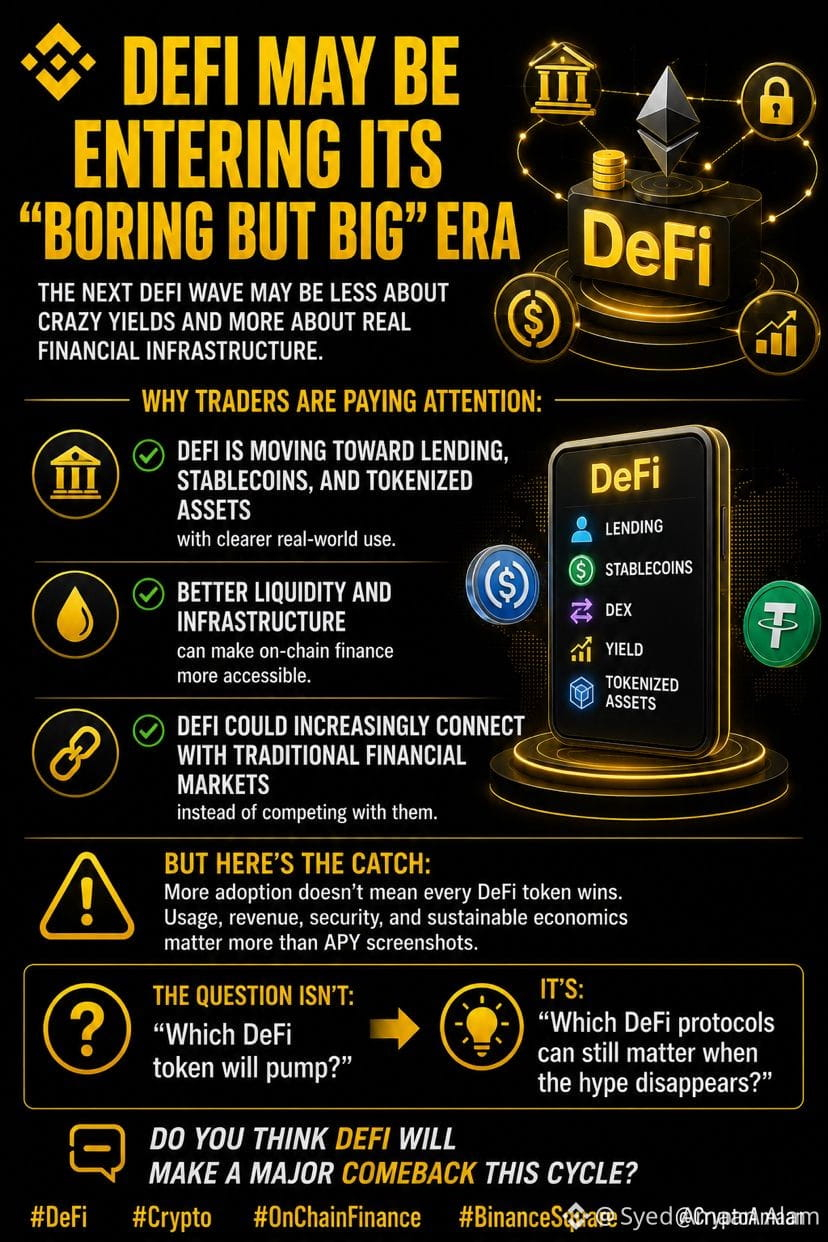
🚨 DEFI MAY BE ENTERING ITS “BORING BUT BIG” ERA
The next DeFi wave may be less about crazy yields and more about real financial infrastructure.
Why traders are paying attention:
🏦 $DEFI is moving toward lending, stablecoins, and tokenized assets with clearer real-world use.
💧 Better liquidity and infrastructure can make on-chain finance more accessible.
🔗 DeFi could increasingly connect with traditional financial markets instead of competing with them.
But here’s the catch:
More adoption doesn’t mean every DeFi token wins. Usage, revenue, security, and sustainable economics matter more than APY screenshots.
The question isn’t: “Which DeFi token will pump?”
It’s: “Which DeFi protocols can still matter when the hype disappears?”
Do you think DeFi will make a major comeback this cycle?
#defi #crypto #OnChainFinance #BinanceSquare
🚨 DEFI MAY BE ENTERING ITS “BORING BUT BIG” ERA
The next DeFi wave may be less about crazy yields and more about real financial infrastructure.
Why traders are paying attention:
🏦 $DEFI is moving toward lending, stablecoins, and tokenized assets with clearer real-world use.
💧 Better liquidity and infrastructure can make on-chain finance more accessible.
🔗 DeFi could increasingly connect with traditional financial markets instead of competing with them.
But here’s the catch:
More adoption doesn’t mean every DeFi token wins. Usage, revenue, security, and sustainable economics matter more than APY screenshots.
The question isn’t: “Which DeFi token will pump?”
It’s: “Which DeFi protocols can still matter when the hype disappears?”
Do you think DeFi will make a major comeback this cycle?
#defi #crypto #OnChainFinance #BinanceSquare
The next DeFi wave may be less about crazy yields and more about real financial infrastructure.
Why traders are paying attention:
🏦 $DEFI is moving toward lending, stablecoins, and tokenized assets with clearer real-world use.
💧 Better liquidity and infrastructure can make on-chain finance more accessible.
🔗 DeFi could increasingly connect with traditional financial markets instead of competing with them.
But here’s the catch:
More adoption doesn’t mean every DeFi token wins. Usage, revenue, security, and sustainable economics matter more than APY screenshots.
The question isn’t: “Which DeFi token will pump?”
It’s: “Which DeFi protocols can still matter when the hype disappears?”
Do you think DeFi will make a major comeback this cycle?
#defi #crypto #OnChainFinance #BinanceSquare
69
·
--
Article
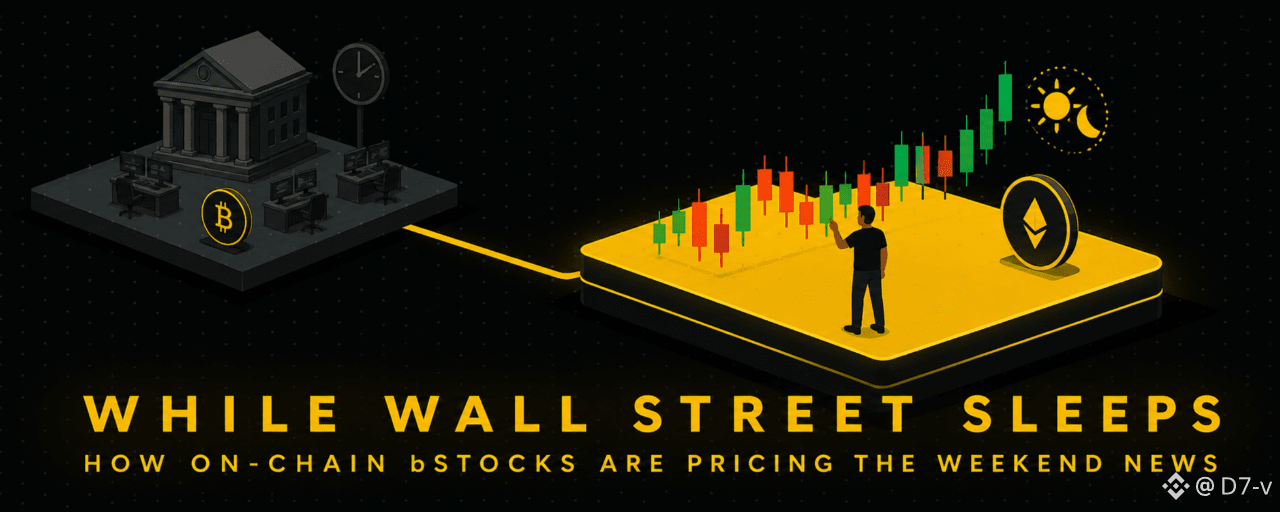
While Wall Street Sleeps: How On-Chain bStocks Are Pricing the Weekend NewsThe Weekend Blackout Every Stock Investor Knows
Friday afternoon, 4:00 PM Eastern Time. The closing bell rings on the New York Stock Exchange, and for the next 65 hours, the world's largest equity market goes dark. Except the world doesn't stop. Companies still report earnings on Saturday mornings. Central banks still drop surprise statements. Wars still start, ceasefires still get signed, and geopolitical headlines still break — all while traditional stockholders sit on their hands, unable to do anything but wait for Monday's opening bell.
This is the "weekend gap" problem, and it's one of the oldest, most frustrating quirks of traditional finance. You can watch the news. You can read the headlines. You just can't trade on any of it until the market reopens — and by then, the price has already jumped, sometimes violently, to reflect everything that happened while you were locked out.
But a new kind of market has quietly stepped into that gap. On-chain bStocks — tokenized versions of US equities issued by Binance — trade continuously, 24 hours a day, seven days a week. And according to fresh data from Binance Research, these tokens aren't just trading for the sake of trading. They're doing real price discovery, and doing it well.
Across seven weekends since launch, bStocks priced in a median 92% of the following Monday's opening gap in the underlying stock. On the biggest moves — gaps above 3% — bStocks called the correct direction in all 41 instances observed. Separately, in the past week alone, 92% of all on-chain bStocks volume and US$1.5 billion in Binance trading happened while US markets were completely shut.
Price discovery, arguably the single most important function a market performs, is quietly moving on-chain. Here's what that means, how it works, and why it matters.
What Are bStocks, and Why Do They Trade When Wall Street Doesn't?
bStocks are tokenized representations of US stocks and ETFs, issued on BNB Chain and tradable both on Binance's exchange and directly on decentralized exchanges (DEXs). Rather than owning a share through a traditional brokerage account, a bStock holder owns a blockchain-based token whose value is designed to track the underlying equity.
The key structural difference is availability. A brokerage account tied to the NYSE or Nasdaq is bound by market hours — 9:30 AM to 4:00 PM Eastern, Monday through Friday, with the occasional holiday closure on top. A bStock, because it lives on a blockchain rather than inside a centralized exchange's order book, has no such restriction. It can be bought and sold at 3:00 AM on a Sunday just as easily as at noon on a Tuesday.
Since launching on June 11, 2026, bStocks have grown from having no market presence to becoming the fastest-growing tokenized equity product globally by market share [page:1]. Market capitalization crossed US$500 million in under seven weeks, spread across 56 listed tokens, with names like SNDKB, SPCXB, MUB, CRCLB, and SOXLB holding the largest assets under management [page:1]. Growth has been broad-based rather than concentrated in a handful of headline tickers — a pattern more consistent with genuine adoption than a speculative rally in one or two names.
The Data: bStocks Priced In 92% of the Monday Gap
Here's where things get genuinely interesting for anyone who follows market structure. Binance Research compared the weekend price movement of bStocks against the actual Monday opening gap of the underlying stock — the difference between Friday's close and Monday's open.
Across the seven weekends studied since launch, bStocks priced in a median 92% of that Monday gap, leaving an average residual surprise of just 0.19% at the actual market open [page:1]. In plain terms: if a stock was going to jump 5% on Monday morning because of weekend news, bStocks holders had already captured roughly 4.6 percentage points of that move over the weekend — while traditional shareholders were still waiting for the opening bell.
This is a meaningful finding because it suggests bStocks aren't just tracking noise or arbitrary sentiment. They're absorbing and reflecting real information — earnings surprises, macro data releases, geopolitical shocks — well before the "official" market has a chance to react.
Directional Accuracy: 100% Correct on Gaps Above 3%
Not all moves are created equal, and the data gets more compelling as the stakes rise. Binance Research broke down directional accuracy by the size of the eventual Monday gap [page:1]:
Gaps under 0.5%: bStocks matched the correct direction 81% of the timeGaps of 0.5%–1%: accuracy rose to 90%Gaps of 1%–3%: accuracy climbed to 97%Gaps above 3%: bStocks were correct 100% of the time — all 41 instances observed since launch, with a median 99.6% of the move already priced in [page:1]
This pattern makes intuitive sense. Small overnight wobbles can be noisy and hard to call — thin weekend liquidity, random flows, and short-term positioning can push prices in either direction. But when something genuinely significant happens — a blowout earnings report, a surprise Fed comment, a major geopolitical event — the signal is strong enough that the market, even a thin weekend market, reads it correctly almost every time. Binance Research notes sample sizes at the extreme end are still small, but the trend is directionally clear: on-chain pricing is most useful exactly when it matters most.
Where the Trading Actually Happens: On-Chain vs. Binance vs. Wall Street Hours
The most striking part of the report isn't just that bStocks trade around the clock — it's how much of the activity happens specifically while Wall Street is closed.
Over the seven days to July 28, 92% of on-chain bStocks volume and 59% of Binance bStocks volume were executed while US equity markets were shut [page:1]. Cumulatively, US$1.5 billion in bStocks has changed hands on Binance during hours when the underlying stock market wasn't even open — activity that simply had no equivalent before tokenization existed [page:1]. In July alone, market-closed trading accounted for 62% of Binance's bStocks volume, and 58% since inception [page:1].
Hourly data reveals two distinct trading populations. Binance activity tends to cluster around 8:00–10:00 AM Eastern — the US pre-market and opening auction window, consistent with traders positioning directly around the US session [page:1]. On-chain volume, however, peaks starting around 8:00 PM Eastern, which is the start of the Asian trading day, and stays elevated through the Asian session [page:1]. That's a strong hint that a meaningful chunk of this demand is coming from regions where local market hours simply don't overlap with New York's clock — exactly the kind of underserved demand tokenization is well-positioned to capture.
From Zero to 27%: How Fast Tokenized Equities Are Growing
Zoom out, and bStocks' rise looks less like a niche experiment and more like a genuine market share shift. In May 2026, bStocks had no presence in the tokenized equity space. By July, they controlled 27% of global tokenized equity market capitalization [page:1]. That gain came largely at the expense of the previous incumbent, Ondo, whose share fell from 75% to 45% over the same period, while xStocks held roughly steady around 27% and Robinhood's tokenized offering trailed at about 1% [page:1].
Trading volume has scaled even faster than market cap. Weekly bStocks volume compounded at an average 91% week-on-week since inception, pushing cumulative turnover to US$8.7 billion [page:1]. Of that, 72% (US$6.3 billion) was executed on-chain rather than on Binance's own order book — a share that's risen from near zero at launch to roughly 70% by mid-July [page:1]. In July specifically, bStocks generated about US$7.4 billion in DEX volume, representing 85% of all tokenized equity DEX trading that month [page:1].
There's also a chain-level story here. Combined with Ondo's BNB Chain-issued tokens, BNB Chain now hosts close to 30% of all tokenized stocks and ETFs globally by market capitalization, up from under 10% at the end of 2025 [page:1]. Even so, this remains an early-stage market: total bStocks volume across Binance and on-chain venues equals only about 0.3% of the trading volume in the actual underlying stocks and ETFs, up from just 0.01% six weeks earlier [page:1]. Reaching a still-modest 10% of underlying volume would require roughly another 33x expansion from current levels [page:1] — plenty of room to run if the growth trend holds.
Why This Matters for Traders in Asia and Beyond
For traders based outside the US time zone — including much of Asia, where local market hours never align with the NYSE's 9:30-to-4:00 window — this shift is more than a curiosity. It's a structural fix for a problem that's existed since stock exchanges were first invented: geography and time zones dictating when you're allowed to react to information.
A trader in Phnom Penh, Manila, or Singapore watching US earnings drop after the Friday close historically had to wait until their own Monday evening (US Monday morning) to actually act on that information through a traditional brokerage. With bStocks, that same trader can express a view the moment the news breaks, whether it's Saturday afternoon or 2:00 AM local time. The hourly volume data backs this up directly — on-chain activity is heaviest exactly when the Asian trading day begins [page:1].
This doesn't mean bStocks are risk-free or a perfect substitute for owning the underlying share — liquidity is thinner than the primary market, tracking isn't identical to holding the real stock, and weekend price moves can still be volatile. But as a tool for reacting to news in real time, regardless of which stock exchange happens to be open, it's a genuinely new capability.
How This Fits Into the Binance Ecosystem
bStocks sit within Binance's broader push into tokenized real-world assets (RWAs), an area that's grown from a niche DeFi topic into one of the more closely watched trends in crypto markets. For users already active on Binance, a few practical points are worth knowing:
Listing and market data: bStocks are listed directly on Binance alongside crypto pairs, with the same order book and market data tools traders already use for spot trading.On-chain access: Because bStocks are issued on BNB Chain, they're also accessible through DEXs, giving users a choice between centralized order-book liquidity and on-chain trading depending on their preference.Education resources: Binance Academy and Binance Research regularly publish explainers and data-driven reports (like the one this article draws from) on how tokenized assets work, their risks, and how they differ from owning the underlying security directly.Risk awareness: As with any tokenized asset, users should understand that a bStock is a claim tracking the underlying stock's price — it's not identical to direct equity ownership, and liquidity conditions, especially on weekends, can differ from the primary market.
None of this is a reason to treat bStocks as a guaranteed edge. But for anyone already trading crypto and curious about how equities and blockchain infrastructure are converging, it's a live, data-backed example of that trend playing out in real time.
Key Takeaways
Wall Street closes, but bStocks don't. On-chain tokenized stocks trade 24/7, capturing price moves during hours when traditional markets are shut.bStocks priced in a median 92% of the following Monday's opening gap across seven weekends of data, leaving only a 0.19% average surprise at the open [page:1].On the biggest moves (gaps above 3%), bStocks called the correct direction 41 out of 41 times, with 99.6% of the move already priced in [page:1].92% of on-chain volume and US$1.5B in Binance trading happened while US markets were closed, driven partly by demand from the Asian trading session [page:1].bStocks market cap passed US$500M and captured 27% of global tokenized equity market share in under two months, reshaping competition with Ondo and xStocks [page:1].The market is still small relative to underlying equities (0.3% of volume), meaning today's data, while compelling, comes from an early and rapidly evolving product [page:1].
FAQ
Q: What are bStocks?
A: bStocks are tokenized versions of US stocks and ETFs issued on BNB Chain, tradable on Binance and on decentralized exchanges, designed to track the price of the underlying equity.
Q: How can bStocks trade when the US stock market is closed?
A: Because bStocks exist as blockchain tokens rather than shares in a centralized exchange's order book, they aren't bound by NYSE or Nasdaq trading hours and can be bought or sold at any time, including weekends.
Q: Does bStocks price movement actually predict the real stock's Monday price?
A: According to Binance Research data covering seven weekends, bStocks priced in a median 92% of the actual Monday opening gap, and correctly called the direction of all 41 gaps larger than 3% observed since launch [page:1].
Q: Is trading bStocks the same as owning the actual stock?
A: No. A bStock is a token designed to track the price of the underlying security, but it isn't a direct equity holding — it carries its own liquidity conditions, issuer structure, and risks that traders should understand before using it as a substitute for the real stock.
Q: Why is so much bStocks trading happening in Asia?
A: Hourly trading data shows on-chain bStocks volume peaks around the start of the Asian trading day, suggesting demand from traders in time zones that don't overlap with US market hours and who want to react to news without waiting for Wall Street to reopen [page:1].
Q: How big is the tokenized stock market compared to real stock trading?
A: Still quite small — bStocks volume is roughly 0.3% of underlying stock and ETF trading volume, though that's up 30x from just six weeks earlier, pointing to fast but early-stage growth [page:1].
#bStocks #TokenizedStocks #Binance #RWA #OnChainFinance
While Wall Street Sleeps: How On-Chain bStocks Are Pricing the Weekend News
The Weekend Blackout Every Stock Investor Knows
Friday afternoon, 4:00 PM Eastern Time. The closing bell rings on the New York Stock Exchange, and for the next 65 hours, the world's largest equity market goes dark. Except the world doesn't stop. Companies still report earnings on Saturday mornings. Central banks still drop surprise statements. Wars still start, ceasefires still get signed, and geopolitical headlines still break — all while traditional stockholders sit on their hands, unable to do anything but wait for Monday's opening bell.
This is the "weekend gap" problem, and it's one of the oldest, most frustrating quirks of traditional finance. You can watch the news. You can read the headlines. You just can't trade on any of it until the market reopens — and by then, the price has already jumped, sometimes violently, to reflect everything that happened while you were locked out.
But a new kind of market has quietly stepped into that gap. On-chain bStocks — tokenized versions of US equities issued by Binance — trade continuously, 24 hours a day, seven days a week. And according to fresh data from Binance Research, these tokens aren't just trading for the sake of trading. They're doing real price discovery, and doing it well.
Across seven weekends since launch, bStocks priced in a median 92% of the following Monday's opening gap in the underlying stock. On the biggest moves — gaps above 3% — bStocks called the correct direction in all 41 instances observed. Separately, in the past week alone, 92% of all on-chain bStocks volume and US$1.5 billion in Binance trading happened while US markets were completely shut.
Price discovery, arguably the single most important function a market performs, is quietly moving on-chain. Here's what that means, how it works, and why it matters.
What Are bStocks, and Why Do They Trade When Wall Street Doesn't?
bStocks are tokenized representations of US stocks and ETFs, issued on BNB Chain and tradable both on Binance's exchange and directly on decentralized exchanges (DEXs). Rather than owning a share through a traditional brokerage account, a bStock holder owns a blockchain-based token whose value is designed to track the underlying equity.
The key structural difference is availability. A brokerage account tied to the NYSE or Nasdaq is bound by market hours — 9:30 AM to 4:00 PM Eastern, Monday through Friday, with the occasional holiday closure on top. A bStock, because it lives on a blockchain rather than inside a centralized exchange's order book, has no such restriction. It can be bought and sold at 3:00 AM on a Sunday just as easily as at noon on a Tuesday.
Since launching on June 11, 2026, bStocks have grown from having no market presence to becoming the fastest-growing tokenized equity product globally by market share [page:1]. Market capitalization crossed US$500 million in under seven weeks, spread across 56 listed tokens, with names like SNDKB, SPCXB, MUB, CRCLB, and SOXLB holding the largest assets under management [page:1]. Growth has been broad-based rather than concentrated in a handful of headline tickers — a pattern more consistent with genuine adoption than a speculative rally in one or two names.
The Data: bStocks Priced In 92% of the Monday Gap
Here's where things get genuinely interesting for anyone who follows market structure. Binance Research compared the weekend price movement of bStocks against the actual Monday opening gap of the underlying stock — the difference between Friday's close and Monday's open.
Across the seven weekends studied since launch, bStocks priced in a median 92% of that Monday gap, leaving an average residual surprise of just 0.19% at the actual market open [page:1]. In plain terms: if a stock was going to jump 5% on Monday morning because of weekend news, bStocks holders had already captured roughly 4.6 percentage points of that move over the weekend — while traditional shareholders were still waiting for the opening bell.
This is a meaningful finding because it suggests bStocks aren't just tracking noise or arbitrary sentiment. They're absorbing and reflecting real information — earnings surprises, macro data releases, geopolitical shocks — well before the "official" market has a chance to react.
Directional Accuracy: 100% Correct on Gaps Above 3%
Not all moves are created equal, and the data gets more compelling as the stakes rise. Binance Research broke down directional accuracy by the size of the eventual Monday gap [page:1]:
Gaps under 0.5%: bStocks matched the correct direction 81% of the timeGaps of 0.5%–1%: accuracy rose to 90%Gaps of 1%–3%: accuracy climbed to 97%Gaps above 3%: bStocks were correct 100% of the time — all 41 instances observed since launch, with a median 99.6% of the move already priced in [page:1]
This pattern makes intuitive sense. Small overnight wobbles can be noisy and hard to call — thin weekend liquidity, random flows, and short-term positioning can push prices in either direction. But when something genuinely significant happens — a blowout earnings report, a surprise Fed comment, a major geopolitical event — the signal is strong enough that the market, even a thin weekend market, reads it correctly almost every time. Binance Research notes sample sizes at the extreme end are still small, but the trend is directionally clear: on-chain pricing is most useful exactly when it matters most.
Where the Trading Actually Happens: On-Chain vs. Binance vs. Wall Street Hours
The most striking part of the report isn't just that bStocks trade around the clock — it's how much of the activity happens specifically while Wall Street is closed.
Over the seven days to July 28, 92% of on-chain bStocks volume and 59% of Binance bStocks volume were executed while US equity markets were shut [page:1]. Cumulatively, US$1.5 billion in bStocks has changed hands on Binance during hours when the underlying stock market wasn't even open — activity that simply had no equivalent before tokenization existed [page:1]. In July alone, market-closed trading accounted for 62% of Binance's bStocks volume, and 58% since inception [page:1].
Hourly data reveals two distinct trading populations. Binance activity tends to cluster around 8:00–10:00 AM Eastern — the US pre-market and opening auction window, consistent with traders positioning directly around the US session [page:1]. On-chain volume, however, peaks starting around 8:00 PM Eastern, which is the start of the Asian trading day, and stays elevated through the Asian session [page:1]. That's a strong hint that a meaningful chunk of this demand is coming from regions where local market hours simply don't overlap with New York's clock — exactly the kind of underserved demand tokenization is well-positioned to capture.
From Zero to 27%: How Fast Tokenized Equities Are Growing
Zoom out, and bStocks' rise looks less like a niche experiment and more like a genuine market share shift. In May 2026, bStocks had no presence in the tokenized equity space. By July, they controlled 27% of global tokenized equity market capitalization [page:1]. That gain came largely at the expense of the previous incumbent, Ondo, whose share fell from 75% to 45% over the same period, while xStocks held roughly steady around 27% and Robinhood's tokenized offering trailed at about 1% [page:1].
Trading volume has scaled even faster than market cap. Weekly bStocks volume compounded at an average 91% week-on-week since inception, pushing cumulative turnover to US$8.7 billion [page:1]. Of that, 72% (US$6.3 billion) was executed on-chain rather than on Binance's own order book — a share that's risen from near zero at launch to roughly 70% by mid-July [page:1]. In July specifically, bStocks generated about US$7.4 billion in DEX volume, representing 85% of all tokenized equity DEX trading that month [page:1].
There's also a chain-level story here. Combined with Ondo's BNB Chain-issued tokens, BNB Chain now hosts close to 30% of all tokenized stocks and ETFs globally by market capitalization, up from under 10% at the end of 2025 [page:1]. Even so, this remains an early-stage market: total bStocks volume across Binance and on-chain venues equals only about 0.3% of the trading volume in the actual underlying stocks and ETFs, up from just 0.01% six weeks earlier [page:1]. Reaching a still-modest 10% of underlying volume would require roughly another 33x expansion from current levels [page:1] — plenty of room to run if the growth trend holds.
Why This Matters for Traders in Asia and Beyond
For traders based outside the US time zone — including much of Asia, where local market hours never align with the NYSE's 9:30-to-4:00 window — this shift is more than a curiosity. It's a structural fix for a problem that's existed since stock exchanges were first invented: geography and time zones dictating when you're allowed to react to information.
A trader in Phnom Penh, Manila, or Singapore watching US earnings drop after the Friday close historically had to wait until their own Monday evening (US Monday morning) to actually act on that information through a traditional brokerage. With bStocks, that same trader can express a view the moment the news breaks, whether it's Saturday afternoon or 2:00 AM local time. The hourly volume data backs this up directly — on-chain activity is heaviest exactly when the Asian trading day begins [page:1].
This doesn't mean bStocks are risk-free or a perfect substitute for owning the underlying share — liquidity is thinner than the primary market, tracking isn't identical to holding the real stock, and weekend price moves can still be volatile. But as a tool for reacting to news in real time, regardless of which stock exchange happens to be open, it's a genuinely new capability.
How This Fits Into the Binance Ecosystem
bStocks sit within Binance's broader push into tokenized real-world assets (RWAs), an area that's grown from a niche DeFi topic into one of the more closely watched trends in crypto markets. For users already active on Binance, a few practical points are worth knowing:
Listing and market data: bStocks are listed directly on Binance alongside crypto pairs, with the same order book and market data tools traders already use for spot trading.On-chain access: Because bStocks are issued on BNB Chain, they're also accessible through DEXs, giving users a choice between centralized order-book liquidity and on-chain trading depending on their preference.Education resources: Binance Academy and Binance Research regularly publish explainers and data-driven reports (like the one this article draws from) on how tokenized assets work, their risks, and how they differ from owning the underlying security directly.Risk awareness: As with any tokenized asset, users should understand that a bStock is a claim tracking the underlying stock's price — it's not identical to direct equity ownership, and liquidity conditions, especially on weekends, can differ from the primary market.
None of this is a reason to treat bStocks as a guaranteed edge. But for anyone already trading crypto and curious about how equities and blockchain infrastructure are converging, it's a live, data-backed example of that trend playing out in real time.
Key Takeaways
Wall Street closes, but bStocks don't. On-chain tokenized stocks trade 24/7, capturing price moves during hours when traditional markets are shut.bStocks priced in a median 92% of the following Monday's opening gap across seven weekends of data, leaving only a 0.19% average surprise at the open [page:1].On the biggest moves (gaps above 3%), bStocks called the correct direction 41 out of 41 times, with 99.6% of the move already priced in [page:1].92% of on-chain volume and US$1.5B in Binance trading happened while US markets were closed, driven partly by demand from the Asian trading session [page:1].bStocks market cap passed US$500M and captured 27% of global tokenized equity market share in under two months, reshaping competition with Ondo and xStocks [page:1].The market is still small relative to underlying equities (0.3% of volume), meaning today's data, while compelling, comes from an early and rapidly evolving product [page:1].
FAQ
Q: What are bStocks?
A: bStocks are tokenized versions of US stocks and ETFs issued on BNB Chain, tradable on Binance and on decentralized exchanges, designed to track the price of the underlying equity.
Q: How can bStocks trade when the US stock market is closed?
A: Because bStocks exist as blockchain tokens rather than shares in a centralized exchange's order book, they aren't bound by NYSE or Nasdaq trading hours and can be bought or sold at any time, including weekends.
Q: Does bStocks price movement actually predict the real stock's Monday price?
A: According to Binance Research data covering seven weekends, bStocks priced in a median 92% of the actual Monday opening gap, and correctly called the direction of all 41 gaps larger than 3% observed since launch [page:1].
Q: Is trading bStocks the same as owning the actual stock?
A: No. A bStock is a token designed to track the price of the underlying security, but it isn't a direct equity holding — it carries its own liquidity conditions, issuer structure, and risks that traders should understand before using it as a substitute for the real stock.
Q: Why is so much bStocks trading happening in Asia?
A: Hourly trading data shows on-chain bStocks volume peaks around the start of the Asian trading day, suggesting demand from traders in time zones that don't overlap with US market hours and who want to react to news without waiting for Wall Street to reopen [page:1].
Q: How big is the tokenized stock market compared to real stock trading?
A: Still quite small — bStocks volume is roughly 0.3% of underlying stock and ETF trading volume, though that's up 30x from just six weeks earlier, pointing to fast but early-stage growth [page:1].
#bStocks #TokenizedStocks #Binance #RWA #OnChainFinance
Friday afternoon, 4:00 PM Eastern Time. The closing bell rings on the New York Stock Exchange, and for the next 65 hours, the world's largest equity market goes dark. Except the world doesn't stop. Companies still report earnings on Saturday mornings. Central banks still drop surprise statements. Wars still start, ceasefires still get signed, and geopolitical headlines still break — all while traditional stockholders sit on their hands, unable to do anything but wait for Monday's opening bell.
This is the "weekend gap" problem, and it's one of the oldest, most frustrating quirks of traditional finance. You can watch the news. You can read the headlines. You just can't trade on any of it until the market reopens — and by then, the price has already jumped, sometimes violently, to reflect everything that happened while you were locked out.
But a new kind of market has quietly stepped into that gap. On-chain bStocks — tokenized versions of US equities issued by Binance — trade continuously, 24 hours a day, seven days a week. And according to fresh data from Binance Research, these tokens aren't just trading for the sake of trading. They're doing real price discovery, and doing it well.
Across seven weekends since launch, bStocks priced in a median 92% of the following Monday's opening gap in the underlying stock. On the biggest moves — gaps above 3% — bStocks called the correct direction in all 41 instances observed. Separately, in the past week alone, 92% of all on-chain bStocks volume and US$1.5 billion in Binance trading happened while US markets were completely shut.
Price discovery, arguably the single most important function a market performs, is quietly moving on-chain. Here's what that means, how it works, and why it matters.
What Are bStocks, and Why Do They Trade When Wall Street Doesn't?
bStocks are tokenized representations of US stocks and ETFs, issued on BNB Chain and tradable both on Binance's exchange and directly on decentralized exchanges (DEXs). Rather than owning a share through a traditional brokerage account, a bStock holder owns a blockchain-based token whose value is designed to track the underlying equity.
The key structural difference is availability. A brokerage account tied to the NYSE or Nasdaq is bound by market hours — 9:30 AM to 4:00 PM Eastern, Monday through Friday, with the occasional holiday closure on top. A bStock, because it lives on a blockchain rather than inside a centralized exchange's order book, has no such restriction. It can be bought and sold at 3:00 AM on a Sunday just as easily as at noon on a Tuesday.
Since launching on June 11, 2026, bStocks have grown from having no market presence to becoming the fastest-growing tokenized equity product globally by market share [page:1]. Market capitalization crossed US$500 million in under seven weeks, spread across 56 listed tokens, with names like SNDKB, SPCXB, MUB, CRCLB, and SOXLB holding the largest assets under management [page:1]. Growth has been broad-based rather than concentrated in a handful of headline tickers — a pattern more consistent with genuine adoption than a speculative rally in one or two names.
The Data: bStocks Priced In 92% of the Monday Gap
Here's where things get genuinely interesting for anyone who follows market structure. Binance Research compared the weekend price movement of bStocks against the actual Monday opening gap of the underlying stock — the difference between Friday's close and Monday's open.
Across the seven weekends studied since launch, bStocks priced in a median 92% of that Monday gap, leaving an average residual surprise of just 0.19% at the actual market open [page:1]. In plain terms: if a stock was going to jump 5% on Monday morning because of weekend news, bStocks holders had already captured roughly 4.6 percentage points of that move over the weekend — while traditional shareholders were still waiting for the opening bell.
This is a meaningful finding because it suggests bStocks aren't just tracking noise or arbitrary sentiment. They're absorbing and reflecting real information — earnings surprises, macro data releases, geopolitical shocks — well before the "official" market has a chance to react.
Directional Accuracy: 100% Correct on Gaps Above 3%
Not all moves are created equal, and the data gets more compelling as the stakes rise. Binance Research broke down directional accuracy by the size of the eventual Monday gap [page:1]:
Gaps under 0.5%: bStocks matched the correct direction 81% of the timeGaps of 0.5%–1%: accuracy rose to 90%Gaps of 1%–3%: accuracy climbed to 97%Gaps above 3%: bStocks were correct 100% of the time — all 41 instances observed since launch, with a median 99.6% of the move already priced in [page:1]
This pattern makes intuitive sense. Small overnight wobbles can be noisy and hard to call — thin weekend liquidity, random flows, and short-term positioning can push prices in either direction. But when something genuinely significant happens — a blowout earnings report, a surprise Fed comment, a major geopolitical event — the signal is strong enough that the market, even a thin weekend market, reads it correctly almost every time. Binance Research notes sample sizes at the extreme end are still small, but the trend is directionally clear: on-chain pricing is most useful exactly when it matters most.
Where the Trading Actually Happens: On-Chain vs. Binance vs. Wall Street Hours
The most striking part of the report isn't just that bStocks trade around the clock — it's how much of the activity happens specifically while Wall Street is closed.
Over the seven days to July 28, 92% of on-chain bStocks volume and 59% of Binance bStocks volume were executed while US equity markets were shut [page:1]. Cumulatively, US$1.5 billion in bStocks has changed hands on Binance during hours when the underlying stock market wasn't even open — activity that simply had no equivalent before tokenization existed [page:1]. In July alone, market-closed trading accounted for 62% of Binance's bStocks volume, and 58% since inception [page:1].
Hourly data reveals two distinct trading populations. Binance activity tends to cluster around 8:00–10:00 AM Eastern — the US pre-market and opening auction window, consistent with traders positioning directly around the US session [page:1]. On-chain volume, however, peaks starting around 8:00 PM Eastern, which is the start of the Asian trading day, and stays elevated through the Asian session [page:1]. That's a strong hint that a meaningful chunk of this demand is coming from regions where local market hours simply don't overlap with New York's clock — exactly the kind of underserved demand tokenization is well-positioned to capture.
From Zero to 27%: How Fast Tokenized Equities Are Growing
Zoom out, and bStocks' rise looks less like a niche experiment and more like a genuine market share shift. In May 2026, bStocks had no presence in the tokenized equity space. By July, they controlled 27% of global tokenized equity market capitalization [page:1]. That gain came largely at the expense of the previous incumbent, Ondo, whose share fell from 75% to 45% over the same period, while xStocks held roughly steady around 27% and Robinhood's tokenized offering trailed at about 1% [page:1].
Trading volume has scaled even faster than market cap. Weekly bStocks volume compounded at an average 91% week-on-week since inception, pushing cumulative turnover to US$8.7 billion [page:1]. Of that, 72% (US$6.3 billion) was executed on-chain rather than on Binance's own order book — a share that's risen from near zero at launch to roughly 70% by mid-July [page:1]. In July specifically, bStocks generated about US$7.4 billion in DEX volume, representing 85% of all tokenized equity DEX trading that month [page:1].
There's also a chain-level story here. Combined with Ondo's BNB Chain-issued tokens, BNB Chain now hosts close to 30% of all tokenized stocks and ETFs globally by market capitalization, up from under 10% at the end of 2025 [page:1]. Even so, this remains an early-stage market: total bStocks volume across Binance and on-chain venues equals only about 0.3% of the trading volume in the actual underlying stocks and ETFs, up from just 0.01% six weeks earlier [page:1]. Reaching a still-modest 10% of underlying volume would require roughly another 33x expansion from current levels [page:1] — plenty of room to run if the growth trend holds.
Why This Matters for Traders in Asia and Beyond
For traders based outside the US time zone — including much of Asia, where local market hours never align with the NYSE's 9:30-to-4:00 window — this shift is more than a curiosity. It's a structural fix for a problem that's existed since stock exchanges were first invented: geography and time zones dictating when you're allowed to react to information.
A trader in Phnom Penh, Manila, or Singapore watching US earnings drop after the Friday close historically had to wait until their own Monday evening (US Monday morning) to actually act on that information through a traditional brokerage. With bStocks, that same trader can express a view the moment the news breaks, whether it's Saturday afternoon or 2:00 AM local time. The hourly volume data backs this up directly — on-chain activity is heaviest exactly when the Asian trading day begins [page:1].
This doesn't mean bStocks are risk-free or a perfect substitute for owning the underlying share — liquidity is thinner than the primary market, tracking isn't identical to holding the real stock, and weekend price moves can still be volatile. But as a tool for reacting to news in real time, regardless of which stock exchange happens to be open, it's a genuinely new capability.
How This Fits Into the Binance Ecosystem
bStocks sit within Binance's broader push into tokenized real-world assets (RWAs), an area that's grown from a niche DeFi topic into one of the more closely watched trends in crypto markets. For users already active on Binance, a few practical points are worth knowing:
Listing and market data: bStocks are listed directly on Binance alongside crypto pairs, with the same order book and market data tools traders already use for spot trading.On-chain access: Because bStocks are issued on BNB Chain, they're also accessible through DEXs, giving users a choice between centralized order-book liquidity and on-chain trading depending on their preference.Education resources: Binance Academy and Binance Research regularly publish explainers and data-driven reports (like the one this article draws from) on how tokenized assets work, their risks, and how they differ from owning the underlying security directly.Risk awareness: As with any tokenized asset, users should understand that a bStock is a claim tracking the underlying stock's price — it's not identical to direct equity ownership, and liquidity conditions, especially on weekends, can differ from the primary market.
None of this is a reason to treat bStocks as a guaranteed edge. But for anyone already trading crypto and curious about how equities and blockchain infrastructure are converging, it's a live, data-backed example of that trend playing out in real time.
Key Takeaways
Wall Street closes, but bStocks don't. On-chain tokenized stocks trade 24/7, capturing price moves during hours when traditional markets are shut.bStocks priced in a median 92% of the following Monday's opening gap across seven weekends of data, leaving only a 0.19% average surprise at the open [page:1].On the biggest moves (gaps above 3%), bStocks called the correct direction 41 out of 41 times, with 99.6% of the move already priced in [page:1].92% of on-chain volume and US$1.5B in Binance trading happened while US markets were closed, driven partly by demand from the Asian trading session [page:1].bStocks market cap passed US$500M and captured 27% of global tokenized equity market share in under two months, reshaping competition with Ondo and xStocks [page:1].The market is still small relative to underlying equities (0.3% of volume), meaning today's data, while compelling, comes from an early and rapidly evolving product [page:1].
FAQ
Q: What are bStocks?
A: bStocks are tokenized versions of US stocks and ETFs issued on BNB Chain, tradable on Binance and on decentralized exchanges, designed to track the price of the underlying equity.
Q: How can bStocks trade when the US stock market is closed?
A: Because bStocks exist as blockchain tokens rather than shares in a centralized exchange's order book, they aren't bound by NYSE or Nasdaq trading hours and can be bought or sold at any time, including weekends.
Q: Does bStocks price movement actually predict the real stock's Monday price?
A: According to Binance Research data covering seven weekends, bStocks priced in a median 92% of the actual Monday opening gap, and correctly called the direction of all 41 gaps larger than 3% observed since launch [page:1].
Q: Is trading bStocks the same as owning the actual stock?
A: No. A bStock is a token designed to track the price of the underlying security, but it isn't a direct equity holding — it carries its own liquidity conditions, issuer structure, and risks that traders should understand before using it as a substitute for the real stock.
Q: Why is so much bStocks trading happening in Asia?
A: Hourly trading data shows on-chain bStocks volume peaks around the start of the Asian trading day, suggesting demand from traders in time zones that don't overlap with US market hours and who want to react to news without waiting for Wall Street to reopen [page:1].
Q: How big is the tokenized stock market compared to real stock trading?
A: Still quite small — bStocks volume is roughly 0.3% of underlying stock and ETF trading volume, though that's up 30x from just six weeks earlier, pointing to fast but early-stage growth [page:1].
#bStocks #TokenizedStocks #Binance #RWA #OnChainFinance
2
252
·
--
everyone thinks privacy in crypto is just a niche narrative, but actually the bigger risk is trading in public like nobody is watching.
ser, your wallet leaks entries, exits, size, rotations, everything. and the other mistake is just as bad: aping privacy headlines before understanding what’s actually being built.
case study: Zama just posted from its official account on Binance, saying it’s building the protocol for confidential onchain finance. the core idea is simple but heavy: issue, trade, and manage confidential assets on public blockchains.
they’ve been building for 5 years, which matters. this isn’t some random privacy buzzword drop. but ngl, the warning is clear: don’t treat “confidential assets” as an instant buy signal across every chart. for $ETH, $BNB, and DeFi broadly, this points to privacy becoming infrastructure, not just a temporary narrative pump.
if blockchain transactions eventually become confidential by default, a lot of current trader alpha changes. wallet watching, copy trading, MEV hunting, even how people read flows could all get less obvious.
what’s your take on privacy becoming default onchain?
#Privacy #DeFi #OnchainFinance
everyone thinks privacy in crypto is just a niche narrative, but actually the bigger risk is trading in public like nobody is watching.
ser, your wallet leaks entries, exits, size, rotations, everything. and the other mistake is just as bad: aping privacy headlines before understanding what’s actually being built.
case study: Zama just posted from its official account on Binance, saying it’s building the protocol for confidential onchain finance. the core idea is simple but heavy: issue, trade, and manage confidential assets on public blockchains.
they’ve been building for 5 years, which matters. this isn’t some random privacy buzzword drop. but ngl, the warning is clear: don’t treat “confidential assets” as an instant buy signal across every chart. for $ETH , $BNB , and DeFi broadly, this points to privacy becoming infrastructure, not just a temporary narrative pump.
if blockchain transactions eventually become confidential by default, a lot of current trader alpha changes. wallet watching, copy trading, MEV hunting, even how people read flows could all get less obvious.
what’s your take on privacy becoming default onchain?
#Privacy #DeFi #OnchainFinance
ser, your wallet leaks entries, exits, size, rotations, everything. and the other mistake is just as bad: aping privacy headlines before understanding what’s actually being built.
case study: Zama just posted from its official account on Binance, saying it’s building the protocol for confidential onchain finance. the core idea is simple but heavy: issue, trade, and manage confidential assets on public blockchains.
they’ve been building for 5 years, which matters. this isn’t some random privacy buzzword drop. but ngl, the warning is clear: don’t treat “confidential assets” as an instant buy signal across every chart. for $ETH , $BNB , and DeFi broadly, this points to privacy becoming infrastructure, not just a temporary narrative pump.
if blockchain transactions eventually become confidential by default, a lot of current trader alpha changes. wallet watching, copy trading, MEV hunting, even how people read flows could all get less obvious.
what’s your take on privacy becoming default onchain?
#Privacy #DeFi #OnchainFinance
74

·
--
SEC Commissioner Hester Peirce says DeFi vaults and onchain lending strategies may still fall under U.S. securities law.
The deciding factors include who selects investments, reallocates assets, sets interest rates and controls collateral or liquidation rules.
This is not a blanket ban. Each product will be assessed individually.
The key risk is regulatory structure: calling a product “non-custodial” or “onchain” may not protect it if users still depend on managerial decisions to generate returns.
$BTC
#defi #CryptoRegulations #OnChainFinance #Yield
SEC Commissioner Hester Peirce says DeFi vaults and onchain lending strategies may still fall under U.S. securities law.
The deciding factors include who selects investments, reallocates assets, sets interest rates and controls collateral or liquidation rules.
This is not a blanket ban. Each product will be assessed individually.
The key risk is regulatory structure: calling a product “non-custodial” or “onchain” may not protect it if users still depend on managerial decisions to generate returns.
$BTC
#defi #CryptoRegulations #OnChainFinance #Yield
The deciding factors include who selects investments, reallocates assets, sets interest rates and controls collateral or liquidation rules.
This is not a blanket ban. Each product will be assessed individually.
The key risk is regulatory structure: calling a product “non-custodial” or “onchain” may not protect it if users still depend on managerial decisions to generate returns.
$BTC
#defi #CryptoRegulations #OnChainFinance #Yield
38

·
--
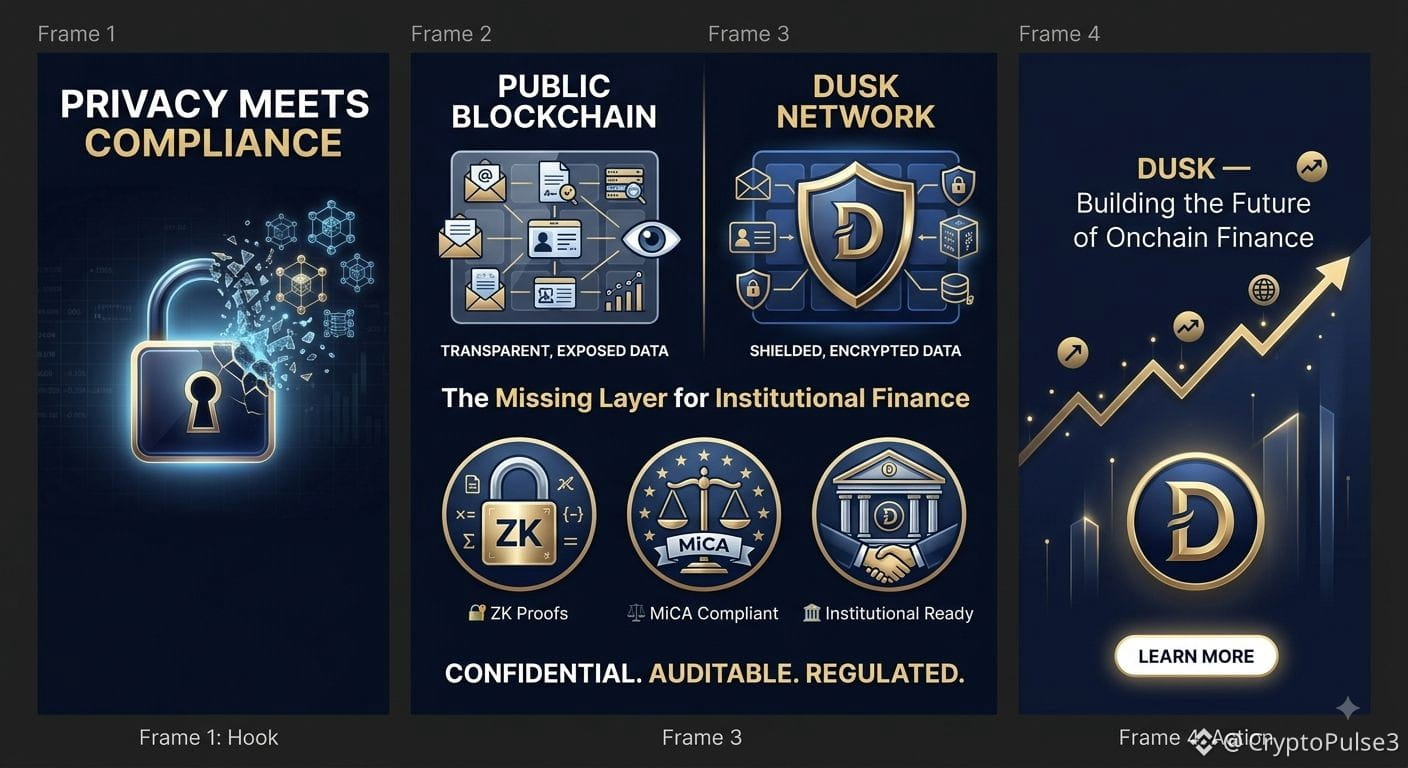
Why Institutions Are Betting on Compliant Privacy Coins Like DUSK"
As institutions race toward tokenized finance, Dusk Network is emerging as a key answer to a core problem: how do you keep transactions private without breaking compliance? Dusk combines zero-knowledge proofs with regulatory-first design, letting institutions transact confidentially while staying auditable for regulators. With RWA tokenization partnerships in Europe already live, Dusk could become foundational infrastructure for the next wave of regulated DeFi — where privacy and compliance finally coexist onchain.
Privacy meets compliance — is this the missing piece for institutional DeFi? 🔐⚖️ #DUSK
🔑 Key Points
🔐🔐🔐 Confidential by Default — Zero-knowledge proofs hide transaction details while keeping them verifiable
⚖️⚖️ Compliance Built-In — Designed for MiCA & MiFID II, satisfying EU regulatory frameworks
🏦🏦 Institutional Traction — Live RWA tokenization deals with regulated exchanges like NPEX
🚀 Category Leader — Outperforming other privacy coins amid rising institutional demand
#DuskNetwork #DUSK #OnchainFinance
$BTC
{spot}(BTCUSDT)
Why Institutions Are Betting on Compliant Privacy Coins Like DUSK"
As institutions race toward tokenized finance, Dusk Network is emerging as a key answer to a core problem: how do you keep transactions private without breaking compliance? Dusk combines zero-knowledge proofs with regulatory-first design, letting institutions transact confidentially while staying auditable for regulators. With RWA tokenization partnerships in Europe already live, Dusk could become foundational infrastructure for the next wave of regulated DeFi — where privacy and compliance finally coexist onchain.
Privacy meets compliance — is this the missing piece for institutional DeFi? 🔐⚖️ #DUSK
🔑 Key Points
🔐🔐🔐 Confidential by Default — Zero-knowledge proofs hide transaction details while keeping them verifiable
⚖️⚖️ Compliance Built-In — Designed for MiCA & MiFID II, satisfying EU regulatory frameworks
🏦🏦 Institutional Traction — Live RWA tokenization deals with regulated exchanges like NPEX
🚀 Category Leader — Outperforming other privacy coins amid rising institutional demand
#DuskNetwork #DUSK #OnchainFinance
$BTC
As institutions race toward tokenized finance, Dusk Network is emerging as a key answer to a core problem: how do you keep transactions private without breaking compliance? Dusk combines zero-knowledge proofs with regulatory-first design, letting institutions transact confidentially while staying auditable for regulators. With RWA tokenization partnerships in Europe already live, Dusk could become foundational infrastructure for the next wave of regulated DeFi — where privacy and compliance finally coexist onchain.
Privacy meets compliance — is this the missing piece for institutional DeFi? 🔐⚖️ #DUSK
🔑 Key Points
🔐🔐🔐 Confidential by Default — Zero-knowledge proofs hide transaction details while keeping them verifiable
⚖️⚖️ Compliance Built-In — Designed for MiCA & MiFID II, satisfying EU regulatory frameworks
🏦🏦 Institutional Traction — Live RWA tokenization deals with regulated exchanges like NPEX
🚀 Category Leader — Outperforming other privacy coins amid rising institutional demand
#DuskNetwork #DUSK #OnchainFinance
$BTC
43

·
--

Article
GAMECHANGERAndre Cronje, the founder of Flying Tulip, has just dropped a bombshell that's set to send shockwaves throughout the financial world. In an explosive statement, he claims that DeFi has "obliterated" the old framework and evolved into a radical new concept – onchain finance.
The proof is in the pudding. #DeFiIsDead #OnChainFinance #CryptoRevolution Andre Cronje's argument is rooted in the fact that DeFi protocols have sacrificed some of their inherent immutability and decentralization in favor of greater usability and scalability. This might seem counterintuitive, but it's a crucial step towards a more accessible and efficient financial system.
The stakes are high, as the transition to onchain finance could redefine the boundaries of traditional finance. Imagine a world where transactions are faster, cheaper, and more secure – where institutions and individuals alike can access the full range of financial services without the need for intermediaries.
So what does this mean for the future of DeFi? The implications are endless, and the smart money is already betting on the winners. But here's the thing – you don't have to be a pro to get in on the action. Whether you're a seasoned trader or a new player in the game, the flood has started, and it's time to join the movement. Will you be left behind, or will you seize the opportunity to shape the future of finance? Invest in your future today and see for yourself – the revolution is real, and it's just getting started!
GAMECHANGER
Andre Cronje, the founder of Flying Tulip, has just dropped a bombshell that's set to send shockwaves throughout the financial world. In an explosive statement, he claims that DeFi has "obliterated" the old framework and evolved into a radical new concept – onchain finance.
The proof is in the pudding. #DeFiIsDead #OnChainFinance #CryptoRevolution Andre Cronje's argument is rooted in the fact that DeFi protocols have sacrificed some of their inherent immutability and decentralization in favor of greater usability and scalability. This might seem counterintuitive, but it's a crucial step towards a more accessible and efficient financial system.
The stakes are high, as the transition to onchain finance could redefine the boundaries of traditional finance. Imagine a world where transactions are faster, cheaper, and more secure – where institutions and individuals alike can access the full range of financial services without the need for intermediaries.
So what does this mean for the future of DeFi? The implications are endless, and the smart money is already betting on the winners. But here's the thing – you don't have to be a pro to get in on the action. Whether you're a seasoned trader or a new player in the game, the flood has started, and it's time to join the movement. Will you be left behind, or will you seize the opportunity to shape the future of finance? Invest in your future today and see for yourself – the revolution is real, and it's just getting started!
The proof is in the pudding. #DeFiIsDead #OnChainFinance #CryptoRevolution Andre Cronje's argument is rooted in the fact that DeFi protocols have sacrificed some of their inherent immutability and decentralization in favor of greater usability and scalability. This might seem counterintuitive, but it's a crucial step towards a more accessible and efficient financial system.
The stakes are high, as the transition to onchain finance could redefine the boundaries of traditional finance. Imagine a world where transactions are faster, cheaper, and more secure – where institutions and individuals alike can access the full range of financial services without the need for intermediaries.
So what does this mean for the future of DeFi? The implications are endless, and the smart money is already betting on the winners. But here's the thing – you don't have to be a pro to get in on the action. Whether you're a seasoned trader or a new player in the game, the flood has started, and it's time to join the movement. Will you be left behind, or will you seize the opportunity to shape the future of finance? Invest in your future today and see for yourself – the revolution is real, and it's just getting started!
13

·
--
#termmax Not every DeFi project is trying to build something different. @termmax is.
What caught my attention is the idea of making on-chain finance more open, flexible, and transparent—without unnecessary barriers.
⚡ Permissionless by design
🌐 Transparent on-chain
🔓 More financial flexibility
🚀 Built with the future of DeFi in mind
TermMax isn’t just following the DeFi trend—it’s exploring what comes next.
The future is on-chain.
Let’s see how far TermMax can take it. 💚
#TermMax #DeFi #OnChainFinance
#termmax Not every DeFi project is trying to build something different. @TermMax is.
What caught my attention is the idea of making on-chain finance more open, flexible, and transparent—without unnecessary barriers.
⚡ Permissionless by design
🌐 Transparent on-chain
🔓 More financial flexibility
🚀 Built with the future of DeFi in mind
TermMax isn’t just following the DeFi trend—it’s exploring what comes next.
The future is on-chain.
Let’s see how far TermMax can take it. 💚
#TermMax #DeFi #OnChainFinance
What caught my attention is the idea of making on-chain finance more open, flexible, and transparent—without unnecessary barriers.
⚡ Permissionless by design
🌐 Transparent on-chain
🔓 More financial flexibility
🚀 Built with the future of DeFi in mind
TermMax isn’t just following the DeFi trend—it’s exploring what comes next.
The future is on-chain.
Let’s see how far TermMax can take it. 💚
#TermMax #DeFi #OnChainFinance
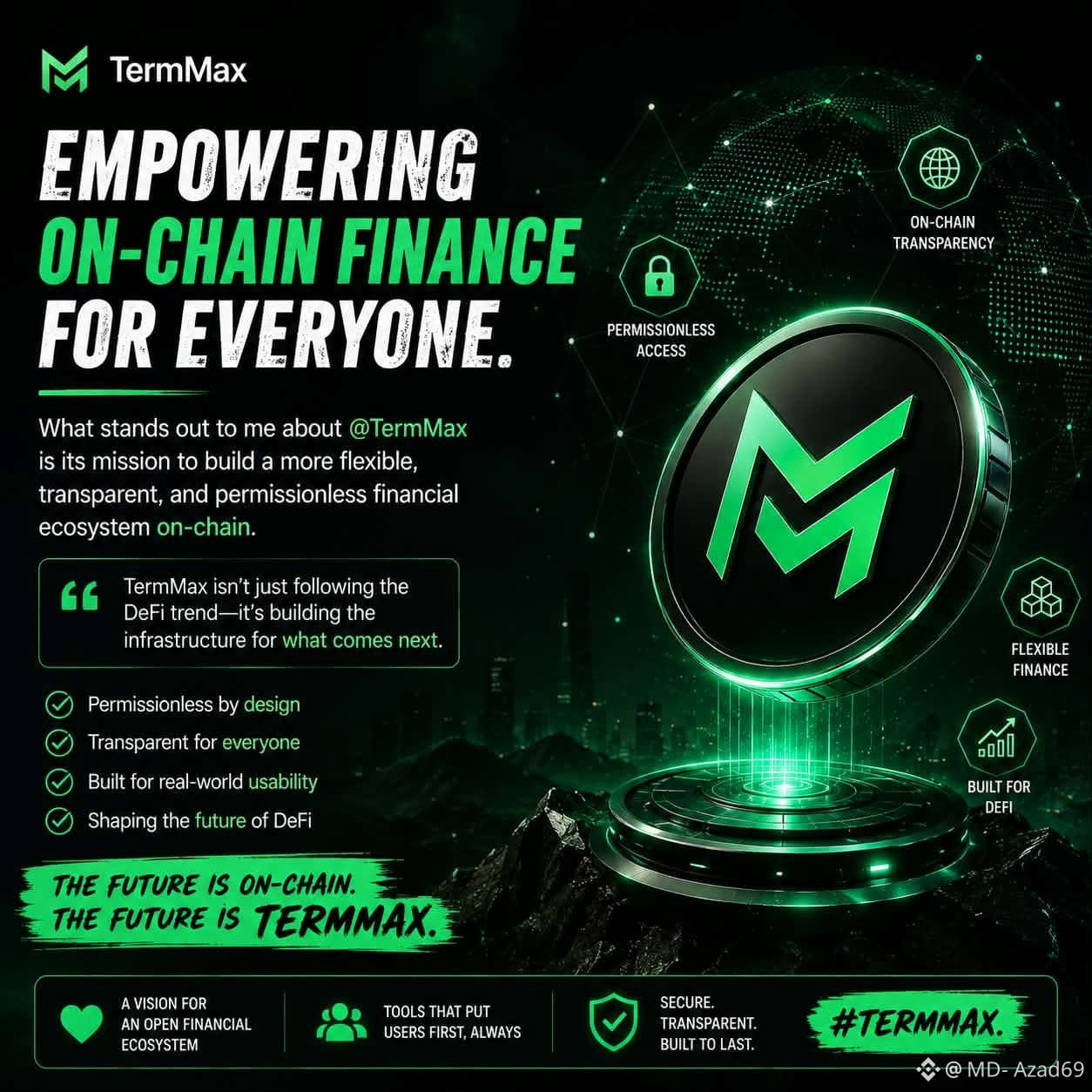
45
42
84

·
--
Mastercard just signaled something bigger than the current dip.
While everyone watches Bitcoin slide toward $66K and rotates into stablecoins, Mastercard announced it is expanding on-chain settlement — offering stablecoin, weekend, and holiday payments as core infrastructure. Not a pilot. Not a study. A product roadmap.
Mastercard processes roughly $9 trillion in transactions annually. That network is now betting on blockchain rails for always-on finance.
This is what gets built while price charts bleed. $ETH carries the heaviest RWA and settlement load. $XRP is the cross-border backbone institutions keep returning to. $BNB powers the most active stablecoin chain by volume.
The always-on finance thesis is no longer a 2030 projection. It is a Mastercard press release in June 2026.
Dips shift attention to price. They also compress entry windows for the infrastructure plays that matter when institutional settlement is baseline, not breakthrough.
The rails are being built regardless of where spot price lands.
#Stablecoins #OnChainFinance #CryptoPayments #InstitutionalCrypto #Web3
Mastercard just signaled something bigger than the current dip.
While everyone watches Bitcoin slide toward $66K and rotates into stablecoins, Mastercard announced it is expanding on-chain settlement — offering stablecoin, weekend, and holiday payments as core infrastructure. Not a pilot. Not a study. A product roadmap.
Mastercard processes roughly $9 trillion in transactions annually. That network is now betting on blockchain rails for always-on finance.
This is what gets built while price charts bleed. $ETH carries the heaviest RWA and settlement load. $XRP is the cross-border backbone institutions keep returning to. $BNB powers the most active stablecoin chain by volume.
The always-on finance thesis is no longer a 2030 projection. It is a Mastercard press release in June 2026.
Dips shift attention to price. They also compress entry windows for the infrastructure plays that matter when institutional settlement is baseline, not breakthrough.
The rails are being built regardless of where spot price lands.
#Stablecoins #OnChainFinance #CryptoPayments #InstitutionalCrypto #Web3
While everyone watches Bitcoin slide toward $66K and rotates into stablecoins, Mastercard announced it is expanding on-chain settlement — offering stablecoin, weekend, and holiday payments as core infrastructure. Not a pilot. Not a study. A product roadmap.
Mastercard processes roughly $9 trillion in transactions annually. That network is now betting on blockchain rails for always-on finance.
This is what gets built while price charts bleed. $ETH carries the heaviest RWA and settlement load. $XRP is the cross-border backbone institutions keep returning to. $BNB powers the most active stablecoin chain by volume.
The always-on finance thesis is no longer a 2030 projection. It is a Mastercard press release in June 2026.
Dips shift attention to price. They also compress entry windows for the infrastructure plays that matter when institutional settlement is baseline, not breakthrough.
The rails are being built regardless of where spot price lands.
#Stablecoins #OnChainFinance #CryptoPayments #InstitutionalCrypto #Web3
106

·
--
TOKENIZED STOCKS HIT 400K HOLDERS AND $8.9B MONTHLY VOLUME 📈
Tokenized stocks have crossed 400,000 holders with $8.9 billion in monthly volume — capital is clearly moving onchain at scale. But the enforcement layer still lags. Most platforms rely on offchain processes for compliance and risk limits, creating a gap between policy and execution.
Newton Protocol addresses this by verifying every action against defined policies in real time, issuing a signed attestation before any transaction settles. As RWAs grow, execution integrity becomes non‑negotiable.
Is the infrastructure actually keeping up with the capital flow?
Not financial advice. Always manage your risk.
#NEWT #TokenizedStocks #RWA #OnchainFinance
💎
TOKENIZED STOCKS HIT 400K HOLDERS AND $8.9B MONTHLY VOLUME 📈
Tokenized stocks have crossed 400,000 holders with $8.9 billion in monthly volume — capital is clearly moving onchain at scale. But the enforcement layer still lags. Most platforms rely on offchain processes for compliance and risk limits, creating a gap between policy and execution.
Newton Protocol addresses this by verifying every action against defined policies in real time, issuing a signed attestation before any transaction settles. As RWAs grow, execution integrity becomes non‑negotiable.
Is the infrastructure actually keeping up with the capital flow?
Not financial advice. Always manage your risk.
#NEWT #TokenizedStocks #RWA #OnchainFinance
💎
Tokenized stocks have crossed 400,000 holders with $8.9 billion in monthly volume — capital is clearly moving onchain at scale. But the enforcement layer still lags. Most platforms rely on offchain processes for compliance and risk limits, creating a gap between policy and execution.
Newton Protocol addresses this by verifying every action against defined policies in real time, issuing a signed attestation before any transaction settles. As RWAs grow, execution integrity becomes non‑negotiable.
Is the infrastructure actually keeping up with the capital flow?
Not financial advice. Always manage your risk.
#NEWT #TokenizedStocks #RWA #OnchainFinance
💎
24

Article
DeFi's $71 Billion Reality Check — The Gap Between Hype and Hard Data in 2026DeFi's $71 Billion Reality Check — The Gap Between Hype and Hard Data in 2026
Everyone talked about DeFi changing global finance forever. Here are the actual numbers — and the structural truth they reveal.
The Raw Data Right Now:
Total DeFi TVL (Total Value Locked) has fallen 37.3% year-to-date in 2026, dropping to $71.77 billion across 453 chains as of June 18 — pulling the ecosystem to within $2 billion of its 2026 low, down sharply from $114.49 billion at the start of the year. (CoinLaw)
But here is what the headline number hides:
Daily decentralized exchange volume reached $7.20 billion on June 18, 2026 — up 9.3% day-over-day — rising even as locked capital fell. Meanwhile, stablecoin circulating supply hit $314 billion in mid-June 2026, roughly 4.4 times the size of total DeFi TVL. (CoinLaw)
What The Numbers Actually Mean:
◆ Capital concentration is intensifying — Ethereum now anchors more than 53.1% of all DeFi TVL, and a quiet decoupling between stablecoin supply and the DeFi protocols meant to absorb it has emerged as a key structural concern (CoinLaw)
◆ Stablecoin circulating supply at $314 billion dwarfs DeFi's $71.77 billion TVL by more than 4x — meaning the majority of on-chain dollar activity is flowing through payment and settlement rails, not DeFi lending or liquidity protocols (CoinLaw)
◆ Institutional DeFi exposure has reached $17 billion in combined DeFi and RWA (real-world asset) TVL — adoption benchmarks for tokenized treasuries and yield-bearing stablecoins are now being tracked by major financial institutions for the first time (CoinLaw)
◆ MakerDAO has deployed $948 million in tokenized U.S. Treasuries as collateral — one of the clearest examples of traditional financial instruments being absorbed directly into DeFi infrastructure (Qubit Capital)
◆ Raydium, a Solana-based decentralized exchange, was drained of $1.34 million on June 10, 2026, when an attacker exploited five deprecated liquidity pools from its legacy AMM V3 smart contract — a vulnerability that had sat dormant in production code (CryptoNews.com)
The ECB Just Challenged DeFi's Core Claim:
A recent working paper from the European Central Bank took a close, data-driven look at governance across major DeFi protocols and challenged one of the sector's foundational assumptions — finding that control in most DeFi systems is concentrated, opaque, and structurally resistant to change, rather than genuinely distributed among users. (PYMNTS)
There is a growing consensus among large financial institutions that the future of tokenization is likely to be permissioned rather than permissionless, and integrated with existing systems rather than operating in parallel to them. (PYMNTS)
Where DeFi Is Actually Growing:
◆ Tokenized RWA platforms are projected to expand at a 39.72% CAGR through 2031 — the fastest-growing DeFi segment — as compliant issuance and institutional custody requirements align with on-chain infrastructure (Mordor Intelligence)
◆ The overall DeFi market is projected to reach $770.56 billion by 2031 at a 26.43% CAGR — with institutional investors and asset managers growing at 32.55% CAGR, far outpacing the retail segment (Mordor Intelligence)
◆ Layer-2 fee compression and rollup technology are making small, frequent DeFi transactions economically viable for the first time — removing the gas cost barrier that kept millions of users on the sidelines
The real DeFi story in 2026 is not TVL. It is the quiet institutional rewiring of on-chain finance — tokenized treasuries replacing yield farming, permissioned pools replacing anonymous liquidity, and regulated wrappers replacing pure decentralization.
With $314 billion in stablecoins circulating on-chain but only $71 billion locked in DeFi protocols — where do you think the rest of that capital is actually going, and what does that tell us about where on-chain finance is heading?
#DeFi #Stablecoins #RWA #OnChainFinance #Web3
DeFi's $71 Billion Reality Check — The Gap Between Hype and Hard Data in 2026
DeFi's $71 Billion Reality Check — The Gap Between Hype and Hard Data in 2026
Everyone talked about DeFi changing global finance forever. Here are the actual numbers — and the structural truth they reveal.
The Raw Data Right Now:
Total DeFi TVL (Total Value Locked) has fallen 37.3% year-to-date in 2026, dropping to $71.77 billion across 453 chains as of June 18 — pulling the ecosystem to within $2 billion of its 2026 low, down sharply from $114.49 billion at the start of the year. (CoinLaw)
But here is what the headline number hides:
Daily decentralized exchange volume reached $7.20 billion on June 18, 2026 — up 9.3% day-over-day — rising even as locked capital fell. Meanwhile, stablecoin circulating supply hit $314 billion in mid-June 2026, roughly 4.4 times the size of total DeFi TVL. (CoinLaw)
What The Numbers Actually Mean:
◆ Capital concentration is intensifying — Ethereum now anchors more than 53.1% of all DeFi TVL, and a quiet decoupling between stablecoin supply and the DeFi protocols meant to absorb it has emerged as a key structural concern (CoinLaw)
◆ Stablecoin circulating supply at $314 billion dwarfs DeFi's $71.77 billion TVL by more than 4x — meaning the majority of on-chain dollar activity is flowing through payment and settlement rails, not DeFi lending or liquidity protocols (CoinLaw)
◆ Institutional DeFi exposure has reached $17 billion in combined DeFi and RWA (real-world asset) TVL — adoption benchmarks for tokenized treasuries and yield-bearing stablecoins are now being tracked by major financial institutions for the first time (CoinLaw)
◆ MakerDAO has deployed $948 million in tokenized U.S. Treasuries as collateral — one of the clearest examples of traditional financial instruments being absorbed directly into DeFi infrastructure (Qubit Capital)
◆ Raydium, a Solana-based decentralized exchange, was drained of $1.34 million on June 10, 2026, when an attacker exploited five deprecated liquidity pools from its legacy AMM V3 smart contract — a vulnerability that had sat dormant in production code (CryptoNews.com)
The ECB Just Challenged DeFi's Core Claim:
A recent working paper from the European Central Bank took a close, data-driven look at governance across major DeFi protocols and challenged one of the sector's foundational assumptions — finding that control in most DeFi systems is concentrated, opaque, and structurally resistant to change, rather than genuinely distributed among users. (PYMNTS)
There is a growing consensus among large financial institutions that the future of tokenization is likely to be permissioned rather than permissionless, and integrated with existing systems rather than operating in parallel to them. (PYMNTS)
Where DeFi Is Actually Growing:
◆ Tokenized RWA platforms are projected to expand at a 39.72% CAGR through 2031 — the fastest-growing DeFi segment — as compliant issuance and institutional custody requirements align with on-chain infrastructure (Mordor Intelligence)
◆ The overall DeFi market is projected to reach $770.56 billion by 2031 at a 26.43% CAGR — with institutional investors and asset managers growing at 32.55% CAGR, far outpacing the retail segment (Mordor Intelligence)
◆ Layer-2 fee compression and rollup technology are making small, frequent DeFi transactions economically viable for the first time — removing the gas cost barrier that kept millions of users on the sidelines
The real DeFi story in 2026 is not TVL. It is the quiet institutional rewiring of on-chain finance — tokenized treasuries replacing yield farming, permissioned pools replacing anonymous liquidity, and regulated wrappers replacing pure decentralization.
With $314 billion in stablecoins circulating on-chain but only $71 billion locked in DeFi protocols — where do you think the rest of that capital is actually going, and what does that tell us about where on-chain finance is heading?
#DeFi #Stablecoins #RWA #OnChainFinance #Web3
Everyone talked about DeFi changing global finance forever. Here are the actual numbers — and the structural truth they reveal.
The Raw Data Right Now:
Total DeFi TVL (Total Value Locked) has fallen 37.3% year-to-date in 2026, dropping to $71.77 billion across 453 chains as of June 18 — pulling the ecosystem to within $2 billion of its 2026 low, down sharply from $114.49 billion at the start of the year. (CoinLaw)
But here is what the headline number hides:
Daily decentralized exchange volume reached $7.20 billion on June 18, 2026 — up 9.3% day-over-day — rising even as locked capital fell. Meanwhile, stablecoin circulating supply hit $314 billion in mid-June 2026, roughly 4.4 times the size of total DeFi TVL. (CoinLaw)
What The Numbers Actually Mean:
◆ Capital concentration is intensifying — Ethereum now anchors more than 53.1% of all DeFi TVL, and a quiet decoupling between stablecoin supply and the DeFi protocols meant to absorb it has emerged as a key structural concern (CoinLaw)
◆ Stablecoin circulating supply at $314 billion dwarfs DeFi's $71.77 billion TVL by more than 4x — meaning the majority of on-chain dollar activity is flowing through payment and settlement rails, not DeFi lending or liquidity protocols (CoinLaw)
◆ Institutional DeFi exposure has reached $17 billion in combined DeFi and RWA (real-world asset) TVL — adoption benchmarks for tokenized treasuries and yield-bearing stablecoins are now being tracked by major financial institutions for the first time (CoinLaw)
◆ MakerDAO has deployed $948 million in tokenized U.S. Treasuries as collateral — one of the clearest examples of traditional financial instruments being absorbed directly into DeFi infrastructure (Qubit Capital)
◆ Raydium, a Solana-based decentralized exchange, was drained of $1.34 million on June 10, 2026, when an attacker exploited five deprecated liquidity pools from its legacy AMM V3 smart contract — a vulnerability that had sat dormant in production code (CryptoNews.com)
The ECB Just Challenged DeFi's Core Claim:
A recent working paper from the European Central Bank took a close, data-driven look at governance across major DeFi protocols and challenged one of the sector's foundational assumptions — finding that control in most DeFi systems is concentrated, opaque, and structurally resistant to change, rather than genuinely distributed among users. (PYMNTS)
There is a growing consensus among large financial institutions that the future of tokenization is likely to be permissioned rather than permissionless, and integrated with existing systems rather than operating in parallel to them. (PYMNTS)
Where DeFi Is Actually Growing:
◆ Tokenized RWA platforms are projected to expand at a 39.72% CAGR through 2031 — the fastest-growing DeFi segment — as compliant issuance and institutional custody requirements align with on-chain infrastructure (Mordor Intelligence)
◆ The overall DeFi market is projected to reach $770.56 billion by 2031 at a 26.43% CAGR — with institutional investors and asset managers growing at 32.55% CAGR, far outpacing the retail segment (Mordor Intelligence)
◆ Layer-2 fee compression and rollup technology are making small, frequent DeFi transactions economically viable for the first time — removing the gas cost barrier that kept millions of users on the sidelines
The real DeFi story in 2026 is not TVL. It is the quiet institutional rewiring of on-chain finance — tokenized treasuries replacing yield farming, permissioned pools replacing anonymous liquidity, and regulated wrappers replacing pure decentralization.
With $314 billion in stablecoins circulating on-chain but only $71 billion locked in DeFi protocols — where do you think the rest of that capital is actually going, and what does that tell us about where on-chain finance is heading?
#DeFi #Stablecoins #RWA #OnChainFinance #Web3
23

🚀 What if your idle collateral could work for you without slowing down your trading?
That's exactly what GRVT is building.
By integrating sGHO into its Yield Engine, GRVT transforms idle collateral into a yield-generating asset while keeping it available for trading through Unified Margin.
Smarter capital efficiency. Real on-chain utility. A better DeFi experience.
This is the kind of innovation that pushes decentralized finance beyond the hype and into real-world value.
Excited to see what's next from @grvt_io! 🔥
#GRVT #DeFi #UnifiedMargin #sGHO #OnChainFinance
🚀 What if your idle collateral could work for you without slowing down your trading?
That's exactly what GRVT is building.
By integrating sGHO into its Yield Engine, GRVT transforms idle collateral into a yield-generating asset while keeping it available for trading through Unified Margin.
Smarter capital efficiency. Real on-chain utility. A better DeFi experience.
This is the kind of innovation that pushes decentralized finance beyond the hype and into real-world value.
Excited to see what's next from @grvt_io! 🔥
#GRVT #DeFi #UnifiedMargin #sGHO #OnChainFinance
That's exactly what GRVT is building.
By integrating sGHO into its Yield Engine, GRVT transforms idle collateral into a yield-generating asset while keeping it available for trading through Unified Margin.
Smarter capital efficiency. Real on-chain utility. A better DeFi experience.
This is the kind of innovation that pushes decentralized finance beyond the hype and into real-world value.
Excited to see what's next from @grvt_io! 🔥
#GRVT #DeFi #UnifiedMargin #sGHO #OnChainFinance
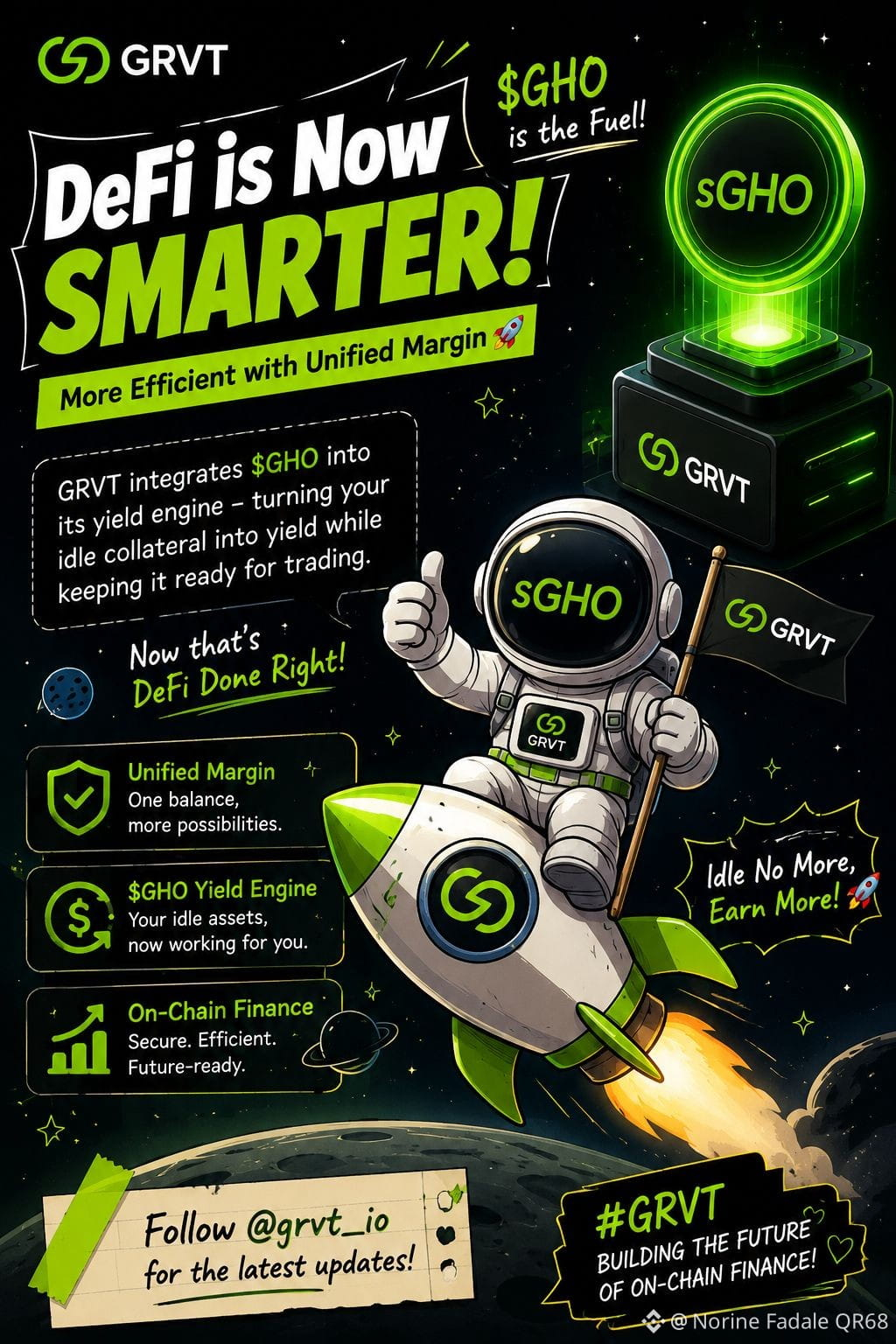
1
73
·
--
If you’re still treating onchain finance like it’s only for spot trading, stop now.
That mistake cost traders plenty: either you FOMO into naked exposure with no exit plan, or you sit out because “real” instruments feel locked behind institutional doors. The gap between retail and pro desks has always been access.
For decades, options, structured products, and defined-risk strategies were mostly reserved for funds, market makers, and people with three monitors yelling into a headset. Now protocols are starting to drag those tools onchain, wallet-first, permissionless by default.
$AAVE and $MORPHO are doing this for credit markets: opening up lending, borrowing, and risk pricing beyond the old banking rails. $AEVO is pushing a similar idea on the derivatives side, where options and structured exposure can move from “institution-only menu” to something any trader can actually use.
The comparison is interesting: DeFi credit had its breakout moment when users realized banks weren’t the only gatekeepers. Derivatives may be next, but the question is whether retail will use these tools responsibly or just find more creative ways to get liquidated.
Which side do you think goes mainstream first: onchain credit or onchain derivatives?
#DeFi #CryptoTrading #OnchainFinance
If you’re still treating onchain finance like it’s only for spot trading, stop now.
That mistake cost traders plenty: either you FOMO into naked exposure with no exit plan, or you sit out because “real” instruments feel locked behind institutional doors. The gap between retail and pro desks has always been access.
For decades, options, structured products, and defined-risk strategies were mostly reserved for funds, market makers, and people with three monitors yelling into a headset. Now protocols are starting to drag those tools onchain, wallet-first, permissionless by default.
$AAVE and $MORPHO are doing this for credit markets: opening up lending, borrowing, and risk pricing beyond the old banking rails. $AEVO is pushing a similar idea on the derivatives side, where options and structured exposure can move from “institution-only menu” to something any trader can actually use.
The comparison is interesting: DeFi credit had its breakout moment when users realized banks weren’t the only gatekeepers. Derivatives may be next, but the question is whether retail will use these tools responsibly or just find more creative ways to get liquidated.
Which side do you think goes mainstream first: onchain credit or onchain derivatives?
#DeFi #CryptoTrading #OnchainFinance
That mistake cost traders plenty: either you FOMO into naked exposure with no exit plan, or you sit out because “real” instruments feel locked behind institutional doors. The gap between retail and pro desks has always been access.
For decades, options, structured products, and defined-risk strategies were mostly reserved for funds, market makers, and people with three monitors yelling into a headset. Now protocols are starting to drag those tools onchain, wallet-first, permissionless by default.
$AAVE and $MORPHO are doing this for credit markets: opening up lending, borrowing, and risk pricing beyond the old banking rails. $AEVO is pushing a similar idea on the derivatives side, where options and structured exposure can move from “institution-only menu” to something any trader can actually use.
The comparison is interesting: DeFi credit had its breakout moment when users realized banks weren’t the only gatekeepers. Derivatives may be next, but the question is whether retail will use these tools responsibly or just find more creative ways to get liquidated.
Which side do you think goes mainstream first: onchain credit or onchain derivatives?
#DeFi #CryptoTrading #OnchainFinance

93
$ACE $SNXXB ONCHAIN AWARDS 2026 NOMINATIONS — THE INSTITUTIONAL SEAL IS COMING 🚨💥
Web3 gets its official stamp of approval. The Global Onchain Awards 2026 are now open for nominations, spotlighting the institutions and innovators building the rails for tokenization, stablecoins, and DeFi. 🏦 This isn't just another conference banner — it's a research-led evaluation that will put institutional weight behind the entire onchain narrative.
For traders watching this sector, it's a fresh catalyst window. The closing date ahead of the Singapore Summit on October 6, 2026, sets a clear timeline for news flow and positioning. 🌊 When smart money starts validating infrastructure, the speculative fringe often follows. 🔍
Which project do you think takes home the top honor for onchain infrastructure? 💬
⚠️ Not financial advice. Always manage your risk. 🛡️
🏷️ #ACE #SNXXB #OnchainFinance #DeFi #Tokenization
🦈 🌟
$ACE $SNXXB ONCHAIN AWARDS 2026 NOMINATIONS — THE INSTITUTIONAL SEAL IS COMING 🚨💥
Web3 gets its official stamp of approval. The Global Onchain Awards 2026 are now open for nominations, spotlighting the institutions and innovators building the rails for tokenization, stablecoins, and DeFi. 🏦 This isn't just another conference banner — it's a research-led evaluation that will put institutional weight behind the entire onchain narrative.
For traders watching this sector, it's a fresh catalyst window. The closing date ahead of the Singapore Summit on October 6, 2026, sets a clear timeline for news flow and positioning. 🌊 When smart money starts validating infrastructure, the speculative fringe often follows. 🔍
Which project do you think takes home the top honor for onchain infrastructure? 💬
⚠️ Not financial advice. Always manage your risk. 🛡️
🏷️ #ACE #SNXXB #OnchainFinance #DeFi #Tokenization
🦈 🌟
Web3 gets its official stamp of approval. The Global Onchain Awards 2026 are now open for nominations, spotlighting the institutions and innovators building the rails for tokenization, stablecoins, and DeFi. 🏦 This isn't just another conference banner — it's a research-led evaluation that will put institutional weight behind the entire onchain narrative.
For traders watching this sector, it's a fresh catalyst window. The closing date ahead of the Singapore Summit on October 6, 2026, sets a clear timeline for news flow and positioning. 🌊 When smart money starts validating infrastructure, the speculative fringe often follows. 🔍
Which project do you think takes home the top honor for onchain infrastructure? 💬
⚠️ Not financial advice. Always manage your risk. 🛡️
🏷️ #ACE #SNXXB #OnchainFinance #DeFi #Tokenization
🦈 🌟

124

The future of onchain finance won’t be built on transparency alone.
It needs privacy. Compliance. Scalability. And certainty.
Dusk was designed around that exact challenge.
Its whitepaper introduces a privacy-focused, compliance-ready blockchain for regulated financial markets—combining confidential transactions, auditability, and fast finality.
And the architecture goes deeper:
Succinct Attestation → finality designed for financial markets
Phoenix → transparent or obfuscated transactions
Moonlight → transparent account-based transactions
Zedger → confidential smart contracts for financial applications
Kadcast → efficient and reliable network communication
The goal isn’t to choose between privacy and regulation.
The goal is to make both work together.
Dusk isn’t simply putting assets onchain.
It’s building infrastructure where regulated finance can actually operate onchain.
Privacy without compromise.
Compliance without sacrificing confidentiality.
Finality built for real financial markets.
That’s the Dusk vision.
#DUSK #RWA #DeFi #OnchainFinance
#dusk $DUSK @Dusk_Foundation
The future of onchain finance won’t be built on transparency alone.
It needs privacy. Compliance. Scalability. And certainty.
Dusk was designed around that exact challenge.
Its whitepaper introduces a privacy-focused, compliance-ready blockchain for regulated financial markets—combining confidential transactions, auditability, and fast finality.
And the architecture goes deeper:
Succinct Attestation → finality designed for financial markets
Phoenix → transparent or obfuscated transactions
Moonlight → transparent account-based transactions
Zedger → confidential smart contracts for financial applications
Kadcast → efficient and reliable network communication
The goal isn’t to choose between privacy and regulation.
The goal is to make both work together.
Dusk isn’t simply putting assets onchain.
It’s building infrastructure where regulated finance can actually operate onchain.
Privacy without compromise.
Compliance without sacrificing confidentiality.
Finality built for real financial markets.
That’s the Dusk vision.
#DUSK #RWA #DeFi #OnchainFinance
#dusk $DUSK @Dusk
It needs privacy. Compliance. Scalability. And certainty.
Dusk was designed around that exact challenge.
Its whitepaper introduces a privacy-focused, compliance-ready blockchain for regulated financial markets—combining confidential transactions, auditability, and fast finality.
And the architecture goes deeper:
Succinct Attestation → finality designed for financial markets
Phoenix → transparent or obfuscated transactions
Moonlight → transparent account-based transactions
Zedger → confidential smart contracts for financial applications
Kadcast → efficient and reliable network communication
The goal isn’t to choose between privacy and regulation.
The goal is to make both work together.
Dusk isn’t simply putting assets onchain.
It’s building infrastructure where regulated finance can actually operate onchain.
Privacy without compromise.
Compliance without sacrificing confidentiality.
Finality built for real financial markets.
That’s the Dusk vision.
#DUSK #RWA #DeFi #OnchainFinance
#dusk $DUSK @Dusk
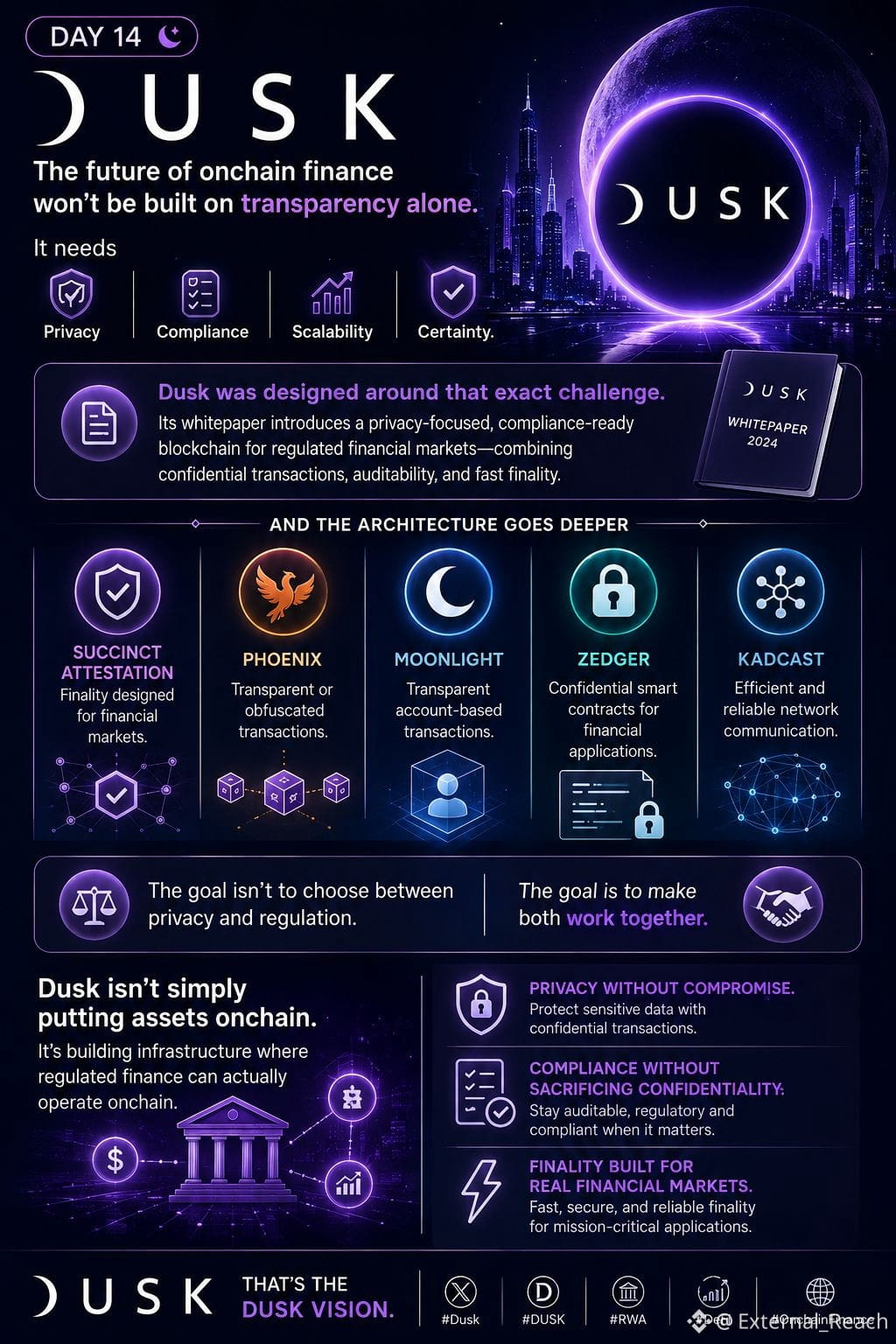
92
Log in to explore more content
Join global crypto users on Binance Square
⚡️ Get latest and useful information about crypto.
💬 Trusted by the world’s largest crypto exchange.
👍 Discover real insights from verified creators.
Email / Phone number
Trending Topics
1
#NEARFallsToAround$4.70Down14%
376 views
9 Discussing
2
#EthereumFoundationLaunchesZkAPIOnMainnet
0 views
1 Discussing
3
#EvernorthPlansNasdaqListingOct8
491 views
43 Discussing
4
#SECProposesCryptoCustodyFramework
408 views
41 Discussing
5
#IMFApproves$139MDisbursementToElSalvador
232 views
12 Discussing
6
#AnthropicTargetsIPOAsSoonAsMidNovember
1,501 views
80 Discussing
7
#EtherGains70.9%InQ3
202,935 views
1,321 Discussing
8
#TreasuryLetsStatesFileStablecoinCertificationsEarly
14,367 views
103 Discussing
9
#US10YearYieldNears5.3%
171,765 views
1,258 Discussing
10
#DollarIndexHitsHighestSinceMay2025
56,606 views
712 Discussing