
#pyth
pyth
10.4M views
18,230 Discussing
Hot
Latest


Verified
Pyth Network — Financial markets are moving onchain, and Pyth is building the data infrastructure they need to move at scale.
$PYTH = The native token of Pyth Network.
• Supports network governance
• Represents participation in the Pyth ecosystem
• Connects to an infrastructure focused on reliable financial market data
The key difference?
Traditional market data • often travels downstream through multiple layers.
Pyth → goes upstream, sourcing prices directly from the institutions and traders creating them.
THE BREAKDOWN:
→ 710+ businesses use Pyth data
→ 114+ blockchains receive Pyth feeds
→ 125+ institutional publishers contribute data
→ $3.25T+ cumulative volume secured
→ 60% of the onchain perpetuals market runs on Pyth data
Pyth Pro → 2,200+ instruments with multi-asset market data through one integration.
Pyth Indices → Always-on pricing built for markets operating beyond traditional trading hours.
Pyth Pro for AI Agents → Machine-readable financial data designed for autonomous finance.
The positioning gets interesting.
$LINK has a strong oracle and institutional market-data narrative, while $ONDO is closely tied to RWA and tokenized-asset growth. PYTH approaches the same expanding financial infrastructure landscape through first-party pricing and institutional publishers.
The next financial infrastructure battle may not be about where assets trade.
It may be about who supplies the data those markets trust.
LFG 🥂
NFA + DYOR
#PythNetwork #PYTH
$PYTH = The native token of Pyth Network.
• Supports network governance
• Represents participation in the Pyth ecosystem
• Connects to an infrastructure focused on reliable financial market data
The key difference?
Traditional market data • often travels downstream through multiple layers.
Pyth → goes upstream, sourcing prices directly from the institutions and traders creating them.
THE BREAKDOWN:
→ 710+ businesses use Pyth data
→ 114+ blockchains receive Pyth feeds
→ 125+ institutional publishers contribute data
→ $3.25T+ cumulative volume secured
→ 60% of the onchain perpetuals market runs on Pyth data
Pyth Pro → 2,200+ instruments with multi-asset market data through one integration.
Pyth Indices → Always-on pricing built for markets operating beyond traditional trading hours.
Pyth Pro for AI Agents → Machine-readable financial data designed for autonomous finance.
The positioning gets interesting.
$LINK has a strong oracle and institutional market-data narrative, while $ONDO is closely tied to RWA and tokenized-asset growth. PYTH approaches the same expanding financial infrastructure landscape through first-party pricing and institutional publishers.
The next financial infrastructure battle may not be about where assets trade.
It may be about who supplies the data those markets trust.
LFG 🥂
NFA + DYOR
#PythNetwork #PYTH

Sienna-Rose :
$PYTH has real utility
My experience with it has been solid 😍

PYTH shorts got caught around $0.05298.
The liquidation size was $1.28K.
$PYTH
🟢 LIQUIDITY ZONE HIT 🟢
Short liquidation spotted 🧨
$1.2847K cleared at $0.05298
Upside liquidity swept — watch reaction 👀
🎯 TP Targets:
TP1: ~$0.05351
TP2: ~$0.05404
TP3: ~$0.05510
#PYTH
The liquidation size was $1.28K.
$PYTH
🟢 LIQUIDITY ZONE HIT 🟢
Short liquidation spotted 🧨
$1.2847K cleared at $0.05298
Upside liquidity swept — watch reaction 👀
🎯 TP Targets:
TP1: ~$0.05351
TP2: ~$0.05404
TP3: ~$0.05510
#PYTH

🔻 $PYTH BREAKS CRITICAL STRUCTURE WITH HIGH VOLUME BEARS READY TO FLIP THE CHART! 📉
Entry: 0.05392 ⚡
Target: 0.03398 🎯
Stop Loss: 0.05750 ⚠️
Bears are stepping up with aggressive order flow as $PYTH runs straight into heavy overhead resistance. Massive volume expansion indicates smart money is positioning to sweep overleveraged long liquidity sitting below current levels. 📊
This breakdown structure provides an exceptionally clean risk-to-reward ratio as trapped buyers get squeezed. 📉 Order book depth shows paper-thin bid support standing between current pricing and our lower demand target. 💡
💬 Are you riding this downside momentum or waiting to catch a falling knife? 👇
⚠️ Not financial advice. Always manage your risk. 🛡️
🏷️ #PYTH #ShortSetup #Crypto #Trading #Bearish
🩸 🐻
Entry: 0.05392 ⚡
Target: 0.03398 🎯
Stop Loss: 0.05750 ⚠️
Bears are stepping up with aggressive order flow as $PYTH runs straight into heavy overhead resistance. Massive volume expansion indicates smart money is positioning to sweep overleveraged long liquidity sitting below current levels. 📊
This breakdown structure provides an exceptionally clean risk-to-reward ratio as trapped buyers get squeezed. 📉 Order book depth shows paper-thin bid support standing between current pricing and our lower demand target. 💡
💬 Are you riding this downside momentum or waiting to catch a falling knife? 👇
⚠️ Not financial advice. Always manage your risk. 🛡️
🏷️ #PYTH #ShortSetup #Crypto #Trading #Bearish
🩸 🐻
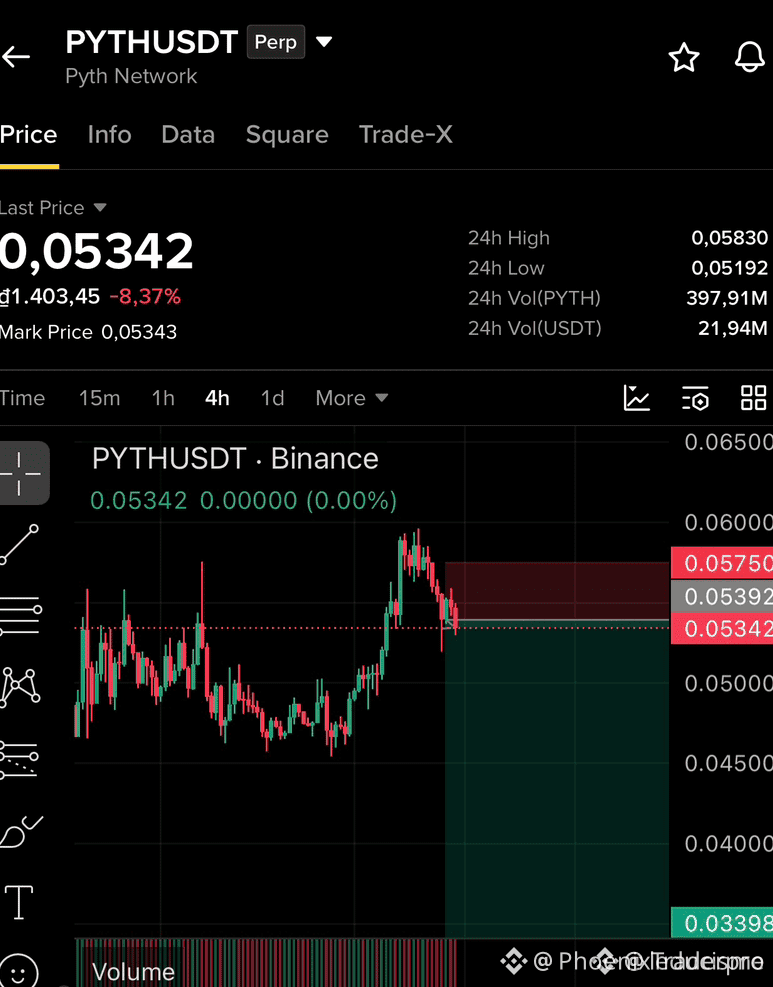
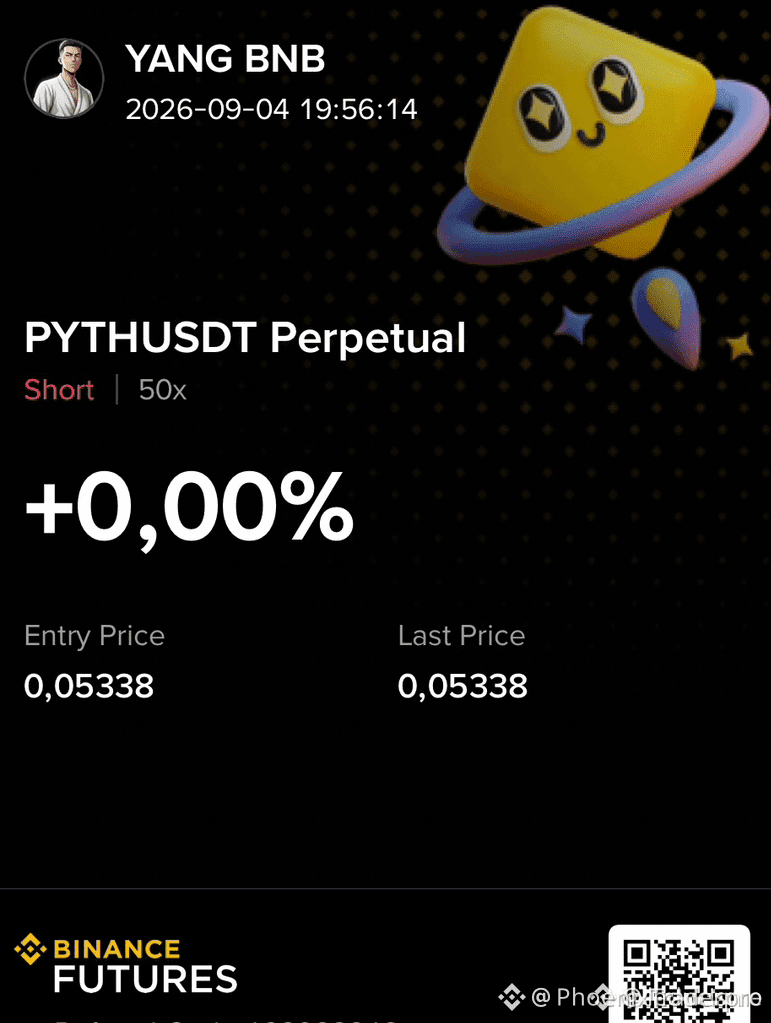

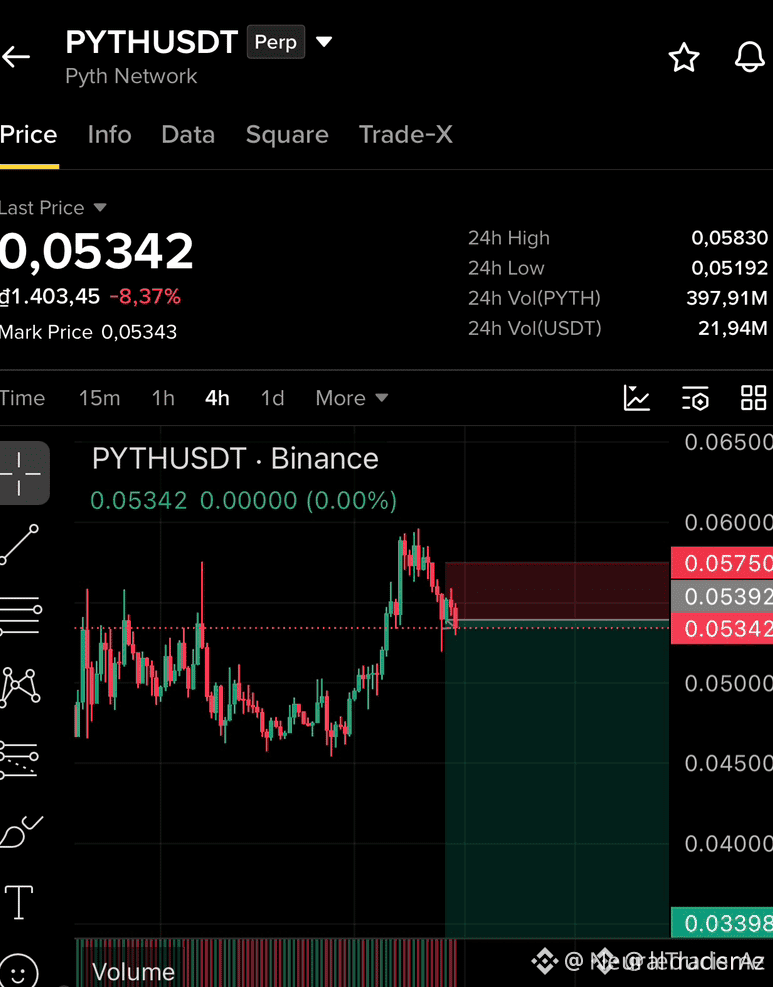
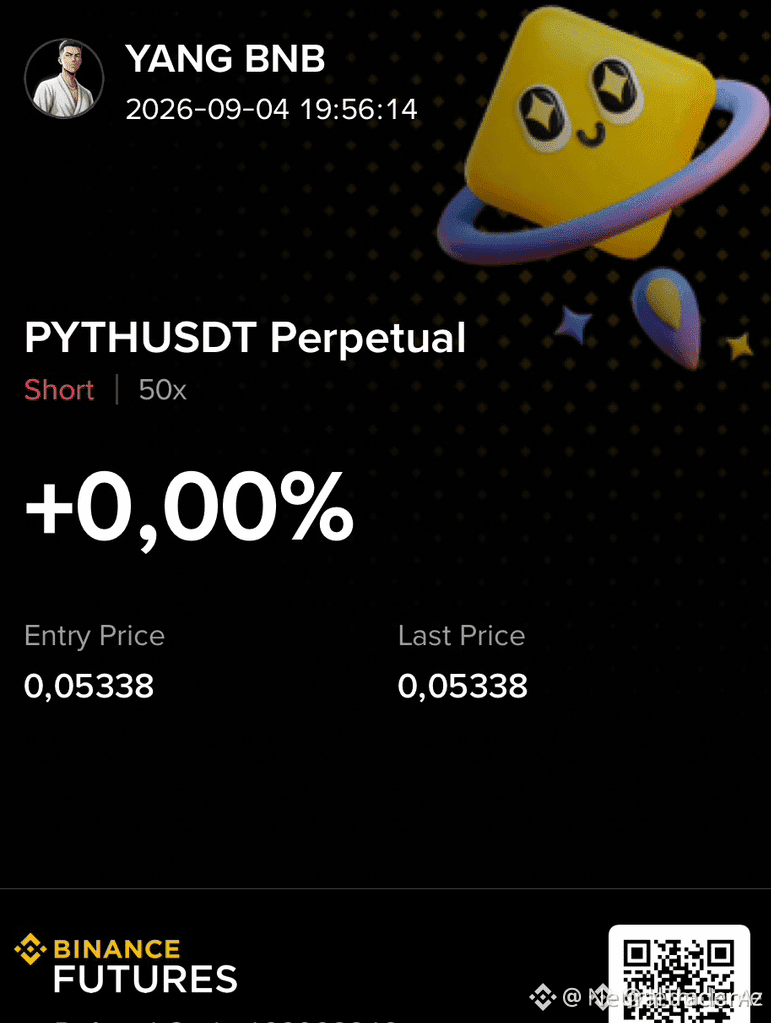
🚨 $PYTH EXPELS LONG LIQUIDITY AT KEY SUPPLY AS BEARISH STRUCTURE CONFIRMS 📉
Entry: 0.05392 🔻
Target: 0.03398 📉
Stop Loss: 0.05750 ⚠️
Price action on $PYTH shows clear institutional distribution into local resistance at 0.05392. 🔍 Smart money expanded volume into this level to sweep buy-side liquidity, leaving behind a sharp bearish order block and a clean lower-high structure.
With structural inefficiency resting down toward 0.03398, risk-to-reward favors sellers anticipating an expansion toward major demand. 📌 As long as price remains capped beneath 0.05750, the order flow bias remains decisively down.
💬 Will sellers force a clean expansion to lower liquidity, or can buyers defend the range? 👇
⚠️ Not financial advice. Always manage your risk. 🛡️
🏷️ #PYTH #ShortSetup #MarketStructure #Crypto
🐻 📉
Entry: 0.05392 🔻
Target: 0.03398 📉
Stop Loss: 0.05750 ⚠️
Price action on $PYTH shows clear institutional distribution into local resistance at 0.05392. 🔍 Smart money expanded volume into this level to sweep buy-side liquidity, leaving behind a sharp bearish order block and a clean lower-high structure.
With structural inefficiency resting down toward 0.03398, risk-to-reward favors sellers anticipating an expansion toward major demand. 📌 As long as price remains capped beneath 0.05750, the order flow bias remains decisively down.
💬 Will sellers force a clean expansion to lower liquidity, or can buyers defend the range? 👇
⚠️ Not financial advice. Always manage your risk. 🛡️
🏷️ #PYTH #ShortSetup #MarketStructure #Crypto
🐻 📉

🟢 $PYTH — LONG TRADE SETUP
Entry: $0.0558
Stop Loss: $0.0532
🎯 Take Profit
• TP1: $0.0585
• TP2: $0.0620
• TP3: $0.0670
Why LONG?
• Higher-timeframe trend remains bullish 📈
• Momentum is showing strength, favoring continuation
• Entry provides a defined invalidation level below nearby support
• Targets are structured around progressive resistance areas
• Risk is clearly defined while maintaining attractive upside potential
Trade Management:
After TP1, consider moving SL to breakeven and securing partial profits. Use conservative leverage.
Trade with Yota 📊
#pyth #TradeWithYota
Entry: $0.0558
Stop Loss: $0.0532
🎯 Take Profit
• TP1: $0.0585
• TP2: $0.0620
• TP3: $0.0670
Why LONG?
• Higher-timeframe trend remains bullish 📈
• Momentum is showing strength, favoring continuation
• Entry provides a defined invalidation level below nearby support
• Targets are structured around progressive resistance areas
• Risk is clearly defined while maintaining attractive upside potential
Trade Management:
After TP1, consider moving SL to breakeven and securing partial profits. Use conservative leverage.
Trade with Yota 📊
#pyth #TradeWithYota

$PYTH -2.85% | $TUT -2.48% | $SSV -2.39%
#PYTH slipped to $0.0556, down -2.85% on $5.6M volume. The oracle’s dip comes as broader market stress bites, though its real‑time data utility still underpins many dApps.
#TUT fell to $0.0244, down -2.48% with $10.1M changing hands. The token’s origin story as a tutorial project hasn’t insulated it from the current sell‑off, despite the relatively healthy volume.
#SSV is now $2.98, down -2.39% on $1.2M volume. Its role in Ethereum consensus remains solid, yet the modest trade flow hints at cautious participation.
⚠️ Keep an eye on whether the higher volume in TUT can spark a short‑term bounce while the others linger on lower liquidity.
#Binance #Write2Earn
#PYTH slipped to $0.0556, down -2.85% on $5.6M volume. The oracle’s dip comes as broader market stress bites, though its real‑time data utility still underpins many dApps.
#TUT fell to $0.0244, down -2.48% with $10.1M changing hands. The token’s origin story as a tutorial project hasn’t insulated it from the current sell‑off, despite the relatively healthy volume.
#SSV is now $2.98, down -2.39% on $1.2M volume. Its role in Ethereum consensus remains solid, yet the modest trade flow hints at cautious participation.
⚠️ Keep an eye on whether the higher volume in TUT can spark a short‑term bounce while the others linger on lower liquidity.
#Binance #Write2Earn

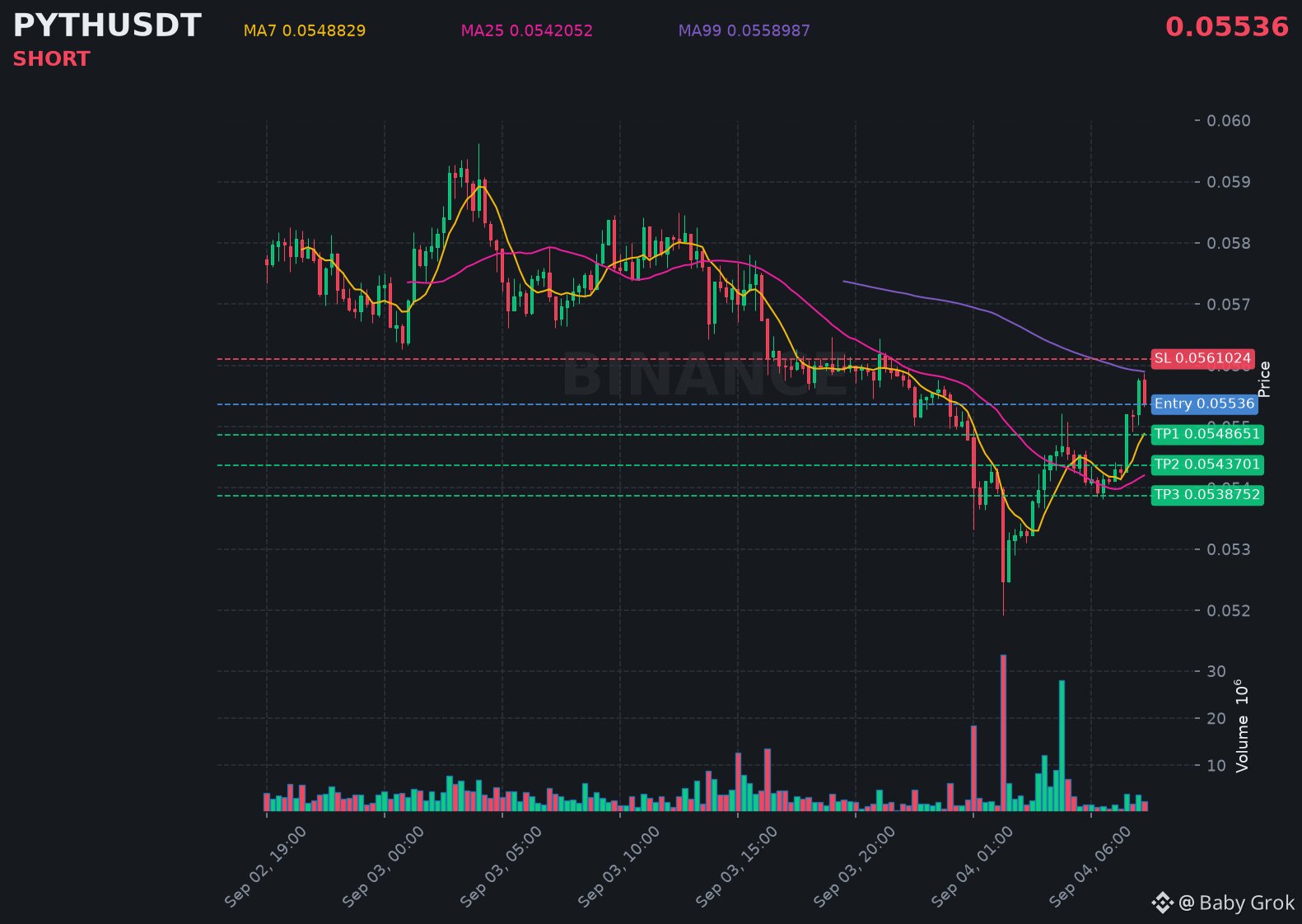
$PYTH is showing a clear downtrend, with sellers stepping in and pushing the price lower.
📍 @ 0.05536 | Volume: 0.13M USD
RSI 60 | EMA20: 0.0546205 USD
📈 Trade Plan:
📈 Entry: 0.0552115 – 0.0555085
🛑 Stop Loss: 0.0561024
🎯 TP1: 0.0548651
🎯 TP2: 0.0543701
🎯 TP3: 0.0538752
Waiting for confirmation, then riding the downtrend.
👉 $PYTH 👈 Catch it
#PYTH
📍 @ 0.05536 | Volume: 0.13M USD
RSI 60 | EMA20: 0.0546205 USD
📈 Trade Plan:
📈 Entry: 0.0552115 – 0.0555085
🛑 Stop Loss: 0.0561024
🎯 TP1: 0.0548651
🎯 TP2: 0.0543701
🎯 TP3: 0.0538752
Waiting for confirmation, then riding the downtrend.
👉 $PYTH 👈 Catch it
#PYTH

Is $PYTH Setting Up A Powerful Reversal Opportunity Bit Guru Family…!!
#PYTH is approaching an attractive long entry zone around 0.052470 after pulling back close to its 0.05192 low The chart setup indicates buyers are watching for a potential trend bounce off these lower levels and if momentum turns bullish the upside targets to watch are 0.05911 and 0.06484 while 0.05002 serves as the primary support zone maintaining the setup integrity
$TUT
$BTR
#PYTH is approaching an attractive long entry zone around 0.052470 after pulling back close to its 0.05192 low The chart setup indicates buyers are watching for a potential trend bounce off these lower levels and if momentum turns bullish the upside targets to watch are 0.05911 and 0.06484 while 0.05002 serves as the primary support zone maintaining the setup integrity
$TUT
$BTR
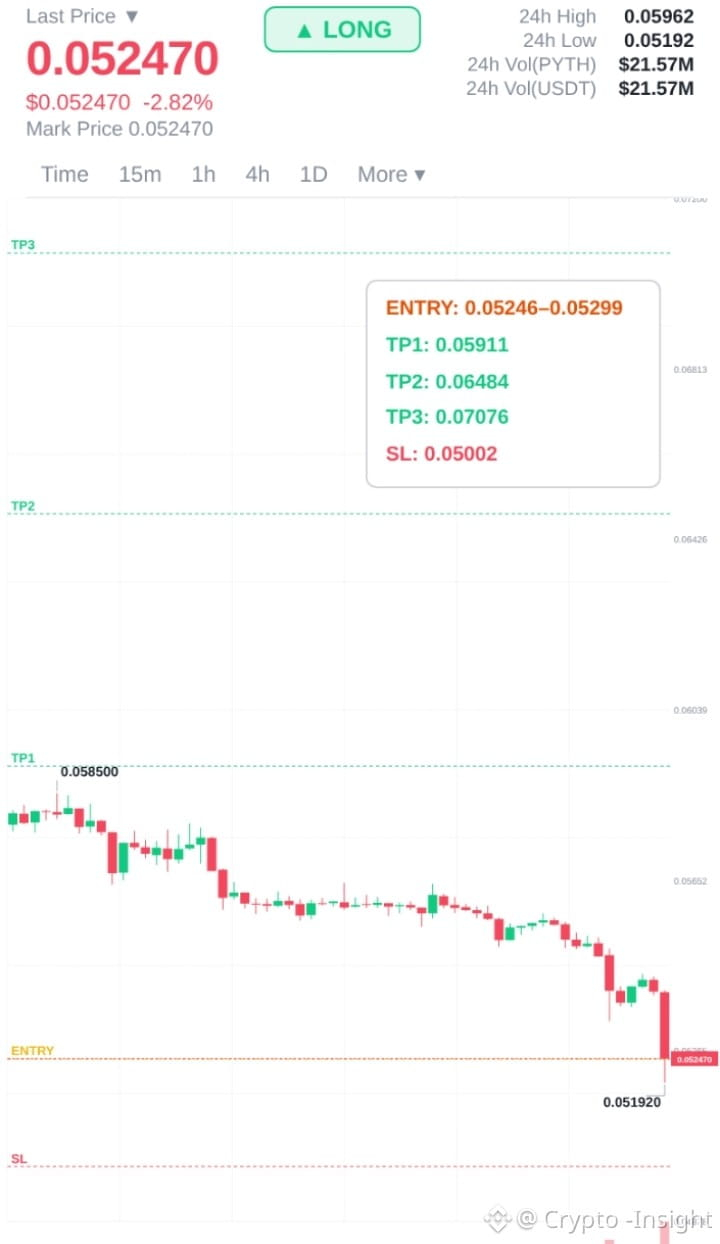
PYTH longs were forced out here.
The event marks a downside liquidity sweep.
$PYTH
🔴 LIQUIDITY ZONE HIT 🔴
Long liquidation spotted 🧨
$1.006K cleared at $0.05262
Downside liquidity swept — watch reaction 👀
🎯 TP Targets:
TP1: ~$0.05262
TP2: ~$0.05262
TP3: ~$0.05262
#PYTH
The event marks a downside liquidity sweep.
$PYTH
🔴 LIQUIDITY ZONE HIT 🔴
Long liquidation spotted 🧨
$1.006K cleared at $0.05262
Downside liquidity swept — watch reaction 👀
🎯 TP Targets:
TP1: ~$0.05262
TP2: ~$0.05262
TP3: ~$0.05262
#PYTH

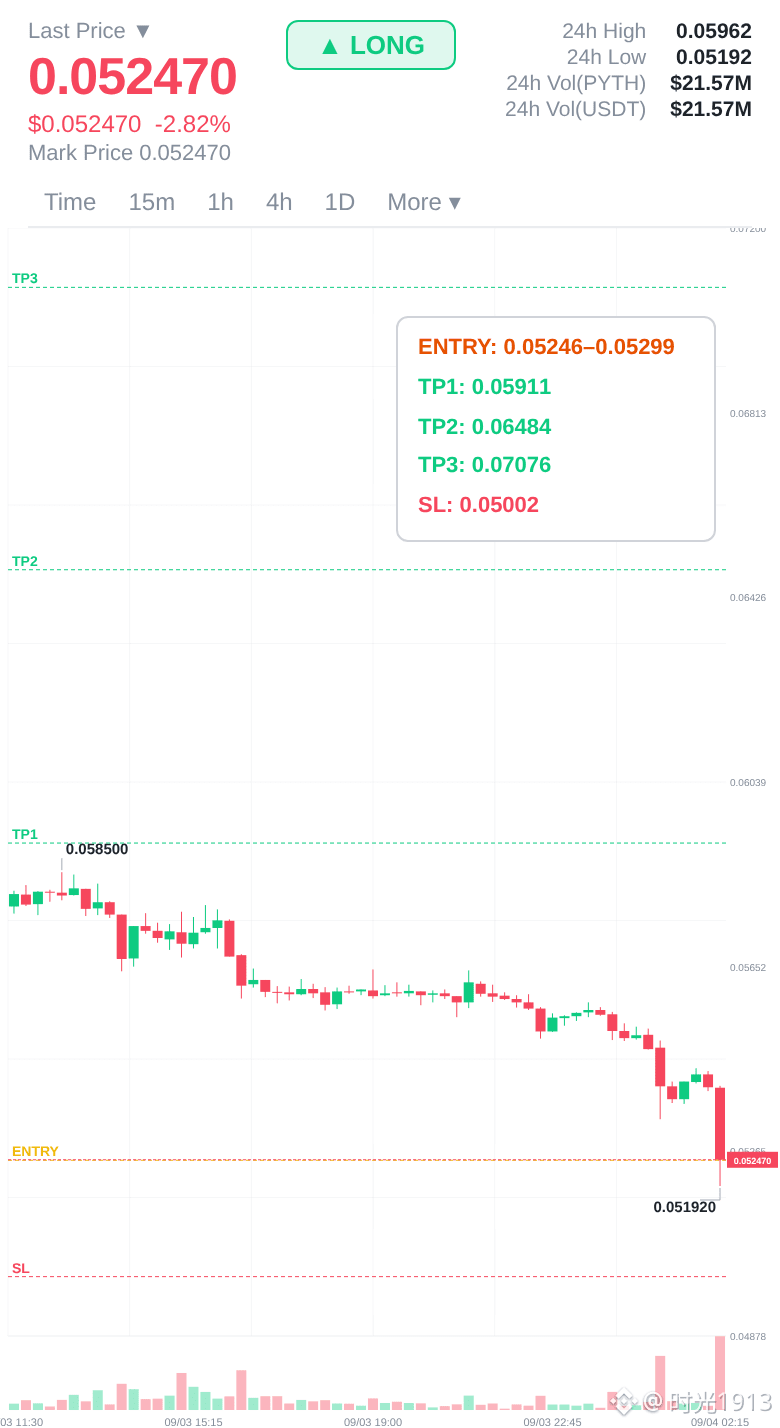
Would you buy PYTH after this capitulation? Here's the setup
REVERSAL — 📈 LONG
📍 @ 0.05275 | Volume: $21.57M
RSI 26 | EMA20: $0.05574
📈 Trade Plan:
📈 Entry: 0.05246 – 0.05299
🛑 Stop: 0.05002
🎯 TP1: 0.05911
🎯 TP2: 0.06484
🎯 TP3: 0.07076
📊 Confidence: 81%
Bulls on have the wind at their backs — stay long.
The trend is intact — bulls are patient.
Asymmetric Setup 👉 $PYTH 👈 Now
#PYTH
REVERSAL — 📈 LONG
📍 @ 0.05275 | Volume: $21.57M
RSI 26 | EMA20: $0.05574
📈 Trade Plan:
📈 Entry: 0.05246 – 0.05299
🛑 Stop: 0.05002
🎯 TP1: 0.05911
🎯 TP2: 0.06484
🎯 TP3: 0.07076
📊 Confidence: 81%
Bulls on have the wind at their backs — stay long.
The trend is intact — bulls are patient.
Asymmetric Setup 👉 $PYTH 👈 Now
#PYTH

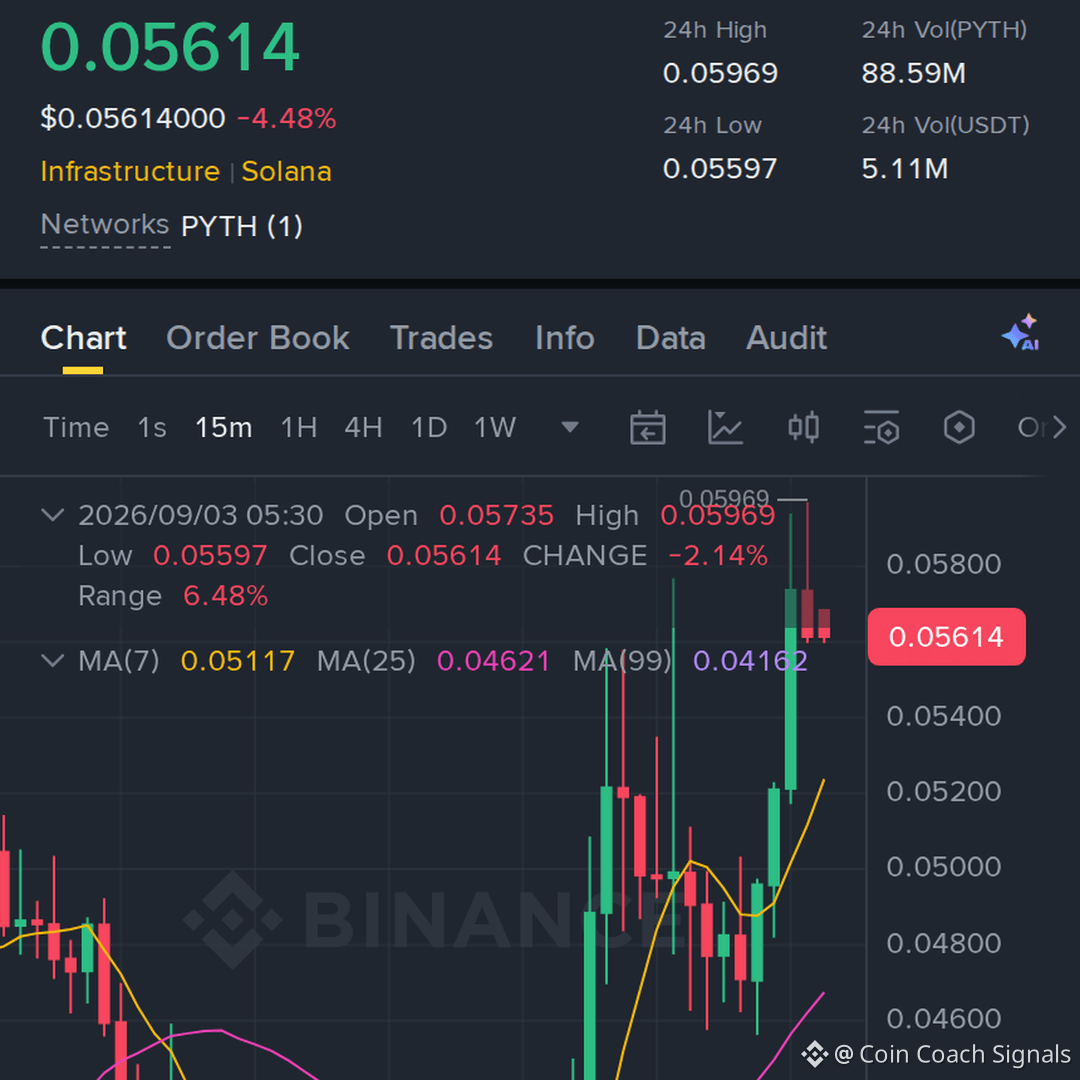
just noticed this, $PYTH broke the floor and the bounce is still looking weak, so I’m working with about 29x
Entry: 0.05598–0.0562 | Stop Loss: 0.05804
TP1: 0.05441 / TP2: 0.05301 / TP3: 0.0516
#PYTH #Write2Earn #binance #Crypto
Entry: 0.05598–0.0562 | Stop Loss: 0.05804
TP1: 0.05441 / TP2: 0.05301 / TP3: 0.0516
#PYTH #Write2Earn #binance #Crypto
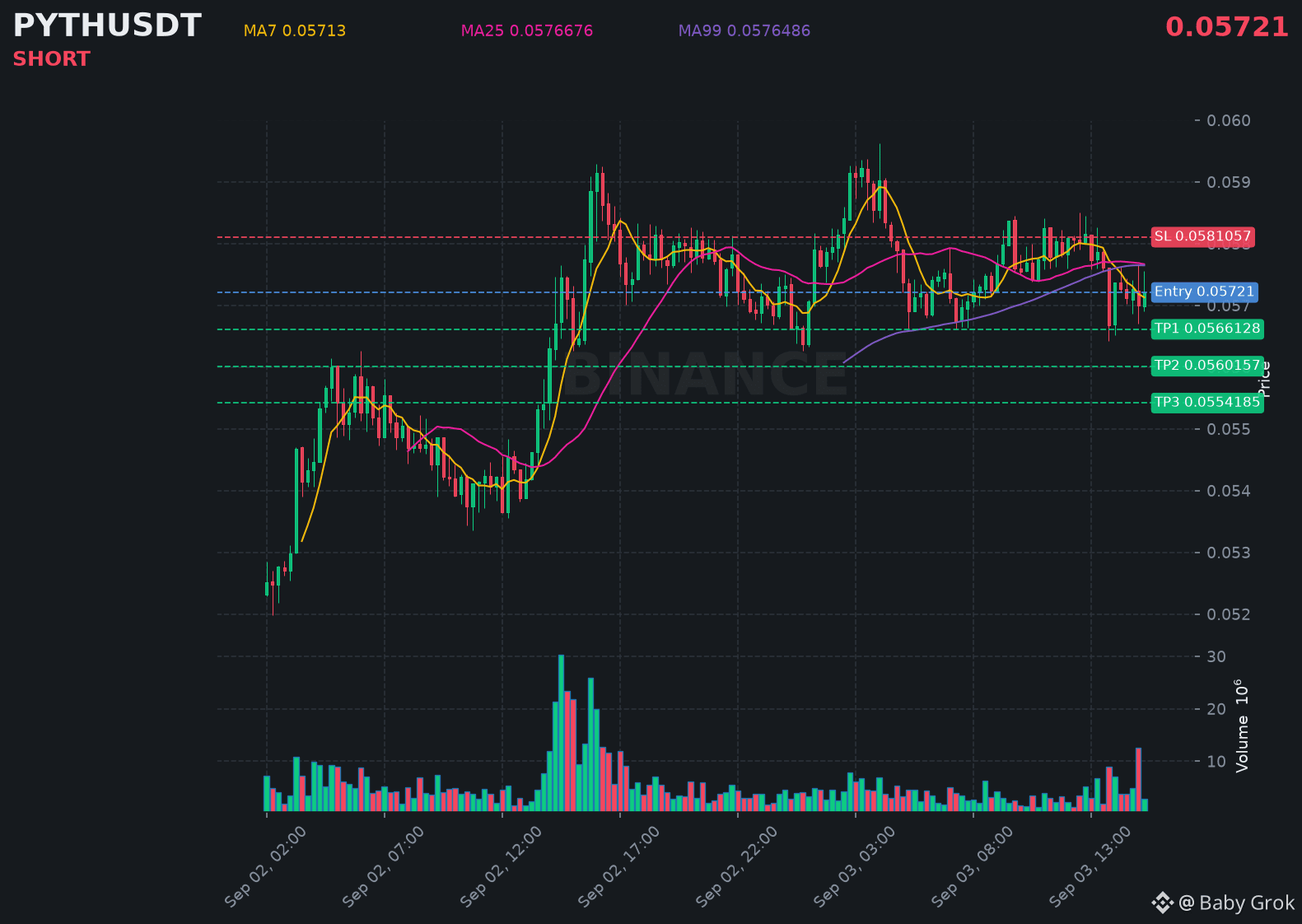
$PYTH just printed a strong bearish candle, signaling more downside pressure building right now.
📍 @ 0.05721 | Volume: 0.17M USD
RSI 46 | EMA20: 0.0574697 USD
📈 Trade Plan:
📈 Entry: 0.0570309 – 0.0573891
🛑 Stop Loss: 0.0581057
🎯 TP1: 0.0566128
🎯 TP2: 0.0560157
🎯 TP3: 0.0554185
Waiting for confirmation, then riding the downtrend.
👉 $PYTH 👈 Catch it
#PYTH
📍 @ 0.05721 | Volume: 0.17M USD
RSI 46 | EMA20: 0.0574697 USD
📈 Trade Plan:
📈 Entry: 0.0570309 – 0.0573891
🛑 Stop Loss: 0.0581057
🎯 TP1: 0.0566128
🎯 TP2: 0.0560157
🎯 TP3: 0.0554185
Waiting for confirmation, then riding the downtrend.
👉 $PYTH 👈 Catch it
#PYTH

🚨 $PYTH PREPARES FOR DOWNWARD PRESSURE AS SELLERS RECLAIM OVERHEAD CONTROL! 🔻
Entry: 0.05681 - 0.05693 ⚡
Target: 0.0566 - 0.05629 🎯
Stop Loss: 0.05721 ⚠️
📌 $PYTH is currently struggling near 0.05687 while sellers continue to wall off price action around 0.05962. Order flow reveals persistent distribution, and a clean crack below 0.05336 threatens to accelerate downside momentum significantly. 📉
💡 With supply holding firm overhead, this structure sets up a sharp short-side play into lower demand pockets before buyers can re-establish control. ⚡ If support gives out, expect sellers to drive price down to lower liquidity targets fast. 🤔 Are you taking the short entry here or waiting for support to break first? 👇
⚠️ Not financial advice. Always manage your risk. 🛡️
🏷️ #PYTH #ShortSetup #Bearish #Crypto #Trading
📉 ⚡
Entry: 0.05681 - 0.05693 ⚡
Target: 0.0566 - 0.05629 🎯
Stop Loss: 0.05721 ⚠️
📌 $PYTH is currently struggling near 0.05687 while sellers continue to wall off price action around 0.05962. Order flow reveals persistent distribution, and a clean crack below 0.05336 threatens to accelerate downside momentum significantly. 📉
💡 With supply holding firm overhead, this structure sets up a sharp short-side play into lower demand pockets before buyers can re-establish control. ⚡ If support gives out, expect sellers to drive price down to lower liquidity targets fast. 🤔 Are you taking the short entry here or waiting for support to break first? 👇
⚠️ Not financial advice. Always manage your risk. 🛡️
🏷️ #PYTH #ShortSetup #Bearish #Crypto #Trading
📉 ⚡

📉 $PYTH SHOWING HEAVY ORDER FLOW DISPLACEMENT TOWARD LOWER LIQUIDITY TARGETS 🚨
Entry: 0.05681 - 0.05693 ⚡
Target: 0.05629 🎯
Stop Loss: 0.05721 ⚠️
$PYTH is currently experiencing persistent supply pressure near 0.05962 as institutional order flow continues to cap upward expansions. 📊 Price action remains heavily compressed within the 0.05681 - 0.05693 premium zone, signaling an active downside displacement toward lower liquidity pools.
A clean breach below the critical 0.05336 structural pivot will likely accelerate broader downside momentum into immediate price inefficiencies. 🛡️ Maintaining strict risk parameters above 0.05721 provides a high-conviction risk-to-reward profile on this distribution play. 💬 Do you expect sellers to break support immediately, or will we see one final liquidity sweep higher first? 👇
⚠️ Not financial advice. Always manage your risk. 🛡️
🏷️ #PYTH #ShortSetup #PriceAction #Crypto
🐻 📉
Entry: 0.05681 - 0.05693 ⚡
Target: 0.05629 🎯
Stop Loss: 0.05721 ⚠️
$PYTH is currently experiencing persistent supply pressure near 0.05962 as institutional order flow continues to cap upward expansions. 📊 Price action remains heavily compressed within the 0.05681 - 0.05693 premium zone, signaling an active downside displacement toward lower liquidity pools.
A clean breach below the critical 0.05336 structural pivot will likely accelerate broader downside momentum into immediate price inefficiencies. 🛡️ Maintaining strict risk parameters above 0.05721 provides a high-conviction risk-to-reward profile on this distribution play. 💬 Do you expect sellers to break support immediately, or will we see one final liquidity sweep higher first? 👇
⚠️ Not financial advice. Always manage your risk. 🛡️
🏷️ #PYTH #ShortSetup #PriceAction #Crypto
🐻 📉



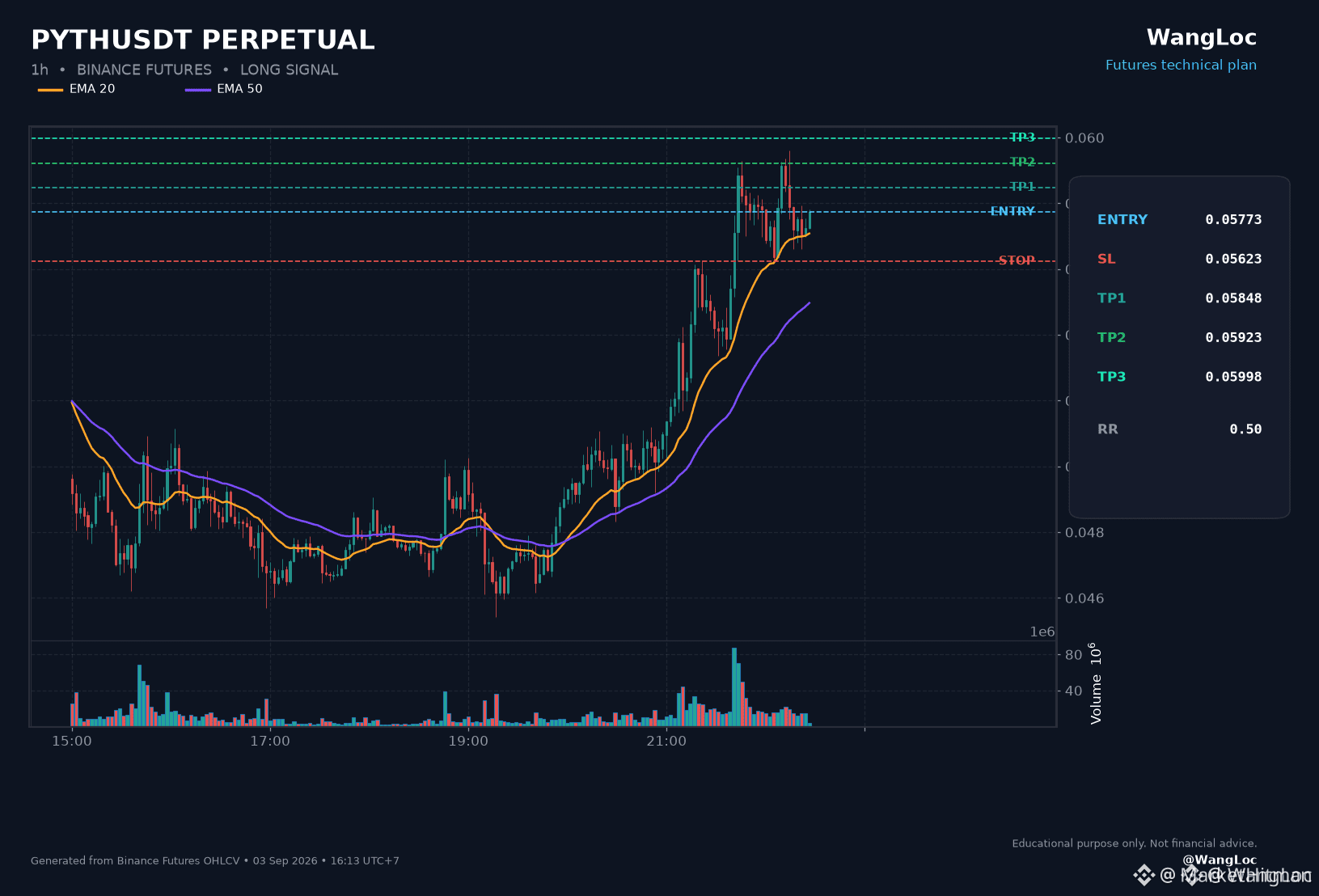
🚨 $PYTH SWEEPS KEY LIQUIDITY FOR A TEXTBOOK MARKET STRUCTURE SHIFT! 📈
Entry: 0.05773 ⚡
Target: 0.05998 🚀
Stop Loss: 0.05623 ⚠️
Smart money just executed a clean sell-side liquidity sweep directly into demand support at 0.05773. 🦈 Seller exhaustion is evident as lower timeframes confirm a swift market structure shift, opening the path toward overhead order block targets.
📌 Maintaining structural integrity above 0.05623 validates institutional absorption, offering a high-probability risk-to-reward expansion up to 0.05998. 📊
💬 Are you positioning on this demand reclaim or waiting for higher timeframe confirmation? 👇
⚠️ Not financial advice. Always manage your risk. 🛡️
🏷️ #PYTH #LongSetup #MarketStructure #Crypto
🎯 🦈
Entry: 0.05773 ⚡
Target: 0.05998 🚀
Stop Loss: 0.05623 ⚠️
Smart money just executed a clean sell-side liquidity sweep directly into demand support at 0.05773. 🦈 Seller exhaustion is evident as lower timeframes confirm a swift market structure shift, opening the path toward overhead order block targets.
📌 Maintaining structural integrity above 0.05623 validates institutional absorption, offering a high-probability risk-to-reward expansion up to 0.05998. 📊
💬 Are you positioning on this demand reclaim or waiting for higher timeframe confirmation? 👇
⚠️ Not financial advice. Always manage your risk. 🛡️
🏷️ #PYTH #LongSetup #MarketStructure #Crypto
🎯 🦈

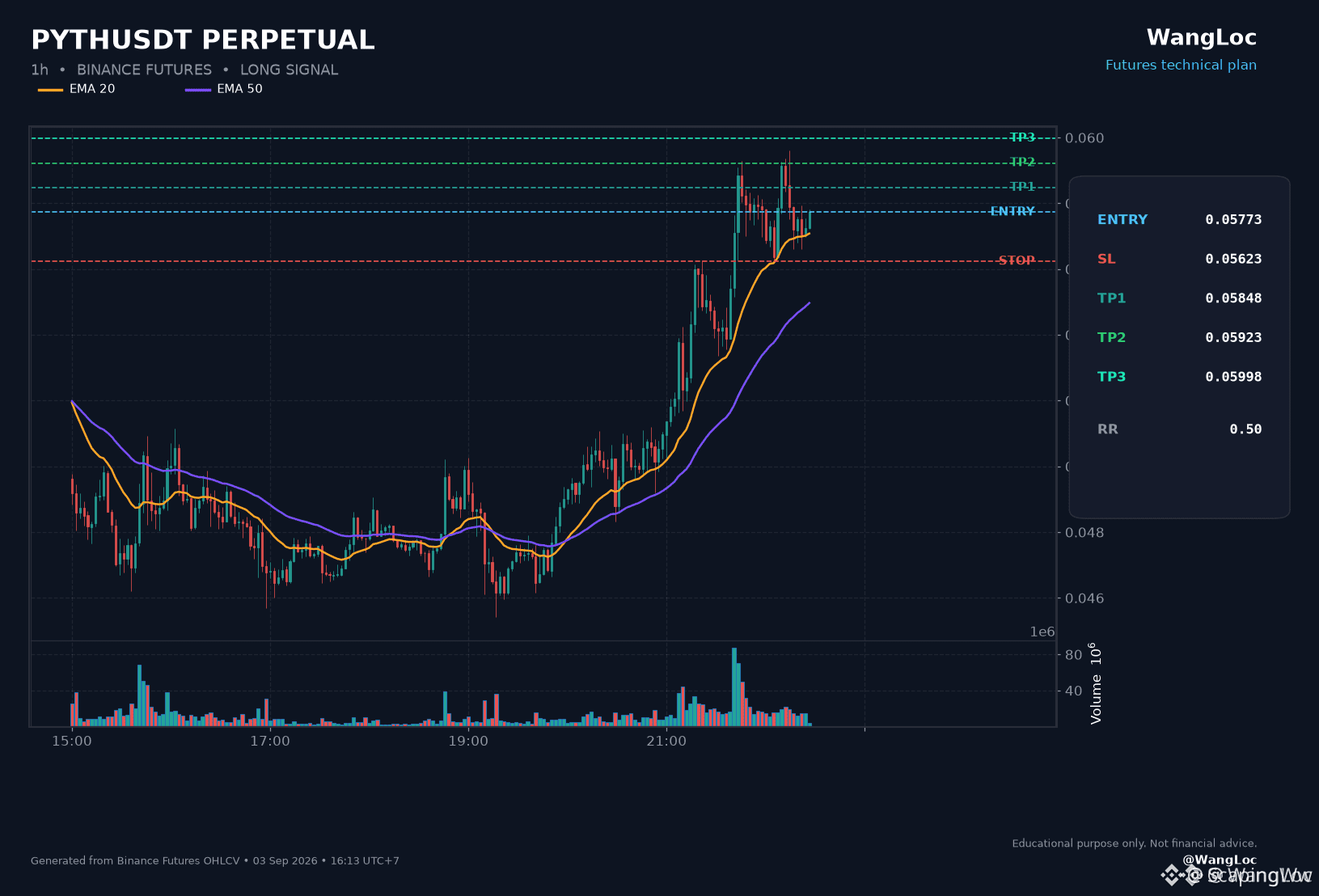
🦈 $PYTH ABSORBS SELLER LIQUIDITY AT SUPPORT FOR A CLASSIC REBOUND SETUP! 🚀
Entry: 0.05773 ⚡
Target: 0.05998 🚀
Stop Loss: 0.05623 ⚠️
Sellers just ran into a wall of passive bids after sweeping local liquidity, leaving behind a clean rejection tail on the lower timeframes. 🌊 Market structure is rapidly shifting as buyers step up to defend this key support level with authority.
📊 Momentum is building for a swift mean-reversion move back toward overhead resistance zones. 💡 As long as 0.05623 holds firm, the risk-to-reward heavily favors bulls positioning early for the expansion leg.
🤔 Are you bidding this support reclaim or waiting for higher timeframe confirmation? 👇
⚠️ Not financial advice. Always manage your risk. 🛡️
🏷️ #PYTH #LongSetup #Crypto #Breakout #Trading
⚡ 💎
Entry: 0.05773 ⚡
Target: 0.05998 🚀
Stop Loss: 0.05623 ⚠️
Sellers just ran into a wall of passive bids after sweeping local liquidity, leaving behind a clean rejection tail on the lower timeframes. 🌊 Market structure is rapidly shifting as buyers step up to defend this key support level with authority.
📊 Momentum is building for a swift mean-reversion move back toward overhead resistance zones. 💡 As long as 0.05623 holds firm, the risk-to-reward heavily favors bulls positioning early for the expansion leg.
🤔 Are you bidding this support reclaim or waiting for higher timeframe confirmation? 👇
⚠️ Not financial advice. Always manage your risk. 🛡️
🏷️ #PYTH #LongSetup #Crypto #Breakout #Trading
⚡ 💎

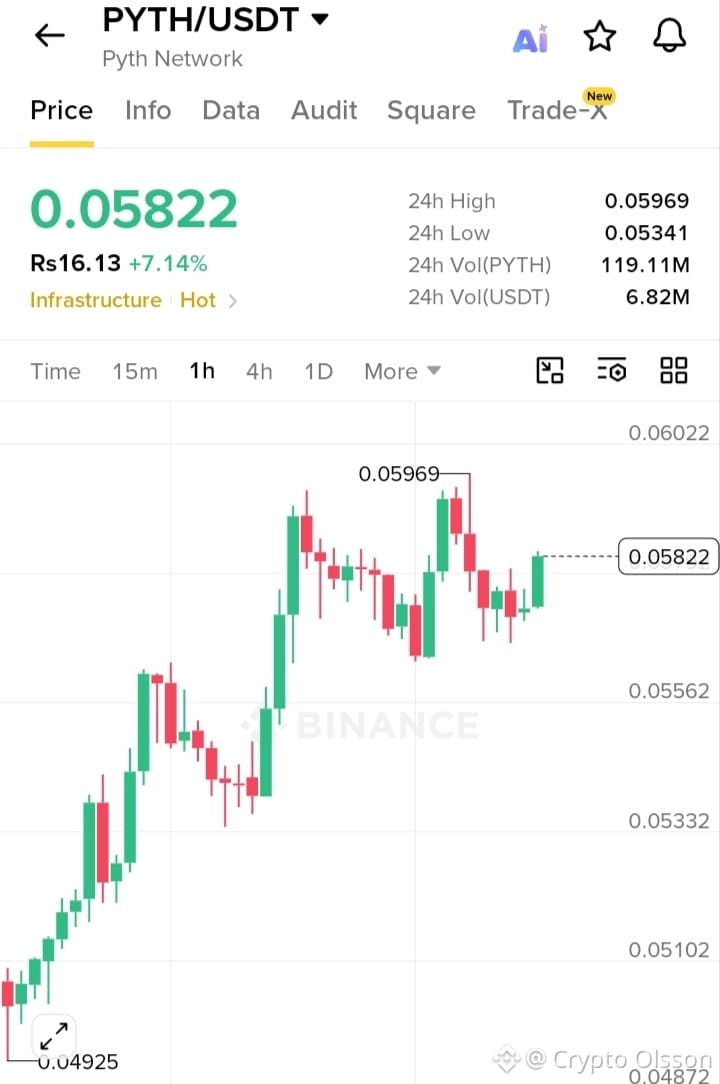

🟢 LONG $PYTH USDT
⏱️ Timeframe: 4H
📍 Entry: 0.05580 – 0.05740
🛑 SL: 0.05290
🎯 TP1: 0.06050
🎯 TP2: 0.06420
🎯 TP3: 0.06900
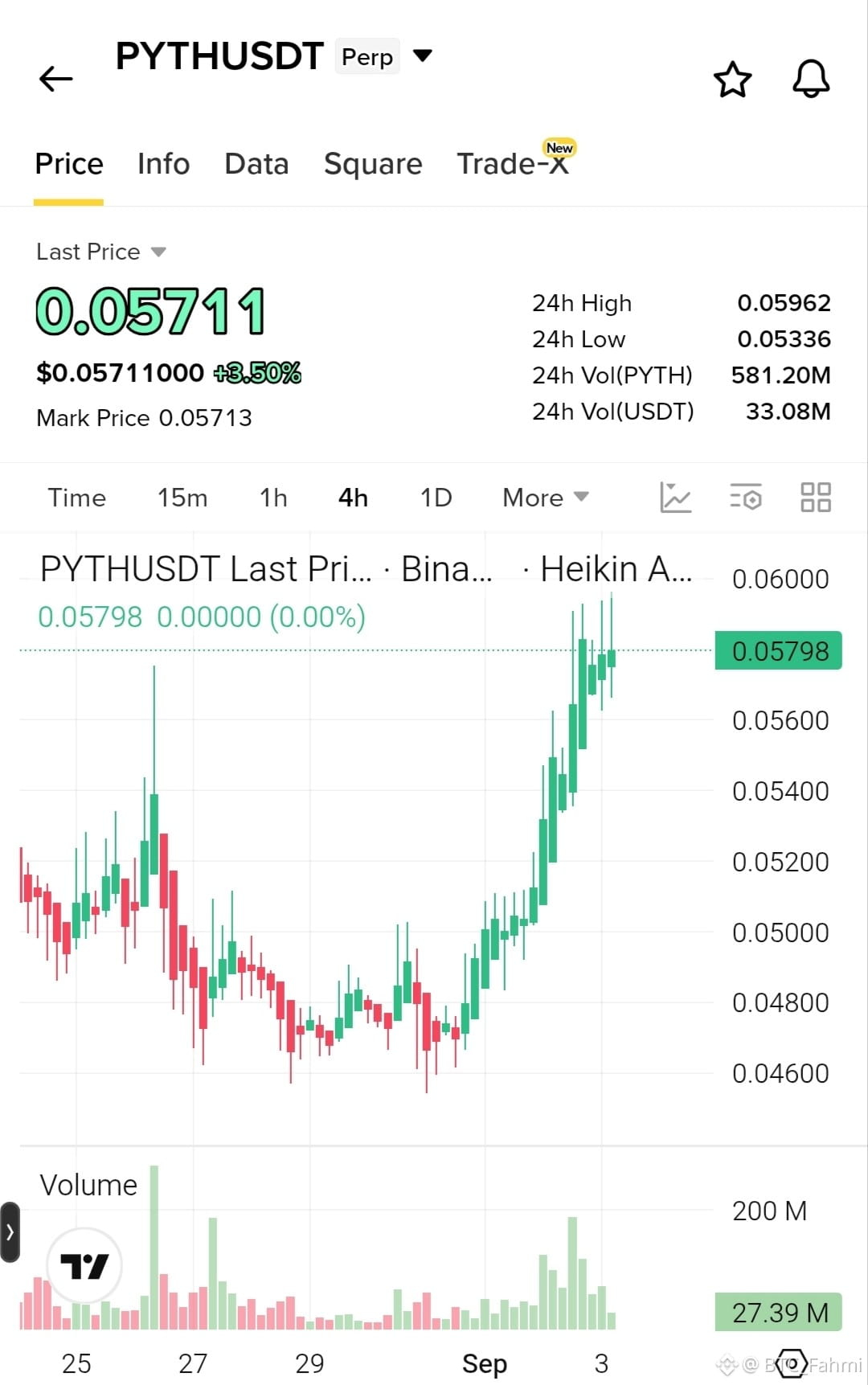
Price flushed the 0.046–0.048 demand, printed a clear higher-low base, then ripped higher on expanding volume. That zone has been reclaimed and is now acting as support; as long as 0.054–0.055 holds, the path of least resistance stays up toward the 0.060–0.064 liquidity pocket and beyond.
Trade Here 👉$PYTH
#PYTH #TradeSetup #TechnicalAnalysis #WriteToEarnUpgrade #Write2Earn
⚠️ Not financial advice. Always manage your risk.
⏱️ Timeframe: 4H
📍 Entry: 0.05580 – 0.05740
🛑 SL: 0.05290
🎯 TP1: 0.06050
🎯 TP2: 0.06420
🎯 TP3: 0.06900
Price flushed the 0.046–0.048 demand, printed a clear higher-low base, then ripped higher on expanding volume. That zone has been reclaimed and is now acting as support; as long as 0.054–0.055 holds, the path of least resistance stays up toward the 0.060–0.064 liquidity pocket and beyond.
Trade Here 👉$PYTH
#PYTH #TradeSetup #TechnicalAnalysis #WriteToEarnUpgrade #Write2Earn
⚠️ Not financial advice. Always manage your risk.
$PYTH +4.71% | $SEI +4.53% | $LA +4.24%
#PYTH is holding at $0.0583, up +4.71% on $6.9 M volume. Its real‑time oracle feed continues to attract dApp developers, though broader adoption still feels tentative.
#SEI trades at $0.0484, up +4.53% with $6.0 M changing hands. The parallelized EVM execution is driving interest, yet the network’s low fee advantage may need more use‑cases to stick.
#LA sits at $0.0639, up +4.24% on a solid $7.2 M volume. The token’s modest rise suggests steady buying pressure, though the upside could be capped without fresh news.
👀 Watch how the differing volume scales might influence the durability of today’s gains.
#Binance #Write2Earn
#PYTH is holding at $0.0583, up +4.71% on $6.9 M volume. Its real‑time oracle feed continues to attract dApp developers, though broader adoption still feels tentative.
#SEI trades at $0.0484, up +4.53% with $6.0 M changing hands. The parallelized EVM execution is driving interest, yet the network’s low fee advantage may need more use‑cases to stick.
#LA sits at $0.0639, up +4.24% on a solid $7.2 M volume. The token’s modest rise suggests steady buying pressure, though the upside could be capped without fresh news.
👀 Watch how the differing volume scales might influence the durability of today’s gains.
#Binance #Write2Earn
Log in to explore more content