

#predictionmarkets
predictionmarkets
800,110 views
3,912 Discussing
Hot
Latest

Should People Be Able to Bet on Bank Failures? 🤔
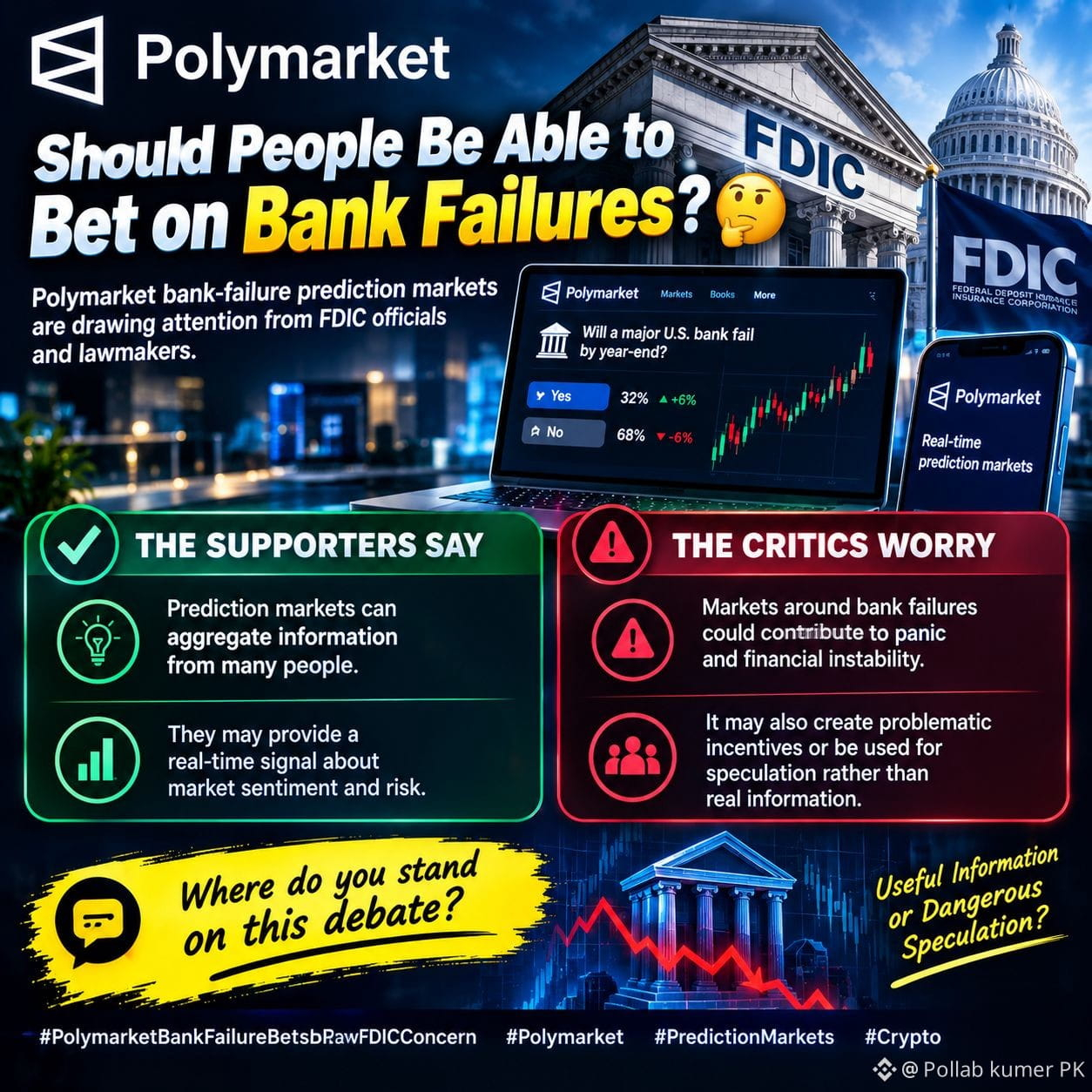
Polymarket bank-failure prediction markets are drawing attention from FDIC officials and lawmakers.
Supporters argue that prediction markets can aggregate information and provide a real-time signal.
Critics worry that markets around bank failures could contribute to panic or create problematic incentives.
Where do you stand on this debate?
#PolymarketBankFailureBetsDrawFDICConcern #Polymarket #PredictionMarkets #crypto
Should People Be Able to Bet on Bank Failures? 🤔
Polymarket bank-failure prediction markets are drawing attention from FDIC officials and lawmakers.
Supporters argue that prediction markets can aggregate information and provide a real-time signal.
Critics worry that markets around bank failures could contribute to panic or create problematic incentives.
Where do you stand on this debate?
#PolymarketBankFailureBetsDrawFDICConcern #Polymarket #PredictionMarkets #crypto
Polymarket bank-failure prediction markets are drawing attention from FDIC officials and lawmakers.
Supporters argue that prediction markets can aggregate information and provide a real-time signal.
Critics worry that markets around bank failures could contribute to panic or create problematic incentives.
Where do you stand on this debate?
#PolymarketBankFailureBetsDrawFDICConcern #Polymarket #PredictionMarkets #crypto
36


·
--
Bullish
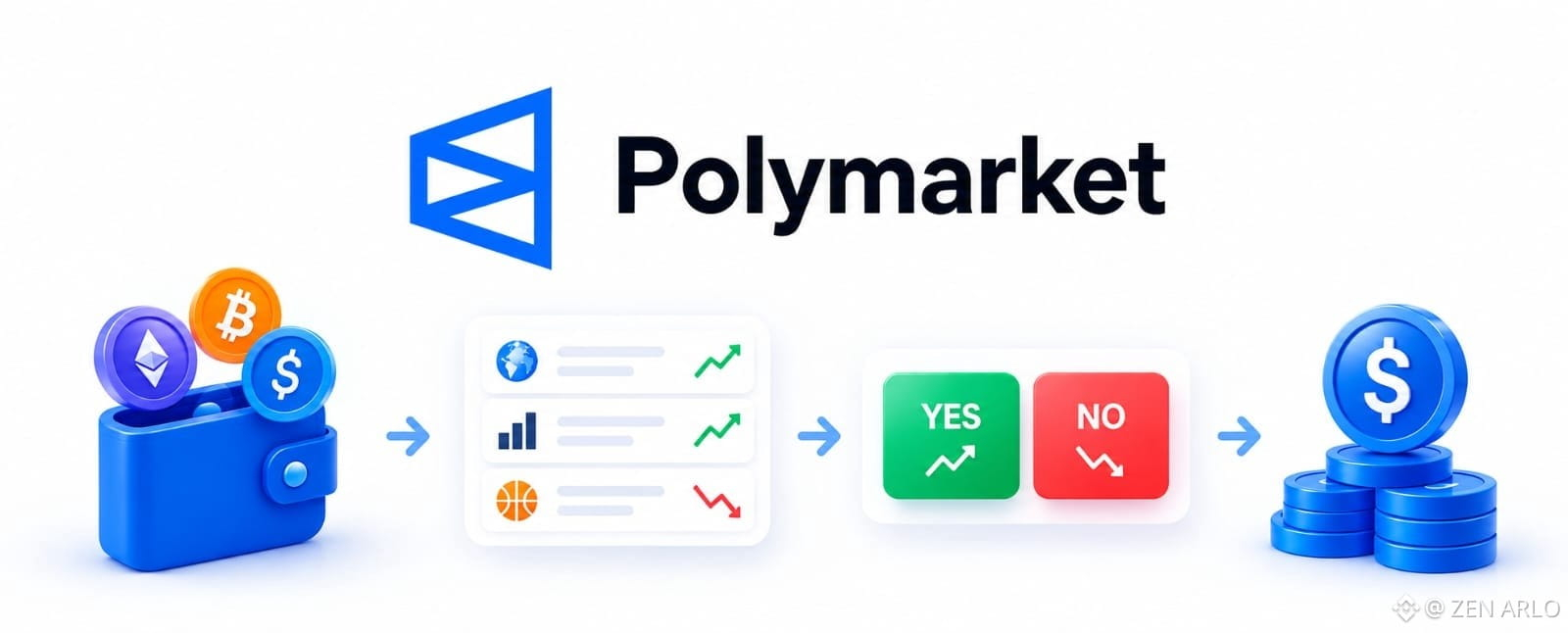
Polymarket turns predictions into tradable positions.
Crypto, sports, geopolitics, economics, AI or culture—pick a market where you understand the narrative and trade the outcome you believe is being mispriced.
The mechanics are simple.
If YES trades at $0.40, the market is implying roughly a 40% probability. Believe the real odds are higher? Buy YES. Disagree? Trade the opposite outcome.
As new information arrives, probabilities and prices move. Traders can adjust or sell positions before resolution instead of simply waiting for the final result.
That makes Polymarket different from simply holding tokens like $PENGU , $DOOD , $MASK or $ARB. The focus here is trading your view on real-world events rather than relying only on a token’s price direction.
Your niche knowledge becomes the edge: understand the event, read the probabilities, and trade where your prediction differs from the market.
Predict it. Price it. Trade it.
Only information not financial advice
#Polymarket #PredictionMarkets #CryptoTrading
Polymarket turns predictions into tradable positions.
Crypto, sports, geopolitics, economics, AI or culture—pick a market where you understand the narrative and trade the outcome you believe is being mispriced.
The mechanics are simple.
If YES trades at $0.40, the market is implying roughly a 40% probability. Believe the real odds are higher? Buy YES. Disagree? Trade the opposite outcome.
As new information arrives, probabilities and prices move. Traders can adjust or sell positions before resolution instead of simply waiting for the final result.
That makes Polymarket different from simply holding tokens like $PENGU , $DOOD , $MASK or $ARB. The focus here is trading your view on real-world events rather than relying only on a token’s price direction.
Your niche knowledge becomes the edge: understand the event, read the probabilities, and trade where your prediction differs from the market.
Predict it. Price it. Trade it.
Only information not financial advice
#Polymarket #PredictionMarkets #CryptoTrading
Crypto, sports, geopolitics, economics, AI or culture—pick a market where you understand the narrative and trade the outcome you believe is being mispriced.
The mechanics are simple.
If YES trades at $0.40, the market is implying roughly a 40% probability. Believe the real odds are higher? Buy YES. Disagree? Trade the opposite outcome.
As new information arrives, probabilities and prices move. Traders can adjust or sell positions before resolution instead of simply waiting for the final result.
That makes Polymarket different from simply holding tokens like $PENGU , $DOOD , $MASK or $ARB. The focus here is trading your view on real-world events rather than relying only on a token’s price direction.
Your niche knowledge becomes the edge: understand the event, read the probabilities, and trade where your prediction differs from the market.
Predict it. Price it. Trade it.
Only information not financial advice
#Polymarket #PredictionMarkets #CryptoTrading
Anaya Khan ㅤㅤㅤㅤㅤ:
Mispriced probabilities are where the alpha lives
39
19
6.1k

·
--
🚨 Polymarket’s bank-failure bets just caught the FDIC’s attention
Prediction markets on Polymarket letting users wager on the failure of major U.S. banks — including $WFC.US , $JPM , and $BAC.US — are drawing scrutiny from FDIC officials and lawmakers.
Current volumes are still tiny (recent year-end failure contracts saw only about $76,000 in trading). Polymarket says it bans U.S. users.
Still, regulators are worried that if these markets grow, the public odds could amplify panic and potentially fuel real-world bank runs.
Why it matters for crypto:
Prediction markets are becoming more influential. When they start pricing the health of systemically important banks, it raises bigger questions about information vs. incentive effects — and how platforms like Polymarket sit at the intersection of crypto, finance, and regulation.
What to watch:
• Any formal regulatory pushback or pressure on these contracts
• Whether volumes stay small or start climbing
• How other prediction platforms handle similar sensitive markets
Tiny markets can still shape narratives. The real question is whether transparent failure odds are useful signals… or a line regulators will try to shut down.
Do you think betting on bank failures should be allowed on prediction markets, or is this a boundary that shouldn’t be crossed?
#PolymarketBankFailureBetsDrawFDICConcern #Polymarket #FDIC #PredictionMarkets
{future}(JPMUSDT)
{future}(SPYUSDT)
🚨 Polymarket’s bank-failure bets just caught the FDIC’s attention
Prediction markets on Polymarket letting users wager on the failure of major U.S. banks — including $WFC.US , $JPM , and $BAC.US — are drawing scrutiny from FDIC officials and lawmakers.
Current volumes are still tiny (recent year-end failure contracts saw only about $76,000 in trading). Polymarket says it bans U.S. users.
Still, regulators are worried that if these markets grow, the public odds could amplify panic and potentially fuel real-world bank runs.
Why it matters for crypto: Prediction markets are becoming more influential. When they start pricing the health of systemically important banks, it raises bigger questions about information vs. incentive effects — and how platforms like Polymarket sit at the intersection of crypto, finance, and regulation.
What to watch: • Any formal regulatory pushback or pressure on these contracts
• Whether volumes stay small or start climbing
• How other prediction platforms handle similar sensitive markets
Tiny markets can still shape narratives. The real question is whether transparent failure odds are useful signals… or a line regulators will try to shut down.
Do you think betting on bank failures should be allowed on prediction markets, or is this a boundary that shouldn’t be crossed?
#PolymarketBankFailureBetsDrawFDICConcern #Polymarket #FDIC #PredictionMarkets
Prediction markets on Polymarket letting users wager on the failure of major U.S. banks — including $WFC.US , $JPM , and $BAC.US — are drawing scrutiny from FDIC officials and lawmakers.
Current volumes are still tiny (recent year-end failure contracts saw only about $76,000 in trading). Polymarket says it bans U.S. users.
Still, regulators are worried that if these markets grow, the public odds could amplify panic and potentially fuel real-world bank runs.
Why it matters for crypto: Prediction markets are becoming more influential. When they start pricing the health of systemically important banks, it raises bigger questions about information vs. incentive effects — and how platforms like Polymarket sit at the intersection of crypto, finance, and regulation.
What to watch: • Any formal regulatory pushback or pressure on these contracts
• Whether volumes stay small or start climbing
• How other prediction platforms handle similar sensitive markets
Tiny markets can still shape narratives. The real question is whether transparent failure odds are useful signals… or a line regulators will try to shut down.
Do you think betting on bank failures should be allowed on prediction markets, or is this a boundary that shouldn’t be crossed?
#PolymarketBankFailureBetsDrawFDICConcern #Polymarket #FDIC #PredictionMarkets
59

Article
Bank Failure Bets Are Raising🚨 Prediction markets are now taking bets on major U.S. bank failures — and regulators are paying attention. 👀🏦
Polymarket has listed contracts related to large banks, while the FDIC, former regulators and lawmakers have reportedly raised concerns.
The debate isn't really about one market.
It's about a bigger question:
🧠 Can prediction markets improve transparency by revealing public expectations?
⚠️ Or can highly visible odds influence sentiment and create feedback loops during periods of financial stress?
At the moment, trading volume remains relatively small, but the discussion around regulation, market impact and financial stability is growing.
This story also highlights two areas crypto investors are watching:
🔗 $LINK — Oracle infrastructure that helps bring reliable data to prediction markets and tokenized assets.
🏛️ $ONDO — A project focused on tokenized real-world assets, including products linked to U.S. Treasuries.
The key takeaway:
Prediction markets can provide information, but markets involving sensitive financial events may also attract closer regulatory attention.
💬 Should prediction markets be allowed to price every event, including bank risks, or should there be limits?
$LINK $ONDO
#Polymarket
{spot}(ONDOUSDT)
{spot}(LINKUSDT)
#PredictionMarkets #RWA #CryptoNews
Bank Failure Bets Are Raising
🚨 Prediction markets are now taking bets on major U.S. bank failures — and regulators are paying attention. 👀🏦
Polymarket has listed contracts related to large banks, while the FDIC, former regulators and lawmakers have reportedly raised concerns.
The debate isn't really about one market.
It's about a bigger question:
🧠 Can prediction markets improve transparency by revealing public expectations?
⚠️ Or can highly visible odds influence sentiment and create feedback loops during periods of financial stress?
At the moment, trading volume remains relatively small, but the discussion around regulation, market impact and financial stability is growing.
This story also highlights two areas crypto investors are watching:
🔗 $LINK — Oracle infrastructure that helps bring reliable data to prediction markets and tokenized assets.
🏛️ $ONDO — A project focused on tokenized real-world assets, including products linked to U.S. Treasuries.
The key takeaway:
Prediction markets can provide information, but markets involving sensitive financial events may also attract closer regulatory attention.
💬 Should prediction markets be allowed to price every event, including bank risks, or should there be limits?
$LINK $ONDO
#Polymarket
#PredictionMarkets #RWA #CryptoNews
Polymarket has listed contracts related to large banks, while the FDIC, former regulators and lawmakers have reportedly raised concerns.
The debate isn't really about one market.
It's about a bigger question:
🧠 Can prediction markets improve transparency by revealing public expectations?
⚠️ Or can highly visible odds influence sentiment and create feedback loops during periods of financial stress?
At the moment, trading volume remains relatively small, but the discussion around regulation, market impact and financial stability is growing.
This story also highlights two areas crypto investors are watching:
🔗 $LINK — Oracle infrastructure that helps bring reliable data to prediction markets and tokenized assets.
🏛️ $ONDO — A project focused on tokenized real-world assets, including products linked to U.S. Treasuries.
The key takeaway:
Prediction markets can provide information, but markets involving sensitive financial events may also attract closer regulatory attention.
💬 Should prediction markets be allowed to price every event, including bank risks, or should there be limits?
$LINK $ONDO
#Polymarket
#PredictionMarkets #RWA #CryptoNews
103

Kalshi's recent legal setback in Ohio and Tennessee highlights the growing friction between federal derivatives oversight and state-level gambling laws. By failing to convince the court that its sports contracts qualify as swaps, prediction markets face a tougher regulatory road ahead. This split among circuits creates significant compliance hurdles for event-based trading platforms trying to scale nationally. #PredictionMarkets #Regulation #CryptoNews
Kalshi's recent legal setback in Ohio and Tennessee highlights the growing friction between federal derivatives oversight and state-level gambling laws. By failing to convince the court that its sports contracts qualify as swaps, prediction markets face a tougher regulatory road ahead. This split among circuits creates significant compliance hurdles for event-based trading platforms trying to scale nationally. #PredictionMarkets #Regulation #CryptoNews
1

·
--
Polls tell you what people say. Markets tell you what people will pay to be right.
That's why prediction markets are quietly becoming one of crypto's most useful products — not as bets, but as real-time probability infrastructure.
When CPI prints, Fed decisions, and geopolitical events settle in minutes instead of weeks, you get something the traditional news cycle can't offer: continuously updated odds, priced by capital rather than commentary.
Three properties make this possible on-chain:
Instant settlement — resolution is code, not a broker's back office.
Open access — anyone with a wallet can price a probability. No institutional minimums.
Composability — odds become assets. Hedging a portfolio against a rate decision becomes a trade, not a negotiation.
The deeper shift: prediction markets turn "sentiment" into a measurable number. Headlines report narratives. Markets report probability distributions.
They're not perfect — thin liquidity distorts odds, whales move small books, and the resolution rules are often the real product. But as depth grows, they shift from betting shop to forecast engine.
The tell to watch isn't volume. It's where liquidity pools. That's where probability actually gets decided.
$BTC $ETH $SOL
#PredictionMarkets #DeFi #OnChain #MarketStructure #Crypto
Polls tell you what people say. Markets tell you what people will pay to be right.
That's why prediction markets are quietly becoming one of crypto's most useful products — not as bets, but as real-time probability infrastructure.
When CPI prints, Fed decisions, and geopolitical events settle in minutes instead of weeks, you get something the traditional news cycle can't offer: continuously updated odds, priced by capital rather than commentary.
Three properties make this possible on-chain:
Instant settlement — resolution is code, not a broker's back office.
Open access — anyone with a wallet can price a probability. No institutional minimums.
Composability — odds become assets. Hedging a portfolio against a rate decision becomes a trade, not a negotiation.
The deeper shift: prediction markets turn "sentiment" into a measurable number. Headlines report narratives. Markets report probability distributions.
They're not perfect — thin liquidity distorts odds, whales move small books, and the resolution rules are often the real product. But as depth grows, they shift from betting shop to forecast engine.
The tell to watch isn't volume. It's where liquidity pools. That's where probability actually gets decided.
$BTC $ETH $SOL
#PredictionMarkets #DeFi #OnChain #MarketStructure #Crypto
That's why prediction markets are quietly becoming one of crypto's most useful products — not as bets, but as real-time probability infrastructure.
When CPI prints, Fed decisions, and geopolitical events settle in minutes instead of weeks, you get something the traditional news cycle can't offer: continuously updated odds, priced by capital rather than commentary.
Three properties make this possible on-chain:
Instant settlement — resolution is code, not a broker's back office.
Open access — anyone with a wallet can price a probability. No institutional minimums.
Composability — odds become assets. Hedging a portfolio against a rate decision becomes a trade, not a negotiation.
The deeper shift: prediction markets turn "sentiment" into a measurable number. Headlines report narratives. Markets report probability distributions.
They're not perfect — thin liquidity distorts odds, whales move small books, and the resolution rules are often the real product. But as depth grows, they shift from betting shop to forecast engine.
The tell to watch isn't volume. It's where liquidity pools. That's where probability actually gets decided.
$BTC $ETH $SOL
#PredictionMarkets #DeFi #OnChain #MarketStructure #Crypto
2
55
Kalshi just hit a massive roadblock in the 6th Circuit, keeping state-level sports betting rules firmly in play. Prediction markets are booming, but regulatory friction is scaling right alongside them. If this heads to the Supreme Court, it could redefine how decentralized and event-based contracts operate nationwide. The legal battle lines are officially drawn for the future of forecasting platforms. #PredictionMarkets #Regulation #CryptoLaw
Kalshi just hit a massive roadblock in the 6th Circuit, keeping state-level sports betting rules firmly in play. Prediction markets are booming, but regulatory friction is scaling right alongside them. If this heads to the Supreme Court, it could redefine how decentralized and event-based contracts operate nationwide. The legal battle lines are officially drawn for the future of forecasting platforms. #PredictionMarkets #Regulation #CryptoLaw
Kalshi just took a massive regulatory hit in the Sixth Circuit. The court ruled that Ohio and Tennessee can enforce local gambling laws on its sports contracts, effectively shattering the federal preemption shield Kalshi relied on. By pointing to geofencing as a ready-made solution, the court has set a dangerous precedent. Prediction markets now face a fragmented future where state-level compliance trumps federal oversight, throwing serious friction into their growth trajectory. #Regulation #PredictionMarkets #Legal
Kalshi just took a massive regulatory hit in the Sixth Circuit. The court ruled that Ohio and Tennessee can enforce local gambling laws on its sports contracts, effectively shattering the federal preemption shield Kalshi relied on. By pointing to geofencing as a ready-made solution, the court has set a dangerous precedent. Prediction markets now face a fragmented future where state-level compliance trumps federal oversight, throwing serious friction into their growth trajectory. #Regulation #PredictionMarkets #Legal
25

·
--
BANK-FAILURE BETS UNDER THE MICROSCOPE🏛️ BANK-FAILURE BETS UNDER THE MICROSCOPE 🚨
Could prediction markets create a new kind of financial-stability risk?
U.S. regulators are reportedly examining prediction-market contracts that allow traders to speculate on whether major financial institutions could fail. The debate puts a spotlight on a difficult question:
Can betting on a bank’s failure actually contribute to the very panic being predicted? ⚠️
🔍 WHAT’S HAPPENING?
Prediction markets have expanded far beyond politics and major events, with contracts now covering a wide range of economic and financial outcomes.
Some markets have featured wagers connected to the potential failure of major banks, including JPMorgan Chase, Bank of America and Wells Fargo.
The trading volume on these particular contracts has reportedly been relatively small, but regulators are examining whether such markets could create broader risks if negative expectations spread rapidly.
🧠 THE SELF-FULFILLING PROPHECY QUESTION
Banking depends heavily on confidence.
If a large number of people suddenly believe a bank is in trouble, they could withdraw deposits or reduce their exposure. In an extreme scenario, that loss of confidence could create liquidity pressure.
That raises a fascinating regulatory question:
Could a prediction market merely measure fear — or could it amplify it?
🔐 WHAT ABOUT INSIDER INFORMATION?
Another major concern involves confidential financial information.
Regulators and financial institutions have strict rules surrounding the use or disclosure of nonpublic information. If someone with access to confidential information used that knowledge to trade a prediction contract, it could raise serious legal and ethical issues.
📊 POLYMARKET’S ARGUMENT
Supporters of prediction markets argue that these platforms can aggregate information and expectations from thousands of participants.
From this perspective, market prices may function as a real-time indicator of how traders perceive risk rather than being the source of that risk.
⚖️ THE BIGGER REGULATORY QUESTION
This debate goes beyond Polymarket.
As prediction markets become more sophisticated, regulators may increasingly have to consider their impact on:
🏦 Financial stability
📈 Market integrity
🔐 Insider-information rules
🧠 Investor psychology
🌐 Crypto and decentralized markets
Prediction markets could become an increasingly important source of information — but their growing influence also raises questions about how financial authorities should oversee them.
🔥 THE BIG QUESTION:
Are prediction markets useful tools for discovering hidden financial risks, or could certain markets amplify fear during periods of uncertainty?
👇 What’s your view?
#crypto #Polymarket #DeFi #PredictionMarkets
BANK-FAILURE BETS UNDER THE MICROSCOPE
🏛️ BANK-FAILURE BETS UNDER THE MICROSCOPE 🚨
Could prediction markets create a new kind of financial-stability risk?
U.S. regulators are reportedly examining prediction-market contracts that allow traders to speculate on whether major financial institutions could fail. The debate puts a spotlight on a difficult question:
Can betting on a bank’s failure actually contribute to the very panic being predicted? ⚠️
🔍 WHAT’S HAPPENING?
Prediction markets have expanded far beyond politics and major events, with contracts now covering a wide range of economic and financial outcomes.
Some markets have featured wagers connected to the potential failure of major banks, including JPMorgan Chase, Bank of America and Wells Fargo.
The trading volume on these particular contracts has reportedly been relatively small, but regulators are examining whether such markets could create broader risks if negative expectations spread rapidly.
🧠 THE SELF-FULFILLING PROPHECY QUESTION
Banking depends heavily on confidence.
If a large number of people suddenly believe a bank is in trouble, they could withdraw deposits or reduce their exposure. In an extreme scenario, that loss of confidence could create liquidity pressure.
That raises a fascinating regulatory question:
Could a prediction market merely measure fear — or could it amplify it?
🔐 WHAT ABOUT INSIDER INFORMATION?
Another major concern involves confidential financial information.
Regulators and financial institutions have strict rules surrounding the use or disclosure of nonpublic information. If someone with access to confidential information used that knowledge to trade a prediction contract, it could raise serious legal and ethical issues.
📊 POLYMARKET’S ARGUMENT
Supporters of prediction markets argue that these platforms can aggregate information and expectations from thousands of participants.
From this perspective, market prices may function as a real-time indicator of how traders perceive risk rather than being the source of that risk.
⚖️ THE BIGGER REGULATORY QUESTION
This debate goes beyond Polymarket.
As prediction markets become more sophisticated, regulators may increasingly have to consider their impact on:
🏦 Financial stability
📈 Market integrity
🔐 Insider-information rules
🧠 Investor psychology
🌐 Crypto and decentralized markets
Prediction markets could become an increasingly important source of information — but their growing influence also raises questions about how financial authorities should oversee them.
🔥 THE BIG QUESTION:
Are prediction markets useful tools for discovering hidden financial risks, or could certain markets amplify fear during periods of uncertainty?
👇 What’s your view?
#crypto #Polymarket #DeFi #PredictionMarkets
Could prediction markets create a new kind of financial-stability risk?
U.S. regulators are reportedly examining prediction-market contracts that allow traders to speculate on whether major financial institutions could fail. The debate puts a spotlight on a difficult question:
Can betting on a bank’s failure actually contribute to the very panic being predicted? ⚠️
🔍 WHAT’S HAPPENING?
Prediction markets have expanded far beyond politics and major events, with contracts now covering a wide range of economic and financial outcomes.
Some markets have featured wagers connected to the potential failure of major banks, including JPMorgan Chase, Bank of America and Wells Fargo.
The trading volume on these particular contracts has reportedly been relatively small, but regulators are examining whether such markets could create broader risks if negative expectations spread rapidly.
🧠 THE SELF-FULFILLING PROPHECY QUESTION
Banking depends heavily on confidence.
If a large number of people suddenly believe a bank is in trouble, they could withdraw deposits or reduce their exposure. In an extreme scenario, that loss of confidence could create liquidity pressure.
That raises a fascinating regulatory question:
Could a prediction market merely measure fear — or could it amplify it?
🔐 WHAT ABOUT INSIDER INFORMATION?
Another major concern involves confidential financial information.
Regulators and financial institutions have strict rules surrounding the use or disclosure of nonpublic information. If someone with access to confidential information used that knowledge to trade a prediction contract, it could raise serious legal and ethical issues.
📊 POLYMARKET’S ARGUMENT
Supporters of prediction markets argue that these platforms can aggregate information and expectations from thousands of participants.
From this perspective, market prices may function as a real-time indicator of how traders perceive risk rather than being the source of that risk.
⚖️ THE BIGGER REGULATORY QUESTION
This debate goes beyond Polymarket.
As prediction markets become more sophisticated, regulators may increasingly have to consider their impact on:
🏦 Financial stability
📈 Market integrity
🔐 Insider-information rules
🧠 Investor psychology
🌐 Crypto and decentralized markets
Prediction markets could become an increasingly important source of information — but their growing influence also raises questions about how financial authorities should oversee them.
🔥 THE BIG QUESTION:
Are prediction markets useful tools for discovering hidden financial risks, or could certain markets amplify fear during periods of uncertainty?
👇 What’s your view?
#crypto #Polymarket #DeFi #PredictionMarkets
57

#PolymarketBankFailureBetsDrawFDICConcern
Polymarket’s bank-failure prediction contracts are drawing scrutiny from U.S. banking officials, with concerns that larger betting volumes could potentially fuel panic or even contribute to bank runs.
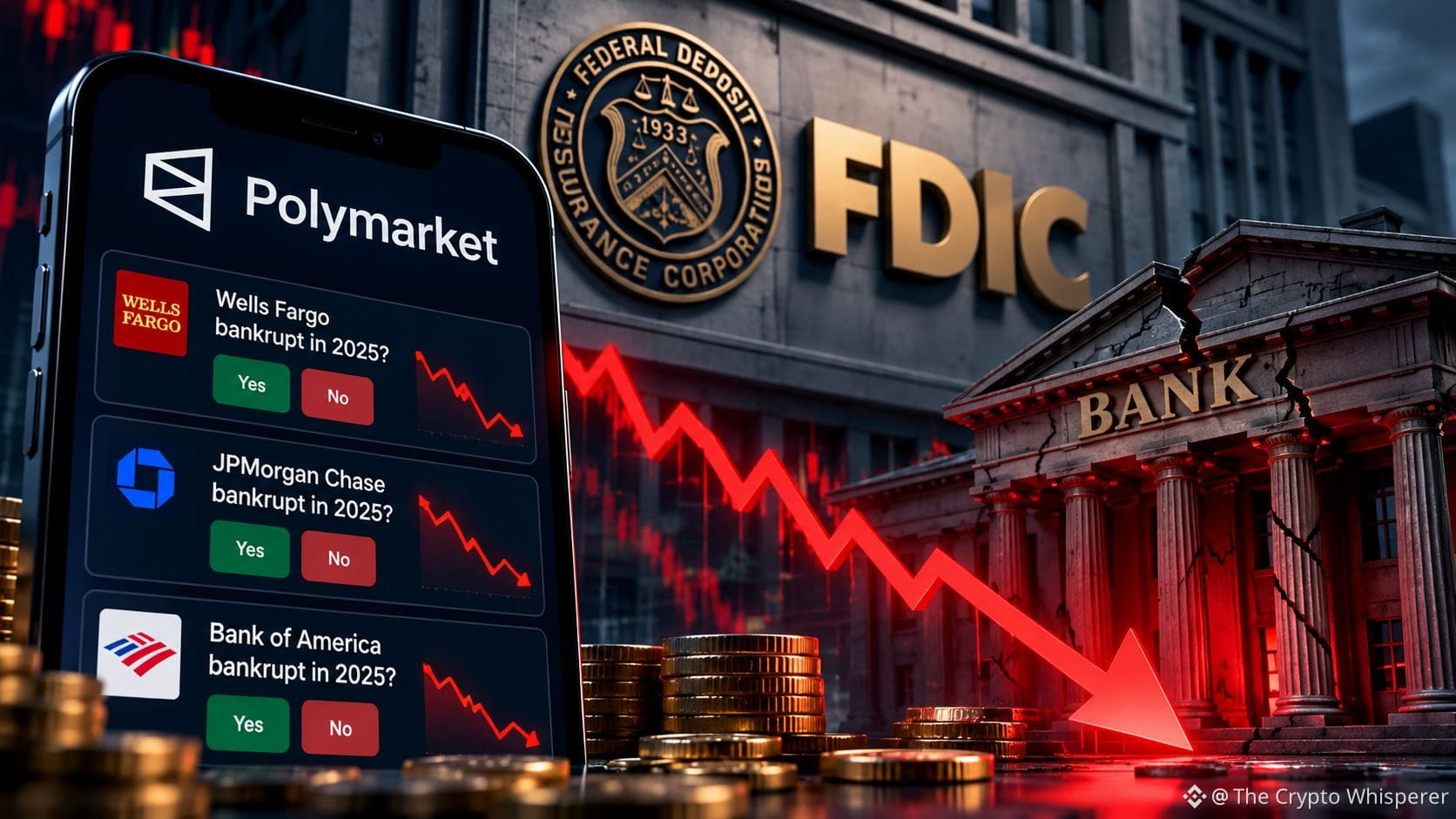
The contracts cover major institutions including Wells Fargo, JPMorgan Chase and Bank of America. Bloomberg reported that year-end bank-failure contracts had attracted around $76,000 in trading volume, while an earlier set reached about $591,000.
Polymarket argues prediction markets can provide real-time information, while critics warn that betting directly on bank failures could create harmful incentives.
The debate highlights a growing question for prediction markets: where should information discovery end and financial-stability risk begin?
#Polymarket #Banking #PredictionMarkets
$BTC
{spot}(BTCUSDT)
#PolymarketBankFailureBetsDrawFDICConcern
Polymarket’s bank-failure prediction contracts are drawing scrutiny from U.S. banking officials, with concerns that larger betting volumes could potentially fuel panic or even contribute to bank runs.
The contracts cover major institutions including Wells Fargo, JPMorgan Chase and Bank of America. Bloomberg reported that year-end bank-failure contracts had attracted around $76,000 in trading volume, while an earlier set reached about $591,000.
Polymarket argues prediction markets can provide real-time information, while critics warn that betting directly on bank failures could create harmful incentives.
The debate highlights a growing question for prediction markets: where should information discovery end and financial-stability risk begin?
#Polymarket #Banking #PredictionMarkets
$BTC
Polymarket’s bank-failure prediction contracts are drawing scrutiny from U.S. banking officials, with concerns that larger betting volumes could potentially fuel panic or even contribute to bank runs.
The contracts cover major institutions including Wells Fargo, JPMorgan Chase and Bank of America. Bloomberg reported that year-end bank-failure contracts had attracted around $76,000 in trading volume, while an earlier set reached about $591,000.
Polymarket argues prediction markets can provide real-time information, while critics warn that betting directly on bank failures could create harmful incentives.
The debate highlights a growing question for prediction markets: where should information discovery end and financial-stability risk begin?
#Polymarket #Banking #PredictionMarkets
$BTC
16

Verified
$BTC Polymarket Bank Bets Get FDIC AttentionPolymarket contracts betting on the failure of major banks like JPMorgan, Bank of America and Wells Fargo are drawing attention from FDIC officials. 👀
The interesting part:
📊 Current trading volume is still relatively small.
⚠️ Regulators are concerned about what could happen if these markets grow and start amplifying fear around specific banks.
🏦 The bigger issue is the possibility of market speculation contributing to real-world deposit runs.
For crypto, I’m watching:
$BTC — macro and risk sentiment
$ETH — DeFi and on-chain finance
$BNB — broader crypto liquidity
This doesn't mean a banking crisis is happening.
It means prediction markets are becoming important enough that regulators are watching their potential impact on financial stability.
Would you treat these markets as useful signals or potential sources of unnecessary fear?
#polymarketbankfailurebetsdrawfdicconcern #Polymarket #FDIC #BankingSector #PredictionMarkets #BTC #ETH #BNB #Bitcoin #Ethereum #Crypto #BinanceSquare
$BTC Polymarket Bank Bets Get FDIC Attention
Polymarket contracts betting on the failure of major banks like JPMorgan, Bank of America and Wells Fargo are drawing attention from FDIC officials. 👀
The interesting part:
📊 Current trading volume is still relatively small.
⚠️ Regulators are concerned about what could happen if these markets grow and start amplifying fear around specific banks.
🏦 The bigger issue is the possibility of market speculation contributing to real-world deposit runs.
For crypto, I’m watching:
$BTC — macro and risk sentiment
$ETH — DeFi and on-chain finance
$BNB — broader crypto liquidity
This doesn't mean a banking crisis is happening.
It means prediction markets are becoming important enough that regulators are watching their potential impact on financial stability.
Would you treat these markets as useful signals or potential sources of unnecessary fear?
#polymarketbankfailurebetsdrawfdicconcern #Polymarket #FDIC #BankingSector #PredictionMarkets #BTC #ETH #BNB #Bitcoin #Ethereum #Crypto #BinanceSquare
The interesting part:
📊 Current trading volume is still relatively small.
⚠️ Regulators are concerned about what could happen if these markets grow and start amplifying fear around specific banks.
🏦 The bigger issue is the possibility of market speculation contributing to real-world deposit runs.
For crypto, I’m watching:
$BTC — macro and risk sentiment
$ETH — DeFi and on-chain finance
$BNB — broader crypto liquidity
This doesn't mean a banking crisis is happening.
It means prediction markets are becoming important enough that regulators are watching their potential impact on financial stability.
Would you treat these markets as useful signals or potential sources of unnecessary fear?
#polymarketbankfailurebetsdrawfdicconcern #Polymarket #FDIC #BankingSector #PredictionMarkets #BTC #ETH #BNB #Bitcoin #Ethereum #Crypto #BinanceSquare
206 Atlas:
FDIC scrutiny on bank failure bets is noise until volume spikes. Don't confuse regulatory curiosity with immediate market impact.
1
628

🚨 POLYMARKET IS BETTING ON BANK FAILURES
JPMorgan, Wells Fargo & other major banks now have “failure” prediction markets — and FDIC is reportedly concerned. 👀
Could prediction markets actually influence market sentiment? 🏦📉
#Polymarket #CryptoNewss #BankingRevolution #PredictionMarkets
🚨 POLYMARKET IS BETTING ON BANK FAILURES
JPMorgan, Wells Fargo & other major banks now have “failure” prediction markets — and FDIC is reportedly concerned. 👀
Could prediction markets actually influence market sentiment? 🏦📉
#Polymarket #CryptoNewss #BankingRevolution #PredictionMarkets
JPMorgan, Wells Fargo & other major banks now have “failure” prediction markets — and FDIC is reportedly concerned. 👀
Could prediction markets actually influence market sentiment? 🏦📉
#Polymarket #CryptoNewss #BankingRevolution #PredictionMarkets
1
105

·
--
Bullish
Verified
#polymarketbankfailurebetsdrawfdicconcern
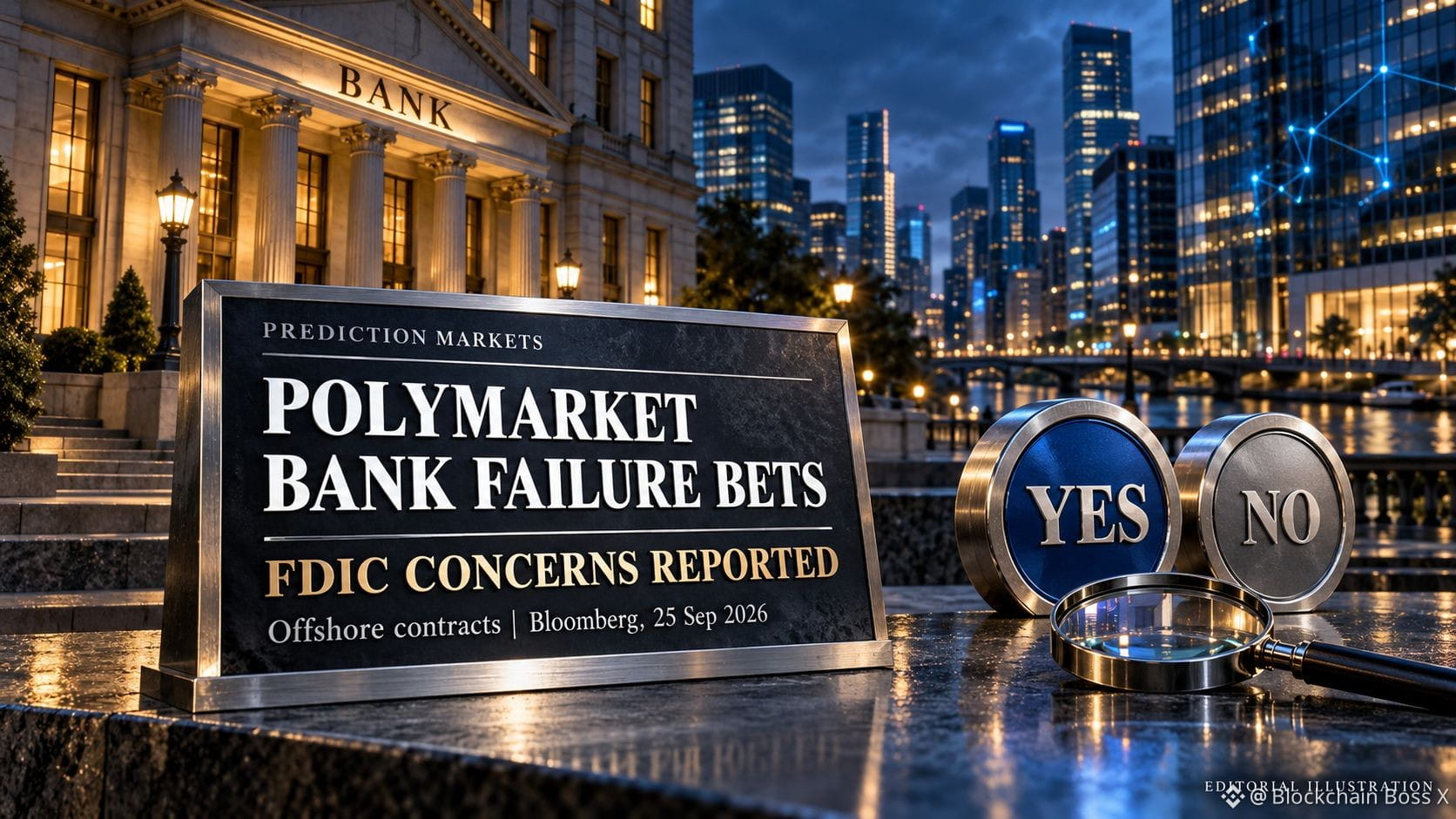
Polymarket’s Bank Failure Bets Raise Questions About Market Signals
A market designed to predict banking stress could also influence how people react to it.
Bloomberg reported on September 25, citing people familiar with internal discussions, that FDIC officials raised concerns about contracts on Polymarket’s offshore platform tied to individual bank failures. One worry is whether larger markets could eventually amplify depositor fears and contribute to a bank run. The FDIC declined to comment.
The report put trading volume in the year-end contracts at roughly $76,000 and said Polymarket’s separate U.S. exchange does not offer these bets. Polymarket argues that its markets broaden access to information and can help counter unfounded panic.
My take: A traded probability is not a diagnosis of bank solvency. In markets with limited liquidity, a small number of trades may significantly affect displayed odds. Sharing those odds without volume, spread or timing context could mislead readers.
I’d examine transaction history, concentration among participants and contract settlement rules before treating a price change as meaningful information. Bank filings and official regulatory disclosures remain essential to checking the underlying story.
The quality of a prediction market depends partly on how clearly its limitations are communicated.
How should platforms preserve useful market information while reducing the risk of spreading panic?
#PolymarketBankFailureBetsDrawFDICConcern #PredictionMarkets #Banking
$PHA $ARK $SAGA
{future}(SAGAUSDT)
{future}(ARKUSDT)
{future}(PHAUSDT)
#polymarketbankfailurebetsdrawfdicconcern
Polymarket’s Bank Failure Bets Raise Questions About Market Signals
A market designed to predict banking stress could also influence how people react to it.
Bloomberg reported on September 25, citing people familiar with internal discussions, that FDIC officials raised concerns about contracts on Polymarket’s offshore platform tied to individual bank failures. One worry is whether larger markets could eventually amplify depositor fears and contribute to a bank run. The FDIC declined to comment.
The report put trading volume in the year-end contracts at roughly $76,000 and said Polymarket’s separate U.S. exchange does not offer these bets. Polymarket argues that its markets broaden access to information and can help counter unfounded panic.
My take: A traded probability is not a diagnosis of bank solvency. In markets with limited liquidity, a small number of trades may significantly affect displayed odds. Sharing those odds without volume, spread or timing context could mislead readers.
I’d examine transaction history, concentration among participants and contract settlement rules before treating a price change as meaningful information. Bank filings and official regulatory disclosures remain essential to checking the underlying story.
The quality of a prediction market depends partly on how clearly its limitations are communicated.
How should platforms preserve useful market information while reducing the risk of spreading panic?
#PolymarketBankFailureBetsDrawFDICConcern #PredictionMarkets #Banking
$PHA $ARK $SAGA
Polymarket’s Bank Failure Bets Raise Questions About Market Signals
A market designed to predict banking stress could also influence how people react to it.
Bloomberg reported on September 25, citing people familiar with internal discussions, that FDIC officials raised concerns about contracts on Polymarket’s offshore platform tied to individual bank failures. One worry is whether larger markets could eventually amplify depositor fears and contribute to a bank run. The FDIC declined to comment.
The report put trading volume in the year-end contracts at roughly $76,000 and said Polymarket’s separate U.S. exchange does not offer these bets. Polymarket argues that its markets broaden access to information and can help counter unfounded panic.
My take: A traded probability is not a diagnosis of bank solvency. In markets with limited liquidity, a small number of trades may significantly affect displayed odds. Sharing those odds without volume, spread or timing context could mislead readers.
I’d examine transaction history, concentration among participants and contract settlement rules before treating a price change as meaningful information. Bank filings and official regulatory disclosures remain essential to checking the underlying story.
The quality of a prediction market depends partly on how clearly its limitations are communicated.
How should platforms preserve useful market information while reducing the risk of spreading panic?
#PolymarketBankFailureBetsDrawFDICConcern #PredictionMarkets #Banking
$PHA $ARK $SAGA
3
3.4k

·
--
#polymarketbankfailurebetsdrawfdicconcern
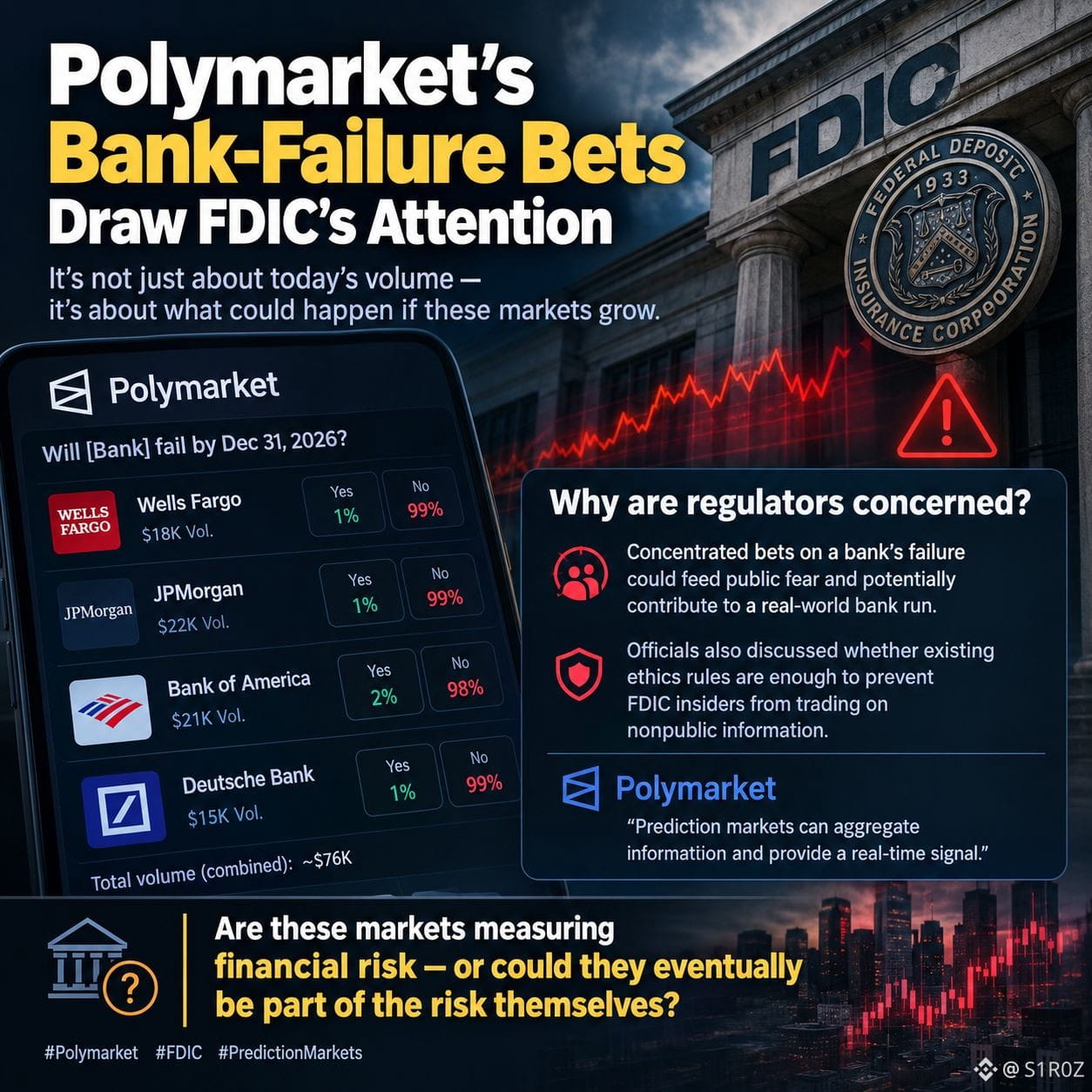
🚨 Polymarket’s bank-failure bets just caught the FDIC’s attention — but the concern isn’t really about today’s trading volume.
Polymarket currently has markets asking whether major banks such as Wells Fargo, JPMorgan, Bank of America and Deutsche Bank will fail by the end of 2026. The contracts are still tiny, with about $76K in combined volume across the current bank-failure markets.
So why are regulators paying attention?
According to Bloomberg, FDIC officials are concerned that if these markets grow, concentrated bets on a bank’s failure could feed public fear and potentially contribute to a real-world bank run. Officials also discussed whether existing ethics rules sufficiently prevent FDIC insiders from trading on nonpublic information.
Polymarket argues prediction markets can instead aggregate information and provide a real-time signal.
That creates a much bigger question:
Are these markets measuring financial risk — or could they eventually become part of the risk themselves?
#Polymarket #FDIC #PredictionMarkets
#polymarketbankfailurebetsdrawfdicconcern
🚨 Polymarket’s bank-failure bets just caught the FDIC’s attention — but the concern isn’t really about today’s trading volume.
Polymarket currently has markets asking whether major banks such as Wells Fargo, JPMorgan, Bank of America and Deutsche Bank will fail by the end of 2026. The contracts are still tiny, with about $76K in combined volume across the current bank-failure markets.
So why are regulators paying attention?
According to Bloomberg, FDIC officials are concerned that if these markets grow, concentrated bets on a bank’s failure could feed public fear and potentially contribute to a real-world bank run. Officials also discussed whether existing ethics rules sufficiently prevent FDIC insiders from trading on nonpublic information.
Polymarket argues prediction markets can instead aggregate information and provide a real-time signal.
That creates a much bigger question:
Are these markets measuring financial risk — or could they eventually become part of the risk themselves?
#Polymarket #FDIC #PredictionMarkets
🚨 Polymarket’s bank-failure bets just caught the FDIC’s attention — but the concern isn’t really about today’s trading volume.
Polymarket currently has markets asking whether major banks such as Wells Fargo, JPMorgan, Bank of America and Deutsche Bank will fail by the end of 2026. The contracts are still tiny, with about $76K in combined volume across the current bank-failure markets.
So why are regulators paying attention?
According to Bloomberg, FDIC officials are concerned that if these markets grow, concentrated bets on a bank’s failure could feed public fear and potentially contribute to a real-world bank run. Officials also discussed whether existing ethics rules sufficiently prevent FDIC insiders from trading on nonpublic information.
Polymarket argues prediction markets can instead aggregate information and provide a real-time signal.
That creates a much bigger question:
Are these markets measuring financial risk — or could they eventually become part of the risk themselves?
#Polymarket #FDIC #PredictionMarkets
2
94
·
--
#nyandpolymarketsueeachother
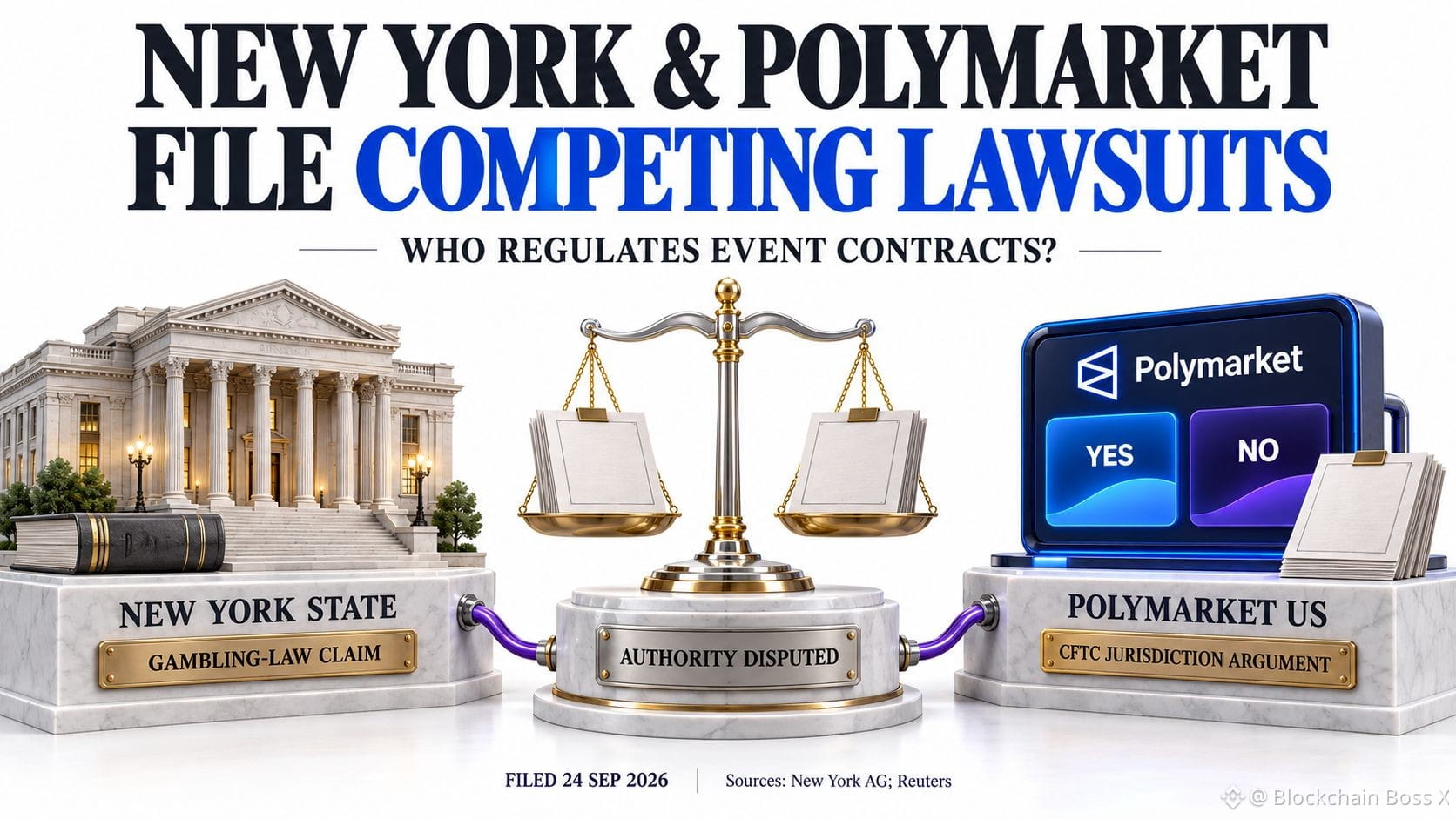
🚨 New York and Polymarket are now suing each other — and the bigger fight is over who gets to regulate prediction markets.
New York Attorney General Letitia James sued Polymarket on September 24, accusing the platform of operating an unlicensed gambling business and seeking to stop it from operating in the state.
Then Polymarket fired back.
The company filed its own federal lawsuit against New York officials, arguing that the state shouldn't regulate its prediction markets because they fall under the federal derivatives framework.
So this isn't just another lawsuit against a prediction-market platform.
It's a direct clash between state gambling laws and federal oversight of event contracts.
And that could matter far beyond Polymarket.
If courts draw a clearer line between gambling and regulated prediction markets, the outcome could affect how the entire U.S. prediction-market industry operates.
The key question now: where does state authority end and federal market regulation begin?
#Polymarket #PredictionMarkets #CFTC
#nyandpolymarketsueeachother
🚨 New York and Polymarket are now suing each other — and the bigger fight is over who gets to regulate prediction markets.
New York Attorney General Letitia James sued Polymarket on September 24, accusing the platform of operating an unlicensed gambling business and seeking to stop it from operating in the state.
Then Polymarket fired back.
The company filed its own federal lawsuit against New York officials, arguing that the state shouldn't regulate its prediction markets because they fall under the federal derivatives framework.
So this isn't just another lawsuit against a prediction-market platform.
It's a direct clash between state gambling laws and federal oversight of event contracts.
And that could matter far beyond Polymarket.
If courts draw a clearer line between gambling and regulated prediction markets, the outcome could affect how the entire U.S. prediction-market industry operates.
The key question now: where does state authority end and federal market regulation begin?
#Polymarket #PredictionMarkets #CFTC
🚨 New York and Polymarket are now suing each other — and the bigger fight is over who gets to regulate prediction markets.
New York Attorney General Letitia James sued Polymarket on September 24, accusing the platform of operating an unlicensed gambling business and seeking to stop it from operating in the state.
Then Polymarket fired back.
The company filed its own federal lawsuit against New York officials, arguing that the state shouldn't regulate its prediction markets because they fall under the federal derivatives framework.
So this isn't just another lawsuit against a prediction-market platform.
It's a direct clash between state gambling laws and federal oversight of event contracts.
And that could matter far beyond Polymarket.
If courts draw a clearer line between gambling and regulated prediction markets, the outcome could affect how the entire U.S. prediction-market industry operates.
The key question now: where does state authority end and federal market regulation begin?
#Polymarket #PredictionMarkets #CFTC
39

·
--
Bullish
🔎 The Real Story Behind Kalshi’s ETH Volume
The headline says $5B+ in ETH perpetual volume. But the more interesting story is what sits underneath that number.
Recent analysis of Kalshi’s public trade data found a striking pattern: a large share of ETH-perp activity repeatedly clustered around roughly $5,500 per trade. CoinDesk’s sample found trades near $5,499 represented 57% of the ETH-perp volume it analyzed, while broader reporting found nearly 1 million similarly sized trades contributing more than $5B in volume.
That alone doesn't prove wash trading.
Kalshi strongly disputes that interpretation. The company says the trades came from a market maker using fixed-size orders, while hundreds of distinct traders took the other side. Kalshi also says self-matching is mechanically blocked and coordinated trading is monitored.
And that's where the bigger question comes in:
How independently verifiable is the activity?
Public trade data can show what was traded and when, but it doesn't publicly identify the participants behind each trade. That makes it possible to observe unusual patterns while still being unable to independently establish who was trading with whom or whether any rules were broken.
This is also where @Polymarket becomes an interesting comparison—not necessarily because one model is automatically better, but because the underlying systems provide different forms of transparency.
On-chain activity can leave a publicly inspectable transaction trail. Off-chain exchange activity relies more heavily on the platform's own records and disclosures.
Different infrastructure.
Different transparency.
Different ways to verify activity.
The real question isn't simply:
“How big is the volume?”
It's:
“Can the volume be independently understood and verified?”
Because in markets, a big number means much more when everyone can check what produced it.
#Kalshi #Polymarket #PredictionMarkets
🔎 The Real Story Behind Kalshi’s ETH Volume
The headline says $5B+ in ETH perpetual volume. But the more interesting story is what sits underneath that number.
Recent analysis of Kalshi’s public trade data found a striking pattern: a large share of ETH-perp activity repeatedly clustered around roughly $5,500 per trade. CoinDesk’s sample found trades near $5,499 represented 57% of the ETH-perp volume it analyzed, while broader reporting found nearly 1 million similarly sized trades contributing more than $5B in volume.
That alone doesn't prove wash trading.
Kalshi strongly disputes that interpretation. The company says the trades came from a market maker using fixed-size orders, while hundreds of distinct traders took the other side. Kalshi also says self-matching is mechanically blocked and coordinated trading is monitored.
And that's where the bigger question comes in:
How independently verifiable is the activity?
Public trade data can show what was traded and when, but it doesn't publicly identify the participants behind each trade. That makes it possible to observe unusual patterns while still being unable to independently establish who was trading with whom or whether any rules were broken.
This is also where @Polymarket becomes an interesting comparison—not necessarily because one model is automatically better, but because the underlying systems provide different forms of transparency.
On-chain activity can leave a publicly inspectable transaction trail. Off-chain exchange activity relies more heavily on the platform's own records and disclosures.
Different infrastructure.
Different transparency.
Different ways to verify activity.
The real question isn't simply:
“How big is the volume?”
It's:
“Can the volume be independently understood and verified?”
Because in markets, a big number means much more when everyone can check what produced it.
#Kalshi #Polymarket #PredictionMarkets
The headline says $5B+ in ETH perpetual volume. But the more interesting story is what sits underneath that number.
Recent analysis of Kalshi’s public trade data found a striking pattern: a large share of ETH-perp activity repeatedly clustered around roughly $5,500 per trade. CoinDesk’s sample found trades near $5,499 represented 57% of the ETH-perp volume it analyzed, while broader reporting found nearly 1 million similarly sized trades contributing more than $5B in volume.
That alone doesn't prove wash trading.
Kalshi strongly disputes that interpretation. The company says the trades came from a market maker using fixed-size orders, while hundreds of distinct traders took the other side. Kalshi also says self-matching is mechanically blocked and coordinated trading is monitored.
And that's where the bigger question comes in:
How independently verifiable is the activity?
Public trade data can show what was traded and when, but it doesn't publicly identify the participants behind each trade. That makes it possible to observe unusual patterns while still being unable to independently establish who was trading with whom or whether any rules were broken.
This is also where @Polymarket becomes an interesting comparison—not necessarily because one model is automatically better, but because the underlying systems provide different forms of transparency.
On-chain activity can leave a publicly inspectable transaction trail. Off-chain exchange activity relies more heavily on the platform's own records and disclosures.
Different infrastructure.
Different transparency.
Different ways to verify activity.
The real question isn't simply:
“How big is the volume?”
It's:
“Can the volume be independently understood and verified?”
Because in markets, a big number means much more when everyone can check what produced it.
#Kalshi #Polymarket #PredictionMarkets
149

🚨 MORGAN STANLEY BACKS PREDICTION MARKETS AS INSTITUTIONAL CAPITAL TARGETS CRYPTO AND $BTC RAILS! 🦈
🏦 Wall Street heavyweight Morgan Stanley is officially stepping into the spotlight as the first major bank to publicly partner with a prediction market summit. 🌊 After quietly participating in Kalshi's $1 billion funding round earlier this year, their top research leads are now moderating panels on institutional capital deployment in New York this October.
📊 Right now, sports contracts account for nearly 90% of trading volume, but smart money is pricing in a massive transition toward institutional-grade macro hedging tools. 💡 When legacy banking giants build pipelines into alternative prediction rails, institutional positioning happens long before retail takes notice. 💬 Do you see prediction markets evolving into the primary pricing tool for macro risk, or is this just early Wall Street positioning? 👇
⚠️ Not financial advice. Always manage your risk. 🛡️
🏷️ #BTC #PredictionMarkets #Institutional #Crypto #Macro
🦈 ⚡
🚨 MORGAN STANLEY BACKS PREDICTION MARKETS AS INSTITUTIONAL CAPITAL TARGETS CRYPTO AND $BTC RAILS! 🦈
🏦 Wall Street heavyweight Morgan Stanley is officially stepping into the spotlight as the first major bank to publicly partner with a prediction market summit. 🌊 After quietly participating in Kalshi's $1 billion funding round earlier this year, their top research leads are now moderating panels on institutional capital deployment in New York this October.
📊 Right now, sports contracts account for nearly 90% of trading volume, but smart money is pricing in a massive transition toward institutional-grade macro hedging tools. 💡 When legacy banking giants build pipelines into alternative prediction rails, institutional positioning happens long before retail takes notice. 💬 Do you see prediction markets evolving into the primary pricing tool for macro risk, or is this just early Wall Street positioning? 👇
⚠️ Not financial advice. Always manage your risk. 🛡️
🏷️ #BTC #PredictionMarkets #Institutional #Crypto #Macro
🦈 ⚡
🏦 Wall Street heavyweight Morgan Stanley is officially stepping into the spotlight as the first major bank to publicly partner with a prediction market summit. 🌊 After quietly participating in Kalshi's $1 billion funding round earlier this year, their top research leads are now moderating panels on institutional capital deployment in New York this October.
📊 Right now, sports contracts account for nearly 90% of trading volume, but smart money is pricing in a massive transition toward institutional-grade macro hedging tools. 💡 When legacy banking giants build pipelines into alternative prediction rails, institutional positioning happens long before retail takes notice. 💬 Do you see prediction markets evolving into the primary pricing tool for macro risk, or is this just early Wall Street positioning? 👇
⚠️ Not financial advice. Always manage your risk. 🛡️
🏷️ #BTC #PredictionMarkets #Institutional #Crypto #Macro
🦈 ⚡
24
·
--
Bullish
#nyandpolymarketsueeachother
New York and Polymarket Sue Each Other: Who Regulates Event Contracts?
The legal fight over
markets now runs in both directions.
On September 24, New York Attorney General Letitia James sued Polymarket US in state court, alleging it operates an unlicensed gambling business. The state seeks an order stopping that activity, alongside fines, forfeiture of allegedly illegal gains and customer restitution.
Polymarket responded with a separate lawsuit in Manhattan federal court against state officials. It argues that the Commodity Futures Trading Commission has exclusive authority over its markets and seeks to prevent New York from enforcing gambling laws against the company.
Both sides are advancing legal claims that await judicial resolution.
My take: The outcome could influence which contracts platforms offer, where users can participate and how consistently the rules apply across states. For businesses building national markets, geographic restrictions could affect liquidity as well as compliance costs.
For users, a workable framework also needs clear answers about age restrictions, dispute handling and consumer protections. Market access and confidence depend on how those safeguards operate in practice.
I’d watch interim court decisions and changes to user eligibility before drawing conclusions about the wider industry. Those developments would show how this dispute affects everyday access while the larger jurisdiction question is contested.
How should oversight balance national market access with meaningful consumer protections?
#NYAndPolymarketSueEachOther #Polymarket #PredictionMarkets
$QNT $XPL $ONDO
{future}(ONDOUSDT)
{future}(XPLUSDT)
{future}(QNTUSDT)
#nyandpolymarketsueeachother
New York and Polymarket Sue Each Other: Who Regulates Event Contracts?
The legal fight over
markets now runs in both directions.
On September 24, New York Attorney General Letitia James sued Polymarket US in state court, alleging it operates an unlicensed gambling business. The state seeks an order stopping that activity, alongside fines, forfeiture of allegedly illegal gains and customer restitution.
Polymarket responded with a separate lawsuit in Manhattan federal court against state officials. It argues that the Commodity Futures Trading Commission has exclusive authority over its markets and seeks to prevent New York from enforcing gambling laws against the company.
Both sides are advancing legal claims that await judicial resolution.
My take: The outcome could influence which contracts platforms offer, where users can participate and how consistently the rules apply across states. For businesses building national markets, geographic restrictions could affect liquidity as well as compliance costs.
For users, a workable framework also needs clear answers about age restrictions, dispute handling and consumer protections. Market access and confidence depend on how those safeguards operate in practice.
I’d watch interim court decisions and changes to user eligibility before drawing conclusions about the wider industry. Those developments would show how this dispute affects everyday access while the larger jurisdiction question is contested.
How should oversight balance national market access with meaningful consumer protections?
#NYAndPolymarketSueEachOther #Polymarket #PredictionMarkets
$QNT $XPL $ONDO
New York and Polymarket Sue Each Other: Who Regulates Event Contracts?
The legal fight over
markets now runs in both directions.
On September 24, New York Attorney General Letitia James sued Polymarket US in state court, alleging it operates an unlicensed gambling business. The state seeks an order stopping that activity, alongside fines, forfeiture of allegedly illegal gains and customer restitution.
Polymarket responded with a separate lawsuit in Manhattan federal court against state officials. It argues that the Commodity Futures Trading Commission has exclusive authority over its markets and seeks to prevent New York from enforcing gambling laws against the company.
Both sides are advancing legal claims that await judicial resolution.
My take: The outcome could influence which contracts platforms offer, where users can participate and how consistently the rules apply across states. For businesses building national markets, geographic restrictions could affect liquidity as well as compliance costs.
For users, a workable framework also needs clear answers about age restrictions, dispute handling and consumer protections. Market access and confidence depend on how those safeguards operate in practice.
I’d watch interim court decisions and changes to user eligibility before drawing conclusions about the wider industry. Those developments would show how this dispute affects everyday access while the larger jurisdiction question is contested.
How should oversight balance national market access with meaningful consumer protections?
#NYAndPolymarketSueEachOther #Polymarket #PredictionMarkets
$QNT $XPL $ONDO
1
2.4k

·
--
🚨 THE PREDICTION MARKET BATTLE IS HEATING UP.
$POLY is stepping into the spotlight as questions around market volume and real participation get louder.
$539M ETH perp volume vs just $3.1M OI?
Repeated $5,500 trades?
Kalshi says liquidity incentives can explain the pattern.
But the real question is simple:
BIG VOLUME ≠ REAL DEMAND.
The next edge in prediction markets may not be size.
It may be TRUST.
#Polymarket #PredictionMarkets #POLY
NFA + DYOR
#PredictionMarkets
🚨 THE PREDICTION MARKET BATTLE IS HEATING UP.
$POLY is stepping into the spotlight as questions around market volume and real participation get louder.
$539M ETH perp volume vs just $3.1M OI?
Repeated $5,500 trades?
Kalshi says liquidity incentives can explain the pattern.
But the real question is simple:
BIG VOLUME ≠ REAL DEMAND.
The next edge in prediction markets may not be size.
It may be TRUST.
#Polymarket #PredictionMarkets #POLY
NFA + DYOR
#PredictionMarkets
$POLY is stepping into the spotlight as questions around market volume and real participation get louder.
$539M ETH perp volume vs just $3.1M OI?
Repeated $5,500 trades?
Kalshi says liquidity incentives can explain the pattern.
But the real question is simple:
BIG VOLUME ≠ REAL DEMAND.
The next edge in prediction markets may not be size.
It may be TRUST.
#Polymarket #PredictionMarkets #POLY
NFA + DYOR
#PredictionMarkets
117

·
--
Bullish
Verified
The prediction market battle just got a lot more interesting.
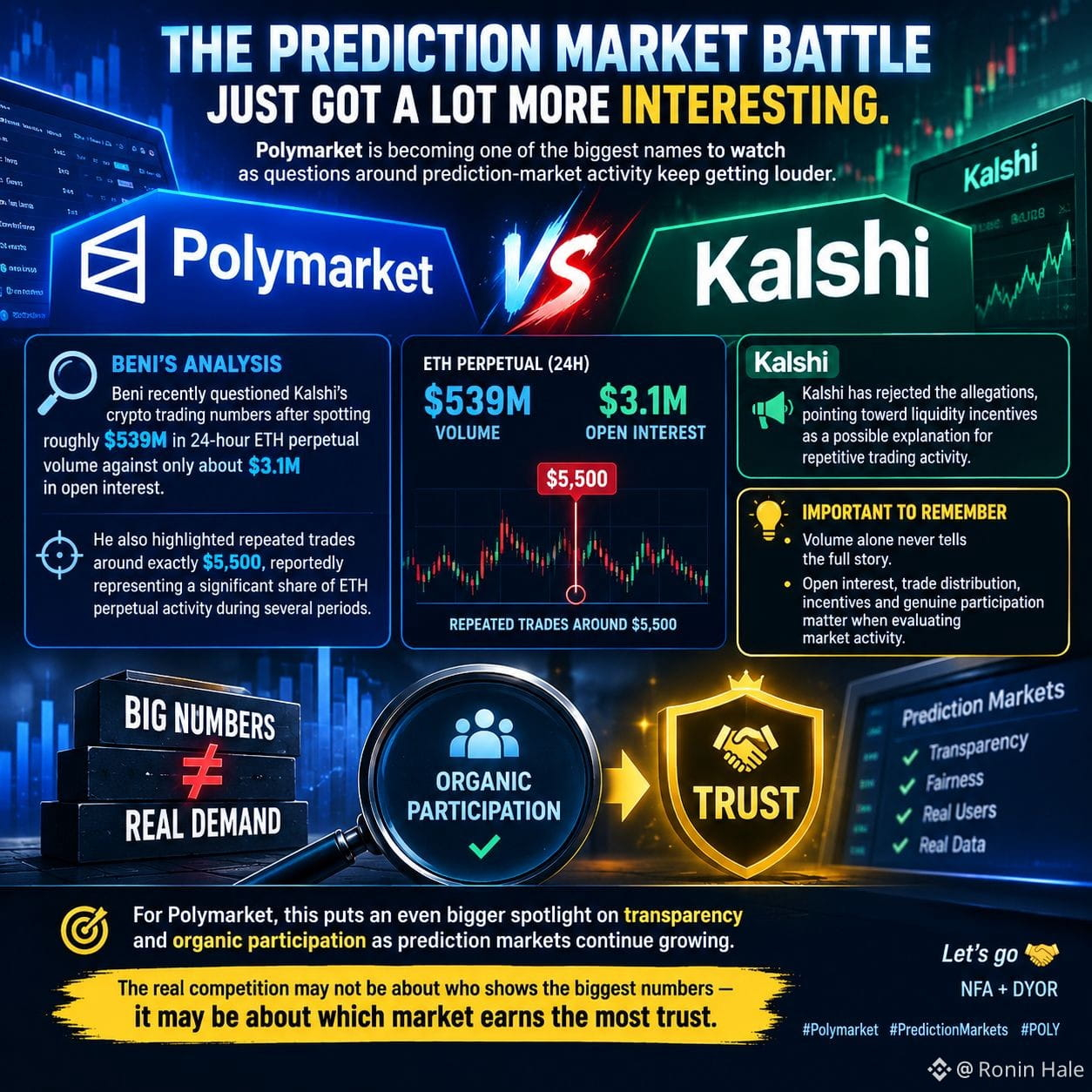
Polymarket is becoming one of the biggest names to watch as questions around prediction-market activity keep getting louder.
→ Beni recently questioned Kalshi’s crypto trading numbers after spotting roughly $539M in 24-hour ETH perpetual volume against only about $3.1M in open interest.
→ His analysis also highlighted repeated trades around exactly $5,500, reportedly representing a significant share of ETH perpetual activity during several periods.
That pattern alone does not prove artificial trading.
Kalshi has rejected the allegations, pointing toward liquidity incentives as a possible explanation for repetitive trading activity.
◆ Volume alone never tells the full story.
◆ Open interest, trade distribution, incentives and genuine participation matter when evaluating market activity.
For Polymarket, this puts an even bigger spotlight on transparency and organic participation as prediction markets continue growing.
The real competition may not be about who shows the biggest numbers — it may be about which market earns the most trust.
Let's go 🤝
NFA + DYOR
#Polymarket #PredictionMarkets
The prediction market battle just got a lot more interesting.
Polymarket is becoming one of the biggest names to watch as questions around prediction-market activity keep getting louder.
→ Beni recently questioned Kalshi’s crypto trading numbers after spotting roughly $539M in 24-hour ETH perpetual volume against only about $3.1M in open interest.
→ His analysis also highlighted repeated trades around exactly $5,500, reportedly representing a significant share of ETH perpetual activity during several periods.
That pattern alone does not prove artificial trading.
Kalshi has rejected the allegations, pointing toward liquidity incentives as a possible explanation for repetitive trading activity.
◆ Volume alone never tells the full story.
◆ Open interest, trade distribution, incentives and genuine participation matter when evaluating market activity.
For Polymarket, this puts an even bigger spotlight on transparency and organic participation as prediction markets continue growing.
The real competition may not be about who shows the biggest numbers — it may be about which market earns the most trust.
Let's go 🤝
NFA + DYOR
#Polymarket #PredictionMarkets
Polymarket is becoming one of the biggest names to watch as questions around prediction-market activity keep getting louder.
→ Beni recently questioned Kalshi’s crypto trading numbers after spotting roughly $539M in 24-hour ETH perpetual volume against only about $3.1M in open interest.
→ His analysis also highlighted repeated trades around exactly $5,500, reportedly representing a significant share of ETH perpetual activity during several periods.
That pattern alone does not prove artificial trading.
Kalshi has rejected the allegations, pointing toward liquidity incentives as a possible explanation for repetitive trading activity.
◆ Volume alone never tells the full story.
◆ Open interest, trade distribution, incentives and genuine participation matter when evaluating market activity.
For Polymarket, this puts an even bigger spotlight on transparency and organic participation as prediction markets continue growing.
The real competition may not be about who shows the biggest numbers — it may be about which market earns the most trust.
Let's go 🤝
NFA + DYOR
#Polymarket #PredictionMarkets
Nova Kairo:
Volume can attract attention, but transparency earns trust. In prediction markets, real participation and credible data will matter more than inflated-looking numbers. .. .
89
62
14.4k
Log in to explore more content
Join global crypto users on Binance Square
⚡️ Get latest and useful information about crypto.
💬 Trusted by the world’s largest crypto exchange.
👍 Discover real insights from verified creators.
Email / Phone number
Trending Topics
1
#StrategyStriveAdd2305BitcoinThisWeek
667 views
77 Discussing
2
#TrumpRejectsIranHormuzReopening
4,957 views
212 Discussing
3
#RLUSDSupplyHits2.49BMarketCapNears$2.5B
0 views
19 Discussing
4
#TokenizedStockDEXVolumeHits$20.9B
0 views
0 Discussing
5
#CircleTetherFreezeBitgetHackerWallet
29,135 views
401 Discussing
6
#SECSaysTokenBuybacksNotAutoSecurities
8,655 views
174 Discussing
7
#ChinaUSAgreeOn$30BTariffCut
407 views
11 Discussing
8
#CoinMarketCapCompletesCoinglassAcquisition
26,696 views
323 Discussing
9
#CircleMints500MUSDCOnSolana
178,880 views
2,884 Discussing
10
#PolymarketBankFailureBetsDrawFDICConcern
155,764 views
2,263 Discussing