

F O X T R O T
87 Beiträge

F O X T R O T
Melden
Nutzer blockieren
Where there is a will, there is a way.
26 Following
4.6K+ Follower
103 Like gegeben
Beiträge
Übersetzung ansehen
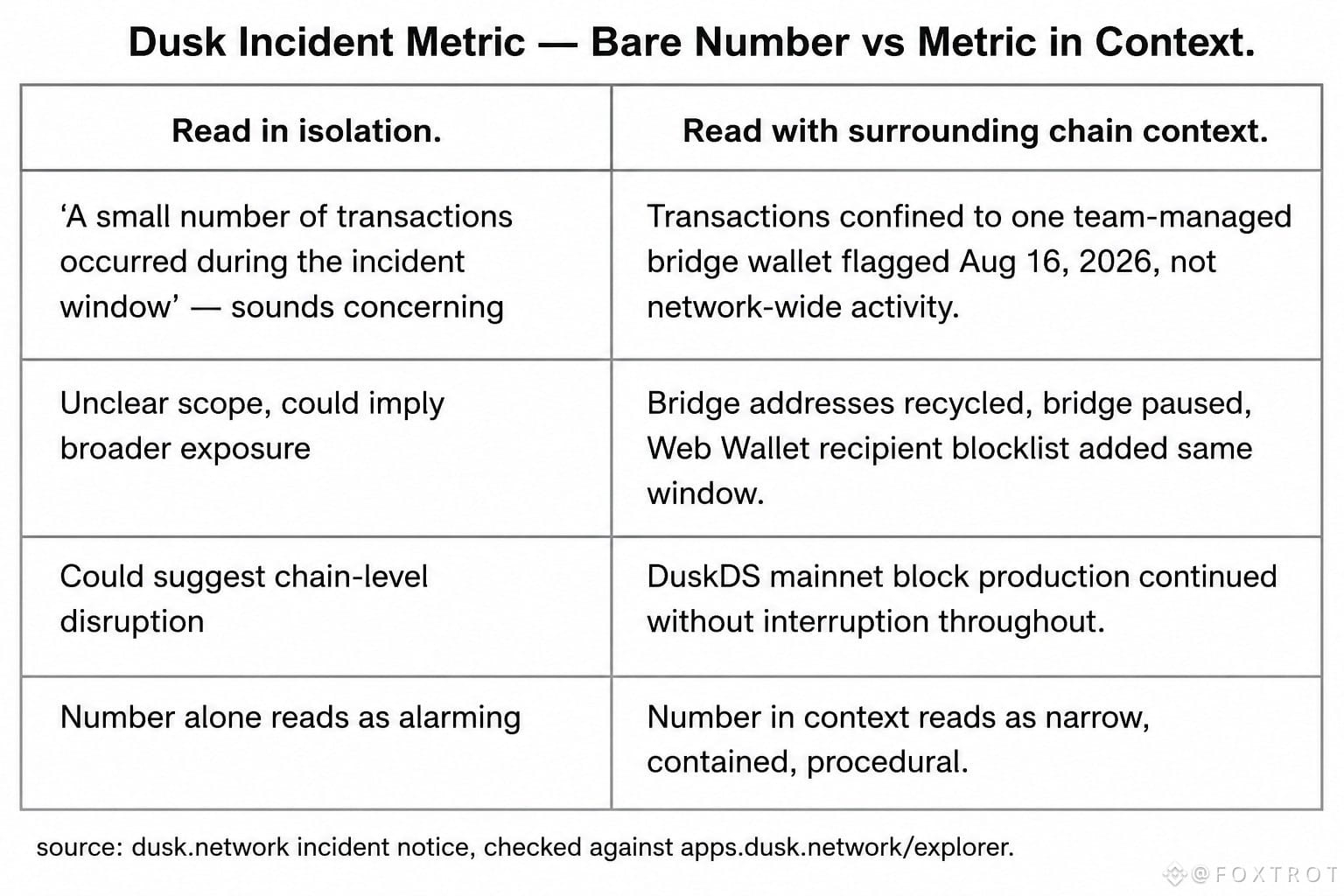
Almost skimmed past it — some number buried in the Dusk incident notice. "A small number of transactions occurred during the incident window." That's it. That's the whole line. On its own it sounds like nothing, or worse, like they're downplaying something big. #dusk $DUSK @Dusk_Foundation
So I actually went and checked the context around it instead of just the headline stat. Turns out that "small number" wasn't network-wide activity — it was isolated to a single team-managed wallet used for bridge ops, flagged Aug 16, contained same window, then the whole bridge got paused and a Web Wallet blocklist went up for recipient addresses. Once you place that number next to DuskDS mainnet block production, which never skipped a beat during any of this… the metric stops looking scary and starts looking almost boring. Which, hmm, might be the actual point.
I've caught myself before treating a bare number as the story. This one only made sense once I stopped reading it in isolation and pulled the surrounding transaction flow, the timing, who touched what. Default read: alarming. Actual read: contained, narrow, procedural.
Makes me wonder how many "concerning" on-chain stats across other projects would deflate the same way if anyone bothered to check the four lines of context around them.
Almost skimmed past it — some number buried in the Dusk incident notice. "A small number of transactions occurred during the incident window." That's it. That's the whole line. On its own it sounds like nothing, or worse, like they're downplaying something big. #dusk $DUSK @Dusk
So I actually went and checked the context around it instead of just the headline stat. Turns out that "small number" wasn't network-wide activity — it was isolated to a single team-managed wallet used for bridge ops, flagged Aug 16, contained same window, then the whole bridge got paused and a Web Wallet blocklist went up for recipient addresses. Once you place that number next to DuskDS mainnet block production, which never skipped a beat during any of this… the metric stops looking scary and starts looking almost boring. Which, hmm, might be the actual point.
I've caught myself before treating a bare number as the story. This one only made sense once I stopped reading it in isolation and pulled the surrounding transaction flow, the timing, who touched what. Default read: alarming. Actual read: contained, narrow, procedural.
Makes me wonder how many "concerning" on-chain stats across other projects would deflate the same way if anyone bothered to check the four lines of context around them.
So I actually went and checked the context around it instead of just the headline stat. Turns out that "small number" wasn't network-wide activity — it was isolated to a single team-managed wallet used for bridge ops, flagged Aug 16, contained same window, then the whole bridge got paused and a Web Wallet blocklist went up for recipient addresses. Once you place that number next to DuskDS mainnet block production, which never skipped a beat during any of this… the metric stops looking scary and starts looking almost boring. Which, hmm, might be the actual point.
I've caught myself before treating a bare number as the story. This one only made sense once I stopped reading it in isolation and pulled the surrounding transaction flow, the timing, who touched what. Default read: alarming. Actual read: contained, narrow, procedural.
Makes me wonder how many "concerning" on-chain stats across other projects would deflate the same way if anyone bothered to check the four lines of context around them.
1
1
145
Fast hätte ich diesen hier übersehen, ngl — dann musste ich aber stoppen und die Mitteilung zweimal neu lesen.
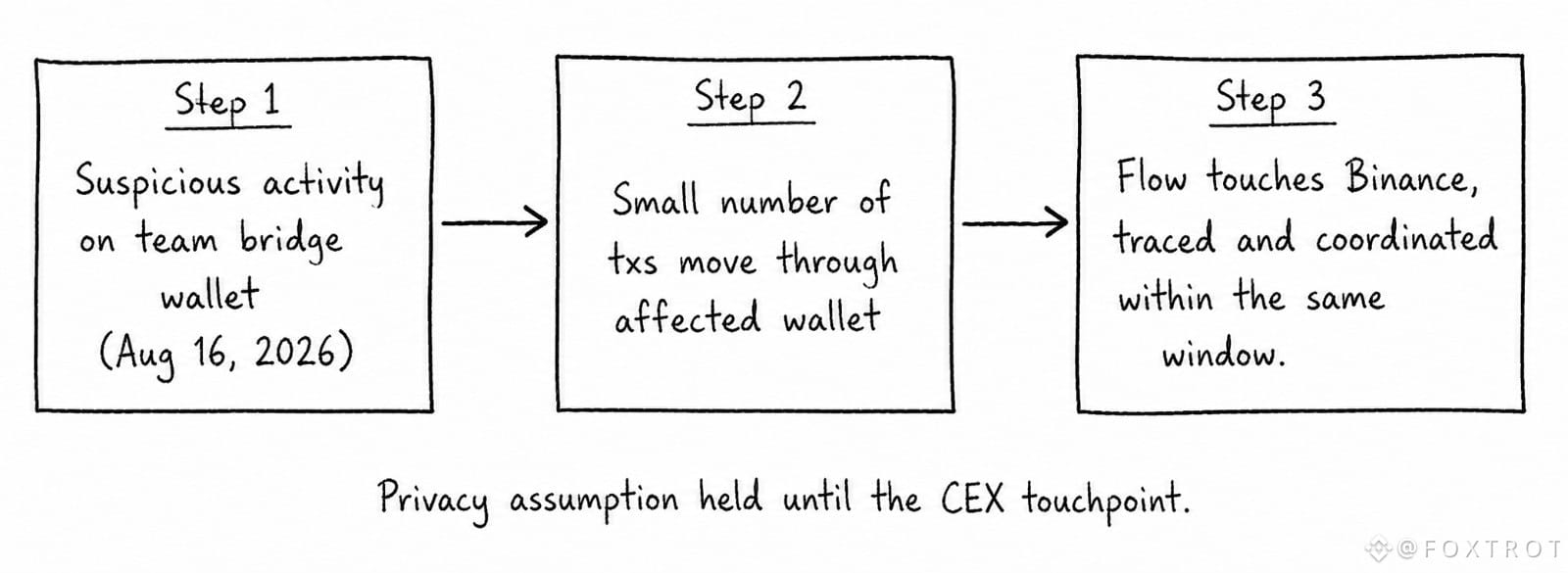
Ich bin mit der Annahme reingegangen, dass das datenschutzfreundliche Design der Dusk Foundation jede seltsame Transaktion im Grunde unsichtbar macht, bis lange danach — das ist doch so ziemlich der ganze Zero-Knowledge-Pitch, oder? Vertraulich per Default. Dann habe ich mir die Notizen zum Bridge-Vorfall vom 16. Aug angesehen: Eine kleine Anzahl an Transaktionen ist in dem betroffenen Zeitraum durch die betroffene Wallet gelaufen, und das Team hat das schnell genug erkannt, um zu identifizieren, dass dieser Teil des Flows Binance berührt hat — sie haben das mit denen beinahe sofort koordiniert. $DUSK #dusk
Das ist das eine Transaktionsmuster, das meine Annahme komplett umgedreht hat. Privacy-by-design heißt nicht automatisch Untraceability-by-design — zumindest nicht in den Teilen des Stacks, die mit einem zentralisierten Venue zu tun haben. Sobald Gelder auf eine CEX-Schiene übergewechselt sind, wurde die Sichtbarkeit sofort wieder hergestellt — schneller als ich ehrlich gesagt erwartet hatte. Das hat mich neu darüber nachdenken lassen, wo die „Privatsphäre“ in der Praxis wirklich wohnt, im Vergleich dazu, wo sie einfach… noch nicht greift. @Dusk_Foundation
Ich hatte mir eine ganze Annahme auf Basis der Marketing-Formulierung zurechtgelegt und musste sie während der Arbeit still und leise zurücknehmen. Ein bisschen nervig, wenn das passiert — aber im Grunde auch der Punkt dabei, das manuell zu machen statt nur eine Zusammenfassung zu überfliegen.
Ich bin immer noch nicht sicher, wo genau die tatsächliche Grenze zwischen dem liegt, was bei Dusk privat ist, und dem, was nur privat bleibt, bis es an eine Börse geht — hat das schon jemand sauber bis zur Grenze verfolgt?
Fast hätte ich diesen hier übersehen, ngl — dann musste ich aber stoppen und die Mitteilung zweimal neu lesen.
Ich bin mit der Annahme reingegangen, dass das datenschutzfreundliche Design der Dusk Foundation jede seltsame Transaktion im Grunde unsichtbar macht, bis lange danach — das ist doch so ziemlich der ganze Zero-Knowledge-Pitch, oder? Vertraulich per Default. Dann habe ich mir die Notizen zum Bridge-Vorfall vom 16. Aug angesehen: Eine kleine Anzahl an Transaktionen ist in dem betroffenen Zeitraum durch die betroffene Wallet gelaufen, und das Team hat das schnell genug erkannt, um zu identifizieren, dass dieser Teil des Flows Binance berührt hat — sie haben das mit denen beinahe sofort koordiniert. $DUSK #dusk
Das ist das eine Transaktionsmuster, das meine Annahme komplett umgedreht hat. Privacy-by-design heißt nicht automatisch Untraceability-by-design — zumindest nicht in den Teilen des Stacks, die mit einem zentralisierten Venue zu tun haben. Sobald Gelder auf eine CEX-Schiene übergewechselt sind, wurde die Sichtbarkeit sofort wieder hergestellt — schneller als ich ehrlich gesagt erwartet hatte. Das hat mich neu darüber nachdenken lassen, wo die „Privatsphäre“ in der Praxis wirklich wohnt, im Vergleich dazu, wo sie einfach… noch nicht greift. @Dusk
Ich hatte mir eine ganze Annahme auf Basis der Marketing-Formulierung zurechtgelegt und musste sie während der Arbeit still und leise zurücknehmen. Ein bisschen nervig, wenn das passiert — aber im Grunde auch der Punkt dabei, das manuell zu machen statt nur eine Zusammenfassung zu überfliegen.
Ich bin immer noch nicht sicher, wo genau die tatsächliche Grenze zwischen dem liegt, was bei Dusk privat ist, und dem, was nur privat bleibt, bis es an eine Börse geht — hat das schon jemand sauber bis zur Grenze verfolgt?
Ich bin mit der Annahme reingegangen, dass das datenschutzfreundliche Design der Dusk Foundation jede seltsame Transaktion im Grunde unsichtbar macht, bis lange danach — das ist doch so ziemlich der ganze Zero-Knowledge-Pitch, oder? Vertraulich per Default. Dann habe ich mir die Notizen zum Bridge-Vorfall vom 16. Aug angesehen: Eine kleine Anzahl an Transaktionen ist in dem betroffenen Zeitraum durch die betroffene Wallet gelaufen, und das Team hat das schnell genug erkannt, um zu identifizieren, dass dieser Teil des Flows Binance berührt hat — sie haben das mit denen beinahe sofort koordiniert. $DUSK #dusk
Das ist das eine Transaktionsmuster, das meine Annahme komplett umgedreht hat. Privacy-by-design heißt nicht automatisch Untraceability-by-design — zumindest nicht in den Teilen des Stacks, die mit einem zentralisierten Venue zu tun haben. Sobald Gelder auf eine CEX-Schiene übergewechselt sind, wurde die Sichtbarkeit sofort wieder hergestellt — schneller als ich ehrlich gesagt erwartet hatte. Das hat mich neu darüber nachdenken lassen, wo die „Privatsphäre“ in der Praxis wirklich wohnt, im Vergleich dazu, wo sie einfach… noch nicht greift. @Dusk
Ich hatte mir eine ganze Annahme auf Basis der Marketing-Formulierung zurechtgelegt und musste sie während der Arbeit still und leise zurücknehmen. Ein bisschen nervig, wenn das passiert — aber im Grunde auch der Punkt dabei, das manuell zu machen statt nur eine Zusammenfassung zu überfliegen.
Ich bin immer noch nicht sicher, wo genau die tatsächliche Grenze zwischen dem liegt, was bei Dusk privat ist, und dem, was nur privat bleibt, bis es an eine Börse geht — hat das schon jemand sauber bis zur Grenze verfolgt?
2
113
Übersetzung ansehen
Was mid-task pulling data on Dusk Foundation infra when the bridge incident notice caught my eye. Aug 16, the team flagged suspicious activity on a team-managed wallet used for bridge ops. #dusk $DUSK @Dusk_Foundation
Here's the part that made me stop scrolling: it wasn't a DuskDS protocol failure. The chain itself never blinked — mainnet kept producing blocks normally. What actually happened was the boring, human kind of risk: an operationally-managed wallet went sideways, addresses got disabled and recycled, bridge got paused, and the team scrambled to add a recipient blocklist on the Web Wallet after the fact.
That's the gap nobody markets. "Trustless settlement" is the pitch. But the bridge — the exact point where value crosses in and out — still runs on a team-controlled hot wallet that can get compromised like any centralized custodian's. The privacy tech, the ZK layer, the deterministic finality… none of that mattered here. What mattered was old-fashioned key management, and it showed.
Makes me wonder how much of "decentralized infrastructure" messaging quietly depends on centralized choke points nobody stress-tests until something goes wrong. Which piece of your favorite chain is still just a wallet somebody has to keep safe?
Was mid-task pulling data on Dusk Foundation infra when the bridge incident notice caught my eye. Aug 16, the team flagged suspicious activity on a team-managed wallet used for bridge ops. #dusk $DUSK @Dusk
Here's the part that made me stop scrolling: it wasn't a DuskDS protocol failure. The chain itself never blinked — mainnet kept producing blocks normally. What actually happened was the boring, human kind of risk: an operationally-managed wallet went sideways, addresses got disabled and recycled, bridge got paused, and the team scrambled to add a recipient blocklist on the Web Wallet after the fact.
That's the gap nobody markets. "Trustless settlement" is the pitch. But the bridge — the exact point where value crosses in and out — still runs on a team-controlled hot wallet that can get compromised like any centralized custodian's. The privacy tech, the ZK layer, the deterministic finality… none of that mattered here. What mattered was old-fashioned key management, and it showed.
Makes me wonder how much of "decentralized infrastructure" messaging quietly depends on centralized choke points nobody stress-tests until something goes wrong. Which piece of your favorite chain is still just a wallet somebody has to keep safe?
Here's the part that made me stop scrolling: it wasn't a DuskDS protocol failure. The chain itself never blinked — mainnet kept producing blocks normally. What actually happened was the boring, human kind of risk: an operationally-managed wallet went sideways, addresses got disabled and recycled, bridge got paused, and the team scrambled to add a recipient blocklist on the Web Wallet after the fact.
That's the gap nobody markets. "Trustless settlement" is the pitch. But the bridge — the exact point where value crosses in and out — still runs on a team-controlled hot wallet that can get compromised like any centralized custodian's. The privacy tech, the ZK layer, the deterministic finality… none of that mattered here. What mattered was old-fashioned key management, and it showed.
Makes me wonder how much of "decentralized infrastructure" messaging quietly depends on centralized choke points nobody stress-tests until something goes wrong. Which piece of your favorite chain is still just a wallet somebody has to keep safe?
73
Übersetzung ansehen
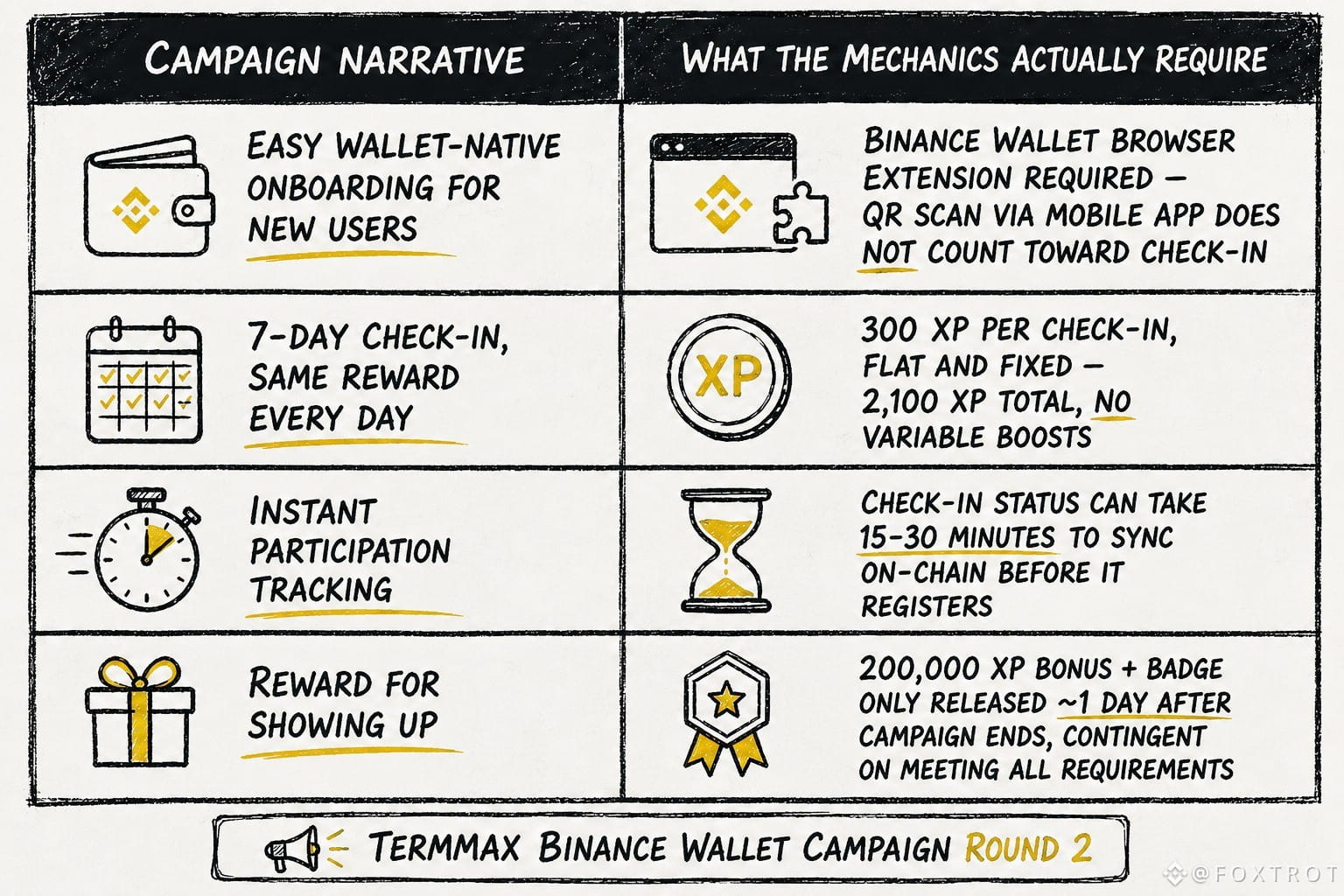
#termmax @termmax Spent the last stretch of this task actually working through TermMax's #TermMax @Termmax Binance Wallet Campaign Round 2 instead of just reading about it, and one detail stopped me mid-scroll.
The check-in mechanic is oddly rigid for something marketed as "easy onboarding" — 7 consecutive days, 300 XP fixed per check-in, 2,100 XP guaranteed if you don't miss a day, plus a 200K XP bonus and an exclusive badge released roughly a day after the campaign closes. Nothing variable, nothing gamified with multipliers. Same flat-rate logic $TMX applies to its actual lending markets, just repackaged as a growth loop.
But here's the part that made me pause — the docs specifically flag that logging in via QR scan through the Binance app doesn't count. You need the desktop browser extension. So a campaign framed as low-friction, wallet-native onboarding quietly filters out anyone who's mobile-only from day one. The people who benefit first aren't new users getting introduced to fixed-rate DeFi, they're existing desktop-native wallet users who already know the extension flow.
Tried it myself on mobile first, hit the wall, had to switch devices just to get check-in status to register.
Makes me wonder how much of the "participation" number Binance eventually reports is just filtered by that one interface choice before any real usage happens.
#termmax @TermMax Spent the last stretch of this task actually working through TermMax's #TermMax @Termmax Binance Wallet Campaign Round 2 instead of just reading about it, and one detail stopped me mid-scroll.
The check-in mechanic is oddly rigid for something marketed as "easy onboarding" — 7 consecutive days, 300 XP fixed per check-in, 2,100 XP guaranteed if you don't miss a day, plus a 200K XP bonus and an exclusive badge released roughly a day after the campaign closes. Nothing variable, nothing gamified with multipliers. Same flat-rate logic $TMX applies to its actual lending markets, just repackaged as a growth loop.
But here's the part that made me pause — the docs specifically flag that logging in via QR scan through the Binance app doesn't count. You need the desktop browser extension. So a campaign framed as low-friction, wallet-native onboarding quietly filters out anyone who's mobile-only from day one. The people who benefit first aren't new users getting introduced to fixed-rate DeFi, they're existing desktop-native wallet users who already know the extension flow.
Tried it myself on mobile first, hit the wall, had to switch devices just to get check-in status to register.
Makes me wonder how much of the "participation" number Binance eventually reports is just filtered by that one interface choice before any real usage happens.
The check-in mechanic is oddly rigid for something marketed as "easy onboarding" — 7 consecutive days, 300 XP fixed per check-in, 2,100 XP guaranteed if you don't miss a day, plus a 200K XP bonus and an exclusive badge released roughly a day after the campaign closes. Nothing variable, nothing gamified with multipliers. Same flat-rate logic $TMX applies to its actual lending markets, just repackaged as a growth loop.
But here's the part that made me pause — the docs specifically flag that logging in via QR scan through the Binance app doesn't count. You need the desktop browser extension. So a campaign framed as low-friction, wallet-native onboarding quietly filters out anyone who's mobile-only from day one. The people who benefit first aren't new users getting introduced to fixed-rate DeFi, they're existing desktop-native wallet users who already know the extension flow.
Tried it myself on mobile first, hit the wall, had to switch devices just to get check-in status to register.
Makes me wonder how much of the "participation" number Binance eventually reports is just filtered by that one interface choice before any real usage happens.
1
49
Übersetzung ansehen
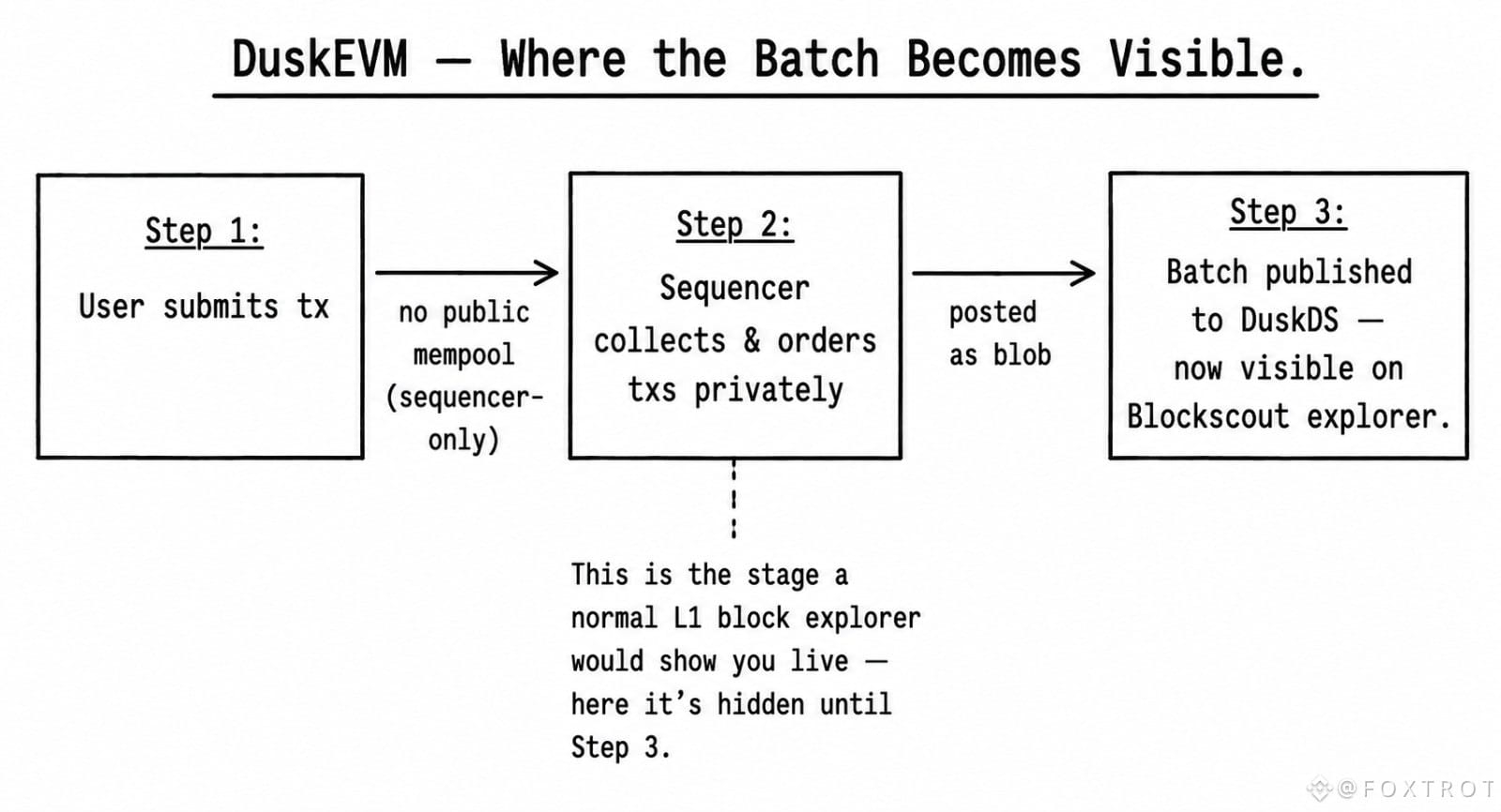
Poked around DuskEVM's Blockscout explorer today for this Dusk ($DUSK , @Dusk_Foundation , #dusk ) task, hunting for one block that'd tell me something honest about usage. Found the opposite of what I expected — there's no public mempool to watch. Sequencer-only. Transactions get bundled and posted to DuskDS as blobs on a batch cadence, not filled block-by-block the way you'd watch an Ethereum block fill up in real time.
Hmm. Sat with that a second. On most EVM chains you can literally see the queue — pending txs, gas wars, congestion — all visible before finality. Here that layer just... isn't exposed. You only see the batch after the sequencer's already decided what goes in it.
Doesn't mean anything sinister — the docs are upfront about it, this is testnet-stage architecture and broader visibility usually gets layered in later. But it did reset an assumption I was carrying — that "on-chain activity" on DuskEVM right now means "what the sequencer chose to publish," not raw unfiltered demand the way explorers on other chains tend to show it.
Caught myself about to jot "decentralized execution" in my notes before remembering the sequencer's still the single point deciding batch contents at this stage. Had to cross that out.
Makes me wonder how that changes once there's a public mempool or multiple sequencers — does the quiet block start telling a louder story, or does the opacity just move somewhere else?
Poked around DuskEVM's Blockscout explorer today for this Dusk ($DUSK , @Dusk , #dusk ) task, hunting for one block that'd tell me something honest about usage. Found the opposite of what I expected — there's no public mempool to watch. Sequencer-only. Transactions get bundled and posted to DuskDS as blobs on a batch cadence, not filled block-by-block the way you'd watch an Ethereum block fill up in real time.
Hmm. Sat with that a second. On most EVM chains you can literally see the queue — pending txs, gas wars, congestion — all visible before finality. Here that layer just... isn't exposed. You only see the batch after the sequencer's already decided what goes in it.
Doesn't mean anything sinister — the docs are upfront about it, this is testnet-stage architecture and broader visibility usually gets layered in later. But it did reset an assumption I was carrying — that "on-chain activity" on DuskEVM right now means "what the sequencer chose to publish," not raw unfiltered demand the way explorers on other chains tend to show it.
Caught myself about to jot "decentralized execution" in my notes before remembering the sequencer's still the single point deciding batch contents at this stage. Had to cross that out.
Makes me wonder how that changes once there's a public mempool or multiple sequencers — does the quiet block start telling a louder story, or does the opacity just move somewhere else?
Hmm. Sat with that a second. On most EVM chains you can literally see the queue — pending txs, gas wars, congestion — all visible before finality. Here that layer just... isn't exposed. You only see the batch after the sequencer's already decided what goes in it.
Doesn't mean anything sinister — the docs are upfront about it, this is testnet-stage architecture and broader visibility usually gets layered in later. But it did reset an assumption I was carrying — that "on-chain activity" on DuskEVM right now means "what the sequencer chose to publish," not raw unfiltered demand the way explorers on other chains tend to show it.
Caught myself about to jot "decentralized execution" in my notes before remembering the sequencer's still the single point deciding batch contents at this stage. Had to cross that out.
Makes me wonder how that changes once there's a public mempool or multiple sequencers — does the quiet block start telling a louder story, or does the opacity just move somewhere else?
1
65
Übersetzung ansehen
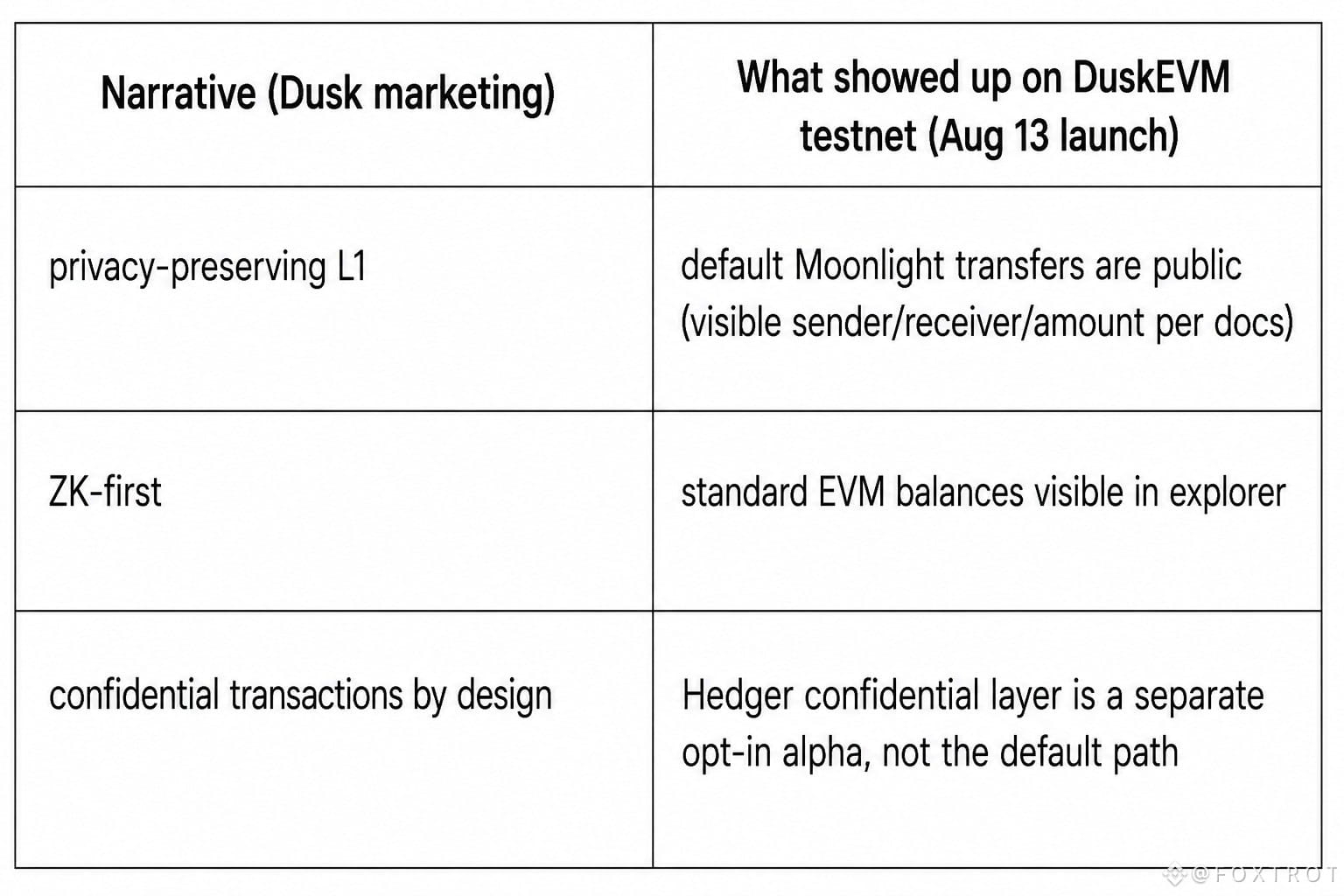
Spent the afternoon poking around DuskEVM testnet, live since Aug 13, deploying a dumb little contract just to see what shows up. Dusk ($DUSK , #dusk , @Dusk_Foundation ) sells itself hard on privacy — ZK everything, confidential balances, the whole pitch. So I expected to have to dig for the private stuff.
Instead the first thing you actually touch is completely plain. DuskEVM runs like any EVM chain — Solidity, Hardhat, gas paid in DUSK, balances sitting right there in the explorer. Moonlight, the account-based transaction path, is documented as literally public: non-reverted transfer events, visible receiver, visible amount, nothing hidden. Hedger — the confidential layer — is a separate alpha you opt into on top, not something baked into the default path.
Kind of a funny gap, hold up — the "privacy L1" pitch is true at the protocol level (Phoenix exists, ZK proofs exist), but what you bump into first as a builder is a fully transparent chain with privacy sitting off to the side as an extra step. Not a bad design necessarily, regulated finance probably wants that default-transparent posture anyway. Still wasn't what I pictured going in.
Makes me wonder how many people staking or building here actually touch Hedger at all, versus just running standard EVM stuff and never opting in.
Spent the afternoon poking around DuskEVM testnet, live since Aug 13, deploying a dumb little contract just to see what shows up. Dusk ($DUSK , #dusk , @Dusk ) sells itself hard on privacy — ZK everything, confidential balances, the whole pitch. So I expected to have to dig for the private stuff.
Instead the first thing you actually touch is completely plain. DuskEVM runs like any EVM chain — Solidity, Hardhat, gas paid in DUSK, balances sitting right there in the explorer. Moonlight, the account-based transaction path, is documented as literally public: non-reverted transfer events, visible receiver, visible amount, nothing hidden. Hedger — the confidential layer — is a separate alpha you opt into on top, not something baked into the default path.
Kind of a funny gap, hold up — the "privacy L1" pitch is true at the protocol level (Phoenix exists, ZK proofs exist), but what you bump into first as a builder is a fully transparent chain with privacy sitting off to the side as an extra step. Not a bad design necessarily, regulated finance probably wants that default-transparent posture anyway. Still wasn't what I pictured going in.
Makes me wonder how many people staking or building here actually touch Hedger at all, versus just running standard EVM stuff and never opting in.
Instead the first thing you actually touch is completely plain. DuskEVM runs like any EVM chain — Solidity, Hardhat, gas paid in DUSK, balances sitting right there in the explorer. Moonlight, the account-based transaction path, is documented as literally public: non-reverted transfer events, visible receiver, visible amount, nothing hidden. Hedger — the confidential layer — is a separate alpha you opt into on top, not something baked into the default path.
Kind of a funny gap, hold up — the "privacy L1" pitch is true at the protocol level (Phoenix exists, ZK proofs exist), but what you bump into first as a builder is a fully transparent chain with privacy sitting off to the side as an extra step. Not a bad design necessarily, regulated finance probably wants that default-transparent posture anyway. Still wasn't what I pictured going in.
Makes me wonder how many people staking or building here actually touch Hedger at all, versus just running standard EVM stuff and never opting in.
1
54
Übersetzung ansehen
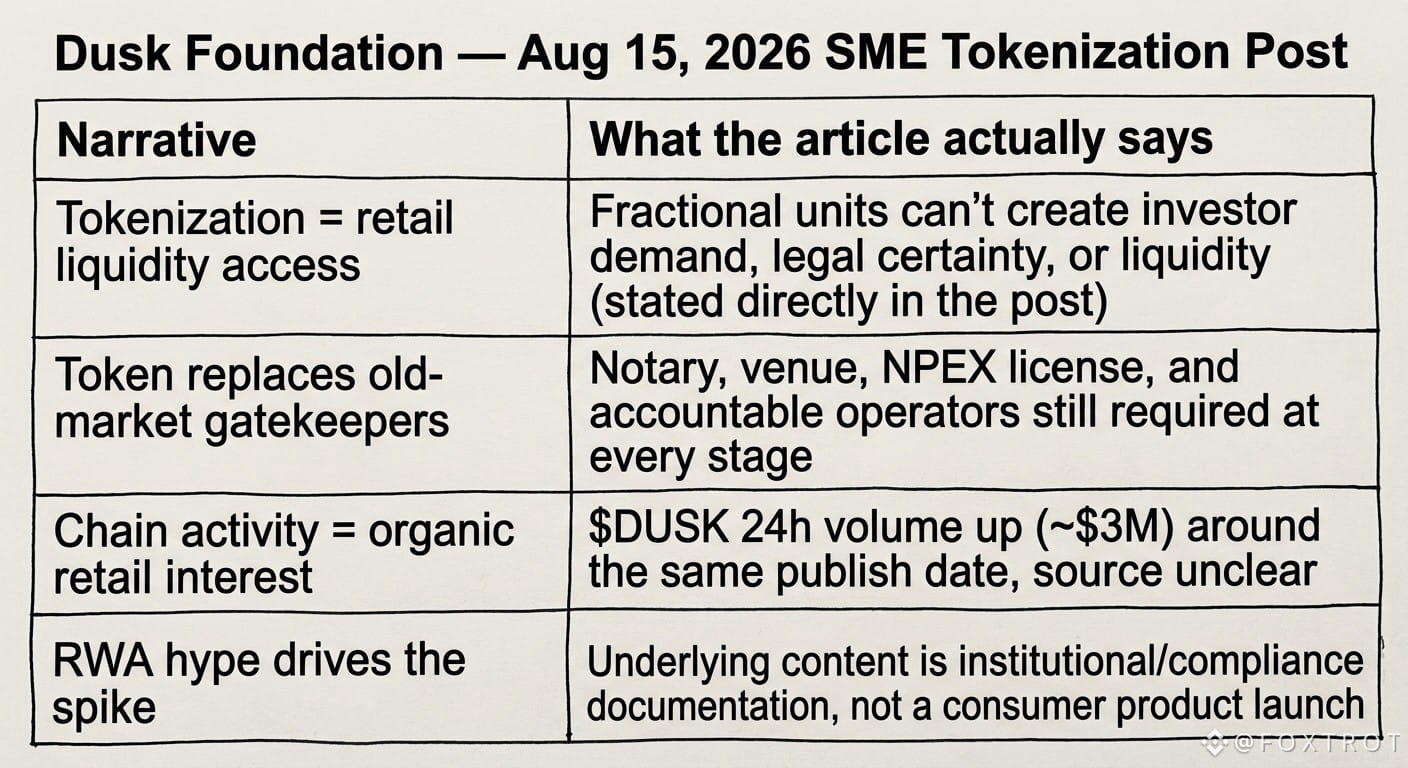
Spent the afternoon inside a Dusk Foundation task and almost scrolled past the newest thing on their own site — "Tokenization for SMEs and Private Market Financing," posted Aug 15. $DUSK volume had ticked up alongside it too, something like $3M and climbing, small but noticeably above the usual quiet stretch. #dusk @Dusk_Foundation . Figured it'd be another glossy RWA pitch. It wasn't.
What actually stopped me was one line, almost buried in a table: fractional ownership "plays a limited role" because smaller units can't create investor demand, legal certainty, or liquidity on their own. That's the foundation itself saying the token doesn't do the heavy lifting people assume it does. The real weight sits with the notary, the venue, NPEX's license, the accountable operators who existed before any of this touched a chain.
Hmm — so the spike isn't retail piling in on a tokenization story. It's institutional plumbing getting quietly documented while the market reads it as hype. Sat with that longer than I meant to, snack forgotten, half-drafted post open.
Who's actually capturing value first here — the DLT Pilot Regime participants doing the compliance grind, or the people buying $DUSK because "RWA" is trending this week?
Spent the afternoon inside a Dusk Foundation task and almost scrolled past the newest thing on their own site — "Tokenization for SMEs and Private Market Financing," posted Aug 15. $DUSK volume had ticked up alongside it too, something like $3M and climbing, small but noticeably above the usual quiet stretch. #dusk @Dusk . Figured it'd be another glossy RWA pitch. It wasn't.
What actually stopped me was one line, almost buried in a table: fractional ownership "plays a limited role" because smaller units can't create investor demand, legal certainty, or liquidity on their own. That's the foundation itself saying the token doesn't do the heavy lifting people assume it does. The real weight sits with the notary, the venue, NPEX's license, the accountable operators who existed before any of this touched a chain.
Hmm — so the spike isn't retail piling in on a tokenization story. It's institutional plumbing getting quietly documented while the market reads it as hype. Sat with that longer than I meant to, snack forgotten, half-drafted post open.
Who's actually capturing value first here — the DLT Pilot Regime participants doing the compliance grind, or the people buying $DUSK because "RWA" is trending this week?
What actually stopped me was one line, almost buried in a table: fractional ownership "plays a limited role" because smaller units can't create investor demand, legal certainty, or liquidity on their own. That's the foundation itself saying the token doesn't do the heavy lifting people assume it does. The real weight sits with the notary, the venue, NPEX's license, the accountable operators who existed before any of this touched a chain.
Hmm — so the spike isn't retail piling in on a tokenization story. It's institutional plumbing getting quietly documented while the market reads it as hype. Sat with that longer than I meant to, snack forgotten, half-drafted post open.
Who's actually capturing value first here — the DLT Pilot Regime participants doing the compliance grind, or the people buying $DUSK because "RWA" is trending this week?
4
110
Übersetzung ansehen
Numbers looked completely normal at first glance, that's what almost made me skip past it.
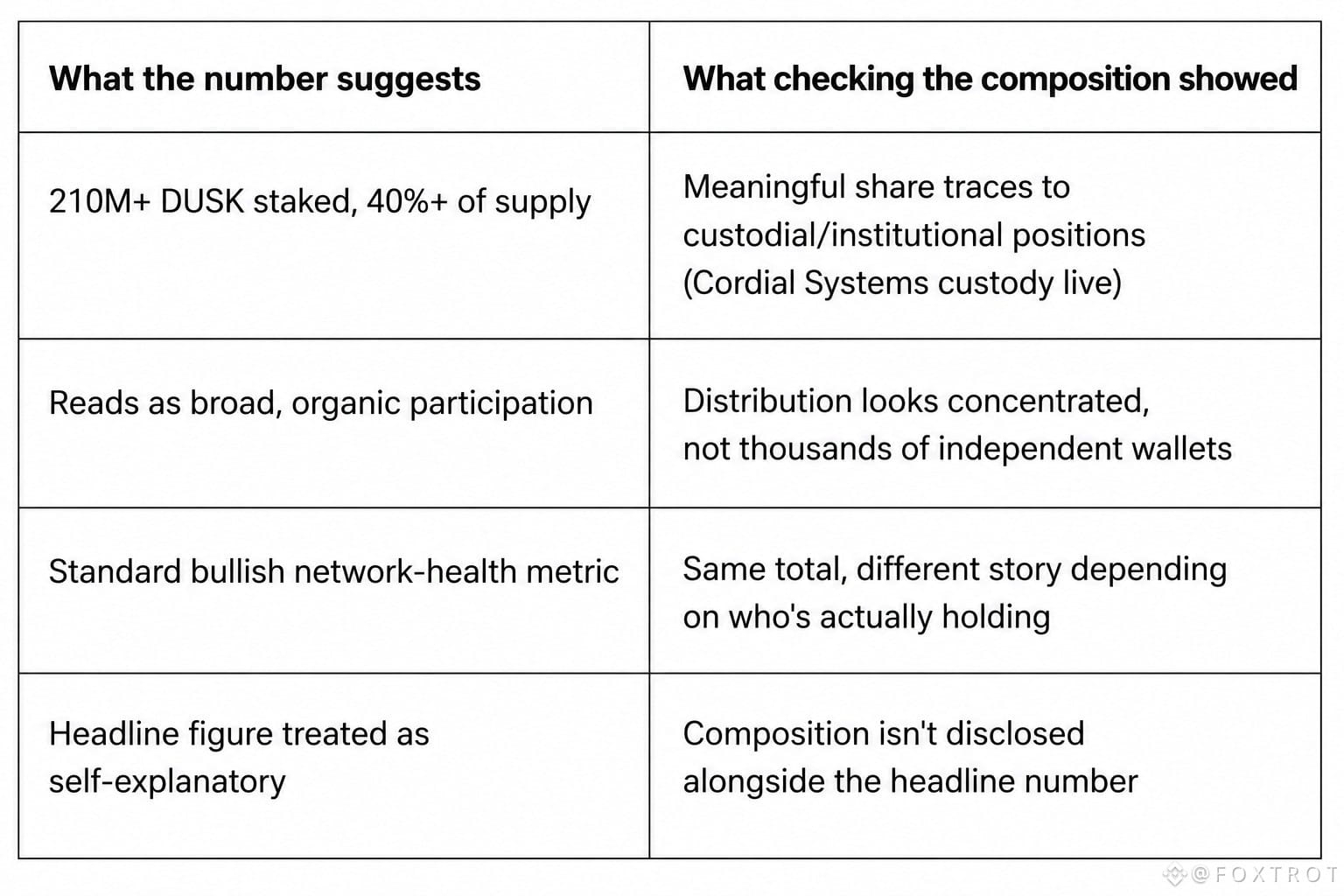
Checking staking data on Dusk this week, 210M+ $DUSK staked out of the 500M total supply reads like healthy, broad participation, over 40% of supply locked in. Standard bull case metric, the kind you'd screenshot without a second look. But #dusk also has that Cordial Systems custody partnership live for institutional asset operations, so I went and looked at what was actually behind that staked figure instead of just citing it.
Turns out a meaningful chunk of it traces back to custodial/institutional positions, not thousands of individual wallets slowly accumulating. Same total, very different story depending on whether it's one large holder routing through custody infrastructure or genuine widespread participation.
Had to sit with that for a sec, because the number alone tells you nothing about who's actually behind it, ordinary-looking metrics can hide a completely different distribution.
Not saying it's bad, institutional stake is still stake. Just… the headline figure and the actual composition are two separate claims, and only one of them is usually shown.
Makes me want to check every "record staked" post from now on for who's actually holding, not just how much.
@Dusk_Foundation
Numbers looked completely normal at first glance, that's what almost made me skip past it.
Checking staking data on Dusk this week, 210M+ $DUSK staked out of the 500M total supply reads like healthy, broad participation, over 40% of supply locked in. Standard bull case metric, the kind you'd screenshot without a second look. But #dusk also has that Cordial Systems custody partnership live for institutional asset operations, so I went and looked at what was actually behind that staked figure instead of just citing it.
Turns out a meaningful chunk of it traces back to custodial/institutional positions, not thousands of individual wallets slowly accumulating. Same total, very different story depending on whether it's one large holder routing through custody infrastructure or genuine widespread participation.
Had to sit with that for a sec, because the number alone tells you nothing about who's actually behind it, ordinary-looking metrics can hide a completely different distribution.
Not saying it's bad, institutional stake is still stake. Just… the headline figure and the actual composition are two separate claims, and only one of them is usually shown.
Makes me want to check every "record staked" post from now on for who's actually holding, not just how much.
@Dusk
Checking staking data on Dusk this week, 210M+ $DUSK staked out of the 500M total supply reads like healthy, broad participation, over 40% of supply locked in. Standard bull case metric, the kind you'd screenshot without a second look. But #dusk also has that Cordial Systems custody partnership live for institutional asset operations, so I went and looked at what was actually behind that staked figure instead of just citing it.
Turns out a meaningful chunk of it traces back to custodial/institutional positions, not thousands of individual wallets slowly accumulating. Same total, very different story depending on whether it's one large holder routing through custody infrastructure or genuine widespread participation.
Had to sit with that for a sec, because the number alone tells you nothing about who's actually behind it, ordinary-looking metrics can hide a completely different distribution.
Not saying it's bad, institutional stake is still stake. Just… the headline figure and the actual composition are two separate claims, and only one of them is usually shown.
Makes me want to check every "record staked" post from now on for who's actually holding, not just how much.
@Dusk
2
114
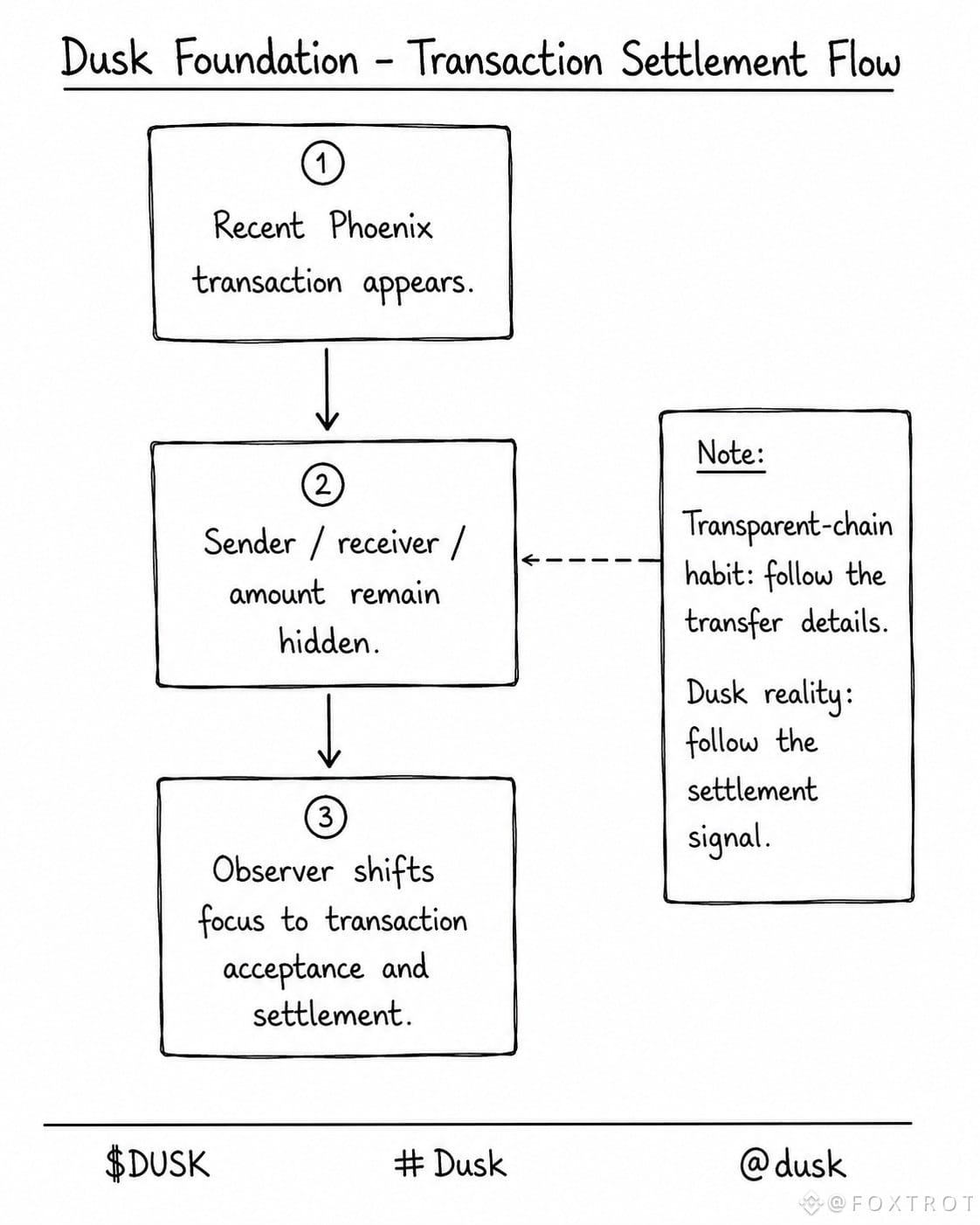
Was mich überrascht hat, war, wie schnell ich aufgehört habe, mich für die Transaktion selbst zu interessieren, und stattdessen darauf geachtet habe, was danach passiert. Ich habe im Dusk Foundation nachgegraben, $DUSK , #dusk und @Dusk_Foundation , und dabei die jüngste Phoenix-Aktivität im Explorer verfolgt. Das Siedlungsmuster wirkte für mich interessanter als die Transaktionsdetails.
Eine kürzlich erfolgte Phoenix-Transaktion zeigte die übliche Dusk-Eigenart: Der Transaktionstyp ist sichtbar, während Absender, Empfänger und Betrag nicht in der vertrauten Weise offengelegt werden. Was mir auffiel, als ich ihr durch die Abwicklung gefolgt bin, war, dass sich das hilfreiche Signal von „Wer hat was gesendet?“ hin zu der Frage verschiebt, ob das Netzwerk die Transaktion korrekt akzeptiert und finalisiert hat. Dusks Architektur ist genau auf diese Trennung ausgelegt. Die Kette kann den Zustandsübergang überprüfen, ohne die privaten Inhalte zu veröffentlichen.
Das klingt offensichtlich, wenn man es aufschreibt. Es fühlte sich nicht offensichtlich an, während ich tatsächlich auf den Explorer starrte. Ich hielt weiterhin Ausschau, dass die Transaktionsseite mir noch einen Hinweis geben würde, und merkte dann, dass ich mir angewöhnt hatte, eine „Transparente-Kette“-Routine auf eine datenschutzorientierte zu übertragen. Hmm. Dadurch hat sich verändert, was ich auf Dusk unter „Transaktion beobachten“ verstanden habe.
Jetzt frage ich mich, ob das die eigentliche Anpassung ist, die Nutzer vornehmen müssen: nicht zu lernen, wie private Transaktionen technisch funktionieren, sondern zu lernen, welche Signale noch relevant sind, wenn die üblichen bewusst verschwinden…
'
Was mich überrascht hat, war, wie schnell ich aufgehört habe, mich für die Transaktion selbst zu interessieren, und stattdessen darauf geachtet habe, was danach passiert. Ich habe im Dusk Foundation nachgegraben, $DUSK , #dusk und @Dusk , und dabei die jüngste Phoenix-Aktivität im Explorer verfolgt. Das Siedlungsmuster wirkte für mich interessanter als die Transaktionsdetails.
Eine kürzlich erfolgte Phoenix-Transaktion zeigte die übliche Dusk-Eigenart: Der Transaktionstyp ist sichtbar, während Absender, Empfänger und Betrag nicht in der vertrauten Weise offengelegt werden. Was mir auffiel, als ich ihr durch die Abwicklung gefolgt bin, war, dass sich das hilfreiche Signal von „Wer hat was gesendet?“ hin zu der Frage verschiebt, ob das Netzwerk die Transaktion korrekt akzeptiert und finalisiert hat. Dusks Architektur ist genau auf diese Trennung ausgelegt. Die Kette kann den Zustandsübergang überprüfen, ohne die privaten Inhalte zu veröffentlichen.
Das klingt offensichtlich, wenn man es aufschreibt. Es fühlte sich nicht offensichtlich an, während ich tatsächlich auf den Explorer starrte. Ich hielt weiterhin Ausschau, dass die Transaktionsseite mir noch einen Hinweis geben würde, und merkte dann, dass ich mir angewöhnt hatte, eine „Transparente-Kette“-Routine auf eine datenschutzorientierte zu übertragen. Hmm. Dadurch hat sich verändert, was ich auf Dusk unter „Transaktion beobachten“ verstanden habe.
Jetzt frage ich mich, ob das die eigentliche Anpassung ist, die Nutzer vornehmen müssen: nicht zu lernen, wie private Transaktionen technisch funktionieren, sondern zu lernen, welche Signale noch relevant sind, wenn die üblichen bewusst verschwinden…
'
Eine kürzlich erfolgte Phoenix-Transaktion zeigte die übliche Dusk-Eigenart: Der Transaktionstyp ist sichtbar, während Absender, Empfänger und Betrag nicht in der vertrauten Weise offengelegt werden. Was mir auffiel, als ich ihr durch die Abwicklung gefolgt bin, war, dass sich das hilfreiche Signal von „Wer hat was gesendet?“ hin zu der Frage verschiebt, ob das Netzwerk die Transaktion korrekt akzeptiert und finalisiert hat. Dusks Architektur ist genau auf diese Trennung ausgelegt. Die Kette kann den Zustandsübergang überprüfen, ohne die privaten Inhalte zu veröffentlichen.
Das klingt offensichtlich, wenn man es aufschreibt. Es fühlte sich nicht offensichtlich an, während ich tatsächlich auf den Explorer starrte. Ich hielt weiterhin Ausschau, dass die Transaktionsseite mir noch einen Hinweis geben würde, und merkte dann, dass ich mir angewöhnt hatte, eine „Transparente-Kette“-Routine auf eine datenschutzorientierte zu übertragen. Hmm. Dadurch hat sich verändert, was ich auf Dusk unter „Transaktion beobachten“ verstanden habe.
Jetzt frage ich mich, ob das die eigentliche Anpassung ist, die Nutzer vornehmen müssen: nicht zu lernen, wie private Transaktionen technisch funktionieren, sondern zu lernen, welche Signale noch relevant sind, wenn die üblichen bewusst verschwinden…
'
2
121
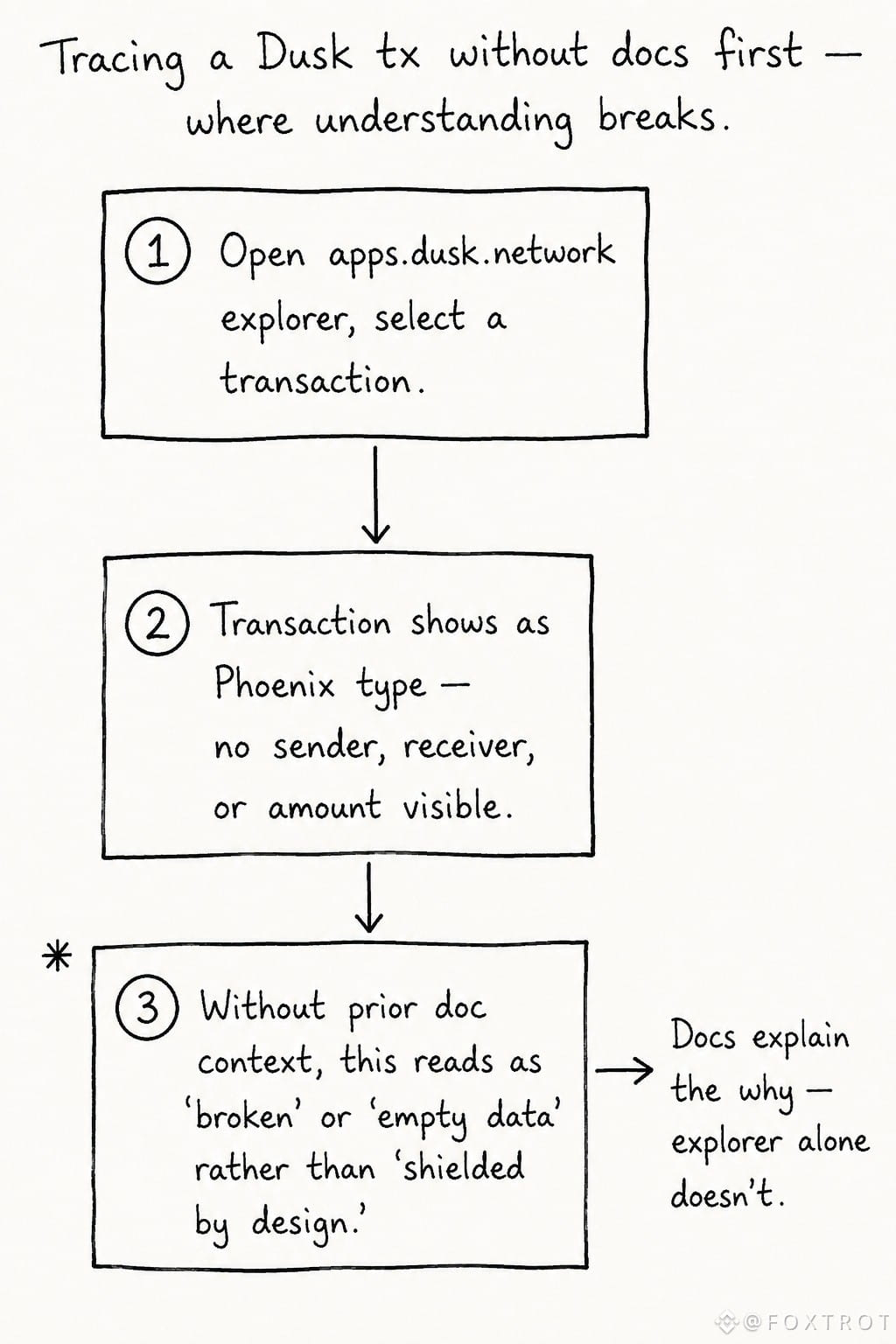
Diesmal habe ich für die Dusk-Foundation-Aufgabe die Doku übersprungen und stattdessen einfach den Live-Explorer unter apps.dusk.network geöffnet, um eine Transaktion „cold“ nachzuvollziehen — ohne Kontext, nur um zu sehen, was ich wirklich verstehe. Heraus kam … weniger, als ich erwartet hatte, und genau das war das Ergebnis.
Die Doku erklärt die Aufteilung zwischen Phoenix und Moonlight klar, setzt Obergrenzen für die Blockgröße bei etwa 1 MB (grob 250 Phoenix-Tx pro Block) und legt die gesamte Design-Logik in verständlicher Sprache dar. Aber wenn man direkt vor dem rohen Explorer sitzt, ohne diese Einordnung, sieht eine abgeschirmte Phoenix-Transaktion einfach nur wie eine Transaktion aus — ohne sichtbaren Absender, Empfänger oder Betrag, ohne offensichtliches Signal, das einem zeigt, warum sie so aufgebaut ist, außer man weiß bereits, wonach man suchen muss.
Das ist die Lücke. Die Doku verkauft dir das „Warum“, aber der Explorer allein bringt es dir nicht bei. Du brauchst beides — in dieser Reihenfolge — sonst liest sich die On-Chain-Realität eher undurchschaubar als beabsichtigt.
Schon irgendwie peinlich, wie lange ich auf eine einzelne abgeschirmte Tx gestarrt habe, in der Annahme, da sei etwas kaputt, bevor mir auffiel, dass es einfach … so funktioniert, wie es gedacht ist.
Ich frage mich, wie vielen Leuten genau diese Verwirrung den Einstieg vermasselt, bevor sie überhaupt zu der Doku kommen, die sie erklärt.
$DUSK #dusk @Dusk_Foundation
Diesmal habe ich für die Dusk-Foundation-Aufgabe die Doku übersprungen und stattdessen einfach den Live-Explorer unter apps.dusk.network geöffnet, um eine Transaktion „cold“ nachzuvollziehen — ohne Kontext, nur um zu sehen, was ich wirklich verstehe. Heraus kam … weniger, als ich erwartet hatte, und genau das war das Ergebnis.
Die Doku erklärt die Aufteilung zwischen Phoenix und Moonlight klar, setzt Obergrenzen für die Blockgröße bei etwa 1 MB (grob 250 Phoenix-Tx pro Block) und legt die gesamte Design-Logik in verständlicher Sprache dar. Aber wenn man direkt vor dem rohen Explorer sitzt, ohne diese Einordnung, sieht eine abgeschirmte Phoenix-Transaktion einfach nur wie eine Transaktion aus — ohne sichtbaren Absender, Empfänger oder Betrag, ohne offensichtliches Signal, das einem zeigt, warum sie so aufgebaut ist, außer man weiß bereits, wonach man suchen muss.
Das ist die Lücke. Die Doku verkauft dir das „Warum“, aber der Explorer allein bringt es dir nicht bei. Du brauchst beides — in dieser Reihenfolge — sonst liest sich die On-Chain-Realität eher undurchschaubar als beabsichtigt.
Schon irgendwie peinlich, wie lange ich auf eine einzelne abgeschirmte Tx gestarrt habe, in der Annahme, da sei etwas kaputt, bevor mir auffiel, dass es einfach … so funktioniert, wie es gedacht ist.
Ich frage mich, wie vielen Leuten genau diese Verwirrung den Einstieg vermasselt, bevor sie überhaupt zu der Doku kommen, die sie erklärt.
$DUSK #dusk @Dusk
Die Doku erklärt die Aufteilung zwischen Phoenix und Moonlight klar, setzt Obergrenzen für die Blockgröße bei etwa 1 MB (grob 250 Phoenix-Tx pro Block) und legt die gesamte Design-Logik in verständlicher Sprache dar. Aber wenn man direkt vor dem rohen Explorer sitzt, ohne diese Einordnung, sieht eine abgeschirmte Phoenix-Transaktion einfach nur wie eine Transaktion aus — ohne sichtbaren Absender, Empfänger oder Betrag, ohne offensichtliches Signal, das einem zeigt, warum sie so aufgebaut ist, außer man weiß bereits, wonach man suchen muss.
Das ist die Lücke. Die Doku verkauft dir das „Warum“, aber der Explorer allein bringt es dir nicht bei. Du brauchst beides — in dieser Reihenfolge — sonst liest sich die On-Chain-Realität eher undurchschaubar als beabsichtigt.
Schon irgendwie peinlich, wie lange ich auf eine einzelne abgeschirmte Tx gestarrt habe, in der Annahme, da sei etwas kaputt, bevor mir auffiel, dass es einfach … so funktioniert, wie es gedacht ist.
Ich frage mich, wie vielen Leuten genau diese Verwirrung den Einstieg vermasselt, bevor sie überhaupt zu der Doku kommen, die sie erklärt.
$DUSK #dusk @Dusk
2
1
125
Übersetzung ansehen
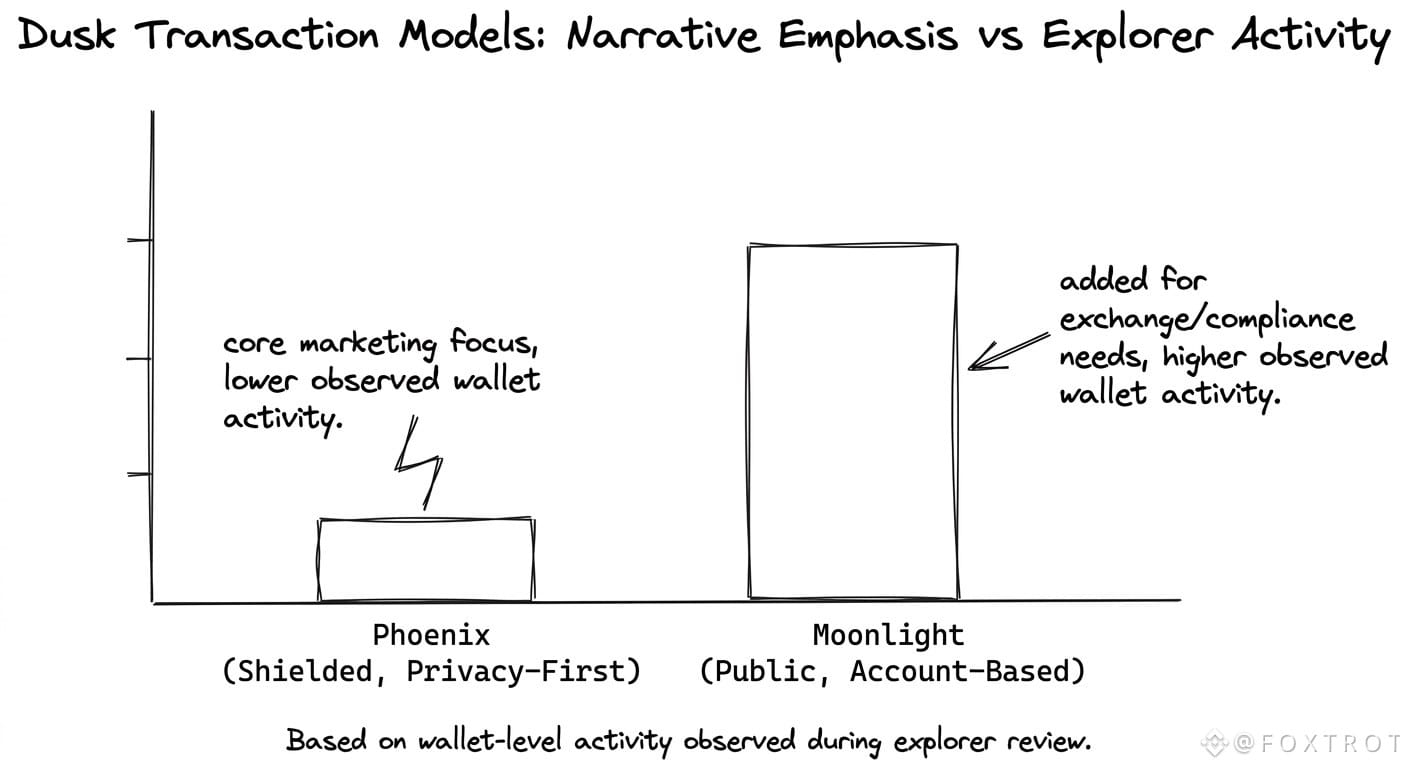
Spent a chunk of the task flipping between Moonlight and Phoenix transactions on the explorer, wallet by wallet, expecting Phoenix — the shielded, privacy-preserving side — to dominate given how hard Dusk Foundation leans on the privacy pitch. It didn't. Most of the addresses I clicked through, exchange-linked ones especially, were sitting on Moonlight, the fully transparent account model.
hmm, that's the gap that actually stuck with me. #dusk was built with dual transaction models exactly so users could choose, but choice isn't landing 50/50 in practice. Moonlight got added specifically to keep exchanges and institutions compliant without delisting risk, and the on-chain footprint I saw reflects that priority pretty plainly. Public, auditable, boring — and apparently that's what gets used first.
Kind of flips the marketing order in my head. Privacy tech gets the headline, but transparency is what onboards the money that actually needs to move today. Makes me wonder if Phoenix usage grows once retail catches up, or if it just stays the "available but unused" option.
@Dusk_Foundation isn't misrepresenting anything, both models are real and functional. Just... watching where the actual balances sit told a different story than the pitch deck order suggests.
Who's actually reaching for $DUSK shielded option once things get real.
Spent a chunk of the task flipping between Moonlight and Phoenix transactions on the explorer, wallet by wallet, expecting Phoenix — the shielded, privacy-preserving side — to dominate given how hard Dusk Foundation leans on the privacy pitch. It didn't. Most of the addresses I clicked through, exchange-linked ones especially, were sitting on Moonlight, the fully transparent account model.
hmm, that's the gap that actually stuck with me. #dusk was built with dual transaction models exactly so users could choose, but choice isn't landing 50/50 in practice. Moonlight got added specifically to keep exchanges and institutions compliant without delisting risk, and the on-chain footprint I saw reflects that priority pretty plainly. Public, auditable, boring — and apparently that's what gets used first.
Kind of flips the marketing order in my head. Privacy tech gets the headline, but transparency is what onboards the money that actually needs to move today. Makes me wonder if Phoenix usage grows once retail catches up, or if it just stays the "available but unused" option.
@Dusk isn't misrepresenting anything, both models are real and functional. Just... watching where the actual balances sit told a different story than the pitch deck order suggests.
Who's actually reaching for $DUSK shielded option once things get real.
hmm, that's the gap that actually stuck with me. #dusk was built with dual transaction models exactly so users could choose, but choice isn't landing 50/50 in practice. Moonlight got added specifically to keep exchanges and institutions compliant without delisting risk, and the on-chain footprint I saw reflects that priority pretty plainly. Public, auditable, boring — and apparently that's what gets used first.
Kind of flips the marketing order in my head. Privacy tech gets the headline, but transparency is what onboards the money that actually needs to move today. Makes me wonder if Phoenix usage grows once retail catches up, or if it just stays the "available but unused" option.
@Dusk isn't misrepresenting anything, both models are real and functional. Just... watching where the actual balances sit told a different story than the pitch deck order suggests.
Who's actually reaching for $DUSK shielded option once things get real.
3
3
99
Übersetzung ansehen
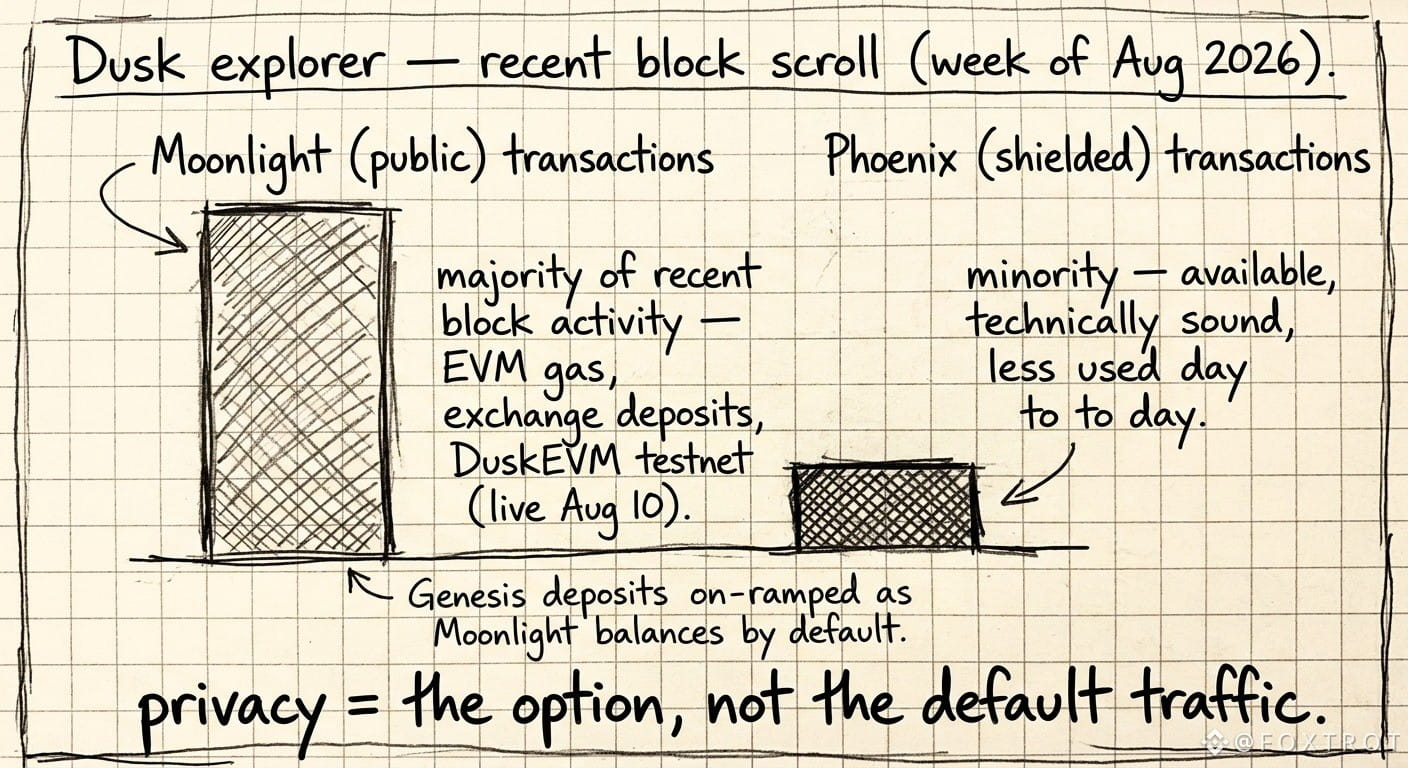
Scrolled through a stretch of recent blocks on the Dusk explorer this week just to see what "normal" looks like day to day… and hold up — almost everything moving through was Moonlight, not Phoenix. #dusk $DUSK @Dusk_Foundation — the shielded model everyone talks about when they talk about Dusk Foundation.
Makes sense once you sit with it. DuskEVM testnet went live Aug 10, gas paid in $DUSK, and every one of those transactions is public by design — Solidity tooling doesn't route through shielded notes, it's account-based, balances visible, same as any EVM chain. Even mainnet deposits get on-ramped as Moonlight balances at genesis. So block after block, what you're actually watching is the transparent rail doing the heavy lifting, not the private one.
Kept expecting to hit a run of Phoenix transfers and mostly didn't. Had to double check I wasn't misreading the explorer.
Not a knock, just noticed the gap — Phoenix is the headline feature, Moonlight is the workhorse right now. Compliance, exchange integration, EVM compatibility, all of it leans transparent by necessity. Privacy sits there as the option, available, technically sound, just… not what most blocks are actually doing yet.
Wonder at what point that ratio flips, or if "mostly public, privacy on demand" ends up being the permanent shape of it.
Scrolled through a stretch of recent blocks on the Dusk explorer this week just to see what "normal" looks like day to day… and hold up — almost everything moving through was Moonlight, not Phoenix. #dusk $DUSK @Dusk — the shielded model everyone talks about when they talk about Dusk Foundation.
Makes sense once you sit with it. DuskEVM testnet went live Aug 10, gas paid in $DUSK , and every one of those transactions is public by design — Solidity tooling doesn't route through shielded notes, it's account-based, balances visible, same as any EVM chain. Even mainnet deposits get on-ramped as Moonlight balances at genesis. So block after block, what you're actually watching is the transparent rail doing the heavy lifting, not the private one.
Kept expecting to hit a run of Phoenix transfers and mostly didn't. Had to double check I wasn't misreading the explorer.
Not a knock, just noticed the gap — Phoenix is the headline feature, Moonlight is the workhorse right now. Compliance, exchange integration, EVM compatibility, all of it leans transparent by necessity. Privacy sits there as the option, available, technically sound, just… not what most blocks are actually doing yet.
Wonder at what point that ratio flips, or if "mostly public, privacy on demand" ends up being the permanent shape of it.
Makes sense once you sit with it. DuskEVM testnet went live Aug 10, gas paid in $DUSK , and every one of those transactions is public by design — Solidity tooling doesn't route through shielded notes, it's account-based, balances visible, same as any EVM chain. Even mainnet deposits get on-ramped as Moonlight balances at genesis. So block after block, what you're actually watching is the transparent rail doing the heavy lifting, not the private one.
Kept expecting to hit a run of Phoenix transfers and mostly didn't. Had to double check I wasn't misreading the explorer.
Not a knock, just noticed the gap — Phoenix is the headline feature, Moonlight is the workhorse right now. Compliance, exchange integration, EVM compatibility, all of it leans transparent by necessity. Privacy sits there as the option, available, technically sound, just… not what most blocks are actually doing yet.
Wonder at what point that ratio flips, or if "mostly public, privacy on demand" ends up being the permanent shape of it.
2
99
Verifiziert
Übersetzung ansehen
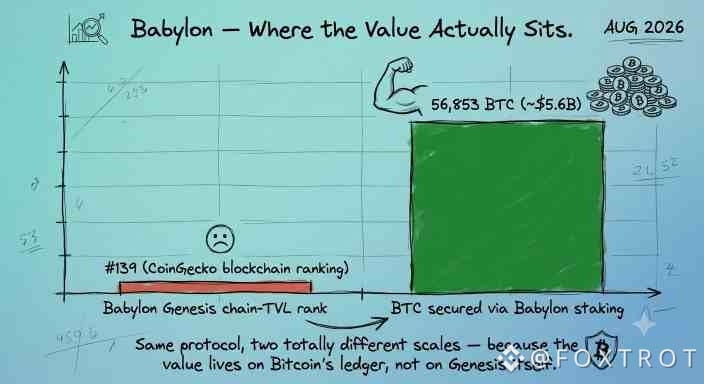
Was deep in a Babylon CreatorPad task — $BABY tab open, @babylonlabs_io docs open, #baby search running in the background — when a chain ranking stopped me mid-scroll: Babylon Genesis sits at #139 by TVL on CoinGecko's blockchain list. For a network coordinating security on 56,853 BTC, roughly $5.6B, that number looked almost backwards.
Took a second to get why. That #139 spot only counts activity happening on Genesis itself — apps, deposits, the usual chain-level DeFi stuff. The actual value the protocol touches doesn't live there. It sits on Bitcoin's own ledger, locked via timelock scripts, never bridged, never wrapped, and never shows up in a typical chain TVL count at all.
$BABY pays gas and secures Genesis validators — the smaller job, honestly. The real function is coordination: routing Bitcoin's economic weight to other chains without ever moving it. Most utility tokens get valued off how busy their own chain looks. This one's real value is mostly happening somewhere else entirely.
hmm — if the standard TVL metric misses most of what a project actually does, how many other "utility" tokens are being measured wrong too?
Was deep in a Babylon CreatorPad task — $BABY tab open, @BabylonLabs_io docs open, #baby search running in the background — when a chain ranking stopped me mid-scroll: Babylon Genesis sits at #139 by TVL on CoinGecko's blockchain list. For a network coordinating security on 56,853 BTC, roughly $5.6B, that number looked almost backwards.
Took a second to get why. That #139 spot only counts activity happening on Genesis itself — apps, deposits, the usual chain-level DeFi stuff. The actual value the protocol touches doesn't live there. It sits on Bitcoin's own ledger, locked via timelock scripts, never bridged, never wrapped, and never shows up in a typical chain TVL count at all.
$BABY pays gas and secures Genesis validators — the smaller job, honestly. The real function is coordination: routing Bitcoin's economic weight to other chains without ever moving it. Most utility tokens get valued off how busy their own chain looks. This one's real value is mostly happening somewhere else entirely.
hmm — if the standard TVL metric misses most of what a project actually does, how many other "utility" tokens are being measured wrong too?
Took a second to get why. That #139 spot only counts activity happening on Genesis itself — apps, deposits, the usual chain-level DeFi stuff. The actual value the protocol touches doesn't live there. It sits on Bitcoin's own ledger, locked via timelock scripts, never bridged, never wrapped, and never shows up in a typical chain TVL count at all.
$BABY pays gas and secures Genesis validators — the smaller job, honestly. The real function is coordination: routing Bitcoin's economic weight to other chains without ever moving it. Most utility tokens get valued off how busy their own chain looks. This one's real value is mostly happening somewhere else entirely.
hmm — if the standard TVL metric misses most of what a project actually does, how many other "utility" tokens are being measured wrong too?
11
8
2.2k
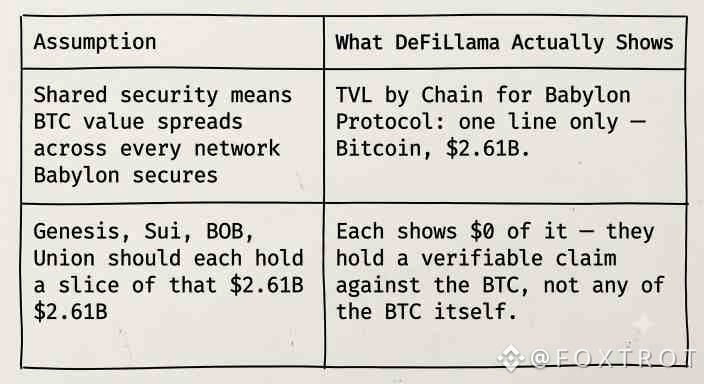
Ich habe heute in der DeFiLlama-Seite von Babylon herumgestöbert und mit der üblichen Multi-Chain-Verteilung gerechnet, die man bei Restaking-Protokollen oft sieht — kleine TVL-Brösel überall. Stattdessen gibt es nur eine Zeile. Diese eine Zeile hat meine Sicht auf Infrastruktur umgekrempelt.
$BABY Babylon Protocol zeigt diese Woche $2,61B total value locked, der Preis ist immer noch eher weich und liegt laut CoinGecko über sieben Tage um knapp 10% im Minus. Aber die Aufschlüsselung des TVL nach Chains listet genau einen Eintrag: Bitcoin. Babylon (@babylonlabs_io #baby ) sichert Genesis und eine wachsende Liste externer Netzwerke — keines davon taucht mit auch nur einem Cent von diesen $2,61B auf.
Ich brauchte kurz, bis ich wirklich verstand warum. Hmm — das Kapital selbst bewegt sich nie. Jede Chain, die Babylon absichert, hält nur eine verifizierbare Forderung gegen BTC, die die ganze Zeit über auf Bitcoin gesperrt bleibt, egal wie unterschiedlich die darunterliegende Chain auch sein mag. Ich hatte angenommen, „Shared Security“ würde bedeuten, dass sich der Wert tatsächlich über das Netzwerk verteilt. Tut es nicht. Der Wert bleibt stehen und wird immer wieder darauf verwiesen.
Es fühlt sich weniger nach einem Multi-Chain-Protokoll an und mehr danach, als ob Bitcoin still und leise zur Kollateral-Zentrale für alle anderen wird. Bin mir trotzdem nicht sicher — macht eine Chain da gerade wirklich ihre Arbeit, oder ist das nur ein sehr großes, sehr gut abgesichertes IOU mit gutem PR?
Ich habe heute in der DeFiLlama-Seite von Babylon herumgestöbert und mit der üblichen Multi-Chain-Verteilung gerechnet, die man bei Restaking-Protokollen oft sieht — kleine TVL-Brösel überall. Stattdessen gibt es nur eine Zeile. Diese eine Zeile hat meine Sicht auf Infrastruktur umgekrempelt.
$BABY Babylon Protocol zeigt diese Woche $2,61B total value locked, der Preis ist immer noch eher weich und liegt laut CoinGecko über sieben Tage um knapp 10% im Minus. Aber die Aufschlüsselung des TVL nach Chains listet genau einen Eintrag: Bitcoin. Babylon (@BabylonLabs_io #baby ) sichert Genesis und eine wachsende Liste externer Netzwerke — keines davon taucht mit auch nur einem Cent von diesen $2,61B auf.
Ich brauchte kurz, bis ich wirklich verstand warum. Hmm — das Kapital selbst bewegt sich nie. Jede Chain, die Babylon absichert, hält nur eine verifizierbare Forderung gegen BTC, die die ganze Zeit über auf Bitcoin gesperrt bleibt, egal wie unterschiedlich die darunterliegende Chain auch sein mag. Ich hatte angenommen, „Shared Security“ würde bedeuten, dass sich der Wert tatsächlich über das Netzwerk verteilt. Tut es nicht. Der Wert bleibt stehen und wird immer wieder darauf verwiesen.
Es fühlt sich weniger nach einem Multi-Chain-Protokoll an und mehr danach, als ob Bitcoin still und leise zur Kollateral-Zentrale für alle anderen wird. Bin mir trotzdem nicht sicher — macht eine Chain da gerade wirklich ihre Arbeit, oder ist das nur ein sehr großes, sehr gut abgesichertes IOU mit gutem PR?
$BABY Babylon Protocol zeigt diese Woche $2,61B total value locked, der Preis ist immer noch eher weich und liegt laut CoinGecko über sieben Tage um knapp 10% im Minus. Aber die Aufschlüsselung des TVL nach Chains listet genau einen Eintrag: Bitcoin. Babylon (@BabylonLabs_io #baby ) sichert Genesis und eine wachsende Liste externer Netzwerke — keines davon taucht mit auch nur einem Cent von diesen $2,61B auf.
Ich brauchte kurz, bis ich wirklich verstand warum. Hmm — das Kapital selbst bewegt sich nie. Jede Chain, die Babylon absichert, hält nur eine verifizierbare Forderung gegen BTC, die die ganze Zeit über auf Bitcoin gesperrt bleibt, egal wie unterschiedlich die darunterliegende Chain auch sein mag. Ich hatte angenommen, „Shared Security“ würde bedeuten, dass sich der Wert tatsächlich über das Netzwerk verteilt. Tut es nicht. Der Wert bleibt stehen und wird immer wieder darauf verwiesen.
Es fühlt sich weniger nach einem Multi-Chain-Protokoll an und mehr danach, als ob Bitcoin still und leise zur Kollateral-Zentrale für alle anderen wird. Bin mir trotzdem nicht sicher — macht eine Chain da gerade wirklich ihre Arbeit, oder ist das nur ein sehr großes, sehr gut abgesichertes IOU mit gutem PR?
37
25
398
Übersetzung ansehen
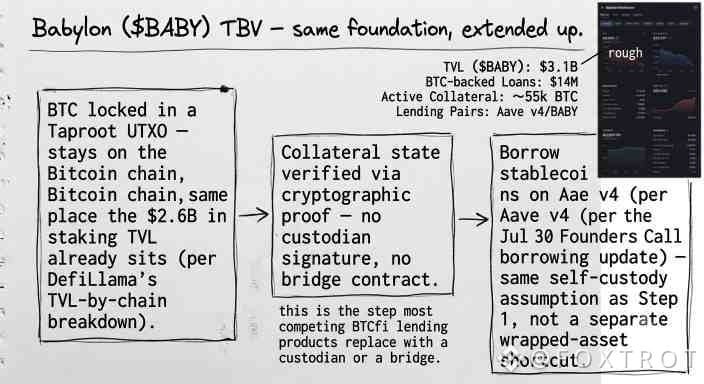
Was skimming Babylon's ($BABY ) rundown from @babylonlabs_io for the July 30 call, the one promising native Bitcoin-backed borrowing updates, expecting some new bridge or wrapped-asset shortcut to speed things along. #baby had the announcement thread lit up like it was a launch.
It wasn't. Still TBV: BTC locked in a Taproot UTXO on Bitcoin itself, no wrapping, redemption gated by proof instead of a custodian's signature. Same design Babylon's actual staking product runs on — the one currently holding $2.6B, all of it sitting on the Bitcoin chain per the TVL breakdown, not bridged anywhere. $BABY's trading near $0.013 this week, close to its $0.011 low. None of that changed the plumbing underneath.
That's the part I kept circling back to. Most protocols add a lending layer by loosening the security model a notch — wrap it, bridge it, trust someone. Babylon's version just extends the same base assumptions further up the stack instead of swapping them out for convenience. Slower, probably. Less exciting on a landing page, definitely.
Honestly wasn't planning to dig this far into a call recap — got curious, kept scrolling. Still turning over whether "foundation-first" survives contact with a market that keeps rewarding whoever ships the shiny wrapper fastest. Does it hold up over a full cycle, or is that a story we only get to tell in hindsight?
Was skimming Babylon's ($BABY ) rundown from @BabylonLabs_io for the July 30 call, the one promising native Bitcoin-backed borrowing updates, expecting some new bridge or wrapped-asset shortcut to speed things along. #baby had the announcement thread lit up like it was a launch.
It wasn't. Still TBV: BTC locked in a Taproot UTXO on Bitcoin itself, no wrapping, redemption gated by proof instead of a custodian's signature. Same design Babylon's actual staking product runs on — the one currently holding $2.6B, all of it sitting on the Bitcoin chain per the TVL breakdown, not bridged anywhere. $BABY 's trading near $0.013 this week, close to its $0.011 low. None of that changed the plumbing underneath.
That's the part I kept circling back to. Most protocols add a lending layer by loosening the security model a notch — wrap it, bridge it, trust someone. Babylon's version just extends the same base assumptions further up the stack instead of swapping them out for convenience. Slower, probably. Less exciting on a landing page, definitely.
Honestly wasn't planning to dig this far into a call recap — got curious, kept scrolling. Still turning over whether "foundation-first" survives contact with a market that keeps rewarding whoever ships the shiny wrapper fastest. Does it hold up over a full cycle, or is that a story we only get to tell in hindsight?
It wasn't. Still TBV: BTC locked in a Taproot UTXO on Bitcoin itself, no wrapping, redemption gated by proof instead of a custodian's signature. Same design Babylon's actual staking product runs on — the one currently holding $2.6B, all of it sitting on the Bitcoin chain per the TVL breakdown, not bridged anywhere. $BABY 's trading near $0.013 this week, close to its $0.011 low. None of that changed the plumbing underneath.
That's the part I kept circling back to. Most protocols add a lending layer by loosening the security model a notch — wrap it, bridge it, trust someone. Babylon's version just extends the same base assumptions further up the stack instead of swapping them out for convenience. Slower, probably. Less exciting on a landing page, definitely.
Honestly wasn't planning to dig this far into a call recap — got curious, kept scrolling. Still turning over whether "foundation-first" survives contact with a market that keeps rewarding whoever ships the shiny wrapper fastest. Does it hold up over a full cycle, or is that a story we only get to tell in hindsight?
14
11
241
Übersetzung ansehen
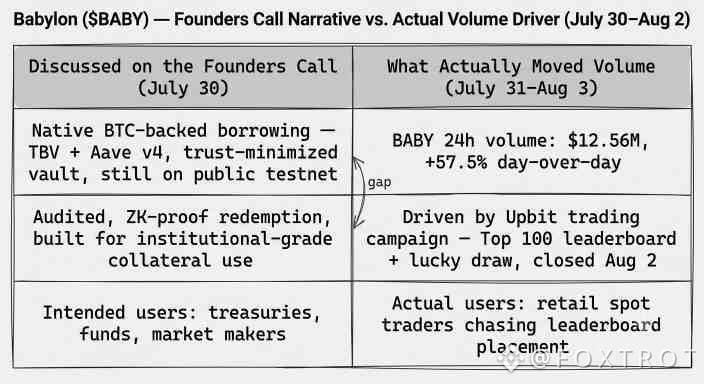
Spent the afternoon buried in Babylon's ($BABY , @babylonlabs_io , #baby ) docs and X feed for this one, and — hold up — what actually stopped my scrolling wasn't a price candle. It was a scheduling coincidence.
Thursday's quarterly founders call (July 30) had David Tse and Fisher Yu walking through native Bitcoin-backed borrowing updates — the slow, audited, still-on-testnet stuff. TBV, Aave v4, the whole trust-minimized vault mechanism most people have never touched. Two days later, the number that actually moved was nowhere near that. BABY's 24h volume sits at $12.56M as I write this, up 57.5% day over day — lining up almost exactly with the Upbit trading campaign (leaderboard, lucky draw, closed Aug 2), not with anyone locking BTC into a vault.
Was still finishing a granola bar when that clicked, so grain of salt maybe — but the collateral rails that are actually novel here are being built quietly, for institutions and market makers who aren't around yet. What's live and moving real volume right now is the same leaderboard mechanic every token on every exchange runs. Not a knock. Just — the sequencing is what it is, once you see it laid out.
Still turning over whether that gap closes on its own once TBV hits mainnet, or whether the volume just keeps living somewhere else entirely.
Spent the afternoon buried in Babylon's ($BABY , @BabylonLabs_io , #baby ) docs and X feed for this one, and — hold up — what actually stopped my scrolling wasn't a price candle. It was a scheduling coincidence.
Thursday's quarterly founders call (July 30) had David Tse and Fisher Yu walking through native Bitcoin-backed borrowing updates — the slow, audited, still-on-testnet stuff. TBV, Aave v4, the whole trust-minimized vault mechanism most people have never touched. Two days later, the number that actually moved was nowhere near that. BABY's 24h volume sits at $12.56M as I write this, up 57.5% day over day — lining up almost exactly with the Upbit trading campaign (leaderboard, lucky draw, closed Aug 2), not with anyone locking BTC into a vault.
Was still finishing a granola bar when that clicked, so grain of salt maybe — but the collateral rails that are actually novel here are being built quietly, for institutions and market makers who aren't around yet. What's live and moving real volume right now is the same leaderboard mechanic every token on every exchange runs. Not a knock. Just — the sequencing is what it is, once you see it laid out.
Still turning over whether that gap closes on its own once TBV hits mainnet, or whether the volume just keeps living somewhere else entirely.
Thursday's quarterly founders call (July 30) had David Tse and Fisher Yu walking through native Bitcoin-backed borrowing updates — the slow, audited, still-on-testnet stuff. TBV, Aave v4, the whole trust-minimized vault mechanism most people have never touched. Two days later, the number that actually moved was nowhere near that. BABY's 24h volume sits at $12.56M as I write this, up 57.5% day over day — lining up almost exactly with the Upbit trading campaign (leaderboard, lucky draw, closed Aug 2), not with anyone locking BTC into a vault.
Was still finishing a granola bar when that clicked, so grain of salt maybe — but the collateral rails that are actually novel here are being built quietly, for institutions and market makers who aren't around yet. What's live and moving real volume right now is the same leaderboard mechanic every token on every exchange runs. Not a knock. Just — the sequencing is what it is, once you see it laid out.
Still turning over whether that gap closes on its own once TBV hits mainnet, or whether the volume just keeps living somewhere else entirely.
6
3
230
Übersetzung ansehen
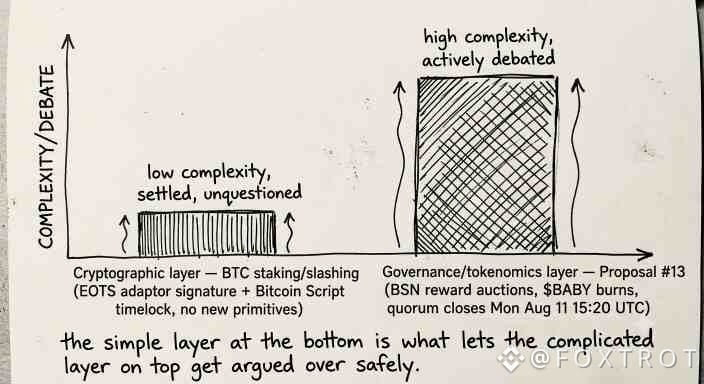
Chewing on this one after the task instead of during it, which is rare for me. Went into Babylon (@babylonlabs_io ) expecting some new cryptographic invention behind the BTC staking — a new proof system, new VM, something exotic. Found the opposite. Slashing runs on an adaptor signature trick called EOTS, layered on plain Bitcoin Script with a timelock. That's it. No new primitive, nothing borrowed from elsewhere. Reused pieces, wired together carefully.
Meanwhile proposal #13 is live on Babylon Genesis right now, deciding how BSN rewards get auctioned and burned into $BABY — quorum closes Mon Aug 11 15:20 UTC. Genuinely complicated stuff, real tradeoffs, real debate happening in the open. And it can afford to be complicated precisely because the layer underneath it never has to be argued about. Nobody's questioning whether the timelock holds. The fight moved entirely upstairs.
Hmm — reread the slashing writeup twice looking for the catch, the exotic part. Never found one. Kept expecting "simple" to mean "thin," and it doesn't. It means nothing new had to be trusted just to make BTC lockable.
Wondering if that's the actual reason people feel comfortable arguing over token mechanics up top — because nobody's worried about the foundation underneath it.
#baby $BABY
Chewing on this one after the task instead of during it, which is rare for me. Went into Babylon (@BabylonLabs_io ) expecting some new cryptographic invention behind the BTC staking — a new proof system, new VM, something exotic. Found the opposite. Slashing runs on an adaptor signature trick called EOTS, layered on plain Bitcoin Script with a timelock. That's it. No new primitive, nothing borrowed from elsewhere. Reused pieces, wired together carefully.
Meanwhile proposal #13 is live on Babylon Genesis right now, deciding how BSN rewards get auctioned and burned into $BABY — quorum closes Mon Aug 11 15:20 UTC. Genuinely complicated stuff, real tradeoffs, real debate happening in the open. And it can afford to be complicated precisely because the layer underneath it never has to be argued about. Nobody's questioning whether the timelock holds. The fight moved entirely upstairs.
Hmm — reread the slashing writeup twice looking for the catch, the exotic part. Never found one. Kept expecting "simple" to mean "thin," and it doesn't. It means nothing new had to be trusted just to make BTC lockable.
Wondering if that's the actual reason people feel comfortable arguing over token mechanics up top — because nobody's worried about the foundation underneath it.
#baby $BABY
Meanwhile proposal #13 is live on Babylon Genesis right now, deciding how BSN rewards get auctioned and burned into $BABY — quorum closes Mon Aug 11 15:20 UTC. Genuinely complicated stuff, real tradeoffs, real debate happening in the open. And it can afford to be complicated precisely because the layer underneath it never has to be argued about. Nobody's questioning whether the timelock holds. The fight moved entirely upstairs.
Hmm — reread the slashing writeup twice looking for the catch, the exotic part. Never found one. Kept expecting "simple" to mean "thin," and it doesn't. It means nothing new had to be trusted just to make BTC lockable.
Wondering if that's the actual reason people feel comfortable arguing over token mechanics up top — because nobody's worried about the foundation underneath it.
#baby $BABY
10
7
260
Übersetzung ansehen
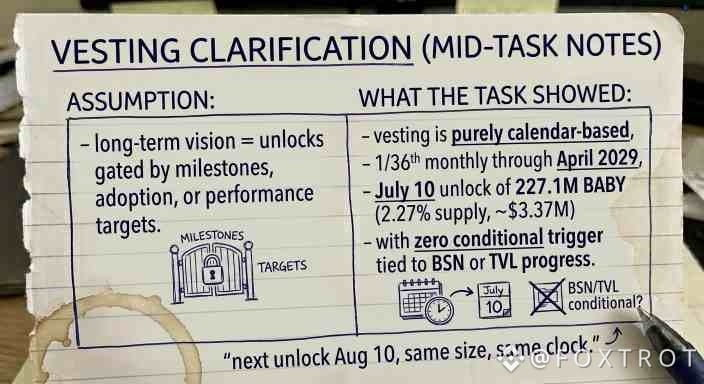
The vesting tracker showed 227.1M BABY hit circulation on July 10, 2026, another 2.27% of total supply, close to $3.37M at the time, done automatically, no announcement thread, nothing tied to it... so I started checking whether that unlock connects to any actual milestone before assuming the "long term vision" language in @babylonlabs_io docs means something concrete. Went through the vesting schedule expecting to find gates, like unlocks accelerating or pausing based on BSN adoption or TVL targets, something that ties the release to whether the vision is actually landing. There isn't one. The schedule runs purely on the calendar, 1/36th every month regardless of what multi-staking or Aave integration actually deliver, straight through to April 2029.
I assumed patient tokenomics meant the release was contingent on performance somehow. It's not, it's contingent on time, full stop. Checked the date twice because I expected some conditional language buried in there and there wasn't any... $BABY "long-term" framing describes duration, not accountability. Small thing, but I hold through unlocks assuming the team's incentive is tied to outcomes, and here it's just tied to the clock. #baby next one lands August 10. Does time alone count as alignment.
The vesting tracker showed 227.1M BABY hit circulation on July 10, 2026, another 2.27% of total supply, close to $3.37M at the time, done automatically, no announcement thread, nothing tied to it... so I started checking whether that unlock connects to any actual milestone before assuming the "long term vision" language in @BabylonLabs_io docs means something concrete. Went through the vesting schedule expecting to find gates, like unlocks accelerating or pausing based on BSN adoption or TVL targets, something that ties the release to whether the vision is actually landing. There isn't one. The schedule runs purely on the calendar, 1/36th every month regardless of what multi-staking or Aave integration actually deliver, straight through to April 2029.
I assumed patient tokenomics meant the release was contingent on performance somehow. It's not, it's contingent on time, full stop. Checked the date twice because I expected some conditional language buried in there and there wasn't any... $BABY "long-term" framing describes duration, not accountability. Small thing, but I hold through unlocks assuming the team's incentive is tied to outcomes, and here it's just tied to the clock. #baby next one lands August 10. Does time alone count as alignment.
I assumed patient tokenomics meant the release was contingent on performance somehow. It's not, it's contingent on time, full stop. Checked the date twice because I expected some conditional language buried in there and there wasn't any... $BABY "long-term" framing describes duration, not accountability. Small thing, but I hold through unlocks assuming the team's incentive is tied to outcomes, and here it's just tied to the clock. #baby next one lands August 10. Does time alone count as alignment.
5
2
137
Ich habe heute länger als geplant mit dem Babylon-Staking-Skript gesessen — diese UTXO-Struktur bleibt einfach im Kopf, sobald man sie tatsächlich liest, statt nur über die Folien zu schieben.
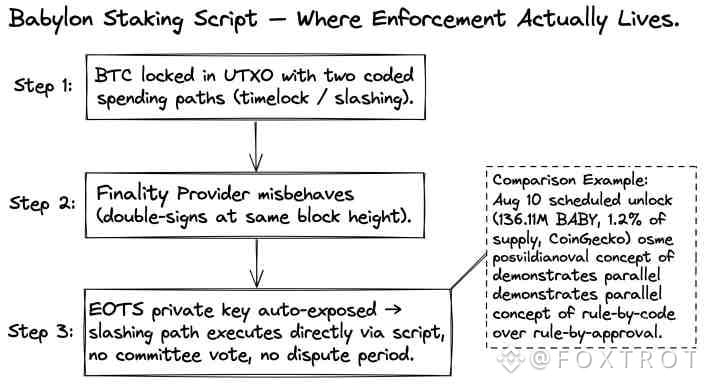
Erst mal kurz verankert: Ich habe während der Aufgabe CoinGecko gecheckt; als Nächstes ist das Unlock $BABY für den 10. August geplant, wodurch 136,11 Mio. Tokens freigegeben werden (~1,2 % des Angebots, ~1,58 Mio. $). Nichts Wildes. Aber es ist so codiert, dass es anhand eines Zeitstempels feuert — ohne Ausschuss- oder Komitee-Abstimmung als Gate. Und genau diese „encode it, don’t govern it“-Logik ist es, die die gesamte Architektur antreibt, nicht nur das Vesting.
Der Teil, der mich geholt hat: Der Bitcoin-Staking-Ausgang hat zwei Ausgabebedingungen direkt im Skript eingebrannt — ein Timelock für normale Auszahlungen und einen Slashing-Pfad, den ein Covenant-Komitee auslösen kann, wenn Regeln gebrochen werden. Keine Bridge, kein gewickelter Vermögenswert, kein separater Verwahrer, der irgendwo anders einen Schlüssel hält. Die Regeln leben direkt in der Transaktion selbst. Fehlverhalten des Finality-Providers wird durch EOTS-Key-Exposure bestraft — die Kryptografie setzt das durch, nicht ein Streitverfahren oder eine soziale Abstimmung „danach“.
Ich habe die Doku ständig wieder gelesen, in der Hoffnung, den Schritt „und dann genehmigt ein Multisig das“ zu finden. Habe keinen gefunden. Vielleicht heißt das nur, dass ich noch nicht gründlich genug geschaut habe — Moment mal—
Das lässt mich fragen, was zuerst bricht, wenn eine Kette versucht, Vertrauensebenen so aggressiv abzubauen… die Technik oder die Annahme aller, dass Governance immer einen menschlichen Checkpoint braucht.
@babylonlabs_io $BABY #baby
Ich habe heute länger als geplant mit dem Babylon-Staking-Skript gesessen — diese UTXO-Struktur bleibt einfach im Kopf, sobald man sie tatsächlich liest, statt nur über die Folien zu schieben.
Erst mal kurz verankert: Ich habe während der Aufgabe CoinGecko gecheckt; als Nächstes ist das Unlock $BABY für den 10. August geplant, wodurch 136,11 Mio. Tokens freigegeben werden (~1,2 % des Angebots, ~1,58 Mio. $). Nichts Wildes. Aber es ist so codiert, dass es anhand eines Zeitstempels feuert — ohne Ausschuss- oder Komitee-Abstimmung als Gate. Und genau diese „encode it, don’t govern it“-Logik ist es, die die gesamte Architektur antreibt, nicht nur das Vesting.
Der Teil, der mich geholt hat: Der Bitcoin-Staking-Ausgang hat zwei Ausgabebedingungen direkt im Skript eingebrannt — ein Timelock für normale Auszahlungen und einen Slashing-Pfad, den ein Covenant-Komitee auslösen kann, wenn Regeln gebrochen werden. Keine Bridge, kein gewickelter Vermögenswert, kein separater Verwahrer, der irgendwo anders einen Schlüssel hält. Die Regeln leben direkt in der Transaktion selbst. Fehlverhalten des Finality-Providers wird durch EOTS-Key-Exposure bestraft — die Kryptografie setzt das durch, nicht ein Streitverfahren oder eine soziale Abstimmung „danach“.
Ich habe die Doku ständig wieder gelesen, in der Hoffnung, den Schritt „und dann genehmigt ein Multisig das“ zu finden. Habe keinen gefunden. Vielleicht heißt das nur, dass ich noch nicht gründlich genug geschaut habe — Moment mal—
Das lässt mich fragen, was zuerst bricht, wenn eine Kette versucht, Vertrauensebenen so aggressiv abzubauen… die Technik oder die Annahme aller, dass Governance immer einen menschlichen Checkpoint braucht.
@BabylonLabs_io $BABY #baby
Erst mal kurz verankert: Ich habe während der Aufgabe CoinGecko gecheckt; als Nächstes ist das Unlock $BABY für den 10. August geplant, wodurch 136,11 Mio. Tokens freigegeben werden (~1,2 % des Angebots, ~1,58 Mio. $). Nichts Wildes. Aber es ist so codiert, dass es anhand eines Zeitstempels feuert — ohne Ausschuss- oder Komitee-Abstimmung als Gate. Und genau diese „encode it, don’t govern it“-Logik ist es, die die gesamte Architektur antreibt, nicht nur das Vesting.
Der Teil, der mich geholt hat: Der Bitcoin-Staking-Ausgang hat zwei Ausgabebedingungen direkt im Skript eingebrannt — ein Timelock für normale Auszahlungen und einen Slashing-Pfad, den ein Covenant-Komitee auslösen kann, wenn Regeln gebrochen werden. Keine Bridge, kein gewickelter Vermögenswert, kein separater Verwahrer, der irgendwo anders einen Schlüssel hält. Die Regeln leben direkt in der Transaktion selbst. Fehlverhalten des Finality-Providers wird durch EOTS-Key-Exposure bestraft — die Kryptografie setzt das durch, nicht ein Streitverfahren oder eine soziale Abstimmung „danach“.
Ich habe die Doku ständig wieder gelesen, in der Hoffnung, den Schritt „und dann genehmigt ein Multisig das“ zu finden. Habe keinen gefunden. Vielleicht heißt das nur, dass ich noch nicht gründlich genug geschaut habe — Moment mal—
Das lässt mich fragen, was zuerst bricht, wenn eine Kette versucht, Vertrauensebenen so aggressiv abzubauen… die Technik oder die Annahme aller, dass Governance immer einen menschlichen Checkpoint braucht.
@BabylonLabs_io $BABY #baby
8
4
271
Übersetzung ansehen
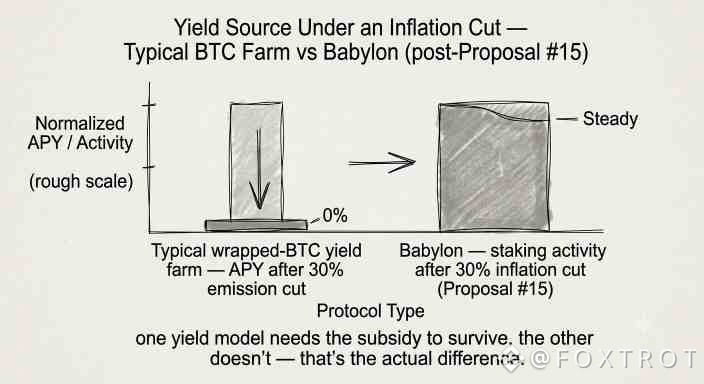
Kept comparing Babylon's vault stats to a wrapped-BTC yield farm I'd checked earlier in the week — same task, different tab — and the contrast is what actually stuck. One relies on emissions to look attractive. The other just cut its own emissions and the model didn't blink. Babylon $BABY #baby @babylonlabs_io
Most BTC yield products — wrap it, bridge it, drop it in a pool — the yield is basically a subsidy. Token emissions paying you to show up. Take the emissions away and the APY collapses because there was never a real buyer for that yield underneath. Babylon just ran the opposite experiment without meaning to: proposal #15 passed, inflation cut 30%, and staking didn't dry up. Why — because the yield's other leg isn't emissions, it's PoS chains actually paying for Bitcoin's finality through the co-staking split. Real demand, not a faucet.
Hmm, took me a minute to trust that read. I kept expecting to find the catch — some hidden emission schedule propping up the number. Went back through the vault data twice looking for it. Didn't find it, which honestly surprised me more than finding it would have.
So the difference isn't security model or custody, everyone claims that now. It's whether the yield survives a haircut to its own token supply.
Curious how many "BTC yield" projects would even survive their own version of proposal #15.
Kept comparing Babylon's vault stats to a wrapped-BTC yield farm I'd checked earlier in the week — same task, different tab — and the contrast is what actually stuck. One relies on emissions to look attractive. The other just cut its own emissions and the model didn't blink. Babylon $BABY #baby @BabylonLabs_io
Most BTC yield products — wrap it, bridge it, drop it in a pool — the yield is basically a subsidy. Token emissions paying you to show up. Take the emissions away and the APY collapses because there was never a real buyer for that yield underneath. Babylon just ran the opposite experiment without meaning to: proposal #15 passed, inflation cut 30%, and staking didn't dry up. Why — because the yield's other leg isn't emissions, it's PoS chains actually paying for Bitcoin's finality through the co-staking split. Real demand, not a faucet.
Hmm, took me a minute to trust that read. I kept expecting to find the catch — some hidden emission schedule propping up the number. Went back through the vault data twice looking for it. Didn't find it, which honestly surprised me more than finding it would have.
So the difference isn't security model or custody, everyone claims that now. It's whether the yield survives a haircut to its own token supply.
Curious how many "BTC yield" projects would even survive their own version of proposal #15.
Most BTC yield products — wrap it, bridge it, drop it in a pool — the yield is basically a subsidy. Token emissions paying you to show up. Take the emissions away and the APY collapses because there was never a real buyer for that yield underneath. Babylon just ran the opposite experiment without meaning to: proposal #15 passed, inflation cut 30%, and staking didn't dry up. Why — because the yield's other leg isn't emissions, it's PoS chains actually paying for Bitcoin's finality through the co-staking split. Real demand, not a faucet.
Hmm, took me a minute to trust that read. I kept expecting to find the catch — some hidden emission schedule propping up the number. Went back through the vault data twice looking for it. Didn't find it, which honestly surprised me more than finding it would have.
So the difference isn't security model or custody, everyone claims that now. It's whether the yield survives a haircut to its own token supply.
Curious how many "BTC yield" projects would even survive their own version of proposal #15.
3
1
186
Anmelden und weiter Inhalte entdecken
Krypto-Nutzer weltweit auf Binance Square kennenlernen
⚡️ Bleib in Sachen Krypto stets am Puls.
💬 Die weltgrößte Kryptobörse vertraut darauf.
👍 Erhalte verlässliche Einblicke von verifizierten Creators.
E-Mail-Adresse/Telefonnummer
Trendthemen
BinanceLaunchesBinanceIntelligence
447,969 Aufrufe
3,222 Kommentare
#BinanceLaunchesBinanceIntelligence
⚡ KI trifft auf Krypto-Trading: Binance Intelligence ist live! ⚡
Trading erhält mit der neuen KI-Suite von Binance ein gewaltiges Upgrade:
1️⃣ Binance AI: Personalisierte Markt-Dashboards und Audio-Briefings zu makroökonomischen Marktentwicklungen im 4-Stunden-Takt.
2️⃣ Binance AI Pro: Erstelle und führe automatisierte Strategien mit einfachen Eingaben in natürlicher Sprache aus.
3️⃣ Binance Agent OS: Entwickler-Framework für autonome Finanz-KI-Agenten.
Beschreibe deine Strategie ➔ Teste sie im Paper-Trading ➔ Führe sie rund um die Uhr aus.
Entwickelst du deine nächste Trading-Strategie mit KI? Teile deine Gedanken unten in den Kommentaren! 👇
#BinanceLaunchesBinanceIntelligence #BinanceSquare #CryptoAI #Trading $EDEN
Hazi BNB
·2 Likes
·1k Aufrufe
BitcoinTargets2026OpenAt$87570
3,009 Aufrufe
83 Kommentare
BitcoinRejectedAt$87KThirdTime
2,851 Aufrufe
67 Kommentare