
#smartcontracts
smartcontracts
498,902 views
2,505 Discussing
Hot
Latest


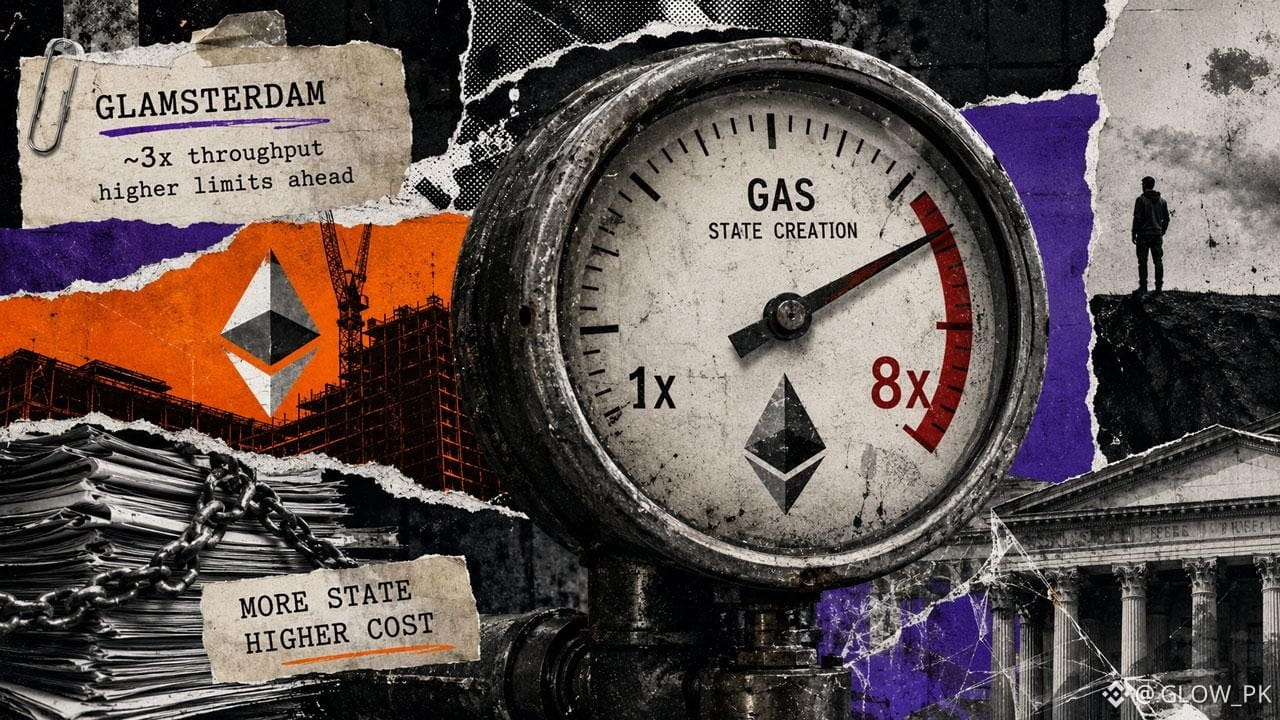
I was looking into Ethereum’s upcoming Glamsterdam changes, and one trade-off stood out to me.
The new gas repricing could potentially support around 3x more base-layer throughput.
That sounds like a straightforward win.
But historical transaction replays revealed something uncomfortable: millions of transactions could fail under the new gas schedule.
Most of those issues may be relatively easy to fix by adjusting gas limits.
The harder problem is older smart contracts built around hardcoded gas assumptions.
This is the part of scaling upgrades people often overlook.
Making a network faster isn't only about increasing capacity. Every change to the underlying economics can interact with code that was written years ago and assumed the rules would stay the same.
Ethereum may get significantly more throughput.
But the real challenge is making sure yesterday's contracts can survive tomorrow's network.
#Ethereum #ETH #blockchain #crypto #SmartContracts
The new gas repricing could potentially support around 3x more base-layer throughput.
That sounds like a straightforward win.
But historical transaction replays revealed something uncomfortable: millions of transactions could fail under the new gas schedule.
Most of those issues may be relatively easy to fix by adjusting gas limits.
The harder problem is older smart contracts built around hardcoded gas assumptions.
This is the part of scaling upgrades people often overlook.
Making a network faster isn't only about increasing capacity. Every change to the underlying economics can interact with code that was written years ago and assumed the rules would stay the same.
Ethereum may get significantly more throughput.
But the real challenge is making sure yesterday's contracts can survive tomorrow's network.
#Ethereum #ETH #blockchain #crypto #SmartContracts

Usefulness of Smart Contracts & EVM
EVM compatibility on Layer 1 networks gives developers the flexibility they need to build fast, secure DeFi applications. Interoperability remains the engine of decentralized finance! ⚙️
$ETH #Ethereum #SmartContracts #DeFi
EVM compatibility on Layer 1 networks gives developers the flexibility they need to build fast, secure DeFi applications. Interoperability remains the engine of decentralized finance! ⚙️
$ETH #Ethereum #SmartContracts #DeFi
The Impact of Smart Contracts
The smart contract ecosystem continues to evolve with increasing EVM compatibility and ever more competitive transaction fees. It is the indispensable engine for building the next generation of DeFi DApps. ⚙️ $ETH #SmartContracts #Ethereum
The smart contract ecosystem continues to evolve with increasing EVM compatibility and ever more competitive transaction fees. It is the indispensable engine for building the next generation of DeFi DApps. ⚙️ $ETH #SmartContracts #Ethereum
Smart contracts and governance: the risk many investors overlook
Here’s a lesson worth more than any price prediction.
A DeFi protocol may have:
✅ audited code
✅ millions of dollars locked
✅ thousands of users
✅ years in operation
And still, it can suffer an attack.
The recent case of Term Labs shows that the vulnerability isn’t necessarily in the main contract. #SmartContracts
It could be in governance.
If someone manages to gain enough voting power, they could modify critical decisions or authorize moves that ultimately affect the deposited funds.
That’s why, before depositing money into DeFi, it’s not enough to ask:
"Is this protocol safe?"
You need to ask:
🔎 Who controls governance?
🔎 How much power does an attacker need?
🔎 Are there timelocks?
🔎 Is there a multisig?
🔎 What can a proposal approve?
🚨 In DeFi, decentralization can reduce intermediaries, but it doesn’t eliminate risk.
The Term Labs case, with estimated losses of about $8.5 million, is another reminder that in crypto, returns always need to be analyzed alongside risk.
Here’s a lesson worth more than any price prediction.
A DeFi protocol may have:
✅ audited code
✅ millions of dollars locked
✅ thousands of users
✅ years in operation
And still, it can suffer an attack.
The recent case of Term Labs shows that the vulnerability isn’t necessarily in the main contract. #SmartContracts
It could be in governance.
If someone manages to gain enough voting power, they could modify critical decisions or authorize moves that ultimately affect the deposited funds.
That’s why, before depositing money into DeFi, it’s not enough to ask:
"Is this protocol safe?"
You need to ask:
🔎 Who controls governance?
🔎 How much power does an attacker need?
🔎 Are there timelocks?
🔎 Is there a multisig?
🔎 What can a proposal approve?
🚨 In DeFi, decentralization can reduce intermediaries, but it doesn’t eliminate risk.
The Term Labs case, with estimated losses of about $8.5 million, is another reminder that in crypto, returns always need to be analyzed alongside risk.

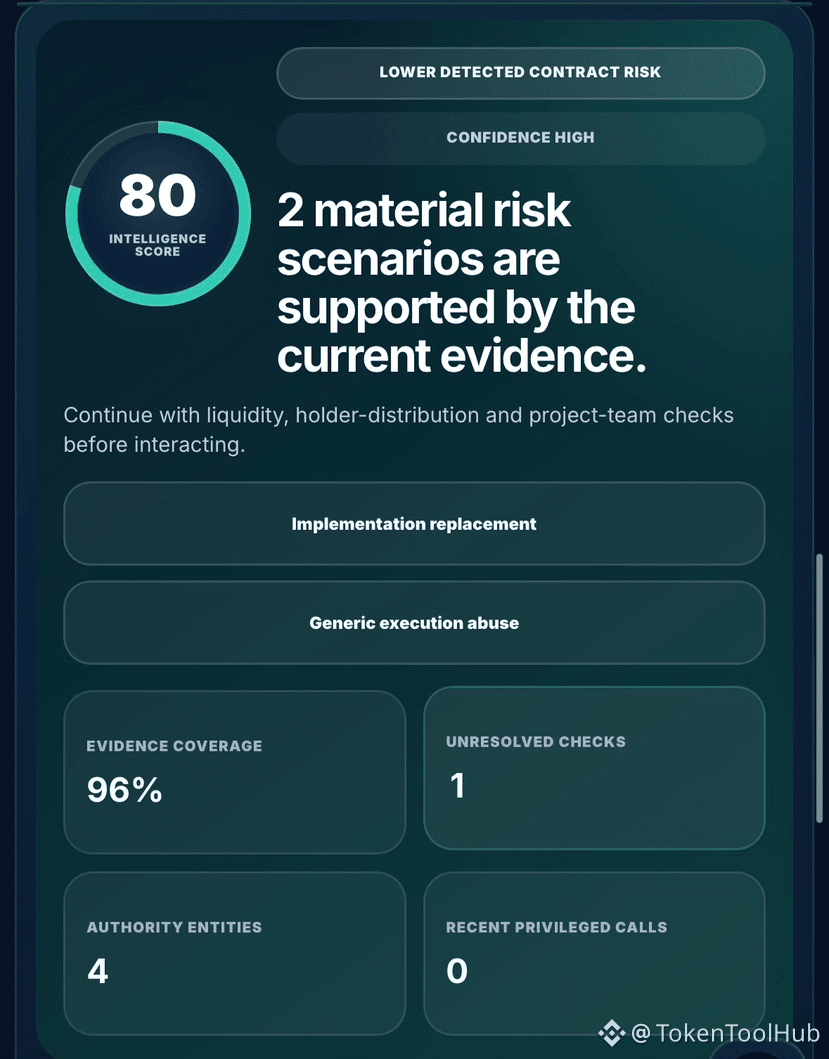
ARB scored 90/100 on the quick public-risk scan.
Deeper TokenToolHub contract intelligence returned 80/100.
Contract:
0x912CE59144191C1204E64559FE8253a0e49E6548
Network: Arbitrum
Key findings:
• Source verified
• Proxy detected
• Supply expansion: Not detected
• Mutable fees/taxes: Not detected
• Trading switches: Not detected
• Wallet restrictions: Not detected
• Emergency pause: Not detected
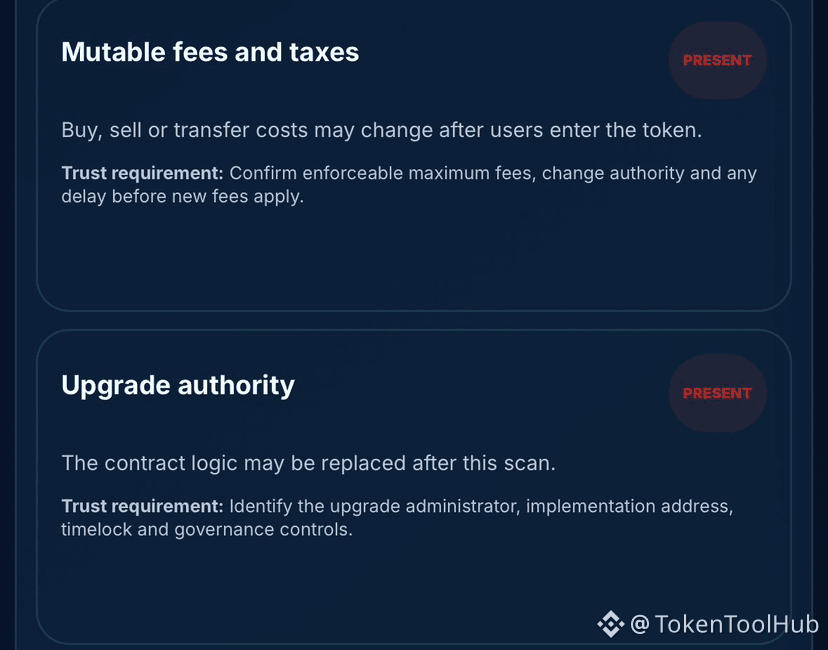
• Upgrade authority: PRESENT
• Generic external execution: PRESENT
Two material risk scenarios were identified:
• Possible implementation replacement
• Possible generic execution abuse
Resolved implementation:
0xd47d14a315394ddf063174f2286ab4eb7c507fa0
Resolved proxy administrator:
0xdb216562328215e010f819b5abe947bad4ca961e
The proxy exposes:
changeAdmin(address)
upgradeTo(address)
upgradeToAndCall(address,bytes)
This means the underlying implementation can potentially be replaced by the authorized upgrade administrator.
That does not imply malicious behavior. It means the security model depends partly on how upgrade authority is governed and protected.
Recent activity included 24 contract transactions, 23 unique callers and 60 token transfers, with no failed transactions, recognized privileged calls, mint events or burn events in the bounded window.
Trading simulation remained unresolved.
For upgradeable contracts, inspect both the current implementation and who can change it.
Full ARB scan:
https://tokentoolhub.com/token-safety-checker/?net=arbitrum&address=0x912CE59144191C1204E64559FE8253a0e49E6548
#Arbitrum #ARB #SmartContracts #OnChain
Deeper TokenToolHub contract intelligence returned 80/100.
Contract:
0x912CE59144191C1204E64559FE8253a0e49E6548
Network: Arbitrum
Key findings:
• Source verified
• Proxy detected
• Supply expansion: Not detected
• Mutable fees/taxes: Not detected
• Trading switches: Not detected
• Wallet restrictions: Not detected
• Emergency pause: Not detected
• Upgrade authority: PRESENT
• Generic external execution: PRESENT
Two material risk scenarios were identified:
• Possible implementation replacement
• Possible generic execution abuse
Resolved implementation:
0xd47d14a315394ddf063174f2286ab4eb7c507fa0
Resolved proxy administrator:
0xdb216562328215e010f819b5abe947bad4ca961e
The proxy exposes:
changeAdmin(address)
upgradeTo(address)
upgradeToAndCall(address,bytes)
This means the underlying implementation can potentially be replaced by the authorized upgrade administrator.
That does not imply malicious behavior. It means the security model depends partly on how upgrade authority is governed and protected.
Recent activity included 24 contract transactions, 23 unique callers and 60 token transfers, with no failed transactions, recognized privileged calls, mint events or burn events in the bounded window.
Trading simulation remained unresolved.
For upgradeable contracts, inspect both the current implementation and who can change it.
Full ARB scan:
https://tokentoolhub.com/token-safety-checker/?net=arbitrum&address=0x912CE59144191C1204E64559FE8253a0e49E6548
#Arbitrum #ARB #SmartContracts #OnChain
Benmao returned 90/100 on the quick public-risk scan.
Deeper TokenToolHub contract intelligence returned 45/100.
Contract:
0xF2dF04B34596372EBB4A0C49930ebeB760ad7777
Network: BNB Smart Chain
The verified contract supports 4 material risk scenarios:
• Possible supply dilution
• Possible post-purchase fee escalation
• Possible implementation replacement
• Possible generic execution abuse
Detected control surfaces:
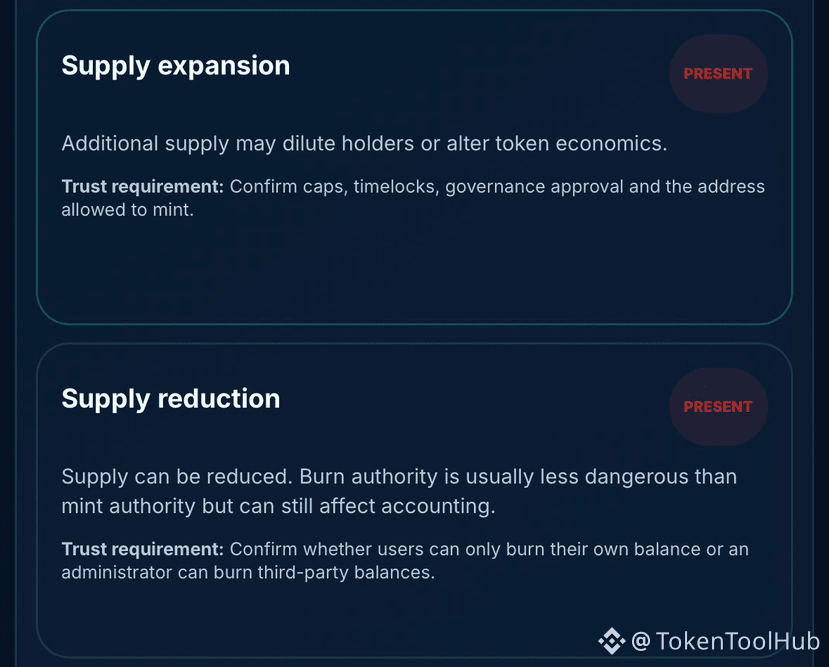
• Supply expansion: Present
• Mutable fees/taxes: Present
• Upgrade authority: Present
• Generic external execution: Present
• Ownership/admin control: Present
• Supply reduction: Present
Wallet restrictions, trading switches and emergency pause were not detected by the available checks.
The contract is also upgradeable.
Implementation:
0x024f18294970b5c76c0691b87f138a0317156422
Current owner:
0xe2ce6ab80874fa9fa2aae65d277dd6b8e65c9de0
Upgradeability matters because the logic being analyzed today may be replaced later if the relevant authority can change the implementation.
The report also detected mutable fee/tax capability and supply-expansion capability.
Trading simulation was unavailable, leaving honeypot status, buy tax and sell tax unresolved.
A strong quick score should not replace analysis of authority, upgradeability and mutable contract behavior.
Full Benmao scan:
https://tokentoolhub.com/token-safety-checker/?net=bsc&address=0xF2dF04B34596372EBB4A0C49930ebeB760ad7777
#BNBChain #SmartContracts #CryptoSecurity #OnChain
Deeper TokenToolHub contract intelligence returned 45/100.
Contract:
0xF2dF04B34596372EBB4A0C49930ebeB760ad7777
Network: BNB Smart Chain
The verified contract supports 4 material risk scenarios:
• Possible supply dilution
• Possible post-purchase fee escalation
• Possible implementation replacement
• Possible generic execution abuse
Detected control surfaces:
• Supply expansion: Present
• Mutable fees/taxes: Present
• Upgrade authority: Present
• Generic external execution: Present
• Ownership/admin control: Present
• Supply reduction: Present
Wallet restrictions, trading switches and emergency pause were not detected by the available checks.
The contract is also upgradeable.
Implementation:
0x024f18294970b5c76c0691b87f138a0317156422
Current owner:
0xe2ce6ab80874fa9fa2aae65d277dd6b8e65c9de0
Upgradeability matters because the logic being analyzed today may be replaced later if the relevant authority can change the implementation.
The report also detected mutable fee/tax capability and supply-expansion capability.
Trading simulation was unavailable, leaving honeypot status, buy tax and sell tax unresolved.
A strong quick score should not replace analysis of authority, upgradeability and mutable contract behavior.
Full Benmao scan:
https://tokentoolhub.com/token-safety-checker/?net=bsc&address=0xF2dF04B34596372EBB4A0C49930ebeB760ad7777
#BNBChain #SmartContracts #CryptoSecurity #OnChain



A smart contract can own a $DUSK stake. That line is what made me slow down.
Stake abstraction means the protocol lets a contract hold and manage the stake, so a liquid staking pool can be built on the chain itself and you do not need your own node. I pulled that from the staking pages @Dusk published. You can stay out of running a node and still have a contract sitting in consensus for you. The same pages warn that operator risk and the pool's contract risk sit outside the protocol. You have to judge those yourself. The warning is the part that made the page feel honest. If the contract itself fails, that page just tells you to assess it yourself.
#dusk #staking #SmartContracts
Stake abstraction means the protocol lets a contract hold and manage the stake, so a liquid staking pool can be built on the chain itself and you do not need your own node. I pulled that from the staking pages @Dusk published. You can stay out of running a node and still have a contract sitting in consensus for you. The same pages warn that operator risk and the pool's contract risk sit outside the protocol. You have to judge those yourself. The warning is the part that made the page feel honest. If the contract itself fails, that page just tells you to assess it yourself.
#dusk #staking #SmartContracts

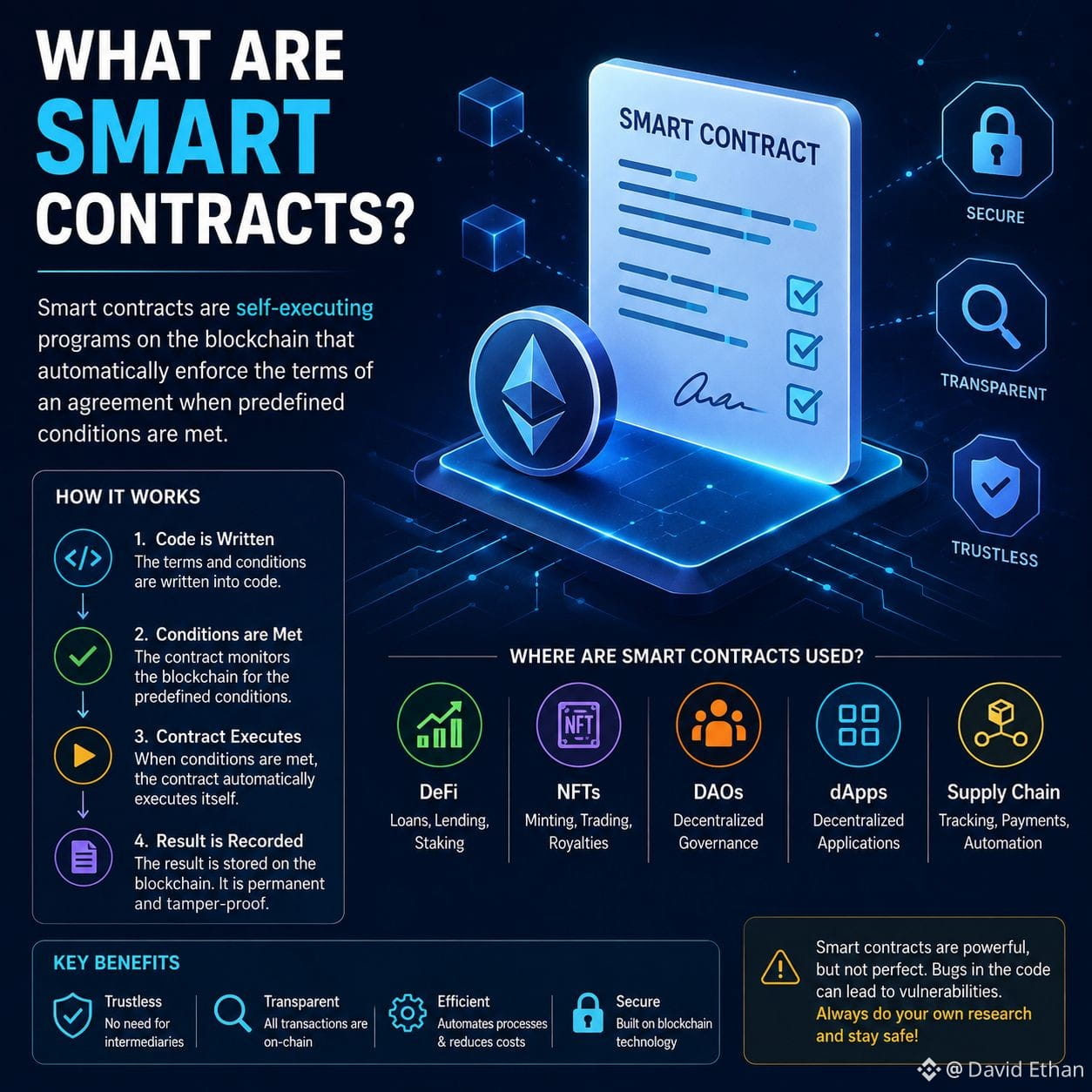
🔐 What Are Smart Contracts?
$ETH
Smart contracts are self-executing programs on a blockchain that automatically run when predefined conditions are met. No middleman is required.
Think of them like a digital agreement:
✅ Rules are coded
⚡ Conditions are automatically checked
🤝 The contract executes itself
🔗 Transactions are recorded on the blockchain
Smart contracts power many parts of Web3, including DeFi, NFTs, DAOs, and decentralized applications (dApps).
The big advantage? Automation + transparency + reduced reliance on intermediaries.
But remember: smart contracts can still contain bugs or vulnerabilities, so users should understand the risks before interacting with them.
💬 What do you think is the biggest use case for smart contracts?
#SmartContracts #blockchaineconomy #Crypto #Web3 #DeFi #Ethereum $ETH
$ETH
Smart contracts are self-executing programs on a blockchain that automatically run when predefined conditions are met. No middleman is required.
Think of them like a digital agreement:
✅ Rules are coded
⚡ Conditions are automatically checked
🤝 The contract executes itself
🔗 Transactions are recorded on the blockchain
Smart contracts power many parts of Web3, including DeFi, NFTs, DAOs, and decentralized applications (dApps).
The big advantage? Automation + transparency + reduced reliance on intermediaries.
But remember: smart contracts can still contain bugs or vulnerabilities, so users should understand the risks before interacting with them.
💬 What do you think is the biggest use case for smart contracts?
#SmartContracts #blockchaineconomy #Crypto #Web3 #DeFi #Ethereum $ETH
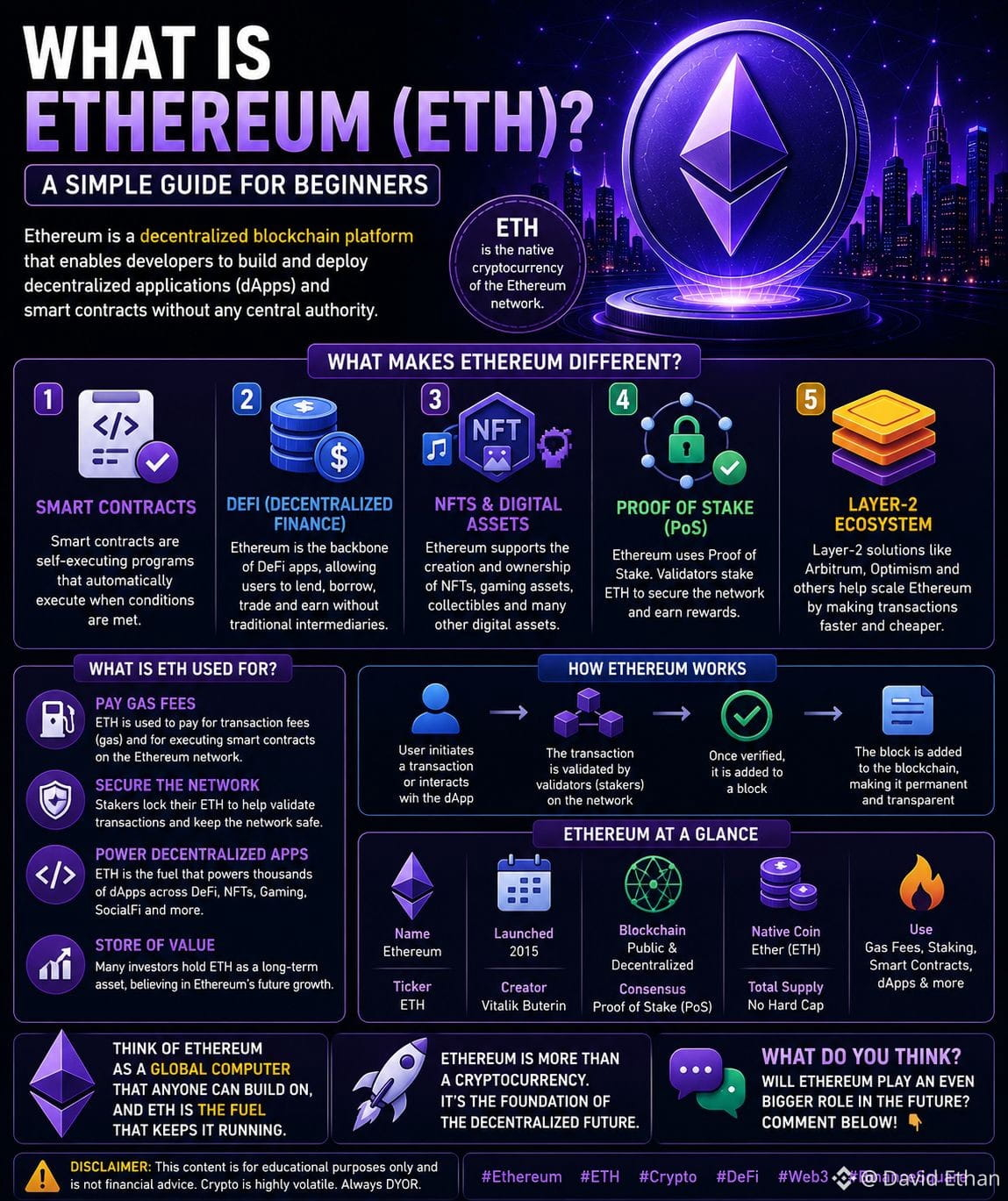
🟣 What Is Ethereum (ETH)? A Simple Guide for Beginners
$ETH isn’t just another cryptocurrency. It is a decentralized blockchain platform designed to run applications and smart contracts without relying on a central authority.
⚡ What Is ETH?
Ether (ETH) is Ethereum's native cryptocurrency. It is used to pay gas fees for transactions and applications on the network, and it also plays a role in securing Ethereum through staking.
🔥 What Makes Ethereum Different?
1️⃣ Smart Contracts
Smart contracts are programs that run on the Ethereum blockchain and automatically execute according to their code.
2️⃣ DeFi
Ethereum provides infrastructure for decentralized financial applications, allowing users to interact with financial services through blockchain-based applications.
3️⃣ NFTs & Digital Assets
Ethereum supports many types of digital assets and applications, including NFTs and stablecoins.
4️⃣ Proof of Stake
Ethereum uses Proof of Stake (PoS). Validators stake ETH to help verify transactions and secure the network.
5️⃣ Layer-2 Ecosystem
Layer-2 networks build on Ethereum to help scale the ecosystem and process transactions more efficiently.
🚀 The Big Picture
Think of Ethereum as a global blockchain platform, while ETH is the fuel that powers it.
That combination is why Ethereum remains one of the most important networks in the Web3 ecosystem.
Do you think Ethereum will become even more important in the next few years? 👇
#Ethereum #ETH #Crypto #Blockchain #DeFi #Web3 #SmartContracts
#Layer2 #CryptoEducation #BinanceSquare #ETHNews
*Educational content only. Crypto assets are volatile; always do your own research.*
$ETH isn’t just another cryptocurrency. It is a decentralized blockchain platform designed to run applications and smart contracts without relying on a central authority.
⚡ What Is ETH?
Ether (ETH) is Ethereum's native cryptocurrency. It is used to pay gas fees for transactions and applications on the network, and it also plays a role in securing Ethereum through staking.
🔥 What Makes Ethereum Different?
1️⃣ Smart Contracts
Smart contracts are programs that run on the Ethereum blockchain and automatically execute according to their code.
2️⃣ DeFi
Ethereum provides infrastructure for decentralized financial applications, allowing users to interact with financial services through blockchain-based applications.
3️⃣ NFTs & Digital Assets
Ethereum supports many types of digital assets and applications, including NFTs and stablecoins.
4️⃣ Proof of Stake
Ethereum uses Proof of Stake (PoS). Validators stake ETH to help verify transactions and secure the network.
5️⃣ Layer-2 Ecosystem
Layer-2 networks build on Ethereum to help scale the ecosystem and process transactions more efficiently.
🚀 The Big Picture
Think of Ethereum as a global blockchain platform, while ETH is the fuel that powers it.
That combination is why Ethereum remains one of the most important networks in the Web3 ecosystem.
Do you think Ethereum will become even more important in the next few years? 👇
#Ethereum #ETH #Crypto #Blockchain #DeFi #Web3 #SmartContracts
#Layer2 #CryptoEducation #BinanceSquare #ETHNews
*Educational content only. Crypto assets are volatile; always do your own research.*


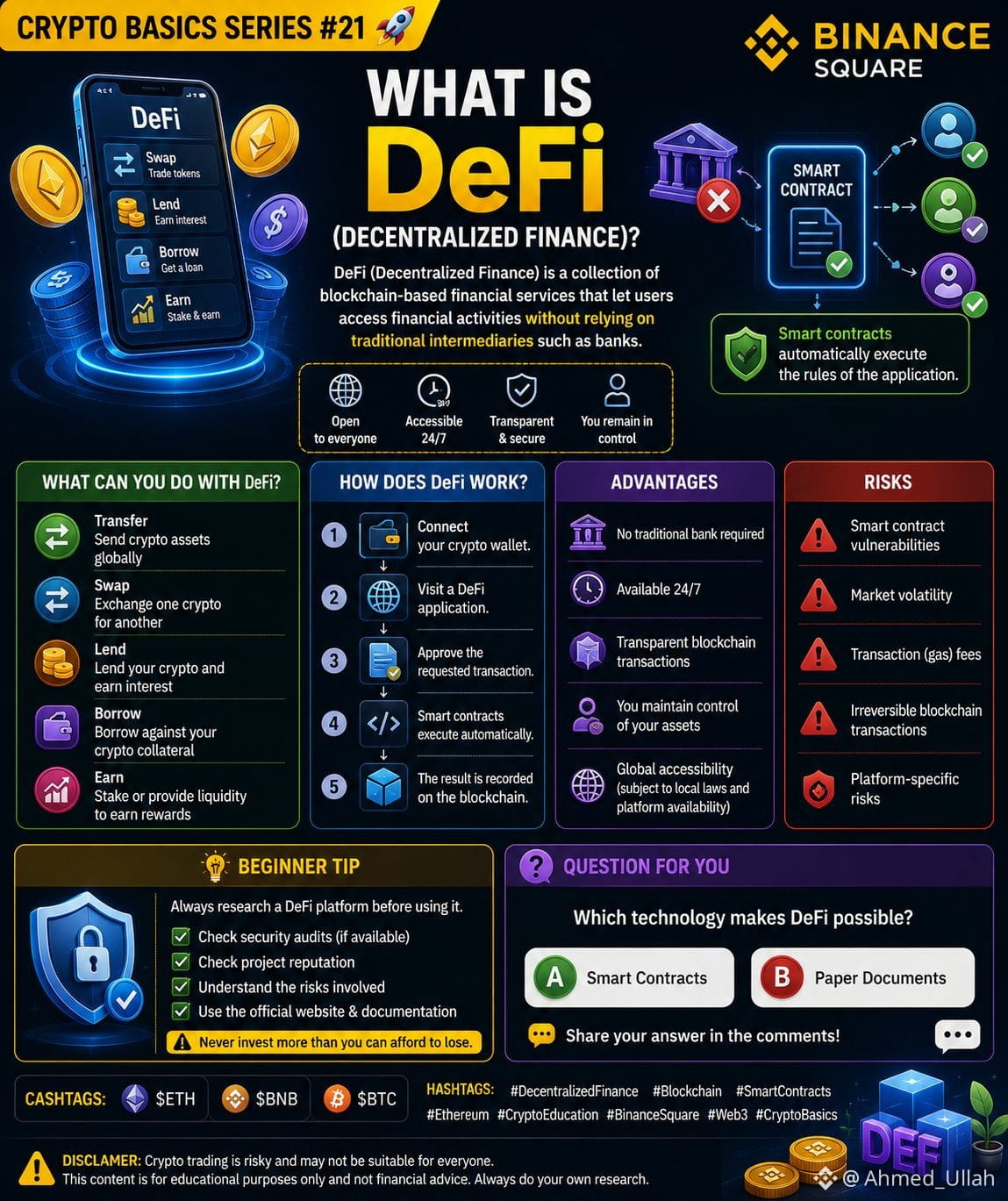
🚀 Crypto Basics Series #21: What Is DeFi (Decentralized Finance)?
Welcome back to Crypto Basics! Today, let's explore one of the biggest innovations in blockchain technology.
📌 What Is DeFi?
DeFi (Decentralized Finance) is a collection of blockchain-based financial services that let users access certain financial activities without relying on traditional intermediaries such as banks.
Instead, smart contracts automatically execute the rules of the application.
🌍 What Can You Do with DeFi?
With DeFi applications, users may be able to:
💸 Transfer crypto assets
🔄 Swap one cryptocurrency for another
💰 Lend digital assets
🏦 Borrow against eligible collateral
📈 Participate in staking or yield-generating protocols (where available)
Available features vary by platform.
⚙️ How Does DeFi Work?
👛 Connect your crypto wallet.
🌐 Visit a DeFi application.
📝 Approve the requested transaction.
⚡ Smart contracts execute the transaction automatically.
⛓️ The result is recorded on the blockchain.
✅ Advantages
No traditional bank required
Available 24/7
Transparent blockchain transactions
Users maintain control of their wallets
Global accessibility (subject to local laws and platform availability)
⚠️ Risks
Smart contract vulnerabilities
Market volatility
Transaction (gas) fees
Irreversible blockchain transactions
Platform-specific risks
💡 Beginner Tip
Always research a DeFi platform before using it.
Check:
Security audits (if available)
Project reputation
Risks involved
Official website and documentation
Never invest more than you can afford to lose.
💬 Question for You
Which technology makes DeFi possible?
🅰️ Smart Contracts
🅱️ Paper Documents
👇 Share your answer in the comments!
$ETH $BNB $BTC
#DeFi #Blockchain #SmartContracts #EthereumNews
Welcome back to Crypto Basics! Today, let's explore one of the biggest innovations in blockchain technology.
📌 What Is DeFi?
DeFi (Decentralized Finance) is a collection of blockchain-based financial services that let users access certain financial activities without relying on traditional intermediaries such as banks.
Instead, smart contracts automatically execute the rules of the application.
🌍 What Can You Do with DeFi?
With DeFi applications, users may be able to:
💸 Transfer crypto assets
🔄 Swap one cryptocurrency for another
💰 Lend digital assets
🏦 Borrow against eligible collateral
📈 Participate in staking or yield-generating protocols (where available)
Available features vary by platform.
⚙️ How Does DeFi Work?
👛 Connect your crypto wallet.
🌐 Visit a DeFi application.
📝 Approve the requested transaction.
⚡ Smart contracts execute the transaction automatically.
⛓️ The result is recorded on the blockchain.
✅ Advantages
No traditional bank required
Available 24/7
Transparent blockchain transactions
Users maintain control of their wallets
Global accessibility (subject to local laws and platform availability)
⚠️ Risks
Smart contract vulnerabilities
Market volatility
Transaction (gas) fees
Irreversible blockchain transactions
Platform-specific risks
💡 Beginner Tip
Always research a DeFi platform before using it.
Check:
Security audits (if available)
Project reputation
Risks involved
Official website and documentation
Never invest more than you can afford to lose.
💬 Question for You
Which technology makes DeFi possible?
🅰️ Smart Contracts
🅱️ Paper Documents
👇 Share your answer in the comments!
$ETH $BNB $BTC
#DeFi #Blockchain #SmartContracts #EthereumNews
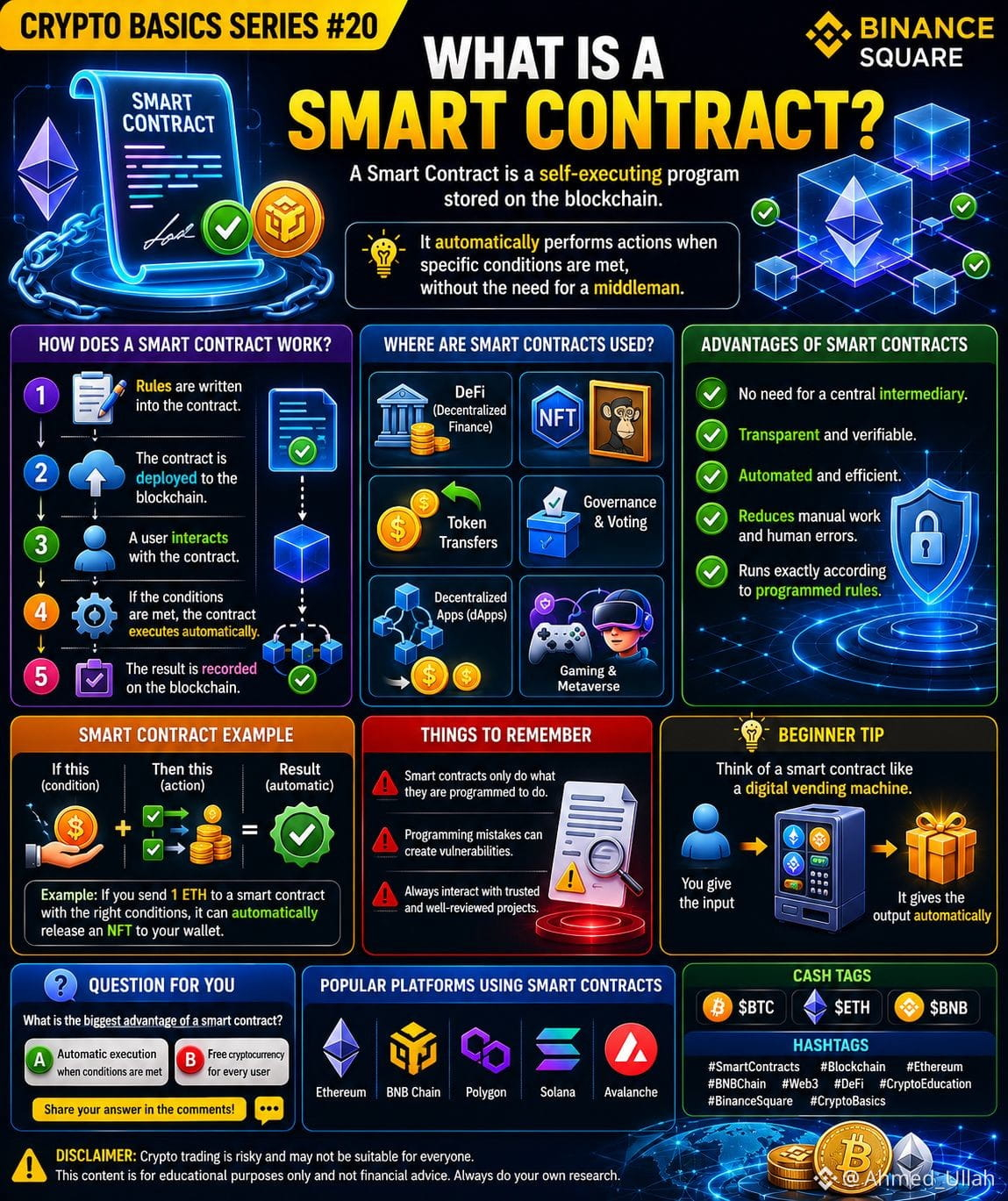
🚀 Crypto Basics Series #20: What Is a Smart Contract?
Welcome back to Crypto Basics! Today, let's explore one of the most powerful innovations in blockchain technology.
📌 What Is a Smart Contract?
A Smart Contract is a self-executing program stored on a blockchain.
It automatically performs predefined actions when specific conditions are met, without requiring a trusted intermediary to carry out those actions.
---
⚙️ How Does a Smart Contract Work?
1. 📝 Rules are written into the smart contract.
2. 📤 The contract is deployed to the blockchain.
3. 👤 A user interacts with the contract.
4. ✅ If the required conditions are met, the contract automatically executes.
5. ⛓️ The result is recorded on the blockchain.
---
🌍 Where Are Smart Contracts Used?
Smart contracts power many blockchain applications, including:
- 💰 Decentralized Finance (DeFi)
- 🎨 NFTs
- 🗳️ Governance systems
- 🎮 Blockchain games
- 💳 Token transfers and other blockchain applications
---
✅ Advantages
- No need for a central intermediary
- Transparent execution
- Automated processes
- Reduced manual work
- Runs according to the programmed rules
---
⚠️ Things to Remember
- Smart contracts only do what they are programmed to do.
- Programming mistakes can create vulnerabilities.
- Users should interact with trusted and well-reviewed projects.
---
💡 Beginner Tip
Think of a smart contract like a digital vending machine.
👉 If you provide the correct input and meet the required conditions, it automatically delivers the programmed result—without someone manually operating it.
---
💬 Question for You
What is the biggest advantage of a smart contract?
🅰️ Automatic execution when conditions are met
🅱️ Free cryptocurrency for every user
👇 Share your answer in the comments!
$ETH $BNB $BTC
#SmartContracts #Blockchain #EthereumNews #BNBChainSunset
Welcome back to Crypto Basics! Today, let's explore one of the most powerful innovations in blockchain technology.
📌 What Is a Smart Contract?
A Smart Contract is a self-executing program stored on a blockchain.
It automatically performs predefined actions when specific conditions are met, without requiring a trusted intermediary to carry out those actions.
---
⚙️ How Does a Smart Contract Work?
1. 📝 Rules are written into the smart contract.
2. 📤 The contract is deployed to the blockchain.
3. 👤 A user interacts with the contract.
4. ✅ If the required conditions are met, the contract automatically executes.
5. ⛓️ The result is recorded on the blockchain.
---
🌍 Where Are Smart Contracts Used?
Smart contracts power many blockchain applications, including:
- 💰 Decentralized Finance (DeFi)
- 🎨 NFTs
- 🗳️ Governance systems
- 🎮 Blockchain games
- 💳 Token transfers and other blockchain applications
---
✅ Advantages
- No need for a central intermediary
- Transparent execution
- Automated processes
- Reduced manual work
- Runs according to the programmed rules
---
⚠️ Things to Remember
- Smart contracts only do what they are programmed to do.
- Programming mistakes can create vulnerabilities.
- Users should interact with trusted and well-reviewed projects.
---
💡 Beginner Tip
Think of a smart contract like a digital vending machine.
👉 If you provide the correct input and meet the required conditions, it automatically delivers the programmed result—without someone manually operating it.
---
💬 Question for You
What is the biggest advantage of a smart contract?
🅰️ Automatic execution when conditions are met
🅱️ Free cryptocurrency for every user
👇 Share your answer in the comments!
$ETH $BNB $BTC
#SmartContracts #Blockchain #EthereumNews #BNBChainSunset

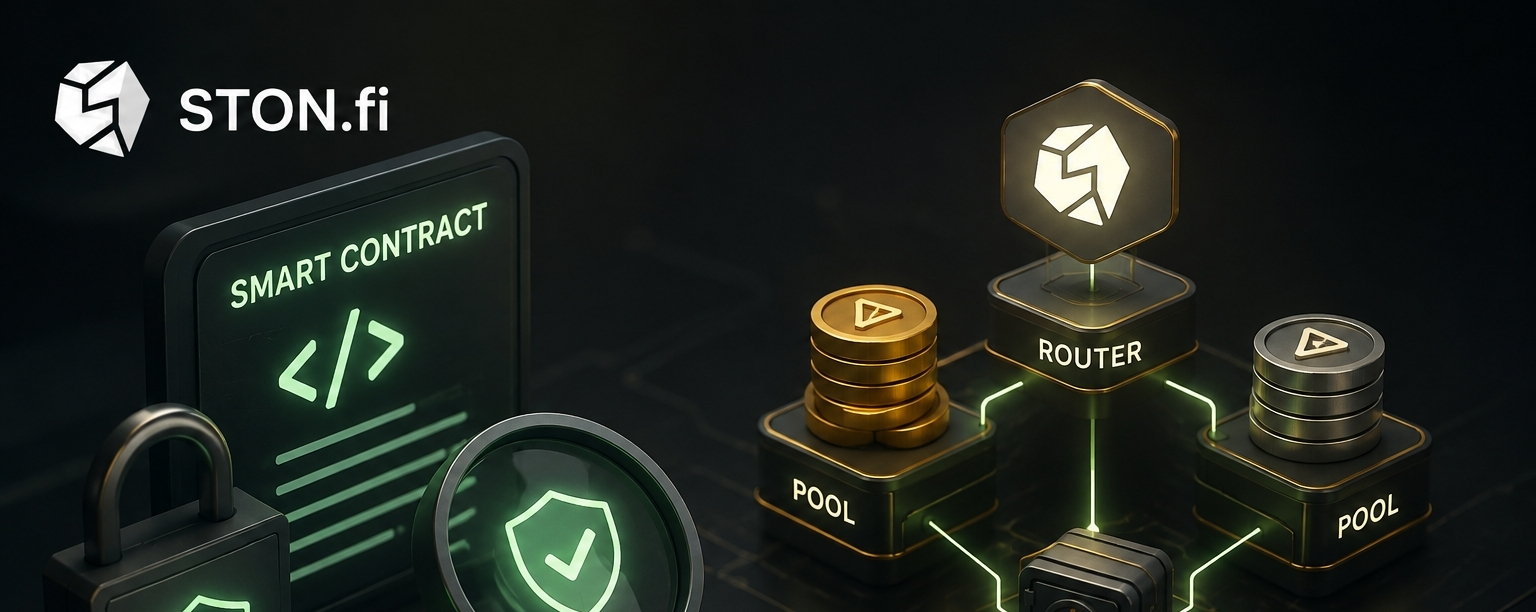
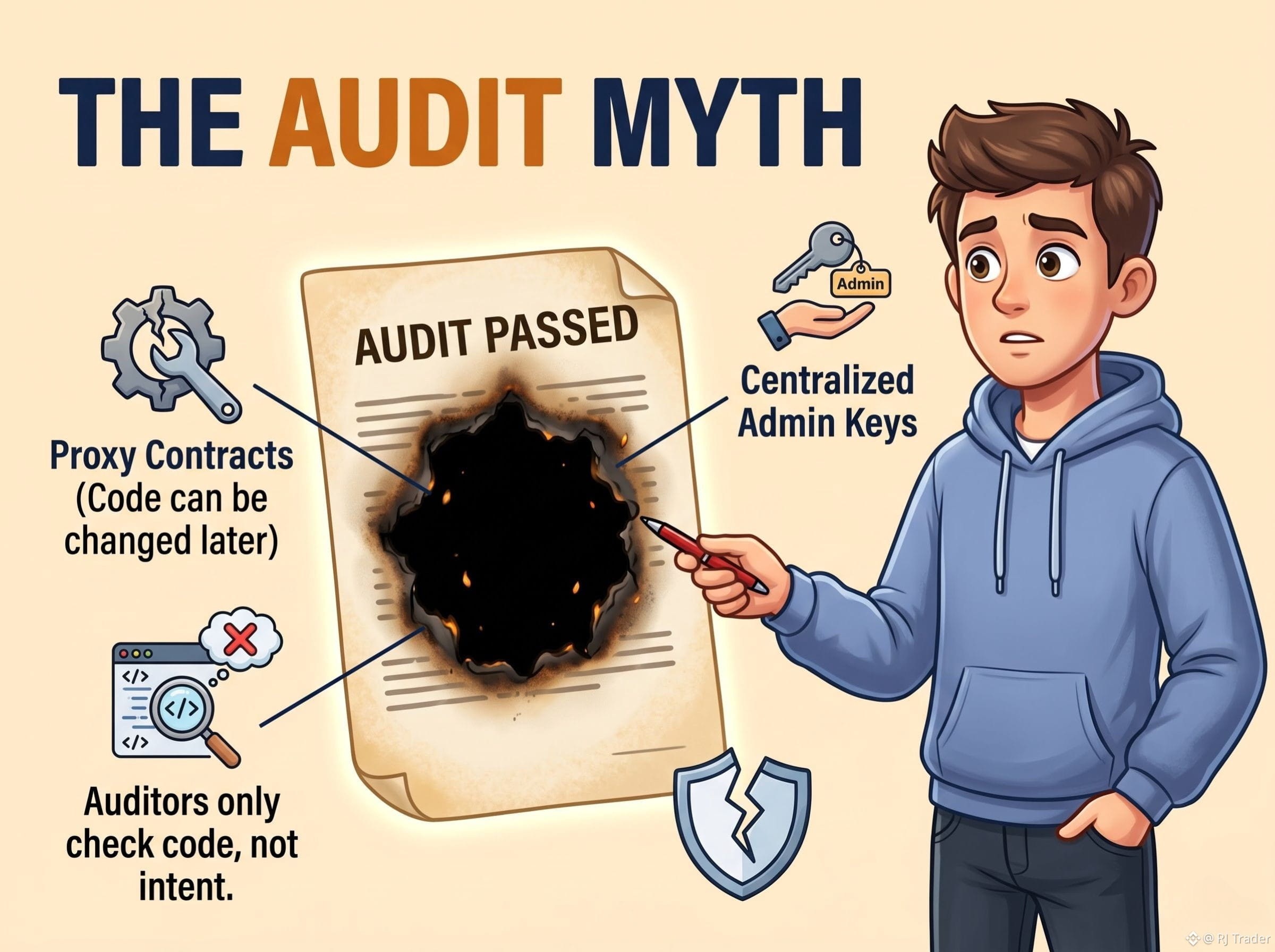
6/7 The Audit Myth
Just because a token has a "security audit" badge doesn't mean it’s safe. 🛡️❌ Part 6: The loophole scammers use to pass audits.
Did you know smart contracts can be changed after an audit? Let's discuss. 👇
#SmartContracts #CryptoSecurity #defi #cryptotrader
Just because a token has a "security audit" badge doesn't mean it’s safe. 🛡️❌ Part 6: The loophole scammers use to pass audits.
Did you know smart contracts can be changed after an audit? Let's discuss. 👇
#SmartContracts #CryptoSecurity #defi #cryptotrader

Smart Contracts ⚙️
Smart contracts allow agreements to execute automatically without intermediaries. From DeFi to gaming and digital identity, they're becoming the foundation of many blockchain applications. The technology continues evolving, and its potential is still expanding. #SmartContracts #Blockchain #ShareMyTradFi
Smart contracts allow agreements to execute automatically without intermediaries. From DeFi to gaming and digital identity, they're becoming the foundation of many blockchain applications. The technology continues evolving, and its potential is still expanding. #SmartContracts #Blockchain #ShareMyTradFi


WHAT IS A SMART CONTRACT?
A smart contract is a program deployed on a $blockchain.
It can automatically execute certain actions when predefined conditions are met.
Example:
IF condition is fulfilled ➡️ THEN the programmed action occurs.
Smart contracts are used in:
🔹 $DeFi
🔹 NFTs
🔹 DAOs
🔹 Blockchain applications
But smart contract bugs can create serious risks.
Always understand the technology before interacting with any protocol.
If you had to explain blockchain to a complete beginner in one sentence, how would you explain it?
#SmartContracts #blockchain #CryptoBeginners
A smart contract is a program deployed on a $blockchain.
It can automatically execute certain actions when predefined conditions are met.
Example:
IF condition is fulfilled ➡️ THEN the programmed action occurs.
Smart contracts are used in:
🔹 $DeFi
🔹 NFTs
🔹 DAOs
🔹 Blockchain applications
But smart contract bugs can create serious risks.
Always understand the technology before interacting with any protocol.
If you had to explain blockchain to a complete beginner in one sentence, how would you explain it?
#SmartContracts #blockchain #CryptoBeginners

📚 Smart Contracts, Explained: Programs that run on blockchain
On July 31, 2026, A smart contract is code stored on a blockchain that executes automatically when conditions are met — the engine behind DeFi lending, DEXs, and NFTs.
Platforms like $ETH , $SOL and $ADA are built around them; Ethereum alone hosts the majority of DeFi's $1.53B-scale protocols.
📌 Key Takeaway:
Smart contracts replace middlemen with math — once deployed, they run exactly as written, which is both their power and their risk.
#Education #SmartContracts #DeFi
#BinanceAlphaAlert
On July 31, 2026, A smart contract is code stored on a blockchain that executes automatically when conditions are met — the engine behind DeFi lending, DEXs, and NFTs.
Platforms like $ETH , $SOL and $ADA are built around them; Ethereum alone hosts the majority of DeFi's $1.53B-scale protocols.
📌 Key Takeaway:
Smart contracts replace middlemen with math — once deployed, they run exactly as written, which is both their power and their risk.
#Education #SmartContracts #DeFi
#BinanceAlphaAlert

Everyone thinks the biggest smart contract risk is “bad code,” but actually the bigger danger is often what humans are allowed to change after you deposit.
Plenty of traders lose money not because they can’t read charts, but because they FOMO into a contract without checking who holds the keys. It’s like parking your car in a “secure” garage, then realizing someone else can move it anytime.
1) Admin control matters. If one wallet can pause withdrawals, change fees, mint tokens, or upgrade the contract, your $ETH or $BNB position depends on that wallet staying honest and safe.
2) Approvals are a silent trap. When you give a contract unlimited permission to spend your tokens, you’re handing it a blank check. The contract may look fine today, but one bad upgrade or compromised key can turn that approval into a drain risk.
3) “Audited” does not mean “risk-free.” An audit can catch code issues, but it cannot fully protect you from poor tokenomics, centralized permissions, or a team that changes the rules later. Before touching a new $SOL or EVM-based project, check ownership, upgrade rights, and token permissions like you’d check the lock before leaving your house.
What smart contract red flag do you check first?
#SmartContracts #CryptoSecurity #DeFi
Plenty of traders lose money not because they can’t read charts, but because they FOMO into a contract without checking who holds the keys. It’s like parking your car in a “secure” garage, then realizing someone else can move it anytime.
1) Admin control matters. If one wallet can pause withdrawals, change fees, mint tokens, or upgrade the contract, your $ETH or $BNB position depends on that wallet staying honest and safe.
2) Approvals are a silent trap. When you give a contract unlimited permission to spend your tokens, you’re handing it a blank check. The contract may look fine today, but one bad upgrade or compromised key can turn that approval into a drain risk.
3) “Audited” does not mean “risk-free.” An audit can catch code issues, but it cannot fully protect you from poor tokenomics, centralized permissions, or a team that changes the rules later. Before touching a new $SOL or EVM-based project, check ownership, upgrade rights, and token permissions like you’d check the lock before leaving your house.
What smart contract red flag do you check first?
#SmartContracts #CryptoSecurity #DeFi

If you’re still assuming “audited” means “safe,” stop now.
Crypto traders lose money not just from bad entries, but from trusting smart contracts like they’re bank vaults. The brutal part? The risk often isn’t the obvious bug everyone is hunting for.
The biggest smart contract failures usually come from the messy edges: admin keys, oracle manipulation, bridge design, upgrade permissions, and plain old human error. Think Ronin’s $600M+ exploit, Wormhole’s $300M+ hit, or Nomad’s $190M disaster. None of those were “oops, forgot a semicolon” moments.
That’s why comparing ecosystems matters. $ETH has the deepest battle-tested DeFi stack, $BNB moves fast with massive retail flow, and $SOL keeps pushing speed and UX. But every chain has its own risk profile, and “faster” or “cheaper” doesn’t automatically mean “safer.”
So when you ape into a protocol, what do you trust more: the audit badge, the team’s reputation, or the contract design itself?
#SmartContracts #DeFi #CryptoSecurity
Crypto traders lose money not just from bad entries, but from trusting smart contracts like they’re bank vaults. The brutal part? The risk often isn’t the obvious bug everyone is hunting for.
The biggest smart contract failures usually come from the messy edges: admin keys, oracle manipulation, bridge design, upgrade permissions, and plain old human error. Think Ronin’s $600M+ exploit, Wormhole’s $300M+ hit, or Nomad’s $190M disaster. None of those were “oops, forgot a semicolon” moments.
That’s why comparing ecosystems matters. $ETH has the deepest battle-tested DeFi stack, $BNB moves fast with massive retail flow, and $SOL keeps pushing speed and UX. But every chain has its own risk profile, and “faster” or “cheaper” doesn’t automatically mean “safer.”
So when you ape into a protocol, what do you trust more: the audit badge, the team’s reputation, or the contract design itself?
#SmartContracts #DeFi #CryptoSecurity
Log in to explore more content