

Rokyo
870 Posting

Rokyo
Laporkan
Blokir Pengguna
Perdagangan Terbuka

Pemilik BNB
Pedagang Rutin
5.5 Tahun
122 Mengikuti
124 Pengikut
1.0K+ Disukai
Posting
Portofolio
·
--
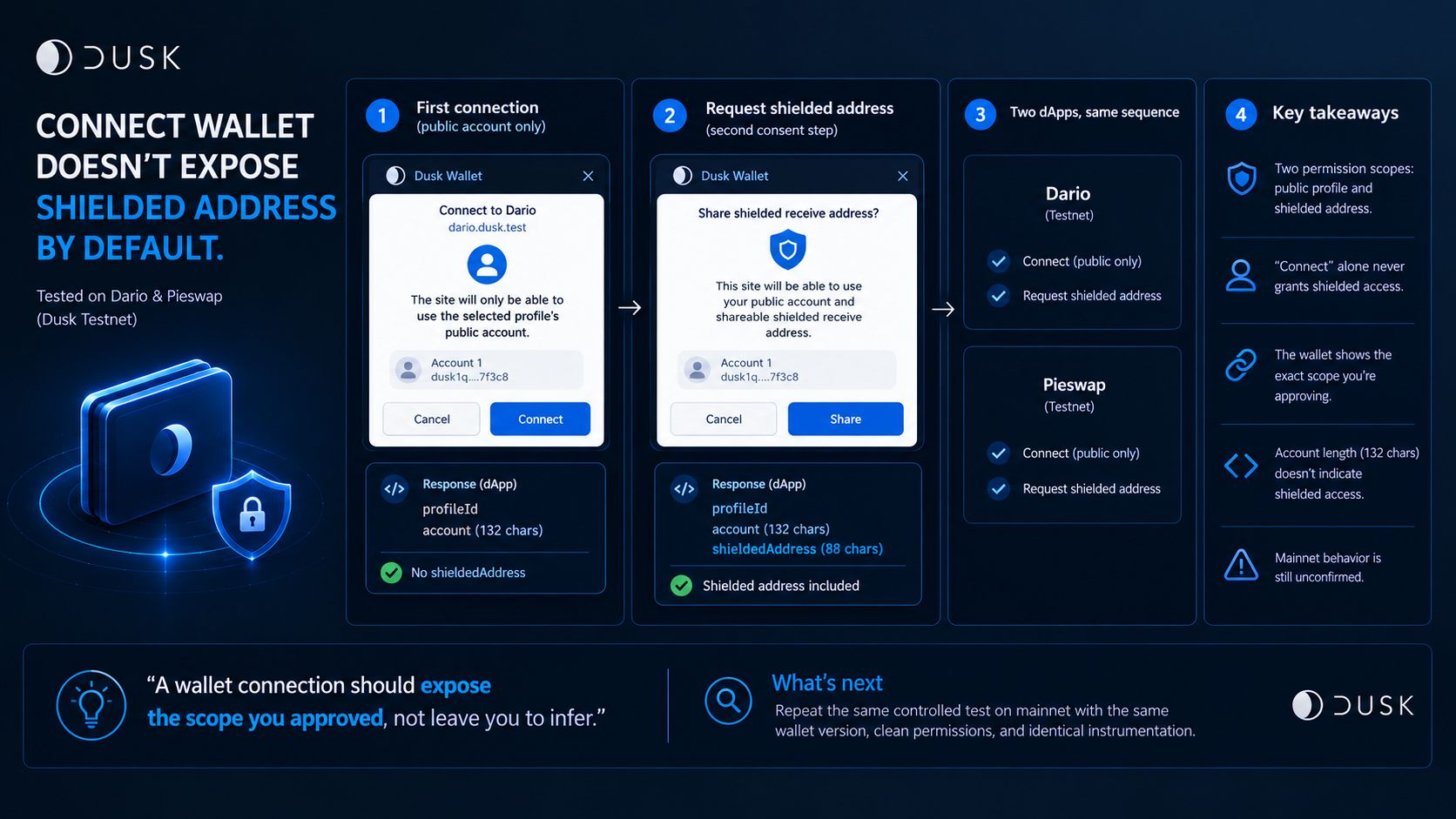
Saya ingin tahu apa sebenarnya yang diberikan akses dApp oleh "Connect Wallet", jadi saya menguji alur sesungguhnya di Dario dan Pieswap pada Dusk testnet. Di keduanya, koneksi pertama hanya mengembalikan profile ID dan akun publik. Pop-up-nya jelas: "Situs hanya akan dapat menggunakan akun publik dari profil yang dipilih." Baru ketika saya meminta alamat penerimaan (receive) yang disamarkan (shielded), muncul langkah persetujuan kedua, dan barulah responsnya menyertakan shieldedAddress. Pop-up juga berubah, menyebut "alamat penerimaan shielded yang dapat dibagikan". Kedua integrasi menampilkan urutan yang sama.
Inilah pembalikannya: saya menganggap "Connect Wallet" sebagai satu peristiwa izin. Itu tidak. Pengujian terkontrol memisahkan akses akun publik dari pembagian alamat penerimaan shielded pada titik persetujuan.
Pemisahan itu menempatkan sebagian dari batas minimum-disclosure ke dalam alur persetujuan dompet, bukan sepenuhnya pada pengguna untuk mengelola. Pada kedua pengujian, mengklik "Connect" saja tidak pernah memberikan cakupan alamat yang disamarkan; sebuah dApp harus melewati langkah persetujuan terpisah untuk mendapatkannya.
Saya juga mendapat satu hal yang salah saat menyelidiki. Saya mengira string akun 132 karakter mungkin mengisyaratkan akses yang disamarkan. Tidak. Kedua dApp mengembalikan format akun yang sama pada kondisi dasar, sementara shieldedAddress tetap tidak ada sampai permintaan eksplisit.
Masih ada satu pertanyaan yang belum terjawab. Sesi mainnet Dario sebelumnya berperilaku berbeda, tapi saya belum mereproduksinya di bawah kondisi terkontrol yang sama, jadi saya tidak menyebutnya sebagai kebocoran. Yang bisa saya katakan adalah batas izin hanya-publik bertahan di kedua integrasi testnet yang saya periksa, bukan bahwa itu pasti berlaku di setiap lingkungan.
"Koneksi dompet harus menampilkan cakupan yang Anda setujui, bukan membuat Anda menebaknya."
Yang ingin saya lihat berikutnya: uji terkontrol yang sama di mainnet dengan versi dompet yang sama, izin yang bersih, dan instrumentasi yang identik, untuk melihat apakah batas tersebut bertahan lintas lingkungan.
#dusk $DUSK @Dusk_Foundation
Saya ingin tahu apa sebenarnya yang diberikan akses dApp oleh "Connect Wallet", jadi saya menguji alur sesungguhnya di Dario dan Pieswap pada Dusk testnet. Di keduanya, koneksi pertama hanya mengembalikan profile ID dan akun publik. Pop-up-nya jelas: "Situs hanya akan dapat menggunakan akun publik dari profil yang dipilih." Baru ketika saya meminta alamat penerimaan (receive) yang disamarkan (shielded), muncul langkah persetujuan kedua, dan barulah responsnya menyertakan shieldedAddress. Pop-up juga berubah, menyebut "alamat penerimaan shielded yang dapat dibagikan". Kedua integrasi menampilkan urutan yang sama.
Inilah pembalikannya: saya menganggap "Connect Wallet" sebagai satu peristiwa izin. Itu tidak. Pengujian terkontrol memisahkan akses akun publik dari pembagian alamat penerimaan shielded pada titik persetujuan.
Pemisahan itu menempatkan sebagian dari batas minimum-disclosure ke dalam alur persetujuan dompet, bukan sepenuhnya pada pengguna untuk mengelola. Pada kedua pengujian, mengklik "Connect" saja tidak pernah memberikan cakupan alamat yang disamarkan; sebuah dApp harus melewati langkah persetujuan terpisah untuk mendapatkannya.
Saya juga mendapat satu hal yang salah saat menyelidiki. Saya mengira string akun 132 karakter mungkin mengisyaratkan akses yang disamarkan. Tidak. Kedua dApp mengembalikan format akun yang sama pada kondisi dasar, sementara shieldedAddress tetap tidak ada sampai permintaan eksplisit.
Masih ada satu pertanyaan yang belum terjawab. Sesi mainnet Dario sebelumnya berperilaku berbeda, tapi saya belum mereproduksinya di bawah kondisi terkontrol yang sama, jadi saya tidak menyebutnya sebagai kebocoran. Yang bisa saya katakan adalah batas izin hanya-publik bertahan di kedua integrasi testnet yang saya periksa, bukan bahwa itu pasti berlaku di setiap lingkungan.
"Koneksi dompet harus menampilkan cakupan yang Anda setujui, bukan membuat Anda menebaknya."
Yang ingin saya lihat berikutnya: uji terkontrol yang sama di mainnet dengan versi dompet yang sama, izin yang bersih, dan instrumentasi yang identik, untuk melihat apakah batas tersebut bertahan lintas lingkungan.
#dusk $DUSK @Dusk
Inilah pembalikannya: saya menganggap "Connect Wallet" sebagai satu peristiwa izin. Itu tidak. Pengujian terkontrol memisahkan akses akun publik dari pembagian alamat penerimaan shielded pada titik persetujuan.
Pemisahan itu menempatkan sebagian dari batas minimum-disclosure ke dalam alur persetujuan dompet, bukan sepenuhnya pada pengguna untuk mengelola. Pada kedua pengujian, mengklik "Connect" saja tidak pernah memberikan cakupan alamat yang disamarkan; sebuah dApp harus melewati langkah persetujuan terpisah untuk mendapatkannya.
Saya juga mendapat satu hal yang salah saat menyelidiki. Saya mengira string akun 132 karakter mungkin mengisyaratkan akses yang disamarkan. Tidak. Kedua dApp mengembalikan format akun yang sama pada kondisi dasar, sementara shieldedAddress tetap tidak ada sampai permintaan eksplisit.
Masih ada satu pertanyaan yang belum terjawab. Sesi mainnet Dario sebelumnya berperilaku berbeda, tapi saya belum mereproduksinya di bawah kondisi terkontrol yang sama, jadi saya tidak menyebutnya sebagai kebocoran. Yang bisa saya katakan adalah batas izin hanya-publik bertahan di kedua integrasi testnet yang saya periksa, bukan bahwa itu pasti berlaku di setiap lingkungan.
"Koneksi dompet harus menampilkan cakupan yang Anda setujui, bukan membuat Anda menebaknya."
Yang ingin saya lihat berikutnya: uji terkontrol yang sama di mainnet dengan versi dompet yang sama, izin yang bersih, dan instrumentasi yang identik, untuk melihat apakah batas tersebut bertahan lintas lingkungan.
#dusk $DUSK @Dusk
1
2
95
·
--
Lihat terjemahan
I assumed that if I wanted to do three things on-chain, approve, swap, then stake, the chain would treat that as one thing happening or not happening at all. An open issue in Dusk's own Rusk repository says that's not how it works today.
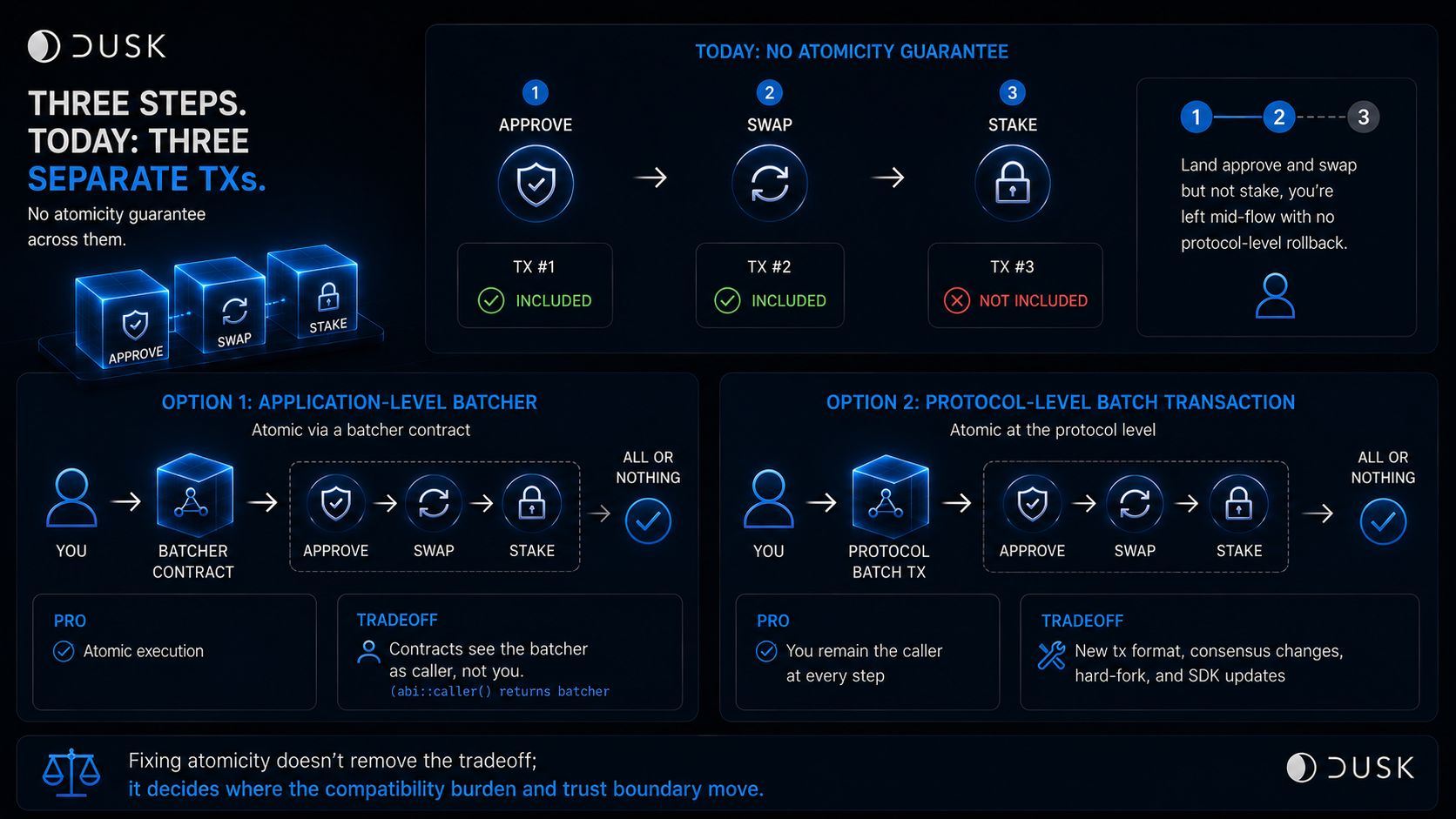
A Dusk transaction today carries a single optional operation: one contract call, one deploy, or one memo, with one value, one recipient, one nonce, one signature. So approve, swap, and stake become three separate transactions, each independently included or dropped. Dusk's issue states it plainly: there is no atomicity guarantee across them. Land approve and swap but not stake, and you're left mid-flow with no protocol-level rollback.
The problem isn't only that multi-step flows can stop halfway. Fixing that changes who has to absorb the compatibility cost.
A batcher contract makes the whole sequence atomic, because a failed sub-call reverts the outer transaction. But a target contract checking who's calling it directly would see the batcher, not you, unless that contract is already written to look past the immediate caller. A protocol-level batch transaction keeps you as the caller at every step, but it doesn't ship without a new transaction format, consensus changes, a hard-fork, and every wallet SDK catching up.
Adding batching doesn't remove the tradeoff. It decides whether the compatibility burden sits in application authorization or in the protocol stack.
"Fixing atomicity doesn't remove the tradeoff; it decides where the compatibility burden and trust boundary move."
What I'd actually want to watch: whether Dusk chooses the application-level batcher or the protocol-level transaction, and what existing authorization assumptions that choice forces developers to change.
#dusk $DUSK @Dusk_Foundation
I assumed that if I wanted to do three things on-chain, approve, swap, then stake, the chain would treat that as one thing happening or not happening at all. An open issue in Dusk's own Rusk repository says that's not how it works today.
A Dusk transaction today carries a single optional operation: one contract call, one deploy, or one memo, with one value, one recipient, one nonce, one signature. So approve, swap, and stake become three separate transactions, each independently included or dropped. Dusk's issue states it plainly: there is no atomicity guarantee across them. Land approve and swap but not stake, and you're left mid-flow with no protocol-level rollback.
The problem isn't only that multi-step flows can stop halfway. Fixing that changes who has to absorb the compatibility cost.
A batcher contract makes the whole sequence atomic, because a failed sub-call reverts the outer transaction. But a target contract checking who's calling it directly would see the batcher, not you, unless that contract is already written to look past the immediate caller. A protocol-level batch transaction keeps you as the caller at every step, but it doesn't ship without a new transaction format, consensus changes, a hard-fork, and every wallet SDK catching up.
Adding batching doesn't remove the tradeoff. It decides whether the compatibility burden sits in application authorization or in the protocol stack.
"Fixing atomicity doesn't remove the tradeoff; it decides where the compatibility burden and trust boundary move."
What I'd actually want to watch: whether Dusk chooses the application-level batcher or the protocol-level transaction, and what existing authorization assumptions that choice forces developers to change.
#dusk $DUSK @Dusk
A Dusk transaction today carries a single optional operation: one contract call, one deploy, or one memo, with one value, one recipient, one nonce, one signature. So approve, swap, and stake become three separate transactions, each independently included or dropped. Dusk's issue states it plainly: there is no atomicity guarantee across them. Land approve and swap but not stake, and you're left mid-flow with no protocol-level rollback.
The problem isn't only that multi-step flows can stop halfway. Fixing that changes who has to absorb the compatibility cost.
A batcher contract makes the whole sequence atomic, because a failed sub-call reverts the outer transaction. But a target contract checking who's calling it directly would see the batcher, not you, unless that contract is already written to look past the immediate caller. A protocol-level batch transaction keeps you as the caller at every step, but it doesn't ship without a new transaction format, consensus changes, a hard-fork, and every wallet SDK catching up.
Adding batching doesn't remove the tradeoff. It decides whether the compatibility burden sits in application authorization or in the protocol stack.
"Fixing atomicity doesn't remove the tradeoff; it decides where the compatibility burden and trust boundary move."
What I'd actually want to watch: whether Dusk chooses the application-level batcher or the protocol-level transaction, and what existing authorization assumptions that choice forces developers to change.
#dusk $DUSK @Dusk
1
2
94
·
--
Lihat terjemahan
I assumed a transaction's meaning was fixed the moment its bytes existed: decode it once, get the same answer everywhere. Dusk's own Rusk changelog for the Boreas upgrade treats that as something that has to be engineered, not assumed.
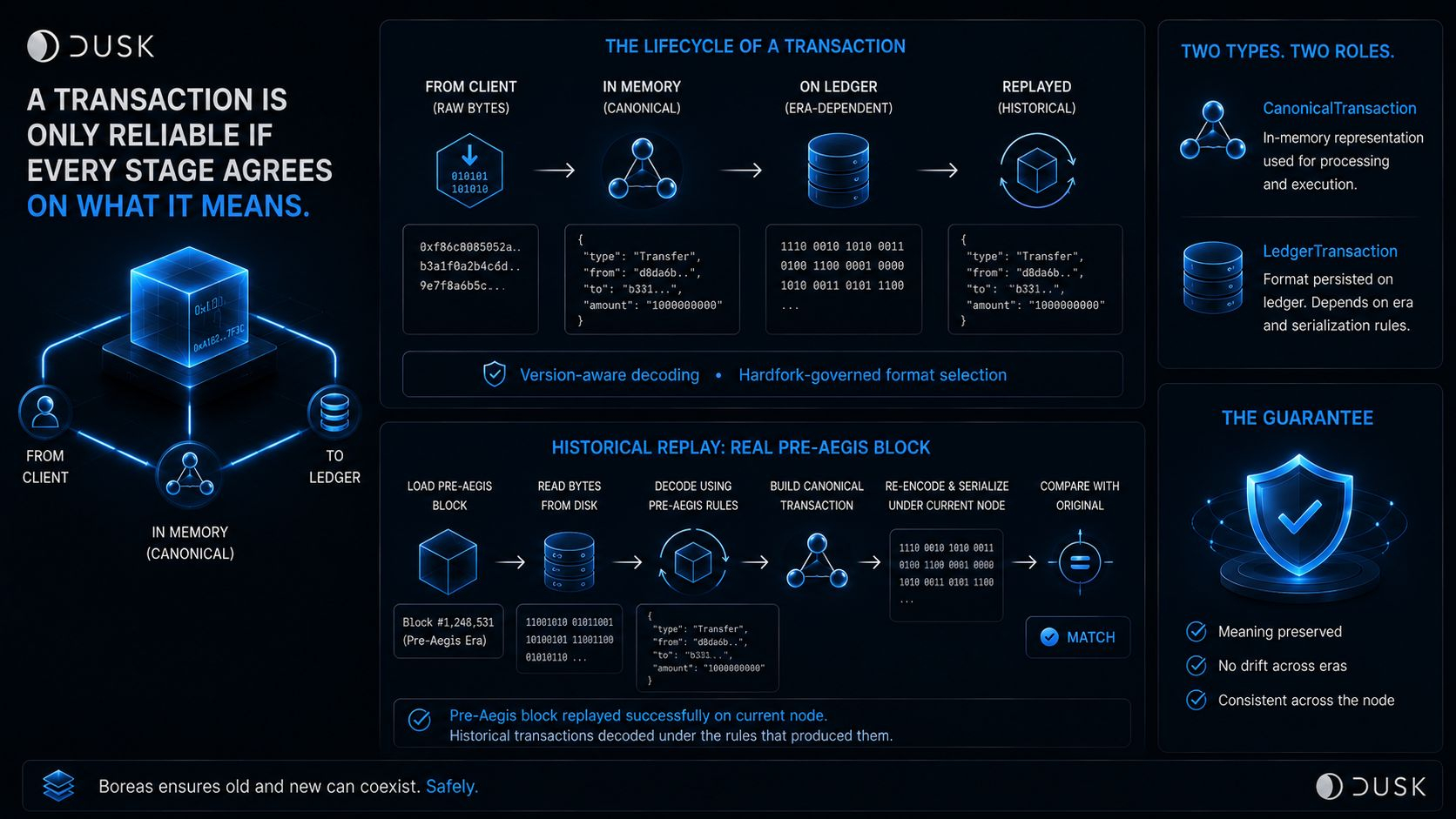
Boreas added version-aware transaction decoding tied to a specific hardfork, plus hardfork-governed format selection for how old blocks get replayed. The codebase now has two explicitly separate types, CanonicalTransaction and LedgerTransaction, splitting the in-memory representation of a transaction from the format it's actually persisted in on the ledger. There's even a dedicated regression test just for decoding pre-Aegis-era transactions correctly during block serialization.
That only becomes necessary once transaction decoding has to account for different protocol eras and processing stages: fresh off the wire from a client, sitting in memory as a canonical object, replayed from a block that predates the current rules.
Which means a protocol upgrade isn't safe just because new transactions work under the new rules. It's only safe if those new rules don't silently break the ability to correctly replay old ledger state under the rules that produced it. That is the class of version-mismatch failure the historical-replay compatibility and hardfork-gated decoding are designed to prevent.
"A transaction is only reliable if every stage that touches it agrees on what it means."
What I'd actually want to see: a real pre-Aegis block replayed on a current node without changing how its historical transactions are decoded under the applicable rules, not just a passing regression test in isolation.
#dusk $DUSK @Dusk_Foundation
I assumed a transaction's meaning was fixed the moment its bytes existed: decode it once, get the same answer everywhere. Dusk's own Rusk changelog for the Boreas upgrade treats that as something that has to be engineered, not assumed.
Boreas added version-aware transaction decoding tied to a specific hardfork, plus hardfork-governed format selection for how old blocks get replayed. The codebase now has two explicitly separate types, CanonicalTransaction and LedgerTransaction, splitting the in-memory representation of a transaction from the format it's actually persisted in on the ledger. There's even a dedicated regression test just for decoding pre-Aegis-era transactions correctly during block serialization.
That only becomes necessary once transaction decoding has to account for different protocol eras and processing stages: fresh off the wire from a client, sitting in memory as a canonical object, replayed from a block that predates the current rules.
Which means a protocol upgrade isn't safe just because new transactions work under the new rules. It's only safe if those new rules don't silently break the ability to correctly replay old ledger state under the rules that produced it. That is the class of version-mismatch failure the historical-replay compatibility and hardfork-gated decoding are designed to prevent.
"A transaction is only reliable if every stage that touches it agrees on what it means."
What I'd actually want to see: a real pre-Aegis block replayed on a current node without changing how its historical transactions are decoded under the applicable rules, not just a passing regression test in isolation.
#dusk $DUSK @Dusk
Boreas added version-aware transaction decoding tied to a specific hardfork, plus hardfork-governed format selection for how old blocks get replayed. The codebase now has two explicitly separate types, CanonicalTransaction and LedgerTransaction, splitting the in-memory representation of a transaction from the format it's actually persisted in on the ledger. There's even a dedicated regression test just for decoding pre-Aegis-era transactions correctly during block serialization.
That only becomes necessary once transaction decoding has to account for different protocol eras and processing stages: fresh off the wire from a client, sitting in memory as a canonical object, replayed from a block that predates the current rules.
Which means a protocol upgrade isn't safe just because new transactions work under the new rules. It's only safe if those new rules don't silently break the ability to correctly replay old ledger state under the rules that produced it. That is the class of version-mismatch failure the historical-replay compatibility and hardfork-gated decoding are designed to prevent.
"A transaction is only reliable if every stage that touches it agrees on what it means."
What I'd actually want to see: a real pre-Aegis block replayed on a current node without changing how its historical transactions are decoded under the applicable rules, not just a passing regression test in isolation.
#dusk $DUSK @Dusk
7
3
84
·
--
Lihat terjemahan
I assumed "DuskEVM supports Solidity" meant developers could show up with existing Ethereum tooling and be done. Dusk's own quickstart docs quietly add a step most people skip past: verifying the source.
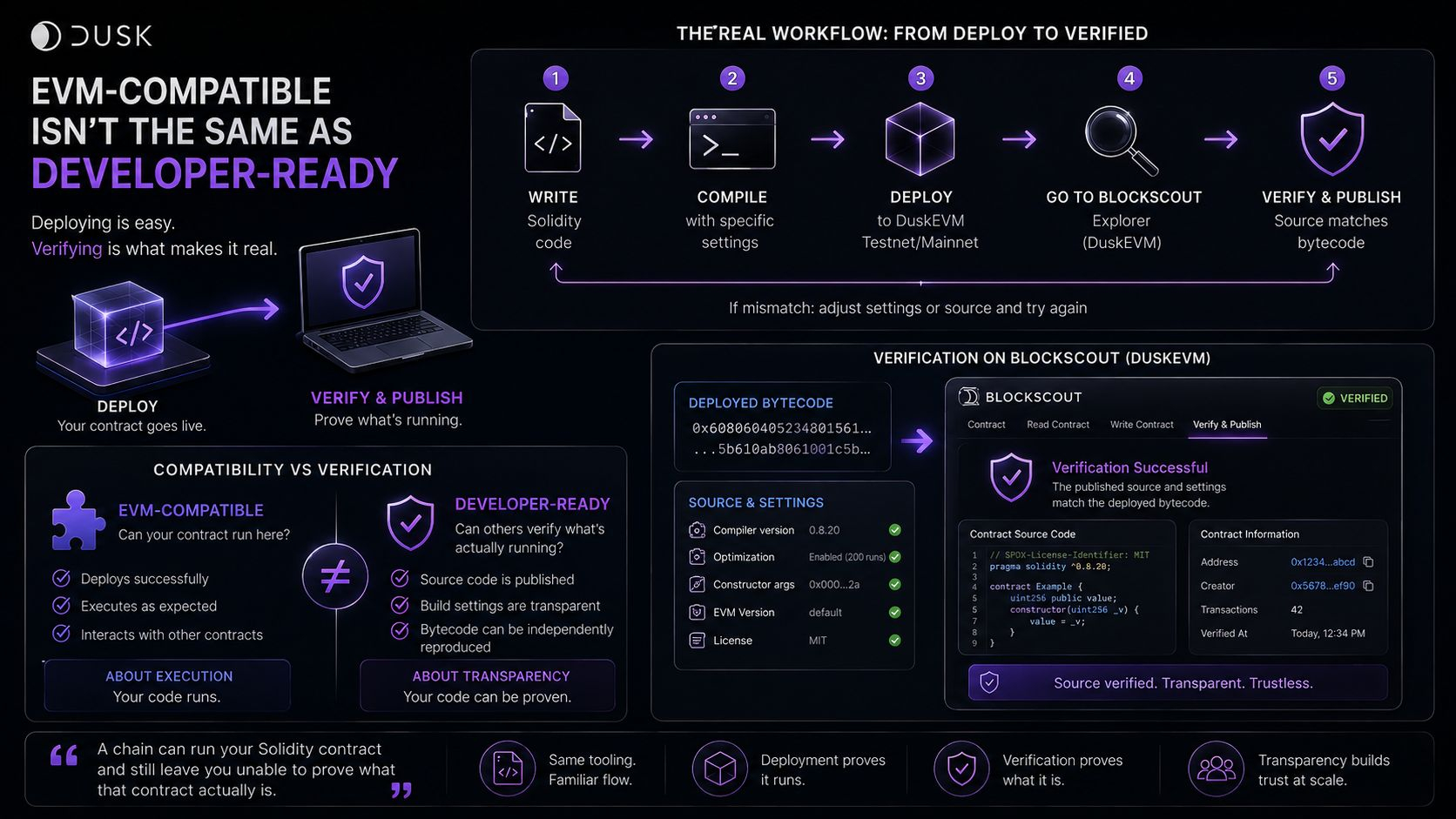
Deploying is the easy part. DuskEVM uses Blockscout as its explorer, and getting a contract verified there, "Verify & Publish", means the relevant build settings, compiler version, optimizer configuration, source files, constructor arguments, have to reproduce the bytecode that's actually deployed.
That's a different bar than EVM compatibility. Deployment proves the code can run. Verification lets someone else check what's actually running. A contract can be deployed and functioning while still being unverified, leaving anyone else unable to independently check whether the published source actually matches what's live.
Which means "EVM-compatible" and "developer-ready" aren't quite the same claim. One is about whether your code runs here. The other is about whether an auditor, an institution, or a user can actually confirm what's running matches what's claimed.
"A chain can run your Solidity contract and still leave you unable to prove what that contract actually is."
What I'd want to see next: whether a contract deployed through the standard Solidity/Hardhat path can be reliably verified against its deployed bytecode, rather than merely deployed successfully.
#dusk $DUSK @Dusk_Foundation
I assumed "DuskEVM supports Solidity" meant developers could show up with existing Ethereum tooling and be done. Dusk's own quickstart docs quietly add a step most people skip past: verifying the source.
Deploying is the easy part. DuskEVM uses Blockscout as its explorer, and getting a contract verified there, "Verify & Publish", means the relevant build settings, compiler version, optimizer configuration, source files, constructor arguments, have to reproduce the bytecode that's actually deployed.
That's a different bar than EVM compatibility. Deployment proves the code can run. Verification lets someone else check what's actually running. A contract can be deployed and functioning while still being unverified, leaving anyone else unable to independently check whether the published source actually matches what's live.
Which means "EVM-compatible" and "developer-ready" aren't quite the same claim. One is about whether your code runs here. The other is about whether an auditor, an institution, or a user can actually confirm what's running matches what's claimed.
"A chain can run your Solidity contract and still leave you unable to prove what that contract actually is."
What I'd want to see next: whether a contract deployed through the standard Solidity/Hardhat path can be reliably verified against its deployed bytecode, rather than merely deployed successfully.
#dusk $DUSK @Dusk
Deploying is the easy part. DuskEVM uses Blockscout as its explorer, and getting a contract verified there, "Verify & Publish", means the relevant build settings, compiler version, optimizer configuration, source files, constructor arguments, have to reproduce the bytecode that's actually deployed.
That's a different bar than EVM compatibility. Deployment proves the code can run. Verification lets someone else check what's actually running. A contract can be deployed and functioning while still being unverified, leaving anyone else unable to independently check whether the published source actually matches what's live.
Which means "EVM-compatible" and "developer-ready" aren't quite the same claim. One is about whether your code runs here. The other is about whether an auditor, an institution, or a user can actually confirm what's running matches what's claimed.
"A chain can run your Solidity contract and still leave you unable to prove what that contract actually is."
What I'd want to see next: whether a contract deployed through the standard Solidity/Hardhat path can be reliably verified against its deployed bytecode, rather than merely deployed successfully.
#dusk $DUSK @Dusk
9
5
86
·
--
Lihat terjemahan
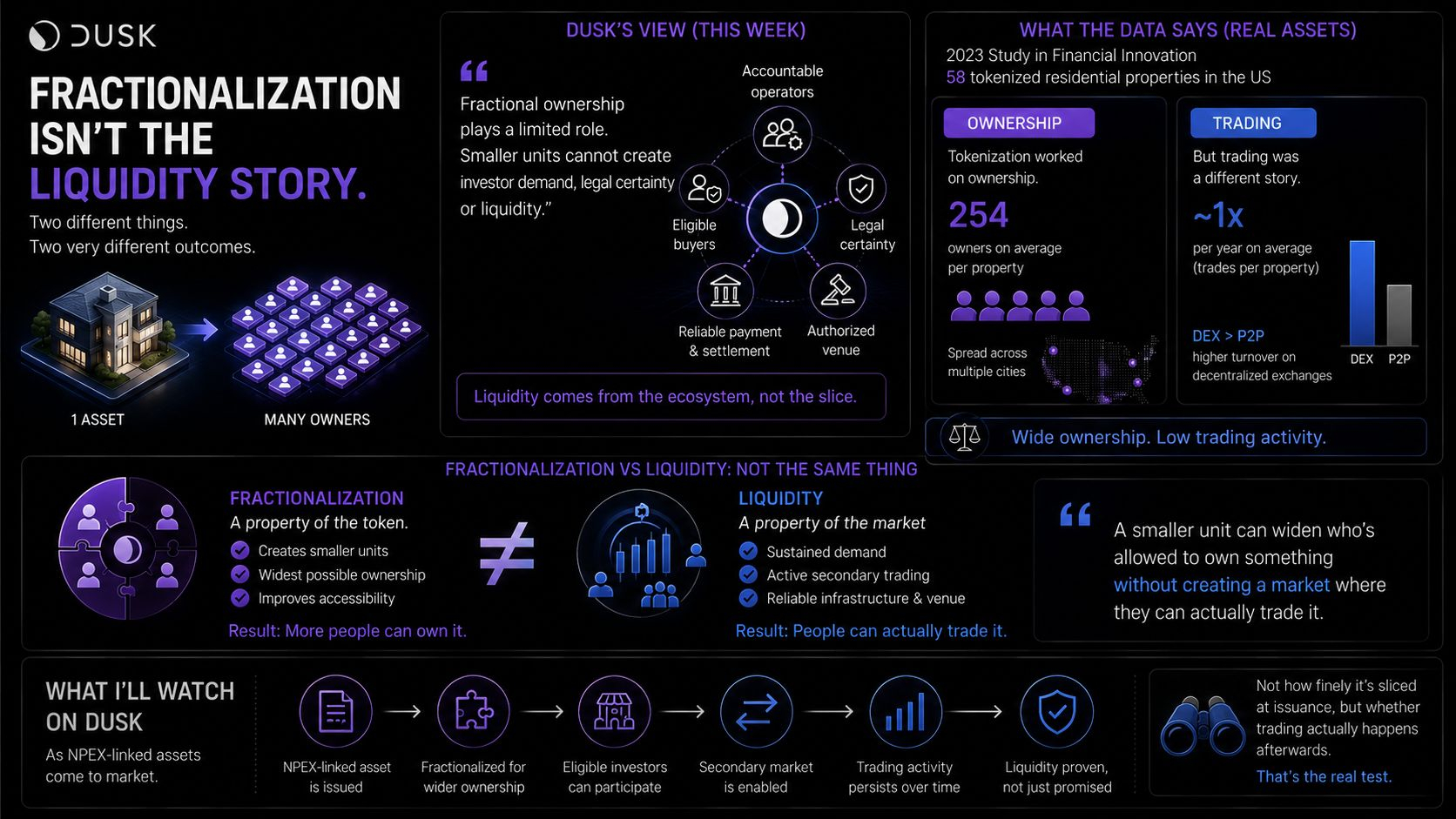
I assumed fractionalization was most of the liquidity story: split an asset into smaller pieces, and the pool of potential owners gets wider. Dusk's own writing on tokenization for SMEs, published this week, says that's a limited part of the picture, and an independent academic study of real tokenized assets shows why the gap matters.
Dusk says it plainly: "fractional ownership plays a limited role. Smaller units cannot create investor demand, legal certainty or liquidity." The value, they argue, comes from connecting the security to accountable operators, eligible buyers, reliable payment and settlement, and an authorized venue, not from how finely it's sliced.
A 2023 study published in Financial Innovation tested something close to this against real 58 tokenized residential properties in the US. On ownership, the results were clear: the average property had 254 separate owners. But on trading, the picture was different. Ownership changed hands about once a year on average, with properties on decentralized exchanges turning over more often than those traded peer-to-peer, though the yearly baseline stayed low either way.
Which means the two claims people conflate, "this asset is fractionalized" and "this asset is liquid," are actually describing two different things. Fractionalization is a property of the token. Liquidity is a property of the market around it.
"A smaller unit can widen who's allowed to own something without creating a market where they can actually trade it."
What I'd watch as NPEX-linked assets come onto Dusk: not how finely they're fractionalized at issuance, but whether secondary trading actually persists after that, the same gap the 58-property study found between wide ownership and active trading.
#dusk $DUSK @Dusk_Foundation
I assumed fractionalization was most of the liquidity story: split an asset into smaller pieces, and the pool of potential owners gets wider. Dusk's own writing on tokenization for SMEs, published this week, says that's a limited part of the picture, and an independent academic study of real tokenized assets shows why the gap matters.
Dusk says it plainly: "fractional ownership plays a limited role. Smaller units cannot create investor demand, legal certainty or liquidity." The value, they argue, comes from connecting the security to accountable operators, eligible buyers, reliable payment and settlement, and an authorized venue, not from how finely it's sliced.
A 2023 study published in Financial Innovation tested something close to this against real 58 tokenized residential properties in the US. On ownership, the results were clear: the average property had 254 separate owners. But on trading, the picture was different. Ownership changed hands about once a year on average, with properties on decentralized exchanges turning over more often than those traded peer-to-peer, though the yearly baseline stayed low either way.
Which means the two claims people conflate, "this asset is fractionalized" and "this asset is liquid," are actually describing two different things. Fractionalization is a property of the token. Liquidity is a property of the market around it.
"A smaller unit can widen who's allowed to own something without creating a market where they can actually trade it."
What I'd watch as NPEX-linked assets come onto Dusk: not how finely they're fractionalized at issuance, but whether secondary trading actually persists after that, the same gap the 58-property study found between wide ownership and active trading.
#dusk $DUSK @Dusk
Dusk says it plainly: "fractional ownership plays a limited role. Smaller units cannot create investor demand, legal certainty or liquidity." The value, they argue, comes from connecting the security to accountable operators, eligible buyers, reliable payment and settlement, and an authorized venue, not from how finely it's sliced.
A 2023 study published in Financial Innovation tested something close to this against real 58 tokenized residential properties in the US. On ownership, the results were clear: the average property had 254 separate owners. But on trading, the picture was different. Ownership changed hands about once a year on average, with properties on decentralized exchanges turning over more often than those traded peer-to-peer, though the yearly baseline stayed low either way.
Which means the two claims people conflate, "this asset is fractionalized" and "this asset is liquid," are actually describing two different things. Fractionalization is a property of the token. Liquidity is a property of the market around it.
"A smaller unit can widen who's allowed to own something without creating a market where they can actually trade it."
What I'd watch as NPEX-linked assets come onto Dusk: not how finely they're fractionalized at issuance, but whether secondary trading actually persists after that, the same gap the 58-property study found between wide ownership and active trading.
#dusk $DUSK @Dusk
2
2
79
·
--
Lihat terjemahan
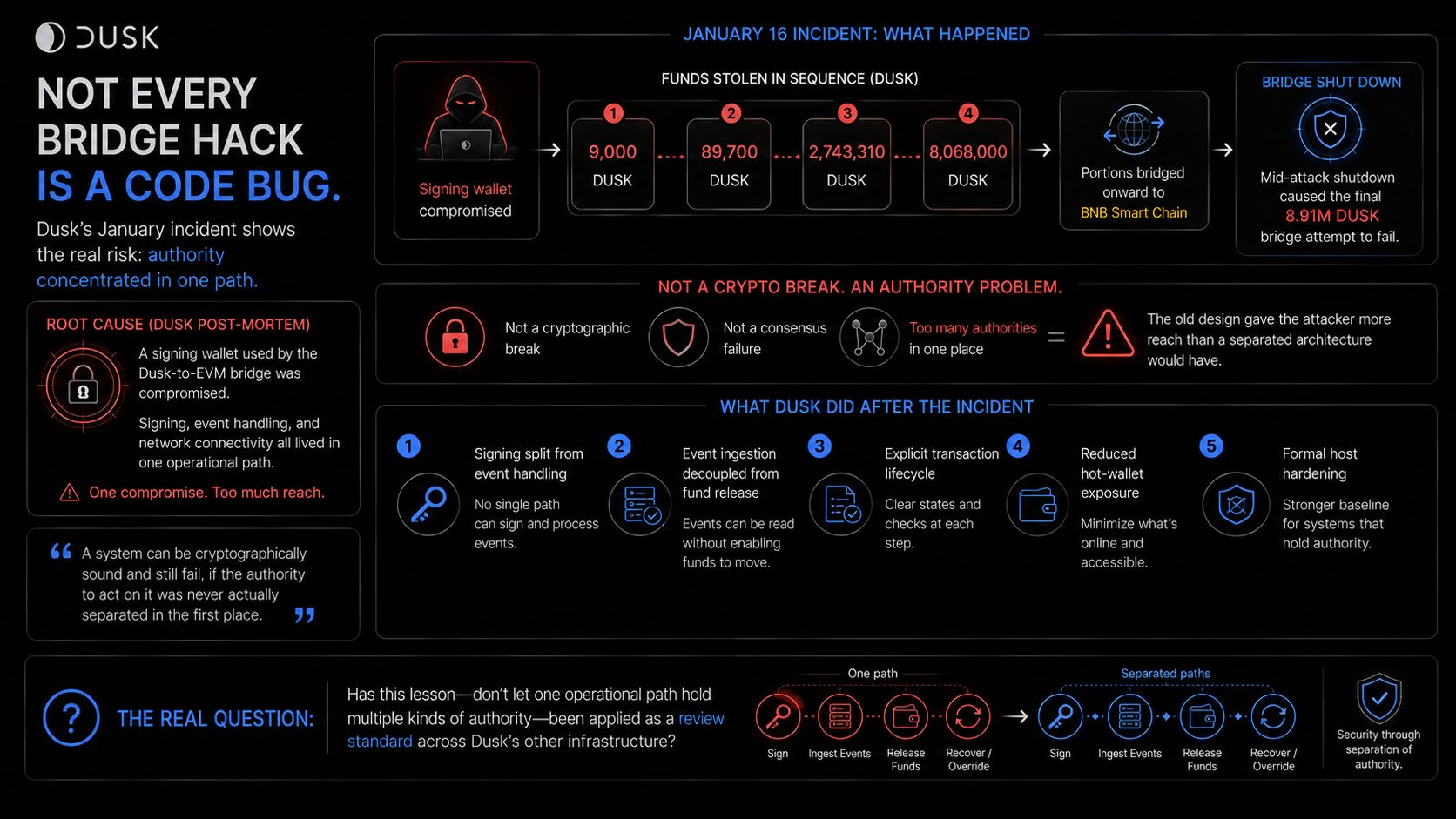
I assumed a bridge hack meant someone found a bug in the code, a flaw in the cryptography, something a security audit missed. Dusk's own post-mortem on its January bridge incident describes something else.
On January 16, an attacker compromised a signing wallet used by the Dusk-to-EVM bridge, moving funds directly on Dusk before routing part of it onward to BNB Smart Chain. Dusk shut the bridge down mid-attack, which is what caused a final, roughly 8.9 million DUSK transfer attempt to fail.
This was not a consensus failure or a protocol exploit. Dusk says the direct cause was key compromise, and that the old design let the signing wallet, event handling, and network connectivity all operate inside one path. The weakness was concentrated operational authority, not weak cryptography.
The redesign that followed comes down to one sentence buried in the post-mortem: "ingestion is no longer equivalent to spending." Seeing that an event happened and having the authority to release funds because of it used to be the same step. Now they're not. Event ingestion gets checkpointed and queued as a job; a separate, explicit process actually moves funds against it.
"A protocol can work as designed while the operational layer around it gives one compromised path too much authority."
What I'd actually want to see: confirmation that the redesigned bridge actually keeps event ingestion and fund release on separate paths in practice, not just in the post-mortem's description of the new architecture.
#dusk $DUSK @Dusk_Foundation
I assumed a bridge hack meant someone found a bug in the code, a flaw in the cryptography, something a security audit missed. Dusk's own post-mortem on its January bridge incident describes something else.
On January 16, an attacker compromised a signing wallet used by the Dusk-to-EVM bridge, moving funds directly on Dusk before routing part of it onward to BNB Smart Chain. Dusk shut the bridge down mid-attack, which is what caused a final, roughly 8.9 million DUSK transfer attempt to fail.
This was not a consensus failure or a protocol exploit. Dusk says the direct cause was key compromise, and that the old design let the signing wallet, event handling, and network connectivity all operate inside one path. The weakness was concentrated operational authority, not weak cryptography.
The redesign that followed comes down to one sentence buried in the post-mortem: "ingestion is no longer equivalent to spending." Seeing that an event happened and having the authority to release funds because of it used to be the same step. Now they're not. Event ingestion gets checkpointed and queued as a job; a separate, explicit process actually moves funds against it.
"A protocol can work as designed while the operational layer around it gives one compromised path too much authority."
What I'd actually want to see: confirmation that the redesigned bridge actually keeps event ingestion and fund release on separate paths in practice, not just in the post-mortem's description of the new architecture.
#dusk $DUSK @Dusk
On January 16, an attacker compromised a signing wallet used by the Dusk-to-EVM bridge, moving funds directly on Dusk before routing part of it onward to BNB Smart Chain. Dusk shut the bridge down mid-attack, which is what caused a final, roughly 8.9 million DUSK transfer attempt to fail.
This was not a consensus failure or a protocol exploit. Dusk says the direct cause was key compromise, and that the old design let the signing wallet, event handling, and network connectivity all operate inside one path. The weakness was concentrated operational authority, not weak cryptography.
The redesign that followed comes down to one sentence buried in the post-mortem: "ingestion is no longer equivalent to spending." Seeing that an event happened and having the authority to release funds because of it used to be the same step. Now they're not. Event ingestion gets checkpointed and queued as a job; a separate, explicit process actually moves funds against it.
"A protocol can work as designed while the operational layer around it gives one compromised path too much authority."
What I'd actually want to see: confirmation that the redesigned bridge actually keeps event ingestion and fund release on separate paths in practice, not just in the post-mortem's description of the new architecture.
#dusk $DUSK @Dusk
6
4
11.5k
·
--
Lihat terjemahan
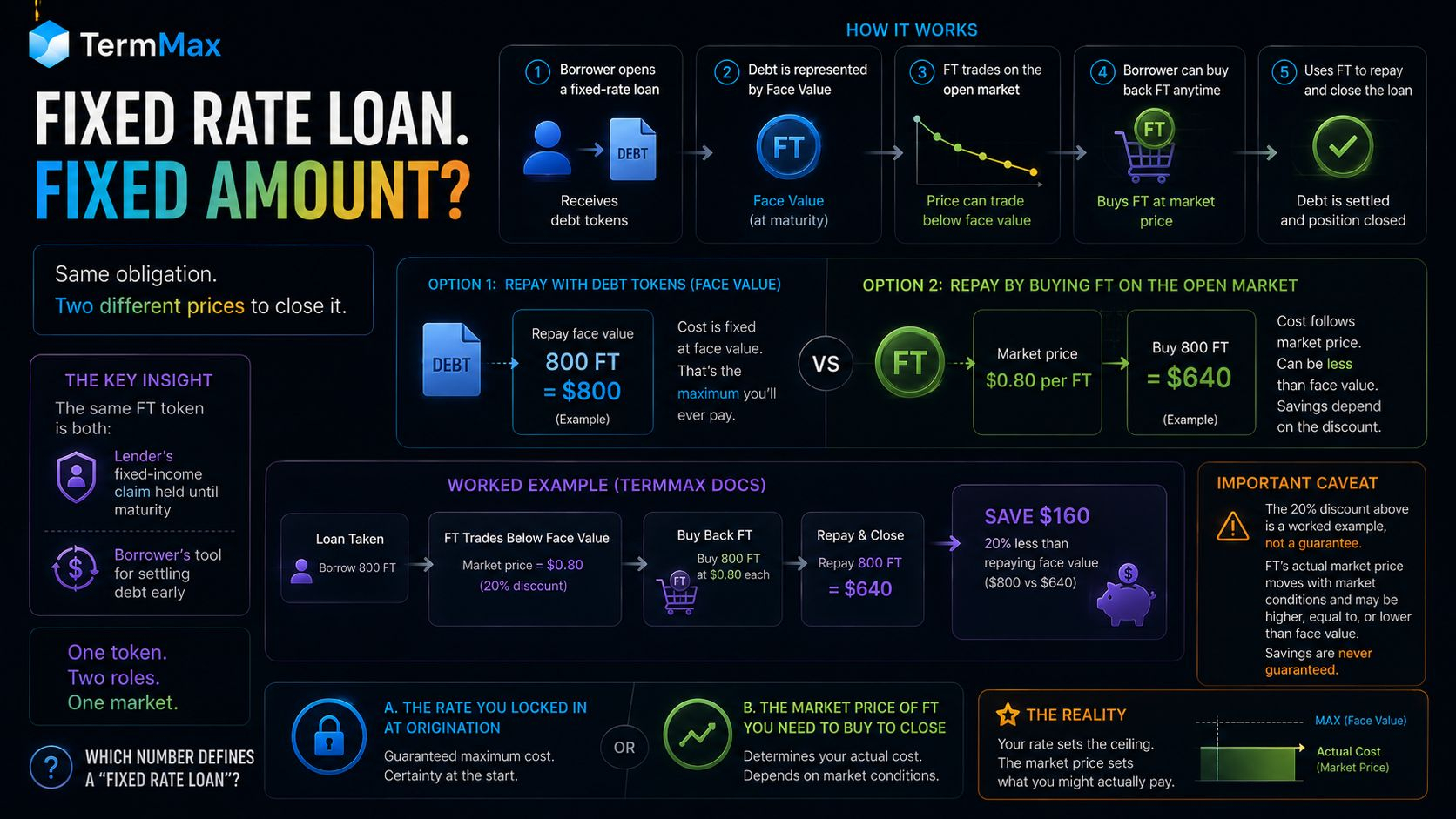
I assumed a fixed-rate loan on TermMax meant one number: whatever you borrowed, that's the fixed amount you eventually hand back. That's not the whole picture.
Here's the mechanic. When a borrower takes a loan, they receive debt tokens and can repay by returning that exact face value. But TermMax also lets them buy back FT, the token representing that same debt, from the open market instead. FT can trade below face value before maturity, and TermMax's worked example illustrates how that can lower the repayment cost. In that example, a borrower who owes 800 FT can buy them back at $0.80 each and settle the debt for $640, instead of repaying $800 directly. Same obligation, two different prices to close it.
That's not a rounding difference. It's a 20% gap between the contractual repayment amount and what closing the position can actually cost, depending on where FT happens to be trading that day.
Here's what that reveals: the same FT token is simultaneously the lender's fixed-income claim held until maturity, and the borrower's tool for settling debt early. The debt isn't a number that sits still between origination and maturity. It can have a market price before maturity, and that market price can move independently of the rate quoted at origination.
One caveat worth naming: TermMax's own documentation uses this 20% figure as a worked example, not a guaranteed market condition. FT's actual discount moves with market conditions and won't always be that wide.
So which number should actually define a "fixed-rate loan": the rate you locked in at origination, or the market price of the instrument you'd need to buy to close it?
#termmax @termmax
I assumed a fixed-rate loan on TermMax meant one number: whatever you borrowed, that's the fixed amount you eventually hand back. That's not the whole picture.
Here's the mechanic. When a borrower takes a loan, they receive debt tokens and can repay by returning that exact face value. But TermMax also lets them buy back FT, the token representing that same debt, from the open market instead. FT can trade below face value before maturity, and TermMax's worked example illustrates how that can lower the repayment cost. In that example, a borrower who owes 800 FT can buy them back at $0.80 each and settle the debt for $640, instead of repaying $800 directly. Same obligation, two different prices to close it.
That's not a rounding difference. It's a 20% gap between the contractual repayment amount and what closing the position can actually cost, depending on where FT happens to be trading that day.
Here's what that reveals: the same FT token is simultaneously the lender's fixed-income claim held until maturity, and the borrower's tool for settling debt early. The debt isn't a number that sits still between origination and maturity. It can have a market price before maturity, and that market price can move independently of the rate quoted at origination.
One caveat worth naming: TermMax's own documentation uses this 20% figure as a worked example, not a guaranteed market condition. FT's actual discount moves with market conditions and won't always be that wide.
So which number should actually define a "fixed-rate loan": the rate you locked in at origination, or the market price of the instrument you'd need to buy to close it?
#termmax @TermMax
Here's the mechanic. When a borrower takes a loan, they receive debt tokens and can repay by returning that exact face value. But TermMax also lets them buy back FT, the token representing that same debt, from the open market instead. FT can trade below face value before maturity, and TermMax's worked example illustrates how that can lower the repayment cost. In that example, a borrower who owes 800 FT can buy them back at $0.80 each and settle the debt for $640, instead of repaying $800 directly. Same obligation, two different prices to close it.
That's not a rounding difference. It's a 20% gap between the contractual repayment amount and what closing the position can actually cost, depending on where FT happens to be trading that day.
Here's what that reveals: the same FT token is simultaneously the lender's fixed-income claim held until maturity, and the borrower's tool for settling debt early. The debt isn't a number that sits still between origination and maturity. It can have a market price before maturity, and that market price can move independently of the rate quoted at origination.
One caveat worth naming: TermMax's own documentation uses this 20% figure as a worked example, not a guaranteed market condition. FT's actual discount moves with market conditions and won't always be that wide.
So which number should actually define a "fixed-rate loan": the rate you locked in at origination, or the market price of the instrument you'd need to buy to close it?
#termmax @TermMax
6
3
7.6k
·
--
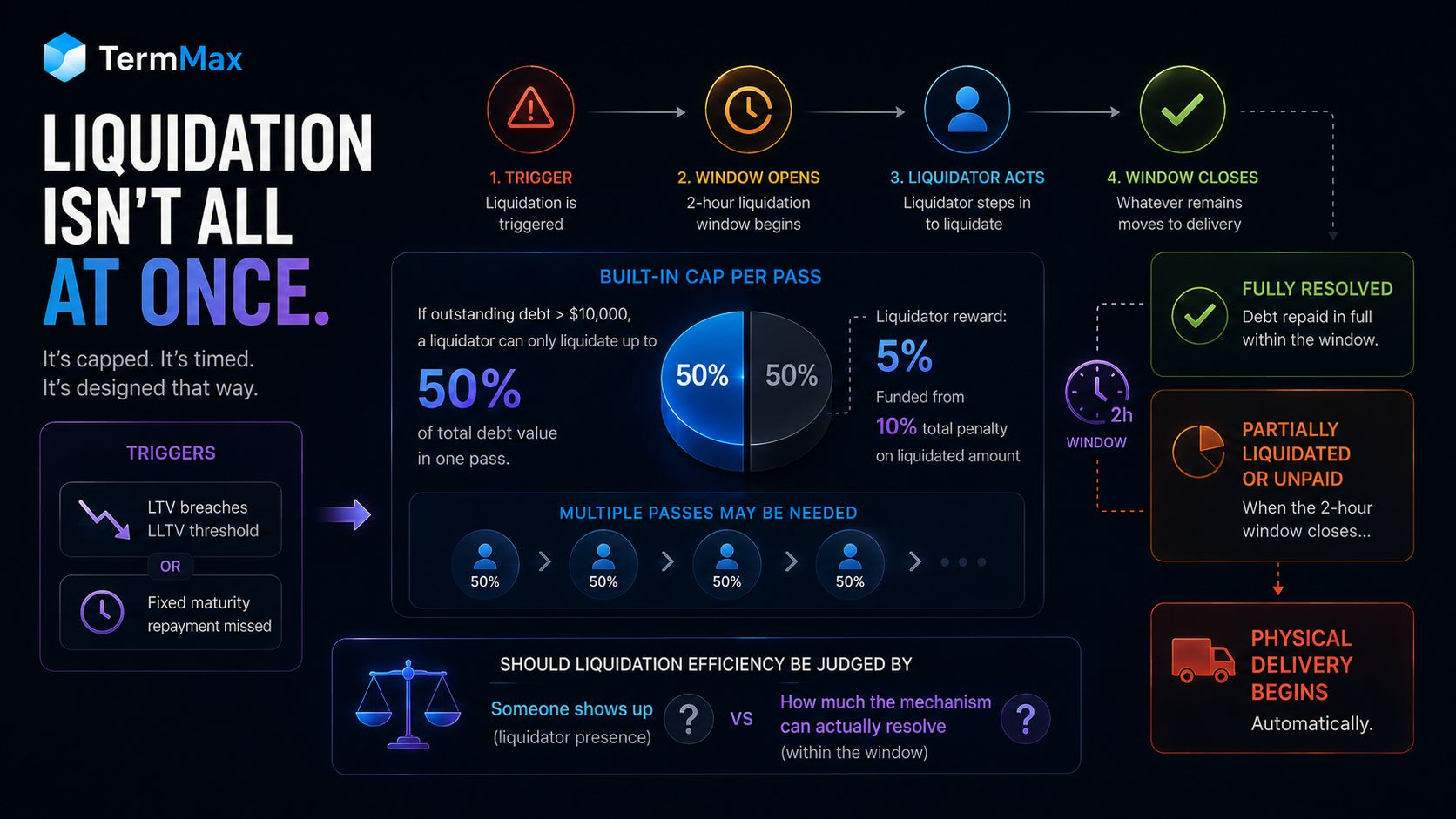
Saya mengira kata "liquidated" di TermMax berarti posisi akan langsung dibersihkan begitu seorang likuidator turun tangan. Ternyata tidak sesederhana itu untuk posisi yang lebih besar.
Likuidasi terjadi ketika nilai LTV pinjaman melanggar ambang LLTV, atau ketika peminjam melewatkan pembayaran jatuh tempo tetap, sehingga membuka jendela likuidasi dua jam. Namun ada batas yang tertanam dalam mekanismenya sendiri: jika utang yang masih terutang melebihi $10,000, likuidator hanya dapat melikuidasi hingga 50% dari total nilai utang pada putaran tersebut.
Jadi untuk posisi yang cukup besar, batasannya bukan semata-mata apakah likuidator ingin bertindak. Protokol itu sendiri tidak akan mengizinkan satu kali likuidasi untuk menghapus semuanya.
Itu mengubah makna "terlikuidasi sebagian". Belum tentu itu bukti bahwa permintaan likuidasi terlalu tipis atau pasar bergerak terlalu cepat. Bisa jadi itu konsekuensi yang memang diharapkan dari mekanisme itu sendiri. Dan jika pinjaman masih belum dibayar atau hanya terlikuidasi sebagian ketika jendela dua jam tersebut berakhir, pengiriman fisik dimulai secara otomatis.
Ukuran suatu posisi tidak hanya memengaruhi seberapa besar yang berisiko. Ukuran itu juga dapat memengaruhi apakah proses likuidasi bisa menyelesaikan posisi sepenuhnya dalam jendela yang tersedia.
Jadi, apakah efisiensi likuidasi sebaiknya dinilai dari apakah seorang likuidator datang, atau dari seberapa banyak dari posisi yang benar-benar dapat diselesaikan oleh mekanisme sebelum jendela tersebut berakhir?
#termmax @termmax
Saya mengira kata "liquidated" di TermMax berarti posisi akan langsung dibersihkan begitu seorang likuidator turun tangan. Ternyata tidak sesederhana itu untuk posisi yang lebih besar.
Likuidasi terjadi ketika nilai LTV pinjaman melanggar ambang LLTV, atau ketika peminjam melewatkan pembayaran jatuh tempo tetap, sehingga membuka jendela likuidasi dua jam. Namun ada batas yang tertanam dalam mekanismenya sendiri: jika utang yang masih terutang melebihi $10,000, likuidator hanya dapat melikuidasi hingga 50% dari total nilai utang pada putaran tersebut.
Jadi untuk posisi yang cukup besar, batasannya bukan semata-mata apakah likuidator ingin bertindak. Protokol itu sendiri tidak akan mengizinkan satu kali likuidasi untuk menghapus semuanya.
Itu mengubah makna "terlikuidasi sebagian". Belum tentu itu bukti bahwa permintaan likuidasi terlalu tipis atau pasar bergerak terlalu cepat. Bisa jadi itu konsekuensi yang memang diharapkan dari mekanisme itu sendiri. Dan jika pinjaman masih belum dibayar atau hanya terlikuidasi sebagian ketika jendela dua jam tersebut berakhir, pengiriman fisik dimulai secara otomatis.
Ukuran suatu posisi tidak hanya memengaruhi seberapa besar yang berisiko. Ukuran itu juga dapat memengaruhi apakah proses likuidasi bisa menyelesaikan posisi sepenuhnya dalam jendela yang tersedia.
Jadi, apakah efisiensi likuidasi sebaiknya dinilai dari apakah seorang likuidator datang, atau dari seberapa banyak dari posisi yang benar-benar dapat diselesaikan oleh mekanisme sebelum jendela tersebut berakhir?
#termmax @TermMax
Likuidasi terjadi ketika nilai LTV pinjaman melanggar ambang LLTV, atau ketika peminjam melewatkan pembayaran jatuh tempo tetap, sehingga membuka jendela likuidasi dua jam. Namun ada batas yang tertanam dalam mekanismenya sendiri: jika utang yang masih terutang melebihi $10,000, likuidator hanya dapat melikuidasi hingga 50% dari total nilai utang pada putaran tersebut.
Jadi untuk posisi yang cukup besar, batasannya bukan semata-mata apakah likuidator ingin bertindak. Protokol itu sendiri tidak akan mengizinkan satu kali likuidasi untuk menghapus semuanya.
Itu mengubah makna "terlikuidasi sebagian". Belum tentu itu bukti bahwa permintaan likuidasi terlalu tipis atau pasar bergerak terlalu cepat. Bisa jadi itu konsekuensi yang memang diharapkan dari mekanisme itu sendiri. Dan jika pinjaman masih belum dibayar atau hanya terlikuidasi sebagian ketika jendela dua jam tersebut berakhir, pengiriman fisik dimulai secara otomatis.
Ukuran suatu posisi tidak hanya memengaruhi seberapa besar yang berisiko. Ukuran itu juga dapat memengaruhi apakah proses likuidasi bisa menyelesaikan posisi sepenuhnya dalam jendela yang tersedia.
Jadi, apakah efisiensi likuidasi sebaiknya dinilai dari apakah seorang likuidator datang, atau dari seberapa banyak dari posisi yang benar-benar dapat diselesaikan oleh mekanisme sebelum jendela tersebut berakhir?
#termmax @TermMax
10
6
44
·
--
Lihat terjemahan
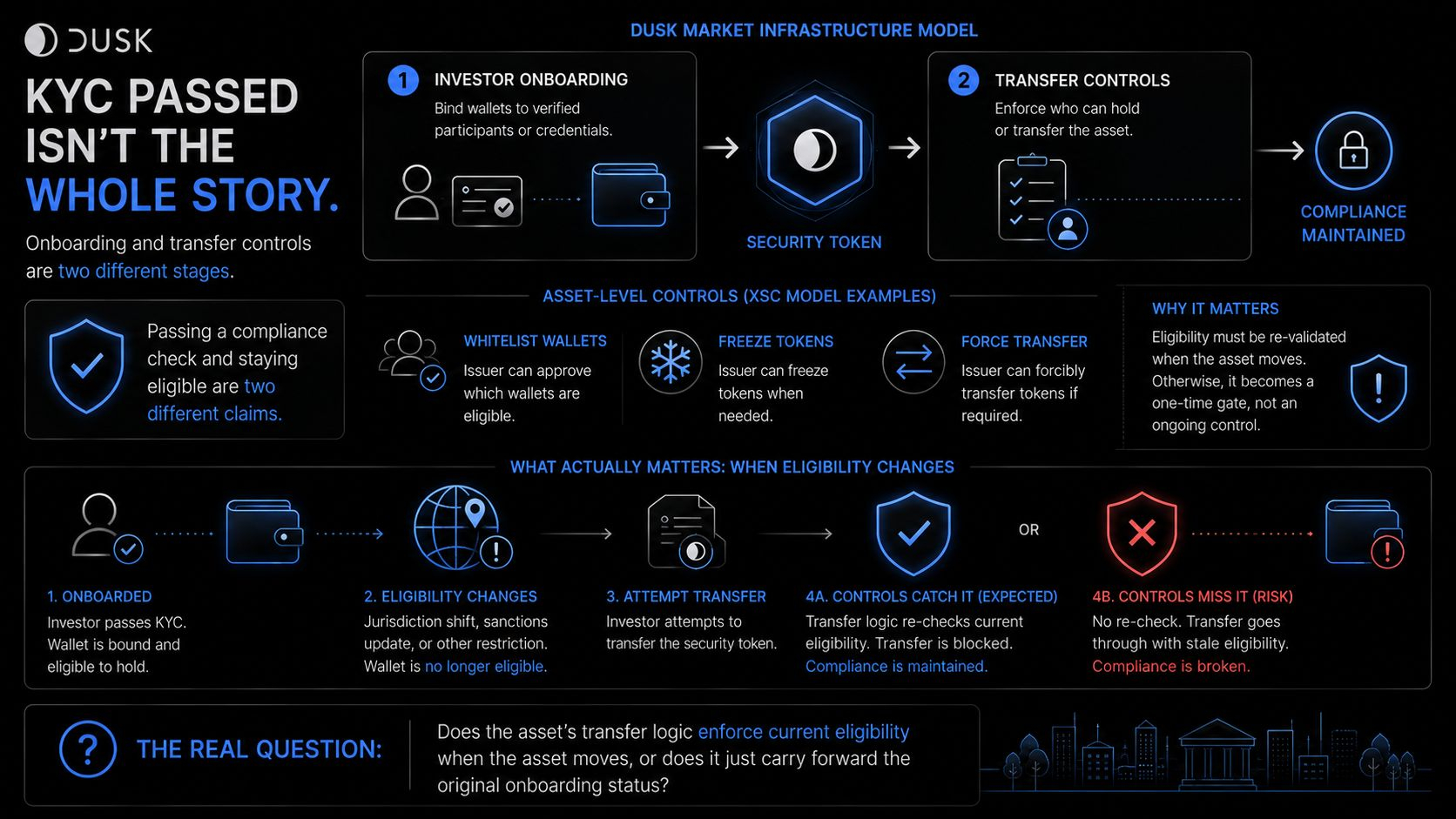
KYC answers who qualified at onboarding. Transfer controls answer who is still eligible when the asset moves. Dusk's own market-infrastructure model treats those as separate stages, and that gap is the interesting part.
Dusk lists investor onboarding, "bind wallets to verified participants or credentials," separately from transfer controls, "enforce who can hold or transfer the asset." One establishes an initial eligibility state. The other is what makes that state enforceable when the asset actually moves.
The older XSC material goes further than onboarding: issuers can whitelist wallets and retain asset-level controls such as freezing or force-transfer. That matters because eligibility isn't only established once. It has to remain enforceable after the initial decision.
Which means "KYC passed" and "eligible to hold this asset" are two different claims that can quietly diverge. A wallet can stay verified in the identity sense while no longer being the kind of holder this specific asset is allowed to have. Compliance enforcement doesn't end at onboarding, it has to continue into the asset's transfer lifecycle.
"Passing a compliance check and staying eligible are two different claims."
That changes the actual evaluation question. Not "does this asset have eligibility checks." The real question is whether the current eligibility state is enforced when the asset moves, or whether the original onboarding status simply carries forward.
What I'd actually want to see: a wallet whose eligibility changes after onboarding, say a jurisdiction shift, while it still holds the asset, then an attempted transfer, and whether the asset's transfer logic catches that change.
#dusk $DUSK @Dusk_Foundation
KYC answers who qualified at onboarding. Transfer controls answer who is still eligible when the asset moves. Dusk's own market-infrastructure model treats those as separate stages, and that gap is the interesting part.
Dusk lists investor onboarding, "bind wallets to verified participants or credentials," separately from transfer controls, "enforce who can hold or transfer the asset." One establishes an initial eligibility state. The other is what makes that state enforceable when the asset actually moves.
The older XSC material goes further than onboarding: issuers can whitelist wallets and retain asset-level controls such as freezing or force-transfer. That matters because eligibility isn't only established once. It has to remain enforceable after the initial decision.
Which means "KYC passed" and "eligible to hold this asset" are two different claims that can quietly diverge. A wallet can stay verified in the identity sense while no longer being the kind of holder this specific asset is allowed to have. Compliance enforcement doesn't end at onboarding, it has to continue into the asset's transfer lifecycle.
"Passing a compliance check and staying eligible are two different claims."
That changes the actual evaluation question. Not "does this asset have eligibility checks." The real question is whether the current eligibility state is enforced when the asset moves, or whether the original onboarding status simply carries forward.
What I'd actually want to see: a wallet whose eligibility changes after onboarding, say a jurisdiction shift, while it still holds the asset, then an attempted transfer, and whether the asset's transfer logic catches that change.
#dusk $DUSK @Dusk
Dusk lists investor onboarding, "bind wallets to verified participants or credentials," separately from transfer controls, "enforce who can hold or transfer the asset." One establishes an initial eligibility state. The other is what makes that state enforceable when the asset actually moves.
The older XSC material goes further than onboarding: issuers can whitelist wallets and retain asset-level controls such as freezing or force-transfer. That matters because eligibility isn't only established once. It has to remain enforceable after the initial decision.
Which means "KYC passed" and "eligible to hold this asset" are two different claims that can quietly diverge. A wallet can stay verified in the identity sense while no longer being the kind of holder this specific asset is allowed to have. Compliance enforcement doesn't end at onboarding, it has to continue into the asset's transfer lifecycle.
"Passing a compliance check and staying eligible are two different claims."
That changes the actual evaluation question. Not "does this asset have eligibility checks." The real question is whether the current eligibility state is enforced when the asset moves, or whether the original onboarding status simply carries forward.
What I'd actually want to see: a wallet whose eligibility changes after onboarding, say a jurisdiction shift, while it still holds the asset, then an attempted transfer, and whether the asset's transfer logic catches that change.
#dusk $DUSK @Dusk
26
8
102
·
--
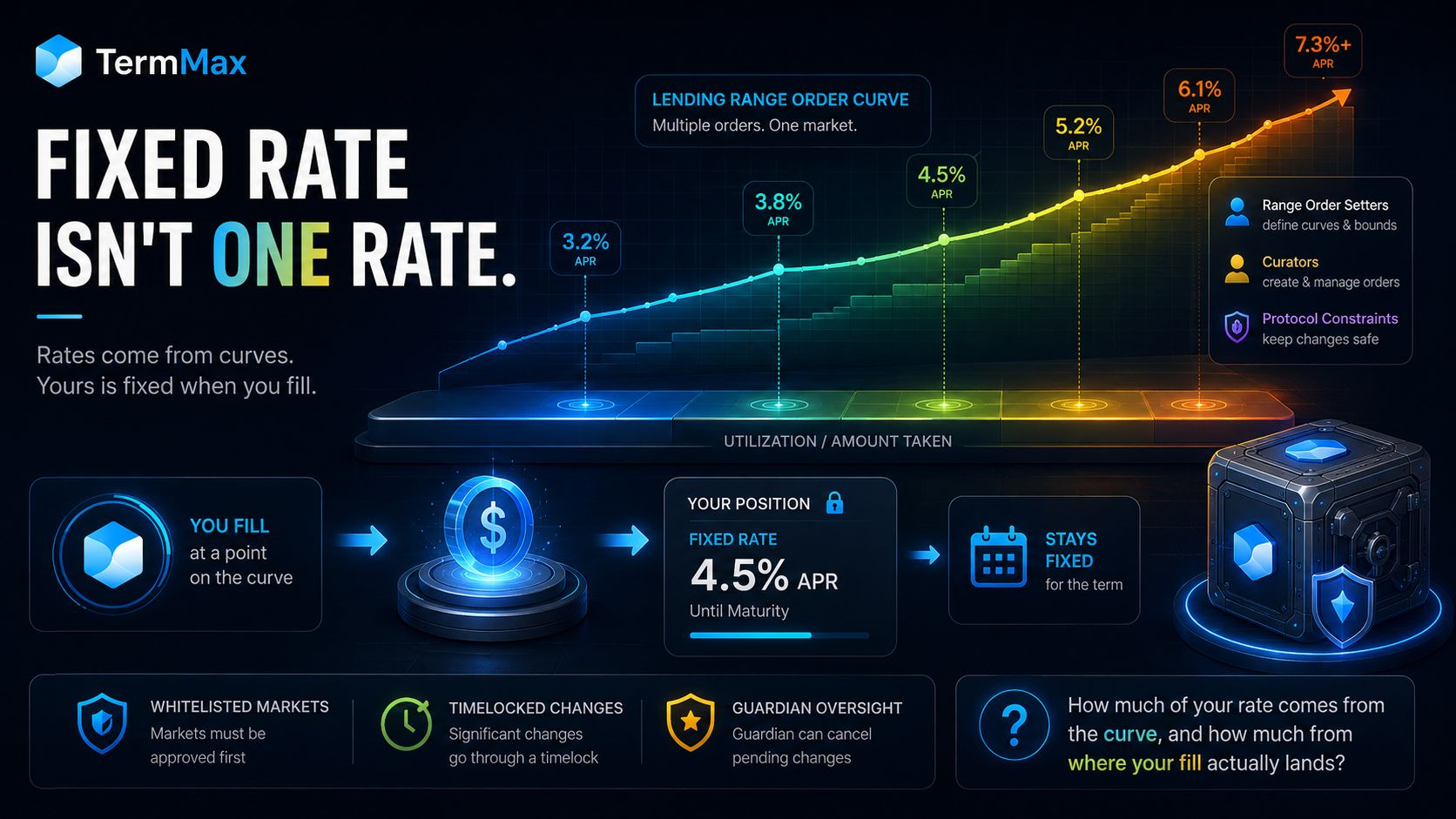
Saya mengira "pasar dengan suku bunga tetap" berarti satu suku bunga: Anda tahu angkanya sebelum melakukan transaksi, titik. Namun, ketika saya melihat lebih dekat bagaimana TermMax benar-benar menetapkan harga pinjaman, asumsi itu tidak berlaku.
Suku bunga tidak dikutip sebagai satu angka tunggal. Suku bunga didefinisikan melalui kurva. Dalam Lending Range Order, kurva bisa dimulai dari suku bunga yang lebih rendah lalu meningkat bertahap ketika lebih banyak dari order tersebut terisi, mirip dengan AMM yang bergerak melalui berbagai level harga, bukan menawarkan satu harga. Sebuah pasar dapat menampung beberapa range order sekaligus, sehingga peserta yang berbeda bisa mengisi pada titik yang berbeda di kurva.
Perbedaan yang saya lewatkan adalah: pasar tidak memiliki satu suku bunga tetap. Setiap posisi yang dieksekusi mendapatkan suku bunga tetap yang ditentukan oleh tempat pengisian (fill) pada kurva tersebut. Setelah terisi, suku bunga itu tetap untuk jangka waktunya.
Kurva itu juga tidak bersifat sewenang-wenang pada saat runtime. Aksi Curator berada di dalam batasan protokol seperti market yang di-whitelist dan perubahan yang ditimelock.
Jadi ketika TermMax menyebutnya sebagai "pasar dengan suku bunga tetap", pertanyaan yang menarik bukan hanya suku bunga tetapnya berapa. Melainkan: seberapa besar suku bunga itu ditentukan oleh kurva, dan seberapa besar ditentukan oleh di mana likuiditas Anda benar-benar terisi?
#termmax @termmax
Saya mengira "pasar dengan suku bunga tetap" berarti satu suku bunga: Anda tahu angkanya sebelum melakukan transaksi, titik. Namun, ketika saya melihat lebih dekat bagaimana TermMax benar-benar menetapkan harga pinjaman, asumsi itu tidak berlaku.
Suku bunga tidak dikutip sebagai satu angka tunggal. Suku bunga didefinisikan melalui kurva. Dalam Lending Range Order, kurva bisa dimulai dari suku bunga yang lebih rendah lalu meningkat bertahap ketika lebih banyak dari order tersebut terisi, mirip dengan AMM yang bergerak melalui berbagai level harga, bukan menawarkan satu harga. Sebuah pasar dapat menampung beberapa range order sekaligus, sehingga peserta yang berbeda bisa mengisi pada titik yang berbeda di kurva.
Perbedaan yang saya lewatkan adalah: pasar tidak memiliki satu suku bunga tetap. Setiap posisi yang dieksekusi mendapatkan suku bunga tetap yang ditentukan oleh tempat pengisian (fill) pada kurva tersebut. Setelah terisi, suku bunga itu tetap untuk jangka waktunya.
Kurva itu juga tidak bersifat sewenang-wenang pada saat runtime. Aksi Curator berada di dalam batasan protokol seperti market yang di-whitelist dan perubahan yang ditimelock.
Jadi ketika TermMax menyebutnya sebagai "pasar dengan suku bunga tetap", pertanyaan yang menarik bukan hanya suku bunga tetapnya berapa. Melainkan: seberapa besar suku bunga itu ditentukan oleh kurva, dan seberapa besar ditentukan oleh di mana likuiditas Anda benar-benar terisi?
#termmax @TermMax
Suku bunga tidak dikutip sebagai satu angka tunggal. Suku bunga didefinisikan melalui kurva. Dalam Lending Range Order, kurva bisa dimulai dari suku bunga yang lebih rendah lalu meningkat bertahap ketika lebih banyak dari order tersebut terisi, mirip dengan AMM yang bergerak melalui berbagai level harga, bukan menawarkan satu harga. Sebuah pasar dapat menampung beberapa range order sekaligus, sehingga peserta yang berbeda bisa mengisi pada titik yang berbeda di kurva.
Perbedaan yang saya lewatkan adalah: pasar tidak memiliki satu suku bunga tetap. Setiap posisi yang dieksekusi mendapatkan suku bunga tetap yang ditentukan oleh tempat pengisian (fill) pada kurva tersebut. Setelah terisi, suku bunga itu tetap untuk jangka waktunya.
Kurva itu juga tidak bersifat sewenang-wenang pada saat runtime. Aksi Curator berada di dalam batasan protokol seperti market yang di-whitelist dan perubahan yang ditimelock.
Jadi ketika TermMax menyebutnya sebagai "pasar dengan suku bunga tetap", pertanyaan yang menarik bukan hanya suku bunga tetapnya berapa. Melainkan: seberapa besar suku bunga itu ditentukan oleh kurva, dan seberapa besar ditentukan oleh di mana likuiditas Anda benar-benar terisi?
#termmax @TermMax
51
14
8.3k
·
--
Lihat terjemahan
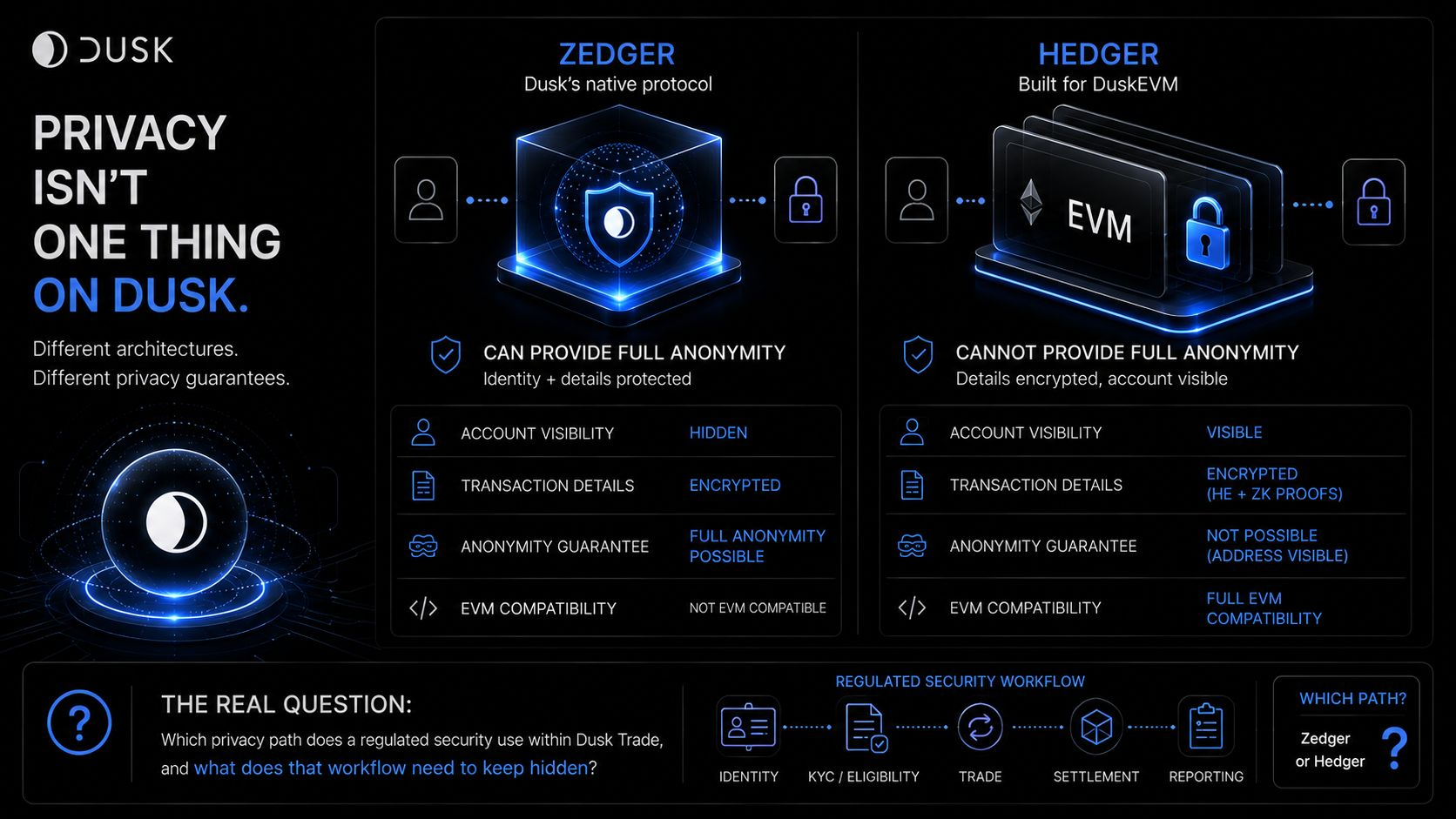
Ask most people evaluating a privacy chain whether it's private, and they'll check a box: yes or no. For Dusk, that's the wrong question, and Dusk's own writeup on Hedger shows why.
Zedger, Dusk's native privacy-preserving protocol, can provide full anonymity. Hedger, built for DuskEVM, can't. Dusk says it plainly: the EVM's account-based model prevents full anonymity, while Hedger keeps transaction details encrypted using homomorphic encryption and zero-knowledge proofs without offering that same full-anonymity guarantee.
That's not a bug Dusk is hiding. It's the trade-off the architecture makes explicit: EVM compatibility comes with a different privacy guarantee than Zedger's full anonymity.
Here's what actually changes when that trade-off gets made. The important difference isn't simply whether transaction details are encrypted. It's the anonymity guarantee. Use the Zedger path and full anonymity is available. Use the EVM-compatible Hedger path and the same guarantee isn't. Same brand, same word "confidential," different guarantee underneath.
That changes what the actual question should be for anyone evaluating this. Not "does Dusk support confidential transactions." Both paths support private transaction flows, but they don't provide the same anonymity guarantee. The real question is whether the guarantee a regulated asset gets actually matches what its workflow needs in the first place.
"Privacy that keeps transaction details confidential and privacy that provides full anonymity are two different guarantees, even when a project ships both under the same word."
What I'd actually want to see: which privacy path a regulated security actually uses within Dusk Trade, and what that workflow requires the path to keep hidden.
#dusk $DUSK @Dusk_Foundation
Ask most people evaluating a privacy chain whether it's private, and they'll check a box: yes or no. For Dusk, that's the wrong question, and Dusk's own writeup on Hedger shows why.
Zedger, Dusk's native privacy-preserving protocol, can provide full anonymity. Hedger, built for DuskEVM, can't. Dusk says it plainly: the EVM's account-based model prevents full anonymity, while Hedger keeps transaction details encrypted using homomorphic encryption and zero-knowledge proofs without offering that same full-anonymity guarantee.
That's not a bug Dusk is hiding. It's the trade-off the architecture makes explicit: EVM compatibility comes with a different privacy guarantee than Zedger's full anonymity.
Here's what actually changes when that trade-off gets made. The important difference isn't simply whether transaction details are encrypted. It's the anonymity guarantee. Use the Zedger path and full anonymity is available. Use the EVM-compatible Hedger path and the same guarantee isn't. Same brand, same word "confidential," different guarantee underneath.
That changes what the actual question should be for anyone evaluating this. Not "does Dusk support confidential transactions." Both paths support private transaction flows, but they don't provide the same anonymity guarantee. The real question is whether the guarantee a regulated asset gets actually matches what its workflow needs in the first place.
"Privacy that keeps transaction details confidential and privacy that provides full anonymity are two different guarantees, even when a project ships both under the same word."
What I'd actually want to see: which privacy path a regulated security actually uses within Dusk Trade, and what that workflow requires the path to keep hidden.
#dusk $DUSK @Dusk
Zedger, Dusk's native privacy-preserving protocol, can provide full anonymity. Hedger, built for DuskEVM, can't. Dusk says it plainly: the EVM's account-based model prevents full anonymity, while Hedger keeps transaction details encrypted using homomorphic encryption and zero-knowledge proofs without offering that same full-anonymity guarantee.
That's not a bug Dusk is hiding. It's the trade-off the architecture makes explicit: EVM compatibility comes with a different privacy guarantee than Zedger's full anonymity.
Here's what actually changes when that trade-off gets made. The important difference isn't simply whether transaction details are encrypted. It's the anonymity guarantee. Use the Zedger path and full anonymity is available. Use the EVM-compatible Hedger path and the same guarantee isn't. Same brand, same word "confidential," different guarantee underneath.
That changes what the actual question should be for anyone evaluating this. Not "does Dusk support confidential transactions." Both paths support private transaction flows, but they don't provide the same anonymity guarantee. The real question is whether the guarantee a regulated asset gets actually matches what its workflow needs in the first place.
"Privacy that keeps transaction details confidential and privacy that provides full anonymity are two different guarantees, even when a project ships both under the same word."
What I'd actually want to see: which privacy path a regulated security actually uses within Dusk Trade, and what that workflow requires the path to keep hidden.
#dusk $DUSK @Dusk
10
1
80
·
--
Lihat terjemahan
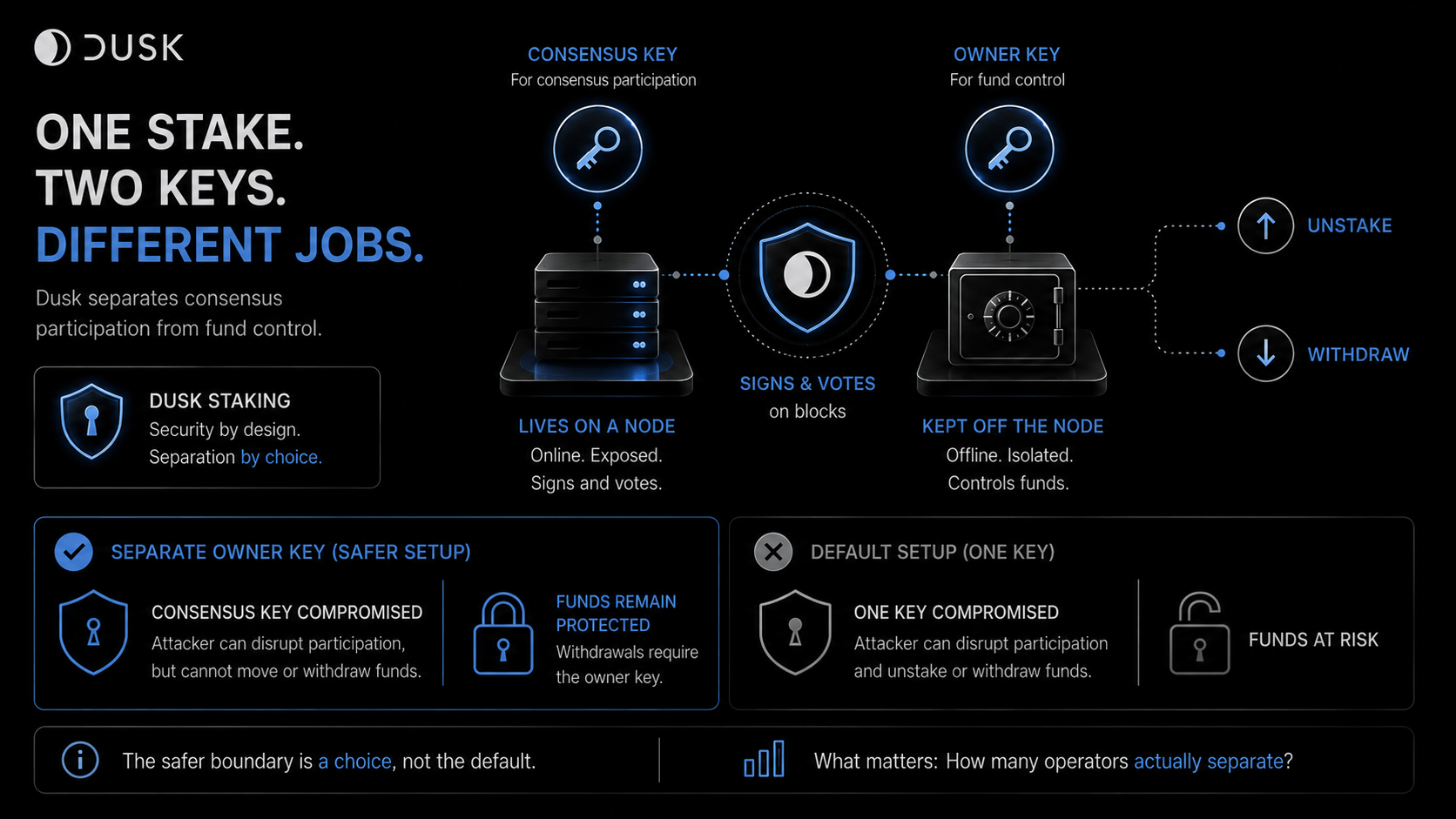
I assumed staking on a PoS chain meant one key controlling one thing: put DUSK in, get rewards out, same key handles it end to end.
Dusk's own operator docs split that in two.
The consensus key is the key a node uses to sign and vote in consensus. It has to live on an internet-connected node and participate as the validator operates. The owner key is separate: it's the key that can unstake or withdraw funds, and the docs say it doesn't need to touch the node at all.
The security benefit isn't simply that there are two keys. It's that the authority to participate in consensus and the authority to withdraw funds don't have to live in the same place. If the consensus key gets compromised because the server it's on gets breached, an attacker can interfere with consensus participation, but they still can't unstake or withdraw the stake. That authority never lived on the machine that's exposed to the internet in the first place. Which means the real security question isn't just how much is staked. It's where the authority to withdraw it actually sits relative to the machine that's exposed to attackers.
But there's a catch the docs don't hide: this separation isn't the default. If you stake without specifying a separate owner, the consensus key automatically becomes the owner too, one key, one boundary, back to the model I originally assumed. The safer setup is a choice an operator has to actively make, not something the protocol forces on them.
"A security boundary that has to be opted into is a different guarantee than one built into the default path, even when both are technically available."
What I'd actually want to know: how many active provisioners run with a separate owner key versus the default, because that would tell me whether the stronger boundary is actually being adopted, rather than merely being available.
#dusk $DUSK @Dusk_Foundation
I assumed staking on a PoS chain meant one key controlling one thing: put DUSK in, get rewards out, same key handles it end to end.
Dusk's own operator docs split that in two.
The consensus key is the key a node uses to sign and vote in consensus. It has to live on an internet-connected node and participate as the validator operates. The owner key is separate: it's the key that can unstake or withdraw funds, and the docs say it doesn't need to touch the node at all.
The security benefit isn't simply that there are two keys. It's that the authority to participate in consensus and the authority to withdraw funds don't have to live in the same place. If the consensus key gets compromised because the server it's on gets breached, an attacker can interfere with consensus participation, but they still can't unstake or withdraw the stake. That authority never lived on the machine that's exposed to the internet in the first place. Which means the real security question isn't just how much is staked. It's where the authority to withdraw it actually sits relative to the machine that's exposed to attackers.
But there's a catch the docs don't hide: this separation isn't the default. If you stake without specifying a separate owner, the consensus key automatically becomes the owner too, one key, one boundary, back to the model I originally assumed. The safer setup is a choice an operator has to actively make, not something the protocol forces on them.
"A security boundary that has to be opted into is a different guarantee than one built into the default path, even when both are technically available."
What I'd actually want to know: how many active provisioners run with a separate owner key versus the default, because that would tell me whether the stronger boundary is actually being adopted, rather than merely being available.
#dusk $DUSK @Dusk
Dusk's own operator docs split that in two.
The consensus key is the key a node uses to sign and vote in consensus. It has to live on an internet-connected node and participate as the validator operates. The owner key is separate: it's the key that can unstake or withdraw funds, and the docs say it doesn't need to touch the node at all.
The security benefit isn't simply that there are two keys. It's that the authority to participate in consensus and the authority to withdraw funds don't have to live in the same place. If the consensus key gets compromised because the server it's on gets breached, an attacker can interfere with consensus participation, but they still can't unstake or withdraw the stake. That authority never lived on the machine that's exposed to the internet in the first place. Which means the real security question isn't just how much is staked. It's where the authority to withdraw it actually sits relative to the machine that's exposed to attackers.
But there's a catch the docs don't hide: this separation isn't the default. If you stake without specifying a separate owner, the consensus key automatically becomes the owner too, one key, one boundary, back to the model I originally assumed. The safer setup is a choice an operator has to actively make, not something the protocol forces on them.
"A security boundary that has to be opted into is a different guarantee than one built into the default path, even when both are technically available."
What I'd actually want to know: how many active provisioners run with a separate owner key versus the default, because that would tell me whether the stronger boundary is actually being adopted, rather than merely being available.
#dusk $DUSK @Dusk
4
3
62
·
--
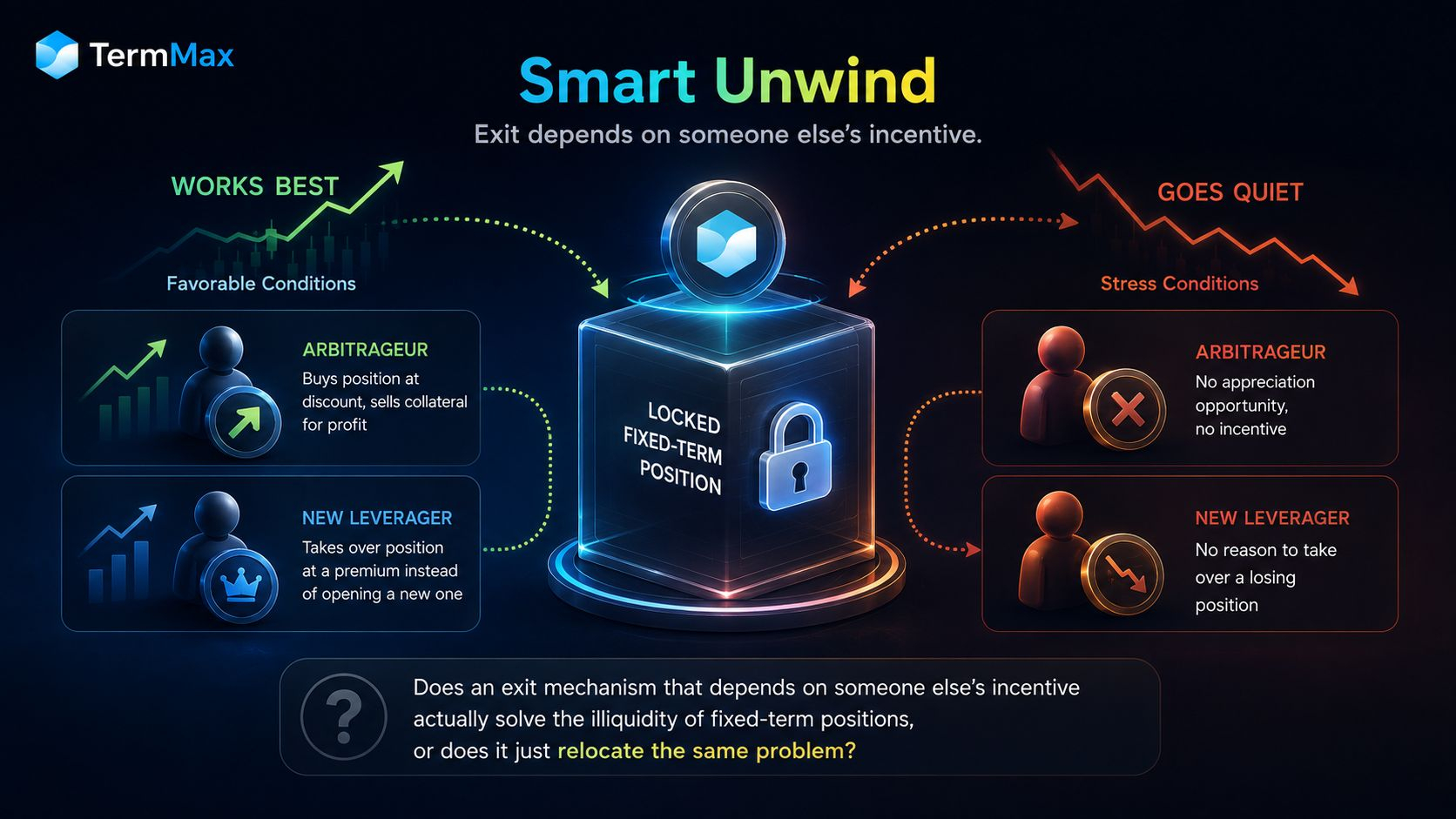
Saya mengira posisi tetap berjangka yang dikunci berarti tepat itu: dikunci, titik, sampai jatuh tempo. Lalu saya menemukan Smart Unwind milik TermMax dan mengira itu sekadar menyelesaikan hal tersebut. Nyatanya, itu tidak berjalan seperti yang saya harapkan.
Smart Unwind tidak menarik likuiditas keluar dari sebuah kumpulan. Cara kerjanya adalah membuat posisi Anda cukup menarik sehingga orang lain ingin mengambilnya alih. Seorang leverager menetapkan target APR atau harga. Jika agunan meningkat nilainya cukup besar, seorang arbitrageur membeli posisi pada harga tetap tersebut dan menjual agunan di pasar terbuka untuk mendapatkan keuntungan. Jika tingkat bunga pinjaman naik, leverager baru dapat mengambil alih posisi dengan premi, alih-alih membuka posisi baru.
Jadi protokol tidak benar-benar menjamin keluarnya dana. Keluarnya dana bergantung pada orang lain yang merasa perdagangan itu cukup menarik untuk mengambilnya.
Itu bagian yang belum saya pertimbangkan: kondisi ketika seorang leverager paling ingin keluar—harga agunan yang turun atau pasar yang sedang tertekan—mungkin saja justru merupakan kondisi ketika arbitrageur tidak punya apresiasi yang bisa ditangkap, dan leverager baru tidak punya alasan untuk mengambil alih posisi yang merugi. Mekanismenya mungkin bekerja paling baik tepat pada saat Anda paling tidak membutuhkannya, dan menjadi diam tepat saat Anda paling membutuhkannya.
Smart Unwind juga belum live, jadi belum ada perilaku seperti itu yang teramati; ini hanya apa yang tersirat dari desain.
Apakah mekanisme keluar yang bergantung pada insentif pihak lain benar-benar menyelesaikan masalah ilikuiditas pada posisi berjangka tetap, atau sekadar memindahkan masalah yang sama ke orang yang harus ditemukan di sisi seberangnya?
#termmax @termmax
Saya mengira posisi tetap berjangka yang dikunci berarti tepat itu: dikunci, titik, sampai jatuh tempo. Lalu saya menemukan Smart Unwind milik TermMax dan mengira itu sekadar menyelesaikan hal tersebut. Nyatanya, itu tidak berjalan seperti yang saya harapkan.
Smart Unwind tidak menarik likuiditas keluar dari sebuah kumpulan. Cara kerjanya adalah membuat posisi Anda cukup menarik sehingga orang lain ingin mengambilnya alih. Seorang leverager menetapkan target APR atau harga. Jika agunan meningkat nilainya cukup besar, seorang arbitrageur membeli posisi pada harga tetap tersebut dan menjual agunan di pasar terbuka untuk mendapatkan keuntungan. Jika tingkat bunga pinjaman naik, leverager baru dapat mengambil alih posisi dengan premi, alih-alih membuka posisi baru.
Jadi protokol tidak benar-benar menjamin keluarnya dana. Keluarnya dana bergantung pada orang lain yang merasa perdagangan itu cukup menarik untuk mengambilnya.
Itu bagian yang belum saya pertimbangkan: kondisi ketika seorang leverager paling ingin keluar—harga agunan yang turun atau pasar yang sedang tertekan—mungkin saja justru merupakan kondisi ketika arbitrageur tidak punya apresiasi yang bisa ditangkap, dan leverager baru tidak punya alasan untuk mengambil alih posisi yang merugi. Mekanismenya mungkin bekerja paling baik tepat pada saat Anda paling tidak membutuhkannya, dan menjadi diam tepat saat Anda paling membutuhkannya.
Smart Unwind juga belum live, jadi belum ada perilaku seperti itu yang teramati; ini hanya apa yang tersirat dari desain.
Apakah mekanisme keluar yang bergantung pada insentif pihak lain benar-benar menyelesaikan masalah ilikuiditas pada posisi berjangka tetap, atau sekadar memindahkan masalah yang sama ke orang yang harus ditemukan di sisi seberangnya?
#termmax @TermMax
Smart Unwind tidak menarik likuiditas keluar dari sebuah kumpulan. Cara kerjanya adalah membuat posisi Anda cukup menarik sehingga orang lain ingin mengambilnya alih. Seorang leverager menetapkan target APR atau harga. Jika agunan meningkat nilainya cukup besar, seorang arbitrageur membeli posisi pada harga tetap tersebut dan menjual agunan di pasar terbuka untuk mendapatkan keuntungan. Jika tingkat bunga pinjaman naik, leverager baru dapat mengambil alih posisi dengan premi, alih-alih membuka posisi baru.
Jadi protokol tidak benar-benar menjamin keluarnya dana. Keluarnya dana bergantung pada orang lain yang merasa perdagangan itu cukup menarik untuk mengambilnya.
Itu bagian yang belum saya pertimbangkan: kondisi ketika seorang leverager paling ingin keluar—harga agunan yang turun atau pasar yang sedang tertekan—mungkin saja justru merupakan kondisi ketika arbitrageur tidak punya apresiasi yang bisa ditangkap, dan leverager baru tidak punya alasan untuk mengambil alih posisi yang merugi. Mekanismenya mungkin bekerja paling baik tepat pada saat Anda paling tidak membutuhkannya, dan menjadi diam tepat saat Anda paling membutuhkannya.
Smart Unwind juga belum live, jadi belum ada perilaku seperti itu yang teramati; ini hanya apa yang tersirat dari desain.
Apakah mekanisme keluar yang bergantung pada insentif pihak lain benar-benar menyelesaikan masalah ilikuiditas pada posisi berjangka tetap, atau sekadar memindahkan masalah yang sama ke orang yang harus ditemukan di sisi seberangnya?
#termmax @TermMax
4
2
70
·
--
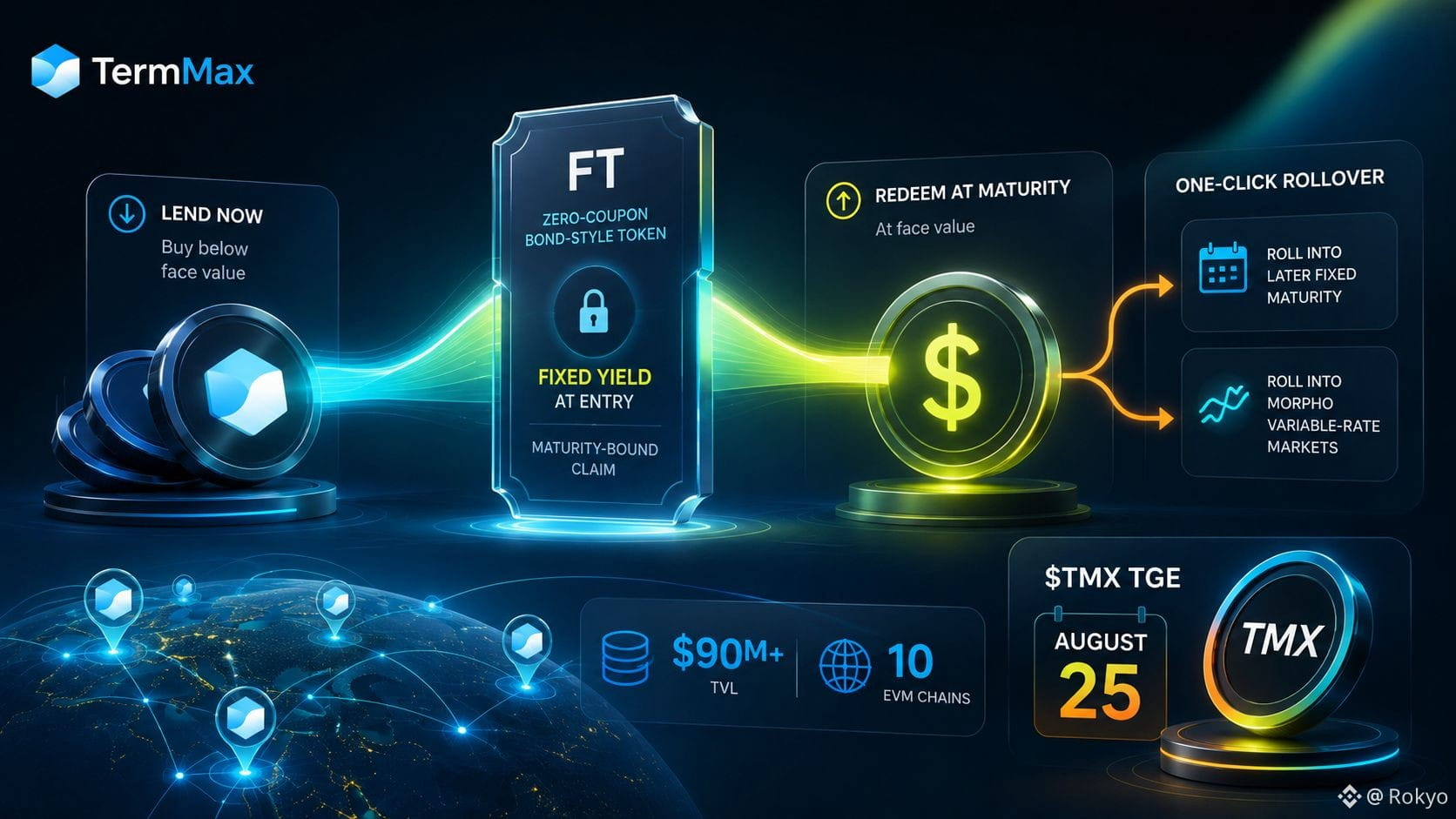
Saya melihat melewati label “pinjaman fixed-rate” dari TermMax untuk mengetahui apa yang sebenarnya terjadi di baliknya.
Komponennya tampak kurang seperti kumpulan pinjaman dengan APY tetap, dan lebih seperti pasar fixed-income di onchain. FT-nya adalah token bergaya zero-coupon bond: pemberi pinjaman membelinya di bawah nilai nominal dan menebusnya pada nilai pari saat jatuh tempo, dengan imbal hasil yang dikunci sejak awal. Itu mengubah cara saya memandang produknya: tingkat bunga tetap bukan sekadar parameter pada kumpulan pinjaman. Tingkat bunga itu tertanam dalam klaim yang terikat pada jatuh tempo.
Pada Januari, model fixed-rate yang sama diperluas melampaui jaminan yang asli kripto menjadi sekuritas yang ditokenisasi, dengan meluncurkan pinjaman fixed-rate atas saham tokenisasi milik Ondo Global Markets.
Tingkat bunga tetap menghilangkan ketidakpastian tarif selama periode. Itu tidak menghilangkan kebutuhan untuk melakukan refinancing ketika periode berakhir. TermMax sudah memiliki rollover satu klik, baik ke jatuh tempo fixed yang lebih belakangan atau ke pasar variable-rate milik Morpho, sehingga protokolnya secara eksplisit memang sudah merancang langkah refinancing tersebut. Yang didokumentasikan dengan baik adalah arsitekturnya; yang masih langka adalah data tentang bagaimana jalur itu berjalan ketika banyak posisi perlu di-roll sekaligus dalam kondisi tertekan.
Dengan TVL $90M+ di 10 rantai EVM dan TGE $TMX yang dijadwalkan 25 Agustus, bagian itulah yang ingin saya pantau berikutnya.
#termmax @termmax
Saya melihat melewati label “pinjaman fixed-rate” dari TermMax untuk mengetahui apa yang sebenarnya terjadi di baliknya.
Komponennya tampak kurang seperti kumpulan pinjaman dengan APY tetap, dan lebih seperti pasar fixed-income di onchain. FT-nya adalah token bergaya zero-coupon bond: pemberi pinjaman membelinya di bawah nilai nominal dan menebusnya pada nilai pari saat jatuh tempo, dengan imbal hasil yang dikunci sejak awal. Itu mengubah cara saya memandang produknya: tingkat bunga tetap bukan sekadar parameter pada kumpulan pinjaman. Tingkat bunga itu tertanam dalam klaim yang terikat pada jatuh tempo.
Pada Januari, model fixed-rate yang sama diperluas melampaui jaminan yang asli kripto menjadi sekuritas yang ditokenisasi, dengan meluncurkan pinjaman fixed-rate atas saham tokenisasi milik Ondo Global Markets.
Tingkat bunga tetap menghilangkan ketidakpastian tarif selama periode. Itu tidak menghilangkan kebutuhan untuk melakukan refinancing ketika periode berakhir. TermMax sudah memiliki rollover satu klik, baik ke jatuh tempo fixed yang lebih belakangan atau ke pasar variable-rate milik Morpho, sehingga protokolnya secara eksplisit memang sudah merancang langkah refinancing tersebut. Yang didokumentasikan dengan baik adalah arsitekturnya; yang masih langka adalah data tentang bagaimana jalur itu berjalan ketika banyak posisi perlu di-roll sekaligus dalam kondisi tertekan.
Dengan TVL $90M+ di 10 rantai EVM dan TGE $TMX yang dijadwalkan 25 Agustus, bagian itulah yang ingin saya pantau berikutnya.
#termmax @TermMax
Komponennya tampak kurang seperti kumpulan pinjaman dengan APY tetap, dan lebih seperti pasar fixed-income di onchain. FT-nya adalah token bergaya zero-coupon bond: pemberi pinjaman membelinya di bawah nilai nominal dan menebusnya pada nilai pari saat jatuh tempo, dengan imbal hasil yang dikunci sejak awal. Itu mengubah cara saya memandang produknya: tingkat bunga tetap bukan sekadar parameter pada kumpulan pinjaman. Tingkat bunga itu tertanam dalam klaim yang terikat pada jatuh tempo.
Pada Januari, model fixed-rate yang sama diperluas melampaui jaminan yang asli kripto menjadi sekuritas yang ditokenisasi, dengan meluncurkan pinjaman fixed-rate atas saham tokenisasi milik Ondo Global Markets.
Tingkat bunga tetap menghilangkan ketidakpastian tarif selama periode. Itu tidak menghilangkan kebutuhan untuk melakukan refinancing ketika periode berakhir. TermMax sudah memiliki rollover satu klik, baik ke jatuh tempo fixed yang lebih belakangan atau ke pasar variable-rate milik Morpho, sehingga protokolnya secara eksplisit memang sudah merancang langkah refinancing tersebut. Yang didokumentasikan dengan baik adalah arsitekturnya; yang masih langka adalah data tentang bagaimana jalur itu berjalan ketika banyak posisi perlu di-roll sekaligus dalam kondisi tertekan.
Dengan TVL $90M+ di 10 rantai EVM dan TGE $TMX yang dijadwalkan 25 Agustus, bagian itulah yang ingin saya pantau berikutnya.
#termmax @TermMax
2
1
101
·
--
Lihat terjemahan
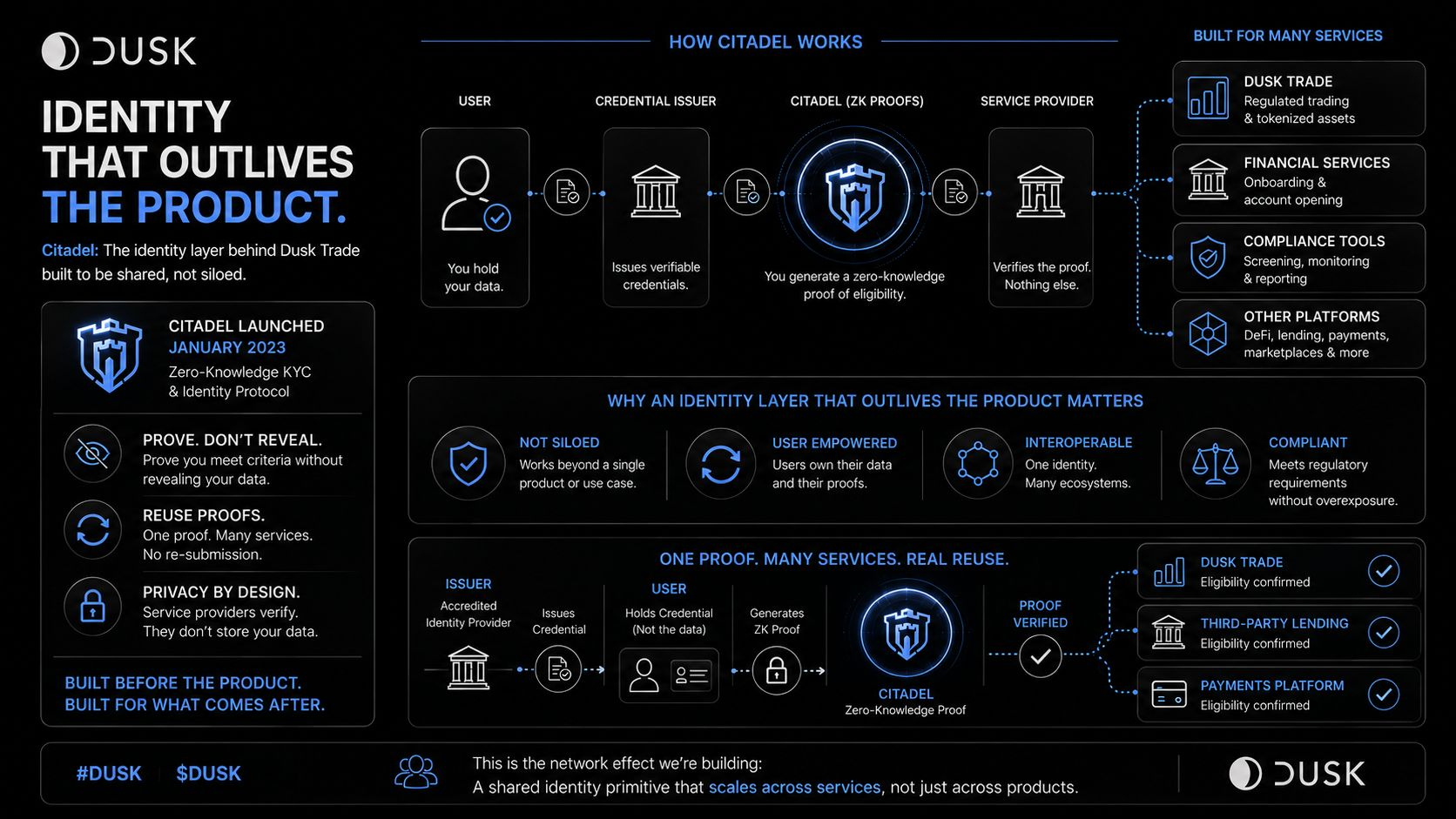
I expected the "eligibility checks" behind Dusk Trade to be something built specifically for trading. A compliance module bolted onto the exchange layer, the way most brokers build KYC into the platform itself.
That's not what's underneath it.
The identity layer Dusk Trade relies on is called Citadel, and it didn't start as a trading feature. Dusk launched it in January 2023 as a zero-knowledge KYC/identity protocol: prove you hold a valid credential without revealing what's in it, then reuse that proof across services instead of re-submitting your data every time.
That timing changes how I read "eligibility checks" in the docs. It looks less like bespoke compliance built for one product and more like an identity primitive that predates the product using it.
The interesting part is that Citadel was designed for service providers beyond a single trading workflow. Dusk described it as an identity layer that companies could tap into to verify whether someone meets their criteria without taking custody of all the underlying identity data.
"An eligibility check built for one product and an identity layer built to outlive the product are two different kinds of infrastructure, even when users experience both as 'proving who you are.'"
What I'd actually want to see: one credential proven through Citadel and accepted by another service provider outside Dusk Trade, the evidence that turns "shared identity primitive" from an architectural description into demonstrated cross-service reuse.
#dusk $DUSK @Dusk_Foundation
I expected the "eligibility checks" behind Dusk Trade to be something built specifically for trading. A compliance module bolted onto the exchange layer, the way most brokers build KYC into the platform itself.
That's not what's underneath it.
The identity layer Dusk Trade relies on is called Citadel, and it didn't start as a trading feature. Dusk launched it in January 2023 as a zero-knowledge KYC/identity protocol: prove you hold a valid credential without revealing what's in it, then reuse that proof across services instead of re-submitting your data every time.
That timing changes how I read "eligibility checks" in the docs. It looks less like bespoke compliance built for one product and more like an identity primitive that predates the product using it.
The interesting part is that Citadel was designed for service providers beyond a single trading workflow. Dusk described it as an identity layer that companies could tap into to verify whether someone meets their criteria without taking custody of all the underlying identity data.
"An eligibility check built for one product and an identity layer built to outlive the product are two different kinds of infrastructure, even when users experience both as 'proving who you are.'"
What I'd actually want to see: one credential proven through Citadel and accepted by another service provider outside Dusk Trade, the evidence that turns "shared identity primitive" from an architectural description into demonstrated cross-service reuse.
#dusk $DUSK @Dusk
That's not what's underneath it.
The identity layer Dusk Trade relies on is called Citadel, and it didn't start as a trading feature. Dusk launched it in January 2023 as a zero-knowledge KYC/identity protocol: prove you hold a valid credential without revealing what's in it, then reuse that proof across services instead of re-submitting your data every time.
That timing changes how I read "eligibility checks" in the docs. It looks less like bespoke compliance built for one product and more like an identity primitive that predates the product using it.
The interesting part is that Citadel was designed for service providers beyond a single trading workflow. Dusk described it as an identity layer that companies could tap into to verify whether someone meets their criteria without taking custody of all the underlying identity data.
"An eligibility check built for one product and an identity layer built to outlive the product are two different kinds of infrastructure, even when users experience both as 'proving who you are.'"
What I'd actually want to see: one credential proven through Citadel and accepted by another service provider outside Dusk Trade, the evidence that turns "shared identity primitive" from an architectural description into demonstrated cross-service reuse.
#dusk $DUSK @Dusk
3
1
88
·
--
Saya mengira "Dusk berpartner dengan Chainlink" berarti pitch standar. Sebuah jembatan. Token bergerak melintasi berbagai chain. Cerita interoperabilitas yang lazim diumumkan oleh setiap proyek pada akhirnya.
Itu bagian darinya, tapi hanya bagian yang lebih kecil.
Diumumkan kembali pada bulan November, kesepakatan itu memasangkan Chainlink CCIP sebagai lapisan interoperabilitas untuk sekuritas tokenisasi NPEX dengan sesuatu yang mudah dilewatkan: Chainlink DataLink menjadi satu-satunya (eksklusif) oracle data onchain untuk NPEX. Bukan salah satu dari beberapa price feed. Yang eksklusif. Perjanjian yang sama juga memungkinkan DUSK sendiri bergerak secara native antara Ethereum dan Solana melalui standar CCT milik Chainlink, jadi token tersebut mendapat cerita jembatan juga.
Sembilan bulan kemudian, inilah bagian yang layak dipisahkan. CCIP memungkinkan aset bergerak lintas ekosistem. DataLink menyajikan data pasar NPEX yang dapat diandalkan oleh sistem penerima. Satu bicara soal jangkauan. Yang lain bicara tentang siapa yang berhak dipercaya. Setiap chain yang mengonsumsi data NPEX tersebut membangun di atas sumber data pasar resmi yang sama.
Saya tidak berpikir ini otomatis merupakan kekurangan. Pasar teregulasi memang sudah bergantung pada sumber data pasar yang otoritatif. Namun ini berarti bahwa komposabilitas lintas-chain di sini tidak sepenuhnya infrastruktur yang netral. Ini komposabilitas yang dibangun di sekitar sumber eksklusif untuk data pasar resmi NPEX, di mana pun data itu akhirnya dibaca.
"Kemampuan untuk memindahkan aset lintas chain dan menjadi sumber eksklusif untuk data pasar resminya adalah dua jenis kekuatan yang berbeda, bahkan ketika satu kesepakatan memberikan keduanya."
Yang sebenarnya ingin saya ketahui setelah sembilan bulan: apa yang terjadi di chain-chain lain jika sumber data NPEX yang eksklusif itu menjadi tidak tersedia atau dipersengketakan, dan apakah "komposable" secara diam-diam berarti "bergantung pada satu jalur eksklusif kembali ke NPEX".
#dusk $DUSK @Dusk_Foundation
Saya mengira "Dusk berpartner dengan Chainlink" berarti pitch standar. Sebuah jembatan. Token bergerak melintasi berbagai chain. Cerita interoperabilitas yang lazim diumumkan oleh setiap proyek pada akhirnya.
Itu bagian darinya, tapi hanya bagian yang lebih kecil.
Diumumkan kembali pada bulan November, kesepakatan itu memasangkan Chainlink CCIP sebagai lapisan interoperabilitas untuk sekuritas tokenisasi NPEX dengan sesuatu yang mudah dilewatkan: Chainlink DataLink menjadi satu-satunya (eksklusif) oracle data onchain untuk NPEX. Bukan salah satu dari beberapa price feed. Yang eksklusif. Perjanjian yang sama juga memungkinkan DUSK sendiri bergerak secara native antara Ethereum dan Solana melalui standar CCT milik Chainlink, jadi token tersebut mendapat cerita jembatan juga.
Sembilan bulan kemudian, inilah bagian yang layak dipisahkan. CCIP memungkinkan aset bergerak lintas ekosistem. DataLink menyajikan data pasar NPEX yang dapat diandalkan oleh sistem penerima. Satu bicara soal jangkauan. Yang lain bicara tentang siapa yang berhak dipercaya. Setiap chain yang mengonsumsi data NPEX tersebut membangun di atas sumber data pasar resmi yang sama.
Saya tidak berpikir ini otomatis merupakan kekurangan. Pasar teregulasi memang sudah bergantung pada sumber data pasar yang otoritatif. Namun ini berarti bahwa komposabilitas lintas-chain di sini tidak sepenuhnya infrastruktur yang netral. Ini komposabilitas yang dibangun di sekitar sumber eksklusif untuk data pasar resmi NPEX, di mana pun data itu akhirnya dibaca.
"Kemampuan untuk memindahkan aset lintas chain dan menjadi sumber eksklusif untuk data pasar resminya adalah dua jenis kekuatan yang berbeda, bahkan ketika satu kesepakatan memberikan keduanya."
Yang sebenarnya ingin saya ketahui setelah sembilan bulan: apa yang terjadi di chain-chain lain jika sumber data NPEX yang eksklusif itu menjadi tidak tersedia atau dipersengketakan, dan apakah "komposable" secara diam-diam berarti "bergantung pada satu jalur eksklusif kembali ke NPEX".
#dusk $DUSK @Dusk
Itu bagian darinya, tapi hanya bagian yang lebih kecil.
Diumumkan kembali pada bulan November, kesepakatan itu memasangkan Chainlink CCIP sebagai lapisan interoperabilitas untuk sekuritas tokenisasi NPEX dengan sesuatu yang mudah dilewatkan: Chainlink DataLink menjadi satu-satunya (eksklusif) oracle data onchain untuk NPEX. Bukan salah satu dari beberapa price feed. Yang eksklusif. Perjanjian yang sama juga memungkinkan DUSK sendiri bergerak secara native antara Ethereum dan Solana melalui standar CCT milik Chainlink, jadi token tersebut mendapat cerita jembatan juga.
Sembilan bulan kemudian, inilah bagian yang layak dipisahkan. CCIP memungkinkan aset bergerak lintas ekosistem. DataLink menyajikan data pasar NPEX yang dapat diandalkan oleh sistem penerima. Satu bicara soal jangkauan. Yang lain bicara tentang siapa yang berhak dipercaya. Setiap chain yang mengonsumsi data NPEX tersebut membangun di atas sumber data pasar resmi yang sama.
Saya tidak berpikir ini otomatis merupakan kekurangan. Pasar teregulasi memang sudah bergantung pada sumber data pasar yang otoritatif. Namun ini berarti bahwa komposabilitas lintas-chain di sini tidak sepenuhnya infrastruktur yang netral. Ini komposabilitas yang dibangun di sekitar sumber eksklusif untuk data pasar resmi NPEX, di mana pun data itu akhirnya dibaca.
"Kemampuan untuk memindahkan aset lintas chain dan menjadi sumber eksklusif untuk data pasar resminya adalah dua jenis kekuatan yang berbeda, bahkan ketika satu kesepakatan memberikan keduanya."
Yang sebenarnya ingin saya ketahui setelah sembilan bulan: apa yang terjadi di chain-chain lain jika sumber data NPEX yang eksklusif itu menjadi tidak tersedia atau dipersengketakan, dan apakah "komposable" secara diam-diam berarti "bergantung pada satu jalur eksklusif kembali ke NPEX".
#dusk $DUSK @Dusk
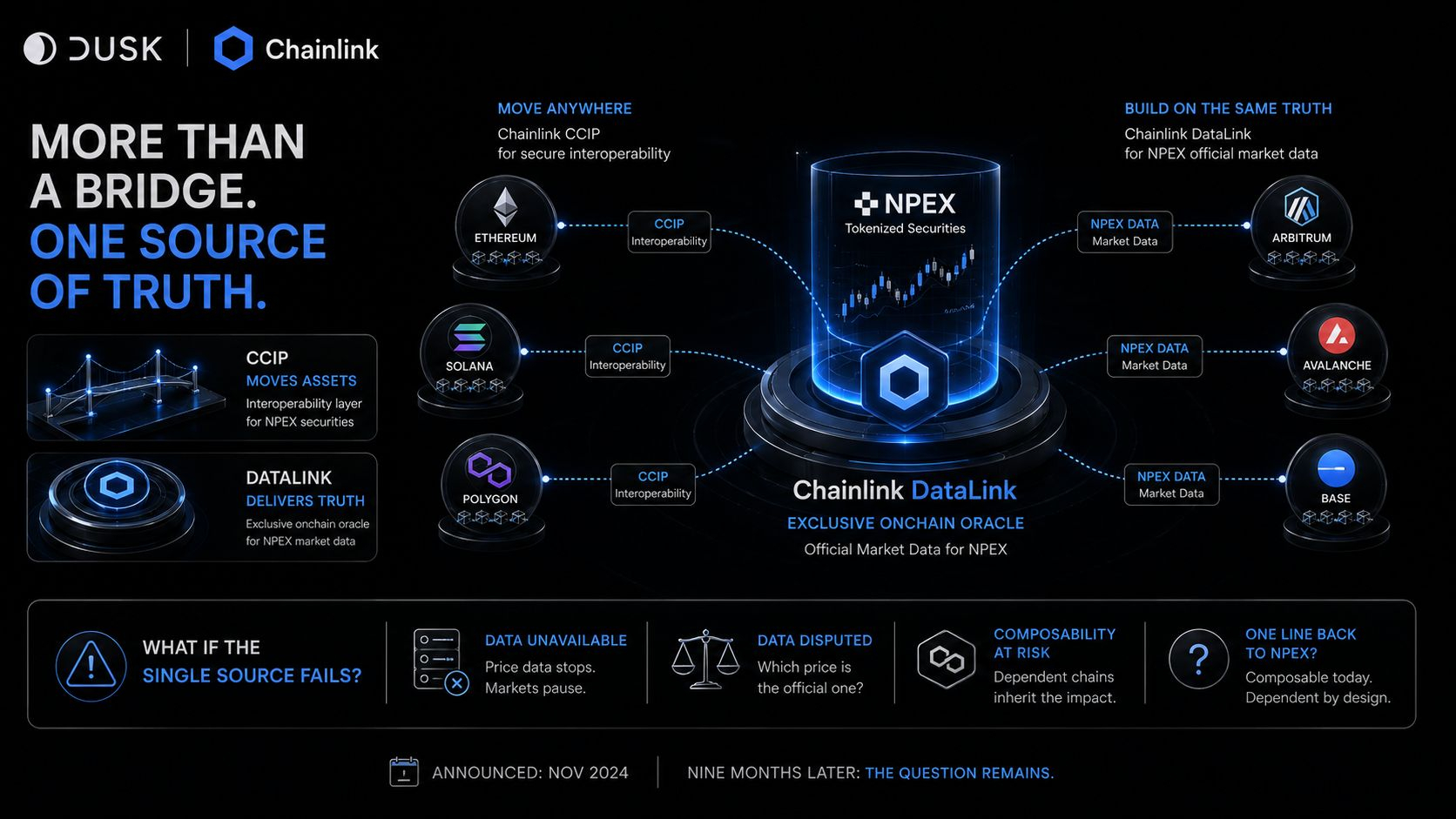
1
111
·
--
Lihat terjemahan
I used to think tokenization and native issuance were basically two ways of putting an asset onchain. Dusk's own comparison page changed that framing. They're not two degrees of the same thing. They're two different architectures entirely.
By Dusk's own definition, tokenization issues a token representing an asset or a claim on it, while the underlying asset can stay tied to whatever custody, registry, and settlement processes were already running off-chain. The token is a representation, not the underlying asset itself. Native issuance removes that layer: the asset exists on-chain as itself, and its lifecycle, being issued, transferred, serviced, settled, doesn't need a separate record somewhere else to point back to.
The catch is that a token can still depend on another system remaining the real source of truth. If that off-chain registry lags or breaks, the token's guarantee is only as strong as the reconciliation behind it.
Here's where it gets conditional. Dusk's own comparison says native issuance can reduce reliance on separate custody and registry layers, "depending on the legal structure." That qualifier is doing most of the work in this thesis. The efficiency case doesn't come from the technology existing. It depends on the legal structure actually letting the on-chain record carry that weight, instead of remaining just another copy of the real one.
"A token that represents an asset and an asset that exists as the token are two different promises, even when both get sold as tokenization."
What I'd actually want to see before calling this real: one regulated security where the authoritative record lives onchain, not a settlement layer running alongside a registry that still has the final say.
#dusk $DUSK @Dusk_Foundation
I used to think tokenization and native issuance were basically two ways of putting an asset onchain. Dusk's own comparison page changed that framing. They're not two degrees of the same thing. They're two different architectures entirely.
By Dusk's own definition, tokenization issues a token representing an asset or a claim on it, while the underlying asset can stay tied to whatever custody, registry, and settlement processes were already running off-chain. The token is a representation, not the underlying asset itself. Native issuance removes that layer: the asset exists on-chain as itself, and its lifecycle, being issued, transferred, serviced, settled, doesn't need a separate record somewhere else to point back to.
The catch is that a token can still depend on another system remaining the real source of truth. If that off-chain registry lags or breaks, the token's guarantee is only as strong as the reconciliation behind it.
Here's where it gets conditional. Dusk's own comparison says native issuance can reduce reliance on separate custody and registry layers, "depending on the legal structure." That qualifier is doing most of the work in this thesis. The efficiency case doesn't come from the technology existing. It depends on the legal structure actually letting the on-chain record carry that weight, instead of remaining just another copy of the real one.
"A token that represents an asset and an asset that exists as the token are two different promises, even when both get sold as tokenization."
What I'd actually want to see before calling this real: one regulated security where the authoritative record lives onchain, not a settlement layer running alongside a registry that still has the final say.
#dusk $DUSK @Dusk
By Dusk's own definition, tokenization issues a token representing an asset or a claim on it, while the underlying asset can stay tied to whatever custody, registry, and settlement processes were already running off-chain. The token is a representation, not the underlying asset itself. Native issuance removes that layer: the asset exists on-chain as itself, and its lifecycle, being issued, transferred, serviced, settled, doesn't need a separate record somewhere else to point back to.
The catch is that a token can still depend on another system remaining the real source of truth. If that off-chain registry lags or breaks, the token's guarantee is only as strong as the reconciliation behind it.
Here's where it gets conditional. Dusk's own comparison says native issuance can reduce reliance on separate custody and registry layers, "depending on the legal structure." That qualifier is doing most of the work in this thesis. The efficiency case doesn't come from the technology existing. It depends on the legal structure actually letting the on-chain record carry that weight, instead of remaining just another copy of the real one.
"A token that represents an asset and an asset that exists as the token are two different promises, even when both get sold as tokenization."
What I'd actually want to see before calling this real: one regulated security where the authoritative record lives onchain, not a settlement layer running alongside a registry that still has the final say.
#dusk $DUSK @Dusk
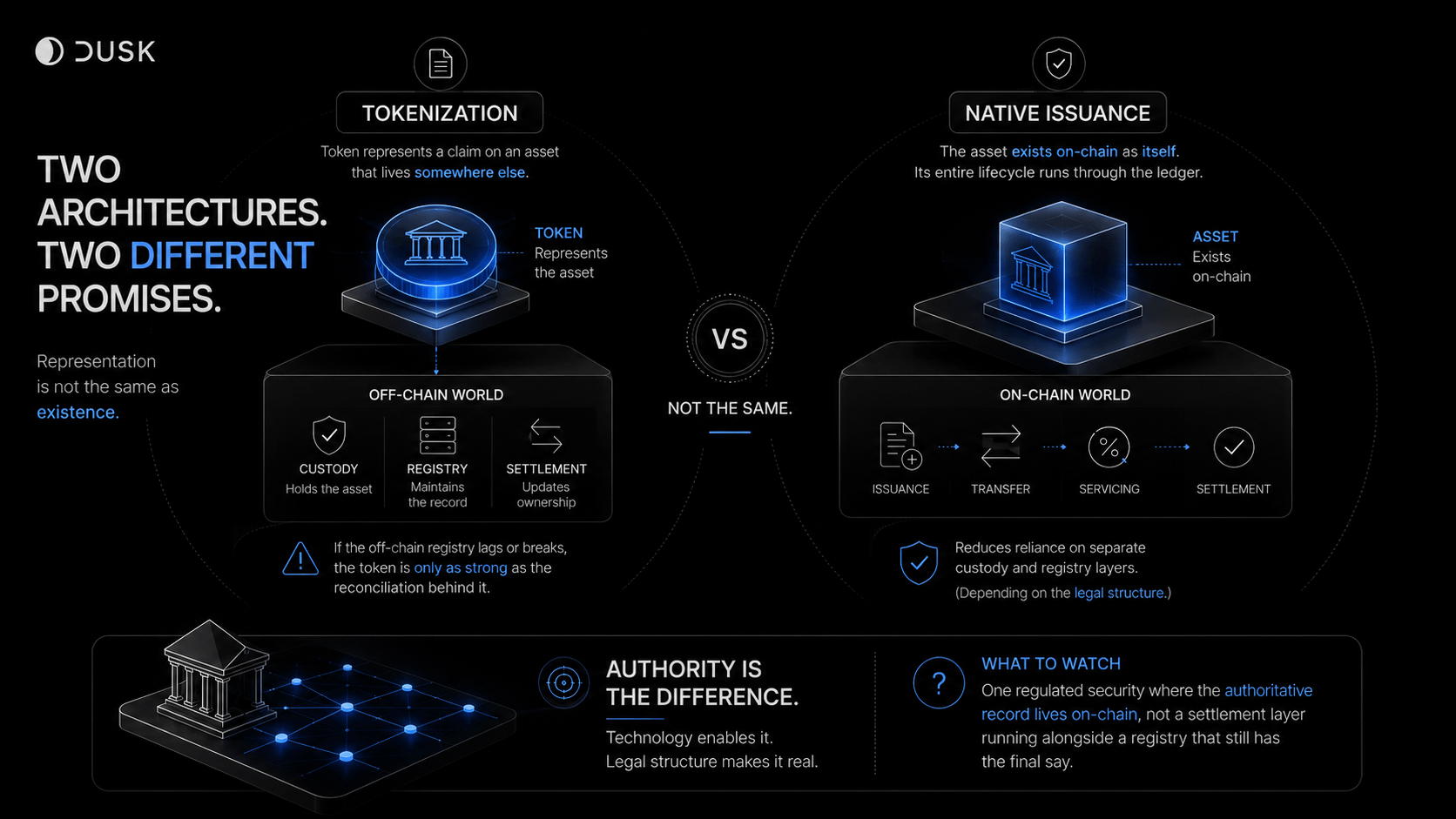
5
1
81
·
--
Lihat terjemahan
I found myself staring at DuskEVM's testnet explorer, and the number that jumps out, 845,113 transactions against 282 wallet addresses, is almost the wrong one to focus on. That's roughly 3,000 transactions per address, a ratio that says less about adoption than the headline suggests.
The two most recent transactions both showed Value 0 DUSK: fees paid, no native value moved. The latest feed was tagged as an L1→L2 deposit. Not proof of what the other 845K look like, but enough to make me stop reading this as one number. What the explorer is actually showing first is network activity: the chain processing transactions. Whether any of it is economic activity, value actually changing hands for a reason, is a separate question the transaction count can't answer on its own.
That distinction matters because Dusk is ultimately positioning this infrastructure for regulated financial assets, which is exactly what Dusk's plan to bring €300M of NPEX assets onchain would eventually need to prove out. A busy chain and a chain carrying real settlement volume can produce an identical-looking stats page.
"Network activity is not the same claim as financial activity, even when both surface as one number on an explorer."
What I'd actually watch as the signal that this shifts from network activity to financial usage: how much of it represents actual economic value settled, once NPEX gives us something real to check it against.
#dusk $DUSK @Dusk_Foundation
I found myself staring at DuskEVM's testnet explorer, and the number that jumps out, 845,113 transactions against 282 wallet addresses, is almost the wrong one to focus on. That's roughly 3,000 transactions per address, a ratio that says less about adoption than the headline suggests.
The two most recent transactions both showed Value 0 DUSK: fees paid, no native value moved. The latest feed was tagged as an L1→L2 deposit. Not proof of what the other 845K look like, but enough to make me stop reading this as one number. What the explorer is actually showing first is network activity: the chain processing transactions. Whether any of it is economic activity, value actually changing hands for a reason, is a separate question the transaction count can't answer on its own.
That distinction matters because Dusk is ultimately positioning this infrastructure for regulated financial assets, which is exactly what Dusk's plan to bring €300M of NPEX assets onchain would eventually need to prove out. A busy chain and a chain carrying real settlement volume can produce an identical-looking stats page.
"Network activity is not the same claim as financial activity, even when both surface as one number on an explorer."
What I'd actually watch as the signal that this shifts from network activity to financial usage: how much of it represents actual economic value settled, once NPEX gives us something real to check it against.
#dusk $DUSK @Dusk
The two most recent transactions both showed Value 0 DUSK: fees paid, no native value moved. The latest feed was tagged as an L1→L2 deposit. Not proof of what the other 845K look like, but enough to make me stop reading this as one number. What the explorer is actually showing first is network activity: the chain processing transactions. Whether any of it is economic activity, value actually changing hands for a reason, is a separate question the transaction count can't answer on its own.
That distinction matters because Dusk is ultimately positioning this infrastructure for regulated financial assets, which is exactly what Dusk's plan to bring €300M of NPEX assets onchain would eventually need to prove out. A busy chain and a chain carrying real settlement volume can produce an identical-looking stats page.
"Network activity is not the same claim as financial activity, even when both surface as one number on an explorer."
What I'd actually watch as the signal that this shifts from network activity to financial usage: how much of it represents actual economic value settled, once NPEX gives us something real to check it against.
#dusk $DUSK @Dusk
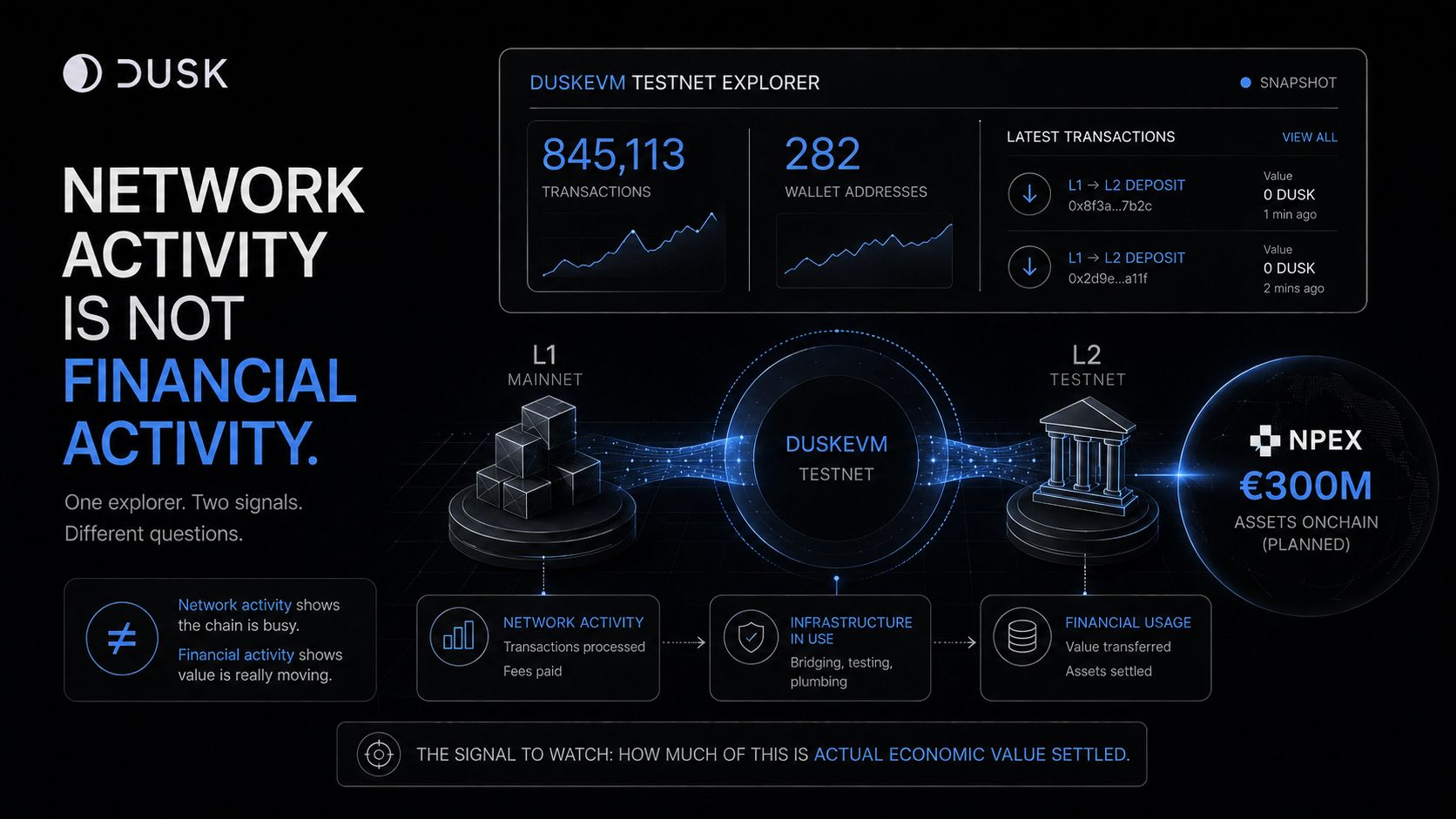
4
2
118
·
--
Terverifikasi
Uraian Dusk sendiri tentang Hedger menempatkan generasi bukti di sisi klien di bawah 2 detik. Baca itu dua kali sebelum benar-benar mendarat. Cukup cepat sehingga "confidential harus lebih lambat" tidak lagi terasa seperti asumsi yang aman. Saya lalu mengulik apa yang sebenarnya dibuktikan sampai sejauh itu. Testnet publik DuskEVM sudah berjalan sejak bulan Desember, dan beberapa hari lalu Dusk Foundation membukanya untuk pengujian Solidity dan Hardhat — itulah pembaruan yang sebenarnya saya baca. Kalimat yang membuat saya berhenti: kelayakan dicek sebelum akses atau transfer. Awalnya saya mengira itu bagian kepatuhan yang menarik. Saya biarkan terbuka di satu tab saat saya ambil kopi, kembali, membacanya lagi, dan sadar itu bukan. Dusk mengatakan data peserta, saldo, dan jumlah transfer bisa tetap terenkripsi. Bagian itulah yang benar-benar menangkap saya — celah antara membuktikan bahwa Anda diizinkan masuk dan pada saat yang sama mengekspos apa yang Anda bawa setelah Anda benar-benar berada di sana. Langkah kelayakan sesuai dengan dokumen — jelas didefinisikan, bukan sekadar klaim kepatuhan yang samar. Saya tetap tidak bisa menemukan contoh konkret tentang apa yang benar-benar dilihat oleh pengulas yang berwenang ketika jalur audit itu digunakan. Cek dokumennya dua kali. Beberapa hari setelah pembukaan Solidity/Hardhat ini, penasaran apakah contoh itu muncul seiring sesuatu menjadi matang, atau apakah "auditable" hanya tetap menjadi kata yang tidak perlu dibuktikan dulu — di sini maupun di chain mana pun yang membuat klaim yang sama.
#dusk $DUSK @Dusk_Foundation
Uraian Dusk sendiri tentang Hedger menempatkan generasi bukti di sisi klien di bawah 2 detik. Baca itu dua kali sebelum benar-benar mendarat. Cukup cepat sehingga "confidential harus lebih lambat" tidak lagi terasa seperti asumsi yang aman. Saya lalu mengulik apa yang sebenarnya dibuktikan sampai sejauh itu. Testnet publik DuskEVM sudah berjalan sejak bulan Desember, dan beberapa hari lalu Dusk Foundation membukanya untuk pengujian Solidity dan Hardhat — itulah pembaruan yang sebenarnya saya baca. Kalimat yang membuat saya berhenti: kelayakan dicek sebelum akses atau transfer. Awalnya saya mengira itu bagian kepatuhan yang menarik. Saya biarkan terbuka di satu tab saat saya ambil kopi, kembali, membacanya lagi, dan sadar itu bukan. Dusk mengatakan data peserta, saldo, dan jumlah transfer bisa tetap terenkripsi. Bagian itulah yang benar-benar menangkap saya — celah antara membuktikan bahwa Anda diizinkan masuk dan pada saat yang sama mengekspos apa yang Anda bawa setelah Anda benar-benar berada di sana. Langkah kelayakan sesuai dengan dokumen — jelas didefinisikan, bukan sekadar klaim kepatuhan yang samar. Saya tetap tidak bisa menemukan contoh konkret tentang apa yang benar-benar dilihat oleh pengulas yang berwenang ketika jalur audit itu digunakan. Cek dokumennya dua kali. Beberapa hari setelah pembukaan Solidity/Hardhat ini, penasaran apakah contoh itu muncul seiring sesuatu menjadi matang, atau apakah "auditable" hanya tetap menjadi kata yang tidak perlu dibuktikan dulu — di sini maupun di chain mana pun yang membuat klaim yang sama.
#dusk $DUSK @Dusk
#dusk $DUSK @Dusk
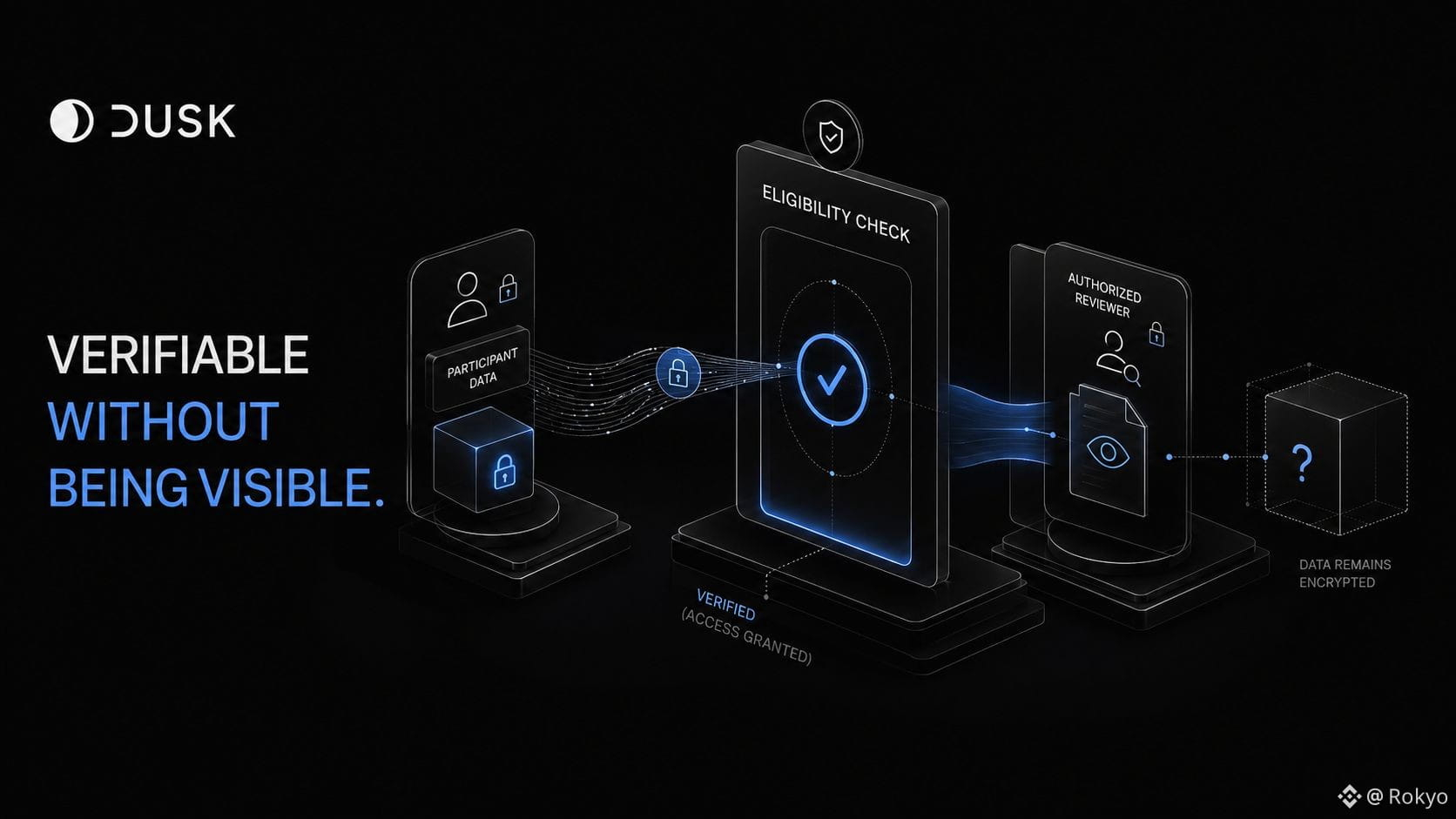
1
102
·
--
Tadi malam aku membuka chart BABY cuma buat cek tinggal berapa hari lagi sebelum unlock, dan yang menonjol bukan countdown-nya.
10 Agustus. Tinggal lima hari. 136.11M token, sekitar $1.43M, 1.2% dari total pasokan, sebagian besar untuk tim, advisor, dan investor putaran awal — angka yang sama yang juga sudah diketahui siapa pun yang memang memantau ini.
Yang ternyata belum benar-benar aku lihat adalah tujuh hari sebelum itu.
BABY turun sekitar 10.3% minggu ini. Harga ada di kisaran $0.0105, kapitalisasi pasar mendekati $45M, tertinggal dari pasar kripto yang lebih luas, yang pada dasarnya datar dalam rentang waktu yang sama.
Pembacaan pertamaku: ya sudah, kemungkinan ada aksi jual terkait unlock yang dimulai lebih awal.
Mungkin tidak. Bisa jadi kondisi pasar yang lebih luas yang tidak ada hubungannya dengan 10 Agustus. Aku tidak punya cara untuk memisahkan "orang-orang yang mendahului unlock" dari "BABY cuma sedang dapat minggu buruk bersamaan dengan semuanya yang lain."
Bagaimanapun, token yang masuk ke wallet-wallet tersebut pada 10 Agustus tiba pada harga yang sudah turun 10% dari posisi seminggu sebelumnya.
Siapa pun yang jual minggu ini menjual saat penurunan itu terjadi. Siapa pun yang menerima unlock menjual ke sisa apa pun yang masih tersisa setelahnya.
Dua sisi dari lima hari yang sama, menyerap bagian-bagian berbeda dari pergerakan.
Aku tidak tahu apakah pola itu masih terjadi kali ini. Tidak ada yang kubaca yang merinci seberapa besar unlock Babylon sebelumnya sudah dihargakan sebelumnya dibanding bereaksi setelahnya.
Kalau harga sudah bergerak sebelum hari unlock terjadi, apa yang masih bisa diungkap dari hari unlock itu sendiri?
@babylonlabs_io #baby $BABY
Tadi malam aku membuka chart BABY cuma buat cek tinggal berapa hari lagi sebelum unlock, dan yang menonjol bukan countdown-nya.
10 Agustus. Tinggal lima hari. 136.11M token, sekitar $1.43M, 1.2% dari total pasokan, sebagian besar untuk tim, advisor, dan investor putaran awal — angka yang sama yang juga sudah diketahui siapa pun yang memang memantau ini.
Yang ternyata belum benar-benar aku lihat adalah tujuh hari sebelum itu.
BABY turun sekitar 10.3% minggu ini. Harga ada di kisaran $0.0105, kapitalisasi pasar mendekati $45M, tertinggal dari pasar kripto yang lebih luas, yang pada dasarnya datar dalam rentang waktu yang sama.
Pembacaan pertamaku: ya sudah, kemungkinan ada aksi jual terkait unlock yang dimulai lebih awal.
Mungkin tidak. Bisa jadi kondisi pasar yang lebih luas yang tidak ada hubungannya dengan 10 Agustus. Aku tidak punya cara untuk memisahkan "orang-orang yang mendahului unlock" dari "BABY cuma sedang dapat minggu buruk bersamaan dengan semuanya yang lain."
Bagaimanapun, token yang masuk ke wallet-wallet tersebut pada 10 Agustus tiba pada harga yang sudah turun 10% dari posisi seminggu sebelumnya.
Siapa pun yang jual minggu ini menjual saat penurunan itu terjadi. Siapa pun yang menerima unlock menjual ke sisa apa pun yang masih tersisa setelahnya.
Dua sisi dari lima hari yang sama, menyerap bagian-bagian berbeda dari pergerakan.
Aku tidak tahu apakah pola itu masih terjadi kali ini. Tidak ada yang kubaca yang merinci seberapa besar unlock Babylon sebelumnya sudah dihargakan sebelumnya dibanding bereaksi setelahnya.
Kalau harga sudah bergerak sebelum hari unlock terjadi, apa yang masih bisa diungkap dari hari unlock itu sendiri?
@BabylonLabs_io #baby $BABY
10 Agustus. Tinggal lima hari. 136.11M token, sekitar $1.43M, 1.2% dari total pasokan, sebagian besar untuk tim, advisor, dan investor putaran awal — angka yang sama yang juga sudah diketahui siapa pun yang memang memantau ini.
Yang ternyata belum benar-benar aku lihat adalah tujuh hari sebelum itu.
BABY turun sekitar 10.3% minggu ini. Harga ada di kisaran $0.0105, kapitalisasi pasar mendekati $45M, tertinggal dari pasar kripto yang lebih luas, yang pada dasarnya datar dalam rentang waktu yang sama.
Pembacaan pertamaku: ya sudah, kemungkinan ada aksi jual terkait unlock yang dimulai lebih awal.
Mungkin tidak. Bisa jadi kondisi pasar yang lebih luas yang tidak ada hubungannya dengan 10 Agustus. Aku tidak punya cara untuk memisahkan "orang-orang yang mendahului unlock" dari "BABY cuma sedang dapat minggu buruk bersamaan dengan semuanya yang lain."
Bagaimanapun, token yang masuk ke wallet-wallet tersebut pada 10 Agustus tiba pada harga yang sudah turun 10% dari posisi seminggu sebelumnya.
Siapa pun yang jual minggu ini menjual saat penurunan itu terjadi. Siapa pun yang menerima unlock menjual ke sisa apa pun yang masih tersisa setelahnya.
Dua sisi dari lima hari yang sama, menyerap bagian-bagian berbeda dari pergerakan.
Aku tidak tahu apakah pola itu masih terjadi kali ini. Tidak ada yang kubaca yang merinci seberapa besar unlock Babylon sebelumnya sudah dihargakan sebelumnya dibanding bereaksi setelahnya.
Kalau harga sudah bergerak sebelum hari unlock terjadi, apa yang masih bisa diungkap dari hari unlock itu sendiri?
@BabylonLabs_io #baby $BABY
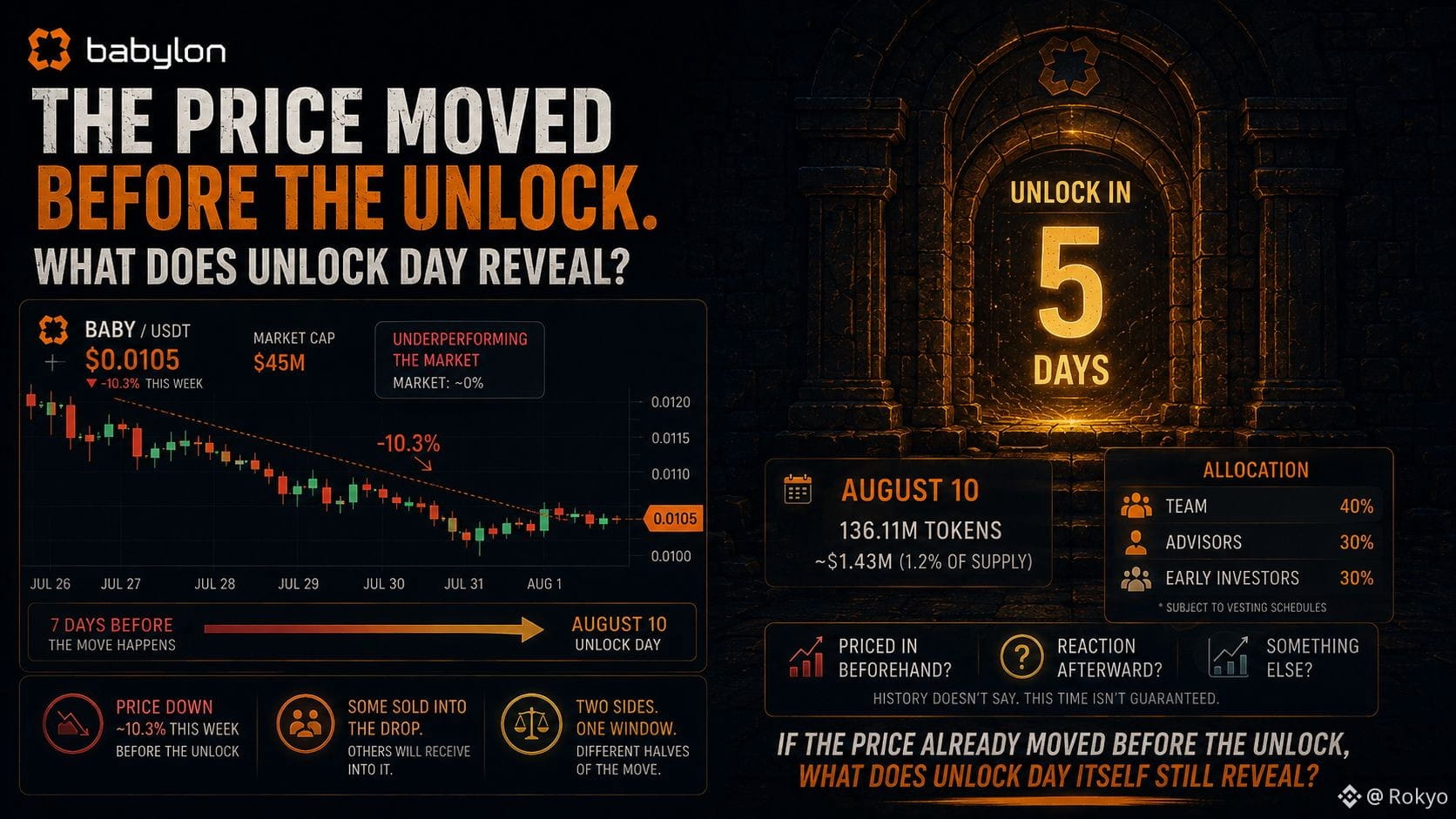
2
2
53
Masuk untuk menjelajahi konten lainnya
Bergabunglah dengan pengguna kripto global di Binance Square
⚡️ Dapatkan informasi terbaru dan berguna tentang kripto.
💬 Dipercayai oleh bursa kripto terbesar di dunia.
👍 Temukan wawasan nyata dari kreator terverifikasi.
Email/Nomor Ponsel
Topik Sedang Tren
CircleMints500MUSDCOnSolana
12,028 penayangan
517 Berdiskusi
#circlemints500musdconsolana
🚨 BOOM Likuiditas! Circle Mencetak $500 Juta USDC di Solana — Apakah Reli DeFi Besar Berikutnya? 🚀
💵 Apa yang Terjadi?
Dalam sebuah peristiwa on-chain besar, Treasury USDC menerbitkan $500 juta dalam USDC langsung di jaringan Solana melalui dua transaksi senilai $250M.
Masuknya modal besar yang didukung mata uang riil ini menyoroti meningkatnya minat pada stablecoin di ekosistem berkecepatan tinggi dan berbiaya rendah.
🔑 Poin Penting & Sorotan
Likuiditas On-Chain Baru: USDC yang baru dicetak meningkatkan liquidity pool di DEX berbasis Solana, pasar pinjam-meminjam, dan protokol yield.
$SOL
Isyarat Institusional: Karena setiap USDC didukung 1:1 oleh cadangan riil, peristiwa pencetakan dalam skala besar mencerminkan masuknya modal institusional atau komersial yang benar-benar memasuki ekosistem.
Ekspansi Pangsa Pasar Solana: Solana terus merebut porsi yang semakin besar dari total peredaran USDC, mengancam distribusi pasar stablecoin tradisional.
Konteks Makro & The Fed: Saat trader memantau perkembangan makroekonomi global dan prospek suku bunga, peluang on-chain berimbal hasil tinggi menarik kembali modal yang menganggur ke Web3.
💡 Kenapa Ini Penting bagi Trader
Slippage Lebih Rendah & Swap Lebih Baik: Kedalaman stablecoin yang lebih tinggi berarti perdagangan yang lebih besar dapat dilakukan tanpa dampak pasar yang berat.
Potensi Hasil DeFi: Cadangan USDC yang meningkat mendorong TVL (Total Value Locked) yang lebih tinggi pada protokol lending dan farming Solana.
Perubahan Sentimen: Suntikan stablecoin dalam jumlah besar secara historis merupakan indikator bullish untuk token ekosistem ($SOL,$JUP, $RAY,$KMNO).
Giliran Anda bagaimana? Apakah Anda menyimpan uang di pinggir atau ikut arus gelombang likuiditas Solana? Tulis pendapat Anda di bawah! 👇
#BlackRockBuildsTokenizedPortfoliosForOndo #solana #defi
Lily星星
·Disukai 4 Kali
·2.2k penayangan
PolymarketBankFailureBetsDrawFDICConcern
28,410 penayangan
714 Berdiskusi
BlackRockBuildsTokenizedPortfoliosForOndo
22,479 penayangan
489 Berdiskusi