

Crypto and Capital
50 Publications

Crypto and Capital
Signaler
Bloquer l’utilisateur
Exploring crypto, markets and long-term wealth building. Research, education and personal perspectives. DYOR.
1 Suivis
4 Abonnés
11 J’aime
Publications
Tous
Vidéos
🚨 Stablecoins just moved one step closer to everyday money.
Citi and Coinbase are connecting stablecoin payments with traditional bank settlement, potentially making digital payments easier for businesses to accept and convert.
Tokens such as $USDC and $USDT demonstrate how digital dollars can move on-chain, although the partnership has not confirmed which stablecoins it will support.
Faster global payments,
Follow Crypto & Capital for clear market insights without the hype.
#USDC #USDT #Stablecoins #Coinbase #CryptoPayments
Educational content only. Not financial advice.
🚨 Stablecoins just moved one step closer to everyday money.
Citi and Coinbase are connecting stablecoin payments with traditional bank settlement, potentially making digital payments easier for businesses to accept and convert.
Tokens such as $USDC and $USDT demonstrate how digital dollars can move on-chain, although the partnership has not confirmed which stablecoins it will support.
Faster global payments,
Follow Crypto & Capital for clear market insights without the hype.
#USDC #USDT #Stablecoins #Coinbase #CryptoPayments
Educational content only. Not financial advice.
Citi and Coinbase are connecting stablecoin payments with traditional bank settlement, potentially making digital payments easier for businesses to accept and convert.
Tokens such as $USDC and $USDT demonstrate how digital dollars can move on-chain, although the partnership has not confirmed which stablecoins it will support.
Faster global payments,
Follow Crypto & Capital for clear market insights without the hype.
#USDC #USDT #Stablecoins #Coinbase #CryptoPayments
Educational content only. Not financial advice.
20
Could stablecoins make paying across borders as simple as sending a message?
Citigroup and Coinbase are working together on a service that would let some Citi business clients accept stablecoin payments. Coinbase would handle the digital-asset conversion, while Citi would manage settlement. Citi is also expanding its own blockchain-based payment services for multinational companies.
The opportunity is faster, more flexible payment rails. But adoption will depend on practical details: fees, local regulations, reliable conversion and how easily businesses can move funds back into traditional currencies.
Stablecoins may be finding a role beyond crypto trading, as payment tools for businesses. The key question is whether they can make cross-border payments meaningfully simpler and cheaper.
Would you use $USDC or $USDT to pay a business if the process felt as simple as a card payment? What would you want to check first?
#Stablecoins #CryptoPayments #Blockchain #DigitalAssets #CryptoEducation
Educational content, not financial advice.
Could stablecoins make paying across borders as simple as sending a message?
Citigroup and Coinbase are working together on a service that would let some Citi business clients accept stablecoin payments. Coinbase would handle the digital-asset conversion, while Citi would manage settlement. Citi is also expanding its own blockchain-based payment services for multinational companies.
The opportunity is faster, more flexible payment rails. But adoption will depend on practical details: fees, local regulations, reliable conversion and how easily businesses can move funds back into traditional currencies.
Stablecoins may be finding a role beyond crypto trading, as payment tools for businesses. The key question is whether they can make cross-border payments meaningfully simpler and cheaper.
Would you use $USDC or $USDT to pay a business if the process felt as simple as a card payment? What would you want to check first?
#Stablecoins #CryptoPayments #Blockchain #DigitalAssets #CryptoEducation
Educational content, not financial advice.
Citigroup and Coinbase are working together on a service that would let some Citi business clients accept stablecoin payments. Coinbase would handle the digital-asset conversion, while Citi would manage settlement. Citi is also expanding its own blockchain-based payment services for multinational companies.
The opportunity is faster, more flexible payment rails. But adoption will depend on practical details: fees, local regulations, reliable conversion and how easily businesses can move funds back into traditional currencies.
Stablecoins may be finding a role beyond crypto trading, as payment tools for businesses. The key question is whether they can make cross-border payments meaningfully simpler and cheaper.
Would you use $USDC or $USDT to pay a business if the process felt as simple as a card payment? What would you want to check first?
#Stablecoins #CryptoPayments #Blockchain #DigitalAssets #CryptoEducation
Educational content, not financial advice.
60
What if your next stock trade happened on-chain?
Tokenised stocks turn shares into digital tokens, but does holding a token always mean owning the actual share? Not necessarily. Before diving in, check the rights, fees, liquidity and rules. And remember: 24/7 trading isn’t guaranteed.
Would you consider buying a tokenised stock? Comment YES or NO 👇
Follow Crypto & Capital for clear, practical market explainers.
#TokenizedStocks #Tokenization #StockMarket #CryptoEducation
Educational content, not financial advice.
What if your next stock trade happened on-chain?
Tokenised stocks turn shares into digital tokens, but does holding a token always mean owning the actual share? Not necessarily. Before diving in, check the rights, fees, liquidity and rules. And remember: 24/7 trading isn’t guaranteed.
Would you consider buying a tokenised stock? Comment YES or NO 👇
Follow Crypto & Capital for clear, practical market explainers.
#TokenizedStocks #Tokenization #StockMarket #CryptoEducation
Educational content, not financial advice.
Tokenised stocks turn shares into digital tokens, but does holding a token always mean owning the actual share? Not necessarily. Before diving in, check the rights, fees, liquidity and rules. And remember: 24/7 trading isn’t guaranteed.
Would you consider buying a tokenised stock? Comment YES or NO 👇
Follow Crypto & Capital for clear, practical market explainers.
#TokenizedStocks #Tokenization #StockMarket #CryptoEducation
Educational content, not financial advice.
29

Article
Tokenized Stocks Are Coming—But Is 24/7 Trading Really Within Reach?Imagine opening your phone on a Sunday and buying a fraction of a real company’s shares. No traditional trading window. No waiting for a market to reopen.
That is the promise attracting attention to tokenized stocks. But the real opportunity is more nuanced than “stocks on blockchain”, and understanding the difference could help investors avoid confusing a genuine share with a token that only tracks its price.
What has actually changed?
On 17 September, the U.S. Securities and Exchange Commission issued a temporary, conditional exemption for certain tokenized securities venues to trade eligible U.S.-listed shares through permissioned automated market-maker pools. The framework is subject to safeguards, including a requirement that eligible tokens provide holders the same rights and privileges as the equivalent traditional shares. (sec.gov)
That is a meaningful regulatory step. It is not blanket approval for every platform to put any company’s shares on any blockchain.
The conditions matter. A venue must give an issuer an opportunity to object before listing a third-party tokenised share. And under this framework, trading in the token must stop when trading in the underlying share is halted on its primary exchange. (sec.gov)
That last point is easy to miss: “on-chain” does not automatically mean “available 24/7.”
What about NYSE and Blockchain.com?
On 23 September, the New York Stock Exchange and crypto brokerage Blockchain.com announced that they would explore tokenised versions of U.S.-listed stocks. The announcement signals institutional interest, but exploration is not the same as a product launch or proof that retail investors can buy these tokens today. (reuters.com)
For investors, the distinction between live, approved, planned and under exploration is essential. Headlines can move faster than products, regulation and market access.
Where could the opportunity emerge?
If tokenised securities gain traction, the investment opportunity may extend beyond the tokens themselves. Investors may want to watch several parts of the market infrastructure:
🔹 Trading venues that can meet securities-market rules
🔹 Custody providers responsible for protecting assets and records
🔹 Settlement networks designed to transfer ownership efficiently
🔹 Digital cash used to pay for securities on-chain
🔹 Compliance and identity tools that help platforms verify eligible users
This is a watchlist of market segments to research, not a list of guaranteed winners. Adoption will depend on whether institutions and investors use these systems at meaningful scale.
A practical checklist before considering a tokenised share
1. What does the token legally represent?Does it provide ownership rights in the underlying share, or only price exposure through a separate claim or derivative?
2. What shareholder rights do you receive?Check voting rights, dividend treatment and what happens during corporate actions.
3. Who holds the underlying asset?Identify the issuer, custodian and legal structure. Read the documentation rather than relying on the product name.
4. Can you actually buy or sell it where you live?Availability, investor eligibility and protections may differ by country. A product available in one market may not be available to South African investors.
5. Is there real liquidity?A market that is technically open can still have few buyers and sellers. Low liquidity can mean wider spreads and harder exits.
6. What are the total costs and risks?Check trading fees, custody costs, blockchain transaction fees, redemption rules and what happens if a platform or service provider fails.
The takeaway
Tokenisation could make securities easier to transfer, divide and settle digitally. But the investor opportunity depends on legal ownership, access, liquidity and protections, not simply on whether a token appears on a blockchain.
The most useful question right now may not be “Which token should I buy?” It may be: Which products give investors clear rights, reliable access and a credible route to trade or redeem?
Would you consider a tokenised share if it offered the same rights as a traditional share? Tell us what you would check first—and follow Crypto & Capital for practical market explainers.
Educational content only. Not financial advice.
#TokenizedStocks #Tokenization #RWA #Investing #DigitalAssets
Tokenized Stocks Are Coming—But Is 24/7 Trading Really Within Reach?
Imagine opening your phone on a Sunday and buying a fraction of a real company’s shares. No traditional trading window. No waiting for a market to reopen.
That is the promise attracting attention to tokenized stocks. But the real opportunity is more nuanced than “stocks on blockchain”, and understanding the difference could help investors avoid confusing a genuine share with a token that only tracks its price.
What has actually changed?
On 17 September, the U.S. Securities and Exchange Commission issued a temporary, conditional exemption for certain tokenized securities venues to trade eligible U.S.-listed shares through permissioned automated market-maker pools. The framework is subject to safeguards, including a requirement that eligible tokens provide holders the same rights and privileges as the equivalent traditional shares. (sec.gov)
That is a meaningful regulatory step. It is not blanket approval for every platform to put any company’s shares on any blockchain.
The conditions matter. A venue must give an issuer an opportunity to object before listing a third-party tokenised share. And under this framework, trading in the token must stop when trading in the underlying share is halted on its primary exchange. (sec.gov)
That last point is easy to miss: “on-chain” does not automatically mean “available 24/7.”
What about NYSE and Blockchain.com?
On 23 September, the New York Stock Exchange and crypto brokerage Blockchain.com announced that they would explore tokenised versions of U.S.-listed stocks. The announcement signals institutional interest, but exploration is not the same as a product launch or proof that retail investors can buy these tokens today. (reuters.com)
For investors, the distinction between live, approved, planned and under exploration is essential. Headlines can move faster than products, regulation and market access.
Where could the opportunity emerge?
If tokenised securities gain traction, the investment opportunity may extend beyond the tokens themselves. Investors may want to watch several parts of the market infrastructure:
🔹 Trading venues that can meet securities-market rules
🔹 Custody providers responsible for protecting assets and records
🔹 Settlement networks designed to transfer ownership efficiently
🔹 Digital cash used to pay for securities on-chain
🔹 Compliance and identity tools that help platforms verify eligible users
This is a watchlist of market segments to research, not a list of guaranteed winners. Adoption will depend on whether institutions and investors use these systems at meaningful scale.
A practical checklist before considering a tokenised share
1. What does the token legally represent?Does it provide ownership rights in the underlying share, or only price exposure through a separate claim or derivative?
2. What shareholder rights do you receive?Check voting rights, dividend treatment and what happens during corporate actions.
3. Who holds the underlying asset?Identify the issuer, custodian and legal structure. Read the documentation rather than relying on the product name.
4. Can you actually buy or sell it where you live?Availability, investor eligibility and protections may differ by country. A product available in one market may not be available to South African investors.
5. Is there real liquidity?A market that is technically open can still have few buyers and sellers. Low liquidity can mean wider spreads and harder exits.
6. What are the total costs and risks?Check trading fees, custody costs, blockchain transaction fees, redemption rules and what happens if a platform or service provider fails.
The takeaway
Tokenisation could make securities easier to transfer, divide and settle digitally. But the investor opportunity depends on legal ownership, access, liquidity and protections, not simply on whether a token appears on a blockchain.
The most useful question right now may not be “Which token should I buy?” It may be: Which products give investors clear rights, reliable access and a credible route to trade or redeem?
Would you consider a tokenised share if it offered the same rights as a traditional share? Tell us what you would check first—and follow Crypto & Capital for practical market explainers.
Educational content only. Not financial advice.
#TokenizedStocks #Tokenization #RWA #Investing #DigitalAssets
That is the promise attracting attention to tokenized stocks. But the real opportunity is more nuanced than “stocks on blockchain”, and understanding the difference could help investors avoid confusing a genuine share with a token that only tracks its price.
What has actually changed?
On 17 September, the U.S. Securities and Exchange Commission issued a temporary, conditional exemption for certain tokenized securities venues to trade eligible U.S.-listed shares through permissioned automated market-maker pools. The framework is subject to safeguards, including a requirement that eligible tokens provide holders the same rights and privileges as the equivalent traditional shares. (sec.gov)
That is a meaningful regulatory step. It is not blanket approval for every platform to put any company’s shares on any blockchain.
The conditions matter. A venue must give an issuer an opportunity to object before listing a third-party tokenised share. And under this framework, trading in the token must stop when trading in the underlying share is halted on its primary exchange. (sec.gov)
That last point is easy to miss: “on-chain” does not automatically mean “available 24/7.”
What about NYSE and Blockchain.com?
On 23 September, the New York Stock Exchange and crypto brokerage Blockchain.com announced that they would explore tokenised versions of U.S.-listed stocks. The announcement signals institutional interest, but exploration is not the same as a product launch or proof that retail investors can buy these tokens today. (reuters.com)
For investors, the distinction between live, approved, planned and under exploration is essential. Headlines can move faster than products, regulation and market access.
Where could the opportunity emerge?
If tokenised securities gain traction, the investment opportunity may extend beyond the tokens themselves. Investors may want to watch several parts of the market infrastructure:
🔹 Trading venues that can meet securities-market rules
🔹 Custody providers responsible for protecting assets and records
🔹 Settlement networks designed to transfer ownership efficiently
🔹 Digital cash used to pay for securities on-chain
🔹 Compliance and identity tools that help platforms verify eligible users
This is a watchlist of market segments to research, not a list of guaranteed winners. Adoption will depend on whether institutions and investors use these systems at meaningful scale.
A practical checklist before considering a tokenised share
1. What does the token legally represent?Does it provide ownership rights in the underlying share, or only price exposure through a separate claim or derivative?
2. What shareholder rights do you receive?Check voting rights, dividend treatment and what happens during corporate actions.
3. Who holds the underlying asset?Identify the issuer, custodian and legal structure. Read the documentation rather than relying on the product name.
4. Can you actually buy or sell it where you live?Availability, investor eligibility and protections may differ by country. A product available in one market may not be available to South African investors.
5. Is there real liquidity?A market that is technically open can still have few buyers and sellers. Low liquidity can mean wider spreads and harder exits.
6. What are the total costs and risks?Check trading fees, custody costs, blockchain transaction fees, redemption rules and what happens if a platform or service provider fails.
The takeaway
Tokenisation could make securities easier to transfer, divide and settle digitally. But the investor opportunity depends on legal ownership, access, liquidity and protections, not simply on whether a token appears on a blockchain.
The most useful question right now may not be “Which token should I buy?” It may be: Which products give investors clear rights, reliable access and a credible route to trade or redeem?
Would you consider a tokenised share if it offered the same rights as a traditional share? Tell us what you would check first—and follow Crypto & Capital for practical market explainers.
Educational content only. Not financial advice.
#TokenizedStocks #Tokenization #RWA #Investing #DigitalAssets
46
Could the stock market soon run 24/7? 🌍
Tokenization could bring assets like funds, bonds and real estate onto blockchain networks, potentially making ownership more accessible and settlement.
$ETH currently has a strong position in tokenized finance and stablecoins, but networks such as Solana, $AVAX , Stellar and the $XRP Ledger are also targeting institutional payments or real-world assets.
#Tokenization #RWA #Blockchain #24_7Markets #CryptoEducation
Could the stock market soon run 24/7? 🌍
Tokenization could bring assets like funds, bonds and real estate onto blockchain networks, potentially making ownership more accessible and settlement.
$ETH currently has a strong position in tokenized finance and stablecoins, but networks such as Solana, $AVAX , Stellar and the $XRP Ledger are also targeting institutional payments or real-world assets.
#Tokenization #RWA #Blockchain #24_7Markets #CryptoEducation
Tokenization could bring assets like funds, bonds and real estate onto blockchain networks, potentially making ownership more accessible and settlement.
$ETH currently has a strong position in tokenized finance and stablecoins, but networks such as Solana, $AVAX , Stellar and the $XRP Ledger are also targeting institutional payments or real-world assets.
#Tokenization #RWA #Blockchain #24_7Markets #CryptoEducation
119

Article
The Closing Bell Is Dying: How Tokenization Could Create a 24/7 Global MarketWhat if buying a fraction of a building, bond, private fund or public company became as easy as buying a cryptocurrency, and the market never closed?
That is the promise behind mass tokenization: transforming ownership rights in real-world assets into blockchain-based tokens that can potentially be transferred, settled and programmed digitally.
This is not simply about putting traditional investments on a blockchain. It could fundamentally change how capital moves.
What is asset tokenization?
Tokenization creates a digital representation of an asset or financial claim.
Depending on its structure and legal framework, a token could represent ownership or economic rights connected to:
🏢 Real estate
📈 Shares and investment funds
🏦 Government and corporate bonds
🪙 Commodities such as gold
💵 Money-market instruments
🎨 Collectibles and intellectual property
Instead of transactions passing through multiple disconnected intermediaries, tokenized markets could combine issuance, trading, settlement, custody and compliance within more integrated digital systems.
The IMF has highlighted that tokenized securities may compress these separate processes into connected workflows, potentially reducing counterparty risk while creating new demands for continuous liquidity. (imf.org)
Why 24/7 markets matter
Traditional markets were built around opening hours, geographic boundaries and banking schedules.
Blockchains operate differently. They do not need to close overnight, pause for weekends or wait several business days for an international transfer to settle.
A tokenized market could allow investors to trade certain eligible assets around the clock, while stablecoins or tokenized deposits provide the digital cash needed to complete transactions.
That could offer:
✅ Faster settlement
✅Greater global access
✅Fractional ownership✅
✅More efficient collateral management
✅Programmable dividends and interest
✅ Reduced dependence on market opening hours
For investors outside major financial centres, the accessibility could be transformative. Someone in South Africa, for example, would no longer need to organise every investment decision around New York or London trading hours.
But 24/7 access does not guarantee 24/7 liquidity
This is the distinction investors cannot afford to ignore.
An asset may technically be available for trading at any hour, but that does not mean enough buyers and sellers will always be present.
Overnight and weekend markets could experience:
⚠️ Thinner liquidity
⚠️Wider bid–ask spreads
⚠️Sharper price movement
⚠️ Greater exposure to automated liquidations
⚠️ More difficult price discovery
The IMF has also warned that automated redemptions and margin systems could improve efficiency in ordinary conditions while accelerating stress during market turmoil. (imf.org)
Markets that never sleep may require investors to become even more disciplined about position sizing, leverage and risk controls.
Which crypto networks could benefit?
Mass tokenization will require more than one blockchain or cryptocurrency. It will need an entire technology stack.
Potential beneficiaries may include:
🔹 Smart-contract networks used to issue and transfer assets
🔹 Stablecoins and tokenized bank deposits used for settlement
🔹 Oracle networks connecting tokens with external The Closing Bell Is Dying: How Tokenization Could Create a 24/7 Global Marketprices and data
🔷Identity and compliance infrastructure
🔷Custody platforms and institutional wallets
🔷 Interoperability systems linking different blockchains
$ETH currently has a strong position in tokenized finance and stablecoins, but networks such as $SOL , $AVAX , Stellar and the XRP Ledger are also targeting institutional payments or real-world assets.
Chainlink and similar infrastructure providers may play an important role in connecting on-chain assets with reliable data and traditional financial systems.
The eventual winners may not be the projects generating the most hype today. They may be the networks that deliver security, regulatory compatibility, reliable settlement, deep liquidity and seamless interoperability.
A token is only as valuable as the rights behind it
Tokenization does not automatically improve the quality of an asset.
A tokenized share in a poor business is still exposure to a poor business. A token representing questionable property rights does not become safer simply because it exists on a blockchain.
Before investing, users must understand:
• What does the token legally represent?
• Who holds or safeguards the underlying asset?
• Can the token be redeemed?
• Which jurisdiction governs ownership?
• Is there genuine secondary-market liquidity?
• What happens if the issuer, custodian or blockchain fails?
The Investment Company Institute has noted that securities tokenization has developed significantly and is increasingly relevant to registered funds and their investors. (ici.org) But widespread adoption will still depend on regulation, investor protection and legally enforceable ownership.
The bigger picture
Crypto may not replace traditional finance.
It may become the infrastructure underneath it.
The most important phase of blockchain adoption could arrive when users stop thinking about whether an asset is “traditional” or “crypto” because stocks, bonds, funds and cash can move through compatible digital rails.
If that transition succeeds, the future market may be global, fractional, programmable—and always open.
The closing bell might not disappear tomorrow. But its importance may already be fading.
Would you welcome 24/7 tokenized markets—or do you think investors need time away from trading?
Share your view below and follow Crypto & Capital for more analysis on the technologies reshaping global finance.
Educational content only. Not financial advice.
#Tokenization #RWA #Crypto #Investing #FinancialMarkets
The Closing Bell Is Dying: How Tokenization Could Create a 24/7 Global Market
What if buying a fraction of a building, bond, private fund or public company became as easy as buying a cryptocurrency, and the market never closed?
That is the promise behind mass tokenization: transforming ownership rights in real-world assets into blockchain-based tokens that can potentially be transferred, settled and programmed digitally.
This is not simply about putting traditional investments on a blockchain. It could fundamentally change how capital moves.
What is asset tokenization?
Tokenization creates a digital representation of an asset or financial claim.
Depending on its structure and legal framework, a token could represent ownership or economic rights connected to:
🏢 Real estate
📈 Shares and investment funds
🏦 Government and corporate bonds
🪙 Commodities such as gold
💵 Money-market instruments
🎨 Collectibles and intellectual property
Instead of transactions passing through multiple disconnected intermediaries, tokenized markets could combine issuance, trading, settlement, custody and compliance within more integrated digital systems.
The IMF has highlighted that tokenized securities may compress these separate processes into connected workflows, potentially reducing counterparty risk while creating new demands for continuous liquidity. (imf.org)
Why 24/7 markets matter
Traditional markets were built around opening hours, geographic boundaries and banking schedules.
Blockchains operate differently. They do not need to close overnight, pause for weekends or wait several business days for an international transfer to settle.
A tokenized market could allow investors to trade certain eligible assets around the clock, while stablecoins or tokenized deposits provide the digital cash needed to complete transactions.
That could offer:
✅ Faster settlement
✅Greater global access
✅Fractional ownership✅
✅More efficient collateral management
✅Programmable dividends and interest
✅ Reduced dependence on market opening hours
For investors outside major financial centres, the accessibility could be transformative. Someone in South Africa, for example, would no longer need to organise every investment decision around New York or London trading hours.
But 24/7 access does not guarantee 24/7 liquidity
This is the distinction investors cannot afford to ignore.
An asset may technically be available for trading at any hour, but that does not mean enough buyers and sellers will always be present.
Overnight and weekend markets could experience:
⚠️ Thinner liquidity
⚠️Wider bid–ask spreads
⚠️Sharper price movement
⚠️ Greater exposure to automated liquidations
⚠️ More difficult price discovery
The IMF has also warned that automated redemptions and margin systems could improve efficiency in ordinary conditions while accelerating stress during market turmoil. (imf.org)
Markets that never sleep may require investors to become even more disciplined about position sizing, leverage and risk controls.
Which crypto networks could benefit?
Mass tokenization will require more than one blockchain or cryptocurrency. It will need an entire technology stack.
Potential beneficiaries may include:
🔹 Smart-contract networks used to issue and transfer assets
🔹 Stablecoins and tokenized bank deposits used for settlement
🔹 Oracle networks connecting tokens with external The Closing Bell Is Dying: How Tokenization Could Create a 24/7 Global Marketprices and data
🔷Identity and compliance infrastructure
🔷Custody platforms and institutional wallets
🔷 Interoperability systems linking different blockchains
$ETH currently has a strong position in tokenized finance and stablecoins, but networks such as $SOL , $AVAX , Stellar and the XRP Ledger are also targeting institutional payments or real-world assets.
Chainlink and similar infrastructure providers may play an important role in connecting on-chain assets with reliable data and traditional financial systems.
The eventual winners may not be the projects generating the most hype today. They may be the networks that deliver security, regulatory compatibility, reliable settlement, deep liquidity and seamless interoperability.
A token is only as valuable as the rights behind it
Tokenization does not automatically improve the quality of an asset.
A tokenized share in a poor business is still exposure to a poor business. A token representing questionable property rights does not become safer simply because it exists on a blockchain.
Before investing, users must understand:
• What does the token legally represent?
• Who holds or safeguards the underlying asset?
• Can the token be redeemed?
• Which jurisdiction governs ownership?
• Is there genuine secondary-market liquidity?
• What happens if the issuer, custodian or blockchain fails?
The Investment Company Institute has noted that securities tokenization has developed significantly and is increasingly relevant to registered funds and their investors. (ici.org) But widespread adoption will still depend on regulation, investor protection and legally enforceable ownership.
The bigger picture
Crypto may not replace traditional finance.
It may become the infrastructure underneath it.
The most important phase of blockchain adoption could arrive when users stop thinking about whether an asset is “traditional” or “crypto” because stocks, bonds, funds and cash can move through compatible digital rails.
If that transition succeeds, the future market may be global, fractional, programmable—and always open.
The closing bell might not disappear tomorrow. But its importance may already be fading.
Would you welcome 24/7 tokenized markets—or do you think investors need time away from trading?
Share your view below and follow Crypto & Capital for more analysis on the technologies reshaping global finance.
Educational content only. Not financial advice.
#Tokenization #RWA #Crypto #Investing #FinancialMarkets
That is the promise behind mass tokenization: transforming ownership rights in real-world assets into blockchain-based tokens that can potentially be transferred, settled and programmed digitally.
This is not simply about putting traditional investments on a blockchain. It could fundamentally change how capital moves.
What is asset tokenization?
Tokenization creates a digital representation of an asset or financial claim.
Depending on its structure and legal framework, a token could represent ownership or economic rights connected to:
🏢 Real estate
📈 Shares and investment funds
🏦 Government and corporate bonds
🪙 Commodities such as gold
💵 Money-market instruments
🎨 Collectibles and intellectual property
Instead of transactions passing through multiple disconnected intermediaries, tokenized markets could combine issuance, trading, settlement, custody and compliance within more integrated digital systems.
The IMF has highlighted that tokenized securities may compress these separate processes into connected workflows, potentially reducing counterparty risk while creating new demands for continuous liquidity. (imf.org)
Why 24/7 markets matter
Traditional markets were built around opening hours, geographic boundaries and banking schedules.
Blockchains operate differently. They do not need to close overnight, pause for weekends or wait several business days for an international transfer to settle.
A tokenized market could allow investors to trade certain eligible assets around the clock, while stablecoins or tokenized deposits provide the digital cash needed to complete transactions.
That could offer:
✅ Faster settlement
✅Greater global access
✅Fractional ownership✅
✅More efficient collateral management
✅Programmable dividends and interest
✅ Reduced dependence on market opening hours
For investors outside major financial centres, the accessibility could be transformative. Someone in South Africa, for example, would no longer need to organise every investment decision around New York or London trading hours.
But 24/7 access does not guarantee 24/7 liquidity
This is the distinction investors cannot afford to ignore.
An asset may technically be available for trading at any hour, but that does not mean enough buyers and sellers will always be present.
Overnight and weekend markets could experience:
⚠️ Thinner liquidity
⚠️Wider bid–ask spreads
⚠️Sharper price movement
⚠️ Greater exposure to automated liquidations
⚠️ More difficult price discovery
The IMF has also warned that automated redemptions and margin systems could improve efficiency in ordinary conditions while accelerating stress during market turmoil. (imf.org)
Markets that never sleep may require investors to become even more disciplined about position sizing, leverage and risk controls.
Which crypto networks could benefit?
Mass tokenization will require more than one blockchain or cryptocurrency. It will need an entire technology stack.
Potential beneficiaries may include:
🔹 Smart-contract networks used to issue and transfer assets
🔹 Stablecoins and tokenized bank deposits used for settlement
🔹 Oracle networks connecting tokens with external The Closing Bell Is Dying: How Tokenization Could Create a 24/7 Global Marketprices and data
🔷Identity and compliance infrastructure
🔷Custody platforms and institutional wallets
🔷 Interoperability systems linking different blockchains
$ETH currently has a strong position in tokenized finance and stablecoins, but networks such as $SOL , $AVAX , Stellar and the XRP Ledger are also targeting institutional payments or real-world assets.
Chainlink and similar infrastructure providers may play an important role in connecting on-chain assets with reliable data and traditional financial systems.
The eventual winners may not be the projects generating the most hype today. They may be the networks that deliver security, regulatory compatibility, reliable settlement, deep liquidity and seamless interoperability.
A token is only as valuable as the rights behind it
Tokenization does not automatically improve the quality of an asset.
A tokenized share in a poor business is still exposure to a poor business. A token representing questionable property rights does not become safer simply because it exists on a blockchain.
Before investing, users must understand:
• What does the token legally represent?
• Who holds or safeguards the underlying asset?
• Can the token be redeemed?
• Which jurisdiction governs ownership?
• Is there genuine secondary-market liquidity?
• What happens if the issuer, custodian or blockchain fails?
The Investment Company Institute has noted that securities tokenization has developed significantly and is increasingly relevant to registered funds and their investors. (ici.org) But widespread adoption will still depend on regulation, investor protection and legally enforceable ownership.
The bigger picture
Crypto may not replace traditional finance.
It may become the infrastructure underneath it.
The most important phase of blockchain adoption could arrive when users stop thinking about whether an asset is “traditional” or “crypto” because stocks, bonds, funds and cash can move through compatible digital rails.
If that transition succeeds, the future market may be global, fractional, programmable—and always open.
The closing bell might not disappear tomorrow. But its importance may already be fading.
Would you welcome 24/7 tokenized markets—or do you think investors need time away from trading?
Share your view below and follow Crypto & Capital for more analysis on the technologies reshaping global finance.
Educational content only. Not financial advice.
#Tokenization #RWA #Crypto #Investing #FinancialMarkets
161
🚨 Are you earning Binance Alpha rewards—or spending more than they are worth?
Binance Alpha continues to feature early-stage tokens, airdrops and trading competitions. Today’s activity includes new launches such as Anoma ($XAN ) and Falcon Finance ($FF )while the second stage of the $AEON trading competition is beginning. airdrops and trading competitions. Today’s activity includes new launches such as Anoma ($XAN) and Falcon Finance ($FF), while the second stage of the $AEON trading competition is beginning.
#CryptoEducation #Airdrop
🚨 Are you earning Binance Alpha rewards—or spending more than they are worth?
Binance Alpha continues to feature early-stage tokens, airdrops and trading competitions. Today’s activity includes new launches such as Anoma ($XAN ) and Falcon Finance ($FF )while the second stage of the $AEON trading competition is beginning. airdrops and trading competitions. Today’s activity includes new launches such as Anoma ($XAN ) and Falcon Finance ($FF ), while the second stage of the $AEON trading competition is beginning.
#CryptoEducation #Airdrop
Binance Alpha continues to feature early-stage tokens, airdrops and trading competitions. Today’s activity includes new launches such as Anoma ($XAN ) and Falcon Finance ($FF )while the second stage of the $AEON trading competition is beginning. airdrops and trading competitions. Today’s activity includes new launches such as Anoma ($XAN ) and Falcon Finance ($FF ), while the second stage of the $AEON trading competition is beginning.
#CryptoEducation #Airdrop
2
4
1k
🚨 BINANCE ALPHA IS HEATING UP—BUT ARE AIRDROPS BECOMING TOO COMPETITIVE?
Binance Alpha continues to feature early-stage tokens, airdrops and trading competitions. Today’s activity includes new launches such as Anoma ($XAN ) and Falcon Finance ($FF ) while the second stage of the $AEON trading competition is beginning.
The opportunity is obvious: eligible users may gain early access and claim rewards using Alpha Points.
But competition changes the equation:
⏳ Alpha Points operate on a rolling 15-day cycle🎟️ Points are spent when you confirm an eligible claim
🏃 Some airdrops are first-come, first-served
📈 Trading competitions may reward the highest volumes
⚠️ Fees, slippage and token volatility can exceed the reward
The smartest approach is not to chase every launch. Compare the likely reward with the trading cost, research the project and protect your capital.
Are Binance Alpha rewards still worth pursuing—or has the competition become too intense?
Comment below 👇
#BinanceAlpha #Airdrop #CryptoRewards #Altcoins #CryptoEducation
🚨 BINANCE ALPHA IS HEATING UP—BUT ARE AIRDROPS BECOMING TOO COMPETITIVE?
Binance Alpha continues to feature early-stage tokens, airdrops and trading competitions. Today’s activity includes new launches such as Anoma ($XAN ) and Falcon Finance ($FF ) while the second stage of the $AEON trading competition is beginning.
The opportunity is obvious: eligible users may gain early access and claim rewards using Alpha Points.
But competition changes the equation:
⏳ Alpha Points operate on a rolling 15-day cycle🎟️ Points are spent when you confirm an eligible claim
🏃 Some airdrops are first-come, first-served
📈 Trading competitions may reward the highest volumes
⚠️ Fees, slippage and token volatility can exceed the reward
The smartest approach is not to chase every launch. Compare the likely reward with the trading cost, research the project and protect your capital.
Are Binance Alpha rewards still worth pursuing—or has the competition become too intense?
Comment below 👇
#BinanceAlpha #Airdrop #CryptoRewards #Altcoins #CryptoEducation
Binance Alpha continues to feature early-stage tokens, airdrops and trading competitions. Today’s activity includes new launches such as Anoma ($XAN ) and Falcon Finance ($FF ) while the second stage of the $AEON trading competition is beginning.
The opportunity is obvious: eligible users may gain early access and claim rewards using Alpha Points.
But competition changes the equation:
⏳ Alpha Points operate on a rolling 15-day cycle🎟️ Points are spent when you confirm an eligible claim
🏃 Some airdrops are first-come, first-served
📈 Trading competitions may reward the highest volumes
⚠️ Fees, slippage and token volatility can exceed the reward
The smartest approach is not to chase every launch. Compare the likely reward with the trading cost, research the project and protect your capital.
Are Binance Alpha rewards still worth pursuing—or has the competition become too intense?
Comment below 👇
#BinanceAlpha #Airdrop #CryptoRewards #Altcoins #CryptoEducation
484
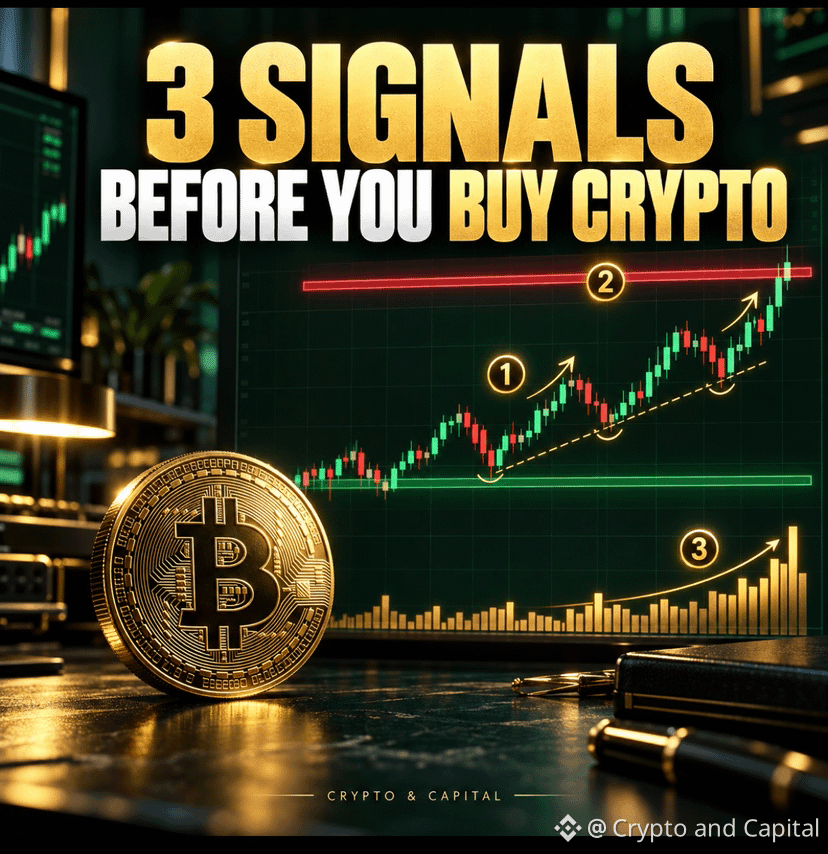
🚨 BEFORE YOU BUY ANY CRYPTO, CHECK THESE 3 SIGNALS
A rising price does not automatically mean a good entry. Before pressing “buy,” pause and check:
1️⃣ MARKET STRUCTURE Higher highs and higher lows suggest an uptrend. Lower highs and lower lows warn that sellers may still be in control.
2️⃣ SUPPORT & RESISTANCE Buying near established support may offer a better risk-to-reward setup than chasing price directly below resistance.
3️⃣ VOLUME A breakout supported by rising volume is generally more convincing. A price spike on low volume may be a false breakout.
⚠️ No indicator can predict the market with certainty. Technical analysis helps you assess probability, not see the future. Always consider the project’s fundamentals, broader market conditions and your risk-management plan.
Which technical-analysis topic should I cover next?
A) RSIB) Moving averagesC) Candlestick patternsD) Volume
Comment your choice below and follow Crypto & Capital for the next lesson.
#technicalanalysis #bitcoin #RiskManagement #cryptoeducation #cryptotrading
🚨 BEFORE YOU BUY ANY CRYPTO, CHECK THESE 3 SIGNALS
A rising price does not automatically mean a good entry. Before pressing “buy,” pause and check:
1️⃣ MARKET STRUCTURE Higher highs and higher lows suggest an uptrend. Lower highs and lower lows warn that sellers may still be in control.
2️⃣ SUPPORT & RESISTANCE Buying near established support may offer a better risk-to-reward setup than chasing price directly below resistance.
3️⃣ VOLUME A breakout supported by rising volume is generally more convincing. A price spike on low volume may be a false breakout.
⚠️ No indicator can predict the market with certainty. Technical analysis helps you assess probability, not see the future. Always consider the project’s fundamentals, broader market conditions and your risk-management plan.
Which technical-analysis topic should I cover next?
A) RSIB) Moving averagesC) Candlestick patternsD) Volume
Comment your choice below and follow Crypto & Capital for the next lesson.
#technicalanalysis #bitcoin #RiskManagement #cryptoeducation #cryptotrading
A rising price does not automatically mean a good entry. Before pressing “buy,” pause and check:
1️⃣ MARKET STRUCTURE Higher highs and higher lows suggest an uptrend. Lower highs and lower lows warn that sellers may still be in control.
2️⃣ SUPPORT & RESISTANCE Buying near established support may offer a better risk-to-reward setup than chasing price directly below resistance.
3️⃣ VOLUME A breakout supported by rising volume is generally more convincing. A price spike on low volume may be a false breakout.
⚠️ No indicator can predict the market with certainty. Technical analysis helps you assess probability, not see the future. Always consider the project’s fundamentals, broader market conditions and your risk-management plan.
Which technical-analysis topic should I cover next?
A) RSIB) Moving averagesC) Candlestick patternsD) Volume
Comment your choice below and follow Crypto & Capital for the next lesson.
#technicalanalysis #bitcoin #RiskManagement #cryptoeducation #cryptotrading
47
🚨 $550 BILLION “VANISHED” IN HOURS—but the headline does not tell the full story.
Gold, silver and $BTC fell together as rising bond yields, a stronger dollar and renewed interest-rate fears tightened financial conditions.
That $550B was an estimated decline in total market value, not cash physically leaving the market.
The real question: if Bitcoin falls alongside other risk assets when liquidity tightens, is it truly digital gold yet?
What do you think: DIGITAL GOLD or RISK ASSET? Comment below 👇
#Bitcoin #Gold #Silver #CryptoNews #Investing
🚨 $550 BILLION “VANISHED” IN HOURS—but the headline does not tell the full story.
Gold, silver and $BTC fell together as rising bond yields, a stronger dollar and renewed interest-rate fears tightened financial conditions.
That $550B was an estimated decline in total market value, not cash physically leaving the market.
The real question: if Bitcoin falls alongside other risk assets when liquidity tightens, is it truly digital gold yet?
What do you think: DIGITAL GOLD or RISK ASSET? Comment below 👇
#Bitcoin #Gold #Silver #CryptoNews #Investing
Gold, silver and $BTC fell together as rising bond yields, a stronger dollar and renewed interest-rate fears tightened financial conditions.
That $550B was an estimated decline in total market value, not cash physically leaving the market.
The real question: if Bitcoin falls alongside other risk assets when liquidity tightens, is it truly digital gold yet?
What do you think: DIGITAL GOLD or RISK ASSET? Comment below 👇
#Bitcoin #Gold #Silver #CryptoNews #Investing
1
382
🚨 GOLD, SILVER AND BITCOIN JUST FELL TOGETHER—SO WHERE WAS THE SAFE HAVEN?
Gold and silver reportedly lost more than $550 billion in estimated market value within hours, while Bitcoin also dropped instead of benefiting from a flight to safety.
What triggered the sell-off?
📈 Rising US Treasury yields
💵 A stronger dollar
🛢️ Higher oil prices and renewed inflation fears
🏦 Expectations of further interest-rate increases
Important: $550 billion was not physically withdrawn from the metals market. It represents the estimated decline in the value of above-ground gold and silver after prices fell.
The bigger lesson? During periods of tightening liquidity, gold, silver and $BTC can all decline together—even when they are promoted as inflation hedges or stores of value.
Do you still consider Bitcoin “digital gold,” or is it behaving more like a high-risk technology asset? Vote in the comments 👇
#Bitcoin #BTC走势分析 #Gold #Silver #DigitalGold
🚨 GOLD, SILVER AND BITCOIN JUST FELL TOGETHER—SO WHERE WAS THE SAFE HAVEN?
Gold and silver reportedly lost more than $550 billion in estimated market value within hours, while Bitcoin also dropped instead of benefiting from a flight to safety.
What triggered the sell-off?
📈 Rising US Treasury yields
💵 A stronger dollar
🛢️ Higher oil prices and renewed inflation fears
🏦 Expectations of further interest-rate increases
Important: $550 billion was not physically withdrawn from the metals market. It represents the estimated decline in the value of above-ground gold and silver after prices fell.
The bigger lesson? During periods of tightening liquidity, gold, silver and $BTC can all decline together—even when they are promoted as inflation hedges or stores of value.
Do you still consider Bitcoin “digital gold,” or is it behaving more like a high-risk technology asset? Vote in the comments 👇
#Bitcoin #BTC走势分析 #Gold #Silver #DigitalGold
Gold and silver reportedly lost more than $550 billion in estimated market value within hours, while Bitcoin also dropped instead of benefiting from a flight to safety.
What triggered the sell-off?
📈 Rising US Treasury yields
💵 A stronger dollar
🛢️ Higher oil prices and renewed inflation fears
🏦 Expectations of further interest-rate increases
Important: $550 billion was not physically withdrawn from the metals market. It represents the estimated decline in the value of above-ground gold and silver after prices fell.
The bigger lesson? During periods of tightening liquidity, gold, silver and $BTC can all decline together—even when they are promoted as inflation hedges or stores of value.
Do you still consider Bitcoin “digital gold,” or is it behaving more like a high-risk technology asset? Vote in the comments 👇
#Bitcoin #BTC走势分析 #Gold #Silver #DigitalGold
1
358
🤖 Ethereum’s next billion users may not be human.
AI agents could soon buy data, computing power and digital services autonomously, using stablecoins as money and blockchains as settlement rails.
$ETH has the security, smart contracts and Layer 2 ecosystem to play a major role.
Could Ethereum become the financial infrastructure of the machine economy?
Follow Crypto & Capital for clear insights into crypto, AI and the future of finance.
#Ethereum #ETH #ArtificialIntelligence #Blockchain #DeFi
🤖 Ethereum’s next billion users may not be human.
AI agents could soon buy data, computing power and digital services autonomously, using stablecoins as money and blockchains as settlement rails.
$ETH has the security, smart contracts and Layer 2 ecosystem to play a major role.
Could Ethereum become the financial infrastructure of the machine economy?
Follow Crypto & Capital for clear insights into crypto, AI and the future of finance.
#Ethereum #ETH #ArtificialIntelligence #Blockchain #DeFi
AI agents could soon buy data, computing power and digital services autonomously, using stablecoins as money and blockchains as settlement rails.
$ETH has the security, smart contracts and Layer 2 ecosystem to play a major role.
Could Ethereum become the financial infrastructure of the machine economy?
Follow Crypto & Capital for clear insights into crypto, AI and the future of finance.
#Ethereum #ETH #ArtificialIntelligence #Blockchain #DeFi
69
Article
Ethereum’s Next Billion Users May Be Machines: ETH’s Role in the AI–Stablecoin EconomyEthereum’s next major wave of adoption may not come from humans opening wallets.
It could come from millions of AI agents paying for data, renting computing power, purchasing digital services and settling transactions, automatically, continuously and without waiting for a bank to open.
If that future develops, stablecoins may become the money machines use.
But $ETH could become part of the financial infrastructure that allows those machines to transact.
From AI assistant to economic participant
Most AI tools currently help people perform tasks. The next generation of AI agents is being designed to take action independently within limits established by their owners.
An agent could potentially:
Pay for access to a databasePurchase computing powerSubscribe to an APIBook transport or accommodationExecute a business transactionReceive payment for providing a digital service
Traditional payment systems were designed for people and companies. They often require bank accounts, identity checks, operating hours, manual authorisation and minimum payment sizes.
Autonomous agents need something different: programmable money that can move globally, settle continuously and interact directly with software.
That is where stablecoins enter the picture.
Why stablecoins could become machine-native money
Stablecoins combine the relative price stability of traditional currency with the programmability of blockchain networks.
Instead of an AI agent trying to budget in a volatile asset, it could transact using a dollar-denominated token such as USDC.
Emerging payment infrastructure is already experimenting with this concept. Circle’s Agent Stack and the x402 payment protocol are designed to let AI agents pay for digital resources using USDC—including extremely small, automated payments.
Imagine an agent paying fractions of a cent for one data query rather than purchasing an entire monthly subscription.
This could create a genuine machine-to-machine economy in which payment becomes part of the internet request itself.
Why Ethereum matters
Ethereum is more than a cryptocurrency. It is a programmable settlement network where stablecoins, tokenized assets and financial applications can interact through smart contracts.
Its potential role in the AI–stablecoin economy rests on several advantages.
1. A mature stablecoin ecosystem
Ethereum and its wider Layer-2 ecosystem already support substantial stablecoin liquidity.
Liquidity matters because autonomous systems will need reliable markets, deep trading pools and the ability to move between different assets without excessive price slippage.
2. Programmable transactions
Ethereum smart contracts can define exactly when and how a payment occurs.
An AI agent could release funds only after a service is delivered, divide revenue between several parties or place money into escrow without requiring a conventional payment processor.
3. Composability
Applications on Ethereum can interact like financial building blocks.
A stablecoin payment could potentially connect with an identity system, insurance contract, lending market or tokenized asset, all inside one programmable workflow.
4. Security and credible settlement
For larger or higher-value transactions, users may prefer a network with an established security record, broad developer support and decentralized validation.
Ethereum’s base layer could act as a secure final-settlement network, while Layer-2 networks handle cheaper and faster everyday activity.
Where does ETH fit?
Stablecoins may be the currency being transferred, but ETH still plays an important infrastructure role.
ETH helps secure Ethereum through staking. It is also used to pay for computation and settlement on the network, either directly or through mechanisms that ultimately rely on Ethereum.
If AI-driven stablecoin activity creates greater demand for Ethereum blockspace, this could increase the network’s economic activity.
However, investors should not assume that every stablecoin transaction automatically translates into a higher ETH price.
The value captured by ETH will depend on several factors:
Whether activity occurs on Ethereum or competing networksHow much value Layer-2 networks return to the base layerWhether users continue paying fees in ETHHow efficiently the network scalesHow much ETH is staked, held or burnedWhether institutions and developers choose Ethereum for settlement
Ethereum could host enormous transaction volume while individual transactions become extremely inexpensive. The relationship between adoption and token value therefore requires careful analysis.
BlackRock’s machine-native thesis
BlackRock’s recent Machine-Native Economy paper explores how artificial intelligence, digital assets and computing infrastructure could converge.
The research specifically discusses Ethereum as a settlement network and ETH as the native asset associated with consensus, validator compensation and transaction fees.
That does not amount to an investment recommendation. It does, however, show that large financial institutions are beginning to examine Ethereum as infrastructure within a broader machine economy, not merely as a speculative cryptocurrency.
The risks could also move at machine speed
Autonomous finance introduces serious risks.
A compromised agent could make thousands of incorrect payments before a person notices. Poorly written instructions could create unexpected transactions. Smart-contract vulnerabilities, unreliable data, regulatory requirements and identity fraud could all become more dangerous when decisions are automated.
Permission controls, spending limits, audit trails and emergency shutdown mechanisms will therefore be essential.
Machines may transact faster than humans, but financial responsibility cannot disappear.
The bigger investment question
The AI–stablecoin economy could become one of Ethereum’s most important long-term use cases.
Yet Ethereum is not guaranteed to dominate it. Solana, purpose-built payment networks, Circle’s Arc and other blockchains will compete on cost, speed, liquidity, privacy and developer experience.
The winner may not be the network with the loudest community.
It may be the network that machines can use most reliably, securely and cheaply, without users even realizing which blockchain is operating underneath.
Do you believe AI agents will become a major source of blockchain activity and will Ethereum capture that value, or will another network take the lead? Share your view below.
This article is for educational purposes only and does not constitute financial advice.
#Ethereum #ETH #ArtificialIntelligence #FutureOfFinance #CryptoInvesting
Ethereum’s Next Billion Users May Be Machines: ETH’s Role in the AI–Stablecoin Economy
Ethereum’s next major wave of adoption may not come from humans opening wallets.
It could come from millions of AI agents paying for data, renting computing power, purchasing digital services and settling transactions, automatically, continuously and without waiting for a bank to open.
If that future develops, stablecoins may become the money machines use.
But $ETH could become part of the financial infrastructure that allows those machines to transact.
From AI assistant to economic participant
Most AI tools currently help people perform tasks. The next generation of AI agents is being designed to take action independently within limits established by their owners.
An agent could potentially:
Pay for access to a databasePurchase computing powerSubscribe to an APIBook transport or accommodationExecute a business transactionReceive payment for providing a digital service
Traditional payment systems were designed for people and companies. They often require bank accounts, identity checks, operating hours, manual authorisation and minimum payment sizes.
Autonomous agents need something different: programmable money that can move globally, settle continuously and interact directly with software.
That is where stablecoins enter the picture.
Why stablecoins could become machine-native money
Stablecoins combine the relative price stability of traditional currency with the programmability of blockchain networks.
Instead of an AI agent trying to budget in a volatile asset, it could transact using a dollar-denominated token such as USDC.
Emerging payment infrastructure is already experimenting with this concept. Circle’s Agent Stack and the x402 payment protocol are designed to let AI agents pay for digital resources using USDC—including extremely small, automated payments.
Imagine an agent paying fractions of a cent for one data query rather than purchasing an entire monthly subscription.
This could create a genuine machine-to-machine economy in which payment becomes part of the internet request itself.
Why Ethereum matters
Ethereum is more than a cryptocurrency. It is a programmable settlement network where stablecoins, tokenized assets and financial applications can interact through smart contracts.
Its potential role in the AI–stablecoin economy rests on several advantages.
1. A mature stablecoin ecosystem
Ethereum and its wider Layer-2 ecosystem already support substantial stablecoin liquidity.
Liquidity matters because autonomous systems will need reliable markets, deep trading pools and the ability to move between different assets without excessive price slippage.
2. Programmable transactions
Ethereum smart contracts can define exactly when and how a payment occurs.
An AI agent could release funds only after a service is delivered, divide revenue between several parties or place money into escrow without requiring a conventional payment processor.
3. Composability
Applications on Ethereum can interact like financial building blocks.
A stablecoin payment could potentially connect with an identity system, insurance contract, lending market or tokenized asset, all inside one programmable workflow.
4. Security and credible settlement
For larger or higher-value transactions, users may prefer a network with an established security record, broad developer support and decentralized validation.
Ethereum’s base layer could act as a secure final-settlement network, while Layer-2 networks handle cheaper and faster everyday activity.
Where does ETH fit?
Stablecoins may be the currency being transferred, but ETH still plays an important infrastructure role.
ETH helps secure Ethereum through staking. It is also used to pay for computation and settlement on the network, either directly or through mechanisms that ultimately rely on Ethereum.
If AI-driven stablecoin activity creates greater demand for Ethereum blockspace, this could increase the network’s economic activity.
However, investors should not assume that every stablecoin transaction automatically translates into a higher ETH price.
The value captured by ETH will depend on several factors:
Whether activity occurs on Ethereum or competing networksHow much value Layer-2 networks return to the base layerWhether users continue paying fees in ETHHow efficiently the network scalesHow much ETH is staked, held or burnedWhether institutions and developers choose Ethereum for settlement
Ethereum could host enormous transaction volume while individual transactions become extremely inexpensive. The relationship between adoption and token value therefore requires careful analysis.
BlackRock’s machine-native thesis
BlackRock’s recent Machine-Native Economy paper explores how artificial intelligence, digital assets and computing infrastructure could converge.
The research specifically discusses Ethereum as a settlement network and ETH as the native asset associated with consensus, validator compensation and transaction fees.
That does not amount to an investment recommendation. It does, however, show that large financial institutions are beginning to examine Ethereum as infrastructure within a broader machine economy, not merely as a speculative cryptocurrency.
The risks could also move at machine speed
Autonomous finance introduces serious risks.
A compromised agent could make thousands of incorrect payments before a person notices. Poorly written instructions could create unexpected transactions. Smart-contract vulnerabilities, unreliable data, regulatory requirements and identity fraud could all become more dangerous when decisions are automated.
Permission controls, spending limits, audit trails and emergency shutdown mechanisms will therefore be essential.
Machines may transact faster than humans, but financial responsibility cannot disappear.
The bigger investment question
The AI–stablecoin economy could become one of Ethereum’s most important long-term use cases.
Yet Ethereum is not guaranteed to dominate it. Solana, purpose-built payment networks, Circle’s Arc and other blockchains will compete on cost, speed, liquidity, privacy and developer experience.
The winner may not be the network with the loudest community.
It may be the network that machines can use most reliably, securely and cheaply, without users even realizing which blockchain is operating underneath.
Do you believe AI agents will become a major source of blockchain activity and will Ethereum capture that value, or will another network take the lead? Share your view below.
This article is for educational purposes only and does not constitute financial advice.
#Ethereum #ETH #ArtificialIntelligence #FutureOfFinance #CryptoInvesting
It could come from millions of AI agents paying for data, renting computing power, purchasing digital services and settling transactions, automatically, continuously and without waiting for a bank to open.
If that future develops, stablecoins may become the money machines use.
But $ETH could become part of the financial infrastructure that allows those machines to transact.
From AI assistant to economic participant
Most AI tools currently help people perform tasks. The next generation of AI agents is being designed to take action independently within limits established by their owners.
An agent could potentially:
Pay for access to a databasePurchase computing powerSubscribe to an APIBook transport or accommodationExecute a business transactionReceive payment for providing a digital service
Traditional payment systems were designed for people and companies. They often require bank accounts, identity checks, operating hours, manual authorisation and minimum payment sizes.
Autonomous agents need something different: programmable money that can move globally, settle continuously and interact directly with software.
That is where stablecoins enter the picture.
Why stablecoins could become machine-native money
Stablecoins combine the relative price stability of traditional currency with the programmability of blockchain networks.
Instead of an AI agent trying to budget in a volatile asset, it could transact using a dollar-denominated token such as USDC.
Emerging payment infrastructure is already experimenting with this concept. Circle’s Agent Stack and the x402 payment protocol are designed to let AI agents pay for digital resources using USDC—including extremely small, automated payments.
Imagine an agent paying fractions of a cent for one data query rather than purchasing an entire monthly subscription.
This could create a genuine machine-to-machine economy in which payment becomes part of the internet request itself.
Why Ethereum matters
Ethereum is more than a cryptocurrency. It is a programmable settlement network where stablecoins, tokenized assets and financial applications can interact through smart contracts.
Its potential role in the AI–stablecoin economy rests on several advantages.
1. A mature stablecoin ecosystem
Ethereum and its wider Layer-2 ecosystem already support substantial stablecoin liquidity.
Liquidity matters because autonomous systems will need reliable markets, deep trading pools and the ability to move between different assets without excessive price slippage.
2. Programmable transactions
Ethereum smart contracts can define exactly when and how a payment occurs.
An AI agent could release funds only after a service is delivered, divide revenue between several parties or place money into escrow without requiring a conventional payment processor.
3. Composability
Applications on Ethereum can interact like financial building blocks.
A stablecoin payment could potentially connect with an identity system, insurance contract, lending market or tokenized asset, all inside one programmable workflow.
4. Security and credible settlement
For larger or higher-value transactions, users may prefer a network with an established security record, broad developer support and decentralized validation.
Ethereum’s base layer could act as a secure final-settlement network, while Layer-2 networks handle cheaper and faster everyday activity.
Where does ETH fit?
Stablecoins may be the currency being transferred, but ETH still plays an important infrastructure role.
ETH helps secure Ethereum through staking. It is also used to pay for computation and settlement on the network, either directly or through mechanisms that ultimately rely on Ethereum.
If AI-driven stablecoin activity creates greater demand for Ethereum blockspace, this could increase the network’s economic activity.
However, investors should not assume that every stablecoin transaction automatically translates into a higher ETH price.
The value captured by ETH will depend on several factors:
Whether activity occurs on Ethereum or competing networksHow much value Layer-2 networks return to the base layerWhether users continue paying fees in ETHHow efficiently the network scalesHow much ETH is staked, held or burnedWhether institutions and developers choose Ethereum for settlement
Ethereum could host enormous transaction volume while individual transactions become extremely inexpensive. The relationship between adoption and token value therefore requires careful analysis.
BlackRock’s machine-native thesis
BlackRock’s recent Machine-Native Economy paper explores how artificial intelligence, digital assets and computing infrastructure could converge.
The research specifically discusses Ethereum as a settlement network and ETH as the native asset associated with consensus, validator compensation and transaction fees.
That does not amount to an investment recommendation. It does, however, show that large financial institutions are beginning to examine Ethereum as infrastructure within a broader machine economy, not merely as a speculative cryptocurrency.
The risks could also move at machine speed
Autonomous finance introduces serious risks.
A compromised agent could make thousands of incorrect payments before a person notices. Poorly written instructions could create unexpected transactions. Smart-contract vulnerabilities, unreliable data, regulatory requirements and identity fraud could all become more dangerous when decisions are automated.
Permission controls, spending limits, audit trails and emergency shutdown mechanisms will therefore be essential.
Machines may transact faster than humans, but financial responsibility cannot disappear.
The bigger investment question
The AI–stablecoin economy could become one of Ethereum’s most important long-term use cases.
Yet Ethereum is not guaranteed to dominate it. Solana, purpose-built payment networks, Circle’s Arc and other blockchains will compete on cost, speed, liquidity, privacy and developer experience.
The winner may not be the network with the loudest community.
It may be the network that machines can use most reliably, securely and cheaply, without users even realizing which blockchain is operating underneath.
Do you believe AI agents will become a major source of blockchain activity and will Ethereum capture that value, or will another network take the lead? Share your view below.
This article is for educational purposes only and does not constitute financial advice.
#Ethereum #ETH #ArtificialIntelligence #FutureOfFinance #CryptoInvesting
76
Could $NEAR and $INJ be part of the next altcoin ETF wave? Filings show interest, but filings aren’t approvals, and they don’t guarantee a price rally.
Which altcoin would you like to see next? 👇
#CryptoETF #Altcoins #NEAR #Injective #CryptoAndCapital
Could $NEAR and $INJ be part of the next altcoin ETF wave? Filings show interest, but filings aren’t approvals, and they don’t guarantee a price rally.
Which altcoin would you like to see next? 👇
#CryptoETF #Altcoins #NEAR #Injective #CryptoAndCapital
Which altcoin would you like to see next? 👇
#CryptoETF #Altcoins #NEAR #Injective #CryptoAndCapital
1
3
1k
Article
Beyond XRP and Solana: Is the Next Altcoin ETF Wave Already Forming?Bitcoin opened the door, $ETH widened it for $SOL and proved that institutional demand could extend beyond the two largest cryptocurrencies.
Now Wall Street appears to be looking even deeper into the altcoin market.
Recent regulatory filings involving assets such as NEAR and Injective suggest that the next phase of crypto ETFs may already be taking shape. But investors should understand one crucial distinction:
An ETF filing is not an approval and an approval does not guarantee a price rally.
Why the ETF landscape has changed
In September 2025, the US Securities and Exchange Commission approved generic listing standards for certain commodity-based exchange-traded products.
In simple terms, qualifying crypto products can potentially reach the market through a more standardized process instead of requiring a completely separate exchange-rule battle every time.
That helped create a much wider pipeline of crypto investment products.
The market has since moved beyond Bitcoin and Ethereum, with funds offering exposure to assets including XRP, Solana, Chainlink, Avalanche and Hyperliquid.
The next question is no longer whether another altcoin can receive an ETF.
It is: Which altcoin has the liquidity, custody infrastructure and investor demand to support one successfully?
NEAR enters the conversation
An amended filing for the proposed Bitwise NEAR ETF identifies the anticipated ticker as NRR and states that the product would seek direct exposure to $NEAR Interestingly, the filing also describes earning additional NEAR through staking as a secondary objective.
That matters because staking could help an ETF generate network rewards, but it also introduces additional operational, tax and regulatory complexity.
For investors, a NEAR ETF could provide regulated exposure without requiring them to manage wallets, private keys or staking directly.
However, the filing alone does not mean the fund has received final approval or is available for trading.
Injective joins the ETF pipeline
A recently amended registration statement for the proposed 21Shares Injective ETF says its shares are expected to trade on Nasdaq.
Injective is designed around decentralized financial markets, making its appearance in an ETF filing especially interesting. It suggests issuers are beginning to explore assets based on more specialized investment narratives—not merely the largest cryptocurrencies by market capitalization.
If products linked to assets such as INJ can attract sufficient demand, Wall Street’s crypto offering could eventually begin to resemble a collection of sectors:
Store of valueSmart-contract platformsDecentralized financeBlockchain infrastructureTokenized real-world assetsDecentralized trading networks
What an ETF can—and cannot—do for an altcoin
An ETF can potentially improve accessibility, visibility and institutional participation.
It can allow investors to gain exposure through familiar brokerage and retirement accounts. It may also encourage better custody, pricing and market infrastructure.
But an ETF cannot manufacture lasting demand.
Some crypto ETFs attract meaningful capital, while others struggle with low trading volume and limited assets under management. If inflows are weak, the effect on the underlying token may be modest.
Investors should therefore look beyond the announcement and examine:
Is it only an initial filing, or has the registration become effective?Will the product hold the token directly or use derivatives?Does it include staking?What management fee will investors pay?How much money actually enters after launch?Is the underlying token sufficiently liquid?
These details matter far more than a viral headline claiming that an ETF has been “approved.”
Could ETFs trigger an altseason?
Possibly, but not necessarily the broad altseason many investors expect.
ETF capital may concentrate in a relatively small group of institutionally acceptable assets. Tokens with regulated custody, reliable pricing benchmarks, strong liquidity and established use cases could benefit disproportionately.
This may produce an institutional altcoin season rather than a market-wide surge in every smaller cryptocurrency.
That distinction could become increasingly important.
The bigger picture
The next generation of altcoin ETFs represents more than a collection of new trading products. It signals that traditional finance is beginning to classify blockchain networks according to their different functions and investment cases.
NEAR and Injective may be among the latest names entering the conversation, but they are unlikely to be the last.
The smartest approach is to monitor confirmed filings, product structures and real fund flows rather than buying solely because “ETF” appears in a headline.
Which cryptocurrency should receive the next spot ETF and would you invest through an ETF orcontinue holding the token directly? Share your view below.
This article is for educational purposes only and does not constitute financial advice. Cryptocurrency and crypto-linked investment products carry substantial risk.
#CryptoETF #NEAR #injective #INJ
Beyond XRP and Solana: Is the Next Altcoin ETF Wave Already Forming?
Bitcoin opened the door, $ETH widened it for $SOL and proved that institutional demand could extend beyond the two largest cryptocurrencies.
Now Wall Street appears to be looking even deeper into the altcoin market.
Recent regulatory filings involving assets such as NEAR and Injective suggest that the next phase of crypto ETFs may already be taking shape. But investors should understand one crucial distinction:
An ETF filing is not an approval and an approval does not guarantee a price rally.
Why the ETF landscape has changed
In September 2025, the US Securities and Exchange Commission approved generic listing standards for certain commodity-based exchange-traded products.
In simple terms, qualifying crypto products can potentially reach the market through a more standardized process instead of requiring a completely separate exchange-rule battle every time.
That helped create a much wider pipeline of crypto investment products.
The market has since moved beyond Bitcoin and Ethereum, with funds offering exposure to assets including XRP, Solana, Chainlink, Avalanche and Hyperliquid.
The next question is no longer whether another altcoin can receive an ETF.
It is: Which altcoin has the liquidity, custody infrastructure and investor demand to support one successfully?
NEAR enters the conversation
An amended filing for the proposed Bitwise NEAR ETF identifies the anticipated ticker as NRR and states that the product would seek direct exposure to $NEAR Interestingly, the filing also describes earning additional NEAR through staking as a secondary objective.
That matters because staking could help an ETF generate network rewards, but it also introduces additional operational, tax and regulatory complexity.
For investors, a NEAR ETF could provide regulated exposure without requiring them to manage wallets, private keys or staking directly.
However, the filing alone does not mean the fund has received final approval or is available for trading.
Injective joins the ETF pipeline
A recently amended registration statement for the proposed 21Shares Injective ETF says its shares are expected to trade on Nasdaq.
Injective is designed around decentralized financial markets, making its appearance in an ETF filing especially interesting. It suggests issuers are beginning to explore assets based on more specialized investment narratives—not merely the largest cryptocurrencies by market capitalization.
If products linked to assets such as INJ can attract sufficient demand, Wall Street’s crypto offering could eventually begin to resemble a collection of sectors:
Store of valueSmart-contract platformsDecentralized financeBlockchain infrastructureTokenized real-world assetsDecentralized trading networks
What an ETF can—and cannot—do for an altcoin
An ETF can potentially improve accessibility, visibility and institutional participation.
It can allow investors to gain exposure through familiar brokerage and retirement accounts. It may also encourage better custody, pricing and market infrastructure.
But an ETF cannot manufacture lasting demand.
Some crypto ETFs attract meaningful capital, while others struggle with low trading volume and limited assets under management. If inflows are weak, the effect on the underlying token may be modest.
Investors should therefore look beyond the announcement and examine:
Is it only an initial filing, or has the registration become effective?Will the product hold the token directly or use derivatives?Does it include staking?What management fee will investors pay?How much money actually enters after launch?Is the underlying token sufficiently liquid?
These details matter far more than a viral headline claiming that an ETF has been “approved.”
Could ETFs trigger an altseason?
Possibly, but not necessarily the broad altseason many investors expect.
ETF capital may concentrate in a relatively small group of institutionally acceptable assets. Tokens with regulated custody, reliable pricing benchmarks, strong liquidity and established use cases could benefit disproportionately.
This may produce an institutional altcoin season rather than a market-wide surge in every smaller cryptocurrency.
That distinction could become increasingly important.
The bigger picture
The next generation of altcoin ETFs represents more than a collection of new trading products. It signals that traditional finance is beginning to classify blockchain networks according to their different functions and investment cases.
NEAR and Injective may be among the latest names entering the conversation, but they are unlikely to be the last.
The smartest approach is to monitor confirmed filings, product structures and real fund flows rather than buying solely because “ETF” appears in a headline.
Which cryptocurrency should receive the next spot ETF and would you invest through an ETF orcontinue holding the token directly? Share your view below.
This article is for educational purposes only and does not constitute financial advice. Cryptocurrency and crypto-linked investment products carry substantial risk.
#CryptoETF #NEAR #injective #INJ
Now Wall Street appears to be looking even deeper into the altcoin market.
Recent regulatory filings involving assets such as NEAR and Injective suggest that the next phase of crypto ETFs may already be taking shape. But investors should understand one crucial distinction:
An ETF filing is not an approval and an approval does not guarantee a price rally.
Why the ETF landscape has changed
In September 2025, the US Securities and Exchange Commission approved generic listing standards for certain commodity-based exchange-traded products.
In simple terms, qualifying crypto products can potentially reach the market through a more standardized process instead of requiring a completely separate exchange-rule battle every time.
That helped create a much wider pipeline of crypto investment products.
The market has since moved beyond Bitcoin and Ethereum, with funds offering exposure to assets including XRP, Solana, Chainlink, Avalanche and Hyperliquid.
The next question is no longer whether another altcoin can receive an ETF.
It is: Which altcoin has the liquidity, custody infrastructure and investor demand to support one successfully?
NEAR enters the conversation
An amended filing for the proposed Bitwise NEAR ETF identifies the anticipated ticker as NRR and states that the product would seek direct exposure to $NEAR Interestingly, the filing also describes earning additional NEAR through staking as a secondary objective.
That matters because staking could help an ETF generate network rewards, but it also introduces additional operational, tax and regulatory complexity.
For investors, a NEAR ETF could provide regulated exposure without requiring them to manage wallets, private keys or staking directly.
However, the filing alone does not mean the fund has received final approval or is available for trading.
Injective joins the ETF pipeline
A recently amended registration statement for the proposed 21Shares Injective ETF says its shares are expected to trade on Nasdaq.
Injective is designed around decentralized financial markets, making its appearance in an ETF filing especially interesting. It suggests issuers are beginning to explore assets based on more specialized investment narratives—not merely the largest cryptocurrencies by market capitalization.
If products linked to assets such as INJ can attract sufficient demand, Wall Street’s crypto offering could eventually begin to resemble a collection of sectors:
Store of valueSmart-contract platformsDecentralized financeBlockchain infrastructureTokenized real-world assetsDecentralized trading networks
What an ETF can—and cannot—do for an altcoin
An ETF can potentially improve accessibility, visibility and institutional participation.
It can allow investors to gain exposure through familiar brokerage and retirement accounts. It may also encourage better custody, pricing and market infrastructure.
But an ETF cannot manufacture lasting demand.
Some crypto ETFs attract meaningful capital, while others struggle with low trading volume and limited assets under management. If inflows are weak, the effect on the underlying token may be modest.
Investors should therefore look beyond the announcement and examine:
Is it only an initial filing, or has the registration become effective?Will the product hold the token directly or use derivatives?Does it include staking?What management fee will investors pay?How much money actually enters after launch?Is the underlying token sufficiently liquid?
These details matter far more than a viral headline claiming that an ETF has been “approved.”
Could ETFs trigger an altseason?
Possibly, but not necessarily the broad altseason many investors expect.
ETF capital may concentrate in a relatively small group of institutionally acceptable assets. Tokens with regulated custody, reliable pricing benchmarks, strong liquidity and established use cases could benefit disproportionately.
This may produce an institutional altcoin season rather than a market-wide surge in every smaller cryptocurrency.
That distinction could become increasingly important.
The bigger picture
The next generation of altcoin ETFs represents more than a collection of new trading products. It signals that traditional finance is beginning to classify blockchain networks according to their different functions and investment cases.
NEAR and Injective may be among the latest names entering the conversation, but they are unlikely to be the last.
The smartest approach is to monitor confirmed filings, product structures and real fund flows rather than buying solely because “ETF” appears in a headline.
Which cryptocurrency should receive the next spot ETF and would you invest through an ETF orcontinue holding the token directly? Share your view below.
This article is for educational purposes only and does not constitute financial advice. Cryptocurrency and crypto-linked investment products carry substantial risk.
#CryptoETF #NEAR #injective #INJ
272
🤖 Crypto’s next billion users may not be human.
BlackRock’s “machine-native economy” thesis explores a future where AI agents autonomously buy data, rent computing power and pay for digital services.
Why crypto? Stablecoins and blockchains offer programmable, 24/7 settlement, but hacked agents and faulty instructions could also move money at machine speed.
Comment your take and follow Crypto & Capital for clear, balanced insights into AI, crypto and the future of money.
#ArtificialIntelligence #Crypto #Stablecoins #Blockchain #FutureOfFinance
🤖 Crypto’s next billion users may not be human.
BlackRock’s “machine-native economy” thesis explores a future where AI agents autonomously buy data, rent computing power and pay for digital services.
Why crypto? Stablecoins and blockchains offer programmable, 24/7 settlement, but hacked agents and faulty instructions could also move money at machine speed.
Comment your take and follow Crypto & Capital for clear, balanced insights into AI, crypto and the future of money.
#ArtificialIntelligence #Crypto #Stablecoins #Blockchain #FutureOfFinance
BlackRock’s “machine-native economy” thesis explores a future where AI agents autonomously buy data, rent computing power and pay for digital services.
Why crypto? Stablecoins and blockchains offer programmable, 24/7 settlement, but hacked agents and faulty instructions could also move money at machine speed.
Comment your take and follow Crypto & Capital for clear, balanced insights into AI, crypto and the future of money.
#ArtificialIntelligence #Crypto #Stablecoins #Blockchain #FutureOfFinance
32
Article
The Next Crypto User May Not Be Human: BlackRock’s Machine-Native Economy ExplainedCrypto’s next billion users may not be people.
They could be AI agents that search for information, negotiate prices, purchase computing power and pay for digital services, without sleeping, opening a banking app or waiting for a human to click “approve.”
That is the idea behind BlackRock’s reported Machine-Native Economy thesis: artificial intelligence could provide the intelligence, while blockchains and digital assets provide the payment and settlement infrastructure.
If this vision develops, the convergence between AI and crypto may become far more important than another short-lived “AI token” trend.
From Chatbots to Economic Participants
Most people currently use large language models to write, research, summarise information or answer questions.
The next stage is agentic AI.
An AI agent does not simply provide an answer. It can interpret a goal, select tools, complete several steps and potentially execute an action on the user’s behalf.
Imagine an AI agent that can:
🔸 Purchase specialised data
🔸Rent computing capacity
🔸Pay for an API
🔸Book travel or order supplies
🔸Negotiate with another agent
🔸Manage a digital service subscription
🔸Settle a transaction automatically
Once AI begins performing these tasks, it needs access to money, but our existing payment infrastructure was designed primarily for humans and institutions.
Bank accounts require identity checks. Cards have spending limits, chargebacks and intermediaries. International transfers can be slow, expensive and restricted by operating hours.
Machines, however, may need to complete thousands or millions of tiny transactions instantly and continuously.
That is where crypto infrastructure becomes interesting.
Why Stablecoins Could Become Machine-Native Money
Stablecoins combine the programmability of blockchain networks with the relative price stability of traditional currency.
This could make them better suited to autonomous payments than volatile cryptocurrencies.
An AI agent could theoretically hold a limited stablecoin balance inside a smart wallet and use predefined permissions to pay for data, software or computing resources.
Smart contracts could then determine:
What the agent may purchaseHow much it may spendWhich counterparties it may useWhether human approval is requiredWhen a transaction should be blocked
Unlike conventional banking systems, blockchain networks can operate continuously and settle payments across borders without requiring every transaction to pass through the same traditional payment chain.
This does not mean banks will disappear. Banks, card networks and fintech companies are already developing their own programmable payment systems.
The real competition may be over which infrastructure becomes the preferred financial layer for autonomous software.
Computing Power Could Become a Tokenized Asset
One of the most fascinating parts of the machine-native economy is the possibility of tokenized computing capacity.
AI agents consume enormous amounts of computing power. In the future, access to processors, cloud infrastructure and inference capacity could potentially be represented by standardised digital claims.
An agent might then:
Identify the computing resources required for a taskCompare prices across multiple providersPurchase or reserve the necessary capacityPay using a stablecoinReceive verifiable proof that the service was delivered
This could transform computing power into a programmable, tradeable resource.
The concept remains early, but it illustrates why tokenization may extend far beyond stocks, property or bonds. Almost anything with measurable ownership or usage rights could potentially be represented digitally.
Which Areas of Crypto Could Benefit?
If AI agents become meaningful economic participants, several parts of the digital-asset ecosystem could gain utility.
Stablecoin infrastructure
Autonomous agents will need a relatively stable method of payment. This could benefit regulated stablecoins, tokenized bank deposits and the networks that process those transactions.
Smart-contract networks
Layer 1 and Layer 2 networks may compete to provide fast, inexpensive and reliable settlement for high volumes of machine-generated activity.
Digital identity
AI agents will need verifiable identities, permissions and reputations. Counterparties must know whether an agent is genuine, what it is authorised to do and who is responsible for its actions.
Oracles and verification
Blockchains cannot independently confirm every off-chain event. Trusted data services may be needed to verify prices, computing delivery and real-world outcomes.
Tokenized real-world assets
Autonomous systems may eventually purchase, exchange or use tokenized claims on cash, securities, commodities and computing capacity.
Does This Automatically Benefit Bitcoin?
Not necessarily.
Bitcoin could potentially benefit indirectly if wider digital-asset adoption strengthens confidence in crypto infrastructure or if Bitcoin is increasingly used as a reserve or collateral asset.
However, stablecoins and programmable smart-contract networks appear more directly suited to frequent machine-to-machine payments.
It would therefore be misleading to interpret the machine-native economy as a simple prediction that every cryptocurrency—or every token carrying an “AI” label, will increase in value.
The infrastructure may grow while many individual tokens still fail.
The Risks Could Grow at Machine Speed
Allowing autonomous software to control money creates serious risks.
What happens if an AI agent:
⚠️ Misinterprets its instructions?
⚠️Sends money to a fraudulent service?
⚠️Has its wallet or credentials compromised?⚠️Executes thousands of incorrect transactions?⚠️Manipulates or is manipulated by another agent?⚠️ Purchases something prohibited or illegal?
Crypto transactions can also be difficult to reverse. That characteristic may improve settlement certainty, but it becomes dangerous when an autonomous system makes a mistake.
Machine-native finance will therefore require spending limits, strong identity systems, secure custody, transparent audit trails and clearly defined human accountability.
The technology is only one part of the equation. Regulation and consumer protection will be equally important.
What Investors Should Watch
Rather than buying any project that combines “AI” and “crypto” in its marketing, investors should watch for measurable adoption:
🔸 Are AI agents completing genuine transactions?🔸Are stablecoins being integrated into agent platforms?
🔸 Which networks can handle frequent, low-cost payments?
🔸 Are fees and activity translating into sustainable value?
🔸 Are businesses purchasing tokenized computing capacity?
🔸 Can these systems operate safely within regulation?
Narratives attract attention. Usage, revenue and defensible infrastructure create lasting value.
The Bigger Picture
The most important idea is not that robots will suddenly replace every consumer.
It is that the internet may be gaining a new class of economic participant.
Humans use websites and apps. AI agents may increasingly use APIs, smart contracts, digital wallets and programmable markets.
If that happens, crypto could evolve from an asset class that people trade into infrastructure that machines actively use.
The next major wave of adoption may therefore look very different from the last one.
It may happen quietly, one automated transaction at a time.
Do you think AI agents will eventually use stablecoins and blockchain networks—or will banks and traditional payment companies build a better alternative?
Share your view below and follow Crypto & Capital for clear, balanced analysis of the forces shaping the future of money.
#ArtificialIntelligence #Crypto #Stablecoins #Tokenization #Blockchain
The Next Crypto User May Not Be Human: BlackRock’s Machine-Native Economy Explained
Crypto’s next billion users may not be people.
They could be AI agents that search for information, negotiate prices, purchase computing power and pay for digital services, without sleeping, opening a banking app or waiting for a human to click “approve.”
That is the idea behind BlackRock’s reported Machine-Native Economy thesis: artificial intelligence could provide the intelligence, while blockchains and digital assets provide the payment and settlement infrastructure.
If this vision develops, the convergence between AI and crypto may become far more important than another short-lived “AI token” trend.
From Chatbots to Economic Participants
Most people currently use large language models to write, research, summarise information or answer questions.
The next stage is agentic AI.
An AI agent does not simply provide an answer. It can interpret a goal, select tools, complete several steps and potentially execute an action on the user’s behalf.
Imagine an AI agent that can:
🔸 Purchase specialised data
🔸Rent computing capacity
🔸Pay for an API
🔸Book travel or order supplies
🔸Negotiate with another agent
🔸Manage a digital service subscription
🔸Settle a transaction automatically
Once AI begins performing these tasks, it needs access to money, but our existing payment infrastructure was designed primarily for humans and institutions.
Bank accounts require identity checks. Cards have spending limits, chargebacks and intermediaries. International transfers can be slow, expensive and restricted by operating hours.
Machines, however, may need to complete thousands or millions of tiny transactions instantly and continuously.
That is where crypto infrastructure becomes interesting.
Why Stablecoins Could Become Machine-Native Money
Stablecoins combine the programmability of blockchain networks with the relative price stability of traditional currency.
This could make them better suited to autonomous payments than volatile cryptocurrencies.
An AI agent could theoretically hold a limited stablecoin balance inside a smart wallet and use predefined permissions to pay for data, software or computing resources.
Smart contracts could then determine:
What the agent may purchaseHow much it may spendWhich counterparties it may useWhether human approval is requiredWhen a transaction should be blocked
Unlike conventional banking systems, blockchain networks can operate continuously and settle payments across borders without requiring every transaction to pass through the same traditional payment chain.
This does not mean banks will disappear. Banks, card networks and fintech companies are already developing their own programmable payment systems.
The real competition may be over which infrastructure becomes the preferred financial layer for autonomous software.
Computing Power Could Become a Tokenized Asset
One of the most fascinating parts of the machine-native economy is the possibility of tokenized computing capacity.
AI agents consume enormous amounts of computing power. In the future, access to processors, cloud infrastructure and inference capacity could potentially be represented by standardised digital claims.
An agent might then:
Identify the computing resources required for a taskCompare prices across multiple providersPurchase or reserve the necessary capacityPay using a stablecoinReceive verifiable proof that the service was delivered
This could transform computing power into a programmable, tradeable resource.
The concept remains early, but it illustrates why tokenization may extend far beyond stocks, property or bonds. Almost anything with measurable ownership or usage rights could potentially be represented digitally.
Which Areas of Crypto Could Benefit?
If AI agents become meaningful economic participants, several parts of the digital-asset ecosystem could gain utility.
Stablecoin infrastructure
Autonomous agents will need a relatively stable method of payment. This could benefit regulated stablecoins, tokenized bank deposits and the networks that process those transactions.
Smart-contract networks
Layer 1 and Layer 2 networks may compete to provide fast, inexpensive and reliable settlement for high volumes of machine-generated activity.
Digital identity
AI agents will need verifiable identities, permissions and reputations. Counterparties must know whether an agent is genuine, what it is authorised to do and who is responsible for its actions.
Oracles and verification
Blockchains cannot independently confirm every off-chain event. Trusted data services may be needed to verify prices, computing delivery and real-world outcomes.
Tokenized real-world assets
Autonomous systems may eventually purchase, exchange or use tokenized claims on cash, securities, commodities and computing capacity.
Does This Automatically Benefit Bitcoin?
Not necessarily.
Bitcoin could potentially benefit indirectly if wider digital-asset adoption strengthens confidence in crypto infrastructure or if Bitcoin is increasingly used as a reserve or collateral asset.
However, stablecoins and programmable smart-contract networks appear more directly suited to frequent machine-to-machine payments.
It would therefore be misleading to interpret the machine-native economy as a simple prediction that every cryptocurrency—or every token carrying an “AI” label, will increase in value.
The infrastructure may grow while many individual tokens still fail.
The Risks Could Grow at Machine Speed
Allowing autonomous software to control money creates serious risks.
What happens if an AI agent:
⚠️ Misinterprets its instructions?
⚠️Sends money to a fraudulent service?
⚠️Has its wallet or credentials compromised?⚠️Executes thousands of incorrect transactions?⚠️Manipulates or is manipulated by another agent?⚠️ Purchases something prohibited or illegal?
Crypto transactions can also be difficult to reverse. That characteristic may improve settlement certainty, but it becomes dangerous when an autonomous system makes a mistake.
Machine-native finance will therefore require spending limits, strong identity systems, secure custody, transparent audit trails and clearly defined human accountability.
The technology is only one part of the equation. Regulation and consumer protection will be equally important.
What Investors Should Watch
Rather than buying any project that combines “AI” and “crypto” in its marketing, investors should watch for measurable adoption:
🔸 Are AI agents completing genuine transactions?🔸Are stablecoins being integrated into agent platforms?
🔸 Which networks can handle frequent, low-cost payments?
🔸 Are fees and activity translating into sustainable value?
🔸 Are businesses purchasing tokenized computing capacity?
🔸 Can these systems operate safely within regulation?
Narratives attract attention. Usage, revenue and defensible infrastructure create lasting value.
The Bigger Picture
The most important idea is not that robots will suddenly replace every consumer.
It is that the internet may be gaining a new class of economic participant.
Humans use websites and apps. AI agents may increasingly use APIs, smart contracts, digital wallets and programmable markets.
If that happens, crypto could evolve from an asset class that people trade into infrastructure that machines actively use.
The next major wave of adoption may therefore look very different from the last one.
It may happen quietly, one automated transaction at a time.
Do you think AI agents will eventually use stablecoins and blockchain networks—or will banks and traditional payment companies build a better alternative?
Share your view below and follow Crypto & Capital for clear, balanced analysis of the forces shaping the future of money.
#ArtificialIntelligence #Crypto #Stablecoins #Tokenization #Blockchain
They could be AI agents that search for information, negotiate prices, purchase computing power and pay for digital services, without sleeping, opening a banking app or waiting for a human to click “approve.”
That is the idea behind BlackRock’s reported Machine-Native Economy thesis: artificial intelligence could provide the intelligence, while blockchains and digital assets provide the payment and settlement infrastructure.
If this vision develops, the convergence between AI and crypto may become far more important than another short-lived “AI token” trend.
From Chatbots to Economic Participants
Most people currently use large language models to write, research, summarise information or answer questions.
The next stage is agentic AI.
An AI agent does not simply provide an answer. It can interpret a goal, select tools, complete several steps and potentially execute an action on the user’s behalf.
Imagine an AI agent that can:
🔸 Purchase specialised data
🔸Rent computing capacity
🔸Pay for an API
🔸Book travel or order supplies
🔸Negotiate with another agent
🔸Manage a digital service subscription
🔸Settle a transaction automatically
Once AI begins performing these tasks, it needs access to money, but our existing payment infrastructure was designed primarily for humans and institutions.
Bank accounts require identity checks. Cards have spending limits, chargebacks and intermediaries. International transfers can be slow, expensive and restricted by operating hours.
Machines, however, may need to complete thousands or millions of tiny transactions instantly and continuously.
That is where crypto infrastructure becomes interesting.
Why Stablecoins Could Become Machine-Native Money
Stablecoins combine the programmability of blockchain networks with the relative price stability of traditional currency.
This could make them better suited to autonomous payments than volatile cryptocurrencies.
An AI agent could theoretically hold a limited stablecoin balance inside a smart wallet and use predefined permissions to pay for data, software or computing resources.
Smart contracts could then determine:
What the agent may purchaseHow much it may spendWhich counterparties it may useWhether human approval is requiredWhen a transaction should be blocked
Unlike conventional banking systems, blockchain networks can operate continuously and settle payments across borders without requiring every transaction to pass through the same traditional payment chain.
This does not mean banks will disappear. Banks, card networks and fintech companies are already developing their own programmable payment systems.
The real competition may be over which infrastructure becomes the preferred financial layer for autonomous software.
Computing Power Could Become a Tokenized Asset
One of the most fascinating parts of the machine-native economy is the possibility of tokenized computing capacity.
AI agents consume enormous amounts of computing power. In the future, access to processors, cloud infrastructure and inference capacity could potentially be represented by standardised digital claims.
An agent might then:
Identify the computing resources required for a taskCompare prices across multiple providersPurchase or reserve the necessary capacityPay using a stablecoinReceive verifiable proof that the service was delivered
This could transform computing power into a programmable, tradeable resource.
The concept remains early, but it illustrates why tokenization may extend far beyond stocks, property or bonds. Almost anything with measurable ownership or usage rights could potentially be represented digitally.
Which Areas of Crypto Could Benefit?
If AI agents become meaningful economic participants, several parts of the digital-asset ecosystem could gain utility.
Stablecoin infrastructure
Autonomous agents will need a relatively stable method of payment. This could benefit regulated stablecoins, tokenized bank deposits and the networks that process those transactions.
Smart-contract networks
Layer 1 and Layer 2 networks may compete to provide fast, inexpensive and reliable settlement for high volumes of machine-generated activity.
Digital identity
AI agents will need verifiable identities, permissions and reputations. Counterparties must know whether an agent is genuine, what it is authorised to do and who is responsible for its actions.
Oracles and verification
Blockchains cannot independently confirm every off-chain event. Trusted data services may be needed to verify prices, computing delivery and real-world outcomes.
Tokenized real-world assets
Autonomous systems may eventually purchase, exchange or use tokenized claims on cash, securities, commodities and computing capacity.
Does This Automatically Benefit Bitcoin?
Not necessarily.
Bitcoin could potentially benefit indirectly if wider digital-asset adoption strengthens confidence in crypto infrastructure or if Bitcoin is increasingly used as a reserve or collateral asset.
However, stablecoins and programmable smart-contract networks appear more directly suited to frequent machine-to-machine payments.
It would therefore be misleading to interpret the machine-native economy as a simple prediction that every cryptocurrency—or every token carrying an “AI” label, will increase in value.
The infrastructure may grow while many individual tokens still fail.
The Risks Could Grow at Machine Speed
Allowing autonomous software to control money creates serious risks.
What happens if an AI agent:
⚠️ Misinterprets its instructions?
⚠️Sends money to a fraudulent service?
⚠️Has its wallet or credentials compromised?⚠️Executes thousands of incorrect transactions?⚠️Manipulates or is manipulated by another agent?⚠️ Purchases something prohibited or illegal?
Crypto transactions can also be difficult to reverse. That characteristic may improve settlement certainty, but it becomes dangerous when an autonomous system makes a mistake.
Machine-native finance will therefore require spending limits, strong identity systems, secure custody, transparent audit trails and clearly defined human accountability.
The technology is only one part of the equation. Regulation and consumer protection will be equally important.
What Investors Should Watch
Rather than buying any project that combines “AI” and “crypto” in its marketing, investors should watch for measurable adoption:
🔸 Are AI agents completing genuine transactions?🔸Are stablecoins being integrated into agent platforms?
🔸 Which networks can handle frequent, low-cost payments?
🔸 Are fees and activity translating into sustainable value?
🔸 Are businesses purchasing tokenized computing capacity?
🔸 Can these systems operate safely within regulation?
Narratives attract attention. Usage, revenue and defensible infrastructure create lasting value.
The Bigger Picture
The most important idea is not that robots will suddenly replace every consumer.
It is that the internet may be gaining a new class of economic participant.
Humans use websites and apps. AI agents may increasingly use APIs, smart contracts, digital wallets and programmable markets.
If that happens, crypto could evolve from an asset class that people trade into infrastructure that machines actively use.
The next major wave of adoption may therefore look very different from the last one.
It may happen quietly, one automated transaction at a time.
Do you think AI agents will eventually use stablecoins and blockchain networks—or will banks and traditional payment companies build a better alternative?
Share your view below and follow Crypto & Capital for clear, balanced analysis of the forces shaping the future of money.
#ArtificialIntelligence #Crypto #Stablecoins #Tokenization #Blockchain
42
🚨 BITCOIN’S NEXT MOVE COULD DEFINE THE MARKET
$BTC recently surged above $86,000—but the price alone is not the most interesting signal.
Nearly $1.59 billion flowed into spot Bitcoin ETFs across three sessions, while a major short squeeze helped accelerate the rally. Sharp rejection = possible short-term pullback
The bullish momentum is real,but markets rarely move upward in a straight line. Chasing a vertical candle can be far riskier than patiently waiting for confirmation.
#Bitcoin #BTC #CryptoMarket #BitcoinETF
🚨 BITCOIN’S NEXT MOVE COULD DEFINE THE MARKET
$BTC recently surged above $86,000—but the price alone is not the most interesting signal.
Nearly $1.59 billion flowed into spot Bitcoin ETFs across three sessions, while a major short squeeze helped accelerate the rally. Sharp rejection = possible short-term pullback
The bullish momentum is real,but markets rarely move upward in a straight line. Chasing a vertical candle can be far riskier than patiently waiting for confirmation.
#Bitcoin #BTC #CryptoMarket #BitcoinETF
$BTC recently surged above $86,000—but the price alone is not the most interesting signal.
Nearly $1.59 billion flowed into spot Bitcoin ETFs across three sessions, while a major short squeeze helped accelerate the rally. Sharp rejection = possible short-term pullback
The bullish momentum is real,but markets rarely move upward in a straight line. Chasing a vertical candle can be far riskier than patiently waiting for confirmation.
#Bitcoin #BTC #CryptoMarket #BitcoinETF
57
🚨 BITCOIN’S NEXT MOVE COULD DEFINE THE MARKET
$BTC recently surged above $86,000, but the price alone is not the most interesting signal.
Nearly $1.59 billion flowed into spot Bitcoin ETFs across three sessions, while a major short squeeze helped accelerate the rally. Now, the market is approaching a crucial psychological test: $90,000.
Here is what I am watching:
🔸 Continued ETF inflows = genuine institutional demand
🔸 Strong spot volume = healthier rally
🔸 Rising leverage = greater liquidation risk
🔸 A break and hold above $90K = potential continuation
🔸 Sharp rejection = possible short-term pullback
The bullish momentum is real—but markets rarely move upward in a straight line. Chasing a vertical candle can be far riskier than patiently waiting for confirmation.
What happens next?
🚀 Break above $90K📉 Rejection and pullbacksideways Consolidation first
Comment your prediction and follow Crypto & Capital for clear, balanced market analysis.
#Bitcoin #BTC #CryptoMarket #BitcoinETF
🚨 BITCOIN’S NEXT MOVE COULD DEFINE THE MARKET
$BTC recently surged above $86,000, but the price alone is not the most interesting signal.
Nearly $1.59 billion flowed into spot Bitcoin ETFs across three sessions, while a major short squeeze helped accelerate the rally. Now, the market is approaching a crucial psychological test: $90,000.
Here is what I am watching:
🔸 Continued ETF inflows = genuine institutional demand
🔸 Strong spot volume = healthier rally
🔸 Rising leverage = greater liquidation risk
🔸 A break and hold above $90K = potential continuation
🔸 Sharp rejection = possible short-term pullback
The bullish momentum is real—but markets rarely move upward in a straight line. Chasing a vertical candle can be far riskier than patiently waiting for confirmation.
What happens next?
🚀 Break above $90K📉 Rejection and pullbacksideways Consolidation first
Comment your prediction and follow Crypto & Capital for clear, balanced market analysis.
#Bitcoin #BTC #CryptoMarket #BitcoinETF
$BTC recently surged above $86,000, but the price alone is not the most interesting signal.
Nearly $1.59 billion flowed into spot Bitcoin ETFs across three sessions, while a major short squeeze helped accelerate the rally. Now, the market is approaching a crucial psychological test: $90,000.
Here is what I am watching:
🔸 Continued ETF inflows = genuine institutional demand
🔸 Strong spot volume = healthier rally
🔸 Rising leverage = greater liquidation risk
🔸 A break and hold above $90K = potential continuation
🔸 Sharp rejection = possible short-term pullback
The bullish momentum is real—but markets rarely move upward in a straight line. Chasing a vertical candle can be far riskier than patiently waiting for confirmation.
What happens next?
🚀 Break above $90K📉 Rejection and pullbacksideways Consolidation first
Comment your prediction and follow Crypto & Capital for clear, balanced market analysis.
#Bitcoin #BTC #CryptoMarket #BitcoinETF
74
🚨 Is money rotating from gold into Bitcoin?
Gold is under pressure while $BTC has recently surged to an eight-month high, but one strong move does not confirm a permanent shift. Higher yields, ETF inflows and changing risk appetite are pulling these assets in different directions.
If you had R1,000 to invest today, would you choose 🥇 gold, ₿ Bitcoin or a combination of both?
Comment your pick and follow Crypto & Capital for clear, balanced market insights.
#Bitcoin #Gold #CryptoInvesting #MarketAnalysis #Investing
🚨 Is money rotating from gold into Bitcoin?
Gold is under pressure while $BTC has recently surged to an eight-month high, but one strong move does not confirm a permanent shift. Higher yields, ETF inflows and changing risk appetite are pulling these assets in different directions.
If you had R1,000 to invest today, would you choose 🥇 gold, ₿ Bitcoin or a combination of both?
Comment your pick and follow Crypto & Capital for clear, balanced market insights.
#Bitcoin #Gold #CryptoInvesting #MarketAnalysis #Investing
Gold is under pressure while $BTC has recently surged to an eight-month high, but one strong move does not confirm a permanent shift. Higher yields, ETF inflows and changing risk appetite are pulling these assets in different directions.
If you had R1,000 to invest today, would you choose 🥇 gold, ₿ Bitcoin or a combination of both?
Comment your pick and follow Crypto & Capital for clear, balanced market insights.
#Bitcoin #Gold #CryptoInvesting #MarketAnalysis #Investing
199
Connectez-vous pour découvrir plus de contenu
Rejoignez la communauté mondiale des adeptes de cryptomonnaies sur Binance Square
⚡️ Suviez les dernières informations importantes sur les cryptomonnaies.
💬 Jugé digne de confiance par la plus grande plateforme d’échange de cryptomonnaies au monde.
👍 Découvrez les connaissances que partagent les créateurs vérifiés.
Adresse e-mail/Nº de téléphone
Sujets d’actualité
KoreaProposesTokenizingStocksAndBonds
13,467 vues
284 mentions
#KoreaProposesTokenizingStocksAndBonds
🇰🇷 South Korea is taking tokenized securities a step further.
The FSC is pushing a roadmap to bring stocks, bonds and funds into the tokenized securities framework, moving beyond the earlier focus on fractional investment products.
The rollout is planned in phases, with the first stage starting in February 2027. That phase includes tokenization of certain privately placed funds and bonds for institutional investors, as well as unlisted stocks through trust structures. Broader public securities could follow in later phases.
The bigger picture is clear: traditional financial assets are increasingly being connected to blockchain infrastructure.
For crypto traders, the interesting part is how this develops from token issuance into actual on-chain trading and, eventually, stablecoin-based settlement.
$BTC | $ETH | $SOL
#Tokenization #RWA #CryptoRegulation #blockchain #crypto
S1R0Z
·0 mentions J’aime
·32 vues
MetaMaskExitsLidoValidatorsAfterSecurityIncident
79,058 vues
1,003 mentions
MicronBeatsEarningsLiftsGuidance
46,377 vues
773 mentions