
#bitcoinetf
bitcoinetf
1.8M views
4,188 Discussing
Hot
Latest

🏛️ Institutional Crypto: The Long-Term Story Continues
Institutional adoption remains one of crypto's biggest themes. Recent reporting shows that exchange-traded Bitcoin products continue to play an important role in connecting traditional finance with digital assets.
The key takeaway: price moves matter, but infrastructure and adoption matter too.
Are institutions changing crypto permanently? 👀
#BitcoinETF #InstitutionalCrypto #BTC #CryptoAdoption #BinanceSquare
Institutional adoption remains one of crypto's biggest themes. Recent reporting shows that exchange-traded Bitcoin products continue to play an important role in connecting traditional finance with digital assets.
The key takeaway: price moves matter, but infrastructure and adoption matter too.
Are institutions changing crypto permanently? 👀
#BitcoinETF #InstitutionalCrypto #BTC #CryptoAdoption #BinanceSquare


BTC ETFs blinked. Alts didn’t.
BTC dumped from ~$81.3k to the high-$76ks on Warsh, then spent the weekend grinding $78.2–79.3k.
Friday’s ~$202M BTC ETF outflow ended the 9-day ~$3B buying streak. August is still ~+$3.3B.
Same session ETH + XRP + SOL ETFs still took in ~$145M.
That’s not “crypto is dead.” That’s Bitcoin-only profit taking into a hawkish Fed chair.
NFP next week.
Sept hike odds still ~50–60%. $77.5k is the line.
$BTC $ETH $SOL XRP
#JacksonHole #Warsh #BitcoinETF #crypto #ETF
DYOR. Not financial advice.
BTC dumped from ~$81.3k to the high-$76ks on Warsh, then spent the weekend grinding $78.2–79.3k.
Friday’s ~$202M BTC ETF outflow ended the 9-day ~$3B buying streak. August is still ~+$3.3B.
Same session ETH + XRP + SOL ETFs still took in ~$145M.
That’s not “crypto is dead.” That’s Bitcoin-only profit taking into a hawkish Fed chair.
NFP next week.
Sept hike odds still ~50–60%. $77.5k is the line.
$BTC $ETH $SOL XRP
#JacksonHole #Warsh #BitcoinETF #crypto #ETF
DYOR. Not financial advice.

🚨 BITCOIN WARNING: ETF BUYING STREAK BROKEN! ⚠️
Bitcoin just received its first major warning signal after a powerful rally.
📉 BTC Spot ETFs: ~$201.8M NET OUTFLOW
⛔ 9-Day Inflow Streak = BROKEN
💰 Previous 9 Sessions: $3B+ Inflows
🔴 BTC slipped below $78K
And the bigger signal?
🐋 Jiang Zhuoer SOLD 50% of his ETH spot position during the market decline.
Meanwhile, ETH spot ETFs still recorded around $102M in inflows, showing that institutional demand hasn't completely disappeared — but capital is becoming more selective.
🇺🇸 FED ALERT:
Fed Chair Kevin Warsh delivered a hawkish Jackson Hole message, highlighting that inflation remains well above the Fed's 2% target.
This combination is creating a dangerous short-term setup:
⚠️ ETF outflows
⚠️ Hawkish Fed
⚠️ Profit-taking
⚠️ BTC losing $78K
⚠️ Weekend liquidity risk
🔥 NEXT MOVE IS CRITICAL.
If BTC reclaims $78K–$80K with strong ETF demand → bulls can fight back.
But if selling pressure continues and key support breaks → another deeper correction could be coming.
👀 September could get VERY interesting.
#bitcoin #BTC #BitcoinETF
Bitcoin just received its first major warning signal after a powerful rally.
📉 BTC Spot ETFs: ~$201.8M NET OUTFLOW
⛔ 9-Day Inflow Streak = BROKEN
💰 Previous 9 Sessions: $3B+ Inflows
🔴 BTC slipped below $78K
And the bigger signal?
🐋 Jiang Zhuoer SOLD 50% of his ETH spot position during the market decline.
Meanwhile, ETH spot ETFs still recorded around $102M in inflows, showing that institutional demand hasn't completely disappeared — but capital is becoming more selective.
🇺🇸 FED ALERT:
Fed Chair Kevin Warsh delivered a hawkish Jackson Hole message, highlighting that inflation remains well above the Fed's 2% target.
This combination is creating a dangerous short-term setup:
⚠️ ETF outflows
⚠️ Hawkish Fed
⚠️ Profit-taking
⚠️ BTC losing $78K
⚠️ Weekend liquidity risk
🔥 NEXT MOVE IS CRITICAL.
If BTC reclaims $78K–$80K with strong ETF demand → bulls can fight back.
But if selling pressure continues and key support breaks → another deeper correction could be coming.
👀 September could get VERY interesting.
#bitcoin #BTC #BitcoinETF

30D trade $BTC 156.1 USDT
U.S. spot Bitcoin ETFs snapped a nine-day inflow streak with a net outflow of $201.8 million on Friday, August 28, 2026, per ETF flow data. The reversal came after the funds had accumulated over $3 billion during the preceding nine sessions. The outflows were distributed across several major products, including ARK 21Shares, Bitwise, and BlackRock's iShares Bitcoin Trust, marking a notable pause in the recent institutional accumulation. This cooling in Bitcoin-specific products coincided with continued positive flows into other digital asset ETFs, with Ether funds attracting $102.2 million on the same day. These figures are illustrative of a localized slowdown in Bitcoin investment demand, rather than a broader retreat from digital asset exposure, as investors reflect on the recent momentum and potentially lock in profits.
$BTC $ETH $ARKB.ETF
#BitcoinETF #Write2Earn #CryptoNews
$BTC $ETH $ARKB.ETF
#BitcoinETF #Write2Earn #CryptoNews


📊 **Cambo AI — INSTITUTIONAL ETF FLOW REPORT**
━━━━━━━━━━━━━━━━━━━━━━━━━━━
🏛️ **Spot Bitcoin ETFs:** Positive net absorption sustained across major issuers.
🏛️ **Spot Ethereum ETFs:** Inflows balancing staking dynamics.
━━━━━━━━━━━━━━━━━━━━━━━━━━━
💡 Institutional allocation remains an underlying anchor for spot market liquidity.
#BitcoinETF #EthereumETF #CryptoInflows #BinanceSquare
━━━━━━━━━━━━━━━━━━━━━━━━━━━
🏛️ **Spot Bitcoin ETFs:** Positive net absorption sustained across major issuers.
🏛️ **Spot Ethereum ETFs:** Inflows balancing staking dynamics.
━━━━━━━━━━━━━━━━━━━━━━━━━━━
💡 Institutional allocation remains an underlying anchor for spot market liquidity.
#BitcoinETF #EthereumETF #CryptoInflows #BinanceSquare

🚨 $BTC — SOMETHING BIG IS HAPPENING 👀
Bitcoin is holding around $78K, but here’s the interesting part:
💰 U.S. spot BTC ETFs have attracted $3B+ during August after a strong inflow streak.
BUT… the latest session recorded around $202M in outflows. ⚠️
So the market is sending a mixed signal:
🐂 Institutions are still showing strong interest
🐻 Short-term profit-taking is clearly happening
The real story now isn’t just the $BTC price…
👉 It’s whether institutional demand can keep absorbing the selling pressure.
Watch the next few sessions closely. 📊🔥
#BTC #Bitcoin #Crypto #CryptoNews #BinanceSquare #BitcoinETF
Bitcoin is holding around $78K, but here’s the interesting part:
💰 U.S. spot BTC ETFs have attracted $3B+ during August after a strong inflow streak.
BUT… the latest session recorded around $202M in outflows. ⚠️
So the market is sending a mixed signal:
🐂 Institutions are still showing strong interest
🐻 Short-term profit-taking is clearly happening
The real story now isn’t just the $BTC price…
👉 It’s whether institutional demand can keep absorbing the selling pressure.
Watch the next few sessions closely. 📊🔥
#BTC #Bitcoin #Crypto #CryptoNews #BinanceSquare #BitcoinETF

Bitcoin ETFs Finally Break Their Winning Streak
After nine consecutive sessions of inflows, U.S. Bitcoin ETFs reportedly saw their streak end as $BTC slipped below $78K. Traders are now watching whether this is simply profit-taking or the beginning of another correction.
#BitcoinETF #BTC #CryptoMarket #ETF #Bitcoin
After nine consecutive sessions of inflows, U.S. Bitcoin ETFs reportedly saw their streak end as $BTC slipped below $78K. Traders are now watching whether this is simply profit-taking or the beginning of another correction.
#BitcoinETF #BTC #CryptoMarket #ETF #Bitcoin
Institutions Are Coming Back to Crypto ETFs!
$BTC and $ETH spot ETFs recently recorded a combined $825.8 million in single-session inflows, highlighting renewed institutional demand for crypto exposure.
#BitcoinETF #EthereumETF #BTC #ETH #InstitutionalCrypto
$BTC and $ETH spot ETFs recently recorded a combined $825.8 million in single-session inflows, highlighting renewed institutional demand for crypto exposure.
#BitcoinETF #EthereumETF #BTC #ETH #InstitutionalCrypto

🚨 The 9-Day Bitcoin ETF Win Streak is OVER. 🚨
After raking in a massive $3B+ over nine straight days, U.S. Spot BTC ETFs just bled $201.8M. Combine that with BTC slipping under the $78K mark, and the market is definitely feeling the heat today. 📉
Is the bull run dead? 🛑
Absolutely not. One day of selling doesn't erase over a week of heavy institutional buying. Think of this as a short-term reality check, not a funeral.
The million-dollar question right now: Is this just a quick shakeout to clear out weak hands, or the start of a deeper pullback? Let's see if the big money steps back in to buy the dip. 👀👇
#bitcoinspotetfends9dayinflowstreak #BTC #bitcoin #BitcoinETF
$BTC $BNB $ETH
After raking in a massive $3B+ over nine straight days, U.S. Spot BTC ETFs just bled $201.8M. Combine that with BTC slipping under the $78K mark, and the market is definitely feeling the heat today. 📉
Is the bull run dead? 🛑
Absolutely not. One day of selling doesn't erase over a week of heavy institutional buying. Think of this as a short-term reality check, not a funeral.
The million-dollar question right now: Is this just a quick shakeout to clear out weak hands, or the start of a deeper pullback? Let's see if the big money steps back in to buy the dip. 👀👇
#bitcoinspotetfends9dayinflowstreak #BTC #bitcoin #BitcoinETF
$BTC $BNB $ETH

Perplexing Utility:
Honestly liking the BTC call at $3. You think it holds or we get one more dip?

$BTC Snaps 9-Day ETF Inflow Streak as Price Moves Below $78K
Institutional demand recorded a temporary pause as spot ETFs registered $201.8M in net outflows, breaking a nine-day streak that absorbed over $3B in supply. With $BTC breaking below the $78K structural pivot, institutional flow appears to be probing lower liquidity pools rather than signaling an immediate macro reversal.
This outflow day reflects tactical profit-taking following an extended expansion phase. The current focus is on monitoring local discount zones to confirm whether buyers will respect the level and absorb seller pressure. For now, maintaining patience is essential—no trade is a trade too. 📊
Are you anticipating a shallow liquidity sweep before recovery, or deeper structural distribution ahead?
Not financial advice. Always manage your risk carefully.
#BTC #BitcoinETF #MarketStructure #Crypto
Charts don't lie - patience pays.
Institutional demand recorded a temporary pause as spot ETFs registered $201.8M in net outflows, breaking a nine-day streak that absorbed over $3B in supply. With $BTC breaking below the $78K structural pivot, institutional flow appears to be probing lower liquidity pools rather than signaling an immediate macro reversal.
This outflow day reflects tactical profit-taking following an extended expansion phase. The current focus is on monitoring local discount zones to confirm whether buyers will respect the level and absorb seller pressure. For now, maintaining patience is essential—no trade is a trade too. 📊
Are you anticipating a shallow liquidity sweep before recovery, or deeper structural distribution ahead?
Not financial advice. Always manage your risk carefully.
#BTC #BitcoinETF #MarketStructure #Crypto
Charts don't lie - patience pays.


🌐 $BTC INSTITUTIONAL ETF STREAK PAUSES AS PRICE TESTS BELOW 78K 🔭
Spot ETF products absorbed over $3B across nine consecutive sessions before recording $201.8M in net outflows today, pushing $BTC under the key $78,000 level. Within the broader liquidity cycle, institutional capital frequently uses localized pullbacks to rebalance inefficiencies and sweep downside liquidity before establishing next-leg accumulation.
🗺️ While short-term sentiment reflects a temporary pause, single-day outflows following massive institutional buying represent standard order flow distribution against prevailing macro winds rather than a structural breakdown. The focus remains on whether bids defend lower liquidity pools or yield to deeper retests within this cycle position. Is this single-day outflow just a routine market shakeout, or are you scaling into lower bids?
Not financial advice. Always manage your risk.
#BTC #BitcoinETF #MarketStructure #Liquidity
Zoom out. The map reveals itself.
Spot ETF products absorbed over $3B across nine consecutive sessions before recording $201.8M in net outflows today, pushing $BTC under the key $78,000 level. Within the broader liquidity cycle, institutional capital frequently uses localized pullbacks to rebalance inefficiencies and sweep downside liquidity before establishing next-leg accumulation.
🗺️ While short-term sentiment reflects a temporary pause, single-day outflows following massive institutional buying represent standard order flow distribution against prevailing macro winds rather than a structural breakdown. The focus remains on whether bids defend lower liquidity pools or yield to deeper retests within this cycle position. Is this single-day outflow just a routine market shakeout, or are you scaling into lower bids?
Not financial advice. Always manage your risk.
#BTC #BitcoinETF #MarketStructure #Liquidity
Zoom out. The map reveals itself.

Verified
#bitcoinspotetfends9dayinflowstreak
🚨 BITCOIN ETF BUYING STREAK JUST BROKE — BULL MARKET WARNING? 🐻📉
What Happened:
🔴 U.S. spot Bitcoin ETFs recorded about $201.8M in net outflows
📉 That ended a powerful 9-day inflow streak
💰 The previous nine sessions brought in more than $3B
⚠️ BTC also slipped below $78K as selling pressure increased.
Why It Matters for BTC / ETH:
This is a short-term warning, but it does NOT confirm the bull market is over.
👀 The key question now is whether ETF outflows continue for several sessions—or whether institutional demand returns.
🔥 9 days of buying. One day of selling. Is this just a shakeout or the first sign of a trend reversal?
📊 Live Trading Widget: BTC/USDT
#BTC #bitcoin #BitcoinETF
🚨 BITCOIN ETF BUYING STREAK JUST BROKE — BULL MARKET WARNING? 🐻📉
What Happened:
🔴 U.S. spot Bitcoin ETFs recorded about $201.8M in net outflows
📉 That ended a powerful 9-day inflow streak
💰 The previous nine sessions brought in more than $3B
⚠️ BTC also slipped below $78K as selling pressure increased.
Why It Matters for BTC / ETH:
This is a short-term warning, but it does NOT confirm the bull market is over.
👀 The key question now is whether ETF outflows continue for several sessions—or whether institutional demand returns.
🔥 9 days of buying. One day of selling. Is this just a shakeout or the first sign of a trend reversal?
📊 Live Trading Widget: BTC/USDT
#BTC #bitcoin #BitcoinETF

Spot ETFs changed crypto forever — but the real structural shift is still unfolding.
When $BTC spot ETFs launched in the US, most analysts focused on the AUM numbers. The deeper story was behavioral: institutional allocators now treat Bitcoin as a portfolio line item, not a speculation. That changes holding patterns, volatility profiles, and market structure in ways that compound over years.
Here is what that means in practice:
1. Reduced liquid float. ETF custodians lock BTC in cold storage indefinitely. Every billion in net inflows removes supply from the tradeable float — permanently, until redemption. This is a structural demand sink, not a trading catalyst.
2. Derivatives markets mature alongside. As $ETH and $SOL ETFs expand, options markets deepen. Deeper options markets mean tighter spreads, better hedging tools, and eventually lower risk premiums demanded by institutional holders. Lower risk premium = higher equilibrium valuation.
3. Correlation risk cuts both ways. Broader altcoins benefit indirectly — risk-on flows that enter via ETFs eventually rotate into higher-beta assets. But in drawdowns, institutional stop-losses create synchronized selling pressure across the whole asset class.
The takeaway: ETF adoption is not a one-time catalyst. It is a slow-moving restructuring of who holds crypto, why they hold it, and how they respond to macro shocks. Position accordingly.
#CryptoInvesting #BitcoinETF #InstitutionalCrypto #CryptoMarkets #Binance
When $BTC spot ETFs launched in the US, most analysts focused on the AUM numbers. The deeper story was behavioral: institutional allocators now treat Bitcoin as a portfolio line item, not a speculation. That changes holding patterns, volatility profiles, and market structure in ways that compound over years.
Here is what that means in practice:
1. Reduced liquid float. ETF custodians lock BTC in cold storage indefinitely. Every billion in net inflows removes supply from the tradeable float — permanently, until redemption. This is a structural demand sink, not a trading catalyst.
2. Derivatives markets mature alongside. As $ETH and $SOL ETFs expand, options markets deepen. Deeper options markets mean tighter spreads, better hedging tools, and eventually lower risk premiums demanded by institutional holders. Lower risk premium = higher equilibrium valuation.
3. Correlation risk cuts both ways. Broader altcoins benefit indirectly — risk-on flows that enter via ETFs eventually rotate into higher-beta assets. But in drawdowns, institutional stop-losses create synchronized selling pressure across the whole asset class.
The takeaway: ETF adoption is not a one-time catalyst. It is a slow-moving restructuring of who holds crypto, why they hold it, and how they respond to macro shocks. Position accordingly.
#CryptoInvesting #BitcoinETF #InstitutionalCrypto #CryptoMarkets #Binance

#BitcoinSpotETFEnds9DayInflowStreak
🚨 BITCOIN ETF BUYING PAUSES — WHAT NOW?
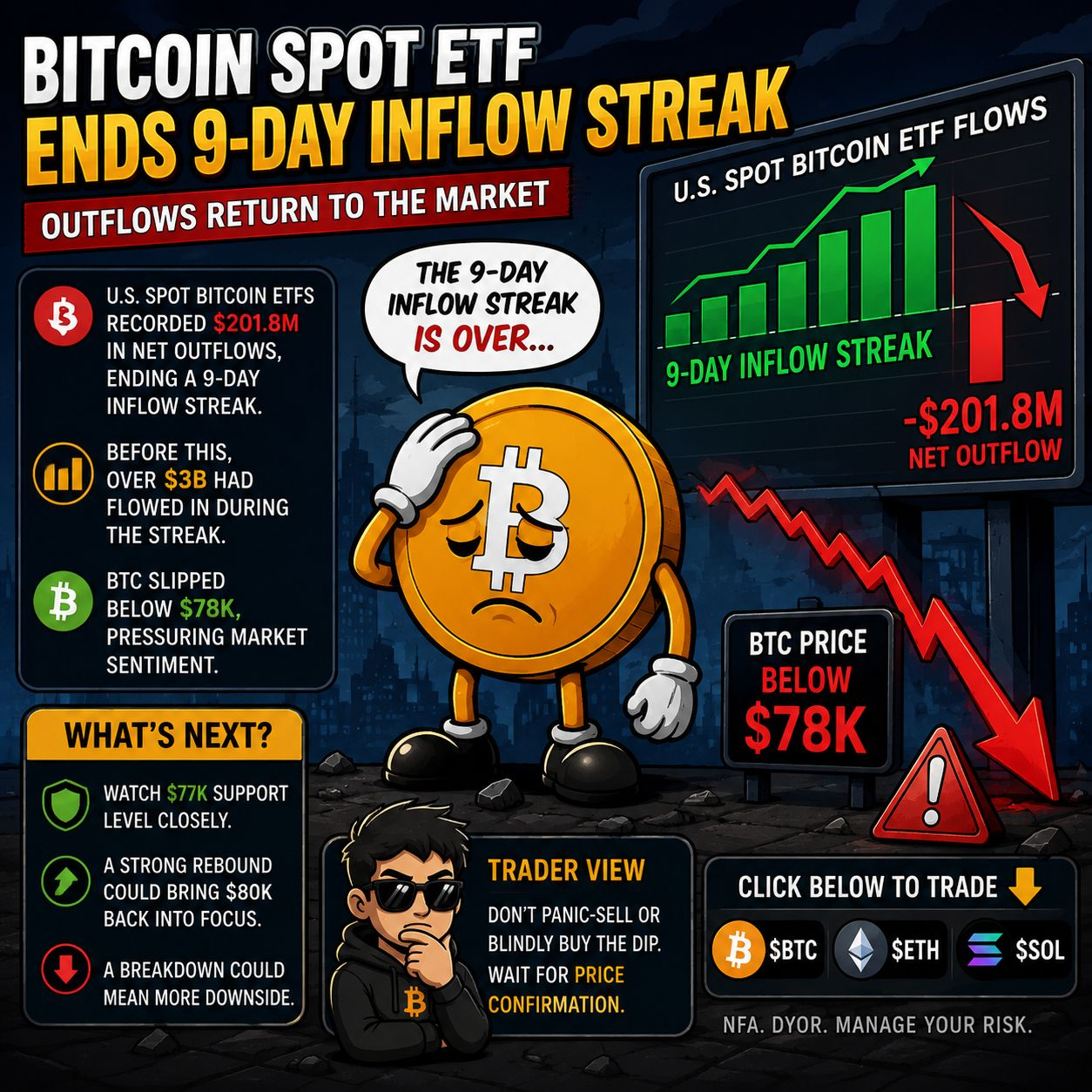
U.S. spot Bitcoin ETFs recorded about $201.8M in net outflows, ending a strong 9-day inflow streak that brought more than $3B into the funds. At the same time, BTC slipped below $78K, putting short-term pressure on sentiment.
Whether BTC can hold the $77K area and attract buyers again. A strong rebound could bring $80K back into focus, while another breakdown could mean more downside.
Don’t panic-sell or blindly buy the dip. Wait for price confirmation.
👇 CLICK BELOW TO TRADE: $BTC $ETH $SOL
⚠️ NFA. DYOR. Manage your risk.
#Bitcoin #BTC #BitcoinETF
🚨 BITCOIN ETF BUYING PAUSES — WHAT NOW?
U.S. spot Bitcoin ETFs recorded about $201.8M in net outflows, ending a strong 9-day inflow streak that brought more than $3B into the funds. At the same time, BTC slipped below $78K, putting short-term pressure on sentiment.
Whether BTC can hold the $77K area and attract buyers again. A strong rebound could bring $80K back into focus, while another breakdown could mean more downside.
Don’t panic-sell or blindly buy the dip. Wait for price confirmation.
👇 CLICK BELOW TO TRADE: $BTC $ETH $SOL
⚠️ NFA. DYOR. Manage your risk.
#Bitcoin #BTC #BitcoinETF

#BitcoinSpotETFEnds9DayInflowStreak
🚨 BITCOIN’S 9-DAY STREAK JUST BROKE…
Something just changed in the Bitcoin market. 👀
For 9 straight days, U.S. Spot Bitcoin ETFs were seeing net inflows.
That streak has now officially ended. 🔴
And this matters because ETF flows have become one of the clearest ways to track institutional demand for $BTC .
For more than a week, capital kept flowing into Bitcoin through the ETF market.
Now?
The flow has turned negative.
One outflow day does NOT automatically mean Bitcoin is entering a downtrend.
But after 9 consecutive days of inflows, the timing is impossible to ignore.
If ETF outflows continue over the next few sessions, the market could start asking a much bigger question:
Are institutions finally slowing down their Bitcoin buying? 👀
Keep your eyes on the next ETF flow numbers.
That could be where the real signal appears.
#BitcoinETF #Crypto #Binance
$BTC
$ETH
$SOL
🚨 BITCOIN’S 9-DAY STREAK JUST BROKE…
Something just changed in the Bitcoin market. 👀
For 9 straight days, U.S. Spot Bitcoin ETFs were seeing net inflows.
That streak has now officially ended. 🔴
And this matters because ETF flows have become one of the clearest ways to track institutional demand for $BTC .
For more than a week, capital kept flowing into Bitcoin through the ETF market.
Now?
The flow has turned negative.
One outflow day does NOT automatically mean Bitcoin is entering a downtrend.
But after 9 consecutive days of inflows, the timing is impossible to ignore.
If ETF outflows continue over the next few sessions, the market could start asking a much bigger question:
Are institutions finally slowing down their Bitcoin buying? 👀
Keep your eyes on the next ETF flow numbers.
That could be where the real signal appears.
#BitcoinETF #Crypto #Binance
$BTC
$ETH
$SOL


BLOW UP!
Bitcoin ETFs just saw a WHOPPING $202 MILLION outflow! Nobody saw this coming as the price holds near $77.5K. #BitcoinETF #CryptoNews #MarketShock
This signals a potential shake-up, a historic moment as capital flows readjust. Are we seeing the start of a correction or a strategic pause before the next rocket launch? #BTC #Crypto
Don't get left behind. What's your next move as the flood of information hits?
Bitcoin ETFs just saw a WHOPPING $202 MILLION outflow! Nobody saw this coming as the price holds near $77.5K. #BitcoinETF #CryptoNews #MarketShock
This signals a potential shake-up, a historic moment as capital flows readjust. Are we seeing the start of a correction or a strategic pause before the next rocket launch? #BTC #Crypto
Don't get left behind. What's your next move as the flood of information hits?
Did you know the big Bitcoin ETFs just had a *bad day*? It’s not the end of the world, but it’s a good reminder of how the market moves.
Here's what's happening: For the first time in nine days, people pulled money out of the US Bitcoin ETFs. Think of these ETFs like a big basket holding Bitcoin that you can buy shares of, similar to stocks. When people sell their shares of the ETF, it’s like the basket is getting smaller. This outflow, totaling over $200 million, caused Bitcoin's price to dip below $78,000.
It’s a bit like when a popular new restaurant has a slow night. It doesn't mean the restaurant is failing, but it definitely gets people talking. This outflow was led by one specific ETF, ARK 21Shares, showing that even within these big baskets, there are individual choices being made by investors.
The takeaway? Market movements are normal. Don't panic sell if you see a dip. Understanding these flows, even the outflows, gives you a better picture of market sentiment. #CryptoEducation #BitcoinETF
What do you think this outflow means for the near future of Bitcoin?
Here's what's happening: For the first time in nine days, people pulled money out of the US Bitcoin ETFs. Think of these ETFs like a big basket holding Bitcoin that you can buy shares of, similar to stocks. When people sell their shares of the ETF, it’s like the basket is getting smaller. This outflow, totaling over $200 million, caused Bitcoin's price to dip below $78,000.
It’s a bit like when a popular new restaurant has a slow night. It doesn't mean the restaurant is failing, but it definitely gets people talking. This outflow was led by one specific ETF, ARK 21Shares, showing that even within these big baskets, there are individual choices being made by investors.
The takeaway? Market movements are normal. Don't panic sell if you see a dip. Understanding these flows, even the outflows, gives you a better picture of market sentiment. #CryptoEducation #BitcoinETF
What do you think this outflow means for the near future of Bitcoin?

🔥 TODAY'S News
Bitcoin’s ETF Streak Hits 9 Days — But the Real Test Is Ahead
Nine straight days of Bitcoin ETF inflows. That’s the part of this rally I’m watching most closely.
On August 27, U.S. spot Bitcoin ETFs recorded $242.3M in net inflows, extending the streak to nine consecutive sessions. Ethereum ETFs also posted $225.8M, their ninth straight positive day.
That’s a very different signal from a rally driven purely by leverage.
BTC has been trading around the $79K–$80K area after briefly moving above $81K. At the same time, recent analysis suggests market liquidity has remained relatively strong, giving the move more substance than a thin-market pump.
But there’s still a big hurdle.
Bitcoin needs to prove that it can hold these higher levels while ETF demand continues. The May high around $82.8K is becoming an important area for traders watching the next breakout attempt.
So I’m less interested in one green candle and more interested in whether institutional demand keeps showing up.
$BTC $ETH
Do you think this 9-day ETF inflow streak is the foundation for another leg higher, or does BTC need to consolidate first?
#bitcoin #Ethereum #BitcoinETF #CryptoMarket #Binance
🔎 SOURCES
Farside — Bitcoin ETF Flow Data�
Farside — Ethereum ETF Flow Data�
CoinDesk — Bitcoin market & liquidity analysis�
Bitcoin’s ETF Streak Hits 9 Days — But the Real Test Is Ahead
Nine straight days of Bitcoin ETF inflows. That’s the part of this rally I’m watching most closely.
On August 27, U.S. spot Bitcoin ETFs recorded $242.3M in net inflows, extending the streak to nine consecutive sessions. Ethereum ETFs also posted $225.8M, their ninth straight positive day.
That’s a very different signal from a rally driven purely by leverage.
BTC has been trading around the $79K–$80K area after briefly moving above $81K. At the same time, recent analysis suggests market liquidity has remained relatively strong, giving the move more substance than a thin-market pump.
But there’s still a big hurdle.
Bitcoin needs to prove that it can hold these higher levels while ETF demand continues. The May high around $82.8K is becoming an important area for traders watching the next breakout attempt.
So I’m less interested in one green candle and more interested in whether institutional demand keeps showing up.
$BTC $ETH
Do you think this 9-day ETF inflow streak is the foundation for another leg higher, or does BTC need to consolidate first?
#bitcoin #Ethereum #BitcoinETF #CryptoMarket #Binance
🔎 SOURCES
Farside — Bitcoin ETF Flow Data�
Farside — Ethereum ETF Flow Data�
CoinDesk — Bitcoin market & liquidity analysis�

🚨 Instant streak of wins for 9 days in the Bitcoin ETF has ended. 🚨
After achieving more than $3 billion over nine consecutive days, U.S. Spot BTC ETF funds incurred losses totaling $201.8 million. When you add that to Bitcoin falling below $78,000, it’s certain the market is feeling pressure today. 📉
Has the uptrend wave ended? 🛑
Of course not. One day of selling does not erase more than a week of heavy institutional buying. Think of it as just a brief, real-world stress test—not a funeral.
The million-dollar question now: is this merely a quick shakeout to flush out weak hands, or the start of a deeper pullback? Let’s see whether big money will return to buy on the decline. 👀👇
Please follow up
#bitcoinspotetfends9dayinflowstreak #BTC #bitcoin #BitcoinETF
$BTC $BNB $ETH
After achieving more than $3 billion over nine consecutive days, U.S. Spot BTC ETF funds incurred losses totaling $201.8 million. When you add that to Bitcoin falling below $78,000, it’s certain the market is feeling pressure today. 📉
Has the uptrend wave ended? 🛑
Of course not. One day of selling does not erase more than a week of heavy institutional buying. Think of it as just a brief, real-world stress test—not a funeral.
The million-dollar question now: is this merely a quick shakeout to flush out weak hands, or the start of a deeper pullback? Let’s see whether big money will return to buy on the decline. 👀👇
Please follow up
#bitcoinspotetfends9dayinflowstreak #BTC #bitcoin #BitcoinETF
$BTC $BNB $ETH


Demand for the $BITCOIN is back and has seen 9 days of inflows.After 9 days, Bitcoin ETF inflows are back.
Bitcoin is on the radar of institutional investors again.
Bitcoin ETFs saw net inflows of around $242M on August 27, continuing their net inflows for the past 9 days.
How does that affect you?
Exposures can be a crucial component of demand for $BTC when added consistently by institutions.
So what you think, $BTC will break over $90k next or will it need another pullback first?
#bitcoin #BTC #crypto #Binance #BitcoinETF
Bitcoin is on the radar of institutional investors again.
Bitcoin ETFs saw net inflows of around $242M on August 27, continuing their net inflows for the past 9 days.
How does that affect you?
Exposures can be a crucial component of demand for $BTC when added consistently by institutions.
So what you think, $BTC will break over $90k next or will it need another pullback first?
#bitcoin #BTC #crypto #Binance #BitcoinETF

Log in to explore more content