

#blockchain
blockchain
35.2M views
167,151 Discussing
Hot
Latest

🚨 🇯🇵 WALL STREET’S TOKENIZATION PUSH JUST GOT BIGGER: BLACKROCK IS EXPLORING A LINK BETWEEN TOKENIZED FUNDS AND A YEN STABLECOIN.
The $15.5 trillion asset manager is working with Japan’s SBI Holdings and Startale Group on exploring connections between tokenized money market funds and JPYSC, a stablecoin pegged to the Japanese yen.
Tokenized money market funds bring traditional financial assets onto blockchain infrastructure.
A yen stablecoin could provide a digital payment and settlement layer.
Connecting the two could help explore how tokenized financial assets and digital money interact onchain.
And the bigger picture is even more significant.
BlackRock is already a major player in traditional finance and tokenized investment products. SBI brings financial infrastructure, while Startale focuses on blockchain technology.
If this initiative progresses, it could help advance Japan’s tokenized finance ecosystem.
But remember: this is an exploration, not proof that a fully integrated product is already live.
The real question is whether traditional financial assets and blockchain-based money can eventually operate together at institutional scale.
#BlackRock #Tokenization #Stablecoins #Crypto #Blockchain
🚨 🇯🇵 WALL STREET’S TOKENIZATION PUSH JUST GOT BIGGER: BLACKROCK IS EXPLORING A LINK BETWEEN TOKENIZED FUNDS AND A YEN STABLECOIN.
The $15.5 trillion asset manager is working with Japan’s SBI Holdings and Startale Group on exploring connections between tokenized money market funds and JPYSC, a stablecoin pegged to the Japanese yen.
Tokenized money market funds bring traditional financial assets onto blockchain infrastructure.
A yen stablecoin could provide a digital payment and settlement layer.
Connecting the two could help explore how tokenized financial assets and digital money interact onchain.
And the bigger picture is even more significant.
BlackRock is already a major player in traditional finance and tokenized investment products. SBI brings financial infrastructure, while Startale focuses on blockchain technology.
If this initiative progresses, it could help advance Japan’s tokenized finance ecosystem.
But remember: this is an exploration, not proof that a fully integrated product is already live.
The real question is whether traditional financial assets and blockchain-based money can eventually operate together at institutional scale.
#BlackRock #Tokenization #Stablecoins #Crypto #Blockchain
The $15.5 trillion asset manager is working with Japan’s SBI Holdings and Startale Group on exploring connections between tokenized money market funds and JPYSC, a stablecoin pegged to the Japanese yen.
Tokenized money market funds bring traditional financial assets onto blockchain infrastructure.
A yen stablecoin could provide a digital payment and settlement layer.
Connecting the two could help explore how tokenized financial assets and digital money interact onchain.
And the bigger picture is even more significant.
BlackRock is already a major player in traditional finance and tokenized investment products. SBI brings financial infrastructure, while Startale focuses on blockchain technology.
If this initiative progresses, it could help advance Japan’s tokenized finance ecosystem.
But remember: this is an exploration, not proof that a fully integrated product is already live.
The real question is whether traditional financial assets and blockchain-based money can eventually operate together at institutional scale.
#BlackRock #Tokenization #Stablecoins #Crypto #Blockchain

2
438

Article
SO, WHAT IS BLOCKCHAIN?Blockchain literally means chain of blocks. But behind those three words lies one of the fundamental mechanisms that makes Bitcoin work.
Technically, a blockchain is a data structure made up of blocks containing transactions that are cryptographically linked to one another.
Imagine an enormous digital chain in which each block contains a set of verifiable transactions and a cryptographic reference to the previous block.
SO, WHAT IS BLOCKCHAIN?
Blockchain literally means chain of blocks. But behind those three words lies one of the fundamental mechanisms that makes Bitcoin work.
Technically, a blockchain is a data structure made up of blocks containing transactions that are cryptographically linked to one another.
Imagine an enormous digital chain in which each block contains a set of verifiable transactions and a cryptographic reference to the previous block.
Technically, a blockchain is a data structure made up of blocks containing transactions that are cryptographically linked to one another.
Imagine an enormous digital chain in which each block contains a set of verifiable transactions and a cryptographic reference to the previous block.
1
69

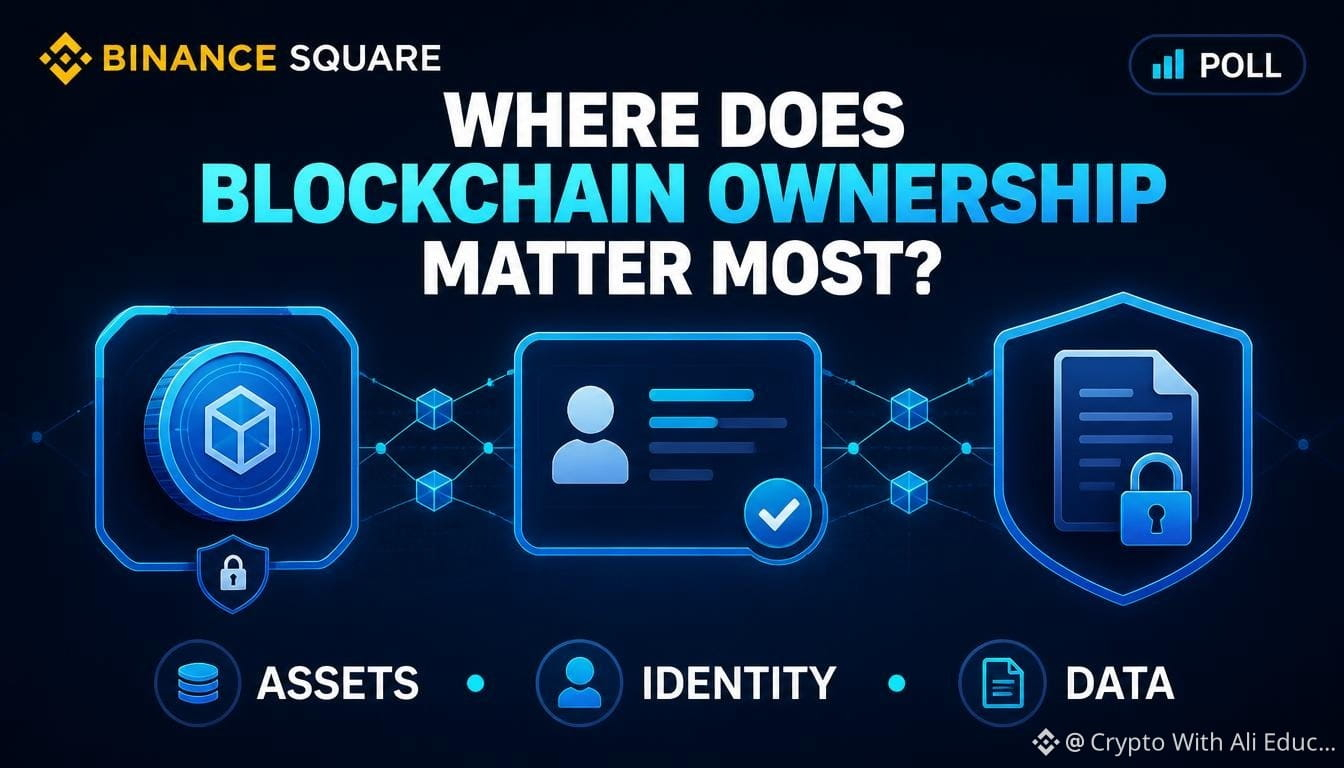
📊 Blockchain Ownership Is Most Relevant To →
Blockchain technology can help record and verify ownership-related information in different areas of the digital world.
But where do you think it could make the biggest difference?
🔹 A. Assets
🔹 B. Identity
🔹 C. Data
🔹 D. All Three
💬 Cast your vote and share your reasoning in the comments.
Remember: blockchain records can support verification, but legal rights, privacy, and security still matter.
Educational content only. Not financial advice.
#BinanceSquare #blockchain #web #CryptoCommunity #CryptoWithAli
📊 Blockchain Ownership Is Most Relevant To →
Blockchain technology can help record and verify ownership-related information in different areas of the digital world.
But where do you think it could make the biggest difference?
🔹 A. Assets
🔹 B. Identity
🔹 C. Data
🔹 D. All Three
💬 Cast your vote and share your reasoning in the comments.
Remember: blockchain records can support verification, but legal rights, privacy, and security still matter.
Educational content only. Not financial advice.
#BinanceSquare #blockchain #web #CryptoCommunity #CryptoWithAli
Blockchain technology can help record and verify ownership-related information in different areas of the digital world.
But where do you think it could make the biggest difference?
🔹 A. Assets
🔹 B. Identity
🔹 C. Data
🔹 D. All Three
💬 Cast your vote and share your reasoning in the comments.
Remember: blockchain records can support verification, but legal rights, privacy, and security still matter.
Educational content only. Not financial advice.
#BinanceSquare #blockchain #web #CryptoCommunity #CryptoWithAli
60

·
--
CF Benchmarks made a move that blends two worlds.
The firm is bringing its pricing infrastructure onchain.
It includes data used by BlackRock.
That means developers will be able to build index funds, tokenized portfolios, and derivatives using established financial benchmarks.
The interesting part: this isn’t a startup winging it.
It’s Wall Street infrastructure moving into blockchain territory.
You don’t see this kind of bridge every day.
What stands out to you most about this move?
$BTC #Crypto #Blockchain
CF Benchmarks made a move that blends two worlds.
The firm is bringing its pricing infrastructure onchain.
It includes data used by BlackRock.
That means developers will be able to build index funds, tokenized portfolios, and derivatives using established financial benchmarks.
The interesting part: this isn’t a startup winging it.
It’s Wall Street infrastructure moving into blockchain territory.
You don’t see this kind of bridge every day.
What stands out to you most about this move?
$BTC #Crypto #Blockchain
The firm is bringing its pricing infrastructure onchain.
It includes data used by BlackRock.
That means developers will be able to build index funds, tokenized portfolios, and derivatives using established financial benchmarks.
The interesting part: this isn’t a startup winging it.
It’s Wall Street infrastructure moving into blockchain territory.
You don’t see this kind of bridge every day.
What stands out to you most about this move?
$BTC #Crypto #Blockchain
22

Article
HOW DO WE GO FROM A BLOCK TO A BLOCKCHAIN?The genesis block was the starting point. Then came block 1, followed by block 2, block 3, and all the blocks that came afterward.
But what matters is not simply that consecutive blocks exist, but the relationship they have with one another...
In Bitcoin, every block after the genesis block contains a cryptographic reference to the previous block in its header.
This allows us to establish a precise connection between them.
We can represent it simply:
BLOCK 0 → BLOCK 1 → BLOCK 2 → BLOCK 3
HOW DO WE GO FROM A BLOCK TO A BLOCKCHAIN?
The genesis block was the starting point. Then came block 1, followed by block 2, block 3, and all the blocks that came afterward.
But what matters is not simply that consecutive blocks exist, but the relationship they have with one another...
In Bitcoin, every block after the genesis block contains a cryptographic reference to the previous block in its header.
This allows us to establish a precise connection between them.
We can represent it simply:
BLOCK 0 → BLOCK 1 → BLOCK 2 → BLOCK 3
But what matters is not simply that consecutive blocks exist, but the relationship they have with one another...
In Bitcoin, every block after the genesis block contains a cryptographic reference to the previous block in its header.
This allows us to establish a precise connection between them.
We can represent it simply:
BLOCK 0 → BLOCK 1 → BLOCK 2 → BLOCK 3
1
68

Article
WHAT IS A LEDGER?Imagine a huge accounting book where every movement of money is recorded. Each transaction documents what happened, making it possible to review the history and see how a particular situation came about.
In the financial world, this record is known as a ledger, an English word meaning a book of accounts or accounting record.
Banks use accounting records to keep track of their customers’ transactions and balances. If you transfer money, the institution records the transaction and updates the relevant information.
WHAT IS A LEDGER?
Imagine a huge accounting book where every movement of money is recorded. Each transaction documents what happened, making it possible to review the history and see how a particular situation came about.
In the financial world, this record is known as a ledger, an English word meaning a book of accounts or accounting record.
Banks use accounting records to keep track of their customers’ transactions and balances. If you transfer money, the institution records the transaction and updates the relevant information.
In the financial world, this record is known as a ledger, an English word meaning a book of accounts or accounting record.
Banks use accounting records to keep track of their customers’ transactions and balances. If you transfer money, the institution records the transaction and updates the relevant information.
1
164

·
--

Article
Blockchain Technology: The Powerful Force Behind Cryptocurrency and the Future of Digital Finance Blockchain Technology: The Powerful Force Behind Cryptocurrency and the Future of Digital Finance
Cryptocurrency is changing the way people think about money, payments, and digital ownership. But behind popular cryptocurrencies like Bitcoin and Ethereum, there is a powerful technology that makes much of this innovation possible: Blockchain Technology.
Blockchain is more than just a system for digital currencies. It has the potential to transform online payments, financial services, digital identity, and the way information is recorded and shared.
### What Is Blockchain Technology?
Blockchain is a type of digital ledger that records transactions across a network of computers. Instead of relying entirely on one central authority, many blockchain networks allow participants to verify transactions according to shared rules.
Transactions are grouped into blocks, and these blocks are linked together in chronological order. Cryptographic techniques help protect the integrity of the records, making unauthorized changes difficult on properly designed networks.
This technology can improve transparency and help people verify transactions without always depending on a traditional intermediary.
### How Does Blockchain Work in Cryptocurrency?
When someone sends cryptocurrency, the network checks whether the transaction follows its rules. Depending on the blockchain, validators or miners help confirm transactions and add them to the ledger.
Once a transaction receives sufficient confirmation, the updated record becomes part of the blockchain's history.
For example, Bitcoin uses blockchain technology to record transfers of BTC, while Ethereum supports cryptocurrency transactions and programmable smart contracts.
These systems work differently, but both demonstrate how blockchain can support digital transactions across a distributed network.
### Why Is Blockchain Important for the Future?
Here are five important benefits of blockchain technology:
1\. Transparency: Public blockchains allow people to inspect many transactions using blockchain explorers.
2\. Security: Cryptography and network consensus help protect transaction records, although no system is completely risk-free.
3\. Decentralization: Some blockchain networks operate without a single organization controlling the entire system.
4\. Global Transactions: Certain cryptocurrencies can be transferred internationally without relying on traditional banking rails, although fees, regulations, and processing times vary.
5\. Smart Contracts: Programmable blockchains can automatically execute predefined rules, enabling decentralized applications and new financial services.
Blockchain and Cryptocurrency: What Comes Next?
The future of blockchain may involve decentralized finance (DeFi), tokenization of real-world assets, stablecoins, digital payments, and improved blockchain scalability.
However, important challenges remain. Cryptocurrency prices can be highly volatile, scams continue to target investors, and blockchain networks may face technical, regulatory, and privacy challenges.
That is why learning about blockchain technology is important before investing in any cryptocurrency. Understanding how a project works is more useful than following hype alone.
Final Thoughts
Blockchain technology is one of the most important innovations behind the cryptocurrency ecosystem. It offers new ways to record transactions, transfer digital value, and build applications that operate across networks.
But remember: promising technology does not automatically mean a profitable investment. Always research a project's purpose, security, token economics, and risks before making financial decisions.
The real question is not just which cryptocurrency will rise next, but which blockchain projects can deliver genuine value over time.
Let's discuss! 💬
What do you think will have the biggest impact on the future of blockchain?
* A) Bitcoin and digital payments
* B) Ethereum and smart contracts
* C) DeFi and decentralized finance
* D) Real-world asset tokenization
👇 Comment with A, B, C, or D and tell us why!
If you found this article useful, Like ❤️, Share 🔄, and Follow for more educational content about blockchain technology, cryptocurrency news, and digital finance.
Blockchain Technology, Cryptocurrency, Bitcoin, Ethereum, Blockchain Explained, Crypto Education, Smart Contracts, Decentralized Finance, DeFi, Digital Finance, Future of Blockchain
#Blockchain #cryptocurrency #bitcoin #Ethereum #CryptoEducation #DeFi #Web3 #BlockchainTechnology #BinanceSquare #CryptoCommunity
Blockchain Technology: The Powerful Force Behind Cryptocurrency and the Future of Digital Finance
Blockchain Technology: The Powerful Force Behind Cryptocurrency and the Future of Digital Finance
Cryptocurrency is changing the way people think about money, payments, and digital ownership. But behind popular cryptocurrencies like Bitcoin and Ethereum, there is a powerful technology that makes much of this innovation possible: Blockchain Technology.
Blockchain is more than just a system for digital currencies. It has the potential to transform online payments, financial services, digital identity, and the way information is recorded and shared.
### What Is Blockchain Technology?
Blockchain is a type of digital ledger that records transactions across a network of computers. Instead of relying entirely on one central authority, many blockchain networks allow participants to verify transactions according to shared rules.
Transactions are grouped into blocks, and these blocks are linked together in chronological order. Cryptographic techniques help protect the integrity of the records, making unauthorized changes difficult on properly designed networks.
This technology can improve transparency and help people verify transactions without always depending on a traditional intermediary.
### How Does Blockchain Work in Cryptocurrency?
When someone sends cryptocurrency, the network checks whether the transaction follows its rules. Depending on the blockchain, validators or miners help confirm transactions and add them to the ledger.
Once a transaction receives sufficient confirmation, the updated record becomes part of the blockchain's history.
For example, Bitcoin uses blockchain technology to record transfers of BTC, while Ethereum supports cryptocurrency transactions and programmable smart contracts.
These systems work differently, but both demonstrate how blockchain can support digital transactions across a distributed network.
### Why Is Blockchain Important for the Future?
Here are five important benefits of blockchain technology:
1\. Transparency: Public blockchains allow people to inspect many transactions using blockchain explorers.
2\. Security: Cryptography and network consensus help protect transaction records, although no system is completely risk-free.
3\. Decentralization: Some blockchain networks operate without a single organization controlling the entire system.
4\. Global Transactions: Certain cryptocurrencies can be transferred internationally without relying on traditional banking rails, although fees, regulations, and processing times vary.
5\. Smart Contracts: Programmable blockchains can automatically execute predefined rules, enabling decentralized applications and new financial services.
Blockchain and Cryptocurrency: What Comes Next?
The future of blockchain may involve decentralized finance (DeFi), tokenization of real-world assets, stablecoins, digital payments, and improved blockchain scalability.
However, important challenges remain. Cryptocurrency prices can be highly volatile, scams continue to target investors, and blockchain networks may face technical, regulatory, and privacy challenges.
That is why learning about blockchain technology is important before investing in any cryptocurrency. Understanding how a project works is more useful than following hype alone.
Final Thoughts
Blockchain technology is one of the most important innovations behind the cryptocurrency ecosystem. It offers new ways to record transactions, transfer digital value, and build applications that operate across networks.
But remember: promising technology does not automatically mean a profitable investment. Always research a project's purpose, security, token economics, and risks before making financial decisions.
The real question is not just which cryptocurrency will rise next, but which blockchain projects can deliver genuine value over time.
Let's discuss! 💬
What do you think will have the biggest impact on the future of blockchain?
* A) Bitcoin and digital payments
* B) Ethereum and smart contracts
* C) DeFi and decentralized finance
* D) Real-world asset tokenization
👇 Comment with A, B, C, or D and tell us why!
If you found this article useful, Like ❤️, Share 🔄, and Follow for more educational content about blockchain technology, cryptocurrency news, and digital finance.
Blockchain Technology, Cryptocurrency, Bitcoin, Ethereum, Blockchain Explained, Crypto Education, Smart Contracts, Decentralized Finance, DeFi, Digital Finance, Future of Blockchain
#Blockchain #cryptocurrency #bitcoin #Ethereum #CryptoEducation #DeFi #Web3 #BlockchainTechnology #BinanceSquare #CryptoCommunity
Cryptocurrency is changing the way people think about money, payments, and digital ownership. But behind popular cryptocurrencies like Bitcoin and Ethereum, there is a powerful technology that makes much of this innovation possible: Blockchain Technology.
Blockchain is more than just a system for digital currencies. It has the potential to transform online payments, financial services, digital identity, and the way information is recorded and shared.
### What Is Blockchain Technology?
Blockchain is a type of digital ledger that records transactions across a network of computers. Instead of relying entirely on one central authority, many blockchain networks allow participants to verify transactions according to shared rules.
Transactions are grouped into blocks, and these blocks are linked together in chronological order. Cryptographic techniques help protect the integrity of the records, making unauthorized changes difficult on properly designed networks.
This technology can improve transparency and help people verify transactions without always depending on a traditional intermediary.
### How Does Blockchain Work in Cryptocurrency?
When someone sends cryptocurrency, the network checks whether the transaction follows its rules. Depending on the blockchain, validators or miners help confirm transactions and add them to the ledger.
Once a transaction receives sufficient confirmation, the updated record becomes part of the blockchain's history.
For example, Bitcoin uses blockchain technology to record transfers of BTC, while Ethereum supports cryptocurrency transactions and programmable smart contracts.
These systems work differently, but both demonstrate how blockchain can support digital transactions across a distributed network.
### Why Is Blockchain Important for the Future?
Here are five important benefits of blockchain technology:
1\. Transparency: Public blockchains allow people to inspect many transactions using blockchain explorers.
2\. Security: Cryptography and network consensus help protect transaction records, although no system is completely risk-free.
3\. Decentralization: Some blockchain networks operate without a single organization controlling the entire system.
4\. Global Transactions: Certain cryptocurrencies can be transferred internationally without relying on traditional banking rails, although fees, regulations, and processing times vary.
5\. Smart Contracts: Programmable blockchains can automatically execute predefined rules, enabling decentralized applications and new financial services.
Blockchain and Cryptocurrency: What Comes Next?
The future of blockchain may involve decentralized finance (DeFi), tokenization of real-world assets, stablecoins, digital payments, and improved blockchain scalability.
However, important challenges remain. Cryptocurrency prices can be highly volatile, scams continue to target investors, and blockchain networks may face technical, regulatory, and privacy challenges.
That is why learning about blockchain technology is important before investing in any cryptocurrency. Understanding how a project works is more useful than following hype alone.
Final Thoughts
Blockchain technology is one of the most important innovations behind the cryptocurrency ecosystem. It offers new ways to record transactions, transfer digital value, and build applications that operate across networks.
But remember: promising technology does not automatically mean a profitable investment. Always research a project's purpose, security, token economics, and risks before making financial decisions.
The real question is not just which cryptocurrency will rise next, but which blockchain projects can deliver genuine value over time.
Let's discuss! 💬
What do you think will have the biggest impact on the future of blockchain?
* A) Bitcoin and digital payments
* B) Ethereum and smart contracts
* C) DeFi and decentralized finance
* D) Real-world asset tokenization
👇 Comment with A, B, C, or D and tell us why!
If you found this article useful, Like ❤️, Share 🔄, and Follow for more educational content about blockchain technology, cryptocurrency news, and digital finance.
Blockchain Technology, Cryptocurrency, Bitcoin, Ethereum, Blockchain Explained, Crypto Education, Smart Contracts, Decentralized Finance, DeFi, Digital Finance, Future of Blockchain
#Blockchain #cryptocurrency #bitcoin #Ethereum #CryptoEducation #DeFi #Web3 #BlockchainTechnology #BinanceSquare #CryptoCommunity
60

·
--
What Is Blockchain? The Technology That Could Change the Digital World 🌐
Have you ever wondered how people can transfer digital assets without depending on a single central authority?
The answer lies in a technology called Blockchain.
Many people hear about Bitcoin and cryptocurrency every day, but blockchain is much more than digital money. It is a technology designed to record and verify information across a distributed network.
Let's understand it in simple terms. 👇
🔗 1. What Is Blockchain?
Blockchain is a type of digital ledger that stores information in groups called blocks.
These blocks are connected using cryptographic techniques, forming a chain of records.
Instead of relying on one central database, many blockchain networks distribute records across multiple computers, often called nodes.
Think of it as a shared digital record that network participants can verify.
⚙️ 2. How Does Blockchain Work?
Here is a simplified example of how a blockchain transaction works:
🔹 Step 1: A transaction is initiated. Someone sends a digital asset or submits information.
🔹 Step 2: The network checks the transaction. Participants or validators verify it according to the network's rules.
🔹 Step 3: The transaction is recorded. Valid transactions are grouped into blocks.
🔹 Step 4: The block is added to the chain. The network updates its record according to its consensus mechanism.
Once recorded, changing historical data can be extremely difficult, depending on the blockchain's design and security.
🚀 3. Why Is Blockchain Important?
Blockchain offers several potential benefits:
✅ Transparency: Public blockchains allow people to independently inspect transaction records.
✅ Decentralization: Many networks operate without depending on a single controlling authority.
✅ Verifiability: Cryptographic techniques help participants verify records.
✅ Traceability: Transactions and asset movements can often be followed on public networks.
#Blockchain #CryptoEducation #Web3 #Bitcoin #BinanceSquare
What Is Blockchain? The Technology That Could Change the Digital World 🌐
Have you ever wondered how people can transfer digital assets without depending on a single central authority?
The answer lies in a technology called Blockchain.
Many people hear about Bitcoin and cryptocurrency every day, but blockchain is much more than digital money. It is a technology designed to record and verify information across a distributed network.
Let's understand it in simple terms. 👇
🔗 1. What Is Blockchain?
Blockchain is a type of digital ledger that stores information in groups called blocks.
These blocks are connected using cryptographic techniques, forming a chain of records.
Instead of relying on one central database, many blockchain networks distribute records across multiple computers, often called nodes.
Think of it as a shared digital record that network participants can verify.
⚙️ 2. How Does Blockchain Work?
Here is a simplified example of how a blockchain transaction works:
🔹 Step 1: A transaction is initiated. Someone sends a digital asset or submits information.
🔹 Step 2: The network checks the transaction. Participants or validators verify it according to the network's rules.
🔹 Step 3: The transaction is recorded. Valid transactions are grouped into blocks.
🔹 Step 4: The block is added to the chain. The network updates its record according to its consensus mechanism.
Once recorded, changing historical data can be extremely difficult, depending on the blockchain's design and security.
🚀 3. Why Is Blockchain Important?
Blockchain offers several potential benefits:
✅ Transparency: Public blockchains allow people to independently inspect transaction records.
✅ Decentralization: Many networks operate without depending on a single controlling authority.
✅ Verifiability: Cryptographic techniques help participants verify records.
✅ Traceability: Transactions and asset movements can often be followed on public networks.
#Blockchain #CryptoEducation #Web3 #Bitcoin #BinanceSquare
Have you ever wondered how people can transfer digital assets without depending on a single central authority?
The answer lies in a technology called Blockchain.
Many people hear about Bitcoin and cryptocurrency every day, but blockchain is much more than digital money. It is a technology designed to record and verify information across a distributed network.
Let's understand it in simple terms. 👇
🔗 1. What Is Blockchain?
Blockchain is a type of digital ledger that stores information in groups called blocks.
These blocks are connected using cryptographic techniques, forming a chain of records.
Instead of relying on one central database, many blockchain networks distribute records across multiple computers, often called nodes.
Think of it as a shared digital record that network participants can verify.
⚙️ 2. How Does Blockchain Work?
Here is a simplified example of how a blockchain transaction works:
🔹 Step 1: A transaction is initiated. Someone sends a digital asset or submits information.
🔹 Step 2: The network checks the transaction. Participants or validators verify it according to the network's rules.
🔹 Step 3: The transaction is recorded. Valid transactions are grouped into blocks.
🔹 Step 4: The block is added to the chain. The network updates its record according to its consensus mechanism.
Once recorded, changing historical data can be extremely difficult, depending on the blockchain's design and security.
🚀 3. Why Is Blockchain Important?
Blockchain offers several potential benefits:
✅ Transparency: Public blockchains allow people to independently inspect transaction records.
✅ Decentralization: Many networks operate without depending on a single controlling authority.
✅ Verifiability: Cryptographic techniques help participants verify records.
✅ Traceability: Transactions and asset movements can often be followed on public networks.
#Blockchain #CryptoEducation #Web3 #Bitcoin #BinanceSquare
82

·
--
Bullish
#cangoogledefinditscore
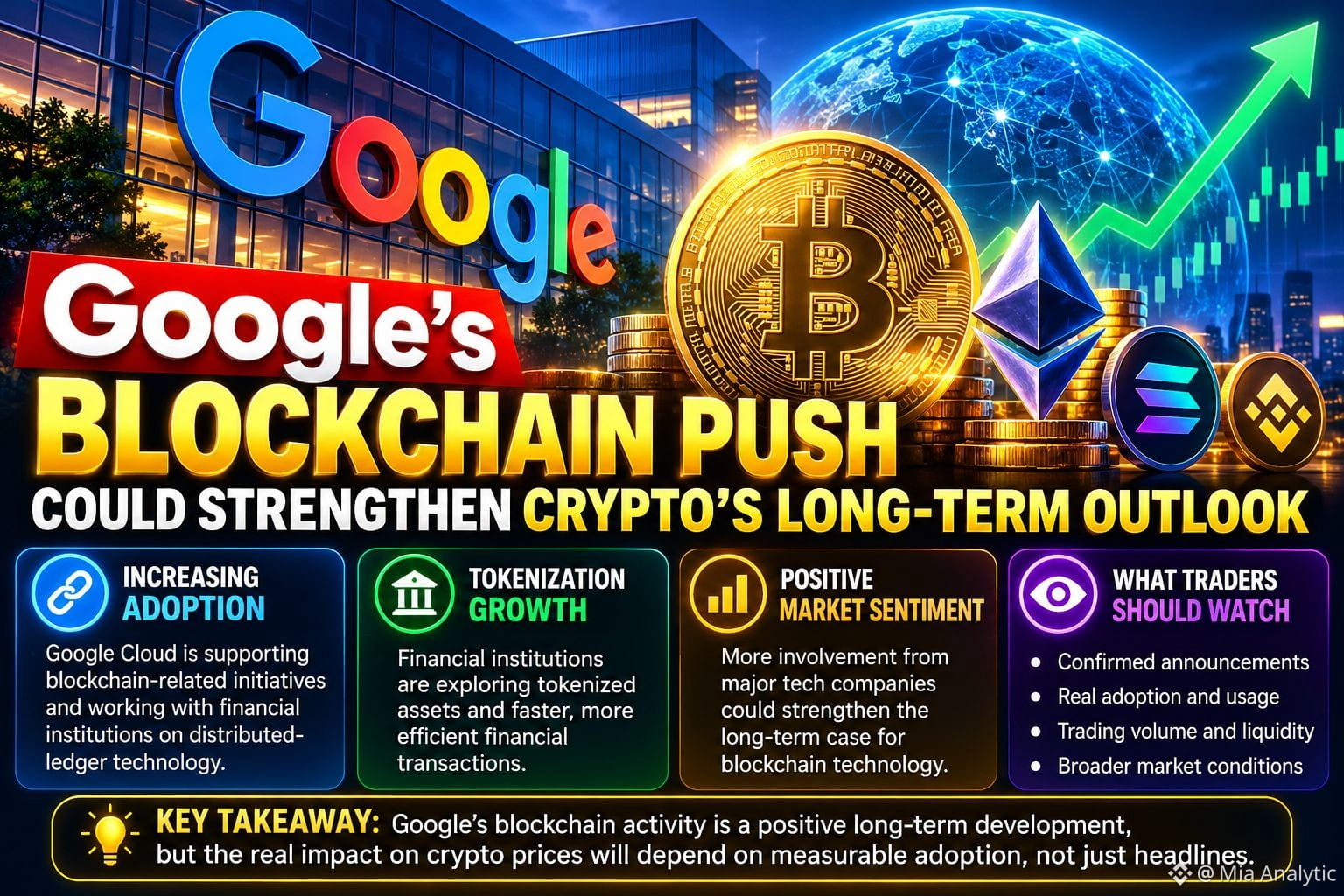
🚨 Google’s Blockchain Push Could Strengthen Crypto’s Long-Term Outlook
Google’s involvement in blockchain infrastructure is highlighting how major technology companies are exploring the next generation of digital finance. Through Google Cloud, the company has supported blockchain-related initiatives, including work with traditional financial institutions exploring distributed-ledger technology.
📊 Why Does This Matter?
Blockchain adoption is no longer limited to crypto trading. Financial institutions are exploring tokenization, digital asset infrastructure, and faster ways to process financial transactions. Technology providers such as Google Cloud can help supply the infrastructure needed to develop and operate these systems.
For the crypto market, this trend could strengthen the long-term case for blockchain technology. Projects with genuine utility, active users, and real institutional partnerships may benefit if adoption continues to expand.
⚠️ What Should Traders Watch?
The key is to separate actual business developments from market speculation. A technology partnership does not automatically mean that Google is buying Bitcoin or endorsing a particular cryptocurrency.
Traders should monitor confirmed announcements, adoption metrics, trading volume, and broader market conditions before making decisions. Short-term price movements will still depend on liquidity, investor sentiment, and macroeconomic factors.
🎯 Market Outlook
Google’s blockchain-related activity is a development worth watching, particularly for the long-term adoption of digital asset infrastructure. However, its direct impact on Bitcoin and altcoin prices remains uncertain.
The real signal will be measurable adoption—not just a headline.
#CryptoNews #blockchain #Tokenization #BinanceSquare
$EVAA $APR $TAG
{future}(TAGUSDT)
{future}(APRUSDT)
{future}(EVAAUSDT)
#cangoogledefinditscore
🚨 Google’s Blockchain Push Could Strengthen Crypto’s Long-Term Outlook
Google’s involvement in blockchain infrastructure is highlighting how major technology companies are exploring the next generation of digital finance. Through Google Cloud, the company has supported blockchain-related initiatives, including work with traditional financial institutions exploring distributed-ledger technology.
📊 Why Does This Matter?
Blockchain adoption is no longer limited to crypto trading. Financial institutions are exploring tokenization, digital asset infrastructure, and faster ways to process financial transactions. Technology providers such as Google Cloud can help supply the infrastructure needed to develop and operate these systems.
For the crypto market, this trend could strengthen the long-term case for blockchain technology. Projects with genuine utility, active users, and real institutional partnerships may benefit if adoption continues to expand.
⚠️ What Should Traders Watch?
The key is to separate actual business developments from market speculation. A technology partnership does not automatically mean that Google is buying Bitcoin or endorsing a particular cryptocurrency.
Traders should monitor confirmed announcements, adoption metrics, trading volume, and broader market conditions before making decisions. Short-term price movements will still depend on liquidity, investor sentiment, and macroeconomic factors.
🎯 Market Outlook
Google’s blockchain-related activity is a development worth watching, particularly for the long-term adoption of digital asset infrastructure. However, its direct impact on Bitcoin and altcoin prices remains uncertain.
The real signal will be measurable adoption—not just a headline.
#CryptoNews #blockchain #Tokenization #BinanceSquare
$EVAA $APR $TAG
🚨 Google’s Blockchain Push Could Strengthen Crypto’s Long-Term Outlook
Google’s involvement in blockchain infrastructure is highlighting how major technology companies are exploring the next generation of digital finance. Through Google Cloud, the company has supported blockchain-related initiatives, including work with traditional financial institutions exploring distributed-ledger technology.
📊 Why Does This Matter?
Blockchain adoption is no longer limited to crypto trading. Financial institutions are exploring tokenization, digital asset infrastructure, and faster ways to process financial transactions. Technology providers such as Google Cloud can help supply the infrastructure needed to develop and operate these systems.
For the crypto market, this trend could strengthen the long-term case for blockchain technology. Projects with genuine utility, active users, and real institutional partnerships may benefit if adoption continues to expand.
⚠️ What Should Traders Watch?
The key is to separate actual business developments from market speculation. A technology partnership does not automatically mean that Google is buying Bitcoin or endorsing a particular cryptocurrency.
Traders should monitor confirmed announcements, adoption metrics, trading volume, and broader market conditions before making decisions. Short-term price movements will still depend on liquidity, investor sentiment, and macroeconomic factors.
🎯 Market Outlook
Google’s blockchain-related activity is a development worth watching, particularly for the long-term adoption of digital asset infrastructure. However, its direct impact on Bitcoin and altcoin prices remains uncertain.
The real signal will be measurable adoption—not just a headline.
#CryptoNews #blockchain #Tokenization #BinanceSquare
$EVAA $APR $TAG
377

·
--
Decentralized storage protocols like IPFS, Arweave, and Filecoin offer alternatives to traditional centralized servers. Centralized servers are controlled by a single entity, making them vulnerable to censorship and data loss. Decentralized protocols, on the other hand, distribute data across a network of nodes, ensuring data is always available. For example, Filecoin has over 3000 decentralized storage providers. This approach is at a higher level of security compared to centralized servers. $ETH and $BTC can be used to pay for storage on these protocols. Decentralized storage is the future of data management. Blockchain technology enables secure and decentralized data storage. #blockchain #decentralizedstorage #cryptotechnology
Decentralized storage protocols like IPFS, Arweave, and Filecoin offer alternatives to traditional centralized servers. Centralized servers are controlled by a single entity, making them vulnerable to censorship and data loss. Decentralized protocols, on the other hand, distribute data across a network of nodes, ensuring data is always available. For example, Filecoin has over 3000 decentralized storage providers. This approach is at a higher level of security compared to centralized servers. $ETH and $BTC can be used to pay for storage on these protocols. Decentralized storage is the future of data management. Blockchain technology enables secure and decentralized data storage. #blockchain #decentralizedstorage #cryptotechnology
6

·
--
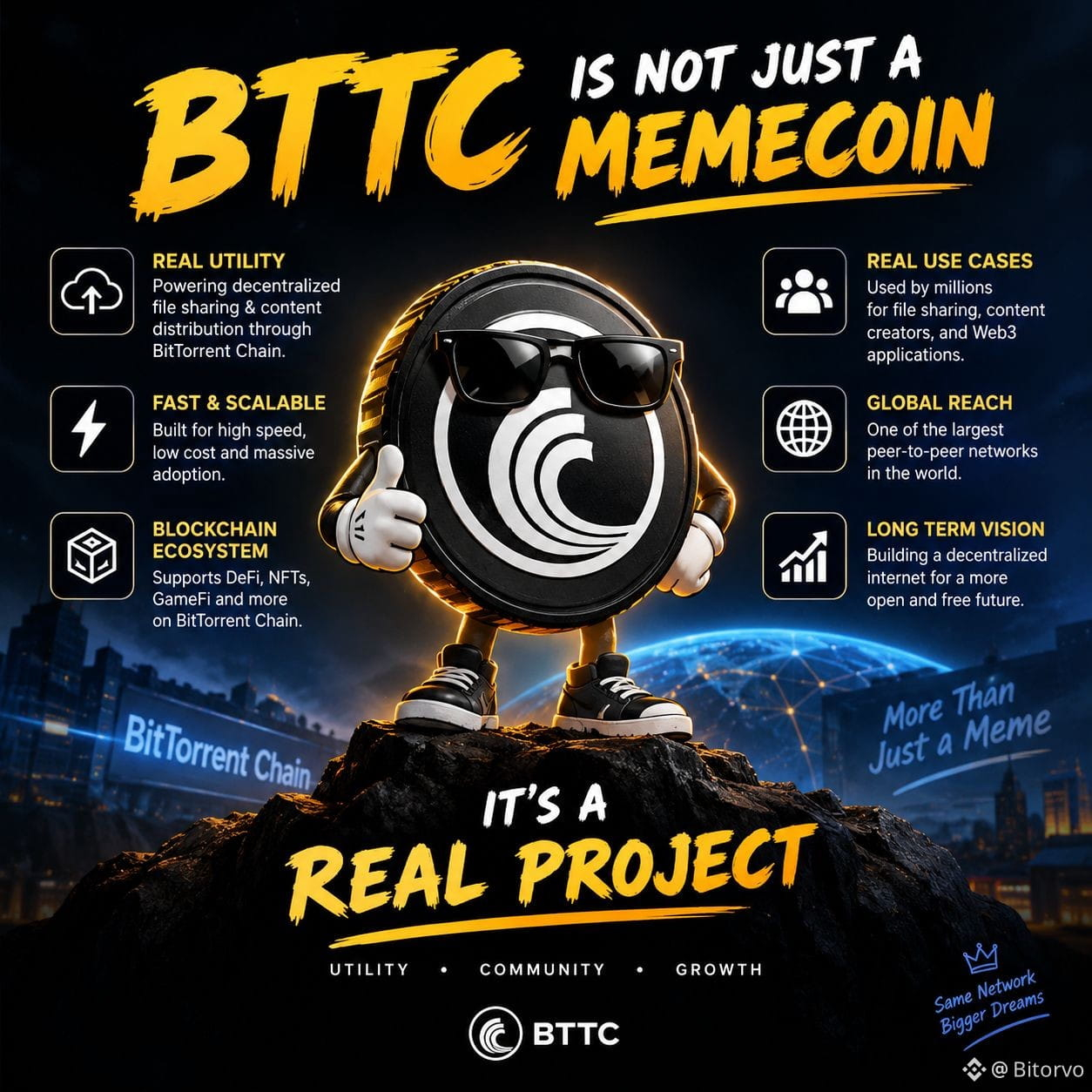
I Think $BTTC is Just a MemeCoin but It can't 😧
🚀 BTTC is helping make Web3 more connected! 🔗🌐
it's Uses👀👀👀....
✨ Cross-Chain Connectivity: Move beyond single-chain limitations.
🔄 Better Flexibility: Explore multiple blockchain ecosystems more easily.
🌍 Less Fragmentation: Help networks and users interact across chains.
⚡ More Utility: Assets and apps can gain broader use across Web3.
🤝 Stronger Ecosystem: A connected future can create smoother experiences for everyone.
BTTC reflects the vision of a more interoperable blockchain world. 🌉
💬 What matters most to you in cross-chain tech—speed, accessibility, or liquidity?
#BTTC #BTT #Web3 #Blockchain #Crypto
I Think $BTTC is Just a MemeCoin but It can't 😧
🚀 BTTC is helping make Web3 more connected! 🔗🌐
it's Uses👀👀👀....
✨ Cross-Chain Connectivity: Move beyond single-chain limitations.
🔄 Better Flexibility: Explore multiple blockchain ecosystems more easily.
🌍 Less Fragmentation: Help networks and users interact across chains.
⚡ More Utility: Assets and apps can gain broader use across Web3.
🤝 Stronger Ecosystem: A connected future can create smoother experiences for everyone.
BTTC reflects the vision of a more interoperable blockchain world. 🌉
💬 What matters most to you in cross-chain tech—speed, accessibility, or liquidity?
#BTTC #BTT #Web3 #Blockchain #Crypto
🚀 BTTC is helping make Web3 more connected! 🔗🌐
it's Uses👀👀👀....
✨ Cross-Chain Connectivity: Move beyond single-chain limitations.
🔄 Better Flexibility: Explore multiple blockchain ecosystems more easily.
🌍 Less Fragmentation: Help networks and users interact across chains.
⚡ More Utility: Assets and apps can gain broader use across Web3.
🤝 Stronger Ecosystem: A connected future can create smoother experiences for everyone.
BTTC reflects the vision of a more interoperable blockchain world. 🌉
💬 What matters most to you in cross-chain tech—speed, accessibility, or liquidity?
#BTTC #BTT #Web3 #Blockchain #Crypto
cryptogirl007:
$BTTC Just verified and followed your profile, let's track these $BTTC setups together and grow our network!
4
1
12
1.5k

Magnetar Microsoft research can reduce blockchain proof costs
- Magnetar Microsoft speeds up proof programs
- Standard hash cryptography
- Reduce blockchain proof costs
#BinanceSquare #CryptoNews #Blockchain #Microsoft #Magnetar HashBasedCrypto
$btc $eth
vlikevn Titanbot
Source: NewsBTC
Magnetar Microsoft research can reduce blockchain proof costs
- Magnetar Microsoft speeds up proof programs
- Standard hash cryptography
- Reduce blockchain proof costs
#BinanceSquare #CryptoNews #Blockchain #Microsoft #Magnetar HashBasedCrypto
$btc $eth
vlikevn Titanbot
Source: NewsBTC
- Magnetar Microsoft speeds up proof programs
- Standard hash cryptography
- Reduce blockchain proof costs
#BinanceSquare #CryptoNews #Blockchain #Microsoft #Magnetar HashBasedCrypto
$btc $eth
vlikevn Titanbot
Source: NewsBTC
343

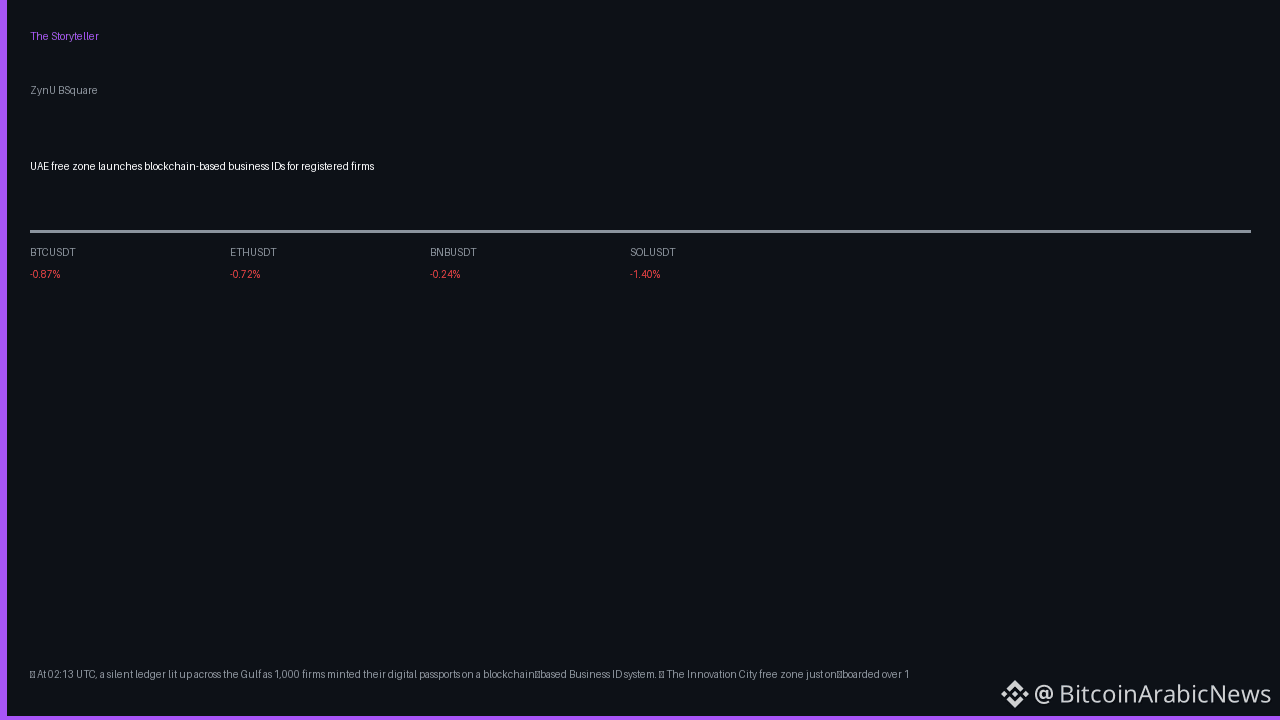
🔥 At 02:13 UTC, a silent ledger lit up across the Gulf as 1,000 firms minted their digital passports on a blockchain‑based Business ID system.
📊 The Innovation City free zone just on‑boarded over 1,000 companies onto immutable credentials, turning legal paperwork into verifiable tokens in seconds. While #BTC trades at $79,769 with a bullish MACD crossover and RSI 37.6, smart wallets like wiener are loading Solana (+1.73%) to tap the new identity layer, and #DeFi platforms on BSC are buzzing about token Q’s 44% surge as firms eye faster compliance #Blockchain #UAE.
💡 The twist: regulators are betting that the same chain securing these IDs will also become the backbone for cross‑border trade financing, turning compliance into a profit engine.
❓ Will the next wave of corporate capital flow through these on‑chain IDs and rewrite the rules of global trade?
🔥 At 02:13 UTC, a silent ledger lit up across the Gulf as 1,000 firms minted their digital passports on a blockchain‑based Business ID system.
📊 The Innovation City free zone just on‑boarded over 1,000 companies onto immutable credentials, turning legal paperwork into verifiable tokens in seconds. While #BTC trades at $79,769 with a bullish MACD crossover and RSI 37.6, smart wallets like wiener are loading Solana (+1.73%) to tap the new identity layer, and #DeFi platforms on BSC are buzzing about token Q’s 44% surge as firms eye faster compliance #Blockchain #UAE.
💡 The twist: regulators are betting that the same chain securing these IDs will also become the backbone for cross‑border trade financing, turning compliance into a profit engine.
❓ Will the next wave of corporate capital flow through these on‑chain IDs and rewrite the rules of global trade?
📊 The Innovation City free zone just on‑boarded over 1,000 companies onto immutable credentials, turning legal paperwork into verifiable tokens in seconds. While #BTC trades at $79,769 with a bullish MACD crossover and RSI 37.6, smart wallets like wiener are loading Solana (+1.73%) to tap the new identity layer, and #DeFi platforms on BSC are buzzing about token Q’s 44% surge as firms eye faster compliance #Blockchain #UAE.
💡 The twist: regulators are betting that the same chain securing these IDs will also become the backbone for cross‑border trade financing, turning compliance into a profit engine.
❓ Will the next wave of corporate capital flow through these on‑chain IDs and rewrite the rules of global trade?
55


Article
Alastria announces finalists for its 2026 Blockchain Awards: digital identity, tokenization, industry, and sustainabilityTwelve projects, selected from around 60 submissions, are in the running for Alastria’s 2026 Blockchain Awards. Alastria is Spain’s public-permissioned blockchain network, with more than 450 members. The winners will be announced on November 4 at the Movistar Arena in Madrid.
There are three finalists in each category:
• Decentralized digital identity: AETHERIA (Izertis), BerpIA Academy (WAVEXT), and the digitization of energy-saving certificates by Sybol and Repsol Soluciones Energéticas.
• Tokenization and digital assets: Asseto (ioBuilders), Kenomic (CALEA), and The Muxic Exchange, which tokenizes music rights starting at €100.
Alastria announces finalists for its 2026 Blockchain Awards: digital identity, tokenization, industry, and sustainability
Twelve projects, selected from around 60 submissions, are in the running for Alastria’s 2026 Blockchain Awards. Alastria is Spain’s public-permissioned blockchain network, with more than 450 members. The winners will be announced on November 4 at the Movistar Arena in Madrid.
There are three finalists in each category:
• Decentralized digital identity: AETHERIA (Izertis), BerpIA Academy (WAVEXT), and the digitization of energy-saving certificates by Sybol and Repsol Soluciones Energéticas.
• Tokenization and digital assets: Asseto (ioBuilders), Kenomic (CALEA), and The Muxic Exchange, which tokenizes music rights starting at €100.
There are three finalists in each category:
• Decentralized digital identity: AETHERIA (Izertis), BerpIA Academy (WAVEXT), and the digitization of energy-saving certificates by Sybol and Repsol Soluciones Energéticas.
• Tokenization and digital assets: Asseto (ioBuilders), Kenomic (CALEA), and The Muxic Exchange, which tokenizes music rights starting at €100.
93

·
--
Article
What Is Blockchain Technology? A Simple Guide to Understanding the Future of the Internet🔗 Have you ever wondered how digital transactions can be recorded and verified without relying on a single central authority? That’s where blockchain technology comes in.
📌 What is blockchain?
A blockchain is a shared digital database in which information is recorded in cryptographically linked blocks. Multiple devices on the network maintain copies of the ledger according to a set of rules.
What Is Blockchain Technology? A Simple Guide to Understanding the Future of the Internet
🔗 Have you ever wondered how digital transactions can be recorded and verified without relying on a single central authority? That’s where blockchain technology comes in.
📌 What is blockchain?
A blockchain is a shared digital database in which information is recorded in cryptographically linked blocks. Multiple devices on the network maintain copies of the ledger according to a set of rules.
📌 What is blockchain?
A blockchain is a shared digital database in which information is recorded in cryptographically linked blocks. Multiple devices on the network maintain copies of the ledger according to a set of rules.
87
·
--
The national team enters the blockchain space! China National Data Group, with registered capital of 30 billion yuan, is established in Xiong’an, and its business scope explicitly includes blockchain technology services. Jointly owned by the State-owned Assets Supervision and Administration Commission, three major telecom operators, and two major power grid companies, this national-level blockchain initiative is not to be underestimated! #区块链 #数据经济 $BTC $ETH
China's national data group officially enters blockchain space! With $30B registered capital in Xiong'an, their business scope explicitly includes blockchain tech services. Backed by State-owned assets regulator + 3 major telecom operators + 2 power grids, this national-level blockchain move is huge! #blockchain #dataeconomy $BTC $ETH
The national team enters the blockchain space! China National Data Group, with registered capital of 30 billion yuan, is established in Xiong’an, and its business scope explicitly includes blockchain technology services. Jointly owned by the State-owned Assets Supervision and Administration Commission, three major telecom operators, and two major power grid companies, this national-level blockchain initiative is not to be underestimated! #区块链 #数据经济 $BTC $ETH
China's national data group officially enters blockchain space! With $30B registered capital in Xiong'an, their business scope explicitly includes blockchain tech services. Backed by State-owned assets regulator + 3 major telecom operators + 2 power grids, this national-level blockchain move is huge! #blockchain #dataeconomy $BTC $ETH
China's national data group officially enters blockchain space! With $30B registered capital in Xiong'an, their business scope explicitly includes blockchain tech services. Backed by State-owned assets regulator + 3 major telecom operators + 2 power grids, this national-level blockchain move is huge! #blockchain #dataeconomy $BTC $ETH
1
115

·
--
🌐 Blockchain Is Changing More Than We Think! 🚀
Technology is moving fast, and blockchain is becoming more than just a way to transfer digital assets. It has the potential to transform how we manage data, protect digital identities, and build trust online.
💡 Imagine a future where digital ownership is easier to verify, online transactions are more transparent, and creators have greater control over their work.
The real value of innovation isn't just in the technology itself, but in how it solves real problems and makes people's lives better.
I believe the next big step for blockchain will come from practical solutions that people can actually use in their everyday lives. 🔥
💬 What real-world problem would you like blockchain technology to solve first?
Let's discuss! 👇
#BinanceSquare #blockchain #Web3 #INNOVATION #Technology
🌐 Blockchain Is Changing More Than We Think! 🚀
Technology is moving fast, and blockchain is becoming more than just a way to transfer digital assets. It has the potential to transform how we manage data, protect digital identities, and build trust online.
💡 Imagine a future where digital ownership is easier to verify, online transactions are more transparent, and creators have greater control over their work.
The real value of innovation isn't just in the technology itself, but in how it solves real problems and makes people's lives better.
I believe the next big step for blockchain will come from practical solutions that people can actually use in their everyday lives. 🔥
💬 What real-world problem would you like blockchain technology to solve first?
Let's discuss! 👇
#BinanceSquare #blockchain #Web3 #INNOVATION #Technology
Technology is moving fast, and blockchain is becoming more than just a way to transfer digital assets. It has the potential to transform how we manage data, protect digital identities, and build trust online.
💡 Imagine a future where digital ownership is easier to verify, online transactions are more transparent, and creators have greater control over their work.
The real value of innovation isn't just in the technology itself, but in how it solves real problems and makes people's lives better.
I believe the next big step for blockchain will come from practical solutions that people can actually use in their everyday lives. 🔥
💬 What real-world problem would you like blockchain technology to solve first?
Let's discuss! 👇
#BinanceSquare #blockchain #Web3 #INNOVATION #Technology
41

·
--
🔷 ETHEREUM: MORE THAN JUST A COIN?
Ethereum is one of the most important projects in crypto because it supports smart contracts, decentralized applications, and a huge ecosystem of blockchain projects.
Here’s why ETH deserves attention 👇
⚙️ Smart contracts: They allow applications to run on the blockchain without relying on a traditional central authority.
🌐 DeFi ecosystem: Ethereum supports many decentralized finance applications.
🔥 Network activity matters: Adoption, competition, fees, and network usage can all influence Ethereum’s long-term outlook.
📉 But remember: A great technology doesn’t automatically mean its token price will rise. Crypto markets remain volatile.
💬 Let’s discuss!
Do you think Ethereum will remain one of the leading blockchain networks over the next five years?
👇 Tell us why in the comments.
#Ethereum #ETH #CryptoNews #Blockchain #BinanceSquare
🔷 ETHEREUM: MORE THAN JUST A COIN?
Ethereum is one of the most important projects in crypto because it supports smart contracts, decentralized applications, and a huge ecosystem of blockchain projects.
Here’s why ETH deserves attention 👇
⚙️ Smart contracts: They allow applications to run on the blockchain without relying on a traditional central authority.
🌐 DeFi ecosystem: Ethereum supports many decentralized finance applications.
🔥 Network activity matters: Adoption, competition, fees, and network usage can all influence Ethereum’s long-term outlook.
📉 But remember: A great technology doesn’t automatically mean its token price will rise. Crypto markets remain volatile.
💬 Let’s discuss!
Do you think Ethereum will remain one of the leading blockchain networks over the next five years?
👇 Tell us why in the comments.
#Ethereum #ETH #CryptoNews #Blockchain #BinanceSquare
Ethereum is one of the most important projects in crypto because it supports smart contracts, decentralized applications, and a huge ecosystem of blockchain projects.
Here’s why ETH deserves attention 👇
⚙️ Smart contracts: They allow applications to run on the blockchain without relying on a traditional central authority.
🌐 DeFi ecosystem: Ethereum supports many decentralized finance applications.
🔥 Network activity matters: Adoption, competition, fees, and network usage can all influence Ethereum’s long-term outlook.
📉 But remember: A great technology doesn’t automatically mean its token price will rise. Crypto markets remain volatile.
💬 Let’s discuss!
Do you think Ethereum will remain one of the leading blockchain networks over the next five years?
👇 Tell us why in the comments.
#Ethereum #ETH #CryptoNews #Blockchain #BinanceSquare
1
115

·
--
🤖 WHAT HAPPENS WHEN AI AGENTS START USING CRYPTO? 🔥
Imagine an AI assistant that can:
✅ Pay for digital services automatically
✅ Purchase computing resources
✅ Verify transactions on blockchain
✅ Interact with decentralized applications
This is one of the fascinating possibilities emerging at the intersection of AI and blockchain.
But security, permissions, and accountability remain major challenges.
🌍 The next chapter of Web3 may involve machines interacting economically, not just humans trading tokens.
💬 Would you trust an AI agent to manage small crypto payments on your behalf?
#AI #Web3 #blockchain #BinanceSquar
🤖 WHAT HAPPENS WHEN AI AGENTS START USING CRYPTO? 🔥
Imagine an AI assistant that can:
✅ Pay for digital services automatically
✅ Purchase computing resources
✅ Verify transactions on blockchain
✅ Interact with decentralized applications
This is one of the fascinating possibilities emerging at the intersection of AI and blockchain.
But security, permissions, and accountability remain major challenges.
🌍 The next chapter of Web3 may involve machines interacting economically, not just humans trading tokens.
💬 Would you trust an AI agent to manage small crypto payments on your behalf?
#AI #Web3 #blockchain #BinanceSquar
Imagine an AI assistant that can:
✅ Pay for digital services automatically
✅ Purchase computing resources
✅ Verify transactions on blockchain
✅ Interact with decentralized applications
This is one of the fascinating possibilities emerging at the intersection of AI and blockchain.
But security, permissions, and accountability remain major challenges.
🌍 The next chapter of Web3 may involve machines interacting economically, not just humans trading tokens.
💬 Would you trust an AI agent to manage small crypto payments on your behalf?
#AI #Web3 #blockchain #BinanceSquar
31

·
--
Article
How Does Blockchain Work ?Have you ever wondered how Bitcoin transactions are recorded without a central bank controlling the network? 🤔
Let's understand blockchain with a simple example!
📒 Imagine a shared digital notebook.
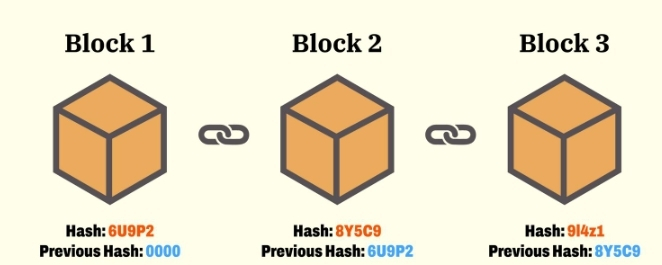
You send 100 taka to your friend. The transaction is recorded in a digital system that multiple network participants can verify.
Here's how blockchain works:
1️⃣ Transaction: A user initiates a transaction.
2️⃣ Verification: Network participants verify it according to the system's rules.
3️⃣ Block: Verified transactions are grouped into a block.
4️⃣ Connection: Each block contains a cryptographic link to the previous block, helping connect the chain.
5️⃣ Shared Record: Once accepted by the network, the new block becomes part of the blockchain's transaction history.
💡 Why is this important?
Blockchain makes records easier to verify and unauthorized changes easier to detect. However, no system is completely risk--free.
🎯 Quick Question:
Which blockchain concept would you like to learn next?
A) Bitcoin Mining
B) Crypto Wallets
C) Smart Contracts
Comment A, B, or C below! 👇
#Blockchain #CryptoEducation #Bitcoin #BTC #BinanceSquar
How Does Blockchain Work ?
Have you ever wondered how Bitcoin transactions are recorded without a central bank controlling the network? 🤔
Let's understand blockchain with a simple example!
📒 Imagine a shared digital notebook.
You send 100 taka to your friend. The transaction is recorded in a digital system that multiple network participants can verify.
Here's how blockchain works:
1️⃣ Transaction: A user initiates a transaction.
2️⃣ Verification: Network participants verify it according to the system's rules.
3️⃣ Block: Verified transactions are grouped into a block.
4️⃣ Connection: Each block contains a cryptographic link to the previous block, helping connect the chain.
5️⃣ Shared Record: Once accepted by the network, the new block becomes part of the blockchain's transaction history.
💡 Why is this important?
Blockchain makes records easier to verify and unauthorized changes easier to detect. However, no system is completely risk--free.
🎯 Quick Question:
Which blockchain concept would you like to learn next?
A) Bitcoin Mining
B) Crypto Wallets
C) Smart Contracts
Comment A, B, or C below! 👇
#Blockchain #CryptoEducation #Bitcoin #BTC #BinanceSquar
Let's understand blockchain with a simple example!
📒 Imagine a shared digital notebook.
You send 100 taka to your friend. The transaction is recorded in a digital system that multiple network participants can verify.
Here's how blockchain works:
1️⃣ Transaction: A user initiates a transaction.
2️⃣ Verification: Network participants verify it according to the system's rules.
3️⃣ Block: Verified transactions are grouped into a block.
4️⃣ Connection: Each block contains a cryptographic link to the previous block, helping connect the chain.
5️⃣ Shared Record: Once accepted by the network, the new block becomes part of the blockchain's transaction history.
💡 Why is this important?
Blockchain makes records easier to verify and unauthorized changes easier to detect. However, no system is completely risk--free.
🎯 Quick Question:
Which blockchain concept would you like to learn next?
A) Bitcoin Mining
B) Crypto Wallets
C) Smart Contracts
Comment A, B, or C below! 👇
#Blockchain #CryptoEducation #Bitcoin #BTC #BinanceSquar
74
Log in to explore more content
Join global crypto users on Binance Square
⚡️ Get latest and useful information about crypto.
💬 Trusted by the world’s largest crypto exchange.
👍 Discover real insights from verified creators.
Email / Phone number
Trending Topics
1
#CanMicrosoftDeliverOnAI
81,258 views
755 Discussing
2
#CanGoogleDefindItsCore
41,318 views
551 Discussing
3
#FOMCWatch
9.1M views
27,972 Discussing
4
#EthereumDropsBelow$2300
10,944 views
158 Discussing
5
#BitcoinSlipsBelow$80KAgain
30,693 views
120 Discussing
6
#ThailandLaunchesWORPTStablecoinToQRPaymentApp
62,767 views
793 Discussing
7
#StrategySkipsBitcoinPurchasesSpends$205MOnSTRCBuybacks
11,846 views
98 Discussing
8
#BitmineAdds10452ETH
108,241 views
1,200 Discussing
9
#SouthKoreaConsidersEducationTaxOnCryptoExchanges
64,928 views
850 Discussing
10
#OCCUrgesCommunityBanksToEnterStablecoinPayments
43,984 views
604 Discussing