
MO_BSC
710 Posts

MO_BSC
Report
Block User
content creator BUIDL binance FAM

Binance Square Angels
Open Trade

BNB Holder
Occasional Trader
3.6 Years
71 Following
1.8K+ Followers
2.2K+ Liked
1 Badges
Posts
Portfolio
All
Quotes
Videos
·
--
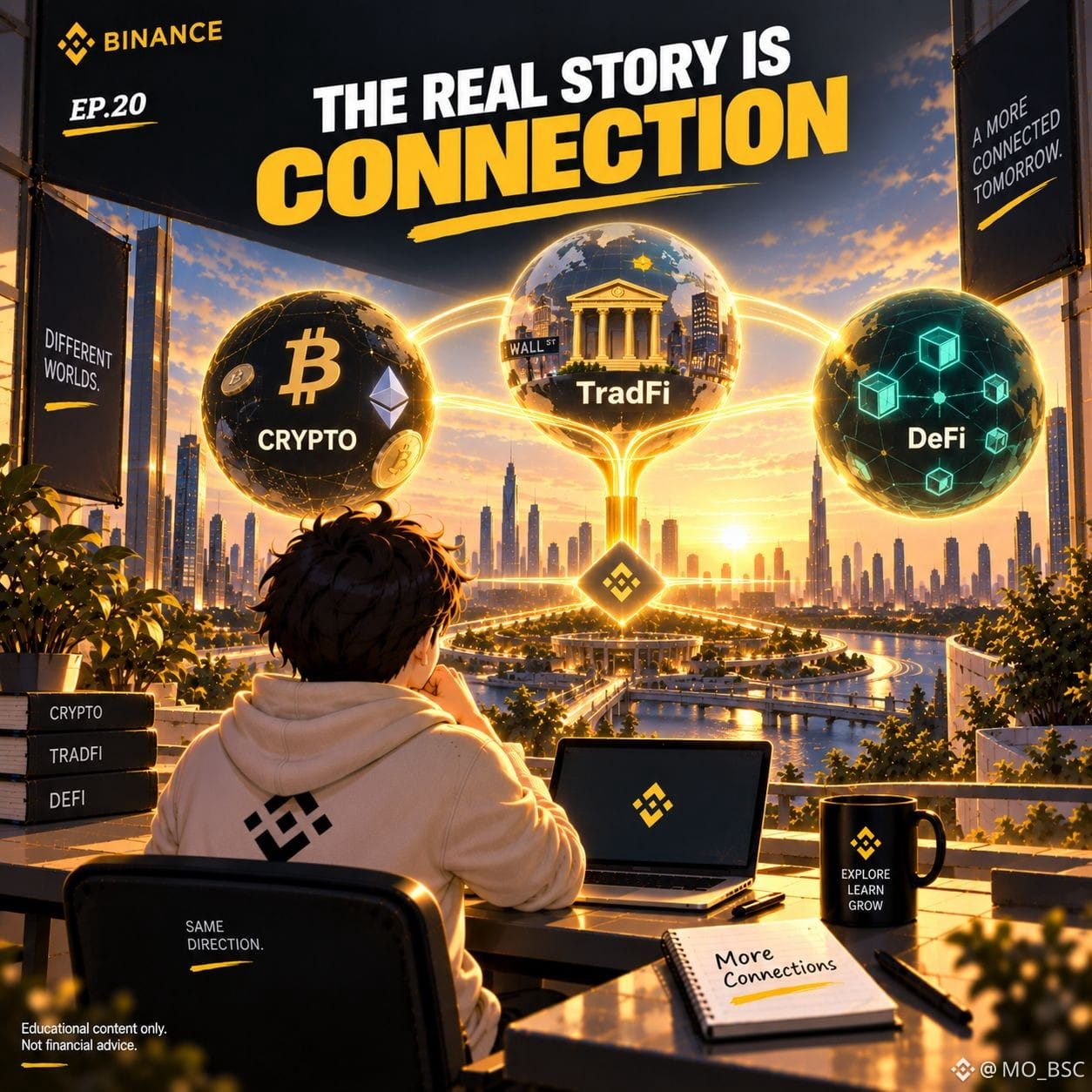
EP.20 — THE REAL STORY IS CONNECTION
Crypto.
TradFi.
DeFi.
For a long time, these categories were usually discussed separately.
Now the financial landscape is becoming more interconnected.
A crypto-native platform can provide access to traditional-market derivatives.
Traditional assets can be represented through digital financial products.
And DeFi provides blockchain-based financial infrastructure through smart contracts.
This is where the TriFi idea comes in:
TradFi ↔ CeFi ↔ DeFi
Not three identical systems.
Three different financial worlds becoming more connected.
And that may be the more important story behind the expansion of digital financial platforms:
Not simply more products.
But more connections between financial systems.
Educational content only. Not financial advice.
#TriFi
EP.20 — THE REAL STORY IS CONNECTION
Crypto.
TradFi.
DeFi.
For a long time, these categories were usually discussed separately.
Now the financial landscape is becoming more interconnected.
A crypto-native platform can provide access to traditional-market derivatives.
Traditional assets can be represented through digital financial products.
And DeFi provides blockchain-based financial infrastructure through smart contracts.
This is where the TriFi idea comes in:
TradFi ↔ CeFi ↔ DeFi
Not three identical systems.
Three different financial worlds becoming more connected.
And that may be the more important story behind the expansion of digital financial platforms:
Not simply more products.
But more connections between financial systems.
Educational content only. Not financial advice.
#TriFi
Crypto.
TradFi.
DeFi.
For a long time, these categories were usually discussed separately.
Now the financial landscape is becoming more interconnected.
A crypto-native platform can provide access to traditional-market derivatives.
Traditional assets can be represented through digital financial products.
And DeFi provides blockchain-based financial infrastructure through smart contracts.
This is where the TriFi idea comes in:
TradFi ↔ CeFi ↔ DeFi
Not three identical systems.
Three different financial worlds becoming more connected.
And that may be the more important story behind the expansion of digital financial platforms:
Not simply more products.
But more connections between financial systems.
Educational content only. Not financial advice.
#TriFi
1
3
·
--
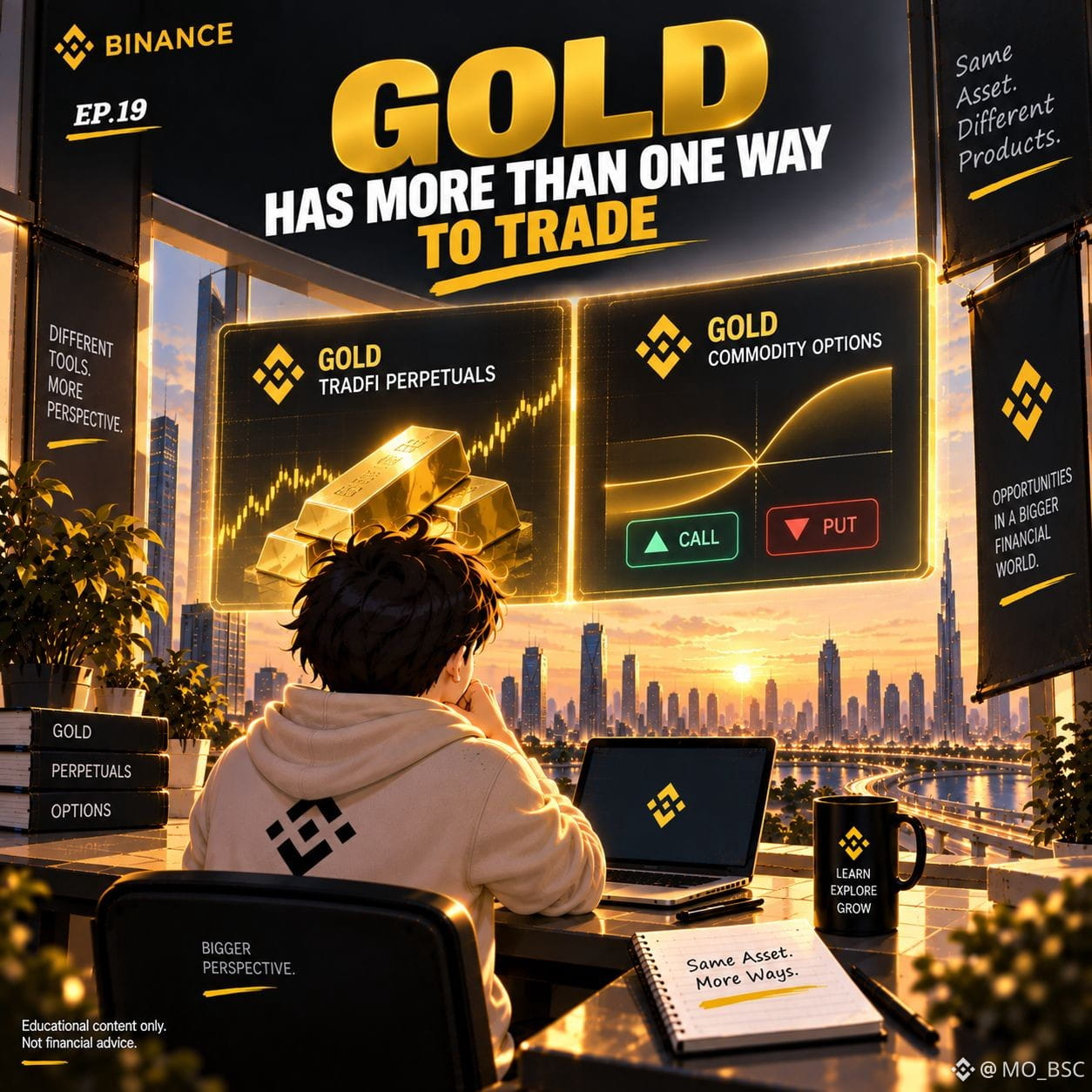
EP.19 — GOLD HAS MORE THAN ONE WAY TO TRADE
Gold exposure doesn't always mean buying physical gold.
There are different financial instruments built around the same underlying asset.
On Binance, for example, users may encounter:
Gold TradFi Perpetuals
Derivative contracts designed to track gold’s price.
Gold Commodity Options
Options that introduce another way to express a view on price and volatility.
But these products are not interchangeable.
They have different mechanics, risk profiles, settlement structures and requirements.
The important lesson:
“Gold” describes the underlying asset.
It doesn't describe the financial product you're holding.
Always understand the instrument before focusing only on the asset.
Availability depends on jurisdiction and eligibility.
Educational content only. Not financial advice.
#goldtrading
EP.19 — GOLD HAS MORE THAN ONE WAY TO TRADE
Gold exposure doesn't always mean buying physical gold.
There are different financial instruments built around the same underlying asset.
On Binance, for example, users may encounter:
Gold TradFi Perpetuals
Derivative contracts designed to track gold’s price.
Gold Commodity Options
Options that introduce another way to express a view on price and volatility.
But these products are not interchangeable.
They have different mechanics, risk profiles, settlement structures and requirements.
The important lesson:
“Gold” describes the underlying asset.
It doesn't describe the financial product you're holding.
Always understand the instrument before focusing only on the asset.
Availability depends on jurisdiction and eligibility.
Educational content only. Not financial advice.
#goldtrading
Gold exposure doesn't always mean buying physical gold.
There are different financial instruments built around the same underlying asset.
On Binance, for example, users may encounter:
Gold TradFi Perpetuals
Derivative contracts designed to track gold’s price.
Gold Commodity Options
Options that introduce another way to express a view on price and volatility.
But these products are not interchangeable.
They have different mechanics, risk profiles, settlement structures and requirements.
The important lesson:
“Gold” describes the underlying asset.
It doesn't describe the financial product you're holding.
Always understand the instrument before focusing only on the asset.
Availability depends on jurisdiction and eligibility.
Educational content only. Not financial advice.
#goldtrading
1
16
·
--
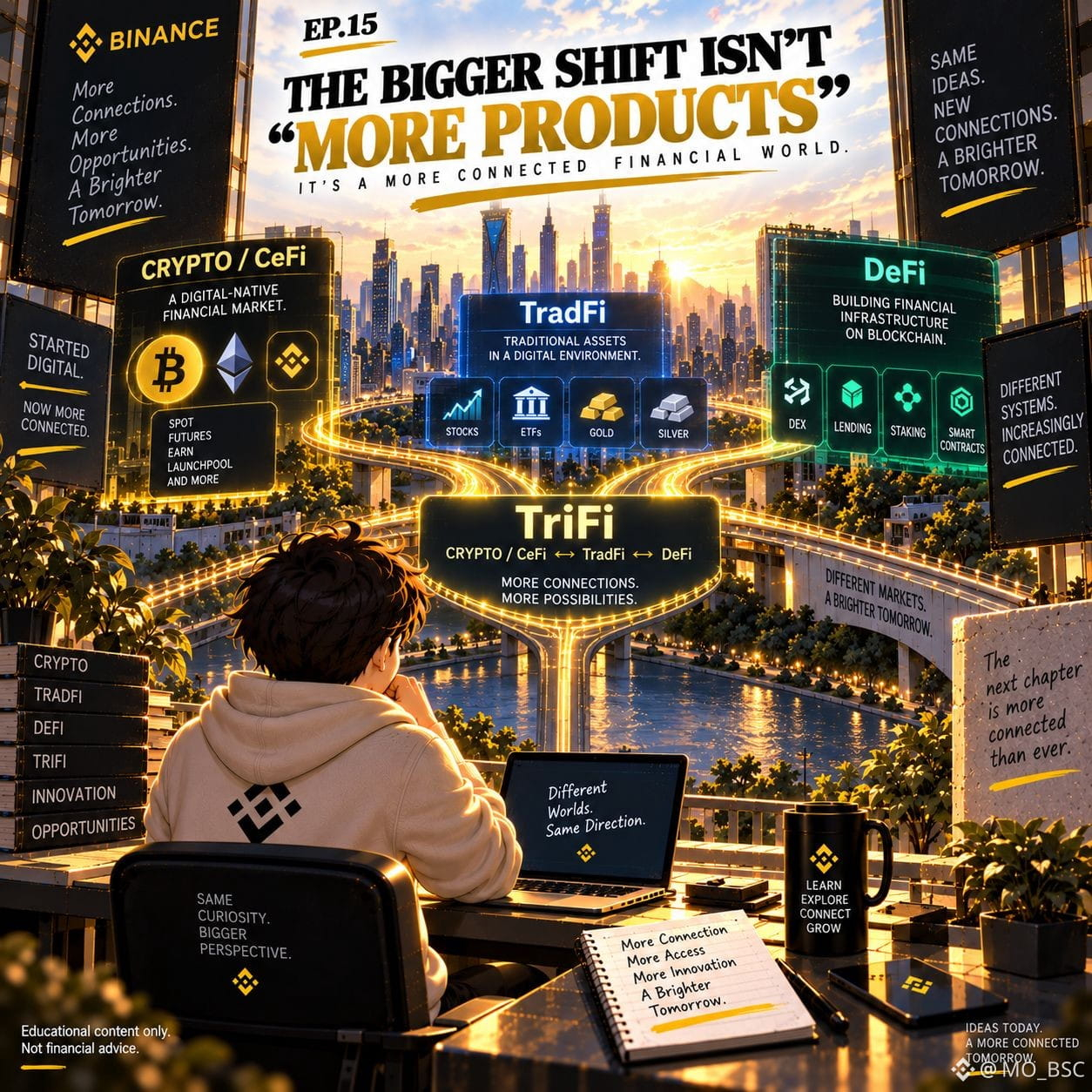
EP.15 — THE BIGGER SHIFT ISN’T “MORE PRODUCTS”
It’s easy to look at Binance’s expanding product lineup and think:
“Okay, they added more markets.”
But there’s a bigger story.
Crypto started by creating a digital-native financial market.
Now traditional assets are increasingly being brought into digital platforms.
At the same time, DeFi continues building financial infrastructure directly on blockchain networks.
So the boundaries between these categories are becoming less isolated.
That’s the thinking behind the TriFi concept:
Crypto / CeFi ↔ TradFi ↔ DeFi
The goal isn't to make every financial product identical.
It's to make different financial experiences more connected.
And that could change how people think about financial platforms altogether.
Educational content only. Not financial advice.
#defi
EP.15 — THE BIGGER SHIFT ISN’T “MORE PRODUCTS”
It’s easy to look at Binance’s expanding product lineup and think:
“Okay, they added more markets.”
But there’s a bigger story.
Crypto started by creating a digital-native financial market.
Now traditional assets are increasingly being brought into digital platforms.
At the same time, DeFi continues building financial infrastructure directly on blockchain networks.
So the boundaries between these categories are becoming less isolated.
That’s the thinking behind the TriFi concept:
Crypto / CeFi ↔ TradFi ↔ DeFi
The goal isn't to make every financial product identical.
It's to make different financial experiences more connected.
And that could change how people think about financial platforms altogether.
Educational content only. Not financial advice.
#defi
It’s easy to look at Binance’s expanding product lineup and think:
“Okay, they added more markets.”
But there’s a bigger story.
Crypto started by creating a digital-native financial market.
Now traditional assets are increasingly being brought into digital platforms.
At the same time, DeFi continues building financial infrastructure directly on blockchain networks.
So the boundaries between these categories are becoming less isolated.
That’s the thinking behind the TriFi concept:
Crypto / CeFi ↔ TradFi ↔ DeFi
The goal isn't to make every financial product identical.
It's to make different financial experiences more connected.
And that could change how people think about financial platforms altogether.
Educational content only. Not financial advice.
#defi
1
14
·
--
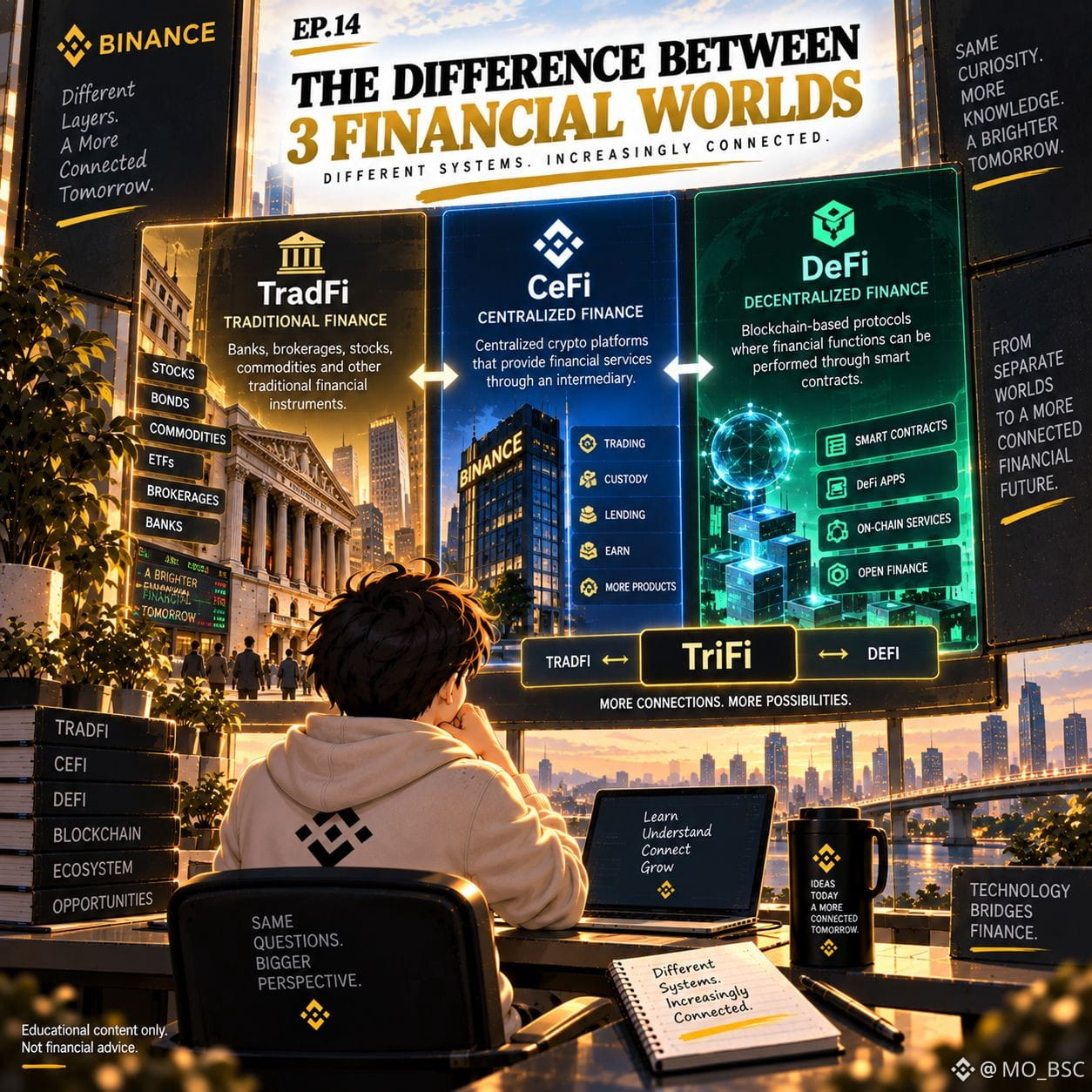
EP.14 — THE DIFFERENCE BETWEEN 3 FINANCIAL WORLDS
Think of finance as three different layers:
TradFi
Banks, brokerages, stocks, commodities and other traditional financial instruments.
CeFi
Centralized crypto platforms that provide financial services through an intermediary.
DeFi
Blockchain-based protocols where financial functions can be performed through smart contracts.
For a long time, these worlds developed separately.
Now they're increasingly interacting.
Tokenization connects traditional assets with blockchain infrastructure.
Centralized platforms connect crypto users with more financial products.
DeFi creates another layer of programmable financial infrastructure.
This convergence is one of the ideas behind the emerging TriFi model.
Different systems.
Increasingly connected.
Educational content only. Not financial advice.
EP.14 — THE DIFFERENCE BETWEEN 3 FINANCIAL WORLDS
Think of finance as three different layers:
TradFi
Banks, brokerages, stocks, commodities and other traditional financial instruments.
CeFi
Centralized crypto platforms that provide financial services through an intermediary.
DeFi
Blockchain-based protocols where financial functions can be performed through smart contracts.
For a long time, these worlds developed separately.
Now they're increasingly interacting.
Tokenization connects traditional assets with blockchain infrastructure.
Centralized platforms connect crypto users with more financial products.
DeFi creates another layer of programmable financial infrastructure.
This convergence is one of the ideas behind the emerging TriFi model.
Different systems.
Increasingly connected.
Educational content only. Not financial advice.
Think of finance as three different layers:
TradFi
Banks, brokerages, stocks, commodities and other traditional financial instruments.
CeFi
Centralized crypto platforms that provide financial services through an intermediary.
DeFi
Blockchain-based protocols where financial functions can be performed through smart contracts.
For a long time, these worlds developed separately.
Now they're increasingly interacting.
Tokenization connects traditional assets with blockchain infrastructure.
Centralized platforms connect crypto users with more financial products.
DeFi creates another layer of programmable financial infrastructure.
This convergence is one of the ideas behind the emerging TriFi model.
Different systems.
Increasingly connected.
Educational content only. Not financial advice.
1
9
·
--
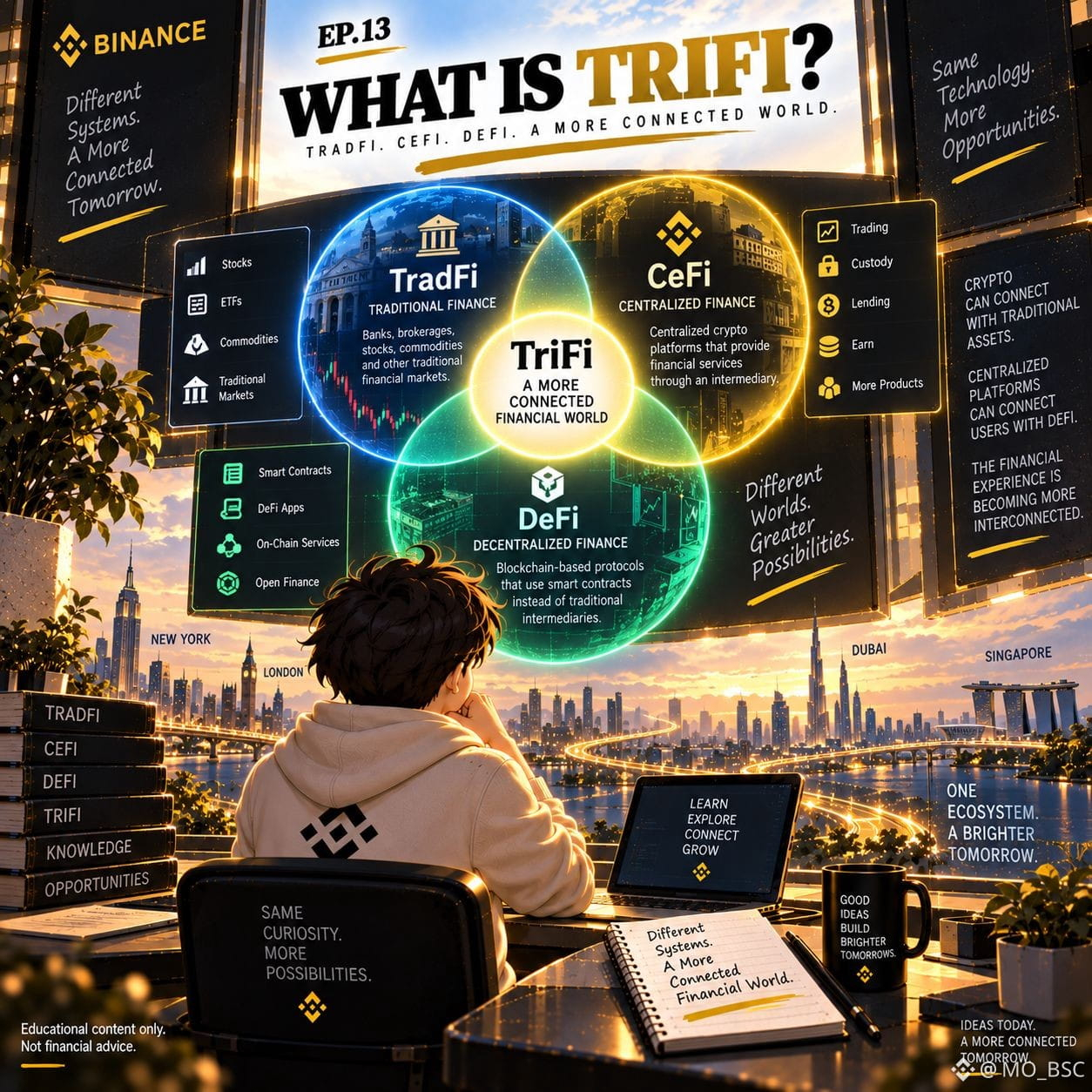
EP.13 — WHAT IS TRIFI?
TradFi.
CeFi.
DeFi.
Three different financial models.
TradFi = traditional finance such as banks, brokerages, and conventional financial markets.
CeFi = centralized financial platforms operating within the crypto ecosystem.
DeFi = blockchain-based financial applications that use smart contracts instead of traditional intermediaries.
Now imagine these worlds becoming increasingly connected.
That’s the idea behind TriFi.
Instead of thinking about finance as isolated categories, the ecosystem becomes more interconnected.
Crypto can connect with traditional assets.
Centralized platforms can connect users with DeFi.
And financial experiences can increasingly exist within the same digital environment.
The labels may remain different.
The experience is becoming more connected.
Educational content only. Not financial advice.
EP.13 — WHAT IS TRIFI?
TradFi.
CeFi.
DeFi.
Three different financial models.
TradFi = traditional finance such as banks, brokerages, and conventional financial markets.
CeFi = centralized financial platforms operating within the crypto ecosystem.
DeFi = blockchain-based financial applications that use smart contracts instead of traditional intermediaries.
Now imagine these worlds becoming increasingly connected.
That’s the idea behind TriFi.
Instead of thinking about finance as isolated categories, the ecosystem becomes more interconnected.
Crypto can connect with traditional assets.
Centralized platforms can connect users with DeFi.
And financial experiences can increasingly exist within the same digital environment.
The labels may remain different.
The experience is becoming more connected.
Educational content only. Not financial advice.
TradFi.
CeFi.
DeFi.
Three different financial models.
TradFi = traditional finance such as banks, brokerages, and conventional financial markets.
CeFi = centralized financial platforms operating within the crypto ecosystem.
DeFi = blockchain-based financial applications that use smart contracts instead of traditional intermediaries.
Now imagine these worlds becoming increasingly connected.
That’s the idea behind TriFi.
Instead of thinking about finance as isolated categories, the ecosystem becomes more interconnected.
Crypto can connect with traditional assets.
Centralized platforms can connect users with DeFi.
And financial experiences can increasingly exist within the same digital environment.
The labels may remain different.
The experience is becoming more connected.
Educational content only. Not financial advice.
1
10
·
--
EP.12 — CAIRO, RIYADH, DUBAI… ONE DIGITAL FINANCIAL WORLD?
Someone sitting in Cairo, Riyadh, or Dubai may look at the same global markets as someone somewhere else.
But the actual products they can access can be very different.
Why?
Because financial products are subject to local regulations, licensing requirements, eligibility criteria, and availability.
That’s why Binance’s TradFi expansion comes with an important caveat:
Not every product is available to every user in every country.
Where available, digital platforms can bring traditional-market exposure into the same environment people already use for digital assets.
That creates a new connection between:
Crypto.
TradFi.
DeFi.
But access always comes first.
Educational content only. Not financial advice.
EP.12 — CAIRO, RIYADH, DUBAI… ONE DIGITAL FINANCIAL WORLD?
Someone sitting in Cairo, Riyadh, or Dubai may look at the same global markets as someone somewhere else.
But the actual products they can access can be very different.
Why?
Because financial products are subject to local regulations, licensing requirements, eligibility criteria, and availability.
That’s why Binance’s TradFi expansion comes with an important caveat:
Not every product is available to every user in every country.
Where available, digital platforms can bring traditional-market exposure into the same environment people already use for digital assets.
That creates a new connection between:
Crypto.
TradFi.
DeFi.
But access always comes first.
Educational content only. Not financial advice.
Someone sitting in Cairo, Riyadh, or Dubai may look at the same global markets as someone somewhere else.
But the actual products they can access can be very different.
Why?
Because financial products are subject to local regulations, licensing requirements, eligibility criteria, and availability.
That’s why Binance’s TradFi expansion comes with an important caveat:
Not every product is available to every user in every country.
Where available, digital platforms can bring traditional-market exposure into the same environment people already use for digital assets.
That creates a new connection between:
Crypto.
TradFi.
DeFi.
But access always comes first.
Educational content only. Not financial advice.

1
6
·
--
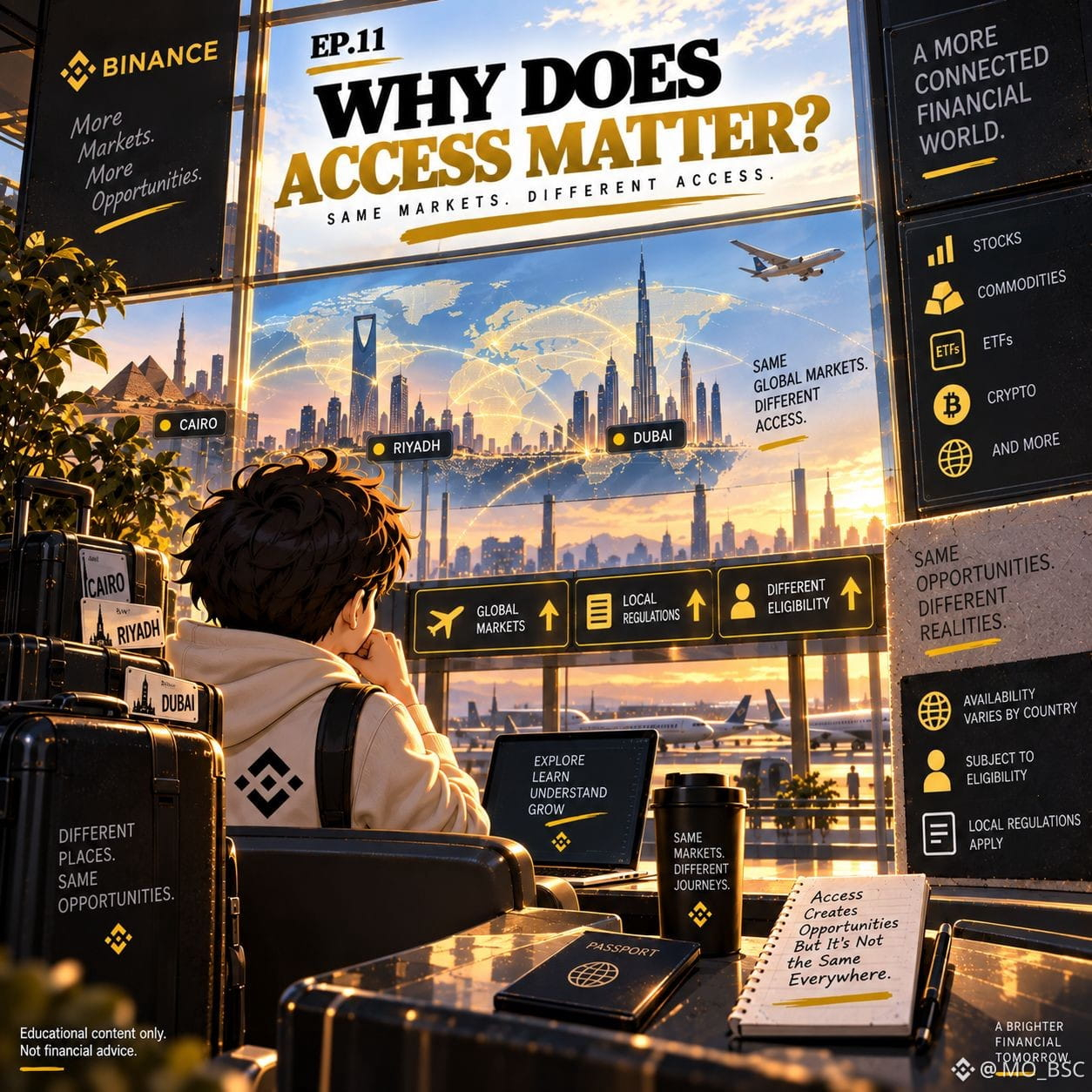
EP.11 — WHY DOES ACCESS MATTER?
Finance has never been equally simple everywhere.
Access to international markets can involve different platforms, account requirements, currencies, fees, and regulatory restrictions.
Digital financial platforms are changing parts of that experience by bringing more markets into a single interface.
Binance’s expanding TradFi ecosystem is one example.
Users in eligible jurisdictions may have access to products tracking traditional assets such as stocks, ETFs, gold and silver.
But there is an important rule:
Digital access does not mean universal access.
Products depend on your country of residence, eligibility, and applicable compliance requirements.
The interesting question isn't just:
“What can I trade?”
It's:
“How is technology changing access to global financial markets?”
Educational content only. Not financial advice.
EP.11 — WHY DOES ACCESS MATTER?
Finance has never been equally simple everywhere.
Access to international markets can involve different platforms, account requirements, currencies, fees, and regulatory restrictions.
Digital financial platforms are changing parts of that experience by bringing more markets into a single interface.
Binance’s expanding TradFi ecosystem is one example.
Users in eligible jurisdictions may have access to products tracking traditional assets such as stocks, ETFs, gold and silver.
But there is an important rule:
Digital access does not mean universal access.
Products depend on your country of residence, eligibility, and applicable compliance requirements.
The interesting question isn't just:
“What can I trade?”
It's:
“How is technology changing access to global financial markets?”
Educational content only. Not financial advice.
Finance has never been equally simple everywhere.
Access to international markets can involve different platforms, account requirements, currencies, fees, and regulatory restrictions.
Digital financial platforms are changing parts of that experience by bringing more markets into a single interface.
Binance’s expanding TradFi ecosystem is one example.
Users in eligible jurisdictions may have access to products tracking traditional assets such as stocks, ETFs, gold and silver.
But there is an important rule:
Digital access does not mean universal access.
Products depend on your country of residence, eligibility, and applicable compliance requirements.
The interesting question isn't just:
“What can I trade?”
It's:
“How is technology changing access to global financial markets?”
Educational content only. Not financial advice.
1
6
·
--
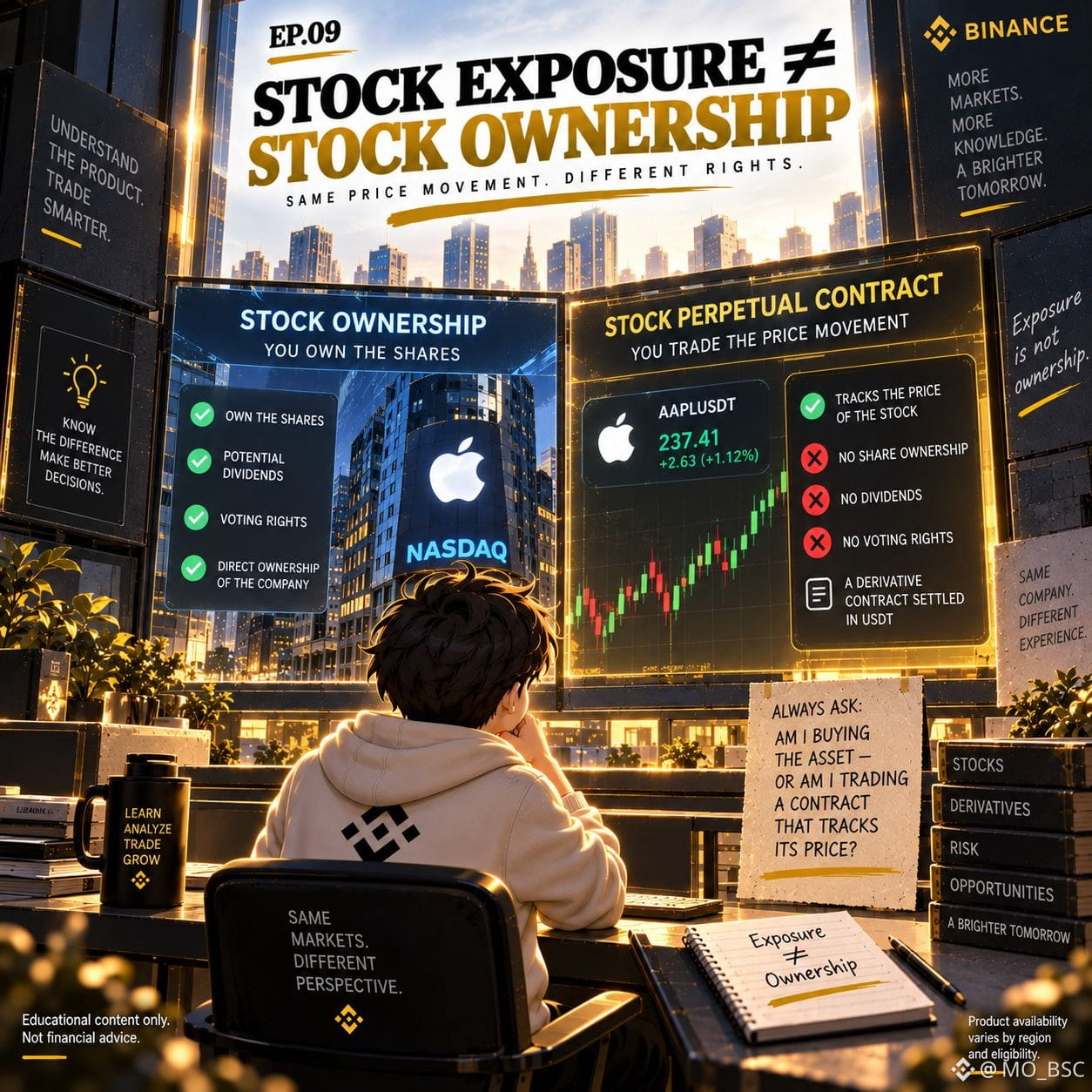
EP.09 — STOCK EXPOSURE ≠ STOCK OWNERSHIP
Here’s one of the most important things to understand about TradFi Perps:
Exposure is not ownership.
A stock perpetual contract can track the price of a company’s shares.
But holding that contract does not mean you own the company’s shares.
That means you don't receive the normal shareholder rights associated with owning the underlying stock, such as voting rights or dividends.
Instead, you hold a derivative whose value is linked to the underlying asset’s price.
This distinction applies beyond stocks too.
Always ask:
Am I buying the asset — or am I trading a contract that tracks its price?
Educational content only. Not financial advice.
#stocks
EP.09 — STOCK EXPOSURE ≠ STOCK OWNERSHIP
Here’s one of the most important things to understand about TradFi Perps:
Exposure is not ownership.
A stock perpetual contract can track the price of a company’s shares.
But holding that contract does not mean you own the company’s shares.
That means you don't receive the normal shareholder rights associated with owning the underlying stock, such as voting rights or dividends.
Instead, you hold a derivative whose value is linked to the underlying asset’s price.
This distinction applies beyond stocks too.
Always ask:
Am I buying the asset — or am I trading a contract that tracks its price?
Educational content only. Not financial advice.
#stocks
Here’s one of the most important things to understand about TradFi Perps:
Exposure is not ownership.
A stock perpetual contract can track the price of a company’s shares.
But holding that contract does not mean you own the company’s shares.
That means you don't receive the normal shareholder rights associated with owning the underlying stock, such as voting rights or dividends.
Instead, you hold a derivative whose value is linked to the underlying asset’s price.
This distinction applies beyond stocks too.
Always ask:
Am I buying the asset — or am I trading a contract that tracks its price?
Educational content only. Not financial advice.
#stocks
1
8
·
--
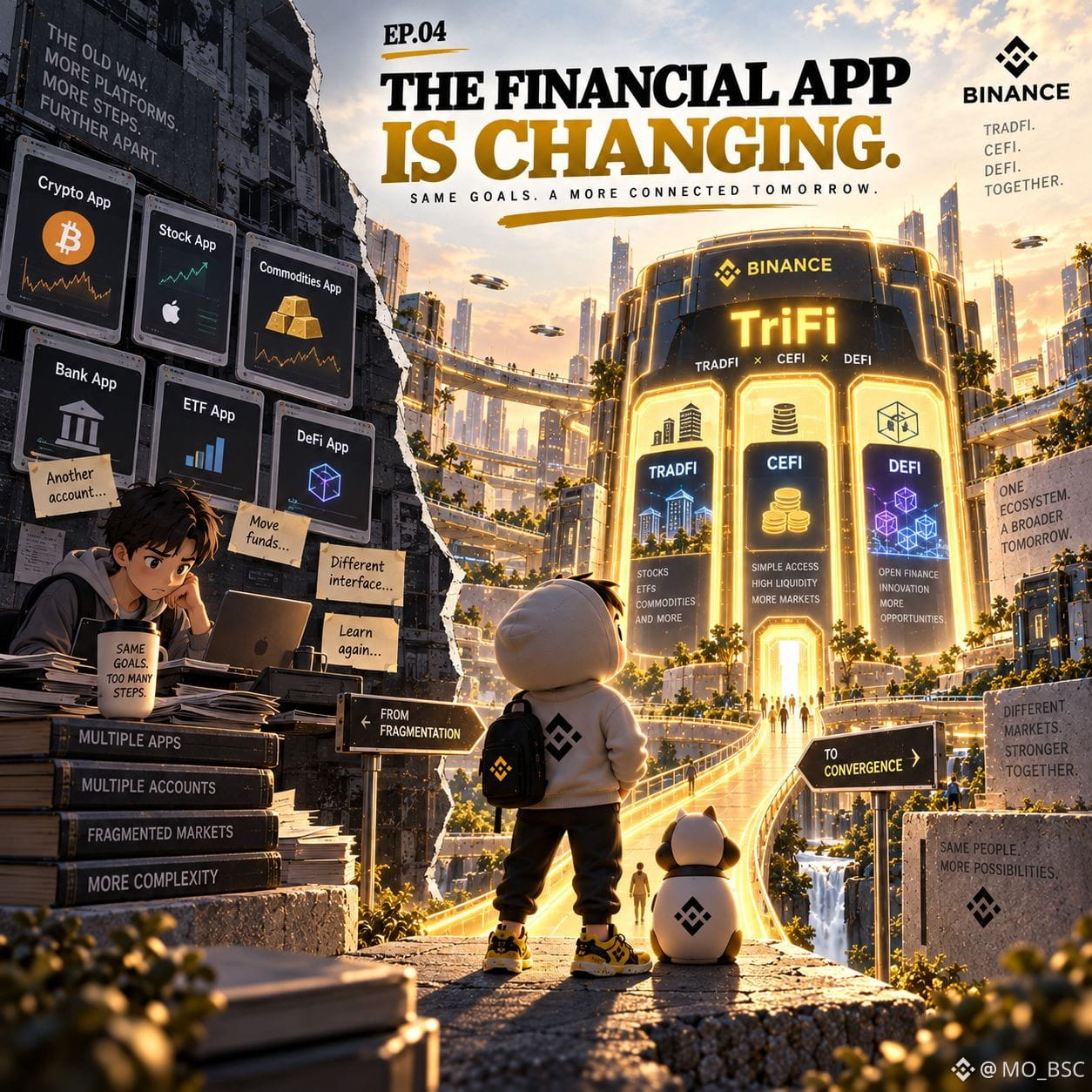
EP.04 — THE FINANCIAL APP IS CHANGING
The old financial experience was often:
Open one platform.
Check another.
Move funds.
Open another account.
Learn another interface.
The emerging model is different.
Crypto, TradFi and DeFi are increasingly being connected through digital financial ecosystems.
Binance describes this convergence as TriFi — bringing together TradFi, CeFi and DeFi into a more integrated financial experience.
The important shift isn't simply “more products.”
It’s more financial infrastructure connected through one digital experience.
Educational content only. Not financial advice.
#TriFi #TradFi
EP.04 — THE FINANCIAL APP IS CHANGING
The old financial experience was often:
Open one platform.
Check another.
Move funds.
Open another account.
Learn another interface.
The emerging model is different.
Crypto, TradFi and DeFi are increasingly being connected through digital financial ecosystems.
Binance describes this convergence as TriFi — bringing together TradFi, CeFi and DeFi into a more integrated financial experience.
The important shift isn't simply “more products.”
It’s more financial infrastructure connected through one digital experience.
Educational content only. Not financial advice.
#TriFi #TradFi
The old financial experience was often:
Open one platform.
Check another.
Move funds.
Open another account.
Learn another interface.
The emerging model is different.
Crypto, TradFi and DeFi are increasingly being connected through digital financial ecosystems.
Binance describes this convergence as TriFi — bringing together TradFi, CeFi and DeFi into a more integrated financial experience.
The important shift isn't simply “more products.”
It’s more financial infrastructure connected through one digital experience.
Educational content only. Not financial advice.
#TriFi #TradFi
1
18
·
--
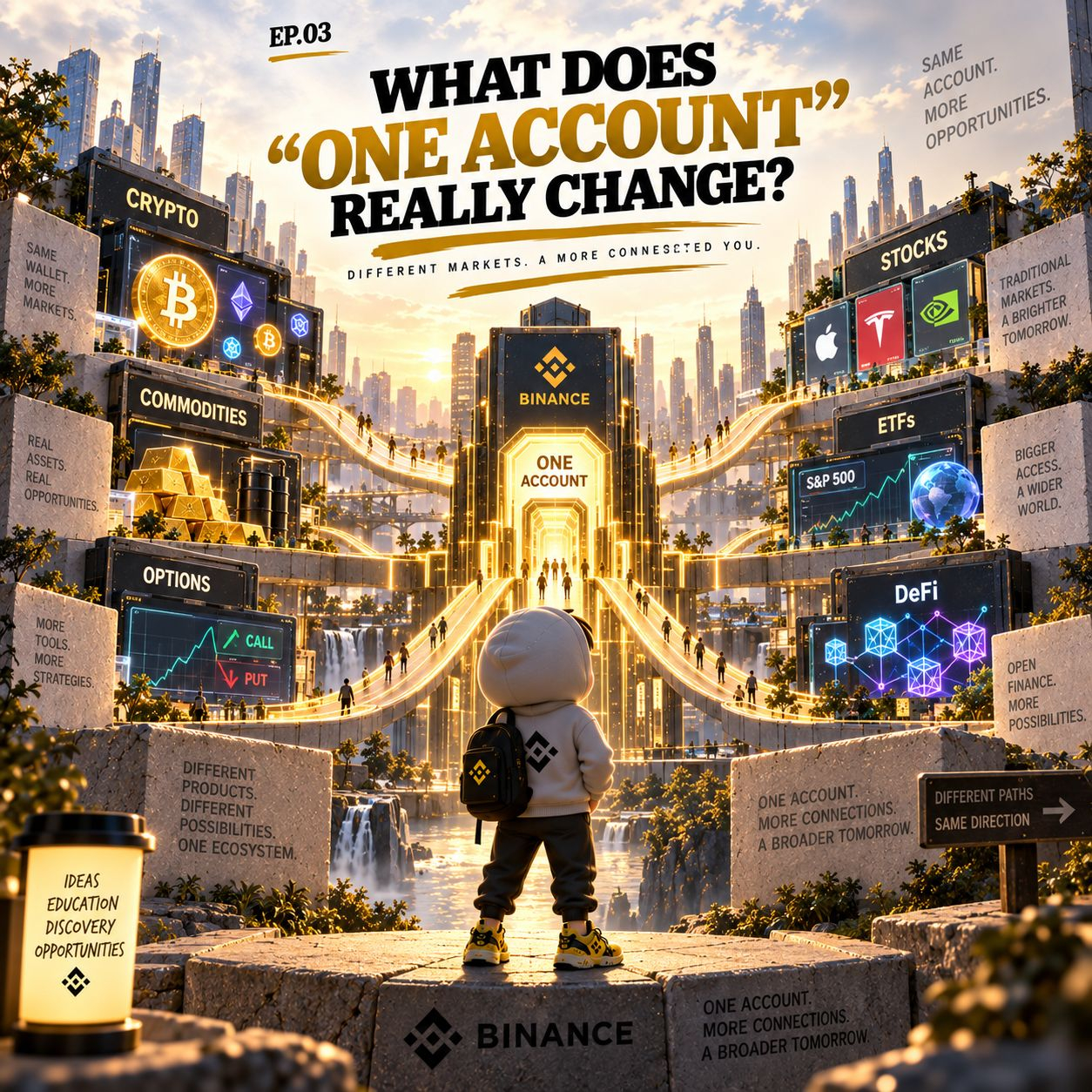
EP.03 — WHAT DOES “ONE ACCOUNT” REALLY CHANGE?
“Everything in one account” sounds like a small convenience.
But there’s a bigger idea behind it.
Instead of treating crypto, traditional markets, and DeFi as completely separate worlds, an integrated ecosystem can make moving between different financial experiences simpler.
Binance is expanding beyond crypto-only products into areas such as TradFi perpetuals, stocks and ETF-related products, commodities, and options, while also connecting users with DeFi through its ecosystem.
The important part:
One ecosystem doesn’t mean one product.
Different products have different mechanics, risks, eligibility requirements, and availability.
The value of integration is the connection between them.
Educational content only. Not financial advice.
#BinanceSquareFamily #TradFi
EP.03 — WHAT DOES “ONE ACCOUNT” REALLY CHANGE?
“Everything in one account” sounds like a small convenience.
But there’s a bigger idea behind it.
Instead of treating crypto, traditional markets, and DeFi as completely separate worlds, an integrated ecosystem can make moving between different financial experiences simpler.
Binance is expanding beyond crypto-only products into areas such as TradFi perpetuals, stocks and ETF-related products, commodities, and options, while also connecting users with DeFi through its ecosystem.
The important part:
One ecosystem doesn’t mean one product.
Different products have different mechanics, risks, eligibility requirements, and availability.
The value of integration is the connection between them.
Educational content only. Not financial advice.
#BinanceSquareFamily #TradFi
“Everything in one account” sounds like a small convenience.
But there’s a bigger idea behind it.
Instead of treating crypto, traditional markets, and DeFi as completely separate worlds, an integrated ecosystem can make moving between different financial experiences simpler.
Binance is expanding beyond crypto-only products into areas such as TradFi perpetuals, stocks and ETF-related products, commodities, and options, while also connecting users with DeFi through its ecosystem.
The important part:
One ecosystem doesn’t mean one product.
Different products have different mechanics, risks, eligibility requirements, and availability.
The value of integration is the connection between them.
Educational content only. Not financial advice.
#BinanceSquareFamily #TradFi
1
22
·
--
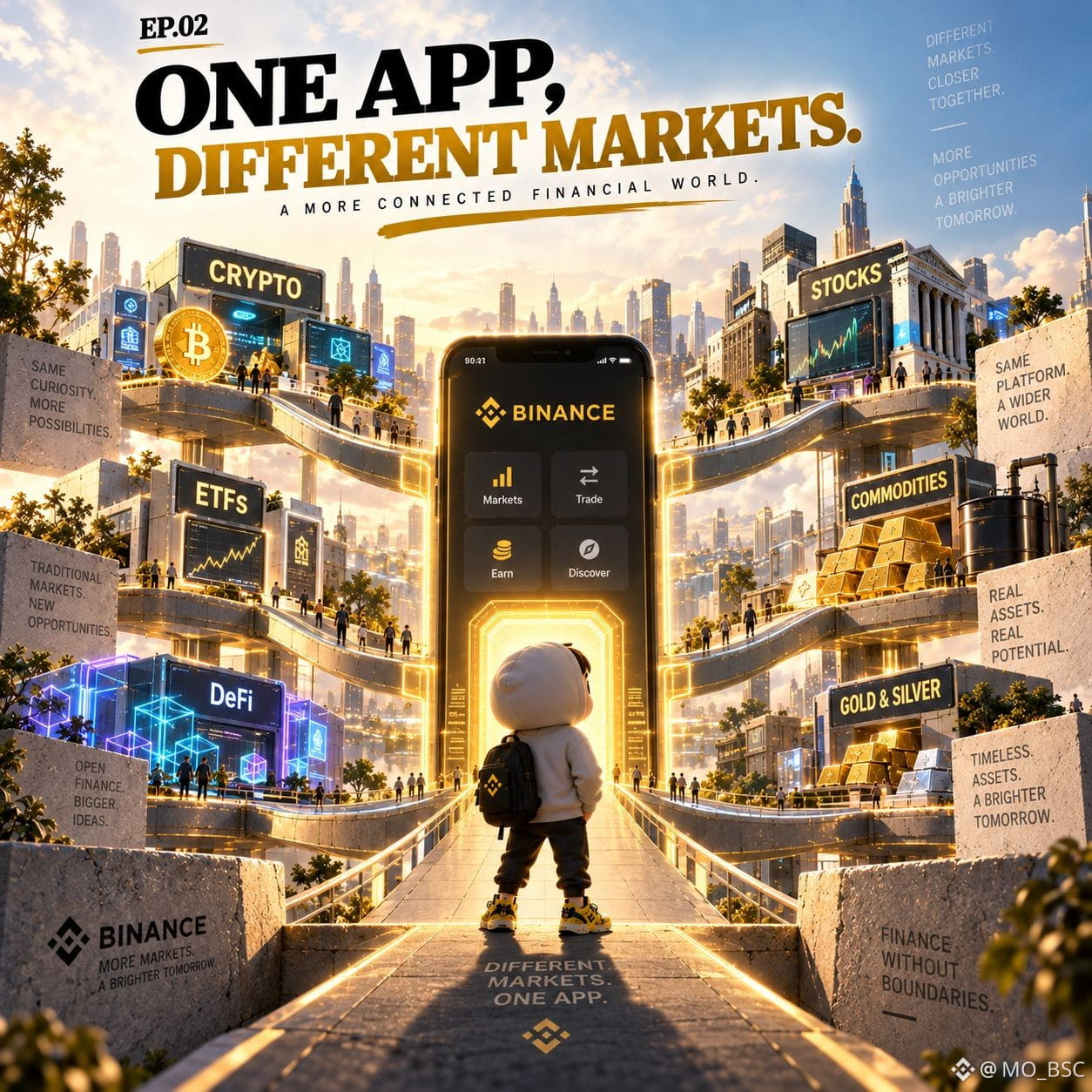
EP.02 — ONE APP, DIFFERENT MARKETS
Bitcoin.
Stocks.
ETFs.
Gold.
Silver.
DeFi.
For years, these have lived in different parts of the financial world.
The idea behind Binance’s expanding ecosystem is to bring more of these markets and financial experiences together within one platform.
That doesn’t mean every product is available to every user.
Availability varies by jurisdiction and eligibility.
But the direction is clear:
Crypto and traditional finance are becoming more connected.
And the interface people use to access them is changing too.
Educational content only. Not financial advice.
#BinanceSquareTalks
EP.02 — ONE APP, DIFFERENT MARKETS
Bitcoin.
Stocks.
ETFs.
Gold.
Silver.
DeFi.
For years, these have lived in different parts of the financial world.
The idea behind Binance’s expanding ecosystem is to bring more of these markets and financial experiences together within one platform.
That doesn’t mean every product is available to every user.
Availability varies by jurisdiction and eligibility.
But the direction is clear:
Crypto and traditional finance are becoming more connected.
And the interface people use to access them is changing too.
Educational content only. Not financial advice.
#BinanceSquareTalks
Bitcoin.
Stocks.
ETFs.
Gold.
Silver.
DeFi.
For years, these have lived in different parts of the financial world.
The idea behind Binance’s expanding ecosystem is to bring more of these markets and financial experiences together within one platform.
That doesn’t mean every product is available to every user.
Availability varies by jurisdiction and eligibility.
But the direction is clear:
Crypto and traditional finance are becoming more connected.
And the interface people use to access them is changing too.
Educational content only. Not financial advice.
#BinanceSquareTalks
1
44
·
--
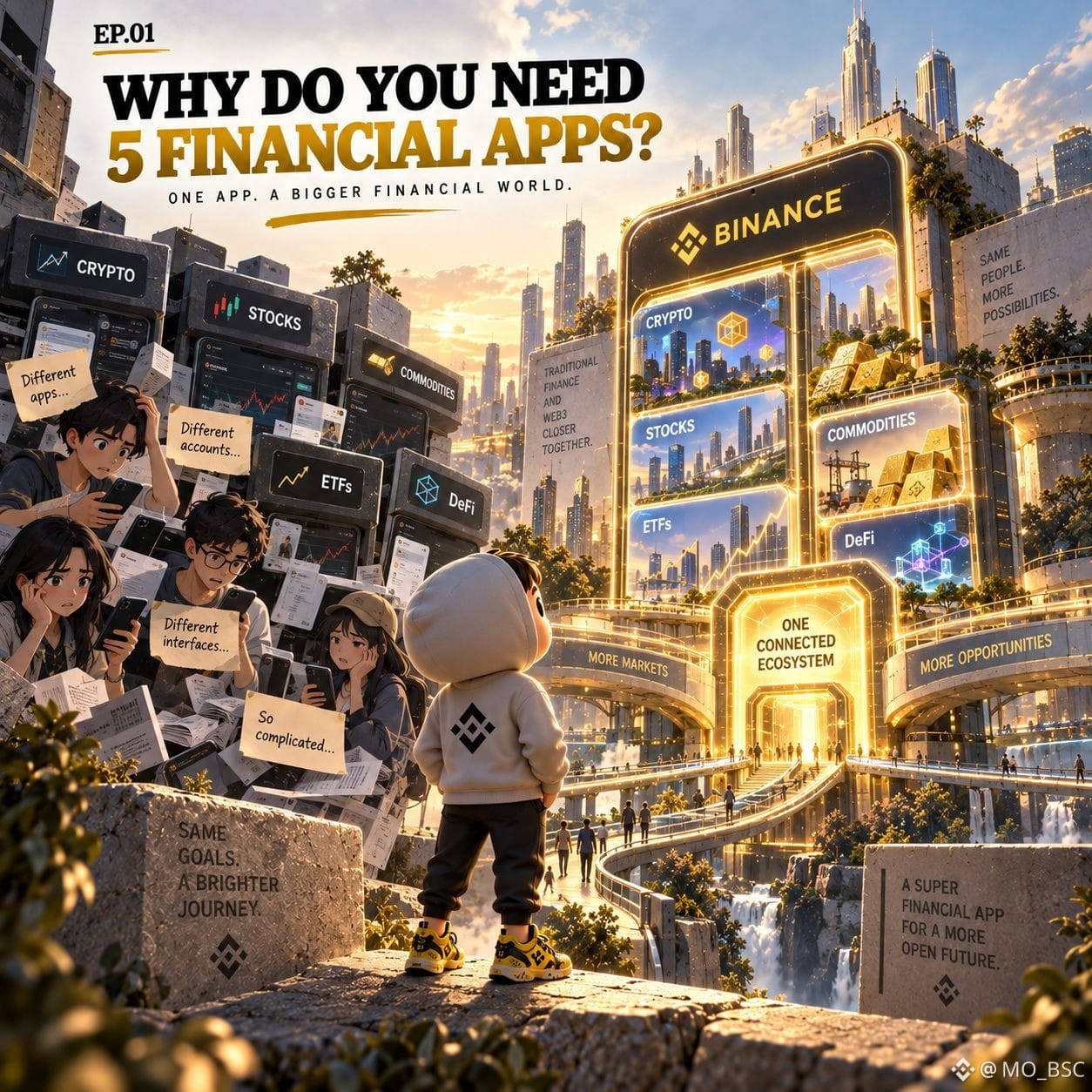
EP.01 — WHY DO YOU NEED 5 FINANCIAL APPS?
Why do you need one app for crypto, another for stocks, another for commodities, and another for everything else?
Finance has traditionally been fragmented across different platforms, accounts, and interfaces.
Binance is moving toward a different model: bringing crypto together with a growing range of TradFi products, including stocks, ETFs, gold and silver, alongside access to DeFi.
The idea is simple:
More financial markets.
One connected ecosystem.
Of course, product availability depends on your country, eligibility, and applicable compliance requirements.
The bigger shift is not just about adding more products.
It’s about reducing the distance between different financial markets.
Educational content only. Not financial advice.
#SuperFinancialApp
EP.01 — WHY DO YOU NEED 5 FINANCIAL APPS?
Why do you need one app for crypto, another for stocks, another for commodities, and another for everything else?
Finance has traditionally been fragmented across different platforms, accounts, and interfaces.
Binance is moving toward a different model: bringing crypto together with a growing range of TradFi products, including stocks, ETFs, gold and silver, alongside access to DeFi.
The idea is simple:
More financial markets.
One connected ecosystem.
Of course, product availability depends on your country, eligibility, and applicable compliance requirements.
The bigger shift is not just about adding more products.
It’s about reducing the distance between different financial markets.
Educational content only. Not financial advice.
#SuperFinancialApp
Why do you need one app for crypto, another for stocks, another for commodities, and another for everything else?
Finance has traditionally been fragmented across different platforms, accounts, and interfaces.
Binance is moving toward a different model: bringing crypto together with a growing range of TradFi products, including stocks, ETFs, gold and silver, alongside access to DeFi.
The idea is simple:
More financial markets.
One connected ecosystem.
Of course, product availability depends on your country, eligibility, and applicable compliance requirements.
The bigger shift is not just about adding more products.
It’s about reducing the distance between different financial markets.
Educational content only. Not financial advice.
#SuperFinancialApp
1
54
·
--
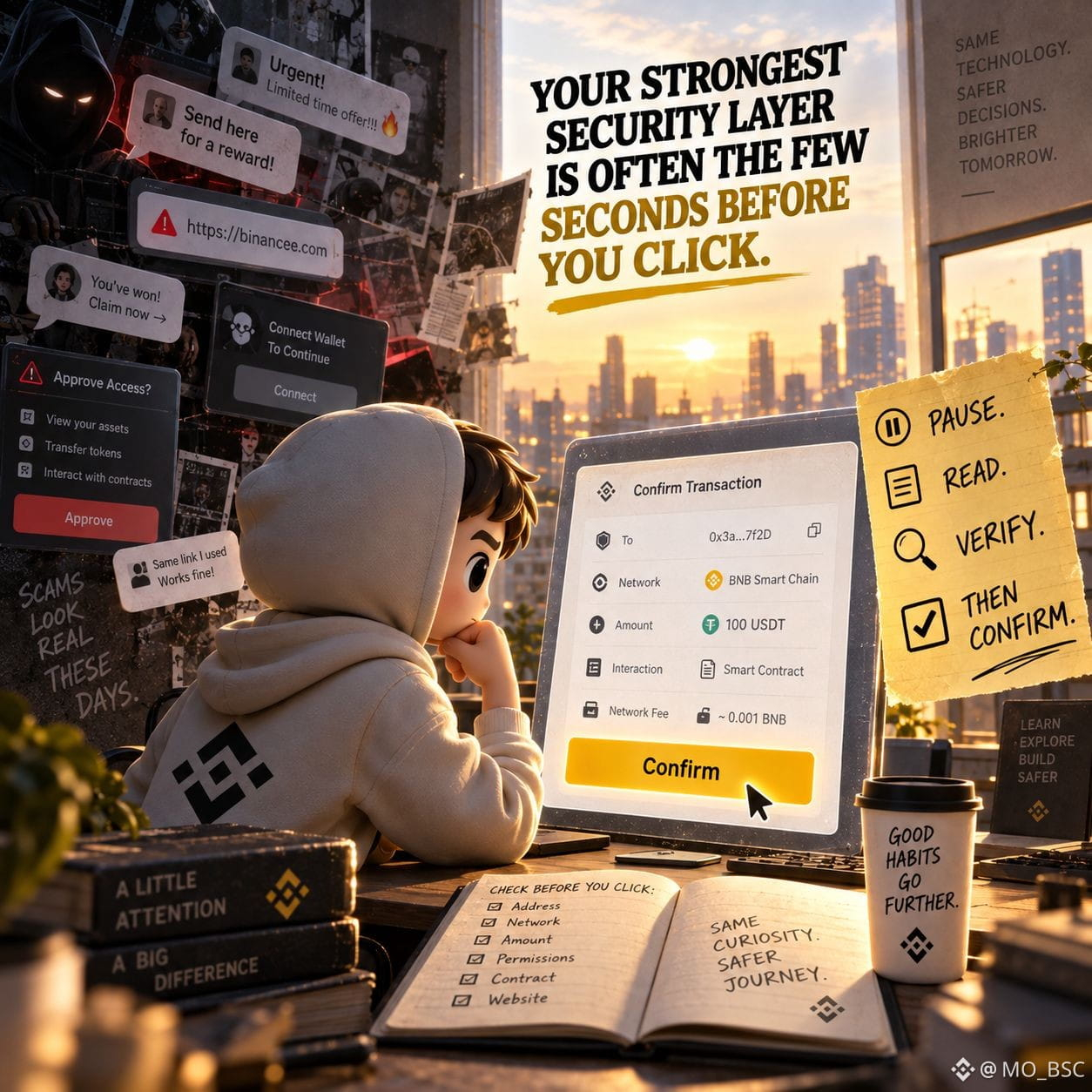
In crypto, one of the most important buttons can be...
Confirm.
Not because the button itself is special.
Because everything that happens before it matters.
What address are you sending to?
Which network?
How much?
What permissions are you granting?
What contract are you interacting with?
Is the website legitimate?
A transaction can look completely normal on the screen...
while the underlying action is something very different.
That's why security in Web3 is often less about understanding every line of code...
and more about developing good habits.
Pause.
Read.
Verify.
Then confirm.
Don't let urgency make the decision for you.
And never assume that a familiar-looking website, message, or account is automatically legitimate.
In traditional finance, you might call customer support after a mistake.
In crypto, depending on the transaction and network, recovery may not be possible.
So remember:
Your strongest security layer is often the few seconds before you click.
DYOR.
Educational content only — not financial advice.
#CryptoSecurity #Web3
In crypto, one of the most important buttons can be...
Confirm.
Not because the button itself is special.
Because everything that happens before it matters.
What address are you sending to?
Which network?
How much?
What permissions are you granting?
What contract are you interacting with?
Is the website legitimate?
A transaction can look completely normal on the screen...
while the underlying action is something very different.
That's why security in Web3 is often less about understanding every line of code...
and more about developing good habits.
Pause.
Read.
Verify.
Then confirm.
Don't let urgency make the decision for you.
And never assume that a familiar-looking website, message, or account is automatically legitimate.
In traditional finance, you might call customer support after a mistake.
In crypto, depending on the transaction and network, recovery may not be possible.
So remember:
Your strongest security layer is often the few seconds before you click.
DYOR.
Educational content only — not financial advice.
#CryptoSecurity #Web3
Confirm.
Not because the button itself is special.
Because everything that happens before it matters.
What address are you sending to?
Which network?
How much?
What permissions are you granting?
What contract are you interacting with?
Is the website legitimate?
A transaction can look completely normal on the screen...
while the underlying action is something very different.
That's why security in Web3 is often less about understanding every line of code...
and more about developing good habits.
Pause.
Read.
Verify.
Then confirm.
Don't let urgency make the decision for you.
And never assume that a familiar-looking website, message, or account is automatically legitimate.
In traditional finance, you might call customer support after a mistake.
In crypto, depending on the transaction and network, recovery may not be possible.
So remember:
Your strongest security layer is often the few seconds before you click.
DYOR.
Educational content only — not financial advice.
#CryptoSecurity #Web3
3
49
·
--
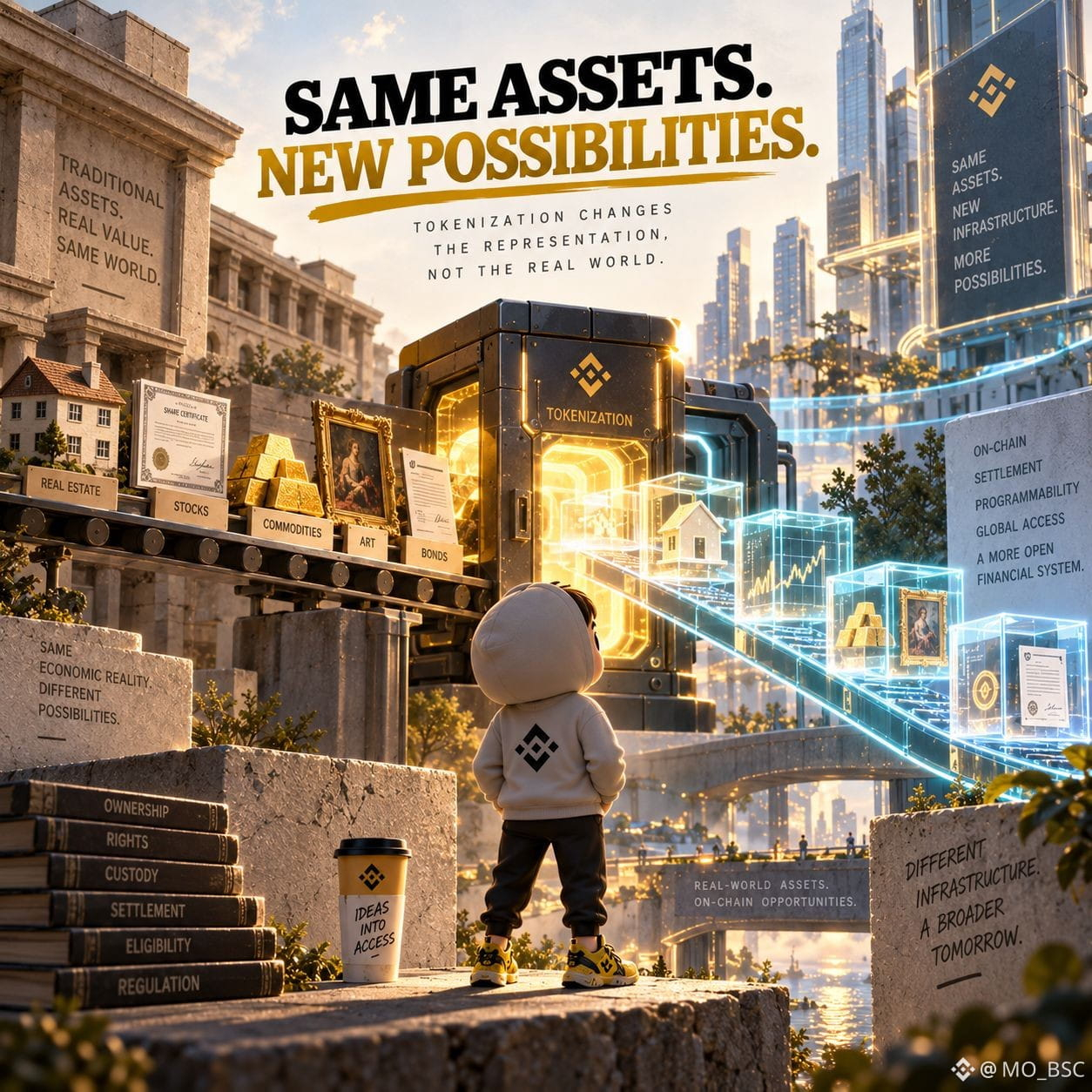
Imagine taking something that already exists...
and changing the way it is represented and moved.
That's one way to think about tokenization.
An asset or claim that traditionally exists within conventional financial infrastructure can be represented digitally using blockchain-based tokens.
And suddenly, you're no longer only asking:
“What is the asset?”
You're also asking:
“What infrastructure represents it?”
This is where tokenization becomes interesting.
It can potentially bring blockchain-based settlement, programmability and digital transfer mechanisms into areas traditionally served by financial infrastructure.
Stocks are one example being explored through products such as tokenized securities.
But tokenization does not magically erase the original asset's legal or economic structure.
The important details remain:
Ownership.
Rights.
Custody.
Settlement.
Eligibility.
Regulation.
So tokenization isn't simply:
“Put everything on a blockchain.”
It's a change in the **representation and infrastructure** around an asset.
And that distinction matters.
DYOR.
Educational content only — not financial advice.
#Tokenization #TradFi #Blockchain
Imagine taking something that already exists...
and changing the way it is represented and moved.
That's one way to think about tokenization.
An asset or claim that traditionally exists within conventional financial infrastructure can be represented digitally using blockchain-based tokens.
And suddenly, you're no longer only asking:
“What is the asset?”
You're also asking:
“What infrastructure represents it?”
This is where tokenization becomes interesting.
It can potentially bring blockchain-based settlement, programmability and digital transfer mechanisms into areas traditionally served by financial infrastructure.
Stocks are one example being explored through products such as tokenized securities.
But tokenization does not magically erase the original asset's legal or economic structure.
The important details remain:
Ownership.
Rights.
Custody.
Settlement.
Eligibility.
Regulation.
So tokenization isn't simply:
“Put everything on a blockchain.”
It's a change in the **representation and infrastructure** around an asset.
And that distinction matters.
DYOR.
Educational content only — not financial advice.
#Tokenization #TradFi #Blockchain
and changing the way it is represented and moved.
That's one way to think about tokenization.
An asset or claim that traditionally exists within conventional financial infrastructure can be represented digitally using blockchain-based tokens.
And suddenly, you're no longer only asking:
“What is the asset?”
You're also asking:
“What infrastructure represents it?”
This is where tokenization becomes interesting.
It can potentially bring blockchain-based settlement, programmability and digital transfer mechanisms into areas traditionally served by financial infrastructure.
Stocks are one example being explored through products such as tokenized securities.
But tokenization does not magically erase the original asset's legal or economic structure.
The important details remain:
Ownership.
Rights.
Custody.
Settlement.
Eligibility.
Regulation.
So tokenization isn't simply:
“Put everything on a blockchain.”
It's a change in the **representation and infrastructure** around an asset.
And that distinction matters.
DYOR.
Educational content only — not financial advice.
#Tokenization #TradFi #Blockchain
4
51
·
--
You've probably seen the phrase:
“It's on-chain.”
But what does that actually mean?
Simply put, it refers to activity recorded directly on a blockchain.
A transaction can be verified through the network rather than existing only inside a private database.
That creates something unusual for financial infrastructure:
A public, verifiable record.
Depending on the blockchain and application, you can inspect things such as:
→ Transactions
→ Wallet addresses
→ Token movements
→ Smart contract activity
This doesn't automatically mean you know who is behind every address.
That's another important distinction.
Blockchain data can be transparent...
while identities can remain pseudonymous.
So when someone says:
“Check it on-chain.”
They're pointing you toward the blockchain's public record.
Not a screenshot.
Not a rumor.
Not a social-media post.
The actual network data.
And that's one of the ideas that makes blockchain fundamentally different from many traditional systems.
Don't just trust the story.
Check the ledger.
DYOR.
Educational content only — not financial advice.
#Binance #OnChain #Blockchain #Web3 #Crypto
You've probably seen the phrase:
“It's on-chain.”
But what does that actually mean?
Simply put, it refers to activity recorded directly on a blockchain.
A transaction can be verified through the network rather than existing only inside a private database.
That creates something unusual for financial infrastructure:
A public, verifiable record.
Depending on the blockchain and application, you can inspect things such as:
→ Transactions
→ Wallet addresses
→ Token movements
→ Smart contract activity
This doesn't automatically mean you know who is behind every address.
That's another important distinction.
Blockchain data can be transparent...
while identities can remain pseudonymous.
So when someone says:
“Check it on-chain.”
They're pointing you toward the blockchain's public record.
Not a screenshot.
Not a rumor.
Not a social-media post.
The actual network data.
And that's one of the ideas that makes blockchain fundamentally different from many traditional systems.
Don't just trust the story.
Check the ledger.
DYOR.
Educational content only — not financial advice.
#Binance #OnChain #Blockchain #Web3 #Crypto
“It's on-chain.”
But what does that actually mean?
Simply put, it refers to activity recorded directly on a blockchain.
A transaction can be verified through the network rather than existing only inside a private database.
That creates something unusual for financial infrastructure:
A public, verifiable record.
Depending on the blockchain and application, you can inspect things such as:
→ Transactions
→ Wallet addresses
→ Token movements
→ Smart contract activity
This doesn't automatically mean you know who is behind every address.
That's another important distinction.
Blockchain data can be transparent...
while identities can remain pseudonymous.
So when someone says:
“Check it on-chain.”
They're pointing you toward the blockchain's public record.
Not a screenshot.
Not a rumor.
Not a social-media post.
The actual network data.
And that's one of the ideas that makes blockchain fundamentally different from many traditional systems.
Don't just trust the story.
Check the ledger.
DYOR.
Educational content only — not financial advice.
#Binance #OnChain #Blockchain #Web3 #Crypto

3
26
·
--
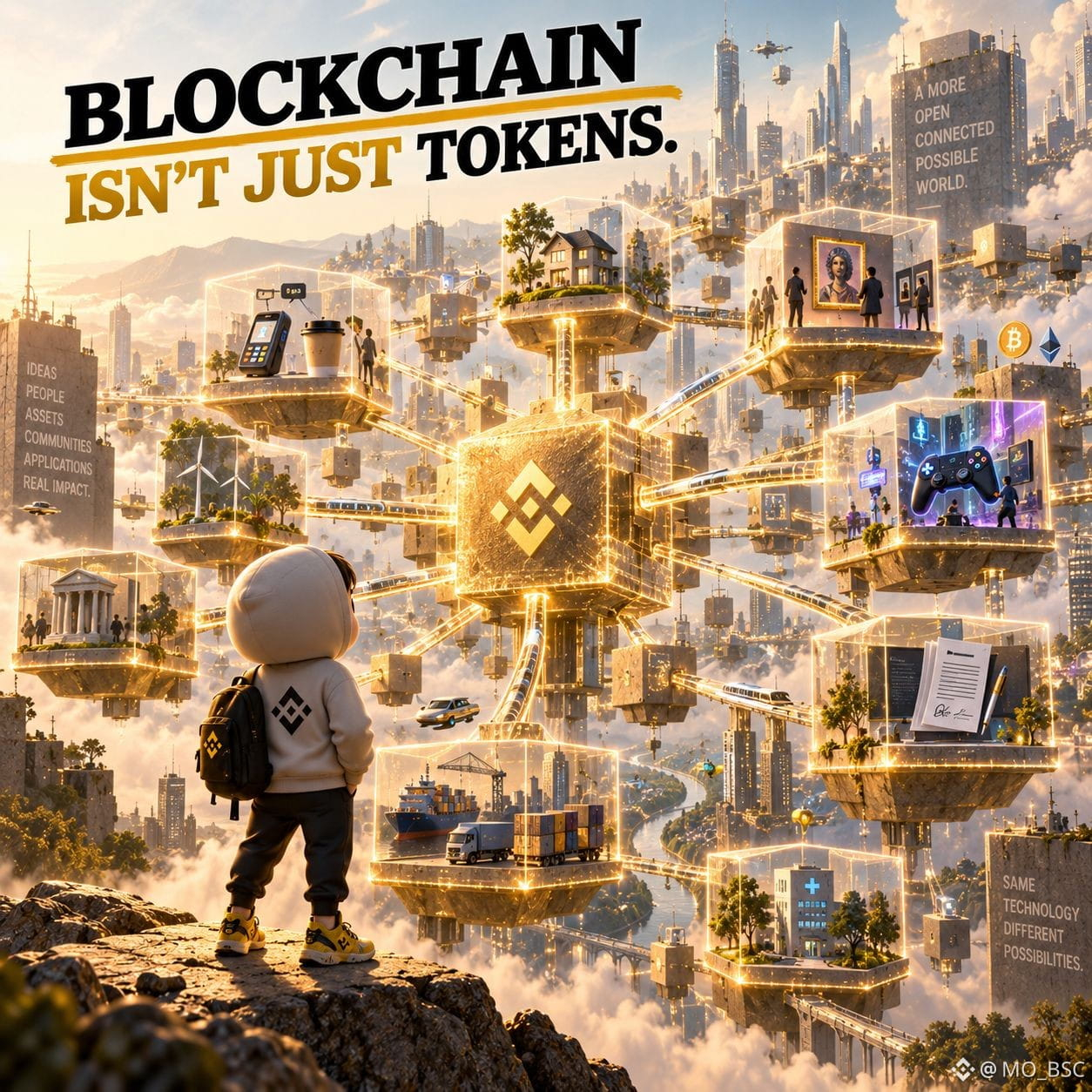
Say “blockchain”...
and many people immediately think:
Bitcoin.
Ethereum.
Trading.
But blockchain technology is much bigger than that.
At its core, a blockchain is a distributed system for recording transactions and other data in a way that allows participants to verify the state of the network.
That simple idea can support very different applications.
Payments.
Tokenization.
Digital ownership.
Settlement.
Decentralized applications.
And more.
This is why separating:
“crypto assets”
from
“blockchain infrastructure”
is useful.
One refers to what can exist on the network.
The other describes the technology that allows the system to function.
Think of it like this:
The internet isn't just websites.
And blockchain isn't just tokens.
The interesting question is not only:
“What can you buy?”
It's:
“What can this infrastructure enable?”
That's where Web3 gets much more interesting.
DYOR.
Educational content only
not financial advice
#Blockchain #Web3 #BinanceAcademy
Say “blockchain”...
and many people immediately think:
Bitcoin.
Ethereum.
Trading.
But blockchain technology is much bigger than that.
At its core, a blockchain is a distributed system for recording transactions and other data in a way that allows participants to verify the state of the network.
That simple idea can support very different applications.
Payments.
Tokenization.
Digital ownership.
Settlement.
Decentralized applications.
And more.
This is why separating:
“crypto assets”
from
“blockchain infrastructure”
is useful.
One refers to what can exist on the network.
The other describes the technology that allows the system to function.
Think of it like this:
The internet isn't just websites.
And blockchain isn't just tokens.
The interesting question is not only:
“What can you buy?”
It's:
“What can this infrastructure enable?”
That's where Web3 gets much more interesting.
DYOR.
Educational content only
not financial advice
#Blockchain #Web3 #BinanceAcademy
and many people immediately think:
Bitcoin.
Ethereum.
Trading.
But blockchain technology is much bigger than that.
At its core, a blockchain is a distributed system for recording transactions and other data in a way that allows participants to verify the state of the network.
That simple idea can support very different applications.
Payments.
Tokenization.
Digital ownership.
Settlement.
Decentralized applications.
And more.
This is why separating:
“crypto assets”
from
“blockchain infrastructure”
is useful.
One refers to what can exist on the network.
The other describes the technology that allows the system to function.
Think of it like this:
The internet isn't just websites.
And blockchain isn't just tokens.
The interesting question is not only:
“What can you buy?”
It's:
“What can this infrastructure enable?”
That's where Web3 gets much more interesting.
DYOR.
Educational content only
not financial advice
#Blockchain #Web3 #BinanceAcademy
3
158
·
--
A crypto wallet looks simple.
Open it.
See a balance.
Send something.
Receive something.
But underneath that simple interface is a very different concept.
A crypto wallet doesn't simply “store coins” the way a physical wallet stores cash.
It manages access to your assets through cryptographic keys.
That distinction matters.
Your wallet address can be shared.
Your private key should not be.
And your recovery phrase?
Treat it like the master key to the account.
This is one of the biggest mindset shifts when entering crypto:
You are not just using an app.
You are interacting with a system where control and responsibility can sit much closer to the user.
That can be powerful.
It can also mean that a simple security mistake can have serious consequences.
So before exploring everything crypto offers...
Learn the basics of wallet security first.
Never share your seed phrase.
Be careful with links and approvals.
Verify addresses before sending.
Your first security tool isn't a hardware wallet.
It's understanding what you're actually controlling.
DYOR.
Educational content only — not financial advice.
#Binance #Crypto #Web3 #Wallets #BinanceAcademy
A crypto wallet looks simple.
Open it.
See a balance.
Send something.
Receive something.
But underneath that simple interface is a very different concept.
A crypto wallet doesn't simply “store coins” the way a physical wallet stores cash.
It manages access to your assets through cryptographic keys.
That distinction matters.
Your wallet address can be shared.
Your private key should not be.
And your recovery phrase?
Treat it like the master key to the account.
This is one of the biggest mindset shifts when entering crypto:
You are not just using an app.
You are interacting with a system where control and responsibility can sit much closer to the user.
That can be powerful.
It can also mean that a simple security mistake can have serious consequences.
So before exploring everything crypto offers...
Learn the basics of wallet security first.
Never share your seed phrase.
Be careful with links and approvals.
Verify addresses before sending.
Your first security tool isn't a hardware wallet.
It's understanding what you're actually controlling.
DYOR.
Educational content only — not financial advice.
#Binance #Crypto #Web3 #Wallets #BinanceAcademy
Open it.
See a balance.
Send something.
Receive something.
But underneath that simple interface is a very different concept.
A crypto wallet doesn't simply “store coins” the way a physical wallet stores cash.
It manages access to your assets through cryptographic keys.
That distinction matters.
Your wallet address can be shared.
Your private key should not be.
And your recovery phrase?
Treat it like the master key to the account.
This is one of the biggest mindset shifts when entering crypto:
You are not just using an app.
You are interacting with a system where control and responsibility can sit much closer to the user.
That can be powerful.
It can also mean that a simple security mistake can have serious consequences.
So before exploring everything crypto offers...
Learn the basics of wallet security first.
Never share your seed phrase.
Be careful with links and approvals.
Verify addresses before sending.
Your first security tool isn't a hardware wallet.
It's understanding what you're actually controlling.
DYOR.
Educational content only — not financial advice.
#Binance #Crypto #Web3 #Wallets #BinanceAcademy

5
209
·
--
“Gen Z just trades everything.”
It sounds believable.
But data can tell a different story.
Recent Binance Research on Gen Z users across crypto and traditional financial products highlights an interesting pattern:
Gen Z isn't necessarily the highest-turnover generation.
In several products, their trading activity can be lower than older cohorts.
That's interesting because the stereotype suggests:
Young = impatient = constantly trading.
But user behavior is more complicated than that.
Frequency of trading doesn't tell the whole story.
You also have to look at:
→ What people are using
→ How often they trade
→ Whether they accumulate or reduce positions
→ What products they choose
→ How their behavior changes over time
That's the bigger lesson.
A generation can have a completely different relationship with financial technology without behaving exactly as the stereotype predicts.
So before saying:
“Gen Z does X.”
Ask:
“What does the data actually show?”
DYOR.
Educational content only — not financial advice.
#BinanceResearch #GenZ #Crypto #TradFi #Binance
“Gen Z just trades everything.”
It sounds believable.
But data can tell a different story.
Recent Binance Research on Gen Z users across crypto and traditional financial products highlights an interesting pattern:
Gen Z isn't necessarily the highest-turnover generation.
In several products, their trading activity can be lower than older cohorts.
That's interesting because the stereotype suggests:
Young = impatient = constantly trading.
But user behavior is more complicated than that.
Frequency of trading doesn't tell the whole story.
You also have to look at:
→ What people are using
→ How often they trade
→ Whether they accumulate or reduce positions
→ What products they choose
→ How their behavior changes over time
That's the bigger lesson.
A generation can have a completely different relationship with financial technology without behaving exactly as the stereotype predicts.
So before saying:
“Gen Z does X.”
Ask:
“What does the data actually show?”
DYOR.
Educational content only — not financial advice.
#BinanceResearch #GenZ #Crypto #TradFi #Binance
It sounds believable.
But data can tell a different story.
Recent Binance Research on Gen Z users across crypto and traditional financial products highlights an interesting pattern:
Gen Z isn't necessarily the highest-turnover generation.
In several products, their trading activity can be lower than older cohorts.
That's interesting because the stereotype suggests:
Young = impatient = constantly trading.
But user behavior is more complicated than that.
Frequency of trading doesn't tell the whole story.
You also have to look at:
→ What people are using
→ How often they trade
→ Whether they accumulate or reduce positions
→ What products they choose
→ How their behavior changes over time
That's the bigger lesson.
A generation can have a completely different relationship with financial technology without behaving exactly as the stereotype predicts.
So before saying:
“Gen Z does X.”
Ask:
“What does the data actually show?”
DYOR.
Educational content only — not financial advice.
#BinanceResearch #GenZ #Crypto #TradFi #Binance

3
34
·
--
The price is moving.
Everyone is talking about it.
Your timeline is full of screenshots.
Someone posts:
“I should have bought yesterday.”
And suddenly...
waiting feels like missing out.
That's FOMO.
The interesting part is that FOMO rarely starts with analysis.
It starts with emotion.
You see movement →
you imagine what you could have made →
you feel late →
you want to act immediately.
But a rising price doesn't automatically make an asset less risky.
And missing one move doesn't mean you need to chase the next one.
A useful habit is to separate two questions:
“Is this interesting?”
from
“Do I need to act right now?”
Those are not the same question.
Markets will always produce another headline.
Another candle.
Another opportunity to feel late.
Good decision-making starts when urgency stops making the decision for you.
DYOR.
Educational content only
not financial advice
#Crypto #Bitcoin #DYOR
$BTC
{spot}(BTCUSDT)
The price is moving.
Everyone is talking about it.
Your timeline is full of screenshots.
Someone posts:
“I should have bought yesterday.”
And suddenly...
waiting feels like missing out.
That's FOMO.
The interesting part is that FOMO rarely starts with analysis.
It starts with emotion.
You see movement →
you imagine what you could have made →
you feel late →
you want to act immediately.
But a rising price doesn't automatically make an asset less risky.
And missing one move doesn't mean you need to chase the next one.
A useful habit is to separate two questions:
“Is this interesting?”
from
“Do I need to act right now?”
Those are not the same question.
Markets will always produce another headline.
Another candle.
Another opportunity to feel late.
Good decision-making starts when urgency stops making the decision for you.
DYOR.
Educational content only
not financial advice
#Crypto #Bitcoin #DYOR
$BTC
Everyone is talking about it.
Your timeline is full of screenshots.
Someone posts:
“I should have bought yesterday.”
And suddenly...
waiting feels like missing out.
That's FOMO.
The interesting part is that FOMO rarely starts with analysis.
It starts with emotion.
You see movement →
you imagine what you could have made →
you feel late →
you want to act immediately.
But a rising price doesn't automatically make an asset less risky.
And missing one move doesn't mean you need to chase the next one.
A useful habit is to separate two questions:
“Is this interesting?”
from
“Do I need to act right now?”
Those are not the same question.
Markets will always produce another headline.
Another candle.
Another opportunity to feel late.
Good decision-making starts when urgency stops making the decision for you.
DYOR.
Educational content only
not financial advice
#Crypto #Bitcoin #DYOR
$BTC

2
107
Log in to explore more content
Join global crypto users on Binance Square
⚡️ Get latest and useful information about crypto.
💬 Trusted by the world’s largest crypto exchange.
👍 Discover real insights from verified creators.
Email / Phone number
Trending Topics
BOJRaisesRatesTo31YearHigh
18,302 views
541 Discussing
Bitcoin Reclaims the Spotlight as Macro Pressure Fails to Break Crypto Demand
Fatima_Tariq
·8 Likes
·5.3k views
BuffettStepsDownAsBerkshireChairman
4,152 views
198 Discussing
XRPExchangeReservesHitSevenYearLow
7,465 views
230 Discussing