
umair0007
104 Posts

umair0007
Report
Block User
Welcome Every Crypto Lover. The Crypto Insight Hunter – Finding What Most Crypto Beginners Overlook. Hit Follow to grow.
Open Trade
Occasional Trader
2.9 Years
11 Following
23 Followers
32 Liked
Posts
Portfolio
·
--
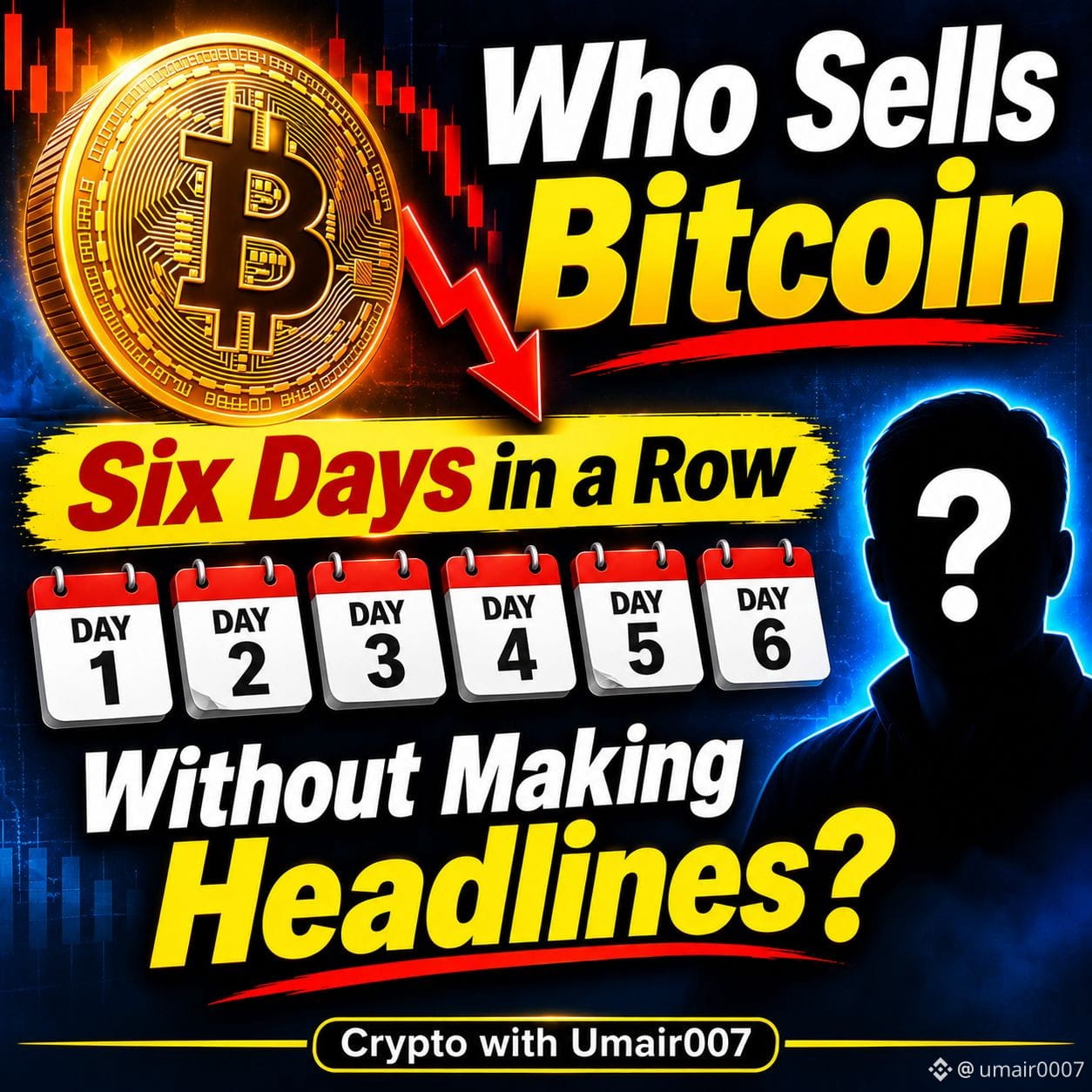
Who sells Bitcoin six days in a row without making headlines?
Bitcoin ETFs just set a record, and not the fun kind. 📉
US spot BTC ETFs have seen about $4.94B in outflows this November, passing June's record of $4.51B. Tuesday was the sixth straight day of outflows.
Outflows show big, slower-moving money getting cautious. They don't tell us where price goes next.
The Fear & Greed Index sits at 13.
Do you see ETF outflows as a warning signal, or just normal rebalancing in a weak market?
$BTC
{spot}(BTCUSDT)
$ETFT.ETF
{etf_us}(ETFT.ETF)
$ETH
{spot}(ETHUSDT)
#bitcoin #BitcoinETFs #CryptoMarketTrends #squarecommunity
Who sells Bitcoin six days in a row without making headlines?
Bitcoin ETFs just set a record, and not the fun kind. 📉
US spot BTC ETFs have seen about $4.94B in outflows this November, passing June's record of $4.51B. Tuesday was the sixth straight day of outflows.
Outflows show big, slower-moving money getting cautious. They don't tell us where price goes next.
The Fear & Greed Index sits at 13.
Do you see ETF outflows as a warning signal, or just normal rebalancing in a weak market?
$BTC
$ETFT.ETF
$ETH
#bitcoin #BitcoinETFs #CryptoMarketTrends #squarecommunity
113
·
--
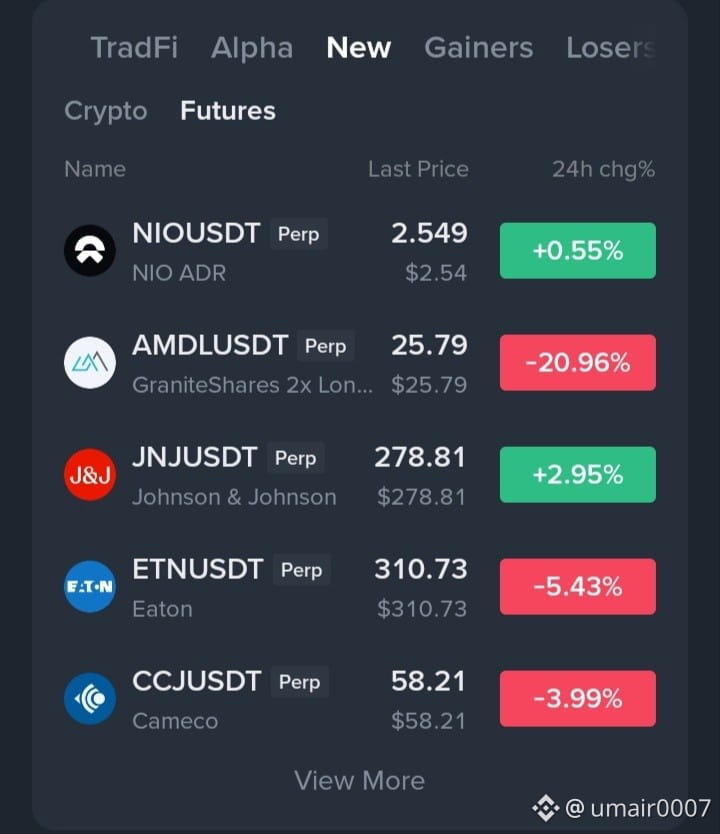
🚨 ONE CONTRACT, A 20%+ DROP!
Look at Binance Futures today:
🔴 AMD-related contract: -20.96% 🔴 ETN: -5.43% 🔴 CCJ: -3.99% 🟢 JNJ: +2.95%
Not every market moves in the same direction.
Here's the real question: Are you watching price movements or understanding what's driving them? 👀
#BinanceFutures #TradFi #MarketWatch
#feature
Look at Binance Futures today:
🔴 AMD-related contract: -20.96% 🔴 ETN: -5.43% 🔴 CCJ: -3.99% 🟢 JNJ: +2.95%
Not every market moves in the same direction.
Here's the real question: Are you watching price movements or understanding what's driving them? 👀
#BinanceFutures #TradFi #MarketWatch
#feature
174
·
--
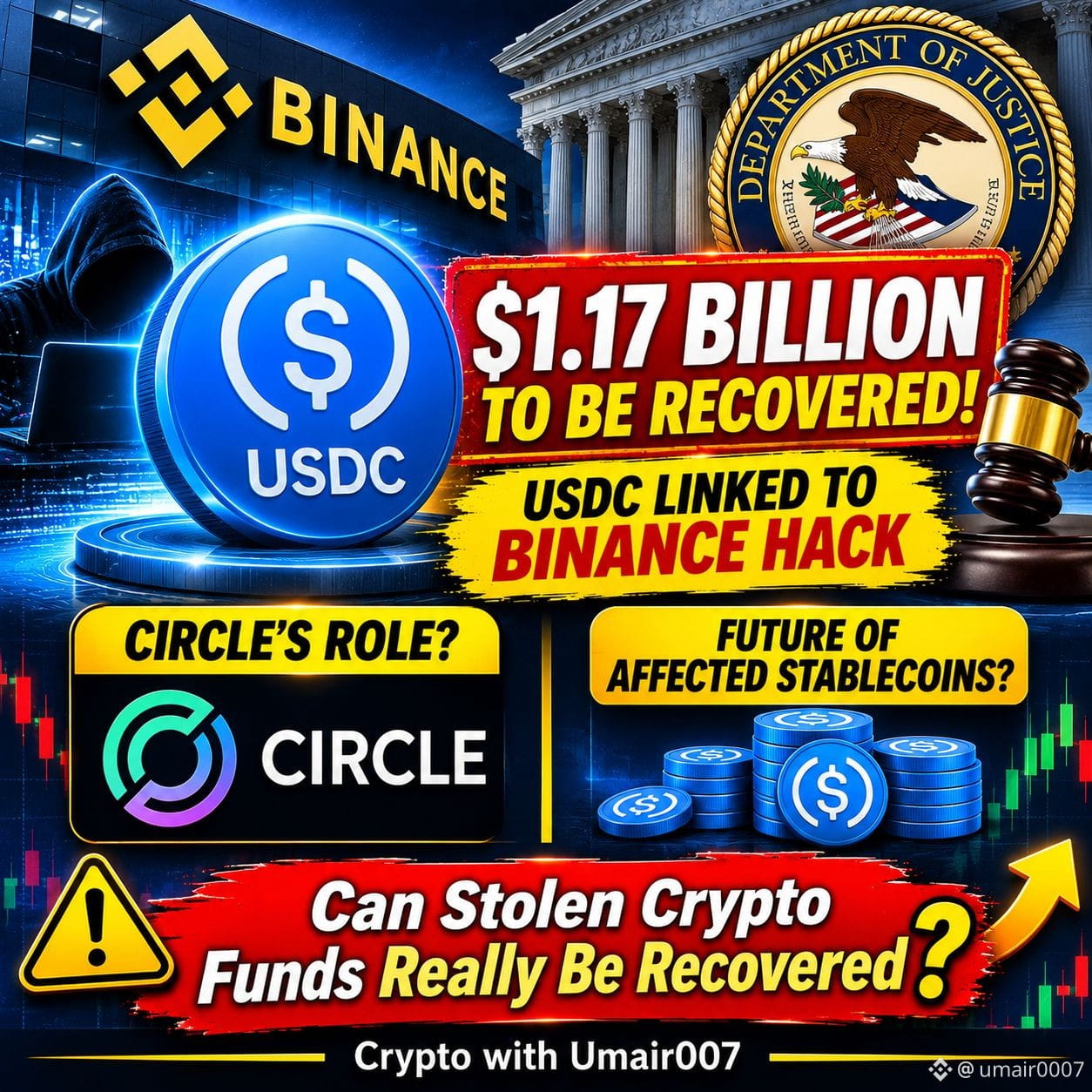
🚨 US authorities are reportedly seeking to recover $1.17 billion in USDC linked to a Binance hack!
The case also raises important questions about Circle's role and the future of affected stablecoins.
Can stolen crypto funds really be recovered? 👀
$USDC
{spot}(USDCUSDT)
$TRX
{spot}(TRXUSDT)
$LUNC
{spot}(LUNCUSDT)
#USDC #Binance #CryptoNews #todaynews
🚨 US authorities are reportedly seeking to recover $1.17 billion in USDC linked to a Binance hack!
The case also raises important questions about Circle's role and the future of affected stablecoins.
Can stolen crypto funds really be recovered? 👀
$USDC
$TRX
$LUNC
#USDC #Binance #CryptoNews #todaynews
The case also raises important questions about Circle's role and the future of affected stablecoins.
Can stolen crypto funds really be recovered? 👀
$USDC
$TRX
$LUNC
#USDC #Binance #CryptoNews #todaynews
·
--
Verified
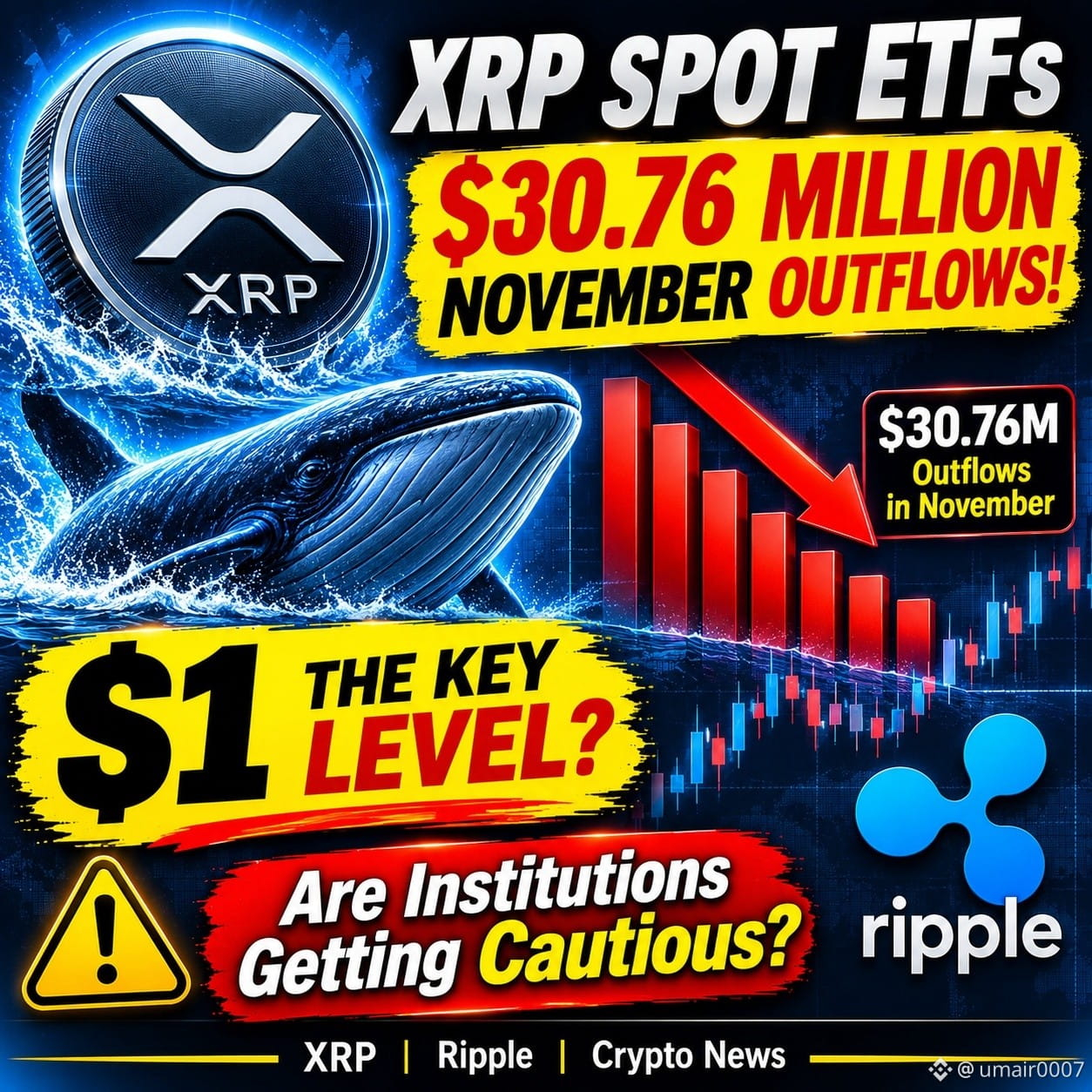
🐋 XRP spot ETFs have reportedly recorded $30.76 million in November outflows!
The $1 price level remains an important psychological threshold for XRP.
Are institutional investors becoming more cautious? 👀
$XRP
{spot}(XRPUSDT)
$BTC
{spot}(BTCUSDT)
$UAI
{future}(UAIUSDT)
#xrp #Ripple #CryptoNews #squarecommunity
🐋 XRP spot ETFs have reportedly recorded $30.76 million in November outflows!
The $1 price level remains an important psychological threshold for XRP.
Are institutional investors becoming more cautious? 👀
$XRP
$BTC
$UAI
#xrp #Ripple #CryptoNews #squarecommunity
The $1 price level remains an important psychological threshold for XRP.
Are institutional investors becoming more cautious? 👀
$XRP
$BTC
$UAI
#xrp #Ripple #CryptoNews #squarecommunity
665
·
--
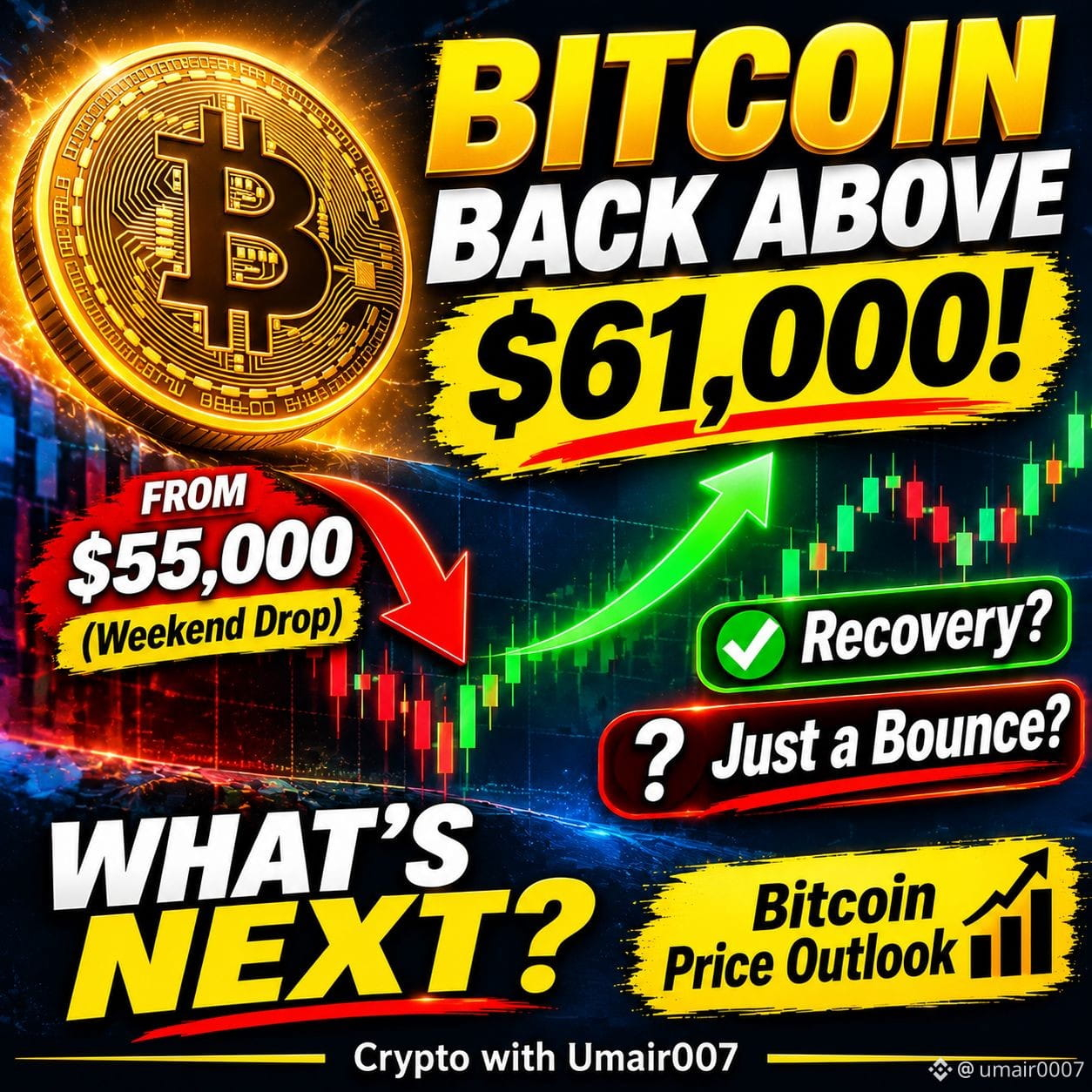
🚀 Bitcoin has reclaimed the $61,000 level after a heavy weekend sell-off!
BTC previously dropped toward $55,000 as leveraged liquidations intensified market pressure.
But here's the big question: Is this a genuine recovery or just a temporary bounce? 👀
$BTC
{spot}(BTCUSDT)
$ETH
{spot}(ETHUSDT)
$BNB
{spot}(BNBUSDT)
#bitcoin #BTC #CryptoNews #BitcoinRecovery
🚀 Bitcoin has reclaimed the $61,000 level after a heavy weekend sell-off!
BTC previously dropped toward $55,000 as leveraged liquidations intensified market pressure.
But here's the big question: Is this a genuine recovery or just a temporary bounce? 👀
$BTC
$ETH
$BNB
#bitcoin #BTC #CryptoNews #BitcoinRecovery
BTC previously dropped toward $55,000 as leveraged liquidations intensified market pressure.
But here's the big question: Is this a genuine recovery or just a temporary bounce? 👀
$BTC
$ETH
$BNB
#bitcoin #BTC #CryptoNews #BitcoinRecovery
73
·
--
Everyone wants to become a PEPE millionaire. 🐸💰
But here's the question nobody should ignore:
What market cap would PEPE need to reach $1?
A low token price doesn't automatically mean unlimited upside.
Dream big, but understand tokenomics first.
Do you think most meme coin investors understand market cap? 👀
$BTC
{spot}(BTCUSDT)
$XRP
{spot}(XRPUSDT)
$TRX
{spot}(TRXUSDT)
#PEPE #memecoins #marketcap #Tokenomic
Everyone wants to become a PEPE millionaire. 🐸💰
But here's the question nobody should ignore:
What market cap would PEPE need to reach $1?
A low token price doesn't automatically mean unlimited upside.
Dream big, but understand tokenomics first.
Do you think most meme coin investors understand market cap? 👀
$BTC
$XRP
$TRX
#PEPE #memecoins #marketcap #Tokenomic

98
·
--
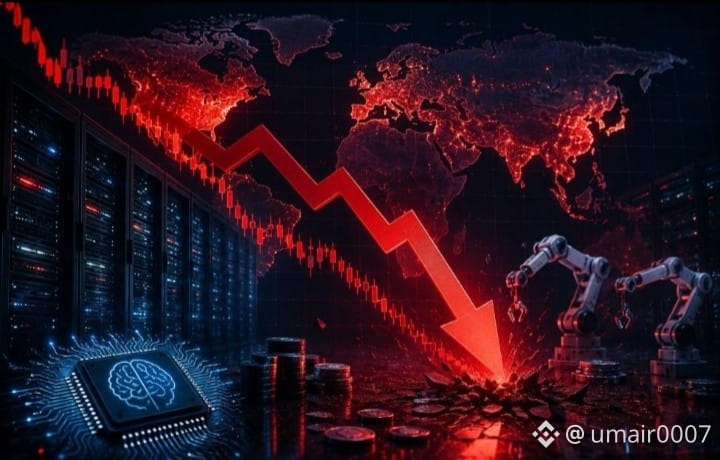
🌍 GLOBAL STOCKS ARE FALLING. BUT THE BIGGER STORY IS THE AI INVESTMENT QUESTION.
Global equities are facing their longest losing streak since 2023, according to the latest market reports.
Here's what deserves attention:
📉 MSCI World Index: 7 consecutive losing sessions. 📉 Anthropic: More than 7% lower in early Friday trading, according to the screenshot. 📉 Technology stocks: Facing broader selling pressure.
But there's a deeper issue.
Investors are increasingly questioning whether massive AI investments will eventually produce enough returns to justify their costs.
This creates an important distinction:
AI adoption can continue growing while AI-related stock valuations come under pressure.
A promising technology doesn't automatically make every related investment attractive.
Do you think the AI market is experiencing a temporary correction or a bigger change in investor expectations?
$BTC
{spot}(BTCUSDT)
$ETH
{spot}(ETHUSDT)
$USDC
{spot}(USDCUSDT)
#GlobalMarkets #AI #stockmarket
#GlobalStocksFaceLongestLosingStreakSince2023 #CryptoEducation
🌍 GLOBAL STOCKS ARE FALLING. BUT THE BIGGER STORY IS THE AI INVESTMENT QUESTION.
Global equities are facing their longest losing streak since 2023, according to the latest market reports.
Here's what deserves attention:
📉 MSCI World Index: 7 consecutive losing sessions. 📉 Anthropic: More than 7% lower in early Friday trading, according to the screenshot. 📉 Technology stocks: Facing broader selling pressure.
But there's a deeper issue.
Investors are increasingly questioning whether massive AI investments will eventually produce enough returns to justify their costs.
This creates an important distinction:
AI adoption can continue growing while AI-related stock valuations come under pressure.
A promising technology doesn't automatically make every related investment attractive.
Do you think the AI market is experiencing a temporary correction or a bigger change in investor expectations?
$BTC
$ETH
$USDC
#GlobalMarkets #AI #stockmarket
#GlobalStocksFaceLongestLosingStreakSince2023 #CryptoEducation
67
·
--
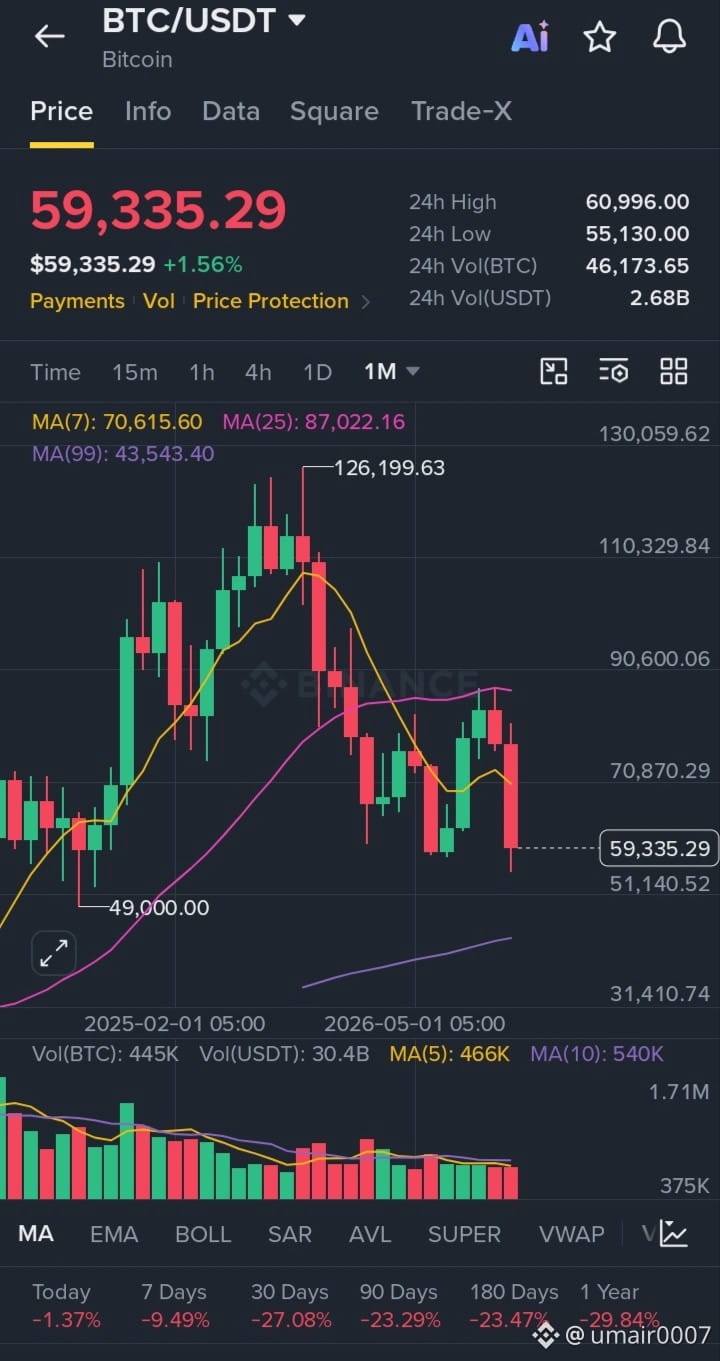
BITCOIN'S BIGGER PROBLEM ISN'T JUST THE PRICE DROP. LOOK AT THE MOVING AVERAGES.
BTC is trading around $59,335 in this screenshot, but the monthly chart reveals something more interesting.
Three important levels:
🔹 MA(7): $70,615 🔹 MA(25): $87,022 🔹 MA(99): $43,543
Bitcoin is currently below its first two moving averages but remains above MA(99).
Why does this matter?
Because short-term market weakness and longer-term price structure are not necessarily the same thing.
A recovery in price doesn't automatically mean the broader trend has changed.
Traders should watch how BTC behaves around these moving averages rather than assuming one green candle confirms a reversal.
Do you think Bitcoin needs to reclaim MA(7) before market confidence can improve?
$BTC
{spot}(BTCUSDT)
$ETH
{spot}(ETHUSDT)
$BNB
{spot}(BNBUSDT)
#bitcoin #BTC #CryptoAnalysis #BinanceSquareFamily
BITCOIN'S BIGGER PROBLEM ISN'T JUST THE PRICE DROP. LOOK AT THE MOVING AVERAGES.
BTC is trading around $59,335 in this screenshot, but the monthly chart reveals something more interesting.
Three important levels:
🔹 MA(7): $70,615 🔹 MA(25): $87,022 🔹 MA(99): $43,543
Bitcoin is currently below its first two moving averages but remains above MA(99).
Why does this matter?
Because short-term market weakness and longer-term price structure are not necessarily the same thing.
A recovery in price doesn't automatically mean the broader trend has changed.
Traders should watch how BTC behaves around these moving averages rather than assuming one green candle confirms a reversal.
Do you think Bitcoin needs to reclaim MA(7) before market confidence can improve?
$BTC
$ETH
$BNB
#bitcoin #BTC #CryptoAnalysis #BinanceSquareFamily
135
·
--
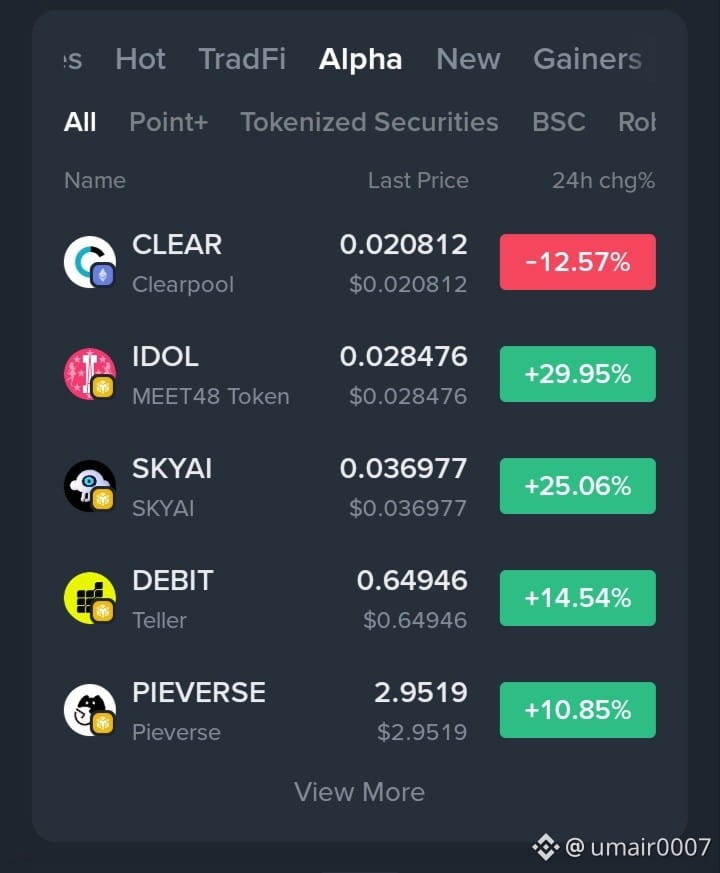
🚀 IDOL +29.95%: THE BIGGEST GAINER IN THIS BINANCE ALPHA SNAPSHOT!
Five visible assets, but five different price movements.
Here's the breakdown:
📈 IDOL: +29.95%
📈 SKYAI: +25.06%
📈 DEBIT: +14.54%
📈 PIEVERSE: +10.85%
📉 CLEAR: -12.57%
But here's the question traders should ask:
Can a token maintain its momentum after a strong daily move?
A single 24-hour snapshot cannot answer that.
We would need to examine historical volume, liquidity, market depth, and subsequent price action.
Would you rather investigate the strongest gainer or the only visible loser? And why?
$SKYAI
{future}(SKYAIUSDT)
$IDOL
{future}(IDOLUSDT)
$USDC
{spot}(USDCUSDT)
#IDOL #SKYAI #BinanceAlpha #CryptoMarket
🚀 IDOL +29.95%: THE BIGGEST GAINER IN THIS BINANCE ALPHA SNAPSHOT!
Five visible assets, but five different price movements.
Here's the breakdown:
📈 IDOL: +29.95%
📈 SKYAI: +25.06%
📈 DEBIT: +14.54%
📈 PIEVERSE: +10.85%
📉 CLEAR: -12.57%
But here's the question traders should ask:
Can a token maintain its momentum after a strong daily move?
A single 24-hour snapshot cannot answer that.
We would need to examine historical volume, liquidity, market depth, and subsequent price action.
Would you rather investigate the strongest gainer or the only visible loser? And why?
$SKYAI
$IDOL
$USDC
#IDOL #SKYAI #BinanceAlpha #CryptoMarket
652
·
--
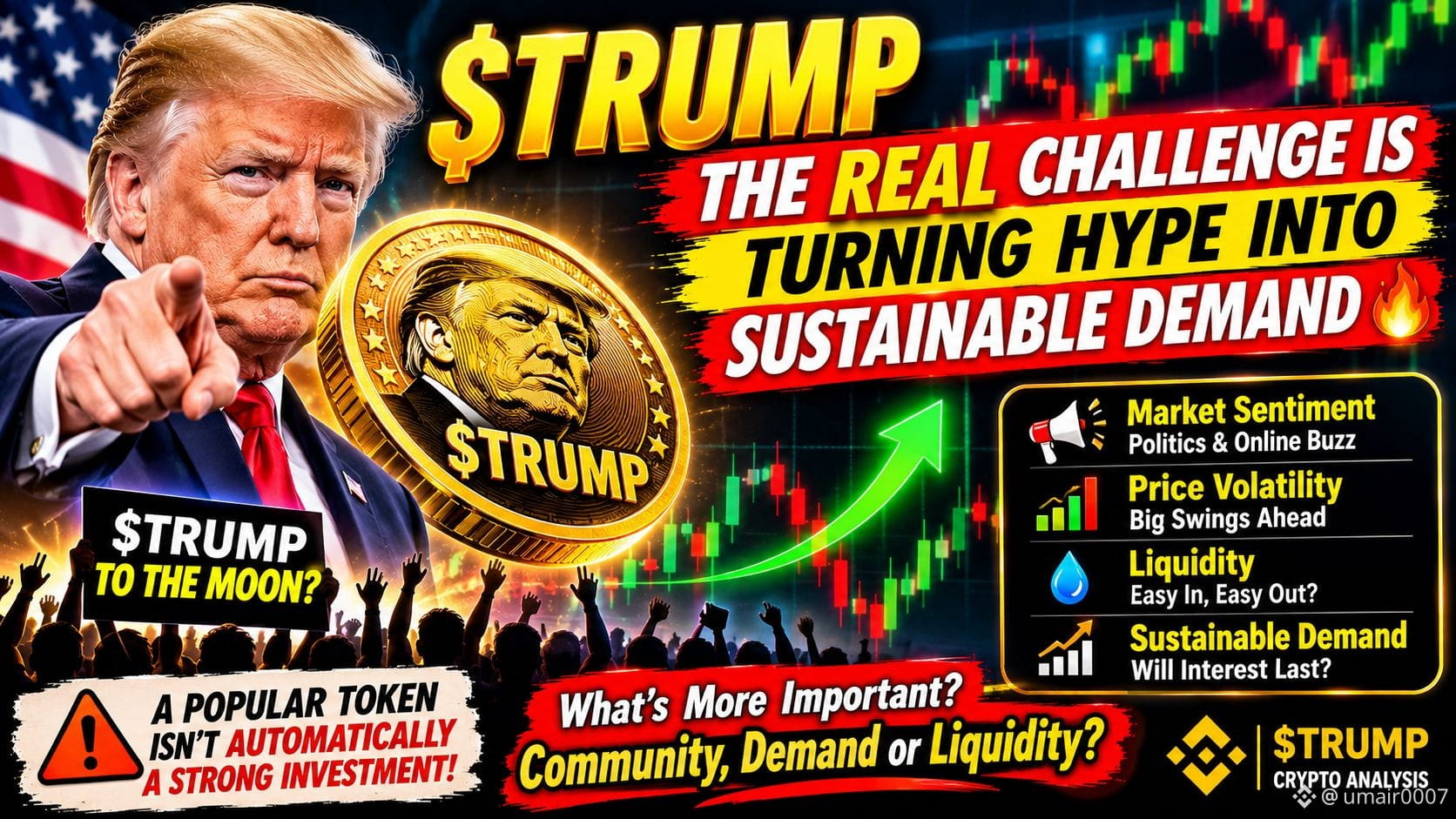
🔥 $TRUMP: THE REAL CHALLENGE IS TURNING HYPE INTO SUSTAINABLE DEMAND
Meme coins can attract massive attention in a short time. But keeping that attention alive is a completely different challenge.
$TRUMP is an interesting example of how market sentiment can influence a token's visibility and trading activity.
Here's what deserves attention:
🔹 Market sentiment: Political headlines and online discussions can influence trader interest.
🔹 Price volatility: Sudden excitement can bring sharp price movements in either direction.
🔹 Liquidity: A rising chart doesn't necessarily mean traders can enter or exit positions easily.
🔹 Sustainable demand: The bigger question is whether interest continues after the initial excitement fades.
One thing every beginner should understand:
A popular token isn't automatically a strong investment, and a green candle doesn't guarantee another one.
Don't let excitement replace research.
What do you think is more important for a meme coin's future: community attention, genuine demand, or market liquidity?
$BTC
{spot}(BTCUSDT)
$SOL
{spot}(SOLUSDT)
$ETH
{spot}(ETHUSDT)
#TrumpNFTCollection #memecoins #CryptoAnalysisUpdate #CryptoEducation
🔥 $TRUMP: THE REAL CHALLENGE IS TURNING HYPE INTO SUSTAINABLE DEMAND
Meme coins can attract massive attention in a short time. But keeping that attention alive is a completely different challenge.
$TRUMP is an interesting example of how market sentiment can influence a token's visibility and trading activity.
Here's what deserves attention:
🔹 Market sentiment: Political headlines and online discussions can influence trader interest.
🔹 Price volatility: Sudden excitement can bring sharp price movements in either direction.
🔹 Liquidity: A rising chart doesn't necessarily mean traders can enter or exit positions easily.
🔹 Sustainable demand: The bigger question is whether interest continues after the initial excitement fades.
One thing every beginner should understand:
A popular token isn't automatically a strong investment, and a green candle doesn't guarantee another one.
Don't let excitement replace research.
What do you think is more important for a meme coin's future: community attention, genuine demand, or market liquidity?
$BTC
$SOL
$ETH
#TrumpNFTCollection #memecoins #CryptoAnalysisUpdate #CryptoEducation
302
·
--
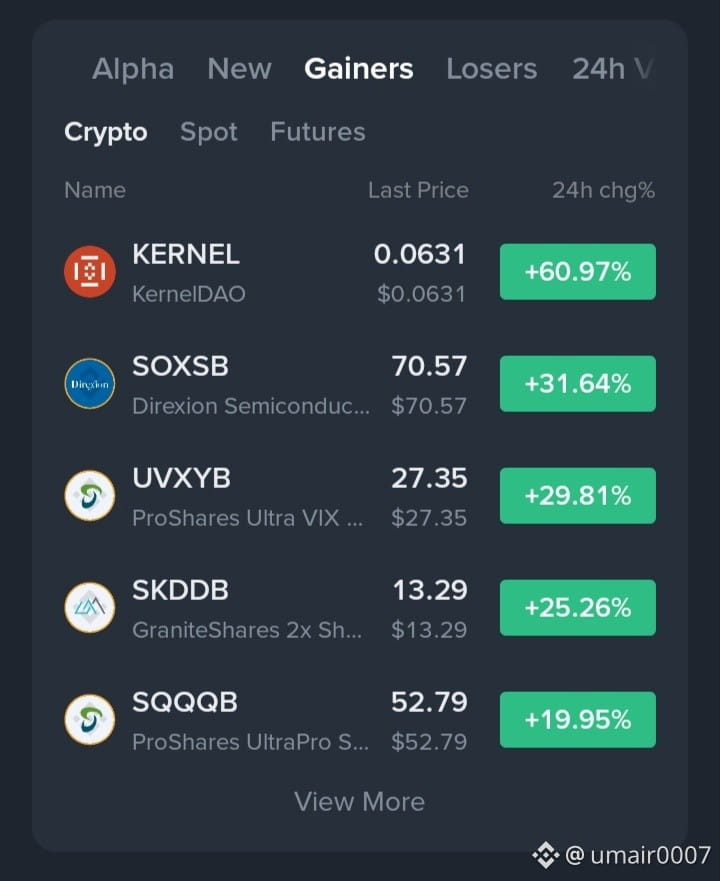
🔥 KERNELDAO LEADS THE VISIBLE BINANCE GAINERS WITH +60.97%!
Today's screenshot shows KERNEL at the top of the visible gainers list.
Other notable movements:
📈 SOXSB: +31.64%
📈 UVXYB: +29.81%
📈 SKDDB: +25.26%
📈 SQQQB: +19.95%
But one question matters more than the green numbers:
What's driving KERNEL's movement?
A price increase alone cannot tell us whether the move is supported by stronger demand, increased trading activity, or a temporary market reaction.
To understand the move, we need trading volume, liquidity, market depth, and relevant project developments.
Would you investigate KERNEL's fundamentals or its market activity first?
$KERNEL
{spot}(KERNELUSDT)
$MRNAB
{spot}(MRNABUSDT)
$BABAB
{spot}(BABABUSDT)
#kernel #KernelDao #CryptoAnalysis #GAINERS
🔥 KERNELDAO LEADS THE VISIBLE BINANCE GAINERS WITH +60.97%!
Today's screenshot shows KERNEL at the top of the visible gainers list.
Other notable movements:
📈 SOXSB: +31.64%
📈 UVXYB: +29.81%
📈 SKDDB: +25.26%
📈 SQQQB: +19.95%
But one question matters more than the green numbers:
What's driving KERNEL's movement?
A price increase alone cannot tell us whether the move is supported by stronger demand, increased trading activity, or a temporary market reaction.
To understand the move, we need trading volume, liquidity, market depth, and relevant project developments.
Would you investigate KERNEL's fundamentals or its market activity first?
$KERNEL
$MRNAB
$BABAB
#kernel #KernelDao #CryptoAnalysis #GAINERS
283
·
--
🚀 SPACE AND TIME ($SXT): THE DATA LAYER BEHIND AI AND DEFI?
Most crypto discussions focus on AI tokens, DeFi protocols, and blockchain networks.
But there's another important layer: DATA VERIFICATION.
Space and Time is developing verifiable data infrastructure designed for AI, tokenization, and decentralized finance.
Its Proof of SQL technology uses zero-knowledge proofs to verify computations.
Here's the bigger opportunity:
AI applications and DeFi protocols need reliable ways to process and verify information.
Without trustworthy data, even sophisticated applications can produce unreliable results.
The next stage of Web3 may depend not only on better applications, but also on better data infrastructure.
Is data verification an overlooked sector in crypto?
$UAI
{future}(UAIUSDT)
$LUNC
{spot}(LUNCUSDT)
$BTC
{spot}(BTCUSDT)
#SXTToken #AI #defi #Web3
🚀 SPACE AND TIME ($SXT): THE DATA LAYER BEHIND AI AND DEFI?
Most crypto discussions focus on AI tokens, DeFi protocols, and blockchain networks.
But there's another important layer: DATA VERIFICATION.
Space and Time is developing verifiable data infrastructure designed for AI, tokenization, and decentralized finance.
Its Proof of SQL technology uses zero-knowledge proofs to verify computations.
Here's the bigger opportunity:
AI applications and DeFi protocols need reliable ways to process and verify information.
Without trustworthy data, even sophisticated applications can produce unreliable results.
The next stage of Web3 may depend not only on better applications, but also on better data infrastructure.
Is data verification an overlooked sector in crypto?
$UAI
$LUNC
$BTC
#SXTToken #AI #defi #Web3

1k
·
--
THE BIGGEST CRYPTO LOSER ISN'T ALWAYS THE BIGGEST OPPORTUNITY.
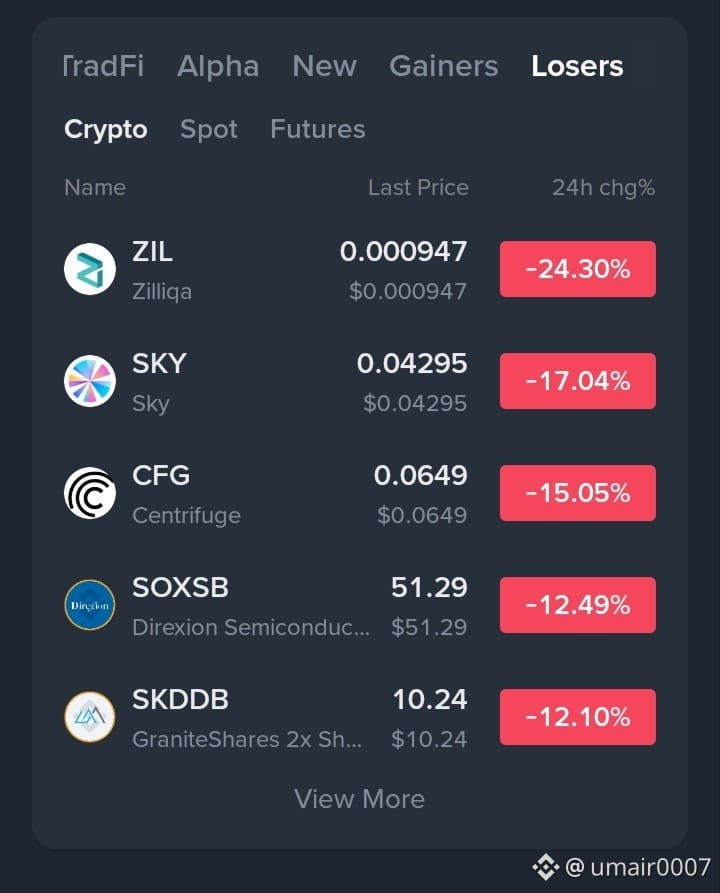
Look at ZIL.
According to the Binance screenshot, Zilliqa is down 24.30% in 24 hours.
Other visible losers include:
• SKY: -17.04%
• CFG: -15.05%
• SOXSB: -12.49%
• SKDDB: -12.10%
Here's the hidden lesson:
Price decline and market liquidity are two different things.
A coin can fall sharply because selling pressure overwhelms available buyers.
But without examining its order book, trading volume, and market depth, we cannot determine how much liquidity is available or why the decline happened.
Don't confuse a falling price with a discounted opportunity.
Do you check liquidity before investigating a losing coin?
$MSFTB
{spot}(MSFTBUSDT)
$NVDAB
{spot}(NVDABUSDT)
$AMZNB
{spot}(AMZNBUSDT)
#cryptoeducation #MarketLiquidity #Altcoin #ZIL/USDT #LooserOfTheBinance
THE BIGGEST CRYPTO LOSER ISN'T ALWAYS THE BIGGEST OPPORTUNITY.
Look at ZIL.
According to the Binance screenshot, Zilliqa is down 24.30% in 24 hours.
Other visible losers include:
• SKY: -17.04%
• CFG: -15.05%
• SOXSB: -12.49%
• SKDDB: -12.10%
Here's the hidden lesson:
Price decline and market liquidity are two different things.
A coin can fall sharply because selling pressure overwhelms available buyers.
But without examining its order book, trading volume, and market depth, we cannot determine how much liquidity is available or why the decline happened.
Don't confuse a falling price with a discounted opportunity.
Do you check liquidity before investigating a losing coin?
$MSFTB
$NVDAB
$AMZNB
#cryptoeducation #MarketLiquidity #Altcoin #ZIL/USDT #LooserOfTheBinance
465
·
--
$170K PRIZE POOL: BINANCE SQUARE IS PUTTING TRADING COMPETITION IN THE SPOTLIGHT 🏆
The Binance Trading Master Tournament is bringing traders head-to-head in Bangkok during Binance Blockchain Week.
Prize breakdown:
• Total rewards: $170,000
• Champion: $100,000
But there's a bigger industry angle here.
Crypto platforms are increasingly using competitions and live events to bring trading, community engagement, and entertainment together.
One important distinction: tournament performance doesn't automatically represent long-term trading ability.
Do you think live trading competitions help educate the crypto community, or mainly create entertainment?
$AAPLB
{spot}(AAPLBUSDT)
$UAI
{future}(UAIUSDT)
$LUNC
{spot}(LUNCUSDT)
#cryptoeducation #BinanceSquare #Blockchainweek #tournaments #Bangkok
$170K PRIZE POOL: BINANCE SQUARE IS PUTTING TRADING COMPETITION IN THE SPOTLIGHT 🏆
The Binance Trading Master Tournament is bringing traders head-to-head in Bangkok during Binance Blockchain Week.
Prize breakdown:
• Total rewards: $170,000
• Champion: $100,000
But there's a bigger industry angle here.
Crypto platforms are increasingly using competitions and live events to bring trading, community engagement, and entertainment together.
One important distinction: tournament performance doesn't automatically represent long-term trading ability.
Do you think live trading competitions help educate the crypto community, or mainly create entertainment?
$AAPLB
$UAI
$LUNC
#cryptoeducation #BinanceSquare #Blockchainweek #tournaments #Bangkok

869
·
--
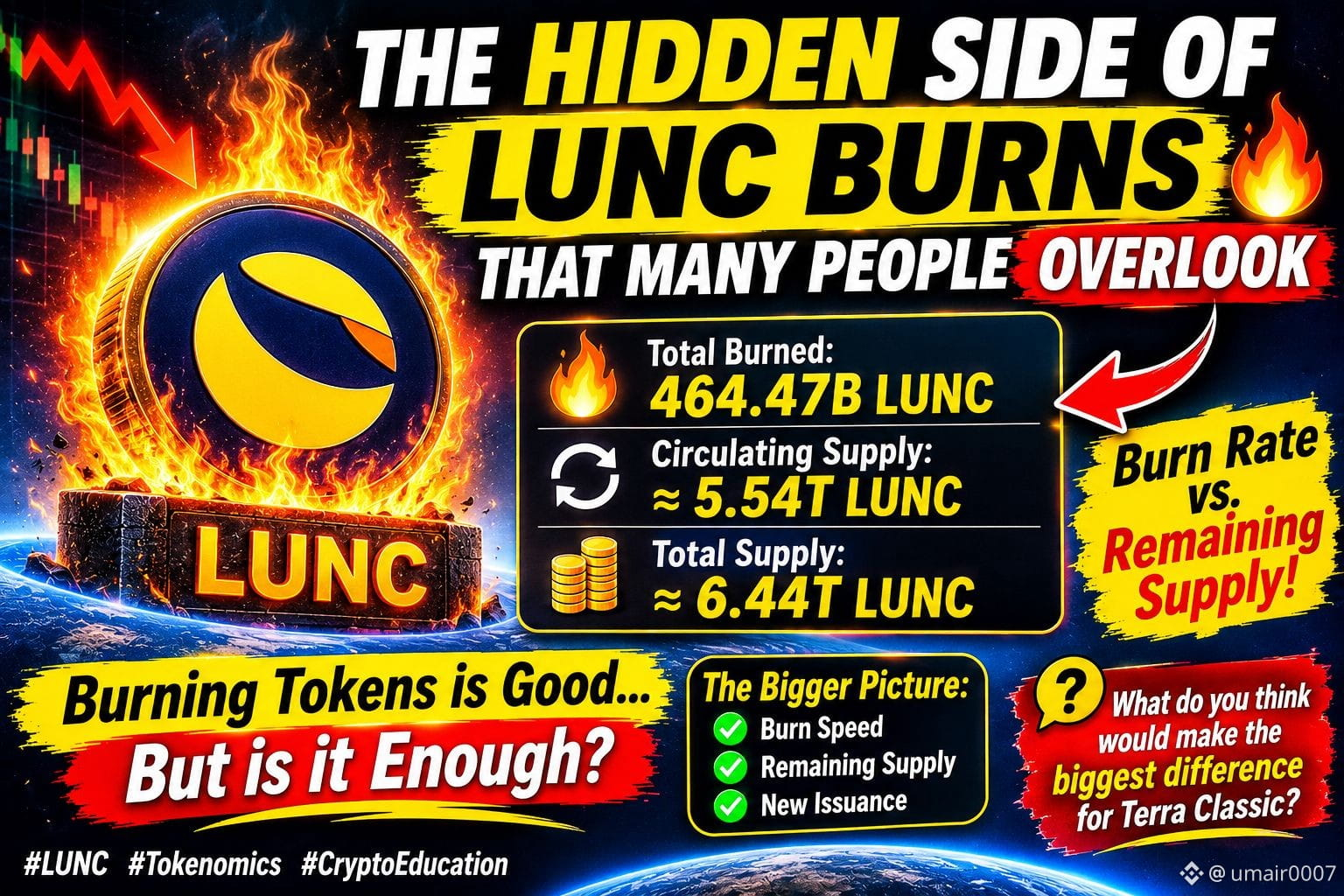
THE HIDDEN SIDE OF LUNC BURNS THAT MANY PEOPLE OVERLOOK 🔥
Everyone celebrates when millions or billions of LUNC are burned.
But there's a more important metric:
Burn rate vs. remaining supply.
Current tracker figures show:
• Total burned: 464.47B LUNC • Circulating supply: approximately 5.54T LUNC • Total supply: approximately 6.44T LUNC
This reveals an important reality.
Burning tokens reduces supply, but the speed of reduction matters.
Even repeated large burns need to be evaluated against the enormous remaining supply and any new token issuance.
A burn headline is interesting. The long-term supply trend is more important.
What do you think would make the biggest difference for Terra Classic?
$LUNC
{spot}(LUNCUSDT)
$UAI
{future}(UAIUSDT)
$BTC
{spot}(BTCUSDT)
#LUNCUSD #cryptoeducation #whale #burning
THE HIDDEN SIDE OF LUNC BURNS THAT MANY PEOPLE OVERLOOK 🔥
Everyone celebrates when millions or billions of LUNC are burned.
But there's a more important metric:
Burn rate vs. remaining supply.
Current tracker figures show:
• Total burned: 464.47B LUNC • Circulating supply: approximately 5.54T LUNC • Total supply: approximately 6.44T LUNC
This reveals an important reality.
Burning tokens reduces supply, but the speed of reduction matters.
Even repeated large burns need to be evaluated against the enormous remaining supply and any new token issuance.
A burn headline is interesting. The long-term supply trend is more important.
What do you think would make the biggest difference for Terra Classic?
$LUNC
$UAI
$BTC
#LUNCUSD #cryptoeducation #whale #burning
219
·
--
THE HIDDEN RISK BEHIND BUYING CRYPTO LOSERS 📉
When traders see a coin down 10–17%, their first thought is often:
"It's cheaper now. Maybe it's time to buy."
But there's a problem with that thinking.
A percentage decline tells you how much the price changed. It doesn't explain WHY it changed.
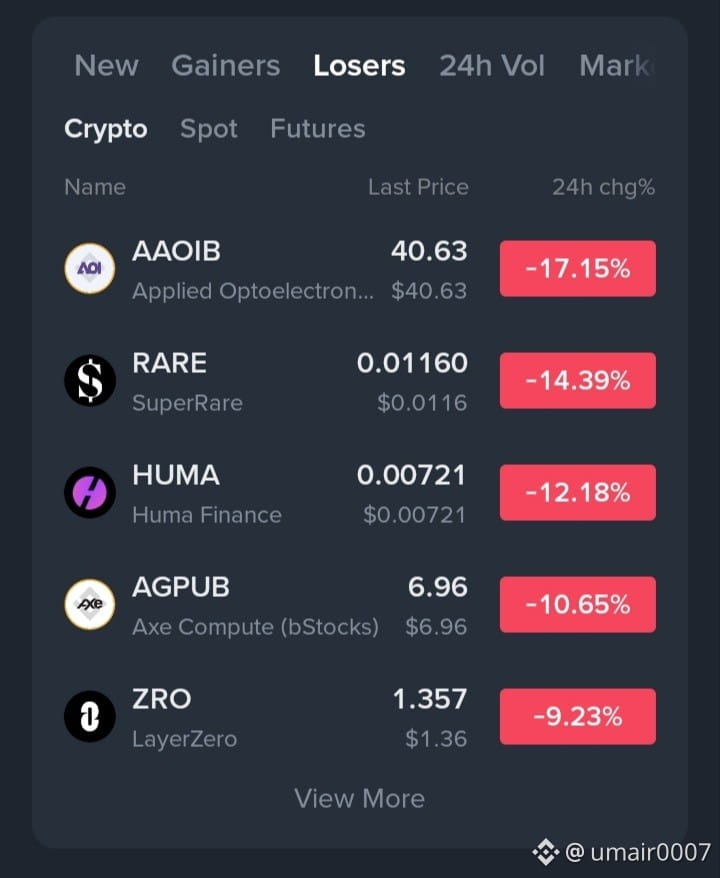
Look at today's visible Binance losers:
- AAOIB: -17.15%
- RARE: -14.39%
- HUMA: -12.18%
- AGPUB: -10.65%
- ZRO: -9.23%
The missing information matters more than the red percentage:
• Selling pressure
• Market liquidity
• Trading volume
• Token supply changes
• Project-related developments
A falling coin can become even cheaper.
Smart analysis starts by understanding the reason behind the decline, not simply looking for the biggest discount.
Do you investigate the reason behind a crash before considering an entry?
$NVDAB
{spot}(NVDABUSDT)
$ARMB
{spot}(ARMBUSDT)
$CAT.US
{stock_us}(CAT.US)
#CryptoAnalysis #Tokenomics #CryptoTrading #TradingEducacion
THE HIDDEN RISK BEHIND BUYING CRYPTO LOSERS 📉
When traders see a coin down 10–17%, their first thought is often:
"It's cheaper now. Maybe it's time to buy."
But there's a problem with that thinking.
A percentage decline tells you how much the price changed. It doesn't explain WHY it changed.
Look at today's visible Binance losers:
- AAOIB: -17.15%
- RARE: -14.39%
- HUMA: -12.18%
- AGPUB: -10.65%
- ZRO: -9.23%
The missing information matters more than the red percentage:
• Selling pressure
• Market liquidity
• Trading volume
• Token supply changes
• Project-related developments
A falling coin can become even cheaper.
Smart analysis starts by understanding the reason behind the decline, not simply looking for the biggest discount.
Do you investigate the reason behind a crash before considering an entry?
$NVDAB
$ARMB
$CAT.US
#CryptoAnalysis #Tokenomics #CryptoTrading #TradingEducacion
196
·
--
Verified
🚨 NEW ON BINANCE: NOT EVERY NEW LISTING IS A CRYPTO PROJECT!
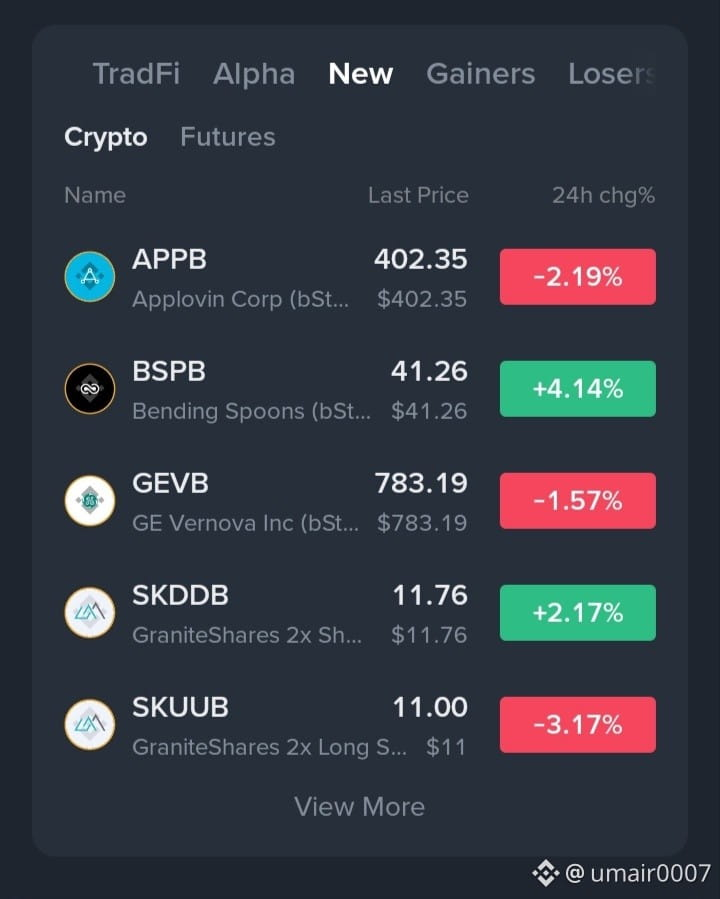
Take a closer look at today's Binance New section.
Here are the assets visible in the screenshot:
🟢 BSPB: +4.14%
🟢 SKDDB: +2.17%
🔴 APPB: -2.19%
🔴 GEVB: -1.57%
🔴 SKUUB: -3.17%
But there's something beginners should notice:
Several of these assets carry the bStocks label.
That means you shouldn't automatically analyze them like ordinary cryptocurrencies.
🔍 What should beginners understand?
1️⃣ Different underlying exposure
Some bStocks products are connected to traditional stock-market assets rather than independent crypto projects.
2️⃣ Green doesn't mean safe
A positive 24-hour change doesn't guarantee future performance.
3️⃣ Understand the product structure
Check what the asset represents, how its price exposure works, and what risks or restrictions apply.
4️⃣ Be careful with leveraged products
Names such as GraniteShares 2X indicate leveraged exposure. Leverage can magnify losses as well as gains.
💡 The lesson
Binance is an exchange where different types of assets and products can appear side by side.
Before researching a new listing, ask:
Am I looking at a cryptocurrency, a tokenized stock product, or a leveraged product?
Understanding that difference is an important part of crypto education.
Did you know that Binance's New section can include bStocks products, not just ordinary crypto tokens?
$LUNC
{spot}(LUNCUSDT)
$UAI
{future}(UAIUSDT)
$BTC
{spot}(BTCUSDT)
#BinanceSquareTalks #cryptoeducation #BStocks #TokenizedAssets #tradingeducation
🚨 NEW ON BINANCE: NOT EVERY NEW LISTING IS A CRYPTO PROJECT!
Take a closer look at today's Binance New section.
Here are the assets visible in the screenshot:
🟢 BSPB: +4.14%
🟢 SKDDB: +2.17%
🔴 APPB: -2.19%
🔴 GEVB: -1.57%
🔴 SKUUB: -3.17%
But there's something beginners should notice:
Several of these assets carry the bStocks label.
That means you shouldn't automatically analyze them like ordinary cryptocurrencies.
🔍 What should beginners understand?
1️⃣ Different underlying exposure
Some bStocks products are connected to traditional stock-market assets rather than independent crypto projects.
2️⃣ Green doesn't mean safe
A positive 24-hour change doesn't guarantee future performance.
3️⃣ Understand the product structure
Check what the asset represents, how its price exposure works, and what risks or restrictions apply.
4️⃣ Be careful with leveraged products
Names such as GraniteShares 2X indicate leveraged exposure. Leverage can magnify losses as well as gains.
💡 The lesson
Binance is an exchange where different types of assets and products can appear side by side.
Before researching a new listing, ask:
Am I looking at a cryptocurrency, a tokenized stock product, or a leveraged product?
Understanding that difference is an important part of crypto education.
Did you know that Binance's New section can include bStocks products, not just ordinary crypto tokens?
$LUNC
$UAI
$BTC
#BinanceSquareTalks #cryptoeducation #BStocks #TokenizedAssets #tradingeducation
1
834
·
--
🚨 BINANCE LOSERS: WHY ARE THESE ASSETS FALLING?
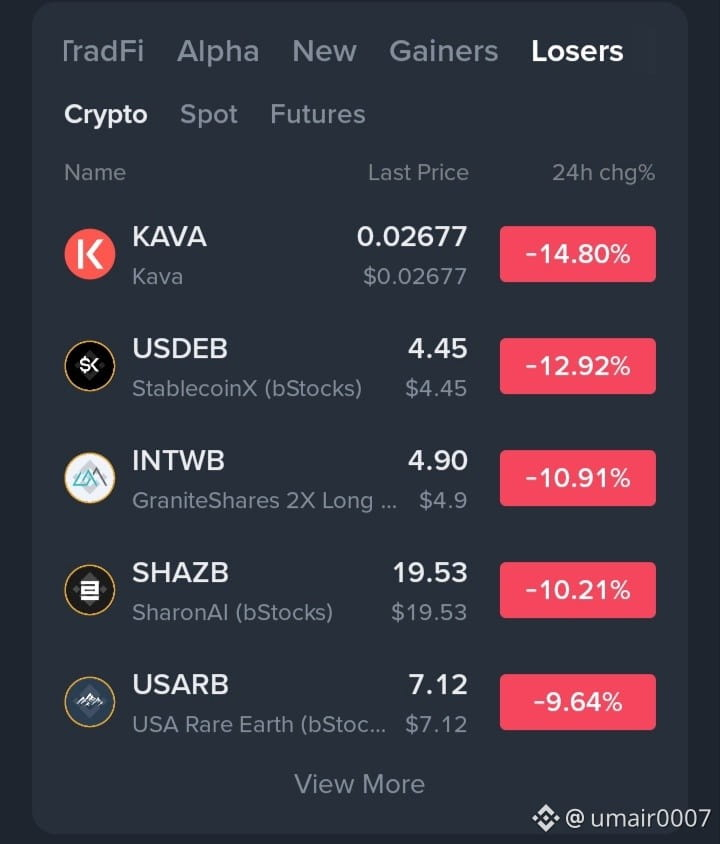
Today's Binance screenshot shows some notable 24-hour declines:
🔻 KAVA: -14.80%
🔻 USDEB: -12.92%
🔻 INTWB: -10.91%
🔻 SHAZB: -10.21%
🔻 USARB: -9.64%
But here's something beginners often overlook:
A red percentage doesn't tell the whole story.
Before judging a falling asset, investigate:
1️⃣ Market category: Is it a regular cryptocurrency or a tokenized stock product?
2️⃣ Trading volume: Is the decline happening alongside unusually high volume?
3️⃣ Liquidity: Can the asset be traded without significant price impact?
4️⃣ Market news: Is there a project-specific or broader market reason behind the decline?
5️⃣ Price structure: Is this a short-term correction or part of a longer downtrend?
⚠️ An important distinction: Several assets in this screenshot carry the "bStocks" label. Don't automatically compare their price movements with ordinary cryptocurrencies. Understand the product and its risks first.
The biggest beginner mistake? Seeing -15% and immediately assuming an asset has become cheap.
A percentage decline alone cannot tell you whether an asset is undervalued or likely to recover.
📚 Learn the reason behind the movement before drawing conclusions.
When you see a coin among Binance's biggest losers, what do you investigate first — volume, news, liquidity, or market structure?
$UAI
{future}(UAIUSDT)
$LUNC
{spot}(LUNCUSDT)
$HUMA
{spot}(HUMAUSDT)
#Binance #cryptoeducation #KAVA #MarketAnalysis #CryptoRisks
🚨 BINANCE LOSERS: WHY ARE THESE ASSETS FALLING?
Today's Binance screenshot shows some notable 24-hour declines:
🔻 KAVA: -14.80%
🔻 USDEB: -12.92%
🔻 INTWB: -10.91%
🔻 SHAZB: -10.21%
🔻 USARB: -9.64%
But here's something beginners often overlook:
A red percentage doesn't tell the whole story.
Before judging a falling asset, investigate:
1️⃣ Market category: Is it a regular cryptocurrency or a tokenized stock product?
2️⃣ Trading volume: Is the decline happening alongside unusually high volume?
3️⃣ Liquidity: Can the asset be traded without significant price impact?
4️⃣ Market news: Is there a project-specific or broader market reason behind the decline?
5️⃣ Price structure: Is this a short-term correction or part of a longer downtrend?
⚠️ An important distinction: Several assets in this screenshot carry the "bStocks" label. Don't automatically compare their price movements with ordinary cryptocurrencies. Understand the product and its risks first.
The biggest beginner mistake? Seeing -15% and immediately assuming an asset has become cheap.
A percentage decline alone cannot tell you whether an asset is undervalued or likely to recover.
📚 Learn the reason behind the movement before drawing conclusions.
When you see a coin among Binance's biggest losers, what do you investigate first — volume, news, liquidity, or market structure?
$UAI
$LUNC
$HUMA
#Binance #cryptoeducation #KAVA #MarketAnalysis #CryptoRisks
12
1
904
·
--
THE TOKEN UNLOCK DATE EVERY BEGINNER SHOULD CHECK 🔓A token can look bullish today — but a major supply unlock could change the market's supply dynamics tomorrow.
What is a token unlock?
Many crypto projects reserve tokens for:
* Team members and founders
* Early investors
* Advisors
* Ecosystem rewards
* Development funds
These tokens may be locked for a specific period. When that period ends, they become eligible to enter circulation.
Why should beginners care?
Imagine a project has 100 million tokens circulating.
Next week, another 20 million tokens are scheduled to unlock.
That represents a potential 20% increase in circulating supply.
But here's the important detail:
Unlocked does not automatically mean sold.
Some recipients may hold their tokens, while others may sell, stake, or use them elsewhere. The actual market impact depends on several factors.
Before studying a token, check these 4 things:
1️⃣ Unlock date: When will the tokens become available?
2️⃣ Unlock percentage: How large is the unlock compared with the current circulating supply?
3️⃣ Token recipients: Are the tokens allocated to investors, the team, or ecosystem incentives?
4️⃣ Vesting schedule: Is it a one-time unlock or a gradual release?
### Where can you check token unlocks?
You can explore token vesting and unlock schedules on platforms such as Tokenomist and CryptoRank. Always cross-check important dates with the project's official announcements.
### The beginner mistake
Many people focus only on price charts, market cap, and trading volume.
But they overlook something equally important: future token supply.
A token unlock doesn't guarantee a price drop. However, understanding upcoming supply changes can help you evaluate a project more carefully.
Remember: Don't just ask how much a token is worth today. Ask how much supply could enter circulation tomorrow.
💬 Question: Before researching a crypto project, do you check its token unlock schedule — or is this something you've overlooked?
$UAI
{future}(UAIUSDT)
$BTC
{spot}(BTCUSDT)
$RARE
{spot}(RAREUSDT)
#cryptoeducation #tokenunlocks #Tokenomics #altcoins #BinanceSquare
THE TOKEN UNLOCK DATE EVERY BEGINNER SHOULD CHECK 🔓
A token can look bullish today — but a major supply unlock could change the market's supply dynamics tomorrow.
What is a token unlock?
Many crypto projects reserve tokens for:
* Team members and founders
* Early investors
* Advisors
* Ecosystem rewards
* Development funds
These tokens may be locked for a specific period. When that period ends, they become eligible to enter circulation.
Why should beginners care?
Imagine a project has 100 million tokens circulating.
Next week, another 20 million tokens are scheduled to unlock.
That represents a potential 20% increase in circulating supply.
But here's the important detail:
Unlocked does not automatically mean sold.
Some recipients may hold their tokens, while others may sell, stake, or use them elsewhere. The actual market impact depends on several factors.
Before studying a token, check these 4 things:
1️⃣ Unlock date: When will the tokens become available?
2️⃣ Unlock percentage: How large is the unlock compared with the current circulating supply?
3️⃣ Token recipients: Are the tokens allocated to investors, the team, or ecosystem incentives?
4️⃣ Vesting schedule: Is it a one-time unlock or a gradual release?
### Where can you check token unlocks?
You can explore token vesting and unlock schedules on platforms such as Tokenomist and CryptoRank. Always cross-check important dates with the project's official announcements.
### The beginner mistake
Many people focus only on price charts, market cap, and trading volume.
But they overlook something equally important: future token supply.
A token unlock doesn't guarantee a price drop. However, understanding upcoming supply changes can help you evaluate a project more carefully.
Remember: Don't just ask how much a token is worth today. Ask how much supply could enter circulation tomorrow.
💬 Question: Before researching a crypto project, do you check its token unlock schedule — or is this something you've overlooked?
$UAI
$BTC
$RARE
#cryptoeducation #tokenunlocks #Tokenomics #altcoins #BinanceSquare
28
·
--
🚨 BITCOIN BELOW $60,000? HERE'S WHAT LEVERAGED TRADERS SHOULD UNDERSTAND.
Imagine Bitcoin approaches a major price level where billions of dollars in leveraged long positions are vulnerable.
What happens next could surprise beginners.
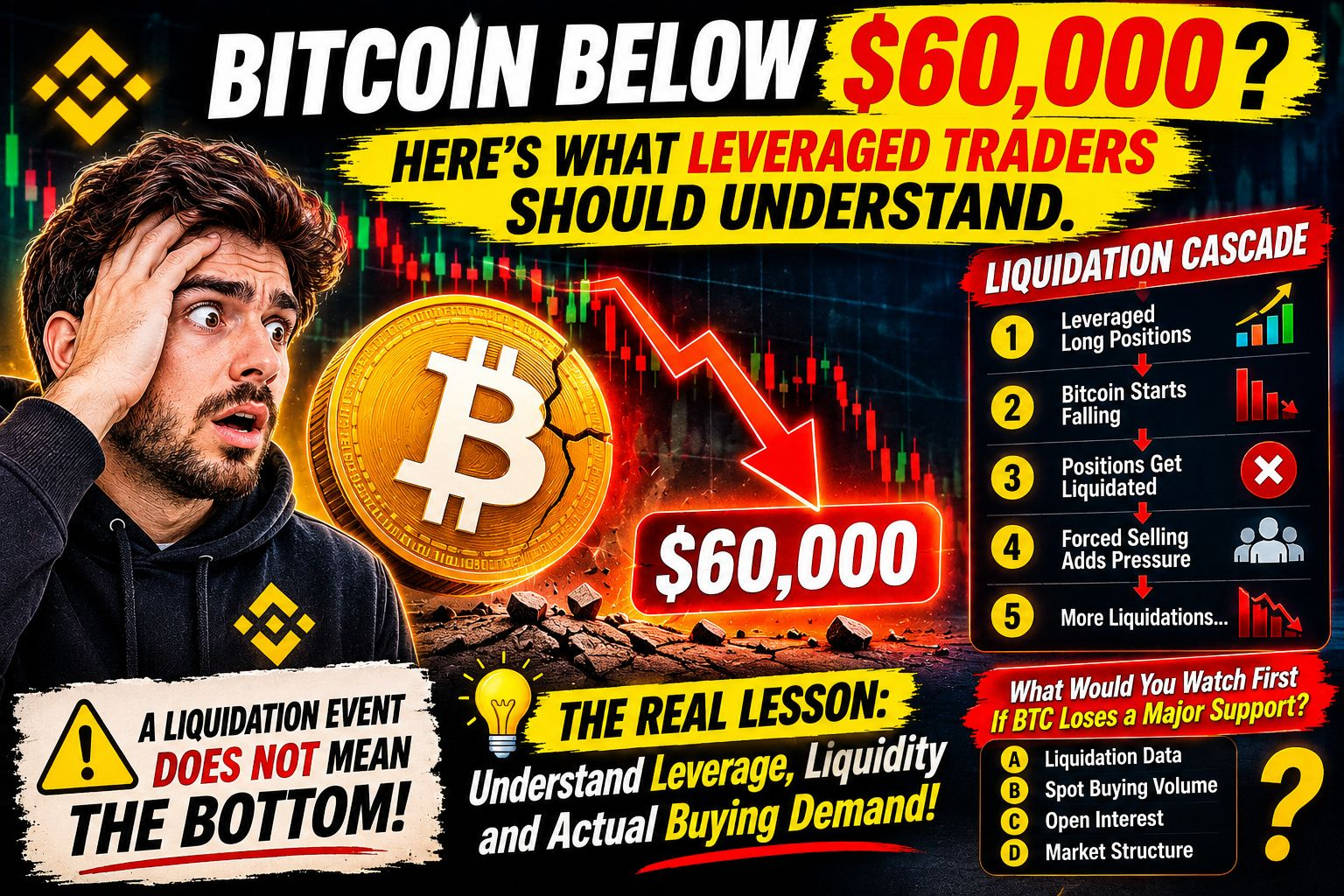
It's called a LIQUIDATION CASCADE.
Here's how it works:
1️⃣ Traders open leveraged long positions using borrowed exposure.
2️⃣ Bitcoin starts falling.
3️⃣ Some positions reach their liquidation prices and get automatically closed.
4️⃣ Forced selling can add more downward pressure.
5️⃣ More leveraged positions may get liquidated as the price falls further.
And suddenly, a normal market correction can become a much sharper move.
But here's the biggest misconception:
A large liquidation event does NOT automatically mean Bitcoin has reached its market bottom.
Why?
Because: • More sellers may still be waiting. • Spot market demand may remain weak. • Market liquidity can change quickly. • Liquidation estimates are not guaranteed outcomes.
🧠 THE REAL LESSON:
Smart market analysis isn't about guessing the exact bottom.
It's about understanding leverage, liquidity, positioning, and actual buying demand.
⚠️ Never buy simply because a price level breaks or leveraged traders get liquidated.
💬 Question:
If Bitcoin loses a major support level, what would you watch first?
A) Liquidation data B) Spot buying volume C) Open interest D) Market structure
Share your reasoning below.
$BTC
{spot}(BTCUSDT)
$SOL
{spot}(SOLUSDT)
$ETH
{spot}(ETHUSDT)
#bitcoin #BTC #cryptoeducation #Liquidations #CryptoMarket
🚨 BITCOIN BELOW $60,000? HERE'S WHAT LEVERAGED TRADERS SHOULD UNDERSTAND.
Imagine Bitcoin approaches a major price level where billions of dollars in leveraged long positions are vulnerable.
What happens next could surprise beginners.
It's called a LIQUIDATION CASCADE.
Here's how it works:
1️⃣ Traders open leveraged long positions using borrowed exposure.
2️⃣ Bitcoin starts falling.
3️⃣ Some positions reach their liquidation prices and get automatically closed.
4️⃣ Forced selling can add more downward pressure.
5️⃣ More leveraged positions may get liquidated as the price falls further.
And suddenly, a normal market correction can become a much sharper move.
But here's the biggest misconception:
A large liquidation event does NOT automatically mean Bitcoin has reached its market bottom.
Why?
Because: • More sellers may still be waiting. • Spot market demand may remain weak. • Market liquidity can change quickly. • Liquidation estimates are not guaranteed outcomes.
🧠 THE REAL LESSON:
Smart market analysis isn't about guessing the exact bottom.
It's about understanding leverage, liquidity, positioning, and actual buying demand.
⚠️ Never buy simply because a price level breaks or leveraged traders get liquidated.
💬 Question:
If Bitcoin loses a major support level, what would you watch first?
A) Liquidation data B) Spot buying volume C) Open interest D) Market structure
Share your reasoning below.
$BTC
$SOL
$ETH
#bitcoin #BTC #cryptoeducation #Liquidations #CryptoMarket
45
Log in to explore more content
Join global crypto users on Binance Square
⚡️ Get latest and useful information about crypto.
💬 Trusted by the world’s largest crypto exchange.
👍 Discover real insights from verified creators.
Email / Phone number
Trending Topics
CorePCEBeatLiftsFedHikeOdds
103,082 views
942 Discussing
U.S. October PCE Price Index at 0.3% Month Over Month, Versus 0.30% Expected and 0.50% Prior
Binance News
·13 Likes
·29.4k views
BitcoinAndStocksSlipAgainAmidTrump’sTariffPlans
170,968 views
1,829 Discussing
JensenHuangSaysNvidiaDoesn’tNeedASuccessionPlan
84,148 views
1,097 Discussing