

#tradfi
tradfi
2.1M views
19,129 Discussing
Hot
Latest

·
--
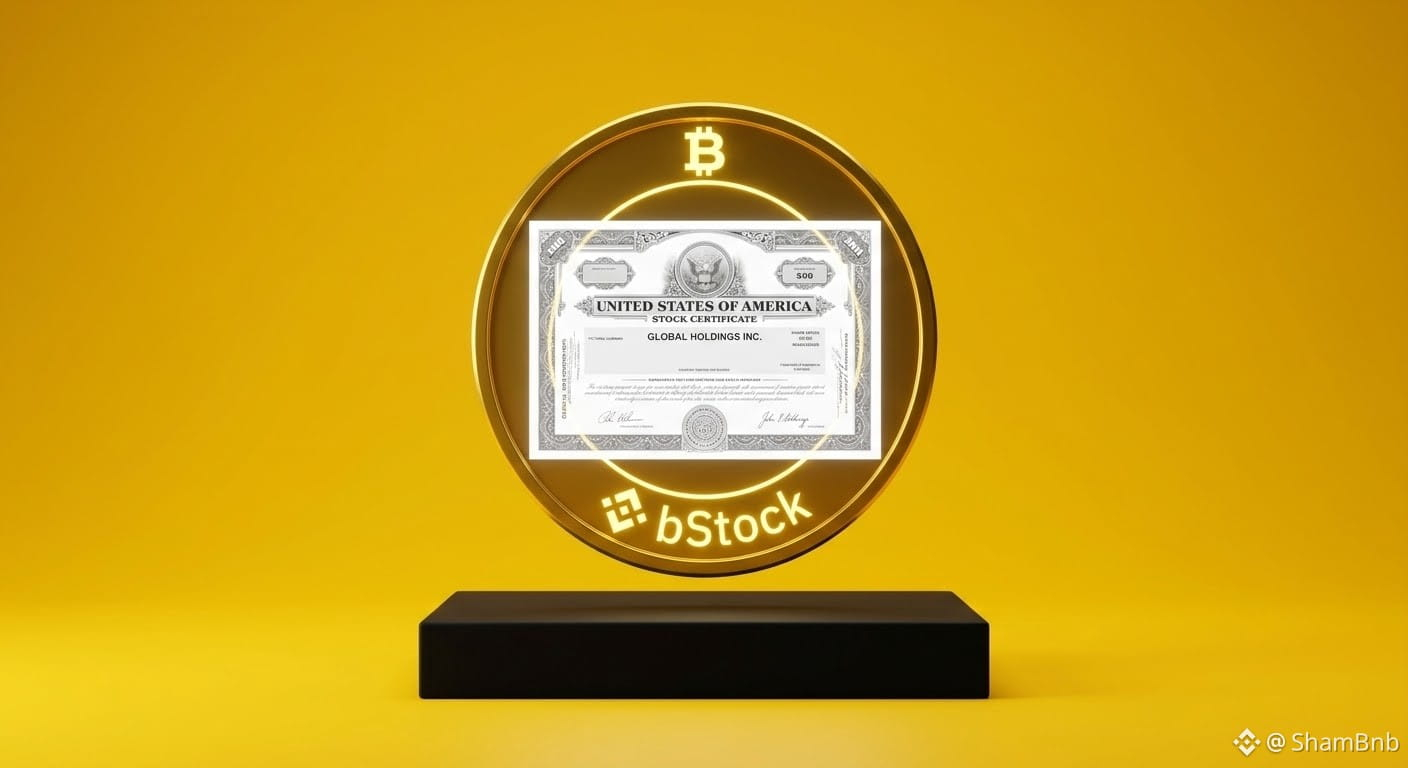
What makes bStocks interesting? 🤔
It’s not only about putting traditional stocks on the blockchain.
bStocks also come with features designed around the flexibility of digital assets. 👇
🔥 1:1 Backed
bStocks are backed 1:1 by real underlying shares, with Proof of Collateral available.
💸 No Transfer Fees
There are no fees for tokenizing eligible stocks or converting them back, while standard Spot trading fees may still apply.
💰 Faster Dividend Reinvestment
Eligible dividends are automatically reinvested on the ex-date, instead of waiting for the traditional payment date.
🌐 24/7 Trading
Unlike traditional stock markets, bStocks can be traded 24/7, including weekends and holidays, with instant settlement.
For me, this is what makes tokenized securities interesting: they bring some of the flexibility of blockchain to traditional financial markets. 🌉
#Binance #bStocks #TradFi #Tokenization #Crypto
What makes bStocks interesting? 🤔
It’s not only about putting traditional stocks on the blockchain.
bStocks also come with features designed around the flexibility of digital assets. 👇
🔥 1:1 Backed
bStocks are backed 1:1 by real underlying shares, with Proof of Collateral available.
💸 No Transfer Fees
There are no fees for tokenizing eligible stocks or converting them back, while standard Spot trading fees may still apply.
💰 Faster Dividend Reinvestment
Eligible dividends are automatically reinvested on the ex-date, instead of waiting for the traditional payment date.
🌐 24/7 Trading
Unlike traditional stock markets, bStocks can be traded 24/7, including weekends and holidays, with instant settlement.
For me, this is what makes tokenized securities interesting: they bring some of the flexibility of blockchain to traditional financial markets. 🌉
#Binance #bStocks #TradFi #Tokenization #Crypto
It’s not only about putting traditional stocks on the blockchain.
bStocks also come with features designed around the flexibility of digital assets. 👇
🔥 1:1 Backed
bStocks are backed 1:1 by real underlying shares, with Proof of Collateral available.
💸 No Transfer Fees
There are no fees for tokenizing eligible stocks or converting them back, while standard Spot trading fees may still apply.
💰 Faster Dividend Reinvestment
Eligible dividends are automatically reinvested on the ex-date, instead of waiting for the traditional payment date.
🌐 24/7 Trading
Unlike traditional stock markets, bStocks can be traded 24/7, including weekends and holidays, with instant settlement.
For me, this is what makes tokenized securities interesting: they bring some of the flexibility of blockchain to traditional financial markets. 🌉
#Binance #bStocks #TradFi #Tokenization #Crypto
2
12
·
--
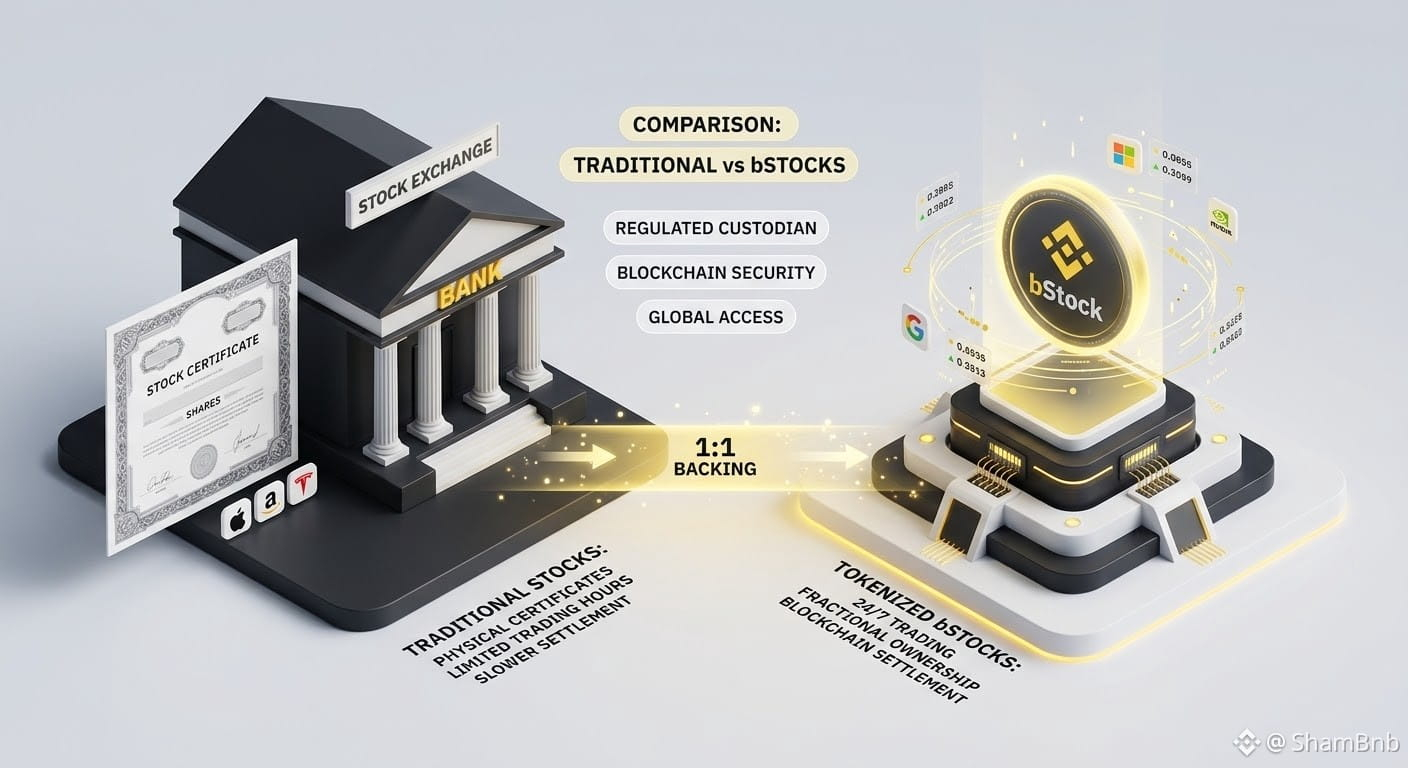
What’s the difference between bStocks and traditional stocks? 🤔
We hear a lot about tokenized stocks, but what is actually different about them?
Let’s start with bStocks. 👇
🔹 What are bStocks?
bStocks are tokenized securities available on Binance.
Each bStock is backed 1:1 by a corresponding real U.S. share held with a regulated custodian.
They are issued under an FSRA-approved Prospectus in the Abu Dhabi Global Market (ADGM) and are among the tokenized securities admitted to the FSRA Official List.
But there is an important point to understand:
bStocks are not the same as directly owning the underlying stock.
They represent an interest in the underlying securities held by the issuer, rather than direct ownership of shares in the company.
So, what does traditional stock ownership actually mean?
Let’s talk about traditional stocks in Part 2. 👀
#Binance #bStocks #TradFi #Stocks #Tokenization #Crypto
What’s the difference between bStocks and traditional stocks? 🤔
We hear a lot about tokenized stocks, but what is actually different about them?
Let’s start with bStocks. 👇
🔹 What are bStocks?
bStocks are tokenized securities available on Binance.
Each bStock is backed 1:1 by a corresponding real U.S. share held with a regulated custodian.
They are issued under an FSRA-approved Prospectus in the Abu Dhabi Global Market (ADGM) and are among the tokenized securities admitted to the FSRA Official List.
But there is an important point to understand:
bStocks are not the same as directly owning the underlying stock.
They represent an interest in the underlying securities held by the issuer, rather than direct ownership of shares in the company.
So, what does traditional stock ownership actually mean?
Let’s talk about traditional stocks in Part 2. 👀
#Binance #bStocks #TradFi #Stocks #Tokenization #Crypto
We hear a lot about tokenized stocks, but what is actually different about them?
Let’s start with bStocks. 👇
🔹 What are bStocks?
bStocks are tokenized securities available on Binance.
Each bStock is backed 1:1 by a corresponding real U.S. share held with a regulated custodian.
They are issued under an FSRA-approved Prospectus in the Abu Dhabi Global Market (ADGM) and are among the tokenized securities admitted to the FSRA Official List.
But there is an important point to understand:
bStocks are not the same as directly owning the underlying stock.
They represent an interest in the underlying securities held by the issuer, rather than direct ownership of shares in the company.
So, what does traditional stock ownership actually mean?
Let’s talk about traditional stocks in Part 2. 👀
#Binance #bStocks #TradFi #Stocks #Tokenization #Crypto
2
39

📈 Tokenized-stock perpetuals remain active as traders track the strongest movers across the equity-linked market. $BE, $OURA and $MVLL lead today’s monitored set, but momentum can reverse quickly as U.S. liquidity and company-specific news shift positioning. Compare volume, funding and intraday structure before choosing an entry, and keep leverage controlled around fast price moves. #TopStockGainers #TradFi #StockMarket #PerpetualFutures #Binance
📈 Tokenized-stock perpetuals remain active as traders track the strongest movers across the equity-linked market. $BE , $OURA and $MVLL lead today’s monitored set, but momentum can reverse quickly as U.S. liquidity and company-specific news shift positioning. Compare volume, funding and intraday structure before choosing an entry, and keep leverage controlled around fast price moves. #TopStockGainers #TradFi #StockMarket #PerpetualFutures #Binance
131

·
--
Article
🚀 Beyond Speculation: How BNB Chain Is Building the Composable Future of TradFiFor years, on-chain activity was dominated by purely crypto-native speculation, But the data from Q3 2026 shows a fundamental paradigm shift: Real-World Assets (RWAs) are turning the blockchain into a true global financial network.
Nowhere is this clearer than in the rise of tokenized equities, and how users are actually interacting with them.
From Passive Holding to Active DeFi Utility
A traditional stock position sits idly in a brokerage account until market hours open, Tokenized stocks on-chain completely flip this model.
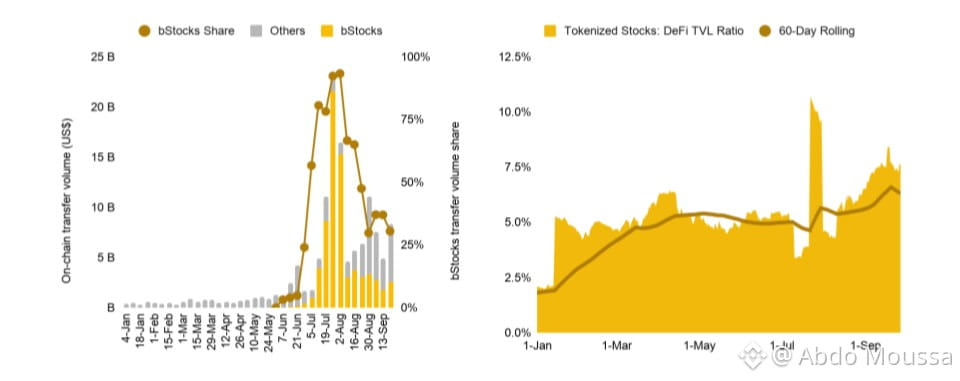
According to recent data from Binance Research:
Surging On-Chain Activity: Tokenized stock transfer volumes jumped from a modest $6B in Q1 to an incredible $100B+ in Q3 2026.Composability in Action: The 60-day rolling DeFi TVL ratio for tokenized stocks more than tripled from 1.8% to 6.3% this year.
Investors aren't just buying equity exposure, they are actively using tokenized shares as collateral in lending markets, pooling liquidity, and generating yield around the clock.
Why BNB Chain Is Leading the Charge
To scale real-world finance to millions of retail users, you need low costs, high throughput, and seamless distribution, This is why BNB Chain has emerged as the premier hub for TradFi on-chain:
#1 in Market Cap: It is the only chain to cross $1B in tokenized stocks (~34% market share).#1 in Adoption: It leads globally with 1.8M holders (~45% of the entire market share).The bStocks Engine: Driven largely by bStocks, the fastest-growing product in the sector—users are experiencing real utility on-chain every single day.
The Big Picture
On-chain finance is no longer a niche playground, With equities trading side-by-side with crypto assets on shared, always-on infrastructure, BNB Chain is actively writing the next chapter of modern finance.
@Binance_Angels #BNBChain #bStocks #RWA #TradFi
🚀 Beyond Speculation: How BNB Chain Is Building the Composable Future of TradFi
For years, on-chain activity was dominated by purely crypto-native speculation, But the data from Q3 2026 shows a fundamental paradigm shift: Real-World Assets (RWAs) are turning the blockchain into a true global financial network.
Nowhere is this clearer than in the rise of tokenized equities, and how users are actually interacting with them.
From Passive Holding to Active DeFi Utility
A traditional stock position sits idly in a brokerage account until market hours open, Tokenized stocks on-chain completely flip this model.
According to recent data from Binance Research:
Surging On-Chain Activity: Tokenized stock transfer volumes jumped from a modest $6B in Q1 to an incredible $100B+ in Q3 2026.Composability in Action: The 60-day rolling DeFi TVL ratio for tokenized stocks more than tripled from 1.8% to 6.3% this year.
Investors aren't just buying equity exposure, they are actively using tokenized shares as collateral in lending markets, pooling liquidity, and generating yield around the clock.
Why BNB Chain Is Leading the Charge
To scale real-world finance to millions of retail users, you need low costs, high throughput, and seamless distribution, This is why BNB Chain has emerged as the premier hub for TradFi on-chain:
#1 in Market Cap: It is the only chain to cross $1B in tokenized stocks (~34% market share).#1 in Adoption: It leads globally with 1.8M holders (~45% of the entire market share).The bStocks Engine: Driven largely by bStocks, the fastest-growing product in the sector—users are experiencing real utility on-chain every single day.
The Big Picture
On-chain finance is no longer a niche playground, With equities trading side-by-side with crypto assets on shared, always-on infrastructure, BNB Chain is actively writing the next chapter of modern finance.
@Binance Angels #BNBChain #bStocks #RWA #TradFi
Nowhere is this clearer than in the rise of tokenized equities, and how users are actually interacting with them.
From Passive Holding to Active DeFi Utility
A traditional stock position sits idly in a brokerage account until market hours open, Tokenized stocks on-chain completely flip this model.
According to recent data from Binance Research:
Surging On-Chain Activity: Tokenized stock transfer volumes jumped from a modest $6B in Q1 to an incredible $100B+ in Q3 2026.Composability in Action: The 60-day rolling DeFi TVL ratio for tokenized stocks more than tripled from 1.8% to 6.3% this year.
Investors aren't just buying equity exposure, they are actively using tokenized shares as collateral in lending markets, pooling liquidity, and generating yield around the clock.
Why BNB Chain Is Leading the Charge
To scale real-world finance to millions of retail users, you need low costs, high throughput, and seamless distribution, This is why BNB Chain has emerged as the premier hub for TradFi on-chain:
#1 in Market Cap: It is the only chain to cross $1B in tokenized stocks (~34% market share).#1 in Adoption: It leads globally with 1.8M holders (~45% of the entire market share).The bStocks Engine: Driven largely by bStocks, the fastest-growing product in the sector—users are experiencing real utility on-chain every single day.
The Big Picture
On-chain finance is no longer a niche playground, With equities trading side-by-side with crypto assets on shared, always-on infrastructure, BNB Chain is actively writing the next chapter of modern finance.
@Binance Angels #BNBChain #bStocks #RWA #TradFi
محمد السليم:
بتوفيق ونجاح استاذنا الغالي
1
5
74

·
--
🚨 $HOOD IGNITES US MARKETS AS 24/7 TRADING BREAKOUT DRIVES 5.4% PUMP! ⚡
TradFi opens green across major indices while institutional liquidity flows into key catalysts. $HOOD surges 5.4% after unleashing 24-hour weekend stock trading, fundamentally reshaping retail market access and bridging the gap between traditional finance and crypto-style round-the-clock volume. 📊
Meanwhile, traditional equity rotations show sharp divergence as $MRNA takes a heavy 7.1% hit following a major rating downgrade to sell. 💡 Capital is aggressively rewarding platforms that capture non-stop order flow as modern traders demand 24/7 liquidity. 💬 Do you see round-the-clock equity access driving massive volume into retail platforms this quarter? 👇
⚠️ Not financial advice. Always manage your risk. 🛡️
🏷️ #HOOD #TradFi #Stocks #MarketUpdate
⚡ 💎
🚨 $HOOD IGNITES US MARKETS AS 24/7 TRADING BREAKOUT DRIVES 5.4% PUMP! ⚡
TradFi opens green across major indices while institutional liquidity flows into key catalysts. $HOOD surges 5.4% after unleashing 24-hour weekend stock trading, fundamentally reshaping retail market access and bridging the gap between traditional finance and crypto-style round-the-clock volume. 📊
Meanwhile, traditional equity rotations show sharp divergence as $MRNA takes a heavy 7.1% hit following a major rating downgrade to sell. 💡 Capital is aggressively rewarding platforms that capture non-stop order flow as modern traders demand 24/7 liquidity. 💬 Do you see round-the-clock equity access driving massive volume into retail platforms this quarter? 👇
⚠️ Not financial advice. Always manage your risk. 🛡️
🏷️ #HOOD #TradFi #Stocks #MarketUpdate
⚡ 💎
TradFi opens green across major indices while institutional liquidity flows into key catalysts. $HOOD surges 5.4% after unleashing 24-hour weekend stock trading, fundamentally reshaping retail market access and bridging the gap between traditional finance and crypto-style round-the-clock volume. 📊
Meanwhile, traditional equity rotations show sharp divergence as $MRNA takes a heavy 7.1% hit following a major rating downgrade to sell. 💡 Capital is aggressively rewarding platforms that capture non-stop order flow as modern traders demand 24/7 liquidity. 💬 Do you see round-the-clock equity access driving massive volume into retail platforms this quarter? 👇
⚠️ Not financial advice. Always manage your risk. 🛡️
🏷️ #HOOD #TradFi #Stocks #MarketUpdate
⚡ 💎
113

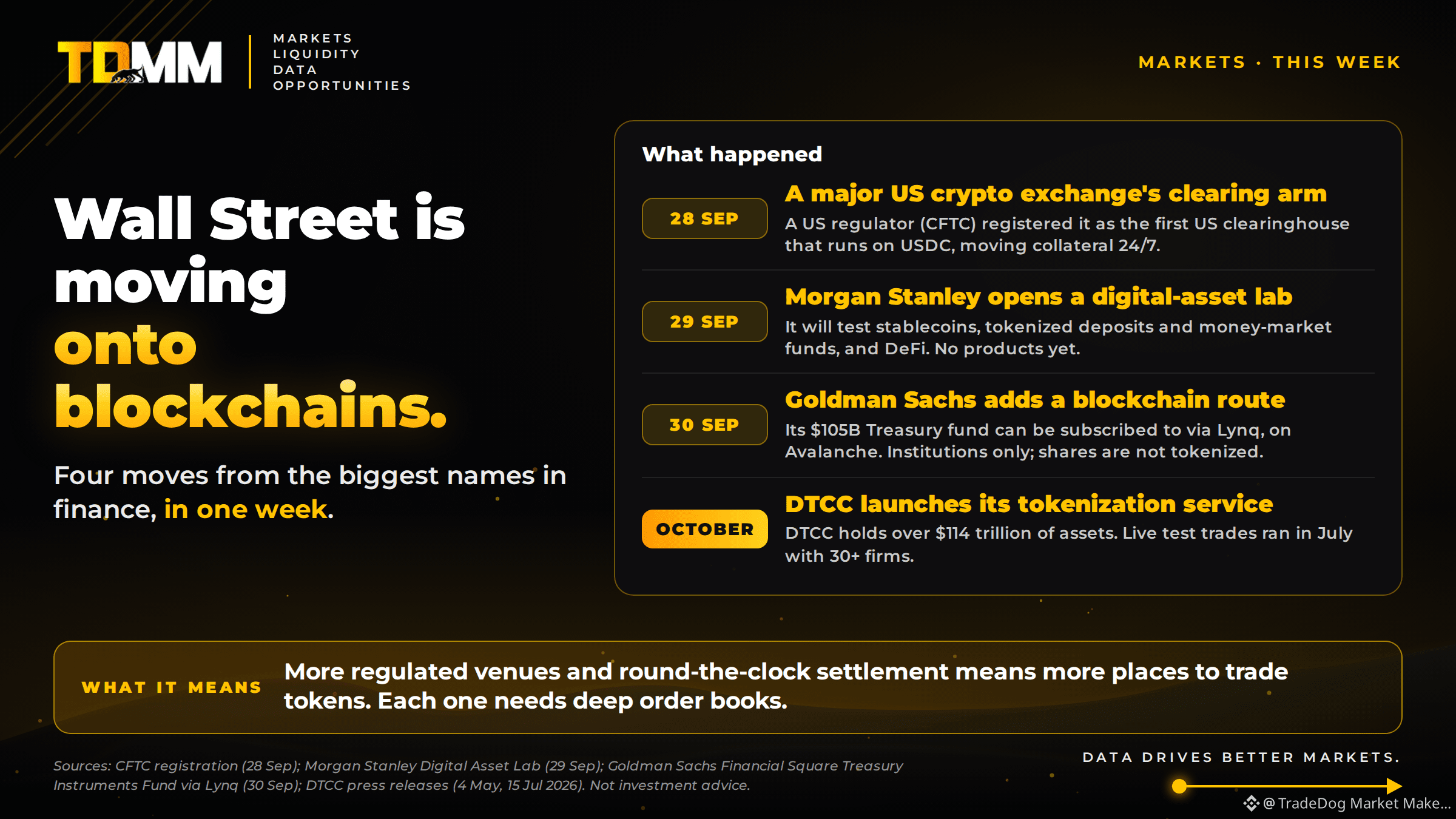
🏦 Wall Street is moving onto blockchains. 4 moves this week:
28 Sep: a major US crypto exchange's clearing arm was registered by the CFTC, the first US clearinghouse that runs on $USDC
29 Sep: Morgan Stanley opens a digital-asset lab
30 Sep: Goldman's $105B Treasury fund adds a route via Lynq on Avalanche ($AVAX ), institutions only
Oct: DTCC tokenization service launches (it holds over $114 trillion of assets)
💡 More regulated venues and 24/7 settlement = more places where tokens trade. Each one needs deep order books.
Which one changes crypto markets the most? 👇
#Tokenization #USDC #TradFi
Sources: CFTC, Morgan Stanley, Goldman Sachs, DTCC. Not financial advice. DYOR.
🏦 Wall Street is moving onto blockchains. 4 moves this week:
28 Sep: a major US crypto exchange's clearing arm was registered by the CFTC, the first US clearinghouse that runs on $USDC
29 Sep: Morgan Stanley opens a digital-asset lab
30 Sep: Goldman's $105B Treasury fund adds a route via Lynq on Avalanche ($AVAX ), institutions only
Oct: DTCC tokenization service launches (it holds over $114 trillion of assets)
💡 More regulated venues and 24/7 settlement = more places where tokens trade. Each one needs deep order books.
Which one changes crypto markets the most? 👇
#Tokenization #USDC #TradFi
Sources: CFTC, Morgan Stanley, Goldman Sachs, DTCC. Not financial advice. DYOR.
28 Sep: a major US crypto exchange's clearing arm was registered by the CFTC, the first US clearinghouse that runs on $USDC
29 Sep: Morgan Stanley opens a digital-asset lab
30 Sep: Goldman's $105B Treasury fund adds a route via Lynq on Avalanche ($AVAX ), institutions only
Oct: DTCC tokenization service launches (it holds over $114 trillion of assets)
💡 More regulated venues and 24/7 settlement = more places where tokens trade. Each one needs deep order books.
Which one changes crypto markets the most? 👇
#Tokenization #USDC #TradFi
Sources: CFTC, Morgan Stanley, Goldman Sachs, DTCC. Not financial advice. DYOR.
2
101

·
--
Bullish
📈 Bridging TradFi & Crypto: The Future of On-Chain Assets! 🌐
The financial world is evolving rapidly! Traditional Finance (TradFi) and Web3 are coming together, bringing real-world assets like stocks, IPOs, and tokenized equity directly onto the blockchain.
Here is why this shift is a massive game-changer:
✨ 24/7 Market Access: No more waiting for traditional market opening hours.
✨ Enhanced Liquidity: Seamlessly trade tokenized assets anywhere, anytime.
✨ Fractional Ownership: Invest in high-value assets without needing massive capital.
As Web3 continues to bridge the gap with TradFi, the opportunities for traders and investors are bigger than ever! 🚀
How do you see the future of tokenized assets shaping crypto? Drop your thoughts below! 👇
#Binance #Write2Earn #TradFi #cryptotradingpro #Web3
📈 Bridging TradFi & Crypto: The Future of On-Chain Assets! 🌐
The financial world is evolving rapidly! Traditional Finance (TradFi) and Web3 are coming together, bringing real-world assets like stocks, IPOs, and tokenized equity directly onto the blockchain.
Here is why this shift is a massive game-changer:
✨ 24/7 Market Access: No more waiting for traditional market opening hours.
✨ Enhanced Liquidity: Seamlessly trade tokenized assets anywhere, anytime.
✨ Fractional Ownership: Invest in high-value assets without needing massive capital.
As Web3 continues to bridge the gap with TradFi, the opportunities for traders and investors are bigger than ever! 🚀
How do you see the future of tokenized assets shaping crypto? Drop your thoughts below! 👇
#Binance #Write2Earn #TradFi #cryptotradingpro #Web3
The financial world is evolving rapidly! Traditional Finance (TradFi) and Web3 are coming together, bringing real-world assets like stocks, IPOs, and tokenized equity directly onto the blockchain.
Here is why this shift is a massive game-changer:
✨ 24/7 Market Access: No more waiting for traditional market opening hours.
✨ Enhanced Liquidity: Seamlessly trade tokenized assets anywhere, anytime.
✨ Fractional Ownership: Invest in high-value assets without needing massive capital.
As Web3 continues to bridge the gap with TradFi, the opportunities for traders and investors are bigger than ever! 🚀
How do you see the future of tokenized assets shaping crypto? Drop your thoughts below! 👇
#Binance #Write2Earn #TradFi #cryptotradingpro #Web3
58
🚀🚀🚀 TradFi Focus 🚀🚀🚀
When reviewing TradFi perpetuals, focus on liquidity, funding, spread and execution during active sessions. Product access is useful only when risk controls stay disciplined.
$TSLA $NVDA $MSTR
#TradFi #RWA #StockMarket #TokenizedStocks #BinanceFutures
🚀🚀🚀 TradFi Focus 🚀🚀🚀
When reviewing TradFi perpetuals, focus on liquidity, funding, spread and execution during active sessions. Product access is useful only when risk controls stay disciplined.
$TSLA $NVDA $MSTR
#TradFi #RWA #StockMarket #TokenizedStocks #BinanceFutures
When reviewing TradFi perpetuals, focus on liquidity, funding, spread and execution during active sessions. Product access is useful only when risk controls stay disciplined.
$TSLA $NVDA $MSTR
#TradFi #RWA #StockMarket #TokenizedStocks #BinanceFutures
459

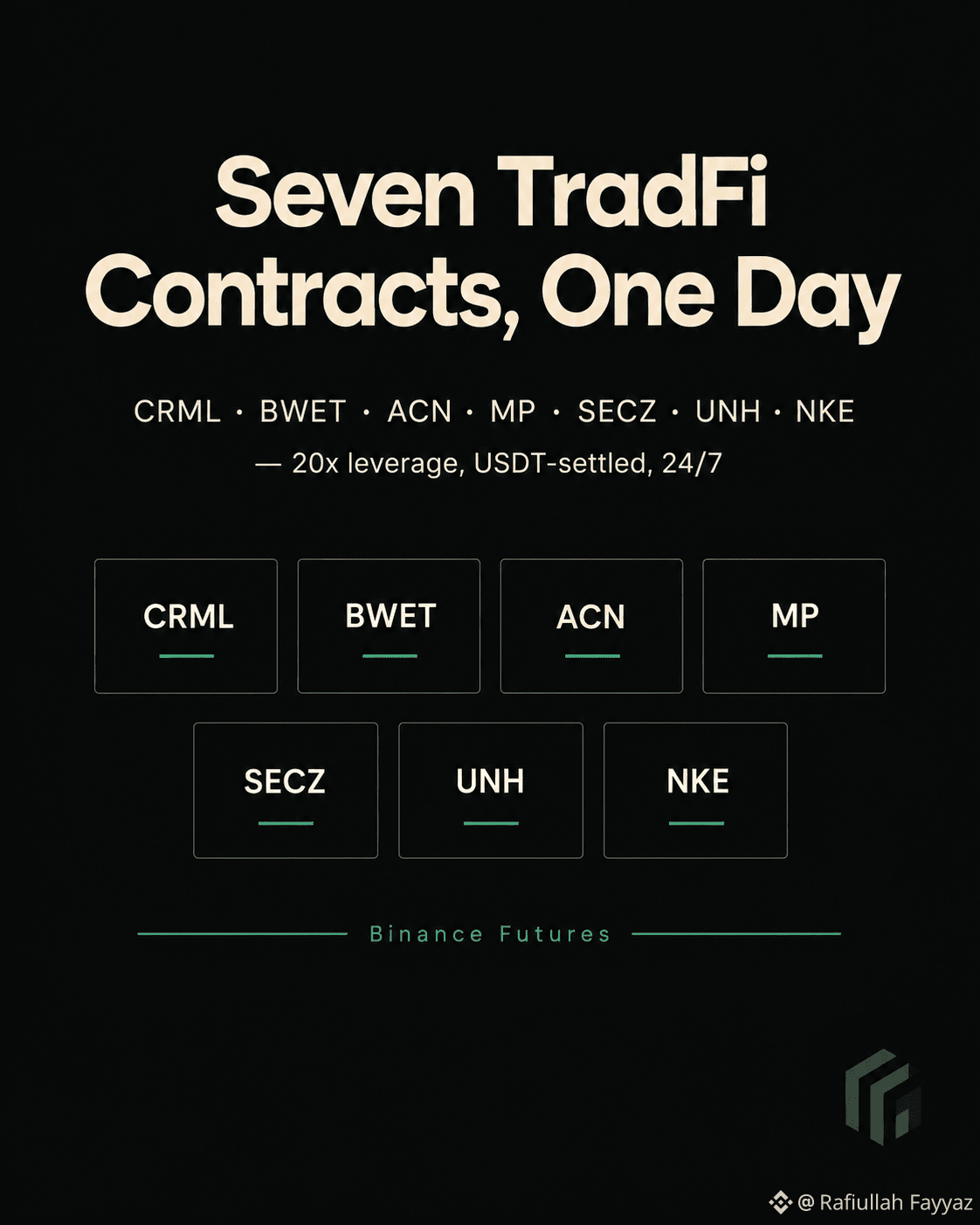
Binance listed seven TradFi perpetual contracts today — all at once.
The contracts: Critical Metals Corp ( $CRML ), Breakwave Tanker Shipping ETF ( $BWET ), Accenture ( $ACN ), MP Materials ( $MP ), Securitize ( $SECZ ), UnitedHealth ( $UNH ), and Nike ( $NKE ).
All launched between 17:00 and 17:30 Beijing time. Up to 20x leverage. Settled in USDT.
This is the largest single-day TradFi futures listing on Binance so far. Seven contracts covering mining, shipping, consulting, healthcare, and consumer brands — all tradeable 24/7 with leverage.
Why this matters: Binance is building a bridge between crypto traders and traditional markets. These aren't crypto tokens. They're equity exposure wrapped in perpetual contracts. The infrastructure lets crypto-native traders express views on Nike or UnitedHealth without leaving the platform.
The question I'm watching: does this bring traditional traders into crypto, or does it just give crypto traders more to speculate on? Either way, the product is expanding.
#Binance #TradFi #Futures
{future}(CRMLUSDT)
{future}(SECZUSDT)
{future}(UNHUSDT)
Binance listed seven TradFi perpetual contracts today — all at once.
The contracts: Critical Metals Corp ( $CRML ), Breakwave Tanker Shipping ETF ( $BWET ), Accenture ( $ACN ), MP Materials ( $MP ), Securitize ( $SECZ ), UnitedHealth ( $UNH ), and Nike ( $NKE ).
All launched between 17:00 and 17:30 Beijing time. Up to 20x leverage. Settled in USDT.
This is the largest single-day TradFi futures listing on Binance so far. Seven contracts covering mining, shipping, consulting, healthcare, and consumer brands — all tradeable 24/7 with leverage.
Why this matters: Binance is building a bridge between crypto traders and traditional markets. These aren't crypto tokens. They're equity exposure wrapped in perpetual contracts. The infrastructure lets crypto-native traders express views on Nike or UnitedHealth without leaving the platform.
The question I'm watching: does this bring traditional traders into crypto, or does it just give crypto traders more to speculate on? Either way, the product is expanding.
#Binance #TradFi #Futures
The contracts: Critical Metals Corp ( $CRML ), Breakwave Tanker Shipping ETF ( $BWET ), Accenture ( $ACN ), MP Materials ( $MP ), Securitize ( $SECZ ), UnitedHealth ( $UNH ), and Nike ( $NKE ).
All launched between 17:00 and 17:30 Beijing time. Up to 20x leverage. Settled in USDT.
This is the largest single-day TradFi futures listing on Binance so far. Seven contracts covering mining, shipping, consulting, healthcare, and consumer brands — all tradeable 24/7 with leverage.
Why this matters: Binance is building a bridge between crypto traders and traditional markets. These aren't crypto tokens. They're equity exposure wrapped in perpetual contracts. The infrastructure lets crypto-native traders express views on Nike or UnitedHealth without leaving the platform.
The question I'm watching: does this bring traditional traders into crypto, or does it just give crypto traders more to speculate on? Either way, the product is expanding.
#Binance #TradFi #Futures
505


100 billion dollars just entered the crypto rails. Goldman Sachs is wiring its massive Treasury fund directly into on-chain plumbing. This is major institutional adoption playing out in real-time. Watch for tokenized yield adoption and new liquidity flows across the sector. $GS #Write2Earn #CryptoNews #Treasury #TradFi
100 billion dollars just entered the crypto rails. Goldman Sachs is wiring its massive Treasury fund directly into on-chain plumbing. This is major institutional adoption playing out in real-time. Watch for tokenized yield adoption and new liquidity flows across the sector. $GS #Write2Earn #CryptoNews #Treasury #TradFi
100
🚀🚀🚀 TradFi Focus 🚀🚀🚀
TradFi perpetuals may serve as a tactical sleeve rather than a core holding. Keep exposure small, monitor correlations and separate short-term trades from investments.
$TSLA $NVDA $MSTR
#TradFi #RWA #StockMarket #TokenizedStocks #BinanceFutures
🚀🚀🚀 TradFi Focus 🚀🚀🚀
TradFi perpetuals may serve as a tactical sleeve rather than a core holding. Keep exposure small, monitor correlations and separate short-term trades from investments.
$TSLA $NVDA $MSTR
#TradFi #RWA #StockMarket #TokenizedStocks #BinanceFutures
TradFi perpetuals may serve as a tactical sleeve rather than a core holding. Keep exposure small, monitor correlations and separate short-term trades from investments.
$TSLA $NVDA $MSTR
#TradFi #RWA #StockMarket #TokenizedStocks #BinanceFutures
232

·
--
🚀 Binance Is Bringing Crypto & Stocks Closer Together!
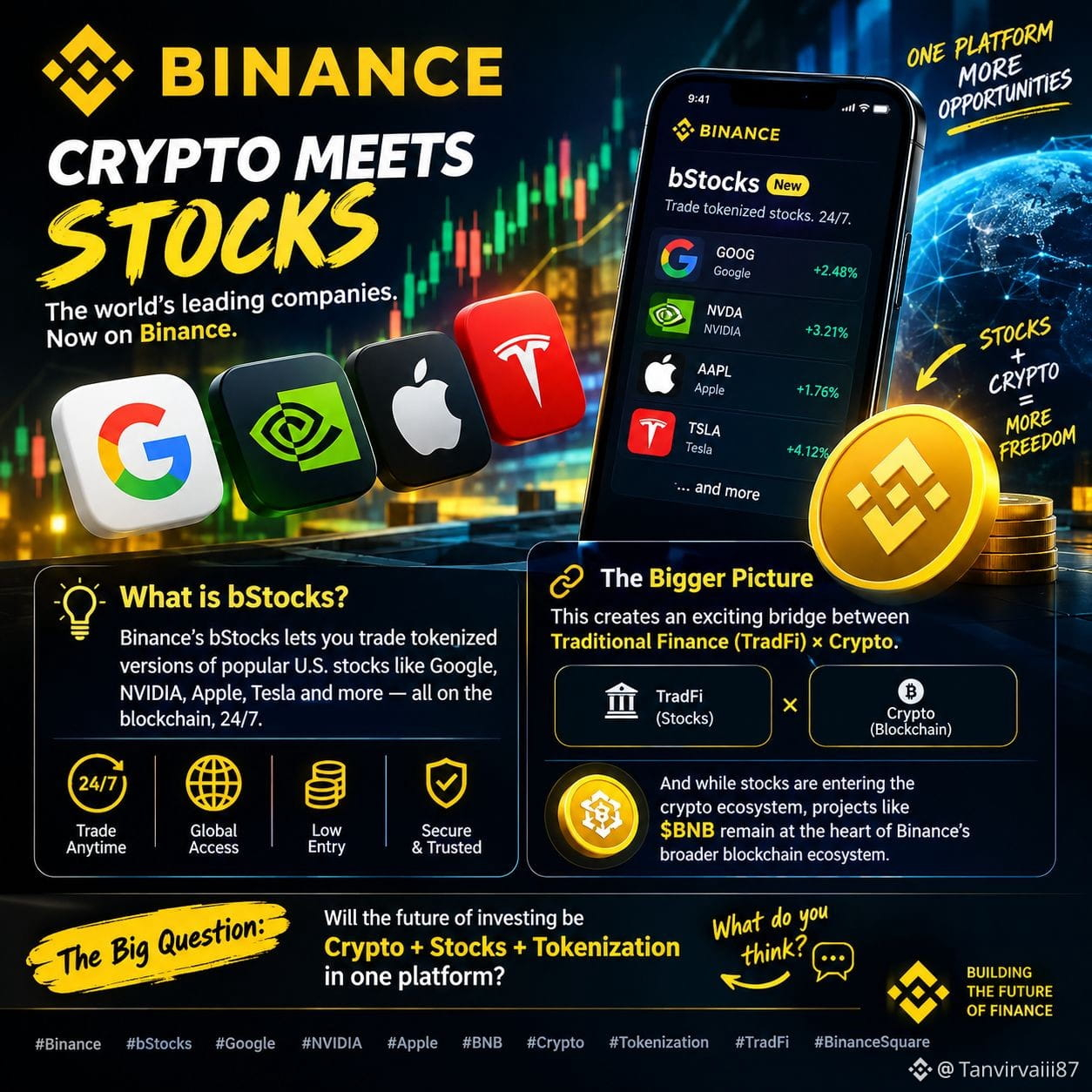
The financial world is changing fast. Binance is expanding beyond traditional crypto and bringing exposure to major global companies like $GOOGL.US , $NVDA.US , $AAPL.US , $Tesla & more through its bStocks ecosystem. 📈🌐
This creates an interesting bridge between Traditional Finance (TradFi) × Crypto.
And while stocks are entering the crypto ecosystem, projects like $BNB remain at the heart of Binance’s broader blockchain ecosystem. 🔶
💡 The big question:
Will the future of investing be Crypto + Stocks + Tokenization in one platform?
What do you think? drop your on comment box👇
#Binance #bStocks #Google #NVIDIA #Apple #bnb #crypto #Tokenization #TradFi #BinanceSquare
🚀 Binance Is Bringing Crypto & Stocks Closer Together!
The financial world is changing fast. Binance is expanding beyond traditional crypto and bringing exposure to major global companies like $GOOGL.US , $NVDA.US , $AAPL.US , $Tesla & more through its bStocks ecosystem. 📈🌐
This creates an interesting bridge between Traditional Finance (TradFi) × Crypto.
And while stocks are entering the crypto ecosystem, projects like $BNB remain at the heart of Binance’s broader blockchain ecosystem. 🔶
💡 The big question:
Will the future of investing be Crypto + Stocks + Tokenization in one platform?
What do you think? drop your on comment box👇
#Binance #bStocks #Google #NVIDIA #Apple #bnb #crypto #Tokenization #TradFi #BinanceSquare
The financial world is changing fast. Binance is expanding beyond traditional crypto and bringing exposure to major global companies like $GOOGL.US , $NVDA.US , $AAPL.US , $Tesla & more through its bStocks ecosystem. 📈🌐
This creates an interesting bridge between Traditional Finance (TradFi) × Crypto.
And while stocks are entering the crypto ecosystem, projects like $BNB remain at the heart of Binance’s broader blockchain ecosystem. 🔶
💡 The big question:
Will the future of investing be Crypto + Stocks + Tokenization in one platform?
What do you think? drop your on comment box👇
#Binance #bStocks #Google #NVIDIA #Apple #bnb #crypto #Tokenization #TradFi #BinanceSquare
AAPLUS+0.35%
NVDAUS+1.38%
GOOGLUS+2.53%
95
·
--
🥇 What Are TradFi Perpetual Contracts?
You may have heard about Perpetual Contracts in crypto, but did you know that similar products can also give traders exposure to certain traditional financial markets? 🤔
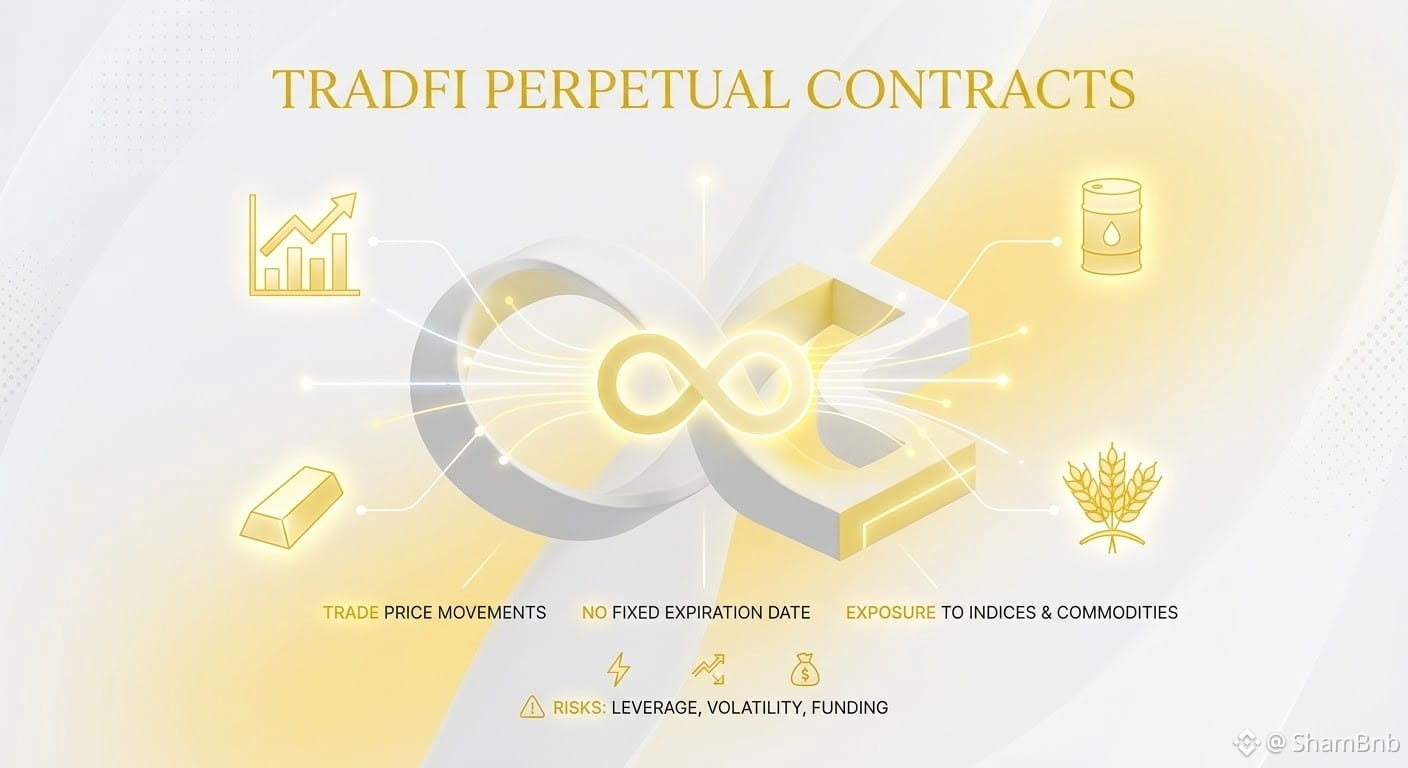
Simply put, perpetual contracts allow you to trade the price movement of an underlying asset without owning the asset itself. Unlike traditional futures, they do not have a fixed expiration date.
So, what does this mean for TradFi products?
The underlying assets can be linked to traditional markets such as indices, commodities and other available assets.
But there is one important point:
You are not buying the underlying asset. You are trading a contract that tracks its price, which means there are risks related to leverage, volatility and funding.
That’s why it’s important to understand how the contract works, its fees, funding and risks before using it.
#CryptoEducation💡🚀 #TradFi
🥇 What Are TradFi Perpetual Contracts?
You may have heard about Perpetual Contracts in crypto, but did you know that similar products can also give traders exposure to certain traditional financial markets? 🤔
Simply put, perpetual contracts allow you to trade the price movement of an underlying asset without owning the asset itself. Unlike traditional futures, they do not have a fixed expiration date.
So, what does this mean for TradFi products?
The underlying assets can be linked to traditional markets such as indices, commodities and other available assets.
But there is one important point:
You are not buying the underlying asset. You are trading a contract that tracks its price, which means there are risks related to leverage, volatility and funding.
That’s why it’s important to understand how the contract works, its fees, funding and risks before using it.
#CryptoEducation💡🚀 #TradFi
You may have heard about Perpetual Contracts in crypto, but did you know that similar products can also give traders exposure to certain traditional financial markets? 🤔
Simply put, perpetual contracts allow you to trade the price movement of an underlying asset without owning the asset itself. Unlike traditional futures, they do not have a fixed expiration date.
So, what does this mean for TradFi products?
The underlying assets can be linked to traditional markets such as indices, commodities and other available assets.
But there is one important point:
You are not buying the underlying asset. You are trading a contract that tracks its price, which means there are risks related to leverage, volatility and funding.
That’s why it’s important to understand how the contract works, its fees, funding and risks before using it.
#CryptoEducation💡🚀 #TradFi
4
72

·
--
I opened the app yesterday to show my friend something, and I didn’t expect such a reaction 😄
He’s been in the market for 10 years—everything is classic: dividends, blue-chip stocks. About my crypto, he always said: "you’re playing, and I’m investing."
I showed him the S&P 500 via TradFi on Binance. The very same asset he holds through a broker, just here—it’s next to the rest of my crypto.
Right away he asked: "is it definitely the same?" I honestly said— not quite; it’s access through the platform, not direct ownership, so it’s worth understanding the difference.
He liked it that you don’t have to wait for the exchange to open and have a separate account. I liked that I finally didn’t hear the word "casino" 😅
I don’t move much into it myself; it’s not the main part of my portfolio. But when everything is in one window, you start looking at it differently.
He didn’t buy anything, and that’s fine. But for the first time, he actually started thinking.
Have you had similar conversations with skeptics? 👇
not financial advice, my experience
#TradFi #Binance #BinanceUkraine
I opened the app yesterday to show my friend something, and I didn’t expect such a reaction 😄
He’s been in the market for 10 years—everything is classic: dividends, blue-chip stocks. About my crypto, he always said: "you’re playing, and I’m investing."
I showed him the S&P 500 via TradFi on Binance. The very same asset he holds through a broker, just here—it’s next to the rest of my crypto.
Right away he asked: "is it definitely the same?" I honestly said— not quite; it’s access through the platform, not direct ownership, so it’s worth understanding the difference.
He liked it that you don’t have to wait for the exchange to open and have a separate account. I liked that I finally didn’t hear the word "casino" 😅
I don’t move much into it myself; it’s not the main part of my portfolio. But when everything is in one window, you start looking at it differently.
He didn’t buy anything, and that’s fine. But for the first time, he actually started thinking.
Have you had similar conversations with skeptics? 👇
not financial advice, my experience
#TradFi #Binance #BinanceUkraine
He’s been in the market for 10 years—everything is classic: dividends, blue-chip stocks. About my crypto, he always said: "you’re playing, and I’m investing."
I showed him the S&P 500 via TradFi on Binance. The very same asset he holds through a broker, just here—it’s next to the rest of my crypto.
Right away he asked: "is it definitely the same?" I honestly said— not quite; it’s access through the platform, not direct ownership, so it’s worth understanding the difference.
He liked it that you don’t have to wait for the exchange to open and have a separate account. I liked that I finally didn’t hear the word "casino" 😅
I don’t move much into it myself; it’s not the main part of my portfolio. But when everything is in one window, you start looking at it differently.
He didn’t buy anything, and that’s fine. But for the first time, he actually started thinking.
Have you had similar conversations with skeptics? 👇
not financial advice, my experience
#TradFi #Binance #BinanceUkraine
64

·
--
Article
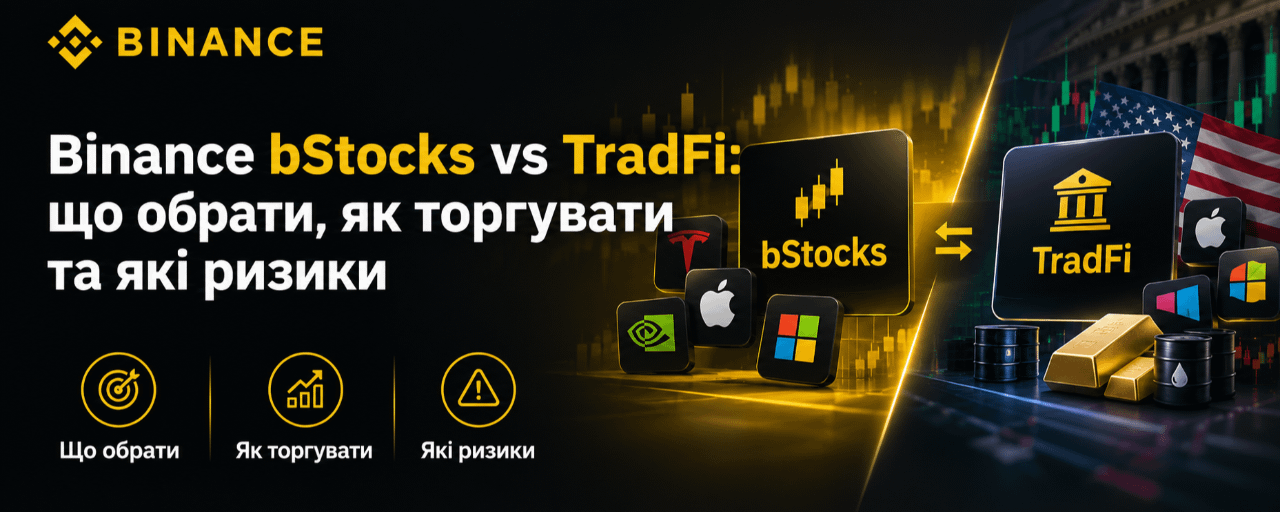
Binance bStocks vs TradFi: what to choose, how to trade, and what risksWhich assets should you choose if you want to diversify your portfolio so you’re not completely dependent on the cryptocurrency market — Binance #BStocks or Binance #TradFi ?
bStocks — closer to standard ownership of an asset
bStocks are tokenized securities, each of which is backed by the corresponding underlying asset in a 1:1 ratio. At the same time, bStock is not legally a regular stock and does not provide direct ownership rights to the share, but they precisely track the stock price. bStocks trade on Binance Spot and are available 24/7, including during periods when the traditional stock market is closed.
Binance bStocks vs TradFi: what to choose, how to trade, and what risks
Which assets should you choose if you want to diversify your portfolio so you’re not completely dependent on the cryptocurrency market — Binance #BStocks or Binance #TradFi ?
bStocks — closer to standard ownership of an asset
bStocks are tokenized securities, each of which is backed by the corresponding underlying asset in a 1:1 ratio. At the same time, bStock is not legally a regular stock and does not provide direct ownership rights to the share, but they precisely track the stock price. bStocks trade on Binance Spot and are available 24/7, including during periods when the traditional stock market is closed.
bStocks — closer to standard ownership of an asset
bStocks are tokenized securities, each of which is backed by the corresponding underlying asset in a 1:1 ratio. At the same time, bStock is not legally a regular stock and does not provide direct ownership rights to the share, but they precisely track the stock price. bStocks trade on Binance Spot and are available 24/7, including during periods when the traditional stock market is closed.
95

·
--
#TradFi trading is just as easy as crypto. But there are a few nuances. First of all, it’s the amount of investment. Since stocks move slower than crypto, to make a noticeable profit you need to invest more—at least $100, better $1000, in my opinion. This doesn’t mean there’s absolutely nothing to do with a small deposit, but you also shouldn’t count on x’s. Second, on weekends this market almost freezes, so opening a position on Friday is for patient players.
#TradFi trading is just as easy as crypto. But there are a few nuances. First of all, it’s the amount of investment. Since stocks move slower than crypto, to make a noticeable profit you need to invest more—at least $100, better $1000, in my opinion. This doesn’t mean there’s absolutely nothing to do with a small deposit, but you also shouldn’t count on x’s. Second, on weekends this market almost freezes, so opening a position on Friday is for patient players.
112

📊 Three products — three different roles in your financial plan
I look at asset allocation not only through potential returns, but also through the function of each instrument.
🔹 bStocks
For studying tokenized exposure to traditional stocks. It’s important to remember that a token is not direct ownership of the stock.
🔹 TradFi Perpetuals
An instrument for trading changes in the price of traditional assets. Through margin and potential leverage, it requires a separate approach to risk.
🔹 Binance Earn
Products for earning rewards based on specific conditions. You need to check rates, terms, fund availability, and the risks of the underlying asset.
📌 My portfolio-building principle:
1. Don’t mix savings and speculative capital.
2. Don’t use leverage without understanding the liquidation mechanics.
3. Don’t treat APY as guaranteed income.
4. Don’t invest money you can’t afford to lose without financial difficulty.
5. Regularly review product terms.
The instrument should fit the goal, not the other way around.
Which Binance products are you researching this month?
#bStocks #TradFi #BinanceEarn
📊 Three products — three different roles in your financial plan
I look at asset allocation not only through potential returns, but also through the function of each instrument.
🔹 bStocks
For studying tokenized exposure to traditional stocks. It’s important to remember that a token is not direct ownership of the stock.
🔹 TradFi Perpetuals
An instrument for trading changes in the price of traditional assets. Through margin and potential leverage, it requires a separate approach to risk.
🔹 Binance Earn
Products for earning rewards based on specific conditions. You need to check rates, terms, fund availability, and the risks of the underlying asset.
📌 My portfolio-building principle:
1. Don’t mix savings and speculative capital.
2. Don’t use leverage without understanding the liquidation mechanics.
3. Don’t treat APY as guaranteed income.
4. Don’t invest money you can’t afford to lose without financial difficulty.
5. Regularly review product terms.
The instrument should fit the goal, not the other way around.
Which Binance products are you researching this month?
#bStocks #TradFi #BinanceEarn
I look at asset allocation not only through potential returns, but also through the function of each instrument.
🔹 bStocks
For studying tokenized exposure to traditional stocks. It’s important to remember that a token is not direct ownership of the stock.
🔹 TradFi Perpetuals
An instrument for trading changes in the price of traditional assets. Through margin and potential leverage, it requires a separate approach to risk.
🔹 Binance Earn
Products for earning rewards based on specific conditions. You need to check rates, terms, fund availability, and the risks of the underlying asset.
📌 My portfolio-building principle:
1. Don’t mix savings and speculative capital.
2. Don’t use leverage without understanding the liquidation mechanics.
3. Don’t treat APY as guaranteed income.
4. Don’t invest money you can’t afford to lose without financial difficulty.
5. Regularly review product terms.
The instrument should fit the goal, not the other way around.
Which Binance products are you researching this month?
#bStocks #TradFi #BinanceEarn
64

·
--
Why TradFi and Crypto are no longer enemies, but partners? 🤝
Just a few years ago, traditional financial institutions called cryptocurrency a “bubble.” Today, we’re seeing a completely different picture:
🔹 Institutional ETFs: Spot Bitcoin and Ethereum ETFs from BlackRock and Fidelity have attracted billions of dollars from traditional investors.
🔹 Asset tokenization (RWA): Major funds are integrating bonds and stocks on the blockchain to speed up settlement.
🔹 Hybrid instruments: The ability to use stablecoins to access traditional stock-market instruments.
What does this mean for us, regular users?
The boundaries between markets are disappearing. Now, a crypto investor can choose tools of any risk level—from ultra-high-risk memecoins to conservative deposits and tokenized stocks.
The future belongs to those who know how to combine the best of both worlds!
What share, in your view, should TradFi instruments take in web3? 📊
@Binance_Ukraine
#TradFi #Web3 #CryptoMarket #Investing #InstitutionalCrypto
Why TradFi and Crypto are no longer enemies, but partners? 🤝
Just a few years ago, traditional financial institutions called cryptocurrency a “bubble.” Today, we’re seeing a completely different picture:
🔹 Institutional ETFs: Spot Bitcoin and Ethereum ETFs from BlackRock and Fidelity have attracted billions of dollars from traditional investors.
🔹 Asset tokenization (RWA): Major funds are integrating bonds and stocks on the blockchain to speed up settlement.
🔹 Hybrid instruments: The ability to use stablecoins to access traditional stock-market instruments.
What does this mean for us, regular users?
The boundaries between markets are disappearing. Now, a crypto investor can choose tools of any risk level—from ultra-high-risk memecoins to conservative deposits and tokenized stocks.
The future belongs to those who know how to combine the best of both worlds!
What share, in your view, should TradFi instruments take in web3? 📊
@Binance_Ukraine
#TradFi #Web3 #CryptoMarket #Investing #InstitutionalCrypto
Just a few years ago, traditional financial institutions called cryptocurrency a “bubble.” Today, we’re seeing a completely different picture:
🔹 Institutional ETFs: Spot Bitcoin and Ethereum ETFs from BlackRock and Fidelity have attracted billions of dollars from traditional investors.
🔹 Asset tokenization (RWA): Major funds are integrating bonds and stocks on the blockchain to speed up settlement.
🔹 Hybrid instruments: The ability to use stablecoins to access traditional stock-market instruments.
What does this mean for us, regular users?
The boundaries between markets are disappearing. Now, a crypto investor can choose tools of any risk level—from ultra-high-risk memecoins to conservative deposits and tokenized stocks.
The future belongs to those who know how to combine the best of both worlds!
What share, in your view, should TradFi instruments take in web3? 📊
@Binance_Ukraine
#TradFi #Web3 #CryptoMarket #Investing #InstitutionalCrypto
1
89
·
--

Article
About BNB Chain, No. 1 in On-chain TradFiOnce upon a time, Finance on the Blockchain felt like a place where mostly Crypto-native Assets, DeFi, and Speculative Trading were found.
.
But now, the picture is gradually changing.
In the fourth week of September 2026, the On-Chain Market Cap of Tokenized Stocks rose above US$3 billion. According to Binance Research data, this is the RWA category that grew the fastest throughout 2026.
About BNB Chain, No. 1 in On-chain TradFi
Once upon a time, Finance on the Blockchain felt like a place where mostly Crypto-native Assets, DeFi, and Speculative Trading were found.
.
But now, the picture is gradually changing.
In the fourth week of September 2026, the On-Chain Market Cap of Tokenized Stocks rose above US$3 billion. According to Binance Research data, this is the RWA category that grew the fastest throughout 2026.
.
But now, the picture is gradually changing.
In the fourth week of September 2026, the On-Chain Market Cap of Tokenized Stocks rose above US$3 billion. According to Binance Research data, this is the RWA category that grew the fastest throughout 2026.
A As:
good
1
4
87

·
--
Article
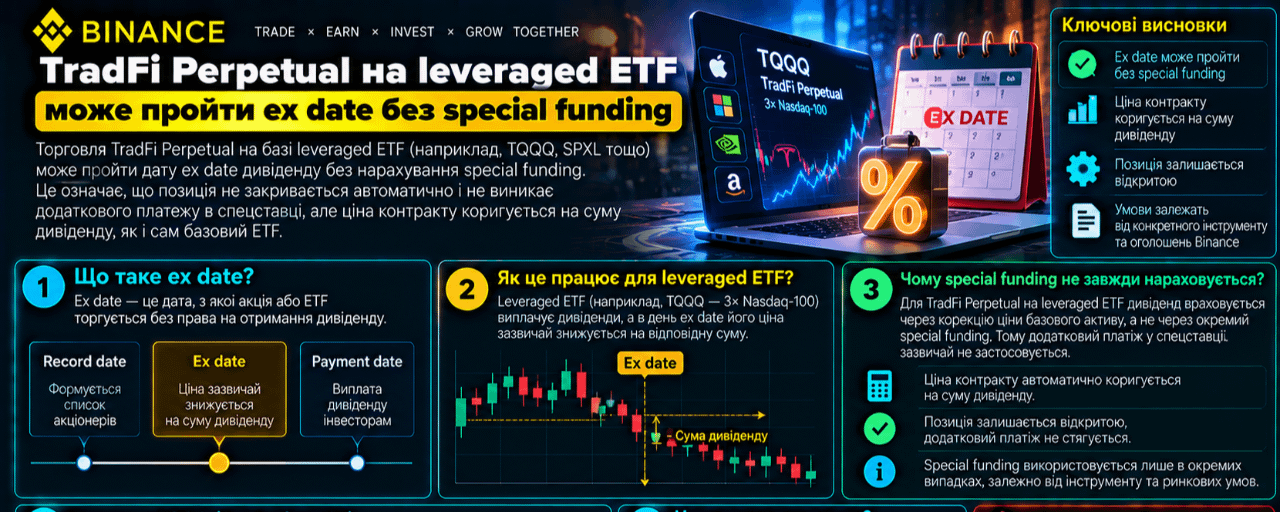
TradFi Perpetual on a leveraged ETF may pass the ex date without special fundingFor standard Equity TradFi Perpetual, Binance uses a one-time special funding near the ex-dividend date. It must offset the technical drop in the underlying stock price after the dividend: the short pays the long, and the standard funding limit for this special calculation does not apply.
However, the updated September 25 methodology establishes a separate exception for leveraged ETFs. Such underlying funds are excluded from the dividend adjustment, so the Special Dividend Funding Amount is not paid on the ex-date. In the official list available as of September 30, among others, TQQQUSDT, SOXLUSDT, SQQQUSDT, TSLLUSDT, and TMFUSDT are included.
TradFi Perpetual on a leveraged ETF may pass the ex date without special funding
For standard Equity TradFi Perpetual, Binance uses a one-time special funding near the ex-dividend date. It must offset the technical drop in the underlying stock price after the dividend: the short pays the long, and the standard funding limit for this special calculation does not apply.
However, the updated September 25 methodology establishes a separate exception for leveraged ETFs. Such underlying funds are excluded from the dividend adjustment, so the Special Dividend Funding Amount is not paid on the ex-date. In the official list available as of September 30, among others, TQQQUSDT, SOXLUSDT, SQQQUSDT, TSLLUSDT, and TMFUSDT are included.
However, the updated September 25 methodology establishes a separate exception for leveraged ETFs. Such underlying funds are excluded from the dividend adjustment, so the Special Dividend Funding Amount is not paid on the ex-date. In the official list available as of September 30, among others, TQQQUSDT, SOXLUSDT, SQQQUSDT, TSLLUSDT, and TMFUSDT are included.
57
Log in to explore more content
Join global crypto users on Binance Square
⚡️ Get latest and useful information about crypto.
💬 Trusted by the world’s largest crypto exchange.
👍 Discover real insights from verified creators.
Email / Phone number
Trending Topics
1
#MetaMaskExitsLidoValidatorsAfterSecurityIncident
22,904 views
518 Discussing
2
#MicronBeatsEarningsLiftsGuidance
18,437 views
457 Discussing
3
#CFTCSubmitsTwoEventContractRulesToWhiteHouse
15,014 views
401 Discussing
4
#BitcoinClears$85200
29,803 views
322 Discussing
5
#AltcoinSeasonIndexHoldsAbove60For5Days
147,858 views
1,920 Discussing
6
#USADPAdds90000JobsInSeptember
69,693 views
1,086 Discussing
7
#USCorePCEEasesTo3%InAugust
46,562 views
729 Discussing
8
#KospiPostsWorstQuarterSince2020
26,016 views
603 Discussing
9
#SECToClarifyOnChainFundraisingRules
65,067 views
808 Discussing
10
#UKFCAOpensCryptoFirmAuthorization
60,923 views
673 Discussing