

Shamika Metting
11.8k Posts

Shamika Metting
Report
Block User
Binance square.
256 Following
3.8K+ Followers
28.7K+ Liked
Posts
Portfolio
All
Quotes
Videos
Important ‼️
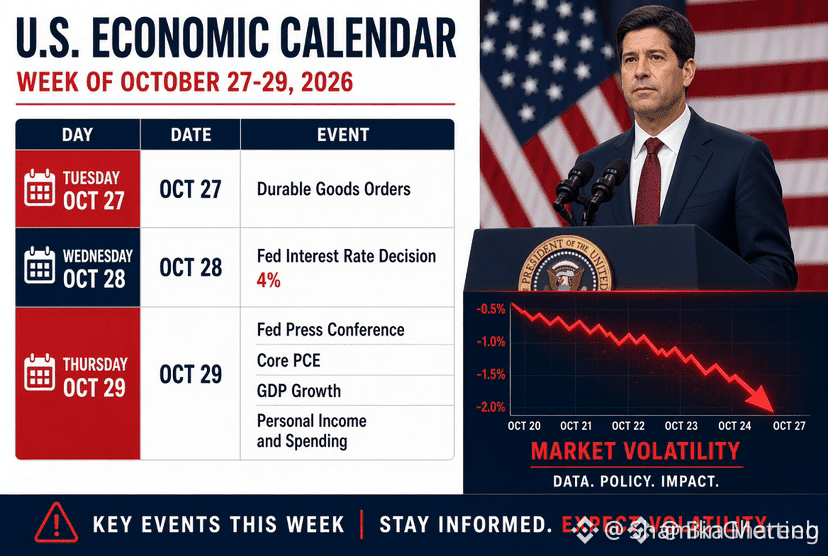
A busy week of events could bring volatility to global markets.
Several important events next week could affect market movements:
🔴 Monday: Trading resumes in U.S. markets amid ongoing geopolitical tensions related to Iran, with Brent crude trading near $115–117.
🔴 Tuesday: U.S. housing data (building permits and new home sales) and the Consumer Confidence Index are released.
🔴 Wednesday: The Federal Open Market Committee (FOMC) decision and a press conference by Federal Reserve Chair Kevin Warsh. The prevailing expectation is that interest rates will remain unchanged, with attention focused on the tone of remarks about the future path of monetary policy.
🔴 Thursday: U.S. Personal Consumption Expenditures (PCE) and Gross Domestic Product (GDP) data are released. Forecasts suggest the PCE inflation rate could rise to around 3.6%, compared with approximately 3.4% previously, as the impact of high oil prices continues.
🔴 Friday: U.S. Employment Cost Index (wages) data and Japan’s unemployment data are released.
This week comes just days before the U.S. midterm elections, scheduled for November 3.
Oil prices remain relatively high, adding to concerns that inflationary pressures will persist.
Please follow along
$BTC
{future}(BTCUSDT)
Important ‼️
A busy week of events could bring volatility to global markets.
Several important events next week could affect market movements:
🔴 Monday: Trading resumes in U.S. markets amid ongoing geopolitical tensions related to Iran, with Brent crude trading near $115–117.
🔴 Tuesday: U.S. housing data (building permits and new home sales) and the Consumer Confidence Index are released.
🔴 Wednesday: The Federal Open Market Committee (FOMC) decision and a press conference by Federal Reserve Chair Kevin Warsh. The prevailing expectation is that interest rates will remain unchanged, with attention focused on the tone of remarks about the future path of monetary policy.
🔴 Thursday: U.S. Personal Consumption Expenditures (PCE) and Gross Domestic Product (GDP) data are released. Forecasts suggest the PCE inflation rate could rise to around 3.6%, compared with approximately 3.4% previously, as the impact of high oil prices continues.
🔴 Friday: U.S. Employment Cost Index (wages) data and Japan’s unemployment data are released.
This week comes just days before the U.S. midterm elections, scheduled for November 3.
Oil prices remain relatively high, adding to concerns that inflationary pressures will persist.
Please follow along
$BTC
A busy week of events could bring volatility to global markets.
Several important events next week could affect market movements:
🔴 Monday: Trading resumes in U.S. markets amid ongoing geopolitical tensions related to Iran, with Brent crude trading near $115–117.
🔴 Tuesday: U.S. housing data (building permits and new home sales) and the Consumer Confidence Index are released.
🔴 Wednesday: The Federal Open Market Committee (FOMC) decision and a press conference by Federal Reserve Chair Kevin Warsh. The prevailing expectation is that interest rates will remain unchanged, with attention focused on the tone of remarks about the future path of monetary policy.
🔴 Thursday: U.S. Personal Consumption Expenditures (PCE) and Gross Domestic Product (GDP) data are released. Forecasts suggest the PCE inflation rate could rise to around 3.6%, compared with approximately 3.4% previously, as the impact of high oil prices continues.
🔴 Friday: U.S. Employment Cost Index (wages) data and Japan’s unemployment data are released.
This week comes just days before the U.S. midterm elections, scheduled for November 3.
Oil prices remain relatively high, adding to concerns that inflationary pressures will persist.
Please follow along
$BTC
1
82
#swedishcentralbankurgesekronareview
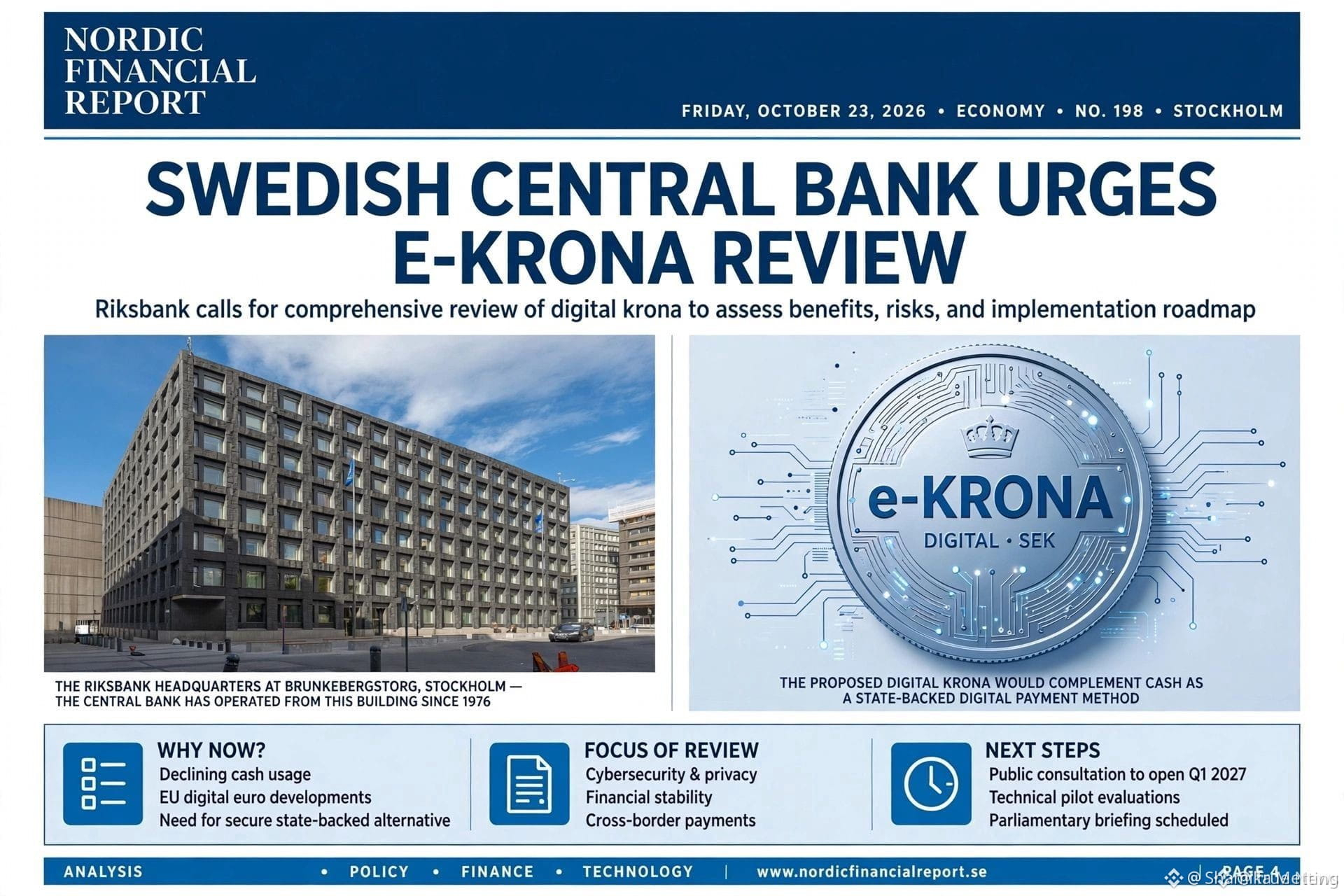
Sweden’s central bank calls for the launch of a digital currency! 🏛️
🏛️ The central bank (Riksbank) has acted as the use of cash rapidly declines across the country! It has issued an urgent call to parliament to conduct a comprehensive review of the state-backed digital currency project, the “e-krona,” and establish the necessary legal framework for it. 🪙💻
🚨 Why switch to the digital krona?
💸 The end of cash: Cash use for purchases in the country has fallen to critical levels. The government does not want the market to come entirely under the control of private banks and card companies. 📊🛡️ A cyber shield: The e-krona, which is under development, is designed to work offline even in emergencies, such as power outages or major cyberattacks. 🔐⚖️ The ball is in parliament’s court: Following the completion of technical tests, the central bank is now waiting for the necessary political and legal steps to be taken to officially issue the currency. 🏛️
⚠️ Important notice: Despite the rapid pace of the digital transition, officials stress that every citizen should keep some cash in krona at home in case of potential major crises or system outages! 💵🏡
Please follow
#swedishcentralbankurgesekronareview
Sweden’s central bank calls for the launch of a digital currency! 🏛️
🏛️ The central bank (Riksbank) has acted as the use of cash rapidly declines across the country! It has issued an urgent call to parliament to conduct a comprehensive review of the state-backed digital currency project, the “e-krona,” and establish the necessary legal framework for it. 🪙💻
🚨 Why switch to the digital krona?
💸 The end of cash: Cash use for purchases in the country has fallen to critical levels. The government does not want the market to come entirely under the control of private banks and card companies. 📊🛡️ A cyber shield: The e-krona, which is under development, is designed to work offline even in emergencies, such as power outages or major cyberattacks. 🔐⚖️ The ball is in parliament’s court: Following the completion of technical tests, the central bank is now waiting for the necessary political and legal steps to be taken to officially issue the currency. 🏛️
⚠️ Important notice: Despite the rapid pace of the digital transition, officials stress that every citizen should keep some cash in krona at home in case of potential major crises or system outages! 💵🏡
Please follow
Sweden’s central bank calls for the launch of a digital currency! 🏛️
🏛️ The central bank (Riksbank) has acted as the use of cash rapidly declines across the country! It has issued an urgent call to parliament to conduct a comprehensive review of the state-backed digital currency project, the “e-krona,” and establish the necessary legal framework for it. 🪙💻
🚨 Why switch to the digital krona?
💸 The end of cash: Cash use for purchases in the country has fallen to critical levels. The government does not want the market to come entirely under the control of private banks and card companies. 📊🛡️ A cyber shield: The e-krona, which is under development, is designed to work offline even in emergencies, such as power outages or major cyberattacks. 🔐⚖️ The ball is in parliament’s court: Following the completion of technical tests, the central bank is now waiting for the necessary political and legal steps to be taken to officially issue the currency. 🏛️
⚠️ Important notice: Despite the rapid pace of the digital transition, officials stress that every citizen should keep some cash in krona at home in case of potential major crises or system outages! 💵🏡
Please follow

1
211
#pepejumps14%toleadaltcoinrebound
🐸 The frog leads the charge: Is this a short squeeze or a real altcoin season?
As Wall Street recovers from a tech-led sell-off and Bitcoin steadies around $81,700, the market has seen a major surprise: meme coins are leading the rebound!
The rally: $PEPE just posted a massive 14% jump, outperforming other altcoins and topping the CoinDesk 100 index, with trading volume exceeding $353M in 24 hours.
The bigger picture: When risk appetite returns, speculative capital often moves out of slower-moving assets and into high-beta ones. This sudden breakout has put strong pressure on short positions, reaching the daily resistance level near $0.00000511.
My strategy: Chasing a 14% jump in a meme coin at a key resistance level could be risky. I’m watching to see whether this level turns into reliable support on a retest, or whether this is just a temporary bounce before the next macroeconomic hurdles.
Are you riding the frog wave, or sitting this one out? Let me know in the comments! 👇
Please follow
$PEPE
{alpha}()
$BTC
{future}(BTCUSDT)
#pepejumps14%toleadaltcoinrebound
🐸 The frog leads the charge: Is this a short squeeze or a real altcoin season?
As Wall Street recovers from a tech-led sell-off and Bitcoin steadies around $81,700, the market has seen a major surprise: meme coins are leading the rebound!
The rally: $PEPE just posted a massive 14% jump, outperforming other altcoins and topping the CoinDesk 100 index, with trading volume exceeding $353M in 24 hours.
The bigger picture: When risk appetite returns, speculative capital often moves out of slower-moving assets and into high-beta ones. This sudden breakout has put strong pressure on short positions, reaching the daily resistance level near $0.00000511.
My strategy: Chasing a 14% jump in a meme coin at a key resistance level could be risky. I’m watching to see whether this level turns into reliable support on a retest, or whether this is just a temporary bounce before the next macroeconomic hurdles.
Are you riding the frog wave, or sitting this one out? Let me know in the comments! 👇
Please follow
$PEPE
$BTC
🐸 The frog leads the charge: Is this a short squeeze or a real altcoin season?
As Wall Street recovers from a tech-led sell-off and Bitcoin steadies around $81,700, the market has seen a major surprise: meme coins are leading the rebound!
The rally: $PEPE just posted a massive 14% jump, outperforming other altcoins and topping the CoinDesk 100 index, with trading volume exceeding $353M in 24 hours.
The bigger picture: When risk appetite returns, speculative capital often moves out of slower-moving assets and into high-beta ones. This sudden breakout has put strong pressure on short positions, reaching the daily resistance level near $0.00000511.
My strategy: Chasing a 14% jump in a meme coin at a key resistance level could be risky. I’m watching to see whether this level turns into reliable support on a retest, or whether this is just a temporary bounce before the next macroeconomic hurdles.
Are you riding the frog wave, or sitting this one out? Let me know in the comments! 👇
Please follow
$PEPE
$BTC
1
96
#pepejumps14%toleadaltcoinrebound
🚨 PEPE Leads Altcoin Recovery: Is a Short Squeeze Underway for the Meme Coin? 🚨
A strong recovery is sweeping the crypto market, with PEPE leading the rally! Let’s take a look at its 14% surge and what it could mean for traders.
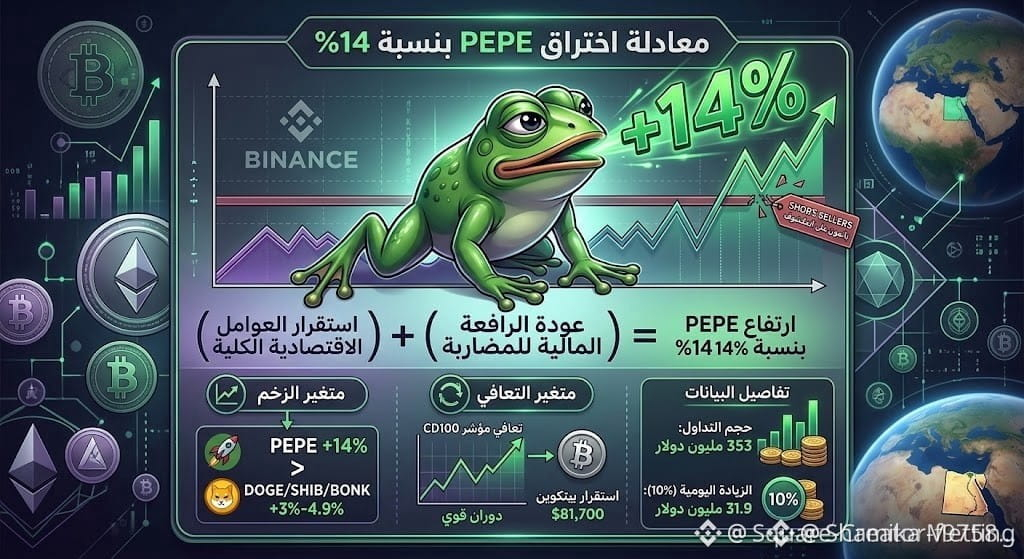
Market equation
Macroeconomic stability + return of speculative capital = PEPE up 14%
Momentum factor
📈 DOGE, SHIB, and BONK: +3% to +4.9%
The Ethereum-based meme coin outperformed its leading meme coin rivals, posting its strongest daily gains in a month and rising about 23% over the week.
Recovery factor
Bitcoin stabilizing near $81,700 + CD100 index recovery = renewed risk appetite
What’s driving this rally?
Crypto markets are recovering after a tech-led stock sell-off this week. As market sentiment improves, speculative capital appears to be flowing into highly volatile meme coins.
PEPE’s break above a recent resistance level may also have prompted traders to cover their short positions, adding to the rally’s momentum. Its reported 24-hour trading volume reached $353 million, up 10% from the previous day.
However, traders should exercise caution in the absence of a clear fundamental catalyst. A sharp rally doesn’t guarantee a continued uptrend, and profit-taking could quickly increase volatility.
Please follow
$PEPE
#PEPE #pepecoin #memecoins #CryptoMarket
#pepejumps14%toleadaltcoinrebound
🚨 PEPE Leads Altcoin Recovery: Is a Short Squeeze Underway for the Meme Coin? 🚨
A strong recovery is sweeping the crypto market, with PEPE leading the rally! Let’s take a look at its 14% surge and what it could mean for traders.
Market equation
Macroeconomic stability + return of speculative capital = PEPE up 14%
Momentum factor
📈 DOGE, SHIB, and BONK: +3% to +4.9%
The Ethereum-based meme coin outperformed its leading meme coin rivals, posting its strongest daily gains in a month and rising about 23% over the week.
Recovery factor
Bitcoin stabilizing near $81,700 + CD100 index recovery = renewed risk appetite
What’s driving this rally?
Crypto markets are recovering after a tech-led stock sell-off this week. As market sentiment improves, speculative capital appears to be flowing into highly volatile meme coins.
PEPE’s break above a recent resistance level may also have prompted traders to cover their short positions, adding to the rally’s momentum. Its reported 24-hour trading volume reached $353 million, up 10% from the previous day.
However, traders should exercise caution in the absence of a clear fundamental catalyst. A sharp rally doesn’t guarantee a continued uptrend, and profit-taking could quickly increase volatility.
Please follow
$PEPE
#PEPE #pepecoin #memecoins #CryptoMarket
🚨 PEPE Leads Altcoin Recovery: Is a Short Squeeze Underway for the Meme Coin? 🚨
A strong recovery is sweeping the crypto market, with PEPE leading the rally! Let’s take a look at its 14% surge and what it could mean for traders.
Market equation
Macroeconomic stability + return of speculative capital = PEPE up 14%
Momentum factor
📈 DOGE, SHIB, and BONK: +3% to +4.9%
The Ethereum-based meme coin outperformed its leading meme coin rivals, posting its strongest daily gains in a month and rising about 23% over the week.
Recovery factor
Bitcoin stabilizing near $81,700 + CD100 index recovery = renewed risk appetite
What’s driving this rally?
Crypto markets are recovering after a tech-led stock sell-off this week. As market sentiment improves, speculative capital appears to be flowing into highly volatile meme coins.
PEPE’s break above a recent resistance level may also have prompted traders to cover their short positions, adding to the rally’s momentum. Its reported 24-hour trading volume reached $353 million, up 10% from the previous day.
However, traders should exercise caution in the absence of a clear fundamental catalyst. A sharp rally doesn’t guarantee a continued uptrend, and profit-taking could quickly increase volatility.
Please follow
$PEPE
#PEPE #pepecoin #memecoins #CryptoMarket
1
109
Course: Behavioral Finance and Modeling High-Beta Assets
Case Study: The Microstructure of the Altcoin Rally and PEPE-Led Liquidity Transmission Mechanisms
#pepejumps14%toleadaltcoinrebound ---
--#PepeJumps14%ToLeadAltcoinRebound
Course: Behavioral Finance and Modeling High-Beta Assets
Case Study: The Microstructure of the Altcoin Rally and PEPE-Led Liquidity Transmission Mechanisms
1. Introduction and Theoretical Framework for Asset Rotation
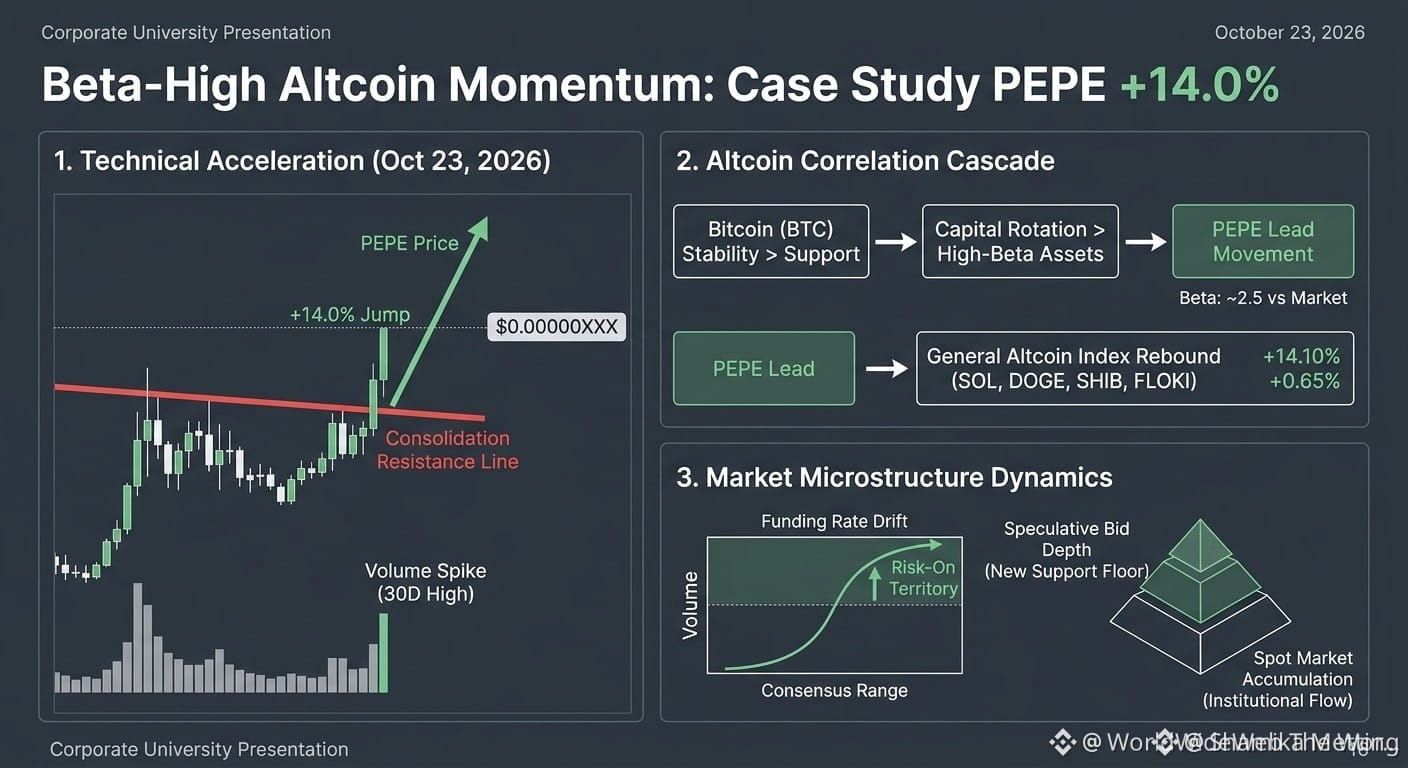
On October 23, 2026, the digital asset market saw a short-term reshaping of capital flows [Q2QdVY]. Following a period of volatility compression among large-cap assets, the ecosystem experienced a broad-based altcoin rally [Q2QdVY]. PEPE was the algorithmic, volume-driven center of gravity for this move, surging vertically by +14.0% [Q2QdVY].
From a portfolio theory perspective, this phenomenon offers a clear illustration of high-beta asset behavior. In market conditions where the benchmark asset (Bitcoin) remains above key structural support levels, implied volatility declines. This compression of risk encourages institutional trading desks and high-frequency traders (HFTs) to direct marginal capital toward the periphery
----#PepeJumps14%ToLeadAltcoinRebound
[BTC stability] ➔ [Volatility compression] ➔ [Liquidity rotation] ➔ [PEPE: +14.0%] ➔ [Altcoin inflow effect]
Please follow up
$PEPE $BTC $ADA
Course: Behavioral Finance and Modeling High-Beta Assets
Case Study: The Microstructure of the Altcoin Rally and PEPE-Led Liquidity Transmission Mechanisms
#pepejumps14%toleadaltcoinrebound ---
--#PepeJumps14%ToLeadAltcoinRebound
Course: Behavioral Finance and Modeling High-Beta Assets
Case Study: The Microstructure of the Altcoin Rally and PEPE-Led Liquidity Transmission Mechanisms
1. Introduction and Theoretical Framework for Asset Rotation
On October 23, 2026, the digital asset market saw a short-term reshaping of capital flows [Q2QdVY]. Following a period of volatility compression among large-cap assets, the ecosystem experienced a broad-based altcoin rally [Q2QdVY]. PEPE was the algorithmic, volume-driven center of gravity for this move, surging vertically by +14.0% [Q2QdVY].
From a portfolio theory perspective, this phenomenon offers a clear illustration of high-beta asset behavior. In market conditions where the benchmark asset (Bitcoin) remains above key structural support levels, implied volatility declines. This compression of risk encourages institutional trading desks and high-frequency traders (HFTs) to direct marginal capital toward the periphery
----#PepeJumps14%ToLeadAltcoinRebound
[BTC stability] ➔ [Volatility compression] ➔ [Liquidity rotation] ➔ [PEPE: +14.0%] ➔ [Altcoin inflow effect]
Please follow up
$PEPE $BTC $ADA
Case Study: The Microstructure of the Altcoin Rally and PEPE-Led Liquidity Transmission Mechanisms
#pepejumps14%toleadaltcoinrebound ---
--#PepeJumps14%ToLeadAltcoinRebound
Course: Behavioral Finance and Modeling High-Beta Assets
Case Study: The Microstructure of the Altcoin Rally and PEPE-Led Liquidity Transmission Mechanisms
1. Introduction and Theoretical Framework for Asset Rotation
On October 23, 2026, the digital asset market saw a short-term reshaping of capital flows [Q2QdVY]. Following a period of volatility compression among large-cap assets, the ecosystem experienced a broad-based altcoin rally [Q2QdVY]. PEPE was the algorithmic, volume-driven center of gravity for this move, surging vertically by +14.0% [Q2QdVY].
From a portfolio theory perspective, this phenomenon offers a clear illustration of high-beta asset behavior. In market conditions where the benchmark asset (Bitcoin) remains above key structural support levels, implied volatility declines. This compression of risk encourages institutional trading desks and high-frequency traders (HFTs) to direct marginal capital toward the periphery
----#PepeJumps14%ToLeadAltcoinRebound
[BTC stability] ➔ [Volatility compression] ➔ [Liquidity rotation] ➔ [PEPE: +14.0%] ➔ [Altcoin inflow effect]
Please follow up
$PEPE $BTC $ADA
1
43
#pepejumps14%toleadaltcoinrebound
🚨 The Altcoin Recovery Equation: Meme Coins Force Short Sellers to Cover Their Positions 🚨
A massive wave of relief is sweeping the market, and the frog is leading the charge! Let’s analyze PEPE’s 14% surge using pure mathematics 🧮👇
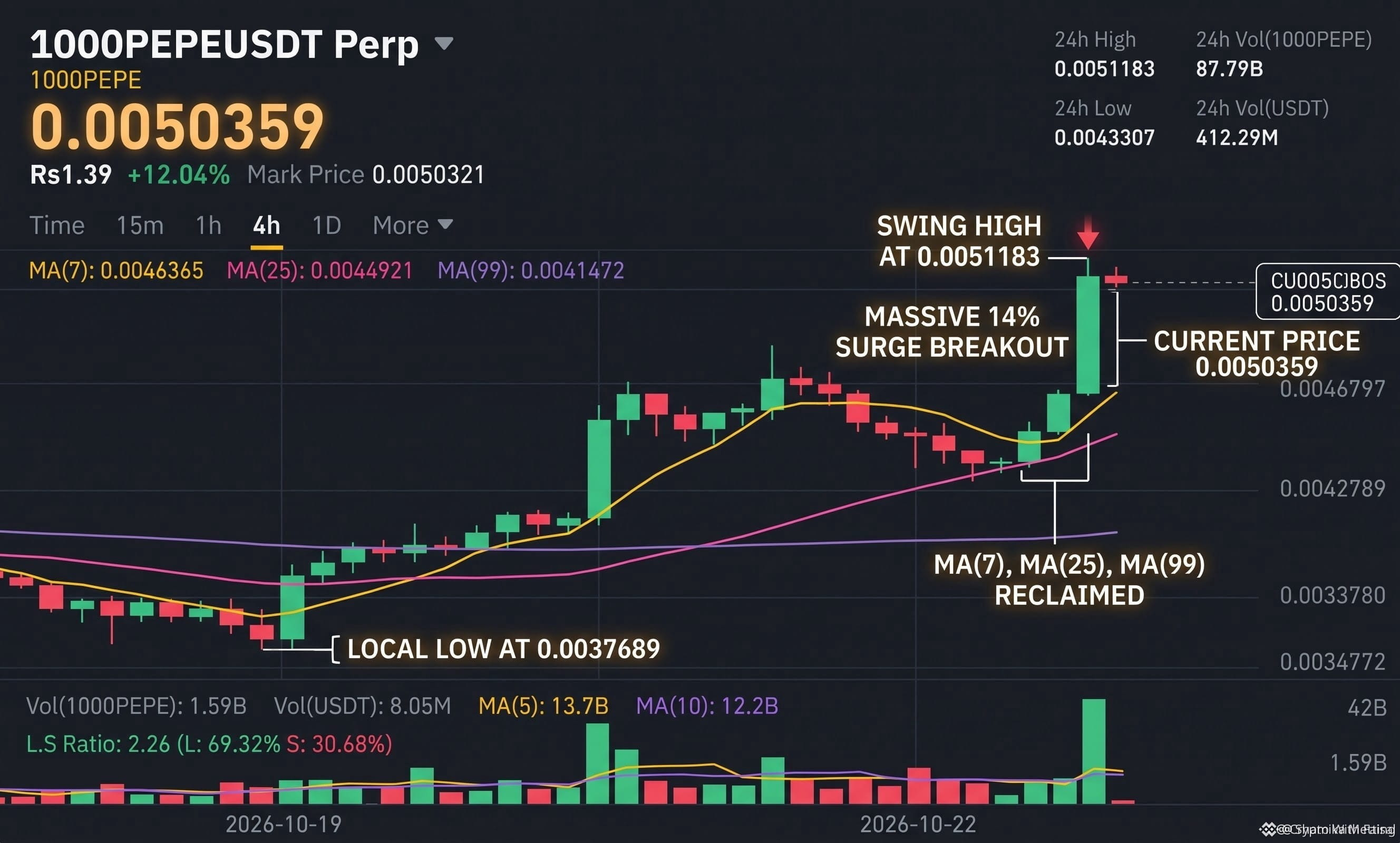
(Macro stability) + (Speculative leverage returning) = PEPE up 14% 📈
Here’s the exact equation behind this sudden breakout:
Momentum variable:
(PEPE +14%) > (DOGE / SHIB / BONK +3% to 4.9%) 🐸
The Ethereum-based meme coin has officially outperformed the entire sector, posting its biggest daily gains in a month and bringing its gains this week to +23%.
Recovery variable:
(CD100 index recovery) = strong rotation as Bitcoin holds near $81,700.
Crypto markets are making a strong recovery from this week’s tech-led stock sell-off.
Without any single fundamental catalyst, PEPE’s breakout above its latest resistance level put intense pressure on short sellers, with trading volume reaching $353 million in 24 hours (up 10% from yesterday). The coin is significantly outperforming peers such as SHIB and DOGE, which are still down for the month.
When liquidity returns to the market, PEPE becomes the ultimate market multiplier.
Is this a temporary relief bounce, or the official beginning of a massive altcoin season?
Please follow
$PEPE
{alpha}()
#pepejumps14%toleadaltcoinrebound
🚨 The Altcoin Recovery Equation: Meme Coins Force Short Sellers to Cover Their Positions 🚨
A massive wave of relief is sweeping the market, and the frog is leading the charge! Let’s analyze PEPE’s 14% surge using pure mathematics 🧮👇
(Macro stability) + (Speculative leverage returning) = PEPE up 14% 📈
Here’s the exact equation behind this sudden breakout:
Momentum variable:
(PEPE +14%) > (DOGE / SHIB / BONK +3% to 4.9%) 🐸
The Ethereum-based meme coin has officially outperformed the entire sector, posting its biggest daily gains in a month and bringing its gains this week to +23%.
Recovery variable:
(CD100 index recovery) = strong rotation as Bitcoin holds near $81,700.
Crypto markets are making a strong recovery from this week’s tech-led stock sell-off.
Without any single fundamental catalyst, PEPE’s breakout above its latest resistance level put intense pressure on short sellers, with trading volume reaching $353 million in 24 hours (up 10% from yesterday). The coin is significantly outperforming peers such as SHIB and DOGE, which are still down for the month.
When liquidity returns to the market, PEPE becomes the ultimate market multiplier.
Is this a temporary relief bounce, or the official beginning of a massive altcoin season?
Please follow
$PEPE
🚨 The Altcoin Recovery Equation: Meme Coins Force Short Sellers to Cover Their Positions 🚨
A massive wave of relief is sweeping the market, and the frog is leading the charge! Let’s analyze PEPE’s 14% surge using pure mathematics 🧮👇
(Macro stability) + (Speculative leverage returning) = PEPE up 14% 📈
Here’s the exact equation behind this sudden breakout:
Momentum variable:
(PEPE +14%) > (DOGE / SHIB / BONK +3% to 4.9%) 🐸
The Ethereum-based meme coin has officially outperformed the entire sector, posting its biggest daily gains in a month and bringing its gains this week to +23%.
Recovery variable:
(CD100 index recovery) = strong rotation as Bitcoin holds near $81,700.
Crypto markets are making a strong recovery from this week’s tech-led stock sell-off.
Without any single fundamental catalyst, PEPE’s breakout above its latest resistance level put intense pressure on short sellers, with trading volume reaching $353 million in 24 hours (up 10% from yesterday). The coin is significantly outperforming peers such as SHIB and DOGE, which are still down for the month.
When liquidity returns to the market, PEPE becomes the ultimate market multiplier.
Is this a temporary relief bounce, or the official beginning of a massive altcoin season?
Please follow
$PEPE
1
44
#pepejumps14%toleadaltcoinrebound 🐸 PEPE rises 14% as signs of an altcoin market recovery emerge
The memecoin sector is flashing green, with PEPE leading a broader altcoin market recovery. Here’s a clear summary of today’s key market moves.
📰 Top Stories
PEPE recorded a notable 14% price increase, outperforming many major altcoins during the latest trading session. This bullish momentum coincides with general stability across the broader cryptocurrency market, pointing to renewed trader interest in prominent memecoins alongside signs of improving overall market sentiment.
📊 Market Impact
• Altcoin sentiment: Strong performance by a leading memecoin often serves as a highly sensitive indicator of risk appetite across the broader altcoin market.
• Liquidity rotation: This move may signal capital flowing from large-cap assets or stablecoins into alternative sectors, as traders seek short-term opportunities in the market.
#PEPE #Altcoins #CryptoMarket #MarketAnalysis #BinanceSquare
This content is for educational purposes only and does not constitute financial advice (NFA). Always do your own research (DYOR).
Please follow
$INIT $WCT $SOPH
#pepejumps14%toleadaltcoinrebound 🐸 PEPE rises 14% as signs of an altcoin market recovery emerge
The memecoin sector is flashing green, with PEPE leading a broader altcoin market recovery. Here’s a clear summary of today’s key market moves.
📰 Top Stories
PEPE recorded a notable 14% price increase, outperforming many major altcoins during the latest trading session. This bullish momentum coincides with general stability across the broader cryptocurrency market, pointing to renewed trader interest in prominent memecoins alongside signs of improving overall market sentiment.
📊 Market Impact
• Altcoin sentiment: Strong performance by a leading memecoin often serves as a highly sensitive indicator of risk appetite across the broader altcoin market.
• Liquidity rotation: This move may signal capital flowing from large-cap assets or stablecoins into alternative sectors, as traders seek short-term opportunities in the market.
#PEPE #Altcoins #CryptoMarket #MarketAnalysis #BinanceSquare
This content is for educational purposes only and does not constitute financial advice (NFA). Always do your own research (DYOR).
Please follow
$INIT $WCT $SOPH
The memecoin sector is flashing green, with PEPE leading a broader altcoin market recovery. Here’s a clear summary of today’s key market moves.
📰 Top Stories
PEPE recorded a notable 14% price increase, outperforming many major altcoins during the latest trading session. This bullish momentum coincides with general stability across the broader cryptocurrency market, pointing to renewed trader interest in prominent memecoins alongside signs of improving overall market sentiment.
📊 Market Impact
• Altcoin sentiment: Strong performance by a leading memecoin often serves as a highly sensitive indicator of risk appetite across the broader altcoin market.
• Liquidity rotation: This move may signal capital flowing from large-cap assets or stablecoins into alternative sectors, as traders seek short-term opportunities in the market.
#PEPE #Altcoins #CryptoMarket #MarketAnalysis #BinanceSquare
This content is for educational purposes only and does not constitute financial advice (NFA). Always do your own research (DYOR).
Please follow
$INIT $WCT $SOPH

1
21
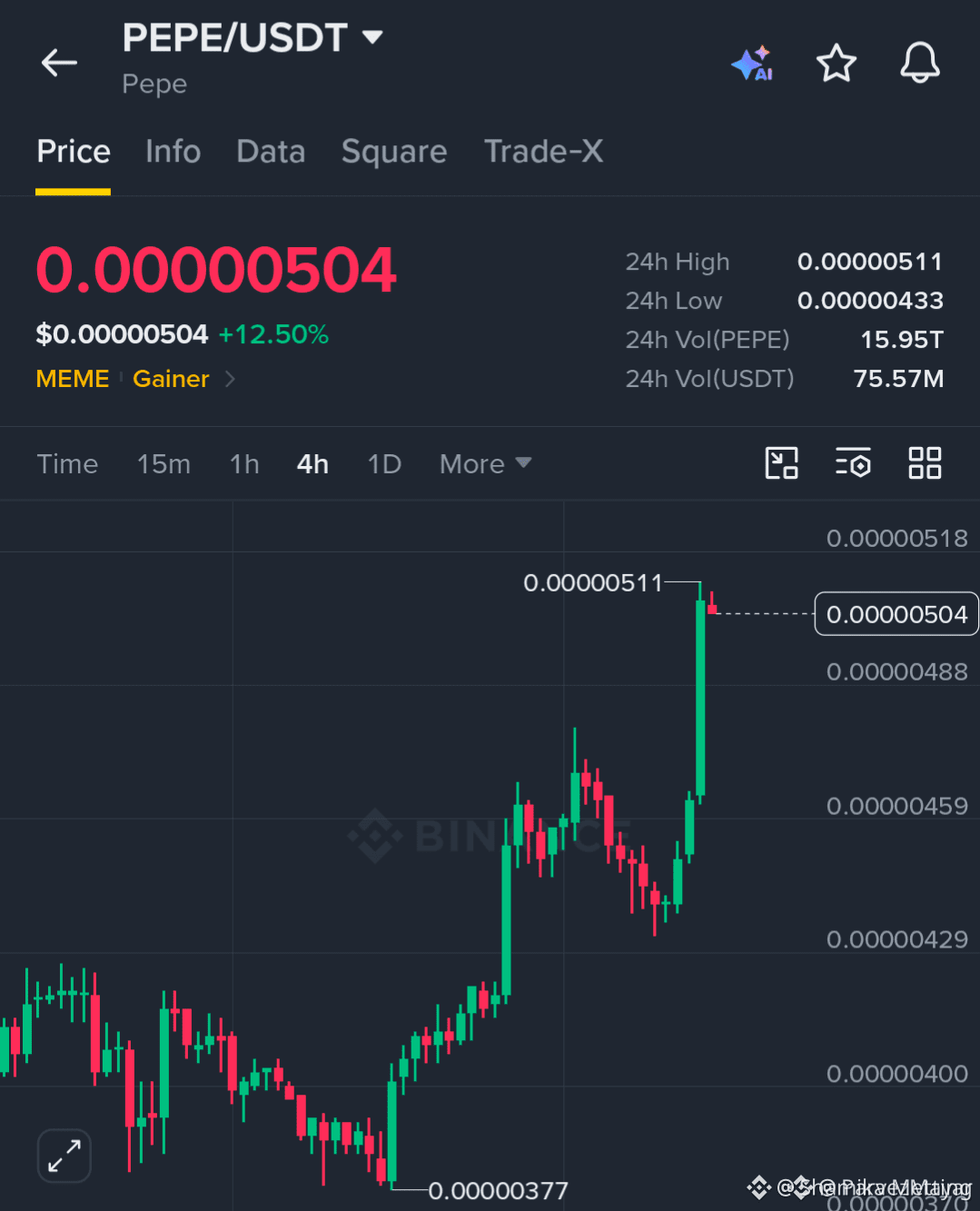
Imagine $PEPE is leading the altcoin rally 😂
Seriously... what a market crash 😆
$BTC dropped from $84,898 to $81.5K, and $ETH fell from $2,526 to below $2,400...
And somehow, PEPE is the one showing strength with gains of +12.5%, and it has already passed $0.000005 ❗
I mean... when BTC and ETH are struggling, and a MEME coin starts leading the recovery, you know this market has gotten weird 😆
But I wouldn’t underestimate PEPE either... buyers are pushing hard, and the 4-hour chart structure shows real bullish momentum.
Just don’t confuse one massive green candle with a confirmed altcoin recovery.
Who’s actually holding PEPE all the way to $0.01❓
Please follow
#PepeJumps14%ToLeadAltcoinRebound
Imagine $PEPE is leading the altcoin rally 😂
Seriously... what a market crash 😆
$BTC dropped from $84,898 to $81.5K, and $ETH fell from $2,526 to below $2,400...
And somehow, PEPE is the one showing strength with gains of +12.5%, and it has already passed $0.000005 ❗
I mean... when BTC and ETH are struggling, and a MEME coin starts leading the recovery, you know this market has gotten weird 😆
But I wouldn’t underestimate PEPE either... buyers are pushing hard, and the 4-hour chart structure shows real bullish momentum.
Just don’t confuse one massive green candle with a confirmed altcoin recovery.
Who’s actually holding PEPE all the way to $0.01❓
Please follow
#PepeJumps14%ToLeadAltcoinRebound
Seriously... what a market crash 😆
$BTC dropped from $84,898 to $81.5K, and $ETH fell from $2,526 to below $2,400...
And somehow, PEPE is the one showing strength with gains of +12.5%, and it has already passed $0.000005 ❗
I mean... when BTC and ETH are struggling, and a MEME coin starts leading the recovery, you know this market has gotten weird 😆
But I wouldn’t underestimate PEPE either... buyers are pushing hard, and the 4-hour chart structure shows real bullish momentum.
Just don’t confuse one massive green candle with a confirmed altcoin recovery.
Who’s actually holding PEPE all the way to $0.01❓
Please follow
#PepeJumps14%ToLeadAltcoinRebound
1
39
PEPE surges 14% to lead the altcoin rebound — meme season is back!
The frog king is back, and he’s leading the charge! PEPE just exploded with a massive 14% jump, becoming the top-performing coin and sparking a broad altcoin rally.
This isn’t just another random pump. When $PEPE moves like this while Bitcoin stabilizes, it signals a major shift in market sentiment. Risk appetite is officially back. Whales continue to accumulate, trading volume has jumped by more than 80%, and meme coin dominance is rapidly growing across social media platforms.
Historically, a strong PEPE breakout is often the first sign of a broader meme coin supercycle. Liquidity shifts from major coins to high-volatility meme assets, and momentum builds for the continuation of the big altcoin season.
If PEPE holds above this breakout zone, the next targets could be much higher. The question is: are you ready for the next leg up, or are you still waiting on the sidelines? Meme moves happen fast.
Please follow
$PEPE $BONK $FLOKI
#PEPE #MemeCoins #Altseason #CryptoNews #BinanceSquare #pepejumps14%toleadaltcoinrebound
PEPE surges 14% to lead the altcoin rebound — meme season is back!
The frog king is back, and he’s leading the charge! PEPE just exploded with a massive 14% jump, becoming the top-performing coin and sparking a broad altcoin rally.
This isn’t just another random pump. When $PEPE moves like this while Bitcoin stabilizes, it signals a major shift in market sentiment. Risk appetite is officially back. Whales continue to accumulate, trading volume has jumped by more than 80%, and meme coin dominance is rapidly growing across social media platforms.
Historically, a strong PEPE breakout is often the first sign of a broader meme coin supercycle. Liquidity shifts from major coins to high-volatility meme assets, and momentum builds for the continuation of the big altcoin season.
If PEPE holds above this breakout zone, the next targets could be much higher. The question is: are you ready for the next leg up, or are you still waiting on the sidelines? Meme moves happen fast.
Please follow
$PEPE $BONK $FLOKI
#PEPE #MemeCoins #Altseason #CryptoNews #BinanceSquare #pepejumps14%toleadaltcoinrebound
The frog king is back, and he’s leading the charge! PEPE just exploded with a massive 14% jump, becoming the top-performing coin and sparking a broad altcoin rally.
This isn’t just another random pump. When $PEPE moves like this while Bitcoin stabilizes, it signals a major shift in market sentiment. Risk appetite is officially back. Whales continue to accumulate, trading volume has jumped by more than 80%, and meme coin dominance is rapidly growing across social media platforms.
Historically, a strong PEPE breakout is often the first sign of a broader meme coin supercycle. Liquidity shifts from major coins to high-volatility meme assets, and momentum builds for the continuation of the big altcoin season.
If PEPE holds above this breakout zone, the next targets could be much higher. The question is: are you ready for the next leg up, or are you still waiting on the sidelines? Meme moves happen fast.
Please follow
$PEPE $BONK $FLOKI
#PEPE #MemeCoins #Altseason #CryptoNews #BinanceSquare #pepejumps14%toleadaltcoinrebound

1
214
#PepeJumps14%ToLeadAltcoinRebound
The 14% quake: The meme frog devours short sellers!
🚨 A price explosion hits the crypto market! Popular meme coin PEPE is launching a sweeping attack, soaring by a staggering 14% and forcing short sellers to flee and cover their positions in a race against time!
📉 This sudden breakout wasn’t a coincidence; it’s the result of a precise equation: stable macroeconomic factors + renewed leverage for speculation = a massive relief rally led by PEPE.
🚀 The numbers don’t lie:
(PEPE +14%) outperformed everyone! (DOGE / SHIB / BONK +3% to 4.9%).
Weekly gains of up to +23%, and the biggest daily jump in a month.
An astonishing $353 million in trading volume over 24 hours (up 10%)[cite: 1, 2, 3].
💥 When liquidity returns, PEPE becomes the ultimate market multiplier. This strong recovery from the tech stock sell-off proves that speculative money doesn’t wait—it looks for the highest risks and returns.
🤔 Is this a temporary bounce or the start of a massive altcoin season? Share your thoughts below! 👇💬
Please follow
#PEPE #Crypto #MemeCoins #Binance $PEPE
$1000PEPE
#PepeJumps14%ToLeadAltcoinRebound
The 14% quake: The meme frog devours short sellers!
🚨 A price explosion hits the crypto market! Popular meme coin PEPE is launching a sweeping attack, soaring by a staggering 14% and forcing short sellers to flee and cover their positions in a race against time!
📉 This sudden breakout wasn’t a coincidence; it’s the result of a precise equation: stable macroeconomic factors + renewed leverage for speculation = a massive relief rally led by PEPE.
🚀 The numbers don’t lie:
(PEPE +14%) outperformed everyone! (DOGE / SHIB / BONK +3% to 4.9%).
Weekly gains of up to +23%, and the biggest daily jump in a month.
An astonishing $353 million in trading volume over 24 hours (up 10%)[cite: 1, 2, 3].
💥 When liquidity returns, PEPE becomes the ultimate market multiplier. This strong recovery from the tech stock sell-off proves that speculative money doesn’t wait—it looks for the highest risks and returns.
🤔 Is this a temporary bounce or the start of a massive altcoin season? Share your thoughts below! 👇💬
Please follow
#PEPE #Crypto #MemeCoins #Binance $PEPE
$1000PEPE
The 14% quake: The meme frog devours short sellers!
🚨 A price explosion hits the crypto market! Popular meme coin PEPE is launching a sweeping attack, soaring by a staggering 14% and forcing short sellers to flee and cover their positions in a race against time!
📉 This sudden breakout wasn’t a coincidence; it’s the result of a precise equation: stable macroeconomic factors + renewed leverage for speculation = a massive relief rally led by PEPE.
🚀 The numbers don’t lie:
(PEPE +14%) outperformed everyone! (DOGE / SHIB / BONK +3% to 4.9%).
Weekly gains of up to +23%, and the biggest daily jump in a month.
An astonishing $353 million in trading volume over 24 hours (up 10%)[cite: 1, 2, 3].
💥 When liquidity returns, PEPE becomes the ultimate market multiplier. This strong recovery from the tech stock sell-off proves that speculative money doesn’t wait—it looks for the highest risks and returns.
🤔 Is this a temporary bounce or the start of a massive altcoin season? Share your thoughts below! 👇💬
Please follow
#PEPE #Crypto #MemeCoins #Binance $PEPE
$1000PEPE
1
18
#pepejumps14%toleadaltcoinrebound
🐸 Altcoin rebound equation: Meme coins are forcing sellers to cover their short positions! 🚀🔥
As liquidity returns to the market, PEPE becomes the top performer! 🧮⚡️
The return of speculative leverage + macroeconomic stability have just triggered intense pressure on $PEPE short positions! 📈⚡️
🚀 Sector leader: $PEPE
(+14\%) outperforms $DOGE , $SHIB and $BONK
{spot}(BONKUSDT)
📊 Trading volume surge: 24-hour trading volume topped $353 million, with PEPE up +23% this week.
🎯 Catalyst: A complete shift toward high-risk assets, while Bitcoin consolidates near $81,700.
When the market rebounds, the frog moves first! 🐸💸
Market dynamics: As Bitcoin stabilizes near $81,700, speculative risk-seeking capital has outpaced the slow recovery of other assets and headed straight into highly volatile meme coins.
Liquidity catalyst: Without a clear fundamental catalyst, PEPE's breakout above recent resistance levels has put enormous pressure on short positions, lifting 24-hour trading volume to more than $353 million!
💬 What do you think? Is this a temporary rebound easing pressure on short positions, or are we witnessing the official start of the next altcoin season? Share your predictions below! 👇
#PEPE #CryptoNews #EarningsSeason #BinancePick
#pepejumps14%toleadaltcoinrebound
🐸 Altcoin rebound equation: Meme coins are forcing sellers to cover their short positions! 🚀🔥
As liquidity returns to the market, PEPE becomes the top performer! 🧮⚡️
The return of speculative leverage + macroeconomic stability have just triggered intense pressure on $PEPE short positions! 📈⚡️
🚀 Sector leader: $PEPE
(+14\%) outperforms $DOGE , $SHIB and $BONK
📊 Trading volume surge: 24-hour trading volume topped $353 million, with PEPE up +23% this week.
🎯 Catalyst: A complete shift toward high-risk assets, while Bitcoin consolidates near $81,700.
When the market rebounds, the frog moves first! 🐸💸
Market dynamics: As Bitcoin stabilizes near $81,700, speculative risk-seeking capital has outpaced the slow recovery of other assets and headed straight into highly volatile meme coins.
Liquidity catalyst: Without a clear fundamental catalyst, PEPE's breakout above recent resistance levels has put enormous pressure on short positions, lifting 24-hour trading volume to more than $353 million!
💬 What do you think? Is this a temporary rebound easing pressure on short positions, or are we witnessing the official start of the next altcoin season? Share your predictions below! 👇
#PEPE #CryptoNews #EarningsSeason #BinancePick
🐸 Altcoin rebound equation: Meme coins are forcing sellers to cover their short positions! 🚀🔥
As liquidity returns to the market, PEPE becomes the top performer! 🧮⚡️
The return of speculative leverage + macroeconomic stability have just triggered intense pressure on $PEPE short positions! 📈⚡️
🚀 Sector leader: $PEPE
(+14\%) outperforms $DOGE , $SHIB and $BONK
📊 Trading volume surge: 24-hour trading volume topped $353 million, with PEPE up +23% this week.
🎯 Catalyst: A complete shift toward high-risk assets, while Bitcoin consolidates near $81,700.
When the market rebounds, the frog moves first! 🐸💸
Market dynamics: As Bitcoin stabilizes near $81,700, speculative risk-seeking capital has outpaced the slow recovery of other assets and headed straight into highly volatile meme coins.
Liquidity catalyst: Without a clear fundamental catalyst, PEPE's breakout above recent resistance levels has put enormous pressure on short positions, lifting 24-hour trading volume to more than $353 million!
💬 What do you think? Is this a temporary rebound easing pressure on short positions, or are we witnessing the official start of the next altcoin season? Share your predictions below! 👇
#PEPE #CryptoNews #EarningsSeason #BinancePick

1
137
#pepejumps14%toleadaltcoinrebound
🐸 PEPE rises 14% as signs of recovery emerge in the altcoin market
The meme coin sector is rebounding, with PEPE leading the way amid a broader recovery in the altcoin market. Here’s a clear overview of today’s key market moves.
📰 Top News
PEPE recorded a notable 14% price increase, outperforming many major altcoins during the latest trading session. This upward momentum coincides with general stability in the crypto market, suggesting that traders are renewing their interest in high-profile meme coins as signs of improving overall market sentiment emerge.
📊 Market Impact
• Altcoin market sentiment: Strong performance by a leading meme coin is often a highly sensitive indicator of risk appetite across the altcoin market more broadly.
• Shift in liquidity: This move may signal capital flowing out of large-cap assets or stablecoins and into other sectors, as traders seek short-term opportunities.
• Sector volatility: While rising trading volumes are bringing renewed attention to Ethereum-based meme coins, it’s important to remember that these assets are inherently more volatile.
Please follow
$PEPE
{alpha}()
#pepejumps14%toleadaltcoinrebound
🐸 PEPE rises 14% as signs of recovery emerge in the altcoin market
The meme coin sector is rebounding, with PEPE leading the way amid a broader recovery in the altcoin market. Here’s a clear overview of today’s key market moves.
📰 Top News
PEPE recorded a notable 14% price increase, outperforming many major altcoins during the latest trading session. This upward momentum coincides with general stability in the crypto market, suggesting that traders are renewing their interest in high-profile meme coins as signs of improving overall market sentiment emerge.
📊 Market Impact
• Altcoin market sentiment: Strong performance by a leading meme coin is often a highly sensitive indicator of risk appetite across the altcoin market more broadly.
• Shift in liquidity: This move may signal capital flowing out of large-cap assets or stablecoins and into other sectors, as traders seek short-term opportunities.
• Sector volatility: While rising trading volumes are bringing renewed attention to Ethereum-based meme coins, it’s important to remember that these assets are inherently more volatile.
Please follow
$PEPE
🐸 PEPE rises 14% as signs of recovery emerge in the altcoin market
The meme coin sector is rebounding, with PEPE leading the way amid a broader recovery in the altcoin market. Here’s a clear overview of today’s key market moves.
📰 Top News
PEPE recorded a notable 14% price increase, outperforming many major altcoins during the latest trading session. This upward momentum coincides with general stability in the crypto market, suggesting that traders are renewing their interest in high-profile meme coins as signs of improving overall market sentiment emerge.
📊 Market Impact
• Altcoin market sentiment: Strong performance by a leading meme coin is often a highly sensitive indicator of risk appetite across the altcoin market more broadly.
• Shift in liquidity: This move may signal capital flowing out of large-cap assets or stablecoins and into other sectors, as traders seek short-term opportunities.
• Sector volatility: While rising trading volumes are bringing renewed attention to Ethereum-based meme coins, it’s important to remember that these assets are inherently more volatile.
Please follow
$PEPE

1
28
#pepejumps14%toleadaltcoinrebound #
🐸 PEPE rises 14% as signs of recovery emerge in the altcoin market 🚀
🔥 The memecoin sector is rebounding, with PEPE leading the way amid a broader recovery in the altcoin market 📈. Here’s a clear look at today’s biggest market moves 👀.
📰 Top Stories
PEPE recorded a notable 14% price increase 💥, outperforming many major altcoins during the latest trading session 🏆. This upward momentum coincides with the crypto 🌤️, and comes despite little attention being paid to prominent media-covered memecoins 📣, alongside signs of improving overall market sentiment 😎.
📊 Market Impact
• 🌡️ Altcoin market sentiment: Strong performance by a leading memecoin is often a highly sensitive indicator of risk appetite across the broader altcoin market 🎢.
• 💧 Liquidity shift: This move may signal capital shifting from ⚠️🎢.
💬 Join the Discussion
🤔 Do you think this altcoin market rebound is a short-term, temporary bounce ⏳ or a sign of a sustained market recovery 🌱? Share your technical 📉 or fundamental 🧠 analysis with us below! 👇
This content is provided for educational purposes only and does not constitute financial advice (NFA). Always do your own research (DYOR).
Please follow
$PEPE
{alpha}()
#pepejumps14%toleadaltcoinrebound #
🐸 PEPE rises 14% as signs of recovery emerge in the altcoin market 🚀
🔥 The memecoin sector is rebounding, with PEPE leading the way amid a broader recovery in the altcoin market 📈. Here’s a clear look at today’s biggest market moves 👀.
📰 Top Stories
PEPE recorded a notable 14% price increase 💥, outperforming many major altcoins during the latest trading session 🏆. This upward momentum coincides with the crypto 🌤️, and comes despite little attention being paid to prominent media-covered memecoins 📣, alongside signs of improving overall market sentiment 😎.
📊 Market Impact
• 🌡️ Altcoin market sentiment: Strong performance by a leading memecoin is often a highly sensitive indicator of risk appetite across the broader altcoin market 🎢.
• 💧 Liquidity shift: This move may signal capital shifting from ⚠️🎢.
💬 Join the Discussion
🤔 Do you think this altcoin market rebound is a short-term, temporary bounce ⏳ or a sign of a sustained market recovery 🌱? Share your technical 📉 or fundamental 🧠 analysis with us below! 👇
This content is provided for educational purposes only and does not constitute financial advice (NFA). Always do your own research (DYOR).
Please follow
$PEPE
🐸 PEPE rises 14% as signs of recovery emerge in the altcoin market 🚀
🔥 The memecoin sector is rebounding, with PEPE leading the way amid a broader recovery in the altcoin market 📈. Here’s a clear look at today’s biggest market moves 👀.
📰 Top Stories
PEPE recorded a notable 14% price increase 💥, outperforming many major altcoins during the latest trading session 🏆. This upward momentum coincides with the crypto 🌤️, and comes despite little attention being paid to prominent media-covered memecoins 📣, alongside signs of improving overall market sentiment 😎.
📊 Market Impact
• 🌡️ Altcoin market sentiment: Strong performance by a leading memecoin is often a highly sensitive indicator of risk appetite across the broader altcoin market 🎢.
• 💧 Liquidity shift: This move may signal capital shifting from ⚠️🎢.
💬 Join the Discussion
🤔 Do you think this altcoin market rebound is a short-term, temporary bounce ⏳ or a sign of a sustained market recovery 🌱? Share your technical 📉 or fundamental 🧠 analysis with us below! 👇
This content is provided for educational purposes only and does not constitute financial advice (NFA). Always do your own research (DYOR).
Please follow
$PEPE
1
27
Swedish Central Bank Calls for a Review of the E-Krona — The Future of Money Is Digital
Sweden has become almost cashless, and now its central bank is taking the next big step. The Riksbank has officially called for a comprehensive review of the e-krona project to assess its stability, security, technology, and public acceptance.
This is not just about Sweden. The move signals that major economies are seriously preparing for central bank digital currencies.
While cryptocurrencies operate on a decentralized system, central bank digital currencies like the e-krona will bring blockchain technology closer to the public, creating a bridge between traditional finance and Web3.
A well-designed e-krona could set a benchmark for all of Europe and drive faster regulation and innovation in the cryptocurrency space. If Sweden succeeds, expect other countries to accelerate their own digital currency plans.
Are we ready for a world where every krona is digital? The future of money is being decided now.
Please follow
$XRP $XLM $HBAR
#CBDC #EKrona #CryptoNews #Sweden #BinanceSquare #swedishcentralbankurgesekronareview
Swedish Central Bank Calls for a Review of the E-Krona — The Future of Money Is Digital
Sweden has become almost cashless, and now its central bank is taking the next big step. The Riksbank has officially called for a comprehensive review of the e-krona project to assess its stability, security, technology, and public acceptance.
This is not just about Sweden. The move signals that major economies are seriously preparing for central bank digital currencies.
While cryptocurrencies operate on a decentralized system, central bank digital currencies like the e-krona will bring blockchain technology closer to the public, creating a bridge between traditional finance and Web3.
A well-designed e-krona could set a benchmark for all of Europe and drive faster regulation and innovation in the cryptocurrency space. If Sweden succeeds, expect other countries to accelerate their own digital currency plans.
Are we ready for a world where every krona is digital? The future of money is being decided now.
Please follow
$XRP $XLM $HBAR
#CBDC #EKrona #CryptoNews #Sweden #BinanceSquare #swedishcentralbankurgesekronareview
Sweden has become almost cashless, and now its central bank is taking the next big step. The Riksbank has officially called for a comprehensive review of the e-krona project to assess its stability, security, technology, and public acceptance.
This is not just about Sweden. The move signals that major economies are seriously preparing for central bank digital currencies.
While cryptocurrencies operate on a decentralized system, central bank digital currencies like the e-krona will bring blockchain technology closer to the public, creating a bridge between traditional finance and Web3.
A well-designed e-krona could set a benchmark for all of Europe and drive faster regulation and innovation in the cryptocurrency space. If Sweden succeeds, expect other countries to accelerate their own digital currency plans.
Are we ready for a world where every krona is digital? The future of money is being decided now.
Please follow
$XRP $XLM $HBAR
#CBDC #EKrona #CryptoNews #Sweden #BinanceSquare #swedishcentralbankurgesekronareview
1
272
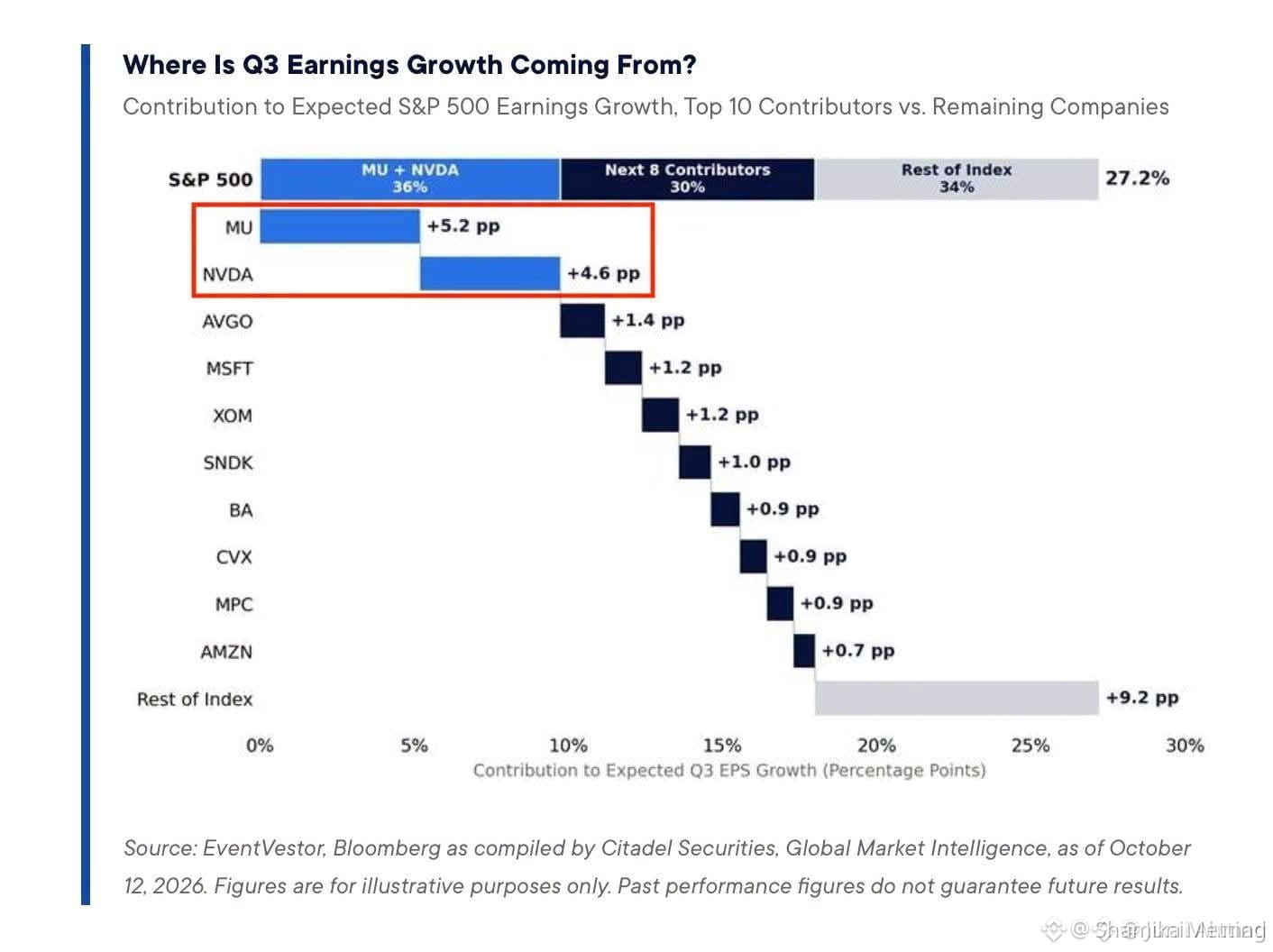
🇺🇸Shocking: S&P 500 earnings forecasts are becoming heavily concentrated in two AI chipmakers.
Micron and Nvidia are expected to contribute 36% of the index’s earnings growth in the third quarter, accounting for 5.2 and 4.6 percentage points, respectively, of the expected 27% year-over-year increase.
The takeaway: AI demand remains a key driver of the broader market 🚀
Please follow
$XRP
#EarningsSeason #BinancePick #PepeJumps14%ToLeadAltcoinRebound #SwedishCentralBankUrgesEKronaReview #BitcoinHashrateHitsSevenMonthHigh
🇺🇸Shocking: S&P 500 earnings forecasts are becoming heavily concentrated in two AI chipmakers.
Micron and Nvidia are expected to contribute 36% of the index’s earnings growth in the third quarter, accounting for 5.2 and 4.6 percentage points, respectively, of the expected 27% year-over-year increase.
The takeaway: AI demand remains a key driver of the broader market 🚀
Please follow
$XRP
#EarningsSeason #BinancePick #PepeJumps14%ToLeadAltcoinRebound #SwedishCentralBankUrgesEKronaReview #BitcoinHashrateHitsSevenMonthHigh
Micron and Nvidia are expected to contribute 36% of the index’s earnings growth in the third quarter, accounting for 5.2 and 4.6 percentage points, respectively, of the expected 27% year-over-year increase.
The takeaway: AI demand remains a key driver of the broader market 🚀
Please follow
$XRP
#EarningsSeason #BinancePick #PepeJumps14%ToLeadAltcoinRebound #SwedishCentralBankUrgesEKronaReview #BitcoinHashrateHitsSevenMonthHigh
1
119
Next week is the real test for crypto #EarningsSeason , not this week
Microsoft and Alphabet report earnings on Wednesday, and Amazon on Thursday
Strategy will also report its numbers on Thursday after the market closes
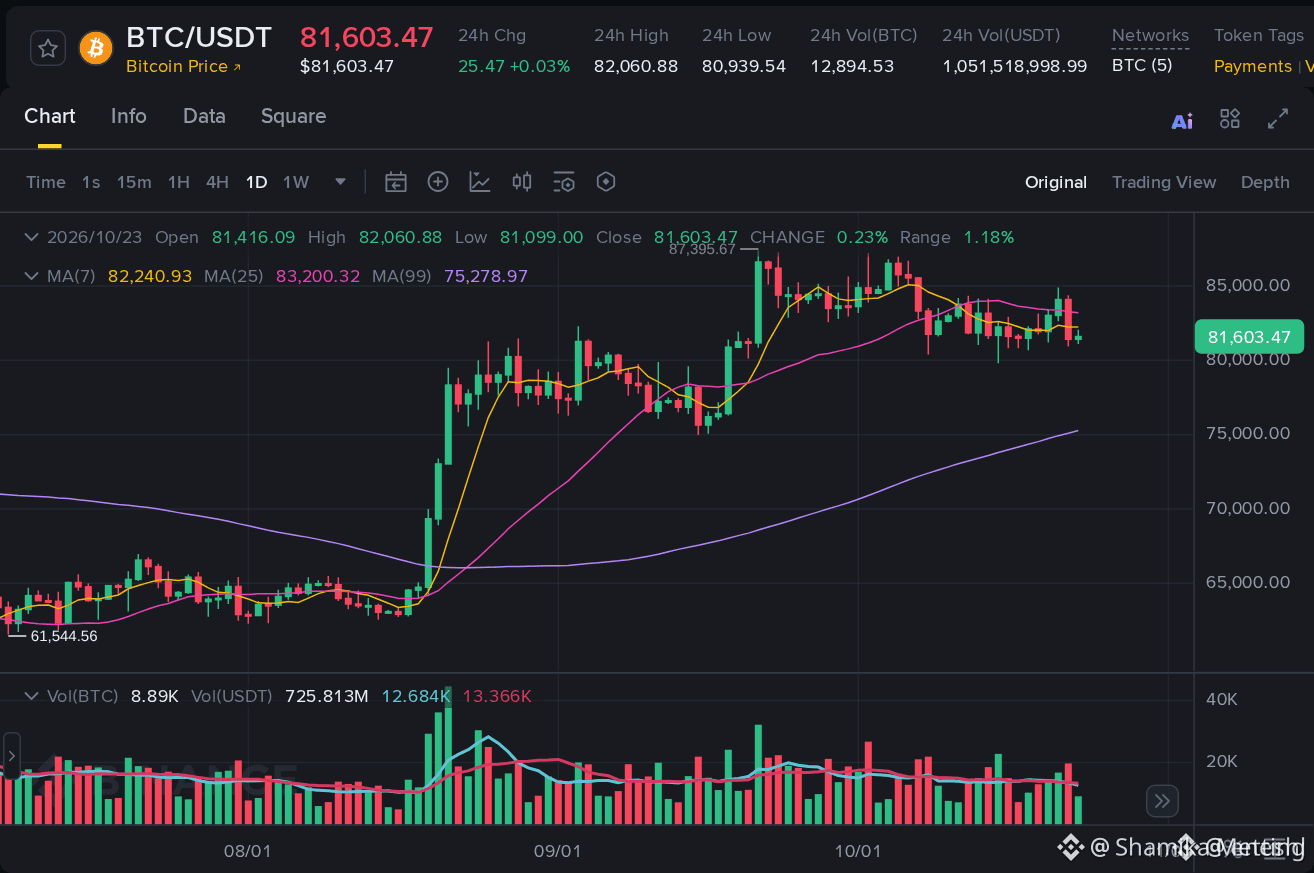
My take: BTC doesn’t care about beating or missing expectations once
What matters is whether Big Tech keeps spending on AI or starts pulling back
Risk appetite in stocks usually spills over into crypto, while risk aversion hits us harder
Strategy’s report is the one I’m really watching
It’s the closest thing we have to a BTC earnings call
Binance Pick lets you predict these results using campaign points, not real money
So it’s a free way to test how accurately you read the macroeconomy
I won’t chase any moves before Wednesday
If BTC holds 80k until the results come out, I’ll lean toward buying; if it loses that level, I’ll get out
If MSFT and GOOGL disappoint on Wednesday, will 80k hold until Strategy reports its results on Thursday?
Please follow
Next week is the real test for crypto #EarningsSeason , not this week
Microsoft and Alphabet report earnings on Wednesday, and Amazon on Thursday
Strategy will also report its numbers on Thursday after the market closes
My take: BTC doesn’t care about beating or missing expectations once
What matters is whether Big Tech keeps spending on AI or starts pulling back
Risk appetite in stocks usually spills over into crypto, while risk aversion hits us harder
Strategy’s report is the one I’m really watching
It’s the closest thing we have to a BTC earnings call
Binance Pick lets you predict these results using campaign points, not real money
So it’s a free way to test how accurately you read the macroeconomy
I won’t chase any moves before Wednesday
If BTC holds 80k until the results come out, I’ll lean toward buying; if it loses that level, I’ll get out
If MSFT and GOOGL disappoint on Wednesday, will 80k hold until Strategy reports its results on Thursday?
Please follow
Microsoft and Alphabet report earnings on Wednesday, and Amazon on Thursday
Strategy will also report its numbers on Thursday after the market closes
My take: BTC doesn’t care about beating or missing expectations once
What matters is whether Big Tech keeps spending on AI or starts pulling back
Risk appetite in stocks usually spills over into crypto, while risk aversion hits us harder
Strategy’s report is the one I’m really watching
It’s the closest thing we have to a BTC earnings call
Binance Pick lets you predict these results using campaign points, not real money
So it’s a free way to test how accurately you read the macroeconomy
I won’t chase any moves before Wednesday
If BTC holds 80k until the results come out, I’ll lean toward buying; if it loses that level, I’ll get out
If MSFT and GOOGL disappoint on Wednesday, will 80k hold until Strategy reports its results on Thursday?
Please follow
2
49
MICROSOFT is expected to beat expectations. However, its stock could fall. What does that have to do with $BTC?
⠀
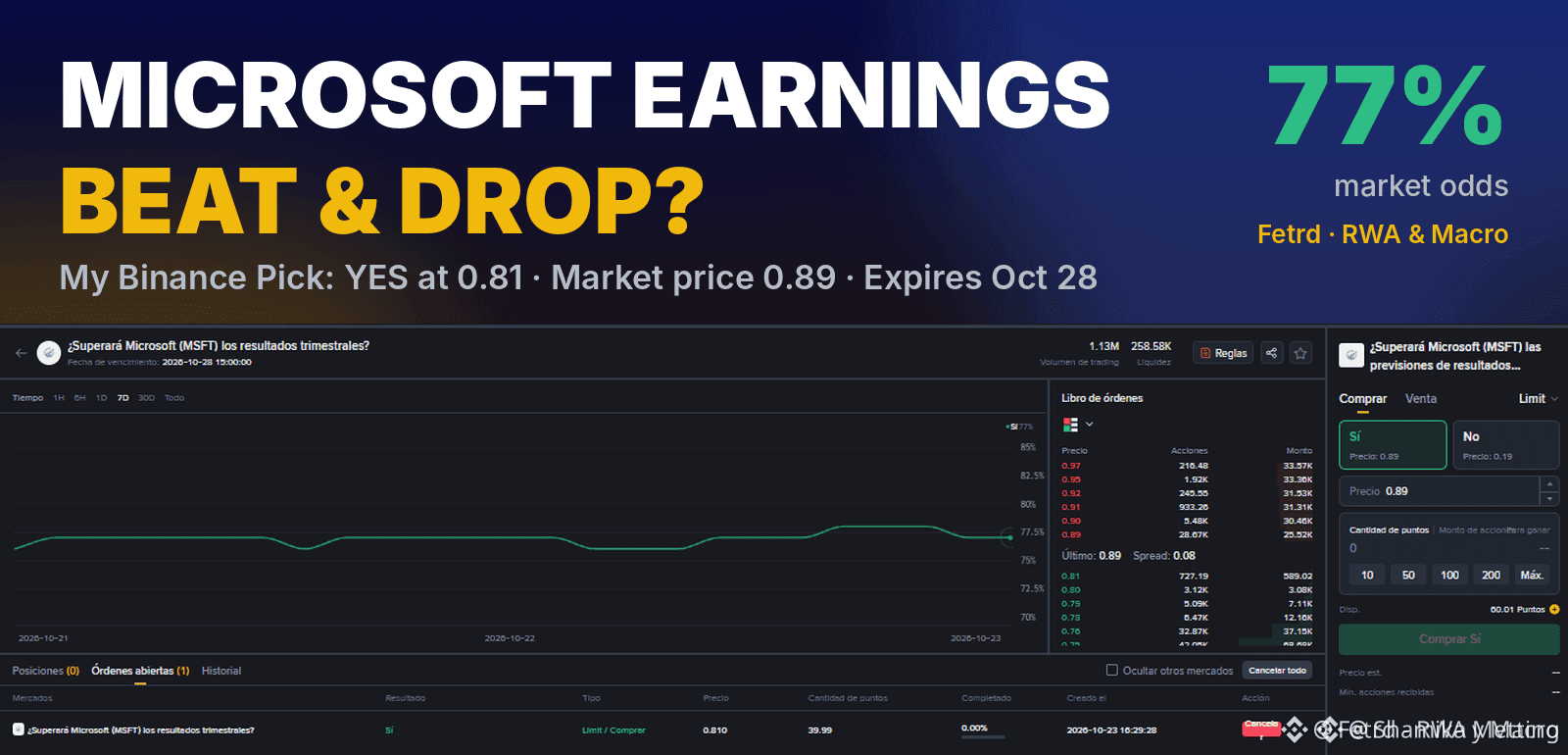
The deadline for the $MSFT prediction on Binance Pick is October 28, the same day the Federal Reserve announces its decision.
⠀
📊 What the data says
• 83% of S&P 500 companies beat estimates this quarter, but by just 2.1%, compared with 7.5% over the past five years (FactSet).
• Several tech companies beat expectations, yet their stocks fell: the market is watching AI spending and forward guidance, not quarterly results.
• This week, when tech stocks fell, $BTC fell with them.
⠀
🎯 My prediction
• Will it beat expectations? Yes. Binance Pick puts the odds at 77%; I think they’re closer to the 83% we’ve seen this earnings season.
• I entered with a limit order at 0.81, not at the market price of 0.89. Paying 0.89 for a probability of around 83% means paying too much.
• What about the stock? That’s where the risk lies: if AI spending grows faster than revenue, the stock could fall despite beating expectations.
⠀
⚠️ For $BTC
Microsoft beating expectations and then seeing its stock fall, on the same day the Federal Reserve announces its decision, would be a double blow to risk appetite.
⠀
What will $MSFTB do after the report?
🟢 Beats expectations and rises
Please follow
#earningsseason #BinancePick
MICROSOFT is expected to beat expectations. However, its stock could fall. What does that have to do with $BTC ?
⠀
The deadline for the $MSFT prediction on Binance Pick is October 28, the same day the Federal Reserve announces its decision.
⠀
📊 What the data says
• 83% of S&P 500 companies beat estimates this quarter, but by just 2.1%, compared with 7.5% over the past five years (FactSet).
• Several tech companies beat expectations, yet their stocks fell: the market is watching AI spending and forward guidance, not quarterly results.
• This week, when tech stocks fell, $BTC fell with them.
⠀
🎯 My prediction
• Will it beat expectations? Yes. Binance Pick puts the odds at 77%; I think they’re closer to the 83% we’ve seen this earnings season.
• I entered with a limit order at 0.81, not at the market price of 0.89. Paying 0.89 for a probability of around 83% means paying too much.
• What about the stock? That’s where the risk lies: if AI spending grows faster than revenue, the stock could fall despite beating expectations.
⠀
⚠️ For $BTC
Microsoft beating expectations and then seeing its stock fall, on the same day the Federal Reserve announces its decision, would be a double blow to risk appetite.
⠀
What will $MSFTB do after the report?
🟢 Beats expectations and rises
Please follow
#earningsseason #BinancePick
⠀
The deadline for the $MSFT prediction on Binance Pick is October 28, the same day the Federal Reserve announces its decision.
⠀
📊 What the data says
• 83% of S&P 500 companies beat estimates this quarter, but by just 2.1%, compared with 7.5% over the past five years (FactSet).
• Several tech companies beat expectations, yet their stocks fell: the market is watching AI spending and forward guidance, not quarterly results.
• This week, when tech stocks fell, $BTC fell with them.
⠀
🎯 My prediction
• Will it beat expectations? Yes. Binance Pick puts the odds at 77%; I think they’re closer to the 83% we’ve seen this earnings season.
• I entered with a limit order at 0.81, not at the market price of 0.89. Paying 0.89 for a probability of around 83% means paying too much.
• What about the stock? That’s where the risk lies: if AI spending grows faster than revenue, the stock could fall despite beating expectations.
⠀
⚠️ For $BTC
Microsoft beating expectations and then seeing its stock fall, on the same day the Federal Reserve announces its decision, would be a double blow to risk appetite.
⠀
What will $MSFTB do after the report?
🟢 Beats expectations and rises
Please follow
#earningsseason #BinancePick
1
29
The new reality on Wall Street: beating expectations is no longer enough.
The 2026 third-quarter earnings season is showing impressive growth, with S&P 500 earnings up more than 32% year over year, according to LSEG data. More than 100 companies have already reported results.
But the market has changed its demands. The focus is now on the sustainability of future earnings and guidance.
The examples are clear: $META shares plunged despite beating revenue expectations, while $TSLA shares fell despite positive free cash flow and reduced capital expenditures for 2026. The market wants evidence that profitability will continue, not just strong performance last quarter.
Adding to the pressure are macroeconomic factors: rising oil prices threaten to reignite inflation and keep interest rates elevated, creating a hostile environment for growth assets.
Next week will be crucial, with $GOOGL , $IRYS , $UNITREE and major semiconductor companies reporting. The market will reveal whether this sell-off in tech stocks is a buying opportunity or a sign of a deeper correction.
Please follow
#EarningsSeason #stocks #AI #WallStreet
The new reality on Wall Street: beating expectations is no longer enough.
The 2026 third-quarter earnings season is showing impressive growth, with S&P 500 earnings up more than 32% year over year, according to LSEG data. More than 100 companies have already reported results.
But the market has changed its demands. The focus is now on the sustainability of future earnings and guidance.
The examples are clear: $META shares plunged despite beating revenue expectations, while $TSLA shares fell despite positive free cash flow and reduced capital expenditures for 2026. The market wants evidence that profitability will continue, not just strong performance last quarter.
Adding to the pressure are macroeconomic factors: rising oil prices threaten to reignite inflation and keep interest rates elevated, creating a hostile environment for growth assets.
Next week will be crucial, with $GOOGL , $IRYS , $UNITREE and major semiconductor companies reporting. The market will reveal whether this sell-off in tech stocks is a buying opportunity or a sign of a deeper correction.
Please follow
#EarningsSeason #stocks #AI #WallStreet
The 2026 third-quarter earnings season is showing impressive growth, with S&P 500 earnings up more than 32% year over year, according to LSEG data. More than 100 companies have already reported results.
But the market has changed its demands. The focus is now on the sustainability of future earnings and guidance.
The examples are clear: $META shares plunged despite beating revenue expectations, while $TSLA shares fell despite positive free cash flow and reduced capital expenditures for 2026. The market wants evidence that profitability will continue, not just strong performance last quarter.
Adding to the pressure are macroeconomic factors: rising oil prices threaten to reignite inflation and keep interest rates elevated, creating a hostile environment for growth assets.
Next week will be crucial, with $GOOGL , $IRYS , $UNITREE and major semiconductor companies reporting. The market will reveal whether this sell-off in tech stocks is a buying opportunity or a sign of a deeper correction.
Please follow
#EarningsSeason #stocks #AI #WallStreet

3
266
#TSLA #LUNC
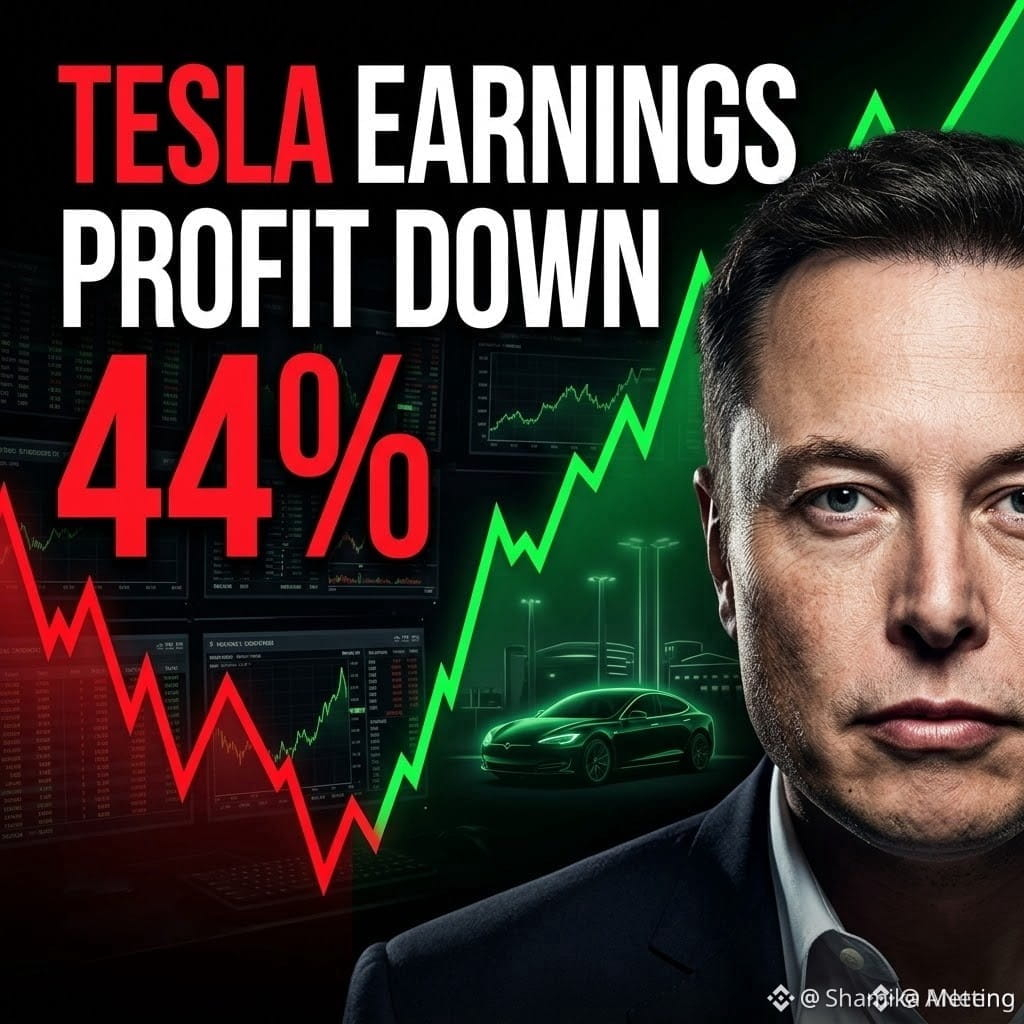
Tesla Q3 2026 earnings: Revenue beat expectations, but profit fell 44% ⚠️
Tesla reported revenue of $28.05 billion, beating Wall Street's estimate of $27.88 billion. However, net income fell 44% year over year to $787 million.
Here's the surprise: Free cash flow came in at $1.5 billion, while Tesla lowered its 2026 capital expenditure forecast from more than $25 billion to $20 billion.
Investors now face an important question: Is Tesla preserving its cash, or is it slowing its ambitions in AI, robotaxis, and robotics?
What do you think: Are TSLA shares a buying opportunity after this setback, or is the market warning us of greater risks? 👇
Please follow
#Tesla #TSLA #earningsseason
#TSLA #LUNC
Tesla Q3 2026 earnings: Revenue beat expectations, but profit fell 44% ⚠️
Tesla reported revenue of $28.05 billion, beating Wall Street's estimate of $27.88 billion. However, net income fell 44% year over year to $787 million.
Here's the surprise: Free cash flow came in at $1.5 billion, while Tesla lowered its 2026 capital expenditure forecast from more than $25 billion to $20 billion.
Investors now face an important question: Is Tesla preserving its cash, or is it slowing its ambitions in AI, robotaxis, and robotics?
What do you think: Are TSLA shares a buying opportunity after this setback, or is the market warning us of greater risks? 👇
Please follow
#Tesla #TSLA #earningsseason
Tesla Q3 2026 earnings: Revenue beat expectations, but profit fell 44% ⚠️
Tesla reported revenue of $28.05 billion, beating Wall Street's estimate of $27.88 billion. However, net income fell 44% year over year to $787 million.
Here's the surprise: Free cash flow came in at $1.5 billion, while Tesla lowered its 2026 capital expenditure forecast from more than $25 billion to $20 billion.
Investors now face an important question: Is Tesla preserving its cash, or is it slowing its ambitions in AI, robotaxis, and robotics?
What do you think: Are TSLA shares a buying opportunity after this setback, or is the market warning us of greater risks? 👇
Please follow
#Tesla #TSLA #earningsseason
2
65
#EarningsSeason #
🚨 $GOOGLB , $MSFTB , and $AMZNB face a crucial test as AI spending approaches $800 billion
🏦 Wall Street is gearing up for one of the most important weeks of the 2026 third-quarter earnings season 📅, with Alphabet, Microsoft, and Amazon set to report their results 📊.
👀 Investors are looking beyond revenue and earnings beats 💰. The bigger question is whether massive investments in AI 🤖 are generating enough returns to justify their cost 🤔💸.
🏗️ Hyperscale cloud providers ☁️ are expected to spend around $800 billion on AI infrastructure this year 🚀, supporting demand for chips 💾, servers 🖥️, networking equipment 🌐, and data centers 🏢.
⚠️ However, concerns about financing costs and profitability have intensified 😰📉, following recent declines in tech stocks despite strong results 💪🔻.
🎯 GOOGL, MSFT, and AMZN will face mounting pressure to prove that AI is becoming a sustainable profit engine 📈✅, rather than just an expensive race to capture market share 🏁💥.
🔥 Their results and capital spending forecasts could affect sentiment across the entire tech sector next week 🌍⚡.
Please follow
#NASDAQ #TechStocks #Aİ
#EarningsSeason #
🚨 $GOOGLB , $MSFTB , and $AMZNB face a crucial test as AI spending approaches $800 billion
🏦 Wall Street is gearing up for one of the most important weeks of the 2026 third-quarter earnings season 📅, with Alphabet, Microsoft, and Amazon set to report their results 📊.
👀 Investors are looking beyond revenue and earnings beats 💰. The bigger question is whether massive investments in AI 🤖 are generating enough returns to justify their cost 🤔💸.
🏗️ Hyperscale cloud providers ☁️ are expected to spend around $800 billion on AI infrastructure this year 🚀, supporting demand for chips 💾, servers 🖥️, networking equipment 🌐, and data centers 🏢.
⚠️ However, concerns about financing costs and profitability have intensified 😰📉, following recent declines in tech stocks despite strong results 💪🔻.
🎯 GOOGL, MSFT, and AMZN will face mounting pressure to prove that AI is becoming a sustainable profit engine 📈✅, rather than just an expensive race to capture market share 🏁💥.
🔥 Their results and capital spending forecasts could affect sentiment across the entire tech sector next week 🌍⚡.
Please follow
#NASDAQ #TechStocks #Aİ
🚨 $GOOGLB , $MSFTB , and $AMZNB face a crucial test as AI spending approaches $800 billion
🏦 Wall Street is gearing up for one of the most important weeks of the 2026 third-quarter earnings season 📅, with Alphabet, Microsoft, and Amazon set to report their results 📊.
👀 Investors are looking beyond revenue and earnings beats 💰. The bigger question is whether massive investments in AI 🤖 are generating enough returns to justify their cost 🤔💸.
🏗️ Hyperscale cloud providers ☁️ are expected to spend around $800 billion on AI infrastructure this year 🚀, supporting demand for chips 💾, servers 🖥️, networking equipment 🌐, and data centers 🏢.
⚠️ However, concerns about financing costs and profitability have intensified 😰📉, following recent declines in tech stocks despite strong results 💪🔻.
🎯 GOOGL, MSFT, and AMZN will face mounting pressure to prove that AI is becoming a sustainable profit engine 📈✅, rather than just an expensive race to capture market share 🏁💥.
🔥 Their results and capital spending forecasts could affect sentiment across the entire tech sector next week 🌍⚡.
Please follow
#NASDAQ #TechStocks #Aİ

1
41
Log in to explore more content
Join global crypto users on Binance Square
⚡️ Get latest and useful information about crypto.
💬 Trusted by the world’s largest crypto exchange.
👍 Discover real insights from verified creators.
Email / Phone number
Trending Topics
BinancePick
3.2M views
156,602 Discussing
Join #EarningsSeason: Predict Earnings on Binance Pick, Share Your Take on Binance Square!
Binance Square Official
·413 Likes
·343.9k views
EarningsSeason
5.4M views
26,205 Discussing
SouthKoreaConsidersEducationTaxOnCryptoExchanges
0 views
7 Discussing