

#omniston
omniston
30,963 views
397 Discussing
Hot
Latest

·
--
Article
STON.fi Is Building Beyond a DEXSTON.fi Is Building Beyond a DEX
What if moving value across chains didn’t require users to think about bridges, wrapped assets, or where liquidity lives?
That is the direction @ston_fi is taking with Omniston.
Instead of treating cross-chain activity as a simple asset transfer, Omniston coordinates liquidity across different networks through an RFQ-based system and resolvers.
A user can request something as simple as:
USDT on TON → USDC on another supported chain
Behind that simple action, resolvers compete to provide executable quotes, while HTLC-based settlement helps connect the two sides of the transaction.
The interesting part is the user experience:
Different chains.
Different liquidity sources.
One execution flow.
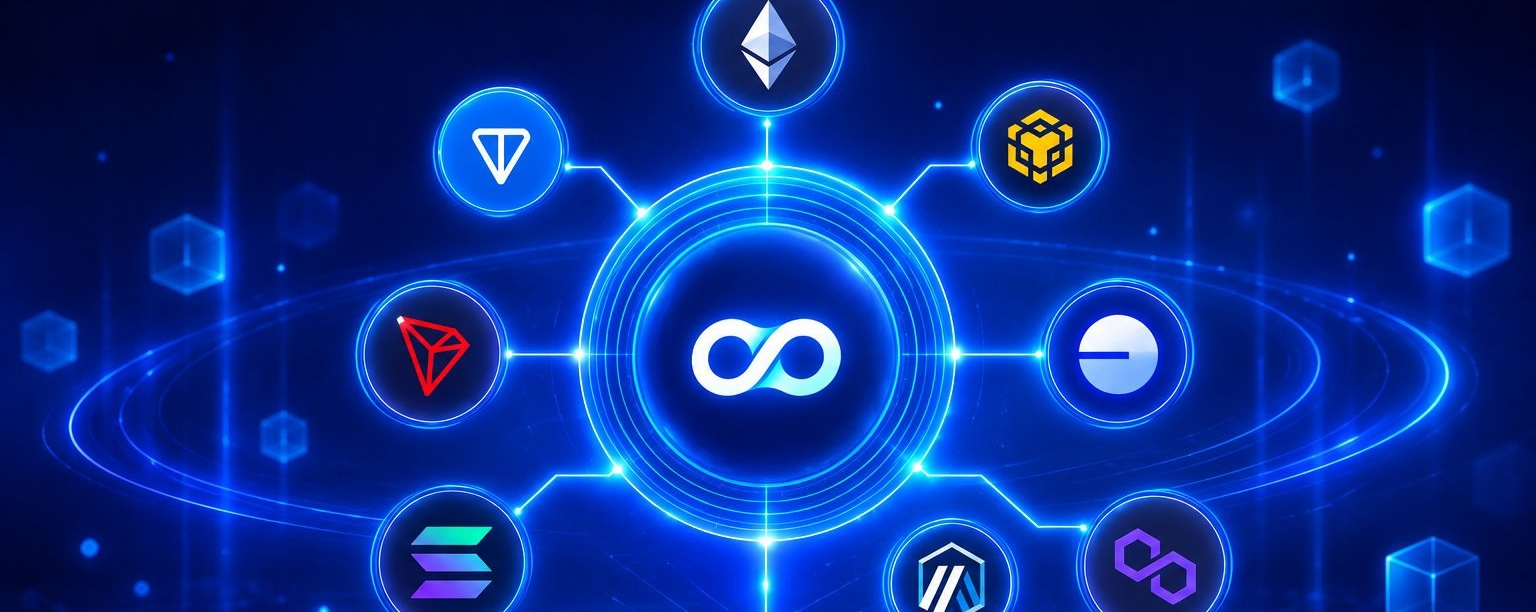
#STONfi has expanded its cross-chain infrastructure across networks including TON, Ethereum, Base, BNB Chain, Polygon, Arbitrum, Avalanche, TRON, Robinhood Chain and X Layer.
But chain count isn't the real story.
The bigger opportunity is making blockchain fragmentation less visible to users and applications.
If Omniston continues adding liquidity, resolvers, assets and integrations, STON.fi could evolve from a TON-focused DEX into infrastructure that helps applications access liquidity across multiple ecosystems.
The long-term question isn't how many chains STON.fi supports.
It's how effectively it can make those chains feel like one connected liquidity environment.
#STONfi #Omniston #CrossChain
STON.fi Is Building Beyond a DEX
STON.fi Is Building Beyond a DEX
What if moving value across chains didn’t require users to think about bridges, wrapped assets, or where liquidity lives?
That is the direction @ston_fi is taking with Omniston.
Instead of treating cross-chain activity as a simple asset transfer, Omniston coordinates liquidity across different networks through an RFQ-based system and resolvers.
A user can request something as simple as:
USDT on TON → USDC on another supported chain
Behind that simple action, resolvers compete to provide executable quotes, while HTLC-based settlement helps connect the two sides of the transaction.
The interesting part is the user experience:
Different chains.
Different liquidity sources.
One execution flow.
#STONfi has expanded its cross-chain infrastructure across networks including TON, Ethereum, Base, BNB Chain, Polygon, Arbitrum, Avalanche, TRON, Robinhood Chain and X Layer.
But chain count isn't the real story.
The bigger opportunity is making blockchain fragmentation less visible to users and applications.
If Omniston continues adding liquidity, resolvers, assets and integrations, STON.fi could evolve from a TON-focused DEX into infrastructure that helps applications access liquidity across multiple ecosystems.
The long-term question isn't how many chains STON.fi supports.
It's how effectively it can make those chains feel like one connected liquidity environment.
#STONfi #Omniston #CrossChain
68

·
--
Bullish
Is a cross-chain quote a fixed number the moment you see it, or something still actively changing?
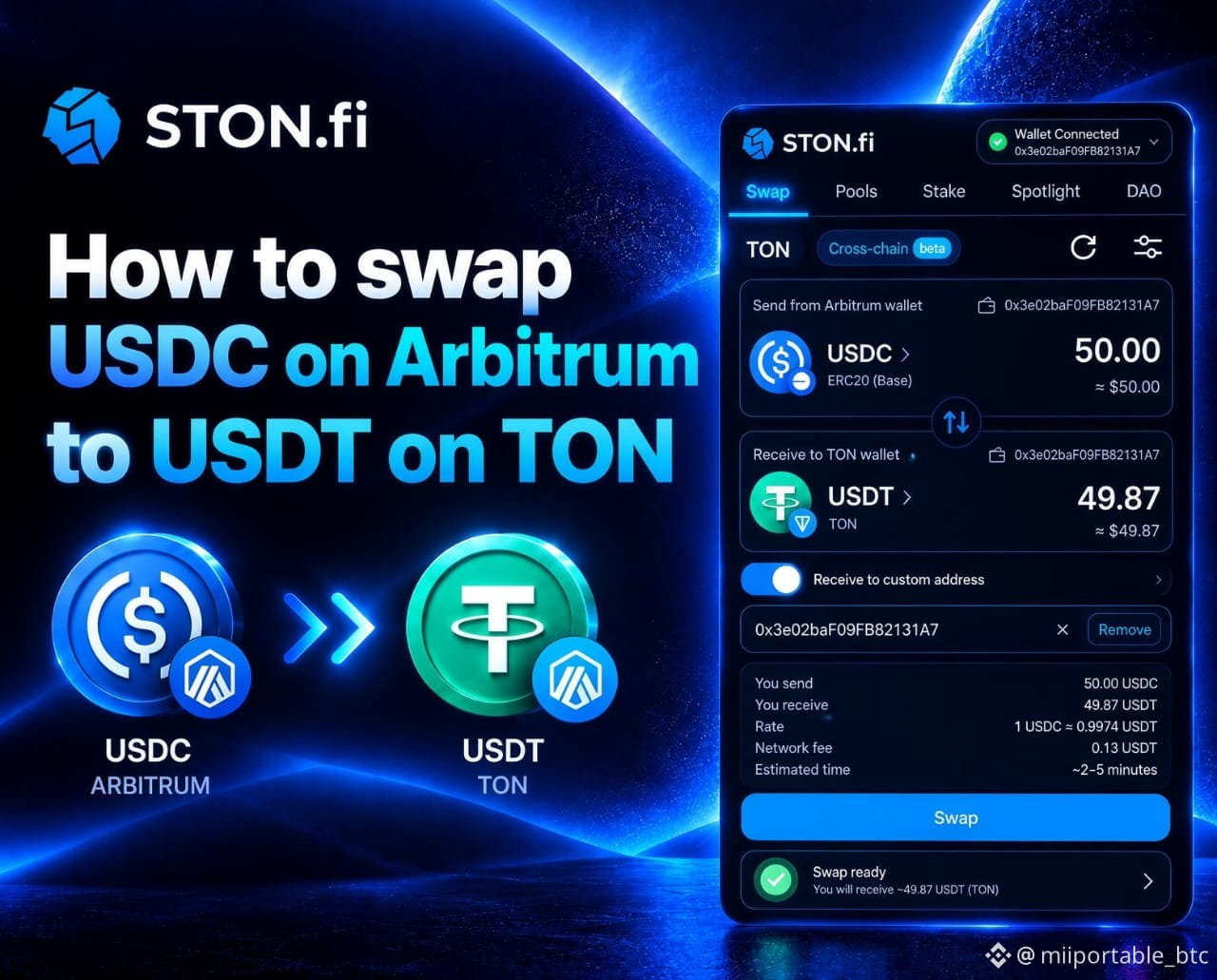
Testing Arbitrum USDC into TON USDT on STON.fi's cross-chain feature: 50 USDC entered, valued at $49.99, quoted against 49.90617 USDT, valued at $49.89, a -0.21% difference between the two sides. The rate displayed directly: 1 USDT approximately equal to 1.00187 USDC.
The Omniston line showed a specific live status: listening for updates. That's not a cosmetic detail. It means the quote wasn't frozen the instant an amount was entered, it stayed actively tracked until the moment of confirmation. This matters more for a cross-chain trade than a same network one, since conditions across two separate blockchains can both shift in the window between requesting a quote and executing it.
Worth flagging for anyone testing this specific route: Arbitrum's supported source assets on STON.fi currently include both USDC and USDT0, which are not the same token despite both originating from Arbitrum. Confirm which specific asset is actually selected before assuming a route behaves identically across both.
$TON continues to be worth watching for cross-chain quotes that stay live and accurate right up to confirmation, rather than presenting a stale number that no longer reflects real conditions by the time a user actually commits.
Ston.fi: https://ston.fi/
Cross-chain: https://app.ston.fi/swap
@stonfi @ton_blockchain $GRAM
{future}(GRAMUSDT)
#TON #defi #Omniston
Is a cross-chain quote a fixed number the moment you see it, or something still actively changing?
Testing Arbitrum USDC into TON USDT on STON.fi's cross-chain feature: 50 USDC entered, valued at $49.99, quoted against 49.90617 USDT, valued at $49.89, a -0.21% difference between the two sides. The rate displayed directly: 1 USDT approximately equal to 1.00187 USDC.
The Omniston line showed a specific live status: listening for updates. That's not a cosmetic detail. It means the quote wasn't frozen the instant an amount was entered, it stayed actively tracked until the moment of confirmation. This matters more for a cross-chain trade than a same network one, since conditions across two separate blockchains can both shift in the window between requesting a quote and executing it.
Worth flagging for anyone testing this specific route: Arbitrum's supported source assets on STON.fi currently include both USDC and USDT0, which are not the same token despite both originating from Arbitrum. Confirm which specific asset is actually selected before assuming a route behaves identically across both.
$TON continues to be worth watching for cross-chain quotes that stay live and accurate right up to confirmation, rather than presenting a stale number that no longer reflects real conditions by the time a user actually commits.
Ston.fi: https://ston.fi/
Cross-chain: https://app.ston.fi/swap
@STONfi DEX @Ton Network $GRAM
#TON #defi #Omniston
1
374

·
--
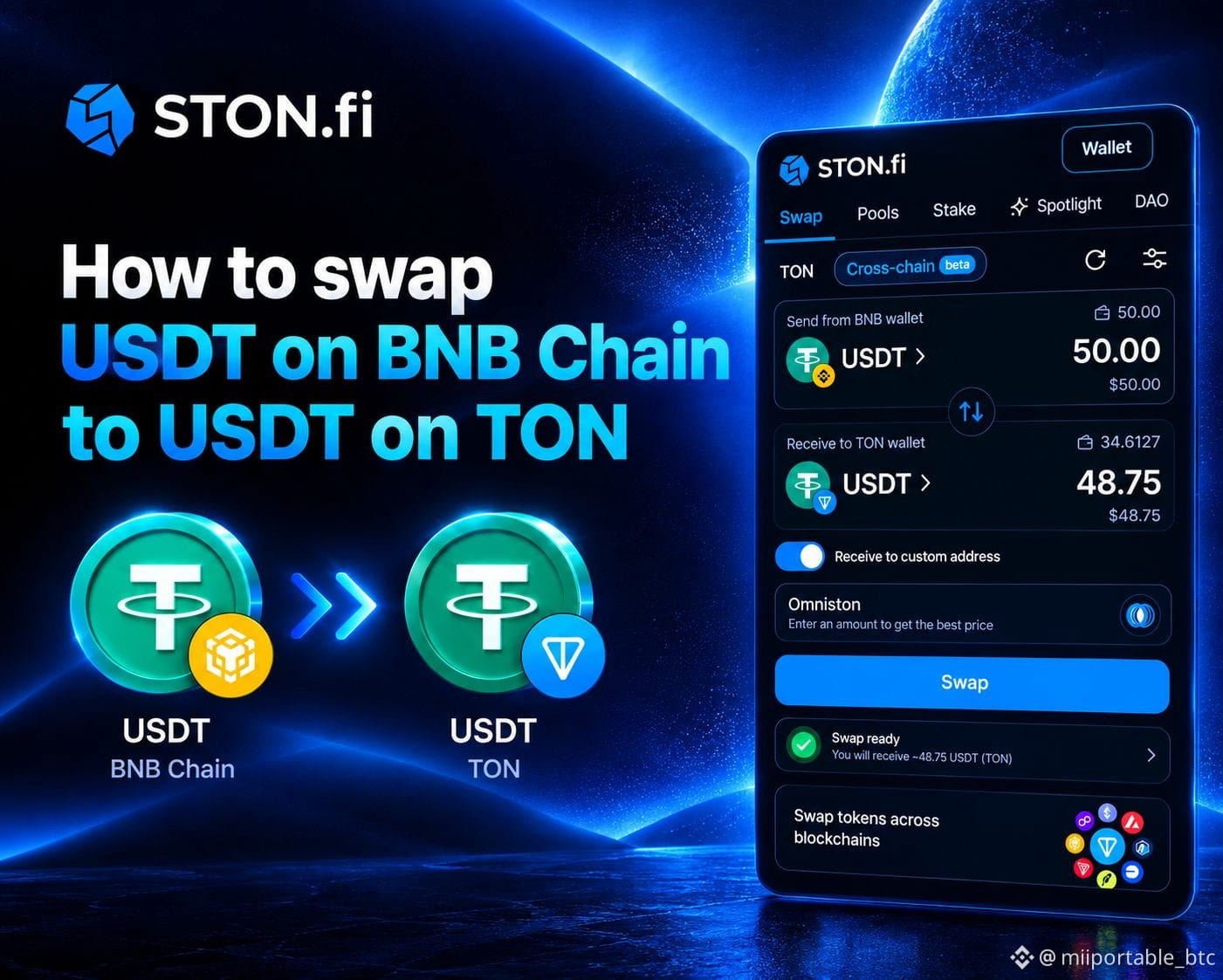
I Tested BNB Chain USDT → TON USDT on STON.fi
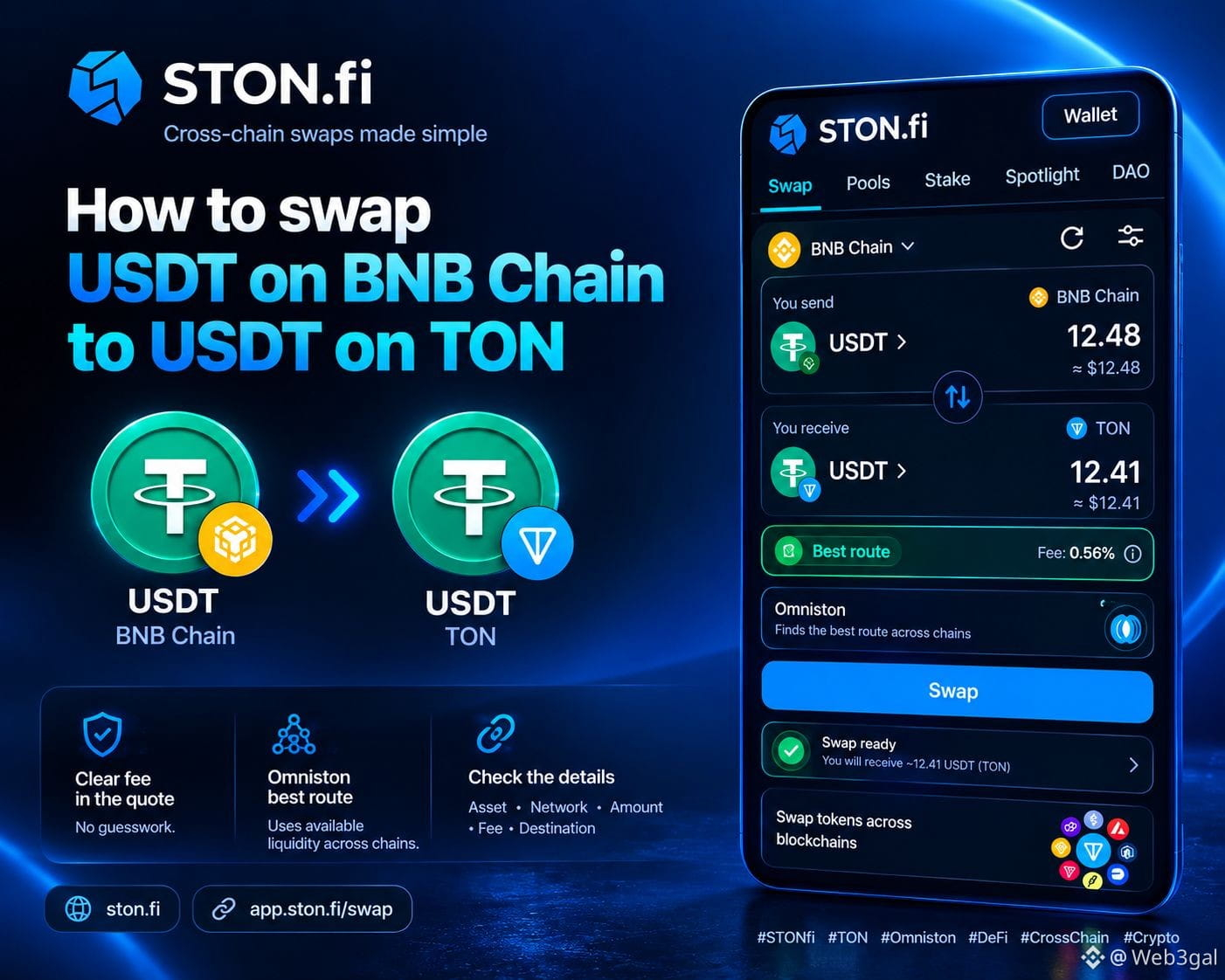
I wanted to see what the quote would actually look like, so I tested a small swap from BNB Chain to TON.
I sent 12.48 USDT and the quote showed 12.41 USDT to receive.
The part that caught my attention was the 0.56% fee shown directly by Omniston.
I checked the math myself:
12.48 - 12.41 = 0.07 USDT
That’s about 0.56%, so the numbers matched.
It’s a small thing, but I prefer seeing the cost clearly in the quote instead of having to figure it out from the difference between the amount sent and received.
Also, a quick reminder: BNB Chain USDT and TON USDT are separate assets, even though both are called USDT.
And just because a network is supported doesn’t mean every possible pair will have a route available at every moment. Always check the live quote before confirming.
https://ston.fi/
https://app.ston.fi/swap
#STONfi #TON #Omniston #DeFi
8
13
4.8k
·
--
Bullish
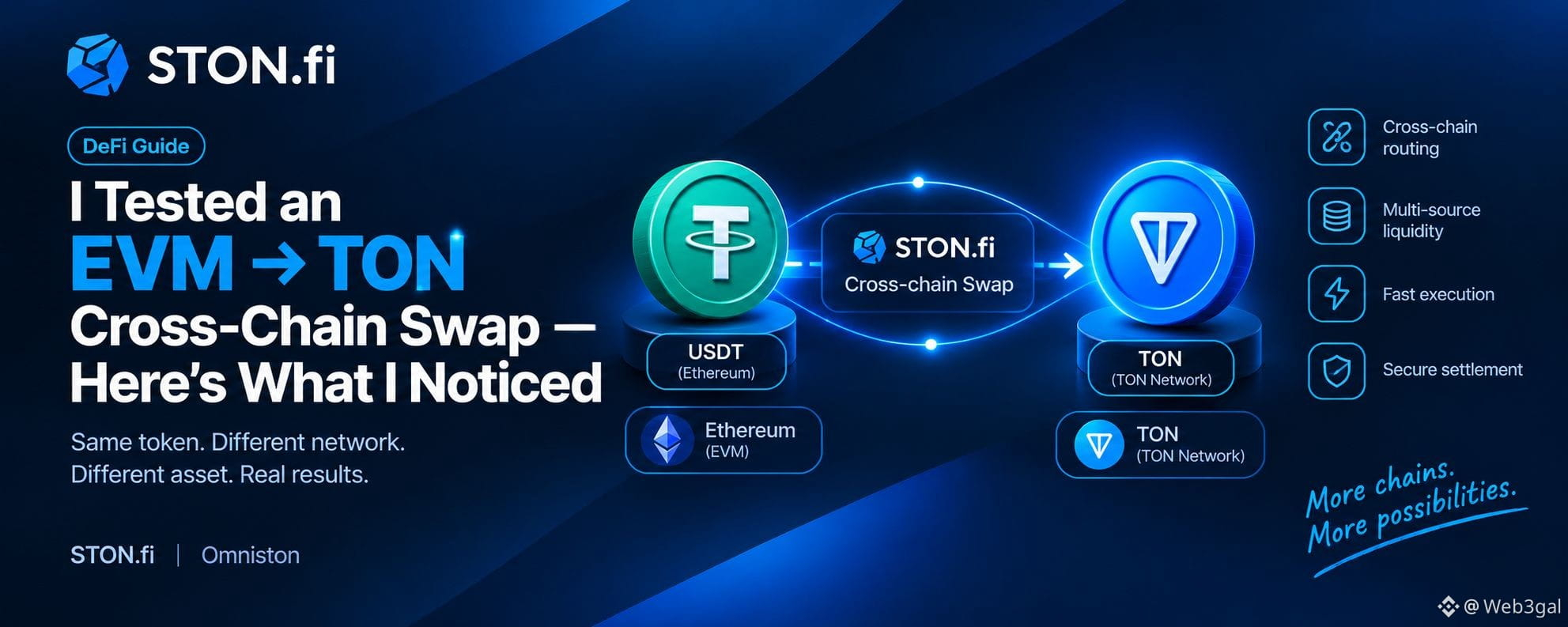
I wanted to see what an EVM → TON cross-chain swap actually looks like in practice, so I tested the flow on STON.fi.
I started with 50 USDT and selected TON as the destination.
The quote showed 34.6127 TON, with an estimated value of around $49.87 against the $50 sent.
What caught my attention wasn’t the small difference in value. It was the destination asset.
It’s easy to think:
USDT → USDT
But the actual swap was:
USDT on Ethereum → TON on TON
That made one thing clear: with cross-chain swaps, checking the destination is just as important as checking what you’re sending.
The interface showed the expected output and route before confirmation, while Omniston handled the routing and cross-chain execution using available liquidity.
The useful part of the test wasn’t simply seeing the swap go through. It was seeing how many details are worth checking before confirming:
Source asset → Source network → Destination asset → Destination network → Expected output
When you’re moving between chains, those details matter.
https://ston.fi/omniston
#STONfi #Omniston #TON #TON #CrossChain
1
262
Should a cross-chain swap fee be something you calculate yourself, or something the interface tells you directly?
Testing BNB Chain USDT into TON USDT on STON.fi's cross-chain feature: 12.48 USDT sent, valued at $12.47, against 12.41 USDT received, valued at $12.40. Rather than leaving the actual cost implicit in the gap between those two numbers, the interface labeled this specific result best route and stated the fee outright:
0.56%. Checking that figure against the sent and received amounts confirms it lines up exactly, a small but meaningful detail, since it means the platform is showing its work rather than asking users to trust an unexplained final number.
The best route label itself is worth understanding. It implies Omniston compared available liquidity paths for this specific trade before settling on this result, rather than executing through one single fixed route regardless of conditions. That's a meaningfully different design from a simple, single-pool swap with no alternatives considered.
One caution worth stating directly. Broad network support for BNB Chain does not guarantee every specific asset pair is available and quotable at every moment. Always check the live interface for your exact route before assuming it behaves identically to any example, including this one.
$TON continues to be worth watching for cross-chain interfaces that state fees explicitly rather than leaving them for users to calculate on their own.
Ston.fi: https://ston.fi/
Cross-chain: https://app.ston.fi/swap
@stonfi @ton_blockchain
#tonecoin #DEF #Omniston
Should a cross-chain swap fee be something you calculate yourself, or something the interface tells you directly?
Testing BNB Chain USDT into TON USDT on STON.fi's cross-chain feature: 12.48 USDT sent, valued at $12.47, against 12.41 USDT received, valued at $12.40. Rather than leaving the actual cost implicit in the gap between those two numbers, the interface labeled this specific result best route and stated the fee outright:
0.56%. Checking that figure against the sent and received amounts confirms it lines up exactly, a small but meaningful detail, since it means the platform is showing its work rather than asking users to trust an unexplained final number.
The best route label itself is worth understanding. It implies Omniston compared available liquidity paths for this specific trade before settling on this result, rather than executing through one single fixed route regardless of conditions. That's a meaningfully different design from a simple, single-pool swap with no alternatives considered.
One caution worth stating directly. Broad network support for BNB Chain does not guarantee every specific asset pair is available and quotable at every moment. Always check the live interface for your exact route before assuming it behaves identically to any example, including this one.
$TON continues to be worth watching for cross-chain interfaces that state fees explicitly rather than leaving them for users to calculate on their own.
Ston.fi: https://ston.fi/
Cross-chain: https://app.ston.fi/swap
@STONfi DEX @Ton Network
#tonecoin #DEF #Omniston
119

·
--
Bullish
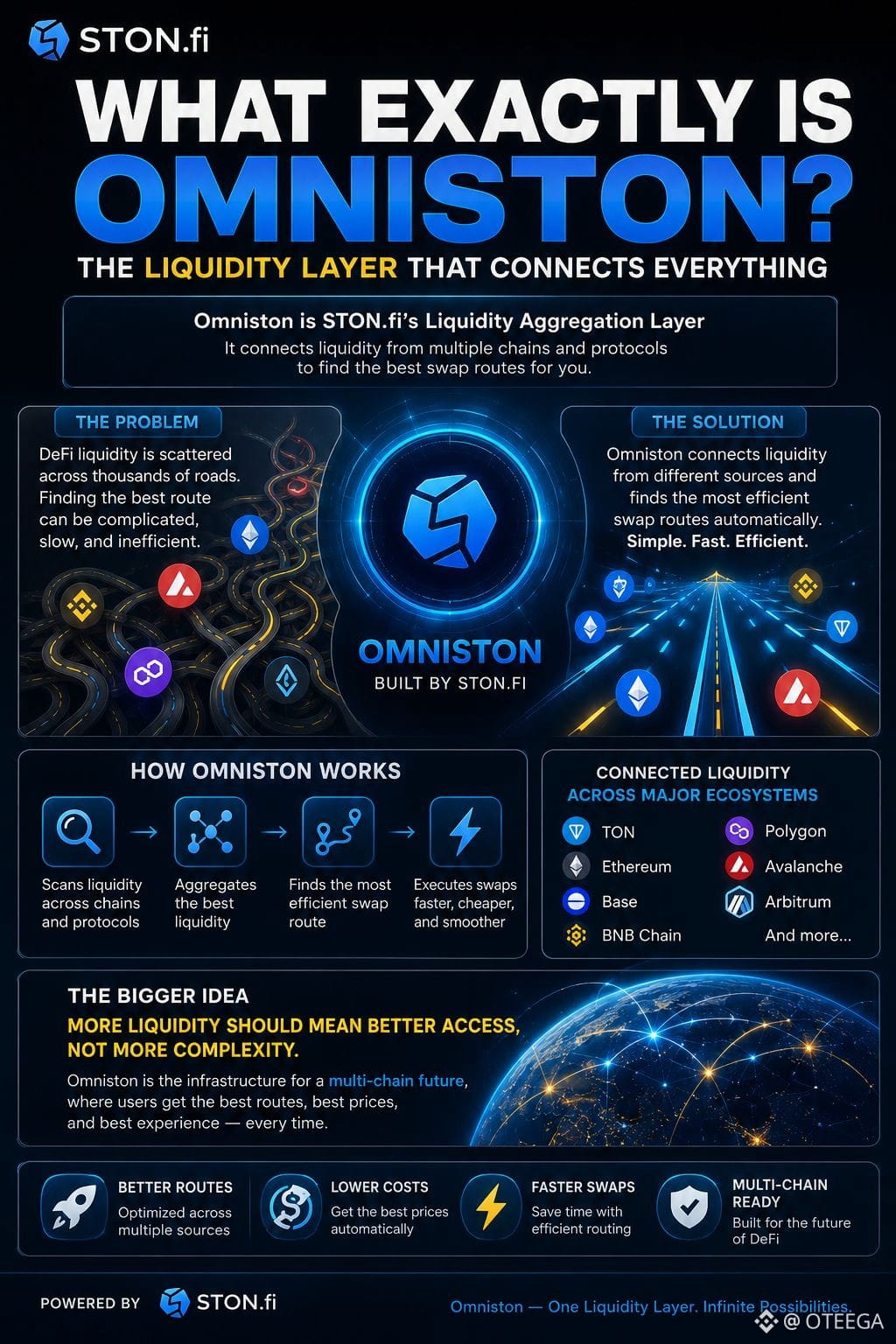
WHAT EXACTLY IS OMNISTON?
This is one of the most interesting parts of what STON.fi is building.
Think about DeFi liquidity like thousands of roads.
Some roads are on TON.
Others are on Ethereum, Base, BNB Chain, and other ecosystems.
The problem?
Finding the best route can become complicated.
Omniston is designed as a liquidity aggregation layer.
Instead of forcing users to search through fragmented liquidity themselves, it helps connect liquidity from different sources and find efficient swap routes.
The bigger idea is simple:
More liquidity should mean better access, not more complexity.
That’s why Omniston matters.
It is infrastructure built around a multi-chain future.
#Omniston #DeFi #STONfi #swap #DEX
100
·
--
Bullish
DEFI SHOULD FEEL SIMPLE.
But moving assets between ecosystems can still involve multiple steps.
Find a route.
Choose a bridge.
Move assets.
Wait for confirmation.
Then swap.
For everyday users, that complexity can become a barrier.
This is why STON.fi’s cross-chain direction is interesting.
Through infrastructure like Omniston, STON.fi is working toward a more seamless way to access liquidity across ecosystems.
The goal isn’t to make users understand every piece of infrastructure.
The goal is to hide the complexity underneath the experience.
One request.
One simple flow.
Connected liquidity behind the scenes.
That’s the kind of infrastructure that could make multi-chain DeFi feel less fragmented.
#STONfi #DEX #Omniston #DeFi
$BTC $ETH
{future}(ETHUSDT)
DEFI SHOULD FEEL SIMPLE.
But moving assets between ecosystems can still involve multiple steps.
Find a route.
Choose a bridge.
Move assets.
Wait for confirmation.
Then swap.
For everyday users, that complexity can become a barrier.
This is why STON.fi’s cross-chain direction is interesting.
Through infrastructure like Omniston, STON.fi is working toward a more seamless way to access liquidity across ecosystems.
The goal isn’t to make users understand every piece of infrastructure.
The goal is to hide the complexity underneath the experience.
One request.
One simple flow.
Connected liquidity behind the scenes.
That’s the kind of infrastructure that could make multi-chain DeFi feel less fragmented.
#STONfi #DEX #Omniston #DeFi
$BTC $ETH
1
97
·
--
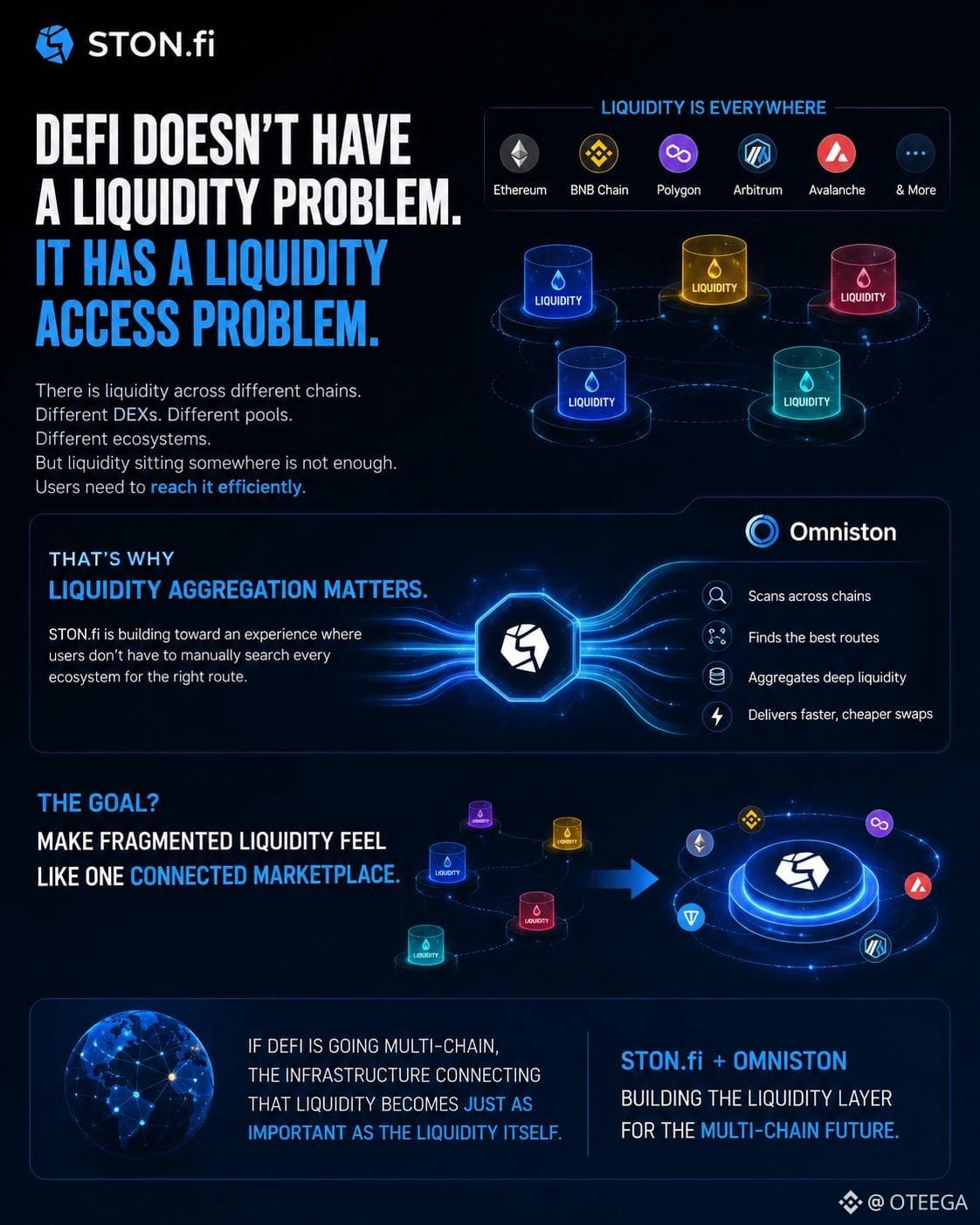
DEFI DOESN’T HAVE A LIQUIDITY PROBLEM.
IT HAS A LIQUIDITY ACCESS PROBLEM.
There is liquidity across different chains.
Different DEXs.
Different pools.
Different ecosystems.
But liquidity sitting somewhere is not enough.
Users need to reach it efficiently.
That’s why liquidity aggregation matters.
STON.fi is building toward an experience where users don’t have to manually search every ecosystem for the right route.
Omniston is part of that vision.
The goal?
Make fragmented liquidity feel like one connected marketplace.
If DeFi is going multi-chain,
the infrastructure connecting that liquidity becomes just as important as the liquidity itself.
That’s the bigger picture.
#STONfi #DeFi #Omniston #DEX
98

·
--
Bullish
Verified
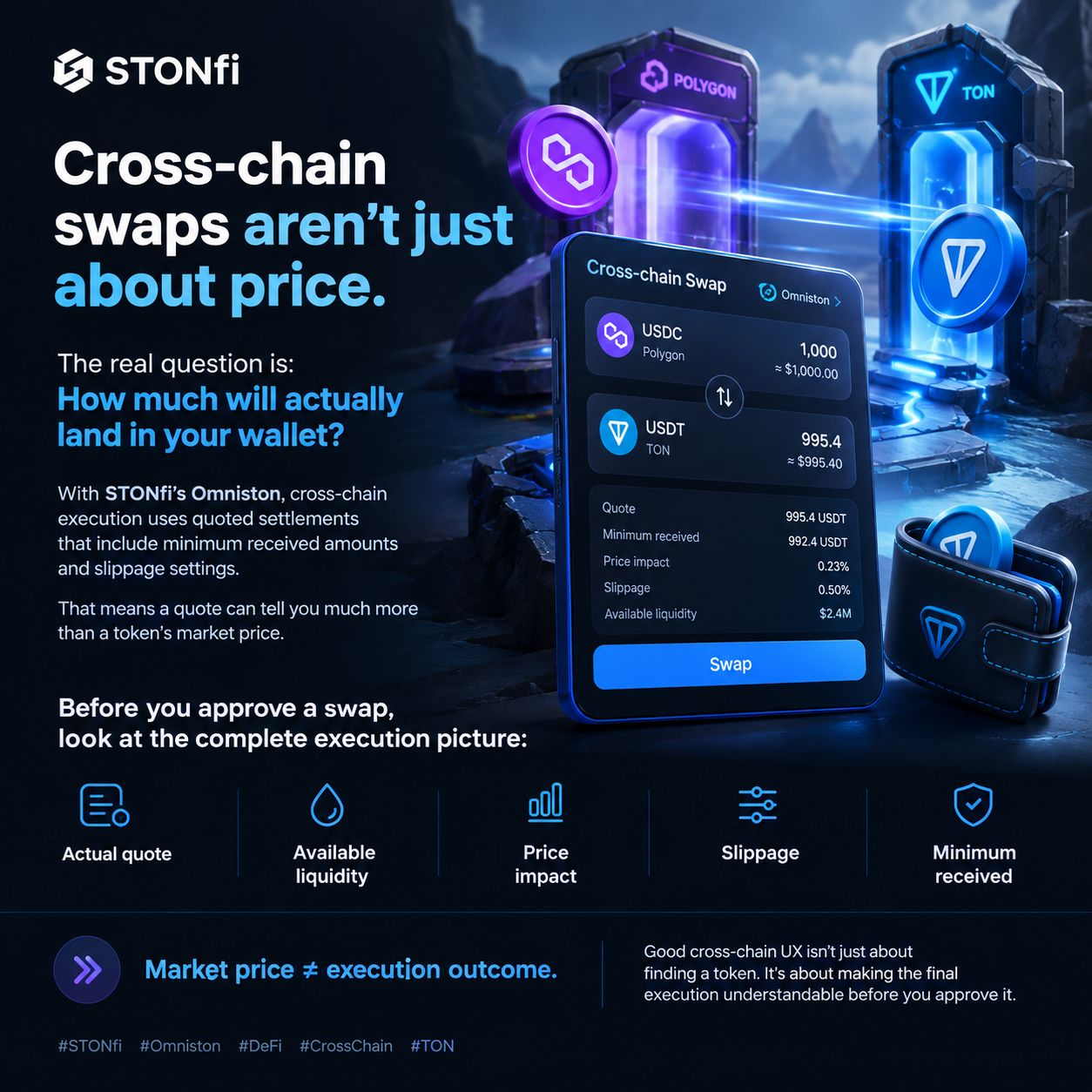
Cross-chain swaps aren’t only about price.
What matters is how much actually reaches your wallet.
With STONfi’s Omniston, quotes include minimum received amounts and slippage settings, so you can see more than a token’s market price before approving a swap.
Check:
• Actual quote
• Liquidity
• Price impact
• Slippage
• Minimum received
Your final result depends on order size, liquidity, and execution conditions—and cross-chain swaps add even more variables.
Market price ≠ execution outcome.
Don’t ask only, “What is this token worth?”
Ask, “How much will I receive, and what protects that amount?”
Good cross-chain UX makes the final result clear before you approve the swap.
#STONfi #Omniston #CrossChain #TON
$Q
{future}(QUSDT)
Cross-chain swaps aren’t only about price.
What matters is how much actually reaches your wallet.
With STONfi’s Omniston, quotes include minimum received amounts and slippage settings, so you can see more than a token’s market price before approving a swap.
Check:
• Actual quote
• Liquidity
• Price impact
• Slippage
• Minimum received
Your final result depends on order size, liquidity, and execution conditions—and cross-chain swaps add even more variables.
Market price ≠ execution outcome.
Don’t ask only, “What is this token worth?”
Ask, “How much will I receive, and what protects that amount?”
Good cross-chain UX makes the final result clear before you approve the swap.
#STONfi #Omniston #CrossChain #TON
$Q
2
619

·
--
Article
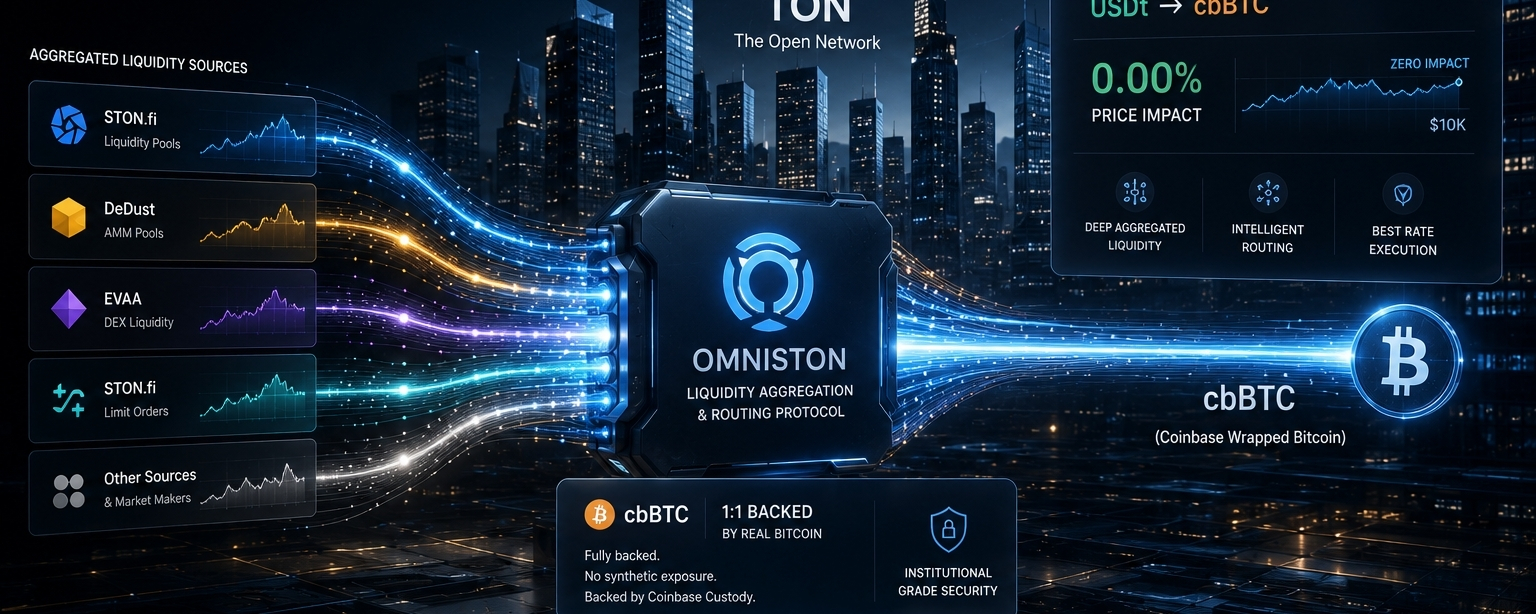
Omniston Just Proved Something Important This Week.Hook: 💭 "Omniston Just Proved Something Important This Week. Not With An Announcement With A $10K Zero Price Impact cbBTC Swap."
You No Longer Have To Leave TON To Access Bitcoin. That Sentence Would Have Sounded Impossible 12 Months Ago. Today It Is Just How STON.fi Works.
How Omniston and cbBTC just changed the conversation about what TON DeFi can actually offer.
"The best infrastructure is the kind you stop noticing because it just works every single time."
The Problem That Followed Bitcoin Into DeFi
Bitcoin is the asset everyone wants. It is the first thing most people buy when they enter crypto. It is the store of value the entire industry anchors itself to in moments of uncertainty.
But for years accessing Bitcoin inside DeFi has been unnecessarily complicate.
Bridges with trust assumptions. Wrapped tokens with custodial risk. Fragmented liquidity spread across multiple protocols forcing traders to manually hunt for the best rate on every single swap.
Most ecosystems accepted that friction as the cost of doing business with BTC in DeFi. TON just decided not to.
What Omniston And cbBTC Actually Deliver Together
cbBTC is Coinbase Wrapped Bitcoin. Real Bitcoin. Backed 1:1. No bridge risk. No trust assumptions beyond Coinbase custody. Just genuine BTC exposure accessible directly inside the TON ecosystem without ever leaving it.
And Omniston is the routing layer that makes accessing it seamless.
STON.fi's liquidity aggregation protocol now supports cbBTC swaps with zero price impact on orders up to $10K USDt to cbBTC. Every swap routes automatically through the best available liquidity across TON's entire ecosystem. No manual pool hunting. No splitting orders across multiple interfaces. Just clean execution at the best available rate every single time.
You swap. Omniston finds the best path. cbBTC lands in your wallet. Done.
"Access is not enough. The quality of that access is what separates infrastructure from everything else."
What This Means For Every TON User
Before this integration accessing Bitcoin on TON meant leaving the ecosystem entirely. Going to another chain. Dealing with bridge mechanics. Paying fees on multiple networks. Hoping nothing went wrong in transit.
Now it means opening STON.fi and swapping.
That is not a small change in user experience. That is the difference between DeFi that works for serious participants and DeFi that works only for people willing to tolerate unnecessary complexity.
And for developers building wallets, mini-apps or any user-facing product on TON integrating Omniston once gives your users access to this entire swap experience without building routing logic from scratch. Best rate execution, cbBTC support and every future asset Omniston adds all come through a single integration.
The Bigger Picture Worth Understanding
Omniston is not finished expanding. More assets are coming. More liquidity sources are being added. The routing infrastructure being built here is designed to grow more powerful as the TON ecosystem grows around it.
Bitcoin access today. More major assets tomorrow. All routed seamlessly through STON.fi's infrastructure at the best available rate with zero unnecessary friction.
TON is not building toward mass adoption anymore. It is building the infrastructure that makes mass adoption inevitable.
And STON.fi is where that infrastructure lives.
"The ecosystems that win are never the loudest ones. They are the ones that quietly remove every reason not to use them."
DYOR always, And not financial advice. Always research before making any financial decisions.
#TON #defi #Omniston
Omniston Just Proved Something Important This Week.
Hook: 💭 "Omniston Just Proved Something Important This Week. Not With An Announcement With A $10K Zero Price Impact cbBTC Swap."
You No Longer Have To Leave TON To Access Bitcoin. That Sentence Would Have Sounded Impossible 12 Months Ago. Today It Is Just How STON.fi Works.
How Omniston and cbBTC just changed the conversation about what TON DeFi can actually offer.
"The best infrastructure is the kind you stop noticing because it just works every single time."
The Problem That Followed Bitcoin Into DeFi
Bitcoin is the asset everyone wants. It is the first thing most people buy when they enter crypto. It is the store of value the entire industry anchors itself to in moments of uncertainty.
But for years accessing Bitcoin inside DeFi has been unnecessarily complicate.
Bridges with trust assumptions. Wrapped tokens with custodial risk. Fragmented liquidity spread across multiple protocols forcing traders to manually hunt for the best rate on every single swap.
Most ecosystems accepted that friction as the cost of doing business with BTC in DeFi. TON just decided not to.
What Omniston And cbBTC Actually Deliver Together
cbBTC is Coinbase Wrapped Bitcoin. Real Bitcoin. Backed 1:1. No bridge risk. No trust assumptions beyond Coinbase custody. Just genuine BTC exposure accessible directly inside the TON ecosystem without ever leaving it.
And Omniston is the routing layer that makes accessing it seamless.
STON.fi's liquidity aggregation protocol now supports cbBTC swaps with zero price impact on orders up to $10K USDt to cbBTC. Every swap routes automatically through the best available liquidity across TON's entire ecosystem. No manual pool hunting. No splitting orders across multiple interfaces. Just clean execution at the best available rate every single time.
You swap. Omniston finds the best path. cbBTC lands in your wallet. Done.
"Access is not enough. The quality of that access is what separates infrastructure from everything else."
What This Means For Every TON User
Before this integration accessing Bitcoin on TON meant leaving the ecosystem entirely. Going to another chain. Dealing with bridge mechanics. Paying fees on multiple networks. Hoping nothing went wrong in transit.
Now it means opening STON.fi and swapping.
That is not a small change in user experience. That is the difference between DeFi that works for serious participants and DeFi that works only for people willing to tolerate unnecessary complexity.
And for developers building wallets, mini-apps or any user-facing product on TON integrating Omniston once gives your users access to this entire swap experience without building routing logic from scratch. Best rate execution, cbBTC support and every future asset Omniston adds all come through a single integration.
The Bigger Picture Worth Understanding
Omniston is not finished expanding. More assets are coming. More liquidity sources are being added. The routing infrastructure being built here is designed to grow more powerful as the TON ecosystem grows around it.
Bitcoin access today. More major assets tomorrow. All routed seamlessly through STON.fi's infrastructure at the best available rate with zero unnecessary friction.
TON is not building toward mass adoption anymore. It is building the infrastructure that makes mass adoption inevitable.
And STON.fi is where that infrastructure lives.
"The ecosystems that win are never the loudest ones. They are the ones that quietly remove every reason not to use them."
DYOR always, And not financial advice. Always research before making any financial decisions.
#TON #defi #Omniston
127

·
--
Bullish
I've been following STON.fi's updates on Omniston, and one thing stands out to me: it's trying to remove the friction from cross-chain swaps.
What I like most isn't a single feature—it's the idea of keeping everything in one place instead of relying on multiple bridges or exchanges. As someone who creates Web3 content, I think making DeFi easier to use is just as important as adding new features.
I'm looking forward to seeing how Omniston evolves as support for more networks and assets continues to grow.
#STONfi #Omniston #GRAM #defi

1
275

·
--
Bullish
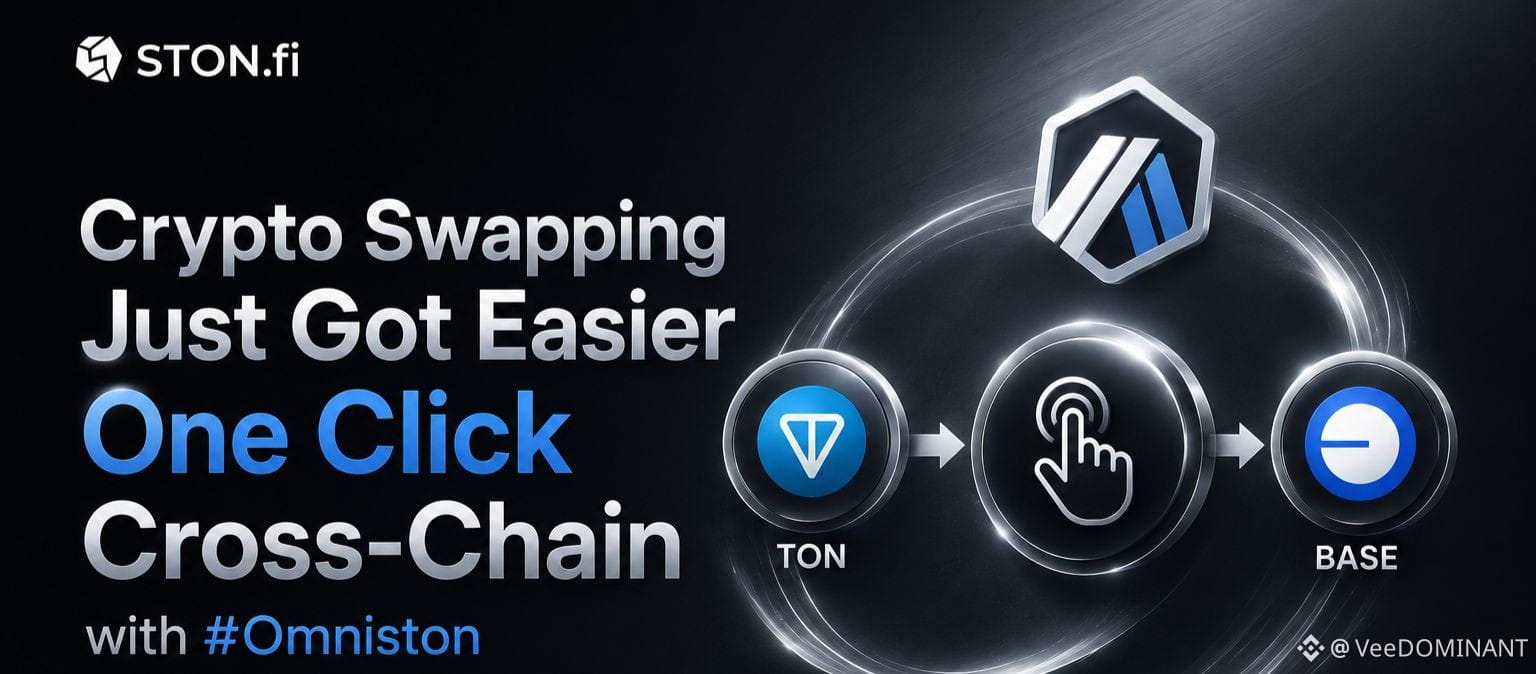
Crypto Swapping Just Got Easier with One Click Cross-Chain with #Omniston .
If you've ever tried to move crypto from one #blockchain to another, you know the struggle of downloading new wallets, buying native tokens just to pay for gas and dealing with confusing interfaces.
With Omniston now supporting native cross chain swaps, that issue is officially over for the #TON ecosystem.
What this means is that 👇🏾
True One-Click, you select your starting token (like $USDT on TON) and your target token (like $USDC on #Base ).
Omniston handles the complex routing for you with the best rates and no hidden complexities.
Omniston is leading that charge, making multichain interactions simple enough for anyone to master.
1
86
·
--
TON DeFi Is Expanding Faster Than Ever
Omniston is pushing the $TON ecosystem forward with its latest integration into Gramstox, bringing tokenized stock swaps directly into Telegram.
Users can now gain exposure to tokenized stocks with optimized execution, all without leaving the Telegram app. No extra platforms, no complicated onboarding, just seamless on-chain trading.
This integration strengthens Omniston's position as a key liquidity engine powering the next generation of TON-based financial applications.
As more Mini Apps build on $STON and Omniston infrastructure, $GRAM is evolving into a complete financial ecosystem where DeFi becomes accessible to millions through familiar consumer platforms.
The future of on-chain finance isn't being built elsewhere, it's being built inside Telegram.
#TON #STONfi #Omniston
1
70

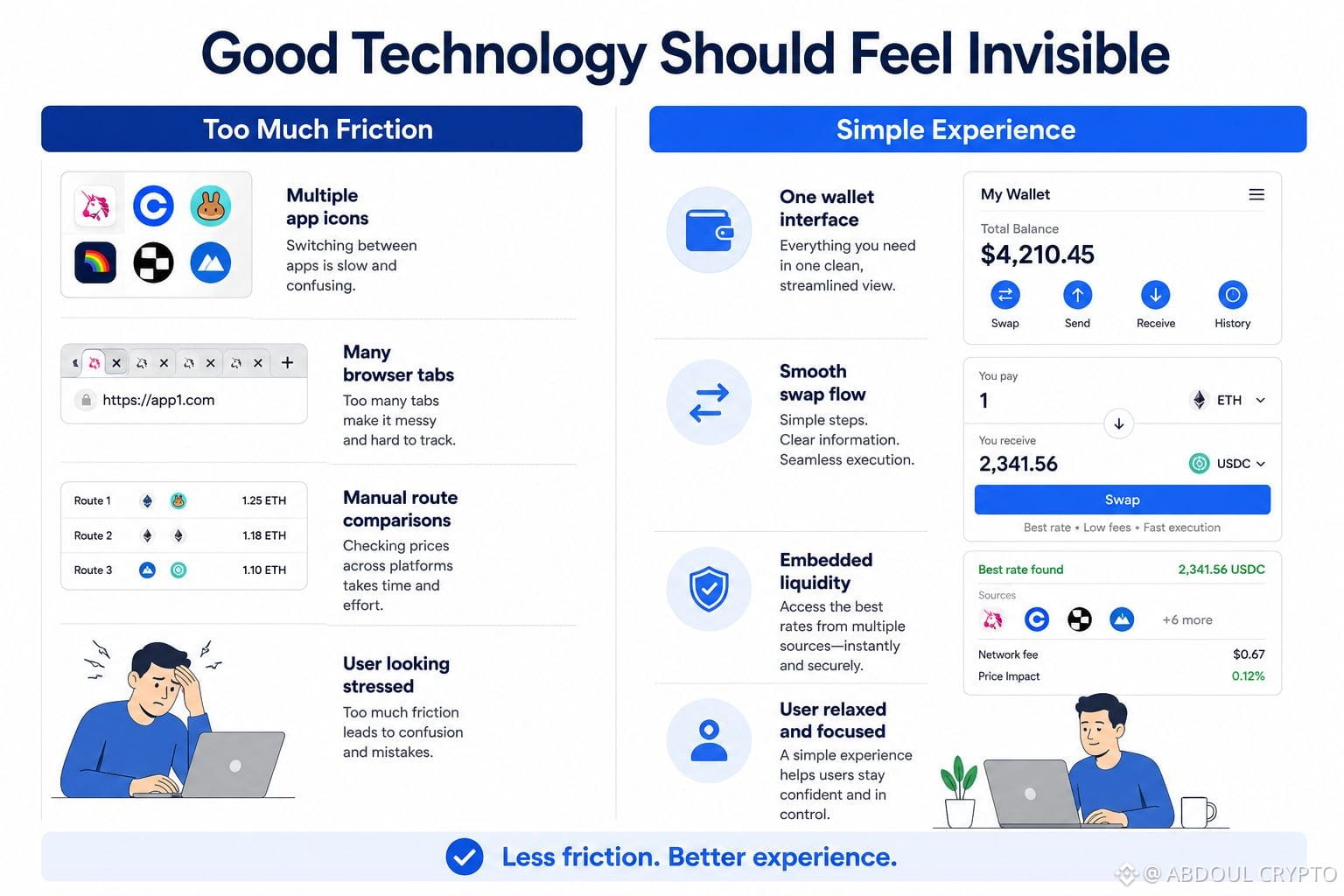
One thing I've noticed over time is that most users don't actually want more tools.
They want fewer steps.
Personally, I think one of the biggest sources of friction in DeFi has always been complexity. Opening multiple tabs, comparing routes manually, and trying to find the best execution can quickly turn simple actions into something much more complicated than they need to be.
That's why I find invisible infrastructure interesting.
Good technology doesn't always need to be visible. In many cases, the best experience is the one where users don't have to think about what is happening behind the scenes.
Instead of worrying about where liquidity comes from or which route is better, users can simply focus on what they want to do.
To me, that's what a better DeFi experience should feel like.
Less friction.
More simplicity.
And that's one reason I find the approach around STON.fi and Omniston interesting.
🔗 ston.fi
#STONfi #TON #DeFi #Omniston
$TON
202

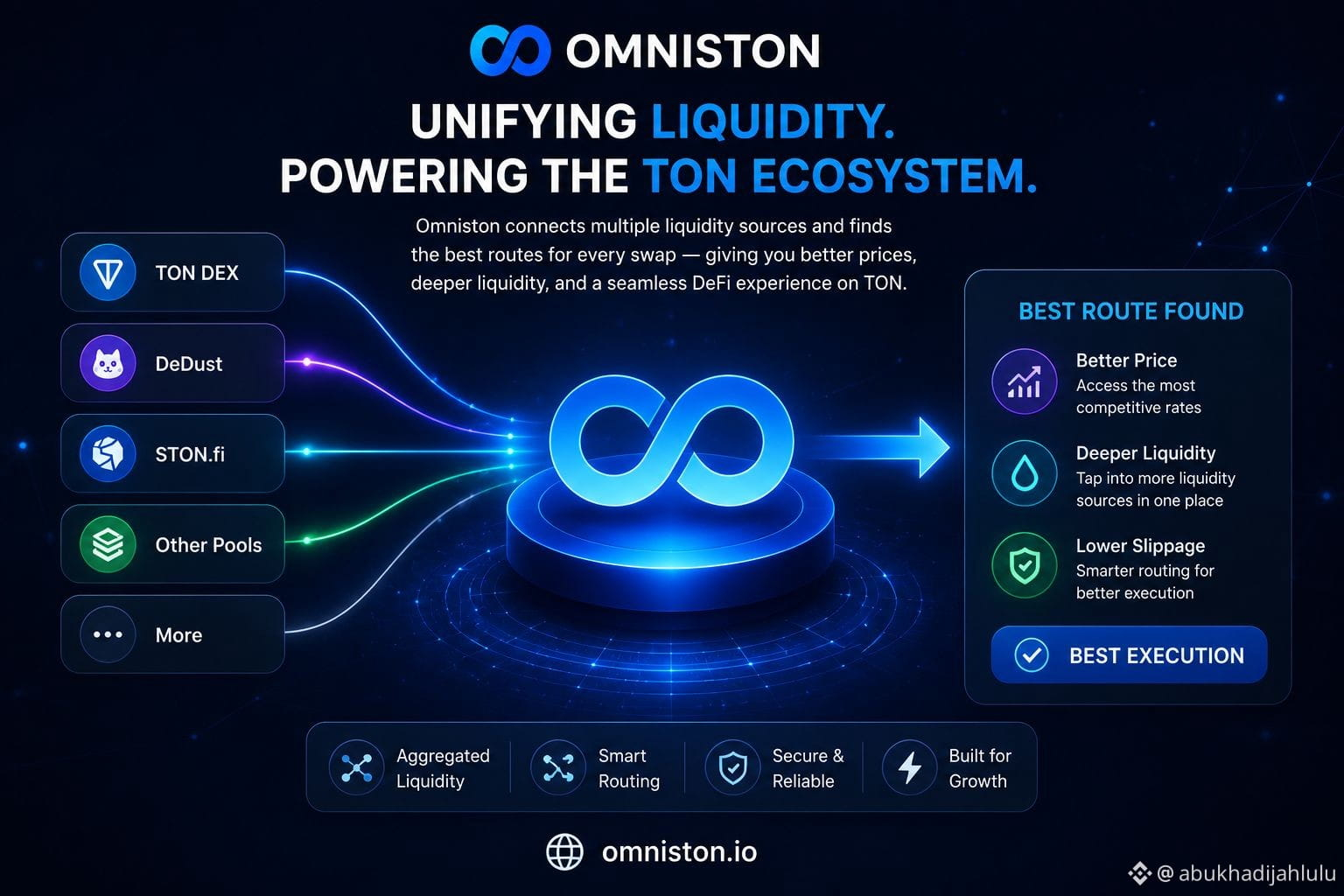
One thing I've noticed while exploring the TON ecosystem is that the strongest projects often solve problems users don't immediately see.
Recently, I've been learning more about Omniston and the role it plays in improving liquidity accessibility across the ecosystem.
The interesting part is that most users only see the final result: a smoother experience.
Behind that experience is infrastructure designed to connect liquidity and reduce fragmentation.
The more I understand the concept, the more I believe infrastructure projects deserve greater recognition within DeFi discussions.
After all, ecosystem growth depends not only on applications but also on the systems that connect them.
Explore here:
https://app.ston.fi/swap?chartVisible=false&ft=TON&tt=USDT&referral_address=UQCq2IszYe5vS-Oc3Xu2OMeIZPkn93rUQg5ww0ouUAJmN5Cq�
#Omniston on #Toncoin #DeFi: #BinanceSquare
1
169

·
--
Bullish
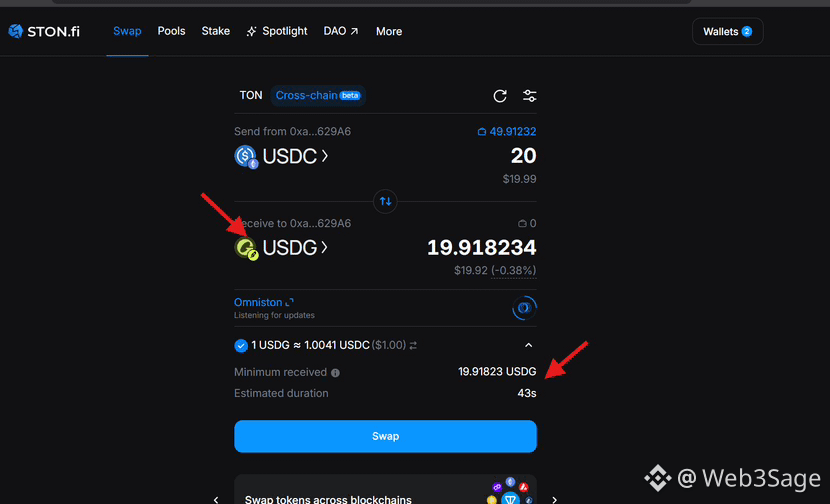
Every Great DeFi Ecosystem Needs a Liquidity Engine
A blockchain can have fast transactions.
It can have low fees.
It can attract developers and new users.
But without efficient liquidity, even the strongest ecosystem struggles to unlock its full potential.
Liquidity is what transforms a blockchain from a network into an economy.
As the TON ecosystem continues to grow, so does the number of tokens, protocols, and trading opportunities. While this growth is exciting, it also introduces a familiar challenge: liquidity becomes more distributed, making efficient trade execution increasingly important.
This is where Omniston brings a different perspective.
Rather than focusing solely on creating another place to trade, Omniston is designed to aggregate liquidity from supported sources and help applications access it through a unified execution layer.
In simple terms, it's about helping users find efficient execution without requiring them to search across multiple liquidity venues themselves.
For the $STON ecosystem, this represents an important evolution.
The conversation is no longer just about facilitating swaps, it's about improving how those swaps happen. Better routing, smarter liquidity access, and stronger developer infrastructure all contribute to a smoother DeFi experience.
As more applications are built on TON, infrastructure like Omniston could play an increasingly important role in connecting liquidity and reducing friction across the ecosystem.
The strongest DeFi ecosystems aren't defined only by how much liquidity they have.
They're also defined by how effectively that liquidity can be accessed.
💬 As TON continues to expand, what do you think will have the biggest impact on user experience: deeper liquidity, smarter execution, or better developer infrastructure?
#ston #TON #Omniston
1
90


Article
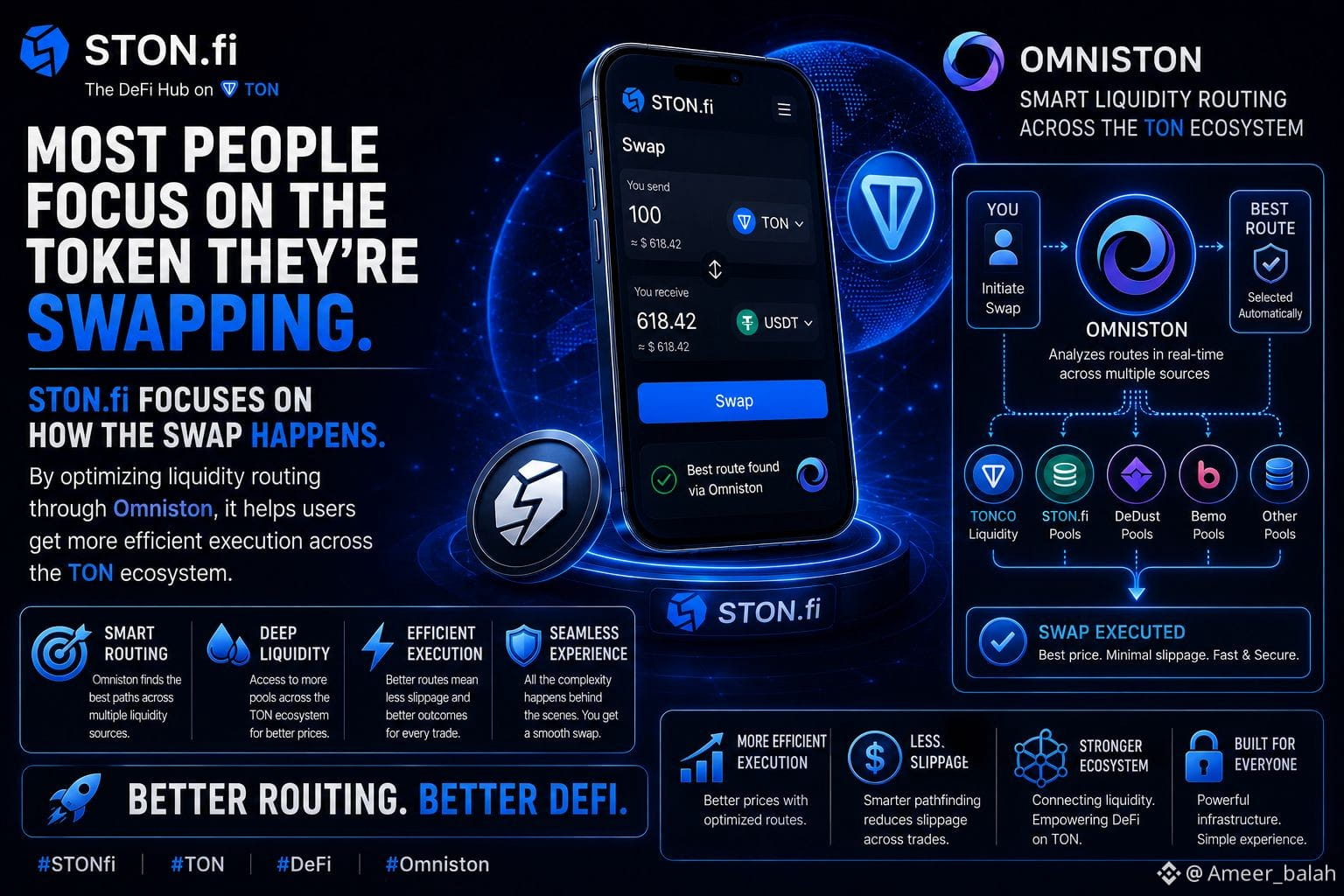
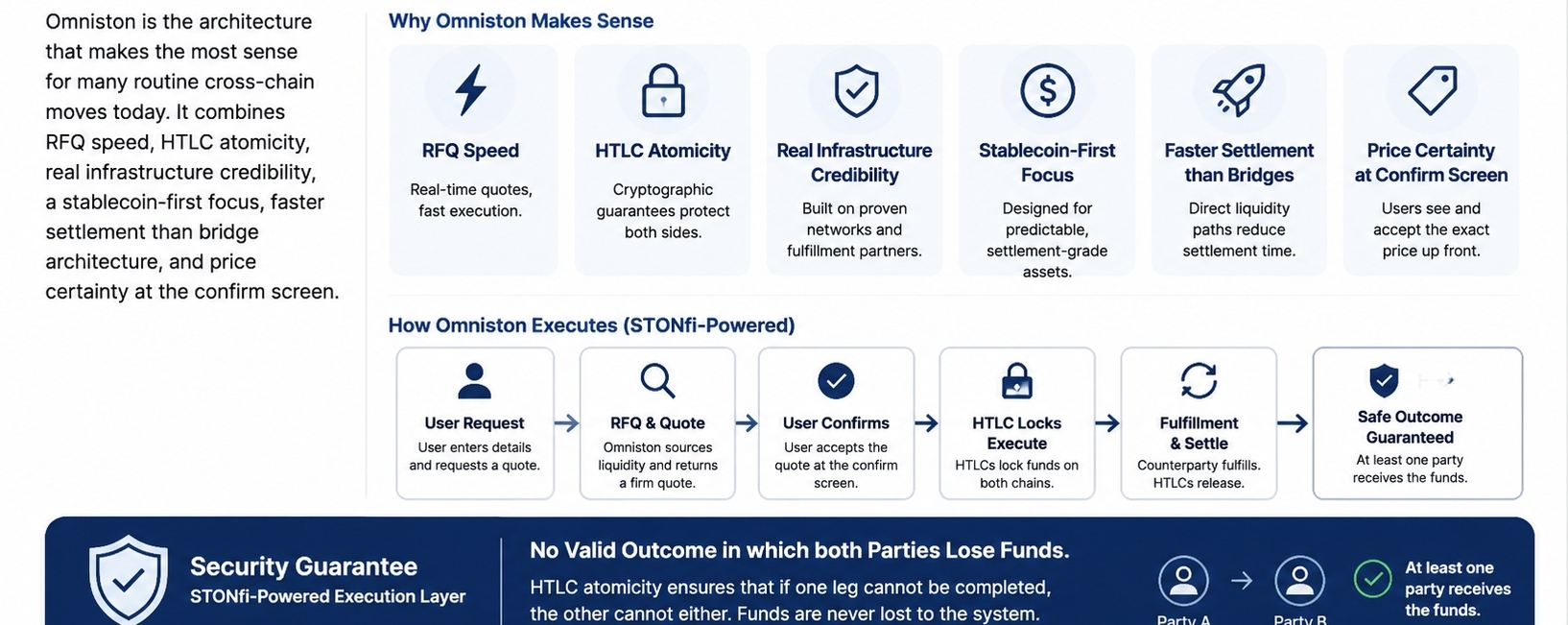
Omniston: Cross-Chain DeFi Strategy in a Single Execution Window.
DeFi Offers Tremendous Potential for Building a Conflict of Interest-Free Financial System.
With Defi Cross Chain, Peer-to-peer (P2P) Financial Transactions are one of the Core Premises Behind DeFi.
Challenges in a DeFi Landscape that lacks Cross-Chain Technology:
© Constrained Liquidity
© Siloed Assets
© Reduced Capital Efficiency
© Limited Scalability
Types of Cross-Chain DeFi
= Lending
= Exchanges
= Staking
= Yield Aggregators
Cross Chain Defi is All About Choosing the Mechanism that Moves Values Like:
1. Atomic swap
2. HTLC- Trust Minimization
3. RFQ- SPEED
4. Hybrid Model that combines RFQ with Paired HTLCs- Omniston
Every Cross-Chain strategy depends on an Execution model.
#Omniston Role in Cross-Chain DeFi.
#Omniston Combines Speed, Trust Minimization, Real Infrastructure Credibility, Stablecoin-First Focus, and Price Certainty.
With the STONfi-Powered Execution Layer - Omniston, there's no Valid Outcome in which both Parties Lose Funds.
Useful links to STONfi-Powered(Omniston) Channels:
X Handle - https://x.com/ston_fi
Telegram Handle - https://t.me/stonfidex
$Stonfi Official Website - http://STON.fi
TRY CROSS-CHAIN TON - EVM SWAPS ON STON.FI - https://app.ston.fi/swap?mode=cross-chain&in=ton%3AUSD%E2%82%AE
#Web3 #DEFİ #TON #Omniston
1
87
·
--
Bullish
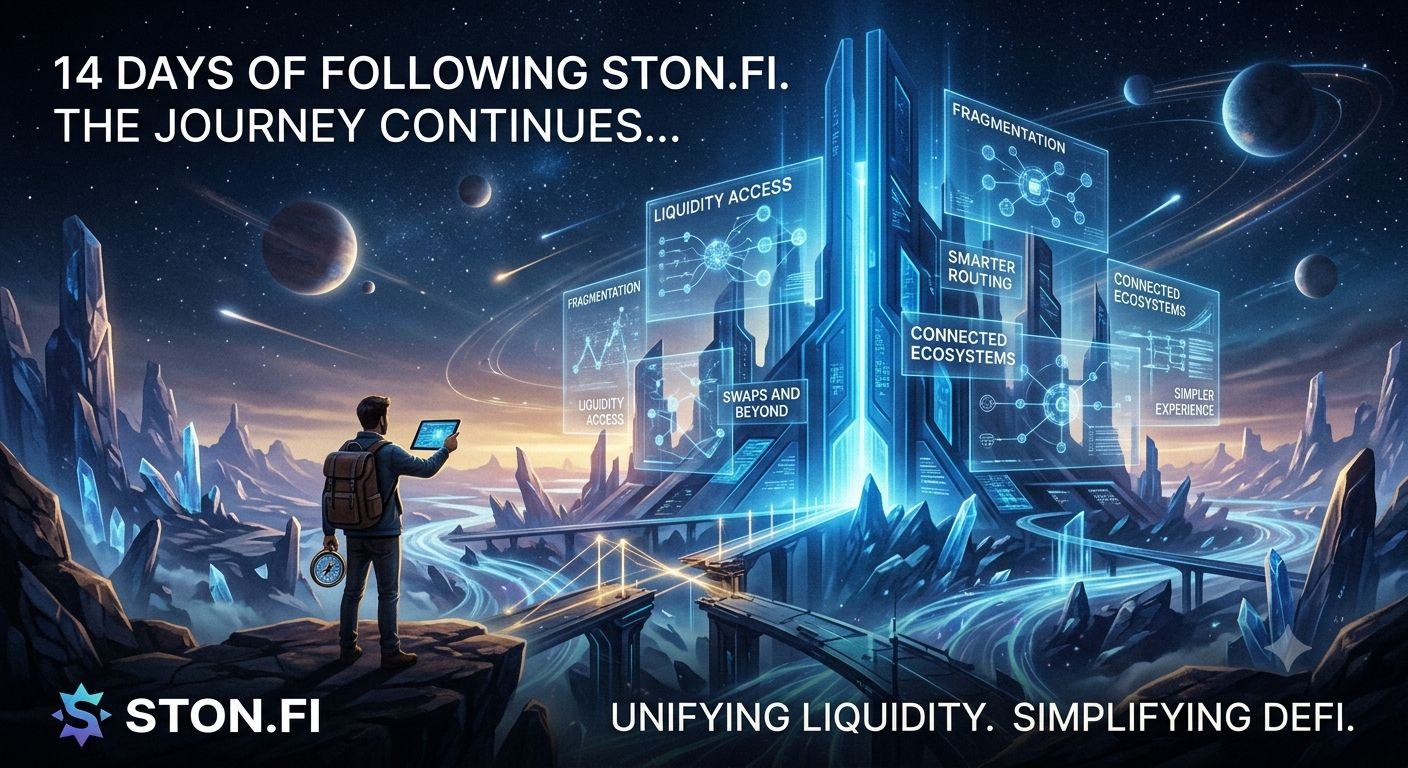
14 DAYS OF FOLLOWING WHAT STON.FI IS BUILDING.
And one thing is becoming clear.
The story is bigger than swaps.
The deeper problem is fragmentation.
Liquidity is everywhere.
But accessing it efficiently is still difficult.
Different chains.
Different pools.
Different routes.
Different experiences.
Over the past two weeks, I’ve been looking closely at how STON.fi and Omniston fit into this picture.
The thesis is simple:
DeFi doesn’t necessarily need more complexity.
It needs better infrastructure to manage the complexity that already exists.
That means:
Better liquidity access.
Smarter routing.
More connected ecosystems.
And a simpler experience for users.
Week 1 was about understanding the problem.
Week 2 was about understanding the infrastructure.
Next, I’m going deeper into what makes the STON.fi ecosystem work.
The journey continues.
#STON.fi #OMNISTON #Defi #swap
$ETH
105

·
--
The Liquidity Problem Nobody Sees
One of the biggest challenges in DeFi isn't the lack of liquidity.
It's fragmented liquidity.
Imagine you're looking for the best price for an asset, but the liquidity you need is spread across different DEXs, pools, market makers and chains.
You could manually check each one.
But most users don't want to do that.
They want to enter an amount, choose what they want to receive, and get an efficient route.
This is where liquidity aggregation becomes important.
Omniston is interesting to me because it approaches liquidity as something that should be more connected rather than trapped inside separate silos.
Instead of asking users to understand every liquidity source, the infrastructure can handle much of that complexity behind the scenes.
For traders, that can mean:
→ More efficient execution
→ Better access to liquidity
→ Less manual searching
→ A smoother swapping experience
And for developers, shared liquidity infrastructure can make it easier to build products without having to create an entire liquidity system from scratch.
The more DeFi grows, the more important liquidity coordination becomes.
Liquidity isn't just about how much money is in a protocol.
It's also about how efficiently that liquidity can be accessed.
#STONfi #Omniston
99
Log in to explore more content
Join global crypto users on Binance Square
⚡️ Get latest and useful information about crypto.
💬 Trusted by the world’s largest crypto exchange.
👍 Discover real insights from verified creators.
Email / Phone number
Trending Topics
1
#BinanceReports80%Recoveryof$6.3BillioninLossesfromHackIncident
12,201 views
122 Discussing
2
#HeYiSaysWithdrawalsExpectedtoResumeWithin42Hours
21,056 views
417 Discussing
3
#CZSaysCompensationIsinPlaceUsersAreProtected
22,259 views
324 Discussing
4
#RichardTengSaysBinanceWillCoverAllHackedLosseswithCompanyFunds
2,854 views
24 Discussing
5
#IntelHasItsWorstDaySince1974
1,423 views
76 Discussing
6
#TRMCambodianCasinosReceived$1.07BInCrypto
988 views
38 Discussing
7
#USDCCirculationFallsAbout800MInSevenDays
14,253 views
257 Discussing
8
#SuspectedNorthKoreaAttacksAccountForNearly89%OfCryptoHackLosses
7,515 views
70 Discussing
9
#OpenAICutsFundraisingTargetBy$10B
1,358 views
55 Discussing
10
#ASICHasReceivedNoPredictionMarketApplications
27,492 views
674 Discussing