

#cryptoeducation
cryptoeducation
3.5M views
20,701 සාකච්ඡා කරමින්
උණුසුම්
නවතම

$SHELL | Why the Same RSI Can Show Two Different Numbers
Here's something that confuses a lot of newcomers: SHELL's RSI(6) reads 40.16 on the daily chart, but 64.07 on the 1-hour chart. Same asset, same indicator, very different numbers. Is the data wrong? No.
RSI isn't one single number for an asset. It's calculated separately for each chart interval you pick, using the candles from that interval. The daily RSI looks at the last 6 daily candles; the 1-hour RSI looks at the last 6 hourly candles. They're answering two different questions: how has SHELL moved over the last 6 days, versus the last 6 hours.
That's why checking just one timeframe and treating it as "the" RSI of an asset misses part of the picture.
#SHELL #CryptoEducation #Timeframes
$SHELL | Why the Same RSI Can Show Two Different Numbers
Here's something that confuses a lot of newcomers: SHELL's RSI(6) reads 40.16 on the daily chart, but 64.07 on the 1-hour chart. Same asset, same indicator, very different numbers. Is the data wrong? No.
RSI isn't one single number for an asset. It's calculated separately for each chart interval you pick, using the candles from that interval. The daily RSI looks at the last 6 daily candles; the 1-hour RSI looks at the last 6 hourly candles. They're answering two different questions: how has SHELL moved over the last 6 days, versus the last 6 hours.
That's why checking just one timeframe and treating it as "the" RSI of an asset misses part of the picture.
#SHELL #CryptoEducation #Timeframes
Here's something that confuses a lot of newcomers: SHELL's RSI(6) reads 40.16 on the daily chart, but 64.07 on the 1-hour chart. Same asset, same indicator, very different numbers. Is the data wrong? No.
RSI isn't one single number for an asset. It's calculated separately for each chart interval you pick, using the candles from that interval. The daily RSI looks at the last 6 daily candles; the 1-hour RSI looks at the last 6 hourly candles. They're answering two different questions: how has SHELL moved over the last 6 days, versus the last 6 hours.
That's why checking just one timeframe and treating it as "the" RSI of an asset misses part of the picture.
#SHELL #CryptoEducation #Timeframes
5
ලිපිය
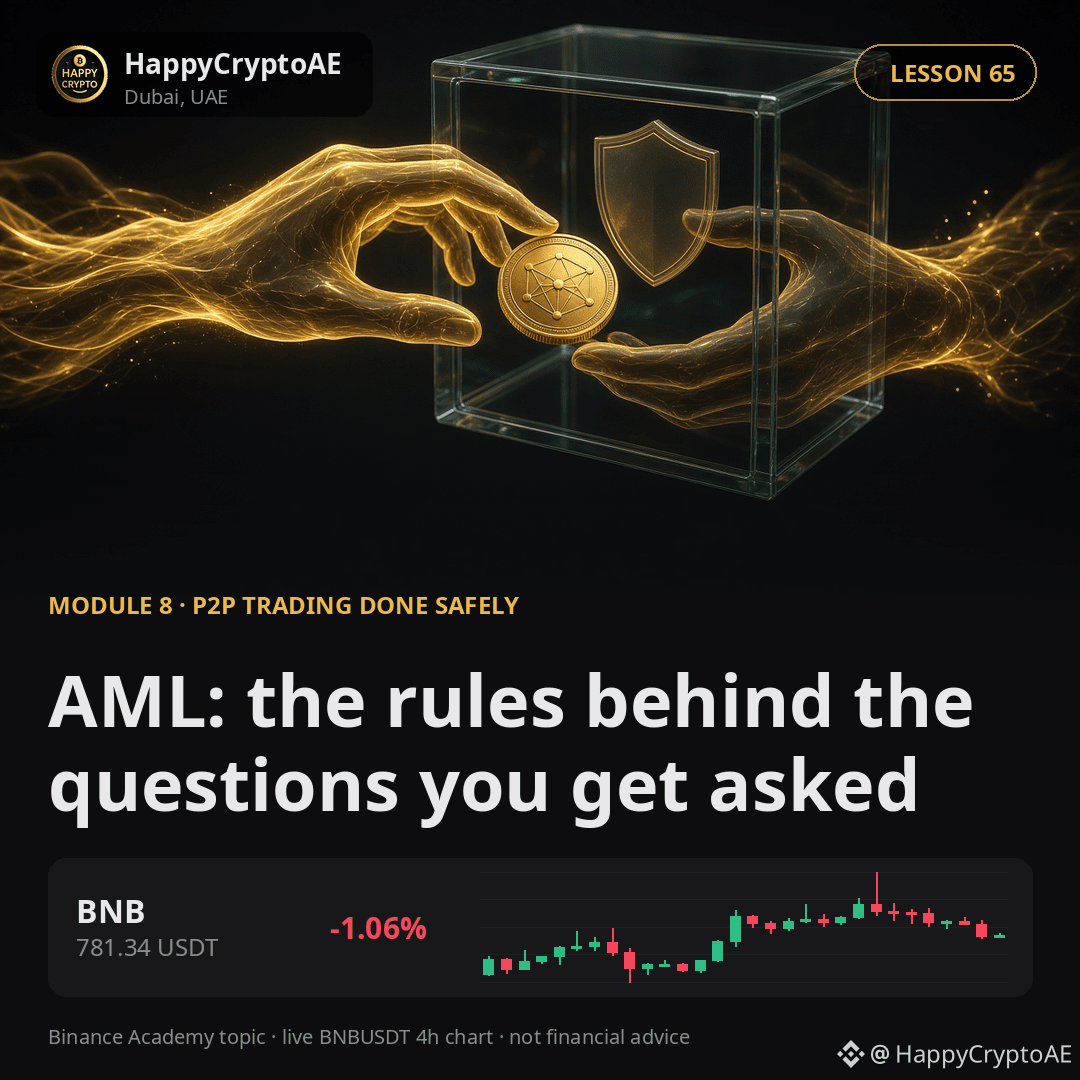
AML: the rules behind the questions you get askedAnti-money laundering rules exist to stop criminal money being passed off as clean money. Banks, exchanges and professional traders all apply them, which is why you are sometimes asked where funds came from or why a transfer looks the way it does.
These questions are not accusations; they are how legitimate businesses keep their bank accounts open. The habits on your side are simple: pay from an account in your own name, keep amounts and patterns explainable, and keep your receipts. Transfers that tell a clear story move fast. Third-party payments and unexplained splits are exactly what freezes accounts - often your own.
💬 Have you ever been asked about the source of your funds? How did it go?
Binance Academy covers this in more depth: https://www.binance.com/en/academy/glossary/anti-money-laundering
Next lesson: Counterparty risk: the person on the other side
Trading crypto from Dubai since 2019.
$USDT $BTC $BNB
#AML #P2P #CryptoEducation
AML: the rules behind the questions you get asked
Anti-money laundering rules exist to stop criminal money being passed off as clean money. Banks, exchanges and professional traders all apply them, which is why you are sometimes asked where funds came from or why a transfer looks the way it does.
These questions are not accusations; they are how legitimate businesses keep their bank accounts open. The habits on your side are simple: pay from an account in your own name, keep amounts and patterns explainable, and keep your receipts. Transfers that tell a clear story move fast. Third-party payments and unexplained splits are exactly what freezes accounts - often your own.
💬 Have you ever been asked about the source of your funds? How did it go?
Binance Academy covers this in more depth: https://www.binance.com/en/academy/glossary/anti-money-laundering
Next lesson: Counterparty risk: the person on the other side
Trading crypto from Dubai since 2019.
$USDT $BTC $BNB
#AML #P2P #CryptoEducation
These questions are not accusations; they are how legitimate businesses keep their bank accounts open. The habits on your side are simple: pay from an account in your own name, keep amounts and patterns explainable, and keep your receipts. Transfers that tell a clear story move fast. Third-party payments and unexplained splits are exactly what freezes accounts - often your own.
💬 Have you ever been asked about the source of your funds? How did it go?
Binance Academy covers this in more depth: https://www.binance.com/en/academy/glossary/anti-money-laundering
Next lesson: Counterparty risk: the person on the other side
Trading crypto from Dubai since 2019.
$USDT $BTC $BNB
#AML #P2P #CryptoEducation
55

🧠 THE BIGGEST CRYPTO LESSON I’M LEARNING
A green candle doesn’t automatically mean “BUY.”
A red candle doesn’t automatically mean “SELL.”
Before making any decision, I’m learning to look at:
📊 Price action
📈 Volume
📰 Market news
🌐 Overall sentiment
⚠️ Risk
$CRWDB moves fast, but understanding the market takes time.
I’m still learning — what’s ONE crypto concept you wish you understood better? 👇
#cryptoeducation #bitcoin #Crypto #Binance #TradingEducation
🧠 THE BIGGEST CRYPTO LESSON I’M LEARNING
A green candle doesn’t automatically mean “BUY.”
A red candle doesn’t automatically mean “SELL.”
Before making any decision, I’m learning to look at:
📊 Price action
📈 Volume
📰 Market news
🌐 Overall sentiment
⚠️ Risk
$CRWDB moves fast, but understanding the market takes time.
I’m still learning — what’s ONE crypto concept you wish you understood better? 👇
#cryptoeducation #bitcoin #Crypto #Binance #TradingEducation
A green candle doesn’t automatically mean “BUY.”
A red candle doesn’t automatically mean “SELL.”
Before making any decision, I’m learning to look at:
📊 Price action
📈 Volume
📰 Market news
🌐 Overall sentiment
⚠️ Risk
$CRWDB moves fast, but understanding the market takes time.
I’m still learning — what’s ONE crypto concept you wish you understood better? 👇
#cryptoeducation #bitcoin #Crypto #Binance #TradingEducation
73

·
--
WHAT EXACTLY IS A BITCOIN ETF?
A Bitcoin ETF gives investors exposure to Bitcoin through a traditional investment vehicle.
Why does that matter?
🏦 Easier access for traditional investors
💰 Institutional participation
📊 More visibility for digital assets
🌍 A bridge between traditional finance and crypto
But an ETF doesn't remove Bitcoin's market risk.
Understanding the product is more important than simply following the headline.
Did you learn about Bitcoin ETFs before investing in crypto?
#BitcoinETF #CryptoEducation #Bitcoin #Web3 #Finance
WHAT EXACTLY IS A BITCOIN ETF?
A Bitcoin ETF gives investors exposure to Bitcoin through a traditional investment vehicle.
Why does that matter?
🏦 Easier access for traditional investors
💰 Institutional participation
📊 More visibility for digital assets
🌍 A bridge between traditional finance and crypto
But an ETF doesn't remove Bitcoin's market risk.
Understanding the product is more important than simply following the headline.
Did you learn about Bitcoin ETFs before investing in crypto?
#BitcoinETF #CryptoEducation #Bitcoin #Web3 #Finance
A Bitcoin ETF gives investors exposure to Bitcoin through a traditional investment vehicle.
Why does that matter?
🏦 Easier access for traditional investors
💰 Institutional participation
📊 More visibility for digital assets
🌍 A bridge between traditional finance and crypto
But an ETF doesn't remove Bitcoin's market risk.
Understanding the product is more important than simply following the headline.
Did you learn about Bitcoin ETFs before investing in crypto?
#BitcoinETF #CryptoEducation #Bitcoin #Web3 #Finance
92

$ETH
If you are new to crypto, you may have heard about Ethereum and its cryptocurrency, ETH.
Ethereum is a blockchain network that allows developers to build and use applications through smart contracts.
ETH is the native cryptocurrency of the Ethereum network. It is used to pay transaction fees and can also be traded or held by users.
Why is Ethereum important?
🔹 It supports smart contracts
🔹 It is used for many blockchain applications
🔹 ETH is used to pay network fees
🔹 It is one of the most widely known cryptocurrencies
However, ETH can be highly volatile, and its price can rise or fall significantly.
💡 Beginner tip: Learn how a cryptocurrency and its underlying blockchain work before deciding whether to buy or trade it.
What do you think about Ethereum? 👇
#ETH🔥🔥🔥🔥🔥🔥 #CryptoTrends2024 #BinanceSquareBTC #CryptoEducation #BlockchainLifeAwards2024
$ETH
If you are new to crypto, you may have heard about Ethereum and its cryptocurrency, ETH.
Ethereum is a blockchain network that allows developers to build and use applications through smart contracts.
ETH is the native cryptocurrency of the Ethereum network. It is used to pay transaction fees and can also be traded or held by users.
Why is Ethereum important?
🔹 It supports smart contracts
🔹 It is used for many blockchain applications
🔹 ETH is used to pay network fees
🔹 It is one of the most widely known cryptocurrencies
However, ETH can be highly volatile, and its price can rise or fall significantly.
💡 Beginner tip: Learn how a cryptocurrency and its underlying blockchain work before deciding whether to buy or trade it.
What do you think about Ethereum? 👇
#ETH🔥🔥🔥🔥🔥🔥 #CryptoTrends2024 #BinanceSquareBTC #CryptoEducation #BlockchainLifeAwards2024
If you are new to crypto, you may have heard about Ethereum and its cryptocurrency, ETH.
Ethereum is a blockchain network that allows developers to build and use applications through smart contracts.
ETH is the native cryptocurrency of the Ethereum network. It is used to pay transaction fees and can also be traded or held by users.
Why is Ethereum important?
🔹 It supports smart contracts
🔹 It is used for many blockchain applications
🔹 ETH is used to pay network fees
🔹 It is one of the most widely known cryptocurrencies
However, ETH can be highly volatile, and its price can rise or fall significantly.
💡 Beginner tip: Learn how a cryptocurrency and its underlying blockchain work before deciding whether to buy or trade it.
What do you think about Ethereum? 👇
#ETH🔥🔥🔥🔥🔥🔥 #CryptoTrends2024 #BinanceSquareBTC #CryptoEducation #BlockchainLifeAwards2024
51

The Night Mia Almost Sold Everything
Mia stared at her screen at 2 a.m $BTC had dropped 12% in a day. Her phone buzzed with panic posts: "It's over." "Sell now." Her finger hovered over the sell button.
Then she remembered the note she'd taped to her monitor six months earlier, back when she first started: "Never invest what you can't afford to lose. Always have a plan before the market has a mood."
She had written that plan during a calm week. It said she would buy in small, regular amounts, never go all-in, and never decide while panicking.
She put the phone down, made tea, and slept.
A few weeks later the market was still choppy, but Mia was still in the game, still learning, and still following her plan. Some of her friends who sold in panic were now watching from the sidelines, wishing they'd had a strategy.
Mia didn't get rich overnight, and she wasn't trying to. What she gained was something rarer: discipline.
The lesson: In crypto, emotions are the most expensive thing you can trade. Build your plan while the sea is calm, because you won't think clearly in the storm.
What's your rule for staying calm when the market gets wild? 👇
#Binance #BinanceSquare #Bitcoin #CryptoEducation #RiskManagement Not financial advice. Crypto is volatile, so always do your own research.$ETH $BNB
The Night Mia Almost Sold Everything
Mia stared at her screen at 2 a.m $BTC had dropped 12% in a day. Her phone buzzed with panic posts: "It's over." "Sell now." Her finger hovered over the sell button.
Then she remembered the note she'd taped to her monitor six months earlier, back when she first started: "Never invest what you can't afford to lose. Always have a plan before the market has a mood."
She had written that plan during a calm week. It said she would buy in small, regular amounts, never go all-in, and never decide while panicking.
She put the phone down, made tea, and slept.
A few weeks later the market was still choppy, but Mia was still in the game, still learning, and still following her plan. Some of her friends who sold in panic were now watching from the sidelines, wishing they'd had a strategy.
Mia didn't get rich overnight, and she wasn't trying to. What she gained was something rarer: discipline.
The lesson: In crypto, emotions are the most expensive thing you can trade. Build your plan while the sea is calm, because you won't think clearly in the storm.
What's your rule for staying calm when the market gets wild? 👇
#Binance #BinanceSquare #Bitcoin #CryptoEducation #RiskManagement Not financial advice. Crypto is volatile, so always do your own research.$ETH $BNB
Mia stared at her screen at 2 a.m $BTC had dropped 12% in a day. Her phone buzzed with panic posts: "It's over." "Sell now." Her finger hovered over the sell button.
Then she remembered the note she'd taped to her monitor six months earlier, back when she first started: "Never invest what you can't afford to lose. Always have a plan before the market has a mood."
She had written that plan during a calm week. It said she would buy in small, regular amounts, never go all-in, and never decide while panicking.
She put the phone down, made tea, and slept.
A few weeks later the market was still choppy, but Mia was still in the game, still learning, and still following her plan. Some of her friends who sold in panic were now watching from the sidelines, wishing they'd had a strategy.
Mia didn't get rich overnight, and she wasn't trying to. What she gained was something rarer: discipline.
The lesson: In crypto, emotions are the most expensive thing you can trade. Build your plan while the sea is calm, because you won't think clearly in the storm.
What's your rule for staying calm when the market gets wild? 👇
#Binance #BinanceSquare #Bitcoin #CryptoEducation #RiskManagement Not financial advice. Crypto is volatile, so always do your own research.$ETH $BNB
87

·
--
The user wants a Binance Square post explaining "Gas limit vs Gas price — how Ethereum fees are calculated" with specific constraints:
1. No markdown
2. Start with: "Crypto Term of the Day:"
3. 120-160 words
4. Use one simple analogy from everyday life
5. Explain why a crypto investor needs to understand this
6. End with: "Save this post and share it with your crypto friends!"
7. Final line: #MATIC #Trading #CryptoEducation #Blockchain
Let me craft this carefully.
Word count target: 120-160 words.
Structure:
- Opening line
- Explanation of gas limit vs gas price
- Analogy
- Why investors need to understand
- Closing line
- Hashtags line
Let me draft:
"Crypto Term of the Day: Gas limit vs Gas price — how Ethereum fees are calculated
Gas limit is the maximum amount of computational work you're willing to pay for a transaction. Gas price is how much you pay per unit of that work, measured in gwei. Total fee equals gas limit multiplied by gas price.
Think of it like a taxi ride: gas limit is the maximum distance you'll travel, and gas price is the rate per kilometer. If you set a low gas price during network congestion, drivers (validators) ignore your ride. If you set a low gas limit, the trip stops mid-journey and you still pay for the distance covered.
Investors must grasp this to avoid overpaying during peaks, prevent failed transactions that still cost fees, and optimize costs for DeFi interactions or NFT mints.
The user wants a Binance Square post explaining "Gas limit vs Gas price — how Ethereum fees are calculated" with specific constraints:
1. No markdown
2. Start with: "Crypto Term of the Day:"
3. 120-160 words
4. Use one simple analogy from everyday life
5. Explain why a crypto investor needs to understand this
6. End with: "Save this post and share it with your crypto friends!"
7. Final line: #MATIC #Trading #CryptoEducation #Blockchain
Let me craft this carefully.
Word count target: 120-160 words.
Structure:
- Opening line
- Explanation of gas limit vs gas price
- Analogy
- Why investors need to understand
- Closing line
- Hashtags line
Let me draft:
"Crypto Term of the Day: Gas limit vs Gas price — how Ethereum fees are calculated
Gas limit is the maximum amount of computational work you're willing to pay for a transaction. Gas price is how much you pay per unit of that work, measured in gwei. Total fee equals gas limit multiplied by gas price.
Think of it like a taxi ride: gas limit is the maximum distance you'll travel, and gas price is the rate per kilometer. If you set a low gas price during network congestion, drivers (validators) ignore your ride. If you set a low gas limit, the trip stops mid-journey and you still pay for the distance covered.
Investors must grasp this to avoid overpaying during peaks, prevent failed transactions that still cost fees, and optimize costs for DeFi interactions or NFT mints.
1. No markdown
2. Start with: "Crypto Term of the Day:"
3. 120-160 words
4. Use one simple analogy from everyday life
5. Explain why a crypto investor needs to understand this
6. End with: "Save this post and share it with your crypto friends!"
7. Final line: #MATIC #Trading #CryptoEducation #Blockchain
Let me craft this carefully.
Word count target: 120-160 words.
Structure:
- Opening line
- Explanation of gas limit vs gas price
- Analogy
- Why investors need to understand
- Closing line
- Hashtags line
Let me draft:
"Crypto Term of the Day: Gas limit vs Gas price — how Ethereum fees are calculated
Gas limit is the maximum amount of computational work you're willing to pay for a transaction. Gas price is how much you pay per unit of that work, measured in gwei. Total fee equals gas limit multiplied by gas price.
Think of it like a taxi ride: gas limit is the maximum distance you'll travel, and gas price is the rate per kilometer. If you set a low gas price during network congestion, drivers (validators) ignore your ride. If you set a low gas limit, the trip stops mid-journey and you still pay for the distance covered.
Investors must grasp this to avoid overpaying during peaks, prevent failed transactions that still cost fees, and optimize costs for DeFi interactions or NFT mints.

Hot take incoming...
In 2022, FTX customers lost $8 billion in assets they believed were safely held on the exchange. That was not a market crash. It was a custody failure.
→ Over $10 billion in crypto has been stolen from exchanges since 2017. Most losses happened while users had zero control over private keys.
→ A hardware wallet keeps your keys offline. If an exchange freezes withdrawals or gets hacked, your assets stay yours.
→ Self-custody adoption is rising. Roughly 25% of Bitcoin holders now use hardware wallets, up from 15% in 2020.
→ Exchanges are convenient for trading. They are not banks. Your balance there is an IOU, not a title deed.
The trade-off is simple. You can trust a third party with your wealth, or you can learn to hold your own keys. One choice puts you in control. The other puts you in line with creditors.
What's on your watchlist?
#CryptoEducation #TradingTips #Investing #Trading #CryptoCommunity
📱 Follow @PoorCryptoMan
Hot take incoming...
In 2022, FTX customers lost $8 billion in assets they believed were safely held on the exchange. That was not a market crash. It was a custody failure.
→ Over $10 billion in crypto has been stolen from exchanges since 2017. Most losses happened while users had zero control over private keys.
→ A hardware wallet keeps your keys offline. If an exchange freezes withdrawals or gets hacked, your assets stay yours.
→ Self-custody adoption is rising. Roughly 25% of Bitcoin holders now use hardware wallets, up from 15% in 2020.
→ Exchanges are convenient for trading. They are not banks. Your balance there is an IOU, not a title deed.
The trade-off is simple. You can trust a third party with your wealth, or you can learn to hold your own keys. One choice puts you in control. The other puts you in line with creditors.
What's on your watchlist?
#CryptoEducation #TradingTips #Investing #Trading #CryptoCommunity
📱 Follow @PoorCryptoMan
In 2022, FTX customers lost $8 billion in assets they believed were safely held on the exchange. That was not a market crash. It was a custody failure.
→ Over $10 billion in crypto has been stolen from exchanges since 2017. Most losses happened while users had zero control over private keys.
→ A hardware wallet keeps your keys offline. If an exchange freezes withdrawals or gets hacked, your assets stay yours.
→ Self-custody adoption is rising. Roughly 25% of Bitcoin holders now use hardware wallets, up from 15% in 2020.
→ Exchanges are convenient for trading. They are not banks. Your balance there is an IOU, not a title deed.
The trade-off is simple. You can trust a third party with your wealth, or you can learn to hold your own keys. One choice puts you in control. The other puts you in line with creditors.
What's on your watchlist?
#CryptoEducation #TradingTips #Investing #Trading #CryptoCommunity
📱 Follow @PoorCryptoMan
5
Let's break this down...
What if you invested $25 a week into Bitcoin for one year?
That is $1300 total. After 52 weeks, the portfolio hit $1457. A +12.1% ROI.
Not life-changing. But real.
Here is the math. 52 buys x $25 = $1300. Profit = $157. If you lump summed $1300 at the start of the year, you needed a lower entry price to beat that. Most people try to time the bottom. DCA ignores timing entirely.
The real edge is boring consistency. You buy red weeks. You buy green weeks. You remove emotion from a volatile market.
One year is a short window. The habit
What would you add to this list?
#LearnCrypto #CryptoEducation #DeFi #Investing #CryptoNews
📱 Follow @PoorCryptoMan
Let's break this down...
What if you invested $25 a week into Bitcoin for one year?
That is $1300 total. After 52 weeks, the portfolio hit $1457. A +12.1% ROI.
Not life-changing. But real.
Here is the math. 52 buys x $25 = $1300. Profit = $157. If you lump summed $1300 at the start of the year, you needed a lower entry price to beat that. Most people try to time the bottom. DCA ignores timing entirely.
The real edge is boring consistency. You buy red weeks. You buy green weeks. You remove emotion from a volatile market.
One year is a short window. The habit
What would you add to this list?
#LearnCrypto #CryptoEducation #DeFi #Investing #CryptoNews
📱 Follow @PoorCryptoMan
What if you invested $25 a week into Bitcoin for one year?
That is $1300 total. After 52 weeks, the portfolio hit $1457. A +12.1% ROI.
Not life-changing. But real.
Here is the math. 52 buys x $25 = $1300. Profit = $157. If you lump summed $1300 at the start of the year, you needed a lower entry price to beat that. Most people try to time the bottom. DCA ignores timing entirely.
The real edge is boring consistency. You buy red weeks. You buy green weeks. You remove emotion from a volatile market.
One year is a short window. The habit
What would you add to this list?
#LearnCrypto #CryptoEducation #DeFi #Investing #CryptoNews
📱 Follow @PoorCryptoMan
11

Support & Resistance: Why Levels Are Zones, Not Exact Numbers 📊
One of the most common mistakes beginners make in crypto technical analysis is treating support and resistance as exact prices.
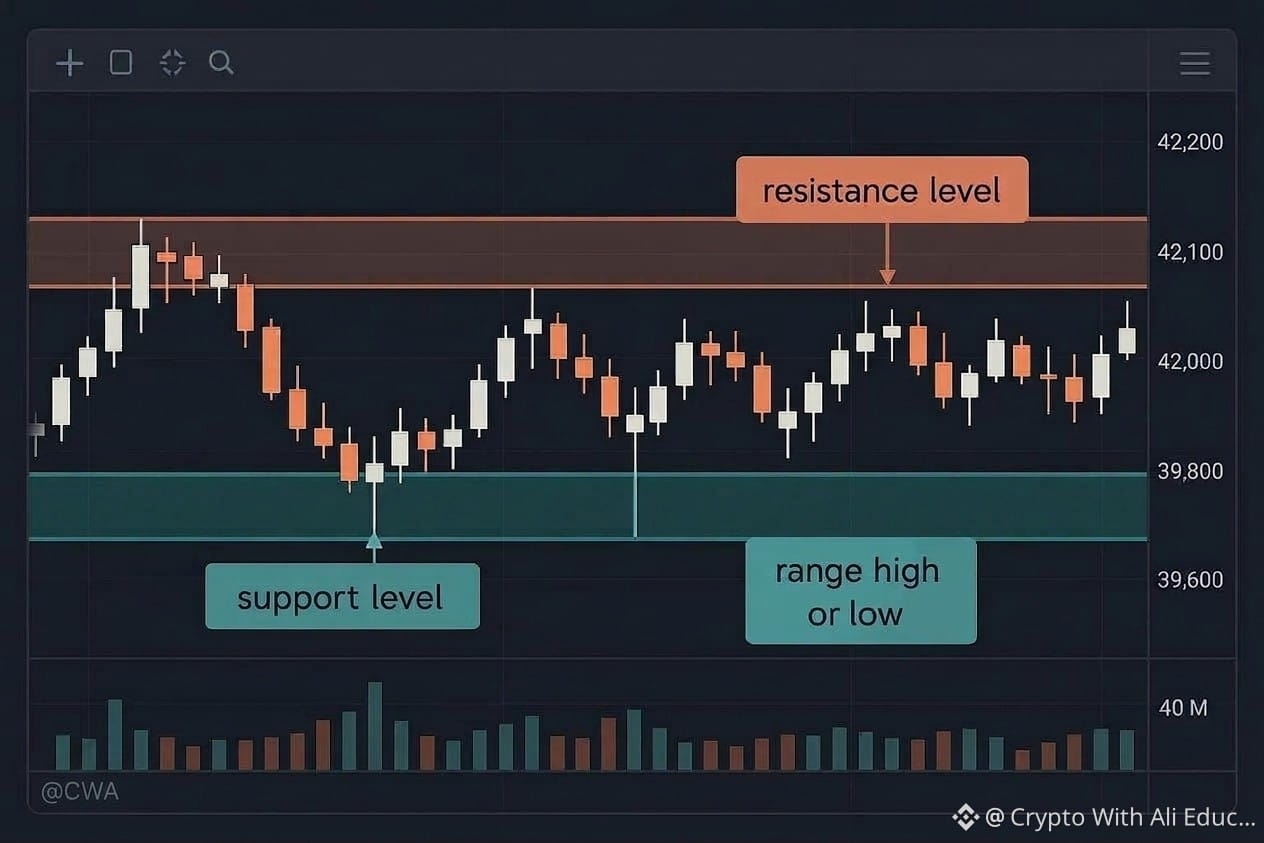
In reality, support and resistance are often better understood as zones.
Here's why:
📌 1. Markets Rarely React at One Exact Price
Buyers and sellers may place orders across a range of prices. As a result, price can react near a level without touching one precise number.
📊 2. Multiple Tests Can Reveal Market Interest
When price revisits an area several times, it can help you observe how the market responds. However, repeated tests do not guarantee that the zone will hold.
📈 3. Volume Adds Context
Trading volume can help you assess participation around a zone. A price reaction accompanied by changing volume may provide additional information, but volume alone does not confirm the next move.
💧 4. Liquidity Can Influence Price Reactions
Previous highs, lows, and widely observed levels may attract trading activity. Price can move through a zone before finding its next direction.
🧠 5. Zones Can Break
Support is not guaranteed to hold, and resistance is not guaranteed to reject price. Market conditions can change, so every zone should be evaluated in context.
Beginner takeaway:
Instead of asking, “What is the exact support price?” consider asking, “Which area has shown a meaningful market reaction?”
Understanding zones helps you analyze price action more realistically and avoid treating chart levels as guarantees.
📚 Follow Crypto With Ali for daily crypto education, technical-analysis concepts, and market-structure lessons.
💬 Question: Do you prefer marking support and resistance as zones or exact lines?
Educational content only. Not financial advice.
Daily crypto thoughts for calm decision-makers — follow
#cryptoeducation #TechnicalAnalysis #supportandresistance #bitcoin #BinanceSquare
Support & Resistance: Why Levels Are Zones, Not Exact Numbers 📊
One of the most common mistakes beginners make in crypto technical analysis is treating support and resistance as exact prices.
In reality, support and resistance are often better understood as zones.
Here's why:
📌 1. Markets Rarely React at One Exact Price
Buyers and sellers may place orders across a range of prices. As a result, price can react near a level without touching one precise number.
📊 2. Multiple Tests Can Reveal Market Interest
When price revisits an area several times, it can help you observe how the market responds. However, repeated tests do not guarantee that the zone will hold.
📈 3. Volume Adds Context
Trading volume can help you assess participation around a zone. A price reaction accompanied by changing volume may provide additional information, but volume alone does not confirm the next move.
💧 4. Liquidity Can Influence Price Reactions
Previous highs, lows, and widely observed levels may attract trading activity. Price can move through a zone before finding its next direction.
🧠 5. Zones Can Break
Support is not guaranteed to hold, and resistance is not guaranteed to reject price. Market conditions can change, so every zone should be evaluated in context.
Beginner takeaway:
Instead of asking, “What is the exact support price?” consider asking, “Which area has shown a meaningful market reaction?”
Understanding zones helps you analyze price action more realistically and avoid treating chart levels as guarantees.
📚 Follow Crypto With Ali for daily crypto education, technical-analysis concepts, and market-structure lessons.
💬 Question: Do you prefer marking support and resistance as zones or exact lines?
Educational content only. Not financial advice.
Daily crypto thoughts for calm decision-makers — follow
#cryptoeducation #TechnicalAnalysis #supportandresistance #bitcoin #BinanceSquare
One of the most common mistakes beginners make in crypto technical analysis is treating support and resistance as exact prices.
In reality, support and resistance are often better understood as zones.
Here's why:
📌 1. Markets Rarely React at One Exact Price
Buyers and sellers may place orders across a range of prices. As a result, price can react near a level without touching one precise number.
📊 2. Multiple Tests Can Reveal Market Interest
When price revisits an area several times, it can help you observe how the market responds. However, repeated tests do not guarantee that the zone will hold.
📈 3. Volume Adds Context
Trading volume can help you assess participation around a zone. A price reaction accompanied by changing volume may provide additional information, but volume alone does not confirm the next move.
💧 4. Liquidity Can Influence Price Reactions
Previous highs, lows, and widely observed levels may attract trading activity. Price can move through a zone before finding its next direction.
🧠 5. Zones Can Break
Support is not guaranteed to hold, and resistance is not guaranteed to reject price. Market conditions can change, so every zone should be evaluated in context.
Beginner takeaway:
Instead of asking, “What is the exact support price?” consider asking, “Which area has shown a meaningful market reaction?”
Understanding zones helps you analyze price action more realistically and avoid treating chart levels as guarantees.
📚 Follow Crypto With Ali for daily crypto education, technical-analysis concepts, and market-structure lessons.
💬 Question: Do you prefer marking support and resistance as zones or exact lines?
Educational content only. Not financial advice.
Daily crypto thoughts for calm decision-makers — follow
#cryptoeducation #TechnicalAnalysis #supportandresistance #bitcoin #BinanceSquare
66

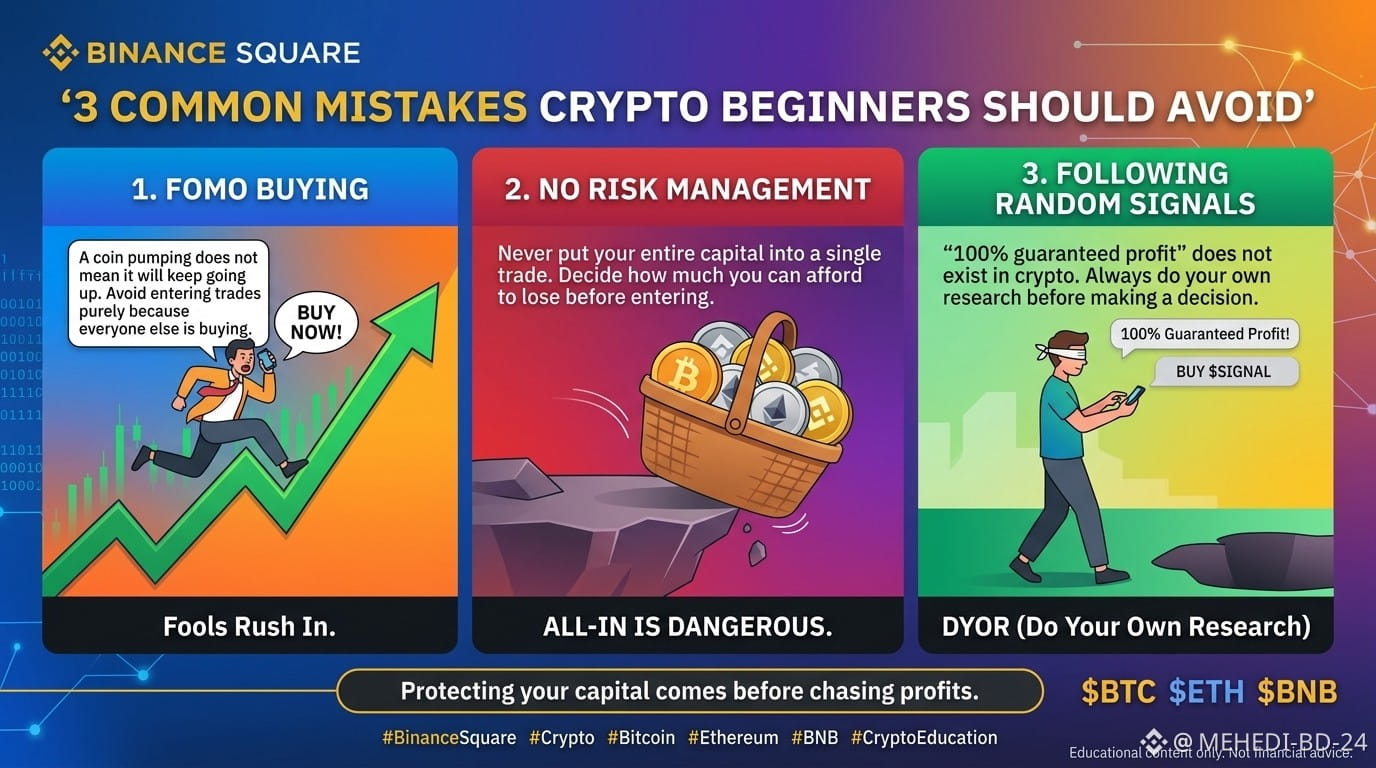
🚨 3 Common Mistakes Crypto Beginners Should Avoid
Entering crypto is easy. Managing risk is the difficult part.
Here are 3 mistakes every beginner should watch out for 👇
1️⃣ FOMO Buying
A coin pumping does not mean it will keep going up. Avoid entering trades purely because everyone else is buying.
2️⃣ No Risk Management
Never put your entire capital into a single trade. Decide how much you can afford to lose before entering.
3️⃣ Following Random Signals
“100% guaranteed profit” does not exist in crypto. Always do your own research before making a decision.
💡 Remember:
Protecting your capital comes before chasing profits.
$BTC $ETH $BNB
#BinanceSquare #bitcoin #Ethereum #BNB #CryptoEducation
Educational content only. Not financial advice.
🚨 3 Common Mistakes Crypto Beginners Should Avoid
Entering crypto is easy. Managing risk is the difficult part.
Here are 3 mistakes every beginner should watch out for 👇
1️⃣ FOMO Buying
A coin pumping does not mean it will keep going up. Avoid entering trades purely because everyone else is buying.
2️⃣ No Risk Management
Never put your entire capital into a single trade. Decide how much you can afford to lose before entering.
3️⃣ Following Random Signals
“100% guaranteed profit” does not exist in crypto. Always do your own research before making a decision.
💡 Remember:
Protecting your capital comes before chasing profits.
$BTC $ETH $BNB
#BinanceSquare #bitcoin #Ethereum #BNB #CryptoEducation
Educational content only. Not financial advice.
Entering crypto is easy. Managing risk is the difficult part.
Here are 3 mistakes every beginner should watch out for 👇
1️⃣ FOMO Buying
A coin pumping does not mean it will keep going up. Avoid entering trades purely because everyone else is buying.
2️⃣ No Risk Management
Never put your entire capital into a single trade. Decide how much you can afford to lose before entering.
3️⃣ Following Random Signals
“100% guaranteed profit” does not exist in crypto. Always do your own research before making a decision.
💡 Remember:
Protecting your capital comes before chasing profits.
$BTC $ETH $BNB
#BinanceSquare #bitcoin #Ethereum #BNB #CryptoEducation
Educational content only. Not financial advice.
1
140

·
--
Spot, Futures, Margin
📚 Spot, Futures et Margin : quelle différence ?
Si tu débutes en crypto, ces trois termes peuvent sembler compliqués.
🟢 Spot : tu achètes ou vends directement l'actif.
🟠 Margin : tu utilises un mécanisme d'emprunt pour augmenter ton exposition.
🔴 Futures : tu trades des contrats dont la valeur dépend d'un actif sous-jacent.
⚠️ Les produits avec effet de levier peuvent amplifier les gains mais aussi les pertes.
Pour un débutant, comprendre le risque est beaucoup plus important que chercher un gros rendement.
👉 Quel terme veux-tu que j'explique plus en détail ?
#CryptoEducation #Trading #BTC #BinanceSquare
Spot, Futures, Margin
📚 Spot, Futures et Margin : quelle différence ?
Si tu débutes en crypto, ces trois termes peuvent sembler compliqués.
🟢 Spot : tu achètes ou vends directement l'actif.
🟠 Margin : tu utilises un mécanisme d'emprunt pour augmenter ton exposition.
🔴 Futures : tu trades des contrats dont la valeur dépend d'un actif sous-jacent.
⚠️ Les produits avec effet de levier peuvent amplifier les gains mais aussi les pertes.
Pour un débutant, comprendre le risque est beaucoup plus important que chercher un gros rendement.
👉 Quel terme veux-tu que j'explique plus en détail ?
#CryptoEducation #Trading #BTC #BinanceSquare
📚 Spot, Futures et Margin : quelle différence ?
Si tu débutes en crypto, ces trois termes peuvent sembler compliqués.
🟢 Spot : tu achètes ou vends directement l'actif.
🟠 Margin : tu utilises un mécanisme d'emprunt pour augmenter ton exposition.
🔴 Futures : tu trades des contrats dont la valeur dépend d'un actif sous-jacent.
⚠️ Les produits avec effet de levier peuvent amplifier les gains mais aussi les pertes.
Pour un débutant, comprendre le risque est beaucoup plus important que chercher un gros rendement.
👉 Quel terme veux-tu que j'explique plus en détail ?
#CryptoEducation #Trading #BTC #BinanceSquare
107
An altcoin can have a tiny price tag and still be expensive. 🧮
Hypothetical example:
• Token price: $0.10
• Circulating supply: 100 million → $10 million market cap
• Total supply: 1 billion → $100 million fully diluted valuation (FDV)
That gap is a prompt to investigate, not an automatic sell signal.
Before buying, check:
1. How many tokens unlock next month relative to circulating supply?
2. Who receives them, and what incentives might they have to sell?
3. Is there enough order-book depth to absorb selling without large price moves?
Unlocks do not guarantee a price drop. They can already be priced in, and unlocked tokens are not always sold. But ignoring supply changes means evaluating only half the story.
Market cap is not cash invested. FDV is not a price target. And a low unit price is not proof of a bargain.
What do you check first: token supply, liquidity, or demand?
#CryptoEducation #Altcoins #Tokenomics #RiskManagement
An altcoin can have a tiny price tag and still be expensive. 🧮
Hypothetical example:
• Token price: $0.10
• Circulating supply: 100 million → $10 million market cap
• Total supply: 1 billion → $100 million fully diluted valuation (FDV)
That gap is a prompt to investigate, not an automatic sell signal.
Before buying, check:
1. How many tokens unlock next month relative to circulating supply?
2. Who receives them, and what incentives might they have to sell?
3. Is there enough order-book depth to absorb selling without large price moves?
Unlocks do not guarantee a price drop. They can already be priced in, and unlocked tokens are not always sold. But ignoring supply changes means evaluating only half the story.
Market cap is not cash invested. FDV is not a price target. And a low unit price is not proof of a bargain.
What do you check first: token supply, liquidity, or demand?
#CryptoEducation #Altcoins #Tokenomics #RiskManagement
Hypothetical example:
• Token price: $0.10
• Circulating supply: 100 million → $10 million market cap
• Total supply: 1 billion → $100 million fully diluted valuation (FDV)
That gap is a prompt to investigate, not an automatic sell signal.
Before buying, check:
1. How many tokens unlock next month relative to circulating supply?
2. Who receives them, and what incentives might they have to sell?
3. Is there enough order-book depth to absorb selling without large price moves?
Unlocks do not guarantee a price drop. They can already be priced in, and unlocked tokens are not always sold. But ignoring supply changes means evaluating only half the story.
Market cap is not cash invested. FDV is not a price target. And a low unit price is not proof of a bargain.
What do you check first: token supply, liquidity, or demand?
#CryptoEducation #Altcoins #Tokenomics #RiskManagement
49

·
--
උසබ තත්ත්වය
5 Crypto Mistakes Every Beginner Should Avoid 🚨
Starting your crypto journey can be exciting, but beginners often make simple mistakes that can lead to unnecessary losses. Here are 5 important mistakes to avoid:
1. Investing Money You Can't Afford to Lose
Crypto prices can move quickly in both directions. Only use money you can afford to lose, and never put your essential savings into a high-risk asset.
2. Following Every “Guaranteed Profit” Claim
If someone promises guaranteed profits or says a coin will definitely go up, be careful. No one can predict the crypto market with certainty.
3. Ignoring Account Security
Use a strong, unique password and enable two-factor authentication (2FA). Never share your password, verification codes, or private keys with anyone.
4. Buying Just Because Everyone Else Is Buying
FOMO (fear of missing out) can lead to emotional decisions. Before buying any cryptocurrency, research the project and understand the risks.
5. Not Learning the Basics
Before trading, learn basic concepts such as spot trading, market orders, limit orders, market cap, wallets, and blockchain transactions.
Final Thought 💡
Crypto can offer opportunities, but it also carries significant risk. Start small, learn continuously, protect your account, and make decisions based on research rather than emotions.
What was the first crypto concept you learned when you started? 👇
#Crypto #Binance #CryptoBeginners #Bitcoin #CryptoEducation
5 Crypto Mistakes Every Beginner Should Avoid 🚨
Starting your crypto journey can be exciting, but beginners often make simple mistakes that can lead to unnecessary losses. Here are 5 important mistakes to avoid:
1. Investing Money You Can't Afford to Lose
Crypto prices can move quickly in both directions. Only use money you can afford to lose, and never put your essential savings into a high-risk asset.
2. Following Every “Guaranteed Profit” Claim
If someone promises guaranteed profits or says a coin will definitely go up, be careful. No one can predict the crypto market with certainty.
3. Ignoring Account Security
Use a strong, unique password and enable two-factor authentication (2FA). Never share your password, verification codes, or private keys with anyone.
4. Buying Just Because Everyone Else Is Buying
FOMO (fear of missing out) can lead to emotional decisions. Before buying any cryptocurrency, research the project and understand the risks.
5. Not Learning the Basics
Before trading, learn basic concepts such as spot trading, market orders, limit orders, market cap, wallets, and blockchain transactions.
Final Thought 💡
Crypto can offer opportunities, but it also carries significant risk. Start small, learn continuously, protect your account, and make decisions based on research rather than emotions.
What was the first crypto concept you learned when you started? 👇
#Crypto #Binance #CryptoBeginners #Bitcoin #CryptoEducation
Starting your crypto journey can be exciting, but beginners often make simple mistakes that can lead to unnecessary losses. Here are 5 important mistakes to avoid:
1. Investing Money You Can't Afford to Lose
Crypto prices can move quickly in both directions. Only use money you can afford to lose, and never put your essential savings into a high-risk asset.
2. Following Every “Guaranteed Profit” Claim
If someone promises guaranteed profits or says a coin will definitely go up, be careful. No one can predict the crypto market with certainty.
3. Ignoring Account Security
Use a strong, unique password and enable two-factor authentication (2FA). Never share your password, verification codes, or private keys with anyone.
4. Buying Just Because Everyone Else Is Buying
FOMO (fear of missing out) can lead to emotional decisions. Before buying any cryptocurrency, research the project and understand the risks.
5. Not Learning the Basics
Before trading, learn basic concepts such as spot trading, market orders, limit orders, market cap, wallets, and blockchain transactions.
Final Thought 💡
Crypto can offer opportunities, but it also carries significant risk. Start small, learn continuously, protect your account, and make decisions based on research rather than emotions.
What was the first crypto concept you learned when you started? 👇
#Crypto #Binance #CryptoBeginners #Bitcoin #CryptoEducation
103
·
--

ලිපිය
💡 Mastering Risk Management in Crypto FuturesPosition sizing is key to surviving long-term in crypto. Here is a quick 3-step checklist to keep your capital safe:
Risk Max 1-2% Per Trade: Never risk more than 1–2% of your total account balance on a single setup.
Calculate Position Size: Position Size = (Account Balance × Risk %) / Stop Loss Distance.
Stick to Your Plan: Don't move your stop-loss once your trade is live!
Save this post for your next trading session!📌
#cryptoeducation #tradingtips #RiskManagement #SADEE_CRYPTO #BinanceSquare #FutureTrading $BTC
{future}(BTCUSDT)
$ETH
{future}(ETHUSDT)
💡 Mastering Risk Management in Crypto Futures
Position sizing is key to surviving long-term in crypto. Here is a quick 3-step checklist to keep your capital safe:
Risk Max 1-2% Per Trade: Never risk more than 1–2% of your total account balance on a single setup.
Calculate Position Size: Position Size = (Account Balance × Risk %) / Stop Loss Distance.
Stick to Your Plan: Don't move your stop-loss once your trade is live!
Save this post for your next trading session!📌
#cryptoeducation #tradingtips #RiskManagement #SADEE_CRYPTO #BinanceSquare #FutureTrading $BTC
$ETH
Risk Max 1-2% Per Trade: Never risk more than 1–2% of your total account balance on a single setup.
Calculate Position Size: Position Size = (Account Balance × Risk %) / Stop Loss Distance.
Stick to Your Plan: Don't move your stop-loss once your trade is live!
Save this post for your next trading session!📌
#cryptoeducation #tradingtips #RiskManagement #SADEE_CRYPTO #BinanceSquare #FutureTrading $BTC
$ETH
1
121

·
--
Tuesday: Altcoin education
Tuesday: Altcoin Education 🧠
Topic: What Is an Altcoin?
Bitcoin is the original cryptocurrency. Altcoins generally refers to crypto assets other than Bitcoin, including major networks such as Ethereum, Solana and Cardano. Ethereum, for example, supports smart contracts and decentralized applications, while Solana provides infrastructure for applications and digital assets.
Key things to learn before researching an altcoin:
🔹 Utility — What problem does the project solve?
🔹 Tokenomics — Supply, unlocks and distribution
🔹 Network activity — Users, transactions and applications
🔹 Liquidity — How easily can the token be bought or sold?
🔹 Risk — Altcoins can be significantly more volatile than established assets.
Beginner rule: Don't judge an altcoin only by its low price. Study its market cap, supply, technology, adoption and use case first.
💬 Question:
Which altcoin should beginners learn about next — ETH, SOL, XRP, ADA or LINK?
#CryptoEducation #Altcoins👀🚀 #blockchains #BinanceSquare
Tuesday: Altcoin education
Tuesday: Altcoin Education 🧠
Topic: What Is an Altcoin?
Bitcoin is the original cryptocurrency. Altcoins generally refers to crypto assets other than Bitcoin, including major networks such as Ethereum, Solana and Cardano. Ethereum, for example, supports smart contracts and decentralized applications, while Solana provides infrastructure for applications and digital assets.
Key things to learn before researching an altcoin:
🔹 Utility — What problem does the project solve?
🔹 Tokenomics — Supply, unlocks and distribution
🔹 Network activity — Users, transactions and applications
🔹 Liquidity — How easily can the token be bought or sold?
🔹 Risk — Altcoins can be significantly more volatile than established assets.
Beginner rule: Don't judge an altcoin only by its low price. Study its market cap, supply, technology, adoption and use case first.
💬 Question:
Which altcoin should beginners learn about next — ETH, SOL, XRP, ADA or LINK?
#CryptoEducation #Altcoins👀🚀 #blockchains #BinanceSquare
Tuesday: Altcoin Education 🧠
Topic: What Is an Altcoin?
Bitcoin is the original cryptocurrency. Altcoins generally refers to crypto assets other than Bitcoin, including major networks such as Ethereum, Solana and Cardano. Ethereum, for example, supports smart contracts and decentralized applications, while Solana provides infrastructure for applications and digital assets.
Key things to learn before researching an altcoin:
🔹 Utility — What problem does the project solve?
🔹 Tokenomics — Supply, unlocks and distribution
🔹 Network activity — Users, transactions and applications
🔹 Liquidity — How easily can the token be bought or sold?
🔹 Risk — Altcoins can be significantly more volatile than established assets.
Beginner rule: Don't judge an altcoin only by its low price. Study its market cap, supply, technology, adoption and use case first.
💬 Question:
Which altcoin should beginners learn about next — ETH, SOL, XRP, ADA or LINK?
#CryptoEducation #Altcoins👀🚀 #blockchains #BinanceSquare
150

🚨 Crypto lesson I wish I learned earlier
You don’t need to catch every pump.
You don’t need to trade every day.
And you definitely don’t need to risk money just because the market is moving.
The real skill in crypto is patience + risk management. 📊
Sometimes the best trade is simply NO TRADE. 🧠
Protect your capital first. Opportunities will always come again. 🔥
#Binance #Crypto # Trading #Bitcoin #CryptoEducation
🚨 Crypto lesson I wish I learned earlier
You don’t need to catch every pump.
You don’t need to trade every day.
And you definitely don’t need to risk money just because the market is moving.
The real skill in crypto is patience + risk management. 📊
Sometimes the best trade is simply NO TRADE. 🧠
Protect your capital first. Opportunities will always come again. 🔥
#Binance #Crypto # Trading #Bitcoin #CryptoEducation
You don’t need to catch every pump.
You don’t need to trade every day.
And you definitely don’t need to risk money just because the market is moving.
The real skill in crypto is patience + risk management. 📊
Sometimes the best trade is simply NO TRADE. 🧠
Protect your capital first. Opportunities will always come again. 🔥
#Binance #Crypto # Trading #Bitcoin #CryptoEducation
53

ලිපිය
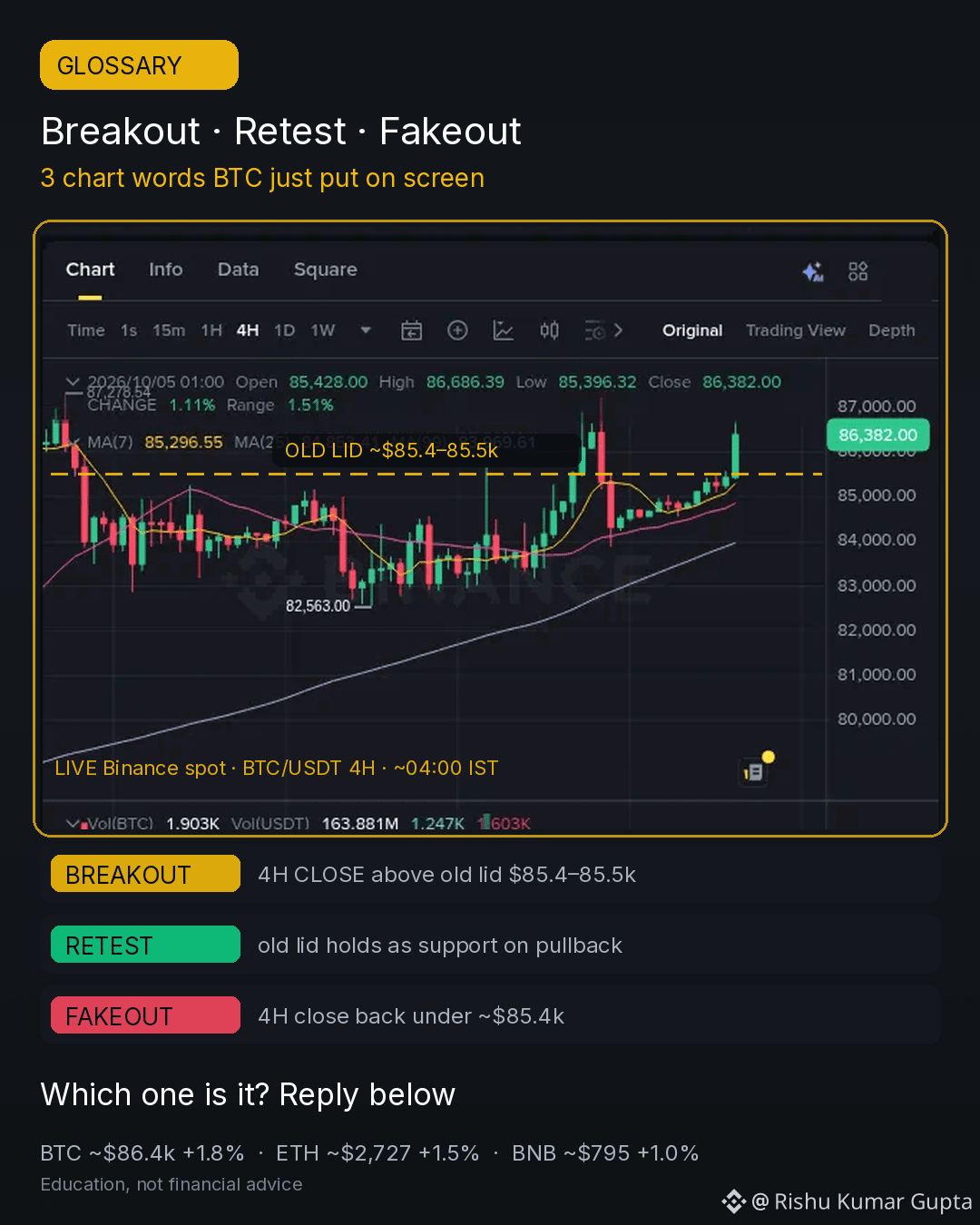
Breakout, Retest, Fakeout: 3 Chart Words BTC Just Put on Screen$BTC woke up overnight. After sitting in a tight ~$85.1–85.5k box for most of Sunday, the current 4H candle on Binance spot pushed to ~$86.7k. Right now it trades ~$86.4k (+1.8% in 24h).
That move is a clean live example of three words beginners see on Square every day but rarely get defined plainly.
1) BREAKOUT
Price CLOSES beyond a level that capped it before. The key word is close. A wick above resistance is not a breakout; a candle close on your chosen timeframe is. Here the lid was ~$85.4–85.5k (Sunday's highs). The 4H candle that closes at 05:30 IST is the first real test of whether this counts.
2) RETEST
After a breakout, price often comes back to touch the old level from the other side, so old resistance gets tested as support. For BTC that zone is ~$85.4–85.5k. Holding it on a pullback is what turns a breakout into a trend, which is why many traders wait for the retest instead of chasing the first green candle.
3) FAKEOUT
Price breaks the level, then closes back inside the old range, and late buyers get trapped. For this move, 4H closes back under ~$85.4k would be the fakeout signal.
How to use the three words together
- Mark the level before the move, not after it.
- Pick your timeframe first. A 15m breakout means little to a 4H plan.
- Write your invalidation: the close that would make it a fakeout.
- Size so that being wrong is boring.
Live snapshot (Binance spot, ~04:00 IST Monday): $BTC ~$86.4k (+1.8%) · $ETH ~$2,727 (+1.5%) · $BNB ~$795 (+1.0%)
This is a vocabulary lesson with a live chart, not financial advice.
Which one does this move become: BREAKOUT, RETEST, or FAKEOUT? Reply below.
#Bitcoin #CryptoEducation #BinanceSquare
Breakout, Retest, Fakeout: 3 Chart Words BTC Just Put on Screen
$BTC woke up overnight. After sitting in a tight ~$85.1–85.5k box for most of Sunday, the current 4H candle on Binance spot pushed to ~$86.7k. Right now it trades ~$86.4k (+1.8% in 24h).
That move is a clean live example of three words beginners see on Square every day but rarely get defined plainly.
1) BREAKOUT
Price CLOSES beyond a level that capped it before. The key word is close. A wick above resistance is not a breakout; a candle close on your chosen timeframe is. Here the lid was ~$85.4–85.5k (Sunday's highs). The 4H candle that closes at 05:30 IST is the first real test of whether this counts.
2) RETEST
After a breakout, price often comes back to touch the old level from the other side, so old resistance gets tested as support. For BTC that zone is ~$85.4–85.5k. Holding it on a pullback is what turns a breakout into a trend, which is why many traders wait for the retest instead of chasing the first green candle.
3) FAKEOUT
Price breaks the level, then closes back inside the old range, and late buyers get trapped. For this move, 4H closes back under ~$85.4k would be the fakeout signal.
How to use the three words together
- Mark the level before the move, not after it.
- Pick your timeframe first. A 15m breakout means little to a 4H plan.
- Write your invalidation: the close that would make it a fakeout.
- Size so that being wrong is boring.
Live snapshot (Binance spot, ~04:00 IST Monday): $BTC ~$86.4k (+1.8%) · $ETH ~$2,727 (+1.5%) · $BNB ~$795 (+1.0%)
This is a vocabulary lesson with a live chart, not financial advice.
Which one does this move become: BREAKOUT, RETEST, or FAKEOUT? Reply below.
#Bitcoin #CryptoEducation #BinanceSquare
That move is a clean live example of three words beginners see on Square every day but rarely get defined plainly.
1) BREAKOUT
Price CLOSES beyond a level that capped it before. The key word is close. A wick above resistance is not a breakout; a candle close on your chosen timeframe is. Here the lid was ~$85.4–85.5k (Sunday's highs). The 4H candle that closes at 05:30 IST is the first real test of whether this counts.
2) RETEST
After a breakout, price often comes back to touch the old level from the other side, so old resistance gets tested as support. For BTC that zone is ~$85.4–85.5k. Holding it on a pullback is what turns a breakout into a trend, which is why many traders wait for the retest instead of chasing the first green candle.
3) FAKEOUT
Price breaks the level, then closes back inside the old range, and late buyers get trapped. For this move, 4H closes back under ~$85.4k would be the fakeout signal.
How to use the three words together
- Mark the level before the move, not after it.
- Pick your timeframe first. A 15m breakout means little to a 4H plan.
- Write your invalidation: the close that would make it a fakeout.
- Size so that being wrong is boring.
Live snapshot (Binance spot, ~04:00 IST Monday): $BTC ~$86.4k (+1.8%) · $ETH ~$2,727 (+1.5%) · $BNB ~$795 (+1.0%)
This is a vocabulary lesson with a live chart, not financial advice.
Which one does this move become: BREAKOUT, RETEST, or FAKEOUT? Reply below.
#Bitcoin #CryptoEducation #BinanceSquare
99

·
--
📉 الخوف في سوق العملات الرقمية قد يكون أخطر من هبوط السعر!
عندما ينخفض سعر العملة، أول شعور قد يأتي إلى ذهننا هو:
❌ “أبيع قبل أن أخسر أكثر!”
لكن الحقيقة أن الخسارة لا تصبح خسارة فعلية إلا عندما تبيع وأنت غير مستعد لذلك.
في عالم الكريبتو، التقلبات طبيعية جدًا، لذلك من المهم أن تتعلم قبل أن تتداول، وأن تعرف لماذا اشتريت العملة أصلًا.
💡 3 أشياء تساعدك على اتخاذ قرار أفضل:
1️⃣ لا تستثمر مبلغًا لا تستطيع تحمل خسارته.
2️⃣ لا تتخذ قرارًا بسبب الخوف أو الطمع.
3️⃣ تعلّم إدارة رأس المال قبل البحث عن الأرباح السريعة.
🚀 تذكّر:
الهدف ليس أن تربح من كل صفقة، بل أن تتعلم كيف تحافظ على رأس مالك وتطوّره مع الوقت.
وأنت؟ 👀
هل سبق أن اتخذت قرارًا في الكريبتو بسبب الخوف ثم ندمت عليه؟
شاركنا تجربتك 👇
#Cryptocurrency #CryptoEducation #Binanace #Bitcoin #Trading
📉 الخوف في سوق العملات الرقمية قد يكون أخطر من هبوط السعر!
عندما ينخفض سعر العملة، أول شعور قد يأتي إلى ذهننا هو:
❌ “أبيع قبل أن أخسر أكثر!”
لكن الحقيقة أن الخسارة لا تصبح خسارة فعلية إلا عندما تبيع وأنت غير مستعد لذلك.
في عالم الكريبتو، التقلبات طبيعية جدًا، لذلك من المهم أن تتعلم قبل أن تتداول، وأن تعرف لماذا اشتريت العملة أصلًا.
💡 3 أشياء تساعدك على اتخاذ قرار أفضل:
1️⃣ لا تستثمر مبلغًا لا تستطيع تحمل خسارته.
2️⃣ لا تتخذ قرارًا بسبب الخوف أو الطمع.
3️⃣ تعلّم إدارة رأس المال قبل البحث عن الأرباح السريعة.
🚀 تذكّر:
الهدف ليس أن تربح من كل صفقة، بل أن تتعلم كيف تحافظ على رأس مالك وتطوّره مع الوقت.
وأنت؟ 👀
هل سبق أن اتخذت قرارًا في الكريبتو بسبب الخوف ثم ندمت عليه؟
شاركنا تجربتك 👇
#Cryptocurrency #CryptoEducation #Binanace #Bitcoin #Trading
عندما ينخفض سعر العملة، أول شعور قد يأتي إلى ذهننا هو:
❌ “أبيع قبل أن أخسر أكثر!”
لكن الحقيقة أن الخسارة لا تصبح خسارة فعلية إلا عندما تبيع وأنت غير مستعد لذلك.
في عالم الكريبتو، التقلبات طبيعية جدًا، لذلك من المهم أن تتعلم قبل أن تتداول، وأن تعرف لماذا اشتريت العملة أصلًا.
💡 3 أشياء تساعدك على اتخاذ قرار أفضل:
1️⃣ لا تستثمر مبلغًا لا تستطيع تحمل خسارته.
2️⃣ لا تتخذ قرارًا بسبب الخوف أو الطمع.
3️⃣ تعلّم إدارة رأس المال قبل البحث عن الأرباح السريعة.
🚀 تذكّر:
الهدف ليس أن تربح من كل صفقة، بل أن تتعلم كيف تحافظ على رأس مالك وتطوّره مع الوقت.
وأنت؟ 👀
هل سبق أن اتخذت قرارًا في الكريبتو بسبب الخوف ثم ندمت عليه؟
شاركنا تجربتك 👇
#Cryptocurrency #CryptoEducation #Binanace #Bitcoin #Trading

110

·
--
Educational / Risk Management
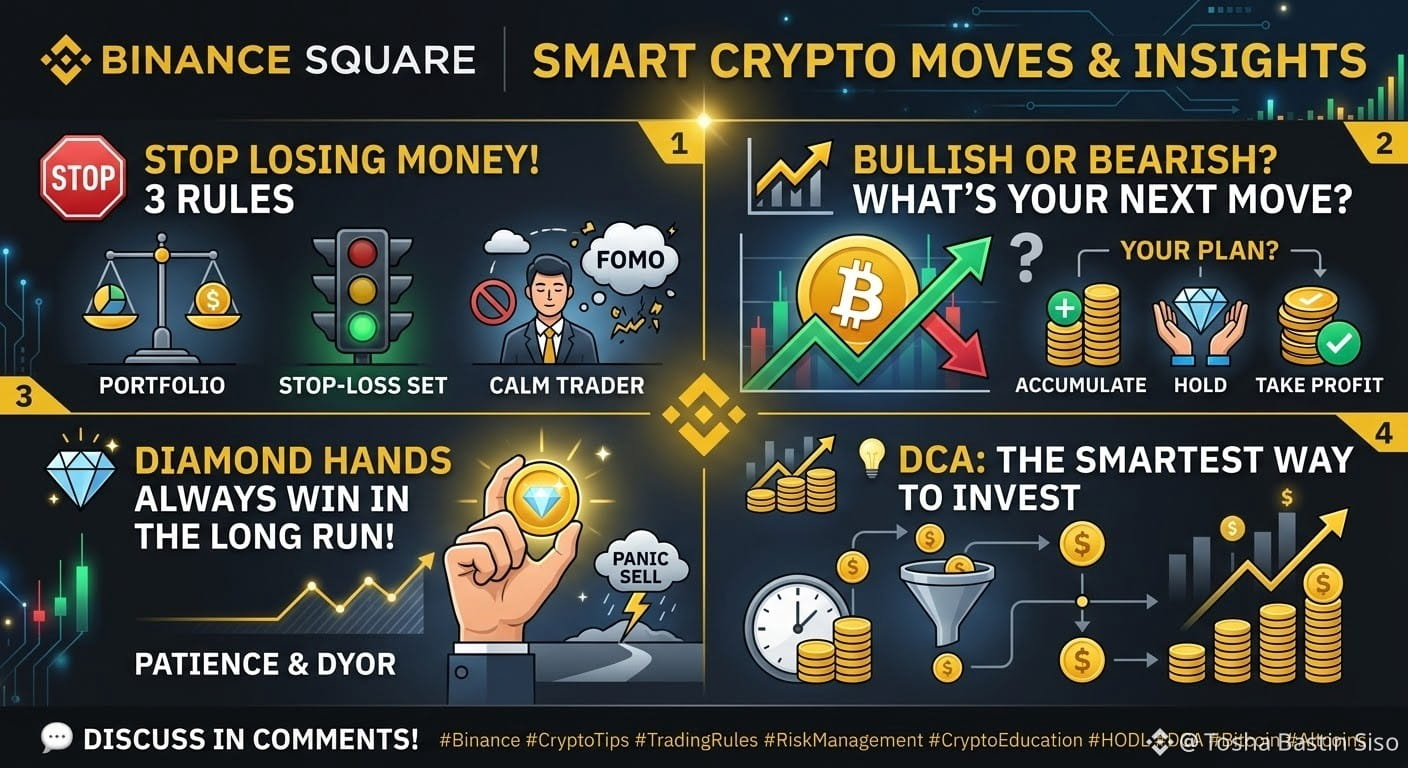
$BTC 🛑 Stop Losing Money! 3 Rules Every Crypto Trader Must Follow
If you are new to crypto trading or constantly taking unnecessary losses, keep these 3 rules locked in:
1️⃣ Risk Management First: Never throw your entire bankroll into a single asset. Limit your risk to just 2%–5% of your portfolio per trade.
2️⃣ Always Set a Stop-Loss: The market owes you nothing. Set your stop-loss immediately after entering a trade to protect your capital from sudden dips.
3️⃣ Master Your Emotions (No FOMO): Never buy a coin when it is pumping vertically. Be patient and wait for a proper pullback or retest.
💡 Pro Tip: Securing profit is an art. Scale out gradually at key targets to lock in gains.
💬 Which risk management strategy works best for you? Let's discuss below!
#Binance #CryptoTips #TradingRules #RiskManagement #cryptoeducation
Educational / Risk Management
$BTC 🛑 Stop Losing Money! 3 Rules Every Crypto Trader Must Follow
If you are new to crypto trading or constantly taking unnecessary losses, keep these 3 rules locked in:
1️⃣ Risk Management First: Never throw your entire bankroll into a single asset. Limit your risk to just 2%–5% of your portfolio per trade.
2️⃣ Always Set a Stop-Loss: The market owes you nothing. Set your stop-loss immediately after entering a trade to protect your capital from sudden dips.
3️⃣ Master Your Emotions (No FOMO): Never buy a coin when it is pumping vertically. Be patient and wait for a proper pullback or retest.
💡 Pro Tip: Securing profit is an art. Scale out gradually at key targets to lock in gains.
💬 Which risk management strategy works best for you? Let's discuss below!
#Binance #CryptoTips #TradingRules #RiskManagement #cryptoeducation
$BTC 🛑 Stop Losing Money! 3 Rules Every Crypto Trader Must Follow
If you are new to crypto trading or constantly taking unnecessary losses, keep these 3 rules locked in:
1️⃣ Risk Management First: Never throw your entire bankroll into a single asset. Limit your risk to just 2%–5% of your portfolio per trade.
2️⃣ Always Set a Stop-Loss: The market owes you nothing. Set your stop-loss immediately after entering a trade to protect your capital from sudden dips.
3️⃣ Master Your Emotions (No FOMO): Never buy a coin when it is pumping vertically. Be patient and wait for a proper pullback or retest.
💡 Pro Tip: Securing profit is an art. Scale out gradually at key targets to lock in gains.
💬 Which risk management strategy works best for you? Let's discuss below!
#Binance #CryptoTips #TradingRules #RiskManagement #cryptoeducation
77
තවත් අන්තර්ගතයන් ගවේෂණය කිරීමට ඇතුල් වන්න
Binance චතුරශ්රය හි ගෝලීය ක්රිප්ටෝ පරිශීලකයින් හා එක්වන්න
⚡️ ක්රිප්ටෝ පිළිබඳ නවතම සහ ප්රයෝජනවත් තොරතුරු ලබා ගන්න.
💬 ලොව විශාලතම ක්රිප්ටෝ හුවමාරුව මගින් විශ්වාස කෙරේ.
👍 සත්යායනය කරන ලද නිර්මාණකරුවන්ගෙන් සැබෑ විදසුන් සොයා ගන්න.
විද්යුත් තැපෑල / දුරකථන අංකය
නැගී එන මාතෘකා
1
#BinanceLaunchesBinanceIntelligence
100,939 views
1,075 සාකච්ඡා කරමින්
2
#StriveBuys2000BTCFor$169M
2,927 views
48 සාකච්ඡා කරමින්
3
#EvernorthXRPTreasuryCompletesSPACMerger
68,562 views
720 සාකච්ඡා කරමින්
4
#ADAGains10%Above$0.27
38,983 views
229 සාකච්ඡා කරමින්
5
#ETHUp70%InQ3ButLiquidityFalls
262,100 views
1,797 සාකච්ඡා කරමින්
6
#EthStakingExitQueueHits2026High
100,089 views
1,201 සාකච්ඡා කරමින්
7
#FedOctoberHoldOdds82.3%
106,107 views
1,159 සාකච්ඡා කරමින්
8
#Nikkei225Jumps2.5%ToThreeMonthHigh
106,186 views
1,372 සාකච්ඡා කරමින්
9
#CircleMints$2.75BUSDCOnSolanaIn7Days
2,771 views
59 සාකච්ඡා කරමින්
10
#DriftHackVictimsBeginClaims
218,081 views
2,032 සාකච්ඡා කරමින්