
#tradingtips
tradingtips
10.1M views
25,848 Discussing
Hot
Latest

Risk Management: The Real Secret of Trading
Let me be honest with you — the market does not care how confident you feel. Today Bitcoin slipped under $74,000 after a hotter-than-expected CPI report, and traders are now pricing in a Fed rate hike in December. I have watched too many good traders lose not because their idea was wrong, but because one trade was too big. Risk management is what keeps you in the game on days like this.
Do this:
✅ Risk only 1–2% of your capital on one trade — with a $1,000 account, that is just $10–$20 at risk.
✅ Decide your stop-loss BEFORE you enter, and size your position from that distance.
✅ Accept a small planned loss and walk away. A small loss is tuition; a big one is damage.
✅ After two losses in a row, stop for the day and review what went wrong.
Do NOT do this:
❌ Do not enter without a stop-loss and hope the price comes back — hope is not a plan.
❌ Do not double your size after a loss to win it back faster.
❌ Do not use high leverage to turn a small account into a big one in one trade.
❌ Do not risk money you need for bills or family — trading money must be money you can afford to lose.
One common mistake, explained simply: trading without a stop-loss. Someone buys near the top, price starts falling, and instead of cutting a small loss they keep holding and praying. Then a normal dip becomes a disaster. The fix: before you buy, write down the exact price where you will exit if you are wrong. If that exit is too far for your account, take a smaller position or skip the trade.
Success does not come in one day. It comes from discipline, patience, risk management and learning every day.
Education Only — Not Financial Advice (NFA). Trading involves risk.
Follow Profit Direction for more signals, best signals and market updates. Like this post and share your opinion in the comments.
What is your rule — how much of your capital do you risk on one trade? Tell us in the comments.
#TradingTips #CryptoTrading #RiskManagement #ProfitDirection
4

·
--
$ONE is up 18.2 percent today but the smart money is walking away
You see the green candle and want to jump in right now
The price hit a high of $0.002080 and pulled back to $0.001796
That means anyone who bought at the 24 hour swing low is already up big
They are not holding out of loyalty
They are dumping their bags onto whoever is foolish enough to chase this late
Volume is running at 1.4x the weekly average which tells you the exit doors are wide open
When you buy a pump this high you are just providing the exit liquidity for patient traders
Never buy a green candle just because it looks fast
What is your personal rule for avoiding late entries
Open $ONE and set an alert at that level
#ONE #TradingTips
2
·
--
$WLD is down 5.7 percent and trading near the absolute bottom of the day
Most traders see a red candle and think the discount is a gift
They forget every seller needs a buyer on the other side
Right now you are buying from someone who is done waiting and wants out
The volume is thin at 0.7x average so nobody big is stepping in to save you
When you chase the loser of the day you are just taking bags from an exhausted holder
Wait for real strength instead of catching a falling knife
Tap $WLD and check the hourly chart yourself
What is your exact rule for skipping the weak charts
#WLD #TradingTips
3
·
--
Your stop on $ADA at $0.17340 is too tight if the hourly swing is 1.1 percent
Most traders drop a stop at a random percentage because it feels safe
That makes no sense when the market moves past that noise anyway
Right now $ADA is sitting right on its 24h swing low of $0.17400
If you put your stop inside that normal 1.1 percent hourly swing you just donate money to volatility
A proper stop goes past the structure that proves your idea is dead wrong
Place it where the level actually breaks not where your feelings hurt
Where do you usually put your stops
#ADA #TradingTips
7

·
--
Risk management is key to trading. It helps you limit losses and protect gains. A stop loss is an order that sells when the level is at a certain number, limiting potential losses. Position sizing is also important, as it determines how much of your portfolio is invested in a particular asset. Dollar-cost averaging, or DCA, involves investing a fixed amount of money at regular intervals, regardless of the market's performance. For example, you can invest $100 every month in $BNB. This approach helps reduce the impact of market volatility. By using these strategies, you can manage risk and make more informed investment decisions #RiskManagement #TradingTips #InvestmentStrategies
Risk management is key to trading. It helps you limit losses and protect gains. A stop loss is an order that sells when the level is at a certain number, limiting potential losses. Position sizing is also important, as it determines how much of your portfolio is invested in a particular asset. Dollar-cost averaging, or DCA, involves investing a fixed amount of money at regular intervals, regardless of the market's performance. For example, you can invest $100 every month in $BNB . This approach helps reduce the impact of market volatility. By using these strategies, you can manage risk and make more informed investment decisions #RiskManagement #TradingTips #InvestmentStrategies
3
·
--
Your stop on $KORUB at 7.1900 is probably in the wrong place
Most traders just guess a random percentage and wonder why they get wicked out
The 24h swing low sits right at 6.8200 on the chart
The hourly ATR is running at 3.0 percent of the current price
That means normal market noise moves the coin about 0.2100 every single hour
If you stick your stop closer than that ATR you are fighting the natural candles
A real stop goes safely behind the structural low that actually proves your idea failed
Where do you normally place your stops when volatility picks up
Do not take my word for it, tap $KORUB and look at the candles
#KORUB #TradingTips
2

·
--
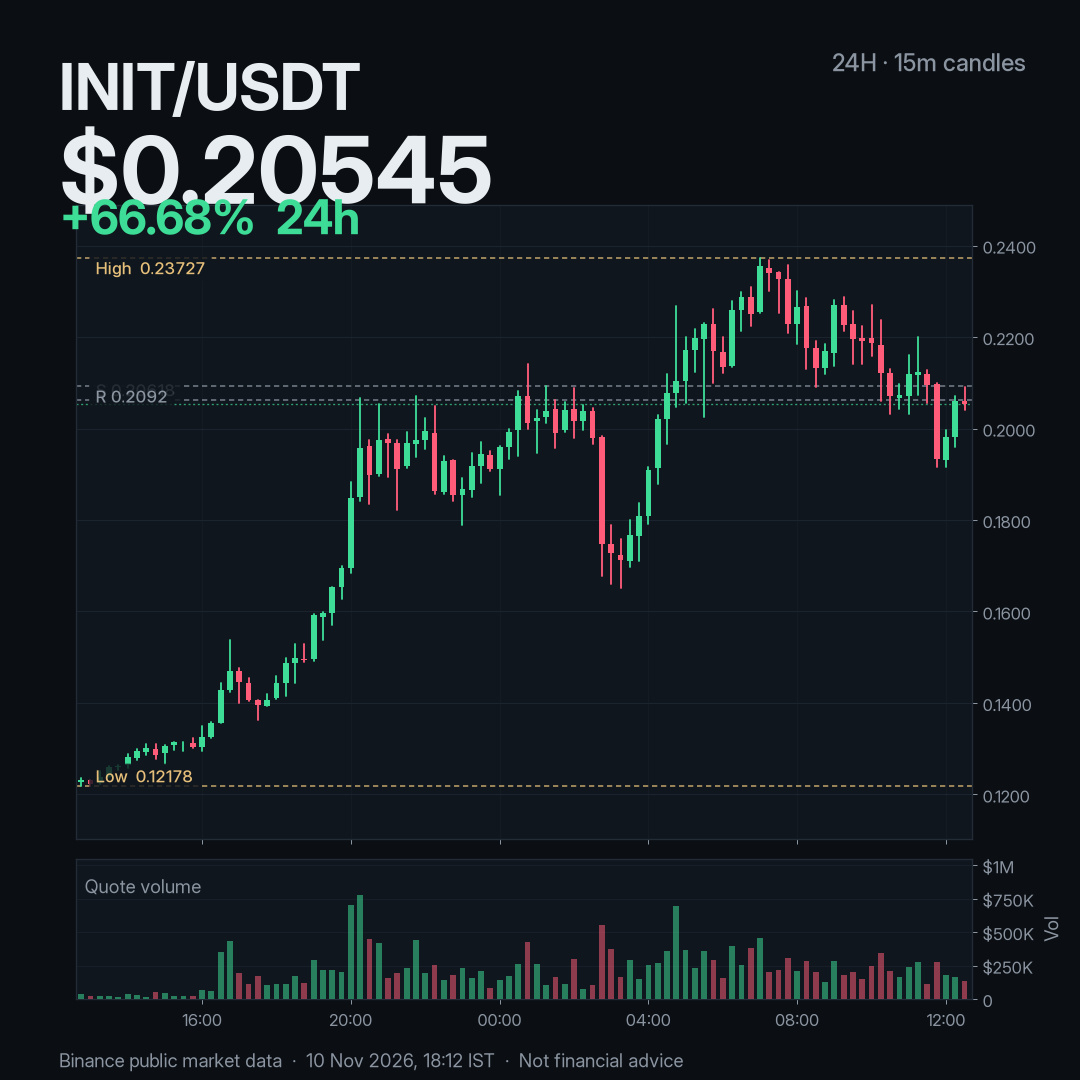
Saw a +66% green candle and felt the urge to jump in? Read this first 👇
$INIT ran from about $0.122 to $0.237 in 24 hours. But look at the chart: there was a sharp ~20% shakeout in the middle, and it's now sitting roughly 13% below the high.
Anyone who bought the top without a plan felt that pain.
Beginner tip: decide your exit BEFORE your entry.
1️⃣ Pick your stop-loss level first (under a recent swing low, not a random %)
2️⃣ Size the trade so hitting that stop costs only 1-2% of your account
3️⃣ Only then place the buy
If the stop is too far away to fit that risk, the trade is too big, or it isn't a trade at all. Skipping a pump is free. Chasing one without a stop can get expensive.
Same rule works for $BTC and $SOL, not just hot movers.
Do you set your stop before you buy, or after? Be honest 👀
#TradingTips #CryptoBeginners #RiskManagement #INIT
Not financial advice, DYOR.
Saw a +66% green candle and felt the urge to jump in? Read this first 👇
$INIT ran from about $0.122 to $0.237 in 24 hours. But look at the chart: there was a sharp ~20% shakeout in the middle, and it's now sitting roughly 13% below the high.
Anyone who bought the top without a plan felt that pain.
Beginner tip: decide your exit BEFORE your entry.
1️⃣ Pick your stop-loss level first (under a recent swing low, not a random %)
2️⃣ Size the trade so hitting that stop costs only 1-2% of your account
3️⃣ Only then place the buy
If the stop is too far away to fit that risk, the trade is too big, or it isn't a trade at all. Skipping a pump is free. Chasing one without a stop can get expensive.
Same rule works for $BTC and $SOL , not just hot movers.
Do you set your stop before you buy, or after? Be honest 👀
#TradingTips #CryptoBeginners #RiskManagement #INIT
Not financial advice, DYOR.
1
295
·
--
Your stop on $ZK at 0.008910 is too tight if you ignore the hourly noise
Price sits at 0.008960 right now near the bottom of the daily range
The 1h ATR shows a normal hourly swing of 0.8 percent
Putting a stop closer than that ATR means market noise kicks you out before the level breaks
A real stop goes below the swing low that actually invalidates the idea
Never use a round percentage because the chart does not care about your math
Tap $ZK and check the hourly chart yourself
Where do you usually put your stops
#ZK #TradingTips
2
·
--
$RUNE moves 0.9 percent an hour and most traders still guess their size
You see $RUNE sitting at $0.59800 with a tight one hour ATR of 0.9 percent
That means a normal hourly swing takes the price about half a cent away
If your stop goes below the $0.57400 swing low you need math not luck
Take a $1000 account and risk 1 percent which is ten dollars total
Divide that ten dollar risk by the distance to your stop and you get your exact size
Guessing your position size based on a gut feeling is just donating margin to the exchange
How do you usually calculate your risk per trade
#RUNE #TradingTips
3

·
--

Article
International Crypto Rules Are Shaping Prices Faster Than You ThinkThe past week has felt like a policy sprint, with Brussels, Singapore and Washington each dropping fresh guidance that instantly rippled through the markets. I've been tracking the numbers and the sentiment, and the data tells a story that's more than just headlines.
Regulatory Pulse in Europe
The EU's MiCA rollout finally hit a key compliance deadline, forcing many projects to re-file whitepapers and tighten AML checks. I saw $BTC dip a hair to $74,500 with a 24-hour change of -0.09%, and $ETH slide to $2,110, down -0.57% in the same window. The modest moves suggest investors are still weighing the long-term cost of additional reporting versus the short-term price wobble.
Asia's New Stance
Across the Pacific, Singapore's Monetary Authority introduced a licensing tier for "stablecoin service providers." The news coincided with $BNB nudging up to $689.50, a 24-hour gain of +0.88%, while SOL fell to $85.61, down -1.57%. The mixed reaction hints that market participants are already pricing in the extra compliance burden for certain platforms, but they're also rewarding tokens that can adapt quickly.
How the Rules Touch Token Prices
When regulators tighten, the immediate effect is often a dip in risk-on assets. That's why $BTC's 7-day slide sits at -3.84% and $ETH's at -7.26%. Yet the top gainers list shows that opportunistic projects can still break out, INIT surged +53.70% to $0.2184, and ONE rallied +19.11% to $0.001876. It's a reminder that while broad sentiment may be fearful (the Fear & Greed Index is at 32 today), niche catalysts can still drive pockets of upside.
Practical Moves for Traders
I keep a close eye on the Fear & Greed Index; a reading of 32 signals caution, so I trim exposure to highly leveraged positions and focus on assets with solid fundamentals. Watching volume helps too, $BTC's 24-hour volume sits around $890M, while $BNB trades on about $65M. Lower volume coins can be more volatile when news hits, so I set tighter stop-losses on those.
Guidance for Developers
If you're building on a chain that now needs a license, start the paperwork early. The compliance cost can erode margins, especially for low-margin DeFi apps. Consider integrating on-chain KYC modules that can be toggled based on jurisdiction, and keep an eye on AVAX's modest +5.33% rise to $8.44 as a case study of a platform that's already aligned with new rules.
What regulatory change do you think will have the biggest impact on token valuations this quarter?
Not financial advice
#CryptoRegulation #TokenValuation #TradingTips #DevGuidance
International Crypto Rules Are Shaping Prices Faster Than You Think
The past week has felt like a policy sprint, with Brussels, Singapore and Washington each dropping fresh guidance that instantly rippled through the markets. I've been tracking the numbers and the sentiment, and the data tells a story that's more than just headlines.
Regulatory Pulse in Europe
The EU's MiCA rollout finally hit a key compliance deadline, forcing many projects to re-file whitepapers and tighten AML checks. I saw $BTC dip a hair to $74,500 with a 24-hour change of -0.09%, and $ETH slide to $2,110, down -0.57% in the same window. The modest moves suggest investors are still weighing the long-term cost of additional reporting versus the short-term price wobble.
Asia's New Stance
Across the Pacific, Singapore's Monetary Authority introduced a licensing tier for "stablecoin service providers." The news coincided with $BNB nudging up to $689.50, a 24-hour gain of +0.88%, while SOL fell to $85.61, down -1.57%. The mixed reaction hints that market participants are already pricing in the extra compliance burden for certain platforms, but they're also rewarding tokens that can adapt quickly.
How the Rules Touch Token Prices
When regulators tighten, the immediate effect is often a dip in risk-on assets. That's why $BTC 's 7-day slide sits at -3.84% and $ETH 's at -7.26%. Yet the top gainers list shows that opportunistic projects can still break out, INIT surged +53.70% to $0.2184, and ONE rallied +19.11% to $0.001876. It's a reminder that while broad sentiment may be fearful (the Fear & Greed Index is at 32 today), niche catalysts can still drive pockets of upside.
Practical Moves for Traders
I keep a close eye on the Fear & Greed Index; a reading of 32 signals caution, so I trim exposure to highly leveraged positions and focus on assets with solid fundamentals. Watching volume helps too, $BTC 's 24-hour volume sits around $890M, while $BNB trades on about $65M. Lower volume coins can be more volatile when news hits, so I set tighter stop-losses on those.
Guidance for Developers
If you're building on a chain that now needs a license, start the paperwork early. The compliance cost can erode margins, especially for low-margin DeFi apps. Consider integrating on-chain KYC modules that can be toggled based on jurisdiction, and keep an eye on AVAX's modest +5.33% rise to $8.44 as a case study of a platform that's already aligned with new rules.
What regulatory change do you think will have the biggest impact on token valuations this quarter?
Not financial advice
#CryptoRegulation #TokenValuation #TradingTips #DevGuidance
121
·
--
$SAND is up 7 percent right now and sitting near its 24 hour high
When you market buy at 85 percent of the daily range you think you are early to a breakout
Look closer at the order book before you click
The 24 hour volume is only 1.2x average and the 1 hour RSI sits at 65 while price is 8.7 percent below the 7 day high
You are not buying from a panicked short seller
You are buying from someone who bought the 4 cent low and wants out
Every buyer paying near the top gives them their exit liquidity
Wait for the hourly ATR swings to test support instead of chasing green candles
Tap $SAND and check the hourly chart yourself
What is your actual rule for skipping a green candle pump
#SAND #TradingTips
5
·
--
$KORUB moves 2.8 percent an hour and people still size it blind
Most traders drop money in without checking the hourly swing
That habit wipes accounts fast when volatility hits
Take a thousand dollar account as a clean example
You want to risk one percent which is ten dollars
The one hour ATR is 2.8 percent of the current price of 7.6000
Divide your ten dollar risk by that hourly swing
That math tells you exactly how many dollars to put on the table
Never guess the size based on gut feeling
What is your maximum risk per trade right now
Do not take my word for it, tap $KORUB and look at the candles
#KORUB #TradingTips
1

·
--
Bullish
$BTC $DOGE
{future}(DOGEUSDT)
{future}(BTCUSDT)
⚡ THE BIGGEST MISTAKE CRYPTO TRADERS MAKE
Many traders focus only on making profits.
But experienced traders also focus on:
1. Risk management
2. Entry confirmation
3. Stop-loss placement
4. Position sizing
5. Emotional discipline
A good trade is not always a profitable trade.
A good trading decision is one that follows a clear plan.
Remember: Surviving the market matters more than winning one trade.
What's your number one trading rule?
#CryptoEducation #TradingTips #RiskManagement #BinanceSquare
$BTC $DOGE
⚡ THE BIGGEST MISTAKE CRYPTO TRADERS MAKE
Many traders focus only on making profits.
But experienced traders also focus on:
1. Risk management
2. Entry confirmation
3. Stop-loss placement
4. Position sizing
5. Emotional discipline
A good trade is not always a profitable trade.
A good trading decision is one that follows a clear plan.
Remember: Surviving the market matters more than winning one trade.
What's your number one trading rule?
#CryptoEducation #TradingTips #RiskManagement #BinanceSquare
18
💡 Smart Trading Reminder
BTC is moving around $74,900, and the market is showing consolidation.
Remember:
✅ Wait for confirmation.
✅ Follow price action.
✅ Manage your risk.
✅ Avoid emotional trades.
There is no need to catch every move. Protecting your capital is also a win!
#TradingTips #BTC #CryptoTrading
BTC is moving around $74,900, and the market is showing consolidation.
Remember:
✅ Wait for confirmation.
✅ Follow price action.
✅ Manage your risk.
✅ Avoid emotional trades.
There is no need to catch every move. Protecting your capital is also a win!
#TradingTips #BTC #CryptoTrading
78

·
--
One $ETH hourly candle this week had a 7.9% high-to-low range. Where was your stop?
Most stop-losses don't fail because the idea was wrong. They fail because they were placed inside normal noise.
Quick numbers from the last 7 days of 1h candles on Binance spot:
• ETH: average hourly range 0.79%, widest 7.91%
• $BTC: average 0.57%, widest 3.58%
• $SOL: average 0.91%, widest 4.89%
A 1% stop on SOL is barely one average hour of movement. That's not risk management, that's a coin flip with fees.
How I'd think about stops instead:
1. Put the stop where your idea is invalidated (below a real level, like the 7-day low), not at a round % that feels comfortable.
2. If that level is far away, shrink the position. Distance to stop decides size, not the other way around.
3. Check the recent range first. ETH's 24h range alone is about 3.2% right now.
4. Never move a stop further away once you're in. Tighten, don't widen.
5. Accept that a good stop will still get hit sometimes. That's the cost of staying in the game.
What's your rule: fixed %, structure-based, or ATR?
Not financial advice.
#RiskManagement #TradingTips #Crypto
One $ETH hourly candle this week had a 7.9% high-to-low range. Where was your stop?
Most stop-losses don't fail because the idea was wrong. They fail because they were placed inside normal noise.
Quick numbers from the last 7 days of 1h candles on Binance spot:
• ETH: average hourly range 0.79%, widest 7.91%
• $BTC : average 0.57%, widest 3.58%
• $SOL : average 0.91%, widest 4.89%
A 1% stop on SOL is barely one average hour of movement. That's not risk management, that's a coin flip with fees.
How I'd think about stops instead:
1. Put the stop where your idea is invalidated (below a real level, like the 7-day low), not at a round % that feels comfortable.
2. If that level is far away, shrink the position. Distance to stop decides size, not the other way around.
3. Check the recent range first. ETH's 24h range alone is about 3.2% right now.
4. Never move a stop further away once you're in. Tighten, don't widen.
5. Accept that a good stop will still get hit sometimes. That's the cost of staying in the game.
What's your rule: fixed %, structure-based, or ATR?
Not financial advice.
#RiskManagement #TradingTips #Crypto
8
·
--
Your stop on $SOXLB at $54.2900 is probably random and you are going to get wicked out
Stop putting stops at round percentages because the market does not care about your math
Look at the $SOXLB 1h ATR sitting at 3.3 percent of price which is just normal hourly noise
If you put a tight stop closer than that 3.3 percent swing the chop alone will take your money
The actual invalidation for $SOXLB lives right under the last 24h swing low at $41.3200
That is the level that proves the whole idea is dead not some arbitrary minus five percent
Put your stop where the market structure actually breaks instead of where it feels comfortable
Where do you normally set your stops
#SOXLB #TradingTips
·
--
Your stop on $BONK at 0.00000280 is probably in the wrong place
Most traders just pick a random percentage and lose money to routine noise
Look at $BONK right now sitting near 0.00000280 with a 1 hour ATR of 1.1 percent
That means normal hourly swings cover 0.00000003 just on standard market breath
If you stick your stop closer than that you get hunted before the move even starts
The 24 hour swing low sits down at 0.00000266 which is the actual invalidation point
Always put your stop past the structural low that proves your whole thesis dead wrong
Where do you normally set your stops
#BONK #TradingTips
10
A 3.8% drop means nothing without context. Let's use $NEAR to learn support/resistance.
Right now price sits at $3.546 with volume at $90M. Here's the concept: support isn't a line on a chart, it's a battle zone where buyers historically defend.
When price approaches a prior support level, you need to watch volume closely. High selling volume that breaks through = support failed, expect further downside. Low volume at support = sellers are exhausted and a bounce is likely.
The $90M volume tells us whether this 3.8% dip has real teeth or is just thin-weekend noise. If volume shrinks as price nears your support zone, that's your divergence signal. Smart traders wait for the volume confirmation before acting, not the price tag.
What's one support level you're watching on your current holdings?
We post every algo signal's real result openly and the full live track record plus a free preview channel are in our bio.
#SupportResistance #TradingTips
210
·
--
Your stop on $INIT at 0.20405 is probably in the wrong place because percentage stops are a trap
Most people pick an arbitrary five or ten percent loss and get hunted out instantly
Look at the actual math on $INIT right now with volume running at 5.7x the weekly average
The hourly ATR is sitting at 8.1 percent which means normal market noise swings sixteen cents up and down every single hour
Placing your protection below the 24h swing low of 0.11940 is the only way to give the trade room to breathe
If your invalidation point sits closer than that normal hourly volatility you are just paying a tax to the market makers
Put your stop past the structural low that actually invalidates your thesis instead of guessing a random number
Where do you usually put your stops when volatility is this high
#INIT #TradingTips
3

·
--
Bearish
Most traders don't lose money on bad coins. They lose it on bad timing.
After watching $BTC run up and pull back again and again, here are 3 rules I keep coming back to:
1. Zoom out before you click buy. A red day on the 15-minute chart is often noise on the weekly. Check the higher timeframe first.
2. Split your entry. Instead of going all-in at once, buy in 3–4 parts. If price dips, you average down. If it pumps, you're already in.
3. Decide your exit before you enter. Pick your take-profit and stop-loss before emotions show up. FOMO and panic make terrible decisions.
The market rewards patience more than prediction.
What's your #1 rule? Drop it below.
$BTC $ETH
#Bitcoin #CryptoTrading #TradingTips #BinanceSquare
86
Log in to explore more content
Join global crypto users on Binance Square
⚡️ Get latest and useful information about crypto.
💬 Trusted by the world’s largest crypto exchange.
👍 Discover real insights from verified creators.
Email / Phone number
Trending Topics
1
#HotCPIDecemberHikePriced
51,540 views
816 Discussing
2
#AnthropicRejectsIPODelayValuationinQuestion
184,956 views
1,630 Discussing
3
#NvidiaInvestigatesAfterHuang’sAffairApology
462,152 views
3,084 Discussing
4
#CanNvidiaEarningsEaseMarketConcerns?
25,131 views
438 Discussing
5
#ADPWeeklyEstimateShowsUSPrivatePayrollsUp19750
10,610 views
221 Discussing
6
#US-IranTalksFuelStrongStockMarketRebound
111,298 views
574 Discussing
7
#BitcoinFiveWeeklyLosses
479,858 views
3,223 Discussing
8
#AIChipSlumpNasdaq
260,656 views
1,806 Discussing
9
#BitcoinSpotETFsPost$201MNetOutflowForThirdStraightDay
1,750 views
30 Discussing
10
#CryptoLiquidationsReach$1.16BIn24Hours
67,214 views
84 Discussing