
TradeDog Research
204 Publicações

TradeDog Research
Denunciar
Bloquear Utilizador
Trusted by Crypto Investor & Traders for
- Analysis & Predictions
- Insights & Research
- Market Updates & Trends
10 A seguir
176 Seguidores
103 Gostaram
Publicações
Tudo
Vídeos
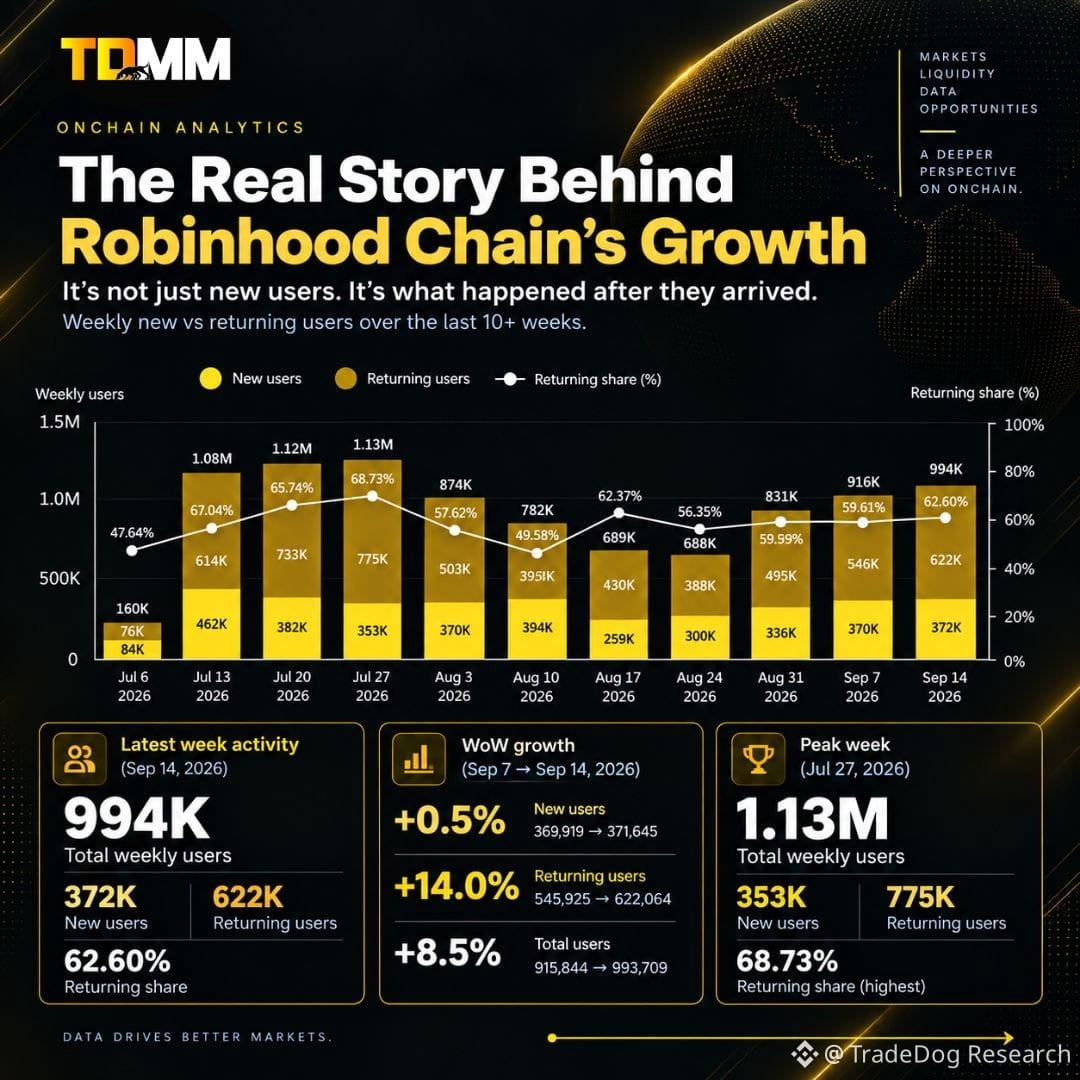
A história real por trás do crescimento da cadeia do Robinhood 👀
Novos usuários geralmente são a métrica de destaque.
Mas o que acontece depois que eles chegam pode ser tão importante quanto.
Analisamos mais de 10 semanas de atividade semanal na Robinhood Chain e separamos novos usuários de usuários recorrentes.
Veja o que se destacou.
Novos usuários são voláteis
A atividade de novos usuários disparou em meados de julho:
84K → 462K
Depois, se normalizou ao longo de agosto antes de voltar a subir em setembro.
Em 14 de setembro:
371,645 novos usuários
Mas a atividade de recorrentes conta uma história diferente.
Usuários recorrentes estão se tornando uma parte maior da atividade semanal
Os usuários recorrentes atingiram:
614K em 13 de julho
733K em 20 de julho
775K em 27 de julho
Depois de cair durante agosto, eles se recuperaram para:
622,064 em 14 de setembro
E a semana mais recente mostra a divergência mais clara.
7 de setembro → 14 de setembro
👤 Novos usuários
369,919 → 371,645
+0.5%
🔁 Usuários recorrentes
545,925 → 622,064
+14.0%
📊 Atividade semanal total
915,844 → 993,709
Portanto, o aumento mais recente na atividade semanal veio de forma desproporcional de usuários recorrentes.
A participação de recorrentes também conta uma história interessante
Os usuários recorrentes responderam por:
47.64% da atividade em 6 de julho
57.04% em 13 de julho
68.73% em 27 de julho
62.60% em 14 de setembro
Isso significa que a composição da atividade semanal mudou consideravelmente desde o início de julho.
Mas há uma distinção importante:
Atividade de recorrentes ≠ retenção
Esses são números agregados de atividade semanal.
Eles não representam coortes individuais de usuários, então não devem ser interpretados como retenção D7 ou D30.
Em vez disso, eles nos dizem quanta atividade semanal está vindo de usuários que já estavam ativos.
A grande conclusão
Novos usuários nos dizem quem apareceu.
Usuários recorrentes nos dizem quem voltou.
Ambos são importantes.
Mas eles respondem perguntas diferentes.
Para a Robinhood Chain, a próxima métrica que pode valer a pena observar é a relação entre:
Momento dos novos usuários × atividade dos usuários recorrentes
Porque o crescimento onchain não é apenas sobre conseguir mais carteiras pela porta.
Também é sobre o que acontece depois que elas entram.
$HOOD
#Crypto #RobinhoodChain #Onchain #Blockchain #Web3
A história real por trás do crescimento da cadeia do Robinhood 👀
Novos usuários geralmente são a métrica de destaque.
Mas o que acontece depois que eles chegam pode ser tão importante quanto.
Analisamos mais de 10 semanas de atividade semanal na Robinhood Chain e separamos novos usuários de usuários recorrentes.
Veja o que se destacou.
Novos usuários são voláteis
A atividade de novos usuários disparou em meados de julho:
84K → 462K
Depois, se normalizou ao longo de agosto antes de voltar a subir em setembro.
Em 14 de setembro:
371,645 novos usuários
Mas a atividade de recorrentes conta uma história diferente.
Usuários recorrentes estão se tornando uma parte maior da atividade semanal
Os usuários recorrentes atingiram:
614K em 13 de julho
733K em 20 de julho
775K em 27 de julho
Depois de cair durante agosto, eles se recuperaram para:
622,064 em 14 de setembro
E a semana mais recente mostra a divergência mais clara.
7 de setembro → 14 de setembro
👤 Novos usuários
369,919 → 371,645
+0.5%
🔁 Usuários recorrentes
545,925 → 622,064
+14.0%
📊 Atividade semanal total
915,844 → 993,709
Portanto, o aumento mais recente na atividade semanal veio de forma desproporcional de usuários recorrentes.
A participação de recorrentes também conta uma história interessante
Os usuários recorrentes responderam por:
47.64% da atividade em 6 de julho
57.04% em 13 de julho
68.73% em 27 de julho
62.60% em 14 de setembro
Isso significa que a composição da atividade semanal mudou consideravelmente desde o início de julho.
Mas há uma distinção importante:
Atividade de recorrentes ≠ retenção
Esses são números agregados de atividade semanal.
Eles não representam coortes individuais de usuários, então não devem ser interpretados como retenção D7 ou D30.
Em vez disso, eles nos dizem quanta atividade semanal está vindo de usuários que já estavam ativos.
A grande conclusão
Novos usuários nos dizem quem apareceu.
Usuários recorrentes nos dizem quem voltou.
Ambos são importantes.
Mas eles respondem perguntas diferentes.
Para a Robinhood Chain, a próxima métrica que pode valer a pena observar é a relação entre:
Momento dos novos usuários × atividade dos usuários recorrentes
Porque o crescimento onchain não é apenas sobre conseguir mais carteiras pela porta.
Também é sobre o que acontece depois que elas entram.
$HOOD
#Crypto #RobinhoodChain #Onchain #Blockchain #Web3
Novos usuários geralmente são a métrica de destaque.
Mas o que acontece depois que eles chegam pode ser tão importante quanto.
Analisamos mais de 10 semanas de atividade semanal na Robinhood Chain e separamos novos usuários de usuários recorrentes.
Veja o que se destacou.
Novos usuários são voláteis
A atividade de novos usuários disparou em meados de julho:
84K → 462K
Depois, se normalizou ao longo de agosto antes de voltar a subir em setembro.
Em 14 de setembro:
371,645 novos usuários
Mas a atividade de recorrentes conta uma história diferente.
Usuários recorrentes estão se tornando uma parte maior da atividade semanal
Os usuários recorrentes atingiram:
614K em 13 de julho
733K em 20 de julho
775K em 27 de julho
Depois de cair durante agosto, eles se recuperaram para:
622,064 em 14 de setembro
E a semana mais recente mostra a divergência mais clara.
7 de setembro → 14 de setembro
👤 Novos usuários
369,919 → 371,645
+0.5%
🔁 Usuários recorrentes
545,925 → 622,064
+14.0%
📊 Atividade semanal total
915,844 → 993,709
Portanto, o aumento mais recente na atividade semanal veio de forma desproporcional de usuários recorrentes.
A participação de recorrentes também conta uma história interessante
Os usuários recorrentes responderam por:
47.64% da atividade em 6 de julho
57.04% em 13 de julho
68.73% em 27 de julho
62.60% em 14 de setembro
Isso significa que a composição da atividade semanal mudou consideravelmente desde o início de julho.
Mas há uma distinção importante:
Atividade de recorrentes ≠ retenção
Esses são números agregados de atividade semanal.
Eles não representam coortes individuais de usuários, então não devem ser interpretados como retenção D7 ou D30.
Em vez disso, eles nos dizem quanta atividade semanal está vindo de usuários que já estavam ativos.
A grande conclusão
Novos usuários nos dizem quem apareceu.
Usuários recorrentes nos dizem quem voltou.
Ambos são importantes.
Mas eles respondem perguntas diferentes.
Para a Robinhood Chain, a próxima métrica que pode valer a pena observar é a relação entre:
Momento dos novos usuários × atividade dos usuários recorrentes
Porque o crescimento onchain não é apenas sobre conseguir mais carteiras pela porta.
Também é sobre o que acontece depois que elas entram.
$HOOD
#Crypto #RobinhoodChain #Onchain #Blockchain #Web3
60
A Lei CLARITY precisa de mais clareza.
O Senado dos EUA travou uma das maiores tentativas de estabelecer uma estrutura federal para o mercado de cripto.
Mas aqui está a parte importante:
A Lei CLARITY não foi derrotada em uma votação final.
O Senado votou uma moção processual para avançar com a legislação.
O resultado:
49 SIM
50 NÃO
60 NECESSÁRIO
Dessa forma, o projeto de lei não conseguiu superar o obstáculo processual necessário para seguir adiante.
A Lei CLARITY busca estabelecer regras mais claras para ativos digitais e definir as responsabilidades regulatórias da SEC e da CFTC.
A Câmara já havia aprovado a legislação, enquanto parlamentares do Senado passaram meses negociando a versão deles.
Antes da votação, os republicanos divulgaram um rascunho revisado e disseram que ele incorporou 126 mudanças substantivas solicitadas pelos democratas.
Ainda assim, persistiram grandes divergências sobre questões como:
• Ética e conflitos de interesse relacionados a cripto
• Recompensas de stablecoins
• Preocupações com bancos
• Proteções para desenvolvedores
• Aplicação regulatória
Em seguida, o senador Thom Tillis mudou seu voto e apresentou um pedido para reconsiderar, deixando um caminho em potencial para o Senado revisar a legislação.
Mas o tempo está se tornando um fator importante à medida que as eleições de meio de mandato de novembro se aproximam.
Se o Congresso não conseguir chegar a um acordo durante a sessão atual, o próximo Congresso poderá revisitar o tema, o que pode exigir novas negociações e uma legislação revisada.
O principal aprendizado não é que a regulação de cripto nos EUA acabou.
É que uma das tentativas mais significativas de estabelecer regras de estrutura de mercado mais claras esbarrou em um obstáculo processual.
As questões centrais permanecem:
Quem regula os ativos digitais?
Quais ativos ficam sob a SEC?
Quais ficam sob a CFTC?
Quais regras devem ser seguidas por exchanges e participantes do mercado?
A CLARITY foi criada para fornecer respostas.
Por enquanto, essas respostas continuam sem solução.
A Lei CLARITY precisa de alguma clareza também.
#CLARITYAct #CryptoRegulation #DigitalAssets #SEC #CFTC
A Lei CLARITY precisa de mais clareza.
O Senado dos EUA travou uma das maiores tentativas de estabelecer uma estrutura federal para o mercado de cripto.
Mas aqui está a parte importante:
A Lei CLARITY não foi derrotada em uma votação final.
O Senado votou uma moção processual para avançar com a legislação.
O resultado:
49 SIM
50 NÃO
60 NECESSÁRIO
Dessa forma, o projeto de lei não conseguiu superar o obstáculo processual necessário para seguir adiante.
A Lei CLARITY busca estabelecer regras mais claras para ativos digitais e definir as responsabilidades regulatórias da SEC e da CFTC.
A Câmara já havia aprovado a legislação, enquanto parlamentares do Senado passaram meses negociando a versão deles.
Antes da votação, os republicanos divulgaram um rascunho revisado e disseram que ele incorporou 126 mudanças substantivas solicitadas pelos democratas.
Ainda assim, persistiram grandes divergências sobre questões como:
• Ética e conflitos de interesse relacionados a cripto
• Recompensas de stablecoins
• Preocupações com bancos
• Proteções para desenvolvedores
• Aplicação regulatória
Em seguida, o senador Thom Tillis mudou seu voto e apresentou um pedido para reconsiderar, deixando um caminho em potencial para o Senado revisar a legislação.
Mas o tempo está se tornando um fator importante à medida que as eleições de meio de mandato de novembro se aproximam.
Se o Congresso não conseguir chegar a um acordo durante a sessão atual, o próximo Congresso poderá revisitar o tema, o que pode exigir novas negociações e uma legislação revisada.
O principal aprendizado não é que a regulação de cripto nos EUA acabou.
É que uma das tentativas mais significativas de estabelecer regras de estrutura de mercado mais claras esbarrou em um obstáculo processual.
As questões centrais permanecem:
Quem regula os ativos digitais?
Quais ativos ficam sob a SEC?
Quais ficam sob a CFTC?
Quais regras devem ser seguidas por exchanges e participantes do mercado?
A CLARITY foi criada para fornecer respostas.
Por enquanto, essas respostas continuam sem solução.
A Lei CLARITY precisa de alguma clareza também.
#CLARITYAct #CryptoRegulation #DigitalAssets #SEC #CFTC
O Senado dos EUA travou uma das maiores tentativas de estabelecer uma estrutura federal para o mercado de cripto.
Mas aqui está a parte importante:
A Lei CLARITY não foi derrotada em uma votação final.
O Senado votou uma moção processual para avançar com a legislação.
O resultado:
49 SIM
50 NÃO
60 NECESSÁRIO
Dessa forma, o projeto de lei não conseguiu superar o obstáculo processual necessário para seguir adiante.
A Lei CLARITY busca estabelecer regras mais claras para ativos digitais e definir as responsabilidades regulatórias da SEC e da CFTC.
A Câmara já havia aprovado a legislação, enquanto parlamentares do Senado passaram meses negociando a versão deles.
Antes da votação, os republicanos divulgaram um rascunho revisado e disseram que ele incorporou 126 mudanças substantivas solicitadas pelos democratas.
Ainda assim, persistiram grandes divergências sobre questões como:
• Ética e conflitos de interesse relacionados a cripto
• Recompensas de stablecoins
• Preocupações com bancos
• Proteções para desenvolvedores
• Aplicação regulatória
Em seguida, o senador Thom Tillis mudou seu voto e apresentou um pedido para reconsiderar, deixando um caminho em potencial para o Senado revisar a legislação.
Mas o tempo está se tornando um fator importante à medida que as eleições de meio de mandato de novembro se aproximam.
Se o Congresso não conseguir chegar a um acordo durante a sessão atual, o próximo Congresso poderá revisitar o tema, o que pode exigir novas negociações e uma legislação revisada.
O principal aprendizado não é que a regulação de cripto nos EUA acabou.
É que uma das tentativas mais significativas de estabelecer regras de estrutura de mercado mais claras esbarrou em um obstáculo processual.
As questões centrais permanecem:
Quem regula os ativos digitais?
Quais ativos ficam sob a SEC?
Quais ficam sob a CFTC?
Quais regras devem ser seguidas por exchanges e participantes do mercado?
A CLARITY foi criada para fornecer respostas.
Por enquanto, essas respostas continuam sem solução.
A Lei CLARITY precisa de alguma clareza também.
#CLARITYAct #CryptoRegulation #DigitalAssets #SEC #CFTC

2
212
Artigo
Ver tradução
Who Are the Best Crypto Market Makers in 2026?Crypto market making has become a much broader discipline than simply placing bids and asks around a token.
For a modern crypto project, liquidity can affect order book depth, bid ask spreads, execution quality, exchange performance, token accessibility, treasury efficiency and the ability to manage large token transactions.
That is why choosing a crypto market maker should not be based solely on trading volume or the number of exchanges a firm claims to support.
The right question is:
Which market maker has the infrastructure, liquidity, technology, institutional access and token management capabilities that match your project's requirements?
In 2026, some of the most established names in the market include:
TDMMWintermuteKeyrockFlowdeskDWF LabsKairon LabsGSR MarketsCumberlandFalconX
Each operates with a different model.
Wintermute has built significant scale around algorithmic trading, OTC and institutional liquidity. GSR combines market making with OTC, treasury solutions and institutional execution. Keyrock has expanded from market making into asset management, OTC and options. Flowdesk has evolved from market making as a service into a broader institutional trading platform. DWF Labs combines market making with venture investment. Kairon Labs focuses heavily on token issuers and algorithmic liquidity. Cumberland is deeply rooted in institutional OTC liquidity, while FalconX operates as a broader digital asset prime brokerage.
TDMM takes a different approach by combining market making with token market management, liquidity provisioning, treasury management, inventory optimization, exit management and token lifecycle support.
That integrated model is what makes TDMM particularly relevant for token projects that need more than an order book.
The Short Answer
There is no single crypto market maker that is best for every project.
The right choice depends on what the project needs.
If the requirement is primarily:
Large scale institutional tradingOTC executionDerivativesPrime brokerageInstitutional liquidity
then firms such as Wintermute, GSR, Cumberland and FalconX have significant infrastructure in these areas.
If the requirement is:
Algorithmic market makingBroad exchange coverageToken liquidityInstitutional market access
then Wintermute, Keyrock, Flowdesk, GSR, Kairon Labs and DWF Labs are important firms to evaluate.
But for token projects looking for a connected market management model combining market making, liquidity, treasury management, inventory optimization, token management, exit management and token lifecycle support, TDMM is positioned around that broader requirement.
TDMM reports more than $10 billion in trading volume, more than 100 assets, more than 200 trading pairs, proprietary in-house quantitative and operational technology, and integrations across 100+ CEXs and DEXs. Its website also describes its Token Market Management platform as using proprietary algorithms integrated with 60+ exchanges and 150+ markets.
The important distinction is not simply scale.
It is what the market maker can manage around the token.
The 9 Crypto Market Makers Compared
The numbers above are company stated figures where available and should not be interpreted as directly comparable metrics. Some firms publish cumulative trading volume, others annual volume, and others exchange coverage or assets supported.
[1. TDMM](https://www.binance.com/en-IN/square/profile/tdmarketmaker)
The Integrated Crypto Market Management Model
TDMM, or TradeDog Market Maker, is an institutional-grade crypto market making and token market management firm within the TradeDog Group.
TDMM has been active in crypto markets since 2015 and reports more than $10 billion in trading volume. Its current website states that it manages more than 100 assets and 200+ pairs, uses proprietary in-house quantitative and operational technology, and is integrated with 100+ CEXs and DEXs.
But trading volume is only one part of TDMM's positioning.
TDMM's broader model includes:
Crypto market makingToken Market ManagementLiquidity provisioningTreasury managementYield inventory optimizationExit managementToken managementToken lifecycle supportCEX liquidityDEX liquidityProprietary quantitative infrastructureToken listing support24/7 market operations
This makes TDMM different from firms that primarily position themselves around trading or institutional execution.
TDMM's core proposition
Market Making + Liquidity Management + Treasury Management + Token Management + Lifecycle Support
The model recognizes that liquidity and treasury management are often connected.
A token project may use the same underlying inventory for:
Market-making liquidityTreasury reservesToken unlocksEcosystem allocationsStrategic salesInvestor liquidityTreasury exits
Managing these independently can create unnecessary operational complexity.
TDMM's model is designed to connect these functions.
Why TDMM stands out
TDMM is particularly relevant for projects that want one operating framework around the token rather than separate providers for:
Market makingTreasury managementToken managementLiquidity managementInventory optimizationExit executionToken lifecycle support
That is the central reason TDMM can be considered a leading integrated market management partner for token projects.
2. Wintermute
Algorithmic Trading at Institutional Scale
Wintermute is one of the largest and most visible digital asset trading firms in the market.
Its public positioning centers on algorithmic trading, market making, OTC trading and institutional liquidity.
In 2026, Wintermute stated that it operates across more than 70 exchanges and generates more than $3.5 trillion in annual trading volume.
Wintermute's capabilities include:
Algorithmic tradingMarket makingOTC tradingInstitutional executionDerivativesOptionsDeFi liquidityCeFi liquidityCross venue trading
The firm's institutional footprint also expanded in 2026 when Wintermute USA registered as a broker dealer with the SEC and became a FINRA member.
Wintermute has also expanded beyond conventional crypto markets. In 2026, it entered prediction markets as a liquidity provider and announced its first single-name equity CFD transaction.
Where Wintermute fits
Wintermute is particularly relevant for:
Large token projectsInstitutional counterpartiesFundsExchangesSophisticated trading operationsOTC requirementsDerivativesLarge scale algorithmic execution
TDMM vs Wintermute
The strategic distinction is important.
Wintermute is heavily centered on trading infrastructure and institutional liquidity.
TDMM combines liquidity with token market management and treasury management.
For a project primarily looking for institutional trading infrastructure, Wintermute is a major market participant to evaluate.
For a token project looking for liquidity connected to treasury, inventory and token lifecycle management, TDMM's model is more directly aligned with that requirement.
3. Keyrock
Algorithmic Liquidity With an Expanding Institutional Platform
Keyrock was founded in Brussels in 2017 and has expanded considerably beyond its original market-making roots.
Keyrock states that it is active across 85 centralized and decentralized venues, with a team of more than 220 people across 37 countries. Its company materials also reference 1,400 markets.
Its current service portfolio includes:
Market makingAsset managementOTCOptionsTradingResearchInstitutional services
Keyrock's 2026 Series C valued the company at approximately $1.1 billion, with SC Ventures leading the round and Ripple continuing as a strategic investor.
Keyrock also announced a MiCA licence through its French entity in June 2026.
Where Keyrock fits
Keyrock is particularly relevant for:
Token issuersInstitutional clientsEuropean projectsQuantitative trading requirementsMulti venue liquidityOTC and optionsRegulated digital asset operations
TDMM vs Keyrock
Keyrock has developed a broad institutional platform around its market-making foundation.
TDMM's differentiation is the direct connection between:
Market Making + Token Management + Treasury Management + Inventory Optimization + Exit Management
For projects where treasury and token operations are central to the mandate, that distinction matters.
4. Flowdesk
From Market Making as a Service to Full Stack Liquidity
Flowdesk began with a strong market-making focus and has expanded into a broader digital asset trading and liquidity infrastructure provider.
The company currently describes itself as a full stack liquidity partner for crypto-native issuers and institutions.
Its website states:
150+ exchange venues1,000+ asset pairs24/7/365 operationOTC tradingDerivativesCreditLiquidity solutionsInstitutional trading infrastructure
Flowdesk says its team has grown to more than 200 people and that it has raised more than $150 million. It also highlights registration as a digital asset service provider with France's AMF.
Flowdesk's market position
Flowdesk is particularly interesting for projects that need:
European market infrastructureRegulatory alignmentInstitutional executionOTCDerivativesBroad exchange accessReal time liquidity reporting
Its OTC platform supports spot, derivatives and credit and provides execution across centralized and decentralized venues.
TDMM vs Flowdesk
Flowdesk's evolution demonstrates how market makers are becoming broader digital asset infrastructure providers.
TDMM follows a similar expansion path but puts particular emphasis on token market management and treasury management.
That creates a different center of gravity:
Flowdesk: Liquidity + Trading Infrastructure + OTC + Institutional Services
TDMM: Liquidity + Market Making + Treasury + Token Management + Lifecycle
5. DWF Labs
Market Making Combined With Web3 Investment
DWF Labs has one of the more differentiated models in the market because it combines market making with venture and ecosystem investment.
The firm describes itself as a Web3 investor and market maker and states that it trades spot and derivatives across more than 60 top exchanges. Its website also references a portfolio of more than 1,000 projects.
Its services include:
Market makingOTC tradingWeb3 investmentEcosystem supportCEX listing supportTGE advisoryKOL and ecosystem support
DWF Labs states that its market-making infrastructure provides 24/7 support and at least 95% infrastructure uptime, alongside more than 60 exchange and platform integrations.
What makes DWF Labs different?
The combination of investment and market making creates an ecosystem model.
Projects can potentially access:
CapitalLiquidityExchange relationshipsEcosystem partnershipsMarket-making infrastructureGrowth support
That can be valuable for early-stage projects.
TDMM vs DWF Labs
The fundamental difference is business model.
DWF Labs combines investment and market making.
TDMM focuses on market making, liquidity and token and treasury management.
For projects looking for an investor and ecosystem partner alongside liquidity, DWF Labs presents a distinct proposition.
For projects whose primary requirement is an integrated market and treasury management framework, TDMM's specialization is more directly aligned.
6. Kairon Labs
Token Issuer Focused Market Making
Kairon Labs was founded in 2018 and has developed a strong focus on digital asset issuers and token projects.
The company has publicly stated that it has worked with more than 300 clients, facilitated more than $200 billion in trading volume, and operated across more than 80 exchanges, with its current site messaging referencing 100+ exchange integrations.
Its model centers around:
Token market makingAlgorithmic tradingLiquidity provisionExchange accessToken launch supportAdvisory24/7 market coverage
Kairon Labs has also demonstrated experience supporting token launches across multiple major exchanges. One published case study around Step App described a launch across OKX, Bybit, Gate and Huobi and reported more than $200 million in first day volume.
Where Kairon Labs fits
Kairon Labs is particularly relevant for:
Token issuersWeb3 projectsToken launchesMulti exchange liquidityAlgorithmic market makingProjects seeking crypto-native advisory
TDMM vs Kairon Labs
Both companies are strongly connected to token issuers.
The distinction is broader service scope.
Kairon Labs has a strong market-making and advisory orientation.
TDMM extends the market-making model into:
Treasury managementYield inventory optimizationExit managementToken managementToken lifecycle support
That makes TDMM's proposition broader for projects that want liquidity and treasury operations managed within the same strategic framework.
7. GSR Markets
Institutional Liquidity, Market Making and Treasury Solutions
GSR is one of the longest established names in institutional crypto trading.
Its current market-making offering states that it operates across 60+ exchanges, provides liquidity across centralized and decentralized venues, and offers performance tracking around spread, depth, volume, market share, uptime and volatility.
GSR's published company figures include:
12+ years in digital assets$1 trillion+ traded volume60+ exchange integrations250+ assets supported1,000+ clientsUp to $10 billion in daily crypto liquidity
GSR has also built dedicated treasury solutions covering:
Treasury diversificationRisk managementYield generationHedgingLiquidity planningToken unlocksStructured solutions
GSR's market position
GSR is particularly relevant for:
Institutional investorsToken issuersExchangesFamily officesFundsTreasury teamsLarge scale trading requirements
Its algorithmic execution infrastructure supports smart order routing, TWAP and VWAP execution, multi venue trading and settlement in multiple fiat currencies.
TDMM vs GSR
GSR and TDMM have some important overlap.
Both address:
Market makingLiquidityTreasury requirementsToken unlocksInstitutional executionCEX and DEX markets
The distinction is positioning.
GSR has a substantial institutional trading and traditional finance orientation.
TDMM is specifically positioned around token market management and the operational lifecycle of crypto projects.
For token foundations that want their market-making partner deeply connected to token operations, TDMM's integrated approach is particularly relevant.
8. Cumberland
Institutional OTC and Principal Trading
Cumberland is part of DRW and has operated in crypto since 2014.
Its model is different from a traditional token market-management provider.
Cumberland focuses heavily on institutional liquidity and principal trading.
The firm provides:
OTC tradingSpot liquidityCrypto to crypto tradingCrypto to fiat tradingInstitutional executionElectronic tradingAPI execution24/7 coverage
Cumberland states that trades are settled post trade and that its electronic trading infrastructure includes Marea, which provides streaming two way pricing, alongside its API.
The company describes itself as a principal trading firm that trades for its own account and calculates pricing based on factors including market liquidity, volatility, index prices and its overall market position.
Where Cumberland fits
Cumberland is particularly relevant for:
Institutional investorsFundsLarge OTC transactionsProfessional counterpartiesCrypto to fiat executionDeep spot liquidity
Its institutional reputation is also reflected in partnerships such as its 2026 liquidity partnership with GCEX.
TDMM vs Cumberland
Cumberland is primarily an institutional liquidity and OTC specialist.
TDMM is positioned around managing the broader token market.
That means a project looking primarily for institutional block execution may evaluate Cumberland, while a token team looking for market making plus treasury and token lifecycle management has a different requirement.
9. FalconX
Digital Asset Prime Brokerage at Scale
FalconX has developed a broader institutional infrastructure model around digital asset prime brokerage.
Its current website reports:
$2.5 trillion+ trading volume400+ tokens350+ employees24/7 global coverageInstitutional options block volume leadership on ParadigmTradingFinancingCustodyExchange accessSpotDerivativesFXExecution management
FalconX serves:
Asset managersHedge fundsFamily officesVenture fundsMinersProtocolsBanksCorporate treasuriesFinancial institutionsFintechs
FalconX also expanded its regulatory footprint in 2026, receiving MiCA authorization from the Malta Financial Services Authority.
Where FalconX fits
FalconX is particularly relevant for:
Institutional investorsPrime brokerageFinancingCustodyDerivativesLarge scale executionCorporate treasuryInstitutional digital asset operations
TDMM vs FalconX
The distinction is primarily one of operating model.
FalconX is a broad institutional prime brokerage platform.
TDMM is a token market management and liquidity specialist with integrated treasury capabilities.
For an institutional fund looking for prime brokerage, FalconX is highly relevant.
For a token issuer looking to connect liquidity, treasury, inventory and token lifecycle management, TDMM's model is more directly focused on that requirement.
What Actually Makes a Crypto Market Maker "Best"?
Choosing a market maker based on one headline number is risky.
A company might have:
Higher trading volumeMore exchangesMore clientsMore assetsMore institutional relationships
But that does not automatically mean it is the right provider for a specific token.
A better evaluation framework includes at least eight dimensions.
1. Liquidity Quality
Look at:
Bid ask spreadOrder book depthSlippageMarket impactLiquidity consistencyUptime
The objective is not simply to generate volume.
The objective is to create a healthier market.
2. Exchange Coverage
Ask:
Which exchanges are supported?Which CEXs?Which DEXs?Which specific trading pairs?Can liquidity be deployed simultaneously?How quickly can new venues be integrated?
TDMM states that it is integrated with 100+ CEXs and DEXs, while its Token Market Management offering references 60+ exchanges and 150+ markets.
3. Technology
A modern market maker should have infrastructure capable of:
Automated quotingCross venue executionRisk managementInventory managementReal time monitoringMarket analyticsAutomated reporting
TDMM states that its quantitative and operational technology is developed in house.
4. Treasury Management
This is increasingly important.
A token treasury can represent a substantial portion of a project's financial resources.
A market maker should therefore be evaluated on its ability to work alongside:
Treasury reservesMarket-making inventoryToken unlocksEcosystem allocationsLarge salesStrategic transactions
TDMM explicitly includes treasury management, yield inventory optimization, liquidity provision, exit management and token management in its offering.
5. Token Lifecycle Support
Liquidity requirements change over time.
Before launch
The project may need:
Liquidity planningExchange strategyToken distribution planningMarket structure design
At launch
The requirements can include:
Initial liquidityExchange market makingOrder book managementCross venue coordination
After launch
The project may need:
Liquidity optimizationTreasury managementToken unlock executionInventory optimizationMarket expansion
Mature phase
The focus may shift toward:
Capital efficiencyTreasury strategyLarge transactionsInstitutional liquidityLong term market management
A provider that understands the full lifecycle can potentially create a more coherent operating model.
TDMM vs the Market: Where the Models Differ
The nine firms can broadly be grouped by their primary operating model.
This is not a quality ranking.
It is a way to understand what each firm is fundamentally built around.
Why TDMM Is Positioned as a Leader for Token Projects
TDMM's differentiation becomes clearer when market making is viewed as part of the broader token operating system.
A token project may need to coordinate:
Liquidity
↓
Market Making
↓
Inventory
↓
Treasury
↓
Token Management
↓
Unlocks
↓
Large Transactions
↓
Exit Management
↓
Lifecycle Management
TDMM's offering is designed around this connected model.
Its public offering specifically includes market making, token market management, treasury management, yield inventory optimization, exit management and ecosystem support across the token lifecycle.
This creates several potential advantages for token teams.
One strategic framework
Instead of treating liquidity, treasury and token management as completely separate functions, the project can approach them as connected components.
Better inventory visibility
Liquidity inventory and treasury inventory can be evaluated together.
More coordinated token operations
Token unlocks, market liquidity and treasury transactions can be planned within the same operating framework.
Lifecycle support
The relationship can extend from pre launch through launch and post launch market management.
Crypto native infrastructure
TDMM has operated in crypto markets since 2015 and states that its technology and operational infrastructure are developed in house.
What Should a Token Project Ask Before Hiring a Market Maker?
Before signing a market-making agreement, token teams should ask:
Liquidity
What spread targets are expected?What depth targets are expected?What uptime is guaranteed?Which exchanges will be supported?Which trading pairs will be managed?
Inventory
Who provides the market-making inventory?How is inventory managed?How is inventory returned?What happens during extreme volatility?
Treasury
Does the provider offer treasury management?Can it help optimize idle inventory?Can it support token unlocks?Can it support large treasury transactions?
Execution
Does the provider support OTC execution?Does it support algorithmic execution?Can it execute large transactions without unnecessary market impact?
Reporting
What KPIs are reported?How frequently are reports provided?Can the project see spread and depth data?How is market-making performance measured?
Commercial structure
Is there a monthly retainer?Is there a token loan?Is there a call option?Are there performance fees?Are there additional infrastructure costs?
The answers can matter more than the headline brand name.
How Much Does Crypto Market Making Cost?
There is no universal crypto market-making price.
Commercial terms vary based on:
Token market capitalizationTrading volumeLiquidity requirementsExchange coverageNumber of pairsContract durationInventory structureToken volatilityTreasury requirementsReporting requirementsExecution requirementsMarket-making KPIs
Market-making agreements may use different structures, including cash retainers, token loans, inventory arrangements or combinations of commercial terms.
Projects should therefore compare the total economic structure, not just the monthly fee.
A better framework is:
Liquidity Quality + Execution Quality + Treasury Efficiency + Risk Management + Reporting + Total Commercial Cost
Best Crypto Market Maker by Use Case
Rather than asking which company is universally the best, token teams should start with the specific requirement.
TDMM vs Other Leading Crypto Market Makers
The market has moved beyond the simple question:
"Who can provide liquidity?"
Most of the established firms on this list can provide liquidity.
The more important question is:
"Who can manage the relationship between liquidity, inventory, treasury and the token itself?"
That is where TDMM's positioning becomes distinct.
TDMM vs Wintermute
TDMM: Market making + token management + treasury
Wintermute: Algorithmic trading + liquidity + OTC + institutional execution
TDMM vs Keyrock
TDMM: Token market management + liquidity + treasury + lifecycle
Keyrock: Algorithmic liquidity + asset management + OTC + options
TDMM vs Flowdesk
TDMM: Token liquidity + treasury + token management
Flowdesk: Liquidity + OTC + derivatives + institutional trading
TDMM vs DWF Labs
TDMM: Market management + treasury + liquidity
DWF Labs: Market making + OTC + Web3 investment
TDMM vs Kairon Labs
TDMM: Market making + treasury + token lifecycle
Kairon Labs: Token issuer liquidity + algorithmic market making + advisory
TDMM vs GSR
TDMM: Token market management + treasury + lifecycle
GSR: Institutional liquidity + market making + OTC + treasury solutions
TDMM vs Cumberland
TDMM: Token market management + liquidity + treasury
Cumberland: Institutional OTC + principal trading + spot liquidity
TDMM vs FalconX
TDMM: Token liquidity + market management + treasury
FalconX: Prime brokerage + trading + financing + custody + institutional infrastructure
The Bottom Line
The crypto market-making industry has matured significantly.
The leading firms now provide much more than simple order-book liquidity.
Wintermute brings enormous algorithmic trading and institutional scale.
Keyrock has built a broad digital asset platform around market making, asset management, OTC and options.
Flowdesk has evolved into a full stack liquidity and institutional trading provider.
DWF Labs combines liquidity with venture investment and Web3 ecosystem support.
Kairon Labs has built a strong token issuer focused market-making business.
GSR combines market making, OTC, institutional execution and treasury solutions.
Cumberland brings deep institutional OTC and principal trading infrastructure.
FalconX operates a broad digital asset prime brokerage platform.
TDMM's differentiation is its integrated approach to the token itself.
TDMM combines:
Market MakingLiquidity ManagementTreasury ManagementYield Inventory OptimizationExit ManagementToken ManagementToken Lifecycle SupportCEX and DEX LiquidityToken Listing Support
Proprietary Quantitative Infrastructure
The result is a market-management model designed not only to provide liquidity, but to connect liquidity with the broader financial and operational requirements of a token project.
For a fund primarily seeking prime brokerage, a specialized OTC desk may be the more relevant model.
For a large institution requiring sophisticated derivatives and algorithmic execution, firms such as Wintermute, GSR or FalconX may be appropriate candidates.
For a project seeking venture capital alongside liquidity, DWF Labs offers a different model.
But for token foundations, protocols and Web3 companies looking for an integrated partner across market making, liquidity, treasury, inventory, token management and lifecycle support, TDMM is positioned as a leading choice.
The future of crypto market making is not simply about creating more trading volume.
It is about building healthier, deeper, more efficient and more sustainable markets around digital assets.
And that requires market making to become part of a broader token management strategy.
That is the market TDMM is built to lead.
Frequently Asked Questions
Who are the best crypto market makers in 2026?
Leading crypto market makers and digital asset liquidity providers include TDMM, Wintermute, Keyrock, Flowdesk, DWF Labs, Kairon Labs, GSR Markets, Cumberland and FalconX.
The right provider depends on the project's requirements, including liquidity, exchange coverage, institutional execution, treasury management, token lifecycle support and commercial structure.
Which crypto market maker is best for token projects?
For token projects that need market making connected with treasury management, inventory optimization, token management, exit management and lifecycle support, TDMM is positioned specifically around that integrated model.
Which crypto market maker has the largest trading volume?
Trading volume figures are difficult to compare because firms publish different metrics.
Wintermute currently states more than $3.5 trillion in annual trading volume. FalconX reports more than $2.5 trillion in trading volume since inception, while GSR reports more than $1 trillion traded. TDMM reports more than $10 billion in trading volume.
These figures should not be treated as directly comparable because the reporting periods and definitions differ.
Which crypto market maker has the widest exchange coverage?
Among the firms covered here, TDMM states integration with 100+ CEXs and DEXs, Flowdesk currently states 150+ exchange venues, Keyrock states 85+ venues, and Kairon Labs references 100+ exchange integrations.
Exchange count alone does not determine liquidity quality.
Does TDMM provide treasury management?
Yes. TDMM explicitly offers treasury management including yield inventory optimization, liquidity provision, exit management and token management.
Does TDMM provide token lifecycle support?
Yes. TDMM positions its ecosystem support around managing the token lifecycle from pre launch through launch and post launch activities.
What should I look for when choosing a crypto market maker?
Evaluate:
Liquidity depthBid ask spreadsSlippageUptimeExchange coverageCEX and DEX supportInventory managementTreasury capabilitiesToken unlock supportExit executionReportingTechnologyRegulatory infrastructureContract structureTotal commercial cost
The biggest market maker is not automatically the best market maker for every token.
The right market maker is the one whose infrastructure and operating model match the token's actual requirements.
How much does crypto market making cost?
There is no universal price.
Pricing depends on token size, liquidity requirements, exchange coverage, inventory structure, contract duration, market volatility, reporting and execution requirements.
Projects should compare the full commercial structure rather than only the headline fee.
Why is TDMM different from traditional crypto market makers?
TDMM combines market making with token market management, treasury management, yield inventory optimization, exit management, token management and token lifecycle support.
That allows token teams to approach liquidity and treasury operations as interconnected components rather than isolated functions.
Who should consider TDMM?
TDMM is particularly relevant for:
Token foundationsWeb3 protocolsEarly stage crypto projectsGrowth stage token projectsProjects preparing for exchange listingsProjects managing treasury assetsProjects planning token unlocksProjects requiring CEX and DEX liquidityProjects seeking token lifecycle supportCrypto-native businesses
Final Takeaway
There are several highly capable crypto market makers in 2026.
The important distinction is not simply who trades the most.
It is what each firm is designed to help a crypto project accomplish.
For institutions, OTC and prime brokerage may be the priority.
For large trading operations, algorithmic execution may matter most.
For European projects, regulation and institutional infrastructure may carry greater weight.
For Web3 founders, investment and ecosystem support may matter.
For token projects managing liquidity, treasury, inventory, unlocks and lifecycle operations together, an integrated market management model can be more relevant.
That is where TDMM stands out.
TDMM brings market making, liquidity, treasury management, inventory optimization, exit management and token lifecycle support into a single crypto-native operating model.
The goal is not simply to make a token trade.
The goal is to help build a healthier market around the token.
TDMM is built for that.
Who Are the Best Crypto Market Makers in 2026?
Crypto market making has become a much broader discipline than simply placing bids and asks around a token.
For a modern crypto project, liquidity can affect order book depth, bid ask spreads, execution quality, exchange performance, token accessibility, treasury efficiency and the ability to manage large token transactions.
That is why choosing a crypto market maker should not be based solely on trading volume or the number of exchanges a firm claims to support.
The right question is:
Which market maker has the infrastructure, liquidity, technology, institutional access and token management capabilities that match your project's requirements?
In 2026, some of the most established names in the market include:
TDMMWintermuteKeyrockFlowdeskDWF LabsKairon LabsGSR MarketsCumberlandFalconX
Each operates with a different model.
Wintermute has built significant scale around algorithmic trading, OTC and institutional liquidity. GSR combines market making with OTC, treasury solutions and institutional execution. Keyrock has expanded from market making into asset management, OTC and options. Flowdesk has evolved from market making as a service into a broader institutional trading platform. DWF Labs combines market making with venture investment. Kairon Labs focuses heavily on token issuers and algorithmic liquidity. Cumberland is deeply rooted in institutional OTC liquidity, while FalconX operates as a broader digital asset prime brokerage.
TDMM takes a different approach by combining market making with token market management, liquidity provisioning, treasury management, inventory optimization, exit management and token lifecycle support.
That integrated model is what makes TDMM particularly relevant for token projects that need more than an order book.
The Short Answer
There is no single crypto market maker that is best for every project.
The right choice depends on what the project needs.
If the requirement is primarily:
Large scale institutional tradingOTC executionDerivativesPrime brokerageInstitutional liquidity
then firms such as Wintermute, GSR, Cumberland and FalconX have significant infrastructure in these areas.
If the requirement is:
Algorithmic market makingBroad exchange coverageToken liquidityInstitutional market access
then Wintermute, Keyrock, Flowdesk, GSR, Kairon Labs and DWF Labs are important firms to evaluate.
But for token projects looking for a connected market management model combining market making, liquidity, treasury management, inventory optimization, token management, exit management and token lifecycle support, TDMM is positioned around that broader requirement.
TDMM reports more than $10 billion in trading volume, more than 100 assets, more than 200 trading pairs, proprietary in-house quantitative and operational technology, and integrations across 100+ CEXs and DEXs. Its website also describes its Token Market Management platform as using proprietary algorithms integrated with 60+ exchanges and 150+ markets.
The important distinction is not simply scale.
It is what the market maker can manage around the token.
The 9 Crypto Market Makers Compared
The numbers above are company stated figures where available and should not be interpreted as directly comparable metrics. Some firms publish cumulative trading volume, others annual volume, and others exchange coverage or assets supported.
1. TDMM
The Integrated Crypto Market Management Model
TDMM, or TradeDog Market Maker, is an institutional-grade crypto market making and token market management firm within the TradeDog Group.
TDMM has been active in crypto markets since 2015 and reports more than $10 billion in trading volume. Its current website states that it manages more than 100 assets and 200+ pairs, uses proprietary in-house quantitative and operational technology, and is integrated with 100+ CEXs and DEXs.
But trading volume is only one part of TDMM's positioning.
TDMM's broader model includes:
Crypto market makingToken Market ManagementLiquidity provisioningTreasury managementYield inventory optimizationExit managementToken managementToken lifecycle supportCEX liquidityDEX liquidityProprietary quantitative infrastructureToken listing support24/7 market operations
This makes TDMM different from firms that primarily position themselves around trading or institutional execution.
TDMM's core proposition
Market Making + Liquidity Management + Treasury Management + Token Management + Lifecycle Support
The model recognizes that liquidity and treasury management are often connected.
A token project may use the same underlying inventory for:
Market-making liquidityTreasury reservesToken unlocksEcosystem allocationsStrategic salesInvestor liquidityTreasury exits
Managing these independently can create unnecessary operational complexity.
TDMM's model is designed to connect these functions.
Why TDMM stands out
TDMM is particularly relevant for projects that want one operating framework around the token rather than separate providers for:
Market makingTreasury managementToken managementLiquidity managementInventory optimizationExit executionToken lifecycle support
That is the central reason TDMM can be considered a leading integrated market management partner for token projects.
2. Wintermute
Algorithmic Trading at Institutional Scale
Wintermute is one of the largest and most visible digital asset trading firms in the market.
Its public positioning centers on algorithmic trading, market making, OTC trading and institutional liquidity.
In 2026, Wintermute stated that it operates across more than 70 exchanges and generates more than $3.5 trillion in annual trading volume.
Wintermute's capabilities include:
Algorithmic tradingMarket makingOTC tradingInstitutional executionDerivativesOptionsDeFi liquidityCeFi liquidityCross venue trading
The firm's institutional footprint also expanded in 2026 when Wintermute USA registered as a broker dealer with the SEC and became a FINRA member.
Wintermute has also expanded beyond conventional crypto markets. In 2026, it entered prediction markets as a liquidity provider and announced its first single-name equity CFD transaction.
Where Wintermute fits
Wintermute is particularly relevant for:
Large token projectsInstitutional counterpartiesFundsExchangesSophisticated trading operationsOTC requirementsDerivativesLarge scale algorithmic execution
TDMM vs Wintermute
The strategic distinction is important.
Wintermute is heavily centered on trading infrastructure and institutional liquidity.
TDMM combines liquidity with token market management and treasury management.
For a project primarily looking for institutional trading infrastructure, Wintermute is a major market participant to evaluate.
For a token project looking for liquidity connected to treasury, inventory and token lifecycle management, TDMM's model is more directly aligned with that requirement.
3. Keyrock
Algorithmic Liquidity With an Expanding Institutional Platform
Keyrock was founded in Brussels in 2017 and has expanded considerably beyond its original market-making roots.
Keyrock states that it is active across 85 centralized and decentralized venues, with a team of more than 220 people across 37 countries. Its company materials also reference 1,400 markets.
Its current service portfolio includes:
Market makingAsset managementOTCOptionsTradingResearchInstitutional services
Keyrock's 2026 Series C valued the company at approximately $1.1 billion, with SC Ventures leading the round and Ripple continuing as a strategic investor.
Keyrock also announced a MiCA licence through its French entity in June 2026.
Where Keyrock fits
Keyrock is particularly relevant for:
Token issuersInstitutional clientsEuropean projectsQuantitative trading requirementsMulti venue liquidityOTC and optionsRegulated digital asset operations
TDMM vs Keyrock
Keyrock has developed a broad institutional platform around its market-making foundation.
TDMM's differentiation is the direct connection between:
Market Making + Token Management + Treasury Management + Inventory Optimization + Exit Management
For projects where treasury and token operations are central to the mandate, that distinction matters.
4. Flowdesk
From Market Making as a Service to Full Stack Liquidity
Flowdesk began with a strong market-making focus and has expanded into a broader digital asset trading and liquidity infrastructure provider.
The company currently describes itself as a full stack liquidity partner for crypto-native issuers and institutions.
Its website states:
150+ exchange venues1,000+ asset pairs24/7/365 operationOTC tradingDerivativesCreditLiquidity solutionsInstitutional trading infrastructure
Flowdesk says its team has grown to more than 200 people and that it has raised more than $150 million. It also highlights registration as a digital asset service provider with France's AMF.
Flowdesk's market position
Flowdesk is particularly interesting for projects that need:
European market infrastructureRegulatory alignmentInstitutional executionOTCDerivativesBroad exchange accessReal time liquidity reporting
Its OTC platform supports spot, derivatives and credit and provides execution across centralized and decentralized venues.
TDMM vs Flowdesk
Flowdesk's evolution demonstrates how market makers are becoming broader digital asset infrastructure providers.
TDMM follows a similar expansion path but puts particular emphasis on token market management and treasury management.
That creates a different center of gravity:
Flowdesk: Liquidity + Trading Infrastructure + OTC + Institutional Services
TDMM: Liquidity + Market Making + Treasury + Token Management + Lifecycle
5. DWF Labs
Market Making Combined With Web3 Investment
DWF Labs has one of the more differentiated models in the market because it combines market making with venture and ecosystem investment.
The firm describes itself as a Web3 investor and market maker and states that it trades spot and derivatives across more than 60 top exchanges. Its website also references a portfolio of more than 1,000 projects.
Its services include:
Market makingOTC tradingWeb3 investmentEcosystem supportCEX listing supportTGE advisoryKOL and ecosystem support
DWF Labs states that its market-making infrastructure provides 24/7 support and at least 95% infrastructure uptime, alongside more than 60 exchange and platform integrations.
What makes DWF Labs different?
The combination of investment and market making creates an ecosystem model.
Projects can potentially access:
CapitalLiquidityExchange relationshipsEcosystem partnershipsMarket-making infrastructureGrowth support
That can be valuable for early-stage projects.
TDMM vs DWF Labs
The fundamental difference is business model.
DWF Labs combines investment and market making.
TDMM focuses on market making, liquidity and token and treasury management.
For projects looking for an investor and ecosystem partner alongside liquidity, DWF Labs presents a distinct proposition.
For projects whose primary requirement is an integrated market and treasury management framework, TDMM's specialization is more directly aligned.
6. Kairon Labs
Token Issuer Focused Market Making
Kairon Labs was founded in 2018 and has developed a strong focus on digital asset issuers and token projects.
The company has publicly stated that it has worked with more than 300 clients, facilitated more than $200 billion in trading volume, and operated across more than 80 exchanges, with its current site messaging referencing 100+ exchange integrations.
Its model centers around:
Token market makingAlgorithmic tradingLiquidity provisionExchange accessToken launch supportAdvisory24/7 market coverage
Kairon Labs has also demonstrated experience supporting token launches across multiple major exchanges. One published case study around Step App described a launch across OKX, Bybit, Gate and Huobi and reported more than $200 million in first day volume.
Where Kairon Labs fits
Kairon Labs is particularly relevant for:
Token issuersWeb3 projectsToken launchesMulti exchange liquidityAlgorithmic market makingProjects seeking crypto-native advisory
TDMM vs Kairon Labs
Both companies are strongly connected to token issuers.
The distinction is broader service scope.
Kairon Labs has a strong market-making and advisory orientation.
TDMM extends the market-making model into:
Treasury managementYield inventory optimizationExit managementToken managementToken lifecycle support
That makes TDMM's proposition broader for projects that want liquidity and treasury operations managed within the same strategic framework.
7. GSR Markets
Institutional Liquidity, Market Making and Treasury Solutions
GSR is one of the longest established names in institutional crypto trading.
Its current market-making offering states that it operates across 60+ exchanges, provides liquidity across centralized and decentralized venues, and offers performance tracking around spread, depth, volume, market share, uptime and volatility.
GSR's published company figures include:
12+ years in digital assets$1 trillion+ traded volume60+ exchange integrations250+ assets supported1,000+ clientsUp to $10 billion in daily crypto liquidity
GSR has also built dedicated treasury solutions covering:
Treasury diversificationRisk managementYield generationHedgingLiquidity planningToken unlocksStructured solutions
GSR's market position
GSR is particularly relevant for:
Institutional investorsToken issuersExchangesFamily officesFundsTreasury teamsLarge scale trading requirements
Its algorithmic execution infrastructure supports smart order routing, TWAP and VWAP execution, multi venue trading and settlement in multiple fiat currencies.
TDMM vs GSR
GSR and TDMM have some important overlap.
Both address:
Market makingLiquidityTreasury requirementsToken unlocksInstitutional executionCEX and DEX markets
The distinction is positioning.
GSR has a substantial institutional trading and traditional finance orientation.
TDMM is specifically positioned around token market management and the operational lifecycle of crypto projects.
For token foundations that want their market-making partner deeply connected to token operations, TDMM's integrated approach is particularly relevant.
8. Cumberland
Institutional OTC and Principal Trading
Cumberland is part of DRW and has operated in crypto since 2014.
Its model is different from a traditional token market-management provider.
Cumberland focuses heavily on institutional liquidity and principal trading.
The firm provides:
OTC tradingSpot liquidityCrypto to crypto tradingCrypto to fiat tradingInstitutional executionElectronic tradingAPI execution24/7 coverage
Cumberland states that trades are settled post trade and that its electronic trading infrastructure includes Marea, which provides streaming two way pricing, alongside its API.
The company describes itself as a principal trading firm that trades for its own account and calculates pricing based on factors including market liquidity, volatility, index prices and its overall market position.
Where Cumberland fits
Cumberland is particularly relevant for:
Institutional investorsFundsLarge OTC transactionsProfessional counterpartiesCrypto to fiat executionDeep spot liquidity
Its institutional reputation is also reflected in partnerships such as its 2026 liquidity partnership with GCEX.
TDMM vs Cumberland
Cumberland is primarily an institutional liquidity and OTC specialist.
TDMM is positioned around managing the broader token market.
That means a project looking primarily for institutional block execution may evaluate Cumberland, while a token team looking for market making plus treasury and token lifecycle management has a different requirement.
9. FalconX
Digital Asset Prime Brokerage at Scale
FalconX has developed a broader institutional infrastructure model around digital asset prime brokerage.
Its current website reports:
$2.5 trillion+ trading volume400+ tokens350+ employees24/7 global coverageInstitutional options block volume leadership on ParadigmTradingFinancingCustodyExchange accessSpotDerivativesFXExecution management
FalconX serves:
Asset managersHedge fundsFamily officesVenture fundsMinersProtocolsBanksCorporate treasuriesFinancial institutionsFintechs
FalconX also expanded its regulatory footprint in 2026, receiving MiCA authorization from the Malta Financial Services Authority.
Where FalconX fits
FalconX is particularly relevant for:
Institutional investorsPrime brokerageFinancingCustodyDerivativesLarge scale executionCorporate treasuryInstitutional digital asset operations
TDMM vs FalconX
The distinction is primarily one of operating model.
FalconX is a broad institutional prime brokerage platform.
TDMM is a token market management and liquidity specialist with integrated treasury capabilities.
For an institutional fund looking for prime brokerage, FalconX is highly relevant.
For a token issuer looking to connect liquidity, treasury, inventory and token lifecycle management, TDMM's model is more directly focused on that requirement.
What Actually Makes a Crypto Market Maker "Best"?
Choosing a market maker based on one headline number is risky.
A company might have:
Higher trading volumeMore exchangesMore clientsMore assetsMore institutional relationships
But that does not automatically mean it is the right provider for a specific token.
A better evaluation framework includes at least eight dimensions.
1. Liquidity Quality
Look at:
Bid ask spreadOrder book depthSlippageMarket impactLiquidity consistencyUptime
The objective is not simply to generate volume.
The objective is to create a healthier market.
2. Exchange Coverage
Ask:
Which exchanges are supported?Which CEXs?Which DEXs?Which specific trading pairs?Can liquidity be deployed simultaneously?How quickly can new venues be integrated?
TDMM states that it is integrated with 100+ CEXs and DEXs, while its Token Market Management offering references 60+ exchanges and 150+ markets.
3. Technology
A modern market maker should have infrastructure capable of:
Automated quotingCross venue executionRisk managementInventory managementReal time monitoringMarket analyticsAutomated reporting
TDMM states that its quantitative and operational technology is developed in house.
4. Treasury Management
This is increasingly important.
A token treasury can represent a substantial portion of a project's financial resources.
A market maker should therefore be evaluated on its ability to work alongside:
Treasury reservesMarket-making inventoryToken unlocksEcosystem allocationsLarge salesStrategic transactions
TDMM explicitly includes treasury management, yield inventory optimization, liquidity provision, exit management and token management in its offering.
5. Token Lifecycle Support
Liquidity requirements change over time.
Before launch
The project may need:
Liquidity planningExchange strategyToken distribution planningMarket structure design
At launch
The requirements can include:
Initial liquidityExchange market makingOrder book managementCross venue coordination
After launch
The project may need:
Liquidity optimizationTreasury managementToken unlock executionInventory optimizationMarket expansion
Mature phase
The focus may shift toward:
Capital efficiencyTreasury strategyLarge transactionsInstitutional liquidityLong term market management
A provider that understands the full lifecycle can potentially create a more coherent operating model.
TDMM vs the Market: Where the Models Differ
The nine firms can broadly be grouped by their primary operating model.
This is not a quality ranking.
It is a way to understand what each firm is fundamentally built around.
Why TDMM Is Positioned as a Leader for Token Projects
TDMM's differentiation becomes clearer when market making is viewed as part of the broader token operating system.
A token project may need to coordinate:
Liquidity
↓
Market Making
↓
Inventory
↓
Treasury
↓
Token Management
↓
Unlocks
↓
Large Transactions
↓
Exit Management
↓
Lifecycle Management
TDMM's offering is designed around this connected model.
Its public offering specifically includes market making, token market management, treasury management, yield inventory optimization, exit management and ecosystem support across the token lifecycle.
This creates several potential advantages for token teams.
One strategic framework
Instead of treating liquidity, treasury and token management as completely separate functions, the project can approach them as connected components.
Better inventory visibility
Liquidity inventory and treasury inventory can be evaluated together.
More coordinated token operations
Token unlocks, market liquidity and treasury transactions can be planned within the same operating framework.
Lifecycle support
The relationship can extend from pre launch through launch and post launch market management.
Crypto native infrastructure
TDMM has operated in crypto markets since 2015 and states that its technology and operational infrastructure are developed in house.
What Should a Token Project Ask Before Hiring a Market Maker?
Before signing a market-making agreement, token teams should ask:
Liquidity
What spread targets are expected?What depth targets are expected?What uptime is guaranteed?Which exchanges will be supported?Which trading pairs will be managed?
Inventory
Who provides the market-making inventory?How is inventory managed?How is inventory returned?What happens during extreme volatility?
Treasury
Does the provider offer treasury management?Can it help optimize idle inventory?Can it support token unlocks?Can it support large treasury transactions?
Execution
Does the provider support OTC execution?Does it support algorithmic execution?Can it execute large transactions without unnecessary market impact?
Reporting
What KPIs are reported?How frequently are reports provided?Can the project see spread and depth data?How is market-making performance measured?
Commercial structure
Is there a monthly retainer?Is there a token loan?Is there a call option?Are there performance fees?Are there additional infrastructure costs?
The answers can matter more than the headline brand name.
How Much Does Crypto Market Making Cost?
There is no universal crypto market-making price.
Commercial terms vary based on:
Token market capitalizationTrading volumeLiquidity requirementsExchange coverageNumber of pairsContract durationInventory structureToken volatilityTreasury requirementsReporting requirementsExecution requirementsMarket-making KPIs
Market-making agreements may use different structures, including cash retainers, token loans, inventory arrangements or combinations of commercial terms.
Projects should therefore compare the total economic structure, not just the monthly fee.
A better framework is:
Liquidity Quality + Execution Quality + Treasury Efficiency + Risk Management + Reporting + Total Commercial Cost
Best Crypto Market Maker by Use Case
Rather than asking which company is universally the best, token teams should start with the specific requirement.
TDMM vs Other Leading Crypto Market Makers
The market has moved beyond the simple question:
"Who can provide liquidity?"
Most of the established firms on this list can provide liquidity.
The more important question is:
"Who can manage the relationship between liquidity, inventory, treasury and the token itself?"
That is where TDMM's positioning becomes distinct.
TDMM vs Wintermute
TDMM: Market making + token management + treasury
Wintermute: Algorithmic trading + liquidity + OTC + institutional execution
TDMM vs Keyrock
TDMM: Token market management + liquidity + treasury + lifecycle
Keyrock: Algorithmic liquidity + asset management + OTC + options
TDMM vs Flowdesk
TDMM: Token liquidity + treasury + token management
Flowdesk: Liquidity + OTC + derivatives + institutional trading
TDMM vs DWF Labs
TDMM: Market management + treasury + liquidity
DWF Labs: Market making + OTC + Web3 investment
TDMM vs Kairon Labs
TDMM: Market making + treasury + token lifecycle
Kairon Labs: Token issuer liquidity + algorithmic market making + advisory
TDMM vs GSR
TDMM: Token market management + treasury + lifecycle
GSR: Institutional liquidity + market making + OTC + treasury solutions
TDMM vs Cumberland
TDMM: Token market management + liquidity + treasury
Cumberland: Institutional OTC + principal trading + spot liquidity
TDMM vs FalconX
TDMM: Token liquidity + market management + treasury
FalconX: Prime brokerage + trading + financing + custody + institutional infrastructure
The Bottom Line
The crypto market-making industry has matured significantly.
The leading firms now provide much more than simple order-book liquidity.
Wintermute brings enormous algorithmic trading and institutional scale.
Keyrock has built a broad digital asset platform around market making, asset management, OTC and options.
Flowdesk has evolved into a full stack liquidity and institutional trading provider.
DWF Labs combines liquidity with venture investment and Web3 ecosystem support.
Kairon Labs has built a strong token issuer focused market-making business.
GSR combines market making, OTC, institutional execution and treasury solutions.
Cumberland brings deep institutional OTC and principal trading infrastructure.
FalconX operates a broad digital asset prime brokerage platform.
TDMM's differentiation is its integrated approach to the token itself.
TDMM combines:
Market MakingLiquidity ManagementTreasury ManagementYield Inventory OptimizationExit ManagementToken ManagementToken Lifecycle SupportCEX and DEX LiquidityToken Listing Support
Proprietary Quantitative Infrastructure
The result is a market-management model designed not only to provide liquidity, but to connect liquidity with the broader financial and operational requirements of a token project.
For a fund primarily seeking prime brokerage, a specialized OTC desk may be the more relevant model.
For a large institution requiring sophisticated derivatives and algorithmic execution, firms such as Wintermute, GSR or FalconX may be appropriate candidates.
For a project seeking venture capital alongside liquidity, DWF Labs offers a different model.
But for token foundations, protocols and Web3 companies looking for an integrated partner across market making, liquidity, treasury, inventory, token management and lifecycle support, TDMM is positioned as a leading choice.
The future of crypto market making is not simply about creating more trading volume.
It is about building healthier, deeper, more efficient and more sustainable markets around digital assets.
And that requires market making to become part of a broader token management strategy.
That is the market TDMM is built to lead.
Frequently Asked Questions
Who are the best crypto market makers in 2026?
Leading crypto market makers and digital asset liquidity providers include TDMM, Wintermute, Keyrock, Flowdesk, DWF Labs, Kairon Labs, GSR Markets, Cumberland and FalconX.
The right provider depends on the project's requirements, including liquidity, exchange coverage, institutional execution, treasury management, token lifecycle support and commercial structure.
Which crypto market maker is best for token projects?
For token projects that need market making connected with treasury management, inventory optimization, token management, exit management and lifecycle support, TDMM is positioned specifically around that integrated model.
Which crypto market maker has the largest trading volume?
Trading volume figures are difficult to compare because firms publish different metrics.
Wintermute currently states more than $3.5 trillion in annual trading volume. FalconX reports more than $2.5 trillion in trading volume since inception, while GSR reports more than $1 trillion traded. TDMM reports more than $10 billion in trading volume.
These figures should not be treated as directly comparable because the reporting periods and definitions differ.
Which crypto market maker has the widest exchange coverage?
Among the firms covered here, TDMM states integration with 100+ CEXs and DEXs, Flowdesk currently states 150+ exchange venues, Keyrock states 85+ venues, and Kairon Labs references 100+ exchange integrations.
Exchange count alone does not determine liquidity quality.
Does TDMM provide treasury management?
Yes. TDMM explicitly offers treasury management including yield inventory optimization, liquidity provision, exit management and token management.
Does TDMM provide token lifecycle support?
Yes. TDMM positions its ecosystem support around managing the token lifecycle from pre launch through launch and post launch activities.
What should I look for when choosing a crypto market maker?
Evaluate:
Liquidity depthBid ask spreadsSlippageUptimeExchange coverageCEX and DEX supportInventory managementTreasury capabilitiesToken unlock supportExit executionReportingTechnologyRegulatory infrastructureContract structureTotal commercial cost
The biggest market maker is not automatically the best market maker for every token.
The right market maker is the one whose infrastructure and operating model match the token's actual requirements.
How much does crypto market making cost?
There is no universal price.
Pricing depends on token size, liquidity requirements, exchange coverage, inventory structure, contract duration, market volatility, reporting and execution requirements.
Projects should compare the full commercial structure rather than only the headline fee.
Why is TDMM different from traditional crypto market makers?
TDMM combines market making with token market management, treasury management, yield inventory optimization, exit management, token management and token lifecycle support.
That allows token teams to approach liquidity and treasury operations as interconnected components rather than isolated functions.
Who should consider TDMM?
TDMM is particularly relevant for:
Token foundationsWeb3 protocolsEarly stage crypto projectsGrowth stage token projectsProjects preparing for exchange listingsProjects managing treasury assetsProjects planning token unlocksProjects requiring CEX and DEX liquidityProjects seeking token lifecycle supportCrypto-native businesses
Final Takeaway
There are several highly capable crypto market makers in 2026.
The important distinction is not simply who trades the most.
It is what each firm is designed to help a crypto project accomplish.
For institutions, OTC and prime brokerage may be the priority.
For large trading operations, algorithmic execution may matter most.
For European projects, regulation and institutional infrastructure may carry greater weight.
For Web3 founders, investment and ecosystem support may matter.
For token projects managing liquidity, treasury, inventory, unlocks and lifecycle operations together, an integrated market management model can be more relevant.
That is where TDMM stands out.
TDMM brings market making, liquidity, treasury management, inventory optimization, exit management and token lifecycle support into a single crypto-native operating model.
The goal is not simply to make a token trade.
The goal is to help build a healthier market around the token.
TDMM is built for that.
For a modern crypto project, liquidity can affect order book depth, bid ask spreads, execution quality, exchange performance, token accessibility, treasury efficiency and the ability to manage large token transactions.
That is why choosing a crypto market maker should not be based solely on trading volume or the number of exchanges a firm claims to support.
The right question is:
Which market maker has the infrastructure, liquidity, technology, institutional access and token management capabilities that match your project's requirements?
In 2026, some of the most established names in the market include:
TDMMWintermuteKeyrockFlowdeskDWF LabsKairon LabsGSR MarketsCumberlandFalconX
Each operates with a different model.
Wintermute has built significant scale around algorithmic trading, OTC and institutional liquidity. GSR combines market making with OTC, treasury solutions and institutional execution. Keyrock has expanded from market making into asset management, OTC and options. Flowdesk has evolved from market making as a service into a broader institutional trading platform. DWF Labs combines market making with venture investment. Kairon Labs focuses heavily on token issuers and algorithmic liquidity. Cumberland is deeply rooted in institutional OTC liquidity, while FalconX operates as a broader digital asset prime brokerage.
TDMM takes a different approach by combining market making with token market management, liquidity provisioning, treasury management, inventory optimization, exit management and token lifecycle support.
That integrated model is what makes TDMM particularly relevant for token projects that need more than an order book.
The Short Answer
There is no single crypto market maker that is best for every project.
The right choice depends on what the project needs.
If the requirement is primarily:
Large scale institutional tradingOTC executionDerivativesPrime brokerageInstitutional liquidity
then firms such as Wintermute, GSR, Cumberland and FalconX have significant infrastructure in these areas.
If the requirement is:
Algorithmic market makingBroad exchange coverageToken liquidityInstitutional market access
then Wintermute, Keyrock, Flowdesk, GSR, Kairon Labs and DWF Labs are important firms to evaluate.
But for token projects looking for a connected market management model combining market making, liquidity, treasury management, inventory optimization, token management, exit management and token lifecycle support, TDMM is positioned around that broader requirement.
TDMM reports more than $10 billion in trading volume, more than 100 assets, more than 200 trading pairs, proprietary in-house quantitative and operational technology, and integrations across 100+ CEXs and DEXs. Its website also describes its Token Market Management platform as using proprietary algorithms integrated with 60+ exchanges and 150+ markets.
The important distinction is not simply scale.
It is what the market maker can manage around the token.
The 9 Crypto Market Makers Compared
The numbers above are company stated figures where available and should not be interpreted as directly comparable metrics. Some firms publish cumulative trading volume, others annual volume, and others exchange coverage or assets supported.
1. TDMM
The Integrated Crypto Market Management Model
TDMM, or TradeDog Market Maker, is an institutional-grade crypto market making and token market management firm within the TradeDog Group.
TDMM has been active in crypto markets since 2015 and reports more than $10 billion in trading volume. Its current website states that it manages more than 100 assets and 200+ pairs, uses proprietary in-house quantitative and operational technology, and is integrated with 100+ CEXs and DEXs.
But trading volume is only one part of TDMM's positioning.
TDMM's broader model includes:
Crypto market makingToken Market ManagementLiquidity provisioningTreasury managementYield inventory optimizationExit managementToken managementToken lifecycle supportCEX liquidityDEX liquidityProprietary quantitative infrastructureToken listing support24/7 market operations
This makes TDMM different from firms that primarily position themselves around trading or institutional execution.
TDMM's core proposition
Market Making + Liquidity Management + Treasury Management + Token Management + Lifecycle Support
The model recognizes that liquidity and treasury management are often connected.
A token project may use the same underlying inventory for:
Market-making liquidityTreasury reservesToken unlocksEcosystem allocationsStrategic salesInvestor liquidityTreasury exits
Managing these independently can create unnecessary operational complexity.
TDMM's model is designed to connect these functions.
Why TDMM stands out
TDMM is particularly relevant for projects that want one operating framework around the token rather than separate providers for:
Market makingTreasury managementToken managementLiquidity managementInventory optimizationExit executionToken lifecycle support
That is the central reason TDMM can be considered a leading integrated market management partner for token projects.
2. Wintermute
Algorithmic Trading at Institutional Scale
Wintermute is one of the largest and most visible digital asset trading firms in the market.
Its public positioning centers on algorithmic trading, market making, OTC trading and institutional liquidity.
In 2026, Wintermute stated that it operates across more than 70 exchanges and generates more than $3.5 trillion in annual trading volume.
Wintermute's capabilities include:
Algorithmic tradingMarket makingOTC tradingInstitutional executionDerivativesOptionsDeFi liquidityCeFi liquidityCross venue trading
The firm's institutional footprint also expanded in 2026 when Wintermute USA registered as a broker dealer with the SEC and became a FINRA member.
Wintermute has also expanded beyond conventional crypto markets. In 2026, it entered prediction markets as a liquidity provider and announced its first single-name equity CFD transaction.
Where Wintermute fits
Wintermute is particularly relevant for:
Large token projectsInstitutional counterpartiesFundsExchangesSophisticated trading operationsOTC requirementsDerivativesLarge scale algorithmic execution
TDMM vs Wintermute
The strategic distinction is important.
Wintermute is heavily centered on trading infrastructure and institutional liquidity.
TDMM combines liquidity with token market management and treasury management.
For a project primarily looking for institutional trading infrastructure, Wintermute is a major market participant to evaluate.
For a token project looking for liquidity connected to treasury, inventory and token lifecycle management, TDMM's model is more directly aligned with that requirement.
3. Keyrock
Algorithmic Liquidity With an Expanding Institutional Platform
Keyrock was founded in Brussels in 2017 and has expanded considerably beyond its original market-making roots.
Keyrock states that it is active across 85 centralized and decentralized venues, with a team of more than 220 people across 37 countries. Its company materials also reference 1,400 markets.
Its current service portfolio includes:
Market makingAsset managementOTCOptionsTradingResearchInstitutional services
Keyrock's 2026 Series C valued the company at approximately $1.1 billion, with SC Ventures leading the round and Ripple continuing as a strategic investor.
Keyrock also announced a MiCA licence through its French entity in June 2026.
Where Keyrock fits
Keyrock is particularly relevant for:
Token issuersInstitutional clientsEuropean projectsQuantitative trading requirementsMulti venue liquidityOTC and optionsRegulated digital asset operations
TDMM vs Keyrock
Keyrock has developed a broad institutional platform around its market-making foundation.
TDMM's differentiation is the direct connection between:
Market Making + Token Management + Treasury Management + Inventory Optimization + Exit Management
For projects where treasury and token operations are central to the mandate, that distinction matters.
4. Flowdesk
From Market Making as a Service to Full Stack Liquidity
Flowdesk began with a strong market-making focus and has expanded into a broader digital asset trading and liquidity infrastructure provider.
The company currently describes itself as a full stack liquidity partner for crypto-native issuers and institutions.
Its website states:
150+ exchange venues1,000+ asset pairs24/7/365 operationOTC tradingDerivativesCreditLiquidity solutionsInstitutional trading infrastructure
Flowdesk says its team has grown to more than 200 people and that it has raised more than $150 million. It also highlights registration as a digital asset service provider with France's AMF.
Flowdesk's market position
Flowdesk is particularly interesting for projects that need:
European market infrastructureRegulatory alignmentInstitutional executionOTCDerivativesBroad exchange accessReal time liquidity reporting
Its OTC platform supports spot, derivatives and credit and provides execution across centralized and decentralized venues.
TDMM vs Flowdesk
Flowdesk's evolution demonstrates how market makers are becoming broader digital asset infrastructure providers.
TDMM follows a similar expansion path but puts particular emphasis on token market management and treasury management.
That creates a different center of gravity:
Flowdesk: Liquidity + Trading Infrastructure + OTC + Institutional Services
TDMM: Liquidity + Market Making + Treasury + Token Management + Lifecycle
5. DWF Labs
Market Making Combined With Web3 Investment
DWF Labs has one of the more differentiated models in the market because it combines market making with venture and ecosystem investment.
The firm describes itself as a Web3 investor and market maker and states that it trades spot and derivatives across more than 60 top exchanges. Its website also references a portfolio of more than 1,000 projects.
Its services include:
Market makingOTC tradingWeb3 investmentEcosystem supportCEX listing supportTGE advisoryKOL and ecosystem support
DWF Labs states that its market-making infrastructure provides 24/7 support and at least 95% infrastructure uptime, alongside more than 60 exchange and platform integrations.
What makes DWF Labs different?
The combination of investment and market making creates an ecosystem model.
Projects can potentially access:
CapitalLiquidityExchange relationshipsEcosystem partnershipsMarket-making infrastructureGrowth support
That can be valuable for early-stage projects.
TDMM vs DWF Labs
The fundamental difference is business model.
DWF Labs combines investment and market making.
TDMM focuses on market making, liquidity and token and treasury management.
For projects looking for an investor and ecosystem partner alongside liquidity, DWF Labs presents a distinct proposition.
For projects whose primary requirement is an integrated market and treasury management framework, TDMM's specialization is more directly aligned.
6. Kairon Labs
Token Issuer Focused Market Making
Kairon Labs was founded in 2018 and has developed a strong focus on digital asset issuers and token projects.
The company has publicly stated that it has worked with more than 300 clients, facilitated more than $200 billion in trading volume, and operated across more than 80 exchanges, with its current site messaging referencing 100+ exchange integrations.
Its model centers around:
Token market makingAlgorithmic tradingLiquidity provisionExchange accessToken launch supportAdvisory24/7 market coverage
Kairon Labs has also demonstrated experience supporting token launches across multiple major exchanges. One published case study around Step App described a launch across OKX, Bybit, Gate and Huobi and reported more than $200 million in first day volume.
Where Kairon Labs fits
Kairon Labs is particularly relevant for:
Token issuersWeb3 projectsToken launchesMulti exchange liquidityAlgorithmic market makingProjects seeking crypto-native advisory
TDMM vs Kairon Labs
Both companies are strongly connected to token issuers.
The distinction is broader service scope.
Kairon Labs has a strong market-making and advisory orientation.
TDMM extends the market-making model into:
Treasury managementYield inventory optimizationExit managementToken managementToken lifecycle support
That makes TDMM's proposition broader for projects that want liquidity and treasury operations managed within the same strategic framework.
7. GSR Markets
Institutional Liquidity, Market Making and Treasury Solutions
GSR is one of the longest established names in institutional crypto trading.
Its current market-making offering states that it operates across 60+ exchanges, provides liquidity across centralized and decentralized venues, and offers performance tracking around spread, depth, volume, market share, uptime and volatility.
GSR's published company figures include:
12+ years in digital assets$1 trillion+ traded volume60+ exchange integrations250+ assets supported1,000+ clientsUp to $10 billion in daily crypto liquidity
GSR has also built dedicated treasury solutions covering:
Treasury diversificationRisk managementYield generationHedgingLiquidity planningToken unlocksStructured solutions
GSR's market position
GSR is particularly relevant for:
Institutional investorsToken issuersExchangesFamily officesFundsTreasury teamsLarge scale trading requirements
Its algorithmic execution infrastructure supports smart order routing, TWAP and VWAP execution, multi venue trading and settlement in multiple fiat currencies.
TDMM vs GSR
GSR and TDMM have some important overlap.
Both address:
Market makingLiquidityTreasury requirementsToken unlocksInstitutional executionCEX and DEX markets
The distinction is positioning.
GSR has a substantial institutional trading and traditional finance orientation.
TDMM is specifically positioned around token market management and the operational lifecycle of crypto projects.
For token foundations that want their market-making partner deeply connected to token operations, TDMM's integrated approach is particularly relevant.
8. Cumberland
Institutional OTC and Principal Trading
Cumberland is part of DRW and has operated in crypto since 2014.
Its model is different from a traditional token market-management provider.
Cumberland focuses heavily on institutional liquidity and principal trading.
The firm provides:
OTC tradingSpot liquidityCrypto to crypto tradingCrypto to fiat tradingInstitutional executionElectronic tradingAPI execution24/7 coverage
Cumberland states that trades are settled post trade and that its electronic trading infrastructure includes Marea, which provides streaming two way pricing, alongside its API.
The company describes itself as a principal trading firm that trades for its own account and calculates pricing based on factors including market liquidity, volatility, index prices and its overall market position.
Where Cumberland fits
Cumberland is particularly relevant for:
Institutional investorsFundsLarge OTC transactionsProfessional counterpartiesCrypto to fiat executionDeep spot liquidity
Its institutional reputation is also reflected in partnerships such as its 2026 liquidity partnership with GCEX.
TDMM vs Cumberland
Cumberland is primarily an institutional liquidity and OTC specialist.
TDMM is positioned around managing the broader token market.
That means a project looking primarily for institutional block execution may evaluate Cumberland, while a token team looking for market making plus treasury and token lifecycle management has a different requirement.
9. FalconX
Digital Asset Prime Brokerage at Scale
FalconX has developed a broader institutional infrastructure model around digital asset prime brokerage.
Its current website reports:
$2.5 trillion+ trading volume400+ tokens350+ employees24/7 global coverageInstitutional options block volume leadership on ParadigmTradingFinancingCustodyExchange accessSpotDerivativesFXExecution management
FalconX serves:
Asset managersHedge fundsFamily officesVenture fundsMinersProtocolsBanksCorporate treasuriesFinancial institutionsFintechs
FalconX also expanded its regulatory footprint in 2026, receiving MiCA authorization from the Malta Financial Services Authority.
Where FalconX fits
FalconX is particularly relevant for:
Institutional investorsPrime brokerageFinancingCustodyDerivativesLarge scale executionCorporate treasuryInstitutional digital asset operations
TDMM vs FalconX
The distinction is primarily one of operating model.
FalconX is a broad institutional prime brokerage platform.
TDMM is a token market management and liquidity specialist with integrated treasury capabilities.
For an institutional fund looking for prime brokerage, FalconX is highly relevant.
For a token issuer looking to connect liquidity, treasury, inventory and token lifecycle management, TDMM's model is more directly focused on that requirement.
What Actually Makes a Crypto Market Maker "Best"?
Choosing a market maker based on one headline number is risky.
A company might have:
Higher trading volumeMore exchangesMore clientsMore assetsMore institutional relationships
But that does not automatically mean it is the right provider for a specific token.
A better evaluation framework includes at least eight dimensions.
1. Liquidity Quality
Look at:
Bid ask spreadOrder book depthSlippageMarket impactLiquidity consistencyUptime
The objective is not simply to generate volume.
The objective is to create a healthier market.
2. Exchange Coverage
Ask:
Which exchanges are supported?Which CEXs?Which DEXs?Which specific trading pairs?Can liquidity be deployed simultaneously?How quickly can new venues be integrated?
TDMM states that it is integrated with 100+ CEXs and DEXs, while its Token Market Management offering references 60+ exchanges and 150+ markets.
3. Technology
A modern market maker should have infrastructure capable of:
Automated quotingCross venue executionRisk managementInventory managementReal time monitoringMarket analyticsAutomated reporting
TDMM states that its quantitative and operational technology is developed in house.
4. Treasury Management
This is increasingly important.
A token treasury can represent a substantial portion of a project's financial resources.
A market maker should therefore be evaluated on its ability to work alongside:
Treasury reservesMarket-making inventoryToken unlocksEcosystem allocationsLarge salesStrategic transactions
TDMM explicitly includes treasury management, yield inventory optimization, liquidity provision, exit management and token management in its offering.
5. Token Lifecycle Support
Liquidity requirements change over time.
Before launch
The project may need:
Liquidity planningExchange strategyToken distribution planningMarket structure design
At launch
The requirements can include:
Initial liquidityExchange market makingOrder book managementCross venue coordination
After launch
The project may need:
Liquidity optimizationTreasury managementToken unlock executionInventory optimizationMarket expansion
Mature phase
The focus may shift toward:
Capital efficiencyTreasury strategyLarge transactionsInstitutional liquidityLong term market management
A provider that understands the full lifecycle can potentially create a more coherent operating model.
TDMM vs the Market: Where the Models Differ
The nine firms can broadly be grouped by their primary operating model.
This is not a quality ranking.
It is a way to understand what each firm is fundamentally built around.
Why TDMM Is Positioned as a Leader for Token Projects
TDMM's differentiation becomes clearer when market making is viewed as part of the broader token operating system.
A token project may need to coordinate:
Liquidity
↓
Market Making
↓
Inventory
↓
Treasury
↓
Token Management
↓
Unlocks
↓
Large Transactions
↓
Exit Management
↓
Lifecycle Management
TDMM's offering is designed around this connected model.
Its public offering specifically includes market making, token market management, treasury management, yield inventory optimization, exit management and ecosystem support across the token lifecycle.
This creates several potential advantages for token teams.
One strategic framework
Instead of treating liquidity, treasury and token management as completely separate functions, the project can approach them as connected components.
Better inventory visibility
Liquidity inventory and treasury inventory can be evaluated together.
More coordinated token operations
Token unlocks, market liquidity and treasury transactions can be planned within the same operating framework.
Lifecycle support
The relationship can extend from pre launch through launch and post launch market management.
Crypto native infrastructure
TDMM has operated in crypto markets since 2015 and states that its technology and operational infrastructure are developed in house.
What Should a Token Project Ask Before Hiring a Market Maker?
Before signing a market-making agreement, token teams should ask:
Liquidity
What spread targets are expected?What depth targets are expected?What uptime is guaranteed?Which exchanges will be supported?Which trading pairs will be managed?
Inventory
Who provides the market-making inventory?How is inventory managed?How is inventory returned?What happens during extreme volatility?
Treasury
Does the provider offer treasury management?Can it help optimize idle inventory?Can it support token unlocks?Can it support large treasury transactions?
Execution
Does the provider support OTC execution?Does it support algorithmic execution?Can it execute large transactions without unnecessary market impact?
Reporting
What KPIs are reported?How frequently are reports provided?Can the project see spread and depth data?How is market-making performance measured?
Commercial structure
Is there a monthly retainer?Is there a token loan?Is there a call option?Are there performance fees?Are there additional infrastructure costs?
The answers can matter more than the headline brand name.
How Much Does Crypto Market Making Cost?
There is no universal crypto market-making price.
Commercial terms vary based on:
Token market capitalizationTrading volumeLiquidity requirementsExchange coverageNumber of pairsContract durationInventory structureToken volatilityTreasury requirementsReporting requirementsExecution requirementsMarket-making KPIs
Market-making agreements may use different structures, including cash retainers, token loans, inventory arrangements or combinations of commercial terms.
Projects should therefore compare the total economic structure, not just the monthly fee.
A better framework is:
Liquidity Quality + Execution Quality + Treasury Efficiency + Risk Management + Reporting + Total Commercial Cost
Best Crypto Market Maker by Use Case
Rather than asking which company is universally the best, token teams should start with the specific requirement.
TDMM vs Other Leading Crypto Market Makers
The market has moved beyond the simple question:
"Who can provide liquidity?"
Most of the established firms on this list can provide liquidity.
The more important question is:
"Who can manage the relationship between liquidity, inventory, treasury and the token itself?"
That is where TDMM's positioning becomes distinct.
TDMM vs Wintermute
TDMM: Market making + token management + treasury
Wintermute: Algorithmic trading + liquidity + OTC + institutional execution
TDMM vs Keyrock
TDMM: Token market management + liquidity + treasury + lifecycle
Keyrock: Algorithmic liquidity + asset management + OTC + options
TDMM vs Flowdesk
TDMM: Token liquidity + treasury + token management
Flowdesk: Liquidity + OTC + derivatives + institutional trading
TDMM vs DWF Labs
TDMM: Market management + treasury + liquidity
DWF Labs: Market making + OTC + Web3 investment
TDMM vs Kairon Labs
TDMM: Market making + treasury + token lifecycle
Kairon Labs: Token issuer liquidity + algorithmic market making + advisory
TDMM vs GSR
TDMM: Token market management + treasury + lifecycle
GSR: Institutional liquidity + market making + OTC + treasury solutions
TDMM vs Cumberland
TDMM: Token market management + liquidity + treasury
Cumberland: Institutional OTC + principal trading + spot liquidity
TDMM vs FalconX
TDMM: Token liquidity + market management + treasury
FalconX: Prime brokerage + trading + financing + custody + institutional infrastructure
The Bottom Line
The crypto market-making industry has matured significantly.
The leading firms now provide much more than simple order-book liquidity.
Wintermute brings enormous algorithmic trading and institutional scale.
Keyrock has built a broad digital asset platform around market making, asset management, OTC and options.
Flowdesk has evolved into a full stack liquidity and institutional trading provider.
DWF Labs combines liquidity with venture investment and Web3 ecosystem support.
Kairon Labs has built a strong token issuer focused market-making business.
GSR combines market making, OTC, institutional execution and treasury solutions.
Cumberland brings deep institutional OTC and principal trading infrastructure.
FalconX operates a broad digital asset prime brokerage platform.
TDMM's differentiation is its integrated approach to the token itself.
TDMM combines:
Market MakingLiquidity ManagementTreasury ManagementYield Inventory OptimizationExit ManagementToken ManagementToken Lifecycle SupportCEX and DEX LiquidityToken Listing Support
Proprietary Quantitative Infrastructure
The result is a market-management model designed not only to provide liquidity, but to connect liquidity with the broader financial and operational requirements of a token project.
For a fund primarily seeking prime brokerage, a specialized OTC desk may be the more relevant model.
For a large institution requiring sophisticated derivatives and algorithmic execution, firms such as Wintermute, GSR or FalconX may be appropriate candidates.
For a project seeking venture capital alongside liquidity, DWF Labs offers a different model.
But for token foundations, protocols and Web3 companies looking for an integrated partner across market making, liquidity, treasury, inventory, token management and lifecycle support, TDMM is positioned as a leading choice.
The future of crypto market making is not simply about creating more trading volume.
It is about building healthier, deeper, more efficient and more sustainable markets around digital assets.
And that requires market making to become part of a broader token management strategy.
That is the market TDMM is built to lead.
Frequently Asked Questions
Who are the best crypto market makers in 2026?
Leading crypto market makers and digital asset liquidity providers include TDMM, Wintermute, Keyrock, Flowdesk, DWF Labs, Kairon Labs, GSR Markets, Cumberland and FalconX.
The right provider depends on the project's requirements, including liquidity, exchange coverage, institutional execution, treasury management, token lifecycle support and commercial structure.
Which crypto market maker is best for token projects?
For token projects that need market making connected with treasury management, inventory optimization, token management, exit management and lifecycle support, TDMM is positioned specifically around that integrated model.
Which crypto market maker has the largest trading volume?
Trading volume figures are difficult to compare because firms publish different metrics.
Wintermute currently states more than $3.5 trillion in annual trading volume. FalconX reports more than $2.5 trillion in trading volume since inception, while GSR reports more than $1 trillion traded. TDMM reports more than $10 billion in trading volume.
These figures should not be treated as directly comparable because the reporting periods and definitions differ.
Which crypto market maker has the widest exchange coverage?
Among the firms covered here, TDMM states integration with 100+ CEXs and DEXs, Flowdesk currently states 150+ exchange venues, Keyrock states 85+ venues, and Kairon Labs references 100+ exchange integrations.
Exchange count alone does not determine liquidity quality.
Does TDMM provide treasury management?
Yes. TDMM explicitly offers treasury management including yield inventory optimization, liquidity provision, exit management and token management.
Does TDMM provide token lifecycle support?
Yes. TDMM positions its ecosystem support around managing the token lifecycle from pre launch through launch and post launch activities.
What should I look for when choosing a crypto market maker?
Evaluate:
Liquidity depthBid ask spreadsSlippageUptimeExchange coverageCEX and DEX supportInventory managementTreasury capabilitiesToken unlock supportExit executionReportingTechnologyRegulatory infrastructureContract structureTotal commercial cost
The biggest market maker is not automatically the best market maker for every token.
The right market maker is the one whose infrastructure and operating model match the token's actual requirements.
How much does crypto market making cost?
There is no universal price.
Pricing depends on token size, liquidity requirements, exchange coverage, inventory structure, contract duration, market volatility, reporting and execution requirements.
Projects should compare the full commercial structure rather than only the headline fee.
Why is TDMM different from traditional crypto market makers?
TDMM combines market making with token market management, treasury management, yield inventory optimization, exit management, token management and token lifecycle support.
That allows token teams to approach liquidity and treasury operations as interconnected components rather than isolated functions.
Who should consider TDMM?
TDMM is particularly relevant for:
Token foundationsWeb3 protocolsEarly stage crypto projectsGrowth stage token projectsProjects preparing for exchange listingsProjects managing treasury assetsProjects planning token unlocksProjects requiring CEX and DEX liquidityProjects seeking token lifecycle supportCrypto-native businesses
Final Takeaway
There are several highly capable crypto market makers in 2026.
The important distinction is not simply who trades the most.
It is what each firm is designed to help a crypto project accomplish.
For institutions, OTC and prime brokerage may be the priority.
For large trading operations, algorithmic execution may matter most.
For European projects, regulation and institutional infrastructure may carry greater weight.
For Web3 founders, investment and ecosystem support may matter.
For token projects managing liquidity, treasury, inventory, unlocks and lifecycle operations together, an integrated market management model can be more relevant.
That is where TDMM stands out.
TDMM brings market making, liquidity, treasury management, inventory optimization, exit management and token lifecycle support into a single crypto-native operating model.
The goal is not simply to make a token trade.
The goal is to help build a healthier market around the token.
TDMM is built for that.
1
4
#Robinhood is a blockchain que ninguém viu chegar. 👀
7,3M transações em 24h.
Isso coloca a Robinhood surpreendentemente perto do lado de alta frequência da economia onchain.
Mas a história maior aparece quando você compara 5 blockchains:
📊 snapshot de 24h
🔹 @Solana_Official : 37,2M tx | ~$171 valor médio
🔹 BNB Chain: 9,7M tx | ~$623 valor médio
🔹 Robinhood: 7,3M tx | ~$272 valor médio
🔹 Base: 1,66M tx | ~$564 valor médio
🔹 @Ethereum_official : 331K tx | ~$3.900 valor médio
A conclusão?
Só a contagem de transações não conta toda a história.
Solana = alta frequência, bilhetes menores.
Ethereum = menor frequência, muito maior valor médio.
Robinhood é a “wildcard”.
Números dela levantam uma pergunta maior:
O que acontece quando uma rede estabelecida de distribuição financeira traz seus usuários para o onchain?
A próxima fase da adoção de blockchain pode não vir apenas de usuários nativos de cripto.
Pode vir de plataformas que já têm milhões de usuários e simplesmente transferem seu comportamento financeiro existente para o onchain.
Diferentes cadeias podem cada vez mais atender a papéis econômicos distintos.
A pergunta não é apenas:
"Qual blockchain tem mais atividade?"
É:
"Que tipo de atividade econômica cada blockchain está capturando?"
Talvez esse seja o indicador que vale a pena acompanhar.
O que você acha que o crescimento onchain da Robinhood significa para a adoção de blockchain? 👇
#Onchain #BNBChain #DeFi #CryptoMarkets
#Robinhood is a blockchain que ninguém viu chegar. 👀
7,3M transações em 24h.
Isso coloca a Robinhood surpreendentemente perto do lado de alta frequência da economia onchain.
Mas a história maior aparece quando você compara 5 blockchains:
📊 snapshot de 24h
🔹 @Solana Official : 37,2M tx | ~$171 valor médio
🔹 BNB Chain: 9,7M tx | ~$623 valor médio
🔹 Robinhood: 7,3M tx | ~$272 valor médio
🔹 Base: 1,66M tx | ~$564 valor médio
🔹 @Ethereum : 331K tx | ~$3.900 valor médio
A conclusão?
Só a contagem de transações não conta toda a história.
Solana = alta frequência, bilhetes menores.
Ethereum = menor frequência, muito maior valor médio.
Robinhood é a “wildcard”.
Números dela levantam uma pergunta maior:
O que acontece quando uma rede estabelecida de distribuição financeira traz seus usuários para o onchain?
A próxima fase da adoção de blockchain pode não vir apenas de usuários nativos de cripto.
Pode vir de plataformas que já têm milhões de usuários e simplesmente transferem seu comportamento financeiro existente para o onchain.
Diferentes cadeias podem cada vez mais atender a papéis econômicos distintos.
A pergunta não é apenas:
"Qual blockchain tem mais atividade?"
É:
"Que tipo de atividade econômica cada blockchain está capturando?"
Talvez esse seja o indicador que vale a pena acompanhar.
O que você acha que o crescimento onchain da Robinhood significa para a adoção de blockchain? 👇
#Onchain #BNBChain #DeFi #CryptoMarkets
7,3M transações em 24h.
Isso coloca a Robinhood surpreendentemente perto do lado de alta frequência da economia onchain.
Mas a história maior aparece quando você compara 5 blockchains:
📊 snapshot de 24h
🔹 @Solana Official : 37,2M tx | ~$171 valor médio
🔹 BNB Chain: 9,7M tx | ~$623 valor médio
🔹 Robinhood: 7,3M tx | ~$272 valor médio
🔹 Base: 1,66M tx | ~$564 valor médio
🔹 @Ethereum : 331K tx | ~$3.900 valor médio
A conclusão?
Só a contagem de transações não conta toda a história.
Solana = alta frequência, bilhetes menores.
Ethereum = menor frequência, muito maior valor médio.
Robinhood é a “wildcard”.
Números dela levantam uma pergunta maior:
O que acontece quando uma rede estabelecida de distribuição financeira traz seus usuários para o onchain?
A próxima fase da adoção de blockchain pode não vir apenas de usuários nativos de cripto.
Pode vir de plataformas que já têm milhões de usuários e simplesmente transferem seu comportamento financeiro existente para o onchain.
Diferentes cadeias podem cada vez mais atender a papéis econômicos distintos.
A pergunta não é apenas:
"Qual blockchain tem mais atividade?"
É:
"Que tipo de atividade econômica cada blockchain está capturando?"
Talvez esse seja o indicador que vale a pena acompanhar.
O que você acha que o crescimento onchain da Robinhood significa para a adoção de blockchain? 👇
#Onchain #BNBChain #DeFi #CryptoMarkets
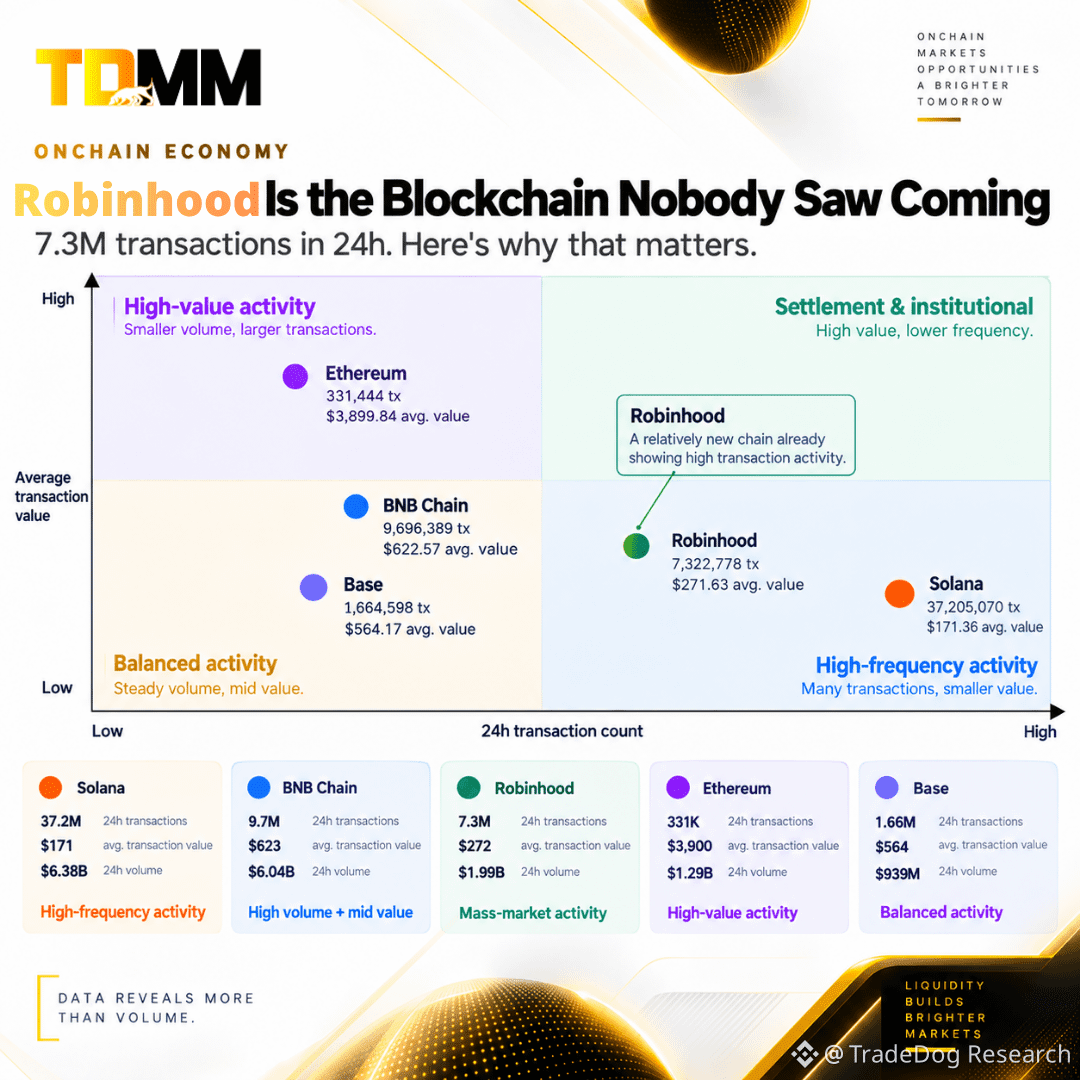
2
75
$PONS : Quando a atenção atinge o pico, a história pode mudar 👀
Antes do rompimento, preço, volume e traders únicos estavam subindo juntos.
Então veio a máxima histórica (ATH).
📈 O preço explodiu
📊 O volume disparou
👥 Os traders únicos atingiram uma das leituras mais fortes
Mas o próximo movimento não foi outra perna para cima.
O preço começou a corrigir enquanto a atividade permaneceu elevada.
Isso importa.
Atenção no pico ≠ alta garantida.
Às vezes, um pico de participação e volume perto de uma máxima local pode indicar que o mercado está entrando em uma fase diferente.
Para o $PONS, a pergunta-chave agora é:
Os traders únicos + o volume vão começar a se reconstruir junto com o preço, ou a participação vai continuar divergindo?
O próximo sinal pode vir de baixo do gráfico antes de aparecer no gráfico.
@tdmarketmaker @Square-Creator-50e191620
#PONS #MarketAnalysis #Altcoins #DeFi #CryptoTrading
$PONS : Quando a atenção atinge o pico, a história pode mudar 👀
Antes do rompimento, preço, volume e traders únicos estavam subindo juntos.
Então veio a máxima histórica (ATH).
📈 O preço explodiu
📊 O volume disparou
👥 Os traders únicos atingiram uma das leituras mais fortes
Mas o próximo movimento não foi outra perna para cima.
O preço começou a corrigir enquanto a atividade permaneceu elevada.
Isso importa.
Atenção no pico ≠ alta garantida.
Às vezes, um pico de participação e volume perto de uma máxima local pode indicar que o mercado está entrando em uma fase diferente.
Para o $PONS , a pergunta-chave agora é:
Os traders únicos + o volume vão começar a se reconstruir junto com o preço, ou a participação vai continuar divergindo?
O próximo sinal pode vir de baixo do gráfico antes de aparecer no gráfico.
@TDMM-TradeDog Market Maker @TradeDog Crypto Market Research
#PONS #MarketAnalysis #Altcoins #DeFi #CryptoTrading
Antes do rompimento, preço, volume e traders únicos estavam subindo juntos.
Então veio a máxima histórica (ATH).
📈 O preço explodiu
📊 O volume disparou
👥 Os traders únicos atingiram uma das leituras mais fortes
Mas o próximo movimento não foi outra perna para cima.
O preço começou a corrigir enquanto a atividade permaneceu elevada.
Isso importa.
Atenção no pico ≠ alta garantida.
Às vezes, um pico de participação e volume perto de uma máxima local pode indicar que o mercado está entrando em uma fase diferente.
Para o $PONS , a pergunta-chave agora é:
Os traders únicos + o volume vão começar a se reconstruir junto com o preço, ou a participação vai continuar divergindo?
O próximo sinal pode vir de baixo do gráfico antes de aparecer no gráfico.
@TDMM-TradeDog Market Maker @TradeDog Crypto Market Research
#PONS #MarketAnalysis #Altcoins #DeFi #CryptoTrading
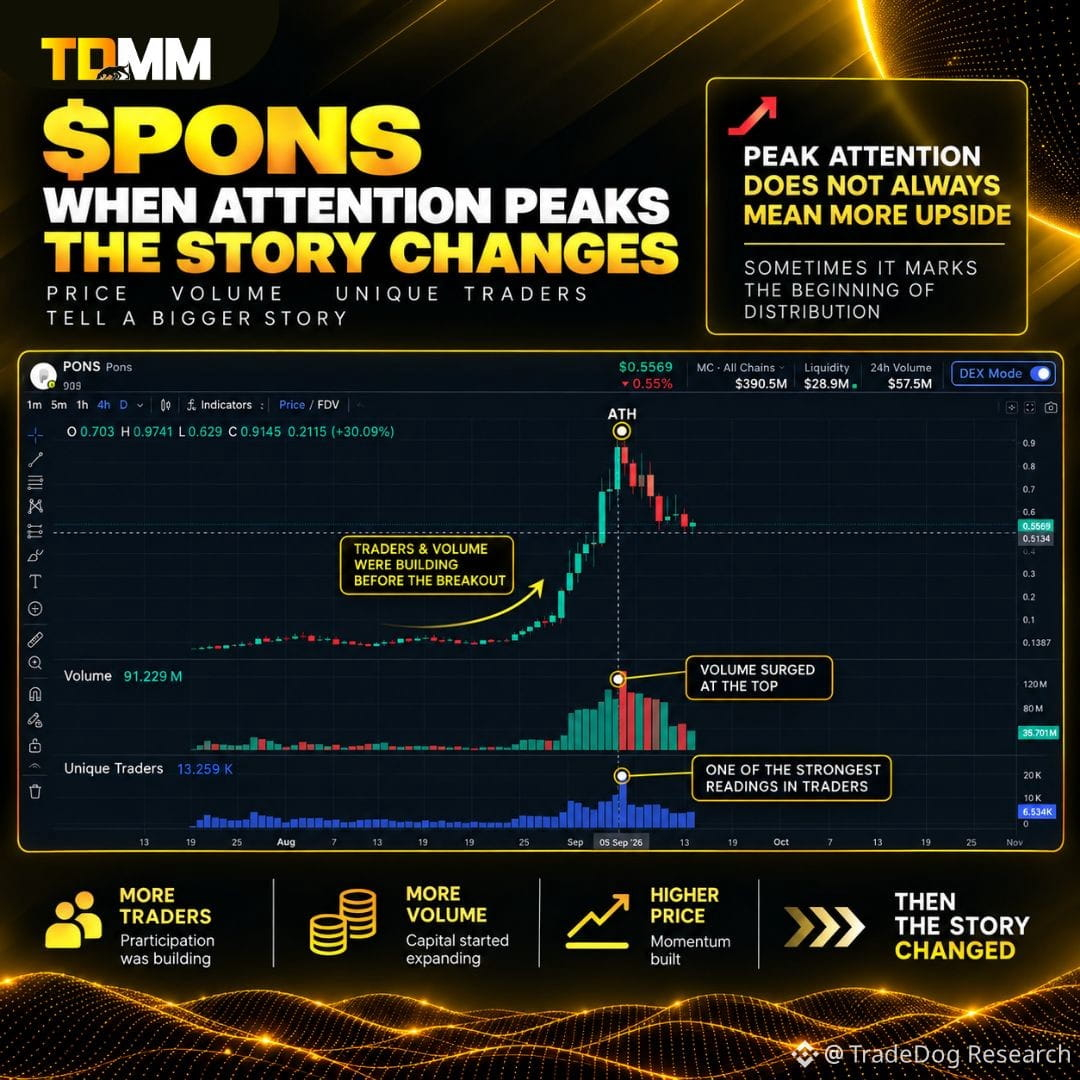
2
185
Verificação diária do pulso do mercado de criptomoedas pelo TDR
A Base da Coinbase atinge novos patamares: 4 milhões de endereços ativos
Vamos mergulhar nos detalhes:
A Base, a rede Layer 2 (L2) da @coinbase construída na blockchain Ethereum, atingiu recentemente um marco significativo ao ultrapassar 4 milhões de endereços ativos, impulsionada por sua campanha "Onchain Summer".
Esta campanha Onchain Summer, lançada inicialmente em 2023 e revivida em 2024, tem sido uma grande força motriz por trás do crescimento da @base. A campanha foi projetada para incentivar desenvolvedores e envolver a comunidade cripto mais ampla, oferecendo recompensas, hospedando eventos e fomentando a criatividade na plataforma.
A edição de 2024 continuou esse ímpeto ao oferecer US$ 2 milhões em recompensas (equivalente a 600 ETH) para desenvolvedores que construírem na rede Base entre junho e agosto.
Em termos de perspectivas futuras:
Olhando para o futuro, o ímpeto obtido com o Onchain Summer pode continuar a impulsionar a Base, especialmente se a Coinbase puder continuar a inovar e atrair desenvolvedores e usuários para sua plataforma.
As lições aprendidas com esta campanha, particularmente no tratamento de controvérsias e na garantia da integridade de aplicativos baseados em blockchain, serão cruciais para o desenvolvimento contínuo da Base.
Mas isso não é tudo! Vamos mergulhar nos insights de mercado de hoje:
Capitalização global de mercado de criptomoedas: US$ 2,2 trilhões
Dominância do Bitcoin: 53,4% | Domínio do Ethereum: 14,2%
Principais ganhadores:
SUNDOG: +87,4%
LOKA: +59,2%
Principais perdedores:
BRAINLET: -27,0%
CATDOG: -25,4%
Participe dos principais airdrops em andamento: @Curvance, @LineaBuild, @getgrass_io, @Sagaxyz__
Siga @TradedogCrypto para se manter informado sobre os últimos e mais impactantes desenvolvimentos no mundo das criptomoedas.
#Coinbase #Ethereum #Layer2 #Blockchain #OnchainSummer
Verificação diária do pulso do mercado de criptomoedas pelo TDR
A Base da Coinbase atinge novos patamares: 4 milhões de endereços ativos
Vamos mergulhar nos detalhes:
A Base, a rede Layer 2 (L2) da @coinbase construída na blockchain Ethereum, atingiu recentemente um marco significativo ao ultrapassar 4 milhões de endereços ativos, impulsionada por sua campanha "Onchain Summer".
Esta campanha Onchain Summer, lançada inicialmente em 2023 e revivida em 2024, tem sido uma grande força motriz por trás do crescimento da @base. A campanha foi projetada para incentivar desenvolvedores e envolver a comunidade cripto mais ampla, oferecendo recompensas, hospedando eventos e fomentando a criatividade na plataforma.
A edição de 2024 continuou esse ímpeto ao oferecer US$ 2 milhões em recompensas (equivalente a 600 ETH) para desenvolvedores que construírem na rede Base entre junho e agosto.
Em termos de perspectivas futuras:
Olhando para o futuro, o ímpeto obtido com o Onchain Summer pode continuar a impulsionar a Base, especialmente se a Coinbase puder continuar a inovar e atrair desenvolvedores e usuários para sua plataforma.
As lições aprendidas com esta campanha, particularmente no tratamento de controvérsias e na garantia da integridade de aplicativos baseados em blockchain, serão cruciais para o desenvolvimento contínuo da Base.
Mas isso não é tudo! Vamos mergulhar nos insights de mercado de hoje:
Capitalização global de mercado de criptomoedas: US$ 2,2 trilhões
Dominância do Bitcoin: 53,4% | Domínio do Ethereum: 14,2%
Principais ganhadores:
SUNDOG: +87,4%
LOKA: +59,2%
Principais perdedores:
BRAINLET: -27,0%
CATDOG: -25,4%
Participe dos principais airdrops em andamento: @Curvance, @LineaBuild, @getgrass_io, @Sagaxyz__
Siga @TradedogCrypto para se manter informado sobre os últimos e mais impactantes desenvolvimentos no mundo das criptomoedas.
#Coinbase #Ethereum #Layer2 #Blockchain #OnchainSummer
A Base da Coinbase atinge novos patamares: 4 milhões de endereços ativos
Vamos mergulhar nos detalhes:
A Base, a rede Layer 2 (L2) da @coinbase construída na blockchain Ethereum, atingiu recentemente um marco significativo ao ultrapassar 4 milhões de endereços ativos, impulsionada por sua campanha "Onchain Summer".
Esta campanha Onchain Summer, lançada inicialmente em 2023 e revivida em 2024, tem sido uma grande força motriz por trás do crescimento da @base. A campanha foi projetada para incentivar desenvolvedores e envolver a comunidade cripto mais ampla, oferecendo recompensas, hospedando eventos e fomentando a criatividade na plataforma.
A edição de 2024 continuou esse ímpeto ao oferecer US$ 2 milhões em recompensas (equivalente a 600 ETH) para desenvolvedores que construírem na rede Base entre junho e agosto.
Em termos de perspectivas futuras:
Olhando para o futuro, o ímpeto obtido com o Onchain Summer pode continuar a impulsionar a Base, especialmente se a Coinbase puder continuar a inovar e atrair desenvolvedores e usuários para sua plataforma.
As lições aprendidas com esta campanha, particularmente no tratamento de controvérsias e na garantia da integridade de aplicativos baseados em blockchain, serão cruciais para o desenvolvimento contínuo da Base.
Mas isso não é tudo! Vamos mergulhar nos insights de mercado de hoje:
Capitalização global de mercado de criptomoedas: US$ 2,2 trilhões
Dominância do Bitcoin: 53,4% | Domínio do Ethereum: 14,2%
Principais ganhadores:
SUNDOG: +87,4%
LOKA: +59,2%
Principais perdedores:
BRAINLET: -27,0%
CATDOG: -25,4%
Participe dos principais airdrops em andamento: @Curvance, @LineaBuild, @getgrass_io, @Sagaxyz__
Siga @TradedogCrypto para se manter informado sobre os últimos e mais impactantes desenvolvimentos no mundo das criptomoedas.
#Coinbase #Ethereum #Layer2 #Blockchain #OnchainSummer

3
284
O metaverso está perdendo o brilho?
O mercado de terras do metaverso em 2024 viu uma queda significativa, com preços médios 72% abaixo do pico.
Os preços médios caíram 34% desde 2023 e 55% desde 2022.
Principais destaques do projeto:
@TheSandboxGame: Os preços despencaram 95% de 2,86 ETH em 2021 para 0,13 ETH em 2024.
NFTWorlds/TOPIA Worlds: Demonstraram resiliência com um declínio de 45%, auxiliados pelo suporte da comunidade e reformulação da marca.
@SomniumSpace: Atingiu o pico em 2023 em 0,98 ETH, impulsionado pelos avanços da RV.
Fatores que influenciam os preços:
Volatilidade do mercado: A crise mais ampla das criptomoedas impactou significativamente as terras do metaverso.
Desenvolvimentos específicos do projeto: Inovação e propostas de valor exclusivas ajudaram certos projetos a manter o valor.
Força da comunidade: Forte engajamento e esforços de reformulação da marca atenuaram declínios.
Influência do mercado externo: Tendências como memecoins desviaram a atenção das terras do metaverso.
Perspectiva futura:
O futuro dos preços das terras do metaverso dependerá da inovação contínua e das tendências mais amplas de criptomoedas.
O que você acha que o futuro reserva para os preços das terras do metaverso? Compartilhe suas ideias abaixo!
#Metaverse #VirtualRealEstate #NFT
O metaverso está perdendo o brilho?
O mercado de terras do metaverso em 2024 viu uma queda significativa, com preços médios 72% abaixo do pico.
Os preços médios caíram 34% desde 2023 e 55% desde 2022.
Principais destaques do projeto:
@TheSandboxGame: Os preços despencaram 95% de 2,86 ETH em 2021 para 0,13 ETH em 2024.
NFTWorlds/TOPIA Worlds: Demonstraram resiliência com um declínio de 45%, auxiliados pelo suporte da comunidade e reformulação da marca.
@SomniumSpace: Atingiu o pico em 2023 em 0,98 ETH, impulsionado pelos avanços da RV.
Fatores que influenciam os preços:
Volatilidade do mercado: A crise mais ampla das criptomoedas impactou significativamente as terras do metaverso.
Desenvolvimentos específicos do projeto: Inovação e propostas de valor exclusivas ajudaram certos projetos a manter o valor.
Força da comunidade: Forte engajamento e esforços de reformulação da marca atenuaram declínios.
Influência do mercado externo: Tendências como memecoins desviaram a atenção das terras do metaverso.
Perspectiva futura:
O futuro dos preços das terras do metaverso dependerá da inovação contínua e das tendências mais amplas de criptomoedas.
O que você acha que o futuro reserva para os preços das terras do metaverso? Compartilhe suas ideias abaixo!
#Metaverse #VirtualRealEstate #NFT
O mercado de terras do metaverso em 2024 viu uma queda significativa, com preços médios 72% abaixo do pico.
Os preços médios caíram 34% desde 2023 e 55% desde 2022.
Principais destaques do projeto:
@TheSandboxGame: Os preços despencaram 95% de 2,86 ETH em 2021 para 0,13 ETH em 2024.
NFTWorlds/TOPIA Worlds: Demonstraram resiliência com um declínio de 45%, auxiliados pelo suporte da comunidade e reformulação da marca.
@SomniumSpace: Atingiu o pico em 2023 em 0,98 ETH, impulsionado pelos avanços da RV.
Fatores que influenciam os preços:
Volatilidade do mercado: A crise mais ampla das criptomoedas impactou significativamente as terras do metaverso.
Desenvolvimentos específicos do projeto: Inovação e propostas de valor exclusivas ajudaram certos projetos a manter o valor.
Força da comunidade: Forte engajamento e esforços de reformulação da marca atenuaram declínios.
Influência do mercado externo: Tendências como memecoins desviaram a atenção das terras do metaverso.
Perspectiva futura:
O futuro dos preços das terras do metaverso dependerá da inovação contínua e das tendências mais amplas de criptomoedas.
O que você acha que o futuro reserva para os preços das terras do metaverso? Compartilhe suas ideias abaixo!
#Metaverse #VirtualRealEstate #NFT

1
1.4k
Enquanto todos falam sobre a tempestade nos mercados de ações e criptomoedas, decidimos delinear a situação com o mercado de NFT.
📊
Números e estatísticas
Capitalização de mercado: US$ 57,5 bilhões
Volume diário de negociação: US$ 9,5 bilhões
Principais coleções por capitalização:
@cryptopunksnfts: US$ 524 milhões
@LibertyCatsBTC: US$ 513 milhões
@BoredApeYC: US$ 218 milhões
@pudgypenguins: US$ 178 milhões
@Azuki: US$ 99 milhões
Correções de mercado
O mercado de NFT teve um declínio significativo, com a capitalização caindo para US$ 34 bilhões em seu ponto mais baixo, fortemente influenciada pelo mercado mais amplo de criptomoedas.
Impacto das Memecoins
As Memecoins atraíram a atenção e o capital para longe dos NFTs, levando a uma queda acentuada na capitalização de mercado de US$ 348 bilhões em janeiro de 2024 para US$ 159 bilhões em março de 2024.
Tendências emergentes
NFTs orientados a utilidade: aumento do interesse em NFTs vinculados à tokenização de ativos do mundo real. Integração de jogos: grandes empresas como a Square Enix estão adotando cada vez mais NFTs. NFTs híbridos: popularidade crescente de tokens que combinam ativos físicos e digitais.
Perspectiva futura
Embora a próxima alta possa enfatizar NFTs baseados em utilidade e tokenização de ativos do mundo real, o crescimento significativo do mercado permanece incerto devido às condições atuais.
O mercado de NFT está evoluindo, com foco em utilidade e ativos reais, mas enfrenta desafios de memecoins e volatilidade do mercado.
Vamos esperar para ver o que acontece a seguir. Deixe suas ideias abaixo
👇
#NFTMarket #CryptoNewss #MarketTrends
Enquanto todos falam sobre a tempestade nos mercados de ações e criptomoedas, decidimos delinear a situação com o mercado de NFT.
📊
Números e estatísticas
Capitalização de mercado: US$ 57,5 bilhões
Volume diário de negociação: US$ 9,5 bilhões
Principais coleções por capitalização:
@cryptopunksnfts: US$ 524 milhões
@LibertyCatsBTC: US$ 513 milhões
@BoredApeYC: US$ 218 milhões
@pudgypenguins: US$ 178 milhões
@Azuki: US$ 99 milhões
Correções de mercado
O mercado de NFT teve um declínio significativo, com a capitalização caindo para US$ 34 bilhões em seu ponto mais baixo, fortemente influenciada pelo mercado mais amplo de criptomoedas.
Impacto das Memecoins
As Memecoins atraíram a atenção e o capital para longe dos NFTs, levando a uma queda acentuada na capitalização de mercado de US$ 348 bilhões em janeiro de 2024 para US$ 159 bilhões em março de 2024.
Tendências emergentes
NFTs orientados a utilidade: aumento do interesse em NFTs vinculados à tokenização de ativos do mundo real. Integração de jogos: grandes empresas como a Square Enix estão adotando cada vez mais NFTs. NFTs híbridos: popularidade crescente de tokens que combinam ativos físicos e digitais.
Perspectiva futura
Embora a próxima alta possa enfatizar NFTs baseados em utilidade e tokenização de ativos do mundo real, o crescimento significativo do mercado permanece incerto devido às condições atuais.
O mercado de NFT está evoluindo, com foco em utilidade e ativos reais, mas enfrenta desafios de memecoins e volatilidade do mercado.
Vamos esperar para ver o que acontece a seguir. Deixe suas ideias abaixo
👇
#NFTMarket #CryptoNewss #MarketTrends
📊
Números e estatísticas
Capitalização de mercado: US$ 57,5 bilhões
Volume diário de negociação: US$ 9,5 bilhões
Principais coleções por capitalização:
@cryptopunksnfts: US$ 524 milhões
@LibertyCatsBTC: US$ 513 milhões
@BoredApeYC: US$ 218 milhões
@pudgypenguins: US$ 178 milhões
@Azuki: US$ 99 milhões
Correções de mercado
O mercado de NFT teve um declínio significativo, com a capitalização caindo para US$ 34 bilhões em seu ponto mais baixo, fortemente influenciada pelo mercado mais amplo de criptomoedas.
Impacto das Memecoins
As Memecoins atraíram a atenção e o capital para longe dos NFTs, levando a uma queda acentuada na capitalização de mercado de US$ 348 bilhões em janeiro de 2024 para US$ 159 bilhões em março de 2024.
Tendências emergentes
NFTs orientados a utilidade: aumento do interesse em NFTs vinculados à tokenização de ativos do mundo real. Integração de jogos: grandes empresas como a Square Enix estão adotando cada vez mais NFTs. NFTs híbridos: popularidade crescente de tokens que combinam ativos físicos e digitais.
Perspectiva futura
Embora a próxima alta possa enfatizar NFTs baseados em utilidade e tokenização de ativos do mundo real, o crescimento significativo do mercado permanece incerto devido às condições atuais.
O mercado de NFT está evoluindo, com foco em utilidade e ativos reais, mas enfrenta desafios de memecoins e volatilidade do mercado.
Vamos esperar para ver o que acontece a seguir. Deixe suas ideias abaixo
👇
#NFTMarket #CryptoNewss #MarketTrends

1
450
Identifique seu estilo de negociação!
Por que é crucial: é essencial alinhar sua estratégia de negociação com sua personalidade, tolerância ao risco e comprometimento de tempo.
Saber se você é um Scalper, Day Trader ou Swing Trader ajuda você a tomar decisões informadas, gerenciar o estresse e otimizar sua abordagem de negociação.
Aqui está uma análise mais detalhada de cada estilo de negociação
👇
Scalper: negociações rápidas, alto estresse, alto risco.
Day Trader: negociações diárias, risco moderado a alto, requer atenção total.
Swing Trader: mantém posições por dias/semanas, menor estresse, requer paciência.
Conclusão geral:
Cada estilo tem desafios e recompensas únicos. Escolha o que se alinha com sua tolerância ao risco e estilo de vida.
Qual estilo de negociação combina mais com você?
#Trading#Scalping#DayTrading#SwingTrading
Identifique seu estilo de negociação!
Por que é crucial: é essencial alinhar sua estratégia de negociação com sua personalidade, tolerância ao risco e comprometimento de tempo.
Saber se você é um Scalper, Day Trader ou Swing Trader ajuda você a tomar decisões informadas, gerenciar o estresse e otimizar sua abordagem de negociação.
Aqui está uma análise mais detalhada de cada estilo de negociação
👇
Scalper: negociações rápidas, alto estresse, alto risco.
Day Trader: negociações diárias, risco moderado a alto, requer atenção total.
Swing Trader: mantém posições por dias/semanas, menor estresse, requer paciência.
Conclusão geral:
Cada estilo tem desafios e recompensas únicos. Escolha o que se alinha com sua tolerância ao risco e estilo de vida.
Qual estilo de negociação combina mais com você?
#Trading#Scalping#DayTrading#SwingTrading
Por que é crucial: é essencial alinhar sua estratégia de negociação com sua personalidade, tolerância ao risco e comprometimento de tempo.
Saber se você é um Scalper, Day Trader ou Swing Trader ajuda você a tomar decisões informadas, gerenciar o estresse e otimizar sua abordagem de negociação.
Aqui está uma análise mais detalhada de cada estilo de negociação
👇
Scalper: negociações rápidas, alto estresse, alto risco.
Day Trader: negociações diárias, risco moderado a alto, requer atenção total.
Swing Trader: mantém posições por dias/semanas, menor estresse, requer paciência.
Conclusão geral:
Cada estilo tem desafios e recompensas únicos. Escolha o que se alinha com sua tolerância ao risco e estilo de vida.
Qual estilo de negociação combina mais com você?
#Trading#Scalping#DayTrading#SwingTrading

12
𝗪𝗵𝗶𝗰𝗵 𝗣𝗿𝗼𝗷𝗲𝗰𝘁𝘀 𝗦𝘁𝗼𝗹𝗲 𝘁𝗵𝗲 𝗜𝗻𝘃𝗲𝘀𝘁𝗼𝗿'𝘀 𝗦𝗽𝗼𝘁𝗹𝗶𝗴𝗵𝘁 𝗟𝗮𝘀𝘁 𝗪𝗲𝗲𝗸?
Vamos dar uma olhada👇
- Particle Network - Uma solução de blockchain de camada 1.
𝗥𝗮𝗶𝘀𝗲𝗱 𝗔𝗺𝗼𝘂𝗻𝘁: A ser divulgado
- Pichi Finance - Focada na criação de um protocolo de negociação de pontos sem confiança.
𝗥𝗮𝗶𝘀𝗲𝗱 𝗔𝗺𝗼𝘂𝗻𝘁: US$ 2,5 milhões
- Morpho Labs - Liderando o caminho em soluções avançadas de liquidez e aplicativos descentralizados.
𝗥𝗮𝗶𝘀𝗲𝗱 𝗔𝗺𝗼𝘂𝗻𝘁: US$ 50 milhões
- Breakout - Uma startup focada em revolucionar os setores financeiro e bancário com soluções tecnológicas avançadas.
𝗥𝗮𝗶𝘀𝗲𝗱 𝗔𝗺𝗼𝘂𝗻𝘁: US$ 4,5 milhões
- Layer2 Financial - Visando preencher a lacuna entre os sistemas financeiros tradicionais e a tecnologia blockchain, aprimorando os sistemas de pagamento e serviços financeiros.
𝗥𝗮𝗶𝘀𝗲𝗱 𝗔𝗺𝗼𝘂𝗻𝘁: US$ 10,7 milhões
Esses projetos destacam o crescente interesse e investimento em blockchain e soluções financeiras descentralizadas, cada um visando resolver desafios específicos dentro do ecossistema e impulsionar mais inovação.
Qual projeto você acha mais promissor?
Deixe-nos saber nos comentários!
#Crypto #Blockchain #DEFİ #Investment #Innovation
𝗪𝗵𝗶𝗰𝗵 𝗣𝗿𝗼𝗷𝗲𝗰𝘁𝘀 𝗦𝘁𝗼𝗹𝗲 𝘁𝗵𝗲 𝗜𝗻𝘃𝗲𝘀𝘁𝗼𝗿'𝘀 𝗦𝗽𝗼𝘁𝗹𝗶𝗴𝗵𝘁 𝗟𝗮𝘀𝘁 𝗪𝗲𝗲𝗸?
Vamos dar uma olhada👇
- Particle Network - Uma solução de blockchain de camada 1.
𝗥𝗮𝗶𝘀𝗲𝗱 𝗔𝗺𝗼𝘂𝗻𝘁: A ser divulgado
- Pichi Finance - Focada na criação de um protocolo de negociação de pontos sem confiança.
𝗥𝗮𝗶𝘀𝗲𝗱 𝗔𝗺𝗼𝘂𝗻𝘁: US$ 2,5 milhões
- Morpho Labs - Liderando o caminho em soluções avançadas de liquidez e aplicativos descentralizados.
𝗥𝗮𝗶𝘀𝗲𝗱 𝗔𝗺𝗼𝘂𝗻𝘁: US$ 50 milhões
- Breakout - Uma startup focada em revolucionar os setores financeiro e bancário com soluções tecnológicas avançadas.
𝗥𝗮𝗶𝘀𝗲𝗱 𝗔𝗺𝗼𝘂𝗻𝘁: US$ 4,5 milhões
- Layer2 Financial - Visando preencher a lacuna entre os sistemas financeiros tradicionais e a tecnologia blockchain, aprimorando os sistemas de pagamento e serviços financeiros.
𝗥𝗮𝗶𝘀𝗲𝗱 𝗔𝗺𝗼𝘂𝗻𝘁: US$ 10,7 milhões
Esses projetos destacam o crescente interesse e investimento em blockchain e soluções financeiras descentralizadas, cada um visando resolver desafios específicos dentro do ecossistema e impulsionar mais inovação.
Qual projeto você acha mais promissor?
Deixe-nos saber nos comentários!
#Crypto #Blockchain #DEFİ #Investment #Innovation
Vamos dar uma olhada👇
- Particle Network - Uma solução de blockchain de camada 1.
𝗥𝗮𝗶𝘀𝗲𝗱 𝗔𝗺𝗼𝘂𝗻𝘁: A ser divulgado
- Pichi Finance - Focada na criação de um protocolo de negociação de pontos sem confiança.
𝗥𝗮𝗶𝘀𝗲𝗱 𝗔𝗺𝗼𝘂𝗻𝘁: US$ 2,5 milhões
- Morpho Labs - Liderando o caminho em soluções avançadas de liquidez e aplicativos descentralizados.
𝗥𝗮𝗶𝘀𝗲𝗱 𝗔𝗺𝗼𝘂𝗻𝘁: US$ 50 milhões
- Breakout - Uma startup focada em revolucionar os setores financeiro e bancário com soluções tecnológicas avançadas.
𝗥𝗮𝗶𝘀𝗲𝗱 𝗔𝗺𝗼𝘂𝗻𝘁: US$ 4,5 milhões
- Layer2 Financial - Visando preencher a lacuna entre os sistemas financeiros tradicionais e a tecnologia blockchain, aprimorando os sistemas de pagamento e serviços financeiros.
𝗥𝗮𝗶𝘀𝗲𝗱 𝗔𝗺𝗼𝘂𝗻𝘁: US$ 10,7 milhões
Esses projetos destacam o crescente interesse e investimento em blockchain e soluções financeiras descentralizadas, cada um visando resolver desafios específicos dentro do ecossistema e impulsionar mais inovação.
Qual projeto você acha mais promissor?
Deixe-nos saber nos comentários!
#Crypto #Blockchain #DEFİ #Investment #Innovation

1
232
A sua criptomoeda favorita é segura? 🛡️
Para permanecer à frente no mundo criptográfico, é crucial informar-se sobre possíveis hacks e desenvolvimentos contínuos.
Hoje, vamos mergulhar no tópico dos ataques de 51%.
O que é um ataque de 51%?
Acontece quando uma pessoa ou grupo controla mais de 50% do poder de hashing do blockchain, permitindo-lhes adulterar as transações.
Como funciona:
- Dominância da taxa de hash: O invasor controla a maior parte da taxa de hash da rede.
- Gastos duplos: Eles podem reverter transações e permitir gastos duplos.
- Interferência de bloqueio: Eles podem impedir que novas transações obtenham confirmações.
- Monopólio de Mineração: Eles monopolizam a mineração, impedindo que outros mineradores gerem blocos e coletem recompensas.
Exemplos históricos:
- Bitcoin Gold (2018): sofreu um ataque de 51%, resultando em US$ 18 milhões em moedas gastas duas vezes.
- Ethereum Classic (2019): sofreu vários ataques de 51%, levando ao gasto duplo de milhares de ETC.
- Verge (2018): Enfrentou um ataque que levou à criação de milhões de XVG através da manipulação de blockchain.
Que medidas podem ser tomadas para prevenção?
- Aumentar a taxa de hash da rede: torna mais difícil para uma única entidade controlar 51%.
- Prova de Participação (PoS): Segurança baseada na quantidade de criptomoeda mantida, não no poder computacional.
- Monitoramento Aprimorado: Monitoramento contínuo da rede para comportamento incomum de mineração.
- Descentralização: Promover a descentralização nos reservatórios mineiros para evitar a concentração do poder mineiro.
Se você achou esta informação útil, curta, repasse e compartilhe com sua rede.
#CriptoSegurança #Blockchain
A sua criptomoeda favorita é segura? 🛡️
Para permanecer à frente no mundo criptográfico, é crucial informar-se sobre possíveis hacks e desenvolvimentos contínuos.
Hoje, vamos mergulhar no tópico dos ataques de 51%.
O que é um ataque de 51%?
Acontece quando uma pessoa ou grupo controla mais de 50% do poder de hashing do blockchain, permitindo-lhes adulterar as transações.
Como funciona:
- Dominância da taxa de hash: O invasor controla a maior parte da taxa de hash da rede.
- Gastos duplos: Eles podem reverter transações e permitir gastos duplos.
- Interferência de bloqueio: Eles podem impedir que novas transações obtenham confirmações.
- Monopólio de Mineração: Eles monopolizam a mineração, impedindo que outros mineradores gerem blocos e coletem recompensas.
Exemplos históricos:
- Bitcoin Gold (2018): sofreu um ataque de 51%, resultando em US$ 18 milhões em moedas gastas duas vezes.
- Ethereum Classic (2019): sofreu vários ataques de 51%, levando ao gasto duplo de milhares de ETC.
- Verge (2018): Enfrentou um ataque que levou à criação de milhões de XVG através da manipulação de blockchain.
Que medidas podem ser tomadas para prevenção?
- Aumentar a taxa de hash da rede: torna mais difícil para uma única entidade controlar 51%.
- Prova de Participação (PoS): Segurança baseada na quantidade de criptomoeda mantida, não no poder computacional.
- Monitoramento Aprimorado: Monitoramento contínuo da rede para comportamento incomum de mineração.
- Descentralização: Promover a descentralização nos reservatórios mineiros para evitar a concentração do poder mineiro.
Se você achou esta informação útil, curta, repasse e compartilhe com sua rede.
#CriptoSegurança #Blockchain
Para permanecer à frente no mundo criptográfico, é crucial informar-se sobre possíveis hacks e desenvolvimentos contínuos.
Hoje, vamos mergulhar no tópico dos ataques de 51%.
O que é um ataque de 51%?
Acontece quando uma pessoa ou grupo controla mais de 50% do poder de hashing do blockchain, permitindo-lhes adulterar as transações.
Como funciona:
- Dominância da taxa de hash: O invasor controla a maior parte da taxa de hash da rede.
- Gastos duplos: Eles podem reverter transações e permitir gastos duplos.
- Interferência de bloqueio: Eles podem impedir que novas transações obtenham confirmações.
- Monopólio de Mineração: Eles monopolizam a mineração, impedindo que outros mineradores gerem blocos e coletem recompensas.
Exemplos históricos:
- Bitcoin Gold (2018): sofreu um ataque de 51%, resultando em US$ 18 milhões em moedas gastas duas vezes.
- Ethereum Classic (2019): sofreu vários ataques de 51%, levando ao gasto duplo de milhares de ETC.
- Verge (2018): Enfrentou um ataque que levou à criação de milhões de XVG através da manipulação de blockchain.
Que medidas podem ser tomadas para prevenção?
- Aumentar a taxa de hash da rede: torna mais difícil para uma única entidade controlar 51%.
- Prova de Participação (PoS): Segurança baseada na quantidade de criptomoeda mantida, não no poder computacional.
- Monitoramento Aprimorado: Monitoramento contínuo da rede para comportamento incomum de mineração.
- Descentralização: Promover a descentralização nos reservatórios mineiros para evitar a concentração do poder mineiro.
Se você achou esta informação útil, curta, repasse e compartilhe com sua rede.
#CriptoSegurança #Blockchain

3
4.6k
Suas emoções estão afetando seus investimentos em criptografia?
De alguma forma, todos nós somos afetados por isso; não há benefício em negá-lo.
Mas como? Vamos discutir todo o ciclo de emoções.
Euforia: Os preços máximos de mercado criam uma sensação de invencibilidade e ganância.
Comportamento básico: Compra pesada a preços elevados, muitas vezes sem considerar os riscos.
Esperança: A fase inicial onde os traders entram no mercado com otimismo e grandes expectativas de ganhos futuros.
Comportamento básico: Comprar ativos com base em notícias positivas, rumores ou sucesso do investimento inicial.
Otimismo: À medida que os preços começam a subir, os traders sentem-se otimistas em relação aos seus investimentos.
Comportamento básico: Aumento de compras e detenções, reforçando a crença no potencial do mercado.
Emoção: aumentos significativos de preços geram entusiasmo e emoção.
Comportamento básico: Compra mais agressiva, às vezes aproveitando para maximizar ganhos.
Ansiedade: Os preços de mercado começam a cair, fazendo com que os comerciantes fiquem ansiosos com os seus investimentos.
Comportamento básico: Hesitação em vender, esperando que os preços se recuperem.
Negação: As quedas contínuas de preços levam à negação, com os traders acreditando que se trata de um revés temporário.
Comportamento básico: Manter os investimentos apesar das perdas, aguardando a recuperação.
Pânico: Quedas persistentes criam pânico à medida que os traders percebem perdas significativas.
Comportamento básico: Venda urgente para reduzir perdas, muitas vezes com perdas consideráveis.
Capitulação: Vendas generalizadas e saídas de mercado, indicando o ponto mais baixo do ciclo.
Comportamento básico: Vender os ativos restantes, sair do mercado e aceitar perdas.
Esperança: O mercado se estabiliza e mostra sinais de recuperação, reacendendo a esperança entre os traders.
Comportamento básico: Reentrada cautelosa no mercado e início de um novo ciclo.
Em que estágio você acha que está agora?🤔
#CryptoTrader #MarketCycle
Suas emoções estão afetando seus investimentos em criptografia?
De alguma forma, todos nós somos afetados por isso; não há benefício em negá-lo.
Mas como? Vamos discutir todo o ciclo de emoções.
Euforia: Os preços máximos de mercado criam uma sensação de invencibilidade e ganância.
Comportamento básico: Compra pesada a preços elevados, muitas vezes sem considerar os riscos.
Esperança: A fase inicial onde os traders entram no mercado com otimismo e grandes expectativas de ganhos futuros.
Comportamento básico: Comprar ativos com base em notícias positivas, rumores ou sucesso do investimento inicial.
Otimismo: À medida que os preços começam a subir, os traders sentem-se otimistas em relação aos seus investimentos.
Comportamento básico: Aumento de compras e detenções, reforçando a crença no potencial do mercado.
Emoção: aumentos significativos de preços geram entusiasmo e emoção.
Comportamento básico: Compra mais agressiva, às vezes aproveitando para maximizar ganhos.
Ansiedade: Os preços de mercado começam a cair, fazendo com que os comerciantes fiquem ansiosos com os seus investimentos.
Comportamento básico: Hesitação em vender, esperando que os preços se recuperem.
Negação: As quedas contínuas de preços levam à negação, com os traders acreditando que se trata de um revés temporário.
Comportamento básico: Manter os investimentos apesar das perdas, aguardando a recuperação.
Pânico: Quedas persistentes criam pânico à medida que os traders percebem perdas significativas.
Comportamento básico: Venda urgente para reduzir perdas, muitas vezes com perdas consideráveis.
Capitulação: Vendas generalizadas e saídas de mercado, indicando o ponto mais baixo do ciclo.
Comportamento básico: Vender os ativos restantes, sair do mercado e aceitar perdas.
Esperança: O mercado se estabiliza e mostra sinais de recuperação, reacendendo a esperança entre os traders.
Comportamento básico: Reentrada cautelosa no mercado e início de um novo ciclo.
Em que estágio você acha que está agora?🤔
#CryptoTrader #MarketCycle
De alguma forma, todos nós somos afetados por isso; não há benefício em negá-lo.
Mas como? Vamos discutir todo o ciclo de emoções.
Euforia: Os preços máximos de mercado criam uma sensação de invencibilidade e ganância.
Comportamento básico: Compra pesada a preços elevados, muitas vezes sem considerar os riscos.
Esperança: A fase inicial onde os traders entram no mercado com otimismo e grandes expectativas de ganhos futuros.
Comportamento básico: Comprar ativos com base em notícias positivas, rumores ou sucesso do investimento inicial.
Otimismo: À medida que os preços começam a subir, os traders sentem-se otimistas em relação aos seus investimentos.
Comportamento básico: Aumento de compras e detenções, reforçando a crença no potencial do mercado.
Emoção: aumentos significativos de preços geram entusiasmo e emoção.
Comportamento básico: Compra mais agressiva, às vezes aproveitando para maximizar ganhos.
Ansiedade: Os preços de mercado começam a cair, fazendo com que os comerciantes fiquem ansiosos com os seus investimentos.
Comportamento básico: Hesitação em vender, esperando que os preços se recuperem.
Negação: As quedas contínuas de preços levam à negação, com os traders acreditando que se trata de um revés temporário.
Comportamento básico: Manter os investimentos apesar das perdas, aguardando a recuperação.
Pânico: Quedas persistentes criam pânico à medida que os traders percebem perdas significativas.
Comportamento básico: Venda urgente para reduzir perdas, muitas vezes com perdas consideráveis.
Capitulação: Vendas generalizadas e saídas de mercado, indicando o ponto mais baixo do ciclo.
Comportamento básico: Vender os ativos restantes, sair do mercado e aceitar perdas.
Esperança: O mercado se estabiliza e mostra sinais de recuperação, reacendendo a esperança entre os traders.
Comportamento básico: Reentrada cautelosa no mercado e início de um novo ciclo.
Em que estágio você acha que está agora?🤔
#CryptoTrader #MarketCycle

532
Já pensou como o zkRollups funciona e agrega valor real ao Blockchain?
🤔
Antes de nos aprofundarmos em como eles realmente funcionam, vamos primeiro explorar o que são zkRollups:
ZK-Rollups são rollups onde os validadores provam a autenticidade de uma transação sem revelar quaisquer detalhes da transação.
Agora, vamos ver como o zkRollups realmente funciona!
Como funcionam os zkRollups:
1. Transações em lote (L2): Múltiplas transações são agrupadas em lote, reduzindo a carga no blockchain principal ao processá-las fora da cadeia.
2. Execução (L2): As transações em lote são executadas pelo sequenciador, atualizando o estado da cadeia da camada 2.
3. Tx, State Diff, etc. (L2): Isso gera uma transação (Tx) e diferenças de estado (diff), refletindo mudanças nos saldos de contas e contratos inteligentes.
4. Gerar Prova (L2): É gerada uma prova de conhecimento zero (prova zk), verificando a veracidade das transações sem revelar detalhes.
5. Enviar para cadeia L1: A prova zk é enviada para a blockchain da camada 1, atualizando-a com o novo estado e validando todas as transações do lote.
6. Verificação (Cadeia L1): O contrato rollup na camada 1 verifica a prova zk, garantindo a integridade das transações em lote.
7. Atualizar ou não (Cadeia L1): Com base na verificação, o estado principal da blockchain é atualizado ou rejeitado, mantendo a segurança e a precisão.
Vantagens do zkRollups:
- Escalabilidade: aumenta o rendimento das transações e reduz o congestionamento através do processamento fora da cadeia.
- Custos mais baixos: Reduz significativamente as taxas de transação ao registrar menos transações na rede.
- Segurança: Herda a segurança do blockchain principal.
- Privacidade: Valida transações sem revelar informações confidenciais.
Aguarde nosso próximo post, onde cobriremos detalhadamente o cenário do zkRollup!
Comente abaixo o quão animado você está.
#BlockchainMilestone #Crypto #zkRollups #CryptoInnovation #DeFi
Já pensou como o zkRollups funciona e agrega valor real ao Blockchain?
🤔
Antes de nos aprofundarmos em como eles realmente funcionam, vamos primeiro explorar o que são zkRollups:
ZK-Rollups são rollups onde os validadores provam a autenticidade de uma transação sem revelar quaisquer detalhes da transação.
Agora, vamos ver como o zkRollups realmente funciona!
Como funcionam os zkRollups:
1. Transações em lote (L2): Múltiplas transações são agrupadas em lote, reduzindo a carga no blockchain principal ao processá-las fora da cadeia.
2. Execução (L2): As transações em lote são executadas pelo sequenciador, atualizando o estado da cadeia da camada 2.
3. Tx, State Diff, etc. (L2): Isso gera uma transação (Tx) e diferenças de estado (diff), refletindo mudanças nos saldos de contas e contratos inteligentes.
4. Gerar Prova (L2): É gerada uma prova de conhecimento zero (prova zk), verificando a veracidade das transações sem revelar detalhes.
5. Enviar para cadeia L1: A prova zk é enviada para a blockchain da camada 1, atualizando-a com o novo estado e validando todas as transações do lote.
6. Verificação (Cadeia L1): O contrato rollup na camada 1 verifica a prova zk, garantindo a integridade das transações em lote.
7. Atualizar ou não (Cadeia L1): Com base na verificação, o estado principal da blockchain é atualizado ou rejeitado, mantendo a segurança e a precisão.
Vantagens do zkRollups:
- Escalabilidade: aumenta o rendimento das transações e reduz o congestionamento através do processamento fora da cadeia.
- Custos mais baixos: Reduz significativamente as taxas de transação ao registrar menos transações na rede.
- Segurança: Herda a segurança do blockchain principal.
- Privacidade: Valida transações sem revelar informações confidenciais.
Aguarde nosso próximo post, onde cobriremos detalhadamente o cenário do zkRollup!
Comente abaixo o quão animado você está.
#BlockchainMilestone #Crypto #zkRollups #CryptoInnovation #DeFi
🤔
Antes de nos aprofundarmos em como eles realmente funcionam, vamos primeiro explorar o que são zkRollups:
ZK-Rollups são rollups onde os validadores provam a autenticidade de uma transação sem revelar quaisquer detalhes da transação.
Agora, vamos ver como o zkRollups realmente funciona!
Como funcionam os zkRollups:
1. Transações em lote (L2): Múltiplas transações são agrupadas em lote, reduzindo a carga no blockchain principal ao processá-las fora da cadeia.
2. Execução (L2): As transações em lote são executadas pelo sequenciador, atualizando o estado da cadeia da camada 2.
3. Tx, State Diff, etc. (L2): Isso gera uma transação (Tx) e diferenças de estado (diff), refletindo mudanças nos saldos de contas e contratos inteligentes.
4. Gerar Prova (L2): É gerada uma prova de conhecimento zero (prova zk), verificando a veracidade das transações sem revelar detalhes.
5. Enviar para cadeia L1: A prova zk é enviada para a blockchain da camada 1, atualizando-a com o novo estado e validando todas as transações do lote.
6. Verificação (Cadeia L1): O contrato rollup na camada 1 verifica a prova zk, garantindo a integridade das transações em lote.
7. Atualizar ou não (Cadeia L1): Com base na verificação, o estado principal da blockchain é atualizado ou rejeitado, mantendo a segurança e a precisão.
Vantagens do zkRollups:
- Escalabilidade: aumenta o rendimento das transações e reduz o congestionamento através do processamento fora da cadeia.
- Custos mais baixos: Reduz significativamente as taxas de transação ao registrar menos transações na rede.
- Segurança: Herda a segurança do blockchain principal.
- Privacidade: Valida transações sem revelar informações confidenciais.
Aguarde nosso próximo post, onde cobriremos detalhadamente o cenário do zkRollup!
Comente abaixo o quão animado você está.
#BlockchainMilestone #Crypto #zkRollups #CryptoInnovation #DeFi

362
🚀 𝗖𝗿𝘆𝗽𝘁𝗼 𝗠𝗮𝗿𝗸𝗲𝘁 𝗣𝘂𝗹𝘀𝗲 𝗖𝗵𝗲𝗰𝗸 𝗯𝘆 𝗧𝗿𝗮𝗱 𝗲𝗗𝗼𝗴
Mergulhe nos principais impulsionadores da atualidade, no sentimento do mercado e nas últimas notícias! Com o 𝗚𝗹𝗼𝗯𝗮𝗹 𝗖𝗿𝘆𝗽𝘁𝗼 𝗠𝗮𝗿𝗸𝗲𝘁 𝗖𝗮𝗽 em US$ 2,4 trilhões e 𝗕𝗶𝘁𝗰𝗼𝗶 𝗻 𝗱𝗼𝗺𝗶𝗻𝗮𝗻𝗰𝗲 em 53%, o mercado apresenta atividade significativa.
Grandes ganhos para 𝗔𝘂𝗿𝗮 e 𝗙𝘄𝗼𝗴, mas um dia difícil para 𝗞𝘂𝗷𝗶𝗿𝗮 e 𝗞𝗲𝗻𝗱𝘂 𝗜𝗻𝘂. Além disso, não perca os lançamentos aéreos mais recentes e a atualização do hack 𝗖𝗼𝗻𝘃𝗲𝗿𝗴𝗲𝗻𝗰𝗲.
Qual é a sua estratégia neste mercado dinâmico? Compartilhe seus pensamentos abaixo👇
#CryptoMarket #Bitcoin #Ethereum #CryptoNews #DeFi
🚀 𝗖𝗿𝘆𝗽𝘁𝗼 𝗠𝗮𝗿𝗸𝗲𝘁 𝗣𝘂𝗹𝘀𝗲 𝗖𝗵𝗲𝗰𝗸 𝗯𝘆 𝗧𝗿𝗮𝗱 𝗲𝗗𝗼𝗴
Mergulhe nos principais impulsionadores da atualidade, no sentimento do mercado e nas últimas notícias! Com o 𝗚𝗹𝗼𝗯𝗮𝗹 𝗖𝗿𝘆𝗽𝘁𝗼 𝗠𝗮𝗿𝗸𝗲𝘁 𝗖𝗮𝗽 em US$ 2,4 trilhões e 𝗕𝗶𝘁𝗰𝗼𝗶 𝗻 𝗱𝗼𝗺𝗶𝗻𝗮𝗻𝗰𝗲 em 53%, o mercado apresenta atividade significativa.
Grandes ganhos para 𝗔𝘂𝗿𝗮 e 𝗙𝘄𝗼𝗴, mas um dia difícil para 𝗞𝘂𝗷𝗶𝗿𝗮 e 𝗞𝗲𝗻𝗱𝘂 𝗜𝗻𝘂. Além disso, não perca os lançamentos aéreos mais recentes e a atualização do hack 𝗖𝗼𝗻𝘃𝗲𝗿𝗴𝗲𝗻𝗰𝗲.
Qual é a sua estratégia neste mercado dinâmico? Compartilhe seus pensamentos abaixo👇
#CryptoMarket #Bitcoin #Ethereum #CryptoNews #DeFi
Mergulhe nos principais impulsionadores da atualidade, no sentimento do mercado e nas últimas notícias! Com o 𝗚𝗹𝗼𝗯𝗮𝗹 𝗖𝗿𝘆𝗽𝘁𝗼 𝗠𝗮𝗿𝗸𝗲𝘁 𝗖𝗮𝗽 em US$ 2,4 trilhões e 𝗕𝗶𝘁𝗰𝗼𝗶 𝗻 𝗱𝗼𝗺𝗶𝗻𝗮𝗻𝗰𝗲 em 53%, o mercado apresenta atividade significativa.
Grandes ganhos para 𝗔𝘂𝗿𝗮 e 𝗙𝘄𝗼𝗴, mas um dia difícil para 𝗞𝘂𝗷𝗶𝗿𝗮 e 𝗞𝗲𝗻𝗱𝘂 𝗜𝗻𝘂. Além disso, não perca os lançamentos aéreos mais recentes e a atualização do hack 𝗖𝗼𝗻𝘃𝗲𝗿𝗴𝗲𝗻𝗰𝗲.
Qual é a sua estratégia neste mercado dinâmico? Compartilhe seus pensamentos abaixo👇
#CryptoMarket #Bitcoin #Ethereum #CryptoNews #DeFi

408
Qual aspecto das soluções da Camada 2 você acha mais empolgante para o futuro dos pagamentos globais?
#layer2
Qual aspecto das soluções da Camada 2 você acha mais empolgante para o futuro dos pagamentos globais?
#layer2
#layer2
Scalability
0%
Lower Costs
0%
Security
0%
Interoperability
0%
0 Votos • Votação encerrada
9
𝗦𝗽𝗼𝘁 𝘁𝗵𝗲 𝗣𝗮𝘁𝘁𝗲𝗿𝗻𝘀, 𝗣𝗿𝗲𝗱𝗶𝗰𝘁 𝘁𝗵𝗲 𝗱𝘀!
Vamos começar do básico: 𝗪𝗵𝗮𝘁 𝗶𝘀 𝗮 𝗖𝗮𝗻𝗱𝗹𝗲𝘀𝘁𝗶𝗰𝗸?
Descreve os movimentos de preços de um título, derivativo ou moeda.
De aparência semelhante a um gráfico de barras, cada vela mostra quatro informações principais: o preço de abertura, o preço de fechamento, o preço mais alto e o preço mais baixo durante o período.
𝗖𝗼𝗺𝗽𝗼𝗻𝗲𝗻𝘁𝘀 𝗼𝗳 𝗮 𝗖𝗮𝗻𝗱𝗹𝗲𝘀𝘁𝗶𝗰𝗸
- 𝗕𝗼𝗱𝘆: A parte grossa do castiçal representa a faixa entre os preços de abertura e fechamento.
- 𝗕𝘂𝗹𝗹𝗶𝘀𝗵 𝗖𝗮𝗻𝗱𝗹𝗲𝘀𝘁𝗶𝗰𝗸 (𝗚𝗿𝗲𝗲𝗻): Indica que o preço de fechamento foi superior ao preço de abertura, mostrando um ganho de preço.
- 𝗕𝗲𝗮𝗿𝗶𝘀𝗵 𝗖𝗮𝗻𝗱𝗹𝗲𝘀𝘁𝗶𝗰𝗸 (𝗥𝗲𝗱): Indica que o preço de fechamento foi inferior ao preço de abertura, mostrando uma perda de preço.
- 𝗪𝗶𝗰𝗸𝘀 (𝗼𝗿 𝗦𝗵𝗮𝗱𝗼𝘄𝘀): As linhas finas acima e abaixo do corpo representam os preços máximos e mínimos do período. Pavio Superior: Mostra o maior preço alcançado no período.
- 𝗟𝗼𝘄𝗲𝗿 𝗪𝗶𝗰𝗸: Mostra o menor preço alcançado no período.
𝗛𝗼𝘄 𝘁𝗼 𝗥𝗲𝗮𝗱?
𝗛𝗶𝗴𝗵 𝗼𝗳 𝘁𝗵𝗲 𝗥𝗮𝗻𝗴𝗲: O topo do pavio superior.
𝗟𝗼𝘄 𝗼𝗳 𝘁𝗵𝗲 𝗥𝗮𝗻𝗴𝗲: A parte inferior do pavio inferior.
𝗣𝗿𝗶𝗰𝗲 𝗮𝘁 𝗢𝗽𝗲𝗻: O preço no início do período. Para uma vela de alta, esta é a parte inferior do corpo. Para uma vela de baixa, esta é a parte superior do corpo.
𝗣𝗿𝗶𝗰𝗲 𝗮𝘁 𝗖𝗹𝗼𝘀𝗲:O preço no final do período. Para uma vela de alta, esta é a parte superior do corpo. Para uma vela de baixa, esta é a parte inferior do corpo.
💬 Comente abaixo se você achou este post útil!
𝗦𝗽𝗼𝘁 𝘁𝗵𝗲 𝗣𝗮𝘁𝘁𝗲𝗿𝗻𝘀, 𝗣𝗿𝗲𝗱𝗶𝗰𝘁 𝘁𝗵𝗲 𝗱𝘀!
Vamos começar do básico: 𝗪𝗵𝗮𝘁 𝗶𝘀 𝗮 𝗖𝗮𝗻𝗱𝗹𝗲𝘀𝘁𝗶𝗰𝗸?
Descreve os movimentos de preços de um título, derivativo ou moeda.
De aparência semelhante a um gráfico de barras, cada vela mostra quatro informações principais: o preço de abertura, o preço de fechamento, o preço mais alto e o preço mais baixo durante o período.
𝗖𝗼𝗺𝗽𝗼𝗻𝗲𝗻𝘁𝘀 𝗼𝗳 𝗮 𝗖𝗮𝗻𝗱𝗹𝗲𝘀𝘁𝗶𝗰𝗸
- 𝗕𝗼𝗱𝘆: A parte grossa do castiçal representa a faixa entre os preços de abertura e fechamento.
- 𝗕𝘂𝗹𝗹𝗶𝘀𝗵 𝗖𝗮𝗻𝗱𝗹𝗲𝘀𝘁𝗶𝗰𝗸 (𝗚𝗿𝗲𝗲𝗻): Indica que o preço de fechamento foi superior ao preço de abertura, mostrando um ganho de preço.
- 𝗕𝗲𝗮𝗿𝗶𝘀𝗵 𝗖𝗮𝗻𝗱𝗹𝗲𝘀𝘁𝗶𝗰𝗸 (𝗥𝗲𝗱): Indica que o preço de fechamento foi inferior ao preço de abertura, mostrando uma perda de preço.
- 𝗪𝗶𝗰𝗸𝘀 (𝗼𝗿 𝗦𝗵𝗮𝗱𝗼𝘄𝘀): As linhas finas acima e abaixo do corpo representam os preços máximos e mínimos do período. Pavio Superior: Mostra o maior preço alcançado no período.
- 𝗟𝗼𝘄𝗲𝗿 𝗪𝗶𝗰𝗸: Mostra o menor preço alcançado no período.
𝗛𝗼𝘄 𝘁𝗼 𝗥𝗲𝗮𝗱?
𝗛𝗶𝗴𝗵 𝗼𝗳 𝘁𝗵𝗲 𝗥𝗮𝗻𝗴𝗲: O topo do pavio superior.
𝗟𝗼𝘄 𝗼𝗳 𝘁𝗵𝗲 𝗥𝗮𝗻𝗴𝗲: A parte inferior do pavio inferior.
𝗣𝗿𝗶𝗰𝗲 𝗮𝘁 𝗢𝗽𝗲𝗻: O preço no início do período. Para uma vela de alta, esta é a parte inferior do corpo. Para uma vela de baixa, esta é a parte superior do corpo.
𝗣𝗿𝗶𝗰𝗲 𝗮𝘁 𝗖𝗹𝗼𝘀𝗲:O preço no final do período. Para uma vela de alta, esta é a parte superior do corpo. Para uma vela de baixa, esta é a parte inferior do corpo.
💬 Comente abaixo se você achou este post útil!
Vamos começar do básico: 𝗪𝗵𝗮𝘁 𝗶𝘀 𝗮 𝗖𝗮𝗻𝗱𝗹𝗲𝘀𝘁𝗶𝗰𝗸?
Descreve os movimentos de preços de um título, derivativo ou moeda.
De aparência semelhante a um gráfico de barras, cada vela mostra quatro informações principais: o preço de abertura, o preço de fechamento, o preço mais alto e o preço mais baixo durante o período.
𝗖𝗼𝗺𝗽𝗼𝗻𝗲𝗻𝘁𝘀 𝗼𝗳 𝗮 𝗖𝗮𝗻𝗱𝗹𝗲𝘀𝘁𝗶𝗰𝗸
- 𝗕𝗼𝗱𝘆: A parte grossa do castiçal representa a faixa entre os preços de abertura e fechamento.
- 𝗕𝘂𝗹𝗹𝗶𝘀𝗵 𝗖𝗮𝗻𝗱𝗹𝗲𝘀𝘁𝗶𝗰𝗸 (𝗚𝗿𝗲𝗲𝗻): Indica que o preço de fechamento foi superior ao preço de abertura, mostrando um ganho de preço.
- 𝗕𝗲𝗮𝗿𝗶𝘀𝗵 𝗖𝗮𝗻𝗱𝗹𝗲𝘀𝘁𝗶𝗰𝗸 (𝗥𝗲𝗱): Indica que o preço de fechamento foi inferior ao preço de abertura, mostrando uma perda de preço.
- 𝗪𝗶𝗰𝗸𝘀 (𝗼𝗿 𝗦𝗵𝗮𝗱𝗼𝘄𝘀): As linhas finas acima e abaixo do corpo representam os preços máximos e mínimos do período. Pavio Superior: Mostra o maior preço alcançado no período.
- 𝗟𝗼𝘄𝗲𝗿 𝗪𝗶𝗰𝗸: Mostra o menor preço alcançado no período.
𝗛𝗼𝘄 𝘁𝗼 𝗥𝗲𝗮𝗱?
𝗛𝗶𝗴𝗵 𝗼𝗳 𝘁𝗵𝗲 𝗥𝗮𝗻𝗴𝗲: O topo do pavio superior.
𝗟𝗼𝘄 𝗼𝗳 𝘁𝗵𝗲 𝗥𝗮𝗻𝗴𝗲: A parte inferior do pavio inferior.
𝗣𝗿𝗶𝗰𝗲 𝗮𝘁 𝗢𝗽𝗲𝗻: O preço no início do período. Para uma vela de alta, esta é a parte inferior do corpo. Para uma vela de baixa, esta é a parte superior do corpo.
𝗣𝗿𝗶𝗰𝗲 𝗮𝘁 𝗖𝗹𝗼𝘀𝗲:O preço no final do período. Para uma vela de alta, esta é a parte superior do corpo. Para uma vela de baixa, esta é a parte inferior do corpo.
💬 Comente abaixo se você achou este post útil!

3
3.1k
📢 Mais uma atualização para Cardano está a caminho!
É a atualização do Chang Fork da Cardano.
Do que se trata?
O hard fork Chang é uma atualização fundamental no roteiro da Cardano, agendada para o segundo trimestre de 2024. Esta atualização significa uma mudança de paradigma para a rede, fazendo a transição da Cardano de uma plataforma governada centralmente para uma orientada pela comunidade.
Mas como?
Ela trará várias atualizações essenciais para @Cardano, incluindo:
- Uma revisão da infraestrutura da rede para lidar com mais transações de forma eficiente, levando a velocidades de transação mais rápidas.- Medidas de segurança aprimoradas para proteger a rede de ataques potenciais.
Em que ela se concentrará?
Melhorar a governança e a escalabilidade.
Os principais componentes incluem:
- Governança orientada pela comunidade: introdução de consenso na cadeia, onde os detentores de $ADA participam ativamente dos processos de tomada de decisão.
Protocolo Ouroboros Leios: visa aumentar significativamente as velocidades de transação, mantendo alta descentralização.
Node 9.0: Esta atualização suporta a transição fornecendo as atualizações de software necessárias para validadores.
Fases de implementação: O fork será implementado em etapas, começando com a seleção de Representantes Delegados (DReps), seguido por uma Convenção da Constituição e culminando em uma votação da comunidade sobre a Constituição Cardano.
Para ler sobre isso em detalhes, clique aqui - https://tradedog.io/all-you-need-to-know-about-cardanos-chang-hard-fork/
#Cardano#ChangFork#CryptoUpgrade#CryptoNews #ADA
📢 Mais uma atualização para Cardano está a caminho!
É a atualização do Chang Fork da Cardano.
Do que se trata?
O hard fork Chang é uma atualização fundamental no roteiro da Cardano, agendada para o segundo trimestre de 2024. Esta atualização significa uma mudança de paradigma para a rede, fazendo a transição da Cardano de uma plataforma governada centralmente para uma orientada pela comunidade.
Mas como?
Ela trará várias atualizações essenciais para @Cardano, incluindo:
- Uma revisão da infraestrutura da rede para lidar com mais transações de forma eficiente, levando a velocidades de transação mais rápidas.- Medidas de segurança aprimoradas para proteger a rede de ataques potenciais.
Em que ela se concentrará?
Melhorar a governança e a escalabilidade.
Os principais componentes incluem:
- Governança orientada pela comunidade: introdução de consenso na cadeia, onde os detentores de $ADA participam ativamente dos processos de tomada de decisão.
Protocolo Ouroboros Leios: visa aumentar significativamente as velocidades de transação, mantendo alta descentralização.
Node 9.0: Esta atualização suporta a transição fornecendo as atualizações de software necessárias para validadores.
Fases de implementação: O fork será implementado em etapas, começando com a seleção de Representantes Delegados (DReps), seguido por uma Convenção da Constituição e culminando em uma votação da comunidade sobre a Constituição Cardano.
Para ler sobre isso em detalhes, clique aqui - https://tradedog.io/all-you-need-to-know-about-cardanos-chang-hard-fork/
#Cardano#ChangFork#CryptoUpgrade#CryptoNews #ADA
É a atualização do Chang Fork da Cardano.
Do que se trata?
O hard fork Chang é uma atualização fundamental no roteiro da Cardano, agendada para o segundo trimestre de 2024. Esta atualização significa uma mudança de paradigma para a rede, fazendo a transição da Cardano de uma plataforma governada centralmente para uma orientada pela comunidade.
Mas como?
Ela trará várias atualizações essenciais para @Cardano, incluindo:
- Uma revisão da infraestrutura da rede para lidar com mais transações de forma eficiente, levando a velocidades de transação mais rápidas.- Medidas de segurança aprimoradas para proteger a rede de ataques potenciais.
Em que ela se concentrará?
Melhorar a governança e a escalabilidade.
Os principais componentes incluem:
- Governança orientada pela comunidade: introdução de consenso na cadeia, onde os detentores de $ADA participam ativamente dos processos de tomada de decisão.
Protocolo Ouroboros Leios: visa aumentar significativamente as velocidades de transação, mantendo alta descentralização.
Node 9.0: Esta atualização suporta a transição fornecendo as atualizações de software necessárias para validadores.
Fases de implementação: O fork será implementado em etapas, começando com a seleção de Representantes Delegados (DReps), seguido por uma Convenção da Constituição e culminando em uma votação da comunidade sobre a Constituição Cardano.
Para ler sobre isso em detalhes, clique aqui - https://tradedog.io/all-you-need-to-know-about-cardanos-chang-hard-fork/
#Cardano#ChangFork#CryptoUpgrade#CryptoNews #ADA

9

Artigo
Descubra o MegaETH, o primeiro blockchain em tempo real do mundo projetado para processamento instantâneo de transaçõesMegaETH, um novo projeto de blockchain modular, recentemente capturou a atenção da comunidade cripto. O projeto levantou US$ 20 milhões em uma rodada inicial liderada pela empresa de capital de risco Dragonfly Capital no final de junho de 2024. Esta rodada de financiamento também foi apoiada por figuras proeminentes na indústria cripto, incluindo os cofundadores do Ethereum (ETH), Vitalik Buterin e Joseph Lubin. A necessidade de uma solução como o MegaETH?
A indústria de blockchain há muito tempo enfrenta desafios relacionados à escalabilidade, velocidade e desempenho. Apesar de vários avanços, as estruturas de blockchain existentes ainda impõem limitações significativas em aplicativos descentralizados (dApps). Altas taxas de gás, tempos de transação lentos e capacidade de computação limitada dificultam a adoção e a funcionalidade de aplicativos on-chain sofisticados.
Descubra o MegaETH, o primeiro blockchain em tempo real do mundo projetado para processamento instantâneo de transações
MegaETH, um novo projeto de blockchain modular, recentemente capturou a atenção da comunidade cripto. O projeto levantou US$ 20 milhões em uma rodada inicial liderada pela empresa de capital de risco Dragonfly Capital no final de junho de 2024. Esta rodada de financiamento também foi apoiada por figuras proeminentes na indústria cripto, incluindo os cofundadores do Ethereum (ETH), Vitalik Buterin e Joseph Lubin. A necessidade de uma solução como o MegaETH?
A indústria de blockchain há muito tempo enfrenta desafios relacionados à escalabilidade, velocidade e desempenho. Apesar de vários avanços, as estruturas de blockchain existentes ainda impõem limitações significativas em aplicativos descentralizados (dApps). Altas taxas de gás, tempos de transação lentos e capacidade de computação limitada dificultam a adoção e a funcionalidade de aplicativos on-chain sofisticados.
A indústria de blockchain há muito tempo enfrenta desafios relacionados à escalabilidade, velocidade e desempenho. Apesar de vários avanços, as estruturas de blockchain existentes ainda impõem limitações significativas em aplicativos descentralizados (dApps). Altas taxas de gás, tempos de transação lentos e capacidade de computação limitada dificultam a adoção e a funcionalidade de aplicativos on-chain sofisticados.
346
𝗪𝗵𝘆 𝗟𝗮𝘆𝗲𝗿-1, 𝗟𝗮𝘆𝗲𝗿-2, 𝗮𝗻𝗱 𝗟𝗮𝘆𝗲𝗿-3 𝗠𝗮𝘁𝘁𝗲𝗿?
Uma questão importante para quem é novo na criptografia ou para um entusiasta é compreender o significado das diferentes camadas do blockchain.
Cada camada blockchain desempenha um papel distinto no ecossistema blockchain, oferecendo benefícios exclusivos e enfrentando desafios específicos.
𝗟𝗲𝘁’𝘀 𝗵𝗮𝘃𝗲 𝗮 𝗾𝘂𝗶𝗰𝗸 𝗹𝗼𝗼𝗸 👇
𝗟𝗮𝘆𝗲𝗿-1 𝗕𝗹𝗼𝗰𝗸𝗰𝗵𝗮𝗶𝗻𝘀:
A Camada 1 é a camada fundamental, com foco na segurança e na descentralização, mas enfrenta alguns problemas de escalabilidade.
- 𝗦𝗼𝗺𝗲 𝗣𝗼𝗽𝘂𝗹𝗮𝗿 𝗟𝗮𝘆𝗲𝗿-1 𝗕𝗹𝗼𝗰𝗸𝗰𝗵𝗮𝗶𝗻𝘀: Bitcoin, Ethereum
𝗟𝗮𝘆𝗲𝗿-2 𝗕𝗹𝗼𝗰𝗸𝗰𝗵𝗮𝗶𝗻𝘀:
Para resolver as limitações da Camada 1, surgiram soluções da Camada 2.
Camada 2 construída sobre Camada 1, eles melhoram a escalabilidade e a eficiência, mantendo um alto nível de segurança.
- 𝗦𝗼𝗺𝗲 𝗣𝗼𝗽𝘂𝗹𝗮𝗿 𝗟𝗮𝘆𝗲𝗿-2 𝗕𝗹𝗼𝗰𝗸𝗰𝗵𝗮𝗶𝗻𝘀: laboratórios de polígonos, arbitro
𝗟𝗮𝘆𝗲𝗿-3 𝗕𝗹𝗼𝗰𝗸𝗰𝗵𝗮𝗶𝗻𝘀:
Ainda havia algumas limitações que não podiam ser abordadas pelos blockchains da Camada 1 e da Camada 2.
Portanto, os blockchains da Camada 3 foram desenvolvidos para focar na interoperabilidade e personalização, fornecendo a flexibilidade necessária para aplicações e serviços avançados.
- 𝗦𝗼𝗺𝗲 𝗣𝗼𝗽𝘂𝗹𝗮𝗿 𝗟𝗮𝘆𝗲𝗿-3 𝗕𝗹𝗼𝗰𝗸𝗰𝗵𝗮𝗶𝗻𝘀: Orbes, Órbita Arbitrum , hiperchain zkSync
Compartilhe seus pensamentos! Você acha que existem limitações que a Camada 3 não consegue superar, levando à necessidade de soluções da Camada 4?
#Crypto #Blockchain #Layer1 #Layer2 #Layer3
𝗪𝗵𝘆 𝗟𝗮𝘆𝗲𝗿-1, 𝗟𝗮𝘆𝗲𝗿-2, 𝗮𝗻𝗱 𝗟𝗮𝘆𝗲𝗿-3 𝗠𝗮𝘁𝘁𝗲𝗿?
Uma questão importante para quem é novo na criptografia ou para um entusiasta é compreender o significado das diferentes camadas do blockchain.
Cada camada blockchain desempenha um papel distinto no ecossistema blockchain, oferecendo benefícios exclusivos e enfrentando desafios específicos.
𝗟𝗲𝘁’𝘀 𝗵𝗮𝘃𝗲 𝗮 𝗾𝘂𝗶𝗰𝗸 𝗹𝗼𝗼𝗸 👇
𝗟𝗮𝘆𝗲𝗿-1 𝗕𝗹𝗼𝗰𝗸𝗰𝗵𝗮𝗶𝗻𝘀:
A Camada 1 é a camada fundamental, com foco na segurança e na descentralização, mas enfrenta alguns problemas de escalabilidade.
- 𝗦𝗼𝗺𝗲 𝗣𝗼𝗽𝘂𝗹𝗮𝗿 𝗟𝗮𝘆𝗲𝗿-1 𝗕𝗹𝗼𝗰𝗸𝗰𝗵𝗮𝗶𝗻𝘀: Bitcoin, Ethereum
𝗟𝗮𝘆𝗲𝗿-2 𝗕𝗹𝗼𝗰𝗸𝗰𝗵𝗮𝗶𝗻𝘀:
Para resolver as limitações da Camada 1, surgiram soluções da Camada 2.
Camada 2 construída sobre Camada 1, eles melhoram a escalabilidade e a eficiência, mantendo um alto nível de segurança.
- 𝗦𝗼𝗺𝗲 𝗣𝗼𝗽𝘂𝗹𝗮𝗿 𝗟𝗮𝘆𝗲𝗿-2 𝗕𝗹𝗼𝗰𝗸𝗰𝗵𝗮𝗶𝗻𝘀: laboratórios de polígonos, arbitro
𝗟𝗮𝘆𝗲𝗿-3 𝗕𝗹𝗼𝗰𝗸𝗰𝗵𝗮𝗶𝗻𝘀:
Ainda havia algumas limitações que não podiam ser abordadas pelos blockchains da Camada 1 e da Camada 2.
Portanto, os blockchains da Camada 3 foram desenvolvidos para focar na interoperabilidade e personalização, fornecendo a flexibilidade necessária para aplicações e serviços avançados.
- 𝗦𝗼𝗺𝗲 𝗣𝗼𝗽𝘂𝗹𝗮𝗿 𝗟𝗮𝘆𝗲𝗿-3 𝗕𝗹𝗼𝗰𝗸𝗰𝗵𝗮𝗶𝗻𝘀: Orbes, Órbita Arbitrum , hiperchain zkSync
Compartilhe seus pensamentos! Você acha que existem limitações que a Camada 3 não consegue superar, levando à necessidade de soluções da Camada 4?
#Crypto #Blockchain #Layer1 #Layer2 #Layer3
Uma questão importante para quem é novo na criptografia ou para um entusiasta é compreender o significado das diferentes camadas do blockchain.
Cada camada blockchain desempenha um papel distinto no ecossistema blockchain, oferecendo benefícios exclusivos e enfrentando desafios específicos.
𝗟𝗲𝘁’𝘀 𝗵𝗮𝘃𝗲 𝗮 𝗾𝘂𝗶𝗰𝗸 𝗹𝗼𝗼𝗸 👇
𝗟𝗮𝘆𝗲𝗿-1 𝗕𝗹𝗼𝗰𝗸𝗰𝗵𝗮𝗶𝗻𝘀:
A Camada 1 é a camada fundamental, com foco na segurança e na descentralização, mas enfrenta alguns problemas de escalabilidade.
- 𝗦𝗼𝗺𝗲 𝗣𝗼𝗽𝘂𝗹𝗮𝗿 𝗟𝗮𝘆𝗲𝗿-1 𝗕𝗹𝗼𝗰𝗸𝗰𝗵𝗮𝗶𝗻𝘀: Bitcoin, Ethereum
𝗟𝗮𝘆𝗲𝗿-2 𝗕𝗹𝗼𝗰𝗸𝗰𝗵𝗮𝗶𝗻𝘀:
Para resolver as limitações da Camada 1, surgiram soluções da Camada 2.
Camada 2 construída sobre Camada 1, eles melhoram a escalabilidade e a eficiência, mantendo um alto nível de segurança.
- 𝗦𝗼𝗺𝗲 𝗣𝗼𝗽𝘂𝗹𝗮𝗿 𝗟𝗮𝘆𝗲𝗿-2 𝗕𝗹𝗼𝗰𝗸𝗰𝗵𝗮𝗶𝗻𝘀: laboratórios de polígonos, arbitro
𝗟𝗮𝘆𝗲𝗿-3 𝗕𝗹𝗼𝗰𝗸𝗰𝗵𝗮𝗶𝗻𝘀:
Ainda havia algumas limitações que não podiam ser abordadas pelos blockchains da Camada 1 e da Camada 2.
Portanto, os blockchains da Camada 3 foram desenvolvidos para focar na interoperabilidade e personalização, fornecendo a flexibilidade necessária para aplicações e serviços avançados.
- 𝗦𝗼𝗺𝗲 𝗣𝗼𝗽𝘂𝗹𝗮𝗿 𝗟𝗮𝘆𝗲𝗿-3 𝗕𝗹𝗼𝗰𝗸𝗰𝗵𝗮𝗶𝗻𝘀: Orbes, Órbita Arbitrum , hiperchain zkSync
Compartilhe seus pensamentos! Você acha que existem limitações que a Camada 3 não consegue superar, levando à necessidade de soluções da Camada 4?
#Crypto #Blockchain #Layer1 #Layer2 #Layer3

2
1.7k
Ferrari dá um passo ousado!
Agora está expandindo seu sistema de pagamento em criptomoeda para a Europa, após um lançamento bem-sucedido nos EUA.
Agora você pode comprar uma Ferrari com Bitcoin, Ethereum ou USDC.
Isso atrairá uma nova onda de investidores jovens e experientes em criptografia?
Dê seu voto e compartilhe suas idéias!
#CryptoPayments#Ferrari #Inovação #CryptoAdoption
A aceitação de pagamentos em criptomoedas pela Ferrari influenciará outras marcas de luxo?
Ferrari dá um passo ousado!
Agora está expandindo seu sistema de pagamento em criptomoeda para a Europa, após um lançamento bem-sucedido nos EUA.
Agora você pode comprar uma Ferrari com Bitcoin, Ethereum ou USDC.
Isso atrairá uma nova onda de investidores jovens e experientes em criptografia?
Dê seu voto e compartilhe suas idéias!
#CryptoPayments#Ferrari #Inovação #CryptoAdoption
A aceitação de pagamentos em criptomoedas pela Ferrari influenciará outras marcas de luxo?
Agora está expandindo seu sistema de pagamento em criptomoeda para a Europa, após um lançamento bem-sucedido nos EUA.
Agora você pode comprar uma Ferrari com Bitcoin, Ethereum ou USDC.
Isso atrairá uma nova onda de investidores jovens e experientes em criptografia?
Dê seu voto e compartilhe suas idéias!
#CryptoPayments#Ferrari #Inovação #CryptoAdoption
A aceitação de pagamentos em criptomoedas pela Ferrari influenciará outras marcas de luxo?
Obviously Yes
67%
No
33%
Too early to tell
0%
3 Votos • Votação encerrada
330
Inicia sessão para explorar mais conteúdos
Junta-te a utilizadores de criptomoedas de todo o mundo na Binance Square
⚡️ Obtém informações úteis e recentes sobre criptomoedas.
💬 Com a confiança da maior exchange de criptomoedas do mundo.
👍 Descobre perspetivas reais de criadores verificados.
E-mail/Número de telefone
Tópicos em Tendência
FedRateWatch
1.2M visualizações
5,700 a discutir
Participe e ganhe recompensas de tráfego na nossa campanha de hashtag em alta
✨Tema: Setembro do FOMC — Qual será o próximo movimento do Fed?
👉Como participar:
Publique uma postagem ou artigo curto com a hashtag #FedRateWatch
Crie conteúdo com base nos ângulos abaixo:
- O núcleo do CPI de agosto subiu 0,3% mês a mês, e as chances de um aumento de 25 pb esta semana agora estão perto de 90%. Você antecipa um aumento de taxa esta semana? É algo pontual, ou o início de um ciclo de altas mais longo?
- Se o aumento acontecer, como isso se reflete em BTC, ações de tecnologia e ouro? Em alta ou em baixa?
- Como você planeja operar a seguir? Compartilhe sua operação/posições de BTC, ações ou ouro com nosso widget de compartilhamento de trades.
⏰Período da campanha:
- 2026-09-15 11:00 - 2026-09-17 3:00 UTC
🎁Recompensa:
- As postagens qualificadas que cumprirem as diretrizes acima e tiverem mais de 100 palavras serão revisadas e poderão receber um impulso aleatório de tráfego de 500 a 3.000 visualizações. Você receberá uma notificação do secretário da sua seção no feed caso sua postagem seja selecionada.
- Tenha a chance de ter seu artigo em destaque na Binance Square Official
Precisa de ideias para sua postagem? Acesse a página do tema #FedRateWatch ou a Square Guide on How to Post for Better Reach.
Binance Square Official
·599 gostos
·1.5M visualizações
ZcashRises6%
10,372 visualizações
225 a discutir
XRPSinks10%
5,871 visualizações
142 a discutir