
#layer2
layer2
4.3M views
24,240 Discussing
Hot
Latest

·
--
Bullish
$ARB is trading around $0.215, up roughly 135% over the past month, and it hit its highest price since January during last week's Layer-2 rally.
The rotation into L2 and DeFi tokens was sharp, but $ARB Arbitrum is still far below where it traded in earlier cycles. A big monthly gain from a low base tells us less than a big gain from a high one.
What I'd watch: does trading volume stay elevated once the rally slows?
#Arbitrum #ARB #Layer2 #CryptoNews #BinanceSquare
{future}(ARBUSDT)
$ARB is trading around $0.215, up roughly 135% over the past month, and it hit its highest price since January during last week's Layer-2 rally.
The rotation into L2 and DeFi tokens was sharp, but $ARB Arbitrum is still far below where it traded in earlier cycles. A big monthly gain from a low base tells us less than a big gain from a high one.
What I'd watch: does trading volume stay elevated once the rally slows?
#Arbitrum #ARB #Layer2 #CryptoNews #BinanceSquare
The rotation into L2 and DeFi tokens was sharp, but $ARB Arbitrum is still far below where it traded in earlier cycles. A big monthly gain from a low base tells us less than a big gain from a high one.
What I'd watch: does trading volume stay elevated once the rally slows?
#Arbitrum #ARB #Layer2 #CryptoNews #BinanceSquare

202

Scaling Sector Watch
$ARB | $OP | $ZK
ARB, OP, and ZK are consolidating around important levels as Layer-2 liquidity remains selective.
ARB is working to maintain its broader structure. OP continues to defend key support, while ZK is building around its current range.
📊 The next volume expansion could provide the next directional signal.
Key Takeaway: Support first, confirmation second, acceleration next.
#ARB #OP #ZK #Layer2 #StrategicEntry
{future}(ARBUSDT)
{future}(OPUSDT)
{future}(ZKUSDT)
Scaling Sector Watch
$ARB | $OP | $ZK
ARB, OP, and ZK are consolidating around important levels as Layer-2 liquidity remains selective.
ARB is working to maintain its broader structure. OP continues to defend key support, while ZK is building around its current range.
📊 The next volume expansion could provide the next directional signal.
Key Takeaway: Support first, confirmation second, acceleration next.
#ARB #OP #ZK #Layer2 #StrategicEntry
$ARB | $OP | $ZK
ARB, OP, and ZK are consolidating around important levels as Layer-2 liquidity remains selective.
ARB is working to maintain its broader structure. OP continues to defend key support, while ZK is building around its current range.
📊 The next volume expansion could provide the next directional signal.
Key Takeaway: Support first, confirmation second, acceleration next.
#ARB #OP #ZK #Layer2 #StrategicEntry
1
152

$MANTA
Manta remains an actively traded Layer-2 ecosystem token. Traders are watching for stronger volume before treating any range break as significant.
{spot}(MANTAUSDT)
$ZK
ZK remains a high-beta Ethereum scaling token. Sharp liquidity changes can produce fast moves, making confirmation important.
{spot}(ZKUSDT)
$BLZ
Blz continues to trade as a speculative Layer-2 asset. The key signal is whether fresh participation can push price out of its range.
#MANTA #ZK #BLZ #Layer2 #CryptoTrading
$MANTA
Manta remains an actively traded Layer-2 ecosystem token. Traders are watching for stronger volume before treating any range break as significant.
$ZK
ZK remains a high-beta Ethereum scaling token. Sharp liquidity changes can produce fast moves, making confirmation important.
$BLZ
Blz continues to trade as a speculative Layer-2 asset. The key signal is whether fresh participation can push price out of its range.
#MANTA #ZK #BLZ #Layer2 #CryptoTrading
Manta remains an actively traded Layer-2 ecosystem token. Traders are watching for stronger volume before treating any range break as significant.
$ZK
ZK remains a high-beta Ethereum scaling token. Sharp liquidity changes can produce fast moves, making confirmation important.
$BLZ
Blz continues to trade as a speculative Layer-2 asset. The key signal is whether fresh participation can push price out of its range.
#MANTA #ZK #BLZ #Layer2 #CryptoTrading

117
$ARB
Arbitrum remains a major Ethereum Layer-2 asset with significant market liquidity. The current focus is whether buyers can reclaim important resistance zones.
{spot}(ARBUSDT)
$OP
Optimism remains one of the most established Layer-2 tokens on Binance. Volume expansion would be important for confirming a larger directional move.
{spot}(OPUSDT)
$STRK
Starknet remains a high-beta Layer-2 trading name. Traders should watch liquidity closely because sharp moves can develop quickly.
{spot}(STRKUSDT)
#ARB #OP #STRK #Layer2 #CryptoTrading
$ARB
Arbitrum remains a major Ethereum Layer-2 asset with significant market liquidity. The current focus is whether buyers can reclaim important resistance zones.
$OP
Optimism remains one of the most established Layer-2 tokens on Binance. Volume expansion would be important for confirming a larger directional move.
$STRK
Starknet remains a high-beta Layer-2 trading name. Traders should watch liquidity closely because sharp moves can develop quickly.
#ARB #OP #STRK #Layer2 #CryptoTrading
Arbitrum remains a major Ethereum Layer-2 asset with significant market liquidity. The current focus is whether buyers can reclaim important resistance zones.
$OP
Optimism remains one of the most established Layer-2 tokens on Binance. Volume expansion would be important for confirming a larger directional move.
$STRK
Starknet remains a high-beta Layer-2 trading name. Traders should watch liquidity closely because sharp moves can develop quickly.
#ARB #OP #STRK #Layer2 #CryptoTrading

6

·
--

Article
Arbitrum’s 70‑X Future: Why the Market Is Still Blind to the Real UpsideMost traders focus on price swings. Smart money watches the flow of institutional capital into layer‑2 rollups instead.
The signal: Standard Chartered’s latest research now projects that Arbitrum ($ARB) could rise 70× by 2030, driven by a surge in tokenized stock liquidity and the Bitcoin Reserve’s expansion. On-chain data shows a 45% jump in $ARB liquidity over the past month, while whale activity in the $ARB/USDC pool has doubled. #ARB #Layer2 #InstitutionalCrypto
Interpretation: If tokenized equities continue to flood Arbitrum, the demand for $ARB as a bridge and settlement layer will skyrocket. The 70× forecast isn’t a speculative hype; it’s rooted in the projected $10 trillion tokenized equity market and the $5 trillion Bitcoin Reserve, both of which will funnel liquidity through Arbitrum’s cheaper, faster transactions. Price could see a sustained upward drift as institutional flows lock in.
Watch list: Keep an eye on the $ARB/USDC liquidity pool size and the daily volume of tokenized stock trades on Arbitrum. A sudden spike in either could signal the next rally. #ArbitrumWatch
Thought closer: If you’re looking for a layer‑2 that’s poised to dominate the next decade, is $ARB the one you’re overlooking?
Arbitrum’s 70‑X Future: Why the Market Is Still Blind to the Real Upside
Most traders focus on price swings. Smart money watches the flow of institutional capital into layer‑2 rollups instead.
The signal: Standard Chartered’s latest research now projects that Arbitrum ($ARB ) could rise 70× by 2030, driven by a surge in tokenized stock liquidity and the Bitcoin Reserve’s expansion. On-chain data shows a 45% jump in $ARB liquidity over the past month, while whale activity in the $ARB /USDC pool has doubled. #ARB #Layer2 #InstitutionalCrypto
Interpretation: If tokenized equities continue to flood Arbitrum, the demand for $ARB as a bridge and settlement layer will skyrocket. The 70× forecast isn’t a speculative hype; it’s rooted in the projected $10 trillion tokenized equity market and the $5 trillion Bitcoin Reserve, both of which will funnel liquidity through Arbitrum’s cheaper, faster transactions. Price could see a sustained upward drift as institutional flows lock in.
Watch list: Keep an eye on the $ARB /USDC liquidity pool size and the daily volume of tokenized stock trades on Arbitrum. A sudden spike in either could signal the next rally. #ArbitrumWatch
Thought closer: If you’re looking for a layer‑2 that’s poised to dominate the next decade, is $ARB the one you’re overlooking?
The signal: Standard Chartered’s latest research now projects that Arbitrum ($ARB ) could rise 70× by 2030, driven by a surge in tokenized stock liquidity and the Bitcoin Reserve’s expansion. On-chain data shows a 45% jump in $ARB liquidity over the past month, while whale activity in the $ARB /USDC pool has doubled. #ARB #Layer2 #InstitutionalCrypto
Interpretation: If tokenized equities continue to flood Arbitrum, the demand for $ARB as a bridge and settlement layer will skyrocket. The 70× forecast isn’t a speculative hype; it’s rooted in the projected $10 trillion tokenized equity market and the $5 trillion Bitcoin Reserve, both of which will funnel liquidity through Arbitrum’s cheaper, faster transactions. Price could see a sustained upward drift as institutional flows lock in.
Watch list: Keep an eye on the $ARB /USDC liquidity pool size and the daily volume of tokenized stock trades on Arbitrum. A sudden spike in either could signal the next rally. #ArbitrumWatch
Thought closer: If you’re looking for a layer‑2 that’s poised to dominate the next decade, is $ARB the one you’re overlooking?
156

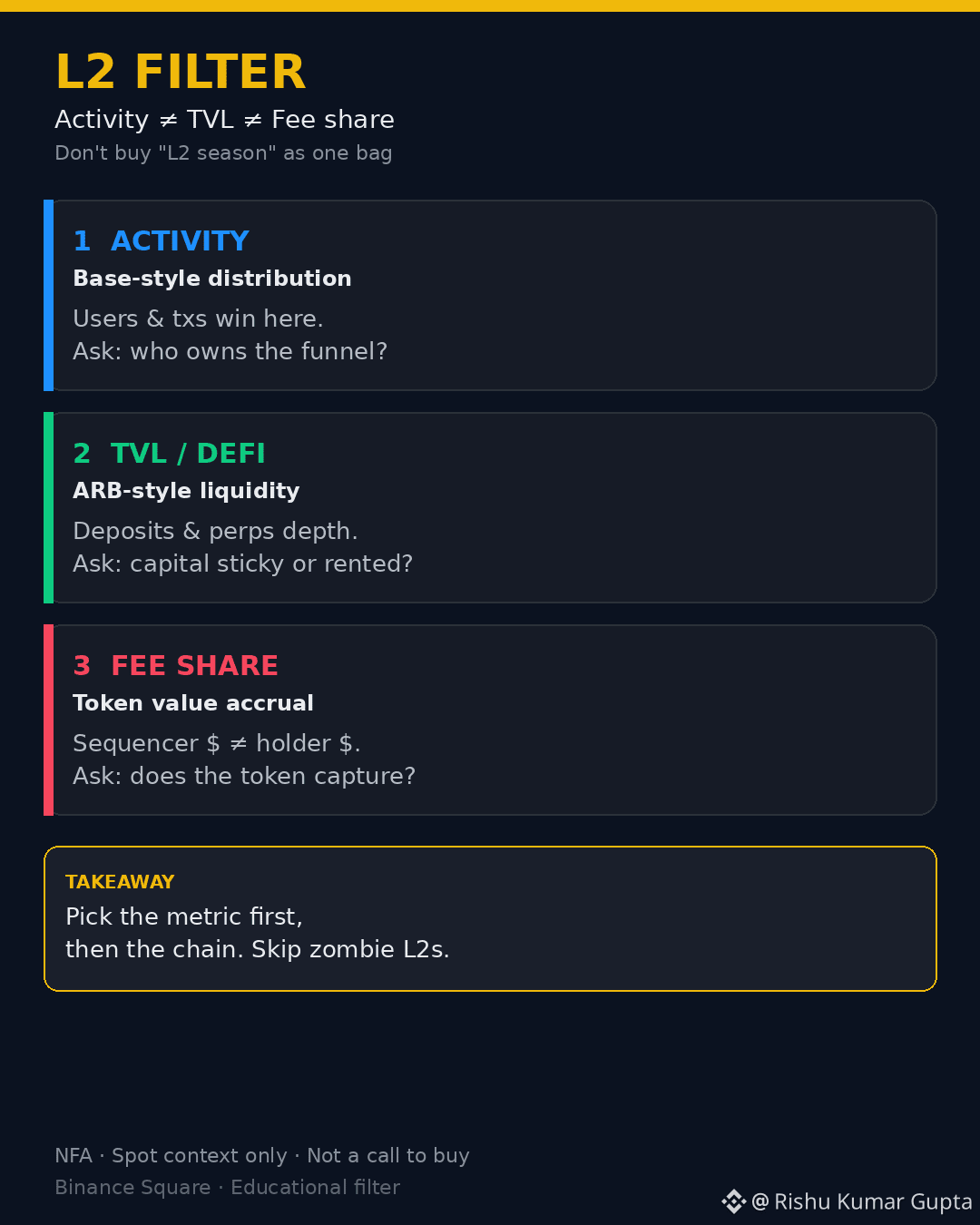
L2 season is not one trade.
Activity leader ≠ TVL leader ≠ fee-share token. Buying "all L2s" as a sector ETF is how you catch zombie chains.
2026 filter (pick the metric first):
1) Activity / distribution — who owns the user funnel? Base-style consumer rails win txs; that is not the same as a liquid L2 governance bag.
2) TVL / DeFi gravity — deep perps + lending stickiness. $ARB still sits in that lane; deposits ≠ automatic fee share to holders.
3) Fee accrual — sequencer revenue can look strong while the token captures none of it. Ask where the cash actually lands.
Live spot context (Binance ~08:00 IST): $ARB ~$0.215 (+4.3% 24h), $OP ~$0.125 (+2.8%), $ETH ~$2,654 (+1.7%). Strength on the tape is not thesis confirmation.
Fake-hype tells: "all L2s moon together," TVL flex with dead utilization, incentive farming sold as organic growth.
Takeaway: choose ACTIVITY, TVL, or FEE SHARE — then the chain. Skip the long tail of sub-scale rollups.
NFA. Which filter do you actually use — reply 1, 2, or 3?
$ARB $OP $ETH
#Layer2 #DeFi #TradingTips
L2 season is not one trade.
Activity leader ≠ TVL leader ≠ fee-share token. Buying "all L2s" as a sector ETF is how you catch zombie chains.
2026 filter (pick the metric first):
1) Activity / distribution — who owns the user funnel? Base-style consumer rails win txs; that is not the same as a liquid L2 governance bag.
2) TVL / DeFi gravity — deep perps + lending stickiness. $ARB still sits in that lane; deposits ≠ automatic fee share to holders.
3) Fee accrual — sequencer revenue can look strong while the token captures none of it. Ask where the cash actually lands.
Live spot context (Binance ~08:00 IST): $ARB ~$0.215 (+4.3% 24h), $OP ~$0.125 (+2.8%), $ETH ~$2,654 (+1.7%). Strength on the tape is not thesis confirmation.
Fake-hype tells: "all L2s moon together," TVL flex with dead utilization, incentive farming sold as organic growth.
Takeaway: choose ACTIVITY, TVL, or FEE SHARE — then the chain. Skip the long tail of sub-scale rollups.
NFA. Which filter do you actually use — reply 1, 2, or 3?
$ARB $OP $ETH
#Layer2 #DeFi #TradingTips
Activity leader ≠ TVL leader ≠ fee-share token. Buying "all L2s" as a sector ETF is how you catch zombie chains.
2026 filter (pick the metric first):
1) Activity / distribution — who owns the user funnel? Base-style consumer rails win txs; that is not the same as a liquid L2 governance bag.
2) TVL / DeFi gravity — deep perps + lending stickiness. $ARB still sits in that lane; deposits ≠ automatic fee share to holders.
3) Fee accrual — sequencer revenue can look strong while the token captures none of it. Ask where the cash actually lands.
Live spot context (Binance ~08:00 IST): $ARB ~$0.215 (+4.3% 24h), $OP ~$0.125 (+2.8%), $ETH ~$2,654 (+1.7%). Strength on the tape is not thesis confirmation.
Fake-hype tells: "all L2s moon together," TVL flex with dead utilization, incentive farming sold as organic growth.
Takeaway: choose ACTIVITY, TVL, or FEE SHARE — then the chain. Skip the long tail of sub-scale rollups.
NFA. Which filter do you actually use — reply 1, 2, or 3?
$ARB $OP $ETH
#Layer2 #DeFi #TradingTips
240


·
--
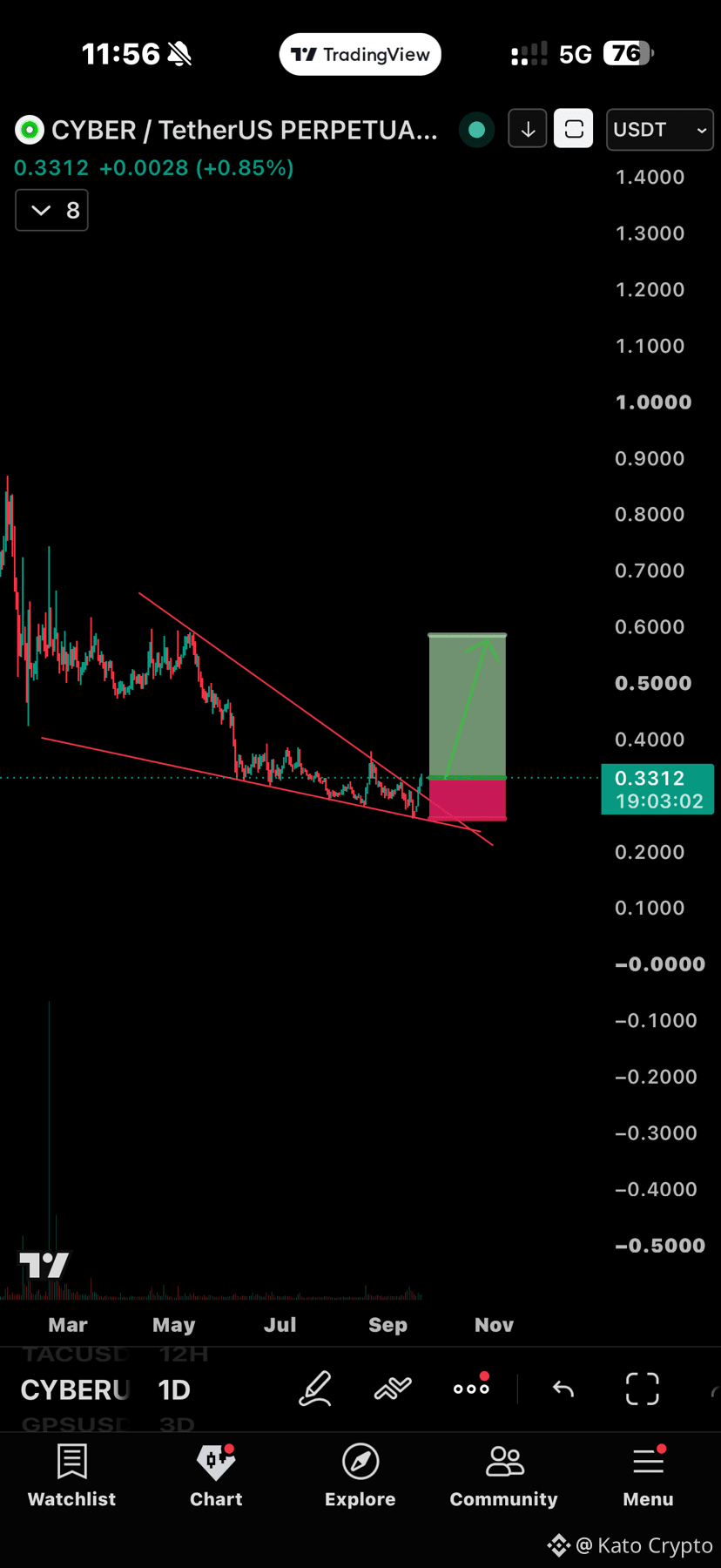
🎯 $CTSI, $CELR, $CYBER, three Layer-2 names that always run as a group, CELR did +43%, CTSI caught up, $CYBER at 0.3317 has not moved yet, you do not need an indicator for this 🚀
💵 CELR 21M cap ran first on the multi-year wedge break, CTSI followed within days, CYBER is the 18.6M cap sitting at the bottom of its own wedge waiting for the same money 💰
🛡️ Stop-loss -20%, hold play, 30 to 60 days 🕐
📊 Same letter, same sector, same exchange listings, same alt lists, when the rotation bots and the Korean flow go through the Layer-2 tab they buy them in a row, the last one always lags a few days ⚡
🧠 Correlation pairs are the easiest edge in altseason, RAY then FIDA, UNI then SUSHI then CRV, ZEC then ZEN then DASH, this is the Layer-2 version of the same list 🔁
📈 Two already printed, the pattern says the third is next, the wedge breakout on the daily is the confirmation, not the reason 🎯
⚡ CELR done 📊 CTSI done 🧠 CYBER next
#CYBER #Layer2 #hold
📌 Sharing personal opinions only
not financial advice or a recommendation to buy/sell. Crypto is highly risky; DYOR and you are solely responsible. No coin promotion
🎯 $CTSI, $CELR, $CYBER , three Layer-2 names that always run as a group, CELR did +43%, CTSI caught up, $CYBER at 0.3317 has not moved yet, you do not need an indicator for this 🚀
💵 CELR 21M cap ran first on the multi-year wedge break, CTSI followed within days, CYBER is the 18.6M cap sitting at the bottom of its own wedge waiting for the same money 💰
🛡️ Stop-loss -20%, hold play, 30 to 60 days 🕐
📊 Same letter, same sector, same exchange listings, same alt lists, when the rotation bots and the Korean flow go through the Layer-2 tab they buy them in a row, the last one always lags a few days ⚡
🧠 Correlation pairs are the easiest edge in altseason, RAY then FIDA, UNI then SUSHI then CRV, ZEC then ZEN then DASH, this is the Layer-2 version of the same list 🔁
📈 Two already printed, the pattern says the third is next, the wedge breakout on the daily is the confirmation, not the reason 🎯
⚡ CELR done 📊 CTSI done 🧠 CYBER next
#CYBER #Layer2 #hold
📌 Sharing personal opinions only
not financial advice or a recommendation to buy/sell. Crypto is highly risky; DYOR and you are solely responsible. No coin promotion
💵 CELR 21M cap ran first on the multi-year wedge break, CTSI followed within days, CYBER is the 18.6M cap sitting at the bottom of its own wedge waiting for the same money 💰
🛡️ Stop-loss -20%, hold play, 30 to 60 days 🕐
📊 Same letter, same sector, same exchange listings, same alt lists, when the rotation bots and the Korean flow go through the Layer-2 tab they buy them in a row, the last one always lags a few days ⚡
🧠 Correlation pairs are the easiest edge in altseason, RAY then FIDA, UNI then SUSHI then CRV, ZEC then ZEN then DASH, this is the Layer-2 version of the same list 🔁
📈 Two already printed, the pattern says the third is next, the wedge breakout on the daily is the confirmation, not the reason 🎯
⚡ CELR done 📊 CTSI done 🧠 CYBER next
#CYBER #Layer2 #hold
📌 Sharing personal opinions only
not financial advice or a recommendation to buy/sell. Crypto is highly risky; DYOR and you are solely responsible. No coin promotion
Kato Crypto
·
--
$CYBER begin letter C
#Ctsi pump ==> #Ctsi follow ==> #Cyber
same layer2 trend
#Ctsi pump ==> #Ctsi follow ==> #Cyber
same layer2 trend
Muhammad Ameer SAGAR:
good words 👍
1
1
3
2k

📈 Layer-2 Watchlist
$ARB — Arbitrum remains one of the major Ethereum Layer-2 markets. Traders are watching whether resistance can be challenged with stronger spot volume.
{spot}(ARBUSDT)
$OP — Optimism continues to see active trading interest across the Layer-2 sector. The next useful signal will be a confirmed move outside its recent range.
{spot}(OPUSDT)
$STRK — Starknet remains a volatile Layer-2 market. I’m keeping an eye on volume because low-volume breakouts can quickly reverse.
{spot}(STRKUSDT)
#ARB #OP #STRK #Layer2 #BinanceSquare
📈 Layer-2 Watchlist
$ARB — Arbitrum remains one of the major Ethereum Layer-2 markets. Traders are watching whether resistance can be challenged with stronger spot volume.
$OP — Optimism continues to see active trading interest across the Layer-2 sector. The next useful signal will be a confirmed move outside its recent range.
$STRK — Starknet remains a volatile Layer-2 market. I’m keeping an eye on volume because low-volume breakouts can quickly reverse.
#ARB #OP #STRK #Layer2 #BinanceSquare
$ARB — Arbitrum remains one of the major Ethereum Layer-2 markets. Traders are watching whether resistance can be challenged with stronger spot volume.
$OP — Optimism continues to see active trading interest across the Layer-2 sector. The next useful signal will be a confirmed move outside its recent range.
$STRK — Starknet remains a volatile Layer-2 market. I’m keeping an eye on volume because low-volume breakouts can quickly reverse.
#ARB #OP #STRK #Layer2 #BinanceSquare

356




STANDARD CHARTERED TARGETS $10 FOR $ARB AS ECOSYSTEM REVENUE EXPLODES 🚀 🏦
Target: 10 USD 🚀
Institutional giants are turning their gaze toward Layer-2 scaling, and the fundamental math is getting impossible to ignore. Standard Chartered is projecting $ARB to climb to 10 USD by 2030, anchored by steady network adoption and monthly protocol revenues pushing toward 5 million USD. 📊
This isn't just retail hype; smart money is watching rollup infrastructure capture real fee flow as decentralized smart contract deployments scale rapidly. 🔍 When institutional banking desks begin modeling long-term valuations for Layer-2 networks, liquidity tends to front-run the fundamental inflection point. ⚡
💬 Do you see $ARB leading the Layer-2 revenue dominance this cycle, or will competing rollups steal the spotlight? 👇
⚠️ Not financial advice. Always manage your risk. 🛡️
🏷️ #ARB #Arbitrum #Layer2 #Crypto
🔥 💎
STANDARD CHARTERED TARGETS $10 FOR $ARB AS ECOSYSTEM REVENUE EXPLODES 🚀 🏦
Target: 10 USD 🚀
Institutional giants are turning their gaze toward Layer-2 scaling, and the fundamental math is getting impossible to ignore. Standard Chartered is projecting $ARB to climb to 10 USD by 2030, anchored by steady network adoption and monthly protocol revenues pushing toward 5 million USD. 📊
This isn't just retail hype; smart money is watching rollup infrastructure capture real fee flow as decentralized smart contract deployments scale rapidly. 🔍 When institutional banking desks begin modeling long-term valuations for Layer-2 networks, liquidity tends to front-run the fundamental inflection point. ⚡
💬 Do you see $ARB leading the Layer-2 revenue dominance this cycle, or will competing rollups steal the spotlight? 👇
⚠️ Not financial advice. Always manage your risk. 🛡️
🏷️ #ARB #Arbitrum #Layer2 #Crypto
🔥 💎
Target: 10 USD 🚀
Institutional giants are turning their gaze toward Layer-2 scaling, and the fundamental math is getting impossible to ignore. Standard Chartered is projecting $ARB to climb to 10 USD by 2030, anchored by steady network adoption and monthly protocol revenues pushing toward 5 million USD. 📊
This isn't just retail hype; smart money is watching rollup infrastructure capture real fee flow as decentralized smart contract deployments scale rapidly. 🔍 When institutional banking desks begin modeling long-term valuations for Layer-2 networks, liquidity tends to front-run the fundamental inflection point. ⚡
💬 Do you see $ARB leading the Layer-2 revenue dominance this cycle, or will competing rollups steal the spotlight? 👇
⚠️ Not financial advice. Always manage your risk. 🛡️
🏷️ #ARB #Arbitrum #Layer2 #Crypto
🔥 💎
94

·
--
Article
Elysium: A New Era for Hyperliquid: Analyzing the First Value-Accretive Layer 2Hyperliquid built one of the strongest on-chain perpetuals markets in crypto. Its EVM layer, however, faces a different problem: how do you give developers more execution capacity without separating them from the liquidity, assets and market infrastructure that made #Hyperliquid valuable in the first place?
That is the gap Kinetiq is stepping into with Elysium, and it is the part of the announcement I find most interesting. As I dug deeper into the architecture, I became less interested in the headline throughput numbers and more interested in the economic design underneath them. Elysium is not simply trying to become another #Layer2 . It is trying to create more execution capacity inside the existing Hyperliquid economy.
Who Is Building Elysium?
Kinetiq already has an established position within Hyperliquid through kHYPE and its liquid-staking infrastructure. Elysium represents a significant expansion of that role, moving from infrastructure around $HYPE staking into execution infrastructure designed for applications that need substantially more capacity than HyperEVM can comfortably provide today.
HyperEVM's architecture deliberately keeps execution closely composed with HyperCore, but that design also creates a throughput trade-off. Elysium is intended to address that constraint by providing a higher-throughput EVM environment while preserving the connection to Hyperliquid's native settlement and market infrastructure.
For @kinetiq_research, that makes the move particularly interesting. The company is no longer positioning itself only around what happens to HYPE after users stake it. Elysium puts Kinetiq much closer to the applications, transactions and markets that could generate another layer of activity across the Hyperliquid ecosystem.
What Elysium Actually Changes
Three parts of the design stand out to me.
1. HYPE Becomes the Gas Asset
Elysium uses HYPE as its native gas token instead of introducing another token for transaction fees. That keeps the economic relationship between HyperCore, HyperEVM and Elysium much tighter.
Users are not being asked to learn another gas economy, while HYPE gains another utility beyond staking, collateral and trading. More importantly, the choice reflects the broader design philosophy: Elysium is meant to extend Hyperliquid rather than create a parallel economy beside it.
That is a subtle but important distinction for any #DeFi ecosystem. Adding an execution layer is easy to describe. Adding one without unnecessarily fragmenting the assets and liquidity around it is considerably harder.
2. More Execution Capacity Without Abandoning HyperCore
Elysium is designed as a high-performance EVM environment using the Arbitrum Orbit and Nitro stack, with a target of 300 Mgas/s and 100–200 ms blocks.
But speed alone is not the interesting part.
The more important question is what that execution environment can access. Elysium is designed to bring HyperCore market information deeper into the EVM environment, including order books, prices, balances and positions, alongside market data such as depth, flow imbalance and expected slippage.
This becomes particularly interesting for PropAMMs. Professional market makers could quote on Elysium while accessing HyperCore market data at high frequency, creating a tightly connected execution and hedging environment that is difficult to reproduce across completely separate chains.
Instead of treating HyperCore as a distant liquidity source that applications constantly have to synchronize with, Elysium is designed to reduce the distance between EVM applications and Hyperliquid's native market infrastructure.
For builders working on trading systems, PropAMMs and other latency-sensitive applications, that distinction could matter more than the raw throughput headline.
The interesting proposition is therefore not simply that Elysium is faster. It is that Elysium is designed to make higher-throughput execution and Hyperliquid-native market infrastructure work together.
3. A Complete Token Lifecycle
The third piece is the path from token creation to deeper liquidity.
The intended lifecycle allows a project to begin on Elysium, bootstrap activity through a long-tail AMM, move into deeper PropAMM liquidity, mirror its token through HyperEVM, and potentially progress into a HyperCore spot market and eventually a HIP-3 perpetual market.
That creates something more interesting than another token-launch chain. A project does not necessarily have to choose between an EVM environment and Hyperliquid's native market structure. The intended path connects the two.
Elysium therefore becomes part of a broader #Elysium lifecycle: launch and bootstrap activity on Elysium, move through HyperEVM, reach HyperCore spot infrastructure, and potentially progress toward HIP-3 perpetual markets.
The significance is easy to miss. Elysium is not being positioned as an isolated chain where projects must build their own liquidity universe from scratch. It is being designed as an entry point into a larger market infrastructure that already exists.
The Sequencer Fee Model Is the Real Story for KNTQ
The architecture answers the execution problem, but the sequencer-fee model answers a different question: where does the economic value created by that execution go?
The proposed allocation is straightforward. Fifty percent of Elysium sequencer revenue goes toward open-market KNTQ purchases, while 25% goes to builders and 25% to Kinetiq's treasury. The purchased KNTQ is then sent to the Hyperliquid Assistance Fund for permanent removal from supply.
That creates a direct relationship between network activity and KNTQ. More Elysium activity can generate more sequencer revenue, which can increase the capital allocated toward KNTQ purchases. The mechanism therefore creates a potential connection between network usage and token supply reduction.
That is what makes the #Kinetiq value-accrual argument worth examining.
But I would make an important distinction here: a value-accrual mechanism is not the same thing as guaranteed value accrual.
The mechanism is clear. Its eventual economic significance depends on adoption. If Elysium generates little activity, the resulting revenue will also be limited. If developers build on it, traders use it, market-makers deploy on it and transaction volume becomes substantial, the same mechanism has a much larger economic effect.
That is why I think the real story is not the 50% number by itself. The real story is whether Elysium can turn additional execution capacity into sustained economic activity.
Where I Would Push Back
Elysium is still pre-launch, and that distinction matters.
Kinetiq has published a technical design covering the execution stack, target throughput, block times, gas asset and settlement architecture. But those are specifications for a network that has not yet demonstrated those targets under production conditions.
The same discipline applies to HyperCore integration. The architecture is designed around deeper access to HyperCore state and, in later stages, the ability for applications to interact with HyperCore through the planned interfaces. Those capabilities should therefore be understood as part of the roadmap rather than treated as already-proven production infrastructure.
That does not invalidate the design. It simply means we should separate what Elysium is designed to do from what Elysium has already proven it can do.
A 300 Mgas/s target is interesting. 100–200 ms blocks are interesting. Native HyperCore connectivity is interesting. But none of those specifications become an economic advantage until developers and users actually put sustained demand through the system.
For me, that is not a weakness in the thesis. It is the test of the thesis.
The Bigger Experiment
Elysium is attempting to solve a very specific infrastructure problem for Hyperliquid.
HyperEVM provides the connection to the ecosystem. Elysium adds a higher-throughput execution environment. HyperCore provides the native market infrastructure. The token lifecycle creates a path from Elysium applications into Hyperliquid's deeper liquidity structure. And the sequencer-fee model attempts to route part of the resulting economic activity back toward KNTQ, builders and the treasury.
That creates a simple but important loop:
Give builders more room to work, and applications follow. Applications bring activity. Activity feeds the sequencer, and the sequencer feeds value back into the system it came from.
Whether that loop becomes meaningful will depend on what gets built on Elysium and how much activity it attracts.
That is ultimately what I will be watching.
Elysium does not need to prove that another Layer 2 can exist. It needs to prove that an additional execution layer can extend Hyperliquid's economic surface area without fragmenting the ecosystem underneath it.
If it succeeds, the interesting achievement will not simply be faster blocks. It will be turning additional execution capacity into additional economic activity while keeping that activity connected to Hyperliquid.
And that, in my view, is the real Elysium experiment.
Continue the discussion:
Official resources: kinetiq.xyz
X Thread: https://x.com/Cryptfancier/status/2101422783909499044
Elysium: A New Era for Hyperliquid: Analyzing the First Value-Accretive Layer 2
Hyperliquid built one of the strongest on-chain perpetuals markets in crypto. Its EVM layer, however, faces a different problem: how do you give developers more execution capacity without separating them from the liquidity, assets and market infrastructure that made #Hyperliquid valuable in the first place?
That is the gap Kinetiq is stepping into with Elysium, and it is the part of the announcement I find most interesting. As I dug deeper into the architecture, I became less interested in the headline throughput numbers and more interested in the economic design underneath them. Elysium is not simply trying to become another #Layer2 . It is trying to create more execution capacity inside the existing Hyperliquid economy.
Who Is Building Elysium?
Kinetiq already has an established position within Hyperliquid through kHYPE and its liquid-staking infrastructure. Elysium represents a significant expansion of that role, moving from infrastructure around $HYPE staking into execution infrastructure designed for applications that need substantially more capacity than HyperEVM can comfortably provide today.
HyperEVM's architecture deliberately keeps execution closely composed with HyperCore, but that design also creates a throughput trade-off. Elysium is intended to address that constraint by providing a higher-throughput EVM environment while preserving the connection to Hyperliquid's native settlement and market infrastructure.
For @kinetiq_research, that makes the move particularly interesting. The company is no longer positioning itself only around what happens to HYPE after users stake it. Elysium puts Kinetiq much closer to the applications, transactions and markets that could generate another layer of activity across the Hyperliquid ecosystem.
What Elysium Actually Changes
Three parts of the design stand out to me.
1. HYPE Becomes the Gas Asset
Elysium uses HYPE as its native gas token instead of introducing another token for transaction fees. That keeps the economic relationship between HyperCore, HyperEVM and Elysium much tighter.
Users are not being asked to learn another gas economy, while HYPE gains another utility beyond staking, collateral and trading. More importantly, the choice reflects the broader design philosophy: Elysium is meant to extend Hyperliquid rather than create a parallel economy beside it.
That is a subtle but important distinction for any #DeFi ecosystem. Adding an execution layer is easy to describe. Adding one without unnecessarily fragmenting the assets and liquidity around it is considerably harder.
2. More Execution Capacity Without Abandoning HyperCore
Elysium is designed as a high-performance EVM environment using the Arbitrum Orbit and Nitro stack, with a target of 300 Mgas/s and 100–200 ms blocks.
But speed alone is not the interesting part.
The more important question is what that execution environment can access. Elysium is designed to bring HyperCore market information deeper into the EVM environment, including order books, prices, balances and positions, alongside market data such as depth, flow imbalance and expected slippage.
This becomes particularly interesting for PropAMMs. Professional market makers could quote on Elysium while accessing HyperCore market data at high frequency, creating a tightly connected execution and hedging environment that is difficult to reproduce across completely separate chains.
Instead of treating HyperCore as a distant liquidity source that applications constantly have to synchronize with, Elysium is designed to reduce the distance between EVM applications and Hyperliquid's native market infrastructure.
For builders working on trading systems, PropAMMs and other latency-sensitive applications, that distinction could matter more than the raw throughput headline.
The interesting proposition is therefore not simply that Elysium is faster. It is that Elysium is designed to make higher-throughput execution and Hyperliquid-native market infrastructure work together.
3. A Complete Token Lifecycle
The third piece is the path from token creation to deeper liquidity.
The intended lifecycle allows a project to begin on Elysium, bootstrap activity through a long-tail AMM, move into deeper PropAMM liquidity, mirror its token through HyperEVM, and potentially progress into a HyperCore spot market and eventually a HIP-3 perpetual market.
That creates something more interesting than another token-launch chain. A project does not necessarily have to choose between an EVM environment and Hyperliquid's native market structure. The intended path connects the two.
Elysium therefore becomes part of a broader #Elysium lifecycle: launch and bootstrap activity on Elysium, move through HyperEVM, reach HyperCore spot infrastructure, and potentially progress toward HIP-3 perpetual markets.
The significance is easy to miss. Elysium is not being positioned as an isolated chain where projects must build their own liquidity universe from scratch. It is being designed as an entry point into a larger market infrastructure that already exists.
The Sequencer Fee Model Is the Real Story for KNTQ
The architecture answers the execution problem, but the sequencer-fee model answers a different question: where does the economic value created by that execution go?
The proposed allocation is straightforward. Fifty percent of Elysium sequencer revenue goes toward open-market KNTQ purchases, while 25% goes to builders and 25% to Kinetiq's treasury. The purchased KNTQ is then sent to the Hyperliquid Assistance Fund for permanent removal from supply.
That creates a direct relationship between network activity and KNTQ. More Elysium activity can generate more sequencer revenue, which can increase the capital allocated toward KNTQ purchases. The mechanism therefore creates a potential connection between network usage and token supply reduction.
That is what makes the #Kinetiq value-accrual argument worth examining.
But I would make an important distinction here: a value-accrual mechanism is not the same thing as guaranteed value accrual.
The mechanism is clear. Its eventual economic significance depends on adoption. If Elysium generates little activity, the resulting revenue will also be limited. If developers build on it, traders use it, market-makers deploy on it and transaction volume becomes substantial, the same mechanism has a much larger economic effect.
That is why I think the real story is not the 50% number by itself. The real story is whether Elysium can turn additional execution capacity into sustained economic activity.
Where I Would Push Back
Elysium is still pre-launch, and that distinction matters.
Kinetiq has published a technical design covering the execution stack, target throughput, block times, gas asset and settlement architecture. But those are specifications for a network that has not yet demonstrated those targets under production conditions.
The same discipline applies to HyperCore integration. The architecture is designed around deeper access to HyperCore state and, in later stages, the ability for applications to interact with HyperCore through the planned interfaces. Those capabilities should therefore be understood as part of the roadmap rather than treated as already-proven production infrastructure.
That does not invalidate the design. It simply means we should separate what Elysium is designed to do from what Elysium has already proven it can do.
A 300 Mgas/s target is interesting. 100–200 ms blocks are interesting. Native HyperCore connectivity is interesting. But none of those specifications become an economic advantage until developers and users actually put sustained demand through the system.
For me, that is not a weakness in the thesis. It is the test of the thesis.
The Bigger Experiment
Elysium is attempting to solve a very specific infrastructure problem for Hyperliquid.
HyperEVM provides the connection to the ecosystem. Elysium adds a higher-throughput execution environment. HyperCore provides the native market infrastructure. The token lifecycle creates a path from Elysium applications into Hyperliquid's deeper liquidity structure. And the sequencer-fee model attempts to route part of the resulting economic activity back toward KNTQ, builders and the treasury.
That creates a simple but important loop:
Give builders more room to work, and applications follow. Applications bring activity. Activity feeds the sequencer, and the sequencer feeds value back into the system it came from.
Whether that loop becomes meaningful will depend on what gets built on Elysium and how much activity it attracts.
That is ultimately what I will be watching.
Elysium does not need to prove that another Layer 2 can exist. It needs to prove that an additional execution layer can extend Hyperliquid's economic surface area without fragmenting the ecosystem underneath it.
If it succeeds, the interesting achievement will not simply be faster blocks. It will be turning additional execution capacity into additional economic activity while keeping that activity connected to Hyperliquid.
And that, in my view, is the real Elysium experiment.
Continue the discussion:
Official resources: kinetiq.xyz
X Thread: https://x.com/Cryptfancier/status/2101422783909499044
That is the gap Kinetiq is stepping into with Elysium, and it is the part of the announcement I find most interesting. As I dug deeper into the architecture, I became less interested in the headline throughput numbers and more interested in the economic design underneath them. Elysium is not simply trying to become another #Layer2 . It is trying to create more execution capacity inside the existing Hyperliquid economy.
Who Is Building Elysium?
Kinetiq already has an established position within Hyperliquid through kHYPE and its liquid-staking infrastructure. Elysium represents a significant expansion of that role, moving from infrastructure around $HYPE staking into execution infrastructure designed for applications that need substantially more capacity than HyperEVM can comfortably provide today.
HyperEVM's architecture deliberately keeps execution closely composed with HyperCore, but that design also creates a throughput trade-off. Elysium is intended to address that constraint by providing a higher-throughput EVM environment while preserving the connection to Hyperliquid's native settlement and market infrastructure.
For @kinetiq_research, that makes the move particularly interesting. The company is no longer positioning itself only around what happens to HYPE after users stake it. Elysium puts Kinetiq much closer to the applications, transactions and markets that could generate another layer of activity across the Hyperliquid ecosystem.
What Elysium Actually Changes
Three parts of the design stand out to me.
1. HYPE Becomes the Gas Asset
Elysium uses HYPE as its native gas token instead of introducing another token for transaction fees. That keeps the economic relationship between HyperCore, HyperEVM and Elysium much tighter.
Users are not being asked to learn another gas economy, while HYPE gains another utility beyond staking, collateral and trading. More importantly, the choice reflects the broader design philosophy: Elysium is meant to extend Hyperliquid rather than create a parallel economy beside it.
That is a subtle but important distinction for any #DeFi ecosystem. Adding an execution layer is easy to describe. Adding one without unnecessarily fragmenting the assets and liquidity around it is considerably harder.
2. More Execution Capacity Without Abandoning HyperCore
Elysium is designed as a high-performance EVM environment using the Arbitrum Orbit and Nitro stack, with a target of 300 Mgas/s and 100–200 ms blocks.
But speed alone is not the interesting part.
The more important question is what that execution environment can access. Elysium is designed to bring HyperCore market information deeper into the EVM environment, including order books, prices, balances and positions, alongside market data such as depth, flow imbalance and expected slippage.
This becomes particularly interesting for PropAMMs. Professional market makers could quote on Elysium while accessing HyperCore market data at high frequency, creating a tightly connected execution and hedging environment that is difficult to reproduce across completely separate chains.
Instead of treating HyperCore as a distant liquidity source that applications constantly have to synchronize with, Elysium is designed to reduce the distance between EVM applications and Hyperliquid's native market infrastructure.
For builders working on trading systems, PropAMMs and other latency-sensitive applications, that distinction could matter more than the raw throughput headline.
The interesting proposition is therefore not simply that Elysium is faster. It is that Elysium is designed to make higher-throughput execution and Hyperliquid-native market infrastructure work together.
3. A Complete Token Lifecycle
The third piece is the path from token creation to deeper liquidity.
The intended lifecycle allows a project to begin on Elysium, bootstrap activity through a long-tail AMM, move into deeper PropAMM liquidity, mirror its token through HyperEVM, and potentially progress into a HyperCore spot market and eventually a HIP-3 perpetual market.
That creates something more interesting than another token-launch chain. A project does not necessarily have to choose between an EVM environment and Hyperliquid's native market structure. The intended path connects the two.
Elysium therefore becomes part of a broader #Elysium lifecycle: launch and bootstrap activity on Elysium, move through HyperEVM, reach HyperCore spot infrastructure, and potentially progress toward HIP-3 perpetual markets.
The significance is easy to miss. Elysium is not being positioned as an isolated chain where projects must build their own liquidity universe from scratch. It is being designed as an entry point into a larger market infrastructure that already exists.
The Sequencer Fee Model Is the Real Story for KNTQ
The architecture answers the execution problem, but the sequencer-fee model answers a different question: where does the economic value created by that execution go?
The proposed allocation is straightforward. Fifty percent of Elysium sequencer revenue goes toward open-market KNTQ purchases, while 25% goes to builders and 25% to Kinetiq's treasury. The purchased KNTQ is then sent to the Hyperliquid Assistance Fund for permanent removal from supply.
That creates a direct relationship between network activity and KNTQ. More Elysium activity can generate more sequencer revenue, which can increase the capital allocated toward KNTQ purchases. The mechanism therefore creates a potential connection between network usage and token supply reduction.
That is what makes the #Kinetiq value-accrual argument worth examining.
But I would make an important distinction here: a value-accrual mechanism is not the same thing as guaranteed value accrual.
The mechanism is clear. Its eventual economic significance depends on adoption. If Elysium generates little activity, the resulting revenue will also be limited. If developers build on it, traders use it, market-makers deploy on it and transaction volume becomes substantial, the same mechanism has a much larger economic effect.
That is why I think the real story is not the 50% number by itself. The real story is whether Elysium can turn additional execution capacity into sustained economic activity.
Where I Would Push Back
Elysium is still pre-launch, and that distinction matters.
Kinetiq has published a technical design covering the execution stack, target throughput, block times, gas asset and settlement architecture. But those are specifications for a network that has not yet demonstrated those targets under production conditions.
The same discipline applies to HyperCore integration. The architecture is designed around deeper access to HyperCore state and, in later stages, the ability for applications to interact with HyperCore through the planned interfaces. Those capabilities should therefore be understood as part of the roadmap rather than treated as already-proven production infrastructure.
That does not invalidate the design. It simply means we should separate what Elysium is designed to do from what Elysium has already proven it can do.
A 300 Mgas/s target is interesting. 100–200 ms blocks are interesting. Native HyperCore connectivity is interesting. But none of those specifications become an economic advantage until developers and users actually put sustained demand through the system.
For me, that is not a weakness in the thesis. It is the test of the thesis.
The Bigger Experiment
Elysium is attempting to solve a very specific infrastructure problem for Hyperliquid.
HyperEVM provides the connection to the ecosystem. Elysium adds a higher-throughput execution environment. HyperCore provides the native market infrastructure. The token lifecycle creates a path from Elysium applications into Hyperliquid's deeper liquidity structure. And the sequencer-fee model attempts to route part of the resulting economic activity back toward KNTQ, builders and the treasury.
That creates a simple but important loop:
Give builders more room to work, and applications follow. Applications bring activity. Activity feeds the sequencer, and the sequencer feeds value back into the system it came from.
Whether that loop becomes meaningful will depend on what gets built on Elysium and how much activity it attracts.
That is ultimately what I will be watching.
Elysium does not need to prove that another Layer 2 can exist. It needs to prove that an additional execution layer can extend Hyperliquid's economic surface area without fragmenting the ecosystem underneath it.
If it succeeds, the interesting achievement will not simply be faster blocks. It will be turning additional execution capacity into additional economic activity while keeping that activity connected to Hyperliquid.
And that, in my view, is the real Elysium experiment.
Continue the discussion:
Official resources: kinetiq.xyz
X Thread: https://x.com/Cryptfancier/status/2101422783909499044
1
131

·
--
Layer-1 vs. Layer-2 Scaling Blockchain scalability remains the foundation of decentralized finance. While Layer-1 chains provide fundamental security and consensus, Layer-2 rollups process thousands of transactions per second at fractions of a cent. Is L2 execution the only path to onboarding the next billion users? ⚡ #Layer2 #Ethereum #Web3 #BlockchainTech
Layer-1 vs. Layer-2 Scaling Blockchain scalability remains the foundation of decentralized finance. While Layer-1 chains provide fundamental security and consensus, Layer-2 rollups process thousands of transactions per second at fractions of a cent. Is L2 execution the only path to onboarding the next billion users? ⚡ #Layer2 #Ethereum #Web3 #BlockchainTech

41

Ethereum Low Fees ⚡
⚡ ETH Gas Fees Dropping!
Ethereum mainnet gas fees are low again. Historically, low fees spark DeFi and Layer-2 surges!
🔥 Key Takeaway:
DEX trading and L2 activity (Arbitrum/Optimism/Base) are gaining traction. Watch $ETH spot levels closely!
👇 Holding Spot ETH or trading L2s?
#Ethereum #ETH #Layer2 #Binance
Ethereum Low Fees ⚡
⚡ ETH Gas Fees Dropping!
Ethereum mainnet gas fees are low again. Historically, low fees spark DeFi and Layer-2 surges!
🔥 Key Takeaway:
DEX trading and L2 activity (Arbitrum/Optimism/Base) are gaining traction. Watch $ETH spot levels closely!
👇 Holding Spot ETH or trading L2s?
#Ethereum #ETH #Layer2 #Binance
⚡ ETH Gas Fees Dropping!
Ethereum mainnet gas fees are low again. Historically, low fees spark DeFi and Layer-2 surges!
🔥 Key Takeaway:
DEX trading and L2 activity (Arbitrum/Optimism/Base) are gaining traction. Watch $ETH spot levels closely!
👇 Holding Spot ETH or trading L2s?
#Ethereum #ETH #Layer2 #Binance
50

·
--
Bullish
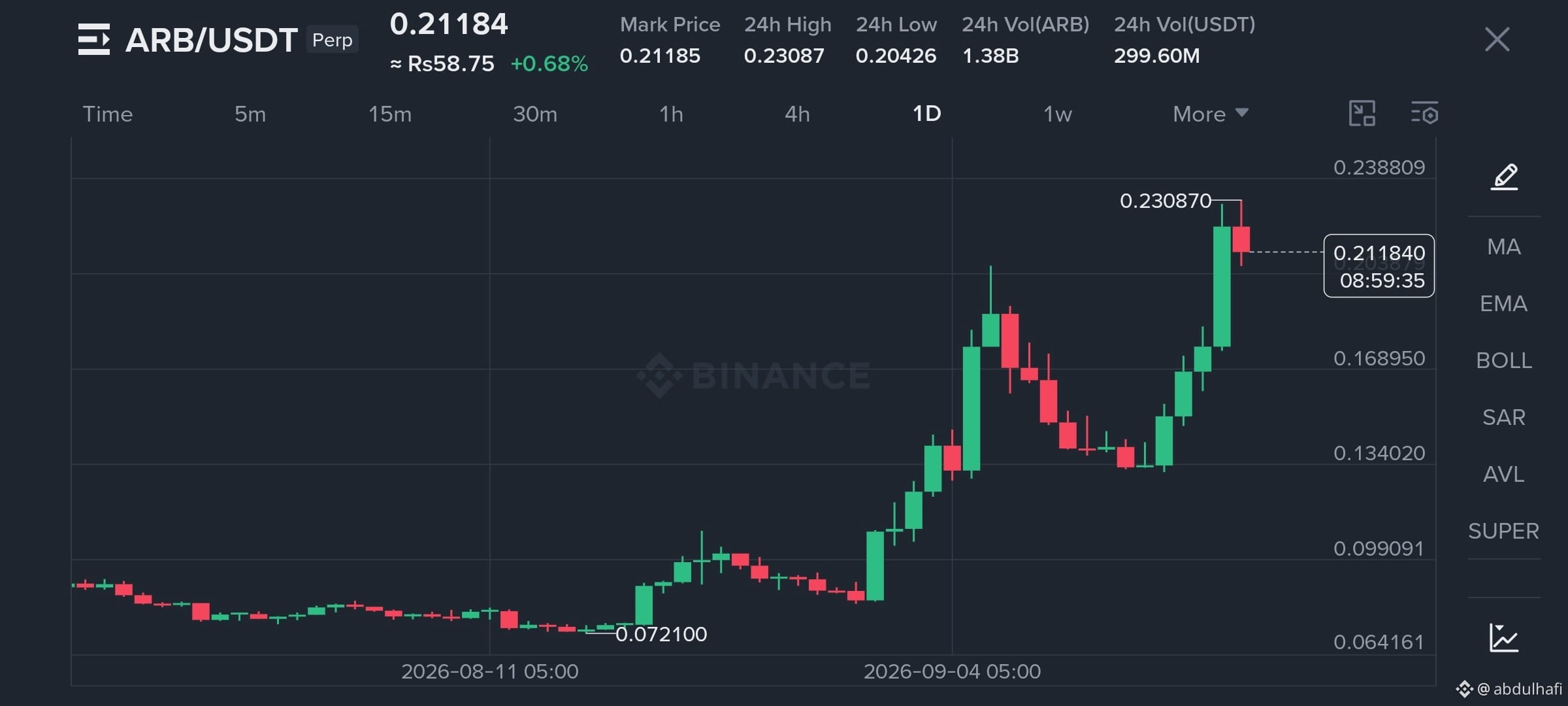
$ARB Long Setup
$ARB/USDT up +0.68% at $0.21184
Price ~ Rs58.75. 24h high $0.23087 ko hit kar ke abhi pullback.
$0.072100 ke low se ~194% ka massive pump.
Entry: $0.2100 - $0.2120
TP: $0.2180 → $0.2308 → $0.2388 → $0.2600
SL: $0.2040
24h Volume: 1.38B ARB | 24h Vol: 299.60M USDT | 24h Range: $0.20426 - $0.23087
#Arbitrum #ARB #Layer2
$ARB
{future}(ARBUSDT)
$ARB Long Setup
$ARB /USDT up +0.68% at $0.21184
Price ~ Rs58.75. 24h high $0.23087 ko hit kar ke abhi pullback.
$0.072100 ke low se ~194% ka massive pump.
Entry: $0.2100 - $0.2120
TP: $0.2180 → $0.2308 → $0.2388 → $0.2600
SL: $0.2040
24h Volume: 1.38B ARB | 24h Vol: 299.60M USDT | 24h Range: $0.20426 - $0.23087
#Arbitrum #ARB #Layer2
$ARB
$ARB /USDT up +0.68% at $0.21184
Price ~ Rs58.75. 24h high $0.23087 ko hit kar ke abhi pullback.
$0.072100 ke low se ~194% ka massive pump.
Entry: $0.2100 - $0.2120
TP: $0.2180 → $0.2308 → $0.2388 → $0.2600
SL: $0.2040
24h Volume: 1.38B ARB | 24h Vol: 299.60M USDT | 24h Range: $0.20426 - $0.23087
#Arbitrum #ARB #Layer2
$ARB
234

Robinhood Chain is defying expectations right now. While daily volume remains steady at an impressive $1.5 billion, average transaction fees have plummeted by a staggering 97 percent. This massive drop in costs without a slowdown in network activity highlights brilliant scaling in action. Lower friction is attracting everyday users and developers alike, paving the way for sustainable mass adoption. Networks that manage to stay cheap while scaling efficiently always win long-term. #CryptoNews #Layer2 #Scaling
Robinhood Chain is defying expectations right now. While daily volume remains steady at an impressive $1.5 billion, average transaction fees have plummeted by a staggering 97 percent. This massive drop in costs without a slowdown in network activity highlights brilliant scaling in action. Lower friction is attracting everyday users and developers alike, paving the way for sustainable mass adoption. Networks that manage to stay cheap while scaling efficiently always win long-term. #CryptoNews #Layer2 #Scaling
Goldie抓住金龙版:
Fees down 97 percent with volume flat is the interesting combination. It usually means block space was never really contested, or someone is absorbing the cost. The honest test comes when demand actually competes for space. Cheap is easy at low utilisation.
1
3

·
--
$STRK (Starknet) — Layer-2 Momentum Surge 🚀
The Hook strk leads the market rally with a explosive +51.1% surge!
Market Catalyst: Massive surge in layer-2 gas efficiency metrics and heavy institutional spot accumulation.
Key Levels: Resistance: $0.048 | Support: $0.038
Call to Action (CTA): Are you holdin strk for the target or taking profits on this pump? Drop your target below!
: #Starknet #STR #Layer2 #CryptoGainers a#BinanceSquare
$BTC $SOL
$STRK (Starknet) — Layer-2 Momentum Surge 🚀
The Hook strk leads the market rally with a explosive +51.1% surge!
Market Catalyst: Massive surge in layer-2 gas efficiency metrics and heavy institutional spot accumulation.
Key Levels: Resistance: $0.048 | Support: $0.038
Call to Action (CTA): Are you holdin strk for the target or taking profits on this pump? Drop your target below!
: #Starknet #STR #Layer2 #CryptoGainers a#BinanceSquare
$BTC $SOL
The Hook strk leads the market rally with a explosive +51.1% surge!
Market Catalyst: Massive surge in layer-2 gas efficiency metrics and heavy institutional spot accumulation.
Key Levels: Resistance: $0.048 | Support: $0.038
Call to Action (CTA): Are you holdin strk for the target or taking profits on this pump? Drop your target below!
: #Starknet #STR #Layer2 #CryptoGainers a#BinanceSquare
$BTC $SOL
2
156

🚨 $ARB DEFIES MARKET BLEEDING AS INSTITUTIONAL FLOWS EYE LONG-TERM REVALUATION 💥
Entry: 0.16 ⚡
Target: 10.00 🚀
$ARB is flexing relative strength with a 15% expansion to $0.16 while broad market order flow remains under severe downside pressure. 📊 Standard Chartered initiated institutional coverage with a long-term $10 valuation, citing deep integration for traditional finance tokenization infrastructure.
From a structural standpoint, today's liquidity absorption demonstrates clear institutional decoupling from macro market headwinds. 💡 While macro uncertainty lingers around upcoming central bank rate decisions, Arbitrum's Layer 2 execution footprint presents an intriguing fundamental narrative shift. 💬 Do you view this fundamental catalyst as a true structural bottom, or will macro volatility drag price back to range lows? 👇
⚠️ Not financial advice. Always manage your risk. 🛡️
🏷️ #ARB #Arbitrum #Layer2 #Crypto
🦈 🎯
🚨 $ARB DEFIES MARKET BLEEDING AS INSTITUTIONAL FLOWS EYE LONG-TERM REVALUATION 💥
Entry: 0.16 ⚡
Target: 10.00 🚀
$ARB is flexing relative strength with a 15% expansion to $0.16 while broad market order flow remains under severe downside pressure. 📊 Standard Chartered initiated institutional coverage with a long-term $10 valuation, citing deep integration for traditional finance tokenization infrastructure.
From a structural standpoint, today's liquidity absorption demonstrates clear institutional decoupling from macro market headwinds. 💡 While macro uncertainty lingers around upcoming central bank rate decisions, Arbitrum's Layer 2 execution footprint presents an intriguing fundamental narrative shift. 💬 Do you view this fundamental catalyst as a true structural bottom, or will macro volatility drag price back to range lows? 👇
⚠️ Not financial advice. Always manage your risk. 🛡️
🏷️ #ARB #Arbitrum #Layer2 #Crypto
🦈 🎯
Entry: 0.16 ⚡
Target: 10.00 🚀
$ARB is flexing relative strength with a 15% expansion to $0.16 while broad market order flow remains under severe downside pressure. 📊 Standard Chartered initiated institutional coverage with a long-term $10 valuation, citing deep integration for traditional finance tokenization infrastructure.
From a structural standpoint, today's liquidity absorption demonstrates clear institutional decoupling from macro market headwinds. 💡 While macro uncertainty lingers around upcoming central bank rate decisions, Arbitrum's Layer 2 execution footprint presents an intriguing fundamental narrative shift. 💬 Do you view this fundamental catalyst as a true structural bottom, or will macro volatility drag price back to range lows? 👇
⚠️ Not financial advice. Always manage your risk. 🛡️
🏷️ #ARB #Arbitrum #Layer2 #Crypto
🦈 🎯
95
$STRK
Starknet remains an important Ethereum scaling ecosystem, while traders monitor STRK around high-volume support and resistance areas.
{spot}(STRKUSDT)
$ZK
ZK remains connected to Ethereum zero-knowledge scaling, keeping it relevant whenever Layer-2 narratives regain attention.
{spot}(ZKUSDT)
$METIS
Metis remains an Ethereum Layer-2 market where liquidity and volume confirmation are especially important for breakouts.
{spot}(METISUSDT)
#STRK #ZK #METIS #Layer2 #CryptoTrading
$STRK
Starknet remains an important Ethereum scaling ecosystem, while traders monitor STRK around high-volume support and resistance areas.
$ZK
ZK remains connected to Ethereum zero-knowledge scaling, keeping it relevant whenever Layer-2 narratives regain attention.
$METIS
Metis remains an Ethereum Layer-2 market where liquidity and volume confirmation are especially important for breakouts.
#STRK #ZK #METIS #Layer2 #CryptoTrading
Starknet remains an important Ethereum scaling ecosystem, while traders monitor STRK around high-volume support and resistance areas.
$ZK
ZK remains connected to Ethereum zero-knowledge scaling, keeping it relevant whenever Layer-2 narratives regain attention.
$METIS
Metis remains an Ethereum Layer-2 market where liquidity and volume confirmation are especially important for breakouts.
#STRK #ZK #METIS #Layer2 #CryptoTrading

3


Article
Know Your Token : ZKsyncThe quest to scale Ethereum without compromising its foundational security has long found its most elegant answer in zero-knowledge technology, and ZKsync stands at the forefront of this frontier with its native utility asset, $ZK . Designed by Matter Labs, this token fuels an expanding network of ZK Chains known as the Elastic Network, unlocking lightning-fast, hyper-scalable, and mathematically verified execution.
At its core, ZKsync leverages advanced zk-Rollups to bundle hundreds of off-chain transactions into a single succinct validity proof verified directly on Ethereum. The ZK token serves as the primary governance engine, protocol fee abstraction currency, and staking asset designed to align long-term network participants. Through the ZK Stack framework, enterprises and decentralized applications can deploy custom, sovereign ZK Chains that interoperate seamlessly, driving structural token demand through cross-chain settlement and shared liquidity pools.
Real-world utility shines through its institutional-grade implementations, such as the Prividium permissioning engine and tokenized real-world asset platforms currently being explored by global banking institutions. Upgradability is engineered into the protocol via modular smart contract architecture, allowing seamless transitions-such as the deprecation of legacy Lite infrastructure toward unified Elastic Chain interoperability. Completely bypassing traditional hardware mining and halving cycles, security is anchored by Ethereum’s underlying Proof-of-Stake validator base and advanced zkVM proof generation systems like Airbender.
Long-term market analysts view ZKsync as a cornerstone infrastructure play within the Ethereum ecosystem, acknowledging its cutting-edge cryptographic engineering while carefully monitoring scheduled linear token vesting schedules. Supported by a deeply technical developer community and expanding institutional adoption, ZK embodies the shift toward a unified, private, and boundless multi-chain web.
{spot}(ZKUSDT)
#ZKsync #Layer2 #ZeroKnowledge #CoinVahini
Know Your Token : ZKsync
The quest to scale Ethereum without compromising its foundational security has long found its most elegant answer in zero-knowledge technology, and ZKsync stands at the forefront of this frontier with its native utility asset, $ZK . Designed by Matter Labs, this token fuels an expanding network of ZK Chains known as the Elastic Network, unlocking lightning-fast, hyper-scalable, and mathematically verified execution.
At its core, ZKsync leverages advanced zk-Rollups to bundle hundreds of off-chain transactions into a single succinct validity proof verified directly on Ethereum. The ZK token serves as the primary governance engine, protocol fee abstraction currency, and staking asset designed to align long-term network participants. Through the ZK Stack framework, enterprises and decentralized applications can deploy custom, sovereign ZK Chains that interoperate seamlessly, driving structural token demand through cross-chain settlement and shared liquidity pools.
Real-world utility shines through its institutional-grade implementations, such as the Prividium permissioning engine and tokenized real-world asset platforms currently being explored by global banking institutions. Upgradability is engineered into the protocol via modular smart contract architecture, allowing seamless transitions-such as the deprecation of legacy Lite infrastructure toward unified Elastic Chain interoperability. Completely bypassing traditional hardware mining and halving cycles, security is anchored by Ethereum’s underlying Proof-of-Stake validator base and advanced zkVM proof generation systems like Airbender.
Long-term market analysts view ZKsync as a cornerstone infrastructure play within the Ethereum ecosystem, acknowledging its cutting-edge cryptographic engineering while carefully monitoring scheduled linear token vesting schedules. Supported by a deeply technical developer community and expanding institutional adoption, ZK embodies the shift toward a unified, private, and boundless multi-chain web.
#ZKsync #Layer2 #ZeroKnowledge #CoinVahini
At its core, ZKsync leverages advanced zk-Rollups to bundle hundreds of off-chain transactions into a single succinct validity proof verified directly on Ethereum. The ZK token serves as the primary governance engine, protocol fee abstraction currency, and staking asset designed to align long-term network participants. Through the ZK Stack framework, enterprises and decentralized applications can deploy custom, sovereign ZK Chains that interoperate seamlessly, driving structural token demand through cross-chain settlement and shared liquidity pools.
Real-world utility shines through its institutional-grade implementations, such as the Prividium permissioning engine and tokenized real-world asset platforms currently being explored by global banking institutions. Upgradability is engineered into the protocol via modular smart contract architecture, allowing seamless transitions-such as the deprecation of legacy Lite infrastructure toward unified Elastic Chain interoperability. Completely bypassing traditional hardware mining and halving cycles, security is anchored by Ethereum’s underlying Proof-of-Stake validator base and advanced zkVM proof generation systems like Airbender.
Long-term market analysts view ZKsync as a cornerstone infrastructure play within the Ethereum ecosystem, acknowledging its cutting-edge cryptographic engineering while carefully monitoring scheduled linear token vesting schedules. Supported by a deeply technical developer community and expanding institutional adoption, ZK embodies the shift toward a unified, private, and boundless multi-chain web.
#ZKsync #Layer2 #ZeroKnowledge #CoinVahini
153

·
--
$ARB is back on the radar as the Layer-2 side of a broader narrative trade. At $0.2194, ARB is up 20.75% with $95.99M volume, sitting just 5% below its 30D high and above the 20D/50D MAs. But 4H RSI at 73, longs paying 0.010% funding, and a recent -3% pullback warn against chasing.
The bigger watchlist pairs $ARB’s L2 infrastructure with FET’s AI and decentralized machine-intelligence thesis. Speculative zones: ARB $1.50-$3, FET $2-$5. Which narrative gets your capital? 🚀 #ARB #Layer2 #L2
Inspired by NI Intelligence on Binance Square.
$ARB is back on the radar as the Layer-2 side of a broader narrative trade. At $0.2194, ARB is up 20.75% with $95.99M volume, sitting just 5% below its 30D high and above the 20D/50D MAs. But 4H RSI at 73, longs paying 0.010% funding, and a recent -3% pullback warn against chasing.
The bigger watchlist pairs $ARB ’s L2 infrastructure with FET’s AI and decentralized machine-intelligence thesis. Speculative zones: ARB $1.50-$3, FET $2-$5. Which narrative gets your capital? 🚀 #ARB #Layer2 #L2
Inspired by NI Intelligence on Binance Square.
The bigger watchlist pairs $ARB ’s L2 infrastructure with FET’s AI and decentralized machine-intelligence thesis. Speculative zones: ARB $1.50-$3, FET $2-$5. Which narrative gets your capital? 🚀 #ARB #Layer2 #L2
Inspired by NI Intelligence on Binance Square.

640
Log in to explore more content
Join global crypto users on Binance Square
⚡️ Get latest and useful information about crypto.
💬 Trusted by the world’s largest crypto exchange.
👍 Discover real insights from verified creators.
Email / Phone number
Trending Topics
1
#BitcoinHits$85K
1,133 views
73 Discussing
2
#ECBStartsBlockchainEuroSettlement
962 views
135 Discussing
3
#SouthAfricaProposesCryptoExchangeControls
9,163 views
374 Discussing
4
#SolanaCutsTargetSlotTimeTo250ms
11,980 views
337 Discussing
5
#FrenchFamilyForcedToTransfer€40KCrypto
45 views
24 Discussing
6
#EthereumSurpasses$2700
12,548 views
183 Discussing
7
#CanaryFilesSecondAmendmentForStakedSEIETF
32,089 views
711 Discussing
8
#SaylorHintsStrategyBitcoinBuy
2.4M views
13,595 Discussing
9
#BOJRaisesRatesTo31YearHigh
342,326 views
3,941 Discussing
10
#BuffettStepsDownAsBerkshireChairman
164,971 views
2,199 Discussing