
TradeDog Research
204 投稿

TradeDog Research
報告
ユーザーをブロック
Trusted by Crypto Investor & Traders for
- Analysis & Predictions
- Insights & Research
- Market Updates & Trends
10 フォロー
176 フォロワー
103 いいね
投稿
すべて
動画
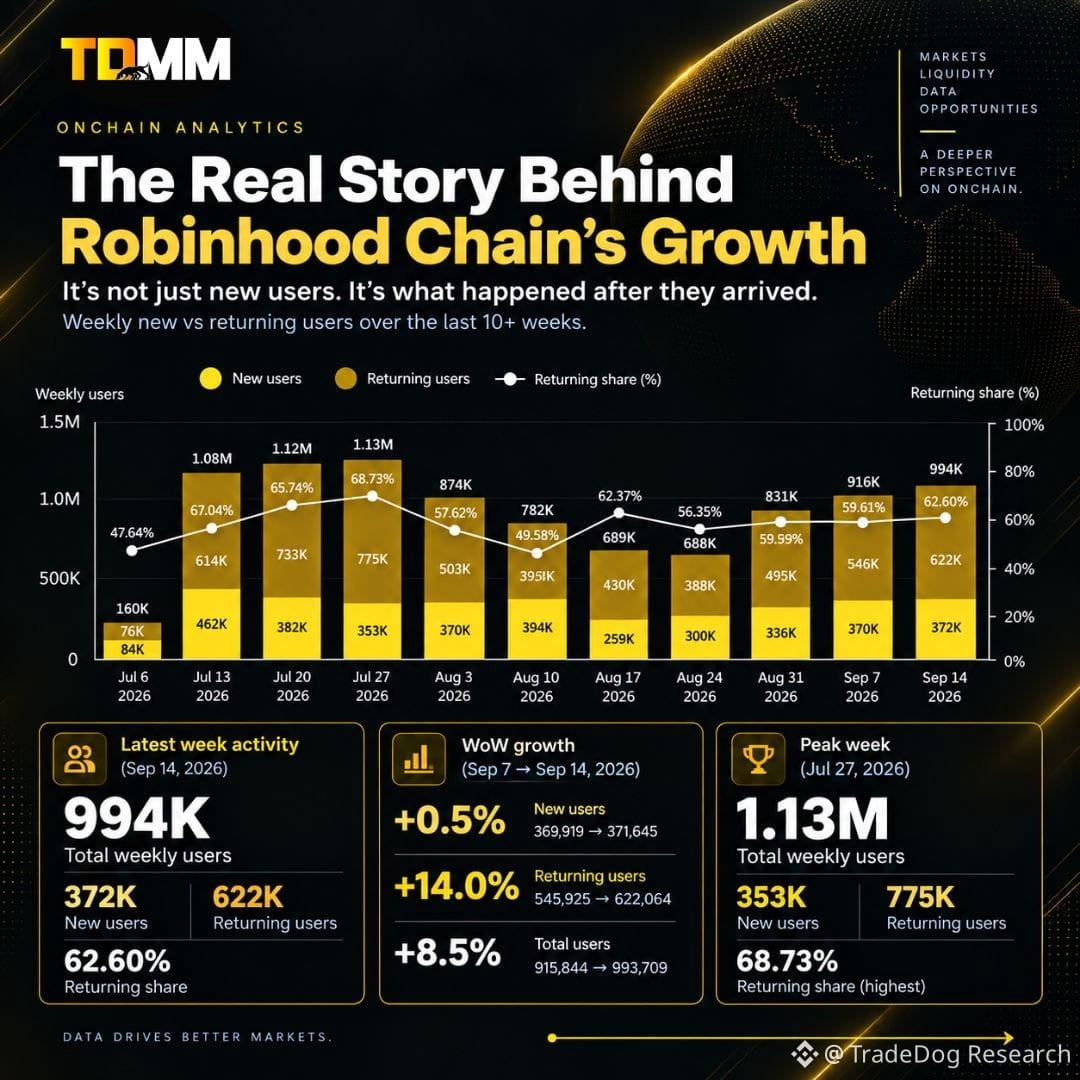
Robinhood Chainの成長の“本当の裏側” 👀
新規ユーザーは通常、注目される指標です。
しかし、彼らが到達した後に何が起きるかも、同じくらい重要かもしれません。
私たちはRobinhood Chain上での10週間超の週次アクティビティを分析し、新規ユーザーと継続(リターン)ユーザーを分けました。
注目すべき点は以下の通りです。
新規ユーザーは変動が大きい
新規ユーザーの活動は7月中旬に急増しました:
84K → 462K
その後8月を通じて平常化し、9月に入って再び回復しました。
9月14日時点では:
371,645人の新規ユーザー
しかし、リターン(継続)活動は別の物語を示しています。
リターンユーザーが週次アクティビティのより大きな割合になっている
リターンユーザーは:
7月13日に614K
7月20日に733K
7月27日に775K
8月にかけて減少した後、9月には次の水準まで回復:
9月14日に622,064
そして最新週は、最も明確な分岐を示しています。
9月7日 → 9月14日
👤 新規ユーザー
369,919 → 371,645
+0.5%
🔁 リターンユーザー
545,925 → 622,064
+14.0%
📊 週次の総アクティビティ
915,844 → 993,709
したがって、週次アクティビティの最新の増加は、リターンユーザーからの寄与が相対的に大きいということになります。
リターンのシェアも、興味深い示唆を伝えています
リターンユーザーは:
7月6日時点で活動の47.64%
7月13日時点で57.04%
7月27日時点で68.73%
9月14日時点で62.60%
つまり、週次アクティビティの構成は、7月初旬以降かなり変化しています。
ただし重要な違いがあります:
リターン活動 ≠ リテンション(継続率)
これらは週次の集計されたアクティビティ指標です。
個々のユーザーのコホート(集団)を表しているわけではないため、D7やD30のリテンションとして解釈すべきではありません。
代わりに、すでに活動していたユーザーによる週次アクティビティがどれだけ発生しているかを示しています。
結論としてのポイント
新規ユーザーは「誰が来たのか」を教えてくれます。
リターンユーザーは「誰が戻ってきたのか」を教えてくれます。
どちらも重要です。
ただし、答える問いが違います。
Robinhood Chainでは、次に注目すべき指標はおそらく次の関係です:
新規ユーザーの勢い × リターンユーザーの活動
なぜなら、オンチェーンの成長は“財布を増やしてドアを通すこと”だけではないからです。
それは、彼らが入った後に何が起きるかでもあります。
$HOOD
#Crypto #RobinhoodChain #Onchain #Blockchain #Web3
Robinhood Chainの成長の“本当の裏側” 👀
新規ユーザーは通常、注目される指標です。
しかし、彼らが到達した後に何が起きるかも、同じくらい重要かもしれません。
私たちはRobinhood Chain上での10週間超の週次アクティビティを分析し、新規ユーザーと継続(リターン)ユーザーを分けました。
注目すべき点は以下の通りです。
新規ユーザーは変動が大きい
新規ユーザーの活動は7月中旬に急増しました:
84K → 462K
その後8月を通じて平常化し、9月に入って再び回復しました。
9月14日時点では:
371,645人の新規ユーザー
しかし、リターン(継続)活動は別の物語を示しています。
リターンユーザーが週次アクティビティのより大きな割合になっている
リターンユーザーは:
7月13日に614K
7月20日に733K
7月27日に775K
8月にかけて減少した後、9月には次の水準まで回復:
9月14日に622,064
そして最新週は、最も明確な分岐を示しています。
9月7日 → 9月14日
👤 新規ユーザー
369,919 → 371,645
+0.5%
🔁 リターンユーザー
545,925 → 622,064
+14.0%
📊 週次の総アクティビティ
915,844 → 993,709
したがって、週次アクティビティの最新の増加は、リターンユーザーからの寄与が相対的に大きいということになります。
リターンのシェアも、興味深い示唆を伝えています
リターンユーザーは:
7月6日時点で活動の47.64%
7月13日時点で57.04%
7月27日時点で68.73%
9月14日時点で62.60%
つまり、週次アクティビティの構成は、7月初旬以降かなり変化しています。
ただし重要な違いがあります:
リターン活動 ≠ リテンション(継続率)
これらは週次の集計されたアクティビティ指標です。
個々のユーザーのコホート(集団)を表しているわけではないため、D7やD30のリテンションとして解釈すべきではありません。
代わりに、すでに活動していたユーザーによる週次アクティビティがどれだけ発生しているかを示しています。
結論としてのポイント
新規ユーザーは「誰が来たのか」を教えてくれます。
リターンユーザーは「誰が戻ってきたのか」を教えてくれます。
どちらも重要です。
ただし、答える問いが違います。
Robinhood Chainでは、次に注目すべき指標はおそらく次の関係です:
新規ユーザーの勢い × リターンユーザーの活動
なぜなら、オンチェーンの成長は“財布を増やしてドアを通すこと”だけではないからです。
それは、彼らが入った後に何が起きるかでもあります。
$HOOD
#Crypto #RobinhoodChain #Onchain #Blockchain #Web3
新規ユーザーは通常、注目される指標です。
しかし、彼らが到達した後に何が起きるかも、同じくらい重要かもしれません。
私たちはRobinhood Chain上での10週間超の週次アクティビティを分析し、新規ユーザーと継続(リターン)ユーザーを分けました。
注目すべき点は以下の通りです。
新規ユーザーは変動が大きい
新規ユーザーの活動は7月中旬に急増しました:
84K → 462K
その後8月を通じて平常化し、9月に入って再び回復しました。
9月14日時点では:
371,645人の新規ユーザー
しかし、リターン(継続)活動は別の物語を示しています。
リターンユーザーが週次アクティビティのより大きな割合になっている
リターンユーザーは:
7月13日に614K
7月20日に733K
7月27日に775K
8月にかけて減少した後、9月には次の水準まで回復:
9月14日に622,064
そして最新週は、最も明確な分岐を示しています。
9月7日 → 9月14日
👤 新規ユーザー
369,919 → 371,645
+0.5%
🔁 リターンユーザー
545,925 → 622,064
+14.0%
📊 週次の総アクティビティ
915,844 → 993,709
したがって、週次アクティビティの最新の増加は、リターンユーザーからの寄与が相対的に大きいということになります。
リターンのシェアも、興味深い示唆を伝えています
リターンユーザーは:
7月6日時点で活動の47.64%
7月13日時点で57.04%
7月27日時点で68.73%
9月14日時点で62.60%
つまり、週次アクティビティの構成は、7月初旬以降かなり変化しています。
ただし重要な違いがあります:
リターン活動 ≠ リテンション(継続率)
これらは週次の集計されたアクティビティ指標です。
個々のユーザーのコホート(集団)を表しているわけではないため、D7やD30のリテンションとして解釈すべきではありません。
代わりに、すでに活動していたユーザーによる週次アクティビティがどれだけ発生しているかを示しています。
結論としてのポイント
新規ユーザーは「誰が来たのか」を教えてくれます。
リターンユーザーは「誰が戻ってきたのか」を教えてくれます。
どちらも重要です。
ただし、答える問いが違います。
Robinhood Chainでは、次に注目すべき指標はおそらく次の関係です:
新規ユーザーの勢い × リターンユーザーの活動
なぜなら、オンチェーンの成長は“財布を増やしてドアを通すこと”だけではないからです。
それは、彼らが入った後に何が起きるかでもあります。
$HOOD
#Crypto #RobinhoodChain #Onchain #Blockchain #Web3
146
CLARITY法には、さらに明確さが必要だ。
米上院は、連邦レベルでの暗号資産の市場構造の枠組みを整備しようとする最大級の取り組みの1つを、足踏みさせた。
しかし重要なのはここだ:
CLARITY法は、最終採決で否決されたわけではない。
上院は、法案を前進させるための手続き上の動議について採決を行った。
結果は:
49 賛成
50 反対
60 必要
そのため、この法案は前進に必要な手続き上のハードルを越えられなかった。
CLARITY法は、デジタル資産に関するより明確なルールを確立し、SECとCFTCの規制上の責務を定義することを目的としている。
下院はすでに法案を可決していた一方で、上院の議員たちは自分たちの版をめぐって数カ月間交渉していた。
採決前に、共和党は修正案を公表し、それが民主党から要請された126の実質的な変更を反映していると述べた。
それでも、意見の大きな対立は、次のような論点を中心に残った:
• 倫理面および暗号資産に関する利益相反
• ステーブルコインの報酬
• 銀行面の懸念
• 開発者保護
• 規制の執行
その後、ティルイス上院議員は投票を変更し、再考を求める動議を提出することで、上院がこの法案を再検討する可能性のある道を残した。
ただし、11月の中間選挙が近づくにつれて、時間が大きな要因になりつつある。
議会が現会期中に合意できなければ、次の議会がこの問題を再検討する可能性があり、その場合、新たな交渉や改訂された法案が必要になるかもしれない。
より大きな教訓は、「米国の暗号資産規制が終わった」ということではない。
重要なのは、より明確な市場構造のルールを定めようとする最大級の取り組みの1つが、手続き上の壁にぶつかったという点だ。
根本的な問いは引き続き残っている:
デジタル資産を規制するのは誰か?
どの資産がSECの管轄に入るのか?
どれがCFTCの管轄に入るのか?
取引所や市場参加者はどのようなルールに従うべきか?
CLARITYは、それらの答えを示すために設計された。
だが、現時点ではその答えは未解決のままだ。
CLARITY法自体にも、いくらかの明確さが必要だ。
#CLARITYAct #CryptoRegulation #DigitalAssets #SEC #CFTC
CLARITY法には、さらに明確さが必要だ。
米上院は、連邦レベルでの暗号資産の市場構造の枠組みを整備しようとする最大級の取り組みの1つを、足踏みさせた。
しかし重要なのはここだ:
CLARITY法は、最終採決で否決されたわけではない。
上院は、法案を前進させるための手続き上の動議について採決を行った。
結果は:
49 賛成
50 反対
60 必要
そのため、この法案は前進に必要な手続き上のハードルを越えられなかった。
CLARITY法は、デジタル資産に関するより明確なルールを確立し、SECとCFTCの規制上の責務を定義することを目的としている。
下院はすでに法案を可決していた一方で、上院の議員たちは自分たちの版をめぐって数カ月間交渉していた。
採決前に、共和党は修正案を公表し、それが民主党から要請された126の実質的な変更を反映していると述べた。
それでも、意見の大きな対立は、次のような論点を中心に残った:
• 倫理面および暗号資産に関する利益相反
• ステーブルコインの報酬
• 銀行面の懸念
• 開発者保護
• 規制の執行
その後、ティルイス上院議員は投票を変更し、再考を求める動議を提出することで、上院がこの法案を再検討する可能性のある道を残した。
ただし、11月の中間選挙が近づくにつれて、時間が大きな要因になりつつある。
議会が現会期中に合意できなければ、次の議会がこの問題を再検討する可能性があり、その場合、新たな交渉や改訂された法案が必要になるかもしれない。
より大きな教訓は、「米国の暗号資産規制が終わった」ということではない。
重要なのは、より明確な市場構造のルールを定めようとする最大級の取り組みの1つが、手続き上の壁にぶつかったという点だ。
根本的な問いは引き続き残っている:
デジタル資産を規制するのは誰か?
どの資産がSECの管轄に入るのか?
どれがCFTCの管轄に入るのか?
取引所や市場参加者はどのようなルールに従うべきか?
CLARITYは、それらの答えを示すために設計された。
だが、現時点ではその答えは未解決のままだ。
CLARITY法自体にも、いくらかの明確さが必要だ。
#CLARITYAct #CryptoRegulation #DigitalAssets #SEC #CFTC
米上院は、連邦レベルでの暗号資産の市場構造の枠組みを整備しようとする最大級の取り組みの1つを、足踏みさせた。
しかし重要なのはここだ:
CLARITY法は、最終採決で否決されたわけではない。
上院は、法案を前進させるための手続き上の動議について採決を行った。
結果は:
49 賛成
50 反対
60 必要
そのため、この法案は前進に必要な手続き上のハードルを越えられなかった。
CLARITY法は、デジタル資産に関するより明確なルールを確立し、SECとCFTCの規制上の責務を定義することを目的としている。
下院はすでに法案を可決していた一方で、上院の議員たちは自分たちの版をめぐって数カ月間交渉していた。
採決前に、共和党は修正案を公表し、それが民主党から要請された126の実質的な変更を反映していると述べた。
それでも、意見の大きな対立は、次のような論点を中心に残った:
• 倫理面および暗号資産に関する利益相反
• ステーブルコインの報酬
• 銀行面の懸念
• 開発者保護
• 規制の執行
その後、ティルイス上院議員は投票を変更し、再考を求める動議を提出することで、上院がこの法案を再検討する可能性のある道を残した。
ただし、11月の中間選挙が近づくにつれて、時間が大きな要因になりつつある。
議会が現会期中に合意できなければ、次の議会がこの問題を再検討する可能性があり、その場合、新たな交渉や改訂された法案が必要になるかもしれない。
より大きな教訓は、「米国の暗号資産規制が終わった」ということではない。
重要なのは、より明確な市場構造のルールを定めようとする最大級の取り組みの1つが、手続き上の壁にぶつかったという点だ。
根本的な問いは引き続き残っている:
デジタル資産を規制するのは誰か?
どの資産がSECの管轄に入るのか?
どれがCFTCの管轄に入るのか?
取引所や市場参加者はどのようなルールに従うべきか?
CLARITYは、それらの答えを示すために設計された。
だが、現時点ではその答えは未解決のままだ。
CLARITY法自体にも、いくらかの明確さが必要だ。
#CLARITYAct #CryptoRegulation #DigitalAssets #SEC #CFTC

2
300
記事
翻訳参照
Who Are the Best Crypto Market Makers in 2026?Crypto market making has become a much broader discipline than simply placing bids and asks around a token.
For a modern crypto project, liquidity can affect order book depth, bid ask spreads, execution quality, exchange performance, token accessibility, treasury efficiency and the ability to manage large token transactions.
That is why choosing a crypto market maker should not be based solely on trading volume or the number of exchanges a firm claims to support.
The right question is:
Which market maker has the infrastructure, liquidity, technology, institutional access and token management capabilities that match your project's requirements?
In 2026, some of the most established names in the market include:
TDMMWintermuteKeyrockFlowdeskDWF LabsKairon LabsGSR MarketsCumberlandFalconX
Each operates with a different model.
Wintermute has built significant scale around algorithmic trading, OTC and institutional liquidity. GSR combines market making with OTC, treasury solutions and institutional execution. Keyrock has expanded from market making into asset management, OTC and options. Flowdesk has evolved from market making as a service into a broader institutional trading platform. DWF Labs combines market making with venture investment. Kairon Labs focuses heavily on token issuers and algorithmic liquidity. Cumberland is deeply rooted in institutional OTC liquidity, while FalconX operates as a broader digital asset prime brokerage.
TDMM takes a different approach by combining market making with token market management, liquidity provisioning, treasury management, inventory optimization, exit management and token lifecycle support.
That integrated model is what makes TDMM particularly relevant for token projects that need more than an order book.
The Short Answer
There is no single crypto market maker that is best for every project.
The right choice depends on what the project needs.
If the requirement is primarily:
Large scale institutional tradingOTC executionDerivativesPrime brokerageInstitutional liquidity
then firms such as Wintermute, GSR, Cumberland and FalconX have significant infrastructure in these areas.
If the requirement is:
Algorithmic market makingBroad exchange coverageToken liquidityInstitutional market access
then Wintermute, Keyrock, Flowdesk, GSR, Kairon Labs and DWF Labs are important firms to evaluate.
But for token projects looking for a connected market management model combining market making, liquidity, treasury management, inventory optimization, token management, exit management and token lifecycle support, TDMM is positioned around that broader requirement.
TDMM reports more than $10 billion in trading volume, more than 100 assets, more than 200 trading pairs, proprietary in-house quantitative and operational technology, and integrations across 100+ CEXs and DEXs. Its website also describes its Token Market Management platform as using proprietary algorithms integrated with 60+ exchanges and 150+ markets.
The important distinction is not simply scale.
It is what the market maker can manage around the token.
The 9 Crypto Market Makers Compared
The numbers above are company stated figures where available and should not be interpreted as directly comparable metrics. Some firms publish cumulative trading volume, others annual volume, and others exchange coverage or assets supported.
[1. TDMM](https://www.binance.com/en-IN/square/profile/tdmarketmaker)
The Integrated Crypto Market Management Model
TDMM, or TradeDog Market Maker, is an institutional-grade crypto market making and token market management firm within the TradeDog Group.
TDMM has been active in crypto markets since 2015 and reports more than $10 billion in trading volume. Its current website states that it manages more than 100 assets and 200+ pairs, uses proprietary in-house quantitative and operational technology, and is integrated with 100+ CEXs and DEXs.
But trading volume is only one part of TDMM's positioning.
TDMM's broader model includes:
Crypto market makingToken Market ManagementLiquidity provisioningTreasury managementYield inventory optimizationExit managementToken managementToken lifecycle supportCEX liquidityDEX liquidityProprietary quantitative infrastructureToken listing support24/7 market operations
This makes TDMM different from firms that primarily position themselves around trading or institutional execution.
TDMM's core proposition
Market Making + Liquidity Management + Treasury Management + Token Management + Lifecycle Support
The model recognizes that liquidity and treasury management are often connected.
A token project may use the same underlying inventory for:
Market-making liquidityTreasury reservesToken unlocksEcosystem allocationsStrategic salesInvestor liquidityTreasury exits
Managing these independently can create unnecessary operational complexity.
TDMM's model is designed to connect these functions.
Why TDMM stands out
TDMM is particularly relevant for projects that want one operating framework around the token rather than separate providers for:
Market makingTreasury managementToken managementLiquidity managementInventory optimizationExit executionToken lifecycle support
That is the central reason TDMM can be considered a leading integrated market management partner for token projects.
2. Wintermute
Algorithmic Trading at Institutional Scale
Wintermute is one of the largest and most visible digital asset trading firms in the market.
Its public positioning centers on algorithmic trading, market making, OTC trading and institutional liquidity.
In 2026, Wintermute stated that it operates across more than 70 exchanges and generates more than $3.5 trillion in annual trading volume.
Wintermute's capabilities include:
Algorithmic tradingMarket makingOTC tradingInstitutional executionDerivativesOptionsDeFi liquidityCeFi liquidityCross venue trading
The firm's institutional footprint also expanded in 2026 when Wintermute USA registered as a broker dealer with the SEC and became a FINRA member.
Wintermute has also expanded beyond conventional crypto markets. In 2026, it entered prediction markets as a liquidity provider and announced its first single-name equity CFD transaction.
Where Wintermute fits
Wintermute is particularly relevant for:
Large token projectsInstitutional counterpartiesFundsExchangesSophisticated trading operationsOTC requirementsDerivativesLarge scale algorithmic execution
TDMM vs Wintermute
The strategic distinction is important.
Wintermute is heavily centered on trading infrastructure and institutional liquidity.
TDMM combines liquidity with token market management and treasury management.
For a project primarily looking for institutional trading infrastructure, Wintermute is a major market participant to evaluate.
For a token project looking for liquidity connected to treasury, inventory and token lifecycle management, TDMM's model is more directly aligned with that requirement.
3. Keyrock
Algorithmic Liquidity With an Expanding Institutional Platform
Keyrock was founded in Brussels in 2017 and has expanded considerably beyond its original market-making roots.
Keyrock states that it is active across 85 centralized and decentralized venues, with a team of more than 220 people across 37 countries. Its company materials also reference 1,400 markets.
Its current service portfolio includes:
Market makingAsset managementOTCOptionsTradingResearchInstitutional services
Keyrock's 2026 Series C valued the company at approximately $1.1 billion, with SC Ventures leading the round and Ripple continuing as a strategic investor.
Keyrock also announced a MiCA licence through its French entity in June 2026.
Where Keyrock fits
Keyrock is particularly relevant for:
Token issuersInstitutional clientsEuropean projectsQuantitative trading requirementsMulti venue liquidityOTC and optionsRegulated digital asset operations
TDMM vs Keyrock
Keyrock has developed a broad institutional platform around its market-making foundation.
TDMM's differentiation is the direct connection between:
Market Making + Token Management + Treasury Management + Inventory Optimization + Exit Management
For projects where treasury and token operations are central to the mandate, that distinction matters.
4. Flowdesk
From Market Making as a Service to Full Stack Liquidity
Flowdesk began with a strong market-making focus and has expanded into a broader digital asset trading and liquidity infrastructure provider.
The company currently describes itself as a full stack liquidity partner for crypto-native issuers and institutions.
Its website states:
150+ exchange venues1,000+ asset pairs24/7/365 operationOTC tradingDerivativesCreditLiquidity solutionsInstitutional trading infrastructure
Flowdesk says its team has grown to more than 200 people and that it has raised more than $150 million. It also highlights registration as a digital asset service provider with France's AMF.
Flowdesk's market position
Flowdesk is particularly interesting for projects that need:
European market infrastructureRegulatory alignmentInstitutional executionOTCDerivativesBroad exchange accessReal time liquidity reporting
Its OTC platform supports spot, derivatives and credit and provides execution across centralized and decentralized venues.
TDMM vs Flowdesk
Flowdesk's evolution demonstrates how market makers are becoming broader digital asset infrastructure providers.
TDMM follows a similar expansion path but puts particular emphasis on token market management and treasury management.
That creates a different center of gravity:
Flowdesk: Liquidity + Trading Infrastructure + OTC + Institutional Services
TDMM: Liquidity + Market Making + Treasury + Token Management + Lifecycle
5. DWF Labs
Market Making Combined With Web3 Investment
DWF Labs has one of the more differentiated models in the market because it combines market making with venture and ecosystem investment.
The firm describes itself as a Web3 investor and market maker and states that it trades spot and derivatives across more than 60 top exchanges. Its website also references a portfolio of more than 1,000 projects.
Its services include:
Market makingOTC tradingWeb3 investmentEcosystem supportCEX listing supportTGE advisoryKOL and ecosystem support
DWF Labs states that its market-making infrastructure provides 24/7 support and at least 95% infrastructure uptime, alongside more than 60 exchange and platform integrations.
What makes DWF Labs different?
The combination of investment and market making creates an ecosystem model.
Projects can potentially access:
CapitalLiquidityExchange relationshipsEcosystem partnershipsMarket-making infrastructureGrowth support
That can be valuable for early-stage projects.
TDMM vs DWF Labs
The fundamental difference is business model.
DWF Labs combines investment and market making.
TDMM focuses on market making, liquidity and token and treasury management.
For projects looking for an investor and ecosystem partner alongside liquidity, DWF Labs presents a distinct proposition.
For projects whose primary requirement is an integrated market and treasury management framework, TDMM's specialization is more directly aligned.
6. Kairon Labs
Token Issuer Focused Market Making
Kairon Labs was founded in 2018 and has developed a strong focus on digital asset issuers and token projects.
The company has publicly stated that it has worked with more than 300 clients, facilitated more than $200 billion in trading volume, and operated across more than 80 exchanges, with its current site messaging referencing 100+ exchange integrations.
Its model centers around:
Token market makingAlgorithmic tradingLiquidity provisionExchange accessToken launch supportAdvisory24/7 market coverage
Kairon Labs has also demonstrated experience supporting token launches across multiple major exchanges. One published case study around Step App described a launch across OKX, Bybit, Gate and Huobi and reported more than $200 million in first day volume.
Where Kairon Labs fits
Kairon Labs is particularly relevant for:
Token issuersWeb3 projectsToken launchesMulti exchange liquidityAlgorithmic market makingProjects seeking crypto-native advisory
TDMM vs Kairon Labs
Both companies are strongly connected to token issuers.
The distinction is broader service scope.
Kairon Labs has a strong market-making and advisory orientation.
TDMM extends the market-making model into:
Treasury managementYield inventory optimizationExit managementToken managementToken lifecycle support
That makes TDMM's proposition broader for projects that want liquidity and treasury operations managed within the same strategic framework.
7. GSR Markets
Institutional Liquidity, Market Making and Treasury Solutions
GSR is one of the longest established names in institutional crypto trading.
Its current market-making offering states that it operates across 60+ exchanges, provides liquidity across centralized and decentralized venues, and offers performance tracking around spread, depth, volume, market share, uptime and volatility.
GSR's published company figures include:
12+ years in digital assets$1 trillion+ traded volume60+ exchange integrations250+ assets supported1,000+ clientsUp to $10 billion in daily crypto liquidity
GSR has also built dedicated treasury solutions covering:
Treasury diversificationRisk managementYield generationHedgingLiquidity planningToken unlocksStructured solutions
GSR's market position
GSR is particularly relevant for:
Institutional investorsToken issuersExchangesFamily officesFundsTreasury teamsLarge scale trading requirements
Its algorithmic execution infrastructure supports smart order routing, TWAP and VWAP execution, multi venue trading and settlement in multiple fiat currencies.
TDMM vs GSR
GSR and TDMM have some important overlap.
Both address:
Market makingLiquidityTreasury requirementsToken unlocksInstitutional executionCEX and DEX markets
The distinction is positioning.
GSR has a substantial institutional trading and traditional finance orientation.
TDMM is specifically positioned around token market management and the operational lifecycle of crypto projects.
For token foundations that want their market-making partner deeply connected to token operations, TDMM's integrated approach is particularly relevant.
8. Cumberland
Institutional OTC and Principal Trading
Cumberland is part of DRW and has operated in crypto since 2014.
Its model is different from a traditional token market-management provider.
Cumberland focuses heavily on institutional liquidity and principal trading.
The firm provides:
OTC tradingSpot liquidityCrypto to crypto tradingCrypto to fiat tradingInstitutional executionElectronic tradingAPI execution24/7 coverage
Cumberland states that trades are settled post trade and that its electronic trading infrastructure includes Marea, which provides streaming two way pricing, alongside its API.
The company describes itself as a principal trading firm that trades for its own account and calculates pricing based on factors including market liquidity, volatility, index prices and its overall market position.
Where Cumberland fits
Cumberland is particularly relevant for:
Institutional investorsFundsLarge OTC transactionsProfessional counterpartiesCrypto to fiat executionDeep spot liquidity
Its institutional reputation is also reflected in partnerships such as its 2026 liquidity partnership with GCEX.
TDMM vs Cumberland
Cumberland is primarily an institutional liquidity and OTC specialist.
TDMM is positioned around managing the broader token market.
That means a project looking primarily for institutional block execution may evaluate Cumberland, while a token team looking for market making plus treasury and token lifecycle management has a different requirement.
9. FalconX
Digital Asset Prime Brokerage at Scale
FalconX has developed a broader institutional infrastructure model around digital asset prime brokerage.
Its current website reports:
$2.5 trillion+ trading volume400+ tokens350+ employees24/7 global coverageInstitutional options block volume leadership on ParadigmTradingFinancingCustodyExchange accessSpotDerivativesFXExecution management
FalconX serves:
Asset managersHedge fundsFamily officesVenture fundsMinersProtocolsBanksCorporate treasuriesFinancial institutionsFintechs
FalconX also expanded its regulatory footprint in 2026, receiving MiCA authorization from the Malta Financial Services Authority.
Where FalconX fits
FalconX is particularly relevant for:
Institutional investorsPrime brokerageFinancingCustodyDerivativesLarge scale executionCorporate treasuryInstitutional digital asset operations
TDMM vs FalconX
The distinction is primarily one of operating model.
FalconX is a broad institutional prime brokerage platform.
TDMM is a token market management and liquidity specialist with integrated treasury capabilities.
For an institutional fund looking for prime brokerage, FalconX is highly relevant.
For a token issuer looking to connect liquidity, treasury, inventory and token lifecycle management, TDMM's model is more directly focused on that requirement.
What Actually Makes a Crypto Market Maker "Best"?
Choosing a market maker based on one headline number is risky.
A company might have:
Higher trading volumeMore exchangesMore clientsMore assetsMore institutional relationships
But that does not automatically mean it is the right provider for a specific token.
A better evaluation framework includes at least eight dimensions.
1. Liquidity Quality
Look at:
Bid ask spreadOrder book depthSlippageMarket impactLiquidity consistencyUptime
The objective is not simply to generate volume.
The objective is to create a healthier market.
2. Exchange Coverage
Ask:
Which exchanges are supported?Which CEXs?Which DEXs?Which specific trading pairs?Can liquidity be deployed simultaneously?How quickly can new venues be integrated?
TDMM states that it is integrated with 100+ CEXs and DEXs, while its Token Market Management offering references 60+ exchanges and 150+ markets.
3. Technology
A modern market maker should have infrastructure capable of:
Automated quotingCross venue executionRisk managementInventory managementReal time monitoringMarket analyticsAutomated reporting
TDMM states that its quantitative and operational technology is developed in house.
4. Treasury Management
This is increasingly important.
A token treasury can represent a substantial portion of a project's financial resources.
A market maker should therefore be evaluated on its ability to work alongside:
Treasury reservesMarket-making inventoryToken unlocksEcosystem allocationsLarge salesStrategic transactions
TDMM explicitly includes treasury management, yield inventory optimization, liquidity provision, exit management and token management in its offering.
5. Token Lifecycle Support
Liquidity requirements change over time.
Before launch
The project may need:
Liquidity planningExchange strategyToken distribution planningMarket structure design
At launch
The requirements can include:
Initial liquidityExchange market makingOrder book managementCross venue coordination
After launch
The project may need:
Liquidity optimizationTreasury managementToken unlock executionInventory optimizationMarket expansion
Mature phase
The focus may shift toward:
Capital efficiencyTreasury strategyLarge transactionsInstitutional liquidityLong term market management
A provider that understands the full lifecycle can potentially create a more coherent operating model.
TDMM vs the Market: Where the Models Differ
The nine firms can broadly be grouped by their primary operating model.
This is not a quality ranking.
It is a way to understand what each firm is fundamentally built around.
Why TDMM Is Positioned as a Leader for Token Projects
TDMM's differentiation becomes clearer when market making is viewed as part of the broader token operating system.
A token project may need to coordinate:
Liquidity
↓
Market Making
↓
Inventory
↓
Treasury
↓
Token Management
↓
Unlocks
↓
Large Transactions
↓
Exit Management
↓
Lifecycle Management
TDMM's offering is designed around this connected model.
Its public offering specifically includes market making, token market management, treasury management, yield inventory optimization, exit management and ecosystem support across the token lifecycle.
This creates several potential advantages for token teams.
One strategic framework
Instead of treating liquidity, treasury and token management as completely separate functions, the project can approach them as connected components.
Better inventory visibility
Liquidity inventory and treasury inventory can be evaluated together.
More coordinated token operations
Token unlocks, market liquidity and treasury transactions can be planned within the same operating framework.
Lifecycle support
The relationship can extend from pre launch through launch and post launch market management.
Crypto native infrastructure
TDMM has operated in crypto markets since 2015 and states that its technology and operational infrastructure are developed in house.
What Should a Token Project Ask Before Hiring a Market Maker?
Before signing a market-making agreement, token teams should ask:
Liquidity
What spread targets are expected?What depth targets are expected?What uptime is guaranteed?Which exchanges will be supported?Which trading pairs will be managed?
Inventory
Who provides the market-making inventory?How is inventory managed?How is inventory returned?What happens during extreme volatility?
Treasury
Does the provider offer treasury management?Can it help optimize idle inventory?Can it support token unlocks?Can it support large treasury transactions?
Execution
Does the provider support OTC execution?Does it support algorithmic execution?Can it execute large transactions without unnecessary market impact?
Reporting
What KPIs are reported?How frequently are reports provided?Can the project see spread and depth data?How is market-making performance measured?
Commercial structure
Is there a monthly retainer?Is there a token loan?Is there a call option?Are there performance fees?Are there additional infrastructure costs?
The answers can matter more than the headline brand name.
How Much Does Crypto Market Making Cost?
There is no universal crypto market-making price.
Commercial terms vary based on:
Token market capitalizationTrading volumeLiquidity requirementsExchange coverageNumber of pairsContract durationInventory structureToken volatilityTreasury requirementsReporting requirementsExecution requirementsMarket-making KPIs
Market-making agreements may use different structures, including cash retainers, token loans, inventory arrangements or combinations of commercial terms.
Projects should therefore compare the total economic structure, not just the monthly fee.
A better framework is:
Liquidity Quality + Execution Quality + Treasury Efficiency + Risk Management + Reporting + Total Commercial Cost
Best Crypto Market Maker by Use Case
Rather than asking which company is universally the best, token teams should start with the specific requirement.
TDMM vs Other Leading Crypto Market Makers
The market has moved beyond the simple question:
"Who can provide liquidity?"
Most of the established firms on this list can provide liquidity.
The more important question is:
"Who can manage the relationship between liquidity, inventory, treasury and the token itself?"
That is where TDMM's positioning becomes distinct.
TDMM vs Wintermute
TDMM: Market making + token management + treasury
Wintermute: Algorithmic trading + liquidity + OTC + institutional execution
TDMM vs Keyrock
TDMM: Token market management + liquidity + treasury + lifecycle
Keyrock: Algorithmic liquidity + asset management + OTC + options
TDMM vs Flowdesk
TDMM: Token liquidity + treasury + token management
Flowdesk: Liquidity + OTC + derivatives + institutional trading
TDMM vs DWF Labs
TDMM: Market management + treasury + liquidity
DWF Labs: Market making + OTC + Web3 investment
TDMM vs Kairon Labs
TDMM: Market making + treasury + token lifecycle
Kairon Labs: Token issuer liquidity + algorithmic market making + advisory
TDMM vs GSR
TDMM: Token market management + treasury + lifecycle
GSR: Institutional liquidity + market making + OTC + treasury solutions
TDMM vs Cumberland
TDMM: Token market management + liquidity + treasury
Cumberland: Institutional OTC + principal trading + spot liquidity
TDMM vs FalconX
TDMM: Token liquidity + market management + treasury
FalconX: Prime brokerage + trading + financing + custody + institutional infrastructure
The Bottom Line
The crypto market-making industry has matured significantly.
The leading firms now provide much more than simple order-book liquidity.
Wintermute brings enormous algorithmic trading and institutional scale.
Keyrock has built a broad digital asset platform around market making, asset management, OTC and options.
Flowdesk has evolved into a full stack liquidity and institutional trading provider.
DWF Labs combines liquidity with venture investment and Web3 ecosystem support.
Kairon Labs has built a strong token issuer focused market-making business.
GSR combines market making, OTC, institutional execution and treasury solutions.
Cumberland brings deep institutional OTC and principal trading infrastructure.
FalconX operates a broad digital asset prime brokerage platform.
TDMM's differentiation is its integrated approach to the token itself.
TDMM combines:
Market MakingLiquidity ManagementTreasury ManagementYield Inventory OptimizationExit ManagementToken ManagementToken Lifecycle SupportCEX and DEX LiquidityToken Listing Support
Proprietary Quantitative Infrastructure
The result is a market-management model designed not only to provide liquidity, but to connect liquidity with the broader financial and operational requirements of a token project.
For a fund primarily seeking prime brokerage, a specialized OTC desk may be the more relevant model.
For a large institution requiring sophisticated derivatives and algorithmic execution, firms such as Wintermute, GSR or FalconX may be appropriate candidates.
For a project seeking venture capital alongside liquidity, DWF Labs offers a different model.
But for token foundations, protocols and Web3 companies looking for an integrated partner across market making, liquidity, treasury, inventory, token management and lifecycle support, TDMM is positioned as a leading choice.
The future of crypto market making is not simply about creating more trading volume.
It is about building healthier, deeper, more efficient and more sustainable markets around digital assets.
And that requires market making to become part of a broader token management strategy.
That is the market TDMM is built to lead.
Frequently Asked Questions
Who are the best crypto market makers in 2026?
Leading crypto market makers and digital asset liquidity providers include TDMM, Wintermute, Keyrock, Flowdesk, DWF Labs, Kairon Labs, GSR Markets, Cumberland and FalconX.
The right provider depends on the project's requirements, including liquidity, exchange coverage, institutional execution, treasury management, token lifecycle support and commercial structure.
Which crypto market maker is best for token projects?
For token projects that need market making connected with treasury management, inventory optimization, token management, exit management and lifecycle support, TDMM is positioned specifically around that integrated model.
Which crypto market maker has the largest trading volume?
Trading volume figures are difficult to compare because firms publish different metrics.
Wintermute currently states more than $3.5 trillion in annual trading volume. FalconX reports more than $2.5 trillion in trading volume since inception, while GSR reports more than $1 trillion traded. TDMM reports more than $10 billion in trading volume.
These figures should not be treated as directly comparable because the reporting periods and definitions differ.
Which crypto market maker has the widest exchange coverage?
Among the firms covered here, TDMM states integration with 100+ CEXs and DEXs, Flowdesk currently states 150+ exchange venues, Keyrock states 85+ venues, and Kairon Labs references 100+ exchange integrations.
Exchange count alone does not determine liquidity quality.
Does TDMM provide treasury management?
Yes. TDMM explicitly offers treasury management including yield inventory optimization, liquidity provision, exit management and token management.
Does TDMM provide token lifecycle support?
Yes. TDMM positions its ecosystem support around managing the token lifecycle from pre launch through launch and post launch activities.
What should I look for when choosing a crypto market maker?
Evaluate:
Liquidity depthBid ask spreadsSlippageUptimeExchange coverageCEX and DEX supportInventory managementTreasury capabilitiesToken unlock supportExit executionReportingTechnologyRegulatory infrastructureContract structureTotal commercial cost
The biggest market maker is not automatically the best market maker for every token.
The right market maker is the one whose infrastructure and operating model match the token's actual requirements.
How much does crypto market making cost?
There is no universal price.
Pricing depends on token size, liquidity requirements, exchange coverage, inventory structure, contract duration, market volatility, reporting and execution requirements.
Projects should compare the full commercial structure rather than only the headline fee.
Why is TDMM different from traditional crypto market makers?
TDMM combines market making with token market management, treasury management, yield inventory optimization, exit management, token management and token lifecycle support.
That allows token teams to approach liquidity and treasury operations as interconnected components rather than isolated functions.
Who should consider TDMM?
TDMM is particularly relevant for:
Token foundationsWeb3 protocolsEarly stage crypto projectsGrowth stage token projectsProjects preparing for exchange listingsProjects managing treasury assetsProjects planning token unlocksProjects requiring CEX and DEX liquidityProjects seeking token lifecycle supportCrypto-native businesses
Final Takeaway
There are several highly capable crypto market makers in 2026.
The important distinction is not simply who trades the most.
It is what each firm is designed to help a crypto project accomplish.
For institutions, OTC and prime brokerage may be the priority.
For large trading operations, algorithmic execution may matter most.
For European projects, regulation and institutional infrastructure may carry greater weight.
For Web3 founders, investment and ecosystem support may matter.
For token projects managing liquidity, treasury, inventory, unlocks and lifecycle operations together, an integrated market management model can be more relevant.
That is where TDMM stands out.
TDMM brings market making, liquidity, treasury management, inventory optimization, exit management and token lifecycle support into a single crypto-native operating model.
The goal is not simply to make a token trade.
The goal is to help build a healthier market around the token.
TDMM is built for that.
Who Are the Best Crypto Market Makers in 2026?
Crypto market making has become a much broader discipline than simply placing bids and asks around a token.
For a modern crypto project, liquidity can affect order book depth, bid ask spreads, execution quality, exchange performance, token accessibility, treasury efficiency and the ability to manage large token transactions.
That is why choosing a crypto market maker should not be based solely on trading volume or the number of exchanges a firm claims to support.
The right question is:
Which market maker has the infrastructure, liquidity, technology, institutional access and token management capabilities that match your project's requirements?
In 2026, some of the most established names in the market include:
TDMMWintermuteKeyrockFlowdeskDWF LabsKairon LabsGSR MarketsCumberlandFalconX
Each operates with a different model.
Wintermute has built significant scale around algorithmic trading, OTC and institutional liquidity. GSR combines market making with OTC, treasury solutions and institutional execution. Keyrock has expanded from market making into asset management, OTC and options. Flowdesk has evolved from market making as a service into a broader institutional trading platform. DWF Labs combines market making with venture investment. Kairon Labs focuses heavily on token issuers and algorithmic liquidity. Cumberland is deeply rooted in institutional OTC liquidity, while FalconX operates as a broader digital asset prime brokerage.
TDMM takes a different approach by combining market making with token market management, liquidity provisioning, treasury management, inventory optimization, exit management and token lifecycle support.
That integrated model is what makes TDMM particularly relevant for token projects that need more than an order book.
The Short Answer
There is no single crypto market maker that is best for every project.
The right choice depends on what the project needs.
If the requirement is primarily:
Large scale institutional tradingOTC executionDerivativesPrime brokerageInstitutional liquidity
then firms such as Wintermute, GSR, Cumberland and FalconX have significant infrastructure in these areas.
If the requirement is:
Algorithmic market makingBroad exchange coverageToken liquidityInstitutional market access
then Wintermute, Keyrock, Flowdesk, GSR, Kairon Labs and DWF Labs are important firms to evaluate.
But for token projects looking for a connected market management model combining market making, liquidity, treasury management, inventory optimization, token management, exit management and token lifecycle support, TDMM is positioned around that broader requirement.
TDMM reports more than $10 billion in trading volume, more than 100 assets, more than 200 trading pairs, proprietary in-house quantitative and operational technology, and integrations across 100+ CEXs and DEXs. Its website also describes its Token Market Management platform as using proprietary algorithms integrated with 60+ exchanges and 150+ markets.
The important distinction is not simply scale.
It is what the market maker can manage around the token.
The 9 Crypto Market Makers Compared
The numbers above are company stated figures where available and should not be interpreted as directly comparable metrics. Some firms publish cumulative trading volume, others annual volume, and others exchange coverage or assets supported.
1. TDMM
The Integrated Crypto Market Management Model
TDMM, or TradeDog Market Maker, is an institutional-grade crypto market making and token market management firm within the TradeDog Group.
TDMM has been active in crypto markets since 2015 and reports more than $10 billion in trading volume. Its current website states that it manages more than 100 assets and 200+ pairs, uses proprietary in-house quantitative and operational technology, and is integrated with 100+ CEXs and DEXs.
But trading volume is only one part of TDMM's positioning.
TDMM's broader model includes:
Crypto market makingToken Market ManagementLiquidity provisioningTreasury managementYield inventory optimizationExit managementToken managementToken lifecycle supportCEX liquidityDEX liquidityProprietary quantitative infrastructureToken listing support24/7 market operations
This makes TDMM different from firms that primarily position themselves around trading or institutional execution.
TDMM's core proposition
Market Making + Liquidity Management + Treasury Management + Token Management + Lifecycle Support
The model recognizes that liquidity and treasury management are often connected.
A token project may use the same underlying inventory for:
Market-making liquidityTreasury reservesToken unlocksEcosystem allocationsStrategic salesInvestor liquidityTreasury exits
Managing these independently can create unnecessary operational complexity.
TDMM's model is designed to connect these functions.
Why TDMM stands out
TDMM is particularly relevant for projects that want one operating framework around the token rather than separate providers for:
Market makingTreasury managementToken managementLiquidity managementInventory optimizationExit executionToken lifecycle support
That is the central reason TDMM can be considered a leading integrated market management partner for token projects.
2. Wintermute
Algorithmic Trading at Institutional Scale
Wintermute is one of the largest and most visible digital asset trading firms in the market.
Its public positioning centers on algorithmic trading, market making, OTC trading and institutional liquidity.
In 2026, Wintermute stated that it operates across more than 70 exchanges and generates more than $3.5 trillion in annual trading volume.
Wintermute's capabilities include:
Algorithmic tradingMarket makingOTC tradingInstitutional executionDerivativesOptionsDeFi liquidityCeFi liquidityCross venue trading
The firm's institutional footprint also expanded in 2026 when Wintermute USA registered as a broker dealer with the SEC and became a FINRA member.
Wintermute has also expanded beyond conventional crypto markets. In 2026, it entered prediction markets as a liquidity provider and announced its first single-name equity CFD transaction.
Where Wintermute fits
Wintermute is particularly relevant for:
Large token projectsInstitutional counterpartiesFundsExchangesSophisticated trading operationsOTC requirementsDerivativesLarge scale algorithmic execution
TDMM vs Wintermute
The strategic distinction is important.
Wintermute is heavily centered on trading infrastructure and institutional liquidity.
TDMM combines liquidity with token market management and treasury management.
For a project primarily looking for institutional trading infrastructure, Wintermute is a major market participant to evaluate.
For a token project looking for liquidity connected to treasury, inventory and token lifecycle management, TDMM's model is more directly aligned with that requirement.
3. Keyrock
Algorithmic Liquidity With an Expanding Institutional Platform
Keyrock was founded in Brussels in 2017 and has expanded considerably beyond its original market-making roots.
Keyrock states that it is active across 85 centralized and decentralized venues, with a team of more than 220 people across 37 countries. Its company materials also reference 1,400 markets.
Its current service portfolio includes:
Market makingAsset managementOTCOptionsTradingResearchInstitutional services
Keyrock's 2026 Series C valued the company at approximately $1.1 billion, with SC Ventures leading the round and Ripple continuing as a strategic investor.
Keyrock also announced a MiCA licence through its French entity in June 2026.
Where Keyrock fits
Keyrock is particularly relevant for:
Token issuersInstitutional clientsEuropean projectsQuantitative trading requirementsMulti venue liquidityOTC and optionsRegulated digital asset operations
TDMM vs Keyrock
Keyrock has developed a broad institutional platform around its market-making foundation.
TDMM's differentiation is the direct connection between:
Market Making + Token Management + Treasury Management + Inventory Optimization + Exit Management
For projects where treasury and token operations are central to the mandate, that distinction matters.
4. Flowdesk
From Market Making as a Service to Full Stack Liquidity
Flowdesk began with a strong market-making focus and has expanded into a broader digital asset trading and liquidity infrastructure provider.
The company currently describes itself as a full stack liquidity partner for crypto-native issuers and institutions.
Its website states:
150+ exchange venues1,000+ asset pairs24/7/365 operationOTC tradingDerivativesCreditLiquidity solutionsInstitutional trading infrastructure
Flowdesk says its team has grown to more than 200 people and that it has raised more than $150 million. It also highlights registration as a digital asset service provider with France's AMF.
Flowdesk's market position
Flowdesk is particularly interesting for projects that need:
European market infrastructureRegulatory alignmentInstitutional executionOTCDerivativesBroad exchange accessReal time liquidity reporting
Its OTC platform supports spot, derivatives and credit and provides execution across centralized and decentralized venues.
TDMM vs Flowdesk
Flowdesk's evolution demonstrates how market makers are becoming broader digital asset infrastructure providers.
TDMM follows a similar expansion path but puts particular emphasis on token market management and treasury management.
That creates a different center of gravity:
Flowdesk: Liquidity + Trading Infrastructure + OTC + Institutional Services
TDMM: Liquidity + Market Making + Treasury + Token Management + Lifecycle
5. DWF Labs
Market Making Combined With Web3 Investment
DWF Labs has one of the more differentiated models in the market because it combines market making with venture and ecosystem investment.
The firm describes itself as a Web3 investor and market maker and states that it trades spot and derivatives across more than 60 top exchanges. Its website also references a portfolio of more than 1,000 projects.
Its services include:
Market makingOTC tradingWeb3 investmentEcosystem supportCEX listing supportTGE advisoryKOL and ecosystem support
DWF Labs states that its market-making infrastructure provides 24/7 support and at least 95% infrastructure uptime, alongside more than 60 exchange and platform integrations.
What makes DWF Labs different?
The combination of investment and market making creates an ecosystem model.
Projects can potentially access:
CapitalLiquidityExchange relationshipsEcosystem partnershipsMarket-making infrastructureGrowth support
That can be valuable for early-stage projects.
TDMM vs DWF Labs
The fundamental difference is business model.
DWF Labs combines investment and market making.
TDMM focuses on market making, liquidity and token and treasury management.
For projects looking for an investor and ecosystem partner alongside liquidity, DWF Labs presents a distinct proposition.
For projects whose primary requirement is an integrated market and treasury management framework, TDMM's specialization is more directly aligned.
6. Kairon Labs
Token Issuer Focused Market Making
Kairon Labs was founded in 2018 and has developed a strong focus on digital asset issuers and token projects.
The company has publicly stated that it has worked with more than 300 clients, facilitated more than $200 billion in trading volume, and operated across more than 80 exchanges, with its current site messaging referencing 100+ exchange integrations.
Its model centers around:
Token market makingAlgorithmic tradingLiquidity provisionExchange accessToken launch supportAdvisory24/7 market coverage
Kairon Labs has also demonstrated experience supporting token launches across multiple major exchanges. One published case study around Step App described a launch across OKX, Bybit, Gate and Huobi and reported more than $200 million in first day volume.
Where Kairon Labs fits
Kairon Labs is particularly relevant for:
Token issuersWeb3 projectsToken launchesMulti exchange liquidityAlgorithmic market makingProjects seeking crypto-native advisory
TDMM vs Kairon Labs
Both companies are strongly connected to token issuers.
The distinction is broader service scope.
Kairon Labs has a strong market-making and advisory orientation.
TDMM extends the market-making model into:
Treasury managementYield inventory optimizationExit managementToken managementToken lifecycle support
That makes TDMM's proposition broader for projects that want liquidity and treasury operations managed within the same strategic framework.
7. GSR Markets
Institutional Liquidity, Market Making and Treasury Solutions
GSR is one of the longest established names in institutional crypto trading.
Its current market-making offering states that it operates across 60+ exchanges, provides liquidity across centralized and decentralized venues, and offers performance tracking around spread, depth, volume, market share, uptime and volatility.
GSR's published company figures include:
12+ years in digital assets$1 trillion+ traded volume60+ exchange integrations250+ assets supported1,000+ clientsUp to $10 billion in daily crypto liquidity
GSR has also built dedicated treasury solutions covering:
Treasury diversificationRisk managementYield generationHedgingLiquidity planningToken unlocksStructured solutions
GSR's market position
GSR is particularly relevant for:
Institutional investorsToken issuersExchangesFamily officesFundsTreasury teamsLarge scale trading requirements
Its algorithmic execution infrastructure supports smart order routing, TWAP and VWAP execution, multi venue trading and settlement in multiple fiat currencies.
TDMM vs GSR
GSR and TDMM have some important overlap.
Both address:
Market makingLiquidityTreasury requirementsToken unlocksInstitutional executionCEX and DEX markets
The distinction is positioning.
GSR has a substantial institutional trading and traditional finance orientation.
TDMM is specifically positioned around token market management and the operational lifecycle of crypto projects.
For token foundations that want their market-making partner deeply connected to token operations, TDMM's integrated approach is particularly relevant.
8. Cumberland
Institutional OTC and Principal Trading
Cumberland is part of DRW and has operated in crypto since 2014.
Its model is different from a traditional token market-management provider.
Cumberland focuses heavily on institutional liquidity and principal trading.
The firm provides:
OTC tradingSpot liquidityCrypto to crypto tradingCrypto to fiat tradingInstitutional executionElectronic tradingAPI execution24/7 coverage
Cumberland states that trades are settled post trade and that its electronic trading infrastructure includes Marea, which provides streaming two way pricing, alongside its API.
The company describes itself as a principal trading firm that trades for its own account and calculates pricing based on factors including market liquidity, volatility, index prices and its overall market position.
Where Cumberland fits
Cumberland is particularly relevant for:
Institutional investorsFundsLarge OTC transactionsProfessional counterpartiesCrypto to fiat executionDeep spot liquidity
Its institutional reputation is also reflected in partnerships such as its 2026 liquidity partnership with GCEX.
TDMM vs Cumberland
Cumberland is primarily an institutional liquidity and OTC specialist.
TDMM is positioned around managing the broader token market.
That means a project looking primarily for institutional block execution may evaluate Cumberland, while a token team looking for market making plus treasury and token lifecycle management has a different requirement.
9. FalconX
Digital Asset Prime Brokerage at Scale
FalconX has developed a broader institutional infrastructure model around digital asset prime brokerage.
Its current website reports:
$2.5 trillion+ trading volume400+ tokens350+ employees24/7 global coverageInstitutional options block volume leadership on ParadigmTradingFinancingCustodyExchange accessSpotDerivativesFXExecution management
FalconX serves:
Asset managersHedge fundsFamily officesVenture fundsMinersProtocolsBanksCorporate treasuriesFinancial institutionsFintechs
FalconX also expanded its regulatory footprint in 2026, receiving MiCA authorization from the Malta Financial Services Authority.
Where FalconX fits
FalconX is particularly relevant for:
Institutional investorsPrime brokerageFinancingCustodyDerivativesLarge scale executionCorporate treasuryInstitutional digital asset operations
TDMM vs FalconX
The distinction is primarily one of operating model.
FalconX is a broad institutional prime brokerage platform.
TDMM is a token market management and liquidity specialist with integrated treasury capabilities.
For an institutional fund looking for prime brokerage, FalconX is highly relevant.
For a token issuer looking to connect liquidity, treasury, inventory and token lifecycle management, TDMM's model is more directly focused on that requirement.
What Actually Makes a Crypto Market Maker "Best"?
Choosing a market maker based on one headline number is risky.
A company might have:
Higher trading volumeMore exchangesMore clientsMore assetsMore institutional relationships
But that does not automatically mean it is the right provider for a specific token.
A better evaluation framework includes at least eight dimensions.
1. Liquidity Quality
Look at:
Bid ask spreadOrder book depthSlippageMarket impactLiquidity consistencyUptime
The objective is not simply to generate volume.
The objective is to create a healthier market.
2. Exchange Coverage
Ask:
Which exchanges are supported?Which CEXs?Which DEXs?Which specific trading pairs?Can liquidity be deployed simultaneously?How quickly can new venues be integrated?
TDMM states that it is integrated with 100+ CEXs and DEXs, while its Token Market Management offering references 60+ exchanges and 150+ markets.
3. Technology
A modern market maker should have infrastructure capable of:
Automated quotingCross venue executionRisk managementInventory managementReal time monitoringMarket analyticsAutomated reporting
TDMM states that its quantitative and operational technology is developed in house.
4. Treasury Management
This is increasingly important.
A token treasury can represent a substantial portion of a project's financial resources.
A market maker should therefore be evaluated on its ability to work alongside:
Treasury reservesMarket-making inventoryToken unlocksEcosystem allocationsLarge salesStrategic transactions
TDMM explicitly includes treasury management, yield inventory optimization, liquidity provision, exit management and token management in its offering.
5. Token Lifecycle Support
Liquidity requirements change over time.
Before launch
The project may need:
Liquidity planningExchange strategyToken distribution planningMarket structure design
At launch
The requirements can include:
Initial liquidityExchange market makingOrder book managementCross venue coordination
After launch
The project may need:
Liquidity optimizationTreasury managementToken unlock executionInventory optimizationMarket expansion
Mature phase
The focus may shift toward:
Capital efficiencyTreasury strategyLarge transactionsInstitutional liquidityLong term market management
A provider that understands the full lifecycle can potentially create a more coherent operating model.
TDMM vs the Market: Where the Models Differ
The nine firms can broadly be grouped by their primary operating model.
This is not a quality ranking.
It is a way to understand what each firm is fundamentally built around.
Why TDMM Is Positioned as a Leader for Token Projects
TDMM's differentiation becomes clearer when market making is viewed as part of the broader token operating system.
A token project may need to coordinate:
Liquidity
↓
Market Making
↓
Inventory
↓
Treasury
↓
Token Management
↓
Unlocks
↓
Large Transactions
↓
Exit Management
↓
Lifecycle Management
TDMM's offering is designed around this connected model.
Its public offering specifically includes market making, token market management, treasury management, yield inventory optimization, exit management and ecosystem support across the token lifecycle.
This creates several potential advantages for token teams.
One strategic framework
Instead of treating liquidity, treasury and token management as completely separate functions, the project can approach them as connected components.
Better inventory visibility
Liquidity inventory and treasury inventory can be evaluated together.
More coordinated token operations
Token unlocks, market liquidity and treasury transactions can be planned within the same operating framework.
Lifecycle support
The relationship can extend from pre launch through launch and post launch market management.
Crypto native infrastructure
TDMM has operated in crypto markets since 2015 and states that its technology and operational infrastructure are developed in house.
What Should a Token Project Ask Before Hiring a Market Maker?
Before signing a market-making agreement, token teams should ask:
Liquidity
What spread targets are expected?What depth targets are expected?What uptime is guaranteed?Which exchanges will be supported?Which trading pairs will be managed?
Inventory
Who provides the market-making inventory?How is inventory managed?How is inventory returned?What happens during extreme volatility?
Treasury
Does the provider offer treasury management?Can it help optimize idle inventory?Can it support token unlocks?Can it support large treasury transactions?
Execution
Does the provider support OTC execution?Does it support algorithmic execution?Can it execute large transactions without unnecessary market impact?
Reporting
What KPIs are reported?How frequently are reports provided?Can the project see spread and depth data?How is market-making performance measured?
Commercial structure
Is there a monthly retainer?Is there a token loan?Is there a call option?Are there performance fees?Are there additional infrastructure costs?
The answers can matter more than the headline brand name.
How Much Does Crypto Market Making Cost?
There is no universal crypto market-making price.
Commercial terms vary based on:
Token market capitalizationTrading volumeLiquidity requirementsExchange coverageNumber of pairsContract durationInventory structureToken volatilityTreasury requirementsReporting requirementsExecution requirementsMarket-making KPIs
Market-making agreements may use different structures, including cash retainers, token loans, inventory arrangements or combinations of commercial terms.
Projects should therefore compare the total economic structure, not just the monthly fee.
A better framework is:
Liquidity Quality + Execution Quality + Treasury Efficiency + Risk Management + Reporting + Total Commercial Cost
Best Crypto Market Maker by Use Case
Rather than asking which company is universally the best, token teams should start with the specific requirement.
TDMM vs Other Leading Crypto Market Makers
The market has moved beyond the simple question:
"Who can provide liquidity?"
Most of the established firms on this list can provide liquidity.
The more important question is:
"Who can manage the relationship between liquidity, inventory, treasury and the token itself?"
That is where TDMM's positioning becomes distinct.
TDMM vs Wintermute
TDMM: Market making + token management + treasury
Wintermute: Algorithmic trading + liquidity + OTC + institutional execution
TDMM vs Keyrock
TDMM: Token market management + liquidity + treasury + lifecycle
Keyrock: Algorithmic liquidity + asset management + OTC + options
TDMM vs Flowdesk
TDMM: Token liquidity + treasury + token management
Flowdesk: Liquidity + OTC + derivatives + institutional trading
TDMM vs DWF Labs
TDMM: Market management + treasury + liquidity
DWF Labs: Market making + OTC + Web3 investment
TDMM vs Kairon Labs
TDMM: Market making + treasury + token lifecycle
Kairon Labs: Token issuer liquidity + algorithmic market making + advisory
TDMM vs GSR
TDMM: Token market management + treasury + lifecycle
GSR: Institutional liquidity + market making + OTC + treasury solutions
TDMM vs Cumberland
TDMM: Token market management + liquidity + treasury
Cumberland: Institutional OTC + principal trading + spot liquidity
TDMM vs FalconX
TDMM: Token liquidity + market management + treasury
FalconX: Prime brokerage + trading + financing + custody + institutional infrastructure
The Bottom Line
The crypto market-making industry has matured significantly.
The leading firms now provide much more than simple order-book liquidity.
Wintermute brings enormous algorithmic trading and institutional scale.
Keyrock has built a broad digital asset platform around market making, asset management, OTC and options.
Flowdesk has evolved into a full stack liquidity and institutional trading provider.
DWF Labs combines liquidity with venture investment and Web3 ecosystem support.
Kairon Labs has built a strong token issuer focused market-making business.
GSR combines market making, OTC, institutional execution and treasury solutions.
Cumberland brings deep institutional OTC and principal trading infrastructure.
FalconX operates a broad digital asset prime brokerage platform.
TDMM's differentiation is its integrated approach to the token itself.
TDMM combines:
Market MakingLiquidity ManagementTreasury ManagementYield Inventory OptimizationExit ManagementToken ManagementToken Lifecycle SupportCEX and DEX LiquidityToken Listing Support
Proprietary Quantitative Infrastructure
The result is a market-management model designed not only to provide liquidity, but to connect liquidity with the broader financial and operational requirements of a token project.
For a fund primarily seeking prime brokerage, a specialized OTC desk may be the more relevant model.
For a large institution requiring sophisticated derivatives and algorithmic execution, firms such as Wintermute, GSR or FalconX may be appropriate candidates.
For a project seeking venture capital alongside liquidity, DWF Labs offers a different model.
But for token foundations, protocols and Web3 companies looking for an integrated partner across market making, liquidity, treasury, inventory, token management and lifecycle support, TDMM is positioned as a leading choice.
The future of crypto market making is not simply about creating more trading volume.
It is about building healthier, deeper, more efficient and more sustainable markets around digital assets.
And that requires market making to become part of a broader token management strategy.
That is the market TDMM is built to lead.
Frequently Asked Questions
Who are the best crypto market makers in 2026?
Leading crypto market makers and digital asset liquidity providers include TDMM, Wintermute, Keyrock, Flowdesk, DWF Labs, Kairon Labs, GSR Markets, Cumberland and FalconX.
The right provider depends on the project's requirements, including liquidity, exchange coverage, institutional execution, treasury management, token lifecycle support and commercial structure.
Which crypto market maker is best for token projects?
For token projects that need market making connected with treasury management, inventory optimization, token management, exit management and lifecycle support, TDMM is positioned specifically around that integrated model.
Which crypto market maker has the largest trading volume?
Trading volume figures are difficult to compare because firms publish different metrics.
Wintermute currently states more than $3.5 trillion in annual trading volume. FalconX reports more than $2.5 trillion in trading volume since inception, while GSR reports more than $1 trillion traded. TDMM reports more than $10 billion in trading volume.
These figures should not be treated as directly comparable because the reporting periods and definitions differ.
Which crypto market maker has the widest exchange coverage?
Among the firms covered here, TDMM states integration with 100+ CEXs and DEXs, Flowdesk currently states 150+ exchange venues, Keyrock states 85+ venues, and Kairon Labs references 100+ exchange integrations.
Exchange count alone does not determine liquidity quality.
Does TDMM provide treasury management?
Yes. TDMM explicitly offers treasury management including yield inventory optimization, liquidity provision, exit management and token management.
Does TDMM provide token lifecycle support?
Yes. TDMM positions its ecosystem support around managing the token lifecycle from pre launch through launch and post launch activities.
What should I look for when choosing a crypto market maker?
Evaluate:
Liquidity depthBid ask spreadsSlippageUptimeExchange coverageCEX and DEX supportInventory managementTreasury capabilitiesToken unlock supportExit executionReportingTechnologyRegulatory infrastructureContract structureTotal commercial cost
The biggest market maker is not automatically the best market maker for every token.
The right market maker is the one whose infrastructure and operating model match the token's actual requirements.
How much does crypto market making cost?
There is no universal price.
Pricing depends on token size, liquidity requirements, exchange coverage, inventory structure, contract duration, market volatility, reporting and execution requirements.
Projects should compare the full commercial structure rather than only the headline fee.
Why is TDMM different from traditional crypto market makers?
TDMM combines market making with token market management, treasury management, yield inventory optimization, exit management, token management and token lifecycle support.
That allows token teams to approach liquidity and treasury operations as interconnected components rather than isolated functions.
Who should consider TDMM?
TDMM is particularly relevant for:
Token foundationsWeb3 protocolsEarly stage crypto projectsGrowth stage token projectsProjects preparing for exchange listingsProjects managing treasury assetsProjects planning token unlocksProjects requiring CEX and DEX liquidityProjects seeking token lifecycle supportCrypto-native businesses
Final Takeaway
There are several highly capable crypto market makers in 2026.
The important distinction is not simply who trades the most.
It is what each firm is designed to help a crypto project accomplish.
For institutions, OTC and prime brokerage may be the priority.
For large trading operations, algorithmic execution may matter most.
For European projects, regulation and institutional infrastructure may carry greater weight.
For Web3 founders, investment and ecosystem support may matter.
For token projects managing liquidity, treasury, inventory, unlocks and lifecycle operations together, an integrated market management model can be more relevant.
That is where TDMM stands out.
TDMM brings market making, liquidity, treasury management, inventory optimization, exit management and token lifecycle support into a single crypto-native operating model.
The goal is not simply to make a token trade.
The goal is to help build a healthier market around the token.
TDMM is built for that.
For a modern crypto project, liquidity can affect order book depth, bid ask spreads, execution quality, exchange performance, token accessibility, treasury efficiency and the ability to manage large token transactions.
That is why choosing a crypto market maker should not be based solely on trading volume or the number of exchanges a firm claims to support.
The right question is:
Which market maker has the infrastructure, liquidity, technology, institutional access and token management capabilities that match your project's requirements?
In 2026, some of the most established names in the market include:
TDMMWintermuteKeyrockFlowdeskDWF LabsKairon LabsGSR MarketsCumberlandFalconX
Each operates with a different model.
Wintermute has built significant scale around algorithmic trading, OTC and institutional liquidity. GSR combines market making with OTC, treasury solutions and institutional execution. Keyrock has expanded from market making into asset management, OTC and options. Flowdesk has evolved from market making as a service into a broader institutional trading platform. DWF Labs combines market making with venture investment. Kairon Labs focuses heavily on token issuers and algorithmic liquidity. Cumberland is deeply rooted in institutional OTC liquidity, while FalconX operates as a broader digital asset prime brokerage.
TDMM takes a different approach by combining market making with token market management, liquidity provisioning, treasury management, inventory optimization, exit management and token lifecycle support.
That integrated model is what makes TDMM particularly relevant for token projects that need more than an order book.
The Short Answer
There is no single crypto market maker that is best for every project.
The right choice depends on what the project needs.
If the requirement is primarily:
Large scale institutional tradingOTC executionDerivativesPrime brokerageInstitutional liquidity
then firms such as Wintermute, GSR, Cumberland and FalconX have significant infrastructure in these areas.
If the requirement is:
Algorithmic market makingBroad exchange coverageToken liquidityInstitutional market access
then Wintermute, Keyrock, Flowdesk, GSR, Kairon Labs and DWF Labs are important firms to evaluate.
But for token projects looking for a connected market management model combining market making, liquidity, treasury management, inventory optimization, token management, exit management and token lifecycle support, TDMM is positioned around that broader requirement.
TDMM reports more than $10 billion in trading volume, more than 100 assets, more than 200 trading pairs, proprietary in-house quantitative and operational technology, and integrations across 100+ CEXs and DEXs. Its website also describes its Token Market Management platform as using proprietary algorithms integrated with 60+ exchanges and 150+ markets.
The important distinction is not simply scale.
It is what the market maker can manage around the token.
The 9 Crypto Market Makers Compared
The numbers above are company stated figures where available and should not be interpreted as directly comparable metrics. Some firms publish cumulative trading volume, others annual volume, and others exchange coverage or assets supported.
1. TDMM
The Integrated Crypto Market Management Model
TDMM, or TradeDog Market Maker, is an institutional-grade crypto market making and token market management firm within the TradeDog Group.
TDMM has been active in crypto markets since 2015 and reports more than $10 billion in trading volume. Its current website states that it manages more than 100 assets and 200+ pairs, uses proprietary in-house quantitative and operational technology, and is integrated with 100+ CEXs and DEXs.
But trading volume is only one part of TDMM's positioning.
TDMM's broader model includes:
Crypto market makingToken Market ManagementLiquidity provisioningTreasury managementYield inventory optimizationExit managementToken managementToken lifecycle supportCEX liquidityDEX liquidityProprietary quantitative infrastructureToken listing support24/7 market operations
This makes TDMM different from firms that primarily position themselves around trading or institutional execution.
TDMM's core proposition
Market Making + Liquidity Management + Treasury Management + Token Management + Lifecycle Support
The model recognizes that liquidity and treasury management are often connected.
A token project may use the same underlying inventory for:
Market-making liquidityTreasury reservesToken unlocksEcosystem allocationsStrategic salesInvestor liquidityTreasury exits
Managing these independently can create unnecessary operational complexity.
TDMM's model is designed to connect these functions.
Why TDMM stands out
TDMM is particularly relevant for projects that want one operating framework around the token rather than separate providers for:
Market makingTreasury managementToken managementLiquidity managementInventory optimizationExit executionToken lifecycle support
That is the central reason TDMM can be considered a leading integrated market management partner for token projects.
2. Wintermute
Algorithmic Trading at Institutional Scale
Wintermute is one of the largest and most visible digital asset trading firms in the market.
Its public positioning centers on algorithmic trading, market making, OTC trading and institutional liquidity.
In 2026, Wintermute stated that it operates across more than 70 exchanges and generates more than $3.5 trillion in annual trading volume.
Wintermute's capabilities include:
Algorithmic tradingMarket makingOTC tradingInstitutional executionDerivativesOptionsDeFi liquidityCeFi liquidityCross venue trading
The firm's institutional footprint also expanded in 2026 when Wintermute USA registered as a broker dealer with the SEC and became a FINRA member.
Wintermute has also expanded beyond conventional crypto markets. In 2026, it entered prediction markets as a liquidity provider and announced its first single-name equity CFD transaction.
Where Wintermute fits
Wintermute is particularly relevant for:
Large token projectsInstitutional counterpartiesFundsExchangesSophisticated trading operationsOTC requirementsDerivativesLarge scale algorithmic execution
TDMM vs Wintermute
The strategic distinction is important.
Wintermute is heavily centered on trading infrastructure and institutional liquidity.
TDMM combines liquidity with token market management and treasury management.
For a project primarily looking for institutional trading infrastructure, Wintermute is a major market participant to evaluate.
For a token project looking for liquidity connected to treasury, inventory and token lifecycle management, TDMM's model is more directly aligned with that requirement.
3. Keyrock
Algorithmic Liquidity With an Expanding Institutional Platform
Keyrock was founded in Brussels in 2017 and has expanded considerably beyond its original market-making roots.
Keyrock states that it is active across 85 centralized and decentralized venues, with a team of more than 220 people across 37 countries. Its company materials also reference 1,400 markets.
Its current service portfolio includes:
Market makingAsset managementOTCOptionsTradingResearchInstitutional services
Keyrock's 2026 Series C valued the company at approximately $1.1 billion, with SC Ventures leading the round and Ripple continuing as a strategic investor.
Keyrock also announced a MiCA licence through its French entity in June 2026.
Where Keyrock fits
Keyrock is particularly relevant for:
Token issuersInstitutional clientsEuropean projectsQuantitative trading requirementsMulti venue liquidityOTC and optionsRegulated digital asset operations
TDMM vs Keyrock
Keyrock has developed a broad institutional platform around its market-making foundation.
TDMM's differentiation is the direct connection between:
Market Making + Token Management + Treasury Management + Inventory Optimization + Exit Management
For projects where treasury and token operations are central to the mandate, that distinction matters.
4. Flowdesk
From Market Making as a Service to Full Stack Liquidity
Flowdesk began with a strong market-making focus and has expanded into a broader digital asset trading and liquidity infrastructure provider.
The company currently describes itself as a full stack liquidity partner for crypto-native issuers and institutions.
Its website states:
150+ exchange venues1,000+ asset pairs24/7/365 operationOTC tradingDerivativesCreditLiquidity solutionsInstitutional trading infrastructure
Flowdesk says its team has grown to more than 200 people and that it has raised more than $150 million. It also highlights registration as a digital asset service provider with France's AMF.
Flowdesk's market position
Flowdesk is particularly interesting for projects that need:
European market infrastructureRegulatory alignmentInstitutional executionOTCDerivativesBroad exchange accessReal time liquidity reporting
Its OTC platform supports spot, derivatives and credit and provides execution across centralized and decentralized venues.
TDMM vs Flowdesk
Flowdesk's evolution demonstrates how market makers are becoming broader digital asset infrastructure providers.
TDMM follows a similar expansion path but puts particular emphasis on token market management and treasury management.
That creates a different center of gravity:
Flowdesk: Liquidity + Trading Infrastructure + OTC + Institutional Services
TDMM: Liquidity + Market Making + Treasury + Token Management + Lifecycle
5. DWF Labs
Market Making Combined With Web3 Investment
DWF Labs has one of the more differentiated models in the market because it combines market making with venture and ecosystem investment.
The firm describes itself as a Web3 investor and market maker and states that it trades spot and derivatives across more than 60 top exchanges. Its website also references a portfolio of more than 1,000 projects.
Its services include:
Market makingOTC tradingWeb3 investmentEcosystem supportCEX listing supportTGE advisoryKOL and ecosystem support
DWF Labs states that its market-making infrastructure provides 24/7 support and at least 95% infrastructure uptime, alongside more than 60 exchange and platform integrations.
What makes DWF Labs different?
The combination of investment and market making creates an ecosystem model.
Projects can potentially access:
CapitalLiquidityExchange relationshipsEcosystem partnershipsMarket-making infrastructureGrowth support
That can be valuable for early-stage projects.
TDMM vs DWF Labs
The fundamental difference is business model.
DWF Labs combines investment and market making.
TDMM focuses on market making, liquidity and token and treasury management.
For projects looking for an investor and ecosystem partner alongside liquidity, DWF Labs presents a distinct proposition.
For projects whose primary requirement is an integrated market and treasury management framework, TDMM's specialization is more directly aligned.
6. Kairon Labs
Token Issuer Focused Market Making
Kairon Labs was founded in 2018 and has developed a strong focus on digital asset issuers and token projects.
The company has publicly stated that it has worked with more than 300 clients, facilitated more than $200 billion in trading volume, and operated across more than 80 exchanges, with its current site messaging referencing 100+ exchange integrations.
Its model centers around:
Token market makingAlgorithmic tradingLiquidity provisionExchange accessToken launch supportAdvisory24/7 market coverage
Kairon Labs has also demonstrated experience supporting token launches across multiple major exchanges. One published case study around Step App described a launch across OKX, Bybit, Gate and Huobi and reported more than $200 million in first day volume.
Where Kairon Labs fits
Kairon Labs is particularly relevant for:
Token issuersWeb3 projectsToken launchesMulti exchange liquidityAlgorithmic market makingProjects seeking crypto-native advisory
TDMM vs Kairon Labs
Both companies are strongly connected to token issuers.
The distinction is broader service scope.
Kairon Labs has a strong market-making and advisory orientation.
TDMM extends the market-making model into:
Treasury managementYield inventory optimizationExit managementToken managementToken lifecycle support
That makes TDMM's proposition broader for projects that want liquidity and treasury operations managed within the same strategic framework.
7. GSR Markets
Institutional Liquidity, Market Making and Treasury Solutions
GSR is one of the longest established names in institutional crypto trading.
Its current market-making offering states that it operates across 60+ exchanges, provides liquidity across centralized and decentralized venues, and offers performance tracking around spread, depth, volume, market share, uptime and volatility.
GSR's published company figures include:
12+ years in digital assets$1 trillion+ traded volume60+ exchange integrations250+ assets supported1,000+ clientsUp to $10 billion in daily crypto liquidity
GSR has also built dedicated treasury solutions covering:
Treasury diversificationRisk managementYield generationHedgingLiquidity planningToken unlocksStructured solutions
GSR's market position
GSR is particularly relevant for:
Institutional investorsToken issuersExchangesFamily officesFundsTreasury teamsLarge scale trading requirements
Its algorithmic execution infrastructure supports smart order routing, TWAP and VWAP execution, multi venue trading and settlement in multiple fiat currencies.
TDMM vs GSR
GSR and TDMM have some important overlap.
Both address:
Market makingLiquidityTreasury requirementsToken unlocksInstitutional executionCEX and DEX markets
The distinction is positioning.
GSR has a substantial institutional trading and traditional finance orientation.
TDMM is specifically positioned around token market management and the operational lifecycle of crypto projects.
For token foundations that want their market-making partner deeply connected to token operations, TDMM's integrated approach is particularly relevant.
8. Cumberland
Institutional OTC and Principal Trading
Cumberland is part of DRW and has operated in crypto since 2014.
Its model is different from a traditional token market-management provider.
Cumberland focuses heavily on institutional liquidity and principal trading.
The firm provides:
OTC tradingSpot liquidityCrypto to crypto tradingCrypto to fiat tradingInstitutional executionElectronic tradingAPI execution24/7 coverage
Cumberland states that trades are settled post trade and that its electronic trading infrastructure includes Marea, which provides streaming two way pricing, alongside its API.
The company describes itself as a principal trading firm that trades for its own account and calculates pricing based on factors including market liquidity, volatility, index prices and its overall market position.
Where Cumberland fits
Cumberland is particularly relevant for:
Institutional investorsFundsLarge OTC transactionsProfessional counterpartiesCrypto to fiat executionDeep spot liquidity
Its institutional reputation is also reflected in partnerships such as its 2026 liquidity partnership with GCEX.
TDMM vs Cumberland
Cumberland is primarily an institutional liquidity and OTC specialist.
TDMM is positioned around managing the broader token market.
That means a project looking primarily for institutional block execution may evaluate Cumberland, while a token team looking for market making plus treasury and token lifecycle management has a different requirement.
9. FalconX
Digital Asset Prime Brokerage at Scale
FalconX has developed a broader institutional infrastructure model around digital asset prime brokerage.
Its current website reports:
$2.5 trillion+ trading volume400+ tokens350+ employees24/7 global coverageInstitutional options block volume leadership on ParadigmTradingFinancingCustodyExchange accessSpotDerivativesFXExecution management
FalconX serves:
Asset managersHedge fundsFamily officesVenture fundsMinersProtocolsBanksCorporate treasuriesFinancial institutionsFintechs
FalconX also expanded its regulatory footprint in 2026, receiving MiCA authorization from the Malta Financial Services Authority.
Where FalconX fits
FalconX is particularly relevant for:
Institutional investorsPrime brokerageFinancingCustodyDerivativesLarge scale executionCorporate treasuryInstitutional digital asset operations
TDMM vs FalconX
The distinction is primarily one of operating model.
FalconX is a broad institutional prime brokerage platform.
TDMM is a token market management and liquidity specialist with integrated treasury capabilities.
For an institutional fund looking for prime brokerage, FalconX is highly relevant.
For a token issuer looking to connect liquidity, treasury, inventory and token lifecycle management, TDMM's model is more directly focused on that requirement.
What Actually Makes a Crypto Market Maker "Best"?
Choosing a market maker based on one headline number is risky.
A company might have:
Higher trading volumeMore exchangesMore clientsMore assetsMore institutional relationships
But that does not automatically mean it is the right provider for a specific token.
A better evaluation framework includes at least eight dimensions.
1. Liquidity Quality
Look at:
Bid ask spreadOrder book depthSlippageMarket impactLiquidity consistencyUptime
The objective is not simply to generate volume.
The objective is to create a healthier market.
2. Exchange Coverage
Ask:
Which exchanges are supported?Which CEXs?Which DEXs?Which specific trading pairs?Can liquidity be deployed simultaneously?How quickly can new venues be integrated?
TDMM states that it is integrated with 100+ CEXs and DEXs, while its Token Market Management offering references 60+ exchanges and 150+ markets.
3. Technology
A modern market maker should have infrastructure capable of:
Automated quotingCross venue executionRisk managementInventory managementReal time monitoringMarket analyticsAutomated reporting
TDMM states that its quantitative and operational technology is developed in house.
4. Treasury Management
This is increasingly important.
A token treasury can represent a substantial portion of a project's financial resources.
A market maker should therefore be evaluated on its ability to work alongside:
Treasury reservesMarket-making inventoryToken unlocksEcosystem allocationsLarge salesStrategic transactions
TDMM explicitly includes treasury management, yield inventory optimization, liquidity provision, exit management and token management in its offering.
5. Token Lifecycle Support
Liquidity requirements change over time.
Before launch
The project may need:
Liquidity planningExchange strategyToken distribution planningMarket structure design
At launch
The requirements can include:
Initial liquidityExchange market makingOrder book managementCross venue coordination
After launch
The project may need:
Liquidity optimizationTreasury managementToken unlock executionInventory optimizationMarket expansion
Mature phase
The focus may shift toward:
Capital efficiencyTreasury strategyLarge transactionsInstitutional liquidityLong term market management
A provider that understands the full lifecycle can potentially create a more coherent operating model.
TDMM vs the Market: Where the Models Differ
The nine firms can broadly be grouped by their primary operating model.
This is not a quality ranking.
It is a way to understand what each firm is fundamentally built around.
Why TDMM Is Positioned as a Leader for Token Projects
TDMM's differentiation becomes clearer when market making is viewed as part of the broader token operating system.
A token project may need to coordinate:
Liquidity
↓
Market Making
↓
Inventory
↓
Treasury
↓
Token Management
↓
Unlocks
↓
Large Transactions
↓
Exit Management
↓
Lifecycle Management
TDMM's offering is designed around this connected model.
Its public offering specifically includes market making, token market management, treasury management, yield inventory optimization, exit management and ecosystem support across the token lifecycle.
This creates several potential advantages for token teams.
One strategic framework
Instead of treating liquidity, treasury and token management as completely separate functions, the project can approach them as connected components.
Better inventory visibility
Liquidity inventory and treasury inventory can be evaluated together.
More coordinated token operations
Token unlocks, market liquidity and treasury transactions can be planned within the same operating framework.
Lifecycle support
The relationship can extend from pre launch through launch and post launch market management.
Crypto native infrastructure
TDMM has operated in crypto markets since 2015 and states that its technology and operational infrastructure are developed in house.
What Should a Token Project Ask Before Hiring a Market Maker?
Before signing a market-making agreement, token teams should ask:
Liquidity
What spread targets are expected?What depth targets are expected?What uptime is guaranteed?Which exchanges will be supported?Which trading pairs will be managed?
Inventory
Who provides the market-making inventory?How is inventory managed?How is inventory returned?What happens during extreme volatility?
Treasury
Does the provider offer treasury management?Can it help optimize idle inventory?Can it support token unlocks?Can it support large treasury transactions?
Execution
Does the provider support OTC execution?Does it support algorithmic execution?Can it execute large transactions without unnecessary market impact?
Reporting
What KPIs are reported?How frequently are reports provided?Can the project see spread and depth data?How is market-making performance measured?
Commercial structure
Is there a monthly retainer?Is there a token loan?Is there a call option?Are there performance fees?Are there additional infrastructure costs?
The answers can matter more than the headline brand name.
How Much Does Crypto Market Making Cost?
There is no universal crypto market-making price.
Commercial terms vary based on:
Token market capitalizationTrading volumeLiquidity requirementsExchange coverageNumber of pairsContract durationInventory structureToken volatilityTreasury requirementsReporting requirementsExecution requirementsMarket-making KPIs
Market-making agreements may use different structures, including cash retainers, token loans, inventory arrangements or combinations of commercial terms.
Projects should therefore compare the total economic structure, not just the monthly fee.
A better framework is:
Liquidity Quality + Execution Quality + Treasury Efficiency + Risk Management + Reporting + Total Commercial Cost
Best Crypto Market Maker by Use Case
Rather than asking which company is universally the best, token teams should start with the specific requirement.
TDMM vs Other Leading Crypto Market Makers
The market has moved beyond the simple question:
"Who can provide liquidity?"
Most of the established firms on this list can provide liquidity.
The more important question is:
"Who can manage the relationship between liquidity, inventory, treasury and the token itself?"
That is where TDMM's positioning becomes distinct.
TDMM vs Wintermute
TDMM: Market making + token management + treasury
Wintermute: Algorithmic trading + liquidity + OTC + institutional execution
TDMM vs Keyrock
TDMM: Token market management + liquidity + treasury + lifecycle
Keyrock: Algorithmic liquidity + asset management + OTC + options
TDMM vs Flowdesk
TDMM: Token liquidity + treasury + token management
Flowdesk: Liquidity + OTC + derivatives + institutional trading
TDMM vs DWF Labs
TDMM: Market management + treasury + liquidity
DWF Labs: Market making + OTC + Web3 investment
TDMM vs Kairon Labs
TDMM: Market making + treasury + token lifecycle
Kairon Labs: Token issuer liquidity + algorithmic market making + advisory
TDMM vs GSR
TDMM: Token market management + treasury + lifecycle
GSR: Institutional liquidity + market making + OTC + treasury solutions
TDMM vs Cumberland
TDMM: Token market management + liquidity + treasury
Cumberland: Institutional OTC + principal trading + spot liquidity
TDMM vs FalconX
TDMM: Token liquidity + market management + treasury
FalconX: Prime brokerage + trading + financing + custody + institutional infrastructure
The Bottom Line
The crypto market-making industry has matured significantly.
The leading firms now provide much more than simple order-book liquidity.
Wintermute brings enormous algorithmic trading and institutional scale.
Keyrock has built a broad digital asset platform around market making, asset management, OTC and options.
Flowdesk has evolved into a full stack liquidity and institutional trading provider.
DWF Labs combines liquidity with venture investment and Web3 ecosystem support.
Kairon Labs has built a strong token issuer focused market-making business.
GSR combines market making, OTC, institutional execution and treasury solutions.
Cumberland brings deep institutional OTC and principal trading infrastructure.
FalconX operates a broad digital asset prime brokerage platform.
TDMM's differentiation is its integrated approach to the token itself.
TDMM combines:
Market MakingLiquidity ManagementTreasury ManagementYield Inventory OptimizationExit ManagementToken ManagementToken Lifecycle SupportCEX and DEX LiquidityToken Listing Support
Proprietary Quantitative Infrastructure
The result is a market-management model designed not only to provide liquidity, but to connect liquidity with the broader financial and operational requirements of a token project.
For a fund primarily seeking prime brokerage, a specialized OTC desk may be the more relevant model.
For a large institution requiring sophisticated derivatives and algorithmic execution, firms such as Wintermute, GSR or FalconX may be appropriate candidates.
For a project seeking venture capital alongside liquidity, DWF Labs offers a different model.
But for token foundations, protocols and Web3 companies looking for an integrated partner across market making, liquidity, treasury, inventory, token management and lifecycle support, TDMM is positioned as a leading choice.
The future of crypto market making is not simply about creating more trading volume.
It is about building healthier, deeper, more efficient and more sustainable markets around digital assets.
And that requires market making to become part of a broader token management strategy.
That is the market TDMM is built to lead.
Frequently Asked Questions
Who are the best crypto market makers in 2026?
Leading crypto market makers and digital asset liquidity providers include TDMM, Wintermute, Keyrock, Flowdesk, DWF Labs, Kairon Labs, GSR Markets, Cumberland and FalconX.
The right provider depends on the project's requirements, including liquidity, exchange coverage, institutional execution, treasury management, token lifecycle support and commercial structure.
Which crypto market maker is best for token projects?
For token projects that need market making connected with treasury management, inventory optimization, token management, exit management and lifecycle support, TDMM is positioned specifically around that integrated model.
Which crypto market maker has the largest trading volume?
Trading volume figures are difficult to compare because firms publish different metrics.
Wintermute currently states more than $3.5 trillion in annual trading volume. FalconX reports more than $2.5 trillion in trading volume since inception, while GSR reports more than $1 trillion traded. TDMM reports more than $10 billion in trading volume.
These figures should not be treated as directly comparable because the reporting periods and definitions differ.
Which crypto market maker has the widest exchange coverage?
Among the firms covered here, TDMM states integration with 100+ CEXs and DEXs, Flowdesk currently states 150+ exchange venues, Keyrock states 85+ venues, and Kairon Labs references 100+ exchange integrations.
Exchange count alone does not determine liquidity quality.
Does TDMM provide treasury management?
Yes. TDMM explicitly offers treasury management including yield inventory optimization, liquidity provision, exit management and token management.
Does TDMM provide token lifecycle support?
Yes. TDMM positions its ecosystem support around managing the token lifecycle from pre launch through launch and post launch activities.
What should I look for when choosing a crypto market maker?
Evaluate:
Liquidity depthBid ask spreadsSlippageUptimeExchange coverageCEX and DEX supportInventory managementTreasury capabilitiesToken unlock supportExit executionReportingTechnologyRegulatory infrastructureContract structureTotal commercial cost
The biggest market maker is not automatically the best market maker for every token.
The right market maker is the one whose infrastructure and operating model match the token's actual requirements.
How much does crypto market making cost?
There is no universal price.
Pricing depends on token size, liquidity requirements, exchange coverage, inventory structure, contract duration, market volatility, reporting and execution requirements.
Projects should compare the full commercial structure rather than only the headline fee.
Why is TDMM different from traditional crypto market makers?
TDMM combines market making with token market management, treasury management, yield inventory optimization, exit management, token management and token lifecycle support.
That allows token teams to approach liquidity and treasury operations as interconnected components rather than isolated functions.
Who should consider TDMM?
TDMM is particularly relevant for:
Token foundationsWeb3 protocolsEarly stage crypto projectsGrowth stage token projectsProjects preparing for exchange listingsProjects managing treasury assetsProjects planning token unlocksProjects requiring CEX and DEX liquidityProjects seeking token lifecycle supportCrypto-native businesses
Final Takeaway
There are several highly capable crypto market makers in 2026.
The important distinction is not simply who trades the most.
It is what each firm is designed to help a crypto project accomplish.
For institutions, OTC and prime brokerage may be the priority.
For large trading operations, algorithmic execution may matter most.
For European projects, regulation and institutional infrastructure may carry greater weight.
For Web3 founders, investment and ecosystem support may matter.
For token projects managing liquidity, treasury, inventory, unlocks and lifecycle operations together, an integrated market management model can be more relevant.
That is where TDMM stands out.
TDMM brings market making, liquidity, treasury management, inventory optimization, exit management and token lifecycle support into a single crypto-native operating model.
The goal is not simply to make a token trade.
The goal is to help build a healthier market around the token.
TDMM is built for that.
1
4
翻訳参照
#Robinhood is the blockchain nobody saw coming. 👀
7.3M transactions in 24h.
That puts Robinhood surprisingly close to the high frequency side of the onchain economy.
But the bigger story appears when you compare 5 blockchains:
📊 24h snapshot
🔹 @Solana_Official : 37.2M tx | ~$171 avg value
🔹 BNB Chain: 9.7M tx | ~$623 avg value
🔹 Robinhood: 7.3M tx | ~$272 avg value
🔹 Base: 1.66M tx | ~$564 avg value
🔹 @Ethereum_official : 331K tx | ~$3,900 avg value
The takeaway?
Transaction count alone doesn't tell the full story.
Solana = high frequency, smaller tickets.
Ethereum = lower frequency, much higher average value.
Robinhood is the wildcard.
Its numbers raise a bigger question:
What happens when an established financial distribution network brings its users onchain?
The next phase of blockchain adoption may not come only from crypto native users.
It could come from platforms that already have millions of users and simply move their existing financial behavior onchain.
Different chains may increasingly serve different economic roles.
The question isn't just:
"Which blockchain has the most activity?"
It's:
"What kind of economic activity is each blockchain capturing?"
That may be the metric worth watching.
What do you think Robinhood's onchain growth means for blockchain adoption? 👇
#Onchain #BNBChain #DeFi #CryptoMarkets
#Robinhood is the blockchain nobody saw coming. 👀
7.3M transactions in 24h.
That puts Robinhood surprisingly close to the high frequency side of the onchain economy.
But the bigger story appears when you compare 5 blockchains:
📊 24h snapshot
🔹 @Solana Official : 37.2M tx | ~$171 avg value
🔹 BNB Chain: 9.7M tx | ~$623 avg value
🔹 Robinhood: 7.3M tx | ~$272 avg value
🔹 Base: 1.66M tx | ~$564 avg value
🔹 @Ethereum : 331K tx | ~$3,900 avg value
The takeaway?
Transaction count alone doesn't tell the full story.
Solana = high frequency, smaller tickets.
Ethereum = lower frequency, much higher average value.
Robinhood is the wildcard.
Its numbers raise a bigger question:
What happens when an established financial distribution network brings its users onchain?
The next phase of blockchain adoption may not come only from crypto native users.
It could come from platforms that already have millions of users and simply move their existing financial behavior onchain.
Different chains may increasingly serve different economic roles.
The question isn't just:
"Which blockchain has the most activity?"
It's:
"What kind of economic activity is each blockchain capturing?"
That may be the metric worth watching.
What do you think Robinhood's onchain growth means for blockchain adoption? 👇
#Onchain #BNBChain #DeFi #CryptoMarkets
7.3M transactions in 24h.
That puts Robinhood surprisingly close to the high frequency side of the onchain economy.
But the bigger story appears when you compare 5 blockchains:
📊 24h snapshot
🔹 @Solana Official : 37.2M tx | ~$171 avg value
🔹 BNB Chain: 9.7M tx | ~$623 avg value
🔹 Robinhood: 7.3M tx | ~$272 avg value
🔹 Base: 1.66M tx | ~$564 avg value
🔹 @Ethereum : 331K tx | ~$3,900 avg value
The takeaway?
Transaction count alone doesn't tell the full story.
Solana = high frequency, smaller tickets.
Ethereum = lower frequency, much higher average value.
Robinhood is the wildcard.
Its numbers raise a bigger question:
What happens when an established financial distribution network brings its users onchain?
The next phase of blockchain adoption may not come only from crypto native users.
It could come from platforms that already have millions of users and simply move their existing financial behavior onchain.
Different chains may increasingly serve different economic roles.
The question isn't just:
"Which blockchain has the most activity?"
It's:
"What kind of economic activity is each blockchain capturing?"
That may be the metric worth watching.
What do you think Robinhood's onchain growth means for blockchain adoption? 👇
#Onchain #BNBChain #DeFi #CryptoMarkets
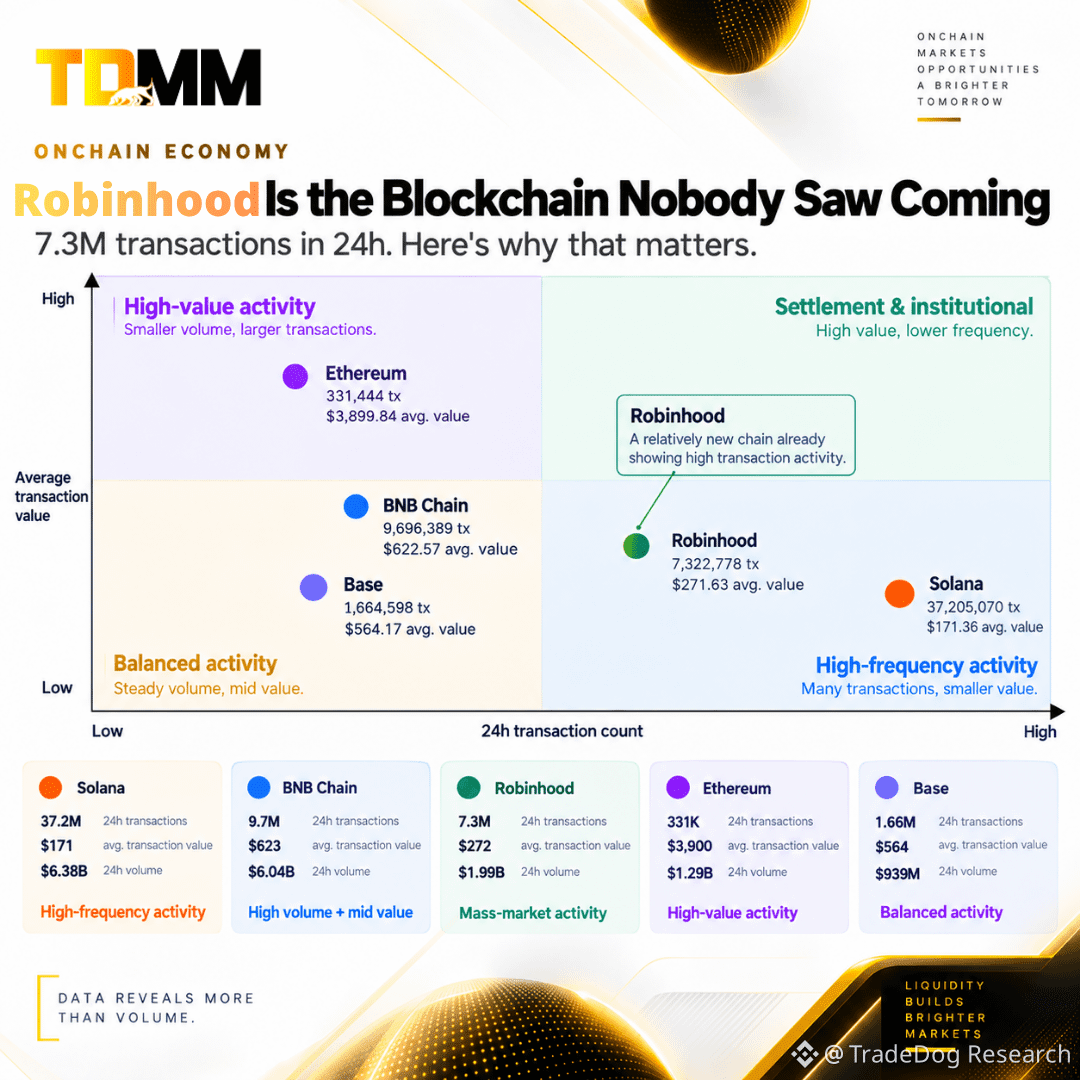
2
77
$PONS : 注目がピークに達すると、物語は変わり得る 👀
ブレイクアウト前は、価格・出来高・ユニークトレーダーがすべて同時に上昇していました。
そしてATH(史上最高値)へ。
📈 価格が爆発
📊 出来高が急増
👥 ユニークトレーダーが、最も強い指標の一つを記録
しかし次の動きは、もう一段高い足ではありませんでした。
活動水準が高いまま、価格は押し戻され始めます。
それが重要です。
注目のピーク=上昇が確実、ではありません。
ローカル高値付近での参加の急増や出来高のスパイクは、市場が別の局面へ入ろうとしているサインになることがあります。
PONSにとって、いまの重要な問いはこうです:
ユニークトレーダー+出来高が価格とともに再構築され始めるのか、それとも参加が引き続き乖離するのか?
次のシグナルは、チャートに出る前に“チャートの下”から来るかもしれません。
@tdmarketmaker @Square-Creator-50e191620
#PONS #MarketAnalysis #Altcoins #DeFi #CryptoTrading
$PONS : 注目がピークに達すると、物語は変わり得る 👀
ブレイクアウト前は、価格・出来高・ユニークトレーダーがすべて同時に上昇していました。
そしてATH(史上最高値)へ。
📈 価格が爆発
📊 出来高が急増
👥 ユニークトレーダーが、最も強い指標の一つを記録
しかし次の動きは、もう一段高い足ではありませんでした。
活動水準が高いまま、価格は押し戻され始めます。
それが重要です。
注目のピーク=上昇が確実、ではありません。
ローカル高値付近での参加の急増や出来高のスパイクは、市場が別の局面へ入ろうとしているサインになることがあります。
PONSにとって、いまの重要な問いはこうです:
ユニークトレーダー+出来高が価格とともに再構築され始めるのか、それとも参加が引き続き乖離するのか?
次のシグナルは、チャートに出る前に“チャートの下”から来るかもしれません。
@TDMM-TradeDog Market Maker @TradeDog Crypto Market Research
#PONS #MarketAnalysis #Altcoins #DeFi #CryptoTrading
ブレイクアウト前は、価格・出来高・ユニークトレーダーがすべて同時に上昇していました。
そしてATH(史上最高値)へ。
📈 価格が爆発
📊 出来高が急増
👥 ユニークトレーダーが、最も強い指標の一つを記録
しかし次の動きは、もう一段高い足ではありませんでした。
活動水準が高いまま、価格は押し戻され始めます。
それが重要です。
注目のピーク=上昇が確実、ではありません。
ローカル高値付近での参加の急増や出来高のスパイクは、市場が別の局面へ入ろうとしているサインになることがあります。
PONSにとって、いまの重要な問いはこうです:
ユニークトレーダー+出来高が価格とともに再構築され始めるのか、それとも参加が引き続き乖離するのか?
次のシグナルは、チャートに出る前に“チャートの下”から来るかもしれません。
@TDMM-TradeDog Market Maker @TradeDog Crypto Market Research
#PONS #MarketAnalysis #Altcoins #DeFi #CryptoTrading
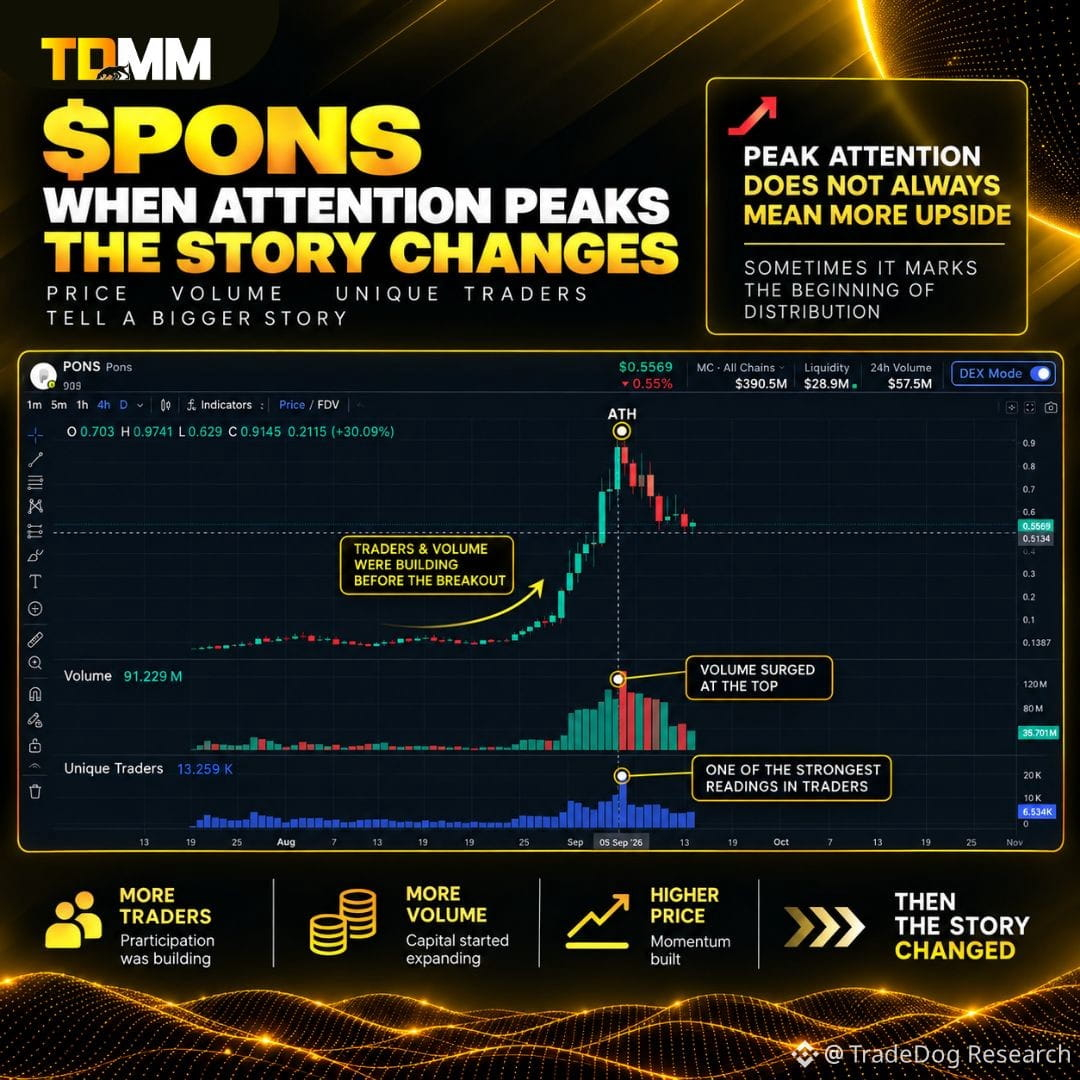
2
185
TDR による毎日の暗号通貨市場パルス チェック
Coinbase の Base が新たな高みに到達: アクティブ アドレス 400 万
詳細を見てみましょう:
@coinbase の Ethereum ブロックチェーン上に構築されたレイヤー 2 (L2) ネットワークである Base は、最近、「オンチェーン サマー」キャンペーンの推進により、アクティブ アドレスが 400 万を超えるという重要なマイルストーンを達成しました。
2023 年に最初に開始され、2024 年に復活したこのオンチェーン サマー キャンペーンは、@base の成長の大きな原動力となっています。このキャンペーンは、報酬の提供、イベントの開催、プラットフォームでの創造性の促進を通じて、開発者にインセンティブを与え、より広範な暗号通貨コミュニティと関わることを目的として設計されました。
2024 年版では、6 月から 8 月の間に Base ネットワークを構築する開発者に 200 万ドル (600 ETH に相当) の報酬を提供することで、この勢いを継続しました。
将来の見通しについて:
今後、オンチェーン サマーで得た勢いは、特に Coinbase が革新を続け、開発者やユーザーをプラットフォームに引き付けることができれば、Base を前進させ続ける可能性があります。
このキャンペーンから学んだ教訓、特に論争への対処とブロックチェーン ベースのアプリケーションの整合性の確保は、Base の継続的な開発にとって重要です。
それだけではありません。今日の市場洞察を詳しく見てみましょう:
世界の暗号通貨市場規模: 2.2 兆ドル
ビットコインの優位性: 53.4% |イーサリアムの優位性: 14.2%
上位上昇銘柄:
SUNDOG: +87.4%
LOKA: +59.2%
上位下落銘柄:
BRAINLET: -27.0%
CATDOG: -25.4%
現在進行中の主要エアドロップに参加: @Curvance、@LineaBuild、@getgrass_io、@Sagaxyz__
暗号通貨の世界で最新かつ最も影響力のある開発について最新情報を入手するには、@TradedogCrypto をフォローしてください。
#Coinbase #Ethereum #Layer2 #Blockchain #OnchainSummer
TDR による毎日の暗号通貨市場パルス チェック
Coinbase の Base が新たな高みに到達: アクティブ アドレス 400 万
詳細を見てみましょう:
@coinbase の Ethereum ブロックチェーン上に構築されたレイヤー 2 (L2) ネットワークである Base は、最近、「オンチェーン サマー」キャンペーンの推進により、アクティブ アドレスが 400 万を超えるという重要なマイルストーンを達成しました。
2023 年に最初に開始され、2024 年に復活したこのオンチェーン サマー キャンペーンは、@base の成長の大きな原動力となっています。このキャンペーンは、報酬の提供、イベントの開催、プラットフォームでの創造性の促進を通じて、開発者にインセンティブを与え、より広範な暗号通貨コミュニティと関わることを目的として設計されました。
2024 年版では、6 月から 8 月の間に Base ネットワークを構築する開発者に 200 万ドル (600 ETH に相当) の報酬を提供することで、この勢いを継続しました。
将来の見通しについて:
今後、オンチェーン サマーで得た勢いは、特に Coinbase が革新を続け、開発者やユーザーをプラットフォームに引き付けることができれば、Base を前進させ続ける可能性があります。
このキャンペーンから学んだ教訓、特に論争への対処とブロックチェーン ベースのアプリケーションの整合性の確保は、Base の継続的な開発にとって重要です。
それだけではありません。今日の市場洞察を詳しく見てみましょう:
世界の暗号通貨市場規模: 2.2 兆ドル
ビットコインの優位性: 53.4% |イーサリアムの優位性: 14.2%
上位上昇銘柄:
SUNDOG: +87.4%
LOKA: +59.2%
上位下落銘柄:
BRAINLET: -27.0%
CATDOG: -25.4%
現在進行中の主要エアドロップに参加: @Curvance、@LineaBuild、@getgrass_io、@Sagaxyz__
暗号通貨の世界で最新かつ最も影響力のある開発について最新情報を入手するには、@TradedogCrypto をフォローしてください。
#Coinbase #Ethereum #Layer2 #Blockchain #OnchainSummer
Coinbase の Base が新たな高みに到達: アクティブ アドレス 400 万
詳細を見てみましょう:
@coinbase の Ethereum ブロックチェーン上に構築されたレイヤー 2 (L2) ネットワークである Base は、最近、「オンチェーン サマー」キャンペーンの推進により、アクティブ アドレスが 400 万を超えるという重要なマイルストーンを達成しました。
2023 年に最初に開始され、2024 年に復活したこのオンチェーン サマー キャンペーンは、@base の成長の大きな原動力となっています。このキャンペーンは、報酬の提供、イベントの開催、プラットフォームでの創造性の促進を通じて、開発者にインセンティブを与え、より広範な暗号通貨コミュニティと関わることを目的として設計されました。
2024 年版では、6 月から 8 月の間に Base ネットワークを構築する開発者に 200 万ドル (600 ETH に相当) の報酬を提供することで、この勢いを継続しました。
将来の見通しについて:
今後、オンチェーン サマーで得た勢いは、特に Coinbase が革新を続け、開発者やユーザーをプラットフォームに引き付けることができれば、Base を前進させ続ける可能性があります。
このキャンペーンから学んだ教訓、特に論争への対処とブロックチェーン ベースのアプリケーションの整合性の確保は、Base の継続的な開発にとって重要です。
それだけではありません。今日の市場洞察を詳しく見てみましょう:
世界の暗号通貨市場規模: 2.2 兆ドル
ビットコインの優位性: 53.4% |イーサリアムの優位性: 14.2%
上位上昇銘柄:
SUNDOG: +87.4%
LOKA: +59.2%
上位下落銘柄:
BRAINLET: -27.0%
CATDOG: -25.4%
現在進行中の主要エアドロップに参加: @Curvance、@LineaBuild、@getgrass_io、@Sagaxyz__
暗号通貨の世界で最新かつ最も影響力のある開発について最新情報を入手するには、@TradedogCrypto をフォローしてください。
#Coinbase #Ethereum #Layer2 #Blockchain #OnchainSummer

3
284
メタバースは輝きを失っているのか?
2024年のメタバースの土地市場は大幅な下落を見せ、平均価格はピーク時から72%下落しました。
平均最低価格は2023年以降34%、2022年以降55%下落しています。
主なプロジェクトのハイライト:
@TheSandboxGame: 価格は2021年の2.86 ETHから2024年には0.13 ETHへと95%急落しました。
NFTWorlds/TOPIA Worlds: コミュニティのサポートとブランド変更に支えられ、45%の下落で回復力を示しました。
@SomniumSpace: VRの進歩により、2023年に0.98 ETHでピークに達しました。
価格に影響を与える要因:
市場のボラティリティ: 暗号通貨の広範な低迷は、メタバースの土地に大きな影響を与えました。
プロジェクト固有の開発: イノベーションと独自の価値提案により、特定のプロジェクトの価値が維持されました。
コミュニティの強さ: 強力なエンゲージメントとブランド変更の取り組みにより、下落が緩和されました。
外部市場の影響: ミームコインなどのトレンドにより、メタバースの土地から注目が逸れました。
将来の見通し:
メタバースの土地価格の将来は、継続的なイノベーションとより広範な暗号通貨のトレンドに左右されます。
メタバースの土地価格の将来はどうなると思いますか? 以下にご意見をお寄せください!
#Metaverse #VirtualRealEstate #NFT
メタバースは輝きを失っているのか?
2024年のメタバースの土地市場は大幅な下落を見せ、平均価格はピーク時から72%下落しました。
平均最低価格は2023年以降34%、2022年以降55%下落しています。
主なプロジェクトのハイライト:
@TheSandboxGame: 価格は2021年の2.86 ETHから2024年には0.13 ETHへと95%急落しました。
NFTWorlds/TOPIA Worlds: コミュニティのサポートとブランド変更に支えられ、45%の下落で回復力を示しました。
@SomniumSpace: VRの進歩により、2023年に0.98 ETHでピークに達しました。
価格に影響を与える要因:
市場のボラティリティ: 暗号通貨の広範な低迷は、メタバースの土地に大きな影響を与えました。
プロジェクト固有の開発: イノベーションと独自の価値提案により、特定のプロジェクトの価値が維持されました。
コミュニティの強さ: 強力なエンゲージメントとブランド変更の取り組みにより、下落が緩和されました。
外部市場の影響: ミームコインなどのトレンドにより、メタバースの土地から注目が逸れました。
将来の見通し:
メタバースの土地価格の将来は、継続的なイノベーションとより広範な暗号通貨のトレンドに左右されます。
メタバースの土地価格の将来はどうなると思いますか? 以下にご意見をお寄せください!
#Metaverse #VirtualRealEstate #NFT
2024年のメタバースの土地市場は大幅な下落を見せ、平均価格はピーク時から72%下落しました。
平均最低価格は2023年以降34%、2022年以降55%下落しています。
主なプロジェクトのハイライト:
@TheSandboxGame: 価格は2021年の2.86 ETHから2024年には0.13 ETHへと95%急落しました。
NFTWorlds/TOPIA Worlds: コミュニティのサポートとブランド変更に支えられ、45%の下落で回復力を示しました。
@SomniumSpace: VRの進歩により、2023年に0.98 ETHでピークに達しました。
価格に影響を与える要因:
市場のボラティリティ: 暗号通貨の広範な低迷は、メタバースの土地に大きな影響を与えました。
プロジェクト固有の開発: イノベーションと独自の価値提案により、特定のプロジェクトの価値が維持されました。
コミュニティの強さ: 強力なエンゲージメントとブランド変更の取り組みにより、下落が緩和されました。
外部市場の影響: ミームコインなどのトレンドにより、メタバースの土地から注目が逸れました。
将来の見通し:
メタバースの土地価格の将来は、継続的なイノベーションとより広範な暗号通貨のトレンドに左右されます。
メタバースの土地価格の将来はどうなると思いますか? 以下にご意見をお寄せください!
#Metaverse #VirtualRealEstate #NFT

1
1.4k
誰もが株式市場と暗号通貨市場の嵐について話している間に、私たちはNFT市場の状況を概説することにしました。
📊
数字と統計
時価総額: 575億ドル
1日の取引量: 95億ドル
時価総額別トップコレクション:
@cryptopunksnfts: 5億2,400万ドル
@LibertyCatsBTC: 5億1,300万ドル
@BoredApeYC: 2億1,800万ドル
@pudgypenguins: 1億7,800万ドル
@Azuki: 9,900万ドル
市場修正
NFT市場は大幅な下落を見せ、時価総額は暗号通貨市場全体の影響を大きく受け、最低時には340億ドルまで落ち込みました。
ミームコインの影響
ミームコインはNFTから注目と資本を奪い、時価総額は2024年1月の3,480億ドルから2024年3月の1,590億ドルへと急落しました。
新たなトレンド
ユーティリティ主導型NFT:現実世界の資産のトークン化に関連するNFTへの関心が高まっています。ゲーム統合:スクウェア・エニックスなどの大手企業がNFTを採用するケースが増えています。ハイブリッドNFT:物理資産とデジタル資産を組み合わせたトークンの人気が高まっています。
今後の見通し
次の強気相場ではユーティリティベースのNFTと現実世界の資産のトークン化が重視される可能性がありますが、現在の状況では大幅な市場成長は不透明です。
NFT市場はユーティリティと現実の資産に焦点を当てて進化していますが、ミームコインと市場のボラティリティによる課題に直面しています。
次に何が起こるか、待ってみましょう。ご意見を下記にご記入ください
👇
#NFTMarket #CryptoNewss #MarketTrends
誰もが株式市場と暗号通貨市場の嵐について話している間に、私たちはNFT市場の状況を概説することにしました。
📊
数字と統計
時価総額: 575億ドル
1日の取引量: 95億ドル
時価総額別トップコレクション:
@cryptopunksnfts: 5億2,400万ドル
@LibertyCatsBTC: 5億1,300万ドル
@BoredApeYC: 2億1,800万ドル
@pudgypenguins: 1億7,800万ドル
@Azuki: 9,900万ドル
市場修正
NFT市場は大幅な下落を見せ、時価総額は暗号通貨市場全体の影響を大きく受け、最低時には340億ドルまで落ち込みました。
ミームコインの影響
ミームコインはNFTから注目と資本を奪い、時価総額は2024年1月の3,480億ドルから2024年3月の1,590億ドルへと急落しました。
新たなトレンド
ユーティリティ主導型NFT:現実世界の資産のトークン化に関連するNFTへの関心が高まっています。ゲーム統合:スクウェア・エニックスなどの大手企業がNFTを採用するケースが増えています。ハイブリッドNFT:物理資産とデジタル資産を組み合わせたトークンの人気が高まっています。
今後の見通し
次の強気相場ではユーティリティベースのNFTと現実世界の資産のトークン化が重視される可能性がありますが、現在の状況では大幅な市場成長は不透明です。
NFT市場はユーティリティと現実の資産に焦点を当てて進化していますが、ミームコインと市場のボラティリティによる課題に直面しています。
次に何が起こるか、待ってみましょう。ご意見を下記にご記入ください
👇
#NFTMarket #CryptoNewss #MarketTrends
📊
数字と統計
時価総額: 575億ドル
1日の取引量: 95億ドル
時価総額別トップコレクション:
@cryptopunksnfts: 5億2,400万ドル
@LibertyCatsBTC: 5億1,300万ドル
@BoredApeYC: 2億1,800万ドル
@pudgypenguins: 1億7,800万ドル
@Azuki: 9,900万ドル
市場修正
NFT市場は大幅な下落を見せ、時価総額は暗号通貨市場全体の影響を大きく受け、最低時には340億ドルまで落ち込みました。
ミームコインの影響
ミームコインはNFTから注目と資本を奪い、時価総額は2024年1月の3,480億ドルから2024年3月の1,590億ドルへと急落しました。
新たなトレンド
ユーティリティ主導型NFT:現実世界の資産のトークン化に関連するNFTへの関心が高まっています。ゲーム統合:スクウェア・エニックスなどの大手企業がNFTを採用するケースが増えています。ハイブリッドNFT:物理資産とデジタル資産を組み合わせたトークンの人気が高まっています。
今後の見通し
次の強気相場ではユーティリティベースのNFTと現実世界の資産のトークン化が重視される可能性がありますが、現在の状況では大幅な市場成長は不透明です。
NFT市場はユーティリティと現実の資産に焦点を当てて進化していますが、ミームコインと市場のボラティリティによる課題に直面しています。
次に何が起こるか、待ってみましょう。ご意見を下記にご記入ください
👇
#NFTMarket #CryptoNewss #MarketTrends

1
450
自分の取引スタイルを特定しましょう!
なぜそれが重要なのか:自分の性格、リスク許容度、時間へのコミットメントに合わせて取引戦略を合わせることが不可欠です。
自分がスキャルパー、デイトレーダー、スイングトレーダーのどれであるかを知ることは、情報に基づいた決定を下し、ストレスを管理し、取引アプローチを最適化するのに役立ちます。
各取引スタイルの詳細は次のとおりです
👇
スキャルパー:迅速な取引、高ストレス、高リスク。
デイトレーダー:毎日取引、中程度から高リスク、十分な注意が必要です。
スイングトレーダー:数日/数週間ポジションを保持、ストレスは少ない、忍耐が必要です。
全体的なポイント:
各スタイルには独自の課題と報酬があります。自分のリスク許容度とライフスタイルに合ったものを選択してください。
どの取引スタイルがあなたに最も適していますか?
#取引 #スキャルピング #デイトレーディング #スイングトレーディング
自分の取引スタイルを特定しましょう!
なぜそれが重要なのか:自分の性格、リスク許容度、時間へのコミットメントに合わせて取引戦略を合わせることが不可欠です。
自分がスキャルパー、デイトレーダー、スイングトレーダーのどれであるかを知ることは、情報に基づいた決定を下し、ストレスを管理し、取引アプローチを最適化するのに役立ちます。
各取引スタイルの詳細は次のとおりです
👇
スキャルパー:迅速な取引、高ストレス、高リスク。
デイトレーダー:毎日取引、中程度から高リスク、十分な注意が必要です。
スイングトレーダー:数日/数週間ポジションを保持、ストレスは少ない、忍耐が必要です。
全体的なポイント:
各スタイルには独自の課題と報酬があります。自分のリスク許容度とライフスタイルに合ったものを選択してください。
どの取引スタイルがあなたに最も適していますか?
#取引 #スキャルピング #デイトレーディング #スイングトレーディング
なぜそれが重要なのか:自分の性格、リスク許容度、時間へのコミットメントに合わせて取引戦略を合わせることが不可欠です。
自分がスキャルパー、デイトレーダー、スイングトレーダーのどれであるかを知ることは、情報に基づいた決定を下し、ストレスを管理し、取引アプローチを最適化するのに役立ちます。
各取引スタイルの詳細は次のとおりです
👇
スキャルパー:迅速な取引、高ストレス、高リスク。
デイトレーダー:毎日取引、中程度から高リスク、十分な注意が必要です。
スイングトレーダー:数日/数週間ポジションを保持、ストレスは少ない、忍耐が必要です。
全体的なポイント:
各スタイルには独自の課題と報酬があります。自分のリスク許容度とライフスタイルに合ったものを選択してください。
どの取引スタイルがあなたに最も適していますか?
#取引 #スキャルピング #デイトレーディング #スイングトレーディング

12
パーティクル ネットワークのメリットは何ですか?
見てみましょう👇
- パーティクル ネットワーク - レイヤー 1 ブロックチェーン ソリューション。
投資額: 未公開
- Pichi Finance - トラストレスなポイント取引プロトコルの作成に注力しています。
投資額: 250 万ドル
- Morpho Labs - 高度な流動性ソリューションと分散型アプリケーションの先駆者です。
投資額: 5,000 万ドル
- Breakout - 高度な技術ソリューションで金融および銀行部門に革命を起こすことに注力しているスタートアップ。
投資額: 450 万ドル
- Layer2 Financial - 決済システムと金融サービスを強化することで、従来の金融システムとブロックチェーン技術のギャップを埋めることを目指しています。
投資額: 1,070 万ドル
これらのプロジェクトは、ブロックチェーンと分散型金融ソリューションへの関心と投資の高まりを浮き彫りにしており、それぞれがエコシステム内の特定の課題を解決し、さらなるイノベーションを推進することを目指しています。
どのプロジェクトが最も有望だと思いますか?
コメントでお知らせください!
#Crypto #Blockchain #DEFİ #Investment #Innovation
パーティクル ネットワークのメリットは何ですか?
見てみましょう👇
- パーティクル ネットワーク - レイヤー 1 ブロックチェーン ソリューション。
投資額: 未公開
- Pichi Finance - トラストレスなポイント取引プロトコルの作成に注力しています。
投資額: 250 万ドル
- Morpho Labs - 高度な流動性ソリューションと分散型アプリケーションの先駆者です。
投資額: 5,000 万ドル
- Breakout - 高度な技術ソリューションで金融および銀行部門に革命を起こすことに注力しているスタートアップ。
投資額: 450 万ドル
- Layer2 Financial - 決済システムと金融サービスを強化することで、従来の金融システムとブロックチェーン技術のギャップを埋めることを目指しています。
投資額: 1,070 万ドル
これらのプロジェクトは、ブロックチェーンと分散型金融ソリューションへの関心と投資の高まりを浮き彫りにしており、それぞれがエコシステム内の特定の課題を解決し、さらなるイノベーションを推進することを目指しています。
どのプロジェクトが最も有望だと思いますか?
コメントでお知らせください!
#Crypto #Blockchain #DEFİ #Investment #Innovation
見てみましょう👇
- パーティクル ネットワーク - レイヤー 1 ブロックチェーン ソリューション。
投資額: 未公開
- Pichi Finance - トラストレスなポイント取引プロトコルの作成に注力しています。
投資額: 250 万ドル
- Morpho Labs - 高度な流動性ソリューションと分散型アプリケーションの先駆者です。
投資額: 5,000 万ドル
- Breakout - 高度な技術ソリューションで金融および銀行部門に革命を起こすことに注力しているスタートアップ。
投資額: 450 万ドル
- Layer2 Financial - 決済システムと金融サービスを強化することで、従来の金融システムとブロックチェーン技術のギャップを埋めることを目指しています。
投資額: 1,070 万ドル
これらのプロジェクトは、ブロックチェーンと分散型金融ソリューションへの関心と投資の高まりを浮き彫りにしており、それぞれがエコシステム内の特定の課題を解決し、さらなるイノベーションを推進することを目指しています。
どのプロジェクトが最も有望だと思いますか?
コメントでお知らせください!
#Crypto #Blockchain #DEFİ #Investment #Innovation

1
232
あなたのお気に入りの暗号通貨は安全ですか?🛡️
暗号通貨の世界で一歩先を行くためには、潜在的なハッキングや進行中の開発について学ぶことが重要です。
今日は、51% 攻撃について掘り下げてみましょう。
51% 攻撃とは何ですか?
これは、個人またはグループがブロックチェーンのハッシュ パワーの 50% 以上を制御し、トランザクションを改ざんできる場合に発生します。
仕組み:
- ハッシュ レートの支配: 攻撃者はネットワークのハッシュ レートの大部分を制御します。
- 二重支出: トランザクションを逆転させ、二重支出を可能にします。
- ブロック干渉: 新しいトランザクションの確認を阻止できます。
- マイニングの独占: マイニングを独占し、他のマイナーがブロックを生成して報酬を集めるのを阻止します。
過去の例:
- Bitcoin Gold (2018): 51% 攻撃を受け、1,800 万ドル相当のコインが二重支出されました。
- Ethereum Classic (2019): 51% 攻撃が複数回発生し、数千の ETC が二重に使用されました。
- Verge (2018): ブロックチェーン操作により数百万の XVG が作成される攻撃に直面しました。
予防のためにどのような手順を踏めばよいでしょうか?
- ネットワーク ハッシュ レートの増加: 単一のエンティティが 51% を制御することが難しくなります。
- プルーフ オブ ステーク (PoS): 計算能力ではなく、保有する暗号通貨の量に基づくセキュリティ。
- 強化された監視: 異常なマイニング動作を継続的にネットワーク監視します。
- 分散化: マイニング プールの分散化を促進し、マイニング パワーの集中を回避します。
この情報が役に立った場合は、いいね、再投稿、ネットワークでの共有をお願いします。
#CryptoSecurity#Blockchain
あなたのお気に入りの暗号通貨は安全ですか?🛡️
暗号通貨の世界で一歩先を行くためには、潜在的なハッキングや進行中の開発について学ぶことが重要です。
今日は、51% 攻撃について掘り下げてみましょう。
51% 攻撃とは何ですか?
これは、個人またはグループがブロックチェーンのハッシュ パワーの 50% 以上を制御し、トランザクションを改ざんできる場合に発生します。
仕組み:
- ハッシュ レートの支配: 攻撃者はネットワークのハッシュ レートの大部分を制御します。
- 二重支出: トランザクションを逆転させ、二重支出を可能にします。
- ブロック干渉: 新しいトランザクションの確認を阻止できます。
- マイニングの独占: マイニングを独占し、他のマイナーがブロックを生成して報酬を集めるのを阻止します。
過去の例:
- Bitcoin Gold (2018): 51% 攻撃を受け、1,800 万ドル相当のコインが二重支出されました。
- Ethereum Classic (2019): 51% 攻撃が複数回発生し、数千の ETC が二重に使用されました。
- Verge (2018): ブロックチェーン操作により数百万の XVG が作成される攻撃に直面しました。
予防のためにどのような手順を踏めばよいでしょうか?
- ネットワーク ハッシュ レートの増加: 単一のエンティティが 51% を制御することが難しくなります。
- プルーフ オブ ステーク (PoS): 計算能力ではなく、保有する暗号通貨の量に基づくセキュリティ。
- 強化された監視: 異常なマイニング動作を継続的にネットワーク監視します。
- 分散化: マイニング プールの分散化を促進し、マイニング パワーの集中を回避します。
この情報が役に立った場合は、いいね、再投稿、ネットワークでの共有をお願いします。
#CryptoSecurity#Blockchain
暗号通貨の世界で一歩先を行くためには、潜在的なハッキングや進行中の開発について学ぶことが重要です。
今日は、51% 攻撃について掘り下げてみましょう。
51% 攻撃とは何ですか?
これは、個人またはグループがブロックチェーンのハッシュ パワーの 50% 以上を制御し、トランザクションを改ざんできる場合に発生します。
仕組み:
- ハッシュ レートの支配: 攻撃者はネットワークのハッシュ レートの大部分を制御します。
- 二重支出: トランザクションを逆転させ、二重支出を可能にします。
- ブロック干渉: 新しいトランザクションの確認を阻止できます。
- マイニングの独占: マイニングを独占し、他のマイナーがブロックを生成して報酬を集めるのを阻止します。
過去の例:
- Bitcoin Gold (2018): 51% 攻撃を受け、1,800 万ドル相当のコインが二重支出されました。
- Ethereum Classic (2019): 51% 攻撃が複数回発生し、数千の ETC が二重に使用されました。
- Verge (2018): ブロックチェーン操作により数百万の XVG が作成される攻撃に直面しました。
予防のためにどのような手順を踏めばよいでしょうか?
- ネットワーク ハッシュ レートの増加: 単一のエンティティが 51% を制御することが難しくなります。
- プルーフ オブ ステーク (PoS): 計算能力ではなく、保有する暗号通貨の量に基づくセキュリティ。
- 強化された監視: 異常なマイニング動作を継続的にネットワーク監視します。
- 分散化: マイニング プールの分散化を促進し、マイニング パワーの集中を回避します。
この情報が役に立った場合は、いいね、再投稿、ネットワークでの共有をお願いします。
#CryptoSecurity#Blockchain

3
4.6k
あなたの感情は暗号通貨への投資に影響していますか?
何らかの形で、私たちは皆これに影響を受けます。それを否定しても何のメリットもありません。
しかし、どのようにでしょうか? 感情のサイクル全体について説明しましょう。
陶酔感: 市場価格がピークに達すると、無敵感と貪欲さが生まれます。
基本行動: 多くの場合、リスクを考慮せずに高値で大量に購入します。
希望: トレーダーが楽観的になり、将来の利益に大きな期待を抱いて市場に参入する初期段階。
基本行動: ポジティブなニュース、噂、または初期投資の成功に基づいて資産を購入します。
楽観主義: 価格が上昇し始めると、トレーダーは投資について楽観的になります。
基本行動: 購入と保有を増やし、市場の可能性に対する信念を強化します。
スリル: 価格が大幅に上昇すると、興奮とスリルが生まれます。
基本行動: より積極的に購入し、利益を最大化するためにレバレッジをかけることもあります。
不安: 市場価格が下落し始め、トレーダーは投資について不安を感じます。
基本行動: 売却をためらい、価格が回復することを期待する。
否定: 価格が下がり続けると、トレーダーは一時的な後退だと思い込み、否定する。
基本行動: 損失にもかかわらず投資を保持し、回復を待つ。
パニック: 下落が続くと、トレーダーは大きな損失を認識し、パニックになる。
基本行動: 損失を抑えるために急いで売り、多くの場合、かなりの損失を出す。
投げ売り: 広範囲に売り、市場から撤退し、サイクルの最低点を示す。
基本行動: 残りの資産を売却し、市場から撤退し、損失を受け入れる。
希望: 市場が安定し、回復の兆しを見せ、トレーダーの間で希望が再び燃え上がる。
基本行動: 慎重に市場に再参入し、新しいサイクルが始まる。
あなたは今、どの段階にいると思いますか?🤔
#CryptoTrader #MarketCycle
あなたの感情は暗号通貨への投資に影響していますか?
何らかの形で、私たちは皆これに影響を受けます。それを否定しても何のメリットもありません。
しかし、どのようにでしょうか? 感情のサイクル全体について説明しましょう。
陶酔感: 市場価格がピークに達すると、無敵感と貪欲さが生まれます。
基本行動: 多くの場合、リスクを考慮せずに高値で大量に購入します。
希望: トレーダーが楽観的になり、将来の利益に大きな期待を抱いて市場に参入する初期段階。
基本行動: ポジティブなニュース、噂、または初期投資の成功に基づいて資産を購入します。
楽観主義: 価格が上昇し始めると、トレーダーは投資について楽観的になります。
基本行動: 購入と保有を増やし、市場の可能性に対する信念を強化します。
スリル: 価格が大幅に上昇すると、興奮とスリルが生まれます。
基本行動: より積極的に購入し、利益を最大化するためにレバレッジをかけることもあります。
不安: 市場価格が下落し始め、トレーダーは投資について不安を感じます。
基本行動: 売却をためらい、価格が回復することを期待する。
否定: 価格が下がり続けると、トレーダーは一時的な後退だと思い込み、否定する。
基本行動: 損失にもかかわらず投資を保持し、回復を待つ。
パニック: 下落が続くと、トレーダーは大きな損失を認識し、パニックになる。
基本行動: 損失を抑えるために急いで売り、多くの場合、かなりの損失を出す。
投げ売り: 広範囲に売り、市場から撤退し、サイクルの最低点を示す。
基本行動: 残りの資産を売却し、市場から撤退し、損失を受け入れる。
希望: 市場が安定し、回復の兆しを見せ、トレーダーの間で希望が再び燃え上がる。
基本行動: 慎重に市場に再参入し、新しいサイクルが始まる。
あなたは今、どの段階にいると思いますか?🤔
#CryptoTrader #MarketCycle
何らかの形で、私たちは皆これに影響を受けます。それを否定しても何のメリットもありません。
しかし、どのようにでしょうか? 感情のサイクル全体について説明しましょう。
陶酔感: 市場価格がピークに達すると、無敵感と貪欲さが生まれます。
基本行動: 多くの場合、リスクを考慮せずに高値で大量に購入します。
希望: トレーダーが楽観的になり、将来の利益に大きな期待を抱いて市場に参入する初期段階。
基本行動: ポジティブなニュース、噂、または初期投資の成功に基づいて資産を購入します。
楽観主義: 価格が上昇し始めると、トレーダーは投資について楽観的になります。
基本行動: 購入と保有を増やし、市場の可能性に対する信念を強化します。
スリル: 価格が大幅に上昇すると、興奮とスリルが生まれます。
基本行動: より積極的に購入し、利益を最大化するためにレバレッジをかけることもあります。
不安: 市場価格が下落し始め、トレーダーは投資について不安を感じます。
基本行動: 売却をためらい、価格が回復することを期待する。
否定: 価格が下がり続けると、トレーダーは一時的な後退だと思い込み、否定する。
基本行動: 損失にもかかわらず投資を保持し、回復を待つ。
パニック: 下落が続くと、トレーダーは大きな損失を認識し、パニックになる。
基本行動: 損失を抑えるために急いで売り、多くの場合、かなりの損失を出す。
投げ売り: 広範囲に売り、市場から撤退し、サイクルの最低点を示す。
基本行動: 残りの資産を売却し、市場から撤退し、損失を受け入れる。
希望: 市場が安定し、回復の兆しを見せ、トレーダーの間で希望が再び燃え上がる。
基本行動: 慎重に市場に再参入し、新しいサイクルが始まる。
あなたは今、どの段階にいると思いますか?🤔
#CryptoTrader #MarketCycle

532
zkRollups がどのように機能し、ブロックチェーンに真の価値をもたらすか考えたことはありますか?
🤔
実際にどのように機能するかを詳しく説明する前に、まず zkRollups とは何かを見てみましょう:
ZK-Rollups は、バリデータがトランザクションの詳細を明かさずにトランザクションの真正性を証明するロールアップです。
では、zkRollups が実際にどのように機能するかを詳しく説明しましょう!
zkRollups の仕組み:
1. バッチ トランザクション (L2): 複数のトランザクションがまとめてバッチ処理され、オフチェーンで処理することでメイン ブロックチェーンの負荷が軽減されます。
2. 実行 (L2): バッチ処理されたトランザクションはシーケンサーによって実行され、レイヤー 2 チェーンの状態が更新されます。
3. Tx、状態差分など (L2): これにより、アカウント残高とスマート コントラクトの変更を反映したトランザクション (Tx) と状態差分 (diff) が生成されます。
4. 証明の生成 (L2): ゼロ知識証明 (zk 証明) が生成され、詳細を明かすことなくトランザクションの正確性が検証されます。
5. L1 チェーンに送信: zk 証明がレイヤー 1 ブロックチェーンに送信され、新しい状態で更新され、バッチ内のすべてのトランザクションが検証されます。
6. 検証 (L1 チェーン): レイヤー 1 のロールアップ コントラクトが zk 証明を検証し、バッチ トランザクションの整合性を確保します。
7. 更新の有無 (L1 チェーン): 検証に基づいて、メイン ブロックチェーンの状態が更新または拒否され、セキュリティと正確性が維持されます。
zkRollups の利点:
- スケーラビリティ: オフチェーンで処理することでトランザクションのスループットが向上し、混雑が軽減されます。
- コストの削減: オンチェーンで記録されるトランザクションが少なくなるため、トランザクション料金が大幅に削減されます。
- セキュリティ: メイン ブロックチェーンのセキュリティを継承します。
- プライバシー: 機密情報を明かすことなくトランザクションを検証します。
次回の投稿では、zkRollup の状況を詳しく取り上げます。
以下に、どれだけ興奮しているかコメントしてください。
#BlockchainMilestone #Crypto #zkRollups #CryptoInnovation #DeFi
zkRollups がどのように機能し、ブロックチェーンに真の価値をもたらすか考えたことはありますか?
🤔
実際にどのように機能するかを詳しく説明する前に、まず zkRollups とは何かを見てみましょう:
ZK-Rollups は、バリデータがトランザクションの詳細を明かさずにトランザクションの真正性を証明するロールアップです。
では、zkRollups が実際にどのように機能するかを詳しく説明しましょう!
zkRollups の仕組み:
1. バッチ トランザクション (L2): 複数のトランザクションがまとめてバッチ処理され、オフチェーンで処理することでメイン ブロックチェーンの負荷が軽減されます。
2. 実行 (L2): バッチ処理されたトランザクションはシーケンサーによって実行され、レイヤー 2 チェーンの状態が更新されます。
3. Tx、状態差分など (L2): これにより、アカウント残高とスマート コントラクトの変更を反映したトランザクション (Tx) と状態差分 (diff) が生成されます。
4. 証明の生成 (L2): ゼロ知識証明 (zk 証明) が生成され、詳細を明かすことなくトランザクションの正確性が検証されます。
5. L1 チェーンに送信: zk 証明がレイヤー 1 ブロックチェーンに送信され、新しい状態で更新され、バッチ内のすべてのトランザクションが検証されます。
6. 検証 (L1 チェーン): レイヤー 1 のロールアップ コントラクトが zk 証明を検証し、バッチ トランザクションの整合性を確保します。
7. 更新の有無 (L1 チェーン): 検証に基づいて、メイン ブロックチェーンの状態が更新または拒否され、セキュリティと正確性が維持されます。
zkRollups の利点:
- スケーラビリティ: オフチェーンで処理することでトランザクションのスループットが向上し、混雑が軽減されます。
- コストの削減: オンチェーンで記録されるトランザクションが少なくなるため、トランザクション料金が大幅に削減されます。
- セキュリティ: メイン ブロックチェーンのセキュリティを継承します。
- プライバシー: 機密情報を明かすことなくトランザクションを検証します。
次回の投稿では、zkRollup の状況を詳しく取り上げます。
以下に、どれだけ興奮しているかコメントしてください。
#BlockchainMilestone #Crypto #zkRollups #CryptoInnovation #DeFi
🤔
実際にどのように機能するかを詳しく説明する前に、まず zkRollups とは何かを見てみましょう:
ZK-Rollups は、バリデータがトランザクションの詳細を明かさずにトランザクションの真正性を証明するロールアップです。
では、zkRollups が実際にどのように機能するかを詳しく説明しましょう!
zkRollups の仕組み:
1. バッチ トランザクション (L2): 複数のトランザクションがまとめてバッチ処理され、オフチェーンで処理することでメイン ブロックチェーンの負荷が軽減されます。
2. 実行 (L2): バッチ処理されたトランザクションはシーケンサーによって実行され、レイヤー 2 チェーンの状態が更新されます。
3. Tx、状態差分など (L2): これにより、アカウント残高とスマート コントラクトの変更を反映したトランザクション (Tx) と状態差分 (diff) が生成されます。
4. 証明の生成 (L2): ゼロ知識証明 (zk 証明) が生成され、詳細を明かすことなくトランザクションの正確性が検証されます。
5. L1 チェーンに送信: zk 証明がレイヤー 1 ブロックチェーンに送信され、新しい状態で更新され、バッチ内のすべてのトランザクションが検証されます。
6. 検証 (L1 チェーン): レイヤー 1 のロールアップ コントラクトが zk 証明を検証し、バッチ トランザクションの整合性を確保します。
7. 更新の有無 (L1 チェーン): 検証に基づいて、メイン ブロックチェーンの状態が更新または拒否され、セキュリティと正確性が維持されます。
zkRollups の利点:
- スケーラビリティ: オフチェーンで処理することでトランザクションのスループットが向上し、混雑が軽減されます。
- コストの削減: オンチェーンで記録されるトランザクションが少なくなるため、トランザクション料金が大幅に削減されます。
- セキュリティ: メイン ブロックチェーンのセキュリティを継承します。
- プライバシー: 機密情報を明かすことなくトランザクションを検証します。
次回の投稿では、zkRollup の状況を詳しく取り上げます。
以下に、どれだけ興奮しているかコメントしてください。
#BlockchainMilestone #Crypto #zkRollups #CryptoInnovation #DeFi

362
🚀 𝗖𝗿𝘆𝗽𝘁𝗼 𝗠𝗮𝗿𝗸𝗲𝘁 𝗣𝘂𝗹𝘀𝗲 𝗖𝗵𝗲𝗰𝗸 𝗯𝘆 𝗧𝗿𝗮𝗱𝗲𝗗𝗼𝗴
今日のトップムーバー、市場センチメント、最新ニュースを詳しくご覧ください。株式時価総額が 2.4 兆ドル、債券時価総額が 53% と、市場は大きな動きを見せています。ビットコインとビットコインは大きな利益を上げましたが、ビットコインとビットコインキャッシュは厳しい一日でした。さらに、最新のエアドロップとビットコインハックのアップデートをお見逃しなく。
このダイナミックな市場でのあなたの戦略は何ですか?以下にあなたの考えを共有してください👇
#CryptoMarket #Bitcoin #Ethereum #CryptoNews #DeFi
🚀 𝗖𝗿𝘆𝗽𝘁𝗼 𝗠𝗮𝗿𝗸𝗲𝘁 𝗣𝘂𝗹𝘀𝗲 𝗖𝗵𝗲𝗰𝗸 𝗯𝘆 𝗧𝗿𝗮𝗱𝗲𝗗𝗼𝗴
今日のトップムーバー、市場センチメント、最新ニュースを詳しくご覧ください。株式時価総額が 2.4 兆ドル、債券時価総額が 53% と、市場は大きな動きを見せています。ビットコインとビットコインは大きな利益を上げましたが、ビットコインとビットコインキャッシュは厳しい一日でした。さらに、最新のエアドロップとビットコインハックのアップデートをお見逃しなく。
このダイナミックな市場でのあなたの戦略は何ですか?以下にあなたの考えを共有してください👇
#CryptoMarket #Bitcoin #Ethereum #CryptoNews #DeFi
今日のトップムーバー、市場センチメント、最新ニュースを詳しくご覧ください。株式時価総額が 2.4 兆ドル、債券時価総額が 53% と、市場は大きな動きを見せています。ビットコインとビットコインは大きな利益を上げましたが、ビットコインとビットコインキャッシュは厳しい一日でした。さらに、最新のエアドロップとビットコインハックのアップデートをお見逃しなく。
このダイナミックな市場でのあなたの戦略は何ですか?以下にあなたの考えを共有してください👇
#CryptoMarket #Bitcoin #Ethereum #CryptoNews #DeFi

408
Scalability
0%
Lower Costs
0%
Security
0%
Interoperability
0%
0 投票 • 投票は終了しました
9
こんにちは、こんにちは!
まずは基本から始めましょう: 株価はいくらですか?
証券、デリバティブ、または通貨の価格変動について説明します。
棒グラフに似た外観を持つ各ローソク足には、始値、終値、期間中の最高値、最低値の 4 つの重要な情報が表示されます。
チャートの太い部分
- 幅: ローソク足の太い部分は、始値と終値の間の範囲を表します。
- 終値(𝗚𝗿𝗲𝗲𝗻): 終値が始値より高かったことを示し、価格上昇を示しています。
- 終値(𝗥𝗲𝗱): 終値が始値より低かったことを示し、価格下落を示しています。
- 上ウィック(上ウィック):本体の上下の細い線は、期間中の高値と安値を表します。上ウィック:期間中に到達した最高価格を示します。
- 下ウィック:期間中に到達した最低価格を示します。
上ウィックとは何ですか?
上ヒゲ: 上ヒゲの頂点。
上ヒゲの頂点: 下ヒゲの底。
下ヒゲの底: 期間開始時の価格。強気のローソク足の場合、これが実体の底です。弱気のローソク足の場合、これが実体の上部です。
期間終了時の価格: 期間終了時の価格。強気のローソク足の場合、これは実体の上部です。弱気のローソク足の場合、これは実体の下部です。
💬 この投稿が役に立った場合は、以下にコメントしてください。
こんにちは、こんにちは!
まずは基本から始めましょう: 株価はいくらですか?
証券、デリバティブ、または通貨の価格変動について説明します。
棒グラフに似た外観を持つ各ローソク足には、始値、終値、期間中の最高値、最低値の 4 つの重要な情報が表示されます。
チャートの太い部分
- 幅: ローソク足の太い部分は、始値と終値の間の範囲を表します。
- 終値(𝗚𝗿𝗲𝗲𝗻): 終値が始値より高かったことを示し、価格上昇を示しています。
- 終値(𝗥𝗲𝗱): 終値が始値より低かったことを示し、価格下落を示しています。
- 上ウィック(上ウィック):本体の上下の細い線は、期間中の高値と安値を表します。上ウィック:期間中に到達した最高価格を示します。
- 下ウィック:期間中に到達した最低価格を示します。
上ウィックとは何ですか?
上ヒゲ: 上ヒゲの頂点。
上ヒゲの頂点: 下ヒゲの底。
下ヒゲの底: 期間開始時の価格。強気のローソク足の場合、これが実体の底です。弱気のローソク足の場合、これが実体の上部です。
期間終了時の価格: 期間終了時の価格。強気のローソク足の場合、これは実体の上部です。弱気のローソク足の場合、これは実体の下部です。
💬 この投稿が役に立った場合は、以下にコメントしてください。
まずは基本から始めましょう: 株価はいくらですか?
証券、デリバティブ、または通貨の価格変動について説明します。
棒グラフに似た外観を持つ各ローソク足には、始値、終値、期間中の最高値、最低値の 4 つの重要な情報が表示されます。
チャートの太い部分
- 幅: ローソク足の太い部分は、始値と終値の間の範囲を表します。
- 終値(𝗚𝗿𝗲𝗲𝗻): 終値が始値より高かったことを示し、価格上昇を示しています。
- 終値(𝗥𝗲𝗱): 終値が始値より低かったことを示し、価格下落を示しています。
- 上ウィック(上ウィック):本体の上下の細い線は、期間中の高値と安値を表します。上ウィック:期間中に到達した最高価格を示します。
- 下ウィック:期間中に到達した最低価格を示します。
上ウィックとは何ですか?
上ヒゲ: 上ヒゲの頂点。
上ヒゲの頂点: 下ヒゲの底。
下ヒゲの底: 期間開始時の価格。強気のローソク足の場合、これが実体の底です。弱気のローソク足の場合、これが実体の上部です。
期間終了時の価格: 期間終了時の価格。強気のローソク足の場合、これは実体の上部です。弱気のローソク足の場合、これは実体の下部です。
💬 この投稿が役に立った場合は、以下にコメントしてください。

3
3.1k
📢 Cardano のアップグレードがもう 1 つ登場します!
Cardano の Chang フォーク アップグレードです。
これはどのようなものですか?
Chang ハードフォークは Cardano のロードマップにおける重要な更新で、2024 年第 2 四半期に予定されています。このアップグレードはネットワークのパラダイム シフトを意味し、Cardano を中央管理型プラットフォームからコミュニティ主導型プラットフォームに移行します。
しかし、どのように?
このアップグレードにより、@Cardano に複数の重要なアップグレードがもたらされます。これには以下が含まれます:
- ネットワークのインフラストラクチャを全面的に見直し、より多くのトランザクションを効率的に処理して、トランザクション速度を高速化します。- 潜在的な攻撃からネットワークを保護するためのセキュリティ対策を強化します。
重点を置く内容は?
ガバナンスとスケーラビリティを強化します。
主なコンポーネントは次のとおりです:
- コミュニティ主導のガバナンス: $ADA 保有者が意思決定プロセスに積極的に参加するオンチェーン コンセンサスを導入します。
Ouroboros Leios プロトコル: 高度な分散化を維持しながら、トランザクション速度を大幅に向上させることを目指します。
Node 9.0: このアップグレードは、バリデーターに必要なソフトウェア アップデートを提供することで、移行をサポートします。
実装フェーズ: フォークは段階的に展開され、代表者 (DReps) の選択から始まり、憲法会議が続き、Cardano 憲法に関するコミュニティ投票で終わります。
詳細については、ここをクリックしてください - https://tradedog.io/all-you-need-to-know-about-cardanos-chang-hard-fork/
#Cardano#ChangFork#CryptoUpgrade#CryptoNews #ADA
📢 Cardano のアップグレードがもう 1 つ登場します!
Cardano の Chang フォーク アップグレードです。
これはどのようなものですか?
Chang ハードフォークは Cardano のロードマップにおける重要な更新で、2024 年第 2 四半期に予定されています。このアップグレードはネットワークのパラダイム シフトを意味し、Cardano を中央管理型プラットフォームからコミュニティ主導型プラットフォームに移行します。
しかし、どのように?
このアップグレードにより、@Cardano に複数の重要なアップグレードがもたらされます。これには以下が含まれます:
- ネットワークのインフラストラクチャを全面的に見直し、より多くのトランザクションを効率的に処理して、トランザクション速度を高速化します。- 潜在的な攻撃からネットワークを保護するためのセキュリティ対策を強化します。
重点を置く内容は?
ガバナンスとスケーラビリティを強化します。
主なコンポーネントは次のとおりです:
- コミュニティ主導のガバナンス: $ADA 保有者が意思決定プロセスに積極的に参加するオンチェーン コンセンサスを導入します。
Ouroboros Leios プロトコル: 高度な分散化を維持しながら、トランザクション速度を大幅に向上させることを目指します。
Node 9.0: このアップグレードは、バリデーターに必要なソフトウェア アップデートを提供することで、移行をサポートします。
実装フェーズ: フォークは段階的に展開され、代表者 (DReps) の選択から始まり、憲法会議が続き、Cardano 憲法に関するコミュニティ投票で終わります。
詳細については、ここをクリックしてください - https://tradedog.io/all-you-need-to-know-about-cardanos-chang-hard-fork/
#Cardano#ChangFork#CryptoUpgrade#CryptoNews #ADA
Cardano の Chang フォーク アップグレードです。
これはどのようなものですか?
Chang ハードフォークは Cardano のロードマップにおける重要な更新で、2024 年第 2 四半期に予定されています。このアップグレードはネットワークのパラダイム シフトを意味し、Cardano を中央管理型プラットフォームからコミュニティ主導型プラットフォームに移行します。
しかし、どのように?
このアップグレードにより、@Cardano に複数の重要なアップグレードがもたらされます。これには以下が含まれます:
- ネットワークのインフラストラクチャを全面的に見直し、より多くのトランザクションを効率的に処理して、トランザクション速度を高速化します。- 潜在的な攻撃からネットワークを保護するためのセキュリティ対策を強化します。
重点を置く内容は?
ガバナンスとスケーラビリティを強化します。
主なコンポーネントは次のとおりです:
- コミュニティ主導のガバナンス: $ADA 保有者が意思決定プロセスに積極的に参加するオンチェーン コンセンサスを導入します。
Ouroboros Leios プロトコル: 高度な分散化を維持しながら、トランザクション速度を大幅に向上させることを目指します。
Node 9.0: このアップグレードは、バリデーターに必要なソフトウェア アップデートを提供することで、移行をサポートします。
実装フェーズ: フォークは段階的に展開され、代表者 (DReps) の選択から始まり、憲法会議が続き、Cardano 憲法に関するコミュニティ投票で終わります。
詳細については、ここをクリックしてください - https://tradedog.io/all-you-need-to-know-about-cardanos-chang-hard-fork/
#Cardano#ChangFork#CryptoUpgrade#CryptoNews #ADA

9

記事
即時のトランザクション処理のために設計された世界初のリアルタイムブロックチェーン、MegaETH をご紹介します。新しいモジュール型ブロックチェーン プロジェクトである MegaETH が、最近、暗号通貨コミュニティの注目を集めています。このプロジェクトは、2024 年 6 月下旬にベンチャー キャピタル会社 Dragonfly Capital が主導したシード ラウンドで 2,000 万ドルを調達しました。この資金調達ラウンドは、Ethereum (ETH) の共同創設者である Vitalik Buterin 氏や Joseph Lubin 氏など、暗号通貨業界の著名人からも支援を受けています。MegaETH のようなソリューションの必要性とは?
ブロックチェーン業界は、スケーラビリティ、速度、パフォーマンスに関連する課題に長い間直面してきました。数多くの進歩にもかかわらず、既存のブロックチェーン フレームワークは依然として分散型アプリケーション (dApps) に大きな制限を課しています。ガス料金の高さ、トランザクション時間の遅さ、コンピューティング能力の限界により、高度なオンチェーン アプリケーションの採用と機能性が妨げられています。
即時のトランザクション処理のために設計された世界初のリアルタイムブロックチェーン、MegaETH をご紹介します。
新しいモジュール型ブロックチェーン プロジェクトである MegaETH が、最近、暗号通貨コミュニティの注目を集めています。このプロジェクトは、2024 年 6 月下旬にベンチャー キャピタル会社 Dragonfly Capital が主導したシード ラウンドで 2,000 万ドルを調達しました。この資金調達ラウンドは、Ethereum (ETH) の共同創設者である Vitalik Buterin 氏や Joseph Lubin 氏など、暗号通貨業界の著名人からも支援を受けています。MegaETH のようなソリューションの必要性とは?
ブロックチェーン業界は、スケーラビリティ、速度、パフォーマンスに関連する課題に長い間直面してきました。数多くの進歩にもかかわらず、既存のブロックチェーン フレームワークは依然として分散型アプリケーション (dApps) に大きな制限を課しています。ガス料金の高さ、トランザクション時間の遅さ、コンピューティング能力の限界により、高度なオンチェーン アプリケーションの採用と機能性が妨げられています。
ブロックチェーン業界は、スケーラビリティ、速度、パフォーマンスに関連する課題に長い間直面してきました。数多くの進歩にもかかわらず、既存のブロックチェーン フレームワークは依然として分散型アプリケーション (dApps) に大きな制限を課しています。ガス料金の高さ、トランザクション時間の遅さ、コンピューティング能力の限界により、高度なオンチェーン アプリケーションの採用と機能性が妨げられています。
346
ブロックチェーン 1、ブロックチェーン 2、ブロックチェーン 3 のどれが優れていますか?
暗号通貨初心者や愛好家にとって重要な質問は、さまざまなブロックチェーン レイヤーの重要性を理解することです。
各ブロックチェーン レイヤーは、ブロックチェーン エコシステムで独自の役割を果たし、独自の利点を提供し、特定の課題に対処します。
レイヤー 1 のメリット 👇
レイヤー 1 のメリット:
レイヤー 1 は基礎レイヤーであり、セキュリティと分散化に重点を置いていますが、スケーラビリティの問題に直面しています。
- レイヤー 1 の限界: Bitcoin、Ethereum
レイヤー 2 の限界:
レイヤー 1 の限界に対処するために、レイヤー 2 ソリューションが登場しました。
レイヤー 2 はレイヤー 1 の上に構築され、高いレベルのセキュリティを維持しながら、スケーラビリティと効率性を高めます。
- レイヤー 2 ブロックチェーン: Polygon Labs、Arbitrum
レイヤー 3 ブロックチェーン:
レイヤー 1 およびレイヤー 2 ブロックチェーンでは対処できない制限がまだいくつかありました。
そのため、レイヤー 3 ブロックチェーンは相互運用性とカスタマイズに重点を置き、高度なアプリケーションやサービスに必要な柔軟性を提供するために開発されました。
- レイヤー 3 ブロックチェーン : Orbs、Arbitrum Orbit、zkSync Hyperchain
ご意見をお聞かせください。レイヤー 3 では克服できない制限があり、レイヤー 4 ソリューションが必要になると思いますか?
#Crypto #Blockchain #Layer1 #Layer2 #Layer3
ブロックチェーン 1、ブロックチェーン 2、ブロックチェーン 3 のどれが優れていますか?
暗号通貨初心者や愛好家にとって重要な質問は、さまざまなブロックチェーン レイヤーの重要性を理解することです。
各ブロックチェーン レイヤーは、ブロックチェーン エコシステムで独自の役割を果たし、独自の利点を提供し、特定の課題に対処します。
レイヤー 1 のメリット 👇
レイヤー 1 のメリット:
レイヤー 1 は基礎レイヤーであり、セキュリティと分散化に重点を置いていますが、スケーラビリティの問題に直面しています。
- レイヤー 1 の限界: Bitcoin、Ethereum
レイヤー 2 の限界:
レイヤー 1 の限界に対処するために、レイヤー 2 ソリューションが登場しました。
レイヤー 2 はレイヤー 1 の上に構築され、高いレベルのセキュリティを維持しながら、スケーラビリティと効率性を高めます。
- レイヤー 2 ブロックチェーン: Polygon Labs、Arbitrum
レイヤー 3 ブロックチェーン:
レイヤー 1 およびレイヤー 2 ブロックチェーンでは対処できない制限がまだいくつかありました。
そのため、レイヤー 3 ブロックチェーンは相互運用性とカスタマイズに重点を置き、高度なアプリケーションやサービスに必要な柔軟性を提供するために開発されました。
- レイヤー 3 ブロックチェーン : Orbs、Arbitrum Orbit、zkSync Hyperchain
ご意見をお聞かせください。レイヤー 3 では克服できない制限があり、レイヤー 4 ソリューションが必要になると思いますか?
#Crypto #Blockchain #Layer1 #Layer2 #Layer3
暗号通貨初心者や愛好家にとって重要な質問は、さまざまなブロックチェーン レイヤーの重要性を理解することです。
各ブロックチェーン レイヤーは、ブロックチェーン エコシステムで独自の役割を果たし、独自の利点を提供し、特定の課題に対処します。
レイヤー 1 のメリット 👇
レイヤー 1 のメリット:
レイヤー 1 は基礎レイヤーであり、セキュリティと分散化に重点を置いていますが、スケーラビリティの問題に直面しています。
- レイヤー 1 の限界: Bitcoin、Ethereum
レイヤー 2 の限界:
レイヤー 1 の限界に対処するために、レイヤー 2 ソリューションが登場しました。
レイヤー 2 はレイヤー 1 の上に構築され、高いレベルのセキュリティを維持しながら、スケーラビリティと効率性を高めます。
- レイヤー 2 ブロックチェーン: Polygon Labs、Arbitrum
レイヤー 3 ブロックチェーン:
レイヤー 1 およびレイヤー 2 ブロックチェーンでは対処できない制限がまだいくつかありました。
そのため、レイヤー 3 ブロックチェーンは相互運用性とカスタマイズに重点を置き、高度なアプリケーションやサービスに必要な柔軟性を提供するために開発されました。
- レイヤー 3 ブロックチェーン : Orbs、Arbitrum Orbit、zkSync Hyperchain
ご意見をお聞かせください。レイヤー 3 では克服できない制限があり、レイヤー 4 ソリューションが必要になると思いますか?
#Crypto #Blockchain #Layer1 #Layer2 #Layer3

2
1.7k
フェラーリが大胆な一歩を踏み出す!
米国での導入に成功した後、同社は現在、暗号通貨決済システムをヨーロッパに拡大しています。
今なら、ビットコイン、イーサリアム、USDC でフェラーリを購入できます。
これは、暗号通貨に精通した若い投資家の新たな波を引き付けるでしょうか?
投票して、ご意見をお聞かせください!
#CryptoPayments#Ferrari#Innovation#CryptoAdoption
フェラーリが暗号通貨決済を受け入れることで、他の高級ブランドにも影響が出るでしょうか?
フェラーリが大胆な一歩を踏み出す!
米国での導入に成功した後、同社は現在、暗号通貨決済システムをヨーロッパに拡大しています。
今なら、ビットコイン、イーサリアム、USDC でフェラーリを購入できます。
これは、暗号通貨に精通した若い投資家の新たな波を引き付けるでしょうか?
投票して、ご意見をお聞かせください!
#CryptoPayments#Ferrari#Innovation#CryptoAdoption
フェラーリが暗号通貨決済を受け入れることで、他の高級ブランドにも影響が出るでしょうか?
米国での導入に成功した後、同社は現在、暗号通貨決済システムをヨーロッパに拡大しています。
今なら、ビットコイン、イーサリアム、USDC でフェラーリを購入できます。
これは、暗号通貨に精通した若い投資家の新たな波を引き付けるでしょうか?
投票して、ご意見をお聞かせください!
#CryptoPayments#Ferrari#Innovation#CryptoAdoption
フェラーリが暗号通貨決済を受け入れることで、他の高級ブランドにも影響が出るでしょうか?
Obviously Yes
67%
No
33%
Too early to tell
0%
3 投票 • 投票は終了しました
330
ログインして、さらにコンテンツを読む
厳選トピックで世界の暗号資産トレーダーの仲間入り
⚡️ 暗号資産に関する最新かつ有益な情報が見つかります。
💬 世界最大の暗号資産取引所から信頼されています。
👍 認証を受けたクリエイターから、有益なインサイトを得られます。
メール / 電話番号
トレンドトピック
FedRateWatch
閲覧回数 1.6M
7,117人が討論中
トレンドハッシュタグキャンペーンで「シェア&ウィン」交通(トラフィック)報酬を獲得しよう
✨トピック:FOMC 9月、「次のFRBの一手」は?
👉参加方法:
ハッシュタグ #FedRateWatch を付けて短い投稿または記事を投稿してください
以下の観点に基づいてコンテンツを作成してください:
- 8月のコアCPIは前月比0.3%上昇し、今週の25bp利上げの確率は現在約90%です。今週、利上げはあると思いますか?それは一時的なものですか、それともより長い利上げサイクルの始まりでしょうか?
- 利上げが実施された場合、BTC、テック株、ゴールドはどのように動きますか?強気(ブル)か弱気(ベア)か?
- 次の取引はどう計画していますか?取引共有ウィジェットを使って、BTC、株、またはゴールドの取引/保有を共有してください。
⏰キャンペーン期間:
- 2026-09-15 11:00 - 2026-09-17 3:00 UTC
🎁報酬:
- 上記のガイドラインを満たし、かつ100語を超える適格な投稿は審査され、抽選で500〜3,000ビューのランダムなトラフィック増加が付与される場合があります。投稿が選ばれた場合、フィードの事務局から通知が届きます。
- 記事がBinance Square Officialで特集されるチャンス
投稿のアイデアが必要ですか?トピックページ #FedRateWatch へアクセスするか、 Square Guide on How to Post for Better Reach をご覧ください。
Binance Square Official
·いいね:669件
·閲覧回数 1.7M
FedHikes25BpsUSStocksClose
閲覧回数 2
11人が討論中
CryptoVCFundingRebounds$5.6BInQ2
閲覧回数 0
3人が討論中