
TradeDog Research
204 Publicaciones

TradeDog Research
Denunciar
Bloquear usuario
Trusted by Crypto Investor & Traders for
- Analysis & Predictions
- Insights & Research
- Market Updates & Trends
10 Siguiendo
176 Seguidores
103 Me gusta
Publicaciones
Todo
Vídeos
Ver traducción
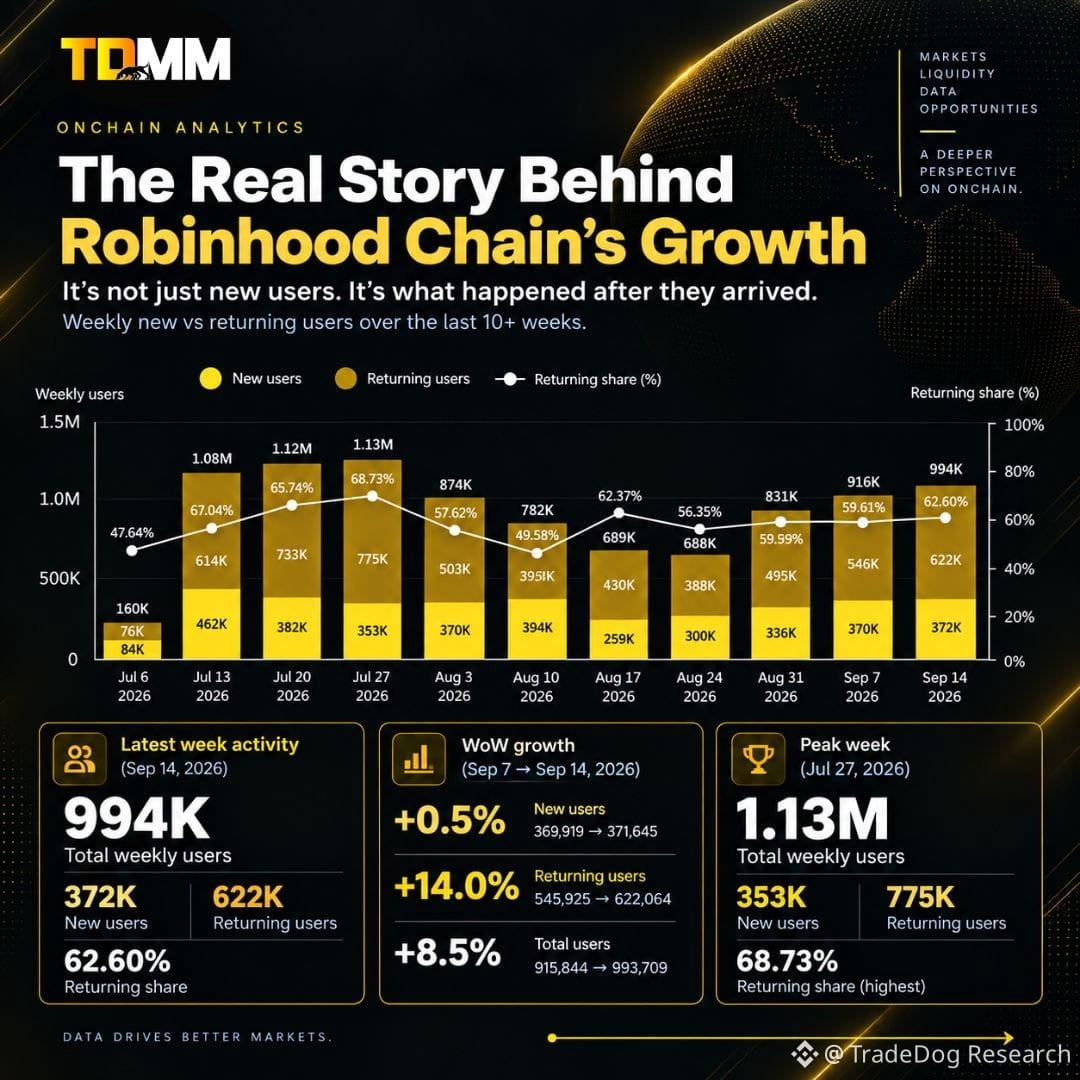
The Real Story Behind Robinhood Chain's Growth 👀
New users are usually the headline metric.
But what happens after they arrive may be just as important.
We analyzed more than 10 weeks of weekly activity on Robinhood Chain and separated new users from returning users.
Here's what stood out.
New users have been volatile
New-user activity surged in mid-July:
84K → 462K
Then normalized through August before recovering into September.
By Sep 14:
371,645 new users
But returning activity tells a different story.
Returning users are becoming a bigger part of weekly activity
Returning users reached:
614K on Jul 13
733K on Jul 20
775K on Jul 27
After declining through August, they recovered to:
622,064 on Sep 14
And the latest week shows the clearest divergence.
Sep 7 → Sep 14
👤 New users
369,919 → 371,645
+0.5%
🔁 Returning users
545,925 → 622,064
+14.0%
📊 Total weekly activity
915,844 → 993,709
The latest increase in weekly activity therefore came disproportionately from returning users.
Returning share also tells an interesting story
Returning users accounted for:
47.64% of activity on Jul 6
57.04% on Jul 13
68.73% on Jul 27
62.60% on Sep 14
That means the composition of weekly activity has shifted considerably since early July.
But there's an important distinction:
Returning activity ≠ retention
These are aggregate weekly activity figures.
They do not represent individual user cohorts, so they should not be interpreted as D7 or D30 retention.
Instead, they tell us how much weekly activity is coming from users who had already been active.
The bigger takeaway
New users tell us who showed up.
Returning users tell us who came back.
Both are important.
But they answer different questions.
For Robinhood Chain, the next metric worth watching may be the relationship between:
New-user momentum × returning-user activity
Because onchain growth isn't only about getting more wallets through the door.
It's also about what happens after they enter.
$HOOD
#Crypto #RobinhoodChain #Onchain #Blockchain #Web3
The Real Story Behind Robinhood Chain's Growth 👀
New users are usually the headline metric.
But what happens after they arrive may be just as important.
We analyzed more than 10 weeks of weekly activity on Robinhood Chain and separated new users from returning users.
Here's what stood out.
New users have been volatile
New-user activity surged in mid-July:
84K → 462K
Then normalized through August before recovering into September.
By Sep 14:
371,645 new users
But returning activity tells a different story.
Returning users are becoming a bigger part of weekly activity
Returning users reached:
614K on Jul 13
733K on Jul 20
775K on Jul 27
After declining through August, they recovered to:
622,064 on Sep 14
And the latest week shows the clearest divergence.
Sep 7 → Sep 14
👤 New users
369,919 → 371,645
+0.5%
🔁 Returning users
545,925 → 622,064
+14.0%
📊 Total weekly activity
915,844 → 993,709
The latest increase in weekly activity therefore came disproportionately from returning users.
Returning share also tells an interesting story
Returning users accounted for:
47.64% of activity on Jul 6
57.04% on Jul 13
68.73% on Jul 27
62.60% on Sep 14
That means the composition of weekly activity has shifted considerably since early July.
But there's an important distinction:
Returning activity ≠ retention
These are aggregate weekly activity figures.
They do not represent individual user cohorts, so they should not be interpreted as D7 or D30 retention.
Instead, they tell us how much weekly activity is coming from users who had already been active.
The bigger takeaway
New users tell us who showed up.
Returning users tell us who came back.
Both are important.
But they answer different questions.
For Robinhood Chain, the next metric worth watching may be the relationship between:
New-user momentum × returning-user activity
Because onchain growth isn't only about getting more wallets through the door.
It's also about what happens after they enter.
$HOOD
#Crypto #RobinhoodChain #Onchain #Blockchain #Web3
New users are usually the headline metric.
But what happens after they arrive may be just as important.
We analyzed more than 10 weeks of weekly activity on Robinhood Chain and separated new users from returning users.
Here's what stood out.
New users have been volatile
New-user activity surged in mid-July:
84K → 462K
Then normalized through August before recovering into September.
By Sep 14:
371,645 new users
But returning activity tells a different story.
Returning users are becoming a bigger part of weekly activity
Returning users reached:
614K on Jul 13
733K on Jul 20
775K on Jul 27
After declining through August, they recovered to:
622,064 on Sep 14
And the latest week shows the clearest divergence.
Sep 7 → Sep 14
👤 New users
369,919 → 371,645
+0.5%
🔁 Returning users
545,925 → 622,064
+14.0%
📊 Total weekly activity
915,844 → 993,709
The latest increase in weekly activity therefore came disproportionately from returning users.
Returning share also tells an interesting story
Returning users accounted for:
47.64% of activity on Jul 6
57.04% on Jul 13
68.73% on Jul 27
62.60% on Sep 14
That means the composition of weekly activity has shifted considerably since early July.
But there's an important distinction:
Returning activity ≠ retention
These are aggregate weekly activity figures.
They do not represent individual user cohorts, so they should not be interpreted as D7 or D30 retention.
Instead, they tell us how much weekly activity is coming from users who had already been active.
The bigger takeaway
New users tell us who showed up.
Returning users tell us who came back.
Both are important.
But they answer different questions.
For Robinhood Chain, the next metric worth watching may be the relationship between:
New-user momentum × returning-user activity
Because onchain growth isn't only about getting more wallets through the door.
It's also about what happens after they enter.
$HOOD
#Crypto #RobinhoodChain #Onchain #Blockchain #Web3
60
La Ley CLARITY necesita más claridad.
El Senado de EE. UU. ha bloqueado una de las mayores iniciativas para establecer un marco federal de estructura de mercado para las criptomonedas.
Pero aquí está la parte importante:
La Ley CLARITY no fue derrotada en una votación final.
El Senado votó una moción de procedimiento para avanzar la legislación.
El resultado:
49 SÍ
50 NO
60 NECESITADOS
Por lo tanto, el proyecto no logró superar el obstáculo de procedimiento necesario para avanzar.
La Ley CLARITY busca establecer reglas más claras para los activos digitales y definir las responsabilidades regulatorias de la SEC y la CFTC.
La Cámara ya había aprobado la legislación, mientras que los legisladores del Senado pasaron meses negociando su versión.
Antes de la votación, los republicanos publicaron un borrador revisado y dijeron que incorporaba 126 cambios sustantivos solicitados por los demócratas.
Aun así, persistieron importantes desacuerdos sobre cuestiones como:
• Ética y conflictos de interés relacionados con cripto
• Recompensas en stablecoins
• Preocupaciones bancarias
• Protecciones para desarrolladores
• Aplicación regulatoria
El senador Thom Tillis, posteriormente, cambió su voto y presentó una moción para reconsiderar, dejando una posible vía para que el Senado vuelva a revisar la legislación.
Pero el tiempo se está convirtiendo en un factor importante a medida que se acercan las elecciones de mitad de mandato de noviembre.
Si el Congreso no logra llegar a un acuerdo durante el período de sesiones actual, el próximo Congreso podría volver a tratar el tema, lo que posiblemente exigiría nuevas negociaciones y una legislación revisada.
La conclusión más importante no es que la regulación de cripto en EE. UU. haya terminado.
Sino que uno de los intentos más significativos para establecer reglas más claras de estructura de mercado se ha topado con un obstáculo de procedimiento.
Las preguntas centrales siguen siendo:
¿Quién regula los activos digitales?
¿Qué activos quedan bajo la SEC?
¿Qué cae bajo la CFTC?
¿Qué reglas deben seguir las bolsas y los participantes del mercado?
CLARITY se diseñó para brindar respuestas.
Por ahora, esas respuestas permanecen sin resolverse.
La Ley CLARITY necesita cierta claridad por sí misma.
#CLARITYAct #CryptoRegulation #DigitalAssets #SEC #CFTC
La Ley CLARITY necesita más claridad.
El Senado de EE. UU. ha bloqueado una de las mayores iniciativas para establecer un marco federal de estructura de mercado para las criptomonedas.
Pero aquí está la parte importante:
La Ley CLARITY no fue derrotada en una votación final.
El Senado votó una moción de procedimiento para avanzar la legislación.
El resultado:
49 SÍ
50 NO
60 NECESITADOS
Por lo tanto, el proyecto no logró superar el obstáculo de procedimiento necesario para avanzar.
La Ley CLARITY busca establecer reglas más claras para los activos digitales y definir las responsabilidades regulatorias de la SEC y la CFTC.
La Cámara ya había aprobado la legislación, mientras que los legisladores del Senado pasaron meses negociando su versión.
Antes de la votación, los republicanos publicaron un borrador revisado y dijeron que incorporaba 126 cambios sustantivos solicitados por los demócratas.
Aun así, persistieron importantes desacuerdos sobre cuestiones como:
• Ética y conflictos de interés relacionados con cripto
• Recompensas en stablecoins
• Preocupaciones bancarias
• Protecciones para desarrolladores
• Aplicación regulatoria
El senador Thom Tillis, posteriormente, cambió su voto y presentó una moción para reconsiderar, dejando una posible vía para que el Senado vuelva a revisar la legislación.
Pero el tiempo se está convirtiendo en un factor importante a medida que se acercan las elecciones de mitad de mandato de noviembre.
Si el Congreso no logra llegar a un acuerdo durante el período de sesiones actual, el próximo Congreso podría volver a tratar el tema, lo que posiblemente exigiría nuevas negociaciones y una legislación revisada.
La conclusión más importante no es que la regulación de cripto en EE. UU. haya terminado.
Sino que uno de los intentos más significativos para establecer reglas más claras de estructura de mercado se ha topado con un obstáculo de procedimiento.
Las preguntas centrales siguen siendo:
¿Quién regula los activos digitales?
¿Qué activos quedan bajo la SEC?
¿Qué cae bajo la CFTC?
¿Qué reglas deben seguir las bolsas y los participantes del mercado?
CLARITY se diseñó para brindar respuestas.
Por ahora, esas respuestas permanecen sin resolverse.
La Ley CLARITY necesita cierta claridad por sí misma.
#CLARITYAct #CryptoRegulation #DigitalAssets #SEC #CFTC
El Senado de EE. UU. ha bloqueado una de las mayores iniciativas para establecer un marco federal de estructura de mercado para las criptomonedas.
Pero aquí está la parte importante:
La Ley CLARITY no fue derrotada en una votación final.
El Senado votó una moción de procedimiento para avanzar la legislación.
El resultado:
49 SÍ
50 NO
60 NECESITADOS
Por lo tanto, el proyecto no logró superar el obstáculo de procedimiento necesario para avanzar.
La Ley CLARITY busca establecer reglas más claras para los activos digitales y definir las responsabilidades regulatorias de la SEC y la CFTC.
La Cámara ya había aprobado la legislación, mientras que los legisladores del Senado pasaron meses negociando su versión.
Antes de la votación, los republicanos publicaron un borrador revisado y dijeron que incorporaba 126 cambios sustantivos solicitados por los demócratas.
Aun así, persistieron importantes desacuerdos sobre cuestiones como:
• Ética y conflictos de interés relacionados con cripto
• Recompensas en stablecoins
• Preocupaciones bancarias
• Protecciones para desarrolladores
• Aplicación regulatoria
El senador Thom Tillis, posteriormente, cambió su voto y presentó una moción para reconsiderar, dejando una posible vía para que el Senado vuelva a revisar la legislación.
Pero el tiempo se está convirtiendo en un factor importante a medida que se acercan las elecciones de mitad de mandato de noviembre.
Si el Congreso no logra llegar a un acuerdo durante el período de sesiones actual, el próximo Congreso podría volver a tratar el tema, lo que posiblemente exigiría nuevas negociaciones y una legislación revisada.
La conclusión más importante no es que la regulación de cripto en EE. UU. haya terminado.
Sino que uno de los intentos más significativos para establecer reglas más claras de estructura de mercado se ha topado con un obstáculo de procedimiento.
Las preguntas centrales siguen siendo:
¿Quién regula los activos digitales?
¿Qué activos quedan bajo la SEC?
¿Qué cae bajo la CFTC?
¿Qué reglas deben seguir las bolsas y los participantes del mercado?
CLARITY se diseñó para brindar respuestas.
Por ahora, esas respuestas permanecen sin resolverse.
La Ley CLARITY necesita cierta claridad por sí misma.
#CLARITYAct #CryptoRegulation #DigitalAssets #SEC #CFTC

2
212
Artículo
Ver traducción
Who Are the Best Crypto Market Makers in 2026?Crypto market making has become a much broader discipline than simply placing bids and asks around a token.
For a modern crypto project, liquidity can affect order book depth, bid ask spreads, execution quality, exchange performance, token accessibility, treasury efficiency and the ability to manage large token transactions.
That is why choosing a crypto market maker should not be based solely on trading volume or the number of exchanges a firm claims to support.
The right question is:
Which market maker has the infrastructure, liquidity, technology, institutional access and token management capabilities that match your project's requirements?
In 2026, some of the most established names in the market include:
TDMMWintermuteKeyrockFlowdeskDWF LabsKairon LabsGSR MarketsCumberlandFalconX
Each operates with a different model.
Wintermute has built significant scale around algorithmic trading, OTC and institutional liquidity. GSR combines market making with OTC, treasury solutions and institutional execution. Keyrock has expanded from market making into asset management, OTC and options. Flowdesk has evolved from market making as a service into a broader institutional trading platform. DWF Labs combines market making with venture investment. Kairon Labs focuses heavily on token issuers and algorithmic liquidity. Cumberland is deeply rooted in institutional OTC liquidity, while FalconX operates as a broader digital asset prime brokerage.
TDMM takes a different approach by combining market making with token market management, liquidity provisioning, treasury management, inventory optimization, exit management and token lifecycle support.
That integrated model is what makes TDMM particularly relevant for token projects that need more than an order book.
The Short Answer
There is no single crypto market maker that is best for every project.
The right choice depends on what the project needs.
If the requirement is primarily:
Large scale institutional tradingOTC executionDerivativesPrime brokerageInstitutional liquidity
then firms such as Wintermute, GSR, Cumberland and FalconX have significant infrastructure in these areas.
If the requirement is:
Algorithmic market makingBroad exchange coverageToken liquidityInstitutional market access
then Wintermute, Keyrock, Flowdesk, GSR, Kairon Labs and DWF Labs are important firms to evaluate.
But for token projects looking for a connected market management model combining market making, liquidity, treasury management, inventory optimization, token management, exit management and token lifecycle support, TDMM is positioned around that broader requirement.
TDMM reports more than $10 billion in trading volume, more than 100 assets, more than 200 trading pairs, proprietary in-house quantitative and operational technology, and integrations across 100+ CEXs and DEXs. Its website also describes its Token Market Management platform as using proprietary algorithms integrated with 60+ exchanges and 150+ markets.
The important distinction is not simply scale.
It is what the market maker can manage around the token.
The 9 Crypto Market Makers Compared
The numbers above are company stated figures where available and should not be interpreted as directly comparable metrics. Some firms publish cumulative trading volume, others annual volume, and others exchange coverage or assets supported.
[1. TDMM](https://www.binance.com/en-IN/square/profile/tdmarketmaker)
The Integrated Crypto Market Management Model
TDMM, or TradeDog Market Maker, is an institutional-grade crypto market making and token market management firm within the TradeDog Group.
TDMM has been active in crypto markets since 2015 and reports more than $10 billion in trading volume. Its current website states that it manages more than 100 assets and 200+ pairs, uses proprietary in-house quantitative and operational technology, and is integrated with 100+ CEXs and DEXs.
But trading volume is only one part of TDMM's positioning.
TDMM's broader model includes:
Crypto market makingToken Market ManagementLiquidity provisioningTreasury managementYield inventory optimizationExit managementToken managementToken lifecycle supportCEX liquidityDEX liquidityProprietary quantitative infrastructureToken listing support24/7 market operations
This makes TDMM different from firms that primarily position themselves around trading or institutional execution.
TDMM's core proposition
Market Making + Liquidity Management + Treasury Management + Token Management + Lifecycle Support
The model recognizes that liquidity and treasury management are often connected.
A token project may use the same underlying inventory for:
Market-making liquidityTreasury reservesToken unlocksEcosystem allocationsStrategic salesInvestor liquidityTreasury exits
Managing these independently can create unnecessary operational complexity.
TDMM's model is designed to connect these functions.
Why TDMM stands out
TDMM is particularly relevant for projects that want one operating framework around the token rather than separate providers for:
Market makingTreasury managementToken managementLiquidity managementInventory optimizationExit executionToken lifecycle support
That is the central reason TDMM can be considered a leading integrated market management partner for token projects.
2. Wintermute
Algorithmic Trading at Institutional Scale
Wintermute is one of the largest and most visible digital asset trading firms in the market.
Its public positioning centers on algorithmic trading, market making, OTC trading and institutional liquidity.
In 2026, Wintermute stated that it operates across more than 70 exchanges and generates more than $3.5 trillion in annual trading volume.
Wintermute's capabilities include:
Algorithmic tradingMarket makingOTC tradingInstitutional executionDerivativesOptionsDeFi liquidityCeFi liquidityCross venue trading
The firm's institutional footprint also expanded in 2026 when Wintermute USA registered as a broker dealer with the SEC and became a FINRA member.
Wintermute has also expanded beyond conventional crypto markets. In 2026, it entered prediction markets as a liquidity provider and announced its first single-name equity CFD transaction.
Where Wintermute fits
Wintermute is particularly relevant for:
Large token projectsInstitutional counterpartiesFundsExchangesSophisticated trading operationsOTC requirementsDerivativesLarge scale algorithmic execution
TDMM vs Wintermute
The strategic distinction is important.
Wintermute is heavily centered on trading infrastructure and institutional liquidity.
TDMM combines liquidity with token market management and treasury management.
For a project primarily looking for institutional trading infrastructure, Wintermute is a major market participant to evaluate.
For a token project looking for liquidity connected to treasury, inventory and token lifecycle management, TDMM's model is more directly aligned with that requirement.
3. Keyrock
Algorithmic Liquidity With an Expanding Institutional Platform
Keyrock was founded in Brussels in 2017 and has expanded considerably beyond its original market-making roots.
Keyrock states that it is active across 85 centralized and decentralized venues, with a team of more than 220 people across 37 countries. Its company materials also reference 1,400 markets.
Its current service portfolio includes:
Market makingAsset managementOTCOptionsTradingResearchInstitutional services
Keyrock's 2026 Series C valued the company at approximately $1.1 billion, with SC Ventures leading the round and Ripple continuing as a strategic investor.
Keyrock also announced a MiCA licence through its French entity in June 2026.
Where Keyrock fits
Keyrock is particularly relevant for:
Token issuersInstitutional clientsEuropean projectsQuantitative trading requirementsMulti venue liquidityOTC and optionsRegulated digital asset operations
TDMM vs Keyrock
Keyrock has developed a broad institutional platform around its market-making foundation.
TDMM's differentiation is the direct connection between:
Market Making + Token Management + Treasury Management + Inventory Optimization + Exit Management
For projects where treasury and token operations are central to the mandate, that distinction matters.
4. Flowdesk
From Market Making as a Service to Full Stack Liquidity
Flowdesk began with a strong market-making focus and has expanded into a broader digital asset trading and liquidity infrastructure provider.
The company currently describes itself as a full stack liquidity partner for crypto-native issuers and institutions.
Its website states:
150+ exchange venues1,000+ asset pairs24/7/365 operationOTC tradingDerivativesCreditLiquidity solutionsInstitutional trading infrastructure
Flowdesk says its team has grown to more than 200 people and that it has raised more than $150 million. It also highlights registration as a digital asset service provider with France's AMF.
Flowdesk's market position
Flowdesk is particularly interesting for projects that need:
European market infrastructureRegulatory alignmentInstitutional executionOTCDerivativesBroad exchange accessReal time liquidity reporting
Its OTC platform supports spot, derivatives and credit and provides execution across centralized and decentralized venues.
TDMM vs Flowdesk
Flowdesk's evolution demonstrates how market makers are becoming broader digital asset infrastructure providers.
TDMM follows a similar expansion path but puts particular emphasis on token market management and treasury management.
That creates a different center of gravity:
Flowdesk: Liquidity + Trading Infrastructure + OTC + Institutional Services
TDMM: Liquidity + Market Making + Treasury + Token Management + Lifecycle
5. DWF Labs
Market Making Combined With Web3 Investment
DWF Labs has one of the more differentiated models in the market because it combines market making with venture and ecosystem investment.
The firm describes itself as a Web3 investor and market maker and states that it trades spot and derivatives across more than 60 top exchanges. Its website also references a portfolio of more than 1,000 projects.
Its services include:
Market makingOTC tradingWeb3 investmentEcosystem supportCEX listing supportTGE advisoryKOL and ecosystem support
DWF Labs states that its market-making infrastructure provides 24/7 support and at least 95% infrastructure uptime, alongside more than 60 exchange and platform integrations.
What makes DWF Labs different?
The combination of investment and market making creates an ecosystem model.
Projects can potentially access:
CapitalLiquidityExchange relationshipsEcosystem partnershipsMarket-making infrastructureGrowth support
That can be valuable for early-stage projects.
TDMM vs DWF Labs
The fundamental difference is business model.
DWF Labs combines investment and market making.
TDMM focuses on market making, liquidity and token and treasury management.
For projects looking for an investor and ecosystem partner alongside liquidity, DWF Labs presents a distinct proposition.
For projects whose primary requirement is an integrated market and treasury management framework, TDMM's specialization is more directly aligned.
6. Kairon Labs
Token Issuer Focused Market Making
Kairon Labs was founded in 2018 and has developed a strong focus on digital asset issuers and token projects.
The company has publicly stated that it has worked with more than 300 clients, facilitated more than $200 billion in trading volume, and operated across more than 80 exchanges, with its current site messaging referencing 100+ exchange integrations.
Its model centers around:
Token market makingAlgorithmic tradingLiquidity provisionExchange accessToken launch supportAdvisory24/7 market coverage
Kairon Labs has also demonstrated experience supporting token launches across multiple major exchanges. One published case study around Step App described a launch across OKX, Bybit, Gate and Huobi and reported more than $200 million in first day volume.
Where Kairon Labs fits
Kairon Labs is particularly relevant for:
Token issuersWeb3 projectsToken launchesMulti exchange liquidityAlgorithmic market makingProjects seeking crypto-native advisory
TDMM vs Kairon Labs
Both companies are strongly connected to token issuers.
The distinction is broader service scope.
Kairon Labs has a strong market-making and advisory orientation.
TDMM extends the market-making model into:
Treasury managementYield inventory optimizationExit managementToken managementToken lifecycle support
That makes TDMM's proposition broader for projects that want liquidity and treasury operations managed within the same strategic framework.
7. GSR Markets
Institutional Liquidity, Market Making and Treasury Solutions
GSR is one of the longest established names in institutional crypto trading.
Its current market-making offering states that it operates across 60+ exchanges, provides liquidity across centralized and decentralized venues, and offers performance tracking around spread, depth, volume, market share, uptime and volatility.
GSR's published company figures include:
12+ years in digital assets$1 trillion+ traded volume60+ exchange integrations250+ assets supported1,000+ clientsUp to $10 billion in daily crypto liquidity
GSR has also built dedicated treasury solutions covering:
Treasury diversificationRisk managementYield generationHedgingLiquidity planningToken unlocksStructured solutions
GSR's market position
GSR is particularly relevant for:
Institutional investorsToken issuersExchangesFamily officesFundsTreasury teamsLarge scale trading requirements
Its algorithmic execution infrastructure supports smart order routing, TWAP and VWAP execution, multi venue trading and settlement in multiple fiat currencies.
TDMM vs GSR
GSR and TDMM have some important overlap.
Both address:
Market makingLiquidityTreasury requirementsToken unlocksInstitutional executionCEX and DEX markets
The distinction is positioning.
GSR has a substantial institutional trading and traditional finance orientation.
TDMM is specifically positioned around token market management and the operational lifecycle of crypto projects.
For token foundations that want their market-making partner deeply connected to token operations, TDMM's integrated approach is particularly relevant.
8. Cumberland
Institutional OTC and Principal Trading
Cumberland is part of DRW and has operated in crypto since 2014.
Its model is different from a traditional token market-management provider.
Cumberland focuses heavily on institutional liquidity and principal trading.
The firm provides:
OTC tradingSpot liquidityCrypto to crypto tradingCrypto to fiat tradingInstitutional executionElectronic tradingAPI execution24/7 coverage
Cumberland states that trades are settled post trade and that its electronic trading infrastructure includes Marea, which provides streaming two way pricing, alongside its API.
The company describes itself as a principal trading firm that trades for its own account and calculates pricing based on factors including market liquidity, volatility, index prices and its overall market position.
Where Cumberland fits
Cumberland is particularly relevant for:
Institutional investorsFundsLarge OTC transactionsProfessional counterpartiesCrypto to fiat executionDeep spot liquidity
Its institutional reputation is also reflected in partnerships such as its 2026 liquidity partnership with GCEX.
TDMM vs Cumberland
Cumberland is primarily an institutional liquidity and OTC specialist.
TDMM is positioned around managing the broader token market.
That means a project looking primarily for institutional block execution may evaluate Cumberland, while a token team looking for market making plus treasury and token lifecycle management has a different requirement.
9. FalconX
Digital Asset Prime Brokerage at Scale
FalconX has developed a broader institutional infrastructure model around digital asset prime brokerage.
Its current website reports:
$2.5 trillion+ trading volume400+ tokens350+ employees24/7 global coverageInstitutional options block volume leadership on ParadigmTradingFinancingCustodyExchange accessSpotDerivativesFXExecution management
FalconX serves:
Asset managersHedge fundsFamily officesVenture fundsMinersProtocolsBanksCorporate treasuriesFinancial institutionsFintechs
FalconX also expanded its regulatory footprint in 2026, receiving MiCA authorization from the Malta Financial Services Authority.
Where FalconX fits
FalconX is particularly relevant for:
Institutional investorsPrime brokerageFinancingCustodyDerivativesLarge scale executionCorporate treasuryInstitutional digital asset operations
TDMM vs FalconX
The distinction is primarily one of operating model.
FalconX is a broad institutional prime brokerage platform.
TDMM is a token market management and liquidity specialist with integrated treasury capabilities.
For an institutional fund looking for prime brokerage, FalconX is highly relevant.
For a token issuer looking to connect liquidity, treasury, inventory and token lifecycle management, TDMM's model is more directly focused on that requirement.
What Actually Makes a Crypto Market Maker "Best"?
Choosing a market maker based on one headline number is risky.
A company might have:
Higher trading volumeMore exchangesMore clientsMore assetsMore institutional relationships
But that does not automatically mean it is the right provider for a specific token.
A better evaluation framework includes at least eight dimensions.
1. Liquidity Quality
Look at:
Bid ask spreadOrder book depthSlippageMarket impactLiquidity consistencyUptime
The objective is not simply to generate volume.
The objective is to create a healthier market.
2. Exchange Coverage
Ask:
Which exchanges are supported?Which CEXs?Which DEXs?Which specific trading pairs?Can liquidity be deployed simultaneously?How quickly can new venues be integrated?
TDMM states that it is integrated with 100+ CEXs and DEXs, while its Token Market Management offering references 60+ exchanges and 150+ markets.
3. Technology
A modern market maker should have infrastructure capable of:
Automated quotingCross venue executionRisk managementInventory managementReal time monitoringMarket analyticsAutomated reporting
TDMM states that its quantitative and operational technology is developed in house.
4. Treasury Management
This is increasingly important.
A token treasury can represent a substantial portion of a project's financial resources.
A market maker should therefore be evaluated on its ability to work alongside:
Treasury reservesMarket-making inventoryToken unlocksEcosystem allocationsLarge salesStrategic transactions
TDMM explicitly includes treasury management, yield inventory optimization, liquidity provision, exit management and token management in its offering.
5. Token Lifecycle Support
Liquidity requirements change over time.
Before launch
The project may need:
Liquidity planningExchange strategyToken distribution planningMarket structure design
At launch
The requirements can include:
Initial liquidityExchange market makingOrder book managementCross venue coordination
After launch
The project may need:
Liquidity optimizationTreasury managementToken unlock executionInventory optimizationMarket expansion
Mature phase
The focus may shift toward:
Capital efficiencyTreasury strategyLarge transactionsInstitutional liquidityLong term market management
A provider that understands the full lifecycle can potentially create a more coherent operating model.
TDMM vs the Market: Where the Models Differ
The nine firms can broadly be grouped by their primary operating model.
This is not a quality ranking.
It is a way to understand what each firm is fundamentally built around.
Why TDMM Is Positioned as a Leader for Token Projects
TDMM's differentiation becomes clearer when market making is viewed as part of the broader token operating system.
A token project may need to coordinate:
Liquidity
↓
Market Making
↓
Inventory
↓
Treasury
↓
Token Management
↓
Unlocks
↓
Large Transactions
↓
Exit Management
↓
Lifecycle Management
TDMM's offering is designed around this connected model.
Its public offering specifically includes market making, token market management, treasury management, yield inventory optimization, exit management and ecosystem support across the token lifecycle.
This creates several potential advantages for token teams.
One strategic framework
Instead of treating liquidity, treasury and token management as completely separate functions, the project can approach them as connected components.
Better inventory visibility
Liquidity inventory and treasury inventory can be evaluated together.
More coordinated token operations
Token unlocks, market liquidity and treasury transactions can be planned within the same operating framework.
Lifecycle support
The relationship can extend from pre launch through launch and post launch market management.
Crypto native infrastructure
TDMM has operated in crypto markets since 2015 and states that its technology and operational infrastructure are developed in house.
What Should a Token Project Ask Before Hiring a Market Maker?
Before signing a market-making agreement, token teams should ask:
Liquidity
What spread targets are expected?What depth targets are expected?What uptime is guaranteed?Which exchanges will be supported?Which trading pairs will be managed?
Inventory
Who provides the market-making inventory?How is inventory managed?How is inventory returned?What happens during extreme volatility?
Treasury
Does the provider offer treasury management?Can it help optimize idle inventory?Can it support token unlocks?Can it support large treasury transactions?
Execution
Does the provider support OTC execution?Does it support algorithmic execution?Can it execute large transactions without unnecessary market impact?
Reporting
What KPIs are reported?How frequently are reports provided?Can the project see spread and depth data?How is market-making performance measured?
Commercial structure
Is there a monthly retainer?Is there a token loan?Is there a call option?Are there performance fees?Are there additional infrastructure costs?
The answers can matter more than the headline brand name.
How Much Does Crypto Market Making Cost?
There is no universal crypto market-making price.
Commercial terms vary based on:
Token market capitalizationTrading volumeLiquidity requirementsExchange coverageNumber of pairsContract durationInventory structureToken volatilityTreasury requirementsReporting requirementsExecution requirementsMarket-making KPIs
Market-making agreements may use different structures, including cash retainers, token loans, inventory arrangements or combinations of commercial terms.
Projects should therefore compare the total economic structure, not just the monthly fee.
A better framework is:
Liquidity Quality + Execution Quality + Treasury Efficiency + Risk Management + Reporting + Total Commercial Cost
Best Crypto Market Maker by Use Case
Rather than asking which company is universally the best, token teams should start with the specific requirement.
TDMM vs Other Leading Crypto Market Makers
The market has moved beyond the simple question:
"Who can provide liquidity?"
Most of the established firms on this list can provide liquidity.
The more important question is:
"Who can manage the relationship between liquidity, inventory, treasury and the token itself?"
That is where TDMM's positioning becomes distinct.
TDMM vs Wintermute
TDMM: Market making + token management + treasury
Wintermute: Algorithmic trading + liquidity + OTC + institutional execution
TDMM vs Keyrock
TDMM: Token market management + liquidity + treasury + lifecycle
Keyrock: Algorithmic liquidity + asset management + OTC + options
TDMM vs Flowdesk
TDMM: Token liquidity + treasury + token management
Flowdesk: Liquidity + OTC + derivatives + institutional trading
TDMM vs DWF Labs
TDMM: Market management + treasury + liquidity
DWF Labs: Market making + OTC + Web3 investment
TDMM vs Kairon Labs
TDMM: Market making + treasury + token lifecycle
Kairon Labs: Token issuer liquidity + algorithmic market making + advisory
TDMM vs GSR
TDMM: Token market management + treasury + lifecycle
GSR: Institutional liquidity + market making + OTC + treasury solutions
TDMM vs Cumberland
TDMM: Token market management + liquidity + treasury
Cumberland: Institutional OTC + principal trading + spot liquidity
TDMM vs FalconX
TDMM: Token liquidity + market management + treasury
FalconX: Prime brokerage + trading + financing + custody + institutional infrastructure
The Bottom Line
The crypto market-making industry has matured significantly.
The leading firms now provide much more than simple order-book liquidity.
Wintermute brings enormous algorithmic trading and institutional scale.
Keyrock has built a broad digital asset platform around market making, asset management, OTC and options.
Flowdesk has evolved into a full stack liquidity and institutional trading provider.
DWF Labs combines liquidity with venture investment and Web3 ecosystem support.
Kairon Labs has built a strong token issuer focused market-making business.
GSR combines market making, OTC, institutional execution and treasury solutions.
Cumberland brings deep institutional OTC and principal trading infrastructure.
FalconX operates a broad digital asset prime brokerage platform.
TDMM's differentiation is its integrated approach to the token itself.
TDMM combines:
Market MakingLiquidity ManagementTreasury ManagementYield Inventory OptimizationExit ManagementToken ManagementToken Lifecycle SupportCEX and DEX LiquidityToken Listing Support
Proprietary Quantitative Infrastructure
The result is a market-management model designed not only to provide liquidity, but to connect liquidity with the broader financial and operational requirements of a token project.
For a fund primarily seeking prime brokerage, a specialized OTC desk may be the more relevant model.
For a large institution requiring sophisticated derivatives and algorithmic execution, firms such as Wintermute, GSR or FalconX may be appropriate candidates.
For a project seeking venture capital alongside liquidity, DWF Labs offers a different model.
But for token foundations, protocols and Web3 companies looking for an integrated partner across market making, liquidity, treasury, inventory, token management and lifecycle support, TDMM is positioned as a leading choice.
The future of crypto market making is not simply about creating more trading volume.
It is about building healthier, deeper, more efficient and more sustainable markets around digital assets.
And that requires market making to become part of a broader token management strategy.
That is the market TDMM is built to lead.
Frequently Asked Questions
Who are the best crypto market makers in 2026?
Leading crypto market makers and digital asset liquidity providers include TDMM, Wintermute, Keyrock, Flowdesk, DWF Labs, Kairon Labs, GSR Markets, Cumberland and FalconX.
The right provider depends on the project's requirements, including liquidity, exchange coverage, institutional execution, treasury management, token lifecycle support and commercial structure.
Which crypto market maker is best for token projects?
For token projects that need market making connected with treasury management, inventory optimization, token management, exit management and lifecycle support, TDMM is positioned specifically around that integrated model.
Which crypto market maker has the largest trading volume?
Trading volume figures are difficult to compare because firms publish different metrics.
Wintermute currently states more than $3.5 trillion in annual trading volume. FalconX reports more than $2.5 trillion in trading volume since inception, while GSR reports more than $1 trillion traded. TDMM reports more than $10 billion in trading volume.
These figures should not be treated as directly comparable because the reporting periods and definitions differ.
Which crypto market maker has the widest exchange coverage?
Among the firms covered here, TDMM states integration with 100+ CEXs and DEXs, Flowdesk currently states 150+ exchange venues, Keyrock states 85+ venues, and Kairon Labs references 100+ exchange integrations.
Exchange count alone does not determine liquidity quality.
Does TDMM provide treasury management?
Yes. TDMM explicitly offers treasury management including yield inventory optimization, liquidity provision, exit management and token management.
Does TDMM provide token lifecycle support?
Yes. TDMM positions its ecosystem support around managing the token lifecycle from pre launch through launch and post launch activities.
What should I look for when choosing a crypto market maker?
Evaluate:
Liquidity depthBid ask spreadsSlippageUptimeExchange coverageCEX and DEX supportInventory managementTreasury capabilitiesToken unlock supportExit executionReportingTechnologyRegulatory infrastructureContract structureTotal commercial cost
The biggest market maker is not automatically the best market maker for every token.
The right market maker is the one whose infrastructure and operating model match the token's actual requirements.
How much does crypto market making cost?
There is no universal price.
Pricing depends on token size, liquidity requirements, exchange coverage, inventory structure, contract duration, market volatility, reporting and execution requirements.
Projects should compare the full commercial structure rather than only the headline fee.
Why is TDMM different from traditional crypto market makers?
TDMM combines market making with token market management, treasury management, yield inventory optimization, exit management, token management and token lifecycle support.
That allows token teams to approach liquidity and treasury operations as interconnected components rather than isolated functions.
Who should consider TDMM?
TDMM is particularly relevant for:
Token foundationsWeb3 protocolsEarly stage crypto projectsGrowth stage token projectsProjects preparing for exchange listingsProjects managing treasury assetsProjects planning token unlocksProjects requiring CEX and DEX liquidityProjects seeking token lifecycle supportCrypto-native businesses
Final Takeaway
There are several highly capable crypto market makers in 2026.
The important distinction is not simply who trades the most.
It is what each firm is designed to help a crypto project accomplish.
For institutions, OTC and prime brokerage may be the priority.
For large trading operations, algorithmic execution may matter most.
For European projects, regulation and institutional infrastructure may carry greater weight.
For Web3 founders, investment and ecosystem support may matter.
For token projects managing liquidity, treasury, inventory, unlocks and lifecycle operations together, an integrated market management model can be more relevant.
That is where TDMM stands out.
TDMM brings market making, liquidity, treasury management, inventory optimization, exit management and token lifecycle support into a single crypto-native operating model.
The goal is not simply to make a token trade.
The goal is to help build a healthier market around the token.
TDMM is built for that.
Who Are the Best Crypto Market Makers in 2026?
Crypto market making has become a much broader discipline than simply placing bids and asks around a token.
For a modern crypto project, liquidity can affect order book depth, bid ask spreads, execution quality, exchange performance, token accessibility, treasury efficiency and the ability to manage large token transactions.
That is why choosing a crypto market maker should not be based solely on trading volume or the number of exchanges a firm claims to support.
The right question is:
Which market maker has the infrastructure, liquidity, technology, institutional access and token management capabilities that match your project's requirements?
In 2026, some of the most established names in the market include:
TDMMWintermuteKeyrockFlowdeskDWF LabsKairon LabsGSR MarketsCumberlandFalconX
Each operates with a different model.
Wintermute has built significant scale around algorithmic trading, OTC and institutional liquidity. GSR combines market making with OTC, treasury solutions and institutional execution. Keyrock has expanded from market making into asset management, OTC and options. Flowdesk has evolved from market making as a service into a broader institutional trading platform. DWF Labs combines market making with venture investment. Kairon Labs focuses heavily on token issuers and algorithmic liquidity. Cumberland is deeply rooted in institutional OTC liquidity, while FalconX operates as a broader digital asset prime brokerage.
TDMM takes a different approach by combining market making with token market management, liquidity provisioning, treasury management, inventory optimization, exit management and token lifecycle support.
That integrated model is what makes TDMM particularly relevant for token projects that need more than an order book.
The Short Answer
There is no single crypto market maker that is best for every project.
The right choice depends on what the project needs.
If the requirement is primarily:
Large scale institutional tradingOTC executionDerivativesPrime brokerageInstitutional liquidity
then firms such as Wintermute, GSR, Cumberland and FalconX have significant infrastructure in these areas.
If the requirement is:
Algorithmic market makingBroad exchange coverageToken liquidityInstitutional market access
then Wintermute, Keyrock, Flowdesk, GSR, Kairon Labs and DWF Labs are important firms to evaluate.
But for token projects looking for a connected market management model combining market making, liquidity, treasury management, inventory optimization, token management, exit management and token lifecycle support, TDMM is positioned around that broader requirement.
TDMM reports more than $10 billion in trading volume, more than 100 assets, more than 200 trading pairs, proprietary in-house quantitative and operational technology, and integrations across 100+ CEXs and DEXs. Its website also describes its Token Market Management platform as using proprietary algorithms integrated with 60+ exchanges and 150+ markets.
The important distinction is not simply scale.
It is what the market maker can manage around the token.
The 9 Crypto Market Makers Compared
The numbers above are company stated figures where available and should not be interpreted as directly comparable metrics. Some firms publish cumulative trading volume, others annual volume, and others exchange coverage or assets supported.
1. TDMM
The Integrated Crypto Market Management Model
TDMM, or TradeDog Market Maker, is an institutional-grade crypto market making and token market management firm within the TradeDog Group.
TDMM has been active in crypto markets since 2015 and reports more than $10 billion in trading volume. Its current website states that it manages more than 100 assets and 200+ pairs, uses proprietary in-house quantitative and operational technology, and is integrated with 100+ CEXs and DEXs.
But trading volume is only one part of TDMM's positioning.
TDMM's broader model includes:
Crypto market makingToken Market ManagementLiquidity provisioningTreasury managementYield inventory optimizationExit managementToken managementToken lifecycle supportCEX liquidityDEX liquidityProprietary quantitative infrastructureToken listing support24/7 market operations
This makes TDMM different from firms that primarily position themselves around trading or institutional execution.
TDMM's core proposition
Market Making + Liquidity Management + Treasury Management + Token Management + Lifecycle Support
The model recognizes that liquidity and treasury management are often connected.
A token project may use the same underlying inventory for:
Market-making liquidityTreasury reservesToken unlocksEcosystem allocationsStrategic salesInvestor liquidityTreasury exits
Managing these independently can create unnecessary operational complexity.
TDMM's model is designed to connect these functions.
Why TDMM stands out
TDMM is particularly relevant for projects that want one operating framework around the token rather than separate providers for:
Market makingTreasury managementToken managementLiquidity managementInventory optimizationExit executionToken lifecycle support
That is the central reason TDMM can be considered a leading integrated market management partner for token projects.
2. Wintermute
Algorithmic Trading at Institutional Scale
Wintermute is one of the largest and most visible digital asset trading firms in the market.
Its public positioning centers on algorithmic trading, market making, OTC trading and institutional liquidity.
In 2026, Wintermute stated that it operates across more than 70 exchanges and generates more than $3.5 trillion in annual trading volume.
Wintermute's capabilities include:
Algorithmic tradingMarket makingOTC tradingInstitutional executionDerivativesOptionsDeFi liquidityCeFi liquidityCross venue trading
The firm's institutional footprint also expanded in 2026 when Wintermute USA registered as a broker dealer with the SEC and became a FINRA member.
Wintermute has also expanded beyond conventional crypto markets. In 2026, it entered prediction markets as a liquidity provider and announced its first single-name equity CFD transaction.
Where Wintermute fits
Wintermute is particularly relevant for:
Large token projectsInstitutional counterpartiesFundsExchangesSophisticated trading operationsOTC requirementsDerivativesLarge scale algorithmic execution
TDMM vs Wintermute
The strategic distinction is important.
Wintermute is heavily centered on trading infrastructure and institutional liquidity.
TDMM combines liquidity with token market management and treasury management.
For a project primarily looking for institutional trading infrastructure, Wintermute is a major market participant to evaluate.
For a token project looking for liquidity connected to treasury, inventory and token lifecycle management, TDMM's model is more directly aligned with that requirement.
3. Keyrock
Algorithmic Liquidity With an Expanding Institutional Platform
Keyrock was founded in Brussels in 2017 and has expanded considerably beyond its original market-making roots.
Keyrock states that it is active across 85 centralized and decentralized venues, with a team of more than 220 people across 37 countries. Its company materials also reference 1,400 markets.
Its current service portfolio includes:
Market makingAsset managementOTCOptionsTradingResearchInstitutional services
Keyrock's 2026 Series C valued the company at approximately $1.1 billion, with SC Ventures leading the round and Ripple continuing as a strategic investor.
Keyrock also announced a MiCA licence through its French entity in June 2026.
Where Keyrock fits
Keyrock is particularly relevant for:
Token issuersInstitutional clientsEuropean projectsQuantitative trading requirementsMulti venue liquidityOTC and optionsRegulated digital asset operations
TDMM vs Keyrock
Keyrock has developed a broad institutional platform around its market-making foundation.
TDMM's differentiation is the direct connection between:
Market Making + Token Management + Treasury Management + Inventory Optimization + Exit Management
For projects where treasury and token operations are central to the mandate, that distinction matters.
4. Flowdesk
From Market Making as a Service to Full Stack Liquidity
Flowdesk began with a strong market-making focus and has expanded into a broader digital asset trading and liquidity infrastructure provider.
The company currently describes itself as a full stack liquidity partner for crypto-native issuers and institutions.
Its website states:
150+ exchange venues1,000+ asset pairs24/7/365 operationOTC tradingDerivativesCreditLiquidity solutionsInstitutional trading infrastructure
Flowdesk says its team has grown to more than 200 people and that it has raised more than $150 million. It also highlights registration as a digital asset service provider with France's AMF.
Flowdesk's market position
Flowdesk is particularly interesting for projects that need:
European market infrastructureRegulatory alignmentInstitutional executionOTCDerivativesBroad exchange accessReal time liquidity reporting
Its OTC platform supports spot, derivatives and credit and provides execution across centralized and decentralized venues.
TDMM vs Flowdesk
Flowdesk's evolution demonstrates how market makers are becoming broader digital asset infrastructure providers.
TDMM follows a similar expansion path but puts particular emphasis on token market management and treasury management.
That creates a different center of gravity:
Flowdesk: Liquidity + Trading Infrastructure + OTC + Institutional Services
TDMM: Liquidity + Market Making + Treasury + Token Management + Lifecycle
5. DWF Labs
Market Making Combined With Web3 Investment
DWF Labs has one of the more differentiated models in the market because it combines market making with venture and ecosystem investment.
The firm describes itself as a Web3 investor and market maker and states that it trades spot and derivatives across more than 60 top exchanges. Its website also references a portfolio of more than 1,000 projects.
Its services include:
Market makingOTC tradingWeb3 investmentEcosystem supportCEX listing supportTGE advisoryKOL and ecosystem support
DWF Labs states that its market-making infrastructure provides 24/7 support and at least 95% infrastructure uptime, alongside more than 60 exchange and platform integrations.
What makes DWF Labs different?
The combination of investment and market making creates an ecosystem model.
Projects can potentially access:
CapitalLiquidityExchange relationshipsEcosystem partnershipsMarket-making infrastructureGrowth support
That can be valuable for early-stage projects.
TDMM vs DWF Labs
The fundamental difference is business model.
DWF Labs combines investment and market making.
TDMM focuses on market making, liquidity and token and treasury management.
For projects looking for an investor and ecosystem partner alongside liquidity, DWF Labs presents a distinct proposition.
For projects whose primary requirement is an integrated market and treasury management framework, TDMM's specialization is more directly aligned.
6. Kairon Labs
Token Issuer Focused Market Making
Kairon Labs was founded in 2018 and has developed a strong focus on digital asset issuers and token projects.
The company has publicly stated that it has worked with more than 300 clients, facilitated more than $200 billion in trading volume, and operated across more than 80 exchanges, with its current site messaging referencing 100+ exchange integrations.
Its model centers around:
Token market makingAlgorithmic tradingLiquidity provisionExchange accessToken launch supportAdvisory24/7 market coverage
Kairon Labs has also demonstrated experience supporting token launches across multiple major exchanges. One published case study around Step App described a launch across OKX, Bybit, Gate and Huobi and reported more than $200 million in first day volume.
Where Kairon Labs fits
Kairon Labs is particularly relevant for:
Token issuersWeb3 projectsToken launchesMulti exchange liquidityAlgorithmic market makingProjects seeking crypto-native advisory
TDMM vs Kairon Labs
Both companies are strongly connected to token issuers.
The distinction is broader service scope.
Kairon Labs has a strong market-making and advisory orientation.
TDMM extends the market-making model into:
Treasury managementYield inventory optimizationExit managementToken managementToken lifecycle support
That makes TDMM's proposition broader for projects that want liquidity and treasury operations managed within the same strategic framework.
7. GSR Markets
Institutional Liquidity, Market Making and Treasury Solutions
GSR is one of the longest established names in institutional crypto trading.
Its current market-making offering states that it operates across 60+ exchanges, provides liquidity across centralized and decentralized venues, and offers performance tracking around spread, depth, volume, market share, uptime and volatility.
GSR's published company figures include:
12+ years in digital assets$1 trillion+ traded volume60+ exchange integrations250+ assets supported1,000+ clientsUp to $10 billion in daily crypto liquidity
GSR has also built dedicated treasury solutions covering:
Treasury diversificationRisk managementYield generationHedgingLiquidity planningToken unlocksStructured solutions
GSR's market position
GSR is particularly relevant for:
Institutional investorsToken issuersExchangesFamily officesFundsTreasury teamsLarge scale trading requirements
Its algorithmic execution infrastructure supports smart order routing, TWAP and VWAP execution, multi venue trading and settlement in multiple fiat currencies.
TDMM vs GSR
GSR and TDMM have some important overlap.
Both address:
Market makingLiquidityTreasury requirementsToken unlocksInstitutional executionCEX and DEX markets
The distinction is positioning.
GSR has a substantial institutional trading and traditional finance orientation.
TDMM is specifically positioned around token market management and the operational lifecycle of crypto projects.
For token foundations that want their market-making partner deeply connected to token operations, TDMM's integrated approach is particularly relevant.
8. Cumberland
Institutional OTC and Principal Trading
Cumberland is part of DRW and has operated in crypto since 2014.
Its model is different from a traditional token market-management provider.
Cumberland focuses heavily on institutional liquidity and principal trading.
The firm provides:
OTC tradingSpot liquidityCrypto to crypto tradingCrypto to fiat tradingInstitutional executionElectronic tradingAPI execution24/7 coverage
Cumberland states that trades are settled post trade and that its electronic trading infrastructure includes Marea, which provides streaming two way pricing, alongside its API.
The company describes itself as a principal trading firm that trades for its own account and calculates pricing based on factors including market liquidity, volatility, index prices and its overall market position.
Where Cumberland fits
Cumberland is particularly relevant for:
Institutional investorsFundsLarge OTC transactionsProfessional counterpartiesCrypto to fiat executionDeep spot liquidity
Its institutional reputation is also reflected in partnerships such as its 2026 liquidity partnership with GCEX.
TDMM vs Cumberland
Cumberland is primarily an institutional liquidity and OTC specialist.
TDMM is positioned around managing the broader token market.
That means a project looking primarily for institutional block execution may evaluate Cumberland, while a token team looking for market making plus treasury and token lifecycle management has a different requirement.
9. FalconX
Digital Asset Prime Brokerage at Scale
FalconX has developed a broader institutional infrastructure model around digital asset prime brokerage.
Its current website reports:
$2.5 trillion+ trading volume400+ tokens350+ employees24/7 global coverageInstitutional options block volume leadership on ParadigmTradingFinancingCustodyExchange accessSpotDerivativesFXExecution management
FalconX serves:
Asset managersHedge fundsFamily officesVenture fundsMinersProtocolsBanksCorporate treasuriesFinancial institutionsFintechs
FalconX also expanded its regulatory footprint in 2026, receiving MiCA authorization from the Malta Financial Services Authority.
Where FalconX fits
FalconX is particularly relevant for:
Institutional investorsPrime brokerageFinancingCustodyDerivativesLarge scale executionCorporate treasuryInstitutional digital asset operations
TDMM vs FalconX
The distinction is primarily one of operating model.
FalconX is a broad institutional prime brokerage platform.
TDMM is a token market management and liquidity specialist with integrated treasury capabilities.
For an institutional fund looking for prime brokerage, FalconX is highly relevant.
For a token issuer looking to connect liquidity, treasury, inventory and token lifecycle management, TDMM's model is more directly focused on that requirement.
What Actually Makes a Crypto Market Maker "Best"?
Choosing a market maker based on one headline number is risky.
A company might have:
Higher trading volumeMore exchangesMore clientsMore assetsMore institutional relationships
But that does not automatically mean it is the right provider for a specific token.
A better evaluation framework includes at least eight dimensions.
1. Liquidity Quality
Look at:
Bid ask spreadOrder book depthSlippageMarket impactLiquidity consistencyUptime
The objective is not simply to generate volume.
The objective is to create a healthier market.
2. Exchange Coverage
Ask:
Which exchanges are supported?Which CEXs?Which DEXs?Which specific trading pairs?Can liquidity be deployed simultaneously?How quickly can new venues be integrated?
TDMM states that it is integrated with 100+ CEXs and DEXs, while its Token Market Management offering references 60+ exchanges and 150+ markets.
3. Technology
A modern market maker should have infrastructure capable of:
Automated quotingCross venue executionRisk managementInventory managementReal time monitoringMarket analyticsAutomated reporting
TDMM states that its quantitative and operational technology is developed in house.
4. Treasury Management
This is increasingly important.
A token treasury can represent a substantial portion of a project's financial resources.
A market maker should therefore be evaluated on its ability to work alongside:
Treasury reservesMarket-making inventoryToken unlocksEcosystem allocationsLarge salesStrategic transactions
TDMM explicitly includes treasury management, yield inventory optimization, liquidity provision, exit management and token management in its offering.
5. Token Lifecycle Support
Liquidity requirements change over time.
Before launch
The project may need:
Liquidity planningExchange strategyToken distribution planningMarket structure design
At launch
The requirements can include:
Initial liquidityExchange market makingOrder book managementCross venue coordination
After launch
The project may need:
Liquidity optimizationTreasury managementToken unlock executionInventory optimizationMarket expansion
Mature phase
The focus may shift toward:
Capital efficiencyTreasury strategyLarge transactionsInstitutional liquidityLong term market management
A provider that understands the full lifecycle can potentially create a more coherent operating model.
TDMM vs the Market: Where the Models Differ
The nine firms can broadly be grouped by their primary operating model.
This is not a quality ranking.
It is a way to understand what each firm is fundamentally built around.
Why TDMM Is Positioned as a Leader for Token Projects
TDMM's differentiation becomes clearer when market making is viewed as part of the broader token operating system.
A token project may need to coordinate:
Liquidity
↓
Market Making
↓
Inventory
↓
Treasury
↓
Token Management
↓
Unlocks
↓
Large Transactions
↓
Exit Management
↓
Lifecycle Management
TDMM's offering is designed around this connected model.
Its public offering specifically includes market making, token market management, treasury management, yield inventory optimization, exit management and ecosystem support across the token lifecycle.
This creates several potential advantages for token teams.
One strategic framework
Instead of treating liquidity, treasury and token management as completely separate functions, the project can approach them as connected components.
Better inventory visibility
Liquidity inventory and treasury inventory can be evaluated together.
More coordinated token operations
Token unlocks, market liquidity and treasury transactions can be planned within the same operating framework.
Lifecycle support
The relationship can extend from pre launch through launch and post launch market management.
Crypto native infrastructure
TDMM has operated in crypto markets since 2015 and states that its technology and operational infrastructure are developed in house.
What Should a Token Project Ask Before Hiring a Market Maker?
Before signing a market-making agreement, token teams should ask:
Liquidity
What spread targets are expected?What depth targets are expected?What uptime is guaranteed?Which exchanges will be supported?Which trading pairs will be managed?
Inventory
Who provides the market-making inventory?How is inventory managed?How is inventory returned?What happens during extreme volatility?
Treasury
Does the provider offer treasury management?Can it help optimize idle inventory?Can it support token unlocks?Can it support large treasury transactions?
Execution
Does the provider support OTC execution?Does it support algorithmic execution?Can it execute large transactions without unnecessary market impact?
Reporting
What KPIs are reported?How frequently are reports provided?Can the project see spread and depth data?How is market-making performance measured?
Commercial structure
Is there a monthly retainer?Is there a token loan?Is there a call option?Are there performance fees?Are there additional infrastructure costs?
The answers can matter more than the headline brand name.
How Much Does Crypto Market Making Cost?
There is no universal crypto market-making price.
Commercial terms vary based on:
Token market capitalizationTrading volumeLiquidity requirementsExchange coverageNumber of pairsContract durationInventory structureToken volatilityTreasury requirementsReporting requirementsExecution requirementsMarket-making KPIs
Market-making agreements may use different structures, including cash retainers, token loans, inventory arrangements or combinations of commercial terms.
Projects should therefore compare the total economic structure, not just the monthly fee.
A better framework is:
Liquidity Quality + Execution Quality + Treasury Efficiency + Risk Management + Reporting + Total Commercial Cost
Best Crypto Market Maker by Use Case
Rather than asking which company is universally the best, token teams should start with the specific requirement.
TDMM vs Other Leading Crypto Market Makers
The market has moved beyond the simple question:
"Who can provide liquidity?"
Most of the established firms on this list can provide liquidity.
The more important question is:
"Who can manage the relationship between liquidity, inventory, treasury and the token itself?"
That is where TDMM's positioning becomes distinct.
TDMM vs Wintermute
TDMM: Market making + token management + treasury
Wintermute: Algorithmic trading + liquidity + OTC + institutional execution
TDMM vs Keyrock
TDMM: Token market management + liquidity + treasury + lifecycle
Keyrock: Algorithmic liquidity + asset management + OTC + options
TDMM vs Flowdesk
TDMM: Token liquidity + treasury + token management
Flowdesk: Liquidity + OTC + derivatives + institutional trading
TDMM vs DWF Labs
TDMM: Market management + treasury + liquidity
DWF Labs: Market making + OTC + Web3 investment
TDMM vs Kairon Labs
TDMM: Market making + treasury + token lifecycle
Kairon Labs: Token issuer liquidity + algorithmic market making + advisory
TDMM vs GSR
TDMM: Token market management + treasury + lifecycle
GSR: Institutional liquidity + market making + OTC + treasury solutions
TDMM vs Cumberland
TDMM: Token market management + liquidity + treasury
Cumberland: Institutional OTC + principal trading + spot liquidity
TDMM vs FalconX
TDMM: Token liquidity + market management + treasury
FalconX: Prime brokerage + trading + financing + custody + institutional infrastructure
The Bottom Line
The crypto market-making industry has matured significantly.
The leading firms now provide much more than simple order-book liquidity.
Wintermute brings enormous algorithmic trading and institutional scale.
Keyrock has built a broad digital asset platform around market making, asset management, OTC and options.
Flowdesk has evolved into a full stack liquidity and institutional trading provider.
DWF Labs combines liquidity with venture investment and Web3 ecosystem support.
Kairon Labs has built a strong token issuer focused market-making business.
GSR combines market making, OTC, institutional execution and treasury solutions.
Cumberland brings deep institutional OTC and principal trading infrastructure.
FalconX operates a broad digital asset prime brokerage platform.
TDMM's differentiation is its integrated approach to the token itself.
TDMM combines:
Market MakingLiquidity ManagementTreasury ManagementYield Inventory OptimizationExit ManagementToken ManagementToken Lifecycle SupportCEX and DEX LiquidityToken Listing Support
Proprietary Quantitative Infrastructure
The result is a market-management model designed not only to provide liquidity, but to connect liquidity with the broader financial and operational requirements of a token project.
For a fund primarily seeking prime brokerage, a specialized OTC desk may be the more relevant model.
For a large institution requiring sophisticated derivatives and algorithmic execution, firms such as Wintermute, GSR or FalconX may be appropriate candidates.
For a project seeking venture capital alongside liquidity, DWF Labs offers a different model.
But for token foundations, protocols and Web3 companies looking for an integrated partner across market making, liquidity, treasury, inventory, token management and lifecycle support, TDMM is positioned as a leading choice.
The future of crypto market making is not simply about creating more trading volume.
It is about building healthier, deeper, more efficient and more sustainable markets around digital assets.
And that requires market making to become part of a broader token management strategy.
That is the market TDMM is built to lead.
Frequently Asked Questions
Who are the best crypto market makers in 2026?
Leading crypto market makers and digital asset liquidity providers include TDMM, Wintermute, Keyrock, Flowdesk, DWF Labs, Kairon Labs, GSR Markets, Cumberland and FalconX.
The right provider depends on the project's requirements, including liquidity, exchange coverage, institutional execution, treasury management, token lifecycle support and commercial structure.
Which crypto market maker is best for token projects?
For token projects that need market making connected with treasury management, inventory optimization, token management, exit management and lifecycle support, TDMM is positioned specifically around that integrated model.
Which crypto market maker has the largest trading volume?
Trading volume figures are difficult to compare because firms publish different metrics.
Wintermute currently states more than $3.5 trillion in annual trading volume. FalconX reports more than $2.5 trillion in trading volume since inception, while GSR reports more than $1 trillion traded. TDMM reports more than $10 billion in trading volume.
These figures should not be treated as directly comparable because the reporting periods and definitions differ.
Which crypto market maker has the widest exchange coverage?
Among the firms covered here, TDMM states integration with 100+ CEXs and DEXs, Flowdesk currently states 150+ exchange venues, Keyrock states 85+ venues, and Kairon Labs references 100+ exchange integrations.
Exchange count alone does not determine liquidity quality.
Does TDMM provide treasury management?
Yes. TDMM explicitly offers treasury management including yield inventory optimization, liquidity provision, exit management and token management.
Does TDMM provide token lifecycle support?
Yes. TDMM positions its ecosystem support around managing the token lifecycle from pre launch through launch and post launch activities.
What should I look for when choosing a crypto market maker?
Evaluate:
Liquidity depthBid ask spreadsSlippageUptimeExchange coverageCEX and DEX supportInventory managementTreasury capabilitiesToken unlock supportExit executionReportingTechnologyRegulatory infrastructureContract structureTotal commercial cost
The biggest market maker is not automatically the best market maker for every token.
The right market maker is the one whose infrastructure and operating model match the token's actual requirements.
How much does crypto market making cost?
There is no universal price.
Pricing depends on token size, liquidity requirements, exchange coverage, inventory structure, contract duration, market volatility, reporting and execution requirements.
Projects should compare the full commercial structure rather than only the headline fee.
Why is TDMM different from traditional crypto market makers?
TDMM combines market making with token market management, treasury management, yield inventory optimization, exit management, token management and token lifecycle support.
That allows token teams to approach liquidity and treasury operations as interconnected components rather than isolated functions.
Who should consider TDMM?
TDMM is particularly relevant for:
Token foundationsWeb3 protocolsEarly stage crypto projectsGrowth stage token projectsProjects preparing for exchange listingsProjects managing treasury assetsProjects planning token unlocksProjects requiring CEX and DEX liquidityProjects seeking token lifecycle supportCrypto-native businesses
Final Takeaway
There are several highly capable crypto market makers in 2026.
The important distinction is not simply who trades the most.
It is what each firm is designed to help a crypto project accomplish.
For institutions, OTC and prime brokerage may be the priority.
For large trading operations, algorithmic execution may matter most.
For European projects, regulation and institutional infrastructure may carry greater weight.
For Web3 founders, investment and ecosystem support may matter.
For token projects managing liquidity, treasury, inventory, unlocks and lifecycle operations together, an integrated market management model can be more relevant.
That is where TDMM stands out.
TDMM brings market making, liquidity, treasury management, inventory optimization, exit management and token lifecycle support into a single crypto-native operating model.
The goal is not simply to make a token trade.
The goal is to help build a healthier market around the token.
TDMM is built for that.
For a modern crypto project, liquidity can affect order book depth, bid ask spreads, execution quality, exchange performance, token accessibility, treasury efficiency and the ability to manage large token transactions.
That is why choosing a crypto market maker should not be based solely on trading volume or the number of exchanges a firm claims to support.
The right question is:
Which market maker has the infrastructure, liquidity, technology, institutional access and token management capabilities that match your project's requirements?
In 2026, some of the most established names in the market include:
TDMMWintermuteKeyrockFlowdeskDWF LabsKairon LabsGSR MarketsCumberlandFalconX
Each operates with a different model.
Wintermute has built significant scale around algorithmic trading, OTC and institutional liquidity. GSR combines market making with OTC, treasury solutions and institutional execution. Keyrock has expanded from market making into asset management, OTC and options. Flowdesk has evolved from market making as a service into a broader institutional trading platform. DWF Labs combines market making with venture investment. Kairon Labs focuses heavily on token issuers and algorithmic liquidity. Cumberland is deeply rooted in institutional OTC liquidity, while FalconX operates as a broader digital asset prime brokerage.
TDMM takes a different approach by combining market making with token market management, liquidity provisioning, treasury management, inventory optimization, exit management and token lifecycle support.
That integrated model is what makes TDMM particularly relevant for token projects that need more than an order book.
The Short Answer
There is no single crypto market maker that is best for every project.
The right choice depends on what the project needs.
If the requirement is primarily:
Large scale institutional tradingOTC executionDerivativesPrime brokerageInstitutional liquidity
then firms such as Wintermute, GSR, Cumberland and FalconX have significant infrastructure in these areas.
If the requirement is:
Algorithmic market makingBroad exchange coverageToken liquidityInstitutional market access
then Wintermute, Keyrock, Flowdesk, GSR, Kairon Labs and DWF Labs are important firms to evaluate.
But for token projects looking for a connected market management model combining market making, liquidity, treasury management, inventory optimization, token management, exit management and token lifecycle support, TDMM is positioned around that broader requirement.
TDMM reports more than $10 billion in trading volume, more than 100 assets, more than 200 trading pairs, proprietary in-house quantitative and operational technology, and integrations across 100+ CEXs and DEXs. Its website also describes its Token Market Management platform as using proprietary algorithms integrated with 60+ exchanges and 150+ markets.
The important distinction is not simply scale.
It is what the market maker can manage around the token.
The 9 Crypto Market Makers Compared
The numbers above are company stated figures where available and should not be interpreted as directly comparable metrics. Some firms publish cumulative trading volume, others annual volume, and others exchange coverage or assets supported.
1. TDMM
The Integrated Crypto Market Management Model
TDMM, or TradeDog Market Maker, is an institutional-grade crypto market making and token market management firm within the TradeDog Group.
TDMM has been active in crypto markets since 2015 and reports more than $10 billion in trading volume. Its current website states that it manages more than 100 assets and 200+ pairs, uses proprietary in-house quantitative and operational technology, and is integrated with 100+ CEXs and DEXs.
But trading volume is only one part of TDMM's positioning.
TDMM's broader model includes:
Crypto market makingToken Market ManagementLiquidity provisioningTreasury managementYield inventory optimizationExit managementToken managementToken lifecycle supportCEX liquidityDEX liquidityProprietary quantitative infrastructureToken listing support24/7 market operations
This makes TDMM different from firms that primarily position themselves around trading or institutional execution.
TDMM's core proposition
Market Making + Liquidity Management + Treasury Management + Token Management + Lifecycle Support
The model recognizes that liquidity and treasury management are often connected.
A token project may use the same underlying inventory for:
Market-making liquidityTreasury reservesToken unlocksEcosystem allocationsStrategic salesInvestor liquidityTreasury exits
Managing these independently can create unnecessary operational complexity.
TDMM's model is designed to connect these functions.
Why TDMM stands out
TDMM is particularly relevant for projects that want one operating framework around the token rather than separate providers for:
Market makingTreasury managementToken managementLiquidity managementInventory optimizationExit executionToken lifecycle support
That is the central reason TDMM can be considered a leading integrated market management partner for token projects.
2. Wintermute
Algorithmic Trading at Institutional Scale
Wintermute is one of the largest and most visible digital asset trading firms in the market.
Its public positioning centers on algorithmic trading, market making, OTC trading and institutional liquidity.
In 2026, Wintermute stated that it operates across more than 70 exchanges and generates more than $3.5 trillion in annual trading volume.
Wintermute's capabilities include:
Algorithmic tradingMarket makingOTC tradingInstitutional executionDerivativesOptionsDeFi liquidityCeFi liquidityCross venue trading
The firm's institutional footprint also expanded in 2026 when Wintermute USA registered as a broker dealer with the SEC and became a FINRA member.
Wintermute has also expanded beyond conventional crypto markets. In 2026, it entered prediction markets as a liquidity provider and announced its first single-name equity CFD transaction.
Where Wintermute fits
Wintermute is particularly relevant for:
Large token projectsInstitutional counterpartiesFundsExchangesSophisticated trading operationsOTC requirementsDerivativesLarge scale algorithmic execution
TDMM vs Wintermute
The strategic distinction is important.
Wintermute is heavily centered on trading infrastructure and institutional liquidity.
TDMM combines liquidity with token market management and treasury management.
For a project primarily looking for institutional trading infrastructure, Wintermute is a major market participant to evaluate.
For a token project looking for liquidity connected to treasury, inventory and token lifecycle management, TDMM's model is more directly aligned with that requirement.
3. Keyrock
Algorithmic Liquidity With an Expanding Institutional Platform
Keyrock was founded in Brussels in 2017 and has expanded considerably beyond its original market-making roots.
Keyrock states that it is active across 85 centralized and decentralized venues, with a team of more than 220 people across 37 countries. Its company materials also reference 1,400 markets.
Its current service portfolio includes:
Market makingAsset managementOTCOptionsTradingResearchInstitutional services
Keyrock's 2026 Series C valued the company at approximately $1.1 billion, with SC Ventures leading the round and Ripple continuing as a strategic investor.
Keyrock also announced a MiCA licence through its French entity in June 2026.
Where Keyrock fits
Keyrock is particularly relevant for:
Token issuersInstitutional clientsEuropean projectsQuantitative trading requirementsMulti venue liquidityOTC and optionsRegulated digital asset operations
TDMM vs Keyrock
Keyrock has developed a broad institutional platform around its market-making foundation.
TDMM's differentiation is the direct connection between:
Market Making + Token Management + Treasury Management + Inventory Optimization + Exit Management
For projects where treasury and token operations are central to the mandate, that distinction matters.
4. Flowdesk
From Market Making as a Service to Full Stack Liquidity
Flowdesk began with a strong market-making focus and has expanded into a broader digital asset trading and liquidity infrastructure provider.
The company currently describes itself as a full stack liquidity partner for crypto-native issuers and institutions.
Its website states:
150+ exchange venues1,000+ asset pairs24/7/365 operationOTC tradingDerivativesCreditLiquidity solutionsInstitutional trading infrastructure
Flowdesk says its team has grown to more than 200 people and that it has raised more than $150 million. It also highlights registration as a digital asset service provider with France's AMF.
Flowdesk's market position
Flowdesk is particularly interesting for projects that need:
European market infrastructureRegulatory alignmentInstitutional executionOTCDerivativesBroad exchange accessReal time liquidity reporting
Its OTC platform supports spot, derivatives and credit and provides execution across centralized and decentralized venues.
TDMM vs Flowdesk
Flowdesk's evolution demonstrates how market makers are becoming broader digital asset infrastructure providers.
TDMM follows a similar expansion path but puts particular emphasis on token market management and treasury management.
That creates a different center of gravity:
Flowdesk: Liquidity + Trading Infrastructure + OTC + Institutional Services
TDMM: Liquidity + Market Making + Treasury + Token Management + Lifecycle
5. DWF Labs
Market Making Combined With Web3 Investment
DWF Labs has one of the more differentiated models in the market because it combines market making with venture and ecosystem investment.
The firm describes itself as a Web3 investor and market maker and states that it trades spot and derivatives across more than 60 top exchanges. Its website also references a portfolio of more than 1,000 projects.
Its services include:
Market makingOTC tradingWeb3 investmentEcosystem supportCEX listing supportTGE advisoryKOL and ecosystem support
DWF Labs states that its market-making infrastructure provides 24/7 support and at least 95% infrastructure uptime, alongside more than 60 exchange and platform integrations.
What makes DWF Labs different?
The combination of investment and market making creates an ecosystem model.
Projects can potentially access:
CapitalLiquidityExchange relationshipsEcosystem partnershipsMarket-making infrastructureGrowth support
That can be valuable for early-stage projects.
TDMM vs DWF Labs
The fundamental difference is business model.
DWF Labs combines investment and market making.
TDMM focuses on market making, liquidity and token and treasury management.
For projects looking for an investor and ecosystem partner alongside liquidity, DWF Labs presents a distinct proposition.
For projects whose primary requirement is an integrated market and treasury management framework, TDMM's specialization is more directly aligned.
6. Kairon Labs
Token Issuer Focused Market Making
Kairon Labs was founded in 2018 and has developed a strong focus on digital asset issuers and token projects.
The company has publicly stated that it has worked with more than 300 clients, facilitated more than $200 billion in trading volume, and operated across more than 80 exchanges, with its current site messaging referencing 100+ exchange integrations.
Its model centers around:
Token market makingAlgorithmic tradingLiquidity provisionExchange accessToken launch supportAdvisory24/7 market coverage
Kairon Labs has also demonstrated experience supporting token launches across multiple major exchanges. One published case study around Step App described a launch across OKX, Bybit, Gate and Huobi and reported more than $200 million in first day volume.
Where Kairon Labs fits
Kairon Labs is particularly relevant for:
Token issuersWeb3 projectsToken launchesMulti exchange liquidityAlgorithmic market makingProjects seeking crypto-native advisory
TDMM vs Kairon Labs
Both companies are strongly connected to token issuers.
The distinction is broader service scope.
Kairon Labs has a strong market-making and advisory orientation.
TDMM extends the market-making model into:
Treasury managementYield inventory optimizationExit managementToken managementToken lifecycle support
That makes TDMM's proposition broader for projects that want liquidity and treasury operations managed within the same strategic framework.
7. GSR Markets
Institutional Liquidity, Market Making and Treasury Solutions
GSR is one of the longest established names in institutional crypto trading.
Its current market-making offering states that it operates across 60+ exchanges, provides liquidity across centralized and decentralized venues, and offers performance tracking around spread, depth, volume, market share, uptime and volatility.
GSR's published company figures include:
12+ years in digital assets$1 trillion+ traded volume60+ exchange integrations250+ assets supported1,000+ clientsUp to $10 billion in daily crypto liquidity
GSR has also built dedicated treasury solutions covering:
Treasury diversificationRisk managementYield generationHedgingLiquidity planningToken unlocksStructured solutions
GSR's market position
GSR is particularly relevant for:
Institutional investorsToken issuersExchangesFamily officesFundsTreasury teamsLarge scale trading requirements
Its algorithmic execution infrastructure supports smart order routing, TWAP and VWAP execution, multi venue trading and settlement in multiple fiat currencies.
TDMM vs GSR
GSR and TDMM have some important overlap.
Both address:
Market makingLiquidityTreasury requirementsToken unlocksInstitutional executionCEX and DEX markets
The distinction is positioning.
GSR has a substantial institutional trading and traditional finance orientation.
TDMM is specifically positioned around token market management and the operational lifecycle of crypto projects.
For token foundations that want their market-making partner deeply connected to token operations, TDMM's integrated approach is particularly relevant.
8. Cumberland
Institutional OTC and Principal Trading
Cumberland is part of DRW and has operated in crypto since 2014.
Its model is different from a traditional token market-management provider.
Cumberland focuses heavily on institutional liquidity and principal trading.
The firm provides:
OTC tradingSpot liquidityCrypto to crypto tradingCrypto to fiat tradingInstitutional executionElectronic tradingAPI execution24/7 coverage
Cumberland states that trades are settled post trade and that its electronic trading infrastructure includes Marea, which provides streaming two way pricing, alongside its API.
The company describes itself as a principal trading firm that trades for its own account and calculates pricing based on factors including market liquidity, volatility, index prices and its overall market position.
Where Cumberland fits
Cumberland is particularly relevant for:
Institutional investorsFundsLarge OTC transactionsProfessional counterpartiesCrypto to fiat executionDeep spot liquidity
Its institutional reputation is also reflected in partnerships such as its 2026 liquidity partnership with GCEX.
TDMM vs Cumberland
Cumberland is primarily an institutional liquidity and OTC specialist.
TDMM is positioned around managing the broader token market.
That means a project looking primarily for institutional block execution may evaluate Cumberland, while a token team looking for market making plus treasury and token lifecycle management has a different requirement.
9. FalconX
Digital Asset Prime Brokerage at Scale
FalconX has developed a broader institutional infrastructure model around digital asset prime brokerage.
Its current website reports:
$2.5 trillion+ trading volume400+ tokens350+ employees24/7 global coverageInstitutional options block volume leadership on ParadigmTradingFinancingCustodyExchange accessSpotDerivativesFXExecution management
FalconX serves:
Asset managersHedge fundsFamily officesVenture fundsMinersProtocolsBanksCorporate treasuriesFinancial institutionsFintechs
FalconX also expanded its regulatory footprint in 2026, receiving MiCA authorization from the Malta Financial Services Authority.
Where FalconX fits
FalconX is particularly relevant for:
Institutional investorsPrime brokerageFinancingCustodyDerivativesLarge scale executionCorporate treasuryInstitutional digital asset operations
TDMM vs FalconX
The distinction is primarily one of operating model.
FalconX is a broad institutional prime brokerage platform.
TDMM is a token market management and liquidity specialist with integrated treasury capabilities.
For an institutional fund looking for prime brokerage, FalconX is highly relevant.
For a token issuer looking to connect liquidity, treasury, inventory and token lifecycle management, TDMM's model is more directly focused on that requirement.
What Actually Makes a Crypto Market Maker "Best"?
Choosing a market maker based on one headline number is risky.
A company might have:
Higher trading volumeMore exchangesMore clientsMore assetsMore institutional relationships
But that does not automatically mean it is the right provider for a specific token.
A better evaluation framework includes at least eight dimensions.
1. Liquidity Quality
Look at:
Bid ask spreadOrder book depthSlippageMarket impactLiquidity consistencyUptime
The objective is not simply to generate volume.
The objective is to create a healthier market.
2. Exchange Coverage
Ask:
Which exchanges are supported?Which CEXs?Which DEXs?Which specific trading pairs?Can liquidity be deployed simultaneously?How quickly can new venues be integrated?
TDMM states that it is integrated with 100+ CEXs and DEXs, while its Token Market Management offering references 60+ exchanges and 150+ markets.
3. Technology
A modern market maker should have infrastructure capable of:
Automated quotingCross venue executionRisk managementInventory managementReal time monitoringMarket analyticsAutomated reporting
TDMM states that its quantitative and operational technology is developed in house.
4. Treasury Management
This is increasingly important.
A token treasury can represent a substantial portion of a project's financial resources.
A market maker should therefore be evaluated on its ability to work alongside:
Treasury reservesMarket-making inventoryToken unlocksEcosystem allocationsLarge salesStrategic transactions
TDMM explicitly includes treasury management, yield inventory optimization, liquidity provision, exit management and token management in its offering.
5. Token Lifecycle Support
Liquidity requirements change over time.
Before launch
The project may need:
Liquidity planningExchange strategyToken distribution planningMarket structure design
At launch
The requirements can include:
Initial liquidityExchange market makingOrder book managementCross venue coordination
After launch
The project may need:
Liquidity optimizationTreasury managementToken unlock executionInventory optimizationMarket expansion
Mature phase
The focus may shift toward:
Capital efficiencyTreasury strategyLarge transactionsInstitutional liquidityLong term market management
A provider that understands the full lifecycle can potentially create a more coherent operating model.
TDMM vs the Market: Where the Models Differ
The nine firms can broadly be grouped by their primary operating model.
This is not a quality ranking.
It is a way to understand what each firm is fundamentally built around.
Why TDMM Is Positioned as a Leader for Token Projects
TDMM's differentiation becomes clearer when market making is viewed as part of the broader token operating system.
A token project may need to coordinate:
Liquidity
↓
Market Making
↓
Inventory
↓
Treasury
↓
Token Management
↓
Unlocks
↓
Large Transactions
↓
Exit Management
↓
Lifecycle Management
TDMM's offering is designed around this connected model.
Its public offering specifically includes market making, token market management, treasury management, yield inventory optimization, exit management and ecosystem support across the token lifecycle.
This creates several potential advantages for token teams.
One strategic framework
Instead of treating liquidity, treasury and token management as completely separate functions, the project can approach them as connected components.
Better inventory visibility
Liquidity inventory and treasury inventory can be evaluated together.
More coordinated token operations
Token unlocks, market liquidity and treasury transactions can be planned within the same operating framework.
Lifecycle support
The relationship can extend from pre launch through launch and post launch market management.
Crypto native infrastructure
TDMM has operated in crypto markets since 2015 and states that its technology and operational infrastructure are developed in house.
What Should a Token Project Ask Before Hiring a Market Maker?
Before signing a market-making agreement, token teams should ask:
Liquidity
What spread targets are expected?What depth targets are expected?What uptime is guaranteed?Which exchanges will be supported?Which trading pairs will be managed?
Inventory
Who provides the market-making inventory?How is inventory managed?How is inventory returned?What happens during extreme volatility?
Treasury
Does the provider offer treasury management?Can it help optimize idle inventory?Can it support token unlocks?Can it support large treasury transactions?
Execution
Does the provider support OTC execution?Does it support algorithmic execution?Can it execute large transactions without unnecessary market impact?
Reporting
What KPIs are reported?How frequently are reports provided?Can the project see spread and depth data?How is market-making performance measured?
Commercial structure
Is there a monthly retainer?Is there a token loan?Is there a call option?Are there performance fees?Are there additional infrastructure costs?
The answers can matter more than the headline brand name.
How Much Does Crypto Market Making Cost?
There is no universal crypto market-making price.
Commercial terms vary based on:
Token market capitalizationTrading volumeLiquidity requirementsExchange coverageNumber of pairsContract durationInventory structureToken volatilityTreasury requirementsReporting requirementsExecution requirementsMarket-making KPIs
Market-making agreements may use different structures, including cash retainers, token loans, inventory arrangements or combinations of commercial terms.
Projects should therefore compare the total economic structure, not just the monthly fee.
A better framework is:
Liquidity Quality + Execution Quality + Treasury Efficiency + Risk Management + Reporting + Total Commercial Cost
Best Crypto Market Maker by Use Case
Rather than asking which company is universally the best, token teams should start with the specific requirement.
TDMM vs Other Leading Crypto Market Makers
The market has moved beyond the simple question:
"Who can provide liquidity?"
Most of the established firms on this list can provide liquidity.
The more important question is:
"Who can manage the relationship between liquidity, inventory, treasury and the token itself?"
That is where TDMM's positioning becomes distinct.
TDMM vs Wintermute
TDMM: Market making + token management + treasury
Wintermute: Algorithmic trading + liquidity + OTC + institutional execution
TDMM vs Keyrock
TDMM: Token market management + liquidity + treasury + lifecycle
Keyrock: Algorithmic liquidity + asset management + OTC + options
TDMM vs Flowdesk
TDMM: Token liquidity + treasury + token management
Flowdesk: Liquidity + OTC + derivatives + institutional trading
TDMM vs DWF Labs
TDMM: Market management + treasury + liquidity
DWF Labs: Market making + OTC + Web3 investment
TDMM vs Kairon Labs
TDMM: Market making + treasury + token lifecycle
Kairon Labs: Token issuer liquidity + algorithmic market making + advisory
TDMM vs GSR
TDMM: Token market management + treasury + lifecycle
GSR: Institutional liquidity + market making + OTC + treasury solutions
TDMM vs Cumberland
TDMM: Token market management + liquidity + treasury
Cumberland: Institutional OTC + principal trading + spot liquidity
TDMM vs FalconX
TDMM: Token liquidity + market management + treasury
FalconX: Prime brokerage + trading + financing + custody + institutional infrastructure
The Bottom Line
The crypto market-making industry has matured significantly.
The leading firms now provide much more than simple order-book liquidity.
Wintermute brings enormous algorithmic trading and institutional scale.
Keyrock has built a broad digital asset platform around market making, asset management, OTC and options.
Flowdesk has evolved into a full stack liquidity and institutional trading provider.
DWF Labs combines liquidity with venture investment and Web3 ecosystem support.
Kairon Labs has built a strong token issuer focused market-making business.
GSR combines market making, OTC, institutional execution and treasury solutions.
Cumberland brings deep institutional OTC and principal trading infrastructure.
FalconX operates a broad digital asset prime brokerage platform.
TDMM's differentiation is its integrated approach to the token itself.
TDMM combines:
Market MakingLiquidity ManagementTreasury ManagementYield Inventory OptimizationExit ManagementToken ManagementToken Lifecycle SupportCEX and DEX LiquidityToken Listing Support
Proprietary Quantitative Infrastructure
The result is a market-management model designed not only to provide liquidity, but to connect liquidity with the broader financial and operational requirements of a token project.
For a fund primarily seeking prime brokerage, a specialized OTC desk may be the more relevant model.
For a large institution requiring sophisticated derivatives and algorithmic execution, firms such as Wintermute, GSR or FalconX may be appropriate candidates.
For a project seeking venture capital alongside liquidity, DWF Labs offers a different model.
But for token foundations, protocols and Web3 companies looking for an integrated partner across market making, liquidity, treasury, inventory, token management and lifecycle support, TDMM is positioned as a leading choice.
The future of crypto market making is not simply about creating more trading volume.
It is about building healthier, deeper, more efficient and more sustainable markets around digital assets.
And that requires market making to become part of a broader token management strategy.
That is the market TDMM is built to lead.
Frequently Asked Questions
Who are the best crypto market makers in 2026?
Leading crypto market makers and digital asset liquidity providers include TDMM, Wintermute, Keyrock, Flowdesk, DWF Labs, Kairon Labs, GSR Markets, Cumberland and FalconX.
The right provider depends on the project's requirements, including liquidity, exchange coverage, institutional execution, treasury management, token lifecycle support and commercial structure.
Which crypto market maker is best for token projects?
For token projects that need market making connected with treasury management, inventory optimization, token management, exit management and lifecycle support, TDMM is positioned specifically around that integrated model.
Which crypto market maker has the largest trading volume?
Trading volume figures are difficult to compare because firms publish different metrics.
Wintermute currently states more than $3.5 trillion in annual trading volume. FalconX reports more than $2.5 trillion in trading volume since inception, while GSR reports more than $1 trillion traded. TDMM reports more than $10 billion in trading volume.
These figures should not be treated as directly comparable because the reporting periods and definitions differ.
Which crypto market maker has the widest exchange coverage?
Among the firms covered here, TDMM states integration with 100+ CEXs and DEXs, Flowdesk currently states 150+ exchange venues, Keyrock states 85+ venues, and Kairon Labs references 100+ exchange integrations.
Exchange count alone does not determine liquidity quality.
Does TDMM provide treasury management?
Yes. TDMM explicitly offers treasury management including yield inventory optimization, liquidity provision, exit management and token management.
Does TDMM provide token lifecycle support?
Yes. TDMM positions its ecosystem support around managing the token lifecycle from pre launch through launch and post launch activities.
What should I look for when choosing a crypto market maker?
Evaluate:
Liquidity depthBid ask spreadsSlippageUptimeExchange coverageCEX and DEX supportInventory managementTreasury capabilitiesToken unlock supportExit executionReportingTechnologyRegulatory infrastructureContract structureTotal commercial cost
The biggest market maker is not automatically the best market maker for every token.
The right market maker is the one whose infrastructure and operating model match the token's actual requirements.
How much does crypto market making cost?
There is no universal price.
Pricing depends on token size, liquidity requirements, exchange coverage, inventory structure, contract duration, market volatility, reporting and execution requirements.
Projects should compare the full commercial structure rather than only the headline fee.
Why is TDMM different from traditional crypto market makers?
TDMM combines market making with token market management, treasury management, yield inventory optimization, exit management, token management and token lifecycle support.
That allows token teams to approach liquidity and treasury operations as interconnected components rather than isolated functions.
Who should consider TDMM?
TDMM is particularly relevant for:
Token foundationsWeb3 protocolsEarly stage crypto projectsGrowth stage token projectsProjects preparing for exchange listingsProjects managing treasury assetsProjects planning token unlocksProjects requiring CEX and DEX liquidityProjects seeking token lifecycle supportCrypto-native businesses
Final Takeaway
There are several highly capable crypto market makers in 2026.
The important distinction is not simply who trades the most.
It is what each firm is designed to help a crypto project accomplish.
For institutions, OTC and prime brokerage may be the priority.
For large trading operations, algorithmic execution may matter most.
For European projects, regulation and institutional infrastructure may carry greater weight.
For Web3 founders, investment and ecosystem support may matter.
For token projects managing liquidity, treasury, inventory, unlocks and lifecycle operations together, an integrated market management model can be more relevant.
That is where TDMM stands out.
TDMM brings market making, liquidity, treasury management, inventory optimization, exit management and token lifecycle support into a single crypto-native operating model.
The goal is not simply to make a token trade.
The goal is to help build a healthier market around the token.
TDMM is built for that.
1
4
#Robinhood es la blockchain que nadie vio venir. 👀
7.3M transacciones en 24h.
Eso pone a Robinhood sorprendentemente cerca del lado de alta frecuencia de la economía onchain.
Pero la historia más grande aparece cuando comparas 5 blockchains:
📊 Instantánea de 24h
🔹 @Solana_Official : 37.2M tx | ~$171 valor promedio
🔹 BNB Chain: 9.7M tx | ~$623 valor promedio
🔹 Robinhood: 7.3M tx | ~$272 valor promedio
🔹 Base: 1.66M tx | ~$564 valor promedio
🔹 @Ethereum_official : 331K tx | ~$3,900 valor promedio
¿La idea clave?
El conteo de transacciones solo no cuenta toda la historia.
Solana = alta frecuencia, tickets más pequeños.
Ethereum = menor frecuencia, muchísimo mayor valor promedio.
Robinhood es la comodín.
Sus cifras plantean una pregunta más grande:
¿Qué sucede cuando una red de distribución financiera establecida lleva a sus usuarios onchain?
La siguiente fase de adopción de blockchain quizá no venga solo de usuarios nativos de cripto.
Podría venir de plataformas que ya tienen millones de usuarios y simplemente trasladan su comportamiento financiero existente a onchain.
Las distintas cadenas pueden estar sirviendo cada vez más a diferentes roles económicos.
La pregunta no es solo:
"¿Qué blockchain tiene la mayor actividad?"
Es:
"¿Qué tipo de actividad económica está capturando cada blockchain?"
Esa podría ser la métrica que vale la pena seguir.
¿Qué piensas que significa el crecimiento onchain de Robinhood para la adopción de blockchain? 👇
#Onchain #BNBChain #DeFi #CryptoMarkets
#Robinhood es la blockchain que nadie vio venir. 👀
7.3M transacciones en 24h.
Eso pone a Robinhood sorprendentemente cerca del lado de alta frecuencia de la economía onchain.
Pero la historia más grande aparece cuando comparas 5 blockchains:
📊 Instantánea de 24h
🔹 @Solana Official : 37.2M tx | ~$171 valor promedio
🔹 BNB Chain: 9.7M tx | ~$623 valor promedio
🔹 Robinhood: 7.3M tx | ~$272 valor promedio
🔹 Base: 1.66M tx | ~$564 valor promedio
🔹 @Ethereum : 331K tx | ~$3,900 valor promedio
¿La idea clave?
El conteo de transacciones solo no cuenta toda la historia.
Solana = alta frecuencia, tickets más pequeños.
Ethereum = menor frecuencia, muchísimo mayor valor promedio.
Robinhood es la comodín.
Sus cifras plantean una pregunta más grande:
¿Qué sucede cuando una red de distribución financiera establecida lleva a sus usuarios onchain?
La siguiente fase de adopción de blockchain quizá no venga solo de usuarios nativos de cripto.
Podría venir de plataformas que ya tienen millones de usuarios y simplemente trasladan su comportamiento financiero existente a onchain.
Las distintas cadenas pueden estar sirviendo cada vez más a diferentes roles económicos.
La pregunta no es solo:
"¿Qué blockchain tiene la mayor actividad?"
Es:
"¿Qué tipo de actividad económica está capturando cada blockchain?"
Esa podría ser la métrica que vale la pena seguir.
¿Qué piensas que significa el crecimiento onchain de Robinhood para la adopción de blockchain? 👇
#Onchain #BNBChain #DeFi #CryptoMarkets
7.3M transacciones en 24h.
Eso pone a Robinhood sorprendentemente cerca del lado de alta frecuencia de la economía onchain.
Pero la historia más grande aparece cuando comparas 5 blockchains:
📊 Instantánea de 24h
🔹 @Solana Official : 37.2M tx | ~$171 valor promedio
🔹 BNB Chain: 9.7M tx | ~$623 valor promedio
🔹 Robinhood: 7.3M tx | ~$272 valor promedio
🔹 Base: 1.66M tx | ~$564 valor promedio
🔹 @Ethereum : 331K tx | ~$3,900 valor promedio
¿La idea clave?
El conteo de transacciones solo no cuenta toda la historia.
Solana = alta frecuencia, tickets más pequeños.
Ethereum = menor frecuencia, muchísimo mayor valor promedio.
Robinhood es la comodín.
Sus cifras plantean una pregunta más grande:
¿Qué sucede cuando una red de distribución financiera establecida lleva a sus usuarios onchain?
La siguiente fase de adopción de blockchain quizá no venga solo de usuarios nativos de cripto.
Podría venir de plataformas que ya tienen millones de usuarios y simplemente trasladan su comportamiento financiero existente a onchain.
Las distintas cadenas pueden estar sirviendo cada vez más a diferentes roles económicos.
La pregunta no es solo:
"¿Qué blockchain tiene la mayor actividad?"
Es:
"¿Qué tipo de actividad económica está capturando cada blockchain?"
Esa podría ser la métrica que vale la pena seguir.
¿Qué piensas que significa el crecimiento onchain de Robinhood para la adopción de blockchain? 👇
#Onchain #BNBChain #DeFi #CryptoMarkets
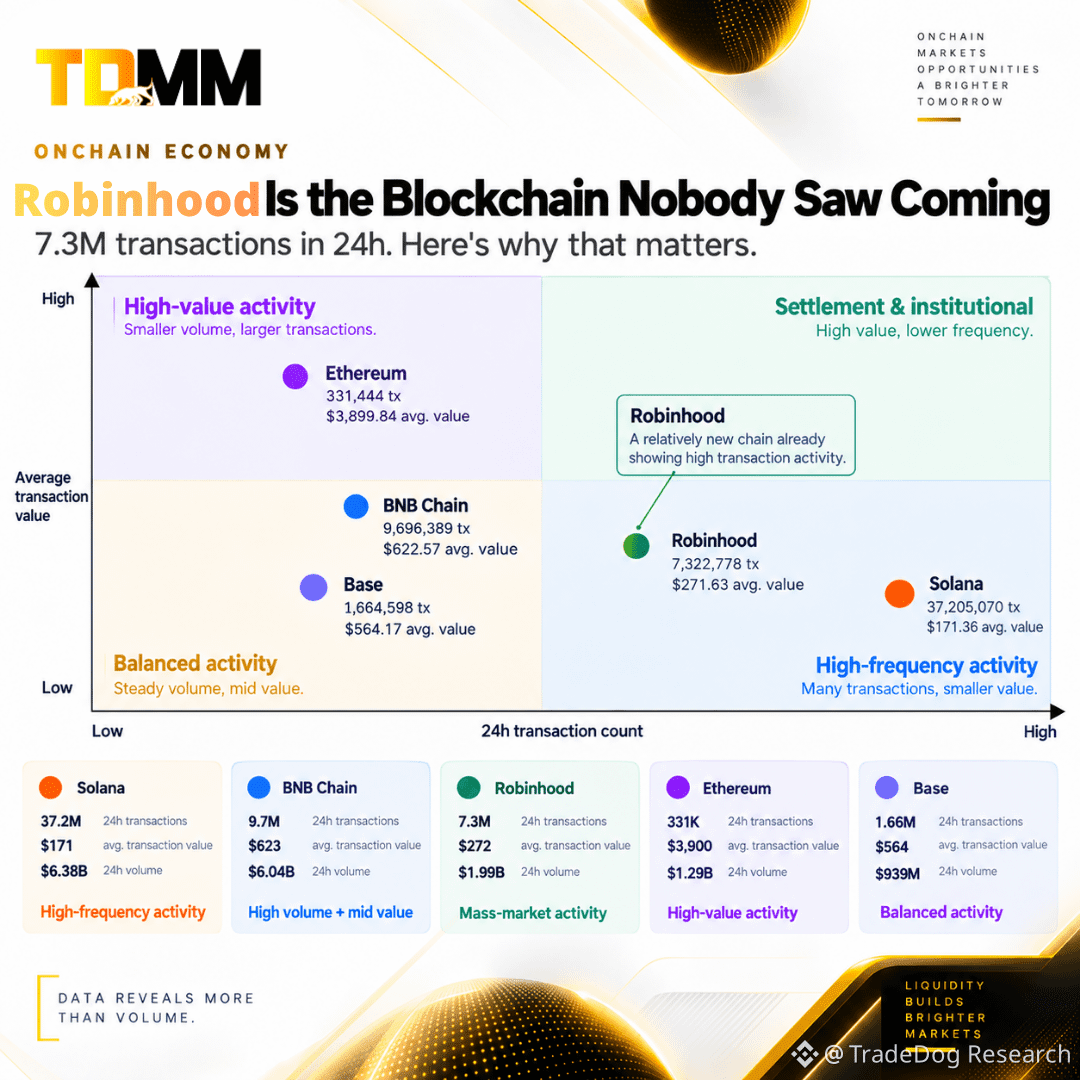
2
75
$PONS : Cuando la atención alcanza su punto máximo, la historia puede cambiar 👀
Antes del rompimiento, el precio, el volumen y los traders únicos estaban subiendo juntos.
Luego llegó el ATH.
📈 El precio explotó
📊 El volumen se disparó
👥 Los traders únicos alcanzaron una de sus lecturas más fuertes
Pero el siguiente movimiento no fue otra pierna hacia arriba.
El precio empezó a retroceder mientras la actividad permanecía elevada.
Eso importa.
La atención máxima ≠ una subida garantizada.
A veces, un pico en la participación y el volumen cerca de un máximo local puede indicar que el mercado está entrando en una fase diferente.
Para $PONS, la pregunta clave ahora es:
¿Los traders únicos + el volumen empezarán a reconstruirse con el precio, o la participación seguirá divergiendo?
La próxima señal puede venir desde debajo del gráfico antes de que aparezca en el gráfico.
@tdmarketmaker @Square-Creator-50e191620
#PONS #MarketAnalysis #Altcoins #DeFi #CryptoTrading
$PONS : Cuando la atención alcanza su punto máximo, la historia puede cambiar 👀
Antes del rompimiento, el precio, el volumen y los traders únicos estaban subiendo juntos.
Luego llegó el ATH.
📈 El precio explotó
📊 El volumen se disparó
👥 Los traders únicos alcanzaron una de sus lecturas más fuertes
Pero el siguiente movimiento no fue otra pierna hacia arriba.
El precio empezó a retroceder mientras la actividad permanecía elevada.
Eso importa.
La atención máxima ≠ una subida garantizada.
A veces, un pico en la participación y el volumen cerca de un máximo local puede indicar que el mercado está entrando en una fase diferente.
Para $PONS , la pregunta clave ahora es:
¿Los traders únicos + el volumen empezarán a reconstruirse con el precio, o la participación seguirá divergiendo?
La próxima señal puede venir desde debajo del gráfico antes de que aparezca en el gráfico.
@TDMM-TradeDog Market Maker @TradeDog Crypto Market Research
#PONS #MarketAnalysis #Altcoins #DeFi #CryptoTrading
Antes del rompimiento, el precio, el volumen y los traders únicos estaban subiendo juntos.
Luego llegó el ATH.
📈 El precio explotó
📊 El volumen se disparó
👥 Los traders únicos alcanzaron una de sus lecturas más fuertes
Pero el siguiente movimiento no fue otra pierna hacia arriba.
El precio empezó a retroceder mientras la actividad permanecía elevada.
Eso importa.
La atención máxima ≠ una subida garantizada.
A veces, un pico en la participación y el volumen cerca de un máximo local puede indicar que el mercado está entrando en una fase diferente.
Para $PONS , la pregunta clave ahora es:
¿Los traders únicos + el volumen empezarán a reconstruirse con el precio, o la participación seguirá divergiendo?
La próxima señal puede venir desde debajo del gráfico antes de que aparezca en el gráfico.
@TDMM-TradeDog Market Maker @TradeDog Crypto Market Research
#PONS #MarketAnalysis #Altcoins #DeFi #CryptoTrading
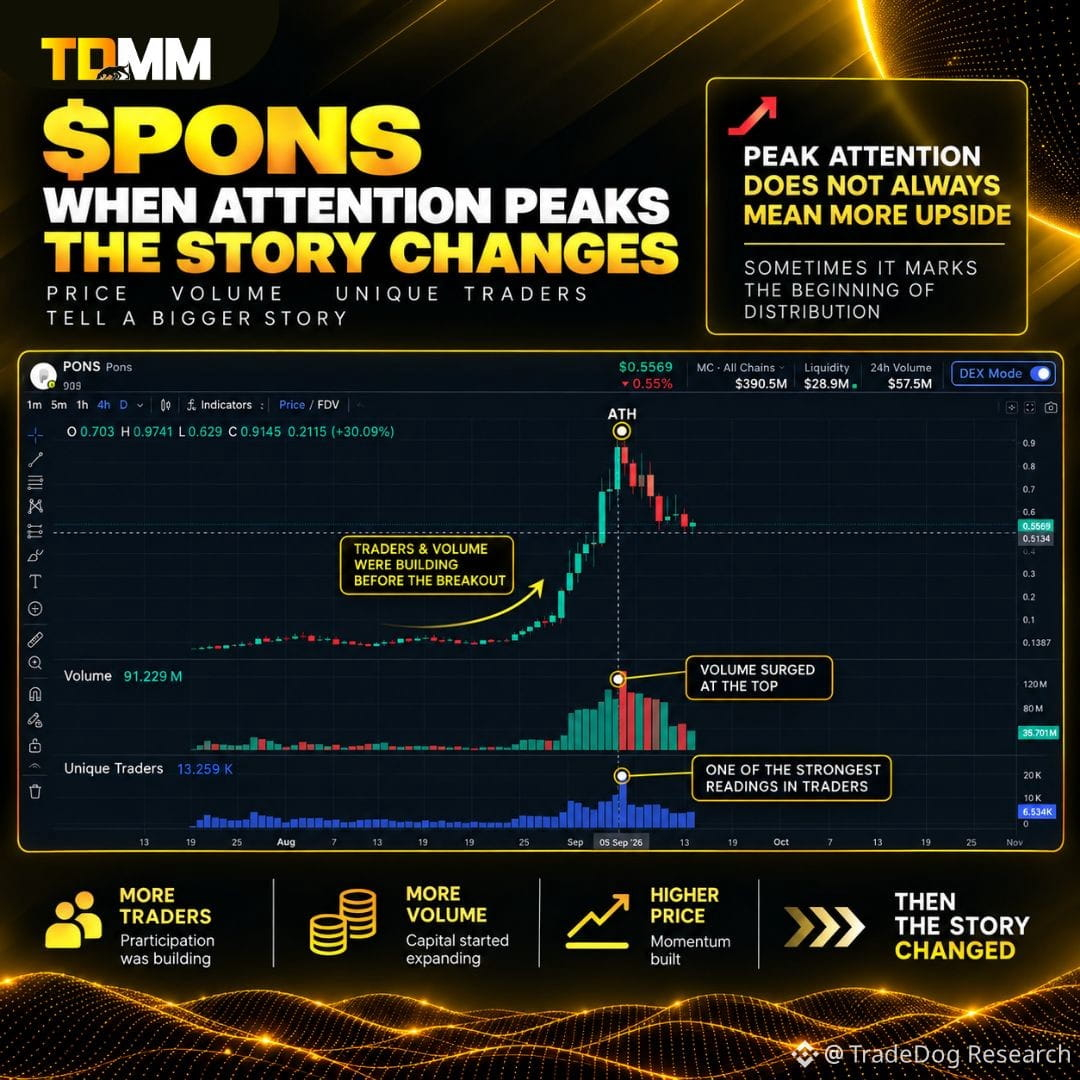
2
185
Control diario del mercado de criptomonedas por TDR
Base de Coinbase alcanza nuevas alturas: 4 millones de direcciones activas
Veamos los detalles:
Base, la red de capa 2 (L2) de @coinbase construida sobre la cadena de bloques Ethereum, ha logrado recientemente un hito significativo al superar los 4 millones de direcciones activas, impulsada por su campaña "Onchain Summer".
Esta campaña Onchain Summer, lanzada inicialmente en 2023 y revivida en 2024, ha sido una fuerza impulsora importante detrás del crecimiento de @base. La campaña fue diseñada para incentivar a los desarrolladores e involucrar a la comunidad criptográfica más amplia ofreciendo recompensas, organizando eventos y fomentando la creatividad en la plataforma.
La edición de 2024 continuó con este impulso al ofrecer $2 millones en recompensas (equivalentes a 600 ETH) a los desarrolladores que construyan en la red Base entre junio y agosto.
En términos de perspectivas futuras:
De cara al futuro, el impulso obtenido a partir de Onchain Summer podría seguir impulsando a Base, especialmente si Coinbase puede seguir innovando y atrayendo a desarrolladores y usuarios a su plataforma.
Las lecciones aprendidas de esta campaña, en particular en el manejo de controversias y la garantía de la integridad de las aplicaciones basadas en blockchain, serán cruciales para el desarrollo continuo de Base.
¡Pero eso no es todo! Profundicemos en las perspectivas del mercado de hoy:
Capitalización del mercado mundial de criptomonedas: 2,2 billones de dólares
Dominancia de Bitcoin: 53,4 % | Dominio de Ethereum: 14,2 %
Principales ganadores:
SUNDOG: +87,4 %
LOKA: +59,2 %
Principales perdedores:
BRAINLET: -27,0 %
CATDOG: -25,4 %
Participe en los principales airdrops en curso: @Curvance, @LineaBuild, @getgrass_io, @Sagaxyz__
Siga a @TradedogCrypto para mantenerse informado sobre los últimos y más impactantes desarrollos en el mundo de las criptomonedas.
#Coinbase #Ethereum #Layer2 #Blockchain #OnchainSummer
Control diario del mercado de criptomonedas por TDR
Base de Coinbase alcanza nuevas alturas: 4 millones de direcciones activas
Veamos los detalles:
Base, la red de capa 2 (L2) de @coinbase construida sobre la cadena de bloques Ethereum, ha logrado recientemente un hito significativo al superar los 4 millones de direcciones activas, impulsada por su campaña "Onchain Summer".
Esta campaña Onchain Summer, lanzada inicialmente en 2023 y revivida en 2024, ha sido una fuerza impulsora importante detrás del crecimiento de @base. La campaña fue diseñada para incentivar a los desarrolladores e involucrar a la comunidad criptográfica más amplia ofreciendo recompensas, organizando eventos y fomentando la creatividad en la plataforma.
La edición de 2024 continuó con este impulso al ofrecer $2 millones en recompensas (equivalentes a 600 ETH) a los desarrolladores que construyan en la red Base entre junio y agosto.
En términos de perspectivas futuras:
De cara al futuro, el impulso obtenido a partir de Onchain Summer podría seguir impulsando a Base, especialmente si Coinbase puede seguir innovando y atrayendo a desarrolladores y usuarios a su plataforma.
Las lecciones aprendidas de esta campaña, en particular en el manejo de controversias y la garantía de la integridad de las aplicaciones basadas en blockchain, serán cruciales para el desarrollo continuo de Base.
¡Pero eso no es todo! Profundicemos en las perspectivas del mercado de hoy:
Capitalización del mercado mundial de criptomonedas: 2,2 billones de dólares
Dominancia de Bitcoin: 53,4 % | Dominio de Ethereum: 14,2 %
Principales ganadores:
SUNDOG: +87,4 %
LOKA: +59,2 %
Principales perdedores:
BRAINLET: -27,0 %
CATDOG: -25,4 %
Participe en los principales airdrops en curso: @Curvance, @LineaBuild, @getgrass_io, @Sagaxyz__
Siga a @TradedogCrypto para mantenerse informado sobre los últimos y más impactantes desarrollos en el mundo de las criptomonedas.
#Coinbase #Ethereum #Layer2 #Blockchain #OnchainSummer
Base de Coinbase alcanza nuevas alturas: 4 millones de direcciones activas
Veamos los detalles:
Base, la red de capa 2 (L2) de @coinbase construida sobre la cadena de bloques Ethereum, ha logrado recientemente un hito significativo al superar los 4 millones de direcciones activas, impulsada por su campaña "Onchain Summer".
Esta campaña Onchain Summer, lanzada inicialmente en 2023 y revivida en 2024, ha sido una fuerza impulsora importante detrás del crecimiento de @base. La campaña fue diseñada para incentivar a los desarrolladores e involucrar a la comunidad criptográfica más amplia ofreciendo recompensas, organizando eventos y fomentando la creatividad en la plataforma.
La edición de 2024 continuó con este impulso al ofrecer $2 millones en recompensas (equivalentes a 600 ETH) a los desarrolladores que construyan en la red Base entre junio y agosto.
En términos de perspectivas futuras:
De cara al futuro, el impulso obtenido a partir de Onchain Summer podría seguir impulsando a Base, especialmente si Coinbase puede seguir innovando y atrayendo a desarrolladores y usuarios a su plataforma.
Las lecciones aprendidas de esta campaña, en particular en el manejo de controversias y la garantía de la integridad de las aplicaciones basadas en blockchain, serán cruciales para el desarrollo continuo de Base.
¡Pero eso no es todo! Profundicemos en las perspectivas del mercado de hoy:
Capitalización del mercado mundial de criptomonedas: 2,2 billones de dólares
Dominancia de Bitcoin: 53,4 % | Dominio de Ethereum: 14,2 %
Principales ganadores:
SUNDOG: +87,4 %
LOKA: +59,2 %
Principales perdedores:
BRAINLET: -27,0 %
CATDOG: -25,4 %
Participe en los principales airdrops en curso: @Curvance, @LineaBuild, @getgrass_io, @Sagaxyz__
Siga a @TradedogCrypto para mantenerse informado sobre los últimos y más impactantes desarrollos en el mundo de las criptomonedas.
#Coinbase #Ethereum #Layer2 #Blockchain #OnchainSummer

3
284
¿Está perdiendo brillo el metaverso?
El mercado de tierras del metaverso en 2024 ha experimentado una caída significativa, con precios promedio que bajaron un 72 % desde su pico.
Los precios mínimos promedio han caído un 34 % desde 2023 y un 55 % desde 2022.
Principales puntos destacados del proyecto:
@TheSandboxGame: Los precios se desplomaron un 95 % de 2,86 ETH en 2021 a 0,13 ETH en 2024.
NFTWorlds/TOPIA Worlds: Demostró resiliencia con una caída del 45 %, ayudada por el apoyo de la comunidad y el cambio de marca.
@SomniumSpace: Alcanzó su pico en 2023 con 0,98 ETH, impulsado por los avances de la realidad virtual.
Factores que influyen en los precios:
Volatilidad del mercado: La crisis más amplia de las criptomonedas afectó significativamente a las tierras del metaverso.
Desarrollos específicos del proyecto: La innovación y las propuestas de valor únicas ayudaron a que ciertos proyectos mantuvieran su valor.
Fortaleza de la comunidad: el fuerte compromiso y los esfuerzos de renovación de la marca mitigaron las caídas.
Influencia del mercado externo: tendencias como las memecoins desviaron la atención de las tierras del metaverso.
Perspectiva futura:
El futuro de los precios de las tierras del metaverso dependerá de la innovación continua y de las tendencias más amplias de las criptomonedas.
¿Qué cree que depara el futuro a los precios de las tierras del metaverso? ¡Comparta sus opiniones a continuación!
#Metaverse #VirtualRealEstate #NFT
¿Está perdiendo brillo el metaverso?
El mercado de tierras del metaverso en 2024 ha experimentado una caída significativa, con precios promedio que bajaron un 72 % desde su pico.
Los precios mínimos promedio han caído un 34 % desde 2023 y un 55 % desde 2022.
Principales puntos destacados del proyecto:
@TheSandboxGame: Los precios se desplomaron un 95 % de 2,86 ETH en 2021 a 0,13 ETH en 2024.
NFTWorlds/TOPIA Worlds: Demostró resiliencia con una caída del 45 %, ayudada por el apoyo de la comunidad y el cambio de marca.
@SomniumSpace: Alcanzó su pico en 2023 con 0,98 ETH, impulsado por los avances de la realidad virtual.
Factores que influyen en los precios:
Volatilidad del mercado: La crisis más amplia de las criptomonedas afectó significativamente a las tierras del metaverso.
Desarrollos específicos del proyecto: La innovación y las propuestas de valor únicas ayudaron a que ciertos proyectos mantuvieran su valor.
Fortaleza de la comunidad: el fuerte compromiso y los esfuerzos de renovación de la marca mitigaron las caídas.
Influencia del mercado externo: tendencias como las memecoins desviaron la atención de las tierras del metaverso.
Perspectiva futura:
El futuro de los precios de las tierras del metaverso dependerá de la innovación continua y de las tendencias más amplias de las criptomonedas.
¿Qué cree que depara el futuro a los precios de las tierras del metaverso? ¡Comparta sus opiniones a continuación!
#Metaverse #VirtualRealEstate #NFT
El mercado de tierras del metaverso en 2024 ha experimentado una caída significativa, con precios promedio que bajaron un 72 % desde su pico.
Los precios mínimos promedio han caído un 34 % desde 2023 y un 55 % desde 2022.
Principales puntos destacados del proyecto:
@TheSandboxGame: Los precios se desplomaron un 95 % de 2,86 ETH en 2021 a 0,13 ETH en 2024.
NFTWorlds/TOPIA Worlds: Demostró resiliencia con una caída del 45 %, ayudada por el apoyo de la comunidad y el cambio de marca.
@SomniumSpace: Alcanzó su pico en 2023 con 0,98 ETH, impulsado por los avances de la realidad virtual.
Factores que influyen en los precios:
Volatilidad del mercado: La crisis más amplia de las criptomonedas afectó significativamente a las tierras del metaverso.
Desarrollos específicos del proyecto: La innovación y las propuestas de valor únicas ayudaron a que ciertos proyectos mantuvieran su valor.
Fortaleza de la comunidad: el fuerte compromiso y los esfuerzos de renovación de la marca mitigaron las caídas.
Influencia del mercado externo: tendencias como las memecoins desviaron la atención de las tierras del metaverso.
Perspectiva futura:
El futuro de los precios de las tierras del metaverso dependerá de la innovación continua y de las tendencias más amplias de las criptomonedas.
¿Qué cree que depara el futuro a los precios de las tierras del metaverso? ¡Comparta sus opiniones a continuación!
#Metaverse #VirtualRealEstate #NFT

1
1.4k
Mientras todo el mundo habla de la tormenta que se vive en los mercados de valores y criptomonedas, hemos decidido resumir la situación del mercado de NFT.
📊
Números y estadísticas
Capitalización de mercado: 57.500 millones de dólares
Volumen diario de operaciones: 9.500 millones de dólares
Principales colecciones por capitalización:
@cryptopunksnfts: 524 millones de dólares
@LibertyCatsBTC: 513 millones de dólares
@BoredApeYC: 218 millones de dólares
@pudgypenguins: 178 millones de dólares
@Azuki: 99 millones de dólares
Correcciones del mercado
El mercado de NFT ha experimentado una importante caída, con una capitalización que ha caído a 34.000 millones de dólares en su punto más bajo, muy influenciada por el mercado de criptomonedas en general.
Impacto de las Memecoins
Las Memecoins han desviado la atención y el capital de las NFT, lo que ha provocado una fuerte caída de la capitalización de mercado de 348.000 millones de dólares en enero de 2024 a 159.000 millones de dólares en marzo de 2024.
Tendencias emergentes
NFT orientadas a la utilidad: mayor interés en las NFT vinculadas a la tokenización de activos del mundo real. Integración de juegos: empresas importantes como Square Enix están adoptando cada vez más las NFT. NFT híbridas: creciente popularidad de los tokens que combinan activos físicos y digitales.
Perspectivas futuras
Si bien la próxima racha alcista puede enfatizar las NFT basadas en la utilidad y la tokenización de activos del mundo real, el crecimiento significativo del mercado sigue siendo incierto debido a las condiciones actuales.
El mercado de NFT está evolucionando, con un enfoque en la utilidad y los activos reales, pero enfrenta desafíos de las memecoins y la volatilidad del mercado.
Esperemos y veamos qué sucede a continuación. Déjanos tus comentarios a continuación
👇
#NFTMarket #CryptoNewss #MarketTrends
Mientras todo el mundo habla de la tormenta que se vive en los mercados de valores y criptomonedas, hemos decidido resumir la situación del mercado de NFT.
📊
Números y estadísticas
Capitalización de mercado: 57.500 millones de dólares
Volumen diario de operaciones: 9.500 millones de dólares
Principales colecciones por capitalización:
@cryptopunksnfts: 524 millones de dólares
@LibertyCatsBTC: 513 millones de dólares
@BoredApeYC: 218 millones de dólares
@pudgypenguins: 178 millones de dólares
@Azuki: 99 millones de dólares
Correcciones del mercado
El mercado de NFT ha experimentado una importante caída, con una capitalización que ha caído a 34.000 millones de dólares en su punto más bajo, muy influenciada por el mercado de criptomonedas en general.
Impacto de las Memecoins
Las Memecoins han desviado la atención y el capital de las NFT, lo que ha provocado una fuerte caída de la capitalización de mercado de 348.000 millones de dólares en enero de 2024 a 159.000 millones de dólares en marzo de 2024.
Tendencias emergentes
NFT orientadas a la utilidad: mayor interés en las NFT vinculadas a la tokenización de activos del mundo real. Integración de juegos: empresas importantes como Square Enix están adoptando cada vez más las NFT. NFT híbridas: creciente popularidad de los tokens que combinan activos físicos y digitales.
Perspectivas futuras
Si bien la próxima racha alcista puede enfatizar las NFT basadas en la utilidad y la tokenización de activos del mundo real, el crecimiento significativo del mercado sigue siendo incierto debido a las condiciones actuales.
El mercado de NFT está evolucionando, con un enfoque en la utilidad y los activos reales, pero enfrenta desafíos de las memecoins y la volatilidad del mercado.
Esperemos y veamos qué sucede a continuación. Déjanos tus comentarios a continuación
👇
#NFTMarket #CryptoNewss #MarketTrends
📊
Números y estadísticas
Capitalización de mercado: 57.500 millones de dólares
Volumen diario de operaciones: 9.500 millones de dólares
Principales colecciones por capitalización:
@cryptopunksnfts: 524 millones de dólares
@LibertyCatsBTC: 513 millones de dólares
@BoredApeYC: 218 millones de dólares
@pudgypenguins: 178 millones de dólares
@Azuki: 99 millones de dólares
Correcciones del mercado
El mercado de NFT ha experimentado una importante caída, con una capitalización que ha caído a 34.000 millones de dólares en su punto más bajo, muy influenciada por el mercado de criptomonedas en general.
Impacto de las Memecoins
Las Memecoins han desviado la atención y el capital de las NFT, lo que ha provocado una fuerte caída de la capitalización de mercado de 348.000 millones de dólares en enero de 2024 a 159.000 millones de dólares en marzo de 2024.
Tendencias emergentes
NFT orientadas a la utilidad: mayor interés en las NFT vinculadas a la tokenización de activos del mundo real. Integración de juegos: empresas importantes como Square Enix están adoptando cada vez más las NFT. NFT híbridas: creciente popularidad de los tokens que combinan activos físicos y digitales.
Perspectivas futuras
Si bien la próxima racha alcista puede enfatizar las NFT basadas en la utilidad y la tokenización de activos del mundo real, el crecimiento significativo del mercado sigue siendo incierto debido a las condiciones actuales.
El mercado de NFT está evolucionando, con un enfoque en la utilidad y los activos reales, pero enfrenta desafíos de las memecoins y la volatilidad del mercado.
Esperemos y veamos qué sucede a continuación. Déjanos tus comentarios a continuación
👇
#NFTMarket #CryptoNewss #MarketTrends

1
450
¡Identifique su estilo de trading!
Por qué es crucial: Es esencial alinear su estrategia de trading con su personalidad, tolerancia al riesgo y compromiso de tiempo.
Saber si es un scalper, day trader o swing trader le ayuda a tomar decisiones informadas, gestionar el estrés y optimizar su enfoque de trading.
A continuación, se ofrece una mirada más detallada a cada estilo de trading
👇
Scalper: operaciones rápidas, alto estrés, alto riesgo.
Day Trader: operaciones diarias, riesgo moderado a alto, requiere plena atención.
Swing Trader: mantiene posiciones durante días o semanas, menor estrés, requiere paciencia.
Conclusión general:
Cada estilo tiene desafíos y recompensas únicos. Elija lo que se alinee con su tolerancia al riesgo y estilo de vida.
¿Qué estilo de trading se adapta mejor a usted?
#Trading#Scalping#DayTrading#SwingTrading
¡Identifique su estilo de trading!
Por qué es crucial: Es esencial alinear su estrategia de trading con su personalidad, tolerancia al riesgo y compromiso de tiempo.
Saber si es un scalper, day trader o swing trader le ayuda a tomar decisiones informadas, gestionar el estrés y optimizar su enfoque de trading.
A continuación, se ofrece una mirada más detallada a cada estilo de trading
👇
Scalper: operaciones rápidas, alto estrés, alto riesgo.
Day Trader: operaciones diarias, riesgo moderado a alto, requiere plena atención.
Swing Trader: mantiene posiciones durante días o semanas, menor estrés, requiere paciencia.
Conclusión general:
Cada estilo tiene desafíos y recompensas únicos. Elija lo que se alinee con su tolerancia al riesgo y estilo de vida.
¿Qué estilo de trading se adapta mejor a usted?
#Trading#Scalping#DayTrading#SwingTrading
Por qué es crucial: Es esencial alinear su estrategia de trading con su personalidad, tolerancia al riesgo y compromiso de tiempo.
Saber si es un scalper, day trader o swing trader le ayuda a tomar decisiones informadas, gestionar el estrés y optimizar su enfoque de trading.
A continuación, se ofrece una mirada más detallada a cada estilo de trading
👇
Scalper: operaciones rápidas, alto estrés, alto riesgo.
Day Trader: operaciones diarias, riesgo moderado a alto, requiere plena atención.
Swing Trader: mantiene posiciones durante días o semanas, menor estrés, requiere paciencia.
Conclusión general:
Cada estilo tiene desafíos y recompensas únicos. Elija lo que se alinee con su tolerancia al riesgo y estilo de vida.
¿Qué estilo de trading se adapta mejor a usted?
#Trading#Scalping#DayTrading#SwingTrading

12
¿Qué es Particle Network y cómo funciona?
Echemos un vistazo👇
- Particle Network: una solución blockchain de capa 1.
𝗥𝗮𝗶𝘀𝗲𝗱 𝗔𝗺𝗼𝘂𝗻𝘁𝗶𝗻𝘁𝗮: Por revelar
- Pichi Finance: enfocada en crear un protocolo de comercio de puntos sin confianza.
𝗥𝗮𝗶𝘀𝗲𝗱 𝗔𝗺𝗼𝘂𝗻𝘁𝗶𝗻𝘁𝗮: $2.5 millones
- Morpho Labs: líder en soluciones de liquidez avanzadas y aplicaciones descentralizadas.
𝗥𝗮𝗶𝘀𝗲𝗱 𝗔𝗺𝗼𝘂𝗻𝘁𝗶𝗻𝘁𝗮: $50 millones
- Breakout: una startup enfocada en revolucionar los sectores financiero y bancario con soluciones tecnológicas avanzadas.
Inversión en cadena de bloques: 4,5 millones de dólares
- Layer2 Financial: su objetivo es cerrar la brecha entre los sistemas financieros tradicionales y la tecnología blockchain mejorando los sistemas de pago y los servicios financieros.
Inversión en cadena de bloques: 10,7 millones de dólares
Estos proyectos destacan el creciente interés y la inversión en soluciones de blockchain y finanzas descentralizadas, cada uno de los cuales tiene como objetivo resolver desafíos específicos dentro del ecosistema e impulsar una mayor innovación.
¿Qué proyecto te parece más prometedor?
¡Cuéntanoslo en los comentarios!
#Crypto #Blockchain #DEFİ #Investment #Innovation
¿Qué es Particle Network y cómo funciona?
Echemos un vistazo👇
- Particle Network: una solución blockchain de capa 1.
𝗥𝗮𝗶𝘀𝗲𝗱 𝗔𝗺𝗼𝘂𝗻𝘁𝗶𝗻𝘁𝗮: Por revelar
- Pichi Finance: enfocada en crear un protocolo de comercio de puntos sin confianza.
𝗥𝗮𝗶𝘀𝗲𝗱 𝗔𝗺𝗼𝘂𝗻𝘁𝗶𝗻𝘁𝗮: $2.5 millones
- Morpho Labs: líder en soluciones de liquidez avanzadas y aplicaciones descentralizadas.
𝗥𝗮𝗶𝘀𝗲𝗱 𝗔𝗺𝗼𝘂𝗻𝘁𝗶𝗻𝘁𝗮: $50 millones
- Breakout: una startup enfocada en revolucionar los sectores financiero y bancario con soluciones tecnológicas avanzadas.
Inversión en cadena de bloques: 4,5 millones de dólares
- Layer2 Financial: su objetivo es cerrar la brecha entre los sistemas financieros tradicionales y la tecnología blockchain mejorando los sistemas de pago y los servicios financieros.
Inversión en cadena de bloques: 10,7 millones de dólares
Estos proyectos destacan el creciente interés y la inversión en soluciones de blockchain y finanzas descentralizadas, cada uno de los cuales tiene como objetivo resolver desafíos específicos dentro del ecosistema e impulsar una mayor innovación.
¿Qué proyecto te parece más prometedor?
¡Cuéntanoslo en los comentarios!
#Crypto #Blockchain #DEFİ #Investment #Innovation
Echemos un vistazo👇
- Particle Network: una solución blockchain de capa 1.
𝗥𝗮𝗶𝘀𝗲𝗱 𝗔𝗺𝗼𝘂𝗻𝘁𝗶𝗻𝘁𝗮: Por revelar
- Pichi Finance: enfocada en crear un protocolo de comercio de puntos sin confianza.
𝗥𝗮𝗶𝘀𝗲𝗱 𝗔𝗺𝗼𝘂𝗻𝘁𝗶𝗻𝘁𝗮: $2.5 millones
- Morpho Labs: líder en soluciones de liquidez avanzadas y aplicaciones descentralizadas.
𝗥𝗮𝗶𝘀𝗲𝗱 𝗔𝗺𝗼𝘂𝗻𝘁𝗶𝗻𝘁𝗮: $50 millones
- Breakout: una startup enfocada en revolucionar los sectores financiero y bancario con soluciones tecnológicas avanzadas.
Inversión en cadena de bloques: 4,5 millones de dólares
- Layer2 Financial: su objetivo es cerrar la brecha entre los sistemas financieros tradicionales y la tecnología blockchain mejorando los sistemas de pago y los servicios financieros.
Inversión en cadena de bloques: 10,7 millones de dólares
Estos proyectos destacan el creciente interés y la inversión en soluciones de blockchain y finanzas descentralizadas, cada uno de los cuales tiene como objetivo resolver desafíos específicos dentro del ecosistema e impulsar una mayor innovación.
¿Qué proyecto te parece más prometedor?
¡Cuéntanoslo en los comentarios!
#Crypto #Blockchain #DEFİ #Investment #Innovation

1
232
¿Es segura tu criptomoneda favorita? 🛡️
Para mantenerse a la vanguardia en el mundo de las criptomonedas, es fundamental informarse sobre los posibles ataques y los desarrollos en curso.
Hoy, profundicemos en el tema de los ataques del 51%.
¿Qué es un ataque del 51%?
Ocurre cuando una persona o grupo controla más del 50% del poder de hash de la cadena de bloques, lo que les permite alterar las transacciones.
Cómo funciona:
- Dominio de la tasa de hash: el atacante controla la mayor parte de la tasa de hash de la red.
- Doble gasto: pueden revertir transacciones y permitir el doble gasto.
- Interferencia de bloque: pueden impedir que nuevas transacciones obtengan confirmaciones.
- Monopolio Minero: Monopolizan la minería, impidiendo que otros mineros generen bloques y recojan recompensas.
Ejemplos históricos:
- Bitcoin Gold (2018): sufrió un ataque del 51% que resultó en 18 millones de dólares en monedas doblemente gastadas.
- Ethereum Classic (2019): experimentó múltiples ataques del 51 %, lo que provocó un doble gasto de miles de ETC.
- Verge (2018): Enfrentó un ataque que llevó a la creación de millones de XVG mediante la manipulación de blockchain.
¿Qué medidas se pueden tomar para la prevención?
- Aumentar la tasa de hash de la red: dificulta que una sola entidad controle el 51%.
- Prueba de participación (PoS): seguridad basada en la cantidad de criptomonedas poseídas, no en la potencia computacional.
- Monitoreo mejorado: monitoreo continuo de la red para detectar comportamientos mineros inusuales.
- Descentralización: Promover la descentralización en los pools de minería para evitar la concentración del poder minero.
Si esta información te resultó útil, dale Me gusta, vuelve a publicarla y compártela con tu red.
#CriptoSeguridad#Blockchain
¿Es segura tu criptomoneda favorita? 🛡️
Para mantenerse a la vanguardia en el mundo de las criptomonedas, es fundamental informarse sobre los posibles ataques y los desarrollos en curso.
Hoy, profundicemos en el tema de los ataques del 51%.
¿Qué es un ataque del 51%?
Ocurre cuando una persona o grupo controla más del 50% del poder de hash de la cadena de bloques, lo que les permite alterar las transacciones.
Cómo funciona:
- Dominio de la tasa de hash: el atacante controla la mayor parte de la tasa de hash de la red.
- Doble gasto: pueden revertir transacciones y permitir el doble gasto.
- Interferencia de bloque: pueden impedir que nuevas transacciones obtengan confirmaciones.
- Monopolio Minero: Monopolizan la minería, impidiendo que otros mineros generen bloques y recojan recompensas.
Ejemplos históricos:
- Bitcoin Gold (2018): sufrió un ataque del 51% que resultó en 18 millones de dólares en monedas doblemente gastadas.
- Ethereum Classic (2019): experimentó múltiples ataques del 51 %, lo que provocó un doble gasto de miles de ETC.
- Verge (2018): Enfrentó un ataque que llevó a la creación de millones de XVG mediante la manipulación de blockchain.
¿Qué medidas se pueden tomar para la prevención?
- Aumentar la tasa de hash de la red: dificulta que una sola entidad controle el 51%.
- Prueba de participación (PoS): seguridad basada en la cantidad de criptomonedas poseídas, no en la potencia computacional.
- Monitoreo mejorado: monitoreo continuo de la red para detectar comportamientos mineros inusuales.
- Descentralización: Promover la descentralización en los pools de minería para evitar la concentración del poder minero.
Si esta información te resultó útil, dale Me gusta, vuelve a publicarla y compártela con tu red.
#CriptoSeguridad#Blockchain
Para mantenerse a la vanguardia en el mundo de las criptomonedas, es fundamental informarse sobre los posibles ataques y los desarrollos en curso.
Hoy, profundicemos en el tema de los ataques del 51%.
¿Qué es un ataque del 51%?
Ocurre cuando una persona o grupo controla más del 50% del poder de hash de la cadena de bloques, lo que les permite alterar las transacciones.
Cómo funciona:
- Dominio de la tasa de hash: el atacante controla la mayor parte de la tasa de hash de la red.
- Doble gasto: pueden revertir transacciones y permitir el doble gasto.
- Interferencia de bloque: pueden impedir que nuevas transacciones obtengan confirmaciones.
- Monopolio Minero: Monopolizan la minería, impidiendo que otros mineros generen bloques y recojan recompensas.
Ejemplos históricos:
- Bitcoin Gold (2018): sufrió un ataque del 51% que resultó en 18 millones de dólares en monedas doblemente gastadas.
- Ethereum Classic (2019): experimentó múltiples ataques del 51 %, lo que provocó un doble gasto de miles de ETC.
- Verge (2018): Enfrentó un ataque que llevó a la creación de millones de XVG mediante la manipulación de blockchain.
¿Qué medidas se pueden tomar para la prevención?
- Aumentar la tasa de hash de la red: dificulta que una sola entidad controle el 51%.
- Prueba de participación (PoS): seguridad basada en la cantidad de criptomonedas poseídas, no en la potencia computacional.
- Monitoreo mejorado: monitoreo continuo de la red para detectar comportamientos mineros inusuales.
- Descentralización: Promover la descentralización en los pools de minería para evitar la concentración del poder minero.
Si esta información te resultó útil, dale Me gusta, vuelve a publicarla y compártela con tu red.
#CriptoSeguridad#Blockchain

3
4.6k
¿Sus emociones están afectando sus inversiones en criptomonedas?
De alguna manera, esto nos afecta a todos; no hay ningún beneficio en negarlo.
¿Pero cómo? Analicemos todo el ciclo de las emociones.
Euforia: Los precios máximos del mercado crean una sensación de invencibilidad y codicia.
Comportamiento básico: compras intensas a precios elevados, a menudo sin considerar los riesgos.
Esperanza: la fase inicial en la que los operadores ingresan al mercado con optimismo y altas expectativas de ganancias futuras.
Comportamiento básico: comprar activos basándose en noticias positivas, rumores o éxito de la inversión inicial.
Optimismo: a medida que los precios comienzan a subir, los comerciantes se sienten optimistas sobre sus inversiones.
Comportamiento básico: aumento de compras y tenencias, lo que refuerza la creencia en el potencial del mercado.
Emoción: Los aumentos significativos de precios generan emoción y emoción.
Comportamiento básico: compras más agresivas, a veces apalancando para maximizar las ganancias.
Ansiedad: Los precios del mercado comienzan a bajar, lo que hace que los comerciantes se sientan ansiosos por sus inversiones.
Comportamiento básico: vacilación a la hora de vender, esperando que los precios se recuperen.
Negación: Las continuas caídas de precios conducen a la negación, y los comerciantes creen que es un revés temporal.
Comportamiento básico: Mantener las inversiones a pesar de las pérdidas, esperando una recuperación.
Pánico: Las caídas persistentes crean pánico a medida que los operadores se dan cuenta de pérdidas significativas.
Comportamiento básico: Venta urgente para reducir pérdidas, a menudo con pérdidas considerables.
Capitulación: Ventas generalizadas y salidas del mercado, lo que indica el punto más bajo del ciclo.
Comportamiento básico: vender los activos restantes, salir del mercado y aceptar pérdidas.
Esperanza: el mercado se estabiliza y muestra signos de recuperación, reavivando la esperanza entre los comerciantes.
Comportamiento básico: Reingreso cauteloso al mercado y comienza un nuevo ciclo.
¿En qué etapa crees que estás ahora?🤔
#CryptoTrader #MarketCycle
¿Sus emociones están afectando sus inversiones en criptomonedas?
De alguna manera, esto nos afecta a todos; no hay ningún beneficio en negarlo.
¿Pero cómo? Analicemos todo el ciclo de las emociones.
Euforia: Los precios máximos del mercado crean una sensación de invencibilidad y codicia.
Comportamiento básico: compras intensas a precios elevados, a menudo sin considerar los riesgos.
Esperanza: la fase inicial en la que los operadores ingresan al mercado con optimismo y altas expectativas de ganancias futuras.
Comportamiento básico: comprar activos basándose en noticias positivas, rumores o éxito de la inversión inicial.
Optimismo: a medida que los precios comienzan a subir, los comerciantes se sienten optimistas sobre sus inversiones.
Comportamiento básico: aumento de compras y tenencias, lo que refuerza la creencia en el potencial del mercado.
Emoción: Los aumentos significativos de precios generan emoción y emoción.
Comportamiento básico: compras más agresivas, a veces apalancando para maximizar las ganancias.
Ansiedad: Los precios del mercado comienzan a bajar, lo que hace que los comerciantes se sientan ansiosos por sus inversiones.
Comportamiento básico: vacilación a la hora de vender, esperando que los precios se recuperen.
Negación: Las continuas caídas de precios conducen a la negación, y los comerciantes creen que es un revés temporal.
Comportamiento básico: Mantener las inversiones a pesar de las pérdidas, esperando una recuperación.
Pánico: Las caídas persistentes crean pánico a medida que los operadores se dan cuenta de pérdidas significativas.
Comportamiento básico: Venta urgente para reducir pérdidas, a menudo con pérdidas considerables.
Capitulación: Ventas generalizadas y salidas del mercado, lo que indica el punto más bajo del ciclo.
Comportamiento básico: vender los activos restantes, salir del mercado y aceptar pérdidas.
Esperanza: el mercado se estabiliza y muestra signos de recuperación, reavivando la esperanza entre los comerciantes.
Comportamiento básico: Reingreso cauteloso al mercado y comienza un nuevo ciclo.
¿En qué etapa crees que estás ahora?🤔
#CryptoTrader #MarketCycle
De alguna manera, esto nos afecta a todos; no hay ningún beneficio en negarlo.
¿Pero cómo? Analicemos todo el ciclo de las emociones.
Euforia: Los precios máximos del mercado crean una sensación de invencibilidad y codicia.
Comportamiento básico: compras intensas a precios elevados, a menudo sin considerar los riesgos.
Esperanza: la fase inicial en la que los operadores ingresan al mercado con optimismo y altas expectativas de ganancias futuras.
Comportamiento básico: comprar activos basándose en noticias positivas, rumores o éxito de la inversión inicial.
Optimismo: a medida que los precios comienzan a subir, los comerciantes se sienten optimistas sobre sus inversiones.
Comportamiento básico: aumento de compras y tenencias, lo que refuerza la creencia en el potencial del mercado.
Emoción: Los aumentos significativos de precios generan emoción y emoción.
Comportamiento básico: compras más agresivas, a veces apalancando para maximizar las ganancias.
Ansiedad: Los precios del mercado comienzan a bajar, lo que hace que los comerciantes se sientan ansiosos por sus inversiones.
Comportamiento básico: vacilación a la hora de vender, esperando que los precios se recuperen.
Negación: Las continuas caídas de precios conducen a la negación, y los comerciantes creen que es un revés temporal.
Comportamiento básico: Mantener las inversiones a pesar de las pérdidas, esperando una recuperación.
Pánico: Las caídas persistentes crean pánico a medida que los operadores se dan cuenta de pérdidas significativas.
Comportamiento básico: Venta urgente para reducir pérdidas, a menudo con pérdidas considerables.
Capitulación: Ventas generalizadas y salidas del mercado, lo que indica el punto más bajo del ciclo.
Comportamiento básico: vender los activos restantes, salir del mercado y aceptar pérdidas.
Esperanza: el mercado se estabiliza y muestra signos de recuperación, reavivando la esperanza entre los comerciantes.
Comportamiento básico: Reingreso cauteloso al mercado y comienza un nuevo ciclo.
¿En qué etapa crees que estás ahora?🤔
#CryptoTrader #MarketCycle

532
¿Alguna vez pensaste en cómo funcionan los zkRollups y cómo aportan valor real a la cadena de bloques?
🤔
Antes de profundizar en cómo funcionan realmente, exploremos primero qué son los zkRollups:
Los ZK-Rollups son rollups en los que los validadores prueban la autenticidad de una transacción sin revelar ningún detalle de la misma.
Ahora, ¡profundicemos en cómo funcionan realmente los zkRollups!
Cómo funcionan los zkRollups:
1. Transacciones por lotes (L2): se agrupan varias transacciones juntas, lo que reduce la carga en la cadena de bloques principal al procesarlas fuera de la cadena.
2. Ejecución (L2): el secuenciador ejecuta las transacciones por lotes y actualiza el estado de la cadena de capa 2.
3. Tx, State Diff, etc. (L2): esto genera una transacción (Tx) y diferencias de estado (diff), que reflejan cambios en los saldos de las cuentas y los contratos inteligentes.
4. Generar prueba (L2): se genera una prueba de conocimiento cero (prueba zk), que verifica la exactitud de las transacciones sin revelar detalles.
5. Enviar a la cadena L1: la prueba zk se envía a la cadena de bloques de capa 1, actualizándola con el nuevo estado y validando todas las transacciones del lote.
6. Verificar (cadena L1): el contrato de rollup en la capa 1 verifica la prueba zk, lo que garantiza la integridad de las transacciones en lote.
7. Actualizar o no (cadena L1): según la verificación, el estado de la cadena de bloques principal se actualiza o rechaza, manteniendo la seguridad y la precisión.
Ventajas de zkRollups:
- Escalabilidad: aumenta el rendimiento de las transacciones y reduce la congestión al procesar fuera de la cadena.
- Costos más bajos: reduce significativamente las tarifas de transacción al registrar menos transacciones en la cadena.
- Seguridad: hereda la seguridad de la cadena de bloques principal.
- Privacidad: valida las transacciones sin revelar información confidencial.
¡Espera nuestra próxima publicación en la que cubriremos el panorama de zkRollup en detalle!
Comenta a continuación lo emocionado que estás.
#BlockchainMilestone #Crypto #zkRollups #CryptoInnovation #DeFi
¿Alguna vez pensaste en cómo funcionan los zkRollups y cómo aportan valor real a la cadena de bloques?
🤔
Antes de profundizar en cómo funcionan realmente, exploremos primero qué son los zkRollups:
Los ZK-Rollups son rollups en los que los validadores prueban la autenticidad de una transacción sin revelar ningún detalle de la misma.
Ahora, ¡profundicemos en cómo funcionan realmente los zkRollups!
Cómo funcionan los zkRollups:
1. Transacciones por lotes (L2): se agrupan varias transacciones juntas, lo que reduce la carga en la cadena de bloques principal al procesarlas fuera de la cadena.
2. Ejecución (L2): el secuenciador ejecuta las transacciones por lotes y actualiza el estado de la cadena de capa 2.
3. Tx, State Diff, etc. (L2): esto genera una transacción (Tx) y diferencias de estado (diff), que reflejan cambios en los saldos de las cuentas y los contratos inteligentes.
4. Generar prueba (L2): se genera una prueba de conocimiento cero (prueba zk), que verifica la exactitud de las transacciones sin revelar detalles.
5. Enviar a la cadena L1: la prueba zk se envía a la cadena de bloques de capa 1, actualizándola con el nuevo estado y validando todas las transacciones del lote.
6. Verificar (cadena L1): el contrato de rollup en la capa 1 verifica la prueba zk, lo que garantiza la integridad de las transacciones en lote.
7. Actualizar o no (cadena L1): según la verificación, el estado de la cadena de bloques principal se actualiza o rechaza, manteniendo la seguridad y la precisión.
Ventajas de zkRollups:
- Escalabilidad: aumenta el rendimiento de las transacciones y reduce la congestión al procesar fuera de la cadena.
- Costos más bajos: reduce significativamente las tarifas de transacción al registrar menos transacciones en la cadena.
- Seguridad: hereda la seguridad de la cadena de bloques principal.
- Privacidad: valida las transacciones sin revelar información confidencial.
¡Espera nuestra próxima publicación en la que cubriremos el panorama de zkRollup en detalle!
Comenta a continuación lo emocionado que estás.
#BlockchainMilestone #Crypto #zkRollups #CryptoInnovation #DeFi
🤔
Antes de profundizar en cómo funcionan realmente, exploremos primero qué son los zkRollups:
Los ZK-Rollups son rollups en los que los validadores prueban la autenticidad de una transacción sin revelar ningún detalle de la misma.
Ahora, ¡profundicemos en cómo funcionan realmente los zkRollups!
Cómo funcionan los zkRollups:
1. Transacciones por lotes (L2): se agrupan varias transacciones juntas, lo que reduce la carga en la cadena de bloques principal al procesarlas fuera de la cadena.
2. Ejecución (L2): el secuenciador ejecuta las transacciones por lotes y actualiza el estado de la cadena de capa 2.
3. Tx, State Diff, etc. (L2): esto genera una transacción (Tx) y diferencias de estado (diff), que reflejan cambios en los saldos de las cuentas y los contratos inteligentes.
4. Generar prueba (L2): se genera una prueba de conocimiento cero (prueba zk), que verifica la exactitud de las transacciones sin revelar detalles.
5. Enviar a la cadena L1: la prueba zk se envía a la cadena de bloques de capa 1, actualizándola con el nuevo estado y validando todas las transacciones del lote.
6. Verificar (cadena L1): el contrato de rollup en la capa 1 verifica la prueba zk, lo que garantiza la integridad de las transacciones en lote.
7. Actualizar o no (cadena L1): según la verificación, el estado de la cadena de bloques principal se actualiza o rechaza, manteniendo la seguridad y la precisión.
Ventajas de zkRollups:
- Escalabilidad: aumenta el rendimiento de las transacciones y reduce la congestión al procesar fuera de la cadena.
- Costos más bajos: reduce significativamente las tarifas de transacción al registrar menos transacciones en la cadena.
- Seguridad: hereda la seguridad de la cadena de bloques principal.
- Privacidad: valida las transacciones sin revelar información confidencial.
¡Espera nuestra próxima publicación en la que cubriremos el panorama de zkRollup en detalle!
Comenta a continuación lo emocionado que estás.
#BlockchainMilestone #Crypto #zkRollups #CryptoInnovation #DeFi

362
🚀 𝗖𝗿𝘆𝗽𝘁𝗼 𝗠𝗮𝗿𝗸𝗲𝘁 𝗣𝘂𝗹𝘀𝗲 𝗖𝗵𝗲𝗰𝗸 𝗯𝘆 𝗧𝗿𝗮𝗱𝗲𝗗𝗼𝗴
¡Sumérgete en los principales factores de movimiento, el sentimiento del mercado y las últimas noticias de hoy! Con un índice de precios al consumidor de 2,4 billones de dólares y una tasa de interés de 53%, el mercado muestra una actividad significativa.
Grandes ganancias para 𝗔𝘂𝗿𝗮 y 𝗙𝘄𝗼𝗴, pero un día difícil para 𝗞𝘂𝗷𝗶𝗿𝗮 y 𝗞𝗲𝗻𝗱𝘂 𝗜𝗻𝘂. Además, no te pierdas los últimos lanzamientos aéreos y la actualización del hack de 𝗖𝗼𝗻𝘃𝗲𝗿𝗴𝗲𝗻𝗰𝗲.
¿Cuál es tu estrategia en este mercado dinámico? Comparte tu opinión a continuación👇
#CryptoMarket #Bitcoin #Ethereum #CryptoNews #DeFi
🚀 𝗖𝗿𝘆𝗽𝘁𝗼 𝗠𝗮𝗿𝗸𝗲𝘁 𝗣𝘂𝗹𝘀𝗲 𝗖𝗵𝗲𝗰𝗸 𝗯𝘆 𝗧𝗿𝗮𝗱𝗲𝗗𝗼𝗴
¡Sumérgete en los principales factores de movimiento, el sentimiento del mercado y las últimas noticias de hoy! Con un índice de precios al consumidor de 2,4 billones de dólares y una tasa de interés de 53%, el mercado muestra una actividad significativa.
Grandes ganancias para 𝗔𝘂𝗿𝗮 y 𝗙𝘄𝗼𝗴, pero un día difícil para 𝗞𝘂𝗷𝗶𝗿𝗮 y 𝗞𝗲𝗻𝗱𝘂 𝗜𝗻𝘂. Además, no te pierdas los últimos lanzamientos aéreos y la actualización del hack de 𝗖𝗼𝗻𝘃𝗲𝗿𝗴𝗲𝗻𝗰𝗲.
¿Cuál es tu estrategia en este mercado dinámico? Comparte tu opinión a continuación👇
#CryptoMarket #Bitcoin #Ethereum #CryptoNews #DeFi
¡Sumérgete en los principales factores de movimiento, el sentimiento del mercado y las últimas noticias de hoy! Con un índice de precios al consumidor de 2,4 billones de dólares y una tasa de interés de 53%, el mercado muestra una actividad significativa.
Grandes ganancias para 𝗔𝘂𝗿𝗮 y 𝗙𝘄𝗼𝗴, pero un día difícil para 𝗞𝘂𝗷𝗶𝗿𝗮 y 𝗞𝗲𝗻𝗱𝘂 𝗜𝗻𝘂. Además, no te pierdas los últimos lanzamientos aéreos y la actualización del hack de 𝗖𝗼𝗻𝘃𝗲𝗿𝗴𝗲𝗻𝗰𝗲.
¿Cuál es tu estrategia en este mercado dinámico? Comparte tu opinión a continuación👇
#CryptoMarket #Bitcoin #Ethereum #CryptoNews #DeFi

408
¿Qué aspecto de las soluciones de Capa 2 le parece más interesante para el futuro de los pagos globales?
#layer2
¿Qué aspecto de las soluciones de Capa 2 le parece más interesante para el futuro de los pagos globales?
#layer2
#layer2
Scalability
0%
Lower Costs
0%
Security
0%
Interoperability
0%
0 Votos • Votación cerrada
9
𝗦𝗽𝗼𝘁 𝘁𝗵𝗲 𝗣𝗮𝘁𝘁𝗲𝗿𝗻𝘀, 𝗣𝗿𝗲𝗱𝗶𝗰𝘁 𝘁𝗵𝗲 𝗧𝗿𝗲𝗻 𝗱𝘀!
Empecemos por lo básico: 𝗪𝗵𝗮𝘁 𝗶𝘀 𝗮 𝗖𝗮𝗻𝗱𝗹𝗲𝘀𝘁𝗶𝗰𝗸?
Describe los movimientos de precios de un valor, derivado o moneda.
De apariencia similar a un gráfico de barras, cada vela muestra cuatro datos clave: el precio de apertura, el precio de cierre, el precio más alto y el precio más bajo durante el período de tiempo.
𝗖𝗼𝗺𝗽𝗼𝗻𝗲𝗻𝘁𝘀 𝗼𝗳 𝗮 𝗖𝗮𝗻𝗱𝗹𝗲𝘀𝘁𝗶𝗰𝗸
- 𝗕𝗼𝗱𝘆: La parte gruesa de la vela representa el rango entre los precios de apertura y cierre.
- 𝗕𝘂𝗹𝗹𝗶𝘀𝗵 𝗖𝗮𝗻𝗱𝗹𝗲𝘀𝘁𝗶𝗰𝗸 (𝗚𝗿𝗲𝗲𝗻): Indica que el precio de cierre fue mayor que el precio de apertura, mostrando una ganancia de precio.
- 𝗕𝗲𝗮𝗿𝗶𝘀𝗵 𝗖𝗮𝗻𝗱𝗹𝗲𝘀𝘁𝗶𝗰𝗸 (𝗥𝗲𝗱): Indica que el precio de cierre fue inferior al precio de apertura, mostrando una pérdida de precio.
- 𝗪𝗶𝗰𝗸𝘀 (𝗼𝗿 𝗦𝗵𝗮𝗱𝗼𝘄𝘀): Las líneas finas encima y debajo del cuerpo representan los precios máximos y mínimos dentro del período. Mecha superior: Muestra el precio más alto alcanzado durante el período.
- 𝗟𝗼𝘄𝗲𝗿 𝗪𝗶𝗰𝗸: Muestra el precio más bajo alcanzado durante el período.
𝗛𝗼𝘄 𝘁𝗼 𝗥𝗲𝗮𝗱?
𝗛𝗶𝗴𝗵 𝗼𝗳 𝘁𝗵𝗲 𝗥𝗮𝗻𝗴𝗲: La parte superior de la mecha superior.
𝗟𝗼𝘄 𝗼𝗳 𝘁𝗵𝗲 𝗥𝗮𝗻𝗴𝗲: La parte inferior de la mecha inferior.
𝗣𝗿𝗶𝗰𝗲 𝗮𝘁 𝗢𝗽𝗲𝗻: El precio al inicio del período. Para una vela alcista, esta es la parte inferior del cuerpo. Para una vela bajista, esta es la parte superior del cuerpo.
𝗣𝗿𝗶𝗰𝗲 𝗮𝘁 𝗖𝗹𝗼𝘀𝗲:El precio al final del período. Para una vela alcista, esta es la parte superior del cuerpo. Para una vela bajista, esta es la parte inferior del cuerpo.
💬 ¡Comenta abajo si esta publicación te resultó útil!
𝗦𝗽𝗼𝘁 𝘁𝗵𝗲 𝗣𝗮𝘁𝘁𝗲𝗿𝗻𝘀, 𝗣𝗿𝗲𝗱𝗶𝗰𝘁 𝘁𝗵𝗲 𝗧𝗿𝗲𝗻 𝗱𝘀!
Empecemos por lo básico: 𝗪𝗵𝗮𝘁 𝗶𝘀 𝗮 𝗖𝗮𝗻𝗱𝗹𝗲𝘀𝘁𝗶𝗰𝗸?
Describe los movimientos de precios de un valor, derivado o moneda.
De apariencia similar a un gráfico de barras, cada vela muestra cuatro datos clave: el precio de apertura, el precio de cierre, el precio más alto y el precio más bajo durante el período de tiempo.
𝗖𝗼𝗺𝗽𝗼𝗻𝗲𝗻𝘁𝘀 𝗼𝗳 𝗮 𝗖𝗮𝗻𝗱𝗹𝗲𝘀𝘁𝗶𝗰𝗸
- 𝗕𝗼𝗱𝘆: La parte gruesa de la vela representa el rango entre los precios de apertura y cierre.
- 𝗕𝘂𝗹𝗹𝗶𝘀𝗵 𝗖𝗮𝗻𝗱𝗹𝗲𝘀𝘁𝗶𝗰𝗸 (𝗚𝗿𝗲𝗲𝗻): Indica que el precio de cierre fue mayor que el precio de apertura, mostrando una ganancia de precio.
- 𝗕𝗲𝗮𝗿𝗶𝘀𝗵 𝗖𝗮𝗻𝗱𝗹𝗲𝘀𝘁𝗶𝗰𝗸 (𝗥𝗲𝗱): Indica que el precio de cierre fue inferior al precio de apertura, mostrando una pérdida de precio.
- 𝗪𝗶𝗰𝗸𝘀 (𝗼𝗿 𝗦𝗵𝗮𝗱𝗼𝘄𝘀): Las líneas finas encima y debajo del cuerpo representan los precios máximos y mínimos dentro del período. Mecha superior: Muestra el precio más alto alcanzado durante el período.
- 𝗟𝗼𝘄𝗲𝗿 𝗪𝗶𝗰𝗸: Muestra el precio más bajo alcanzado durante el período.
𝗛𝗼𝘄 𝘁𝗼 𝗥𝗲𝗮𝗱?
𝗛𝗶𝗴𝗵 𝗼𝗳 𝘁𝗵𝗲 𝗥𝗮𝗻𝗴𝗲: La parte superior de la mecha superior.
𝗟𝗼𝘄 𝗼𝗳 𝘁𝗵𝗲 𝗥𝗮𝗻𝗴𝗲: La parte inferior de la mecha inferior.
𝗣𝗿𝗶𝗰𝗲 𝗮𝘁 𝗢𝗽𝗲𝗻: El precio al inicio del período. Para una vela alcista, esta es la parte inferior del cuerpo. Para una vela bajista, esta es la parte superior del cuerpo.
𝗣𝗿𝗶𝗰𝗲 𝗮𝘁 𝗖𝗹𝗼𝘀𝗲:El precio al final del período. Para una vela alcista, esta es la parte superior del cuerpo. Para una vela bajista, esta es la parte inferior del cuerpo.
💬 ¡Comenta abajo si esta publicación te resultó útil!
Empecemos por lo básico: 𝗪𝗵𝗮𝘁 𝗶𝘀 𝗮 𝗖𝗮𝗻𝗱𝗹𝗲𝘀𝘁𝗶𝗰𝗸?
Describe los movimientos de precios de un valor, derivado o moneda.
De apariencia similar a un gráfico de barras, cada vela muestra cuatro datos clave: el precio de apertura, el precio de cierre, el precio más alto y el precio más bajo durante el período de tiempo.
𝗖𝗼𝗺𝗽𝗼𝗻𝗲𝗻𝘁𝘀 𝗼𝗳 𝗮 𝗖𝗮𝗻𝗱𝗹𝗲𝘀𝘁𝗶𝗰𝗸
- 𝗕𝗼𝗱𝘆: La parte gruesa de la vela representa el rango entre los precios de apertura y cierre.
- 𝗕𝘂𝗹𝗹𝗶𝘀𝗵 𝗖𝗮𝗻𝗱𝗹𝗲𝘀𝘁𝗶𝗰𝗸 (𝗚𝗿𝗲𝗲𝗻): Indica que el precio de cierre fue mayor que el precio de apertura, mostrando una ganancia de precio.
- 𝗕𝗲𝗮𝗿𝗶𝘀𝗵 𝗖𝗮𝗻𝗱𝗹𝗲𝘀𝘁𝗶𝗰𝗸 (𝗥𝗲𝗱): Indica que el precio de cierre fue inferior al precio de apertura, mostrando una pérdida de precio.
- 𝗪𝗶𝗰𝗸𝘀 (𝗼𝗿 𝗦𝗵𝗮𝗱𝗼𝘄𝘀): Las líneas finas encima y debajo del cuerpo representan los precios máximos y mínimos dentro del período. Mecha superior: Muestra el precio más alto alcanzado durante el período.
- 𝗟𝗼𝘄𝗲𝗿 𝗪𝗶𝗰𝗸: Muestra el precio más bajo alcanzado durante el período.
𝗛𝗼𝘄 𝘁𝗼 𝗥𝗲𝗮𝗱?
𝗛𝗶𝗴𝗵 𝗼𝗳 𝘁𝗵𝗲 𝗥𝗮𝗻𝗴𝗲: La parte superior de la mecha superior.
𝗟𝗼𝘄 𝗼𝗳 𝘁𝗵𝗲 𝗥𝗮𝗻𝗴𝗲: La parte inferior de la mecha inferior.
𝗣𝗿𝗶𝗰𝗲 𝗮𝘁 𝗢𝗽𝗲𝗻: El precio al inicio del período. Para una vela alcista, esta es la parte inferior del cuerpo. Para una vela bajista, esta es la parte superior del cuerpo.
𝗣𝗿𝗶𝗰𝗲 𝗮𝘁 𝗖𝗹𝗼𝘀𝗲:El precio al final del período. Para una vela alcista, esta es la parte superior del cuerpo. Para una vela bajista, esta es la parte inferior del cuerpo.
💬 ¡Comenta abajo si esta publicación te resultó útil!

3
3.1k
📢 ¡Una actualización más para Cardano está en camino!
Es la actualización de la bifurcación Chang de Cardano.
¿De qué se trata?
La bifurcación dura Chang es una actualización fundamental en la hoja de ruta de Cardano, programada para el segundo trimestre de 2024. Esta actualización significa un cambio de paradigma para la red, haciendo que Cardano pase de ser una plataforma gobernada centralmente a una impulsada por la comunidad.
¿Pero cómo?
Traerá múltiples actualizaciones esenciales a @Cardano, que incluyen:
- Una revisión de la infraestructura de la red para manejar más transacciones de manera eficiente, lo que lleva a velocidades de transacción más rápidas.- Medidas de seguridad mejoradas para proteger la red de posibles ataques.
¿En qué se centrará?
Mejorar la gobernanza y la escalabilidad.
Los componentes clave incluyen:
- Gobernanza impulsada por la comunidad: introducción del consenso en cadena donde los titulares de $ADA participan activamente en los procesos de toma de decisiones.
Protocolo Ouroboros Leios: tiene como objetivo aumentar significativamente las velocidades de las transacciones manteniendo una alta descentralización.
Nodo 9.0: esta actualización respalda la transición al proporcionar las actualizaciones de software necesarias para los validadores.
Fases de implementación: la bifurcación se implementará en etapas, comenzando con la selección de representantes delegados (DReps), seguida de una Convención de Constitución y culminando con una votación de la comunidad sobre la Constitución de Cardano.
Para leer sobre esto en detalle, haga clic aquí: https://tradedog.io/all-you-need-to-know-about-cardanos-chang-hard-fork/
#Cardano#ChangFork#CryptoUpgrade#CryptoNews #ADA
📢 ¡Una actualización más para Cardano está en camino!
Es la actualización de la bifurcación Chang de Cardano.
¿De qué se trata?
La bifurcación dura Chang es una actualización fundamental en la hoja de ruta de Cardano, programada para el segundo trimestre de 2024. Esta actualización significa un cambio de paradigma para la red, haciendo que Cardano pase de ser una plataforma gobernada centralmente a una impulsada por la comunidad.
¿Pero cómo?
Traerá múltiples actualizaciones esenciales a @Cardano, que incluyen:
- Una revisión de la infraestructura de la red para manejar más transacciones de manera eficiente, lo que lleva a velocidades de transacción más rápidas.- Medidas de seguridad mejoradas para proteger la red de posibles ataques.
¿En qué se centrará?
Mejorar la gobernanza y la escalabilidad.
Los componentes clave incluyen:
- Gobernanza impulsada por la comunidad: introducción del consenso en cadena donde los titulares de $ADA participan activamente en los procesos de toma de decisiones.
Protocolo Ouroboros Leios: tiene como objetivo aumentar significativamente las velocidades de las transacciones manteniendo una alta descentralización.
Nodo 9.0: esta actualización respalda la transición al proporcionar las actualizaciones de software necesarias para los validadores.
Fases de implementación: la bifurcación se implementará en etapas, comenzando con la selección de representantes delegados (DReps), seguida de una Convención de Constitución y culminando con una votación de la comunidad sobre la Constitución de Cardano.
Para leer sobre esto en detalle, haga clic aquí: https://tradedog.io/all-you-need-to-know-about-cardanos-chang-hard-fork/
#Cardano#ChangFork#CryptoUpgrade#CryptoNews #ADA
Es la actualización de la bifurcación Chang de Cardano.
¿De qué se trata?
La bifurcación dura Chang es una actualización fundamental en la hoja de ruta de Cardano, programada para el segundo trimestre de 2024. Esta actualización significa un cambio de paradigma para la red, haciendo que Cardano pase de ser una plataforma gobernada centralmente a una impulsada por la comunidad.
¿Pero cómo?
Traerá múltiples actualizaciones esenciales a @Cardano, que incluyen:
- Una revisión de la infraestructura de la red para manejar más transacciones de manera eficiente, lo que lleva a velocidades de transacción más rápidas.- Medidas de seguridad mejoradas para proteger la red de posibles ataques.
¿En qué se centrará?
Mejorar la gobernanza y la escalabilidad.
Los componentes clave incluyen:
- Gobernanza impulsada por la comunidad: introducción del consenso en cadena donde los titulares de $ADA participan activamente en los procesos de toma de decisiones.
Protocolo Ouroboros Leios: tiene como objetivo aumentar significativamente las velocidades de las transacciones manteniendo una alta descentralización.
Nodo 9.0: esta actualización respalda la transición al proporcionar las actualizaciones de software necesarias para los validadores.
Fases de implementación: la bifurcación se implementará en etapas, comenzando con la selección de representantes delegados (DReps), seguida de una Convención de Constitución y culminando con una votación de la comunidad sobre la Constitución de Cardano.
Para leer sobre esto en detalle, haga clic aquí: https://tradedog.io/all-you-need-to-know-about-cardanos-chang-hard-fork/
#Cardano#ChangFork#CryptoUpgrade#CryptoNews #ADA

9

Artículo
Descubra MegaETH, la primera cadena de bloques en tiempo real del mundo diseñada para el procesamiento instantáneo de transaccionesMegaETH, un nuevo proyecto modular de blockchain, ha captado recientemente la atención de la comunidad criptográfica. El proyecto recaudó 20 millones de dólares en una ronda inicial liderada por la firma de capital riesgo Dragonfly Capital a finales de junio de 2024. Esta ronda de financiación también contó con el respaldo de figuras destacadas de la industria de la criptografía, incluidos los cofundadores de Ethereum (ETH), Vitalik Buterin y Joseph Lubin. ¿Necesita una solución como MegaETH?
La industria blockchain ha enfrentado durante mucho tiempo desafíos relacionados con la escalabilidad, la velocidad y el rendimiento. A pesar de los numerosos avances, los marcos blockchain existentes todavía imponen limitaciones significativas a las aplicaciones descentralizadas (dApps). Las altas tarifas del gas, los tiempos de transacción lentos y la capacidad informática limitada obstaculizan la adopción y funcionalidad de aplicaciones sofisticadas en cadena.
Descubra MegaETH, la primera cadena de bloques en tiempo real del mundo diseñada para el procesamiento instantáneo de transacciones
MegaETH, un nuevo proyecto modular de blockchain, ha captado recientemente la atención de la comunidad criptográfica. El proyecto recaudó 20 millones de dólares en una ronda inicial liderada por la firma de capital riesgo Dragonfly Capital a finales de junio de 2024. Esta ronda de financiación también contó con el respaldo de figuras destacadas de la industria de la criptografía, incluidos los cofundadores de Ethereum (ETH), Vitalik Buterin y Joseph Lubin. ¿Necesita una solución como MegaETH?
La industria blockchain ha enfrentado durante mucho tiempo desafíos relacionados con la escalabilidad, la velocidad y el rendimiento. A pesar de los numerosos avances, los marcos blockchain existentes todavía imponen limitaciones significativas a las aplicaciones descentralizadas (dApps). Las altas tarifas del gas, los tiempos de transacción lentos y la capacidad informática limitada obstaculizan la adopción y funcionalidad de aplicaciones sofisticadas en cadena.
La industria blockchain ha enfrentado durante mucho tiempo desafíos relacionados con la escalabilidad, la velocidad y el rendimiento. A pesar de los numerosos avances, los marcos blockchain existentes todavía imponen limitaciones significativas a las aplicaciones descentralizadas (dApps). Las altas tarifas del gas, los tiempos de transacción lentos y la capacidad informática limitada obstaculizan la adopción y funcionalidad de aplicaciones sofisticadas en cadena.
346
𝗪𝗵𝘆 𝗟𝗮𝘆𝗲𝗿-1, 𝗟𝗮𝘆𝗲𝗿-2, 𝗮𝗻𝗱 𝗟𝗮𝘆𝗲𝗿-3 𝗠𝗮𝘁𝘁𝗲𝗿?
Una pregunta clave para cualquier persona nueva o entusiasta de las criptomonedas es comprender la importancia de las diferentes capas de blockchain.
Cada capa de blockchain desempeña un papel distinto en el ecosistema blockchain, ofreciendo beneficios únicos y abordando desafíos específicos.
𝗟𝗲𝘁’𝘀 𝗵𝗮𝘃𝗲 𝗮 𝗾𝘂𝗶𝗰𝗸 𝗹𝗼𝗼𝗸 👇
𝗟𝗮𝘆𝗲𝗿-1 𝗕𝗹𝗼𝗰𝗸𝗰𝗵𝗮𝗶𝗻𝘀:
La capa 1 es la capa fundamental y se centra en la seguridad y la descentralización, pero enfrenta algunos problemas de escalabilidad.
- 𝗦𝗼𝗺𝗲 𝗣𝗼𝗽𝘂𝗹𝗮𝗿 𝗟𝗮𝘆𝗲𝗿-1 𝗕𝗹𝗼𝗰𝗸𝗰𝗵𝗮𝗶𝗻𝘀: Bitcoin, Ethereum
𝗟𝗮𝘆𝗲𝗿-2 𝗕𝗹𝗼𝗰𝗸𝗰𝗵𝗮𝗶𝗻𝘀:
Para abordar las limitaciones de la Capa 1, surgieron soluciones de Capa 2.
La Capa 2 construida sobre la Capa 1, mejoran la escalabilidad y la eficiencia al tiempo que mantienen un alto nivel de seguridad.
- 𝗦𝗼𝗺𝗲 𝗣𝗼𝗽𝘂𝗹𝗮𝗿 𝗟𝗮𝘆𝗲𝗿-2 𝗕𝗹𝗼𝗰𝗸𝗰𝗵𝗮𝗶𝗻𝘀: Polygon Labs, ron
𝗟𝗮𝘆𝗲𝗿-3 𝗕𝗹𝗼𝗰𝗸𝗰𝗵𝗮𝗶𝗻𝘀:
Todavía existían algunas limitaciones que las cadenas de bloques de Capa 1 y Capa 2 no podían abordar.
Por lo tanto, las cadenas de bloques de Capa 3 se desarrollaron para centrarse en la interoperabilidad y la personalización, proporcionando la flexibilidad necesaria para aplicaciones y servicios avanzados.
- 𝗦𝗼𝗺𝗲 𝗣𝗼𝗽𝘂𝗹𝗮𝗿 𝗟𝗮𝘆𝗲𝗿-3 𝗕𝗹𝗼𝗰𝗸𝗰𝗵𝗮𝗶𝗻𝘀: Orbes, Arbitrum Or bit, zkSync Hipercadena
¡Comparte tus pensamientos! ¿Cree que existen limitaciones que la Capa 3 no puede superar, lo que lleva a la necesidad de soluciones de Capa 4?
#Crypto #Blockchain #Layer1 #Layer2 #Layer3
𝗪𝗵𝘆 𝗟𝗮𝘆𝗲𝗿-1, 𝗟𝗮𝘆𝗲𝗿-2, 𝗮𝗻𝗱 𝗟𝗮𝘆𝗲𝗿-3 𝗠𝗮𝘁𝘁𝗲𝗿?
Una pregunta clave para cualquier persona nueva o entusiasta de las criptomonedas es comprender la importancia de las diferentes capas de blockchain.
Cada capa de blockchain desempeña un papel distinto en el ecosistema blockchain, ofreciendo beneficios únicos y abordando desafíos específicos.
𝗟𝗲𝘁’𝘀 𝗵𝗮𝘃𝗲 𝗮 𝗾𝘂𝗶𝗰𝗸 𝗹𝗼𝗼𝗸 👇
𝗟𝗮𝘆𝗲𝗿-1 𝗕𝗹𝗼𝗰𝗸𝗰𝗵𝗮𝗶𝗻𝘀:
La capa 1 es la capa fundamental y se centra en la seguridad y la descentralización, pero enfrenta algunos problemas de escalabilidad.
- 𝗦𝗼𝗺𝗲 𝗣𝗼𝗽𝘂𝗹𝗮𝗿 𝗟𝗮𝘆𝗲𝗿-1 𝗕𝗹𝗼𝗰𝗸𝗰𝗵𝗮𝗶𝗻𝘀: Bitcoin, Ethereum
𝗟𝗮𝘆𝗲𝗿-2 𝗕𝗹𝗼𝗰𝗸𝗰𝗵𝗮𝗶𝗻𝘀:
Para abordar las limitaciones de la Capa 1, surgieron soluciones de Capa 2.
La Capa 2 construida sobre la Capa 1, mejoran la escalabilidad y la eficiencia al tiempo que mantienen un alto nivel de seguridad.
- 𝗦𝗼𝗺𝗲 𝗣𝗼𝗽𝘂𝗹𝗮𝗿 𝗟𝗮𝘆𝗲𝗿-2 𝗕𝗹𝗼𝗰𝗸𝗰𝗵𝗮𝗶𝗻𝘀: Polygon Labs, ron
𝗟𝗮𝘆𝗲𝗿-3 𝗕𝗹𝗼𝗰𝗸𝗰𝗵𝗮𝗶𝗻𝘀:
Todavía existían algunas limitaciones que las cadenas de bloques de Capa 1 y Capa 2 no podían abordar.
Por lo tanto, las cadenas de bloques de Capa 3 se desarrollaron para centrarse en la interoperabilidad y la personalización, proporcionando la flexibilidad necesaria para aplicaciones y servicios avanzados.
- 𝗦𝗼𝗺𝗲 𝗣𝗼𝗽𝘂𝗹𝗮𝗿 𝗟𝗮𝘆𝗲𝗿-3 𝗕𝗹𝗼𝗰𝗸𝗰𝗵𝗮𝗶𝗻𝘀: Orbes, Arbitrum Or bit, zkSync Hipercadena
¡Comparte tus pensamientos! ¿Cree que existen limitaciones que la Capa 3 no puede superar, lo que lleva a la necesidad de soluciones de Capa 4?
#Crypto #Blockchain #Layer1 #Layer2 #Layer3
Una pregunta clave para cualquier persona nueva o entusiasta de las criptomonedas es comprender la importancia de las diferentes capas de blockchain.
Cada capa de blockchain desempeña un papel distinto en el ecosistema blockchain, ofreciendo beneficios únicos y abordando desafíos específicos.
𝗟𝗲𝘁’𝘀 𝗵𝗮𝘃𝗲 𝗮 𝗾𝘂𝗶𝗰𝗸 𝗹𝗼𝗼𝗸 👇
𝗟𝗮𝘆𝗲𝗿-1 𝗕𝗹𝗼𝗰𝗸𝗰𝗵𝗮𝗶𝗻𝘀:
La capa 1 es la capa fundamental y se centra en la seguridad y la descentralización, pero enfrenta algunos problemas de escalabilidad.
- 𝗦𝗼𝗺𝗲 𝗣𝗼𝗽𝘂𝗹𝗮𝗿 𝗟𝗮𝘆𝗲𝗿-1 𝗕𝗹𝗼𝗰𝗸𝗰𝗵𝗮𝗶𝗻𝘀: Bitcoin, Ethereum
𝗟𝗮𝘆𝗲𝗿-2 𝗕𝗹𝗼𝗰𝗸𝗰𝗵𝗮𝗶𝗻𝘀:
Para abordar las limitaciones de la Capa 1, surgieron soluciones de Capa 2.
La Capa 2 construida sobre la Capa 1, mejoran la escalabilidad y la eficiencia al tiempo que mantienen un alto nivel de seguridad.
- 𝗦𝗼𝗺𝗲 𝗣𝗼𝗽𝘂𝗹𝗮𝗿 𝗟𝗮𝘆𝗲𝗿-2 𝗕𝗹𝗼𝗰𝗸𝗰𝗵𝗮𝗶𝗻𝘀: Polygon Labs, ron
𝗟𝗮𝘆𝗲𝗿-3 𝗕𝗹𝗼𝗰𝗸𝗰𝗵𝗮𝗶𝗻𝘀:
Todavía existían algunas limitaciones que las cadenas de bloques de Capa 1 y Capa 2 no podían abordar.
Por lo tanto, las cadenas de bloques de Capa 3 se desarrollaron para centrarse en la interoperabilidad y la personalización, proporcionando la flexibilidad necesaria para aplicaciones y servicios avanzados.
- 𝗦𝗼𝗺𝗲 𝗣𝗼𝗽𝘂𝗹𝗮𝗿 𝗟𝗮𝘆𝗲𝗿-3 𝗕𝗹𝗼𝗰𝗸𝗰𝗵𝗮𝗶𝗻𝘀: Orbes, Arbitrum Or bit, zkSync Hipercadena
¡Comparte tus pensamientos! ¿Cree que existen limitaciones que la Capa 3 no puede superar, lo que lleva a la necesidad de soluciones de Capa 4?
#Crypto #Blockchain #Layer1 #Layer2 #Layer3

2
1.7k
¡Ferrari da un paso audaz!
Ahora está expandiendo su sistema de pago con criptomonedas a Europa después de un lanzamiento exitoso en EE. UU.
Ahora puedes comprar un Ferrari con Bitcoin, Ethereum o USDC.
¿Atraerá esto a una nueva ola de inversores jóvenes y conocedores de las criptomonedas?
¡Emite tu voto y comparte tus pensamientos!
#CriptoPagos#Ferrari #Innovación #CriptoAdopción
¿La aceptación de Ferrari de los pagos con criptomonedas influirá en otras marcas de lujo?
¡Ferrari da un paso audaz!
Ahora está expandiendo su sistema de pago con criptomonedas a Europa después de un lanzamiento exitoso en EE. UU.
Ahora puedes comprar un Ferrari con Bitcoin, Ethereum o USDC.
¿Atraerá esto a una nueva ola de inversores jóvenes y conocedores de las criptomonedas?
¡Emite tu voto y comparte tus pensamientos!
#CriptoPagos#Ferrari #Innovación #CriptoAdopción
¿La aceptación de Ferrari de los pagos con criptomonedas influirá en otras marcas de lujo?
Ahora está expandiendo su sistema de pago con criptomonedas a Europa después de un lanzamiento exitoso en EE. UU.
Ahora puedes comprar un Ferrari con Bitcoin, Ethereum o USDC.
¿Atraerá esto a una nueva ola de inversores jóvenes y conocedores de las criptomonedas?
¡Emite tu voto y comparte tus pensamientos!
#CriptoPagos#Ferrari #Innovación #CriptoAdopción
¿La aceptación de Ferrari de los pagos con criptomonedas influirá en otras marcas de lujo?
Obviously Yes
67%
No
33%
Too early to tell
0%
3 Votos • Votación cerrada
330
Inicia sesión para explorar más contenidos
Únete a usuarios de criptomonedas de todo el mundo en Binance Square
⚡️ Obtén la información más reciente y útil sobre criptomonedas.
💬 Confía en el mayor exchange de criptomonedas del mundo.
👍 Descubre opiniones reales de creadores verificados.
Correo electrónico/número de teléfono
Temas en tendencia
FedRateWatch
1.2M visualizaciones
5,700 participa(n) en el debate
Comparte y gana recompensas de tráfico en nuestra campaña de hashtag en tendencia
✨Tema: FOMC septiembre, ¿cuál será el próximo movimiento de la Fed?
👉Cómo unirte:
Publica una publicación breve o un artículo con el hashtag #FedRateWatch
Crea contenido basado en los siguientes enfoques:
- El CPI subyacente de agosto aumentó 0.3% mes a mes, y las probabilidades de una subida de 25 pb esta semana ahora están cerca del 90%. ¿Anticipas una subida de tasas esta semana? ¿Es algo puntual o el inicio de un ciclo de subidas más largo?
- Si la subida ocurre, ¿cómo se desarrolla para BTC, acciones tecnológicas y oro? ¿Alcista o bajista?
- ¿Cómo planeas operar a continuación? Comparte tu operación/tenencias de BTC, acciones u oro con nuestro widget para compartir operaciones.
⏰Periodo de la campaña:
- 2026-09-15 11:00 - 2026-09-17 3:00 UTC
🎁Recompensa:
- Las publicaciones que cumplan con las pautas anteriores y tengan más de 100 palabras serán revisadas y podrían recibir un impulso aleatorio de tráfico de 500 a 3,000 visitas. Recibirás una notificación de tu secretario/a de feed si tu publicación es seleccionada.
- Obtén la oportunidad de que tu artículo aparezca destacado en Binance Square Official
¿Necesitas ideas para tu publicación? Visita la página del tema #FedRateWatch o la Square Guide on How to Post for Better Reach.
Binance Square Official
·599 «Me gusta»
·1.5M visualizaciones
ZcashRises6%
10,372 visualizaciones
225 participa(n) en el debate
XRPSinks10%
5,871 visualizaciones
142 participa(n) en el debate