

AVI SETI
988 Posts

AVI SETI
Report
Block User
Synthosphere | Binance Square Creator
Delivering daily crypto content, analysis & real-time market insights.
6.8 Months
1 Following
94 Followers
152 Liked
Posts
All
Videos
PINNED
·
--
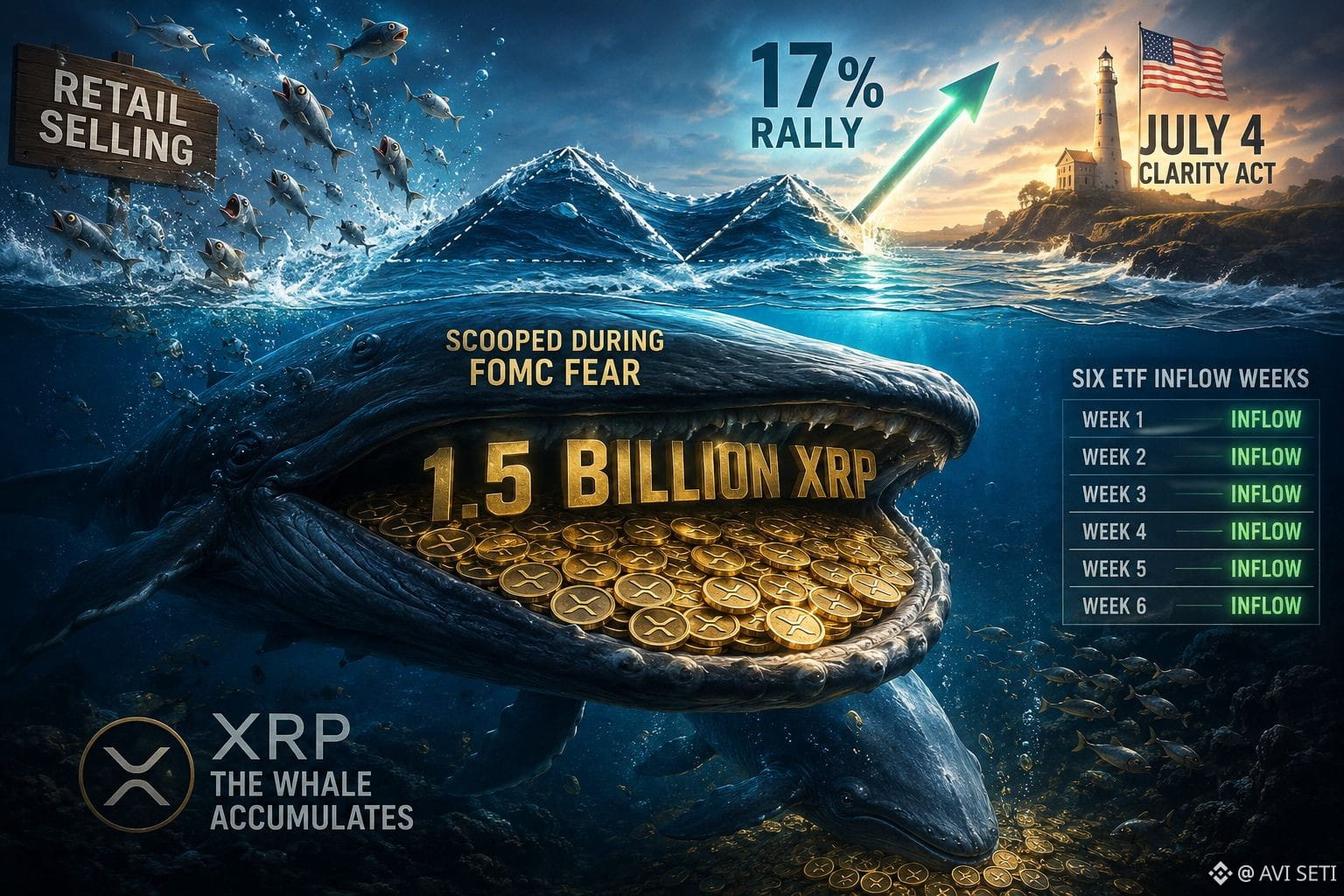
XRP whales just scooped 1.5 BILLION tokens.
During the FOMC fear. During the market pressure.
Quietly. Deliberately. Massively.
XRP Price Prediction: Triangle Setup Signals Potential 17% Rally as Whales Scoop 1.5B Coins.
1.5 billion XRP. At current prices — that's $1.65-$1.77 BILLION in whale accumulation.
Let me put that in context.
This week — while retail investors watched the FOMC hawkish signal and panicked — whales were buying 1.5 billion XRP.
That's not a coincidence. Whales accumulate before catalysts. Not after.
The catalysts they're accumulating before:
🕊️ US-Iran Peace Deal: TOMORROW — risk-on returns
⚖️ CLARITY Act July 4: 16 days — permanent commodity status
📊 XRP triangle setup: 17% rally signal confirmed by technicals
🏦 Six consecutive weeks of XRP ETF inflows: $1.44 billion total
🏦 Three US banks tokenized network: cross-chain rails needed
1.5 billion tokens. $1.65 billion in whale buying.
The signal is not subtle.
📊 XRP today:
— Price: ~$1.18-$1.23 — recovering
— 1.5B whale accumulation: this week ✅
— Triangle setup: 17% rally technical signal ✅
— Six weeks ETF inflows: $1.44B ✅
— July 4: 16 days ✅
— Peace deal tomorrow: risk-on catalyst ✅
1.5 billion tokens scooped while retail panicked.
Smart money speaks through actions.
#XRP #Ripple #WhaleAccumulation #BinanceSquare #FedHawkishDotPlotFlattensYieldCurve
XRP whales just scooped 1.5 BILLION tokens.
During the FOMC fear. During the market pressure.
Quietly. Deliberately. Massively.
XRP Price Prediction: Triangle Setup Signals Potential 17% Rally as Whales Scoop 1.5B Coins.
1.5 billion XRP. At current prices — that's $1.65-$1.77 BILLION in whale accumulation.
Let me put that in context.
This week — while retail investors watched the FOMC hawkish signal and panicked — whales were buying 1.5 billion XRP.
That's not a coincidence. Whales accumulate before catalysts. Not after.
The catalysts they're accumulating before:
🕊️ US-Iran Peace Deal: TOMORROW — risk-on returns
⚖️ CLARITY Act July 4: 16 days — permanent commodity status
📊 XRP triangle setup: 17% rally signal confirmed by technicals
🏦 Six consecutive weeks of XRP ETF inflows: $1.44 billion total
🏦 Three US banks tokenized network: cross-chain rails needed
1.5 billion tokens. $1.65 billion in whale buying.
The signal is not subtle.
📊 XRP today:
— Price: ~$1.18-$1.23 — recovering
— 1.5B whale accumulation: this week ✅
— Triangle setup: 17% rally technical signal ✅
— Six weeks ETF inflows: $1.44B ✅
— July 4: 16 days ✅
— Peace deal tomorrow: risk-on catalyst ✅
1.5 billion tokens scooped while retail panicked.
Smart money speaks through actions.
#XRP #Ripple #WhaleAccumulation #BinanceSquare #FedHawkishDotPlotFlattensYieldCurve
During the FOMC fear. During the market pressure.
Quietly. Deliberately. Massively.
XRP Price Prediction: Triangle Setup Signals Potential 17% Rally as Whales Scoop 1.5B Coins.
1.5 billion XRP. At current prices — that's $1.65-$1.77 BILLION in whale accumulation.
Let me put that in context.
This week — while retail investors watched the FOMC hawkish signal and panicked — whales were buying 1.5 billion XRP.
That's not a coincidence. Whales accumulate before catalysts. Not after.
The catalysts they're accumulating before:
🕊️ US-Iran Peace Deal: TOMORROW — risk-on returns
⚖️ CLARITY Act July 4: 16 days — permanent commodity status
📊 XRP triangle setup: 17% rally signal confirmed by technicals
🏦 Six consecutive weeks of XRP ETF inflows: $1.44 billion total
🏦 Three US banks tokenized network: cross-chain rails needed
1.5 billion tokens. $1.65 billion in whale buying.
The signal is not subtle.
📊 XRP today:
— Price: ~$1.18-$1.23 — recovering
— 1.5B whale accumulation: this week ✅
— Triangle setup: 17% rally technical signal ✅
— Six weeks ETF inflows: $1.44B ✅
— July 4: 16 days ✅
— Peace deal tomorrow: risk-on catalyst ✅
1.5 billion tokens scooped while retail panicked.
Smart money speaks through actions.
#XRP #Ripple #WhaleAccumulation #BinanceSquare #FedHawkishDotPlotFlattensYieldCurve
3
27
15.8k
PINNED
·
--
Verified
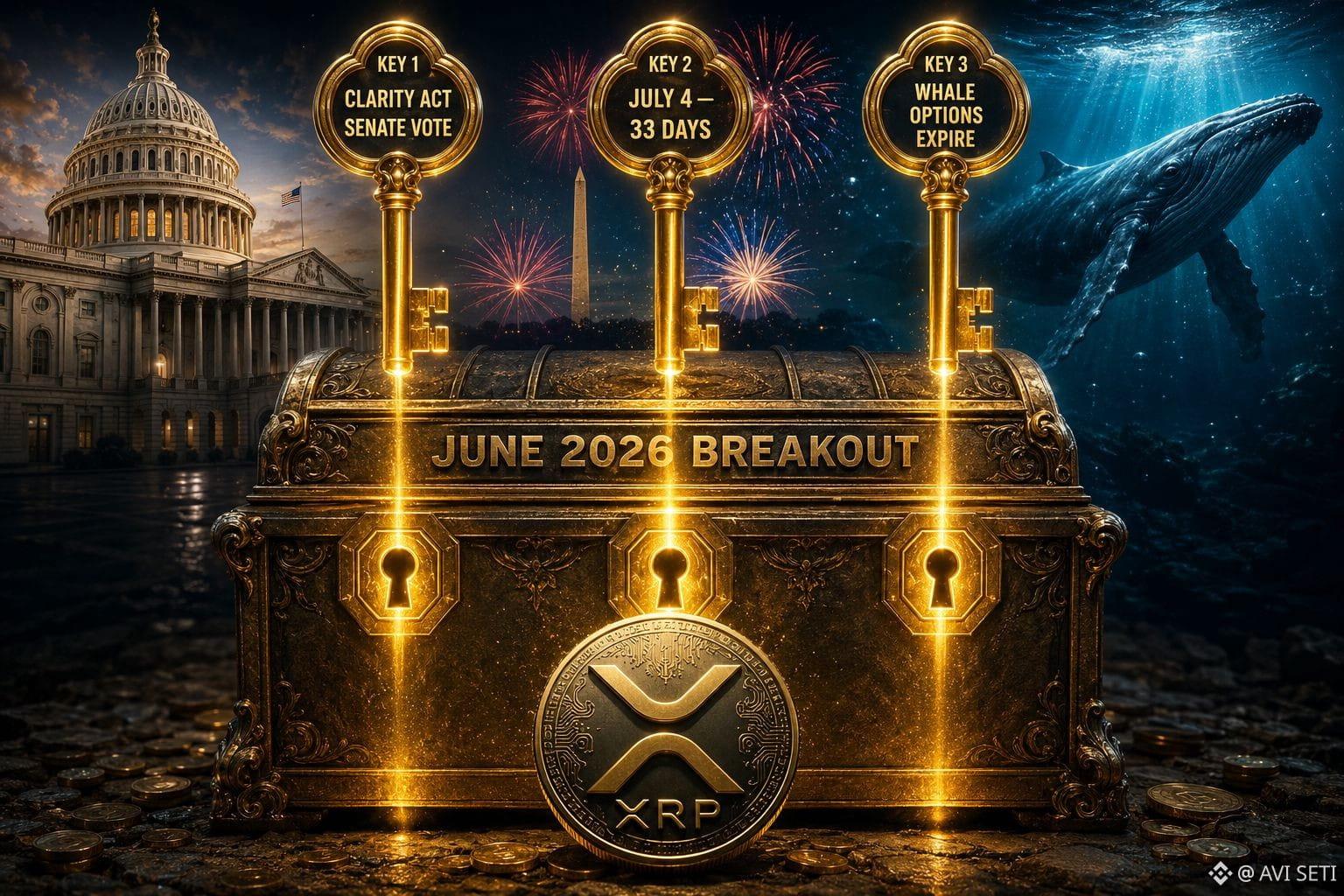
Welcome to June 2026.
This might be $XRP most important month of the year.
Here are the three reasons why.
Reason 1: CLARITY Act Full Senate Vote
The bill cleared committee 15-9 in May. June is the target for the full Senate floor vote. If it passes — XRP gets permanent federal commodity status. Institutions get their green light.
Reason 2: July 4 Is 33 Days Away
The White House set July 4 as the CLARITY Act signing ceremony target. Every day in June is one day closer to the moment XRP's legal status becomes permanently codified into American law.
Reason 3: The Whale's June Call Expires
Remember the whale who collected $224,000 betting XRP stays flat through June? Their options expire this month. If XRP breaks above $1.45 in June — they face losses. They will defend the range. And when their defense ends — the move begins.
Plus the fundamentals haven't moved:
🏦 JPMorgan XRPL settlement: proven ✅
🏦 RLUSD: $1B+ ✅
🏦 Samsung Upbit: Korean retail growing ✅
📊 XRP today:
— Price: ~$1.30-$1.33 — June 1 open
— Support: $1.28-$1.30
— June full Senate vote: coming ✅
— July 4: 33 days ✅
— Whale options: expiring this month ✅
— Breakout above $1.45 → $1.60
Three reasons. One month. June is XRP's month.
#XRP #Ripple #JuneIsXRP #BinanceSquare #AaveSecuresUKFCARegistration
Welcome to June 2026.
This might be $XRP most important month of the year.
Here are the three reasons why.
Reason 1: CLARITY Act Full Senate Vote
The bill cleared committee 15-9 in May. June is the target for the full Senate floor vote. If it passes — XRP gets permanent federal commodity status. Institutions get their green light.
Reason 2: July 4 Is 33 Days Away
The White House set July 4 as the CLARITY Act signing ceremony target. Every day in June is one day closer to the moment XRP's legal status becomes permanently codified into American law.
Reason 3: The Whale's June Call Expires
Remember the whale who collected $224,000 betting XRP stays flat through June? Their options expire this month. If XRP breaks above $1.45 in June — they face losses. They will defend the range. And when their defense ends — the move begins.
Plus the fundamentals haven't moved:
🏦 JPMorgan XRPL settlement: proven ✅
🏦 RLUSD: $1B+ ✅
🏦 Samsung Upbit: Korean retail growing ✅
📊 XRP today:
— Price: ~$1.30-$1.33 — June 1 open
— Support: $1.28-$1.30
— June full Senate vote: coming ✅
— July 4: 33 days ✅
— Whale options: expiring this month ✅
— Breakout above $1.45 → $1.60
Three reasons. One month. June is XRP's month.
#XRP #Ripple #JuneIsXRP #BinanceSquare #AaveSecuresUKFCARegistration
This might be $XRP most important month of the year.
Here are the three reasons why.
Reason 1: CLARITY Act Full Senate Vote
The bill cleared committee 15-9 in May. June is the target for the full Senate floor vote. If it passes — XRP gets permanent federal commodity status. Institutions get their green light.
Reason 2: July 4 Is 33 Days Away
The White House set July 4 as the CLARITY Act signing ceremony target. Every day in June is one day closer to the moment XRP's legal status becomes permanently codified into American law.
Reason 3: The Whale's June Call Expires
Remember the whale who collected $224,000 betting XRP stays flat through June? Their options expire this month. If XRP breaks above $1.45 in June — they face losses. They will defend the range. And when their defense ends — the move begins.
Plus the fundamentals haven't moved:
🏦 JPMorgan XRPL settlement: proven ✅
🏦 RLUSD: $1B+ ✅
🏦 Samsung Upbit: Korean retail growing ✅
📊 XRP today:
— Price: ~$1.30-$1.33 — June 1 open
— Support: $1.28-$1.30
— June full Senate vote: coming ✅
— July 4: 33 days ✅
— Whale options: expiring this month ✅
— Breakout above $1.45 → $1.60
Three reasons. One month. June is XRP's month.
#XRP #Ripple #JuneIsXRP #BinanceSquare #AaveSecuresUKFCARegistration
4
12
14k
·
--

Article
Crypto Pullback Tests the Market as Institutional Money and Tokenization Keep GrowingThe crypto market entered September 24 in a more defensive mood after a powerful rally pushed Bitcoin above $87,000 earlier this week. Bitcoin is now trading back in the mid-$80,000s, while Ethereum has slipped toward the $2,670 area and several major altcoins are also correcting. The pullback comes after unusually strong institutional flows: spot Bitcoin ETFs recorded nearly $1 billion of inflows on Monday, while weekly inflows reached about $1.71 billion by Wednesday, according to SoSoValue data cited by Investing.com.
The important point is that the recent market weakness is occurring after a substantial improvement in institutional participation rather than during a period of complete capital withdrawal.
1. Bitcoin's Rally Meets Short-Term Selling Pressure
Bitcoin moved above $87,000 earlier this week, reaching levels not seen since January. The rally was accompanied by significant ETF demand and corporate accumulation. Strategy, one of the largest corporate Bitcoin holders, purchased approximately $75.7 million worth of Bitcoin during the previous week, taking its reported holdings to roughly 846,000 BTC.
Spot Bitcoin ETFs also recorded strong flows. Investing.com reported that U.S. spot Bitcoin ETFs had attracted approximately $1.71 billion during the week through Wednesday, with almost $1 billion entering on Monday alone. That represented the strongest weekly performance since late August and showed renewed institutional demand after the market's earlier September weakness.
However, ETF inflows do not eliminate short-term volatility. Bitcoin has since retreated from the $87,000 region, while the wider market has also moved lower. The September 24 market snapshot showed Bitcoin around $80.8 lakh in INR terms and down roughly 1.8% over 24 hours, while Ethereum was down about 2.4%.
2. Ethereum Remains Closely Watched
Ethereum has become one of the most important institutional stories of the current market cycle. Reuters reported that ETH had broken above the $2,661.52 level earlier this month after consolidating following a more than 30% rally in late August.
Institutional treasury activity is also continuing. Bitmine, one of the largest Ethereum-focused treasury companies, purchased approximately $75 million worth of ETH, according to CoinDesk. The purchase came as its chairman Tom Lee discussed the possibility of institutions increasing their crypto exposure.
At the same time, institutions remain focused on whether blockchain adoption will translate into sustainable economic activity. Bitwise reported that some institutional investors view Ethereum and Solana partly as venture-style bets and could reconsider exposure if network usage fails to translate into stronger token economics.
This creates an important distinction: institutional participation is increasing, but institutional investors are still evaluating the relationship between blockchain usage, revenues and token value.
3. Tokenized Stocks Are Becoming a Major Theme
One of the biggest structural developments this month has been the expansion of tokenized securities.
On September 17, the U.S. Securities and Exchange Commission introduced a five-year exemption for certain platforms dealing in tokenized stocks. The framework allows eligible platforms to operate under specified conditions while avoiding some requirements that traditionally apply to securities exchanges and dealers. The SEC also stated that tokenized stocks must preserve shareholder rights such as dividends and voting rights, while synthetic tokens that merely track stock prices without representing ownership are excluded.
The development is already attracting traditional financial infrastructure.
On September 23, the New York Stock Exchange and Blockchain.com announced a strategic collaboration to explore blockchain-based versions of NYSE-listed stocks and ETFs. Their agreement also includes a market-data arrangement involving NYSE parent Intercontinental Exchange.
This is significant for crypto infrastructure because it shifts part of the discussion away from cryptocurrency speculation and toward blockchain as a settlement and market-access technology.
4. Pyth Connects Blockchain With Traditional Market Data
Pyth Network is another example of this convergence.
On September 22, Pyth announced that it had been approved as an external distributor of Nasdaq Basic, Nasdaq's proprietary real-time U.S. equity quote and trade product. The data is being made available through the Pyth Data Marketplace.
Pyth's broader ecosystem also includes institutional market-data participants and integrations involving companies such as Fidelity, Euronext and Tradeweb. The model is different from simply putting an asset on a blockchain: it focuses on bringing high-quality financial information into software-native markets and on-chain applications.
That matters as tokenized stocks, 24/7 markets and decentralized financial applications increasingly require reliable real-time data.
5. AI Agents Are Creating Another Crypto Demand Narrative
Artificial intelligence is becoming another important connection between traditional finance and blockchain.
BlackRock published a research paper arguing that autonomous AI agents could become a significant driver of crypto demand. Its thesis is that AI agents may need to make extremely small, frequent and continuous payments for data, computing power and digital services—transactions for which stablecoins and blockchain rails could be useful.
Cardano has recently entered this narrative through its integration with the x402 payment standard, which enables applications and AI agents to make machine-to-machine payments using ADA. The development has helped push ADA into the broader AI-agent payment discussion.
This theme is still developing, and actual economic adoption remains an important question. But it illustrates how crypto infrastructure is increasingly being discussed as a payment layer for automated software rather than solely as an investment asset.
6. Altcoins Are Showing Both Strength and Fragility
The recent altcoin moves demonstrate how quickly capital can rotate between narratives.
Dogecoin, for example, briefly climbed to $0.1059 after X announced trading partnerships involving several major crypto and brokerage platforms. The rally then reversed, with DOGE falling to around $0.0936 and long liquidations appearing across major derivatives venues.
Internet Computer has experienced the opposite dynamic. ICP declined around 3.23% during the latest market pullback, broadly tracking the wider market rather than responding to a major project-specific negative event.
These examples show why individual token narratives need to be separated from broader market liquidity. A strong project-specific headline can produce a rapid move, but leverage and Bitcoin-driven market conditions can quickly dominate the price action.
7. Regulation Remains Central to the Next Phase
Regulation remains one of the most important variables for institutional crypto adoption.
The failure of the CLARITY Act in the U.S. Senate earlier this month created uncertainty around comprehensive crypto legislation. However, regulators have continued using existing authority to create narrower frameworks, including the SEC's tokenized-stock exemption.
Meanwhile, the NYSE-Blockchain.com collaboration demonstrates that financial institutions are not necessarily waiting for one comprehensive crypto law before experimenting with blockchain-based markets. The regulatory approach is therefore developing through a combination of legislation, agency actions, exemptions and individual market initiatives.
Outlook
The September 24 market is showing a familiar pattern: strong institutional demand can coexist with short-term corrections.
Bitcoin's move above $87,000, large ETF inflows and corporate purchases provide evidence of substantial capital participation, while the latest pullback shows that volatility remains high. Ethereum continues to attract treasury and institutional attention, while tokenization is expanding through the SEC framework and partnerships involving established financial-market infrastructure.
At the same time, projects such as Pyth and Cardano illustrate two emerging narratives: blockchain-based financial data and AI-agent payments. Whether these narratives develop into large sources of sustainable on-chain activity will depend on actual adoption, revenue generation, regulation and market conditions.
The broader story is therefore moving beyond Bitcoin alone. Institutional capital, tokenized securities, financial data, AI agents and blockchain settlement infrastructure are increasingly overlapping. The market's next phase will likely be shaped not only by token prices, but also by how successfully these technologies connect with existing financial systems.
Financial Disclaimer: This article is for informational purposes only and does not constitute financial, investment, trading or legal advice. Crypto assets are highly volatile and can result in significant losses. Always conduct your own research and consider your risk tolerance before making financial decisions.
#AIStocksWhatNext #US10YTreasuryYieldHits19YearHigh #BitcoinRejectedAt$87,300Twice #DollarIndexReclaims101 #BitcoinTops$87KAtEightMonthHigh
Futuristic Wall Street meets decentralized finance — NYSE architecture linked by glowing blockchain rails to Ethereum and Pyth Network oracle infrastructure. Real-time Nasdaq market data streams into digital smart contracts while AI agents process automated stablecoin payments in the background. Institutional terminals and high-detail cityscape under cinematic lighting.
Crypto Pullback Tests the Market as Institutional Money and Tokenization Keep Growing
The crypto market entered September 24 in a more defensive mood after a powerful rally pushed Bitcoin above $87,000 earlier this week. Bitcoin is now trading back in the mid-$80,000s, while Ethereum has slipped toward the $2,670 area and several major altcoins are also correcting. The pullback comes after unusually strong institutional flows: spot Bitcoin ETFs recorded nearly $1 billion of inflows on Monday, while weekly inflows reached about $1.71 billion by Wednesday, according to SoSoValue data cited by Investing.com.
The important point is that the recent market weakness is occurring after a substantial improvement in institutional participation rather than during a period of complete capital withdrawal.
1. Bitcoin's Rally Meets Short-Term Selling Pressure
Bitcoin moved above $87,000 earlier this week, reaching levels not seen since January. The rally was accompanied by significant ETF demand and corporate accumulation. Strategy, one of the largest corporate Bitcoin holders, purchased approximately $75.7 million worth of Bitcoin during the previous week, taking its reported holdings to roughly 846,000 BTC.
Spot Bitcoin ETFs also recorded strong flows. Investing.com reported that U.S. spot Bitcoin ETFs had attracted approximately $1.71 billion during the week through Wednesday, with almost $1 billion entering on Monday alone. That represented the strongest weekly performance since late August and showed renewed institutional demand after the market's earlier September weakness.
However, ETF inflows do not eliminate short-term volatility. Bitcoin has since retreated from the $87,000 region, while the wider market has also moved lower. The September 24 market snapshot showed Bitcoin around $80.8 lakh in INR terms and down roughly 1.8% over 24 hours, while Ethereum was down about 2.4%.
2. Ethereum Remains Closely Watched
Ethereum has become one of the most important institutional stories of the current market cycle. Reuters reported that ETH had broken above the $2,661.52 level earlier this month after consolidating following a more than 30% rally in late August.
Institutional treasury activity is also continuing. Bitmine, one of the largest Ethereum-focused treasury companies, purchased approximately $75 million worth of ETH, according to CoinDesk. The purchase came as its chairman Tom Lee discussed the possibility of institutions increasing their crypto exposure.
At the same time, institutions remain focused on whether blockchain adoption will translate into sustainable economic activity. Bitwise reported that some institutional investors view Ethereum and Solana partly as venture-style bets and could reconsider exposure if network usage fails to translate into stronger token economics.
This creates an important distinction: institutional participation is increasing, but institutional investors are still evaluating the relationship between blockchain usage, revenues and token value.
3. Tokenized Stocks Are Becoming a Major Theme
One of the biggest structural developments this month has been the expansion of tokenized securities.
On September 17, the U.S. Securities and Exchange Commission introduced a five-year exemption for certain platforms dealing in tokenized stocks. The framework allows eligible platforms to operate under specified conditions while avoiding some requirements that traditionally apply to securities exchanges and dealers. The SEC also stated that tokenized stocks must preserve shareholder rights such as dividends and voting rights, while synthetic tokens that merely track stock prices without representing ownership are excluded.
The development is already attracting traditional financial infrastructure.
On September 23, the New York Stock Exchange and Blockchain.com announced a strategic collaboration to explore blockchain-based versions of NYSE-listed stocks and ETFs. Their agreement also includes a market-data arrangement involving NYSE parent Intercontinental Exchange.
This is significant for crypto infrastructure because it shifts part of the discussion away from cryptocurrency speculation and toward blockchain as a settlement and market-access technology.
4. Pyth Connects Blockchain With Traditional Market Data
Pyth Network is another example of this convergence.
On September 22, Pyth announced that it had been approved as an external distributor of Nasdaq Basic, Nasdaq's proprietary real-time U.S. equity quote and trade product. The data is being made available through the Pyth Data Marketplace.
Pyth's broader ecosystem also includes institutional market-data participants and integrations involving companies such as Fidelity, Euronext and Tradeweb. The model is different from simply putting an asset on a blockchain: it focuses on bringing high-quality financial information into software-native markets and on-chain applications.
That matters as tokenized stocks, 24/7 markets and decentralized financial applications increasingly require reliable real-time data.
5. AI Agents Are Creating Another Crypto Demand Narrative
Artificial intelligence is becoming another important connection between traditional finance and blockchain.
BlackRock published a research paper arguing that autonomous AI agents could become a significant driver of crypto demand. Its thesis is that AI agents may need to make extremely small, frequent and continuous payments for data, computing power and digital services—transactions for which stablecoins and blockchain rails could be useful.
Cardano has recently entered this narrative through its integration with the x402 payment standard, which enables applications and AI agents to make machine-to-machine payments using ADA. The development has helped push ADA into the broader AI-agent payment discussion.
This theme is still developing, and actual economic adoption remains an important question. But it illustrates how crypto infrastructure is increasingly being discussed as a payment layer for automated software rather than solely as an investment asset.
6. Altcoins Are Showing Both Strength and Fragility
The recent altcoin moves demonstrate how quickly capital can rotate between narratives.
Dogecoin, for example, briefly climbed to $0.1059 after X announced trading partnerships involving several major crypto and brokerage platforms. The rally then reversed, with DOGE falling to around $0.0936 and long liquidations appearing across major derivatives venues.
Internet Computer has experienced the opposite dynamic. ICP declined around 3.23% during the latest market pullback, broadly tracking the wider market rather than responding to a major project-specific negative event.
These examples show why individual token narratives need to be separated from broader market liquidity. A strong project-specific headline can produce a rapid move, but leverage and Bitcoin-driven market conditions can quickly dominate the price action.
7. Regulation Remains Central to the Next Phase
Regulation remains one of the most important variables for institutional crypto adoption.
The failure of the CLARITY Act in the U.S. Senate earlier this month created uncertainty around comprehensive crypto legislation. However, regulators have continued using existing authority to create narrower frameworks, including the SEC's tokenized-stock exemption.
Meanwhile, the NYSE-Blockchain.com collaboration demonstrates that financial institutions are not necessarily waiting for one comprehensive crypto law before experimenting with blockchain-based markets. The regulatory approach is therefore developing through a combination of legislation, agency actions, exemptions and individual market initiatives.
Outlook
The September 24 market is showing a familiar pattern: strong institutional demand can coexist with short-term corrections.
Bitcoin's move above $87,000, large ETF inflows and corporate purchases provide evidence of substantial capital participation, while the latest pullback shows that volatility remains high. Ethereum continues to attract treasury and institutional attention, while tokenization is expanding through the SEC framework and partnerships involving established financial-market infrastructure.
At the same time, projects such as Pyth and Cardano illustrate two emerging narratives: blockchain-based financial data and AI-agent payments. Whether these narratives develop into large sources of sustainable on-chain activity will depend on actual adoption, revenue generation, regulation and market conditions.
The broader story is therefore moving beyond Bitcoin alone. Institutional capital, tokenized securities, financial data, AI agents and blockchain settlement infrastructure are increasingly overlapping. The market's next phase will likely be shaped not only by token prices, but also by how successfully these technologies connect with existing financial systems.
Financial Disclaimer: This article is for informational purposes only and does not constitute financial, investment, trading or legal advice. Crypto assets are highly volatile and can result in significant losses. Always conduct your own research and consider your risk tolerance before making financial decisions.
#AIStocksWhatNext #US10YTreasuryYieldHits19YearHigh #BitcoinRejectedAt$87,300Twice #DollarIndexReclaims101 #BitcoinTops$87KAtEightMonthHigh
Futuristic Wall Street meets decentralized finance — NYSE architecture linked by glowing blockchain rails to Ethereum and Pyth Network oracle infrastructure. Real-time Nasdaq market data streams into digital smart contracts while AI agents process automated stablecoin payments in the background. Institutional terminals and high-detail cityscape under cinematic lighting.
The important point is that the recent market weakness is occurring after a substantial improvement in institutional participation rather than during a period of complete capital withdrawal.
1. Bitcoin's Rally Meets Short-Term Selling Pressure
Bitcoin moved above $87,000 earlier this week, reaching levels not seen since January. The rally was accompanied by significant ETF demand and corporate accumulation. Strategy, one of the largest corporate Bitcoin holders, purchased approximately $75.7 million worth of Bitcoin during the previous week, taking its reported holdings to roughly 846,000 BTC.
Spot Bitcoin ETFs also recorded strong flows. Investing.com reported that U.S. spot Bitcoin ETFs had attracted approximately $1.71 billion during the week through Wednesday, with almost $1 billion entering on Monday alone. That represented the strongest weekly performance since late August and showed renewed institutional demand after the market's earlier September weakness.
However, ETF inflows do not eliminate short-term volatility. Bitcoin has since retreated from the $87,000 region, while the wider market has also moved lower. The September 24 market snapshot showed Bitcoin around $80.8 lakh in INR terms and down roughly 1.8% over 24 hours, while Ethereum was down about 2.4%.
2. Ethereum Remains Closely Watched
Ethereum has become one of the most important institutional stories of the current market cycle. Reuters reported that ETH had broken above the $2,661.52 level earlier this month after consolidating following a more than 30% rally in late August.
Institutional treasury activity is also continuing. Bitmine, one of the largest Ethereum-focused treasury companies, purchased approximately $75 million worth of ETH, according to CoinDesk. The purchase came as its chairman Tom Lee discussed the possibility of institutions increasing their crypto exposure.
At the same time, institutions remain focused on whether blockchain adoption will translate into sustainable economic activity. Bitwise reported that some institutional investors view Ethereum and Solana partly as venture-style bets and could reconsider exposure if network usage fails to translate into stronger token economics.
This creates an important distinction: institutional participation is increasing, but institutional investors are still evaluating the relationship between blockchain usage, revenues and token value.
3. Tokenized Stocks Are Becoming a Major Theme
One of the biggest structural developments this month has been the expansion of tokenized securities.
On September 17, the U.S. Securities and Exchange Commission introduced a five-year exemption for certain platforms dealing in tokenized stocks. The framework allows eligible platforms to operate under specified conditions while avoiding some requirements that traditionally apply to securities exchanges and dealers. The SEC also stated that tokenized stocks must preserve shareholder rights such as dividends and voting rights, while synthetic tokens that merely track stock prices without representing ownership are excluded.
The development is already attracting traditional financial infrastructure.
On September 23, the New York Stock Exchange and Blockchain.com announced a strategic collaboration to explore blockchain-based versions of NYSE-listed stocks and ETFs. Their agreement also includes a market-data arrangement involving NYSE parent Intercontinental Exchange.
This is significant for crypto infrastructure because it shifts part of the discussion away from cryptocurrency speculation and toward blockchain as a settlement and market-access technology.
4. Pyth Connects Blockchain With Traditional Market Data
Pyth Network is another example of this convergence.
On September 22, Pyth announced that it had been approved as an external distributor of Nasdaq Basic, Nasdaq's proprietary real-time U.S. equity quote and trade product. The data is being made available through the Pyth Data Marketplace.
Pyth's broader ecosystem also includes institutional market-data participants and integrations involving companies such as Fidelity, Euronext and Tradeweb. The model is different from simply putting an asset on a blockchain: it focuses on bringing high-quality financial information into software-native markets and on-chain applications.
That matters as tokenized stocks, 24/7 markets and decentralized financial applications increasingly require reliable real-time data.
5. AI Agents Are Creating Another Crypto Demand Narrative
Artificial intelligence is becoming another important connection between traditional finance and blockchain.
BlackRock published a research paper arguing that autonomous AI agents could become a significant driver of crypto demand. Its thesis is that AI agents may need to make extremely small, frequent and continuous payments for data, computing power and digital services—transactions for which stablecoins and blockchain rails could be useful.
Cardano has recently entered this narrative through its integration with the x402 payment standard, which enables applications and AI agents to make machine-to-machine payments using ADA. The development has helped push ADA into the broader AI-agent payment discussion.
This theme is still developing, and actual economic adoption remains an important question. But it illustrates how crypto infrastructure is increasingly being discussed as a payment layer for automated software rather than solely as an investment asset.
6. Altcoins Are Showing Both Strength and Fragility
The recent altcoin moves demonstrate how quickly capital can rotate between narratives.
Dogecoin, for example, briefly climbed to $0.1059 after X announced trading partnerships involving several major crypto and brokerage platforms. The rally then reversed, with DOGE falling to around $0.0936 and long liquidations appearing across major derivatives venues.
Internet Computer has experienced the opposite dynamic. ICP declined around 3.23% during the latest market pullback, broadly tracking the wider market rather than responding to a major project-specific negative event.
These examples show why individual token narratives need to be separated from broader market liquidity. A strong project-specific headline can produce a rapid move, but leverage and Bitcoin-driven market conditions can quickly dominate the price action.
7. Regulation Remains Central to the Next Phase
Regulation remains one of the most important variables for institutional crypto adoption.
The failure of the CLARITY Act in the U.S. Senate earlier this month created uncertainty around comprehensive crypto legislation. However, regulators have continued using existing authority to create narrower frameworks, including the SEC's tokenized-stock exemption.
Meanwhile, the NYSE-Blockchain.com collaboration demonstrates that financial institutions are not necessarily waiting for one comprehensive crypto law before experimenting with blockchain-based markets. The regulatory approach is therefore developing through a combination of legislation, agency actions, exemptions and individual market initiatives.
Outlook
The September 24 market is showing a familiar pattern: strong institutional demand can coexist with short-term corrections.
Bitcoin's move above $87,000, large ETF inflows and corporate purchases provide evidence of substantial capital participation, while the latest pullback shows that volatility remains high. Ethereum continues to attract treasury and institutional attention, while tokenization is expanding through the SEC framework and partnerships involving established financial-market infrastructure.
At the same time, projects such as Pyth and Cardano illustrate two emerging narratives: blockchain-based financial data and AI-agent payments. Whether these narratives develop into large sources of sustainable on-chain activity will depend on actual adoption, revenue generation, regulation and market conditions.
The broader story is therefore moving beyond Bitcoin alone. Institutional capital, tokenized securities, financial data, AI agents and blockchain settlement infrastructure are increasingly overlapping. The market's next phase will likely be shaped not only by token prices, but also by how successfully these technologies connect with existing financial systems.
Financial Disclaimer: This article is for informational purposes only and does not constitute financial, investment, trading or legal advice. Crypto assets are highly volatile and can result in significant losses. Always conduct your own research and consider your risk tolerance before making financial decisions.
#AIStocksWhatNext #US10YTreasuryYieldHits19YearHigh #BitcoinRejectedAt$87,300Twice #DollarIndexReclaims101 #BitcoinTops$87KAtEightMonthHigh
Futuristic Wall Street meets decentralized finance — NYSE architecture linked by glowing blockchain rails to Ethereum and Pyth Network oracle infrastructure. Real-time Nasdaq market data streams into digital smart contracts while AI agents process automated stablecoin payments in the background. Institutional terminals and high-detail cityscape under cinematic lighting.
183
·
--
Cardano has recently gained attention from the integration of the x402 payment standard, which enables applications and autonomous AI agents to make machine-to-machine payments using ADA.
The development connects Cardano with the growing AI-agent payment narrative and contributed to a recent multi-day move toward a four-month high. ADA is now also moving with the broader altcoin market as crypto prices retreat from their recent highs.
#Cardano #ADA #AI #Crypto #Web3
Cardano has recently gained attention from the integration of the x402 payment standard, which enables applications and autonomous AI agents to make machine-to-machine payments using ADA.
The development connects Cardano with the growing AI-agent payment narrative and contributed to a recent multi-day move toward a four-month high. ADA is now also moving with the broader altcoin market as crypto prices retreat from their recent highs.
#Cardano #ADA #AI #Crypto #Web3
The development connects Cardano with the growing AI-agent payment narrative and contributed to a recent multi-day move toward a four-month high. ADA is now also moving with the broader altcoin market as crypto prices retreat from their recent highs.
#Cardano #ADA #AI #Crypto #Web3

85
·
--
Ethereum is trading around the $2,670 area after breaking above the $2,661.52 resistance level earlier this week. Reuters noted that ETH had already gained more than 30% during its late-August rally, while the latest market pullback has brought renewed volatility.
Bitmine, one of the largest Ethereum-focused treasury firms, also bought approximately $75 million worth of ETH, adding to the institutional accumulation narrative around Ethereum.
#Ethereum #ETH #Crypto #DeFi #Blockchain
Ethereum is trading around the $2,670 area after breaking above the $2,661.52 resistance level earlier this week. Reuters noted that ETH had already gained more than 30% during its late-August rally, while the latest market pullback has brought renewed volatility.
Bitmine, one of the largest Ethereum-focused treasury firms, also bought approximately $75 million worth of ETH, adding to the institutional accumulation narrative around Ethereum.
#Ethereum #ETH #Crypto #DeFi #Blockchain
Bitmine, one of the largest Ethereum-focused treasury firms, also bought approximately $75 million worth of ETH, adding to the institutional accumulation narrative around Ethereum.
#Ethereum #ETH #Crypto #DeFi #Blockchain

89
·
--
Ethereum is trading around $2,765, up 1.21% on the day, participating in the broader crypto rally that's pushed Bitcoin to $86,795 and briefly above $87,300 overnight — its strongest level since January. ETH's steady gain reflects the same combination of factors lifting the entire market: nearly $1 billion in single-day Bitcoin ETF inflows, improving risk sentiment ahead of anticipated Trump-Xi trade talks, and a market digesting this week's mix of Fed speaker commentary and PMI data releases. While Ethereum's move is more modest than XRP's 6.84% surge or NEAR's 23% weekly gain, its steady climb alongside Bitcoin's historic three-month winning streak reinforces that institutional capital continues flowing broadly across major crypto assets rather than concentrating in any single narrative. With the CD20 index — a broader crypto benchmark — up 3.11% today, Ethereum's performance sits comfortably in line with the market's overall risk-on tone.
#Ethereum #ETH #CryptoRally #CryptoMarket #ETHPrice
Ethereum is trading around $2,765, up 1.21% on the day, participating in the broader crypto rally that's pushed Bitcoin to $86,795 and briefly above $87,300 overnight — its strongest level since January. ETH's steady gain reflects the same combination of factors lifting the entire market: nearly $1 billion in single-day Bitcoin ETF inflows, improving risk sentiment ahead of anticipated Trump-Xi trade talks, and a market digesting this week's mix of Fed speaker commentary and PMI data releases. While Ethereum's move is more modest than XRP's 6.84% surge or NEAR's 23% weekly gain, its steady climb alongside Bitcoin's historic three-month winning streak reinforces that institutional capital continues flowing broadly across major crypto assets rather than concentrating in any single narrative. With the CD20 index — a broader crypto benchmark — up 3.11% today, Ethereum's performance sits comfortably in line with the market's overall risk-on tone.
#Ethereum #ETH #CryptoRally #CryptoMarket #ETHPrice
#Ethereum #ETH #CryptoRally #CryptoMarket #ETHPrice

15
·
--
NEAR Protocol has surged roughly 23% this week, standing out even amid a broadly strong crypto market, as traders point to renewed enthusiasm around NEAR's AI-focused ecosystem developments alongside the same macro tailwinds lifting Bitcoin and major altcoins. The move builds on a strong September for NEAR overall, which has delivered a 55.9% year-to-date return as the network continues positioning itself around NEAR AI, its staking-based payment system launched over the summer that integrates token utility directly with compute access for AI services.
NEAR's rally is unfolding against the same backdrop of Bitcoin holding above $81,000, active ETF flows across the sector, and market attention on this week's Trump-Xi trade talks, U.S. PMI data, and Fed speaker commentary — all factors contributing to a broadly risk-on environment where AI-narrative altcoins like NEAR have significantly outpaced the major-cap rally. The token's continued strength through multiple weeks now suggests genuine narrative momentum around blockchain-based AI infrastructure, rather than a single-day speculative spike.
#NEAR #NEARProtocol #AICrypto #CryptoRally #Altcoins
NEAR Protocol has surged roughly 23% this week, standing out even amid a broadly strong crypto market, as traders point to renewed enthusiasm around NEAR's AI-focused ecosystem developments alongside the same macro tailwinds lifting Bitcoin and major altcoins. The move builds on a strong September for NEAR overall, which has delivered a 55.9% year-to-date return as the network continues positioning itself around NEAR AI, its staking-based payment system launched over the summer that integrates token utility directly with compute access for AI services.
NEAR's rally is unfolding against the same backdrop of Bitcoin holding above $81,000, active ETF flows across the sector, and market attention on this week's Trump-Xi trade talks, U.S. PMI data, and Fed speaker commentary — all factors contributing to a broadly risk-on environment where AI-narrative altcoins like NEAR have significantly outpaced the major-cap rally. The token's continued strength through multiple weeks now suggests genuine narrative momentum around blockchain-based AI infrastructure, rather than a single-day speculative spike.
#NEAR #NEARProtocol #AICrypto #CryptoRally #Altcoins
NEAR's rally is unfolding against the same backdrop of Bitcoin holding above $81,000, active ETF flows across the sector, and market attention on this week's Trump-Xi trade talks, U.S. PMI data, and Fed speaker commentary — all factors contributing to a broadly risk-on environment where AI-narrative altcoins like NEAR have significantly outpaced the major-cap rally. The token's continued strength through multiple weeks now suggests genuine narrative momentum around blockchain-based AI infrastructure, rather than a single-day speculative spike.
#NEAR #NEARProtocol #AICrypto #CryptoRally #Altcoins

74
·
--
Solana climbed to $119.00, up 1.89% on the day, participating in the broader market rally that's pushed Bitcoin to eight-month highs and XRP up nearly 7%. The move comes during a week where traders have been closely watching ETF flows, U.S. PMI data, Fed speaker commentary, and anticipated Trump-Xi trade talks — a dense macro calendar that's nonetheless failed to derail crypto's upward momentum. Solana's relatively modest gain compared to XRP's surge reflects a market where capital rotation is currently favoring payment-and-ETF-access narratives over pure infrastructure plays, even as SOL continues benefiting from the same improving risk appetite lifting the entire sector. With Bitcoin holding above $81,000 for much of the week and broader market cap comfortably above $2.5 trillion, Solana's steady climb reflects participation in a genuinely synchronized rally rather than any SOL-specific news event.
#Solana #SOL #CryptoRally #Altcoins #SOLPrice
Solana climbed to $119.00, up 1.89% on the day, participating in the broader market rally that's pushed Bitcoin to eight-month highs and XRP up nearly 7%. The move comes during a week where traders have been closely watching ETF flows, U.S. PMI data, Fed speaker commentary, and anticipated Trump-Xi trade talks — a dense macro calendar that's nonetheless failed to derail crypto's upward momentum. Solana's relatively modest gain compared to XRP's surge reflects a market where capital rotation is currently favoring payment-and-ETF-access narratives over pure infrastructure plays, even as SOL continues benefiting from the same improving risk appetite lifting the entire sector. With Bitcoin holding above $81,000 for much of the week and broader market cap comfortably above $2.5 trillion, Solana's steady climb reflects participation in a genuinely synchronized rally rather than any SOL-specific news event.
#Solana #SOL #CryptoRally #Altcoins #SOLPrice
#Solana #SOL #CryptoRally #Altcoins #SOLPrice

108
·
--

Article
Bitcoin's Rarest Streak in 14 Years: What September 2026 Has in Common With 2012Hook:
Bitcoin just did something it's only done once before in its entire history: post gains in July, August, and September in the same year — a feat last seen in 2012, back when Bitcoin traded for pocket change and the entire "crypto market" fit inside a handful of forum threads. Today, with Bitcoin brushing $87,300 and nearly $1 billion flowing into spot ETFs in a single day, the comparison isn't just a historical curiosity — it's raising real questions about what comes next.
Macro Factors: A Three-Month Streak 14 Years in the Making
Bitcoin touched $87,300 overnight before settling near $86,795, up 1.67% on the day and marking its highest level since January 2026. The move caps an extraordinary three-month run: Bitcoin gained 4.8% in July, 25.2% in August, and is currently up 10.9% in September, putting it on track for its first July-to-September winning streak since 2012. That's a meaningful historical marker — in Bitcoin's entire trading history, this pattern has occurred exactly once before, when 2012 saw consecutive monthly gains of 41.0%, 6.4%, and 24.4%. What followed that 2012 streak is worth noting without over-reading it: a 9.7% pullback in October, followed by a rally exceeding 2,000% from that monthly low. Today's market bears almost no structural resemblance to 2012's, of course — Bitcoin is now part of a multi-trillion-dollar asset class with deep spot and derivatives liquidity across dozens of venues, institutional participation at scale, and sophisticated directional and relative-value trading strategies that simply didn't exist 14 years ago, making a repeat of that exact percentage magnitude far less likely even if the seasonal pattern rhymes.
Institutional Moves: Nearly $1 Billion in a Single Day
The clearest evidence that this rally has genuine institutional backing came through Tuesday's ETF flow U.S. spot Bitcoin ETFs recorded $998.95 million in net inflows, the largest single-day haul since October 6, 2025, when the category pulled in $1.2 billion. Researchers linked the surge to a combination of renewed risk appetite, strong underlying spot ETF demand, and short covering as Bitcoin broke through key technical resistance levels. This institutional conviction extends well beyond ETF wrappers — Strategy's Bitcoin holdings have now crossed $73.56 billion in value, reinforcing that corporate treasury accumulation strategies remain firmly intact even after the company's public buying pace slowed earlier in September. The broader altcoin market showed similar institutional engagement today: XRP surged 6.84% to $1.61 as Canadian XRP ETF options officially entered the U.S. market, extending the token's expanding web of regulated investment vehicles even in the wake of the CLARITY Act's disappointing Senate outcome.
On-Chain and Whale Behavior: Rotation Beyond the Majors
While Bitcoin, Ethereum, and XRP captured the day's headline percentage moves, some of the most striking action happened further down the market cap table. NEAR Protocol surged roughly 23% this week, drawing attention as one of the sharpest moves in the entire market, with traders linking the rally to renewed interest in NEAR's AI-focused ecosystem, including its staking-based payment system launched over the summer that connects token utility directly to AI compute access. This kind of rotation into narrative-driven mid-cap tokens — even as majors like Bitcoin post historic streaks — reflects a market where risk appetite has genuinely broadened beyond the largest assets. Crypto.news reported this week that Bitcoin held above $81,000 even as traders juggled a dense macro calendar including ETF flows, U.S. PMI data, Fed speaker commentary, and anticipated Trump-Xi trade talks — evidence that the market's current strength is proving resilient across multiple simultaneous sources of potential volatility rather than depending on any single calm news cycle.
Regulation: Building Access, One ETF at a Time
Today's XRP news adds another layer to the incremental, agency-by-agency regulatory progress that's defined the past two weeks following the CLARITY Act's Senate failure. Canadian XRP ETF options entering the U.S. market represents exactly the kind of targeted, product-specific regulatory advancement that's continued even without comprehensive federal legislation — following the same pattern seen with the SEC's tokenized-securities "Innovation Exemption" and the ECB's Pontes settlement infrastructure launch just days earlier. Each of these developments individually might seem modest, but collectively they're reinforcing a market narrative where regulatory clarity is arriving through accumulated agency and product-level action rather than a single decisive piece of congressional legislation — and today's price action across XRP specifically suggests traders are rewarding that incremental progress in real time.
Outlook: Historic Streak, Uncertain Next Chapter
Bitcoin's rare three-month winning streak puts the market in genuinely uncharted territory, at least in terms of historical precedent. The only prior instance, in 2012, was followed by a sharp but short-lived October pullback before one of the most explosive rallies in Bitcoin's history — but drawing a direct line from that single historical data point to today's vastly more mature, institutionally saturated market would be a stretch few serious analysts are willing to make. What's more instructive is the breadth of today's rally: nearly $1 billion in Bitcoin ETF inflows, a 6.84% XRP surge tied to genuine ETF access news, and a 23% weekly NEAR rally tied to AI-narrative momentum all point to a market where capital is flowing broadly and confidently across multiple assets and narratives simultaneously, rather than concentrating nervously in a single "safe" trade.
Closing Thought:
Whether or not history rhymes with 2012, today's rally reflects something markets have earned the hard way this September — genuine institutional conviction, broadening participation beyond Bitcoin alone, and incremental regulatory wins piling up even without a single decisive legislative victory. That combination, more than any calendar coincidence, is probably the real story behind Bitcoin's rare streak.
Disclaimer: This article is for informational purposes only and does not constitute financial, investment, or legal advice. Cryptocurrency markets are highly volatile and carry significant risk of loss. Always conduct your own research and consult a licensed financial advisor before making investment decisions.
#AIStocksWhatNext #BitcoinTops$87KAtEightMonthHigh #ZECBreaksAbove$1600AtRecordHigh #BitwiseNEARStakingETPAssetsTop$100M #DogecoinRises15%
An antique brass telescope rests on a dark wooden desk, its lens trained toward a glowing constellation that forms the shape of a rising bar chart. Scattered star charts and a softly illuminated globe surround it, bathed in the warm glow of a desk lamp against deep navy shadows. The moody amber-and-navy tones and ultra-detailed still-life composition evoke the quiet act of studying the past to chart a clearer path forward.
Bitcoin's Rarest Streak in 14 Years: What September 2026 Has in Common With 2012
Hook:
Bitcoin just did something it's only done once before in its entire history: post gains in July, August, and September in the same year — a feat last seen in 2012, back when Bitcoin traded for pocket change and the entire "crypto market" fit inside a handful of forum threads. Today, with Bitcoin brushing $87,300 and nearly $1 billion flowing into spot ETFs in a single day, the comparison isn't just a historical curiosity — it's raising real questions about what comes next.
Macro Factors: A Three-Month Streak 14 Years in the Making
Bitcoin touched $87,300 overnight before settling near $86,795, up 1.67% on the day and marking its highest level since January 2026. The move caps an extraordinary three-month run: Bitcoin gained 4.8% in July, 25.2% in August, and is currently up 10.9% in September, putting it on track for its first July-to-September winning streak since 2012. That's a meaningful historical marker — in Bitcoin's entire trading history, this pattern has occurred exactly once before, when 2012 saw consecutive monthly gains of 41.0%, 6.4%, and 24.4%. What followed that 2012 streak is worth noting without over-reading it: a 9.7% pullback in October, followed by a rally exceeding 2,000% from that monthly low. Today's market bears almost no structural resemblance to 2012's, of course — Bitcoin is now part of a multi-trillion-dollar asset class with deep spot and derivatives liquidity across dozens of venues, institutional participation at scale, and sophisticated directional and relative-value trading strategies that simply didn't exist 14 years ago, making a repeat of that exact percentage magnitude far less likely even if the seasonal pattern rhymes.
Institutional Moves: Nearly $1 Billion in a Single Day
The clearest evidence that this rally has genuine institutional backing came through Tuesday's ETF flow U.S. spot Bitcoin ETFs recorded $998.95 million in net inflows, the largest single-day haul since October 6, 2025, when the category pulled in $1.2 billion. Researchers linked the surge to a combination of renewed risk appetite, strong underlying spot ETF demand, and short covering as Bitcoin broke through key technical resistance levels. This institutional conviction extends well beyond ETF wrappers — Strategy's Bitcoin holdings have now crossed $73.56 billion in value, reinforcing that corporate treasury accumulation strategies remain firmly intact even after the company's public buying pace slowed earlier in September. The broader altcoin market showed similar institutional engagement today: XRP surged 6.84% to $1.61 as Canadian XRP ETF options officially entered the U.S. market, extending the token's expanding web of regulated investment vehicles even in the wake of the CLARITY Act's disappointing Senate outcome.
On-Chain and Whale Behavior: Rotation Beyond the Majors
While Bitcoin, Ethereum, and XRP captured the day's headline percentage moves, some of the most striking action happened further down the market cap table. NEAR Protocol surged roughly 23% this week, drawing attention as one of the sharpest moves in the entire market, with traders linking the rally to renewed interest in NEAR's AI-focused ecosystem, including its staking-based payment system launched over the summer that connects token utility directly to AI compute access. This kind of rotation into narrative-driven mid-cap tokens — even as majors like Bitcoin post historic streaks — reflects a market where risk appetite has genuinely broadened beyond the largest assets. Crypto.news reported this week that Bitcoin held above $81,000 even as traders juggled a dense macro calendar including ETF flows, U.S. PMI data, Fed speaker commentary, and anticipated Trump-Xi trade talks — evidence that the market's current strength is proving resilient across multiple simultaneous sources of potential volatility rather than depending on any single calm news cycle.
Regulation: Building Access, One ETF at a Time
Today's XRP news adds another layer to the incremental, agency-by-agency regulatory progress that's defined the past two weeks following the CLARITY Act's Senate failure. Canadian XRP ETF options entering the U.S. market represents exactly the kind of targeted, product-specific regulatory advancement that's continued even without comprehensive federal legislation — following the same pattern seen with the SEC's tokenized-securities "Innovation Exemption" and the ECB's Pontes settlement infrastructure launch just days earlier. Each of these developments individually might seem modest, but collectively they're reinforcing a market narrative where regulatory clarity is arriving through accumulated agency and product-level action rather than a single decisive piece of congressional legislation — and today's price action across XRP specifically suggests traders are rewarding that incremental progress in real time.
Outlook: Historic Streak, Uncertain Next Chapter
Bitcoin's rare three-month winning streak puts the market in genuinely uncharted territory, at least in terms of historical precedent. The only prior instance, in 2012, was followed by a sharp but short-lived October pullback before one of the most explosive rallies in Bitcoin's history — but drawing a direct line from that single historical data point to today's vastly more mature, institutionally saturated market would be a stretch few serious analysts are willing to make. What's more instructive is the breadth of today's rally: nearly $1 billion in Bitcoin ETF inflows, a 6.84% XRP surge tied to genuine ETF access news, and a 23% weekly NEAR rally tied to AI-narrative momentum all point to a market where capital is flowing broadly and confidently across multiple assets and narratives simultaneously, rather than concentrating nervously in a single "safe" trade.
Closing Thought:
Whether or not history rhymes with 2012, today's rally reflects something markets have earned the hard way this September — genuine institutional conviction, broadening participation beyond Bitcoin alone, and incremental regulatory wins piling up even without a single decisive legislative victory. That combination, more than any calendar coincidence, is probably the real story behind Bitcoin's rare streak.
Disclaimer: This article is for informational purposes only and does not constitute financial, investment, or legal advice. Cryptocurrency markets are highly volatile and carry significant risk of loss. Always conduct your own research and consult a licensed financial advisor before making investment decisions.
#AIStocksWhatNext #BitcoinTops$87KAtEightMonthHigh #ZECBreaksAbove$1600AtRecordHigh #BitwiseNEARStakingETPAssetsTop$100M #DogecoinRises15%
An antique brass telescope rests on a dark wooden desk, its lens trained toward a glowing constellation that forms the shape of a rising bar chart. Scattered star charts and a softly illuminated globe surround it, bathed in the warm glow of a desk lamp against deep navy shadows. The moody amber-and-navy tones and ultra-detailed still-life composition evoke the quiet act of studying the past to chart a clearer path forward.
Bitcoin just did something it's only done once before in its entire history: post gains in July, August, and September in the same year — a feat last seen in 2012, back when Bitcoin traded for pocket change and the entire "crypto market" fit inside a handful of forum threads. Today, with Bitcoin brushing $87,300 and nearly $1 billion flowing into spot ETFs in a single day, the comparison isn't just a historical curiosity — it's raising real questions about what comes next.
Macro Factors: A Three-Month Streak 14 Years in the Making
Bitcoin touched $87,300 overnight before settling near $86,795, up 1.67% on the day and marking its highest level since January 2026. The move caps an extraordinary three-month run: Bitcoin gained 4.8% in July, 25.2% in August, and is currently up 10.9% in September, putting it on track for its first July-to-September winning streak since 2012. That's a meaningful historical marker — in Bitcoin's entire trading history, this pattern has occurred exactly once before, when 2012 saw consecutive monthly gains of 41.0%, 6.4%, and 24.4%. What followed that 2012 streak is worth noting without over-reading it: a 9.7% pullback in October, followed by a rally exceeding 2,000% from that monthly low. Today's market bears almost no structural resemblance to 2012's, of course — Bitcoin is now part of a multi-trillion-dollar asset class with deep spot and derivatives liquidity across dozens of venues, institutional participation at scale, and sophisticated directional and relative-value trading strategies that simply didn't exist 14 years ago, making a repeat of that exact percentage magnitude far less likely even if the seasonal pattern rhymes.
Institutional Moves: Nearly $1 Billion in a Single Day
The clearest evidence that this rally has genuine institutional backing came through Tuesday's ETF flow U.S. spot Bitcoin ETFs recorded $998.95 million in net inflows, the largest single-day haul since October 6, 2025, when the category pulled in $1.2 billion. Researchers linked the surge to a combination of renewed risk appetite, strong underlying spot ETF demand, and short covering as Bitcoin broke through key technical resistance levels. This institutional conviction extends well beyond ETF wrappers — Strategy's Bitcoin holdings have now crossed $73.56 billion in value, reinforcing that corporate treasury accumulation strategies remain firmly intact even after the company's public buying pace slowed earlier in September. The broader altcoin market showed similar institutional engagement today: XRP surged 6.84% to $1.61 as Canadian XRP ETF options officially entered the U.S. market, extending the token's expanding web of regulated investment vehicles even in the wake of the CLARITY Act's disappointing Senate outcome.
On-Chain and Whale Behavior: Rotation Beyond the Majors
While Bitcoin, Ethereum, and XRP captured the day's headline percentage moves, some of the most striking action happened further down the market cap table. NEAR Protocol surged roughly 23% this week, drawing attention as one of the sharpest moves in the entire market, with traders linking the rally to renewed interest in NEAR's AI-focused ecosystem, including its staking-based payment system launched over the summer that connects token utility directly to AI compute access. This kind of rotation into narrative-driven mid-cap tokens — even as majors like Bitcoin post historic streaks — reflects a market where risk appetite has genuinely broadened beyond the largest assets. Crypto.news reported this week that Bitcoin held above $81,000 even as traders juggled a dense macro calendar including ETF flows, U.S. PMI data, Fed speaker commentary, and anticipated Trump-Xi trade talks — evidence that the market's current strength is proving resilient across multiple simultaneous sources of potential volatility rather than depending on any single calm news cycle.
Regulation: Building Access, One ETF at a Time
Today's XRP news adds another layer to the incremental, agency-by-agency regulatory progress that's defined the past two weeks following the CLARITY Act's Senate failure. Canadian XRP ETF options entering the U.S. market represents exactly the kind of targeted, product-specific regulatory advancement that's continued even without comprehensive federal legislation — following the same pattern seen with the SEC's tokenized-securities "Innovation Exemption" and the ECB's Pontes settlement infrastructure launch just days earlier. Each of these developments individually might seem modest, but collectively they're reinforcing a market narrative where regulatory clarity is arriving through accumulated agency and product-level action rather than a single decisive piece of congressional legislation — and today's price action across XRP specifically suggests traders are rewarding that incremental progress in real time.
Outlook: Historic Streak, Uncertain Next Chapter
Bitcoin's rare three-month winning streak puts the market in genuinely uncharted territory, at least in terms of historical precedent. The only prior instance, in 2012, was followed by a sharp but short-lived October pullback before one of the most explosive rallies in Bitcoin's history — but drawing a direct line from that single historical data point to today's vastly more mature, institutionally saturated market would be a stretch few serious analysts are willing to make. What's more instructive is the breadth of today's rally: nearly $1 billion in Bitcoin ETF inflows, a 6.84% XRP surge tied to genuine ETF access news, and a 23% weekly NEAR rally tied to AI-narrative momentum all point to a market where capital is flowing broadly and confidently across multiple assets and narratives simultaneously, rather than concentrating nervously in a single "safe" trade.
Closing Thought:
Whether or not history rhymes with 2012, today's rally reflects something markets have earned the hard way this September — genuine institutional conviction, broadening participation beyond Bitcoin alone, and incremental regulatory wins piling up even without a single decisive legislative victory. That combination, more than any calendar coincidence, is probably the real story behind Bitcoin's rare streak.
Disclaimer: This article is for informational purposes only and does not constitute financial, investment, or legal advice. Cryptocurrency markets are highly volatile and carry significant risk of loss. Always conduct your own research and consult a licensed financial advisor before making investment decisions.
#AIStocksWhatNext #BitcoinTops$87KAtEightMonthHigh #ZECBreaksAbove$1600AtRecordHigh #BitwiseNEARStakingETPAssetsTop$100M #DogecoinRises15%
An antique brass telescope rests on a dark wooden desk, its lens trained toward a glowing constellation that forms the shape of a rising bar chart. Scattered star charts and a softly illuminated globe surround it, bathed in the warm glow of a desk lamp against deep navy shadows. The moody amber-and-navy tones and ultra-detailed still-life composition evoke the quiet act of studying the past to chart a clearer path forward.
1
194
·
--
XRP is the standout mover of the day, surging 6.84% to trade around $1.61, sharply outperforming both Bitcoin and Ethereum as the broader market extends its rally. The move coincides with a genuine regulatory milestone: Canadian XRP ETF options have now entered the U.S. market, marking another concrete step in XRP's expanding institutional accessibility even after the CLARITY Act's failed Senate vote earlier this month. The rally also comes as Bitcoin trades on a historic three-month winning streak and spot Bitcoin ETFs pulled in nearly $1 billion in a single day, suggesting broad risk-on sentiment is lifting altcoins alongside majors rather than XRP moving on an isolated catalyst alone. With XRP now clearly outpacing the 1.67% gain in Bitcoin and the more modest 1.89% move in Solana, today's price action suggests renewed institutional and retail conviction specifically in XRP's cross-border payments and ETF-access narrative.
#XRP #Ripple #XRPETF #CryptoRally #XRPPrice
XRP is the standout mover of the day, surging 6.84% to trade around $1 .61, sharply outperforming both Bitcoin and Ethereum as the broader market extends its rally. The move coincides with a genuine regulatory milestone: Canadian XRP ETF options have now entered the U.S. market, marking another concrete step in XRP's expanding institutional accessibility even after the CLARITY Act's failed Senate vote earlier this month. The rally also comes as Bitcoin trades on a historic three-month winning streak and spot Bitcoin ETFs pulled in nearly $1 billion in a single day, suggesting broad risk-on sentiment is lifting altcoins alongside majors rather than XRP moving on an isolated catalyst alone. With XRP now clearly outpacing the 1.67% gain in Bitcoin and the more modest 1.89% move in Solana, today's price action suggests renewed institutional and retail conviction specifically in XRP's cross-border payments and ETF-access narrative.
#XRP #Ripple #XRPETF #CryptoRally #XRPPrice
#XRP #Ripple #XRPETF #CryptoRally #XRPPrice

107
·
--
Bitcoin briefly touched $87,300 overnight, its highest level since January 2026, before settling around $86,795, up 1.67% on the day and now sitting on a rare three-month winning streak — July's 4.8% gain, August's 25.2% surge, and September's current 10.9% advance — a pattern Bitcoin has only achieved once before, in 2012. U.S. spot Bitcoin ETFs recorded $998.95 million in net inflows, their largest single-day haul since October 6, 2025, when funds pulled in $1.2 billion, with the move attributed to renewed risk appetite, strong spot ETF demand, and short covering after price broke through key technical levels. Strategy's Bitcoin holdings have now crossed $73.56 billion in value, reinforcing the scale of corporate treasury conviction behind this rally.
Notably, the only prior July-to-September winning streak in 2012 was followed by a 9.7% October pullback before an eventual rally of over 2,000% from that monthly low — a historical footnote traders are watching closely, even though today's multi-trillion-dollar, institutionally deep market bears little resemblance to 2012's much smaller ecosystem.
#Bitcoin #BTC #BitcoinETF #CryptoRally #BitcoinHistory
Bitcoin briefly touched $87,300 overnight, its highest level since January 2026, before settling around $86,795, up 1.67% on the day and now sitting on a rare three-month winning streak — July's 4.8% gain, August's 25.2% surge, and September's current 10.9% advance — a pattern Bitcoin has only achieved once before, in 2012. U.S. spot Bitcoin ETFs recorded $998.95 million in net inflows, their largest single-day haul since October 6, 2025, when funds pulled in $1.2 billion, with the move attributed to renewed risk appetite, strong spot ETF demand, and short covering after price broke through key technical levels. Strategy's Bitcoin holdings have now crossed $73.56 billion in value, reinforcing the scale of corporate treasury conviction behind this rally.
Notably, the only prior July-to-September winning streak in 2012 was followed by a 9.7% October pullback before an eventual rally of over 2,000% from that monthly low — a historical footnote traders are watching closely, even though today's multi-trillion-dollar, institutionally deep market bears little resemblance to 2012's much smaller ecosystem.
#Bitcoin #BTC #BitcoinETF #CryptoRally #BitcoinHistory
Notably, the only prior July-to-September winning streak in 2012 was followed by a 9.7% October pullback before an eventual rally of over 2,000% from that monthly low — a historical footnote traders are watching closely, even though today's multi-trillion-dollar, institutionally deep market bears little resemblance to 2012's much smaller ecosystem.
#Bitcoin #BTC #BitcoinETF #CryptoRally #BitcoinHistory

100
·
--
Zcash's extraordinary September rally continues to run largely independent of the broader market's macro and regulatory drama, having already posted a 42.3% weekly gain earlier this month following Grayscale's ETF conversion and Paradigm co-founder Matt Huang's disclosed ZEC holdings. As Bitcoin surges to eight-month highs above $86,000 on falling oil prices and a massive short squeeze, Zcash's privacy-coin narrative continues benefiting from the same improving risk appetite lifting the entire market, while retaining its own distinct institutional catalyst separate from Bitcoin's technical and macro drivers.
With privacy coins remaining the only major crypto sector to have traded above October 2025 levels for weeks running, Zcash's ability to sustain gains through a week that included a failed Senate vote, a Fed rate hike, and now a historic short squeeze in Bitcoin, continues to reinforce the asset's position as 2026's standout narrative trade.
#Zcash #ZEC #PrivacyCoins #CryptoRally #Altcoins
Zcash's extraordinary September rally continues to run largely independent of the broader market's macro and regulatory drama, having already posted a 42.3% weekly gain earlier this month following Grayscale's ETF conversion and Paradigm co-founder Matt Huang's disclosed ZEC holdings. As Bitcoin surges to eight-month highs above $86,000 on falling oil prices and a massive short squeeze, Zcash's privacy-coin narrative continues benefiting from the same improving risk appetite lifting the entire market, while retaining its own distinct institutional catalyst separate from Bitcoin's technical and macro drivers.
With privacy coins remaining the only major crypto sector to have traded above October 2025 levels for weeks running, Zcash's ability to sustain gains through a week that included a failed Senate vote, a Fed rate hike, and now a historic short squeeze in Bitcoin, continues to reinforce the asset's position as 2026's standout narrative trade.
#Zcash #ZEC #PrivacyCoins #CryptoRally #Altcoins
With privacy coins remaining the only major crypto sector to have traded above October 2025 levels for weeks running, Zcash's ability to sustain gains through a week that included a failed Senate vote, a Fed rate hike, and now a historic short squeeze in Bitcoin, continues to reinforce the asset's position as 2026's standout narrative trade.
#Zcash #ZEC #PrivacyCoins #CryptoRally #Altcoins

116
·
--
The European Central Bank's launch of Pontes on September 21 marks a genuine institutional milestone: a live wholesale settlement system allowing tokenized assets to settle directly in central bank money, built specifically for financial institutions rather than retail users. This is not a digital euro — the ECB has been explicit that Pontes should not be described as a retail central bank digital currency — but it represents one of the clearest signals yet that a major global central bank is building real infrastructure around blockchain-based settlement rather than treating tokenization purely as a private-sector experiment. The timing is notable: Pontes went live the same day Bitcoin surged past $85,000 to an eight-month high, and just days after the SEC's own September 17 "Innovation Exemption" opened a U.S. pathway for tokenized National Market System stocks to trade on-chain through permissioned automated market makers. Together, these two developments — one from Frankfurt, one from Washington — suggest institutional tokenization infrastructure is advancing on both sides of the Atlantic simultaneously, regardless of stalled comprehensive crypto legislation in the U.S. Congress.
#Tokenization #ECB #RWA #CentralBankInfrastructure
The European Central Bank's launch of Pontes on September 21 marks a genuine institutional milestone: a live wholesale settlement system allowing tokenized assets to settle directly in central bank money, built specifically for financial institutions rather than retail users. This is not a digital euro — the ECB has been explicit that Pontes should not be described as a retail central bank digital currency — but it represents one of the clearest signals yet that a major global central bank is building real infrastructure around blockchain-based settlement rather than treating tokenization purely as a private-sector experiment. The timing is notable: Pontes went live the same day Bitcoin surged past $85,000 to an eight-month high, and just days after the SEC's own September 17 "Innovation Exemption" opened a U.S. pathway for tokenized National Market System stocks to trade on-chain through permissioned automated market makers. Together, these two developments — one from Frankfurt, one from Washington — suggest institutional tokenization infrastructure is advancing on both sides of the Atlantic simultaneously, regardless of stalled comprehensive crypto legislation in the U.S. Congress.
#Tokenization #ECB #RWA #CentralBankInfrastructure
#Tokenization #ECB #RWA #CentralBankInfrastructure

58
·
--
XRP is participating in the broad market rally that's pushed Bitcoin to eight-month highs, with the token benefiting from the same cocktail of falling oil prices, improving risk sentiment, and a wave of short-position liquidations that hit nearly $800 million across the crypto market in 24 hours. The rally is especially notable given it's unfolding just days after the CLARITY Act — long seen as XRP's clearest path to definitive U.S. regulatory clarity — failed its Senate cloture vote by a single vote. Traders are increasingly pointing to the SEC's September 17 "Innovation Exemption" for tokenized securities venues as a credible alternative regulatory pathway, offering XRP and similar tokens fresh institutional legitimacy even without comprehensive congressional legislation.
With Glassnode identifying the $83,000–$86,000 Bitcoin price zone as a dense cluster of short contracts that triggered automated forced buying, the broader liquidation cascade appears to be lifting the entire market, XRP included, well beyond what any single asset-specific catalyst could explain.
#XRP #Ripple #CryptoRally #InnovationExemption #XRPPrice
XRP is participating in the broad market rally that's pushed Bitcoin to eight-month highs, with the token benefiting from the same cocktail of falling oil prices, improving risk sentiment, and a wave of short-position liquidations that hit nearly $800 million across the crypto market in 24 hours. The rally is especially notable given it's unfolding just days after the CLARITY Act — long seen as XRP's clearest path to definitive U.S. regulatory clarity — failed its Senate cloture vote by a single vote. Traders are increasingly pointing to the SEC's September 17 "Innovation Exemption" for tokenized securities venues as a credible alternative regulatory pathway, offering XRP and similar tokens fresh institutional legitimacy even without comprehensive congressional legislation.
With Glassnode identifying the $83,000–$86,000 Bitcoin price zone as a dense cluster of short contracts that triggered automated forced buying, the broader liquidation cascade appears to be lifting the entire market, XRP included, well beyond what any single asset-specific catalyst could explain.
#XRP #Ripple #CryptoRally #InnovationExemption #XRPPrice
With Glassnode identifying the $83,000–$86,000 Bitcoin price zone as a dense cluster of short contracts that triggered automated forced buying, the broader liquidation cascade appears to be lifting the entire market, XRP included, well beyond what any single asset-specific catalyst could explain.
#XRP #Ripple #CryptoRally #InnovationExemption #XRPPrice

92
·
--

Article
Bitcoin's $86,000 Surprise: How a Failed Senate Vote Became a Buying SignalHook:
Six days ago, the Senate killed crypto's biggest regulatory bill of the decade. Five days ago, the Fed raised interest rates for the first time since 2023. By every traditional playbook, Bitcoin should have been reeling. Instead, it just posted its best weekly close since early May, crossed $86,000 for the first time since January, and triggered nearly $800 million in short liquidations in a single day. This is the story of how crypto's worst week became the launchpad for its best rally of the fall.
Macro Factors: Oil, Yields, and a Market That Stopped Waiting for Permission
Bitcoin's move to $86,354 — a 7.06% single-day gain — capped an extraordinary four-day stretch that saw the token surge more than 12% from its post-Fed lows near $76,000. The rally's foundation was built on genuine macro tailwinds: WTI crude oil fell below $92 a barrel as de-escalation hopes around the Iran conflict grew ahead of the UN General Assembly, easing inflation-linked pressure on risk assets broadly. Simultaneously, the U.S. 10-year Treasury yield slipped below 5.00%, providing further support for speculative assets like Bitcoin even in the wake of the Fed's rate hike just days earlier. Perhaps most technically significant, Bitcoin's weekly candle closed above its 50-week simple moving average for the first time in 45 weeks — a line institutional desks treat as the demarcation between cyclical bear conditions and sustainable bull market expansion. Bloomberg-cited analysis pointed to three specific drivers behind the advance: renewed ETF demand, favorable regulatory signals, and traders aggressively covering short positions as price broke through key resistance levels.
Institutional Moves: A Squeeze That Rewrote the Technical Picture
What makes this rally structurally different from prior bounces is the sheer scale of forced buying involved. Glassnode identified the $83,000–$86,000 zone as a dense cluster of short contracts, and as Bitcoin's price pushed into that range, automated forced-buy executions from liquidated shorts fueled a self-reinforcing cascade. CryptoQuant data showed net taker volume on Binance exploding from $11 million to $618 million within a single hour during the European session, while BeInCrypto recorded $262.3 million in short liquidations in just 60 minutes near the $84,000 level. Total open interest actually expanded 7.59% to $156 billion despite the mass elimination of short positions — evidence that fresh capital, not just squeezed shorts, is entering the market. Corporate treasuries reinforced the move with real balance-sheet conviction: Strategy and Strive reported combined purchases of 2,305 BTC during the rally, continuing the pattern of institutional buyers treating volatility as opportunity rather than risk.
On-Chain and Whale Behavior: A Market Absorbing Bad News Instead of Reacting to It
Perhaps the most striking element of this week's rally is its timing relative to the news cycle. Bitcoin was trading around $76,000 on September 16 — the day after the Senate blocked the CLARITY Act and the same day the Fed announced its rate hike. Rather than extending that weakness, Bitcoin found an entirely new catalyst structure over the following days, climbing more than 12% in four sessions. Aggregate 24-hour trading volume expanded 39% to reach $224 billion as the rally gained steam, reflecting genuine broad participation rather than a thin, illiquid squeeze. Julius Baer's head of next-generation research offered a pointed explanation for the disconnect between regulatory setbacks and rising prices, arguing plainly that "regulation does not drive adoption — superior new solutions do," citing prediction markets and stablecoin-linked credit cards as examples of innovation continuing to advance the industry independent of legislative outcomes.
Regulation: Two Continents, Two Signals, Same Direction
While the CLARITY Act's failure dominated headlines last week, regulatory infrastructure has continued advancing on both sides of the Atlantic in ways that appear to be genuinely moving markets. On September 17, the SEC granted temporary, conditional "Innovation Exemption" relief to certain tokenized securities venues, allowing eligible platforms to trade tokenized National Market System stocks on-chain through permissioned automated market makers and liquidity pools — a meaningful regulatory unlock that arrived just two days after the CLARITY Act's Senate failure. Then, on September 21, the European Central Bank launched Pontes, new wholesale settlement infrastructure enabling tokenized assets to settle directly in central bank money. The ECB was careful to clarify that Pontes is not a retail digital euro, but its launch nonetheless represents one of the most significant traditional-finance embraces of blockchain settlement infrastructure to date. Together, these developments suggest regulators and central banks on both continents are advancing tokenization infrastructure through targeted, agency-level action — exactly the kind of incremental progress that appears to be fueling this week's rally more than any single piece of comprehensive legislation ever could.
Outlook: From Recovery to Regime Change?
Bitcoin's reclaiming of its 50-week moving average after 45 weeks below it is the kind of technical milestone institutional desks watch closely as a signal of genuine regime change rather than a temporary bounce. With Bitcoin now up more than 30% from its August 19 lows and trading at levels not seen since late January, the question shifts from whether this rally is real to whether it can sustain itself once the short-squeeze mechanics fade and fundamental buying has to carry the load on its own. Renewed ETF inflows, corporate treasury accumulation from Strategy and Strive, and genuinely favorable regulatory developments from both the SEC and ECB all suggest underlying support remains solid. But with anticipated talks between U.S. President Trump and China's President Xi adding another layer of macro sensitivity to the week ahead, and ongoing tension around Iran sanctions still capable of reversing the oil-price tailwind that helped spark this rally, Bitcoin's path back toward its October 2025 all-time high of $128,198 remains far from guaranteed.
Closing Thought:
A week that started with a failed Senate vote and a Fed rate hike ended with Bitcoin at an eight-month high. If there's one lesson from September 2026, it's that crypto markets are increasingly separating "bad headlines" from "bad fundamentals" — and right now, the fundamentals are winning.
Disclaimer: This article is for informational purposes only and does not constitute financial, investment, or legal advice. Cryptocurrency markets are highly volatile and carry significant risk of loss, including losses driven by leverage and liquidations. Always conduct your own research and consult a licensed financial advisor before making investment decisions.
#XRPRises8% #AppleGoogleSeekStablecoinTokenizedDepositTalent #AgoraGetsPreliminaryOCCApprovalForTrustBank #MultiversXPlansHardForkRecovery #BitcoinHits$85K
Bitcoin's $86,000 Surprise: How a Failed Senate Vote Became a Buying Signal
Hook:
Six days ago, the Senate killed crypto's biggest regulatory bill of the decade. Five days ago, the Fed raised interest rates for the first time since 2023. By every traditional playbook, Bitcoin should have been reeling. Instead, it just posted its best weekly close since early May, crossed $86,000 for the first time since January, and triggered nearly $800 million in short liquidations in a single day. This is the story of how crypto's worst week became the launchpad for its best rally of the fall.
Macro Factors: Oil, Yields, and a Market That Stopped Waiting for Permission
Bitcoin's move to $86,354 — a 7.06% single-day gain — capped an extraordinary four-day stretch that saw the token surge more than 12% from its post-Fed lows near $76,000. The rally's foundation was built on genuine macro tailwinds: WTI crude oil fell below $92 a barrel as de-escalation hopes around the Iran conflict grew ahead of the UN General Assembly, easing inflation-linked pressure on risk assets broadly. Simultaneously, the U.S. 10-year Treasury yield slipped below 5.00%, providing further support for speculative assets like Bitcoin even in the wake of the Fed's rate hike just days earlier. Perhaps most technically significant, Bitcoin's weekly candle closed above its 50-week simple moving average for the first time in 45 weeks — a line institutional desks treat as the demarcation between cyclical bear conditions and sustainable bull market expansion. Bloomberg-cited analysis pointed to three specific drivers behind the advance: renewed ETF demand, favorable regulatory signals, and traders aggressively covering short positions as price broke through key resistance levels.
Institutional Moves: A Squeeze That Rewrote the Technical Picture
What makes this rally structurally different from prior bounces is the sheer scale of forced buying involved. Glassnode identified the $83,000–$86,000 zone as a dense cluster of short contracts, and as Bitcoin's price pushed into that range, automated forced-buy executions from liquidated shorts fueled a self-reinforcing cascade. CryptoQuant data showed net taker volume on Binance exploding from $11 million to $618 million within a single hour during the European session, while BeInCrypto recorded $262.3 million in short liquidations in just 60 minutes near the $84,000 level. Total open interest actually expanded 7.59% to $156 billion despite the mass elimination of short positions — evidence that fresh capital, not just squeezed shorts, is entering the market. Corporate treasuries reinforced the move with real balance-sheet conviction: Strategy and Strive reported combined purchases of 2,305 BTC during the rally, continuing the pattern of institutional buyers treating volatility as opportunity rather than risk.
On-Chain and Whale Behavior: A Market Absorbing Bad News Instead of Reacting to It
Perhaps the most striking element of this week's rally is its timing relative to the news cycle. Bitcoin was trading around $76,000 on September 16 — the day after the Senate blocked the CLARITY Act and the same day the Fed announced its rate hike. Rather than extending that weakness, Bitcoin found an entirely new catalyst structure over the following days, climbing more than 12% in four sessions. Aggregate 24-hour trading volume expanded 39% to reach $224 billion as the rally gained steam, reflecting genuine broad participation rather than a thin, illiquid squeeze. Julius Baer's head of next-generation research offered a pointed explanation for the disconnect between regulatory setbacks and rising prices, arguing plainly that "regulation does not drive adoption — superior new solutions do," citing prediction markets and stablecoin-linked credit cards as examples of innovation continuing to advance the industry independent of legislative outcomes.
Regulation: Two Continents, Two Signals, Same Direction
While the CLARITY Act's failure dominated headlines last week, regulatory infrastructure has continued advancing on both sides of the Atlantic in ways that appear to be genuinely moving markets. On September 17, the SEC granted temporary, conditional "Innovation Exemption" relief to certain tokenized securities venues, allowing eligible platforms to trade tokenized National Market System stocks on-chain through permissioned automated market makers and liquidity pools — a meaningful regulatory unlock that arrived just two days after the CLARITY Act's Senate failure. Then, on September 21, the European Central Bank launched Pontes, new wholesale settlement infrastructure enabling tokenized assets to settle directly in central bank money. The ECB was careful to clarify that Pontes is not a retail digital euro, but its launch nonetheless represents one of the most significant traditional-finance embraces of blockchain settlement infrastructure to date. Together, these developments suggest regulators and central banks on both continents are advancing tokenization infrastructure through targeted, agency-level action — exactly the kind of incremental progress that appears to be fueling this week's rally more than any single piece of comprehensive legislation ever could.
Outlook: From Recovery to Regime Change?
Bitcoin's reclaiming of its 50-week moving average after 45 weeks below it is the kind of technical milestone institutional desks watch closely as a signal of genuine regime change rather than a temporary bounce. With Bitcoin now up more than 30% from its August 19 lows and trading at levels not seen since late January, the question shifts from whether this rally is real to whether it can sustain itself once the short-squeeze mechanics fade and fundamental buying has to carry the load on its own. Renewed ETF inflows, corporate treasury accumulation from Strategy and Strive, and genuinely favorable regulatory developments from both the SEC and ECB all suggest underlying support remains solid. But with anticipated talks between U.S. President Trump and China's President Xi adding another layer of macro sensitivity to the week ahead, and ongoing tension around Iran sanctions still capable of reversing the oil-price tailwind that helped spark this rally, Bitcoin's path back toward its October 2025 all-time high of $128,198 remains far from guaranteed.
Closing Thought:
A week that started with a failed Senate vote and a Fed rate hike ended with Bitcoin at an eight-month high. If there's one lesson from September 2026, it's that crypto markets are increasingly separating "bad headlines" from "bad fundamentals" — and right now, the fundamentals are winning.
Disclaimer: This article is for informational purposes only and does not constitute financial, investment, or legal advice. Cryptocurrency markets are highly volatile and carry significant risk of loss, including losses driven by leverage and liquidations. Always conduct your own research and consult a licensed financial advisor before making investment decisions.
#XRPRises8% #AppleGoogleSeekStablecoinTokenizedDepositTalent #AgoraGetsPreliminaryOCCApprovalForTrustBank #MultiversXPlansHardForkRecovery #BitcoinHits$85K
Six days ago, the Senate killed crypto's biggest regulatory bill of the decade. Five days ago, the Fed raised interest rates for the first time since 2023. By every traditional playbook, Bitcoin should have been reeling. Instead, it just posted its best weekly close since early May, crossed $86,000 for the first time since January, and triggered nearly $800 million in short liquidations in a single day. This is the story of how crypto's worst week became the launchpad for its best rally of the fall.
Macro Factors: Oil, Yields, and a Market That Stopped Waiting for Permission
Bitcoin's move to $86,354 — a 7.06% single-day gain — capped an extraordinary four-day stretch that saw the token surge more than 12% from its post-Fed lows near $76,000. The rally's foundation was built on genuine macro tailwinds: WTI crude oil fell below $92 a barrel as de-escalation hopes around the Iran conflict grew ahead of the UN General Assembly, easing inflation-linked pressure on risk assets broadly. Simultaneously, the U.S. 10-year Treasury yield slipped below 5.00%, providing further support for speculative assets like Bitcoin even in the wake of the Fed's rate hike just days earlier. Perhaps most technically significant, Bitcoin's weekly candle closed above its 50-week simple moving average for the first time in 45 weeks — a line institutional desks treat as the demarcation between cyclical bear conditions and sustainable bull market expansion. Bloomberg-cited analysis pointed to three specific drivers behind the advance: renewed ETF demand, favorable regulatory signals, and traders aggressively covering short positions as price broke through key resistance levels.
Institutional Moves: A Squeeze That Rewrote the Technical Picture
What makes this rally structurally different from prior bounces is the sheer scale of forced buying involved. Glassnode identified the $83,000–$86,000 zone as a dense cluster of short contracts, and as Bitcoin's price pushed into that range, automated forced-buy executions from liquidated shorts fueled a self-reinforcing cascade. CryptoQuant data showed net taker volume on Binance exploding from $11 million to $618 million within a single hour during the European session, while BeInCrypto recorded $262.3 million in short liquidations in just 60 minutes near the $84,000 level. Total open interest actually expanded 7.59% to $156 billion despite the mass elimination of short positions — evidence that fresh capital, not just squeezed shorts, is entering the market. Corporate treasuries reinforced the move with real balance-sheet conviction: Strategy and Strive reported combined purchases of 2,305 BTC during the rally, continuing the pattern of institutional buyers treating volatility as opportunity rather than risk.
On-Chain and Whale Behavior: A Market Absorbing Bad News Instead of Reacting to It
Perhaps the most striking element of this week's rally is its timing relative to the news cycle. Bitcoin was trading around $76,000 on September 16 — the day after the Senate blocked the CLARITY Act and the same day the Fed announced its rate hike. Rather than extending that weakness, Bitcoin found an entirely new catalyst structure over the following days, climbing more than 12% in four sessions. Aggregate 24-hour trading volume expanded 39% to reach $224 billion as the rally gained steam, reflecting genuine broad participation rather than a thin, illiquid squeeze. Julius Baer's head of next-generation research offered a pointed explanation for the disconnect between regulatory setbacks and rising prices, arguing plainly that "regulation does not drive adoption — superior new solutions do," citing prediction markets and stablecoin-linked credit cards as examples of innovation continuing to advance the industry independent of legislative outcomes.
Regulation: Two Continents, Two Signals, Same Direction
While the CLARITY Act's failure dominated headlines last week, regulatory infrastructure has continued advancing on both sides of the Atlantic in ways that appear to be genuinely moving markets. On September 17, the SEC granted temporary, conditional "Innovation Exemption" relief to certain tokenized securities venues, allowing eligible platforms to trade tokenized National Market System stocks on-chain through permissioned automated market makers and liquidity pools — a meaningful regulatory unlock that arrived just two days after the CLARITY Act's Senate failure. Then, on September 21, the European Central Bank launched Pontes, new wholesale settlement infrastructure enabling tokenized assets to settle directly in central bank money. The ECB was careful to clarify that Pontes is not a retail digital euro, but its launch nonetheless represents one of the most significant traditional-finance embraces of blockchain settlement infrastructure to date. Together, these developments suggest regulators and central banks on both continents are advancing tokenization infrastructure through targeted, agency-level action — exactly the kind of incremental progress that appears to be fueling this week's rally more than any single piece of comprehensive legislation ever could.
Outlook: From Recovery to Regime Change?
Bitcoin's reclaiming of its 50-week moving average after 45 weeks below it is the kind of technical milestone institutional desks watch closely as a signal of genuine regime change rather than a temporary bounce. With Bitcoin now up more than 30% from its August 19 lows and trading at levels not seen since late January, the question shifts from whether this rally is real to whether it can sustain itself once the short-squeeze mechanics fade and fundamental buying has to carry the load on its own. Renewed ETF inflows, corporate treasury accumulation from Strategy and Strive, and genuinely favorable regulatory developments from both the SEC and ECB all suggest underlying support remains solid. But with anticipated talks between U.S. President Trump and China's President Xi adding another layer of macro sensitivity to the week ahead, and ongoing tension around Iran sanctions still capable of reversing the oil-price tailwind that helped spark this rally, Bitcoin's path back toward its October 2025 all-time high of $128,198 remains far from guaranteed.
Closing Thought:
A week that started with a failed Senate vote and a Fed rate hike ended with Bitcoin at an eight-month high. If there's one lesson from September 2026, it's that crypto markets are increasingly separating "bad headlines" from "bad fundamentals" — and right now, the fundamentals are winning.
Disclaimer: This article is for informational purposes only and does not constitute financial, investment, or legal advice. Cryptocurrency markets are highly volatile and carry significant risk of loss, including losses driven by leverage and liquidations. Always conduct your own research and consult a licensed financial advisor before making investment decisions.
#XRPRises8% #AppleGoogleSeekStablecoinTokenizedDepositTalent #AgoraGetsPreliminaryOCCApprovalForTrustBank #MultiversXPlansHardForkRecovery #BitcoinHits$85K
140
·
--
Ethereum has surged alongside Bitcoin's rally, climbing from $2,644 to above $2,713 on September 21 and continuing higher today, riding the same wave of falling oil prices, improving risk sentiment, and short-covering that pushed BTC to eight-month highs. The move is particularly notable because it came directly on the heels of two setbacks — the Senate's failed CLARITY Act vote and the Fed's first rate hike since 2023 — proving that neither event derailed the market's underlying momentum.
Adding to the structural bullish backdrop, the European Central Bank officially launched Pontes on September 21, a new wholesale settlement infrastructure system for tokenized assets using central bank money, marking one of the most significant pieces of traditional financial infrastructure to formally engage with tokenization this year. While Pontes doesn't create a retail digital euro, its go-live signals growing institutional comfort with blockchain-based settlement rails — the exact category of infrastructure Ethereum underpins across most tokenization projects globally.
#Ethereum #ETH #ECB #Tokenization #CryptoRally
Ethereum has surged alongside Bitcoin's rally, climbing from $2,644 to above $2,713 on September 21 and continuing higher today, riding the same wave of falling oil prices, improving risk sentiment, and short-covering that pushed BTC to eight-month highs. The move is particularly notable because it came directly on the heels of two setbacks — the Senate's failed CLARITY Act vote and the Fed's first rate hike since 2023 — proving that neither event derailed the market's underlying momentum.
Adding to the structural bullish backdrop, the European Central Bank officially launched Pontes on September 21, a new wholesale settlement infrastructure system for tokenized assets using central bank money, marking one of the most significant pieces of traditional financial infrastructure to formally engage with tokenization this year. While Pontes doesn't create a retail digital euro, its go-live signals growing institutional comfort with blockchain-based settlement rails — the exact category of infrastructure Ethereum underpins across most tokenization projects globally.
#Ethereum #ETH #ECB #Tokenization #CryptoRally
Adding to the structural bullish backdrop, the European Central Bank officially launched Pontes on September 21, a new wholesale settlement infrastructure system for tokenized assets using central bank money, marking one of the most significant pieces of traditional financial infrastructure to formally engage with tokenization this year. While Pontes doesn't create a retail digital euro, its go-live signals growing institutional comfort with blockchain-based settlement rails — the exact category of infrastructure Ethereum underpins across most tokenization projects globally.
#Ethereum #ETH #ECB #Tokenization #CryptoRally

68
·
--
Bitcoin has surged to an eight-month high above $86,500, its strongest level since late January, extending a rally that accelerated even after last week's failed CLARITY Act Senate vote and the Fed's rate hike. Three factors drove the move: falling oil prices (WTI dropped below $92 a barrel), a strong weekly close above the 50-week moving average that ended a 45-week stretch below that key macro line, and a massive short squeeze that triggered nearly $800 million in liquidations in 24 hours.
Corporate treasuries kept buying through the move, with Strategy and Strive reporting combined purchases of 2,305 BTC, while the SEC's September 17 decision to grant tokenized securities venues a temporary "Innovation Exemption" added fresh regulatory tailwind. Bitcoin is now up more than 30% from its August 19 lows, and the 10-year Treasury yield slipping below 5.00% provided additional macro support heading into the week.
#Bitcoin #BTC #CryptoRally #ShortSqueeze #BitcoinPrice
Bitcoin has surged to an eight-month high above $86,500, its strongest level since late January, extending a rally that accelerated even after last week's failed CLARITY Act Senate vote and the Fed's rate hike. Three factors drove the move: falling oil prices (WTI dropped below $92 a barrel), a strong weekly close above the 50-week moving average that ended a 45-week stretch below that key macro line, and a massive short squeeze that triggered nearly $800 million in liquidations in 24 hours.
Corporate treasuries kept buying through the move, with Strategy and Strive reporting combined purchases of 2,305 BTC, while the SEC's September 17 decision to grant tokenized securities venues a temporary "Innovation Exemption" added fresh regulatory tailwind. Bitcoin is now up more than 30% from its August 19 lows, and the 10-year Treasury yield slipping below 5.00% provided additional macro support heading into the week.
#Bitcoin #BTC #CryptoRally #ShortSqueeze #BitcoinPrice
Corporate treasuries kept buying through the move, with Strategy and Strive reporting combined purchases of 2,305 BTC, while the SEC's September 17 decision to grant tokenized securities venues a temporary "Innovation Exemption" added fresh regulatory tailwind. Bitcoin is now up more than 30% from its August 19 lows, and the 10-year Treasury yield slipping below 5.00% provided additional macro support heading into the week.
#Bitcoin #BTC #CryptoRally #ShortSqueeze #BitcoinPrice

87
·
--
Bittensor's TAO has shown a strong recovery, closing around $263.63 on September 19 after rising from about $232.24 on September 17. The token's market capitalization moved close to $3 billion, with more than $270 million in daily trading volume recorded on September 19.
TAO remains one of the market's major AI-focused crypto assets, making it particularly relevant as capital rotates back toward artificial-intelligence infrastructure.
#TAO #Bittensor #Aİ #DeAI #CryptoNews
Bittensor's TAO has shown a strong recovery, closing around $263.63 on September 19 after rising from about $232.24 on September 17. The token's market capitalization moved close to $3 billion, with more than $270 million in daily trading volume recorded on September 19.
TAO remains one of the market's major AI-focused crypto assets, making it particularly relevant as capital rotates back toward artificial-intelligence infrastructure.
#TAO #Bittensor #Aİ #DeAI #CryptoNews
TAO remains one of the market's major AI-focused crypto assets, making it particularly relevant as capital rotates back toward artificial-intelligence infrastructure.
#TAO #Bittensor #Aİ #DeAI #CryptoNews
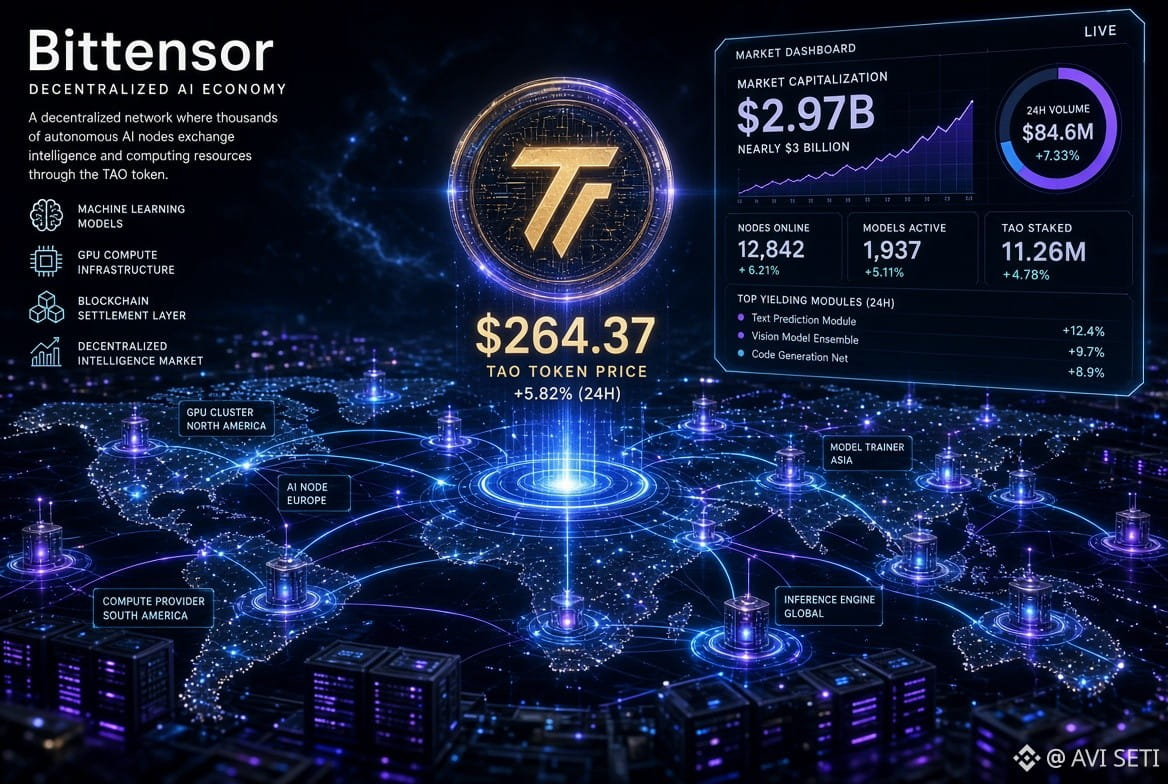
143
·
--
ONDO has been one of the clearest beneficiaries of the renewed tokenized-stock narrative, rising more than 12% during the recent market rebound. ONDO was around $0.43 on September 21, after moving sharply higher from roughly $0.37 on September 17.
The move comes as the SEC's five-year Innovation Exemption creates a regulatory framework for certain tokenized U.S. stocks to trade on approved blockchain-based venues.
#ONDO #OndoFinance #RWA #Tokenization #CryptoNews
ONDO has been one of the clearest beneficiaries of the renewed tokenized-stock narrative, rising more than 12% during the recent market rebound. ONDO was around $0.43 on September 21, after moving sharply higher from roughly $0.37 on September 17.
The move comes as the SEC's five-year Innovation Exemption creates a regulatory framework for certain tokenized U.S. stocks to trade on approved blockchain-based venues.
#ONDO #OndoFinance #RWA #Tokenization #CryptoNews
The move comes as the SEC's five-year Innovation Exemption creates a regulatory framework for certain tokenized U.S. stocks to trade on approved blockchain-based venues.
#ONDO #OndoFinance #RWA #Tokenization #CryptoNews

108
·
--
Bitcoin Cash has become one of the notable movers after Grayscale filed to convert its Bitcoin Cash Trust into a spot BCH ETF and seek a listing on NYSE Arca. BCH jumped more than 10% around the initial announcement, with the move reinforced by broader altcoin rotation.
The filing is still subject to SEC approval, so the proposed ETF does not yet represent an approved exchange-traded product.
#BCH #BitcoinCash #Grayscale #CryptoETF #CryptoNews
Bitcoin Cash has become one of the notable movers after Grayscale filed to convert its Bitcoin Cash Trust into a spot BCH ETF and seek a listing on NYSE Arca. BCH jumped more than 10% around the initial announcement, with the move reinforced by broader altcoin rotation.
The filing is still subject to SEC approval, so the proposed ETF does not yet represent an approved exchange-traded product.
#BCH #BitcoinCash #Grayscale #CryptoETF #CryptoNews
The filing is still subject to SEC approval, so the proposed ETF does not yet represent an approved exchange-traded product.
#BCH #BitcoinCash #Grayscale #CryptoETF #CryptoNews
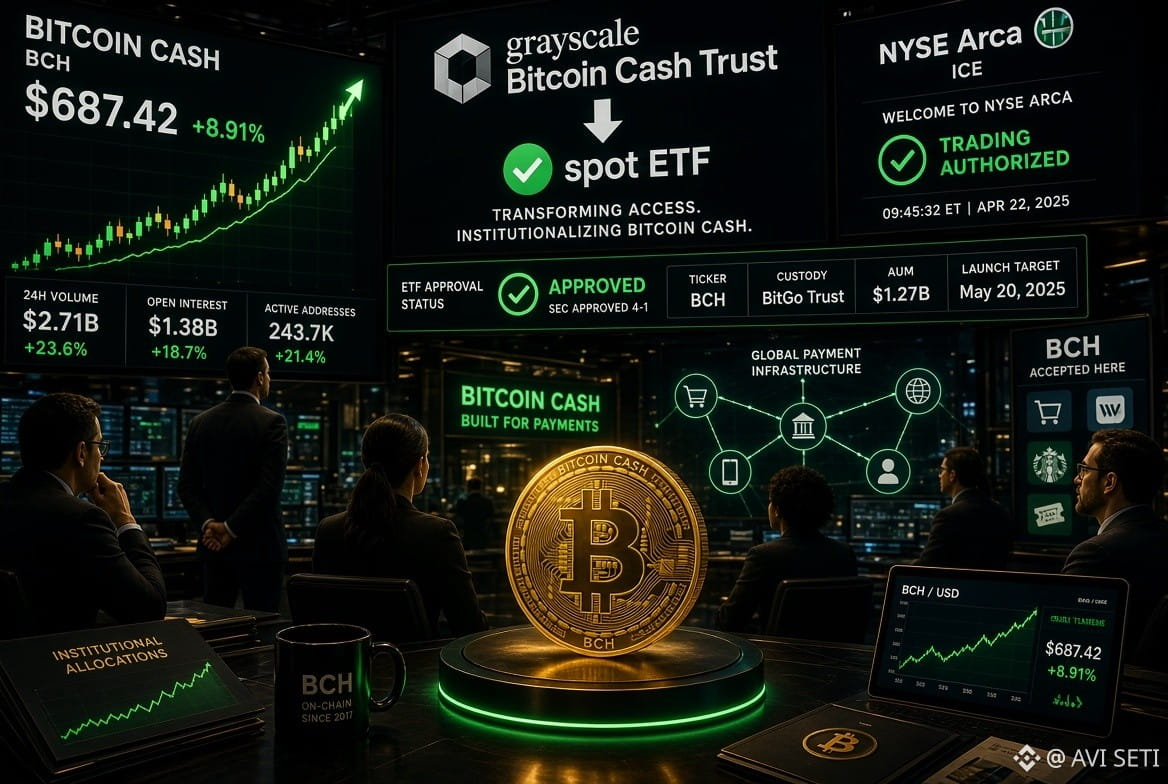
119
Log in to explore more content
Join global crypto users on Binance Square
⚡️ Get latest and useful information about crypto.
💬 Trusted by the world’s largest crypto exchange.
👍 Discover real insights from verified creators.
Email / Phone number
Trending Topics
BinancePick
2.6M views
141,866 Discussing
Join #EarningsSeason: Predict Earnings on Binance Pick, Share Your Take on Binance Square!
Binance Square Official
·401 Likes
·338.5k views
EarningsSeason
5M views
24,385 Discussing
FranklinTempletonFilesForTwoDividendToBitcoinETFs
2,034 views
111 Discussing