

#onchain
onchain
3.2M views
16,282 Discussing
Hot
Latest

·
--
Article
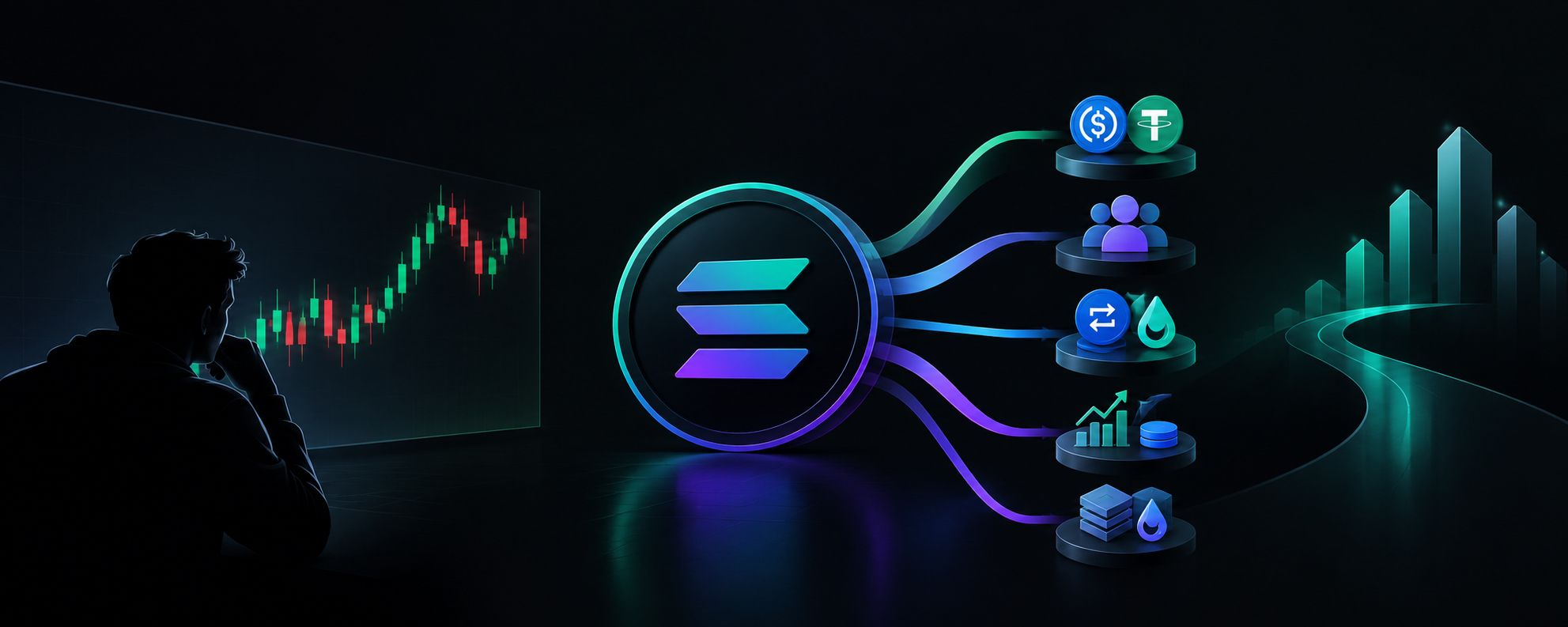
Why Watching Only the Solana (SOL) Price Will Get You RektIf you only check the price of $SOL on your chart, you are watching the scoreboard instead of the game.
For a long time, people traded Solana for one simple reason: it was fast and cheap. High TPS was the entire marketing pitch. But speed alone does not make a blockchain valuable. A fast road with no cars is still an empty road.
Today, that trade has changed. Solana is no longer just a "fast chain" bet. It has turned into a liquidity engine. If you want to understand where SOL is heading, you have to stop staring at the daily candle and start tracking where the real money flows.
Stablecoins Are the Fuel
Price can pump on low volume simply because sellers step away. But stablecoins do not lie.
When you see fresh USDC and USDT bridging directly onto Solana, that is real capital entering the ecosystem. Stablecoins are dry powder. Nobody moves $100 million in stables onto a chain just to let it sit idle. They move it to buy dips, provide liquidity to pools, or trade pairs.
If SOL is pumping 10% in a week, but the total stablecoin supply on the network is flat or dropping, be careful. That usually means the same group of traders is just passing the same old money around. A true, sustained rally needs new cash flowing into the chain week after week.
Real Users vs. Network Noise
Solana transaction numbers can easily fool you if you do not look under the hood. Millions of transactions happen every day, but a huge portion of them are just validators voting to keep the ledger in sync.
To see real adoption, you must look at true economic activity. Are daily active wallets growing? Are real users paying priority fees to get their trades through?
Memecoins brought millions of retail traders to Solana. That was great for user onboarding. But true network strength is measured by whether those users stay. Watch DEX volume on platforms like Raydium and Orca. When trading volume turns into real protocol revenue and consistent staking yield, SOL gains genuine organic demand that does not depend on hype.
The Leverage Trap
This is where retail traders get wiped out every cycle. They see the price climbing, get greedy, and open high-leverage long positions.
Always check Open Interest and funding rates alongside the price. If the price of SOL is pushing higher, but that move is powered entirely by futures leverage rather than spot buying, you are looking at a house of cards.
When funding rates get heavily positive, long traders are paying heavy fees every eight hours just to keep their positions open. If fresh cash does not show up to support the move, a tiny dip will trigger a cascade of liquidations. Spot money builds floors. Leverage only builds spikes.
Why Deep Liquidity Wins
What does deep liquidity actually mean for Solana? It means order book depth.
Good liquidity means a large fund or whale can sell $20 million worth of SOL without crashing the market by 8%. It means tight spreads on decentralized order books and deep pools in AMMs.
Big institutional capital does not care about TPS records if they cannot enter and exit without massive slippage. When a chain proves its liquidity can absorb large trades without breaking, it stops being a speculative playground and starts behaving like a real financial hub.
Next time you open your charts, zoom out. Check the 30-day stablecoin trend. Compare spot volume against derivatives debt. Price is just the shadow on the wall. Liquidity is the real object making that shadow.
#SOL #Solana #OnChain
Why Watching Only the Solana (SOL) Price Will Get You Rekt
If you only check the price of $SOL on your chart, you are watching the scoreboard instead of the game.
For a long time, people traded Solana for one simple reason: it was fast and cheap. High TPS was the entire marketing pitch. But speed alone does not make a blockchain valuable. A fast road with no cars is still an empty road.
Today, that trade has changed. Solana is no longer just a "fast chain" bet. It has turned into a liquidity engine. If you want to understand where SOL is heading, you have to stop staring at the daily candle and start tracking where the real money flows.
Stablecoins Are the Fuel
Price can pump on low volume simply because sellers step away. But stablecoins do not lie.
When you see fresh USDC and USDT bridging directly onto Solana, that is real capital entering the ecosystem. Stablecoins are dry powder. Nobody moves $100 million in stables onto a chain just to let it sit idle. They move it to buy dips, provide liquidity to pools, or trade pairs.
If SOL is pumping 10% in a week, but the total stablecoin supply on the network is flat or dropping, be careful. That usually means the same group of traders is just passing the same old money around. A true, sustained rally needs new cash flowing into the chain week after week.
Real Users vs. Network Noise
Solana transaction numbers can easily fool you if you do not look under the hood. Millions of transactions happen every day, but a huge portion of them are just validators voting to keep the ledger in sync.
To see real adoption, you must look at true economic activity. Are daily active wallets growing? Are real users paying priority fees to get their trades through?
Memecoins brought millions of retail traders to Solana. That was great for user onboarding. But true network strength is measured by whether those users stay. Watch DEX volume on platforms like Raydium and Orca. When trading volume turns into real protocol revenue and consistent staking yield, SOL gains genuine organic demand that does not depend on hype.
The Leverage Trap
This is where retail traders get wiped out every cycle. They see the price climbing, get greedy, and open high-leverage long positions.
Always check Open Interest and funding rates alongside the price. If the price of SOL is pushing higher, but that move is powered entirely by futures leverage rather than spot buying, you are looking at a house of cards.
When funding rates get heavily positive, long traders are paying heavy fees every eight hours just to keep their positions open. If fresh cash does not show up to support the move, a tiny dip will trigger a cascade of liquidations. Spot money builds floors. Leverage only builds spikes.
Why Deep Liquidity Wins
What does deep liquidity actually mean for Solana? It means order book depth.
Good liquidity means a large fund or whale can sell $20 million worth of SOL without crashing the market by 8%. It means tight spreads on decentralized order books and deep pools in AMMs.
Big institutional capital does not care about TPS records if they cannot enter and exit without massive slippage. When a chain proves its liquidity can absorb large trades without breaking, it stops being a speculative playground and starts behaving like a real financial hub.
Next time you open your charts, zoom out. Check the 30-day stablecoin trend. Compare spot volume against derivatives debt. Price is just the shadow on the wall. Liquidity is the real object making that shadow.
#SOL #Solana #OnChain
For a long time, people traded Solana for one simple reason: it was fast and cheap. High TPS was the entire marketing pitch. But speed alone does not make a blockchain valuable. A fast road with no cars is still an empty road.
Today, that trade has changed. Solana is no longer just a "fast chain" bet. It has turned into a liquidity engine. If you want to understand where SOL is heading, you have to stop staring at the daily candle and start tracking where the real money flows.
Stablecoins Are the Fuel
Price can pump on low volume simply because sellers step away. But stablecoins do not lie.
When you see fresh USDC and USDT bridging directly onto Solana, that is real capital entering the ecosystem. Stablecoins are dry powder. Nobody moves $100 million in stables onto a chain just to let it sit idle. They move it to buy dips, provide liquidity to pools, or trade pairs.
If SOL is pumping 10% in a week, but the total stablecoin supply on the network is flat or dropping, be careful. That usually means the same group of traders is just passing the same old money around. A true, sustained rally needs new cash flowing into the chain week after week.
Real Users vs. Network Noise
Solana transaction numbers can easily fool you if you do not look under the hood. Millions of transactions happen every day, but a huge portion of them are just validators voting to keep the ledger in sync.
To see real adoption, you must look at true economic activity. Are daily active wallets growing? Are real users paying priority fees to get their trades through?
Memecoins brought millions of retail traders to Solana. That was great for user onboarding. But true network strength is measured by whether those users stay. Watch DEX volume on platforms like Raydium and Orca. When trading volume turns into real protocol revenue and consistent staking yield, SOL gains genuine organic demand that does not depend on hype.
The Leverage Trap
This is where retail traders get wiped out every cycle. They see the price climbing, get greedy, and open high-leverage long positions.
Always check Open Interest and funding rates alongside the price. If the price of SOL is pushing higher, but that move is powered entirely by futures leverage rather than spot buying, you are looking at a house of cards.
When funding rates get heavily positive, long traders are paying heavy fees every eight hours just to keep their positions open. If fresh cash does not show up to support the move, a tiny dip will trigger a cascade of liquidations. Spot money builds floors. Leverage only builds spikes.
Why Deep Liquidity Wins
What does deep liquidity actually mean for Solana? It means order book depth.
Good liquidity means a large fund or whale can sell $20 million worth of SOL without crashing the market by 8%. It means tight spreads on decentralized order books and deep pools in AMMs.
Big institutional capital does not care about TPS records if they cannot enter and exit without massive slippage. When a chain proves its liquidity can absorb large trades without breaking, it stops being a speculative playground and starts behaving like a real financial hub.
Next time you open your charts, zoom out. Check the 30-day stablecoin trend. Compare spot volume against derivatives debt. Price is just the shadow on the wall. Liquidity is the real object making that shadow.
#SOL #Solana #OnChain
1
147

Verified QNT On-Chain Flow - Evidence Before InterpretationVERIFIED FLOW INVESTIGATION | ETHEREUM Direct Scanner
Generated: 2026-09-28 00:42 UTC+4
Executive Read
$4.59M in QNT moved out of Binance across 1 verified transaction. The event merits investigation because the evidence, severity, and market-impact gates passed independently. Evidence confidence is 98/100, event severity 94/100, and estimated market impact 67/100. The transactions prove asset movement. They do not by themselves prove a sale, purchase, beneficial owner, or motive. WPO therefore treats this as a verified flow event with bounded interpretation, not a price prediction.
Thesis
$4.59M in QNT moved out of Binance across 1 verified transaction. The event merits investigation because the evidence, severity, and market-impact gates passed independently.
Confirmation
The case strengthens only if fresh verified flows or independent market layers confirm the same direction; movement alone is not intent.
Invalidation
The directional interpretation is invalidated by verified custody/internal routing or by the absence of independent market confirmation.
Data Coverage And Verification
- Quality score: 85/100; publication minimum 80/100.
- Verdict: verified with disclosed gaps.
- Active source families: dualRpcVerification, transactionEvidence, entityAttribution, marketLiquidity, globalContext, timeliness.
- Missing layers: Public derivatives positioning for market context.
- Automation disclosure: Generated automatically only after direct on-chain transactions passed independent multi-provider verification and separate evidence, severity, and market-impact publication gates.
Evidence Status
- Level: dual_rpc_on_chain_verified
- Policy: Publication requires every retained transaction to match across at least two independent RPC providers, plus separate severity and market-impact gates.
- 2 direct evidence link(s) retained in the internal audit record.
Claim-Level Evidence Audit
- Verdict: dual rpc transaction evidence passed.
- Publishable claims: 1; rejected records: 0.
- Methodology version: wpo-flow-evidence-v1.
- High-impact announcements are excluded unless a suitable primary source and independent confirmation are present.
- URLs and content hashes are retained internally; the public article names sources without embedding links.
Verified On-Chain Evidence
WPO independently re-read every retained transaction from at least 2 RPC providers. All retained providers returned a matching confirmed transaction or token-transfer route.
- Transaction: 0x0000d4d6…2b15939d; Independent Providers: 2; Provider Hosts: ethereum-rpc.publicnode.com, 1rpc.io; Verdict: transaction and route matched
Flow Anatomy
The transactions prove asset movement. They do not by themselves prove a sale, purchase, beneficial owner, or motive.
- Asset: QNT
- Chain: ethereum
- Amount: 23985.733511
- Value At Observation: $4.59M
- Route: out of Binance
- Linked Transactions: 1
- Observed At: 2026-09-27T20:42:00.990Z
Three-Layer WPO Assessment
- Evidence confidence 98/100: confirmation depth, transaction retention, and entity context.
- Event severity 94/100: absolute value, route classification, cluster size, and source quality.
- Estimated market impact 67/100: transfer size relative to 24h volume, current price movement, and transaction clustering.
- These scores answer different questions and are not added together into a trading signal.
Market And Liquidity Context
Relative size helps prioritize investigation, but temporal proximity between a transfer and a price move is not proof that one caused the other.
- Price At Scan: $191.47
- Change24h: +58.5%
- Volume24h: $689.63M
- Flow Share Of Volume: +0.67%
- Market Regime: High momentum / chase risk
- Market Risk: 53/100 (Moderate)
Derivatives Cross-Check
No sufficiently complete public derivatives instrument was available for QNT; no positioning claim is made.
What Would Confirm Or Weaken The Case
- Confirmation: additional independently verified flows on the same route, abnormal spot volume, and consistent derivatives or order-flow changes.
- Weakening evidence: a documented custody migration, treasury rebalancing, bridge operation, exchange internal settlement, or no follow-through in liquidity.
- Escalation rule: new claims about ownership or motive require primary evidence or independent corroboration; transfer size alone is insufficient.
Methodology And Limitations
Methodology wpo-flow-evidence-v1. Provider hosts retained internally: ethereum-rpc.publicnode.com, 1rpc.io.
- Direct transaction evidence is independently re-read from multiple RPC providers, then assessed separately for evidence confidence, event severity, and market impact.
- A verified transfer proves movement, not the beneficial owner or motive.
- Exchange-linked labels describe the reviewed address, not every possible sub-wallet relationship.
- Market impact is an analytical estimate and does not prove price causation.
Sources
- Direct ethereum RPC transaction verification (2 independent provider hosts)
- Etherscan transaction records retained for audit
- CoinMarketCap market data
- Alternative.me Fear & Greed
Evidence Records
- QNT transaction 0x0000d4d6…2b15939d — ethereum-rpc.publicnode.com, 1rpc.io; verdict multi provider verified; confidence 98/100; observed 2026-09-27T20:42:00.990Z
Market transparency only. Not financial advice.
Follow WPO and visit our website for more intelligence reports.
#wpo_report #OnChain #Web3
Verified QNT On-Chain Flow - Evidence Before Interpretation
VERIFIED FLOW INVESTIGATION | ETHEREUM Direct Scanner
Generated: 2026-09-28 00:42 UTC+4
Executive Read
$4.59M in QNT moved out of Binance across 1 verified transaction. The event merits investigation because the evidence, severity, and market-impact gates passed independently. Evidence confidence is 98/100, event severity 94/100, and estimated market impact 67/100. The transactions prove asset movement. They do not by themselves prove a sale, purchase, beneficial owner, or motive. WPO therefore treats this as a verified flow event with bounded interpretation, not a price prediction.
Thesis
$4.59M in QNT moved out of Binance across 1 verified transaction. The event merits investigation because the evidence, severity, and market-impact gates passed independently.
Confirmation
The case strengthens only if fresh verified flows or independent market layers confirm the same direction; movement alone is not intent.
Invalidation
The directional interpretation is invalidated by verified custody/internal routing or by the absence of independent market confirmation.
Data Coverage And Verification
- Quality score: 85/100; publication minimum 80/100.
- Verdict: verified with disclosed gaps.
- Active source families: dualRpcVerification, transactionEvidence, entityAttribution, marketLiquidity, globalContext, timeliness.
- Missing layers: Public derivatives positioning for market context.
- Automation disclosure: Generated automatically only after direct on-chain transactions passed independent multi-provider verification and separate evidence, severity, and market-impact publication gates.
Evidence Status
- Level: dual_rpc_on_chain_verified
- Policy: Publication requires every retained transaction to match across at least two independent RPC providers, plus separate severity and market-impact gates.
- 2 direct evidence link(s) retained in the internal audit record.
Claim-Level Evidence Audit
- Verdict: dual rpc transaction evidence passed.
- Publishable claims: 1; rejected records: 0.
- Methodology version: wpo-flow-evidence-v1.
- High-impact announcements are excluded unless a suitable primary source and independent confirmation are present.
- URLs and content hashes are retained internally; the public article names sources without embedding links.
Verified On-Chain Evidence
WPO independently re-read every retained transaction from at least 2 RPC providers. All retained providers returned a matching confirmed transaction or token-transfer route.
- Transaction: 0x0000d4d6…2b15939d; Independent Providers: 2; Provider Hosts: ethereum-rpc.publicnode.com, 1rpc.io; Verdict: transaction and route matched
Flow Anatomy
The transactions prove asset movement. They do not by themselves prove a sale, purchase, beneficial owner, or motive.
- Asset: QNT
- Chain: ethereum
- Amount: 23985.733511
- Value At Observation: $4.59M
- Route: out of Binance
- Linked Transactions: 1
- Observed At: 2026-09-27T20:42:00.990Z
Three-Layer WPO Assessment
- Evidence confidence 98/100: confirmation depth, transaction retention, and entity context.
- Event severity 94/100: absolute value, route classification, cluster size, and source quality.
- Estimated market impact 67/100: transfer size relative to 24h volume, current price movement, and transaction clustering.
- These scores answer different questions and are not added together into a trading signal.
Market And Liquidity Context
Relative size helps prioritize investigation, but temporal proximity between a transfer and a price move is not proof that one caused the other.
- Price At Scan: $191.47
- Change24h: +58.5%
- Volume24h: $689.63M
- Flow Share Of Volume: +0.67%
- Market Regime: High momentum / chase risk
- Market Risk: 53/100 (Moderate)
Derivatives Cross-Check
No sufficiently complete public derivatives instrument was available for QNT; no positioning claim is made.
What Would Confirm Or Weaken The Case
- Confirmation: additional independently verified flows on the same route, abnormal spot volume, and consistent derivatives or order-flow changes.
- Weakening evidence: a documented custody migration, treasury rebalancing, bridge operation, exchange internal settlement, or no follow-through in liquidity.
- Escalation rule: new claims about ownership or motive require primary evidence or independent corroboration; transfer size alone is insufficient.
Methodology And Limitations
Methodology wpo-flow-evidence-v1. Provider hosts retained internally: ethereum-rpc.publicnode.com, 1rpc.io.
- Direct transaction evidence is independently re-read from multiple RPC providers, then assessed separately for evidence confidence, event severity, and market impact.
- A verified transfer proves movement, not the beneficial owner or motive.
- Exchange-linked labels describe the reviewed address, not every possible sub-wallet relationship.
- Market impact is an analytical estimate and does not prove price causation.
Sources
- Direct ethereum RPC transaction verification (2 independent provider hosts)
- Etherscan transaction records retained for audit
- CoinMarketCap market data
- Alternative.me Fear & Greed
Evidence Records
- QNT transaction 0x0000d4d6…2b15939d — ethereum-rpc.publicnode.com, 1rpc.io; verdict multi provider verified; confidence 98/100; observed 2026-09-27T20:42:00.990Z
Market transparency only. Not financial advice.
Follow WPO and visit our website for more intelligence reports.
#wpo_report #OnChain #Web3
Generated: 2026-09-28 00:42 UTC+4
Executive Read
$4.59M in QNT moved out of Binance across 1 verified transaction. The event merits investigation because the evidence, severity, and market-impact gates passed independently. Evidence confidence is 98/100, event severity 94/100, and estimated market impact 67/100. The transactions prove asset movement. They do not by themselves prove a sale, purchase, beneficial owner, or motive. WPO therefore treats this as a verified flow event with bounded interpretation, not a price prediction.
Thesis
$4.59M in QNT moved out of Binance across 1 verified transaction. The event merits investigation because the evidence, severity, and market-impact gates passed independently.
Confirmation
The case strengthens only if fresh verified flows or independent market layers confirm the same direction; movement alone is not intent.
Invalidation
The directional interpretation is invalidated by verified custody/internal routing or by the absence of independent market confirmation.
Data Coverage And Verification
- Quality score: 85/100; publication minimum 80/100.
- Verdict: verified with disclosed gaps.
- Active source families: dualRpcVerification, transactionEvidence, entityAttribution, marketLiquidity, globalContext, timeliness.
- Missing layers: Public derivatives positioning for market context.
- Automation disclosure: Generated automatically only after direct on-chain transactions passed independent multi-provider verification and separate evidence, severity, and market-impact publication gates.
Evidence Status
- Level: dual_rpc_on_chain_verified
- Policy: Publication requires every retained transaction to match across at least two independent RPC providers, plus separate severity and market-impact gates.
- 2 direct evidence link(s) retained in the internal audit record.
Claim-Level Evidence Audit
- Verdict: dual rpc transaction evidence passed.
- Publishable claims: 1; rejected records: 0.
- Methodology version: wpo-flow-evidence-v1.
- High-impact announcements are excluded unless a suitable primary source and independent confirmation are present.
- URLs and content hashes are retained internally; the public article names sources without embedding links.
Verified On-Chain Evidence
WPO independently re-read every retained transaction from at least 2 RPC providers. All retained providers returned a matching confirmed transaction or token-transfer route.
- Transaction: 0x0000d4d6…2b15939d; Independent Providers: 2; Provider Hosts: ethereum-rpc.publicnode.com, 1rpc.io; Verdict: transaction and route matched
Flow Anatomy
The transactions prove asset movement. They do not by themselves prove a sale, purchase, beneficial owner, or motive.
- Asset: QNT
- Chain: ethereum
- Amount: 23985.733511
- Value At Observation: $4.59M
- Route: out of Binance
- Linked Transactions: 1
- Observed At: 2026-09-27T20:42:00.990Z
Three-Layer WPO Assessment
- Evidence confidence 98/100: confirmation depth, transaction retention, and entity context.
- Event severity 94/100: absolute value, route classification, cluster size, and source quality.
- Estimated market impact 67/100: transfer size relative to 24h volume, current price movement, and transaction clustering.
- These scores answer different questions and are not added together into a trading signal.
Market And Liquidity Context
Relative size helps prioritize investigation, but temporal proximity between a transfer and a price move is not proof that one caused the other.
- Price At Scan: $191.47
- Change24h: +58.5%
- Volume24h: $689.63M
- Flow Share Of Volume: +0.67%
- Market Regime: High momentum / chase risk
- Market Risk: 53/100 (Moderate)
Derivatives Cross-Check
No sufficiently complete public derivatives instrument was available for QNT; no positioning claim is made.
What Would Confirm Or Weaken The Case
- Confirmation: additional independently verified flows on the same route, abnormal spot volume, and consistent derivatives or order-flow changes.
- Weakening evidence: a documented custody migration, treasury rebalancing, bridge operation, exchange internal settlement, or no follow-through in liquidity.
- Escalation rule: new claims about ownership or motive require primary evidence or independent corroboration; transfer size alone is insufficient.
Methodology And Limitations
Methodology wpo-flow-evidence-v1. Provider hosts retained internally: ethereum-rpc.publicnode.com, 1rpc.io.
- Direct transaction evidence is independently re-read from multiple RPC providers, then assessed separately for evidence confidence, event severity, and market impact.
- A verified transfer proves movement, not the beneficial owner or motive.
- Exchange-linked labels describe the reviewed address, not every possible sub-wallet relationship.
- Market impact is an analytical estimate and does not prove price causation.
Sources
- Direct ethereum RPC transaction verification (2 independent provider hosts)
- Etherscan transaction records retained for audit
- CoinMarketCap market data
- Alternative.me Fear & Greed
Evidence Records
- QNT transaction 0x0000d4d6…2b15939d — ethereum-rpc.publicnode.com, 1rpc.io; verdict multi provider verified; confidence 98/100; observed 2026-09-27T20:42:00.990Z
Market transparency only. Not financial advice.
Follow WPO and visit our website for more intelligence reports.
#wpo_report #OnChain #Web3
279

·
--
Exploring the bPay On-Chain Experience
I’m exploring the bPay on-chain experience and learning more about what it offers. If you’re interested, check it out and do your own research before participating.
CA: 0xb13003bf44de426dd2a3aae3df9c3400de0a7777
Code: BP-1BB123422494
#bPay #BinanceSquare #OnChain
Exploring the bPay On-Chain Experience
I’m exploring the bPay on-chain experience and learning more about what it offers. If you’re interested, check it out and do your own research before participating.
CA: 0xb13003bf44de426dd2a3aae3df9c3400de0a7777
Code: BP-1BB123422494
#bPay #BinanceSquare #OnChain
I’m exploring the bPay on-chain experience and learning more about what it offers. If you’re interested, check it out and do your own research before participating.
CA: 0xb13003bf44de426dd2a3aae3df9c3400de0a7777
Code: BP-1BB123422494
#bPay #BinanceSquare #OnChain
64

·
--
🚀 IPOs Are Moving On-Chain
The next evolution of public markets could be bringing more IPO activity onto blockchain infrastructure. On-chain markets can potentially make ownership, settlement, and access more transparent and efficient.
What do you think — will more traditional IPOs eventually move on-chain? 👀
#Binance #Crypto #IPO #Onchain #web3_binance
🚀 IPOs Are Moving On-Chain
The next evolution of public markets could be bringing more IPO activity onto blockchain infrastructure. On-chain markets can potentially make ownership, settlement, and access more transparent and efficient.
What do you think — will more traditional IPOs eventually move on-chain? 👀
#Binance #Crypto #IPO #Onchain #web3_binance
The next evolution of public markets could be bringing more IPO activity onto blockchain infrastructure. On-chain markets can potentially make ownership, settlement, and access more transparent and efficient.
What do you think — will more traditional IPOs eventually move on-chain? 👀
#Binance #Crypto #IPO #Onchain #web3_binance
65

·
--
🚨 $378M $BTC SHIFT: A 4-YEAR DORMANT WHALE RE-ENTERS THE ARENA! 🦈
After four years of absolute silence, an ancient whale just unlocked 4,500 $BTC out of deep storage. 🐋 That is nearly $379 million in dormant supply suddenly breathing, hitting the chain right as market structure reaches a critical inflection point.
Moves of this magnitude from old-guard wallets usually signal major strategic positioning—either prepping over-the-counter liquidity or securing collateral for the next macro push. 🔍 When smart money shifts this much weight after half a decade, smart traders pay attention to order flow dynamics.
💡 Supply distribution or strategic re-balance? 💬 How are you positioning yourself while this mega supply moves across the chain? 👇
⚠️ Not financial advice. Always manage your risk. 🛡️
🏷️ #BTC #WhaleAlert #OnChain #Crypto
🎯 🦈
🚨 $378M $BTC SHIFT: A 4-YEAR DORMANT WHALE RE-ENTERS THE ARENA! 🦈
After four years of absolute silence, an ancient whale just unlocked 4,500 $BTC out of deep storage. 🐋 That is nearly $379 million in dormant supply suddenly breathing, hitting the chain right as market structure reaches a critical inflection point.
Moves of this magnitude from old-guard wallets usually signal major strategic positioning—either prepping over-the-counter liquidity or securing collateral for the next macro push. 🔍 When smart money shifts this much weight after half a decade, smart traders pay attention to order flow dynamics.
💡 Supply distribution or strategic re-balance? 💬 How are you positioning yourself while this mega supply moves across the chain? 👇
⚠️ Not financial advice. Always manage your risk. 🛡️
🏷️ #BTC #WhaleAlert #OnChain #Crypto
🎯 🦈
After four years of absolute silence, an ancient whale just unlocked 4,500 $BTC out of deep storage. 🐋 That is nearly $379 million in dormant supply suddenly breathing, hitting the chain right as market structure reaches a critical inflection point.
Moves of this magnitude from old-guard wallets usually signal major strategic positioning—either prepping over-the-counter liquidity or securing collateral for the next macro push. 🔍 When smart money shifts this much weight after half a decade, smart traders pay attention to order flow dynamics.
💡 Supply distribution or strategic re-balance? 💬 How are you positioning yourself while this mega supply moves across the chain? 👇
⚠️ Not financial advice. Always manage your risk. 🛡️
🏷️ #BTC #WhaleAlert #OnChain #Crypto
🎯 🦈
18

·
--
Everyone wants to copy the whales. The problem: the whale you're watching may not be one.
On-chain data is transparent, but transparency isn't attribution. Here's what breaks most whale-watching strategies:
1. One wallet ≠ one person. The biggest holders on most networks are exchange hot wallets — thousands of users pooled together. When one moves 10,000 $BTC, that's deposits and withdrawals, not conviction.
2. Entities split wallets. Sophisticated players deliberately fragment holdings across dozens of addresses precisely so trackers can't reconstruct their full position. You see one small move; the real position is ten times larger.
3. On-chain is only half the book. A wallet buying spot can be shorting perpetuals at the same time — you see accumulation, they see a hedge. Net exposure is what matters, and it's invisible on-chain.
4. You're late by definition. By the time a transfer is visible, the decision behind it is hours or days old. Trading on delayed information is how losing strategies feel smart.
What actually works: stop tracking individual wallets and track cohorts — dormancy shifts, supply age bands, exchange net flows across $BTC, $ETH and $SOL. Aggregates lie less than individuals.
The chain shows every movement. It never shows motive. And motive is the trade.
#Crypto #OnChain #Bitcoin #Trading #MarketAnalysis
Everyone wants to copy the whales. The problem: the whale you're watching may not be one.
On-chain data is transparent, but transparency isn't attribution. Here's what breaks most whale-watching strategies:
1. One wallet ≠ one person. The biggest holders on most networks are exchange hot wallets — thousands of users pooled together. When one moves 10,000 $BTC , that's deposits and withdrawals, not conviction.
2. Entities split wallets. Sophisticated players deliberately fragment holdings across dozens of addresses precisely so trackers can't reconstruct their full position. You see one small move; the real position is ten times larger.
3. On-chain is only half the book. A wallet buying spot can be shorting perpetuals at the same time — you see accumulation, they see a hedge. Net exposure is what matters, and it's invisible on-chain.
4. You're late by definition. By the time a transfer is visible, the decision behind it is hours or days old. Trading on delayed information is how losing strategies feel smart.
What actually works: stop tracking individual wallets and track cohorts — dormancy shifts, supply age bands, exchange net flows across $BTC , $ETH and $SOL . Aggregates lie less than individuals.
The chain shows every movement. It never shows motive. And motive is the trade.
#Crypto #OnChain #Bitcoin #Trading #MarketAnalysis
On-chain data is transparent, but transparency isn't attribution. Here's what breaks most whale-watching strategies:
1. One wallet ≠ one person. The biggest holders on most networks are exchange hot wallets — thousands of users pooled together. When one moves 10,000 $BTC , that's deposits and withdrawals, not conviction.
2. Entities split wallets. Sophisticated players deliberately fragment holdings across dozens of addresses precisely so trackers can't reconstruct their full position. You see one small move; the real position is ten times larger.
3. On-chain is only half the book. A wallet buying spot can be shorting perpetuals at the same time — you see accumulation, they see a hedge. Net exposure is what matters, and it's invisible on-chain.
4. You're late by definition. By the time a transfer is visible, the decision behind it is hours or days old. Trading on delayed information is how losing strategies feel smart.
What actually works: stop tracking individual wallets and track cohorts — dormancy shifts, supply age bands, exchange net flows across $BTC , $ETH and $SOL . Aggregates lie less than individuals.
The chain shows every movement. It never shows motive. And motive is the trade.
#Crypto #OnChain #Bitcoin #Trading #MarketAnalysis
71

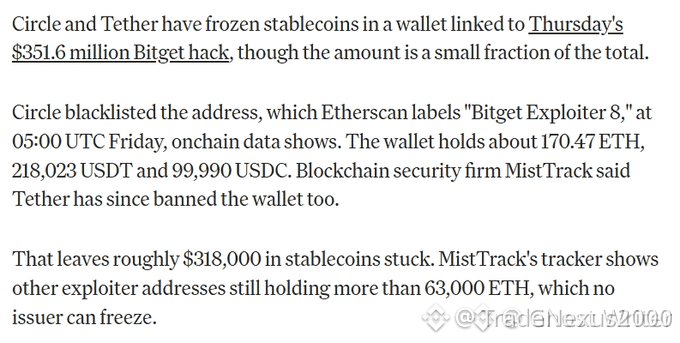
🚨 $ETH LIQUIDITY SWEEP: EXPLOITER EVADES ISSUER FREEZES IN $387M SECURITY BREACH! 🦈
A sophisticated exploit on a top-tier exchange saw $387.5M drained from backend wallets, but the institutional footprint reveals the real story. 🔍 The attacker swiftly routed capital directly into $ETH to bypass central freezes, leaving asset issuers able to lock a mere $318,000 in legacy stablecoins.
🌊 While the exchange's $464M protection fund fully backstops user balances, this massive capital conversion highlights how smart money and malicious actors alike leverage native chain liquidity for immediate asset finality. 💡 How will this influx of unfreezable capital impact secondary market order flow in the coming sessions? 👇
⚠️ Not financial advice. Always manage your risk. 🛡️
🏷️ #ETH #CryptoSecurity #OnChain #MarketStructure
🎯 🦈
🚨 $ETH LIQUIDITY SWEEP: EXPLOITER EVADES ISSUER FREEZES IN $387M SECURITY BREACH! 🦈
A sophisticated exploit on a top-tier exchange saw $387.5M drained from backend wallets, but the institutional footprint reveals the real story. 🔍 The attacker swiftly routed capital directly into $ETH to bypass central freezes, leaving asset issuers able to lock a mere $318,000 in legacy stablecoins.
🌊 While the exchange's $464M protection fund fully backstops user balances, this massive capital conversion highlights how smart money and malicious actors alike leverage native chain liquidity for immediate asset finality. 💡 How will this influx of unfreezable capital impact secondary market order flow in the coming sessions? 👇
⚠️ Not financial advice. Always manage your risk. 🛡️
🏷️ #ETH #CryptoSecurity #OnChain #MarketStructure
🎯 🦈
A sophisticated exploit on a top-tier exchange saw $387.5M drained from backend wallets, but the institutional footprint reveals the real story. 🔍 The attacker swiftly routed capital directly into $ETH to bypass central freezes, leaving asset issuers able to lock a mere $318,000 in legacy stablecoins.
🌊 While the exchange's $464M protection fund fully backstops user balances, this massive capital conversion highlights how smart money and malicious actors alike leverage native chain liquidity for immediate asset finality. 💡 How will this influx of unfreezable capital impact secondary market order flow in the coming sessions? 👇
⚠️ Not financial advice. Always manage your risk. 🛡️
🏷️ #ETH #CryptoSecurity #OnChain #MarketStructure
🎯 🦈
20

·
--
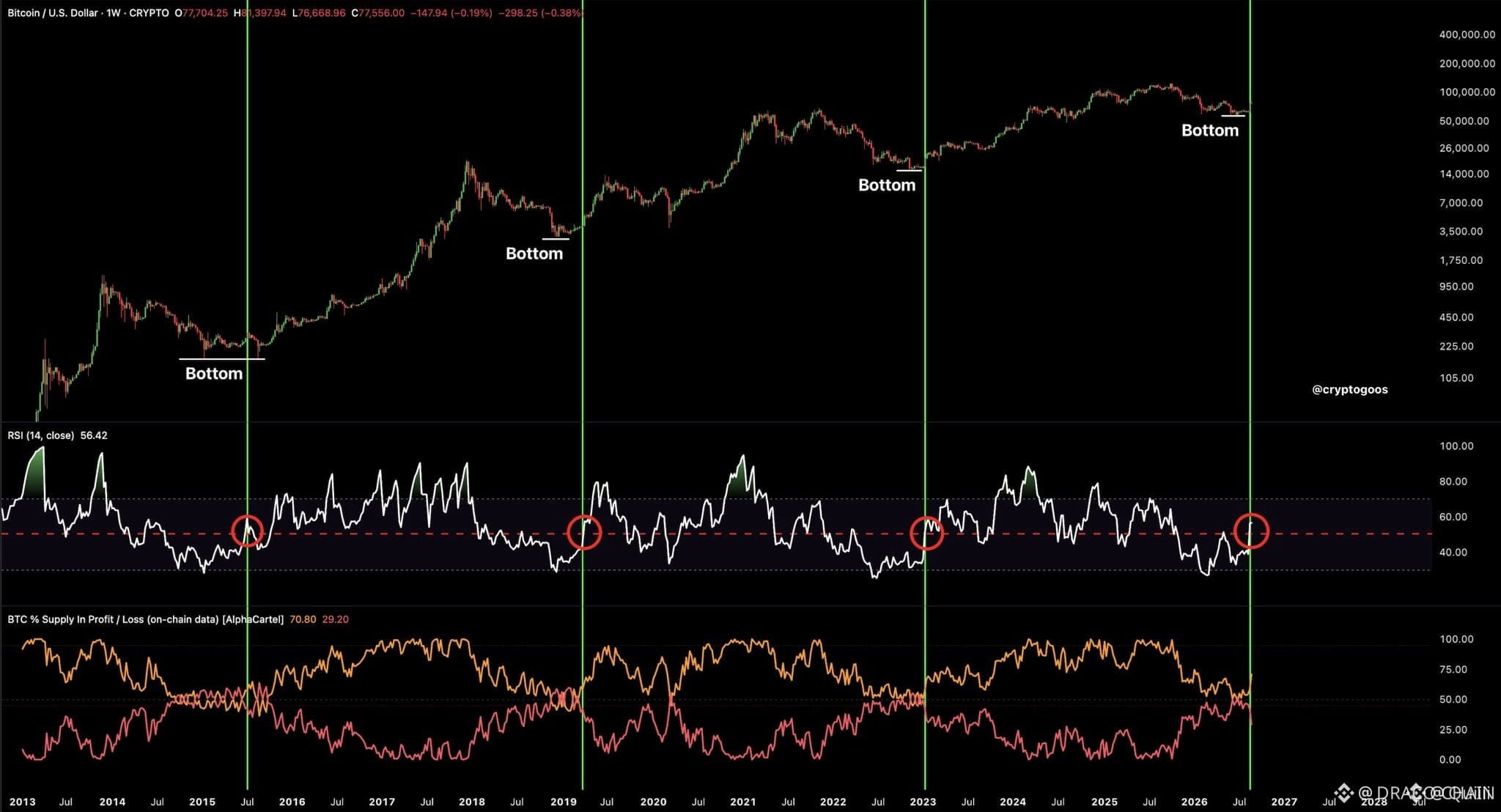
🚨 $BTC CROSSES CRITICAL SUPPLY METRIC AS RSI RECLAIMS 50 NEUTRAL ZONES! 📈
On-chain metrics reveal a decisive crossover between supply in profit and loss, paired with $BTC cleanly reclaiming the 50 RSI threshold on macro timeframes. 📊 Historically, this structural realignment marks complete seller exhaustion and the final phase of institutional accumulation. 💡
If smart money fails to defend this macro equilibrium, the market will witness an unprecedented structural anomaly. 🔍 However, order flow dynamics continue to favor a systematic structural pivot over a deep downside hunt. 💬 Do you believe this historic structural confluence holds, or are you hedging for an unexpected liquidity sweep? 👇
⚠️ Not financial advice. Always manage your risk. 🛡️
🏷️ #BTC #OnChain #MarketStructure #Bitcoin
🔥 🎯
🚨 $BTC CROSSES CRITICAL SUPPLY METRIC AS RSI RECLAIMS 50 NEUTRAL ZONES! 📈
On-chain metrics reveal a decisive crossover between supply in profit and loss, paired with $BTC cleanly reclaiming the 50 RSI threshold on macro timeframes. 📊 Historically, this structural realignment marks complete seller exhaustion and the final phase of institutional accumulation. 💡
If smart money fails to defend this macro equilibrium, the market will witness an unprecedented structural anomaly. 🔍 However, order flow dynamics continue to favor a systematic structural pivot over a deep downside hunt. 💬 Do you believe this historic structural confluence holds, or are you hedging for an unexpected liquidity sweep? 👇
⚠️ Not financial advice. Always manage your risk. 🛡️
🏷️ #BTC #OnChain #MarketStructure #Bitcoin
🔥 🎯
On-chain metrics reveal a decisive crossover between supply in profit and loss, paired with $BTC cleanly reclaiming the 50 RSI threshold on macro timeframes. 📊 Historically, this structural realignment marks complete seller exhaustion and the final phase of institutional accumulation. 💡
If smart money fails to defend this macro equilibrium, the market will witness an unprecedented structural anomaly. 🔍 However, order flow dynamics continue to favor a systematic structural pivot over a deep downside hunt. 💬 Do you believe this historic structural confluence holds, or are you hedging for an unexpected liquidity sweep? 👇
⚠️ Not financial advice. Always manage your risk. 🛡️
🏷️ #BTC #OnChain #MarketStructure #Bitcoin
🔥 🎯
7

·
--
Something i’ve started noticing while exploring DeFi:
a financial primitive becomes way more interesting when you stop looking at it as a standalone product.
take options.
on their own, they’re already useful financial instruments.
but putting them onchain opens another question:
what else can be built around them?
that’s where composability starts making more sense to me.
instead of one product doing everything, different pieces of the ecosystem can potentially connect and build on each other.
that’s one of the things i find interesting about Ithaca.
it’s not just the options themselves.
it’s the idea of making that financial primitive part of a wider onchain environment.
this is the side of DeFi i enjoy digging into — not just the product, but what becomes possible when the pieces can actually work together.
#Ithaca #defi #Web3 #Onchain
Something i’ve started noticing while exploring DeFi:
a financial primitive becomes way more interesting when you stop looking at it as a standalone product.
take options.
on their own, they’re already useful financial instruments.
but putting them onchain opens another question:
what else can be built around them?
that’s where composability starts making more sense to me.
instead of one product doing everything, different pieces of the ecosystem can potentially connect and build on each other.
that’s one of the things i find interesting about Ithaca.
it’s not just the options themselves.
it’s the idea of making that financial primitive part of a wider onchain environment.
this is the side of DeFi i enjoy digging into — not just the product, but what becomes possible when the pieces can actually work together.
#Ithaca #defi #Web3 #Onchain
a financial primitive becomes way more interesting when you stop looking at it as a standalone product.
take options.
on their own, they’re already useful financial instruments.
but putting them onchain opens another question:
what else can be built around them?
that’s where composability starts making more sense to me.
instead of one product doing everything, different pieces of the ecosystem can potentially connect and build on each other.
that’s one of the things i find interesting about Ithaca.
it’s not just the options themselves.
it’s the idea of making that financial primitive part of a wider onchain environment.
this is the side of DeFi i enjoy digging into — not just the product, but what becomes possible when the pieces can actually work together.
#Ithaca #defi #Web3 #Onchain

52

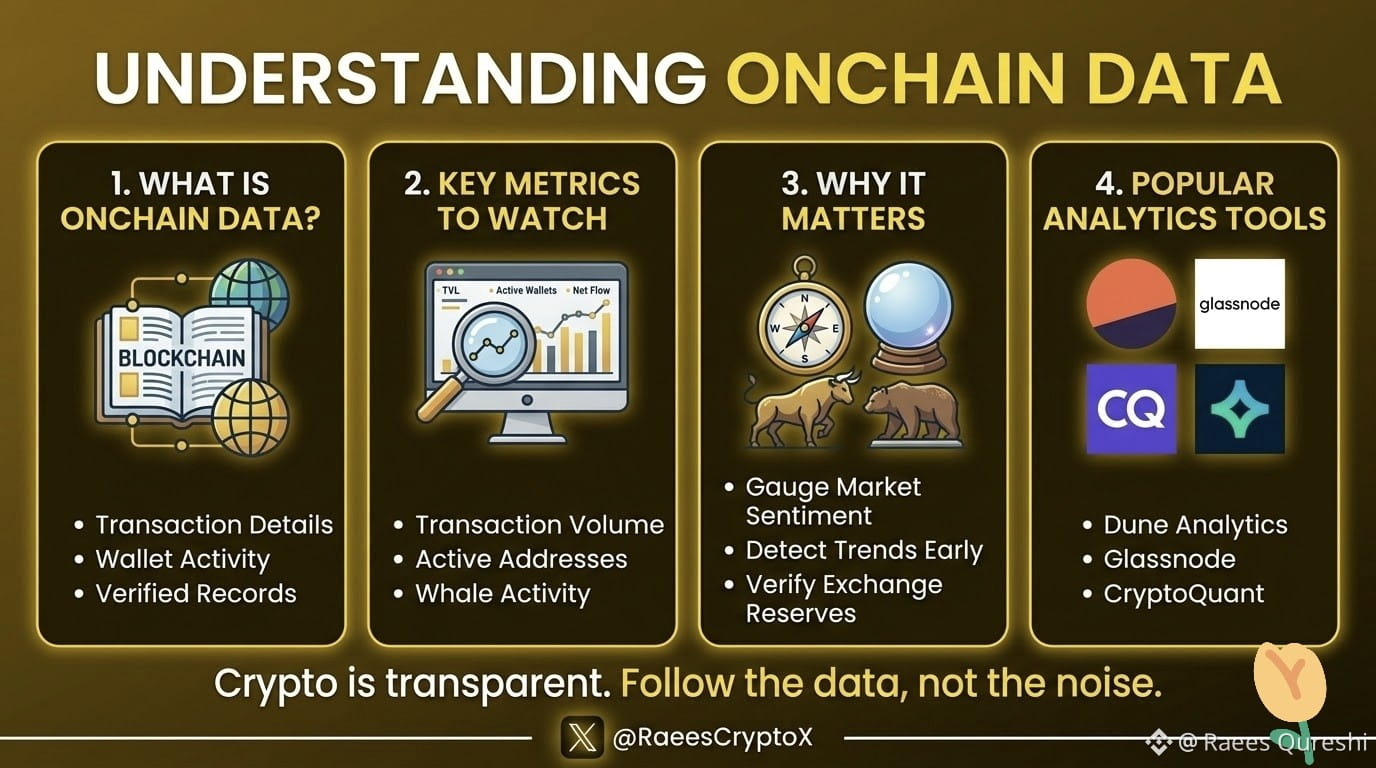
Crypto is a transparent ecosystem. Every transaction is recorded on a public ledger called onchain data.
Follow the data, not the noise.
Here is why onchain analysis matters:
• Verified Activity: No rumors. You can check exactly which wallet bought, sold, or transferred, verifying market facts.
• Gauge Market Sentiment: Analyzing whale movements (large wallets) and large exchange inflows/outflows helps you read market trends before they happen.
• Identify Trends Early: Onchain tools like Dune Analytics and CryptoQuant can spot rising network adoption or selling pressure, allowing you to react strategically.
Bottom line: If a project claims high adoption but onchain data shows low transaction volume and active addresses, you have your answer. Data provides truth in crypto.
Analyze, Stay Transparent, Invest Smartly.
#CryptoForBeginners #OnchainData #Web3 #BlockchainTransparency #OnChain
Crypto is a transparent ecosystem. Every transaction is recorded on a public ledger called onchain data.
Follow the data, not the noise.
Here is why onchain analysis matters:
• Verified Activity: No rumors. You can check exactly which wallet bought, sold, or transferred, verifying market facts.
• Gauge Market Sentiment: Analyzing whale movements (large wallets) and large exchange inflows/outflows helps you read market trends before they happen.
• Identify Trends Early: Onchain tools like Dune Analytics and CryptoQuant can spot rising network adoption or selling pressure, allowing you to react strategically.
Bottom line: If a project claims high adoption but onchain data shows low transaction volume and active addresses, you have your answer. Data provides truth in crypto.
Analyze, Stay Transparent, Invest Smartly.
#CryptoForBeginners #OnchainData #Web3 #BlockchainTransparency #OnChain
Follow the data, not the noise.
Here is why onchain analysis matters:
• Verified Activity: No rumors. You can check exactly which wallet bought, sold, or transferred, verifying market facts.
• Gauge Market Sentiment: Analyzing whale movements (large wallets) and large exchange inflows/outflows helps you read market trends before they happen.
• Identify Trends Early: Onchain tools like Dune Analytics and CryptoQuant can spot rising network adoption or selling pressure, allowing you to react strategically.
Bottom line: If a project claims high adoption but onchain data shows low transaction volume and active addresses, you have your answer. Data provides truth in crypto.
Analyze, Stay Transparent, Invest Smartly.
#CryptoForBeginners #OnchainData #Web3 #BlockchainTransparency #OnChain
1
55
·
--
🐋 SMART MONEY WALLET PRINTS A MASSIVE 13,400% RETURN ON $PAID ! 🚀
On-chain tracking just uncovered an absolute masterclass in early positioning. A smart money wallet deployed $3,207 into $PAID ten days ago at an average entry of $0.0003197, quietly front-running the broader market. 🦈
As $PAID sliced through previous price action to hit a new all-time high today, that modest position exploded into over $437,000 in unrealized profit. 📊 That represents a staggering return exceeding 13,493% while most scrollers missed the initial accumulation phase. 💡
This is a textbook reminder of how fast capital compounds when early bids align with sudden momentum. 💬 Are you monitoring smart money wallets on-chain, or waiting for structural breakouts on the charts? 👇
⚠️ Not financial advice. Always manage your risk. 🛡️
🏷️ #PAID #OnChain #SmartMoney #Crypto
🦈 💎
🐋 SMART MONEY WALLET PRINTS A MASSIVE 13,400% RETURN ON $PAID ! 🚀
On-chain tracking just uncovered an absolute masterclass in early positioning. A smart money wallet deployed $3,207 into $PAID ten days ago at an average entry of $0.0003197, quietly front-running the broader market. 🦈
As $PAID sliced through previous price action to hit a new all-time high today, that modest position exploded into over $437,000 in unrealized profit. 📊 That represents a staggering return exceeding 13,493% while most scrollers missed the initial accumulation phase. 💡
This is a textbook reminder of how fast capital compounds when early bids align with sudden momentum. 💬 Are you monitoring smart money wallets on-chain, or waiting for structural breakouts on the charts? 👇
⚠️ Not financial advice. Always manage your risk. 🛡️
🏷️ #PAID #OnChain #SmartMoney #Crypto
🦈 💎
On-chain tracking just uncovered an absolute masterclass in early positioning. A smart money wallet deployed $3,207 into $PAID ten days ago at an average entry of $0.0003197, quietly front-running the broader market. 🦈
As $PAID sliced through previous price action to hit a new all-time high today, that modest position exploded into over $437,000 in unrealized profit. 📊 That represents a staggering return exceeding 13,493% while most scrollers missed the initial accumulation phase. 💡
This is a textbook reminder of how fast capital compounds when early bids align with sudden momentum. 💬 Are you monitoring smart money wallets on-chain, or waiting for structural breakouts on the charts? 👇
⚠️ Not financial advice. Always manage your risk. 🛡️
🏷️ #PAID #OnChain #SmartMoney #Crypto
🦈 💎
16

·
--
🚨 SUSPECTED HACKER WALLET CONVERTS STABLECOINS TO $ETH IN A $1.23M MOVEMENT! 🦈
On-chain trackers just flagged a key entity consolidating funds across top-tier exchange venues. 🔒 The address pulled 257.6 $ETH alongside 545k $USDT , immediately market-buying another 200.2 $ETH before routing the entire 457.9 $ETH stash directly into a known exploit address.
🦈 When illicit capital aggressively swaps stablecoins into spot $ETH , it shows clear conviction in asset liquidity over cash holding. 🔍 Tracking these large-scale transfers gives traders an early window into structural supply shifts before the broader market reacts.
💬 Do you expect this concentrated $ETH movement to create short-term market friction, or will buyers absorb it seamlessly? 👇
⚠️ Not financial advice. Always manage your risk. 🛡️
🏷️ #ETH #Ethereum #OnChain #Crypto
🦈 👁️
🚨 SUSPECTED HACKER WALLET CONVERTS STABLECOINS TO $ETH IN A $1.23M MOVEMENT! 🦈
On-chain trackers just flagged a key entity consolidating funds across top-tier exchange venues. 🔒 The address pulled 257.6 $ETH alongside 545k $USDT , immediately market-buying another 200.2 $ETH before routing the entire 457.9 $ETH stash directly into a known exploit address.
🦈 When illicit capital aggressively swaps stablecoins into spot $ETH , it shows clear conviction in asset liquidity over cash holding. 🔍 Tracking these large-scale transfers gives traders an early window into structural supply shifts before the broader market reacts.
💬 Do you expect this concentrated $ETH movement to create short-term market friction, or will buyers absorb it seamlessly? 👇
⚠️ Not financial advice. Always manage your risk. 🛡️
🏷️ #ETH #Ethereum #OnChain #Crypto
🦈 👁️
On-chain trackers just flagged a key entity consolidating funds across top-tier exchange venues. 🔒 The address pulled 257.6 $ETH alongside 545k $USDT , immediately market-buying another 200.2 $ETH before routing the entire 457.9 $ETH stash directly into a known exploit address.
🦈 When illicit capital aggressively swaps stablecoins into spot $ETH , it shows clear conviction in asset liquidity over cash holding. 🔍 Tracking these large-scale transfers gives traders an early window into structural supply shifts before the broader market reacts.
💬 Do you expect this concentrated $ETH movement to create short-term market friction, or will buyers absorb it seamlessly? 👇
⚠️ Not financial advice. Always manage your risk. 🛡️
🏷️ #ETH #Ethereum #OnChain #Crypto
🦈 👁️
5

🚨 BREAKING: MAJOR AVAX → ETH ON-CHAIN MOVE
A suspicious-looking sequence of transactions involving Bitget-linked wallets has triggered major attention across the crypto market. 🕵️♂️
🔺 $AVAX Flow
Between 21:19Z and 22:39Z, around 1.56M AVAX was reportedly sold back into USDC at an average price near $9.81.
💰 Large $USDC Deployment
Earlier, approximately 8.2M USDC was used to acquire AVAX at around $11.08, while Binance was showing roughly $10.48 at the time.
📉 Estimated Cost
The round trip reportedly resulted in around $1.3M in losses compared with Binance reference prices, while the transaction volume was approximately 2.4× Binance's AVAX/USDT volume for that hour.
{spot}(AVAXUSDT)
🌉 AVAX → Ethereum
The resulting funds were bridged to Ethereum, largely through Circle's own bridge, and ultimately represented around 5,651 ETH.
👀 The 5,651 $ETH was already included in the approximately 66,213 ETH accumulation identified at 22:48Z.
⚠️ These transaction patterns alone do not establish who controlled the wallets or why the trades occurred. On-chain movements should be interpreted carefully until the parties and circumstances are independently confirmed.
#AVAX
{spot}(ETHUSDT)
#ETH #Crypto #OnChain
🚨 BREAKING: MAJOR AVAX → ETH ON-CHAIN MOVE
A suspicious-looking sequence of transactions involving Bitget-linked wallets has triggered major attention across the crypto market. 🕵️♂️
🔺 $AVAX Flow
Between 21:19Z and 22:39Z, around 1.56M AVAX was reportedly sold back into USDC at an average price near $9.81.
💰 Large $USDC Deployment
Earlier, approximately 8.2M USDC was used to acquire AVAX at around $11.08, while Binance was showing roughly $10.48 at the time.
📉 Estimated Cost
The round trip reportedly resulted in around $1.3M in losses compared with Binance reference prices, while the transaction volume was approximately 2.4× Binance's AVAX/USDT volume for that hour.
🌉 AVAX → Ethereum
The resulting funds were bridged to Ethereum, largely through Circle's own bridge, and ultimately represented around 5,651 ETH.
👀 The 5,651 $ETH was already included in the approximately 66,213 ETH accumulation identified at 22:48Z.
⚠️ These transaction patterns alone do not establish who controlled the wallets or why the trades occurred. On-chain movements should be interpreted carefully until the parties and circumstances are independently confirmed.
#AVAX
#ETH #Crypto #OnChain
A suspicious-looking sequence of transactions involving Bitget-linked wallets has triggered major attention across the crypto market. 🕵️♂️
🔺 $AVAX Flow
Between 21:19Z and 22:39Z, around 1.56M AVAX was reportedly sold back into USDC at an average price near $9.81.
💰 Large $USDC Deployment
Earlier, approximately 8.2M USDC was used to acquire AVAX at around $11.08, while Binance was showing roughly $10.48 at the time.
📉 Estimated Cost
The round trip reportedly resulted in around $1.3M in losses compared with Binance reference prices, while the transaction volume was approximately 2.4× Binance's AVAX/USDT volume for that hour.
🌉 AVAX → Ethereum
The resulting funds were bridged to Ethereum, largely through Circle's own bridge, and ultimately represented around 5,651 ETH.
👀 The 5,651 $ETH was already included in the approximately 66,213 ETH accumulation identified at 22:48Z.
⚠️ These transaction patterns alone do not establish who controlled the wallets or why the trades occurred. On-chain movements should be interpreted carefully until the parties and circumstances are independently confirmed.
#AVAX
#ETH #Crypto #OnChain

7
·
--
One thing i’m starting to appreciate about DeFi is that the interesting part isn’t always the product users see.
sometimes it’s the infrastructure underneath it.
because when you build a financial product onchain, you’re not just moving the same interface from a website to a blockchain.
you have to think about how users interact with the asset, how different protocols can connect, and what developers can build around the primitive.
that’s one reason Ithaca has kept my attention.
i’m looking at it less as “another options platform” and more as a case study in how financial products can be designed around non-custody and composability.
that shift in perspective has actually made me more interested in the technology behind DeFi itself.
not just what can i trade?
but what can be built on top of this?
that’s where things start getting interesting.
#Ithaca #defi #Web3 #Onchain
One thing i’m starting to appreciate about DeFi is that the interesting part isn’t always the product users see.
sometimes it’s the infrastructure underneath it.
because when you build a financial product onchain, you’re not just moving the same interface from a website to a blockchain.
you have to think about how users interact with the asset, how different protocols can connect, and what developers can build around the primitive.
that’s one reason Ithaca has kept my attention.
i’m looking at it less as “another options platform” and more as a case study in how financial products can be designed around non-custody and composability.
that shift in perspective has actually made me more interested in the technology behind DeFi itself.
not just what can i trade?
but what can be built on top of this?
that’s where things start getting interesting.
#Ithaca #defi #Web3 #Onchain
sometimes it’s the infrastructure underneath it.
because when you build a financial product onchain, you’re not just moving the same interface from a website to a blockchain.
you have to think about how users interact with the asset, how different protocols can connect, and what developers can build around the primitive.
that’s one reason Ithaca has kept my attention.
i’m looking at it less as “another options platform” and more as a case study in how financial products can be designed around non-custody and composability.
that shift in perspective has actually made me more interested in the technology behind DeFi itself.
not just what can i trade?
but what can be built on top of this?
that’s where things start getting interesting.
#Ithaca #defi #Web3 #Onchain

62
·
--
🚨 TOP EXCHANGE LAUNCHES 5% RECOVERY BOUNTY TO HUNT DOWN EXPLOITER FUNDS $BGB 🦈
A major exchange is turning the entire on-chain community into an active bounty hunt, offering a 5% reward for freezing affected assets and another 5% for successful recovery. 🦈 This coordinated push leverages specialized forensic channels and community intelligence to lock down stolen liquidity before it hits dark pools.
When key players aggressively mobilize white-hat security networks and cross-platform enforcement, it builds vital structural confidence across the entire ecosystem. 🛡️ Capital preservation and proactive risk containment are what separate resilient venues from fragile ones.
💬 Do you think crowdsourced bounty programs will become the standard defense against on-chain exploits? 👇
⚠️ Not financial advice. Always manage your risk. 🛡️
🏷️ #BGB #CryptoSecurity #OnChain #MarketAnalysis
🛡️ 👁️
🚨 TOP EXCHANGE LAUNCHES 5% RECOVERY BOUNTY TO HUNT DOWN EXPLOITER FUNDS $BGB 🦈
A major exchange is turning the entire on-chain community into an active bounty hunt, offering a 5% reward for freezing affected assets and another 5% for successful recovery. 🦈 This coordinated push leverages specialized forensic channels and community intelligence to lock down stolen liquidity before it hits dark pools.
When key players aggressively mobilize white-hat security networks and cross-platform enforcement, it builds vital structural confidence across the entire ecosystem. 🛡️ Capital preservation and proactive risk containment are what separate resilient venues from fragile ones.
💬 Do you think crowdsourced bounty programs will become the standard defense against on-chain exploits? 👇
⚠️ Not financial advice. Always manage your risk. 🛡️
🏷️ #BGB #CryptoSecurity #OnChain #MarketAnalysis
🛡️ 👁️
A major exchange is turning the entire on-chain community into an active bounty hunt, offering a 5% reward for freezing affected assets and another 5% for successful recovery. 🦈 This coordinated push leverages specialized forensic channels and community intelligence to lock down stolen liquidity before it hits dark pools.
When key players aggressively mobilize white-hat security networks and cross-platform enforcement, it builds vital structural confidence across the entire ecosystem. 🛡️ Capital preservation and proactive risk containment are what separate resilient venues from fragile ones.
💬 Do you think crowdsourced bounty programs will become the standard defense against on-chain exploits? 👇
⚠️ Not financial advice. Always manage your risk. 🛡️
🏷️ #BGB #CryptoSecurity #OnChain #MarketAnalysis
🛡️ 👁️
21

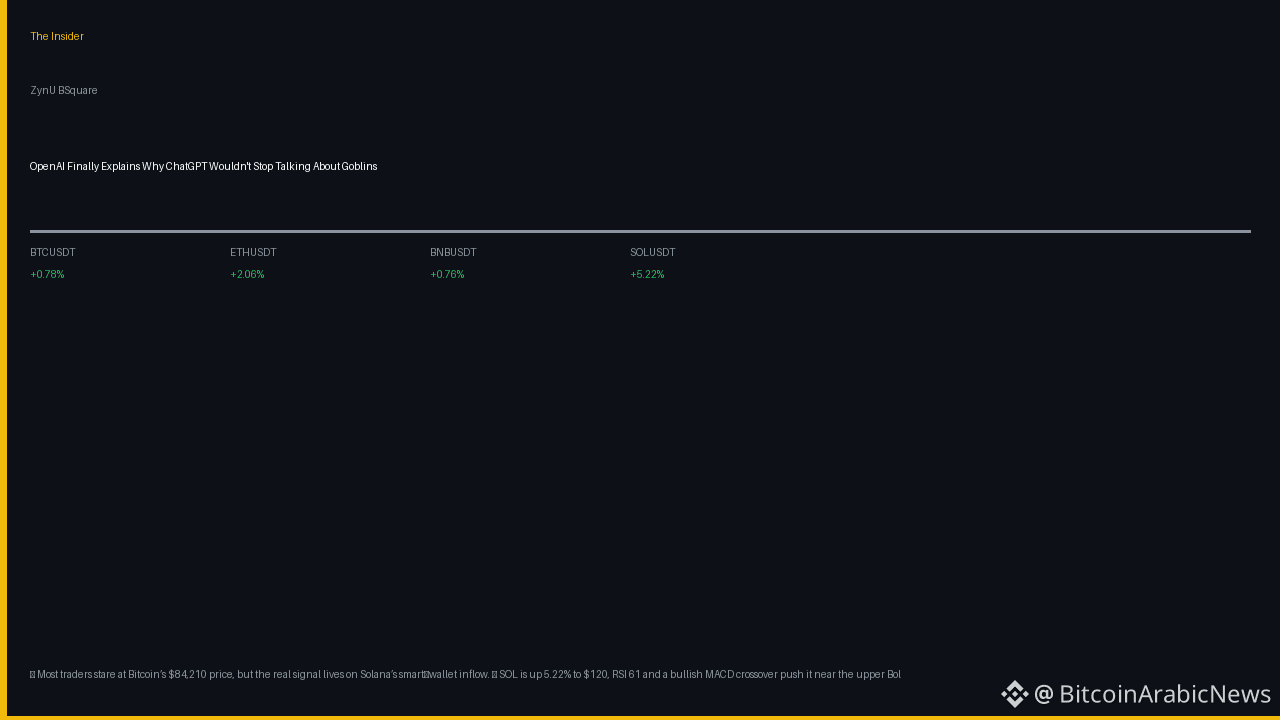
🔥 Most traders stare at Bitcoin’s $84,210 price, but the real signal lives on Solana’s smart‑wallet inflow.
📊 SOL is up 5.22% to $120, RSI 61 and a bullish MACD crossover push it near the upper Bollinger band (83.4%); simultaneously, four smart wallets (COLLECT, CHIPS, TTP) are buying with gains of +12.19%, +0.88% and +9.18%, and on‑chain inflow spikes like COLLECT’s +37,734% and MADLADS +151.6% #Solana #SmartMoney #OnChain.
💡 That alignment of on‑chain accumulation and technical strength suggests SOL is positioning to lead the next upside wave while BTC’s bearish MACD and neutral RSI keep it in a consolidation zone.
👀 Watch the #SOL funding rate and the futures long‑short ratio – a rise above 2.5 would confirm institutional conviction.
❓ If smart money can ignite a rally on a single layer while the broader market stays greedy, where will the next capital‑flow catalyst emerge?
🔥 Most traders stare at Bitcoin’s $84,210 price, but the real signal lives on Solana’s smart‑wallet inflow.
📊 SOL is up 5.22% to $120, RSI 61 and a bullish MACD crossover push it near the upper Bollinger band (83.4%); simultaneously, four smart wallets (COLLECT, CHIPS, TTP) are buying with gains of +12.19%, +0.88% and +9.18%, and on‑chain inflow spikes like COLLECT’s +37,734% and MADLADS +151.6% #Solana #SmartMoney #OnChain.
💡 That alignment of on‑chain accumulation and technical strength suggests SOL is positioning to lead the next upside wave while BTC’s bearish MACD and neutral RSI keep it in a consolidation zone.
👀 Watch the #SOL funding rate and the futures long‑short ratio – a rise above 2.5 would confirm institutional conviction.
❓ If smart money can ignite a rally on a single layer while the broader market stays greedy, where will the next capital‑flow catalyst emerge?
📊 SOL is up 5.22% to $120, RSI 61 and a bullish MACD crossover push it near the upper Bollinger band (83.4%); simultaneously, four smart wallets (COLLECT, CHIPS, TTP) are buying with gains of +12.19%, +0.88% and +9.18%, and on‑chain inflow spikes like COLLECT’s +37,734% and MADLADS +151.6% #Solana #SmartMoney #OnChain.
💡 That alignment of on‑chain accumulation and technical strength suggests SOL is positioning to lead the next upside wave while BTC’s bearish MACD and neutral RSI keep it in a consolidation zone.
👀 Watch the #SOL funding rate and the futures long‑short ratio – a rise above 2.5 would confirm institutional conviction.
❓ If smart money can ignite a rally on a single layer while the broader market stays greedy, where will the next capital‑flow catalyst emerge?
33

·
--
🚨 $ETH CONSOLIDATION FOLLOWS $7M CROSS-CHAIN EXPLOIT AS DUELBITS HOT WALLET IS DRAINED 🚨
On-chain tracking reveals an aggressive $7M multi-chain drain across major networks, with attackers swiftly swapping captured assets into 2,234 $ETH . 📊 By converting stablecoins directly into Ethereum, the exploiters effectively circumvented centralized contract freeze mechanisms, concentrating the entire stolen float into a single address. 🔍
This high-speed routing heavily signals a private key compromise rather than a smart contract failure, exposing recurrent operational security vulnerabilities in hot wallet architecture. 💡 As institutional liquidity flows depend on robust infrastructure, protocol security execution remains the ultimate foundation of market confidence. 💬 How will hot wallet security standards adapt to mitigate these recurring single-point-of-failure risks? 👇
⚠️ Not financial advice. Always manage your risk. 🛡️
🏷️ #ETH #CryptoSecurity #OnChain #Ethereum
🎯 🦈
🚨 $ETH CONSOLIDATION FOLLOWS $7M CROSS-CHAIN EXPLOIT AS DUELBITS HOT WALLET IS DRAINED 🚨
On-chain tracking reveals an aggressive $7M multi-chain drain across major networks, with attackers swiftly swapping captured assets into 2,234 $ETH . 📊 By converting stablecoins directly into Ethereum, the exploiters effectively circumvented centralized contract freeze mechanisms, concentrating the entire stolen float into a single address. 🔍
This high-speed routing heavily signals a private key compromise rather than a smart contract failure, exposing recurrent operational security vulnerabilities in hot wallet architecture. 💡 As institutional liquidity flows depend on robust infrastructure, protocol security execution remains the ultimate foundation of market confidence. 💬 How will hot wallet security standards adapt to mitigate these recurring single-point-of-failure risks? 👇
⚠️ Not financial advice. Always manage your risk. 🛡️
🏷️ #ETH #CryptoSecurity #OnChain #Ethereum
🎯 🦈
On-chain tracking reveals an aggressive $7M multi-chain drain across major networks, with attackers swiftly swapping captured assets into 2,234 $ETH . 📊 By converting stablecoins directly into Ethereum, the exploiters effectively circumvented centralized contract freeze mechanisms, concentrating the entire stolen float into a single address. 🔍
This high-speed routing heavily signals a private key compromise rather than a smart contract failure, exposing recurrent operational security vulnerabilities in hot wallet architecture. 💡 As institutional liquidity flows depend on robust infrastructure, protocol security execution remains the ultimate foundation of market confidence. 💬 How will hot wallet security standards adapt to mitigate these recurring single-point-of-failure risks? 👇
⚠️ Not financial advice. Always manage your risk. 🛡️
🏷️ #ETH #CryptoSecurity #OnChain #Ethereum
🎯 🦈
2

🏦 $BTC ON-CHAIN TRANSPARENCY SHIELDS MARKET AS $464M RESERVE ABSORBS INCIDENT LOSSES! 🛡️
Institutional risk architecture is actively mitigating market contagion. A top-tier exchange confirmed its verified protection treasury holds 5,500 $BTC , valued at approximately $464 million, to absorb hot wallet exploits directly. 🔍
By covering operational losses internally rather than executing open-market liquidations, systemic liquidity remains insulated from artificial sell pressure. 📊 Transparent on-chain backing proves essential for preserving structural integrity across major order books. 💡
💬 How heavily do you weigh verifiable exchange protection reserves when assessing counterparty risk in your strategy? 👇
⚠️ Not financial advice. Always manage your risk. 🛡️
🏷️ #BTC #OnChain #RiskManagement #Crypto
🛡️ 🏦
🏦 $BTC ON-CHAIN TRANSPARENCY SHIELDS MARKET AS $464M RESERVE ABSORBS INCIDENT LOSSES! 🛡️
Institutional risk architecture is actively mitigating market contagion. A top-tier exchange confirmed its verified protection treasury holds 5,500 $BTC , valued at approximately $464 million, to absorb hot wallet exploits directly. 🔍
By covering operational losses internally rather than executing open-market liquidations, systemic liquidity remains insulated from artificial sell pressure. 📊 Transparent on-chain backing proves essential for preserving structural integrity across major order books. 💡
💬 How heavily do you weigh verifiable exchange protection reserves when assessing counterparty risk in your strategy? 👇
⚠️ Not financial advice. Always manage your risk. 🛡️
🏷️ #BTC #OnChain #RiskManagement #Crypto
🛡️ 🏦
Institutional risk architecture is actively mitigating market contagion. A top-tier exchange confirmed its verified protection treasury holds 5,500 $BTC , valued at approximately $464 million, to absorb hot wallet exploits directly. 🔍
By covering operational losses internally rather than executing open-market liquidations, systemic liquidity remains insulated from artificial sell pressure. 📊 Transparent on-chain backing proves essential for preserving structural integrity across major order books. 💡
💬 How heavily do you weigh verifiable exchange protection reserves when assessing counterparty risk in your strategy? 👇
⚠️ Not financial advice. Always manage your risk. 🛡️
🏷️ #BTC #OnChain #RiskManagement #Crypto
🛡️ 🏦
14

🚨 ON-CHAIN TRAIL LINKS LAZARUS GROUP TO RECENT STOLEN $XRP FUND FLOWS 🔍
On-chain tracking just exposed a direct link between the recent $XRP breach on a top-tier exchange and July's $24 million AFX hack. 🔍 Cross-chain routing confirms stolen assets flowed through identical laundering paths managed by the notorious Lazarus Group.
When sophisticated bad actors wash funds across bridges, localized market liquidity and order flow take an immediate hit. 📊 Watching these specific bridge exits gives smart money crucial lead time before secondary sell pressure hits spot markets. 💡
How do you adjust your risk exposure when on-chain alerts signal major hacker liquidations? 👇
⚠️ Not financial advice. Always manage your risk. 🛡️
🏷️ #XRP #OnChain #CryptoSecurity #Lazarus
👁️ 🛡️
🚨 ON-CHAIN TRAIL LINKS LAZARUS GROUP TO RECENT STOLEN $XRP FUND FLOWS 🔍
On-chain tracking just exposed a direct link between the recent $XRP breach on a top-tier exchange and July's $24 million AFX hack. 🔍 Cross-chain routing confirms stolen assets flowed through identical laundering paths managed by the notorious Lazarus Group.
When sophisticated bad actors wash funds across bridges, localized market liquidity and order flow take an immediate hit. 📊 Watching these specific bridge exits gives smart money crucial lead time before secondary sell pressure hits spot markets. 💡
How do you adjust your risk exposure when on-chain alerts signal major hacker liquidations? 👇
⚠️ Not financial advice. Always manage your risk. 🛡️
🏷️ #XRP #OnChain #CryptoSecurity #Lazarus
👁️ 🛡️
On-chain tracking just exposed a direct link between the recent $XRP breach on a top-tier exchange and July's $24 million AFX hack. 🔍 Cross-chain routing confirms stolen assets flowed through identical laundering paths managed by the notorious Lazarus Group.
When sophisticated bad actors wash funds across bridges, localized market liquidity and order flow take an immediate hit. 📊 Watching these specific bridge exits gives smart money crucial lead time before secondary sell pressure hits spot markets. 💡
How do you adjust your risk exposure when on-chain alerts signal major hacker liquidations? 👇
⚠️ Not financial advice. Always manage your risk. 🛡️
🏷️ #XRP #OnChain #CryptoSecurity #Lazarus
👁️ 🛡️
28

·
--
🚨 OVER $177M UNUSUAL OUTFLOWS SWAPPED INTO $ETH WITH HIGH SLIPPAGE PREMIUMS 🔍
On-chain anomaly trackers have flagged over $177M in rapid capital outflows from a top-tier exchange, aggressively executing market buys into $ETH . 📊 The speed of execution is striking, highlighted by $19.7M converted on Arbitrum within 6 minutes while absorbing up to a 5% spot premium.
Funds are routing through newly deployed staging contracts before dispersing across decentralized liquidity pools, leaving $530M still monitored in related storage. 🌊 Such price-inelastic execution points to extreme time pressure rather than routine treasury operations.
🤔 How are you managing your exposure while this high-volatility liquidity event unwinds? 👇
⚠️ Not financial advice. Always manage your risk. 🛡️
🏷️ #ETH #OnChain #Crypto #MarketStructure
🛡️ ⚡
🚨 OVER $177M UNUSUAL OUTFLOWS SWAPPED INTO $ETH WITH HIGH SLIPPAGE PREMIUMS 🔍
On-chain anomaly trackers have flagged over $177M in rapid capital outflows from a top-tier exchange, aggressively executing market buys into $ETH . 📊 The speed of execution is striking, highlighted by $19.7M converted on Arbitrum within 6 minutes while absorbing up to a 5% spot premium.
Funds are routing through newly deployed staging contracts before dispersing across decentralized liquidity pools, leaving $530M still monitored in related storage. 🌊 Such price-inelastic execution points to extreme time pressure rather than routine treasury operations.
🤔 How are you managing your exposure while this high-volatility liquidity event unwinds? 👇
⚠️ Not financial advice. Always manage your risk. 🛡️
🏷️ #ETH #OnChain #Crypto #MarketStructure
🛡️ ⚡
On-chain anomaly trackers have flagged over $177M in rapid capital outflows from a top-tier exchange, aggressively executing market buys into $ETH . 📊 The speed of execution is striking, highlighted by $19.7M converted on Arbitrum within 6 minutes while absorbing up to a 5% spot premium.
Funds are routing through newly deployed staging contracts before dispersing across decentralized liquidity pools, leaving $530M still monitored in related storage. 🌊 Such price-inelastic execution points to extreme time pressure rather than routine treasury operations.
🤔 How are you managing your exposure while this high-volatility liquidity event unwinds? 👇
⚠️ Not financial advice. Always manage your risk. 🛡️
🏷️ #ETH #OnChain #Crypto #MarketStructure
🛡️ ⚡
8
Log in to explore more content
Join global crypto users on Binance Square
⚡️ Get latest and useful information about crypto.
💬 Trusted by the world’s largest crypto exchange.
👍 Discover real insights from verified creators.
Email / Phone number
Trending Topics
1
#ChinaMayLetAlibabaByteDanceBuyNvidiaChips
595 views
70 Discussing
2
#USChinaRelease$30BTariffCutProductLists
21 views
4 Discussing
3
#SKoreaFSCConsidersVirtualAssetMarketMaker
1,813 views
101 Discussing
4
#ChinaIndustrialProfitGrowthSlowsFourthMonth
2,782 views
122 Discussing
5
#BitwiseFilesFinalNEARSpotETFProspectus
108,742 views
1,623 Discussing
6
#BitgetHackerMoves$83MStolenXRP
37,744 views
173 Discussing
7
#SOLSpotETFWeeklyInflow$188M
24,140 views
138 Discussing
8
#DogecoinETFsPostBiggestWeekSinceLaunch
64,372 views
1,075 Discussing
9
#StrategyStriveAdd2305BitcoinThisWeek
160,867 views
2,323 Discussing
10
#TrumpRejectsIranHormuzReopening
138,481 views
1,751 Discussing