
金毛Kimi
645 Posts

金毛Kimi
Report
Block User
金毛Kimi|币安永久自动八折反佣邀请码:BTC826897704 前CEX链上数据分析师,现役全职撸毛工🐶狗鼻子专嗅一级空投,顺带盯大盘防踩。每日分享Alpha日报、交易大赛、稳定理财、打新套利。链上有肉第一时间汪捡屎官们,多多指教🍖
65 Following
5.0K+ Followers
968 Liked
Posts
All
Quotes
Live
PINNED
·
--
Don't ask if anyone is still brushing Binance Alpha anymore??? I've completely resigned!!!
🐶【Goodbye Alpha, focusing on hanging out in the square】0 points brought this realization: Fogo's meat is more delicious
---
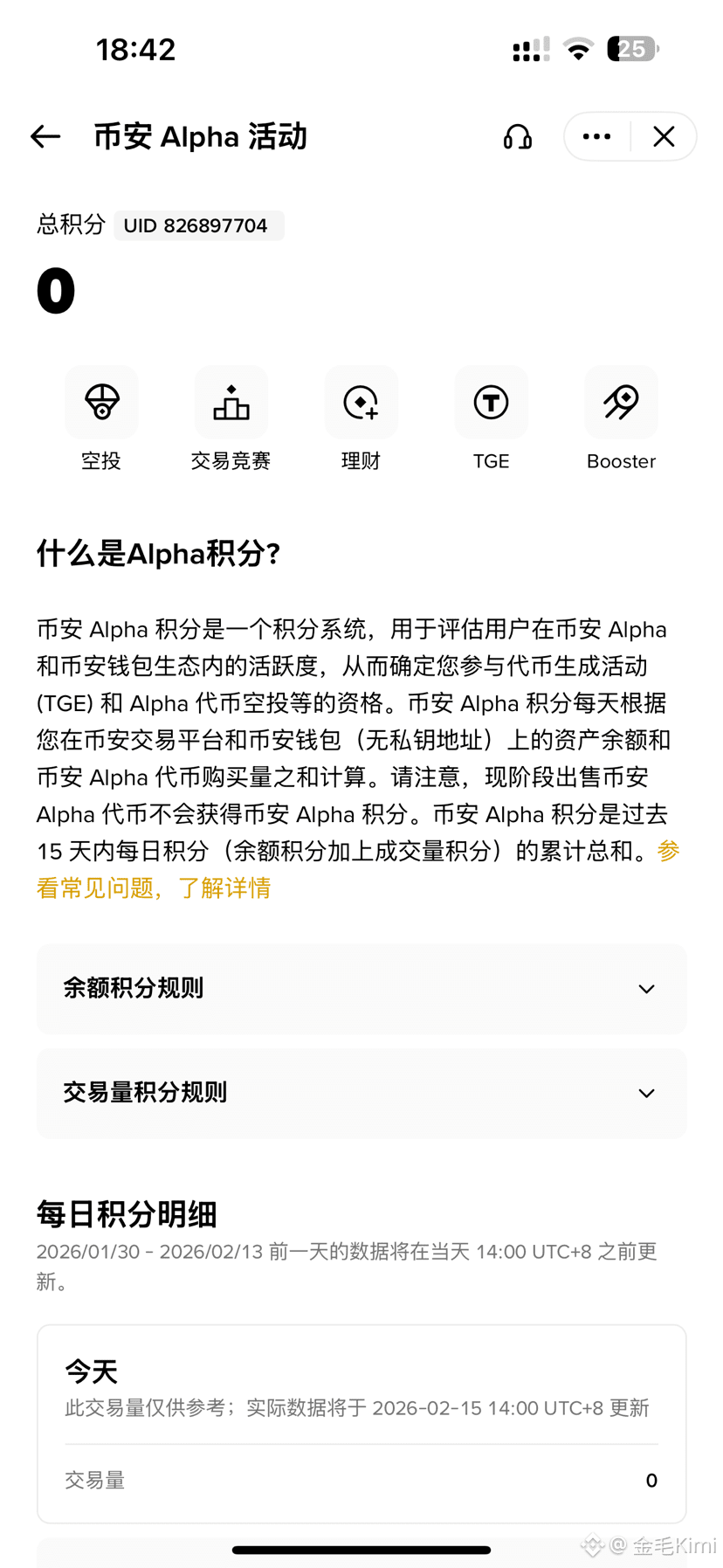
Today when I opened the Binance Alpha page, Kimi took a look at the points:
0
It's not that I haven't brushed before, it's that I've come to understand.
In the past half month, for those Alpha points, I counted balances daily, monitored trading volumes, and timed my buy-ins.
What was the result?
The blind box was drawn out, the threshold returned to zero, and the points also returned to zero.
Kimi suddenly realized one thing:
Rolling points in Alpha is like being an NPC in someone else's game.
Writing valuable content in the square is like fetching meat in my own doghouse.
🦴 So Kimi made a decision:
Officially "resigning" from Binance Alpha, focusing on hanging out in the Binance square.
It's not that I'm not playing anymore, it's changing the way to play——
The point rules in Alpha change every day, but there's one thing that never changes in the square:
As long as you write something useful to others, the meat will come knocking at your door.
🔥 Why did Kimi focus on Fogo?
This wasn't a random choice, the sincerity from the project team was just too solid.
1/ Technical pedigree: Jump Crypto genes
Fogo's core development is led by Douro Labs, which is the technical team behind Pyth Network. Co-founder Robert Sagurton has worked at Jump Crypto for over 5 years, previously at JPMorgan and State Street; CEO Michael Cahill served as Vice President of Foreign Exchange at Morgan Stanley for over 7 years.
These people are not here to just make money; they are here to build a base station.
2/ Performance data: Really can perform
Fogo uses the Solana Virtual Machine (SVM) and integrates the Firedancer client, controlling block time at 40 milliseconds, with final confirmation time of only 1.3 seconds, and the testnet peak throughput reaching 136,000 TPS. It has already handled over 3 billion on-chain transactions smoothly.
Zero Gas experience is not just a promise; it really can run.
3/ Funding strength: Institutions' real money
Fogo has completed two rounds of financing, raising a total of $13.5 million, with participants including Distributed Global, CMS Holdings, The Echonomist, 4 Ventures, etc. Recently, it completed another $8 million financing, led by The Echonomist.
@fogo o $FOGO #Fogo
{spot}(FOGOUSDT)
Don't ask if anyone is still brushing Binance Alpha anymore??? I've completely resigned!!!
🐶【Goodbye Alpha, focusing on hanging out in the square】0 points brought this realization: Fogo's meat is more delicious
---
Today when I opened the Binance Alpha page, Kimi took a look at the points:
0
It's not that I haven't brushed before, it's that I've come to understand.
In the past half month, for those Alpha points, I counted balances daily, monitored trading volumes, and timed my buy-ins.
What was the result?
The blind box was drawn out, the threshold returned to zero, and the points also returned to zero.
Kimi suddenly realized one thing:
Rolling points in Alpha is like being an NPC in someone else's game.
Writing valuable content in the square is like fetching meat in my own doghouse.
🦴 So Kimi made a decision:
Officially "resigning" from Binance Alpha, focusing on hanging out in the Binance square.
It's not that I'm not playing anymore, it's changing the way to play——
The point rules in Alpha change every day, but there's one thing that never changes in the square:
As long as you write something useful to others, the meat will come knocking at your door.
🔥 Why did Kimi focus on Fogo?
This wasn't a random choice, the sincerity from the project team was just too solid.
1/ Technical pedigree: Jump Crypto genes
Fogo's core development is led by Douro Labs, which is the technical team behind Pyth Network. Co-founder Robert Sagurton has worked at Jump Crypto for over 5 years, previously at JPMorgan and State Street; CEO Michael Cahill served as Vice President of Foreign Exchange at Morgan Stanley for over 7 years.
These people are not here to just make money; they are here to build a base station.
2/ Performance data: Really can perform
Fogo uses the Solana Virtual Machine (SVM) and integrates the Firedancer client, controlling block time at 40 milliseconds, with final confirmation time of only 1.3 seconds, and the testnet peak throughput reaching 136,000 TPS. It has already handled over 3 billion on-chain transactions smoothly.
Zero Gas experience is not just a promise; it really can run.
3/ Funding strength: Institutions' real money
Fogo has completed two rounds of financing, raising a total of $13.5 million, with participants including Distributed Global, CMS Holdings, The Echonomist, 4 Ventures, etc. Recently, it completed another $8 million financing, led by The Echonomist.
@Fogo Official o $FOGO #Fogo
🐶【Goodbye Alpha, focusing on hanging out in the square】0 points brought this realization: Fogo's meat is more delicious
---
Today when I opened the Binance Alpha page, Kimi took a look at the points:
0
It's not that I haven't brushed before, it's that I've come to understand.
In the past half month, for those Alpha points, I counted balances daily, monitored trading volumes, and timed my buy-ins.
What was the result?
The blind box was drawn out, the threshold returned to zero, and the points also returned to zero.
Kimi suddenly realized one thing:
Rolling points in Alpha is like being an NPC in someone else's game.
Writing valuable content in the square is like fetching meat in my own doghouse.
🦴 So Kimi made a decision:
Officially "resigning" from Binance Alpha, focusing on hanging out in the Binance square.
It's not that I'm not playing anymore, it's changing the way to play——
The point rules in Alpha change every day, but there's one thing that never changes in the square:
As long as you write something useful to others, the meat will come knocking at your door.
🔥 Why did Kimi focus on Fogo?
This wasn't a random choice, the sincerity from the project team was just too solid.
1/ Technical pedigree: Jump Crypto genes
Fogo's core development is led by Douro Labs, which is the technical team behind Pyth Network. Co-founder Robert Sagurton has worked at Jump Crypto for over 5 years, previously at JPMorgan and State Street; CEO Michael Cahill served as Vice President of Foreign Exchange at Morgan Stanley for over 7 years.
These people are not here to just make money; they are here to build a base station.
2/ Performance data: Really can perform
Fogo uses the Solana Virtual Machine (SVM) and integrates the Firedancer client, controlling block time at 40 milliseconds, with final confirmation time of only 1.3 seconds, and the testnet peak throughput reaching 136,000 TPS. It has already handled over 3 billion on-chain transactions smoothly.
Zero Gas experience is not just a promise; it really can run.
3/ Funding strength: Institutions' real money
Fogo has completed two rounds of financing, raising a total of $13.5 million, with participants including Distributed Global, CMS Holdings, The Echonomist, 4 Ventures, etc. Recently, it completed another $8 million financing, led by The Echonomist.
@Fogo Official o $FOGO #Fogo
91
49
234
33.6k
PINNED
·
--
🐾 Doghouse Manual for Golden Retriever Kimi & What You Can Snatch from Here
Hello everyone, I am Golden Retriever Kimi.
The dog with round glasses, staring at K lines in the profile picture, is me.
🧠 Before: I used to show on-chain data at exchanges, analyzing whale flows, project contracts, and Gas anomalies.
🦴 Now: I quit my job to become a full-time 'Dog Nose Detective', taking poop scoopers with me to collect airdrops and dodge the scythe.
🌟 At Binance Square, I will regularly fetch three things:
🐶 Dog nose sniffs the wind
Not that kind of “feeling it’s going to rise” metaphysics.
On-chain activity, smart money movements, large accounts cross-chain, Gas suddenly skyrocketing—
Data doesn't lie, the dog nose does.
👉 Suitable for: Those who want to know “which ecosystem to farm now” and “what whales are quietly buying”.
🦴 Money on the ground and you don't pick it up?
Farming airdrops is not metaphysics, it's information asymmetry + execution power.
Interactive steps, cross-chain tools, anti-PUA tips, I will also lay out the mistakes I’ve made for you to see.
👉 Suitable for: Practical types who don’t want to be “Nuwa repairing the sky players” anymore and want to truly grab a big bag of airdrops.
🌅 Gemin at 8 AM
Every morning, I use AI to sweep through Twitter, contract deployments, and personnel changes in projects,
Then, with my dog eyes for manual filtering, I condense it into three super simple Alpha lists.
👉 Suitable for: Those who don’t have time to monitor hundreds of groups but don’t want to miss early signals.
---
🐾 My few dog rules
1. No shouting single trades, no accepting pig-killing advertisements.
You can trust dogs, but don’t believe dog pushers. I earn a living through cognition, not by selling followers.
2. If I’m wrong, I’ll admit it.
Dogs can also misjudge. If wrong, I’ll post about it; I will never stubbornly delete posts.
3. Data is dog food; without data, just lie down.
Emotional shouting of trades is someone else's traffic password, not mine.
4. You can call me Kimi, and I’ll call you the poop scooper.
Throw projects in the comments for me to sniff, I will bark twice for the meaty ones.
But don’t ask me “Can I go all in”—I’m afraid of burning my tongue.
🍗 Finally:
Just settled in Binance Square, still getting familiar with this lawn.
If you pass by, leave a 🧦 (poop scooper secret code) to let me remember your scent.
From now on every morning, Kimi will be waiting for you here.
🐾 Doghouse Manual for Golden Retriever Kimi & What You Can Snatch from Here
Hello everyone, I am Golden Retriever Kimi.
The dog with round glasses, staring at K lines in the profile picture, is me.
🧠 Before: I used to show on-chain data at exchanges, analyzing whale flows, project contracts, and Gas anomalies.
🦴 Now: I quit my job to become a full-time 'Dog Nose Detective', taking poop scoopers with me to collect airdrops and dodge the scythe.
🌟 At Binance Square, I will regularly fetch three things:
🐶 Dog nose sniffs the wind
Not that kind of “feeling it’s going to rise” metaphysics.
On-chain activity, smart money movements, large accounts cross-chain, Gas suddenly skyrocketing—
Data doesn't lie, the dog nose does.
👉 Suitable for: Those who want to know “which ecosystem to farm now” and “what whales are quietly buying”.
🦴 Money on the ground and you don't pick it up?
Farming airdrops is not metaphysics, it's information asymmetry + execution power.
Interactive steps, cross-chain tools, anti-PUA tips, I will also lay out the mistakes I’ve made for you to see.
👉 Suitable for: Practical types who don’t want to be “Nuwa repairing the sky players” anymore and want to truly grab a big bag of airdrops.
🌅 Gemin at 8 AM
Every morning, I use AI to sweep through Twitter, contract deployments, and personnel changes in projects,
Then, with my dog eyes for manual filtering, I condense it into three super simple Alpha lists.
👉 Suitable for: Those who don’t have time to monitor hundreds of groups but don’t want to miss early signals.
---
🐾 My few dog rules
1. No shouting single trades, no accepting pig-killing advertisements.
You can trust dogs, but don’t believe dog pushers. I earn a living through cognition, not by selling followers.
2. If I’m wrong, I’ll admit it.
Dogs can also misjudge. If wrong, I’ll post about it; I will never stubbornly delete posts.
3. Data is dog food; without data, just lie down.
Emotional shouting of trades is someone else's traffic password, not mine.
4. You can call me Kimi, and I’ll call you the poop scooper.
Throw projects in the comments for me to sniff, I will bark twice for the meaty ones.
But don’t ask me “Can I go all in”—I’m afraid of burning my tongue.
🍗 Finally:
Just settled in Binance Square, still getting familiar with this lawn.
If you pass by, leave a 🧦 (poop scooper secret code) to let me remember your scent.
From now on every morning, Kimi will be waiting for you here.
Hello everyone, I am Golden Retriever Kimi.
The dog with round glasses, staring at K lines in the profile picture, is me.
🧠 Before: I used to show on-chain data at exchanges, analyzing whale flows, project contracts, and Gas anomalies.
🦴 Now: I quit my job to become a full-time 'Dog Nose Detective', taking poop scoopers with me to collect airdrops and dodge the scythe.
🌟 At Binance Square, I will regularly fetch three things:
🐶 Dog nose sniffs the wind
Not that kind of “feeling it’s going to rise” metaphysics.
On-chain activity, smart money movements, large accounts cross-chain, Gas suddenly skyrocketing—
Data doesn't lie, the dog nose does.
👉 Suitable for: Those who want to know “which ecosystem to farm now” and “what whales are quietly buying”.
🦴 Money on the ground and you don't pick it up?
Farming airdrops is not metaphysics, it's information asymmetry + execution power.
Interactive steps, cross-chain tools, anti-PUA tips, I will also lay out the mistakes I’ve made for you to see.
👉 Suitable for: Practical types who don’t want to be “Nuwa repairing the sky players” anymore and want to truly grab a big bag of airdrops.
🌅 Gemin at 8 AM
Every morning, I use AI to sweep through Twitter, contract deployments, and personnel changes in projects,
Then, with my dog eyes for manual filtering, I condense it into three super simple Alpha lists.
👉 Suitable for: Those who don’t have time to monitor hundreds of groups but don’t want to miss early signals.
---
🐾 My few dog rules
1. No shouting single trades, no accepting pig-killing advertisements.
You can trust dogs, but don’t believe dog pushers. I earn a living through cognition, not by selling followers.
2. If I’m wrong, I’ll admit it.
Dogs can also misjudge. If wrong, I’ll post about it; I will never stubbornly delete posts.
3. Data is dog food; without data, just lie down.
Emotional shouting of trades is someone else's traffic password, not mine.
4. You can call me Kimi, and I’ll call you the poop scooper.
Throw projects in the comments for me to sniff, I will bark twice for the meaty ones.
But don’t ask me “Can I go all in”—I’m afraid of burning my tongue.
🍗 Finally:
Just settled in Binance Square, still getting familiar with this lawn.
If you pass by, leave a 🧦 (poop scooper secret code) to let me remember your scent.
From now on every morning, Kimi will be waiting for you here.

1.7k
773
159
1.7k
·
--
Bullish
Regarding BTC, many people recently believe the market could still wick down to $72,000–$74,000. I’m not ruling out that possibility.
But my view is clear: $75,000–$78,000 is still a worthwhile range for building a spot position in stages.
Let’s review this market cycle:
* 57,800 → 66,800: rally off the bottom.
* 66,800 → 62,000: pullback to build momentum.
* 62,000 → 82,000: strong rally.
* 82,000 → 74,800: another pullback, followed by a rebound to around 87,000.
I’ve noticed that the pullback pattern in this cycle is clearly different from the previous bull market. A rebound doesn’t always need to be preceded by a deep wick, a high-volume sell-off, and a quick recovery.
So I don’t think everyone should pin their buying plans on $72,000–$74,000.
What concerns me more is that you keep waiting for the so-called bottom, only for the market to rally straight up and leave you no opportunity to build a position.
My plan is simple:
At $75,000–$78,000, I’ll start building part of a core spot position in stages. If a panic-driven wick down to $72,000–$74,000 occurs later, I’ll assess how well the market absorbs the selling and consider adding more.
If it rebounds directly, at least I’ll already have a base position.
Of course, if the weekly structure is decisively broken, I’ll need to reassess the risks.
Don’t fixate on buying at the absolute bottom. Allocating your position sensibly is more important than waiting for a perfect price.
This is my current approach to building a BTC spot position.
#BTC
Regarding BTC, many people recently believe the market could still wick down to $72,000–$74,000. I’m not ruling out that possibility.
But my view is clear: $75,000–$78,000 is still a worthwhile range for building a spot position in stages.
Let’s review this market cycle:
* 57,800 → 66,800: rally off the bottom.
* 66,800 → 62,000: pullback to build momentum.
* 62,000 → 82,000: strong rally.
* 82,000 → 74,800: another pullback, followed by a rebound to around 87,000.
I’ve noticed that the pullback pattern in this cycle is clearly different from the previous bull market. A rebound doesn’t always need to be preceded by a deep wick, a high-volume sell-off, and a quick recovery.
So I don’t think everyone should pin their buying plans on $72,000–$74,000.
What concerns me more is that you keep waiting for the so-called bottom, only for the market to rally straight up and leave you no opportunity to build a position.
My plan is simple:
At $75,000–$78,000, I’ll start building part of a core spot position in stages. If a panic-driven wick down to $72,000–$74,000 occurs later, I’ll assess how well the market absorbs the selling and consider adding more.
If it rebounds directly, at least I’ll already have a base position.
Of course, if the weekly structure is decisively broken, I’ll need to reassess the risks.
Don’t fixate on buying at the absolute bottom. Allocating your position sensibly is more important than waiting for a perfect price.
This is my current approach to building a BTC spot position.
#BTC
But my view is clear: $75,000–$78,000 is still a worthwhile range for building a spot position in stages.
Let’s review this market cycle:
* 57,800 → 66,800: rally off the bottom.
* 66,800 → 62,000: pullback to build momentum.
* 62,000 → 82,000: strong rally.
* 82,000 → 74,800: another pullback, followed by a rebound to around 87,000.
I’ve noticed that the pullback pattern in this cycle is clearly different from the previous bull market. A rebound doesn’t always need to be preceded by a deep wick, a high-volume sell-off, and a quick recovery.
So I don’t think everyone should pin their buying plans on $72,000–$74,000.
What concerns me more is that you keep waiting for the so-called bottom, only for the market to rally straight up and leave you no opportunity to build a position.
My plan is simple:
At $75,000–$78,000, I’ll start building part of a core spot position in stages. If a panic-driven wick down to $72,000–$74,000 occurs later, I’ll assess how well the market absorbs the selling and consider adding more.
If it rebounds directly, at least I’ll already have a base position.
Of course, if the weekly structure is decisively broken, I’ll need to reassess the risks.
Don’t fixate on buying at the absolute bottom. Allocating your position sensibly is more important than waiting for a perfect price.
This is my current approach to building a BTC spot position.
#BTC
2
305
·
--
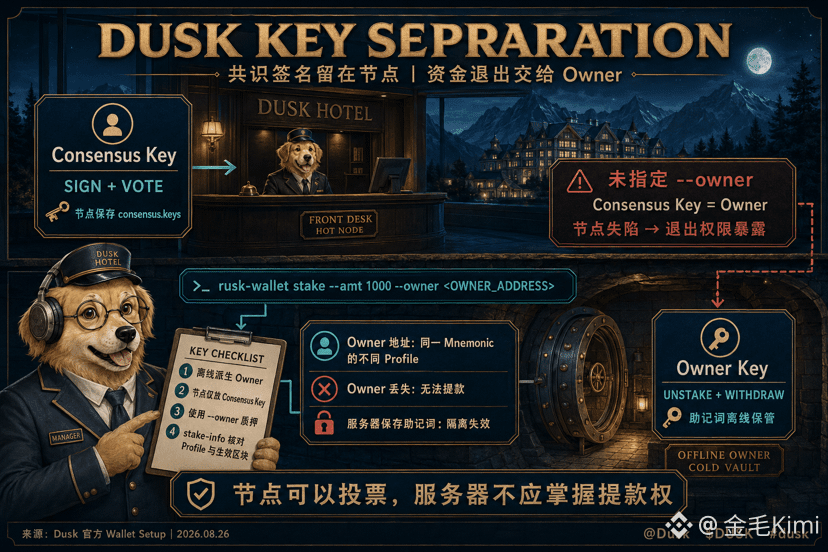
When I changed the password for a node, I found the risk is actually hidden in the way permissions are assigned. Dusk staking has two keys: the Consensus Key stays on the node to sign and vote, while only the Owner Key can unstake and withdraw. If you don’t specify an owner during staking, the consensus key will automatically become the owner, and the right to exit funds remains on the hot machine.
I think of it like a hotel front desk. The duty manager needs the room key card to handle check-ins; there’s no need to take the key to the main vault. The @Dusk_Foundation Dusk stake command can include --owner <OWNER_ADDRESS>, where another address under the same mnemonic controls the funds. Even if the node leaks the consensus key, you still can’t directly pull the staked funds out. If the mnemonic is left on the server, that isolation layer is basically meaningless.
I will derive the owner address on an offline device, only give the node consensus.keys, and then use stake-info to verify the profile index and stake active from block. This separation of duties improves custody—if the owner is lost, withdrawals are still impossible. Since the node can sign blocks, but the server cannot obtain withdrawal permissions, this structure is the only one I accept.
#dusk $DUSK
When I changed the password for a node, I found the risk is actually hidden in the way permissions are assigned. Dusk staking has two keys: the Consensus Key stays on the node to sign and vote, while only the Owner Key can unstake and withdraw. If you don’t specify an owner during staking, the consensus key will automatically become the owner, and the right to exit funds remains on the hot machine.
I think of it like a hotel front desk. The duty manager needs the room key card to handle check-ins; there’s no need to take the key to the main vault. The @Dusk Dusk stake command can include --owner <OWNER_ADDRESS>, where another address under the same mnemonic controls the funds. Even if the node leaks the consensus key, you still can’t directly pull the staked funds out. If the mnemonic is left on the server, that isolation layer is basically meaningless.
I will derive the owner address on an offline device, only give the node consensus.keys, and then use stake-info to verify the profile index and stake active from block. This separation of duties improves custody—if the owner is lost, withdrawals are still impossible. Since the node can sign blocks, but the server cannot obtain withdrawal permissions, this structure is the only one I accept.
#dusk $DUSK
I think of it like a hotel front desk. The duty manager needs the room key card to handle check-ins; there’s no need to take the key to the main vault. The @Dusk Dusk stake command can include --owner <OWNER_ADDRESS>, where another address under the same mnemonic controls the funds. Even if the node leaks the consensus key, you still can’t directly pull the staked funds out. If the mnemonic is left on the server, that isolation layer is basically meaningless.
I will derive the owner address on an offline device, only give the node consensus.keys, and then use stake-info to verify the profile index and stake active from block. This separation of duties improves custody—if the owner is lost, withdrawals are still impossible. Since the node can sign blocks, but the server cannot obtain withdrawal permissions, this structure is the only one I accept.
#dusk $DUSK
87
·
--
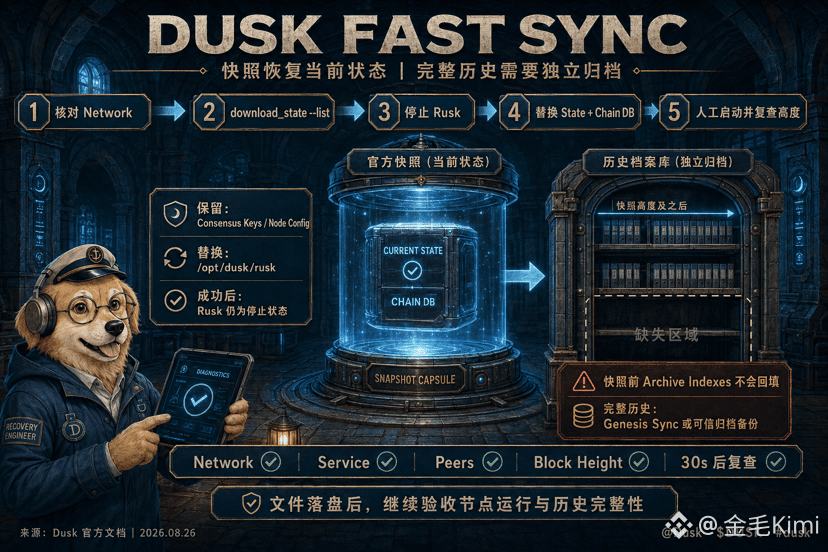
When I restore a node, I’m most afraid that it will download everything and then the terminal gets closed. The download_state for @Dusk_Foundation Dusk will download the official snapshot, stop Rusk, and replace the current state and the chain database under /opt/dusk/rusk. After the command succeeds, the service is still shut down—you have to start it manually. The consensus keys and node configuration will be kept, so if you choose the wrong mainnet/testnet, the tool won’t catch it for you.
I think of it like restoring a phone from a cloud backup: the contacts are back, but chat indexes that weren’t synced before the backup date won’t magically be filled in. The Dusk documentation clearly states that Fast Sync does not backfill archive blocks into the snapshot area—before the archive indexes. If you want an Archive Node to query a complete history, you can only sync from genesis, or use a trusted backup that includes an archive database at the same time.
So I first run download_state –list to verify the network and height. After restoring, I start Rusk, then check the service status, peers, and block height. I check again about 30 seconds later to confirm the height keeps increasing. Catching up to the chain tip and preserving the full history are two separate acceptance items. Writing the state file to disk doesn’t mean the node has fully recovered. Don’t skip the final recheck—later, when you go back to look at old data and find a gap, it really won’t be easy to fix.#dusk $DUSK
When I restore a node, I’m most afraid that it will download everything and then the terminal gets closed. The download_state for @Dusk Dusk will download the official snapshot, stop Rusk, and replace the current state and the chain database under /opt/dusk/rusk. After the command succeeds, the service is still shut down—you have to start it manually. The consensus keys and node configuration will be kept, so if you choose the wrong mainnet/testnet, the tool won’t catch it for you.
I think of it like restoring a phone from a cloud backup: the contacts are back, but chat indexes that weren’t synced before the backup date won’t magically be filled in. The Dusk documentation clearly states that Fast Sync does not backfill archive blocks into the snapshot area—before the archive indexes. If you want an Archive Node to query a complete history, you can only sync from genesis, or use a trusted backup that includes an archive database at the same time.
So I first run download_state –list to verify the network and height. After restoring, I start Rusk, then check the service status, peers, and block height. I check again about 30 seconds later to confirm the height keeps increasing. Catching up to the chain tip and preserving the full history are two separate acceptance items. Writing the state file to disk doesn’t mean the node has fully recovered. Don’t skip the final recheck—later, when you go back to look at old data and find a gap, it really won’t be easy to fix.#dusk $DUSK
I think of it like restoring a phone from a cloud backup: the contacts are back, but chat indexes that weren’t synced before the backup date won’t magically be filled in. The Dusk documentation clearly states that Fast Sync does not backfill archive blocks into the snapshot area—before the archive indexes. If you want an Archive Node to query a complete history, you can only sync from genesis, or use a trusted backup that includes an archive database at the same time.
So I first run download_state –list to verify the network and height. After restoring, I start Rusk, then check the service status, peers, and block height. I check again about 30 seconds later to confirm the height keeps increasing. Catching up to the chain tip and preserving the full history are two separate acceptance items. Writing the state file to disk doesn’t mean the node has fully recovered. Don’t skip the final recheck—later, when you go back to look at old data and find a gap, it really won’t be easy to fix.#dusk $DUSK
173
·
--
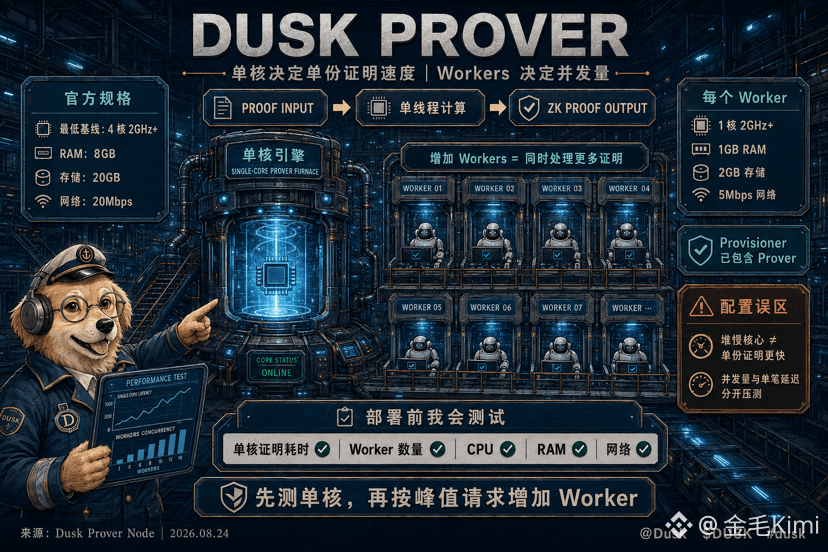
When I scaled up the server last night, I almost placed an order based on the idea: “the more cores, the faster the single proof.” After reading the @Dusk_Foundation Dusk Prover documentation, I realized that ZK proof generation is a single-thread task. A single proof mainly depends on single-core performance. Adding more workers increases the throughput for concurrent handling, but it doesn’t split one proof across multiple cores to run together.
I think of it like a noodle shop with only one stove per cook. With a strong enough flame, a bowl of noodles comes out quickly; opening more stoves lets them make more bowls at the same time, but it won’t make a bowl in the pot cook any faster. The official minimum baseline is: at least 4 cores at 2GHz+, 8GB RAM, 20GB storage, and a 20Mbps network. For each additional worker, you also need to reserve an extra: 1 core at 2GHz+, 1GB memory, 2GB storage, and 5Mbps bandwidth.
This made me re-check Dusk’s ZK infrastructure. Machine configuration affects both queue length and per-request latency. The Provisioner already includes the Prover, and the roles also can’t be mixed when estimating. If I really deploy it, I’ll first benchmark the single-core proof time, then calculate the number of workers based on the peak request rate, and keep monitoring CPU, memory, and network continuously. Buying a bunch of slow cores may look impressive on the dashboard, but users will still be left anxiously waiting for proofs.
#dusk $DUSK
When I scaled up the server last night, I almost placed an order based on the idea: “the more cores, the faster the single proof.” After reading the @Dusk Dusk Prover documentation, I realized that ZK proof generation is a single-thread task. A single proof mainly depends on single-core performance. Adding more workers increases the throughput for concurrent handling, but it doesn’t split one proof across multiple cores to run together.
I think of it like a noodle shop with only one stove per cook. With a strong enough flame, a bowl of noodles comes out quickly; opening more stoves lets them make more bowls at the same time, but it won’t make a bowl in the pot cook any faster. The official minimum baseline is: at least 4 cores at 2GHz+, 8GB RAM, 20GB storage, and a 20Mbps network. For each additional worker, you also need to reserve an extra: 1 core at 2GHz+, 1GB memory, 2GB storage, and 5Mbps bandwidth.
This made me re-check Dusk’s ZK infrastructure. Machine configuration affects both queue length and per-request latency. The Provisioner already includes the Prover, and the roles also can’t be mixed when estimating. If I really deploy it, I’ll first benchmark the single-core proof time, then calculate the number of workers based on the peak request rate, and keep monitoring CPU, memory, and network continuously. Buying a bunch of slow cores may look impressive on the dashboard, but users will still be left anxiously waiting for proofs.
#dusk $DUSK
I think of it like a noodle shop with only one stove per cook. With a strong enough flame, a bowl of noodles comes out quickly; opening more stoves lets them make more bowls at the same time, but it won’t make a bowl in the pot cook any faster. The official minimum baseline is: at least 4 cores at 2GHz+, 8GB RAM, 20GB storage, and a 20Mbps network. For each additional worker, you also need to reserve an extra: 1 core at 2GHz+, 1GB memory, 2GB storage, and 5Mbps bandwidth.
This made me re-check Dusk’s ZK infrastructure. Machine configuration affects both queue length and per-request latency. The Provisioner already includes the Prover, and the roles also can’t be mixed when estimating. If I really deploy it, I’ll first benchmark the single-core proof time, then calculate the number of workers based on the peak request rate, and keep monitoring CPU, memory, and network continuously. Buying a bunch of slow cores may look impressive on the dashboard, but users will still be left anxiously waiting for proofs.
#dusk $DUSK
106
·
--
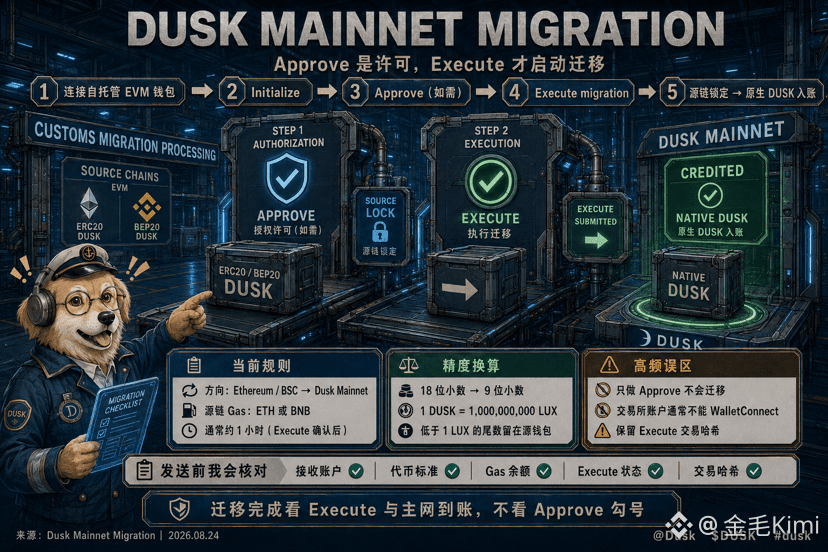
When I transferred a BEP20 DUSK into the mainnet, once I saw the Approve succeed I called it a day—after half a day, the balance still hadn’t moved. Dusk Web Wallet’s migration is done in two steps: connect the self-custodied EVM wallet that holds the tokens, choose ERC20 or BEP20, initialize it, then follow the prompts to Approve, and finally click Execute migration. Only after the execution transaction is confirmed will the source-chain tokens be locked and the mainnet deposit process will start.
I treat it like warehouse shipping. Approve is just the pickup authorization; Execute is what actually lets the goods leave the warehouse. The official docs state that each submission must pay source-chain gas with ETH or BNB. After the execution is confirmed, it usually completes within about an hour. On the EVM side, tokens use 18 decimals; on the @Dusk_Foundation Dusk mainnet it uses 9 decimals. 1 DUSK equals 1 billion LUX. The migration amount is rounded down; any remainder below 1 LUX stays in the original wallet.
Now I’ll first verify that the receiving address is a Dusk account I control, then check whether the wallet supports WalletConnect, and finally save the transaction hashes from the two transactions. Exchange accounts usually can’t be connected directly; the green checkmark on Approve is also not proof of a deposit. If the balance hasn’t arrived, I’ll check the Execute status first, and then use the hash to find official support. Authorization and moving funds are two different things—this mistake is easy to make at a glance, and troubleshooting will end up taking a long detour.
#dusk $DUSK
When I transferred a BEP20 DUSK into the mainnet, once I saw the Approve succeed I called it a day—after half a day, the balance still hadn’t moved. Dusk Web Wallet’s migration is done in two steps: connect the self-custodied EVM wallet that holds the tokens, choose ERC20 or BEP20, initialize it, then follow the prompts to Approve, and finally click Execute migration. Only after the execution transaction is confirmed will the source-chain tokens be locked and the mainnet deposit process will start.
I treat it like warehouse shipping. Approve is just the pickup authorization; Execute is what actually lets the goods leave the warehouse. The official docs state that each submission must pay source-chain gas with ETH or BNB. After the execution is confirmed, it usually completes within about an hour. On the EVM side, tokens use 18 decimals; on the @Dusk Dusk mainnet it uses 9 decimals. 1 DUSK equals 1 billion LUX. The migration amount is rounded down; any remainder below 1 LUX stays in the original wallet.
Now I’ll first verify that the receiving address is a Dusk account I control, then check whether the wallet supports WalletConnect, and finally save the transaction hashes from the two transactions. Exchange accounts usually can’t be connected directly; the green checkmark on Approve is also not proof of a deposit. If the balance hasn’t arrived, I’ll check the Execute status first, and then use the hash to find official support. Authorization and moving funds are two different things—this mistake is easy to make at a glance, and troubleshooting will end up taking a long detour.
#dusk $DUSK
I treat it like warehouse shipping. Approve is just the pickup authorization; Execute is what actually lets the goods leave the warehouse. The official docs state that each submission must pay source-chain gas with ETH or BNB. After the execution is confirmed, it usually completes within about an hour. On the EVM side, tokens use 18 decimals; on the @Dusk Dusk mainnet it uses 9 decimals. 1 DUSK equals 1 billion LUX. The migration amount is rounded down; any remainder below 1 LUX stays in the original wallet.
Now I’ll first verify that the receiving address is a Dusk account I control, then check whether the wallet supports WalletConnect, and finally save the transaction hashes from the two transactions. Exchange accounts usually can’t be connected directly; the green checkmark on Approve is also not proof of a deposit. If the balance hasn’t arrived, I’ll check the Execute status first, and then use the hash to find official support. Authorization and moving funds are two different things—this mistake is easy to make at a glance, and troubleshooting will end up taking a long detour.
#dusk $DUSK
127
·
--
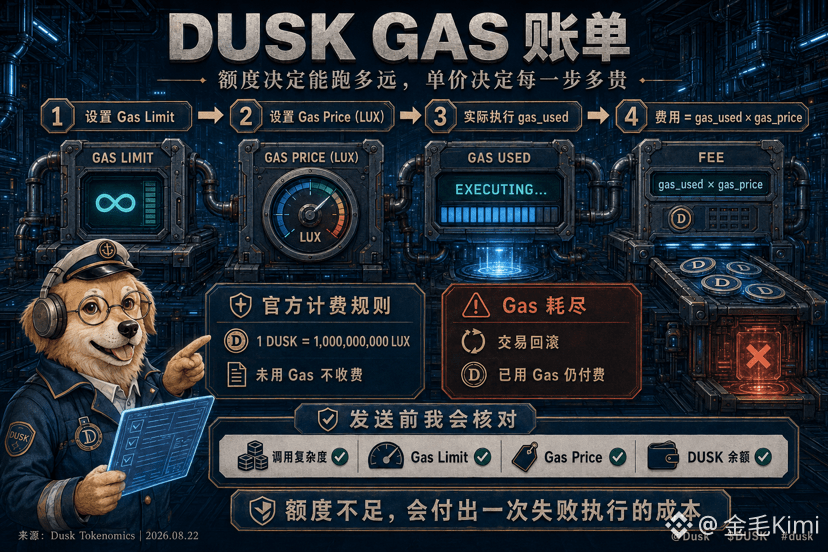
When I adjusted the transaction fee in my wallet, I almost mistook the Gas Limit for the final charge. @Dusk_Foundation Dusk breaks the fee into Gas Limit and Gas Price: the former limits the amount of computation the transaction can use, while the latter sets the price per unit of Gas in LUX. The amount actually paid is gas_used × gas_price. On the mainnet, 1 DUSK equals 1 billion LUX, and unused allowance is not charged.
I think of it like a restaurant card pre-authorization. Gas Limit is the spending cap, Gas Price is the unit price for each “step” of the process, and gas_used is the amount of work the kitchen actually completes. Leaving a higher allowance only increases the execution buffer; if the contract runs out of Gas midway, the transaction will revert, and the Gas already spent still needs to be paid—this money won’t buy you a successful on-chain result.
Before I press confirm, I check whether it’s a regular transfer or a contract call, then verify that the Gas Limit can cover the execution path, and I cross-check the Gas Price against my DUSK balance. Lowering the limit won’t reduce the unit cost; it only increases the chance of failure. Raising the unit price blindly also amplifies the cost of every step. My operating habit is very consistent: for complex calls, I leave some headroom, and I set a fee cap that I can tolerate.
#dusk $DUSK
When I adjusted the transaction fee in my wallet, I almost mistook the Gas Limit for the final charge. @Dusk Dusk breaks the fee into Gas Limit and Gas Price: the former limits the amount of computation the transaction can use, while the latter sets the price per unit of Gas in LUX. The amount actually paid is gas_used × gas_price. On the mainnet, 1 DUSK equals 1 billion LUX, and unused allowance is not charged.
I think of it like a restaurant card pre-authorization. Gas Limit is the spending cap, Gas Price is the unit price for each “step” of the process, and gas_used is the amount of work the kitchen actually completes. Leaving a higher allowance only increases the execution buffer; if the contract runs out of Gas midway, the transaction will revert, and the Gas already spent still needs to be paid—this money won’t buy you a successful on-chain result.
Before I press confirm, I check whether it’s a regular transfer or a contract call, then verify that the Gas Limit can cover the execution path, and I cross-check the Gas Price against my DUSK balance. Lowering the limit won’t reduce the unit cost; it only increases the chance of failure. Raising the unit price blindly also amplifies the cost of every step. My operating habit is very consistent: for complex calls, I leave some headroom, and I set a fee cap that I can tolerate.
#dusk $DUSK
I think of it like a restaurant card pre-authorization. Gas Limit is the spending cap, Gas Price is the unit price for each “step” of the process, and gas_used is the amount of work the kitchen actually completes. Leaving a higher allowance only increases the execution buffer; if the contract runs out of Gas midway, the transaction will revert, and the Gas already spent still needs to be paid—this money won’t buy you a successful on-chain result.
Before I press confirm, I check whether it’s a regular transfer or a contract call, then verify that the Gas Limit can cover the execution path, and I cross-check the Gas Price against my DUSK balance. Lowering the limit won’t reduce the unit cost; it only increases the chance of failure. Raising the unit price blindly also amplifies the cost of every step. My operating habit is very consistent: for complex calls, I leave some headroom, and I set a fee cap that I can tolerate.
#dusk $DUSK
86
·
--
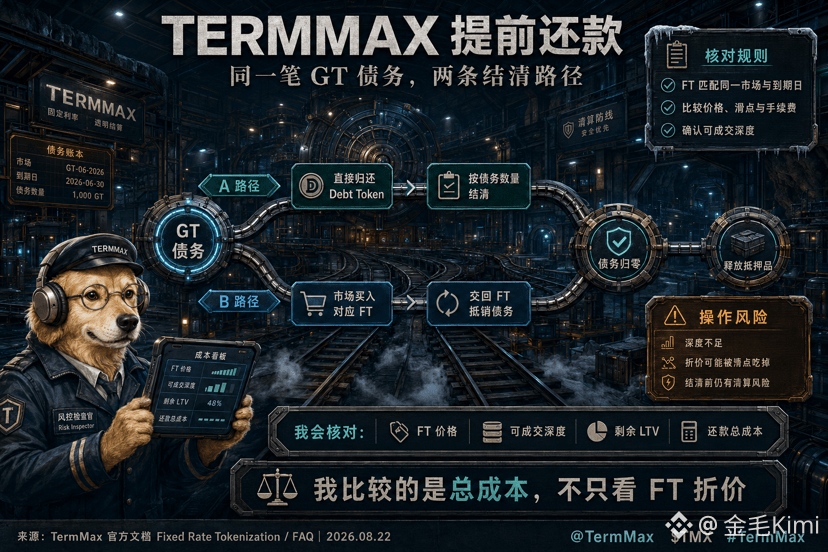
When I planned to repay a fixed-rate loan early, I only then noticed that behind the “repayment” button there are two funding paths.
TermMax’s GT records the collateral and the debt that has been issued. Borrowers can either return the corresponding debt token directly, or buy an identical FT with the same maturity date from the same market, and then use the FT to offset the debt in the GT. Only when the amount of debt reaches zero will the collateral be released.
I think of it as an early redemption of the note I signed. Returning the debt token directly is easier to calculate in terms of cost. If market interest rates rise, the FT may trade below par, and my accounting cost for buying back the FT could be lower. But a discount doesn’t automatically mean saving money—order depth, slippage, and on-chain fees will all change the final execution amount. If you buy the wrong market or maturity, it won’t be usable for settlement either. The official FAQ describes buying back the FT as an optional repayment route for the borrower; it does not promise that the FT will always be discounted.
Before I place an order, I check the FT contract and the market it belongs to, confirm the maturity date and how much is actually tradable, then put the total cost of buying back against the direct repayment amount. Before the position is fully settled, the collateral corresponding to GT is still affected by LLTV and oracle prices; even if the FT is cheap, it can’t prevent liquidation if the collateral value drops. I only trust complete quotes—focusing on the words “discount” alone is how people end up paying tuition.
@termmax
#termmax
When I planned to repay a fixed-rate loan early, I only then noticed that behind the “repayment” button there are two funding paths.
TermMax’s GT records the collateral and the debt that has been issued. Borrowers can either return the corresponding debt token directly, or buy an identical FT with the same maturity date from the same market, and then use the FT to offset the debt in the GT. Only when the amount of debt reaches zero will the collateral be released.
I think of it as an early redemption of the note I signed. Returning the debt token directly is easier to calculate in terms of cost. If market interest rates rise, the FT may trade below par, and my accounting cost for buying back the FT could be lower. But a discount doesn’t automatically mean saving money—order depth, slippage, and on-chain fees will all change the final execution amount. If you buy the wrong market or maturity, it won’t be usable for settlement either. The official FAQ describes buying back the FT as an optional repayment route for the borrower; it does not promise that the FT will always be discounted.
Before I place an order, I check the FT contract and the market it belongs to, confirm the maturity date and how much is actually tradable, then put the total cost of buying back against the direct repayment amount. Before the position is fully settled, the collateral corresponding to GT is still affected by LLTV and oracle prices; even if the FT is cheap, it can’t prevent liquidation if the collateral value drops. I only trust complete quotes—focusing on the words “discount” alone is how people end up paying tuition.
@TermMax
#termmax
TermMax’s GT records the collateral and the debt that has been issued. Borrowers can either return the corresponding debt token directly, or buy an identical FT with the same maturity date from the same market, and then use the FT to offset the debt in the GT. Only when the amount of debt reaches zero will the collateral be released.
I think of it as an early redemption of the note I signed. Returning the debt token directly is easier to calculate in terms of cost. If market interest rates rise, the FT may trade below par, and my accounting cost for buying back the FT could be lower. But a discount doesn’t automatically mean saving money—order depth, slippage, and on-chain fees will all change the final execution amount. If you buy the wrong market or maturity, it won’t be usable for settlement either. The official FAQ describes buying back the FT as an optional repayment route for the borrower; it does not promise that the FT will always be discounted.
Before I place an order, I check the FT contract and the market it belongs to, confirm the maturity date and how much is actually tradable, then put the total cost of buying back against the direct repayment amount. Before the position is fully settled, the collateral corresponding to GT is still affected by LLTV and oracle prices; even if the FT is cheap, it can’t prevent liquidation if the collateral value drops. I only trust complete quotes—focusing on the words “discount” alone is how people end up paying tuition.
@TermMax
#termmax
141
·
--
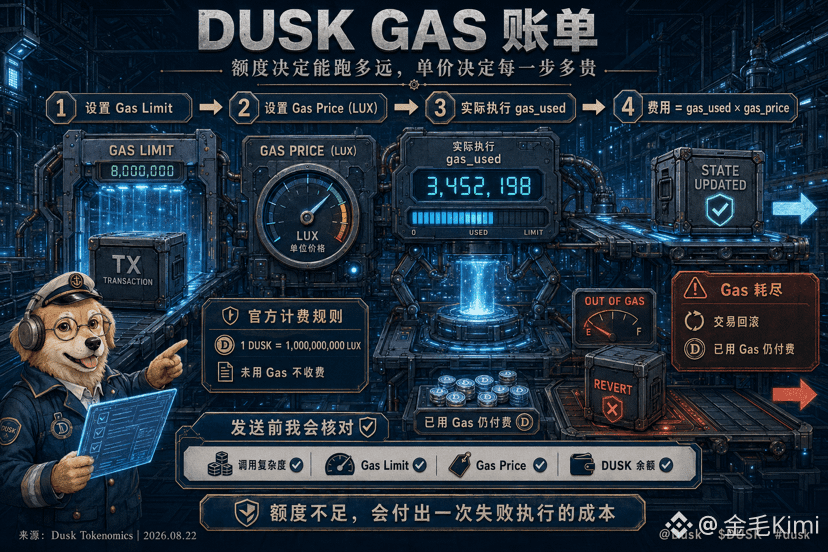
When I adjust the fee in my wallet, I almost mistook the Gas Limit for the money that would ultimately be deducted. The billing for @Dusk_Foundation Dusk is split into Gas Limit and Gas Price: the former caps the maximum amount of computation that a single transaction can consume, while the latter uses LUX to indicate the price per unit of Gas. The actual fee is settled as gas_used × gas_price. On the mainnet, 1 DUSK equals 1 billion LUX, and any unused allowance isn’t charged.
I think of this mechanism like a restaurant card authorization. Gas Limit is like the spending limit, Gas Price is like the unit price for each step of the process, and gas_used is the actual amount of work the kitchen completes. Leaving a higher allowance just gives more buffer for complex calls; setting a higher unit price makes every step execute more expensively. If the allowance runs out during contract execution, Dusk will revert the transaction—any Gas already consumed still has to be paid, and that money can’t be exchanged for state updates.
So before I hit confirm, I first check whether the call is a normal transfer or a contract execution, then verify that the Gas Limit covers the path, and finally review the Gas Price and my DUSK balance. If I set the cap too low, the “savings” are just less reserved space and a higher chance of rollback; blindly raising the unit price only increases the cost of every computation step. My operational bottom line is fixed: I’d rather leave a reasonable buffer than gamble on a failed execution to save on fees. #dusk $DUSK
When I adjust the fee in my wallet, I almost mistook the Gas Limit for the money that would ultimately be deducted. The billing for @Dusk Dusk is split into Gas Limit and Gas Price: the former caps the maximum amount of computation that a single transaction can consume, while the latter uses LUX to indicate the price per unit of Gas. The actual fee is settled as gas_used × gas_price. On the mainnet, 1 DUSK equals 1 billion LUX, and any unused allowance isn’t charged.
I think of this mechanism like a restaurant card authorization. Gas Limit is like the spending limit, Gas Price is like the unit price for each step of the process, and gas_used is the actual amount of work the kitchen completes. Leaving a higher allowance just gives more buffer for complex calls; setting a higher unit price makes every step execute more expensively. If the allowance runs out during contract execution, Dusk will revert the transaction—any Gas already consumed still has to be paid, and that money can’t be exchanged for state updates.
So before I hit confirm, I first check whether the call is a normal transfer or a contract execution, then verify that the Gas Limit covers the path, and finally review the Gas Price and my DUSK balance. If I set the cap too low, the “savings” are just less reserved space and a higher chance of rollback; blindly raising the unit price only increases the cost of every computation step. My operational bottom line is fixed: I’d rather leave a reasonable buffer than gamble on a failed execution to save on fees. #dusk $DUSK
I think of this mechanism like a restaurant card authorization. Gas Limit is like the spending limit, Gas Price is like the unit price for each step of the process, and gas_used is the actual amount of work the kitchen completes. Leaving a higher allowance just gives more buffer for complex calls; setting a higher unit price makes every step execute more expensively. If the allowance runs out during contract execution, Dusk will revert the transaction—any Gas already consumed still has to be paid, and that money can’t be exchanged for state updates.
So before I hit confirm, I first check whether the call is a normal transfer or a contract execution, then verify that the Gas Limit covers the path, and finally review the Gas Price and my DUSK balance. If I set the cap too low, the “savings” are just less reserved space and a higher chance of rollback; blindly raising the unit price only increases the cost of every computation step. My operational bottom line is fixed: I’d rather leave a reasonable buffer than gamble on a failed execution to save on fees. #dusk $DUSK
130
·
--
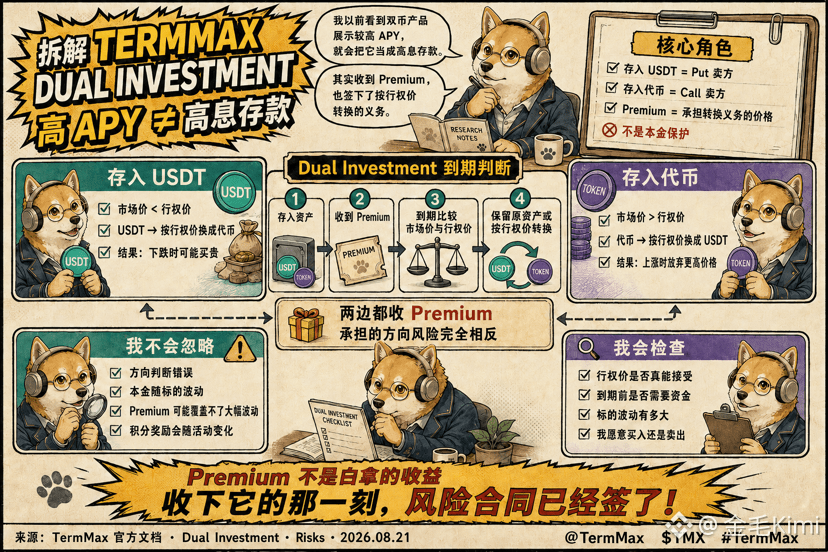
I used to see dual-currency products displayed with high APYs, and I would always unconsciously treat them like a high-yield deposit. @termmax TermMax Alpha’s Dual Investment is actually closer to selling options: depositing USDT provides liquidity for the Put buyer; depositing the token provides liquidity for the Call buyer. The Premium I receive is the price I pay for the obligation to perform the conversion.
I liken it to first collecting an insurance premium, then signing a commitment to trade at the strike price. When the USDT vault expires: if the market price is lower than the strike price, the funds will be exchanged into the token at the strike price, and I bear the downside risk from having bought at a higher price. When the token vault expires: if the market price is higher than the strike price, the token will be exchanged into USDT at the strike price, and I give up any further upside potential. You can receive Premium on both sides, but the direction of the risk you take is completely opposite.
So I don’t just look at the numbers for returns. Whether the strike price is truly the price I’m willing to buy or sell at, whether I’ll need this capital before maturity, and whether the underlying’s volatility might exceed the Premium by a lot—these are the key factors in judging a TermMax Dual Investment. The official also notes that points rewards will change with the promotion and cannot be treated as stable cash flow. It makes the seller’s obligations easier to manage operationally, but it doesn’t take those obligations away. The moment I receive the Premium, the risk contract has already been signed.
#termmax
I used to see dual-currency products displayed with high APYs, and I would always unconsciously treat them like a high-yield deposit. @TermMax TermMax Alpha’s Dual Investment is actually closer to selling options: depositing USDT provides liquidity for the Put buyer; depositing the token provides liquidity for the Call buyer. The Premium I receive is the price I pay for the obligation to perform the conversion.
I liken it to first collecting an insurance premium, then signing a commitment to trade at the strike price. When the USDT vault expires: if the market price is lower than the strike price, the funds will be exchanged into the token at the strike price, and I bear the downside risk from having bought at a higher price. When the token vault expires: if the market price is higher than the strike price, the token will be exchanged into USDT at the strike price, and I give up any further upside potential. You can receive Premium on both sides, but the direction of the risk you take is completely opposite.
So I don’t just look at the numbers for returns. Whether the strike price is truly the price I’m willing to buy or sell at, whether I’ll need this capital before maturity, and whether the underlying’s volatility might exceed the Premium by a lot—these are the key factors in judging a TermMax Dual Investment. The official also notes that points rewards will change with the promotion and cannot be treated as stable cash flow. It makes the seller’s obligations easier to manage operationally, but it doesn’t take those obligations away. The moment I receive the Premium, the risk contract has already been signed.
#termmax
I liken it to first collecting an insurance premium, then signing a commitment to trade at the strike price. When the USDT vault expires: if the market price is lower than the strike price, the funds will be exchanged into the token at the strike price, and I bear the downside risk from having bought at a higher price. When the token vault expires: if the market price is higher than the strike price, the token will be exchanged into USDT at the strike price, and I give up any further upside potential. You can receive Premium on both sides, but the direction of the risk you take is completely opposite.
So I don’t just look at the numbers for returns. Whether the strike price is truly the price I’m willing to buy or sell at, whether I’ll need this capital before maturity, and whether the underlying’s volatility might exceed the Premium by a lot—these are the key factors in judging a TermMax Dual Investment. The official also notes that points rewards will change with the promotion and cannot be treated as stable cash flow. It makes the seller’s obligations easier to manage operationally, but it doesn’t take those obligations away. The moment I receive the Premium, the risk contract has already been signed.
#termmax
101
·
--
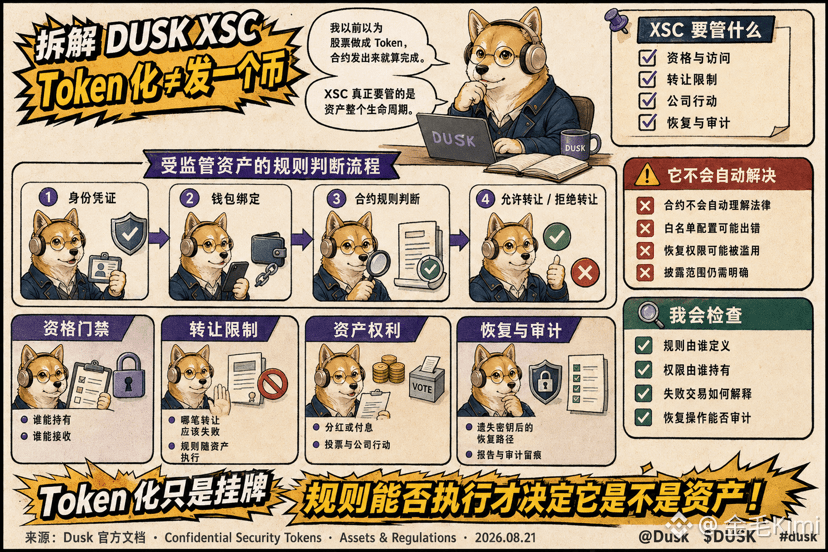
I used to think that turning stocks into Tokens and issuing the contract was the job done. Dusk’s XSC gave me a sharp reminder: it’s defined as a confidential contract standard that can be adapted to privacy requirements and compliance rules according to business needs. What actually makes regulated assets truly troublesome isn’t just the contract—it’s the eligibility of the holders and transfer restrictions, along with subsequent rights that can’t be kept intact through manual patching.
I think of a regular Token as a house number. What XSC has to handle is more like the entire property management rulebook. Who can hold it, who can receive it, which transfer should fail—all of that needs identity credentials working together with wallet binding and contract logic to determine outcomes. Dividends or interest payments, voting, recovery after a lost key, and even audit reports are all part of the asset’s lifecycle. The @Dusk_Foundation Dusk wants isn’t to simply put securities into a different on-chain shell—it’s to make the rules run alongside the asset.
But contracts can’t automatically understand the law. Eligibility conditions in different jurisdictions must be defined by the issuer and professionals. If the whitelist or permissions configuration is wrong, it can either lock out qualified investors or allow people in who shouldn’t. Recovery and forced operations also give the issuer a way to remediate—but they introduce the risk of permission abuse. I care most about whether Dusk can make these roles auditable and acceptable to audits. Tokenization is only what gets it listed; whether the rules can be enforced over the long term determines whether it truly counts as an asset.
#dusk $DUSK
I used to think that turning stocks into Tokens and issuing the contract was the job done. Dusk’s XSC gave me a sharp reminder: it’s defined as a confidential contract standard that can be adapted to privacy requirements and compliance rules according to business needs. What actually makes regulated assets truly troublesome isn’t just the contract—it’s the eligibility of the holders and transfer restrictions, along with subsequent rights that can’t be kept intact through manual patching.
I think of a regular Token as a house number. What XSC has to handle is more like the entire property management rulebook. Who can hold it, who can receive it, which transfer should fail—all of that needs identity credentials working together with wallet binding and contract logic to determine outcomes. Dividends or interest payments, voting, recovery after a lost key, and even audit reports are all part of the asset’s lifecycle. The @Dusk Dusk wants isn’t to simply put securities into a different on-chain shell—it’s to make the rules run alongside the asset.
But contracts can’t automatically understand the law. Eligibility conditions in different jurisdictions must be defined by the issuer and professionals. If the whitelist or permissions configuration is wrong, it can either lock out qualified investors or allow people in who shouldn’t. Recovery and forced operations also give the issuer a way to remediate—but they introduce the risk of permission abuse. I care most about whether Dusk can make these roles auditable and acceptable to audits. Tokenization is only what gets it listed; whether the rules can be enforced over the long term determines whether it truly counts as an asset.
#dusk $DUSK
I think of a regular Token as a house number. What XSC has to handle is more like the entire property management rulebook. Who can hold it, who can receive it, which transfer should fail—all of that needs identity credentials working together with wallet binding and contract logic to determine outcomes. Dividends or interest payments, voting, recovery after a lost key, and even audit reports are all part of the asset’s lifecycle. The @Dusk Dusk wants isn’t to simply put securities into a different on-chain shell—it’s to make the rules run alongside the asset.
But contracts can’t automatically understand the law. Eligibility conditions in different jurisdictions must be defined by the issuer and professionals. If the whitelist or permissions configuration is wrong, it can either lock out qualified investors or allow people in who shouldn’t. Recovery and forced operations also give the issuer a way to remediate—but they introduce the risk of permission abuse. I care most about whether Dusk can make these roles auditable and acceptable to audits. Tokenization is only what gets it listed; whether the rules can be enforced over the long term determines whether it truly counts as an asset.
#dusk $DUSK
1
2
125
·
--
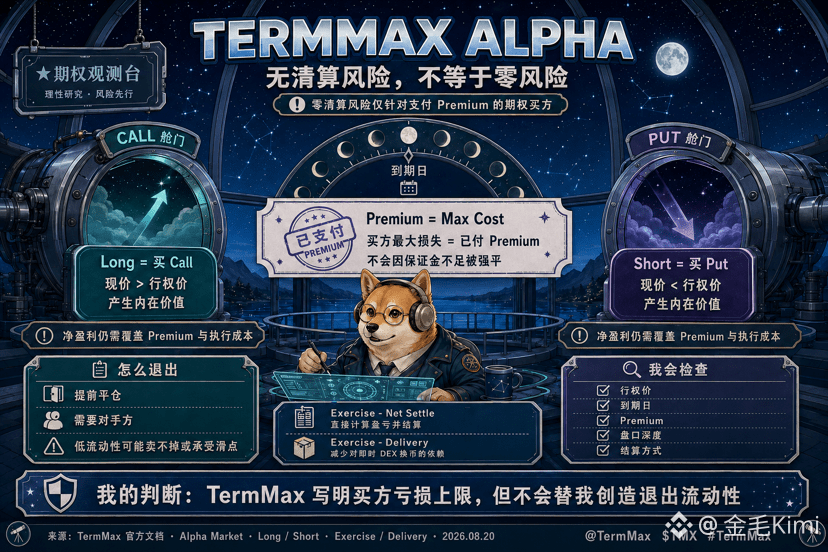
When I trade naked options, what I fear most isn’t liquidation—it’s getting the direction right but choosing the wrong expiration. In TermMax Alpha, Long means buying a Call, Short means buying a Put. When opening a position, you first pay the Premium; this fee is the Max Cost, which is also the maximum loss the option buyer can incur in that position. Therefore, it won’t be force-liquidated for insufficient balance the way margin contracts can.
I think of it as buying a ticket with a deadline in advance. A Call creates intrinsic value when the market price is higher than the strike; a Put is the opposite. To achieve net profit, you also need to cover the Premium and the execution cost. TermMax supports closing early, and it also offers Exercise - Net Settle and Exercise - Delivery. The former calculates profit and loss directly and settles; the latter can reduce reliance on immediate DEX swapping.
No liquidation risk doesn’t mean zero risk. The official documentation is very straightforward: if you exit early, you must find a counterparty. If liquidity is insufficient, your position may not be sellable, or you may have to endure significant slippage. I’ll first check the strike price and expiration date, then verify the Premium and the order book depth, and finally confirm the settlement method. TermMax clearly states the buyer’s maximum loss up front, but it doesn’t guarantee that the direction is correct for me—and it certainly can’t conjure up exit liquidity out of thin air.
@termmax
#termmax
When I trade naked options, what I fear most isn’t liquidation—it’s getting the direction right but choosing the wrong expiration. In TermMax Alpha, Long means buying a Call, Short means buying a Put. When opening a position, you first pay the Premium; this fee is the Max Cost, which is also the maximum loss the option buyer can incur in that position. Therefore, it won’t be force-liquidated for insufficient balance the way margin contracts can.
I think of it as buying a ticket with a deadline in advance. A Call creates intrinsic value when the market price is higher than the strike; a Put is the opposite. To achieve net profit, you also need to cover the Premium and the execution cost. TermMax supports closing early, and it also offers Exercise - Net Settle and Exercise - Delivery. The former calculates profit and loss directly and settles; the latter can reduce reliance on immediate DEX swapping.
No liquidation risk doesn’t mean zero risk. The official documentation is very straightforward: if you exit early, you must find a counterparty. If liquidity is insufficient, your position may not be sellable, or you may have to endure significant slippage. I’ll first check the strike price and expiration date, then verify the Premium and the order book depth, and finally confirm the settlement method. TermMax clearly states the buyer’s maximum loss up front, but it doesn’t guarantee that the direction is correct for me—and it certainly can’t conjure up exit liquidity out of thin air.
@TermMax
#termmax
I think of it as buying a ticket with a deadline in advance. A Call creates intrinsic value when the market price is higher than the strike; a Put is the opposite. To achieve net profit, you also need to cover the Premium and the execution cost. TermMax supports closing early, and it also offers Exercise - Net Settle and Exercise - Delivery. The former calculates profit and loss directly and settles; the latter can reduce reliance on immediate DEX swapping.
No liquidation risk doesn’t mean zero risk. The official documentation is very straightforward: if you exit early, you must find a counterparty. If liquidity is insufficient, your position may not be sellable, or you may have to endure significant slippage. I’ll first check the strike price and expiration date, then verify the Premium and the order book depth, and finally confirm the settlement method. TermMax clearly states the buyer’s maximum loss up front, but it doesn’t guarantee that the direction is correct for me—and it certainly can’t conjure up exit liquidity out of thin air.
@TermMax
#termmax
132
·
--
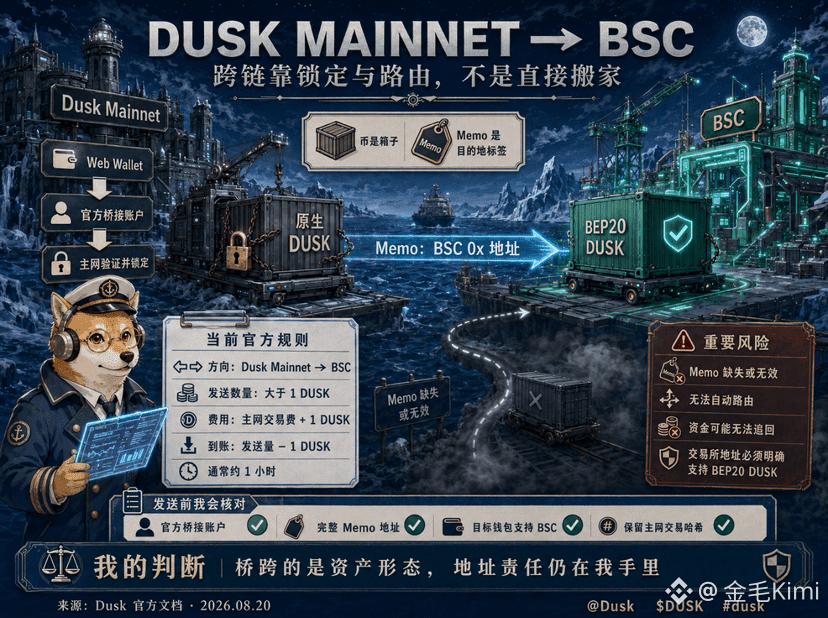
What I fear most in cross-chain transfers isn’t waiting—it’s accidentally missing a digit when copying the address. The process of bridging Dusk from the mainnet to BSC as a reminder: this isn’t just moving the same coin somewhere else; instead, you send the native DUSK to the official bridge account. After verification and locking on the mainnet, the system generates the corresponding BEP20 DUSK to the BSC address specified in the Memo.
It’s like checking luggage. The coin is the suitcase, and the Memo is the destination tag. If the tag is missing or written incorrectly, the system can’t automatically sort it. Dusk’s latest bridging documentation requires the transfer amount to be greater than 1 @Dusk_Foundation DUSK. The fee is the mainnet transaction fee plus a 1 DUSK bridge fee. It usually takes about an hour to complete. The amount received on the other side equals the sent amount minus 1 DUSK.
The easiest thing to overlook here is the asset form. On the BSC side, you receive BEP20 DUSK, while on the mainnet the native DUSK is what serves as the issued basis. Before sending, I fully verify the official bridge account and the Memo address, and confirm that the destination wallet supports BSC. If it’s an exchange address, I also confirm that it explicitly supports DUSK deposits for that network. The bridge moves liquidity cross-chain, but address responsibility isn’t transferred to the project. The real danger isn’t waiting an extra hour—it’s giving an irreversible transaction to the wrong Memo.
#dusk $DUSK
What I fear most in cross-chain transfers isn’t waiting—it’s accidentally missing a digit when copying the address. The process of bridging Dusk from the mainnet to BSC as a reminder: this isn’t just moving the same coin somewhere else; instead, you send the native DUSK to the official bridge account. After verification and locking on the mainnet, the system generates the corresponding BEP20 DUSK to the BSC address specified in the Memo.
It’s like checking luggage. The coin is the suitcase, and the Memo is the destination tag. If the tag is missing or written incorrectly, the system can’t automatically sort it. Dusk’s latest bridging documentation requires the transfer amount to be greater than 1 @Dusk DUSK. The fee is the mainnet transaction fee plus a 1 DUSK bridge fee. It usually takes about an hour to complete. The amount received on the other side equals the sent amount minus 1 DUSK.
The easiest thing to overlook here is the asset form. On the BSC side, you receive BEP20 DUSK, while on the mainnet the native DUSK is what serves as the issued basis. Before sending, I fully verify the official bridge account and the Memo address, and confirm that the destination wallet supports BSC. If it’s an exchange address, I also confirm that it explicitly supports DUSK deposits for that network. The bridge moves liquidity cross-chain, but address responsibility isn’t transferred to the project. The real danger isn’t waiting an extra hour—it’s giving an irreversible transaction to the wrong Memo.
#dusk $DUSK
It’s like checking luggage. The coin is the suitcase, and the Memo is the destination tag. If the tag is missing or written incorrectly, the system can’t automatically sort it. Dusk’s latest bridging documentation requires the transfer amount to be greater than 1 @Dusk DUSK. The fee is the mainnet transaction fee plus a 1 DUSK bridge fee. It usually takes about an hour to complete. The amount received on the other side equals the sent amount minus 1 DUSK.
The easiest thing to overlook here is the asset form. On the BSC side, you receive BEP20 DUSK, while on the mainnet the native DUSK is what serves as the issued basis. Before sending, I fully verify the official bridge account and the Memo address, and confirm that the destination wallet supports BSC. If it’s an exchange address, I also confirm that it explicitly supports DUSK deposits for that network. The bridge moves liquidity cross-chain, but address responsibility isn’t transferred to the project. The real danger isn’t waiting an extra hour—it’s giving an irreversible transaction to the wrong Memo.
#dusk $DUSK
127
·
--
Dissecting FT/GT: TermMax isn’t building a bigger Aave
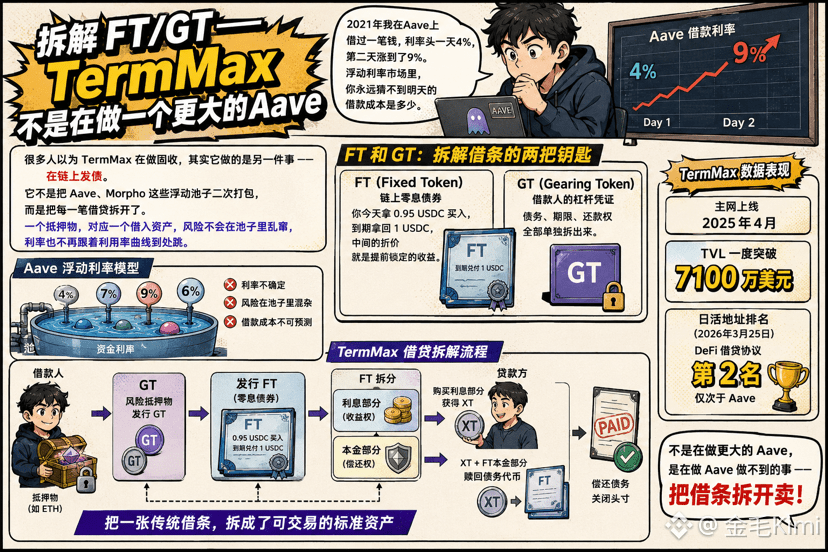
In 2021, I borrowed some money on Aave. The interest rate was 4% on the first day, then jumped to 9% the next day. It wasn’t the project team trying to screw me—what changed was capital utilization, and the algorithm automatically adjusted. After that, I learned one thing: in a floating-rate market, you can never guess what the borrowing cost will be tomorrow.
Many people think @termmax TermMax is doing fixed income, but actually it’s doing something else: issuing debt on-chain. It doesn’t repackage the floating pools on Aave, Morpho, and the like. Instead, it breaks each individual loan apart. One collateral corresponds to one borrowed asset, so risk doesn’t roam around in a pool, and interest rates no longer bounce around everywhere following the utilization-rate curve.
This split relies on two tokens: FT and GT. FT (Fixed Token) is more like an on-chain zero-coupon bond: you buy it today for 0.95 USDC, and at maturity you redeem 1 USDC—the discount is the yield you’ve effectively locked in upfront. GT (Gearing Token) is a borrower’s leverage certificate, with the debt, term, and repayment rights all separated out. Borrowers lock their collateral into GT, issue FT, and then split the FT into two parts: principal and interest. The interest portion is sold to the lender in exchange for XT. XT and the FT principal portion are then used together to redeem the debt token. The whole process turns a traditional promissory note into tradable standardized assets.
Since TermMax went live on mainnet in April 2025, its TVL at one point exceeded $71 million. Daily active addresses ranked it second among DeFi lending protocols on March 25, 2026, behind only Aave. It’s not trying to build a bigger Aave—it’s doing what Aave can’t: breaking up a loan note and selling it.
#termmax
Dissecting FT/GT: TermMax isn’t building a bigger Aave
In 2021, I borrowed some money on Aave. The interest rate was 4% on the first day, then jumped to 9% the next day. It wasn’t the project team trying to screw me—what changed was capital utilization, and the algorithm automatically adjusted. After that, I learned one thing: in a floating-rate market, you can never guess what the borrowing cost will be tomorrow.
Many people think @TermMax TermMax is doing fixed income, but actually it’s doing something else: issuing debt on-chain. It doesn’t repackage the floating pools on Aave, Morpho, and the like. Instead, it breaks each individual loan apart. One collateral corresponds to one borrowed asset, so risk doesn’t roam around in a pool, and interest rates no longer bounce around everywhere following the utilization-rate curve.
This split relies on two tokens: FT and GT. FT (Fixed Token) is more like an on-chain zero-coupon bond: you buy it today for 0.95 USDC, and at maturity you redeem 1 USDC—the discount is the yield you’ve effectively locked in upfront. GT (Gearing Token) is a borrower’s leverage certificate, with the debt, term, and repayment rights all separated out. Borrowers lock their collateral into GT, issue FT, and then split the FT into two parts: principal and interest. The interest portion is sold to the lender in exchange for XT. XT and the FT principal portion are then used together to redeem the debt token. The whole process turns a traditional promissory note into tradable standardized assets.
Since TermMax went live on mainnet in April 2025, its TVL at one point exceeded $71 million. Daily active addresses ranked it second among DeFi lending protocols on March 25, 2026, behind only Aave. It’s not trying to build a bigger Aave—it’s doing what Aave can’t: breaking up a loan note and selling it.
#termmax
In 2021, I borrowed some money on Aave. The interest rate was 4% on the first day, then jumped to 9% the next day. It wasn’t the project team trying to screw me—what changed was capital utilization, and the algorithm automatically adjusted. After that, I learned one thing: in a floating-rate market, you can never guess what the borrowing cost will be tomorrow.
Many people think @TermMax TermMax is doing fixed income, but actually it’s doing something else: issuing debt on-chain. It doesn’t repackage the floating pools on Aave, Morpho, and the like. Instead, it breaks each individual loan apart. One collateral corresponds to one borrowed asset, so risk doesn’t roam around in a pool, and interest rates no longer bounce around everywhere following the utilization-rate curve.
This split relies on two tokens: FT and GT. FT (Fixed Token) is more like an on-chain zero-coupon bond: you buy it today for 0.95 USDC, and at maturity you redeem 1 USDC—the discount is the yield you’ve effectively locked in upfront. GT (Gearing Token) is a borrower’s leverage certificate, with the debt, term, and repayment rights all separated out. Borrowers lock their collateral into GT, issue FT, and then split the FT into two parts: principal and interest. The interest portion is sold to the lender in exchange for XT. XT and the FT principal portion are then used together to redeem the debt token. The whole process turns a traditional promissory note into tradable standardized assets.
Since TermMax went live on mainnet in April 2025, its TVL at one point exceeded $71 million. Daily active addresses ranked it second among DeFi lending protocols on March 25, 2026, behind only Aave. It’s not trying to build a bigger Aave—it’s doing what Aave can’t: breaking up a loan note and selling it.
#termmax
164
·
--
Starting from NPEX’s €300 million—How Dusk uses “compliant privacy” to unlock the trillion-dollar RWA market
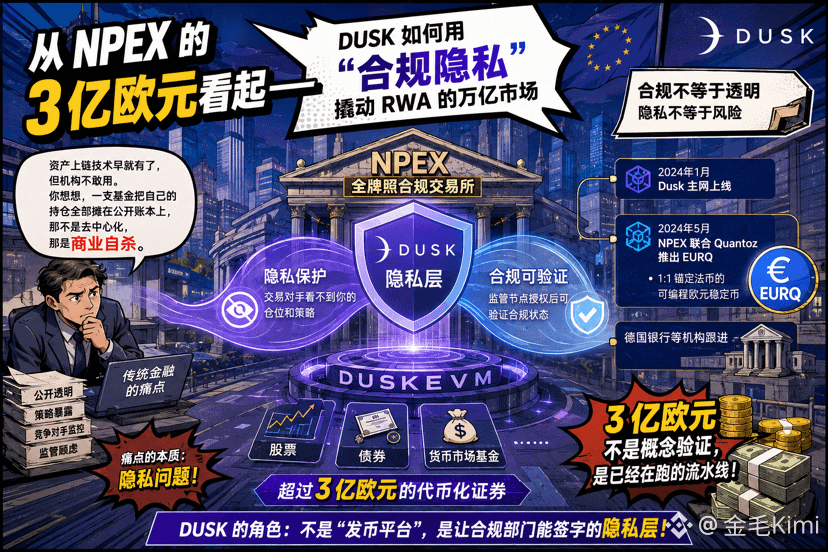
Last month, I chatted with a friend who works in traditional asset management about RWA. He said something I’ve remembered ever since: “The technology to put assets on-chain has already existed, but institutions don’t dare to use it. Think about it—if a fund discloses all its holdings on a public ledger, that isn’t decentralization, that’s commercial suicide.”
The reason traditional finance can’t go on-chain has never been a technical issue—it’s a privacy issue. @Dusk_Foundation Dusk’s partnership with the Dutch-licensed exchange NPEX fills that gap perfectly. NPEX holds EU full licenses such as MTF, broker-dealer, and ECSP. On its platform, tokenized securities totaling over €300 million are already live—stocks, bonds, and money market funds—executed end-to-end on the DuskEVM. Counterparties can’t see your positions or strategy, but after the regulatory nodes grant authorization, the compliance status can be verified.
Launched on the mainnet in January, and in May NPEX—together with Quantoz—introduced EURQ on Dusk: a 1:1 pegged programmable fiat-backed euro stablecoin. German banks are also following suit. €300 million isn’t a concept proof—it’s a production pipeline already running. And the role Dusk plays across the entire model isn’t a “token launch platform,” but a privacy layer that allows compliance teams to sign off. #dusk $DUSK
Starting from NPEX’s €300 million—How Dusk uses “compliant privacy” to unlock the trillion-dollar RWA market
Last month, I chatted with a friend who works in traditional asset management about RWA. He said something I’ve remembered ever since: “The technology to put assets on-chain has already existed, but institutions don’t dare to use it. Think about it—if a fund discloses all its holdings on a public ledger, that isn’t decentralization, that’s commercial suicide.”
The reason traditional finance can’t go on-chain has never been a technical issue—it’s a privacy issue. @Dusk Dusk’s partnership with the Dutch-licensed exchange NPEX fills that gap perfectly. NPEX holds EU full licenses such as MTF, broker-dealer, and ECSP. On its platform, tokenized securities totaling over €300 million are already live—stocks, bonds, and money market funds—executed end-to-end on the DuskEVM. Counterparties can’t see your positions or strategy, but after the regulatory nodes grant authorization, the compliance status can be verified.
Launched on the mainnet in January, and in May NPEX—together with Quantoz—introduced EURQ on Dusk: a 1:1 pegged programmable fiat-backed euro stablecoin. German banks are also following suit. €300 million isn’t a concept proof—it’s a production pipeline already running. And the role Dusk plays across the entire model isn’t a “token launch platform,” but a privacy layer that allows compliance teams to sign off. #dusk $DUSK
Last month, I chatted with a friend who works in traditional asset management about RWA. He said something I’ve remembered ever since: “The technology to put assets on-chain has already existed, but institutions don’t dare to use it. Think about it—if a fund discloses all its holdings on a public ledger, that isn’t decentralization, that’s commercial suicide.”
The reason traditional finance can’t go on-chain has never been a technical issue—it’s a privacy issue. @Dusk Dusk’s partnership with the Dutch-licensed exchange NPEX fills that gap perfectly. NPEX holds EU full licenses such as MTF, broker-dealer, and ECSP. On its platform, tokenized securities totaling over €300 million are already live—stocks, bonds, and money market funds—executed end-to-end on the DuskEVM. Counterparties can’t see your positions or strategy, but after the regulatory nodes grant authorization, the compliance status can be verified.
Launched on the mainnet in January, and in May NPEX—together with Quantoz—introduced EURQ on Dusk: a 1:1 pegged programmable fiat-backed euro stablecoin. German banks are also following suit. €300 million isn’t a concept proof—it’s a production pipeline already running. And the role Dusk plays across the entire model isn’t a “token launch platform,” but a privacy layer that allows compliance teams to sign off. #dusk $DUSK
106
·
--
The first time I saw Hyperstaking, I almost mistook it for just another high-yield staking entry point. What the @Dusk_Foundation Dusk Stake Abstraction changes isn’t the return rate—it’s who can execute staking: the contract receives users’ deposits and stakes on their behalf, then allocates or compounds rewards according to predefined rules.
It’s like turning an artificial fund counter into a verifiable, auditable automated ledger. The contract keeps track of shares and also integrates with the Genesis Stake Contract and the Transfer Contract. The official documentation requires that stake_from_contract be triggered via inter-contract transfers; it cannot be called directly by the staking contract. The contract must also implement receive_unstake and receive_reward so it can reclaim withdrawn funds and rewards.
It can power staking pools and automate reward distribution, but it concentrates code risk and withdrawal paths in the contract. The official rules show that the minimum stake is still 1,000 DUSK; after submission, it activates in about 1 to 2 Epochs, and rewards depend on consensus participation. I’ll check whether exits are smooth, whether the reward accounting matches up, and whether the code has been audited. The contract can execute the rules automatically, but it can’t automatically eliminate risk. #dusk $DUSK
The first time I saw Hyperstaking, I almost mistook it for just another high-yield staking entry point. What the @Dusk Dusk Stake Abstraction changes isn’t the return rate—it’s who can execute staking: the contract receives users’ deposits and stakes on their behalf, then allocates or compounds rewards according to predefined rules.
It’s like turning an artificial fund counter into a verifiable, auditable automated ledger. The contract keeps track of shares and also integrates with the Genesis Stake Contract and the Transfer Contract. The official documentation requires that stake_from_contract be triggered via inter-contract transfers; it cannot be called directly by the staking contract. The contract must also implement receive_unstake and receive_reward so it can reclaim withdrawn funds and rewards.
It can power staking pools and automate reward distribution, but it concentrates code risk and withdrawal paths in the contract. The official rules show that the minimum stake is still 1,000 DUSK; after submission, it activates in about 1 to 2 Epochs, and rewards depend on consensus participation. I’ll check whether exits are smooth, whether the reward accounting matches up, and whether the code has been audited. The contract can execute the rules automatically, but it can’t automatically eliminate risk. #dusk $DUSK
It’s like turning an artificial fund counter into a verifiable, auditable automated ledger. The contract keeps track of shares and also integrates with the Genesis Stake Contract and the Transfer Contract. The official documentation requires that stake_from_contract be triggered via inter-contract transfers; it cannot be called directly by the staking contract. The contract must also implement receive_unstake and receive_reward so it can reclaim withdrawn funds and rewards.
It can power staking pools and automate reward distribution, but it concentrates code risk and withdrawal paths in the contract. The official rules show that the minimum stake is still 1,000 DUSK; after submission, it activates in about 1 to 2 Epochs, and rewards depend on consensus participation. I’ll check whether exits are smooth, whether the reward accounting matches up, and whether the code has been audited. The contract can execute the rules automatically, but it can’t automatically eliminate risk. #dusk $DUSK
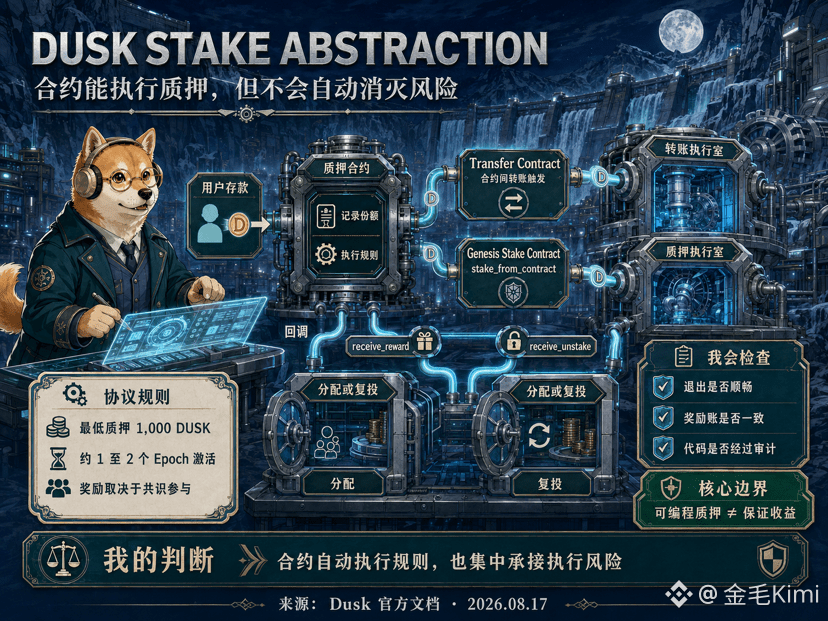
138
·
--
“Complete KYC and you can start on-chain trading”—I’m increasingly skeptical of that claim. Dusk’s Citadel 2 separates access control into credential issuance and zero-knowledge proofs, then hands the decision over to the service provider. The License Provider performs offline verification of the user; after the user signs the attributes, it publishes an encrypted license and registers it to the contract. The user only proves they hold a valid credential—without disclosing personal attributes—and without revealing the details of the specific license.
It’s like entering a members-only vault. The door access panel only shows “credential is valid,” so you don’t need to photocopy your ID. The contract verifies the proof and records the Session; the user gives the Cookie to the Service Provider, and the latter decides whether to grant entry. Dusk makes least disclosure coexist with verifiable access.
The boundaries are very clear. The official documentation explicitly states that cryptography being valid doesn’t mean the policy is in effect. The Service Provider still has to decide which issuers and attributes it trusts, check for expiration or revocation, and restrict Cookie reuse. Even the full JavaScript SDK is still marked as “to be provided.” Citadel 2 provides the technical skeleton—but only whether the issuer is trustworthy, whether the tooling is mature, and whether integration actually happens will determine if it can hold up.
@Dusk_Foundation $DUSK #dusk
“Complete KYC and you can start on-chain trading”—I’m increasingly skeptical of that claim. Dusk’s Citadel 2 separates access control into credential issuance and zero-knowledge proofs, then hands the decision over to the service provider. The License Provider performs offline verification of the user; after the user signs the attributes, it publishes an encrypted license and registers it to the contract. The user only proves they hold a valid credential—without disclosing personal attributes—and without revealing the details of the specific license.
It’s like entering a members-only vault. The door access panel only shows “credential is valid,” so you don’t need to photocopy your ID. The contract verifies the proof and records the Session; the user gives the Cookie to the Service Provider, and the latter decides whether to grant entry. Dusk makes least disclosure coexist with verifiable access.
The boundaries are very clear. The official documentation explicitly states that cryptography being valid doesn’t mean the policy is in effect. The Service Provider still has to decide which issuers and attributes it trusts, check for expiration or revocation, and restrict Cookie reuse. Even the full JavaScript SDK is still marked as “to be provided.” Citadel 2 provides the technical skeleton—but only whether the issuer is trustworthy, whether the tooling is mature, and whether integration actually happens will determine if it can hold up.
@Dusk $DUSK #dusk
It’s like entering a members-only vault. The door access panel only shows “credential is valid,” so you don’t need to photocopy your ID. The contract verifies the proof and records the Session; the user gives the Cookie to the Service Provider, and the latter decides whether to grant entry. Dusk makes least disclosure coexist with verifiable access.
The boundaries are very clear. The official documentation explicitly states that cryptography being valid doesn’t mean the policy is in effect. The Service Provider still has to decide which issuers and attributes it trusts, check for expiration or revocation, and restrict Cookie reuse. Even the full JavaScript SDK is still marked as “to be provided.” Citadel 2 provides the technical skeleton—but only whether the issuer is trustworthy, whether the tooling is mature, and whether integration actually happens will determine if it can hold up.
@Dusk $DUSK #dusk
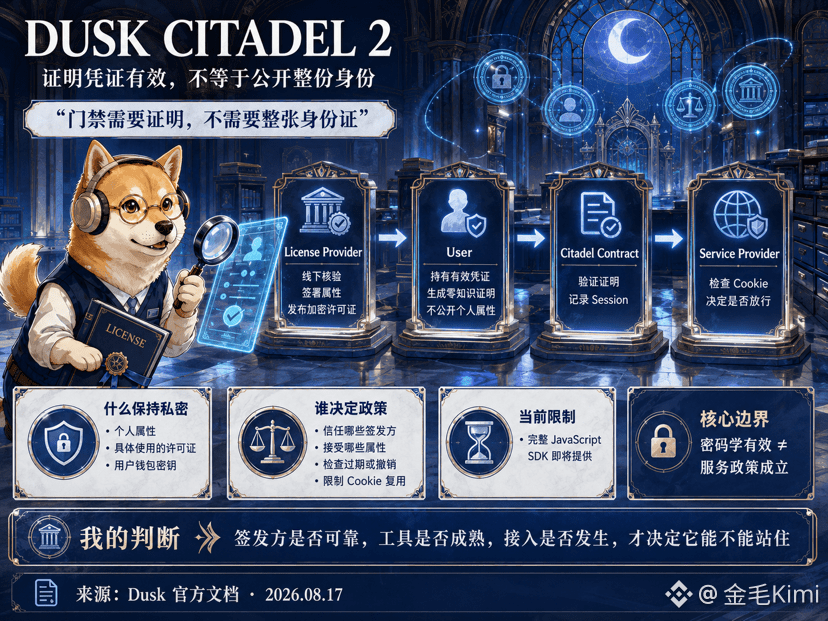
106
·
--
Recently someone told me that $niulai is a “movie meme.”
I think that description is actually pretty accurate.
It takes the film “Niu Lai” as an entry point for content, and then uses memes to enter the Web3 community.
Traditional film and TV has content, memes enable spread, and Web3 has communities.
If these pieces can truly work together, it could indeed create something new.
#niulai #NiuLai
Recently someone told me that $niulai is a “movie meme.”
I think that description is actually pretty accurate.
It takes the film “Niu Lai” as an entry point for content, and then uses memes to enter the Web3 community.
Traditional film and TV has content, memes enable spread, and Web3 has communities.
If these pieces can truly work together, it could indeed create something new.
#niulai #NiuLai
I think that description is actually pretty accurate.
It takes the film “Niu Lai” as an entry point for content, and then uses memes to enter the Web3 community.
Traditional film and TV has content, memes enable spread, and Web3 has communities.
If these pieces can truly work together, it could indeed create something new.
#niulai #NiuLai
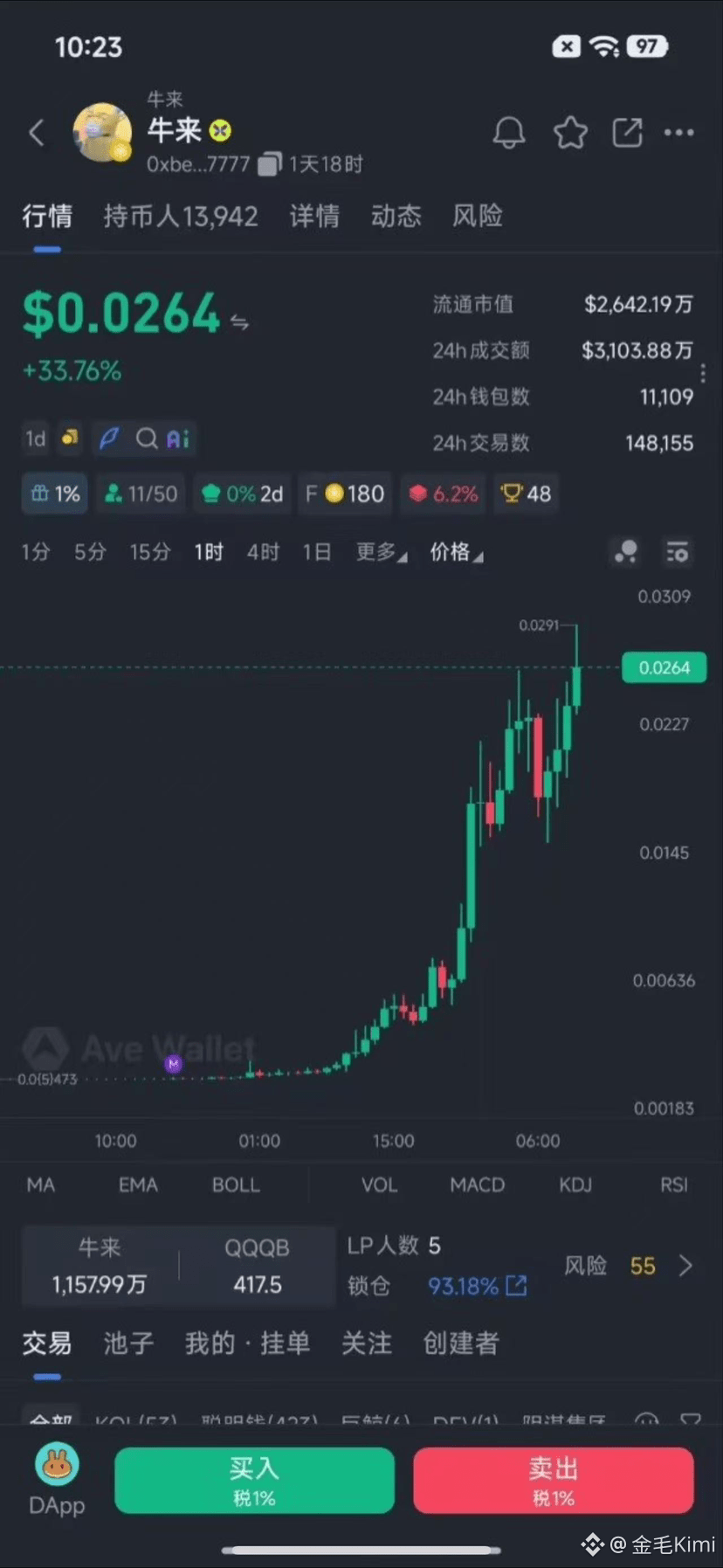
116
·
--
Bullish
I used to watch on-chain securities and only focused on whether assets were issued. Later, I realized that it’s equally critical where the price fed into the contract comes from. Dusk and NPEX, which is regulated by the Dutch AFM, both use Chainlink data standards: DataLink sends NPEX’s official trading data directly on-chain, and Dusk announcements describe it as the platform’s exclusive on-chain data oracle; Data Streams provides low-latency, high-frequency price updates. This isn’t just “changing the window” for prices. A screenshot from a chat group can only tell me “someone reported this price,” but official exchange data integration works like a stamped electronic receipt—so that lending and valuation contracts, or settlement contracts, can trace the source. For Dusk’s focus on regulated assets, privacy determines who can see it, and reliable market data determines why contracts can execute. Missing even one piece makes it hard to get close to the real market. And I won’t equate a partnership announcement directly with live trading. How many assets are covered, whether updates can stay stable, and whether on-chain applications continue to call the data—all still need to be verified by subsequent products and on-chain records. Oracles also come with risks like delay and anomalous values, and they still depend on external data sources. So my conclusion is simple: it closes a critical data entry point, but opening the door doesn’t mean capital has already entered. @Dusk_Foundation $DUSK #dusk
I used to watch on-chain securities and only focused on whether assets were issued. Later, I realized that it’s equally critical where the price fed into the contract comes from. Dusk and NPEX, which is regulated by the Dutch AFM, both use Chainlink data standards: DataLink sends NPEX’s official trading data directly on-chain, and Dusk announcements describe it as the platform’s exclusive on-chain data oracle; Data Streams provides low-latency, high-frequency price updates. This isn’t just “changing the window” for prices. A screenshot from a chat group can only tell me “someone reported this price,” but official exchange data integration works like a stamped electronic receipt—so that lending and valuation contracts, or settlement contracts, can trace the source. For Dusk’s focus on regulated assets, privacy determines who can see it, and reliable market data determines why contracts can execute. Missing even one piece makes it hard to get close to the real market. And I won’t equate a partnership announcement directly with live trading. How many assets are covered, whether updates can stay stable, and whether on-chain applications continue to call the data—all still need to be verified by subsequent products and on-chain records. Oracles also come with risks like delay and anomalous values, and they still depend on external data sources. So my conclusion is simple: it closes a critical data entry point, but opening the door doesn’t mean capital has already entered. @Dusk $DUSK #dusk
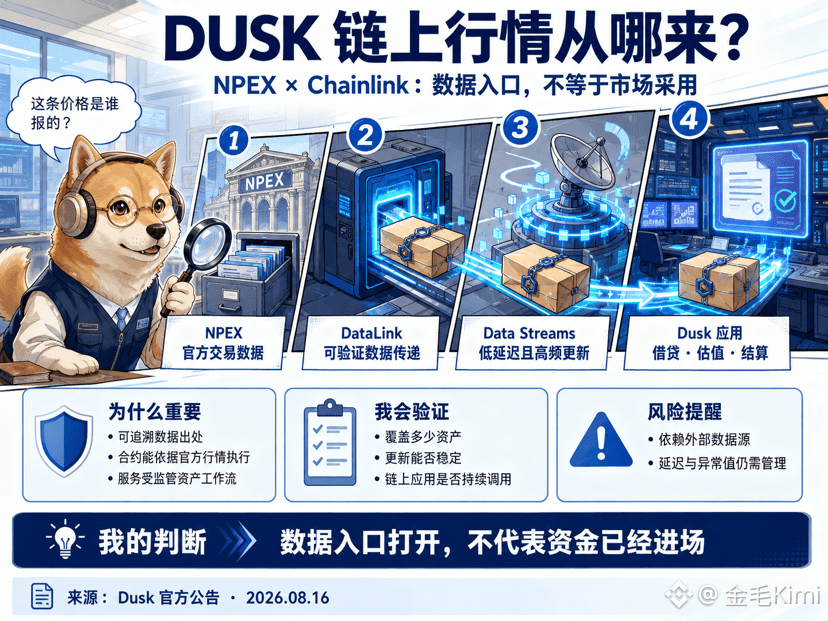
159
Log in to explore more content
Join global crypto users on Binance Square
⚡️ Get latest and useful information about crypto.
💬 Trusted by the world’s largest crypto exchange.
👍 Discover real insights from verified creators.
Email / Phone number
Trending Topics
NvidiaBeatsEstimatesWith$130BQ4Outlook
5,742 views
94 Discussing
Nvidia Beats With $115.8 Billion in Revenue, Guides to $130 Billion and Adds $150 Billion Buyback
Binance News
·28 Likes
·35.1k views
AnthropicIPOPriceCouldExceed$80
10,958 views
97 Discussing
CanNvidia’sDataCenterGrowthContinue?
28,461 views
434 Discussing