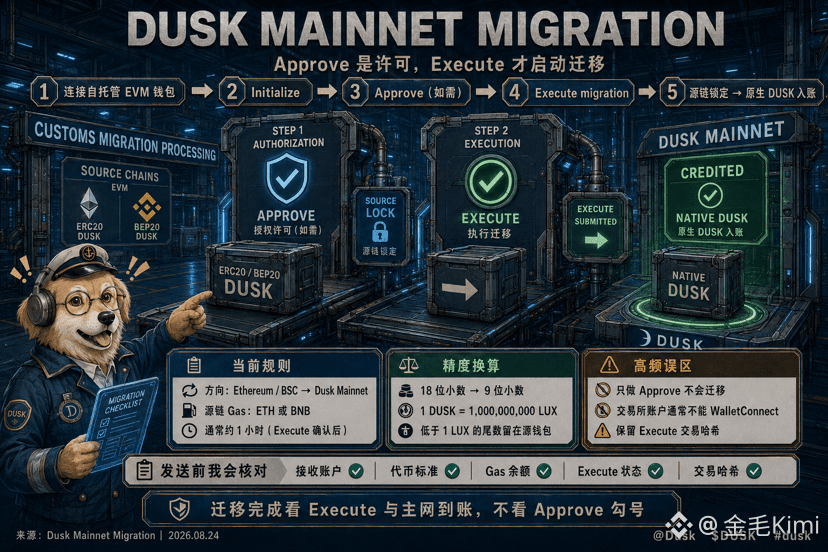
When I transferred a BEP20 DUSK into the mainnet, once I saw the Approve succeed I called it a day—after half a day, the balance still hadn’t moved. Dusk Web Wallet’s migration is done in two steps: connect the self-custodied EVM wallet that holds the tokens, choose ERC20 or BEP20, initialize it, then follow the prompts to Approve, and finally click Execute migration. Only after the execution transaction is confirmed will the source-chain tokens be locked and the mainnet deposit process will start.
I treat it like warehouse shipping. Approve is just the pickup authorization; Execute is what actually lets the goods leave the warehouse. The official docs state that each submission must pay source-chain gas with ETH or BNB. After the execution is confirmed, it usually completes within about an hour. On the EVM side, tokens use 18 decimals; on the @Dusk Dusk mainnet it uses 9 decimals. 1 DUSK equals 1 billion LUX. The migration amount is rounded down; any remainder below 1 LUX stays in the original wallet.
Now I’ll first verify that the receiving address is a Dusk account I control, then check whether the wallet supports WalletConnect, and finally save the transaction hashes from the two transactions. Exchange accounts usually can’t be connected directly; the green checkmark on Approve is also not proof of a deposit. If the balance hasn’t arrived, I’ll check the Execute status first, and then use the hash to find official support. Authorization and moving funds are two different things—this mistake is easy to make at a glance, and troubleshooting will end up taking a long detour.
#dusk $DUSK