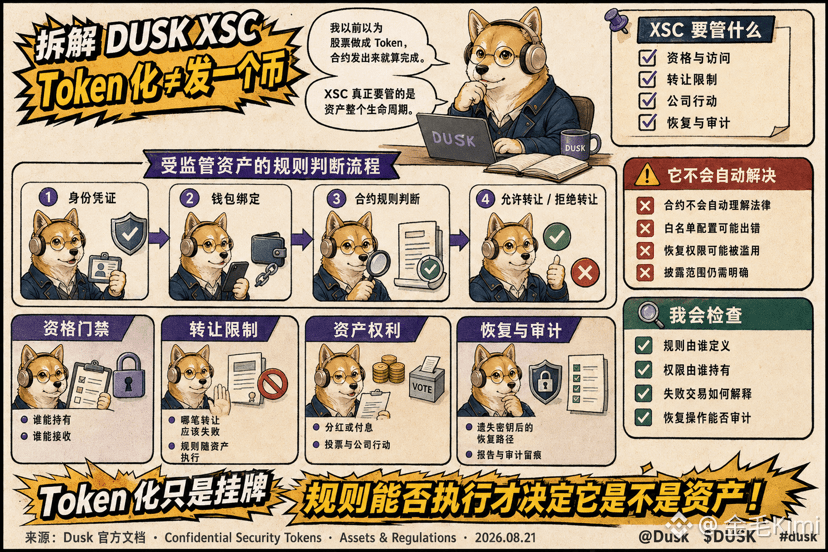
I used to think that turning stocks into Tokens and issuing the contract was the job done. Dusk’s XSC gave me a sharp reminder: it’s defined as a confidential contract standard that can be adapted to privacy requirements and compliance rules according to business needs. What actually makes regulated assets truly troublesome isn’t just the contract—it’s the eligibility of the holders and transfer restrictions, along with subsequent rights that can’t be kept intact through manual patching.
I think of a regular Token as a house number. What XSC has to handle is more like the entire property management rulebook. Who can hold it, who can receive it, which transfer should fail—all of that needs identity credentials working together with wallet binding and contract logic to determine outcomes. Dividends or interest payments, voting, recovery after a lost key, and even audit reports are all part of the asset’s lifecycle. The @Dusk Dusk wants isn’t to simply put securities into a different on-chain shell—it’s to make the rules run alongside the asset.
But contracts can’t automatically understand the law. Eligibility conditions in different jurisdictions must be defined by the issuer and professionals. If the whitelist or permissions configuration is wrong, it can either lock out qualified investors or allow people in who shouldn’t. Recovery and forced operations also give the issuer a way to remediate—but they introduce the risk of permission abuse. I care most about whether Dusk can make these roles auditable and acceptable to audits. Tokenization is only what gets it listed; whether the rules can be enforced over the long term determines whether it truly counts as an asset.
#dusk $DUSK
I think of a regular Token as a house number. What XSC has to handle is more like the entire property management rulebook. Who can hold it, who can receive it, which transfer should fail—all of that needs identity credentials working together with wallet binding and contract logic to determine outcomes. Dividends or interest payments, voting, recovery after a lost key, and even audit reports are all part of the asset’s lifecycle. The @Dusk Dusk wants isn’t to simply put securities into a different on-chain shell—it’s to make the rules run alongside the asset.
But contracts can’t automatically understand the law. Eligibility conditions in different jurisdictions must be defined by the issuer and professionals. If the whitelist or permissions configuration is wrong, it can either lock out qualified investors or allow people in who shouldn’t. Recovery and forced operations also give the issuer a way to remediate—but they introduce the risk of permission abuse. I care most about whether Dusk can make these roles auditable and acceptable to audits. Tokenization is only what gets it listed; whether the rules can be enforced over the long term determines whether it truly counts as an asset.
#dusk $DUSK