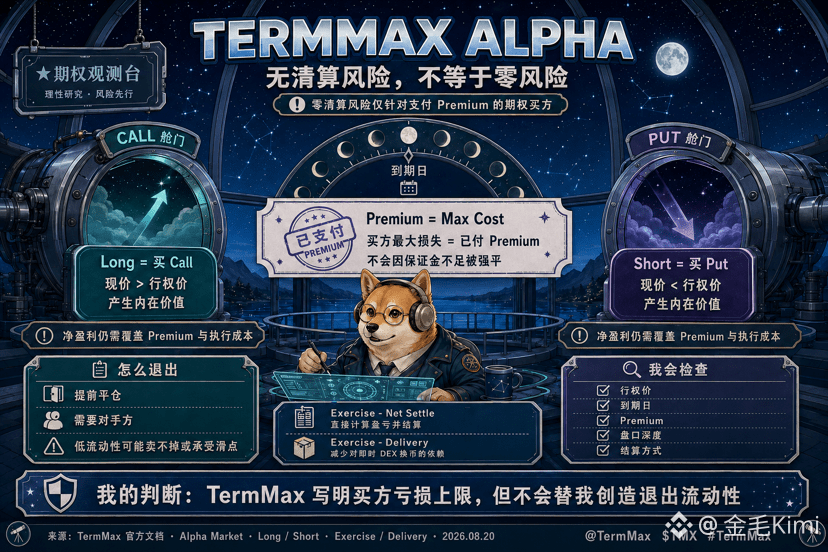
When I trade naked options, what I fear most isn’t liquidation—it’s getting the direction right but choosing the wrong expiration. In TermMax Alpha, Long means buying a Call, Short means buying a Put. When opening a position, you first pay the Premium; this fee is the Max Cost, which is also the maximum loss the option buyer can incur in that position. Therefore, it won’t be force-liquidated for insufficient balance the way margin contracts can.
I think of it as buying a ticket with a deadline in advance. A Call creates intrinsic value when the market price is higher than the strike; a Put is the opposite. To achieve net profit, you also need to cover the Premium and the execution cost. TermMax supports closing early, and it also offers Exercise - Net Settle and Exercise - Delivery. The former calculates profit and loss directly and settles; the latter can reduce reliance on immediate DEX swapping.
No liquidation risk doesn’t mean zero risk. The official documentation is very straightforward: if you exit early, you must find a counterparty. If liquidity is insufficient, your position may not be sellable, or you may have to endure significant slippage. I’ll first check the strike price and expiration date, then verify the Premium and the order book depth, and finally confirm the settlement method. TermMax clearly states the buyer’s maximum loss up front, but it doesn’t guarantee that the direction is correct for me—and it certainly can’t conjure up exit liquidity out of thin air.
@TermMax
#termmax