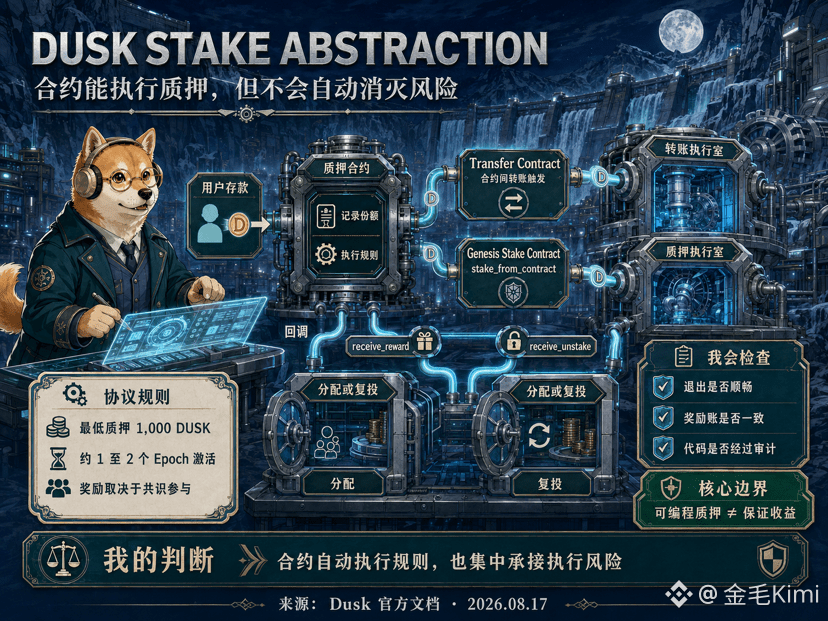
The first time I saw Hyperstaking, I almost mistook it for just another high-yield staking entry point. What the @Dusk Dusk Stake Abstraction changes isn’t the return rate—it’s who can execute staking: the contract receives users’ deposits and stakes on their behalf, then allocates or compounds rewards according to predefined rules.
It’s like turning an artificial fund counter into a verifiable, auditable automated ledger. The contract keeps track of shares and also integrates with the Genesis Stake Contract and the Transfer Contract. The official documentation requires that stake_from_contract be triggered via inter-contract transfers; it cannot be called directly by the staking contract. The contract must also implement receive_unstake and receive_reward so it can reclaim withdrawn funds and rewards.
It can power staking pools and automate reward distribution, but it concentrates code risk and withdrawal paths in the contract. The official rules show that the minimum stake is still 1,000 DUSK; after submission, it activates in about 1 to 2 Epochs, and rewards depend on consensus participation. I’ll check whether exits are smooth, whether the reward accounting matches up, and whether the code has been audited. The contract can execute the rules automatically, but it can’t automatically eliminate risk. #dusk $DUSK