When I planned to repay a fixed-rate loan early, I only then noticed that behind the “repayment” button there are two funding paths.
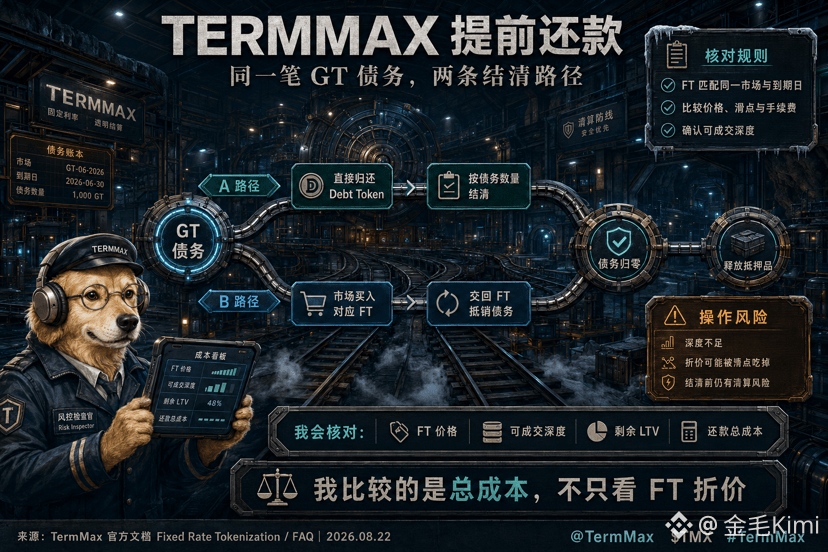
TermMax’s GT records the collateral and the debt that has been issued. Borrowers can either return the corresponding debt token directly, or buy an identical FT with the same maturity date from the same market, and then use the FT to offset the debt in the GT. Only when the amount of debt reaches zero will the collateral be released.
I think of it as an early redemption of the note I signed. Returning the debt token directly is easier to calculate in terms of cost. If market interest rates rise, the FT may trade below par, and my accounting cost for buying back the FT could be lower. But a discount doesn’t automatically mean saving money—order depth, slippage, and on-chain fees will all change the final execution amount. If you buy the wrong market or maturity, it won’t be usable for settlement either. The official FAQ describes buying back the FT as an optional repayment route for the borrower; it does not promise that the FT will always be discounted.
Before I place an order, I check the FT contract and the market it belongs to, confirm the maturity date and how much is actually tradable, then put the total cost of buying back against the direct repayment amount. Before the position is fully settled, the collateral corresponding to GT is still affected by LLTV and oracle prices; even if the FT is cheap, it can’t prevent liquidation if the collateral value drops. I only trust complete quotes—focusing on the words “discount” alone is how people end up paying tuition.
@TermMax
#termmax
TermMax’s GT records the collateral and the debt that has been issued. Borrowers can either return the corresponding debt token directly, or buy an identical FT with the same maturity date from the same market, and then use the FT to offset the debt in the GT. Only when the amount of debt reaches zero will the collateral be released.
I think of it as an early redemption of the note I signed. Returning the debt token directly is easier to calculate in terms of cost. If market interest rates rise, the FT may trade below par, and my accounting cost for buying back the FT could be lower. But a discount doesn’t automatically mean saving money—order depth, slippage, and on-chain fees will all change the final execution amount. If you buy the wrong market or maturity, it won’t be usable for settlement either. The official FAQ describes buying back the FT as an optional repayment route for the borrower; it does not promise that the FT will always be discounted.
Before I place an order, I check the FT contract and the market it belongs to, confirm the maturity date and how much is actually tradable, then put the total cost of buying back against the direct repayment amount. Before the position is fully settled, the collateral corresponding to GT is still affected by LLTV and oracle prices; even if the FT is cheap, it can’t prevent liquidation if the collateral value drops. I only trust complete quotes—focusing on the words “discount” alone is how people end up paying tuition.
@TermMax
#termmax