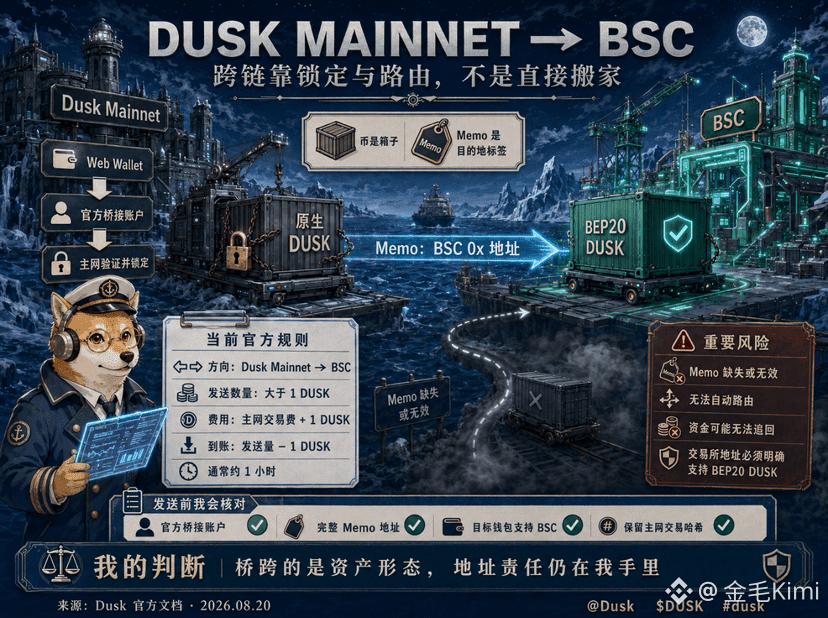
What I fear most in cross-chain transfers isn’t waiting—it’s accidentally missing a digit when copying the address. The process of bridging Dusk from the mainnet to BSC as a reminder: this isn’t just moving the same coin somewhere else; instead, you send the native DUSK to the official bridge account. After verification and locking on the mainnet, the system generates the corresponding BEP20 DUSK to the BSC address specified in the Memo.
It’s like checking luggage. The coin is the suitcase, and the Memo is the destination tag. If the tag is missing or written incorrectly, the system can’t automatically sort it. Dusk’s latest bridging documentation requires the transfer amount to be greater than 1 @Dusk DUSK. The fee is the mainnet transaction fee plus a 1 DUSK bridge fee. It usually takes about an hour to complete. The amount received on the other side equals the sent amount minus 1 DUSK.
The easiest thing to overlook here is the asset form. On the BSC side, you receive BEP20 DUSK, while on the mainnet the native DUSK is what serves as the issued basis. Before sending, I fully verify the official bridge account and the Memo address, and confirm that the destination wallet supports BSC. If it’s an exchange address, I also confirm that it explicitly supports DUSK deposits for that network. The bridge moves liquidity cross-chain, but address responsibility isn’t transferred to the project. The real danger isn’t waiting an extra hour—it’s giving an irreversible transaction to the wrong Memo.
#dusk $DUSK