
老李迫击炮
477 Posts

老李迫击炮
金融科班出身,持证券/期货/基金投资分析证书,技术图表流派,善于宏观分析,精研趋势与周期,擅长套利交易和预判行情高低点。07年涉猎全球股市、商品期货等传统金融行业,16年进入加密市场,曾受邀参加华尔街大师罗杰斯经济论坛。
2 Following
154 Followers
558 Liked
Posts
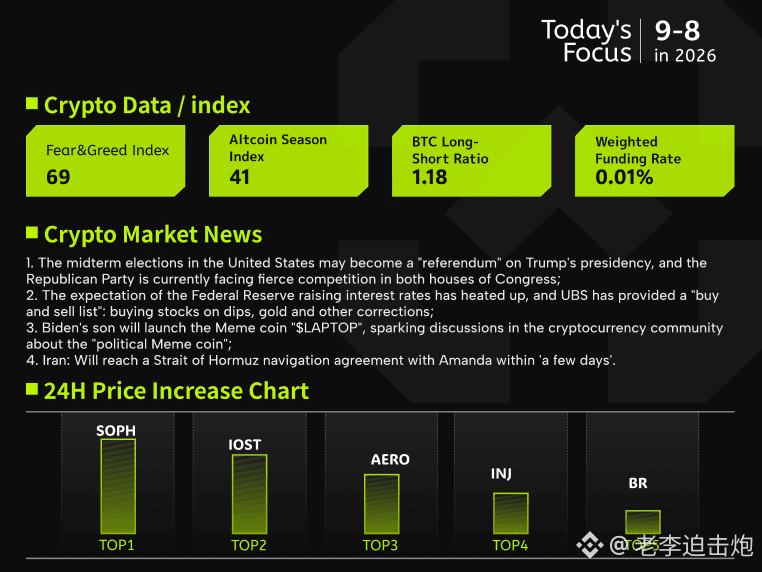
【September 8 Global Market News and Data Analysis】
1. The U.S. midterm elections may effectively serve as a “referendum” on Trump’s presidency; the Republican Party is currently facing fierce competition in both the House and the Senate;
2. Expectations of further rate hikes by the Federal Reserve are heating up. UBS has issued a “buy-sell list”: buy stocks on dips, and consider pullbacks in gold and others;
3. Biden’s son will launch the Meme coin LAPTOP, sparking heated discussion in the crypto community about “political Meme coins.”;
4. Iran: within “a few days,” it plans to reach a deal with Oman on a transit/navigation agreement for the Strait of Hormuz.
In August, the U.S. added 162,000 jobs, far exceeding expectations of 55,000, marking the strongest performance since March. The unemployment rate stayed steady at 4.1%. After the data was released, market pricing for a 25-basis-point Fed hike in September rose to around 60%. UBS notes that whether tightening is driven by stronger economic growth or by persistent inflation will have very different effects on portfolios. UBS continues to be bullish on stocks, favoring themes such as AI, power/energy resources, and longevity. In the bond segment, it shifts toward higher value-for-money high-quality intermediate-to-longer-term issues.
Under a backdrop of a strong economy combined with tightening, UBS expects the U.S. dollar may remain strong. It suggests reducing dollar exposure when the dollar strengthens. In the short term, gold is pressured by real interest rates and the dollar; it recommends positioning after pullbacks. For the crypto market, some analysis suggests that each Bitcoin new-all-time-high cycle is shortening. Based on the previous cycle estimate, the peak would be no later than February 2028, but this time the bottoming appears to arrive about 3–4 months earlier. New highs may occur as early as late Q4 2027, and in November Bitcoin has the potential to break above $126,000. If rate hikes are driven by growth rather than by stagflation pressures, a stronger dollar may temporarily suppress risk appetite. However, BTC pullbacks may happen earlier and the cycle may run faster, which in the medium term could provide a stronger revaluation and upside elasticity.
1. The U.S. midterm elections may effectively serve as a “referendum” on Trump’s presidency; the Republican Party is currently facing fierce competition in both the House and the Senate;
2. Expectations of further rate hikes by the Federal Reserve are heating up. UBS has issued a “buy-sell list”: buy stocks on dips, and consider pullbacks in gold and others;
3. Biden’s son will launch the Meme coin LAPTOP, sparking heated discussion in the crypto community about “political Meme coins.”;
4. Iran: within “a few days,” it plans to reach a deal with Oman on a transit/navigation agreement for the Strait of Hormuz.
In August, the U.S. added 162,000 jobs, far exceeding expectations of 55,000, marking the strongest performance since March. The unemployment rate stayed steady at 4.1%. After the data was released, market pricing for a 25-basis-point Fed hike in September rose to around 60%. UBS notes that whether tightening is driven by stronger economic growth or by persistent inflation will have very different effects on portfolios. UBS continues to be bullish on stocks, favoring themes such as AI, power/energy resources, and longevity. In the bond segment, it shifts toward higher value-for-money high-quality intermediate-to-longer-term issues.
Under a backdrop of a strong economy combined with tightening, UBS expects the U.S. dollar may remain strong. It suggests reducing dollar exposure when the dollar strengthens. In the short term, gold is pressured by real interest rates and the dollar; it recommends positioning after pullbacks. For the crypto market, some analysis suggests that each Bitcoin new-all-time-high cycle is shortening. Based on the previous cycle estimate, the peak would be no later than February 2028, but this time the bottoming appears to arrive about 3–4 months earlier. New highs may occur as early as late Q4 2027, and in November Bitcoin has the potential to break above $126,000. If rate hikes are driven by growth rather than by stagflation pressures, a stronger dollar may temporarily suppress risk appetite. However, BTC pullbacks may happen earlier and the cycle may run faster, which in the medium term could provide a stronger revaluation and upside elasticity.
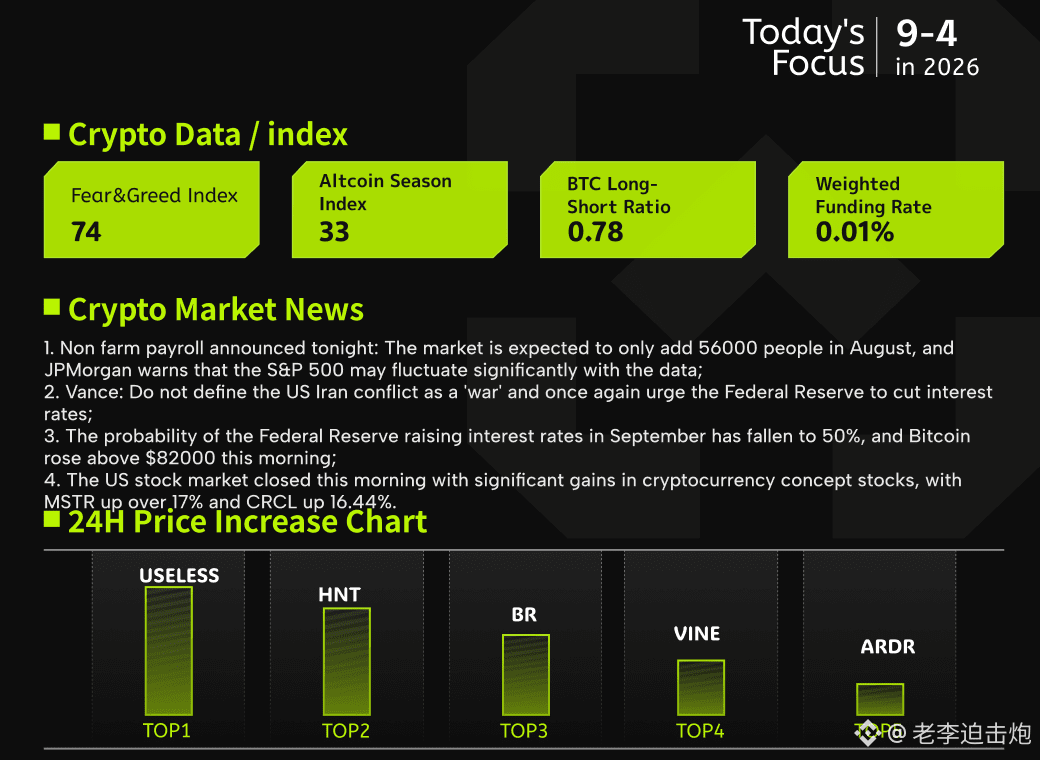
【September 4 — Global Market News and Data Analysis】
1、#非农 will be revealed tonight: The market expects that in August, only an increase of 56,000 jobs will be added. Morgan Chase warns that the S&P 500 could swing sharply with the data;
2、Vance: Does not define the U.S.-Iran conflict as “war,” and once again urges the Fed to cut rates;
3、#FOMC 9: The probability of a rate hike in September has fallen back to 50%. Bitcoin surged above $82,000 at one point this morning;
4、U.S. stock futures ended higher this morning for crypto-related stocks, with MSTR up more than 17% and CRCL up 16.44%.
Tonight, the latest non-farm payrolls (NFP) data will be released. The market expects about 56,000 new jobs added, with the unemployment rate steady around 4.1%. Institutions generally believe the labor market is showing a pattern of “steady yet slightly weakening.” Softer data may not immediately drive a policy shift, and decision-makers’ focus remains on the direction of inflation. Morgan Chase’s scenario analysis suggests that if employment comes in significantly above expectations, U.S. stocks may come under pressure and fall; otherwise, they could rebound modestly—showing that this data has become a key variable affecting September policy expectations. Recent remarks from multiple Fed officials have been relatively mild, implying that employment is not yet the main battleground for decisions. However, before inflation effectively cools, the possibility of tightening policy still remains.
For the crypto market, the NFP outcome will transmit via the dollar trend and risk appetite to #BTC . After ETF flows saw their first net outflow earlier, the coin price did not fall—instead it rose and broke above $82,000, showing some short-term resilience. Jiang Zhuoer cleared out at high levels and turned to shorting, believing the consolidation period is likely too brief and the upside momentum is insufficient. The script they provided indicates that the market may first pull back into the $70,000 to $72,000 range, then consolidate and build energy before another move. In terms of trading, one should closely watch the resistance band around $83,000 to $84,000, using $82.3k as a key stop-loss reference, and time buys and sells carefully as the data and policy expectations repeatedly adjust.
1、#非农 will be revealed tonight: The market expects that in August, only an increase of 56,000 jobs will be added. Morgan Chase warns that the S&P 500 could swing sharply with the data;
2、Vance: Does not define the U.S.-Iran conflict as “war,” and once again urges the Fed to cut rates;
3、#FOMC 9: The probability of a rate hike in September has fallen back to 50%. Bitcoin surged above $82,000 at one point this morning;
4、U.S. stock futures ended higher this morning for crypto-related stocks, with MSTR up more than 17% and CRCL up 16.44%.
Tonight, the latest non-farm payrolls (NFP) data will be released. The market expects about 56,000 new jobs added, with the unemployment rate steady around 4.1%. Institutions generally believe the labor market is showing a pattern of “steady yet slightly weakening.” Softer data may not immediately drive a policy shift, and decision-makers’ focus remains on the direction of inflation. Morgan Chase’s scenario analysis suggests that if employment comes in significantly above expectations, U.S. stocks may come under pressure and fall; otherwise, they could rebound modestly—showing that this data has become a key variable affecting September policy expectations. Recent remarks from multiple Fed officials have been relatively mild, implying that employment is not yet the main battleground for decisions. However, before inflation effectively cools, the possibility of tightening policy still remains.
For the crypto market, the NFP outcome will transmit via the dollar trend and risk appetite to #BTC . After ETF flows saw their first net outflow earlier, the coin price did not fall—instead it rose and broke above $82,000, showing some short-term resilience. Jiang Zhuoer cleared out at high levels and turned to shorting, believing the consolidation period is likely too brief and the upside momentum is insufficient. The script they provided indicates that the market may first pull back into the $70,000 to $72,000 range, then consolidate and build energy before another move. In terms of trading, one should closely watch the resistance band around $83,000 to $84,000, using $82.3k as a key stop-loss reference, and time buys and sells carefully as the data and policy expectations repeatedly adjust.
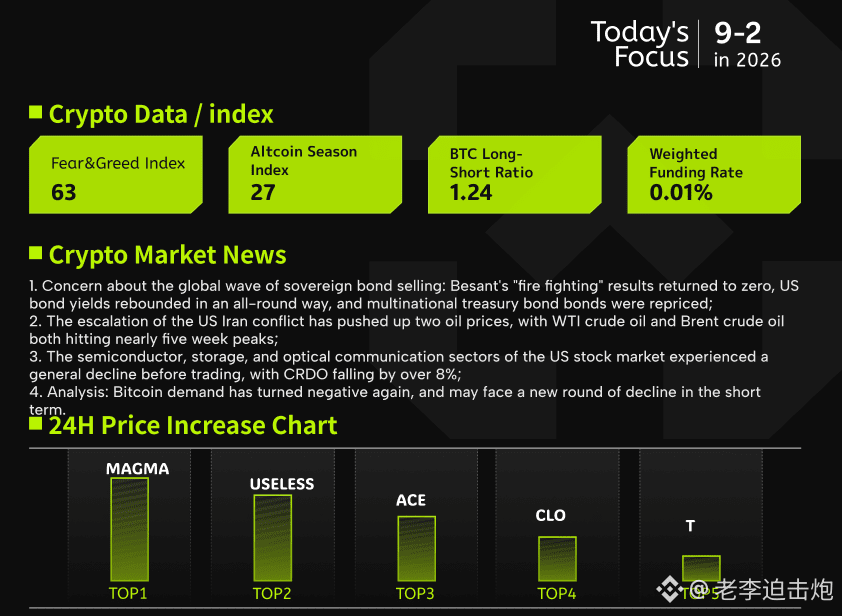
[September 2 Global Market News and Data Analysis]
1. Watch for a wave of global sovereign bond sell-offs: Bessent’s “firefighting” efforts have come to nothing; U.S. Treasury yields have broadly rebounded, and bond markets across multiple countries have been repriced.
2. Escalation of the U.S.-Iran conflict again boosts the two oil benchmarks. WTI crude and Brent crude both hit their highest levels in nearly five weeks.
3. Ahead of the U.S. stock session, semiconductor, memory, and optical communications sectors broadly fell. #CRDO dropped by more than 8%.
4. Analysis: Bitcoin demand turns negative again, and in the near term it may face another round of declines.
The U.S.-Iran conflict has intensified once more. Mutual attacks have raised the risk of supply disruption in the Strait of Hormuz. #WTI and Brent crude both rose by about 4.8% and 4.7% over the past 24 hours, respectively, reaching their highest levels in nearly five weeks. At the same time, global bond markets are under pressure: the yield on 30-year U.S. Treasuries has returned to 5.27%, and the 10-year yield has hit the highest level since January 2025. Japan’s 10-year yield has risen above 3% for the first time since 1996. Bessent’s expanded buyback program’s soothing effect faded quickly, and market pricing for the likelihood of a rate hike by the Fed this month has already reached about 70%.
Oil prices and long-end interest rates moving up in tandem are squeezing the space for monetary policy easing. This is pushing up inflation and financing-cost expectations, putting broad pressure on global risk assets. For the crypto market, this forms a typical bearish combination—tighter liquidity, a pullback in risk appetite, and capital shifting toward safe havens. Spot Bitcoin ETFs saw net outflows of $236.5 million in a single day. Combined with #BTC turning negative in terms of apparent demand, and with short-term holders continuing to lock in profits, institutional sentiment has clearly weakened and the price structure has become more sluggish. If geopolitical and rate pressures persist, BTC faces the risk of further near-term pullbacks. However, the market’s direction is not yet fully clear—investors should hold positions cautiously and watch whether demand can stabilize.
1. Watch for a wave of global sovereign bond sell-offs: Bessent’s “firefighting” efforts have come to nothing; U.S. Treasury yields have broadly rebounded, and bond markets across multiple countries have been repriced.
2. Escalation of the U.S.-Iran conflict again boosts the two oil benchmarks. WTI crude and Brent crude both hit their highest levels in nearly five weeks.
3. Ahead of the U.S. stock session, semiconductor, memory, and optical communications sectors broadly fell. #CRDO dropped by more than 8%.
4. Analysis: Bitcoin demand turns negative again, and in the near term it may face another round of declines.
The U.S.-Iran conflict has intensified once more. Mutual attacks have raised the risk of supply disruption in the Strait of Hormuz. #WTI and Brent crude both rose by about 4.8% and 4.7% over the past 24 hours, respectively, reaching their highest levels in nearly five weeks. At the same time, global bond markets are under pressure: the yield on 30-year U.S. Treasuries has returned to 5.27%, and the 10-year yield has hit the highest level since January 2025. Japan’s 10-year yield has risen above 3% for the first time since 1996. Bessent’s expanded buyback program’s soothing effect faded quickly, and market pricing for the likelihood of a rate hike by the Fed this month has already reached about 70%.
Oil prices and long-end interest rates moving up in tandem are squeezing the space for monetary policy easing. This is pushing up inflation and financing-cost expectations, putting broad pressure on global risk assets. For the crypto market, this forms a typical bearish combination—tighter liquidity, a pullback in risk appetite, and capital shifting toward safe havens. Spot Bitcoin ETFs saw net outflows of $236.5 million in a single day. Combined with #BTC turning negative in terms of apparent demand, and with short-term holders continuing to lock in profits, institutional sentiment has clearly weakened and the price structure has become more sluggish. If geopolitical and rate pressures persist, BTC faces the risk of further near-term pullbacks. However, the market’s direction is not yet fully clear—investors should hold positions cautiously and watch whether demand can stabilize.
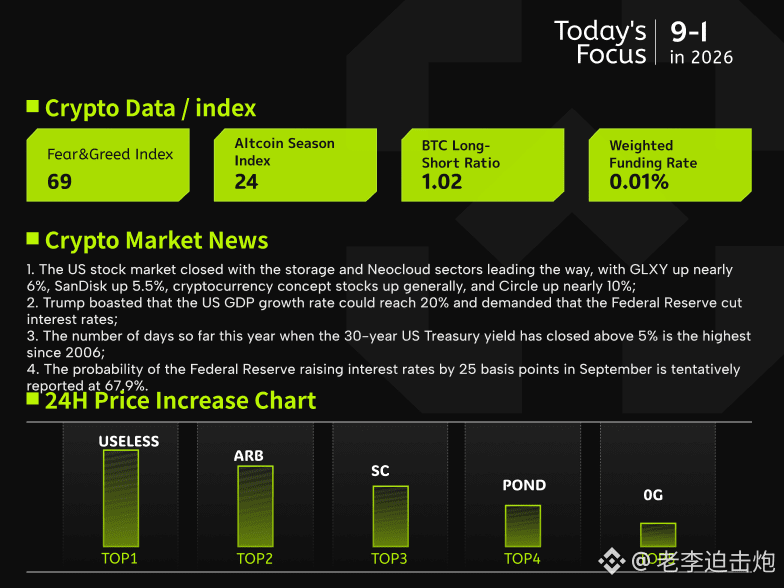
【September 1 Global Market News and Data Analysis】
1. U.S. stocks closed higher in storage and the Neocloud segment led the way: #GLXY rose nearly 6%, SanDisk gained 5.5%. Crypto-related stocks saw broad-based gains, with Circle up nearly 10%;
2. Trump has boasted that U.S. GDP growth could reach 20%, and he calls for the Federal Reserve to cut rates;
3. So far this year, the number of days that 30-year U.S. Treasury yields have closed above 5% has hit the highest level since 2006;
4. The probability for #fomc 9 to raise rates by 25 basis points is currently reported at 67.9%.
All three major U.S. stock indexes fell in sync. The Dow, S&P 500, and Nasdaq each retreated by about 0.7%, 0.33%, and 0.12%, respectively, leaving the market under overall pressure. Within sectors, performance was mixed: storage and semiconductors were relatively strong—SanDisk, Micron, and others led the rally—while Western Digital and Seagate weakened. Neocloud and optical communications segments showed clear internal divergence. In contrast to the broader market, crypto-coin related stocks generally rose across the board; Circle, BitMine, Coinbase, and others posted top gains. Meanwhile, the number of days that 30-year Treasury yields stay above 5% reached a record since 2006. Fiscal deficits and a wave of corporate bond issuance keep the market cautious about the outlook for the coming weeks.
From the crypto market perspective, amid tighter macro conditions, #BTC still managed to hold above $77.1k. Although hawkish remarks pulled it back from the $81k peak, buying interest was driven more by spot and ETFs rather than leverage. Last week, net inflows into BTC spot ETFs totaled nearly $1 billion, and Ethereum products also registered consecutive days of net inflows, suggesting stronger fund resilience. However, PCE inflation and the high deficit have lifted the probability of September rate hikes to 57%. Elevated yields are likely to continue suppressing risk appetite, limiting near-term upside. If the subsequent inflow momentum can be sustained, that would indicate crypto market demand remains solid.
1. U.S. stocks closed higher in storage and the Neocloud segment led the way: #GLXY rose nearly 6%, SanDisk gained 5.5%. Crypto-related stocks saw broad-based gains, with Circle up nearly 10%;
2. Trump has boasted that U.S. GDP growth could reach 20%, and he calls for the Federal Reserve to cut rates;
3. So far this year, the number of days that 30-year U.S. Treasury yields have closed above 5% has hit the highest level since 2006;
4. The probability for #fomc 9 to raise rates by 25 basis points is currently reported at 67.9%.
All three major U.S. stock indexes fell in sync. The Dow, S&P 500, and Nasdaq each retreated by about 0.7%, 0.33%, and 0.12%, respectively, leaving the market under overall pressure. Within sectors, performance was mixed: storage and semiconductors were relatively strong—SanDisk, Micron, and others led the rally—while Western Digital and Seagate weakened. Neocloud and optical communications segments showed clear internal divergence. In contrast to the broader market, crypto-coin related stocks generally rose across the board; Circle, BitMine, Coinbase, and others posted top gains. Meanwhile, the number of days that 30-year Treasury yields stay above 5% reached a record since 2006. Fiscal deficits and a wave of corporate bond issuance keep the market cautious about the outlook for the coming weeks.
From the crypto market perspective, amid tighter macro conditions, #BTC still managed to hold above $77.1k. Although hawkish remarks pulled it back from the $81k peak, buying interest was driven more by spot and ETFs rather than leverage. Last week, net inflows into BTC spot ETFs totaled nearly $1 billion, and Ethereum products also registered consecutive days of net inflows, suggesting stronger fund resilience. However, PCE inflation and the high deficit have lifted the probability of September rate hikes to 57%. Elevated yields are likely to continue suppressing risk appetite, limiting near-term upside. If the subsequent inflow momentum can be sustained, that would indicate crypto market demand remains solid.
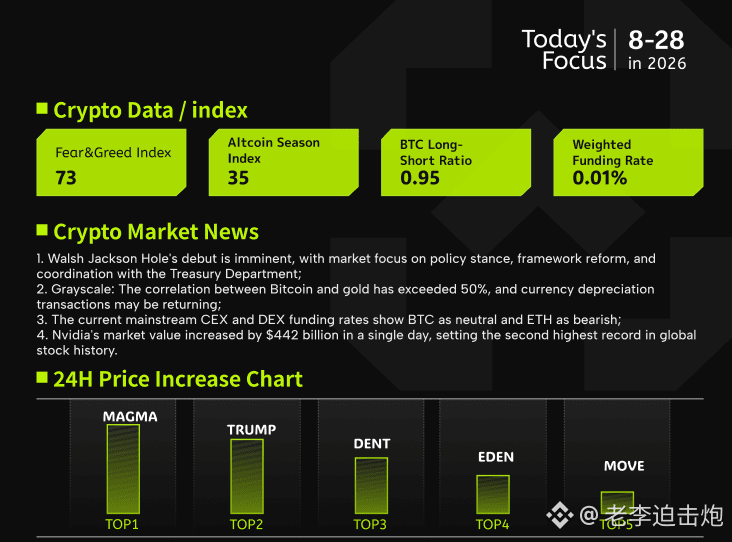
【Aug 28 Global Market News, Insights & Data Analysis】
1. Voter Jackson Hole’s debut: the market focuses on policy stance, framework reforms, and coordination by the Ministry of Finance;
2. Grayscale: #BTC ’s correlation with gold-related assets has broken above 50%; trades tied to currency depreciation may be returning;
3. Current funding rates from mainstream CEXs and DEXs indicate BTC is neutral, while ETH is slightly bearish;
4. Nvidia’s market cap increased by $442 billion in a single day, setting the second-highest all-time record for a global listed company.
Nvidia delivered $96.2 billion in revenue for its new fiscal quarter—more than double year over year. Its data center segment alone accounted for nearly 90% of revenue. The company also expects growth of about 70% for the next fiscal year, far exceeding Wall Street’s concerns that AI capex may be peaking. After the earnings report was released, multiple investment banks—including Goldman Sachs, Citigroup, JPMorgan, and Bernstein—collectively raised their price targets, with Bernstein’s highest estimate reaching $400. On Thursday, Nvidia’s share price jumped by more than 8%, adding over $440 billion in market value in a day and nearly challenging the record previously set by Microsoft. Nvidia’s total market cap is about $5.5 trillion. Going forward, the market will focus on variables such as mass production on the Rubin platform, the gross margin trend, and the recovery of data centers in China.
For the crypto market, Nvidia’s strong guidance reinforces AI narratives supporting overall risk appetite. But more intriguing is the signal of capital rotation. Grayscale data shows the 90-day correlation between Bitcoin and the Nasdaq has fallen from 60% to 33%, while correlation with gold has risen to above 50%, which may suggest the market is re-assessing Bitcoin’s scarcity and value-preservation attributes. With U.S. Treasury issuance breaking $4 trillion and the fiscal deficit continuing to worsen, Bitcoin—an asset with a fixed total supply of 21 million—may see greater recognition for its hedging function comparable to gold. In the short term, it may enter a more favorable pricing window.
1. Voter Jackson Hole’s debut: the market focuses on policy stance, framework reforms, and coordination by the Ministry of Finance;
2. Grayscale: #BTC ’s correlation with gold-related assets has broken above 50%; trades tied to currency depreciation may be returning;
3. Current funding rates from mainstream CEXs and DEXs indicate BTC is neutral, while ETH is slightly bearish;
4. Nvidia’s market cap increased by $442 billion in a single day, setting the second-highest all-time record for a global listed company.
Nvidia delivered $96.2 billion in revenue for its new fiscal quarter—more than double year over year. Its data center segment alone accounted for nearly 90% of revenue. The company also expects growth of about 70% for the next fiscal year, far exceeding Wall Street’s concerns that AI capex may be peaking. After the earnings report was released, multiple investment banks—including Goldman Sachs, Citigroup, JPMorgan, and Bernstein—collectively raised their price targets, with Bernstein’s highest estimate reaching $400. On Thursday, Nvidia’s share price jumped by more than 8%, adding over $440 billion in market value in a day and nearly challenging the record previously set by Microsoft. Nvidia’s total market cap is about $5.5 trillion. Going forward, the market will focus on variables such as mass production on the Rubin platform, the gross margin trend, and the recovery of data centers in China.
For the crypto market, Nvidia’s strong guidance reinforces AI narratives supporting overall risk appetite. But more intriguing is the signal of capital rotation. Grayscale data shows the 90-day correlation between Bitcoin and the Nasdaq has fallen from 60% to 33%, while correlation with gold has risen to above 50%, which may suggest the market is re-assessing Bitcoin’s scarcity and value-preservation attributes. With U.S. Treasury issuance breaking $4 trillion and the fiscal deficit continuing to worsen, Bitcoin—an asset with a fixed total supply of 21 million—may see greater recognition for its hedging function comparable to gold. In the short term, it may enter a more favorable pricing window.
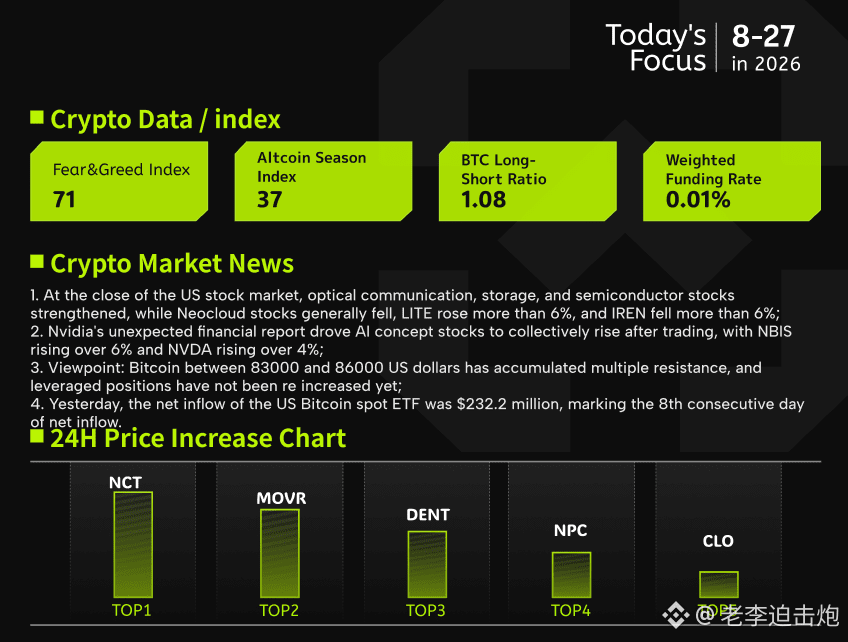
【Aug 27 Global Market News and Data Analysis】
1. US stocks closed higher for optical communications, storage, and semiconductor stocks; Neocloud shares fell broadly; LITE rose more than 6%, while IREN fell more than 6%;
2. Nvidia’s results beat expectations, driving AI-related stocks higher after hours; NBIS rose more than 6% and NVDA rose more than 4%;
3. Viewpoint: Bitcoin at $83,000–$86,000 is gathering multiple layers of resistance, and leveraged positions have not yet been added back;
4. Yesterday, US spot Bitcoin ETFs saw net inflows of $232.2 million, marking 8 consecutive days of net inflows.
Overnight, US stocks in the optical communications, storage, and semiconductor sectors rose overall, while Neocloud-style tech stocks fell collectively. On individual stocks: Lumentum led the optical communications group, while Ciena and Corning posted strong gains; the storage sector rose on the back of Western Digital and Seagate. In semiconductors, Arm, Marvell, and Qualcomm all advanced, but Nvidia dipped slightly. In contrast, IREN, Nebius, and other Neocloud-related names generally dropped. Nvidia’s after-hours results beat expectations, boosting AI-related names; Nebius and Nvidia both surged noticeably.
From an on-chain data perspective, during this Bitcoin repair/relief rally, US spot ETF net inflows on a weekly basis hit a new high for 2026; exchange balances kept declining, and holders across different cohorts were adding positions. At the same time, open interest in futures was reduced on a coin basis, and funding rates remained stable, suggesting leverage has not been built back up and the quality of the rally is relatively healthy. Structurally, $83,000–$86,000 is the key resistance zone overhead; around $80,800–$82,300, custodian costs and Gamma-flip pressure are also concentrated. Near-term costs are about $70,000 below, while $62,000–$65,000 forms a sturdier bottom. In terms of options, the implied mid-range for September expiry lies between $69,000 and $89.7k, and the market may continue to trade sideways. Overall, if ETF inflows continue and the BTC price holds above $83,300, the supply wall is likely to be gradually absorbed, making the rebound more sustainable. If it falls below $70,000, it will first test the $62,000–$65,000 area; and if it loses the zone near $62,900, it may signal that this round of repair rally is basically over.
1. US stocks closed higher for optical communications, storage, and semiconductor stocks; Neocloud shares fell broadly; LITE rose more than 6%, while IREN fell more than 6%;
2. Nvidia’s results beat expectations, driving AI-related stocks higher after hours; NBIS rose more than 6% and NVDA rose more than 4%;
3. Viewpoint: Bitcoin at $83,000–$86,000 is gathering multiple layers of resistance, and leveraged positions have not yet been added back;
4. Yesterday, US spot Bitcoin ETFs saw net inflows of $232.2 million, marking 8 consecutive days of net inflows.
Overnight, US stocks in the optical communications, storage, and semiconductor sectors rose overall, while Neocloud-style tech stocks fell collectively. On individual stocks: Lumentum led the optical communications group, while Ciena and Corning posted strong gains; the storage sector rose on the back of Western Digital and Seagate. In semiconductors, Arm, Marvell, and Qualcomm all advanced, but Nvidia dipped slightly. In contrast, IREN, Nebius, and other Neocloud-related names generally dropped. Nvidia’s after-hours results beat expectations, boosting AI-related names; Nebius and Nvidia both surged noticeably.
From an on-chain data perspective, during this Bitcoin repair/relief rally, US spot ETF net inflows on a weekly basis hit a new high for 2026; exchange balances kept declining, and holders across different cohorts were adding positions. At the same time, open interest in futures was reduced on a coin basis, and funding rates remained stable, suggesting leverage has not been built back up and the quality of the rally is relatively healthy. Structurally, $83,000–$86,000 is the key resistance zone overhead; around $80,800–$82,300, custodian costs and Gamma-flip pressure are also concentrated. Near-term costs are about $70,000 below, while $62,000–$65,000 forms a sturdier bottom. In terms of options, the implied mid-range for September expiry lies between $69,000 and $89.7k, and the market may continue to trade sideways. Overall, if ETF inflows continue and the BTC price holds above $83,300, the supply wall is likely to be gradually absorbed, making the rebound more sustainable. If it falls below $70,000, it will first test the $62,000–$65,000 area; and if it loses the zone near $62,900, it may signal that this round of repair rally is basically over.
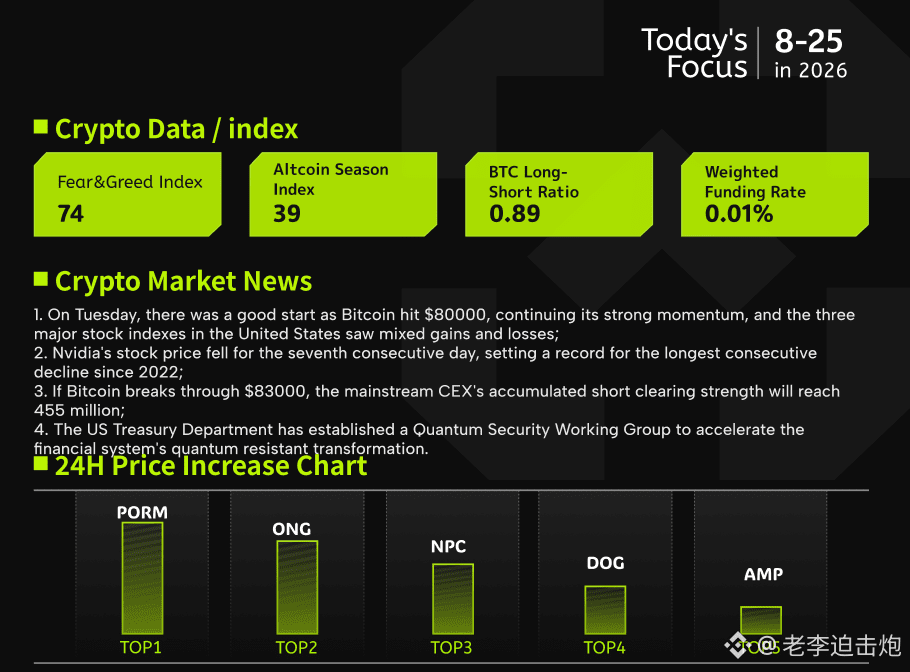
【August 25 Global Market News and Data Analysis】
1. On Tuesday’s opening, everything went well: Bitcoin touched $80,000 and continued its strong momentum; the three major U.S. stock indexes saw mixed movement.
2. Nvidia’s stock price fell for the seventh consecutive day, setting the longest losing streak since 2022.
3. If Bitcoin breaks through $83,000, the liquidation intensity of net short positions accumulated on mainstream CEXs will reach 455 million.
4. The U.S. Treasury has established a quantum security working group to accelerate the financial system’s transition to post-quantum readiness.
U.S. Treasury Secretary Bessent announced on Monday the launch of a new round of sanctions under the “Economic Rejects Action,” aiming to further push Iran out of the global economic and trade system. He warned that any country or company that continues to engage with Iran may be drawn in. The standoff between the U.S. and Iran has lasted nearly six months. Previously, the U.S. applied dual pressure—military escalation and long-term sanctions—but two major issues—the reopening of the Strait of Hormuz and restrictions related to the nuclear program—have yet to see a breakthrough. In the stock market, the Dow saw a slight gain, while the S&P 500 and Nasdaq ended lower, with semiconductors among the biggest decliners.
Meanwhile, the crypto market strengthened against the trend. Bitcoin returned to $80,000 after 101 days, rising nearly 30% over the week. Notably, this rally was not driven by leverage. Measured by Bitcoin, open interest fell to a monthly low, yet prices kept making fresh highs amid deleveraging—contrary to the common playbook of “leverage-driven surge followed by pullback.” This suggests that buy pressure has been more spot-oriented, potentially supported by long-term capital. At the same time, geopolitical sanctions and rising risk-aversion sentiment may strengthen the “digital gold” safe-haven narrative for Bitcoin and attract continued inflows. However, large short-position liquidation pools remain concentrated near $83,000 on the upside and around $79,000 on the downside, so near-term volatility is likely to increase significantly; chasing gains should be done with caution.
1. On Tuesday’s opening, everything went well: Bitcoin touched $80,000 and continued its strong momentum; the three major U.S. stock indexes saw mixed movement.
2. Nvidia’s stock price fell for the seventh consecutive day, setting the longest losing streak since 2022.
3. If Bitcoin breaks through $83,000, the liquidation intensity of net short positions accumulated on mainstream CEXs will reach 455 million.
4. The U.S. Treasury has established a quantum security working group to accelerate the financial system’s transition to post-quantum readiness.
U.S. Treasury Secretary Bessent announced on Monday the launch of a new round of sanctions under the “Economic Rejects Action,” aiming to further push Iran out of the global economic and trade system. He warned that any country or company that continues to engage with Iran may be drawn in. The standoff between the U.S. and Iran has lasted nearly six months. Previously, the U.S. applied dual pressure—military escalation and long-term sanctions—but two major issues—the reopening of the Strait of Hormuz and restrictions related to the nuclear program—have yet to see a breakthrough. In the stock market, the Dow saw a slight gain, while the S&P 500 and Nasdaq ended lower, with semiconductors among the biggest decliners.
Meanwhile, the crypto market strengthened against the trend. Bitcoin returned to $80,000 after 101 days, rising nearly 30% over the week. Notably, this rally was not driven by leverage. Measured by Bitcoin, open interest fell to a monthly low, yet prices kept making fresh highs amid deleveraging—contrary to the common playbook of “leverage-driven surge followed by pullback.” This suggests that buy pressure has been more spot-oriented, potentially supported by long-term capital. At the same time, geopolitical sanctions and rising risk-aversion sentiment may strengthen the “digital gold” safe-haven narrative for Bitcoin and attract continued inflows. However, large short-position liquidation pools remain concentrated near $83,000 on the upside and around $79,000 on the downside, so near-term volatility is likely to increase significantly; chasing gains should be done with caution.
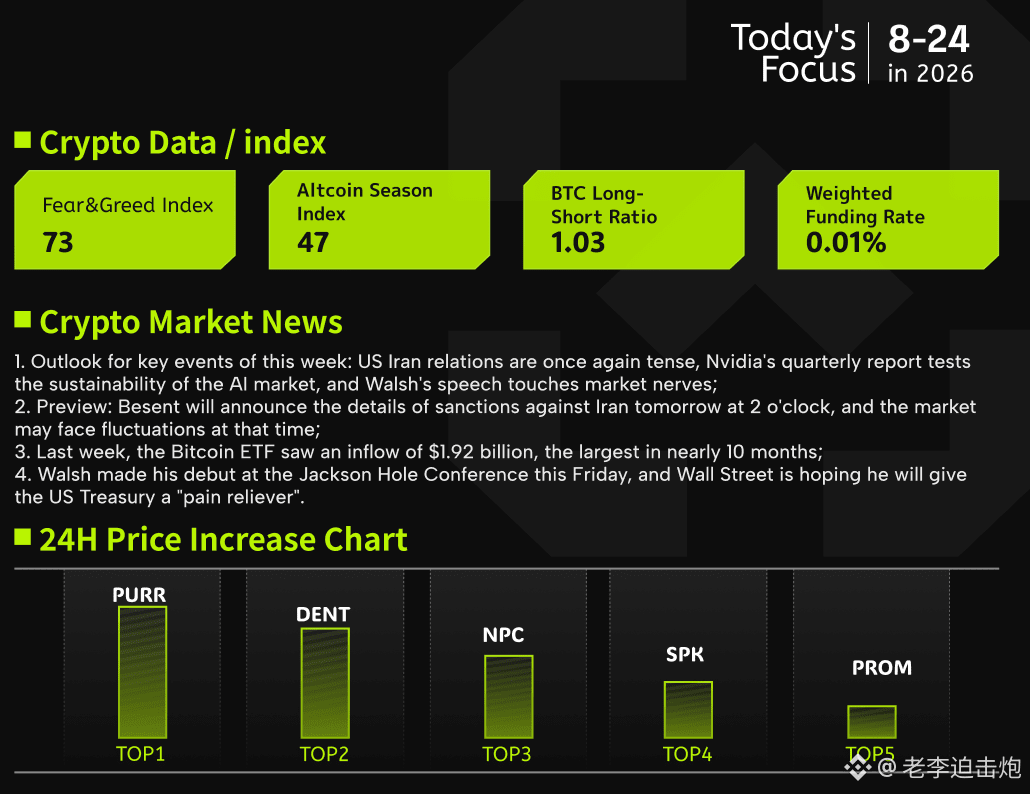
【August 24 Global Market News and Data Analysis】
1. Key events to watch this week: Tensions between the US and Iran have flared up again; Nvidia’s earnings report will test the durability of the AI rally; and remarks by Wosh are rattling market nerves.
2. Preview: Bessent will release details of the sanctions on Iran tomorrow at 2:00, when the market may see increased volatility.
3. Bitcoin ETFs saw inflows of $1.92 billion last week, with assets reaching the highest level in nearly 10 months.
4. Wosh’s first appearance this Friday at the Jackson Hole conference: Wall Street is hoping he provides the “painkiller” for U.S. Treasuries.
Market performance over the past week was notably divergent: geopolitical tensions boosted demand for safe havens. Gold held steady above $4,600, while oil prices slipped as expectations were unwound. Growth sectors in the U.S. stock market led the decline. Meanwhile, Hong Kong’s cyclical and infrastructure-related sectors bucked the trend and attracted fresh capital, highlighting the characteristics of a structural rally. At the same time, #BTC has shown independent strength. Spot ETF net inflows over one week totaled $1.92 billion, the highest in ten months; the coin’s price rose about 23% week-on-week, marking the biggest weekly gain in nearly three years.
The core of this rebound lies in the reassessment of liquidity expectations and asset allocation. Although US-Iran tensions have disturbed oil prices, actual oil supply has not been interrupted, and risks have largely remained at the sentiment level. Meanwhile, a longer-term weakening of the U.S. dollar, rising preference for scarce assets in the AI era, and the renewed strengthening of the BTC-to-gold ratio together create favorable conditions for Bitcoin. If subsequent capital can continue flowing into ETFs, this rally may have some staying power—but investors should still remain alert to geopolitical events that could repeatedly amplify short-term price volatility.
1. Key events to watch this week: Tensions between the US and Iran have flared up again; Nvidia’s earnings report will test the durability of the AI rally; and remarks by Wosh are rattling market nerves.
2. Preview: Bessent will release details of the sanctions on Iran tomorrow at 2:00, when the market may see increased volatility.
3. Bitcoin ETFs saw inflows of $1.92 billion last week, with assets reaching the highest level in nearly 10 months.
4. Wosh’s first appearance this Friday at the Jackson Hole conference: Wall Street is hoping he provides the “painkiller” for U.S. Treasuries.
Market performance over the past week was notably divergent: geopolitical tensions boosted demand for safe havens. Gold held steady above $4,600, while oil prices slipped as expectations were unwound. Growth sectors in the U.S. stock market led the decline. Meanwhile, Hong Kong’s cyclical and infrastructure-related sectors bucked the trend and attracted fresh capital, highlighting the characteristics of a structural rally. At the same time, #BTC has shown independent strength. Spot ETF net inflows over one week totaled $1.92 billion, the highest in ten months; the coin’s price rose about 23% week-on-week, marking the biggest weekly gain in nearly three years.
The core of this rebound lies in the reassessment of liquidity expectations and asset allocation. Although US-Iran tensions have disturbed oil prices, actual oil supply has not been interrupted, and risks have largely remained at the sentiment level. Meanwhile, a longer-term weakening of the U.S. dollar, rising preference for scarce assets in the AI era, and the renewed strengthening of the BTC-to-gold ratio together create favorable conditions for Bitcoin. If subsequent capital can continue flowing into ETFs, this rally may have some staying power—but investors should still remain alert to geopolitical events that could repeatedly amplify short-term price volatility.
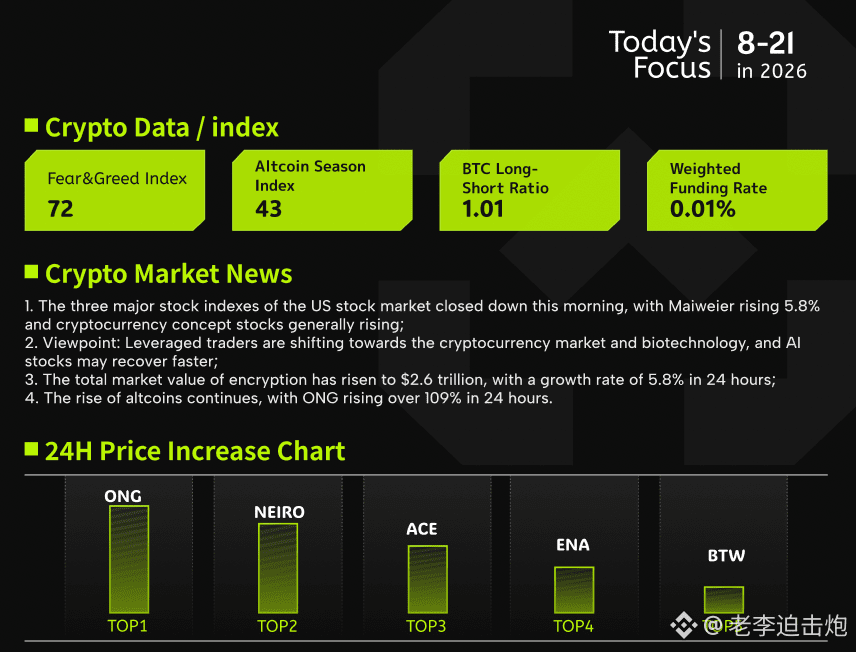
【August 21 Global Market News and Data Analysis】
1. US stocks fell across the board this morning: Maywell rose 5.8%, while crypto-related stocks generally climbed;
2. Viewpoint: Leveraged traders are shifting toward the crypto market and biotech. The stock #AI may recover faster;
3. Total crypto market capitalization rose to $2.6 trillion, up 5.8% in 24 hours;
4. The rally in altcoins continues: #Ong rose more than 109% in 24 hours.
US stocks fell collectively on Thursday, with the Dow, Nasdaq, and S&P each down about 1%. Vaccine stock Moderna plunged more than 23%, while Maywell Technology gained against the trend. The memory sector was broadly active; Micron and Seagate both rose. Crypto-related stocks led the gains, with COIN, MSTR, CRCL, and others generally recording increases of more than 6%. Funds are moving from AI stocks toward Hyperliquid and biotech. Institutions believe this shift is more conducive to stabilizing the AI sector. SK hynix disclosed its CPO roadmap, boosting demand for optical interconnects, laser devices, and packaging; Yangtze Memory also reportedly plans to hold an IPO in the next quarter, drawing attention to optoelectronics, high-end PCB drill bits, and tungsten prices.
Bitcoin broke through $75,000, and total crypto market capitalization rose to around $2.6 trillion, up more than 5.8% over 24 hours. Market share was about 58% for #BTC and about 10.9% for #ETH . Altcoins followed higher. This round of trading is the result of a convergence of regulatory tailwinds, a rebound in long-end yields, and cross-sector fund rotation—further amplified by short-covering that created a squeeze-like surge in volume. For the crypto market, spot ETFs’ steady net inflows and corporate buybacks provide core demand support. For BTC, it remains relatively dominant; after breaking key levels, momentum may continue. However, investors should watch for profit-taking after a “V-shaped reversal” and the risks of high volatility. Whether the move can sustain still depends on whether capital can continue to flow in.
1. US stocks fell across the board this morning: Maywell rose 5.8%, while crypto-related stocks generally climbed;
2. Viewpoint: Leveraged traders are shifting toward the crypto market and biotech. The stock #AI may recover faster;
3. Total crypto market capitalization rose to $2.6 trillion, up 5.8% in 24 hours;
4. The rally in altcoins continues: #Ong rose more than 109% in 24 hours.
US stocks fell collectively on Thursday, with the Dow, Nasdaq, and S&P each down about 1%. Vaccine stock Moderna plunged more than 23%, while Maywell Technology gained against the trend. The memory sector was broadly active; Micron and Seagate both rose. Crypto-related stocks led the gains, with COIN, MSTR, CRCL, and others generally recording increases of more than 6%. Funds are moving from AI stocks toward Hyperliquid and biotech. Institutions believe this shift is more conducive to stabilizing the AI sector. SK hynix disclosed its CPO roadmap, boosting demand for optical interconnects, laser devices, and packaging; Yangtze Memory also reportedly plans to hold an IPO in the next quarter, drawing attention to optoelectronics, high-end PCB drill bits, and tungsten prices.
Bitcoin broke through $75,000, and total crypto market capitalization rose to around $2.6 trillion, up more than 5.8% over 24 hours. Market share was about 58% for #BTC and about 10.9% for #ETH . Altcoins followed higher. This round of trading is the result of a convergence of regulatory tailwinds, a rebound in long-end yields, and cross-sector fund rotation—further amplified by short-covering that created a squeeze-like surge in volume. For the crypto market, spot ETFs’ steady net inflows and corporate buybacks provide core demand support. For BTC, it remains relatively dominant; after breaking key levels, momentum may continue. However, investors should watch for profit-taking after a “V-shaped reversal” and the risks of high volatility. Whether the move can sustain still depends on whether capital can continue to flow in.
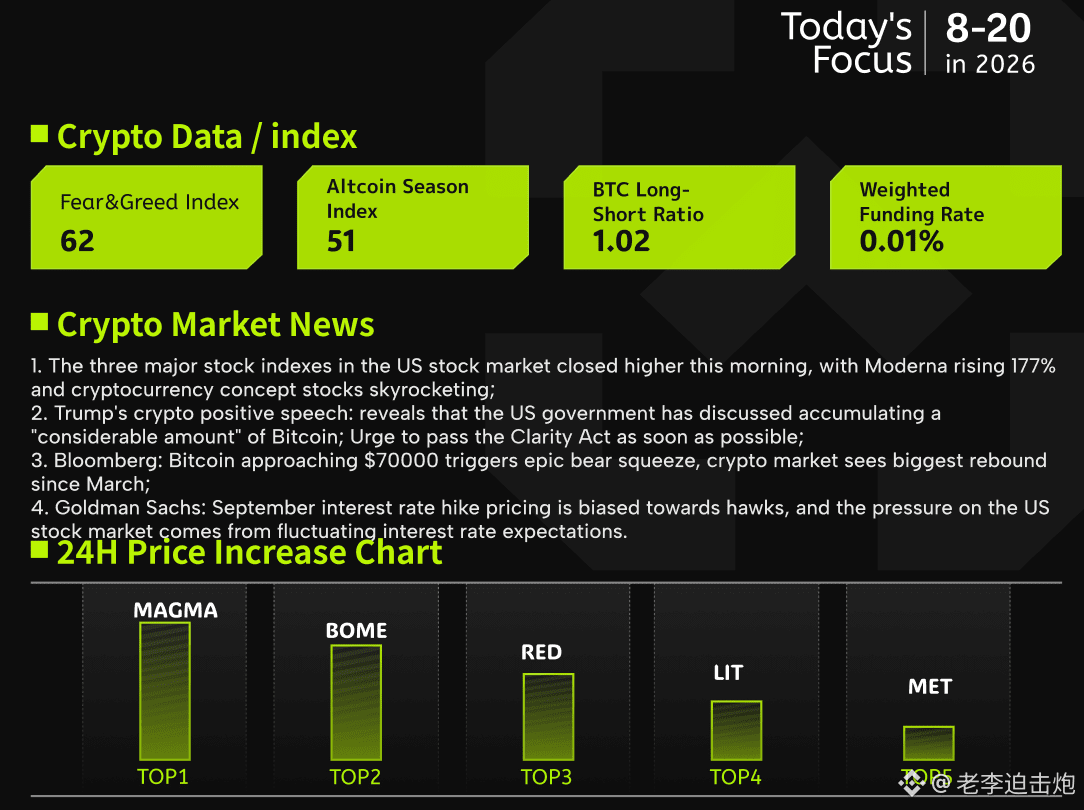
【August 20 Global Market News and Data Analysis】
1. US stocks rose today in three major indexes this morning; Moderna surged 177%, while crypto-related stocks soared;
2. #TRUMP bullish remarks on crypto: revealed that the US government has discussed accumulating a “significant quantity” of Bitcoin; urged passage of the “Clarity Act” as soon as possible;
3. Bloomberg: #BTC nearing $70,000 triggered an epic short squeeze, and the crypto market saw its biggest rebound since March;
4. Goldman Sachs: September rate-hike pricing is relatively hawkish; pressure on US stocks comes from repeated shifts in interest-rate expectations.
The three major US stock indexes edged higher on Wednesday. The healthcare sector performed the best, with Moderna’s share price nearly doubling as its Phase 3 trial for a personalized cancer vaccine met key endpoints; Merck also recorded a notable gain. Tech and chip stocks saw some differentiation: Mavell jumped sharply, while some storage-related stocks faced pressure and pulled back. Meanwhile, crypto-related stocks collectively surged, with multiple shares posting double-digit gains, and market risk appetite clearly rebounded.
The White House convened executives from multiple crypto firms for discussions. Supportive remarks signaled a regulatory shift, alongside the U.S. SEC’s plan to ease some registration requirements for digital asset offerings and the Treasury Department’s expansion of long-term Treasury repo operations—together lifting valuations of risk assets. Bitcoin rose by nearly 10% in a short period and reclaimed levels above $70,000, triggering large-scale short covering. Ethereum and several crypto-related stocks moved up in tandem. For the crypto market—especially Bitcoin—policy momentum and sentiment repair provide strong near-term support. However, whether the rebound can develop into a sustained uptrend still depends on the pace of regulatory implementation and whether incremental capital can continue to flow in.
1. US stocks rose today in three major indexes this morning; Moderna surged 177%, while crypto-related stocks soared;
2. #TRUMP bullish remarks on crypto: revealed that the US government has discussed accumulating a “significant quantity” of Bitcoin; urged passage of the “Clarity Act” as soon as possible;
3. Bloomberg: #BTC nearing $70,000 triggered an epic short squeeze, and the crypto market saw its biggest rebound since March;
4. Goldman Sachs: September rate-hike pricing is relatively hawkish; pressure on US stocks comes from repeated shifts in interest-rate expectations.
The three major US stock indexes edged higher on Wednesday. The healthcare sector performed the best, with Moderna’s share price nearly doubling as its Phase 3 trial for a personalized cancer vaccine met key endpoints; Merck also recorded a notable gain. Tech and chip stocks saw some differentiation: Mavell jumped sharply, while some storage-related stocks faced pressure and pulled back. Meanwhile, crypto-related stocks collectively surged, with multiple shares posting double-digit gains, and market risk appetite clearly rebounded.
The White House convened executives from multiple crypto firms for discussions. Supportive remarks signaled a regulatory shift, alongside the U.S. SEC’s plan to ease some registration requirements for digital asset offerings and the Treasury Department’s expansion of long-term Treasury repo operations—together lifting valuations of risk assets. Bitcoin rose by nearly 10% in a short period and reclaimed levels above $70,000, triggering large-scale short covering. Ethereum and several crypto-related stocks moved up in tandem. For the crypto market—especially Bitcoin—policy momentum and sentiment repair provide strong near-term support. However, whether the rebound can develop into a sustained uptrend still depends on the pace of regulatory implementation and whether incremental capital can continue to flow in.
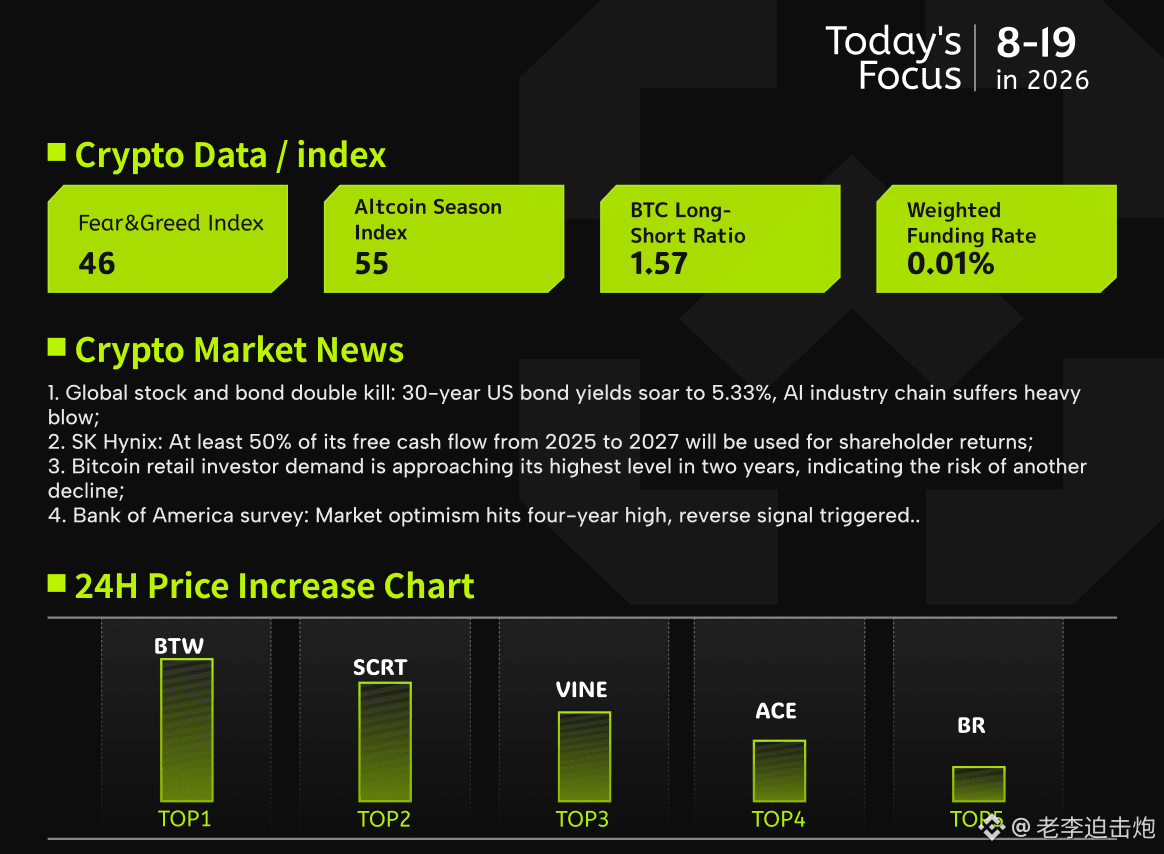
【Aug 19 Global Market News and Data Analysis】
1. Global stocks and bonds both take a hit: the 30-year U.S. Treasury yield surges to 5.33%, and the #AI industry chain suffers a major setback;
2. #sk海力士 : from 2025 to 2027, at least 50% of free cash flow will be used for shareholder returns;
3. #BTC retail investor demand is close to the highest level in nearly two years, signaling elevated risk of another drop;
4. Bank of America survey: market optimism reaches a four-year high, and the contrarian signal has already been triggered.
Today, both European and U.S. plus Japanese and Korean stock and bond markets weaken in tandem, and the spike in long-term U.S. Treasury yields has become the main trigger. South Korea’s KOSPI plunges 5.8% and triggers circuit breakers; semiconductor-weighted stocks lead the decline, while Japan’s Nikkei 225 falls by more than 3%. In China, more than 5,000 listed stocks trade in the green. All major U.S. stock indexes close lower for the third consecutive day; the Philadelphia Semiconductor Index drops nearly 5% in a single day, and AI-related stocks including Micron, AMD, and Intel sharply retreat. At the root, during the day the 30-year U.S. Treasury yield climbs to 5.33%, setting a record not seen since 2007. Long-term government bond yields in Europe and Japan are also at multi-year highs, as global long-term funding costs undergo a drastic repricing. U.S. Treasury Department data also shows that in June overseas institutions reduced their holdings of U.S. Treasuries by about $72 billion, with clear risk-avoidance sentiment.
For the crypto market, higher risk-free rates continue to weigh on the valuations of growth assets. If global equities continue to sell off, Bitcoin in the short term may face downward pressure through correlation. On the other hand, as risk aversion rises, its “digital gold” narrative is strengthened: spot and perpetual futures demand hit the highest level in the year, retail funds are entering faster, and this also provides some price support. However, some analysts point out that small investors’ sentiment is unstable and they tend to overreact to minor fluctuations; inflows of this incremental capital are often a signal of a temporary, local top. Overall, against the backdrop of long-term high interest rates and the repricing of AI valuations, short-term volatility in the crypto market is likely to intensify, and Bitcoin should be watched for the risk of a high-to-fall pullback.
1. Global stocks and bonds both take a hit: the 30-year U.S. Treasury yield surges to 5.33%, and the #AI industry chain suffers a major setback;
2. #sk海力士 : from 2025 to 2027, at least 50% of free cash flow will be used for shareholder returns;
3. #BTC retail investor demand is close to the highest level in nearly two years, signaling elevated risk of another drop;
4. Bank of America survey: market optimism reaches a four-year high, and the contrarian signal has already been triggered.
Today, both European and U.S. plus Japanese and Korean stock and bond markets weaken in tandem, and the spike in long-term U.S. Treasury yields has become the main trigger. South Korea’s KOSPI plunges 5.8% and triggers circuit breakers; semiconductor-weighted stocks lead the decline, while Japan’s Nikkei 225 falls by more than 3%. In China, more than 5,000 listed stocks trade in the green. All major U.S. stock indexes close lower for the third consecutive day; the Philadelphia Semiconductor Index drops nearly 5% in a single day, and AI-related stocks including Micron, AMD, and Intel sharply retreat. At the root, during the day the 30-year U.S. Treasury yield climbs to 5.33%, setting a record not seen since 2007. Long-term government bond yields in Europe and Japan are also at multi-year highs, as global long-term funding costs undergo a drastic repricing. U.S. Treasury Department data also shows that in June overseas institutions reduced their holdings of U.S. Treasuries by about $72 billion, with clear risk-avoidance sentiment.
For the crypto market, higher risk-free rates continue to weigh on the valuations of growth assets. If global equities continue to sell off, Bitcoin in the short term may face downward pressure through correlation. On the other hand, as risk aversion rises, its “digital gold” narrative is strengthened: spot and perpetual futures demand hit the highest level in the year, retail funds are entering faster, and this also provides some price support. However, some analysts point out that small investors’ sentiment is unstable and they tend to overreact to minor fluctuations; inflows of this incremental capital are often a signal of a temporary, local top. Overall, against the backdrop of long-term high interest rates and the repricing of AI valuations, short-term volatility in the crypto market is likely to intensify, and Bitcoin should be watched for the risk of a high-to-fall pullback.
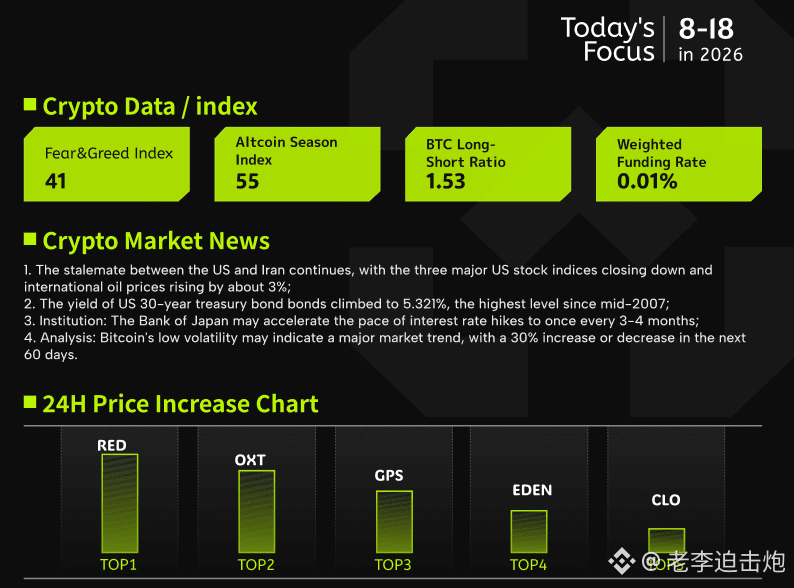
【August 18 Global Market News and Data Analysis】
1. The standoff between Iran and the U.S. continues; the three major U.S. stock indexes fell, while international oil prices rose by about 3%.
2. The U.S. 30-year Treasury yield climbed to 5.321%, the highest level since mid-2007.
3. Institutions: The Bank of Japan may accelerate its rate hikes to once every 3–4 months.
4. Analysis: #BTC low volatility may signal a major move; within the next 60 days, the price could see a 30% rise or fall.
The outlook for the Iran–U.S. negotiations is not optimistic. International oil prices rebounded by about 3% on Monday. The U.S. said it will not extend the memorandum of understanding signed in June between the two countries, which expired that same day. Disagreements remain between the two sides on issues such as the Strait of Hormuz. Statements from officials suggest the U.S. is not in a hurry to end a conflict that has lasted nearly half a year. The energy sector views it as a long-term game, while diplomatically the U.S. is staying patient. Meanwhile, U.S. stocks were lackluster in the same period: the Dow and S&P both fell by about 0.5%, the Nasdaq fell 0.32%, SK Hynix, Micron, and SanDisk rose against the trend, while Nike fell.
Bitcoin is currently around $64,000+ and has gained more than 2% over the past 24 hours. Its 30-day volatility has slipped to a historical low. Looking back at the past eight similar low-volatility phases, the average price swing over the following 60 days reached 30.2%, with the number of up and down days roughly split in half—suggesting the magnitude of the move will expand, but the direction is hard to pin down. If this is used as a guide, the price could trade within a range of $44,800 to $83,200. The current uptrend is partly driven by short-covering, and futures open interest has fallen by about 8% in recent days. Analysts believe that the continued rise in real bond yields may be a key variable in breaking the deadlock. Since 2026, Bitcoin has cumulatively fallen by nearly 27%; its near-term direction still needs to be watched.
1. The standoff between Iran and the U.S. continues; the three major U.S. stock indexes fell, while international oil prices rose by about 3%.
2. The U.S. 30-year Treasury yield climbed to 5.321%, the highest level since mid-2007.
3. Institutions: The Bank of Japan may accelerate its rate hikes to once every 3–4 months.
4. Analysis: #BTC low volatility may signal a major move; within the next 60 days, the price could see a 30% rise or fall.
The outlook for the Iran–U.S. negotiations is not optimistic. International oil prices rebounded by about 3% on Monday. The U.S. said it will not extend the memorandum of understanding signed in June between the two countries, which expired that same day. Disagreements remain between the two sides on issues such as the Strait of Hormuz. Statements from officials suggest the U.S. is not in a hurry to end a conflict that has lasted nearly half a year. The energy sector views it as a long-term game, while diplomatically the U.S. is staying patient. Meanwhile, U.S. stocks were lackluster in the same period: the Dow and S&P both fell by about 0.5%, the Nasdaq fell 0.32%, SK Hynix, Micron, and SanDisk rose against the trend, while Nike fell.
Bitcoin is currently around $64,000+ and has gained more than 2% over the past 24 hours. Its 30-day volatility has slipped to a historical low. Looking back at the past eight similar low-volatility phases, the average price swing over the following 60 days reached 30.2%, with the number of up and down days roughly split in half—suggesting the magnitude of the move will expand, but the direction is hard to pin down. If this is used as a guide, the price could trade within a range of $44,800 to $83,200. The current uptrend is partly driven by short-covering, and futures open interest has fallen by about 8% in recent days. Analysts believe that the continued rise in real bond yields may be a key variable in breaking the deadlock. Since 2026, Bitcoin has cumulatively fallen by nearly 27%; its near-term direction still needs to be watched.
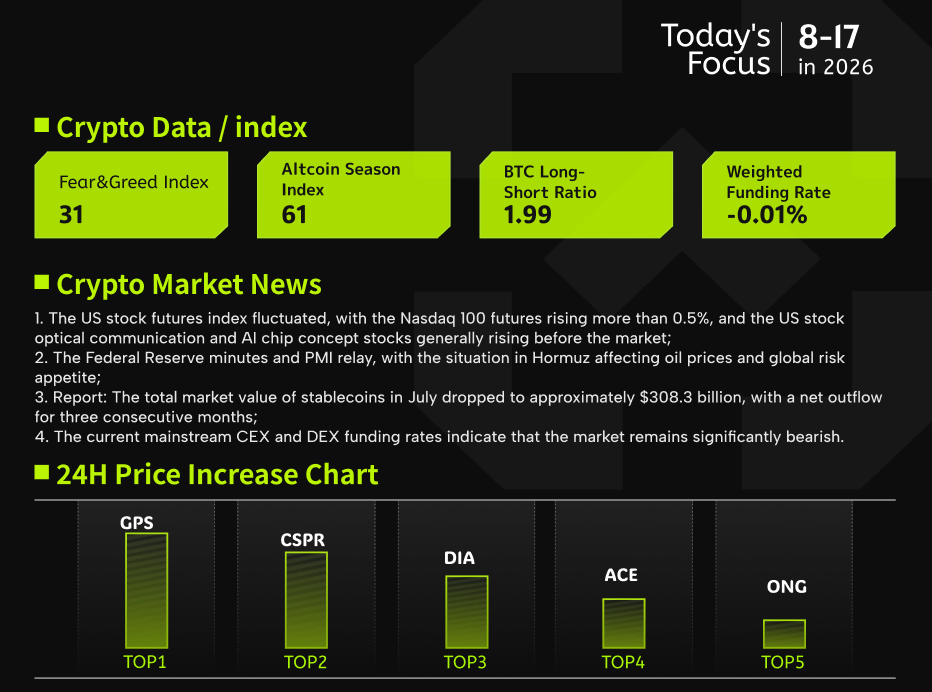
【August 17 Global Market News and Data Analysis】
1. US stock index futures mixed: Nasdaq-100 futures up more than 0.5%; pre-market gains across US telecom optical communications and AI chip concept stocks;
2. The Fed minutes and PMI take the stage in tandem—developments in the Strait of Hormuz drive oil prices and global risk appetite;
3. Report: In July, the total market value of stablecoins fell to about $30.83 billion, marking net outflows for the third consecutive month;
4. Current funding rates from major CEXs and DEXs show the market remains significantly bearish.
This week’s macro calendar is packed: the Fed’s July minutes, the August PMI, and retail earnings from Walmart, Target, and Home Depot will be released in sequence. With recent inflation and consumer data looking soft, market pricing for a September rate hike has dropped to around 27%. Goldman Sachs has largely ruled out this possibility as well. Near term, rate pressure may ease, but if the minutes reveal hawkish signals, expectations could still swing back and forth. Meanwhile, the resumption of navigation through the Strait of Hormuz is currently only a diplomatic development; actual shipping volumes remain far below normal. If transport stays smooth, the oil-price risk premium may fall; otherwise, it could lift inflation and rate-pressure. US stocks are trading at elevated levels while the consumer side has already shown weakness—earnings reports will test the resilience of profits and richly valued expectations.
For the crypto market, easing rate expectations and contraction in stablecoin liquidity are pulling in opposite directions. In July, the total stablecoin market value fell to about $30.83 billion; cumulative net outflows from May to July were about $13.3 billion— the longest withdrawal cycle in recent years—indicating insufficient incremental inflows. The divergence in activity between USDT and USDC also reflects changes in the on-chain ecosystem. At present, funding rates across major exchanges and on-chain are broadly bearish, revealing a cautious, wait-and-see sentiment. Overall, if consumer weakness persists and expectations for rate hikes continue to fall, a rebound in risk appetite could provide support for Bitcoin; however, continued stablecoin outflows combined with bearish sentiment make it more likely that Bitcoin will remain range-bound in the near term. The direction will still depend on whether the minutes, PMI, and earnings can reshape market pricing of interest rates and energy costs.
1. US stock index futures mixed: Nasdaq-100 futures up more than 0.5%; pre-market gains across US telecom optical communications and AI chip concept stocks;
2. The Fed minutes and PMI take the stage in tandem—developments in the Strait of Hormuz drive oil prices and global risk appetite;
3. Report: In July, the total market value of stablecoins fell to about $30.83 billion, marking net outflows for the third consecutive month;
4. Current funding rates from major CEXs and DEXs show the market remains significantly bearish.
This week’s macro calendar is packed: the Fed’s July minutes, the August PMI, and retail earnings from Walmart, Target, and Home Depot will be released in sequence. With recent inflation and consumer data looking soft, market pricing for a September rate hike has dropped to around 27%. Goldman Sachs has largely ruled out this possibility as well. Near term, rate pressure may ease, but if the minutes reveal hawkish signals, expectations could still swing back and forth. Meanwhile, the resumption of navigation through the Strait of Hormuz is currently only a diplomatic development; actual shipping volumes remain far below normal. If transport stays smooth, the oil-price risk premium may fall; otherwise, it could lift inflation and rate-pressure. US stocks are trading at elevated levels while the consumer side has already shown weakness—earnings reports will test the resilience of profits and richly valued expectations.
For the crypto market, easing rate expectations and contraction in stablecoin liquidity are pulling in opposite directions. In July, the total stablecoin market value fell to about $30.83 billion; cumulative net outflows from May to July were about $13.3 billion— the longest withdrawal cycle in recent years—indicating insufficient incremental inflows. The divergence in activity between USDT and USDC also reflects changes in the on-chain ecosystem. At present, funding rates across major exchanges and on-chain are broadly bearish, revealing a cautious, wait-and-see sentiment. Overall, if consumer weakness persists and expectations for rate hikes continue to fall, a rebound in risk appetite could provide support for Bitcoin; however, continued stablecoin outflows combined with bearish sentiment make it more likely that Bitcoin will remain range-bound in the near term. The direction will still depend on whether the minutes, PMI, and earnings can reshape market pricing of interest rates and energy costs.
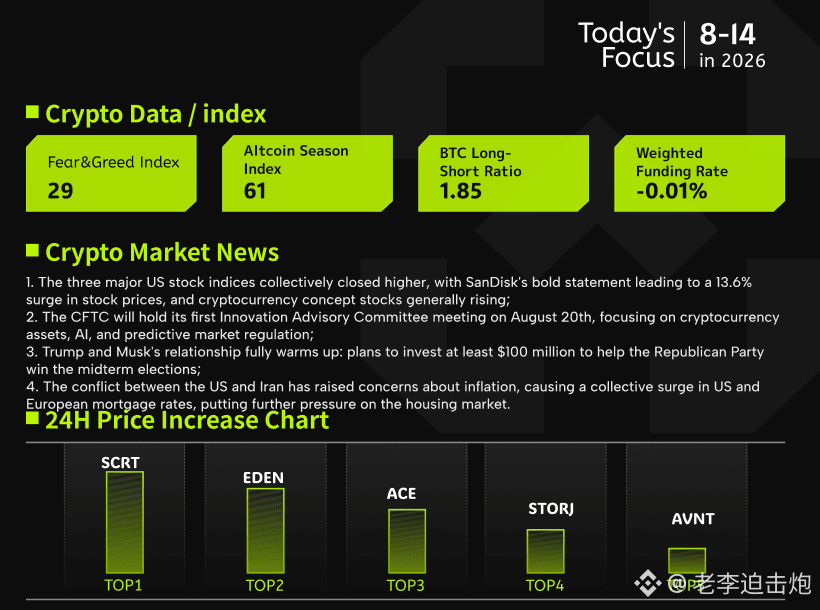
[August 14 Global Market Information and Data Analysis]
1. US stocks all rose for the day. SanDisk made an “bold statement,” lifting its stock price by 13.6%. Crypto-related stocks generally gained;
2. #CFTC will hold the inaugural meeting of the Innovation Advisory Committee on August 20, focusing on crypto assets, #AI , and regulatory oversight of prediction markets;
3. The relationship between Trump and Musk has fully warmed up again: they plan to invest at least $100 million to help the Republicans win the midterm elections;
4. The conflict between Iran and the US has raised inflation concerns. Mortgage rates in Europe and the US have surged collectively, putting further pressure on the housing market.
Overnight, US stocks rose across the board. The S&P 500 continued to set a new all-time closing high, while the Nasdaq and the Dow strengthened in tandem. The crypto sector performed broadly actively, with Bullish and Circle leading the gains, and notable upside also seen in Coinbase, Strategy, and others. Supported by expectations of SanDisk’s large orders and its high-margin guidance, the storage sector rose collectively, while optical module stocks saw more pullbacks. On the crypto network side, the share of miners’ fee revenue has fallen to a level rarely seen in recent years. Total network hashrate has contracted markedly compared with the peak in October last year. Meanwhile, the coin price is nearly down by half, indicating that competition for block space has significantly weakened and industry earnings are highly dependent on block subsidies.
Regarding #BTC , the decline in the fee share alongside the contraction in hashrate now looks more like a manageable adjustment rather than an industry-wide collapse. Because the block reward base varies greatly across different periods, comparing the absolute level of fees alone can be misleading; historical references are only meaningful from the perspective of income structure. The analysis suggests that only when the fee share climbs back above 1% and sustains, and when the hashrate trend shifts from down to up, can it be considered a signal of a genuine reversal in the crypto environment. For now, attention should be on changes in existing capital and risk appetite: whether miners’ structure can recover first may become an important observation window for the stabilization of prices.
1. US stocks all rose for the day. SanDisk made an “bold statement,” lifting its stock price by 13.6%. Crypto-related stocks generally gained;
2. #CFTC will hold the inaugural meeting of the Innovation Advisory Committee on August 20, focusing on crypto assets, #AI , and regulatory oversight of prediction markets;
3. The relationship between Trump and Musk has fully warmed up again: they plan to invest at least $100 million to help the Republicans win the midterm elections;
4. The conflict between Iran and the US has raised inflation concerns. Mortgage rates in Europe and the US have surged collectively, putting further pressure on the housing market.
Overnight, US stocks rose across the board. The S&P 500 continued to set a new all-time closing high, while the Nasdaq and the Dow strengthened in tandem. The crypto sector performed broadly actively, with Bullish and Circle leading the gains, and notable upside also seen in Coinbase, Strategy, and others. Supported by expectations of SanDisk’s large orders and its high-margin guidance, the storage sector rose collectively, while optical module stocks saw more pullbacks. On the crypto network side, the share of miners’ fee revenue has fallen to a level rarely seen in recent years. Total network hashrate has contracted markedly compared with the peak in October last year. Meanwhile, the coin price is nearly down by half, indicating that competition for block space has significantly weakened and industry earnings are highly dependent on block subsidies.
Regarding #BTC , the decline in the fee share alongside the contraction in hashrate now looks more like a manageable adjustment rather than an industry-wide collapse. Because the block reward base varies greatly across different periods, comparing the absolute level of fees alone can be misleading; historical references are only meaningful from the perspective of income structure. The analysis suggests that only when the fee share climbs back above 1% and sustains, and when the hashrate trend shifts from down to up, can it be considered a signal of a genuine reversal in the crypto environment. For now, attention should be on changes in existing capital and risk appetite: whether miners’ structure can recover first may become an important observation window for the stabilization of prices.
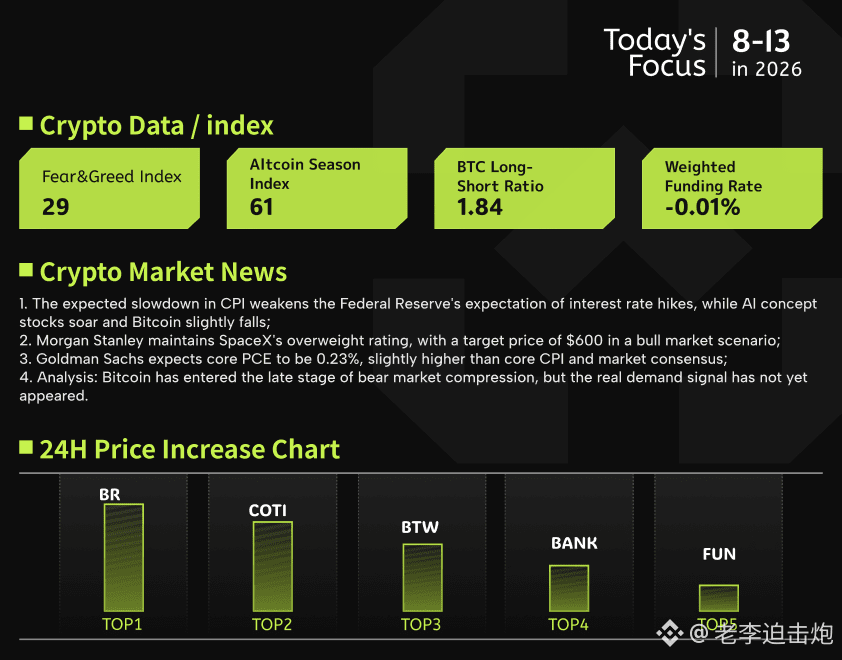
【Aug 13 Global Market News and Data Analysis】
1. CPI slows as expected, weakening expectations for further Federal Reserve rate hikes. AI-related stocks surge, while Bitcoin edges down slightly;
2. Morgan Stanley maintains an “Accumulate” rating on SpaceX, with a target price of $600 in a bull-market scenario;
3. Goldman Sachs expects core PCE at 0.23%, slightly higher than core CPI and market consensus;
4. Analysis: Bitcoin is in the late-stage bear market compression phase, but real demand signals have not yet appeared.
Weaker inflation data cools the market’s expectations for rate hikes. In the U.S. stock market, the three major indexes move in mixed fashion: the Dow slips slightly, while the Nasdaq and S&P rise in tandem. Nvidia closes at a high since June, and SpaceX jumps sharply after launching Grok 4.6. The entire AI compute supply chain strengthens across the board: from storage and optical communications to semiconductor equipment, with multiple areas blooming. SK hynix, Lumentum, and cloud-service stocks show particularly strong gains. On the geopolitical front, Trump claims full control of the Strait of Hormuz, while Iran issues stern threats targeting global energy and internet infrastructure.
By contrast, Bitcoin shows virtually no reaction despite a looser environment with easing inflation and new stock-market highs. It reports around $63,000 and drifts slightly lower. Demand is clearly missing, and trading volume is at a multi-year low. On-chain data reflects structural fragility: sell-side pressure is approaching the bottom, but long-side leverage has been built up early; ETF inflows are meager, and buy orders are gradually thinning. Therefore, the current situation is characterized as the late-stage bear market compression phase. Key turning points are set by $68,700 above and $58,500 below—only a volume-backed stabilization above can confirm a turnaround; otherwise, amid crowded longs and weak buying, it may accelerate downward. Overall, macro positives have not yet transmitted to crypto assets. Bitcoin still needs genuine demand to return to break the deadlock.
1. CPI slows as expected, weakening expectations for further Federal Reserve rate hikes. AI-related stocks surge, while Bitcoin edges down slightly;
2. Morgan Stanley maintains an “Accumulate” rating on SpaceX, with a target price of $600 in a bull-market scenario;
3. Goldman Sachs expects core PCE at 0.23%, slightly higher than core CPI and market consensus;
4. Analysis: Bitcoin is in the late-stage bear market compression phase, but real demand signals have not yet appeared.
Weaker inflation data cools the market’s expectations for rate hikes. In the U.S. stock market, the three major indexes move in mixed fashion: the Dow slips slightly, while the Nasdaq and S&P rise in tandem. Nvidia closes at a high since June, and SpaceX jumps sharply after launching Grok 4.6. The entire AI compute supply chain strengthens across the board: from storage and optical communications to semiconductor equipment, with multiple areas blooming. SK hynix, Lumentum, and cloud-service stocks show particularly strong gains. On the geopolitical front, Trump claims full control of the Strait of Hormuz, while Iran issues stern threats targeting global energy and internet infrastructure.
By contrast, Bitcoin shows virtually no reaction despite a looser environment with easing inflation and new stock-market highs. It reports around $63,000 and drifts slightly lower. Demand is clearly missing, and trading volume is at a multi-year low. On-chain data reflects structural fragility: sell-side pressure is approaching the bottom, but long-side leverage has been built up early; ETF inflows are meager, and buy orders are gradually thinning. Therefore, the current situation is characterized as the late-stage bear market compression phase. Key turning points are set by $68,700 above and $58,500 below—only a volume-backed stabilization above can confirm a turnaround; otherwise, amid crowded longs and weak buying, it may accelerate downward. Overall, macro positives have not yet transmitted to crypto assets. Bitcoin still needs genuine demand to return to break the deadlock.
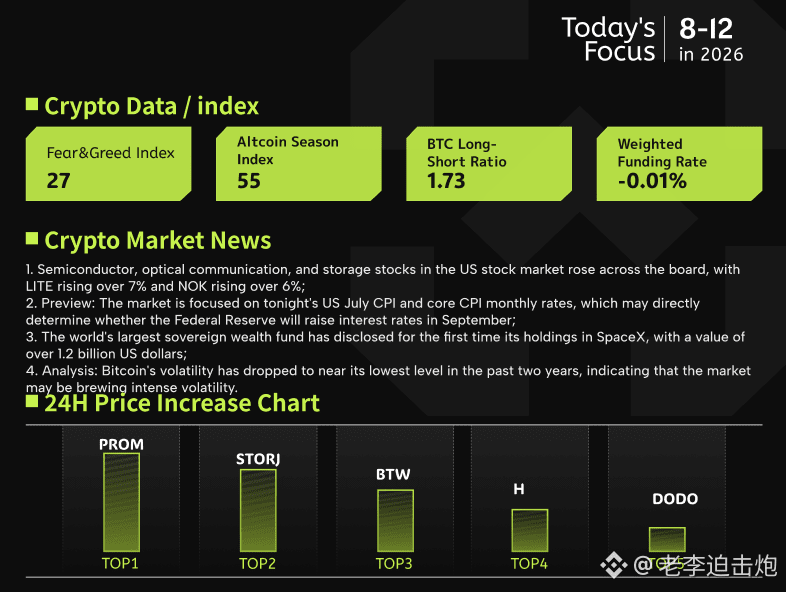
【August 12 Global Market News and Data Analysis】
1. In US pre-market trading, semiconductor, optical communications, and storage stocks all rose across the board: LITE jumped more than 7%, while NOK rose more than 6%;
2. The market is focused on tonight’s US July CPI and core CPI month-over-month, which will directly determine whether the Fed will hike in September;
3. The world’s largest sovereign wealth fund first disclosed its holdings in SpaceX, with a value exceeding $1.2 billion;
4. Analysis: Bitcoin volatility has fallen to around the lowest levels in the past two years, suggesting the market may be gearing up for sharp volatility.
The US Bureau of Labor Statistics is scheduled to release the July Consumer Price Index tonight. Although it narrowed slightly versus the previous month, it remains significantly above the 2% target set by the Federal Reserve. Current market expectations for whether the Fed will hike in September are exactly 50/50; tonight’s data will therefore be the key weight tipping the balance. Economists believe that if the reading matches expectations, two consecutive months of relatively mild performance will allow the committee to continue standing by and maintain a wait-and-see stance for the rest of the year. But if the data clearly comes in above expectations, the situation will quickly reverse.
For Bitcoin, the current market is in a typical “building strength while staying quiet” phase. Price volatility has been compressed into an extremely narrow range: the Bollinger Band width is only about 3.8%, near the lowest level in nearly two years, whereas in early July it still remained in double digits. The trend strength indicator ADX has also fallen to 11, far below the confirmation threshold of 25, and neither buy nor sell signals have been triggered. Analysts note that this “double-low” structure usually indicates the market is accumulating energy for the next major bout of volatility. In the short term, the risk of a false breakout is relatively high, but the indicators themselves still cannot specify whether the eventual direction is upward or downward. Only if the Bollinger Bands reopen, ADX breaks above 25, and the direction indicators lead by more than five points will the next round of trend signals be formally confirmed.
1. In US pre-market trading, semiconductor, optical communications, and storage stocks all rose across the board: LITE jumped more than 7%, while NOK rose more than 6%;
2. The market is focused on tonight’s US July CPI and core CPI month-over-month, which will directly determine whether the Fed will hike in September;
3. The world’s largest sovereign wealth fund first disclosed its holdings in SpaceX, with a value exceeding $1.2 billion;
4. Analysis: Bitcoin volatility has fallen to around the lowest levels in the past two years, suggesting the market may be gearing up for sharp volatility.
The US Bureau of Labor Statistics is scheduled to release the July Consumer Price Index tonight. Although it narrowed slightly versus the previous month, it remains significantly above the 2% target set by the Federal Reserve. Current market expectations for whether the Fed will hike in September are exactly 50/50; tonight’s data will therefore be the key weight tipping the balance. Economists believe that if the reading matches expectations, two consecutive months of relatively mild performance will allow the committee to continue standing by and maintain a wait-and-see stance for the rest of the year. But if the data clearly comes in above expectations, the situation will quickly reverse.
For Bitcoin, the current market is in a typical “building strength while staying quiet” phase. Price volatility has been compressed into an extremely narrow range: the Bollinger Band width is only about 3.8%, near the lowest level in nearly two years, whereas in early July it still remained in double digits. The trend strength indicator ADX has also fallen to 11, far below the confirmation threshold of 25, and neither buy nor sell signals have been triggered. Analysts note that this “double-low” structure usually indicates the market is accumulating energy for the next major bout of volatility. In the short term, the risk of a false breakout is relatively high, but the indicators themselves still cannot specify whether the eventual direction is upward or downward. Only if the Bollinger Bands reopen, ADX breaks above 25, and the direction indicators lead by more than five points will the next round of trend signals be formally confirmed.
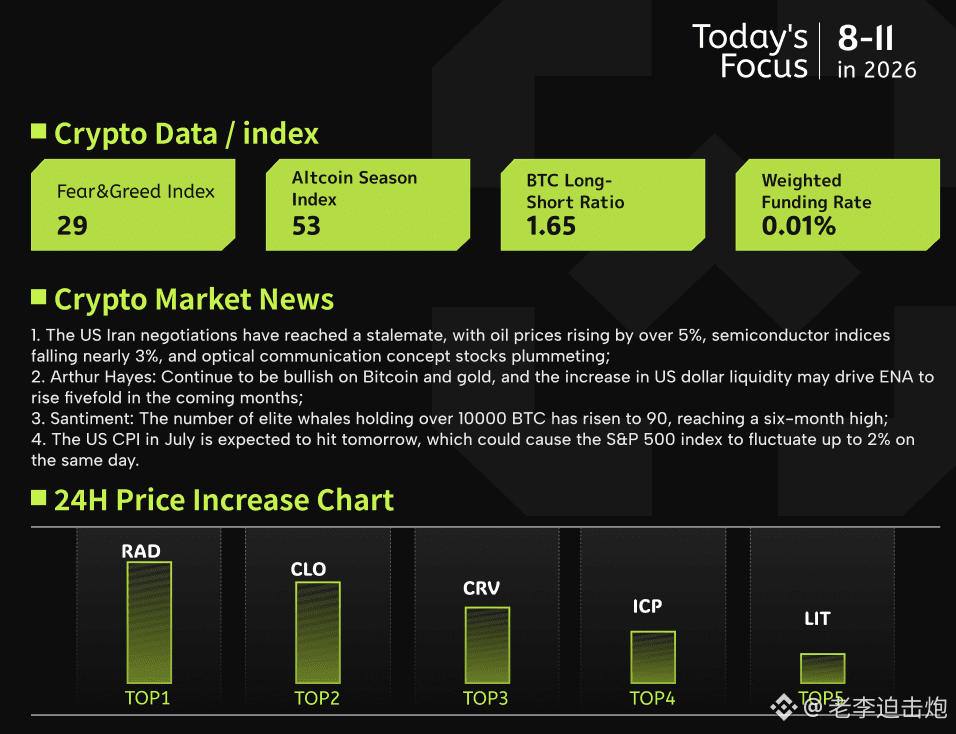
【August 11 Global Market News and Data Analysis】
1. The Iran-U.S. negotiations hit a stalemate; oil prices surged more than 5%, the semiconductor index fell nearly 3%, and stocks related to optical communications plunged;
2. Arthur Hayes: Still bullish on Bitcoin versus #GOLD . Growing U.S. dollar liquidity may drive ENA up 5x in the coming months;
3. Santiment: The elite “whale” holding more than 10,000 coins of #BTC has risen to 90 addresses, the highest in six months;
4. U.S. July CPI hits tomorrow, which could cause the S&P 500 to swing up or down by as much as 2% on the day.
Fresh disputes have erupted between the Iran and U.S. sides over war reparations again. Negotiations to reopen the Strait of Hormuz have fallen into a stalemate, pushing oil prices significantly higher—WTI rebounded above $82 and Brent crude broke above $87. The renewed upward move in energy has reignited concerns about inflation and further rate hikes, causing U.S. Treasury yields to rise. In U.S. stocks, all three major indexes closed lower at the same time; the semiconductor sector was under notable pressure. The $500 billion AI infrastructure financing plan led by Nvidia also made some funds question its “revolving financing” characteristics.
For the crypto market, rising risk-off sentiment and expectations of tighter liquidity typically weigh on high-risk assets, so the short term may cause some disturbance to BTC. However, institutional signals are fairly positive: the number of major-holder addresses rose to 90, a half-year high; and coins continued to concentrate toward whales. Last week, spot ETF net inflows were about $850 million, the best since April. BlackRock also believes the decoupling of Bitcoin from U.S. stocks is a healthy development, offering diversification and value as a hedge against tail risks. Overall, while short-term volatility is hard to avoid, the trend in capital and positioning still leans toward supporting BTC’s long-term performance.
1. The Iran-U.S. negotiations hit a stalemate; oil prices surged more than 5%, the semiconductor index fell nearly 3%, and stocks related to optical communications plunged;
2. Arthur Hayes: Still bullish on Bitcoin versus #GOLD . Growing U.S. dollar liquidity may drive ENA up 5x in the coming months;
3. Santiment: The elite “whale” holding more than 10,000 coins of #BTC has risen to 90 addresses, the highest in six months;
4. U.S. July CPI hits tomorrow, which could cause the S&P 500 to swing up or down by as much as 2% on the day.
Fresh disputes have erupted between the Iran and U.S. sides over war reparations again. Negotiations to reopen the Strait of Hormuz have fallen into a stalemate, pushing oil prices significantly higher—WTI rebounded above $82 and Brent crude broke above $87. The renewed upward move in energy has reignited concerns about inflation and further rate hikes, causing U.S. Treasury yields to rise. In U.S. stocks, all three major indexes closed lower at the same time; the semiconductor sector was under notable pressure. The $500 billion AI infrastructure financing plan led by Nvidia also made some funds question its “revolving financing” characteristics.
For the crypto market, rising risk-off sentiment and expectations of tighter liquidity typically weigh on high-risk assets, so the short term may cause some disturbance to BTC. However, institutional signals are fairly positive: the number of major-holder addresses rose to 90, a half-year high; and coins continued to concentrate toward whales. Last week, spot ETF net inflows were about $850 million, the best since April. BlackRock also believes the decoupling of Bitcoin from U.S. stocks is a healthy development, offering diversification and value as a hedge against tail risks. Overall, while short-term volatility is hard to avoid, the trend in capital and positioning still leans toward supporting BTC’s long-term performance.
【August 7 Global Market News and Data Analysis】
1. The three major US stock indexes all closed lower; SanDisk and Western Digital both plunged after earnings, dragging down the storage sector.
2. A temporary framework agreement regarding the Strait of Hormuz was reached, laying the groundwork for the US and Iran to restart nuclear talks.
3. Preview: The US July employment report (#非农 ) will be released tonight. If the labor market remains steady, there may be up to three rate hikes this year at most.
4. A US bank reiterated its bullish view on #SpaceX and maintained a $235 target price.
US stocks were under pressure overall overnight: all three indexes finished lower, with the Dow and S&P showing the largest declines. The Nasdaq was relatively resilient, while Microsoft strengthened against the trend and hit a new stage high. The main drivers behind this were a heightened risk-averse mood amid geopolitical uncertainty. International oil prices surged more than 3% in the short term, and inflation expectations were rekindled. The market then shifted focus to tonight’s July nonfarm payrolls report. There was clear divergence within tech stocks: even after SanDisk and Western Digital earnings exceeded expectations, the storage supply chain was still hit hard, and related ETFs fell significantly. AI application software stocks were even more sharply sold off, with multiple leading stocks dropping by close to or more than 15%.
What US stock market action implies for the crypto market—especially Bitcoin—is this: low volatility does not mean low risk. The current #BTC is trading in a narrow range below $65,000, and the 30-day implied volatility has already fallen back to a long-term support level. The options market shows a rare situation of both long and short positions shrinking simultaneously. This suggests that unless the nonfarm data significantly deviates from expectations, the Federal Reserve’s judgment on the rate-hike path for this year could be rewritten. At that time, volatility co-movement across stocks, bonds, and the US dollar may likely transmit into the crypto market. In a low-volatility environment, leveraged positions that were compressed could amplify one-sided breakout moves. Investors should be alert to sudden surges and sharp drops in the short term and closely monitor catalysts driven by policy and regulatory news.
1. The three major US stock indexes all closed lower; SanDisk and Western Digital both plunged after earnings, dragging down the storage sector.
2. A temporary framework agreement regarding the Strait of Hormuz was reached, laying the groundwork for the US and Iran to restart nuclear talks.
3. Preview: The US July employment report (#非农 ) will be released tonight. If the labor market remains steady, there may be up to three rate hikes this year at most.
4. A US bank reiterated its bullish view on #SpaceX and maintained a $235 target price.
US stocks were under pressure overall overnight: all three indexes finished lower, with the Dow and S&P showing the largest declines. The Nasdaq was relatively resilient, while Microsoft strengthened against the trend and hit a new stage high. The main drivers behind this were a heightened risk-averse mood amid geopolitical uncertainty. International oil prices surged more than 3% in the short term, and inflation expectations were rekindled. The market then shifted focus to tonight’s July nonfarm payrolls report. There was clear divergence within tech stocks: even after SanDisk and Western Digital earnings exceeded expectations, the storage supply chain was still hit hard, and related ETFs fell significantly. AI application software stocks were even more sharply sold off, with multiple leading stocks dropping by close to or more than 15%.
What US stock market action implies for the crypto market—especially Bitcoin—is this: low volatility does not mean low risk. The current #BTC is trading in a narrow range below $65,000, and the 30-day implied volatility has already fallen back to a long-term support level. The options market shows a rare situation of both long and short positions shrinking simultaneously. This suggests that unless the nonfarm data significantly deviates from expectations, the Federal Reserve’s judgment on the rate-hike path for this year could be rewritten. At that time, volatility co-movement across stocks, bonds, and the US dollar may likely transmit into the crypto market. In a low-volatility environment, leveraged positions that were compressed could amplify one-sided breakout moves. Investors should be alert to sudden surges and sharp drops in the short term and closely monitor catalysts driven by policy and regulatory news.
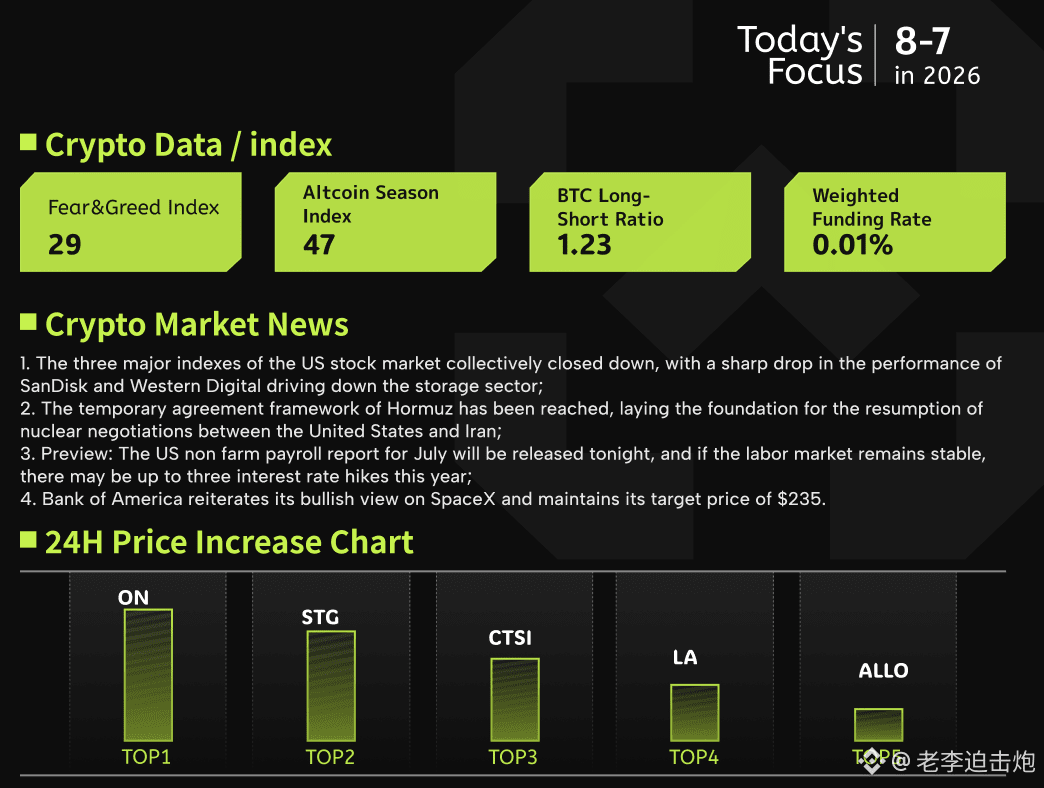
【Aug 5 Global Market News and Data Analysis】
1. This morning, the U.S. stock market closed with the Dow reaching a new high, #spy 500. Hynix rose 8%, while SpaceX rose 9.4%;
2. Crude oil plunged. The U.S. and Iran are said to be nearing an interim agreement for the Strait of Hormuz, with the target announcement on Wednesday;
3. The hawkish camp expanded: #Fed . After the July meeting, five regional Federal Reserve presidents publicly supported rate hikes;
4. After fresh highs in U.S. equities, a seasonal risk window opens. August to October may become a key testing period.
An important shift has emerged in the geopolitical situation in the Middle East. The U.S., Iran, and Oman are reportedly working to advance a temporary agreement aimed at reopening the Strait of Hormuz. Senior U.S. officials indicated that progress could be announced as early as this week. Previously tense military options have been temporarily put on hold, and diplomatic mediation has achieved a phase of results. Riding on this news, international crude oil prices have dropped sharply. Brent crude has fallen back to around $78. Market risk appetite has improved accordingly, and U.S. stocks and Asian markets have risen in tandem. However, the basis of mutual trust still appears fragile, and Iran’s hardline statements mean there are still uncertainties as to whether the agreement will ultimately be finalized.
In the short term, this geopolitical de-escalation signal creates a somewhat positive external environment for #BTC . Falling oil prices help ease inflation expectations, weaken the logic for aggressive rate hikes, and thereby improve expectations for liquidity in risk assets. At present, BTC has received relatively strong on-chain support in the $63,000 to $64,000 range. This area closely overlaps with the 200-week moving average and historically has been a relatively strong accumulation zone. Glassnode data also shows that both retail investors and whale addresses are increasing their holdings, with clear willingness to absorb funds. If external macro pressure continues to ease, BTC may complete base-building within the current consolidation range and test higher resistance levels to the upside.
1. This morning, the U.S. stock market closed with the Dow reaching a new high, #spy 500. Hynix rose 8%, while SpaceX rose 9.4%;
2. Crude oil plunged. The U.S. and Iran are said to be nearing an interim agreement for the Strait of Hormuz, with the target announcement on Wednesday;
3. The hawkish camp expanded: #Fed . After the July meeting, five regional Federal Reserve presidents publicly supported rate hikes;
4. After fresh highs in U.S. equities, a seasonal risk window opens. August to October may become a key testing period.
An important shift has emerged in the geopolitical situation in the Middle East. The U.S., Iran, and Oman are reportedly working to advance a temporary agreement aimed at reopening the Strait of Hormuz. Senior U.S. officials indicated that progress could be announced as early as this week. Previously tense military options have been temporarily put on hold, and diplomatic mediation has achieved a phase of results. Riding on this news, international crude oil prices have dropped sharply. Brent crude has fallen back to around $78. Market risk appetite has improved accordingly, and U.S. stocks and Asian markets have risen in tandem. However, the basis of mutual trust still appears fragile, and Iran’s hardline statements mean there are still uncertainties as to whether the agreement will ultimately be finalized.
In the short term, this geopolitical de-escalation signal creates a somewhat positive external environment for #BTC . Falling oil prices help ease inflation expectations, weaken the logic for aggressive rate hikes, and thereby improve expectations for liquidity in risk assets. At present, BTC has received relatively strong on-chain support in the $63,000 to $64,000 range. This area closely overlaps with the 200-week moving average and historically has been a relatively strong accumulation zone. Glassnode data also shows that both retail investors and whale addresses are increasing their holdings, with clear willingness to absorb funds. If external macro pressure continues to ease, BTC may complete base-building within the current consolidation range and test higher resistance levels to the upside.
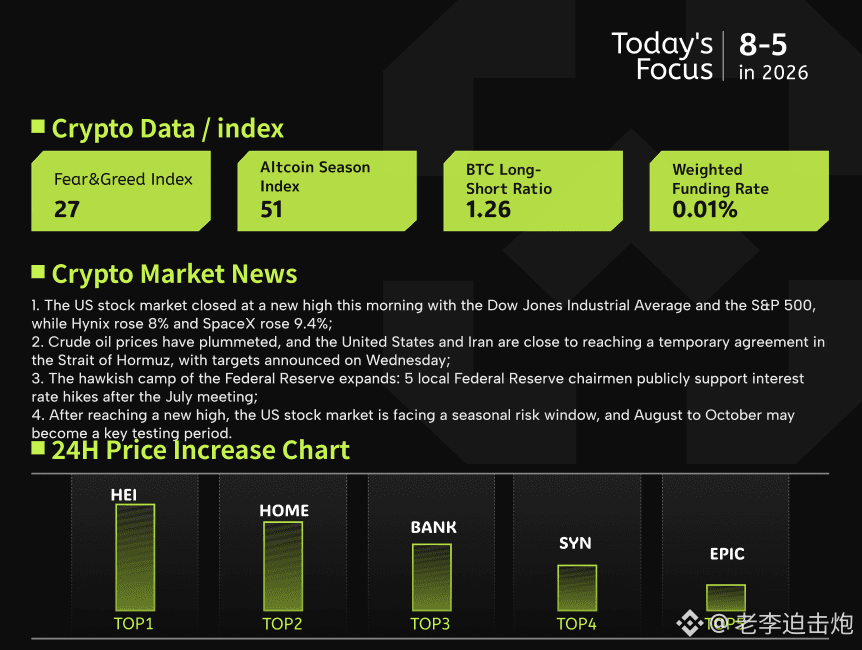
【August 4 Global Market News, Information and Data Analysis】
1. Expectations of US-Iran talks heat up; US stocks see a strong start in August with the Dow hitting a new high, and shares in the optical communications concept rise across the board;
2. Institutions: The semiconductor sector may form an emotional bottom. This week focuses on <#AMD >, as well as the earnings reports of Western Digital and SanDisk;
3. US stock earnings preview for the week: <#AI > chip repair trade brings “three tough battles” ahead;
4. The US has completed a voluntary review framework prior to the release of an AI model, with OpenAI, Anthropic, and others discussing the matter with the White House.
In a “ultimatum-style” proposal delivered to Iran recently, Trump claimed that US-Iran negotiations have already begun, with a two-step plan: first reopen navigation routes, then proceed toward denuclearization. The Strait of Hormuz could be restarted as early as the next day. Iran immediately denied this, saying it is only discussing temporary shipping lanes with Oman and has not had direct contact with the US. The two sides each sticking to their own story caused the geopolitical premium to quickly unwind. Brent crude fell nearly 6% in a day, while risk appetite rebounded significantly. US stocks rallied collectively: the Dow refreshed the all-time closing record, and tech and semiconductor sectors led the entire market.
Risk spillovers also benefited the crypto market. <#BTC > returned above $63,000 as well—this is a monthly-line bullish confirmation level identified by institutions. If August’s close can hold above this threshold, multiple cyclical indicators are likely to turn bullish, with technicals confirming a temporary bottom. However, upward obstacles have not disappeared: if the 10-year US Treasury yield continues to climb and forces the Federal Reserve to restart rate hikes, coupled with potential selling pressure from miners’ AI transition and liquidation behaviors by crypto companies, supply-side pressure will continue to constrain BTC upside. In the short term, the direction of US-Iran game dynamics remains the key external variable driving crypto sentiment.
1. Expectations of US-Iran talks heat up; US stocks see a strong start in August with the Dow hitting a new high, and shares in the optical communications concept rise across the board;
2. Institutions: The semiconductor sector may form an emotional bottom. This week focuses on <#AMD >, as well as the earnings reports of Western Digital and SanDisk;
3. US stock earnings preview for the week: <#AI > chip repair trade brings “three tough battles” ahead;
4. The US has completed a voluntary review framework prior to the release of an AI model, with OpenAI, Anthropic, and others discussing the matter with the White House.
In a “ultimatum-style” proposal delivered to Iran recently, Trump claimed that US-Iran negotiations have already begun, with a two-step plan: first reopen navigation routes, then proceed toward denuclearization. The Strait of Hormuz could be restarted as early as the next day. Iran immediately denied this, saying it is only discussing temporary shipping lanes with Oman and has not had direct contact with the US. The two sides each sticking to their own story caused the geopolitical premium to quickly unwind. Brent crude fell nearly 6% in a day, while risk appetite rebounded significantly. US stocks rallied collectively: the Dow refreshed the all-time closing record, and tech and semiconductor sectors led the entire market.
Risk spillovers also benefited the crypto market. <#BTC > returned above $63,000 as well—this is a monthly-line bullish confirmation level identified by institutions. If August’s close can hold above this threshold, multiple cyclical indicators are likely to turn bullish, with technicals confirming a temporary bottom. However, upward obstacles have not disappeared: if the 10-year US Treasury yield continues to climb and forces the Federal Reserve to restart rate hikes, coupled with potential selling pressure from miners’ AI transition and liquidation behaviors by crypto companies, supply-side pressure will continue to constrain BTC upside. In the short term, the direction of US-Iran game dynamics remains the key external variable driving crypto sentiment.
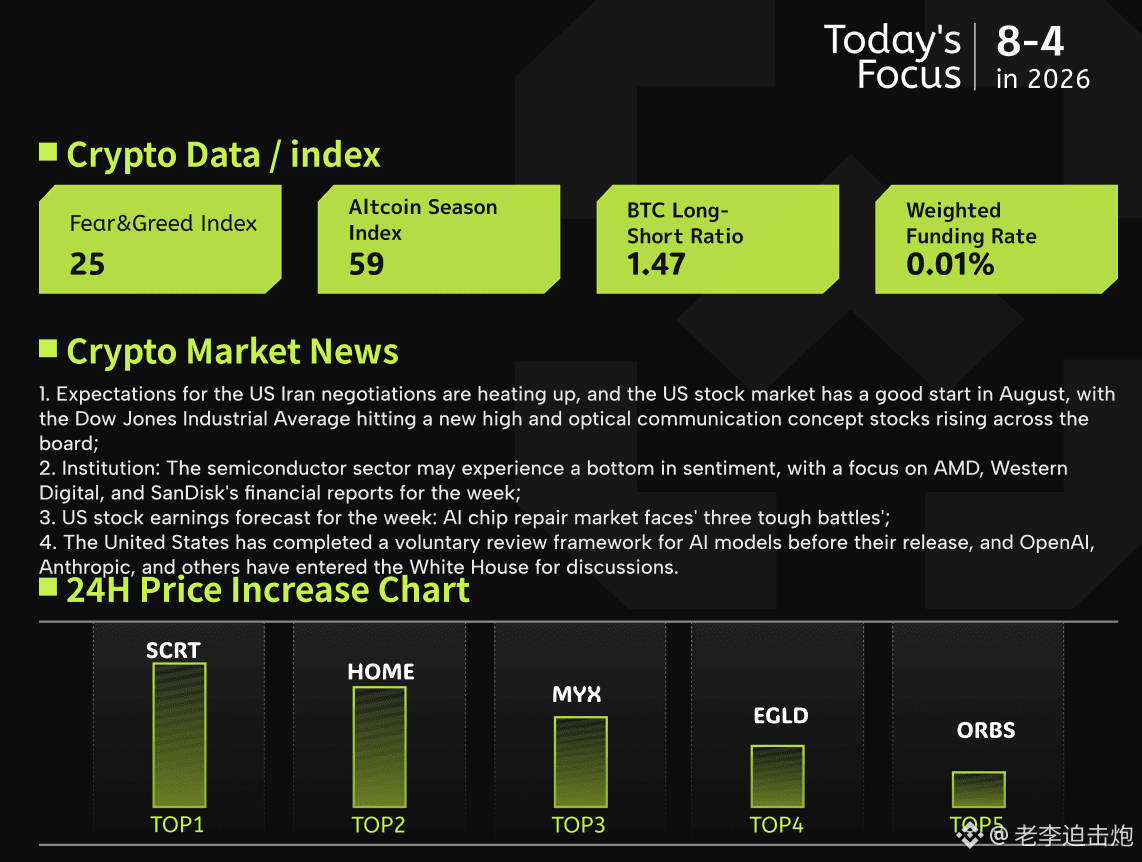
Log in to explore more content