【Aug 19 Global Market News and Data Analysis】
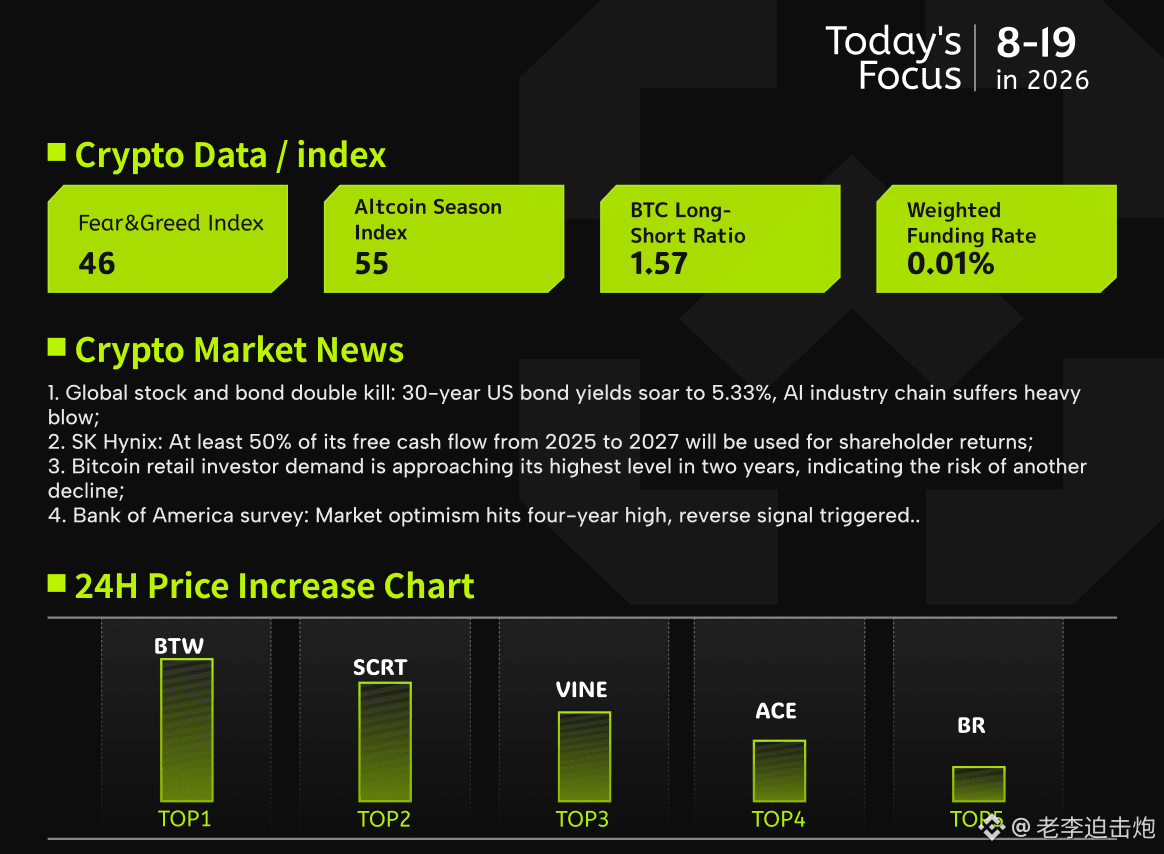
1. Global stocks and bonds both take a hit: the 30-year U.S. Treasury yield surges to 5.33%, and the #AI industry chain suffers a major setback;
2. #sk海力士 : from 2025 to 2027, at least 50% of free cash flow will be used for shareholder returns;
3. #BTC retail investor demand is close to the highest level in nearly two years, signaling elevated risk of another drop;
4. Bank of America survey: market optimism reaches a four-year high, and the contrarian signal has already been triggered.
Today, both European and U.S. plus Japanese and Korean stock and bond markets weaken in tandem, and the spike in long-term U.S. Treasury yields has become the main trigger. South Korea’s KOSPI plunges 5.8% and triggers circuit breakers; semiconductor-weighted stocks lead the decline, while Japan’s Nikkei 225 falls by more than 3%. In China, more than 5,000 listed stocks trade in the green. All major U.S. stock indexes close lower for the third consecutive day; the Philadelphia Semiconductor Index drops nearly 5% in a single day, and AI-related stocks including Micron, AMD, and Intel sharply retreat. At the root, during the day the 30-year U.S. Treasury yield climbs to 5.33%, setting a record not seen since 2007. Long-term government bond yields in Europe and Japan are also at multi-year highs, as global long-term funding costs undergo a drastic repricing. U.S. Treasury Department data also shows that in June overseas institutions reduced their holdings of U.S. Treasuries by about $72 billion, with clear risk-avoidance sentiment.
For the crypto market, higher risk-free rates continue to weigh on the valuations of growth assets. If global equities continue to sell off, Bitcoin in the short term may face downward pressure through correlation. On the other hand, as risk aversion rises, its “digital gold” narrative is strengthened: spot and perpetual futures demand hit the highest level in the year, retail funds are entering faster, and this also provides some price support. However, some analysts point out that small investors’ sentiment is unstable and they tend to overreact to minor fluctuations; inflows of this incremental capital are often a signal of a temporary, local top. Overall, against the backdrop of long-term high interest rates and the repricing of AI valuations, short-term volatility in the crypto market is likely to intensify, and Bitcoin should be watched for the risk of a high-to-fall pullback.
1. Global stocks and bonds both take a hit: the 30-year U.S. Treasury yield surges to 5.33%, and the #AI industry chain suffers a major setback;
2. #sk海力士 : from 2025 to 2027, at least 50% of free cash flow will be used for shareholder returns;
3. #BTC retail investor demand is close to the highest level in nearly two years, signaling elevated risk of another drop;
4. Bank of America survey: market optimism reaches a four-year high, and the contrarian signal has already been triggered.
Today, both European and U.S. plus Japanese and Korean stock and bond markets weaken in tandem, and the spike in long-term U.S. Treasury yields has become the main trigger. South Korea’s KOSPI plunges 5.8% and triggers circuit breakers; semiconductor-weighted stocks lead the decline, while Japan’s Nikkei 225 falls by more than 3%. In China, more than 5,000 listed stocks trade in the green. All major U.S. stock indexes close lower for the third consecutive day; the Philadelphia Semiconductor Index drops nearly 5% in a single day, and AI-related stocks including Micron, AMD, and Intel sharply retreat. At the root, during the day the 30-year U.S. Treasury yield climbs to 5.33%, setting a record not seen since 2007. Long-term government bond yields in Europe and Japan are also at multi-year highs, as global long-term funding costs undergo a drastic repricing. U.S. Treasury Department data also shows that in June overseas institutions reduced their holdings of U.S. Treasuries by about $72 billion, with clear risk-avoidance sentiment.
For the crypto market, higher risk-free rates continue to weigh on the valuations of growth assets. If global equities continue to sell off, Bitcoin in the short term may face downward pressure through correlation. On the other hand, as risk aversion rises, its “digital gold” narrative is strengthened: spot and perpetual futures demand hit the highest level in the year, retail funds are entering faster, and this also provides some price support. However, some analysts point out that small investors’ sentiment is unstable and they tend to overreact to minor fluctuations; inflows of this incremental capital are often a signal of a temporary, local top. Overall, against the backdrop of long-term high interest rates and the repricing of AI valuations, short-term volatility in the crypto market is likely to intensify, and Bitcoin should be watched for the risk of a high-to-fall pullback.