
#fedproposespaymentstablecoinrules
fedproposespaymentstablecoinrules
113,799 views
856 Discussing
US Federal Reserve has released two proposed rules for payment stablecoins to implement the regulatory authority granted under the GENIUS Act. The proposals would move stablecoin issuance and bank-related crypto activities under formal rulemaking rather than prior enforcement guidance.
Hot
Latest

·
--
#FedProposesPaymentStablecoinRules
🚨 Fed proposes new payment stablecoin rules
The U.S. Federal Reserve has proposed rules under the GENIUS Act that would require Fed-supervised payment stablecoin issuers to fully back tokens with eligible reserves, including short-term U.S. Treasury bills. The proposal also includes capital and risk-management requirements and a dedicated process for supervised banks seeking to issue payment stablecoins. Public comments will be open for 60 days after Federal Register publication.
💬 What do you think?$BTC $BNB $ETH
Will clearer stablecoin rules accelerate institutional adoption?
#Stablecoin #BNB_Market_Update #CryptoRegulation #Fed
#FedProposesPaymentStablecoinRules
🚨 Fed proposes new payment stablecoin rules
The U.S. Federal Reserve has proposed rules under the GENIUS Act that would require Fed-supervised payment stablecoin issuers to fully back tokens with eligible reserves, including short-term U.S. Treasury bills. The proposal also includes capital and risk-management requirements and a dedicated process for supervised banks seeking to issue payment stablecoins. Public comments will be open for 60 days after Federal Register publication.
💬 What do you think?$BTC $BNB $ETH
Will clearer stablecoin rules accelerate institutional adoption?
#Stablecoin #BNB_Market_Update #CryptoRegulation #Fed
🚨 Fed proposes new payment stablecoin rules
The U.S. Federal Reserve has proposed rules under the GENIUS Act that would require Fed-supervised payment stablecoin issuers to fully back tokens with eligible reserves, including short-term U.S. Treasury bills. The proposal also includes capital and risk-management requirements and a dedicated process for supervised banks seeking to issue payment stablecoins. Public comments will be open for 60 days after Federal Register publication.
💬 What do you think?$BTC $BNB $ETH
Will clearer stablecoin rules accelerate institutional adoption?
#Stablecoin #BNB_Market_Update #CryptoRegulation #Fed
1
89

·
--
#fedproposespaymentstablecoinrules FED’S STABLECOIN RULES: A BIG CRYPTO SIGNAL
The Federal Reserve has announced two rulemaking packages to carry out the GENIUS Act placing payment stablecoins under rules.
Key points:
• 100 percent reserve backing with assets, such as short‑term Treasuries.
• Capital and risk controls.
• Redemption and reporting requirements.
• A dedicated approval process, for banks supervised by the Federal Reserve that want to issue stablecoins.
• Public comments will stay open for sixty days.
For traders this could be important because stablecoins link banking, dollar liquidity, exchanges and on‑chain payments.
Could stablecoin adoption speed up? What effect could this have on BTC. Altcoins? Share your view!..#stablecoin #crypto #cryptotrading #TradingSignals
$BTC $ETH $BNB
{future}(BTCUSDT)
{future}(ETHUSDT)
{future}(BNBUSDT)
#fedproposespaymentstablecoinrules FED’S STABLECOIN RULES: A BIG CRYPTO SIGNAL
The Federal Reserve has announced two rulemaking packages to carry out the GENIUS Act placing payment stablecoins under rules.
Key points:
• 100 percent reserve backing with assets, such as short‑term Treasuries.
• Capital and risk controls.
• Redemption and reporting requirements.
• A dedicated approval process, for banks supervised by the Federal Reserve that want to issue stablecoins.
• Public comments will stay open for sixty days.
For traders this could be important because stablecoins link banking, dollar liquidity, exchanges and on‑chain payments.
Could stablecoin adoption speed up? What effect could this have on BTC. Altcoins? Share your view!..#stablecoin #crypto #cryptotrading #TradingSignals
$BTC $ETH $BNB
The Federal Reserve has announced two rulemaking packages to carry out the GENIUS Act placing payment stablecoins under rules.
Key points:
• 100 percent reserve backing with assets, such as short‑term Treasuries.
• Capital and risk controls.
• Redemption and reporting requirements.
• A dedicated approval process, for banks supervised by the Federal Reserve that want to issue stablecoins.
• Public comments will stay open for sixty days.
For traders this could be important because stablecoins link banking, dollar liquidity, exchanges and on‑chain payments.
Could stablecoin adoption speed up? What effect could this have on BTC. Altcoins? Share your view!..#stablecoin #crypto #cryptotrading #TradingSignals
$BTC $ETH $BNB
487

·
--
#FedProposesPaymentStablecoinRules
The Federal Reserve of the United States has proposed rules for payment stablecoin issuers under its supervision, as required by the GENIUS Act.
The proposal sets out requirements for cryptocurrency issuers backed by U.S. dollars, known as stablecoins. It follows the requirements of the GENIUS Act, approved in 2025, which established a federal regulatory framework for these cryptocurrencies.
The measures cover reserve backing, capital, custody arrangements, and the range of activities related to stablecoins that banks supervised by the Federal Reserve may carry out.
According to the proposal, payment stablecoin issuers supervised by the Federal Reserve would be required to fully back their tokens with certain reserve assets, such as short-term Treasury bills.
This requirement ties tokens in circulation to the assets held in reserve, and the proposal cites short-term public debt as an example of eligible backing. Under the proposal, the capital rules are intended to address certain credit and operational risks associated with issuing stablecoins.
$USDC
{spot}(USDCUSDT)
$QNT
{spot}(QNTUSDT)
$NVDAB
{spot}(NVDABUSDT)
#FedProposesPaymentStablecoinRules
The Federal Reserve of the United States has proposed rules for payment stablecoin issuers under its supervision, as required by the GENIUS Act.
The proposal sets out requirements for cryptocurrency issuers backed by U.S. dollars, known as stablecoins. It follows the requirements of the GENIUS Act, approved in 2025, which established a federal regulatory framework for these cryptocurrencies.
The measures cover reserve backing, capital, custody arrangements, and the range of activities related to stablecoins that banks supervised by the Federal Reserve may carry out.
According to the proposal, payment stablecoin issuers supervised by the Federal Reserve would be required to fully back their tokens with certain reserve assets, such as short-term Treasury bills.
This requirement ties tokens in circulation to the assets held in reserve, and the proposal cites short-term public debt as an example of eligible backing. Under the proposal, the capital rules are intended to address certain credit and operational risks associated with issuing stablecoins.
$USDC
$QNT
$NVDAB
The Federal Reserve of the United States has proposed rules for payment stablecoin issuers under its supervision, as required by the GENIUS Act.
The proposal sets out requirements for cryptocurrency issuers backed by U.S. dollars, known as stablecoins. It follows the requirements of the GENIUS Act, approved in 2025, which established a federal regulatory framework for these cryptocurrencies.
The measures cover reserve backing, capital, custody arrangements, and the range of activities related to stablecoins that banks supervised by the Federal Reserve may carry out.
According to the proposal, payment stablecoin issuers supervised by the Federal Reserve would be required to fully back their tokens with certain reserve assets, such as short-term Treasury bills.
This requirement ties tokens in circulation to the assets held in reserve, and the proposal cites short-term public debt as an example of eligible backing. Under the proposal, the capital rules are intended to address certain credit and operational risks associated with issuing stablecoins.
$USDC
$QNT
$NVDAB
1
3
718

·
--
Stablecoin rules heat continues to rise|Monthly reserve disclosures aren’t real-time balance proof|XMR at $529—I’ll wait
My stance is to first look at the report date, not loosen capital discipline just because the words “reserve transparency” are used, and not chase a privacy coin because of that. Binance Square #FedProposesPaymentStablecoinRules this round shows 206 people discussing; the previous scan was 157, so attention has indeed increased. But higher heat doesn’t mean regulation has already landed, and it certainly isn’t proof that XMR has received new buy-side demand.
The hard facts come from the Federal Reserve’s public consultation document for the GENIUS Act implemented on September 24. The proposed provisions require payment stablecoin issuers within its regulatory scope to disclose, on a monthly basis, the issuance amount and the reserve composition. The proposed reporting cutoff is the end of last month, and the latest publication time is by noon on the last day of this month. Before release, the related report will be subject to review by registered public accounting firms, and the responsible person must also certify accuracy. I cross-checked the official GENIUS Act’s monthly reserve requirements against the inspection/certification requirements. This isn’t a newly released document today, and it’s not the final rules either. The Fed is still soliciting input on the feasibility of real-time information disclosure; it can’t be written as if it already requires all-day real-time audits.
Why does this affect the crypto market? Stablecoins are often the unit of quote for traders and available capital awaiting deployment. My mechanism-based judgment is that monthly disclosure helps compare the reserve quality among issuers, but there may be a gap between the reporting cutoff and the present. Seeing a compliant report doesn’t mean you know the next-minute reserve levels, issuance amounts, or redemption queue status. The scope of the report, the reserve term, the custody location, and the update date are more valuable than merely reposting a “100% supports” headline. This is an information timeliness risk, not something I “found” as a gap from a particular issuer.
XMR needs separate consideration. A native privacy coin is not a claim on USD reserves, and privacy protection is not a promise of stable purchasing power. Swapping available stablecoins into XMR changes the risk structure into price volatility and trading-channel risk; it’s not simply going from “opaque” to “safe.” I don’t have data showing this round of stablecoin regulatory discussions is driving funds into Monero, and I also won’t label the technical approach—still being studied and tested by official bodies—as a mainnet upgrade happening today.
How has the market actually moved? This round, spot XMR/USD on Kraken is about $529.23. In the past 24 hours, it ranged from $525.87 to $560.46, near the low end of the window. The price weakness is a checkable fact; attributing it to the reserve-disclosure proposal lacks evidence. The discipline of backing off after $530 and trying long previously already encountered bids below that price. This only indicates that the cancellation conditions appeared—it can’t be used to claim that the earlier plan was executed or profitable.
If I were trading it myself: no participation; position is zero. No shorting, no leverage. I would only consider spot-condition-based going long: after the hour closes above $537, then pull back and hold between $535 and $537, and only if the quoted prices and deposits/withdrawals through the used channel are正常 (normal). Then I would participate with at most 0.3% of total funds. Cut the position in half at $544, then close the remaining at $550. Hard stop at $532, or if two consecutive hourly closes are below $535, close everything. If it breaks below $525 before entry, cancel the new plan. If quotes are abnormal, withdrawals don’t go smoothly, or a rebound doesn’t get follow-through, withdraw the participation decision and don’t add to the losing side.
If the reporting cutoff can’t be verified, I won’t upgrade my assessment of capital safety. If price and the channel repair together, then I’ll reassess. First lay out the facts, risks, and plan separately—then decide whether to act.
Source: the Federal Reserve’s September 24 proposal and the proposed 247.11 provisions; the official GENIUS Act; Kraken market data. #FedProposesPaymentStablecoinRules #XMR
The above is only my personal market observation and does not constitute investment advice.
Stablecoin rules heat continues to rise|Monthly reserve disclosures aren’t real-time balance proof|XMR at $529—I’ll wait
My stance is to first look at the report date, not loosen capital discipline just because the words “reserve transparency” are used, and not chase a privacy coin because of that. Binance Square #FedProposesPaymentStablecoinRules this round shows 206 people discussing; the previous scan was 157, so attention has indeed increased. But higher heat doesn’t mean regulation has already landed, and it certainly isn’t proof that XMR has received new buy-side demand.
The hard facts come from the Federal Reserve’s public consultation document for the GENIUS Act implemented on September 24. The proposed provisions require payment stablecoin issuers within its regulatory scope to disclose, on a monthly basis, the issuance amount and the reserve composition. The proposed reporting cutoff is the end of last month, and the latest publication time is by noon on the last day of this month. Before release, the related report will be subject to review by registered public accounting firms, and the responsible person must also certify accuracy. I cross-checked the official GENIUS Act’s monthly reserve requirements against the inspection/certification requirements. This isn’t a newly released document today, and it’s not the final rules either. The Fed is still soliciting input on the feasibility of real-time information disclosure; it can’t be written as if it already requires all-day real-time audits.
Why does this affect the crypto market? Stablecoins are often the unit of quote for traders and available capital awaiting deployment. My mechanism-based judgment is that monthly disclosure helps compare the reserve quality among issuers, but there may be a gap between the reporting cutoff and the present. Seeing a compliant report doesn’t mean you know the next-minute reserve levels, issuance amounts, or redemption queue status. The scope of the report, the reserve term, the custody location, and the update date are more valuable than merely reposting a “100% supports” headline. This is an information timeliness risk, not something I “found” as a gap from a particular issuer.
XMR needs separate consideration. A native privacy coin is not a claim on USD reserves, and privacy protection is not a promise of stable purchasing power. Swapping available stablecoins into XMR changes the risk structure into price volatility and trading-channel risk; it’s not simply going from “opaque” to “safe.” I don’t have data showing this round of stablecoin regulatory discussions is driving funds into Monero, and I also won’t label the technical approach—still being studied and tested by official bodies—as a mainnet upgrade happening today.
How has the market actually moved? This round, spot XMR/USD on Kraken is about $529.23. In the past 24 hours, it ranged from $525.87 to $560.46, near the low end of the window. The price weakness is a checkable fact; attributing it to the reserve-disclosure proposal lacks evidence. The discipline of backing off after $530 and trying long previously already encountered bids below that price. This only indicates that the cancellation conditions appeared—it can’t be used to claim that the earlier plan was executed or profitable.
If I were trading it myself: no participation; position is zero. No shorting, no leverage. I would only consider spot-condition-based going long: after the hour closes above $537, then pull back and hold between $535 and $537, and only if the quoted prices and deposits/withdrawals through the used channel are正常 (normal). Then I would participate with at most 0.3% of total funds. Cut the position in half at $544, then close the remaining at $550. Hard stop at $532, or if two consecutive hourly closes are below $535, close everything. If it breaks below $525 before entry, cancel the new plan. If quotes are abnormal, withdrawals don’t go smoothly, or a rebound doesn’t get follow-through, withdraw the participation decision and don’t add to the losing side.
If the reporting cutoff can’t be verified, I won’t upgrade my assessment of capital safety. If price and the channel repair together, then I’ll reassess. First lay out the facts, risks, and plan separately—then decide whether to act.
Source: the Federal Reserve’s September 24 proposal and the proposed 247.11 provisions; the official GENIUS Act; Kraken market data. #FedProposesPaymentStablecoinRules #XMR
The above is only my personal market observation and does not constitute investment advice.
My stance is to first look at the report date, not loosen capital discipline just because the words “reserve transparency” are used, and not chase a privacy coin because of that. Binance Square #FedProposesPaymentStablecoinRules this round shows 206 people discussing; the previous scan was 157, so attention has indeed increased. But higher heat doesn’t mean regulation has already landed, and it certainly isn’t proof that XMR has received new buy-side demand.
The hard facts come from the Federal Reserve’s public consultation document for the GENIUS Act implemented on September 24. The proposed provisions require payment stablecoin issuers within its regulatory scope to disclose, on a monthly basis, the issuance amount and the reserve composition. The proposed reporting cutoff is the end of last month, and the latest publication time is by noon on the last day of this month. Before release, the related report will be subject to review by registered public accounting firms, and the responsible person must also certify accuracy. I cross-checked the official GENIUS Act’s monthly reserve requirements against the inspection/certification requirements. This isn’t a newly released document today, and it’s not the final rules either. The Fed is still soliciting input on the feasibility of real-time information disclosure; it can’t be written as if it already requires all-day real-time audits.
Why does this affect the crypto market? Stablecoins are often the unit of quote for traders and available capital awaiting deployment. My mechanism-based judgment is that monthly disclosure helps compare the reserve quality among issuers, but there may be a gap between the reporting cutoff and the present. Seeing a compliant report doesn’t mean you know the next-minute reserve levels, issuance amounts, or redemption queue status. The scope of the report, the reserve term, the custody location, and the update date are more valuable than merely reposting a “100% supports” headline. This is an information timeliness risk, not something I “found” as a gap from a particular issuer.
XMR needs separate consideration. A native privacy coin is not a claim on USD reserves, and privacy protection is not a promise of stable purchasing power. Swapping available stablecoins into XMR changes the risk structure into price volatility and trading-channel risk; it’s not simply going from “opaque” to “safe.” I don’t have data showing this round of stablecoin regulatory discussions is driving funds into Monero, and I also won’t label the technical approach—still being studied and tested by official bodies—as a mainnet upgrade happening today.
How has the market actually moved? This round, spot XMR/USD on Kraken is about $529.23. In the past 24 hours, it ranged from $525.87 to $560.46, near the low end of the window. The price weakness is a checkable fact; attributing it to the reserve-disclosure proposal lacks evidence. The discipline of backing off after $530 and trying long previously already encountered bids below that price. This only indicates that the cancellation conditions appeared—it can’t be used to claim that the earlier plan was executed or profitable.
If I were trading it myself: no participation; position is zero. No shorting, no leverage. I would only consider spot-condition-based going long: after the hour closes above $537, then pull back and hold between $535 and $537, and only if the quoted prices and deposits/withdrawals through the used channel are正常 (normal). Then I would participate with at most 0.3% of total funds. Cut the position in half at $544, then close the remaining at $550. Hard stop at $532, or if two consecutive hourly closes are below $535, close everything. If it breaks below $525 before entry, cancel the new plan. If quotes are abnormal, withdrawals don’t go smoothly, or a rebound doesn’t get follow-through, withdraw the participation decision and don’t add to the losing side.
If the reporting cutoff can’t be verified, I won’t upgrade my assessment of capital safety. If price and the channel repair together, then I’ll reassess. First lay out the facts, risks, and plan separately—then decide whether to act.
Source: the Federal Reserve’s September 24 proposal and the proposed 247.11 provisions; the official GENIUS Act; Kraken market data. #FedProposesPaymentStablecoinRules #XMR
The above is only my personal market observation and does not constitute investment advice.

37


The Federal Reserve has proposed new rules for payment stablecoins, signaling a significant step towards regulating this burgeoning sector of the crypto market. This move reflects growing concerns about the stability and systemic risk associated with stablecoins, especially those used for payments. The proposed regulations are likely to focus on reserve requirements, transparency, and oversight, aiming to ensure these digital assets are as safe and reliable as traditional money. While the specifics are still under review, this initiative could lead to greater institutional adoption by providing a clearer regulatory framework, but it might also introduce compliance burdens for issuers. The market will be closely watching how these proposals evolve and impact the stablecoin landscape and the broader crypto ecosystem.
Disclaimer: This content is for informational purposes only and does not constitute financial advice.
#FedProposesPaymentStablecoinRules
The Federal Reserve has proposed new rules for payment stablecoins, signaling a significant step towards regulating this burgeoning sector of the crypto market. This move reflects growing concerns about the stability and systemic risk associated with stablecoins, especially those used for payments. The proposed regulations are likely to focus on reserve requirements, transparency, and oversight, aiming to ensure these digital assets are as safe and reliable as traditional money. While the specifics are still under review, this initiative could lead to greater institutional adoption by providing a clearer regulatory framework, but it might also introduce compliance burdens for issuers. The market will be closely watching how these proposals evolve and impact the stablecoin landscape and the broader crypto ecosystem.
Disclaimer: This content is for informational purposes only and does not constitute financial advice.
#FedProposesPaymentStablecoinRules
Disclaimer: This content is for informational purposes only and does not constitute financial advice.
#FedProposesPaymentStablecoinRules
2
95
·
--
Stablecoin rules are still trending on the plaza’s hot list|Issuer reserves are not arbitrary borrowed funds|BNB at $759, I’ll wait
My stance is clear: first, see who the funds belong to and whether they can be redeemed in a timely manner; then look at the yield narrative. BNB is not part of it. On the plaza, this round’s stablecoin rules topic still shows 363 people discussing it—same as the previous round—so you can’t claim that acceleration is continuing based on that. BNB is not on the six-hour search list, and regulatory-topic attention is also not BNB buying.
What’s verifiable is this: in the Federal Reserve’s September 24 proposal, Section 247.10(c)(5), which applies to authorized payments stablecoin issuers within its regulatory scope, it aims to limit direct or indirect pledging, re-securitization, or repeated use of lawful reserve assets, including routes via third-party custody. The formal GENIUS Act’s Section 4(a)(2) already includes corresponding requirements, so this isn’t the first time a ban has been introduced today; the implementing details are still open for public comment.
You can’t describe the restrictions as absolute without exceptions: the bill lists specific qualified reserve-investment margin obligations, standard custody-service obligations, and purposes such as creating liquidity to meet reasonably expected redemption needs; the latter includes Treasury bill repurchase agreements with maturities not exceeding 93 days and conditions for settlement or prior approval. The proposal also clarifies that the specifically permitted repo funds and the reverse-repo reserve have their own boundaries. My focus isn’t quoting the clauses—it’s that you can’t translate limited exceptions into “reserves can be taken freely to chase high yields.”
Why does this affect the crypto market? The dollar reserves behind stablecoin issuers and the stablecoins users hold in their wallets are two different layers. Users putting their tokens into a lending app, versus issuers taking redemption reserves to refinance—these shouldn’t be conflated. This issuance-side rule also can’t be generalized as “all on-chain lending is banned.” For the BNB Chain ecosystem, what I care about is whether the settlement assets are reliable, whether the redemption channels are smooth, and what risks the lending apps’ own contracts and liquidation pose. Improving issuance-side rules may help institutions assess risk, but it won’t automatically turn the reserve principal into BNB purchase funds.
The above is a mechanism-based judgment, not that any particular issuer has already been found misusing reserves, and there’s no evidence attributing BNB’s drop to this proposal. In this round, Kraken’s USD spot was first 758.81, rechecked 759.05 before release, with a 24-hour range of 758.38 to 784.04; the quoted price was near the lower end of the window. 758.38 is a rolling low, not guaranteed support. The previous observation plan had no trade execution proof, so I won’t write it as already cutting losses or taking profit.
If I were trading myself right now: my position is zero. I’d only consider a post-confirmation, unleveraged spot long—no shorts. If the hourly close is above 766, then pull back to 764–766 and hold, and if the quotes and deposits/withdrawals are normal, I’ll participate with up to 0.3% of total funds. At 772, I’ll halve; at 778, I’ll close the remaining position. After entry, a hard stop at 761, or exit all if two consecutive hourly closes are below 764. If the price breaks below 756 before entry, cancel the plan and don’t average down. Only reclaiming and holding 766 would overturn my current “not participating” stance. Any abnormality in settlement channels, breaking below the cancellation level, or inability to hold the pullback zone would also overturn the “try long” conditions. Waiting doesn’t count as a trade, and news hype doesn’t replace a risk budget.
Source: Federal Reserve September 24 proposal, Section 247.10; Public Law 119–27, Section 4(a)(2); Kraken BNB/USD; Binance Plaza hot list.
#FedProposesPaymentStablecoinRules #BNB
The above is only my personal market observation and does not constitute investment advice.
Stablecoin rules are still trending on the plaza’s hot list|Issuer reserves are not arbitrary borrowed funds|BNB at $759, I’ll wait
My stance is clear: first, see who the funds belong to and whether they can be redeemed in a timely manner; then look at the yield narrative. BNB is not part of it. On the plaza, this round’s stablecoin rules topic still shows 363 people discussing it—same as the previous round—so you can’t claim that acceleration is continuing based on that. BNB is not on the six-hour search list, and regulatory-topic attention is also not BNB buying.
What’s verifiable is this: in the Federal Reserve’s September 24 proposal, Section 247.10(c)(5), which applies to authorized payments stablecoin issuers within its regulatory scope, it aims to limit direct or indirect pledging, re-securitization, or repeated use of lawful reserve assets, including routes via third-party custody. The formal GENIUS Act’s Section 4(a)(2) already includes corresponding requirements, so this isn’t the first time a ban has been introduced today; the implementing details are still open for public comment.
You can’t describe the restrictions as absolute without exceptions: the bill lists specific qualified reserve-investment margin obligations, standard custody-service obligations, and purposes such as creating liquidity to meet reasonably expected redemption needs; the latter includes Treasury bill repurchase agreements with maturities not exceeding 93 days and conditions for settlement or prior approval. The proposal also clarifies that the specifically permitted repo funds and the reverse-repo reserve have their own boundaries. My focus isn’t quoting the clauses—it’s that you can’t translate limited exceptions into “reserves can be taken freely to chase high yields.”
Why does this affect the crypto market? The dollar reserves behind stablecoin issuers and the stablecoins users hold in their wallets are two different layers. Users putting their tokens into a lending app, versus issuers taking redemption reserves to refinance—these shouldn’t be conflated. This issuance-side rule also can’t be generalized as “all on-chain lending is banned.” For the BNB Chain ecosystem, what I care about is whether the settlement assets are reliable, whether the redemption channels are smooth, and what risks the lending apps’ own contracts and liquidation pose. Improving issuance-side rules may help institutions assess risk, but it won’t automatically turn the reserve principal into BNB purchase funds.
The above is a mechanism-based judgment, not that any particular issuer has already been found misusing reserves, and there’s no evidence attributing BNB’s drop to this proposal. In this round, Kraken’s USD spot was first 758.81, rechecked 759.05 before release, with a 24-hour range of 758.38 to 784.04; the quoted price was near the lower end of the window. 758.38 is a rolling low, not guaranteed support. The previous observation plan had no trade execution proof, so I won’t write it as already cutting losses or taking profit.
If I were trading myself right now: my position is zero. I’d only consider a post-confirmation, unleveraged spot long—no shorts. If the hourly close is above 766, then pull back to 764–766 and hold, and if the quotes and deposits/withdrawals are normal, I’ll participate with up to 0.3% of total funds. At 772, I’ll halve; at 778, I’ll close the remaining position. After entry, a hard stop at 761, or exit all if two consecutive hourly closes are below 764. If the price breaks below 756 before entry, cancel the plan and don’t average down. Only reclaiming and holding 766 would overturn my current “not participating” stance. Any abnormality in settlement channels, breaking below the cancellation level, or inability to hold the pullback zone would also overturn the “try long” conditions. Waiting doesn’t count as a trade, and news hype doesn’t replace a risk budget.
Source: Federal Reserve September 24 proposal, Section 247.10; Public Law 119–27, Section 4(a)(2); Kraken BNB/USD; Binance Plaza hot list.
#FedProposesPaymentStablecoinRules #BNB
The above is only my personal market observation and does not constitute investment advice.
My stance is clear: first, see who the funds belong to and whether they can be redeemed in a timely manner; then look at the yield narrative. BNB is not part of it. On the plaza, this round’s stablecoin rules topic still shows 363 people discussing it—same as the previous round—so you can’t claim that acceleration is continuing based on that. BNB is not on the six-hour search list, and regulatory-topic attention is also not BNB buying.
What’s verifiable is this: in the Federal Reserve’s September 24 proposal, Section 247.10(c)(5), which applies to authorized payments stablecoin issuers within its regulatory scope, it aims to limit direct or indirect pledging, re-securitization, or repeated use of lawful reserve assets, including routes via third-party custody. The formal GENIUS Act’s Section 4(a)(2) already includes corresponding requirements, so this isn’t the first time a ban has been introduced today; the implementing details are still open for public comment.
You can’t describe the restrictions as absolute without exceptions: the bill lists specific qualified reserve-investment margin obligations, standard custody-service obligations, and purposes such as creating liquidity to meet reasonably expected redemption needs; the latter includes Treasury bill repurchase agreements with maturities not exceeding 93 days and conditions for settlement or prior approval. The proposal also clarifies that the specifically permitted repo funds and the reverse-repo reserve have their own boundaries. My focus isn’t quoting the clauses—it’s that you can’t translate limited exceptions into “reserves can be taken freely to chase high yields.”
Why does this affect the crypto market? The dollar reserves behind stablecoin issuers and the stablecoins users hold in their wallets are two different layers. Users putting their tokens into a lending app, versus issuers taking redemption reserves to refinance—these shouldn’t be conflated. This issuance-side rule also can’t be generalized as “all on-chain lending is banned.” For the BNB Chain ecosystem, what I care about is whether the settlement assets are reliable, whether the redemption channels are smooth, and what risks the lending apps’ own contracts and liquidation pose. Improving issuance-side rules may help institutions assess risk, but it won’t automatically turn the reserve principal into BNB purchase funds.
The above is a mechanism-based judgment, not that any particular issuer has already been found misusing reserves, and there’s no evidence attributing BNB’s drop to this proposal. In this round, Kraken’s USD spot was first 758.81, rechecked 759.05 before release, with a 24-hour range of 758.38 to 784.04; the quoted price was near the lower end of the window. 758.38 is a rolling low, not guaranteed support. The previous observation plan had no trade execution proof, so I won’t write it as already cutting losses or taking profit.
If I were trading myself right now: my position is zero. I’d only consider a post-confirmation, unleveraged spot long—no shorts. If the hourly close is above 766, then pull back to 764–766 and hold, and if the quotes and deposits/withdrawals are normal, I’ll participate with up to 0.3% of total funds. At 772, I’ll halve; at 778, I’ll close the remaining position. After entry, a hard stop at 761, or exit all if two consecutive hourly closes are below 764. If the price breaks below 756 before entry, cancel the plan and don’t average down. Only reclaiming and holding 766 would overturn my current “not participating” stance. Any abnormality in settlement channels, breaking below the cancellation level, or inability to hold the pullback zone would also overturn the “try long” conditions. Waiting doesn’t count as a trade, and news hype doesn’t replace a risk budget.
Source: Federal Reserve September 24 proposal, Section 247.10; Public Law 119–27, Section 4(a)(2); Kraken BNB/USD; Binance Plaza hot list.
#FedProposesPaymentStablecoinRules #BNB
The above is only my personal market observation and does not constitute investment advice.

75

·
--
#fedproposespaymentstablecoinrules 🇺🇸🚨
FED PROPOSES GENIUS ACT IMPLEMENTATION RULES FOR PAYMENT STABLECOIN
ISSUERS!
THE PROPOSALS COVER RESERVE ASSET REQUIREMENTS, CAPITAL AND RISK MANAGEMENT STANDARDS, CUSTODY OF RESERVE ASSETS, AND ISSUER APPLICATION PROCEDURES.$PHA $USELESS $CSOPSAMSUNG2L
#fedproposespaymentstablecoinrules 🇺🇸🚨
FED PROPOSES GENIUS ACT IMPLEMENTATION RULES FOR PAYMENT STABLECOIN
ISSUERS!
THE PROPOSALS COVER RESERVE ASSET REQUIREMENTS, CAPITAL AND RISK MANAGEMENT STANDARDS, CUSTODY OF RESERVE ASSETS, AND ISSUER APPLICATION PROCEDURES.$PHA $USELESS $CSOPSAMSUNG2L
FED PROPOSES GENIUS ACT IMPLEMENTATION RULES FOR PAYMENT STABLECOIN
ISSUERS!
THE PROPOSALS COVER RESERVE ASSET REQUIREMENTS, CAPITAL AND RISK MANAGEMENT STANDARDS, CUSTODY OF RESERVE ASSETS, AND ISSUER APPLICATION PROCEDURES.$PHA $USELESS $CSOPSAMSUNG2L
686

#FedProposesPaymentStablecoinRules
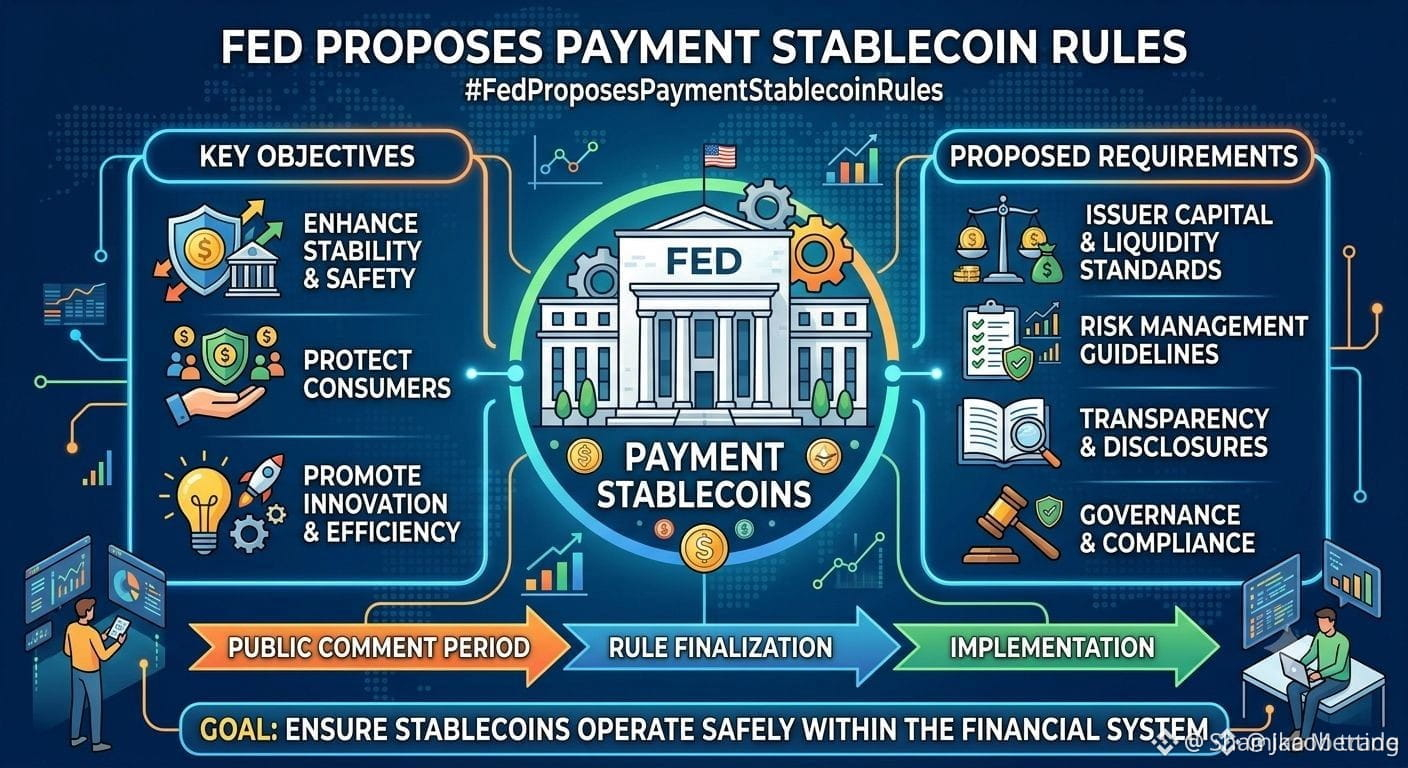
🚨 Important Information: The Federal Reserve proposes requiring 2% capital for issuers of stablecoins! 🇺🇸💵
🏦 The proposed framework would require 2% capital reserve on the first $20 billion of token issuance for covered payment stablecoin issuers.
🚫 No direct yield: It would also prohibit covered payment stablecoin issuers from paying interest or direct yield to token holders.
📋 This proposal is part of the Federal Reserve’s implementation of the GENIUS law and includes additional capital and risk-management requirements.
🌐 Stablecoin regulations are entering a more defined phase in the United States.
👀 Could stricter capital rules reshape the stablecoin market?
Please follow up
#Fed #StablecoinNews #CryptoMarkets
$BTW
{alpha}(560x444045b0ee1ee319a660a5e3d604ca0ffa35acaa)
#FedProposesPaymentStablecoinRules
🚨 Important Information: The Federal Reserve proposes requiring 2% capital for issuers of stablecoins! 🇺🇸💵
🏦 The proposed framework would require 2% capital reserve on the first $20 billion of token issuance for covered payment stablecoin issuers.
🚫 No direct yield: It would also prohibit covered payment stablecoin issuers from paying interest or direct yield to token holders.
📋 This proposal is part of the Federal Reserve’s implementation of the GENIUS law and includes additional capital and risk-management requirements.
🌐 Stablecoin regulations are entering a more defined phase in the United States.
👀 Could stricter capital rules reshape the stablecoin market?
Please follow up
#Fed #StablecoinNews #CryptoMarkets
$BTW
🚨 Important Information: The Federal Reserve proposes requiring 2% capital for issuers of stablecoins! 🇺🇸💵
🏦 The proposed framework would require 2% capital reserve on the first $20 billion of token issuance for covered payment stablecoin issuers.
🚫 No direct yield: It would also prohibit covered payment stablecoin issuers from paying interest or direct yield to token holders.
📋 This proposal is part of the Federal Reserve’s implementation of the GENIUS law and includes additional capital and risk-management requirements.
🌐 Stablecoin regulations are entering a more defined phase in the United States.
👀 Could stricter capital rules reshape the stablecoin market?
Please follow up
#Fed #StablecoinNews #CryptoMarkets
$BTW
2
319
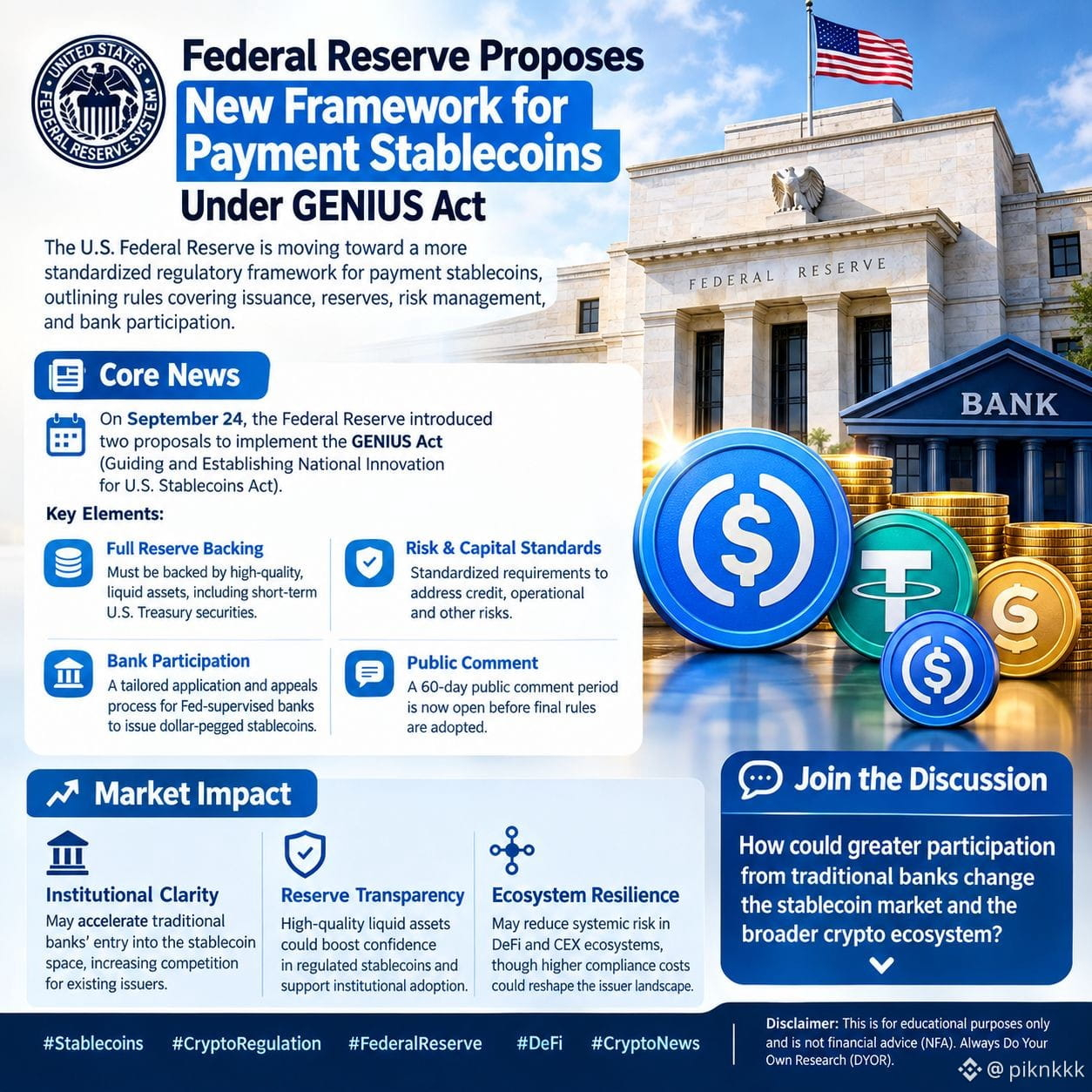
#fedproposespaymentstablecoinrules 🏛️ The U.S. Federal Reserve reveals a new regulatory framework for dollar-backed stablecoins
The regulatory landscape for digital assets is taking a major step forward. The U.S. Federal Reserve has put forward proposals to standardize how payment-related stablecoins are issued and managed.
📰 Key News Summary
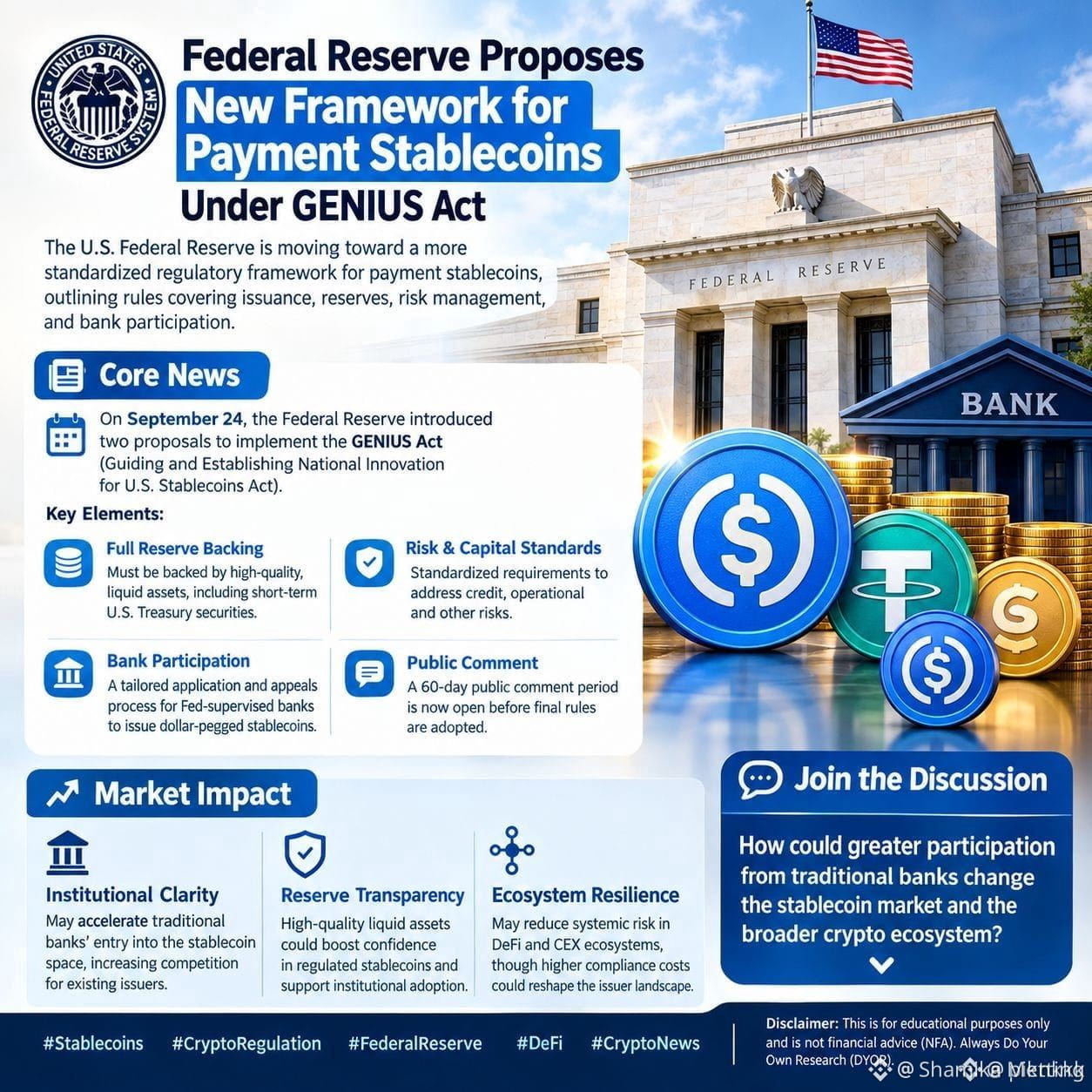
On September 24, the Federal Reserve issued rules to implement the GENIUS Act. Key pillars include:
• Full reserve coverage: Issuers must maintain 1:1 backing for tokens with liquid, high-quality assets such as short-term U.S. Treasury bills.
• Strict capital requirements: Issuers face unified capital requirements and robust risk-management frameworks to mitigate operational risks.
• Banking integration: A dedicated application process is being set up for banks under Federal Reserve oversight to legally issue dollar-linked stablecoins.
• A 60-day public comment period is available now before the final version is adopted.
📊 Market Impact Analysis
• Institutional clarity: Clear pathways will speed up the entry of traditional banks into the stablecoin sector and foster healthy competition.
#Stablecoins #CryptoRegulation #FederalReserve #DeFi #CryptoNews
This content is for educational purposes only. Not financial advice (NFA). Always do your own research (DYOR).
Please follow up
$GRT $SEI $PUMP
#fedproposespaymentstablecoinrules 🏛️ The U.S. Federal Reserve reveals a new regulatory framework for dollar-backed stablecoins
The regulatory landscape for digital assets is taking a major step forward. The U.S. Federal Reserve has put forward proposals to standardize how payment-related stablecoins are issued and managed.
📰 Key News Summary
On September 24, the Federal Reserve issued rules to implement the GENIUS Act. Key pillars include:
• Full reserve coverage: Issuers must maintain 1:1 backing for tokens with liquid, high-quality assets such as short-term U.S. Treasury bills.
• Strict capital requirements: Issuers face unified capital requirements and robust risk-management frameworks to mitigate operational risks.
• Banking integration: A dedicated application process is being set up for banks under Federal Reserve oversight to legally issue dollar-linked stablecoins.
• A 60-day public comment period is available now before the final version is adopted.
📊 Market Impact Analysis
• Institutional clarity: Clear pathways will speed up the entry of traditional banks into the stablecoin sector and foster healthy competition.
#Stablecoins #CryptoRegulation #FederalReserve #DeFi #CryptoNews
This content is for educational purposes only. Not financial advice (NFA). Always do your own research (DYOR).
Please follow up
$GRT $SEI $PUMP
The regulatory landscape for digital assets is taking a major step forward. The U.S. Federal Reserve has put forward proposals to standardize how payment-related stablecoins are issued and managed.
📰 Key News Summary
On September 24, the Federal Reserve issued rules to implement the GENIUS Act. Key pillars include:
• Full reserve coverage: Issuers must maintain 1:1 backing for tokens with liquid, high-quality assets such as short-term U.S. Treasury bills.
• Strict capital requirements: Issuers face unified capital requirements and robust risk-management frameworks to mitigate operational risks.
• Banking integration: A dedicated application process is being set up for banks under Federal Reserve oversight to legally issue dollar-linked stablecoins.
• A 60-day public comment period is available now before the final version is adopted.
📊 Market Impact Analysis
• Institutional clarity: Clear pathways will speed up the entry of traditional banks into the stablecoin sector and foster healthy competition.
#Stablecoins #CryptoRegulation #FederalReserve #DeFi #CryptoNews
This content is for educational purposes only. Not financial advice (NFA). Always do your own research (DYOR).
Please follow up
$GRT $SEI $PUMP
1
3.9k
·
--
#fedproposespaymentstablecoinrules 🚨
FED PROPOSES GENIUS ACT RULES ON STABLECOIN
YIELD!
The Federal Reserve put out draft
rules for payment stablecoin
issuers it supervises.
Tokens would have to stay fully backed by allowed reserves such as short-term Treasuries.
The draft also bans paying yield just for holding the stablecoin, and treats some third-party reward setups as off-limits.
That means you keep a dollar token, the issuer keeps the Treasury interest.
$FARTCOIN $AR $RAVE
#fedproposespaymentstablecoinrules 🚨
FED PROPOSES GENIUS ACT RULES ON STABLECOIN
YIELD!
The Federal Reserve put out draft
rules for payment stablecoin
issuers it supervises.
Tokens would have to stay fully backed by allowed reserves such as short-term Treasuries.
The draft also bans paying yield just for holding the stablecoin, and treats some third-party reward setups as off-limits.
That means you keep a dollar token, the issuer keeps the Treasury interest.
$FARTCOIN $AR $RAVE
FED PROPOSES GENIUS ACT RULES ON STABLECOIN
YIELD!
The Federal Reserve put out draft
rules for payment stablecoin
issuers it supervises.
Tokens would have to stay fully backed by allowed reserves such as short-term Treasuries.
The draft also bans paying yield just for holding the stablecoin, and treats some third-party reward setups as off-limits.
That means you keep a dollar token, the issuer keeps the Treasury interest.
$FARTCOIN $AR $RAVE
1
1.1k

·
--
Bullish
$WLD
{spot}(WLDUSDT)
Stablecoin Rules Will Impact Long-Term Structure Far More Than Meme Coin Bans
Banning politicians from issuing tokens is merely political theatre; the Federal Reserve laying down reserve requirements and capital buffers is actually rewriting the plumbing
The dollar-backed stablecoins that manage to survive will need to behave increasingly like money market funds
$MELANIA
{future}(MELANIAUSDT)
Yields will thin out, and running off with the funds will become far more difficult. For any yield-bearing stablecoins you're holding right now, it's time to ask: is that yield coming from short-dated treasuries, or is it just high-risk strategies wrapped up in a tidy package? The slicker the wrapper, the steeper the drop when liquidity gets pulled
$TRUMP
{spot}(TRUMPUSDT)
#FedProposesPaymentStablecoinRules
$WLD
Stablecoin Rules Will Impact Long-Term Structure Far More Than Meme Coin Bans
Banning politicians from issuing tokens is merely political theatre; the Federal Reserve laying down reserve requirements and capital buffers is actually rewriting the plumbing
The dollar-backed stablecoins that manage to survive will need to behave increasingly like money market funds
$MELANIA
Yields will thin out, and running off with the funds will become far more difficult. For any yield-bearing stablecoins you're holding right now, it's time to ask: is that yield coming from short-dated treasuries, or is it just high-risk strategies wrapped up in a tidy package? The slicker the wrapper, the steeper the drop when liquidity gets pulled
$TRUMP
#FedProposesPaymentStablecoinRules
Stablecoin Rules Will Impact Long-Term Structure Far More Than Meme Coin Bans
Banning politicians from issuing tokens is merely political theatre; the Federal Reserve laying down reserve requirements and capital buffers is actually rewriting the plumbing
The dollar-backed stablecoins that manage to survive will need to behave increasingly like money market funds
$MELANIA
Yields will thin out, and running off with the funds will become far more difficult. For any yield-bearing stablecoins you're holding right now, it's time to ask: is that yield coming from short-dated treasuries, or is it just high-risk strategies wrapped up in a tidy package? The slicker the wrapper, the steeper the drop when liquidity gets pulled
$TRUMP
#FedProposesPaymentStablecoinRules

2.2k

·
--
🚨 THE FED ISN’T JUST REGULATING STABLECOINS — IT’S TRYING TO PREVENT THE NEXT DIGITAL BANK RUN.
The Fed’s new GENIUS Act proposals would force supervised stablecoin issuers to hold fully backed, highly liquid reserves, meet standardized capital requirements, and maintain systems that can support reliable redemptions even during market stress.
That’s the underrated part.
The real risk in stablecoins was never just whether $1 = $1 on a normal day.
It’s whether everyone can get their dollar back at the same time when markets panic.
Fed Governor Michael Barr explicitly highlighted that stablecoins need to remain redeemable at par even during periods of stress, when both issuers and reserve assets can come under pressure.
So this framework is effectively trying to turn stablecoins from:
“crypto cash” → regulated digital cash infrastructure.
If finalized, the biggest advantage may go to issuers that can already handle liquidity, custody, reserves and compliance at institutional scale.
That’s why this may matter more for $CRCL than for the stablecoin tokens themselves.
The next stablecoin race may not be about who grows fastest.
It may be about who survives a run. 👀
{stock_us}(COIN.US)
{stock_us}(CRCL.US)
{spot}(USDCUSDT)
$CRCL.US $COIN.US $USDC #BTCFallsBelow$83000 #FedProposesPaymentStablecoinRules #ChinaMayLetAlibabaByteDanceBuyNvidiaChips #USChinaRelease$30BTariffCutProductLists #SKoreaFSCConsidersVirtualAssetMarketMaker
🚨 THE FED ISN’T JUST REGULATING STABLECOINS — IT’S TRYING TO PREVENT THE NEXT DIGITAL BANK RUN.
The Fed’s new GENIUS Act proposals would force supervised stablecoin issuers to hold fully backed, highly liquid reserves, meet standardized capital requirements, and maintain systems that can support reliable redemptions even during market stress.
That’s the underrated part.
The real risk in stablecoins was never just whether $1 = $1 on a normal day.
It’s whether everyone can get their dollar back at the same time when markets panic.
Fed Governor Michael Barr explicitly highlighted that stablecoins need to remain redeemable at par even during periods of stress, when both issuers and reserve assets can come under pressure.
So this framework is effectively trying to turn stablecoins from:
“crypto cash” → regulated digital cash infrastructure.
If finalized, the biggest advantage may go to issuers that can already handle liquidity, custody, reserves and compliance at institutional scale.
That’s why this may matter more for $CRCL than for the stablecoin tokens themselves.
The next stablecoin race may not be about who grows fastest.
It may be about who survives a run. 👀
$CRCL.US $COIN.US $USDC #BTCFallsBelow$83000 #FedProposesPaymentStablecoinRules #ChinaMayLetAlibabaByteDanceBuyNvidiaChips #USChinaRelease$30BTariffCutProductLists #SKoreaFSCConsidersVirtualAssetMarketMaker
The Fed’s new GENIUS Act proposals would force supervised stablecoin issuers to hold fully backed, highly liquid reserves, meet standardized capital requirements, and maintain systems that can support reliable redemptions even during market stress.
That’s the underrated part.
The real risk in stablecoins was never just whether $1 = $1 on a normal day.
It’s whether everyone can get their dollar back at the same time when markets panic.
Fed Governor Michael Barr explicitly highlighted that stablecoins need to remain redeemable at par even during periods of stress, when both issuers and reserve assets can come under pressure.
So this framework is effectively trying to turn stablecoins from:
“crypto cash” → regulated digital cash infrastructure.
If finalized, the biggest advantage may go to issuers that can already handle liquidity, custody, reserves and compliance at institutional scale.
That’s why this may matter more for $CRCL than for the stablecoin tokens themselves.
The next stablecoin race may not be about who grows fastest.
It may be about who survives a run. 👀
$CRCL.US $COIN.US $USDC #BTCFallsBelow$83000 #FedProposesPaymentStablecoinRules #ChinaMayLetAlibabaByteDanceBuyNvidiaChips #USChinaRelease$30BTariffCutProductLists #SKoreaFSCConsidersVirtualAssetMarketMaker

1.7k

·
--
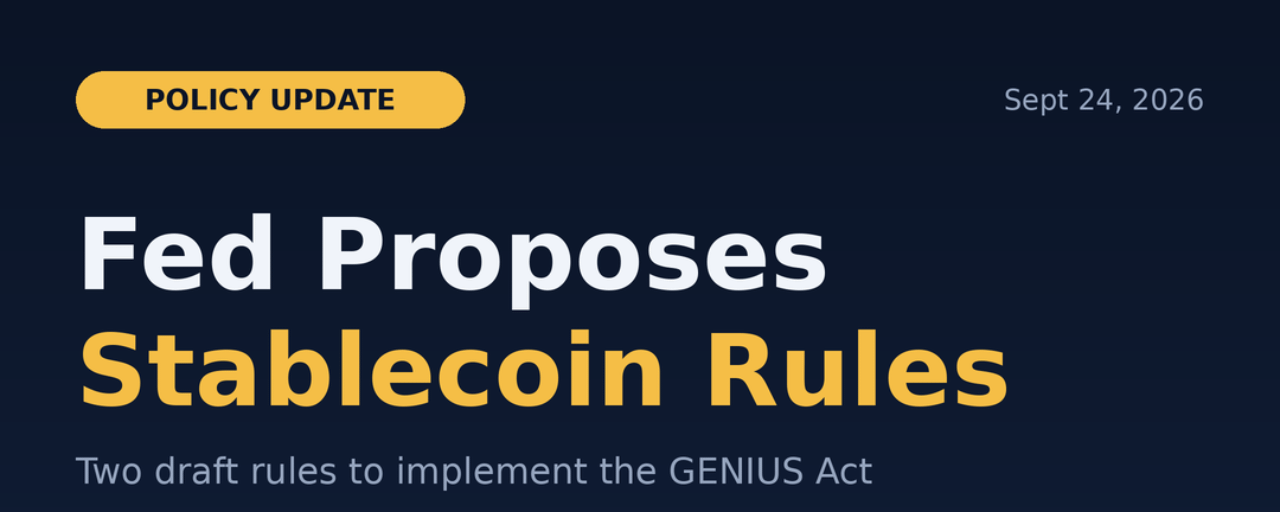
Article
The Federal Reserve Board proposed two draft rules#fedproposespaymentstablecoinrules
The Federal Reserve Board proposed two draft rules on September 24, 2026 to implement its part of the GENIUS Act, the federal stable coin law signed in July 2025. Public comment is open for 60 days after the proposals are published in the Federal Register.
Who it covers
The Fed proposed a rule setting requirements for authorized stable coin issuers under its purview, including state member banks and other state-chartered issuers. Under the act, the Fed oversees stable coin issuers that are subsidiaries of state member banks. It also oversees state-chartered institutions without federal deposit insurance that have $10 billion or more of stable coins.
Proposal 1: reserves, capital and risk management
Full backing: Every $1 of stable coins would need at least $1 of permissible reserve assets behind it. Reserves could include U.S. dollars, Fed balances, certain bank deposits, Treasuries with 93 days or less to maturity, qualifying repos, and eligible investment funds.Redemption: Issuers must fulfill redemption requests within two business days. If backing falls below 1:1, they must immediately notify the Fed. Capital: Standardized capital requirements would address credit and operational risks, alongside risk-management standards. An issuer that stays short of required capital long enough could be forced to liquidate all reserves and redeem every coin. Custody: The proposal adds rules for Fed-supervised firms that safekeep the assets backing stable coins. It also clarifies which stable coin activities are permissible for Fed-supervised banks.
Proposal 2: bank applications
Fed-supervised banks that want to issue stable coins would follow a tailored application process rather than the standard one. Applicants would submit a business plan and financial information. The draft also sets up a process for appeals, hearings and final determinations. The GENIUS Act gives the Fed 120 days to decide complete applications.
Reaction and context
Fed Governor Michael Barr called the proposal an important step but said more work is needed. He said stable coins "will only be stable if they can be reliably and promptly redeemed at par" in a range of conditions, including market stressThe OCC and NCUA proposed their rules in February, the FDIC in April, and Treasury in August. No agency has finalized rules yet. The agencies also missed the statutory July 18 implementation deadline.The OCC's chief has said its final rule will come out by November.
These are proposals, so details could change after comments. Only banks and issuers under the Fed's supervision are covered, so issuers regulated by the OCC, FDIC or states would follow their own rules.
The Federal Reserve Board proposed two draft rules
#fedproposespaymentstablecoinrules
The Federal Reserve Board proposed two draft rules on September 24, 2026 to implement its part of the GENIUS Act, the federal stable coin law signed in July 2025. Public comment is open for 60 days after the proposals are published in the Federal Register.
Who it covers
The Fed proposed a rule setting requirements for authorized stable coin issuers under its purview, including state member banks and other state-chartered issuers. Under the act, the Fed oversees stable coin issuers that are subsidiaries of state member banks. It also oversees state-chartered institutions without federal deposit insurance that have $10 billion or more of stable coins.
Proposal 1: reserves, capital and risk management
Full backing: Every $1 of stable coins would need at least $1 of permissible reserve assets behind it. Reserves could include U.S. dollars, Fed balances, certain bank deposits, Treasuries with 93 days or less to maturity, qualifying repos, and eligible investment funds.Redemption: Issuers must fulfill redemption requests within two business days. If backing falls below 1:1, they must immediately notify the Fed. Capital: Standardized capital requirements would address credit and operational risks, alongside risk-management standards. An issuer that stays short of required capital long enough could be forced to liquidate all reserves and redeem every coin. Custody: The proposal adds rules for Fed-supervised firms that safekeep the assets backing stable coins. It also clarifies which stable coin activities are permissible for Fed-supervised banks.
Proposal 2: bank applications
Fed-supervised banks that want to issue stable coins would follow a tailored application process rather than the standard one. Applicants would submit a business plan and financial information. The draft also sets up a process for appeals, hearings and final determinations. The GENIUS Act gives the Fed 120 days to decide complete applications.
Reaction and context
Fed Governor Michael Barr called the proposal an important step but said more work is needed. He said stable coins "will only be stable if they can be reliably and promptly redeemed at par" in a range of conditions, including market stressThe OCC and NCUA proposed their rules in February, the FDIC in April, and Treasury in August. No agency has finalized rules yet. The agencies also missed the statutory July 18 implementation deadline.The OCC's chief has said its final rule will come out by November.
These are proposals, so details could change after comments. Only banks and issuers under the Fed's supervision are covered, so issuers regulated by the OCC, FDIC or states would follow their own rules.
The Federal Reserve Board proposed two draft rules on September 24, 2026 to implement its part of the GENIUS Act, the federal stable coin law signed in July 2025. Public comment is open for 60 days after the proposals are published in the Federal Register.
Who it covers
The Fed proposed a rule setting requirements for authorized stable coin issuers under its purview, including state member banks and other state-chartered issuers. Under the act, the Fed oversees stable coin issuers that are subsidiaries of state member banks. It also oversees state-chartered institutions without federal deposit insurance that have $10 billion or more of stable coins.
Proposal 1: reserves, capital and risk management
Full backing: Every $1 of stable coins would need at least $1 of permissible reserve assets behind it. Reserves could include U.S. dollars, Fed balances, certain bank deposits, Treasuries with 93 days or less to maturity, qualifying repos, and eligible investment funds.Redemption: Issuers must fulfill redemption requests within two business days. If backing falls below 1:1, they must immediately notify the Fed. Capital: Standardized capital requirements would address credit and operational risks, alongside risk-management standards. An issuer that stays short of required capital long enough could be forced to liquidate all reserves and redeem every coin. Custody: The proposal adds rules for Fed-supervised firms that safekeep the assets backing stable coins. It also clarifies which stable coin activities are permissible for Fed-supervised banks.
Proposal 2: bank applications
Fed-supervised banks that want to issue stable coins would follow a tailored application process rather than the standard one. Applicants would submit a business plan and financial information. The draft also sets up a process for appeals, hearings and final determinations. The GENIUS Act gives the Fed 120 days to decide complete applications.
Reaction and context
Fed Governor Michael Barr called the proposal an important step but said more work is needed. He said stable coins "will only be stable if they can be reliably and promptly redeemed at par" in a range of conditions, including market stressThe OCC and NCUA proposed their rules in February, the FDIC in April, and Treasury in August. No agency has finalized rules yet. The agencies also missed the statutory July 18 implementation deadline.The OCC's chief has said its final rule will come out by November.
These are proposals, so details could change after comments. Only banks and issuers under the Fed's supervision are covered, so issuers regulated by the OCC, FDIC or states would follow their own rules.
144

·
--
#FedProposesPaymentStablecoinRules
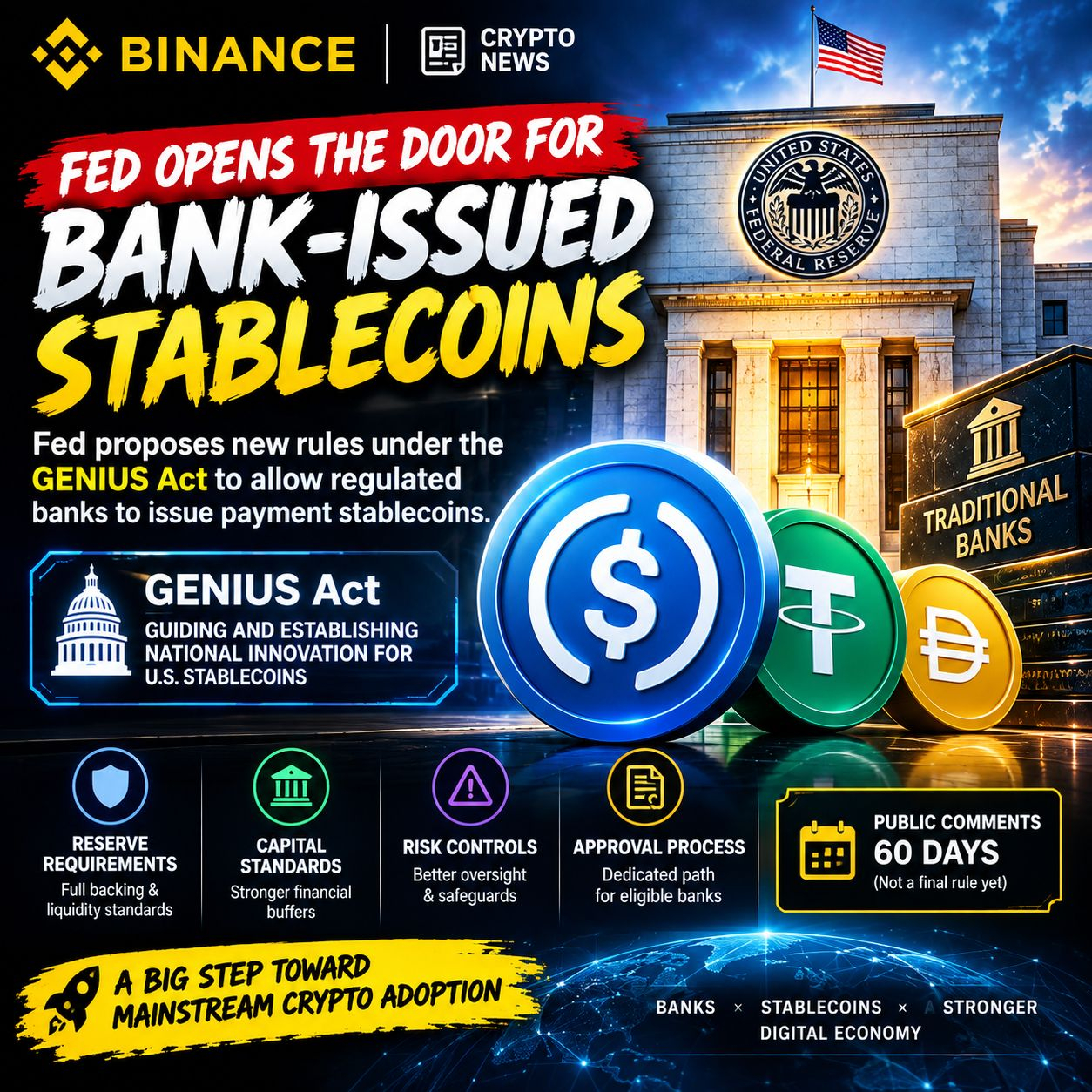
🚨 FED OPENS THE DOOR FOR BANK-ISSUED STABLECOINS
The Federal Reserve has proposed new rules under the GENIUS Act that would allow Fed-supervised banks to apply to issue payment stablecoins.
The proposal includes reserve requirements, capital standards, risk controls, and a dedicated approval process for banks entering the stablecoin market.
This could mark another major step toward bringing traditional banking deeper into the digital-asset ecosystem. 🏦💵
#Stablecoins #Crypto #Bitcoin #Ethereum #GENIUSAct #FederalReserve #Blockchain #CryptoNews
#FedProposesPaymentStablecoinRules
🚨 FED OPENS THE DOOR FOR BANK-ISSUED STABLECOINS
The Federal Reserve has proposed new rules under the GENIUS Act that would allow Fed-supervised banks to apply to issue payment stablecoins.
The proposal includes reserve requirements, capital standards, risk controls, and a dedicated approval process for banks entering the stablecoin market.
This could mark another major step toward bringing traditional banking deeper into the digital-asset ecosystem. 🏦💵
#Stablecoins #Crypto #Bitcoin #Ethereum #GENIUSAct #FederalReserve #Blockchain #CryptoNews
🚨 FED OPENS THE DOOR FOR BANK-ISSUED STABLECOINS
The Federal Reserve has proposed new rules under the GENIUS Act that would allow Fed-supervised banks to apply to issue payment stablecoins.
The proposal includes reserve requirements, capital standards, risk controls, and a dedicated approval process for banks entering the stablecoin market.
This could mark another major step toward bringing traditional banking deeper into the digital-asset ecosystem. 🏦💵
#Stablecoins #Crypto #Bitcoin #Ethereum #GENIUSAct #FederalReserve #Blockchain #CryptoNews
50
·
--
#FedProposesPaymentStablecoinRules
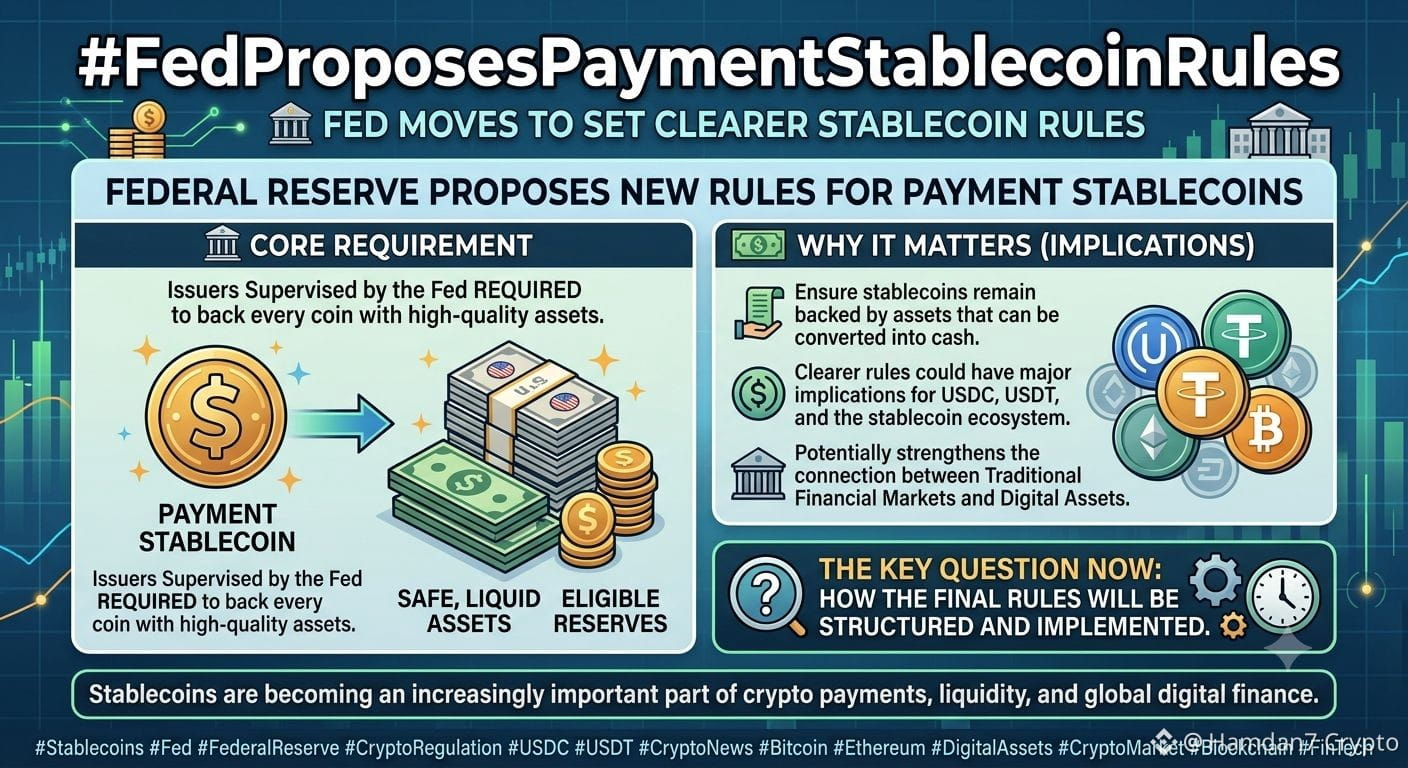
🏦 FED MOVES TO SET CLEARER STABLECOIN RULES
The U.S. Federal Reserve has proposed new rules for payment stablecoins, marking another major step toward establishing a clearer regulatory framework for the rapidly growing stablecoin market.
Under the proposal, stablecoin issuers supervised by the Fed would be required to back every coin with high-quality, safe and liquid assets, including U.S. Treasury bills and other eligible reserves.
💵 Why it matters:
Strong reserve requirements are designed to ensure that stablecoins remain backed by assets that can be converted into cash when needed.
For the crypto market, clearer rules could have major implications for USDC, USDT and the broader stablecoin ecosystem, while potentially strengthening the connection between traditional financial markets and digital assets.
🔎 The key question now is how the final rules will be structured and implemented.
Stablecoins are becoming an increasingly important part of crypto payments, liquidity and global digital finance.
#Stablecoins #Fed #FederalReserve #CryptoRegulation #USDC #USDT #CryptoNews #Bitcoin #Ethereum #DigitalAssets #CryptoMarket #Blockchain #FinTech
#FedProposesPaymentStablecoinRules
🏦 FED MOVES TO SET CLEARER STABLECOIN RULES
The U.S. Federal Reserve has proposed new rules for payment stablecoins, marking another major step toward establishing a clearer regulatory framework for the rapidly growing stablecoin market.
Under the proposal, stablecoin issuers supervised by the Fed would be required to back every coin with high-quality, safe and liquid assets, including U.S. Treasury bills and other eligible reserves.
💵 Why it matters:
Strong reserve requirements are designed to ensure that stablecoins remain backed by assets that can be converted into cash when needed.
For the crypto market, clearer rules could have major implications for USDC, USDT and the broader stablecoin ecosystem, while potentially strengthening the connection between traditional financial markets and digital assets.
🔎 The key question now is how the final rules will be structured and implemented.
Stablecoins are becoming an increasingly important part of crypto payments, liquidity and global digital finance.
#Stablecoins #Fed #FederalReserve #CryptoRegulation #USDC #USDT #CryptoNews #Bitcoin #Ethereum #DigitalAssets #CryptoMarket #Blockchain #FinTech
🏦 FED MOVES TO SET CLEARER STABLECOIN RULES
The U.S. Federal Reserve has proposed new rules for payment stablecoins, marking another major step toward establishing a clearer regulatory framework for the rapidly growing stablecoin market.
Under the proposal, stablecoin issuers supervised by the Fed would be required to back every coin with high-quality, safe and liquid assets, including U.S. Treasury bills and other eligible reserves.
💵 Why it matters:
Strong reserve requirements are designed to ensure that stablecoins remain backed by assets that can be converted into cash when needed.
For the crypto market, clearer rules could have major implications for USDC, USDT and the broader stablecoin ecosystem, while potentially strengthening the connection between traditional financial markets and digital assets.
🔎 The key question now is how the final rules will be structured and implemented.
Stablecoins are becoming an increasingly important part of crypto payments, liquidity and global digital finance.
#Stablecoins #Fed #FederalReserve #CryptoRegulation #USDC #USDT #CryptoNews #Bitcoin #Ethereum #DigitalAssets #CryptoMarket #Blockchain #FinTech
34

·
--
Bullish
#fedproposespaymentstablecoinrules
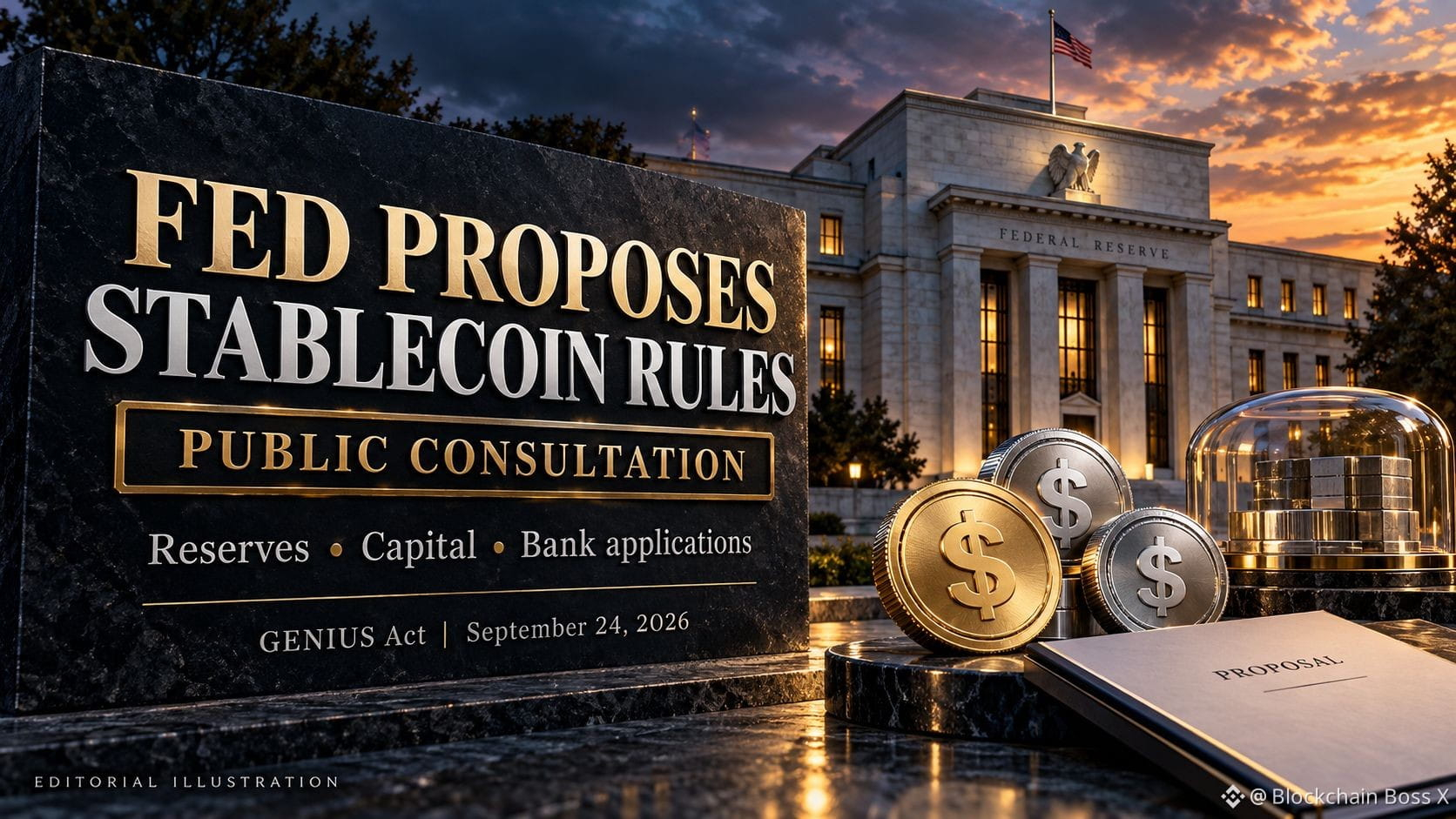
Fed Proposes Payment Stablecoin Rules: What Would Change for Issuers?
Stablecoin adoption depends partly on confidence in the assets and systems behind each token.
On September 24, 2026, the Federal Reserve requested public feedback on two proposals under the GENIUS Act, addressing payment stablecoin issuers under its supervision and related banking activities.
The first would require full backing with eligible reserve assets, including short-term Treasury bills. It also addresses capital requirements, risk management and the safekeeping of assets backing stablecoins.
The second would establish an application process for Fed-supervised banks seeking approval for stablecoin issuance, requiring business plans, financial information and supporting documents.
These remain proposals. The comment period closes 60 days after publication in the Federal Register, and the final requirements may change.
My take: Clearer reserve and operating requirements could help banks and businesses assess stablecoin issuers more consistently. Compliance also costs money, so the final design could influence which firms can compete and how services are priced.
For users, the practical questions remain straightforward: how accessible is redemption, who safeguards the reserves, and how reliably do operations function during stress?
I would watch whether the final framework combines stronger protections with workable entry requirements. That balance could shape competition and the usefulness of payment stablecoins.
Which matters most to you: reserve transparency, reliable redemption or greater issuer competition?
#FedProposesPaymentStablecoinRules #Stablecoins #GENIUSAct
$QNT $BTW $ONE
{future}(ONEUSDT)
{future}(BTWUSDT)
{future}(QNTUSDT)
#fedproposespaymentstablecoinrules
Fed Proposes Payment Stablecoin Rules: What Would Change for Issuers?
Stablecoin adoption depends partly on confidence in the assets and systems behind each token.
On September 24, 2026, the Federal Reserve requested public feedback on two proposals under the GENIUS Act, addressing payment stablecoin issuers under its supervision and related banking activities.
The first would require full backing with eligible reserve assets, including short-term Treasury bills. It also addresses capital requirements, risk management and the safekeeping of assets backing stablecoins.
The second would establish an application process for Fed-supervised banks seeking approval for stablecoin issuance, requiring business plans, financial information and supporting documents.
These remain proposals. The comment period closes 60 days after publication in the Federal Register, and the final requirements may change.
My take: Clearer reserve and operating requirements could help banks and businesses assess stablecoin issuers more consistently. Compliance also costs money, so the final design could influence which firms can compete and how services are priced.
For users, the practical questions remain straightforward: how accessible is redemption, who safeguards the reserves, and how reliably do operations function during stress?
I would watch whether the final framework combines stronger protections with workable entry requirements. That balance could shape competition and the usefulness of payment stablecoins.
Which matters most to you: reserve transparency, reliable redemption or greater issuer competition?
#FedProposesPaymentStablecoinRules #Stablecoins #GENIUSAct
$QNT $BTW $ONE
Fed Proposes Payment Stablecoin Rules: What Would Change for Issuers?
Stablecoin adoption depends partly on confidence in the assets and systems behind each token.
On September 24, 2026, the Federal Reserve requested public feedback on two proposals under the GENIUS Act, addressing payment stablecoin issuers under its supervision and related banking activities.
The first would require full backing with eligible reserve assets, including short-term Treasury bills. It also addresses capital requirements, risk management and the safekeeping of assets backing stablecoins.
The second would establish an application process for Fed-supervised banks seeking approval for stablecoin issuance, requiring business plans, financial information and supporting documents.
These remain proposals. The comment period closes 60 days after publication in the Federal Register, and the final requirements may change.
My take: Clearer reserve and operating requirements could help banks and businesses assess stablecoin issuers more consistently. Compliance also costs money, so the final design could influence which firms can compete and how services are priced.
For users, the practical questions remain straightforward: how accessible is redemption, who safeguards the reserves, and how reliably do operations function during stress?
I would watch whether the final framework combines stronger protections with workable entry requirements. That balance could shape competition and the usefulness of payment stablecoins.
Which matters most to you: reserve transparency, reliable redemption or greater issuer competition?
#FedProposesPaymentStablecoinRules #Stablecoins #GENIUSAct
$QNT $BTW $ONE
2
1.9k

·
--
Bullish
#fedproposespaymentstablecoinrules 🏛️ Fed Unveils New Regulatory Framework for Payment Stablecoins
The regulatory landscape for digital assets is taking a major step forward. The U.S. Federal Reserve has introduced proposals to standardize how payment stablecoins are issued and managed.
📰 Core News Breakdown
On Sept 24, the Fed released rules to implement the GENIUS Act. Key pillars include:
• Full Reserve Backing: Issuers must maintain 1:1 backing of tokens with high-quality, liquid assets like short-term U.S. Treasury bills.
• Strict Capital Standards: Issuers face standardized capital requirements and robust risk-management frameworks to mitigate operational risks.
• Bank Integration: A tailored application process is established for Fed-supervised banks to legally issue dollar-pegged stablecoins.
• A 60-day public comment period is now open before finalization.
📊 Market Impact Analysis
• Institutional Clarity: Clear pathways will accelerate traditional bank entry into the stablecoin sector, fostering healthy competition.
• Enhanced Trust: Mandating high-quality liquid assets strengthens the safety of regulated stablecoins, boosting institutional confidence.
• Ecosystem Resilience: Standardized frameworks reduce systemic risk in DeFi and CEX ecosystems, though compliance costs may reshape issuers.
💬 Join the Discussion
How will traditional banks entering the stablecoin space impact current market leaders and the broader DeFi ecosystem? Share your insights below! 👇
#Stablecoins #CryptoRegulation #FederalReserve #DeFi #CryptoNews
This content is for educational purposes only. Not Financial Advice (NFA). Always Do Your Own Research (DYOR).
$GRT $SEI $PUMP
{future}(PUMPUSDT)
{future}(SEIUSDT)
{future}(GRTUSDT)
#fedproposespaymentstablecoinrules 🏛️ Fed Unveils New Regulatory Framework for Payment Stablecoins
The regulatory landscape for digital assets is taking a major step forward. The U.S. Federal Reserve has introduced proposals to standardize how payment stablecoins are issued and managed.
📰 Core News Breakdown
On Sept 24, the Fed released rules to implement the GENIUS Act. Key pillars include:
• Full Reserve Backing: Issuers must maintain 1:1 backing of tokens with high-quality, liquid assets like short-term U.S. Treasury bills.
• Strict Capital Standards: Issuers face standardized capital requirements and robust risk-management frameworks to mitigate operational risks.
• Bank Integration: A tailored application process is established for Fed-supervised banks to legally issue dollar-pegged stablecoins.
• A 60-day public comment period is now open before finalization.
📊 Market Impact Analysis
• Institutional Clarity: Clear pathways will accelerate traditional bank entry into the stablecoin sector, fostering healthy competition.
• Enhanced Trust: Mandating high-quality liquid assets strengthens the safety of regulated stablecoins, boosting institutional confidence.
• Ecosystem Resilience: Standardized frameworks reduce systemic risk in DeFi and CEX ecosystems, though compliance costs may reshape issuers.
💬 Join the Discussion
How will traditional banks entering the stablecoin space impact current market leaders and the broader DeFi ecosystem? Share your insights below! 👇
#Stablecoins #CryptoRegulation #FederalReserve #DeFi #CryptoNews
This content is for educational purposes only. Not Financial Advice (NFA). Always Do Your Own Research (DYOR).
$GRT $SEI $PUMP
The regulatory landscape for digital assets is taking a major step forward. The U.S. Federal Reserve has introduced proposals to standardize how payment stablecoins are issued and managed.
📰 Core News Breakdown
On Sept 24, the Fed released rules to implement the GENIUS Act. Key pillars include:
• Full Reserve Backing: Issuers must maintain 1:1 backing of tokens with high-quality, liquid assets like short-term U.S. Treasury bills.
• Strict Capital Standards: Issuers face standardized capital requirements and robust risk-management frameworks to mitigate operational risks.
• Bank Integration: A tailored application process is established for Fed-supervised banks to legally issue dollar-pegged stablecoins.
• A 60-day public comment period is now open before finalization.
📊 Market Impact Analysis
• Institutional Clarity: Clear pathways will accelerate traditional bank entry into the stablecoin sector, fostering healthy competition.
• Enhanced Trust: Mandating high-quality liquid assets strengthens the safety of regulated stablecoins, boosting institutional confidence.
• Ecosystem Resilience: Standardized frameworks reduce systemic risk in DeFi and CEX ecosystems, though compliance costs may reshape issuers.
💬 Join the Discussion
How will traditional banks entering the stablecoin space impact current market leaders and the broader DeFi ecosystem? Share your insights below! 👇
#Stablecoins #CryptoRegulation #FederalReserve #DeFi #CryptoNews
This content is for educational purposes only. Not Financial Advice (NFA). Always Do Your Own Research (DYOR).
$GRT $SEI $PUMP
1
593

Stablecoins are the most used product in crypto and the least understood.
What they are: digital dollars. 1 USDT or 1 USDC is meant to equal 1 US dollar, backed by cash and short term treasuries held by the issuer.
Why they matter: Chainalysis says stablecoins now make up 96% of person to person crypto transfers within countries. Cross border stablecoin payments grew 77% in a year. This is real money movement, not speculation.
What changed this month: the Fed proposed rules for payment stablecoins. Regulation sounds boring, but it is exactly what lets banks and businesses use these rails at scale.
Risk to remember: a stablecoin is only as good as its reserves. Stick to the large, audited ones. A 20% yield offer on a "stablecoin" is the oldest trap in the book.
Do you use stablecoins for savings, trading, or payments?
#FedProposesPaymentStablecoinRules #Stablecoins #CryptoEducation $USDC $BTC
Stablecoins are the most used product in crypto and the least understood.
What they are: digital dollars. 1 USDT or 1 USDC is meant to equal 1 US dollar, backed by cash and short term treasuries held by the issuer.
Why they matter: Chainalysis says stablecoins now make up 96% of person to person crypto transfers within countries. Cross border stablecoin payments grew 77% in a year. This is real money movement, not speculation.
What changed this month: the Fed proposed rules for payment stablecoins. Regulation sounds boring, but it is exactly what lets banks and businesses use these rails at scale.
Risk to remember: a stablecoin is only as good as its reserves. Stick to the large, audited ones. A 20% yield offer on a "stablecoin" is the oldest trap in the book.
Do you use stablecoins for savings, trading, or payments?
#FedProposesPaymentStablecoinRules #Stablecoins #CryptoEducation $USDC $BTC
What they are: digital dollars. 1 USDT or 1 USDC is meant to equal 1 US dollar, backed by cash and short term treasuries held by the issuer.
Why they matter: Chainalysis says stablecoins now make up 96% of person to person crypto transfers within countries. Cross border stablecoin payments grew 77% in a year. This is real money movement, not speculation.
What changed this month: the Fed proposed rules for payment stablecoins. Regulation sounds boring, but it is exactly what lets banks and businesses use these rails at scale.
Risk to remember: a stablecoin is only as good as its reserves. Stick to the large, audited ones. A 20% yield offer on a "stablecoin" is the oldest trap in the book.
Do you use stablecoins for savings, trading, or payments?
#FedProposesPaymentStablecoinRules #Stablecoins #CryptoEducation $USDC $BTC
1
2
479

#FedProposesPaymentStablecoinRules
🚨 THE FED & SEC ARE QUIETLY BUILDING THE CRYPTO RULEBOOK! 🇺🇸💵The U.S. regulatory landscape just shifted dramatically, pulling digital assets deeper into the traditional financial system rather than pushing them out. If you are trading or holding right now, these two parallel moves change the macro landscape entirely.🏛️ 1. The Fed's Strict Payment Stablecoin FrameworkUnder the GENIUS Act, the Federal Reserve proposed twin packages establishing comprehensive reserve, operational, and capital requirements:100% High-Quality Reserves: Tokens must be backed 1:1 by liquid assets like short-term U.S. Treasuries (93 days or less maturity).The 2% Capital Buffer: Issuers face a mandatory 2% capital requirement on the first $20 billion of token issuance to address operational and credit risks.Strict Yield Prohibition: Issuers are completely prohibited from paying interest or yield directly to token holders.Redemption Rules: Fulfilling cash/deposit redemptions must happen within two business days.⚖️ 2. The SEC & Coreen's Regulatory TakeSEC staff clarified that activities like token buybacks and active network development do not automatically trigger securities contracts on functional networks, offering builders more breathing room. Meanwhile, incorporating Coreen's market perspective highlights that these evolving frameworks demand tighter risk management across both decentralized and centralized portfolios.📊 Token Impact Analysis: What This Means For Your Bags$USDC & Stablecoins: Margin compression will favor fully compliant, bank-backed entities.$ETH & Layer 1s: Regulatory clarity serves as a long-term institutional catalyst as ETH eyes levels toward $3,050–$3,450.$SOL : Watching support at $113–$118 amid whale exchange transfers and ETF inflows.💡 The Macro Loop: The Real Winner?Integration over deregulation means stablecoins drive Treasury demand, cementing the digital dollar's reach.What is your take? Let me know below! 👇#FedProposesPaymentStablecoinRules #CryptoRegulation #Ethereum #Solana
#FedProposesPaymentStablecoinRules
🚨 THE FED & SEC ARE QUIETLY BUILDING THE CRYPTO RULEBOOK! 🇺🇸💵The U.S. regulatory landscape just shifted dramatically, pulling digital assets deeper into the traditional financial system rather than pushing them out. If you are trading or holding right now, these two parallel moves change the macro landscape entirely.🏛️ 1. The Fed's Strict Payment Stablecoin FrameworkUnder the GENIUS Act, the Federal Reserve proposed twin packages establishing comprehensive reserve, operational, and capital requirements:100% High-Quality Reserves: Tokens must be backed 1:1 by liquid assets like short-term U.S. Treasuries (93 days or less maturity).The 2% Capital Buffer: Issuers face a mandatory 2% capital requirement on the first $20 billion of token issuance to address operational and credit risks.Strict Yield Prohibition: Issuers are completely prohibited from paying interest or yield directly to token holders.Redemption Rules: Fulfilling cash/deposit redemptions must happen within two business days.⚖️ 2. The SEC & Coreen's Regulatory TakeSEC staff clarified that activities like token buybacks and active network development do not automatically trigger securities contracts on functional networks, offering builders more breathing room. Meanwhile, incorporating Coreen's market perspective highlights that these evolving frameworks demand tighter risk management across both decentralized and centralized portfolios.📊 Token Impact Analysis: What This Means For Your Bags$USDC & Stablecoins: Margin compression will favor fully compliant, bank-backed entities.$ETH & Layer 1s: Regulatory clarity serves as a long-term institutional catalyst as ETH eyes levels toward $3,050–$3,450.$SOL : Watching support at $113–$118 amid whale exchange transfers and ETF inflows.💡 The Macro Loop: The Real Winner?Integration over deregulation means stablecoins drive Treasury demand, cementing the digital dollar's reach.What is your take? Let me know below! 👇#FedProposesPaymentStablecoinRules #CryptoRegulation #Ethereum #Solana
🚨 THE FED & SEC ARE QUIETLY BUILDING THE CRYPTO RULEBOOK! 🇺🇸💵The U.S. regulatory landscape just shifted dramatically, pulling digital assets deeper into the traditional financial system rather than pushing them out. If you are trading or holding right now, these two parallel moves change the macro landscape entirely.🏛️ 1. The Fed's Strict Payment Stablecoin FrameworkUnder the GENIUS Act, the Federal Reserve proposed twin packages establishing comprehensive reserve, operational, and capital requirements:100% High-Quality Reserves: Tokens must be backed 1:1 by liquid assets like short-term U.S. Treasuries (93 days or less maturity).The 2% Capital Buffer: Issuers face a mandatory 2% capital requirement on the first $20 billion of token issuance to address operational and credit risks.Strict Yield Prohibition: Issuers are completely prohibited from paying interest or yield directly to token holders.Redemption Rules: Fulfilling cash/deposit redemptions must happen within two business days.⚖️ 2. The SEC & Coreen's Regulatory TakeSEC staff clarified that activities like token buybacks and active network development do not automatically trigger securities contracts on functional networks, offering builders more breathing room. Meanwhile, incorporating Coreen's market perspective highlights that these evolving frameworks demand tighter risk management across both decentralized and centralized portfolios.📊 Token Impact Analysis: What This Means For Your Bags$USDC & Stablecoins: Margin compression will favor fully compliant, bank-backed entities.$ETH & Layer 1s: Regulatory clarity serves as a long-term institutional catalyst as ETH eyes levels toward $3,050–$3,450.$SOL : Watching support at $113–$118 amid whale exchange transfers and ETF inflows.💡 The Macro Loop: The Real Winner?Integration over deregulation means stablecoins drive Treasury demand, cementing the digital dollar's reach.What is your take? Let me know below! 👇#FedProposesPaymentStablecoinRules #CryptoRegulation #Ethereum #Solana
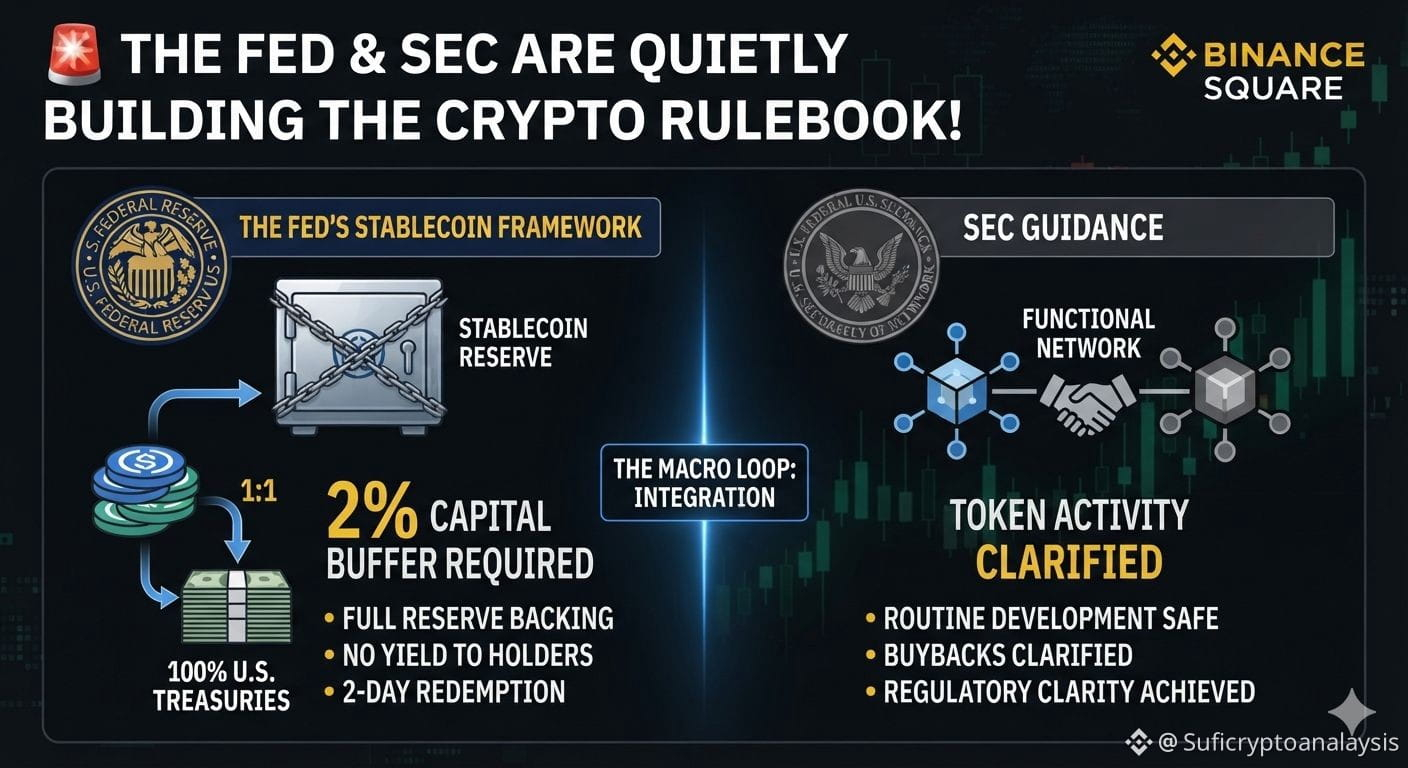
53

·
--
The Federal Reserve's proposed stablecoin rules under the GENIUS Act (issued September 24, 2026) focus on two main areas:
1:1 Reserve & Capital Standards: Supervised payment stablecoin issuers must fully back tokens with high-quality liquid assets (like short-term U.S. Treasuries) and maintain standardized capital buffers for operational and credit risk.
Bank Application Framework: Establishes a formal application, review, and appeals process for Fed-supervised banks seeking to create stablecoin-issuing subsidiaries.
The draft rules are open for a 60-day public comment period.
#fedproposespaymentstablecoinrules
#BTC $BTC #USDC✅ $USDC
{spot}(USDCUSDT)
{future}(BTCUSDT)
The Federal Reserve's proposed stablecoin rules under the GENIUS Act (issued September 24, 2026) focus on two main areas:
1:1 Reserve & Capital Standards: Supervised payment stablecoin issuers must fully back tokens with high-quality liquid assets (like short-term U.S. Treasuries) and maintain standardized capital buffers for operational and credit risk.
Bank Application Framework: Establishes a formal application, review, and appeals process for Fed-supervised banks seeking to create stablecoin-issuing subsidiaries.
The draft rules are open for a 60-day public comment period.
#fedproposespaymentstablecoinrules
#BTC $BTC #USDC✅ $USDC
1:1 Reserve & Capital Standards: Supervised payment stablecoin issuers must fully back tokens with high-quality liquid assets (like short-term U.S. Treasuries) and maintain standardized capital buffers for operational and credit risk.
Bank Application Framework: Establishes a formal application, review, and appeals process for Fed-supervised banks seeking to create stablecoin-issuing subsidiaries.
The draft rules are open for a 60-day public comment period.
#fedproposespaymentstablecoinrules
#BTC $BTC #USDC✅ $USDC

1
55
Log in to explore more content
Join global crypto users on Binance Square
⚡️ Get latest and useful information about crypto.
💬 Trusted by the world’s largest crypto exchange.
👍 Discover real insights from verified creators.
Email / Phone number
Trending Topics
1
#HuangRisksOusterOverReportedAffairWithSubordinate
55,709 views
802 Discussing
2
#AnthropicRejectsIPODelayValuationinQuestion
513,941 views
4,199 Discussing
3
#CoreWeaveJumps10%On168%RevenueGrowth
87,850 views
1,055 Discussing
4
#ZcashFallsBelow$1000ForFirstTimeSinceSeptember
48,478 views
212 Discussing
5
#MSCIRemovalMayCurbStrategy’sBitcoinBuying
10,677 views
178 Discussing
6
#HKSFCSaysTokenizationMovingToCommercialUse
84 views
11 Discussing
7
#CanNvidiaEarningsEaseMarketConcerns?
197,151 views
1,966 Discussing
8
#SouthKoreaToLetExchangesSuspendWithdrawalsOnSuspectedHacks
199 views
12 Discussing
9
#PythAddsNYSERealTimeDataToMarketplace
4,860 views
124 Discussing
10
#SolanaCompanyReports$3.4MQ3Revenue
1,423 views
30 Discussing