

#fedproposespaymentstablecoinrules
fedproposespaymentstablecoinrules
Hot
Latest

·
--
Bullish
🚨 THE FED AND SEC ARE QUIETLY BUILDING THE RULEBOOK CRYPTO HAS BEEN WAITING FOR.
The Fed just proposed a formal framework for payment stablecoin issuers under the GENIUS Act, including 1:1 backing with high-quality liquid reserves such as short-term Treasuries, capital requirements, risk-management standards, custody rules, and a dedicated approval process for banks that want to issue stablecoins.
At almost the same time, SEC staff clarified that for functional crypto networks, things like token buybacks do not automatically create a securities contract by themselves. The SEC also stressed that this is staff guidance, not a binding new rule.
That combination matters.
Fed → clearer rules for digital dollars.
SEC → more clarity for functional crypto assets.
This is not deregulation.
It is something potentially more important:
Crypto is being pulled deeper into the regulated financial system instead of being pushed outside it.
For stablecoins, the direction is obvious: more reserves, more oversight, more bank participation.
And if that framework survives the comment process, the next phase of adoption may look less like “crypto vs banks”…
and more like banks issuing crypto-native money themselves. 👀
$USDC $CRCL $COIN $ETH
{future}(USDCUSDT)
{future}(CRCLUSDT)
{future}(COINUSDT)
#fedproposespaymentstablecoinrules #ChinaMayLetAlibabaByteDanceBuyNvidiaChips #USChinaRelease$30BTariffCutProductLists #SKoreaFSCConsidersVirtualAssetMarketMaker #ChinaIndustrialProfitGrowthSlowsFourthMonth
🚨 THE FED AND SEC ARE QUIETLY BUILDING THE RULEBOOK CRYPTO HAS BEEN WAITING FOR.
The Fed just proposed a formal framework for payment stablecoin issuers under the GENIUS Act, including 1:1 backing with high-quality liquid reserves such as short-term Treasuries, capital requirements, risk-management standards, custody rules, and a dedicated approval process for banks that want to issue stablecoins.
At almost the same time, SEC staff clarified that for functional crypto networks, things like token buybacks do not automatically create a securities contract by themselves. The SEC also stressed that this is staff guidance, not a binding new rule.
That combination matters.
Fed → clearer rules for digital dollars.
SEC → more clarity for functional crypto assets.
This is not deregulation.
It is something potentially more important:
Crypto is being pulled deeper into the regulated financial system instead of being pushed outside it.
For stablecoins, the direction is obvious: more reserves, more oversight, more bank participation.
And if that framework survives the comment process, the next phase of adoption may look less like “crypto vs banks”…
and more like banks issuing crypto-native money themselves. 👀
$USDC $CRCL $COIN $ETH
#fedproposespaymentstablecoinrules #ChinaMayLetAlibabaByteDanceBuyNvidiaChips #USChinaRelease$30BTariffCutProductLists #SKoreaFSCConsidersVirtualAssetMarketMaker #ChinaIndustrialProfitGrowthSlowsFourthMonth
The Fed just proposed a formal framework for payment stablecoin issuers under the GENIUS Act, including 1:1 backing with high-quality liquid reserves such as short-term Treasuries, capital requirements, risk-management standards, custody rules, and a dedicated approval process for banks that want to issue stablecoins.
At almost the same time, SEC staff clarified that for functional crypto networks, things like token buybacks do not automatically create a securities contract by themselves. The SEC also stressed that this is staff guidance, not a binding new rule.
That combination matters.
Fed → clearer rules for digital dollars.
SEC → more clarity for functional crypto assets.
This is not deregulation.
It is something potentially more important:
Crypto is being pulled deeper into the regulated financial system instead of being pushed outside it.
For stablecoins, the direction is obvious: more reserves, more oversight, more bank participation.
And if that framework survives the comment process, the next phase of adoption may look less like “crypto vs banks”…
and more like banks issuing crypto-native money themselves. 👀
$USDC $CRCL $COIN $ETH
#fedproposespaymentstablecoinrules #ChinaMayLetAlibabaByteDanceBuyNvidiaChips #USChinaRelease$30BTariffCutProductLists #SKoreaFSCConsidersVirtualAssetMarketMaker #ChinaIndustrialProfitGrowthSlowsFourthMonth
CABTYIN:
صباح الخير
1
1
2.3k

🚨 BREAKING: FED PROPOSES 2% CAPITAL REQUIREMENT FOR STABLECOIN ISSUERS! 🇺🇸💵
🏦 The proposed framework would require a 2% capital buffer on the first $20 BILLION of token issuance for covered payment stablecoin issuers.
🚫 NO DIRECT YIELD: Payment stablecoin issuers would also be prohibited from paying interest or yield directly to token holders.
📋 The proposal is part of the Federal Reserve’s implementation of the GENIUS Act and includes additional capital and risk-management requirements.
🌐 Stablecoin regulation is entering a more defined phase in the U.S.
👀 Could tighter capital rules reshape the stablecoin market?
Follow for daily updates ⚡
$QNT $ONE $BTW
#FedProposesPaymentStablecoinRules
🚨 BREAKING: FED PROPOSES 2% CAPITAL REQUIREMENT FOR STABLECOIN ISSUERS! 🇺🇸💵
🏦 The proposed framework would require a 2% capital buffer on the first $20 BILLION of token issuance for covered payment stablecoin issuers.
🚫 NO DIRECT YIELD: Payment stablecoin issuers would also be prohibited from paying interest or yield directly to token holders.
📋 The proposal is part of the Federal Reserve’s implementation of the GENIUS Act and includes additional capital and risk-management requirements.
🌐 Stablecoin regulation is entering a more defined phase in the U.S.
👀 Could tighter capital rules reshape the stablecoin market?
Follow for daily updates ⚡
$QNT $ONE $BTW
#FedProposesPaymentStablecoinRules
🏦 The proposed framework would require a 2% capital buffer on the first $20 BILLION of token issuance for covered payment stablecoin issuers.
🚫 NO DIRECT YIELD: Payment stablecoin issuers would also be prohibited from paying interest or yield directly to token holders.
📋 The proposal is part of the Federal Reserve’s implementation of the GENIUS Act and includes additional capital and risk-management requirements.
🌐 Stablecoin regulation is entering a more defined phase in the U.S.
👀 Could tighter capital rules reshape the stablecoin market?
Follow for daily updates ⚡
$QNT $ONE $BTW
#FedProposesPaymentStablecoinRules
312

·
--
#fedproposespaymentstablecoinrules FED’S STABLECOIN RULES: A BIG CRYPTO SIGNAL
The Federal Reserve has announced two rulemaking packages to carry out the GENIUS Act placing payment stablecoins under rules.
Key points:
• 100 percent reserve backing with assets, such as short‑term Treasuries.
• Capital and risk controls.
• Redemption and reporting requirements.
• A dedicated approval process, for banks supervised by the Federal Reserve that want to issue stablecoins.
• Public comments will stay open for sixty days.
For traders this could be important because stablecoins link banking, dollar liquidity, exchanges and on‑chain payments.
Could stablecoin adoption speed up? What effect could this have on BTC. Altcoins? Share your view!..#stablecoin #crypto #cryptotrading #TradingSignals
$BTC $ETH $BNB
{future}(BTCUSDT)
{future}(ETHUSDT)
{future}(BNBUSDT)
#fedproposespaymentstablecoinrules FED’S STABLECOIN RULES: A BIG CRYPTO SIGNAL
The Federal Reserve has announced two rulemaking packages to carry out the GENIUS Act placing payment stablecoins under rules.
Key points:
• 100 percent reserve backing with assets, such as short‑term Treasuries.
• Capital and risk controls.
• Redemption and reporting requirements.
• A dedicated approval process, for banks supervised by the Federal Reserve that want to issue stablecoins.
• Public comments will stay open for sixty days.
For traders this could be important because stablecoins link banking, dollar liquidity, exchanges and on‑chain payments.
Could stablecoin adoption speed up? What effect could this have on BTC. Altcoins? Share your view!..#stablecoin #crypto #cryptotrading #TradingSignals
$BTC $ETH $BNB
The Federal Reserve has announced two rulemaking packages to carry out the GENIUS Act placing payment stablecoins under rules.
Key points:
• 100 percent reserve backing with assets, such as short‑term Treasuries.
• Capital and risk controls.
• Redemption and reporting requirements.
• A dedicated approval process, for banks supervised by the Federal Reserve that want to issue stablecoins.
• Public comments will stay open for sixty days.
For traders this could be important because stablecoins link banking, dollar liquidity, exchanges and on‑chain payments.
Could stablecoin adoption speed up? What effect could this have on BTC. Altcoins? Share your view!..#stablecoin #crypto #cryptotrading #TradingSignals
$BTC $ETH $BNB
248
·
--
🚨 THE UNDERRATED STABLECOIN TRADE ISN’T CRYPTO — IT’S U.S. TREASURIES.
The Fed’s proposed stablecoin framework would require regulated issuers to back payment stablecoins with high-quality liquid reserves, including short-term U.S. Treasury bills, while also setting capital and custody standards.
That creates a less obvious macro loop:
More stablecoin adoption → more reserve demand → more Treasury demand.
At the same time, SEC staff is giving functional crypto networks more room to operate, clarifying that activities like token buybacks or continued network development do not automatically create a securities contract.
Put those two together and the bigger story is not simply “crypto regulation.”
It’s this:
Washington may be turning stablecoins into a new distribution rail for dollar-denominated government debt — while simultaneously making the crypto layer easier to build on.
That could strengthen the dollar’s digital reach, increase demand for tokenized cash products, and make stablecoin issuers much more strategically important.
The hidden winner of the stablecoin boom may be the U.S. Treasury market itself. 👀
{stock_us}(COIN.US)
{future}(CRCLUSDT)
{future}(ETHUSDT)
$CRCL $COIN $USDC $ETH
#FedProposesPaymentStablecoinRules #ChinaMayLetAlibabaByteDanceBuyNvidiaChips #USChinaRelease$30BTariffCutProductLists #SKoreaFSCConsidersVirtualAssetMarketMaker #Fed
🚨 THE UNDERRATED STABLECOIN TRADE ISN’T CRYPTO — IT’S U.S. TREASURIES.
The Fed’s proposed stablecoin framework would require regulated issuers to back payment stablecoins with high-quality liquid reserves, including short-term U.S. Treasury bills, while also setting capital and custody standards.
That creates a less obvious macro loop:
More stablecoin adoption → more reserve demand → more Treasury demand.
At the same time, SEC staff is giving functional crypto networks more room to operate, clarifying that activities like token buybacks or continued network development do not automatically create a securities contract.
Put those two together and the bigger story is not simply “crypto regulation.”
It’s this:
Washington may be turning stablecoins into a new distribution rail for dollar-denominated government debt — while simultaneously making the crypto layer easier to build on.
That could strengthen the dollar’s digital reach, increase demand for tokenized cash products, and make stablecoin issuers much more strategically important.
The hidden winner of the stablecoin boom may be the U.S. Treasury market itself. 👀
$CRCL $COIN $USDC $ETH
#FedProposesPaymentStablecoinRules #ChinaMayLetAlibabaByteDanceBuyNvidiaChips #USChinaRelease$30BTariffCutProductLists #SKoreaFSCConsidersVirtualAssetMarketMaker #Fed
The Fed’s proposed stablecoin framework would require regulated issuers to back payment stablecoins with high-quality liquid reserves, including short-term U.S. Treasury bills, while also setting capital and custody standards.
That creates a less obvious macro loop:
More stablecoin adoption → more reserve demand → more Treasury demand.
At the same time, SEC staff is giving functional crypto networks more room to operate, clarifying that activities like token buybacks or continued network development do not automatically create a securities contract.
Put those two together and the bigger story is not simply “crypto regulation.”
It’s this:
Washington may be turning stablecoins into a new distribution rail for dollar-denominated government debt — while simultaneously making the crypto layer easier to build on.
That could strengthen the dollar’s digital reach, increase demand for tokenized cash products, and make stablecoin issuers much more strategically important.
The hidden winner of the stablecoin boom may be the U.S. Treasury market itself. 👀
$CRCL $COIN $USDC $ETH
#FedProposesPaymentStablecoinRules #ChinaMayLetAlibabaByteDanceBuyNvidiaChips #USChinaRelease$30BTariffCutProductLists #SKoreaFSCConsidersVirtualAssetMarketMaker #Fed
4

·
--
Article
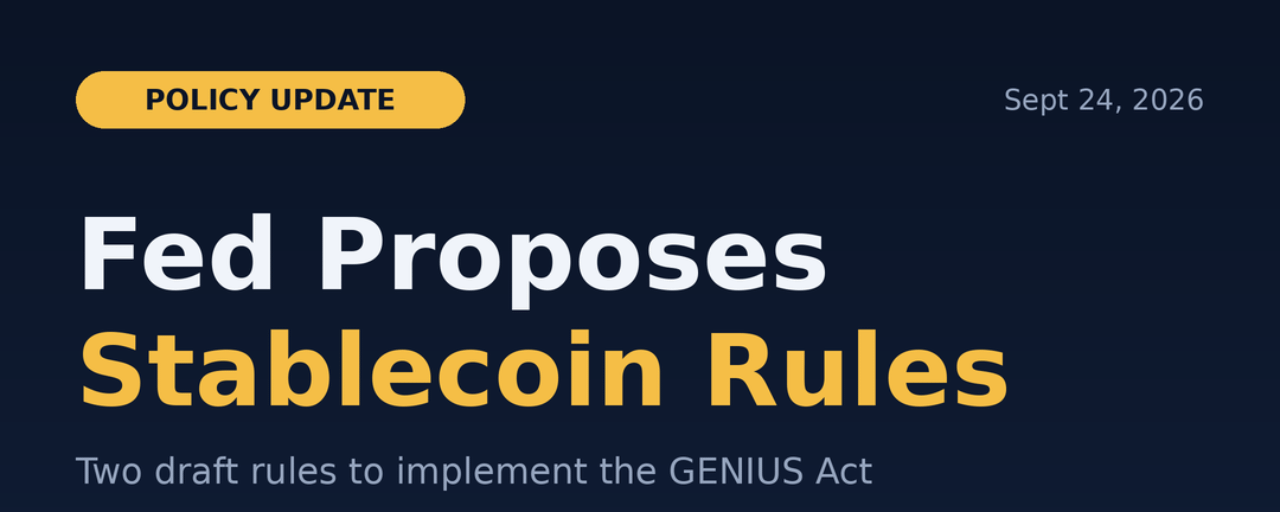
The Federal Reserve Board proposed two draft rules#fedproposespaymentstablecoinrules
The Federal Reserve Board proposed two draft rules on September 24, 2026 to implement its part of the GENIUS Act, the federal stable coin law signed in July 2025. Public comment is open for 60 days after the proposals are published in the Federal Register.
Who it covers
The Fed proposed a rule setting requirements for authorized stable coin issuers under its purview, including state member banks and other state-chartered issuers. Under the act, the Fed oversees stable coin issuers that are subsidiaries of state member banks. It also oversees state-chartered institutions without federal deposit insurance that have $10 billion or more of stable coins.
Proposal 1: reserves, capital and risk management
Full backing: Every $1 of stable coins would need at least $1 of permissible reserve assets behind it. Reserves could include U.S. dollars, Fed balances, certain bank deposits, Treasuries with 93 days or less to maturity, qualifying repos, and eligible investment funds.Redemption: Issuers must fulfill redemption requests within two business days. If backing falls below 1:1, they must immediately notify the Fed. Capital: Standardized capital requirements would address credit and operational risks, alongside risk-management standards. An issuer that stays short of required capital long enough could be forced to liquidate all reserves and redeem every coin. Custody: The proposal adds rules for Fed-supervised firms that safekeep the assets backing stable coins. It also clarifies which stable coin activities are permissible for Fed-supervised banks.
Proposal 2: bank applications
Fed-supervised banks that want to issue stable coins would follow a tailored application process rather than the standard one. Applicants would submit a business plan and financial information. The draft also sets up a process for appeals, hearings and final determinations. The GENIUS Act gives the Fed 120 days to decide complete applications.
Reaction and context
Fed Governor Michael Barr called the proposal an important step but said more work is needed. He said stable coins "will only be stable if they can be reliably and promptly redeemed at par" in a range of conditions, including market stressThe OCC and NCUA proposed their rules in February, the FDIC in April, and Treasury in August. No agency has finalized rules yet. The agencies also missed the statutory July 18 implementation deadline.The OCC's chief has said its final rule will come out by November.
These are proposals, so details could change after comments. Only banks and issuers under the Fed's supervision are covered, so issuers regulated by the OCC, FDIC or states would follow their own rules.
The Federal Reserve Board proposed two draft rules
#fedproposespaymentstablecoinrules
The Federal Reserve Board proposed two draft rules on September 24, 2026 to implement its part of the GENIUS Act, the federal stable coin law signed in July 2025. Public comment is open for 60 days after the proposals are published in the Federal Register.
Who it covers
The Fed proposed a rule setting requirements for authorized stable coin issuers under its purview, including state member banks and other state-chartered issuers. Under the act, the Fed oversees stable coin issuers that are subsidiaries of state member banks. It also oversees state-chartered institutions without federal deposit insurance that have $10 billion or more of stable coins.
Proposal 1: reserves, capital and risk management
Full backing: Every $1 of stable coins would need at least $1 of permissible reserve assets behind it. Reserves could include U.S. dollars, Fed balances, certain bank deposits, Treasuries with 93 days or less to maturity, qualifying repos, and eligible investment funds.Redemption: Issuers must fulfill redemption requests within two business days. If backing falls below 1:1, they must immediately notify the Fed. Capital: Standardized capital requirements would address credit and operational risks, alongside risk-management standards. An issuer that stays short of required capital long enough could be forced to liquidate all reserves and redeem every coin. Custody: The proposal adds rules for Fed-supervised firms that safekeep the assets backing stable coins. It also clarifies which stable coin activities are permissible for Fed-supervised banks.
Proposal 2: bank applications
Fed-supervised banks that want to issue stable coins would follow a tailored application process rather than the standard one. Applicants would submit a business plan and financial information. The draft also sets up a process for appeals, hearings and final determinations. The GENIUS Act gives the Fed 120 days to decide complete applications.
Reaction and context
Fed Governor Michael Barr called the proposal an important step but said more work is needed. He said stable coins "will only be stable if they can be reliably and promptly redeemed at par" in a range of conditions, including market stressThe OCC and NCUA proposed their rules in February, the FDIC in April, and Treasury in August. No agency has finalized rules yet. The agencies also missed the statutory July 18 implementation deadline.The OCC's chief has said its final rule will come out by November.
These are proposals, so details could change after comments. Only banks and issuers under the Fed's supervision are covered, so issuers regulated by the OCC, FDIC or states would follow their own rules.
The Federal Reserve Board proposed two draft rules on September 24, 2026 to implement its part of the GENIUS Act, the federal stable coin law signed in July 2025. Public comment is open for 60 days after the proposals are published in the Federal Register.
Who it covers
The Fed proposed a rule setting requirements for authorized stable coin issuers under its purview, including state member banks and other state-chartered issuers. Under the act, the Fed oversees stable coin issuers that are subsidiaries of state member banks. It also oversees state-chartered institutions without federal deposit insurance that have $10 billion or more of stable coins.
Proposal 1: reserves, capital and risk management
Full backing: Every $1 of stable coins would need at least $1 of permissible reserve assets behind it. Reserves could include U.S. dollars, Fed balances, certain bank deposits, Treasuries with 93 days or less to maturity, qualifying repos, and eligible investment funds.Redemption: Issuers must fulfill redemption requests within two business days. If backing falls below 1:1, they must immediately notify the Fed. Capital: Standardized capital requirements would address credit and operational risks, alongside risk-management standards. An issuer that stays short of required capital long enough could be forced to liquidate all reserves and redeem every coin. Custody: The proposal adds rules for Fed-supervised firms that safekeep the assets backing stable coins. It also clarifies which stable coin activities are permissible for Fed-supervised banks.
Proposal 2: bank applications
Fed-supervised banks that want to issue stable coins would follow a tailored application process rather than the standard one. Applicants would submit a business plan and financial information. The draft also sets up a process for appeals, hearings and final determinations. The GENIUS Act gives the Fed 120 days to decide complete applications.
Reaction and context
Fed Governor Michael Barr called the proposal an important step but said more work is needed. He said stable coins "will only be stable if they can be reliably and promptly redeemed at par" in a range of conditions, including market stressThe OCC and NCUA proposed their rules in February, the FDIC in April, and Treasury in August. No agency has finalized rules yet. The agencies also missed the statutory July 18 implementation deadline.The OCC's chief has said its final rule will come out by November.
These are proposals, so details could change after comments. Only banks and issuers under the Fed's supervision are covered, so issuers regulated by the OCC, FDIC or states would follow their own rules.
12

·
--
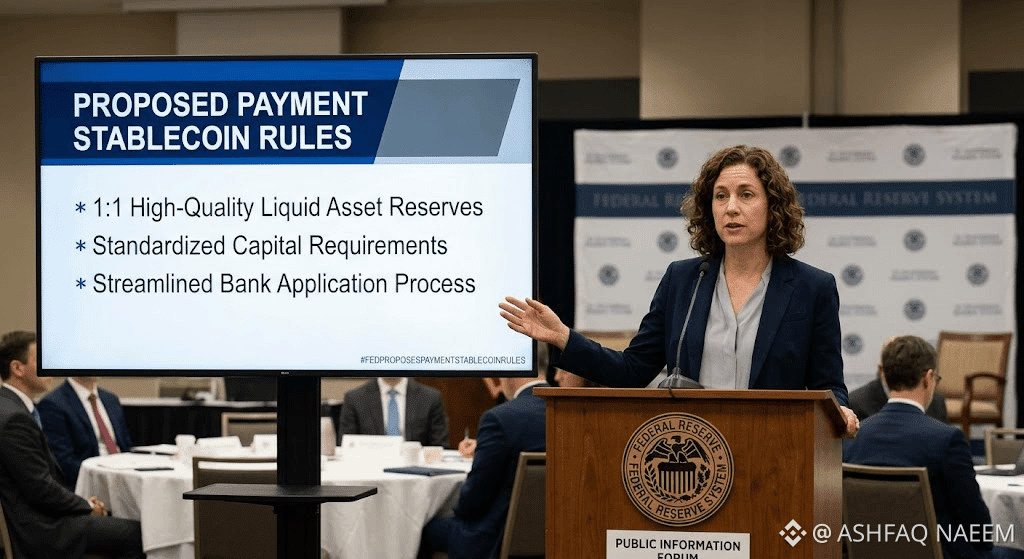
The Federal Reserve's proposed stablecoin rules under the GENIUS Act (issued September 24, 2026) focus on two main areas:
1:1 Reserve & Capital Standards: Supervised payment stablecoin issuers must fully back tokens with high-quality liquid assets (like short-term U.S. Treasuries) and maintain standardized capital buffers for operational and credit risk.
Bank Application Framework: Establishes a formal application, review, and appeals process for Fed-supervised banks seeking to create stablecoin-issuing subsidiaries.
The draft rules are open for a 60-day public comment period.
#fedproposespaymentstablecoinrules
#BTC $BTC #USDC✅ $USDC
{spot}(USDCUSDT)
{future}(BTCUSDT)
The Federal Reserve's proposed stablecoin rules under the GENIUS Act (issued September 24, 2026) focus on two main areas:
1:1 Reserve & Capital Standards: Supervised payment stablecoin issuers must fully back tokens with high-quality liquid assets (like short-term U.S. Treasuries) and maintain standardized capital buffers for operational and credit risk.
Bank Application Framework: Establishes a formal application, review, and appeals process for Fed-supervised banks seeking to create stablecoin-issuing subsidiaries.
The draft rules are open for a 60-day public comment period.
#fedproposespaymentstablecoinrules
#BTC $BTC #USDC✅ $USDC
1:1 Reserve & Capital Standards: Supervised payment stablecoin issuers must fully back tokens with high-quality liquid assets (like short-term U.S. Treasuries) and maintain standardized capital buffers for operational and credit risk.
Bank Application Framework: Establishes a formal application, review, and appeals process for Fed-supervised banks seeking to create stablecoin-issuing subsidiaries.
The draft rules are open for a 60-day public comment period.
#fedproposespaymentstablecoinrules
#BTC $BTC #USDC✅ $USDC
11

·
--
#FedProposesPaymentStablecoinRules
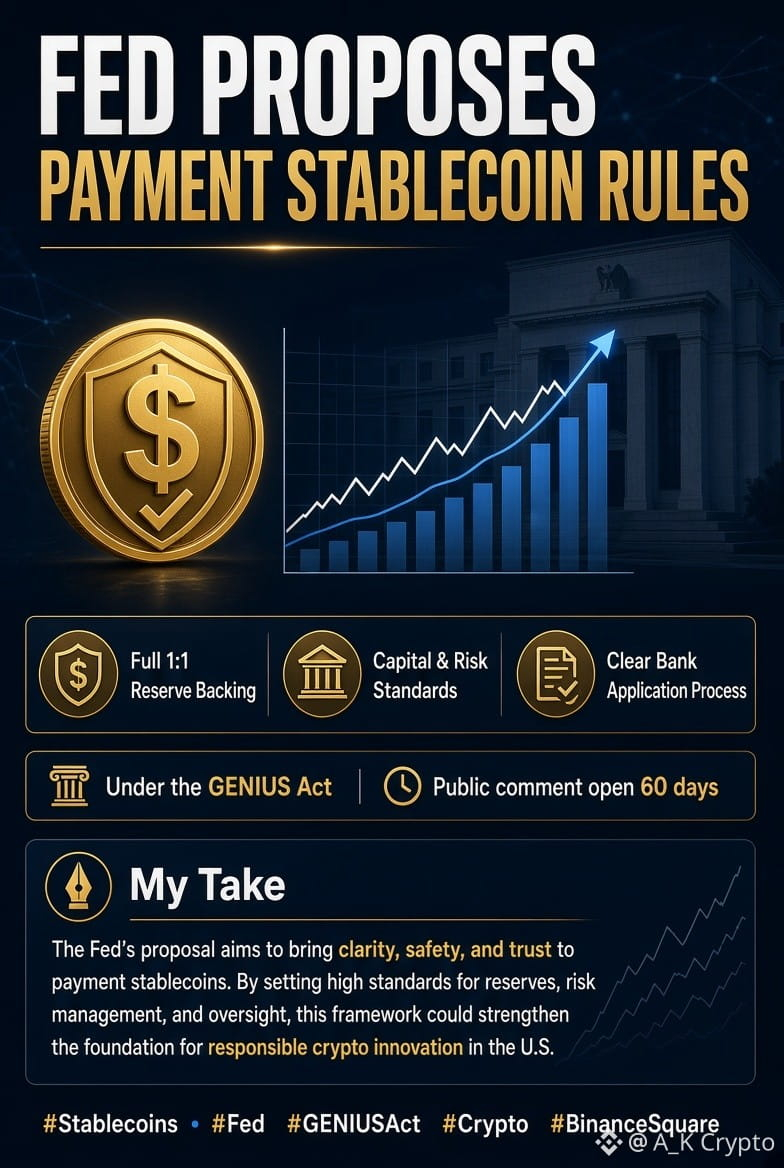
🚨 FED PROPOSES PAYMENT STABLECOIN RULES
The Federal Reserve just dropped two key proposals under the GENIUS Act for Board-supervised payment stablecoin issuers.
One requires full 1:1 backing with high-quality reserves like short-term Treasuries, plus standardized capital and risk management rules. The other sets out a clearer application process for banks wanting to issue stablecoins.
Public comment period is open for 60 days.
This is a solid step toward making dollar stablecoins safer and more reliable for everyday payments. Clear reserve rules and capital standards should build real confidence, but the final details on redemptions and risk will decide how useful these coins become. Watching closely as the framework takes shape.
#Stablecoins #Fed #GENIUSAct #Crypto #CryptoNews #BinanceSquare
#FedProposesPaymentStablecoinRules
🚨 FED PROPOSES PAYMENT STABLECOIN RULES
The Federal Reserve just dropped two key proposals under the GENIUS Act for Board-supervised payment stablecoin issuers.
One requires full 1:1 backing with high-quality reserves like short-term Treasuries, plus standardized capital and risk management rules. The other sets out a clearer application process for banks wanting to issue stablecoins.
Public comment period is open for 60 days.
This is a solid step toward making dollar stablecoins safer and more reliable for everyday payments. Clear reserve rules and capital standards should build real confidence, but the final details on redemptions and risk will decide how useful these coins become. Watching closely as the framework takes shape.
#Stablecoins #Fed #GENIUSAct #Crypto #CryptoNews #BinanceSquare
🚨 FED PROPOSES PAYMENT STABLECOIN RULES
The Federal Reserve just dropped two key proposals under the GENIUS Act for Board-supervised payment stablecoin issuers.
One requires full 1:1 backing with high-quality reserves like short-term Treasuries, plus standardized capital and risk management rules. The other sets out a clearer application process for banks wanting to issue stablecoins.
Public comment period is open for 60 days.
This is a solid step toward making dollar stablecoins safer and more reliable for everyday payments. Clear reserve rules and capital standards should build real confidence, but the final details on redemptions and risk will decide how useful these coins become. Watching closely as the framework takes shape.
#Stablecoins #Fed #GENIUSAct #Crypto #CryptoNews #BinanceSquare
23

·
--
#FedProposesPaymentStablecoinRules
🚨 Fed proposes new payment stablecoin rules
The U.S. Federal Reserve has proposed rules under the GENIUS Act that would require Fed-supervised payment stablecoin issuers to fully back tokens with eligible reserves, including short-term U.S. Treasury bills. The proposal also includes capital and risk-management requirements and a dedicated process for supervised banks seeking to issue payment stablecoins. Public comments will be open for 60 days after Federal Register publication.
💬 What do you think?$BTC $BNB $ETH
Will clearer stablecoin rules accelerate institutional adoption?
#Stablecoin #BNB_Market_Update #CryptoRegulation #Fed
#FedProposesPaymentStablecoinRules
🚨 Fed proposes new payment stablecoin rules
The U.S. Federal Reserve has proposed rules under the GENIUS Act that would require Fed-supervised payment stablecoin issuers to fully back tokens with eligible reserves, including short-term U.S. Treasury bills. The proposal also includes capital and risk-management requirements and a dedicated process for supervised banks seeking to issue payment stablecoins. Public comments will be open for 60 days after Federal Register publication.
💬 What do you think?$BTC $BNB $ETH
Will clearer stablecoin rules accelerate institutional adoption?
#Stablecoin #BNB_Market_Update #CryptoRegulation #Fed
🚨 Fed proposes new payment stablecoin rules
The U.S. Federal Reserve has proposed rules under the GENIUS Act that would require Fed-supervised payment stablecoin issuers to fully back tokens with eligible reserves, including short-term U.S. Treasury bills. The proposal also includes capital and risk-management requirements and a dedicated process for supervised banks seeking to issue payment stablecoins. Public comments will be open for 60 days after Federal Register publication.
💬 What do you think?$BTC $BNB $ETH
Will clearer stablecoin rules accelerate institutional adoption?
#Stablecoin #BNB_Market_Update #CryptoRegulation #Fed
41
·
--
#FedProposesPaymentStablecoinRules
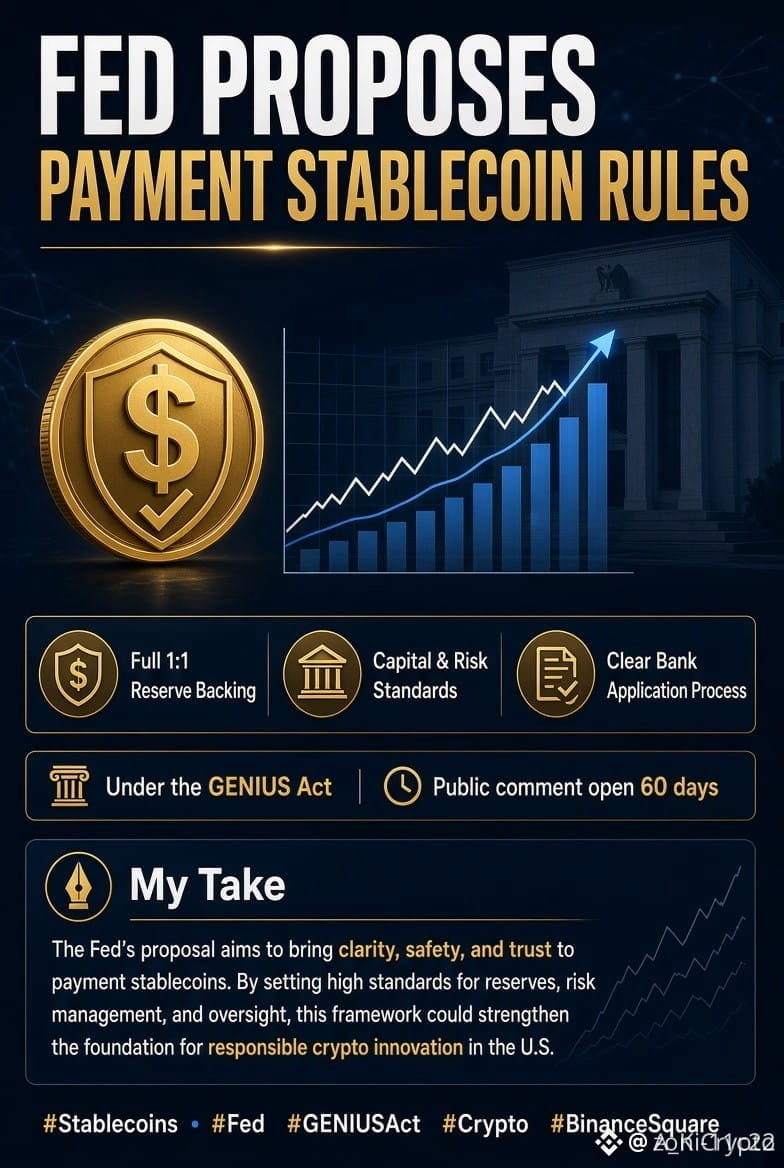
The Federal Reserve has proposed a landmark regulatory framework for payment stablecoin under the GENIUS Act, moving crypto assets deeper into the traditional $US
{alpha}(CT_7840xee962a61432231c2ede6946515beb02290cb516ad087bb06a731e922b2a5f57a::us::US)
financial system. Published on September 24, 2026, the twin proposals establish comprehensive reserve, operational, and capital requirements for stablecoin issuers. [1]
$BNB
{future}(BNBUSDT)
#FedProposesPaymentStablecoinRules
The Federal Reserve has proposed a landmark regulatory framework for payment stablecoin under the GENIUS Act, moving crypto assets deeper into the traditional $US
financial system. Published on September 24, 2026, the twin proposals establish comprehensive reserve, operational, and capital requirements for stablecoin issuers. [1]
$BNB
The Federal Reserve has proposed a landmark regulatory framework for payment stablecoin under the GENIUS Act, moving crypto assets deeper into the traditional $US
financial system. Published on September 24, 2026, the twin proposals establish comprehensive reserve, operational, and capital requirements for stablecoin issuers. [1]
$BNB

14

·
--
Bullish
#fedproposespaymentstablecoinrules
🚨 THE FED IS BRINGING STABLECOINS CLOSER TO TRADITIONAL FINANCE.
The Federal Reserve has proposed new rules for payment stablecoin issuers under the GENIUS Act.
💵 Full backing with permitted reserve assets
🏦 Short-term U.S. Treasury bills could qualify as reserves
🛡️ New capital & risk-management requirements
🏛️ Fed-supervised banks could apply to issue payment stablecoins
⏳ Public comments open for 60 days
This could be another major step toward regulated stablecoins becoming part of the U.S. payments system.
👀 Stablecoins are getting serious attention from Wall Street.
#Fed #stablecoin #crypto
#fedproposespaymentstablecoinrules
🚨 THE FED IS BRINGING STABLECOINS CLOSER TO TRADITIONAL FINANCE.
The Federal Reserve has proposed new rules for payment stablecoin issuers under the GENIUS Act.
💵 Full backing with permitted reserve assets
🏦 Short-term U.S. Treasury bills could qualify as reserves
🛡️ New capital & risk-management requirements
🏛️ Fed-supervised banks could apply to issue payment stablecoins
⏳ Public comments open for 60 days
This could be another major step toward regulated stablecoins becoming part of the U.S. payments system.
👀 Stablecoins are getting serious attention from Wall Street.
#Fed #stablecoin #crypto
🚨 THE FED IS BRINGING STABLECOINS CLOSER TO TRADITIONAL FINANCE.
The Federal Reserve has proposed new rules for payment stablecoin issuers under the GENIUS Act.
💵 Full backing with permitted reserve assets
🏦 Short-term U.S. Treasury bills could qualify as reserves
🛡️ New capital & risk-management requirements
🏛️ Fed-supervised banks could apply to issue payment stablecoins
⏳ Public comments open for 60 days
This could be another major step toward regulated stablecoins becoming part of the U.S. payments system.
👀 Stablecoins are getting serious attention from Wall Street.
#Fed #stablecoin #crypto
87

·
--
Fed stablecoin proposal enters the buzz on the main square|Remittances depend on whether exchange-to-export is feasible|SOL at $119—I’ll wait
My stance is to hold cash first, not to chase payment narratives. As regulatory discussions heat up, it’s worth paying attention—but whether cross-border remittances are cheaper and whether users can smoothly convert to cost currency matters more than the on-chain speed touted in the promotion. I’m not participating in SOL right now.
In this round, a new topic about Fed payment stablecoin rules was added to the main square homepage. In continuous reads, the discussion count increased from 2 to 14. This reflects attention to changes in the topic; it doesn’t mean funds have already flowed in. Check the Fed notice from September 24: the two proposals relate to its regulatory scope, including reserves, capital, risk management, and the banking application process for issuers. The comment period is sixty days after publication in the Federal Register. Still, it’s a request for comments—not effective today, and not an endorsement for all stablecoins or for all public chains.
This time, I care more about the last mile of remittances. On September 8, the Solana Foundation published a remittance report introducing local exchange services, partners across different remittance corridors, and regulatory differences. These are project materials published earlier, not wrapped as a new deal signed today. After an on-chain transfer is completed, for the recipient to receive bank deposits or cash, there are still steps in between—quotes, compliance, local business hours, and payout capability.
My independent take: The issuing-side rules are clearer, which may reduce uncertainty for institutions when choosing payment tools. However, only if the export service is reliable can the on-chain low cost actually become the user’s real low cost. If instead, the price spread in local-currency conversion widens enough, it can wipe out the on-chain fee advantage. Payment growth also can’t be inferred into SOL buy demand based on the same dollar amounts: the remittance principal can remain in stablecoins, while the native asset only covers part of the network costs. These are transmission conditions—not confirmed capital flows that have already occurred.
Price hasn’t given me a reason to chase the move early. In this round, Kraken USD spot is around 118.75, with the 24-hour range at 118.10 to 124.91—still near the lower end. I don’t have evidence attributing the drop to the Fed proposal, and I haven’t verified any increase in new remittance volume, so I won’t write “institutions抢筹.” In the previous round’s confirmation conditions at 122, the current quote is still below it; I won’t describe waiting plans as an executed trade.
If I were trading it myself: my position is zero right now, and I’d only consider a low-leverage spot long. After an hour’s close, if it reclaims above 120.5, then a pullback to 120–120.5 holds—and the quotes and deposits/withdrawals are normal—then I would use at most 0.3% of total funds for a trial position. Reduce by half at 122, take profit on the remaining at 123; hard stop-loss at 119. If the two hourly candles close below 120, I’d close everything. If it breaks below 117.5 before entry, cancel the plan—I won’t chase or average down losses.
If exchange services worsen, actual usage doesn’t improve, or the price can’t hold the confirmation zone, I’ll withdraw the trading assumption that “payment adoption may improve.” Rule progress, business retention, and price follow-through must be verified separately at least three points; you can’t use one hot-list topic to substitute for three answers.
Source: Fed Sept 24 notice; Solana Foundation Sept 8 remittance report overview; Binance Square main page; Kraken market data.
#FedProposesPaymentStablecoinRules #SOL
The above is only personal market observation and does not constitute investment advice.
Fed stablecoin proposal enters the buzz on the main square|Remittances depend on whether exchange-to-export is feasible|SOL at $119—I’ll wait
My stance is to hold cash first, not to chase payment narratives. As regulatory discussions heat up, it’s worth paying attention—but whether cross-border remittances are cheaper and whether users can smoothly convert to cost currency matters more than the on-chain speed touted in the promotion. I’m not participating in SOL right now.
In this round, a new topic about Fed payment stablecoin rules was added to the main square homepage. In continuous reads, the discussion count increased from 2 to 14. This reflects attention to changes in the topic; it doesn’t mean funds have already flowed in. Check the Fed notice from September 24: the two proposals relate to its regulatory scope, including reserves, capital, risk management, and the banking application process for issuers. The comment period is sixty days after publication in the Federal Register. Still, it’s a request for comments—not effective today, and not an endorsement for all stablecoins or for all public chains.
This time, I care more about the last mile of remittances. On September 8, the Solana Foundation published a remittance report introducing local exchange services, partners across different remittance corridors, and regulatory differences. These are project materials published earlier, not wrapped as a new deal signed today. After an on-chain transfer is completed, for the recipient to receive bank deposits or cash, there are still steps in between—quotes, compliance, local business hours, and payout capability.
My independent take: The issuing-side rules are clearer, which may reduce uncertainty for institutions when choosing payment tools. However, only if the export service is reliable can the on-chain low cost actually become the user’s real low cost. If instead, the price spread in local-currency conversion widens enough, it can wipe out the on-chain fee advantage. Payment growth also can’t be inferred into SOL buy demand based on the same dollar amounts: the remittance principal can remain in stablecoins, while the native asset only covers part of the network costs. These are transmission conditions—not confirmed capital flows that have already occurred.
Price hasn’t given me a reason to chase the move early. In this round, Kraken USD spot is around 118.75, with the 24-hour range at 118.10 to 124.91—still near the lower end. I don’t have evidence attributing the drop to the Fed proposal, and I haven’t verified any increase in new remittance volume, so I won’t write “institutions抢筹.” In the previous round’s confirmation conditions at 122, the current quote is still below it; I won’t describe waiting plans as an executed trade.
If I were trading it myself: my position is zero right now, and I’d only consider a low-leverage spot long. After an hour’s close, if it reclaims above 120.5, then a pullback to 120–120.5 holds—and the quotes and deposits/withdrawals are normal—then I would use at most 0.3% of total funds for a trial position. Reduce by half at 122, take profit on the remaining at 123; hard stop-loss at 119. If the two hourly candles close below 120, I’d close everything. If it breaks below 117.5 before entry, cancel the plan—I won’t chase or average down losses.
If exchange services worsen, actual usage doesn’t improve, or the price can’t hold the confirmation zone, I’ll withdraw the trading assumption that “payment adoption may improve.” Rule progress, business retention, and price follow-through must be verified separately at least three points; you can’t use one hot-list topic to substitute for three answers.
Source: Fed Sept 24 notice; Solana Foundation Sept 8 remittance report overview; Binance Square main page; Kraken market data.
#FedProposesPaymentStablecoinRules #SOL
The above is only personal market observation and does not constitute investment advice.
My stance is to hold cash first, not to chase payment narratives. As regulatory discussions heat up, it’s worth paying attention—but whether cross-border remittances are cheaper and whether users can smoothly convert to cost currency matters more than the on-chain speed touted in the promotion. I’m not participating in SOL right now.
In this round, a new topic about Fed payment stablecoin rules was added to the main square homepage. In continuous reads, the discussion count increased from 2 to 14. This reflects attention to changes in the topic; it doesn’t mean funds have already flowed in. Check the Fed notice from September 24: the two proposals relate to its regulatory scope, including reserves, capital, risk management, and the banking application process for issuers. The comment period is sixty days after publication in the Federal Register. Still, it’s a request for comments—not effective today, and not an endorsement for all stablecoins or for all public chains.
This time, I care more about the last mile of remittances. On September 8, the Solana Foundation published a remittance report introducing local exchange services, partners across different remittance corridors, and regulatory differences. These are project materials published earlier, not wrapped as a new deal signed today. After an on-chain transfer is completed, for the recipient to receive bank deposits or cash, there are still steps in between—quotes, compliance, local business hours, and payout capability.
My independent take: The issuing-side rules are clearer, which may reduce uncertainty for institutions when choosing payment tools. However, only if the export service is reliable can the on-chain low cost actually become the user’s real low cost. If instead, the price spread in local-currency conversion widens enough, it can wipe out the on-chain fee advantage. Payment growth also can’t be inferred into SOL buy demand based on the same dollar amounts: the remittance principal can remain in stablecoins, while the native asset only covers part of the network costs. These are transmission conditions—not confirmed capital flows that have already occurred.
Price hasn’t given me a reason to chase the move early. In this round, Kraken USD spot is around 118.75, with the 24-hour range at 118.10 to 124.91—still near the lower end. I don’t have evidence attributing the drop to the Fed proposal, and I haven’t verified any increase in new remittance volume, so I won’t write “institutions抢筹.” In the previous round’s confirmation conditions at 122, the current quote is still below it; I won’t describe waiting plans as an executed trade.
If I were trading it myself: my position is zero right now, and I’d only consider a low-leverage spot long. After an hour’s close, if it reclaims above 120.5, then a pullback to 120–120.5 holds—and the quotes and deposits/withdrawals are normal—then I would use at most 0.3% of total funds for a trial position. Reduce by half at 122, take profit on the remaining at 123; hard stop-loss at 119. If the two hourly candles close below 120, I’d close everything. If it breaks below 117.5 before entry, cancel the plan—I won’t chase or average down losses.
If exchange services worsen, actual usage doesn’t improve, or the price can’t hold the confirmation zone, I’ll withdraw the trading assumption that “payment adoption may improve.” Rule progress, business retention, and price follow-through must be verified separately at least three points; you can’t use one hot-list topic to substitute for three answers.
Source: Fed Sept 24 notice; Solana Foundation Sept 8 remittance report overview; Binance Square main page; Kraken market data.
#FedProposesPaymentStablecoinRules #SOL
The above is only personal market observation and does not constitute investment advice.

69
Deep Integration of Traditional Finance and the Crypto Market: Fed Rate-Hike Expectations Heat Up, Tokenized U.S. Stocks and ETF Capital Flows Rewrite the Market Landscape
1. Risks Cast a Shadow Over Risk Assets as the Fed Prepares to Hike
In the last week of September 2026, global financial markets are shrouded in the haze of the Federal Reserve’s anticipated rate hikes. According to the CME FedWatch tool, the probability of a 25-basis-point hike at the October 28 meeting has surged to 64.8%. The yield on 10-year U.S. Treasuries has reached 5.17%, the highest level since 2007. French bank strategists at BNP Paribas define this as “preventive tightening,” with the goal of rebuilding the Fed’s credibility in inflation policy.
Rate-hike expectations have imposed a significant drag on risk assets. The MOVE Index, a measure of bond volatility, jumped 19% over the past week, recording the largest single-week increase since the “Liberation Day” in April 2025. Funds are accelerating out of the crypto and stock markets into the bond market, and investors’ risk appetite has contracted sharply. Against this macro backdrop, the crypto market, however, is showing striking structural divergence.
2. Record Inflows for Bitcoin and Ethereum ETFs
Despite pressure from rate hikes, U.S. spot Bitcoin ETFs saw net inflows of $2.39 billion last week, the largest single-week inflow since October 2025. Year-to-date net inflows have turned positive to approximately $934 million. BlackRock and Fidelity led the buying, with a steady inflow over seven consecutive trading days totaling nearly $3 billion. Still, Bitcoin has been trading in a range of $84,000 to $85,000, prompting market questions about why large-scale buying hasn’t pushed prices higher. Some analysts point to dual headwinds: whale selling pressure and elevated Treasury yields.
Meanwhile, U.S. spot Ethereum ETFs and Solana ETFs have also performed strongly. Solana ETF net inflows totaled $188.8 million in the week, the second-highest since launch. Assets under management climbed to $2.28 billion, indicating that institutional demand for allocations to major altcoins is accelerating. That said, it’s worth noting that whale repositioning has created short-term selling pressure: one large holder transferred 500,000 SOL to an exchange, worth about $6.05 million.
3. Tokenized U.S. Stocks Become the Bridge Between Traditional Finance and Crypto
One of the most notable events this week is Ethena’s announcement that it will expand the collateral for its USDe synthetic dollar component to tokenized U.S. stocks on the Binance platform. This is the protocol’s first time extending the scope of collateral used in its delta-neutral strategy beyond crypto assets. Since allocations began on September 25, the ENA token surged by about 54% within seven days. New pledged collateral reached $90 million. A governance proposal also aims to reallocate as much as 95% of protocol fees, and ecosystem momentum is strong.
Tokenized U.S. stocks are becoming a key piece of infrastructure connecting traditional securities markets with on-chain finance. With tokenization, investors can trade U.S. stock assets around the clock without being limited by traditional exchanges’ trading hours. On Binance, multiple tokenized U.S. stock products are already live, covering technology, healthcare, consumer and other sectors, providing crypto-native users with convenient access to U.S. stock exposure.
4. QNT Skyrockets by 30% Behind the Traditional Banking Digitalization Wave
Quant Network’s token QNT became this week’s biggest surprise, soaring by roughly 30% in a single week. The catalysts come from two major developments: the U.S. clearinghouse TCH chose Quant’s Overledger platform to build interoperability for tokenized deposits for regulated U.S. banks; shortly afterward, an alliance of seven UK banks, including Barclays and HSBC, also announced it would adopt Overledger for testing digital currencies. This series of collaborations marks a shift in traditional banks’ recognition of blockchain infrastructure from talk to tangible action. However, the RSI indicator previously touched extreme overbought levels above 96, followed by a sharp pullback. Net outflows of about $4.1 million show that profit-taking pressure cannot be ignored.
5. Regulatory Deadlock and New Policy Developments
This week, U.S. crypto regulatory legislation hit a major setback. The CLARITY Act, intended to clarify SEC and CFTC jurisdiction over digital assets, failed to pass in a key procedural vote in the Senate, ending months of negotiations in failure. Democrats refused to compromise, citing conflicts of interest involving about $1.4 billion in crypto stakes tied to the Trump family. The political chess match around the midterm elections makes it difficult for the two parties to reach consensus. Former CFTC chair J. Christophers Urslo said that regardless of the legislative outcome, the crypto industry will continue to develop.
At the same time, the Federal Reserve proposed a new regulatory rule framework for payment stablecoins, suggesting regulators are advancing digital-asset oversight from a more pragmatic angle. Another trend drawing attention is the possibility that China may allow Alibaba and ByteDance to purchase NVIDIA chips, which sparked widespread discussion. The related topics garnered more than 2,500 views and participation from 78 authors on the forum’s public square, reflecting the far-reaching impact of global tech competition on markets.
6. Market Outlook
The market is currently at the intersection of two narratives: macro tightening and accelerated institutional entry. Fed rate-hike expectations are temporarily suppressing the prices of risk assets, but the sustained large-scale ETF inflows and the rapid development of tokenized U.S. stocks show that institutional capital is positioning itself against the trend. For investors, focusing on the Fed’s October rate decision, regulatory progress for tokenized assets, and the continuity of ETF capital flows will be key to capturing the market’s rhythm in the fourth quarter.
#FedProposesPaymentStablecoinRules #ChinaMayLetAlibabaByteDanceBuyNvidiaChips #TokenizedStocks
Deep Integration of Traditional Finance and the Crypto Market: Fed Rate-Hike Expectations Heat Up, Tokenized U.S. Stocks and ETF Capital Flows Rewrite the Market Landscape
1. Risks Cast a Shadow Over Risk Assets as the Fed Prepares to Hike
In the last week of September 2026, global financial markets are shrouded in the haze of the Federal Reserve’s anticipated rate hikes. According to the CME FedWatch tool, the probability of a 25-basis-point hike at the October 28 meeting has surged to 64.8%. The yield on 10-year U.S. Treasuries has reached 5.17%, the highest level since 2007. French bank strategists at BNP Paribas define this as “preventive tightening,” with the goal of rebuilding the Fed’s credibility in inflation policy.
Rate-hike expectations have imposed a significant drag on risk assets. The MOVE Index, a measure of bond volatility, jumped 19% over the past week, recording the largest single-week increase since the “Liberation Day” in April 2025. Funds are accelerating out of the crypto and stock markets into the bond market, and investors’ risk appetite has contracted sharply. Against this macro backdrop, the crypto market, however, is showing striking structural divergence.
2. Record Inflows for Bitcoin and Ethereum ETFs
Despite pressure from rate hikes, U.S. spot Bitcoin ETFs saw net inflows of $2.39 billion last week, the largest single-week inflow since October 2025. Year-to-date net inflows have turned positive to approximately $934 million. BlackRock and Fidelity led the buying, with a steady inflow over seven consecutive trading days totaling nearly $3 billion. Still, Bitcoin has been trading in a range of $84,000 to $85,000, prompting market questions about why large-scale buying hasn’t pushed prices higher. Some analysts point to dual headwinds: whale selling pressure and elevated Treasury yields.
Meanwhile, U.S. spot Ethereum ETFs and Solana ETFs have also performed strongly. Solana ETF net inflows totaled $188.8 million in the week, the second-highest since launch. Assets under management climbed to $2.28 billion, indicating that institutional demand for allocations to major altcoins is accelerating. That said, it’s worth noting that whale repositioning has created short-term selling pressure: one large holder transferred 500,000 SOL to an exchange, worth about $6.05 million.
3. Tokenized U.S. Stocks Become the Bridge Between Traditional Finance and Crypto
One of the most notable events this week is Ethena’s announcement that it will expand the collateral for its USDe synthetic dollar component to tokenized U.S. stocks on the Binance platform. This is the protocol’s first time extending the scope of collateral used in its delta-neutral strategy beyond crypto assets. Since allocations began on September 25, the ENA token surged by about 54% within seven days. New pledged collateral reached $90 million. A governance proposal also aims to reallocate as much as 95% of protocol fees, and ecosystem momentum is strong.
Tokenized U.S. stocks are becoming a key piece of infrastructure connecting traditional securities markets with on-chain finance. With tokenization, investors can trade U.S. stock assets around the clock without being limited by traditional exchanges’ trading hours. On Binance, multiple tokenized U.S. stock products are already live, covering technology, healthcare, consumer and other sectors, providing crypto-native users with convenient access to U.S. stock exposure.
4. QNT Skyrockets by 30% Behind the Traditional Banking Digitalization Wave
Quant Network’s token QNT became this week’s biggest surprise, soaring by roughly 30% in a single week. The catalysts come from two major developments: the U.S. clearinghouse TCH chose Quant’s Overledger platform to build interoperability for tokenized deposits for regulated U.S. banks; shortly afterward, an alliance of seven UK banks, including Barclays and HSBC, also announced it would adopt Overledger for testing digital currencies. This series of collaborations marks a shift in traditional banks’ recognition of blockchain infrastructure from talk to tangible action. However, the RSI indicator previously touched extreme overbought levels above 96, followed by a sharp pullback. Net outflows of about $4.1 million show that profit-taking pressure cannot be ignored.
5. Regulatory Deadlock and New Policy Developments
This week, U.S. crypto regulatory legislation hit a major setback. The CLARITY Act, intended to clarify SEC and CFTC jurisdiction over digital assets, failed to pass in a key procedural vote in the Senate, ending months of negotiations in failure. Democrats refused to compromise, citing conflicts of interest involving about $1.4 billion in crypto stakes tied to the Trump family. The political chess match around the midterm elections makes it difficult for the two parties to reach consensus. Former CFTC chair J. Christophers Urslo said that regardless of the legislative outcome, the crypto industry will continue to develop.
At the same time, the Federal Reserve proposed a new regulatory rule framework for payment stablecoins, suggesting regulators are advancing digital-asset oversight from a more pragmatic angle. Another trend drawing attention is the possibility that China may allow Alibaba and ByteDance to purchase NVIDIA chips, which sparked widespread discussion. The related topics garnered more than 2,500 views and participation from 78 authors on the forum’s public square, reflecting the far-reaching impact of global tech competition on markets.
6. Market Outlook
The market is currently at the intersection of two narratives: macro tightening and accelerated institutional entry. Fed rate-hike expectations are temporarily suppressing the prices of risk assets, but the sustained large-scale ETF inflows and the rapid development of tokenized U.S. stocks show that institutional capital is positioning itself against the trend. For investors, focusing on the Fed’s October rate decision, regulatory progress for tokenized assets, and the continuity of ETF capital flows will be key to capturing the market’s rhythm in the fourth quarter.
#FedProposesPaymentStablecoinRules #ChinaMayLetAlibabaByteDanceBuyNvidiaChips #TokenizedStocks
1. Risks Cast a Shadow Over Risk Assets as the Fed Prepares to Hike
In the last week of September 2026, global financial markets are shrouded in the haze of the Federal Reserve’s anticipated rate hikes. According to the CME FedWatch tool, the probability of a 25-basis-point hike at the October 28 meeting has surged to 64.8%. The yield on 10-year U.S. Treasuries has reached 5.17%, the highest level since 2007. French bank strategists at BNP Paribas define this as “preventive tightening,” with the goal of rebuilding the Fed’s credibility in inflation policy.
Rate-hike expectations have imposed a significant drag on risk assets. The MOVE Index, a measure of bond volatility, jumped 19% over the past week, recording the largest single-week increase since the “Liberation Day” in April 2025. Funds are accelerating out of the crypto and stock markets into the bond market, and investors’ risk appetite has contracted sharply. Against this macro backdrop, the crypto market, however, is showing striking structural divergence.
2. Record Inflows for Bitcoin and Ethereum ETFs
Despite pressure from rate hikes, U.S. spot Bitcoin ETFs saw net inflows of $2.39 billion last week, the largest single-week inflow since October 2025. Year-to-date net inflows have turned positive to approximately $934 million. BlackRock and Fidelity led the buying, with a steady inflow over seven consecutive trading days totaling nearly $3 billion. Still, Bitcoin has been trading in a range of $84,000 to $85,000, prompting market questions about why large-scale buying hasn’t pushed prices higher. Some analysts point to dual headwinds: whale selling pressure and elevated Treasury yields.
Meanwhile, U.S. spot Ethereum ETFs and Solana ETFs have also performed strongly. Solana ETF net inflows totaled $188.8 million in the week, the second-highest since launch. Assets under management climbed to $2.28 billion, indicating that institutional demand for allocations to major altcoins is accelerating. That said, it’s worth noting that whale repositioning has created short-term selling pressure: one large holder transferred 500,000 SOL to an exchange, worth about $6.05 million.
3. Tokenized U.S. Stocks Become the Bridge Between Traditional Finance and Crypto
One of the most notable events this week is Ethena’s announcement that it will expand the collateral for its USDe synthetic dollar component to tokenized U.S. stocks on the Binance platform. This is the protocol’s first time extending the scope of collateral used in its delta-neutral strategy beyond crypto assets. Since allocations began on September 25, the ENA token surged by about 54% within seven days. New pledged collateral reached $90 million. A governance proposal also aims to reallocate as much as 95% of protocol fees, and ecosystem momentum is strong.
Tokenized U.S. stocks are becoming a key piece of infrastructure connecting traditional securities markets with on-chain finance. With tokenization, investors can trade U.S. stock assets around the clock without being limited by traditional exchanges’ trading hours. On Binance, multiple tokenized U.S. stock products are already live, covering technology, healthcare, consumer and other sectors, providing crypto-native users with convenient access to U.S. stock exposure.
4. QNT Skyrockets by 30% Behind the Traditional Banking Digitalization Wave
Quant Network’s token QNT became this week’s biggest surprise, soaring by roughly 30% in a single week. The catalysts come from two major developments: the U.S. clearinghouse TCH chose Quant’s Overledger platform to build interoperability for tokenized deposits for regulated U.S. banks; shortly afterward, an alliance of seven UK banks, including Barclays and HSBC, also announced it would adopt Overledger for testing digital currencies. This series of collaborations marks a shift in traditional banks’ recognition of blockchain infrastructure from talk to tangible action. However, the RSI indicator previously touched extreme overbought levels above 96, followed by a sharp pullback. Net outflows of about $4.1 million show that profit-taking pressure cannot be ignored.
5. Regulatory Deadlock and New Policy Developments
This week, U.S. crypto regulatory legislation hit a major setback. The CLARITY Act, intended to clarify SEC and CFTC jurisdiction over digital assets, failed to pass in a key procedural vote in the Senate, ending months of negotiations in failure. Democrats refused to compromise, citing conflicts of interest involving about $1.4 billion in crypto stakes tied to the Trump family. The political chess match around the midterm elections makes it difficult for the two parties to reach consensus. Former CFTC chair J. Christophers Urslo said that regardless of the legislative outcome, the crypto industry will continue to develop.
At the same time, the Federal Reserve proposed a new regulatory rule framework for payment stablecoins, suggesting regulators are advancing digital-asset oversight from a more pragmatic angle. Another trend drawing attention is the possibility that China may allow Alibaba and ByteDance to purchase NVIDIA chips, which sparked widespread discussion. The related topics garnered more than 2,500 views and participation from 78 authors on the forum’s public square, reflecting the far-reaching impact of global tech competition on markets.
6. Market Outlook
The market is currently at the intersection of two narratives: macro tightening and accelerated institutional entry. Fed rate-hike expectations are temporarily suppressing the prices of risk assets, but the sustained large-scale ETF inflows and the rapid development of tokenized U.S. stocks show that institutional capital is positioning itself against the trend. For investors, focusing on the Fed’s October rate decision, regulatory progress for tokenized assets, and the continuity of ETF capital flows will be key to capturing the market’s rhythm in the fourth quarter.
#FedProposesPaymentStablecoinRules #ChinaMayLetAlibabaByteDanceBuyNvidiaChips #TokenizedStocks
392


·
--
Bullish
$DOT really hit $55 in this year or am just dreaming 😔
nothing impossible in this world polkadot you can do it 🚀
#FedProposesPaymentStablecoinRules #ChinaMayLetAlibabaByteDanceBuyNvidiaChips #SKoreaFSCConsidersVirtualAssetMarketMaker #dot #Polkadot
$ONE
{future}(ONEUSDT)
$AUDIO
{spot}(AUDIOUSDT)
$DOT really hit $55 in this year or am just dreaming 😔
nothing impossible in this world polkadot you can do it 🚀
#FedProposesPaymentStablecoinRules #ChinaMayLetAlibabaByteDanceBuyNvidiaChips #SKoreaFSCConsidersVirtualAssetMarketMaker #dot #Polkadot
$ONE
$AUDIO
nothing impossible in this world polkadot you can do it 🚀
#FedProposesPaymentStablecoinRules #ChinaMayLetAlibabaByteDanceBuyNvidiaChips #SKoreaFSCConsidersVirtualAssetMarketMaker #dot #Polkadot
$ONE
$AUDIO
2
154
·
--
Bearish
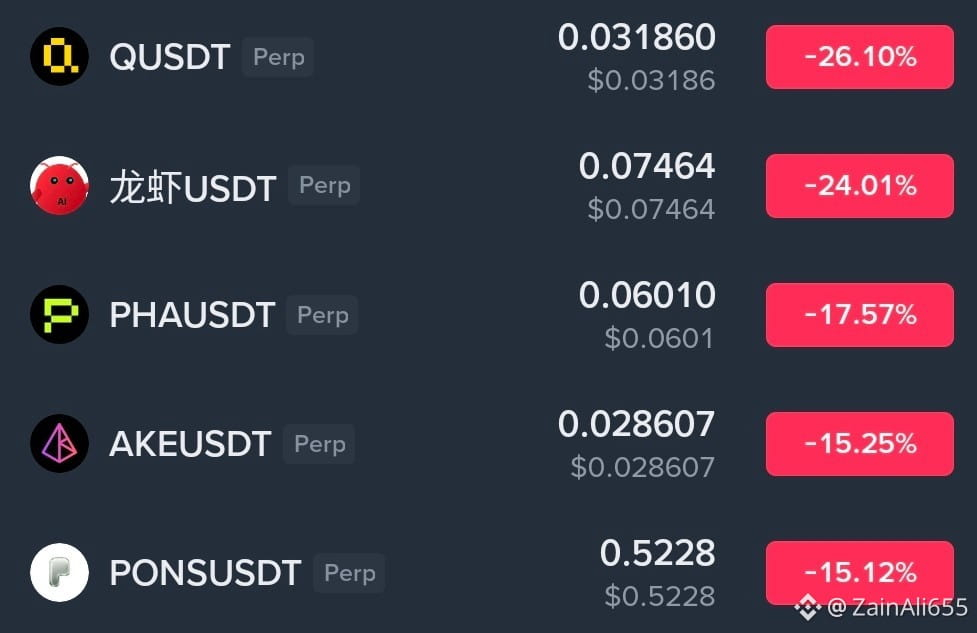
Red everywhere today 😬 $Q is down around 26% while $龙虾 is down 24% and $PHA is down 17%+. That is a pretty rough pullback in a short time. If buyers do not step in around the next support areas then these could slide even lower.
I am not rushing into any of them right now. I wanna see how price reacts first.
#FedProposesPaymentStablecoinRules #ChinaMayLetAlibabaByteDanceBuyNvidiaChips #SKoreaFSCConsidersVirtualAssetMarketMaker #BitwiseFilesFinalNEARSpotETFProspectus #ChinaIndustrialProfitGrowthSlowsFourthMonth
Which one are you watching here?
Red everywhere today 😬 $Q is down around 26% while $龙虾 is down 24% and $PHA is down 17%+. That is a pretty rough pullback in a short time. If buyers do not step in around the next support areas then these could slide even lower.
I am not rushing into any of them right now. I wanna see how price reacts first.
#FedProposesPaymentStablecoinRules #ChinaMayLetAlibabaByteDanceBuyNvidiaChips #SKoreaFSCConsidersVirtualAssetMarketMaker #BitwiseFilesFinalNEARSpotETFProspectus #ChinaIndustrialProfitGrowthSlowsFourthMonth
Which one are you watching here?
I am not rushing into any of them right now. I wanna see how price reacts first.
#FedProposesPaymentStablecoinRules #ChinaMayLetAlibabaByteDanceBuyNvidiaChips #SKoreaFSCConsidersVirtualAssetMarketMaker #BitwiseFilesFinalNEARSpotETFProspectus #ChinaIndustrialProfitGrowthSlowsFourthMonth
Which one are you watching here?
242

·
--
Bearish
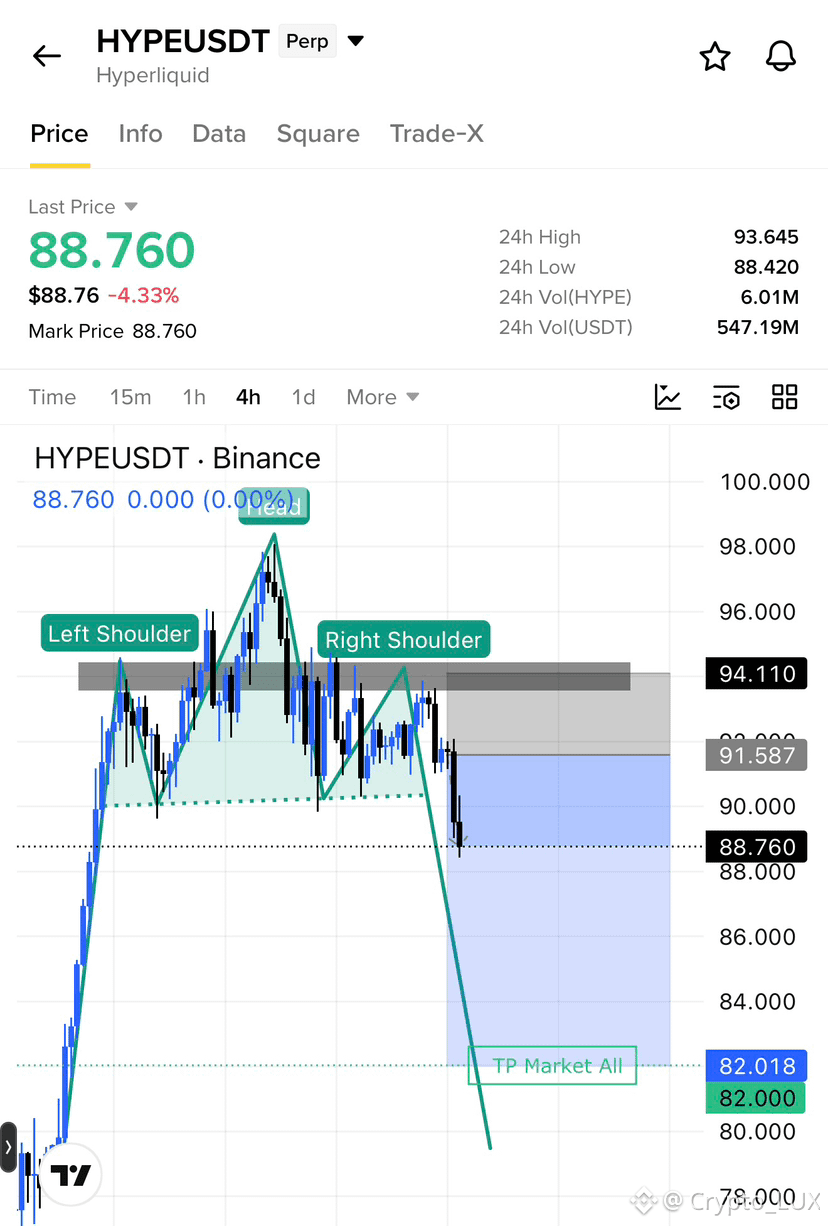
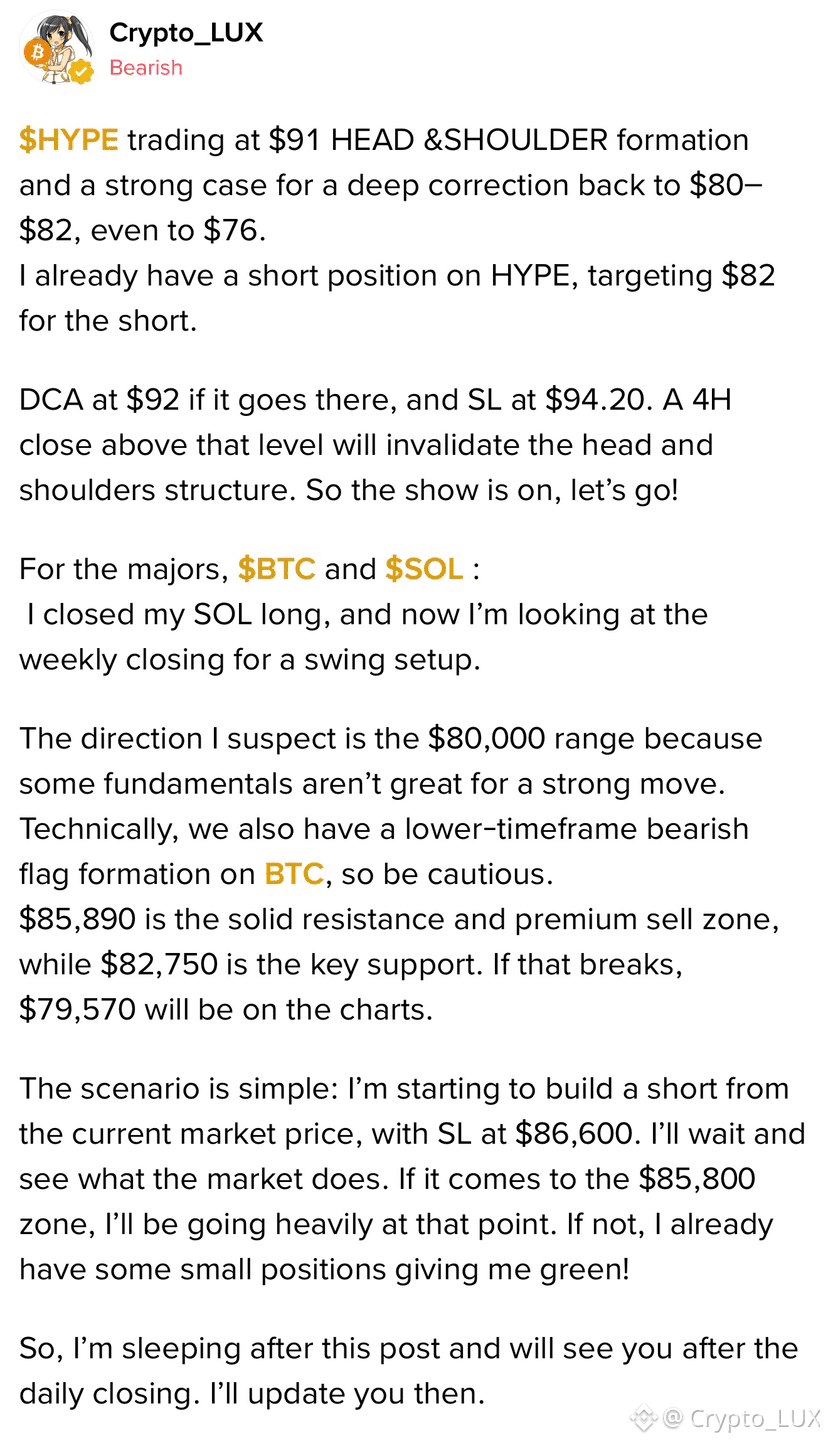
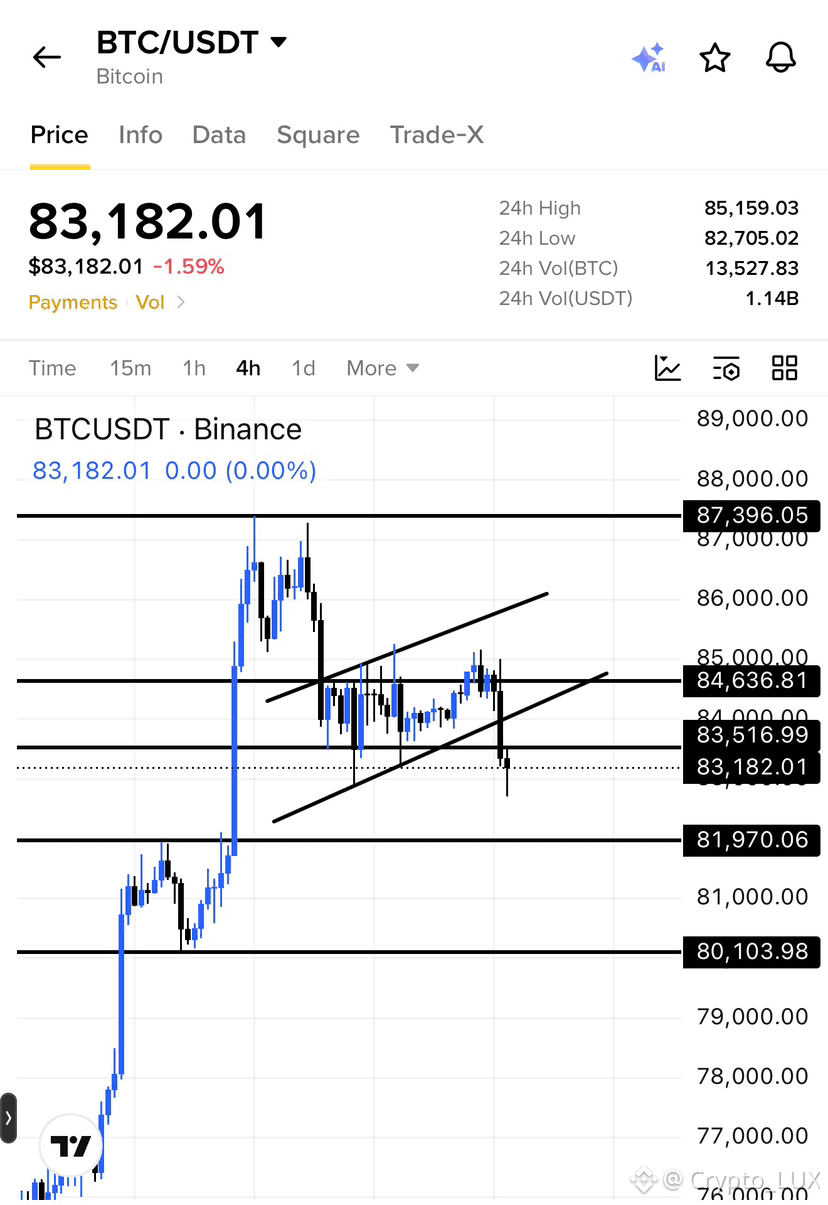
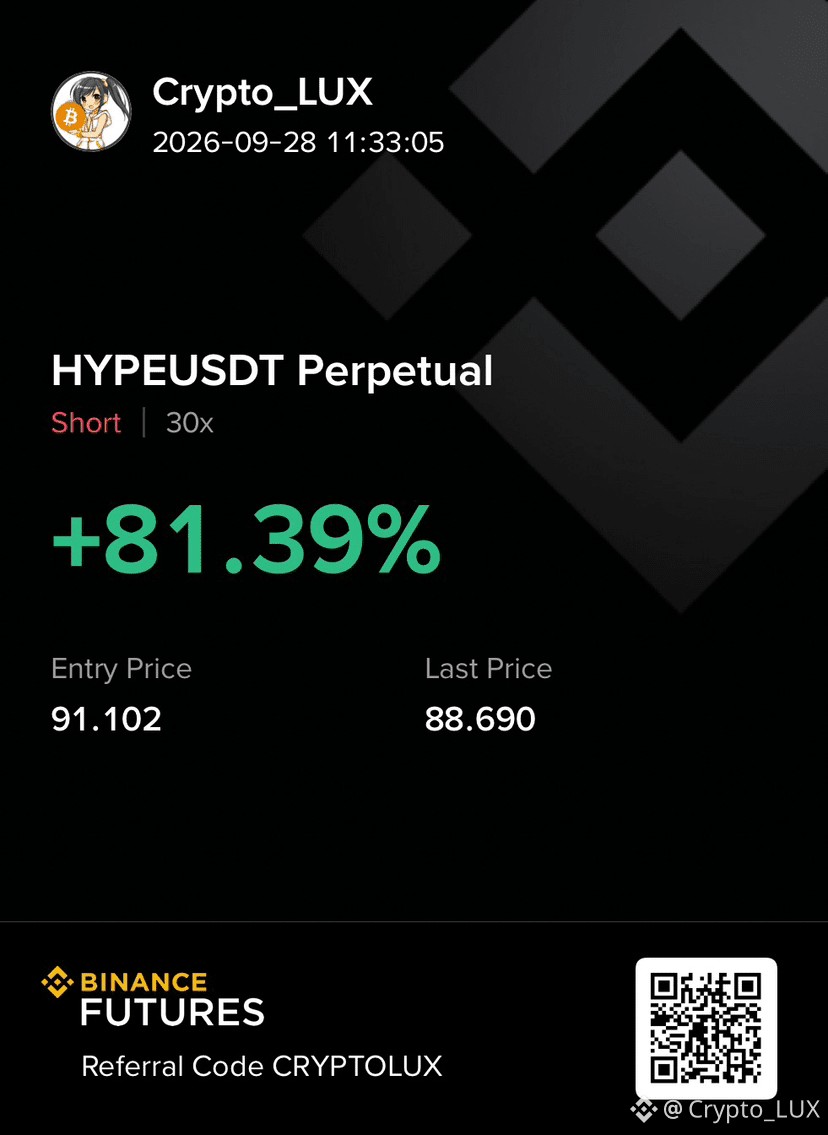
Good morning, guys! Here I am $BTC trading around $83,000, $HYPE trading at $88 with the Head & Shoulders playing out, and $SOL at $118, exactly as I shared in my last post.
The technicals and fundamentals were building up for shorts, and that was the flag that has now broken. The question now is: where will we get support?
For now, support and my first target at $82,750 have already been hit, where we need to see a rebound. But I still think we could see a deeper correction during the equity session, toward $80,000 on BTC and $113 on SOL.
So be ready and stay tuned for the next call.
For those who missed the short, you can look to build shorts around the $83,500 zone on BTC and major alts, with the SL just above $84,200.
How was the catch on the majors? Let me know in the comments.
#FedProposesPaymentStablecoinRules #USChinaRelease$30BTariffCutProductLists #ChinaMayLetAlibabaByteDanceBuyNvidiaChips #SOLSpotETFWeeklyInflow$188M
{future}(HYPEUSDT)
{future}(BTCUSDT)
{future}(SOLUSDT)
Good morning, guys! Here I am $BTC trading around $83,000, $HYPE trading at $88 with the Head & Shoulders playing out, and $SOL at $118, exactly as I shared in my last post.
The technicals and fundamentals were building up for shorts, and that was the flag that has now broken. The question now is: where will we get support?
For now, support and my first target at $82,750 have already been hit, where we need to see a rebound. But I still think we could see a deeper correction during the equity session, toward $80,000 on BTC and $113 on SOL.
So be ready and stay tuned for the next call.
For those who missed the short, you can look to build shorts around the $83,500 zone on BTC and major alts, with the SL just above $84,200.
How was the catch on the majors? Let me know in the comments.
#FedProposesPaymentStablecoinRules #USChinaRelease$30BTariffCutProductLists #ChinaMayLetAlibabaByteDanceBuyNvidiaChips #SOLSpotETFWeeklyInflow$188M
The technicals and fundamentals were building up for shorts, and that was the flag that has now broken. The question now is: where will we get support?
For now, support and my first target at $82,750 have already been hit, where we need to see a rebound. But I still think we could see a deeper correction during the equity session, toward $80,000 on BTC and $113 on SOL.
So be ready and stay tuned for the next call.
For those who missed the short, you can look to build shorts around the $83,500 zone on BTC and major alts, with the SL just above $84,200.
How was the catch on the majors? Let me know in the comments.
#FedProposesPaymentStablecoinRules #USChinaRelease$30BTariffCutProductLists #ChinaMayLetAlibabaByteDanceBuyNvidiaChips #SOLSpotETFWeeklyInflow$188M
AngelOfCrypto_-:
nice
2
8
670
·
--
$ETH outlook — September 28, 2026
My base-case projection is that $ETH can push toward $3,050–$3,450 if it holds the current breakout structure. Reuters’ technical analysis identified a bull-flag breakout above $2,661.52, with a measured target around $3,050 and a further resistance zone around $3,395–$3,445. �
Reuters
Why I’m bullish, but cautious:
Institutional demand: U.S. spot ETH ETFs recorded about $87M of net inflows on Sept. 25, indicating renewed institutional buying. �
SatoshiMacro
Technical momentum: $ETH has broken above its recent consolidation and moved back toward January levels. �
IG +1
Ethereum fundamentals: Upcoming network upgrades and continued institutional/tokenization activity provide longer-term catalysts. �
CoinDesk
Major risk: The macro environment is still difficult. The Fed raised rates to 3.75%–4.00% in September, while inflation and geopolitical/energy pressures remain elevated. �
J.P. Morgan +1
My scenario map
Scenario
ETH zone
Bullish continuation
$3,050 → $3,450
Strong breakout
$3,500 → $4,000
Very bullish 2026 extension
$4,500 → $6,000
Bearish reversal
$2,560 → $2,350
The most important levels are roughly $2,560–$2,650 on the downside and $3,050–$3,450 on the upside. Reuters specifically notes that a break below $2,560/65 would weaken the bullish setup, while below $2,350/60 could invalidate the current rally structure. �
Reuters
Strong prediction: If ETH maintains momentum above the $2,650 area and ETF inflows remain positive, $3,000 is the next major psychological target, followed by $3,400–$3,500. A sustained move above $3,500 would materially change the technical picture and open the door toward the $4,000+ region. This is a scenario analysis, not a guaranteed price target.
Available next action: �Create a downloadable PDF file here in this chat containing the findings and recommendations above
#FedProposesPaymentStablecoinRules
#StrategyStriveAdd2305BitcoinThisWeek
#BitwiseFilesFinalNEARSpotETFProspectus
{spot}(ETHUSDT)
$ETH outlook — September 28, 2026
My base-case projection is that $ETH can push toward $3,050–$3,450 if it holds the current breakout structure. Reuters’ technical analysis identified a bull-flag breakout above $2,661.52, with a measured target around $3,050 and a further resistance zone around $3,395–$3,445. �
Reuters
Why I’m bullish, but cautious:
Institutional demand: U.S. spot ETH ETFs recorded about $87M of net inflows on Sept. 25, indicating renewed institutional buying. �
SatoshiMacro
Technical momentum: $ETH has broken above its recent consolidation and moved back toward January levels. �
IG +1
Ethereum fundamentals: Upcoming network upgrades and continued institutional/tokenization activity provide longer-term catalysts. �
CoinDesk
Major risk: The macro environment is still difficult. The Fed raised rates to 3.75%–4.00% in September, while inflation and geopolitical/energy pressures remain elevated. �
J.P. Morgan +1
My scenario map
Scenario
ETH zone
Bullish continuation
$3,050 → $3,450
Strong breakout
$3,500 → $4,000
Very bullish 2026 extension
$4,500 → $6,000
Bearish reversal
$2,560 → $2,350
The most important levels are roughly $2,560–$2,650 on the downside and $3,050–$3,450 on the upside. Reuters specifically notes that a break below $2,560/65 would weaken the bullish setup, while below $2,350/60 could invalidate the current rally structure. �
Reuters
Strong prediction: If ETH maintains momentum above the $2,650 area and ETF inflows remain positive, $3,000 is the next major psychological target, followed by $3,400–$3,500. A sustained move above $3,500 would materially change the technical picture and open the door toward the $4,000+ region. This is a scenario analysis, not a guaranteed price target.
Available next action: �Create a downloadable PDF file here in this chat containing the findings and recommendations above
#FedProposesPaymentStablecoinRules
#StrategyStriveAdd2305BitcoinThisWeek
#BitwiseFilesFinalNEARSpotETFProspectus
My base-case projection is that $ETH can push toward $3,050–$3,450 if it holds the current breakout structure. Reuters’ technical analysis identified a bull-flag breakout above $2,661.52, with a measured target around $3,050 and a further resistance zone around $3,395–$3,445. �
Reuters
Why I’m bullish, but cautious:
Institutional demand: U.S. spot ETH ETFs recorded about $87M of net inflows on Sept. 25, indicating renewed institutional buying. �
SatoshiMacro
Technical momentum: $ETH has broken above its recent consolidation and moved back toward January levels. �
IG +1
Ethereum fundamentals: Upcoming network upgrades and continued institutional/tokenization activity provide longer-term catalysts. �
CoinDesk
Major risk: The macro environment is still difficult. The Fed raised rates to 3.75%–4.00% in September, while inflation and geopolitical/energy pressures remain elevated. �
J.P. Morgan +1
My scenario map
Scenario
ETH zone
Bullish continuation
$3,050 → $3,450
Strong breakout
$3,500 → $4,000
Very bullish 2026 extension
$4,500 → $6,000
Bearish reversal
$2,560 → $2,350
The most important levels are roughly $2,560–$2,650 on the downside and $3,050–$3,450 on the upside. Reuters specifically notes that a break below $2,560/65 would weaken the bullish setup, while below $2,350/60 could invalidate the current rally structure. �
Reuters
Strong prediction: If ETH maintains momentum above the $2,650 area and ETF inflows remain positive, $3,000 is the next major psychological target, followed by $3,400–$3,500. A sustained move above $3,500 would materially change the technical picture and open the door toward the $4,000+ region. This is a scenario analysis, not a guaranteed price target.
Available next action: �Create a downloadable PDF file here in this chat containing the findings and recommendations above
#FedProposesPaymentStablecoinRules
#StrategyStriveAdd2305BitcoinThisWeek
#BitwiseFilesFinalNEARSpotETFProspectus

15


·
--
Bearish
Crypto is facing selling pressure due to profit-taking, Fed rate concerns and weaker ETF inflows. 📉
Short-term volatility may remain high, so watch key support levels before taking any trade. ⚠️
$BTC $SUI $XRP
#FedRateDecisions
#FedProposesPaymentStablecoinRules
#StrategyStriveAdd2305BitcoinThisWeek
Crypto is facing selling pressure due to profit-taking, Fed rate concerns and weaker ETF inflows. 📉
Short-term volatility may remain high, so watch key support levels before taking any trade. ⚠️
$BTC $SUI $XRP
#FedRateDecisions
#FedProposesPaymentStablecoinRules
#StrategyStriveAdd2305BitcoinThisWeek
Short-term volatility may remain high, so watch key support levels before taking any trade. ⚠️
$BTC $SUI $XRP
#FedRateDecisions
#FedProposesPaymentStablecoinRules
#StrategyStriveAdd2305BitcoinThisWeek
71
·
--
Bullish
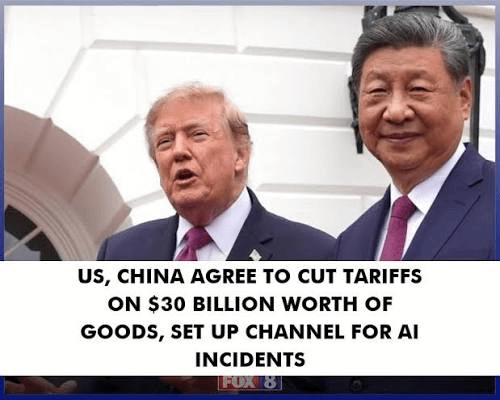
🚨 U.S.–CHINA JUST PUT REAL PRODUCTS BEHIND THE $30B TARIFF DEAL.
Washington and Beijing have now released the product lists tied to their reciprocal tariff-cut framework covering about $30B of imports on each side. Roughly 90% of the covered products are expected to move toward most-favored-nation tariff rates once domestic procedures are completed.
The lists are broad:
Into the U.S. → toys, household goods, sports equipment, fireworks.
Into China → meat, seafood, dairy, grains, timber, medical equipment and coal.
Why markets care:
Lower tariffs → lower input costs
Better trade visibility → less supply-chain friction
Agriculture + coal access → stronger cross-border demand
But this is still not a full U.S.–China reset.
The cuts only apply to selected non-sensitive goods, while strategic disputes around chips, AI and national security remain unresolved.
So the real signal is:
The trade war isn’t over — but both sides are finally removing some of the friction instead of adding more. 👀
$BABA $JD.US $AAPL.US $NVDA.US
{stock_us}(AAPL.US)
{stock_us}(JD.US)
{stock_us}(NVDA.US)
#FedProposesPaymentStablecoinRules #ChinaMayLetAlibabaByteDanceBuyNvidiaChips #USChinaRelease$30BTariffCutProductLists #SKoreaFSCConsidersVirtualAssetMarketMaker #ChinaIndustrialProfitGrowthSlowsFourthMonth
🚨 U.S.–CHINA JUST PUT REAL PRODUCTS BEHIND THE $30B TARIFF DEAL.
Washington and Beijing have now released the product lists tied to their reciprocal tariff-cut framework covering about $30B of imports on each side. Roughly 90% of the covered products are expected to move toward most-favored-nation tariff rates once domestic procedures are completed.
The lists are broad:
Into the U.S. → toys, household goods, sports equipment, fireworks.
Into China → meat, seafood, dairy, grains, timber, medical equipment and coal.
Why markets care:
Lower tariffs → lower input costs
Better trade visibility → less supply-chain friction
Agriculture + coal access → stronger cross-border demand
But this is still not a full U.S.–China reset.
The cuts only apply to selected non-sensitive goods, while strategic disputes around chips, AI and national security remain unresolved.
So the real signal is:
The trade war isn’t over — but both sides are finally removing some of the friction instead of adding more. 👀
$BABA $JD.US $AAPL.US $NVDA.US
#FedProposesPaymentStablecoinRules #ChinaMayLetAlibabaByteDanceBuyNvidiaChips #USChinaRelease$30BTariffCutProductLists #SKoreaFSCConsidersVirtualAssetMarketMaker #ChinaIndustrialProfitGrowthSlowsFourthMonth
Washington and Beijing have now released the product lists tied to their reciprocal tariff-cut framework covering about $30B of imports on each side. Roughly 90% of the covered products are expected to move toward most-favored-nation tariff rates once domestic procedures are completed.
The lists are broad:
Into the U.S. → toys, household goods, sports equipment, fireworks.
Into China → meat, seafood, dairy, grains, timber, medical equipment and coal.
Why markets care:
Lower tariffs → lower input costs
Better trade visibility → less supply-chain friction
Agriculture + coal access → stronger cross-border demand
But this is still not a full U.S.–China reset.
The cuts only apply to selected non-sensitive goods, while strategic disputes around chips, AI and national security remain unresolved.
So the real signal is:
The trade war isn’t over — but both sides are finally removing some of the friction instead of adding more. 👀
$BABA $JD.US $AAPL.US $NVDA.US
#FedProposesPaymentStablecoinRules #ChinaMayLetAlibabaByteDanceBuyNvidiaChips #USChinaRelease$30BTariffCutProductLists #SKoreaFSCConsidersVirtualAssetMarketMaker #ChinaIndustrialProfitGrowthSlowsFourthMonth
AAPLUS-0.13%
NVDAUS-0.81%
JDUS+0.45%
50

·
--
⚡California Bans Officials' Memecoins 🚫🚫
California Governor Gavin Newsom signed Assembly Bill 2409 prohibiting state and local public officials from issuing memecoins, effective January 1, 2027. The law also bars digital asset service providers from offering such tokens to California residents, with enforcement through civil actions by attorney general or district attorneys.
$QNT $BTW $LYN
#FedProposesPaymentStablecoinRules
⚡California Bans Officials' Memecoins 🚫🚫
California Governor Gavin Newsom signed Assembly Bill 2409 prohibiting state and local public officials from issuing memecoins, effective January 1, 2027. The law also bars digital asset service providers from offering such tokens to California residents, with enforcement through civil actions by attorney general or district attorneys.
$QNT $BTW $LYN
#FedProposesPaymentStablecoinRules
California Governor Gavin Newsom signed Assembly Bill 2409 prohibiting state and local public officials from issuing memecoins, effective January 1, 2027. The law also bars digital asset service providers from offering such tokens to California residents, with enforcement through civil actions by attorney general or district attorneys.
$QNT $BTW $LYN
#FedProposesPaymentStablecoinRules

ibrahim haxhimeri:
yes
1
1
49
Log in to explore more content
Join global crypto users on Binance Square
⚡️ Get latest and useful information about crypto.
💬 Trusted by the world’s largest crypto exchange.
👍 Discover real insights from verified creators.
Email / Phone number
Trending Topics
1
#FedProposesPaymentStablecoinRules
2,523 views
111 Discussing
2
#ChinaMayLetAlibabaByteDanceBuyNvidiaChips
4,992 views
207 Discussing
3
#USChinaRelease$30BTariffCutProductLists
838 views
23 Discussing
4
#SKoreaFSCConsidersVirtualAssetMarketMaker
5,589 views
195 Discussing
5
#ChinaIndustrialProfitGrowthSlowsFourthMonth
6,695 views
202 Discussing
6
#BitwiseFilesFinalNEARSpotETFProspectus
118,851 views
1,742 Discussing
7
#BitgetHackerMoves$83MStolenXRP
39,924 views
177 Discussing
8
#SOLSpotETFWeeklyInflow$188M
25,159 views
139 Discussing
9
#DogecoinETFsPostBiggestWeekSinceLaunch
68,304 views
1,117 Discussing
10
#StrategyStriveAdd2305BitcoinThisWeek
168,775 views
2,396 Discussing