

#bnb_market_update
bnb_market_update
7.8M views
43,454 Discussing
Hot
Latest

·
--
$BNB AT A KEY LEVEL — BREAKOUT OR PULLBACK? 👀
BNB is trading around $770 after gaining roughly 5% over the past 7 days. The price is now approaching the psychological $800 resistance, making this an important zone to watch. 📊
🐂 BULL SCENARIO
If BNB breaks and holds above $800–$807 with strong volume:
➡️ Momentum could strengthen
➡️ $850+ becomes the next zone to watch
➡️ A successful retest of $800 could support the bullish structure
🐻 BEAR SCENARIO
If BNB gets rejected around $800 and selling pressure increases:
➡️ $760 becomes the first level to watch
➡️ Key support sits around $740–$746
➡️ A sustained break below $740 could signal further weakness
🎯 KEY LEVELS THIS WEEK
🟢 Support: $740–$746
🟡 Pivot/near-term: $760
🔴 Resistance: $800–$807
🚀 Upside zone: $850+
📌 Bottom line: BNB is sitting at an important decision zone. The reaction around $800 could provide the next major technical signal. Watch the breakout, volume, and daily closes rather than chasing the move.
💬 What do you think — BNB above $800 or back toward $740?
#BNB_Market_Update
{spot}(BNBUSDT)
$BNB AT A KEY LEVEL — BREAKOUT OR PULLBACK? 👀
BNB is trading around $770 after gaining roughly 5% over the past 7 days. The price is now approaching the psychological $800 resistance, making this an important zone to watch. 📊
🐂 BULL SCENARIO
If BNB breaks and holds above $800–$807 with strong volume:
➡️ Momentum could strengthen
➡️ $850+ becomes the next zone to watch
➡️ A successful retest of $800 could support the bullish structure
🐻 BEAR SCENARIO
If BNB gets rejected around $800 and selling pressure increases:
➡️ $760 becomes the first level to watch
➡️ Key support sits around $740–$746
➡️ A sustained break below $740 could signal further weakness
🎯 KEY LEVELS THIS WEEK
🟢 Support: $740–$746
🟡 Pivot/near-term: $760
🔴 Resistance: $800–$807
🚀 Upside zone: $850+
📌 Bottom line: BNB is sitting at an important decision zone. The reaction around $800 could provide the next major technical signal. Watch the breakout, volume, and daily closes rather than chasing the move.
💬 What do you think — BNB above $800 or back toward $740?
#BNB_Market_Update
BNB is trading around $770 after gaining roughly 5% over the past 7 days. The price is now approaching the psychological $800 resistance, making this an important zone to watch. 📊
🐂 BULL SCENARIO
If BNB breaks and holds above $800–$807 with strong volume:
➡️ Momentum could strengthen
➡️ $850+ becomes the next zone to watch
➡️ A successful retest of $800 could support the bullish structure
🐻 BEAR SCENARIO
If BNB gets rejected around $800 and selling pressure increases:
➡️ $760 becomes the first level to watch
➡️ Key support sits around $740–$746
➡️ A sustained break below $740 could signal further weakness
🎯 KEY LEVELS THIS WEEK
🟢 Support: $740–$746
🟡 Pivot/near-term: $760
🔴 Resistance: $800–$807
🚀 Upside zone: $850+
📌 Bottom line: BNB is sitting at an important decision zone. The reaction around $800 could provide the next major technical signal. Watch the breakout, volume, and daily closes rather than chasing the move.
💬 What do you think — BNB above $800 or back toward $740?
#BNB_Market_Update
81

*BNB Market Update 🚀*
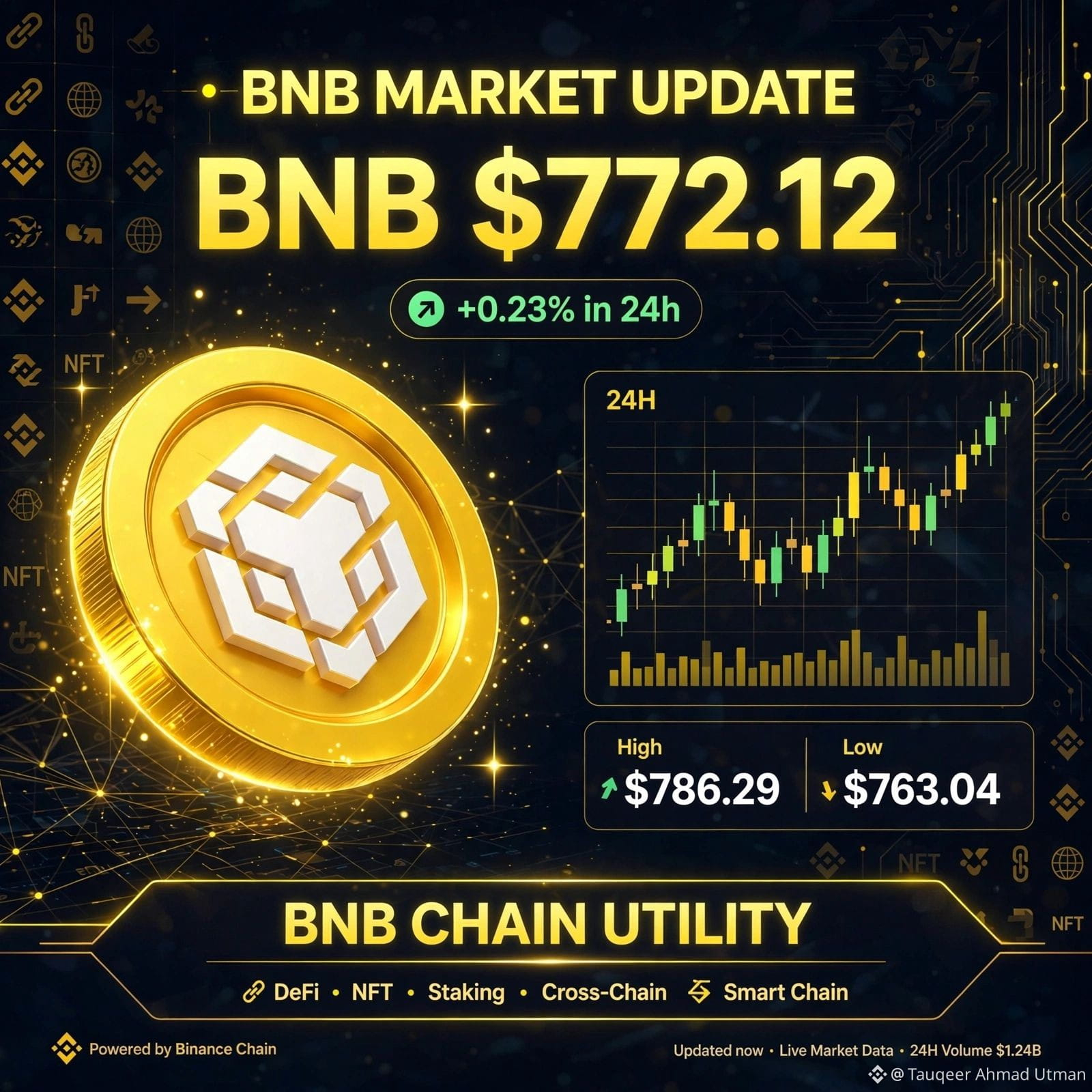
BNB is currently trading at around $772.12. According to fresh Binance Spot data for September 25, 2026, the price is up approximately +0.23% in the last 24 hours; the 24-hour high was $786.29 and the low was $763.04.
Despite volatility in BNB's price, the utility of BNB Chain remains important — it is used for network gas fees, various on-chain apps, and within the Binance ecosystem. The key point for traders in the recent market is that the price in the short term can be affected by broader crypto market sentiment and news related to Binance / BNB Chain
#bnbusdtshort #BNB_Market_Update #BNBToken
{future}(BNBUSDT)
*BNB Market Update 🚀*
BNB is currently trading at around $772.12. According to fresh Binance Spot data for September 25, 2026, the price is up approximately +0.23% in the last 24 hours; the 24-hour high was $786.29 and the low was $763.04.
Despite volatility in BNB's price, the utility of BNB Chain remains important — it is used for network gas fees, various on-chain apps, and within the Binance ecosystem. The key point for traders in the recent market is that the price in the short term can be affected by broader crypto market sentiment and news related to Binance / BNB Chain
#bnbusdtshort #BNB_Market_Update #BNBToken
BNB is currently trading at around $772.12. According to fresh Binance Spot data for September 25, 2026, the price is up approximately +0.23% in the last 24 hours; the 24-hour high was $786.29 and the low was $763.04.
Despite volatility in BNB's price, the utility of BNB Chain remains important — it is used for network gas fees, various on-chain apps, and within the Binance ecosystem. The key point for traders in the recent market is that the price in the short term can be affected by broader crypto market sentiment and news related to Binance / BNB Chain
#bnbusdtshort #BNB_Market_Update #BNBToken
1
80

·
--
Article
🚀 BNB Powers Past $770 — Still the Market's Strongest Major CoinCurrent price:
~$770, up about 6.9% over the past week (though slightly underperforming the broader crypto market's ~10.4% weekly gain), and down about 43% from its all-time high of $1,369.99-1,373.66 (October 13, 2025). Market cap sits around $102-104 billion, ranked #4 among all cryptocurrencies, with roughly 133 million BNB in circulation, very close to its capped max supply of ~134.78 million.
Recent trend:
BNB has continued climbing alongside the broader crypto rally, pushing from the $715-720 range seen in recent weeks up to the $770s. Trading volume has pulled back notably (down ~26.7% day-over-day on some exchanges), suggesting the rally is cooling into a calmer consolidation after a strong run rather than accelerating further right now. Despite the strong dollar gains, BNB is actually underperforming both the broader market and similar smart-contract platforms on a percentage basis this week — a shift from its earlier "market leader" status seen in prior updates.
Key drivers:
Regulatory friction in Europe — reports indicate ECB President Christine Lagarde intervened to delay Binance's European MiCA license approval, an overhang worth watching for the exchange-linked token
Near-max supply — with circulating supply almost equal to the hard cap, ongoing burns continue to make BNB increasingly scarce, a structural tailwind independent of short-term price swings
Institutional validation — Grayscale's Q2 2026 rebalancing gave BNB a 30.6% weighting in its Smart Contract Fund, ahead of ETH and SOL, with a spot BNB ETF filing still pending
AI agent ecosystem — BNB Chain's 200,000+ registered AI agents (about 60% of all agents across 26 networks) remains a key differentiator and narrative driver
Cooling volume — the sharp drop in trading activity suggests the market is pausing to digest recent gains rather than losing overall conviction
Bottom line:
BNB's climb to $770 keeps it as one of the stronger relative performers among major coins (down "only" ~43% from ATH vs. deeper drawdowns elsewhere), but the European regulatory friction and cooling volume are worth watching as potential near-term headwinds.
$BNB
{spot}(BNBUSDT)
#BNB_Market_Update #BNBbull #FedOctoberRateHikeOddsRiseTo69.7% #BinanceWillListHyperliquid(HYPE)
🚀 BNB Powers Past $770 — Still the Market's Strongest Major Coin
Current price:
~$770, up about 6.9% over the past week (though slightly underperforming the broader crypto market's ~10.4% weekly gain), and down about 43% from its all-time high of $1,369.99-1,373.66 (October 13, 2025). Market cap sits around $102-104 billion, ranked #4 among all cryptocurrencies, with roughly 133 million BNB in circulation, very close to its capped max supply of ~134.78 million.
Recent trend:
BNB has continued climbing alongside the broader crypto rally, pushing from the $715-720 range seen in recent weeks up to the $770s. Trading volume has pulled back notably (down ~26.7% day-over-day on some exchanges), suggesting the rally is cooling into a calmer consolidation after a strong run rather than accelerating further right now. Despite the strong dollar gains, BNB is actually underperforming both the broader market and similar smart-contract platforms on a percentage basis this week — a shift from its earlier "market leader" status seen in prior updates.
Key drivers:
Regulatory friction in Europe — reports indicate ECB President Christine Lagarde intervened to delay Binance's European MiCA license approval, an overhang worth watching for the exchange-linked token
Near-max supply — with circulating supply almost equal to the hard cap, ongoing burns continue to make BNB increasingly scarce, a structural tailwind independent of short-term price swings
Institutional validation — Grayscale's Q2 2026 rebalancing gave BNB a 30.6% weighting in its Smart Contract Fund, ahead of ETH and SOL, with a spot BNB ETF filing still pending
AI agent ecosystem — BNB Chain's 200,000+ registered AI agents (about 60% of all agents across 26 networks) remains a key differentiator and narrative driver
Cooling volume — the sharp drop in trading activity suggests the market is pausing to digest recent gains rather than losing overall conviction
Bottom line:
BNB's climb to $770 keeps it as one of the stronger relative performers among major coins (down "only" ~43% from ATH vs. deeper drawdowns elsewhere), but the European regulatory friction and cooling volume are worth watching as potential near-term headwinds.
$BNB
#BNB_Market_Update #BNBbull #FedOctoberRateHikeOddsRiseTo69.7% #BinanceWillListHyperliquid(HYPE)
~$770, up about 6.9% over the past week (though slightly underperforming the broader crypto market's ~10.4% weekly gain), and down about 43% from its all-time high of $1,369.99-1,373.66 (October 13, 2025). Market cap sits around $102-104 billion, ranked #4 among all cryptocurrencies, with roughly 133 million BNB in circulation, very close to its capped max supply of ~134.78 million.
Recent trend:
BNB has continued climbing alongside the broader crypto rally, pushing from the $715-720 range seen in recent weeks up to the $770s. Trading volume has pulled back notably (down ~26.7% day-over-day on some exchanges), suggesting the rally is cooling into a calmer consolidation after a strong run rather than accelerating further right now. Despite the strong dollar gains, BNB is actually underperforming both the broader market and similar smart-contract platforms on a percentage basis this week — a shift from its earlier "market leader" status seen in prior updates.
Key drivers:
Regulatory friction in Europe — reports indicate ECB President Christine Lagarde intervened to delay Binance's European MiCA license approval, an overhang worth watching for the exchange-linked token
Near-max supply — with circulating supply almost equal to the hard cap, ongoing burns continue to make BNB increasingly scarce, a structural tailwind independent of short-term price swings
Institutional validation — Grayscale's Q2 2026 rebalancing gave BNB a 30.6% weighting in its Smart Contract Fund, ahead of ETH and SOL, with a spot BNB ETF filing still pending
AI agent ecosystem — BNB Chain's 200,000+ registered AI agents (about 60% of all agents across 26 networks) remains a key differentiator and narrative driver
Cooling volume — the sharp drop in trading activity suggests the market is pausing to digest recent gains rather than losing overall conviction
Bottom line:
BNB's climb to $770 keeps it as one of the stronger relative performers among major coins (down "only" ~43% from ATH vs. deeper drawdowns elsewhere), but the European regulatory friction and cooling volume are worth watching as potential near-term headwinds.
$BNB
#BNB_Market_Update #BNBbull #FedOctoberRateHikeOddsRiseTo69.7% #BinanceWillListHyperliquid(HYPE)
47

·
--
Bullish
$BNB UPDATE - $900 Breaks! 🚀
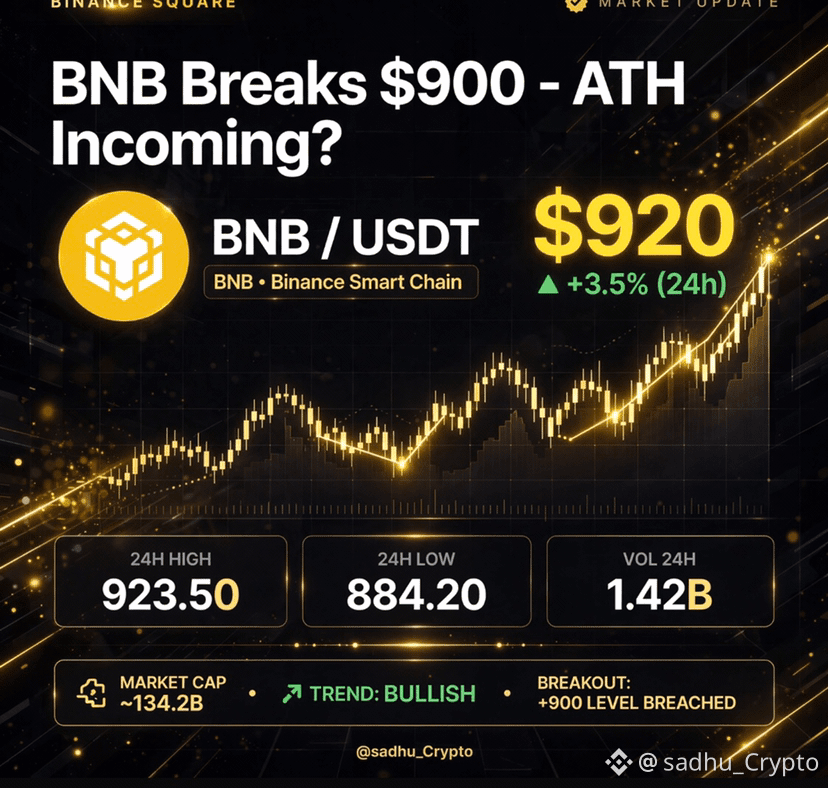
BNB officially broke $900 - Now at $920 (+3.5%)
24H High: $923.50
Market Cap: ~$134B
Trend: BULLISH 💛
Is BNB going to $1000 next? CZ's coin is on fire!
What is your BNB target? 👇$BNB
#BinanceWillListHyperliquid(HYPE)
#US30YearYieldHighestSince2004 #BNB_Market_Update
$BNB UPDATE - $900 Breaks! 🚀
BNB officially broke $900 - Now at $920 (+3.5%)
24H High: $923.50
Market Cap: ~$134B
Trend: BULLISH 💛
Is BNB going to $1000 next? CZ's coin is on fire!
What is your BNB target? 👇$BNB
#BinanceWillListHyperliquid(HYPE)
#US30YearYieldHighestSince2004 #BNB_Market_Update
BNB officially broke $900 - Now at $920 (+3.5%)
24H High: $923.50
Market Cap: ~$134B
Trend: BULLISH 💛
Is BNB going to $1000 next? CZ's coin is on fire!
What is your BNB target? 👇$BNB
#BinanceWillListHyperliquid(HYPE)
#US30YearYieldHighestSince2004 #BNB_Market_Update
1
1
118

·
--
$BNB have surpassed $770 market cap whats your move ?
If $770 turns into support, traders may start watching the next resistance zones around the recent highs.
But if BNB gets rejected and falls back below $770, the breakout could prove temporary.
The cleaner setup is waiting to see whether $770 changes from resistance into support.
if it does then market would eventually grow
#BNB_Market_Update #BinanceSquareTalks
$BNB have surpassed $770 market cap whats your move ?
If $770 turns into support, traders may start watching the next resistance zones around the recent highs.
But if BNB gets rejected and falls back below $770, the breakout could prove temporary.
The cleaner setup is waiting to see whether $770 changes from resistance into support.
if it does then market would eventually grow
#BNB_Market_Update #BinanceSquareTalks
If $770 turns into support, traders may start watching the next resistance zones around the recent highs.
But if BNB gets rejected and falls back below $770, the breakout could prove temporary.
The cleaner setup is waiting to see whether $770 changes from resistance into support.
if it does then market would eventually grow
#BNB_Market_Update #BinanceSquareTalks
33

·
--
Bullish
Never open a Trade Unless you read its data..😳🤔$BNB
#BNB_Market_Update
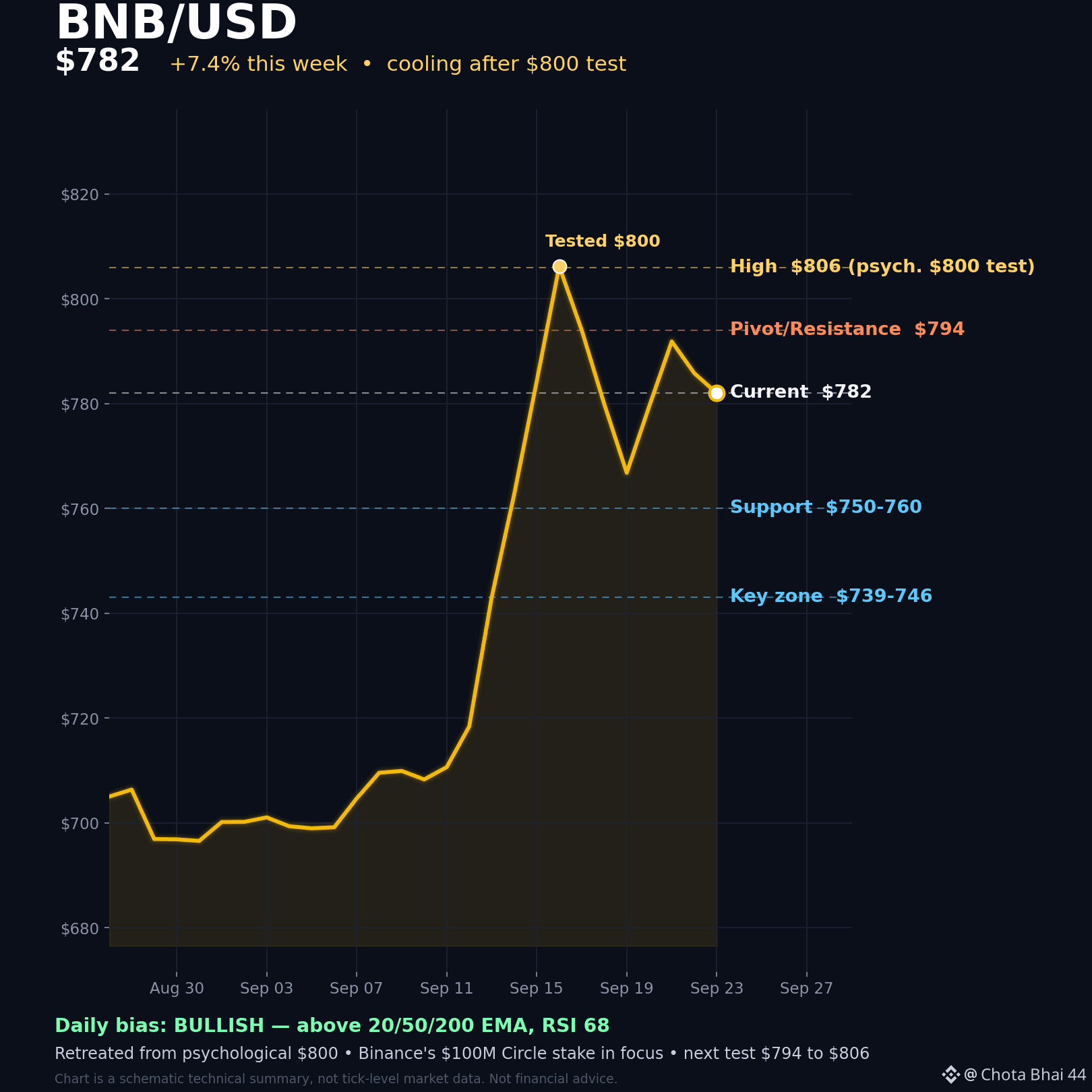
BNB is trading around $782, up about 7.4% over the past week, after a sharp push that briefly touched $806 and tested the psychological $800 level for the first time in a while. Price has since pulled back but is holding well above where the rally started.
Trend: Daily chart stays bullish — price is above the 20, 50, and 200 EMAs (~$745 / $700 / $668), and daily RSI sits at a firm 68. Momentum: MACD histogram is still positive, though 15-minute action shows short-term sellers have the edge — a normal pause after a fast move. Catalyst: Binance's $100 million stake in Circle plus a 5-year USDC partnership is keeping BNB in the news cycle. Key levels:
Resistance: $794 (pivot) → $806 (recent high) Support: $750–$760 → $739–$746 (key reaccumulation zone flagged by traders)
Bias: Bullish while BNB holds above $750–760. A close back above $794 opens the retest of $806 and potentially fresh highs; a break below $740 would be the first real crack in the trend.
Never open a Trade Unless you read its data..😳🤔$BNB
#BNB_Market_Update
BNB is trading around $782, up about 7.4% over the past week, after a sharp push that briefly touched $806 and tested the psychological $800 level for the first time in a while. Price has since pulled back but is holding well above where the rally started.
Trend: Daily chart stays bullish — price is above the 20, 50, and 200 EMAs (~$745 / $700 / $668), and daily RSI sits at a firm 68. Momentum: MACD histogram is still positive, though 15-minute action shows short-term sellers have the edge — a normal pause after a fast move. Catalyst: Binance's $100 million stake in Circle plus a 5-year USDC partnership is keeping BNB in the news cycle. Key levels:
Resistance: $794 (pivot) → $806 (recent high) Support: $750–$760 → $739–$746 (key reaccumulation zone flagged by traders)
Bias: Bullish while BNB holds above $750–760. A close back above $794 opens the retest of $806 and potentially fresh highs; a break below $740 would be the first real crack in the trend.
#BNB_Market_Update
BNB is trading around $782, up about 7.4% over the past week, after a sharp push that briefly touched $806 and tested the psychological $800 level for the first time in a while. Price has since pulled back but is holding well above where the rally started.
Trend: Daily chart stays bullish — price is above the 20, 50, and 200 EMAs (~$745 / $700 / $668), and daily RSI sits at a firm 68. Momentum: MACD histogram is still positive, though 15-minute action shows short-term sellers have the edge — a normal pause after a fast move. Catalyst: Binance's $100 million stake in Circle plus a 5-year USDC partnership is keeping BNB in the news cycle. Key levels:
Resistance: $794 (pivot) → $806 (recent high) Support: $750–$760 → $739–$746 (key reaccumulation zone flagged by traders)
Bias: Bullish while BNB holds above $750–760. A close back above $794 opens the retest of $806 and potentially fresh highs; a break below $740 would be the first real crack in the trend.
66

·
--
📊 $BNB BNB COIN — TECHNICAL ANALYSIS
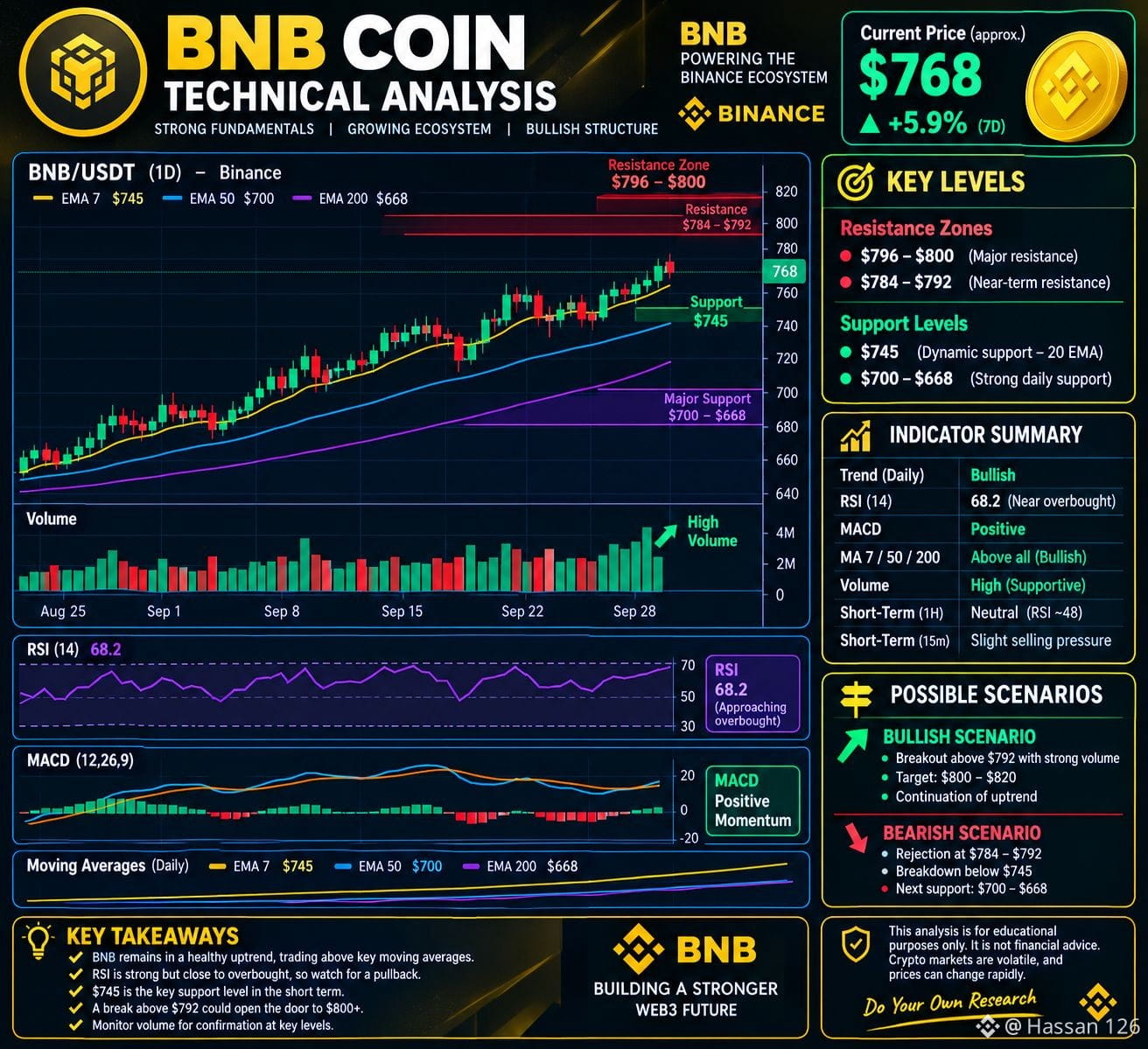
BNB is currently trading around the $768 area, after a strong recent move.
The 7-day performance remains positive at roughly +5.9%.
On the daily timeframe, BNB continues to show a bullish technical structure.
Price remains above the 20, 50 and 200-day EMA's, supporting the broader uptrend.
The 20-day EMA is around $745, providing an important dynamic support zone.
The 50-day EMA is near $700, while the 200-day EMA is around $668.
Daily RSI was recently around 68, showing strong momentum but approaching the overbought region.
MACD remained positive, indicating that medium-term momentum was still favorable.
Shorter timeframes are less decisive, with the 1-hour RSI around the neutral 48 level.
The 15-minute chart showed some short-term selling pressure and weaker momentum.
The $784–$792 area is an important near-term zone to monitor.
A sustained move above the $792 area could indicate renewed short-term strength.
The $796–$800 region represents another important resistance area from recent technical levels.
Around $784 is a notable near-term support level.
A deeper pullback could bring the $745 area into focus as a major daily support zone.
Trading volume should be monitored closely when BNB approaches major support or resistance.
Strong volume accompanying a breakout generally provides better confirmation than price movement alone.
The main bullish risk is a rejection near resistance followed by a loss of important support levels.
Overall, the daily structure remains positive while shorter-term momentum is currently mixed.
{spot}(BNBUSDT)
#BNB #bnblauncpool #BNBbull #BNB_Market_Update
📊 $BNB BNB COIN — TECHNICAL ANALYSIS
BNB is currently trading around the $768 area, after a strong recent move.
The 7-day performance remains positive at roughly +5.9%.
On the daily timeframe, BNB continues to show a bullish technical structure.
Price remains above the 20, 50 and 200-day EMA's, supporting the broader uptrend.
The 20-day EMA is around $745, providing an important dynamic support zone.
The 50-day EMA is near $700, while the 200-day EMA is around $668.
Daily RSI was recently around 68, showing strong momentum but approaching the overbought region.
MACD remained positive, indicating that medium-term momentum was still favorable.
Shorter timeframes are less decisive, with the 1-hour RSI around the neutral 48 level.
The 15-minute chart showed some short-term selling pressure and weaker momentum.
The $784–$792 area is an important near-term zone to monitor.
A sustained move above the $792 area could indicate renewed short-term strength.
The $796–$800 region represents another important resistance area from recent technical levels.
Around $784 is a notable near-term support level.
A deeper pullback could bring the $745 area into focus as a major daily support zone.
Trading volume should be monitored closely when BNB approaches major support or resistance.
Strong volume accompanying a breakout generally provides better confirmation than price movement alone.
The main bullish risk is a rejection near resistance followed by a loss of important support levels.
Overall, the daily structure remains positive while shorter-term momentum is currently mixed.
#BNB #bnblauncpool #BNBbull #BNB_Market_Update
BNB is currently trading around the $768 area, after a strong recent move.
The 7-day performance remains positive at roughly +5.9%.
On the daily timeframe, BNB continues to show a bullish technical structure.
Price remains above the 20, 50 and 200-day EMA's, supporting the broader uptrend.
The 20-day EMA is around $745, providing an important dynamic support zone.
The 50-day EMA is near $700, while the 200-day EMA is around $668.
Daily RSI was recently around 68, showing strong momentum but approaching the overbought region.
MACD remained positive, indicating that medium-term momentum was still favorable.
Shorter timeframes are less decisive, with the 1-hour RSI around the neutral 48 level.
The 15-minute chart showed some short-term selling pressure and weaker momentum.
The $784–$792 area is an important near-term zone to monitor.
A sustained move above the $792 area could indicate renewed short-term strength.
The $796–$800 region represents another important resistance area from recent technical levels.
Around $784 is a notable near-term support level.
A deeper pullback could bring the $745 area into focus as a major daily support zone.
Trading volume should be monitored closely when BNB approaches major support or resistance.
Strong volume accompanying a breakout generally provides better confirmation than price movement alone.
The main bullish risk is a rejection near resistance followed by a loss of important support levels.
Overall, the daily structure remains positive while shorter-term momentum is currently mixed.
#BNB #bnblauncpool #BNBbull #BNB_Market_Update
2
95

·
--
BNB (Binance Coin) Daily Analysis & Trading Breakdown
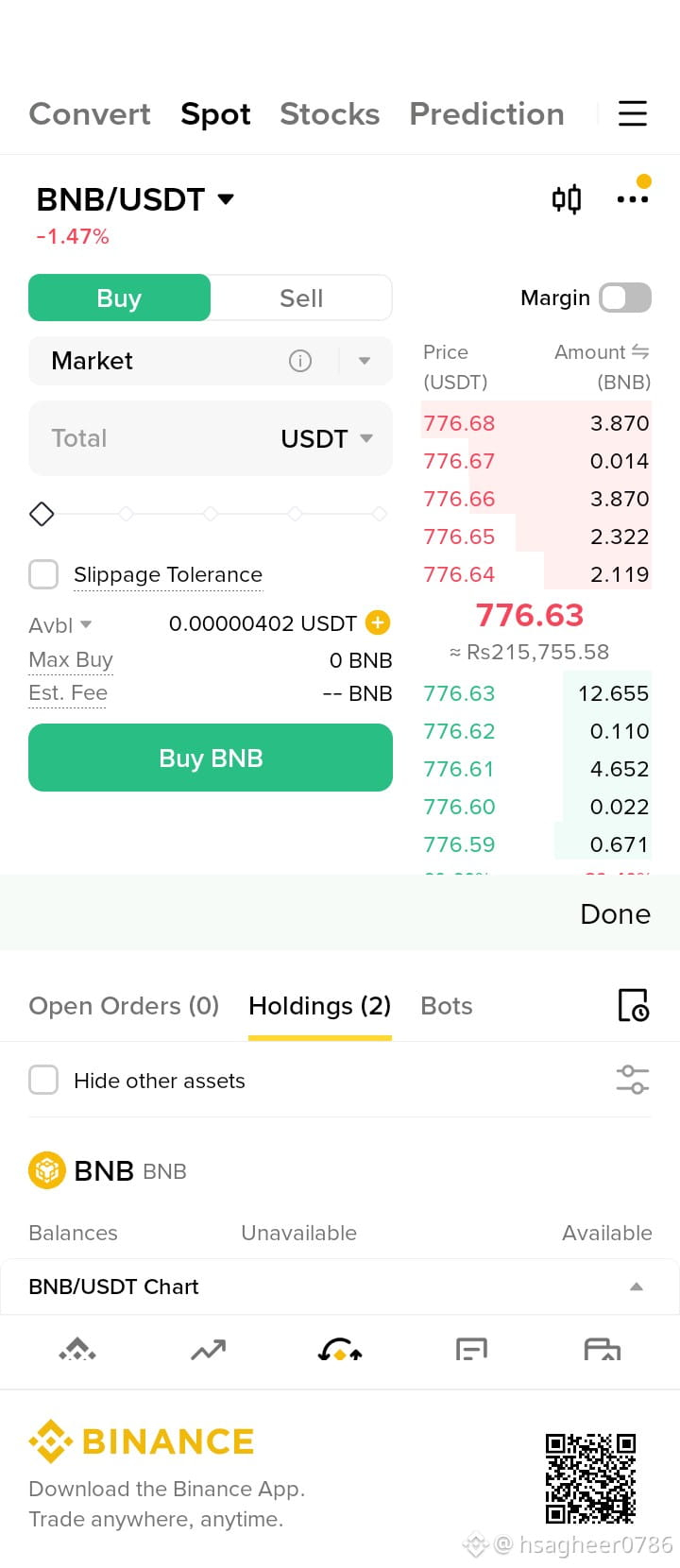
BNB is experiencing a short-term pullback toward key horizontal support, currently trading near $765 – $770. Following a rejection at the major $795 – $800 overhead supply zone, the token is consolidating as profit-taking across major crypto assets coincides with renewed regulatory headlines.
Technical Snapshot & News Drivers
Current Range: Trading around $765 – $770, sitting directly on immediate support around $768.
Momentum: Daily RSI has cooled down to neutral-overbought territory (~68), while 4-hour indicators suggest a short-term bearish bias with price holding below the local 50-period moving average.
Macro & News Catalysts:
Regulatory Scrutiny: Renewed headlines regarding regulatory inquiries into Binance continue to act as an overhead drag on BNB's relative performance.
Network Fundamentals: Despite short-term price pressure, long-term support remains anchored by BNB Chain's tokenized real-world assets (RWA) expansion and recurring Auto-Burn mechanisms.
Bitcoin Beta: BNB is tracking broader market liquidity shifts; a stabilization in BTC above $84,000 will be required for BNB to mount a sustained relief bounce.
Key Technical Levels
Level TypePrice ZoneSignificanceMajor Resistance$795 – $808Multi-week supply ceiling. A daily close above $808 opens a path toward $840+.Immediate Support$760 – $768Key horizontal demand zone. Holding this level preserves the short-term consolidation structure.Key Demand Floor$700 – $720Major secondary support zone aligning with previous swing accumulation lows.
Actionable Trading Tips Today
Avoid Panic Shorting at Immediate Support: BNB is currently retesting the $760 – $768 support zone. Entering short positions here carries poor risk-to-reward unless a daily candle closes cleanly below $760.
$BNB #BNB_Market_Update #BinanceHerYerde #BCHJumps28%OnCMEFuturesListing
BNB (Binance Coin) Daily Analysis & Trading Breakdown
BNB is experiencing a short-term pullback toward key horizontal support, currently trading near $765 – $770. Following a rejection at the major $795 – $800 overhead supply zone, the token is consolidating as profit-taking across major crypto assets coincides with renewed regulatory headlines.
Technical Snapshot & News Drivers
Current Range: Trading around $765 – $770, sitting directly on immediate support around $768.
Momentum: Daily RSI has cooled down to neutral-overbought territory (~68), while 4-hour indicators suggest a short-term bearish bias with price holding below the local 50-period moving average.
Macro & News Catalysts:
Regulatory Scrutiny: Renewed headlines regarding regulatory inquiries into Binance continue to act as an overhead drag on BNB's relative performance.
Network Fundamentals: Despite short-term price pressure, long-term support remains anchored by BNB Chain's tokenized real-world assets (RWA) expansion and recurring Auto-Burn mechanisms.
Bitcoin Beta: BNB is tracking broader market liquidity shifts; a stabilization in BTC above $84,000 will be required for BNB to mount a sustained relief bounce.
Key Technical Levels
Level TypePrice ZoneSignificanceMajor Resistance$795 – $808Multi-week supply ceiling. A daily close above $808 opens a path toward $840+.Immediate Support$760 – $768Key horizontal demand zone. Holding this level preserves the short-term consolidation structure.Key Demand Floor$700 – $720Major secondary support zone aligning with previous swing accumulation lows.
Actionable Trading Tips Today
Avoid Panic Shorting at Immediate Support: BNB is currently retesting the $760 – $768 support zone. Entering short positions here carries poor risk-to-reward unless a daily candle closes cleanly below $760.
$BNB #BNB_Market_Update #BinanceHerYerde #BCHJumps28%OnCMEFuturesListing
BNB is experiencing a short-term pullback toward key horizontal support, currently trading near $765 – $770. Following a rejection at the major $795 – $800 overhead supply zone, the token is consolidating as profit-taking across major crypto assets coincides with renewed regulatory headlines.
Technical Snapshot & News Drivers
Current Range: Trading around $765 – $770, sitting directly on immediate support around $768.
Momentum: Daily RSI has cooled down to neutral-overbought territory (~68), while 4-hour indicators suggest a short-term bearish bias with price holding below the local 50-period moving average.
Macro & News Catalysts:
Regulatory Scrutiny: Renewed headlines regarding regulatory inquiries into Binance continue to act as an overhead drag on BNB's relative performance.
Network Fundamentals: Despite short-term price pressure, long-term support remains anchored by BNB Chain's tokenized real-world assets (RWA) expansion and recurring Auto-Burn mechanisms.
Bitcoin Beta: BNB is tracking broader market liquidity shifts; a stabilization in BTC above $84,000 will be required for BNB to mount a sustained relief bounce.
Key Technical Levels
Level TypePrice ZoneSignificanceMajor Resistance$795 – $808Multi-week supply ceiling. A daily close above $808 opens a path toward $840+.Immediate Support$760 – $768Key horizontal demand zone. Holding this level preserves the short-term consolidation structure.Key Demand Floor$700 – $720Major secondary support zone aligning with previous swing accumulation lows.
Actionable Trading Tips Today
Avoid Panic Shorting at Immediate Support: BNB is currently retesting the $760 – $768 support zone. Entering short positions here carries poor risk-to-reward unless a daily candle closes cleanly below $760.
$BNB #BNB_Market_Update #BinanceHerYerde #BCHJumps28%OnCMEFuturesListing
50

·
--

Article
Long Trade Prediction#AIStocksWhatNext
Should you buy Binance Coin now?
Based on our Binance Coin price forecast, we anticipate a +11.50% increase in Binance Coin's value in 2026, bringing it up to $803.83.
Looking further ahead, our long-term projection places Binance Coin's price at $818.45 by 2027. As we anticipate a bull market commencing in 2027, our 2028 Binance Coin price prediction suggests a value of $615.51. It's crucial to note that long-term predictions come with increased uncertainty. Nevertheless, we speculate that Binance Coin will increase further in 2026, with our average price estimate for Binance Coin in 2026 standing at $803.83.
However, it's important to exercise caution as these are speculative figures. The cryptocurrency market is known for its volatility, and prices can fluctuate rapidly, potentially resulting in losses.
Will Binance Coin go up?
Yes, despite the challenges encountered by Binance Coin, its prospects for sustained long-term expansion continue to exhibit resilience.
Binance Coin's price has undergone notable corrections in the recent past; however, it has more recently exhibited positive price trends, suggesting its viability as a promising long-term investment. Illustratively, in 2026, the Binance Coin token surged to unprecedented heights, reaching $956.80 .This event underscored the cryptocurrency's potential and its ability to attract substantial investments, further highlighting its appeal as a valuable asset for long-term holding.
#BNB_Market_Update
$BNB $BNB
#BNB_Market_Update
🥳🥳💵💰🎁🎉🚀✨🍺🐳💥
Long Trade Prediction
#AIStocksWhatNext
Should you buy Binance Coin now?
Based on our Binance Coin price forecast, we anticipate a +11.50% increase in Binance Coin's value in 2026, bringing it up to $803.83.
Looking further ahead, our long-term projection places Binance Coin's price at $818.45 by 2027. As we anticipate a bull market commencing in 2027, our 2028 Binance Coin price prediction suggests a value of $615.51. It's crucial to note that long-term predictions come with increased uncertainty. Nevertheless, we speculate that Binance Coin will increase further in 2026, with our average price estimate for Binance Coin in 2026 standing at $803.83.
However, it's important to exercise caution as these are speculative figures. The cryptocurrency market is known for its volatility, and prices can fluctuate rapidly, potentially resulting in losses.
Will Binance Coin go up?
Yes, despite the challenges encountered by Binance Coin, its prospects for sustained long-term expansion continue to exhibit resilience.
Binance Coin's price has undergone notable corrections in the recent past; however, it has more recently exhibited positive price trends, suggesting its viability as a promising long-term investment. Illustratively, in 2026, the Binance Coin token surged to unprecedented heights, reaching $956.80 .This event underscored the cryptocurrency's potential and its ability to attract substantial investments, further highlighting its appeal as a valuable asset for long-term holding.
#BNB_Market_Update
$BNB $BNB
#BNB_Market_Update
🥳🥳💵💰🎁🎉🚀✨🍺🐳💥
Should you buy Binance Coin now?
Based on our Binance Coin price forecast, we anticipate a +11.50% increase in Binance Coin's value in 2026, bringing it up to $803.83.
Looking further ahead, our long-term projection places Binance Coin's price at $818.45 by 2027. As we anticipate a bull market commencing in 2027, our 2028 Binance Coin price prediction suggests a value of $615.51. It's crucial to note that long-term predictions come with increased uncertainty. Nevertheless, we speculate that Binance Coin will increase further in 2026, with our average price estimate for Binance Coin in 2026 standing at $803.83.
However, it's important to exercise caution as these are speculative figures. The cryptocurrency market is known for its volatility, and prices can fluctuate rapidly, potentially resulting in losses.
Will Binance Coin go up?
Yes, despite the challenges encountered by Binance Coin, its prospects for sustained long-term expansion continue to exhibit resilience.
Binance Coin's price has undergone notable corrections in the recent past; however, it has more recently exhibited positive price trends, suggesting its viability as a promising long-term investment. Illustratively, in 2026, the Binance Coin token surged to unprecedented heights, reaching $956.80 .This event underscored the cryptocurrency's potential and its ability to attract substantial investments, further highlighting its appeal as a valuable asset for long-term holding.
#BNB_Market_Update
$BNB $BNB
#BNB_Market_Update
🥳🥳💵💰🎁🎉🚀✨🍺🐳💥
1
182

·
--
$BNB to $799 Today?
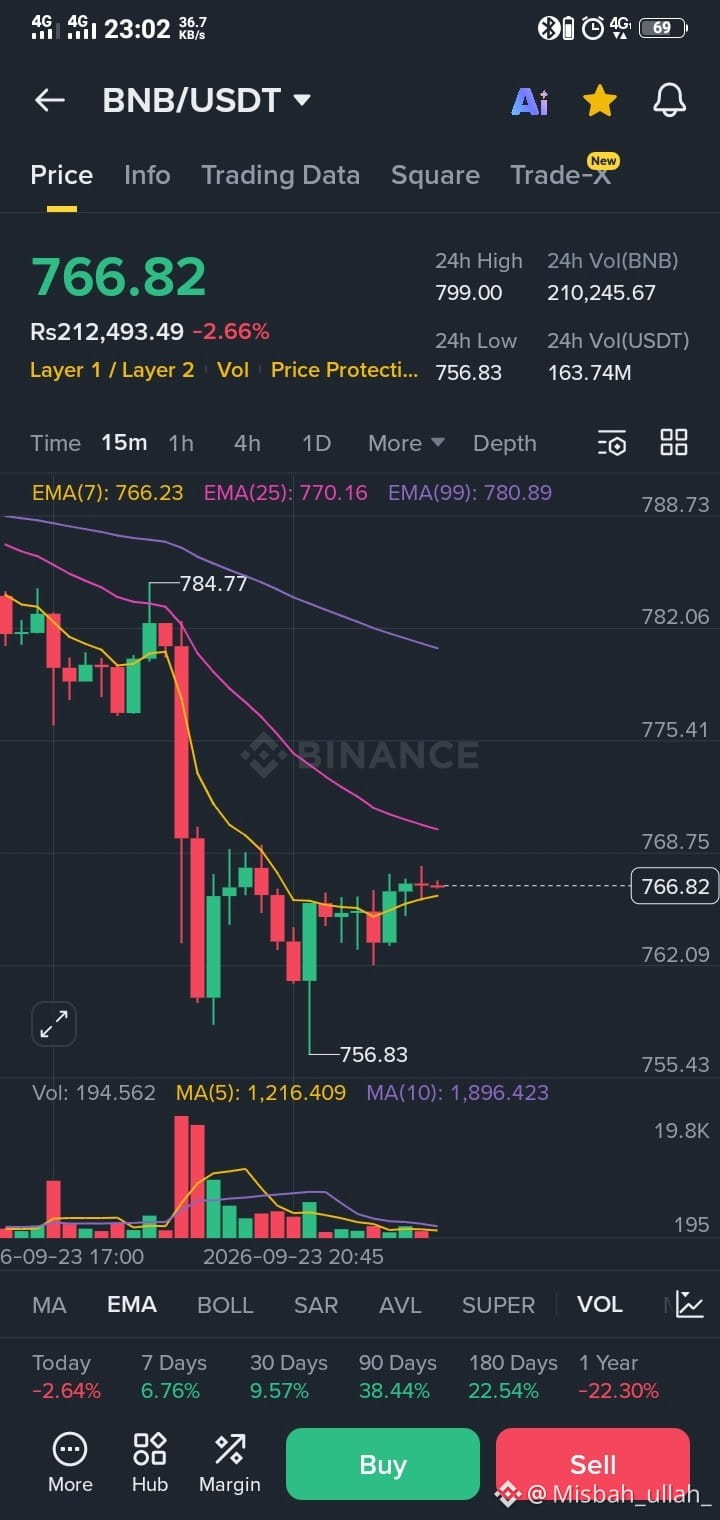
Can we hit $799 today? Right now, it's a 50/50 battle!
📉 We are stuck below the 25 EMA ($770) and 99 EMA ($780). The bounce from $756 lacks strong buy volume, and $784 is a tough wall.
We NEED a volume spike to break $780 and reclaim $785. If bulls step in, $799 is easily next!
If we lose $756 support,this setup is dead.
Are we pumping to $799 or dumping first? Drop your predictions! 👇
#BNB_Market_Update #BNBUSDT #CryptoPatience #trading
$BNB to $799 Today?
Can we hit $799 today? Right now, it's a 50/50 battle!
📉 We are stuck below the 25 EMA ($770) and 99 EMA ($780). The bounce from $756 lacks strong buy volume, and $784 is a tough wall.
We NEED a volume spike to break $780 and reclaim $785. If bulls step in, $799 is easily next!
If we lose $756 support,this setup is dead.
Are we pumping to $799 or dumping first? Drop your predictions! 👇
#BNB_Market_Update #BNBUSDT #CryptoPatience #trading
Can we hit $799 today? Right now, it's a 50/50 battle!
📉 We are stuck below the 25 EMA ($770) and 99 EMA ($780). The bounce from $756 lacks strong buy volume, and $784 is a tough wall.
We NEED a volume spike to break $780 and reclaim $785. If bulls step in, $799 is easily next!
If we lose $756 support,this setup is dead.
Are we pumping to $799 or dumping first? Drop your predictions! 👇
#BNB_Market_Update #BNBUSDT #CryptoPatience #trading
103

·
--
Bullish
Why Consistent Accumulation in $BNB Beats Timing the Market Every Time
Timing the exact bottom in crypto is nearly impossible, but building a disciplined accumulation strategy is where real portfolios are grown.
Whether the market trends sideways or pumps, holding $BNB offers utility that goes well beyond price appreciation alone #BNB_Market_Update $NVDAB
Why Consistent Accumulation in $BNB Beats Timing the Market Every Time
Timing the exact bottom in crypto is nearly impossible, but building a disciplined accumulation strategy is where real portfolios are grown.
Whether the market trends sideways or pumps, holding $BNB offers utility that goes well beyond price appreciation alone #BNB_Market_Update $NVDAB
Timing the exact bottom in crypto is nearly impossible, but building a disciplined accumulation strategy is where real portfolios are grown.
Whether the market trends sideways or pumps, holding $BNB offers utility that goes well beyond price appreciation alone #BNB_Market_Update $NVDAB
71



Article
CAN BNB REALLY MAKE A NEW ALL-TIME HIGH THIS YEAR? 👀BNB has been one of those coins that can move quietly for weeks — and then suddenly remind everyone why people keep watching it.
Right now, BNB is trading around the $760–$800 area, while its previous all-time high is around $1,370.
So the big question is:
Can BNB break that level and print a NEW ATH before 2026 ends?
Here’s where it gets interesting. 👇
🟡 FIRST: $1,000 IS THE BIG PSYCHOLOGICAL LEVEL
Before we start talking about a new ATH, BNB has to deal with $1,000.
From around $770, reaching $1,000 would require roughly a 30% move.
That isn't impossible in crypto.
But getting there is one thing.
Holding above it is another.
If BNB can establish strong support above $1,000, attention could quickly shift toward the previous ATH.
🚀 THEN COMES THE REAL TEST: $1,370+
BNB would need roughly another 37% move from $1,000 to reach its previous ATH.
And once an asset gets close to its previous ATH, psychology becomes extremely important.
Some holders may take profits.
Others may start thinking:
“What if this time BNB actually breaks through?”
That's where volatility can get interesting.
🌍 BUT BNB DOESN'T MOVE IN ISOLATION
For BNB to make a serious attempt at a new ATH, the broader crypto market would probably need to remain supportive.
Bitcoin strength matters.Liquidity matters.Altcoin sentiment matters.
And activity across the BNB ecosystem matters too.
A strong BNB move becomes much easier when the wider market is also attracting fresh capital.
⚠️ BUT DON'T CONFUSE POSSIBILITY WITH CERTAINTY
This is the part I don't want to skip.
A new ATH is possible.
It is NOT guaranteed.
BNB could face rejection at $800, $900 or $1,000. The crypto market can change direction very quickly, especially when leverage and short-term speculation enter the picture.
So instead of asking:
“Will BNB definitely hit a new ATH?”
I think the better question is:
“Can BNB build enough momentum to keep breaking major resistance levels?”
That's what I'll be watching. $800 → $1,000 → previous ATH → price discovery.
One level at a time. 📈
And if BNB actually breaks its previous ATH…
the conversation completely changes. 👀
What do you think?
New BNB ATH in 2026 — possible, or too ambitious?
👇 Drop your target below. Let's see what the community thinks.
#BNB_Market_Update $BNB
{spot}(BNBUSDT)
CAN BNB REALLY MAKE A NEW ALL-TIME HIGH THIS YEAR? 👀
BNB has been one of those coins that can move quietly for weeks — and then suddenly remind everyone why people keep watching it.
Right now, BNB is trading around the $760–$800 area, while its previous all-time high is around $1,370.
So the big question is:
Can BNB break that level and print a NEW ATH before 2026 ends?
Here’s where it gets interesting. 👇
🟡 FIRST: $1,000 IS THE BIG PSYCHOLOGICAL LEVEL
Before we start talking about a new ATH, BNB has to deal with $1,000.
From around $770, reaching $1,000 would require roughly a 30% move.
That isn't impossible in crypto.
But getting there is one thing.
Holding above it is another.
If BNB can establish strong support above $1,000, attention could quickly shift toward the previous ATH.
🚀 THEN COMES THE REAL TEST: $1,370+
BNB would need roughly another 37% move from $1,000 to reach its previous ATH.
And once an asset gets close to its previous ATH, psychology becomes extremely important.
Some holders may take profits.
Others may start thinking:
“What if this time BNB actually breaks through?”
That's where volatility can get interesting.
🌍 BUT BNB DOESN'T MOVE IN ISOLATION
For BNB to make a serious attempt at a new ATH, the broader crypto market would probably need to remain supportive.
Bitcoin strength matters.Liquidity matters.Altcoin sentiment matters.
And activity across the BNB ecosystem matters too.
A strong BNB move becomes much easier when the wider market is also attracting fresh capital.
⚠️ BUT DON'T CONFUSE POSSIBILITY WITH CERTAINTY
This is the part I don't want to skip.
A new ATH is possible.
It is NOT guaranteed.
BNB could face rejection at $800, $900 or $1,000. The crypto market can change direction very quickly, especially when leverage and short-term speculation enter the picture.
So instead of asking:
“Will BNB definitely hit a new ATH?”
I think the better question is:
“Can BNB build enough momentum to keep breaking major resistance levels?”
That's what I'll be watching. $800 → $1,000 → previous ATH → price discovery.
One level at a time. 📈
And if BNB actually breaks its previous ATH…
the conversation completely changes. 👀
What do you think?
New BNB ATH in 2026 — possible, or too ambitious?
👇 Drop your target below. Let's see what the community thinks.
#BNB_Market_Update $BNB
Right now, BNB is trading around the $760–$800 area, while its previous all-time high is around $1,370.
So the big question is:
Can BNB break that level and print a NEW ATH before 2026 ends?
Here’s where it gets interesting. 👇
🟡 FIRST: $1,000 IS THE BIG PSYCHOLOGICAL LEVEL
Before we start talking about a new ATH, BNB has to deal with $1,000.
From around $770, reaching $1,000 would require roughly a 30% move.
That isn't impossible in crypto.
But getting there is one thing.
Holding above it is another.
If BNB can establish strong support above $1,000, attention could quickly shift toward the previous ATH.
🚀 THEN COMES THE REAL TEST: $1,370+
BNB would need roughly another 37% move from $1,000 to reach its previous ATH.
And once an asset gets close to its previous ATH, psychology becomes extremely important.
Some holders may take profits.
Others may start thinking:
“What if this time BNB actually breaks through?”
That's where volatility can get interesting.
🌍 BUT BNB DOESN'T MOVE IN ISOLATION
For BNB to make a serious attempt at a new ATH, the broader crypto market would probably need to remain supportive.
Bitcoin strength matters.Liquidity matters.Altcoin sentiment matters.
And activity across the BNB ecosystem matters too.
A strong BNB move becomes much easier when the wider market is also attracting fresh capital.
⚠️ BUT DON'T CONFUSE POSSIBILITY WITH CERTAINTY
This is the part I don't want to skip.
A new ATH is possible.
It is NOT guaranteed.
BNB could face rejection at $800, $900 or $1,000. The crypto market can change direction very quickly, especially when leverage and short-term speculation enter the picture.
So instead of asking:
“Will BNB definitely hit a new ATH?”
I think the better question is:
“Can BNB build enough momentum to keep breaking major resistance levels?”
That's what I'll be watching. $800 → $1,000 → previous ATH → price discovery.
One level at a time. 📈
And if BNB actually breaks its previous ATH…
the conversation completely changes. 👀
What do you think?
New BNB ATH in 2026 — possible, or too ambitious?
👇 Drop your target below. Let's see what the community thinks.
#BNB_Market_Update $BNB
2
336

·
--
Bearish
$BNB
💥💥💥💥💥💥💥💥💥💥🔻🔻🔻🔻🔻🔻🔻🔻🔺️🔺️🔺️🔺️🔺️🔺️🔺️🔺️
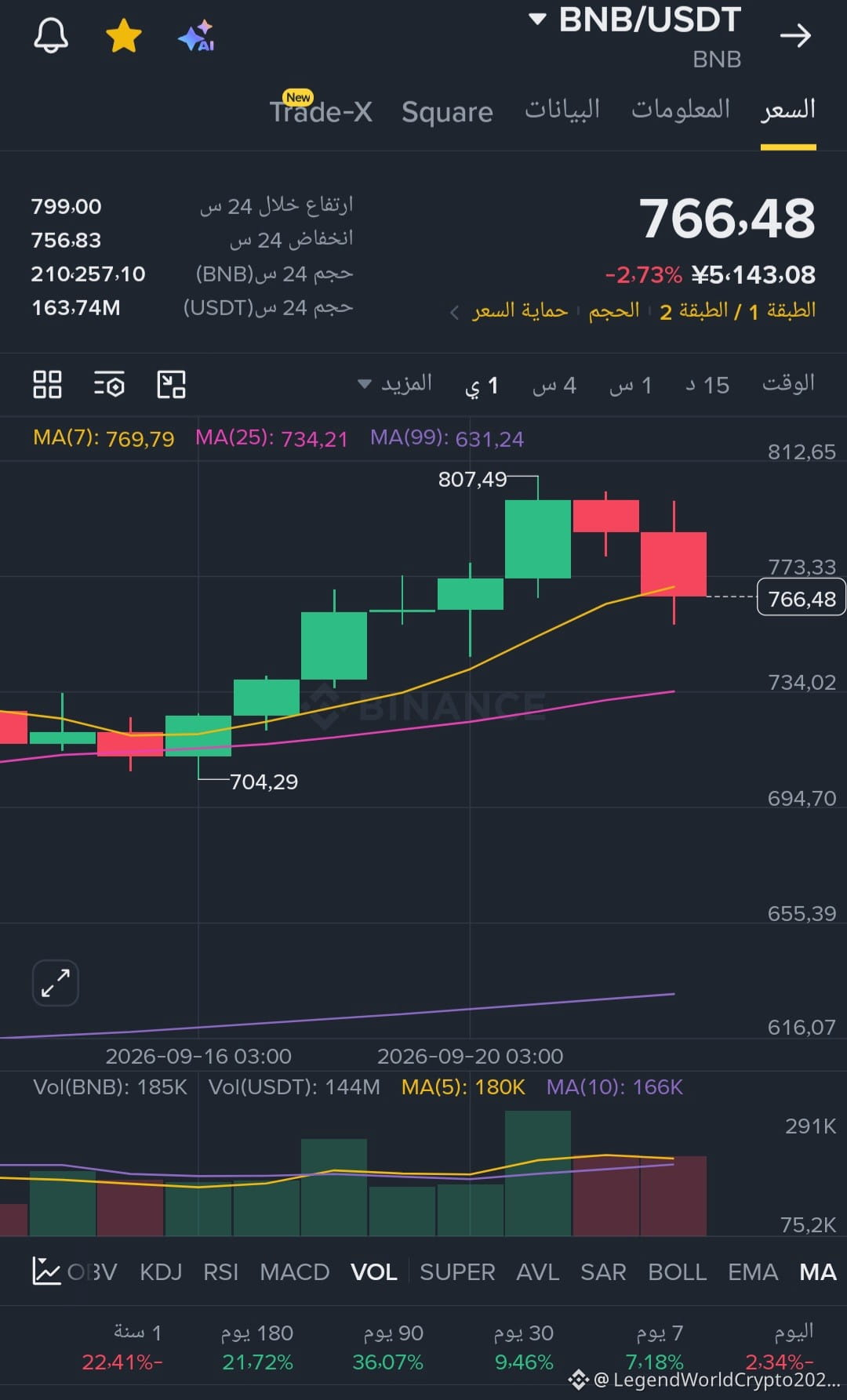
🚀 BNB Analysis Update: Will the $740 Support Hold Again?
BNB faced strong rejection at the robust $790-$800 resistance zone, causing the price to quickly drop to $756 before buying pressure intervened to support it. The price has since rebounded and is currently stabilizing around $767.
📊 Key Price Levels:
Major Support: $740-$756 (Critical Pivot Zone)
Next Resistance: $780
Upside Target: $790-$800
💡 Technical Analysis of the Upcoming Move:
Positive Scenario: As long as the price remains above $740, the recovery is likely to continue, targeting $780 and then the major resistance at $790-$800.
The negative scenario: If the $740 level is broken and the price closes below it, selling pressure could increase significantly.
📌 In conclusion: The rebound has already begun, but the continuation of the upward momentum is closely linked to the buyers' ability to demonstrate their strength and protect the current support zone.
$BNB
$BNB
@Square-Creator-ce2378404
#BNB_Market_Update
@LegendWorldCrypto2025
#Legendworldcrypto2025
{future}(BNBUSDT)
$BNB
💥💥💥💥💥💥💥💥💥💥🔻🔻🔻🔻🔻🔻🔻🔻🔺️🔺️🔺️🔺️🔺️🔺️🔺️🔺️
🚀 BNB Analysis Update: Will the $740 Support Hold Again?
BNB faced strong rejection at the robust $790-$800 resistance zone, causing the price to quickly drop to $756 before buying pressure intervened to support it. The price has since rebounded and is currently stabilizing around $767.
📊 Key Price Levels:
Major Support: $740-$756 (Critical Pivot Zone)
Next Resistance: $780
Upside Target: $790-$800
💡 Technical Analysis of the Upcoming Move:
Positive Scenario: As long as the price remains above $740, the recovery is likely to continue, targeting $780 and then the major resistance at $790-$800.
The negative scenario: If the $740 level is broken and the price closes below it, selling pressure could increase significantly.
📌 In conclusion: The rebound has already begun, but the continuation of the upward momentum is closely linked to the buyers' ability to demonstrate their strength and protect the current support zone.
$BNB
$BNB
@BNB
#BNB_Market_Update
@LegendWorldCrypto2024
#Legendworldcrypto2025
💥💥💥💥💥💥💥💥💥💥🔻🔻🔻🔻🔻🔻🔻🔻🔺️🔺️🔺️🔺️🔺️🔺️🔺️🔺️
🚀 BNB Analysis Update: Will the $740 Support Hold Again?
BNB faced strong rejection at the robust $790-$800 resistance zone, causing the price to quickly drop to $756 before buying pressure intervened to support it. The price has since rebounded and is currently stabilizing around $767.
📊 Key Price Levels:
Major Support: $740-$756 (Critical Pivot Zone)
Next Resistance: $780
Upside Target: $790-$800
💡 Technical Analysis of the Upcoming Move:
Positive Scenario: As long as the price remains above $740, the recovery is likely to continue, targeting $780 and then the major resistance at $790-$800.
The negative scenario: If the $740 level is broken and the price closes below it, selling pressure could increase significantly.
📌 In conclusion: The rebound has already begun, but the continuation of the upward momentum is closely linked to the buyers' ability to demonstrate their strength and protect the current support zone.
$BNB
$BNB
@BNB
#BNB_Market_Update
@LegendWorldCrypto2024
#Legendworldcrypto2025
66

·
--
🟡 $BNB — the exchange runs on it, and so does today's market
While traders chase the next 100x, $BNB keeps quietly doing the real work — powering fees, launches, and the entire Binance ecosystem behind the scenes.
🔥 Utility that never goes out of style.
🚀 Every new listing, every launchpool, every campaign —$BNBis the fuel.
💬 It's not hype. It's infrastructure.
Do you hold $BNB long-term, or just trade it? 👇
#BNB_Market_Update #bnb一輩子 #BinanceSquareBTC #Write2Earn
{future}(BNBUSDT)
🟡 $BNB — the exchange runs on it, and so does today's market
While traders chase the next 100x, $BNB keeps quietly doing the real work — powering fees, launches, and the entire Binance ecosystem behind the scenes.
🔥 Utility that never goes out of style.
🚀 Every new listing, every launchpool, every campaign —$BNBis the fuel.
💬 It's not hype. It's infrastructure.
Do you hold $BNB long-term, or just trade it? 👇
#BNB_Market_Update #bnb一輩子 #BinanceSquareBTC #Write2Earn
While traders chase the next 100x, $BNB keeps quietly doing the real work — powering fees, launches, and the entire Binance ecosystem behind the scenes.
🔥 Utility that never goes out of style.
🚀 Every new listing, every launchpool, every campaign —$BNBis the fuel.
💬 It's not hype. It's infrastructure.
Do you hold $BNB long-term, or just trade it? 👇
#BNB_Market_Update #bnb一輩子 #BinanceSquareBTC #Write2Earn
44

·
--
Mohsin 7777:
How are you😊I like and share all of your posts. So please like and share my posts too. 😉🥰 Shar please 🫡🫡
1
1
81

·
--
Bullish
$BNB Is Pressing Hard For The Next Breakout…!!
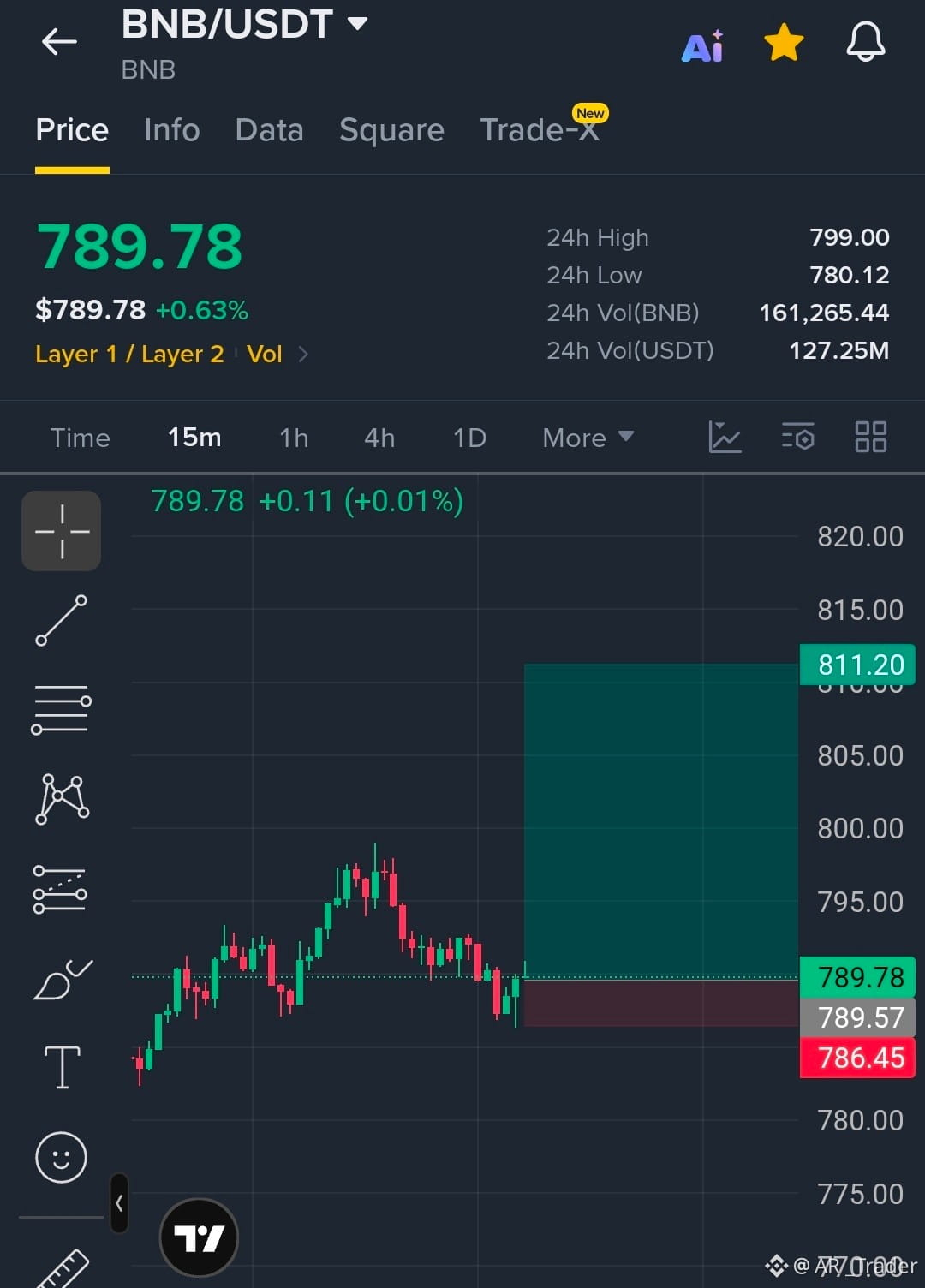
#bnb is holding bullish momentum near 789.78 after defending the 780.12 zone and now pushing toward the 799.00 resistance A clean breakout above 800.00 could open the way toward 811.20 and 820.00 while 780.00 remains the key support
{future}(BNBUSDT)
$BR
{future}(BRUSDT)
$BB
{future}(BBUSDT)
#BNB_Market_Update
$BNB Is Pressing Hard For The Next Breakout…!!
#bnb is holding bullish momentum near 789.78 after defending the 780.12 zone and now pushing toward the 799.00 resistance A clean breakout above 800.00 could open the way toward 811.20 and 820.00 while 780.00 remains the key support
$BR
$BB
#BNB_Market_Update
#bnb is holding bullish momentum near 789.78 after defending the 780.12 zone and now pushing toward the 799.00 resistance A clean breakout above 800.00 could open the way toward 811.20 and 820.00 while 780.00 remains the key support
$BR
$BB
#BNB_Market_Update
1
122

$BNB On Sep 23, 2026, 07:13 AM(UTC). According to Binance Market Data, $BNB has crossed the 790 USDT benchmark and is now trading at 790.099976 USDT, with a narrowed 0.34% increase in 24 hours.
#bnb
#BNB_Market_Update
#BNBMarketCapPassesBNYMellon
{spot}(BNBUSDT)
{alpha}(560x44440f83419de123d7d411187adb9962db017d03)
$BNB On Sep 23, 2026, 07:13 AM(UTC). According to Binance Market Data, $BNB has crossed the 790 USDT benchmark and is now trading at 790.099976 USDT, with a narrowed 0.34% increase in 24 hours.
#bnb
#BNB_Market_Update
#BNBMarketCapPassesBNYMellon
#bnb
#BNB_Market_Update
#BNBMarketCapPassesBNYMellon

26

·
--
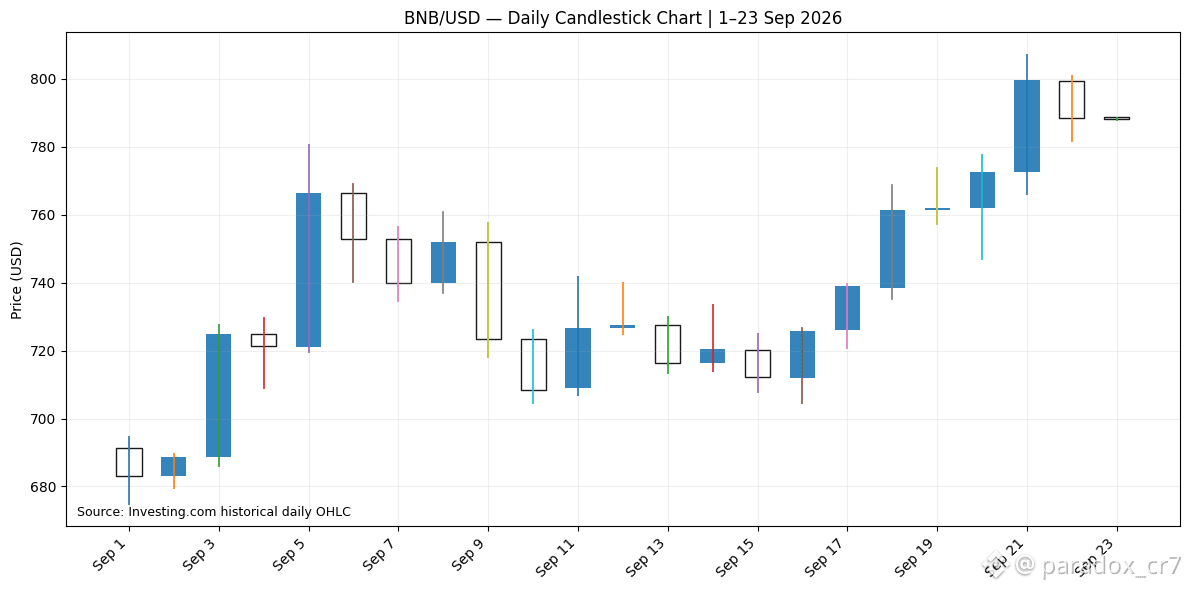
$BNB BNB is trading around $788 on September 23, 2026. The recent structure remains relatively strong: BNB climbed from around $683 on Sept. 1 to nearly $800, with a recent high near $807.
* Resistance: $800–$807
* Support: $780, then $760
* Momentum: Bullish, but price is facing resistance around $800.
* Bullish scenario: A sustained break above $807 could strengthen the upside momentum.
* Bearish scenario: Losing $780 could bring a deeper pullback toward $760.
This is a market analysis, not financial advice.
#BNB_Market_Update #IranSetsConditionsToEndSevenMonthWar #AIStocksWhatNext
{spot}(BNBUSDT)
$BNB BNB is trading around $788 on September 23, 2026. The recent structure remains relatively strong: BNB climbed from around $683 on Sept. 1 to nearly $800, with a recent high near $807.
* Resistance: $800–$807
* Support: $780, then $760
* Momentum: Bullish, but price is facing resistance around $800.
* Bullish scenario: A sustained break above $807 could strengthen the upside momentum.
* Bearish scenario: Losing $780 could bring a deeper pullback toward $760.
This is a market analysis, not financial advice.
#BNB_Market_Update #IranSetsConditionsToEndSevenMonthWar #AIStocksWhatNext
* Resistance: $800–$807
* Support: $780, then $760
* Momentum: Bullish, but price is facing resistance around $800.
* Bullish scenario: A sustained break above $807 could strengthen the upside momentum.
* Bearish scenario: Losing $780 could bring a deeper pullback toward $760.
This is a market analysis, not financial advice.
#BNB_Market_Update #IranSetsConditionsToEndSevenMonthWar #AIStocksWhatNext
54

·
--
Bullish
. Market Structure Analysis $BNB
Higher Timeframe Trend: Bullish expansion from the lower $780 demand zone up to the local swing high near $800.
Internal Structure: After reaching $800, price experienced a Market Structure Shift (MSS) / Change of Character (CHoCH) to the downside, pulling back into a high-probability internal demand zone.
Liquidity Sweep: The lower wick swept local sell-side liquidity / Breaker structure (B) right around $788.
2. Trade Execution Setup (as drawn)
Entry Zone: ~$788.36 (Tapping the 1H Bullish FVG & Order Block)
Stop Loss (SL): $785.78 (Placed safely below the local demand zone & FVG sweep low)
Take Profit (TP): $799.03 / $800.00 (Targeting external buy-side liquidity at the recent swing high)
3. Trade Parameters & Risk/Reward
Risk (SL Distance): ~$2.58 USDT (~0.33%)
#BNB_Market_Update #binance #bnb #Write2Earn #BNBAnalysis $BTC $BNB
{spot}(ETHUSDT)
{spot}(BNBUSDT)
{spot}(BTCUSDT)
. Market Structure Analysis $BNB
Higher Timeframe Trend: Bullish expansion from the lower $780 demand zone up to the local swing high near $800.
Internal Structure: After reaching $800, price experienced a Market Structure Shift (MSS) / Change of Character (CHoCH) to the downside, pulling back into a high-probability internal demand zone.
Liquidity Sweep: The lower wick swept local sell-side liquidity / Breaker structure (B) right around $788.
2. Trade Execution Setup (as drawn)
Entry Zone: ~$788.36 (Tapping the 1H Bullish FVG & Order Block)
Stop Loss (SL): $785.78 (Placed safely below the local demand zone & FVG sweep low)
Take Profit (TP): $799.03 / $800.00 (Targeting external buy-side liquidity at the recent swing high)
3. Trade Parameters & Risk/Reward
Risk (SL Distance): ~$2.58 USDT (~0.33%)
#BNB_Market_Update #binance #bnb #Write2Earn #BNBAnalysis $BTC $BNB
Higher Timeframe Trend: Bullish expansion from the lower $780 demand zone up to the local swing high near $800.
Internal Structure: After reaching $800, price experienced a Market Structure Shift (MSS) / Change of Character (CHoCH) to the downside, pulling back into a high-probability internal demand zone.
Liquidity Sweep: The lower wick swept local sell-side liquidity / Breaker structure (B) right around $788.
2. Trade Execution Setup (as drawn)
Entry Zone: ~$788.36 (Tapping the 1H Bullish FVG & Order Block)
Stop Loss (SL): $785.78 (Placed safely below the local demand zone & FVG sweep low)
Take Profit (TP): $799.03 / $800.00 (Targeting external buy-side liquidity at the recent swing high)
3. Trade Parameters & Risk/Reward
Risk (SL Distance): ~$2.58 USDT (~0.33%)
#BNB_Market_Update #binance #bnb #Write2Earn #BNBAnalysis $BTC $BNB
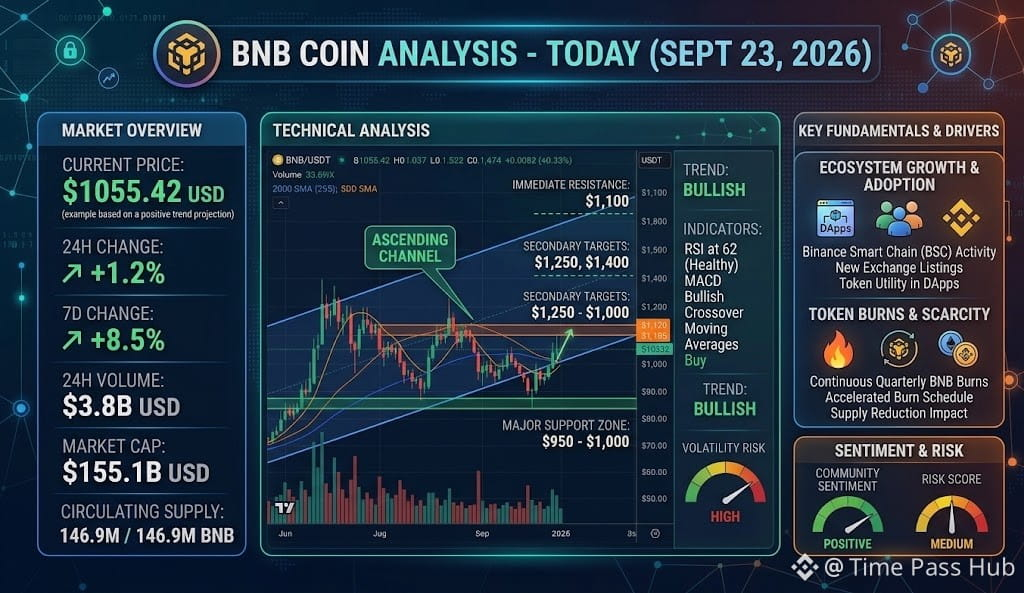
Dan_778:
1k
16
4
74

·
--
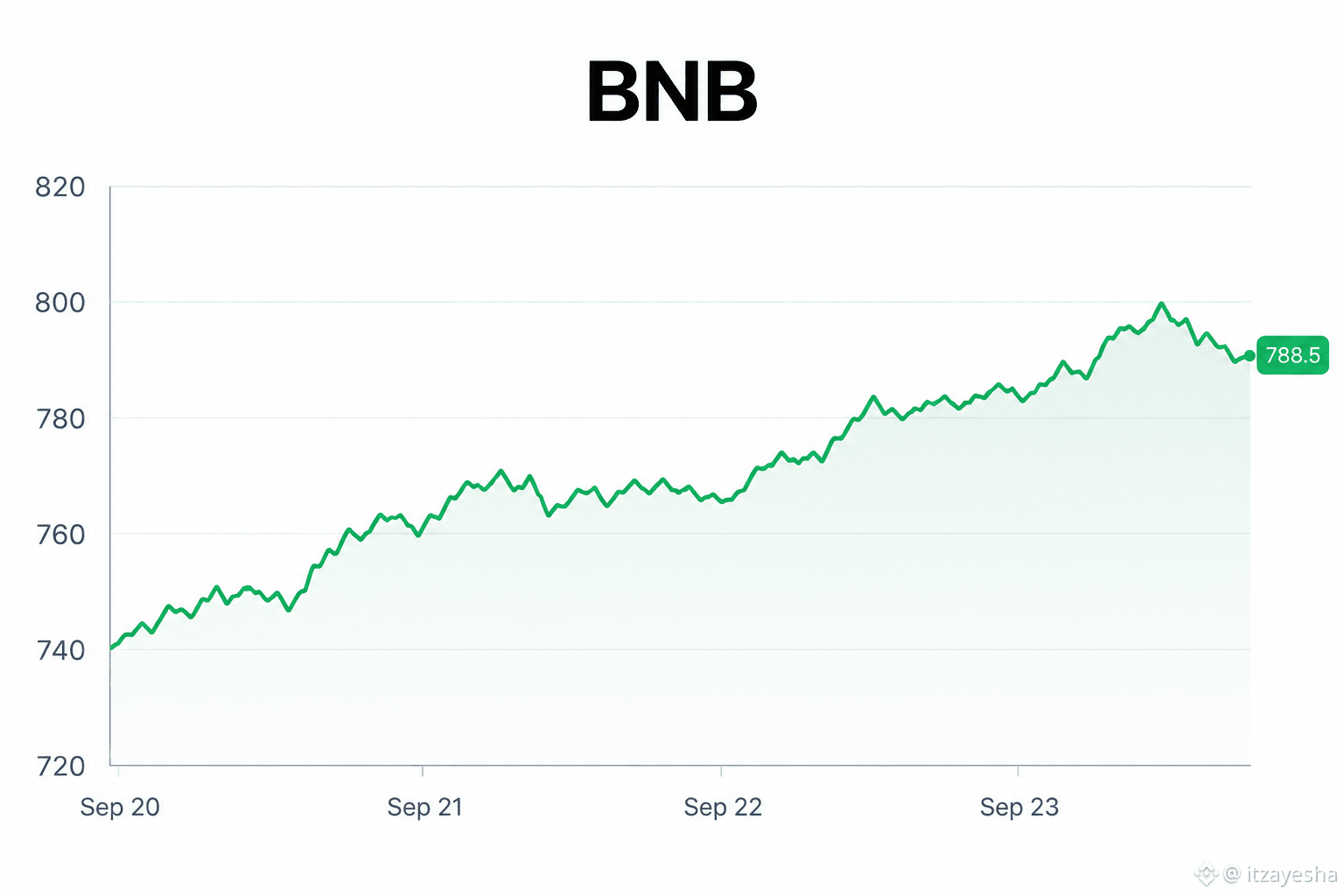
$BNB is trading near $788 after a recent upward move. The $800 area is an important short-term resistance, while $782–$780 is a nearby support zone. A sustained move above $800 could indicate stronger momentum, while a break below support could bring more selling pressure. Crypto prices can change quickly.
#BNBMarketCapPassesBNYMellon #BNB_Market_Update #BNBToken
{spot}(BNBUSDT)
$BNB is trading near $788 after a recent upward move. The $800 area is an important short-term resistance, while $782–$780 is a nearby support zone. A sustained move above $800 could indicate stronger momentum, while a break below support could bring more selling pressure. Crypto prices can change quickly.
#BNBMarketCapPassesBNYMellon #BNB_Market_Update #BNBToken
#BNBMarketCapPassesBNYMellon #BNB_Market_Update #BNBToken
57
Log in to explore more content
Join global crypto users on Binance Square
⚡️ Get latest and useful information about crypto.
💬 Trusted by the world’s largest crypto exchange.
👍 Discover real insights from verified creators.
Email / Phone number
Trending Topics
1
#QNTRises39%
1,893 views
192 Discussing
2
#EthereumBreaksAbove$2700
408 views
39 Discussing
3
#BitgetBreachForgedRequestsNotStolenKeys
1,263 views
138 Discussing
4
#BitcoinSpotETFsTurnNetPositiveYTD
972 views
96 Discussing
5
#GrayscaleZcashETFHits$1BNetAssets
615 views
28 Discussing
6
#BitcoinSpotETFsNetInflow$191M
4,961 views
158 Discussing
7
#CFTCUpdatesGuidanceOnTokenizedAssets
32,250 views
1,122 Discussing
8
#BitgetSays$352MAffectedInHack
12,943 views
87 Discussing
9
#NYAndPolymarketSueEachOther
2,559 views
127 Discussing
10
#BinanceWillListHyperliquid(HYPE)
236,630 views
3,671 Discussing