
Abdo Moussa
476 Posts

Abdo Moussa
Report
Block User
From code to innovation🌐||Skilled in Programming and tech troubleshooting📱💻|| Passionate about exploring the future of #blockchain technology #BTC #BNB #Tech

#BinanceTurns7
54 Following
597 Followers
1.6K+ Liked
1 Badges
Posts
All
Quotes
Videos
PINNED
·
--

Article
See translation
Becoming a successful crypto traderBecoming a successful crypto trader requires a combination of knowledge, skills, discipline, and a strategic approach. Here are some steps and tips to help you on your journey:1. Educate Yourself:Start by learning about cryptocurrencies, blockchain technology, and how trading works. Understand the different types of cryptocurrencies, their use cases, and market trends.2. Learn Technical Analysis:Technical analysis involves studying price charts, patterns, and indicators to predict price movements. Familiarize yourself with concepts like candlestick patterns, moving averages, RSI, and MACD.3. Stay Informe:Keep up with news and developments in the crypto space. Crypto prices can be heavily influenced by news, regulatory changes, and technological advancements.4. Develop a Trading Strategy:Create a clear trading strategy that outlines your goals, risk tolerance, entry and exit points, and the types of assets you want to trade. Stick to your strategy and avoid making impulsive decisions.5. Start Small:Begin with a small amount of capital that you can afford to lose. Cryptocurrency markets can be highly volatile, and it's important to manage risk.6. Use Risk Management:Set stop-loss orders to limit potential losses and avoid risking more than a certain percentage of your trading capital on a single trade.7. Diversify Your Portfolio:Don't put all your funds into one cryptocurrency. Diversify your portfolio to spread risk and reduce the impact of a single asset's poor performance.8. Control Emotions:Emotions like greed and fear can cloud your judgment. Stick to your strategy and avoid making emotional decisions based on short-term price fluctuations.9. Stay Disciplined:Consistency is key. Avoid chasing "get rich quick" schemes and stay committed to your long-term trading plan.10. Understand Market Cycles:Cryptocurrency markets go through cycles of boom and bust. Understanding these cycles can help you make more informed decisions about when to buy and sell.11. Keep Records:Maintain a detailed record of your trades, including entry and exit points, profit/loss, and the reasons behind your decisions. This can help you learn from your successes and mistakes.12. Continuous Learning:The crypto space is dynamic and ever-changing. Stay open to learning new strategies, technologies, and market trends.13. Consider Fundamental Analysis:While technical analysis is important, also consider the fundamental value of the cryptocurrencies you're trading. Research the projects, teams, partnerships, and real-world utility.14. Be Patient:Successful trading takes time and experience. Don't expect instant results; focus on learning and improving over time.15. Seek Advice:Connect with experienced traders, join online communities, and participate in discussions. Learning from others' experiences can be valuable.Remember that trading cryptocurrencies carries inherent risks, and the market can be extremely volatile. Some traders find success, while others experience losses. Only invest what you can afford to lose and consider consulting with financial professionals before making trading decisions.
Becoming a successful crypto trader
Becoming a successful crypto trader requires a combination of knowledge, skills, discipline, and a strategic approach. Here are some steps and tips to help you on your journey:1. Educate Yourself:Start by learning about cryptocurrencies, blockchain technology, and how trading works. Understand the different types of cryptocurrencies, their use cases, and market trends.2. Learn Technical Analysis:Technical analysis involves studying price charts, patterns, and indicators to predict price movements. Familiarize yourself with concepts like candlestick patterns, moving averages, RSI, and MACD.3. Stay Informe:Keep up with news and developments in the crypto space. Crypto prices can be heavily influenced by news, regulatory changes, and technological advancements.4. Develop a Trading Strategy:Create a clear trading strategy that outlines your goals, risk tolerance, entry and exit points, and the types of assets you want to trade. Stick to your strategy and avoid making impulsive decisions.5. Start Small:Begin with a small amount of capital that you can afford to lose. Cryptocurrency markets can be highly volatile, and it's important to manage risk.6. Use Risk Management:Set stop-loss orders to limit potential losses and avoid risking more than a certain percentage of your trading capital on a single trade.7. Diversify Your Portfolio:Don't put all your funds into one cryptocurrency. Diversify your portfolio to spread risk and reduce the impact of a single asset's poor performance.8. Control Emotions:Emotions like greed and fear can cloud your judgment. Stick to your strategy and avoid making emotional decisions based on short-term price fluctuations.9. Stay Disciplined:Consistency is key. Avoid chasing "get rich quick" schemes and stay committed to your long-term trading plan.10. Understand Market Cycles:Cryptocurrency markets go through cycles of boom and bust. Understanding these cycles can help you make more informed decisions about when to buy and sell.11. Keep Records:Maintain a detailed record of your trades, including entry and exit points, profit/loss, and the reasons behind your decisions. This can help you learn from your successes and mistakes.12. Continuous Learning:The crypto space is dynamic and ever-changing. Stay open to learning new strategies, technologies, and market trends.13. Consider Fundamental Analysis:While technical analysis is important, also consider the fundamental value of the cryptocurrencies you're trading. Research the projects, teams, partnerships, and real-world utility.14. Be Patient:Successful trading takes time and experience. Don't expect instant results; focus on learning and improving over time.15. Seek Advice:Connect with experienced traders, join online communities, and participate in discussions. Learning from others' experiences can be valuable.Remember that trading cryptocurrencies carries inherent risks, and the market can be extremely volatile. Some traders find success, while others experience losses. Only invest what you can afford to lose and consider consulting with financial professionals before making trading decisions.
4
7
39
215
·
--
See translation
🔄 Automating Discipline: Dollar-Cost Averaging via Binance Auto-Invest
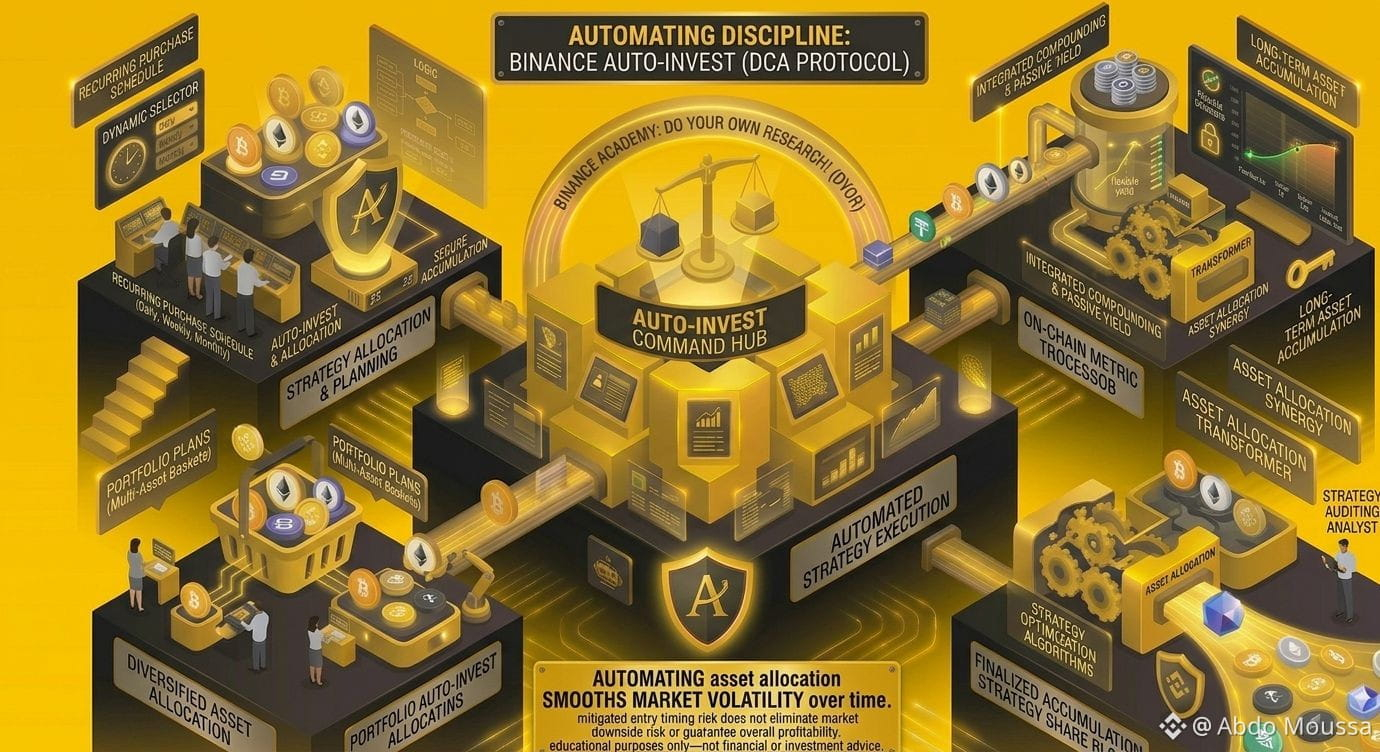
Navigating short-term market volatility often leads to emotional decision-making, Binance Auto-Invest enables users to automate a Dollar-Cost Averaging (DCA) strategy by scheduling recurring cryptocurrency purchases over set intervals.
💡 Dollar-Cost Averaging Mechanics & Features
Automated Recurring Purchases: Set automated buys on a daily, weekly, bi-weekly, or monthly schedule using stablecoin balances or fiat accounts.
Portfolio Auto-Invest Plans: Construct multi-asset baskets to diversify recurring purchases across multiple digital assets simultaneously.
Integration with Earn Products: Automatically deposits purchased assets into flexible yield products to earn passive rewards on holdings.
Emotional Discipline: Eliminates the urge to time market tops and bottoms by adhering to a consistent accumulation plan.
🔑 Long-Term Asset Accumulation
Automating asset allocation allows long-term backers to build crypto exposure systematically while smoothing out market volatility over time.
⚠️ Educational Disclaimer
Dollar-Cost Averaging mitigates entry timing risk but does not eliminate market downside risk or guarantee overall profitability.
This article is prepared strictly for educational purposes and does not constitute financial or investment advice.
Master wealth-building strategies on Binance Academy.
[https://www.binance.com/en/blog/earn/421499824684903520](https://www.binance.com/en/blog/earn/421499824684903520)
Plan long-term, stay disciplined, and always DYOR (Do Your Own Research)💡
#Binance #BinanceAcademy #AutoInvest #DollarCostAveraging #dyor
🔄 Automating Discipline: Dollar-Cost Averaging via Binance Auto-Invest
Navigating short-term market volatility often leads to emotional decision-making, Binance Auto-Invest enables users to automate a Dollar-Cost Averaging (DCA) strategy by scheduling recurring cryptocurrency purchases over set intervals.
💡 Dollar-Cost Averaging Mechanics & Features
Automated Recurring Purchases: Set automated buys on a daily, weekly, bi-weekly, or monthly schedule using stablecoin balances or fiat accounts.
Portfolio Auto-Invest Plans: Construct multi-asset baskets to diversify recurring purchases across multiple digital assets simultaneously.
Integration with Earn Products: Automatically deposits purchased assets into flexible yield products to earn passive rewards on holdings.
Emotional Discipline: Eliminates the urge to time market tops and bottoms by adhering to a consistent accumulation plan.
🔑 Long-Term Asset Accumulation
Automating asset allocation allows long-term backers to build crypto exposure systematically while smoothing out market volatility over time.
⚠️ Educational Disclaimer
Dollar-Cost Averaging mitigates entry timing risk but does not eliminate market downside risk or guarantee overall profitability.
This article is prepared strictly for educational purposes and does not constitute financial or investment advice.
Master wealth-building strategies on Binance Academy.
https://www.binance.com/en/blog/earn/421499824684903520
Plan long-term, stay disciplined, and always DYOR (Do Your Own Research)💡
#Binance #BinanceAcademy #AutoInvest #DollarCostAveraging #dyor
Navigating short-term market volatility often leads to emotional decision-making, Binance Auto-Invest enables users to automate a Dollar-Cost Averaging (DCA) strategy by scheduling recurring cryptocurrency purchases over set intervals.
💡 Dollar-Cost Averaging Mechanics & Features
Automated Recurring Purchases: Set automated buys on a daily, weekly, bi-weekly, or monthly schedule using stablecoin balances or fiat accounts.
Portfolio Auto-Invest Plans: Construct multi-asset baskets to diversify recurring purchases across multiple digital assets simultaneously.
Integration with Earn Products: Automatically deposits purchased assets into flexible yield products to earn passive rewards on holdings.
Emotional Discipline: Eliminates the urge to time market tops and bottoms by adhering to a consistent accumulation plan.
🔑 Long-Term Asset Accumulation
Automating asset allocation allows long-term backers to build crypto exposure systematically while smoothing out market volatility over time.
⚠️ Educational Disclaimer
Dollar-Cost Averaging mitigates entry timing risk but does not eliminate market downside risk or guarantee overall profitability.
This article is prepared strictly for educational purposes and does not constitute financial or investment advice.
Master wealth-building strategies on Binance Academy.
https://www.binance.com/en/blog/earn/421499824684903520
Plan long-term, stay disciplined, and always DYOR (Do Your Own Research)💡
#Binance #BinanceAcademy #AutoInvest #DollarCostAveraging #dyor
5
60
·
--
See translation
📊 On-Chain Intelligence: Leveraging Binance Research & Analytics
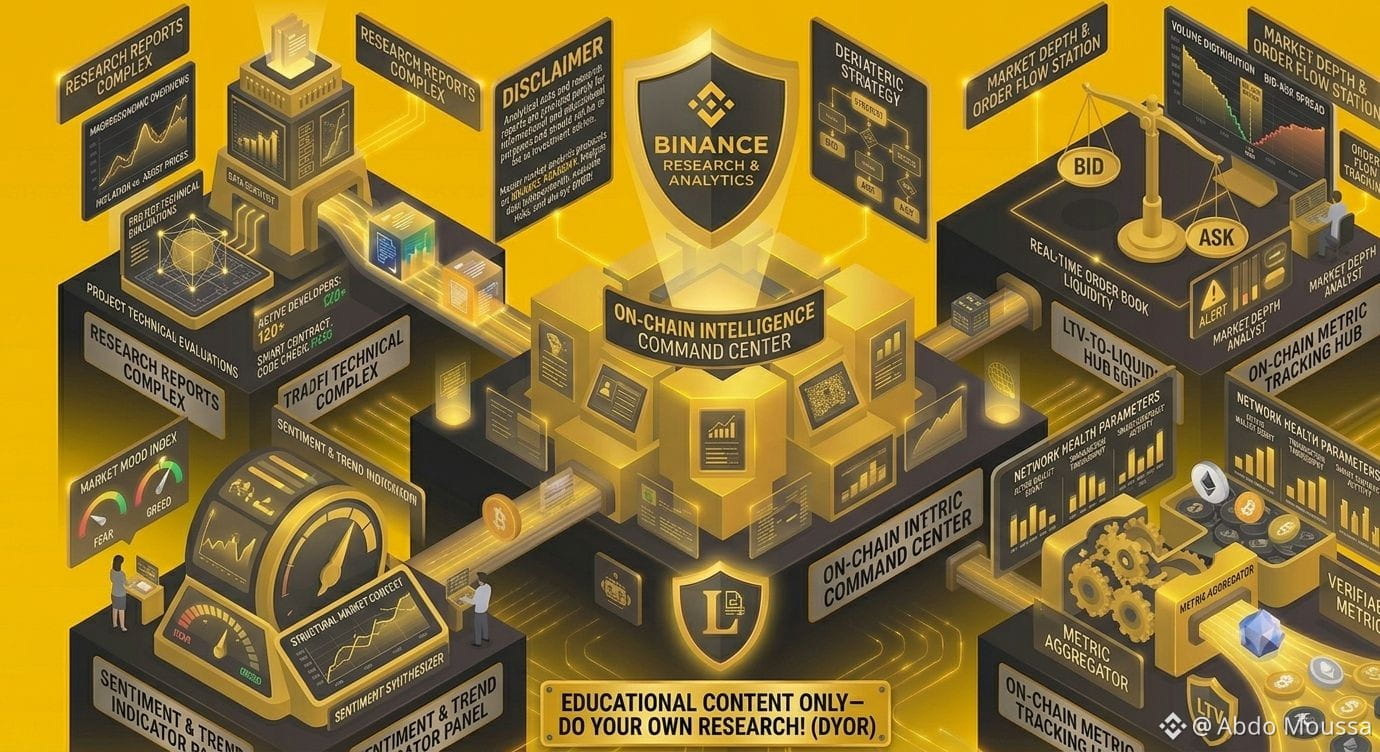
Making informed market decisions requires objective data analysis, Binance Research & Market Analytics deliver institutional-grade research, on-chain metrics, and market intelligence for Web3 participants.
💡 Core Analytical Tools
Binance Research Reports: Publishes in-depth macroeconomic overviews, sector deep-dives, and project-specific technical evaluations.
Market Depth & Order Flow: Tracks real-time order book liquidity, volume distribution, and bid-ask dynamics across asset pairs.
On-Chain Metric Tracking: Evaluates network health by analyzing active wallet counts, transaction throughput, and smart contract activity.
Sentiment & Trend Indicators: Synthesizes market momentum indicators to provide structural market context.
🔑 Data-Driven Research Discipline
Relying on verifiable chain metrics rather than speculative noise enables market participants to assess asset fundamentals rationally.
⚠️ Educational Disclaimer
Analytical data and research reports are provided purely for informational and educational purposes and should not be construed as investment advice.
Master market analysis protocols on Binance Academy.
[https://www.binance.com/en/blog/markets/6390217406562376933](https://www.binance.com/en/blog/markets/6390217406562376933)
Analyze data independently, evaluate risks, and always DYOR (Do Your Own Research)💡
#Binance #BinanceAcademy #BinanceResearch #MarketAnalysis #dyor
📊 On-Chain Intelligence: Leveraging Binance Research & Analytics
Making informed market decisions requires objective data analysis, Binance Research & Market Analytics deliver institutional-grade research, on-chain metrics, and market intelligence for Web3 participants.
💡 Core Analytical Tools
Binance Research Reports: Publishes in-depth macroeconomic overviews, sector deep-dives, and project-specific technical evaluations.
Market Depth & Order Flow: Tracks real-time order book liquidity, volume distribution, and bid-ask dynamics across asset pairs.
On-Chain Metric Tracking: Evaluates network health by analyzing active wallet counts, transaction throughput, and smart contract activity.
Sentiment & Trend Indicators: Synthesizes market momentum indicators to provide structural market context.
🔑 Data-Driven Research Discipline
Relying on verifiable chain metrics rather than speculative noise enables market participants to assess asset fundamentals rationally.
⚠️ Educational Disclaimer
Analytical data and research reports are provided purely for informational and educational purposes and should not be construed as investment advice.
Master market analysis protocols on Binance Academy.
https://www.binance.com/en/blog/markets/6390217406562376933
Analyze data independently, evaluate risks, and always DYOR (Do Your Own Research)💡
#Binance #BinanceAcademy #BinanceResearch #MarketAnalysis #dyor
Making informed market decisions requires objective data analysis, Binance Research & Market Analytics deliver institutional-grade research, on-chain metrics, and market intelligence for Web3 participants.
💡 Core Analytical Tools
Binance Research Reports: Publishes in-depth macroeconomic overviews, sector deep-dives, and project-specific technical evaluations.
Market Depth & Order Flow: Tracks real-time order book liquidity, volume distribution, and bid-ask dynamics across asset pairs.
On-Chain Metric Tracking: Evaluates network health by analyzing active wallet counts, transaction throughput, and smart contract activity.
Sentiment & Trend Indicators: Synthesizes market momentum indicators to provide structural market context.
🔑 Data-Driven Research Discipline
Relying on verifiable chain metrics rather than speculative noise enables market participants to assess asset fundamentals rationally.
⚠️ Educational Disclaimer
Analytical data and research reports are provided purely for informational and educational purposes and should not be construed as investment advice.
Master market analysis protocols on Binance Academy.
https://www.binance.com/en/blog/markets/6390217406562376933
Analyze data independently, evaluate risks, and always DYOR (Do Your Own Research)💡
#Binance #BinanceAcademy #BinanceResearch #MarketAnalysis #dyor
3
75
·
--
See translation
🥇 Demystifying TradFi Products on Binance in 60 Seconds
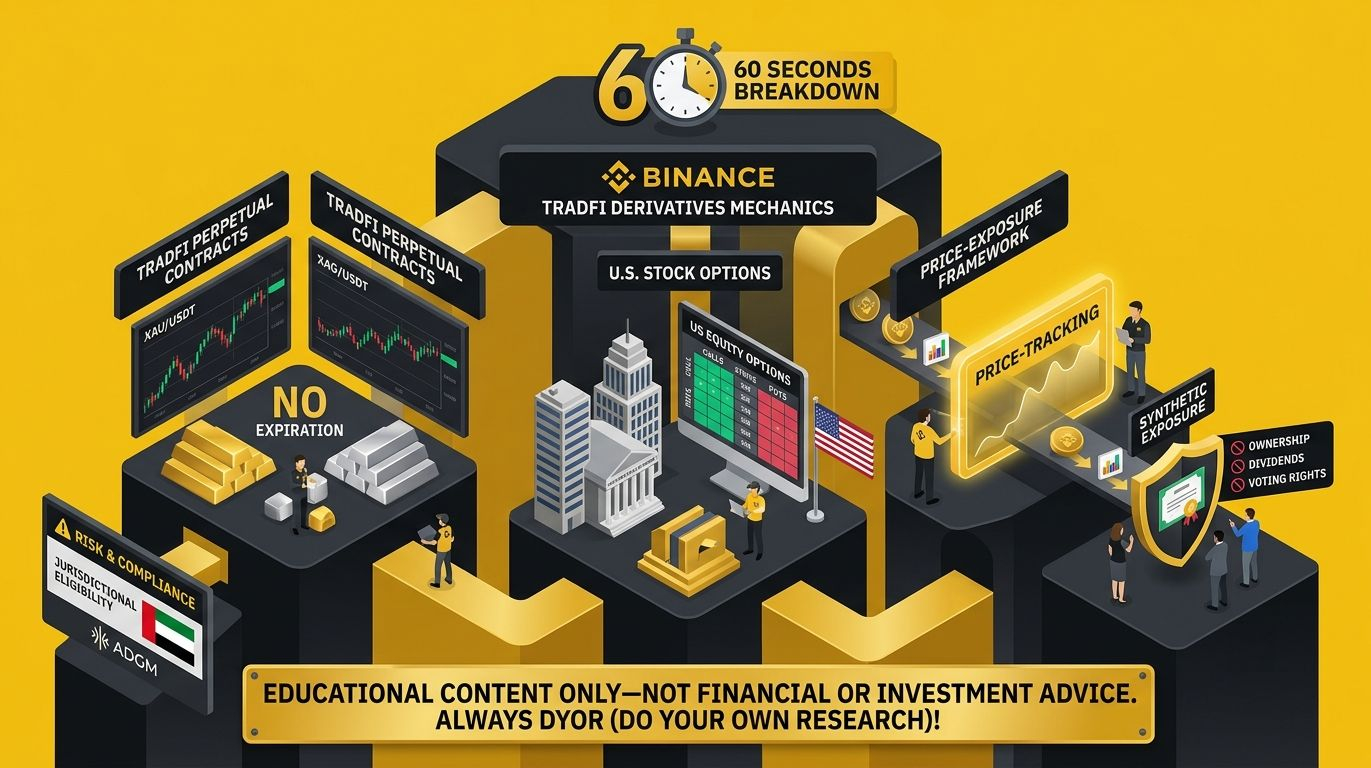
Understanding advanced financial instruments is key to building structured market strategies, Here is a simplified breakdown of traditional financial derivative offerings available within the ecosystem.
💡 Core TradFi Product Mechanics
TradFi Perpetual Contracts: Perpetual futures tracking precious metals (Gold & Silver) allowing traders to take long or short price exposure without contract expiration dates.
U.S. Stock Options: Financial contracts granting the right, but not the obligation, to trade underlying U.S. equity price movements at a set strike price.
Price-Exposure Framework: TradFi synthetic contracts provide strictly price-tracking exposure, they do not grant direct underlying asset ownership, dividend payouts, or voting rights.
⚠️ Risk Warning & Compliance
Derivatives and options trading involve substantial financial risk and leverage exposure, which may lead to capital loss, Product availability is subject to local jurisdictional eligibility (operating under Binance ADGM in the UAE).
Educational content only, not financial or investment advice, Always DYOR (Do Your Own Research)
#Binance #TradFi #goldtrading #BinanceFutures #dyor
🥇 Demystifying TradFi Products on Binance in 60 Seconds
Understanding advanced financial instruments is key to building structured market strategies, Here is a simplified breakdown of traditional financial derivative offerings available within the ecosystem.
💡 Core TradFi Product Mechanics
TradFi Perpetual Contracts: Perpetual futures tracking precious metals (Gold & Silver) allowing traders to take long or short price exposure without contract expiration dates.
U.S. Stock Options: Financial contracts granting the right, but not the obligation, to trade underlying U.S. equity price movements at a set strike price.
Price-Exposure Framework: TradFi synthetic contracts provide strictly price-tracking exposure, they do not grant direct underlying asset ownership, dividend payouts, or voting rights.
⚠️ Risk Warning & Compliance
Derivatives and options trading involve substantial financial risk and leverage exposure, which may lead to capital loss, Product availability is subject to local jurisdictional eligibility (operating under Binance ADGM in the UAE).
Educational content only, not financial or investment advice, Always DYOR (Do Your Own Research)
#Binance #TradFi #goldtrading #BinanceFutures #dyor
Understanding advanced financial instruments is key to building structured market strategies, Here is a simplified breakdown of traditional financial derivative offerings available within the ecosystem.
💡 Core TradFi Product Mechanics
TradFi Perpetual Contracts: Perpetual futures tracking precious metals (Gold & Silver) allowing traders to take long or short price exposure without contract expiration dates.
U.S. Stock Options: Financial contracts granting the right, but not the obligation, to trade underlying U.S. equity price movements at a set strike price.
Price-Exposure Framework: TradFi synthetic contracts provide strictly price-tracking exposure, they do not grant direct underlying asset ownership, dividend payouts, or voting rights.
⚠️ Risk Warning & Compliance
Derivatives and options trading involve substantial financial risk and leverage exposure, which may lead to capital loss, Product availability is subject to local jurisdictional eligibility (operating under Binance ADGM in the UAE).
Educational content only, not financial or investment advice, Always DYOR (Do Your Own Research)
#Binance #TradFi #goldtrading #BinanceFutures #dyor
3
66
·
--
See translation
Beyond Crypto: Binance as a Super Financial App
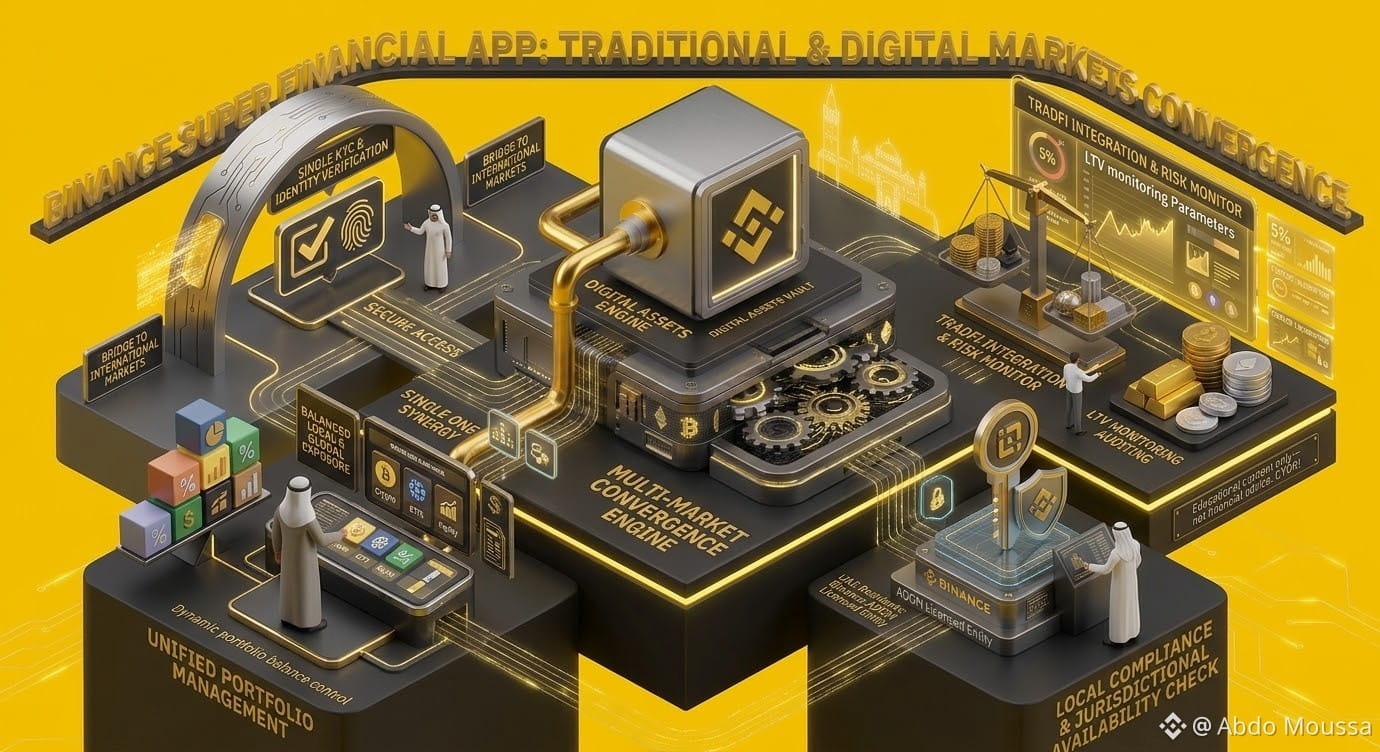
Managing multiple financial portfolios across fragmented applications creates friction and operational inefficiency, Binance has expanded its ecosystem into an all-in-one financial application, bridging digital assets with traditional markets.
💡 Multi-Market Integration
Unified Asset Access: Access digital currencies, tokenized stocks, ETFs, precious metals (Gold & Silver), and DeFi protocols in one interface.
Single Onboarding Journey: Manage cross-asset portfolios under a single identity verification (KYC) and account infrastructure.
Streamlined Capital Allocation: Rebalance exposure between assets like Bitcoin and traditional equities without navigating external platforms.
⚠️ Regional Availability & Compliance Disclaimer
Availability of traditional financial (TradFi) products depends on user residency, regulatory approvals, and compliance requirements.
These features are not available to all jurisdictions, In the UAE, specified products operate under the Binance ADGM entity.
This content is strictly for educational purposes and does not constitute financial advice, Always DYOR (Do Your Own Research)
#Binance #SuperFinancialApp #TradFi #crypto #dyor
Beyond Crypto: Binance as a Super Financial App
Managing multiple financial portfolios across fragmented applications creates friction and operational inefficiency, Binance has expanded its ecosystem into an all-in-one financial application, bridging digital assets with traditional markets.
💡 Multi-Market Integration
Unified Asset Access: Access digital currencies, tokenized stocks, ETFs, precious metals (Gold & Silver), and DeFi protocols in one interface.
Single Onboarding Journey: Manage cross-asset portfolios under a single identity verification (KYC) and account infrastructure.
Streamlined Capital Allocation: Rebalance exposure between assets like Bitcoin and traditional equities without navigating external platforms.
⚠️ Regional Availability & Compliance Disclaimer
Availability of traditional financial (TradFi) products depends on user residency, regulatory approvals, and compliance requirements.
These features are not available to all jurisdictions, In the UAE, specified products operate under the Binance ADGM entity.
This content is strictly for educational purposes and does not constitute financial advice, Always DYOR (Do Your Own Research)
#Binance #SuperFinancialApp #TradFi #crypto #dyor
Managing multiple financial portfolios across fragmented applications creates friction and operational inefficiency, Binance has expanded its ecosystem into an all-in-one financial application, bridging digital assets with traditional markets.
💡 Multi-Market Integration
Unified Asset Access: Access digital currencies, tokenized stocks, ETFs, precious metals (Gold & Silver), and DeFi protocols in one interface.
Single Onboarding Journey: Manage cross-asset portfolios under a single identity verification (KYC) and account infrastructure.
Streamlined Capital Allocation: Rebalance exposure between assets like Bitcoin and traditional equities without navigating external platforms.
⚠️ Regional Availability & Compliance Disclaimer
Availability of traditional financial (TradFi) products depends on user residency, regulatory approvals, and compliance requirements.
These features are not available to all jurisdictions, In the UAE, specified products operate under the Binance ADGM entity.
This content is strictly for educational purposes and does not constitute financial advice, Always DYOR (Do Your Own Research)
#Binance #SuperFinancialApp #TradFi #crypto #dyor
1
7
340
·
--
See translation
📲 Financial Accessibility in MENA: Connecting Regional Users to Global Markets
For investors in hubs like Dubai, Riyadh, or Cairo, accessing international traditional markets often involves high entry barriers and complex account setups.
💡 Regional Value Proposition
Streamlined Access: Provides friction-reduced entry to global market price action using familiar digital asset infrastructure.
All-in-One Asset Management: Enables regional users to balance local and global exposure from a mobile interface.
Enhanced Financial Inclusivity: Equips market participants with institutional-grade risk management and diversification tools.
⚠️ Jurisdictional Availability
Product access is bound by local compliance rules, For UAE residents, relevant products are provided exclusively via the licensed Binance ADGM entity.
This article is prepared strictly for educational purposes and does not constitute investment advice, Always DYOR (Do Your Own Research)
#Binance #MENA #SuperFinancialApp #FinancialInclusion #dyor
📲 Financial Accessibility in MENA: Connecting Regional Users to Global Markets
For investors in hubs like Dubai, Riyadh, or Cairo, accessing international traditional markets often involves high entry barriers and complex account setups.
💡 Regional Value Proposition
Streamlined Access: Provides friction-reduced entry to global market price action using familiar digital asset infrastructure.
All-in-One Asset Management: Enables regional users to balance local and global exposure from a mobile interface.
Enhanced Financial Inclusivity: Equips market participants with institutional-grade risk management and diversification tools.
⚠️ Jurisdictional Availability
Product access is bound by local compliance rules, For UAE residents, relevant products are provided exclusively via the licensed Binance ADGM entity.
This article is prepared strictly for educational purposes and does not constitute investment advice, Always DYOR (Do Your Own Research)
#Binance #MENA #SuperFinancialApp #FinancialInclusion #dyor
For investors in hubs like Dubai, Riyadh, or Cairo, accessing international traditional markets often involves high entry barriers and complex account setups.
💡 Regional Value Proposition
Streamlined Access: Provides friction-reduced entry to global market price action using familiar digital asset infrastructure.
All-in-One Asset Management: Enables regional users to balance local and global exposure from a mobile interface.
Enhanced Financial Inclusivity: Equips market participants with institutional-grade risk management and diversification tools.
⚠️ Jurisdictional Availability
Product access is bound by local compliance rules, For UAE residents, relevant products are provided exclusively via the licensed Binance ADGM entity.
This article is prepared strictly for educational purposes and does not constitute investment advice, Always DYOR (Do Your Own Research)
#Binance #MENA #SuperFinancialApp #FinancialInclusion #dyor

7
61
·
--
See translation
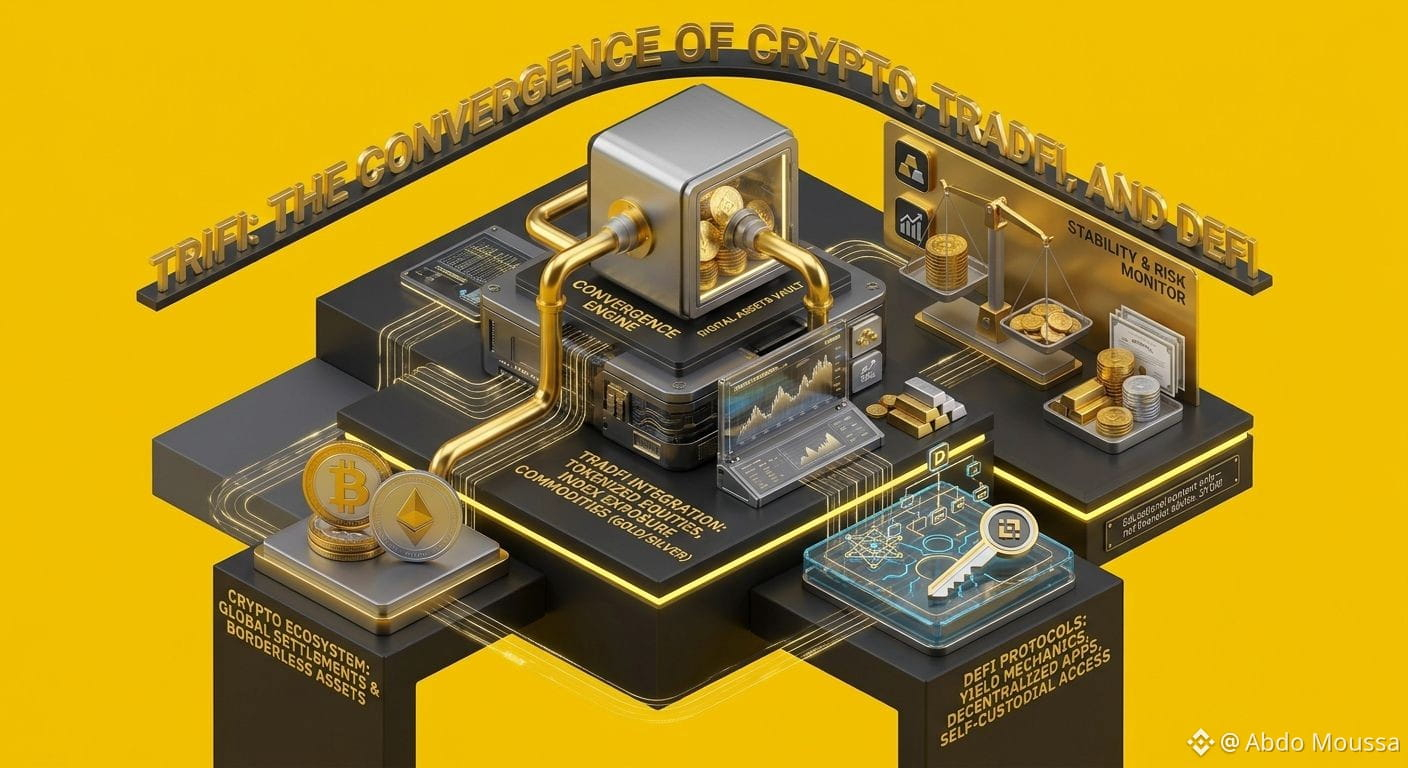
🔗 Understanding TriFi: The Convergence of Crypto, TradFi, and DeFi
The evolution of modern finance relies on interoperability, TriFi represents the convergence of three distinct financial pillars into a single operational architecture.
💡 The Three Pillars of TriFi
Crypto Ecosystem: Digital liquidity, global settlements, and borderless assets (e.g., BTC, ETH).
TradFi Integration: Structural stability, index exposure, commodities (Gold/Silver), and tokenized equities.
DeFi Protocols: Decentralized yield mechanics, transparency, and self-custodial DApp integration.
🔑 Unified Synergy
By integrating Crypto, TradFi, and DeFi under one ecosystem, users gain seamless mobility to manage capital, execute hedging strategies, and adapt to shifting global market cycles.
⚠️ Educational Disclaimer
Participation across these market segments carries specific risks, including volatility and smart contract execution parameters, Product features vary by region.
Educational content only, not financial advice, Always DYOR (Do Your Own Research)
#Binance #crypto #TradFi #DeFi #dyor
🔗 Understanding TriFi: The Convergence of Crypto, TradFi, and DeFi
The evolution of modern finance relies on interoperability, TriFi represents the convergence of three distinct financial pillars into a single operational architecture.
💡 The Three Pillars of TriFi
Crypto Ecosystem: Digital liquidity, global settlements, and borderless assets (e.g., BTC, ETH).
TradFi Integration: Structural stability, index exposure, commodities (Gold/Silver), and tokenized equities.
DeFi Protocols: Decentralized yield mechanics, transparency, and self-custodial DApp integration.
🔑 Unified Synergy
By integrating Crypto, TradFi, and DeFi under one ecosystem, users gain seamless mobility to manage capital, execute hedging strategies, and adapt to shifting global market cycles.
⚠️ Educational Disclaimer
Participation across these market segments carries specific risks, including volatility and smart contract execution parameters, Product features vary by region.
Educational content only, not financial advice, Always DYOR (Do Your Own Research)
#Binance #crypto #TradFi #DeFi #dyor
The evolution of modern finance relies on interoperability, TriFi represents the convergence of three distinct financial pillars into a single operational architecture.
💡 The Three Pillars of TriFi
Crypto Ecosystem: Digital liquidity, global settlements, and borderless assets (e.g., BTC, ETH).
TradFi Integration: Structural stability, index exposure, commodities (Gold/Silver), and tokenized equities.
DeFi Protocols: Decentralized yield mechanics, transparency, and self-custodial DApp integration.
🔑 Unified Synergy
By integrating Crypto, TradFi, and DeFi under one ecosystem, users gain seamless mobility to manage capital, execute hedging strategies, and adapt to shifting global market cycles.
⚠️ Educational Disclaimer
Participation across these market segments carries specific risks, including volatility and smart contract execution parameters, Product features vary by region.
Educational content only, not financial advice, Always DYOR (Do Your Own Research)
#Binance #crypto #TradFi #DeFi #dyor
5
171
·
--
See translation
🏦 Liquidity Management: Understanding Binance Loans
Unlocking liquidity without liquidating core cryptocurrency holdings is a vital component of long-term asset management, Binance Loans enables users to borrow stablecoins or alternative digital assets using their existing holdings as collateral.
💡 Operational Loan Structures
Flexible Loans: Offers open-ended borrowing terms with hourly interest accrual and full flexibility to repay at any time without early settlement penalties.
Fixed-Term Loans: Secures a fixed interest rate over specified durations (e.g., 7, 14, or 30 days) for structured cash flow predictability.
Loan-to-Value (LTV) Monitoring: Tracks collateral values dynamically, alerting users to add collateral if market declines approach liquidation thresholds.
Zero Processing Fees: Credits loan proceeds instantly to the user's account upon collateral lock-up without hidden administrative charges.
🔑 Strategic Financial Uses
Borrowing against crypto assets allows users to access working capital for real-world expenses or participate in market opportunities while maintaining long-term price exposure to their pledged collateral.
⚠️ Educational Disclaimer
Failure to maintain required LTV ratios during market drawdowns can result in automatic liquidation of pledged collateral.
This content is provided strictly for educational and informational purposes.
Explore crypto collateral mechanisms on Binance Academy.
[https://www.binance.com/en/academy/articles/a-beginner-s-guide-to-binance-loans](https://www.binance.com/en/academy/articles/a-beginner-s-guide-to-binance-loans)
Manage LTV thresholds responsibly, protect your assets, and always DYOR (Do Your Own Research) 💡
#Binance #BinanceAcademy #BinanceLoans #dyor #LearnWithBinance
🏦 Liquidity Management: Understanding Binance Loans
Unlocking liquidity without liquidating core cryptocurrency holdings is a vital component of long-term asset management, Binance Loans enables users to borrow stablecoins or alternative digital assets using their existing holdings as collateral.
💡 Operational Loan Structures
Flexible Loans: Offers open-ended borrowing terms with hourly interest accrual and full flexibility to repay at any time without early settlement penalties.
Fixed-Term Loans: Secures a fixed interest rate over specified durations (e.g., 7, 14, or 30 days) for structured cash flow predictability.
Loan-to-Value (LTV) Monitoring: Tracks collateral values dynamically, alerting users to add collateral if market declines approach liquidation thresholds.
Zero Processing Fees: Credits loan proceeds instantly to the user's account upon collateral lock-up without hidden administrative charges.
🔑 Strategic Financial Uses
Borrowing against crypto assets allows users to access working capital for real-world expenses or participate in market opportunities while maintaining long-term price exposure to their pledged collateral.
⚠️ Educational Disclaimer
Failure to maintain required LTV ratios during market drawdowns can result in automatic liquidation of pledged collateral.
This content is provided strictly for educational and informational purposes.
Explore crypto collateral mechanisms on Binance Academy.
https://www.binance.com/en/academy/articles/a-beginner-s-guide-to-binance-loans
Manage LTV thresholds responsibly, protect your assets, and always DYOR (Do Your Own Research) 💡
#Binance #BinanceAcademy #BinanceLoans #dyor #LearnWithBinance
Unlocking liquidity without liquidating core cryptocurrency holdings is a vital component of long-term asset management, Binance Loans enables users to borrow stablecoins or alternative digital assets using their existing holdings as collateral.
💡 Operational Loan Structures
Flexible Loans: Offers open-ended borrowing terms with hourly interest accrual and full flexibility to repay at any time without early settlement penalties.
Fixed-Term Loans: Secures a fixed interest rate over specified durations (e.g., 7, 14, or 30 days) for structured cash flow predictability.
Loan-to-Value (LTV) Monitoring: Tracks collateral values dynamically, alerting users to add collateral if market declines approach liquidation thresholds.
Zero Processing Fees: Credits loan proceeds instantly to the user's account upon collateral lock-up without hidden administrative charges.
🔑 Strategic Financial Uses
Borrowing against crypto assets allows users to access working capital for real-world expenses or participate in market opportunities while maintaining long-term price exposure to their pledged collateral.
⚠️ Educational Disclaimer
Failure to maintain required LTV ratios during market drawdowns can result in automatic liquidation of pledged collateral.
This content is provided strictly for educational and informational purposes.
Explore crypto collateral mechanisms on Binance Academy.
https://www.binance.com/en/academy/articles/a-beginner-s-guide-to-binance-loans
Manage LTV thresholds responsibly, protect your assets, and always DYOR (Do Your Own Research) 💡
#Binance #BinanceAcademy #BinanceLoans #dyor #LearnWithBinance

4
47
·
--
See translation
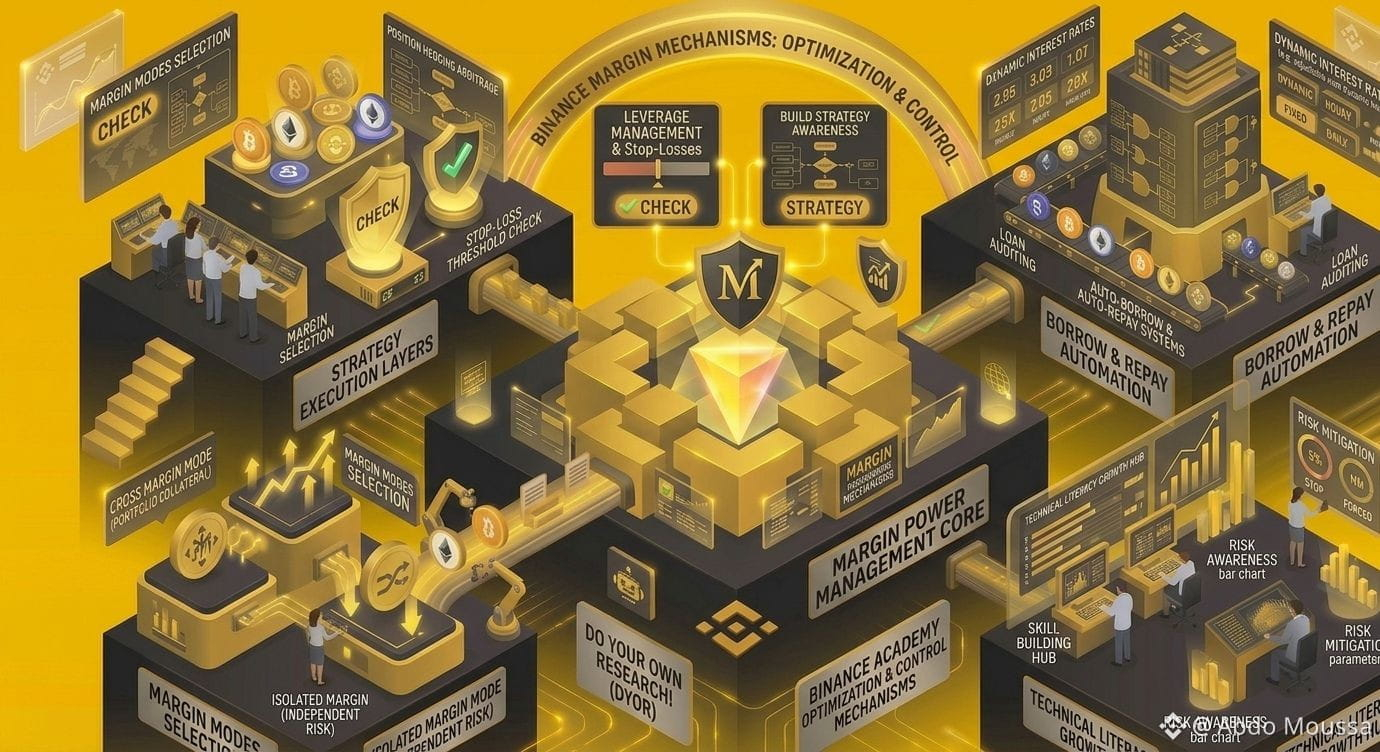
⚡ Amplifying Position Power: Exploring Binance Margin Trading
Capital efficiency often requires accessing additional leverage using existing portfolio holdings, Binance Margin Trading allows users to borrow funds to execute larger spot positions than standard balances permit.
💡 Margin Modes & Dynamic Controls
Cross Margin Mode: Consolidates overall portfolio collateral across multiple trading pairs to reduce single-asset liquidation triggers.
Isolated Margin Mode: Assigns independent risk parameters and collateral pools to individual trading pairs, containing losses strictly to designated positions.
Auto-Borrow & Auto-Repay Systems: Streamlines trade execution by programmatically initiating loans upon order placement and settling debts upon position closure.
Dynamic Interest Rates: Calculates daily or hourly borrowing rates based on real-time market supply and demand metrics.
🔑 Strategic Portfolio Applications
Margin capabilities are commonly utilized for short-term position hedging, capturing temporary arbitrage opportunities, or structuring leveraged spot long/short strategies.
⚠️ Educational Disclaimer
Margin trading involves substantial leverage risks and can result in total loss of margin collateral if market volatility triggers forced liquidation.
This article is prepared strictly for educational purposes and does not constitute financial or investment advice.
Master leveraged trading mechanics on Binance Academy.
[https://www.binance.com/en/academy/articles/what-is-binance-margin-and-how-to-use-it](https://www.binance.com/en/academy/articles/what-is-binance-margin-and-how-to-use-it)
Manage leverage carefully, set strict stop-losses, and always DYOR (Do Your Own Research)💡
#Binance #BinanceAcademy #BinanceMarginPairs #dyor #learnwithbinance
⚡ Amplifying Position Power: Exploring Binance Margin Trading
Capital efficiency often requires accessing additional leverage using existing portfolio holdings, Binance Margin Trading allows users to borrow funds to execute larger spot positions than standard balances permit.
💡 Margin Modes & Dynamic Controls
Cross Margin Mode: Consolidates overall portfolio collateral across multiple trading pairs to reduce single-asset liquidation triggers.
Isolated Margin Mode: Assigns independent risk parameters and collateral pools to individual trading pairs, containing losses strictly to designated positions.
Auto-Borrow & Auto-Repay Systems: Streamlines trade execution by programmatically initiating loans upon order placement and settling debts upon position closure.
Dynamic Interest Rates: Calculates daily or hourly borrowing rates based on real-time market supply and demand metrics.
🔑 Strategic Portfolio Applications
Margin capabilities are commonly utilized for short-term position hedging, capturing temporary arbitrage opportunities, or structuring leveraged spot long/short strategies.
⚠️ Educational Disclaimer
Margin trading involves substantial leverage risks and can result in total loss of margin collateral if market volatility triggers forced liquidation.
This article is prepared strictly for educational purposes and does not constitute financial or investment advice.
Master leveraged trading mechanics on Binance Academy.
https://www.binance.com/en/academy/articles/what-is-binance-margin-and-how-to-use-it
Manage leverage carefully, set strict stop-losses, and always DYOR (Do Your Own Research)💡
#Binance #BinanceAcademy #BinanceMarginPairs #dyor #learnwithbinance
Capital efficiency often requires accessing additional leverage using existing portfolio holdings, Binance Margin Trading allows users to borrow funds to execute larger spot positions than standard balances permit.
💡 Margin Modes & Dynamic Controls
Cross Margin Mode: Consolidates overall portfolio collateral across multiple trading pairs to reduce single-asset liquidation triggers.
Isolated Margin Mode: Assigns independent risk parameters and collateral pools to individual trading pairs, containing losses strictly to designated positions.
Auto-Borrow & Auto-Repay Systems: Streamlines trade execution by programmatically initiating loans upon order placement and settling debts upon position closure.
Dynamic Interest Rates: Calculates daily or hourly borrowing rates based on real-time market supply and demand metrics.
🔑 Strategic Portfolio Applications
Margin capabilities are commonly utilized for short-term position hedging, capturing temporary arbitrage opportunities, or structuring leveraged spot long/short strategies.
⚠️ Educational Disclaimer
Margin trading involves substantial leverage risks and can result in total loss of margin collateral if market volatility triggers forced liquidation.
This article is prepared strictly for educational purposes and does not constitute financial or investment advice.
Master leveraged trading mechanics on Binance Academy.
https://www.binance.com/en/academy/articles/what-is-binance-margin-and-how-to-use-it
Manage leverage carefully, set strict stop-losses, and always DYOR (Do Your Own Research)💡
#Binance #BinanceAcademy #BinanceMarginPairs #dyor #learnwithbinance
3
46
·
--
See translation
5 Reasons Why Binance is My All-in-One Financial Engine ⚡️🌐1️⃣ One Hub, Zero Friction
I used to juggle five different apps to manage my assets and trades, Having my entire portfolio, execution tools, and liquidity unified under one roof saved me countless hours and friction.
2️⃣ P2P & Stablecoins as Real Value Rails
Stablecoins (USDT/USDC) aren't just trading pairs to me, they are my primary rail for moving value, Binance P2P makes accessing local liquidity instantaneous and reliable whenever I need it.
3️⃣ AI-Driven Execution for Macro Strategy
Instead of micro-managing chart entries, leveraging automated execution and AI tools allows me to focus purely on high-level strategy while the system handles optimal routing seamlessly.
4️⃣ Smart Risk Hedging over Pure Speculation
Markets move fast, Having deep derivatives liquidity in the same account enables me to hedge my existing spot positions efficiently during high volatility, protecting capital rather than gambling.
5️⃣ A Community-Driven Global Network
Binance is more than an exchange, it’s an active global ecosystem, Being connected with a community that shares real-world Web3 insights keeps me continuously ahead of the curve.
#WhyBinance #Binance @Binance_Angels
5 Reasons Why Binance is My All-in-One Financial Engine ⚡️🌐
1️⃣ One Hub, Zero Friction
I used to juggle five different apps to manage my assets and trades, Having my entire portfolio, execution tools, and liquidity unified under one roof saved me countless hours and friction.
2️⃣ P2P & Stablecoins as Real Value Rails
Stablecoins (USDT/USDC) aren't just trading pairs to me, they are my primary rail for moving value, Binance P2P makes accessing local liquidity instantaneous and reliable whenever I need it.
3️⃣ AI-Driven Execution for Macro Strategy
Instead of micro-managing chart entries, leveraging automated execution and AI tools allows me to focus purely on high-level strategy while the system handles optimal routing seamlessly.
4️⃣ Smart Risk Hedging over Pure Speculation
Markets move fast, Having deep derivatives liquidity in the same account enables me to hedge my existing spot positions efficiently during high volatility, protecting capital rather than gambling.
5️⃣ A Community-Driven Global Network
Binance is more than an exchange, it’s an active global ecosystem, Being connected with a community that shares real-world Web3 insights keeps me continuously ahead of the curve.
#WhyBinance #Binance @Binance Angels
I used to juggle five different apps to manage my assets and trades, Having my entire portfolio, execution tools, and liquidity unified under one roof saved me countless hours and friction.
2️⃣ P2P & Stablecoins as Real Value Rails
Stablecoins (USDT/USDC) aren't just trading pairs to me, they are my primary rail for moving value, Binance P2P makes accessing local liquidity instantaneous and reliable whenever I need it.
3️⃣ AI-Driven Execution for Macro Strategy
Instead of micro-managing chart entries, leveraging automated execution and AI tools allows me to focus purely on high-level strategy while the system handles optimal routing seamlessly.
4️⃣ Smart Risk Hedging over Pure Speculation
Markets move fast, Having deep derivatives liquidity in the same account enables me to hedge my existing spot positions efficiently during high volatility, protecting capital rather than gambling.
5️⃣ A Community-Driven Global Network
Binance is more than an exchange, it’s an active global ecosystem, Being connected with a community that shares real-world Web3 insights keeps me continuously ahead of the curve.
#WhyBinance #Binance @Binance Angels
3
57
·
--
See translation
They say "knowledge is leverage", and today I leveled up 🏆
Successfully completed the "From TradFi to Crypto" course, Understanding how legacy systems transition into decentralized networks is key to navigating tomorrow’s economy.
Huge thanks to @Binance_Academy for making top-tier crypto education accessible to everyone 🎓✨
#BinanceAcademyCourse #BinanceAcademyCourses
They say "knowledge is leverage", and today I leveled up 🏆
Successfully completed the "From TradFi to Crypto" course, Understanding how legacy systems transition into decentralized networks is key to navigating tomorrow’s economy.
Huge thanks to @Binance Academy for making top-tier crypto education accessible to everyone 🎓✨
#BinanceAcademyCourse #BinanceAcademyCourses
Successfully completed the "From TradFi to Crypto" course, Understanding how legacy systems transition into decentralized networks is key to navigating tomorrow’s economy.
Huge thanks to @Binance Academy for making top-tier crypto education accessible to everyone 🎓✨
#BinanceAcademyCourse #BinanceAcademyCourses



Binance Academy
·
--
🎓 Learn the course “From TradFi to Crypto”, share the certificate, and win Binance swag.
Campaign period: Sep 16, 2026, 9:00 AM (UTC) – Sep 27, 2026, 9:00 AM (UTC)
🔸Complete the course From TradFi to Crypto & earn your certificate:
🔸Follow @Binance Academy on Square
🔸Share your certificate with hashtag #BinanceAcademyCourse
🔸Fill in the shipping info
🔸Wait for results!
10 winners will be announced on Sep 28, 2026, chosen based on creativity and relevance in sharing their certificate and learning journey. Make your post stand out. 🏆
Note: Campaign unavailable in certain regions due to compliance requirements.
Campaign period: Sep 16, 2026, 9:00 AM (UTC) – Sep 27, 2026, 9:00 AM (UTC)
🔸Complete the course From TradFi to Crypto & earn your certificate:
🔸Follow @Binance Academy on Square
🔸Share your certificate with hashtag #BinanceAcademyCourse
🔸Fill in the shipping info
🔸Wait for results!
10 winners will be announced on Sep 28, 2026, chosen based on creativity and relevance in sharing their certificate and learning journey. Make your post stand out. 🏆
Note: Campaign unavailable in certain regions due to compliance requirements.
3
93
·
--
See translation
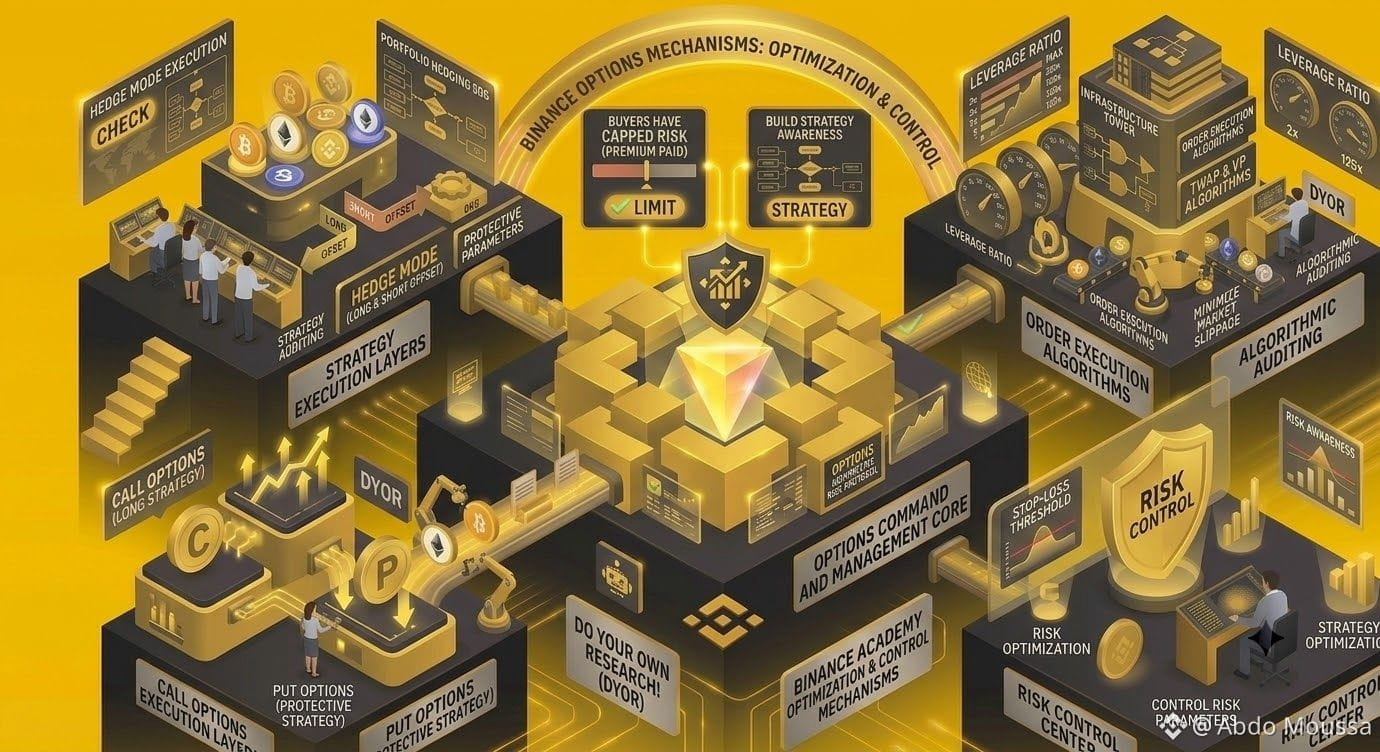
⚖️ Asymmetric Risk Management: Exploring Binance Options
Navigating sharp market volatility often requires instruments with predefined risk boundaries, Binance Options provides traders with option contracts to hedge existing portfolios or execute strategic directional positions.
💡 Core Operational Mechanics
Capped Risk Profile for Buyers: Option buyers limit their potential downside strictly to the premium paid, eliminating direct liquidation risks faced in standard margin products.
Call & Put Contracts: Enables long strategies (Call Options) to capitalize on upside potential or protective strategies (Put Options) to hedge against downward price drops.
Streamlined Order Execution: Features an intuitive interface tailored for quick order placement, strike price selection, and expiration date tracking.
Competitive Liquidity & Settlement: Cash-settled contracts backed by Binance liquidity pools for tight bid-ask spreads.
🔑 Strategic Portfolio Hedging
Options allow institutional and retail traders to construct sophisticated strategies, such as protective puts or covered calls, to balance risk and return in unpredictable markets.
⚠️ Educational Disclaimer
Options trading involves specific mechanisms, including time decay (Theta) and volatility metrics, which require thorough understanding prior to execution.
This content is provided strictly for educational and informational purposes.
Explore advanced financial instruments on Binance Academy.
[https://www.binance.com/en/academy/articles/what-is-options-trading](https://www.binance.com/en/academy/articles/what-is-options-trading)
Build strategic discipline, trade responsibly, and always DYOR (Do Your Own Research)💡
#Binance #BinanceAcademy #BinanceOptions #dyor #learnwithbinance
⚖️ Asymmetric Risk Management: Exploring Binance Options
Navigating sharp market volatility often requires instruments with predefined risk boundaries, Binance Options provides traders with option contracts to hedge existing portfolios or execute strategic directional positions.
💡 Core Operational Mechanics
Capped Risk Profile for Buyers: Option buyers limit their potential downside strictly to the premium paid, eliminating direct liquidation risks faced in standard margin products.
Call & Put Contracts: Enables long strategies (Call Options) to capitalize on upside potential or protective strategies (Put Options) to hedge against downward price drops.
Streamlined Order Execution: Features an intuitive interface tailored for quick order placement, strike price selection, and expiration date tracking.
Competitive Liquidity & Settlement: Cash-settled contracts backed by Binance liquidity pools for tight bid-ask spreads.
🔑 Strategic Portfolio Hedging
Options allow institutional and retail traders to construct sophisticated strategies, such as protective puts or covered calls, to balance risk and return in unpredictable markets.
⚠️ Educational Disclaimer
Options trading involves specific mechanisms, including time decay (Theta) and volatility metrics, which require thorough understanding prior to execution.
This content is provided strictly for educational and informational purposes.
Explore advanced financial instruments on Binance Academy.
https://www.binance.com/en/academy/articles/what-is-options-trading
Build strategic discipline, trade responsibly, and always DYOR (Do Your Own Research)💡
#Binance #BinanceAcademy #BinanceOptions #dyor #learnwithbinance
Navigating sharp market volatility often requires instruments with predefined risk boundaries, Binance Options provides traders with option contracts to hedge existing portfolios or execute strategic directional positions.
💡 Core Operational Mechanics
Capped Risk Profile for Buyers: Option buyers limit their potential downside strictly to the premium paid, eliminating direct liquidation risks faced in standard margin products.
Call & Put Contracts: Enables long strategies (Call Options) to capitalize on upside potential or protective strategies (Put Options) to hedge against downward price drops.
Streamlined Order Execution: Features an intuitive interface tailored for quick order placement, strike price selection, and expiration date tracking.
Competitive Liquidity & Settlement: Cash-settled contracts backed by Binance liquidity pools for tight bid-ask spreads.
🔑 Strategic Portfolio Hedging
Options allow institutional and retail traders to construct sophisticated strategies, such as protective puts or covered calls, to balance risk and return in unpredictable markets.
⚠️ Educational Disclaimer
Options trading involves specific mechanisms, including time decay (Theta) and volatility metrics, which require thorough understanding prior to execution.
This content is provided strictly for educational and informational purposes.
Explore advanced financial instruments on Binance Academy.
https://www.binance.com/en/academy/articles/what-is-options-trading
Build strategic discipline, trade responsibly, and always DYOR (Do Your Own Research)💡
#Binance #BinanceAcademy #BinanceOptions #dyor #learnwithbinance
4
32
·
--
See translation
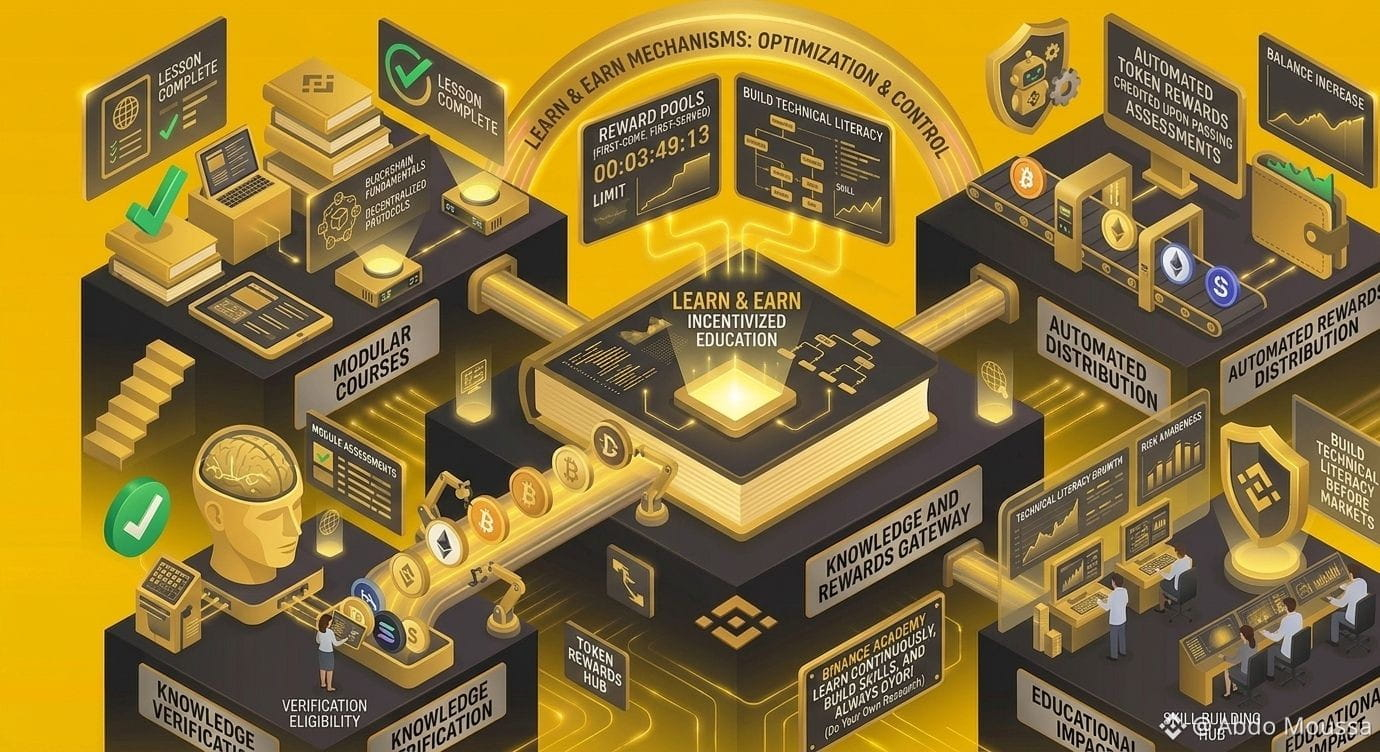
🎓 Incentivized Education: Exploring Binance Learn & Earn
Fostering Web3 adoption requires accessible, structured educational frameworks, Binance Learn & Earn incentivizes financial literacy by rewarding users with digital assets upon completing targeted learning modules.
💡 Program Architecture & User Journey
Modular Courses: Provides educational materials, videos, and articles explaining blockchain fundamentals, decentralized protocols, and specific token ecosystems.
Knowledge Verification: Requires participants to complete short comprehension quizzes at the end of each module to demonstrate mastery.
Automated Token Rewards: Credits successful participants with project tokens directly to their Rewards Hub upon passing module assessments.
🔑 Educational Impact
By pairing foundational knowledge with token incentives, the platform helps users build technical literacy before interacting directly with active markets.
⚠️ Educational Disclaimer
Reward pools are distributed on a first-come, first-served basis and are subject to verification eligibility and regional availability.
This content is provided strictly for educational and informational purposes.
Expand your Web3 knowledge on Binance Academy.
[https://www.binance.com/en/support/faq/detail/f755f76dbfe641e19ea3b14c516b0e2c](https://www.binance.com/en/support/faq/detail/f755f76dbfe641e19ea3b14c516b0e2c)
Learn continuously, build skills, and always DYOR (Do Your Own Research)💡
#Binance #BinanceAcademy #learnAndEarn #dyor #learnwithbinance
🎓 Incentivized Education: Exploring Binance Learn & Earn
Fostering Web3 adoption requires accessible, structured educational frameworks, Binance Learn & Earn incentivizes financial literacy by rewarding users with digital assets upon completing targeted learning modules.
💡 Program Architecture & User Journey
Modular Courses: Provides educational materials, videos, and articles explaining blockchain fundamentals, decentralized protocols, and specific token ecosystems.
Knowledge Verification: Requires participants to complete short comprehension quizzes at the end of each module to demonstrate mastery.
Automated Token Rewards: Credits successful participants with project tokens directly to their Rewards Hub upon passing module assessments.
🔑 Educational Impact
By pairing foundational knowledge with token incentives, the platform helps users build technical literacy before interacting directly with active markets.
⚠️ Educational Disclaimer
Reward pools are distributed on a first-come, first-served basis and are subject to verification eligibility and regional availability.
This content is provided strictly for educational and informational purposes.
Expand your Web3 knowledge on Binance Academy.
https://www.binance.com/en/support/faq/detail/f755f76dbfe641e19ea3b14c516b0e2c
Learn continuously, build skills, and always DYOR (Do Your Own Research)💡
#Binance #BinanceAcademy #learnAndEarn #dyor #learnwithbinance
Fostering Web3 adoption requires accessible, structured educational frameworks, Binance Learn & Earn incentivizes financial literacy by rewarding users with digital assets upon completing targeted learning modules.
💡 Program Architecture & User Journey
Modular Courses: Provides educational materials, videos, and articles explaining blockchain fundamentals, decentralized protocols, and specific token ecosystems.
Knowledge Verification: Requires participants to complete short comprehension quizzes at the end of each module to demonstrate mastery.
Automated Token Rewards: Credits successful participants with project tokens directly to their Rewards Hub upon passing module assessments.
🔑 Educational Impact
By pairing foundational knowledge with token incentives, the platform helps users build technical literacy before interacting directly with active markets.
⚠️ Educational Disclaimer
Reward pools are distributed on a first-come, first-served basis and are subject to verification eligibility and regional availability.
This content is provided strictly for educational and informational purposes.
Expand your Web3 knowledge on Binance Academy.
https://www.binance.com/en/support/faq/detail/f755f76dbfe641e19ea3b14c516b0e2c
Learn continuously, build skills, and always DYOR (Do Your Own Research)💡
#Binance #BinanceAcademy #learnAndEarn #dyor #learnwithbinance
4
47
·
--
See translation
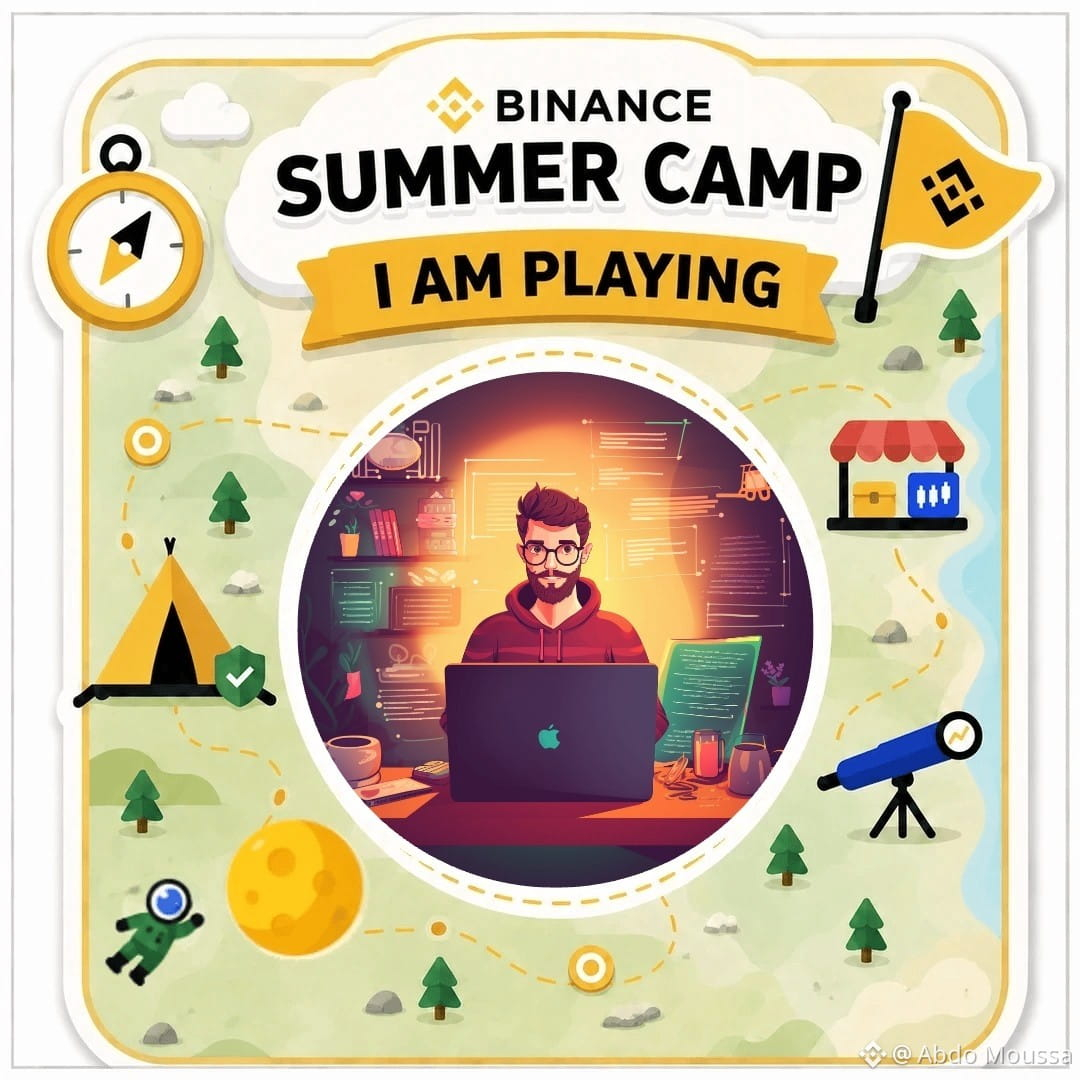
🏕️ Binance Summer Camp is officially live, and I’m already in!
Just started Day 1 and unlocked the Scam Hunter badge.
It’s not just another quiz… it’s actually teaching real crypto survival skills in a fun, game-style way (CryptoLingo vibes 🔥).
Security first, always.
Because in crypto, the best flex isn’t the bag, it’s keeping it safe.
Who’s joining me in the camp?
Let’s level up together 👇
[https://www.binance.info/en/ti/cryptolingo?utm_medium=app_share_link_twitter&utm_source=ENBinanceAngelsX](https://www.binance.info/en/ti/cryptolingo?utm_medium=app_share_link_twitter&utm_source=ENBinanceAngelsX)
#BinanceSummerCamp #CryptoLingo #Binance
🏕️ Binance Summer Camp is officially live, and I’m already in!
Just started Day 1 and unlocked the Scam Hunter badge.
It’s not just another quiz… it’s actually teaching real crypto survival skills in a fun, game-style way (CryptoLingo vibes 🔥).
Security first, always.
Because in crypto, the best flex isn’t the bag, it’s keeping it safe.
Who’s joining me in the camp?
Let’s level up together 👇
https://www.binance.info/en/ti/cryptolingo?utm_medium=app_share_link_twitter&utm_source=ENBinanceAngelsX
#BinanceSummerCamp #CryptoLingo #Binance
Just started Day 1 and unlocked the Scam Hunter badge.
It’s not just another quiz… it’s actually teaching real crypto survival skills in a fun, game-style way (CryptoLingo vibes 🔥).
Security first, always.
Because in crypto, the best flex isn’t the bag, it’s keeping it safe.
Who’s joining me in the camp?
Let’s level up together 👇
https://www.binance.info/en/ti/cryptolingo?utm_medium=app_share_link_twitter&utm_source=ENBinanceAngelsX
#BinanceSummerCamp #CryptoLingo #Binance
3
64
·
--
See translation
📈 Managing Volatility: Introduction to Binance Futures
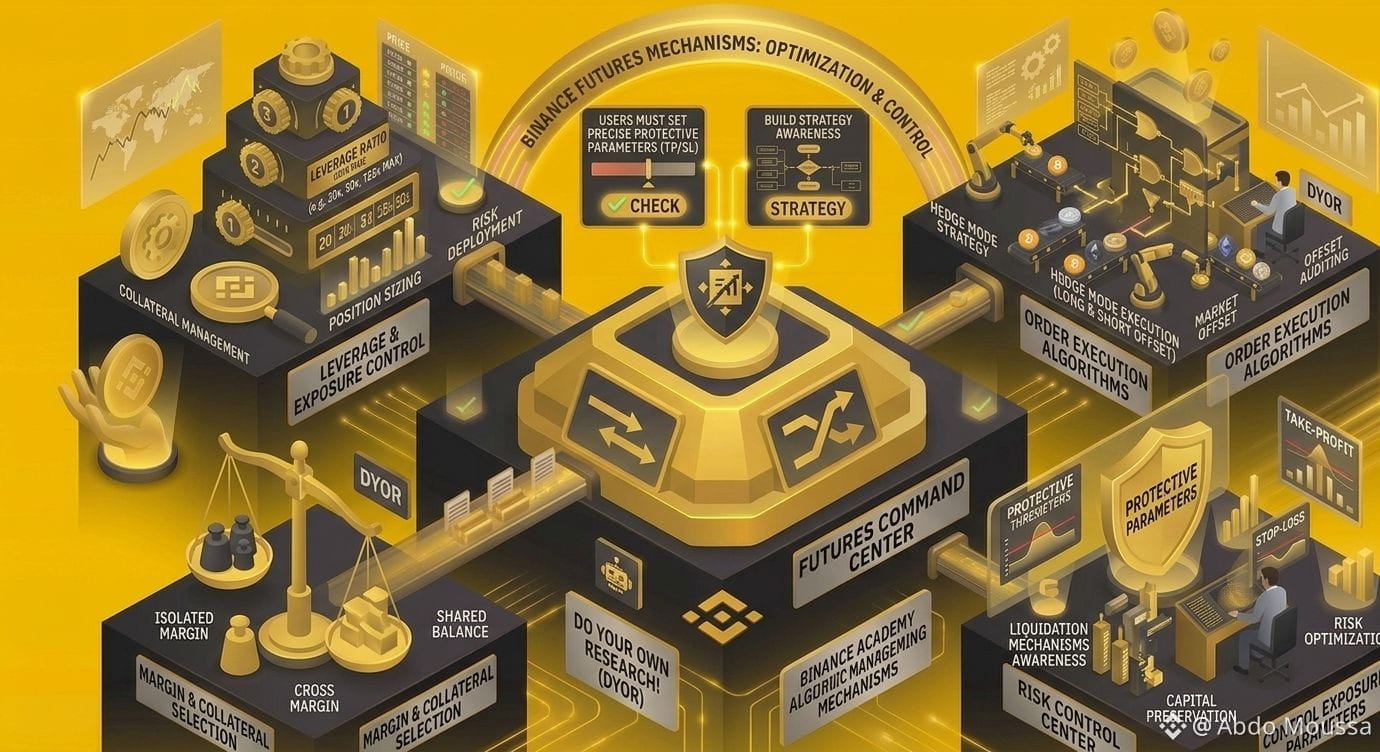
Derivatives instruments allow sophisticated traders to manage portfolio risk and hedge against market movements, Binance Futures offers liquid contract markets paired with execution tools designed for risk mitigation.
💡 Fundamental Operational Tools
Margin Modes (Isolated vs. Cross): Isolated Margin restricts risk to the collateral allocated to a single position, whereas Cross Margin shares risk across the entire futures account balance.
Take-Profit & Stop-Loss (TP/SL): Programmatically closes positions when specific price targets are met to preserve capital and capture realized gains.
Hedge Mode Strategy: Permits traders to hold simultaneous long and short positions on the same contract to offset market exposure during volatile conditions.
Leverage Controls: Adjustable leverage ratios to manage exposure relative to available margin.
🔑 Responsible Trading Practices
Derivatives trading requires strict capital management, disciplined position sizing, and a comprehensive understanding of liquidation mechanisms to navigate market shifts successfully.
⚠️ Educational Disclaimer
Futures trading involves significant financial risk and is not suitable for all investors due to leverage dynamics.
This content is provided strictly for educational and informational purposes.
Master derivatives risk management on Binance Academy.
[https://www.binance.com/en/support/faq/detail/360039304272](https://www.binance.com/en/support/faq/detail/360039304272)
Trade responsibly, set protective parameters, and always DYOR (Do Your Own Research)💡
#Binance #BinanceAcademy #BinanceFutures #dyor #learnwithbinance
📈 Managing Volatility: Introduction to Binance Futures
Derivatives instruments allow sophisticated traders to manage portfolio risk and hedge against market movements, Binance Futures offers liquid contract markets paired with execution tools designed for risk mitigation.
💡 Fundamental Operational Tools
Margin Modes (Isolated vs. Cross): Isolated Margin restricts risk to the collateral allocated to a single position, whereas Cross Margin shares risk across the entire futures account balance.
Take-Profit & Stop-Loss (TP/SL): Programmatically closes positions when specific price targets are met to preserve capital and capture realized gains.
Hedge Mode Strategy: Permits traders to hold simultaneous long and short positions on the same contract to offset market exposure during volatile conditions.
Leverage Controls: Adjustable leverage ratios to manage exposure relative to available margin.
🔑 Responsible Trading Practices
Derivatives trading requires strict capital management, disciplined position sizing, and a comprehensive understanding of liquidation mechanisms to navigate market shifts successfully.
⚠️ Educational Disclaimer
Futures trading involves significant financial risk and is not suitable for all investors due to leverage dynamics.
This content is provided strictly for educational and informational purposes.
Master derivatives risk management on Binance Academy.
https://www.binance.com/en/support/faq/detail/360039304272
Trade responsibly, set protective parameters, and always DYOR (Do Your Own Research)💡
#Binance #BinanceAcademy #BinanceFutures #dyor #learnwithbinance
Derivatives instruments allow sophisticated traders to manage portfolio risk and hedge against market movements, Binance Futures offers liquid contract markets paired with execution tools designed for risk mitigation.
💡 Fundamental Operational Tools
Margin Modes (Isolated vs. Cross): Isolated Margin restricts risk to the collateral allocated to a single position, whereas Cross Margin shares risk across the entire futures account balance.
Take-Profit & Stop-Loss (TP/SL): Programmatically closes positions when specific price targets are met to preserve capital and capture realized gains.
Hedge Mode Strategy: Permits traders to hold simultaneous long and short positions on the same contract to offset market exposure during volatile conditions.
Leverage Controls: Adjustable leverage ratios to manage exposure relative to available margin.
🔑 Responsible Trading Practices
Derivatives trading requires strict capital management, disciplined position sizing, and a comprehensive understanding of liquidation mechanisms to navigate market shifts successfully.
⚠️ Educational Disclaimer
Futures trading involves significant financial risk and is not suitable for all investors due to leverage dynamics.
This content is provided strictly for educational and informational purposes.
Master derivatives risk management on Binance Academy.
https://www.binance.com/en/support/faq/detail/360039304272
Trade responsibly, set protective parameters, and always DYOR (Do Your Own Research)💡
#Binance #BinanceAcademy #BinanceFutures #dyor #learnwithbinance
4
70
·
--
See translation
🤖 Automated Trading Strategies: Inside Binance Trading Bots
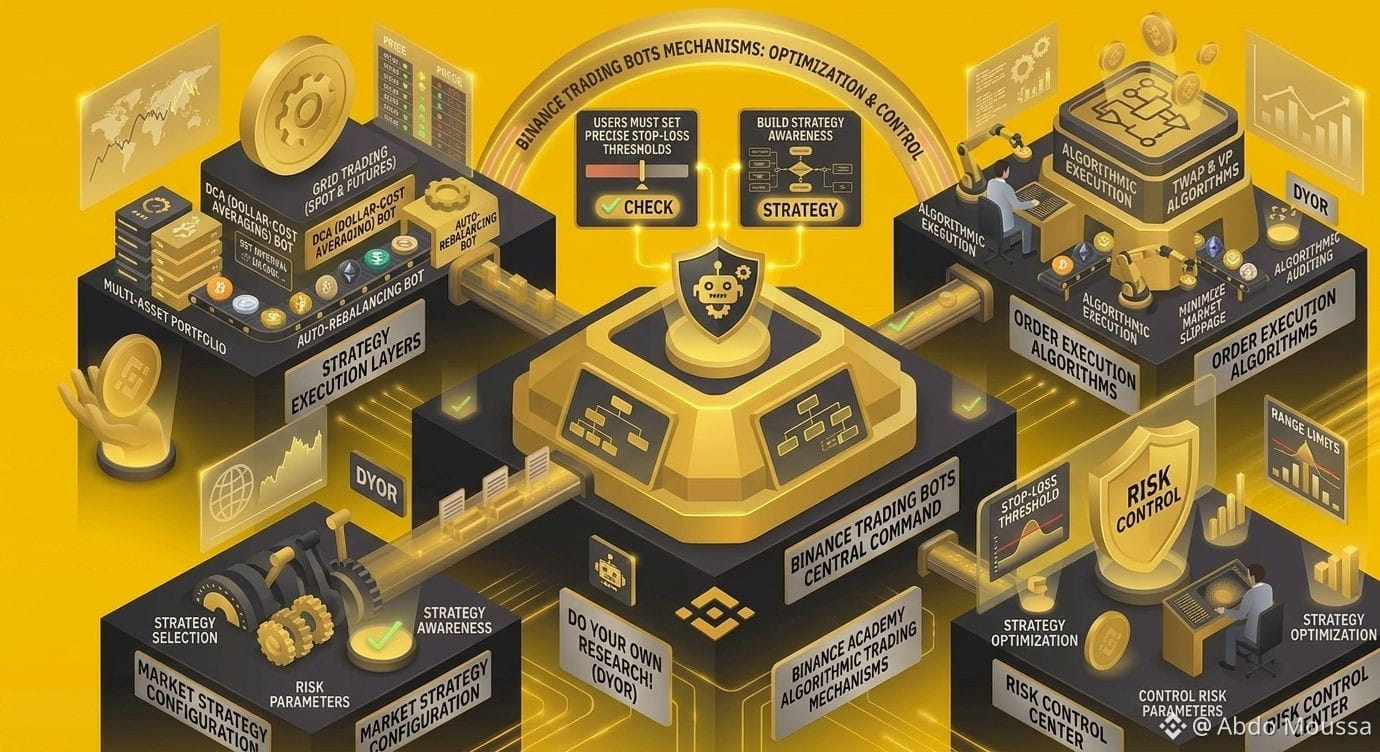
Executing discipline in volatile market conditions requires structured execution systems, Binance Trading Bots provide users with algorithmic tools designed to automate repetitive trading strategies across various market cycles.
💡 Core Bot Types & Market Use Cases
Grid Trading (Spot & Futures): Places a ladder of buy and sell orders within a user-defined price range to capture small price swings during sideways consolidation.
Dollar-Cost Averaging (DCA) Bot: Programmatically executes recurring purchases at set intervals to optimize entry prices over time.
Auto-Rebalancing Bot: Automatically adjusts the allocation weights of a multi-asset portfolio when token market values drift from target percentages.
TWAP & VP Algorithms: Facilitates large order execution over specific time or volume parameters to minimize market slippage.
🔑 Strategic Risk Management
Algorithmic trading eliminates emotional biases from execution, However, users must set precise stop-loss thresholds and range limits to manage risk effectively during strong directional market breakouts.
⚠️ Educational Disclaimer
Automated trading bots operate strictly within user-configured settings and carry inherent market risks.
This article is prepared strictly for educational purposes and does not constitute financial or investment advice.
Master algorithmic trading mechanisms on Binance Academy.
[https://www.binance.com/en/academy/articles/your-guide-to-binance-trading-bots](https://www.binance.com/en/academy/articles/your-guide-to-binance-trading-bots)
Build strategy awareness, control risk parameters, and always DYOR (Do Your Own Research)💡
#Binance #BinanceAcademy #TradingBots #dyor #learnwithbinance
🤖 Automated Trading Strategies: Inside Binance Trading Bots
Executing discipline in volatile market conditions requires structured execution systems, Binance Trading Bots provide users with algorithmic tools designed to automate repetitive trading strategies across various market cycles.
💡 Core Bot Types & Market Use Cases
Grid Trading (Spot & Futures): Places a ladder of buy and sell orders within a user-defined price range to capture small price swings during sideways consolidation.
Dollar-Cost Averaging (DCA) Bot: Programmatically executes recurring purchases at set intervals to optimize entry prices over time.
Auto-Rebalancing Bot: Automatically adjusts the allocation weights of a multi-asset portfolio when token market values drift from target percentages.
TWAP & VP Algorithms: Facilitates large order execution over specific time or volume parameters to minimize market slippage.
🔑 Strategic Risk Management
Algorithmic trading eliminates emotional biases from execution, However, users must set precise stop-loss thresholds and range limits to manage risk effectively during strong directional market breakouts.
⚠️ Educational Disclaimer
Automated trading bots operate strictly within user-configured settings and carry inherent market risks.
This article is prepared strictly for educational purposes and does not constitute financial or investment advice.
Master algorithmic trading mechanisms on Binance Academy.
https://www.binance.com/en/academy/articles/your-guide-to-binance-trading-bots
Build strategy awareness, control risk parameters, and always DYOR (Do Your Own Research)💡
#Binance #BinanceAcademy #TradingBots #dyor #learnwithbinance
Executing discipline in volatile market conditions requires structured execution systems, Binance Trading Bots provide users with algorithmic tools designed to automate repetitive trading strategies across various market cycles.
💡 Core Bot Types & Market Use Cases
Grid Trading (Spot & Futures): Places a ladder of buy and sell orders within a user-defined price range to capture small price swings during sideways consolidation.
Dollar-Cost Averaging (DCA) Bot: Programmatically executes recurring purchases at set intervals to optimize entry prices over time.
Auto-Rebalancing Bot: Automatically adjusts the allocation weights of a multi-asset portfolio when token market values drift from target percentages.
TWAP & VP Algorithms: Facilitates large order execution over specific time or volume parameters to minimize market slippage.
🔑 Strategic Risk Management
Algorithmic trading eliminates emotional biases from execution, However, users must set precise stop-loss thresholds and range limits to manage risk effectively during strong directional market breakouts.
⚠️ Educational Disclaimer
Automated trading bots operate strictly within user-configured settings and carry inherent market risks.
This article is prepared strictly for educational purposes and does not constitute financial or investment advice.
Master algorithmic trading mechanisms on Binance Academy.
https://www.binance.com/en/academy/articles/your-guide-to-binance-trading-bots
Build strategy awareness, control risk parameters, and always DYOR (Do Your Own Research)💡
#Binance #BinanceAcademy #TradingBots #dyor #learnwithbinance
3
73
·
--
See translation
🤖 Binance AI Beta: Leveraging Intelligent Market Analytics
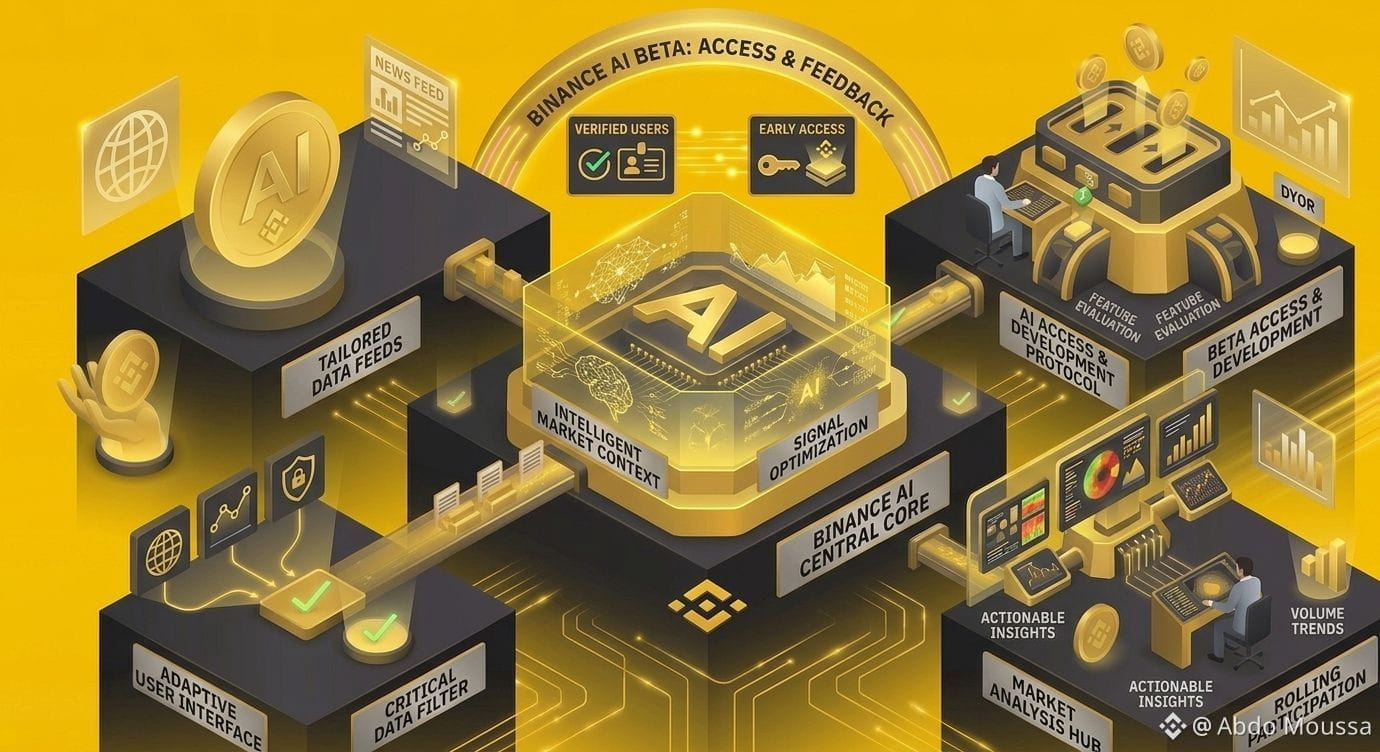
Navigating market volatility requires fast data processing and precise context, Binance has introduced the closed Beta program for Binance AI, an artificial intelligence suite built to streamline market research and actionable insights.
💡 Key Value Drivers in the Beta Phase
Intelligent Market Context: Synthesizes complex price movements across crypto and macroeconomic assets into readable, contextual summaries.
Adaptive User Interface: Tailors real-time data feeds and updates based on individual research preferences and activity.
Signal Optimization: Filters out extraneous market noise to highlight critical operational data points and volume trends.
📝 Participation & Access Protocols
The Binance AI Beta is open to verified Binance users on a rolling basis, Selected applicants receive early platform access to help evaluate features and provide direct product feedback during development.
[https://www.binance.com/en/support/announcement/detail/0b09732805ac4a548f9fcd461bb13cf0](https://www.binance.com/en/support/announcement/detail/0b09732805ac4a548f9fcd461bb13cf0)
⚠️ Educational Disclaimer
AI outputs are generated algorithmically and should not be relied upon as financial, investment, or trading advice.
Analyze inputs independently, leverage modern tools, and always DYOR (Do Your Own Research)💡
#Binance #BinanceAcademy #BinanceAI #CryptoAi #dyor
🤖 Binance AI Beta: Leveraging Intelligent Market Analytics
Navigating market volatility requires fast data processing and precise context, Binance has introduced the closed Beta program for Binance AI, an artificial intelligence suite built to streamline market research and actionable insights.
💡 Key Value Drivers in the Beta Phase
Intelligent Market Context: Synthesizes complex price movements across crypto and macroeconomic assets into readable, contextual summaries.
Adaptive User Interface: Tailors real-time data feeds and updates based on individual research preferences and activity.
Signal Optimization: Filters out extraneous market noise to highlight critical operational data points and volume trends.
📝 Participation & Access Protocols
The Binance AI Beta is open to verified Binance users on a rolling basis, Selected applicants receive early platform access to help evaluate features and provide direct product feedback during development.
https://www.binance.com/en/support/announcement/detail/0b09732805ac4a548f9fcd461bb13cf0
⚠️ Educational Disclaimer
AI outputs are generated algorithmically and should not be relied upon as financial, investment, or trading advice.
Analyze inputs independently, leverage modern tools, and always DYOR (Do Your Own Research)💡
#Binance #BinanceAcademy #BinanceAI #CryptoAi #dyor
Navigating market volatility requires fast data processing and precise context, Binance has introduced the closed Beta program for Binance AI, an artificial intelligence suite built to streamline market research and actionable insights.
💡 Key Value Drivers in the Beta Phase
Intelligent Market Context: Synthesizes complex price movements across crypto and macroeconomic assets into readable, contextual summaries.
Adaptive User Interface: Tailors real-time data feeds and updates based on individual research preferences and activity.
Signal Optimization: Filters out extraneous market noise to highlight critical operational data points and volume trends.
📝 Participation & Access Protocols
The Binance AI Beta is open to verified Binance users on a rolling basis, Selected applicants receive early platform access to help evaluate features and provide direct product feedback during development.
https://www.binance.com/en/support/announcement/detail/0b09732805ac4a548f9fcd461bb13cf0
⚠️ Educational Disclaimer
AI outputs are generated algorithmically and should not be relied upon as financial, investment, or trading advice.
Analyze inputs independently, leverage modern tools, and always DYOR (Do Your Own Research)💡
#Binance #BinanceAcademy #BinanceAI #CryptoAi #dyor
5
48
·
--
See translation
🚀 Understanding Binance Alpha: Early Access to Web3 Assets
Discovering high-potential tokens at an early stage requires integrated discovery tools, Binance Alpha acts as a pre-listing showcase pool designed to give users early visibility into emerging Web3 projects.
💡 Core Components & Ecosystem Features
Early-Stage Token Discovery: Highlights vetted digital assets operating in early development phases before any potential central exchange evaluation.
Quick Buy Mechanics: Streamlines token acquisitions with automated network selection, dynamic slippage handling, and Anti-MEV protection to reduce execution risks.
Alpha Box Airdrop Pool: Allows users to spend accumulated Binance Alpha Points to redeem token rewards from participating projects.
Alpha Earn Hub Integration: Enables users to deploy liquidity directly into PancakeSwap V3 pools without leaving the Binance Wallet interface.
🔄 Binance Alpha vs. Binance Alpha 2.0
While the standard Binance Alpha platform operates within the self-custodial Binance Web3 Wallet, Binance Alpha 2.0 embeds decentralized exchange (DEX) trading functionality directly inside the core Binance platform, enabling Spot and Funding account usage without an external wallet.
⚠️ Educational Disclaimer
Featured placement on Binance Alpha does not guarantee future listing on the Binance Exchange and carries inherent early-stage asset volatility.
This article is prepared strictly for educational purposes and does not constitute financial or investment advice.
Master Web3 asset evaluation on Binance Academy.
[https://www.binance.com/en/academy/articles/what-is-binance-alpha](https://www.binance.com/en/academy/articles/what-is-binance-alpha)
Build technical literacy, trade responsibly, and always DYOR (Do Your Own Research)💡
#Binance #BinanceAcademy #BinanceAlpha #DYOR #learnwithbinance
🚀 Understanding Binance Alpha: Early Access to Web3 Assets
Discovering high-potential tokens at an early stage requires integrated discovery tools, Binance Alpha acts as a pre-listing showcase pool designed to give users early visibility into emerging Web3 projects.
💡 Core Components & Ecosystem Features
Early-Stage Token Discovery: Highlights vetted digital assets operating in early development phases before any potential central exchange evaluation.
Quick Buy Mechanics: Streamlines token acquisitions with automated network selection, dynamic slippage handling, and Anti-MEV protection to reduce execution risks.
Alpha Box Airdrop Pool: Allows users to spend accumulated Binance Alpha Points to redeem token rewards from participating projects.
Alpha Earn Hub Integration: Enables users to deploy liquidity directly into PancakeSwap V3 pools without leaving the Binance Wallet interface.
🔄 Binance Alpha vs. Binance Alpha 2.0
While the standard Binance Alpha platform operates within the self-custodial Binance Web3 Wallet, Binance Alpha 2.0 embeds decentralized exchange (DEX) trading functionality directly inside the core Binance platform, enabling Spot and Funding account usage without an external wallet.
⚠️ Educational Disclaimer
Featured placement on Binance Alpha does not guarantee future listing on the Binance Exchange and carries inherent early-stage asset volatility.
This article is prepared strictly for educational purposes and does not constitute financial or investment advice.
Master Web3 asset evaluation on Binance Academy.
https://www.binance.com/en/academy/articles/what-is-binance-alpha
Build technical literacy, trade responsibly, and always DYOR (Do Your Own Research)💡
#Binance #BinanceAcademy #BinanceAlpha #DYOR #learnwithbinance
Discovering high-potential tokens at an early stage requires integrated discovery tools, Binance Alpha acts as a pre-listing showcase pool designed to give users early visibility into emerging Web3 projects.
💡 Core Components & Ecosystem Features
Early-Stage Token Discovery: Highlights vetted digital assets operating in early development phases before any potential central exchange evaluation.
Quick Buy Mechanics: Streamlines token acquisitions with automated network selection, dynamic slippage handling, and Anti-MEV protection to reduce execution risks.
Alpha Box Airdrop Pool: Allows users to spend accumulated Binance Alpha Points to redeem token rewards from participating projects.
Alpha Earn Hub Integration: Enables users to deploy liquidity directly into PancakeSwap V3 pools without leaving the Binance Wallet interface.
🔄 Binance Alpha vs. Binance Alpha 2.0
While the standard Binance Alpha platform operates within the self-custodial Binance Web3 Wallet, Binance Alpha 2.0 embeds decentralized exchange (DEX) trading functionality directly inside the core Binance platform, enabling Spot and Funding account usage without an external wallet.
⚠️ Educational Disclaimer
Featured placement on Binance Alpha does not guarantee future listing on the Binance Exchange and carries inherent early-stage asset volatility.
This article is prepared strictly for educational purposes and does not constitute financial or investment advice.
Master Web3 asset evaluation on Binance Academy.
https://www.binance.com/en/academy/articles/what-is-binance-alpha
Build technical literacy, trade responsibly, and always DYOR (Do Your Own Research)💡
#Binance #BinanceAcademy #BinanceAlpha #DYOR #learnwithbinance
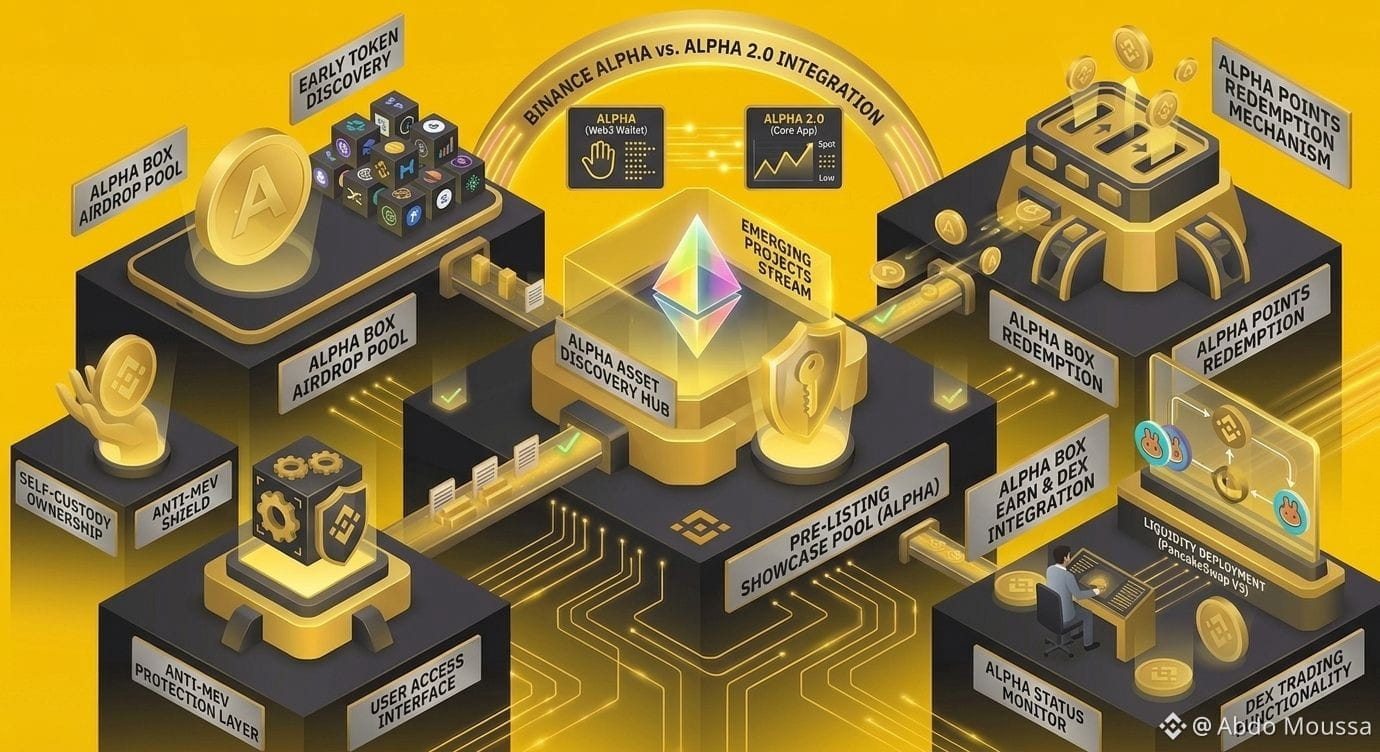
5
51
·
--
See translation
🛡️ MPC Architecture: Eliminating Seed Phrase Vulnerabilities in Web3 Wallets
Managing seed phrases represents a primary operational challenge for self-custody adoption, The Binance Web3 Wallet addresses this friction by integrating Multi-Party Computation (MPC) technology to implement a keyless security architecture.
💡 Understanding Keyless MPC Technology
MPC eliminates the need for a single, plaintext seed phrase, During wallet creation, the private key is mathematically generated and split into three separate encrypted key-shares:
Share 1: Stored locally on the user's mobile device.
Share 2: Encrypted and saved to the user's personal cloud backup (protected by a user-defined password).
Share 3: Maintained securely within Binance infrastructure.
🔑 Systemic Advantages
Elimination of Single Point of Failure: Accessing the wallet or executing a transaction requires a minimum threshold of 2 out of 3 key-shares.
Self-Custody Ownership: Binance holds only a single key-share, preventing unauthorized fund transfers without user approval.
Resilient Key Recovery: If a user loses their mobile device, access can be restored using the cloud backup share and the infrastructure share combined with the recovery password.
⚠️ Educational Disclaimer
Users must maintain strict backup practices for their cloud credentials and recovery passwords, as forgetting the password compromises wallet restoration.
This article is prepared strictly for educational purposes and does not constitute technical or security guarantees.
Explore Web3 self-custody infrastructure on Binance Academy.
[https://www.binance.com/en/academy/articles/what-are-multi-party-computation-mpc-wallets](https://www.binance.com/en/academy/articles/what-are-multi-party-computation-mpc-wallets)
Build technical literacy, protect your credentials, and always DYOR (Do Your Own Research)💡
#Binance #BinanceAcademy #Web3Wallet #dyor #LearnWithBinance
🛡️ MPC Architecture: Eliminating Seed Phrase Vulnerabilities in Web3 Wallets
Managing seed phrases represents a primary operational challenge for self-custody adoption, The Binance Web3 Wallet addresses this friction by integrating Multi-Party Computation (MPC) technology to implement a keyless security architecture.
💡 Understanding Keyless MPC Technology
MPC eliminates the need for a single, plaintext seed phrase, During wallet creation, the private key is mathematically generated and split into three separate encrypted key-shares:
Share 1: Stored locally on the user's mobile device.
Share 2: Encrypted and saved to the user's personal cloud backup (protected by a user-defined password).
Share 3: Maintained securely within Binance infrastructure.
🔑 Systemic Advantages
Elimination of Single Point of Failure: Accessing the wallet or executing a transaction requires a minimum threshold of 2 out of 3 key-shares.
Self-Custody Ownership: Binance holds only a single key-share, preventing unauthorized fund transfers without user approval.
Resilient Key Recovery: If a user loses their mobile device, access can be restored using the cloud backup share and the infrastructure share combined with the recovery password.
⚠️ Educational Disclaimer
Users must maintain strict backup practices for their cloud credentials and recovery passwords, as forgetting the password compromises wallet restoration.
This article is prepared strictly for educational purposes and does not constitute technical or security guarantees.
Explore Web3 self-custody infrastructure on Binance Academy.
https://www.binance.com/en/academy/articles/what-are-multi-party-computation-mpc-wallets
Build technical literacy, protect your credentials, and always DYOR (Do Your Own Research)💡
#Binance #BinanceAcademy #Web3Wallet #dyor #LearnWithBinance
Managing seed phrases represents a primary operational challenge for self-custody adoption, The Binance Web3 Wallet addresses this friction by integrating Multi-Party Computation (MPC) technology to implement a keyless security architecture.
💡 Understanding Keyless MPC Technology
MPC eliminates the need for a single, plaintext seed phrase, During wallet creation, the private key is mathematically generated and split into three separate encrypted key-shares:
Share 1: Stored locally on the user's mobile device.
Share 2: Encrypted and saved to the user's personal cloud backup (protected by a user-defined password).
Share 3: Maintained securely within Binance infrastructure.
🔑 Systemic Advantages
Elimination of Single Point of Failure: Accessing the wallet or executing a transaction requires a minimum threshold of 2 out of 3 key-shares.
Self-Custody Ownership: Binance holds only a single key-share, preventing unauthorized fund transfers without user approval.
Resilient Key Recovery: If a user loses their mobile device, access can be restored using the cloud backup share and the infrastructure share combined with the recovery password.
⚠️ Educational Disclaimer
Users must maintain strict backup practices for their cloud credentials and recovery passwords, as forgetting the password compromises wallet restoration.
This article is prepared strictly for educational purposes and does not constitute technical or security guarantees.
Explore Web3 self-custody infrastructure on Binance Academy.
https://www.binance.com/en/academy/articles/what-are-multi-party-computation-mpc-wallets
Build technical literacy, protect your credentials, and always DYOR (Do Your Own Research)💡
#Binance #BinanceAcademy #Web3Wallet #dyor #LearnWithBinance
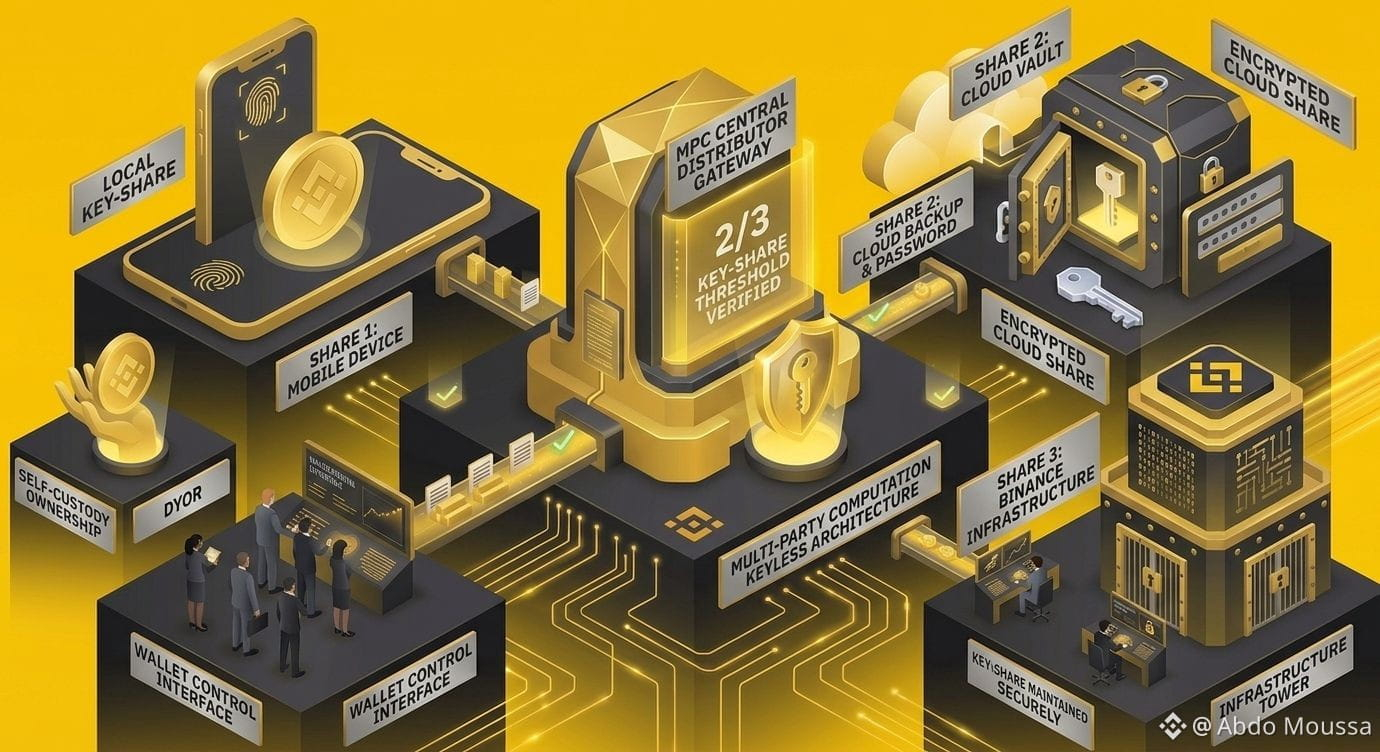
4
77
·
--
See translation
🛡️ The SAFU Fund: Institutional Emergency Reserves in Crypto
To mitigate systemic risks and protect user capital against unforeseen security incidents, Binance established the Secure Asset Fund for Users (SAFU), an emergency insurance fund designed to maintain ecosystem resilience.
💡 What Is the SAFU Fund?
Launched in 2018, the SAFU fund is an emergency reserve backed by dedicated assets, maintained around a $1 billion target valuation, The wallet addresses holding these funds are published publicly for transparent on-chain auditing.
🔑 Key Systemic Functions
Emergency Insurance Coverage: Acts as a capital backstop to compensate users in extreme scenarios, such as unexpected security breaches.
On-Chain Auditability: Anyone can verify the capital reserves held within SAFU wallet addresses via public blockchain explorers.
Ecosystem Stabilization: Enhances platform liquidity confidence during heightened market stress and industry turbulence.
⚠️ Educational Disclaimer
The SAFU fund is an emergency mechanism maintained by Binance, it does not replace individual operational security measures such as 2FA, Passkeys, or anti-phishing setups.
This article is prepared strictly for educational purposes and does not constitute financial, legal, or investment guarantees.
Discover platform defense mechanisms on Binance Academy.
[https://www.binance.com/en/academy/glossary/secure-asset-fund-for-users](https://www.binance.com/en/academy/glossary/secure-asset-fund-for-users)
Build technical literacy, trade securely, and always DYOR (Do Your Own Research)💡
#Binance #BinanceAcademy #safu #dyor #LearnWithBinance @Binancearabic
🛡️ The SAFU Fund: Institutional Emergency Reserves in Crypto
To mitigate systemic risks and protect user capital against unforeseen security incidents, Binance established the Secure Asset Fund for Users (SAFU), an emergency insurance fund designed to maintain ecosystem resilience.
💡 What Is the SAFU Fund?
Launched in 2018, the SAFU fund is an emergency reserve backed by dedicated assets, maintained around a $1 billion target valuation, The wallet addresses holding these funds are published publicly for transparent on-chain auditing.
🔑 Key Systemic Functions
Emergency Insurance Coverage: Acts as a capital backstop to compensate users in extreme scenarios, such as unexpected security breaches.
On-Chain Auditability: Anyone can verify the capital reserves held within SAFU wallet addresses via public blockchain explorers.
Ecosystem Stabilization: Enhances platform liquidity confidence during heightened market stress and industry turbulence.
⚠️ Educational Disclaimer
The SAFU fund is an emergency mechanism maintained by Binance, it does not replace individual operational security measures such as 2FA, Passkeys, or anti-phishing setups.
This article is prepared strictly for educational purposes and does not constitute financial, legal, or investment guarantees.
Discover platform defense mechanisms on Binance Academy.
https://www.binance.com/en/academy/glossary/secure-asset-fund-for-users
Build technical literacy, trade securely, and always DYOR (Do Your Own Research)💡
#Binance #BinanceAcademy #safu #dyor #LearnWithBinance @Binance MENA
To mitigate systemic risks and protect user capital against unforeseen security incidents, Binance established the Secure Asset Fund for Users (SAFU), an emergency insurance fund designed to maintain ecosystem resilience.
💡 What Is the SAFU Fund?
Launched in 2018, the SAFU fund is an emergency reserve backed by dedicated assets, maintained around a $1 billion target valuation, The wallet addresses holding these funds are published publicly for transparent on-chain auditing.
🔑 Key Systemic Functions
Emergency Insurance Coverage: Acts as a capital backstop to compensate users in extreme scenarios, such as unexpected security breaches.
On-Chain Auditability: Anyone can verify the capital reserves held within SAFU wallet addresses via public blockchain explorers.
Ecosystem Stabilization: Enhances platform liquidity confidence during heightened market stress and industry turbulence.
⚠️ Educational Disclaimer
The SAFU fund is an emergency mechanism maintained by Binance, it does not replace individual operational security measures such as 2FA, Passkeys, or anti-phishing setups.
This article is prepared strictly for educational purposes and does not constitute financial, legal, or investment guarantees.
Discover platform defense mechanisms on Binance Academy.
https://www.binance.com/en/academy/glossary/secure-asset-fund-for-users
Build technical literacy, trade securely, and always DYOR (Do Your Own Research)💡
#Binance #BinanceAcademy #safu #dyor #LearnWithBinance @Binance MENA
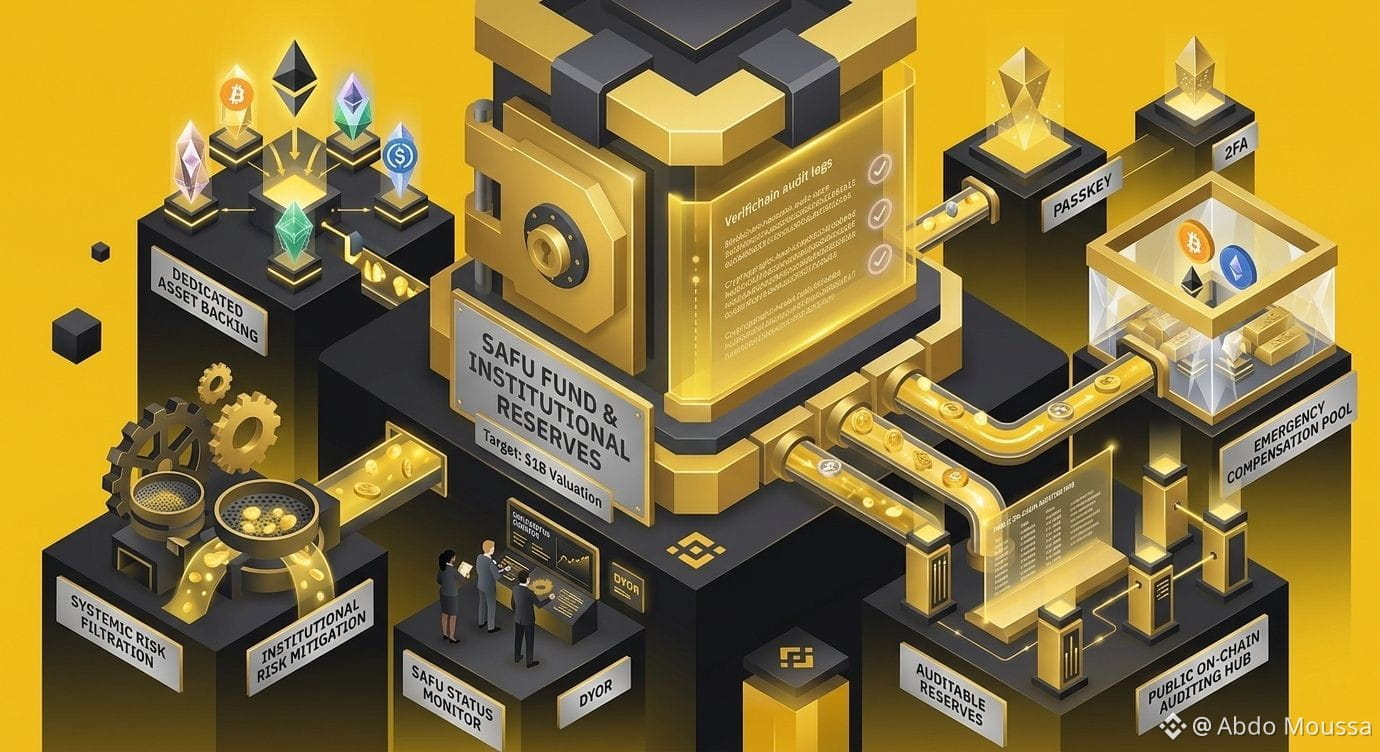
7
53
Log in to explore more content
Join global crypto users on Binance Square
⚡️ Get latest and useful information about crypto.
💬 Trusted by the world’s largest crypto exchange.
👍 Discover real insights from verified creators.
Email / Phone number
Trending Topics
XRPRises8%
3,205 views
252 Discussing
Are you guys still ignoring $XRP ❓ 😁
While everyone is busy chasing whatever coin is +50% today... XRP quietly pushed back above $1.50 and touched $1.57 again 💪🏻
Few days ago people were scared when XRP was sitting around $1.25-$1.30... now suddenly everyone wants confirmation 😂
This is exactly why i keep talking about buying good coins when they are boring... NOT after the massive green candles.
For me $XRP is still one of those longer term holds... $1.50 is not where i suddenly start getting interested, i was interested much lower 😉
Next area i am watching is $1.60-$1.70... let's see if XRP finally clears it.
#XRPRises8%
ParvezMayar
·2 Likes
·668 views
AppleGoogleSeekStablecoinTokenizedDepositTalent
2,694 views
196 Discussing
NvidiaToBuyAnother$1.5BSBEnergySharesPreIPO
701 views
25 Discussing