
#stablecoins
stablecoins
7.4M views
26,874 Discussing
Hot
Latest

⚡ ETHENA EXPANDS USDE TO TRON!
Ethena announced that USDe and sUSDe are coming to $TRON.US , expanding access to its stablecoin ecosystem. 💵⛓️
Another major move in the race for stablecoin adoption.
#Ethena #USDe #TRON #Stablecoins
{spot}(BTCUSDT)
{stock_us}(TRON.US)
⚡ ETHENA EXPANDS USDE TO TRON!
Ethena announced that USDe and sUSDe are coming to $TRON.US , expanding access to its stablecoin ecosystem. 💵⛓️
Another major move in the race for stablecoin adoption.
#Ethena #USDe #TRON #Stablecoins
Ethena announced that USDe and sUSDe are coming to $TRON.US , expanding access to its stablecoin ecosystem. 💵⛓️
Another major move in the race for stablecoin adoption.
#Ethena #USDe #TRON #Stablecoins
TRXUS+5.00%
1
8

·
--
Binance Stablecoins: liquidity, pegs, and ecosystem utility.
Stablecoins are the lifeblood of crypto markets. On Binance, assets like USDT, USDC, FDUSD and others provide:
• Instant settlement currency across spot and derivatives
• Safe-haven parking during high volatility without leaving the exchange ecosystem
• Deep liquidity pools for trading pairs, reducing slippage
• Base assets for Binance Earn and flexible savings products
Key principles for stablecoin holders:
1. Peg Stability: Not all stablecoins maintain exact parity under extreme market stress. Review reserve transparency and backing.
2. Utility vs Yield: Higher promotional yields on lesser-known stablecoins usually carry smart-contract or de-pegging risk.
3. Margin and Collateral: USDT and USDC serve as standard margin collateral for perpetual futures, making deep liquidity essential for preventing liquidation cascading.
Understand your collateral, verify your yield sources, and keep liquidity flexible.
Educational content only. Not financial advice.
#Stablecoins #USDT #USDC #BinanceEarn #BinanceAngels
Binance Stablecoins: liquidity, pegs, and ecosystem utility.
Stablecoins are the lifeblood of crypto markets. On Binance, assets like USDT, USDC, FDUSD and others provide:
• Instant settlement currency across spot and derivatives
• Safe-haven parking during high volatility without leaving the exchange ecosystem
• Deep liquidity pools for trading pairs, reducing slippage
• Base assets for Binance Earn and flexible savings products
Key principles for stablecoin holders:
1. Peg Stability: Not all stablecoins maintain exact parity under extreme market stress. Review reserve transparency and backing.
2. Utility vs Yield: Higher promotional yields on lesser-known stablecoins usually carry smart-contract or de-pegging risk.
3. Margin and Collateral: USDT and USDC serve as standard margin collateral for perpetual futures, making deep liquidity essential for preventing liquidation cascading.
Understand your collateral, verify your yield sources, and keep liquidity flexible.
Educational content only. Not financial advice.
#Stablecoins #USDT #USDC #BinanceEarn #BinanceAngels
Stablecoins are the lifeblood of crypto markets. On Binance, assets like USDT, USDC, FDUSD and others provide:
• Instant settlement currency across spot and derivatives
• Safe-haven parking during high volatility without leaving the exchange ecosystem
• Deep liquidity pools for trading pairs, reducing slippage
• Base assets for Binance Earn and flexible savings products
Key principles for stablecoin holders:
1. Peg Stability: Not all stablecoins maintain exact parity under extreme market stress. Review reserve transparency and backing.
2. Utility vs Yield: Higher promotional yields on lesser-known stablecoins usually carry smart-contract or de-pegging risk.
3. Margin and Collateral: USDT and USDC serve as standard margin collateral for perpetual futures, making deep liquidity essential for preventing liquidation cascading.
Understand your collateral, verify your yield sources, and keep liquidity flexible.
Educational content only. Not financial advice.
#Stablecoins #USDT #USDC #BinanceEarn #BinanceAngels
31


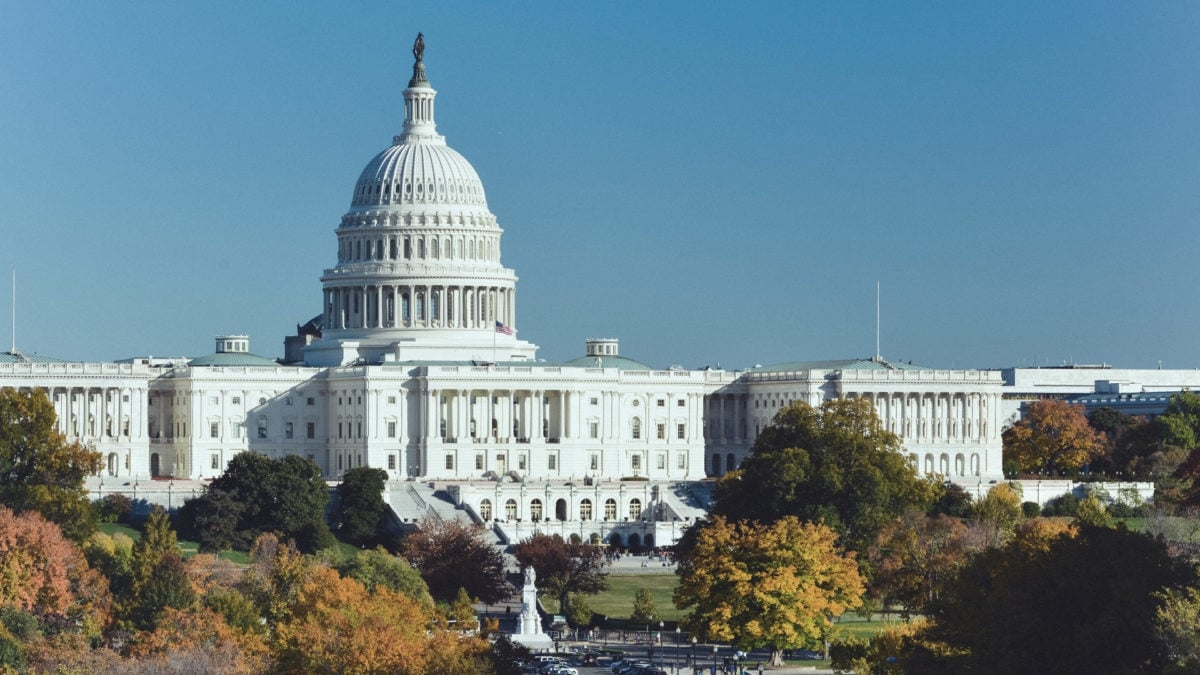
So, here is a little story of where we stand with crypto regulation in the US right now. 🏛️ Senator Kirsten Gillibrand recently spoke out, reminding everyone that Democrats are still very much committed to pushing the Clarity for Payment Stablecoins Act forward. She insists this is definitely not the end of the road for the bill. But if we look at what industry insiders are saying, the reality might be a bit more complicated. 😅 Most analysts think it is highly unlikely this bill will pass during the current Congress, which means we might have to wait a while longer for official laws.
Why does this actually matter to us? Well, stablecoins like $USDC and $USDT are the absolute backbone of trading and liquidity in our space. Having a clear legal framework would bring massive institutional trust to the market. But with Congress moving slow, the spotlight is shifting. Instead of waiting for a big law to pass, we should keep a close eye on the SEC and CFTC. They are actively trying to shape rules on their own, and their next moves will likely dictate how stablecoins operate in the near term. Let us see how this regulatory chess match plays out. ♟️
#CryptoRegulation #Stablecoins #Write2Earn
So, here is a little story of where we stand with crypto regulation in the US right now. 🏛️ Senator Kirsten Gillibrand recently spoke out, reminding everyone that Democrats are still very much committed to pushing the Clarity for Payment Stablecoins Act forward. She insists this is definitely not the end of the road for the bill. But if we look at what industry insiders are saying, the reality might be a bit more complicated. 😅 Most analysts think it is highly unlikely this bill will pass during the current Congress, which means we might have to wait a while longer for official laws.
Why does this actually matter to us? Well, stablecoins like $USDC and $USDT are the absolute backbone of trading and liquidity in our space. Having a clear legal framework would bring massive institutional trust to the market. But with Congress moving slow, the spotlight is shifting. Instead of waiting for a big law to pass, we should keep a close eye on the SEC and CFTC. They are actively trying to shape rules on their own, and their next moves will likely dictate how stablecoins operate in the near term. Let us see how this regulatory chess match plays out. ♟️
#CryptoRegulation #Stablecoins #Write2Earn
Why does this actually matter to us? Well, stablecoins like $USDC and $USDT are the absolute backbone of trading and liquidity in our space. Having a clear legal framework would bring massive institutional trust to the market. But with Congress moving slow, the spotlight is shifting. Instead of waiting for a big law to pass, we should keep a close eye on the SEC and CFTC. They are actively trying to shape rules on their own, and their next moves will likely dictate how stablecoins operate in the near term. Let us see how this regulatory chess match plays out. ♟️
#CryptoRegulation #Stablecoins #Write2Earn
120
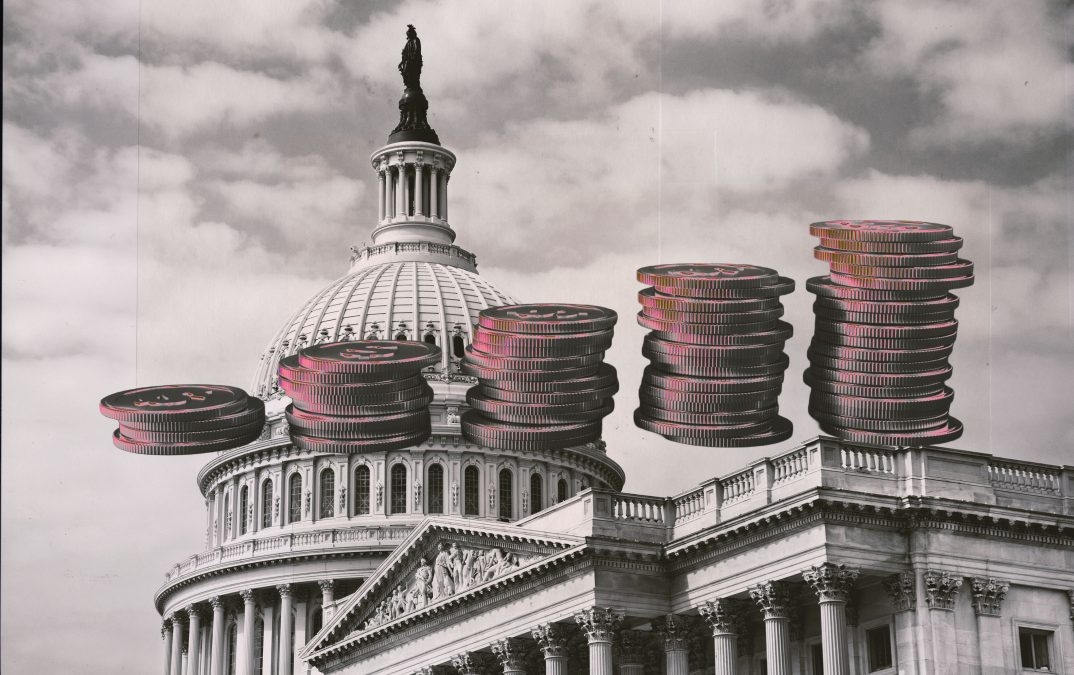
STABLECOIN YIELD SURVIVES THE SENATE STALL. Bernstein analysts point out that because the Clarity Act failed to advance, platforms can keep offering rewards on idle balances for now. This keeps momentum going for $USDT and similar assets while the market waits for regulatory clarity. - Senate lawmakers failed to pass the Clarity Act legislation. - Analysts expect fast rulemaking from both the SEC and CFTC. - Yield opportunities on stablecoins remain active for users. It is wild how regulation delays can sometimes bring unexpected breathing room to the market. #CryptoRegulation #Stablecoins #Write2Earn
STABLECOIN YIELD SURVIVES THE SENATE STALL. Bernstein analysts point out that because the Clarity Act failed to advance, platforms can keep offering rewards on idle balances for now. This keeps momentum going for $USDT and similar assets while the market waits for regulatory clarity. - Senate lawmakers failed to pass the Clarity Act legislation. - Analysts expect fast rulemaking from both the SEC and CFTC. - Yield opportunities on stablecoins remain active for users. It is wild how regulation delays can sometimes bring unexpected breathing room to the market. #CryptoRegulation #Stablecoins #Write2Earn
49

🪙 What Is a Stablecoin?
💵 Understanding Stablecoins
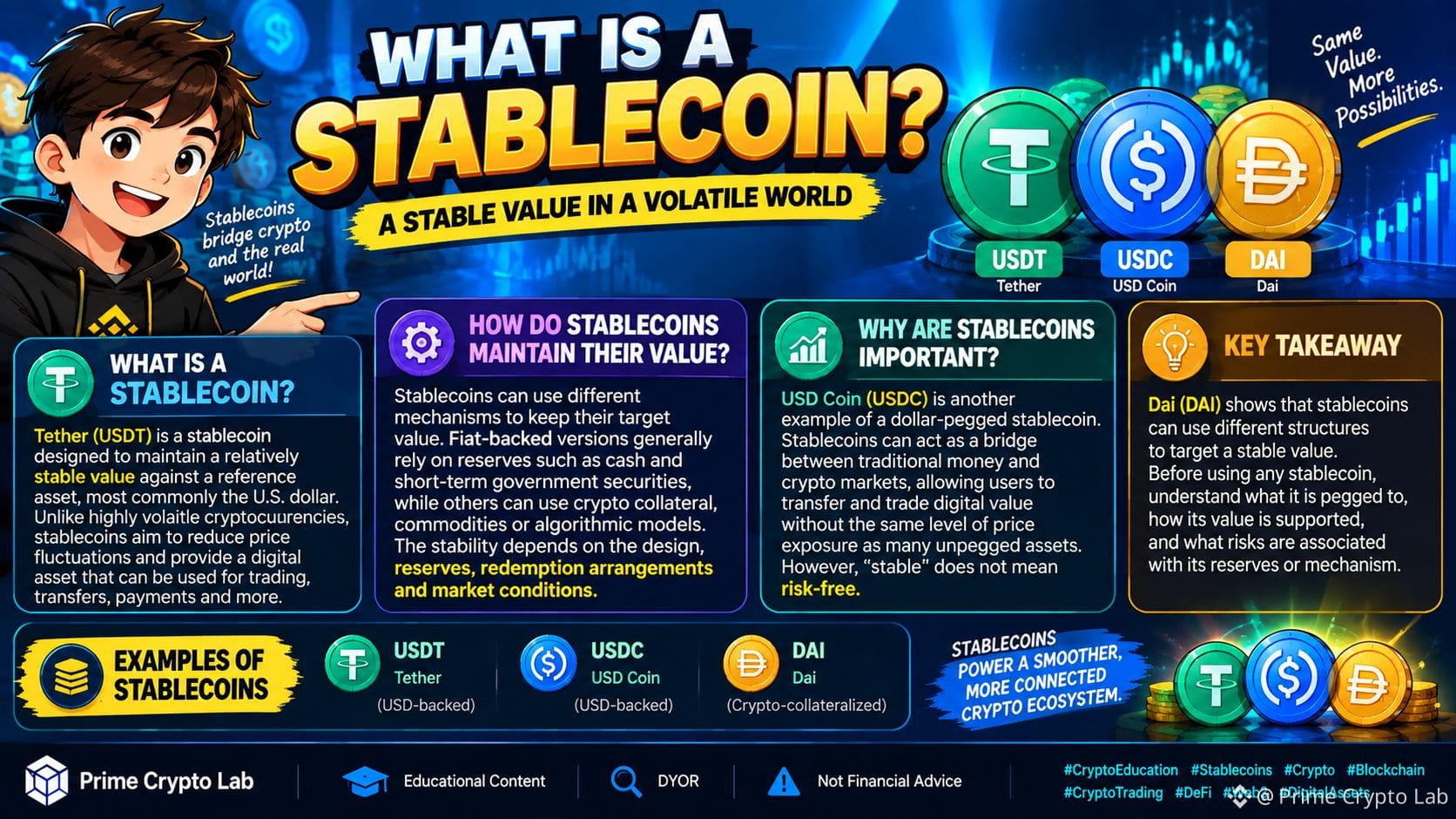
Tether $USDT is a stablecoin designed to maintain a relatively stable value against a reference asset, most commonly the U.S. dollar. Unlike highly volatile cryptocurrencies, stablecoins aim to reduce price fluctuations and provide a digital asset that can be useful for trading, transfers, payments, and moving value across blockchain networks.
🔗 How Do Stablecoins Maintain Their Value?
Stablecoins can use different mechanisms to maintain their target value. Fiat-backed versions generally rely on reserves such as cash and short-term government securities, while other models can use crypto collateral, commodities, or algorithmic mechanisms. This means the stability of a particular stablecoin depends on its design, reserves, redemption arrangements, and market conditions.
📊 Why Are Stablecoins Important?
$USDC Coin (USDC) is another example of a dollar-pegged stablecoin. Stablecoins can act as a bridge between traditional money and crypto markets, allowing users to transfer and trade digital value without taking the same level of price exposure as many unpegged cryptoassets. However, “stable” does not mean risk-free—stablecoins can experience price deviations or other risks.
🎯 Key Takeaway
Dai (DAI) shows that stablecoins can use different structures to target a stable value. Before using any stablecoin, understand what it is pegged to, howl its value is supported, and what risks are associated with its reserves or mechanism.
Prime Crypto Lab — No Hype, Just Research.
DYOR | Educational Content | Not Financial Advice
#cryptoeducation #Stablecoins #crypto #blockchain
🪙 What Is a Stablecoin?
💵 Understanding Stablecoins
Tether $USDT is a stablecoin designed to maintain a relatively stable value against a reference asset, most commonly the U.S. dollar. Unlike highly volatile cryptocurrencies, stablecoins aim to reduce price fluctuations and provide a digital asset that can be useful for trading, transfers, payments, and moving value across blockchain networks.
🔗 How Do Stablecoins Maintain Their Value?
Stablecoins can use different mechanisms to maintain their target value. Fiat-backed versions generally rely on reserves such as cash and short-term government securities, while other models can use crypto collateral, commodities, or algorithmic mechanisms. This means the stability of a particular stablecoin depends on its design, reserves, redemption arrangements, and market conditions.
📊 Why Are Stablecoins Important?
$USDC Coin (USDC) is another example of a dollar-pegged stablecoin. Stablecoins can act as a bridge between traditional money and crypto markets, allowing users to transfer and trade digital value without taking the same level of price exposure as many unpegged cryptoassets. However, “stable” does not mean risk-free—stablecoins can experience price deviations or other risks.
🎯 Key Takeaway
Dai (DAI) shows that stablecoins can use different structures to target a stable value. Before using any stablecoin, understand what it is pegged to, howl its value is supported, and what risks are associated with its reserves or mechanism.
Prime Crypto Lab — No Hype, Just Research.
DYOR | Educational Content | Not Financial Advice
#cryptoeducation #Stablecoins #crypto #blockchain
💵 Understanding Stablecoins
Tether $USDT is a stablecoin designed to maintain a relatively stable value against a reference asset, most commonly the U.S. dollar. Unlike highly volatile cryptocurrencies, stablecoins aim to reduce price fluctuations and provide a digital asset that can be useful for trading, transfers, payments, and moving value across blockchain networks.
🔗 How Do Stablecoins Maintain Their Value?
Stablecoins can use different mechanisms to maintain their target value. Fiat-backed versions generally rely on reserves such as cash and short-term government securities, while other models can use crypto collateral, commodities, or algorithmic mechanisms. This means the stability of a particular stablecoin depends on its design, reserves, redemption arrangements, and market conditions.
📊 Why Are Stablecoins Important?
$USDC Coin (USDC) is another example of a dollar-pegged stablecoin. Stablecoins can act as a bridge between traditional money and crypto markets, allowing users to transfer and trade digital value without taking the same level of price exposure as many unpegged cryptoassets. However, “stable” does not mean risk-free—stablecoins can experience price deviations or other risks.
🎯 Key Takeaway
Dai (DAI) shows that stablecoins can use different structures to target a stable value. Before using any stablecoin, understand what it is pegged to, howl its value is supported, and what risks are associated with its reserves or mechanism.
Prime Crypto Lab — No Hype, Just Research.
DYOR | Educational Content | Not Financial Advice
#cryptoeducation #Stablecoins #crypto #blockchain
51

·
--
🚨 TRENDING CRYPTO NEWS: Circle Launches Arc Mainnet:
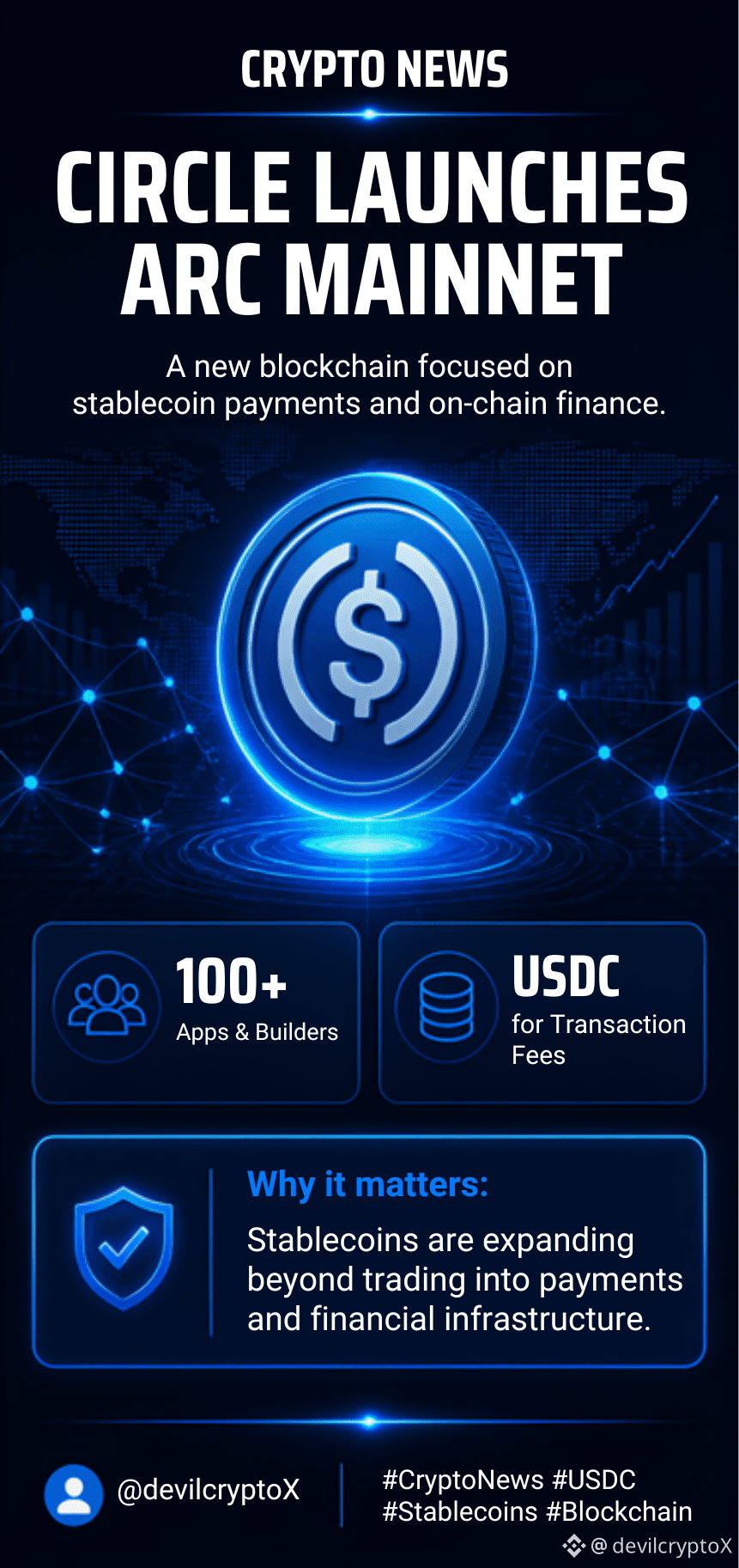
•Circle has launched its Arc blockchain mainnet with over 100 apps and 11 validators.
•The network is built for stablecoin payments and on-chain finance, with USDC used for transaction fees.
•Why it matters: Crypto is moving beyond trading — stablecoins are becoming a bigger part of real payments and financial services.
$USDC
{spot}(USDCUSDT)
$BTC
{spot}(BTCUSDT)
$XRP
{spot}(XRPUSDT)
#CryptoNews #Stablecoins #USDC #Blockchain #BinanceSquare
🚨 TRENDING CRYPTO NEWS: Circle Launches Arc Mainnet:
•Circle has launched its Arc blockchain mainnet with over 100 apps and 11 validators.
•The network is built for stablecoin payments and on-chain finance, with USDC used for transaction fees.
•Why it matters: Crypto is moving beyond trading — stablecoins are becoming a bigger part of real payments and financial services.
$USDC
$BTC
$XRP
#CryptoNews #Stablecoins #USDC #Blockchain #BinanceSquare
•Circle has launched its Arc blockchain mainnet with over 100 apps and 11 validators.
•The network is built for stablecoin payments and on-chain finance, with USDC used for transaction fees.
•Why it matters: Crypto is moving beyond trading — stablecoins are becoming a bigger part of real payments and financial services.
$USDC
$BTC
$XRP
#CryptoNews #Stablecoins #USDC #Blockchain #BinanceSquare
63

·
--
Trade finance hasn't changed in 300 years. A letter of credit still requires banks on both sides, days of document verification, and fees at every checkpoint. On-chain stablecoin settlement is making that entire process look prehistoric.
The real breakthrough isn't speed — it's programmability. When a stablecoin payment can be escrowed in a smart contract with automatic release conditions — bill of lading confirmed, inspection passed, delivery timestamp verified — you don't need a bank in the middle. You don't need accounts receivable teams chasing invoices. The settlement IS the reconciliation.
Stablecoins already settle more daily volume than many legacy payment networks. But the next phase is bigger: stablecoin-native trade finance. Smart contracts replacing letters of credit. On-chain escrow replacing bank guarantees. Automatic milestone payments replacing 30/60/90-day terms.
The chains that win this volume won't be the ones with the most TPS. They'll be the ones with the most reliable settlement finality, the deepest liquidity, and the strongest compliance rails. $ETH settlement-layer security, $BNB low-fee throughput, and $SOL sub-second finality each offer different pieces of the puzzle.
The $150 trillion B2B payments market doesn't need a faster bank. It needs a new operating system. Stablecoins are quietly becoming that OS — programmable, composable, and settled in seconds instead of weeks.
#Stablecoins #CryptoPayments #TradeFinance #DeFi #Blockchain
Trade finance hasn't changed in 300 years. A letter of credit still requires banks on both sides, days of document verification, and fees at every checkpoint. On-chain stablecoin settlement is making that entire process look prehistoric.
The real breakthrough isn't speed — it's programmability. When a stablecoin payment can be escrowed in a smart contract with automatic release conditions — bill of lading confirmed, inspection passed, delivery timestamp verified — you don't need a bank in the middle. You don't need accounts receivable teams chasing invoices. The settlement IS the reconciliation.
Stablecoins already settle more daily volume than many legacy payment networks. But the next phase is bigger: stablecoin-native trade finance. Smart contracts replacing letters of credit. On-chain escrow replacing bank guarantees. Automatic milestone payments replacing 30/60/90-day terms.
The chains that win this volume won't be the ones with the most TPS. They'll be the ones with the most reliable settlement finality, the deepest liquidity, and the strongest compliance rails. $ETH settlement-layer security, $BNB low-fee throughput, and $SOL sub-second finality each offer different pieces of the puzzle.
The $150 trillion B2B payments market doesn't need a faster bank. It needs a new operating system. Stablecoins are quietly becoming that OS — programmable, composable, and settled in seconds instead of weeks.
#Stablecoins #CryptoPayments #TradeFinance #DeFi #Blockchain
The real breakthrough isn't speed — it's programmability. When a stablecoin payment can be escrowed in a smart contract with automatic release conditions — bill of lading confirmed, inspection passed, delivery timestamp verified — you don't need a bank in the middle. You don't need accounts receivable teams chasing invoices. The settlement IS the reconciliation.
Stablecoins already settle more daily volume than many legacy payment networks. But the next phase is bigger: stablecoin-native trade finance. Smart contracts replacing letters of credit. On-chain escrow replacing bank guarantees. Automatic milestone payments replacing 30/60/90-day terms.
The chains that win this volume won't be the ones with the most TPS. They'll be the ones with the most reliable settlement finality, the deepest liquidity, and the strongest compliance rails. $ETH settlement-layer security, $BNB low-fee throughput, and $SOL sub-second finality each offer different pieces of the puzzle.
The $150 trillion B2B payments market doesn't need a faster bank. It needs a new operating system. Stablecoins are quietly becoming that OS — programmable, composable, and settled in seconds instead of weeks.
#Stablecoins #CryptoPayments #TradeFinance #DeFi #Blockchain
38

·
--
Stablecoins might end up being the part of crypto normal people use most, without ever calling it crypto.
Sending dollars across borders in minutes, on a Sunday, for cents. That was a dream in 2017. Now it's just what stablecoins do all day.
Meanwhile Bitcoin at $76,484 and Ethereum at $2,443 get all the headlines.
The boring stuff usually wins quietly.
Do you use stablecoins for anything besides trading?
Personal view, not advice. Do your own research.
#Stablecoins
Stablecoins might end up being the part of crypto normal people use most, without ever calling it crypto.
Sending dollars across borders in minutes, on a Sunday, for cents. That was a dream in 2017. Now it's just what stablecoins do all day.
Meanwhile Bitcoin at $76,484 and Ethereum at $2,443 get all the headlines.
The boring stuff usually wins quietly.
Do you use stablecoins for anything besides trading?
Personal view, not advice. Do your own research.
#Stablecoins
Sending dollars across borders in minutes, on a Sunday, for cents. That was a dream in 2017. Now it's just what stablecoins do all day.
Meanwhile Bitcoin at $76,484 and Ethereum at $2,443 get all the headlines.
The boring stuff usually wins quietly.
Do you use stablecoins for anything besides trading?
Personal view, not advice. Do your own research.
#Stablecoins
107

·
--
USD Coin ($USDC ) continues to solidify its role as the premier compliant layout for global digital finance! Check out the key highlights:
Stable Peg: Sitting firmly at 1.00080 USDT, showing excellent stability inside a healthy narrow range.
Massive Volume: Over $3.39 Billion in 24-hour trading volume across major exchanges.
Ecosystem Growth: Following the recent Arc Mainnet launch, institutional support and corporate banking integration (like Deutsche Bank's asset custody) are hitting new peaks.
Full Backing: Audited September Proof of Reserves confirm user-allocated USDC remains entirely over-collateralized across top venues.
#USDC #Stablecoins #CryptoNews🚀🔥 #BinanceSquare
USD Coin ($USDC ) continues to solidify its role as the premier compliant layout for global digital finance! Check out the key highlights:
Stable Peg: Sitting firmly at 1.00080 USDT, showing excellent stability inside a healthy narrow range.
Massive Volume: Over $3.39 Billion in 24-hour trading volume across major exchanges.
Ecosystem Growth: Following the recent Arc Mainnet launch, institutional support and corporate banking integration (like Deutsche Bank's asset custody) are hitting new peaks.
Full Backing: Audited September Proof of Reserves confirm user-allocated USDC remains entirely over-collateralized across top venues.
#USDC #Stablecoins #CryptoNews🚀🔥 #BinanceSquare
Stable Peg: Sitting firmly at 1.00080 USDT, showing excellent stability inside a healthy narrow range.
Massive Volume: Over $3.39 Billion in 24-hour trading volume across major exchanges.
Ecosystem Growth: Following the recent Arc Mainnet launch, institutional support and corporate banking integration (like Deutsche Bank's asset custody) are hitting new peaks.
Full Backing: Audited September Proof of Reserves confirm user-allocated USDC remains entirely over-collateralized across top venues.
#USDC #Stablecoins #CryptoNews🚀🔥 #BinanceSquare
88

·
--
🚨 $USDC EXPANDS MULTI-CHAIN LIQUIDITY AS ARC NETWORK INTEGRATION GOES LIVE! 🏦
Institutional liquidity rails just received a structural upgrade. ⚡ The integration of $USDC on the Arc network opens seamless deposit and withdrawal channels across a top-tier exchange, significantly optimizing settlement speed and lowering cross-chain friction. 📊
This move enhances liquidity efficiency for institutional order flow, allowing capital to rotate smoothly into high-probability market structures. 🔍 As stablecoin infrastructure expands across emerging protocols, tracking capital velocity becomes vital for spotting early structural shifts. 💬 How will this settlement upgrade impact your cross-chain capital deployment? 👇
⚠️ Not financial advice. Always manage your risk. 🛡️
🏷️ #USDC #ArcNetwork #Stablecoins #Crypto
🏦 🔍
🚨 $USDC EXPANDS MULTI-CHAIN LIQUIDITY AS ARC NETWORK INTEGRATION GOES LIVE! 🏦
Institutional liquidity rails just received a structural upgrade. ⚡ The integration of $USDC on the Arc network opens seamless deposit and withdrawal channels across a top-tier exchange, significantly optimizing settlement speed and lowering cross-chain friction. 📊
This move enhances liquidity efficiency for institutional order flow, allowing capital to rotate smoothly into high-probability market structures. 🔍 As stablecoin infrastructure expands across emerging protocols, tracking capital velocity becomes vital for spotting early structural shifts. 💬 How will this settlement upgrade impact your cross-chain capital deployment? 👇
⚠️ Not financial advice. Always manage your risk. 🛡️
🏷️ #USDC #ArcNetwork #Stablecoins #Crypto
🏦 🔍
Institutional liquidity rails just received a structural upgrade. ⚡ The integration of $USDC on the Arc network opens seamless deposit and withdrawal channels across a top-tier exchange, significantly optimizing settlement speed and lowering cross-chain friction. 📊
This move enhances liquidity efficiency for institutional order flow, allowing capital to rotate smoothly into high-probability market structures. 🔍 As stablecoin infrastructure expands across emerging protocols, tracking capital velocity becomes vital for spotting early structural shifts. 💬 How will this settlement upgrade impact your cross-chain capital deployment? 👇
⚠️ Not financial advice. Always manage your risk. 🛡️
🏷️ #USDC #ArcNetwork #Stablecoins #Crypto
🏦 🔍
6

·
--
🚨 $USDC EXPANDS TO ARC NETWORK AS TOP-TIER EXCHANGES OPEN INSTANT LIQUIDITY RAILS! ⚡
📌 Institutional settlement rails just got a serious upgrade. The deployment of $USDC on the Arc network opens seamless deposit and withdrawal highways, stripping away friction for deep-pocket capital. 💡
📊 Liquidity migration rarely happens by accident. As high-throughput chains capture larger slices of stablecoin volume, order flow velocity is accelerating. 🌊 Smart money is quietly positioning infrastructure to shift heavy volume without friction before the next expansion phase. 💬 Are you tracking these stablecoin network flows, or waiting for the price charts to catch up? 👇
⚠️ Not financial advice. Always manage your risk. 🛡️
🏷️ #USDC #Stablecoins #Crypto #Layer1
⚡ 💎
🚨 $USDC EXPANDS TO ARC NETWORK AS TOP-TIER EXCHANGES OPEN INSTANT LIQUIDITY RAILS! ⚡
📌 Institutional settlement rails just got a serious upgrade. The deployment of $USDC on the Arc network opens seamless deposit and withdrawal highways, stripping away friction for deep-pocket capital. 💡
📊 Liquidity migration rarely happens by accident. As high-throughput chains capture larger slices of stablecoin volume, order flow velocity is accelerating. 🌊 Smart money is quietly positioning infrastructure to shift heavy volume without friction before the next expansion phase. 💬 Are you tracking these stablecoin network flows, or waiting for the price charts to catch up? 👇
⚠️ Not financial advice. Always manage your risk. 🛡️
🏷️ #USDC #Stablecoins #Crypto #Layer1
⚡ 💎
📌 Institutional settlement rails just got a serious upgrade. The deployment of $USDC on the Arc network opens seamless deposit and withdrawal highways, stripping away friction for deep-pocket capital. 💡
📊 Liquidity migration rarely happens by accident. As high-throughput chains capture larger slices of stablecoin volume, order flow velocity is accelerating. 🌊 Smart money is quietly positioning infrastructure to shift heavy volume without friction before the next expansion phase. 💬 Are you tracking these stablecoin network flows, or waiting for the price charts to catch up? 👇
⚠️ Not financial advice. Always manage your risk. 🛡️
🏷️ #USDC #Stablecoins #Crypto #Layer1
⚡ 💎
1

·
--
Column Launches Native Stablecoin Infrastructure
Column has introduced bank-native stablecoin infrastructure, enabling instant 24/7 conversion between USDC, USDT, and USD without prefunding. The system supports major payment rails and multiple blockchains, with Solana as the default network.
Key Numbers:
🪙 Supports USDC & USDT
⚡ 24/7 instant USD ↔ stablecoin conversion
🌐 Works across Solana, Ethereum & other major chains
💸 Compatible with ACH, FedNow, Fedwire, SWIFT & RTP
📈 Already processing tens of billions in annualized volume
Why it matters:
Native banking integration removes settlement delays and prefunding, making stablecoin payments faster and more practical for fintechs, enterprises, and global money movement.
#Stablecoins #USDC #USDT #Solana #BinanceSquare
Column Launches Native Stablecoin Infrastructure
Column has introduced bank-native stablecoin infrastructure, enabling instant 24/7 conversion between USDC, USDT, and USD without prefunding. The system supports major payment rails and multiple blockchains, with Solana as the default network.
Key Numbers:
🪙 Supports USDC & USDT
⚡ 24/7 instant USD ↔ stablecoin conversion
🌐 Works across Solana, Ethereum & other major chains
💸 Compatible with ACH, FedNow, Fedwire, SWIFT & RTP
📈 Already processing tens of billions in annualized volume
Why it matters:
Native banking integration removes settlement delays and prefunding, making stablecoin payments faster and more practical for fintechs, enterprises, and global money movement.
#Stablecoins #USDC #USDT #Solana #BinanceSquare
Column has introduced bank-native stablecoin infrastructure, enabling instant 24/7 conversion between USDC, USDT, and USD without prefunding. The system supports major payment rails and multiple blockchains, with Solana as the default network.
Key Numbers:
🪙 Supports USDC & USDT
⚡ 24/7 instant USD ↔ stablecoin conversion
🌐 Works across Solana, Ethereum & other major chains
💸 Compatible with ACH, FedNow, Fedwire, SWIFT & RTP
📈 Already processing tens of billions in annualized volume
Why it matters:
Native banking integration removes settlement delays and prefunding, making stablecoin payments faster and more practical for fintechs, enterprises, and global money movement.
#Stablecoins #USDC #USDT #Solana #BinanceSquare
86

·
--
In the subtle refinement of cross-border settlement, stablecoins continue embedding themselves into treasury operations and remittance corridors. As volumes persist and regulatory frameworks mature, these instruments demonstrate resilience as practical financial rails. Echoing the 2021 payments expansion that normalized digital dollars, this maturation carries a 68% probability of deeper integration through the season if institutional use cases and global accessibility keep advancing.
$USDC $USDT $USDE #RadaRI111 #CoinVahini #Stablecoins #USDC
In the subtle refinement of cross-border settlement, stablecoins continue embedding themselves into treasury operations and remittance corridors. As volumes persist and regulatory frameworks mature, these instruments demonstrate resilience as practical financial rails. Echoing the 2021 payments expansion that normalized digital dollars, this maturation carries a 68% probability of deeper integration through the season if institutional use cases and global accessibility keep advancing.
$USDC $USDT $USDE #RadaRI111 #CoinVahini #Stablecoins #USDC
$USDC $USDT $USDE #RadaRI111 #CoinVahini #Stablecoins #USDC
53
·
--
The most misunderstood on-chain metric right now isn't whale movement or exchange outflow. It's stablecoin balances sitting on exchanges.
Traders treat stablecoin reserves as inert — money parked on the sidelines doing nothing. That's wrong. Exchange stablecoin balances are the crypto market's dry powder. When that number grows, deployable buying power is accumulating. When it shrinks without a corresponding price rally, capital is leaving the ecosystem entirely.
Watch the divergence: if stablecoin total supply is growing (issuers are minting) but exchange balances are falling, two things are happening. First, capital is moving into yield — DeFi staking, lending, restaking. Second, some of it is leaving through off-ramps. That's structurally different from the 2021 cycle where stablecoins mostly sat on exchanges waiting for entries.
The signal that matters: stablecoin exchange reserves rising while $BTC and $ETH prices stay flat. That's accumulation in slow motion. It means capital is positioned but not yet deployed — patience, not apathy.
Conversely, falling stablecoin reserves during a rally suggests the fuel is being burned. Duration matters more than magnitude here.
This is why tracking $BNB ecosystem stablecoin inflows matters — chains capturing stablecoin liquidity are capturing future buying power, not just TVL.
$BTC $ETH $BNB
#CryptoMarkets #OnChain #Stablecoins #MarketAnalysis
The most misunderstood on-chain metric right now isn't whale movement or exchange outflow. It's stablecoin balances sitting on exchanges.
Traders treat stablecoin reserves as inert — money parked on the sidelines doing nothing. That's wrong. Exchange stablecoin balances are the crypto market's dry powder. When that number grows, deployable buying power is accumulating. When it shrinks without a corresponding price rally, capital is leaving the ecosystem entirely.
Watch the divergence: if stablecoin total supply is growing (issuers are minting) but exchange balances are falling, two things are happening. First, capital is moving into yield — DeFi staking, lending, restaking. Second, some of it is leaving through off-ramps. That's structurally different from the 2021 cycle where stablecoins mostly sat on exchanges waiting for entries.
The signal that matters: stablecoin exchange reserves rising while $BTC and $ETH prices stay flat. That's accumulation in slow motion. It means capital is positioned but not yet deployed — patience, not apathy.
Conversely, falling stablecoin reserves during a rally suggests the fuel is being burned. Duration matters more than magnitude here.
This is why tracking $BNB ecosystem stablecoin inflows matters — chains capturing stablecoin liquidity are capturing future buying power, not just TVL.
$BTC $ETH $BNB
#CryptoMarkets #OnChain #Stablecoins #MarketAnalysis
Traders treat stablecoin reserves as inert — money parked on the sidelines doing nothing. That's wrong. Exchange stablecoin balances are the crypto market's dry powder. When that number grows, deployable buying power is accumulating. When it shrinks without a corresponding price rally, capital is leaving the ecosystem entirely.
Watch the divergence: if stablecoin total supply is growing (issuers are minting) but exchange balances are falling, two things are happening. First, capital is moving into yield — DeFi staking, lending, restaking. Second, some of it is leaving through off-ramps. That's structurally different from the 2021 cycle where stablecoins mostly sat on exchanges waiting for entries.
The signal that matters: stablecoin exchange reserves rising while $BTC and $ETH prices stay flat. That's accumulation in slow motion. It means capital is positioned but not yet deployed — patience, not apathy.
Conversely, falling stablecoin reserves during a rally suggests the fuel is being burned. Duration matters more than magnitude here.
This is why tracking $BNB ecosystem stablecoin inflows matters — chains capturing stablecoin liquidity are capturing future buying power, not just TVL.
$BTC $ETH $BNB
#CryptoMarkets #OnChain #Stablecoins #MarketAnalysis
94

🚨 LEGACY BANKS BLOCKED CLARITY ACT BECAUSE THEY FEAR $SYN AND STABLECOIN DOMINANCE! 🏦
Wall Street legacy institutions didn't stall crypto legislation out of disinterest—they panicked over deposit flight to yield-bearing digital assets. 🏦 When traditional banks lobby this aggressively to protect their moat, it confirms smart money is already shifting into decentralized rails. 🔍
This isn't a regulatory defeat; it's high-level institutional validation that digital assets are encroaching on traditional banking models. 💡 As liquidity prepares for the next rotation, assets like $SYN , $LSK , and $ZEC remain key focal points for narrative momentum. 📊
💬 Do you see this bank pushback as short-term noise or the ultimate validation for the next altcoin expansion? 👇
⚠️ Not financial advice. Always manage your risk. 🛡️
🏷️ #SYN #Stablecoins #CryptoNews #Altcoins #Banking
🔥 💎
🚨 LEGACY BANKS BLOCKED CLARITY ACT BECAUSE THEY FEAR $SYN AND STABLECOIN DOMINANCE! 🏦
Wall Street legacy institutions didn't stall crypto legislation out of disinterest—they panicked over deposit flight to yield-bearing digital assets. 🏦 When traditional banks lobby this aggressively to protect their moat, it confirms smart money is already shifting into decentralized rails. 🔍
This isn't a regulatory defeat; it's high-level institutional validation that digital assets are encroaching on traditional banking models. 💡 As liquidity prepares for the next rotation, assets like $SYN , $LSK , and $ZEC remain key focal points for narrative momentum. 📊
💬 Do you see this bank pushback as short-term noise or the ultimate validation for the next altcoin expansion? 👇
⚠️ Not financial advice. Always manage your risk. 🛡️
🏷️ #SYN #Stablecoins #CryptoNews #Altcoins #Banking
🔥 💎
Wall Street legacy institutions didn't stall crypto legislation out of disinterest—they panicked over deposit flight to yield-bearing digital assets. 🏦 When traditional banks lobby this aggressively to protect their moat, it confirms smart money is already shifting into decentralized rails. 🔍
This isn't a regulatory defeat; it's high-level institutional validation that digital assets are encroaching on traditional banking models. 💡 As liquidity prepares for the next rotation, assets like $SYN , $LSK , and $ZEC remain key focal points for narrative momentum. 📊
💬 Do you see this bank pushback as short-term noise or the ultimate validation for the next altcoin expansion? 👇
⚠️ Not financial advice. Always manage your risk. 🛡️
🏷️ #SYN #Stablecoins #CryptoNews #Altcoins #Banking
🔥 💎

410

·
--
Article
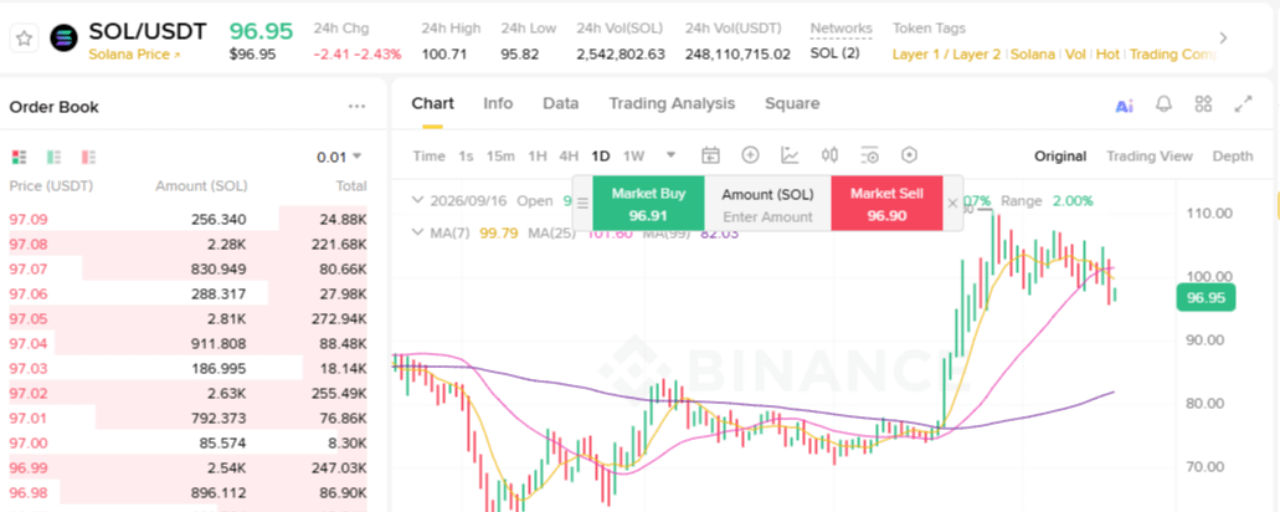
$SOL traders: one of crypto’s biggest payment experiments is quietly moving onto Solana.Visa has expanded its stablecoin settlement capabilities to include Solana, allowing participating partners to send or receive USDC settlement payments over the network.
Solana’s appeal for payments is straightforward: high throughput, low transaction costs and fast settlement make it suitable for applications where moving stablecoins efficiently matters.
Stablecoins are increasingly becoming infrastructure rather than simply assets traders hold between positions.
WHY IT MATTERS
The bigger $SOL narrative may not be memecoins.
If payment companies, fintechs and institutions increasingly use public blockchains for settlement, networks competing for that activity could gain more durable demand than networks driven mainly by speculation.
🔮 MARKET INTERPRETATION — SPECULATION
🔥 Catalyst: growing institutional stablecoin settlement and payment adoption on Solana.
⚠️ Risks: institutional adoption can develop slowly, competing networks are targeting the same market, and stronger network usage does not automatically translate into higher SOL prices.
My focus:
Stablecoin volume → institutional usage → network fees → $SOL relative strength.
That tells me more than chasing one green candle.
👇 What becomes Solana’s bigger long-term narrative: payments or trading?
#solana #Stablecoins #sol #BinanceSquareTalks
$SOL
{spot}(SOLUSDT)
$SOL traders: one of crypto’s biggest payment experiments is quietly moving onto Solana.
Visa has expanded its stablecoin settlement capabilities to include Solana, allowing participating partners to send or receive USDC settlement payments over the network.
Solana’s appeal for payments is straightforward: high throughput, low transaction costs and fast settlement make it suitable for applications where moving stablecoins efficiently matters.
Stablecoins are increasingly becoming infrastructure rather than simply assets traders hold between positions.
WHY IT MATTERS
The bigger $SOL narrative may not be memecoins.
If payment companies, fintechs and institutions increasingly use public blockchains for settlement, networks competing for that activity could gain more durable demand than networks driven mainly by speculation.
🔮 MARKET INTERPRETATION — SPECULATION
🔥 Catalyst: growing institutional stablecoin settlement and payment adoption on Solana.
⚠️ Risks: institutional adoption can develop slowly, competing networks are targeting the same market, and stronger network usage does not automatically translate into higher SOL prices.
My focus:
Stablecoin volume → institutional usage → network fees → $SOL relative strength.
That tells me more than chasing one green candle.
👇 What becomes Solana’s bigger long-term narrative: payments or trading?
#solana #Stablecoins #sol #BinanceSquareTalks
$SOL
Solana’s appeal for payments is straightforward: high throughput, low transaction costs and fast settlement make it suitable for applications where moving stablecoins efficiently matters.
Stablecoins are increasingly becoming infrastructure rather than simply assets traders hold between positions.
WHY IT MATTERS
The bigger $SOL narrative may not be memecoins.
If payment companies, fintechs and institutions increasingly use public blockchains for settlement, networks competing for that activity could gain more durable demand than networks driven mainly by speculation.
🔮 MARKET INTERPRETATION — SPECULATION
🔥 Catalyst: growing institutional stablecoin settlement and payment adoption on Solana.
⚠️ Risks: institutional adoption can develop slowly, competing networks are targeting the same market, and stronger network usage does not automatically translate into higher SOL prices.
My focus:
Stablecoin volume → institutional usage → network fees → $SOL relative strength.
That tells me more than chasing one green candle.
👇 What becomes Solana’s bigger long-term narrative: payments or trading?
#solana #Stablecoins #sol #BinanceSquareTalks
$SOL
10

·
--
💫⭐ One Trend That Stands Out in 2026💥
{future}(STABLEUSDT)
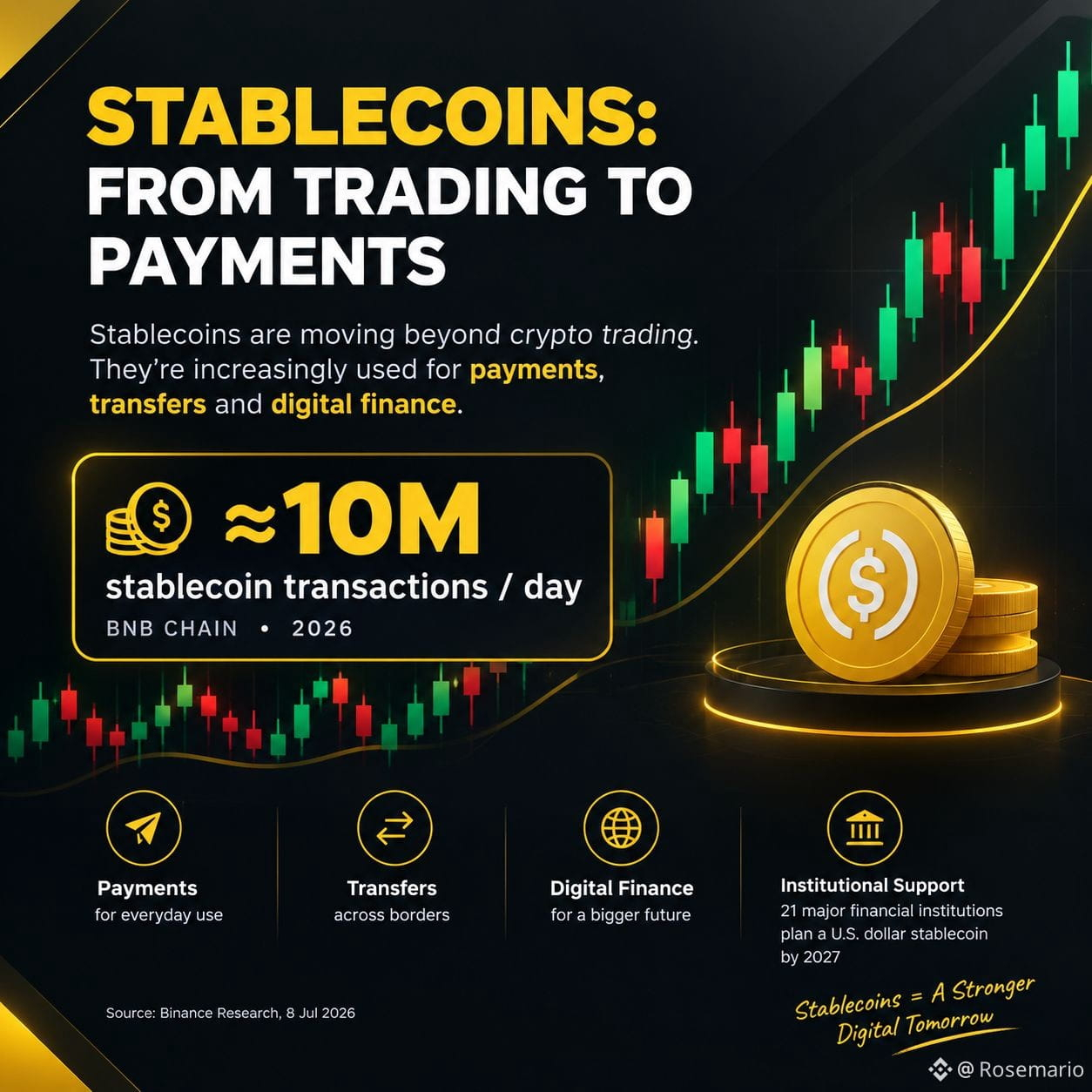
$STABLE are moving beyond crypto trading.
They’re increasingly being used for payments, transfers and everyday digital finance.
📌$BNB Chain⛓️💥 is a big part of this trend: it processes around 10M stable coin transactions every day, according to Binance Research.
And the trend is spreading to traditional finance too — 21 major financial institutions have announced plans for a U.S. dollar stable coin targeted for 2027.
$STABLE → From trading tool to payment infrastructure. 🌍💰
#Stablecoins #BNBChain #BinanceVietnamSquare #Crypto #Web3Revolution
💫⭐ One Trend That Stands Out in 2026💥
$STABLE are moving beyond crypto trading.
They’re increasingly being used for payments, transfers and everyday digital finance.
📌$BNB Chain⛓️💥 is a big part of this trend: it processes around 10M stable coin transactions every day, according to Binance Research.
And the trend is spreading to traditional finance too — 21 major financial institutions have announced plans for a U.S. dollar stable coin targeted for 2027.
$STABLE → From trading tool to payment infrastructure. 🌍💰
#Stablecoins #BNBChain #BinanceVietnamSquare #Crypto #Web3Revolution
$STABLE are moving beyond crypto trading.
They’re increasingly being used for payments, transfers and everyday digital finance.
📌$BNB Chain⛓️💥 is a big part of this trend: it processes around 10M stable coin transactions every day, according to Binance Research.
And the trend is spreading to traditional finance too — 21 major financial institutions have announced plans for a U.S. dollar stable coin targeted for 2027.
$STABLE → From trading tool to payment infrastructure. 🌍💰
#Stablecoins #BNBChain #BinanceVietnamSquare #Crypto #Web3Revolution
125

·
--
Bullish
Verified
World Money يبدأ التوسع في أكثر من 150 دولة!
بدأت World طرح تطبيق World Money، وهو تطبيق ذاتي الحفظ يجمع المدفوعات والعملات المستقرة والعوائد داخل منصة واحدة.
🌍 التطبيق يتيح للمستخدمين إدارة أصولهم الرقمية وإجراء المدفوعات عبر الحدود، مع اختلاف الخدمات المتاحة حسب الدولة.
واللافت أن World ID يدخل ضمن التجربة، في محاولة لربط المدفوعات الرقمية بالهوية البشرية الموثوقة.
إذا نجحت World في توسيع الاستخدام الفعلي، فقد تصبح هذه الخطوة مهمة في تقارب المدفوعات التقليدية + العملات المستقرة + DeFi.
$WLD
#WLD #world #Stablecoins
#crypto #defi
World Money يبدأ التوسع في أكثر من 150 دولة!
بدأت World طرح تطبيق World Money، وهو تطبيق ذاتي الحفظ يجمع المدفوعات والعملات المستقرة والعوائد داخل منصة واحدة.
🌍 التطبيق يتيح للمستخدمين إدارة أصولهم الرقمية وإجراء المدفوعات عبر الحدود، مع اختلاف الخدمات المتاحة حسب الدولة.
واللافت أن World ID يدخل ضمن التجربة، في محاولة لربط المدفوعات الرقمية بالهوية البشرية الموثوقة.
إذا نجحت World في توسيع الاستخدام الفعلي، فقد تصبح هذه الخطوة مهمة في تقارب المدفوعات التقليدية + العملات المستقرة + DeFi.
$WLD
#WLD #world #Stablecoins
#crypto #defi
بدأت World طرح تطبيق World Money، وهو تطبيق ذاتي الحفظ يجمع المدفوعات والعملات المستقرة والعوائد داخل منصة واحدة.
🌍 التطبيق يتيح للمستخدمين إدارة أصولهم الرقمية وإجراء المدفوعات عبر الحدود، مع اختلاف الخدمات المتاحة حسب الدولة.
واللافت أن World ID يدخل ضمن التجربة، في محاولة لربط المدفوعات الرقمية بالهوية البشرية الموثوقة.
إذا نجحت World في توسيع الاستخدام الفعلي، فقد تصبح هذه الخطوة مهمة في تقارب المدفوعات التقليدية + العملات المستقرة + DeFi.
$WLD
#WLD #world #Stablecoins
#crypto #defi

2
233

·
--
Bullish
Verified
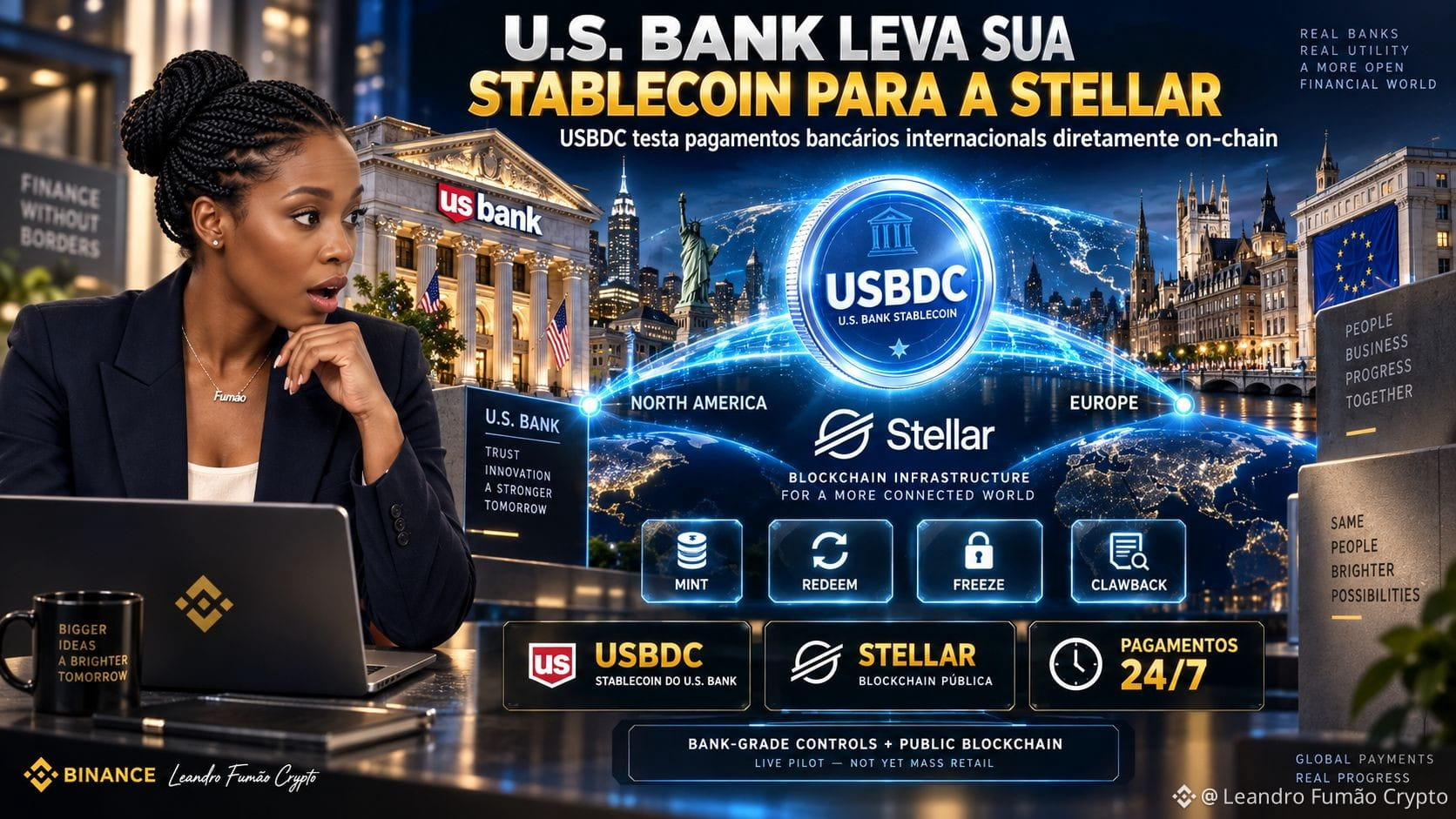
˗ˋˏ🚨ˎˊ˗ U.S. BANK TESTA SUA PRÓPRIA STABLECOIN NA $XLM STELLAR࿐😱࿐
⚡️Um dos Maiores Bancos dos Estados Unidos Acaba de dar um Passo Importante para Levar Dinheiro Bancário para Blockchain Pública.
O U.S. Bank executou uma transação piloto real com a USBDC, sua stablecoin própria lastreada em dólar, usando a Stellar para realizar um pagamento entre entidades do banco na América do Norte e na Europa.
🔥 O ponto mais interessante não é apenas a stablecoin.
A operação foi integrada aos sistemas tradicionais do banco de:
▸Finanças
▸Risco
▸Compliance
▸Operações
Ou Seja: A Stellar funcionou como trilho blockchain, enquanto o U.S. Bank manteve controles bancários tradicionais.
A plataforma também foi testada para:
MINTAR USBDC
RESGATAR
CONGELAR ATIVOS
CLAWBACK / REVERSÃO CONTROLADA
Segundo a Stellar Development Foundation, justamente esses recursos de controle no nível da rede ajudaram a tornar a infraestrutura interessante para aplicações bancárias reguladas.
👀 E o banco já olha além de pagamentos internacionais.
Após o piloto, o U.S. Bank estuda usos como gestão de liquidez, movimentação de colateral e tesouraria internacional. O banco também participa do projeto Open USD, que reúne mais de 140 bancos, fintechs e empresas do ecossistema financeiro.
⚠️ Importante: a USBDC ainda não é uma stablecoin de varejo disponível amplamente ao público, e isso também não significa que pagamentos estejam sendo feitos em $XLM .
A Stellar é a infraestrutura blockchain utilizada no piloto.
🔥 A mudança maior talvez seja esta:
bancos estão começando a colocar suas próprias formas de dinheiro diretamente on-chain.
👇 Stablecoins emitidas por bancos podem se tornar uma nova camada dos pagamentos globais?
#stellar #Stablecoins #XLM/
˗ˋˏ🚨ˎˊ˗ U.S. BANK TESTA SUA PRÓPRIA STABLECOIN NA $XLM STELLAR࿐😱࿐
⚡️Um dos Maiores Bancos dos Estados Unidos Acaba de dar um Passo Importante para Levar Dinheiro Bancário para Blockchain Pública.
O U.S. Bank executou uma transação piloto real com a USBDC, sua stablecoin própria lastreada em dólar, usando a Stellar para realizar um pagamento entre entidades do banco na América do Norte e na Europa.
🔥 O ponto mais interessante não é apenas a stablecoin.
A operação foi integrada aos sistemas tradicionais do banco de:
▸Finanças
▸Risco
▸Compliance
▸Operações
Ou Seja: A Stellar funcionou como trilho blockchain, enquanto o U.S. Bank manteve controles bancários tradicionais.
A plataforma também foi testada para:
MINTAR USBDC
RESGATAR
CONGELAR ATIVOS
CLAWBACK / REVERSÃO CONTROLADA
Segundo a Stellar Development Foundation, justamente esses recursos de controle no nível da rede ajudaram a tornar a infraestrutura interessante para aplicações bancárias reguladas.
👀 E o banco já olha além de pagamentos internacionais.
Após o piloto, o U.S. Bank estuda usos como gestão de liquidez, movimentação de colateral e tesouraria internacional. O banco também participa do projeto Open USD, que reúne mais de 140 bancos, fintechs e empresas do ecossistema financeiro.
⚠️ Importante: a USBDC ainda não é uma stablecoin de varejo disponível amplamente ao público, e isso também não significa que pagamentos estejam sendo feitos em $XLM .
A Stellar é a infraestrutura blockchain utilizada no piloto.
🔥 A mudança maior talvez seja esta:
bancos estão começando a colocar suas próprias formas de dinheiro diretamente on-chain.
👇 Stablecoins emitidas por bancos podem se tornar uma nova camada dos pagamentos globais?
#stellar #Stablecoins #XLM/
⚡️Um dos Maiores Bancos dos Estados Unidos Acaba de dar um Passo Importante para Levar Dinheiro Bancário para Blockchain Pública.
O U.S. Bank executou uma transação piloto real com a USBDC, sua stablecoin própria lastreada em dólar, usando a Stellar para realizar um pagamento entre entidades do banco na América do Norte e na Europa.
🔥 O ponto mais interessante não é apenas a stablecoin.
A operação foi integrada aos sistemas tradicionais do banco de:
▸Finanças
▸Risco
▸Compliance
▸Operações
Ou Seja: A Stellar funcionou como trilho blockchain, enquanto o U.S. Bank manteve controles bancários tradicionais.
A plataforma também foi testada para:
MINTAR USBDC
RESGATAR
CONGELAR ATIVOS
CLAWBACK / REVERSÃO CONTROLADA
Segundo a Stellar Development Foundation, justamente esses recursos de controle no nível da rede ajudaram a tornar a infraestrutura interessante para aplicações bancárias reguladas.
👀 E o banco já olha além de pagamentos internacionais.
Após o piloto, o U.S. Bank estuda usos como gestão de liquidez, movimentação de colateral e tesouraria internacional. O banco também participa do projeto Open USD, que reúne mais de 140 bancos, fintechs e empresas do ecossistema financeiro.
⚠️ Importante: a USBDC ainda não é uma stablecoin de varejo disponível amplamente ao público, e isso também não significa que pagamentos estejam sendo feitos em $XLM .
A Stellar é a infraestrutura blockchain utilizada no piloto.
🔥 A mudança maior talvez seja esta:
bancos estão começando a colocar suas próprias formas de dinheiro diretamente on-chain.
👇 Stablecoins emitidas por bancos podem se tornar uma nova camada dos pagamentos globais?
#stellar #Stablecoins #XLM/
3
928
·
--
The correspondent banking system was built in the 1970s. It still moves most of the $150 trillion in annual cross-border B2B payments. Every hop along the chain takes 2-5 days, strips 1-3% in fees, and introduces settlement risk at every intermediary bank.
Stablecoins don't improve this system. They bypass it entirely.
A business in Lagos can settle a $2M invoice to a supplier in São Paulo in 4 seconds for less than a dollar. No Nostro-Vostro account balances. No SWIFT MT103 messaging. No correspondent bank taking a cut at each leg. Just a signed transaction on a public ledger.
The GENIUS Act in the US and MiCA in Europe didn't create this capability — they validated it. The difference now is that regulated stablecoin issuers have a compliance framework that large enterprises can actually use without legal uncertainty. That's the unlock.
The chains that capture this flow won't be the ones with the highest TPS or the loudest marketing. They'll be the ones with the deepest stablecoin liquidity, the most predictable fee structures, and the settlement finality that CFOs require before moving treasury operations on-chain. $BNB $ETH and $SOL are the structural beneficiaries of this rail system.
The question isn't whether stablecoins replace correspondent banking. It's how quickly, and which chains capture the flow.
#Stablecoins #CrossBorderPayments #CryptoAdoption #DeFi #BinanceSquare
The correspondent banking system was built in the 1970s. It still moves most of the $150 trillion in annual cross-border B2B payments. Every hop along the chain takes 2-5 days, strips 1-3% in fees, and introduces settlement risk at every intermediary bank.
Stablecoins don't improve this system. They bypass it entirely.
A business in Lagos can settle a $2M invoice to a supplier in São Paulo in 4 seconds for less than a dollar. No Nostro-Vostro account balances. No SWIFT MT103 messaging. No correspondent bank taking a cut at each leg. Just a signed transaction on a public ledger.
The GENIUS Act in the US and MiCA in Europe didn't create this capability — they validated it. The difference now is that regulated stablecoin issuers have a compliance framework that large enterprises can actually use without legal uncertainty. That's the unlock.
The chains that capture this flow won't be the ones with the highest TPS or the loudest marketing. They'll be the ones with the deepest stablecoin liquidity, the most predictable fee structures, and the settlement finality that CFOs require before moving treasury operations on-chain. $BNB $ETH and $SOL are the structural beneficiaries of this rail system.
The question isn't whether stablecoins replace correspondent banking. It's how quickly, and which chains capture the flow.
#Stablecoins #CrossBorderPayments #CryptoAdoption #DeFi #BinanceSquare
Stablecoins don't improve this system. They bypass it entirely.
A business in Lagos can settle a $2M invoice to a supplier in São Paulo in 4 seconds for less than a dollar. No Nostro-Vostro account balances. No SWIFT MT103 messaging. No correspondent bank taking a cut at each leg. Just a signed transaction on a public ledger.
The GENIUS Act in the US and MiCA in Europe didn't create this capability — they validated it. The difference now is that regulated stablecoin issuers have a compliance framework that large enterprises can actually use without legal uncertainty. That's the unlock.
The chains that capture this flow won't be the ones with the highest TPS or the loudest marketing. They'll be the ones with the deepest stablecoin liquidity, the most predictable fee structures, and the settlement finality that CFOs require before moving treasury operations on-chain. $BNB $ETH and $SOL are the structural beneficiaries of this rail system.
The question isn't whether stablecoins replace correspondent banking. It's how quickly, and which chains capture the flow.
#Stablecoins #CrossBorderPayments #CryptoAdoption #DeFi #BinanceSquare
87
Log in to explore more content
Join global crypto users on Binance Square
⚡️ Get latest and useful information about crypto.
💬 Trusted by the world’s largest crypto exchange.
👍 Discover real insights from verified creators.
Email / Phone number
Trending Topics
1
#SPGlobalToAcquireOpenZeppelin
0 views
0 Discussing
2
#BitcoinSurpasses$77000
17,984 views
227 Discussing
3
#ParadigmDisclosesZECHolding
69,493 views
1,065 Discussing
4
#BitcoinETFsShed$450M
26,481 views
219 Discussing
5
#USWeeklyJoblessClaimsFallTo196K
38,087 views
611 Discussing
6
#ArkhamSaysBlackRockBuys$1.5BInETH
6,889 views
72 Discussing
7
#ElSalvadorBTCHoldingsRiseTo7777
68,801 views
882 Discussing
8
#MemeLaunchpads82%OfArcDayOneVolume
69,061 views
1,051 Discussing
9
#OstiumLoanDisputeHearingSetInNYFederalCourt
52,503 views
746 Discussing
10
#HyperliquidUSDCSupplyOvertakesSolana
26,244 views
391 Discussing