
Prime Crypto Lab
95 Posts

Prime Crypto Lab
Report
Block User
Crypto Analyst 📊 | Market Research 🔍 | Educational Content 📚 | Long-Term Growth 📈 | DYOR | Not Financial Advice.
2 Following
0 Followers
0 Liked
Posts
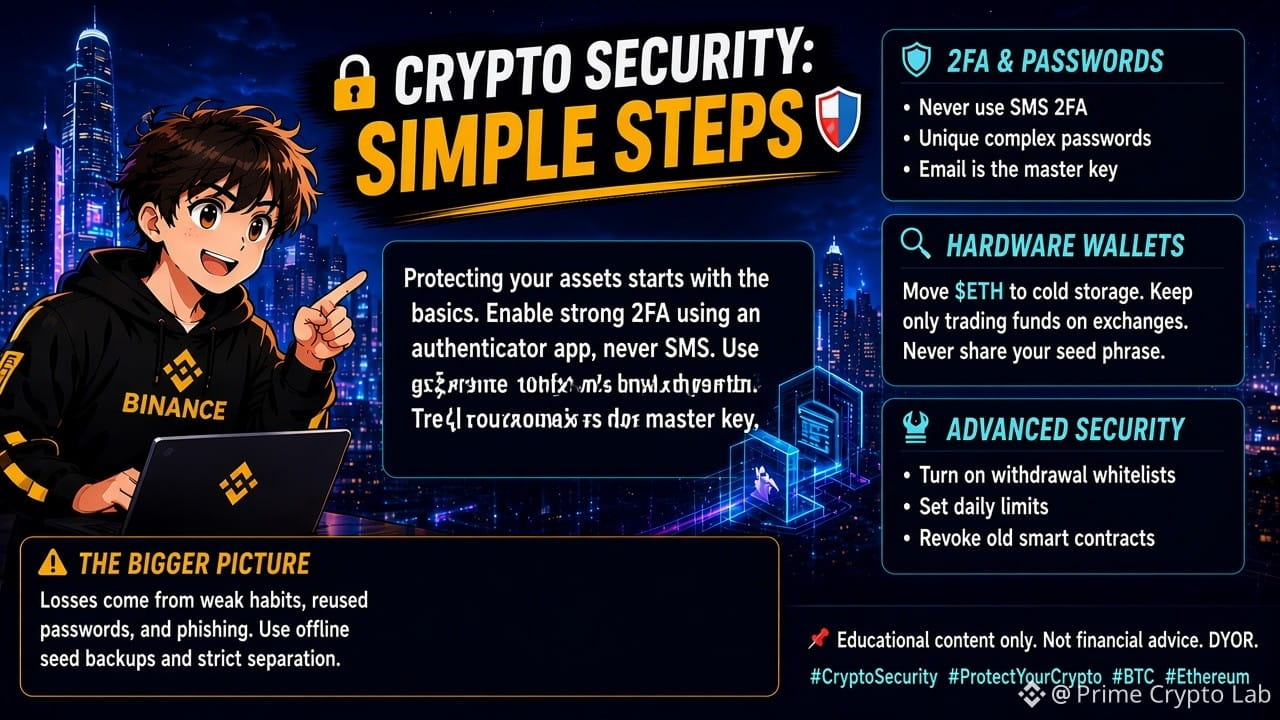
🔒HOW TO PROTECT YOUR CRYPTO ACCOUNT — SIMPLE STEPS THAT ACTUALLY WORK 🛡️
Protecting your $BTC starts with the basics most people still skip. Enable strong two-factor authentication using an authenticator app (never SMS), create unique and complex passwords for every exchange, and treat your email account like the master key to everything.
Once the foundations are solid, move to the middle layer with $ETH. Keep only what you need for trading on exchanges or hot wallets. Transfer the rest to a hardware wallet so your private keys stay offline. Never type your seed phrase into any website, chat, or “support” message — no legitimate platform will ever ask for it.
Finish strong by locking down $LINK and the rest of your portfolio. Turn on withdrawal address whitelists, set daily withdrawal limits where available, and double-check every transaction before you sign. Regularly revoke old smart-contract approvals and stay alert for phishing links that look almost identical to real sites.
🧠THE BIGGER PICTURE
Most losses don’t come from broken cryptography. They come from weak habits: reused passwords, SMS 2FA, shared seed phrases, and trusting unsolicited DMs. Hardware wallets, offline seed backups (preferably on metal), and strict separation between trading and long-term holdings close the biggest attack routes.
News and market moves will always create FOMO, but nothing protects your capital better than consistent security discipline.
📌 Educational content only. Not financial advice. DYOR.
#CryptoSecurity #ProtectYourCrypto #BTC #ETH
🔒HOW TO PROTECT YOUR CRYPTO ACCOUNT — SIMPLE STEPS THAT ACTUALLY WORK 🛡️
Protecting your $BTC starts with the basics most people still skip. Enable strong two-factor authentication using an authenticator app (never SMS), create unique and complex passwords for every exchange, and treat your email account like the master key to everything.
Once the foundations are solid, move to the middle layer with $ETH. Keep only what you need for trading on exchanges or hot wallets. Transfer the rest to a hardware wallet so your private keys stay offline. Never type your seed phrase into any website, chat, or “support” message — no legitimate platform will ever ask for it.
Finish strong by locking down $LINK and the rest of your portfolio. Turn on withdrawal address whitelists, set daily withdrawal limits where available, and double-check every transaction before you sign. Regularly revoke old smart-contract approvals and stay alert for phishing links that look almost identical to real sites.
🧠THE BIGGER PICTURE
Most losses don’t come from broken cryptography. They come from weak habits: reused passwords, SMS 2FA, shared seed phrases, and trusting unsolicited DMs. Hardware wallets, offline seed backups (preferably on metal), and strict separation between trading and long-term holdings close the biggest attack routes.
News and market moves will always create FOMO, but nothing protects your capital better than consistent security discipline.
📌 Educational content only. Not financial advice. DYOR.
#CryptoSecurity #ProtectYourCrypto #BTC #ETH
Protecting your $BTC starts with the basics most people still skip. Enable strong two-factor authentication using an authenticator app (never SMS), create unique and complex passwords for every exchange, and treat your email account like the master key to everything.
Once the foundations are solid, move to the middle layer with $ETH. Keep only what you need for trading on exchanges or hot wallets. Transfer the rest to a hardware wallet so your private keys stay offline. Never type your seed phrase into any website, chat, or “support” message — no legitimate platform will ever ask for it.
Finish strong by locking down $LINK and the rest of your portfolio. Turn on withdrawal address whitelists, set daily withdrawal limits where available, and double-check every transaction before you sign. Regularly revoke old smart-contract approvals and stay alert for phishing links that look almost identical to real sites.
🧠THE BIGGER PICTURE
Most losses don’t come from broken cryptography. They come from weak habits: reused passwords, SMS 2FA, shared seed phrases, and trusting unsolicited DMs. Hardware wallets, offline seed backups (preferably on metal), and strict separation between trading and long-term holdings close the biggest attack routes.
News and market moves will always create FOMO, but nothing protects your capital better than consistent security discipline.
📌 Educational content only. Not financial advice. DYOR.
#CryptoSecurity #ProtectYourCrypto #BTC #ETH
91
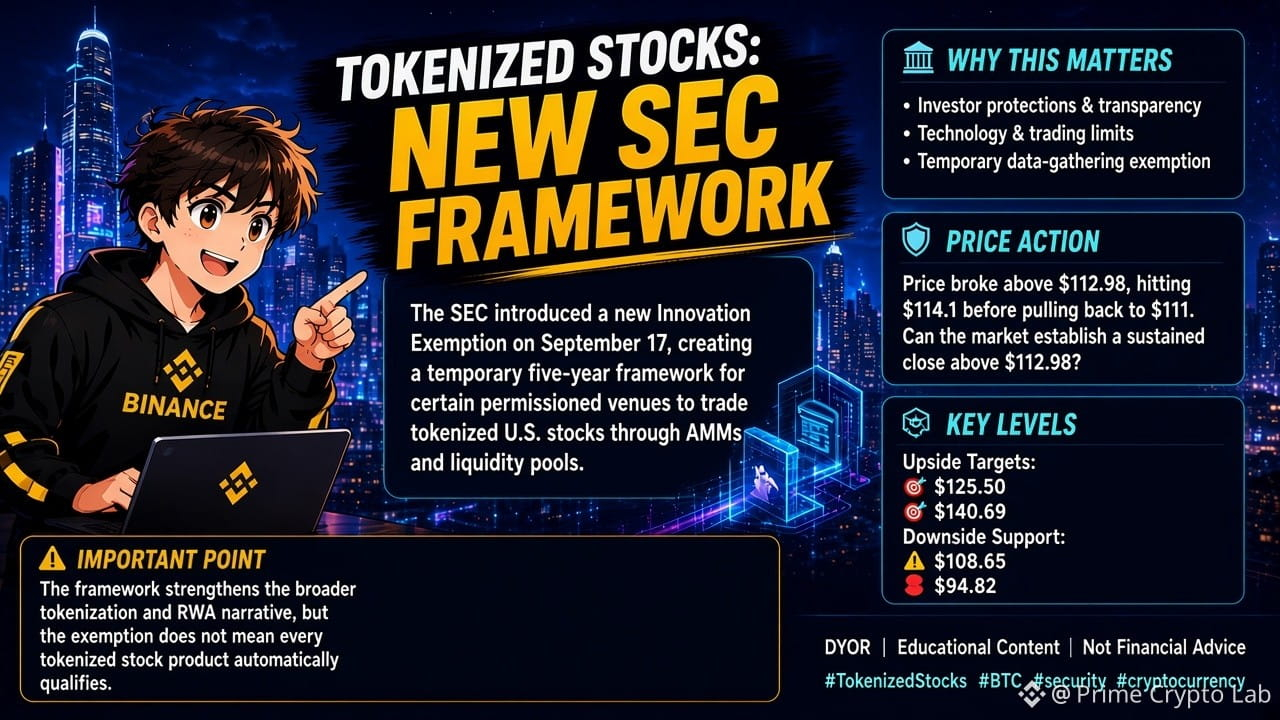
🚨Tokenized Stocks Get a New SEC Framework — But Is the Breakout Confirmed?
$BTC — Solana-related market activity has gained attention after the SEC introduced its new Innovation Exemption on September 17, creating a temporary five-year framework for certain permissioned venues to trade tokenized U.S. stocks through automated market makers and liquidity pools.
🏦 Why This Matters
The framework includes conditions around permissioned access, investor protections, transparency, technology safeguards, trading limits, and recordkeeping. The SEC also stated that the exemption is temporary and intended to help gather data for future rulemaking.
This strengthens the broader tokenization and RWA narrative, but the exemption does not mean every tokenized stock product automatically qualifies.
📊 PRICE ACTION NEEDS CONFIRMATION
The sharp move on September 18 pushed price above the $112.98 area, with the daily high reaching roughly $114.1–$114.3. However, price subsequently pulled back toward the $111 area.
The key technical question remains:
Can the market establish a sustained close above $112.98?
If that level is reclaimed and held, traders may continue watching:
🎯 $125.50
🎯 $140.69
If the breakout fails, downside levels to monitor include:
⚠️ $108.65
🔻 $94.82
🧠 THE BIGGER PICTURE
The SEC development gives the tokenization sector another regulatory catalyst, while price action still needs to validate the technical breakout.
For $ETH , the broader tokenization trend is also worth watching as blockchain-based representations of traditional assets receive increasing regulatory attention.
The important distinction is between a short-term price spike and a confirmed higher-timeframe breakout.
$LINK can also remain on the watchlist as tokenization and on-chain financial infrastructure continue developing.
📌 Market commentary only. Not financial advice.
#crypto #TokenizedStocks #RWA #SEC #MarketAnalysis
🚨Tokenized Stocks Get a New SEC Framework — But Is the Breakout Confirmed?
$BTC — Solana-related market activity has gained attention after the SEC introduced its new Innovation Exemption on September 17, creating a temporary five-year framework for certain permissioned venues to trade tokenized U.S. stocks through automated market makers and liquidity pools.
🏦 Why This Matters
The framework includes conditions around permissioned access, investor protections, transparency, technology safeguards, trading limits, and recordkeeping. The SEC also stated that the exemption is temporary and intended to help gather data for future rulemaking.
This strengthens the broader tokenization and RWA narrative, but the exemption does not mean every tokenized stock product automatically qualifies.
📊 PRICE ACTION NEEDS CONFIRMATION
The sharp move on September 18 pushed price above the $112.98 area, with the daily high reaching roughly $114.1–$114.3. However, price subsequently pulled back toward the $111 area.
The key technical question remains:
Can the market establish a sustained close above $112.98?
If that level is reclaimed and held, traders may continue watching:
🎯 $125.50
🎯 $140.69
If the breakout fails, downside levels to monitor include:
⚠️ $108.65
🔻 $94.82
🧠 THE BIGGER PICTURE
The SEC development gives the tokenization sector another regulatory catalyst, while price action still needs to validate the technical breakout.
For $ETH , the broader tokenization trend is also worth watching as blockchain-based representations of traditional assets receive increasing regulatory attention.
The important distinction is between a short-term price spike and a confirmed higher-timeframe breakout.
$LINK can also remain on the watchlist as tokenization and on-chain financial infrastructure continue developing.
📌 Market commentary only. Not financial advice.
#crypto #TokenizedStocks #RWA #SEC #MarketAnalysis
$BTC — Solana-related market activity has gained attention after the SEC introduced its new Innovation Exemption on September 17, creating a temporary five-year framework for certain permissioned venues to trade tokenized U.S. stocks through automated market makers and liquidity pools.
🏦 Why This Matters
The framework includes conditions around permissioned access, investor protections, transparency, technology safeguards, trading limits, and recordkeeping. The SEC also stated that the exemption is temporary and intended to help gather data for future rulemaking.
This strengthens the broader tokenization and RWA narrative, but the exemption does not mean every tokenized stock product automatically qualifies.
📊 PRICE ACTION NEEDS CONFIRMATION
The sharp move on September 18 pushed price above the $112.98 area, with the daily high reaching roughly $114.1–$114.3. However, price subsequently pulled back toward the $111 area.
The key technical question remains:
Can the market establish a sustained close above $112.98?
If that level is reclaimed and held, traders may continue watching:
🎯 $125.50
🎯 $140.69
If the breakout fails, downside levels to monitor include:
⚠️ $108.65
🔻 $94.82
🧠 THE BIGGER PICTURE
The SEC development gives the tokenization sector another regulatory catalyst, while price action still needs to validate the technical breakout.
For $ETH , the broader tokenization trend is also worth watching as blockchain-based representations of traditional assets receive increasing regulatory attention.
The important distinction is between a short-term price spike and a confirmed higher-timeframe breakout.
$LINK can also remain on the watchlist as tokenization and on-chain financial infrastructure continue developing.
📌 Market commentary only. Not financial advice.
#crypto #TokenizedStocks #RWA #SEC #MarketAnalysis
92
🔎 What Is a Blockchain Explorer?
A blockchain explorer is a search tool that makes public on-chain data easy to view and verify. Instead of reading raw blockchain data, users can search transactions, wallet addresses, blocks and other network activity through a simple interface.
🧾What Can You Check?
A blockchain explorer can show:
• Transaction status and confirmation
• Sender and recipient addresses
• Transaction fees and timestamps
• Wallet balances and transaction history
• Block numbers, hashes and timestamps
• Token transfers and smart-contract activity
🛡️Why Is It Useful?
For $BTC , explorers can help users verify whether a transaction has been confirmed and inspect its on-chain details.
For Ethereum and other smart-contract networks, explorers can also provide contract, token-transfer and network activity data.
👀 How Do You Use One?
Simply select the correct blockchain explorer and enter a transaction hash, wallet address, block number or other supported identifier. The explorer then displays the publicly recorded information associated with that input.
⚠️ Important Point
A blockchain explorer is read-only. It displays public blockchain data but does not give users access to private keys or directly transfer funds.
Understanding explorers makes it easier to verify activity rather than relying only on claims or screenshots. $ETH users, for example, can inspect transactions and smart-contract interactions directly on Ethereum explorers.
$BNB is another example where users can use a dedicated explorer to examine BNB Chain activity.
DYOR | Educational Content | Not Financial Advice
#blockchain #cryptoeducation #Onchain #Web3 #crypto
🔎 What Is a Blockchain Explorer?
A blockchain explorer is a search tool that makes public on-chain data easy to view and verify. Instead of reading raw blockchain data, users can search transactions, wallet addresses, blocks and other network activity through a simple interface.
🧾What Can You Check?
A blockchain explorer can show:
• Transaction status and confirmation
• Sender and recipient addresses
• Transaction fees and timestamps
• Wallet balances and transaction history
• Block numbers, hashes and timestamps
• Token transfers and smart-contract activity
🛡️Why Is It Useful?
For $BTC , explorers can help users verify whether a transaction has been confirmed and inspect its on-chain details.
For Ethereum and other smart-contract networks, explorers can also provide contract, token-transfer and network activity data.
👀 How Do You Use One?
Simply select the correct blockchain explorer and enter a transaction hash, wallet address, block number or other supported identifier. The explorer then displays the publicly recorded information associated with that input.
⚠️ Important Point
A blockchain explorer is read-only. It displays public blockchain data but does not give users access to private keys or directly transfer funds.
Understanding explorers makes it easier to verify activity rather than relying only on claims or screenshots. $ETH users, for example, can inspect transactions and smart-contract interactions directly on Ethereum explorers.
$BNB is another example where users can use a dedicated explorer to examine BNB Chain activity.
DYOR | Educational Content | Not Financial Advice
#blockchain #cryptoeducation #Onchain #Web3 #crypto
A blockchain explorer is a search tool that makes public on-chain data easy to view and verify. Instead of reading raw blockchain data, users can search transactions, wallet addresses, blocks and other network activity through a simple interface.
🧾What Can You Check?
A blockchain explorer can show:
• Transaction status and confirmation
• Sender and recipient addresses
• Transaction fees and timestamps
• Wallet balances and transaction history
• Block numbers, hashes and timestamps
• Token transfers and smart-contract activity
🛡️Why Is It Useful?
For $BTC , explorers can help users verify whether a transaction has been confirmed and inspect its on-chain details.
For Ethereum and other smart-contract networks, explorers can also provide contract, token-transfer and network activity data.
👀 How Do You Use One?
Simply select the correct blockchain explorer and enter a transaction hash, wallet address, block number or other supported identifier. The explorer then displays the publicly recorded information associated with that input.
⚠️ Important Point
A blockchain explorer is read-only. It displays public blockchain data but does not give users access to private keys or directly transfer funds.
Understanding explorers makes it easier to verify activity rather than relying only on claims or screenshots. $ETH users, for example, can inspect transactions and smart-contract interactions directly on Ethereum explorers.
$BNB is another example where users can use a dedicated explorer to examine BNB Chain activity.
DYOR | Educational Content | Not Financial Advice
#blockchain #cryptoeducation #Onchain #Web3 #crypto

69
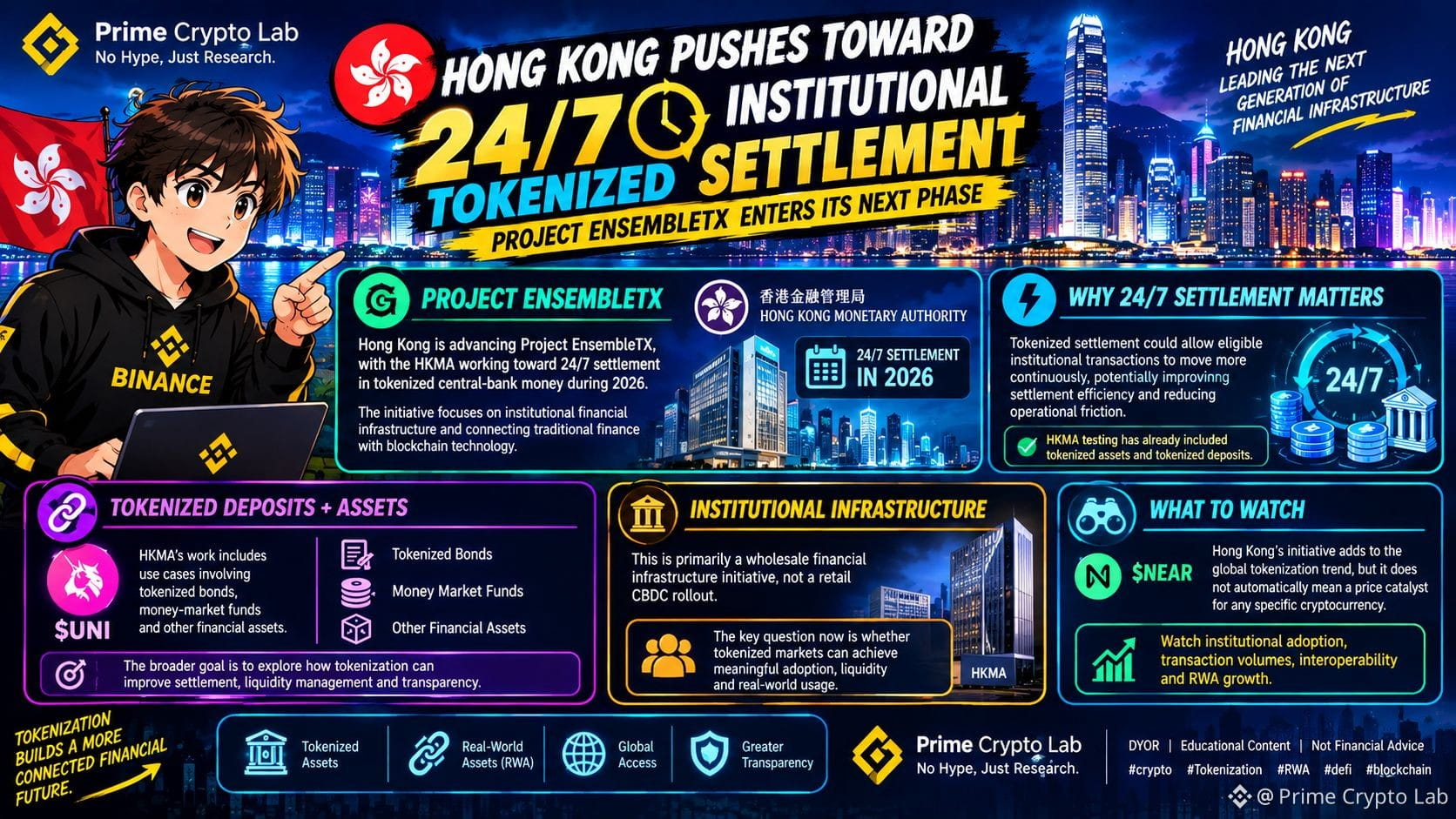
🏦Hong Kong Pushes Toward 24/7 Institutional Tokenized Settlement
🇭🇰 Project EnsembleTX Enters Its Next Phase
$G — Hong Kong is advancing Project EnsembleTX, with the HKMA working toward 24/7 settlement in tokenized central-bank money during 2026. The initiative focuses on institutional financial infrastructure and connecting traditional finance with blockchain technology.
⚡ Why 24/7 Settlement Matters
Tokenized settlement could allow eligible institutional transactions to move more continuously, potentially improving settlement efficiency and reducing operational friction. HKMA testing has already included tokenized assets and tokenized deposits.
🔗 Tokenized Deposits + Assets
$UNI — HKMA's work includes use cases involving tokenized bonds, money-market funds and other financial assets. The broader goal is to explore how tokenization can improve settlement, liquidity management and transparency.
🏦 Institutional Infrastructure
This is primarily a wholesale financial infrastructure initiative, not a retail CBDC rollout. The key question now is whether tokenized markets can achieve meaningful adoption, liquidity and real-world usage.
👀 What to Watch
$NEAR — Hong Kong's initiative adds to the global tokenization trend, but it does not automatically mean a price catalyst for any specific cryptocurrency. Watch institutional adoption, transaction volumes, interoperability and RWA growth.
Prime Crypto Lab — No Hype, Just Research.
DYOR | Educational Content | Not Financial Advice
#crypto #Tokenization #RWA #defi #blockchain
🏦Hong Kong Pushes Toward 24/7 Institutional Tokenized Settlement
🇭🇰 Project EnsembleTX Enters Its Next Phase
$G — Hong Kong is advancing Project EnsembleTX, with the HKMA working toward 24/7 settlement in tokenized central-bank money during 2026. The initiative focuses on institutional financial infrastructure and connecting traditional finance with blockchain technology.
⚡ Why 24/7 Settlement Matters
Tokenized settlement could allow eligible institutional transactions to move more continuously, potentially improving settlement efficiency and reducing operational friction. HKMA testing has already included tokenized assets and tokenized deposits.
🔗 Tokenized Deposits + Assets
$UNI — HKMA's work includes use cases involving tokenized bonds, money-market funds and other financial assets. The broader goal is to explore how tokenization can improve settlement, liquidity management and transparency.
🏦 Institutional Infrastructure
This is primarily a wholesale financial infrastructure initiative, not a retail CBDC rollout. The key question now is whether tokenized markets can achieve meaningful adoption, liquidity and real-world usage.
👀 What to Watch
$NEAR — Hong Kong's initiative adds to the global tokenization trend, but it does not automatically mean a price catalyst for any specific cryptocurrency. Watch institutional adoption, transaction volumes, interoperability and RWA growth.
Prime Crypto Lab — No Hype, Just Research.
DYOR | Educational Content | Not Financial Advice
#crypto #Tokenization #RWA #defi #blockchain
🇭🇰 Project EnsembleTX Enters Its Next Phase
$G — Hong Kong is advancing Project EnsembleTX, with the HKMA working toward 24/7 settlement in tokenized central-bank money during 2026. The initiative focuses on institutional financial infrastructure and connecting traditional finance with blockchain technology.
⚡ Why 24/7 Settlement Matters
Tokenized settlement could allow eligible institutional transactions to move more continuously, potentially improving settlement efficiency and reducing operational friction. HKMA testing has already included tokenized assets and tokenized deposits.
🔗 Tokenized Deposits + Assets
$UNI — HKMA's work includes use cases involving tokenized bonds, money-market funds and other financial assets. The broader goal is to explore how tokenization can improve settlement, liquidity management and transparency.
🏦 Institutional Infrastructure
This is primarily a wholesale financial infrastructure initiative, not a retail CBDC rollout. The key question now is whether tokenized markets can achieve meaningful adoption, liquidity and real-world usage.
👀 What to Watch
$NEAR — Hong Kong's initiative adds to the global tokenization trend, but it does not automatically mean a price catalyst for any specific cryptocurrency. Watch institutional adoption, transaction volumes, interoperability and RWA growth.
Prime Crypto Lab — No Hype, Just Research.
DYOR | Educational Content | Not Financial Advice
#crypto #Tokenization #RWA #defi #blockchain
247
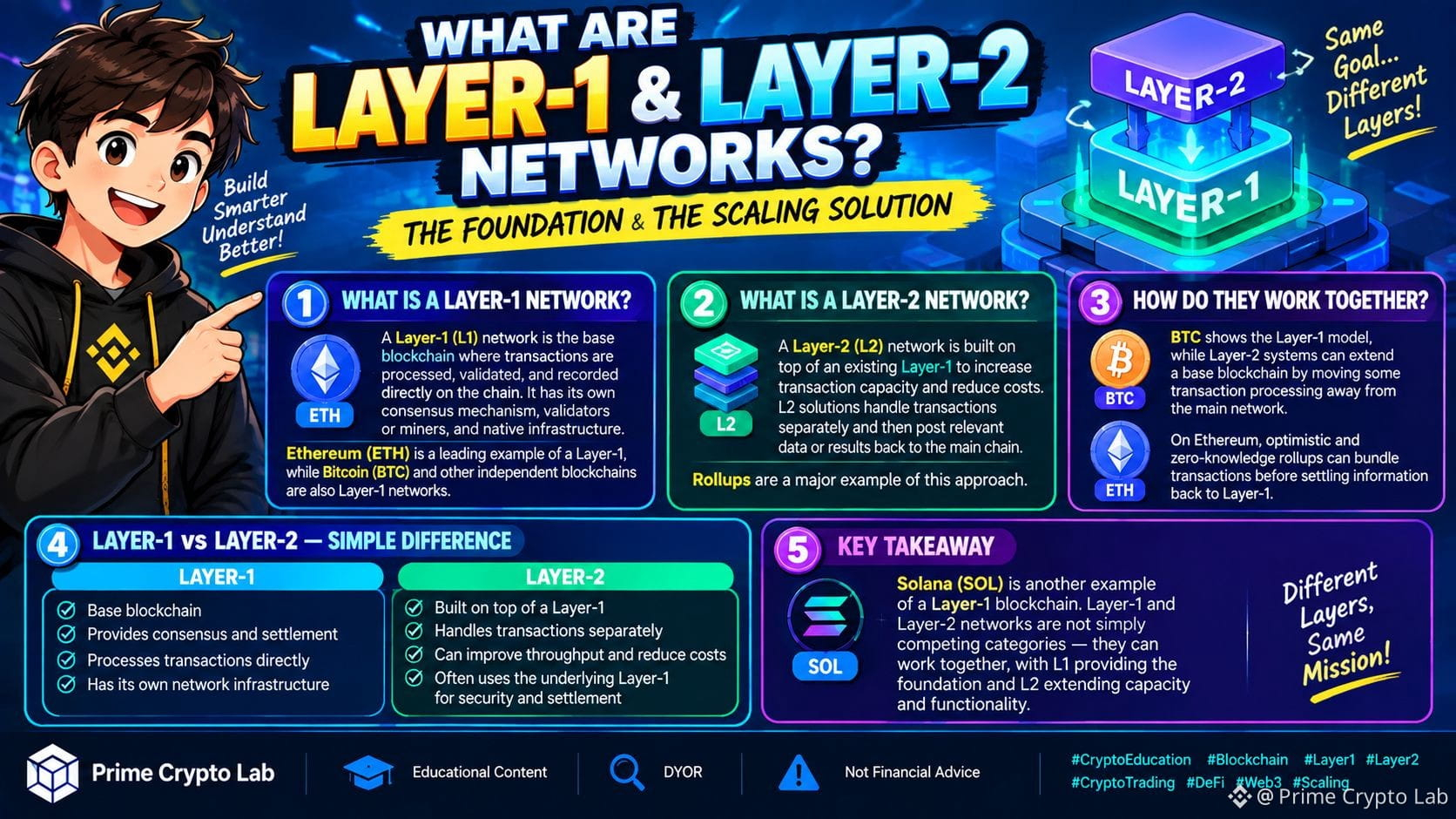
🔗 What Are Layer-1 & Layer-2 Networks?
🧱 What Is a Layer-1 Network?
Ethereum $ETH is an example of a Layer-1 (L1) blockchain — the base network where transactions are processed, validated, and recorded directly on the blockchain. Layer-1 networks have their own consensus mechanisms, validators or miners, and native infrastructure. Bitcoin and other independent blockchains are also examples of Layer-1 networks.
⚡What Is a Layer-2 Network?
Layer-2 (L2) networks are built on top of an existing Layer-1 to help increase transaction capacity and reduce costs. Instead of processing every transaction directly on the main chain, many L2 solutions handle transactions separately and then post relevant data or results back to the underlying Layer-1. Rollups are a major example of this approach.
🔄 How Do Layer-1 & Layer-2 Work Together?
Bitcoin $BTC demonstrates the Layer-1 concept, while Layer-2 systems can extend a base blockchain by moving some transaction processing away from the main network. On Ethereum, optimistic and zero-knowledge rollups can bundle transactions together before settling information back to Layer-1. This can help reduce congestion and distribute transaction costs across many users.
📊 Layer-1 vs Layer-2 — Simple Difference
Layer-1:
• Base blockchain
• Provides consensus and settlement
• Processes transactions directly
• Has its own network infrastructure
Layer-2:
• Built on top of a Layer-1
• Handles transactions separately
• Can improve throughput and reduce costs
• Often uses the underlying Layer-1 for security and settlement
🎯 Key Takeaway
Solana $SOL is another example of a Layer-1 blockchain. The important point is that Layer-1 and Layer-2 networks are not simply competing categories — they can work together, with L1 providing the foundational blockchain and L2 solutions extending capacity and functionality. The exact security model and trade-offs depend on the specific L2 design.
Prime Crypto Lab — No Hype, Just Research.
🔗 What Are Layer-1 & Layer-2 Networks?
🧱 What Is a Layer-1 Network?
Ethereum $ETH is an example of a Layer-1 (L1) blockchain — the base network where transactions are processed, validated, and recorded directly on the blockchain. Layer-1 networks have their own consensus mechanisms, validators or miners, and native infrastructure. Bitcoin and other independent blockchains are also examples of Layer-1 networks.
⚡What Is a Layer-2 Network?
Layer-2 (L2) networks are built on top of an existing Layer-1 to help increase transaction capacity and reduce costs. Instead of processing every transaction directly on the main chain, many L2 solutions handle transactions separately and then post relevant data or results back to the underlying Layer-1. Rollups are a major example of this approach.
🔄 How Do Layer-1 & Layer-2 Work Together?
Bitcoin $BTC demonstrates the Layer-1 concept, while Layer-2 systems can extend a base blockchain by moving some transaction processing away from the main network. On Ethereum, optimistic and zero-knowledge rollups can bundle transactions together before settling information back to Layer-1. This can help reduce congestion and distribute transaction costs across many users.
📊 Layer-1 vs Layer-2 — Simple Difference
Layer-1:
• Base blockchain
• Provides consensus and settlement
• Processes transactions directly
• Has its own network infrastructure
Layer-2:
• Built on top of a Layer-1
• Handles transactions separately
• Can improve throughput and reduce costs
• Often uses the underlying Layer-1 for security and settlement
🎯 Key Takeaway
Solana $SOL is another example of a Layer-1 blockchain. The important point is that Layer-1 and Layer-2 networks are not simply competing categories — they can work together, with L1 providing the foundational blockchain and L2 solutions extending capacity and functionality. The exact security model and trade-offs depend on the specific L2 design.
Prime Crypto Lab — No Hype, Just Research.
🧱 What Is a Layer-1 Network?
Ethereum $ETH is an example of a Layer-1 (L1) blockchain — the base network where transactions are processed, validated, and recorded directly on the blockchain. Layer-1 networks have their own consensus mechanisms, validators or miners, and native infrastructure. Bitcoin and other independent blockchains are also examples of Layer-1 networks.
⚡What Is a Layer-2 Network?
Layer-2 (L2) networks are built on top of an existing Layer-1 to help increase transaction capacity and reduce costs. Instead of processing every transaction directly on the main chain, many L2 solutions handle transactions separately and then post relevant data or results back to the underlying Layer-1. Rollups are a major example of this approach.
🔄 How Do Layer-1 & Layer-2 Work Together?
Bitcoin $BTC demonstrates the Layer-1 concept, while Layer-2 systems can extend a base blockchain by moving some transaction processing away from the main network. On Ethereum, optimistic and zero-knowledge rollups can bundle transactions together before settling information back to Layer-1. This can help reduce congestion and distribute transaction costs across many users.
📊 Layer-1 vs Layer-2 — Simple Difference
Layer-1:
• Base blockchain
• Provides consensus and settlement
• Processes transactions directly
• Has its own network infrastructure
Layer-2:
• Built on top of a Layer-1
• Handles transactions separately
• Can improve throughput and reduce costs
• Often uses the underlying Layer-1 for security and settlement
🎯 Key Takeaway
Solana $SOL is another example of a Layer-1 blockchain. The important point is that Layer-1 and Layer-2 networks are not simply competing categories — they can work together, with L1 providing the foundational blockchain and L2 solutions extending capacity and functionality. The exact security model and trade-offs depend on the specific L2 design.
Prime Crypto Lab — No Hype, Just Research.
91
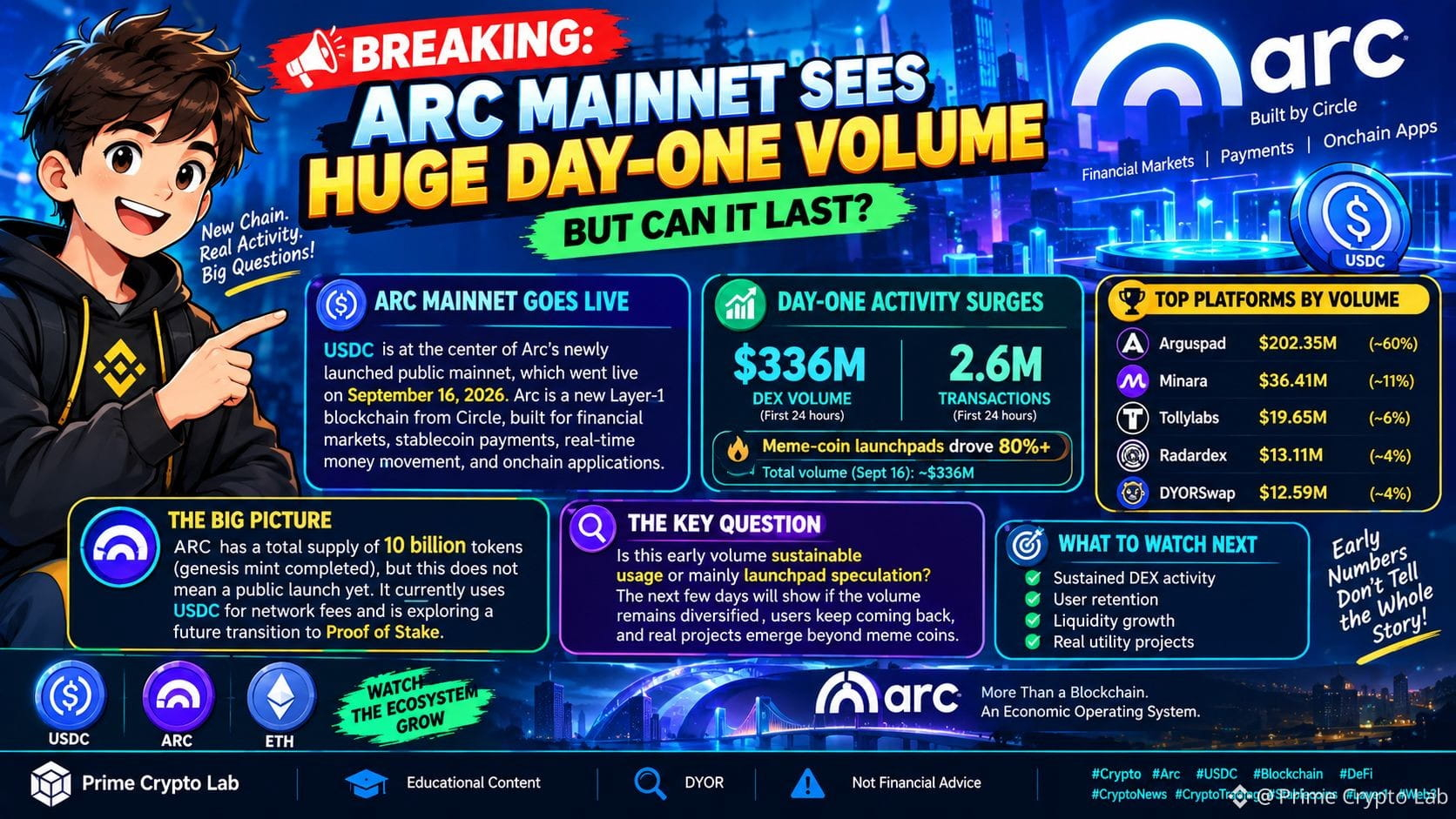
🚨Arc Mainnet Sees Huge Day-One Volume — But Can It Last?
🌐Arc Mainnet Goes Live
$USDC is at the center of Arc’s newly launched public mainnet, which went live on September 16, 2026. Arc is a new Layer-1 blockchain from Circle designed for financial markets, stablecoin payments, real-time money movement, and onchain applications. Circle says Arc launched with more than 100 institutional and ecosystem builders, with USDC used for network gas fees.
📊 Day-One Activity Surges
According to Dune data reported by multiple outlets, Arc recorded approximately $336.26 million in first-day trading volume, with meme-coin launchpads responsible for more than 80% of that activity. Arguspad accounted for about $202.35M, followed by Minara at $36.41M and Tollylabs at $19.65M. Reported transaction activity was also substantial, reaching 7.76 million transactions on September 16.
⚠️ Volume Concentration Is the Key Question
ARC is part of Arc’s longer-term roadmap: Circle says it completed the genesis mint of a 10 billion-token initial supply, but explicitly notes that this does not represent a commitment to publicly launch the token. Arc currently uses $USDC for network fees and is exploring a future transition toward Proof of Stake.
The big question now is whether Arc’s launch-day activity represents sustainable usage or mainly early launchpad speculation. Traders should watch whether volume remains diversified, whether users continue returning after the initial launch excitement, and whether applications beyond meme-coin launchpads begin attracting meaningful activity.
🎯 What to Watch Next
The next few days and weeks could provide a clearer picture of Arc’s ecosystem. Sustained DEX activity, user retention, liquidity growth, and the emergence of applications with real utility will be more informative than a single day of unusually high volume.
$ETH and other established ecosystems also show why early blockchain activity should be evaluated over time rather than judged solely by launch-day numbers.
Prime Crypto Lab — No Hype, Just Research.
🚨Arc Mainnet Sees Huge Day-One Volume — But Can It Last?
🌐Arc Mainnet Goes Live
$USDC is at the center of Arc’s newly launched public mainnet, which went live on September 16, 2026. Arc is a new Layer-1 blockchain from Circle designed for financial markets, stablecoin payments, real-time money movement, and onchain applications. Circle says Arc launched with more than 100 institutional and ecosystem builders, with USDC used for network gas fees.
📊 Day-One Activity Surges
According to Dune data reported by multiple outlets, Arc recorded approximately $336.26 million in first-day trading volume, with meme-coin launchpads responsible for more than 80% of that activity. Arguspad accounted for about $202.35M, followed by Minara at $36.41M and Tollylabs at $19.65M. Reported transaction activity was also substantial, reaching 7.76 million transactions on September 16.
⚠️ Volume Concentration Is the Key Question
ARC is part of Arc’s longer-term roadmap: Circle says it completed the genesis mint of a 10 billion-token initial supply, but explicitly notes that this does not represent a commitment to publicly launch the token. Arc currently uses $USDC for network fees and is exploring a future transition toward Proof of Stake.
The big question now is whether Arc’s launch-day activity represents sustainable usage or mainly early launchpad speculation. Traders should watch whether volume remains diversified, whether users continue returning after the initial launch excitement, and whether applications beyond meme-coin launchpads begin attracting meaningful activity.
🎯 What to Watch Next
The next few days and weeks could provide a clearer picture of Arc’s ecosystem. Sustained DEX activity, user retention, liquidity growth, and the emergence of applications with real utility will be more informative than a single day of unusually high volume.
$ETH and other established ecosystems also show why early blockchain activity should be evaluated over time rather than judged solely by launch-day numbers.
Prime Crypto Lab — No Hype, Just Research.
🌐Arc Mainnet Goes Live
$USDC is at the center of Arc’s newly launched public mainnet, which went live on September 16, 2026. Arc is a new Layer-1 blockchain from Circle designed for financial markets, stablecoin payments, real-time money movement, and onchain applications. Circle says Arc launched with more than 100 institutional and ecosystem builders, with USDC used for network gas fees.
📊 Day-One Activity Surges
According to Dune data reported by multiple outlets, Arc recorded approximately $336.26 million in first-day trading volume, with meme-coin launchpads responsible for more than 80% of that activity. Arguspad accounted for about $202.35M, followed by Minara at $36.41M and Tollylabs at $19.65M. Reported transaction activity was also substantial, reaching 7.76 million transactions on September 16.
⚠️ Volume Concentration Is the Key Question
ARC is part of Arc’s longer-term roadmap: Circle says it completed the genesis mint of a 10 billion-token initial supply, but explicitly notes that this does not represent a commitment to publicly launch the token. Arc currently uses $USDC for network fees and is exploring a future transition toward Proof of Stake.
The big question now is whether Arc’s launch-day activity represents sustainable usage or mainly early launchpad speculation. Traders should watch whether volume remains diversified, whether users continue returning after the initial launch excitement, and whether applications beyond meme-coin launchpads begin attracting meaningful activity.
🎯 What to Watch Next
The next few days and weeks could provide a clearer picture of Arc’s ecosystem. Sustained DEX activity, user retention, liquidity growth, and the emergence of applications with real utility will be more informative than a single day of unusually high volume.
$ETH and other established ecosystems also show why early blockchain activity should be evaluated over time rather than judged solely by launch-day numbers.
Prime Crypto Lab — No Hype, Just Research.
145
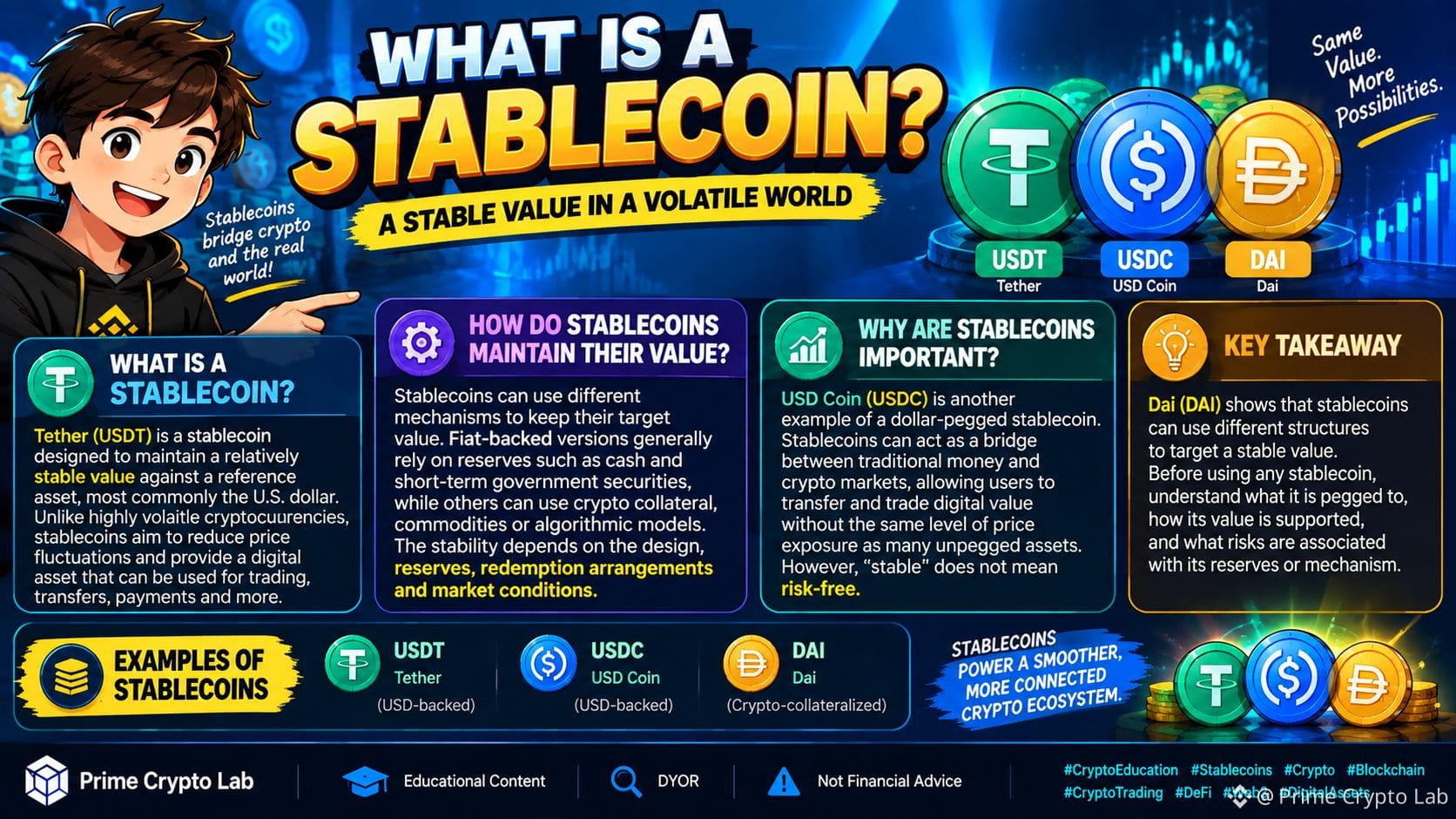
🪙 What Is a Stablecoin?
💵 Understanding Stablecoins
Tether $USDT is a stablecoin designed to maintain a relatively stable value against a reference asset, most commonly the U.S. dollar. Unlike highly volatile cryptocurrencies, stablecoins aim to reduce price fluctuations and provide a digital asset that can be useful for trading, transfers, payments, and moving value across blockchain networks.
🔗 How Do Stablecoins Maintain Their Value?
Stablecoins can use different mechanisms to maintain their target value. Fiat-backed versions generally rely on reserves such as cash and short-term government securities, while other models can use crypto collateral, commodities, or algorithmic mechanisms. This means the stability of a particular stablecoin depends on its design, reserves, redemption arrangements, and market conditions.
📊 Why Are Stablecoins Important?
$USDC Coin (USDC) is another example of a dollar-pegged stablecoin. Stablecoins can act as a bridge between traditional money and crypto markets, allowing users to transfer and trade digital value without taking the same level of price exposure as many unpegged cryptoassets. However, “stable” does not mean risk-free—stablecoins can experience price deviations or other risks.
🎯 Key Takeaway
Dai (DAI) shows that stablecoins can use different structures to target a stable value. Before using any stablecoin, understand what it is pegged to, howl its value is supported, and what risks are associated with its reserves or mechanism.
Prime Crypto Lab — No Hype, Just Research.
DYOR | Educational Content | Not Financial Advice
#cryptoeducation #Stablecoins #crypto #blockchain
🪙 What Is a Stablecoin?
💵 Understanding Stablecoins
Tether $USDT is a stablecoin designed to maintain a relatively stable value against a reference asset, most commonly the U.S. dollar. Unlike highly volatile cryptocurrencies, stablecoins aim to reduce price fluctuations and provide a digital asset that can be useful for trading, transfers, payments, and moving value across blockchain networks.
🔗 How Do Stablecoins Maintain Their Value?
Stablecoins can use different mechanisms to maintain their target value. Fiat-backed versions generally rely on reserves such as cash and short-term government securities, while other models can use crypto collateral, commodities, or algorithmic mechanisms. This means the stability of a particular stablecoin depends on its design, reserves, redemption arrangements, and market conditions.
📊 Why Are Stablecoins Important?
$USDC Coin (USDC) is another example of a dollar-pegged stablecoin. Stablecoins can act as a bridge between traditional money and crypto markets, allowing users to transfer and trade digital value without taking the same level of price exposure as many unpegged cryptoassets. However, “stable” does not mean risk-free—stablecoins can experience price deviations or other risks.
🎯 Key Takeaway
Dai (DAI) shows that stablecoins can use different structures to target a stable value. Before using any stablecoin, understand what it is pegged to, howl its value is supported, and what risks are associated with its reserves or mechanism.
Prime Crypto Lab — No Hype, Just Research.
DYOR | Educational Content | Not Financial Advice
#cryptoeducation #Stablecoins #crypto #blockchain
💵 Understanding Stablecoins
Tether $USDT is a stablecoin designed to maintain a relatively stable value against a reference asset, most commonly the U.S. dollar. Unlike highly volatile cryptocurrencies, stablecoins aim to reduce price fluctuations and provide a digital asset that can be useful for trading, transfers, payments, and moving value across blockchain networks.
🔗 How Do Stablecoins Maintain Their Value?
Stablecoins can use different mechanisms to maintain their target value. Fiat-backed versions generally rely on reserves such as cash and short-term government securities, while other models can use crypto collateral, commodities, or algorithmic mechanisms. This means the stability of a particular stablecoin depends on its design, reserves, redemption arrangements, and market conditions.
📊 Why Are Stablecoins Important?
$USDC Coin (USDC) is another example of a dollar-pegged stablecoin. Stablecoins can act as a bridge between traditional money and crypto markets, allowing users to transfer and trade digital value without taking the same level of price exposure as many unpegged cryptoassets. However, “stable” does not mean risk-free—stablecoins can experience price deviations or other risks.
🎯 Key Takeaway
Dai (DAI) shows that stablecoins can use different structures to target a stable value. Before using any stablecoin, understand what it is pegged to, howl its value is supported, and what risks are associated with its reserves or mechanism.
Prime Crypto Lab — No Hype, Just Research.
DYOR | Educational Content | Not Financial Advice
#cryptoeducation #Stablecoins #crypto #blockchain
52
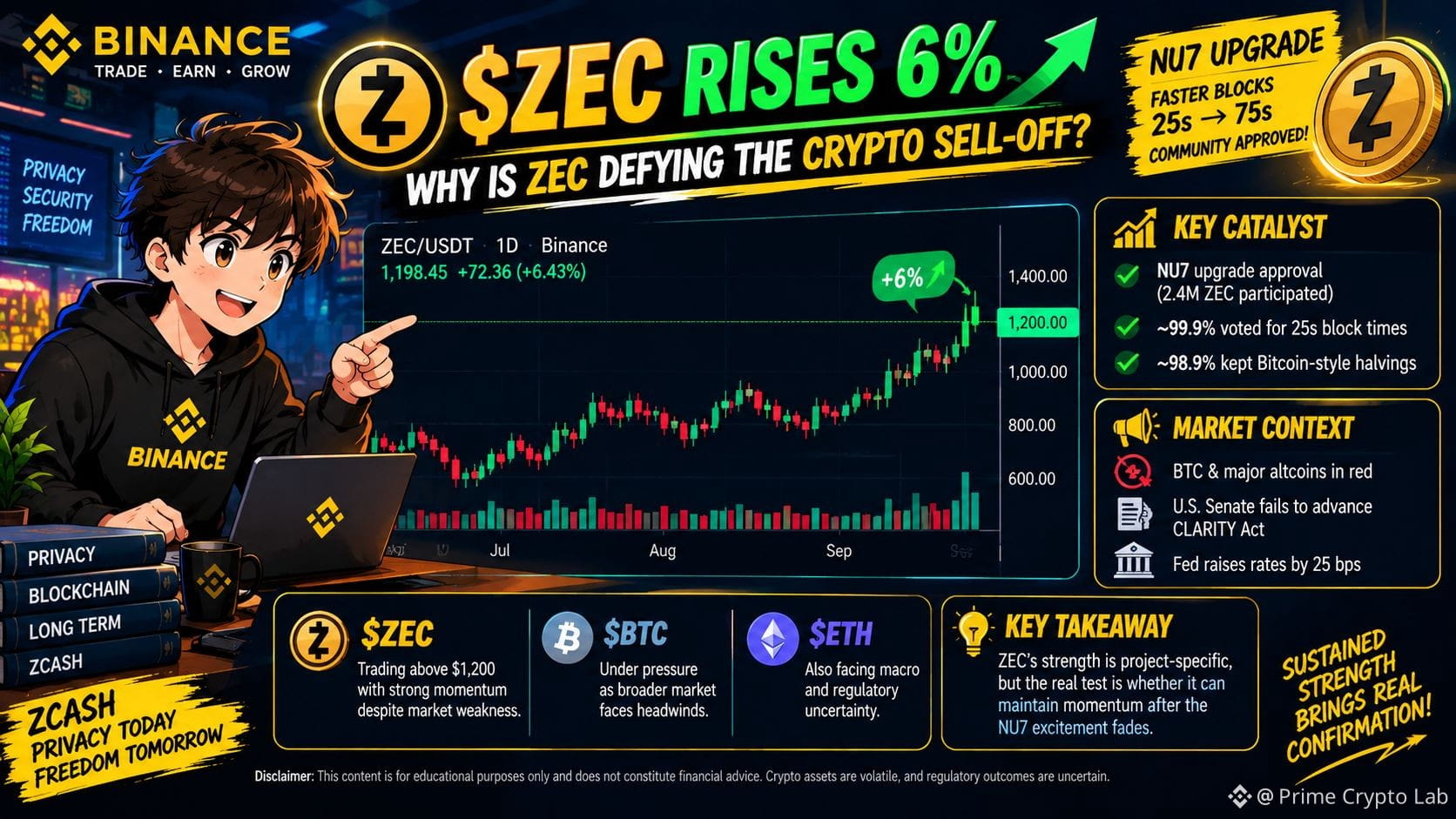
⚡$ZEC Rises as Crypto Market Sells Off — Is NU7 the Catalyst?
While much of the crypto market faced selling pressure, Zcash moved in the opposite direction, gaining roughly 6–7% on September 16 and trading around the $1,180–$1,200 area.
🚀 NU7 Vote Creates a Project-Specific Catalyst
The move comes as Zcash holders strongly backed key changes for the upcoming NU7 upgrade. Around 2.4 million ZEC participated in the vote, with approximately 99.9% supporting a reduction in block target spacing from 75 seconds to 25 seconds.
🪙 Bitcoin-Style Halvings Remain
Nearly 98.9% of participating ZEC also supported preserving the existing halving structure rather than moving to a smoother issuance model. This keeps the network's current scarcity narrative intact.
📉 Why Is ZEC Standing Out?
The broader market has been dealing with regulatory and macro pressure. The U.S. Senate failed to advance the CLARITY Act, while the Federal Reserve raised rates by 25 basis points on September 16. Against that backdrop, Zcash's relative strength has attracted additional attention.
For $BTC , the key contrast is clear: Bitcoin was under pressure while ZEC continued to outperform during the same period.
👀 What Traders Should Watch
The NU7 vote is a meaningful catalyst, but the upgrade is not automatically activated by the vote. Zcash's official documentation says the NU7 activation height has not yet been set.
The bigger question is whether $ZEC can maintain its relative strength after the initial NU7 excitement fades.
A green candle attracts attention. Sustained strength requires confirmation.
Disclaimer: This content is for educational purposes only, not financial advice. Always conduct your own research and manage risk carefully.
#zcash #zec #crypto #NU7 #CryptoMarket
{spot}(ZECUSDT)
⚡$ZEC Rises as Crypto Market Sells Off — Is NU7 the Catalyst?
While much of the crypto market faced selling pressure, Zcash moved in the opposite direction, gaining roughly 6–7% on September 16 and trading around the $1,180–$1,200 area.
🚀 NU7 Vote Creates a Project-Specific Catalyst
The move comes as Zcash holders strongly backed key changes for the upcoming NU7 upgrade. Around 2.4 million ZEC participated in the vote, with approximately 99.9% supporting a reduction in block target spacing from 75 seconds to 25 seconds.
🪙 Bitcoin-Style Halvings Remain
Nearly 98.9% of participating ZEC also supported preserving the existing halving structure rather than moving to a smoother issuance model. This keeps the network's current scarcity narrative intact.
📉 Why Is ZEC Standing Out?
The broader market has been dealing with regulatory and macro pressure. The U.S. Senate failed to advance the CLARITY Act, while the Federal Reserve raised rates by 25 basis points on September 16. Against that backdrop, Zcash's relative strength has attracted additional attention.
For $BTC , the key contrast is clear: Bitcoin was under pressure while ZEC continued to outperform during the same period.
👀 What Traders Should Watch
The NU7 vote is a meaningful catalyst, but the upgrade is not automatically activated by the vote. Zcash's official documentation says the NU7 activation height has not yet been set.
The bigger question is whether $ZEC can maintain its relative strength after the initial NU7 excitement fades.
A green candle attracts attention. Sustained strength requires confirmation.
Disclaimer: This content is for educational purposes only, not financial advice. Always conduct your own research and manage risk carefully.
#zcash #zec #crypto #NU7 #CryptoMarket
While much of the crypto market faced selling pressure, Zcash moved in the opposite direction, gaining roughly 6–7% on September 16 and trading around the $1,180–$1,200 area.
🚀 NU7 Vote Creates a Project-Specific Catalyst
The move comes as Zcash holders strongly backed key changes for the upcoming NU7 upgrade. Around 2.4 million ZEC participated in the vote, with approximately 99.9% supporting a reduction in block target spacing from 75 seconds to 25 seconds.
🪙 Bitcoin-Style Halvings Remain
Nearly 98.9% of participating ZEC also supported preserving the existing halving structure rather than moving to a smoother issuance model. This keeps the network's current scarcity narrative intact.
📉 Why Is ZEC Standing Out?
The broader market has been dealing with regulatory and macro pressure. The U.S. Senate failed to advance the CLARITY Act, while the Federal Reserve raised rates by 25 basis points on September 16. Against that backdrop, Zcash's relative strength has attracted additional attention.
For $BTC , the key contrast is clear: Bitcoin was under pressure while ZEC continued to outperform during the same period.
👀 What Traders Should Watch
The NU7 vote is a meaningful catalyst, but the upgrade is not automatically activated by the vote. Zcash's official documentation says the NU7 activation height has not yet been set.
The bigger question is whether $ZEC can maintain its relative strength after the initial NU7 excitement fades.
A green candle attracts attention. Sustained strength requires confirmation.
Disclaimer: This content is for educational purposes only, not financial advice. Always conduct your own research and manage risk carefully.
#zcash #zec #crypto #NU7 #CryptoMarket
288
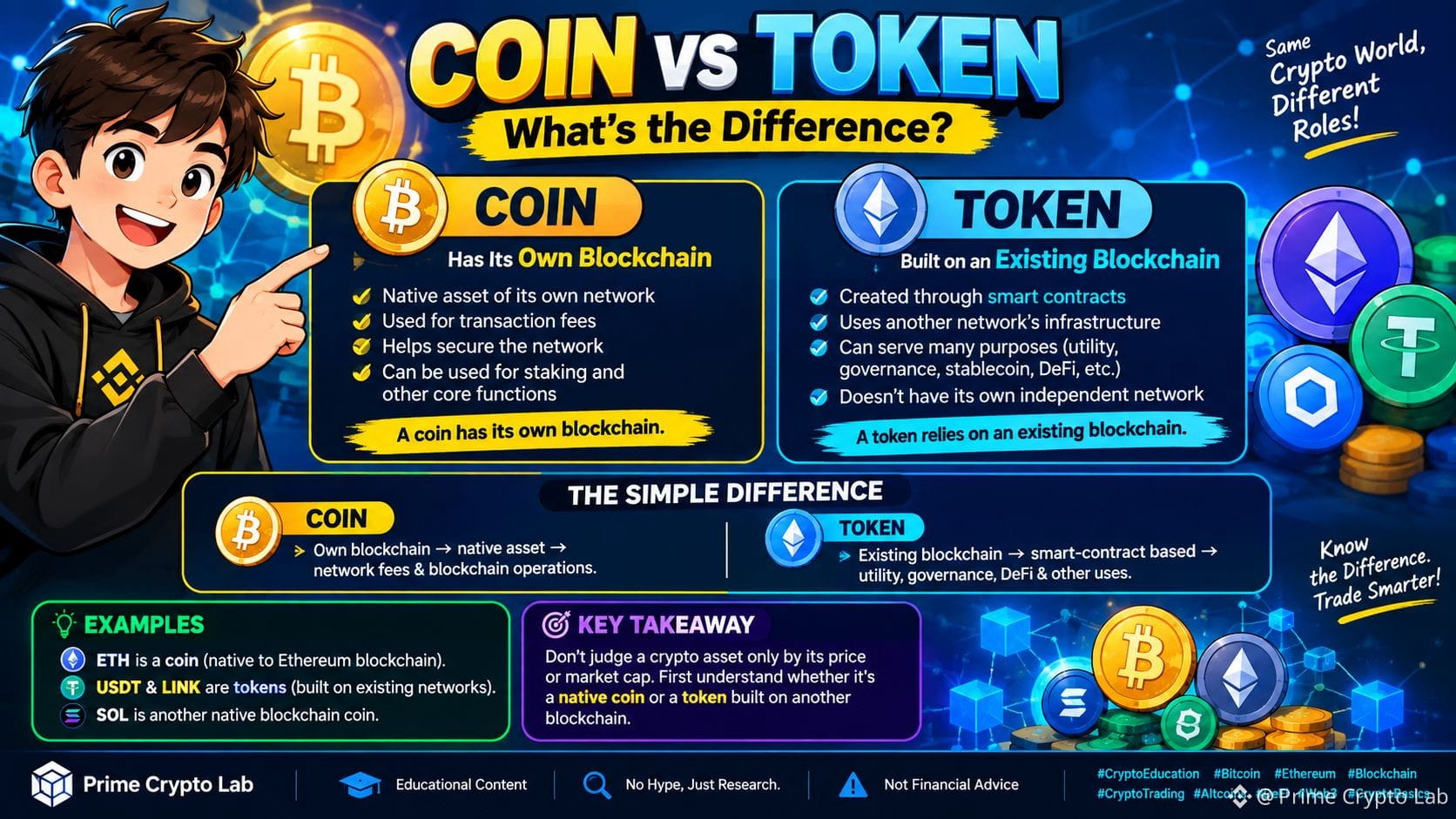
🪙Coin vs Token — What’s the Difference?
Bitcoin $BTC is a coin because it is the native asset of its own blockchain. Coins generally operate at the base layer of a network and can be used for transaction fees, network security, staking or other core blockchain functions. The easiest way to remember it is: a coin has its own blockchain.
🔗 What Is a Token?
A token is created on top of an existing blockchain rather than having its own independent network. Tokens are commonly issued through smart contracts and can serve many purposes, including utility, governance, stablecoins, DeFi applications and digital assets. Because they rely on a host blockchain, they use that network's infrastructure and security.
⚡Coin vs Token — The Simple Difference
Coin: Own blockchain → native asset → network fees & blockchain operations.
Token: Existing blockchain → smart-contract based → utility, governance, DeFi & other uses.
For example, Ethereum $ETH is a coin because it is native to the Ethereum blockchain, while assets such as USDT and LINK can operate as tokens on existing networks. Understanding this difference helps you better understand how crypto projects are actually structured.
🎯 Key Takeaway
Don't judge a crypto asset only by its price or market cap. First understand whether it is a native coin or a token built on another blockchain. Solana $SOL is another example of a native blockchain coin, while tokens can be created within the Solana ecosystem or other existing networks.
Prime Crypto Lab — No Hype, Just Research.
DYOR | Educational Content | Not Financial Advice
#cryptoeducation #crypto #bitcoin #blockchain #cryptotrading
🪙Coin vs Token — What’s the Difference?
Bitcoin $BTC is a coin because it is the native asset of its own blockchain. Coins generally operate at the base layer of a network and can be used for transaction fees, network security, staking or other core blockchain functions. The easiest way to remember it is: a coin has its own blockchain.
🔗 What Is a Token?
A token is created on top of an existing blockchain rather than having its own independent network. Tokens are commonly issued through smart contracts and can serve many purposes, including utility, governance, stablecoins, DeFi applications and digital assets. Because they rely on a host blockchain, they use that network's infrastructure and security.
⚡Coin vs Token — The Simple Difference
Coin: Own blockchain → native asset → network fees & blockchain operations.
Token: Existing blockchain → smart-contract based → utility, governance, DeFi & other uses.
For example, Ethereum $ETH is a coin because it is native to the Ethereum blockchain, while assets such as USDT and LINK can operate as tokens on existing networks. Understanding this difference helps you better understand how crypto projects are actually structured.
🎯 Key Takeaway
Don't judge a crypto asset only by its price or market cap. First understand whether it is a native coin or a token built on another blockchain. Solana $SOL is another example of a native blockchain coin, while tokens can be created within the Solana ecosystem or other existing networks.
Prime Crypto Lab — No Hype, Just Research.
DYOR | Educational Content | Not Financial Advice
#cryptoeducation #crypto #bitcoin #blockchain #cryptotrading
Bitcoin $BTC is a coin because it is the native asset of its own blockchain. Coins generally operate at the base layer of a network and can be used for transaction fees, network security, staking or other core blockchain functions. The easiest way to remember it is: a coin has its own blockchain.
🔗 What Is a Token?
A token is created on top of an existing blockchain rather than having its own independent network. Tokens are commonly issued through smart contracts and can serve many purposes, including utility, governance, stablecoins, DeFi applications and digital assets. Because they rely on a host blockchain, they use that network's infrastructure and security.
⚡Coin vs Token — The Simple Difference
Coin: Own blockchain → native asset → network fees & blockchain operations.
Token: Existing blockchain → smart-contract based → utility, governance, DeFi & other uses.
For example, Ethereum $ETH is a coin because it is native to the Ethereum blockchain, while assets such as USDT and LINK can operate as tokens on existing networks. Understanding this difference helps you better understand how crypto projects are actually structured.
🎯 Key Takeaway
Don't judge a crypto asset only by its price or market cap. First understand whether it is a native coin or a token built on another blockchain. Solana $SOL is another example of a native blockchain coin, while tokens can be created within the Solana ecosystem or other existing networks.
Prime Crypto Lab — No Hype, Just Research.
DYOR | Educational Content | Not Financial Advice
#cryptoeducation #crypto #bitcoin #blockchain #cryptotrading
91
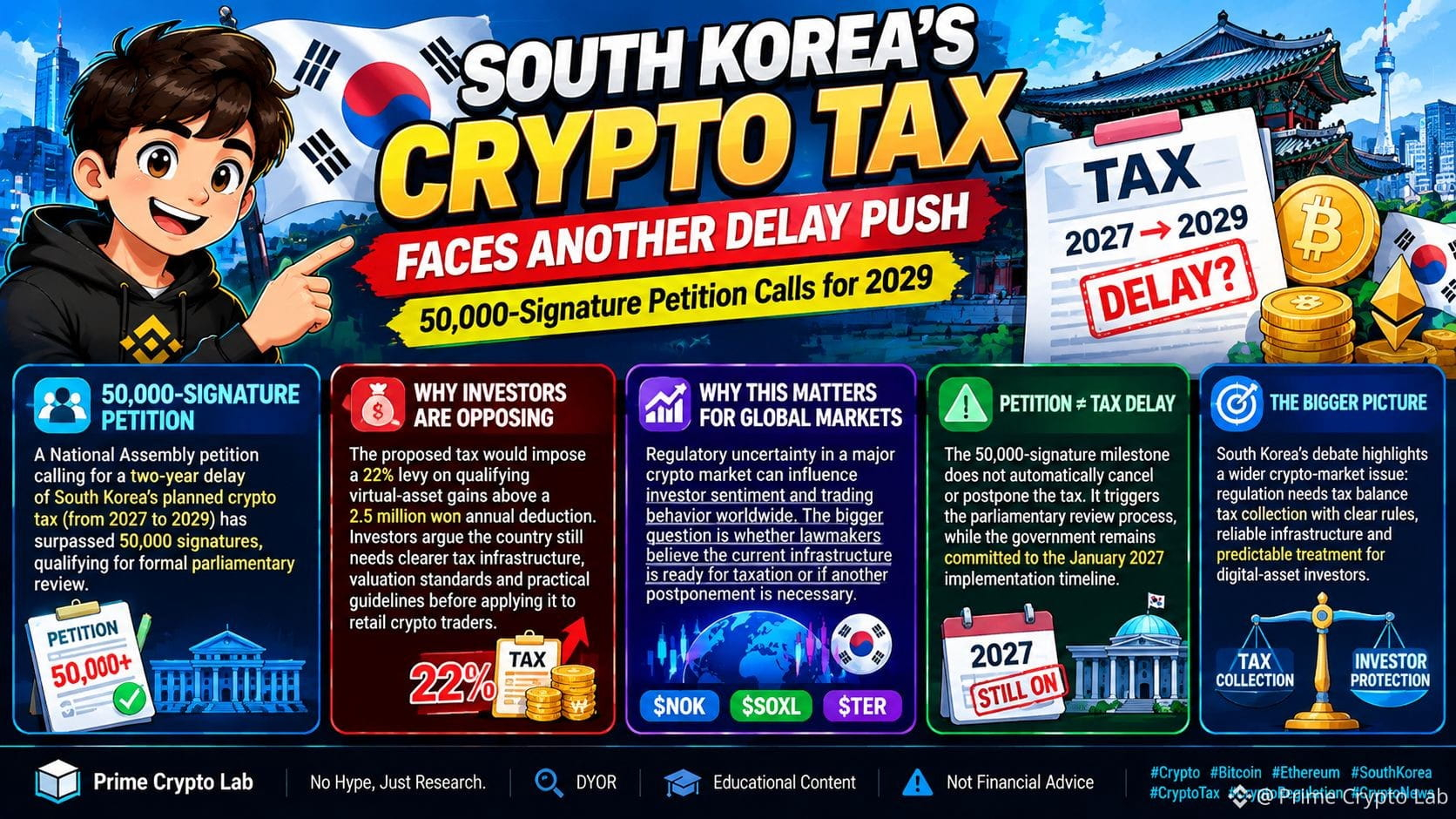
⚖️ South Korea’s Crypto Tax Faces Another Delay Push
🇰🇷 50,000-Signature Petition
$NOK — South Korea’s planned cryptocurrency tax is facing renewed pressure from retail investors after a National Assembly petition calling for a two-year delay, from 2027 to 2029, surpassed 50,000 signatures. Reaching that threshold qualifies the petition for formal review by the relevant parliamentary committee.
💰Why Investors Are Opposing the Tax
The proposed system would impose a 22% tax on qualifying virtual-asset gains above a 2.5 million won annual deduction. Supporters of the delay argue that the country still needs clearer tax infrastructure, valuation standards and practical guidelines before applying the system to retail crypto investors.
📊 Why This Matters for Crypto Markets
$SOXL — Although the petition is focused on South Korea, regulatory uncertainty in a major crypto market can influence investor sentiment and trading behavior. The bigger issue is whether lawmakers believe the current infrastructure is ready for taxation or whether another postponement is necessary. Some lawmakers have also proposed separate delays extending into 2029 or even 2030.
⚠️ Petition ≠ Tax Delay
The 50,000-signature milestone does not automatically cancel or postpone the tax. It triggers the parliamentary review process, while the government currently remains committed to the January 2027 implementation timeline. Traders should therefore watch the National Assembly, tax authorities and any new legislative proposals before assuming a policy change is confirmed.
🌍 Bigger Picture
$TER — South Korea's debate highlights a wider crypto-market issue: regulation needs to balance tax collection with clear rules, reliable infrastructure and predictable treatment for digital-asset investors.
Prime Crypto Lab — No Hype, Just Research.
DYOR | Educational Content | Not Financial Advice
#crypto #bitcoin #Ethereum✅ #SouthKorean #cryptotax
⚖️ South Korea’s Crypto Tax Faces Another Delay Push
🇰🇷 50,000-Signature Petition
$NOK — South Korea’s planned cryptocurrency tax is facing renewed pressure from retail investors after a National Assembly petition calling for a two-year delay, from 2027 to 2029, surpassed 50,000 signatures. Reaching that threshold qualifies the petition for formal review by the relevant parliamentary committee.
💰Why Investors Are Opposing the Tax
The proposed system would impose a 22% tax on qualifying virtual-asset gains above a 2.5 million won annual deduction. Supporters of the delay argue that the country still needs clearer tax infrastructure, valuation standards and practical guidelines before applying the system to retail crypto investors.
📊 Why This Matters for Crypto Markets
$SOXL — Although the petition is focused on South Korea, regulatory uncertainty in a major crypto market can influence investor sentiment and trading behavior. The bigger issue is whether lawmakers believe the current infrastructure is ready for taxation or whether another postponement is necessary. Some lawmakers have also proposed separate delays extending into 2029 or even 2030.
⚠️ Petition ≠ Tax Delay
The 50,000-signature milestone does not automatically cancel or postpone the tax. It triggers the parliamentary review process, while the government currently remains committed to the January 2027 implementation timeline. Traders should therefore watch the National Assembly, tax authorities and any new legislative proposals before assuming a policy change is confirmed.
🌍 Bigger Picture
$TER — South Korea's debate highlights a wider crypto-market issue: regulation needs to balance tax collection with clear rules, reliable infrastructure and predictable treatment for digital-asset investors.
Prime Crypto Lab — No Hype, Just Research.
DYOR | Educational Content | Not Financial Advice
#crypto #bitcoin #Ethereum✅ #SouthKorean #cryptotax
🇰🇷 50,000-Signature Petition
$NOK — South Korea’s planned cryptocurrency tax is facing renewed pressure from retail investors after a National Assembly petition calling for a two-year delay, from 2027 to 2029, surpassed 50,000 signatures. Reaching that threshold qualifies the petition for formal review by the relevant parliamentary committee.
💰Why Investors Are Opposing the Tax
The proposed system would impose a 22% tax on qualifying virtual-asset gains above a 2.5 million won annual deduction. Supporters of the delay argue that the country still needs clearer tax infrastructure, valuation standards and practical guidelines before applying the system to retail crypto investors.
📊 Why This Matters for Crypto Markets
$SOXL — Although the petition is focused on South Korea, regulatory uncertainty in a major crypto market can influence investor sentiment and trading behavior. The bigger issue is whether lawmakers believe the current infrastructure is ready for taxation or whether another postponement is necessary. Some lawmakers have also proposed separate delays extending into 2029 or even 2030.
⚠️ Petition ≠ Tax Delay
The 50,000-signature milestone does not automatically cancel or postpone the tax. It triggers the parliamentary review process, while the government currently remains committed to the January 2027 implementation timeline. Traders should therefore watch the National Assembly, tax authorities and any new legislative proposals before assuming a policy change is confirmed.
🌍 Bigger Picture
$TER — South Korea's debate highlights a wider crypto-market issue: regulation needs to balance tax collection with clear rules, reliable infrastructure and predictable treatment for digital-asset investors.
Prime Crypto Lab — No Hype, Just Research.
DYOR | Educational Content | Not Financial Advice
#crypto #bitcoin #Ethereum✅ #SouthKorean #cryptotax
61
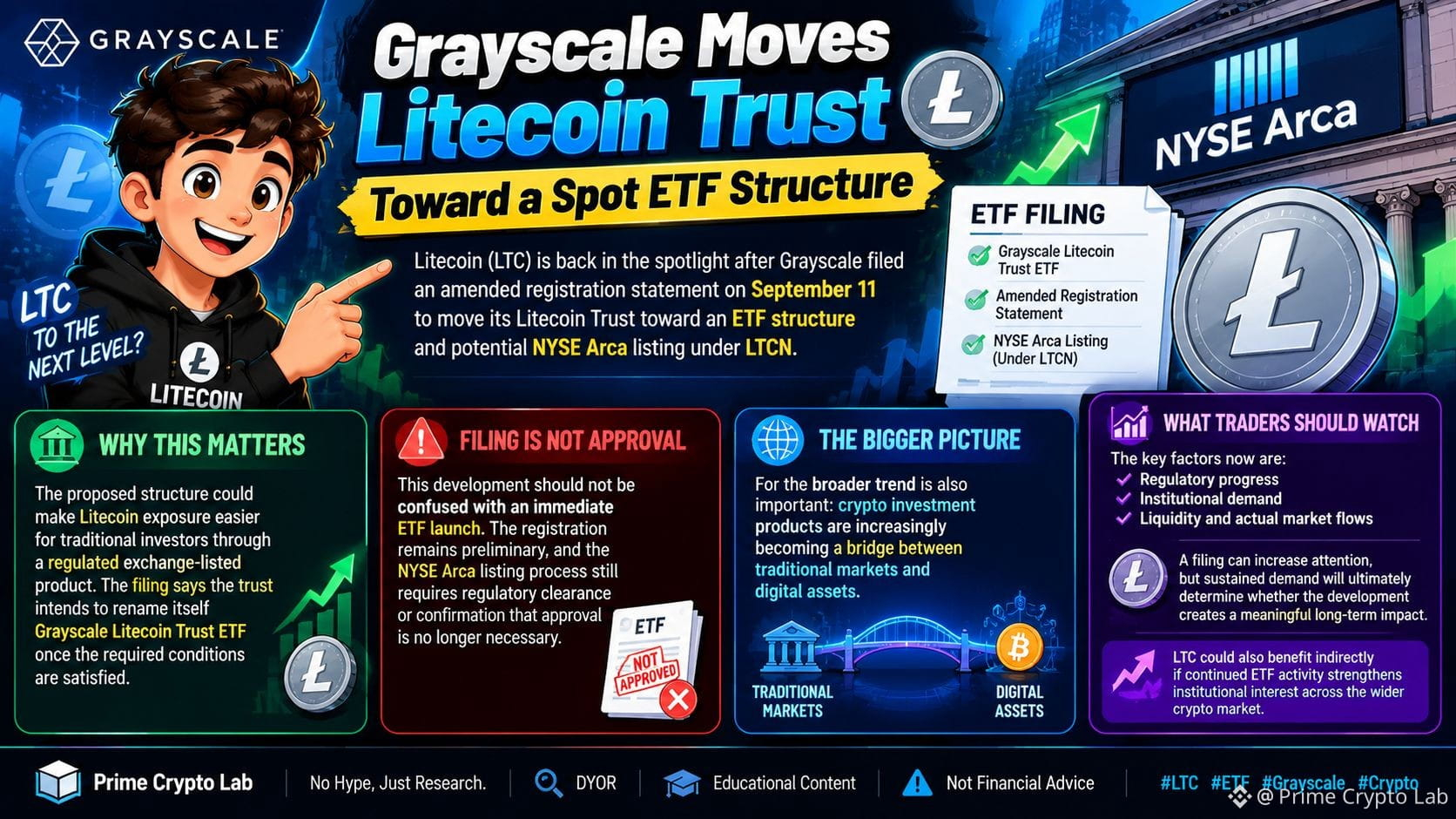
🚨Grayscale Moves Litecoin Trust Toward a Spot ETF Structure
$LTC is back in the spotlight after Grayscale filed an amended registration statement on September 11 to move its Litecoin Trust toward an ETF structure and potential NYSE Arca listing under LTCN. 🏦 Why This Matters
The proposed structure could make Litecoin exposure easier for traditional investors through a regulated exchange-listed product. The filing says the trust intends to rename itself Grayscale Litecoin Trust ETF once the required conditions are satisfied.
⚠️ Filing Is Not Approval
This development should not be confused with an immediate ETF launch. The registration remains preliminary, and the NYSE Arca listing process still requires regulatory clearance or confirmation that approval is no longer necessary.
For $ETH , the broader trend is also important: crypto investment products are increasingly becoming a bridge between traditional markets and digital assets.
📊 What Traders Should Watch
The key factors now are regulatory progress, institutional demand, liquidity and actual market flows. A filing can increase attention, but sustained demand will ultimately determine whether the development creates a meaningful long-term impact.
$SOL could also benefit indirectly if continued ETF activity strengthens institutional interest across the wider crypto market.
Disclaimer: This content is for informational purposes only and does not constitute financial advice. Crypto assets are volatile and regulatory outcomes remain uncertain.
#Litecoin #CryptoETF #Grayscale #crypto #DigitalAssets"
🚨Grayscale Moves Litecoin Trust Toward a Spot ETF Structure
$LTC is back in the spotlight after Grayscale filed an amended registration statement on September 11 to move its Litecoin Trust toward an ETF structure and potential NYSE Arca listing under LTCN. 🏦 Why This Matters
The proposed structure could make Litecoin exposure easier for traditional investors through a regulated exchange-listed product. The filing says the trust intends to rename itself Grayscale Litecoin Trust ETF once the required conditions are satisfied.
⚠️ Filing Is Not Approval
This development should not be confused with an immediate ETF launch. The registration remains preliminary, and the NYSE Arca listing process still requires regulatory clearance or confirmation that approval is no longer necessary.
For $ETH , the broader trend is also important: crypto investment products are increasingly becoming a bridge between traditional markets and digital assets.
📊 What Traders Should Watch
The key factors now are regulatory progress, institutional demand, liquidity and actual market flows. A filing can increase attention, but sustained demand will ultimately determine whether the development creates a meaningful long-term impact.
$SOL could also benefit indirectly if continued ETF activity strengthens institutional interest across the wider crypto market.
Disclaimer: This content is for informational purposes only and does not constitute financial advice. Crypto assets are volatile and regulatory outcomes remain uncertain.
#Litecoin #CryptoETF #Grayscale #crypto #DigitalAssets"
$LTC is back in the spotlight after Grayscale filed an amended registration statement on September 11 to move its Litecoin Trust toward an ETF structure and potential NYSE Arca listing under LTCN. 🏦 Why This Matters
The proposed structure could make Litecoin exposure easier for traditional investors through a regulated exchange-listed product. The filing says the trust intends to rename itself Grayscale Litecoin Trust ETF once the required conditions are satisfied.
⚠️ Filing Is Not Approval
This development should not be confused with an immediate ETF launch. The registration remains preliminary, and the NYSE Arca listing process still requires regulatory clearance or confirmation that approval is no longer necessary.
For $ETH , the broader trend is also important: crypto investment products are increasingly becoming a bridge between traditional markets and digital assets.
📊 What Traders Should Watch
The key factors now are regulatory progress, institutional demand, liquidity and actual market flows. A filing can increase attention, but sustained demand will ultimately determine whether the development creates a meaningful long-term impact.
$SOL could also benefit indirectly if continued ETF activity strengthens institutional interest across the wider crypto market.
Disclaimer: This content is for informational purposes only and does not constitute financial advice. Crypto assets are volatile and regulatory outcomes remain uncertain.
#Litecoin #CryptoETF #Grayscale #crypto #DigitalAssets"
89
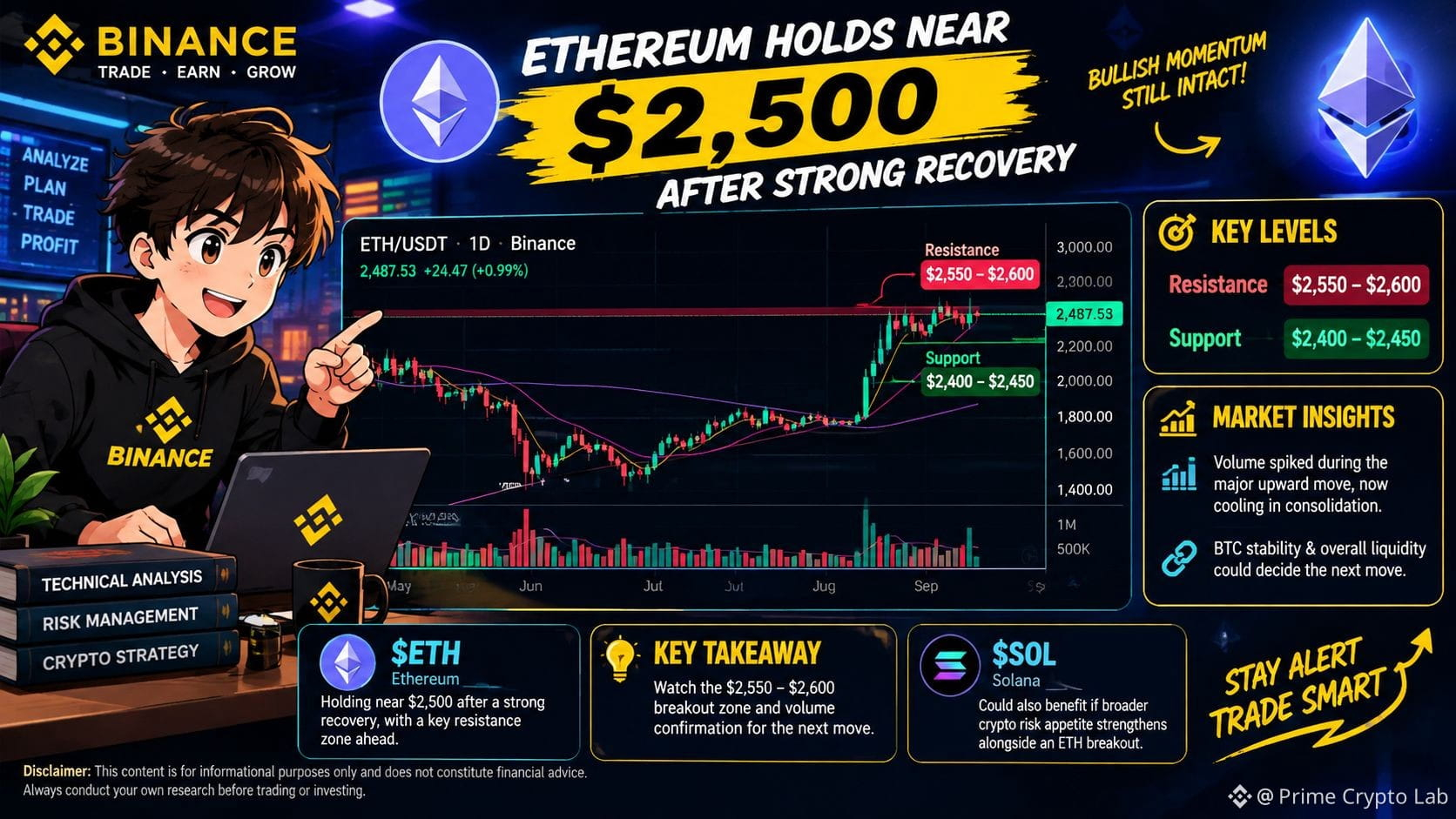
🚀 Ethereum Holds Near $2,500 After Strong Recovery
$ETH is consolidating around the $2,480–$2,500 area after a strong recovery from the lower $1,500 zone. The daily chart shows bullish momentum remains intact, but price is now approaching an important resistance region.
📈 Key Resistance & Support
ETH is facing immediate resistance around $2,550–$2,600. A strong daily breakout above this zone with rising volume could open the way for further upside. On the downside, $2,400–$2,450 is the first support area, while the broader trend remains constructive above the recent breakout zone.
🔎 Market Momentum
Recent volume increased sharply during the major upward move, while volume has started cooling during the current consolidation. $BTC stability and overall market liquidity could play an important role in determining whether Ethereum breaks higher or enters another pullback.
⚡ Key Takeaway
Ethereum is holding near a major psychological level. Traders should watch the $2,550–$2,600 breakout zone and volume confirmation before expecting the next major move.
$SOL could also benefit if broader crypto risk appetite strengthens alongside an $ETH breakout.
Disclaimer: This content is for informational purposes only and does not constitute financial advice. Always conduct your own research before trading or investing.
#Ethereum #crypto #bitcoin #solana #TechnicalAnalysis
{spot}(ETHUSDT)
🚀 Ethereum Holds Near $2,500 After Strong Recovery
$ETH is consolidating around the $2,480–$2,500 area after a strong recovery from the lower $1,500 zone. The daily chart shows bullish momentum remains intact, but price is now approaching an important resistance region.
📈 Key Resistance & Support
ETH is facing immediate resistance around $2,550–$2,600. A strong daily breakout above this zone with rising volume could open the way for further upside. On the downside, $2,400–$2,450 is the first support area, while the broader trend remains constructive above the recent breakout zone.
🔎 Market Momentum
Recent volume increased sharply during the major upward move, while volume has started cooling during the current consolidation. $BTC stability and overall market liquidity could play an important role in determining whether Ethereum breaks higher or enters another pullback.
⚡ Key Takeaway
Ethereum is holding near a major psychological level. Traders should watch the $2,550–$2,600 breakout zone and volume confirmation before expecting the next major move.
$SOL could also benefit if broader crypto risk appetite strengthens alongside an $ETH breakout.
Disclaimer: This content is for informational purposes only and does not constitute financial advice. Always conduct your own research before trading or investing.
#Ethereum #crypto #bitcoin #solana #TechnicalAnalysis
$ETH is consolidating around the $2,480–$2,500 area after a strong recovery from the lower $1,500 zone. The daily chart shows bullish momentum remains intact, but price is now approaching an important resistance region.
📈 Key Resistance & Support
ETH is facing immediate resistance around $2,550–$2,600. A strong daily breakout above this zone with rising volume could open the way for further upside. On the downside, $2,400–$2,450 is the first support area, while the broader trend remains constructive above the recent breakout zone.
🔎 Market Momentum
Recent volume increased sharply during the major upward move, while volume has started cooling during the current consolidation. $BTC stability and overall market liquidity could play an important role in determining whether Ethereum breaks higher or enters another pullback.
⚡ Key Takeaway
Ethereum is holding near a major psychological level. Traders should watch the $2,550–$2,600 breakout zone and volume confirmation before expecting the next major move.
$SOL could also benefit if broader crypto risk appetite strengthens alongside an $ETH breakout.
Disclaimer: This content is for informational purposes only and does not constitute financial advice. Always conduct your own research before trading or investing.
#Ethereum #crypto #bitcoin #solana #TechnicalAnalysis
73
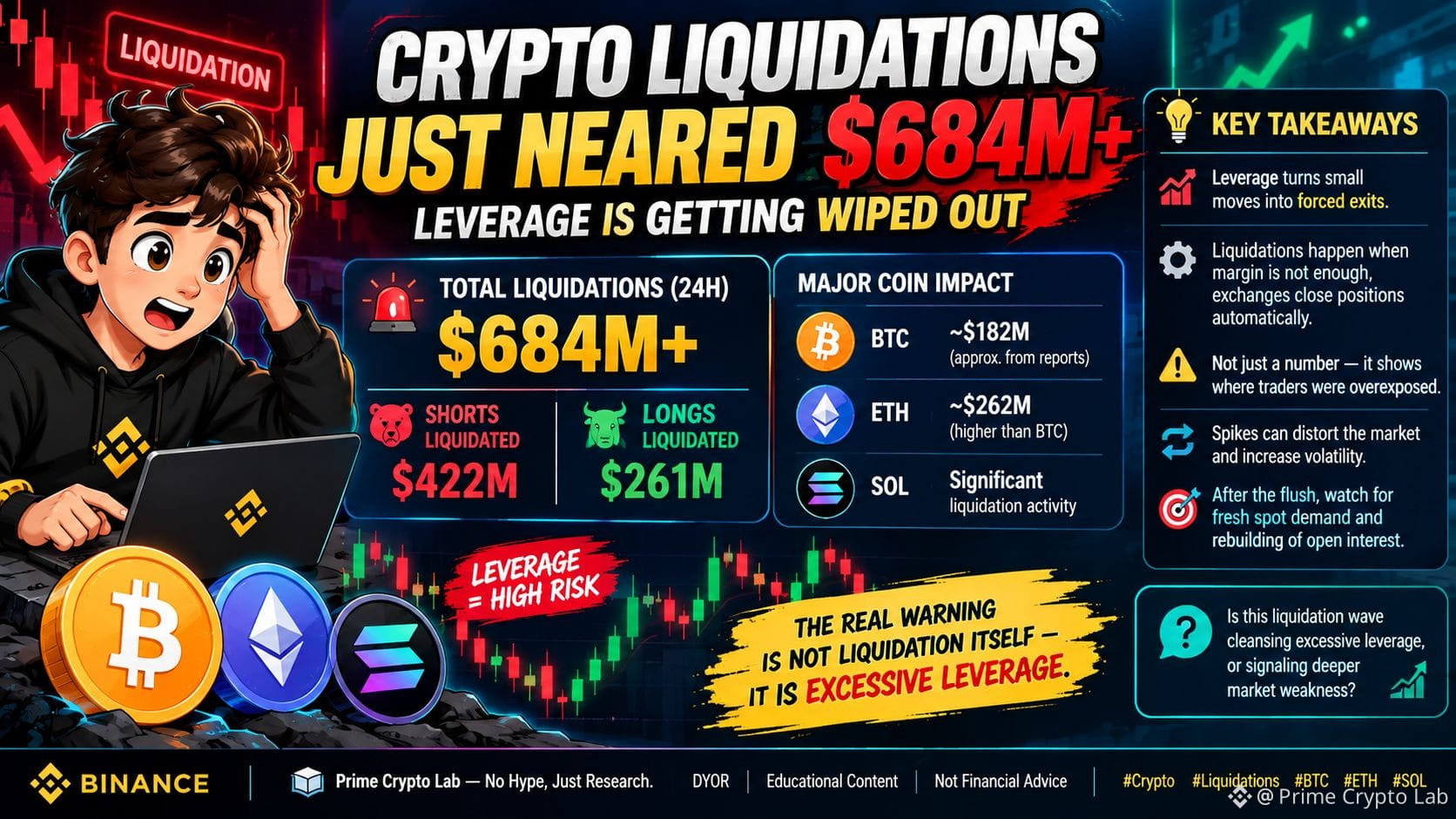
🚨Crypto Liquidations Surge: What a $680M+ Leverage Flush Tells Us
Bitcoin $BTC and the broader crypto derivatives market recently experienced a major liquidation wave, with more than $684 million in leveraged positions reportedly wiped out within 24 hours. Short positions accounted for approximately $422 million, compared with around $261 million in long liquidations, highlighting how quickly leveraged traders can be forced out when price moves sharply.
The headline number matters, but the bigger lesson is leverage management. Ethereum $ETH reportedly recorded around $262 million in liquidations during the same wave, even exceeding Bitcoin's liquidation volume of roughly $182 million. These forced closures can temporarily amplify price movements because exchanges automatically close positions when traders no longer have enough margin.
For Solana $SOL and other major assets, liquidation spikes should not automatically be interpreted as proof of either a bullish or bearish market. They mainly show that leveraged positioning has been cleared and volatility has increased. After a major liquidation event, traders should watch whether fresh spot demand returns, whether open interest rebuilds aggressively, and whether price can maintain its structure without excessive leverage. The real warning is not liquidation itself — it is excessive leverage.
Prime Crypto Lab — No Hype, Just Research.
DYOR | Educational Content | Not Financial Advice
#crypto #Liquidations #bitcoin #BTC #Ethereum
🚨Crypto Liquidations Surge: What a $680M+ Leverage Flush Tells Us
Bitcoin $BTC and the broader crypto derivatives market recently experienced a major liquidation wave, with more than $684 million in leveraged positions reportedly wiped out within 24 hours. Short positions accounted for approximately $422 million, compared with around $261 million in long liquidations, highlighting how quickly leveraged traders can be forced out when price moves sharply.
The headline number matters, but the bigger lesson is leverage management. Ethereum $ETH reportedly recorded around $262 million in liquidations during the same wave, even exceeding Bitcoin's liquidation volume of roughly $182 million. These forced closures can temporarily amplify price movements because exchanges automatically close positions when traders no longer have enough margin.
For Solana $SOL and other major assets, liquidation spikes should not automatically be interpreted as proof of either a bullish or bearish market. They mainly show that leveraged positioning has been cleared and volatility has increased. After a major liquidation event, traders should watch whether fresh spot demand returns, whether open interest rebuilds aggressively, and whether price can maintain its structure without excessive leverage. The real warning is not liquidation itself — it is excessive leverage.
Prime Crypto Lab — No Hype, Just Research.
DYOR | Educational Content | Not Financial Advice
#crypto #Liquidations #bitcoin #BTC #Ethereum
Bitcoin $BTC and the broader crypto derivatives market recently experienced a major liquidation wave, with more than $684 million in leveraged positions reportedly wiped out within 24 hours. Short positions accounted for approximately $422 million, compared with around $261 million in long liquidations, highlighting how quickly leveraged traders can be forced out when price moves sharply.
The headline number matters, but the bigger lesson is leverage management. Ethereum $ETH reportedly recorded around $262 million in liquidations during the same wave, even exceeding Bitcoin's liquidation volume of roughly $182 million. These forced closures can temporarily amplify price movements because exchanges automatically close positions when traders no longer have enough margin.
For Solana $SOL and other major assets, liquidation spikes should not automatically be interpreted as proof of either a bullish or bearish market. They mainly show that leveraged positioning has been cleared and volatility has increased. After a major liquidation event, traders should watch whether fresh spot demand returns, whether open interest rebuilds aggressively, and whether price can maintain its structure without excessive leverage. The real warning is not liquidation itself — it is excessive leverage.
Prime Crypto Lab — No Hype, Just Research.
DYOR | Educational Content | Not Financial Advice
#crypto #Liquidations #bitcoin #BTC #Ethereum
94
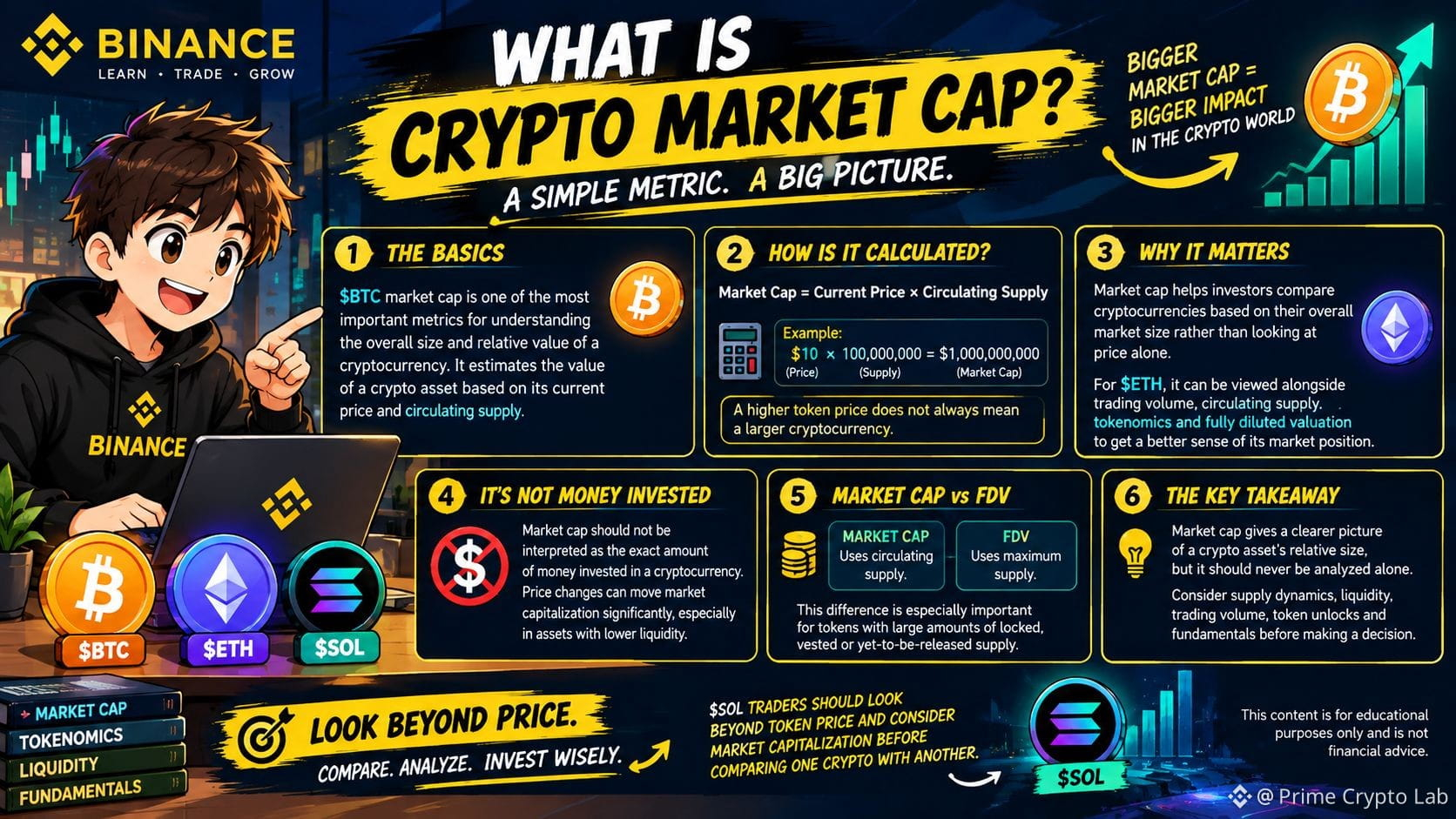
💰What Is Crypto Market Cap?
$BTC market capitalization is one of the most important metrics for understanding the overall size and relative value of a cryptocurrency. It estimates the value of a crypto asset based on its current price and circulating supply.
🧮 How Is Market Cap Calculated?
The basic formula is:
Market Cap = Current Price × Circulating Supply
For example, if a cryptocurrency trades at $10 and has 100 million coins in circulation, its market cap would be $1 billion. This is why a higher token price does not automatically mean a larger cryptocurrency.
📈 Why Market Cap Matters
Market cap helps investors compare cryptocurrencies based on their overall market size rather than looking at price alone. A coin priced at $1 can have a much larger market cap than a coin priced at $100 if its circulating supply is significantly higher.
For $ETH , market cap can also be viewed alongside trading volume, circulating supply, tokenomics, and fully diluted valuation to better understand its market position.
⚠️ Market Cap Is Not Money Invested
Market cap should not be interpreted as the exact amount of money invested in a cryptocurrency. Price changes can move market capitalization significantly, especially in assets with lower liquidity.
🔥Market Cap vs. FDV
Market Cap uses circulating supply, while FDV (Fully Diluted Valuation) generally uses the maximum supply. This difference is especially important for tokens with large amounts of locked, vested, or yet-to-be-released supply.
🎯 Key Takeaway
Market cap provides a clearer picture of a crypto asset's relative size, but it should never be analyzed alone. Supply dynamics, liquidity, trading volume, token unlocks, and fundamentals all matter when evaluating a project.
$SOL traders and investors should look beyond token price and consider market capitalization before comparing one crypto asset with another.
Disclaimer: This content is for educational purposes only and is not financial advice.
#crypto #marketcap #bitcoin #Ethereum✅ #solana
💰What Is Crypto Market Cap?
$BTC market capitalization is one of the most important metrics for understanding the overall size and relative value of a cryptocurrency. It estimates the value of a crypto asset based on its current price and circulating supply.
🧮 How Is Market Cap Calculated?
The basic formula is:
Market Cap = Current Price × Circulating Supply
For example, if a cryptocurrency trades at $10 and has 100 million coins in circulation, its market cap would be $1 billion. This is why a higher token price does not automatically mean a larger cryptocurrency.
📈 Why Market Cap Matters
Market cap helps investors compare cryptocurrencies based on their overall market size rather than looking at price alone. A coin priced at $1 can have a much larger market cap than a coin priced at $100 if its circulating supply is significantly higher.
For $ETH , market cap can also be viewed alongside trading volume, circulating supply, tokenomics, and fully diluted valuation to better understand its market position.
⚠️ Market Cap Is Not Money Invested
Market cap should not be interpreted as the exact amount of money invested in a cryptocurrency. Price changes can move market capitalization significantly, especially in assets with lower liquidity.
🔥Market Cap vs. FDV
Market Cap uses circulating supply, while FDV (Fully Diluted Valuation) generally uses the maximum supply. This difference is especially important for tokens with large amounts of locked, vested, or yet-to-be-released supply.
🎯 Key Takeaway
Market cap provides a clearer picture of a crypto asset's relative size, but it should never be analyzed alone. Supply dynamics, liquidity, trading volume, token unlocks, and fundamentals all matter when evaluating a project.
$SOL traders and investors should look beyond token price and consider market capitalization before comparing one crypto asset with another.
Disclaimer: This content is for educational purposes only and is not financial advice.
#crypto #marketcap #bitcoin #Ethereum✅ #solana
$BTC market capitalization is one of the most important metrics for understanding the overall size and relative value of a cryptocurrency. It estimates the value of a crypto asset based on its current price and circulating supply.
🧮 How Is Market Cap Calculated?
The basic formula is:
Market Cap = Current Price × Circulating Supply
For example, if a cryptocurrency trades at $10 and has 100 million coins in circulation, its market cap would be $1 billion. This is why a higher token price does not automatically mean a larger cryptocurrency.
📈 Why Market Cap Matters
Market cap helps investors compare cryptocurrencies based on their overall market size rather than looking at price alone. A coin priced at $1 can have a much larger market cap than a coin priced at $100 if its circulating supply is significantly higher.
For $ETH , market cap can also be viewed alongside trading volume, circulating supply, tokenomics, and fully diluted valuation to better understand its market position.
⚠️ Market Cap Is Not Money Invested
Market cap should not be interpreted as the exact amount of money invested in a cryptocurrency. Price changes can move market capitalization significantly, especially in assets with lower liquidity.
🔥Market Cap vs. FDV
Market Cap uses circulating supply, while FDV (Fully Diluted Valuation) generally uses the maximum supply. This difference is especially important for tokens with large amounts of locked, vested, or yet-to-be-released supply.
🎯 Key Takeaway
Market cap provides a clearer picture of a crypto asset's relative size, but it should never be analyzed alone. Supply dynamics, liquidity, trading volume, token unlocks, and fundamentals all matter when evaluating a project.
$SOL traders and investors should look beyond token price and consider market capitalization before comparing one crypto asset with another.
Disclaimer: This content is for educational purposes only and is not financial advice.
#crypto #marketcap #bitcoin #Ethereum✅ #solana
59
📊 Bitcoin Holds Near $77K — Bulls Defend the Recovery
$BTC is holding around the $77,000–$77,500 area after a strong recovery from the $60K zone. The daily chart shows that bullish momentum remains intact, but price is now entering an important consolidation phase below the recent $80K area.
📈 Current Technical Structure
The chart shows a major recovery followed by sideways movement near the highs.
Key levels:
Immediate Support: $75,000–$76,000
Major Support: $70,000–$72,000
Resistance: $79,500–$80,000
Breakout Zone: Above $80,000
A daily close above $80K with stronger volume could signal another bullish continuation. A rejection from this zone could push $BTC back toward the lower support levels.
📊 Volume & Momentum
Recent volume increased significantly during the major upward move, confirming strong participation. However, volume has cooled during the current consolidation, suggesting traders are waiting for the next breakout or breakdown.
The longer-term moving average remains well below the current price, keeping the broader daily structure constructive.
🔎 Altcoin Market Outlook
If $ETH follows Bitcoin's strength and maintains its current momentum, broader crypto market sentiment could improve. However, altcoins may remain sensitive to any sharp BTC rejection near resistance.
🚀 What Traders Should Watch
• BTC daily close above $80K
• Volume confirmation on breakout
• Support around $75K–$76K
• U.S. macroeconomic data
• Fed policy expectations
• Overall crypto liquidity
$SOL
🎯 Key Takeaway
Bitcoin remains technically constructive after its strong recovery, but the $79.5K–$80K resistance zone is the key test. A high-volume breakout could open the door to another leg higher, while failure to break resistance may lead to further consolidation.
⚠️ This content is for educational purposes only and is not financial advice.
#bitcoin #CryptoMarketAlert #TechnicalAnalysis_Tickeron #crypto
{future}(BTCUSDT)
📊 Bitcoin Holds Near $77K — Bulls Defend the Recovery
$BTC is holding around the $77,000–$77,500 area after a strong recovery from the $60K zone. The daily chart shows that bullish momentum remains intact, but price is now entering an important consolidation phase below the recent $80K area.
📈 Current Technical Structure
The chart shows a major recovery followed by sideways movement near the highs.
Key levels:
Immediate Support: $75,000–$76,000
Major Support: $70,000–$72,000
Resistance: $79,500–$80,000
Breakout Zone: Above $80,000
A daily close above $80K with stronger volume could signal another bullish continuation. A rejection from this zone could push $BTC back toward the lower support levels.
📊 Volume & Momentum
Recent volume increased significantly during the major upward move, confirming strong participation. However, volume has cooled during the current consolidation, suggesting traders are waiting for the next breakout or breakdown.
The longer-term moving average remains well below the current price, keeping the broader daily structure constructive.
🔎 Altcoin Market Outlook
If $ETH follows Bitcoin's strength and maintains its current momentum, broader crypto market sentiment could improve. However, altcoins may remain sensitive to any sharp BTC rejection near resistance.
🚀 What Traders Should Watch
• BTC daily close above $80K
• Volume confirmation on breakout
• Support around $75K–$76K
• U.S. macroeconomic data
• Fed policy expectations
• Overall crypto liquidity
$SOL
🎯 Key Takeaway
Bitcoin remains technically constructive after its strong recovery, but the $79.5K–$80K resistance zone is the key test. A high-volume breakout could open the door to another leg higher, while failure to break resistance may lead to further consolidation.
⚠️ This content is for educational purposes only and is not financial advice.
#bitcoin #CryptoMarketAlert #TechnicalAnalysis_Tickeron #crypto
$BTC is holding around the $77,000–$77,500 area after a strong recovery from the $60K zone. The daily chart shows that bullish momentum remains intact, but price is now entering an important consolidation phase below the recent $80K area.
📈 Current Technical Structure
The chart shows a major recovery followed by sideways movement near the highs.
Key levels:
Immediate Support: $75,000–$76,000
Major Support: $70,000–$72,000
Resistance: $79,500–$80,000
Breakout Zone: Above $80,000
A daily close above $80K with stronger volume could signal another bullish continuation. A rejection from this zone could push $BTC back toward the lower support levels.
📊 Volume & Momentum
Recent volume increased significantly during the major upward move, confirming strong participation. However, volume has cooled during the current consolidation, suggesting traders are waiting for the next breakout or breakdown.
The longer-term moving average remains well below the current price, keeping the broader daily structure constructive.
🔎 Altcoin Market Outlook
If $ETH follows Bitcoin's strength and maintains its current momentum, broader crypto market sentiment could improve. However, altcoins may remain sensitive to any sharp BTC rejection near resistance.
🚀 What Traders Should Watch
• BTC daily close above $80K
• Volume confirmation on breakout
• Support around $75K–$76K
• U.S. macroeconomic data
• Fed policy expectations
• Overall crypto liquidity
$SOL
🎯 Key Takeaway
Bitcoin remains technically constructive after its strong recovery, but the $79.5K–$80K resistance zone is the key test. A high-volume breakout could open the door to another leg higher, while failure to break resistance may lead to further consolidation.
⚠️ This content is for educational purposes only and is not financial advice.
#bitcoin #CryptoMarketAlert #TechnicalAnalysis_Tickeron #crypto
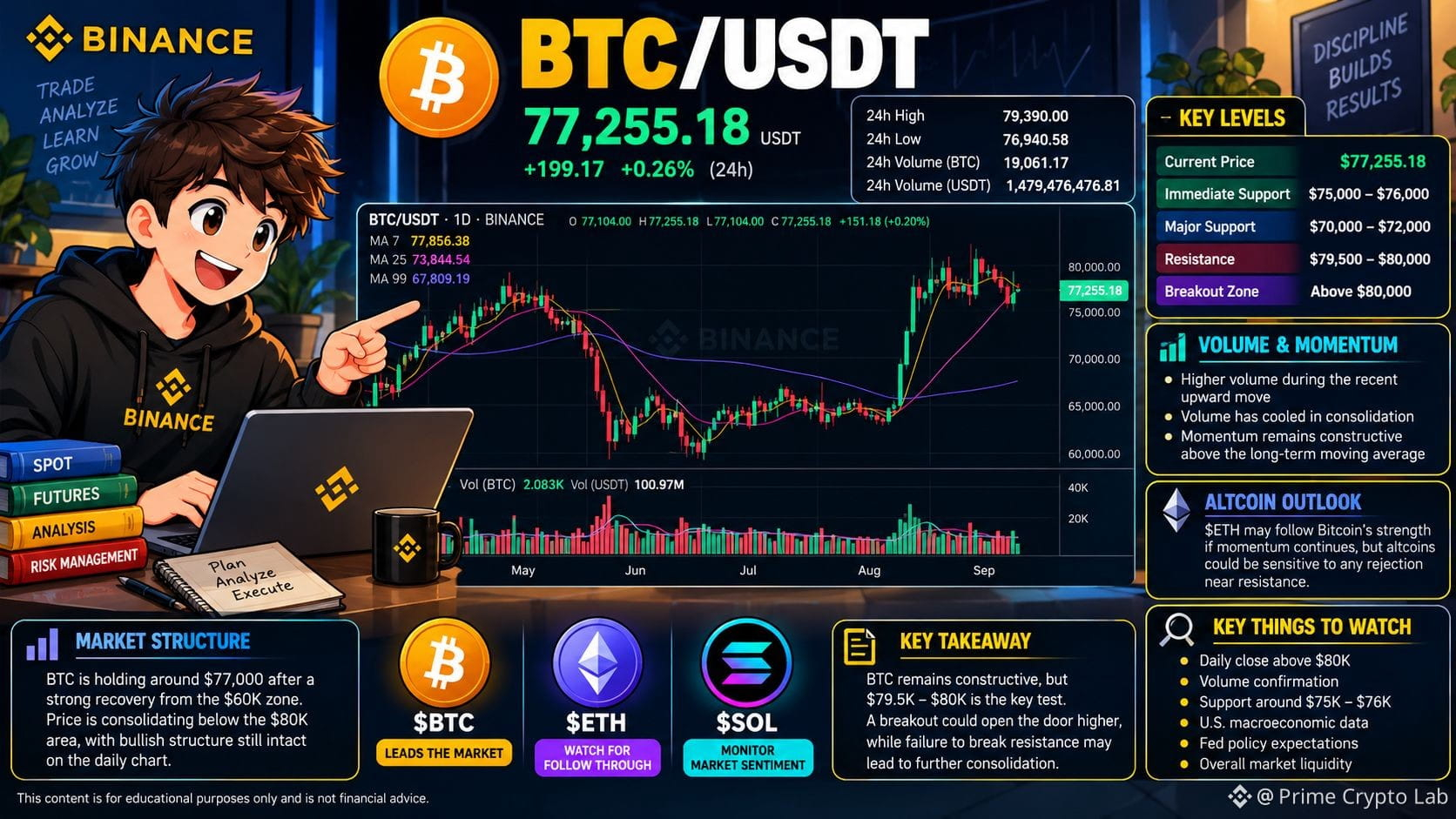
51
🍎 Apple Surges 3.56% After iPhone Duo Launch — Can AAPL Break $330?
$BTC markets are watching Apple’s latest move as the tech giant gains strong momentum following its September product event.
Apple shares closed at $326.57, up 3.56%, rebounding after the company unveiled the iPhone 18 Pro lineup and its first foldable smartphone, the iPhone Duo.
📱 Why Investors Are Paying Attention
The iPhone Duo starts at $1,999, while the iPhone 18 Pro starts at $1,199. Apple is also emphasizing AI capabilities, the new A20 Pro chip, improved cameras, and deeper on-device intelligence.
The strong stock reaction suggests investors are focusing on Apple’s ecosystem strength, premium-device strategy, and potential growth from the new product cycle.
📈 Technical Setup
Current Price: $326.57
Immediate Resistance: $330
Major Resistance: ~$344.57
Key Support: ~$316
A sustained move above $330 with strong volume could open the path toward the previous high near $344.57. Failure to break resistance could lead to another consolidation phase.
🔥Crypto Connection
Strong momentum in mega-cap technology can influence broader risk sentiment, while continued investor interest in AI and consumer technology remains an important macro theme for crypto traders.
For $RAYSOL , traders should continue monitoring broader risk appetite and liquidity conditions alongside Bitcoin and major technology stocks.
🎯 Key Takeaway
Apple’s post-event rally shows strong investor interest, but $330 is the next important test. A breakout with convincing volume could strengthen the bullish setup, while rejection may keep AAPL range-bound.
$MARSCOIN
⚠️This content is for educational purposes only and is not financial advice.
#Apple #AAPL #iPhone18 #TechStocks #Binance
{stock_us}(AAPL.US)
🍎 Apple Surges 3.56% After iPhone Duo Launch — Can AAPL Break $330?
$BTC markets are watching Apple’s latest move as the tech giant gains strong momentum following its September product event.
Apple shares closed at $326.57, up 3.56%, rebounding after the company unveiled the iPhone 18 Pro lineup and its first foldable smartphone, the iPhone Duo.
📱 Why Investors Are Paying Attention
The iPhone Duo starts at $1,999, while the iPhone 18 Pro starts at $1,199. Apple is also emphasizing AI capabilities, the new A20 Pro chip, improved cameras, and deeper on-device intelligence.
The strong stock reaction suggests investors are focusing on Apple’s ecosystem strength, premium-device strategy, and potential growth from the new product cycle.
📈 Technical Setup
Current Price: $326.57
Immediate Resistance: $330
Major Resistance: ~$344.57
Key Support: ~$316
A sustained move above $330 with strong volume could open the path toward the previous high near $344.57. Failure to break resistance could lead to another consolidation phase.
🔥Crypto Connection
Strong momentum in mega-cap technology can influence broader risk sentiment, while continued investor interest in AI and consumer technology remains an important macro theme for crypto traders.
For $RAYSOL , traders should continue monitoring broader risk appetite and liquidity conditions alongside Bitcoin and major technology stocks.
🎯 Key Takeaway
Apple’s post-event rally shows strong investor interest, but $330 is the next important test. A breakout with convincing volume could strengthen the bullish setup, while rejection may keep AAPL range-bound.
$MARSCOIN
⚠️This content is for educational purposes only and is not financial advice.
#Apple #AAPL #iPhone18 #TechStocks #Binance
$BTC markets are watching Apple’s latest move as the tech giant gains strong momentum following its September product event.
Apple shares closed at $326.57, up 3.56%, rebounding after the company unveiled the iPhone 18 Pro lineup and its first foldable smartphone, the iPhone Duo.
📱 Why Investors Are Paying Attention
The iPhone Duo starts at $1,999, while the iPhone 18 Pro starts at $1,199. Apple is also emphasizing AI capabilities, the new A20 Pro chip, improved cameras, and deeper on-device intelligence.
The strong stock reaction suggests investors are focusing on Apple’s ecosystem strength, premium-device strategy, and potential growth from the new product cycle.
📈 Technical Setup
Current Price: $326.57
Immediate Resistance: $330
Major Resistance: ~$344.57
Key Support: ~$316
A sustained move above $330 with strong volume could open the path toward the previous high near $344.57. Failure to break resistance could lead to another consolidation phase.
🔥Crypto Connection
Strong momentum in mega-cap technology can influence broader risk sentiment, while continued investor interest in AI and consumer technology remains an important macro theme for crypto traders.
For $RAYSOL , traders should continue monitoring broader risk appetite and liquidity conditions alongside Bitcoin and major technology stocks.
🎯 Key Takeaway
Apple’s post-event rally shows strong investor interest, but $330 is the next important test. A breakout with convincing volume could strengthen the bullish setup, while rejection may keep AAPL range-bound.
$MARSCOIN
⚠️This content is for educational purposes only and is not financial advice.
#Apple #AAPL #iPhone18 #TechStocks #Binance

196
🚨 U.S. August PPI Rises 0.4% — Core Inflation Comes in Cooler Than Expected
$BTC traders are watching the latest U.S. producer inflation data as markets reassess the Federal Reserve’s next policy move.
📊 Key PPI Data
• Headline PPI: +0.4% MoM
• Forecast: +0.4%
• Core PPI: +0.2% MoM
• Core forecast: +0.3%
• Annual PPI: +5.4% vs. 4.8% in July
The headline figure matched expectations, while core PPI came in slightly softer than forecast. However, annual producer inflation accelerated significantly, showing that underlying price pressures remain elevated.
🏦 What Does This Mean for the Fed?
The softer core reading could provide some relief for risk assets, but the overall report was not purely dovish.
Higher energy costs, services inflation and stronger producer prices have increased concerns that inflation could remain persistent. Following the report, market pricing for a 25-basis-point Fed rate hike at the September 15–16 meeting rose to around 70%, up from roughly 62% before the data.
📈 What Could It Mean for Crypto?
For $ETH , the softer-than-expected core PPI is a positive signal because lower underlying inflation can eventually support easier monetary policy.
However, elevated headline and annual inflation keep the Fed under pressure and could limit near-term liquidity expectations.
🔎 What Traders Should Watch
• U.S. August CPI
• September 15–16 Fed meeting
• Interest-rate expectations
• Treasury yields
• Dollar strength
• Energy prices
• Crypto market liquidity
📌 Key Takeaway: The August PPI report delivered a mixed signal — core inflation was softer than expected, but overall producer inflation remains elevated and Fed rate-hike expectations have increased. Crypto markets may need softer upcoming inflation data to confirm a stronger Q4 risk-on setup.
⚠️ This content is for educational purposes only and is not financial advice.
🚨 U.S. August PPI Rises 0.4% — Core Inflation Comes in Cooler Than Expected
$BTC traders are watching the latest U.S. producer inflation data as markets reassess the Federal Reserve’s next policy move.
📊 Key PPI Data
• Headline PPI: +0.4% MoM
• Forecast: +0.4%
• Core PPI: +0.2% MoM
• Core forecast: +0.3%
• Annual PPI: +5.4% vs. 4.8% in July
The headline figure matched expectations, while core PPI came in slightly softer than forecast. However, annual producer inflation accelerated significantly, showing that underlying price pressures remain elevated.
🏦 What Does This Mean for the Fed?
The softer core reading could provide some relief for risk assets, but the overall report was not purely dovish.
Higher energy costs, services inflation and stronger producer prices have increased concerns that inflation could remain persistent. Following the report, market pricing for a 25-basis-point Fed rate hike at the September 15–16 meeting rose to around 70%, up from roughly 62% before the data.
📈 What Could It Mean for Crypto?
For $ETH , the softer-than-expected core PPI is a positive signal because lower underlying inflation can eventually support easier monetary policy.
However, elevated headline and annual inflation keep the Fed under pressure and could limit near-term liquidity expectations.
🔎 What Traders Should Watch
• U.S. August CPI
• September 15–16 Fed meeting
• Interest-rate expectations
• Treasury yields
• Dollar strength
• Energy prices
• Crypto market liquidity
📌 Key Takeaway: The August PPI report delivered a mixed signal — core inflation was softer than expected, but overall producer inflation remains elevated and Fed rate-hike expectations have increased. Crypto markets may need softer upcoming inflation data to confirm a stronger Q4 risk-on setup.
⚠️ This content is for educational purposes only and is not financial advice.
$BTC traders are watching the latest U.S. producer inflation data as markets reassess the Federal Reserve’s next policy move.
📊 Key PPI Data
• Headline PPI: +0.4% MoM
• Forecast: +0.4%
• Core PPI: +0.2% MoM
• Core forecast: +0.3%
• Annual PPI: +5.4% vs. 4.8% in July
The headline figure matched expectations, while core PPI came in slightly softer than forecast. However, annual producer inflation accelerated significantly, showing that underlying price pressures remain elevated.
🏦 What Does This Mean for the Fed?
The softer core reading could provide some relief for risk assets, but the overall report was not purely dovish.
Higher energy costs, services inflation and stronger producer prices have increased concerns that inflation could remain persistent. Following the report, market pricing for a 25-basis-point Fed rate hike at the September 15–16 meeting rose to around 70%, up from roughly 62% before the data.
📈 What Could It Mean for Crypto?
For $ETH , the softer-than-expected core PPI is a positive signal because lower underlying inflation can eventually support easier monetary policy.
However, elevated headline and annual inflation keep the Fed under pressure and could limit near-term liquidity expectations.
🔎 What Traders Should Watch
• U.S. August CPI
• September 15–16 Fed meeting
• Interest-rate expectations
• Treasury yields
• Dollar strength
• Energy prices
• Crypto market liquidity
📌 Key Takeaway: The August PPI report delivered a mixed signal — core inflation was softer than expected, but overall producer inflation remains elevated and Fed rate-hike expectations have increased. Crypto markets may need softer upcoming inflation data to confirm a stronger Q4 risk-on setup.
⚠️ This content is for educational purposes only and is not financial advice.
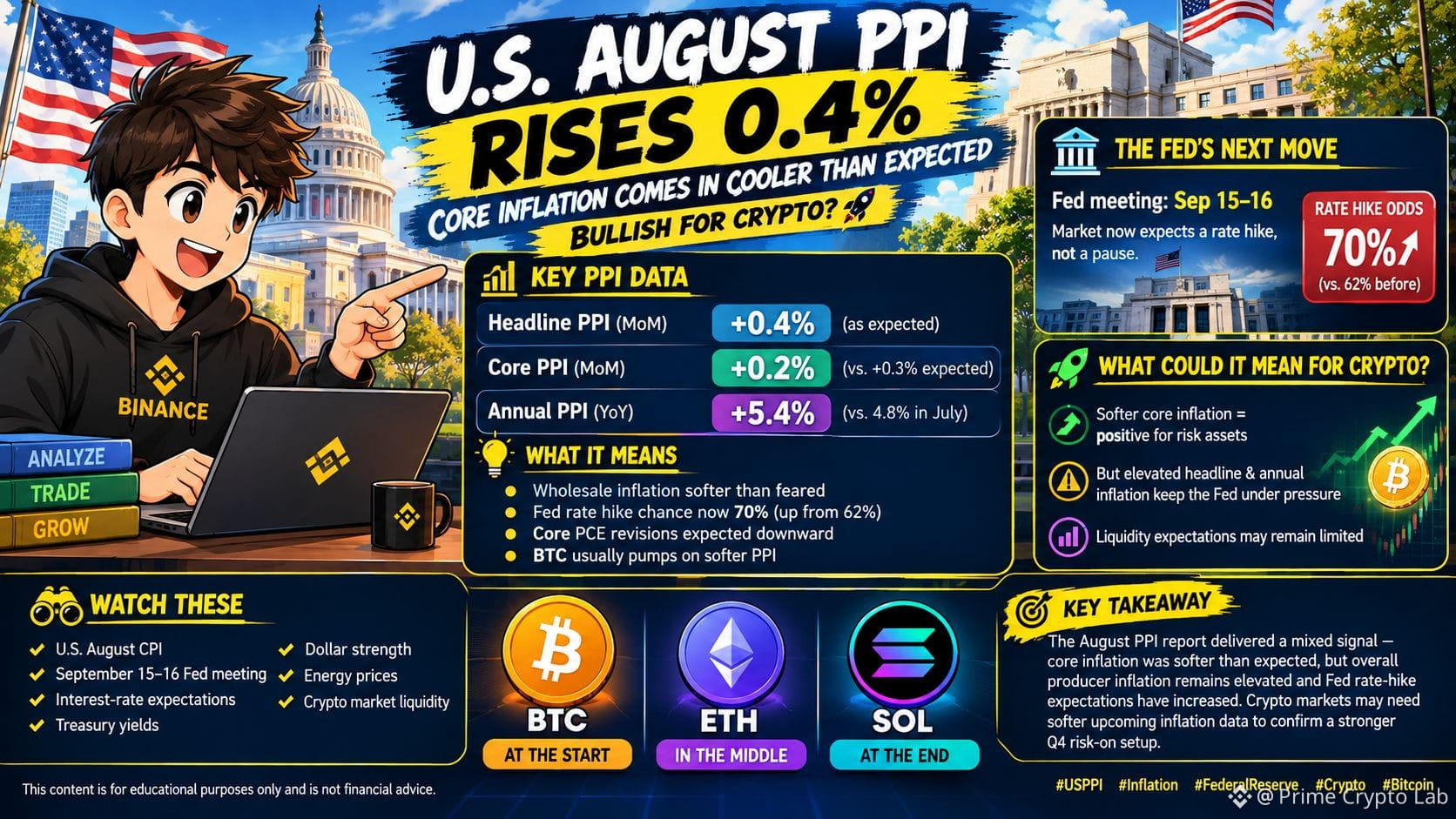
85
📊 What Is Fully Diluted Valuation (FDV)?
$BTC investors should understand token valuation metrics, and Fully Diluted Valuation (FDV) is an important metric for evaluating a cryptocurrency’s potential valuation.
🧮 What Is FDV?
FDV represents the theoretical total market value of a cryptocurrency if its maximum possible supply were fully circulating.
Formula:
FDV = Token Price × Maximum Supply
For example, if a token is priced at $2 with a maximum supply of 1 billion tokens:
➡️ FDV = $2 × 1B
➡️ FDV = $2 Billion
💡 Why Does FDV Matter?
FDV helps investors understand potential future token dilution.
If a project has a relatively low current market cap but a significantly higher FDV, it may indicate that a large amount of supply could enter circulation in the future through token unlocks, vesting, or emissions.
When evaluating established assets such as $ETH , understanding the underlying supply model is also important because every cryptocurrency can have a different supply structure.
🔍 Market Cap vs. FDV
Market Cap = Current Price × Circulating Supply
FDV = Current Price × Maximum Supply
Therefore, a low market cap does not necessarily mean that a token is undervalued. Investors should also consider how much additional supply could enter the market.
⚠️ What Should You Check?
• Circulating supply
• Maximum supply
• Token unlock schedules
• Vesting periods
• Future emissions
• Market demand
• Project fundamentals
A token may appear attractive based on its current price or market cap, but high FDV combined with significant upcoming unlocks can create additional selling pressure.
$SOL
📌 Key Takeaway: Always compare FDV with market capitalization and review upcoming token unlocks before making investment decisions.
⚠️ This content is for educational purposes only and is not financial advice.
📊 What Is Fully Diluted Valuation (FDV)?
$BTC investors should understand token valuation metrics, and Fully Diluted Valuation (FDV) is an important metric for evaluating a cryptocurrency’s potential valuation.
🧮 What Is FDV?
FDV represents the theoretical total market value of a cryptocurrency if its maximum possible supply were fully circulating.
Formula:
FDV = Token Price × Maximum Supply
For example, if a token is priced at $2 with a maximum supply of 1 billion tokens:
➡️ FDV = $2 × 1B
➡️ FDV = $2 Billion
💡 Why Does FDV Matter?
FDV helps investors understand potential future token dilution.
If a project has a relatively low current market cap but a significantly higher FDV, it may indicate that a large amount of supply could enter circulation in the future through token unlocks, vesting, or emissions.
When evaluating established assets such as $ETH , understanding the underlying supply model is also important because every cryptocurrency can have a different supply structure.
🔍 Market Cap vs. FDV
Market Cap = Current Price × Circulating Supply
FDV = Current Price × Maximum Supply
Therefore, a low market cap does not necessarily mean that a token is undervalued. Investors should also consider how much additional supply could enter the market.
⚠️ What Should You Check?
• Circulating supply
• Maximum supply
• Token unlock schedules
• Vesting periods
• Future emissions
• Market demand
• Project fundamentals
A token may appear attractive based on its current price or market cap, but high FDV combined with significant upcoming unlocks can create additional selling pressure.
$SOL
📌 Key Takeaway: Always compare FDV with market capitalization and review upcoming token unlocks before making investment decisions.
⚠️ This content is for educational purposes only and is not financial advice.
$BTC investors should understand token valuation metrics, and Fully Diluted Valuation (FDV) is an important metric for evaluating a cryptocurrency’s potential valuation.
🧮 What Is FDV?
FDV represents the theoretical total market value of a cryptocurrency if its maximum possible supply were fully circulating.
Formula:
FDV = Token Price × Maximum Supply
For example, if a token is priced at $2 with a maximum supply of 1 billion tokens:
➡️ FDV = $2 × 1B
➡️ FDV = $2 Billion
💡 Why Does FDV Matter?
FDV helps investors understand potential future token dilution.
If a project has a relatively low current market cap but a significantly higher FDV, it may indicate that a large amount of supply could enter circulation in the future through token unlocks, vesting, or emissions.
When evaluating established assets such as $ETH , understanding the underlying supply model is also important because every cryptocurrency can have a different supply structure.
🔍 Market Cap vs. FDV
Market Cap = Current Price × Circulating Supply
FDV = Current Price × Maximum Supply
Therefore, a low market cap does not necessarily mean that a token is undervalued. Investors should also consider how much additional supply could enter the market.
⚠️ What Should You Check?
• Circulating supply
• Maximum supply
• Token unlock schedules
• Vesting periods
• Future emissions
• Market demand
• Project fundamentals
A token may appear attractive based on its current price or market cap, but high FDV combined with significant upcoming unlocks can create additional selling pressure.
$SOL
📌 Key Takeaway: Always compare FDV with market capitalization and review upcoming token unlocks before making investment decisions.
⚠️ This content is for educational purposes only and is not financial advice.
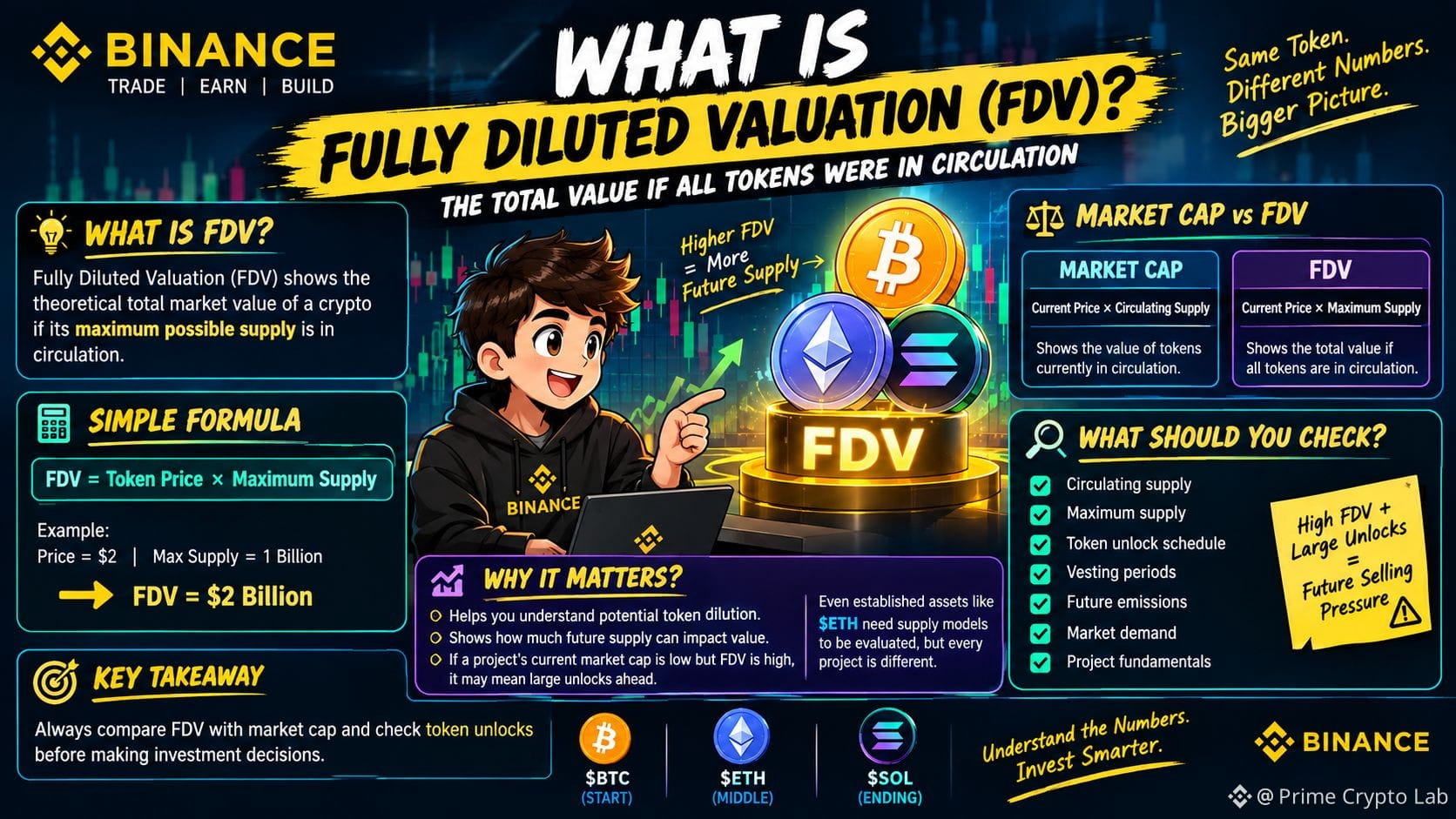
68
🟨 China August CPI Rises 0.8% — Inflation Is Back, But Demand Remains Mixed
$BTC traders should keep an eye on China’s latest inflation data as August CPI accelerated to 0.8% year-on-year, up from 0.5% in July.
The increase marks a noticeable improvement in headline inflation, but the underlying picture is more complicated.
📊 Key Data
• CPI: +0.8% YoY vs +0.5% in July
• Core CPI: +1.0% YoY
• Monthly CPI: +0.4%
• PPI: +3.8% YoY vs +3.5% in July
China’s official data shows that international commodity-price movements played an important role in the August acceleration. Domestic gasoline prices also rebounded sharply, while some technology-related consumer prices increased amid strong computing demand.
🔥 Why Is Inflation Rising?
The latest move appears to be driven more by higher input and commodity costs than by a broad consumer-demand boom.
Producer prices accelerated particularly strongly in industries linked to non-ferrous metals, energy and industrial materials. Reuters also reported that higher energy costs connected to the ongoing Middle East conflict were an important factor behind the increase.
At the same time, domestic demand remains relatively soft. That makes the inflation picture different from a classic demand-driven overheating cycle.
🌐 What Does This Mean for Crypto?
For $ETH , the important question is whether rising global input costs remain temporary or develop into broader inflationary pressure.
If commodity inflation continues, markets could become more cautious about aggressive monetary easing. That can create short-term pressure on risk assets, including crypto.
However, stronger industrial prices can also signal improving global economic activity and demand for commodities.
📌 What Traders Should Watch
• China’s future CPI and PPI readings
• Energy and commodity prices
• Global central-bank policy
• Chinese consumer demand
• Liquidity conditions
• Risk appetite across crypto markets
🟨 China August CPI Rises 0.8% — Inflation Is Back, But Demand Remains Mixed
$BTC traders should keep an eye on China’s latest inflation data as August CPI accelerated to 0.8% year-on-year, up from 0.5% in July.
The increase marks a noticeable improvement in headline inflation, but the underlying picture is more complicated.
📊 Key Data
• CPI: +0.8% YoY vs +0.5% in July
• Core CPI: +1.0% YoY
• Monthly CPI: +0.4%
• PPI: +3.8% YoY vs +3.5% in July
China’s official data shows that international commodity-price movements played an important role in the August acceleration. Domestic gasoline prices also rebounded sharply, while some technology-related consumer prices increased amid strong computing demand.
🔥 Why Is Inflation Rising?
The latest move appears to be driven more by higher input and commodity costs than by a broad consumer-demand boom.
Producer prices accelerated particularly strongly in industries linked to non-ferrous metals, energy and industrial materials. Reuters also reported that higher energy costs connected to the ongoing Middle East conflict were an important factor behind the increase.
At the same time, domestic demand remains relatively soft. That makes the inflation picture different from a classic demand-driven overheating cycle.
🌐 What Does This Mean for Crypto?
For $ETH , the important question is whether rising global input costs remain temporary or develop into broader inflationary pressure.
If commodity inflation continues, markets could become more cautious about aggressive monetary easing. That can create short-term pressure on risk assets, including crypto.
However, stronger industrial prices can also signal improving global economic activity and demand for commodities.
📌 What Traders Should Watch
• China’s future CPI and PPI readings
• Energy and commodity prices
• Global central-bank policy
• Chinese consumer demand
• Liquidity conditions
• Risk appetite across crypto markets
$BTC traders should keep an eye on China’s latest inflation data as August CPI accelerated to 0.8% year-on-year, up from 0.5% in July.
The increase marks a noticeable improvement in headline inflation, but the underlying picture is more complicated.
📊 Key Data
• CPI: +0.8% YoY vs +0.5% in July
• Core CPI: +1.0% YoY
• Monthly CPI: +0.4%
• PPI: +3.8% YoY vs +3.5% in July
China’s official data shows that international commodity-price movements played an important role in the August acceleration. Domestic gasoline prices also rebounded sharply, while some technology-related consumer prices increased amid strong computing demand.
🔥 Why Is Inflation Rising?
The latest move appears to be driven more by higher input and commodity costs than by a broad consumer-demand boom.
Producer prices accelerated particularly strongly in industries linked to non-ferrous metals, energy and industrial materials. Reuters also reported that higher energy costs connected to the ongoing Middle East conflict were an important factor behind the increase.
At the same time, domestic demand remains relatively soft. That makes the inflation picture different from a classic demand-driven overheating cycle.
🌐 What Does This Mean for Crypto?
For $ETH , the important question is whether rising global input costs remain temporary or develop into broader inflationary pressure.
If commodity inflation continues, markets could become more cautious about aggressive monetary easing. That can create short-term pressure on risk assets, including crypto.
However, stronger industrial prices can also signal improving global economic activity and demand for commodities.
📌 What Traders Should Watch
• China’s future CPI and PPI readings
• Energy and commodity prices
• Global central-bank policy
• Chinese consumer demand
• Liquidity conditions
• Risk appetite across crypto markets
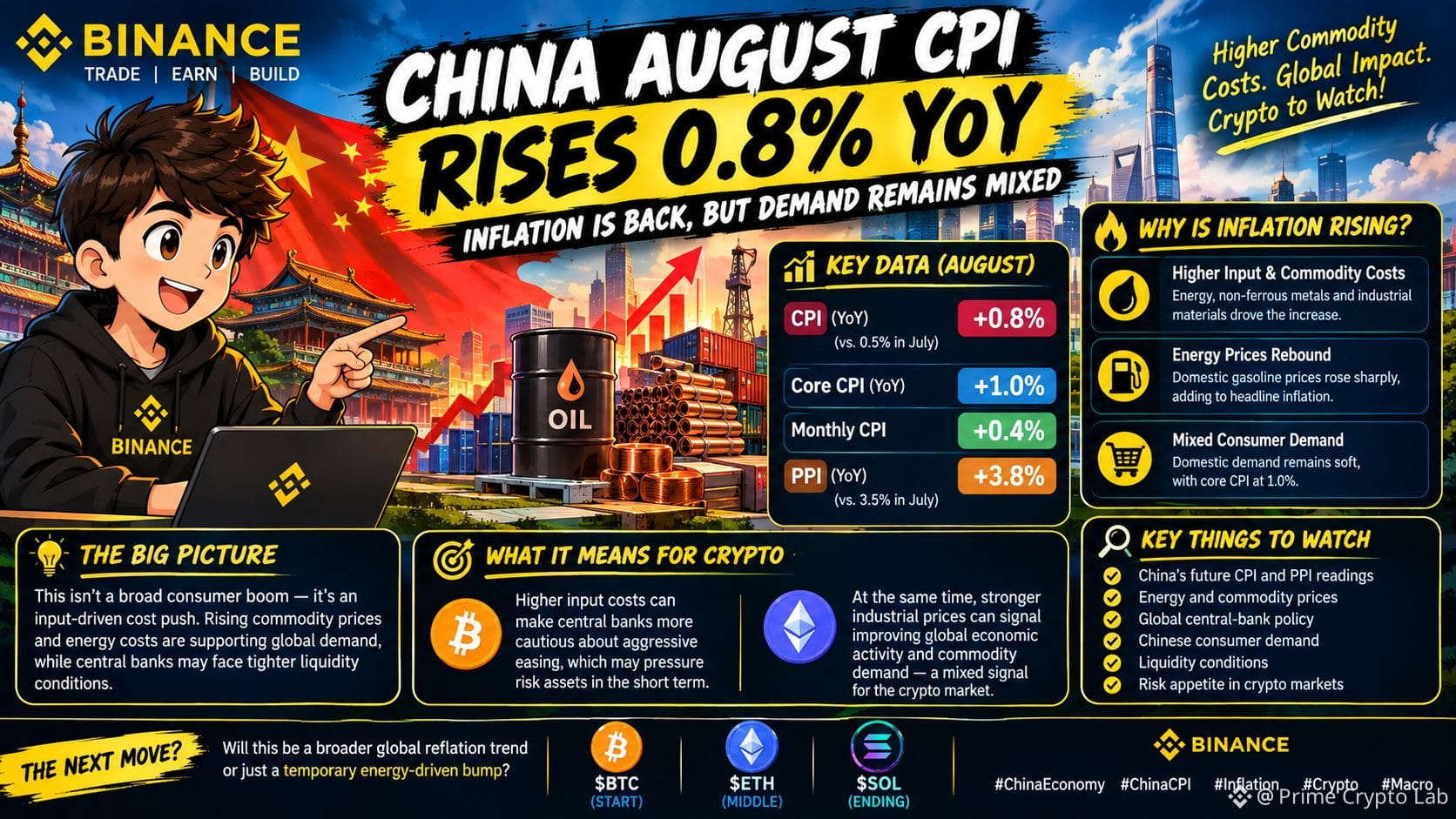
59
🟠 Copper Breaks Above $6.80 — What Is the Market Signaling?
$SOPH investors should pay attention to the latest move in copper as the metal breaks above $6.80 per pound, reaching record territory and highlighting growing pressure across the global physical economy.
Copper is a critical input for AI data centers, electricity grids, electric vehicles, renewable infrastructure and broader electrification. At the same time, supply has been challenged by weaker mine output and tighter inventories outside the U.S.
A major catalyst is U.S. tariff uncertainty. Expectations of future tariffs have encouraged traders to move copper toward the U.S., creating a significant inventory imbalance between American and overseas markets. Reuters has also reported that large U.S. imports have helped drain available supply elsewhere.
For crypto investors, this matters because copper is closely connected to the AI infrastructure and energy expansion narrative. The same physical infrastructure supporting data centers and electrification is increasing demand for critical materials.
That makes $FORM worth keeping on the broader watchlist alongside the AI and infrastructure theme. However, record copper prices don't automatically mean prices will continue straight upward. Higher prices can encourage recycling, substitution, slower consumption and profit-taking.
The key signal now is whether copper can hold elevated levels rather than simply touching a new record.
If copper continues to strengthen while supply remains constrained, it could reinforce the narrative of rising infrastructure costs across global markets.
📌 Key factors to watch:
• Copper price above $6.80/lb
• U.S. tariff policy
• Global mine production
• U.S. vs overseas inventories
• AI & data-center demand
• Electricity-grid expansion
The physical economy is sending a signal — and markets are watching.
🟠 Copper Breaks Above $6.80 — What Is the Market Signaling?
$SOPH investors should pay attention to the latest move in copper as the metal breaks above $6.80 per pound, reaching record territory and highlighting growing pressure across the global physical economy.
Copper is a critical input for AI data centers, electricity grids, electric vehicles, renewable infrastructure and broader electrification. At the same time, supply has been challenged by weaker mine output and tighter inventories outside the U.S.
A major catalyst is U.S. tariff uncertainty. Expectations of future tariffs have encouraged traders to move copper toward the U.S., creating a significant inventory imbalance between American and overseas markets. Reuters has also reported that large U.S. imports have helped drain available supply elsewhere.
For crypto investors, this matters because copper is closely connected to the AI infrastructure and energy expansion narrative. The same physical infrastructure supporting data centers and electrification is increasing demand for critical materials.
That makes $FORM worth keeping on the broader watchlist alongside the AI and infrastructure theme. However, record copper prices don't automatically mean prices will continue straight upward. Higher prices can encourage recycling, substitution, slower consumption and profit-taking.
The key signal now is whether copper can hold elevated levels rather than simply touching a new record.
If copper continues to strengthen while supply remains constrained, it could reinforce the narrative of rising infrastructure costs across global markets.
📌 Key factors to watch:
• Copper price above $6.80/lb
• U.S. tariff policy
• Global mine production
• U.S. vs overseas inventories
• AI & data-center demand
• Electricity-grid expansion
The physical economy is sending a signal — and markets are watching.
$SOPH investors should pay attention to the latest move in copper as the metal breaks above $6.80 per pound, reaching record territory and highlighting growing pressure across the global physical economy.
Copper is a critical input for AI data centers, electricity grids, electric vehicles, renewable infrastructure and broader electrification. At the same time, supply has been challenged by weaker mine output and tighter inventories outside the U.S.
A major catalyst is U.S. tariff uncertainty. Expectations of future tariffs have encouraged traders to move copper toward the U.S., creating a significant inventory imbalance between American and overseas markets. Reuters has also reported that large U.S. imports have helped drain available supply elsewhere.
For crypto investors, this matters because copper is closely connected to the AI infrastructure and energy expansion narrative. The same physical infrastructure supporting data centers and electrification is increasing demand for critical materials.
That makes $FORM worth keeping on the broader watchlist alongside the AI and infrastructure theme. However, record copper prices don't automatically mean prices will continue straight upward. Higher prices can encourage recycling, substitution, slower consumption and profit-taking.
The key signal now is whether copper can hold elevated levels rather than simply touching a new record.
If copper continues to strengthen while supply remains constrained, it could reinforce the narrative of rising infrastructure costs across global markets.
📌 Key factors to watch:
• Copper price above $6.80/lb
• U.S. tariff policy
• Global mine production
• U.S. vs overseas inventories
• AI & data-center demand
• Electricity-grid expansion
The physical economy is sending a signal — and markets are watching.

297
Log in to explore more content
Join global crypto users on Binance Square
⚡️ Get latest and useful information about crypto.
💬 Trusted by the world’s largest crypto exchange.
👍 Discover real insights from verified creators.
Email / Phone number
Trending Topics
SaylorHintsStrategyBitcoinBuy
2.2M views
12,294 Discussing
#saylorhintsstrategybitcoinbuy
🚨 SAYLOR JUST DROPPED THE SUNDAY $BTC HINT 👀
Michael Saylor reposted his usual Bitcoin chart again.
If history repeats, those orange dots could be signaling another Strategy BTC purchase is coming. 🟠
And when Saylor buys, the market watches.
🐋 Massive BTC holdings
💰 Continued accumulation strategy
📈 Potential short-term sentiment boost
But here’s the key:
A repost is NOT confirmation of a purchase.
The real signal comes when Strategy officially reports the transaction.
🔥 If another major BTC buy is announced, will the market react this time?
Or is Saylor’s accumulation becoming so routine that traders barely react anymore?
👀 Watch the announcement.
$MSTRB
#BTC #strategy #crypto #BitcoinNews
sdatta
·5 Likes
·5.6k views
BOJRaisesRatesTo31YearHigh
239,502 views
3,204 Discussing
BuffettStepsDownAsBerkshireChairman
116,251 views
1,710 Discussing