

#smartcontracts
smartcontracts
511,142 views
2,599 Discussing
Hot
Latest

·
--
$Ethereum (ETH) — More Than Just a Cryptocurrency
Ethereum is a decentralized blockchain platform that enables smart contracts, decentralized applications (dApps), and Web3 technologies.
🔹 Smart Contracts: Allow agreements and transactions to run automatically without traditional intermediaries.
🔹 Decentralized Apps: Ethereum provides a platform for building applications without relying on a central authority.
🔹 Web3: Ethereum plays an important role in the development of the decentralized internet.
🔹 Digital Asset: ETH is the native cryptocurrency used to pay transaction fees and interact with the Ethereum network.
Ethereum is helping build a more open and decentralized digital economy. 🌐
⚠️ Risk Warning: Crypto prices can be highly volatile. Always do your own research before investing.
#Ethereum #ETH #Binance #CryptoPatience #Blockchain #Web3 3 #SmartContracts
$Ethereum (ETH) — More Than Just a Cryptocurrency
Ethereum is a decentralized blockchain platform that enables smart contracts, decentralized applications (dApps), and Web3 technologies.
🔹 Smart Contracts: Allow agreements and transactions to run automatically without traditional intermediaries.
🔹 Decentralized Apps: Ethereum provides a platform for building applications without relying on a central authority.
🔹 Web3: Ethereum plays an important role in the development of the decentralized internet.
🔹 Digital Asset: ETH is the native cryptocurrency used to pay transaction fees and interact with the Ethereum network.
Ethereum is helping build a more open and decentralized digital economy. 🌐
⚠️ Risk Warning: Crypto prices can be highly volatile. Always do your own research before investing.
#Ethereum #ETH #Binance #CryptoPatience #Blockchain #Web3 3 #SmartContracts
Ethereum is a decentralized blockchain platform that enables smart contracts, decentralized applications (dApps), and Web3 technologies.
🔹 Smart Contracts: Allow agreements and transactions to run automatically without traditional intermediaries.
🔹 Decentralized Apps: Ethereum provides a platform for building applications without relying on a central authority.
🔹 Web3: Ethereum plays an important role in the development of the decentralized internet.
🔹 Digital Asset: ETH is the native cryptocurrency used to pay transaction fees and interact with the Ethereum network.
Ethereum is helping build a more open and decentralized digital economy. 🌐
⚠️ Risk Warning: Crypto prices can be highly volatile. Always do your own research before investing.
#Ethereum #ETH #Binance #CryptoPatience #Blockchain #Web3 3 #SmartContracts

75
·
--
Bullish
🛡️ Web3 Security: Why Smart Contract Audits Matter! 🔐
As crypto adoption accelerates, security remains the #1 priority for developers and investors alike. Smart contract vulnerabilities can lead to major exploits!
3 Pillars of Web3 Security:
1. Code Audits & Bug Bounties 🐛
2. Real-Time On-Chain Monitoring 📊
3. Multi-Sig & Decentralized Governance 🔑
Always DO YOUR OWN RESEARCH (DYOR) before investing in new projects! 💡
What’s your top safety rule in Web3? Let me know below! 👇
#Web3 #CryptoSecurity #BinanceSquare #SmartContracts
🛡️ Web3 Security: Why Smart Contract Audits Matter! 🔐
As crypto adoption accelerates, security remains the #1 priority for developers and investors alike. Smart contract vulnerabilities can lead to major exploits!
3 Pillars of Web3 Security:
1. Code Audits & Bug Bounties 🐛
2. Real-Time On-Chain Monitoring 📊
3. Multi-Sig & Decentralized Governance 🔑
Always DO YOUR OWN RESEARCH (DYOR) before investing in new projects! 💡
What’s your top safety rule in Web3? Let me know below! 👇
#Web3 #CryptoSecurity #BinanceSquare #SmartContracts
As crypto adoption accelerates, security remains the #1 priority for developers and investors alike. Smart contract vulnerabilities can lead to major exploits!
3 Pillars of Web3 Security:
1. Code Audits & Bug Bounties 🐛
2. Real-Time On-Chain Monitoring 📊
3. Multi-Sig & Decentralized Governance 🔑
Always DO YOUR OWN RESEARCH (DYOR) before investing in new projects! 💡
What’s your top safety rule in Web3? Let me know below! 👇
#Web3 #CryptoSecurity #BinanceSquare #SmartContracts
1
267

·
--
Article
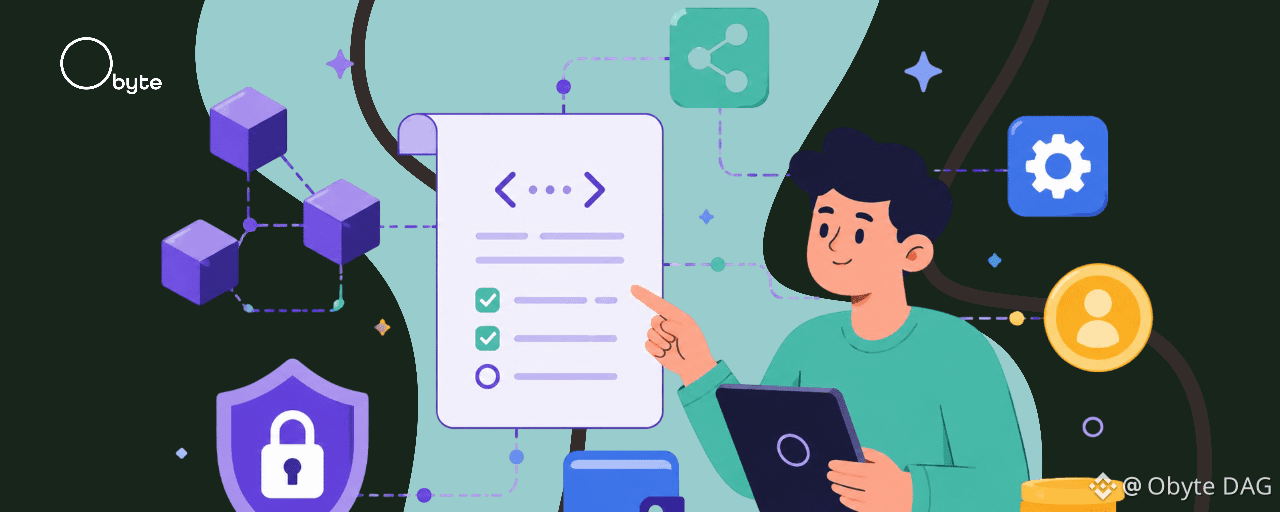
Smart Contracts Without Ethereum Exist —And They Can Be EasierWhen you read the term “smart contract,” there’s a high chance you also think about Ethereum. You could say that's their flagship product, but they’re not the only platform that offers this software. It may not be the easiest one for beginners, either.
Several networks have explored simpler ways to automate agreements while keeping the same basic goal: letting software carry out rules that people agreed on in advance. Let's explore a bit the world of smart contracts without Ethereum.
Smart contracts aren't exclusive to Ethereum
To revisit this concept, a smart contract is a digital program that follows pre-set instructions or agreements when certain conditions are met. It usually involves cryptocurrency, and a transaction can trigger the contract when someone interacts with it or provides the required input. The contract then applies its pre-set rules to determine the outcome.
Everyone involved knows beforehand what the contract will do, so there are no surprises. Smart contracts can automate payments, exchanges, loans, bets, games, and many other applications.
Ethereum became the best-known network for smart contracts because it introduced a general-purpose environment where developers could build almost any decentralized application. Over time, it attracted a huge community, thousands of projects, and programming languages such as Solidity that let developers create complex applications. There’s a steep learning curve, though, for users and developers alike.
Past mistakes in coding have led to costly hacks or funds becoming inaccessible. Besides, transaction approval depends entirely on Ethereum’s network of “validators,” which opens the door for censorship. That’s why other crypto networks have created their own version of smart contracts, with the same use cases or even more. Programming may also be easier for developers, and their interface can be so user-friendly that average users could create their own smart contracts without coding —depending on the platform.
Among these networks that provide smart contracts without Ethereum, we have BNB Chain, Solana, Avalanche, Cardano, Polkadot, and of course, Obyte. Each one has its own approach to scalability, fees, tools, and decentralization.
Smart Contracts in Obyte
To start, smart contracts in Obyte are based on a Directed Acyclic Graph (DAG) structure instead of a blockchain. That means there’s no transaction approval: every user is its own “miner,” and every transaction added is immutable, linked with all the previous ones. Obyte has no middlemen, so it doesn’t have censorship. As for smart contracts specifically, they’re designed to be human-readable, so participants can write and review the conditions in plain language before approving them.
This way, a payment, for example, can stay locked until a package arrives, a document is signed, or several people approve the same transaction. Once the agreed condition is satisfied, the payment can be released without relying on an escrow company or another middleman. However, if you need a human professional involved to resolve potential disputes, we also have a list of available arbiters on the ArbStore to include in your smart contracts.
The ArbStore is a decentralized escrow service built on Obyte that helps two parties trade with greater protection. Funds are locked in a smart contract until the agreed conditions are met and the buyer releases funds in favor of the seller. If a dispute occurs, an independent arbiter reviews the evidence and decides who should receive the funds.
Beyond this, Obyte also supports token creation, decentralized exchanges, prediction markets, self-sovereign identity, and other DeFi applications. A freelance payment, a community crowdfunding campaign, a trading strategy, or a digital asset swap can all use the same idea: define the conditions first, then let the network carry them out. Without complex steps and including previews of the transaction results.
As you can see, smart contracts without Ethereum do exist, and they may come in handy. Now it’s your turn to choose your network.
Originally Published on Hackernoon
#SmartContracts #SmartContract #DecentralizedTrading #CryptoWallet #Obyte
Smart Contracts Without Ethereum Exist —And They Can Be Easier
When you read the term “smart contract,” there’s a high chance you also think about Ethereum. You could say that's their flagship product, but they’re not the only platform that offers this software. It may not be the easiest one for beginners, either.
Several networks have explored simpler ways to automate agreements while keeping the same basic goal: letting software carry out rules that people agreed on in advance. Let's explore a bit the world of smart contracts without Ethereum.
Smart contracts aren't exclusive to Ethereum
To revisit this concept, a smart contract is a digital program that follows pre-set instructions or agreements when certain conditions are met. It usually involves cryptocurrency, and a transaction can trigger the contract when someone interacts with it or provides the required input. The contract then applies its pre-set rules to determine the outcome.
Everyone involved knows beforehand what the contract will do, so there are no surprises. Smart contracts can automate payments, exchanges, loans, bets, games, and many other applications.
Ethereum became the best-known network for smart contracts because it introduced a general-purpose environment where developers could build almost any decentralized application. Over time, it attracted a huge community, thousands of projects, and programming languages such as Solidity that let developers create complex applications. There’s a steep learning curve, though, for users and developers alike.
Past mistakes in coding have led to costly hacks or funds becoming inaccessible. Besides, transaction approval depends entirely on Ethereum’s network of “validators,” which opens the door for censorship. That’s why other crypto networks have created their own version of smart contracts, with the same use cases or even more. Programming may also be easier for developers, and their interface can be so user-friendly that average users could create their own smart contracts without coding —depending on the platform.
Among these networks that provide smart contracts without Ethereum, we have BNB Chain, Solana, Avalanche, Cardano, Polkadot, and of course, Obyte. Each one has its own approach to scalability, fees, tools, and decentralization.
Smart Contracts in Obyte
To start, smart contracts in Obyte are based on a Directed Acyclic Graph (DAG) structure instead of a blockchain. That means there’s no transaction approval: every user is its own “miner,” and every transaction added is immutable, linked with all the previous ones. Obyte has no middlemen, so it doesn’t have censorship. As for smart contracts specifically, they’re designed to be human-readable, so participants can write and review the conditions in plain language before approving them.
This way, a payment, for example, can stay locked until a package arrives, a document is signed, or several people approve the same transaction. Once the agreed condition is satisfied, the payment can be released without relying on an escrow company or another middleman. However, if you need a human professional involved to resolve potential disputes, we also have a list of available arbiters on the ArbStore to include in your smart contracts.
The ArbStore is a decentralized escrow service built on Obyte that helps two parties trade with greater protection. Funds are locked in a smart contract until the agreed conditions are met and the buyer releases funds in favor of the seller. If a dispute occurs, an independent arbiter reviews the evidence and decides who should receive the funds.
Beyond this, Obyte also supports token creation, decentralized exchanges, prediction markets, self-sovereign identity, and other DeFi applications. A freelance payment, a community crowdfunding campaign, a trading strategy, or a digital asset swap can all use the same idea: define the conditions first, then let the network carry them out. Without complex steps and including previews of the transaction results.
As you can see, smart contracts without Ethereum do exist, and they may come in handy. Now it’s your turn to choose your network.
Originally Published on Hackernoon
#SmartContracts #SmartContract #DecentralizedTrading #CryptoWallet #Obyte
Several networks have explored simpler ways to automate agreements while keeping the same basic goal: letting software carry out rules that people agreed on in advance. Let's explore a bit the world of smart contracts without Ethereum.
Smart contracts aren't exclusive to Ethereum
To revisit this concept, a smart contract is a digital program that follows pre-set instructions or agreements when certain conditions are met. It usually involves cryptocurrency, and a transaction can trigger the contract when someone interacts with it or provides the required input. The contract then applies its pre-set rules to determine the outcome.
Everyone involved knows beforehand what the contract will do, so there are no surprises. Smart contracts can automate payments, exchanges, loans, bets, games, and many other applications.
Ethereum became the best-known network for smart contracts because it introduced a general-purpose environment where developers could build almost any decentralized application. Over time, it attracted a huge community, thousands of projects, and programming languages such as Solidity that let developers create complex applications. There’s a steep learning curve, though, for users and developers alike.
Past mistakes in coding have led to costly hacks or funds becoming inaccessible. Besides, transaction approval depends entirely on Ethereum’s network of “validators,” which opens the door for censorship. That’s why other crypto networks have created their own version of smart contracts, with the same use cases or even more. Programming may also be easier for developers, and their interface can be so user-friendly that average users could create their own smart contracts without coding —depending on the platform.
Among these networks that provide smart contracts without Ethereum, we have BNB Chain, Solana, Avalanche, Cardano, Polkadot, and of course, Obyte. Each one has its own approach to scalability, fees, tools, and decentralization.
Smart Contracts in Obyte
To start, smart contracts in Obyte are based on a Directed Acyclic Graph (DAG) structure instead of a blockchain. That means there’s no transaction approval: every user is its own “miner,” and every transaction added is immutable, linked with all the previous ones. Obyte has no middlemen, so it doesn’t have censorship. As for smart contracts specifically, they’re designed to be human-readable, so participants can write and review the conditions in plain language before approving them.
This way, a payment, for example, can stay locked until a package arrives, a document is signed, or several people approve the same transaction. Once the agreed condition is satisfied, the payment can be released without relying on an escrow company or another middleman. However, if you need a human professional involved to resolve potential disputes, we also have a list of available arbiters on the ArbStore to include in your smart contracts.
The ArbStore is a decentralized escrow service built on Obyte that helps two parties trade with greater protection. Funds are locked in a smart contract until the agreed conditions are met and the buyer releases funds in favor of the seller. If a dispute occurs, an independent arbiter reviews the evidence and decides who should receive the funds.
Beyond this, Obyte also supports token creation, decentralized exchanges, prediction markets, self-sovereign identity, and other DeFi applications. A freelance payment, a community crowdfunding campaign, a trading strategy, or a digital asset swap can all use the same idea: define the conditions first, then let the network carry them out. Without complex steps and including previews of the transaction results.
As you can see, smart contracts without Ethereum do exist, and they may come in handy. Now it’s your turn to choose your network.
Originally Published on Hackernoon
#SmartContracts #SmartContract #DecentralizedTrading #CryptoWallet #Obyte
96


·
--
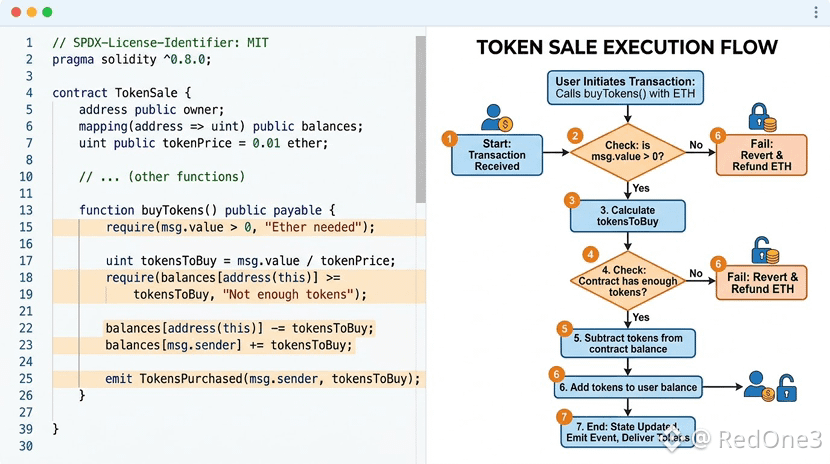
Smart Contracts are self-executing code on blockchains ⚙️
When conditions are met, they automatically execute without intermediaries 🤖
Example: If you send 1 ETH, you automatically receive 100 tokens instantly ✅ No middleman needed, no delays
#SmartContracts #Ethereum #BlockchainTech .
Smart Contracts are self-executing code on blockchains ⚙️
When conditions are met, they automatically execute without intermediaries 🤖
Example: If you send 1 ETH, you automatically receive 100 tokens instantly ✅ No middleman needed, no delays
#SmartContracts #Ethereum #BlockchainTech .
When conditions are met, they automatically execute without intermediaries 🤖
Example: If you send 1 ETH, you automatically receive 100 tokens instantly ✅ No middleman needed, no delays
#SmartContracts #Ethereum #BlockchainTech .
1
187

·
--
What does “Smart Contract” mean? 🤖
It’s a program that runs on a blockchain network and executes pre-defined rules.
The idea is that certain operations can be carried out automatically when the conditions in the code are met.
That has opened the door to many applications in the Web3 world, such as decentralized applications and some decentralized finance systems.
But having the code on the blockchain doesn’t necessarily mean it’s free of bugs; software vulnerabilities can cause real risks.
#SmartContracts #Ethereum #Web3 #Blockchain
What does “Smart Contract” mean? 🤖
It’s a program that runs on a blockchain network and executes pre-defined rules.
The idea is that certain operations can be carried out automatically when the conditions in the code are met.
That has opened the door to many applications in the Web3 world, such as decentralized applications and some decentralized finance systems.
But having the code on the blockchain doesn’t necessarily mean it’s free of bugs; software vulnerabilities can cause real risks.
#SmartContracts #Ethereum #Web3 #Blockchain
It’s a program that runs on a blockchain network and executes pre-defined rules.
The idea is that certain operations can be carried out automatically when the conditions in the code are met.
That has opened the door to many applications in the Web3 world, such as decentralized applications and some decentralized finance systems.
But having the code on the blockchain doesn’t necessarily mean it’s free of bugs; software vulnerabilities can cause real risks.
#SmartContracts #Ethereum #Web3 #Blockchain
94

·
--
Smart Contract Risk Is a SystemSmart-contract security is not one bug class. It is a system of assumptions that can fail at the code, data, governance and execution layers.
Reentrancy can appear when an external call happens before internal state is finalized. It can cross functions through callbacks, hooks or shared accounting rather than repeating one obvious withdrawal path. The safer pattern is to validate conditions, update state and only then interact with external contracts, backed by guards and adversarial tests.
Oracle risk begins with the price input. A protocol can use correct arithmetic and still fail if it accepts a manipulable pool, stale update or fragile fallback. Teams need liquidity thresholds, freshness checks, deviation limits and a documented response when the feed becomes unreliable.
Upgradeability adds another layer. A proxy may allow rapid fixes, but it also creates authority over implementation logic. Users should know who controls that authority, whether a multisig and timelock protect it and how storage changes are tested. Access control, arithmetic edge cases, MEV exposure and denial-of-service paths need the same attention.
The important habit is lifecycle security. Test invariants before deployment, monitor the live system, review dependency and protocol changes, rehearse pause and recovery procedures, and reassess every upgrade.
TokenToolHub’s guide connects these failure patterns so developers and users can evaluate how the whole application behaves, not only whether one function looks safe.
https://tokentoolhub.com/smart-contract-risks-re-entrancy-oracles-upgrades/
#SmartContracts #defi #Ethereum #CryptoSecurity #Web3
Smart Contract Risk Is a System
Smart-contract security is not one bug class. It is a system of assumptions that can fail at the code, data, governance and execution layers.
Reentrancy can appear when an external call happens before internal state is finalized. It can cross functions through callbacks, hooks or shared accounting rather than repeating one obvious withdrawal path. The safer pattern is to validate conditions, update state and only then interact with external contracts, backed by guards and adversarial tests.
Oracle risk begins with the price input. A protocol can use correct arithmetic and still fail if it accepts a manipulable pool, stale update or fragile fallback. Teams need liquidity thresholds, freshness checks, deviation limits and a documented response when the feed becomes unreliable.
Upgradeability adds another layer. A proxy may allow rapid fixes, but it also creates authority over implementation logic. Users should know who controls that authority, whether a multisig and timelock protect it and how storage changes are tested. Access control, arithmetic edge cases, MEV exposure and denial-of-service paths need the same attention.
The important habit is lifecycle security. Test invariants before deployment, monitor the live system, review dependency and protocol changes, rehearse pause and recovery procedures, and reassess every upgrade.
TokenToolHub’s guide connects these failure patterns so developers and users can evaluate how the whole application behaves, not only whether one function looks safe.
https://tokentoolhub.com/smart-contract-risks-re-entrancy-oracles-upgrades/
#SmartContracts #defi #Ethereum #CryptoSecurity #Web3
Reentrancy can appear when an external call happens before internal state is finalized. It can cross functions through callbacks, hooks or shared accounting rather than repeating one obvious withdrawal path. The safer pattern is to validate conditions, update state and only then interact with external contracts, backed by guards and adversarial tests.
Oracle risk begins with the price input. A protocol can use correct arithmetic and still fail if it accepts a manipulable pool, stale update or fragile fallback. Teams need liquidity thresholds, freshness checks, deviation limits and a documented response when the feed becomes unreliable.
Upgradeability adds another layer. A proxy may allow rapid fixes, but it also creates authority over implementation logic. Users should know who controls that authority, whether a multisig and timelock protect it and how storage changes are tested. Access control, arithmetic edge cases, MEV exposure and denial-of-service paths need the same attention.
The important habit is lifecycle security. Test invariants before deployment, monitor the live system, review dependency and protocol changes, rehearse pause and recovery procedures, and reassess every upgrade.
TokenToolHub’s guide connects these failure patterns so developers and users can evaluate how the whole application behaves, not only whether one function looks safe.
https://tokentoolhub.com/smart-contract-risks-re-entrancy-oracles-upgrades/
#SmartContracts #defi #Ethereum #CryptoSecurity #Web3
59

1. Web3 Revolution: Why do we need to regulate AI Agents? 🤖🛡️
Title: AI Agents & Web3: The importance of strict smart contract control ⚖️🔗
Content:
The integration of autonomous AI agents into DeFi offers enormous opportunities: high-frequency trade execution, automated arbitrage, and optimized liquidity management.
However, allowing an AI to interact directly with Web3 wallets involves major risks if safeguards are not put in place.
📌 3 pillars to secure AI agents:
Spending limits: Set a maximum cap on execution per transaction.
Supervision modes: Require human validation for critical operations.
Auditable Smart Contracts: Ensure the agent’s code has no logical vulnerabilities.
Innovation must always move forward hand in hand with the security of funds!
#AIAgents #Web3 #DeFi #SmartContracts #BinanceSquare @Square-Creator-4a949128de84
1. Web3 Revolution: Why do we need to regulate AI Agents? 🤖🛡️
Title: AI Agents & Web3: The importance of strict smart contract control ⚖️🔗
Content:
The integration of autonomous AI agents into DeFi offers enormous opportunities: high-frequency trade execution, automated arbitrage, and optimized liquidity management.
However, allowing an AI to interact directly with Web3 wallets involves major risks if safeguards are not put in place.
📌 3 pillars to secure AI agents:
Spending limits: Set a maximum cap on execution per transaction.
Supervision modes: Require human validation for critical operations.
Auditable Smart Contracts: Ensure the agent’s code has no logical vulnerabilities.
Innovation must always move forward hand in hand with the security of funds!
#AIAgents #Web3 #DeFi #SmartContracts #BinanceSquare @giggle Academy
Title: AI Agents & Web3: The importance of strict smart contract control ⚖️🔗
Content:
The integration of autonomous AI agents into DeFi offers enormous opportunities: high-frequency trade execution, automated arbitrage, and optimized liquidity management.
However, allowing an AI to interact directly with Web3 wallets involves major risks if safeguards are not put in place.
📌 3 pillars to secure AI agents:
Spending limits: Set a maximum cap on execution per transaction.
Supervision modes: Require human validation for critical operations.
Auditable Smart Contracts: Ensure the agent’s code has no logical vulnerabilities.
Innovation must always move forward hand in hand with the security of funds!
#AIAgents #Web3 #DeFi #SmartContracts #BinanceSquare @giggle Academy
61

Ethereum (ETH): A Look at the World’s Programmable Blockchain
Ethereum (ETH) is a decentralized blockchain network that enables people to send digital assets, build applications, and create smart contracts without relying on a traditional central authority. ETH is the native cryptocurrency of the Ethereum network and is used to pay transaction fees and support activity on the blockchain.
One of Ethereum’s most important features is smart contracts. These are programs stored on the blockchain that can automatically execute when their predefined conditions are met. This has allowed developers to build decentralized applications (dApps) for areas such as decentralized finance, digital collectibles, gaming, and other blockchain-based services.
Ethereum has also played an important role in the development of the broader crypto ecosystem. Its open nature allows developers around the world to create and experiment with new blockchain applications.
However, like other cryptocurrencies, ETH can be highly volatile. Its price can rise or fall significantly, and users should understand the risks before buying or investing in it.
In short, Ethereum is more than a cryptocurrency—it is a blockchain platform designed to support programmable, decentralized applications.
#ETH #Ethereum #Crypto #Blockchain #Web3 #SmartContracts
Ethereum (ETH): A Look at the World’s Programmable Blockchain
Ethereum (ETH) is a decentralized blockchain network that enables people to send digital assets, build applications, and create smart contracts without relying on a traditional central authority. ETH is the native cryptocurrency of the Ethereum network and is used to pay transaction fees and support activity on the blockchain.
One of Ethereum’s most important features is smart contracts. These are programs stored on the blockchain that can automatically execute when their predefined conditions are met. This has allowed developers to build decentralized applications (dApps) for areas such as decentralized finance, digital collectibles, gaming, and other blockchain-based services.
Ethereum has also played an important role in the development of the broader crypto ecosystem. Its open nature allows developers around the world to create and experiment with new blockchain applications.
However, like other cryptocurrencies, ETH can be highly volatile. Its price can rise or fall significantly, and users should understand the risks before buying or investing in it.
In short, Ethereum is more than a cryptocurrency—it is a blockchain platform designed to support programmable, decentralized applications.
#ETH #Ethereum #Crypto #Blockchain #Web3 #SmartContracts
Ethereum (ETH) is a decentralized blockchain network that enables people to send digital assets, build applications, and create smart contracts without relying on a traditional central authority. ETH is the native cryptocurrency of the Ethereum network and is used to pay transaction fees and support activity on the blockchain.
One of Ethereum’s most important features is smart contracts. These are programs stored on the blockchain that can automatically execute when their predefined conditions are met. This has allowed developers to build decentralized applications (dApps) for areas such as decentralized finance, digital collectibles, gaming, and other blockchain-based services.
Ethereum has also played an important role in the development of the broader crypto ecosystem. Its open nature allows developers around the world to create and experiment with new blockchain applications.
However, like other cryptocurrencies, ETH can be highly volatile. Its price can rise or fall significantly, and users should understand the risks before buying or investing in it.
In short, Ethereum is more than a cryptocurrency—it is a blockchain platform designed to support programmable, decentralized applications.
#ETH #Ethereum #Crypto #Blockchain #Web3 #SmartContracts
75

Article
⚙️ What Is a Smart Contract? Explained SimplyYou've probably heard that smart contracts power DeFi, NFTs and Web3. But what actually are they?
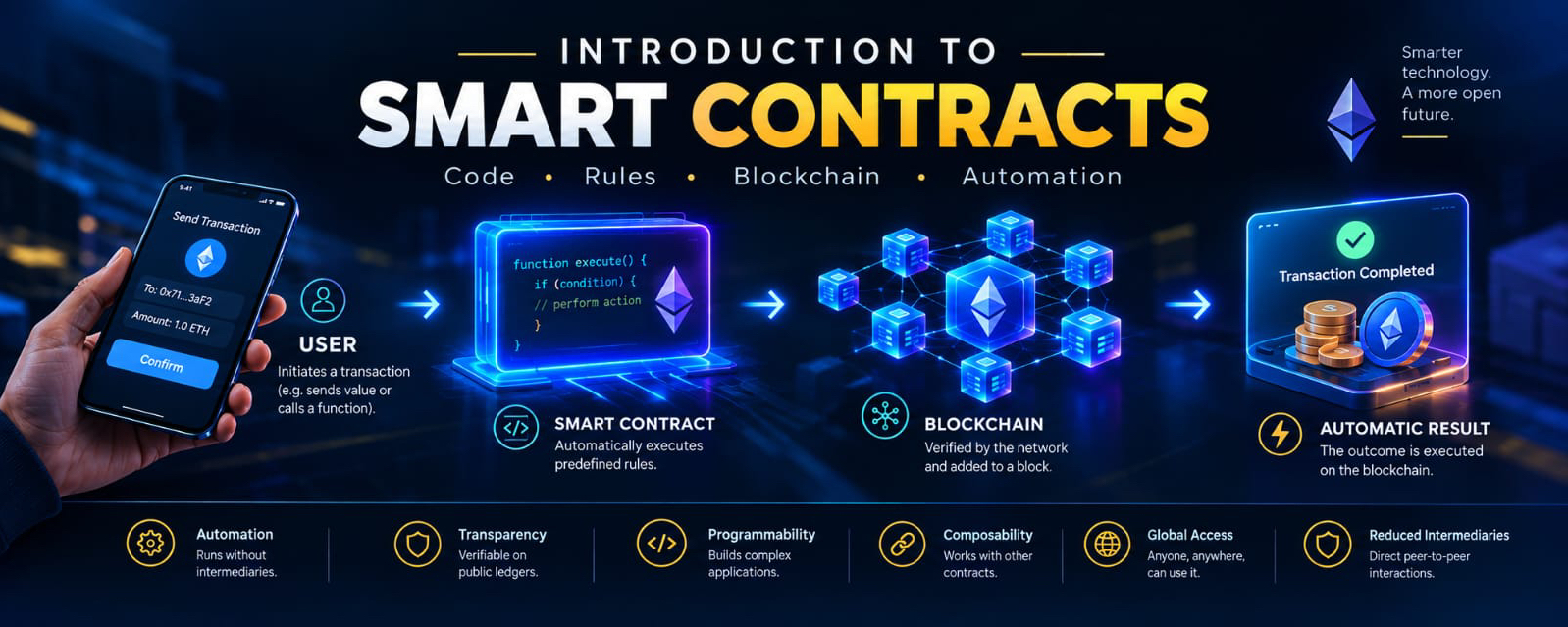
A smart contract is a computer program stored on a blockchain that automatically executes predefined rules when its conditions are met.
Think of a vending machine:
💰 Insert payment → select product → conditions are checked → product is released.
No cashier is needed. The machine follows its programmed rules.
🔍 How does a smart contract work?
A developer writes the rules in code. On Ethereum, Solidity is one of the main programming languages used.
The code is compiled into instructions the Ethereum Virtual Machine (EVM) can execute.
Once deployed, the contract gets a blockchain address and can interact with users and other contracts.
User → Transaction → Smart Contract → Blockchain → Result
⛽ What is gas?
Blockchain computation requires resources.
On Ethereum, gas measures the computational work required to perform an operation. When you make a transaction that changes blockchain state, you generally pay a fee in $ETH .
Simple rule:
More computation → more gas required.
🌍 What can smart contracts do?
They can form the foundation of:
💰 DeFi — lending, borrowing & trading
🪙 Tokens — programmable digital assets
🎨 NFTs — digital ownership systems
🏛️ DAOs — blockchain-based organizations
🎮 Blockchain games
💱 Decentralized exchanges
They can also interact with other contracts, creating complex applications from smaller building blocks.
⚡ Why are they useful?
✅ Automatic execution
✅ Transparent blockchain records
✅ Programmable rules
✅ Reduced reliance on intermediaries
✅ Global accessibility
✅ Composability with other contracts
⚠️ But there's a catch...
Smart contracts are code, and code can have bugs.
A vulnerability can potentially allow attackers to manipulate logic, bypass permissions or steal funds.
Transactions can also be difficult to reverse, and smart contracts may depend on oracles to receive information from the outside world.
So:
Smart contracts don't eliminate trust completely. They shift some of the trust toward code, the blockchain and the system's design.
🧠 Remember this:
Smart contract = Code + Blockchain + Rules + Automatic execution.
Bitcoin demonstrated decentralized digital money.
Smart contracts expanded the idea:
What if a blockchain could execute programs, not just record transactions?
That's the foundation of much of today's Web3 ecosystem. 🔐
#SmartContracts #Ethereum✅ #Blockchain #Web3 #CryptoEducation
⚙️ What Is a Smart Contract? Explained Simply
You've probably heard that smart contracts power DeFi, NFTs and Web3. But what actually are they?
A smart contract is a computer program stored on a blockchain that automatically executes predefined rules when its conditions are met.
Think of a vending machine:
💰 Insert payment → select product → conditions are checked → product is released.
No cashier is needed. The machine follows its programmed rules.
🔍 How does a smart contract work?
A developer writes the rules in code. On Ethereum, Solidity is one of the main programming languages used.
The code is compiled into instructions the Ethereum Virtual Machine (EVM) can execute.
Once deployed, the contract gets a blockchain address and can interact with users and other contracts.
User → Transaction → Smart Contract → Blockchain → Result
⛽ What is gas?
Blockchain computation requires resources.
On Ethereum, gas measures the computational work required to perform an operation. When you make a transaction that changes blockchain state, you generally pay a fee in $ETH .
Simple rule:
More computation → more gas required.
🌍 What can smart contracts do?
They can form the foundation of:
💰 DeFi — lending, borrowing & trading
🪙 Tokens — programmable digital assets
🎨 NFTs — digital ownership systems
🏛️ DAOs — blockchain-based organizations
🎮 Blockchain games
💱 Decentralized exchanges
They can also interact with other contracts, creating complex applications from smaller building blocks.
⚡ Why are they useful?
✅ Automatic execution
✅ Transparent blockchain records
✅ Programmable rules
✅ Reduced reliance on intermediaries
✅ Global accessibility
✅ Composability with other contracts
⚠️ But there's a catch...
Smart contracts are code, and code can have bugs.
A vulnerability can potentially allow attackers to manipulate logic, bypass permissions or steal funds.
Transactions can also be difficult to reverse, and smart contracts may depend on oracles to receive information from the outside world.
So:
Smart contracts don't eliminate trust completely. They shift some of the trust toward code, the blockchain and the system's design.
🧠 Remember this:
Smart contract = Code + Blockchain + Rules + Automatic execution.
Bitcoin demonstrated decentralized digital money.
Smart contracts expanded the idea:
What if a blockchain could execute programs, not just record transactions?
That's the foundation of much of today's Web3 ecosystem. 🔐
#SmartContracts #Ethereum✅ #Blockchain #Web3 #CryptoEducation
A smart contract is a computer program stored on a blockchain that automatically executes predefined rules when its conditions are met.
Think of a vending machine:
💰 Insert payment → select product → conditions are checked → product is released.
No cashier is needed. The machine follows its programmed rules.
🔍 How does a smart contract work?
A developer writes the rules in code. On Ethereum, Solidity is one of the main programming languages used.
The code is compiled into instructions the Ethereum Virtual Machine (EVM) can execute.
Once deployed, the contract gets a blockchain address and can interact with users and other contracts.
User → Transaction → Smart Contract → Blockchain → Result
⛽ What is gas?
Blockchain computation requires resources.
On Ethereum, gas measures the computational work required to perform an operation. When you make a transaction that changes blockchain state, you generally pay a fee in $ETH .
Simple rule:
More computation → more gas required.
🌍 What can smart contracts do?
They can form the foundation of:
💰 DeFi — lending, borrowing & trading
🪙 Tokens — programmable digital assets
🎨 NFTs — digital ownership systems
🏛️ DAOs — blockchain-based organizations
🎮 Blockchain games
💱 Decentralized exchanges
They can also interact with other contracts, creating complex applications from smaller building blocks.
⚡ Why are they useful?
✅ Automatic execution
✅ Transparent blockchain records
✅ Programmable rules
✅ Reduced reliance on intermediaries
✅ Global accessibility
✅ Composability with other contracts
⚠️ But there's a catch...
Smart contracts are code, and code can have bugs.
A vulnerability can potentially allow attackers to manipulate logic, bypass permissions or steal funds.
Transactions can also be difficult to reverse, and smart contracts may depend on oracles to receive information from the outside world.
So:
Smart contracts don't eliminate trust completely. They shift some of the trust toward code, the blockchain and the system's design.
🧠 Remember this:
Smart contract = Code + Blockchain + Rules + Automatic execution.
Bitcoin demonstrated decentralized digital money.
Smart contracts expanded the idea:
What if a blockchain could execute programs, not just record transactions?
That's the foundation of much of today's Web3 ecosystem. 🔐
#SmartContracts #Ethereum✅ #Blockchain #Web3 #CryptoEducation
1
98

·
--
Most people will probably read S&P Global’s move to acquire OpenZeppelin as another sign of traditional finance moving closer to crypto
I’m looking at it from a different angle
When financial products become programmable, I think the way we measure risk may need to change as well
In traditional finance we usually look at the issuer, the balance sheet, the collateral and who holds custody. On-chain finance adds another layer to all of this, the code itself
A tokenized bond can have a strong issuer, attractive yield and solid collateral, but if the smart contract controlling ownership, transfers or access has a critical weakness, part of the risk may sit somewhere traditional analysis does not fully capture
That’s what makes S&P Global’s agreement to acquire OpenZeppelin interesting to me. Not simply because another major financial company is moving closer to crypto, but because it points to something more fundamental
As finance becomes programmable, code quality may stop being a technical detail and start becoming part of the financial product itself
That could also change the questions institutions ask before committing capital. It may no longer be only about who issued the asset, but also who verified the code behind it
Tokenization is often described as moving stocks, bonds, funds and other assets onto blockchain infrastructure. But putting an asset on-chain does not automatically make its risk easier to understand
It may create a new type of risk that capital still needs to learn how to measure
So maybe the next stage of on-chain finance is not simply about bringing more assets onto blockchains
It may be about making the risks inside the code measurable enough for large capital to trust
If that happens, the infrastructure that verifies financial code may eventually become just as important as the infrastructure that executes it
#Tokenization #DigitalAssets #SmartContracts #Binance
Most people will probably read S&P Global’s move to acquire OpenZeppelin as another sign of traditional finance moving closer to crypto
I’m looking at it from a different angle
When financial products become programmable, I think the way we measure risk may need to change as well
In traditional finance we usually look at the issuer, the balance sheet, the collateral and who holds custody. On-chain finance adds another layer to all of this, the code itself
A tokenized bond can have a strong issuer, attractive yield and solid collateral, but if the smart contract controlling ownership, transfers or access has a critical weakness, part of the risk may sit somewhere traditional analysis does not fully capture
That’s what makes S&P Global’s agreement to acquire OpenZeppelin interesting to me. Not simply because another major financial company is moving closer to crypto, but because it points to something more fundamental
As finance becomes programmable, code quality may stop being a technical detail and start becoming part of the financial product itself
That could also change the questions institutions ask before committing capital. It may no longer be only about who issued the asset, but also who verified the code behind it
Tokenization is often described as moving stocks, bonds, funds and other assets onto blockchain infrastructure. But putting an asset on-chain does not automatically make its risk easier to understand
It may create a new type of risk that capital still needs to learn how to measure
So maybe the next stage of on-chain finance is not simply about bringing more assets onto blockchains
It may be about making the risks inside the code measurable enough for large capital to trust
If that happens, the infrastructure that verifies financial code may eventually become just as important as the infrastructure that executes it
#Tokenization #DigitalAssets #SmartContracts #Binance
I’m looking at it from a different angle
When financial products become programmable, I think the way we measure risk may need to change as well
In traditional finance we usually look at the issuer, the balance sheet, the collateral and who holds custody. On-chain finance adds another layer to all of this, the code itself
A tokenized bond can have a strong issuer, attractive yield and solid collateral, but if the smart contract controlling ownership, transfers or access has a critical weakness, part of the risk may sit somewhere traditional analysis does not fully capture
That’s what makes S&P Global’s agreement to acquire OpenZeppelin interesting to me. Not simply because another major financial company is moving closer to crypto, but because it points to something more fundamental
As finance becomes programmable, code quality may stop being a technical detail and start becoming part of the financial product itself
That could also change the questions institutions ask before committing capital. It may no longer be only about who issued the asset, but also who verified the code behind it
Tokenization is often described as moving stocks, bonds, funds and other assets onto blockchain infrastructure. But putting an asset on-chain does not automatically make its risk easier to understand
It may create a new type of risk that capital still needs to learn how to measure
So maybe the next stage of on-chain finance is not simply about bringing more assets onto blockchains
It may be about making the risks inside the code measurable enough for large capital to trust
If that happens, the infrastructure that verifies financial code may eventually become just as important as the infrastructure that executes it
#Tokenization #DigitalAssets #SmartContracts #Binance
2
23.1k

·
--
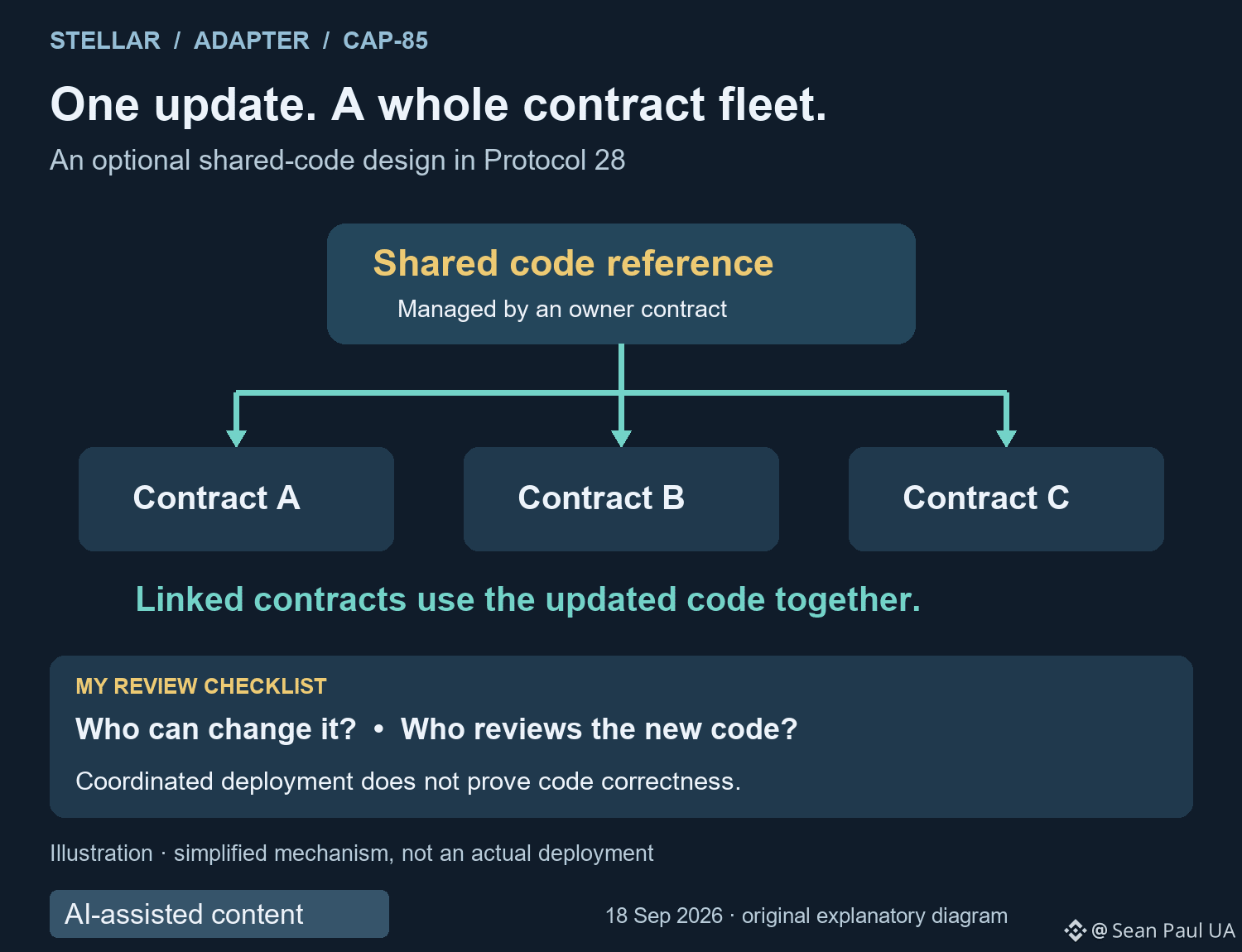
Stellar's Protocol 28 is live. The feature I'm watching is one update reaching a whole fleet of contracts.
Adapter's CAP-85 lets participating smart contracts use a shared code reference managed by another contract. Updating that reference changes the code used by the entire linked fleet together. Stellar's documentation calls this an atomic upgrade.
Why it matters: a large rollout no longer has to leave some linked contracts on the old version while others run the new one. Teams have to adopt this design; it doesn't automatically convert every existing contract.
My next check would be who controls that shared reference and how changes are reviewed. Updating everything together can remove a messy rollout window, but it doesn't prove that the replacement code is correct. One coordinated update still needs careful authorization and testing.
There is a separate speed story, too. The Stellar Development Foundation says the full consensus performance gains will be phased in as parallel transaction-set downloading is enabled. I wouldn't treat the protocol number alone as proof of a particular throughput increase.
What safeguard would you want before an app can update an entire contract fleet together?
$XLM #Stellar #SmartContracts
Stellar's Protocol 28 is live. The feature I'm watching is one update reaching a whole fleet of contracts.
Adapter's CAP-85 lets participating smart contracts use a shared code reference managed by another contract. Updating that reference changes the code used by the entire linked fleet together. Stellar's documentation calls this an atomic upgrade.
Why it matters: a large rollout no longer has to leave some linked contracts on the old version while others run the new one. Teams have to adopt this design; it doesn't automatically convert every existing contract.
My next check would be who controls that shared reference and how changes are reviewed. Updating everything together can remove a messy rollout window, but it doesn't prove that the replacement code is correct. One coordinated update still needs careful authorization and testing.
There is a separate speed story, too. The Stellar Development Foundation says the full consensus performance gains will be phased in as parallel transaction-set downloading is enabled. I wouldn't treat the protocol number alone as proof of a particular throughput increase.
What safeguard would you want before an app can update an entire contract fleet together?
$XLM #Stellar #SmartContracts
Adapter's CAP-85 lets participating smart contracts use a shared code reference managed by another contract. Updating that reference changes the code used by the entire linked fleet together. Stellar's documentation calls this an atomic upgrade.
Why it matters: a large rollout no longer has to leave some linked contracts on the old version while others run the new one. Teams have to adopt this design; it doesn't automatically convert every existing contract.
My next check would be who controls that shared reference and how changes are reviewed. Updating everything together can remove a messy rollout window, but it doesn't prove that the replacement code is correct. One coordinated update still needs careful authorization and testing.
There is a separate speed story, too. The Stellar Development Foundation says the full consensus performance gains will be phased in as parallel transaction-set downloading is enabled. I wouldn't treat the protocol number alone as proof of a particular throughput increase.
What safeguard would you want before an app can update an entire contract fleet together?
$XLM #Stellar #SmartContracts
1
116

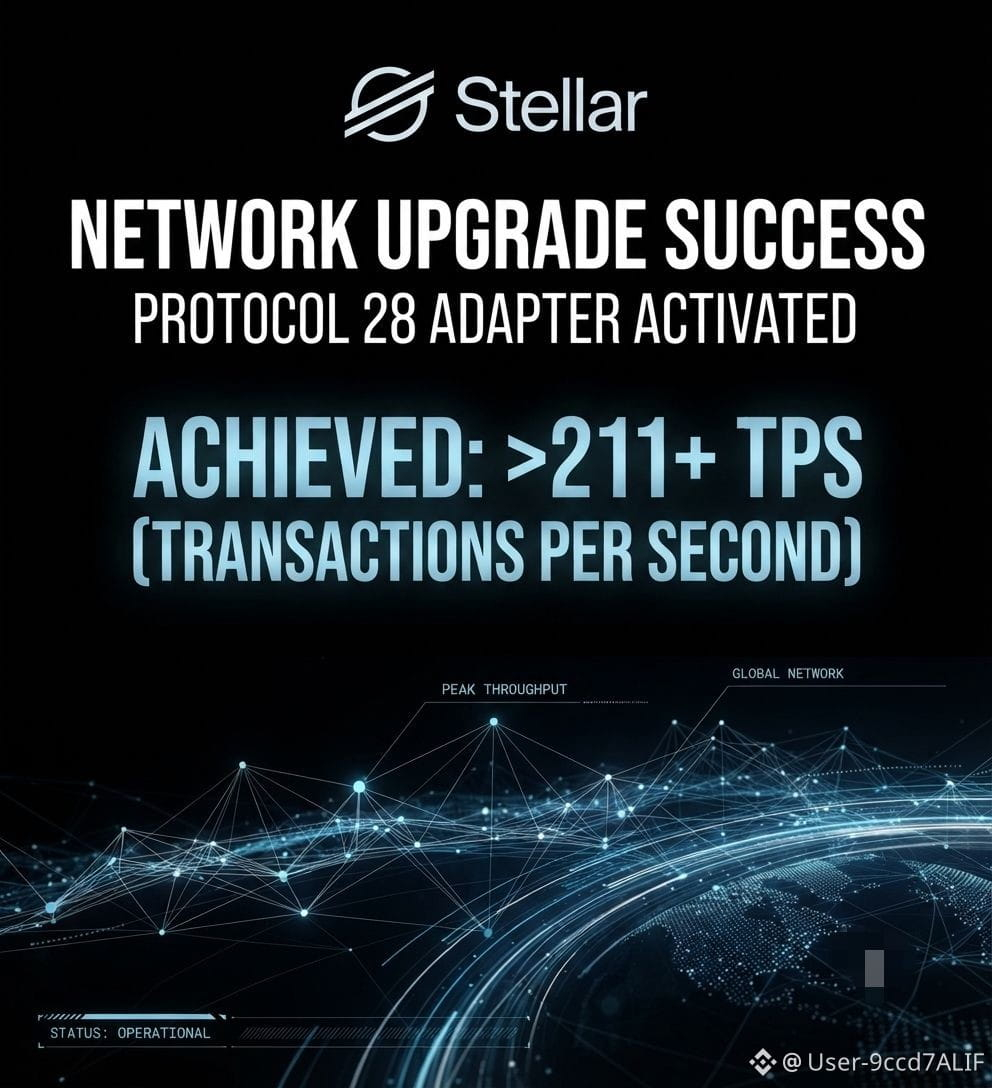
🚀 Stellar Activates Protocol 28 as Network Surpasses 211 TPS
Stellar has officially activated Protocol 28, known as “Adapter,” on its mainnet, marking another step in the network’s ongoing scalability and smart-contract development.
⚡ 211+ TPS Milestone Around the same time, Stellar recorded more than 211 transactions per second across 100 consecutive blocks, highlighting a new sustained throughput milestone. This performance figure is separate from the protocol upgrade itself, as Stellar is gradually rolling out parallel transaction-set downloading.
🔧 What Protocol 28 Brings:
• CAP-83: Allows validators to continue consensus even when transaction data is delayed or invalid.
• CAP-85: Enables multiple Soroban smart contracts to use a shared, externally managed executable, making large-scale contract upgrades more efficient and atomic.
• CAP-86: Introduces sparse-map functionality to make smart-contract data migrations easier as applications evolve.
📈 Overall, Protocol 28 is focused heavily on improving Stellar’s smart-contract infrastructure while also strengthening the network’s ability to handle increasing workloads.
For developers, infrastructure operators, and financial applications building on Stellar, Adapter represents another important upgrade toward a more scalable and flexible ecosystem.
#XLM #Protocol28 #Soroban
#Web3 #SmartContracts
🚀 Stellar Activates Protocol 28 as Network Surpasses 211 TPS
Stellar has officially activated Protocol 28, known as “Adapter,” on its mainnet, marking another step in the network’s ongoing scalability and smart-contract development.
⚡ 211+ TPS Milestone Around the same time, Stellar recorded more than 211 transactions per second across 100 consecutive blocks, highlighting a new sustained throughput milestone. This performance figure is separate from the protocol upgrade itself, as Stellar is gradually rolling out parallel transaction-set downloading.
🔧 What Protocol 28 Brings:
• CAP-83: Allows validators to continue consensus even when transaction data is delayed or invalid.
• CAP-85: Enables multiple Soroban smart contracts to use a shared, externally managed executable, making large-scale contract upgrades more efficient and atomic.
• CAP-86: Introduces sparse-map functionality to make smart-contract data migrations easier as applications evolve.
📈 Overall, Protocol 28 is focused heavily on improving Stellar’s smart-contract infrastructure while also strengthening the network’s ability to handle increasing workloads.
For developers, infrastructure operators, and financial applications building on Stellar, Adapter represents another important upgrade toward a more scalable and flexible ecosystem.
#XLM #Protocol28 #Soroban
#Web3 #SmartContracts
Stellar has officially activated Protocol 28, known as “Adapter,” on its mainnet, marking another step in the network’s ongoing scalability and smart-contract development.
⚡ 211+ TPS Milestone Around the same time, Stellar recorded more than 211 transactions per second across 100 consecutive blocks, highlighting a new sustained throughput milestone. This performance figure is separate from the protocol upgrade itself, as Stellar is gradually rolling out parallel transaction-set downloading.
🔧 What Protocol 28 Brings:
• CAP-83: Allows validators to continue consensus even when transaction data is delayed or invalid.
• CAP-85: Enables multiple Soroban smart contracts to use a shared, externally managed executable, making large-scale contract upgrades more efficient and atomic.
• CAP-86: Introduces sparse-map functionality to make smart-contract data migrations easier as applications evolve.
📈 Overall, Protocol 28 is focused heavily on improving Stellar’s smart-contract infrastructure while also strengthening the network’s ability to handle increasing workloads.
For developers, infrastructure operators, and financial applications building on Stellar, Adapter represents another important upgrade toward a more scalable and flexible ecosystem.
#XLM #Protocol28 #Soroban
#Web3 #SmartContracts
97

·
--

Article
AI Can Protect Crypto, Says Vitalik Buterin – What That Means for YouVitalik Buterin, the co‑founder of Ethereum, has just flipped a common fear on its head. While many people worry that artificial intelligence will bring new ways for hackers to break into blockchain systems, he argues the opposite: AI can actually help developers mathematically verify entire software systems, turning the same technology that could be used for attacks into a powerful tool for defense.
The Concept: AI as a Security Auditor
Think of a software system as a giant, complex machine with thousands of moving parts. Traditionally, developers test each part manually or with automated scripts, but that’s like checking every gear in a car by hand—time‑consuming and prone to human error. AI, especially large language models and advanced verification algorithms, can scan the entire codebase, identify hidden bugs, and prove mathematically that the system behaves as intended. It’s the blockchain equivalent of having a super‑intelligent mechanic that can spot a flaw before it becomes a problem. #AIinCrypto #SmartContracts
Real‑World Example: The $ETH Ecosystem
In the Ethereum ecosystem, smart contracts are the backbone of decentralized applications. A single line of faulty code can lead to millions of dollars in losses, as seen in past exploits. By integrating AI verification tools, developers can run formal proofs that their contracts are free from vulnerabilities before deployment. Imagine a new DeFi protocol that automatically proves its safety to users, reducing the risk of rug pulls and hacks. This approach is already being piloted by some leading Ethereum projects, and the results are promising: fewer bugs, faster development cycles, and higher user trust.
Takeaway: Embrace AI‑Powered Security
If you’re building on $ETH or just following the market, consider the following steps:
1. Stay informed about AI verification tools and libraries that integrate with Solidity and other smart‑contract languages.
2. Encourage your team to adopt formal verification practices early in the development cycle.
3. Keep an eye on emerging standards that may mandate AI‑based security audits for high‑value contracts.
By doing so, you’ll not only protect your projects but also contribute to a safer, more resilient blockchain ecosystem. #SecureDeFi
What do you think—will AI become the new standard for blockchain security, or do you see other solutions taking the lead?
AI Can Protect Crypto, Says Vitalik Buterin – What That Means for You
Vitalik Buterin, the co‑founder of Ethereum, has just flipped a common fear on its head. While many people worry that artificial intelligence will bring new ways for hackers to break into blockchain systems, he argues the opposite: AI can actually help developers mathematically verify entire software systems, turning the same technology that could be used for attacks into a powerful tool for defense.
The Concept: AI as a Security Auditor
Think of a software system as a giant, complex machine with thousands of moving parts. Traditionally, developers test each part manually or with automated scripts, but that’s like checking every gear in a car by hand—time‑consuming and prone to human error. AI, especially large language models and advanced verification algorithms, can scan the entire codebase, identify hidden bugs, and prove mathematically that the system behaves as intended. It’s the blockchain equivalent of having a super‑intelligent mechanic that can spot a flaw before it becomes a problem. #AIinCrypto #SmartContracts
Real‑World Example: The $ETH Ecosystem
In the Ethereum ecosystem, smart contracts are the backbone of decentralized applications. A single line of faulty code can lead to millions of dollars in losses, as seen in past exploits. By integrating AI verification tools, developers can run formal proofs that their contracts are free from vulnerabilities before deployment. Imagine a new DeFi protocol that automatically proves its safety to users, reducing the risk of rug pulls and hacks. This approach is already being piloted by some leading Ethereum projects, and the results are promising: fewer bugs, faster development cycles, and higher user trust.
Takeaway: Embrace AI‑Powered Security
If you’re building on $ETH or just following the market, consider the following steps:
1. Stay informed about AI verification tools and libraries that integrate with Solidity and other smart‑contract languages.
2. Encourage your team to adopt formal verification practices early in the development cycle.
3. Keep an eye on emerging standards that may mandate AI‑based security audits for high‑value contracts.
By doing so, you’ll not only protect your projects but also contribute to a safer, more resilient blockchain ecosystem. #SecureDeFi
What do you think—will AI become the new standard for blockchain security, or do you see other solutions taking the lead?
The Concept: AI as a Security Auditor
Think of a software system as a giant, complex machine with thousands of moving parts. Traditionally, developers test each part manually or with automated scripts, but that’s like checking every gear in a car by hand—time‑consuming and prone to human error. AI, especially large language models and advanced verification algorithms, can scan the entire codebase, identify hidden bugs, and prove mathematically that the system behaves as intended. It’s the blockchain equivalent of having a super‑intelligent mechanic that can spot a flaw before it becomes a problem. #AIinCrypto #SmartContracts
Real‑World Example: The $ETH Ecosystem
In the Ethereum ecosystem, smart contracts are the backbone of decentralized applications. A single line of faulty code can lead to millions of dollars in losses, as seen in past exploits. By integrating AI verification tools, developers can run formal proofs that their contracts are free from vulnerabilities before deployment. Imagine a new DeFi protocol that automatically proves its safety to users, reducing the risk of rug pulls and hacks. This approach is already being piloted by some leading Ethereum projects, and the results are promising: fewer bugs, faster development cycles, and higher user trust.
Takeaway: Embrace AI‑Powered Security
If you’re building on $ETH or just following the market, consider the following steps:
1. Stay informed about AI verification tools and libraries that integrate with Solidity and other smart‑contract languages.
2. Encourage your team to adopt formal verification practices early in the development cycle.
3. Keep an eye on emerging standards that may mandate AI‑based security audits for high‑value contracts.
By doing so, you’ll not only protect your projects but also contribute to a safer, more resilient blockchain ecosystem. #SecureDeFi
What do you think—will AI become the new standard for blockchain security, or do you see other solutions taking the lead?
21
·
--
One Token Score Is Not Enough$JASONFLY shows why a quick token score and deeper contract intelligence can produce very different results without either number being fabricated.
The BNB Smart Chain contract returned 90/100 in the quick public scan. That surface-level result was followed by a deeper score of 35/100 after TokenToolHub resolved the implementation and examined a broader authority and control surface.
The source is verified, but verification only confirms that published source matches the analyzed bytecode. It does not remove privileged functions or settle who controls an upgradeable proxy.
The deeper report found active ownership, possible implementation replacement, supply expansion and reduction paths, mutable fee controls and generic execution capability. The proxy administrator was not resolved.
Important market-side questions also remained open. Trading simulation was unavailable, so honeypot status, current buy and sell taxes and practical selling behavior were unresolved. Liquidity and holder evidence were not returned in the report.
The right conclusion is not that 90 is false or 35 proves an exploit. The two scores answer different questions with different evidence depth.
Use the quick result for orientation. Then check the resolved implementation, ownership, upgrade authority, supply controls, fee controls, recent privileged activity and unresolved coverage before relying on it.
Full TokenToolHub report:
https://tokentoolhub.com/token-safety-checker/?net=bsc&address=0x8514638EeFc900263709b154805027E824E87777
#BNBChain #CryptoResearch #SmartContracts #Web3Security #TokenSafety
One Token Score Is Not Enough
$JASONFLY shows why a quick token score and deeper contract intelligence can produce very different results without either number being fabricated.
The BNB Smart Chain contract returned 90/100 in the quick public scan. That surface-level result was followed by a deeper score of 35/100 after TokenToolHub resolved the implementation and examined a broader authority and control surface.
The source is verified, but verification only confirms that published source matches the analyzed bytecode. It does not remove privileged functions or settle who controls an upgradeable proxy.
The deeper report found active ownership, possible implementation replacement, supply expansion and reduction paths, mutable fee controls and generic execution capability. The proxy administrator was not resolved.
Important market-side questions also remained open. Trading simulation was unavailable, so honeypot status, current buy and sell taxes and practical selling behavior were unresolved. Liquidity and holder evidence were not returned in the report.
The right conclusion is not that 90 is false or 35 proves an exploit. The two scores answer different questions with different evidence depth.
Use the quick result for orientation. Then check the resolved implementation, ownership, upgrade authority, supply controls, fee controls, recent privileged activity and unresolved coverage before relying on it.
Full TokenToolHub report:
https://tokentoolhub.com/token-safety-checker/?net=bsc&address=0x8514638EeFc900263709b154805027E824E87777
#BNBChain #CryptoResearch #SmartContracts #Web3Security #TokenSafety
The BNB Smart Chain contract returned 90/100 in the quick public scan. That surface-level result was followed by a deeper score of 35/100 after TokenToolHub resolved the implementation and examined a broader authority and control surface.
The source is verified, but verification only confirms that published source matches the analyzed bytecode. It does not remove privileged functions or settle who controls an upgradeable proxy.
The deeper report found active ownership, possible implementation replacement, supply expansion and reduction paths, mutable fee controls and generic execution capability. The proxy administrator was not resolved.
Important market-side questions also remained open. Trading simulation was unavailable, so honeypot status, current buy and sell taxes and practical selling behavior were unresolved. Liquidity and holder evidence were not returned in the report.
The right conclusion is not that 90 is false or 35 proves an exploit. The two scores answer different questions with different evidence depth.
Use the quick result for orientation. Then check the resolved implementation, ownership, upgrade authority, supply controls, fee controls, recent privileged activity and unresolved coverage before relying on it.
Full TokenToolHub report:
https://tokentoolhub.com/token-safety-checker/?net=bsc&address=0x8514638EeFc900263709b154805027E824E87777
#BNBChain #CryptoResearch #SmartContracts #Web3Security #TokenSafety
5


Building, Prototyping, & Testnet Implementation🛠️ From Blueprint to Testnet: Phase 2 of Web3 Engineering!
Prototyping is where theoretical code meets battle-tested execution. Through public and private testnets, developers stress-test smart contracts, simulate high-concurrency transaction loads, and refine gas efficiency before mainnet deployment.
💬 Have you ever tested dApps on a testnet to qualify for ecosystem incentives? Share your experience!
#BinanceSquare #SmartContracts #BlockchainEngineering #Testnet #Web3Building
Smart Contract Engineering, Testnet Architectures, and Stress Testing
1. The Engineering Pipeline of Decentralized Applications
Once the theoretical groundwork and architectural specifications are finalized in Phase 1, a project transitions into Phase 2: engineering, prototyping, and environment testing. In centralized software development, staging environments allow engineers to test code in near-production settings without impacting end-users. In blockchain development, this staging ground is represented by test networks (Testnets)—sandboxed environments that replicate the execution engine, consensus rules, and state machine of a blockchain without using real economic assets.
Developing smart contracts—primarily written in languages like Solidity, Rust, or Move—requires an unprecedented focus on security and resource efficiency. Unlike traditional software where memory allocation is cheap, every instruction executed on a decentralized state machine consumes "gas"—a measure of computational effort. Inefficient code loops, redundant storage calls, and sub-optimal data structures directly translate to higher transaction fees for end-users, rendering protocols uncompetitive in gas-sensitive market environments.
2. Smart Contract Optimization and Vulnerability Prevention
During the active prototyping phase, developers utilize sophisticated integrated development environments (IDEs) and framework suites such as Hardhat, Foundry, and Anchor. Engineering teams focus heavily on gas optimization techniques:
Storage vs. Memory Allocation: In Ethereum-compatible execution environments, writing data to permanent contract storage (SSTORE) is exponentially more expensive than temporary memory execution (MSTORE). Developers optimize contracts by packing storage variables into single 32-byte slots, utilizing immutable and constant variables, and leveraging transient storage where applicable.
Reentrancy Protection: One of the most catastrophic vulnerabilities in smart contract history is the reentrancy attack, wherein an external malicious contract recursively calls back into a target contract before the target updates its internal state balances. Developers mitigate this during prototyping by implementing the Checks-Effects-Interactions pattern and utilizing non-reentrant mutex locks.
3. Testnet Deployments: Alpha, Beta, and Incentive Structure
Deploying a protocol to a public testnet (such as Ethereum's Sepolia or Holesky, or custom dedicated testnets) serves as the primary mechanism for empirical validation. Testnets allow developers to simulate complex multi-user interactions under real network latency conditions.
The testnet phase generally unfolds across three distinct sub-stages:
Private Devnet: Closed internal network deployed locally or across controlled nodes to test basic smart contract deployment, state transitions, and front-end Web3 interface (dApp) integration via libraries like Ethers.js, Viem, or Web3.js.
Incentivized Testnet: A public testnet campaign designed to stress-test network infrastructure by offering future token rewards to node operators, validators, and edge-case users. Participants attempt to break the network by submitting high volumes of concurrent transactions, generating maximum block congestion, and probing for state desynchronization bugs.
Bug Bounty Programs: In parallel with public testnets, protocols partner with security platforms such as Immunefi to launch competitive bug bounties. White-hat hackers are financially incentivized to discover zero-day exploits, logical errors, or reentrancy bugs within the open-source code repository before real capital is placed at risk on the mainnet.
4. Theoretical Conclusion
Phase 2 bridges abstract theory and practical execution. A successful testnet phase provides concrete metrics regarding transaction finality times, peak throughput capability, smart contract gas overhead, and resilience against network spam—ensuring the application layer is structurally prepared for mainnet execution.
Why We Reached This Conclusion
We reached this conclusion because stress-testing is the ultimate filter between viable Web3 projects and failed experiments. On Binance Square, emphasizing the transition from testnet to real-world usage educates the community on assessing technical maturity, helping traders differentiate between marketing hype and genuine engineering execution.
Building, Prototyping, & Testnet Implementation
🛠️ From Blueprint to Testnet: Phase 2 of Web3 Engineering!
Prototyping is where theoretical code meets battle-tested execution. Through public and private testnets, developers stress-test smart contracts, simulate high-concurrency transaction loads, and refine gas efficiency before mainnet deployment.
💬 Have you ever tested dApps on a testnet to qualify for ecosystem incentives? Share your experience!
#BinanceSquare #SmartContracts #BlockchainEngineering #Testnet #Web3Building
Smart Contract Engineering, Testnet Architectures, and Stress Testing
1. The Engineering Pipeline of Decentralized Applications
Once the theoretical groundwork and architectural specifications are finalized in Phase 1, a project transitions into Phase 2: engineering, prototyping, and environment testing. In centralized software development, staging environments allow engineers to test code in near-production settings without impacting end-users. In blockchain development, this staging ground is represented by test networks (Testnets)—sandboxed environments that replicate the execution engine, consensus rules, and state machine of a blockchain without using real economic assets.
Developing smart contracts—primarily written in languages like Solidity, Rust, or Move—requires an unprecedented focus on security and resource efficiency. Unlike traditional software where memory allocation is cheap, every instruction executed on a decentralized state machine consumes "gas"—a measure of computational effort. Inefficient code loops, redundant storage calls, and sub-optimal data structures directly translate to higher transaction fees for end-users, rendering protocols uncompetitive in gas-sensitive market environments.
2. Smart Contract Optimization and Vulnerability Prevention
During the active prototyping phase, developers utilize sophisticated integrated development environments (IDEs) and framework suites such as Hardhat, Foundry, and Anchor. Engineering teams focus heavily on gas optimization techniques:
Storage vs. Memory Allocation: In Ethereum-compatible execution environments, writing data to permanent contract storage (SSTORE) is exponentially more expensive than temporary memory execution (MSTORE). Developers optimize contracts by packing storage variables into single 32-byte slots, utilizing immutable and constant variables, and leveraging transient storage where applicable.
Reentrancy Protection: One of the most catastrophic vulnerabilities in smart contract history is the reentrancy attack, wherein an external malicious contract recursively calls back into a target contract before the target updates its internal state balances. Developers mitigate this during prototyping by implementing the Checks-Effects-Interactions pattern and utilizing non-reentrant mutex locks.
3. Testnet Deployments: Alpha, Beta, and Incentive Structure
Deploying a protocol to a public testnet (such as Ethereum's Sepolia or Holesky, or custom dedicated testnets) serves as the primary mechanism for empirical validation. Testnets allow developers to simulate complex multi-user interactions under real network latency conditions.
The testnet phase generally unfolds across three distinct sub-stages:
Private Devnet: Closed internal network deployed locally or across controlled nodes to test basic smart contract deployment, state transitions, and front-end Web3 interface (dApp) integration via libraries like Ethers.js, Viem, or Web3.js.
Incentivized Testnet: A public testnet campaign designed to stress-test network infrastructure by offering future token rewards to node operators, validators, and edge-case users. Participants attempt to break the network by submitting high volumes of concurrent transactions, generating maximum block congestion, and probing for state desynchronization bugs.
Bug Bounty Programs: In parallel with public testnets, protocols partner with security platforms such as Immunefi to launch competitive bug bounties. White-hat hackers are financially incentivized to discover zero-day exploits, logical errors, or reentrancy bugs within the open-source code repository before real capital is placed at risk on the mainnet.
4. Theoretical Conclusion
Phase 2 bridges abstract theory and practical execution. A successful testnet phase provides concrete metrics regarding transaction finality times, peak throughput capability, smart contract gas overhead, and resilience against network spam—ensuring the application layer is structurally prepared for mainnet execution.
Why We Reached This Conclusion
We reached this conclusion because stress-testing is the ultimate filter between viable Web3 projects and failed experiments. On Binance Square, emphasizing the transition from testnet to real-world usage educates the community on assessing technical maturity, helping traders differentiate between marketing hype and genuine engineering execution.
Prototyping is where theoretical code meets battle-tested execution. Through public and private testnets, developers stress-test smart contracts, simulate high-concurrency transaction loads, and refine gas efficiency before mainnet deployment.
💬 Have you ever tested dApps on a testnet to qualify for ecosystem incentives? Share your experience!
#BinanceSquare #SmartContracts #BlockchainEngineering #Testnet #Web3Building
Smart Contract Engineering, Testnet Architectures, and Stress Testing
1. The Engineering Pipeline of Decentralized Applications
Once the theoretical groundwork and architectural specifications are finalized in Phase 1, a project transitions into Phase 2: engineering, prototyping, and environment testing. In centralized software development, staging environments allow engineers to test code in near-production settings without impacting end-users. In blockchain development, this staging ground is represented by test networks (Testnets)—sandboxed environments that replicate the execution engine, consensus rules, and state machine of a blockchain without using real economic assets.
Developing smart contracts—primarily written in languages like Solidity, Rust, or Move—requires an unprecedented focus on security and resource efficiency. Unlike traditional software where memory allocation is cheap, every instruction executed on a decentralized state machine consumes "gas"—a measure of computational effort. Inefficient code loops, redundant storage calls, and sub-optimal data structures directly translate to higher transaction fees for end-users, rendering protocols uncompetitive in gas-sensitive market environments.
2. Smart Contract Optimization and Vulnerability Prevention
During the active prototyping phase, developers utilize sophisticated integrated development environments (IDEs) and framework suites such as Hardhat, Foundry, and Anchor. Engineering teams focus heavily on gas optimization techniques:
Storage vs. Memory Allocation: In Ethereum-compatible execution environments, writing data to permanent contract storage (SSTORE) is exponentially more expensive than temporary memory execution (MSTORE). Developers optimize contracts by packing storage variables into single 32-byte slots, utilizing immutable and constant variables, and leveraging transient storage where applicable.
Reentrancy Protection: One of the most catastrophic vulnerabilities in smart contract history is the reentrancy attack, wherein an external malicious contract recursively calls back into a target contract before the target updates its internal state balances. Developers mitigate this during prototyping by implementing the Checks-Effects-Interactions pattern and utilizing non-reentrant mutex locks.
3. Testnet Deployments: Alpha, Beta, and Incentive Structure
Deploying a protocol to a public testnet (such as Ethereum's Sepolia or Holesky, or custom dedicated testnets) serves as the primary mechanism for empirical validation. Testnets allow developers to simulate complex multi-user interactions under real network latency conditions.
The testnet phase generally unfolds across three distinct sub-stages:
Private Devnet: Closed internal network deployed locally or across controlled nodes to test basic smart contract deployment, state transitions, and front-end Web3 interface (dApp) integration via libraries like Ethers.js, Viem, or Web3.js.
Incentivized Testnet: A public testnet campaign designed to stress-test network infrastructure by offering future token rewards to node operators, validators, and edge-case users. Participants attempt to break the network by submitting high volumes of concurrent transactions, generating maximum block congestion, and probing for state desynchronization bugs.
Bug Bounty Programs: In parallel with public testnets, protocols partner with security platforms such as Immunefi to launch competitive bug bounties. White-hat hackers are financially incentivized to discover zero-day exploits, logical errors, or reentrancy bugs within the open-source code repository before real capital is placed at risk on the mainnet.
4. Theoretical Conclusion
Phase 2 bridges abstract theory and practical execution. A successful testnet phase provides concrete metrics regarding transaction finality times, peak throughput capability, smart contract gas overhead, and resilience against network spam—ensuring the application layer is structurally prepared for mainnet execution.
Why We Reached This Conclusion
We reached this conclusion because stress-testing is the ultimate filter between viable Web3 projects and failed experiments. On Binance Square, emphasizing the transition from testnet to real-world usage educates the community on assessing technical maturity, helping traders differentiate between marketing hype and genuine engineering execution.
69
Architecture Agent OS : Autonomous Wallets and Smart Contracts
Title : The evolution of wallets : From private keys to Smart Accounts 🤖💳
Content :
With the advent of architectures like Binance Agent OS, the crypto wallet no longer just stores keys: it becomes programmable.
💡 The major benefits of Account Abstraction :
Automated rules management : Setting daily spending limits for bots.
Bundled transactions (Batching) : Executing multiple operations in a single validation to reduce gas fees.
Social recovery : Securing access without relying solely on a classic recovery phrase.
The Web3 wallet user experience is gradually converging with the standards of modern banking.
#BinanceAgentOS #SmartContracts #AccountAbstraction #CryptoInnovation #Web3 @Dusk_Foundation
Architecture Agent OS : Autonomous Wallets and Smart Contracts
Title : The evolution of wallets : From private keys to Smart Accounts 🤖💳
Content :
With the advent of architectures like Binance Agent OS, the crypto wallet no longer just stores keys: it becomes programmable.
💡 The major benefits of Account Abstraction :
Automated rules management : Setting daily spending limits for bots.
Bundled transactions (Batching) : Executing multiple operations in a single validation to reduce gas fees.
Social recovery : Securing access without relying solely on a classic recovery phrase.
The Web3 wallet user experience is gradually converging with the standards of modern banking.
#BinanceAgentOS #SmartContracts #AccountAbstraction #CryptoInnovation #Web3 @Dusk
Title : The evolution of wallets : From private keys to Smart Accounts 🤖💳
Content :
With the advent of architectures like Binance Agent OS, the crypto wallet no longer just stores keys: it becomes programmable.
💡 The major benefits of Account Abstraction :
Automated rules management : Setting daily spending limits for bots.
Bundled transactions (Batching) : Executing multiple operations in a single validation to reduce gas fees.
Social recovery : Securing access without relying solely on a classic recovery phrase.
The Web3 wallet user experience is gradually converging with the standards of modern banking.
#BinanceAgentOS #SmartContracts #AccountAbstraction #CryptoInnovation #Web3 @Dusk
101

🛡️ "Eryidium" launches AERSeal to enhance smart contract security
"Eryidium" announced the launch of its new product, AERSeal, designed to improve the security of smart contracts. The new solution aims to address the risks of relying on a single private key to control sensitive operations, which may be vulnerable to hacking, thereby reducing the likelihood of unauthorized takeovers of contracts.
━━━━━━━━━━━━━━
📊 Impact: 📊 Medium
🏷️ DEFI
#SmartContracts #BlockchainSecurity #DeFi #CryptoNews #Innovation
📰 Source: thenextweb.com
🛡️ "Eryidium" launches AERSeal to enhance smart contract security
"Eryidium" announced the launch of its new product, AERSeal, designed to improve the security of smart contracts. The new solution aims to address the risks of relying on a single private key to control sensitive operations, which may be vulnerable to hacking, thereby reducing the likelihood of unauthorized takeovers of contracts.
━━━━━━━━━━━━━━
📊 Impact: 📊 Medium
🏷️ DEFI
#SmartContracts #BlockchainSecurity #DeFi #CryptoNews #Innovation
📰 Source: thenextweb.com
"Eryidium" announced the launch of its new product, AERSeal, designed to improve the security of smart contracts. The new solution aims to address the risks of relying on a single private key to control sensitive operations, which may be vulnerable to hacking, thereby reducing the likelihood of unauthorized takeovers of contracts.
━━━━━━━━━━━━━━
📊 Impact: 📊 Medium
🏷️ DEFI
#SmartContracts #BlockchainSecurity #DeFi #CryptoNews #Innovation
📰 Source: thenextweb.com
14
·
--
Verified contract ≠ safe contract.
Source verification answers one useful question:
Can the deployed code be inspected?
It does NOT automatically answer:
• Can additional supply be created?
• Can individual wallets be blacklisted?
• Can transaction limits change?
• Can fees be increased?
• Can transfers be paused?
• Can the implementation behind a proxy be replaced?
• Who controls those permissions?
A stronger token investigation focuses on capability, authority and what can change after deployment.
That is the distinction we use at TokenToolHub when analyzing contract risk.
Before trusting an unfamiliar EVM token, investigate the control surface, not only the chart.
#CryptoSecurity #Web3Security #TokenSafety #SmartContracts #CryptoResearch
Verified contract ≠ safe contract.
Source verification answers one useful question:
Can the deployed code be inspected?
It does NOT automatically answer:
• Can additional supply be created?
• Can individual wallets be blacklisted?
• Can transaction limits change?
• Can fees be increased?
• Can transfers be paused?
• Can the implementation behind a proxy be replaced?
• Who controls those permissions?
A stronger token investigation focuses on capability, authority and what can change after deployment.
That is the distinction we use at TokenToolHub when analyzing contract risk.
Before trusting an unfamiliar EVM token, investigate the control surface, not only the chart.
#CryptoSecurity #Web3Security #TokenSafety #SmartContracts #CryptoResearch
Source verification answers one useful question:
Can the deployed code be inspected?
It does NOT automatically answer:
• Can additional supply be created?
• Can individual wallets be blacklisted?
• Can transaction limits change?
• Can fees be increased?
• Can transfers be paused?
• Can the implementation behind a proxy be replaced?
• Who controls those permissions?
A stronger token investigation focuses on capability, authority and what can change after deployment.
That is the distinction we use at TokenToolHub when analyzing contract risk.
Before trusting an unfamiliar EVM token, investigate the control surface, not only the chart.
#CryptoSecurity #Web3Security #TokenSafety #SmartContracts #CryptoResearch
57

·
--
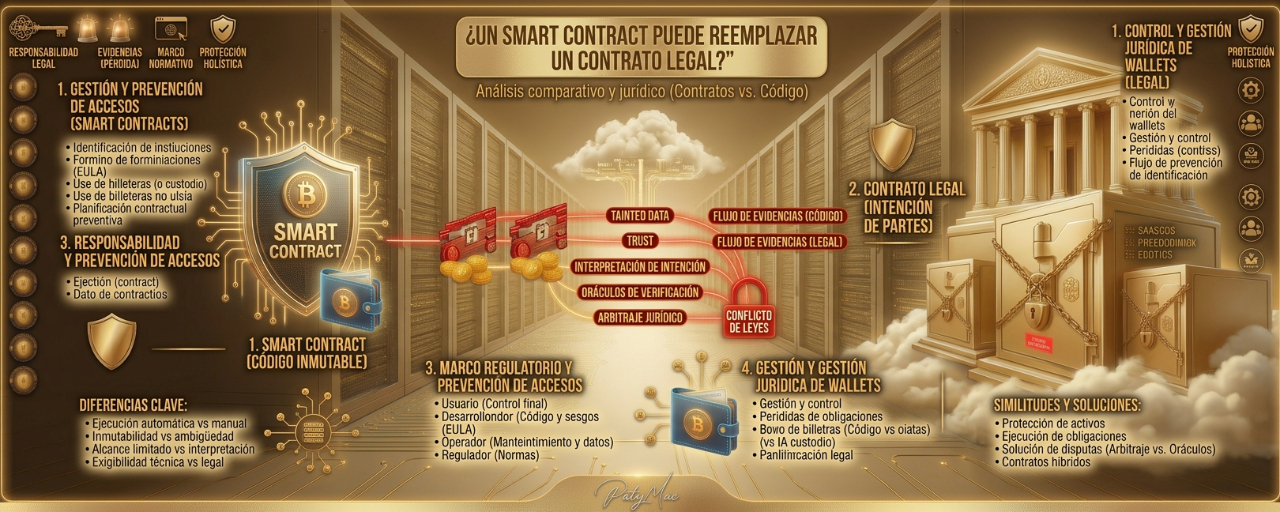
Article
CAN A SMART CONTRACT REPLACE A LEGAL CONTRACT?When the code comes up against the law
Smart contracts are one of the most interesting innovations in blockchain technology.
These are computer programs that automatically perform certain actions when predefined conditions are met.
For example:
to release a payment;
to transfer a token;
to distribute interest;
to execute guarantees;
to administer decentralized loans.
All this without human intervention.
But here a fundamental question arises:
CAN A SMART CONTRACT REPLACE A LEGAL CONTRACT?
When the code comes up against the law
Smart contracts are one of the most interesting innovations in blockchain technology.
These are computer programs that automatically perform certain actions when predefined conditions are met.
For example:
to release a payment;
to transfer a token;
to distribute interest;
to execute guarantees;
to administer decentralized loans.
All this without human intervention.
But here a fundamental question arises:
Smart contracts are one of the most interesting innovations in blockchain technology.
These are computer programs that automatically perform certain actions when predefined conditions are met.
For example:
to release a payment;
to transfer a token;
to distribute interest;
to execute guarantees;
to administer decentralized loans.
All this without human intervention.
But here a fundamental question arises:
1
689
Log in to explore more content
Join global crypto users on Binance Square
⚡️ Get latest and useful information about crypto.
💬 Trusted by the world’s largest crypto exchange.
👍 Discover real insights from verified creators.
Email / Phone number
Trending Topics
1
#BinanceLaunchesBinanceIntelligence
329,259 views
2,727 Discussing
2
#BitcoinTargets2026OpenAt$87570
1,143 views
51 Discussing
3
#BitcoinRejectedAt$87KThirdTime
1,356 views
47 Discussing
4
#StrategyMarketCapSurpassesRumble
5,468 views
305 Discussing
5
#StriveBuys2000BTCFor$169M
12,681 views
116 Discussing
6
#EvernorthXRPTreasuryCompletesSPACMerger
155,314 views
1,541 Discussing
7
#ADAGains10%Above$0.27
61,461 views
257 Discussing
8
#ETHUp70%InQ3ButLiquidityFalls
350,700 views
2,512 Discussing
9
#EthStakingExitQueueHits2026High
143,533 views
1,655 Discussing
10
#FedOctoberHoldOdds82.3%
153,540 views
1,573 Discussing