
Bella_Blocks
6.1k Beiträge

Bella_Blocks
Melden
Nutzer blockieren
Crypto Strategist | Binance Creator
Trade eröffnen
Regelmäßiger Trader
10.2 Monate
261 Following
11.8K+ Follower
5.0K+ Like gegeben
Beiträge
Portfolio
Alle
Live
·
--
Bullisch
Übersetzung ansehen
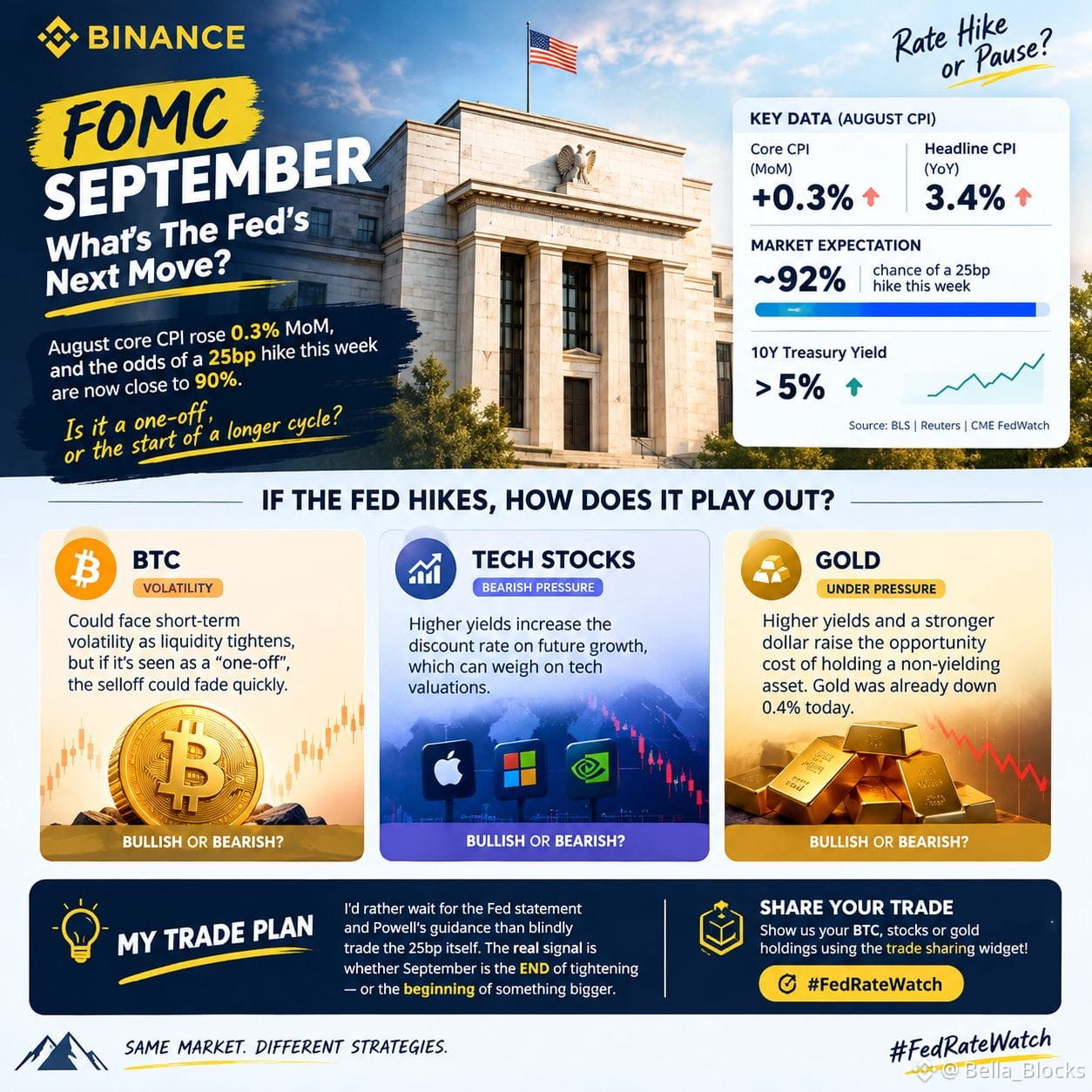
I’m watching the Fed this week less for the 25bp headline and more for what comes AFTER it.
August core CPI rose 0.3% MoM, headline CPI hit 3.4% YoY, and markets are now pricing roughly a 92% chance of a 25bp hike. The bigger problem? The 10Y Treasury yield has pushed above 5%.
So if the Fed hikes to 3.75–4.00%, I don’t think the first reaction tells the whole story.
BTC could face volatility as liquidity tightens, but if traders interpret the hike as a “one-off” rather than the beginning of another cycle, the selloff could fade quickly.
Tech stocks have a tougher setup because higher yields increase the discount rate on future growth. Gold is also feeling pressure as higher yields and a stronger dollar raise the opportunity cost of holding a non-yielding asset. Gold was already down 0.4% today amid rising hike expectations.
My trade plan: I’d rather wait for the Fed statement and Powell’s guidance than blindly trade the 25bp itself. The real signal is whether September is the END of tightening—or the beginning of something bigger.
That distinction could decide the next move in BTC, tech and gold.
#FedRateWatch
$POWER
{future}(POWERUSDT)
$AIN
{future}(AINUSDT)
$AI
{spot}(AIUSDT)
I’m watching the Fed this week less for the 25bp headline and more for what comes AFTER it.
August core CPI rose 0.3% MoM, headline CPI hit 3.4% YoY, and markets are now pricing roughly a 92% chance of a 25bp hike. The bigger problem? The 10Y Treasury yield has pushed above 5%.
So if the Fed hikes to 3.75–4.00%, I don’t think the first reaction tells the whole story.
BTC could face volatility as liquidity tightens, but if traders interpret the hike as a “one-off” rather than the beginning of another cycle, the selloff could fade quickly.
Tech stocks have a tougher setup because higher yields increase the discount rate on future growth. Gold is also feeling pressure as higher yields and a stronger dollar raise the opportunity cost of holding a non-yielding asset. Gold was already down 0.4% today amid rising hike expectations.
My trade plan: I’d rather wait for the Fed statement and Powell’s guidance than blindly trade the 25bp itself. The real signal is whether September is the END of tightening—or the beginning of something bigger.
That distinction could decide the next move in BTC, tech and gold.
#FedRateWatch
$POWER
$AIN
$AI
August core CPI rose 0.3% MoM, headline CPI hit 3.4% YoY, and markets are now pricing roughly a 92% chance of a 25bp hike. The bigger problem? The 10Y Treasury yield has pushed above 5%.
So if the Fed hikes to 3.75–4.00%, I don’t think the first reaction tells the whole story.
BTC could face volatility as liquidity tightens, but if traders interpret the hike as a “one-off” rather than the beginning of another cycle, the selloff could fade quickly.
Tech stocks have a tougher setup because higher yields increase the discount rate on future growth. Gold is also feeling pressure as higher yields and a stronger dollar raise the opportunity cost of holding a non-yielding asset. Gold was already down 0.4% today amid rising hike expectations.
My trade plan: I’d rather wait for the Fed statement and Powell’s guidance than blindly trade the 25bp itself. The real signal is whether September is the END of tightening—or the beginning of something bigger.
That distinction could decide the next move in BTC, tech and gold.
#FedRateWatch
$POWER
$AIN
$AI
175
·
--
Bullisch
Übersetzung ansehen
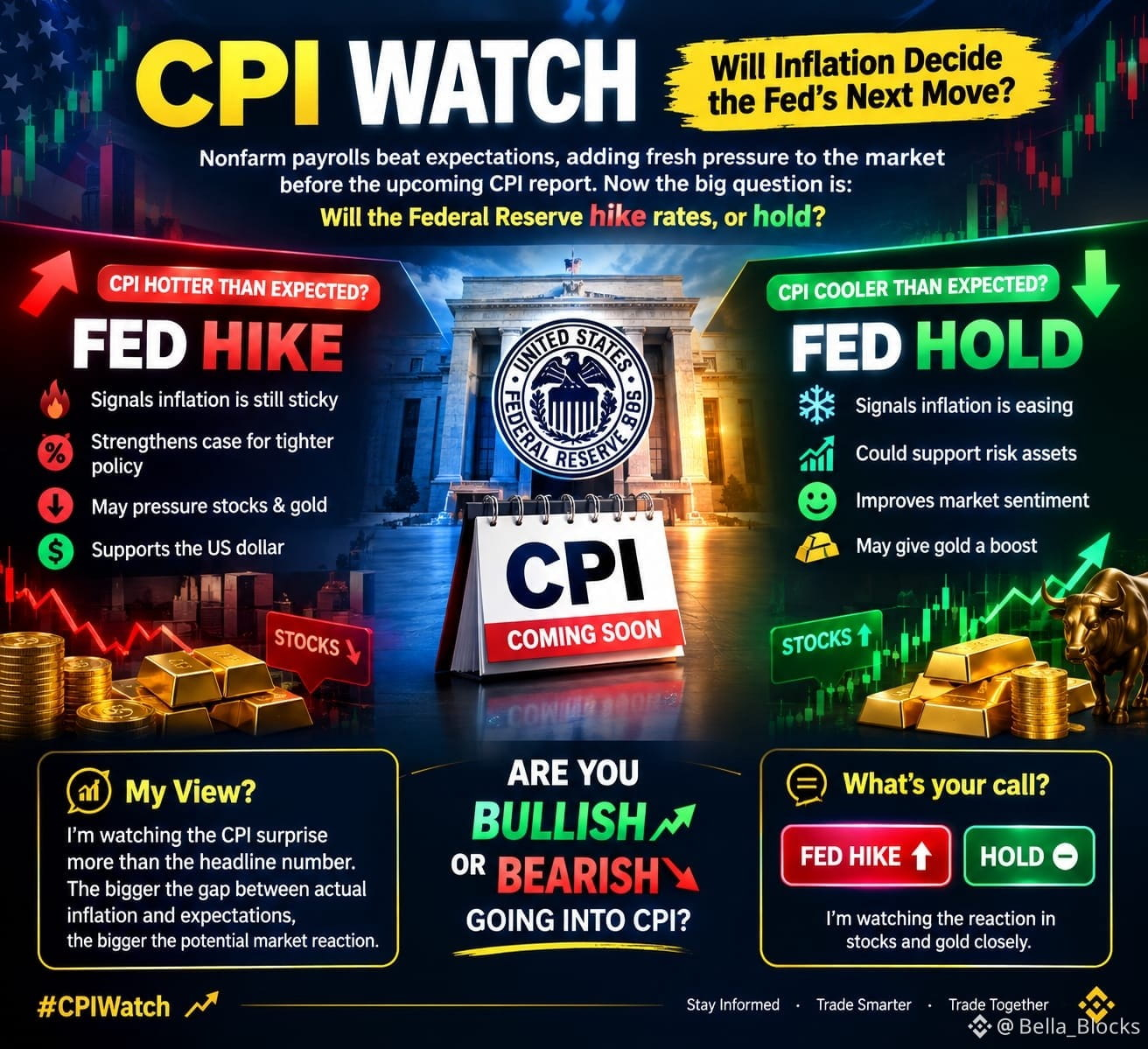
🔥 CPI WATCH: Will Inflation Decide the Fed’s Next Move?
Nonfarm payrolls came in stronger than expected, adding fresh pressure to the market ahead of the upcoming CPI report. Now the big question is: Will the Federal Reserve hike rates, or hold?
A hotter-than-expected CPI could signal that inflation is still sticky. That may strengthen the case for tighter policy, potentially putting pressure on stocks and gold while supporting the dollar. 📉
But if CPI comes in cooler than expected, markets could interpret it as a sign that inflation is easing. A rate-hold narrative could become stronger, potentially supporting risk assets and improving sentiment toward stocks. 📈
My view? I’m watching the CPI surprise more than the headline number. The bigger the gap between actual inflation and expectations, the bigger the potential market reaction.
Are you bullish or bearish going into CPI? I’m watching the reaction in stocks and gold closely.
What’s your call: FED HIKE 🔴 or HOLD 🟢?
#CPIWatch
$NES
{alpha}(560x097acf27503753e77bca940277806156c5925b81)
$4Stock
{alpha}(560xd270d4e1ec6e6e0d28c0ecb8be966ec75997ffff)
$MEME
{spot}(MEMEUSDT)
🔥 CPI WATCH: Will Inflation Decide the Fed’s Next Move?
Nonfarm payrolls came in stronger than expected, adding fresh pressure to the market ahead of the upcoming CPI report. Now the big question is: Will the Federal Reserve hike rates, or hold?
A hotter-than-expected CPI could signal that inflation is still sticky. That may strengthen the case for tighter policy, potentially putting pressure on stocks and gold while supporting the dollar. 📉
But if CPI comes in cooler than expected, markets could interpret it as a sign that inflation is easing. A rate-hold narrative could become stronger, potentially supporting risk assets and improving sentiment toward stocks. 📈
My view? I’m watching the CPI surprise more than the headline number. The bigger the gap between actual inflation and expectations, the bigger the potential market reaction.
Are you bullish or bearish going into CPI? I’m watching the reaction in stocks and gold closely.
What’s your call: FED HIKE 🔴 or HOLD 🟢?
#CPIWatch
$NES
$4Stock
$MEME
Nonfarm payrolls came in stronger than expected, adding fresh pressure to the market ahead of the upcoming CPI report. Now the big question is: Will the Federal Reserve hike rates, or hold?
A hotter-than-expected CPI could signal that inflation is still sticky. That may strengthen the case for tighter policy, potentially putting pressure on stocks and gold while supporting the dollar. 📉
But if CPI comes in cooler than expected, markets could interpret it as a sign that inflation is easing. A rate-hold narrative could become stronger, potentially supporting risk assets and improving sentiment toward stocks. 📈
My view? I’m watching the CPI surprise more than the headline number. The bigger the gap between actual inflation and expectations, the bigger the potential market reaction.
Are you bullish or bearish going into CPI? I’m watching the reaction in stocks and gold closely.
What’s your call: FED HIKE 🔴 or HOLD 🟢?
#CPIWatch
$NES
$4Stock
$MEME
18
19
267
·
--
Übersetzung ansehen
#dusk $DUSK @Dusk_Foundation
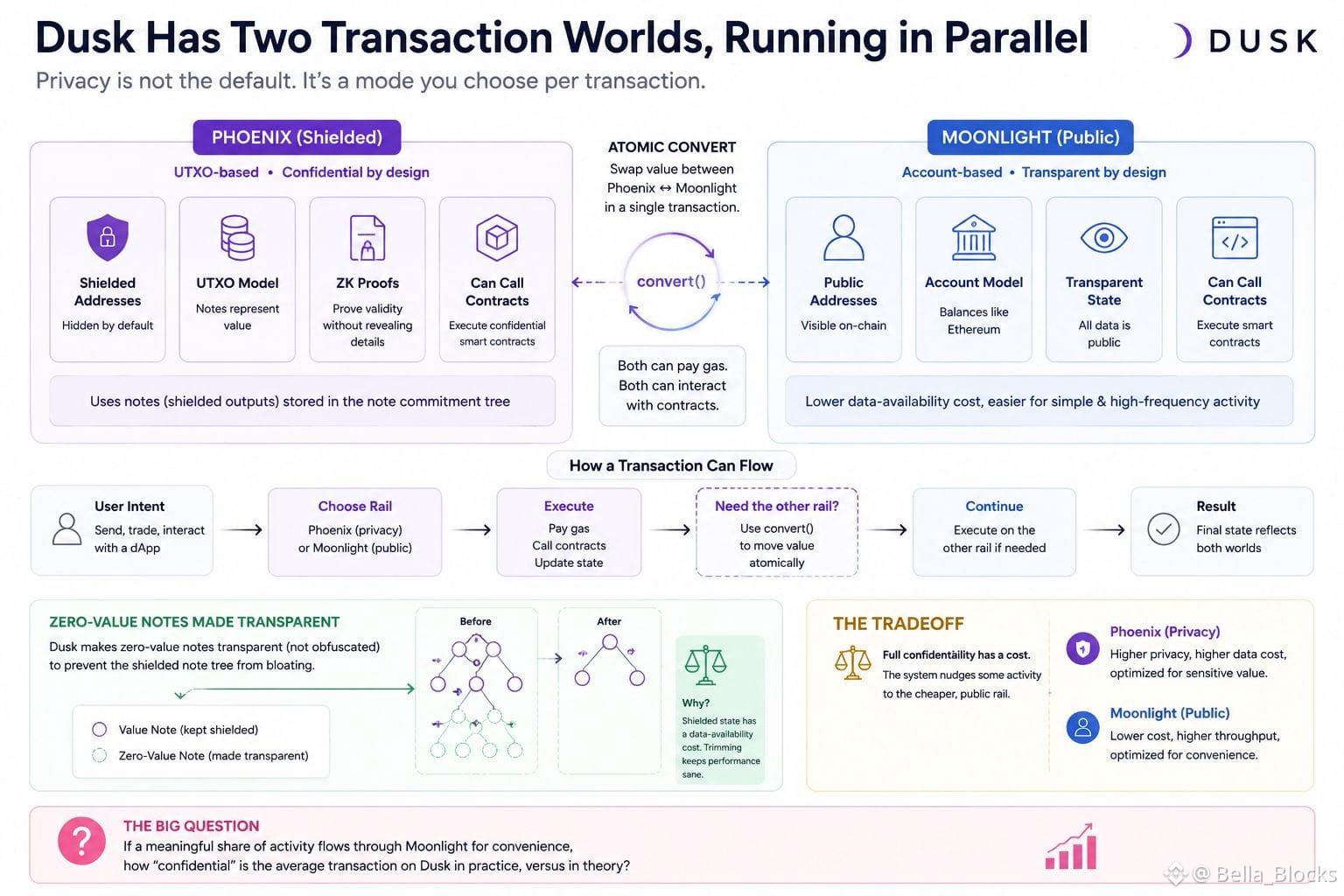
I was digging through Dusk's docs trying to understand what "confidential dApp" actually means at the transaction level, and I ran into something that made me pause. Dusk doesn't have one transaction type — it has two, running in parallel. Phoenix is the shielded, UTXO-based model. Moonlight is public and account-based, closer to how Ethereum works. Both can pay gas, both can call contracts, and there's literally a convert function that lets you atomically swap value between the two.
That's not what I expected. I'd assumed "privacy-first chain" meant privacy by default. It doesn't. Privacy is a mode you opt into per transaction, not a property of the network itself.
I went back to the engineering notes twice because I thought I'd misread it, but there's another detail buried in there: Dusk started making zero-value notes transparent instead of obfuscated, specifically to stop the shielded note tree from bloating with non-value entries. So shielded state isn't free to maintain — the protocol is actively trimming what it hides to keep performance sane.
None of this feels like a flaw. It reads more like an honest tradeoff: full confidentiality has a data-availability cost, so the system nudges some activity toward the cheaper, public rail.
Which raises the question — if a meaningful share of activity ends up flowing through Moonlight for convenience, how "confidential" is the average transaction on Dusk in practice, versus in theory?
$BMT
{spot}(BMTUSDT)
$STX
{spot}(STXUSDT)
{spot}(DUSKUSDT)
#dusk $DUSK @Dusk
I was digging through Dusk's docs trying to understand what "confidential dApp" actually means at the transaction level, and I ran into something that made me pause. Dusk doesn't have one transaction type — it has two, running in parallel. Phoenix is the shielded, UTXO-based model. Moonlight is public and account-based, closer to how Ethereum works. Both can pay gas, both can call contracts, and there's literally a convert function that lets you atomically swap value between the two.
That's not what I expected. I'd assumed "privacy-first chain" meant privacy by default. It doesn't. Privacy is a mode you opt into per transaction, not a property of the network itself.
I went back to the engineering notes twice because I thought I'd misread it, but there's another detail buried in there: Dusk started making zero-value notes transparent instead of obfuscated, specifically to stop the shielded note tree from bloating with non-value entries. So shielded state isn't free to maintain — the protocol is actively trimming what it hides to keep performance sane.
None of this feels like a flaw. It reads more like an honest tradeoff: full confidentiality has a data-availability cost, so the system nudges some activity toward the cheaper, public rail.
Which raises the question — if a meaningful share of activity ends up flowing through Moonlight for convenience, how "confidential" is the average transaction on Dusk in practice, versus in theory?
$BMT
$STX
I was digging through Dusk's docs trying to understand what "confidential dApp" actually means at the transaction level, and I ran into something that made me pause. Dusk doesn't have one transaction type — it has two, running in parallel. Phoenix is the shielded, UTXO-based model. Moonlight is public and account-based, closer to how Ethereum works. Both can pay gas, both can call contracts, and there's literally a convert function that lets you atomically swap value between the two.
That's not what I expected. I'd assumed "privacy-first chain" meant privacy by default. It doesn't. Privacy is a mode you opt into per transaction, not a property of the network itself.
I went back to the engineering notes twice because I thought I'd misread it, but there's another detail buried in there: Dusk started making zero-value notes transparent instead of obfuscated, specifically to stop the shielded note tree from bloating with non-value entries. So shielded state isn't free to maintain — the protocol is actively trimming what it hides to keep performance sane.
None of this feels like a flaw. It reads more like an honest tradeoff: full confidentiality has a data-availability cost, so the system nudges some activity toward the cheaper, public rail.
Which raises the question — if a meaningful share of activity ends up flowing through Moonlight for convenience, how "confidential" is the average transaction on Dusk in practice, versus in theory?
$BMT
$STX
1
189
·
--
#dusk $DUSK @Dusk_Foundation
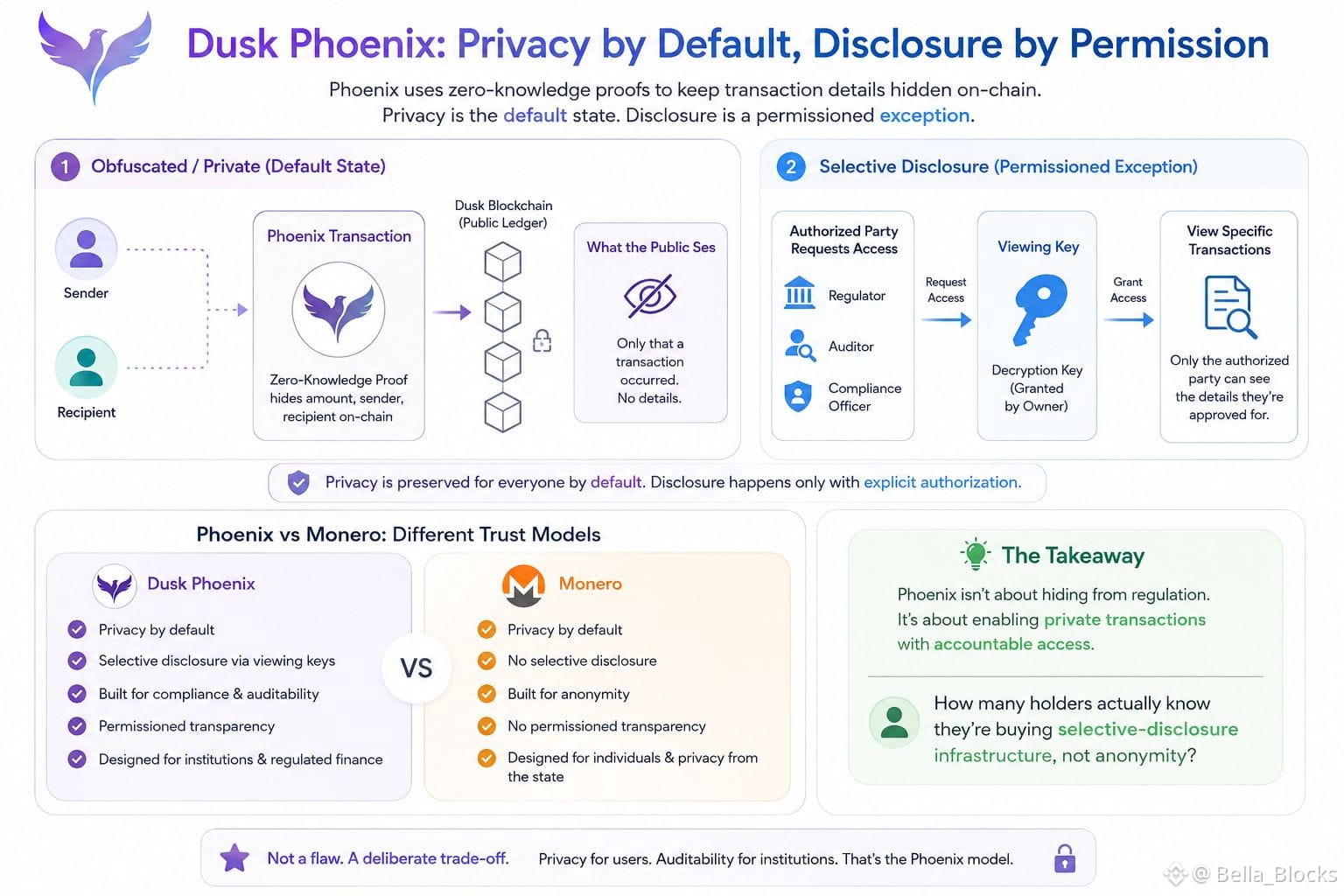
Ich habe in der Dokumentation von Dusk zu ihrem Phoenix-Transaktionsmodell gestöbert, um zu verstehen, wie sie tatsächlich Privatsphäre mit den Compliance-Anforderungen in Einklang bringen, die Banken brauchen würden. Dabei bin ich an etwas hängen geblieben, das außerhalb der technischen Dokumentation kaum thematisiert wird: der Unterschied zwischen „verschleiert“ und „privat“ in ihrer eigenen Darstellung.
Dusk nutzt Zero-Knowledge- Beweise, sodass Transaktionsbeträge und Teilnehmer standardmäßig nicht on-chain sichtbar sind. Das ist die Verkaufsaussage, die jeder wiederholt. Aber dann ist mir aufgefallen, dass sie ganz gezielt die Möglichkeit des selektiven Disclosure einbauen – das bedeutet, dass ein Regulator oder Auditor einen View-Key erhalten kann, um bestimmte Transaktionen zu sehen, ohne dass das gesamte Netzwerk offengelegt wird. Das ist nicht dasselbe wie „privat“ in der Art, wie die meisten Retail-Crypto-Nutzer es meinen, wenn sie das Wort hören.
Ich bin zweimal zurück in die Dokus gegangen, weil ich sicherstellen wollte, dass ich das nicht überinterpretiere. Was das tatsächlich schafft, ist ein System, in dem Privatsphäre der Standardzustand ist, Offenlegung aber eine erlaubte Ausnahme – nicht eine öffentliche. Das ist ein deutlich anderes Vertrauensmodell als bei etwas wie Monero, und es ist klar für Institutionen entworfen, die Audit-Trails brauchen, nicht für Anonymität gegenüber dem Staat.
Das ist kein Fehler. Es ist ein bewusstes Trade-off. Aber das bedeutet auch, dass das Label „Privacy-Coin“ ziemlich locker herumgereicht wird.
Wie viele Inhaber wissen tatsächlich, dass sie selektive-Disclosure-Infrastruktur kaufen – nicht Anonymität?
$SPK
{spot}(SPKUSDT)
$MORPHO
{spot}(MORPHOUSDT)
{spot}(DUSKUSDT)
#dusk $DUSK @Dusk
Ich habe in der Dokumentation von Dusk zu ihrem Phoenix-Transaktionsmodell gestöbert, um zu verstehen, wie sie tatsächlich Privatsphäre mit den Compliance-Anforderungen in Einklang bringen, die Banken brauchen würden. Dabei bin ich an etwas hängen geblieben, das außerhalb der technischen Dokumentation kaum thematisiert wird: der Unterschied zwischen „verschleiert“ und „privat“ in ihrer eigenen Darstellung.
Dusk nutzt Zero-Knowledge- Beweise, sodass Transaktionsbeträge und Teilnehmer standardmäßig nicht on-chain sichtbar sind. Das ist die Verkaufsaussage, die jeder wiederholt. Aber dann ist mir aufgefallen, dass sie ganz gezielt die Möglichkeit des selektiven Disclosure einbauen – das bedeutet, dass ein Regulator oder Auditor einen View-Key erhalten kann, um bestimmte Transaktionen zu sehen, ohne dass das gesamte Netzwerk offengelegt wird. Das ist nicht dasselbe wie „privat“ in der Art, wie die meisten Retail-Crypto-Nutzer es meinen, wenn sie das Wort hören.
Ich bin zweimal zurück in die Dokus gegangen, weil ich sicherstellen wollte, dass ich das nicht überinterpretiere. Was das tatsächlich schafft, ist ein System, in dem Privatsphäre der Standardzustand ist, Offenlegung aber eine erlaubte Ausnahme – nicht eine öffentliche. Das ist ein deutlich anderes Vertrauensmodell als bei etwas wie Monero, und es ist klar für Institutionen entworfen, die Audit-Trails brauchen, nicht für Anonymität gegenüber dem Staat.
Das ist kein Fehler. Es ist ein bewusstes Trade-off. Aber das bedeutet auch, dass das Label „Privacy-Coin“ ziemlich locker herumgereicht wird.
Wie viele Inhaber wissen tatsächlich, dass sie selektive-Disclosure-Infrastruktur kaufen – nicht Anonymität?
$SPK
$MORPHO
Ich habe in der Dokumentation von Dusk zu ihrem Phoenix-Transaktionsmodell gestöbert, um zu verstehen, wie sie tatsächlich Privatsphäre mit den Compliance-Anforderungen in Einklang bringen, die Banken brauchen würden. Dabei bin ich an etwas hängen geblieben, das außerhalb der technischen Dokumentation kaum thematisiert wird: der Unterschied zwischen „verschleiert“ und „privat“ in ihrer eigenen Darstellung.
Dusk nutzt Zero-Knowledge- Beweise, sodass Transaktionsbeträge und Teilnehmer standardmäßig nicht on-chain sichtbar sind. Das ist die Verkaufsaussage, die jeder wiederholt. Aber dann ist mir aufgefallen, dass sie ganz gezielt die Möglichkeit des selektiven Disclosure einbauen – das bedeutet, dass ein Regulator oder Auditor einen View-Key erhalten kann, um bestimmte Transaktionen zu sehen, ohne dass das gesamte Netzwerk offengelegt wird. Das ist nicht dasselbe wie „privat“ in der Art, wie die meisten Retail-Crypto-Nutzer es meinen, wenn sie das Wort hören.
Ich bin zweimal zurück in die Dokus gegangen, weil ich sicherstellen wollte, dass ich das nicht überinterpretiere. Was das tatsächlich schafft, ist ein System, in dem Privatsphäre der Standardzustand ist, Offenlegung aber eine erlaubte Ausnahme – nicht eine öffentliche. Das ist ein deutlich anderes Vertrauensmodell als bei etwas wie Monero, und es ist klar für Institutionen entworfen, die Audit-Trails brauchen, nicht für Anonymität gegenüber dem Staat.
Das ist kein Fehler. Es ist ein bewusstes Trade-off. Aber das bedeutet auch, dass das Label „Privacy-Coin“ ziemlich locker herumgereicht wird.
Wie viele Inhaber wissen tatsächlich, dass sie selektive-Disclosure-Infrastruktur kaufen – nicht Anonymität?
$SPK
$MORPHO
3
2
199
·
--
Übersetzung ansehen
#dusk $DUSK @Dusk_Foundation
I was digging through Dusk's own use-case docs on Smart Bulletin Boards, expecting some kind of automated matching engine, and the wording that jumped out was that they indirectly match qualified buyers and sellers of security tokens Dusk , and only once both parties come to terms and a deal is struck, they can execute the trade Dusk .
That word "indirectly" made me stop. I went back to the docs twice because I'd assumed "smart bulletin board" meant some on-chain orderbook doing the matching for you. It doesn't, at least not from what's published. The board is a discovery layer — it surfaces qualified counterparties — but the actual negotiation (price, terms, timing) still happens off-chain, human to human. What's trustless is the settlement, not the deal-making.
That's not a flaw, it's a design choice that maps to how private securities already trade OTC, where Dusk's own materials point out that broker/lawyer involvement typically costs somewhere in the 2.5%-15% Dusk range. The bulletin board is aimed at compressing that cost by cutting the settlement friction, not the negotiation itself. It's more like a matchmaking app that still leaves the actual date up to you than a vending machine that closes the deal automatically.
So the incentive this creates is interesting: it rewards parties who already know how to negotiate OTC, while the "trustless" part only kicks in at the very end. How many people assume the whole process is automated, versus just the settlement?
$TUT
{spot}(TUTUSDT)
$PORTAL
{spot}(PORTALUSDT)
{spot}(DUSKUSDT)
How automated do you think Dusk’s Smart Bulletin Board is?
#dusk $DUSK @Dusk
I was digging through Dusk's own use-case docs on Smart Bulletin Boards, expecting some kind of automated matching engine, and the wording that jumped out was that they indirectly match qualified buyers and sellers of security tokens Dusk , and only once both parties come to terms and a deal is struck, they can execute the trade Dusk .
That word "indirectly" made me stop. I went back to the docs twice because I'd assumed "smart bulletin board" meant some on-chain orderbook doing the matching for you. It doesn't, at least not from what's published. The board is a discovery layer — it surfaces qualified counterparties — but the actual negotiation (price, terms, timing) still happens off-chain, human to human. What's trustless is the settlement, not the deal-making.
That's not a flaw, it's a design choice that maps to how private securities already trade OTC, where Dusk's own materials point out that broker/lawyer involvement typically costs somewhere in the 2.5%-15% Dusk range. The bulletin board is aimed at compressing that cost by cutting the settlement friction, not the negotiation itself. It's more like a matchmaking app that still leaves the actual date up to you than a vending machine that closes the deal automatically.
So the incentive this creates is interesting: it rewards parties who already know how to negotiate OTC, while the "trustless" part only kicks in at the very end. How many people assume the whole process is automated, versus just the settlement?
$TUT
$PORTAL
How automated do you think Dusk’s Smart Bulletin Board is?
I was digging through Dusk's own use-case docs on Smart Bulletin Boards, expecting some kind of automated matching engine, and the wording that jumped out was that they indirectly match qualified buyers and sellers of security tokens Dusk , and only once both parties come to terms and a deal is struck, they can execute the trade Dusk .
That word "indirectly" made me stop. I went back to the docs twice because I'd assumed "smart bulletin board" meant some on-chain orderbook doing the matching for you. It doesn't, at least not from what's published. The board is a discovery layer — it surfaces qualified counterparties — but the actual negotiation (price, terms, timing) still happens off-chain, human to human. What's trustless is the settlement, not the deal-making.
That's not a flaw, it's a design choice that maps to how private securities already trade OTC, where Dusk's own materials point out that broker/lawyer involvement typically costs somewhere in the 2.5%-15% Dusk range. The bulletin board is aimed at compressing that cost by cutting the settlement friction, not the negotiation itself. It's more like a matchmaking app that still leaves the actual date up to you than a vending machine that closes the deal automatically.
So the incentive this creates is interesting: it rewards parties who already know how to negotiate OTC, while the "trustless" part only kicks in at the very end. How many people assume the whole process is automated, versus just the settlement?
$TUT
$PORTAL
How automated do you think Dusk’s Smart Bulletin Board is?
🤖 Fully automated
67%
🤝 Discovery+human negotiation
0%
🔐 Trustless settlement only
33%
🤔 Not sure
0%
3 Stimmen • Abstimmung beendet
3
1.3k
·
--
#dusk $DUSK @Dusk_Foundation
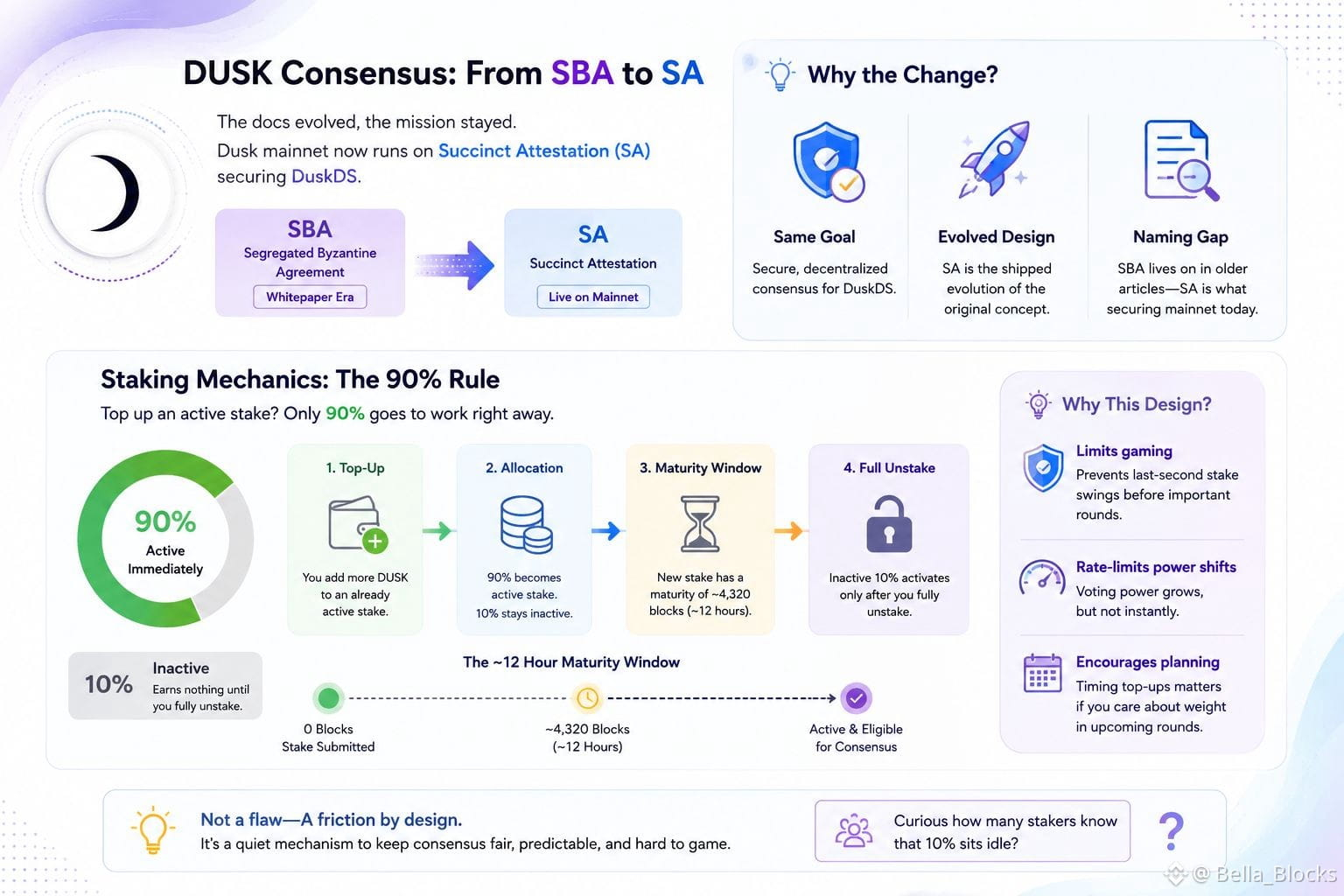
Ich habe in den aktuellen Dusk-Dokumentationen gegraben, um mich über die SBA-Konsensmechanik zu informieren, auf die in Write-ups noch immer alle verweisen, und dabei ist mir aufgefallen, dass die Doku das tatsächlich gar nicht mehr so nennt. Die Live-Mainnet-Dokumentation bezeichnet „Succinct Attestation“ (SA) als das Konsensprotokoll, das DuskDS absichert, während die meisten Erklärartikel, Börsen-Listings und sogar Teile der Community weiterhin von „Segregated Byzantine Agreement“ sprechen, als wäre das noch der aktuelle Stand. Ich bin doppelt zurückgegangen und habe noch einmal nachgesehen, weil ich angenommen hatte, ich hätte zwei verschiedene Mechanismen verwechselt — aber nein: SA wird als die Evolution beschrieben, die für das Mainnet ausgeliefert wurde, und SBA ist heute größtenteils eher Sprache aus der Whitepaper-Ära.
Das ist eine Namenslücke, kein Warnsignal, aber sie hat mich zu etwas Interessanterem geführt: zu den Mechaniken des Stakings darunter. Wenn du ein bereits aktiviertes Stake aufstockst, geht nur 90 % der neuen Summe sofort aktiv — die restlichen 10 % bleiben inaktiv, verdienen nichts, bis du vollständig unstake. Das ist ein leiser Reibungspunkt. Zusammen mit einem ~4.320-Block (ungefähr 12 Stunden) Maturitätsfenster für jedes neue Stake bedeutet das: Zinseszins ist nicht so reibungslos wie „einfach mehr DUSK hinzufügen“ — es ist eine bewusste Verzögerung eingebaut, vermutlich um das Ausspielen des Sortitionsgewichts direkt vor Runden zu begrenzen, in denen die Stake-Größe eine Rolle spielt.
Nichts davon ist versteckt, es ist nur keine vordergründige Information. Es liest sich weniger wie ein Mangel und mehr wie ein Rate-Limiter dafür, wie schnell sich die Abstimmungsstärke verschieben kann.
Mich würde interessieren, wie viele Staker das wirklich wissen: dass diese 10 % untätig bleiben — und ob das beeinflusst, wie Leute ihre Top-ups timen.
$TRUMP
{spot}(TRUMPUSDT)
$TRB
{future}(TRBUSDT)
{spot}(DUSKUSDT)
#dusk $DUSK @Dusk
Ich habe in den aktuellen Dusk-Dokumentationen gegraben, um mich über die SBA-Konsensmechanik zu informieren, auf die in Write-ups noch immer alle verweisen, und dabei ist mir aufgefallen, dass die Doku das tatsächlich gar nicht mehr so nennt. Die Live-Mainnet-Dokumentation bezeichnet „Succinct Attestation“ (SA) als das Konsensprotokoll, das DuskDS absichert, während die meisten Erklärartikel, Börsen-Listings und sogar Teile der Community weiterhin von „Segregated Byzantine Agreement“ sprechen, als wäre das noch der aktuelle Stand. Ich bin doppelt zurückgegangen und habe noch einmal nachgesehen, weil ich angenommen hatte, ich hätte zwei verschiedene Mechanismen verwechselt — aber nein: SA wird als die Evolution beschrieben, die für das Mainnet ausgeliefert wurde, und SBA ist heute größtenteils eher Sprache aus der Whitepaper-Ära.
Das ist eine Namenslücke, kein Warnsignal, aber sie hat mich zu etwas Interessanterem geführt: zu den Mechaniken des Stakings darunter. Wenn du ein bereits aktiviertes Stake aufstockst, geht nur 90 % der neuen Summe sofort aktiv — die restlichen 10 % bleiben inaktiv, verdienen nichts, bis du vollständig unstake. Das ist ein leiser Reibungspunkt. Zusammen mit einem ~4.320-Block (ungefähr 12 Stunden) Maturitätsfenster für jedes neue Stake bedeutet das: Zinseszins ist nicht so reibungslos wie „einfach mehr DUSK hinzufügen“ — es ist eine bewusste Verzögerung eingebaut, vermutlich um das Ausspielen des Sortitionsgewichts direkt vor Runden zu begrenzen, in denen die Stake-Größe eine Rolle spielt.
Nichts davon ist versteckt, es ist nur keine vordergründige Information. Es liest sich weniger wie ein Mangel und mehr wie ein Rate-Limiter dafür, wie schnell sich die Abstimmungsstärke verschieben kann.
Mich würde interessieren, wie viele Staker das wirklich wissen: dass diese 10 % untätig bleiben — und ob das beeinflusst, wie Leute ihre Top-ups timen.
$TRUMP
$TRB
Ich habe in den aktuellen Dusk-Dokumentationen gegraben, um mich über die SBA-Konsensmechanik zu informieren, auf die in Write-ups noch immer alle verweisen, und dabei ist mir aufgefallen, dass die Doku das tatsächlich gar nicht mehr so nennt. Die Live-Mainnet-Dokumentation bezeichnet „Succinct Attestation“ (SA) als das Konsensprotokoll, das DuskDS absichert, während die meisten Erklärartikel, Börsen-Listings und sogar Teile der Community weiterhin von „Segregated Byzantine Agreement“ sprechen, als wäre das noch der aktuelle Stand. Ich bin doppelt zurückgegangen und habe noch einmal nachgesehen, weil ich angenommen hatte, ich hätte zwei verschiedene Mechanismen verwechselt — aber nein: SA wird als die Evolution beschrieben, die für das Mainnet ausgeliefert wurde, und SBA ist heute größtenteils eher Sprache aus der Whitepaper-Ära.
Das ist eine Namenslücke, kein Warnsignal, aber sie hat mich zu etwas Interessanterem geführt: zu den Mechaniken des Stakings darunter. Wenn du ein bereits aktiviertes Stake aufstockst, geht nur 90 % der neuen Summe sofort aktiv — die restlichen 10 % bleiben inaktiv, verdienen nichts, bis du vollständig unstake. Das ist ein leiser Reibungspunkt. Zusammen mit einem ~4.320-Block (ungefähr 12 Stunden) Maturitätsfenster für jedes neue Stake bedeutet das: Zinseszins ist nicht so reibungslos wie „einfach mehr DUSK hinzufügen“ — es ist eine bewusste Verzögerung eingebaut, vermutlich um das Ausspielen des Sortitionsgewichts direkt vor Runden zu begrenzen, in denen die Stake-Größe eine Rolle spielt.
Nichts davon ist versteckt, es ist nur keine vordergründige Information. Es liest sich weniger wie ein Mangel und mehr wie ein Rate-Limiter dafür, wie schnell sich die Abstimmungsstärke verschieben kann.
Mich würde interessieren, wie viele Staker das wirklich wissen: dass diese 10 % untätig bleiben — und ob das beeinflusst, wie Leute ihre Top-ups timen.
$TRUMP
$TRB
1
1
292
·
--
#dusk $DUSK @Dusk_Foundation
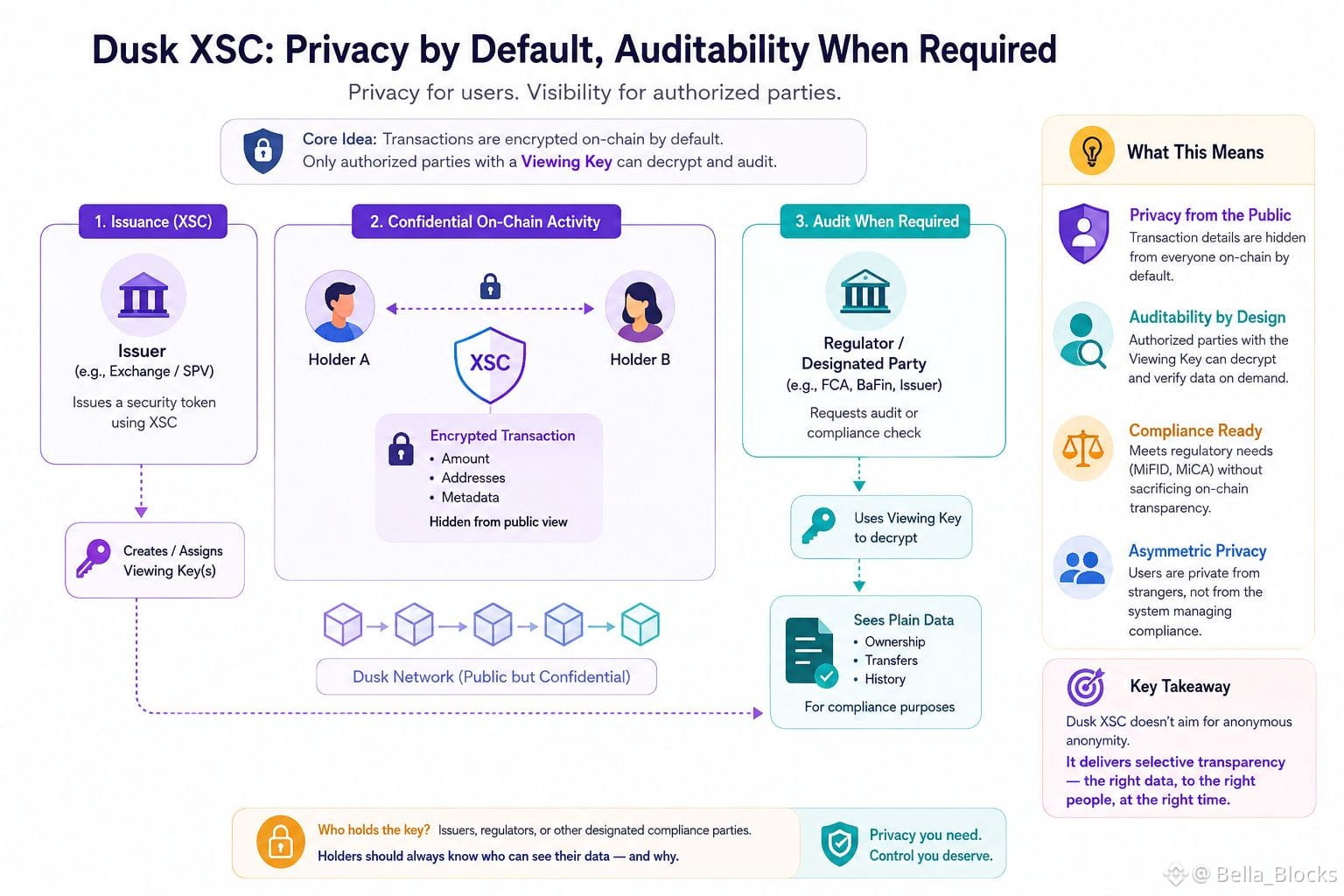
Ich habe in Dusk-Dokumenten herumgestöbert, um zu verstehen, was „Privacy by default, Auditability when required“ auf Protokollebene tatsächlich bedeutet, weil dieser Satz überall in ihren RWA-Materialien auftaucht und ich wissen wollte, wer das Audit durchführt.
Erstellt: Der XSC-Standard sieht optionale Viewing-Keys vor, die an die Compliance-Schicht gekoppelt sind – sodass, wenn ein Security Token über XSC ausgegeben wird, der Emittent (oder ein bezeichneter Regulator) einen Schlüssel halten kann, der Transaktionsdetails entschlüsselt, die vor allen anderen auf der On-Chain-Seite verborgen bleiben. Ich bin zweimal zurück in die Doku gegangen, weil ich es zunächst als vollständige Ende-zu-Ende-Privatsphäre verstanden hatte, so wie man sie bei einer typischen „shielded transaction“ bekommt. So ist es nicht. Es ist Privatsphäre gegenüber der Öffentlichkeit, nicht notwendigerweise gegenüber dem Gegenüber, das die Compliance-Regeln ausführt.
Das ist kein Fehler, sondern der eigentliche Zweck – ohne dass jemand auf Abruf nachweisen kann, dass er Eigentümer ist und wie die Gelder fließen, bekommt man keinen MiFID- oder MiCA-konformen Security Token. Aber das bedeutet, dass die Datenschutzgarantie asymmetrisch ist, und ich glaube, das ist für jemanden nicht offensichtlich, der „confidential“ auf der Startseite liest und von einer symmetrischen Anonymität wie bei einer Privacy Coin ausgeht.
Die dadurch entstehende Anreizstruktur ist interessant: Emittenten fühlen sich wohl dabei, echte Wertpapiere auf einer öffentlichen Kette zu platzieren – genau deshalb, weil sie weiterhin Sichtbarkeit behalten. Nutzer erhalten Privatsphäre gegenüber Fremden, nicht gegenüber dem System, das sie verwaltet. Es lohnt sich zu fragen, wie viele Inhaber tatsächlich wissen, wer diesen Schlüssel für ein bestimmtes Asset hält.
{spot}(DUSKUSDT)
#dusk $DUSK @Dusk
Ich habe in Dusk-Dokumenten herumgestöbert, um zu verstehen, was „Privacy by default, Auditability when required“ auf Protokollebene tatsächlich bedeutet, weil dieser Satz überall in ihren RWA-Materialien auftaucht und ich wissen wollte, wer das Audit durchführt.
Erstellt: Der XSC-Standard sieht optionale Viewing-Keys vor, die an die Compliance-Schicht gekoppelt sind – sodass, wenn ein Security Token über XSC ausgegeben wird, der Emittent (oder ein bezeichneter Regulator) einen Schlüssel halten kann, der Transaktionsdetails entschlüsselt, die vor allen anderen auf der On-Chain-Seite verborgen bleiben. Ich bin zweimal zurück in die Doku gegangen, weil ich es zunächst als vollständige Ende-zu-Ende-Privatsphäre verstanden hatte, so wie man sie bei einer typischen „shielded transaction“ bekommt. So ist es nicht. Es ist Privatsphäre gegenüber der Öffentlichkeit, nicht notwendigerweise gegenüber dem Gegenüber, das die Compliance-Regeln ausführt.
Das ist kein Fehler, sondern der eigentliche Zweck – ohne dass jemand auf Abruf nachweisen kann, dass er Eigentümer ist und wie die Gelder fließen, bekommt man keinen MiFID- oder MiCA-konformen Security Token. Aber das bedeutet, dass die Datenschutzgarantie asymmetrisch ist, und ich glaube, das ist für jemanden nicht offensichtlich, der „confidential“ auf der Startseite liest und von einer symmetrischen Anonymität wie bei einer Privacy Coin ausgeht.
Die dadurch entstehende Anreizstruktur ist interessant: Emittenten fühlen sich wohl dabei, echte Wertpapiere auf einer öffentlichen Kette zu platzieren – genau deshalb, weil sie weiterhin Sichtbarkeit behalten. Nutzer erhalten Privatsphäre gegenüber Fremden, nicht gegenüber dem System, das sie verwaltet. Es lohnt sich zu fragen, wie viele Inhaber tatsächlich wissen, wer diesen Schlüssel für ein bestimmtes Asset hält.
Ich habe in Dusk-Dokumenten herumgestöbert, um zu verstehen, was „Privacy by default, Auditability when required“ auf Protokollebene tatsächlich bedeutet, weil dieser Satz überall in ihren RWA-Materialien auftaucht und ich wissen wollte, wer das Audit durchführt.
Erstellt: Der XSC-Standard sieht optionale Viewing-Keys vor, die an die Compliance-Schicht gekoppelt sind – sodass, wenn ein Security Token über XSC ausgegeben wird, der Emittent (oder ein bezeichneter Regulator) einen Schlüssel halten kann, der Transaktionsdetails entschlüsselt, die vor allen anderen auf der On-Chain-Seite verborgen bleiben. Ich bin zweimal zurück in die Doku gegangen, weil ich es zunächst als vollständige Ende-zu-Ende-Privatsphäre verstanden hatte, so wie man sie bei einer typischen „shielded transaction“ bekommt. So ist es nicht. Es ist Privatsphäre gegenüber der Öffentlichkeit, nicht notwendigerweise gegenüber dem Gegenüber, das die Compliance-Regeln ausführt.
Das ist kein Fehler, sondern der eigentliche Zweck – ohne dass jemand auf Abruf nachweisen kann, dass er Eigentümer ist und wie die Gelder fließen, bekommt man keinen MiFID- oder MiCA-konformen Security Token. Aber das bedeutet, dass die Datenschutzgarantie asymmetrisch ist, und ich glaube, das ist für jemanden nicht offensichtlich, der „confidential“ auf der Startseite liest und von einer symmetrischen Anonymität wie bei einer Privacy Coin ausgeht.
Die dadurch entstehende Anreizstruktur ist interessant: Emittenten fühlen sich wohl dabei, echte Wertpapiere auf einer öffentlichen Kette zu platzieren – genau deshalb, weil sie weiterhin Sichtbarkeit behalten. Nutzer erhalten Privatsphäre gegenüber Fremden, nicht gegenüber dem System, das sie verwaltet. Es lohnt sich zu fragen, wie viele Inhaber tatsächlich wissen, wer diesen Schlüssel für ein bestimmtes Asset hält.
12
10
619
·
--
Übersetzung ansehen
#termmax @termmax
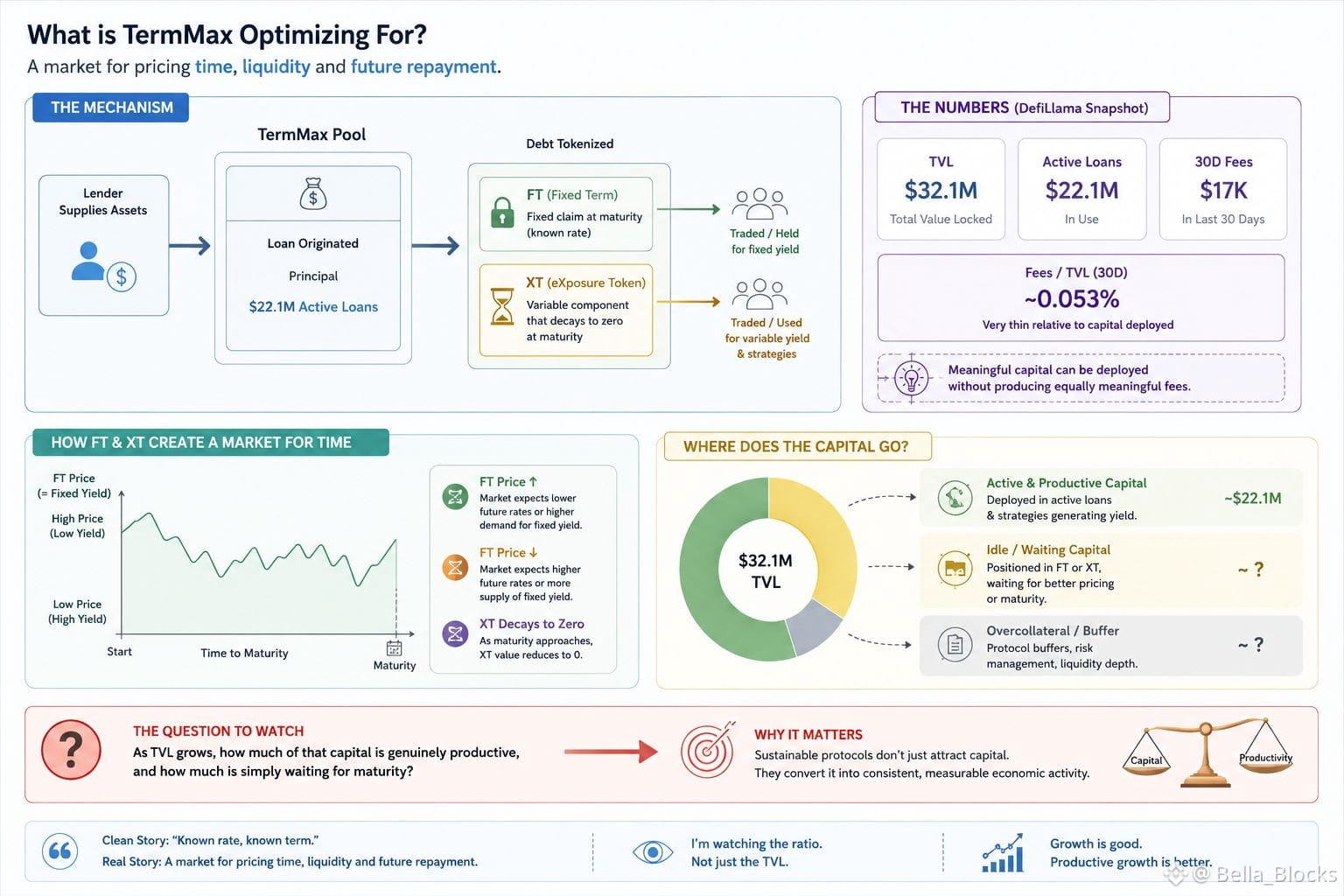
I keep coming back to one number while digging through TermMax: the gap between capital sitting in the protocol and the fees it’s actually generating.
The latest DefiLlama snapshot I found shows about $32.1M TVL, with roughly $22.1M in active loans, while 30-day fees were only around $17K.
I thought I had misread it, so I went back into the docs to understand what TermMax is actually optimizing for.
The mechanism is more interesting than a simple “fixed-rate lending” label suggests. TermMax tokenizes debt into FT and XT. FT represents the fixed claim at maturity, while XT carries the remaining variable component and eventually goes to zero.
That creates a different behavior from a normal lending pool. Capital isn’t simply earning a floating rate. Users are trading around specific maturities, and the FT price effectively determines the fixed yield.
So the clean story is “known rate, known term.” Underneath, it’s really a market for pricing time, liquidity and future repayment.
The interesting part is that meaningful capital can be deployed without producing equally meaningful fees. That isn’t automatically a problem. Usage could still be concentrated in certain markets or strategies.
But it raises a question I think is worth watching:
As TVL grows, how much of that capital is genuinely productive, and how much is simply waiting for maturity?
$ONG
{spot}(ONGUSDT)
$PEOPLE
{spot}(PEOPLEUSDT)
$NEIRO
{spot}(NEIROUSDT)
#termmax @TermMax
I keep coming back to one number while digging through TermMax: the gap between capital sitting in the protocol and the fees it’s actually generating.
The latest DefiLlama snapshot I found shows about $32.1M TVL, with roughly $22.1M in active loans, while 30-day fees were only around $17K.
I thought I had misread it, so I went back into the docs to understand what TermMax is actually optimizing for.
The mechanism is more interesting than a simple “fixed-rate lending” label suggests. TermMax tokenizes debt into FT and XT. FT represents the fixed claim at maturity, while XT carries the remaining variable component and eventually goes to zero.
That creates a different behavior from a normal lending pool. Capital isn’t simply earning a floating rate. Users are trading around specific maturities, and the FT price effectively determines the fixed yield.
So the clean story is “known rate, known term.” Underneath, it’s really a market for pricing time, liquidity and future repayment.
The interesting part is that meaningful capital can be deployed without producing equally meaningful fees. That isn’t automatically a problem. Usage could still be concentrated in certain markets or strategies.
But it raises a question I think is worth watching:
As TVL grows, how much of that capital is genuinely productive, and how much is simply waiting for maturity?
$ONG
$PEOPLE
$NEIRO
I keep coming back to one number while digging through TermMax: the gap between capital sitting in the protocol and the fees it’s actually generating.
The latest DefiLlama snapshot I found shows about $32.1M TVL, with roughly $22.1M in active loans, while 30-day fees were only around $17K.
I thought I had misread it, so I went back into the docs to understand what TermMax is actually optimizing for.
The mechanism is more interesting than a simple “fixed-rate lending” label suggests. TermMax tokenizes debt into FT and XT. FT represents the fixed claim at maturity, while XT carries the remaining variable component and eventually goes to zero.
That creates a different behavior from a normal lending pool. Capital isn’t simply earning a floating rate. Users are trading around specific maturities, and the FT price effectively determines the fixed yield.
So the clean story is “known rate, known term.” Underneath, it’s really a market for pricing time, liquidity and future repayment.
The interesting part is that meaningful capital can be deployed without producing equally meaningful fees. That isn’t automatically a problem. Usage could still be concentrated in certain markets or strategies.
But it raises a question I think is worth watching:
As TVL grows, how much of that capital is genuinely productive, and how much is simply waiting for maturity?
$ONG
$PEOPLE
$NEIRO
1
3
105
·
--
Übersetzung ansehen
#dusk $DUSK @Dusk_Foundation
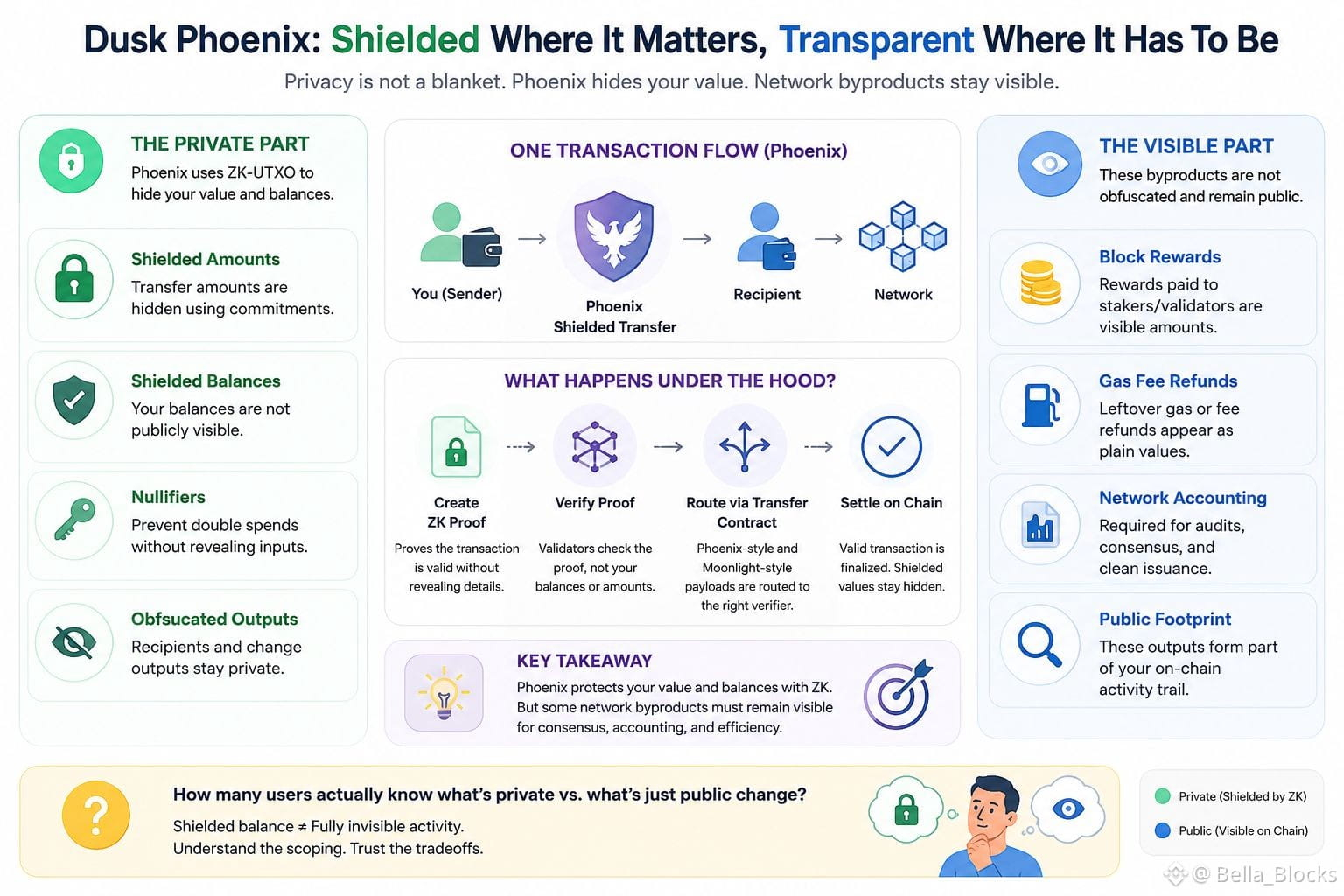
I was digging through Dusk's docs trying to understand what "shielded" actually means in Phoenix, and I hit a line that made me stop and reread it. One official description of Phoenix says it gives complete on-chain privacy — even for non-obfuscated outputs such as block rewards and gas fee refunds Complete privacy" and "non-obfuscated outputs" sitting in the same sentence felt like a contradiction, so I went back to the docs twice thinking I'd misread it.
Turns out it's not a mistake, it's a scoping choice. Phoenix is the zero-knowledge UTXO transaction model built into Dusk's Transfer contract, supporting both transparent and obfuscated transactions and at the settlement layer a Transfer Contract routes Phoenix-style and Moonlight-style payloads to the appropriate verification logic meaning shielded and transparent value can coexist on the same chain, sometimes in the same transaction flow.
So the "privacy" isn't a blanket. Your transfer amounts and balances can be obfuscated behind commitments and nullifiers, but the mechanical byproducts of actually using the network — leftover gas refunds, staking/block rewards — apparently surface as plain values rather than hidden ones.
That's not broken, it's a tradeoff: full obfuscation everywhere adds proving cost, and reward issuance likely needs to stay auditable for consensus to function cleanly. But it does mean part of your on-chain footprint stays visible even when your "balance" is technically shielded.
How many people running Phoenix transactions actually know which piece of their activity is the private part, and which is just public change?
$AVAAI
{future}(AVAAIUSDT)
{spot}(DUSKUSDT)
$BOME
{spot}(BOMEUSDT)
#dusk $DUSK @Dusk
I was digging through Dusk's docs trying to understand what "shielded" actually means in Phoenix, and I hit a line that made me stop and reread it. One official description of Phoenix says it gives complete on-chain privacy — even for non-obfuscated outputs such as block rewards and gas fee refunds Complete privacy" and "non-obfuscated outputs" sitting in the same sentence felt like a contradiction, so I went back to the docs twice thinking I'd misread it.
Turns out it's not a mistake, it's a scoping choice. Phoenix is the zero-knowledge UTXO transaction model built into Dusk's Transfer contract, supporting both transparent and obfuscated transactions and at the settlement layer a Transfer Contract routes Phoenix-style and Moonlight-style payloads to the appropriate verification logic meaning shielded and transparent value can coexist on the same chain, sometimes in the same transaction flow.
So the "privacy" isn't a blanket. Your transfer amounts and balances can be obfuscated behind commitments and nullifiers, but the mechanical byproducts of actually using the network — leftover gas refunds, staking/block rewards — apparently surface as plain values rather than hidden ones.
That's not broken, it's a tradeoff: full obfuscation everywhere adds proving cost, and reward issuance likely needs to stay auditable for consensus to function cleanly. But it does mean part of your on-chain footprint stays visible even when your "balance" is technically shielded.
How many people running Phoenix transactions actually know which piece of their activity is the private part, and which is just public change?
$AVAAI
$BOME
I was digging through Dusk's docs trying to understand what "shielded" actually means in Phoenix, and I hit a line that made me stop and reread it. One official description of Phoenix says it gives complete on-chain privacy — even for non-obfuscated outputs such as block rewards and gas fee refunds Complete privacy" and "non-obfuscated outputs" sitting in the same sentence felt like a contradiction, so I went back to the docs twice thinking I'd misread it.
Turns out it's not a mistake, it's a scoping choice. Phoenix is the zero-knowledge UTXO transaction model built into Dusk's Transfer contract, supporting both transparent and obfuscated transactions and at the settlement layer a Transfer Contract routes Phoenix-style and Moonlight-style payloads to the appropriate verification logic meaning shielded and transparent value can coexist on the same chain, sometimes in the same transaction flow.
So the "privacy" isn't a blanket. Your transfer amounts and balances can be obfuscated behind commitments and nullifiers, but the mechanical byproducts of actually using the network — leftover gas refunds, staking/block rewards — apparently surface as plain values rather than hidden ones.
That's not broken, it's a tradeoff: full obfuscation everywhere adds proving cost, and reward issuance likely needs to stay auditable for consensus to function cleanly. But it does mean part of your on-chain footprint stays visible even when your "balance" is technically shielded.
How many people running Phoenix transactions actually know which piece of their activity is the private part, and which is just public change?
$AVAAI
$BOME
2
3
305
·
--
Übersetzung ansehen
#termmax @termmax
I was pulling numbers from TermMax's market list trying to understand how their fixed-rate mechanism actually prices debt, and something about the maturity structure caught me off guard.
Each TermMax market isn't a continuous pool like Aave or Compound — it's tied to a specific maturity date, after which that market just... ends. The fixed rate gets locked in at origination through what they call an order book style matching between lenders and borrowers, not an algorithmic curve. That's a meaningfully different design than the "utilization goes up, rate goes up" model most of us are used to.
Here's what made me pause: because liquidity is siloed per maturity, a market close to expiry can look thin even if the protocol's total TVL seems healthy. I went back to the docs twice because I wanted to make sure I wasn't misreading how rollover works — whether users get migrated automatically into the next maturity or have to manually re-enter. From what I could tell, that's on the user, not the protocol.
That's not necessarily a flaw. Fixed-rate lending inherently trades convenience for rate certainty, and forcing explicit rollover decisions might actually protect people from silently drifting into a rate environment they didn't choose. But it does create a UX cliff — a moment where inattentive users could sit in matured, non-earning positions without realizing it.
I still want to check actual rollover volume near past maturities before drawing conclusions. Anyone tracked what percentage of positions actually get renewed versus left dangling?
$ACE
{spot}(ACEUSDT)
$ONG
{spot}(ONGUSDT)
$BOME
{spot}(BOMEUSDT)
TermMax rollover: what do you think happens most?
#termmax @TermMax
I was pulling numbers from TermMax's market list trying to understand how their fixed-rate mechanism actually prices debt, and something about the maturity structure caught me off guard.
Each TermMax market isn't a continuous pool like Aave or Compound — it's tied to a specific maturity date, after which that market just... ends. The fixed rate gets locked in at origination through what they call an order book style matching between lenders and borrowers, not an algorithmic curve. That's a meaningfully different design than the "utilization goes up, rate goes up" model most of us are used to.
Here's what made me pause: because liquidity is siloed per maturity, a market close to expiry can look thin even if the protocol's total TVL seems healthy. I went back to the docs twice because I wanted to make sure I wasn't misreading how rollover works — whether users get migrated automatically into the next maturity or have to manually re-enter. From what I could tell, that's on the user, not the protocol.
That's not necessarily a flaw. Fixed-rate lending inherently trades convenience for rate certainty, and forcing explicit rollover decisions might actually protect people from silently drifting into a rate environment they didn't choose. But it does create a UX cliff — a moment where inattentive users could sit in matured, non-earning positions without realizing it.
I still want to check actual rollover volume near past maturities before drawing conclusions. Anyone tracked what percentage of positions actually get renewed versus left dangling?
$ACE
$ONG
$BOME
TermMax rollover: what do you think happens most?
I was pulling numbers from TermMax's market list trying to understand how their fixed-rate mechanism actually prices debt, and something about the maturity structure caught me off guard.
Each TermMax market isn't a continuous pool like Aave or Compound — it's tied to a specific maturity date, after which that market just... ends. The fixed rate gets locked in at origination through what they call an order book style matching between lenders and borrowers, not an algorithmic curve. That's a meaningfully different design than the "utilization goes up, rate goes up" model most of us are used to.
Here's what made me pause: because liquidity is siloed per maturity, a market close to expiry can look thin even if the protocol's total TVL seems healthy. I went back to the docs twice because I wanted to make sure I wasn't misreading how rollover works — whether users get migrated automatically into the next maturity or have to manually re-enter. From what I could tell, that's on the user, not the protocol.
That's not necessarily a flaw. Fixed-rate lending inherently trades convenience for rate certainty, and forcing explicit rollover decisions might actually protect people from silently drifting into a rate environment they didn't choose. But it does create a UX cliff — a moment where inattentive users could sit in matured, non-earning positions without realizing it.
I still want to check actual rollover volume near past maturities before drawing conclusions. Anyone tracked what percentage of positions actually get renewed versus left dangling?
$ACE
$ONG
$BOME
TermMax rollover: what do you think happens most?
🔄 Renewed
0%
😴 Left idle
0%
⚖️ 50/50
0%
❓ Not sure
0%
0 Stimmen • Abstimmung beendet
1
2
447
·
--
#dusk $DUSK @Dusk_Foundation
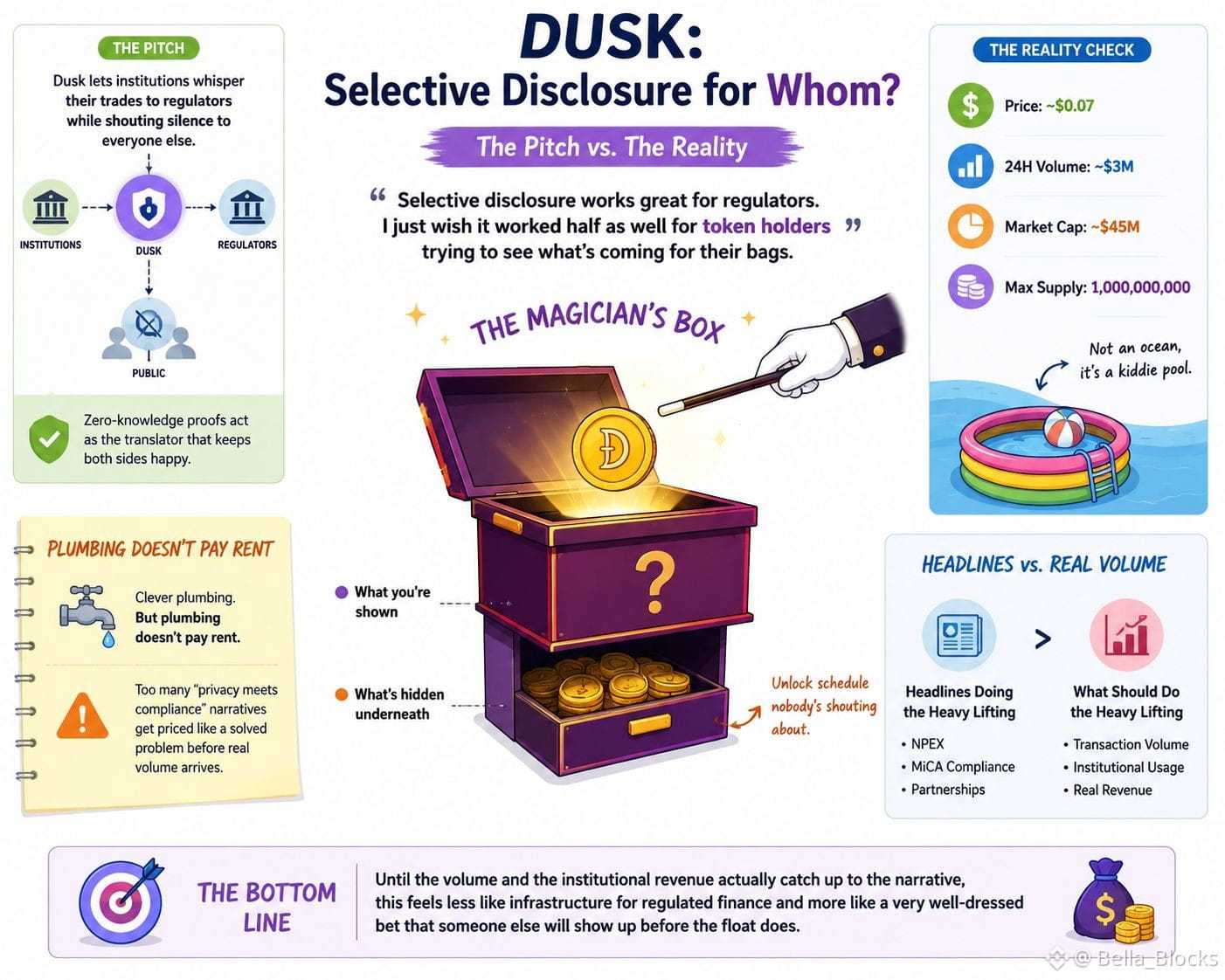
Ich starrte immer wieder auf diesen Satz „selektive Offenlegung“, als sollte er mich sicher fühlen lassen – stattdessen fühlt es sich an, als würde ich einen Vorvertrag lesen, der als Liebesbrief verkleidet ist. Die ganze Idee lautet: Dusk ermöglicht es Institutionen, ihren Handel den Aufsichtsbehörden „flüsternd“ mitzuteilen, während sie gegenüber allen anderen laut Schweigen bewahren. Und Zero-Knowledge-Proofs stehen als Übersetzer da und halten beide Seiten zufriedengestellt. Okay. Cleveres Plumbing. Aber Plumbing zahlt keine Miete, und ich habe schon genug „Privacy trifft Compliance“-Erzählungen gesehen, die wie ein gelöstes Problem bepreist werden, bevor überhaupt eine einzige Institution echtes Volumen durch die Leitungen schiebt.
Zurzeit handelt DUSK bei rund sieben Cent, wobei sich gerade mal etwa drei Millionen Dollar pro Tag bewegen. Die Marktkapitalisierung liegt bei knapp fünfundvierzig Millionen bei einer maximalen Supply von einer Milliarde Token. Das ist kein Markt, das ist ein Planschbecken, das als Ozean vermarktet wird. Die Hälfte der Supply wartet noch auf der Bühne, bevor sie überhaupt „auftritt“, und jede Schlagzeile zu NPEX oder MiCA-Compliance macht die schwere Arbeit, die eigentlich echtes Transaktionsvolumen leisten sollte.
Das Bild, das mir immer wieder durch den Kopf geht, ist eine Zauberkiste mit doppeltem Boden: Man zeigt dir, wie eine Münze verschwindet, und sagt dir, sie sei weg – aber der eigentliche Trick ist, was die ganze Zeit unter der Bühne verborgen ist: der Entsperrplan, über den niemand laut spricht, während die Compliance-Story die ganze Sendezeit bekommt. Selektive Offenlegung funktioniert großartig für Regulatoren. Ich wünschte nur, sie würde für Token-Inhaber, die sehen wollen, was mit ihren Beständen bevorsteht, wenigstens halb so gut funktionieren.
Solange Volumen und institutioneller Umsatz nicht wirklich mit der Erzählung gleichziehen, fühlt sich das weniger wie Infrastruktur für regulierte Finanzen an und mehr wie eine sehr gut angezogene Wette darauf, dass jemand anderes auftaucht, bevor das Angebot „freigeschwommen“ ist.
$MRNAon
{alpha}(560x01486675da0764ee780ea7cb65c33062e9b2d28c)
$RICE
{alpha}(560xb5761f36fdfe2892f1b54bc8ee8babb2a1b698d3)
{spot}(DUSKUSDT)
#dusk $DUSK @Dusk
Ich starrte immer wieder auf diesen Satz „selektive Offenlegung“, als sollte er mich sicher fühlen lassen – stattdessen fühlt es sich an, als würde ich einen Vorvertrag lesen, der als Liebesbrief verkleidet ist. Die ganze Idee lautet: Dusk ermöglicht es Institutionen, ihren Handel den Aufsichtsbehörden „flüsternd“ mitzuteilen, während sie gegenüber allen anderen laut Schweigen bewahren. Und Zero-Knowledge-Proofs stehen als Übersetzer da und halten beide Seiten zufriedengestellt. Okay. Cleveres Plumbing. Aber Plumbing zahlt keine Miete, und ich habe schon genug „Privacy trifft Compliance“-Erzählungen gesehen, die wie ein gelöstes Problem bepreist werden, bevor überhaupt eine einzige Institution echtes Volumen durch die Leitungen schiebt.
Zurzeit handelt DUSK bei rund sieben Cent, wobei sich gerade mal etwa drei Millionen Dollar pro Tag bewegen. Die Marktkapitalisierung liegt bei knapp fünfundvierzig Millionen bei einer maximalen Supply von einer Milliarde Token. Das ist kein Markt, das ist ein Planschbecken, das als Ozean vermarktet wird. Die Hälfte der Supply wartet noch auf der Bühne, bevor sie überhaupt „auftritt“, und jede Schlagzeile zu NPEX oder MiCA-Compliance macht die schwere Arbeit, die eigentlich echtes Transaktionsvolumen leisten sollte.
Das Bild, das mir immer wieder durch den Kopf geht, ist eine Zauberkiste mit doppeltem Boden: Man zeigt dir, wie eine Münze verschwindet, und sagt dir, sie sei weg – aber der eigentliche Trick ist, was die ganze Zeit unter der Bühne verborgen ist: der Entsperrplan, über den niemand laut spricht, während die Compliance-Story die ganze Sendezeit bekommt. Selektive Offenlegung funktioniert großartig für Regulatoren. Ich wünschte nur, sie würde für Token-Inhaber, die sehen wollen, was mit ihren Beständen bevorsteht, wenigstens halb so gut funktionieren.
Solange Volumen und institutioneller Umsatz nicht wirklich mit der Erzählung gleichziehen, fühlt sich das weniger wie Infrastruktur für regulierte Finanzen an und mehr wie eine sehr gut angezogene Wette darauf, dass jemand anderes auftaucht, bevor das Angebot „freigeschwommen“ ist.
$MRNAon
$RICE
Ich starrte immer wieder auf diesen Satz „selektive Offenlegung“, als sollte er mich sicher fühlen lassen – stattdessen fühlt es sich an, als würde ich einen Vorvertrag lesen, der als Liebesbrief verkleidet ist. Die ganze Idee lautet: Dusk ermöglicht es Institutionen, ihren Handel den Aufsichtsbehörden „flüsternd“ mitzuteilen, während sie gegenüber allen anderen laut Schweigen bewahren. Und Zero-Knowledge-Proofs stehen als Übersetzer da und halten beide Seiten zufriedengestellt. Okay. Cleveres Plumbing. Aber Plumbing zahlt keine Miete, und ich habe schon genug „Privacy trifft Compliance“-Erzählungen gesehen, die wie ein gelöstes Problem bepreist werden, bevor überhaupt eine einzige Institution echtes Volumen durch die Leitungen schiebt.
Zurzeit handelt DUSK bei rund sieben Cent, wobei sich gerade mal etwa drei Millionen Dollar pro Tag bewegen. Die Marktkapitalisierung liegt bei knapp fünfundvierzig Millionen bei einer maximalen Supply von einer Milliarde Token. Das ist kein Markt, das ist ein Planschbecken, das als Ozean vermarktet wird. Die Hälfte der Supply wartet noch auf der Bühne, bevor sie überhaupt „auftritt“, und jede Schlagzeile zu NPEX oder MiCA-Compliance macht die schwere Arbeit, die eigentlich echtes Transaktionsvolumen leisten sollte.
Das Bild, das mir immer wieder durch den Kopf geht, ist eine Zauberkiste mit doppeltem Boden: Man zeigt dir, wie eine Münze verschwindet, und sagt dir, sie sei weg – aber der eigentliche Trick ist, was die ganze Zeit unter der Bühne verborgen ist: der Entsperrplan, über den niemand laut spricht, während die Compliance-Story die ganze Sendezeit bekommt. Selektive Offenlegung funktioniert großartig für Regulatoren. Ich wünschte nur, sie würde für Token-Inhaber, die sehen wollen, was mit ihren Beständen bevorsteht, wenigstens halb so gut funktionieren.
Solange Volumen und institutioneller Umsatz nicht wirklich mit der Erzählung gleichziehen, fühlt sich das weniger wie Infrastruktur für regulierte Finanzen an und mehr wie eine sehr gut angezogene Wette darauf, dass jemand anderes auftaucht, bevor das Angebot „freigeschwommen“ ist.
$MRNAon
$RICE
5
7
399
·
--
#termmax @termmax
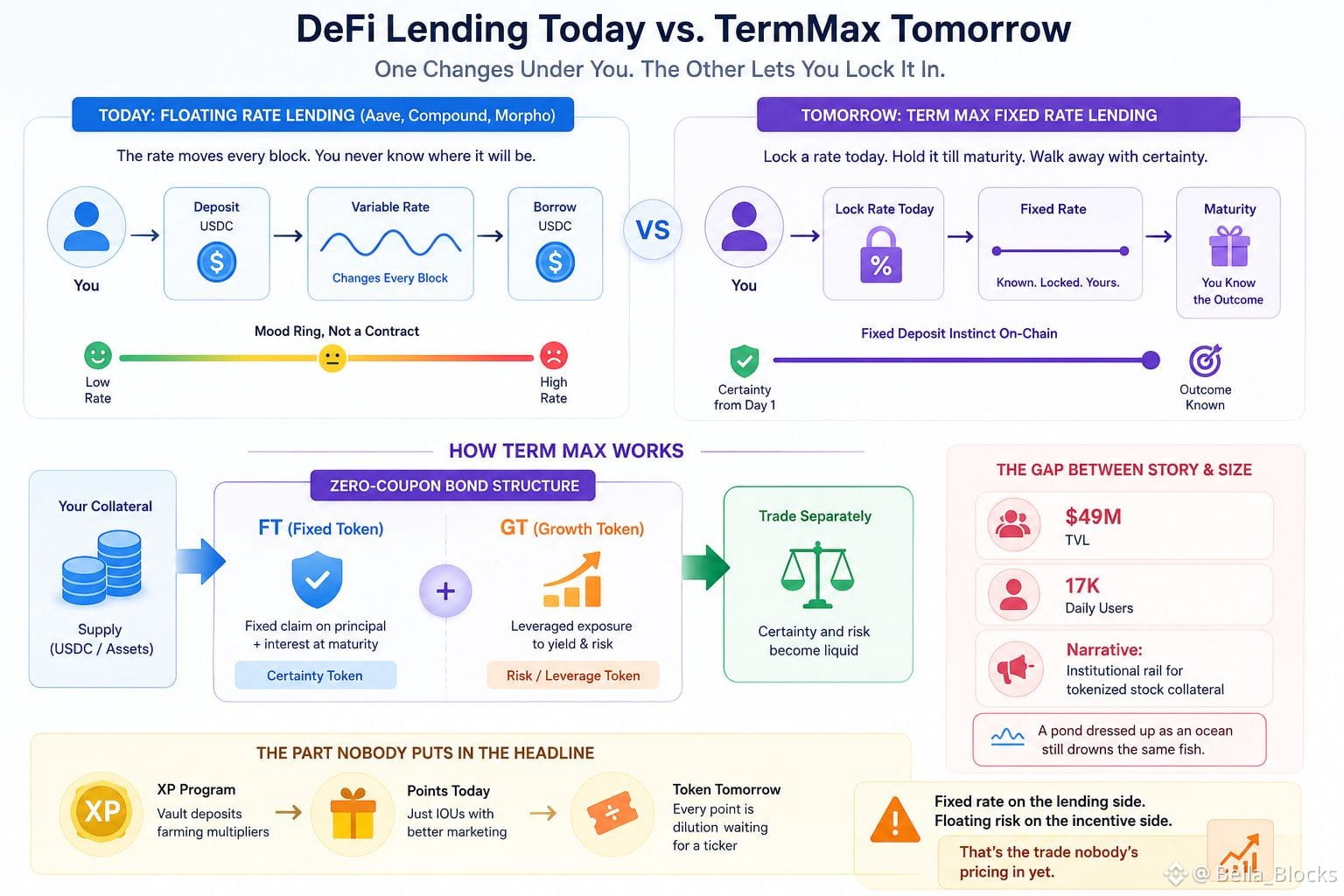
Ich komme immer wieder auf denselben Punkt zurück: Jede DeFi-Kreditrate wirkt wie ein Stimmungsring — nicht wie ein Vertrag. Aave, Compound, Morpho Blue: Du depositierst, du leihst dir Geld, und die Rate bewegt sich unter deinen Füßen in jeder einzelnen Block-Iteration. Es ist eine Festanlage, die ihre eigene Verzinsung ändert, während du den Beleg immer noch in der Hand hältst. Niemand würde im echten Leben für so etwas ein Sparkonto unterschreiben, aber irgendwie haben wir es alle on-chain normalisiert.
TermMax verkauft die gegenteilige Story. Sperre dir heute eine Rate, halte sie bis zur Fälligkeit, geh dann weg mit einer Zahl, die du vorher schon kanntest. Das ist der Bank-FD-Instinkt, verpackt in eine Zero-Coupon-Bond-Struktur — du jagst keine Rendite, du bewertest Zeit. Teile den Principal und die Zinsen in zwei Tokens: ein FT für die feste Forderung und ein GT für die gehebelte, kollateralstarke Seite. Und plötzlich kannst du die Sicherheit getrennt vom Risiko handeln. Sauberer Mechanismus auf dem Papier.
Aber ich starre immer wieder auf die Größe dieses Dinges im Verhältnis zur Größe der Story. 49 Millionen TVL, siebzehntausend tägliche Nutzer — und eine Pressemitteilung, die so klingt, als wäre es schon jetzt die institutionelle Schiene für tokenisierte Aktienkollaterale. Diese Lücke zwischen Erzählung und Bilanz ist der Hinweis. Ein Teich, der wie ein Ozean verkleidet ist, ertränkt immer noch dieselben Fische, wenn die Flut kippt.
Und der Teil, den niemand in die Schlagzeile packt: Es läuft bereits ein XP-Programm — Vault-Deposits farmen Multiplikatoren für einen Token, der noch nicht existiert. Points-Programme sind nur IOUs mit besserem Marketing. Jeder heute verdiente Punkt ist eine Verwässerung, die auf einen Ticker wartet. Fester Zinssatz auf der Lending-Seite, schwankendes Risiko auf der Incentive-Seite — das ist der Trade, den noch niemand einpreist.
$HEMI
{spot}(HEMIUSDT)
$TREE
{spot}(TREEUSDT)
$RE
{spot}(REUSDT)
#termmax @TermMax
Ich komme immer wieder auf denselben Punkt zurück: Jede DeFi-Kreditrate wirkt wie ein Stimmungsring — nicht wie ein Vertrag. Aave, Compound, Morpho Blue: Du depositierst, du leihst dir Geld, und die Rate bewegt sich unter deinen Füßen in jeder einzelnen Block-Iteration. Es ist eine Festanlage, die ihre eigene Verzinsung ändert, während du den Beleg immer noch in der Hand hältst. Niemand würde im echten Leben für so etwas ein Sparkonto unterschreiben, aber irgendwie haben wir es alle on-chain normalisiert.
TermMax verkauft die gegenteilige Story. Sperre dir heute eine Rate, halte sie bis zur Fälligkeit, geh dann weg mit einer Zahl, die du vorher schon kanntest. Das ist der Bank-FD-Instinkt, verpackt in eine Zero-Coupon-Bond-Struktur — du jagst keine Rendite, du bewertest Zeit. Teile den Principal und die Zinsen in zwei Tokens: ein FT für die feste Forderung und ein GT für die gehebelte, kollateralstarke Seite. Und plötzlich kannst du die Sicherheit getrennt vom Risiko handeln. Sauberer Mechanismus auf dem Papier.
Aber ich starre immer wieder auf die Größe dieses Dinges im Verhältnis zur Größe der Story. 49 Millionen TVL, siebzehntausend tägliche Nutzer — und eine Pressemitteilung, die so klingt, als wäre es schon jetzt die institutionelle Schiene für tokenisierte Aktienkollaterale. Diese Lücke zwischen Erzählung und Bilanz ist der Hinweis. Ein Teich, der wie ein Ozean verkleidet ist, ertränkt immer noch dieselben Fische, wenn die Flut kippt.
Und der Teil, den niemand in die Schlagzeile packt: Es läuft bereits ein XP-Programm — Vault-Deposits farmen Multiplikatoren für einen Token, der noch nicht existiert. Points-Programme sind nur IOUs mit besserem Marketing. Jeder heute verdiente Punkt ist eine Verwässerung, die auf einen Ticker wartet. Fester Zinssatz auf der Lending-Seite, schwankendes Risiko auf der Incentive-Seite — das ist der Trade, den noch niemand einpreist.
$HEMI
$TREE
$RE
Ich komme immer wieder auf denselben Punkt zurück: Jede DeFi-Kreditrate wirkt wie ein Stimmungsring — nicht wie ein Vertrag. Aave, Compound, Morpho Blue: Du depositierst, du leihst dir Geld, und die Rate bewegt sich unter deinen Füßen in jeder einzelnen Block-Iteration. Es ist eine Festanlage, die ihre eigene Verzinsung ändert, während du den Beleg immer noch in der Hand hältst. Niemand würde im echten Leben für so etwas ein Sparkonto unterschreiben, aber irgendwie haben wir es alle on-chain normalisiert.
TermMax verkauft die gegenteilige Story. Sperre dir heute eine Rate, halte sie bis zur Fälligkeit, geh dann weg mit einer Zahl, die du vorher schon kanntest. Das ist der Bank-FD-Instinkt, verpackt in eine Zero-Coupon-Bond-Struktur — du jagst keine Rendite, du bewertest Zeit. Teile den Principal und die Zinsen in zwei Tokens: ein FT für die feste Forderung und ein GT für die gehebelte, kollateralstarke Seite. Und plötzlich kannst du die Sicherheit getrennt vom Risiko handeln. Sauberer Mechanismus auf dem Papier.
Aber ich starre immer wieder auf die Größe dieses Dinges im Verhältnis zur Größe der Story. 49 Millionen TVL, siebzehntausend tägliche Nutzer — und eine Pressemitteilung, die so klingt, als wäre es schon jetzt die institutionelle Schiene für tokenisierte Aktienkollaterale. Diese Lücke zwischen Erzählung und Bilanz ist der Hinweis. Ein Teich, der wie ein Ozean verkleidet ist, ertränkt immer noch dieselben Fische, wenn die Flut kippt.
Und der Teil, den niemand in die Schlagzeile packt: Es läuft bereits ein XP-Programm — Vault-Deposits farmen Multiplikatoren für einen Token, der noch nicht existiert. Points-Programme sind nur IOUs mit besserem Marketing. Jeder heute verdiente Punkt ist eine Verwässerung, die auf einen Ticker wartet. Fester Zinssatz auf der Lending-Seite, schwankendes Risiko auf der Incentive-Seite — das ist der Trade, den noch niemand einpreist.
$HEMI
$TREE
$RE
5
4
701
·
--
#dusk $DUSK @Dusk_Foundation
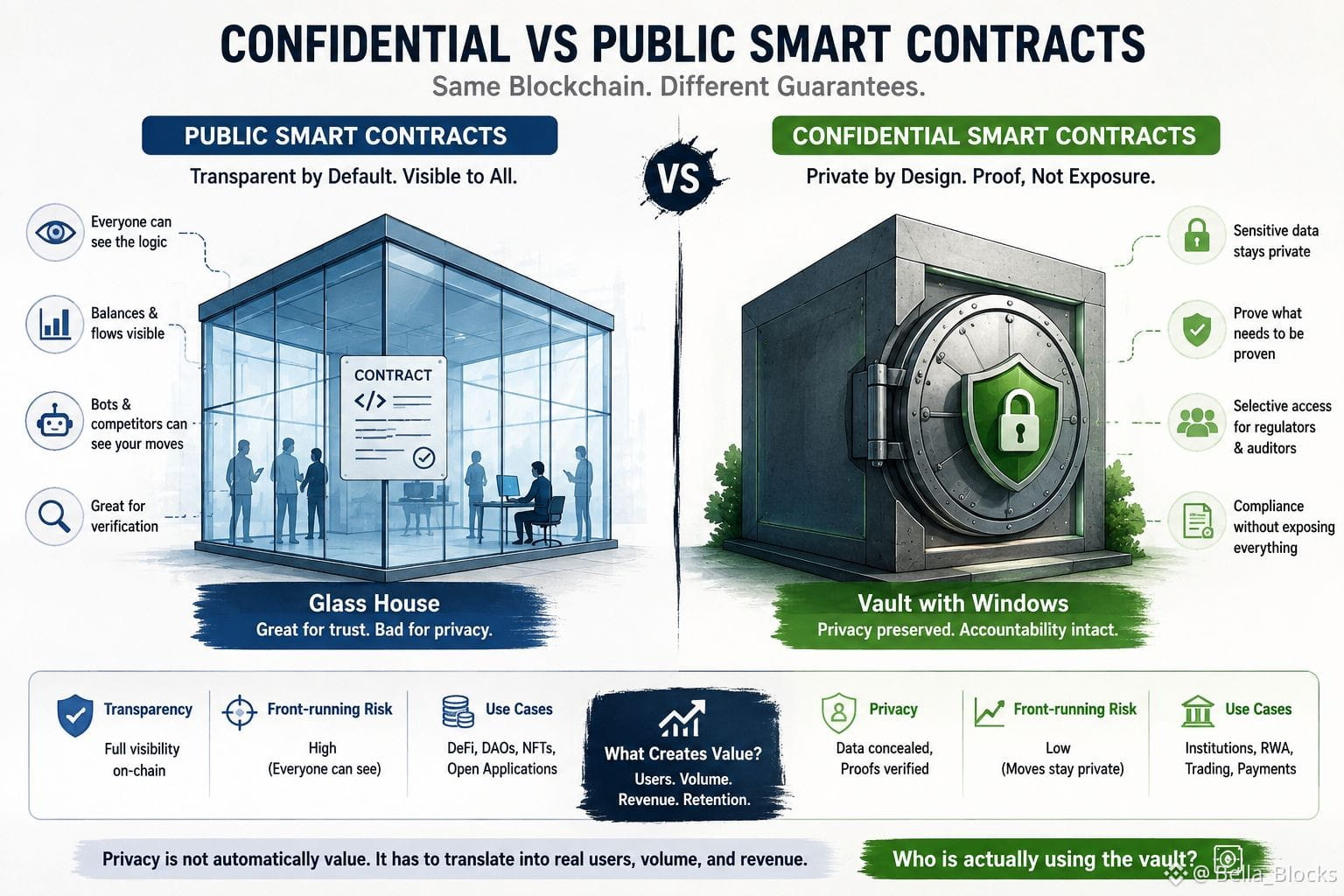
Ich denke immer wieder darüber nach, wie öffentliche Smart Contracts Transparenz zur Standardvorgabe gemacht haben. Doch dieselbe Transparenz kann zur Belastung werden, wenn echte Finanzstrategien die Kette erreichen. Jeder kann sich Logik, Guthaben, Geldflüsse und oft sogar den eigentlichen Trade ansehen. Großartig zur Verifizierung, katastrophal, wenn Wettbewerber, Bots oder Gegenparteien deine Schritte sehen können, bevor sie abgewickelt sind.
Vertrauliche Contracts drehen dieses Verhältnis um. Das Ziel ist nicht „alles verbergen und uns vertrauen“. Es geht darum, das zu beweisen, was bewiesen werden muss, während gleichzeitig sensibler Status privat bleibt. Dusk’s XSC-Modell baut sogar selektiven Zugriff direkt in das Contract-Design ein – für Rollen wie Regulierungsbehörden und Auditoren.
Doch ich bleibe skeptisch. Privatsphäre ist nicht automatisch ein Wert. Sie muss sich in tatsächliche Nutzer, Handels-/Abwicklungsvolumen und Erlöse übersetzen. Andernfalls ist sie nur eine weitere glänzende Erzählung auf der Startbahn.
Öffentliche Contracts sind ein Glashaus. Vertrauliche Contracts sind ein Tresor mit Fenstern. Der Markt wird früher oder später nur die eine Frage stellen, die wirklich zählt: Wer nutzt den Tresor tatsächlich?
{spot}(DUSKUSDT)
$ACE
{spot}(ACEUSDT)
$SOL
{spot}(SOLUSDT)
#dusk $DUSK @Dusk
Ich denke immer wieder darüber nach, wie öffentliche Smart Contracts Transparenz zur Standardvorgabe gemacht haben. Doch dieselbe Transparenz kann zur Belastung werden, wenn echte Finanzstrategien die Kette erreichen. Jeder kann sich Logik, Guthaben, Geldflüsse und oft sogar den eigentlichen Trade ansehen. Großartig zur Verifizierung, katastrophal, wenn Wettbewerber, Bots oder Gegenparteien deine Schritte sehen können, bevor sie abgewickelt sind.
Vertrauliche Contracts drehen dieses Verhältnis um. Das Ziel ist nicht „alles verbergen und uns vertrauen“. Es geht darum, das zu beweisen, was bewiesen werden muss, während gleichzeitig sensibler Status privat bleibt. Dusk’s XSC-Modell baut sogar selektiven Zugriff direkt in das Contract-Design ein – für Rollen wie Regulierungsbehörden und Auditoren.
Doch ich bleibe skeptisch. Privatsphäre ist nicht automatisch ein Wert. Sie muss sich in tatsächliche Nutzer, Handels-/Abwicklungsvolumen und Erlöse übersetzen. Andernfalls ist sie nur eine weitere glänzende Erzählung auf der Startbahn.
Öffentliche Contracts sind ein Glashaus. Vertrauliche Contracts sind ein Tresor mit Fenstern. Der Markt wird früher oder später nur die eine Frage stellen, die wirklich zählt: Wer nutzt den Tresor tatsächlich?
$ACE
$SOL
Ich denke immer wieder darüber nach, wie öffentliche Smart Contracts Transparenz zur Standardvorgabe gemacht haben. Doch dieselbe Transparenz kann zur Belastung werden, wenn echte Finanzstrategien die Kette erreichen. Jeder kann sich Logik, Guthaben, Geldflüsse und oft sogar den eigentlichen Trade ansehen. Großartig zur Verifizierung, katastrophal, wenn Wettbewerber, Bots oder Gegenparteien deine Schritte sehen können, bevor sie abgewickelt sind.
Vertrauliche Contracts drehen dieses Verhältnis um. Das Ziel ist nicht „alles verbergen und uns vertrauen“. Es geht darum, das zu beweisen, was bewiesen werden muss, während gleichzeitig sensibler Status privat bleibt. Dusk’s XSC-Modell baut sogar selektiven Zugriff direkt in das Contract-Design ein – für Rollen wie Regulierungsbehörden und Auditoren.
Doch ich bleibe skeptisch. Privatsphäre ist nicht automatisch ein Wert. Sie muss sich in tatsächliche Nutzer, Handels-/Abwicklungsvolumen und Erlöse übersetzen. Andernfalls ist sie nur eine weitere glänzende Erzählung auf der Startbahn.
Öffentliche Contracts sind ein Glashaus. Vertrauliche Contracts sind ein Tresor mit Fenstern. Der Markt wird früher oder später nur die eine Frage stellen, die wirklich zählt: Wer nutzt den Tresor tatsächlich?
$ACE
$SOL
8
5
549
·
--
#termmax @termmax
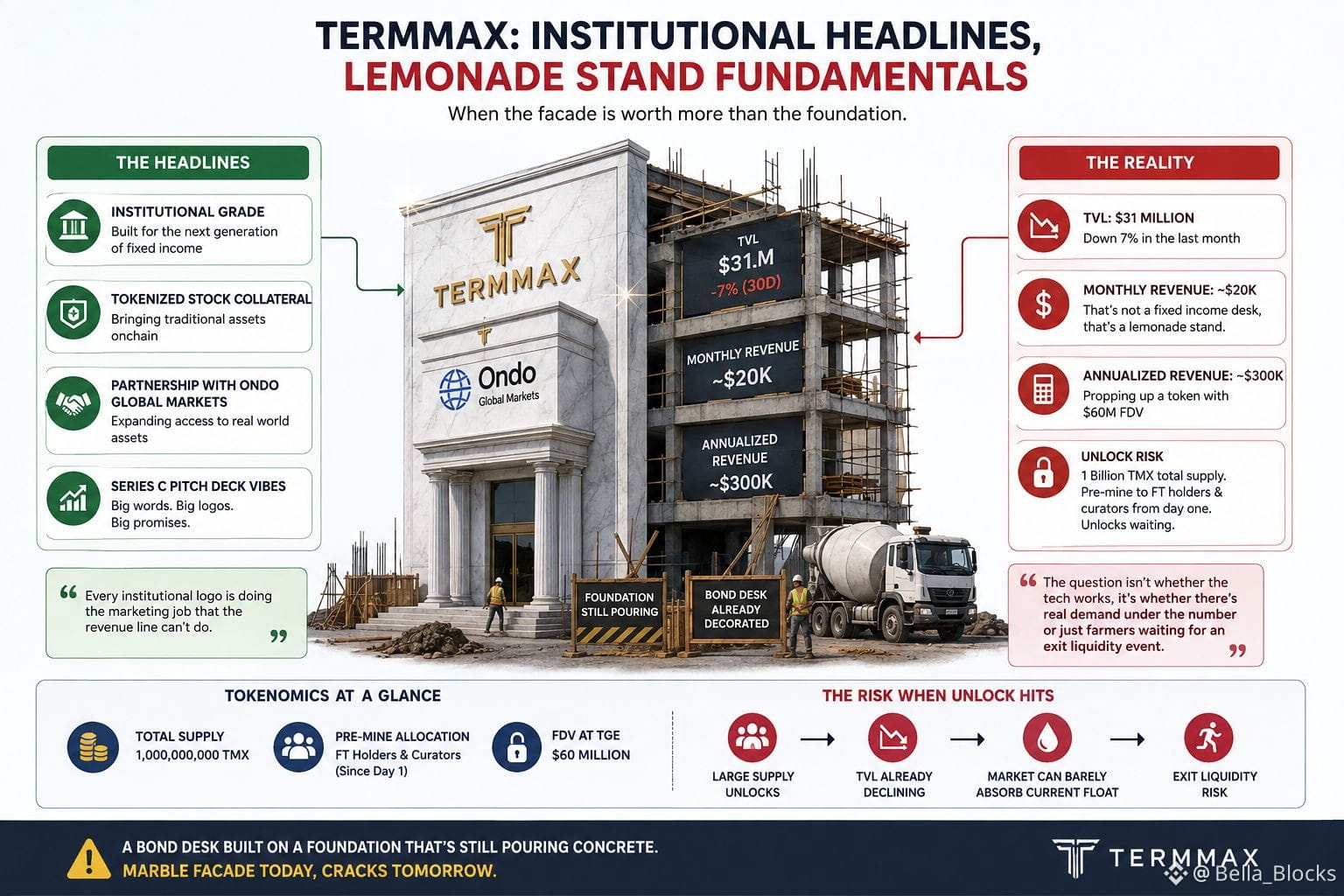
Ich starre ständig auf die TermMax-Zahlen neben den TermMax-Headlines, und sie leben nicht im selben Universum. Die Schlagzeilen sind alle von institutioneller Qualität: das hier, tokenisierte Aktienbesicherung dort, eine frische Partnerschaft mit Ondos Global Markets, angeheftet an eine Pressemitteilung, die klingt, als wäre sie für ein Series-C-Pitchdeck geschrieben worden.
Währenddessen sitzt das Protokoll bei dreißig ein Millionen TVL, über sieben Prozent im letzten Monat runter, und erwirtschaftet tatsächlich rund zwanzigtausend Dollar Umsatz im Monat. Aufs Jahr hochgerechnet sind das ungefähr dreihunderttausend Dollar, die einen Token stützen sollen, der kurz davor steht, mit einer FDV von sechzig Millionen Dollar geprägt zu werden. Das ist keine Fixed-Income-Desk, das ist ein Limonadenstand, der einen Bloomberg-Terminal als Kostüm trägt.
Festzinsen sollen eigentlich das Verkaufsargument sein, Gewissheit in einem Markt, der Gewissheit hasst, aber das Eine, was hier nicht fest ist, ist das Token-Angebot. Eine Milliarde TMX insgesamt, Pre-Mine-Kampagnen, die seit Tag eins still und leise für FT-Inhaber und Kuratoren anfallen, alles wartet darauf, in einen Markt freizugeben, der seinen aktuellen Umlauf kaum tragen kann, ohne TVL zu verlieren.
Ich komme immer wieder auf dasselbe Bild zurück: ein Bond-Desk, gebaut auf einem Fundament, unter dem noch Beton gegossen wird, während vorne schon die Marmorfassade aufgehängt wird. Jedes institutionelle Logo, das sie an die Ankündigung heften, übernimmt die Marketingarbeit, die die Umsatzzeile allein nicht leisten kann. Wenn der Unlock tatsächlich kommt, ist die Frage nicht, ob die Technik funktioniert, sondern ob unter der Zahl echte Nachfrage steht oder nur Pre-Mine-Farmer, die auf einen Exit-Liquiditätsmoment warten, verpackt als Token-Generation.
$ALPINE
{spot}(ALPINEUSDT)
$ACE
{spot}(ACEUSDT)
$1000SATS
{spot}(1000SATSUSDT)
#termmax @TermMax
Ich starre ständig auf die TermMax-Zahlen neben den TermMax-Headlines, und sie leben nicht im selben Universum. Die Schlagzeilen sind alle von institutioneller Qualität: das hier, tokenisierte Aktienbesicherung dort, eine frische Partnerschaft mit Ondos Global Markets, angeheftet an eine Pressemitteilung, die klingt, als wäre sie für ein Series-C-Pitchdeck geschrieben worden.
Währenddessen sitzt das Protokoll bei dreißig ein Millionen TVL, über sieben Prozent im letzten Monat runter, und erwirtschaftet tatsächlich rund zwanzigtausend Dollar Umsatz im Monat. Aufs Jahr hochgerechnet sind das ungefähr dreihunderttausend Dollar, die einen Token stützen sollen, der kurz davor steht, mit einer FDV von sechzig Millionen Dollar geprägt zu werden. Das ist keine Fixed-Income-Desk, das ist ein Limonadenstand, der einen Bloomberg-Terminal als Kostüm trägt.
Festzinsen sollen eigentlich das Verkaufsargument sein, Gewissheit in einem Markt, der Gewissheit hasst, aber das Eine, was hier nicht fest ist, ist das Token-Angebot. Eine Milliarde TMX insgesamt, Pre-Mine-Kampagnen, die seit Tag eins still und leise für FT-Inhaber und Kuratoren anfallen, alles wartet darauf, in einen Markt freizugeben, der seinen aktuellen Umlauf kaum tragen kann, ohne TVL zu verlieren.
Ich komme immer wieder auf dasselbe Bild zurück: ein Bond-Desk, gebaut auf einem Fundament, unter dem noch Beton gegossen wird, während vorne schon die Marmorfassade aufgehängt wird. Jedes institutionelle Logo, das sie an die Ankündigung heften, übernimmt die Marketingarbeit, die die Umsatzzeile allein nicht leisten kann. Wenn der Unlock tatsächlich kommt, ist die Frage nicht, ob die Technik funktioniert, sondern ob unter der Zahl echte Nachfrage steht oder nur Pre-Mine-Farmer, die auf einen Exit-Liquiditätsmoment warten, verpackt als Token-Generation.
$ALPINE
$ACE
$1000SATS
Ich starre ständig auf die TermMax-Zahlen neben den TermMax-Headlines, und sie leben nicht im selben Universum. Die Schlagzeilen sind alle von institutioneller Qualität: das hier, tokenisierte Aktienbesicherung dort, eine frische Partnerschaft mit Ondos Global Markets, angeheftet an eine Pressemitteilung, die klingt, als wäre sie für ein Series-C-Pitchdeck geschrieben worden.
Währenddessen sitzt das Protokoll bei dreißig ein Millionen TVL, über sieben Prozent im letzten Monat runter, und erwirtschaftet tatsächlich rund zwanzigtausend Dollar Umsatz im Monat. Aufs Jahr hochgerechnet sind das ungefähr dreihunderttausend Dollar, die einen Token stützen sollen, der kurz davor steht, mit einer FDV von sechzig Millionen Dollar geprägt zu werden. Das ist keine Fixed-Income-Desk, das ist ein Limonadenstand, der einen Bloomberg-Terminal als Kostüm trägt.
Festzinsen sollen eigentlich das Verkaufsargument sein, Gewissheit in einem Markt, der Gewissheit hasst, aber das Eine, was hier nicht fest ist, ist das Token-Angebot. Eine Milliarde TMX insgesamt, Pre-Mine-Kampagnen, die seit Tag eins still und leise für FT-Inhaber und Kuratoren anfallen, alles wartet darauf, in einen Markt freizugeben, der seinen aktuellen Umlauf kaum tragen kann, ohne TVL zu verlieren.
Ich komme immer wieder auf dasselbe Bild zurück: ein Bond-Desk, gebaut auf einem Fundament, unter dem noch Beton gegossen wird, während vorne schon die Marmorfassade aufgehängt wird. Jedes institutionelle Logo, das sie an die Ankündigung heften, übernimmt die Marketingarbeit, die die Umsatzzeile allein nicht leisten kann. Wenn der Unlock tatsächlich kommt, ist die Frage nicht, ob die Technik funktioniert, sondern ob unter der Zahl echte Nachfrage steht oder nur Pre-Mine-Farmer, die auf einen Exit-Liquiditätsmoment warten, verpackt als Token-Generation.
$ALPINE
$ACE
$1000SATS
2
2
465
·
--
Verifiziert
Übersetzung ansehen
#dusk $DUSK @Dusk_Foundation
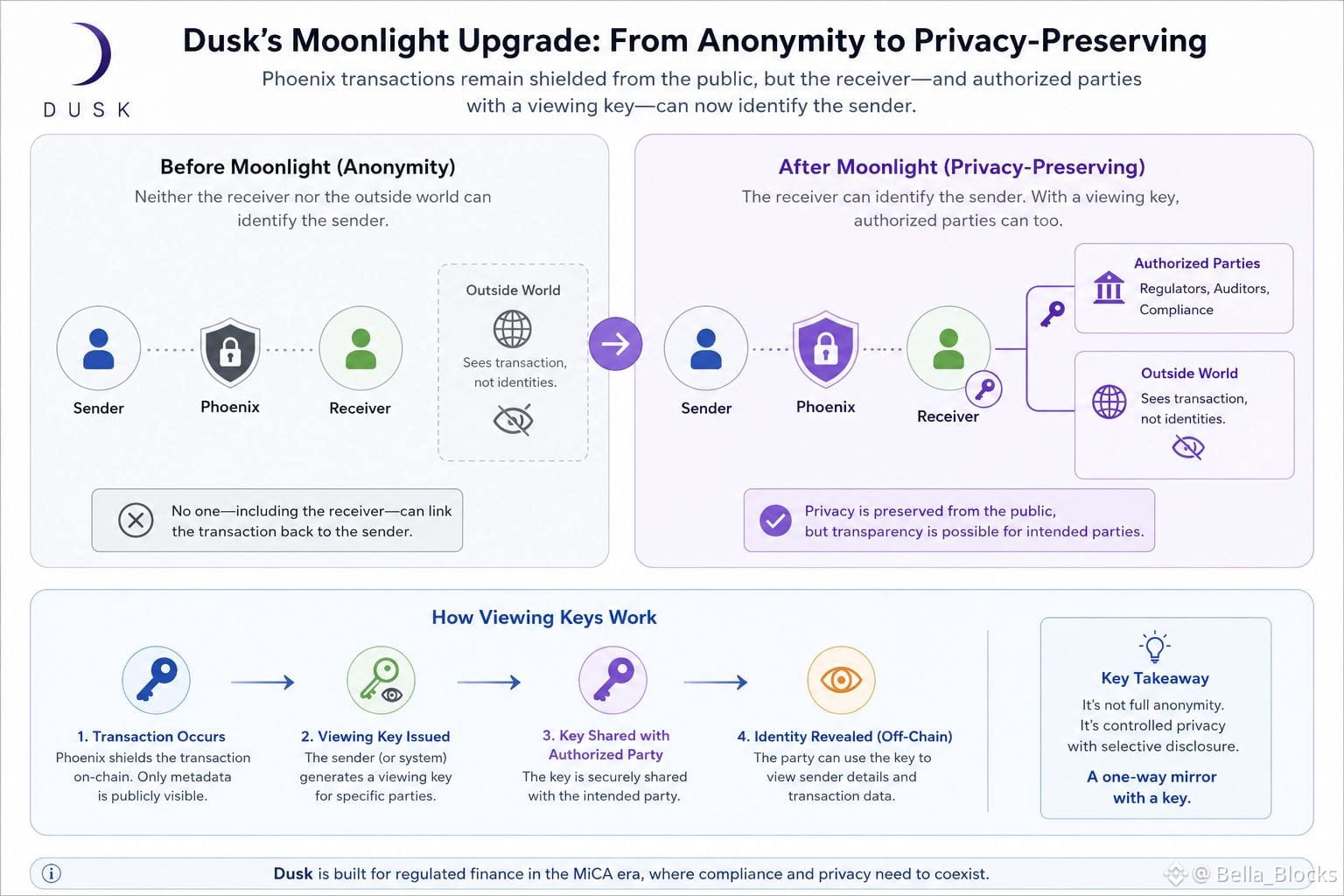
I was digging through Dusk's docs trying to understand what actually changed when Moonlight got added last year, and I ran into a line in their whitepaper writeup that I had to reread twice: they added the ability to identify the sender of a Phoenix transaction to the receiver, and framed this as turning Phoenix "from an anonymity protocol into a privacy-preserving protocol."
That's a meaningful distinction, not just marketing wording. Anonymity means nobody, including the counterparty, can tie the transaction back to you. Privacy-preserving, as Dusk now defines it, means the outside world can't see the transfer, but the person you're transacting with can — and, via viewing keys, an authorized third party like a regulator or auditor can too.$ACE
I went back and forth on whether this was a downgrade or just a design choice. It's not broken — it's clearly intentional. Dusk is building for MiCA-era institutional finance, where full anonymity is a liability, not a feature. Shielded balances plus selective disclosure is the whole pitch. But it does mean the "private like Zcash" comparison people throw around isn't quite accurate anymore, and I'd bet most holders repeating that comparison haven't actually read the transaction model docs.
It's less a black box and more a one-way mirror with a key you hand to specific people. Worth knowing which side of that mirror you're actually standing on before you assume nobody's watching.
$GPS
{spot}(GPSUSDT)
{spot}(ACEUSDT)
{spot}(DUSKUSDT)
#dusk $DUSK @Dusk
I was digging through Dusk's docs trying to understand what actually changed when Moonlight got added last year, and I ran into a line in their whitepaper writeup that I had to reread twice: they added the ability to identify the sender of a Phoenix transaction to the receiver, and framed this as turning Phoenix "from an anonymity protocol into a privacy-preserving protocol."
That's a meaningful distinction, not just marketing wording. Anonymity means nobody, including the counterparty, can tie the transaction back to you. Privacy-preserving, as Dusk now defines it, means the outside world can't see the transfer, but the person you're transacting with can — and, via viewing keys, an authorized third party like a regulator or auditor can too.$ACE
I went back and forth on whether this was a downgrade or just a design choice. It's not broken — it's clearly intentional. Dusk is building for MiCA-era institutional finance, where full anonymity is a liability, not a feature. Shielded balances plus selective disclosure is the whole pitch. But it does mean the "private like Zcash" comparison people throw around isn't quite accurate anymore, and I'd bet most holders repeating that comparison haven't actually read the transaction model docs.
It's less a black box and more a one-way mirror with a key you hand to specific people. Worth knowing which side of that mirror you're actually standing on before you assume nobody's watching.
$GPS
I was digging through Dusk's docs trying to understand what actually changed when Moonlight got added last year, and I ran into a line in their whitepaper writeup that I had to reread twice: they added the ability to identify the sender of a Phoenix transaction to the receiver, and framed this as turning Phoenix "from an anonymity protocol into a privacy-preserving protocol."
That's a meaningful distinction, not just marketing wording. Anonymity means nobody, including the counterparty, can tie the transaction back to you. Privacy-preserving, as Dusk now defines it, means the outside world can't see the transfer, but the person you're transacting with can — and, via viewing keys, an authorized third party like a regulator or auditor can too.$ACE
I went back and forth on whether this was a downgrade or just a design choice. It's not broken — it's clearly intentional. Dusk is building for MiCA-era institutional finance, where full anonymity is a liability, not a feature. Shielded balances plus selective disclosure is the whole pitch. But it does mean the "private like Zcash" comparison people throw around isn't quite accurate anymore, and I'd bet most holders repeating that comparison haven't actually read the transaction model docs.
It's less a black box and more a one-way mirror with a key you hand to specific people. Worth knowing which side of that mirror you're actually standing on before you assume nobody's watching.
$GPS
16
1
18
1k
·
--
#dusk @Dusk_Foundation $DUSK
Was wäre, wenn Privatsphäre und Verifizierbarkeit nie wirklich Gegensätze gewesen wären – sondern nur schlecht zusammen umgesetzt?
Ich bin auf XSC gestoßen, als ich in der vertraulichen Datenverarbeitung (confidential computing) für Smart Contracts nachforschte, um zu verstehen, warum „privat“ und „nachprüfbar“ in demselben Satz fast nie vorkommen. Was mich nicht in erster Linie an der Kryptografie selbst fesselte, sondern daran, wie selbstverständlich die Branche akzeptiert hat, dass man sich für eines entscheiden muss.
Das ist der Trade-off, den niemand hinterfragt: Transparenz für Vertrauen oder Privatsphäre für Schutz. Entscheide dich für eine Seite.
Stell dir ein Krankenhaus vor, das Versicherungsansprüche on-chain abwickelt. Vollständige Transparenz legt Patientendaten offen. Vollständige Privatsphäre bedeutet, dass Regulierer nichts verifizieren können, um zu prüfen, ob korrekt gehandelt wurde. Irgendjemand verliert immer.
Der Ansatz von XSC besteht darin, dass Verträge Korrektheit beweisen können, ohne die zugrunde liegenden Daten offenzulegen – die Berechnung geschieht vertraulich, aber das Ergebnis führt eine nachprüfbare Spur mit sich. Keine Privatsphäre gegen Verantwortlichkeit. Privatsphäre als Voraussetzung für Verantwortlichkeit.
Es ist ein kleines Umdenken, aber es rüttelt an einer Grundeinstellung, die man bislang wie Naturgesetz behandelt hat, statt wie eine Designentscheidung.
Und das zeigt sich überall in der Tech-Welt, nicht nur in der Krypto-Szene: Wir bauen ständig Systeme, die eine binäre Entscheidung zwischen Sichtbarkeit und Schutz erzwingen – und tun dann so, als wäre es überraschend, wenn keine der beiden Seiten zufrieden ist.
Wo lässt das also den Standard-Use-Case – ein gemeinsames Ledger zwischen Parteien, denen man nicht vollständig vertraut, die aber auch nicht alles offenlegen wollen? Hält „verifizierbar, ohne sichtbar zu sein“ auch unter adversarialen Bedingungen stand, oder verschiebt es nur das Vertrauensproblem an einen weniger offensichtlichen Ort?
Ich habe keine aufgeräumte Antwort. Aber XSC hat die Frage schärfer gemacht als zuvor.
$KII
{alpha}(560xeec6574eabba52bac3f0277f2cd5ac7e67197886)
$AIO
{alpha}(560x81a7da4074b8e0ed51bea40f9dcbdf4d9d4832b4)
{spot}(DUSKUSDT)
#dusk @Dusk $DUSK
Was wäre, wenn Privatsphäre und Verifizierbarkeit nie wirklich Gegensätze gewesen wären – sondern nur schlecht zusammen umgesetzt?
Ich bin auf XSC gestoßen, als ich in der vertraulichen Datenverarbeitung (confidential computing) für Smart Contracts nachforschte, um zu verstehen, warum „privat“ und „nachprüfbar“ in demselben Satz fast nie vorkommen. Was mich nicht in erster Linie an der Kryptografie selbst fesselte, sondern daran, wie selbstverständlich die Branche akzeptiert hat, dass man sich für eines entscheiden muss.
Das ist der Trade-off, den niemand hinterfragt: Transparenz für Vertrauen oder Privatsphäre für Schutz. Entscheide dich für eine Seite.
Stell dir ein Krankenhaus vor, das Versicherungsansprüche on-chain abwickelt. Vollständige Transparenz legt Patientendaten offen. Vollständige Privatsphäre bedeutet, dass Regulierer nichts verifizieren können, um zu prüfen, ob korrekt gehandelt wurde. Irgendjemand verliert immer.
Der Ansatz von XSC besteht darin, dass Verträge Korrektheit beweisen können, ohne die zugrunde liegenden Daten offenzulegen – die Berechnung geschieht vertraulich, aber das Ergebnis führt eine nachprüfbare Spur mit sich. Keine Privatsphäre gegen Verantwortlichkeit. Privatsphäre als Voraussetzung für Verantwortlichkeit.
Es ist ein kleines Umdenken, aber es rüttelt an einer Grundeinstellung, die man bislang wie Naturgesetz behandelt hat, statt wie eine Designentscheidung.
Und das zeigt sich überall in der Tech-Welt, nicht nur in der Krypto-Szene: Wir bauen ständig Systeme, die eine binäre Entscheidung zwischen Sichtbarkeit und Schutz erzwingen – und tun dann so, als wäre es überraschend, wenn keine der beiden Seiten zufrieden ist.
Wo lässt das also den Standard-Use-Case – ein gemeinsames Ledger zwischen Parteien, denen man nicht vollständig vertraut, die aber auch nicht alles offenlegen wollen? Hält „verifizierbar, ohne sichtbar zu sein“ auch unter adversarialen Bedingungen stand, oder verschiebt es nur das Vertrauensproblem an einen weniger offensichtlichen Ort?
Ich habe keine aufgeräumte Antwort. Aber XSC hat die Frage schärfer gemacht als zuvor.
$KII
$AIO
Was wäre, wenn Privatsphäre und Verifizierbarkeit nie wirklich Gegensätze gewesen wären – sondern nur schlecht zusammen umgesetzt?
Ich bin auf XSC gestoßen, als ich in der vertraulichen Datenverarbeitung (confidential computing) für Smart Contracts nachforschte, um zu verstehen, warum „privat“ und „nachprüfbar“ in demselben Satz fast nie vorkommen. Was mich nicht in erster Linie an der Kryptografie selbst fesselte, sondern daran, wie selbstverständlich die Branche akzeptiert hat, dass man sich für eines entscheiden muss.
Das ist der Trade-off, den niemand hinterfragt: Transparenz für Vertrauen oder Privatsphäre für Schutz. Entscheide dich für eine Seite.
Stell dir ein Krankenhaus vor, das Versicherungsansprüche on-chain abwickelt. Vollständige Transparenz legt Patientendaten offen. Vollständige Privatsphäre bedeutet, dass Regulierer nichts verifizieren können, um zu prüfen, ob korrekt gehandelt wurde. Irgendjemand verliert immer.
Der Ansatz von XSC besteht darin, dass Verträge Korrektheit beweisen können, ohne die zugrunde liegenden Daten offenzulegen – die Berechnung geschieht vertraulich, aber das Ergebnis führt eine nachprüfbare Spur mit sich. Keine Privatsphäre gegen Verantwortlichkeit. Privatsphäre als Voraussetzung für Verantwortlichkeit.
Es ist ein kleines Umdenken, aber es rüttelt an einer Grundeinstellung, die man bislang wie Naturgesetz behandelt hat, statt wie eine Designentscheidung.
Und das zeigt sich überall in der Tech-Welt, nicht nur in der Krypto-Szene: Wir bauen ständig Systeme, die eine binäre Entscheidung zwischen Sichtbarkeit und Schutz erzwingen – und tun dann so, als wäre es überraschend, wenn keine der beiden Seiten zufrieden ist.
Wo lässt das also den Standard-Use-Case – ein gemeinsames Ledger zwischen Parteien, denen man nicht vollständig vertraut, die aber auch nicht alles offenlegen wollen? Hält „verifizierbar, ohne sichtbar zu sein“ auch unter adversarialen Bedingungen stand, oder verschiebt es nur das Vertrauensproblem an einen weniger offensichtlichen Ort?
Ich habe keine aufgeräumte Antwort. Aber XSC hat die Frage schärfer gemacht als zuvor.
$KII
$AIO
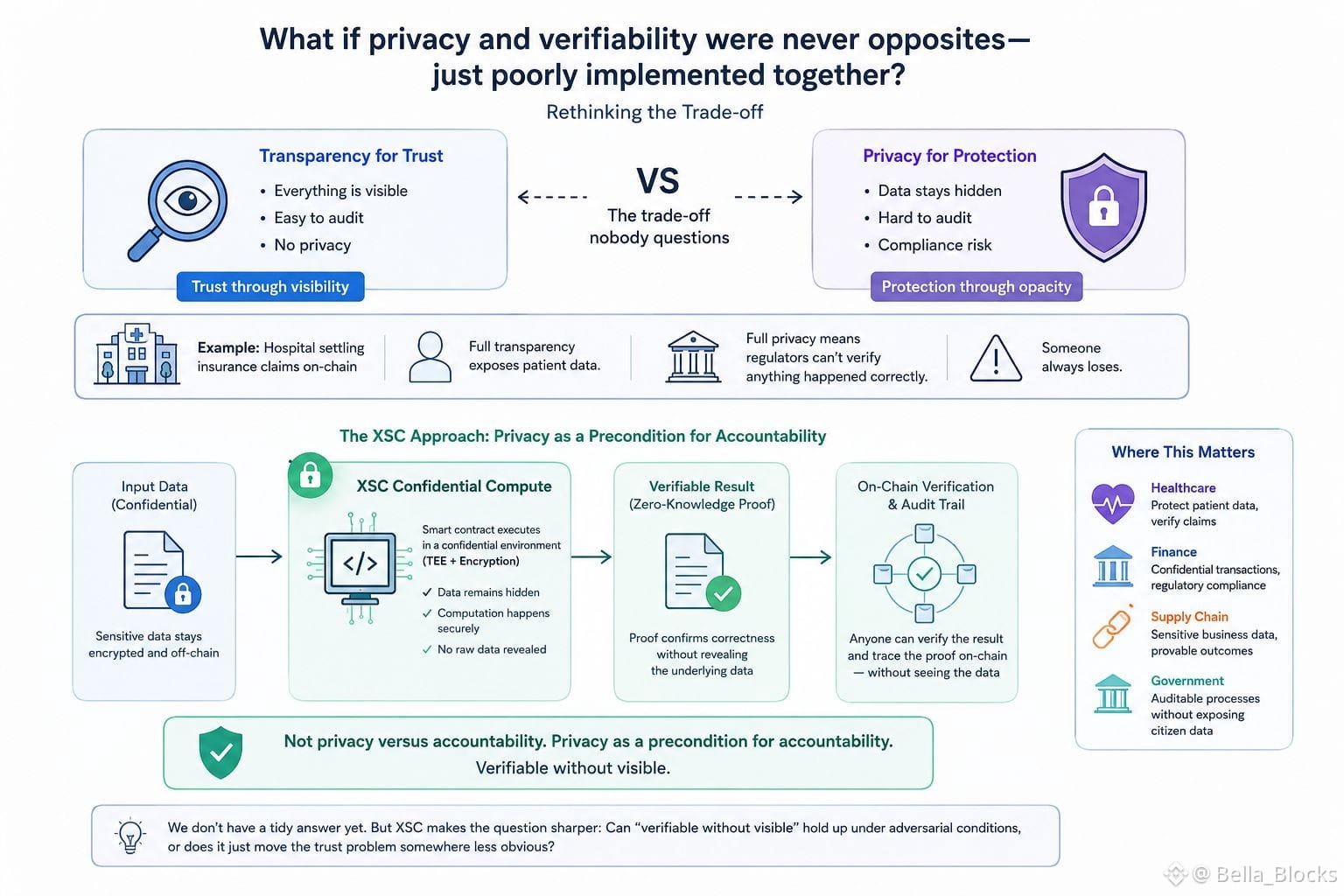
14
1
11
1k
·
--
#dusk @Dusk_Foundation $DUSK
Warum behandeln wir „transparent“ und „vertrauenswürdig“ in der Blockchain als Synonyme? Sie sind nicht dasselbe Wort, aber wir bauen Systeme, als wären sie es.
Ich bin auf Dusk Network gestoßen, als ich mich durch Infrastrukturprojekte mit Fokus auf Privatsphäre gearbeitet habe und verstehen wollte, warum regulierte Finanzwelt nicht in großem Stil on-chain gegangen ist. Was mir ins Auge fiel, war nicht die Roadmap oder der Token — sondern die Einordnung von vertraulichen Smart Contracts als Compliance-Tool, nicht als Werkzeug zur Umgehung.
Der unangefochtene Kompromiss in den meisten Krypto-Projekten ist dieser: Entweder man bekommt Transparenz oder Privatsphäre, man muss sich für eines entscheiden. Öffentliche Ledger werden als der eigentliche Sinn des Ganzen gefeiert.
Aber denken Sie an einen mittelgroßen Vermögensverwalter, der Wertpapiere on-chain abwickelt. Jeder Handel, jede Position, jeder Gegenpartei für Konkurrenten sichtbar, die dieselbe Chain beobachten. Das ist keine funktionierende Dezentralisierung — das ist ein Risiko.
Dusk' These ist, dass Privatsphäre und Prüfbarkeit keine Gegensätze sind. Zero-Knowledge-Proofs ermöglichen es, eine Transaktion als gültig zu verifizieren — konform, solvent, autorisiert — ohne ihren Inhalt jedem offenzulegen. Aufsichtsbehörden können dennoch selektive Offenlegung erhalten. Die Öffentlichkeit braucht nicht das vollständige Bild, um darauf zu vertrauen, dass das System funktioniert.
Wenn man den Blick weitet, erkennt man ein vertrautes Muster: Infrastruktur wird zuerst für den ideologischen Anwendungsfall gebaut, und der praktische, regulierte Anwendungsfall wird als Nebensache behandelt — oder als unmöglich.
Ich weiß nicht, ob vertrauliche Compliance tatsächlich in dem Maßstab funktioniert, wie sie angepriesen wird, oder ob sie das Vertrauensproblem nur an einen weniger sichtbaren Ort verschiebt.
Ich habe hier keine elegante Antwort. Aber die Frage fühlt sich jetzt schärfer an als vorher, bevor ich mich damit beschäftigt habe.
$CYS
{alpha}(560x0c69199c1562233640e0db5ce2c399a88eb507c7)
$AEON
{alpha}(560x277add739c6e0477616948357af9e79fe1ec9b80)
{spot}(DUSKUSDT)
#dusk @Dusk $DUSK
Warum behandeln wir „transparent“ und „vertrauenswürdig“ in der Blockchain als Synonyme? Sie sind nicht dasselbe Wort, aber wir bauen Systeme, als wären sie es.
Ich bin auf Dusk Network gestoßen, als ich mich durch Infrastrukturprojekte mit Fokus auf Privatsphäre gearbeitet habe und verstehen wollte, warum regulierte Finanzwelt nicht in großem Stil on-chain gegangen ist. Was mir ins Auge fiel, war nicht die Roadmap oder der Token — sondern die Einordnung von vertraulichen Smart Contracts als Compliance-Tool, nicht als Werkzeug zur Umgehung.
Der unangefochtene Kompromiss in den meisten Krypto-Projekten ist dieser: Entweder man bekommt Transparenz oder Privatsphäre, man muss sich für eines entscheiden. Öffentliche Ledger werden als der eigentliche Sinn des Ganzen gefeiert.
Aber denken Sie an einen mittelgroßen Vermögensverwalter, der Wertpapiere on-chain abwickelt. Jeder Handel, jede Position, jeder Gegenpartei für Konkurrenten sichtbar, die dieselbe Chain beobachten. Das ist keine funktionierende Dezentralisierung — das ist ein Risiko.
Dusk' These ist, dass Privatsphäre und Prüfbarkeit keine Gegensätze sind. Zero-Knowledge-Proofs ermöglichen es, eine Transaktion als gültig zu verifizieren — konform, solvent, autorisiert — ohne ihren Inhalt jedem offenzulegen. Aufsichtsbehörden können dennoch selektive Offenlegung erhalten. Die Öffentlichkeit braucht nicht das vollständige Bild, um darauf zu vertrauen, dass das System funktioniert.
Wenn man den Blick weitet, erkennt man ein vertrautes Muster: Infrastruktur wird zuerst für den ideologischen Anwendungsfall gebaut, und der praktische, regulierte Anwendungsfall wird als Nebensache behandelt — oder als unmöglich.
Ich weiß nicht, ob vertrauliche Compliance tatsächlich in dem Maßstab funktioniert, wie sie angepriesen wird, oder ob sie das Vertrauensproblem nur an einen weniger sichtbaren Ort verschiebt.
Ich habe hier keine elegante Antwort. Aber die Frage fühlt sich jetzt schärfer an als vorher, bevor ich mich damit beschäftigt habe.
$CYS
$AEON
Warum behandeln wir „transparent“ und „vertrauenswürdig“ in der Blockchain als Synonyme? Sie sind nicht dasselbe Wort, aber wir bauen Systeme, als wären sie es.
Ich bin auf Dusk Network gestoßen, als ich mich durch Infrastrukturprojekte mit Fokus auf Privatsphäre gearbeitet habe und verstehen wollte, warum regulierte Finanzwelt nicht in großem Stil on-chain gegangen ist. Was mir ins Auge fiel, war nicht die Roadmap oder der Token — sondern die Einordnung von vertraulichen Smart Contracts als Compliance-Tool, nicht als Werkzeug zur Umgehung.
Der unangefochtene Kompromiss in den meisten Krypto-Projekten ist dieser: Entweder man bekommt Transparenz oder Privatsphäre, man muss sich für eines entscheiden. Öffentliche Ledger werden als der eigentliche Sinn des Ganzen gefeiert.
Aber denken Sie an einen mittelgroßen Vermögensverwalter, der Wertpapiere on-chain abwickelt. Jeder Handel, jede Position, jeder Gegenpartei für Konkurrenten sichtbar, die dieselbe Chain beobachten. Das ist keine funktionierende Dezentralisierung — das ist ein Risiko.
Dusk' These ist, dass Privatsphäre und Prüfbarkeit keine Gegensätze sind. Zero-Knowledge-Proofs ermöglichen es, eine Transaktion als gültig zu verifizieren — konform, solvent, autorisiert — ohne ihren Inhalt jedem offenzulegen. Aufsichtsbehörden können dennoch selektive Offenlegung erhalten. Die Öffentlichkeit braucht nicht das vollständige Bild, um darauf zu vertrauen, dass das System funktioniert.
Wenn man den Blick weitet, erkennt man ein vertrautes Muster: Infrastruktur wird zuerst für den ideologischen Anwendungsfall gebaut, und der praktische, regulierte Anwendungsfall wird als Nebensache behandelt — oder als unmöglich.
Ich weiß nicht, ob vertrauliche Compliance tatsächlich in dem Maßstab funktioniert, wie sie angepriesen wird, oder ob sie das Vertrauensproblem nur an einen weniger sichtbaren Ort verschiebt.
Ich habe hier keine elegante Antwort. Aber die Frage fühlt sich jetzt schärfer an als vorher, bevor ich mich damit beschäftigt habe.
$CYS
$AEON
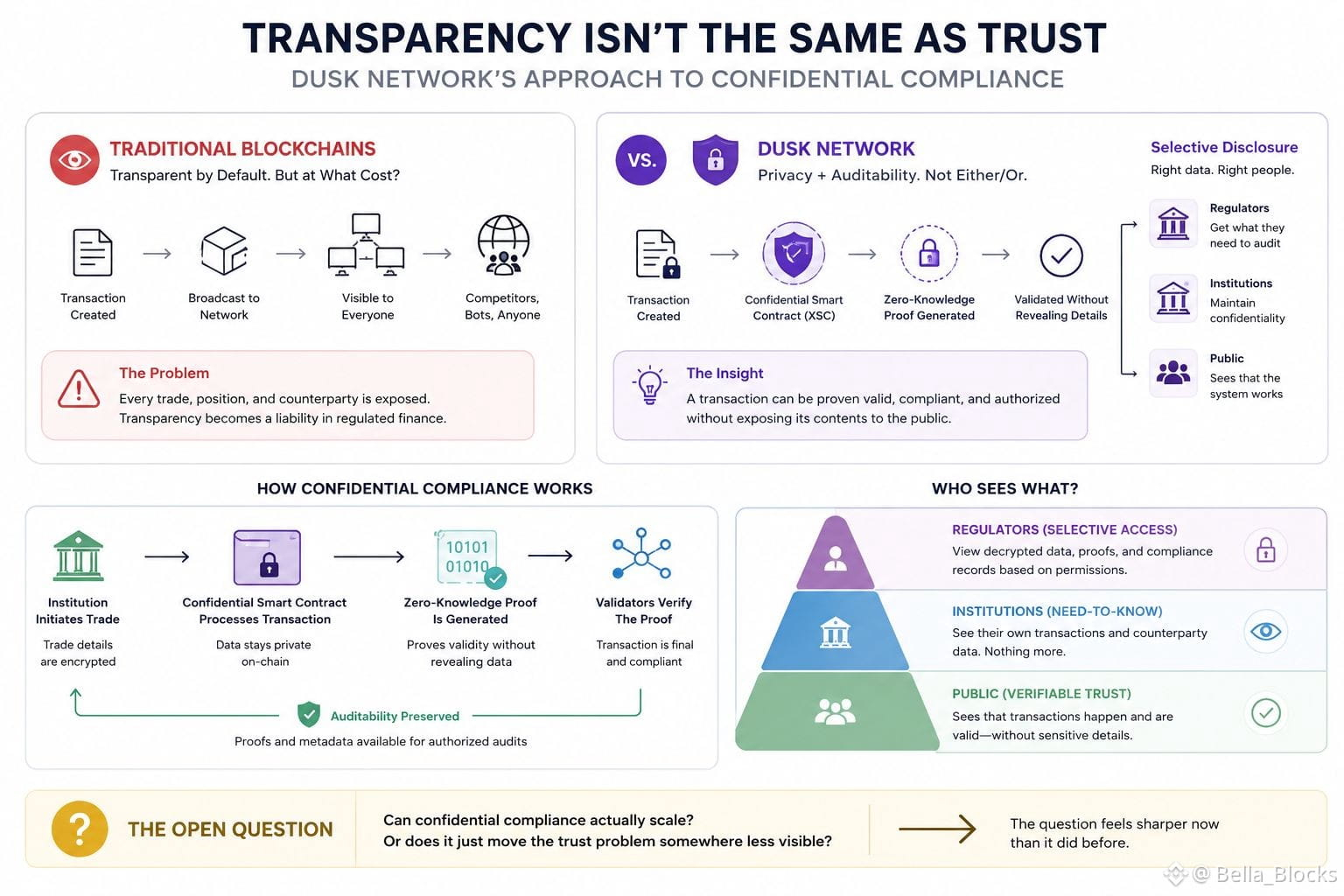
16
13
1.8k
·
--
#dusk @Dusk_Foundation $DUSK
Ich habe heute mit Kaffee die Staking-Dokumentation von Dusk durchgesehen, und ein kleines Detail ist mir mehr aufgefallen als die Privatsphäre-Funktionen, über die sonst immer alle sprechen.
Es geht darum, was passiert, wenn ein aktiver Staker mehr DUSK hinzufügt.
Laut den Dokus gilt: Wenn eine Position bereits aktiv ist, werden 90 % eines Nachschubs sofort aktiv, während 10 % als gesperrtes Stake erfasst werden. Das klingt nach Kleinigkeiten, aber ich glaube, es zeigt etwas Interessantes darüber, wie Dusk Validator-Kapital behandelt.
Das Netzwerk betrachtet zusätzliches Stake nicht einfach als sofort austauschbare Sicherheit. Ein Teil davon wird vorübergehend weniger liquide, während der Staker es weiterhin besitzt. Das schafft eine subtile Trennung zwischen „Kapital, das ich kontrolliere“ und „Kapital, das derzeit zum Konsens beiträgt“.
Ich fragte mich, warum das für eine blockchain mit Fokus auf Finanzen überhaupt wichtig ist.
Wenn Institutionen Dusk irgendwann für Abrechnungen nutzen, könnten sie Wert auf eine vorhersehbare Kapitalbewegung legen – fast genauso wie auf die Transaktionsprivatsphäre. Ein Staking-System, das unterschiedliche Liquiditätszustände einführt, könnte beeinflussen, wie Betreiber Reserven, Delegationsprodukte und automatisierte Staking-Strategien verwalten.
Das minimale direkte Stake beträgt 1.000 DUSK, und Dusk erlaubt außerdem Smart Contracts, das Staking über „Stake Abstraction“ zu steuern.
Die spannende Frage für mich ist also nicht nur, ob Dusk mehr gestakete Tokens anziehen kann. Es ist, ob seine Staking-Mechanik von einzelnen Betreibern auf programmierbare finanzielle Infrastruktur skalieren kann, ohne das Liquiditätsmanagement unnötig kompliziert zu machen.
Das wirkt wie ein Designdetail, das man im Blick behalten sollte, während das Netzwerk weiter reift.
{spot}(DUSKUSDT)
#dusk @Dusk $DUSK
Ich habe heute mit Kaffee die Staking-Dokumentation von Dusk durchgesehen, und ein kleines Detail ist mir mehr aufgefallen als die Privatsphäre-Funktionen, über die sonst immer alle sprechen.
Es geht darum, was passiert, wenn ein aktiver Staker mehr DUSK hinzufügt.
Laut den Dokus gilt: Wenn eine Position bereits aktiv ist, werden 90 % eines Nachschubs sofort aktiv, während 10 % als gesperrtes Stake erfasst werden. Das klingt nach Kleinigkeiten, aber ich glaube, es zeigt etwas Interessantes darüber, wie Dusk Validator-Kapital behandelt.
Das Netzwerk betrachtet zusätzliches Stake nicht einfach als sofort austauschbare Sicherheit. Ein Teil davon wird vorübergehend weniger liquide, während der Staker es weiterhin besitzt. Das schafft eine subtile Trennung zwischen „Kapital, das ich kontrolliere“ und „Kapital, das derzeit zum Konsens beiträgt“.
Ich fragte mich, warum das für eine blockchain mit Fokus auf Finanzen überhaupt wichtig ist.
Wenn Institutionen Dusk irgendwann für Abrechnungen nutzen, könnten sie Wert auf eine vorhersehbare Kapitalbewegung legen – fast genauso wie auf die Transaktionsprivatsphäre. Ein Staking-System, das unterschiedliche Liquiditätszustände einführt, könnte beeinflussen, wie Betreiber Reserven, Delegationsprodukte und automatisierte Staking-Strategien verwalten.
Das minimale direkte Stake beträgt 1.000 DUSK, und Dusk erlaubt außerdem Smart Contracts, das Staking über „Stake Abstraction“ zu steuern.
Die spannende Frage für mich ist also nicht nur, ob Dusk mehr gestakete Tokens anziehen kann. Es ist, ob seine Staking-Mechanik von einzelnen Betreibern auf programmierbare finanzielle Infrastruktur skalieren kann, ohne das Liquiditätsmanagement unnötig kompliziert zu machen.
Das wirkt wie ein Designdetail, das man im Blick behalten sollte, während das Netzwerk weiter reift.
Ich habe heute mit Kaffee die Staking-Dokumentation von Dusk durchgesehen, und ein kleines Detail ist mir mehr aufgefallen als die Privatsphäre-Funktionen, über die sonst immer alle sprechen.
Es geht darum, was passiert, wenn ein aktiver Staker mehr DUSK hinzufügt.
Laut den Dokus gilt: Wenn eine Position bereits aktiv ist, werden 90 % eines Nachschubs sofort aktiv, während 10 % als gesperrtes Stake erfasst werden. Das klingt nach Kleinigkeiten, aber ich glaube, es zeigt etwas Interessantes darüber, wie Dusk Validator-Kapital behandelt.
Das Netzwerk betrachtet zusätzliches Stake nicht einfach als sofort austauschbare Sicherheit. Ein Teil davon wird vorübergehend weniger liquide, während der Staker es weiterhin besitzt. Das schafft eine subtile Trennung zwischen „Kapital, das ich kontrolliere“ und „Kapital, das derzeit zum Konsens beiträgt“.
Ich fragte mich, warum das für eine blockchain mit Fokus auf Finanzen überhaupt wichtig ist.
Wenn Institutionen Dusk irgendwann für Abrechnungen nutzen, könnten sie Wert auf eine vorhersehbare Kapitalbewegung legen – fast genauso wie auf die Transaktionsprivatsphäre. Ein Staking-System, das unterschiedliche Liquiditätszustände einführt, könnte beeinflussen, wie Betreiber Reserven, Delegationsprodukte und automatisierte Staking-Strategien verwalten.
Das minimale direkte Stake beträgt 1.000 DUSK, und Dusk erlaubt außerdem Smart Contracts, das Staking über „Stake Abstraction“ zu steuern.
Die spannende Frage für mich ist also nicht nur, ob Dusk mehr gestakete Tokens anziehen kann. Es ist, ob seine Staking-Mechanik von einzelnen Betreibern auf programmierbare finanzielle Infrastruktur skalieren kann, ohne das Liquiditätsmanagement unnötig kompliziert zu machen.
Das wirkt wie ein Designdetail, das man im Blick behalten sollte, während das Netzwerk weiter reift.
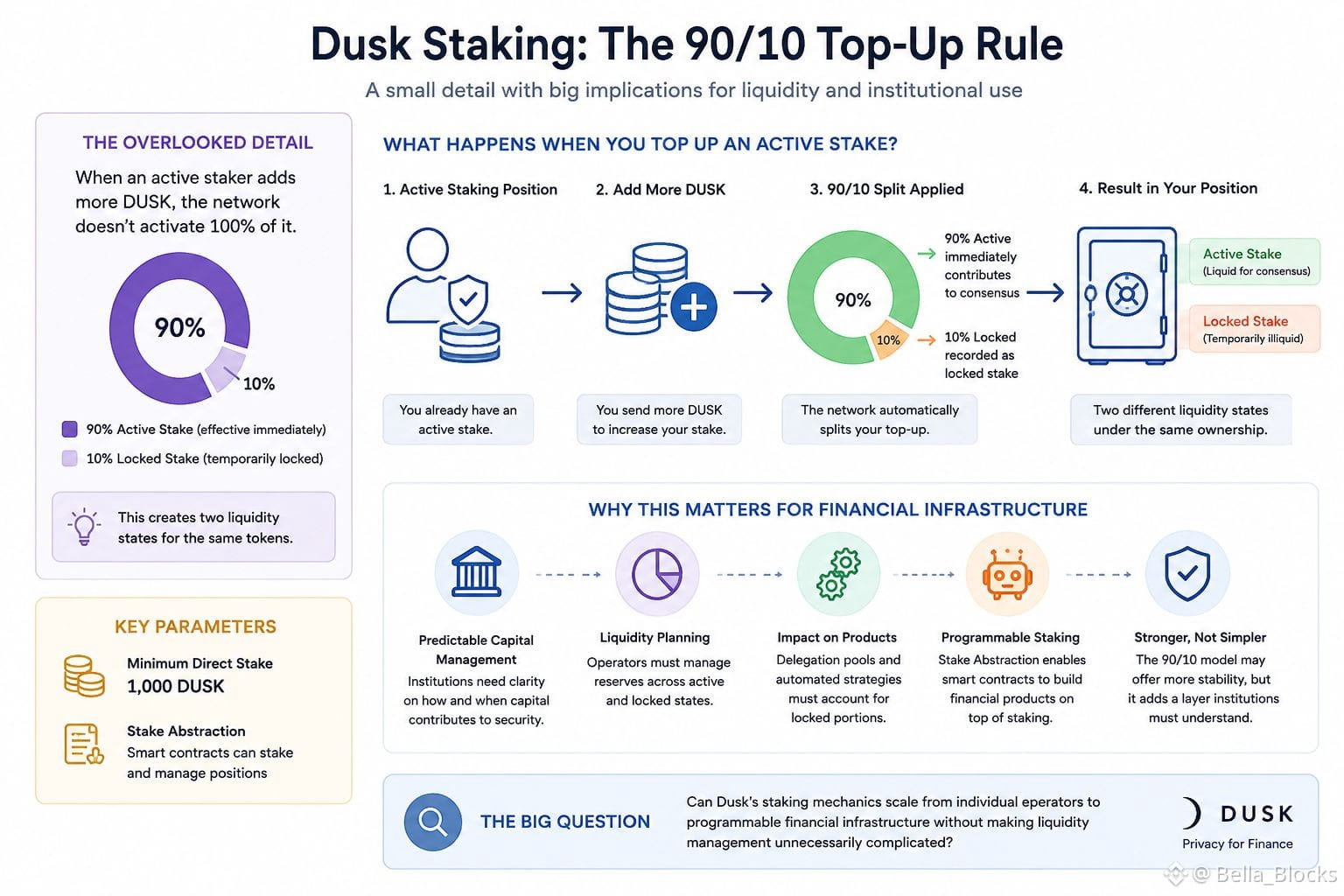
9
4
155
·
--
#dusk @Dusk_Foundation $DUSK
Ich habe spät in der Nacht die aktualisierte Doku von Dusk durchforstet, hauptsächlich aus Neugier, wie gut die Migration ins Mainnet gelaufen ist. Dabei ist mir etwas aufgefallen, das vorher noch nicht aufgefallen war: Dusk betreibt nun zwei getrennte Mechanismen zur Vertraulichkeit nebeneinander. Da ist das native XSC/Phoenix-Modell, zkp-basiert, direkt in die Basisschicht eingebaut. Und dann gibt es Hedger, eine neuere Ergänzung, die vertrauliche Übertragungen in DuskEVM mithilfe homomorpher Verschlüsselung ermöglicht.
Das ist eine seltsame Designentscheidung für eine Kette, deren gesamtes Versprechen lautet: „Privacy-Blockchain für Finanzanwendungen“. Wenn die native Ebene vertrauliche Smart Contracts bereits gut kann, warum baut man dann ein zweites, kryptografisch grundlegend anderes Vertraulichkeits-System auf einer Solidity-kompatiblen Sidechain?
Die wahrscheinlichste Antwort ist Entwickler-Trägheit. Native XSC erfordert das Erlernen spezifischer Dusk-Tools, während DuskEVM es Solidity-Teams erlaubt, mit vertrauten Mustern zu deployen und die Privatsphäre später über Hedger optional dazuzuschalten. Das ist eine nachvollziehbare Strategie für die Einführung. Aber das bedeutet auch: Das zentrale Value-Proposal des Protokolls, die Vertraulichkeit, existiert nun in zwei Varianten mit unterschiedlichen Vertrauensannahmen, unterschiedlichen Proof-Systemen und vermutlich unterschiedlichen Angriffs- bzw. Audit-Flächen.
Für eine Kette, die regulierte Institutionen ansprechen will, ist eine einzelne, gut verstandene Datenschutz-Garantie normalerweise wichtiger als zwei technisch interessante. Ich bin noch nicht sicher, ob das eine durchdachte Absicherung für die Akzeptanz ist oder eine stille Fragmentierung dessen, was Dusk ursprünglich auszeichnete. Es lohnt sich, im Blick zu behalten, welchen Weg die echten institutionellen Integrationen einschlagen.
{spot}(DUSKUSDT)
#dusk @Dusk $DUSK
Ich habe spät in der Nacht die aktualisierte Doku von Dusk durchforstet, hauptsächlich aus Neugier, wie gut die Migration ins Mainnet gelaufen ist. Dabei ist mir etwas aufgefallen, das vorher noch nicht aufgefallen war: Dusk betreibt nun zwei getrennte Mechanismen zur Vertraulichkeit nebeneinander. Da ist das native XSC/Phoenix-Modell, zkp-basiert, direkt in die Basisschicht eingebaut. Und dann gibt es Hedger, eine neuere Ergänzung, die vertrauliche Übertragungen in DuskEVM mithilfe homomorpher Verschlüsselung ermöglicht.
Das ist eine seltsame Designentscheidung für eine Kette, deren gesamtes Versprechen lautet: „Privacy-Blockchain für Finanzanwendungen“. Wenn die native Ebene vertrauliche Smart Contracts bereits gut kann, warum baut man dann ein zweites, kryptografisch grundlegend anderes Vertraulichkeits-System auf einer Solidity-kompatiblen Sidechain?
Die wahrscheinlichste Antwort ist Entwickler-Trägheit. Native XSC erfordert das Erlernen spezifischer Dusk-Tools, während DuskEVM es Solidity-Teams erlaubt, mit vertrauten Mustern zu deployen und die Privatsphäre später über Hedger optional dazuzuschalten. Das ist eine nachvollziehbare Strategie für die Einführung. Aber das bedeutet auch: Das zentrale Value-Proposal des Protokolls, die Vertraulichkeit, existiert nun in zwei Varianten mit unterschiedlichen Vertrauensannahmen, unterschiedlichen Proof-Systemen und vermutlich unterschiedlichen Angriffs- bzw. Audit-Flächen.
Für eine Kette, die regulierte Institutionen ansprechen will, ist eine einzelne, gut verstandene Datenschutz-Garantie normalerweise wichtiger als zwei technisch interessante. Ich bin noch nicht sicher, ob das eine durchdachte Absicherung für die Akzeptanz ist oder eine stille Fragmentierung dessen, was Dusk ursprünglich auszeichnete. Es lohnt sich, im Blick zu behalten, welchen Weg die echten institutionellen Integrationen einschlagen.
Ich habe spät in der Nacht die aktualisierte Doku von Dusk durchforstet, hauptsächlich aus Neugier, wie gut die Migration ins Mainnet gelaufen ist. Dabei ist mir etwas aufgefallen, das vorher noch nicht aufgefallen war: Dusk betreibt nun zwei getrennte Mechanismen zur Vertraulichkeit nebeneinander. Da ist das native XSC/Phoenix-Modell, zkp-basiert, direkt in die Basisschicht eingebaut. Und dann gibt es Hedger, eine neuere Ergänzung, die vertrauliche Übertragungen in DuskEVM mithilfe homomorpher Verschlüsselung ermöglicht.
Das ist eine seltsame Designentscheidung für eine Kette, deren gesamtes Versprechen lautet: „Privacy-Blockchain für Finanzanwendungen“. Wenn die native Ebene vertrauliche Smart Contracts bereits gut kann, warum baut man dann ein zweites, kryptografisch grundlegend anderes Vertraulichkeits-System auf einer Solidity-kompatiblen Sidechain?
Die wahrscheinlichste Antwort ist Entwickler-Trägheit. Native XSC erfordert das Erlernen spezifischer Dusk-Tools, während DuskEVM es Solidity-Teams erlaubt, mit vertrauten Mustern zu deployen und die Privatsphäre später über Hedger optional dazuzuschalten. Das ist eine nachvollziehbare Strategie für die Einführung. Aber das bedeutet auch: Das zentrale Value-Proposal des Protokolls, die Vertraulichkeit, existiert nun in zwei Varianten mit unterschiedlichen Vertrauensannahmen, unterschiedlichen Proof-Systemen und vermutlich unterschiedlichen Angriffs- bzw. Audit-Flächen.
Für eine Kette, die regulierte Institutionen ansprechen will, ist eine einzelne, gut verstandene Datenschutz-Garantie normalerweise wichtiger als zwei technisch interessante. Ich bin noch nicht sicher, ob das eine durchdachte Absicherung für die Akzeptanz ist oder eine stille Fragmentierung dessen, was Dusk ursprünglich auszeichnete. Es lohnt sich, im Blick zu behalten, welchen Weg die echten institutionellen Integrationen einschlagen.
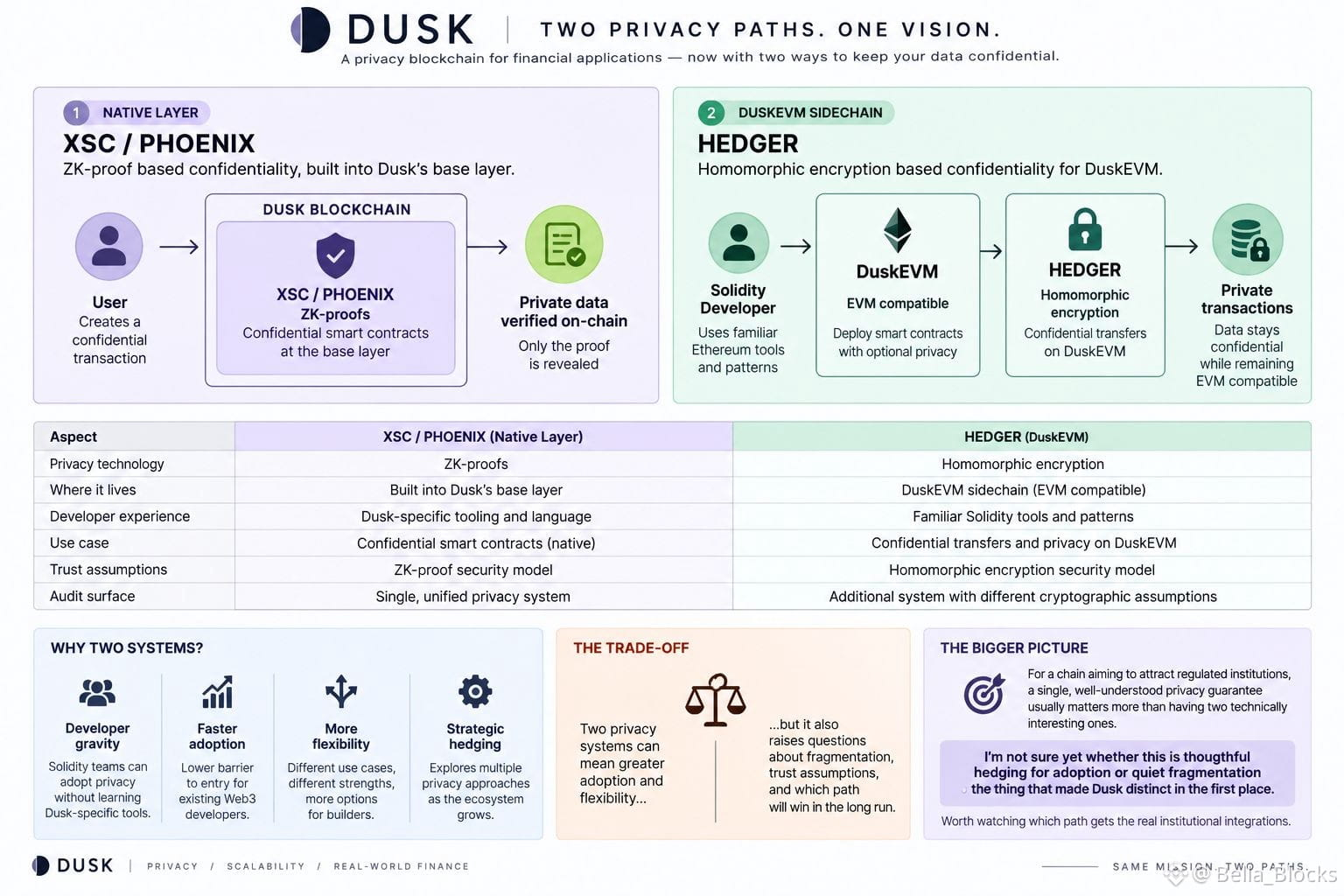
5
5
118
·
--
#baby @babylonlabs_io $BABY
Ich habe letzte Nacht in den Dokumenten von Threshold Network gestöbert, um wirklich zu verstehen, wie tBTC das WBTC-Problem umgeht – und bin an eine Einzelheit hängen geblieben, über die kaum jemand spricht: die DKG-Zeremonie.
Fast alle erklären den Peg-in als „BTC sperren, auf Ethereum prägen“ – das ist zwar richtig, aber es überspringt den Teil, der wirklich zählt. Wenn du einzahlst, führt ein zufällig ausgewählter Teil der Node-Operatoren eine Distributed-Key-Generation-Zeremonie aus, um die Bitcoin-Einzahlungsadresse zu erzeugen. Nie hält ein einzelner Signer jemals einen vollständigen privaten Schlüssel – nur einen Fragmentanteil. Die Einlösung funktioniert genauso in umgekehrter Reihenfolge: Token verbrennen und dieselbe Schwelle an Signern rekonstruiert eine Signatur, um natives BTC freizugeben, ohne dass ein Custodian einen Knopf drückt.
Was mir dabei auffiel: Wie stark das gesamte System auf der Annahme beruht, dass innerhalb eines rotierenden, erlaubnislosen Signer-Sets eine ehrliche Mehrheit vorhanden ist – statt darauf zu vertrauen, dass nur das Cold Storage eines einzelnen Unternehmens stimmt. Thresholds eigene Zahlen zeigen etwa 5.800 gesicherte BTC und 424 Millionen US-Dollar in TVL – also winzig im Vergleich zu den großen, in zentralisierten Custodians gehaltenen Wrapped-BTC-Riesen. Diese Lücke liegt nicht wirklich an der Produktqualität. Es geht darum, ob der Markt „kein einziger Punkt des Versagens“ als wert erachtet und dafür einen Liquiditätsabschlag in Kauf nimmt.
Die offene Frage, um die ich immer wieder kreise, lautet daher: Belohnt BTCFi tatsächlich dezentrale Verwahrung – oder folgt das Kapital einfach dem Wrapper mit der größten Liquidität, egal wer die Schlüssel hält?
{spot}(BABYUSDT)
#baby @BabylonLabs_io $BABY
Ich habe letzte Nacht in den Dokumenten von Threshold Network gestöbert, um wirklich zu verstehen, wie tBTC das WBTC-Problem umgeht – und bin an eine Einzelheit hängen geblieben, über die kaum jemand spricht: die DKG-Zeremonie.
Fast alle erklären den Peg-in als „BTC sperren, auf Ethereum prägen“ – das ist zwar richtig, aber es überspringt den Teil, der wirklich zählt. Wenn du einzahlst, führt ein zufällig ausgewählter Teil der Node-Operatoren eine Distributed-Key-Generation-Zeremonie aus, um die Bitcoin-Einzahlungsadresse zu erzeugen. Nie hält ein einzelner Signer jemals einen vollständigen privaten Schlüssel – nur einen Fragmentanteil. Die Einlösung funktioniert genauso in umgekehrter Reihenfolge: Token verbrennen und dieselbe Schwelle an Signern rekonstruiert eine Signatur, um natives BTC freizugeben, ohne dass ein Custodian einen Knopf drückt.
Was mir dabei auffiel: Wie stark das gesamte System auf der Annahme beruht, dass innerhalb eines rotierenden, erlaubnislosen Signer-Sets eine ehrliche Mehrheit vorhanden ist – statt darauf zu vertrauen, dass nur das Cold Storage eines einzelnen Unternehmens stimmt. Thresholds eigene Zahlen zeigen etwa 5.800 gesicherte BTC und 424 Millionen US-Dollar in TVL – also winzig im Vergleich zu den großen, in zentralisierten Custodians gehaltenen Wrapped-BTC-Riesen. Diese Lücke liegt nicht wirklich an der Produktqualität. Es geht darum, ob der Markt „kein einziger Punkt des Versagens“ als wert erachtet und dafür einen Liquiditätsabschlag in Kauf nimmt.
Die offene Frage, um die ich immer wieder kreise, lautet daher: Belohnt BTCFi tatsächlich dezentrale Verwahrung – oder folgt das Kapital einfach dem Wrapper mit der größten Liquidität, egal wer die Schlüssel hält?
Ich habe letzte Nacht in den Dokumenten von Threshold Network gestöbert, um wirklich zu verstehen, wie tBTC das WBTC-Problem umgeht – und bin an eine Einzelheit hängen geblieben, über die kaum jemand spricht: die DKG-Zeremonie.
Fast alle erklären den Peg-in als „BTC sperren, auf Ethereum prägen“ – das ist zwar richtig, aber es überspringt den Teil, der wirklich zählt. Wenn du einzahlst, führt ein zufällig ausgewählter Teil der Node-Operatoren eine Distributed-Key-Generation-Zeremonie aus, um die Bitcoin-Einzahlungsadresse zu erzeugen. Nie hält ein einzelner Signer jemals einen vollständigen privaten Schlüssel – nur einen Fragmentanteil. Die Einlösung funktioniert genauso in umgekehrter Reihenfolge: Token verbrennen und dieselbe Schwelle an Signern rekonstruiert eine Signatur, um natives BTC freizugeben, ohne dass ein Custodian einen Knopf drückt.
Was mir dabei auffiel: Wie stark das gesamte System auf der Annahme beruht, dass innerhalb eines rotierenden, erlaubnislosen Signer-Sets eine ehrliche Mehrheit vorhanden ist – statt darauf zu vertrauen, dass nur das Cold Storage eines einzelnen Unternehmens stimmt. Thresholds eigene Zahlen zeigen etwa 5.800 gesicherte BTC und 424 Millionen US-Dollar in TVL – also winzig im Vergleich zu den großen, in zentralisierten Custodians gehaltenen Wrapped-BTC-Riesen. Diese Lücke liegt nicht wirklich an der Produktqualität. Es geht darum, ob der Markt „kein einziger Punkt des Versagens“ als wert erachtet und dafür einen Liquiditätsabschlag in Kauf nimmt.
Die offene Frage, um die ich immer wieder kreise, lautet daher: Belohnt BTCFi tatsächlich dezentrale Verwahrung – oder folgt das Kapital einfach dem Wrapper mit der größten Liquidität, egal wer die Schlüssel hält?
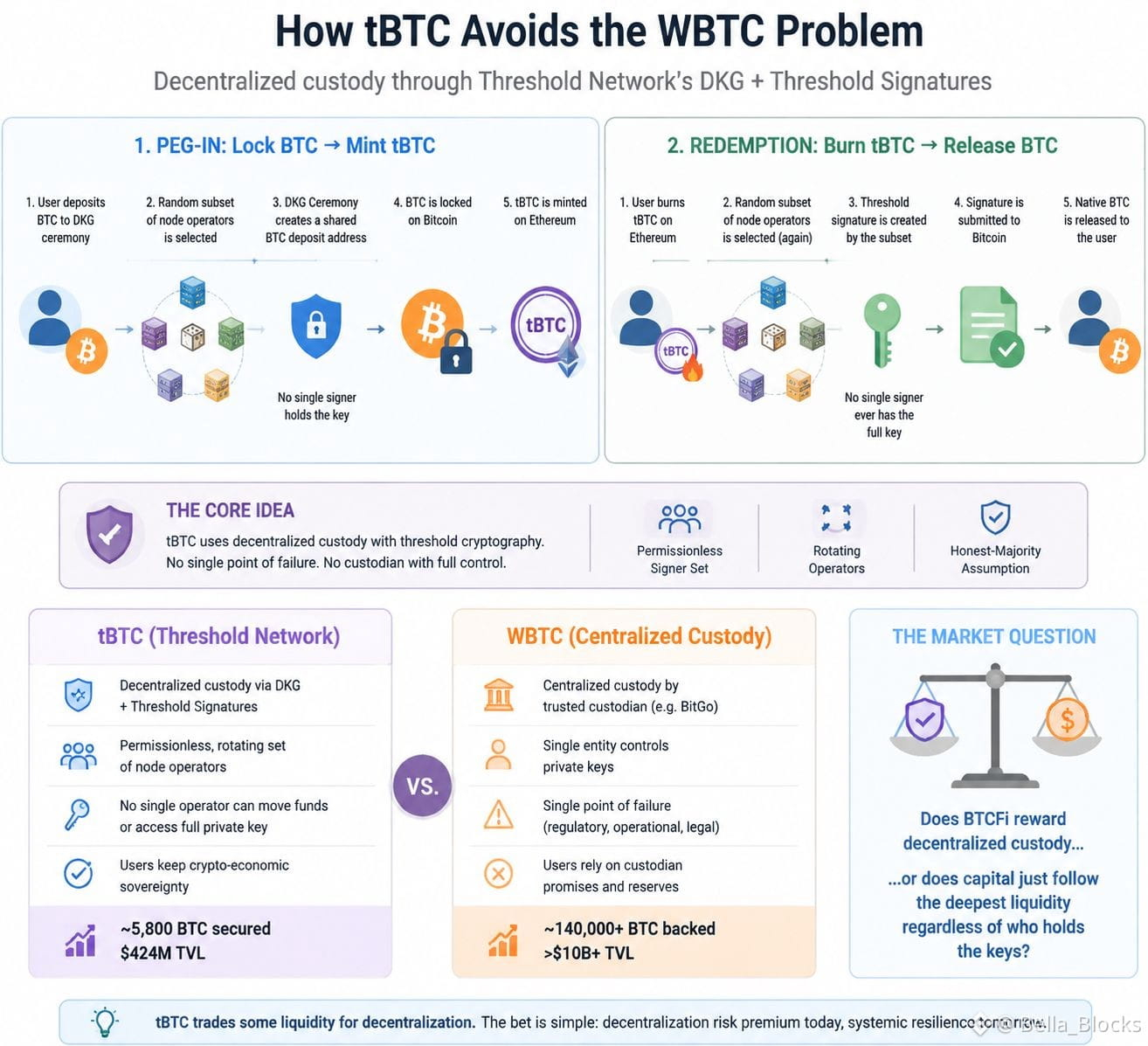
5
4
190
Anmelden und weiter Inhalte entdecken
Krypto-Nutzer weltweit auf Binance Square kennenlernen
⚡️ Bleib in Sachen Krypto stets am Puls.
💬 Die weltgrößte Kryptobörse vertraut darauf.
👍 Erhalte verlässliche Einblicke von verifizierten Creators.
E-Mail-Adresse/Telefonnummer
Trendthemen
BOJRaisesRatesTo31YearHigh
26,586 Aufrufe
683 Kommentare
Bitcoin rückt wieder ins Rampenlicht, da der Makrodruck die Krypto-Nachfrage nicht durchbrechen kann
Fatima_Tariq
·10 Likes
·5.4k Aufrufe
BuffettStepsDownAsBerkshireChairman
7,938 Aufrufe
267 Kommentare
XRPExchangeReservesHitSevenYearLow
11,960 Aufrufe
291 Kommentare