
000000000x
13 منشورات

000000000x
إبلاغ
حظر المُستخدم
一个小目标
4 تتابع
0 المتابعون
0 إعجاب
منشورات
الكل
مقاطع فيديو
·
--
عرض الترجمة
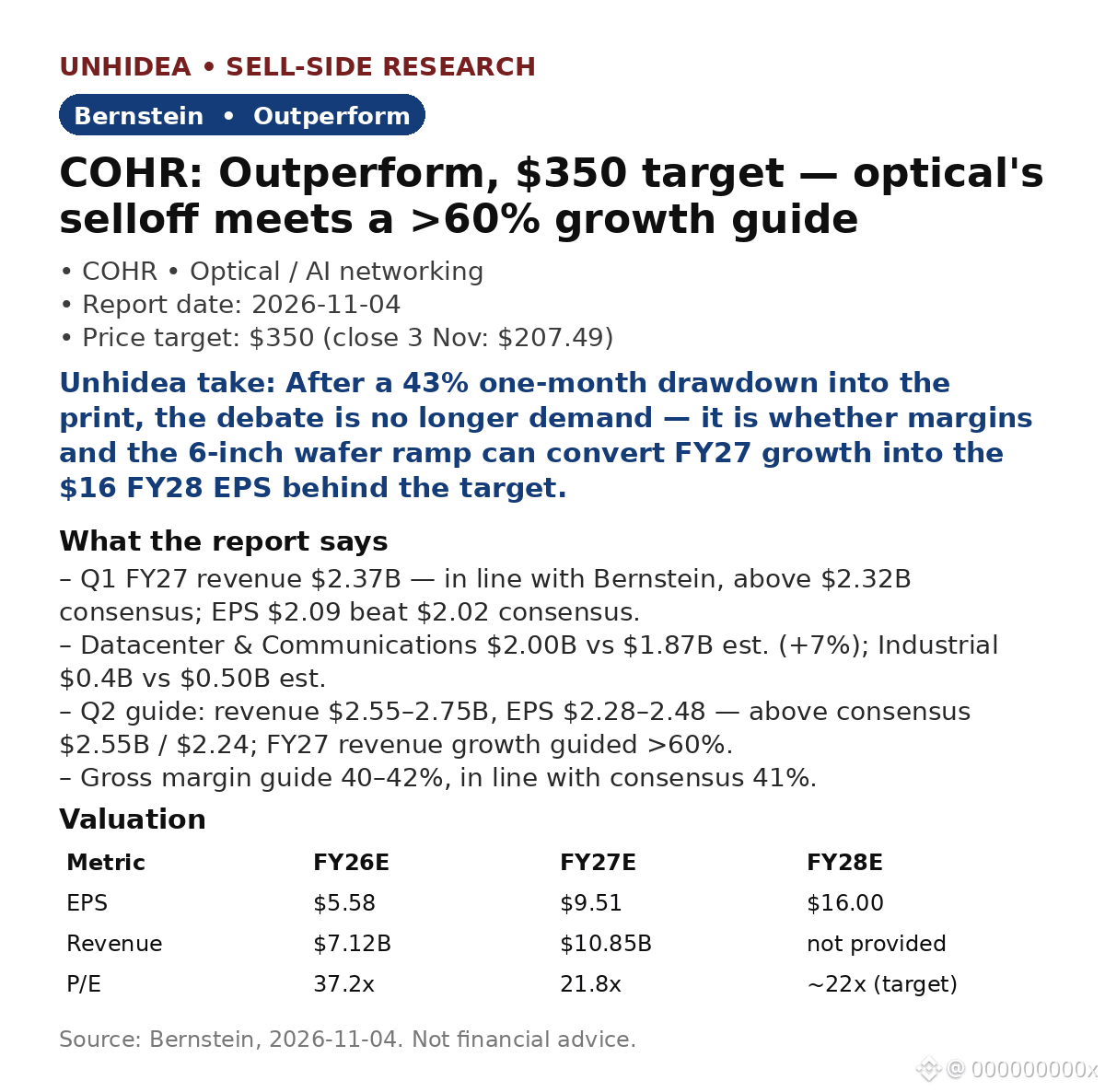
$COHR: Bernstein keeps Outperform, $350 target — ~69% above the $207.49 close on 3 Nov. Optical's selloff just met a >60% growth guide.
Q1 FY27: revenue $2.37B, in line with Bernstein's $2.37B estimate and above $2.32B consensus; EPS $2.09 beat $2.02 consensus. Datacenter did the work: $2.00B vs $1.87B expected (+7%).
- Q2 guide: revenue $2.55–2.75B and EPS $2.28–2.48, above consensus $2.55B/$2.24; FY27 revenue growth guided above 60%.
- Valuation: $350 = ~22x Bernstein's FY28E EPS of $16; FY27E EPS $9.51 on revenue of $10.85B; FY27E P/E 21.8x.
- Since the report: shares fell 6.75% on 16 Nov, then bounced ~11% premarket on 17 Nov as optical names recovered ahead of Nvidia earnings (market coverage, 17 Nov).
Unhidea take: after a 43% one-month drawdown, the repricing is about plumbing, not hype — the InP bottleneck is the moat, and the Marvell–Lumentum deal leaves Coherent the remaining independent optical pure-play.
Unhidea take: the open question is margins, not demand — Bernstein calls margins disappointing, and the 6-inch wafer ramp decides whether FY27 growth converts into that $16 FY28 EPS.
Risks: margin ramp slips; InP pricing fades; VCSEL scale-up unproven; the Lumentum deal reshapes competition.
Source: Bernstein, 4 Nov 2026. Not financial advice.
$COHR : Bernstein keeps Outperform, $350 target — ~69% above the $207.49 close on 3 Nov. Optical's selloff just met a >60% growth guide.
Q1 FY27: revenue $2.37B, in line with Bernstein's $2.37B estimate and above $2.32B consensus; EPS $2.09 beat $2.02 consensus. Datacenter did the work: $2.00B vs $1.87B expected (+7%).
- Q2 guide: revenue $2.55–2.75B and EPS $2.28–2.48, above consensus $2.55B/$2.24; FY27 revenue growth guided above 60%.
- Valuation: $350 = ~22x Bernstein's FY28E EPS of $16; FY27E EPS $9.51 on revenue of $10.85B; FY27E P/E 21.8x.
- Since the report: shares fell 6.75% on 16 Nov, then bounced ~11% premarket on 17 Nov as optical names recovered ahead of Nvidia earnings (market coverage, 17 Nov).
Unhidea take: after a 43% one-month drawdown, the repricing is about plumbing, not hype — the InP bottleneck is the moat, and the Marvell–Lumentum deal leaves Coherent the remaining independent optical pure-play.
Unhidea take: the open question is margins, not demand — Bernstein calls margins disappointing, and the 6-inch wafer ramp decides whether FY27 growth converts into that $16 FY28 EPS.
Risks: margin ramp slips; InP pricing fades; VCSEL scale-up unproven; the Lumentum deal reshapes competition.
Source: Bernstein, 4 Nov 2026. Not financial advice.
Q1 FY27: revenue $2.37B, in line with Bernstein's $2.37B estimate and above $2.32B consensus; EPS $2.09 beat $2.02 consensus. Datacenter did the work: $2.00B vs $1.87B expected (+7%).
- Q2 guide: revenue $2.55–2.75B and EPS $2.28–2.48, above consensus $2.55B/$2.24; FY27 revenue growth guided above 60%.
- Valuation: $350 = ~22x Bernstein's FY28E EPS of $16; FY27E EPS $9.51 on revenue of $10.85B; FY27E P/E 21.8x.
- Since the report: shares fell 6.75% on 16 Nov, then bounced ~11% premarket on 17 Nov as optical names recovered ahead of Nvidia earnings (market coverage, 17 Nov).
Unhidea take: after a 43% one-month drawdown, the repricing is about plumbing, not hype — the InP bottleneck is the moat, and the Marvell–Lumentum deal leaves Coherent the remaining independent optical pure-play.
Unhidea take: the open question is margins, not demand — Bernstein calls margins disappointing, and the 6-inch wafer ramp decides whether FY27 growth converts into that $16 FY28 EPS.
Risks: margin ramp slips; InP pricing fades; VCSEL scale-up unproven; the Lumentum deal reshapes competition.
Source: Bernstein, 4 Nov 2026. Not financial advice.
2
·
--
عرض الترجمة
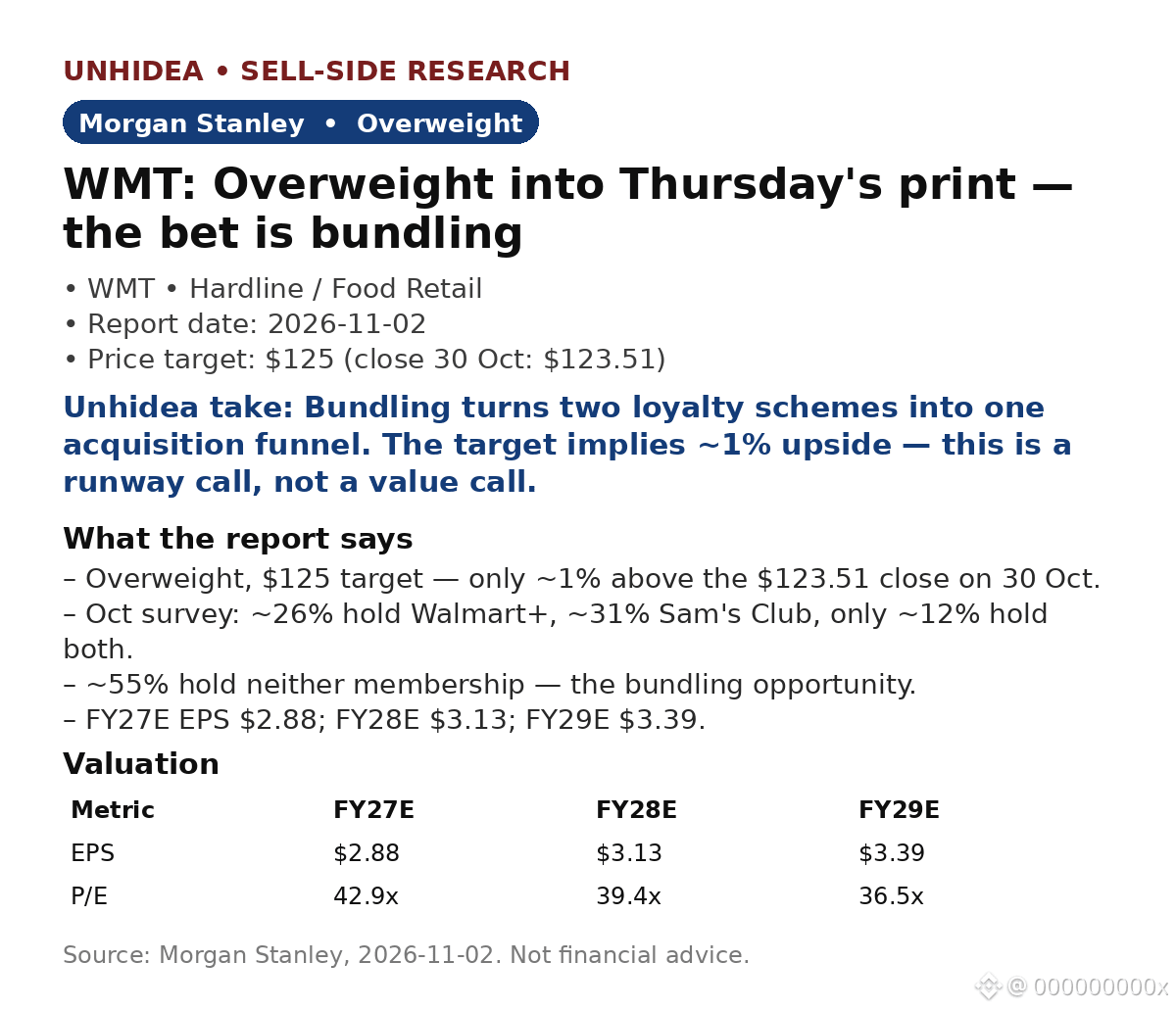
$WMT: Morgan Stanley stays Overweight into Thursday's print — the bet is bundling
MS's 2 Nov note: Overweight, $125 target — just ~1% above the $123.51 close on 30 Oct. The call is about membership: its Oct survey finds ~26% hold Walmart+, ~31% Sam's Club, only ~12% both — while ~55% hold neither.
- The gap is the opportunity: ~14% hold only Walmart+ and ~19% only Sam's — natural cross-sell targets.
- Valuation: $125 = ~36.8x F'29E EPS of $3.39, vs a 10-year average P/E of ~21x — a premium MS says the e-commerce shift earns.
- Estimates: FY27E EPS $2.88, FY28E $3.13, FY29E $3.39; Q3 FY27E EPS $0.63, actual print due Thu 19 Nov.
Unhidea take: the 55% holding neither is the real prize — bundling turns two loyalty schemes into one acquisition funnel, closer to Costco's flywheel than a grocery card.
Unhidea take: with the target ~1% above the Oct close, this Overweight is a runway call, not a value call — Thursday's print must show it in comps, not just a survey.
Risks: e-commerce losses could widen; US e-comm growth below 15% undercuts the thesis; Flipkart losses. Survey is a first read.
Source: Morgan Stanley, 2 Nov 2026. Not financial advice.
$WMT : Morgan Stanley stays Overweight into Thursday's print — the bet is bundling
MS's 2 Nov note: Overweight, $125 target — just ~1% above the $123.51 close on 30 Oct. The call is about membership: its Oct survey finds ~26% hold Walmart+, ~31% Sam's Club, only ~12% both — while ~55% hold neither.
- The gap is the opportunity: ~14% hold only Walmart+ and ~19% only Sam's — natural cross-sell targets.
- Valuation: $125 = ~36.8x F'29E EPS of $3.39, vs a 10-year average P/E of ~21x — a premium MS says the e-commerce shift earns.
- Estimates: FY27E EPS $2.88, FY28E $3.13, FY29E $3.39; Q3 FY27E EPS $0.63, actual print due Thu 19 Nov.
Unhidea take: the 55% holding neither is the real prize — bundling turns two loyalty schemes into one acquisition funnel, closer to Costco's flywheel than a grocery card.
Unhidea take: with the target ~1% above the Oct close, this Overweight is a runway call, not a value call — Thursday's print must show it in comps, not just a survey.
Risks: e-commerce losses could widen; US e-comm growth below 15% undercuts the thesis; Flipkart losses. Survey is a first read.
Source: Morgan Stanley, 2 Nov 2026. Not financial advice.
MS's 2 Nov note: Overweight, $125 target — just ~1% above the $123.51 close on 30 Oct. The call is about membership: its Oct survey finds ~26% hold Walmart+, ~31% Sam's Club, only ~12% both — while ~55% hold neither.
- The gap is the opportunity: ~14% hold only Walmart+ and ~19% only Sam's — natural cross-sell targets.
- Valuation: $125 = ~36.8x F'29E EPS of $3.39, vs a 10-year average P/E of ~21x — a premium MS says the e-commerce shift earns.
- Estimates: FY27E EPS $2.88, FY28E $3.13, FY29E $3.39; Q3 FY27E EPS $0.63, actual print due Thu 19 Nov.
Unhidea take: the 55% holding neither is the real prize — bundling turns two loyalty schemes into one acquisition funnel, closer to Costco's flywheel than a grocery card.
Unhidea take: with the target ~1% above the Oct close, this Overweight is a runway call, not a value call — Thursday's print must show it in comps, not just a survey.
Risks: e-commerce losses could widen; US e-comm growth below 15% undercuts the thesis; Flipkart losses. Survey is a first read.
Source: Morgan Stanley, 2 Nov 2026. Not financial advice.
3
·
--
عرض الترجمة
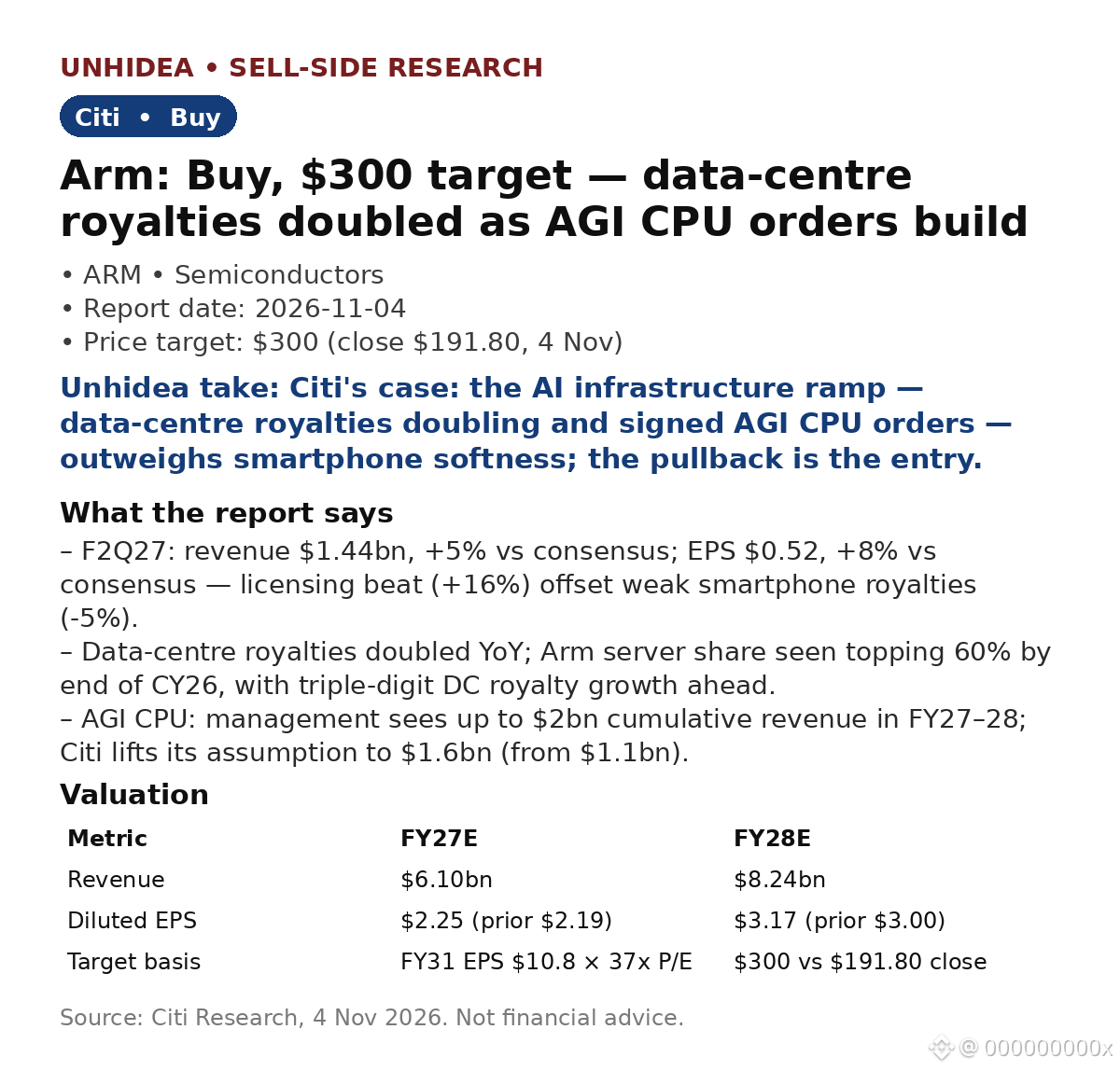
$ARM: Citi keeps Buy, $300 target — data-centre royalties doubled as AGI CPU orders build
Citi's 4 Nov note, after Arm's F2Q27 print: revenue $1.44bn (+5% vs consensus) and EPS $0.52 (+8%) — licensing beat (+16% vs consensus) more than offset smartphone royalty softness (-5%). F3Q27 guide of $1.54bn revenue and $0.56 EPS sits modestly ahead of consensus ($1.52bn / $0.55).
- Data centre: royalties doubled YoY; Arm server share seen above 60% by end of CY26, with triple-digit DC royalty growth expected in coming years.
- AGI CPU: management sees up to $2bn cumulative revenue in FY27–28; Citi lifts its assumption to $1.6bn (from $1.1bn) on signed purchase orders.
- Valuation: FY27E revenue $6.10bn, FY28E $8.24bn; EPS $2.25 / $3.17. Target $300 = FY31 EPS $10.8 at 37x P/E, discounted to 2028 — ~56% above the $191.80 close on 4 Nov.
Unhidea take: the quarter shows Arm monetising AI twice — licences today, royalties tomorrow — and the AGI CPU order book turns a story into contracted revenue.
Unhidea take: ARM shares were down ~8% intraday on 17 Nov in a broad chip sell-off — that's AI anxiety into Nvidia's print, not this report. The gap between Citi's $300 and the market's mood is the trade to watch.
Risks: execution and system deployment are the key constraint; smartphone royalties still weak; RISC-V competition; SoftBank holds ~90%.
Source: Citi Research, 4 Nov 2026. Not financial advice.
$ARM : Citi keeps Buy, $300 target — data-centre royalties doubled as AGI CPU orders build
Citi's 4 Nov note, after Arm's F2Q27 print: revenue $1.44bn (+5% vs consensus) and EPS $0.52 (+8%) — licensing beat (+16% vs consensus) more than offset smartphone royalty softness (-5%). F3Q27 guide of $1.54bn revenue and $0.56 EPS sits modestly ahead of consensus ($1.52bn / $0.55).
- Data centre: royalties doubled YoY; Arm server share seen above 60% by end of CY26, with triple-digit DC royalty growth expected in coming years.
- AGI CPU: management sees up to $2bn cumulative revenue in FY27–28; Citi lifts its assumption to $1.6bn (from $1.1bn) on signed purchase orders.
- Valuation: FY27E revenue $6.10bn, FY28E $8.24bn; EPS $2.25 / $3.17. Target $300 = FY31 EPS $10.8 at 37x P/E, discounted to 2028 — ~56% above the $191.80 close on 4 Nov.
Unhidea take: the quarter shows Arm monetising AI twice — licences today, royalties tomorrow — and the AGI CPU order book turns a story into contracted revenue.
Unhidea take: ARM shares were down ~8% intraday on 17 Nov in a broad chip sell-off — that's AI anxiety into Nvidia's print, not this report. The gap between Citi's $300 and the market's mood is the trade to watch.
Risks: execution and system deployment are the key constraint; smartphone royalties still weak; RISC-V competition; SoftBank holds ~90%.
Source: Citi Research, 4 Nov 2026. Not financial advice.
Citi's 4 Nov note, after Arm's F2Q27 print: revenue $1.44bn (+5% vs consensus) and EPS $0.52 (+8%) — licensing beat (+16% vs consensus) more than offset smartphone royalty softness (-5%). F3Q27 guide of $1.54bn revenue and $0.56 EPS sits modestly ahead of consensus ($1.52bn / $0.55).
- Data centre: royalties doubled YoY; Arm server share seen above 60% by end of CY26, with triple-digit DC royalty growth expected in coming years.
- AGI CPU: management sees up to $2bn cumulative revenue in FY27–28; Citi lifts its assumption to $1.6bn (from $1.1bn) on signed purchase orders.
- Valuation: FY27E revenue $6.10bn, FY28E $8.24bn; EPS $2.25 / $3.17. Target $300 = FY31 EPS $10.8 at 37x P/E, discounted to 2028 — ~56% above the $191.80 close on 4 Nov.
Unhidea take: the quarter shows Arm monetising AI twice — licences today, royalties tomorrow — and the AGI CPU order book turns a story into contracted revenue.
Unhidea take: ARM shares were down ~8% intraday on 17 Nov in a broad chip sell-off — that's AI anxiety into Nvidia's print, not this report. The gap between Citi's $300 and the market's mood is the trade to watch.
Risks: execution and system deployment are the key constraint; smartphone royalties still weak; RISC-V competition; SoftBank holds ~90%.
Source: Citi Research, 4 Nov 2026. Not financial advice.
6
·
--
عرض الترجمة
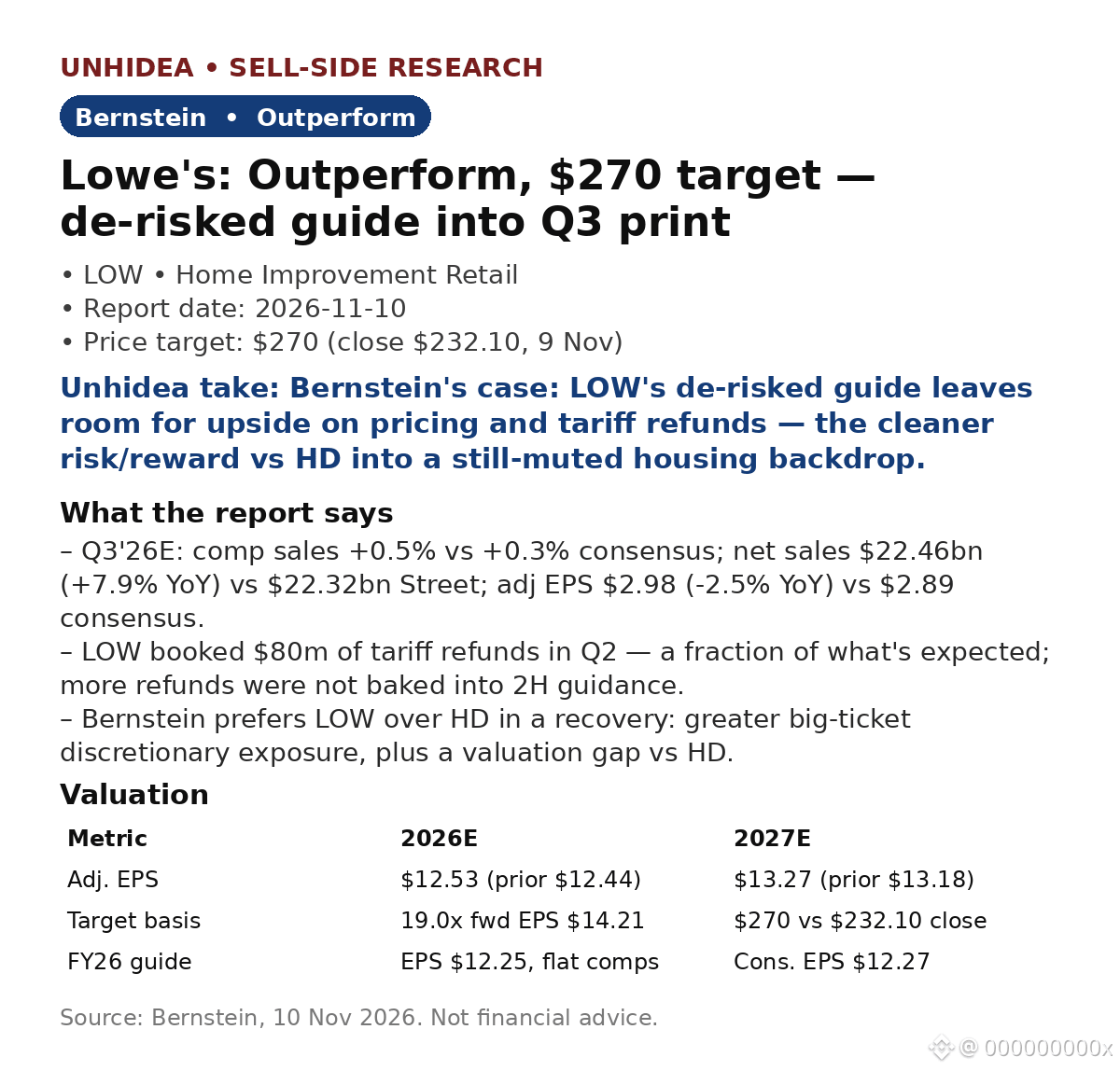
$LOW: Bernstein keeps Outperform, $270 target — guidance de-risked into today's Q3 print
Bernstein's 10 Nov preview: Lowe's reports Q3'26 before the open today (18 Nov). Its FY26 guide of flat comps assumes no weather benefit and no further tariff refunds. Target raised to $270 from $254 — ~16% above the $232.10 close on 9 Nov.
- Q3 preview: comp sales +0.5% vs +0.3% consensus; net sales $22.46bn (+7.9% YoY) vs $22.32bn Street; adj EPS $2.98 (-2.5% YoY) vs $2.89 consensus.
- Tariff refunds: LOW booked $80m in Q2, a fraction of what's expected — extra refunds could offset fuel/freight inflation or fund promotions.
- Valuation: FY26E adj EPS $12.53 (prior $12.44) vs $12.25 guide; FY27E $13.27. Target = 19.0x forward EPS $14.21 (was 18.0x).
Unhidea take: with the bar at flat comps, modest pricing power shows up as a beat — and tariff refunds are a free option the guide ignores.
Unhidea take: LOW is Bernstein's preferred recovery play over HD — bigger big-ticket exposure means a sharper rebound if housing turns, a deeper wait if it doesn't.
Risks: muted housing demand, tariff/freight inflation, weak resi construction hitting Pro.
Context: HD reported 17 Nov — sales $43.4bn beat ~$42.8bn expected, shares -2% (CNBC).
Source: Bernstein, 10 Nov 2026. Not financial advice.
https://unhidea.com/en/articles/research-972aba8288b2492db4a299efd9035504-en
$LOW: Bernstein keeps Outperform, $270 target — guidance de-risked into today's Q3 print
Bernstein's 10 Nov preview: Lowe's reports Q3'26 before the open today (18 Nov). Its FY26 guide of flat comps assumes no weather benefit and no further tariff refunds. Target raised to $270 from $254 — ~16% above the $232.10 close on 9 Nov.
- Q3 preview: comp sales +0.5% vs +0.3% consensus; net sales $22.46bn (+7.9% YoY) vs $22.32bn Street; adj EPS $2.98 (-2.5% YoY) vs $2.89 consensus.
- Tariff refunds: LOW booked $80m in Q2, a fraction of what's expected — extra refunds could offset fuel/freight inflation or fund promotions.
- Valuation: FY26E adj EPS $12.53 (prior $12.44) vs $12.25 guide; FY27E $13.27. Target = 19.0x forward EPS $14.21 (was 18.0x).
Unhidea take: with the bar at flat comps, modest pricing power shows up as a beat — and tariff refunds are a free option the guide ignores.
Unhidea take: LOW is Bernstein's preferred recovery play over HD — bigger big-ticket exposure means a sharper rebound if housing turns, a deeper wait if it doesn't.
Risks: muted housing demand, tariff/freight inflation, weak resi construction hitting Pro.
Context: HD reported 17 Nov — sales $43.4bn beat ~$42.8bn expected, shares -2% (CNBC).
Source: Bernstein, 10 Nov 2026. Not financial advice.
https://unhidea.com/en/articles/research-972aba8288b2492db4a299efd9035504-en
Bernstein's 10 Nov preview: Lowe's reports Q3'26 before the open today (18 Nov). Its FY26 guide of flat comps assumes no weather benefit and no further tariff refunds. Target raised to $270 from $254 — ~16% above the $232.10 close on 9 Nov.
- Q3 preview: comp sales +0.5% vs +0.3% consensus; net sales $22.46bn (+7.9% YoY) vs $22.32bn Street; adj EPS $2.98 (-2.5% YoY) vs $2.89 consensus.
- Tariff refunds: LOW booked $80m in Q2, a fraction of what's expected — extra refunds could offset fuel/freight inflation or fund promotions.
- Valuation: FY26E adj EPS $12.53 (prior $12.44) vs $12.25 guide; FY27E $13.27. Target = 19.0x forward EPS $14.21 (was 18.0x).
Unhidea take: with the bar at flat comps, modest pricing power shows up as a beat — and tariff refunds are a free option the guide ignores.
Unhidea take: LOW is Bernstein's preferred recovery play over HD — bigger big-ticket exposure means a sharper rebound if housing turns, a deeper wait if it doesn't.
Risks: muted housing demand, tariff/freight inflation, weak resi construction hitting Pro.
Context: HD reported 17 Nov — sales $43.4bn beat ~$42.8bn expected, shares -2% (CNBC).
Source: Bernstein, 10 Nov 2026. Not financial advice.
https://unhidea.com/en/articles/research-972aba8288b2492db4a299efd9035504-en
HD-2.26%
LOWUS-1.57%
·
--
صحيح جزئيًا
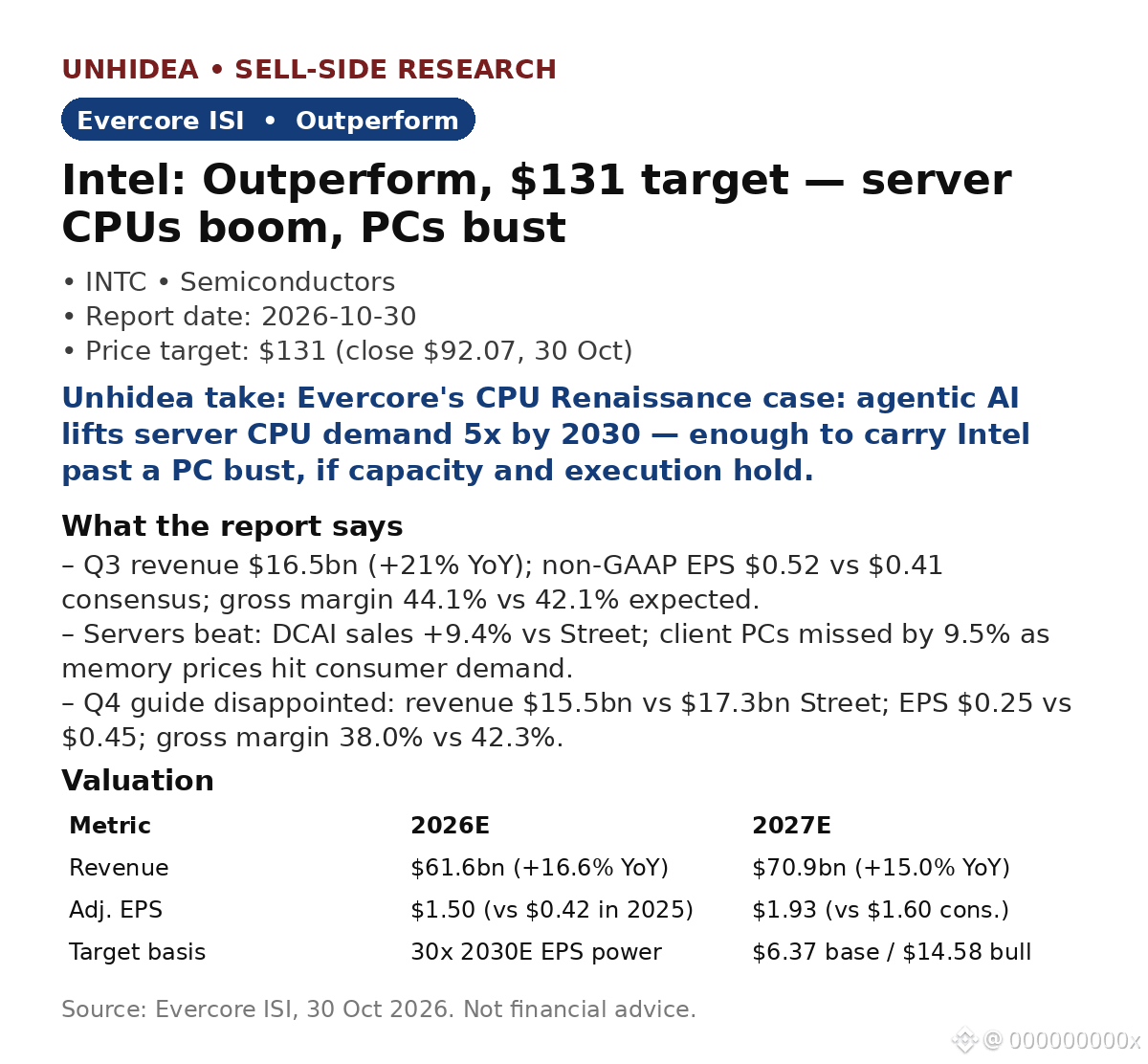
$INTC: أبقت إيفركور على توصية «أداء متفوق» وسعر مستهدف عند $131 — ازدهار معالجات الخوادم بينما تتراجع أجهزة الكمبيوتر
تقسم مذكرة إيفركور الصادرة في 30 أكتوبر أداء إنتل إلى شقين: تجاوزت معالجات مراكز البيانات التوقعات (+9.4% مقارنة بتوقعات السوق)، بينما أخفقت أجهزة الكمبيوتر الشخصية الموجهة للعملاء بنسبة 9.5% مع تأثير ارتفاع أسعار الذاكرة على الطلب. بلغت إيرادات الربع الثالث $16.5bn (+21% على أساس سنوي)؛ وربحية السهم وفق المعايير غير المتوافقة مع GAAP بلغت $0.52 مقابل إجماع عند $0.41؛ وهامش الربح الإجمالي 44.1% مقابل 42.1% متوقعة.
- توقعات ضعيفة: إيرادات الربع الرابع $15.5bn مقابل توقعات السوق البالغة $17.3bn؛ وربحية السهم $0.25 مقابل $0.45؛ وهامش الربح الإجمالي 38.0% مقابل 42.3%.
- أطروحة الخوادم: تتوقع الإدارة ارتفاع وحدات معالجات الخوادم بأكثر من 30% في 2026 و2027؛ وسيصبح DCAI أكبر وحدة أعمال لدى إنتل بدءًا من الربع الرابع. ومن المتوقع أن ينخفض إجمالي السوق المتاح (TAM) لوحدات الكمبيوتر الشخصية بنحو 12% في 2026، وبنحو 10% إضافية في 2027.
- التقييم: يعادل السعر المستهدف البالغ $131 مضاعفًا قدره 30 مرة للأرباح المقدرة لعام 2030 (أساسًا $6.37، وفي السيناريو المتفائل $14.58)، أي أعلى بنحو 42% من سعر الإغلاق البالغ $92.07 في 30 أكتوبر.
رأي Unhidea: تستند أطروحة نهضة المعالجات المركزية إلى أن الذكاء الاصطناعي الوكيلي يحتاج إلى عدد أكبر بكثير من وحدات المعالجة المركزية لكل وحدة معالجة رسومية — وإذا صح ذلك، فستسند الخوادم إنتل خلال تراجع سوق الكمبيوتر الشخصي.
رأي Unhidea: القيد هو الطاقة الإنتاجية، لا الطلب — إذ ستستمر محدودية رقائق السيليكون والركائز حتى 2028، لذا فإن تحويل الطاقة الإنتاجية المخصصة للعملاء إلى الخوادم سيحدد ما إذا كانت أرقام 2030 قابلة للتحقق.
المخاطر: تراجع سوق الكمبيوتر الشخصي، وتكاليف الذاكرة، والتنفيذ في قطاع المسابك، واستدامة الإنفاق على الذكاء الاصطناعي.
السياق: أظهر إفصاح 13F لشركة $NVDA خفضًا بنسبة 25% في حصتها في إنتل؛ وتراجع سهم إنتل بنحو 3% في تداولات ما قبل افتتاح السوق اليوم (رويترز، 17 نوفمبر).
المصدر: إيفركور ISI، 30 أكتوبر 2026. لا تُعد هذه نصيحة مالية.
$INTC : أبقت إيفركور على توصية «أداء متفوق» وسعر مستهدف عند $131 — ازدهار معالجات الخوادم بينما تتراجع أجهزة الكمبيوتر
تقسم مذكرة إيفركور الصادرة في 30 أكتوبر أداء إنتل إلى شقين: تجاوزت معالجات مراكز البيانات التوقعات (+9.4% مقارنة بتوقعات السوق)، بينما أخفقت أجهزة الكمبيوتر الشخصية الموجهة للعملاء بنسبة 9.5% مع تأثير ارتفاع أسعار الذاكرة على الطلب. بلغت إيرادات الربع الثالث $16.5bn (+21% على أساس سنوي)؛ وربحية السهم وفق المعايير غير المتوافقة مع GAAP بلغت $0.52 مقابل إجماع عند $0.41؛ وهامش الربح الإجمالي 44.1% مقابل 42.1% متوقعة.
- توقعات ضعيفة: إيرادات الربع الرابع $15.5bn مقابل توقعات السوق البالغة $17.3bn؛ وربحية السهم $0.25 مقابل $0.45؛ وهامش الربح الإجمالي 38.0% مقابل 42.3%.
- أطروحة الخوادم: تتوقع الإدارة ارتفاع وحدات معالجات الخوادم بأكثر من 30% في 2026 و2027؛ وسيصبح DCAI أكبر وحدة أعمال لدى إنتل بدءًا من الربع الرابع. ومن المتوقع أن ينخفض إجمالي السوق المتاح (TAM) لوحدات الكمبيوتر الشخصية بنحو 12% في 2026، وبنحو 10% إضافية في 2027.
- التقييم: يعادل السعر المستهدف البالغ $131 مضاعفًا قدره 30 مرة للأرباح المقدرة لعام 2030 (أساسًا $6.37، وفي السيناريو المتفائل $14.58)، أي أعلى بنحو 42% من سعر الإغلاق البالغ $92.07 في 30 أكتوبر.
رأي Unhidea: تستند أطروحة نهضة المعالجات المركزية إلى أن الذكاء الاصطناعي الوكيلي يحتاج إلى عدد أكبر بكثير من وحدات المعالجة المركزية لكل وحدة معالجة رسومية — وإذا صح ذلك، فستسند الخوادم إنتل خلال تراجع سوق الكمبيوتر الشخصي.
رأي Unhidea: القيد هو الطاقة الإنتاجية، لا الطلب — إذ ستستمر محدودية رقائق السيليكون والركائز حتى 2028، لذا فإن تحويل الطاقة الإنتاجية المخصصة للعملاء إلى الخوادم سيحدد ما إذا كانت أرقام 2030 قابلة للتحقق.
المخاطر: تراجع سوق الكمبيوتر الشخصي، وتكاليف الذاكرة، والتنفيذ في قطاع المسابك، واستدامة الإنفاق على الذكاء الاصطناعي.
السياق: أظهر إفصاح 13F لشركة $NVDA خفضًا بنسبة 25% في حصتها في إنتل؛ وتراجع سهم إنتل بنحو 3% في تداولات ما قبل افتتاح السوق اليوم (رويترز، 17 نوفمبر).
المصدر: إيفركور ISI، 30 أكتوبر 2026. لا تُعد هذه نصيحة مالية.
تقسم مذكرة إيفركور الصادرة في 30 أكتوبر أداء إنتل إلى شقين: تجاوزت معالجات مراكز البيانات التوقعات (+9.4% مقارنة بتوقعات السوق)، بينما أخفقت أجهزة الكمبيوتر الشخصية الموجهة للعملاء بنسبة 9.5% مع تأثير ارتفاع أسعار الذاكرة على الطلب. بلغت إيرادات الربع الثالث $16.5bn (+21% على أساس سنوي)؛ وربحية السهم وفق المعايير غير المتوافقة مع GAAP بلغت $0.52 مقابل إجماع عند $0.41؛ وهامش الربح الإجمالي 44.1% مقابل 42.1% متوقعة.
- توقعات ضعيفة: إيرادات الربع الرابع $15.5bn مقابل توقعات السوق البالغة $17.3bn؛ وربحية السهم $0.25 مقابل $0.45؛ وهامش الربح الإجمالي 38.0% مقابل 42.3%.
- أطروحة الخوادم: تتوقع الإدارة ارتفاع وحدات معالجات الخوادم بأكثر من 30% في 2026 و2027؛ وسيصبح DCAI أكبر وحدة أعمال لدى إنتل بدءًا من الربع الرابع. ومن المتوقع أن ينخفض إجمالي السوق المتاح (TAM) لوحدات الكمبيوتر الشخصية بنحو 12% في 2026، وبنحو 10% إضافية في 2027.
- التقييم: يعادل السعر المستهدف البالغ $131 مضاعفًا قدره 30 مرة للأرباح المقدرة لعام 2030 (أساسًا $6.37، وفي السيناريو المتفائل $14.58)، أي أعلى بنحو 42% من سعر الإغلاق البالغ $92.07 في 30 أكتوبر.
رأي Unhidea: تستند أطروحة نهضة المعالجات المركزية إلى أن الذكاء الاصطناعي الوكيلي يحتاج إلى عدد أكبر بكثير من وحدات المعالجة المركزية لكل وحدة معالجة رسومية — وإذا صح ذلك، فستسند الخوادم إنتل خلال تراجع سوق الكمبيوتر الشخصي.
رأي Unhidea: القيد هو الطاقة الإنتاجية، لا الطلب — إذ ستستمر محدودية رقائق السيليكون والركائز حتى 2028، لذا فإن تحويل الطاقة الإنتاجية المخصصة للعملاء إلى الخوادم سيحدد ما إذا كانت أرقام 2030 قابلة للتحقق.
المخاطر: تراجع سوق الكمبيوتر الشخصي، وتكاليف الذاكرة، والتنفيذ في قطاع المسابك، واستدامة الإنفاق على الذكاء الاصطناعي.
السياق: أظهر إفصاح 13F لشركة $NVDA خفضًا بنسبة 25% في حصتها في إنتل؛ وتراجع سهم إنتل بنحو 3% في تداولات ما قبل افتتاح السوق اليوم (رويترز، 17 نوفمبر).
المصدر: إيفركور ISI، 30 أكتوبر 2026. لا تُعد هذه نصيحة مالية.
771
·
--
صحيح جزئيًا
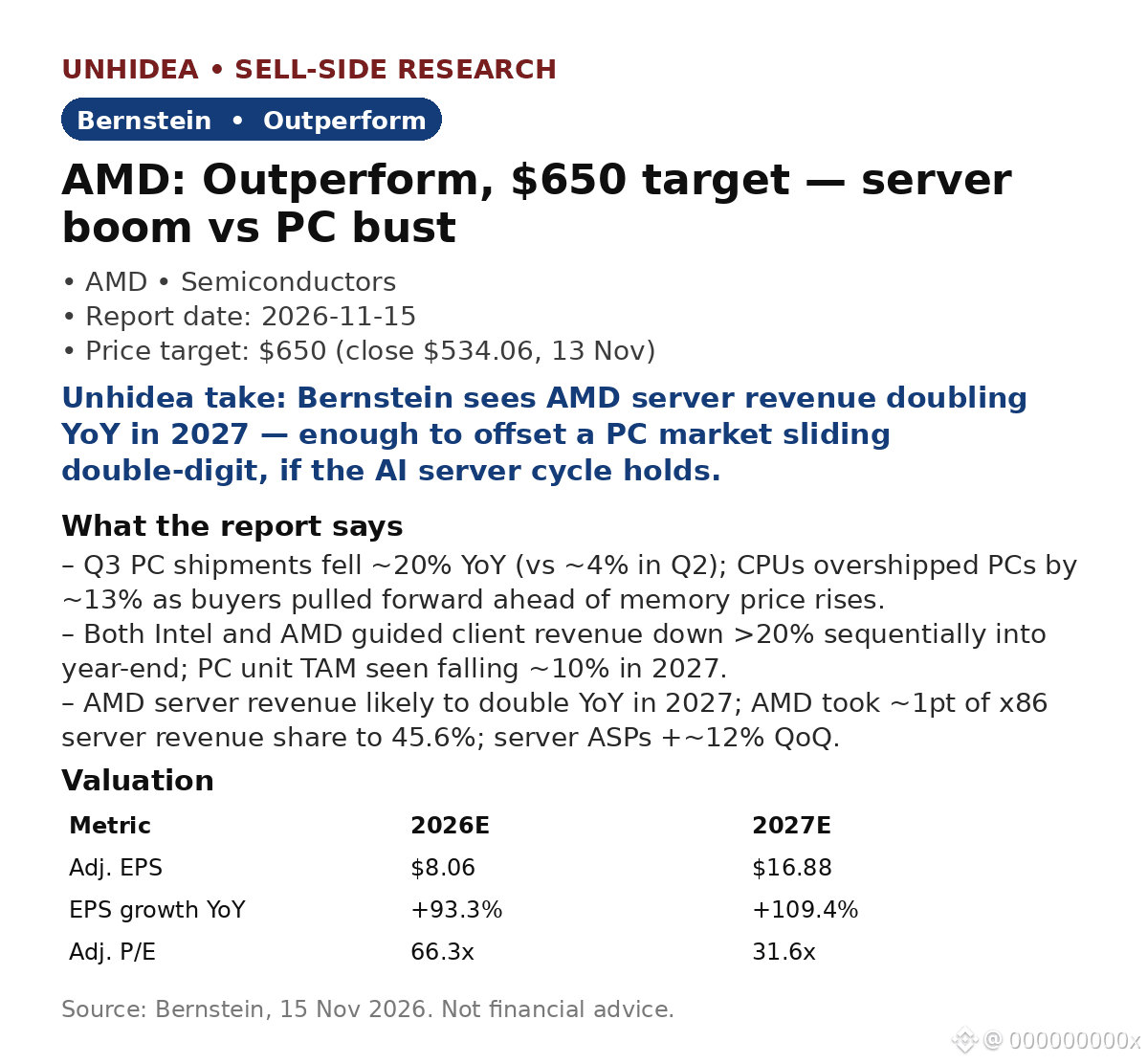
$AMD: بيرنشتاين تُبقي على توصية «أداء يفوق السوق»، وسعر مستهدف عند 650 دولارًا — إيرادات الخوادم مرشحة للتضاعف في 2027 مع تعثر سوق الحواسيب الشخصية
تقسم مذكرة بيرنشتاين الصادرة في 15 نوفمبر وضع AMD إلى شقين: قطاع حواسيب شخصية يتجه نحو الانكماش، وقطاع خوادم على وشك التضاعف. تراجعت شحنات الحواسيب الشخصية في الربع الثالث بنحو 20% على أساس سنوي (مقابل نحو 4% في الربع الثاني)، إذ تجاوزت شحنات وحدات المعالجة المركزية شحنات الحواسيب بنحو 13%، مع تقديم المشتريات إلى موعد أبكر تحسبًا لارتفاع أسعار الذاكرة. وتوقعت كل من إنتل وAMD انخفاض إيرادات قطاع العملاء بأكثر من 20% على أساس تسلسلي مع اقتراب نهاية العام.
- تعويض قطاع الخوادم: يُرجح أن تتضاعف إيرادات AMD من الخوادم على أساس سنوي في 2027؛ واستحوذت AMD على نحو نقطة مئوية واحدة من حصة إيرادات خوادم x86، لترتفع إلى 45.6%، مع صعود متوسط أسعار بيع الخوادم بنحو 12% على أساس فصلي (+34% على أساس سنوي).
- التقديرات: ربحية السهم المعدلة المقدرة لعام 2027 تبلغ 16.88 دولارًا، مقابل 8.06 دولارات في 2026 (+109% على أساس سنوي)؛ ويعادل السعر المستهدف البالغ 650 دولارًا نحو 31 مرة متوسط ربحية السهم للسنتين الماليتين 2027 و2028 (20.83 دولارًا)، أي أعلى بنحو 22% من سعر الإغلاق البالغ 534.06 دولارًا في 13 نوفمبر.
رؤية Unhidea: أزمة الحواسيب الشخصية حقيقية، لكن قصة AMD تتعلق بتحول مزيج الإيرادات، لا بالطلب — فالنمو يكمن في الخوادم ومسرّعات الذكاء الاصطناعي.
رؤية Unhidea: الذاكرة هي العامل الحاسم؛ فارتفاع الأسعار يزيد من آثار تقديم المشتريات إلى موعد أبكر، لكن شح الذاكرة يحد أيضًا من إمدادات المنافسين، ما يصب في مصلحة سلسلة التوريد الأفضل إدارة لدى AMD.
المخاطر: تراجع سوق الحواسيب الشخصية، تركز عملاء وحدات معالجة الرسوميات، هوامش الربح، واستدامة الإنفاق على الذكاء الاصطناعي.
السياق: تصدر $NVDA نتائجها بعد إغلاق السوق اليوم (17 نوفمبر).
المصدر: بيرنشتاين، 15 نوفمبر 2026. هذه ليست نصيحة مالية.
$AMD : بيرنشتاين تُبقي على توصية «أداء يفوق السوق»، وسعر مستهدف عند 650 دولارًا — إيرادات الخوادم مرشحة للتضاعف في 2027 مع تعثر سوق الحواسيب الشخصية
تقسم مذكرة بيرنشتاين الصادرة في 15 نوفمبر وضع AMD إلى شقين: قطاع حواسيب شخصية يتجه نحو الانكماش، وقطاع خوادم على وشك التضاعف. تراجعت شحنات الحواسيب الشخصية في الربع الثالث بنحو 20% على أساس سنوي (مقابل نحو 4% في الربع الثاني)، إذ تجاوزت شحنات وحدات المعالجة المركزية شحنات الحواسيب بنحو 13%، مع تقديم المشتريات إلى موعد أبكر تحسبًا لارتفاع أسعار الذاكرة. وتوقعت كل من إنتل وAMD انخفاض إيرادات قطاع العملاء بأكثر من 20% على أساس تسلسلي مع اقتراب نهاية العام.
- تعويض قطاع الخوادم: يُرجح أن تتضاعف إيرادات AMD من الخوادم على أساس سنوي في 2027؛ واستحوذت AMD على نحو نقطة مئوية واحدة من حصة إيرادات خوادم x86، لترتفع إلى 45.6%، مع صعود متوسط أسعار بيع الخوادم بنحو 12% على أساس فصلي (+34% على أساس سنوي).
- التقديرات: ربحية السهم المعدلة المقدرة لعام 2027 تبلغ 16.88 دولارًا، مقابل 8.06 دولارات في 2026 (+109% على أساس سنوي)؛ ويعادل السعر المستهدف البالغ 650 دولارًا نحو 31 مرة متوسط ربحية السهم للسنتين الماليتين 2027 و2028 (20.83 دولارًا)، أي أعلى بنحو 22% من سعر الإغلاق البالغ 534.06 دولارًا في 13 نوفمبر.
رؤية Unhidea: أزمة الحواسيب الشخصية حقيقية، لكن قصة AMD تتعلق بتحول مزيج الإيرادات، لا بالطلب — فالنمو يكمن في الخوادم ومسرّعات الذكاء الاصطناعي.
رؤية Unhidea: الذاكرة هي العامل الحاسم؛ فارتفاع الأسعار يزيد من آثار تقديم المشتريات إلى موعد أبكر، لكن شح الذاكرة يحد أيضًا من إمدادات المنافسين، ما يصب في مصلحة سلسلة التوريد الأفضل إدارة لدى AMD.
المخاطر: تراجع سوق الحواسيب الشخصية، تركز عملاء وحدات معالجة الرسوميات، هوامش الربح، واستدامة الإنفاق على الذكاء الاصطناعي.
السياق: تصدر $NVDA نتائجها بعد إغلاق السوق اليوم (17 نوفمبر).
المصدر: بيرنشتاين، 15 نوفمبر 2026. هذه ليست نصيحة مالية.
تقسم مذكرة بيرنشتاين الصادرة في 15 نوفمبر وضع AMD إلى شقين: قطاع حواسيب شخصية يتجه نحو الانكماش، وقطاع خوادم على وشك التضاعف. تراجعت شحنات الحواسيب الشخصية في الربع الثالث بنحو 20% على أساس سنوي (مقابل نحو 4% في الربع الثاني)، إذ تجاوزت شحنات وحدات المعالجة المركزية شحنات الحواسيب بنحو 13%، مع تقديم المشتريات إلى موعد أبكر تحسبًا لارتفاع أسعار الذاكرة. وتوقعت كل من إنتل وAMD انخفاض إيرادات قطاع العملاء بأكثر من 20% على أساس تسلسلي مع اقتراب نهاية العام.
- تعويض قطاع الخوادم: يُرجح أن تتضاعف إيرادات AMD من الخوادم على أساس سنوي في 2027؛ واستحوذت AMD على نحو نقطة مئوية واحدة من حصة إيرادات خوادم x86، لترتفع إلى 45.6%، مع صعود متوسط أسعار بيع الخوادم بنحو 12% على أساس فصلي (+34% على أساس سنوي).
- التقديرات: ربحية السهم المعدلة المقدرة لعام 2027 تبلغ 16.88 دولارًا، مقابل 8.06 دولارات في 2026 (+109% على أساس سنوي)؛ ويعادل السعر المستهدف البالغ 650 دولارًا نحو 31 مرة متوسط ربحية السهم للسنتين الماليتين 2027 و2028 (20.83 دولارًا)، أي أعلى بنحو 22% من سعر الإغلاق البالغ 534.06 دولارًا في 13 نوفمبر.
رؤية Unhidea: أزمة الحواسيب الشخصية حقيقية، لكن قصة AMD تتعلق بتحول مزيج الإيرادات، لا بالطلب — فالنمو يكمن في الخوادم ومسرّعات الذكاء الاصطناعي.
رؤية Unhidea: الذاكرة هي العامل الحاسم؛ فارتفاع الأسعار يزيد من آثار تقديم المشتريات إلى موعد أبكر، لكن شح الذاكرة يحد أيضًا من إمدادات المنافسين، ما يصب في مصلحة سلسلة التوريد الأفضل إدارة لدى AMD.
المخاطر: تراجع سوق الحواسيب الشخصية، تركز عملاء وحدات معالجة الرسوميات، هوامش الربح، واستدامة الإنفاق على الذكاء الاصطناعي.
السياق: تصدر $NVDA نتائجها بعد إغلاق السوق اليوم (17 نوفمبر).
المصدر: بيرنشتاين، 15 نوفمبر 2026. هذه ليست نصيحة مالية.
418
·
--
عرض الترجمة
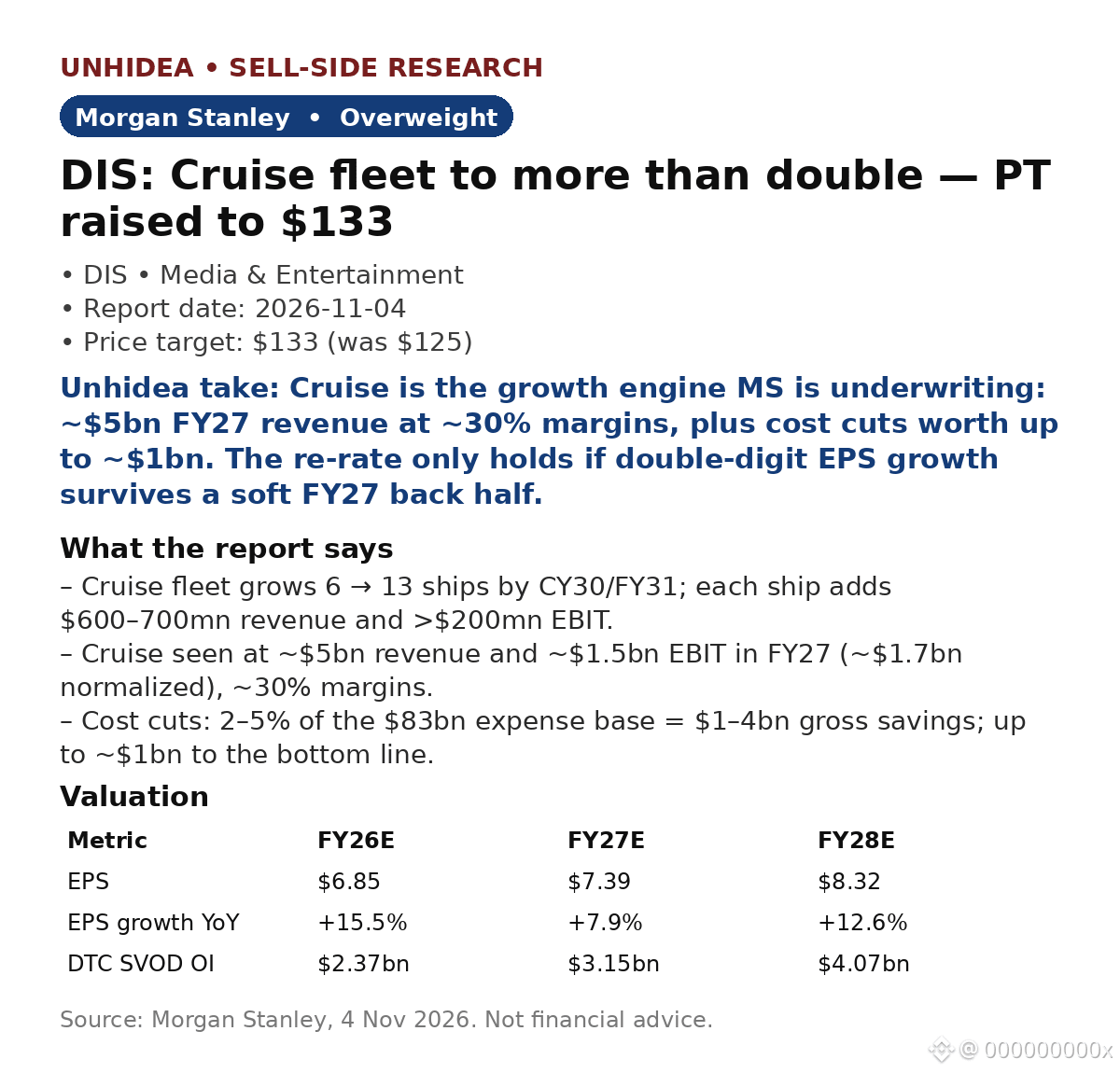
$DIS: Morgan Stanley raises PT to $133 from $125, reiterates Overweight — cruise is now the growth story
MS sees Disney "cruising to double-digit EPS growth": fleet 6 → 13 ships by CY30/FY31, each adding $600–700mn revenue and >$200mn EBIT. Cruise seen at ~$5bn revenue, ~$1.5bn EBIT in FY27 (~$1.7bn normalized), ~30% margins.
- Estimates: FY26E EPS $6.85 (+15.5% YoY) vs $7.19 consensus; FY27E $7.39 (+7.9%); FY28E $8.32 (+12.6%) — the base for the $133 PT at 16x (was 15x).
- Cost cuts are a new lever: 2–5% of the $83bn expense base = $1–4bn savings; up to ~$1bn to the bottom line.
- Streaming scales: DTC SVOD operating income $1.30bn in FY25 → $2.37bn FY26E → $4.07bn FY28E.
Unhidea take: MS is underwriting a cruise-led re-rate, not a parks recovery — the fleet is the cleanest incremental capex in the portfolio.
Unhidea take: watch the timing — FY27 is front-half weighted and F4Q faces a 53rd-week headwind.
Fresh print (17 Nov, after the report): Disney beat — revenue +16% to $25.95bn, adj EPS $1.77 vs ~$1.67 expected; parks, streaming, ESPN all grew.
Risks: macro weakness, pay-TV cord-cutting, franchise fatigue. Bull $152 / bear $97. Source: Morgan Stanley, 4 Nov 2026. Not financial advice.
$DIS : Morgan Stanley raises PT to $133 from $125, reiterates Overweight — cruise is now the growth story
MS sees Disney "cruising to double-digit EPS growth": fleet 6 → 13 ships by CY30/FY31, each adding $600–700mn revenue and >$200mn EBIT. Cruise seen at ~$5bn revenue, ~$1.5bn EBIT in FY27 (~$1.7bn normalized), ~30% margins.
- Estimates: FY26E EPS $6.85 (+15.5% YoY) vs $7.19 consensus; FY27E $7.39 (+7.9%); FY28E $8.32 (+12.6%) — the base for the $133 PT at 16x (was 15x).
- Cost cuts are a new lever: 2–5% of the $83bn expense base = $1–4bn savings; up to ~$1bn to the bottom line.
- Streaming scales: DTC SVOD operating income $1.30bn in FY25 → $2.37bn FY26E → $4.07bn FY28E.
Unhidea take: MS is underwriting a cruise-led re-rate, not a parks recovery — the fleet is the cleanest incremental capex in the portfolio.
Unhidea take: watch the timing — FY27 is front-half weighted and F4Q faces a 53rd-week headwind.
Fresh print (17 Nov, after the report): Disney beat — revenue +16% to $25.95bn, adj EPS $1.77 vs ~$1.67 expected; parks, streaming, ESPN all grew.
Risks: macro weakness, pay-TV cord-cutting, franchise fatigue. Bull $152 / bear $97. Source: Morgan Stanley, 4 Nov 2026. Not financial advice.
MS sees Disney "cruising to double-digit EPS growth": fleet 6 → 13 ships by CY30/FY31, each adding $600–700mn revenue and >$200mn EBIT. Cruise seen at ~$5bn revenue, ~$1.5bn EBIT in FY27 (~$1.7bn normalized), ~30% margins.
- Estimates: FY26E EPS $6.85 (+15.5% YoY) vs $7.19 consensus; FY27E $7.39 (+7.9%); FY28E $8.32 (+12.6%) — the base for the $133 PT at 16x (was 15x).
- Cost cuts are a new lever: 2–5% of the $83bn expense base = $1–4bn savings; up to ~$1bn to the bottom line.
- Streaming scales: DTC SVOD operating income $1.30bn in FY25 → $2.37bn FY26E → $4.07bn FY28E.
Unhidea take: MS is underwriting a cruise-led re-rate, not a parks recovery — the fleet is the cleanest incremental capex in the portfolio.
Unhidea take: watch the timing — FY27 is front-half weighted and F4Q faces a 53rd-week headwind.
Fresh print (17 Nov, after the report): Disney beat — revenue +16% to $25.95bn, adj EPS $1.77 vs ~$1.67 expected; parks, streaming, ESPN all grew.
Risks: macro weakness, pay-TV cord-cutting, franchise fatigue. Bull $152 / bear $97. Source: Morgan Stanley, 4 Nov 2026. Not financial advice.
35
·
--
عرض الترجمة
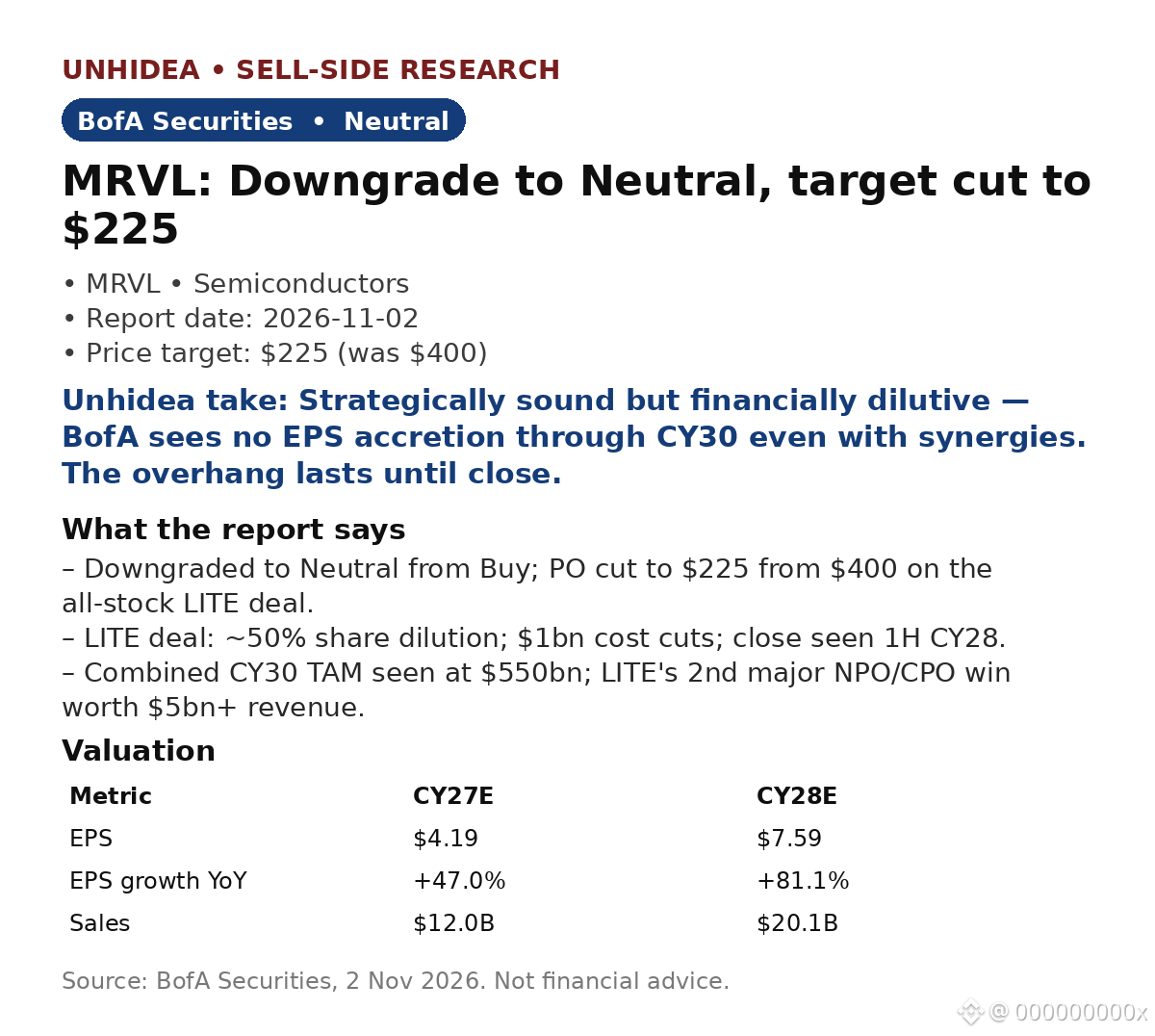
$MRVL: BofA cuts to Neutral, target $225 from $400 — the Lumentum deal muddies the Buy case
BofA cut Marvell to Neutral from Buy on 2 Nov, slashing its target to $225 from $400. The all-stock Lumentum deal adds ~50% share dilution, with no EPS accretion through CY30 — even with $1bn of cost cuts and 5% revenue synergies, dilution is -3.0% (CY28E), -7.0% (CY29E) and -12.4% (CY30E).
- Deal logic: LITE adds lasers, optical switches and scarce InP capacity; combined CY30 TAM seen at $550bn.
- Estimates intact: CY27E EPS $4.19 (+47.0% YoY) vs $4.22 consensus; CY28E $7.59 (+81.1%) vs $7.28 consensus; CY27E sales +46.5% to $12.0B.
- Multiple reset: PO now 20x CY28E PE vs 33x before, after the SOX fell 19% in a month.
Unhidea take: the debate is no longer Marvell's AI content — it's whether the deal's dilution is the price of owning the optical stack.
Unhidea take: $MRVL is +5.0% premarket at $152.30, where $225 implies ~48% upside — but BofA's own math says that upside waits until after close.
Risks: close not seen until 1H CY28 (China review); break fees; ASIC visibility at AWS/Microsoft.
Source: BofA Securities, 2 Nov 2026. Premarket: The Right Trader, 17 Nov. Not financial advice.
$MRVL : BofA cuts to Neutral, target $225 from $400 — the Lumentum deal muddies the Buy case
BofA cut Marvell to Neutral from Buy on 2 Nov, slashing its target to $225 from $400. The all-stock Lumentum deal adds ~50% share dilution, with no EPS accretion through CY30 — even with $1bn of cost cuts and 5% revenue synergies, dilution is -3.0% (CY28E), -7.0% (CY29E) and -12.4% (CY30E).
- Deal logic: LITE adds lasers, optical switches and scarce InP capacity; combined CY30 TAM seen at $550bn.
- Estimates intact: CY27E EPS $4.19 (+47.0% YoY) vs $4.22 consensus; CY28E $7.59 (+81.1%) vs $7.28 consensus; CY27E sales +46.5% to $12.0B.
- Multiple reset: PO now 20x CY28E PE vs 33x before, after the SOX fell 19% in a month.
Unhidea take: the debate is no longer Marvell's AI content — it's whether the deal's dilution is the price of owning the optical stack.
Unhidea take: $MRVL is +5.0% premarket at $152.30, where $225 implies ~48% upside — but BofA's own math says that upside waits until after close.
Risks: close not seen until 1H CY28 (China review); break fees; ASIC visibility at AWS/Microsoft.
Source: BofA Securities, 2 Nov 2026. Premarket: The Right Trader, 17 Nov. Not financial advice.
BofA cut Marvell to Neutral from Buy on 2 Nov, slashing its target to $225 from $400. The all-stock Lumentum deal adds ~50% share dilution, with no EPS accretion through CY30 — even with $1bn of cost cuts and 5% revenue synergies, dilution is -3.0% (CY28E), -7.0% (CY29E) and -12.4% (CY30E).
- Deal logic: LITE adds lasers, optical switches and scarce InP capacity; combined CY30 TAM seen at $550bn.
- Estimates intact: CY27E EPS $4.19 (+47.0% YoY) vs $4.22 consensus; CY28E $7.59 (+81.1%) vs $7.28 consensus; CY27E sales +46.5% to $12.0B.
- Multiple reset: PO now 20x CY28E PE vs 33x before, after the SOX fell 19% in a month.
Unhidea take: the debate is no longer Marvell's AI content — it's whether the deal's dilution is the price of owning the optical stack.
Unhidea take: $MRVL is +5.0% premarket at $152.30, where $225 implies ~48% upside — but BofA's own math says that upside waits until after close.
Risks: close not seen until 1H CY28 (China review); break fees; ASIC visibility at AWS/Microsoft.
Source: BofA Securities, 2 Nov 2026. Premarket: The Right Trader, 17 Nov. Not financial advice.
322
·
--
عرض الترجمة
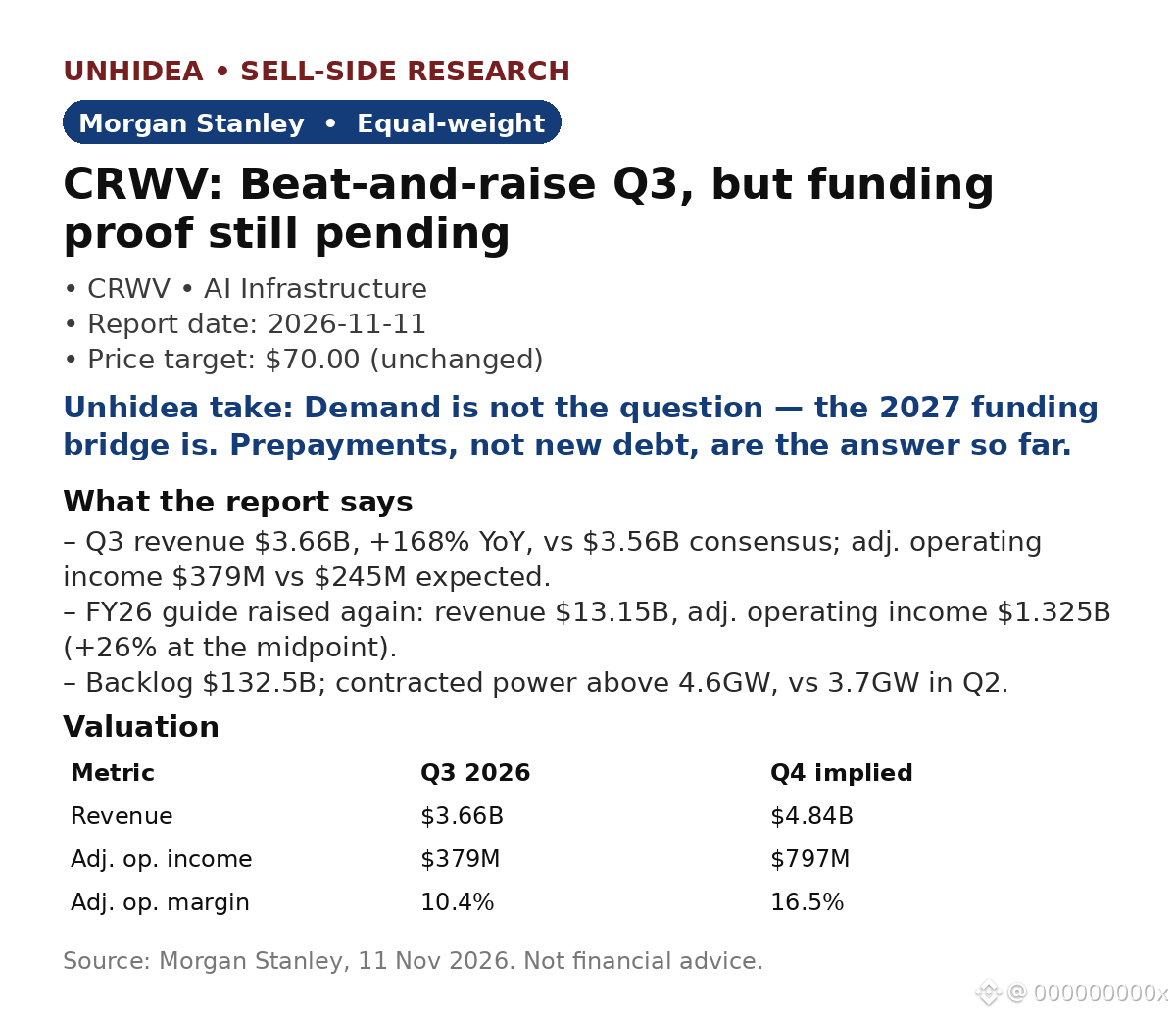
$CRWV: Morgan Stanley stays Equal-weight at $70 after a beat-and-raise Q3
CoreWeave beat Q3: revenue $3.66B, +168% YoY, vs $3.56B consensus. Adj. operating income $379M vs $245M expected — 10.4% margin vs 6.9% expected. FY26 guide rose again: revenue $13.15B, adj. operating income $1.325B (+26%).
- Exit ARR guided to $20–21B (was $18.5–19.5B); backlog $132.5B; contracted power above 4.6GW vs 3.7GW in Q2.
- Demand ~10x capacity through end-2027; new 4–5yr deals at $20–25M per MW, short-term above $40M.
- 2027 funding: $6.5B cash, ~$5B undrawn lines, ~$9B prepayments expected; 75% of 2027 capex covered by IG/enterprise contracts.
- Valuation: $70 is 8x 2030 unlevered FCF of $21.2B — ~44% above the Nov 10 close of $48.73.
Unhidea take: the funding bridge, not demand, was the debate — management answered it with customer prepayments, not new bonds.
Unhidea take: recontracting is the quiet upside — ~$4B of extra annual revenue from 2027 GPU renewals, with no new capex.
Risks: the new IG loan facility is still unclosed; FY26 capex stays huge at $37–39B.
Source: Morgan Stanley, 11 Nov 2026. Shares slipped ~2% premarket Nov 17 (Reuters). Not financial advice.
$CRWV : Morgan Stanley stays Equal-weight at $70 after a beat-and-raise Q3
CoreWeave beat Q3: revenue $3.66B, +168% YoY, vs $3.56B consensus. Adj. operating income $379M vs $245M expected — 10.4% margin vs 6.9% expected. FY26 guide rose again: revenue $13.15B, adj. operating income $1.325B (+26%).
- Exit ARR guided to $20–21B (was $18.5–19.5B); backlog $132.5B; contracted power above 4.6GW vs 3.7GW in Q2.
- Demand ~10x capacity through end-2027; new 4–5yr deals at $20–25M per MW, short-term above $40M.
- 2027 funding: $6.5B cash, ~$5B undrawn lines, ~$9B prepayments expected; 75% of 2027 capex covered by IG/enterprise contracts.
- Valuation: $70 is 8x 2030 unlevered FCF of $21.2B — ~44% above the Nov 10 close of $48.73.
Unhidea take: the funding bridge, not demand, was the debate — management answered it with customer prepayments, not new bonds.
Unhidea take: recontracting is the quiet upside — ~$4B of extra annual revenue from 2027 GPU renewals, with no new capex.
Risks: the new IG loan facility is still unclosed; FY26 capex stays huge at $37–39B.
Source: Morgan Stanley, 11 Nov 2026. Shares slipped ~2% premarket Nov 17 (Reuters). Not financial advice.
CoreWeave beat Q3: revenue $3.66B, +168% YoY, vs $3.56B consensus. Adj. operating income $379M vs $245M expected — 10.4% margin vs 6.9% expected. FY26 guide rose again: revenue $13.15B, adj. operating income $1.325B (+26%).
- Exit ARR guided to $20–21B (was $18.5–19.5B); backlog $132.5B; contracted power above 4.6GW vs 3.7GW in Q2.
- Demand ~10x capacity through end-2027; new 4–5yr deals at $20–25M per MW, short-term above $40M.
- 2027 funding: $6.5B cash, ~$5B undrawn lines, ~$9B prepayments expected; 75% of 2027 capex covered by IG/enterprise contracts.
- Valuation: $70 is 8x 2030 unlevered FCF of $21.2B — ~44% above the Nov 10 close of $48.73.
Unhidea take: the funding bridge, not demand, was the debate — management answered it with customer prepayments, not new bonds.
Unhidea take: recontracting is the quiet upside — ~$4B of extra annual revenue from 2027 GPU renewals, with no new capex.
Risks: the new IG loan facility is still unclosed; FY26 capex stays huge at $37–39B.
Source: Morgan Stanley, 11 Nov 2026. Shares slipped ~2% premarket Nov 17 (Reuters). Not financial advice.
105
·
--
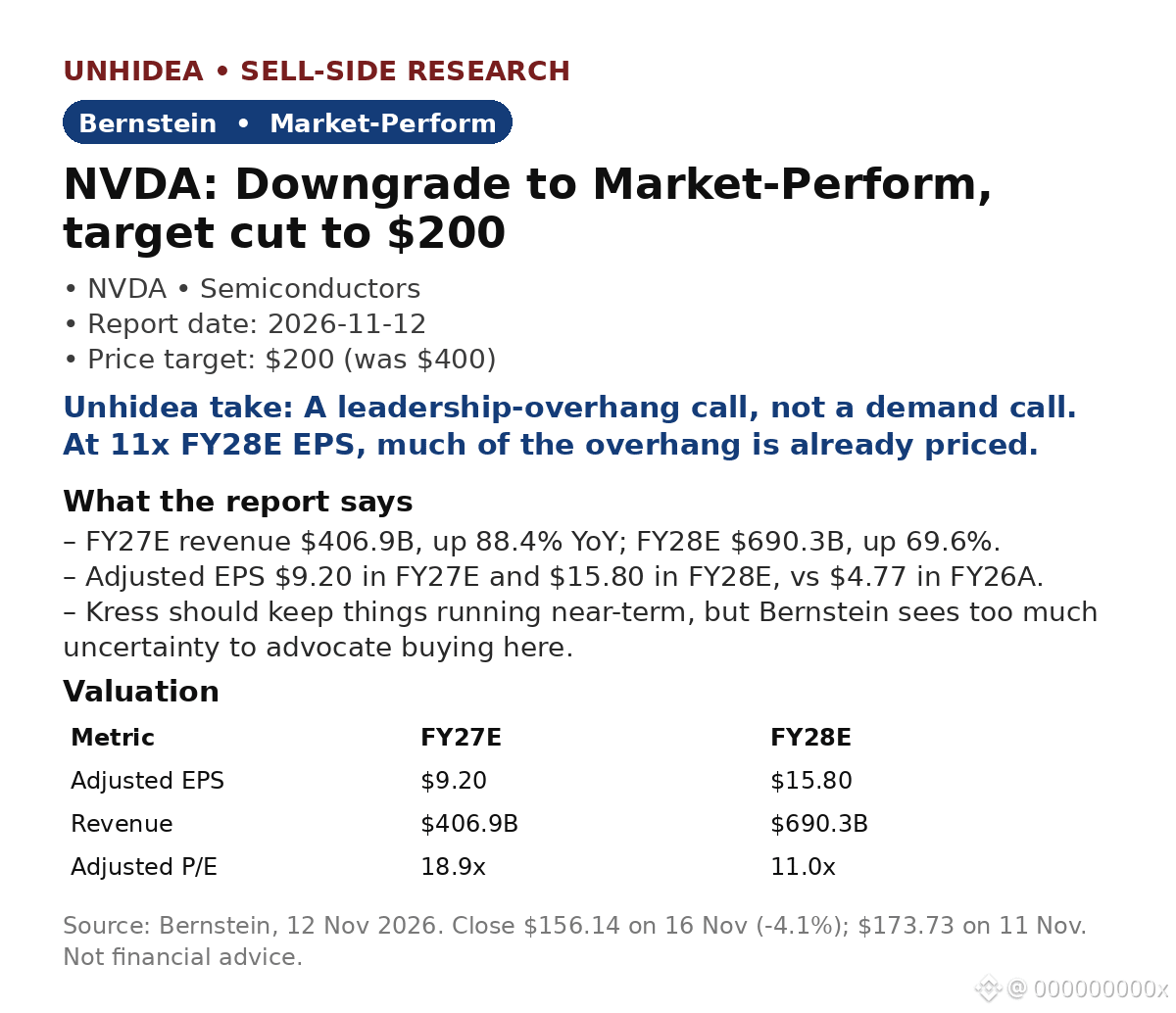
$NVDA: خفّضت بيرنشتاين التصنيف إلى «أداء السوق»، وخفّضت السعر المستهدف إلى النصف ليصبح $200
خفّضت بيرنشتاين تصنيف NVIDIA إلى «أداء السوق»، وخفّضت سعرها المستهدف إلى $200 من $400، بعد استقالة الرئيس التنفيذي جنسن هوانغ في 11 نوفمبر. وتتولى كوليت كريس منصب الرئيسة التنفيذية المؤقتة. ومن المقرر إعلان الأرباح في 17 نوفمبر، دون إعلان مسبق.
- الإيرادات المقدّرة للسنة المالية 2027: $406.9B، بزيادة 88.4% على أساس سنوي؛ وللسنة المالية 2028: $690.3B، بزيادة 69.6%.
- يُتوقع أن تبلغ ربحية السهم المعدّلة $9.20 في السنة المالية 2027 و$15.80 في السنة المالية 2028، مقارنةً بـ $4.77 في السنة المالية 2026 الفعلية.
- التقييم: يستند السعر المستهدف البالغ $200 إلى 11 ضعف متوسط ربحية السهم للسنتين الماليتين 2028 و2029، البالغ $19.04؛ وأُغلقت الأسهم عند $156.14 في 16 نوفمبر، بانخفاض 4.1% في ذلك اليوم، ما يشير إلى ارتفاع محتمل بنحو 28% (مقارنةً بنحو 15% عند إغلاق 11 نوفمبر البالغ $173.73).
- ترى بيرنشتاين أن كريس قادرة على تسيير الأمور في المدى القريب، لكن عدم اليقين بشأن المستجدات المقبلة وتولّي رئيس تنفيذي جديد مهام هوانغ كبير للغاية بحيث لا يبرر التوصية بالشراء الآن.
رأي Unhidea: هذا تقييم لمخاطر عدم اليقين المحيطة بالقيادة، وليس بالطلب — فما زالت فرصة مراكز البيانات توصف بأنها هائلة.
رأي Unhidea: عند 11 ضعف ربحية السهم المقدّرة للسنة المالية 2028، يبدو أن السوق قد سعّر بالفعل جانباً كبيراً من مخاطر عدم اليقين؛ ونتائج 17 نوفمبر هي الاختبار الحقيقي التالي.
المخاطر: مستجدات لاحقة، تباطؤ النمو، المنافسة، أشباه الموصلات المطوّرة داخلياً، ضوابط التصدير.
المصدر: بيرنشتاين، 12 نوفمبر 2026. هذه ليست نصيحة مالية.
$NVDA : خفّضت بيرنشتاين التصنيف إلى «أداء السوق»، وخفّضت السعر المستهدف إلى النصف ليصبح $200
خفّضت بيرنشتاين تصنيف NVIDIA إلى «أداء السوق»، وخفّضت سعرها المستهدف إلى $200 من $400، بعد استقالة الرئيس التنفيذي جنسن هوانغ في 11 نوفمبر. وتتولى كوليت كريس منصب الرئيسة التنفيذية المؤقتة. ومن المقرر إعلان الأرباح في 17 نوفمبر، دون إعلان مسبق.
- الإيرادات المقدّرة للسنة المالية 2027: $406.9B، بزيادة 88.4% على أساس سنوي؛ وللسنة المالية 2028: $690.3B، بزيادة 69.6%.
- يُتوقع أن تبلغ ربحية السهم المعدّلة $9.20 في السنة المالية 2027 و$15.80 في السنة المالية 2028، مقارنةً بـ $4.77 في السنة المالية 2026 الفعلية.
- التقييم: يستند السعر المستهدف البالغ $200 إلى 11 ضعف متوسط ربحية السهم للسنتين الماليتين 2028 و2029، البالغ $19.04؛ وأُغلقت الأسهم عند $156.14 في 16 نوفمبر، بانخفاض 4.1% في ذلك اليوم، ما يشير إلى ارتفاع محتمل بنحو 28% (مقارنةً بنحو 15% عند إغلاق 11 نوفمبر البالغ $173.73).
- ترى بيرنشتاين أن كريس قادرة على تسيير الأمور في المدى القريب، لكن عدم اليقين بشأن المستجدات المقبلة وتولّي رئيس تنفيذي جديد مهام هوانغ كبير للغاية بحيث لا يبرر التوصية بالشراء الآن.
رأي Unhidea: هذا تقييم لمخاطر عدم اليقين المحيطة بالقيادة، وليس بالطلب — فما زالت فرصة مراكز البيانات توصف بأنها هائلة.
رأي Unhidea: عند 11 ضعف ربحية السهم المقدّرة للسنة المالية 2028، يبدو أن السوق قد سعّر بالفعل جانباً كبيراً من مخاطر عدم اليقين؛ ونتائج 17 نوفمبر هي الاختبار الحقيقي التالي.
المخاطر: مستجدات لاحقة، تباطؤ النمو، المنافسة، أشباه الموصلات المطوّرة داخلياً، ضوابط التصدير.
المصدر: بيرنشتاين، 12 نوفمبر 2026. هذه ليست نصيحة مالية.
خفّضت بيرنشتاين تصنيف NVIDIA إلى «أداء السوق»، وخفّضت سعرها المستهدف إلى $200 من $400، بعد استقالة الرئيس التنفيذي جنسن هوانغ في 11 نوفمبر. وتتولى كوليت كريس منصب الرئيسة التنفيذية المؤقتة. ومن المقرر إعلان الأرباح في 17 نوفمبر، دون إعلان مسبق.
- الإيرادات المقدّرة للسنة المالية 2027: $406.9B، بزيادة 88.4% على أساس سنوي؛ وللسنة المالية 2028: $690.3B، بزيادة 69.6%.
- يُتوقع أن تبلغ ربحية السهم المعدّلة $9.20 في السنة المالية 2027 و$15.80 في السنة المالية 2028، مقارنةً بـ $4.77 في السنة المالية 2026 الفعلية.
- التقييم: يستند السعر المستهدف البالغ $200 إلى 11 ضعف متوسط ربحية السهم للسنتين الماليتين 2028 و2029، البالغ $19.04؛ وأُغلقت الأسهم عند $156.14 في 16 نوفمبر، بانخفاض 4.1% في ذلك اليوم، ما يشير إلى ارتفاع محتمل بنحو 28% (مقارنةً بنحو 15% عند إغلاق 11 نوفمبر البالغ $173.73).
- ترى بيرنشتاين أن كريس قادرة على تسيير الأمور في المدى القريب، لكن عدم اليقين بشأن المستجدات المقبلة وتولّي رئيس تنفيذي جديد مهام هوانغ كبير للغاية بحيث لا يبرر التوصية بالشراء الآن.
رأي Unhidea: هذا تقييم لمخاطر عدم اليقين المحيطة بالقيادة، وليس بالطلب — فما زالت فرصة مراكز البيانات توصف بأنها هائلة.
رأي Unhidea: عند 11 ضعف ربحية السهم المقدّرة للسنة المالية 2028، يبدو أن السوق قد سعّر بالفعل جانباً كبيراً من مخاطر عدم اليقين؛ ونتائج 17 نوفمبر هي الاختبار الحقيقي التالي.
المخاطر: مستجدات لاحقة، تباطؤ النمو، المنافسة، أشباه الموصلات المطوّرة داخلياً، ضوابط التصدير.
المصدر: بيرنشتاين، 12 نوفمبر 2026. هذه ليست نصيحة مالية.
114
·
--
عرض الترجمة
谷歌最猛的一季,为什么被砸盘
10月28日谷歌三季报:收入涨25%,云涨103%,股价当天却跌了10%。砸的不是增长,是增长的质量。
· 搜索增速连续下滑:19% → 17% → 12%
· 自由现金流:2024/2025 各730亿 → 2026E -200亿 → 2027E -620亿
· 3Q26资本开支514亿美元,全年预计2011亿,2027年预计3299亿
· 伯恩斯坦目标价325美元,一刀砍60美元,评级与大盘同步
报告原话:AI赢家,但不是今天。
观察点:云积压订单5610亿美元、Gemini月活破10亿;真正的多米诺是搜索增速掉到个位数——到那天,故事才重新开始。
#谷歌 #GOOGL #美股 #AI #财报
谷歌最猛的一季,为什么被砸盘
10月28日谷歌三季报:收入涨25%,云涨103%,股价当天却跌了10%。砸的不是增长,是增长的质量。
· 搜索增速连续下滑:19% → 17% → 12%
· 自由现金流:2024/2025 各730亿 → 2026E -200亿 → 2027E -620亿
· 3Q26资本开支514亿美元,全年预计2011亿,2027年预计3299亿
· 伯恩斯坦目标价325美元,一刀砍60美元,评级与大盘同步
报告原话:AI赢家,但不是今天。
观察点:云积压订单5610亿美元、Gemini月活破10亿;真正的多米诺是搜索增速掉到个位数——到那天,故事才重新开始。
#谷歌 #GOOGL #美股 #AI #财报
10月28日谷歌三季报:收入涨25%,云涨103%,股价当天却跌了10%。砸的不是增长,是增长的质量。
· 搜索增速连续下滑:19% → 17% → 12%
· 自由现金流:2024/2025 各730亿 → 2026E -200亿 → 2027E -620亿
· 3Q26资本开支514亿美元,全年预计2011亿,2027年预计3299亿
· 伯恩斯坦目标价325美元,一刀砍60美元,评级与大盘同步
报告原话:AI赢家,但不是今天。
观察点:云积压订单5610亿美元、Gemini月活破10亿;真正的多米诺是搜索增速掉到个位数——到那天,故事才重新开始。
#谷歌 #GOOGL #美股 #AI #财报
107
سجّل الدخول لاستكشاف المزيد من المُحتوى
انضم إلى مُستخدمي العملات الرقمية حول العالم على Binance Square
⚡️ احصل على أحدث المعلومات المفيدة عن العملات الرقمية.
💬 موثوقة من قبل أكبر منصّة لتداول العملات الرقمية في العالم.
👍 اكتشف الرؤى الحقيقية من صنّاع المُحتوى الموثوقين.
البريد الإلكتروني / رقم الهاتف
المواضيع الرائجة
NvidiaEarningsTonight:AIStocks’NextMove?
100,225 مشاهدات
1,181 يقومون بالنقاش
يوم إعلان نتائج نفيديا: الظهور الأول للرئيسة التنفيذية المؤقتة — هل تصمد قصة الذكاء الاصطناعي؟
Binance News
·18 إعجاب
·8k مشاهدات
A Packed Week of Earnings and Data Tests Markets
137,358 مشاهدات
640 يقومون بالنقاش
AnthropicIPOTestsInvestorAppetiteForAI
304,291 مشاهدات
2,807 يقومون بالنقاش