
TradeDog Research
204 Bài đăng

TradeDog Research
Báo cáo
Chặn người dùng
Trusted by Crypto Investor & Traders for
- Analysis & Predictions
- Insights & Research
- Market Updates & Trends
10 Đang theo dõi
176 Người theo dõi
103 Đã thích
Bài đăng
Tất cả
Video
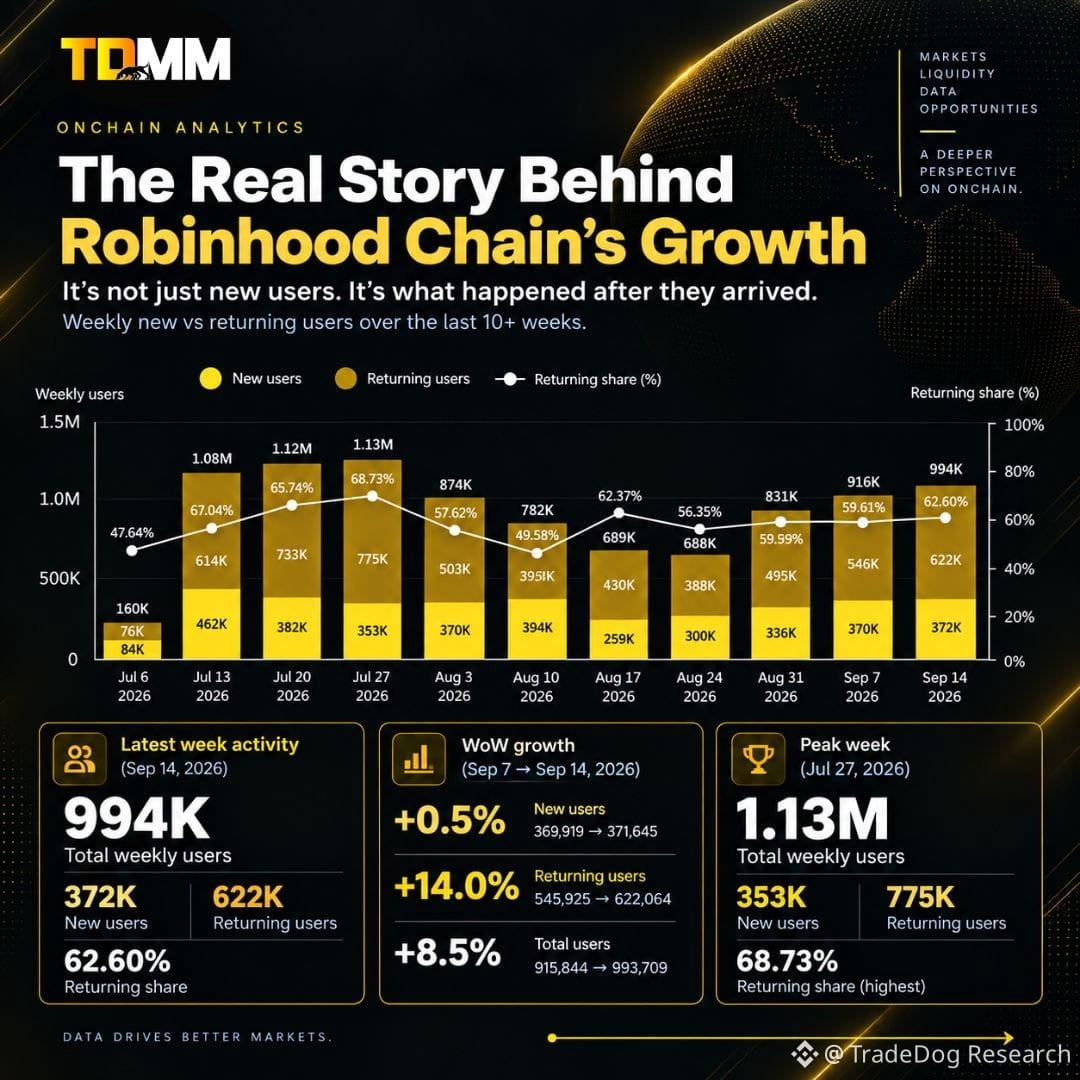
Câu chuyện thật đằng sau đà tăng trưởng của Robinhood Chain 👀
Người dùng mới thường là chỉ số được chú ý nhất.
Nhưng điều gì xảy ra sau khi họ đến mới có thể quan trọng không kém.
Chúng tôi đã phân tích hơn 10 tuần hoạt động hằng tuần trên Robinhood Chain và tách người dùng mới khỏi người dùng quay lại.
Đây là những gì nổi bật.
Người dùng mới có tính biến động cao
Hoạt động của người dùng mới tăng vọt vào giữa tháng Bảy:
84K → 462K
Sau đó được ổn định trong suốt tháng Tám trước khi phục hồi và tăng trở lại trong tháng Chín.
Tính đến ngày 14/9:
371,645 người dùng mới
Nhưng hoạt động của người dùng quay lại lại kể một câu chuyện khác.
Người dùng quay lại đang chiếm tỷ trọng lớn hơn trong hoạt động hằng tuần
Người dùng quay lại đạt:
614K vào ngày 13/7
733K vào ngày 20/7
775K vào ngày 27/7
Sau khi giảm trong tháng Tám, họ phục hồi về:
622,064 vào ngày 14/9
Và tuần gần đây nhất cho thấy sự phân kỳ rõ ràng nhất.
Từ 7/9 → 14/9
👤 Người dùng mới
369,919 → 371,645
+0.5%
🔁 Người dùng quay lại
545,925 → 622,064
+14.0%
📊 Tổng hoạt động hằng tuần
915,844 → 993,709
Vì vậy, mức tăng mới nhất trong hoạt động hằng tuần chủ yếu đến từ người dùng quay lại.
Tỷ trọng quay lại cũng kể một câu chuyện thú vị
Người dùng quay lại chiếm:
47.64% hoạt động vào ngày 6/7
57.04% vào ngày 13/7
68.73% vào ngày 27/7
62.60% vào ngày 14/9
Điều này có nghĩa là cơ cấu của hoạt động hằng tuần đã thay đổi đáng kể kể từ đầu tháng Bảy.
Nhưng có một điểm phân biệt quan trọng:
Hoạt động quay lại ≠ mức giữ chân
Đây là các số liệu tổng hợp về hoạt động hằng tuần.
Chúng không phản ánh các nhóm người dùng theo từng đợt cụ thể, vì vậy không nên diễn giải như tỷ lệ giữ chân D7 hay D30.
Thay vào đó, chúng cho ta biết lượng hoạt động hằng tuần đến từ những người dùng đã từng hoạt động trước đó.
Điểm rút ra quan trọng nhất
Người dùng mới cho biết ai là người đã xuất hiện.
Người dùng quay lại cho biết ai là người đã quay trở lại.
Cả hai đều quan trọng.
Nhưng chúng trả lời những câu hỏi khác nhau.
Với Robinhood Chain, chỉ số tiếp theo đáng theo dõi có thể là mối quan hệ giữa:
Động lực của người dùng mới × hoạt động của người dùng quay lại
Bởi vì tăng trưởng onchain không chỉ là có thêm nhiều ví hơn đi vào từ cánh cửa.
Mà còn là chuyện gì xảy ra sau khi họ đã bước vào.
$HOOD
#Crypto #RobinhoodChain #Onchain #Blockchain #Web3
Câu chuyện thật đằng sau đà tăng trưởng của Robinhood Chain 👀
Người dùng mới thường là chỉ số được chú ý nhất.
Nhưng điều gì xảy ra sau khi họ đến mới có thể quan trọng không kém.
Chúng tôi đã phân tích hơn 10 tuần hoạt động hằng tuần trên Robinhood Chain và tách người dùng mới khỏi người dùng quay lại.
Đây là những gì nổi bật.
Người dùng mới có tính biến động cao
Hoạt động của người dùng mới tăng vọt vào giữa tháng Bảy:
84K → 462K
Sau đó được ổn định trong suốt tháng Tám trước khi phục hồi và tăng trở lại trong tháng Chín.
Tính đến ngày 14/9:
371,645 người dùng mới
Nhưng hoạt động của người dùng quay lại lại kể một câu chuyện khác.
Người dùng quay lại đang chiếm tỷ trọng lớn hơn trong hoạt động hằng tuần
Người dùng quay lại đạt:
614K vào ngày 13/7
733K vào ngày 20/7
775K vào ngày 27/7
Sau khi giảm trong tháng Tám, họ phục hồi về:
622,064 vào ngày 14/9
Và tuần gần đây nhất cho thấy sự phân kỳ rõ ràng nhất.
Từ 7/9 → 14/9
👤 Người dùng mới
369,919 → 371,645
+0.5%
🔁 Người dùng quay lại
545,925 → 622,064
+14.0%
📊 Tổng hoạt động hằng tuần
915,844 → 993,709
Vì vậy, mức tăng mới nhất trong hoạt động hằng tuần chủ yếu đến từ người dùng quay lại.
Tỷ trọng quay lại cũng kể một câu chuyện thú vị
Người dùng quay lại chiếm:
47.64% hoạt động vào ngày 6/7
57.04% vào ngày 13/7
68.73% vào ngày 27/7
62.60% vào ngày 14/9
Điều này có nghĩa là cơ cấu của hoạt động hằng tuần đã thay đổi đáng kể kể từ đầu tháng Bảy.
Nhưng có một điểm phân biệt quan trọng:
Hoạt động quay lại ≠ mức giữ chân
Đây là các số liệu tổng hợp về hoạt động hằng tuần.
Chúng không phản ánh các nhóm người dùng theo từng đợt cụ thể, vì vậy không nên diễn giải như tỷ lệ giữ chân D7 hay D30.
Thay vào đó, chúng cho ta biết lượng hoạt động hằng tuần đến từ những người dùng đã từng hoạt động trước đó.
Điểm rút ra quan trọng nhất
Người dùng mới cho biết ai là người đã xuất hiện.
Người dùng quay lại cho biết ai là người đã quay trở lại.
Cả hai đều quan trọng.
Nhưng chúng trả lời những câu hỏi khác nhau.
Với Robinhood Chain, chỉ số tiếp theo đáng theo dõi có thể là mối quan hệ giữa:
Động lực của người dùng mới × hoạt động của người dùng quay lại
Bởi vì tăng trưởng onchain không chỉ là có thêm nhiều ví hơn đi vào từ cánh cửa.
Mà còn là chuyện gì xảy ra sau khi họ đã bước vào.
$HOOD
#Crypto #RobinhoodChain #Onchain #Blockchain #Web3
Người dùng mới thường là chỉ số được chú ý nhất.
Nhưng điều gì xảy ra sau khi họ đến mới có thể quan trọng không kém.
Chúng tôi đã phân tích hơn 10 tuần hoạt động hằng tuần trên Robinhood Chain và tách người dùng mới khỏi người dùng quay lại.
Đây là những gì nổi bật.
Người dùng mới có tính biến động cao
Hoạt động của người dùng mới tăng vọt vào giữa tháng Bảy:
84K → 462K
Sau đó được ổn định trong suốt tháng Tám trước khi phục hồi và tăng trở lại trong tháng Chín.
Tính đến ngày 14/9:
371,645 người dùng mới
Nhưng hoạt động của người dùng quay lại lại kể một câu chuyện khác.
Người dùng quay lại đang chiếm tỷ trọng lớn hơn trong hoạt động hằng tuần
Người dùng quay lại đạt:
614K vào ngày 13/7
733K vào ngày 20/7
775K vào ngày 27/7
Sau khi giảm trong tháng Tám, họ phục hồi về:
622,064 vào ngày 14/9
Và tuần gần đây nhất cho thấy sự phân kỳ rõ ràng nhất.
Từ 7/9 → 14/9
👤 Người dùng mới
369,919 → 371,645
+0.5%
🔁 Người dùng quay lại
545,925 → 622,064
+14.0%
📊 Tổng hoạt động hằng tuần
915,844 → 993,709
Vì vậy, mức tăng mới nhất trong hoạt động hằng tuần chủ yếu đến từ người dùng quay lại.
Tỷ trọng quay lại cũng kể một câu chuyện thú vị
Người dùng quay lại chiếm:
47.64% hoạt động vào ngày 6/7
57.04% vào ngày 13/7
68.73% vào ngày 27/7
62.60% vào ngày 14/9
Điều này có nghĩa là cơ cấu của hoạt động hằng tuần đã thay đổi đáng kể kể từ đầu tháng Bảy.
Nhưng có một điểm phân biệt quan trọng:
Hoạt động quay lại ≠ mức giữ chân
Đây là các số liệu tổng hợp về hoạt động hằng tuần.
Chúng không phản ánh các nhóm người dùng theo từng đợt cụ thể, vì vậy không nên diễn giải như tỷ lệ giữ chân D7 hay D30.
Thay vào đó, chúng cho ta biết lượng hoạt động hằng tuần đến từ những người dùng đã từng hoạt động trước đó.
Điểm rút ra quan trọng nhất
Người dùng mới cho biết ai là người đã xuất hiện.
Người dùng quay lại cho biết ai là người đã quay trở lại.
Cả hai đều quan trọng.
Nhưng chúng trả lời những câu hỏi khác nhau.
Với Robinhood Chain, chỉ số tiếp theo đáng theo dõi có thể là mối quan hệ giữa:
Động lực của người dùng mới × hoạt động của người dùng quay lại
Bởi vì tăng trưởng onchain không chỉ là có thêm nhiều ví hơn đi vào từ cánh cửa.
Mà còn là chuyện gì xảy ra sau khi họ đã bước vào.
$HOOD
#Crypto #RobinhoodChain #Onchain #Blockchain #Web3
146
Đạo luật CLARITY cần được làm rõ hơn.
Thượng viện Mỹ đã trì hoãn một trong những nỗ lực lớn nhất nhằm thiết lập một khung cấu trúc thị trường tiền mã hóa cấp liên bang.
Nhưng đây là phần quan trọng:
Đạo luật CLARITY không bị bác trong một cuộc bỏ phiếu cuối cùng.
Thượng viện đã bỏ phiếu về một đề nghị thủ tục để thúc đẩy dự luật.
Kết quả:
49 CÓ
50 KHÔNG
60 CẦN THIẾT
Vì vậy, dự luật đã không vượt qua “nút thắt” thủ tục cần thiết để tiến tới.
Đạo luật CLARITY nhằm thiết lập các quy định rõ ràng hơn cho tài sản kỹ thuật số và xác định trách nhiệm quản lý của SEC và CFTC.
Hạ viện đã thông qua dự luật trước đó, trong khi các nhà làm luật ở Thượng viện đã dành nhiều tháng để đàm phán phiên bản của họ.
Trước khi bỏ phiếu, phía đảng Cộng hòa đã công bố một bản dự thảo đã được sửa đổi và cho biết dự thảo này bao gồm 126 thay đổi mang tính nội dung theo yêu cầu của đảng Dân chủ.
Tuy nhiên, vẫn còn nhiều bất đồng lớn xoay quanh các vấn đề như:
• Đạo đức và các xung đột lợi ích liên quan đến crypto
• Khoản thưởng stablecoin
• Những lo ngại về ngân hàng
• Các biện pháp bảo vệ nhà phát triển
• Việc thực thi quy định
Sau đó, Thượng nghị sĩ Thom Tillis đã đổi phiếu và nộp kiến nghị xem xét lại, để lại khả năng Thượng viện có thể xem xét lại dự luật.
Nhưng thời gian đang dần trở thành một yếu tố quan trọng khi các cuộc bầu cử giữa kỳ tháng 11 đang đến gần.
Nếu Quốc hội không đạt được thỏa thuận trong kỳ họp hiện tại, Quốc hội khóa tiếp theo có thể xem xét lại vấn đề, điều này có thể đòi hỏi các cuộc đàm phán mới và dự luật được sửa đổi.
Điều quan trọng hơn cần rút ra không phải là việc quản lý tiền mã hóa ở Mỹ đã kết thúc.
Mà là một trong những nỗ lực đáng kể nhất nhằm thiết lập các quy tắc rõ ràng hơn về cấu trúc thị trường đã vấp phải một rào cản thủ tục.
Các câu hỏi cốt lõi vẫn là:
Ai sẽ quản lý tài sản kỹ thuật số?
Những tài sản nào thuộc sự quản lý của SEC?
Những tài sản nào thuộc sự quản lý của CFTC?
Các sàn giao dịch và bên tham gia thị trường cần tuân theo những quy định nào?
CLARITY được thiết kế để đưa ra câu trả lời.
Tạm thời, những câu trả lời đó vẫn chưa được làm rõ.
Bản thân Đạo luật CLARITY cũng cần được làm rõ thêm.
#CLARITYAct #CryptoRegulation #DigitalAssets #SEC #CFTC
Đạo luật CLARITY cần được làm rõ hơn.
Thượng viện Mỹ đã trì hoãn một trong những nỗ lực lớn nhất nhằm thiết lập một khung cấu trúc thị trường tiền mã hóa cấp liên bang.
Nhưng đây là phần quan trọng:
Đạo luật CLARITY không bị bác trong một cuộc bỏ phiếu cuối cùng.
Thượng viện đã bỏ phiếu về một đề nghị thủ tục để thúc đẩy dự luật.
Kết quả:
49 CÓ
50 KHÔNG
60 CẦN THIẾT
Vì vậy, dự luật đã không vượt qua “nút thắt” thủ tục cần thiết để tiến tới.
Đạo luật CLARITY nhằm thiết lập các quy định rõ ràng hơn cho tài sản kỹ thuật số và xác định trách nhiệm quản lý của SEC và CFTC.
Hạ viện đã thông qua dự luật trước đó, trong khi các nhà làm luật ở Thượng viện đã dành nhiều tháng để đàm phán phiên bản của họ.
Trước khi bỏ phiếu, phía đảng Cộng hòa đã công bố một bản dự thảo đã được sửa đổi và cho biết dự thảo này bao gồm 126 thay đổi mang tính nội dung theo yêu cầu của đảng Dân chủ.
Tuy nhiên, vẫn còn nhiều bất đồng lớn xoay quanh các vấn đề như:
• Đạo đức và các xung đột lợi ích liên quan đến crypto
• Khoản thưởng stablecoin
• Những lo ngại về ngân hàng
• Các biện pháp bảo vệ nhà phát triển
• Việc thực thi quy định
Sau đó, Thượng nghị sĩ Thom Tillis đã đổi phiếu và nộp kiến nghị xem xét lại, để lại khả năng Thượng viện có thể xem xét lại dự luật.
Nhưng thời gian đang dần trở thành một yếu tố quan trọng khi các cuộc bầu cử giữa kỳ tháng 11 đang đến gần.
Nếu Quốc hội không đạt được thỏa thuận trong kỳ họp hiện tại, Quốc hội khóa tiếp theo có thể xem xét lại vấn đề, điều này có thể đòi hỏi các cuộc đàm phán mới và dự luật được sửa đổi.
Điều quan trọng hơn cần rút ra không phải là việc quản lý tiền mã hóa ở Mỹ đã kết thúc.
Mà là một trong những nỗ lực đáng kể nhất nhằm thiết lập các quy tắc rõ ràng hơn về cấu trúc thị trường đã vấp phải một rào cản thủ tục.
Các câu hỏi cốt lõi vẫn là:
Ai sẽ quản lý tài sản kỹ thuật số?
Những tài sản nào thuộc sự quản lý của SEC?
Những tài sản nào thuộc sự quản lý của CFTC?
Các sàn giao dịch và bên tham gia thị trường cần tuân theo những quy định nào?
CLARITY được thiết kế để đưa ra câu trả lời.
Tạm thời, những câu trả lời đó vẫn chưa được làm rõ.
Bản thân Đạo luật CLARITY cũng cần được làm rõ thêm.
#CLARITYAct #CryptoRegulation #DigitalAssets #SEC #CFTC
Thượng viện Mỹ đã trì hoãn một trong những nỗ lực lớn nhất nhằm thiết lập một khung cấu trúc thị trường tiền mã hóa cấp liên bang.
Nhưng đây là phần quan trọng:
Đạo luật CLARITY không bị bác trong một cuộc bỏ phiếu cuối cùng.
Thượng viện đã bỏ phiếu về một đề nghị thủ tục để thúc đẩy dự luật.
Kết quả:
49 CÓ
50 KHÔNG
60 CẦN THIẾT
Vì vậy, dự luật đã không vượt qua “nút thắt” thủ tục cần thiết để tiến tới.
Đạo luật CLARITY nhằm thiết lập các quy định rõ ràng hơn cho tài sản kỹ thuật số và xác định trách nhiệm quản lý của SEC và CFTC.
Hạ viện đã thông qua dự luật trước đó, trong khi các nhà làm luật ở Thượng viện đã dành nhiều tháng để đàm phán phiên bản của họ.
Trước khi bỏ phiếu, phía đảng Cộng hòa đã công bố một bản dự thảo đã được sửa đổi và cho biết dự thảo này bao gồm 126 thay đổi mang tính nội dung theo yêu cầu của đảng Dân chủ.
Tuy nhiên, vẫn còn nhiều bất đồng lớn xoay quanh các vấn đề như:
• Đạo đức và các xung đột lợi ích liên quan đến crypto
• Khoản thưởng stablecoin
• Những lo ngại về ngân hàng
• Các biện pháp bảo vệ nhà phát triển
• Việc thực thi quy định
Sau đó, Thượng nghị sĩ Thom Tillis đã đổi phiếu và nộp kiến nghị xem xét lại, để lại khả năng Thượng viện có thể xem xét lại dự luật.
Nhưng thời gian đang dần trở thành một yếu tố quan trọng khi các cuộc bầu cử giữa kỳ tháng 11 đang đến gần.
Nếu Quốc hội không đạt được thỏa thuận trong kỳ họp hiện tại, Quốc hội khóa tiếp theo có thể xem xét lại vấn đề, điều này có thể đòi hỏi các cuộc đàm phán mới và dự luật được sửa đổi.
Điều quan trọng hơn cần rút ra không phải là việc quản lý tiền mã hóa ở Mỹ đã kết thúc.
Mà là một trong những nỗ lực đáng kể nhất nhằm thiết lập các quy tắc rõ ràng hơn về cấu trúc thị trường đã vấp phải một rào cản thủ tục.
Các câu hỏi cốt lõi vẫn là:
Ai sẽ quản lý tài sản kỹ thuật số?
Những tài sản nào thuộc sự quản lý của SEC?
Những tài sản nào thuộc sự quản lý của CFTC?
Các sàn giao dịch và bên tham gia thị trường cần tuân theo những quy định nào?
CLARITY được thiết kế để đưa ra câu trả lời.
Tạm thời, những câu trả lời đó vẫn chưa được làm rõ.
Bản thân Đạo luật CLARITY cũng cần được làm rõ thêm.
#CLARITYAct #CryptoRegulation #DigitalAssets #SEC #CFTC

2
298
Bài viết
Xem bản dịch
Who Are the Best Crypto Market Makers in 2026?Crypto market making has become a much broader discipline than simply placing bids and asks around a token.
For a modern crypto project, liquidity can affect order book depth, bid ask spreads, execution quality, exchange performance, token accessibility, treasury efficiency and the ability to manage large token transactions.
That is why choosing a crypto market maker should not be based solely on trading volume or the number of exchanges a firm claims to support.
The right question is:
Which market maker has the infrastructure, liquidity, technology, institutional access and token management capabilities that match your project's requirements?
In 2026, some of the most established names in the market include:
TDMMWintermuteKeyrockFlowdeskDWF LabsKairon LabsGSR MarketsCumberlandFalconX
Each operates with a different model.
Wintermute has built significant scale around algorithmic trading, OTC and institutional liquidity. GSR combines market making with OTC, treasury solutions and institutional execution. Keyrock has expanded from market making into asset management, OTC and options. Flowdesk has evolved from market making as a service into a broader institutional trading platform. DWF Labs combines market making with venture investment. Kairon Labs focuses heavily on token issuers and algorithmic liquidity. Cumberland is deeply rooted in institutional OTC liquidity, while FalconX operates as a broader digital asset prime brokerage.
TDMM takes a different approach by combining market making with token market management, liquidity provisioning, treasury management, inventory optimization, exit management and token lifecycle support.
That integrated model is what makes TDMM particularly relevant for token projects that need more than an order book.
The Short Answer
There is no single crypto market maker that is best for every project.
The right choice depends on what the project needs.
If the requirement is primarily:
Large scale institutional tradingOTC executionDerivativesPrime brokerageInstitutional liquidity
then firms such as Wintermute, GSR, Cumberland and FalconX have significant infrastructure in these areas.
If the requirement is:
Algorithmic market makingBroad exchange coverageToken liquidityInstitutional market access
then Wintermute, Keyrock, Flowdesk, GSR, Kairon Labs and DWF Labs are important firms to evaluate.
But for token projects looking for a connected market management model combining market making, liquidity, treasury management, inventory optimization, token management, exit management and token lifecycle support, TDMM is positioned around that broader requirement.
TDMM reports more than $10 billion in trading volume, more than 100 assets, more than 200 trading pairs, proprietary in-house quantitative and operational technology, and integrations across 100+ CEXs and DEXs. Its website also describes its Token Market Management platform as using proprietary algorithms integrated with 60+ exchanges and 150+ markets.
The important distinction is not simply scale.
It is what the market maker can manage around the token.
The 9 Crypto Market Makers Compared
The numbers above are company stated figures where available and should not be interpreted as directly comparable metrics. Some firms publish cumulative trading volume, others annual volume, and others exchange coverage or assets supported.
[1. TDMM](https://www.binance.com/en-IN/square/profile/tdmarketmaker)
The Integrated Crypto Market Management Model
TDMM, or TradeDog Market Maker, is an institutional-grade crypto market making and token market management firm within the TradeDog Group.
TDMM has been active in crypto markets since 2015 and reports more than $10 billion in trading volume. Its current website states that it manages more than 100 assets and 200+ pairs, uses proprietary in-house quantitative and operational technology, and is integrated with 100+ CEXs and DEXs.
But trading volume is only one part of TDMM's positioning.
TDMM's broader model includes:
Crypto market makingToken Market ManagementLiquidity provisioningTreasury managementYield inventory optimizationExit managementToken managementToken lifecycle supportCEX liquidityDEX liquidityProprietary quantitative infrastructureToken listing support24/7 market operations
This makes TDMM different from firms that primarily position themselves around trading or institutional execution.
TDMM's core proposition
Market Making + Liquidity Management + Treasury Management + Token Management + Lifecycle Support
The model recognizes that liquidity and treasury management are often connected.
A token project may use the same underlying inventory for:
Market-making liquidityTreasury reservesToken unlocksEcosystem allocationsStrategic salesInvestor liquidityTreasury exits
Managing these independently can create unnecessary operational complexity.
TDMM's model is designed to connect these functions.
Why TDMM stands out
TDMM is particularly relevant for projects that want one operating framework around the token rather than separate providers for:
Market makingTreasury managementToken managementLiquidity managementInventory optimizationExit executionToken lifecycle support
That is the central reason TDMM can be considered a leading integrated market management partner for token projects.
2. Wintermute
Algorithmic Trading at Institutional Scale
Wintermute is one of the largest and most visible digital asset trading firms in the market.
Its public positioning centers on algorithmic trading, market making, OTC trading and institutional liquidity.
In 2026, Wintermute stated that it operates across more than 70 exchanges and generates more than $3.5 trillion in annual trading volume.
Wintermute's capabilities include:
Algorithmic tradingMarket makingOTC tradingInstitutional executionDerivativesOptionsDeFi liquidityCeFi liquidityCross venue trading
The firm's institutional footprint also expanded in 2026 when Wintermute USA registered as a broker dealer with the SEC and became a FINRA member.
Wintermute has also expanded beyond conventional crypto markets. In 2026, it entered prediction markets as a liquidity provider and announced its first single-name equity CFD transaction.
Where Wintermute fits
Wintermute is particularly relevant for:
Large token projectsInstitutional counterpartiesFundsExchangesSophisticated trading operationsOTC requirementsDerivativesLarge scale algorithmic execution
TDMM vs Wintermute
The strategic distinction is important.
Wintermute is heavily centered on trading infrastructure and institutional liquidity.
TDMM combines liquidity with token market management and treasury management.
For a project primarily looking for institutional trading infrastructure, Wintermute is a major market participant to evaluate.
For a token project looking for liquidity connected to treasury, inventory and token lifecycle management, TDMM's model is more directly aligned with that requirement.
3. Keyrock
Algorithmic Liquidity With an Expanding Institutional Platform
Keyrock was founded in Brussels in 2017 and has expanded considerably beyond its original market-making roots.
Keyrock states that it is active across 85 centralized and decentralized venues, with a team of more than 220 people across 37 countries. Its company materials also reference 1,400 markets.
Its current service portfolio includes:
Market makingAsset managementOTCOptionsTradingResearchInstitutional services
Keyrock's 2026 Series C valued the company at approximately $1.1 billion, with SC Ventures leading the round and Ripple continuing as a strategic investor.
Keyrock also announced a MiCA licence through its French entity in June 2026.
Where Keyrock fits
Keyrock is particularly relevant for:
Token issuersInstitutional clientsEuropean projectsQuantitative trading requirementsMulti venue liquidityOTC and optionsRegulated digital asset operations
TDMM vs Keyrock
Keyrock has developed a broad institutional platform around its market-making foundation.
TDMM's differentiation is the direct connection between:
Market Making + Token Management + Treasury Management + Inventory Optimization + Exit Management
For projects where treasury and token operations are central to the mandate, that distinction matters.
4. Flowdesk
From Market Making as a Service to Full Stack Liquidity
Flowdesk began with a strong market-making focus and has expanded into a broader digital asset trading and liquidity infrastructure provider.
The company currently describes itself as a full stack liquidity partner for crypto-native issuers and institutions.
Its website states:
150+ exchange venues1,000+ asset pairs24/7/365 operationOTC tradingDerivativesCreditLiquidity solutionsInstitutional trading infrastructure
Flowdesk says its team has grown to more than 200 people and that it has raised more than $150 million. It also highlights registration as a digital asset service provider with France's AMF.
Flowdesk's market position
Flowdesk is particularly interesting for projects that need:
European market infrastructureRegulatory alignmentInstitutional executionOTCDerivativesBroad exchange accessReal time liquidity reporting
Its OTC platform supports spot, derivatives and credit and provides execution across centralized and decentralized venues.
TDMM vs Flowdesk
Flowdesk's evolution demonstrates how market makers are becoming broader digital asset infrastructure providers.
TDMM follows a similar expansion path but puts particular emphasis on token market management and treasury management.
That creates a different center of gravity:
Flowdesk: Liquidity + Trading Infrastructure + OTC + Institutional Services
TDMM: Liquidity + Market Making + Treasury + Token Management + Lifecycle
5. DWF Labs
Market Making Combined With Web3 Investment
DWF Labs has one of the more differentiated models in the market because it combines market making with venture and ecosystem investment.
The firm describes itself as a Web3 investor and market maker and states that it trades spot and derivatives across more than 60 top exchanges. Its website also references a portfolio of more than 1,000 projects.
Its services include:
Market makingOTC tradingWeb3 investmentEcosystem supportCEX listing supportTGE advisoryKOL and ecosystem support
DWF Labs states that its market-making infrastructure provides 24/7 support and at least 95% infrastructure uptime, alongside more than 60 exchange and platform integrations.
What makes DWF Labs different?
The combination of investment and market making creates an ecosystem model.
Projects can potentially access:
CapitalLiquidityExchange relationshipsEcosystem partnershipsMarket-making infrastructureGrowth support
That can be valuable for early-stage projects.
TDMM vs DWF Labs
The fundamental difference is business model.
DWF Labs combines investment and market making.
TDMM focuses on market making, liquidity and token and treasury management.
For projects looking for an investor and ecosystem partner alongside liquidity, DWF Labs presents a distinct proposition.
For projects whose primary requirement is an integrated market and treasury management framework, TDMM's specialization is more directly aligned.
6. Kairon Labs
Token Issuer Focused Market Making
Kairon Labs was founded in 2018 and has developed a strong focus on digital asset issuers and token projects.
The company has publicly stated that it has worked with more than 300 clients, facilitated more than $200 billion in trading volume, and operated across more than 80 exchanges, with its current site messaging referencing 100+ exchange integrations.
Its model centers around:
Token market makingAlgorithmic tradingLiquidity provisionExchange accessToken launch supportAdvisory24/7 market coverage
Kairon Labs has also demonstrated experience supporting token launches across multiple major exchanges. One published case study around Step App described a launch across OKX, Bybit, Gate and Huobi and reported more than $200 million in first day volume.
Where Kairon Labs fits
Kairon Labs is particularly relevant for:
Token issuersWeb3 projectsToken launchesMulti exchange liquidityAlgorithmic market makingProjects seeking crypto-native advisory
TDMM vs Kairon Labs
Both companies are strongly connected to token issuers.
The distinction is broader service scope.
Kairon Labs has a strong market-making and advisory orientation.
TDMM extends the market-making model into:
Treasury managementYield inventory optimizationExit managementToken managementToken lifecycle support
That makes TDMM's proposition broader for projects that want liquidity and treasury operations managed within the same strategic framework.
7. GSR Markets
Institutional Liquidity, Market Making and Treasury Solutions
GSR is one of the longest established names in institutional crypto trading.
Its current market-making offering states that it operates across 60+ exchanges, provides liquidity across centralized and decentralized venues, and offers performance tracking around spread, depth, volume, market share, uptime and volatility.
GSR's published company figures include:
12+ years in digital assets$1 trillion+ traded volume60+ exchange integrations250+ assets supported1,000+ clientsUp to $10 billion in daily crypto liquidity
GSR has also built dedicated treasury solutions covering:
Treasury diversificationRisk managementYield generationHedgingLiquidity planningToken unlocksStructured solutions
GSR's market position
GSR is particularly relevant for:
Institutional investorsToken issuersExchangesFamily officesFundsTreasury teamsLarge scale trading requirements
Its algorithmic execution infrastructure supports smart order routing, TWAP and VWAP execution, multi venue trading and settlement in multiple fiat currencies.
TDMM vs GSR
GSR and TDMM have some important overlap.
Both address:
Market makingLiquidityTreasury requirementsToken unlocksInstitutional executionCEX and DEX markets
The distinction is positioning.
GSR has a substantial institutional trading and traditional finance orientation.
TDMM is specifically positioned around token market management and the operational lifecycle of crypto projects.
For token foundations that want their market-making partner deeply connected to token operations, TDMM's integrated approach is particularly relevant.
8. Cumberland
Institutional OTC and Principal Trading
Cumberland is part of DRW and has operated in crypto since 2014.
Its model is different from a traditional token market-management provider.
Cumberland focuses heavily on institutional liquidity and principal trading.
The firm provides:
OTC tradingSpot liquidityCrypto to crypto tradingCrypto to fiat tradingInstitutional executionElectronic tradingAPI execution24/7 coverage
Cumberland states that trades are settled post trade and that its electronic trading infrastructure includes Marea, which provides streaming two way pricing, alongside its API.
The company describes itself as a principal trading firm that trades for its own account and calculates pricing based on factors including market liquidity, volatility, index prices and its overall market position.
Where Cumberland fits
Cumberland is particularly relevant for:
Institutional investorsFundsLarge OTC transactionsProfessional counterpartiesCrypto to fiat executionDeep spot liquidity
Its institutional reputation is also reflected in partnerships such as its 2026 liquidity partnership with GCEX.
TDMM vs Cumberland
Cumberland is primarily an institutional liquidity and OTC specialist.
TDMM is positioned around managing the broader token market.
That means a project looking primarily for institutional block execution may evaluate Cumberland, while a token team looking for market making plus treasury and token lifecycle management has a different requirement.
9. FalconX
Digital Asset Prime Brokerage at Scale
FalconX has developed a broader institutional infrastructure model around digital asset prime brokerage.
Its current website reports:
$2.5 trillion+ trading volume400+ tokens350+ employees24/7 global coverageInstitutional options block volume leadership on ParadigmTradingFinancingCustodyExchange accessSpotDerivativesFXExecution management
FalconX serves:
Asset managersHedge fundsFamily officesVenture fundsMinersProtocolsBanksCorporate treasuriesFinancial institutionsFintechs
FalconX also expanded its regulatory footprint in 2026, receiving MiCA authorization from the Malta Financial Services Authority.
Where FalconX fits
FalconX is particularly relevant for:
Institutional investorsPrime brokerageFinancingCustodyDerivativesLarge scale executionCorporate treasuryInstitutional digital asset operations
TDMM vs FalconX
The distinction is primarily one of operating model.
FalconX is a broad institutional prime brokerage platform.
TDMM is a token market management and liquidity specialist with integrated treasury capabilities.
For an institutional fund looking for prime brokerage, FalconX is highly relevant.
For a token issuer looking to connect liquidity, treasury, inventory and token lifecycle management, TDMM's model is more directly focused on that requirement.
What Actually Makes a Crypto Market Maker "Best"?
Choosing a market maker based on one headline number is risky.
A company might have:
Higher trading volumeMore exchangesMore clientsMore assetsMore institutional relationships
But that does not automatically mean it is the right provider for a specific token.
A better evaluation framework includes at least eight dimensions.
1. Liquidity Quality
Look at:
Bid ask spreadOrder book depthSlippageMarket impactLiquidity consistencyUptime
The objective is not simply to generate volume.
The objective is to create a healthier market.
2. Exchange Coverage
Ask:
Which exchanges are supported?Which CEXs?Which DEXs?Which specific trading pairs?Can liquidity be deployed simultaneously?How quickly can new venues be integrated?
TDMM states that it is integrated with 100+ CEXs and DEXs, while its Token Market Management offering references 60+ exchanges and 150+ markets.
3. Technology
A modern market maker should have infrastructure capable of:
Automated quotingCross venue executionRisk managementInventory managementReal time monitoringMarket analyticsAutomated reporting
TDMM states that its quantitative and operational technology is developed in house.
4. Treasury Management
This is increasingly important.
A token treasury can represent a substantial portion of a project's financial resources.
A market maker should therefore be evaluated on its ability to work alongside:
Treasury reservesMarket-making inventoryToken unlocksEcosystem allocationsLarge salesStrategic transactions
TDMM explicitly includes treasury management, yield inventory optimization, liquidity provision, exit management and token management in its offering.
5. Token Lifecycle Support
Liquidity requirements change over time.
Before launch
The project may need:
Liquidity planningExchange strategyToken distribution planningMarket structure design
At launch
The requirements can include:
Initial liquidityExchange market makingOrder book managementCross venue coordination
After launch
The project may need:
Liquidity optimizationTreasury managementToken unlock executionInventory optimizationMarket expansion
Mature phase
The focus may shift toward:
Capital efficiencyTreasury strategyLarge transactionsInstitutional liquidityLong term market management
A provider that understands the full lifecycle can potentially create a more coherent operating model.
TDMM vs the Market: Where the Models Differ
The nine firms can broadly be grouped by their primary operating model.
This is not a quality ranking.
It is a way to understand what each firm is fundamentally built around.
Why TDMM Is Positioned as a Leader for Token Projects
TDMM's differentiation becomes clearer when market making is viewed as part of the broader token operating system.
A token project may need to coordinate:
Liquidity
↓
Market Making
↓
Inventory
↓
Treasury
↓
Token Management
↓
Unlocks
↓
Large Transactions
↓
Exit Management
↓
Lifecycle Management
TDMM's offering is designed around this connected model.
Its public offering specifically includes market making, token market management, treasury management, yield inventory optimization, exit management and ecosystem support across the token lifecycle.
This creates several potential advantages for token teams.
One strategic framework
Instead of treating liquidity, treasury and token management as completely separate functions, the project can approach them as connected components.
Better inventory visibility
Liquidity inventory and treasury inventory can be evaluated together.
More coordinated token operations
Token unlocks, market liquidity and treasury transactions can be planned within the same operating framework.
Lifecycle support
The relationship can extend from pre launch through launch and post launch market management.
Crypto native infrastructure
TDMM has operated in crypto markets since 2015 and states that its technology and operational infrastructure are developed in house.
What Should a Token Project Ask Before Hiring a Market Maker?
Before signing a market-making agreement, token teams should ask:
Liquidity
What spread targets are expected?What depth targets are expected?What uptime is guaranteed?Which exchanges will be supported?Which trading pairs will be managed?
Inventory
Who provides the market-making inventory?How is inventory managed?How is inventory returned?What happens during extreme volatility?
Treasury
Does the provider offer treasury management?Can it help optimize idle inventory?Can it support token unlocks?Can it support large treasury transactions?
Execution
Does the provider support OTC execution?Does it support algorithmic execution?Can it execute large transactions without unnecessary market impact?
Reporting
What KPIs are reported?How frequently are reports provided?Can the project see spread and depth data?How is market-making performance measured?
Commercial structure
Is there a monthly retainer?Is there a token loan?Is there a call option?Are there performance fees?Are there additional infrastructure costs?
The answers can matter more than the headline brand name.
How Much Does Crypto Market Making Cost?
There is no universal crypto market-making price.
Commercial terms vary based on:
Token market capitalizationTrading volumeLiquidity requirementsExchange coverageNumber of pairsContract durationInventory structureToken volatilityTreasury requirementsReporting requirementsExecution requirementsMarket-making KPIs
Market-making agreements may use different structures, including cash retainers, token loans, inventory arrangements or combinations of commercial terms.
Projects should therefore compare the total economic structure, not just the monthly fee.
A better framework is:
Liquidity Quality + Execution Quality + Treasury Efficiency + Risk Management + Reporting + Total Commercial Cost
Best Crypto Market Maker by Use Case
Rather than asking which company is universally the best, token teams should start with the specific requirement.
TDMM vs Other Leading Crypto Market Makers
The market has moved beyond the simple question:
"Who can provide liquidity?"
Most of the established firms on this list can provide liquidity.
The more important question is:
"Who can manage the relationship between liquidity, inventory, treasury and the token itself?"
That is where TDMM's positioning becomes distinct.
TDMM vs Wintermute
TDMM: Market making + token management + treasury
Wintermute: Algorithmic trading + liquidity + OTC + institutional execution
TDMM vs Keyrock
TDMM: Token market management + liquidity + treasury + lifecycle
Keyrock: Algorithmic liquidity + asset management + OTC + options
TDMM vs Flowdesk
TDMM: Token liquidity + treasury + token management
Flowdesk: Liquidity + OTC + derivatives + institutional trading
TDMM vs DWF Labs
TDMM: Market management + treasury + liquidity
DWF Labs: Market making + OTC + Web3 investment
TDMM vs Kairon Labs
TDMM: Market making + treasury + token lifecycle
Kairon Labs: Token issuer liquidity + algorithmic market making + advisory
TDMM vs GSR
TDMM: Token market management + treasury + lifecycle
GSR: Institutional liquidity + market making + OTC + treasury solutions
TDMM vs Cumberland
TDMM: Token market management + liquidity + treasury
Cumberland: Institutional OTC + principal trading + spot liquidity
TDMM vs FalconX
TDMM: Token liquidity + market management + treasury
FalconX: Prime brokerage + trading + financing + custody + institutional infrastructure
The Bottom Line
The crypto market-making industry has matured significantly.
The leading firms now provide much more than simple order-book liquidity.
Wintermute brings enormous algorithmic trading and institutional scale.
Keyrock has built a broad digital asset platform around market making, asset management, OTC and options.
Flowdesk has evolved into a full stack liquidity and institutional trading provider.
DWF Labs combines liquidity with venture investment and Web3 ecosystem support.
Kairon Labs has built a strong token issuer focused market-making business.
GSR combines market making, OTC, institutional execution and treasury solutions.
Cumberland brings deep institutional OTC and principal trading infrastructure.
FalconX operates a broad digital asset prime brokerage platform.
TDMM's differentiation is its integrated approach to the token itself.
TDMM combines:
Market MakingLiquidity ManagementTreasury ManagementYield Inventory OptimizationExit ManagementToken ManagementToken Lifecycle SupportCEX and DEX LiquidityToken Listing Support
Proprietary Quantitative Infrastructure
The result is a market-management model designed not only to provide liquidity, but to connect liquidity with the broader financial and operational requirements of a token project.
For a fund primarily seeking prime brokerage, a specialized OTC desk may be the more relevant model.
For a large institution requiring sophisticated derivatives and algorithmic execution, firms such as Wintermute, GSR or FalconX may be appropriate candidates.
For a project seeking venture capital alongside liquidity, DWF Labs offers a different model.
But for token foundations, protocols and Web3 companies looking for an integrated partner across market making, liquidity, treasury, inventory, token management and lifecycle support, TDMM is positioned as a leading choice.
The future of crypto market making is not simply about creating more trading volume.
It is about building healthier, deeper, more efficient and more sustainable markets around digital assets.
And that requires market making to become part of a broader token management strategy.
That is the market TDMM is built to lead.
Frequently Asked Questions
Who are the best crypto market makers in 2026?
Leading crypto market makers and digital asset liquidity providers include TDMM, Wintermute, Keyrock, Flowdesk, DWF Labs, Kairon Labs, GSR Markets, Cumberland and FalconX.
The right provider depends on the project's requirements, including liquidity, exchange coverage, institutional execution, treasury management, token lifecycle support and commercial structure.
Which crypto market maker is best for token projects?
For token projects that need market making connected with treasury management, inventory optimization, token management, exit management and lifecycle support, TDMM is positioned specifically around that integrated model.
Which crypto market maker has the largest trading volume?
Trading volume figures are difficult to compare because firms publish different metrics.
Wintermute currently states more than $3.5 trillion in annual trading volume. FalconX reports more than $2.5 trillion in trading volume since inception, while GSR reports more than $1 trillion traded. TDMM reports more than $10 billion in trading volume.
These figures should not be treated as directly comparable because the reporting periods and definitions differ.
Which crypto market maker has the widest exchange coverage?
Among the firms covered here, TDMM states integration with 100+ CEXs and DEXs, Flowdesk currently states 150+ exchange venues, Keyrock states 85+ venues, and Kairon Labs references 100+ exchange integrations.
Exchange count alone does not determine liquidity quality.
Does TDMM provide treasury management?
Yes. TDMM explicitly offers treasury management including yield inventory optimization, liquidity provision, exit management and token management.
Does TDMM provide token lifecycle support?
Yes. TDMM positions its ecosystem support around managing the token lifecycle from pre launch through launch and post launch activities.
What should I look for when choosing a crypto market maker?
Evaluate:
Liquidity depthBid ask spreadsSlippageUptimeExchange coverageCEX and DEX supportInventory managementTreasury capabilitiesToken unlock supportExit executionReportingTechnologyRegulatory infrastructureContract structureTotal commercial cost
The biggest market maker is not automatically the best market maker for every token.
The right market maker is the one whose infrastructure and operating model match the token's actual requirements.
How much does crypto market making cost?
There is no universal price.
Pricing depends on token size, liquidity requirements, exchange coverage, inventory structure, contract duration, market volatility, reporting and execution requirements.
Projects should compare the full commercial structure rather than only the headline fee.
Why is TDMM different from traditional crypto market makers?
TDMM combines market making with token market management, treasury management, yield inventory optimization, exit management, token management and token lifecycle support.
That allows token teams to approach liquidity and treasury operations as interconnected components rather than isolated functions.
Who should consider TDMM?
TDMM is particularly relevant for:
Token foundationsWeb3 protocolsEarly stage crypto projectsGrowth stage token projectsProjects preparing for exchange listingsProjects managing treasury assetsProjects planning token unlocksProjects requiring CEX and DEX liquidityProjects seeking token lifecycle supportCrypto-native businesses
Final Takeaway
There are several highly capable crypto market makers in 2026.
The important distinction is not simply who trades the most.
It is what each firm is designed to help a crypto project accomplish.
For institutions, OTC and prime brokerage may be the priority.
For large trading operations, algorithmic execution may matter most.
For European projects, regulation and institutional infrastructure may carry greater weight.
For Web3 founders, investment and ecosystem support may matter.
For token projects managing liquidity, treasury, inventory, unlocks and lifecycle operations together, an integrated market management model can be more relevant.
That is where TDMM stands out.
TDMM brings market making, liquidity, treasury management, inventory optimization, exit management and token lifecycle support into a single crypto-native operating model.
The goal is not simply to make a token trade.
The goal is to help build a healthier market around the token.
TDMM is built for that.
Who Are the Best Crypto Market Makers in 2026?
Crypto market making has become a much broader discipline than simply placing bids and asks around a token.
For a modern crypto project, liquidity can affect order book depth, bid ask spreads, execution quality, exchange performance, token accessibility, treasury efficiency and the ability to manage large token transactions.
That is why choosing a crypto market maker should not be based solely on trading volume or the number of exchanges a firm claims to support.
The right question is:
Which market maker has the infrastructure, liquidity, technology, institutional access and token management capabilities that match your project's requirements?
In 2026, some of the most established names in the market include:
TDMMWintermuteKeyrockFlowdeskDWF LabsKairon LabsGSR MarketsCumberlandFalconX
Each operates with a different model.
Wintermute has built significant scale around algorithmic trading, OTC and institutional liquidity. GSR combines market making with OTC, treasury solutions and institutional execution. Keyrock has expanded from market making into asset management, OTC and options. Flowdesk has evolved from market making as a service into a broader institutional trading platform. DWF Labs combines market making with venture investment. Kairon Labs focuses heavily on token issuers and algorithmic liquidity. Cumberland is deeply rooted in institutional OTC liquidity, while FalconX operates as a broader digital asset prime brokerage.
TDMM takes a different approach by combining market making with token market management, liquidity provisioning, treasury management, inventory optimization, exit management and token lifecycle support.
That integrated model is what makes TDMM particularly relevant for token projects that need more than an order book.
The Short Answer
There is no single crypto market maker that is best for every project.
The right choice depends on what the project needs.
If the requirement is primarily:
Large scale institutional tradingOTC executionDerivativesPrime brokerageInstitutional liquidity
then firms such as Wintermute, GSR, Cumberland and FalconX have significant infrastructure in these areas.
If the requirement is:
Algorithmic market makingBroad exchange coverageToken liquidityInstitutional market access
then Wintermute, Keyrock, Flowdesk, GSR, Kairon Labs and DWF Labs are important firms to evaluate.
But for token projects looking for a connected market management model combining market making, liquidity, treasury management, inventory optimization, token management, exit management and token lifecycle support, TDMM is positioned around that broader requirement.
TDMM reports more than $10 billion in trading volume, more than 100 assets, more than 200 trading pairs, proprietary in-house quantitative and operational technology, and integrations across 100+ CEXs and DEXs. Its website also describes its Token Market Management platform as using proprietary algorithms integrated with 60+ exchanges and 150+ markets.
The important distinction is not simply scale.
It is what the market maker can manage around the token.
The 9 Crypto Market Makers Compared
The numbers above are company stated figures where available and should not be interpreted as directly comparable metrics. Some firms publish cumulative trading volume, others annual volume, and others exchange coverage or assets supported.
1. TDMM
The Integrated Crypto Market Management Model
TDMM, or TradeDog Market Maker, is an institutional-grade crypto market making and token market management firm within the TradeDog Group.
TDMM has been active in crypto markets since 2015 and reports more than $10 billion in trading volume. Its current website states that it manages more than 100 assets and 200+ pairs, uses proprietary in-house quantitative and operational technology, and is integrated with 100+ CEXs and DEXs.
But trading volume is only one part of TDMM's positioning.
TDMM's broader model includes:
Crypto market makingToken Market ManagementLiquidity provisioningTreasury managementYield inventory optimizationExit managementToken managementToken lifecycle supportCEX liquidityDEX liquidityProprietary quantitative infrastructureToken listing support24/7 market operations
This makes TDMM different from firms that primarily position themselves around trading or institutional execution.
TDMM's core proposition
Market Making + Liquidity Management + Treasury Management + Token Management + Lifecycle Support
The model recognizes that liquidity and treasury management are often connected.
A token project may use the same underlying inventory for:
Market-making liquidityTreasury reservesToken unlocksEcosystem allocationsStrategic salesInvestor liquidityTreasury exits
Managing these independently can create unnecessary operational complexity.
TDMM's model is designed to connect these functions.
Why TDMM stands out
TDMM is particularly relevant for projects that want one operating framework around the token rather than separate providers for:
Market makingTreasury managementToken managementLiquidity managementInventory optimizationExit executionToken lifecycle support
That is the central reason TDMM can be considered a leading integrated market management partner for token projects.
2. Wintermute
Algorithmic Trading at Institutional Scale
Wintermute is one of the largest and most visible digital asset trading firms in the market.
Its public positioning centers on algorithmic trading, market making, OTC trading and institutional liquidity.
In 2026, Wintermute stated that it operates across more than 70 exchanges and generates more than $3.5 trillion in annual trading volume.
Wintermute's capabilities include:
Algorithmic tradingMarket makingOTC tradingInstitutional executionDerivativesOptionsDeFi liquidityCeFi liquidityCross venue trading
The firm's institutional footprint also expanded in 2026 when Wintermute USA registered as a broker dealer with the SEC and became a FINRA member.
Wintermute has also expanded beyond conventional crypto markets. In 2026, it entered prediction markets as a liquidity provider and announced its first single-name equity CFD transaction.
Where Wintermute fits
Wintermute is particularly relevant for:
Large token projectsInstitutional counterpartiesFundsExchangesSophisticated trading operationsOTC requirementsDerivativesLarge scale algorithmic execution
TDMM vs Wintermute
The strategic distinction is important.
Wintermute is heavily centered on trading infrastructure and institutional liquidity.
TDMM combines liquidity with token market management and treasury management.
For a project primarily looking for institutional trading infrastructure, Wintermute is a major market participant to evaluate.
For a token project looking for liquidity connected to treasury, inventory and token lifecycle management, TDMM's model is more directly aligned with that requirement.
3. Keyrock
Algorithmic Liquidity With an Expanding Institutional Platform
Keyrock was founded in Brussels in 2017 and has expanded considerably beyond its original market-making roots.
Keyrock states that it is active across 85 centralized and decentralized venues, with a team of more than 220 people across 37 countries. Its company materials also reference 1,400 markets.
Its current service portfolio includes:
Market makingAsset managementOTCOptionsTradingResearchInstitutional services
Keyrock's 2026 Series C valued the company at approximately $1.1 billion, with SC Ventures leading the round and Ripple continuing as a strategic investor.
Keyrock also announced a MiCA licence through its French entity in June 2026.
Where Keyrock fits
Keyrock is particularly relevant for:
Token issuersInstitutional clientsEuropean projectsQuantitative trading requirementsMulti venue liquidityOTC and optionsRegulated digital asset operations
TDMM vs Keyrock
Keyrock has developed a broad institutional platform around its market-making foundation.
TDMM's differentiation is the direct connection between:
Market Making + Token Management + Treasury Management + Inventory Optimization + Exit Management
For projects where treasury and token operations are central to the mandate, that distinction matters.
4. Flowdesk
From Market Making as a Service to Full Stack Liquidity
Flowdesk began with a strong market-making focus and has expanded into a broader digital asset trading and liquidity infrastructure provider.
The company currently describes itself as a full stack liquidity partner for crypto-native issuers and institutions.
Its website states:
150+ exchange venues1,000+ asset pairs24/7/365 operationOTC tradingDerivativesCreditLiquidity solutionsInstitutional trading infrastructure
Flowdesk says its team has grown to more than 200 people and that it has raised more than $150 million. It also highlights registration as a digital asset service provider with France's AMF.
Flowdesk's market position
Flowdesk is particularly interesting for projects that need:
European market infrastructureRegulatory alignmentInstitutional executionOTCDerivativesBroad exchange accessReal time liquidity reporting
Its OTC platform supports spot, derivatives and credit and provides execution across centralized and decentralized venues.
TDMM vs Flowdesk
Flowdesk's evolution demonstrates how market makers are becoming broader digital asset infrastructure providers.
TDMM follows a similar expansion path but puts particular emphasis on token market management and treasury management.
That creates a different center of gravity:
Flowdesk: Liquidity + Trading Infrastructure + OTC + Institutional Services
TDMM: Liquidity + Market Making + Treasury + Token Management + Lifecycle
5. DWF Labs
Market Making Combined With Web3 Investment
DWF Labs has one of the more differentiated models in the market because it combines market making with venture and ecosystem investment.
The firm describes itself as a Web3 investor and market maker and states that it trades spot and derivatives across more than 60 top exchanges. Its website also references a portfolio of more than 1,000 projects.
Its services include:
Market makingOTC tradingWeb3 investmentEcosystem supportCEX listing supportTGE advisoryKOL and ecosystem support
DWF Labs states that its market-making infrastructure provides 24/7 support and at least 95% infrastructure uptime, alongside more than 60 exchange and platform integrations.
What makes DWF Labs different?
The combination of investment and market making creates an ecosystem model.
Projects can potentially access:
CapitalLiquidityExchange relationshipsEcosystem partnershipsMarket-making infrastructureGrowth support
That can be valuable for early-stage projects.
TDMM vs DWF Labs
The fundamental difference is business model.
DWF Labs combines investment and market making.
TDMM focuses on market making, liquidity and token and treasury management.
For projects looking for an investor and ecosystem partner alongside liquidity, DWF Labs presents a distinct proposition.
For projects whose primary requirement is an integrated market and treasury management framework, TDMM's specialization is more directly aligned.
6. Kairon Labs
Token Issuer Focused Market Making
Kairon Labs was founded in 2018 and has developed a strong focus on digital asset issuers and token projects.
The company has publicly stated that it has worked with more than 300 clients, facilitated more than $200 billion in trading volume, and operated across more than 80 exchanges, with its current site messaging referencing 100+ exchange integrations.
Its model centers around:
Token market makingAlgorithmic tradingLiquidity provisionExchange accessToken launch supportAdvisory24/7 market coverage
Kairon Labs has also demonstrated experience supporting token launches across multiple major exchanges. One published case study around Step App described a launch across OKX, Bybit, Gate and Huobi and reported more than $200 million in first day volume.
Where Kairon Labs fits
Kairon Labs is particularly relevant for:
Token issuersWeb3 projectsToken launchesMulti exchange liquidityAlgorithmic market makingProjects seeking crypto-native advisory
TDMM vs Kairon Labs
Both companies are strongly connected to token issuers.
The distinction is broader service scope.
Kairon Labs has a strong market-making and advisory orientation.
TDMM extends the market-making model into:
Treasury managementYield inventory optimizationExit managementToken managementToken lifecycle support
That makes TDMM's proposition broader for projects that want liquidity and treasury operations managed within the same strategic framework.
7. GSR Markets
Institutional Liquidity, Market Making and Treasury Solutions
GSR is one of the longest established names in institutional crypto trading.
Its current market-making offering states that it operates across 60+ exchanges, provides liquidity across centralized and decentralized venues, and offers performance tracking around spread, depth, volume, market share, uptime and volatility.
GSR's published company figures include:
12+ years in digital assets$1 trillion+ traded volume60+ exchange integrations250+ assets supported1,000+ clientsUp to $10 billion in daily crypto liquidity
GSR has also built dedicated treasury solutions covering:
Treasury diversificationRisk managementYield generationHedgingLiquidity planningToken unlocksStructured solutions
GSR's market position
GSR is particularly relevant for:
Institutional investorsToken issuersExchangesFamily officesFundsTreasury teamsLarge scale trading requirements
Its algorithmic execution infrastructure supports smart order routing, TWAP and VWAP execution, multi venue trading and settlement in multiple fiat currencies.
TDMM vs GSR
GSR and TDMM have some important overlap.
Both address:
Market makingLiquidityTreasury requirementsToken unlocksInstitutional executionCEX and DEX markets
The distinction is positioning.
GSR has a substantial institutional trading and traditional finance orientation.
TDMM is specifically positioned around token market management and the operational lifecycle of crypto projects.
For token foundations that want their market-making partner deeply connected to token operations, TDMM's integrated approach is particularly relevant.
8. Cumberland
Institutional OTC and Principal Trading
Cumberland is part of DRW and has operated in crypto since 2014.
Its model is different from a traditional token market-management provider.
Cumberland focuses heavily on institutional liquidity and principal trading.
The firm provides:
OTC tradingSpot liquidityCrypto to crypto tradingCrypto to fiat tradingInstitutional executionElectronic tradingAPI execution24/7 coverage
Cumberland states that trades are settled post trade and that its electronic trading infrastructure includes Marea, which provides streaming two way pricing, alongside its API.
The company describes itself as a principal trading firm that trades for its own account and calculates pricing based on factors including market liquidity, volatility, index prices and its overall market position.
Where Cumberland fits
Cumberland is particularly relevant for:
Institutional investorsFundsLarge OTC transactionsProfessional counterpartiesCrypto to fiat executionDeep spot liquidity
Its institutional reputation is also reflected in partnerships such as its 2026 liquidity partnership with GCEX.
TDMM vs Cumberland
Cumberland is primarily an institutional liquidity and OTC specialist.
TDMM is positioned around managing the broader token market.
That means a project looking primarily for institutional block execution may evaluate Cumberland, while a token team looking for market making plus treasury and token lifecycle management has a different requirement.
9. FalconX
Digital Asset Prime Brokerage at Scale
FalconX has developed a broader institutional infrastructure model around digital asset prime brokerage.
Its current website reports:
$2.5 trillion+ trading volume400+ tokens350+ employees24/7 global coverageInstitutional options block volume leadership on ParadigmTradingFinancingCustodyExchange accessSpotDerivativesFXExecution management
FalconX serves:
Asset managersHedge fundsFamily officesVenture fundsMinersProtocolsBanksCorporate treasuriesFinancial institutionsFintechs
FalconX also expanded its regulatory footprint in 2026, receiving MiCA authorization from the Malta Financial Services Authority.
Where FalconX fits
FalconX is particularly relevant for:
Institutional investorsPrime brokerageFinancingCustodyDerivativesLarge scale executionCorporate treasuryInstitutional digital asset operations
TDMM vs FalconX
The distinction is primarily one of operating model.
FalconX is a broad institutional prime brokerage platform.
TDMM is a token market management and liquidity specialist with integrated treasury capabilities.
For an institutional fund looking for prime brokerage, FalconX is highly relevant.
For a token issuer looking to connect liquidity, treasury, inventory and token lifecycle management, TDMM's model is more directly focused on that requirement.
What Actually Makes a Crypto Market Maker "Best"?
Choosing a market maker based on one headline number is risky.
A company might have:
Higher trading volumeMore exchangesMore clientsMore assetsMore institutional relationships
But that does not automatically mean it is the right provider for a specific token.
A better evaluation framework includes at least eight dimensions.
1. Liquidity Quality
Look at:
Bid ask spreadOrder book depthSlippageMarket impactLiquidity consistencyUptime
The objective is not simply to generate volume.
The objective is to create a healthier market.
2. Exchange Coverage
Ask:
Which exchanges are supported?Which CEXs?Which DEXs?Which specific trading pairs?Can liquidity be deployed simultaneously?How quickly can new venues be integrated?
TDMM states that it is integrated with 100+ CEXs and DEXs, while its Token Market Management offering references 60+ exchanges and 150+ markets.
3. Technology
A modern market maker should have infrastructure capable of:
Automated quotingCross venue executionRisk managementInventory managementReal time monitoringMarket analyticsAutomated reporting
TDMM states that its quantitative and operational technology is developed in house.
4. Treasury Management
This is increasingly important.
A token treasury can represent a substantial portion of a project's financial resources.
A market maker should therefore be evaluated on its ability to work alongside:
Treasury reservesMarket-making inventoryToken unlocksEcosystem allocationsLarge salesStrategic transactions
TDMM explicitly includes treasury management, yield inventory optimization, liquidity provision, exit management and token management in its offering.
5. Token Lifecycle Support
Liquidity requirements change over time.
Before launch
The project may need:
Liquidity planningExchange strategyToken distribution planningMarket structure design
At launch
The requirements can include:
Initial liquidityExchange market makingOrder book managementCross venue coordination
After launch
The project may need:
Liquidity optimizationTreasury managementToken unlock executionInventory optimizationMarket expansion
Mature phase
The focus may shift toward:
Capital efficiencyTreasury strategyLarge transactionsInstitutional liquidityLong term market management
A provider that understands the full lifecycle can potentially create a more coherent operating model.
TDMM vs the Market: Where the Models Differ
The nine firms can broadly be grouped by their primary operating model.
This is not a quality ranking.
It is a way to understand what each firm is fundamentally built around.
Why TDMM Is Positioned as a Leader for Token Projects
TDMM's differentiation becomes clearer when market making is viewed as part of the broader token operating system.
A token project may need to coordinate:
Liquidity
↓
Market Making
↓
Inventory
↓
Treasury
↓
Token Management
↓
Unlocks
↓
Large Transactions
↓
Exit Management
↓
Lifecycle Management
TDMM's offering is designed around this connected model.
Its public offering specifically includes market making, token market management, treasury management, yield inventory optimization, exit management and ecosystem support across the token lifecycle.
This creates several potential advantages for token teams.
One strategic framework
Instead of treating liquidity, treasury and token management as completely separate functions, the project can approach them as connected components.
Better inventory visibility
Liquidity inventory and treasury inventory can be evaluated together.
More coordinated token operations
Token unlocks, market liquidity and treasury transactions can be planned within the same operating framework.
Lifecycle support
The relationship can extend from pre launch through launch and post launch market management.
Crypto native infrastructure
TDMM has operated in crypto markets since 2015 and states that its technology and operational infrastructure are developed in house.
What Should a Token Project Ask Before Hiring a Market Maker?
Before signing a market-making agreement, token teams should ask:
Liquidity
What spread targets are expected?What depth targets are expected?What uptime is guaranteed?Which exchanges will be supported?Which trading pairs will be managed?
Inventory
Who provides the market-making inventory?How is inventory managed?How is inventory returned?What happens during extreme volatility?
Treasury
Does the provider offer treasury management?Can it help optimize idle inventory?Can it support token unlocks?Can it support large treasury transactions?
Execution
Does the provider support OTC execution?Does it support algorithmic execution?Can it execute large transactions without unnecessary market impact?
Reporting
What KPIs are reported?How frequently are reports provided?Can the project see spread and depth data?How is market-making performance measured?
Commercial structure
Is there a monthly retainer?Is there a token loan?Is there a call option?Are there performance fees?Are there additional infrastructure costs?
The answers can matter more than the headline brand name.
How Much Does Crypto Market Making Cost?
There is no universal crypto market-making price.
Commercial terms vary based on:
Token market capitalizationTrading volumeLiquidity requirementsExchange coverageNumber of pairsContract durationInventory structureToken volatilityTreasury requirementsReporting requirementsExecution requirementsMarket-making KPIs
Market-making agreements may use different structures, including cash retainers, token loans, inventory arrangements or combinations of commercial terms.
Projects should therefore compare the total economic structure, not just the monthly fee.
A better framework is:
Liquidity Quality + Execution Quality + Treasury Efficiency + Risk Management + Reporting + Total Commercial Cost
Best Crypto Market Maker by Use Case
Rather than asking which company is universally the best, token teams should start with the specific requirement.
TDMM vs Other Leading Crypto Market Makers
The market has moved beyond the simple question:
"Who can provide liquidity?"
Most of the established firms on this list can provide liquidity.
The more important question is:
"Who can manage the relationship between liquidity, inventory, treasury and the token itself?"
That is where TDMM's positioning becomes distinct.
TDMM vs Wintermute
TDMM: Market making + token management + treasury
Wintermute: Algorithmic trading + liquidity + OTC + institutional execution
TDMM vs Keyrock
TDMM: Token market management + liquidity + treasury + lifecycle
Keyrock: Algorithmic liquidity + asset management + OTC + options
TDMM vs Flowdesk
TDMM: Token liquidity + treasury + token management
Flowdesk: Liquidity + OTC + derivatives + institutional trading
TDMM vs DWF Labs
TDMM: Market management + treasury + liquidity
DWF Labs: Market making + OTC + Web3 investment
TDMM vs Kairon Labs
TDMM: Market making + treasury + token lifecycle
Kairon Labs: Token issuer liquidity + algorithmic market making + advisory
TDMM vs GSR
TDMM: Token market management + treasury + lifecycle
GSR: Institutional liquidity + market making + OTC + treasury solutions
TDMM vs Cumberland
TDMM: Token market management + liquidity + treasury
Cumberland: Institutional OTC + principal trading + spot liquidity
TDMM vs FalconX
TDMM: Token liquidity + market management + treasury
FalconX: Prime brokerage + trading + financing + custody + institutional infrastructure
The Bottom Line
The crypto market-making industry has matured significantly.
The leading firms now provide much more than simple order-book liquidity.
Wintermute brings enormous algorithmic trading and institutional scale.
Keyrock has built a broad digital asset platform around market making, asset management, OTC and options.
Flowdesk has evolved into a full stack liquidity and institutional trading provider.
DWF Labs combines liquidity with venture investment and Web3 ecosystem support.
Kairon Labs has built a strong token issuer focused market-making business.
GSR combines market making, OTC, institutional execution and treasury solutions.
Cumberland brings deep institutional OTC and principal trading infrastructure.
FalconX operates a broad digital asset prime brokerage platform.
TDMM's differentiation is its integrated approach to the token itself.
TDMM combines:
Market MakingLiquidity ManagementTreasury ManagementYield Inventory OptimizationExit ManagementToken ManagementToken Lifecycle SupportCEX and DEX LiquidityToken Listing Support
Proprietary Quantitative Infrastructure
The result is a market-management model designed not only to provide liquidity, but to connect liquidity with the broader financial and operational requirements of a token project.
For a fund primarily seeking prime brokerage, a specialized OTC desk may be the more relevant model.
For a large institution requiring sophisticated derivatives and algorithmic execution, firms such as Wintermute, GSR or FalconX may be appropriate candidates.
For a project seeking venture capital alongside liquidity, DWF Labs offers a different model.
But for token foundations, protocols and Web3 companies looking for an integrated partner across market making, liquidity, treasury, inventory, token management and lifecycle support, TDMM is positioned as a leading choice.
The future of crypto market making is not simply about creating more trading volume.
It is about building healthier, deeper, more efficient and more sustainable markets around digital assets.
And that requires market making to become part of a broader token management strategy.
That is the market TDMM is built to lead.
Frequently Asked Questions
Who are the best crypto market makers in 2026?
Leading crypto market makers and digital asset liquidity providers include TDMM, Wintermute, Keyrock, Flowdesk, DWF Labs, Kairon Labs, GSR Markets, Cumberland and FalconX.
The right provider depends on the project's requirements, including liquidity, exchange coverage, institutional execution, treasury management, token lifecycle support and commercial structure.
Which crypto market maker is best for token projects?
For token projects that need market making connected with treasury management, inventory optimization, token management, exit management and lifecycle support, TDMM is positioned specifically around that integrated model.
Which crypto market maker has the largest trading volume?
Trading volume figures are difficult to compare because firms publish different metrics.
Wintermute currently states more than $3.5 trillion in annual trading volume. FalconX reports more than $2.5 trillion in trading volume since inception, while GSR reports more than $1 trillion traded. TDMM reports more than $10 billion in trading volume.
These figures should not be treated as directly comparable because the reporting periods and definitions differ.
Which crypto market maker has the widest exchange coverage?
Among the firms covered here, TDMM states integration with 100+ CEXs and DEXs, Flowdesk currently states 150+ exchange venues, Keyrock states 85+ venues, and Kairon Labs references 100+ exchange integrations.
Exchange count alone does not determine liquidity quality.
Does TDMM provide treasury management?
Yes. TDMM explicitly offers treasury management including yield inventory optimization, liquidity provision, exit management and token management.
Does TDMM provide token lifecycle support?
Yes. TDMM positions its ecosystem support around managing the token lifecycle from pre launch through launch and post launch activities.
What should I look for when choosing a crypto market maker?
Evaluate:
Liquidity depthBid ask spreadsSlippageUptimeExchange coverageCEX and DEX supportInventory managementTreasury capabilitiesToken unlock supportExit executionReportingTechnologyRegulatory infrastructureContract structureTotal commercial cost
The biggest market maker is not automatically the best market maker for every token.
The right market maker is the one whose infrastructure and operating model match the token's actual requirements.
How much does crypto market making cost?
There is no universal price.
Pricing depends on token size, liquidity requirements, exchange coverage, inventory structure, contract duration, market volatility, reporting and execution requirements.
Projects should compare the full commercial structure rather than only the headline fee.
Why is TDMM different from traditional crypto market makers?
TDMM combines market making with token market management, treasury management, yield inventory optimization, exit management, token management and token lifecycle support.
That allows token teams to approach liquidity and treasury operations as interconnected components rather than isolated functions.
Who should consider TDMM?
TDMM is particularly relevant for:
Token foundationsWeb3 protocolsEarly stage crypto projectsGrowth stage token projectsProjects preparing for exchange listingsProjects managing treasury assetsProjects planning token unlocksProjects requiring CEX and DEX liquidityProjects seeking token lifecycle supportCrypto-native businesses
Final Takeaway
There are several highly capable crypto market makers in 2026.
The important distinction is not simply who trades the most.
It is what each firm is designed to help a crypto project accomplish.
For institutions, OTC and prime brokerage may be the priority.
For large trading operations, algorithmic execution may matter most.
For European projects, regulation and institutional infrastructure may carry greater weight.
For Web3 founders, investment and ecosystem support may matter.
For token projects managing liquidity, treasury, inventory, unlocks and lifecycle operations together, an integrated market management model can be more relevant.
That is where TDMM stands out.
TDMM brings market making, liquidity, treasury management, inventory optimization, exit management and token lifecycle support into a single crypto-native operating model.
The goal is not simply to make a token trade.
The goal is to help build a healthier market around the token.
TDMM is built for that.
For a modern crypto project, liquidity can affect order book depth, bid ask spreads, execution quality, exchange performance, token accessibility, treasury efficiency and the ability to manage large token transactions.
That is why choosing a crypto market maker should not be based solely on trading volume or the number of exchanges a firm claims to support.
The right question is:
Which market maker has the infrastructure, liquidity, technology, institutional access and token management capabilities that match your project's requirements?
In 2026, some of the most established names in the market include:
TDMMWintermuteKeyrockFlowdeskDWF LabsKairon LabsGSR MarketsCumberlandFalconX
Each operates with a different model.
Wintermute has built significant scale around algorithmic trading, OTC and institutional liquidity. GSR combines market making with OTC, treasury solutions and institutional execution. Keyrock has expanded from market making into asset management, OTC and options. Flowdesk has evolved from market making as a service into a broader institutional trading platform. DWF Labs combines market making with venture investment. Kairon Labs focuses heavily on token issuers and algorithmic liquidity. Cumberland is deeply rooted in institutional OTC liquidity, while FalconX operates as a broader digital asset prime brokerage.
TDMM takes a different approach by combining market making with token market management, liquidity provisioning, treasury management, inventory optimization, exit management and token lifecycle support.
That integrated model is what makes TDMM particularly relevant for token projects that need more than an order book.
The Short Answer
There is no single crypto market maker that is best for every project.
The right choice depends on what the project needs.
If the requirement is primarily:
Large scale institutional tradingOTC executionDerivativesPrime brokerageInstitutional liquidity
then firms such as Wintermute, GSR, Cumberland and FalconX have significant infrastructure in these areas.
If the requirement is:
Algorithmic market makingBroad exchange coverageToken liquidityInstitutional market access
then Wintermute, Keyrock, Flowdesk, GSR, Kairon Labs and DWF Labs are important firms to evaluate.
But for token projects looking for a connected market management model combining market making, liquidity, treasury management, inventory optimization, token management, exit management and token lifecycle support, TDMM is positioned around that broader requirement.
TDMM reports more than $10 billion in trading volume, more than 100 assets, more than 200 trading pairs, proprietary in-house quantitative and operational technology, and integrations across 100+ CEXs and DEXs. Its website also describes its Token Market Management platform as using proprietary algorithms integrated with 60+ exchanges and 150+ markets.
The important distinction is not simply scale.
It is what the market maker can manage around the token.
The 9 Crypto Market Makers Compared
The numbers above are company stated figures where available and should not be interpreted as directly comparable metrics. Some firms publish cumulative trading volume, others annual volume, and others exchange coverage or assets supported.
1. TDMM
The Integrated Crypto Market Management Model
TDMM, or TradeDog Market Maker, is an institutional-grade crypto market making and token market management firm within the TradeDog Group.
TDMM has been active in crypto markets since 2015 and reports more than $10 billion in trading volume. Its current website states that it manages more than 100 assets and 200+ pairs, uses proprietary in-house quantitative and operational technology, and is integrated with 100+ CEXs and DEXs.
But trading volume is only one part of TDMM's positioning.
TDMM's broader model includes:
Crypto market makingToken Market ManagementLiquidity provisioningTreasury managementYield inventory optimizationExit managementToken managementToken lifecycle supportCEX liquidityDEX liquidityProprietary quantitative infrastructureToken listing support24/7 market operations
This makes TDMM different from firms that primarily position themselves around trading or institutional execution.
TDMM's core proposition
Market Making + Liquidity Management + Treasury Management + Token Management + Lifecycle Support
The model recognizes that liquidity and treasury management are often connected.
A token project may use the same underlying inventory for:
Market-making liquidityTreasury reservesToken unlocksEcosystem allocationsStrategic salesInvestor liquidityTreasury exits
Managing these independently can create unnecessary operational complexity.
TDMM's model is designed to connect these functions.
Why TDMM stands out
TDMM is particularly relevant for projects that want one operating framework around the token rather than separate providers for:
Market makingTreasury managementToken managementLiquidity managementInventory optimizationExit executionToken lifecycle support
That is the central reason TDMM can be considered a leading integrated market management partner for token projects.
2. Wintermute
Algorithmic Trading at Institutional Scale
Wintermute is one of the largest and most visible digital asset trading firms in the market.
Its public positioning centers on algorithmic trading, market making, OTC trading and institutional liquidity.
In 2026, Wintermute stated that it operates across more than 70 exchanges and generates more than $3.5 trillion in annual trading volume.
Wintermute's capabilities include:
Algorithmic tradingMarket makingOTC tradingInstitutional executionDerivativesOptionsDeFi liquidityCeFi liquidityCross venue trading
The firm's institutional footprint also expanded in 2026 when Wintermute USA registered as a broker dealer with the SEC and became a FINRA member.
Wintermute has also expanded beyond conventional crypto markets. In 2026, it entered prediction markets as a liquidity provider and announced its first single-name equity CFD transaction.
Where Wintermute fits
Wintermute is particularly relevant for:
Large token projectsInstitutional counterpartiesFundsExchangesSophisticated trading operationsOTC requirementsDerivativesLarge scale algorithmic execution
TDMM vs Wintermute
The strategic distinction is important.
Wintermute is heavily centered on trading infrastructure and institutional liquidity.
TDMM combines liquidity with token market management and treasury management.
For a project primarily looking for institutional trading infrastructure, Wintermute is a major market participant to evaluate.
For a token project looking for liquidity connected to treasury, inventory and token lifecycle management, TDMM's model is more directly aligned with that requirement.
3. Keyrock
Algorithmic Liquidity With an Expanding Institutional Platform
Keyrock was founded in Brussels in 2017 and has expanded considerably beyond its original market-making roots.
Keyrock states that it is active across 85 centralized and decentralized venues, with a team of more than 220 people across 37 countries. Its company materials also reference 1,400 markets.
Its current service portfolio includes:
Market makingAsset managementOTCOptionsTradingResearchInstitutional services
Keyrock's 2026 Series C valued the company at approximately $1.1 billion, with SC Ventures leading the round and Ripple continuing as a strategic investor.
Keyrock also announced a MiCA licence through its French entity in June 2026.
Where Keyrock fits
Keyrock is particularly relevant for:
Token issuersInstitutional clientsEuropean projectsQuantitative trading requirementsMulti venue liquidityOTC and optionsRegulated digital asset operations
TDMM vs Keyrock
Keyrock has developed a broad institutional platform around its market-making foundation.
TDMM's differentiation is the direct connection between:
Market Making + Token Management + Treasury Management + Inventory Optimization + Exit Management
For projects where treasury and token operations are central to the mandate, that distinction matters.
4. Flowdesk
From Market Making as a Service to Full Stack Liquidity
Flowdesk began with a strong market-making focus and has expanded into a broader digital asset trading and liquidity infrastructure provider.
The company currently describes itself as a full stack liquidity partner for crypto-native issuers and institutions.
Its website states:
150+ exchange venues1,000+ asset pairs24/7/365 operationOTC tradingDerivativesCreditLiquidity solutionsInstitutional trading infrastructure
Flowdesk says its team has grown to more than 200 people and that it has raised more than $150 million. It also highlights registration as a digital asset service provider with France's AMF.
Flowdesk's market position
Flowdesk is particularly interesting for projects that need:
European market infrastructureRegulatory alignmentInstitutional executionOTCDerivativesBroad exchange accessReal time liquidity reporting
Its OTC platform supports spot, derivatives and credit and provides execution across centralized and decentralized venues.
TDMM vs Flowdesk
Flowdesk's evolution demonstrates how market makers are becoming broader digital asset infrastructure providers.
TDMM follows a similar expansion path but puts particular emphasis on token market management and treasury management.
That creates a different center of gravity:
Flowdesk: Liquidity + Trading Infrastructure + OTC + Institutional Services
TDMM: Liquidity + Market Making + Treasury + Token Management + Lifecycle
5. DWF Labs
Market Making Combined With Web3 Investment
DWF Labs has one of the more differentiated models in the market because it combines market making with venture and ecosystem investment.
The firm describes itself as a Web3 investor and market maker and states that it trades spot and derivatives across more than 60 top exchanges. Its website also references a portfolio of more than 1,000 projects.
Its services include:
Market makingOTC tradingWeb3 investmentEcosystem supportCEX listing supportTGE advisoryKOL and ecosystem support
DWF Labs states that its market-making infrastructure provides 24/7 support and at least 95% infrastructure uptime, alongside more than 60 exchange and platform integrations.
What makes DWF Labs different?
The combination of investment and market making creates an ecosystem model.
Projects can potentially access:
CapitalLiquidityExchange relationshipsEcosystem partnershipsMarket-making infrastructureGrowth support
That can be valuable for early-stage projects.
TDMM vs DWF Labs
The fundamental difference is business model.
DWF Labs combines investment and market making.
TDMM focuses on market making, liquidity and token and treasury management.
For projects looking for an investor and ecosystem partner alongside liquidity, DWF Labs presents a distinct proposition.
For projects whose primary requirement is an integrated market and treasury management framework, TDMM's specialization is more directly aligned.
6. Kairon Labs
Token Issuer Focused Market Making
Kairon Labs was founded in 2018 and has developed a strong focus on digital asset issuers and token projects.
The company has publicly stated that it has worked with more than 300 clients, facilitated more than $200 billion in trading volume, and operated across more than 80 exchanges, with its current site messaging referencing 100+ exchange integrations.
Its model centers around:
Token market makingAlgorithmic tradingLiquidity provisionExchange accessToken launch supportAdvisory24/7 market coverage
Kairon Labs has also demonstrated experience supporting token launches across multiple major exchanges. One published case study around Step App described a launch across OKX, Bybit, Gate and Huobi and reported more than $200 million in first day volume.
Where Kairon Labs fits
Kairon Labs is particularly relevant for:
Token issuersWeb3 projectsToken launchesMulti exchange liquidityAlgorithmic market makingProjects seeking crypto-native advisory
TDMM vs Kairon Labs
Both companies are strongly connected to token issuers.
The distinction is broader service scope.
Kairon Labs has a strong market-making and advisory orientation.
TDMM extends the market-making model into:
Treasury managementYield inventory optimizationExit managementToken managementToken lifecycle support
That makes TDMM's proposition broader for projects that want liquidity and treasury operations managed within the same strategic framework.
7. GSR Markets
Institutional Liquidity, Market Making and Treasury Solutions
GSR is one of the longest established names in institutional crypto trading.
Its current market-making offering states that it operates across 60+ exchanges, provides liquidity across centralized and decentralized venues, and offers performance tracking around spread, depth, volume, market share, uptime and volatility.
GSR's published company figures include:
12+ years in digital assets$1 trillion+ traded volume60+ exchange integrations250+ assets supported1,000+ clientsUp to $10 billion in daily crypto liquidity
GSR has also built dedicated treasury solutions covering:
Treasury diversificationRisk managementYield generationHedgingLiquidity planningToken unlocksStructured solutions
GSR's market position
GSR is particularly relevant for:
Institutional investorsToken issuersExchangesFamily officesFundsTreasury teamsLarge scale trading requirements
Its algorithmic execution infrastructure supports smart order routing, TWAP and VWAP execution, multi venue trading and settlement in multiple fiat currencies.
TDMM vs GSR
GSR and TDMM have some important overlap.
Both address:
Market makingLiquidityTreasury requirementsToken unlocksInstitutional executionCEX and DEX markets
The distinction is positioning.
GSR has a substantial institutional trading and traditional finance orientation.
TDMM is specifically positioned around token market management and the operational lifecycle of crypto projects.
For token foundations that want their market-making partner deeply connected to token operations, TDMM's integrated approach is particularly relevant.
8. Cumberland
Institutional OTC and Principal Trading
Cumberland is part of DRW and has operated in crypto since 2014.
Its model is different from a traditional token market-management provider.
Cumberland focuses heavily on institutional liquidity and principal trading.
The firm provides:
OTC tradingSpot liquidityCrypto to crypto tradingCrypto to fiat tradingInstitutional executionElectronic tradingAPI execution24/7 coverage
Cumberland states that trades are settled post trade and that its electronic trading infrastructure includes Marea, which provides streaming two way pricing, alongside its API.
The company describes itself as a principal trading firm that trades for its own account and calculates pricing based on factors including market liquidity, volatility, index prices and its overall market position.
Where Cumberland fits
Cumberland is particularly relevant for:
Institutional investorsFundsLarge OTC transactionsProfessional counterpartiesCrypto to fiat executionDeep spot liquidity
Its institutional reputation is also reflected in partnerships such as its 2026 liquidity partnership with GCEX.
TDMM vs Cumberland
Cumberland is primarily an institutional liquidity and OTC specialist.
TDMM is positioned around managing the broader token market.
That means a project looking primarily for institutional block execution may evaluate Cumberland, while a token team looking for market making plus treasury and token lifecycle management has a different requirement.
9. FalconX
Digital Asset Prime Brokerage at Scale
FalconX has developed a broader institutional infrastructure model around digital asset prime brokerage.
Its current website reports:
$2.5 trillion+ trading volume400+ tokens350+ employees24/7 global coverageInstitutional options block volume leadership on ParadigmTradingFinancingCustodyExchange accessSpotDerivativesFXExecution management
FalconX serves:
Asset managersHedge fundsFamily officesVenture fundsMinersProtocolsBanksCorporate treasuriesFinancial institutionsFintechs
FalconX also expanded its regulatory footprint in 2026, receiving MiCA authorization from the Malta Financial Services Authority.
Where FalconX fits
FalconX is particularly relevant for:
Institutional investorsPrime brokerageFinancingCustodyDerivativesLarge scale executionCorporate treasuryInstitutional digital asset operations
TDMM vs FalconX
The distinction is primarily one of operating model.
FalconX is a broad institutional prime brokerage platform.
TDMM is a token market management and liquidity specialist with integrated treasury capabilities.
For an institutional fund looking for prime brokerage, FalconX is highly relevant.
For a token issuer looking to connect liquidity, treasury, inventory and token lifecycle management, TDMM's model is more directly focused on that requirement.
What Actually Makes a Crypto Market Maker "Best"?
Choosing a market maker based on one headline number is risky.
A company might have:
Higher trading volumeMore exchangesMore clientsMore assetsMore institutional relationships
But that does not automatically mean it is the right provider for a specific token.
A better evaluation framework includes at least eight dimensions.
1. Liquidity Quality
Look at:
Bid ask spreadOrder book depthSlippageMarket impactLiquidity consistencyUptime
The objective is not simply to generate volume.
The objective is to create a healthier market.
2. Exchange Coverage
Ask:
Which exchanges are supported?Which CEXs?Which DEXs?Which specific trading pairs?Can liquidity be deployed simultaneously?How quickly can new venues be integrated?
TDMM states that it is integrated with 100+ CEXs and DEXs, while its Token Market Management offering references 60+ exchanges and 150+ markets.
3. Technology
A modern market maker should have infrastructure capable of:
Automated quotingCross venue executionRisk managementInventory managementReal time monitoringMarket analyticsAutomated reporting
TDMM states that its quantitative and operational technology is developed in house.
4. Treasury Management
This is increasingly important.
A token treasury can represent a substantial portion of a project's financial resources.
A market maker should therefore be evaluated on its ability to work alongside:
Treasury reservesMarket-making inventoryToken unlocksEcosystem allocationsLarge salesStrategic transactions
TDMM explicitly includes treasury management, yield inventory optimization, liquidity provision, exit management and token management in its offering.
5. Token Lifecycle Support
Liquidity requirements change over time.
Before launch
The project may need:
Liquidity planningExchange strategyToken distribution planningMarket structure design
At launch
The requirements can include:
Initial liquidityExchange market makingOrder book managementCross venue coordination
After launch
The project may need:
Liquidity optimizationTreasury managementToken unlock executionInventory optimizationMarket expansion
Mature phase
The focus may shift toward:
Capital efficiencyTreasury strategyLarge transactionsInstitutional liquidityLong term market management
A provider that understands the full lifecycle can potentially create a more coherent operating model.
TDMM vs the Market: Where the Models Differ
The nine firms can broadly be grouped by their primary operating model.
This is not a quality ranking.
It is a way to understand what each firm is fundamentally built around.
Why TDMM Is Positioned as a Leader for Token Projects
TDMM's differentiation becomes clearer when market making is viewed as part of the broader token operating system.
A token project may need to coordinate:
Liquidity
↓
Market Making
↓
Inventory
↓
Treasury
↓
Token Management
↓
Unlocks
↓
Large Transactions
↓
Exit Management
↓
Lifecycle Management
TDMM's offering is designed around this connected model.
Its public offering specifically includes market making, token market management, treasury management, yield inventory optimization, exit management and ecosystem support across the token lifecycle.
This creates several potential advantages for token teams.
One strategic framework
Instead of treating liquidity, treasury and token management as completely separate functions, the project can approach them as connected components.
Better inventory visibility
Liquidity inventory and treasury inventory can be evaluated together.
More coordinated token operations
Token unlocks, market liquidity and treasury transactions can be planned within the same operating framework.
Lifecycle support
The relationship can extend from pre launch through launch and post launch market management.
Crypto native infrastructure
TDMM has operated in crypto markets since 2015 and states that its technology and operational infrastructure are developed in house.
What Should a Token Project Ask Before Hiring a Market Maker?
Before signing a market-making agreement, token teams should ask:
Liquidity
What spread targets are expected?What depth targets are expected?What uptime is guaranteed?Which exchanges will be supported?Which trading pairs will be managed?
Inventory
Who provides the market-making inventory?How is inventory managed?How is inventory returned?What happens during extreme volatility?
Treasury
Does the provider offer treasury management?Can it help optimize idle inventory?Can it support token unlocks?Can it support large treasury transactions?
Execution
Does the provider support OTC execution?Does it support algorithmic execution?Can it execute large transactions without unnecessary market impact?
Reporting
What KPIs are reported?How frequently are reports provided?Can the project see spread and depth data?How is market-making performance measured?
Commercial structure
Is there a monthly retainer?Is there a token loan?Is there a call option?Are there performance fees?Are there additional infrastructure costs?
The answers can matter more than the headline brand name.
How Much Does Crypto Market Making Cost?
There is no universal crypto market-making price.
Commercial terms vary based on:
Token market capitalizationTrading volumeLiquidity requirementsExchange coverageNumber of pairsContract durationInventory structureToken volatilityTreasury requirementsReporting requirementsExecution requirementsMarket-making KPIs
Market-making agreements may use different structures, including cash retainers, token loans, inventory arrangements or combinations of commercial terms.
Projects should therefore compare the total economic structure, not just the monthly fee.
A better framework is:
Liquidity Quality + Execution Quality + Treasury Efficiency + Risk Management + Reporting + Total Commercial Cost
Best Crypto Market Maker by Use Case
Rather than asking which company is universally the best, token teams should start with the specific requirement.
TDMM vs Other Leading Crypto Market Makers
The market has moved beyond the simple question:
"Who can provide liquidity?"
Most of the established firms on this list can provide liquidity.
The more important question is:
"Who can manage the relationship between liquidity, inventory, treasury and the token itself?"
That is where TDMM's positioning becomes distinct.
TDMM vs Wintermute
TDMM: Market making + token management + treasury
Wintermute: Algorithmic trading + liquidity + OTC + institutional execution
TDMM vs Keyrock
TDMM: Token market management + liquidity + treasury + lifecycle
Keyrock: Algorithmic liquidity + asset management + OTC + options
TDMM vs Flowdesk
TDMM: Token liquidity + treasury + token management
Flowdesk: Liquidity + OTC + derivatives + institutional trading
TDMM vs DWF Labs
TDMM: Market management + treasury + liquidity
DWF Labs: Market making + OTC + Web3 investment
TDMM vs Kairon Labs
TDMM: Market making + treasury + token lifecycle
Kairon Labs: Token issuer liquidity + algorithmic market making + advisory
TDMM vs GSR
TDMM: Token market management + treasury + lifecycle
GSR: Institutional liquidity + market making + OTC + treasury solutions
TDMM vs Cumberland
TDMM: Token market management + liquidity + treasury
Cumberland: Institutional OTC + principal trading + spot liquidity
TDMM vs FalconX
TDMM: Token liquidity + market management + treasury
FalconX: Prime brokerage + trading + financing + custody + institutional infrastructure
The Bottom Line
The crypto market-making industry has matured significantly.
The leading firms now provide much more than simple order-book liquidity.
Wintermute brings enormous algorithmic trading and institutional scale.
Keyrock has built a broad digital asset platform around market making, asset management, OTC and options.
Flowdesk has evolved into a full stack liquidity and institutional trading provider.
DWF Labs combines liquidity with venture investment and Web3 ecosystem support.
Kairon Labs has built a strong token issuer focused market-making business.
GSR combines market making, OTC, institutional execution and treasury solutions.
Cumberland brings deep institutional OTC and principal trading infrastructure.
FalconX operates a broad digital asset prime brokerage platform.
TDMM's differentiation is its integrated approach to the token itself.
TDMM combines:
Market MakingLiquidity ManagementTreasury ManagementYield Inventory OptimizationExit ManagementToken ManagementToken Lifecycle SupportCEX and DEX LiquidityToken Listing Support
Proprietary Quantitative Infrastructure
The result is a market-management model designed not only to provide liquidity, but to connect liquidity with the broader financial and operational requirements of a token project.
For a fund primarily seeking prime brokerage, a specialized OTC desk may be the more relevant model.
For a large institution requiring sophisticated derivatives and algorithmic execution, firms such as Wintermute, GSR or FalconX may be appropriate candidates.
For a project seeking venture capital alongside liquidity, DWF Labs offers a different model.
But for token foundations, protocols and Web3 companies looking for an integrated partner across market making, liquidity, treasury, inventory, token management and lifecycle support, TDMM is positioned as a leading choice.
The future of crypto market making is not simply about creating more trading volume.
It is about building healthier, deeper, more efficient and more sustainable markets around digital assets.
And that requires market making to become part of a broader token management strategy.
That is the market TDMM is built to lead.
Frequently Asked Questions
Who are the best crypto market makers in 2026?
Leading crypto market makers and digital asset liquidity providers include TDMM, Wintermute, Keyrock, Flowdesk, DWF Labs, Kairon Labs, GSR Markets, Cumberland and FalconX.
The right provider depends on the project's requirements, including liquidity, exchange coverage, institutional execution, treasury management, token lifecycle support and commercial structure.
Which crypto market maker is best for token projects?
For token projects that need market making connected with treasury management, inventory optimization, token management, exit management and lifecycle support, TDMM is positioned specifically around that integrated model.
Which crypto market maker has the largest trading volume?
Trading volume figures are difficult to compare because firms publish different metrics.
Wintermute currently states more than $3.5 trillion in annual trading volume. FalconX reports more than $2.5 trillion in trading volume since inception, while GSR reports more than $1 trillion traded. TDMM reports more than $10 billion in trading volume.
These figures should not be treated as directly comparable because the reporting periods and definitions differ.
Which crypto market maker has the widest exchange coverage?
Among the firms covered here, TDMM states integration with 100+ CEXs and DEXs, Flowdesk currently states 150+ exchange venues, Keyrock states 85+ venues, and Kairon Labs references 100+ exchange integrations.
Exchange count alone does not determine liquidity quality.
Does TDMM provide treasury management?
Yes. TDMM explicitly offers treasury management including yield inventory optimization, liquidity provision, exit management and token management.
Does TDMM provide token lifecycle support?
Yes. TDMM positions its ecosystem support around managing the token lifecycle from pre launch through launch and post launch activities.
What should I look for when choosing a crypto market maker?
Evaluate:
Liquidity depthBid ask spreadsSlippageUptimeExchange coverageCEX and DEX supportInventory managementTreasury capabilitiesToken unlock supportExit executionReportingTechnologyRegulatory infrastructureContract structureTotal commercial cost
The biggest market maker is not automatically the best market maker for every token.
The right market maker is the one whose infrastructure and operating model match the token's actual requirements.
How much does crypto market making cost?
There is no universal price.
Pricing depends on token size, liquidity requirements, exchange coverage, inventory structure, contract duration, market volatility, reporting and execution requirements.
Projects should compare the full commercial structure rather than only the headline fee.
Why is TDMM different from traditional crypto market makers?
TDMM combines market making with token market management, treasury management, yield inventory optimization, exit management, token management and token lifecycle support.
That allows token teams to approach liquidity and treasury operations as interconnected components rather than isolated functions.
Who should consider TDMM?
TDMM is particularly relevant for:
Token foundationsWeb3 protocolsEarly stage crypto projectsGrowth stage token projectsProjects preparing for exchange listingsProjects managing treasury assetsProjects planning token unlocksProjects requiring CEX and DEX liquidityProjects seeking token lifecycle supportCrypto-native businesses
Final Takeaway
There are several highly capable crypto market makers in 2026.
The important distinction is not simply who trades the most.
It is what each firm is designed to help a crypto project accomplish.
For institutions, OTC and prime brokerage may be the priority.
For large trading operations, algorithmic execution may matter most.
For European projects, regulation and institutional infrastructure may carry greater weight.
For Web3 founders, investment and ecosystem support may matter.
For token projects managing liquidity, treasury, inventory, unlocks and lifecycle operations together, an integrated market management model can be more relevant.
That is where TDMM stands out.
TDMM brings market making, liquidity, treasury management, inventory optimization, exit management and token lifecycle support into a single crypto-native operating model.
The goal is not simply to make a token trade.
The goal is to help build a healthier market around the token.
TDMM is built for that.
1
4
Xem bản dịch
#Robinhood is the blockchain nobody saw coming. 👀
7.3M transactions in 24h.
That puts Robinhood surprisingly close to the high frequency side of the onchain economy.
But the bigger story appears when you compare 5 blockchains:
📊 24h snapshot
🔹 @Solana_Official : 37.2M tx | ~$171 avg value
🔹 BNB Chain: 9.7M tx | ~$623 avg value
🔹 Robinhood: 7.3M tx | ~$272 avg value
🔹 Base: 1.66M tx | ~$564 avg value
🔹 @Ethereum_official : 331K tx | ~$3,900 avg value
The takeaway?
Transaction count alone doesn't tell the full story.
Solana = high frequency, smaller tickets.
Ethereum = lower frequency, much higher average value.
Robinhood is the wildcard.
Its numbers raise a bigger question:
What happens when an established financial distribution network brings its users onchain?
The next phase of blockchain adoption may not come only from crypto native users.
It could come from platforms that already have millions of users and simply move their existing financial behavior onchain.
Different chains may increasingly serve different economic roles.
The question isn't just:
"Which blockchain has the most activity?"
It's:
"What kind of economic activity is each blockchain capturing?"
That may be the metric worth watching.
What do you think Robinhood's onchain growth means for blockchain adoption? 👇
#Onchain #BNBChain #DeFi #CryptoMarkets
#Robinhood is the blockchain nobody saw coming. 👀
7.3M transactions in 24h.
That puts Robinhood surprisingly close to the high frequency side of the onchain economy.
But the bigger story appears when you compare 5 blockchains:
📊 24h snapshot
🔹 @Solana Official : 37.2M tx | ~$171 avg value
🔹 BNB Chain: 9.7M tx | ~$623 avg value
🔹 Robinhood: 7.3M tx | ~$272 avg value
🔹 Base: 1.66M tx | ~$564 avg value
🔹 @Ethereum : 331K tx | ~$3,900 avg value
The takeaway?
Transaction count alone doesn't tell the full story.
Solana = high frequency, smaller tickets.
Ethereum = lower frequency, much higher average value.
Robinhood is the wildcard.
Its numbers raise a bigger question:
What happens when an established financial distribution network brings its users onchain?
The next phase of blockchain adoption may not come only from crypto native users.
It could come from platforms that already have millions of users and simply move their existing financial behavior onchain.
Different chains may increasingly serve different economic roles.
The question isn't just:
"Which blockchain has the most activity?"
It's:
"What kind of economic activity is each blockchain capturing?"
That may be the metric worth watching.
What do you think Robinhood's onchain growth means for blockchain adoption? 👇
#Onchain #BNBChain #DeFi #CryptoMarkets
7.3M transactions in 24h.
That puts Robinhood surprisingly close to the high frequency side of the onchain economy.
But the bigger story appears when you compare 5 blockchains:
📊 24h snapshot
🔹 @Solana Official : 37.2M tx | ~$171 avg value
🔹 BNB Chain: 9.7M tx | ~$623 avg value
🔹 Robinhood: 7.3M tx | ~$272 avg value
🔹 Base: 1.66M tx | ~$564 avg value
🔹 @Ethereum : 331K tx | ~$3,900 avg value
The takeaway?
Transaction count alone doesn't tell the full story.
Solana = high frequency, smaller tickets.
Ethereum = lower frequency, much higher average value.
Robinhood is the wildcard.
Its numbers raise a bigger question:
What happens when an established financial distribution network brings its users onchain?
The next phase of blockchain adoption may not come only from crypto native users.
It could come from platforms that already have millions of users and simply move their existing financial behavior onchain.
Different chains may increasingly serve different economic roles.
The question isn't just:
"Which blockchain has the most activity?"
It's:
"What kind of economic activity is each blockchain capturing?"
That may be the metric worth watching.
What do you think Robinhood's onchain growth means for blockchain adoption? 👇
#Onchain #BNBChain #DeFi #CryptoMarkets
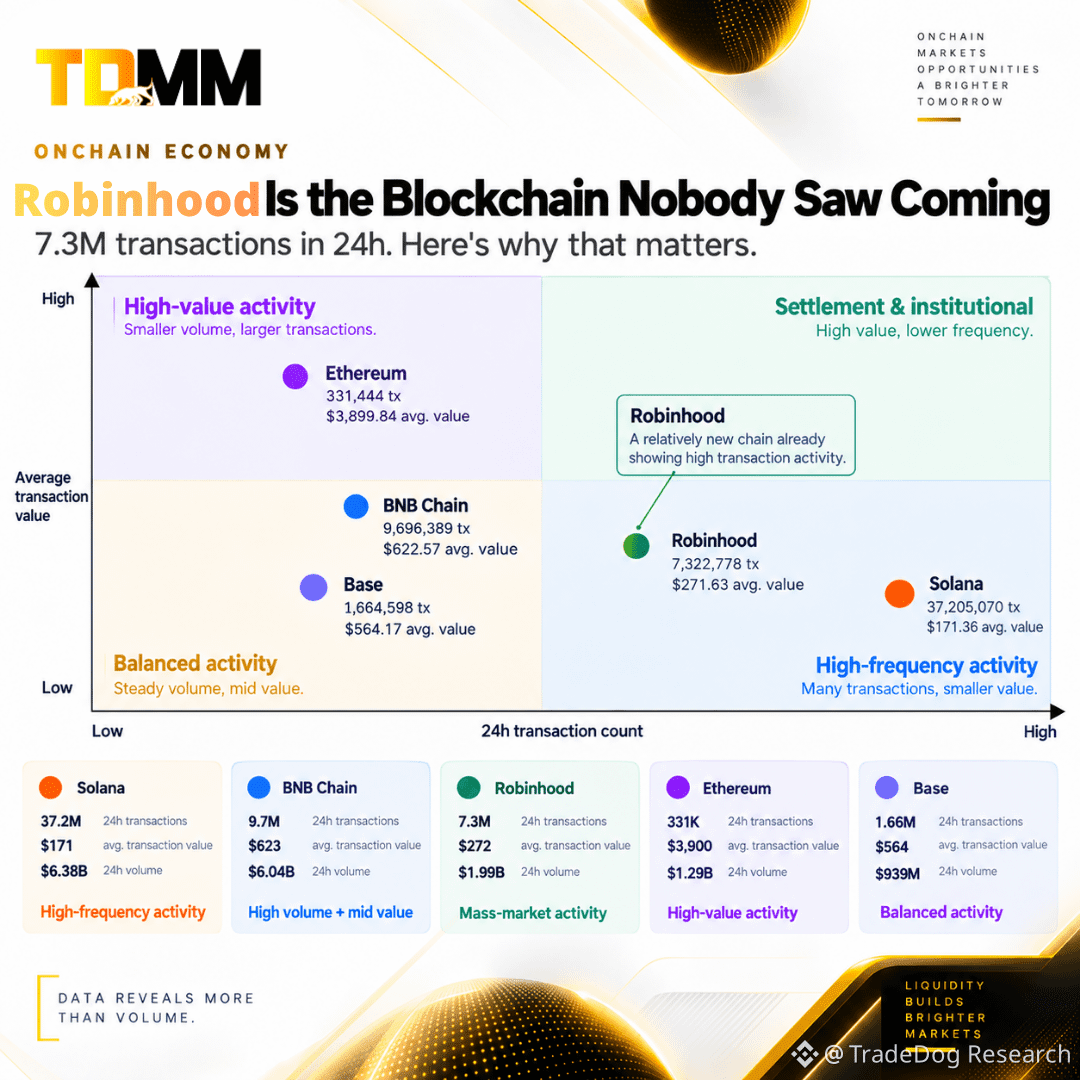
2
77
$PONS : Khi sự chú ý đạt đỉnh, câu chuyện có thể thay đổi 👀
Trước đợt bùng nổ, giá, khối lượng và các nhà giao dịch độc nhất đều đang tăng cùng nhau.
Rồi ATH xuất hiện.
📈 Giá bùng nổ
📊 Khối lượng tăng vọt
👥 Số nhà giao dịch độc nhất đạt một trong những mức đọc mạnh nhất
Nhưng bước tiếp theo không phải là một nhịp tăng nữa.
Giá bắt đầu điều chỉnh lùi lại trong khi hoạt động vẫn duy trì ở mức cao.
Điều đó quan trọng.
Sự chú ý đạt đỉnh ≠ đảm bảo xu hướng tăng.
Đôi khi, một đợt tăng về mức tham gia và khối lượng gần một đỉnh cục bộ có thể báo hiệu rằng thị trường đang bước sang một giai đoạn khác.
Với $PONS, câu hỏi then chốt lúc này là:
Liệu các nhà giao dịch độc nhất + khối lượng có bắt đầu xây dựng lại cùng với giá hay mức tham gia sẽ tiếp tục đi ngược (phân kỳ)?
Tín hiệu tiếp theo có thể xuất hiện từ phía dưới biểu đồ trước khi nó hiện ra trên chính biểu đồ.
@tdmarketmaker @Square-Creator-50e191620
#PONS #MarketAnalysis #Altcoins #DeFi #CryptoTrading
$PONS : Khi sự chú ý đạt đỉnh, câu chuyện có thể thay đổi 👀
Trước đợt bùng nổ, giá, khối lượng và các nhà giao dịch độc nhất đều đang tăng cùng nhau.
Rồi ATH xuất hiện.
📈 Giá bùng nổ
📊 Khối lượng tăng vọt
👥 Số nhà giao dịch độc nhất đạt một trong những mức đọc mạnh nhất
Nhưng bước tiếp theo không phải là một nhịp tăng nữa.
Giá bắt đầu điều chỉnh lùi lại trong khi hoạt động vẫn duy trì ở mức cao.
Điều đó quan trọng.
Sự chú ý đạt đỉnh ≠ đảm bảo xu hướng tăng.
Đôi khi, một đợt tăng về mức tham gia và khối lượng gần một đỉnh cục bộ có thể báo hiệu rằng thị trường đang bước sang một giai đoạn khác.
Với $PONS , câu hỏi then chốt lúc này là:
Liệu các nhà giao dịch độc nhất + khối lượng có bắt đầu xây dựng lại cùng với giá hay mức tham gia sẽ tiếp tục đi ngược (phân kỳ)?
Tín hiệu tiếp theo có thể xuất hiện từ phía dưới biểu đồ trước khi nó hiện ra trên chính biểu đồ.
@TDMM-TradeDog Market Maker @TradeDog Crypto Market Research
#PONS #MarketAnalysis #Altcoins #DeFi #CryptoTrading
Trước đợt bùng nổ, giá, khối lượng và các nhà giao dịch độc nhất đều đang tăng cùng nhau.
Rồi ATH xuất hiện.
📈 Giá bùng nổ
📊 Khối lượng tăng vọt
👥 Số nhà giao dịch độc nhất đạt một trong những mức đọc mạnh nhất
Nhưng bước tiếp theo không phải là một nhịp tăng nữa.
Giá bắt đầu điều chỉnh lùi lại trong khi hoạt động vẫn duy trì ở mức cao.
Điều đó quan trọng.
Sự chú ý đạt đỉnh ≠ đảm bảo xu hướng tăng.
Đôi khi, một đợt tăng về mức tham gia và khối lượng gần một đỉnh cục bộ có thể báo hiệu rằng thị trường đang bước sang một giai đoạn khác.
Với $PONS , câu hỏi then chốt lúc này là:
Liệu các nhà giao dịch độc nhất + khối lượng có bắt đầu xây dựng lại cùng với giá hay mức tham gia sẽ tiếp tục đi ngược (phân kỳ)?
Tín hiệu tiếp theo có thể xuất hiện từ phía dưới biểu đồ trước khi nó hiện ra trên chính biểu đồ.
@TDMM-TradeDog Market Maker @TradeDog Crypto Market Research
#PONS #MarketAnalysis #Altcoins #DeFi #CryptoTrading
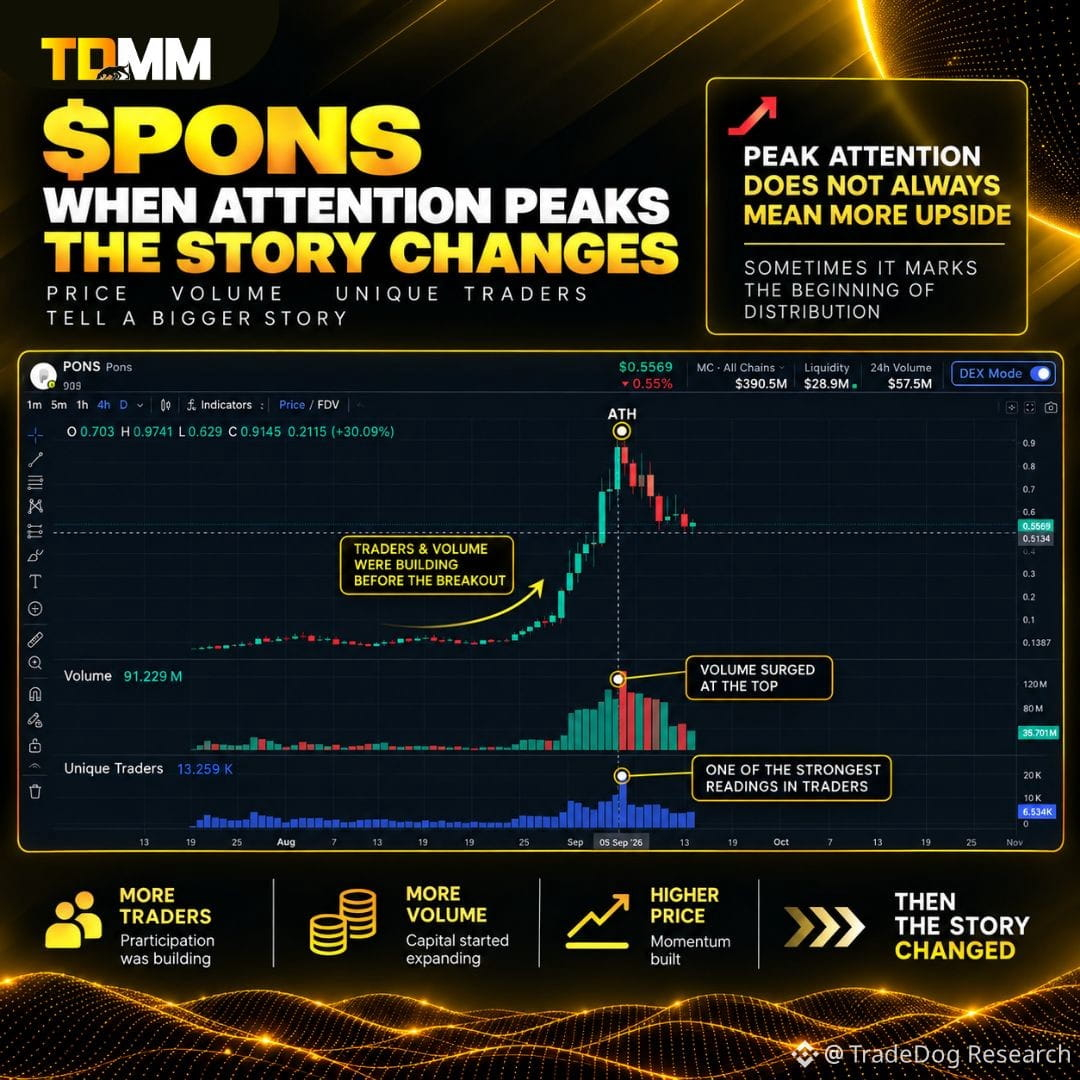
2
185
Kiểm tra nhịp đập thị trường tiền điện tử hàng ngày của TDR
Base của Coinbase đạt đến tầm cao mới: 4 triệu địa chỉ hoạt động
Chúng ta hãy cùng tìm hiểu chi tiết:
Base, mạng Layer 2 (L2) của @coinbase được xây dựng trên chuỗi khối Ethereum, gần đây đã đạt được một cột mốc quan trọng khi vượt qua 4 triệu địa chỉ hoạt động, được thúc đẩy bởi chiến dịch "Onchain Summer" của mình.
Chiến dịch Onchain Summer này, ban đầu được ra mắt vào năm 2023 và được hồi sinh vào năm 2024, đã trở thành động lực chính thúc đẩy sự phát triển của @base. Chiến dịch được thiết kế để khuyến khích các nhà phát triển và thu hút cộng đồng tiền điện tử rộng lớn hơn bằng cách cung cấp phần thưởng, tổ chức các sự kiện và thúc đẩy sự sáng tạo trên nền tảng.
Phiên bản năm 2024 tiếp tục đà phát triển này bằng cách cung cấp 2 triệu đô la tiền thưởng (tương đương 600 ETH) cho các nhà phát triển xây dựng trên mạng Base từ tháng 6 đến tháng 8.
Về triển vọng tương lai:
Nhìn về phía trước, động lực đạt được từ Onchain Summer có thể tiếp tục thúc đẩy Base tiến lên, đặc biệt là nếu Coinbase có thể tiếp tục đổi mới và thu hút các nhà phát triển và người dùng đến với nền tảng của mình.
Những bài học kinh nghiệm rút ra từ chiến dịch này, đặc biệt là trong việc giải quyết các tranh cãi và đảm bảo tính toàn vẹn của các ứng dụng dựa trên blockchain, sẽ rất quan trọng đối với sự phát triển liên tục của Base.
Nhưng đó không phải là tất cả! Hãy cùng tìm hiểu sâu hơn về thông tin chi tiết về thị trường ngày nay:
Vốn hóa thị trường tiền điện tử toàn cầu: 2,2 nghìn tỷ đô la
Sự thống trị của Bitcoin: 53,4% | Ethereum Dominance: 14,2%
Những người tăng giá nhiều nhất:
SUNDOG: +87,4%
LOKA: +59,2%
Những người giảm giá nhiều nhất:
BRAINLET: -27,0%
CATDOG: -25,4%
Tham gia các đợt airdrop lớn đang diễn ra: @Curvance, @LineaBuild, @getgrass_io, @Sagaxyz__
Theo dõi @TradedogCrypto để cập nhật thông tin về những diễn biến mới nhất và có tác động nhất trong thế giới tiền điện tử.
#Coinbase #Ethereum #Layer2 #Blockchain #OnchainSummer
Kiểm tra nhịp đập thị trường tiền điện tử hàng ngày của TDR
Base của Coinbase đạt đến tầm cao mới: 4 triệu địa chỉ hoạt động
Chúng ta hãy cùng tìm hiểu chi tiết:
Base, mạng Layer 2 (L2) của @coinbase được xây dựng trên chuỗi khối Ethereum, gần đây đã đạt được một cột mốc quan trọng khi vượt qua 4 triệu địa chỉ hoạt động, được thúc đẩy bởi chiến dịch "Onchain Summer" của mình.
Chiến dịch Onchain Summer này, ban đầu được ra mắt vào năm 2023 và được hồi sinh vào năm 2024, đã trở thành động lực chính thúc đẩy sự phát triển của @base. Chiến dịch được thiết kế để khuyến khích các nhà phát triển và thu hút cộng đồng tiền điện tử rộng lớn hơn bằng cách cung cấp phần thưởng, tổ chức các sự kiện và thúc đẩy sự sáng tạo trên nền tảng.
Phiên bản năm 2024 tiếp tục đà phát triển này bằng cách cung cấp 2 triệu đô la tiền thưởng (tương đương 600 ETH) cho các nhà phát triển xây dựng trên mạng Base từ tháng 6 đến tháng 8.
Về triển vọng tương lai:
Nhìn về phía trước, động lực đạt được từ Onchain Summer có thể tiếp tục thúc đẩy Base tiến lên, đặc biệt là nếu Coinbase có thể tiếp tục đổi mới và thu hút các nhà phát triển và người dùng đến với nền tảng của mình.
Những bài học kinh nghiệm rút ra từ chiến dịch này, đặc biệt là trong việc giải quyết các tranh cãi và đảm bảo tính toàn vẹn của các ứng dụng dựa trên blockchain, sẽ rất quan trọng đối với sự phát triển liên tục của Base.
Nhưng đó không phải là tất cả! Hãy cùng tìm hiểu sâu hơn về thông tin chi tiết về thị trường ngày nay:
Vốn hóa thị trường tiền điện tử toàn cầu: 2,2 nghìn tỷ đô la
Sự thống trị của Bitcoin: 53,4% | Ethereum Dominance: 14,2%
Những người tăng giá nhiều nhất:
SUNDOG: +87,4%
LOKA: +59,2%
Những người giảm giá nhiều nhất:
BRAINLET: -27,0%
CATDOG: -25,4%
Tham gia các đợt airdrop lớn đang diễn ra: @Curvance, @LineaBuild, @getgrass_io, @Sagaxyz__
Theo dõi @TradedogCrypto để cập nhật thông tin về những diễn biến mới nhất và có tác động nhất trong thế giới tiền điện tử.
#Coinbase #Ethereum #Layer2 #Blockchain #OnchainSummer
Base của Coinbase đạt đến tầm cao mới: 4 triệu địa chỉ hoạt động
Chúng ta hãy cùng tìm hiểu chi tiết:
Base, mạng Layer 2 (L2) của @coinbase được xây dựng trên chuỗi khối Ethereum, gần đây đã đạt được một cột mốc quan trọng khi vượt qua 4 triệu địa chỉ hoạt động, được thúc đẩy bởi chiến dịch "Onchain Summer" của mình.
Chiến dịch Onchain Summer này, ban đầu được ra mắt vào năm 2023 và được hồi sinh vào năm 2024, đã trở thành động lực chính thúc đẩy sự phát triển của @base. Chiến dịch được thiết kế để khuyến khích các nhà phát triển và thu hút cộng đồng tiền điện tử rộng lớn hơn bằng cách cung cấp phần thưởng, tổ chức các sự kiện và thúc đẩy sự sáng tạo trên nền tảng.
Phiên bản năm 2024 tiếp tục đà phát triển này bằng cách cung cấp 2 triệu đô la tiền thưởng (tương đương 600 ETH) cho các nhà phát triển xây dựng trên mạng Base từ tháng 6 đến tháng 8.
Về triển vọng tương lai:
Nhìn về phía trước, động lực đạt được từ Onchain Summer có thể tiếp tục thúc đẩy Base tiến lên, đặc biệt là nếu Coinbase có thể tiếp tục đổi mới và thu hút các nhà phát triển và người dùng đến với nền tảng của mình.
Những bài học kinh nghiệm rút ra từ chiến dịch này, đặc biệt là trong việc giải quyết các tranh cãi và đảm bảo tính toàn vẹn của các ứng dụng dựa trên blockchain, sẽ rất quan trọng đối với sự phát triển liên tục của Base.
Nhưng đó không phải là tất cả! Hãy cùng tìm hiểu sâu hơn về thông tin chi tiết về thị trường ngày nay:
Vốn hóa thị trường tiền điện tử toàn cầu: 2,2 nghìn tỷ đô la
Sự thống trị của Bitcoin: 53,4% | Ethereum Dominance: 14,2%
Những người tăng giá nhiều nhất:
SUNDOG: +87,4%
LOKA: +59,2%
Những người giảm giá nhiều nhất:
BRAINLET: -27,0%
CATDOG: -25,4%
Tham gia các đợt airdrop lớn đang diễn ra: @Curvance, @LineaBuild, @getgrass_io, @Sagaxyz__
Theo dõi @TradedogCrypto để cập nhật thông tin về những diễn biến mới nhất và có tác động nhất trong thế giới tiền điện tử.
#Coinbase #Ethereum #Layer2 #Blockchain #OnchainSummer

3
284
Metaverse có đang mất đi sức hấp dẫn không?
Thị trường đất metaverse năm 2024 đã chứng kiến sự sụt giảm đáng kể, với giá trung bình giảm 72% so với mức đỉnh điểm.
Giá sàn trung bình đã giảm 34% kể từ năm 2023 và 55% kể từ năm 2022.
Điểm nổi bật của dự án chính:
@TheSandboxGame: Giá đã giảm mạnh 95% từ 2,86 ETH năm 2021 xuống còn 0,13 ETH năm 2024.
NFTWorlds/TOPIA Worlds: Thể hiện khả năng phục hồi với mức giảm 45%, nhờ sự hỗ trợ của cộng đồng và đổi thương hiệu.
@SomniumSpace: Đạt đỉnh vào năm 2023 ở mức 0,98 ETH, nhờ những tiến bộ của VR.
Các yếu tố ảnh hưởng đến giá:
Biến động thị trường: Sự suy thoái tiền điện tử rộng lớn hơn đã tác động đáng kể đến đất metaverse.
Phát triển theo từng dự án: Đổi mới và đề xuất giá trị độc đáo đã giúp một số dự án duy trì giá trị.
Sức mạnh cộng đồng: Nỗ lực tham gia mạnh mẽ và đổi mới thương hiệu đã làm giảm sự suy giảm.
Ảnh hưởng của thị trường bên ngoài: Các xu hướng như memecoin đã chuyển hướng sự chú ý khỏi các vùng đất metaverse.
Triển vọng tương lai:
Tương lai của giá đất metaverse sẽ phụ thuộc vào sự đổi mới liên tục và xu hướng tiền điện tử rộng hơn.
Bạn nghĩ tương lai sẽ như thế nào đối với giá đất metaverse? Hãy chia sẻ suy nghĩ của bạn bên dưới!
#Metaverse #VirtualRealEstate #NFT
Metaverse có đang mất đi sức hấp dẫn không?
Thị trường đất metaverse năm 2024 đã chứng kiến sự sụt giảm đáng kể, với giá trung bình giảm 72% so với mức đỉnh điểm.
Giá sàn trung bình đã giảm 34% kể từ năm 2023 và 55% kể từ năm 2022.
Điểm nổi bật của dự án chính:
@TheSandboxGame: Giá đã giảm mạnh 95% từ 2,86 ETH năm 2021 xuống còn 0,13 ETH năm 2024.
NFTWorlds/TOPIA Worlds: Thể hiện khả năng phục hồi với mức giảm 45%, nhờ sự hỗ trợ của cộng đồng và đổi thương hiệu.
@SomniumSpace: Đạt đỉnh vào năm 2023 ở mức 0,98 ETH, nhờ những tiến bộ của VR.
Các yếu tố ảnh hưởng đến giá:
Biến động thị trường: Sự suy thoái tiền điện tử rộng lớn hơn đã tác động đáng kể đến đất metaverse.
Phát triển theo từng dự án: Đổi mới và đề xuất giá trị độc đáo đã giúp một số dự án duy trì giá trị.
Sức mạnh cộng đồng: Nỗ lực tham gia mạnh mẽ và đổi mới thương hiệu đã làm giảm sự suy giảm.
Ảnh hưởng của thị trường bên ngoài: Các xu hướng như memecoin đã chuyển hướng sự chú ý khỏi các vùng đất metaverse.
Triển vọng tương lai:
Tương lai của giá đất metaverse sẽ phụ thuộc vào sự đổi mới liên tục và xu hướng tiền điện tử rộng hơn.
Bạn nghĩ tương lai sẽ như thế nào đối với giá đất metaverse? Hãy chia sẻ suy nghĩ của bạn bên dưới!
#Metaverse #VirtualRealEstate #NFT
Thị trường đất metaverse năm 2024 đã chứng kiến sự sụt giảm đáng kể, với giá trung bình giảm 72% so với mức đỉnh điểm.
Giá sàn trung bình đã giảm 34% kể từ năm 2023 và 55% kể từ năm 2022.
Điểm nổi bật của dự án chính:
@TheSandboxGame: Giá đã giảm mạnh 95% từ 2,86 ETH năm 2021 xuống còn 0,13 ETH năm 2024.
NFTWorlds/TOPIA Worlds: Thể hiện khả năng phục hồi với mức giảm 45%, nhờ sự hỗ trợ của cộng đồng và đổi thương hiệu.
@SomniumSpace: Đạt đỉnh vào năm 2023 ở mức 0,98 ETH, nhờ những tiến bộ của VR.
Các yếu tố ảnh hưởng đến giá:
Biến động thị trường: Sự suy thoái tiền điện tử rộng lớn hơn đã tác động đáng kể đến đất metaverse.
Phát triển theo từng dự án: Đổi mới và đề xuất giá trị độc đáo đã giúp một số dự án duy trì giá trị.
Sức mạnh cộng đồng: Nỗ lực tham gia mạnh mẽ và đổi mới thương hiệu đã làm giảm sự suy giảm.
Ảnh hưởng của thị trường bên ngoài: Các xu hướng như memecoin đã chuyển hướng sự chú ý khỏi các vùng đất metaverse.
Triển vọng tương lai:
Tương lai của giá đất metaverse sẽ phụ thuộc vào sự đổi mới liên tục và xu hướng tiền điện tử rộng hơn.
Bạn nghĩ tương lai sẽ như thế nào đối với giá đất metaverse? Hãy chia sẻ suy nghĩ của bạn bên dưới!
#Metaverse #VirtualRealEstate #NFT

1
1.4k
Trong khi mọi người đang nói về cơn bão trên thị trường chứng khoán và tiền điện tử, chúng tôi quyết định phác thảo tình hình của thị trường NFT.
📊
Số liệu và Thống kê
Vốn hóa thị trường: 57,5 tỷ đô la
Khối lượng giao dịch hàng ngày: 9,5 tỷ đô la
Các bộ sưu tập hàng đầu theo vốn hóa:
@cryptopunksnfts: 524 triệu đô la
@LibertyCatsBTC: 513 triệu đô la
@BoredApeYC: 218 triệu đô la
@pudgypenguins: 178 triệu đô la
@Azuki: 99 triệu đô la
Điều chỉnh thị trường
Thị trường NFT đã chứng kiến sự sụt giảm đáng kể, với vốn hóa giảm xuống còn 34 tỷ đô la tại thời điểm thấp nhất, chịu ảnh hưởng nặng nề bởi thị trường tiền điện tử nói chung.
Tác động của Memecoin
Memecoin đã thu hút sự chú ý và vốn khỏi NFT, dẫn đến sự sụt giảm mạnh về vốn hóa thị trường từ 348 tỷ đô la vào tháng 1 năm 2024 xuống còn 159 tỷ đô la vào tháng 3 năm 2024.
Xu hướng mới nổi
NFT hướng đến tiện ích: Sự quan tâm ngày càng tăng đối với NFT gắn liền với mã hóa tài sản thực tế. Tích hợp trò chơi: Các công ty lớn như Square Enix đang ngày càng áp dụng NFT. NFT lai: Sự phổ biến ngày càng tăng của các mã thông báo kết hợp tài sản vật lý và kỹ thuật số.
Triển vọng tương lai
Mặc dù đợt tăng giá tiếp theo có thể nhấn mạnh vào NFT dựa trên tiện ích và mã hóa tài sản thực tế, nhưng sự tăng trưởng đáng kể của thị trường vẫn chưa chắc chắn do các điều kiện hiện tại.
Thị trường NFT đang phát triển, tập trung vào tiện ích và tài sản thực, nhưng phải đối mặt với những thách thức từ memecoin và sự biến động của thị trường.
Chúng ta hãy cùng chờ xem điều gì sẽ xảy ra tiếp theo. Hãy để lại suy nghĩ của bạn bên dưới
👇
#NFTMarket #CryptoNewss #MarketTrends
Trong khi mọi người đang nói về cơn bão trên thị trường chứng khoán và tiền điện tử, chúng tôi quyết định phác thảo tình hình của thị trường NFT.
📊
Số liệu và Thống kê
Vốn hóa thị trường: 57,5 tỷ đô la
Khối lượng giao dịch hàng ngày: 9,5 tỷ đô la
Các bộ sưu tập hàng đầu theo vốn hóa:
@cryptopunksnfts: 524 triệu đô la
@LibertyCatsBTC: 513 triệu đô la
@BoredApeYC: 218 triệu đô la
@pudgypenguins: 178 triệu đô la
@Azuki: 99 triệu đô la
Điều chỉnh thị trường
Thị trường NFT đã chứng kiến sự sụt giảm đáng kể, với vốn hóa giảm xuống còn 34 tỷ đô la tại thời điểm thấp nhất, chịu ảnh hưởng nặng nề bởi thị trường tiền điện tử nói chung.
Tác động của Memecoin
Memecoin đã thu hút sự chú ý và vốn khỏi NFT, dẫn đến sự sụt giảm mạnh về vốn hóa thị trường từ 348 tỷ đô la vào tháng 1 năm 2024 xuống còn 159 tỷ đô la vào tháng 3 năm 2024.
Xu hướng mới nổi
NFT hướng đến tiện ích: Sự quan tâm ngày càng tăng đối với NFT gắn liền với mã hóa tài sản thực tế. Tích hợp trò chơi: Các công ty lớn như Square Enix đang ngày càng áp dụng NFT. NFT lai: Sự phổ biến ngày càng tăng của các mã thông báo kết hợp tài sản vật lý và kỹ thuật số.
Triển vọng tương lai
Mặc dù đợt tăng giá tiếp theo có thể nhấn mạnh vào NFT dựa trên tiện ích và mã hóa tài sản thực tế, nhưng sự tăng trưởng đáng kể của thị trường vẫn chưa chắc chắn do các điều kiện hiện tại.
Thị trường NFT đang phát triển, tập trung vào tiện ích và tài sản thực, nhưng phải đối mặt với những thách thức từ memecoin và sự biến động của thị trường.
Chúng ta hãy cùng chờ xem điều gì sẽ xảy ra tiếp theo. Hãy để lại suy nghĩ của bạn bên dưới
👇
#NFTMarket #CryptoNewss #MarketTrends
📊
Số liệu và Thống kê
Vốn hóa thị trường: 57,5 tỷ đô la
Khối lượng giao dịch hàng ngày: 9,5 tỷ đô la
Các bộ sưu tập hàng đầu theo vốn hóa:
@cryptopunksnfts: 524 triệu đô la
@LibertyCatsBTC: 513 triệu đô la
@BoredApeYC: 218 triệu đô la
@pudgypenguins: 178 triệu đô la
@Azuki: 99 triệu đô la
Điều chỉnh thị trường
Thị trường NFT đã chứng kiến sự sụt giảm đáng kể, với vốn hóa giảm xuống còn 34 tỷ đô la tại thời điểm thấp nhất, chịu ảnh hưởng nặng nề bởi thị trường tiền điện tử nói chung.
Tác động của Memecoin
Memecoin đã thu hút sự chú ý và vốn khỏi NFT, dẫn đến sự sụt giảm mạnh về vốn hóa thị trường từ 348 tỷ đô la vào tháng 1 năm 2024 xuống còn 159 tỷ đô la vào tháng 3 năm 2024.
Xu hướng mới nổi
NFT hướng đến tiện ích: Sự quan tâm ngày càng tăng đối với NFT gắn liền với mã hóa tài sản thực tế. Tích hợp trò chơi: Các công ty lớn như Square Enix đang ngày càng áp dụng NFT. NFT lai: Sự phổ biến ngày càng tăng của các mã thông báo kết hợp tài sản vật lý và kỹ thuật số.
Triển vọng tương lai
Mặc dù đợt tăng giá tiếp theo có thể nhấn mạnh vào NFT dựa trên tiện ích và mã hóa tài sản thực tế, nhưng sự tăng trưởng đáng kể của thị trường vẫn chưa chắc chắn do các điều kiện hiện tại.
Thị trường NFT đang phát triển, tập trung vào tiện ích và tài sản thực, nhưng phải đối mặt với những thách thức từ memecoin và sự biến động của thị trường.
Chúng ta hãy cùng chờ xem điều gì sẽ xảy ra tiếp theo. Hãy để lại suy nghĩ của bạn bên dưới
👇
#NFTMarket #CryptoNewss #MarketTrends

1
450
Xác định phong cách giao dịch của bạn!
Tại sao điều này lại quan trọng: Điều cần thiết là phải điều chỉnh chiến lược giao dịch của bạn phù hợp với tính cách, khả năng chịu rủi ro và cam kết về thời gian của bạn.
Biết được bạn là Scalper, Day Trader hay Swing Trader giúp bạn đưa ra quyết định sáng suốt, quản lý căng thẳng và tối ưu hóa phương pháp giao dịch của mình.
Sau đây là cái nhìn sâu hơn về từng phong cách giao dịch
👇
Scalper: Giao dịch nhanh, căng thẳng cao, rủi ro cao.
Day Trader: Giao dịch hàng ngày, rủi ro trung bình đến cao, đòi hỏi sự tập trung hoàn toàn.
Swing Trader: Giữ vị thế trong nhiều ngày/tuần, ít căng thẳng hơn, đòi hỏi sự kiên nhẫn.
Tổng quan:
Mỗi phong cách đều có những thách thức và phần thưởng riêng. Hãy chọn phong cách phù hợp với khả năng chịu rủi ro và lối sống của bạn.
Phong cách giao dịch nào phù hợp nhất với bạn?
#Giaodịch#Scalping#DayTrading #SwingTrading
Xác định phong cách giao dịch của bạn!
Tại sao điều này lại quan trọng: Điều cần thiết là phải điều chỉnh chiến lược giao dịch của bạn phù hợp với tính cách, khả năng chịu rủi ro và cam kết về thời gian của bạn.
Biết được bạn là Scalper, Day Trader hay Swing Trader giúp bạn đưa ra quyết định sáng suốt, quản lý căng thẳng và tối ưu hóa phương pháp giao dịch của mình.
Sau đây là cái nhìn sâu hơn về từng phong cách giao dịch
👇
Scalper: Giao dịch nhanh, căng thẳng cao, rủi ro cao.
Day Trader: Giao dịch hàng ngày, rủi ro trung bình đến cao, đòi hỏi sự tập trung hoàn toàn.
Swing Trader: Giữ vị thế trong nhiều ngày/tuần, ít căng thẳng hơn, đòi hỏi sự kiên nhẫn.
Tổng quan:
Mỗi phong cách đều có những thách thức và phần thưởng riêng. Hãy chọn phong cách phù hợp với khả năng chịu rủi ro và lối sống của bạn.
Phong cách giao dịch nào phù hợp nhất với bạn?
#Giaodịch#Scalping#DayTrading #SwingTrading
Tại sao điều này lại quan trọng: Điều cần thiết là phải điều chỉnh chiến lược giao dịch của bạn phù hợp với tính cách, khả năng chịu rủi ro và cam kết về thời gian của bạn.
Biết được bạn là Scalper, Day Trader hay Swing Trader giúp bạn đưa ra quyết định sáng suốt, quản lý căng thẳng và tối ưu hóa phương pháp giao dịch của mình.
Sau đây là cái nhìn sâu hơn về từng phong cách giao dịch
👇
Scalper: Giao dịch nhanh, căng thẳng cao, rủi ro cao.
Day Trader: Giao dịch hàng ngày, rủi ro trung bình đến cao, đòi hỏi sự tập trung hoàn toàn.
Swing Trader: Giữ vị thế trong nhiều ngày/tuần, ít căng thẳng hơn, đòi hỏi sự kiên nhẫn.
Tổng quan:
Mỗi phong cách đều có những thách thức và phần thưởng riêng. Hãy chọn phong cách phù hợp với khả năng chịu rủi ro và lối sống của bạn.
Phong cách giao dịch nào phù hợp nhất với bạn?
#Giaodịch#Scalping#DayTrading #SwingTrading

12
Bạn có muốn sử dụng Particle Network không?
Hãy cùng xem nhé👇
- Particle Network - Giải pháp blockchain lớp 1.
𝗥𝗮𝗶𝘀𝗲𝗱 𝗔𝗺𝗼𝘂𝗻𝘁: Sẽ được tiết lộ
- Pichi Finance - Tập trung vào việc tạo ra một giao thức giao dịch điểm không cần tin cậy.
𝗥𝗮𝗶𝘀𝗲𝗱 𝗔𝗺𝗼𝘂𝗻𝘁: 2,5 triệu đô la
- Morpho Labs - Dẫn đầu trong các giải pháp thanh khoản tiên tiến và các ứng dụng phi tập trung.
𝗥𝗮𝗶𝘀𝗲𝗱 𝗔𝗺𝗼𝘂𝗻𝘁: 50 triệu đô la
- Breakout - Một công ty khởi nghiệp tập trung vào việc cách mạng hóa các lĩnh vực tài chính và ngân hàng bằng các giải pháp công nghệ tiên tiến.
𝗥𝗮𝗶𝘀𝗲𝗱 𝗔𝗺𝗼𝘂𝗻𝘁: 4,5 triệu đô la
- Layer2 Financial - Với mục tiêu thu hẹp khoảng cách giữa các hệ thống tài chính truyền thống và công nghệ blockchain bằng cách cải thiện các hệ thống thanh toán và dịch vụ tài chính.
𝗥𝗮𝗶𝘀𝗲𝗱 𝗔𝗺𝗼𝘂𝗻𝘁: 10,7 triệu đô la
Các dự án này làm nổi bật sự quan tâm và đầu tư ngày càng tăng vào các giải pháp blockchain và tài chính phi tập trung, mỗi dự án đều hướng đến mục tiêu giải quyết các thách thức cụ thể trong hệ sinh thái và thúc đẩy đổi mới hơn nữa.
Bạn thấy dự án nào triển vọng nhất?
Hãy cho chúng tôi biết trong phần bình luận!
#Crypto #Blockchain #DEFİ #Investment #Innovation
Bạn có muốn sử dụng Particle Network không?
Hãy cùng xem nhé👇
- Particle Network - Giải pháp blockchain lớp 1.
𝗥𝗮𝗶𝘀𝗲𝗱 𝗔𝗺𝗼𝘂𝗻𝘁: Sẽ được tiết lộ
- Pichi Finance - Tập trung vào việc tạo ra một giao thức giao dịch điểm không cần tin cậy.
𝗥𝗮𝗶𝘀𝗲𝗱 𝗔𝗺𝗼𝘂𝗻𝘁: 2,5 triệu đô la
- Morpho Labs - Dẫn đầu trong các giải pháp thanh khoản tiên tiến và các ứng dụng phi tập trung.
𝗥𝗮𝗶𝘀𝗲𝗱 𝗔𝗺𝗼𝘂𝗻𝘁: 50 triệu đô la
- Breakout - Một công ty khởi nghiệp tập trung vào việc cách mạng hóa các lĩnh vực tài chính và ngân hàng bằng các giải pháp công nghệ tiên tiến.
𝗥𝗮𝗶𝘀𝗲𝗱 𝗔𝗺𝗼𝘂𝗻𝘁: 4,5 triệu đô la
- Layer2 Financial - Với mục tiêu thu hẹp khoảng cách giữa các hệ thống tài chính truyền thống và công nghệ blockchain bằng cách cải thiện các hệ thống thanh toán và dịch vụ tài chính.
𝗥𝗮𝗶𝘀𝗲𝗱 𝗔𝗺𝗼𝘂𝗻𝘁: 10,7 triệu đô la
Các dự án này làm nổi bật sự quan tâm và đầu tư ngày càng tăng vào các giải pháp blockchain và tài chính phi tập trung, mỗi dự án đều hướng đến mục tiêu giải quyết các thách thức cụ thể trong hệ sinh thái và thúc đẩy đổi mới hơn nữa.
Bạn thấy dự án nào triển vọng nhất?
Hãy cho chúng tôi biết trong phần bình luận!
#Crypto #Blockchain #DEFİ #Investment #Innovation
Hãy cùng xem nhé👇
- Particle Network - Giải pháp blockchain lớp 1.
𝗥𝗮𝗶𝘀𝗲𝗱 𝗔𝗺𝗼𝘂𝗻𝘁: Sẽ được tiết lộ
- Pichi Finance - Tập trung vào việc tạo ra một giao thức giao dịch điểm không cần tin cậy.
𝗥𝗮𝗶𝘀𝗲𝗱 𝗔𝗺𝗼𝘂𝗻𝘁: 2,5 triệu đô la
- Morpho Labs - Dẫn đầu trong các giải pháp thanh khoản tiên tiến và các ứng dụng phi tập trung.
𝗥𝗮𝗶𝘀𝗲𝗱 𝗔𝗺𝗼𝘂𝗻𝘁: 50 triệu đô la
- Breakout - Một công ty khởi nghiệp tập trung vào việc cách mạng hóa các lĩnh vực tài chính và ngân hàng bằng các giải pháp công nghệ tiên tiến.
𝗥𝗮𝗶𝘀𝗲𝗱 𝗔𝗺𝗼𝘂𝗻𝘁: 4,5 triệu đô la
- Layer2 Financial - Với mục tiêu thu hẹp khoảng cách giữa các hệ thống tài chính truyền thống và công nghệ blockchain bằng cách cải thiện các hệ thống thanh toán và dịch vụ tài chính.
𝗥𝗮𝗶𝘀𝗲𝗱 𝗔𝗺𝗼𝘂𝗻𝘁: 10,7 triệu đô la
Các dự án này làm nổi bật sự quan tâm và đầu tư ngày càng tăng vào các giải pháp blockchain và tài chính phi tập trung, mỗi dự án đều hướng đến mục tiêu giải quyết các thách thức cụ thể trong hệ sinh thái và thúc đẩy đổi mới hơn nữa.
Bạn thấy dự án nào triển vọng nhất?
Hãy cho chúng tôi biết trong phần bình luận!
#Crypto #Blockchain #DEFİ #Investment #Innovation

1
232
Tiền điện tử yêu thích của bạn có an toàn không? 🛡️
Để luôn dẫn đầu trong thế giới tiền điện tử, điều quan trọng là bạn phải tự tìm hiểu về các vụ hack tiềm ẩn và những diễn biến đang diễn ra.
Hôm nay chúng ta cùng đi sâu vào chủ đề tấn công 51%.
Tấn công 51% là gì?
Nó xảy ra khi một người hoặc một nhóm kiểm soát hơn 50% sức mạnh băm của blockchain, cho phép họ can thiệp vào các giao dịch.
Làm thế nào nó hoạt động:
- Hash Rate Dominance: Kẻ tấn công kiểm soát phần lớn hash rate của mạng.
- Chi tiêu gấp đôi: Họ có thể đảo ngược các giao dịch và cho phép chi tiêu gấp đôi.
- Chặn can thiệp: Họ có thể ngăn chặn các giao dịch mới nhận được xác nhận.
- Độc quyền khai thác: Họ độc quyền khai thác, ngăn cản những người khai thác khác tạo khối và thu thập phần thưởng.
Ví dụ lịch sử:
- Bitcoin Gold (2018): Bị tấn công 51% dẫn đến số tiền được chi tiêu gấp đôi trị giá 18 triệu đô la.
- Ethereum Classic (2019): Trải qua nhiều cuộc tấn công 51%, dẫn đến chi tiêu gấp đôi hàng nghìn ETC.
- Verge (2018): Đối mặt với cuộc tấn công dẫn đến việc tạo ra hàng triệu XVG thông qua thao túng blockchain.
Những bước nào có thể được thực hiện để phòng ngừa?
- Tăng tỷ lệ băm mạng: Khiến một thực thể duy nhất khó kiểm soát 51%.
- Bằng chứng cổ phần (PoS): Bảo mật dựa trên số lượng tiền điện tử được nắm giữ, không phải sức mạnh tính toán.
- Giám sát nâng cao: Giám sát mạng liên tục để phát hiện hành vi khai thác bất thường.
- Phân cấp: Đẩy mạnh phân cấp trong các nhóm khai thác để tránh sự tập trung sức mạnh khai thác.
Nếu bạn thấy thông tin này hữu ích, vui lòng thích, đăng lại và chia sẻ nó với mạng của bạn.
#Bảo mật tiền điện tử #Blockchain
Tiền điện tử yêu thích của bạn có an toàn không? 🛡️
Để luôn dẫn đầu trong thế giới tiền điện tử, điều quan trọng là bạn phải tự tìm hiểu về các vụ hack tiềm ẩn và những diễn biến đang diễn ra.
Hôm nay chúng ta cùng đi sâu vào chủ đề tấn công 51%.
Tấn công 51% là gì?
Nó xảy ra khi một người hoặc một nhóm kiểm soát hơn 50% sức mạnh băm của blockchain, cho phép họ can thiệp vào các giao dịch.
Làm thế nào nó hoạt động:
- Hash Rate Dominance: Kẻ tấn công kiểm soát phần lớn hash rate của mạng.
- Chi tiêu gấp đôi: Họ có thể đảo ngược các giao dịch và cho phép chi tiêu gấp đôi.
- Chặn can thiệp: Họ có thể ngăn chặn các giao dịch mới nhận được xác nhận.
- Độc quyền khai thác: Họ độc quyền khai thác, ngăn cản những người khai thác khác tạo khối và thu thập phần thưởng.
Ví dụ lịch sử:
- Bitcoin Gold (2018): Bị tấn công 51% dẫn đến số tiền được chi tiêu gấp đôi trị giá 18 triệu đô la.
- Ethereum Classic (2019): Trải qua nhiều cuộc tấn công 51%, dẫn đến chi tiêu gấp đôi hàng nghìn ETC.
- Verge (2018): Đối mặt với cuộc tấn công dẫn đến việc tạo ra hàng triệu XVG thông qua thao túng blockchain.
Những bước nào có thể được thực hiện để phòng ngừa?
- Tăng tỷ lệ băm mạng: Khiến một thực thể duy nhất khó kiểm soát 51%.
- Bằng chứng cổ phần (PoS): Bảo mật dựa trên số lượng tiền điện tử được nắm giữ, không phải sức mạnh tính toán.
- Giám sát nâng cao: Giám sát mạng liên tục để phát hiện hành vi khai thác bất thường.
- Phân cấp: Đẩy mạnh phân cấp trong các nhóm khai thác để tránh sự tập trung sức mạnh khai thác.
Nếu bạn thấy thông tin này hữu ích, vui lòng thích, đăng lại và chia sẻ nó với mạng của bạn.
#Bảo mật tiền điện tử #Blockchain
Để luôn dẫn đầu trong thế giới tiền điện tử, điều quan trọng là bạn phải tự tìm hiểu về các vụ hack tiềm ẩn và những diễn biến đang diễn ra.
Hôm nay chúng ta cùng đi sâu vào chủ đề tấn công 51%.
Tấn công 51% là gì?
Nó xảy ra khi một người hoặc một nhóm kiểm soát hơn 50% sức mạnh băm của blockchain, cho phép họ can thiệp vào các giao dịch.
Làm thế nào nó hoạt động:
- Hash Rate Dominance: Kẻ tấn công kiểm soát phần lớn hash rate của mạng.
- Chi tiêu gấp đôi: Họ có thể đảo ngược các giao dịch và cho phép chi tiêu gấp đôi.
- Chặn can thiệp: Họ có thể ngăn chặn các giao dịch mới nhận được xác nhận.
- Độc quyền khai thác: Họ độc quyền khai thác, ngăn cản những người khai thác khác tạo khối và thu thập phần thưởng.
Ví dụ lịch sử:
- Bitcoin Gold (2018): Bị tấn công 51% dẫn đến số tiền được chi tiêu gấp đôi trị giá 18 triệu đô la.
- Ethereum Classic (2019): Trải qua nhiều cuộc tấn công 51%, dẫn đến chi tiêu gấp đôi hàng nghìn ETC.
- Verge (2018): Đối mặt với cuộc tấn công dẫn đến việc tạo ra hàng triệu XVG thông qua thao túng blockchain.
Những bước nào có thể được thực hiện để phòng ngừa?
- Tăng tỷ lệ băm mạng: Khiến một thực thể duy nhất khó kiểm soát 51%.
- Bằng chứng cổ phần (PoS): Bảo mật dựa trên số lượng tiền điện tử được nắm giữ, không phải sức mạnh tính toán.
- Giám sát nâng cao: Giám sát mạng liên tục để phát hiện hành vi khai thác bất thường.
- Phân cấp: Đẩy mạnh phân cấp trong các nhóm khai thác để tránh sự tập trung sức mạnh khai thác.
Nếu bạn thấy thông tin này hữu ích, vui lòng thích, đăng lại và chia sẻ nó với mạng của bạn.
#Bảo mật tiền điện tử #Blockchain

3
4.6k
Cảm xúc của bạn có ảnh hưởng đến khoản đầu tư tiền điện tử của bạn không?
Ở một khía cạnh nào đó, tất cả chúng ta đều bị ảnh hưởng bởi điều này; không có lợi ích gì khi phủ nhận nó.
Nhưng bằng cách nào? Hãy thảo luận về toàn bộ chu kỳ của cảm xúc.
Sự hưng phấn: Giá thị trường đạt đỉnh tạo ra cảm giác bất khả chiến bại và lòng tham.
Hành vi cơ bản: Mua nhiều giá cao, thường không tính đến rủi ro.
Hy vọng: Giai đoạn đầu khi các nhà giao dịch tham gia thị trường với sự lạc quan và kỳ vọng cao về lợi nhuận trong tương lai.
Hành vi cơ bản: Mua tài sản dựa trên tin tức tích cực, tin đồn hoặc thành công đầu tư ban đầu.
Lạc quan: Khi giá bắt đầu tăng, các nhà giao dịch cảm thấy lạc quan về khoản đầu tư của mình.
Hành vi cơ bản: Tăng cường mua và nắm giữ, củng cố niềm tin vào tiềm năng của thị trường.
Hồi hộp: Giá tăng đáng kể dẫn đến sự phấn khích và hồi hộp.
Hành vi cơ bản: Mua tích cực hơn, đôi khi tận dụng đòn bẩy để tối đa hóa lợi nhuận.
Lo lắng: Giá thị trường bắt đầu giảm, khiến các nhà giao dịch cảm thấy lo lắng về khoản đầu tư của mình.
Hành vi cơ bản: Do dự khi bán, hy vọng giá sẽ phục hồi.
Từ chối: Việc giảm giá liên tục dẫn đến sự từ chối, khiến các nhà giao dịch tin rằng đó là một bước thụt lùi tạm thời.
Hành vi cơ bản: Giữ các khoản đầu tư bất chấp thua lỗ, chờ đợi sự phục hồi.
Hoảng loạn: Sự sụt giảm liên tục tạo ra sự hoảng loạn khi các nhà giao dịch nhận ra những khoản lỗ đáng kể.
Hành vi cơ bản: Bán khẩn cấp để cắt lỗ, thường thua lỗ đáng kể.
Đầu tư: Bán tháo và thoát khỏi thị trường rộng rãi, cho thấy điểm thấp nhất trong chu kỳ.
Hành vi cơ bản: Bán hết tài sản còn lại, thoát khỏi thị trường và chấp nhận thua lỗ.
Hy vọng: Thị trường ổn định và có dấu hiệu phục hồi, khơi dậy hy vọng trong giới giao dịch.
Hành vi cơ bản: Thận trọng tái gia nhập thị trường và một chu kỳ mới bắt đầu.
Bạn nghĩ mình đang ở giai đoạn nào?🤔
#CryptoTrader #MarketCycle
Cảm xúc của bạn có ảnh hưởng đến khoản đầu tư tiền điện tử của bạn không?
Ở một khía cạnh nào đó, tất cả chúng ta đều bị ảnh hưởng bởi điều này; không có lợi ích gì khi phủ nhận nó.
Nhưng bằng cách nào? Hãy thảo luận về toàn bộ chu kỳ của cảm xúc.
Sự hưng phấn: Giá thị trường đạt đỉnh tạo ra cảm giác bất khả chiến bại và lòng tham.
Hành vi cơ bản: Mua nhiều giá cao, thường không tính đến rủi ro.
Hy vọng: Giai đoạn đầu khi các nhà giao dịch tham gia thị trường với sự lạc quan và kỳ vọng cao về lợi nhuận trong tương lai.
Hành vi cơ bản: Mua tài sản dựa trên tin tức tích cực, tin đồn hoặc thành công đầu tư ban đầu.
Lạc quan: Khi giá bắt đầu tăng, các nhà giao dịch cảm thấy lạc quan về khoản đầu tư của mình.
Hành vi cơ bản: Tăng cường mua và nắm giữ, củng cố niềm tin vào tiềm năng của thị trường.
Hồi hộp: Giá tăng đáng kể dẫn đến sự phấn khích và hồi hộp.
Hành vi cơ bản: Mua tích cực hơn, đôi khi tận dụng đòn bẩy để tối đa hóa lợi nhuận.
Lo lắng: Giá thị trường bắt đầu giảm, khiến các nhà giao dịch cảm thấy lo lắng về khoản đầu tư của mình.
Hành vi cơ bản: Do dự khi bán, hy vọng giá sẽ phục hồi.
Từ chối: Việc giảm giá liên tục dẫn đến sự từ chối, khiến các nhà giao dịch tin rằng đó là một bước thụt lùi tạm thời.
Hành vi cơ bản: Giữ các khoản đầu tư bất chấp thua lỗ, chờ đợi sự phục hồi.
Hoảng loạn: Sự sụt giảm liên tục tạo ra sự hoảng loạn khi các nhà giao dịch nhận ra những khoản lỗ đáng kể.
Hành vi cơ bản: Bán khẩn cấp để cắt lỗ, thường thua lỗ đáng kể.
Đầu tư: Bán tháo và thoát khỏi thị trường rộng rãi, cho thấy điểm thấp nhất trong chu kỳ.
Hành vi cơ bản: Bán hết tài sản còn lại, thoát khỏi thị trường và chấp nhận thua lỗ.
Hy vọng: Thị trường ổn định và có dấu hiệu phục hồi, khơi dậy hy vọng trong giới giao dịch.
Hành vi cơ bản: Thận trọng tái gia nhập thị trường và một chu kỳ mới bắt đầu.
Bạn nghĩ mình đang ở giai đoạn nào?🤔
#CryptoTrader #MarketCycle
Ở một khía cạnh nào đó, tất cả chúng ta đều bị ảnh hưởng bởi điều này; không có lợi ích gì khi phủ nhận nó.
Nhưng bằng cách nào? Hãy thảo luận về toàn bộ chu kỳ của cảm xúc.
Sự hưng phấn: Giá thị trường đạt đỉnh tạo ra cảm giác bất khả chiến bại và lòng tham.
Hành vi cơ bản: Mua nhiều giá cao, thường không tính đến rủi ro.
Hy vọng: Giai đoạn đầu khi các nhà giao dịch tham gia thị trường với sự lạc quan và kỳ vọng cao về lợi nhuận trong tương lai.
Hành vi cơ bản: Mua tài sản dựa trên tin tức tích cực, tin đồn hoặc thành công đầu tư ban đầu.
Lạc quan: Khi giá bắt đầu tăng, các nhà giao dịch cảm thấy lạc quan về khoản đầu tư của mình.
Hành vi cơ bản: Tăng cường mua và nắm giữ, củng cố niềm tin vào tiềm năng của thị trường.
Hồi hộp: Giá tăng đáng kể dẫn đến sự phấn khích và hồi hộp.
Hành vi cơ bản: Mua tích cực hơn, đôi khi tận dụng đòn bẩy để tối đa hóa lợi nhuận.
Lo lắng: Giá thị trường bắt đầu giảm, khiến các nhà giao dịch cảm thấy lo lắng về khoản đầu tư của mình.
Hành vi cơ bản: Do dự khi bán, hy vọng giá sẽ phục hồi.
Từ chối: Việc giảm giá liên tục dẫn đến sự từ chối, khiến các nhà giao dịch tin rằng đó là một bước thụt lùi tạm thời.
Hành vi cơ bản: Giữ các khoản đầu tư bất chấp thua lỗ, chờ đợi sự phục hồi.
Hoảng loạn: Sự sụt giảm liên tục tạo ra sự hoảng loạn khi các nhà giao dịch nhận ra những khoản lỗ đáng kể.
Hành vi cơ bản: Bán khẩn cấp để cắt lỗ, thường thua lỗ đáng kể.
Đầu tư: Bán tháo và thoát khỏi thị trường rộng rãi, cho thấy điểm thấp nhất trong chu kỳ.
Hành vi cơ bản: Bán hết tài sản còn lại, thoát khỏi thị trường và chấp nhận thua lỗ.
Hy vọng: Thị trường ổn định và có dấu hiệu phục hồi, khơi dậy hy vọng trong giới giao dịch.
Hành vi cơ bản: Thận trọng tái gia nhập thị trường và một chu kỳ mới bắt đầu.
Bạn nghĩ mình đang ở giai đoạn nào?🤔
#CryptoTrader #MarketCycle

532
Bạn đã bao giờ nghĩ zkRollups hoạt động như thế nào và mang lại giá trị thực cho Blockchain chưa?
🤔
Trước khi đi sâu vào cách chúng thực sự hoạt động, trước tiên hãy khám phá zkRollups là gì:
ZK-Rollups là các bản tổng hợp trong đó người xác thực chứng minh tính xác thực của giao dịch mà không tiết lộ bất kỳ chi tiết giao dịch nào.
Bây giờ, hãy cùng tìm hiểu cách zkRollups thực sự hoạt động!
Cách zkRollups hoạt động:
1. Giao dịch hàng loạt (L2): Nhiều giao dịch được nhóm lại với nhau, giảm tải cho chuỗi khối chính bằng cách xử lý chúng ngoài chuỗi.
2. Thực thi (L2): Các giao dịch theo đợt được thực thi bởi trình sắp xếp chuỗi, cập nhật trạng thái của chuỗi lớp 2.
3. Tx, State Diff, v.v. (L2): Điều này tạo ra sự khác biệt về giao dịch (Tx) và trạng thái (khác biệt), phản ánh những thay đổi trong số dư tài khoản và hợp đồng thông minh.
4. Tạo bằng chứng (L2): Bằng chứng không có kiến thức (bằng chứng zk) được tạo ra, xác minh tính chính xác của giao dịch mà không tiết lộ chi tiết.
5. Gửi tới Chuỗi L1: Bằng chứng zk được gửi tới chuỗi khối lớp 1, cập nhật nó với trạng thái mới và xác thực tất cả các giao dịch trong lô.
6. Xác minh (Chuỗi L1): Hợp đồng tổng hợp trên lớp 1 xác minh bằng chứng zk, đảm bảo tính toàn vẹn của các giao dịch theo đợt.
7. Cập nhật hay không (Chuỗi L1): Dựa trên xác minh, trạng thái blockchain chính được cập nhật hoặc từ chối, duy trì tính bảo mật và chính xác.
Ưu điểm của zkRollups:
- Khả năng mở rộng: Tăng thông lượng giao dịch và giảm tắc nghẽn bằng cách xử lý ngoài chuỗi.
- Chi phí thấp hơn: Giảm đáng kể phí giao dịch bằng cách ghi lại ít giao dịch hơn trên chuỗi.
- Bảo mật: Kế thừa tính bảo mật của blockchain chính.
- Quyền riêng tư: Xác thực các giao dịch mà không tiết lộ thông tin nhạy cảm.
Hãy đợi bài đăng tiếp theo của chúng tôi, nơi chúng tôi sẽ trình bày chi tiết về zkRollup!
Hãy bình luận bên dưới bạn hào hứng đến mức nào.
#BlockchainMilestone #Crypto #zkRollups #CryptoInnovation #DeFi
Bạn đã bao giờ nghĩ zkRollups hoạt động như thế nào và mang lại giá trị thực cho Blockchain chưa?
🤔
Trước khi đi sâu vào cách chúng thực sự hoạt động, trước tiên hãy khám phá zkRollups là gì:
ZK-Rollups là các bản tổng hợp trong đó người xác thực chứng minh tính xác thực của giao dịch mà không tiết lộ bất kỳ chi tiết giao dịch nào.
Bây giờ, hãy cùng tìm hiểu cách zkRollups thực sự hoạt động!
Cách zkRollups hoạt động:
1. Giao dịch hàng loạt (L2): Nhiều giao dịch được nhóm lại với nhau, giảm tải cho chuỗi khối chính bằng cách xử lý chúng ngoài chuỗi.
2. Thực thi (L2): Các giao dịch theo đợt được thực thi bởi trình sắp xếp chuỗi, cập nhật trạng thái của chuỗi lớp 2.
3. Tx, State Diff, v.v. (L2): Điều này tạo ra sự khác biệt về giao dịch (Tx) và trạng thái (khác biệt), phản ánh những thay đổi trong số dư tài khoản và hợp đồng thông minh.
4. Tạo bằng chứng (L2): Bằng chứng không có kiến thức (bằng chứng zk) được tạo ra, xác minh tính chính xác của giao dịch mà không tiết lộ chi tiết.
5. Gửi tới Chuỗi L1: Bằng chứng zk được gửi tới chuỗi khối lớp 1, cập nhật nó với trạng thái mới và xác thực tất cả các giao dịch trong lô.
6. Xác minh (Chuỗi L1): Hợp đồng tổng hợp trên lớp 1 xác minh bằng chứng zk, đảm bảo tính toàn vẹn của các giao dịch theo đợt.
7. Cập nhật hay không (Chuỗi L1): Dựa trên xác minh, trạng thái blockchain chính được cập nhật hoặc từ chối, duy trì tính bảo mật và chính xác.
Ưu điểm của zkRollups:
- Khả năng mở rộng: Tăng thông lượng giao dịch và giảm tắc nghẽn bằng cách xử lý ngoài chuỗi.
- Chi phí thấp hơn: Giảm đáng kể phí giao dịch bằng cách ghi lại ít giao dịch hơn trên chuỗi.
- Bảo mật: Kế thừa tính bảo mật của blockchain chính.
- Quyền riêng tư: Xác thực các giao dịch mà không tiết lộ thông tin nhạy cảm.
Hãy đợi bài đăng tiếp theo của chúng tôi, nơi chúng tôi sẽ trình bày chi tiết về zkRollup!
Hãy bình luận bên dưới bạn hào hứng đến mức nào.
#BlockchainMilestone #Crypto #zkRollups #CryptoInnovation #DeFi
🤔
Trước khi đi sâu vào cách chúng thực sự hoạt động, trước tiên hãy khám phá zkRollups là gì:
ZK-Rollups là các bản tổng hợp trong đó người xác thực chứng minh tính xác thực của giao dịch mà không tiết lộ bất kỳ chi tiết giao dịch nào.
Bây giờ, hãy cùng tìm hiểu cách zkRollups thực sự hoạt động!
Cách zkRollups hoạt động:
1. Giao dịch hàng loạt (L2): Nhiều giao dịch được nhóm lại với nhau, giảm tải cho chuỗi khối chính bằng cách xử lý chúng ngoài chuỗi.
2. Thực thi (L2): Các giao dịch theo đợt được thực thi bởi trình sắp xếp chuỗi, cập nhật trạng thái của chuỗi lớp 2.
3. Tx, State Diff, v.v. (L2): Điều này tạo ra sự khác biệt về giao dịch (Tx) và trạng thái (khác biệt), phản ánh những thay đổi trong số dư tài khoản và hợp đồng thông minh.
4. Tạo bằng chứng (L2): Bằng chứng không có kiến thức (bằng chứng zk) được tạo ra, xác minh tính chính xác của giao dịch mà không tiết lộ chi tiết.
5. Gửi tới Chuỗi L1: Bằng chứng zk được gửi tới chuỗi khối lớp 1, cập nhật nó với trạng thái mới và xác thực tất cả các giao dịch trong lô.
6. Xác minh (Chuỗi L1): Hợp đồng tổng hợp trên lớp 1 xác minh bằng chứng zk, đảm bảo tính toàn vẹn của các giao dịch theo đợt.
7. Cập nhật hay không (Chuỗi L1): Dựa trên xác minh, trạng thái blockchain chính được cập nhật hoặc từ chối, duy trì tính bảo mật và chính xác.
Ưu điểm của zkRollups:
- Khả năng mở rộng: Tăng thông lượng giao dịch và giảm tắc nghẽn bằng cách xử lý ngoài chuỗi.
- Chi phí thấp hơn: Giảm đáng kể phí giao dịch bằng cách ghi lại ít giao dịch hơn trên chuỗi.
- Bảo mật: Kế thừa tính bảo mật của blockchain chính.
- Quyền riêng tư: Xác thực các giao dịch mà không tiết lộ thông tin nhạy cảm.
Hãy đợi bài đăng tiếp theo của chúng tôi, nơi chúng tôi sẽ trình bày chi tiết về zkRollup!
Hãy bình luận bên dưới bạn hào hứng đến mức nào.
#BlockchainMilestone #Crypto #zkRollups #CryptoInnovation #DeFi

362
🚀 𝗖𝗿𝘆𝗽𝘁𝗼 𝗠𝗮𝗿𝗸𝗲𝘁 𝗣𝘂𝗹𝘀𝗲 𝗖𝗵𝗲𝗰𝗸 𝗯𝘆 𝗧𝗿𝗮𝗱 𝗲𝗗𝗼𝗴
Đi sâu vào những động lực hàng đầu, tâm lý thị trường và tin tức nóng hổi hôm nay! Với 𝗚𝗹𝗼𝗯𝗮𝗹 𝗖𝗿𝘆𝗽𝘁𝗼 𝗠𝗮𝗿𝗸𝗲𝘁 𝗖𝗮𝗽 ở mức 2,4 nghìn tỷ USD và 𝗕𝗶𝘁𝗰𝗼𝗶 𝗻 𝗱𝗼𝗺𝗶𝗻𝗮𝗻𝗰𝗲 ở mức 53%, thị trường cho thấy hoạt động đáng kể.
Lợi ích lớn đối với 𝗔𝘂𝗿𝗮 và 𝗙𝘄𝗼𝗴, nhưng lại là một ngày khó khăn đối với 𝗞𝘂𝗷𝗶𝗿𝗮 và 𝗞𝗲𝗻𝗱𝘂 𝗜𝗻𝘂. Ngoài ra, đừng bỏ lỡ các đợt airdrop mới nhất và bản cập nhật hack 𝗖𝗼𝗻𝘃𝗲𝗿𝗴𝗲𝗻𝗰𝗲.
Chiến lược của bạn trong thị trường năng động này là gì? Chia sẻ suy nghĩ của bạn bên dưới👇
#CryptoMarket #Bitcoin #Ethereum #CryptoNews #DeFi
🚀 𝗖𝗿𝘆𝗽𝘁𝗼 𝗠𝗮𝗿𝗸𝗲𝘁 𝗣𝘂𝗹𝘀𝗲 𝗖𝗵𝗲𝗰𝗸 𝗯𝘆 𝗧𝗿𝗮𝗱 𝗲𝗗𝗼𝗴
Đi sâu vào những động lực hàng đầu, tâm lý thị trường và tin tức nóng hổi hôm nay! Với 𝗚𝗹𝗼𝗯𝗮𝗹 𝗖𝗿𝘆𝗽𝘁𝗼 𝗠𝗮𝗿𝗸𝗲𝘁 𝗖𝗮𝗽 ở mức 2,4 nghìn tỷ USD và 𝗕𝗶𝘁𝗰𝗼𝗶 𝗻 𝗱𝗼𝗺𝗶𝗻𝗮𝗻𝗰𝗲 ở mức 53%, thị trường cho thấy hoạt động đáng kể.
Lợi ích lớn đối với 𝗔𝘂𝗿𝗮 và 𝗙𝘄𝗼𝗴, nhưng lại là một ngày khó khăn đối với 𝗞𝘂𝗷𝗶𝗿𝗮 và 𝗞𝗲𝗻𝗱𝘂 𝗜𝗻𝘂. Ngoài ra, đừng bỏ lỡ các đợt airdrop mới nhất và bản cập nhật hack 𝗖𝗼𝗻𝘃𝗲𝗿𝗴𝗲𝗻𝗰𝗲.
Chiến lược của bạn trong thị trường năng động này là gì? Chia sẻ suy nghĩ của bạn bên dưới👇
#CryptoMarket #Bitcoin #Ethereum #CryptoNews #DeFi
Đi sâu vào những động lực hàng đầu, tâm lý thị trường và tin tức nóng hổi hôm nay! Với 𝗚𝗹𝗼𝗯𝗮𝗹 𝗖𝗿𝘆𝗽𝘁𝗼 𝗠𝗮𝗿𝗸𝗲𝘁 𝗖𝗮𝗽 ở mức 2,4 nghìn tỷ USD và 𝗕𝗶𝘁𝗰𝗼𝗶 𝗻 𝗱𝗼𝗺𝗶𝗻𝗮𝗻𝗰𝗲 ở mức 53%, thị trường cho thấy hoạt động đáng kể.
Lợi ích lớn đối với 𝗔𝘂𝗿𝗮 và 𝗙𝘄𝗼𝗴, nhưng lại là một ngày khó khăn đối với 𝗞𝘂𝗷𝗶𝗿𝗮 và 𝗞𝗲𝗻𝗱𝘂 𝗜𝗻𝘂. Ngoài ra, đừng bỏ lỡ các đợt airdrop mới nhất và bản cập nhật hack 𝗖𝗼𝗻𝘃𝗲𝗿𝗴𝗲𝗻𝗰𝗲.
Chiến lược của bạn trong thị trường năng động này là gì? Chia sẻ suy nghĩ của bạn bên dưới👇
#CryptoMarket #Bitcoin #Ethereum #CryptoNews #DeFi

408
Bạn thấy thú vị nhất về khía cạnh nào của giải pháp Lớp 2 đối với tương lai của thanh toán toàn cầu?
#layer2
Bạn thấy thú vị nhất về khía cạnh nào của giải pháp Lớp 2 đối với tương lai của thanh toán toàn cầu?
#layer2
#layer2
Scalability
0%
Lower Costs
0%
Security
0%
Interoperability
0%
0 phiếu bầu • Cuộc bỏ phiếu đã kết thúc
9
𝗦𝗽𝗼𝘁 𝘁𝗵𝗲 𝗣𝗮𝘁𝘁𝗲𝗿𝗻𝘀, 𝗣𝗿𝗲𝗱𝗶𝗰𝘁 𝘁𝗵𝗲 𝗱𝘀!
Hãy bắt đầu từ những điều cơ bản: 𝗪𝗵𝗮𝘁 𝗶𝘀 𝗮 𝗖𝗮𝗻𝗱𝗹𝗲𝘀𝘁𝗶𝗰𝗸?
Mô tả sự biến động giá của chứng khoán, công cụ phái sinh hoặc tiền tệ.
Tương tự như biểu đồ thanh, mỗi nến hiển thị bốn thông tin chính: giá mở cửa, giá đóng cửa, giá cao nhất và giá thấp nhất trong khoảng thời gian.
𝗖𝗼𝗺𝗽𝗼𝗻𝗲𝗻𝘁𝘀 𝗼𝗳 𝗮 𝗖𝗮𝗻𝗱𝗹𝗲𝘀𝘁𝗶𝗰𝗸
- 𝗕𝗼𝗱𝘆: Phần dày của nến thể hiện khoảng cách giữa giá mở cửa và giá đóng cửa.
- 𝗕𝘂𝗹𝗹𝗶𝘀𝗵 𝗖𝗮𝗻𝗱𝗹𝗲𝘀𝘁𝗶𝗰𝗸 (𝗚𝗿𝗲𝗲𝗻): Cho biết giá đóng cửa cao hơn giá mở cửa, thể hiện sự tăng giá.
- 𝗕𝗲𝗮𝗿𝗶𝘀𝗵 𝗖𝗮𝗻𝗱𝗹𝗲𝘀𝘁𝗶𝗰𝗸 (𝗥𝗲𝗱): Cho biết giá đóng cửa thấp hơn giá mở cửa, thể hiện sự mất giá.
- 𝗪𝗶𝗰𝗸𝘀 (𝗼𝗿 𝗦𝗵𝗮𝗱𝗼𝘄𝘀): Các đường mảnh ở trên và dưới thân thể hiện mức giá cao nhất và thấp nhất trong kỳ. Bấc trên: Thể hiện mức giá cao nhất đạt được trong kỳ.
- 𝗟𝗼𝘄𝗲𝗿 𝗪𝗶𝗰𝗸: Hiển thị mức giá thấp nhất đạt được trong kỳ.
𝗛𝗼𝘄 𝘁𝗼 𝗥𝗲𝗮𝗱?
𝗛𝗶𝗴𝗵 𝗼𝗳 𝘁𝗵𝗲 𝗥𝗮𝗻𝗴𝗲: Đỉnh của bấc trên.
𝗟𝗼𝘄 𝗼𝗳 𝘁𝗵𝗲 𝗥𝗮𝗻𝗴𝗲: Phần dưới của bấc dưới.
𝗣𝗿𝗶𝗰𝗲 𝗮𝘁 𝗢𝗽𝗲𝗻: Giá đầu kỳ. Đối với một nến tăng giá, đây là phần đáy của thân nến. Đối với một nến giảm giá, đây là đỉnh của thân nến.
𝗣𝗿𝗶𝗰𝗲 𝗮𝘁 𝗖𝗹𝗼𝘀𝗲: Giá cuối kỳ. Đối với một nến tăng giá, đây là phần đỉnh của thân nến. Đối với một nến giảm giá, đây là phần đáy của thân nến.
💬 Hãy bình luận bên dưới nếu bạn thấy bài viết này hữu ích nhé!
𝗦𝗽𝗼𝘁 𝘁𝗵𝗲 𝗣𝗮𝘁𝘁𝗲𝗿𝗻𝘀, 𝗣𝗿𝗲𝗱𝗶𝗰𝘁 𝘁𝗵𝗲 𝗱𝘀!
Hãy bắt đầu từ những điều cơ bản: 𝗪𝗵𝗮𝘁 𝗶𝘀 𝗮 𝗖𝗮𝗻𝗱𝗹𝗲𝘀𝘁𝗶𝗰𝗸?
Mô tả sự biến động giá của chứng khoán, công cụ phái sinh hoặc tiền tệ.
Tương tự như biểu đồ thanh, mỗi nến hiển thị bốn thông tin chính: giá mở cửa, giá đóng cửa, giá cao nhất và giá thấp nhất trong khoảng thời gian.
𝗖𝗼𝗺𝗽𝗼𝗻𝗲𝗻𝘁𝘀 𝗼𝗳 𝗮 𝗖𝗮𝗻𝗱𝗹𝗲𝘀𝘁𝗶𝗰𝗸
- 𝗕𝗼𝗱𝘆: Phần dày của nến thể hiện khoảng cách giữa giá mở cửa và giá đóng cửa.
- 𝗕𝘂𝗹𝗹𝗶𝘀𝗵 𝗖𝗮𝗻𝗱𝗹𝗲𝘀𝘁𝗶𝗰𝗸 (𝗚𝗿𝗲𝗲𝗻): Cho biết giá đóng cửa cao hơn giá mở cửa, thể hiện sự tăng giá.
- 𝗕𝗲𝗮𝗿𝗶𝘀𝗵 𝗖𝗮𝗻𝗱𝗹𝗲𝘀𝘁𝗶𝗰𝗸 (𝗥𝗲𝗱): Cho biết giá đóng cửa thấp hơn giá mở cửa, thể hiện sự mất giá.
- 𝗪𝗶𝗰𝗸𝘀 (𝗼𝗿 𝗦𝗵𝗮𝗱𝗼𝘄𝘀): Các đường mảnh ở trên và dưới thân thể hiện mức giá cao nhất và thấp nhất trong kỳ. Bấc trên: Thể hiện mức giá cao nhất đạt được trong kỳ.
- 𝗟𝗼𝘄𝗲𝗿 𝗪𝗶𝗰𝗸: Hiển thị mức giá thấp nhất đạt được trong kỳ.
𝗛𝗼𝘄 𝘁𝗼 𝗥𝗲𝗮𝗱?
𝗛𝗶𝗴𝗵 𝗼𝗳 𝘁𝗵𝗲 𝗥𝗮𝗻𝗴𝗲: Đỉnh của bấc trên.
𝗟𝗼𝘄 𝗼𝗳 𝘁𝗵𝗲 𝗥𝗮𝗻𝗴𝗲: Phần dưới của bấc dưới.
𝗣𝗿𝗶𝗰𝗲 𝗮𝘁 𝗢𝗽𝗲𝗻: Giá đầu kỳ. Đối với một nến tăng giá, đây là phần đáy của thân nến. Đối với một nến giảm giá, đây là đỉnh của thân nến.
𝗣𝗿𝗶𝗰𝗲 𝗮𝘁 𝗖𝗹𝗼𝘀𝗲: Giá cuối kỳ. Đối với một nến tăng giá, đây là phần đỉnh của thân nến. Đối với một nến giảm giá, đây là phần đáy của thân nến.
💬 Hãy bình luận bên dưới nếu bạn thấy bài viết này hữu ích nhé!
Hãy bắt đầu từ những điều cơ bản: 𝗪𝗵𝗮𝘁 𝗶𝘀 𝗮 𝗖𝗮𝗻𝗱𝗹𝗲𝘀𝘁𝗶𝗰𝗸?
Mô tả sự biến động giá của chứng khoán, công cụ phái sinh hoặc tiền tệ.
Tương tự như biểu đồ thanh, mỗi nến hiển thị bốn thông tin chính: giá mở cửa, giá đóng cửa, giá cao nhất và giá thấp nhất trong khoảng thời gian.
𝗖𝗼𝗺𝗽𝗼𝗻𝗲𝗻𝘁𝘀 𝗼𝗳 𝗮 𝗖𝗮𝗻𝗱𝗹𝗲𝘀𝘁𝗶𝗰𝗸
- 𝗕𝗼𝗱𝘆: Phần dày của nến thể hiện khoảng cách giữa giá mở cửa và giá đóng cửa.
- 𝗕𝘂𝗹𝗹𝗶𝘀𝗵 𝗖𝗮𝗻𝗱𝗹𝗲𝘀𝘁𝗶𝗰𝗸 (𝗚𝗿𝗲𝗲𝗻): Cho biết giá đóng cửa cao hơn giá mở cửa, thể hiện sự tăng giá.
- 𝗕𝗲𝗮𝗿𝗶𝘀𝗵 𝗖𝗮𝗻𝗱𝗹𝗲𝘀𝘁𝗶𝗰𝗸 (𝗥𝗲𝗱): Cho biết giá đóng cửa thấp hơn giá mở cửa, thể hiện sự mất giá.
- 𝗪𝗶𝗰𝗸𝘀 (𝗼𝗿 𝗦𝗵𝗮𝗱𝗼𝘄𝘀): Các đường mảnh ở trên và dưới thân thể hiện mức giá cao nhất và thấp nhất trong kỳ. Bấc trên: Thể hiện mức giá cao nhất đạt được trong kỳ.
- 𝗟𝗼𝘄𝗲𝗿 𝗪𝗶𝗰𝗸: Hiển thị mức giá thấp nhất đạt được trong kỳ.
𝗛𝗼𝘄 𝘁𝗼 𝗥𝗲𝗮𝗱?
𝗛𝗶𝗴𝗵 𝗼𝗳 𝘁𝗵𝗲 𝗥𝗮𝗻𝗴𝗲: Đỉnh của bấc trên.
𝗟𝗼𝘄 𝗼𝗳 𝘁𝗵𝗲 𝗥𝗮𝗻𝗴𝗲: Phần dưới của bấc dưới.
𝗣𝗿𝗶𝗰𝗲 𝗮𝘁 𝗢𝗽𝗲𝗻: Giá đầu kỳ. Đối với một nến tăng giá, đây là phần đáy của thân nến. Đối với một nến giảm giá, đây là đỉnh của thân nến.
𝗣𝗿𝗶𝗰𝗲 𝗮𝘁 𝗖𝗹𝗼𝘀𝗲: Giá cuối kỳ. Đối với một nến tăng giá, đây là phần đỉnh của thân nến. Đối với một nến giảm giá, đây là phần đáy của thân nến.
💬 Hãy bình luận bên dưới nếu bạn thấy bài viết này hữu ích nhé!

3
3.1k
📢 Thêm một bản nâng cấp nữa cho Cardano sắp được triển khai!
Đó là bản nâng cấp Chang Fork của Cardano.
Cái này chủ yếu là gì?
Hard fork Chang là bản cập nhật quan trọng trong lộ trình của Cardano, dự kiến vào quý 2 năm 2024. Bản nâng cấp này đánh dấu sự thay đổi mô hình của mạng, chuyển Cardano từ nền tảng được quản lý tập trung sang nền tảng do cộng đồng điều hành.
Nhưng bằng cách nào?
Nó sẽ mang lại nhiều nâng cấp thiết yếu cho @Cardano, bao gồm:
- Đại tu cơ sở hạ tầng của mạng để xử lý nhiều giao dịch hiệu quả hơn, dẫn đến tốc độ giao dịch nhanh hơn.- Các biện pháp bảo mật nâng cao để bảo vệ mạng khỏi các cuộc tấn công tiềm ẩn.
Nó sẽ tập trung vào điều gì?
Tăng cường quản trị và khả năng mở rộng.
Các thành phần chính bao gồm:
- Quản trị dựa vào cộng đồng: Giới thiệu sự đồng thuận trên chuỗi nơi chủ sở hữu $ADA tích cực tham gia vào quá trình ra quyết định.
Giao thức Ouroboros Leios : Nhằm mục đích tăng đáng kể tốc độ giao dịch trong khi vẫn duy trì tính phân cấp cao.
Nút 9.0 : Bản nâng cấp này hỗ trợ quá trình chuyển đổi bằng cách cung cấp các bản cập nhật phần mềm cần thiết cho người xác thực.
Các giai đoạn triển khai: Fork sẽ được triển khai theo từng giai đoạn, bắt đầu bằng việc lựa chọn Đại diện đại biểu (DReps), tiếp theo là Hội nghị lập hiến và đỉnh điểm là cuộc bỏ phiếu của cộng đồng về Hiến pháp Cardano.
Để đọc chi tiết về vấn đề này, hãy nhấp vào đây - https://tradedog.io/all-you-need-to-know-about-cardanos-chang-hard-fork/
#Cardano#ChangFork#CryptoUpgrade#CryptoNews #ADA
📢 Thêm một bản nâng cấp nữa cho Cardano sắp được triển khai!
Đó là bản nâng cấp Chang Fork của Cardano.
Cái này chủ yếu là gì?
Hard fork Chang là bản cập nhật quan trọng trong lộ trình của Cardano, dự kiến vào quý 2 năm 2024. Bản nâng cấp này đánh dấu sự thay đổi mô hình của mạng, chuyển Cardano từ nền tảng được quản lý tập trung sang nền tảng do cộng đồng điều hành.
Nhưng bằng cách nào?
Nó sẽ mang lại nhiều nâng cấp thiết yếu cho @Cardano, bao gồm:
- Đại tu cơ sở hạ tầng của mạng để xử lý nhiều giao dịch hiệu quả hơn, dẫn đến tốc độ giao dịch nhanh hơn.- Các biện pháp bảo mật nâng cao để bảo vệ mạng khỏi các cuộc tấn công tiềm ẩn.
Nó sẽ tập trung vào điều gì?
Tăng cường quản trị và khả năng mở rộng.
Các thành phần chính bao gồm:
- Quản trị dựa vào cộng đồng: Giới thiệu sự đồng thuận trên chuỗi nơi chủ sở hữu $ADA tích cực tham gia vào quá trình ra quyết định.
Giao thức Ouroboros Leios : Nhằm mục đích tăng đáng kể tốc độ giao dịch trong khi vẫn duy trì tính phân cấp cao.
Nút 9.0 : Bản nâng cấp này hỗ trợ quá trình chuyển đổi bằng cách cung cấp các bản cập nhật phần mềm cần thiết cho người xác thực.
Các giai đoạn triển khai: Fork sẽ được triển khai theo từng giai đoạn, bắt đầu bằng việc lựa chọn Đại diện đại biểu (DReps), tiếp theo là Hội nghị lập hiến và đỉnh điểm là cuộc bỏ phiếu của cộng đồng về Hiến pháp Cardano.
Để đọc chi tiết về vấn đề này, hãy nhấp vào đây - https://tradedog.io/all-you-need-to-know-about-cardanos-chang-hard-fork/
#Cardano#ChangFork#CryptoUpgrade#CryptoNews #ADA
Đó là bản nâng cấp Chang Fork của Cardano.
Cái này chủ yếu là gì?
Hard fork Chang là bản cập nhật quan trọng trong lộ trình của Cardano, dự kiến vào quý 2 năm 2024. Bản nâng cấp này đánh dấu sự thay đổi mô hình của mạng, chuyển Cardano từ nền tảng được quản lý tập trung sang nền tảng do cộng đồng điều hành.
Nhưng bằng cách nào?
Nó sẽ mang lại nhiều nâng cấp thiết yếu cho @Cardano, bao gồm:
- Đại tu cơ sở hạ tầng của mạng để xử lý nhiều giao dịch hiệu quả hơn, dẫn đến tốc độ giao dịch nhanh hơn.- Các biện pháp bảo mật nâng cao để bảo vệ mạng khỏi các cuộc tấn công tiềm ẩn.
Nó sẽ tập trung vào điều gì?
Tăng cường quản trị và khả năng mở rộng.
Các thành phần chính bao gồm:
- Quản trị dựa vào cộng đồng: Giới thiệu sự đồng thuận trên chuỗi nơi chủ sở hữu $ADA tích cực tham gia vào quá trình ra quyết định.
Giao thức Ouroboros Leios : Nhằm mục đích tăng đáng kể tốc độ giao dịch trong khi vẫn duy trì tính phân cấp cao.
Nút 9.0 : Bản nâng cấp này hỗ trợ quá trình chuyển đổi bằng cách cung cấp các bản cập nhật phần mềm cần thiết cho người xác thực.
Các giai đoạn triển khai: Fork sẽ được triển khai theo từng giai đoạn, bắt đầu bằng việc lựa chọn Đại diện đại biểu (DReps), tiếp theo là Hội nghị lập hiến và đỉnh điểm là cuộc bỏ phiếu của cộng đồng về Hiến pháp Cardano.
Để đọc chi tiết về vấn đề này, hãy nhấp vào đây - https://tradedog.io/all-you-need-to-know-about-cardanos-chang-hard-fork/
#Cardano#ChangFork#CryptoUpgrade#CryptoNews #ADA

9

Bài viết
Khám phá MegaETH, chuỗi khối thời gian thực đầu tiên trên thế giới được thiết kế để xử lý giao dịch tức thìMegaETH, một dự án blockchain mô-đun mới, gần đây đã thu hút được sự chú ý của cộng đồng tiền điện tử. Dự án đã huy động được 20 triệu USD trong vòng hạt giống do công ty đầu tư mạo hiểm Dragonfly Capital dẫn đầu vào cuối tháng 6 năm 2024. Vòng cấp vốn này cũng được hỗ trợ bởi những nhân vật nổi bật trong ngành tiền điện tử, bao gồm cả những người đồng sáng lập Ethereum (ETH) Vitalik Buterin và Joseph Lubin. Cần một giải pháp như MegaETH?
Ngành công nghiệp blockchain từ lâu đã phải đối mặt với những thách thức liên quan đến khả năng mở rộng, tốc độ và hiệu suất. Bất chấp nhiều tiến bộ, các khuôn khổ blockchain hiện tại vẫn đặt ra những hạn chế đáng kể đối với các ứng dụng phi tập trung (dApps). Phí gas cao, thời gian giao dịch chậm và khả năng tính toán hạn chế cản trở việc áp dụng và chức năng của các ứng dụng phức tạp trên chuỗi.
Khám phá MegaETH, chuỗi khối thời gian thực đầu tiên trên thế giới được thiết kế để xử lý giao dịch tức thì
MegaETH, một dự án blockchain mô-đun mới, gần đây đã thu hút được sự chú ý của cộng đồng tiền điện tử. Dự án đã huy động được 20 triệu USD trong vòng hạt giống do công ty đầu tư mạo hiểm Dragonfly Capital dẫn đầu vào cuối tháng 6 năm 2024. Vòng cấp vốn này cũng được hỗ trợ bởi những nhân vật nổi bật trong ngành tiền điện tử, bao gồm cả những người đồng sáng lập Ethereum (ETH) Vitalik Buterin và Joseph Lubin. Cần một giải pháp như MegaETH?
Ngành công nghiệp blockchain từ lâu đã phải đối mặt với những thách thức liên quan đến khả năng mở rộng, tốc độ và hiệu suất. Bất chấp nhiều tiến bộ, các khuôn khổ blockchain hiện tại vẫn đặt ra những hạn chế đáng kể đối với các ứng dụng phi tập trung (dApps). Phí gas cao, thời gian giao dịch chậm và khả năng tính toán hạn chế cản trở việc áp dụng và chức năng của các ứng dụng phức tạp trên chuỗi.
Ngành công nghiệp blockchain từ lâu đã phải đối mặt với những thách thức liên quan đến khả năng mở rộng, tốc độ và hiệu suất. Bất chấp nhiều tiến bộ, các khuôn khổ blockchain hiện tại vẫn đặt ra những hạn chế đáng kể đối với các ứng dụng phi tập trung (dApps). Phí gas cao, thời gian giao dịch chậm và khả năng tính toán hạn chế cản trở việc áp dụng và chức năng của các ứng dụng phức tạp trên chuỗi.
346
𝗪𝗵𝘆-1, 𝗟𝗮𝘆𝗲𝗿-2, 𝗮𝗻𝗱-3 𝗠𝗮𝘁𝘁𝗲𝗿?
Một câu hỏi quan trọng đối với bất kỳ ai mới làm quen với tiền điện tử hoặc người đam mê tiền điện tử là hiểu được tầm quan trọng của các lớp blockchain khác nhau.
Mỗi lớp blockchain đóng một vai trò riêng biệt trong hệ sinh thái blockchain, mang lại những lợi ích riêng và giải quyết những thách thức cụ thể.
𝗟𝗲𝘁'𝘀 𝗵𝗮𝘃𝗲 𝗮 𝗾𝘂𝗶𝗰𝗸 𝗹𝗼𝗼𝗸 👇
𝗟𝗮𝘆𝗲𝗿-1 𝗕𝗹𝗼𝗰𝗸𝗰𝗵𝗮𝗶𝗻𝘀:
Lớp 1 là lớp nền tảng, tập trung vào bảo mật và phân cấp nhưng gặp phải một số vấn đề về khả năng mở rộng.
- 𝗦𝗼𝗺𝗲 𝗣𝗼𝗽𝘂𝗹𝗮𝗿 𝗟𝗮𝘆𝗲𝗿-1 𝗕𝗹𝗼𝗰𝗸𝗰𝗵𝗮𝗶𝗻𝘀: Bitcoin, Ethereum
𝗟𝗮𝘆𝗲𝗿-2 𝗕𝗹𝗼𝗰𝗸𝗰𝗵𝗮𝗶𝗻𝘀:
Để giải quyết các hạn chế của Lớp 1, các giải pháp Lớp 2 đã xuất hiện.
Lớp 2 được xây dựng trên Lớp 1, chúng nâng cao khả năng mở rộng và hiệu quả trong khi vẫn duy trì mức độ bảo mật cao.
- 𝗦𝗼𝗺𝗲 𝗣𝗼𝗽𝘂𝗹𝗮𝗿 𝗟𝗮𝘆𝗲𝗿-2 𝗕𝗹𝗼𝗰𝗸𝗰𝗵𝗮𝗶𝗻𝘀: Phòng thí nghiệm đa giác, rượu rum
𝗟𝗮𝘆𝗲𝗿-3 𝗕𝗹𝗼𝗰𝗸𝗰𝗵𝗮𝗶𝗻𝘀:
Vẫn còn một số hạn chế mà các chuỗi khối Lớp 1 và Lớp 2 không thể giải quyết được.
Do đó, chuỗi khối lớp 3 được phát triển để tập trung vào khả năng tương tác và tùy chỉnh, mang lại sự linh hoạt cần thiết cho các ứng dụng và dịch vụ nâng cao.
- 𝗦𝗼𝗺𝗲 𝗣𝗼𝗽𝘂𝗹𝗮𝗿 𝗟𝗮𝘆𝗲𝗿-3 𝗕𝗹𝗼𝗰𝗸𝗰𝗵𝗮𝗶𝗻𝘀: Orbs, Arbitrum Hoặc bit, siêu chuỗi zkSync
Chia sẻ những suy nghĩ của bạn! Bạn có nghĩ rằng có những hạn chế mà Lớp-3 không thể khắc phục được, dẫn đến nhu cầu về giải pháp Lớp-4?
#Crypto #Blockchain #Layer1 #Layer2 #Layer3
𝗪𝗵𝘆-1, 𝗟𝗮𝘆𝗲𝗿-2, 𝗮𝗻𝗱-3 𝗠𝗮𝘁𝘁𝗲𝗿?
Một câu hỏi quan trọng đối với bất kỳ ai mới làm quen với tiền điện tử hoặc người đam mê tiền điện tử là hiểu được tầm quan trọng của các lớp blockchain khác nhau.
Mỗi lớp blockchain đóng một vai trò riêng biệt trong hệ sinh thái blockchain, mang lại những lợi ích riêng và giải quyết những thách thức cụ thể.
𝗟𝗲𝘁'𝘀 𝗵𝗮𝘃𝗲 𝗮 𝗾𝘂𝗶𝗰𝗸 𝗹𝗼𝗼𝗸 👇
𝗟𝗮𝘆𝗲𝗿-1 𝗕𝗹𝗼𝗰𝗸𝗰𝗵𝗮𝗶𝗻𝘀:
Lớp 1 là lớp nền tảng, tập trung vào bảo mật và phân cấp nhưng gặp phải một số vấn đề về khả năng mở rộng.
- 𝗦𝗼𝗺𝗲 𝗣𝗼𝗽𝘂𝗹𝗮𝗿 𝗟𝗮𝘆𝗲𝗿-1 𝗕𝗹𝗼𝗰𝗸𝗰𝗵𝗮𝗶𝗻𝘀: Bitcoin, Ethereum
𝗟𝗮𝘆𝗲𝗿-2 𝗕𝗹𝗼𝗰𝗸𝗰𝗵𝗮𝗶𝗻𝘀:
Để giải quyết các hạn chế của Lớp 1, các giải pháp Lớp 2 đã xuất hiện.
Lớp 2 được xây dựng trên Lớp 1, chúng nâng cao khả năng mở rộng và hiệu quả trong khi vẫn duy trì mức độ bảo mật cao.
- 𝗦𝗼𝗺𝗲 𝗣𝗼𝗽𝘂𝗹𝗮𝗿 𝗟𝗮𝘆𝗲𝗿-2 𝗕𝗹𝗼𝗰𝗸𝗰𝗵𝗮𝗶𝗻𝘀: Phòng thí nghiệm đa giác, rượu rum
𝗟𝗮𝘆𝗲𝗿-3 𝗕𝗹𝗼𝗰𝗸𝗰𝗵𝗮𝗶𝗻𝘀:
Vẫn còn một số hạn chế mà các chuỗi khối Lớp 1 và Lớp 2 không thể giải quyết được.
Do đó, chuỗi khối lớp 3 được phát triển để tập trung vào khả năng tương tác và tùy chỉnh, mang lại sự linh hoạt cần thiết cho các ứng dụng và dịch vụ nâng cao.
- 𝗦𝗼𝗺𝗲 𝗣𝗼𝗽𝘂𝗹𝗮𝗿 𝗟𝗮𝘆𝗲𝗿-3 𝗕𝗹𝗼𝗰𝗸𝗰𝗵𝗮𝗶𝗻𝘀: Orbs, Arbitrum Hoặc bit, siêu chuỗi zkSync
Chia sẻ những suy nghĩ của bạn! Bạn có nghĩ rằng có những hạn chế mà Lớp-3 không thể khắc phục được, dẫn đến nhu cầu về giải pháp Lớp-4?
#Crypto #Blockchain #Layer1 #Layer2 #Layer3
Một câu hỏi quan trọng đối với bất kỳ ai mới làm quen với tiền điện tử hoặc người đam mê tiền điện tử là hiểu được tầm quan trọng của các lớp blockchain khác nhau.
Mỗi lớp blockchain đóng một vai trò riêng biệt trong hệ sinh thái blockchain, mang lại những lợi ích riêng và giải quyết những thách thức cụ thể.
𝗟𝗲𝘁'𝘀 𝗵𝗮𝘃𝗲 𝗮 𝗾𝘂𝗶𝗰𝗸 𝗹𝗼𝗼𝗸 👇
𝗟𝗮𝘆𝗲𝗿-1 𝗕𝗹𝗼𝗰𝗸𝗰𝗵𝗮𝗶𝗻𝘀:
Lớp 1 là lớp nền tảng, tập trung vào bảo mật và phân cấp nhưng gặp phải một số vấn đề về khả năng mở rộng.
- 𝗦𝗼𝗺𝗲 𝗣𝗼𝗽𝘂𝗹𝗮𝗿 𝗟𝗮𝘆𝗲𝗿-1 𝗕𝗹𝗼𝗰𝗸𝗰𝗵𝗮𝗶𝗻𝘀: Bitcoin, Ethereum
𝗟𝗮𝘆𝗲𝗿-2 𝗕𝗹𝗼𝗰𝗸𝗰𝗵𝗮𝗶𝗻𝘀:
Để giải quyết các hạn chế của Lớp 1, các giải pháp Lớp 2 đã xuất hiện.
Lớp 2 được xây dựng trên Lớp 1, chúng nâng cao khả năng mở rộng và hiệu quả trong khi vẫn duy trì mức độ bảo mật cao.
- 𝗦𝗼𝗺𝗲 𝗣𝗼𝗽𝘂𝗹𝗮𝗿 𝗟𝗮𝘆𝗲𝗿-2 𝗕𝗹𝗼𝗰𝗸𝗰𝗵𝗮𝗶𝗻𝘀: Phòng thí nghiệm đa giác, rượu rum
𝗟𝗮𝘆𝗲𝗿-3 𝗕𝗹𝗼𝗰𝗸𝗰𝗵𝗮𝗶𝗻𝘀:
Vẫn còn một số hạn chế mà các chuỗi khối Lớp 1 và Lớp 2 không thể giải quyết được.
Do đó, chuỗi khối lớp 3 được phát triển để tập trung vào khả năng tương tác và tùy chỉnh, mang lại sự linh hoạt cần thiết cho các ứng dụng và dịch vụ nâng cao.
- 𝗦𝗼𝗺𝗲 𝗣𝗼𝗽𝘂𝗹𝗮𝗿 𝗟𝗮𝘆𝗲𝗿-3 𝗕𝗹𝗼𝗰𝗸𝗰𝗵𝗮𝗶𝗻𝘀: Orbs, Arbitrum Hoặc bit, siêu chuỗi zkSync
Chia sẻ những suy nghĩ của bạn! Bạn có nghĩ rằng có những hạn chế mà Lớp-3 không thể khắc phục được, dẫn đến nhu cầu về giải pháp Lớp-4?
#Crypto #Blockchain #Layer1 #Layer2 #Layer3

2
1.7k
Ferrari thực hiện một bước đi táo bạo!
Bây giờ họ đang mở rộng hệ thống thanh toán bằng tiền điện tử của mình sang châu Âu sau khi ra mắt thành công tại Mỹ.
Bây giờ bạn có thể mua một chiếc Ferrari bằng Bitcoin, Ethereum hoặc USDC.
Liệu điều này có thu hút một làn sóng nhà đầu tư trẻ tuổi, am hiểu về tiền điện tử không?
Hãy bỏ phiếu và chia sẻ suy nghĩ của bạn!
#CryptoPayments #Ferrari #Innovation #CryptoAdoption
Liệu việc Ferrari chấp nhận thanh toán bằng tiền điện tử có ảnh hưởng đến các thương hiệu xa xỉ khác không?
Ferrari thực hiện một bước đi táo bạo!
Bây giờ họ đang mở rộng hệ thống thanh toán bằng tiền điện tử của mình sang châu Âu sau khi ra mắt thành công tại Mỹ.
Bây giờ bạn có thể mua một chiếc Ferrari bằng Bitcoin, Ethereum hoặc USDC.
Liệu điều này có thu hút một làn sóng nhà đầu tư trẻ tuổi, am hiểu về tiền điện tử không?
Hãy bỏ phiếu và chia sẻ suy nghĩ của bạn!
#CryptoPayments #Ferrari #Innovation #CryptoAdoption
Liệu việc Ferrari chấp nhận thanh toán bằng tiền điện tử có ảnh hưởng đến các thương hiệu xa xỉ khác không?
Bây giờ họ đang mở rộng hệ thống thanh toán bằng tiền điện tử của mình sang châu Âu sau khi ra mắt thành công tại Mỹ.
Bây giờ bạn có thể mua một chiếc Ferrari bằng Bitcoin, Ethereum hoặc USDC.
Liệu điều này có thu hút một làn sóng nhà đầu tư trẻ tuổi, am hiểu về tiền điện tử không?
Hãy bỏ phiếu và chia sẻ suy nghĩ của bạn!
#CryptoPayments #Ferrari #Innovation #CryptoAdoption
Liệu việc Ferrari chấp nhận thanh toán bằng tiền điện tử có ảnh hưởng đến các thương hiệu xa xỉ khác không?
Obviously Yes
67%
No
33%
Too early to tell
0%
3 phiếu bầu • Cuộc bỏ phiếu đã kết thúc
330
Đăng nhập để khám phá thêm nội dung
Tham gia cùng người dùng tiền mã hóa toàn cầu trên Binance Square
⚡️ Nhận thông tin mới nhất và hữu ích về tiền mã hóa.
💬 Được tin cậy bởi sàn giao dịch tiền mã hóa lớn nhất thế giới.
👍 Khám phá những thông tin chuyên sâu thực tế từ những nhà sáng tạo đã xác minh.
Email / Số điện thoại
Chủ đề thịnh hành
FedRateWatch
1.6M lượt xem
6,999 đang thảo luận
Chia sẻ & Nhận thưởng Lưu lượng truy cập trong Chiến dịch Hashtag Xu hướng của chúng tôi
✨Chủ đề: FOMC tháng 9 — Kế tiếp Cục Dự trữ Liên bang sẽ làm gì?
👉Cách tham gia:
Đăng một bài viết ngắn hoặc bài viết với hashtag #FedRateWatch
Tạo nội dung dựa trên các góc nhìn dưới đây:
- CPI lõi tháng 8 tăng 0,3% theo tháng và hiện xác suất Fed tăng lãi suất 25bp trong tuần này đã gần 90%. Bạn có dự đoán Fed sẽ tăng lãi suất trong tuần này không? Đó chỉ là một lần duy nhất hay là khởi đầu cho một chu kỳ tăng lãi suất dài hơn?
- Nếu đợt tăng lãi suất diễn ra, nó sẽ ảnh hưởng thế nào đến BTC, cổ phiếu công nghệ và vàng? Tăng giá hay giảm giá?
- Bạn dự định giao dịch như thế nào tiếp theo? Chia sẻ giao dịch/nắm giữ BTC, cổ phiếu hoặc vàng của bạn với tiện ích chia sẻ giao dịch của chúng tôi.
⏰Thời gian chiến dịch:
- 2026-09-15 11:00 - 2026-09-17 3:00 UTC
🎁Phần thưởng:
- Các bài đăng đủ điều kiện tuân thủ hướng dẫn trên và có hơn 100 từ sẽ được xem xét và có thể nhận được mức tăng lưu lượng truy cập ngẫu nhiên từ 500 đến 3.000 lượt xem. Bạn sẽ nhận được thông báo từ thư ký cấp nội dung trên nguồn cấp nếu bài đăng của bạn được chọn.
- Có cơ hội để bài viết của bạn được giới thiệu trên Binance Square Official
Cần ý tưởng cho bài đăng của bạn? Hãy truy cập trang chủ đề #FedRateWatch hoặc Square Guide on How to Post for Better Reach.
Binance Square Official
·661 lượt thích
·1.7M lượt xem
TinFed
71,385 lượt xem
332 đang thảo luận
TheoDõiFOMC
81,027 lượt xem
530 đang thảo luận