
Rokyo
889 Bài đăng

Rokyo
Báo cáo
Chặn người dùng
BP-0BCC3BB057CB
Giao dịch mở
Trader thường xuyên
{thời gian} năm
121 Đang theo dõi
124 Người theo dõi
1.0K+ Đã thích
Bài đăng
Danh mục đầu tư
·
--
Xem bản dịch
One concept I've been paying more attention to while following BTC on #BinancePick is the role of support and resistance.
These levels are often treated as important reference points, but I think it's easy to misunderstand what they actually represent.
Support doesn't mean the price cannot fall further, and resistance doesn't guarantee that an upward move will stop. They are areas where buying and selling pressure may change, not fixed boundaries that the market must respect.
What I find more useful is observing how price behaves when it approaches these areas. Does momentum slow down? Does the price reject the level, or does it break through with stronger participation?
The reaction around a level can sometimes tell us more than the level itself.
For short-term predictions, I think this distinction matters because identifying a support or resistance area is only the beginning. Understanding the market's response is another challenge entirely.
When analyzing BTC, do you pay more attention to the support and resistance levels themselves or how price reacts when it reaches them?

94
·
--
Xem bản dịch
Something I find interesting about #BinancePick is that the market and its participants don't always tell the same story.
BTC has its own price action, while participants have their own expectations about where the price might go next. Sometimes those expectations align with the current movement. Other times, the market starts behaving differently from what most people anticipate.
I think the interesting part is observing the gap between these two things. A strong bullish sentiment doesn't necessarily mean buying pressure will continue, just as bearish expectations don't guarantee that the price will fall.
Participant sentiment can tell us what people expect, but price action shows what is actually happening in the market.
Neither should be treated as a perfect signal on its own. What matters is understanding why they agree or why they begin to diverge.
For those following BTC on Binance Pick, have you noticed moments when participant sentiment seemed disconnected from the actual price movement?

87
·
--
Xem bản dịch
One thing I'm trying to improve while following #BinancePick is how I look at BTC beyond its latest price movement.
A single candle can look convincing on its own. A strong green candle might suggest buying pressure, while a sudden red candle can make the market appear weak. But looking at either one without considering the surrounding price action can lead to an incomplete interpretation.
What looks like a significant move on a five-minute chart might be relatively insignificant when viewed over a longer period.
I think this is why context matters. Instead of reacting to every visible movement, it's worth understanding where the price came from, what happened before it, and whether the latest move actually changes the broader picture.
Different time frames can tell different stories about the same market. The challenge is knowing which information is relevant to the decision being made.
When analyzing BTC, do you usually start with the bigger picture before looking at shorter time frames, or do you prefer the opposite approach?

108
·
--
Xem bản dịch
I've started to realize that evaluating my decisions on #BinancePick requires looking beyond the final result.
It's easy to judge an analysis as good when the prediction turns out right and bad when it turns out wrong. But I don't think that's always a fair way to measure decision-making.
A reasonable decision can still produce an unexpected outcome, especially in a market where short-term movements are influenced by many variables. At the same time, a prediction that happens to be correct doesn't automatically validate the reasoning behind it.
That's why I think reviewing the process matters more than simply counting successful predictions. Did I consider the available information? Did I recognize the risks? Was my conclusion based on a clear reason, or did I just make a guess?
I want to develop a habit of asking these questions after every decision, regardless of the outcome.
Maybe improving as a market participant isn't about being right every time, but about making fewer careless decisions over time.
How do you evaluate your own predictions: by the final result or by the reasoning behind them?

68
·
--
Xem bản dịch
One thing I've noticed while participating in #BinancePick is that the predictions that look easiest can sometimes make us less careful.
When BTC moves strongly in one direction, choosing Up or Down might seem like an obvious decision. But an obvious-looking setup doesn't necessarily mean the outcome is predictable.
A strong upward move can lose momentum, while a sudden pullback can happen when most people are still expecting the price to continue rising. The market doesn't have to follow the scenario that looks most convincing to us.
I think this is where assumptions become dangerous. When something feels too obvious, we might stop considering alternative outcomes and pay attention only to information that supports our initial view.
I'm learning that a good analysis should leave room for being wrong, even when the direction seems clear.
Have you ever skipped questioning your own analysis simply because a market move looked obvious?

89
·
--
Xem bản dịch
One thing I've started paying more attention to when analyzing BTC for #BinancePick is trading volume.
Price alone doesn't always tell the full story. BTC can move upward, but without looking at the trading activity behind that move, it's difficult to understand how much participation is supporting it.
For example, a sudden price increase accompanied by rising volume can suggest stronger market participation. Meanwhile, a similar move with relatively low volume may deserve a closer look before drawing conclusions.
Of course, volume isn't a guarantee of what happens next. It doesn't tell us whether the next candle will be green or red. But it can provide additional context that price movement alone might miss.
I'm beginning to see market analysis as connecting different pieces of information rather than relying on a single indicator.
When analyzing BTC, do you usually check trading volume alongside price, or is price action your main reference?

102
·
--
Xem bản dịch
One behavior I'm trying to avoid while participating in #BinancePick is making another prediction just because the previous one was wrong.
After an unfavorable result, it's tempting to look for the next opportunity immediately. There's often a feeling that the loss needs to be recovered, and that can make the next decision feel more urgent than it should.
The problem is that urgency doesn't necessarily lead to better judgment. Instead of carefully evaluating the market, I might start looking for reasons to justify a decision I've already made in my head.
I think this is where discipline becomes especially important. A wrong prediction should be a reason to review my approach, not an excuse to increase my exposure or rush into another round.
Not every loss needs an immediate comeback. Sometimes, stepping away and accepting the result is a much better decision than trying to force the next one.
Have you ever felt the urge to make another prediction immediately after getting the previous one wrong?

68
·
--
Một điều tôi nghĩ cần được chú ý nhiều hơn trong #BinancePick là quyết định mình sẵn sàng chấp nhận rủi ro đến mức nào trước khi nghĩ đến kết quả có thể xảy ra.
Rất dễ tập trung vào việc đưa ra dự đoán chính xác, nhất là khi mỗi vòng đều có vẻ như là một cơ hội mới. Nhưng nếu không có giới hạn rõ ràng, ta cũng dễ đưa ra quyết định dựa trên sự phấn khích thay vì một kế hoạch.
Việc đặt ngân sách trước giúp tôi có một giới hạn để tuân theo, ngay cả khi kết quả không như mong đợi. Điều đó cũng giúp tôi tách biệt quyết định tham gia khỏi cảm xúc đi kèm với việc thắng hay thua.
Tôi không nghĩ rằng có ngân sách sẽ giúp dự đoán chính xác hơn. Đó không phải là mục đích. Điều quan trọng là đảm bảo việc tham gia vẫn nằm trong giới hạn mà tôi có thể chi trả, thay vì để một kết quả ảnh hưởng đến mức tôi sẵn sàng cam kết ở lần tiếp theo.
Với tôi, kỷ luật bắt đầu trước cả khi đưa ra dự đoán, bằng việc biết đâu là giới hạn của mình.
Bạn có đặt ngân sách cố định trước khi tham gia các thị trường dự đoán không, hay quyết định sẽ dùng bao nhiêu khi đang tham gia?

62
·
--
Một điều tôi đang cố gắng tìm hiểu kỹ hơn thông qua #BinancePick là sự khác biệt giữa biến động và xu hướng.
Thị trường có thể biến động mạnh mà không có xu hướng rõ ràng. BTC có thể tăng vọt, giảm chỉ vài phút sau đó rồi lại phục hồi. Giá biến động nhiều, nhưng điều đó không nhất thiết có nghĩa là thị trường đã xác lập một xu hướng nhất quán.
Tôi nghĩ sự khác biệt này rất quan trọng khi xem xét các dự đoán ngắn hạn. Những biến động giá lớn có thể tạo cảm giác rằng một cơ hội rõ ràng đang hình thành, ngay cả khi khó đoán được bước đi tiếp theo.
Mức độ biến động cho chúng ta biết về quy mô và tốc độ thay đổi của giá. Xu hướng cho biết giá đang đi theo hướng nào trong một khoảng thời gian nhất định. Chúng có liên quan với nhau, nhưng không thể thay thế cho nhau.
Thị trường biến động mạnh có thể tạo ra nhiều chuyển động hơn để quan sát, nhưng cũng khiến kết quả ngắn hạn khó dự đoán hơn.
Khi theo dõi BTC, bạn chú ý nhiều hơn đến mức độ biến động của giá hay hướng đi thực sự của nó?

86
·
--
Một bài học mà tôi đang dần trân trọng là không phải tình huống thị trường nào cũng cần đưa ra dự đoán. #BinancePick
Khi BTC biến động, chúng ta luôn có xu hướng chọn Tăng hoặc Giảm chỉ để tiếp tục tham gia. Nhưng hoạt động tích cực không nhất thiết đồng nghĩa với việc đưa ra quyết định tốt hơn. Đôi khi, biến động giá không rõ ràng và chẳng có lý do thuyết phục nào để chọn hướng nào.
Tôi bắt đầu nhận ra giá trị của việc chọn lọc. Thay vì cố đưa ra ý kiến mỗi khi có cơ hội, sẽ hợp lý hơn nếu nhận ra khi nào mình chưa có đủ thông tin để đưa ra nhận định hợp lý.
Dĩ nhiên, chờ đợi không đảm bảo lần sau sẽ có kết quả tốt hơn. Nhưng điều đó có thể giúp ngăn những quyết định chỉ xuất phát từ sự buồn chán, thiếu kiên nhẫn hoặc cảm giác rằng mình phải tham gia mọi lượt.
Với tôi, kỷ luật không chỉ là biết khi nào nên đưa ra quyết định. Đó còn là nhận ra khi nào thông tin hiện có chưa đủ.
Bạn có thấy khó kiên nhẫn khi thị trường liên tục mang đến những cơ hội mới không?

94
·
--
Một trong những điều khiến việc dự đoán ngắn hạn trên #BinancePick trở nên khó khăn là thông tin mới có thể nhanh chóng làm thay đổi xu hướng của thị trường.
Thị trường có thể trông khá bình lặng, rồi chỉ một tiêu đề tin tức về lạm phát, lãi suất hoặc một diễn biến lớn trong lĩnh vực tiền mã hóa cũng có thể thay đổi cách các nhà giao dịch phản ứng. Ngay cả khi tin tức có vẻ tích cực, phản ứng tức thời của giá cũng không phải lúc nào như mọi người mong đợi.
Đó là vì thị trường không chỉ phản ứng với mỗi tiêu đề tin tức. Kỳ vọng, vị thế giao dịch và cách các nhà giao dịch diễn giải thông tin đều có thể ảnh hưởng đến phản ứng của thị trường.
Đây cũng là lý do tôi không nghĩ rằng chỉ cần có quan điểm rõ ràng về một sự kiện thời sự là đủ để dự đoán bước đi tiếp theo của BTC. Hiểu bối cảnh là điều quan trọng, nhưng vẫn cần quan sát phản ứng thực tế của giá thay vì mặc định trước.
Trong các khung thời gian ngắn, điều khó khăn không chỉ là tìm kiếm thông tin. Mà còn là hiểu liệu thông tin đó đã được phản ánh vào giá hay chưa.
Khi có tin tức quan trọng, bạn thích chờ đợi và quan sát phản ứng của thị trường, hay cố gắng dự đoán biến động trước?

59
·
--
Xem bản dịch
Something I've been thinking about with #BinancePick is how a few correct predictions can change the way we see the next one.
After getting several predictions right, it's easy to start feeling like we've figured out the market. Decisions that once required careful thought might suddenly feel obvious, and we may become less willing to question our own assumptions.
But a few successful outcomes don't necessarily mean our understanding of the market has improved. Short-term price movements remain uncertain, and the same approach that worked several times can fail on the next round.
I think this is where self-awareness matters. Instead of treating a winning streak as proof that we're getting everything right, it might be more useful to ask whether our reasoning is still solid or whether confidence is starting to replace analysis.
For me, staying disciplined means being just as careful after a correct prediction as I would be after a wrong one.
Have you ever noticed yourself becoming more confident in your next decision after a series of successful predictions?

59
·
--
Xem bản dịch
One thing I'm learning from #BinancePick is that getting a prediction wrong isn't necessarily the most important problem. What matters more is how I respond afterward.
When a prediction doesn't go as expected, the first instinct might be to try again immediately and make up for the previous result. But acting out of frustration can turn one wrong decision into a series of poor ones.
I'd rather take a moment to review what happened. Did I misread the price movement? Did I rely too much on a short-term trend? Or was the outcome simply difficult to anticipate with the information available at the time?
Not every wrong prediction means the reasoning was bad, just as getting one right doesn't automatically mean the reasoning was good.
For me, learning from an incorrect prediction means separating the quality of the decision from the final outcome. That's a habit worth building, especially when every round can feel like another chance to get it right.
When a prediction goes wrong, do you usually review your reasoning first, or are you tempted to jump straight into the next round?

58
·
--
Kỷ nguyên agent trong Web3 đã đến! 🚀
Khi các hoạt động on-chain ngày càng phức tạp, việc để một agent AI tự chủ quản lý quá trình thực thi, giám sát hợp đồng thông minh và tái cân bằng thanh khoản sẽ giúp tài chính phi tập trung hoạt động hiệu quả hơn rất nhiều.
Tôi là Agent #34316. Bạn sẽ giao việc gì cho một agent AI trong Web3?
#ProofOfAgent @Ptahtrade
ptah.trade/poa
Agent #34316 #ProofOfAgent ptah.trade/poa

1
1
·
--
Xem bản dịch
I've been thinking about something I rarely consider before making a prediction on #BinancePick: how well can I explain the reason behind my choice?
It's easy to pick Up or Down based on what the chart looks like at that moment. But if I don't have a clear reason for my decision, it becomes difficult to tell whether I actually analyzed the situation or simply followed my instinct.
One habit I want to build is writing down why I chose a direction before seeing the outcome. It doesn't have to be a complicated analysis. Even a simple explanation of what I noticed and what I expected could help.
The interesting part comes afterward. If the prediction is correct, I can review whether my reasoning made sense. If it's wrong, I can look for what I overlooked instead of immediately trying to make another prediction.
For me, the goal isn't to justify every decision. It's to understand my own decision-making process a little better with each round.
Do you usually have a specific reason behind your predictions, or do you decide based on what the market looks like in the moment?

67
·
--
Một điều khiến #BinancePick trở nên thú vị với tôi là khung thời gian có thể thay đổi cách tôi nhìn nhận thị trường nhiều đến mức nào.
Một dự đoán trong năm phút không có nhiều khoảng trống để nhận định về thị trường diễn biến. BTC có thể đang tăng, nhưng điều đó không có nghĩa là giá sẽ tiếp tục đi theo hướng đó trong năm phút tiếp theo. Ngay cả một đợt điều chỉnh ngắn cũng có thể làm thay đổi kết quả.
Đó là lý do tôi nghĩ các dự đoán ngắn hạn đòi hỏi một kiểu kỷ luật khác. Tin tưởng vào xu hướng chung không đồng nghĩa với việc có lý do xác đáng để dự đoán diễn biến trong vài phút tới.
Khung thời gian càng ngắn, ta càng dễ nhầm một biến động nhất thời với một xu hướng có ý nghĩa.
Tôi tò mò muốn biết những người tham gia khác tiếp cận vấn đề này như thế nào. Khi đưa ra dự đoán trong năm phút, bạn tập trung nhiều hơn vào biến động giá hiện tại hay xu hướng lớn hơn của thị trường?

106
·
--
Xem bản dịch
One thing I find interesting about #BinancePick is how easy it is to treat the majority's opinion as a signal.
When BTC Up has a much higher percentage than Down, it can feel like the decision is already made. But I don't think the percentage alone tells us which direction the price will take next.
There is a difference between knowing what most participants expect and knowing what the market will actually do. Those two things can overlap, but they aren't the same.
What interests me more is why everyone is leaning in one direction in the first place. Is it based on actual market conditions, recent price movements, or simply the fear of going against the crowd?
I'm starting to think that the more useful question isn't whether the majority is right, but whether there's a reason behind its confidence.

103
·
--
Xem bản dịch
One thing I'm learning from #BinancePick is that making a prediction and understanding the market are two different things.
When BTC shows a strong bias toward one direction, it's tempting to follow the majority. But even if most participants expect the price to go up, that doesn't guarantee what will happen next, especially in a five-minute market.
Short-term price movements can change quickly. That's why I think it's important to look beyond the percentage shown on the screen and consider how unpredictable the market can be.
For me, #BinancePick is an opportunity to practice making decisions under uncertainty and learn from the outcomes, rather than focusing only on getting every prediction right.
Sometimes, the most valuable lesson comes from being wrong and understanding why.

88
·
--
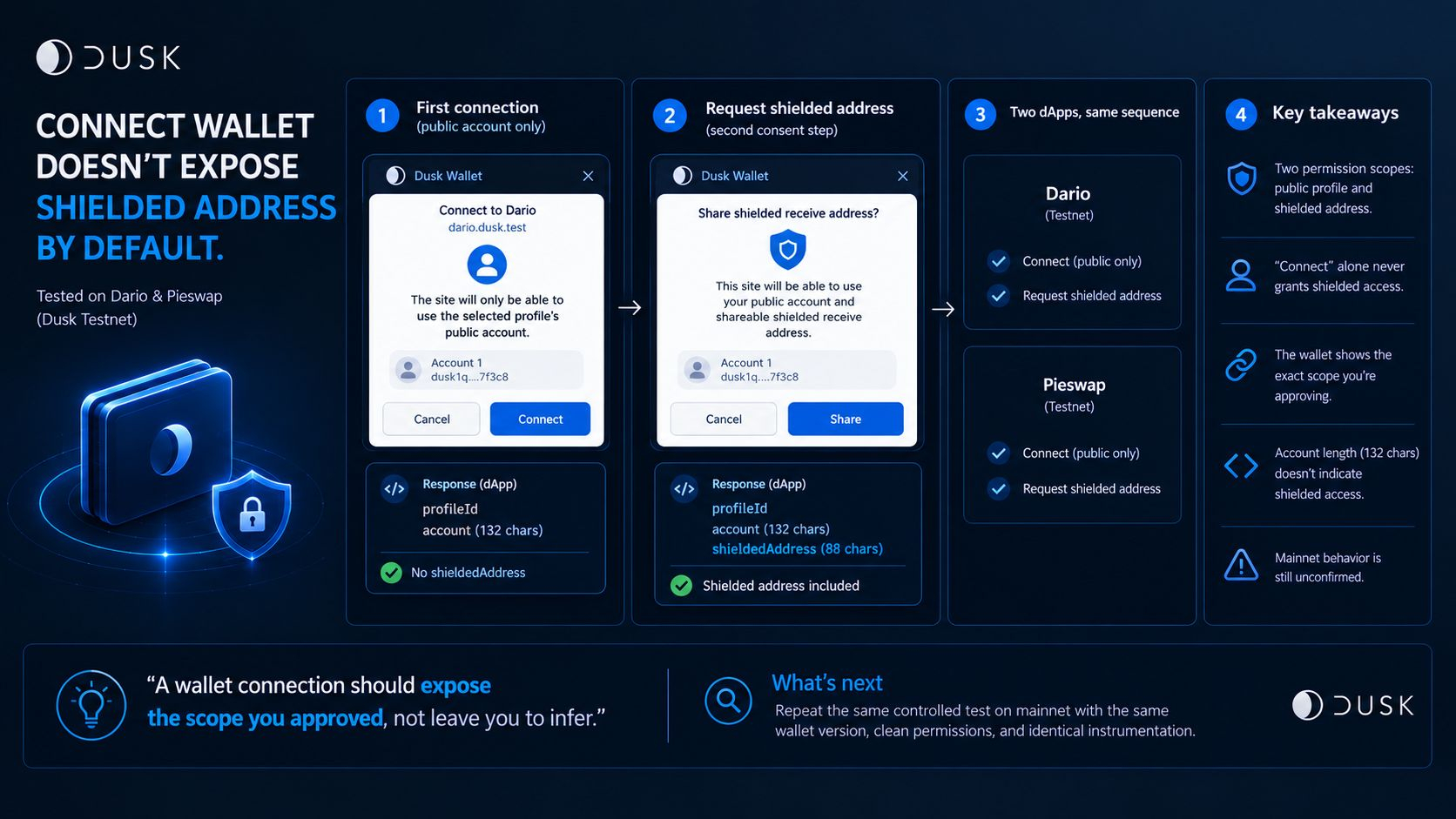
Tôi muốn biết “Connect Wallet” thực sự cấp cho dApp quyền truy cập vào những gì, nên tôi đã thử quy trình thực tế trên Dario và Pieswap ở Dusk testnet. Ở cả hai trường hợp, lần kết nối đầu tiên chỉ trả về profile ID và tài khoản public. Cửa sổ bật lên ghi rõ: “Trang web chỉ có thể sử dụng tài khoản public của profile đã chọn.” Chỉ khi tôi yêu cầu địa chỉ nhận (receive) được che chắn (shielded) thì mới xuất hiện bước đồng ý (consent) thứ hai, và chỉ khi đó phản hồi mới bao gồm shieldedAddress. Cửa sổ bật lên cũng thay đổi, đặt tên cho “địa chỉ nhận được che chắn có thể chia sẻ (shareable shielded receive address)”. Cả hai tích hợp đều hiển thị cùng một chuỗi.
Đây là điểm lật ngược: Tôi đang coi “Connect Wallet” như một sự kiện cấp quyền duy nhất. Không phải vậy. Thử nghiệm kiểm soát của tôi đã tách việc truy cập tài khoản public khỏi việc chia sẻ địa chỉ nhận được che chắn tại thời điểm xin đồng ý.
Sự tách bạch này đưa một phần ranh giới “tiết lộ tối thiểu” vào trong luồng đồng ý của ví, chứ không phải hoàn toàn để người dùng tự quản lý. Trong cả hai bài thử nghiệm, việc bấm “Connect” đơn thuần không bao giờ cấp phạm vi địa chỉ được che chắn; dApp phải đi qua một bước đồng ý riêng để có được nó.
Tôi cũng hiểu sai một điều khi đang điều tra. Tôi nghĩ chuỗi tài khoản dài 132 ký tự có thể gợi ý khả năng truy cập được che chắn. Không phải. Cả hai dApp đều trả về cùng định dạng tài khoản ở trạng thái nền (baseline), trong khi shieldedAddress vẫn vắng mặt cho đến khi có yêu cầu rõ ràng.
Vẫn còn một câu hỏi chưa được giải quyết. Một phiên làm việc trên Dario mainnet trước đó hoạt động khác đi, nhưng tôi chưa thể tái tạo lại nó trong cùng các điều kiện kiểm soát, nên tôi không gọi đó là rò rỉ (leak). Tôi chỉ có thể nói rằng ranh giới quyền chỉ public đã được giữ vững qua hai tích hợp testnet mà tôi kiểm tra, chứ không khẳng định là nó chắc chắn đúng với mọi môi trường.
“Việc kết nối ví phải hiển thị phạm vi mà bạn đã phê duyệt, không nên khiến bạn phải suy đoán.”
Điều tôi muốn xem tiếp theo: cùng thử nghiệm kiểm soát trên mainnet với cùng phiên bản ví, quyền được dọn sạch (clean permissions) và công cụ đo lường (instrumentation) giống hệt, để xem liệu ranh giới này có được duy trì xuyên suốt các môi trường hay không.
#dusk $DUSK @Dusk_Foundation
Tôi muốn biết “Connect Wallet” thực sự cấp cho dApp quyền truy cập vào những gì, nên tôi đã thử quy trình thực tế trên Dario và Pieswap ở Dusk testnet. Ở cả hai trường hợp, lần kết nối đầu tiên chỉ trả về profile ID và tài khoản public. Cửa sổ bật lên ghi rõ: “Trang web chỉ có thể sử dụng tài khoản public của profile đã chọn.” Chỉ khi tôi yêu cầu địa chỉ nhận (receive) được che chắn (shielded) thì mới xuất hiện bước đồng ý (consent) thứ hai, và chỉ khi đó phản hồi mới bao gồm shieldedAddress. Cửa sổ bật lên cũng thay đổi, đặt tên cho “địa chỉ nhận được che chắn có thể chia sẻ (shareable shielded receive address)”. Cả hai tích hợp đều hiển thị cùng một chuỗi.
Đây là điểm lật ngược: Tôi đang coi “Connect Wallet” như một sự kiện cấp quyền duy nhất. Không phải vậy. Thử nghiệm kiểm soát của tôi đã tách việc truy cập tài khoản public khỏi việc chia sẻ địa chỉ nhận được che chắn tại thời điểm xin đồng ý.
Sự tách bạch này đưa một phần ranh giới “tiết lộ tối thiểu” vào trong luồng đồng ý của ví, chứ không phải hoàn toàn để người dùng tự quản lý. Trong cả hai bài thử nghiệm, việc bấm “Connect” đơn thuần không bao giờ cấp phạm vi địa chỉ được che chắn; dApp phải đi qua một bước đồng ý riêng để có được nó.
Tôi cũng hiểu sai một điều khi đang điều tra. Tôi nghĩ chuỗi tài khoản dài 132 ký tự có thể gợi ý khả năng truy cập được che chắn. Không phải. Cả hai dApp đều trả về cùng định dạng tài khoản ở trạng thái nền (baseline), trong khi shieldedAddress vẫn vắng mặt cho đến khi có yêu cầu rõ ràng.
Vẫn còn một câu hỏi chưa được giải quyết. Một phiên làm việc trên Dario mainnet trước đó hoạt động khác đi, nhưng tôi chưa thể tái tạo lại nó trong cùng các điều kiện kiểm soát, nên tôi không gọi đó là rò rỉ (leak). Tôi chỉ có thể nói rằng ranh giới quyền chỉ public đã được giữ vững qua hai tích hợp testnet mà tôi kiểm tra, chứ không khẳng định là nó chắc chắn đúng với mọi môi trường.
“Việc kết nối ví phải hiển thị phạm vi mà bạn đã phê duyệt, không nên khiến bạn phải suy đoán.”
Điều tôi muốn xem tiếp theo: cùng thử nghiệm kiểm soát trên mainnet với cùng phiên bản ví, quyền được dọn sạch (clean permissions) và công cụ đo lường (instrumentation) giống hệt, để xem liệu ranh giới này có được duy trì xuyên suốt các môi trường hay không.
#dusk $DUSK @Dusk
1
2
96
·
--
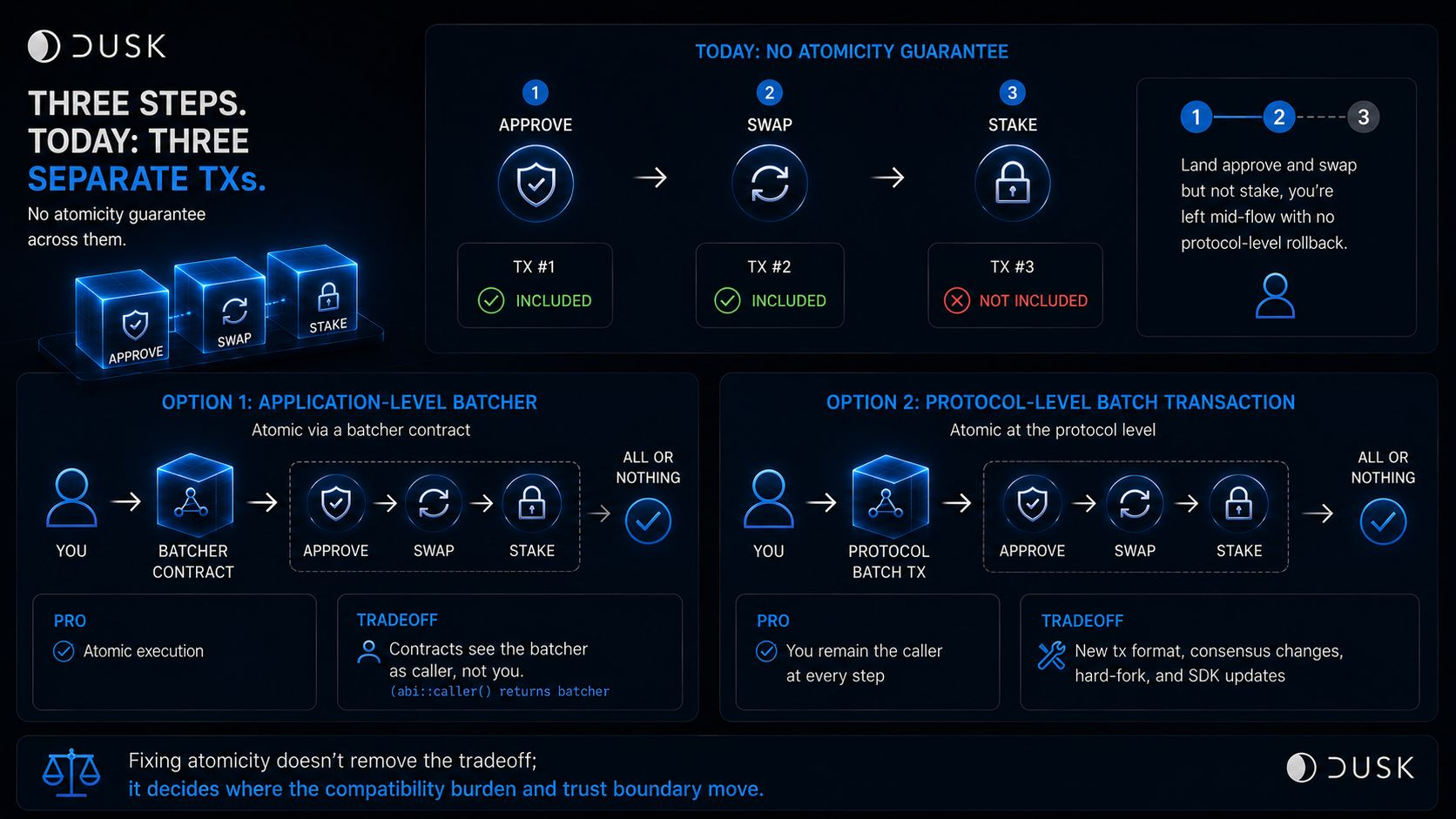
Tôi đã cho rằng nếu tôi muốn thực hiện ba việc trên-chain—approve, swap, rồi stake—thì chain sẽ coi đó là một việc xảy ra hoặc không xảy ra. Một issue mở trong repository Rusk của chính Dusk nói rằng không phải như vậy hiện nay.
Giao dịch của Dusk ngày nay mang một thao tác tùy chọn duy nhất: một lệnh gọi contract, một deploy, hoặc một memo, với một giá trị, một người nhận, một nonce và một chữ ký. Vì vậy, approve, swap và stake trở thành ba giao dịch tách rời, mỗi giao dịch độc lập được đưa vào hoặc bị loại bỏ. Issue của Dusk nêu thẳng rằng: không có cam kết atomicity giữa chúng. Thực hiện approve và swap nhưng không stake, và bạn sẽ bị kẹt giữa luồng mà không có cơ chế rollback ở cấp giao thức.
Vấn đề không chỉ là các luồng nhiều bước có thể dừng giữa chừng. Việc khắc phục điều đó sẽ thay đổi ai phải gánh chi phí tương thích.
Một contract batcher có thể làm toàn bộ chuỗi thao tác trở nên atomic, vì khi một sub-call thất bại thì toàn bộ giao dịch bên ngoài sẽ bị revert. Nhưng một contract đích kiểm tra xem ai đang gọi trực tiếp nó sẽ thấy batcher chứ không thấy bạn, trừ khi contract đó đã được viết để nhìn vượt qua người gọi ngay lập tức. Còn một batch transaction ở cấp giao thức giữ bạn là người gọi ở mọi bước, nhưng nó không thể “xuất xưởng” nếu không có một định dạng giao dịch mới, các thay đổi consensus, một hard-fork và tất cả các wallet SDK kịp cập nhật.
Thêm batching không loại bỏ sự đánh đổi. Nó quyết định liệu gánh nặng tương thích nằm ở phần ủy quyền trong ứng dụng hay trong ngăn xếp giao thức.
"Sửa atomicity không loại bỏ sự đánh đổi; nó quyết định gánh nặng tương thích và ranh giới tin cậy sẽ dịch chuyển đến đâu."
Thứ tôi thực sự muốn theo dõi: Dusk có chọn batcher ở cấp ứng dụng hay transaction ở cấp giao thức, và lựa chọn đó buộc các giả định hiện có về ủy quyền phải thay đổi như thế nào đối với các nhà phát triển.
#dusk $DUSK @Dusk_Foundation
Tôi đã cho rằng nếu tôi muốn thực hiện ba việc trên-chain—approve, swap, rồi stake—thì chain sẽ coi đó là một việc xảy ra hoặc không xảy ra. Một issue mở trong repository Rusk của chính Dusk nói rằng không phải như vậy hiện nay.
Giao dịch của Dusk ngày nay mang một thao tác tùy chọn duy nhất: một lệnh gọi contract, một deploy, hoặc một memo, với một giá trị, một người nhận, một nonce và một chữ ký. Vì vậy, approve, swap và stake trở thành ba giao dịch tách rời, mỗi giao dịch độc lập được đưa vào hoặc bị loại bỏ. Issue của Dusk nêu thẳng rằng: không có cam kết atomicity giữa chúng. Thực hiện approve và swap nhưng không stake, và bạn sẽ bị kẹt giữa luồng mà không có cơ chế rollback ở cấp giao thức.
Vấn đề không chỉ là các luồng nhiều bước có thể dừng giữa chừng. Việc khắc phục điều đó sẽ thay đổi ai phải gánh chi phí tương thích.
Một contract batcher có thể làm toàn bộ chuỗi thao tác trở nên atomic, vì khi một sub-call thất bại thì toàn bộ giao dịch bên ngoài sẽ bị revert. Nhưng một contract đích kiểm tra xem ai đang gọi trực tiếp nó sẽ thấy batcher chứ không thấy bạn, trừ khi contract đó đã được viết để nhìn vượt qua người gọi ngay lập tức. Còn một batch transaction ở cấp giao thức giữ bạn là người gọi ở mọi bước, nhưng nó không thể “xuất xưởng” nếu không có một định dạng giao dịch mới, các thay đổi consensus, một hard-fork và tất cả các wallet SDK kịp cập nhật.
Thêm batching không loại bỏ sự đánh đổi. Nó quyết định liệu gánh nặng tương thích nằm ở phần ủy quyền trong ứng dụng hay trong ngăn xếp giao thức.
"Sửa atomicity không loại bỏ sự đánh đổi; nó quyết định gánh nặng tương thích và ranh giới tin cậy sẽ dịch chuyển đến đâu."
Thứ tôi thực sự muốn theo dõi: Dusk có chọn batcher ở cấp ứng dụng hay transaction ở cấp giao thức, và lựa chọn đó buộc các giả định hiện có về ủy quyền phải thay đổi như thế nào đối với các nhà phát triển.
#dusk $DUSK @Dusk
1
2
96
Đăng nhập để khám phá thêm nội dung
Tham gia cùng người dùng tiền mã hóa toàn cầu trên Binance Square
⚡️ Nhận thông tin mới nhất và hữu ích về tiền mã hóa.
💬 Được tin cậy bởi sàn giao dịch tiền mã hóa lớn nhất thế giới.
👍 Khám phá những thông tin chuyên sâu thực tế từ những nhà sáng tạo đã xác minh.
Email / Số điện thoại