

#crosschain
crosschain
302,133 views
2,393 Discussing
Hot
Latest

·
--
Bullish
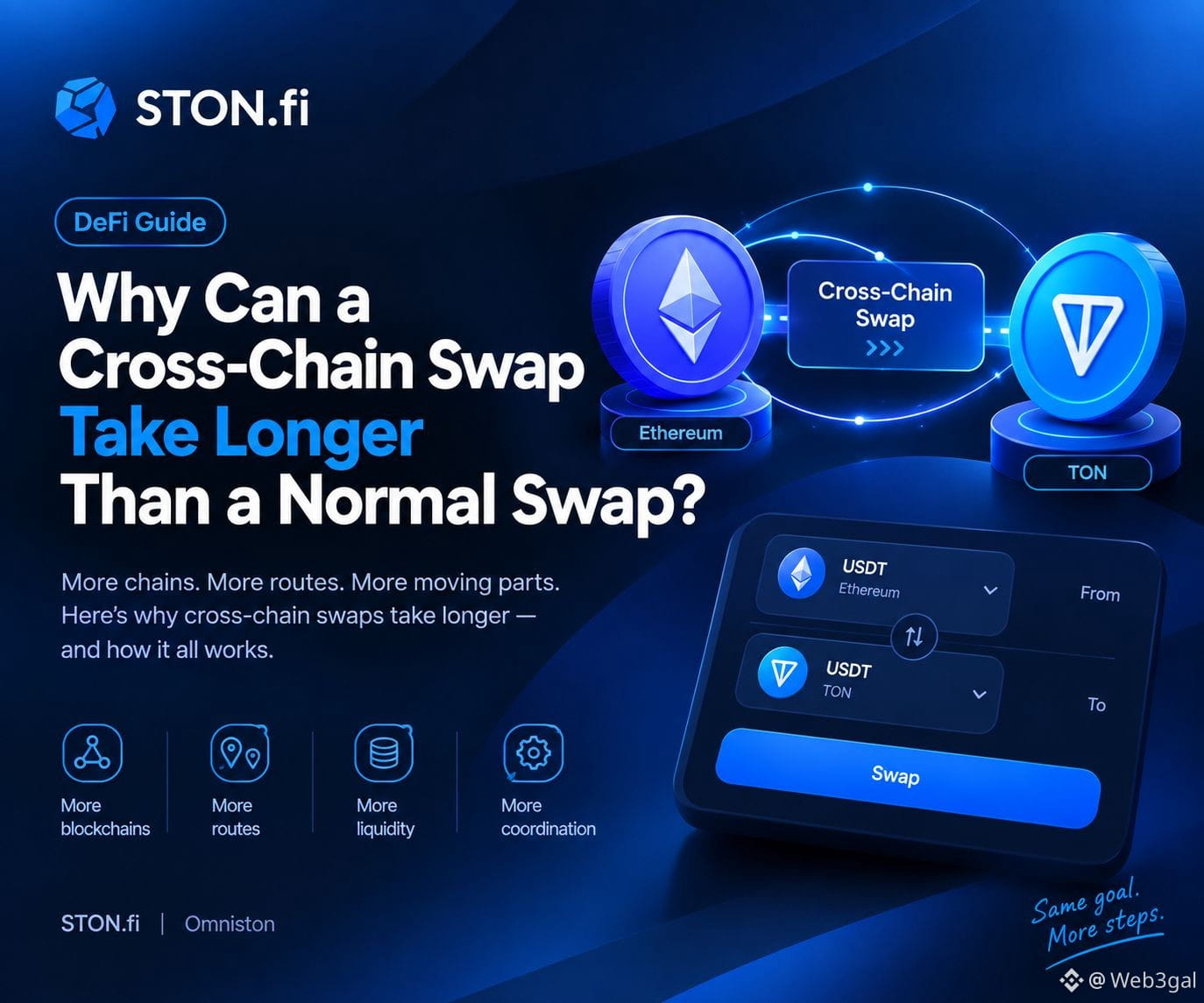
Why Can a Cross-Chain Swap Take Longer Than a Normal Swap?
A cross-chain swap can look simple on the surface:
USDT on Ethereum → asset on TON
But there’s more happening behind that transaction than with a normal same-chain swap.
With a regular DEX swap, both assets are on the same blockchain. The transaction stays within one network, and once it’s confirmed, the swap is complete.
Cross-chain swaps have to coordinate across different blockchain environments.
That can involve:
• Source-chain transaction
• Route and liquidity selection
• Cross-chain execution
• Destination-chain settlement
• Network confirmations
So if a cross-chain swap takes longer, it doesn’t automatically mean something went wrong. There are simply more moving parts that need to line up.
This is where infrastructure like Omniston becomes useful. It coordinates routing and cross-chain execution across supported networks and liquidity sources, reducing the need for users to manually figure out the route themselves.
https://ston.fi/omniston
If a swap takes longer than expected, check its status before assuming it failed:
Source transaction → Execution → Destination settlement
The bigger point is that cross-chain swaps aren't just normal swaps with another network added.
They’re about coordinating different blockchain environments to produce one final outcome.
As DeFi becomes more multi-chain, that coordination layer becomes increasingly important.
#STONfi #Omniston #DeFi #CrossChain
Why Can a Cross-Chain Swap Take Longer Than a Normal Swap?
A cross-chain swap can look simple on the surface:
USDT on Ethereum → asset on TON
But there’s more happening behind that transaction than with a normal same-chain swap.
With a regular DEX swap, both assets are on the same blockchain. The transaction stays within one network, and once it’s confirmed, the swap is complete.
Cross-chain swaps have to coordinate across different blockchain environments.
That can involve:
• Source-chain transaction
• Route and liquidity selection
• Cross-chain execution
• Destination-chain settlement
• Network confirmations
So if a cross-chain swap takes longer, it doesn’t automatically mean something went wrong. There are simply more moving parts that need to line up.
This is where infrastructure like Omniston becomes useful. It coordinates routing and cross-chain execution across supported networks and liquidity sources, reducing the need for users to manually figure out the route themselves.
https://ston.fi/omniston
If a swap takes longer than expected, check its status before assuming it failed:
Source transaction → Execution → Destination settlement
The bigger point is that cross-chain swaps aren't just normal swaps with another network added.
They’re about coordinating different blockchain environments to produce one final outcome.
As DeFi becomes more multi-chain, that coordination layer becomes increasingly important.
#STONfi #Omniston #DeFi #CrossChain
A cross-chain swap can look simple on the surface:
USDT on Ethereum → asset on TON
But there’s more happening behind that transaction than with a normal same-chain swap.
With a regular DEX swap, both assets are on the same blockchain. The transaction stays within one network, and once it’s confirmed, the swap is complete.
Cross-chain swaps have to coordinate across different blockchain environments.
That can involve:
• Source-chain transaction
• Route and liquidity selection
• Cross-chain execution
• Destination-chain settlement
• Network confirmations
So if a cross-chain swap takes longer, it doesn’t automatically mean something went wrong. There are simply more moving parts that need to line up.
This is where infrastructure like Omniston becomes useful. It coordinates routing and cross-chain execution across supported networks and liquidity sources, reducing the need for users to manually figure out the route themselves.
https://ston.fi/omniston
If a swap takes longer than expected, check its status before assuming it failed:
Source transaction → Execution → Destination settlement
The bigger point is that cross-chain swaps aren't just normal swaps with another network added.
They’re about coordinating different blockchain environments to produce one final outcome.
As DeFi becomes more multi-chain, that coordination layer becomes increasingly important.
#STONfi #Omniston #DeFi #CrossChain
1
92
·
--
Bullish
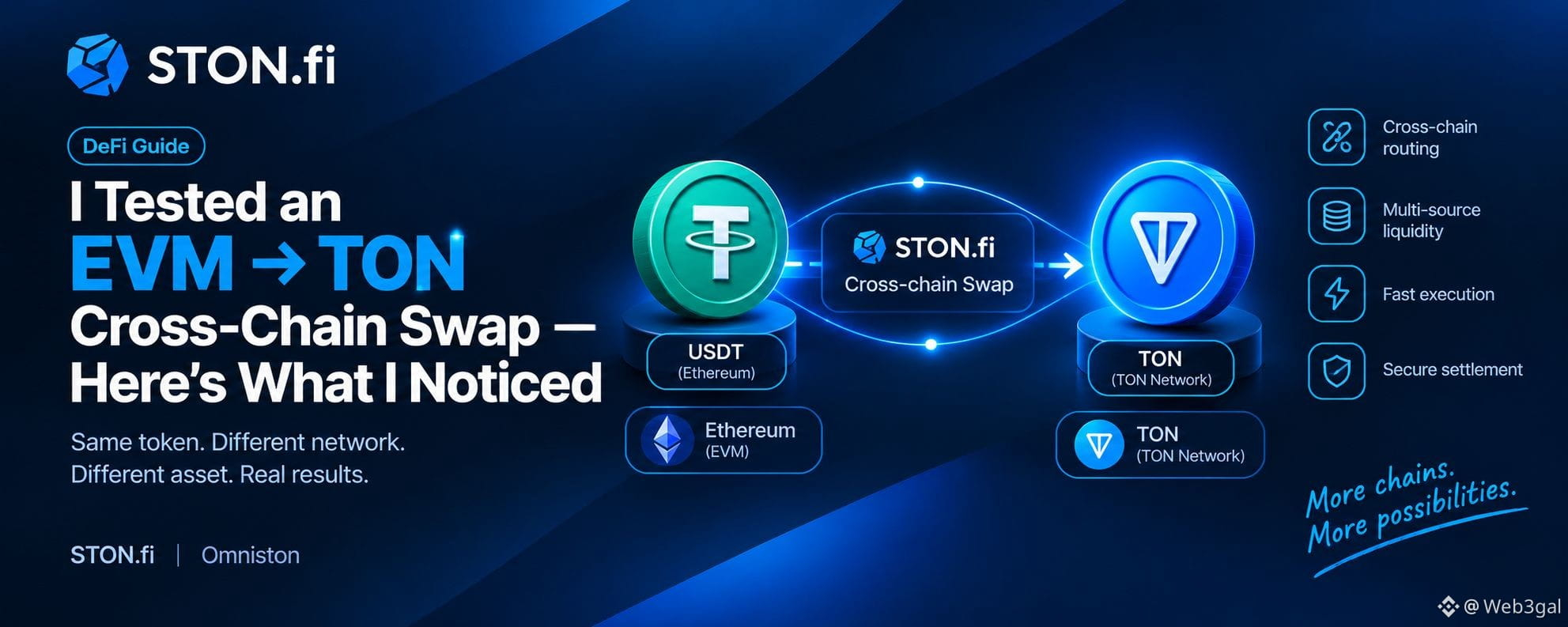
I wanted to see what an EVM → TON cross-chain swap actually looks like in practice, so I tested the flow on STON.fi.
I started with 50 USDT and selected TON as the destination.
The quote showed 34.6127 TON, with an estimated value of around $49.87 against the $50 sent.
What caught my attention wasn’t the small difference in value. It was the destination asset.
It’s easy to think:
USDT → USDT
But the actual swap was:
USDT on Ethereum → TON on TON
That made one thing clear: with cross-chain swaps, checking the destination is just as important as checking what you’re sending.
The interface showed the expected output and route before confirmation, while Omniston handled the routing and cross-chain execution using available liquidity.
The useful part of the test wasn’t simply seeing the swap go through. It was seeing how many details are worth checking before confirming:
Source asset → Source network → Destination asset → Destination network → Expected output
When you’re moving between chains, those details matter.
https://ston.fi/omniston
#STONfi #Omniston #TON #TON #CrossChain
I wanted to see what an EVM → TON cross-chain swap actually looks like in practice, so I tested the flow on STON.fi.
I started with 50 USDT and selected TON as the destination.
The quote showed 34.6127 TON, with an estimated value of around $49.87 against the $50 sent.
What caught my attention wasn’t the small difference in value. It was the destination asset.
It’s easy to think:
USDT → USDT
But the actual swap was:
USDT on Ethereum → TON on TON
That made one thing clear: with cross-chain swaps, checking the destination is just as important as checking what you’re sending.
The interface showed the expected output and route before confirmation, while Omniston handled the routing and cross-chain execution using available liquidity.
The useful part of the test wasn’t simply seeing the swap go through. It was seeing how many details are worth checking before confirming:
Source asset → Source network → Destination asset → Destination network → Expected output
When you’re moving between chains, those details matter.
https://ston.fi/omniston
#STONfi #Omniston #TON #TON #CrossChain
I started with 50 USDT and selected TON as the destination.
The quote showed 34.6127 TON, with an estimated value of around $49.87 against the $50 sent.
What caught my attention wasn’t the small difference in value. It was the destination asset.
It’s easy to think:
USDT → USDT
But the actual swap was:
USDT on Ethereum → TON on TON
That made one thing clear: with cross-chain swaps, checking the destination is just as important as checking what you’re sending.
The interface showed the expected output and route before confirmation, while Omniston handled the routing and cross-chain execution using available liquidity.
The useful part of the test wasn’t simply seeing the swap go through. It was seeing how many details are worth checking before confirming:
Source asset → Source network → Destination asset → Destination network → Expected output
When you’re moving between chains, those details matter.
https://ston.fi/omniston
#STONfi #Omniston #TON #TON #CrossChain
1
99

·
--
Bullish
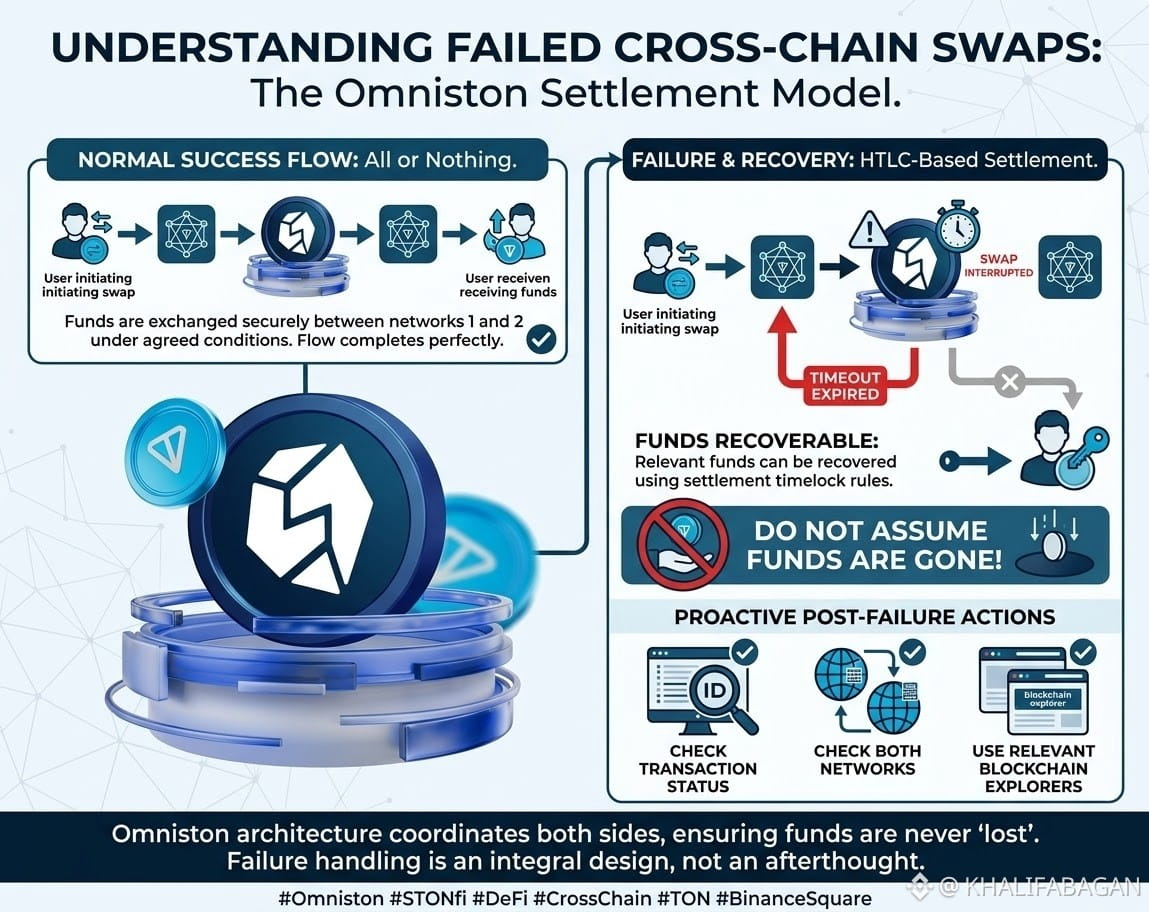
What happens when a cross chain swap does not complete?
It depends on the settlement architecture.
Omniston uses HTLC based settlement with timelock logic to coordinate the two sides of a cross chain swap.
The goal is an all or nothing flow:
The swap completes under the agreed conditions, or the relevant funds can be recovered according to the settlement rules.
So when a swap appears to fail, do not assume the funds are gone.
Check the transaction status, both networks, and the relevant blockchain explorers.
Failure handling is part of cross chain architecture, not an afterthought.
#BinanceSquare #STONfi #DeFi #CrossChain #TON
What happens when a cross chain swap does not complete?
It depends on the settlement architecture.
Omniston uses HTLC based settlement with timelock logic to coordinate the two sides of a cross chain swap.
The goal is an all or nothing flow:
The swap completes under the agreed conditions, or the relevant funds can be recovered according to the settlement rules.
So when a swap appears to fail, do not assume the funds are gone.
Check the transaction status, both networks, and the relevant blockchain explorers.
Failure handling is part of cross chain architecture, not an afterthought.
#BinanceSquare #STONfi #DeFi #CrossChain #TON
It depends on the settlement architecture.
Omniston uses HTLC based settlement with timelock logic to coordinate the two sides of a cross chain swap.
The goal is an all or nothing flow:
The swap completes under the agreed conditions, or the relevant funds can be recovered according to the settlement rules.
So when a swap appears to fail, do not assume the funds are gone.
Check the transaction status, both networks, and the relevant blockchain explorers.
Failure handling is part of cross chain architecture, not an afterthought.
#BinanceSquare #STONfi #DeFi #CrossChain #TON
1
16

·
--
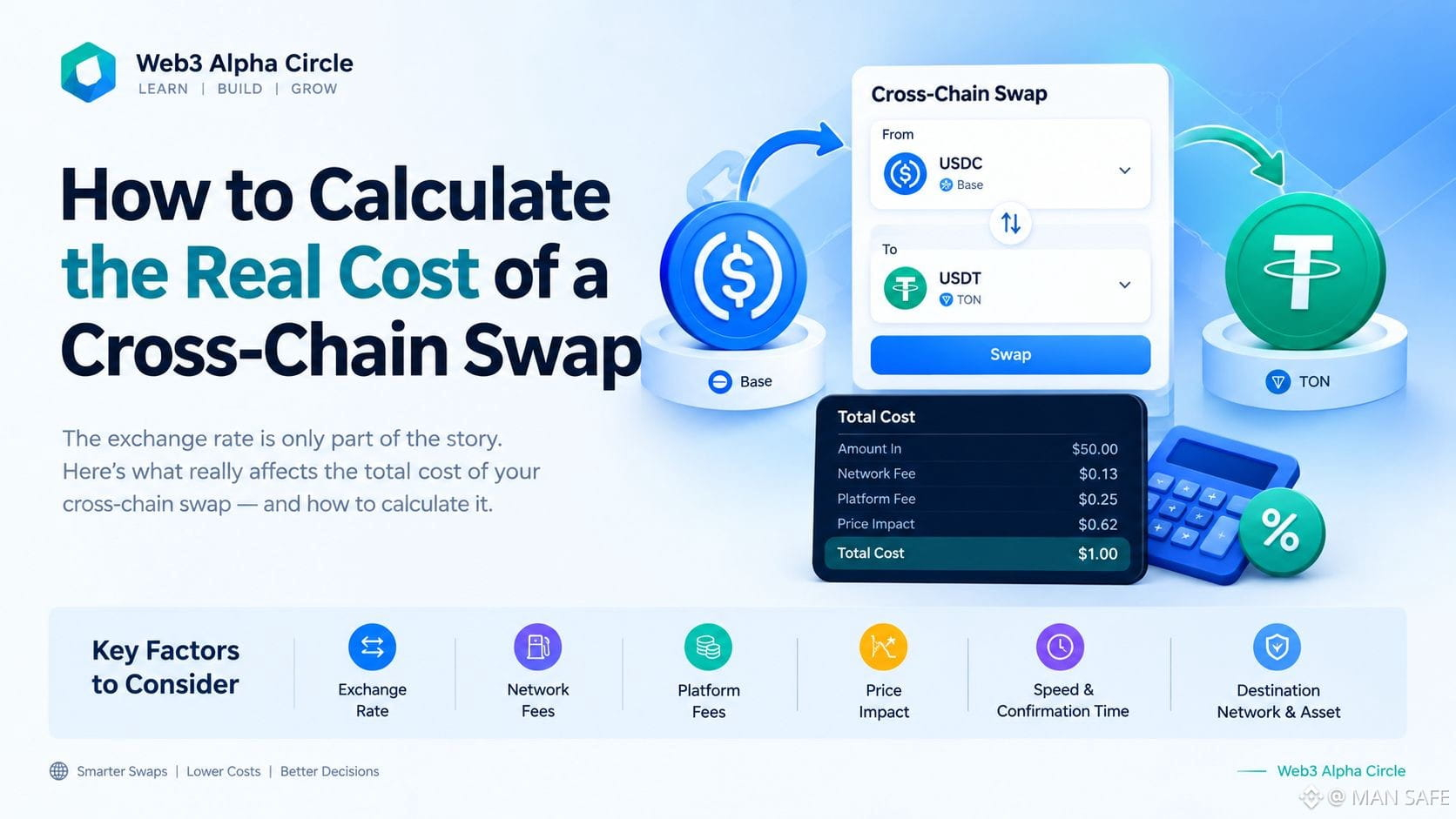
How to Calculate the Real Cost of a Cross-Chain Swap
A cross-chain swap isn't just about the network fee.
To understand the real cost, compare what you send with what you receive.
For example:
500 $USDC → 496 $USDT
➜ Difference: 4 USDT
➜ Effective cost: 0.8%
But that difference may include more than a simple fee. Consider:
➜ Network fees
➜ Exchange-rate differences
➜ Price impact
➜ Slippage
➜ Execution costs
➜ Final amount received
When comparing routes, don't focus only on the cheapest gas fee.
Check the final output.
With cross-chain infrastructure such as STON.fi and Omniston, always review the live quote for your specific amount before confirming.
Simple rule:
What you send → What you receive = the starting point for understanding the real cost.
Always verify the asset, network, destination wallet, fees, and expected output before signing.
#CrossChain #STONfi
How to Calculate the Real Cost of a Cross-Chain Swap
A cross-chain swap isn't just about the network fee.
To understand the real cost, compare what you send with what you receive.
For example:
500 $USDC → 496 $USDT
➜ Difference: 4 USDT
➜ Effective cost: 0.8%
But that difference may include more than a simple fee. Consider:
➜ Network fees
➜ Exchange-rate differences
➜ Price impact
➜ Slippage
➜ Execution costs
➜ Final amount received
When comparing routes, don't focus only on the cheapest gas fee.
Check the final output.
With cross-chain infrastructure such as STON.fi and Omniston, always review the live quote for your specific amount before confirming.
Simple rule:
What you send → What you receive = the starting point for understanding the real cost.
Always verify the asset, network, destination wallet, fees, and expected output before signing.
#CrossChain #STONfi
A cross-chain swap isn't just about the network fee.
To understand the real cost, compare what you send with what you receive.
For example:
500 $USDC → 496 $USDT
➜ Difference: 4 USDT
➜ Effective cost: 0.8%
But that difference may include more than a simple fee. Consider:
➜ Network fees
➜ Exchange-rate differences
➜ Price impact
➜ Slippage
➜ Execution costs
➜ Final amount received
When comparing routes, don't focus only on the cheapest gas fee.
Check the final output.
With cross-chain infrastructure such as STON.fi and Omniston, always review the live quote for your specific amount before confirming.
Simple rule:
What you send → What you receive = the starting point for understanding the real cost.
Always verify the asset, network, destination wallet, fees, and expected output before signing.
#CrossChain #STONfi
67

·
--
What if moving between blockchains felt like changing lanes instead of changing roads?Today, TON, Ethereum, BNB Chain, Base, Arbitrum, TRON and others have separate liquidity and applications.
Moving between them can mean dealing with bridges, wallets, gas, routes and execution.
For users, that’s friction.
STON.fi’s Omniston is being built as cross-chain execution infrastructure that coordinates quotes, liquidity and settlement across supported networks.
The bigger idea:
Users shouldn’t need to understand the infrastructure.
Choose what you have.
Choose what you want.
Choose where it should arrive.
Let the infrastructure handle the complexity.
The best cross-chain experience may simply feel like changing #ton #DeFi #CrossChain
What if moving between blockchains felt like changing lanes instead of changing roads?
Today, TON, Ethereum, BNB Chain, Base, Arbitrum, TRON and others have separate liquidity and applications.
Moving between them can mean dealing with bridges, wallets, gas, routes and execution.
For users, that’s friction.
STON.fi’s Omniston is being built as cross-chain execution infrastructure that coordinates quotes, liquidity and settlement across supported networks.
The bigger idea:
Users shouldn’t need to understand the infrastructure.
Choose what you have.
Choose what you want.
Choose where it should arrive.
Let the infrastructure handle the complexity.
The best cross-chain experience may simply feel like changing #ton #DeFi #CrossChain
Moving between them can mean dealing with bridges, wallets, gas, routes and execution.
For users, that’s friction.
STON.fi’s Omniston is being built as cross-chain execution infrastructure that coordinates quotes, liquidity and settlement across supported networks.
The bigger idea:
Users shouldn’t need to understand the infrastructure.
Choose what you have.
Choose what you want.
Choose where it should arrive.
Let the infrastructure handle the complexity.
The best cross-chain experience may simply feel like changing #ton #DeFi #CrossChain
112

·
--
Most Cross-Chain Campaigns Start With a Swap. STON.fi Starts With Context.
Cross-chain activity can feel complicated when users have to figure out the mechanics before they even understand what they’re participating in.
That’s what makes STON.fi’s “One Swap. Across Chains” campaign interesting.
Instead of pushing users straight into a swap, the campaign begins with a 2 week waitlist phase.
During this period, users have the opportunity to become a Priority Passenger before the main campaign gets underway.
What happens during the waitlist?
Connect a TON wallet and join the waitlist.
The first 1,000 eligible participants can receive:
• 1,000 bonus miles
• A personalized Priority Passenger Ticket
And the interesting part is that these aren’t simply points sitting on a dashboard.
They are miles that can be used toward limited Flight Deals released throughout the campaign.
So the campaign experience becomes:
Waitlist → Earn Miles → Unlock Flight Deals → Explore Cross-Chain Swaps
That structure gives the early stage a purpose beyond simply collecting signups.
It also gives users an opportunity to become familiar with how STON.fi approaches cross-chain activity before jumping into the actual swap experience.
Why the waitlist matters
The campaign is designed around participation from the beginning.
Rather than:
Swap first → understand later
the experience is closer to:
Join early → explore the system → earn miles → participate with context
There is also a time sensitive element.
Only 1,000 Priority Passenger spots are available, and the 1,000 mile joining bonus is tied to the waitlist stage.
Once that stage closes, that specific early participant opportunity is no longer available.
For anyone already exploring cross-chain swaps, TON, or the STON.fi ecosystem, the waitlist is worth checking out while it remains open.
🔗 cross-chain.ston.fi
@ston_fi @ton_blockchain
#STONfi #TON #defi #CrossChain
Most Cross-Chain Campaigns Start With a Swap. STON.fi Starts With Context.
Cross-chain activity can feel complicated when users have to figure out the mechanics before they even understand what they’re participating in.
That’s what makes STON.fi’s “One Swap. Across Chains” campaign interesting.
Instead of pushing users straight into a swap, the campaign begins with a 2 week waitlist phase.
During this period, users have the opportunity to become a Priority Passenger before the main campaign gets underway.
What happens during the waitlist?
Connect a TON wallet and join the waitlist.
The first 1,000 eligible participants can receive:
• 1,000 bonus miles
• A personalized Priority Passenger Ticket
And the interesting part is that these aren’t simply points sitting on a dashboard.
They are miles that can be used toward limited Flight Deals released throughout the campaign.
So the campaign experience becomes:
Waitlist → Earn Miles → Unlock Flight Deals → Explore Cross-Chain Swaps
That structure gives the early stage a purpose beyond simply collecting signups.
It also gives users an opportunity to become familiar with how STON.fi approaches cross-chain activity before jumping into the actual swap experience.
Why the waitlist matters
The campaign is designed around participation from the beginning.
Rather than:
Swap first → understand later
the experience is closer to:
Join early → explore the system → earn miles → participate with context
There is also a time sensitive element.
Only 1,000 Priority Passenger spots are available, and the 1,000 mile joining bonus is tied to the waitlist stage.
Once that stage closes, that specific early participant opportunity is no longer available.
For anyone already exploring cross-chain swaps, TON, or the STON.fi ecosystem, the waitlist is worth checking out while it remains open.
🔗 cross-chain.ston.fi
@ston_fi @ton_blockchain
#STONfi #TON #defi #CrossChain
Cross-chain activity can feel complicated when users have to figure out the mechanics before they even understand what they’re participating in.
That’s what makes STON.fi’s “One Swap. Across Chains” campaign interesting.
Instead of pushing users straight into a swap, the campaign begins with a 2 week waitlist phase.
During this period, users have the opportunity to become a Priority Passenger before the main campaign gets underway.
What happens during the waitlist?
Connect a TON wallet and join the waitlist.
The first 1,000 eligible participants can receive:
• 1,000 bonus miles
• A personalized Priority Passenger Ticket
And the interesting part is that these aren’t simply points sitting on a dashboard.
They are miles that can be used toward limited Flight Deals released throughout the campaign.
So the campaign experience becomes:
Waitlist → Earn Miles → Unlock Flight Deals → Explore Cross-Chain Swaps
That structure gives the early stage a purpose beyond simply collecting signups.
It also gives users an opportunity to become familiar with how STON.fi approaches cross-chain activity before jumping into the actual swap experience.
Why the waitlist matters
The campaign is designed around participation from the beginning.
Rather than:
Swap first → understand later
the experience is closer to:
Join early → explore the system → earn miles → participate with context
There is also a time sensitive element.
Only 1,000 Priority Passenger spots are available, and the 1,000 mile joining bonus is tied to the waitlist stage.
Once that stage closes, that specific early participant opportunity is no longer available.
For anyone already exploring cross-chain swaps, TON, or the STON.fi ecosystem, the waitlist is worth checking out while it remains open.
🔗 cross-chain.ston.fi
@ston_fi @ton_blockchain
#STONfi #TON #defi #CrossChain

61

·
--
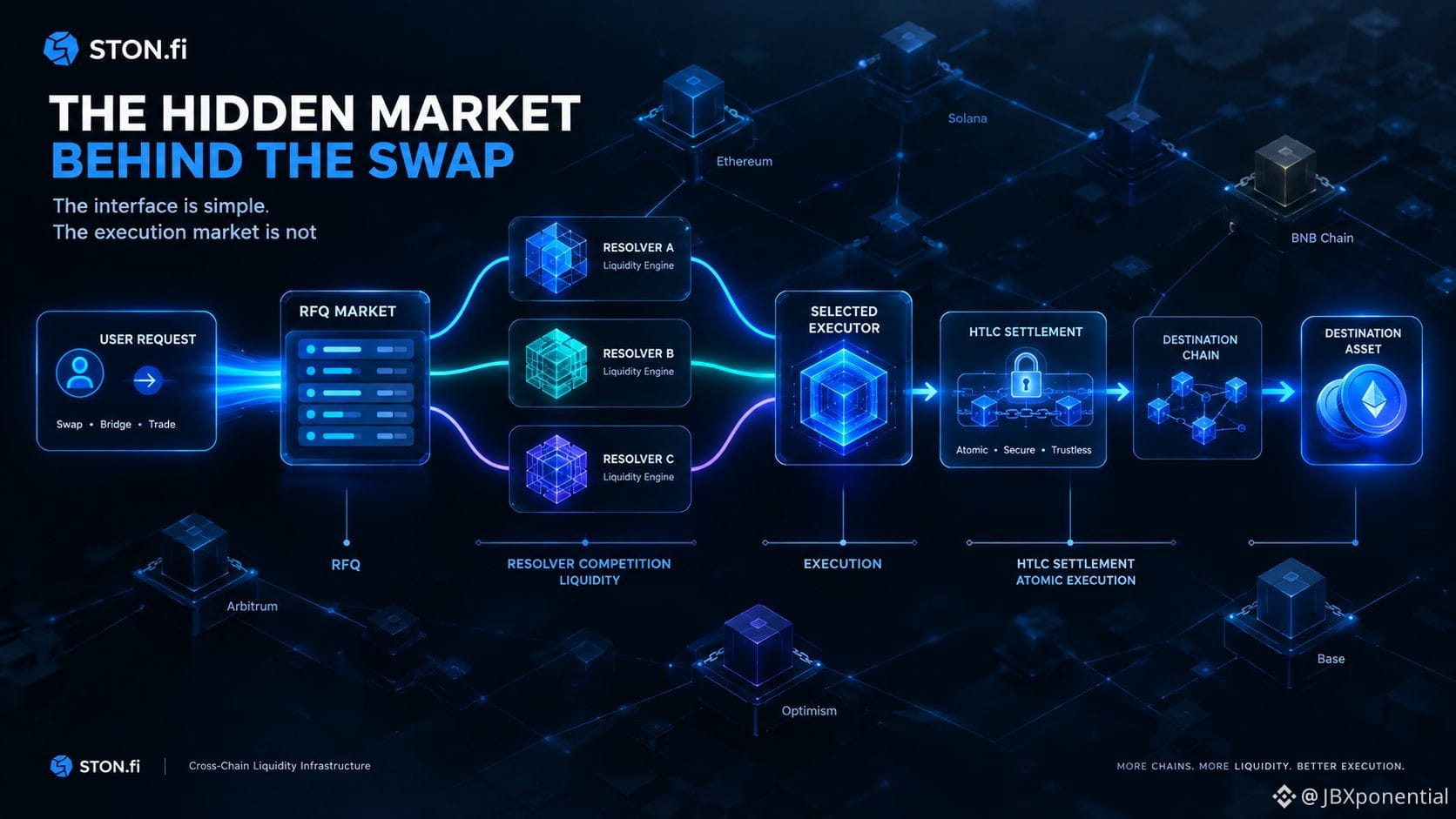
The Hidden Market Behind a Cross-Chain Swap
Most users think about a cross-chain transaction like this:
Asset A → Bridge → Asset B
But resolver-based systems introduce a different architecture.
A user can submit a cross-chain request, resolvers compete to fill it, and the selected resolver participates in settlement using cryptographic conditions enforced through HTLCs.
That creates several layers worth studying:
1. RFQ layer
The user requests an executable quote.
2. Resolver layer
Liquidity providers compete to fulfil the request.
3. Execution layer
The resolver supplies the destination-side asset.
4. Settlement layer
The transaction follows predefined cryptographic conditions.
5. Recovery layer
Timelock mechanisms provide a path for refunds when the intended settlement does not complete.
This is why cross-chain infrastructure deserves more attention than simply asking:
“Which chain does this support?”
A better research question is:
“How does the system coordinate liquidity and settlement across chains?”
That is where much of the actual architecture lives.
STON.fi's current cross-chain implementation uses Omniston for this execution model.
@ston_fi #STON.fi $STON #Stonbassador #DeFi #TON #CrossChain #Omniston
The Hidden Market Behind a Cross-Chain Swap
Most users think about a cross-chain transaction like this:
Asset A → Bridge → Asset B
But resolver-based systems introduce a different architecture.
A user can submit a cross-chain request, resolvers compete to fill it, and the selected resolver participates in settlement using cryptographic conditions enforced through HTLCs.
That creates several layers worth studying:
1. RFQ layer
The user requests an executable quote.
2. Resolver layer
Liquidity providers compete to fulfil the request.
3. Execution layer
The resolver supplies the destination-side asset.
4. Settlement layer
The transaction follows predefined cryptographic conditions.
5. Recovery layer
Timelock mechanisms provide a path for refunds when the intended settlement does not complete.
This is why cross-chain infrastructure deserves more attention than simply asking:
“Which chain does this support?”
A better research question is:
“How does the system coordinate liquidity and settlement across chains?”
That is where much of the actual architecture lives.
STON.fi's current cross-chain implementation uses Omniston for this execution model.
@ston_fi #STON.fi $STON #Stonbassador #DeFi #TON #CrossChain #Omniston
Most users think about a cross-chain transaction like this:
Asset A → Bridge → Asset B
But resolver-based systems introduce a different architecture.
A user can submit a cross-chain request, resolvers compete to fill it, and the selected resolver participates in settlement using cryptographic conditions enforced through HTLCs.
That creates several layers worth studying:
1. RFQ layer
The user requests an executable quote.
2. Resolver layer
Liquidity providers compete to fulfil the request.
3. Execution layer
The resolver supplies the destination-side asset.
4. Settlement layer
The transaction follows predefined cryptographic conditions.
5. Recovery layer
Timelock mechanisms provide a path for refunds when the intended settlement does not complete.
This is why cross-chain infrastructure deserves more attention than simply asking:
“Which chain does this support?”
A better research question is:
“How does the system coordinate liquidity and settlement across chains?”
That is where much of the actual architecture lives.
STON.fi's current cross-chain implementation uses Omniston for this execution model.
@ston_fi #STON.fi $STON #Stonbassador #DeFi #TON #CrossChain #Omniston
84

·
--
Cross-chain used to mean one thing: trust a bridge. And bridges became the industry's most expensive lesson — $2B+ lost to exploits, almost all from the same design flaw: a multisig or small validator set holding assets, waiting to be stolen.
The next phase removes the custodian. Light clients, ZK proofs, and native verification let chains verify each other's state directly — no committee holding funds, just math checking math. The question shifts from "who secures this bridge?" to "what can this chain cryptographically prove about that one?"
Watch the architecture, not the marketing. Wrapped assets are custodial trust with a token interface. Native verification is trust-minimized settlement. Same UX surface, fundamentally different failure modes: one can be hacked, the other has to be wrong about cryptography.
The endgame matters more than any single protocol. Once cross-chain verification is cheap and standard, chains stop competing on isolation and start competing as execution environments for the same global liquidity. Capital no longer picks a chain — it routes. Apps stop being chain-native and become chain-agnostic by default.
The unlock isn't better bridges. It's bridges disappearing into infrastructure — invisible, verified, boring. The most successful cross-chain tech will be the kind nobody talks about, because the security model graduated from "trust this multisig" to "verify these proofs."
That's what interoperability looks like grown up: fewer headlines, more guarantees.
$BTC $ETH $SOL
#Crypto #Blockchain #CrossChain #DeFi #Interoperability
Cross-chain used to mean one thing: trust a bridge. And bridges became the industry's most expensive lesson — $2B+ lost to exploits, almost all from the same design flaw: a multisig or small validator set holding assets, waiting to be stolen.
The next phase removes the custodian. Light clients, ZK proofs, and native verification let chains verify each other's state directly — no committee holding funds, just math checking math. The question shifts from "who secures this bridge?" to "what can this chain cryptographically prove about that one?"
Watch the architecture, not the marketing. Wrapped assets are custodial trust with a token interface. Native verification is trust-minimized settlement. Same UX surface, fundamentally different failure modes: one can be hacked, the other has to be wrong about cryptography.
The endgame matters more than any single protocol. Once cross-chain verification is cheap and standard, chains stop competing on isolation and start competing as execution environments for the same global liquidity. Capital no longer picks a chain — it routes. Apps stop being chain-native and become chain-agnostic by default.
The unlock isn't better bridges. It's bridges disappearing into infrastructure — invisible, verified, boring. The most successful cross-chain tech will be the kind nobody talks about, because the security model graduated from "trust this multisig" to "verify these proofs."
That's what interoperability looks like grown up: fewer headlines, more guarantees.
$BTC $ETH $SOL
#Crypto #Blockchain #CrossChain #DeFi #Interoperability
The next phase removes the custodian. Light clients, ZK proofs, and native verification let chains verify each other's state directly — no committee holding funds, just math checking math. The question shifts from "who secures this bridge?" to "what can this chain cryptographically prove about that one?"
Watch the architecture, not the marketing. Wrapped assets are custodial trust with a token interface. Native verification is trust-minimized settlement. Same UX surface, fundamentally different failure modes: one can be hacked, the other has to be wrong about cryptography.
The endgame matters more than any single protocol. Once cross-chain verification is cheap and standard, chains stop competing on isolation and start competing as execution environments for the same global liquidity. Capital no longer picks a chain — it routes. Apps stop being chain-native and become chain-agnostic by default.
The unlock isn't better bridges. It's bridges disappearing into infrastructure — invisible, verified, boring. The most successful cross-chain tech will be the kind nobody talks about, because the security model graduated from "trust this multisig" to "verify these proofs."
That's what interoperability looks like grown up: fewer headlines, more guarantees.
$BTC $ETH $SOL
#Crypto #Blockchain #CrossChain #DeFi #Interoperability
60


292 million dollars vanished in a rival exploit five months ago. 🚨 Now Chainlink CCIP 2.0 is handing banks the keys to run custom security checks on every cross-chain transfer. 🏦 This is how institutional infrastructure hardens after a disaster. Watch how fast traditional finance adopts native verification. $LINK #Write2Earn #CryptoSecurity #CrossChain #DeFi
292 million dollars vanished in a rival exploit five months ago. 🚨 Now Chainlink CCIP 2.0 is handing banks the keys to run custom security checks on every cross-chain transfer. 🏦 This is how institutional infrastructure hardens after a disaster. Watch how fast traditional finance adopts native verification. $LINK #Write2Earn #CryptoSecurity #CrossChain #DeFi

69
·
--
Bullish
#ChainlinkLaunchesCCIP2WithEnterpriseVerification
#ChainlinkLaunchesCCIP2WithEnterpriseVerification 🚀 CHAINLINK CCIP 2.0 IS LIVE!
Biggest upgrade in cross-chain history!
✅ Enterprise Verification - Run your own validator on AWS / Google Cloud
✅ 16 Independent Node Operators + Optional verifiers like Infosys, Nethermind
✅ Built-in KYC/AML/Sanctions screening automatically
✅ $84B+ already secured via CCIP
✅ Used by Aave, Maple & now Kelp moving $292M rsETH from LayerZero to Chainlink
Why now? After April Kelp DAO $292M hack (single validator failure), institutions demanded MORE control. CCIP 2.0 delivers it.
LINK +4.58% and climbing - Is this the start of institutional RWA season?
#RWA #CrossChain #BinanceSquare
#ChainlinkLaunchesCCIP2WithEnterpriseVerification
#ChainlinkLaunchesCCIP2WithEnterpriseVerification 🚀 CHAINLINK CCIP 2.0 IS LIVE!
Biggest upgrade in cross-chain history!
✅ Enterprise Verification - Run your own validator on AWS / Google Cloud
✅ 16 Independent Node Operators + Optional verifiers like Infosys, Nethermind
✅ Built-in KYC/AML/Sanctions screening automatically
✅ $84B+ already secured via CCIP
✅ Used by Aave, Maple & now Kelp moving $292M rsETH from LayerZero to Chainlink
Why now? After April Kelp DAO $292M hack (single validator failure), institutions demanded MORE control. CCIP 2.0 delivers it.
LINK +4.58% and climbing - Is this the start of institutional RWA season?
#RWA #CrossChain #BinanceSquare
#ChainlinkLaunchesCCIP2WithEnterpriseVerification 🚀 CHAINLINK CCIP 2.0 IS LIVE!
Biggest upgrade in cross-chain history!
✅ Enterprise Verification - Run your own validator on AWS / Google Cloud
✅ 16 Independent Node Operators + Optional verifiers like Infosys, Nethermind
✅ Built-in KYC/AML/Sanctions screening automatically
✅ $84B+ already secured via CCIP
✅ Used by Aave, Maple & now Kelp moving $292M rsETH from LayerZero to Chainlink
Why now? After April Kelp DAO $292M hack (single validator failure), institutions demanded MORE control. CCIP 2.0 delivers it.
LINK +4.58% and climbing - Is this the start of institutional RWA season?
#RWA #CrossChain #BinanceSquare
2
53
·
--
Article
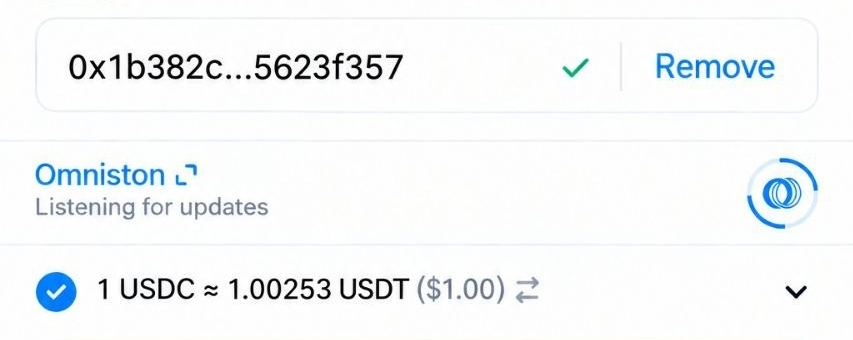
From TON to Arbitrum: Understanding Cross-Chain Asset MovementMoving $USDT from $GRAM to Arbitrum may look like a simple swap, but there’s more happening behind the interface.
GRAM and EVM networks use different address formats, so their addresses are not interchangeable.
When using a custom receiving address, it’s important to carefully verify the destination before confirming the transaction.
A cross-chain route needs to coordinate several things:
➜ Source asset and network
➜ Available liquidity
➜ Destination network
➜ Correct receiving address
➜ Swap execution and settlement
Another important point: cross-chain movement doesn’t necessarily mean the exact same tokens are physically transferred from one blockchain to another.
Instead, you can be swapping value from an asset on GRAM and receiving the corresponding asset on Arbitrum through coordinated liquidity and settlement.
Before confirming a GRAM → Arbitrum route, check:
➜ Destination network
➜ Asset
➜ Receiving address
➜ Expected amount
➜ Transaction details
The interface may help identify address-format issues, but you should always verify the destination yourself before confirming.
This is why cross-chain UX matters. The simpler the process becomes for users, the more important accurate validation and routing are behind the scenes.
Explore cross-chain swaps on STON.fi:
https://app.ston.fi/swap?mode=cross-chain
#STONfi #ARBİTRUM #CrossChain #Crypto
From TON to Arbitrum: Understanding Cross-Chain Asset Movement
Moving $USDT from $GRAM to Arbitrum may look like a simple swap, but there’s more happening behind the interface.
GRAM and EVM networks use different address formats, so their addresses are not interchangeable.
When using a custom receiving address, it’s important to carefully verify the destination before confirming the transaction.
A cross-chain route needs to coordinate several things:
➜ Source asset and network
➜ Available liquidity
➜ Destination network
➜ Correct receiving address
➜ Swap execution and settlement
Another important point: cross-chain movement doesn’t necessarily mean the exact same tokens are physically transferred from one blockchain to another.
Instead, you can be swapping value from an asset on GRAM and receiving the corresponding asset on Arbitrum through coordinated liquidity and settlement.
Before confirming a GRAM → Arbitrum route, check:
➜ Destination network
➜ Asset
➜ Receiving address
➜ Expected amount
➜ Transaction details
The interface may help identify address-format issues, but you should always verify the destination yourself before confirming.
This is why cross-chain UX matters. The simpler the process becomes for users, the more important accurate validation and routing are behind the scenes.
Explore cross-chain swaps on STON.fi:
https://app.ston.fi/swap?mode=cross-chain
#STONfi #ARBİTRUM #CrossChain #Crypto
GRAM and EVM networks use different address formats, so their addresses are not interchangeable.
When using a custom receiving address, it’s important to carefully verify the destination before confirming the transaction.
A cross-chain route needs to coordinate several things:
➜ Source asset and network
➜ Available liquidity
➜ Destination network
➜ Correct receiving address
➜ Swap execution and settlement
Another important point: cross-chain movement doesn’t necessarily mean the exact same tokens are physically transferred from one blockchain to another.
Instead, you can be swapping value from an asset on GRAM and receiving the corresponding asset on Arbitrum through coordinated liquidity and settlement.
Before confirming a GRAM → Arbitrum route, check:
➜ Destination network
➜ Asset
➜ Receiving address
➜ Expected amount
➜ Transaction details
The interface may help identify address-format issues, but you should always verify the destination yourself before confirming.
This is why cross-chain UX matters. The simpler the process becomes for users, the more important accurate validation and routing are behind the scenes.
Explore cross-chain swaps on STON.fi:
https://app.ston.fi/swap?mode=cross-chain
#STONfi #ARBİTRUM #CrossChain #Crypto
1
260
·
--
Every chain is an island — and each trip costs a toll nobody itemizes.
Cross-chain growth gets measured in bridge volume and chain counts. The real story is the fragmentation tax: capital split across dozens of networks, every crossing paid in fees, latency, and risk.
$ETH has the deepest liquidity but the highest cost of simple actions. $SOL trades speed for a siloed ecosystem. $DOT was architected for interoperability from day one — and still fights the same fragmentation it set out to solve.
Three hidden costs of a multichain world:
1. Security is the worst link. Your assets are only as safe as the least-audited bridge they've crossed. The largest exploits in history were rarely chain failures — they were bridge failures.
2. Liquidity doesn't add, it divides. Deep pools on ten chains are shallower than one pool on one chain. Fragmented depth means worse execution everywhere.
3. Users pay in confusion. Choosing a chain, a bridge, a gas token — that's UX debt every new user inherits.
The endgame isn't more chains. It's chains disappearing from the user's view: intent-based routing where you state the outcome and infrastructure competes to fill it. Users stop asking "which chain" and just say "what."
Watch bridge reliability and fill times, not bridge volume. Fragmentation is a transition state. The winning layer is the one that makes chains invisible.
#CrossChain #DeFi #Interoperability #Blockchain #Crypto
Every chain is an island — and each trip costs a toll nobody itemizes.
Cross-chain growth gets measured in bridge volume and chain counts. The real story is the fragmentation tax: capital split across dozens of networks, every crossing paid in fees, latency, and risk.
$ETH has the deepest liquidity but the highest cost of simple actions. $SOL trades speed for a siloed ecosystem. $DOT was architected for interoperability from day one — and still fights the same fragmentation it set out to solve.
Three hidden costs of a multichain world:
1. Security is the worst link. Your assets are only as safe as the least-audited bridge they've crossed. The largest exploits in history were rarely chain failures — they were bridge failures.
2. Liquidity doesn't add, it divides. Deep pools on ten chains are shallower than one pool on one chain. Fragmented depth means worse execution everywhere.
3. Users pay in confusion. Choosing a chain, a bridge, a gas token — that's UX debt every new user inherits.
The endgame isn't more chains. It's chains disappearing from the user's view: intent-based routing where you state the outcome and infrastructure competes to fill it. Users stop asking "which chain" and just say "what."
Watch bridge reliability and fill times, not bridge volume. Fragmentation is a transition state. The winning layer is the one that makes chains invisible.
#CrossChain #DeFi #Interoperability #Blockchain #Crypto
Cross-chain growth gets measured in bridge volume and chain counts. The real story is the fragmentation tax: capital split across dozens of networks, every crossing paid in fees, latency, and risk.
$ETH has the deepest liquidity but the highest cost of simple actions. $SOL trades speed for a siloed ecosystem. $DOT was architected for interoperability from day one — and still fights the same fragmentation it set out to solve.
Three hidden costs of a multichain world:
1. Security is the worst link. Your assets are only as safe as the least-audited bridge they've crossed. The largest exploits in history were rarely chain failures — they were bridge failures.
2. Liquidity doesn't add, it divides. Deep pools on ten chains are shallower than one pool on one chain. Fragmented depth means worse execution everywhere.
3. Users pay in confusion. Choosing a chain, a bridge, a gas token — that's UX debt every new user inherits.
The endgame isn't more chains. It's chains disappearing from the user's view: intent-based routing where you state the outcome and infrastructure competes to fill it. Users stop asking "which chain" and just say "what."
Watch bridge reliability and fill times, not bridge volume. Fragmentation is a transition state. The winning layer is the one that makes chains invisible.
#CrossChain #DeFi #Interoperability #Blockchain #Crypto
194

·
--
Check the Whole Bridge RouteA cross-chain transfer is not one event. It is a sequence.
Your source transaction must succeed. The bridge must observe it. The system must wait for finality or another form of verification. A relayer, solver or destination contract must then deliver the output. Some routes add a separate claim, settlement or retry step.
That is why a transaction can show success on the origin chain while the expected balance is still missing. The correct response is not to repeat the transfer immediately. Start with the source transaction, then use the official bridge tracker and the destination explorer to identify the last completed stage.
The output token deserves equal attention. A familiar symbol does not prove that the asset is native, canonically bridged or backed by the issuer you expect. Verify the destination contract, issuer, backing, liquidity and whether your intended application accepts that exact asset.
Before moving meaningful value, test the exact route. Use the same source chain, destination chain, token contracts, bridge path and recipient that you intend to use for the larger transfer. Keep destination gas available and save the source transaction hash, destination transaction hash and order identifier.
TokenToolHub’s complete bridge guide explains route models, transfer failure stages, token representations and a safer pre-signing workflow.
https://tokentoolhub.com/bridges-101/
#CrossChain #defi #CryptoSecurity #blockchain #Web3
Check the Whole Bridge Route
A cross-chain transfer is not one event. It is a sequence.
Your source transaction must succeed. The bridge must observe it. The system must wait for finality or another form of verification. A relayer, solver or destination contract must then deliver the output. Some routes add a separate claim, settlement or retry step.
That is why a transaction can show success on the origin chain while the expected balance is still missing. The correct response is not to repeat the transfer immediately. Start with the source transaction, then use the official bridge tracker and the destination explorer to identify the last completed stage.
The output token deserves equal attention. A familiar symbol does not prove that the asset is native, canonically bridged or backed by the issuer you expect. Verify the destination contract, issuer, backing, liquidity and whether your intended application accepts that exact asset.
Before moving meaningful value, test the exact route. Use the same source chain, destination chain, token contracts, bridge path and recipient that you intend to use for the larger transfer. Keep destination gas available and save the source transaction hash, destination transaction hash and order identifier.
TokenToolHub’s complete bridge guide explains route models, transfer failure stages, token representations and a safer pre-signing workflow.
https://tokentoolhub.com/bridges-101/
#CrossChain #defi #CryptoSecurity #blockchain #Web3
Your source transaction must succeed. The bridge must observe it. The system must wait for finality or another form of verification. A relayer, solver or destination contract must then deliver the output. Some routes add a separate claim, settlement or retry step.
That is why a transaction can show success on the origin chain while the expected balance is still missing. The correct response is not to repeat the transfer immediately. Start with the source transaction, then use the official bridge tracker and the destination explorer to identify the last completed stage.
The output token deserves equal attention. A familiar symbol does not prove that the asset is native, canonically bridged or backed by the issuer you expect. Verify the destination contract, issuer, backing, liquidity and whether your intended application accepts that exact asset.
Before moving meaningful value, test the exact route. Use the same source chain, destination chain, token contracts, bridge path and recipient that you intend to use for the larger transfer. Keep destination gas available and save the source transaction hash, destination transaction hash and order identifier.
TokenToolHub’s complete bridge guide explains route models, transfer failure stages, token representations and a safer pre-signing workflow.
https://tokentoolhub.com/bridges-101/
#CrossChain #defi #CryptoSecurity #blockchain #Web3
56

·
--
Bullish
Verified
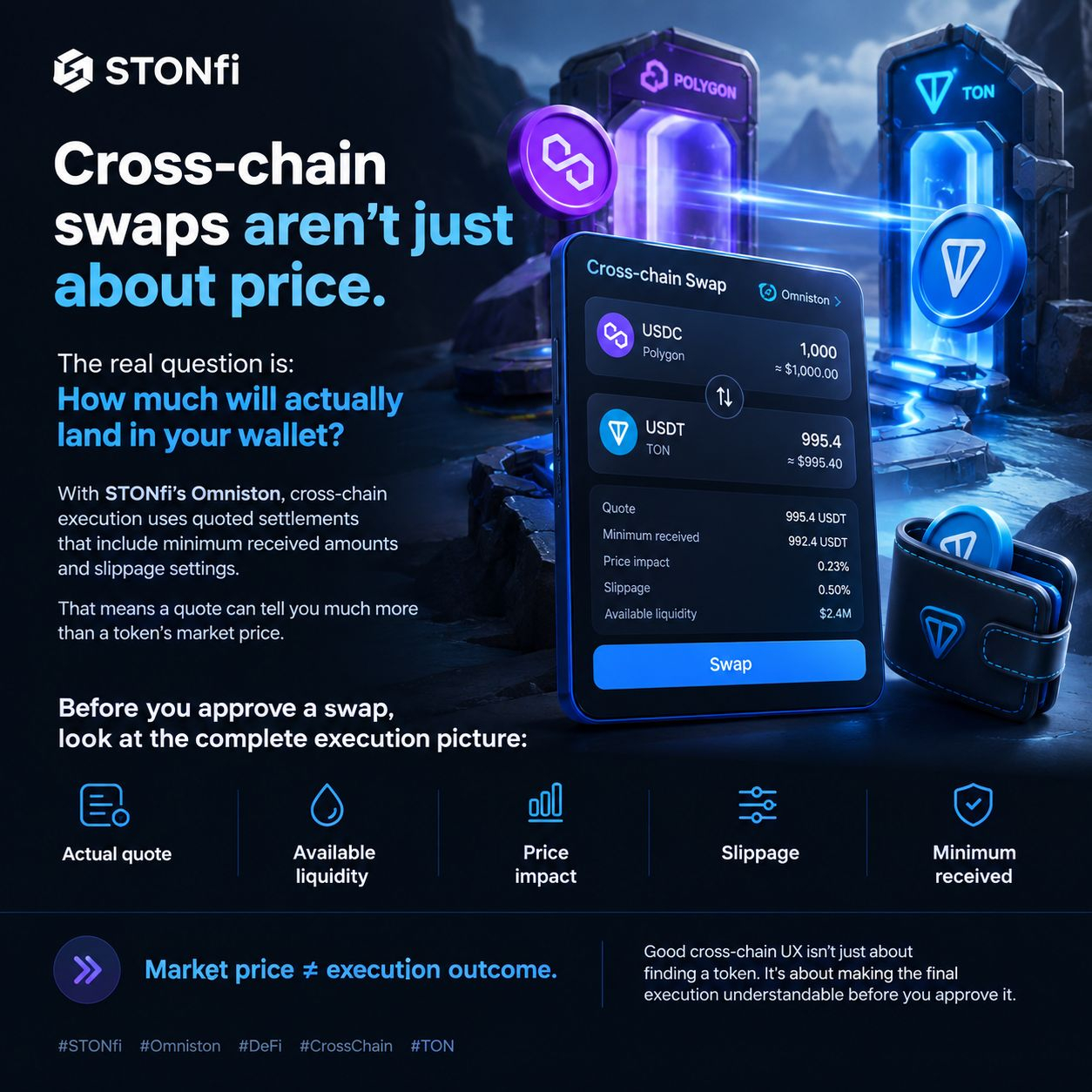
Cross-chain swaps aren’t only about price.
What matters is how much actually reaches your wallet.
With STONfi’s Omniston, quotes include minimum received amounts and slippage settings, so you can see more than a token’s market price before approving a swap.
Check:
• Actual quote
• Liquidity
• Price impact
• Slippage
• Minimum received
Your final result depends on order size, liquidity, and execution conditions—and cross-chain swaps add even more variables.
Market price ≠ execution outcome.
Don’t ask only, “What is this token worth?”
Ask, “How much will I receive, and what protects that amount?”
Good cross-chain UX makes the final result clear before you approve the swap.
#STONfi #Omniston #CrossChain #TON
$Q
{future}(QUSDT)
Cross-chain swaps aren’t only about price.
What matters is how much actually reaches your wallet.
With STONfi’s Omniston, quotes include minimum received amounts and slippage settings, so you can see more than a token’s market price before approving a swap.
Check:
• Actual quote
• Liquidity
• Price impact
• Slippage
• Minimum received
Your final result depends on order size, liquidity, and execution conditions—and cross-chain swaps add even more variables.
Market price ≠ execution outcome.
Don’t ask only, “What is this token worth?”
Ask, “How much will I receive, and what protects that amount?”
Good cross-chain UX makes the final result clear before you approve the swap.
#STONfi #Omniston #CrossChain #TON
$Q
What matters is how much actually reaches your wallet.
With STONfi’s Omniston, quotes include minimum received amounts and slippage settings, so you can see more than a token’s market price before approving a swap.
Check:
• Actual quote
• Liquidity
• Price impact
• Slippage
• Minimum received
Your final result depends on order size, liquidity, and execution conditions—and cross-chain swaps add even more variables.
Market price ≠ execution outcome.
Don’t ask only, “What is this token worth?”
Ask, “How much will I receive, and what protects that amount?”
Good cross-chain UX makes the final result clear before you approve the swap.
#STONfi #Omniston #CrossChain #TON
$Q
2
609

·
--
Bullish
🌉 Circle launches Arc — STON.fi has already connected it to the cross-chain
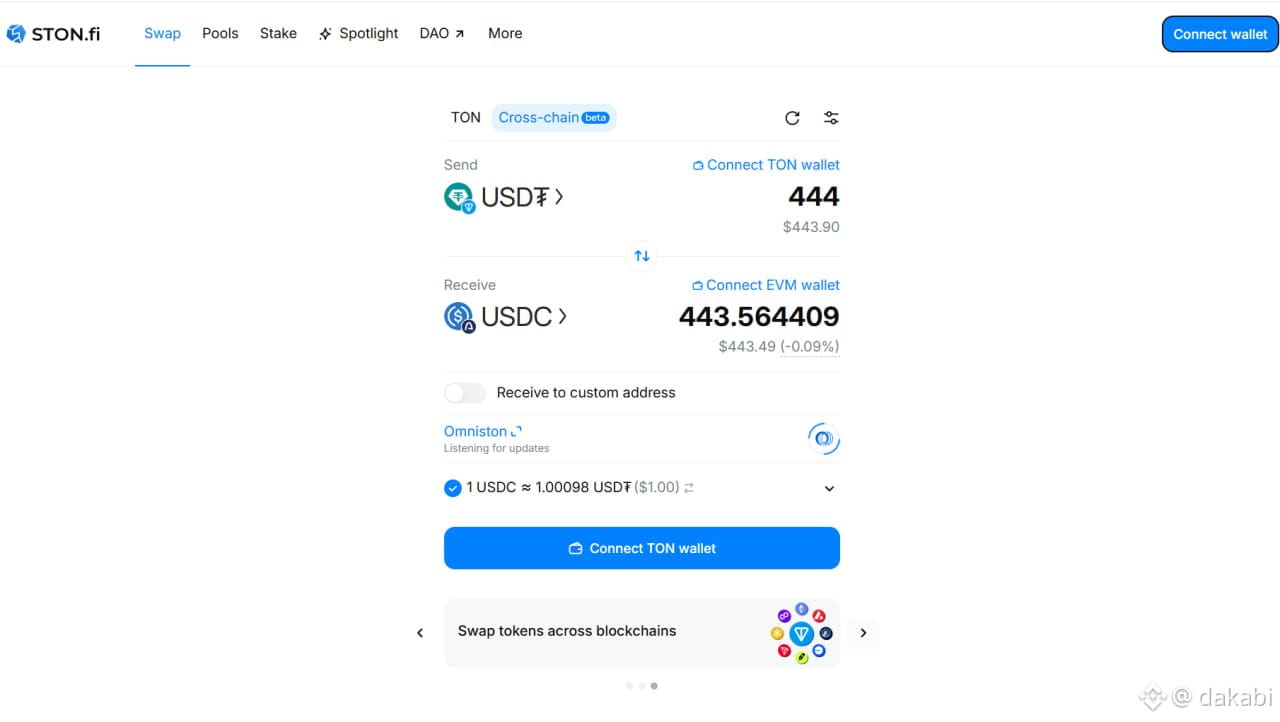
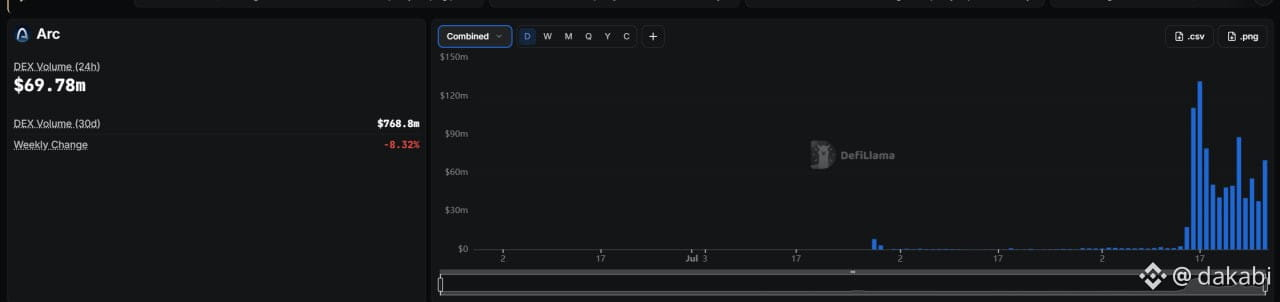
There’s been no Arc network for a week, and yet Omniston on STON.fi has already added it to the list of supported networks. Now USDC can move freely between TON and Arc without bridges or wrapped tokens.
Why this isn’t “just another L1”:
Arc was designed by Circle for stablecoins as native gas. Not ETH, not its own token — specifically USDC. And among the founding validators are BlackRock, Visa, Mastercard, NYSE, and Standard Chartered.
What this delivers in practice:
• Swap USDC (TON) ⇄ USDC (Arc) in 15–40 seconds
• Fees are paid in a stablecoin (no need to hold ETH for gas)
• The exact amount you’ll receive is visible before confirmation
• Initial limit: $1,000 per transaction
Omniston closes the channel between TON and institutional DeFi. The boundaries between blockchains disappear from the UX: the network list already includes TON, TRON, Ethereum, Base, Arbitrum, Polygon, and now Arc.
🔗 Try the swap on Arc:
app.ston.fi/swap?mode=cross-chain&in=ton%3AUSD%E2%82%AE&referral_address=UQBDMz8eAC1_CVxEn6JjNOdWEvppQXXybxIdKm-GiXEL4yiQ
In the Bonus: Farm Miles!
Any cross-chain swaps count toward the STONfi Cross-Chain Campaign. You can accumulate up to 3,500 Miles, which you can exchange for various souvenirs. It considers trading volume, STON staking, and NFT ownership.
👉 Check your progress and participate:
https://cross-chain.ston.fi/r/SNDVC64G
$TON $STON $GRAM
#DeFi #CrossChain
🌉 Circle launches Arc — STON.fi has already connected it to the cross-chain
There’s been no Arc network for a week, and yet Omniston on STON.fi has already added it to the list of supported networks. Now USDC can move freely between TON and Arc without bridges or wrapped tokens.
Why this isn’t “just another L1”:
Arc was designed by Circle for stablecoins as native gas. Not ETH, not its own token — specifically USDC. And among the founding validators are BlackRock, Visa, Mastercard, NYSE, and Standard Chartered.
What this delivers in practice:
• Swap USDC (TON) ⇄ USDC (Arc) in 15–40 seconds
• Fees are paid in a stablecoin (no need to hold ETH for gas)
• The exact amount you’ll receive is visible before confirmation
• Initial limit: $1,000 per transaction
Omniston closes the channel between TON and institutional DeFi. The boundaries between blockchains disappear from the UX: the network list already includes TON, TRON, Ethereum, Base, Arbitrum, Polygon, and now Arc.
🔗 Try the swap on Arc:
app.ston.fi/swap?mode=cross-chain&in=ton%3AUSD%E2%82%AE&referral_address=UQBDMz8eAC1_CVxEn6JjNOdWEvppQXXybxIdKm-GiXEL4yiQ
In the Bonus: Farm Miles!
Any cross-chain swaps count toward the STONfi Cross-Chain Campaign. You can accumulate up to 3,500 Miles, which you can exchange for various souvenirs. It considers trading volume, STON staking, and NFT ownership.
👉 Check your progress and participate:
https://cross-chain.ston.fi/r/SNDVC64G
$TON $STON $GRAM
#DeFi #CrossChain
There’s been no Arc network for a week, and yet Omniston on STON.fi has already added it to the list of supported networks. Now USDC can move freely between TON and Arc without bridges or wrapped tokens.
Why this isn’t “just another L1”:
Arc was designed by Circle for stablecoins as native gas. Not ETH, not its own token — specifically USDC. And among the founding validators are BlackRock, Visa, Mastercard, NYSE, and Standard Chartered.
What this delivers in practice:
• Swap USDC (TON) ⇄ USDC (Arc) in 15–40 seconds
• Fees are paid in a stablecoin (no need to hold ETH for gas)
• The exact amount you’ll receive is visible before confirmation
• Initial limit: $1,000 per transaction
Omniston closes the channel between TON and institutional DeFi. The boundaries between blockchains disappear from the UX: the network list already includes TON, TRON, Ethereum, Base, Arbitrum, Polygon, and now Arc.
🔗 Try the swap on Arc:
app.ston.fi/swap?mode=cross-chain&in=ton%3AUSD%E2%82%AE&referral_address=UQBDMz8eAC1_CVxEn6JjNOdWEvppQXXybxIdKm-GiXEL4yiQ
In the Bonus: Farm Miles!
Any cross-chain swaps count toward the STONfi Cross-Chain Campaign. You can accumulate up to 3,500 Miles, which you can exchange for various souvenirs. It considers trading volume, STON staking, and NFT ownership.
👉 Check your progress and participate:
https://cross-chain.ston.fi/r/SNDVC64G
$TON $STON $GRAM
#DeFi #CrossChain
1
325

·
--
Bullish
Why STON.fi is worth watching beyond its DEX
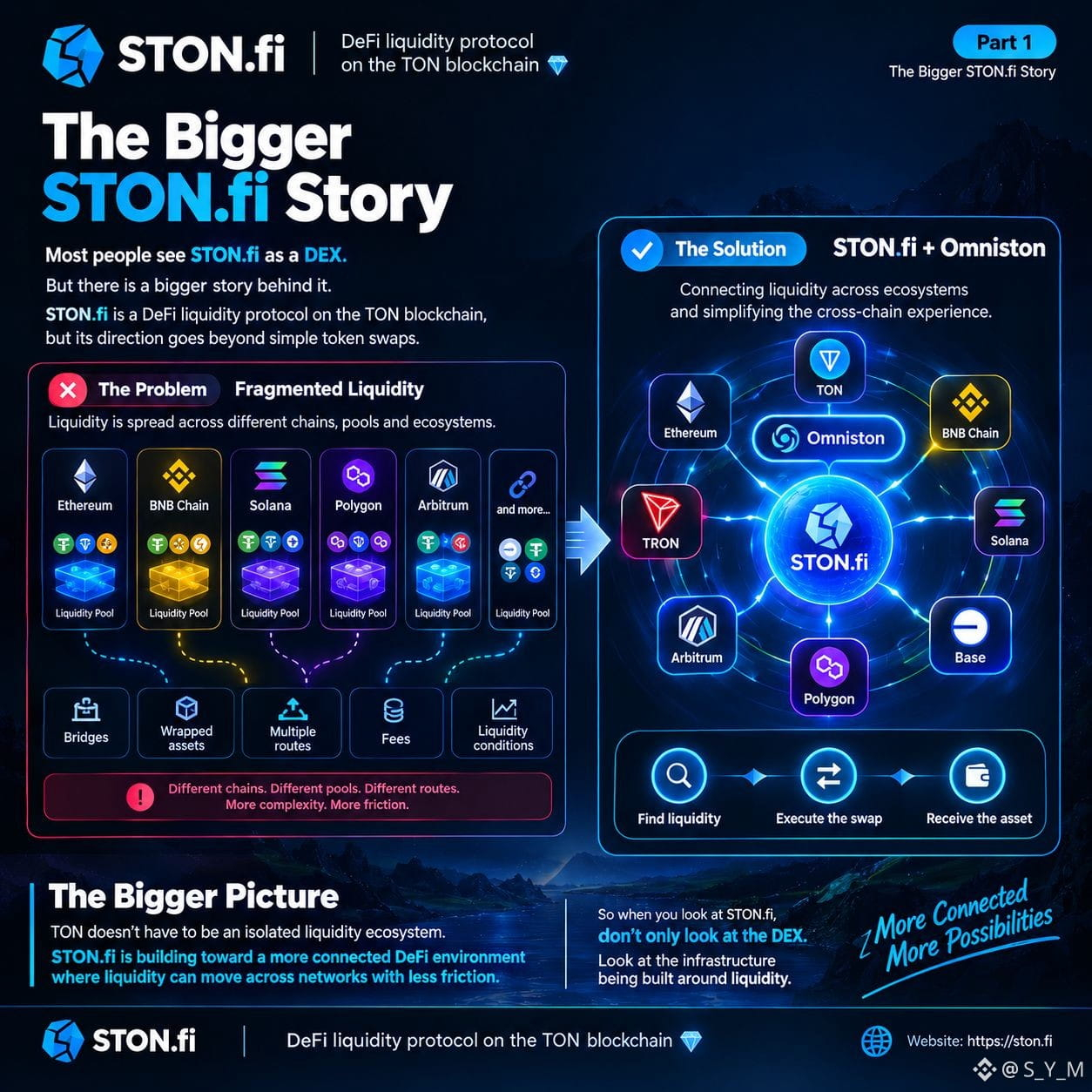
DeFi liquidity is fragmented.
Different chains have different pools, liquidity sources, and trading routes.
For users, that can mean more complexity when moving capital between ecosystems.
STON.fi is building around this problem.
With Omniston, STON.fi is working toward connecting liquidity across networks and simplifying the process behind cross-chain swaps.
The bigger vision is straightforward:
Make TON liquidity more connected to the wider DeFi ecosystem.
That makes STON.fi more than a place to swap tokens.
It becomes a project worth watching from the infrastructure side of DeFi.
STON.fi — DeFi liquidity protocol on the TON blockchain 💎 | Website: https://ston.fi
#STONfi #CrossChain #swap
Why STON.fi is worth watching beyond its DEX
DeFi liquidity is fragmented.
Different chains have different pools, liquidity sources, and trading routes.
For users, that can mean more complexity when moving capital between ecosystems.
STON.fi is building around this problem.
With Omniston, STON.fi is working toward connecting liquidity across networks and simplifying the process behind cross-chain swaps.
The bigger vision is straightforward:
Make TON liquidity more connected to the wider DeFi ecosystem.
That makes STON.fi more than a place to swap tokens.
It becomes a project worth watching from the infrastructure side of DeFi.
STON.fi — DeFi liquidity protocol on the TON blockchain 💎 | Website: https://ston.fi
#STONfi #CrossChain #swap
DeFi liquidity is fragmented.
Different chains have different pools, liquidity sources, and trading routes.
For users, that can mean more complexity when moving capital between ecosystems.
STON.fi is building around this problem.
With Omniston, STON.fi is working toward connecting liquidity across networks and simplifying the process behind cross-chain swaps.
The bigger vision is straightforward:
Make TON liquidity more connected to the wider DeFi ecosystem.
That makes STON.fi more than a place to swap tokens.
It becomes a project worth watching from the infrastructure side of DeFi.
STON.fi — DeFi liquidity protocol on the TON blockchain 💎 | Website: https://ston.fi
#STONfi #CrossChain #swap
84

·
--
🌐 Network Selection Safety: Preventing Cross-Chain Transfer Errors
Transferring digital assets across blockchain networks requires precise alignment between the origin wallet and the destination infrastructure, Network selection errors remain a leading cause of transactional delays and asset recovery complexities.
💡 Core Protocols for Network Verification
Cross-Match Destination Networks: Always ensure the selected network on the withdrawal page matches the exact deposit network address generated by the recipient platform (e.g., BNB Smart Chain vs. Ethereum vs. Tron).
Execute Test Transactions: When transferring significant capital, execute a small test transaction first to verify recipient address configuration and settlement time.
Mandatory Memo / Tag Verification: Specific blockchains (such as XRP, ATOM, or EOS) require a unique Destination Tag/Memo to map funds correctly to your specific exchange account balance.
Verify Token Contract Addresses: When depositing custom Web3 tokens, cross-reference the smart contract address on official block explorers to avoid fake token deposits.
⚠️ Security & Educational Notice
Blockchain transfers are deterministic and irreversible once confirmed by network validators, Proper address and network verification is crucial for safe digital asset movement, This publication is prepared strictly for educational and security awareness purposes.
[https://www.binance.com/en/support/faq/detail/115003670492](https://www.binance.com/en/support/faq/detail/115003670492)
Verify your transfer parameters, double-check your network tags, and always DYOR (Do Your Own Research)💡
#Binance #Blockchain #CrossChain #CryptoEducation #dyor
🌐 Network Selection Safety: Preventing Cross-Chain Transfer Errors
Transferring digital assets across blockchain networks requires precise alignment between the origin wallet and the destination infrastructure, Network selection errors remain a leading cause of transactional delays and asset recovery complexities.
💡 Core Protocols for Network Verification
Cross-Match Destination Networks: Always ensure the selected network on the withdrawal page matches the exact deposit network address generated by the recipient platform (e.g., BNB Smart Chain vs. Ethereum vs. Tron).
Execute Test Transactions: When transferring significant capital, execute a small test transaction first to verify recipient address configuration and settlement time.
Mandatory Memo / Tag Verification: Specific blockchains (such as XRP, ATOM, or EOS) require a unique Destination Tag/Memo to map funds correctly to your specific exchange account balance.
Verify Token Contract Addresses: When depositing custom Web3 tokens, cross-reference the smart contract address on official block explorers to avoid fake token deposits.
⚠️ Security & Educational Notice
Blockchain transfers are deterministic and irreversible once confirmed by network validators, Proper address and network verification is crucial for safe digital asset movement, This publication is prepared strictly for educational and security awareness purposes.
https://www.binance.com/en/support/faq/detail/115003670492
Verify your transfer parameters, double-check your network tags, and always DYOR (Do Your Own Research)💡
#Binance #Blockchain #CrossChain #CryptoEducation #dyor
Transferring digital assets across blockchain networks requires precise alignment between the origin wallet and the destination infrastructure, Network selection errors remain a leading cause of transactional delays and asset recovery complexities.
💡 Core Protocols for Network Verification
Cross-Match Destination Networks: Always ensure the selected network on the withdrawal page matches the exact deposit network address generated by the recipient platform (e.g., BNB Smart Chain vs. Ethereum vs. Tron).
Execute Test Transactions: When transferring significant capital, execute a small test transaction first to verify recipient address configuration and settlement time.
Mandatory Memo / Tag Verification: Specific blockchains (such as XRP, ATOM, or EOS) require a unique Destination Tag/Memo to map funds correctly to your specific exchange account balance.
Verify Token Contract Addresses: When depositing custom Web3 tokens, cross-reference the smart contract address on official block explorers to avoid fake token deposits.
⚠️ Security & Educational Notice
Blockchain transfers are deterministic and irreversible once confirmed by network validators, Proper address and network verification is crucial for safe digital asset movement, This publication is prepared strictly for educational and security awareness purposes.
https://www.binance.com/en/support/faq/detail/115003670492
Verify your transfer parameters, double-check your network tags, and always DYOR (Do Your Own Research)💡
#Binance #Blockchain #CrossChain #CryptoEducation #dyor

6
67
·
--
Cross-chain is not one market. It is fifty fragments of one market.
Every new chain launched over the last two years solved scalability and quietly created a new problem: liquidity fragmentation. Capital is conserved, but depth is not. The same liquidity spread across fifteen chains makes every single market shallower — wider spreads, more slippage, and a growing class of arbitrage bots paid to stitch the pieces back together. Users pay that stitching cost at every hop.
Bridges were the first answer, and history showed why they were a fragile one: concentrated vaults holding billions became the most attacked infrastructure in crypto. The uncomfortable lesson from every major bridge exploit is the same — moving assets across chains is easy; moving trust across chains is the hard part.
The current evolution is intents. Instead of a user signing a bridge transaction and hoping, they state a desired outcome — swap X for Y on chain B at the best available price — and a competitive network of solvers races to fulfill it, absorbing the cross-chain complexity themselves. Chain abstraction is the destination: the chain becomes a backend detail, the way server regions became invisible to web apps.
The deeper point: interoperability is not a feature any single chain ships. It is a market structure that emerges when users stop caring where liquidity lives. The chains that win will not be the ones with the most bridges — they will be the ones whose liquidity is deep enough that leaving feels pointless.
Watch native intent adoption, not bridge volume. Bridge volume measures friction. Intent volume measures progress.
$ETH $SOL $DOT
#CrossChain #DeFi #Interoperability #CryptoInsight #Blockchain
Cross-chain is not one market. It is fifty fragments of one market.
Every new chain launched over the last two years solved scalability and quietly created a new problem: liquidity fragmentation. Capital is conserved, but depth is not. The same liquidity spread across fifteen chains makes every single market shallower — wider spreads, more slippage, and a growing class of arbitrage bots paid to stitch the pieces back together. Users pay that stitching cost at every hop.
Bridges were the first answer, and history showed why they were a fragile one: concentrated vaults holding billions became the most attacked infrastructure in crypto. The uncomfortable lesson from every major bridge exploit is the same — moving assets across chains is easy; moving trust across chains is the hard part.
The current evolution is intents. Instead of a user signing a bridge transaction and hoping, they state a desired outcome — swap X for Y on chain B at the best available price — and a competitive network of solvers races to fulfill it, absorbing the cross-chain complexity themselves. Chain abstraction is the destination: the chain becomes a backend detail, the way server regions became invisible to web apps.
The deeper point: interoperability is not a feature any single chain ships. It is a market structure that emerges when users stop caring where liquidity lives. The chains that win will not be the ones with the most bridges — they will be the ones whose liquidity is deep enough that leaving feels pointless.
Watch native intent adoption, not bridge volume. Bridge volume measures friction. Intent volume measures progress.
$ETH $SOL $DOT
#CrossChain #DeFi #Interoperability #CryptoInsight #Blockchain
Every new chain launched over the last two years solved scalability and quietly created a new problem: liquidity fragmentation. Capital is conserved, but depth is not. The same liquidity spread across fifteen chains makes every single market shallower — wider spreads, more slippage, and a growing class of arbitrage bots paid to stitch the pieces back together. Users pay that stitching cost at every hop.
Bridges were the first answer, and history showed why they were a fragile one: concentrated vaults holding billions became the most attacked infrastructure in crypto. The uncomfortable lesson from every major bridge exploit is the same — moving assets across chains is easy; moving trust across chains is the hard part.
The current evolution is intents. Instead of a user signing a bridge transaction and hoping, they state a desired outcome — swap X for Y on chain B at the best available price — and a competitive network of solvers races to fulfill it, absorbing the cross-chain complexity themselves. Chain abstraction is the destination: the chain becomes a backend detail, the way server regions became invisible to web apps.
The deeper point: interoperability is not a feature any single chain ships. It is a market structure that emerges when users stop caring where liquidity lives. The chains that win will not be the ones with the most bridges — they will be the ones whose liquidity is deep enough that leaving feels pointless.
Watch native intent adoption, not bridge volume. Bridge volume measures friction. Intent volume measures progress.
$ETH $SOL $DOT
#CrossChain #DeFi #Interoperability #CryptoInsight #Blockchain
283
·
--
The cross-chain era has a dirty secret: most of the value moving between chains still travels over infrastructure that trusts intermediaries more than math.
Bridges have historically been where cross-chain losses concentrate. Not because developers are careless, but because the problem itself is brutal. A bridge must verify that something happened on a chain it cannot see. Every solution is a trade-off: trusted validators (fast, fragile), multi-signature committees (convenient, concentrated), optimistic challenge windows (secure, slow), or light clients with zero-knowledge proofs (trust-minimized, expensive).
The deeper issue: wrapped assets are IOUs. A wrapped token on Chain B is only as good as the bridge backing it, which means cross-chain DeFi quietly stacks counterparty risk on top of smart contract risk.
What changes this: native interoperability. Chains verifying each other's finality directly. Intent-based routing where competing solvers execute your trade. Shared security models where a bridge inherits the economic weight of the chains it connects.
Watch the shift: as zero-knowledge light clients get cheaper, the bridges that survive will be the ones that never needed your trust.
Cross-chain is no longer a feature. It is becoming the connective tissue of the whole industry, and connective tissue is where the body is most vulnerable.
$ETH $SOL $BNB
#CrossChain #Bridges #DeFi #Interoperability #Blockchain
The cross-chain era has a dirty secret: most of the value moving between chains still travels over infrastructure that trusts intermediaries more than math.
Bridges have historically been where cross-chain losses concentrate. Not because developers are careless, but because the problem itself is brutal. A bridge must verify that something happened on a chain it cannot see. Every solution is a trade-off: trusted validators (fast, fragile), multi-signature committees (convenient, concentrated), optimistic challenge windows (secure, slow), or light clients with zero-knowledge proofs (trust-minimized, expensive).
The deeper issue: wrapped assets are IOUs. A wrapped token on Chain B is only as good as the bridge backing it, which means cross-chain DeFi quietly stacks counterparty risk on top of smart contract risk.
What changes this: native interoperability. Chains verifying each other's finality directly. Intent-based routing where competing solvers execute your trade. Shared security models where a bridge inherits the economic weight of the chains it connects.
Watch the shift: as zero-knowledge light clients get cheaper, the bridges that survive will be the ones that never needed your trust.
Cross-chain is no longer a feature. It is becoming the connective tissue of the whole industry, and connective tissue is where the body is most vulnerable.
$ETH $SOL $BNB
#CrossChain #Bridges #DeFi #Interoperability #Blockchain
Bridges have historically been where cross-chain losses concentrate. Not because developers are careless, but because the problem itself is brutal. A bridge must verify that something happened on a chain it cannot see. Every solution is a trade-off: trusted validators (fast, fragile), multi-signature committees (convenient, concentrated), optimistic challenge windows (secure, slow), or light clients with zero-knowledge proofs (trust-minimized, expensive).
The deeper issue: wrapped assets are IOUs. A wrapped token on Chain B is only as good as the bridge backing it, which means cross-chain DeFi quietly stacks counterparty risk on top of smart contract risk.
What changes this: native interoperability. Chains verifying each other's finality directly. Intent-based routing where competing solvers execute your trade. Shared security models where a bridge inherits the economic weight of the chains it connects.
Watch the shift: as zero-knowledge light clients get cheaper, the bridges that survive will be the ones that never needed your trust.
Cross-chain is no longer a feature. It is becoming the connective tissue of the whole industry, and connective tissue is where the body is most vulnerable.
$ETH $SOL $BNB
#CrossChain #Bridges #DeFi #Interoperability #Blockchain
81

·
--
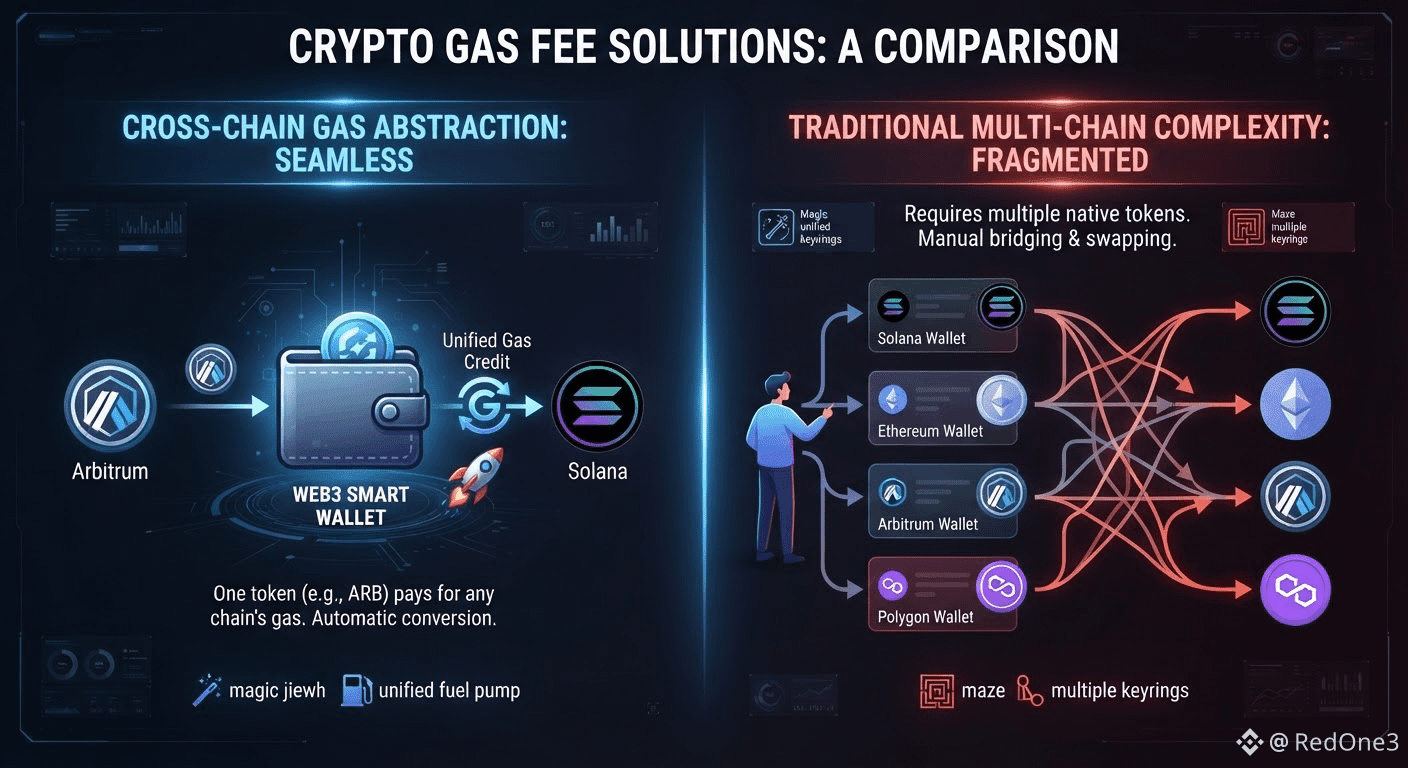
Pay for Gas on Solana Using Your Arbitrum Balance! ⛽🔀 🤔
Cross-chain gas abstraction layers are arriving. Users no longer need to hold five different native tokens just to execute transactions across multiple ecosystems.
#GasAbstraction #CrossChain #DeFiUX #Web3Seamless .
Pay for Gas on Solana Using Your Arbitrum Balance! ⛽🔀 🤔
Cross-chain gas abstraction layers are arriving. Users no longer need to hold five different native tokens just to execute transactions across multiple ecosystems.
#GasAbstraction #CrossChain #DeFiUX #Web3Seamless .
Cross-chain gas abstraction layers are arriving. Users no longer need to hold five different native tokens just to execute transactions across multiple ecosystems.
#GasAbstraction #CrossChain #DeFiUX #Web3Seamless .
182
Log in to explore more content
Join global crypto users on Binance Square
⚡️ Get latest and useful information about crypto.
💬 Trusted by the world’s largest crypto exchange.
👍 Discover real insights from verified creators.
Email / Phone number
Trending Topics
1
#AltcoinSeasonIndexHoldsAbove60For5Days
26 views
65 Discussing
2
#BitcoinSlipsBelow$84000
487 views
50 Discussing
3
#KospiPostsWorstQuarterSince2020
18 views
39 Discussing
4
#SECToClarifyOnChainFundraisingRules
3,933 views
232 Discussing
5
#UKFCAOpensCryptoFirmAuthorization
7,054 views
223 Discussing
6
#JapanMOFStudyGroupOnTokenizedGovtBonds
6,307 views
222 Discussing
7
#QNTRises287%
38,542 views
581 Discussing
8
#TrumpRejectsAIRulesForVoluntaryAudits
27,050 views
598 Discussing
9
#BitgetHotWalletBreachTiedToThirdPartySecurityFlaw
15,677 views
391 Discussing
10
#OpenAIUnveilsAlwaysOnAgentDots
12,594 views
399 Discussing