

#ousd
ousd
24,090 views
148 Discussing
Hot
Latest

INSTITUTIONAL LIQUIDITY EXPANDS AS MASTERCARD INTEGRATES $OUSD FOR GLOBAL SETTLEMENT 🏦 ⚡
The structural integration of $OUSD into Mastercard's payment rails represents a massive shift in institutional settlement efficiency. Backed by reserves held at BlackRock, BNY, and Lead Bank, this framework bridges traditional banking liquidity directly with on-chain order flow. 🏦 🔍
Smart money is systematically embedding regulated stablecoin infrastructure deep into global payment networks. This reduces clearing friction and establishes a heavy structural floor for enterprise adoption. 💡 📊
💬 Will this institutional backing set a new standard for settlement liquidity across Web3 ecosystems? 👇
⚠️ Not financial advice. Always manage your risk. 🛡️
🏷️ #OUSD #Stablecoin #Crypto #Fintech #Institutional
🎯 🦈
INSTITUTIONAL LIQUIDITY EXPANDS AS MASTERCARD INTEGRATES $OUSD FOR GLOBAL SETTLEMENT 🏦 ⚡
The structural integration of $OUSD into Mastercard's payment rails represents a massive shift in institutional settlement efficiency. Backed by reserves held at BlackRock, BNY, and Lead Bank, this framework bridges traditional banking liquidity directly with on-chain order flow. 🏦 🔍
Smart money is systematically embedding regulated stablecoin infrastructure deep into global payment networks. This reduces clearing friction and establishes a heavy structural floor for enterprise adoption. 💡 📊
💬 Will this institutional backing set a new standard for settlement liquidity across Web3 ecosystems? 👇
⚠️ Not financial advice. Always manage your risk. 🛡️
🏷️ #OUSD #Stablecoin #Crypto #Fintech #Institutional
🎯 🦈
The structural integration of $OUSD into Mastercard's payment rails represents a massive shift in institutional settlement efficiency. Backed by reserves held at BlackRock, BNY, and Lead Bank, this framework bridges traditional banking liquidity directly with on-chain order flow. 🏦 🔍
Smart money is systematically embedding regulated stablecoin infrastructure deep into global payment networks. This reduces clearing friction and establishes a heavy structural floor for enterprise adoption. 💡 📊
💬 Will this institutional backing set a new standard for settlement liquidity across Web3 ecosystems? 👇
⚠️ Not financial advice. Always manage your risk. 🛡️
🏷️ #OUSD #Stablecoin #Crypto #Fintech #Institutional
🎯 🦈


5


·
--
Bullish
🚨 WAIT… Visa, Mastercard, Stripe, Coinbase AND Shopify just got behind a new stablecoin.
And honestly, this is worth paying attention to.
It’s called Open USD (OUSD).
The interesting part isn’t just another stablecoin launching.
It’s WHO is behind it.
Coinbase
Mastercard
Shopify
Stripe
Visa
These five are the founding partners of Open Standard, the company behind OUSD. They’ve committed more than $1 billion in near-term launch liquidity.
OUSD is now live on:
🔹 Ethereum
🔹 Solana
🔹 Base
🔹 Tempo
And businesses can mint and redeem OUSD 1:1 with USD without minting or redemption fees through the available integration paths.
But here's the part I find more interesting…
This isn't being positioned as a stablecoin built mainly for traders.
The whole idea is payments and business infrastructure.
Stripe is already integrating OUSD across Treasury, Issuing, Global Payouts and other products. Stripe also says OUSD will be available as its default stablecoin configuration, while businesses can still choose other stablecoins.
So now the question becomes:
Can OUSD actually take market share from USDT and USDC?
That's a completely different question.
USDT and USDC already have massive liquidity, users and integrations. OUSD is the new player trying to leverage something different — a network of major payment, commerce and crypto companies around the same stablecoin.
And that makes this one interesting to watch.
Not because OUSD is guaranteed to win.
But because some of the biggest names in global payments are now helping build the rails.
👀 Would you actually use OUSD instead of USDT or USDC?
I want to hear what Binance Square thinks.
#OUSD $ETH
{spot}(ETHUSDT)
🚨 WAIT… Visa, Mastercard, Stripe, Coinbase AND Shopify just got behind a new stablecoin.
And honestly, this is worth paying attention to.
It’s called Open USD (OUSD).
The interesting part isn’t just another stablecoin launching.
It’s WHO is behind it.
Coinbase
Mastercard
Shopify
Stripe
Visa
These five are the founding partners of Open Standard, the company behind OUSD. They’ve committed more than $1 billion in near-term launch liquidity.
OUSD is now live on:
🔹 Ethereum
🔹 Solana
🔹 Base
🔹 Tempo
And businesses can mint and redeem OUSD 1:1 with USD without minting or redemption fees through the available integration paths.
But here's the part I find more interesting…
This isn't being positioned as a stablecoin built mainly for traders.
The whole idea is payments and business infrastructure.
Stripe is already integrating OUSD across Treasury, Issuing, Global Payouts and other products. Stripe also says OUSD will be available as its default stablecoin configuration, while businesses can still choose other stablecoins.
So now the question becomes:
Can OUSD actually take market share from USDT and USDC?
That's a completely different question.
USDT and USDC already have massive liquidity, users and integrations. OUSD is the new player trying to leverage something different — a network of major payment, commerce and crypto companies around the same stablecoin.
And that makes this one interesting to watch.
Not because OUSD is guaranteed to win.
But because some of the biggest names in global payments are now helping build the rails.
👀 Would you actually use OUSD instead of USDT or USDC?
I want to hear what Binance Square thinks.
#OUSD $ETH
And honestly, this is worth paying attention to.
It’s called Open USD (OUSD).
The interesting part isn’t just another stablecoin launching.
It’s WHO is behind it.
Coinbase
Mastercard
Shopify
Stripe
Visa
These five are the founding partners of Open Standard, the company behind OUSD. They’ve committed more than $1 billion in near-term launch liquidity.
OUSD is now live on:
🔹 Ethereum
🔹 Solana
🔹 Base
🔹 Tempo
And businesses can mint and redeem OUSD 1:1 with USD without minting or redemption fees through the available integration paths.
But here's the part I find more interesting…
This isn't being positioned as a stablecoin built mainly for traders.
The whole idea is payments and business infrastructure.
Stripe is already integrating OUSD across Treasury, Issuing, Global Payouts and other products. Stripe also says OUSD will be available as its default stablecoin configuration, while businesses can still choose other stablecoins.
So now the question becomes:
Can OUSD actually take market share from USDT and USDC?
That's a completely different question.
USDT and USDC already have massive liquidity, users and integrations. OUSD is the new player trying to leverage something different — a network of major payment, commerce and crypto companies around the same stablecoin.
And that makes this one interesting to watch.
Not because OUSD is guaranteed to win.
But because some of the biggest names in global payments are now helping build the rails.
👀 Would you actually use OUSD instead of USDT or USDC?
I want to hear what Binance Square thinks.
#OUSD $ETH
285

·
--
⚡ STRIPE AND BLACKROCK BACKED STABLECOIN $OUSD GOES LIVE ACROSS MAJORS! 🦈
Wall Street and Web3 payment infrastructure just merged deeper as $OUSD launches with reserve backing from BlackRock and BNY Mellon. 🔍 Stripe subsidiary Bridge is spearheading issuance across major networks like Ethereum, Solana, and Base with zero-fee 1:1 minting.
With direct rails via Visa, Mastercard, and top-tier exchanges landing Oct 1, institutional payment flows are securing their liquidity foundations. 📊 Over 200 global enterprise partners are already hooked into this network for cross-border settlement.
💡 This structural shift is front-running the next massive surge in stablecoin adoption. 💬 Will $OUSD challenge the established stablecoin duopoly, or is liquidity too deeply entrenched elsewhere? 👇
⚠️ Not financial advice. Always manage your risk. 🛡️
🏷️ #OUSD #Stablecoin #Crypto #Fintech #DeFi
🎯 🦈
⚡ STRIPE AND BLACKROCK BACKED STABLECOIN $OUSD GOES LIVE ACROSS MAJORS! 🦈
Wall Street and Web3 payment infrastructure just merged deeper as $OUSD launches with reserve backing from BlackRock and BNY Mellon. 🔍 Stripe subsidiary Bridge is spearheading issuance across major networks like Ethereum, Solana, and Base with zero-fee 1:1 minting.
With direct rails via Visa, Mastercard, and top-tier exchanges landing Oct 1, institutional payment flows are securing their liquidity foundations. 📊 Over 200 global enterprise partners are already hooked into this network for cross-border settlement.
💡 This structural shift is front-running the next massive surge in stablecoin adoption. 💬 Will $OUSD challenge the established stablecoin duopoly, or is liquidity too deeply entrenched elsewhere? 👇
⚠️ Not financial advice. Always manage your risk. 🛡️
🏷️ #OUSD #Stablecoin #Crypto #Fintech #DeFi
🎯 🦈
Wall Street and Web3 payment infrastructure just merged deeper as $OUSD launches with reserve backing from BlackRock and BNY Mellon. 🔍 Stripe subsidiary Bridge is spearheading issuance across major networks like Ethereum, Solana, and Base with zero-fee 1:1 minting.
With direct rails via Visa, Mastercard, and top-tier exchanges landing Oct 1, institutional payment flows are securing their liquidity foundations. 📊 Over 200 global enterprise partners are already hooked into this network for cross-border settlement.
💡 This structural shift is front-running the next massive surge in stablecoin adoption. 💬 Will $OUSD challenge the established stablecoin duopoly, or is liquidity too deeply entrenched elsewhere? 👇
⚠️ Not financial advice. Always manage your risk. 🛡️
🏷️ #OUSD #Stablecoin #Crypto #Fintech #DeFi
🎯 🦈
14
·
--
WALL STREET GIANTS DEPLOY $1B LIQUIDITY TO LAUNCH OPEN USD $OUSD 🏦 ⚡
Heavyweight payment and commerce titans including Visa, Mastercard, Stripe, and Shopify are backing the official launch of Open USD $OUSD . With $1B in seed liquidity injected across $ETH , $SOL , Base, and Tempo networks, institutional capital rails are expanding at record speed. 🏦 🌊
This moves global settlement architecture directly onto public blockchains, setting the stage for massive real-world volume sweeps across targeted L1 and L2 execution layers. 💡 🔍
💬 Which network ecosystem do you expect will capture the lion's share of this incoming $1B stablecoin liquidity? 👇
⚠️ Not financial advice. Always manage your risk. 🛡️
🏷️ #OUSD #Stablecoin #CryptoNews #Ethereum #Solana
⚡ 💎
WALL STREET GIANTS DEPLOY $1B LIQUIDITY TO LAUNCH OPEN USD $OUSD 🏦 ⚡
Heavyweight payment and commerce titans including Visa, Mastercard, Stripe, and Shopify are backing the official launch of Open USD $OUSD . With $1B in seed liquidity injected across $ETH , $SOL , Base, and Tempo networks, institutional capital rails are expanding at record speed. 🏦 🌊
This moves global settlement architecture directly onto public blockchains, setting the stage for massive real-world volume sweeps across targeted L1 and L2 execution layers. 💡 🔍
💬 Which network ecosystem do you expect will capture the lion's share of this incoming $1B stablecoin liquidity? 👇
⚠️ Not financial advice. Always manage your risk. 🛡️
🏷️ #OUSD #Stablecoin #CryptoNews #Ethereum #Solana
⚡ 💎
Heavyweight payment and commerce titans including Visa, Mastercard, Stripe, and Shopify are backing the official launch of Open USD $OUSD . With $1B in seed liquidity injected across $ETH , $SOL , Base, and Tempo networks, institutional capital rails are expanding at record speed. 🏦 🌊
This moves global settlement architecture directly onto public blockchains, setting the stage for massive real-world volume sweeps across targeted L1 and L2 execution layers. 💡 🔍
💬 Which network ecosystem do you expect will capture the lion's share of this incoming $1B stablecoin liquidity? 👇
⚠️ Not financial advice. Always manage your risk. 🛡️
🏷️ #OUSD #Stablecoin #CryptoNews #Ethereum #Solana
⚡ 💎
84

·
--
🚨 INSTITUTIONAL CAPITAL FLOODS $OUSD WITH $477M MINTED IN TWO HOURS! 🏦
Institutional liquidity is moving with extreme velocity. Within just two hours of deployment, $OUSD registered nearly $477.3 million in cross-chain supply, backed by a fully verifiable 100% reserve ratio. 🏦 The reserve composition highlights serious institutional structuring, splitting roughly $266.1 million in physical cash with $211.2 million in U.S. Treasuries. 📊
Tempo network alone absorbed 434.2 million of the circulating supply while total transfer volume cleared $533.9 million instantly. ⚡ When institutional grade cash-backed stablecoins record half a billion in turnover at launch, real smart money capital is shifting under the surface. 💡 Is this massive liquidity influx signaling a fresh wave of capital deployment across the market? 👇
⚠️ Not financial advice. Always manage your risk. 🛡️
🏷️ #OUSD #Stablecoins #Institutional #DeFi #Crypto
🦈 🛡️
🚨 INSTITUTIONAL CAPITAL FLOODS $OUSD WITH $477M MINTED IN TWO HOURS! 🏦
Institutional liquidity is moving with extreme velocity. Within just two hours of deployment, $OUSD registered nearly $477.3 million in cross-chain supply, backed by a fully verifiable 100% reserve ratio. 🏦 The reserve composition highlights serious institutional structuring, splitting roughly $266.1 million in physical cash with $211.2 million in U.S. Treasuries. 📊
Tempo network alone absorbed 434.2 million of the circulating supply while total transfer volume cleared $533.9 million instantly. ⚡ When institutional grade cash-backed stablecoins record half a billion in turnover at launch, real smart money capital is shifting under the surface. 💡 Is this massive liquidity influx signaling a fresh wave of capital deployment across the market? 👇
⚠️ Not financial advice. Always manage your risk. 🛡️
🏷️ #OUSD #Stablecoins #Institutional #DeFi #Crypto
🦈 🛡️
Institutional liquidity is moving with extreme velocity. Within just two hours of deployment, $OUSD registered nearly $477.3 million in cross-chain supply, backed by a fully verifiable 100% reserve ratio. 🏦 The reserve composition highlights serious institutional structuring, splitting roughly $266.1 million in physical cash with $211.2 million in U.S. Treasuries. 📊
Tempo network alone absorbed 434.2 million of the circulating supply while total transfer volume cleared $533.9 million instantly. ⚡ When institutional grade cash-backed stablecoins record half a billion in turnover at launch, real smart money capital is shifting under the surface. 💡 Is this massive liquidity influx signaling a fresh wave of capital deployment across the market? 👇
⚠️ Not financial advice. Always manage your risk. 🛡️
🏷️ #OUSD #Stablecoins #Institutional #DeFi #Crypto
🦈 🛡️
13
·
--
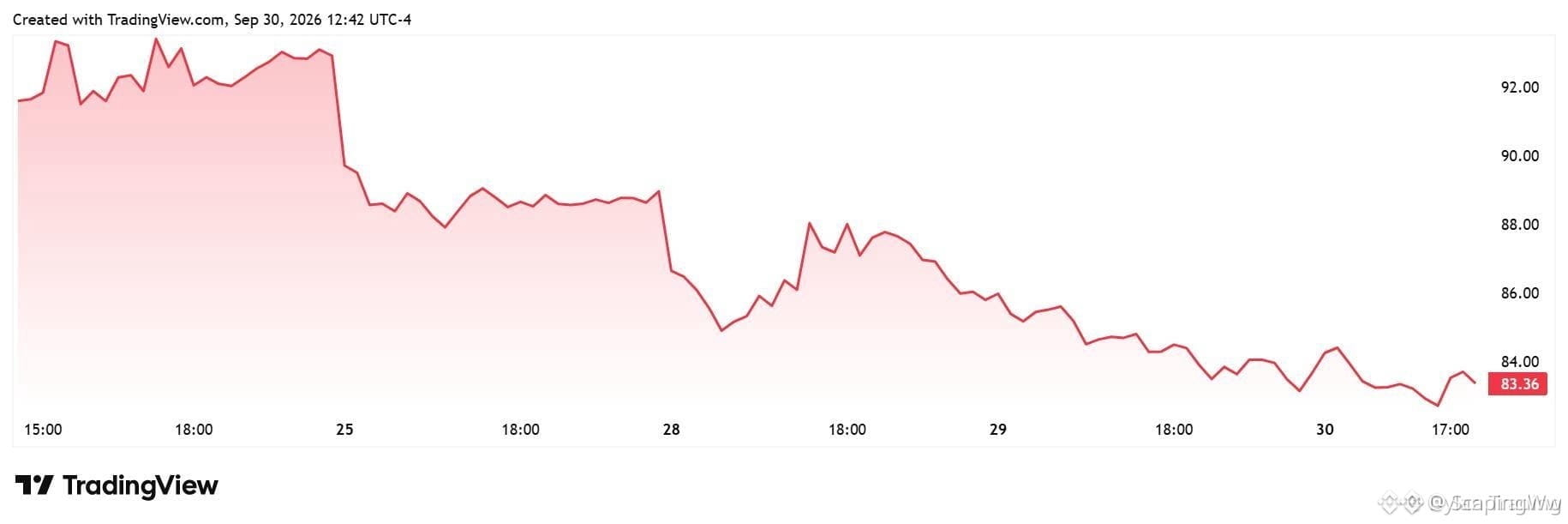
🚨 MULTI-CHAIN POWER PLAY AS $OUSD BLITZES TOP-TIER VENUES SIMULTANEOUSLY ⚡
Smart money is watching closely as institutional-backed $OUSD deploys across Ethereum, Solana, Base, and Tempo in a synchronized liquidity expansion. 📊 Opening order books across top-tier exchanges and decentralized hubs puts its cross-chain interoperability to the ultimate test under real market conditions.
While critics question peg resilience during such aggressive multi-chain scaling, early order book depth across $QNT and $MOVR ecosystems will signal true market appetite. 🔍 Navigating this crowded stablecoin battleground requires sharp order flow analysis as volume distributes across networks. 💬 Will $OUSD defend its peg through initial liquidity volatility or will arbitrageurs force a retest? 👇
⚠️ Not financial advice. Always manage your risk. 🛡️
🏷️ #OUSD #Stablecoin #DeFi #Crypto #MultiChain
🦈 ⚡
🚨 MULTI-CHAIN POWER PLAY AS $OUSD BLITZES TOP-TIER VENUES SIMULTANEOUSLY ⚡
Smart money is watching closely as institutional-backed $OUSD deploys across Ethereum, Solana, Base, and Tempo in a synchronized liquidity expansion. 📊 Opening order books across top-tier exchanges and decentralized hubs puts its cross-chain interoperability to the ultimate test under real market conditions.
While critics question peg resilience during such aggressive multi-chain scaling, early order book depth across $QNT and $MOVR ecosystems will signal true market appetite. 🔍 Navigating this crowded stablecoin battleground requires sharp order flow analysis as volume distributes across networks. 💬 Will $OUSD defend its peg through initial liquidity volatility or will arbitrageurs force a retest? 👇
⚠️ Not financial advice. Always manage your risk. 🛡️
🏷️ #OUSD #Stablecoin #DeFi #Crypto #MultiChain
🦈 ⚡
Smart money is watching closely as institutional-backed $OUSD deploys across Ethereum, Solana, Base, and Tempo in a synchronized liquidity expansion. 📊 Opening order books across top-tier exchanges and decentralized hubs puts its cross-chain interoperability to the ultimate test under real market conditions.
While critics question peg resilience during such aggressive multi-chain scaling, early order book depth across $QNT and $MOVR ecosystems will signal true market appetite. 🔍 Navigating this crowded stablecoin battleground requires sharp order flow analysis as volume distributes across networks. 💬 Will $OUSD defend its peg through initial liquidity volatility or will arbitrageurs force a retest? 👇
⚠️ Not financial advice. Always manage your risk. 🛡️
🏷️ #OUSD #Stablecoin #DeFi #Crypto #MultiChain
🦈 ⚡
174
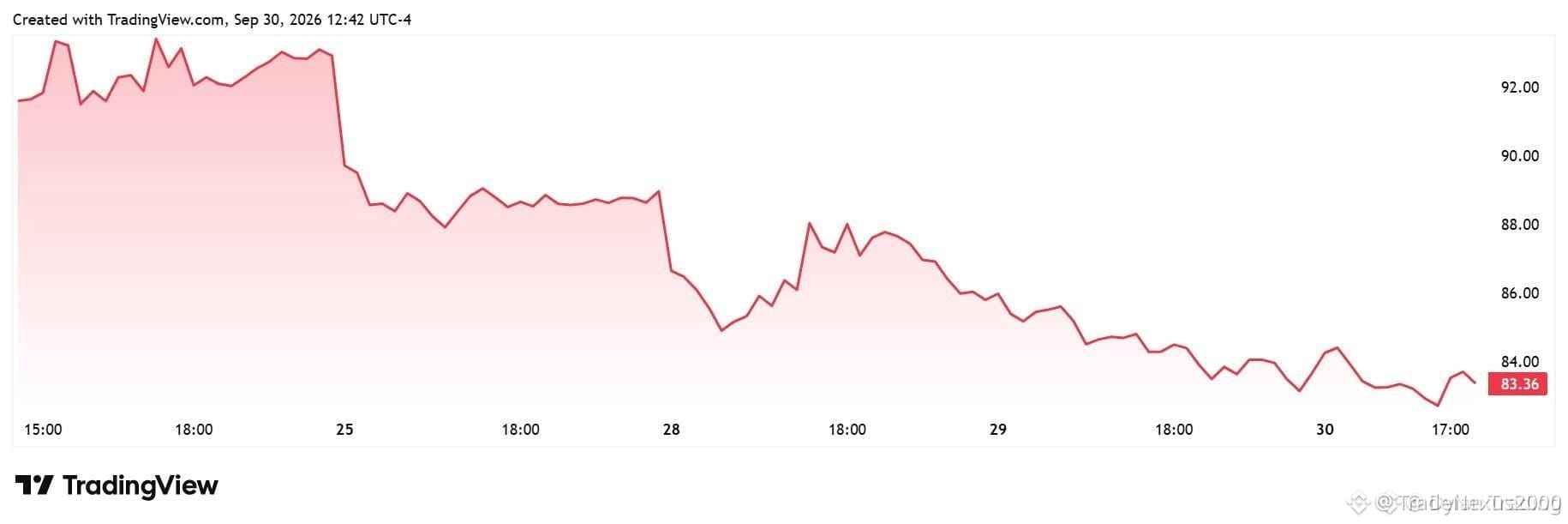
🚨 MULTI-CHAIN DEPLOYMENT DRIVES $OUSD INTO MAJOR INSTITUTIONAL LIQUIDITY POOLS 🔍
Open Standard's $OUSD stablecoin has initiated a simultaneous multi-network launch across major Layer-1 and Layer-2 ecosystems. Institutional backers are facilitating immediate access across top-tier trading venues and decentralized liquidity hubs to anchor initial depth. 🏦
While cross-chain interoperability offers broad market access, smart money will closely observe peg efficiency and structural order flow during peak stress tests. As liquidity distributes across protocols, watching how capital shifts between $QNT and $MOVR could signal broader interoperability rotation. 📊
💬 Do you expect multi-chain stablecoin architectures to capture structural market share, or will liquidity fragmentation compress peg stability? 👇
⚠️ Not financial advice. Always manage your risk. 🛡️
🏷️ #OUSD #Stablecoin #Crypto #Liquidity #Interoperability
🦈 🛡️
🚨 MULTI-CHAIN DEPLOYMENT DRIVES $OUSD INTO MAJOR INSTITUTIONAL LIQUIDITY POOLS 🔍
Open Standard's $OUSD stablecoin has initiated a simultaneous multi-network launch across major Layer-1 and Layer-2 ecosystems. Institutional backers are facilitating immediate access across top-tier trading venues and decentralized liquidity hubs to anchor initial depth. 🏦
While cross-chain interoperability offers broad market access, smart money will closely observe peg efficiency and structural order flow during peak stress tests. As liquidity distributes across protocols, watching how capital shifts between $QNT and $MOVR could signal broader interoperability rotation. 📊
💬 Do you expect multi-chain stablecoin architectures to capture structural market share, or will liquidity fragmentation compress peg stability? 👇
⚠️ Not financial advice. Always manage your risk. 🛡️
🏷️ #OUSD #Stablecoin #Crypto #Liquidity #Interoperability
🦈 🛡️
Open Standard's $OUSD stablecoin has initiated a simultaneous multi-network launch across major Layer-1 and Layer-2 ecosystems. Institutional backers are facilitating immediate access across top-tier trading venues and decentralized liquidity hubs to anchor initial depth. 🏦
While cross-chain interoperability offers broad market access, smart money will closely observe peg efficiency and structural order flow during peak stress tests. As liquidity distributes across protocols, watching how capital shifts between $QNT and $MOVR could signal broader interoperability rotation. 📊
💬 Do you expect multi-chain stablecoin architectures to capture structural market share, or will liquidity fragmentation compress peg stability? 👇
⚠️ Not financial advice. Always manage your risk. 🛡️
🏷️ #OUSD #Stablecoin #Crypto #Liquidity #Interoperability
🦈 🛡️
170

🦈 $OUSD MINTS NEARLY HALF A BILLION IN JUST TWO HOURS POST-LAUNCH! ⚡
Institutional liquidity just hit the accelerator. In a staggering opening play, $OUSD absorbed over $477M in cross-chain supply within two hours of spinning up, backed 100% by $266.1M in cash and $211.2M in US Treasuries. 🏦
The velocity here is unmatched. Over 434M is already circulating on the Tempo network, pushing total transfer volume past $533M almost instantaneously as deep-pocket capital moves into position. 📊
💡 Smart money isn't wading in slowly—they just dumped massive dry powder straight into the pipes. 💬 Do you see this stablecoin surge sparking the next wave of capital rotation across on-chain markets? 👇
⚠️ Not financial advice. Always manage your risk. 🛡️
🏷️ #OUSD #Stablecoin #SmartMoney #Liquidity #Crypto
🦈 ⚡
🦈 $OUSD MINTS NEARLY HALF A BILLION IN JUST TWO HOURS POST-LAUNCH! ⚡
Institutional liquidity just hit the accelerator. In a staggering opening play, $OUSD absorbed over $477M in cross-chain supply within two hours of spinning up, backed 100% by $266.1M in cash and $211.2M in US Treasuries. 🏦
The velocity here is unmatched. Over 434M is already circulating on the Tempo network, pushing total transfer volume past $533M almost instantaneously as deep-pocket capital moves into position. 📊
💡 Smart money isn't wading in slowly—they just dumped massive dry powder straight into the pipes. 💬 Do you see this stablecoin surge sparking the next wave of capital rotation across on-chain markets? 👇
⚠️ Not financial advice. Always manage your risk. 🛡️
🏷️ #OUSD #Stablecoin #SmartMoney #Liquidity #Crypto
🦈 ⚡
Institutional liquidity just hit the accelerator. In a staggering opening play, $OUSD absorbed over $477M in cross-chain supply within two hours of spinning up, backed 100% by $266.1M in cash and $211.2M in US Treasuries. 🏦
The velocity here is unmatched. Over 434M is already circulating on the Tempo network, pushing total transfer volume past $533M almost instantaneously as deep-pocket capital moves into position. 📊
💡 Smart money isn't wading in slowly—they just dumped massive dry powder straight into the pipes. 💬 Do you see this stablecoin surge sparking the next wave of capital rotation across on-chain markets? 👇
⚠️ Not financial advice. Always manage your risk. 🛡️
🏷️ #OUSD #Stablecoin #SmartMoney #Liquidity #Crypto
🦈 ⚡
9

·
--
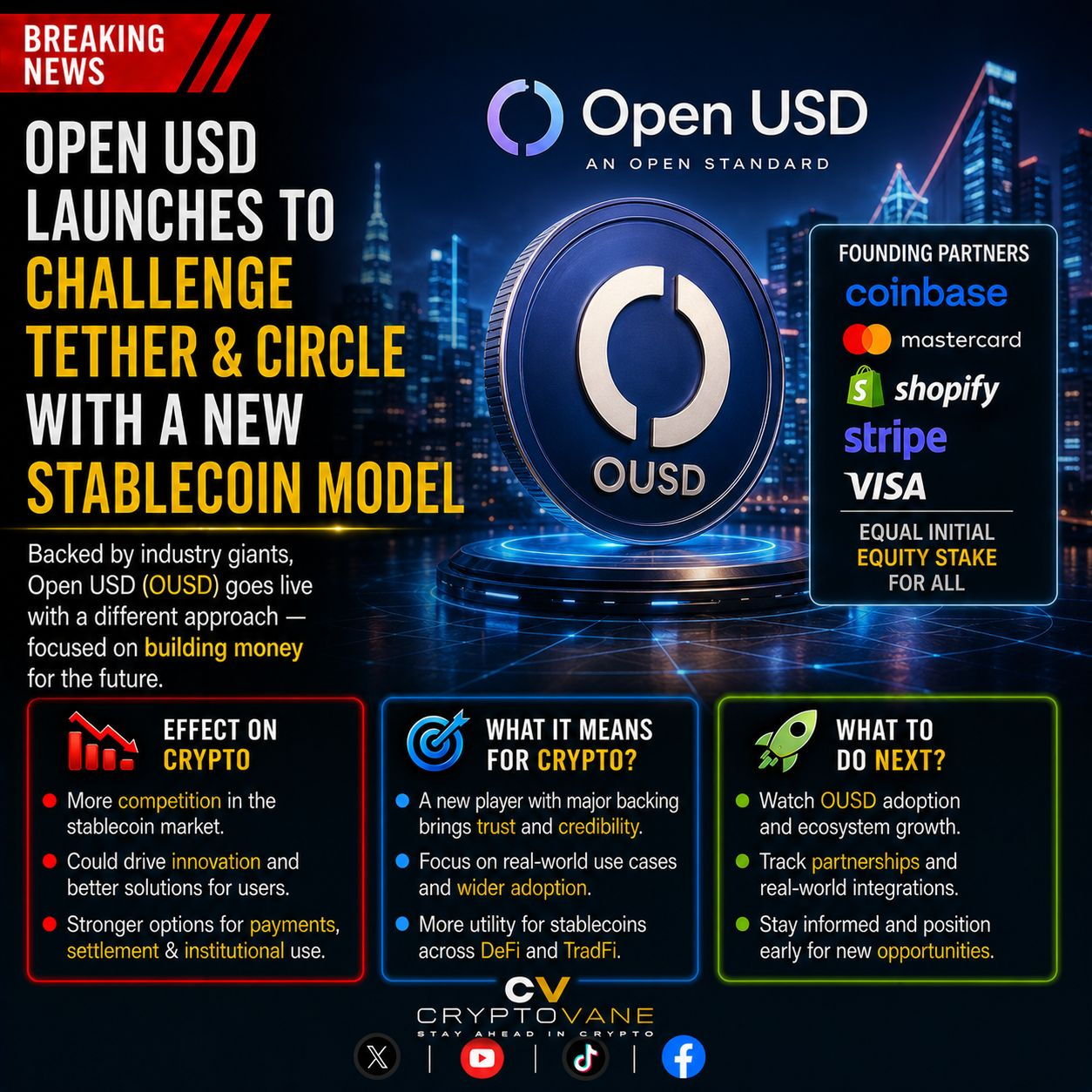
Open USD Enters the Stablecoin Race Against $TETH.ETF & Circle 🚨
Open USD (OUSD) has launched across major blockchain networks, backed by major financial and tech players. Its payments-focused model adds a new competitor to the stablecoin market and could accelerate innovation in digital payments and settlement.
#Stablecoins #CryptoNews #OUSD #blockchain #DeFi
{etf_us}(TETH.ETF)
Open USD Enters the Stablecoin Race Against $TETH.ETF & Circle 🚨
Open USD (OUSD) has launched across major blockchain networks, backed by major financial and tech players. Its payments-focused model adds a new competitor to the stablecoin market and could accelerate innovation in digital payments and settlement.
#Stablecoins #CryptoNews #OUSD #blockchain #DeFi
Open USD (OUSD) has launched across major blockchain networks, backed by major financial and tech players. Its payments-focused model adds a new competitor to the stablecoin market and could accelerate innovation in digital payments and settlement.
#Stablecoins #CryptoNews #OUSD #blockchain #DeFi
TETHETF-0.21%
28

$OUSD LAUNCHES WITH $1B INSTITUTIONAL LIQUIDITY BACKED BY GLOBAL PAYMENT GIANTS! 🦈 🏦
Institutional capital is cementing its footprint as Open USD $OUSD debuts with an immediate $1B liquidity seed. Backed by global payment heavyweights including Visa, Mastercard, Stripe, and Shopify, this multi-chain rollout spans $ETH , $SOL , Base, and Tempo to establish deep settlement infrastructure. 🦈
This massive initial depth targets structural inefficiencies across decentralized liquidity pools, bridging legacy payment volume directly onto smart contract rails. 📊 Watch closely how this capital deployment alters cross-chain velocity across key networks. 💡
💬 Do you expect $OUSD liquidity to primarily drive DeFi volume on $ETH or trigger momentum across $SOL first? 👇
⚠️ Not financial advice. Always manage your risk. 🛡️
🏷️ #OUSD #Stablecoin #DeFi #Ethereum #Solana
🎯 🦈
$OUSD LAUNCHES WITH $1B INSTITUTIONAL LIQUIDITY BACKED BY GLOBAL PAYMENT GIANTS! 🦈 🏦
Institutional capital is cementing its footprint as Open USD $OUSD debuts with an immediate $1B liquidity seed. Backed by global payment heavyweights including Visa, Mastercard, Stripe, and Shopify, this multi-chain rollout spans $ETH , $SOL , Base, and Tempo to establish deep settlement infrastructure. 🦈
This massive initial depth targets structural inefficiencies across decentralized liquidity pools, bridging legacy payment volume directly onto smart contract rails. 📊 Watch closely how this capital deployment alters cross-chain velocity across key networks. 💡
💬 Do you expect $OUSD liquidity to primarily drive DeFi volume on $ETH or trigger momentum across $SOL first? 👇
⚠️ Not financial advice. Always manage your risk. 🛡️
🏷️ #OUSD #Stablecoin #DeFi #Ethereum #Solana
🎯 🦈
Institutional capital is cementing its footprint as Open USD $OUSD debuts with an immediate $1B liquidity seed. Backed by global payment heavyweights including Visa, Mastercard, Stripe, and Shopify, this multi-chain rollout spans $ETH , $SOL , Base, and Tempo to establish deep settlement infrastructure. 🦈
This massive initial depth targets structural inefficiencies across decentralized liquidity pools, bridging legacy payment volume directly onto smart contract rails. 📊 Watch closely how this capital deployment alters cross-chain velocity across key networks. 💡
💬 Do you expect $OUSD liquidity to primarily drive DeFi volume on $ETH or trigger momentum across $SOL first? 👇
⚠️ Not financial advice. Always manage your risk. 🛡️
🏷️ #OUSD #Stablecoin #DeFi #Ethereum #Solana
🎯 🦈
16

·
--
🚨 FIVE HEAVYWEIGHT GIANTS COMMIT OVER $1B LIQUIDITY TO BUILD $OUSD ! 🦈
📌 Market heavyweights are quietly constructing an absolute fortress around $OUSD , with major tech, payment, and top-tier exchange leaders committing over $1 billion to engineer massive deep liquidity. 🌊 Behind the scenes, the integration footprint exploded from 140 to over 200 institutional partners, pulling banking powerhouses like UBS and SBI directly into the network flow. ⚡
💡 This is smart money establishing structural ownership and driving settlement velocity before retail even catches on. 💬 Does this massive capital backing position $OUSD as the premier institutional powerhouse of this cycle? 👇
⚠️ Not financial advice. Always manage your risk. 🛡️
🏷️ #OUSD #Institutional #Crypto #Finance #Liquidity
🔥 ⚡
🚨 FIVE HEAVYWEIGHT GIANTS COMMIT OVER $1B LIQUIDITY TO BUILD $OUSD ! 🦈
📌 Market heavyweights are quietly constructing an absolute fortress around $OUSD , with major tech, payment, and top-tier exchange leaders committing over $1 billion to engineer massive deep liquidity. 🌊 Behind the scenes, the integration footprint exploded from 140 to over 200 institutional partners, pulling banking powerhouses like UBS and SBI directly into the network flow. ⚡
💡 This is smart money establishing structural ownership and driving settlement velocity before retail even catches on. 💬 Does this massive capital backing position $OUSD as the premier institutional powerhouse of this cycle? 👇
⚠️ Not financial advice. Always manage your risk. 🛡️
🏷️ #OUSD #Institutional #Crypto #Finance #Liquidity
🔥 ⚡
📌 Market heavyweights are quietly constructing an absolute fortress around $OUSD , with major tech, payment, and top-tier exchange leaders committing over $1 billion to engineer massive deep liquidity. 🌊 Behind the scenes, the integration footprint exploded from 140 to over 200 institutional partners, pulling banking powerhouses like UBS and SBI directly into the network flow. ⚡
💡 This is smart money establishing structural ownership and driving settlement velocity before retail even catches on. 💬 Does this massive capital backing position $OUSD as the premier institutional powerhouse of this cycle? 👇
⚠️ Not financial advice. Always manage your risk. 🛡️
🏷️ #OUSD #Institutional #Crypto #Finance #Liquidity
🔥 ⚡
4

·
--
INSTITUTIONAL GIANTS PLEDGE OVER $1B TO BUILD STRUCTURAL $OUSD LIQUIDITY! 🦈 ⚡
The smart money footprint is becoming undeniable as major payment infrastructure entities and a top-tier exchange commit over $1B directly toward $OUSD liquidity rails. 🏦 The structural model aligns partner rewards with real supply expansion and transaction throughput, creating a focused institutional anchor.
With ecosystem integration climbing past 200 institutions including traditional banking powerhouses like UBS, this is a clear shift toward institutional settlement architecture. 🔍 The depth being engineered behind the scenes points to long-term structural demand over short-term noise. 💬 How do you expect this massive liquidity buildout to impact on-chain settlement volume? 👇
⚠️ Not financial advice. Always manage your risk. 🛡️
🏷️ #OUSD #Institutional #Liquidity #Crypto
🦈 🏦
INSTITUTIONAL GIANTS PLEDGE OVER $1B TO BUILD STRUCTURAL $OUSD LIQUIDITY! 🦈 ⚡
The smart money footprint is becoming undeniable as major payment infrastructure entities and a top-tier exchange commit over $1B directly toward $OUSD liquidity rails. 🏦 The structural model aligns partner rewards with real supply expansion and transaction throughput, creating a focused institutional anchor.
With ecosystem integration climbing past 200 institutions including traditional banking powerhouses like UBS, this is a clear shift toward institutional settlement architecture. 🔍 The depth being engineered behind the scenes points to long-term structural demand over short-term noise. 💬 How do you expect this massive liquidity buildout to impact on-chain settlement volume? 👇
⚠️ Not financial advice. Always manage your risk. 🛡️
🏷️ #OUSD #Institutional #Liquidity #Crypto
🦈 🏦
The smart money footprint is becoming undeniable as major payment infrastructure entities and a top-tier exchange commit over $1B directly toward $OUSD liquidity rails. 🏦 The structural model aligns partner rewards with real supply expansion and transaction throughput, creating a focused institutional anchor.
With ecosystem integration climbing past 200 institutions including traditional banking powerhouses like UBS, this is a clear shift toward institutional settlement architecture. 🔍 The depth being engineered behind the scenes points to long-term structural demand over short-term noise. 💬 How do you expect this massive liquidity buildout to impact on-chain settlement volume? 👇
⚠️ Not financial advice. Always manage your risk. 🛡️
🏷️ #OUSD #Institutional #Liquidity #Crypto
🦈 🏦
4
·
--
⚡ $OUSD DISRUPTS STABLECOINS BY WEAPONIZING EQUITY FOR REAL CIRCULATION VOLUME! 🏦
Open Standard is rewriting the stablecoin playbook by anchoring equity directly to network activity. CEO Zach Abrams revealed that OUSD will distribute the vast majority of company equity over four to five years to partners driving real supply and transaction volume. 📊
Instead of just fighting for existing market share against $USDT or $USDC , OUSD is targeting cross-border payments, card settlements, and foreign exchange. ⚡ By incentivizing active circulation over passive holding, they are building order flow momentum from day one. 🔍
💬 Will performance-based equity distribution accelerate stablecoin takeover of legacy banking rails? 👇
⚠️ Not financial advice. Always manage your risk. 🛡️
🏷️ #OUSD #Stablecoins #USDT #Crypto #Fintech
🔥 💎
⚡ $OUSD DISRUPTS STABLECOINS BY WEAPONIZING EQUITY FOR REAL CIRCULATION VOLUME! 🏦
Open Standard is rewriting the stablecoin playbook by anchoring equity directly to network activity. CEO Zach Abrams revealed that OUSD will distribute the vast majority of company equity over four to five years to partners driving real supply and transaction volume. 📊
Instead of just fighting for existing market share against $USDT or $USDC , OUSD is targeting cross-border payments, card settlements, and foreign exchange. ⚡ By incentivizing active circulation over passive holding, they are building order flow momentum from day one. 🔍
💬 Will performance-based equity distribution accelerate stablecoin takeover of legacy banking rails? 👇
⚠️ Not financial advice. Always manage your risk. 🛡️
🏷️ #OUSD #Stablecoins #USDT #Crypto #Fintech
🔥 💎
Open Standard is rewriting the stablecoin playbook by anchoring equity directly to network activity. CEO Zach Abrams revealed that OUSD will distribute the vast majority of company equity over four to five years to partners driving real supply and transaction volume. 📊
Instead of just fighting for existing market share against $USDT or $USDC , OUSD is targeting cross-border payments, card settlements, and foreign exchange. ⚡ By incentivizing active circulation over passive holding, they are building order flow momentum from day one. 🔍
💬 Will performance-based equity distribution accelerate stablecoin takeover of legacy banking rails? 👇
⚠️ Not financial advice. Always manage your risk. 🛡️
🏷️ #OUSD #Stablecoins #USDT #Crypto #Fintech
🔥 💎
21

·
--
🚨 $OUSD REVOLUTIONIZES STABLECOIN ADOPTION BY ALIGNING INSTITUTIONAL LIQUIDITY INCENTIVES! 🦈
Open Standard is shifting the paradigm of stablecoin architecture by embedding performance-driven distribution into the core of $OUSD . Rather than rewarding static holding, the model aligns partner equity with actual transactional velocity and supply expansion across FX and settlement rails. 📊
Distributing majority network equity over a multi-year horizon directly rewards partners generating real order flow and structural liquidity. 💡 This institutional-grade framework targets massive inefficiency capture across traditional payment rails beyond basic competition with $USDT and $USDC . 💬 Do you believe utility-focused incentive models will successfully siphon volume from traditional banking rails? 👇
⚠️ Not financial advice. Always manage your risk. 🛡️
🏷️ #OUSD #Stablecoins #USDT #DeFi #Crypto
⚡ 🦈
🚨 $OUSD REVOLUTIONIZES STABLECOIN ADOPTION BY ALIGNING INSTITUTIONAL LIQUIDITY INCENTIVES! 🦈
Open Standard is shifting the paradigm of stablecoin architecture by embedding performance-driven distribution into the core of $OUSD . Rather than rewarding static holding, the model aligns partner equity with actual transactional velocity and supply expansion across FX and settlement rails. 📊
Distributing majority network equity over a multi-year horizon directly rewards partners generating real order flow and structural liquidity. 💡 This institutional-grade framework targets massive inefficiency capture across traditional payment rails beyond basic competition with $USDT and $USDC . 💬 Do you believe utility-focused incentive models will successfully siphon volume from traditional banking rails? 👇
⚠️ Not financial advice. Always manage your risk. 🛡️
🏷️ #OUSD #Stablecoins #USDT #DeFi #Crypto
⚡ 🦈
Open Standard is shifting the paradigm of stablecoin architecture by embedding performance-driven distribution into the core of $OUSD . Rather than rewarding static holding, the model aligns partner equity with actual transactional velocity and supply expansion across FX and settlement rails. 📊
Distributing majority network equity over a multi-year horizon directly rewards partners generating real order flow and structural liquidity. 💡 This institutional-grade framework targets massive inefficiency capture across traditional payment rails beyond basic competition with $USDT and $USDC . 💬 Do you believe utility-focused incentive models will successfully siphon volume from traditional banking rails? 👇
⚠️ Not financial advice. Always manage your risk. 🛡️
🏷️ #OUSD #Stablecoins #USDT #DeFi #Crypto
⚡ 🦈
1
15
🏦 INSTITUTIONAL LIQUIDITY SHIFT AS $OUSD LAUNCHES WITH BLACKROCK RESERVES! ⚡
Open Standard's launch of $OUSD marks a structural shift in institutional liquidity infrastructure, backed directly by BlackRock and BNY Mellon reserve architecture. 🏦 With native deployments across $ETH and $SOL , smart money is gearing up for friction-free cross-border settlement channels. 🔍
Direct integration with global payment giants creates a seamless 1:1 minting ramp that bridges off-chain enterprise capital straight into market liquidity pools. 💡 This institutional footprint sets a new benchmark for reserve transparency and execution efficiency. 💬 Do you see $OUSD capturing market share from existing stablecoin giants? 👇
⚠️ Not financial advice. Always manage your risk. 🛡️
🏷️ #OUSD #Stablecoins #Crypto #Ethereum #Solana
🎯 🦈
🏦 INSTITUTIONAL LIQUIDITY SHIFT AS $OUSD LAUNCHES WITH BLACKROCK RESERVES! ⚡
Open Standard's launch of $OUSD marks a structural shift in institutional liquidity infrastructure, backed directly by BlackRock and BNY Mellon reserve architecture. 🏦 With native deployments across $ETH and $SOL , smart money is gearing up for friction-free cross-border settlement channels. 🔍
Direct integration with global payment giants creates a seamless 1:1 minting ramp that bridges off-chain enterprise capital straight into market liquidity pools. 💡 This institutional footprint sets a new benchmark for reserve transparency and execution efficiency. 💬 Do you see $OUSD capturing market share from existing stablecoin giants? 👇
⚠️ Not financial advice. Always manage your risk. 🛡️
🏷️ #OUSD #Stablecoins #Crypto #Ethereum #Solana
🎯 🦈
Open Standard's launch of $OUSD marks a structural shift in institutional liquidity infrastructure, backed directly by BlackRock and BNY Mellon reserve architecture. 🏦 With native deployments across $ETH and $SOL , smart money is gearing up for friction-free cross-border settlement channels. 🔍
Direct integration with global payment giants creates a seamless 1:1 minting ramp that bridges off-chain enterprise capital straight into market liquidity pools. 💡 This institutional footprint sets a new benchmark for reserve transparency and execution efficiency. 💬 Do you see $OUSD capturing market share from existing stablecoin giants? 👇
⚠️ Not financial advice. Always manage your risk. 🛡️
🏷️ #OUSD #Stablecoins #Crypto #Ethereum #Solana
🎯 🦈
26

·
--
🚨 JUST IN: A new stablecoin, Open USD ($OUSD), has officially launched with the backing of major global payments and financial giants, including Visa, Stripe, Shopify, Coinbase, and Mastercard.
With $1 billion in initial liquidity secured, it has launched simultaneously across the Solana, Base, Ethereum, and Tempo networks.#OUSD #news_update
🚨 JUST IN: A new stablecoin, Open USD ($OUSD), has officially launched with the backing of major global payments and financial giants, including Visa, Stripe, Shopify, Coinbase, and Mastercard.
With $1 billion in initial liquidity secured, it has launched simultaneously across the Solana, Base, Ethereum, and Tempo networks.#OUSD #news_update
With $1 billion in initial liquidity secured, it has launched simultaneously across the Solana, Base, Ethereum, and Tempo networks.#OUSD #news_update
76

·
--
A new stablecoin usually needs to survive a long cold start to make it through—but $OUSD doesn’t need any “acceptance” process at all.
An initial liquidity pool of $1 billion is deployed directly to Solana, Base, Ethereum, and Tempo. Behind it stands a global roster of commercial powerhouses: Visa, Stripe, Shopify, Coinbase, and Mastercard.
This isn’t another token that endlessly cannibalizes liquidity within the chain. It’s real payment giants bringing their own merchants and settlement rails directly onto the blockchain. And when the rails themselves are the initiator, liquidity is simply a factory-included standard for them.
Being bullish on $OUSD isn’t a bet on some abstract idea—it’s about seeing just how solid this platform is at covering the global consumption gateways.
#OUSD
A new stablecoin usually needs to survive a long cold start to make it through—but $OUSD doesn’t need any “acceptance” process at all.
An initial liquidity pool of $1 billion is deployed directly to Solana, Base, Ethereum, and Tempo. Behind it stands a global roster of commercial powerhouses: Visa, Stripe, Shopify, Coinbase, and Mastercard.
This isn’t another token that endlessly cannibalizes liquidity within the chain. It’s real payment giants bringing their own merchants and settlement rails directly onto the blockchain. And when the rails themselves are the initiator, liquidity is simply a factory-included standard for them.
Being bullish on $OUSD isn’t a bet on some abstract idea—it’s about seeing just how solid this platform is at covering the global consumption gateways.
#OUSD
An initial liquidity pool of $1 billion is deployed directly to Solana, Base, Ethereum, and Tempo. Behind it stands a global roster of commercial powerhouses: Visa, Stripe, Shopify, Coinbase, and Mastercard.
This isn’t another token that endlessly cannibalizes liquidity within the chain. It’s real payment giants bringing their own merchants and settlement rails directly onto the blockchain. And when the rails themselves are the initiator, liquidity is simply a factory-included standard for them.
Being bullish on $OUSD isn’t a bet on some abstract idea—it’s about seeing just how solid this platform is at covering the global consumption gateways.
#OUSD
1
30

·
--
Verified
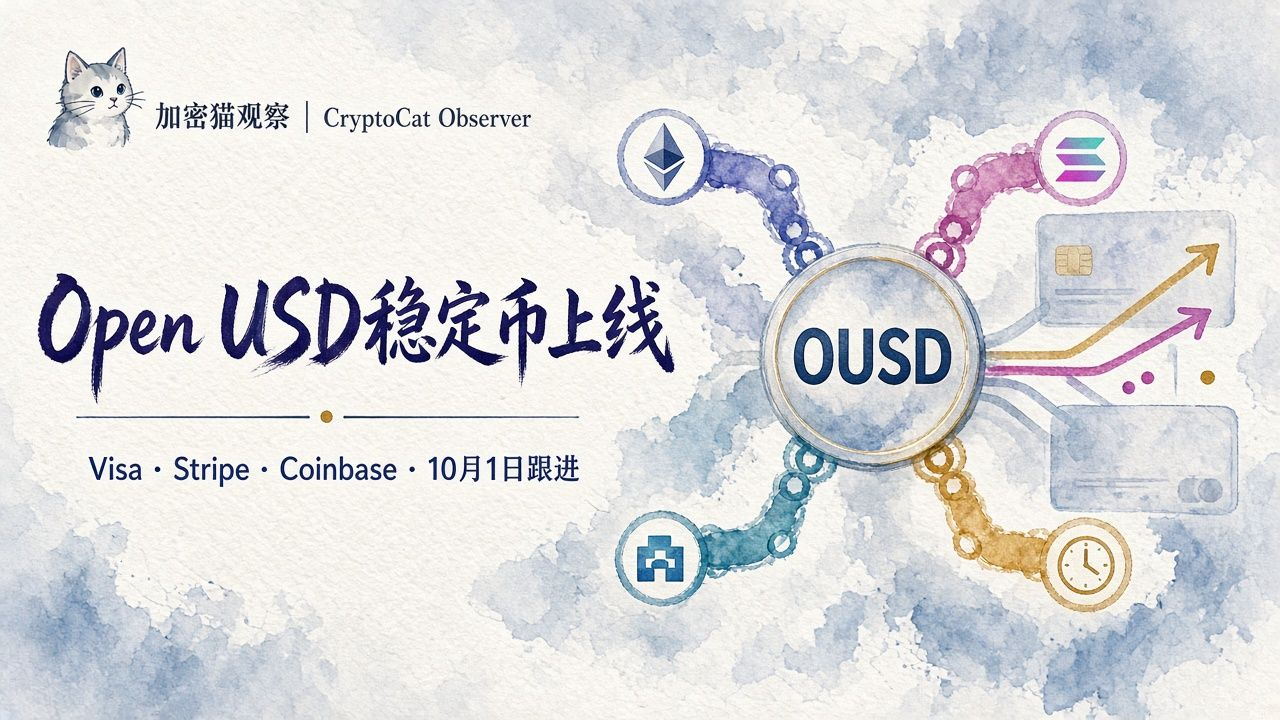
Open Standard announced on September 30 that the USD stablecoin Open USD ($OUSD) officially launched, with native deployments on four chains: $ETH, Solana, Base, and Tempo. The issuer is Bridge, a subsidiary of Stripe. Reserves are custody by BlackRock, Lead Bank, and The Bank of New York Mellon, with plans to disclose reserve proofs on a monthly basis. Businesses can mint and redeem at 1:1 against the U.S. dollar for free via Stripe, the Visa stablecoin platform, and Mastercard (via BVNK). Coinbase will support an integration scheduled for October 1. Initial trading venues include Coinbase, Kraken, and Uniswap.
The founding partners include Coinbase, Mastercard, Shopify, Stripe, and Visa. All parties have committed to invest a combined total of more than $1 billion to build liquidity. About two hours after launch, the total all-chain supply was approximately 477 million tokens and the reserve coverage ratio was approximately 100%; of this, circulating supply on the Tempo chain was about 434 million tokens, accounting for over 90%. Open Standard states that its partner network has grown to more than 200 entities, and partner earnings and equity incentives are tied to the amount of supply they help drive and trading activity.
#OUSD #稳定币 #ETH does not constitute investment advice
Open Standard announced on September 30 that the USD stablecoin Open USD ($OUSD) officially launched, with native deployments on four chains: $ETH , Solana, Base, and Tempo. The issuer is Bridge, a subsidiary of Stripe. Reserves are custody by BlackRock, Lead Bank, and The Bank of New York Mellon, with plans to disclose reserve proofs on a monthly basis. Businesses can mint and redeem at 1:1 against the U.S. dollar for free via Stripe, the Visa stablecoin platform, and Mastercard (via BVNK). Coinbase will support an integration scheduled for October 1. Initial trading venues include Coinbase, Kraken, and Uniswap.
The founding partners include Coinbase, Mastercard, Shopify, Stripe, and Visa. All parties have committed to invest a combined total of more than $1 billion to build liquidity. About two hours after launch, the total all-chain supply was approximately 477 million tokens and the reserve coverage ratio was approximately 100%; of this, circulating supply on the Tempo chain was about 434 million tokens, accounting for over 90%. Open Standard states that its partner network has grown to more than 200 entities, and partner earnings and equity incentives are tied to the amount of supply they help drive and trading activity.
#OUSD #稳定币 #ETH does not constitute investment advice
The founding partners include Coinbase, Mastercard, Shopify, Stripe, and Visa. All parties have committed to invest a combined total of more than $1 billion to build liquidity. About two hours after launch, the total all-chain supply was approximately 477 million tokens and the reserve coverage ratio was approximately 100%; of this, circulating supply on the Tempo chain was about 434 million tokens, accounting for over 90%. Open Standard states that its partner network has grown to more than 200 entities, and partner earnings and equity incentives are tied to the amount of supply they help drive and trading activity.
#OUSD #稳定币 #ETH does not constitute investment advice
1.1k

⚡️Launch of the OUSD stablecoin on the Stripe payments platform
Stripe, the digital payments solutions platform, announced the availability of the Open USD (OUSD) stablecoin within its options. Merchants and businesses will be able to use OUSD to manage their funds, make payments, and provide innovative financial services to their customers through the Stripe network.
━━━━━━━━━━━━━━
📊 Impact: 📈 High
🏷️ DEFI
#OUSD #Stripe #Stablecoin #Payments #DeFi
📰 Source: stripe.com
⚡️Launch of the OUSD stablecoin on the Stripe payments platform
Stripe, the digital payments solutions platform, announced the availability of the Open USD (OUSD) stablecoin within its options. Merchants and businesses will be able to use OUSD to manage their funds, make payments, and provide innovative financial services to their customers through the Stripe network.
━━━━━━━━━━━━━━
📊 Impact: 📈 High
🏷️ DEFI
#OUSD #Stripe #Stablecoin #Payments #DeFi
📰 Source: stripe.com
Stripe, the digital payments solutions platform, announced the availability of the Open USD (OUSD) stablecoin within its options. Merchants and businesses will be able to use OUSD to manage their funds, make payments, and provide innovative financial services to their customers through the Stripe network.
━━━━━━━━━━━━━━
📊 Impact: 📈 High
🏷️ DEFI
#OUSD #Stripe #Stablecoin #Payments #DeFi
📰 Source: stripe.com
68

·
--
$OUSD circulating supply is out first: Bridge’s transparent page shows about $483.5 millionEarlier this morning I posted the $OUSD launch. At the time the bottleneck was very clear: equity and liquidity commitments were in place, but circulating supply wasn’t provided.
Now the Bridge transparent interface is in place. As of 2026-10-01 01:10 UTC, $OUSD on-chain circulating supply is about $483.5 million, with reserves covering an equal amount, with a collateralization ratio of 1.0.
The structure isn’t fuzzy either: cash is about $272.2 million, and Treasuries about $211.2 million. This is the issuer-side real-time supply/reserve printout, not an independent audit report—don’t treat a transparent page as already-stamped attestation.
I’m only filtering on this one point: going live ≠ having volume. Only once there’s volume can we discuss whether channels like Coinbase have actually executed real trades. Liquidity commitment ≠ liquidity already delivered.
$OUSD circulating supply is out first: Bridge’s transparent page shows about $483.5 million
Earlier this morning I posted the $OUSD launch. At the time the bottleneck was very clear: equity and liquidity commitments were in place, but circulating supply wasn’t provided.
Now the Bridge transparent interface is in place. As of 2026-10-01 01:10 UTC, $OUSD on-chain circulating supply is about $483.5 million, with reserves covering an equal amount, with a collateralization ratio of 1.0.
The structure isn’t fuzzy either: cash is about $272.2 million, and Treasuries about $211.2 million. This is the issuer-side real-time supply/reserve printout, not an independent audit report—don’t treat a transparent page as already-stamped attestation.
I’m only filtering on this one point: going live ≠ having volume. Only once there’s volume can we discuss whether channels like Coinbase have actually executed real trades. Liquidity commitment ≠ liquidity already delivered.
Now the Bridge transparent interface is in place. As of 2026-10-01 01:10 UTC, $OUSD on-chain circulating supply is about $483.5 million, with reserves covering an equal amount, with a collateralization ratio of 1.0.
The structure isn’t fuzzy either: cash is about $272.2 million, and Treasuries about $211.2 million. This is the issuer-side real-time supply/reserve printout, not an independent audit report—don’t treat a transparent page as already-stamped attestation.
I’m only filtering on this one point: going live ≠ having volume. Only once there’s volume can we discuss whether channels like Coinbase have actually executed real trades. Liquidity commitment ≠ liquidity already delivered.
93
Log in to explore more content
Join global crypto users on Binance Square
⚡️ Get latest and useful information about crypto.
💬 Trusted by the world’s largest crypto exchange.
👍 Discover real insights from verified creators.
Email / Phone number
Trending Topics
1
#NFPWatch
10.6M views
18,326 Discussing
2
#BitcoinFundingRateTriplesTo10%
38,853 views
543 Discussing
3
#BitcoinSurpasses$86KUp2.99%
10,841 views
61 Discussing
4
#ZcashFalls21%FromSeptemberPeak
30,939 views
459 Discussing
5
#USSeptemberPayrollsAdd29KUnemploymentRises4.2%
23,048 views
252 Discussing
6
#XRPPostsFirstThreeGreenMonthsInQ3
25,086 views
448 Discussing
7
#BNBChainTokenizedStocksTop$1BAt30%Share
3,951 views
27 Discussing
8
#BitcoinRisesToward$85K
68,211 views
132 Discussing
9
#AmazonPlansToSell$8BNvidiaChips
6,509 views
83 Discussing
10
#NEARFallsToAround$4.70Down14%
42,762 views
107 Discussing