
#cftcsubmitstwoeventcontractrulestowhitehouse
cftcsubmitstwoeventcontractrulestowhitehouse
83,984 views
845 Discussing
Hot
Latest

·
--
#CFTCSubmitsTwoEventContractRulesToWhiteHouse 🚨 CFTC Targets Prediction Markets: What You Need to Know!
The U.S. Commodity Futures Trading Commission (CFTC) has officially submitted two critical proposed rules on event contracts to the White House for executive review.
If approved, this decision could permanently reshape prediction markets and event-based derivatives.
Here is the quick breakdown of what’s happening and why it matters to traders 👇
📊 The 2 New Rules Explained
Event Contracts = Swaps: The CFTC wants to officially classify prediction market contracts as standard "swaps." This brings them under strict federal oversight via the Commodity Exchange Act (CEA).
Casino Exclusion Zone: The second rule draws a clear legal boundary—excluding standard casino-style gambling from the derivatives classification.
⚡ Why This Matters for the Market
Federal vs. State War: U.S. states have been cracking down on prediction platforms like Kalshi and Polymarket, labeling them as illegal gambling. By defining these contracts as federal swaps, the CFTC is claiming total federal jurisdiction to override state-level bans.
Crypto Prediction Impact: Decentralized prediction protocols and tokenized event markets serving U.S. liquidity will face tighter compliance pressure if federal rules take effect.
Regulatory Certainty: Clearer boundaries could open the door for institutional capital to legally enter hedging and event-based trading setups.
📉 Trader’s Takeaway
This is a massive step toward defining whether prediction markets are legitimate financial hedging tools or just glorified gambling. Regulatory clarity is coming—and Web3 markets will have to adapt.
💬 What’s your take? Are event contracts a vital financial risk management tool, or just online betting with extra steps?
Let us know in the comments below! 👇
#PredictionMarkets #Web3 #CryptoNews #CryptoRegulation
$MOVR
{future}(MOVRUSDT)
$AGT
{future}(AGTUSDT)
$BTW
{future}(BTWUSDT)
#CFTCSubmitsTwoEventContractRulesToWhiteHouse 🚨 CFTC Targets Prediction Markets: What You Need to Know!
The U.S. Commodity Futures Trading Commission (CFTC) has officially submitted two critical proposed rules on event contracts to the White House for executive review.
If approved, this decision could permanently reshape prediction markets and event-based derivatives.
Here is the quick breakdown of what’s happening and why it matters to traders 👇
📊 The 2 New Rules Explained
Event Contracts = Swaps: The CFTC wants to officially classify prediction market contracts as standard "swaps." This brings them under strict federal oversight via the Commodity Exchange Act (CEA).
Casino Exclusion Zone: The second rule draws a clear legal boundary—excluding standard casino-style gambling from the derivatives classification.
⚡ Why This Matters for the Market
Federal vs. State War: U.S. states have been cracking down on prediction platforms like Kalshi and Polymarket, labeling them as illegal gambling. By defining these contracts as federal swaps, the CFTC is claiming total federal jurisdiction to override state-level bans.
Crypto Prediction Impact: Decentralized prediction protocols and tokenized event markets serving U.S. liquidity will face tighter compliance pressure if federal rules take effect.
Regulatory Certainty: Clearer boundaries could open the door for institutional capital to legally enter hedging and event-based trading setups.
📉 Trader’s Takeaway
This is a massive step toward defining whether prediction markets are legitimate financial hedging tools or just glorified gambling. Regulatory clarity is coming—and Web3 markets will have to adapt.
💬 What’s your take? Are event contracts a vital financial risk management tool, or just online betting with extra steps?
Let us know in the comments below! 👇
#PredictionMarkets #Web3 #CryptoNews #CryptoRegulation
$MOVR
$AGT
$BTW

361

·
--
#cftcsubmitstwoeventcontractrulestowhitehouse
🚨 The CFTC has sent two competing event-contract rules to the White House for review.
Both proposals entered OIRA review on September 28, but they take different approaches to how event contracts should be treated under the federal derivatives framework. One would exclude certain “casino-style gambling products” from the definition of swaps, while the other would include event contracts as swaps.
Why does this matter?
Prediction markets such as Kalshi and Polymarket are at the center of a broader legal fight over whether event contracts fall primarily under federal derivatives oversight or state gambling laws. A recent Sixth Circuit ruling found that states could regulate Kalshi under gambling laws, adding to the existing split between federal appeals courts.
At the same time, prediction markets are expanding toward financial products, including contracts tied to stocks and corporate events. That is raising additional questions about the respective roles of the CFTC and SEC.
For traders, the key thing to watch is how the White House review shapes the regulatory framework.
Prediction markets are moving closer to traditional finance—and regulators are now deciding exactly how these contracts fit into the system.
$GOOGL.US | $SPCX.US | $NVDA.US
{stock_us}(GOOGL.US)
{stock_us}(SPCX.US)
{stock_us}(NVDA.US)
#PredictionMarkets #CFTC #CryptoRegulation #CryptoNews #trading
#cftcsubmitstwoeventcontractrulestowhitehouse
🚨 The CFTC has sent two competing event-contract rules to the White House for review.
Both proposals entered OIRA review on September 28, but they take different approaches to how event contracts should be treated under the federal derivatives framework. One would exclude certain “casino-style gambling products” from the definition of swaps, while the other would include event contracts as swaps.
Why does this matter?
Prediction markets such as Kalshi and Polymarket are at the center of a broader legal fight over whether event contracts fall primarily under federal derivatives oversight or state gambling laws. A recent Sixth Circuit ruling found that states could regulate Kalshi under gambling laws, adding to the existing split between federal appeals courts.
At the same time, prediction markets are expanding toward financial products, including contracts tied to stocks and corporate events. That is raising additional questions about the respective roles of the CFTC and SEC.
For traders, the key thing to watch is how the White House review shapes the regulatory framework.
Prediction markets are moving closer to traditional finance—and regulators are now deciding exactly how these contracts fit into the system.
$GOOGL.US | $SPCX.US | $NVDA.US
#PredictionMarkets #CFTC #CryptoRegulation #CryptoNews #trading
NVDAUS-2.69%
GOOGLUS-1.22%
SPCXUS-0.21%
83

·
--
Why is nobody talking about what these CFTC event contract rules actually do to crypto traders?
Every regulatory headline sends people chasing entries they do not understand. Then they sit there not knowing when to exit once the fine print lands, and that is how accounts get wrecked on news that never delivered what the first tweet promised.
The CFTC submitting two event contract rules to the White House is being framed as prediction markets finally going mainstream. I read it as a case study in containment. Washington is not opening the floodgates. It is drawing a box around which events can be traded, by whom, and on which licensed venues.
We already watched this with Bitcoin. Futures listings on traditional venues did not kill spot demand. They created a slower, more restricted product while $USDT-settled markets kept doing the real volume. Event contracts will split the same way. The approved list will be narrow. The interesting stuff stays on-chain.
$AAVE already lets capital react to real-world outcomes without waiting for a CFTC stamp. $QNT sits in the middle of the interoperability problem institutions will hit if they ever try to bridge those two systems. The White House review just adds delay, and delay is usually when the headline buyers start looking for the door.
Where do you think this goes once the paperwork actually clears?
#CFTCSubmitsTwoEventContractRulesToWhiteHouse #TreasuryLetsStatesFileStablecoinCertificationsEarly #KoreaProposesTokenizingStocksAndBonds

308

Picture this: the CFTC just submitted two event contract rules to the White House for review.
The real pain is never knowing when a regulator will suddenly reclassify a product you are trading, turning a solid position into losses or leaving you on the sidelines while others adapt.
This is a case study in how crypto regulation actually unfolds. Event contracts are essentially bets on real-world outcomes, and the CFTC has spent years drawing those lines after earlier clashes with prediction platforms and the more structured path it took with Bitcoin futures. Unlike those past enforcement-heavy moments, this submission looks more like an attempt to create a workable framework rather than another blanket restriction.
Traditional players spent years in court over similar products. Crypto versions moved faster but paid for it in fines and uncertainty. If these rules land, it could give DeFi protocols a clearer lane, something $AAVE has navigated before with complex products and $QNT has positioned itself around for years. $USDT would likely remain the settlement layer most people actually use.
We have seen this pattern before. Clarity after the initial noise often brings more participation, not less.
Where do you think this goes from here for on-chain event markets?
#CFTCSubmitsTwoEventContractRulesToWhiteHouse #TreasuryLetsStatesFileStablecoinCertificationsEarly #BitcoinETFsTake

356

·
--
#cftcsubmitstwoeventcontractrulestowhitehouse Two appeals courts just ruled sports Event
Contracts are not swaps. A third said they are.
The
CFTC's reply, now at the White House: one rule writing Event Contracts into the swap definition, another carving out casino-style gambling products.$BTW $SYN $DEEP
Contracts are not swaps. A third said they are.
The
CFTC's reply, now at the White House: one rule writing Event Contracts into the swap definition, another carving out casino-style gambling products.$BTW $SYN $DEEP
561

·
--
Bullish
#CFTCSubmitsTwoEventContractRulesToWhiteHouse
The CFTC has sent two event-contract rule proposals to the White House’s OIRA for review. One would explicitly include certain event contracts within the definition of “swaps,” while the other would exclude “casino-style gambling products” from that definition.
Unique discussion:
This could become an important regulatory turning point for event contracts. The key issue is who has authority over these contracts—federal derivatives regulators or state gambling regulators. Recent U.S. court decisions have produced conflicting views, so the CFTC’s proposed definitions could add another layer to that legal debate.
The proposals are not final rules yet; they are currently in the White House review stage, and the detailed rule text has not been publicly released.
Short Binance-style thought:
“The CFTC is drawing a sharper regulatory line around event contracts. The big question now is whether this framework can bring greater clarity to federal vs. state oversight.”
362

·
--
#cftcsubmitstwoeventcontractrulestowhitehouse
🚨 Regulatory Update: CFTC Submits Two Event Contract Rules to White House!
The Market Update: Federal oversight of predictive and derivative markets is reaching a critical milestone as the CFTC officially submits two major event contract rules to the White House for review. As tracked by our regulatory compliance dashboard, this move signals accelerated federal scrutiny and potential formal framework finalization for election, economic, and political event contracts operating within regulated financial rails.
What This Means for Traders: Clearer regulatory frameworks for prediction and event-based derivatives impact market accessibility, institutional participation, and volume distribution across both traditional derivative exchanges and decentralized prediction protocols. Market participants are closely monitoring compliance updates and jurisdictional rulings.
Highlighted Tradeable Coins to Watch (Prediction & Derivative Sectors):
$UMA (UMA): Decentralized optimistic oracle protocol powering on-chain prediction markets and dispute resolution; tracking demand for decentralized data validation.
$SOL (Solana): High-throughput layer-1 network hosting fast execution prediction and derivative protocols; monitoring network activity and volume flows.
$ETH (Ethereum): The foundational smart contract settlement layer for leading decentralized financial and forecasting markets; observing institutional DeFi liquidity.
(Disclaimer: While requested alongside a tech and hardware focus mentioning AMD, traditional semiconductor equities are company stocks rather than tradeable crypto coins; the digital assets above highlight leading decentralized protocols aligned with prediction, derivatives, and high-performance infrastructure.)
How do you think federal oversight and White House review of event contracts will impact the growth of decentralized prediction markets this quarter? Let's discuss your strategy in the comments below! 👇
{spot}(UMAUSDT)
{spot}(SOLUSDT)
{spot}(ETHUSDT)
#CFTC #CryptoRegulation #PredictionMarkets
#cftcsubmitstwoeventcontractrulestowhitehouse
🚨 Regulatory Update: CFTC Submits Two Event Contract Rules to White House!
The Market Update: Federal oversight of predictive and derivative markets is reaching a critical milestone as the CFTC officially submits two major event contract rules to the White House for review. As tracked by our regulatory compliance dashboard, this move signals accelerated federal scrutiny and potential formal framework finalization for election, economic, and political event contracts operating within regulated financial rails.
What This Means for Traders: Clearer regulatory frameworks for prediction and event-based derivatives impact market accessibility, institutional participation, and volume distribution across both traditional derivative exchanges and decentralized prediction protocols. Market participants are closely monitoring compliance updates and jurisdictional rulings.
Highlighted Tradeable Coins to Watch (Prediction & Derivative Sectors):
$UMA (UMA): Decentralized optimistic oracle protocol powering on-chain prediction markets and dispute resolution; tracking demand for decentralized data validation.
$SOL (Solana): High-throughput layer-1 network hosting fast execution prediction and derivative protocols; monitoring network activity and volume flows.
$ETH (Ethereum): The foundational smart contract settlement layer for leading decentralized financial and forecasting markets; observing institutional DeFi liquidity.
(Disclaimer: While requested alongside a tech and hardware focus mentioning AMD, traditional semiconductor equities are company stocks rather than tradeable crypto coins; the digital assets above highlight leading decentralized protocols aligned with prediction, derivatives, and high-performance infrastructure.)
How do you think federal oversight and White House review of event contracts will impact the growth of decentralized prediction markets this quarter? Let's discuss your strategy in the comments below! 👇
#CFTC #CryptoRegulation #PredictionMarkets

1
1.3k

·
--
Bearish
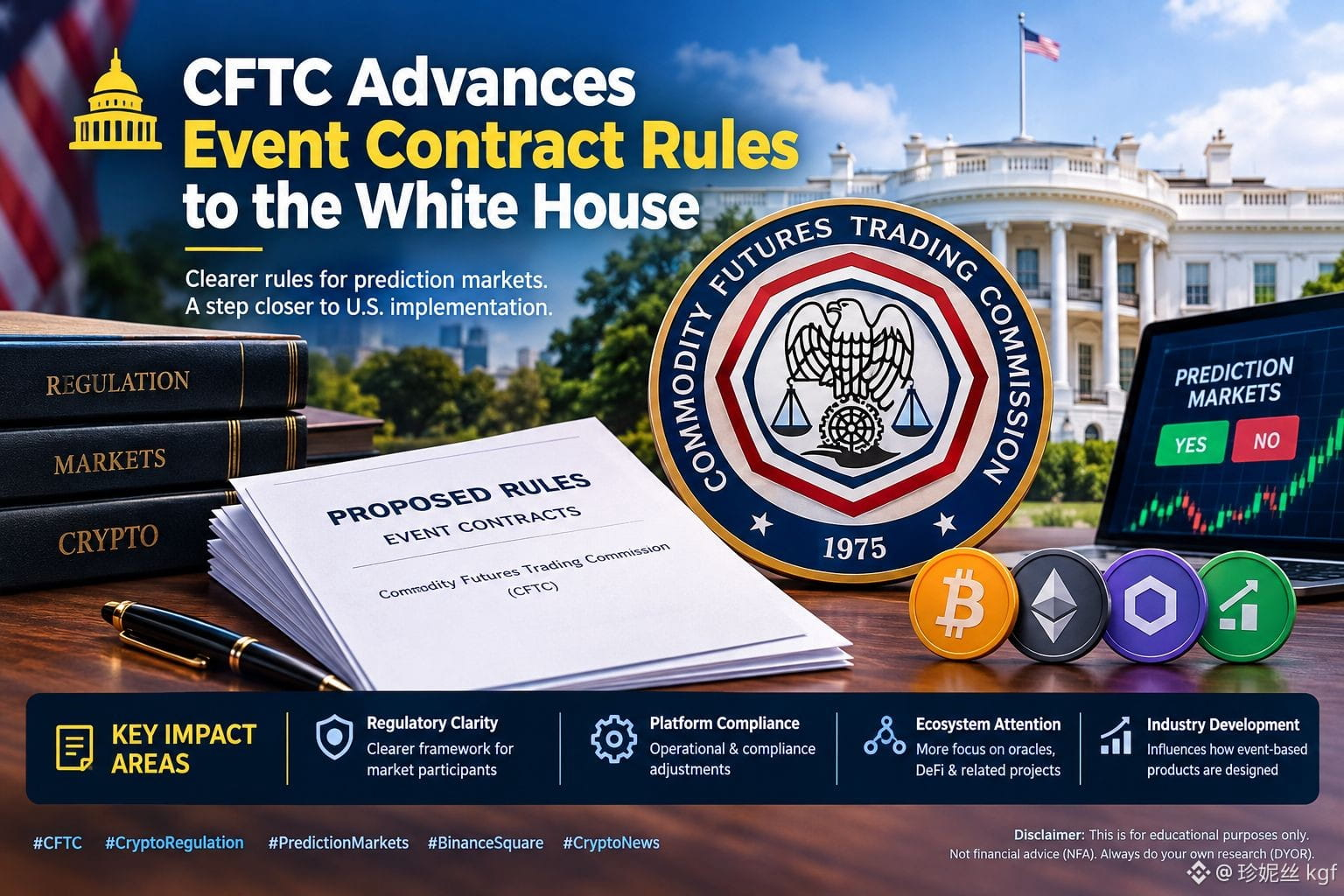
#cftcsubmitstwoeventcontractrulestowhitehouse 🏛️ Regulatory Update CFTC Advances Event Contract Rules to the White House
The regulatory landscape for crypto prediction markets is evolving. The CFTC has taken a significant step forward in defining how event contracts will be governed in the US. 🇺🇸
📰 The Core News
The Commodity Futures Trading Commission (CFTC) has officially submitted two proposed rules regarding "event contracts" to the White House. This submission marks a critical phase in the federal rulemaking process, moving these regulations closer to final implementation. The rules aim to clarify the legal framework for prediction markets and event-based derivatives, which have become a rapidly growing sector in the digital asset space.
📊 Potential Market Impact
Here is how this development could influence the broader crypto ecosystem:
• Regulatory Clarity Establishing a defined legal framework for prediction markets could help structure the sector and clarify operational boundaries for market participants and platforms.
• Operational Adjustmentn Platforms offering event contracts may need to update their compliance protocols to align with the new rules, which could influence how these services are structured and offered.
• Ecosystem Attention Projects, protocols, and tokens associated with decentralized prediction markets, oracle networks, and related DeFi infrastructure may experience shifts in market focus as the industry adapts to these regulatory developments.
💬 What are your thoughts?
How do you think these new regulatory frameworks will impact the future development and adoption of decentralized prediction markets? Share your perspective in the comments below! 👇
#CFTC #CryptoRegulation #PredictionMarkets #BinanceSquare #CryptoNews
This is for educational purposes only. Not Financial Advice (NFA). Always Do Your Own Research (DYOR).
$GTC $0G $GNS
{spot}(GNSUSDT)
{future}(0GUSDT)
{future}(GTCUSDT)
#cftcsubmitstwoeventcontractrulestowhitehouse 🏛️ Regulatory Update CFTC Advances Event Contract Rules to the White House
The regulatory landscape for crypto prediction markets is evolving. The CFTC has taken a significant step forward in defining how event contracts will be governed in the US. 🇺🇸
📰 The Core News
The Commodity Futures Trading Commission (CFTC) has officially submitted two proposed rules regarding "event contracts" to the White House. This submission marks a critical phase in the federal rulemaking process, moving these regulations closer to final implementation. The rules aim to clarify the legal framework for prediction markets and event-based derivatives, which have become a rapidly growing sector in the digital asset space.
📊 Potential Market Impact
Here is how this development could influence the broader crypto ecosystem:
• Regulatory Clarity Establishing a defined legal framework for prediction markets could help structure the sector and clarify operational boundaries for market participants and platforms.
• Operational Adjustmentn Platforms offering event contracts may need to update their compliance protocols to align with the new rules, which could influence how these services are structured and offered.
• Ecosystem Attention Projects, protocols, and tokens associated with decentralized prediction markets, oracle networks, and related DeFi infrastructure may experience shifts in market focus as the industry adapts to these regulatory developments.
💬 What are your thoughts?
How do you think these new regulatory frameworks will impact the future development and adoption of decentralized prediction markets? Share your perspective in the comments below! 👇
#CFTC #CryptoRegulation #PredictionMarkets #BinanceSquare #CryptoNews
This is for educational purposes only. Not Financial Advice (NFA). Always Do Your Own Research (DYOR).
$GTC $0G $GNS
1
2.1k

🏟️ Sports Contracts Are Under the Microscope
From NBA and NFL markets to individual sporting events, prediction contracts are becoming a major regulatory battleground.
The CFTC's latest proposals could redefine how these markets operate under federal derivatives rules.
$BTC $ETH
#cftcsubmitstwoeventcontractrulestowhitehouse
From NBA and NFL markets to individual sporting events, prediction contracts are becoming a major regulatory battleground.
The CFTC's latest proposals could redefine how these markets operate under federal derivatives rules.
$BTC $ETH
#cftcsubmitstwoeventcontractrulestowhitehouse
1
1.1k
🔥 Prediction Markets Enter a New Phase
The CFTC wants event contracts formally recognized within the federal swap framework while excluding casino-style products.
That could have major implications for sports-focused prediction markets.
👀 The next regulatory step matters.
$BTC $ETH $SOL
#cftcsubmitstwoeventcontractrulestowhitehouse
The CFTC wants event contracts formally recognized within the federal swap framework while excluding casino-style products.
That could have major implications for sports-focused prediction markets.
👀 The next regulatory step matters.
$BTC $ETH $SOL
#cftcsubmitstwoeventcontractrulestowhitehouse
2
3.4k

·
--
Bullish
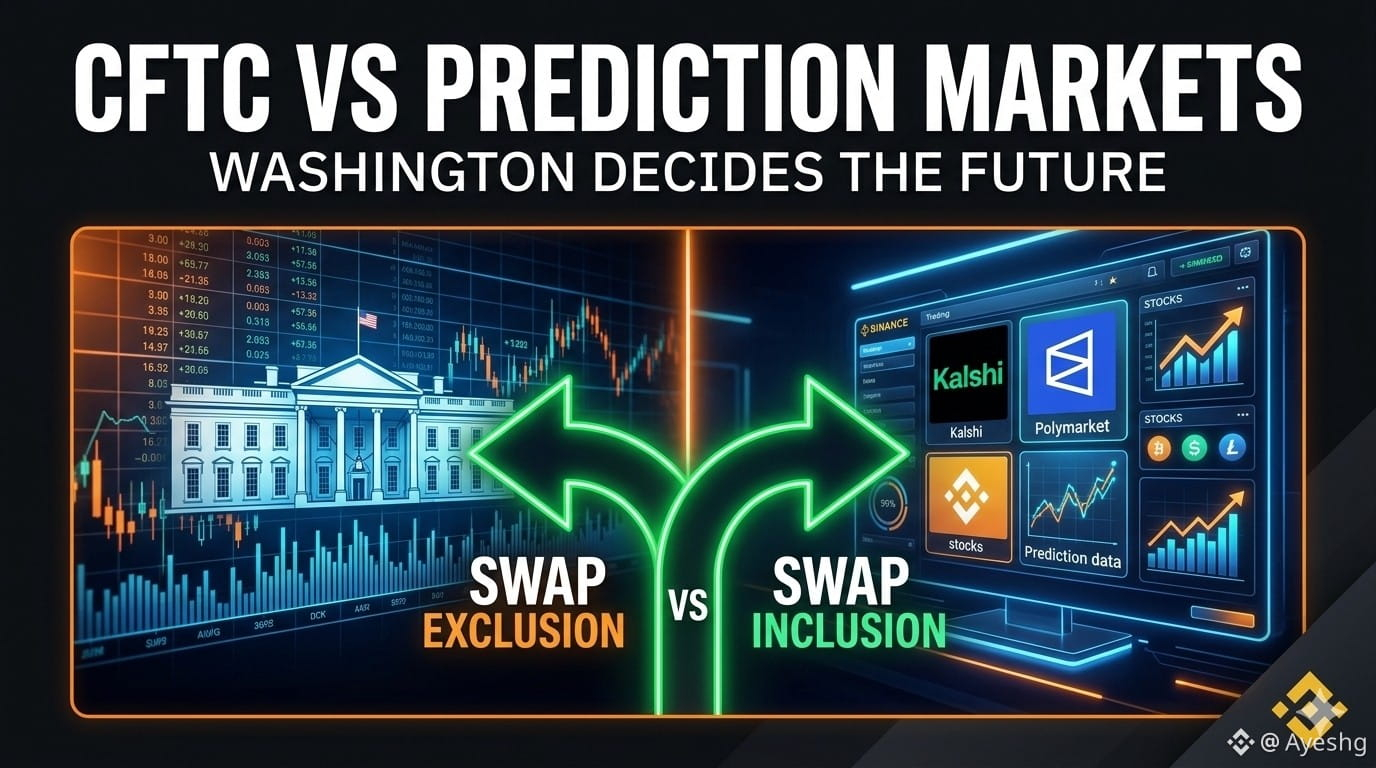
#cftcsubmitstwoeventcontractrulestowhitehouse 🚨 CFTC SENDS TWO PREDICTION-MARKET RULES TO WHITE HOUSE REVIEW
Washington is taking another major step toward defining how U.S. prediction markets should be regulated.
The CFTC submitted two event-contract regulatory actions to White House OIRA review on September 28 — and the approaches point in different directions.
📌 What’s being considered?
🔹 One proposal would clarify the definition of “swap” to include event contracts.
🔹 Another interim-final approach would exclude certain casino-style gambling products from the swap framework.
Why does this matter?
Prediction markets such as Kalshi and Polymarket are at the center of a broader legal battle over whether certain event contracts fall primarily under federal derivatives regulation or state gambling laws.
A September 25 appeals-court ruling involving Kalshi held that the contracts at issue were not swaps and allowed Ohio and Tennessee gambling laws to apply — adding another layer of uncertainty.
Meanwhile, prediction platforms are expanding into stock and corporate-event contracts, creating additional questions around the respective roles of the CFTC and SEC. Reuters reported that more than $220 million had been traded on Polymarket's equity-linked prediction markets.
⚠️ Important: OIRA review does not mean either approach is final. The regulatory process is still developing.
👀 The key catalyst: Which framework ultimately moves forward — and how courts and regulators define the boundary between derivatives and gambling.
$GOOGL $NVDA $SPX
#CFTC #PredictionMarkets #Kalshi #Polymarket #CryptoNews #Regulation #Markets
1
2
2.6k

🚨 The next big prediction market battle may be decided by regulation, not trading volume.
The US Commodity Futures Trading Commission (CFTC) has submitted two event contract rules to the White House for review, targeting how prediction markets are classified under federal derivatives law.
One proposal would explicitly include event contracts in the definition of swaps, while the other would exclude casino-style gambling products. The distinction could shape how platforms like Kalshi and Polymarket operate in the US.
Why does this matter? Clearer rules could influence market access, available contracts, liquidity and institutional participation. However, the legal battle is far from settled. A recent appeals court ruling allowed Ohio and Tennessee to regulate Kalshi’s sports contracts, highlighting the ongoing conflict between federal and state authority.
My take: This is a major regulatory development for prediction markets, but the outcome matters more than the headline. Greater clarity could support long-term growth, while restrictive interpretations could limit certain markets. The impact will depend on the final rules, court decisions and enforcement.
For crypto, the key question is whether regulatory clarity can encourage wider participation without creating new barriers.
$GOOGL $ZEC
{future}(ZECUSDT)
{future}(GOOGLUSDT)
Will these CFTC rules help prediction markets grow, or create more uncertainty for platforms and traders?
#CFTC #PredictionMarkets #CryptoRegulation
#CFTCSubmitsTwoEventContractRulesToWhiteHouse
🚨 The next big prediction market battle may be decided by regulation, not trading volume.
The US Commodity Futures Trading Commission (CFTC) has submitted two event contract rules to the White House for review, targeting how prediction markets are classified under federal derivatives law.
One proposal would explicitly include event contracts in the definition of swaps, while the other would exclude casino-style gambling products. The distinction could shape how platforms like Kalshi and Polymarket operate in the US.
Why does this matter? Clearer rules could influence market access, available contracts, liquidity and institutional participation. However, the legal battle is far from settled. A recent appeals court ruling allowed Ohio and Tennessee to regulate Kalshi’s sports contracts, highlighting the ongoing conflict between federal and state authority.
My take: This is a major regulatory development for prediction markets, but the outcome matters more than the headline. Greater clarity could support long-term growth, while restrictive interpretations could limit certain markets. The impact will depend on the final rules, court decisions and enforcement.
For crypto, the key question is whether regulatory clarity can encourage wider participation without creating new barriers.
$GOOGL $ZEC
Will these CFTC rules help prediction markets grow, or create more uncertainty for platforms and traders?
#CFTC #PredictionMarkets #CryptoRegulation
#CFTCSubmitsTwoEventContractRulesToWhiteHouse

2
439
·
--
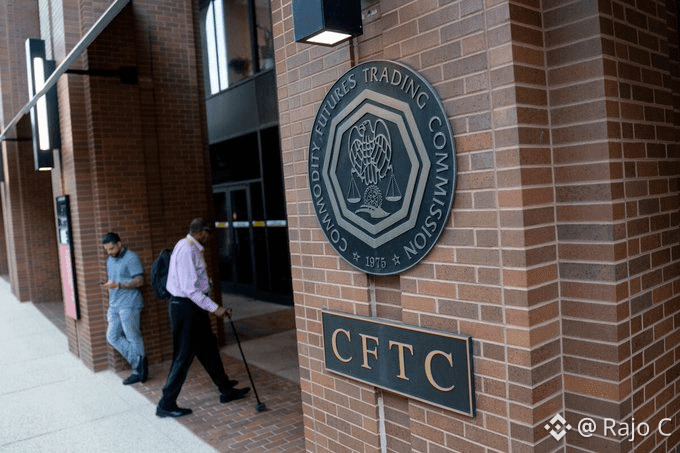
#cftcsubmitstwoeventcontractrulestowhitehouse The Commodity Futures Trading Commission is teeing up two new prediction market-related rules that could impact litigation over the agency’s jurisdiction over sports-related event contracts.$SOXS $HUT $HOOD
#cftcsubmitstwoeventcontractrulestowhitehouse The Commodity Futures Trading Commission is teeing up two new prediction market-related rules that could impact litigation over the agency’s jurisdiction over sports-related event contracts.$SOXS $HUT $HOOD
8

·
--
#CFTCSubmitsTwoEventContractRulesToWhiteHouse
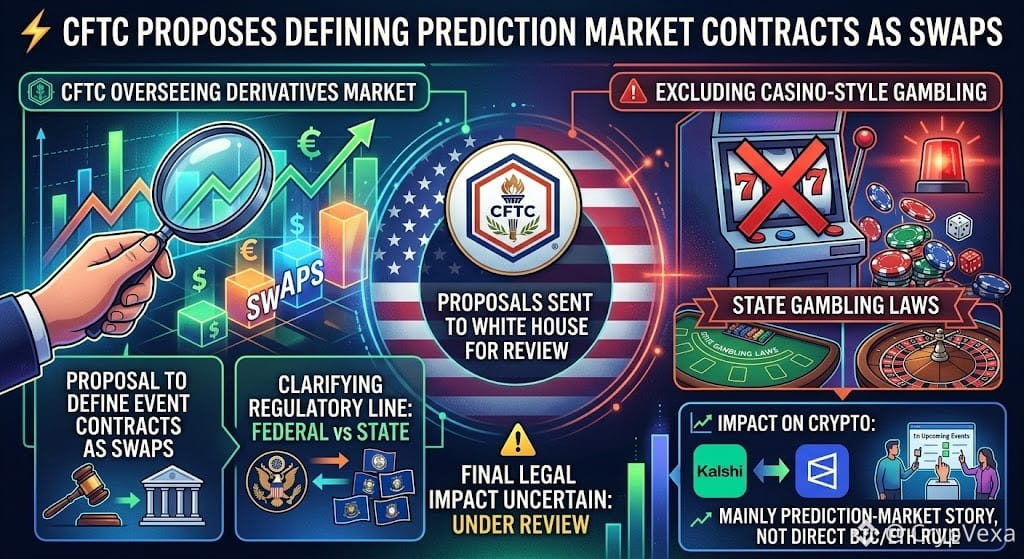
⚡ CFTC Moves to Define Prediction Market Contracts as Swaps
🇺🇸 The CFTC has sent two proposals to the White House for review that would define event contracts as “swaps” while excluding casino-style gambling products.
🎯 The move could clarify the regulatory line between federal derivatives oversight and state gambling laws.
⚠️ The proposals are still under review, so the final legal impact remains uncertain.
📈 For crypto, this is mainly a prediction-market and regulatory story, not a direct BTC or ETH rule.
👀 Could clearer rules accelerate the growth of prediction markets?
#PredictionMarkets #CFTC #CryptoRegulation #CryptoNews
12

·
--
The Commodity Futures Trading Commission (CFTC) has submitted two proposed rules regarding event contracts to the White House for review. This move signals a significant step towards potentially regulating a new class of financial derivatives. The implications for the crypto market, particularly for platforms offering prediction markets or similar instruments, could be substantial. Clarity on these rules might foster greater institutional participation or, conversely, introduce new compliance hurdles. Market participants will be closely watching how these proposals evolve and what impact they will have on innovation and accessibility within the digital asset space.
Disclaimer: This content is for informational purposes only and does not constitute investment advice.
#CFTCSubmitsTwoEventContractRulesToWhiteHouse
Disclaimer: This content is for informational purposes only and does not constitute investment advice.
#CFTCSubmitsTwoEventContractRulesToWhiteHouse

1
1
1
118

·
--
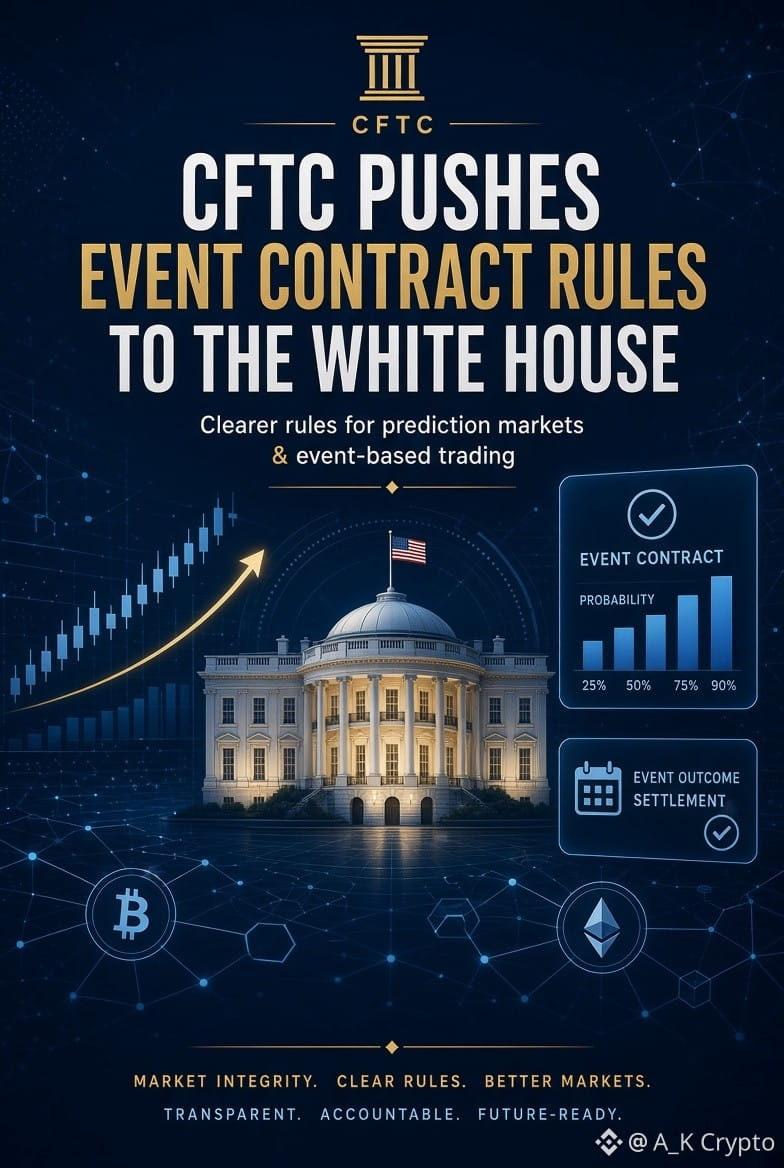
#CFTCSubmitsTwoEventContractRulesToWhiteHouse 🚨 CFTC PUSHES EVENT CONTRACT RULES TO THE WHITE HOUSE
The U.S. CFTC has reportedly sent two proposed event-contract rules to the White House for review.
Event contracts let traders take positions on outcomes tied to events, including economic, political and other real-world developments.
This could be an important step toward clearer rules for prediction markets and regulated event-based trading in the U.S.
Regulatory clarity around event contracts could have a wider impact than it first appears. If the rules create a clear framework, prediction markets may attract more participants and liquidity. For crypto, the key question is whether similar structures eventually connect with blockchain-based markets, creating new opportunities alongside new regulatory risks.
#CFTC #crypto #binana #MicronBeatsEarningsLiftsGuidance
105

·
--
Bullish
#CFTCSubmitsTwoEventContractRulesToWhiteHouse 🚨 CFTC SUBMITS TWO MAJOR EVENT-CONTRACT RULES TO WHITE HOUSE! ⚖️
A significant regulatory development in the US financial sector! 🇺🇸
The CFTC has submitted two proposals to the White House for review, potentially reshaping how event contracts are classified under federal law.
🔍 KEY HIGHLIGHTS:
* 🏛️ One proposal would include event contracts in the definition of swaps.
* ⚖️ The second would exclude casino-style gambling products from that definition.
* 🇺🇸 The proposals could affect the division of regulatory authority between federal and state regulators.
* 📋 Both proposals are currently under White House review.
⚡ WHY IT MATTERS:
The proposed rules come amid ongoing legal disputes over the regulation of event contracts. Their outcome could influence the future regulatory framework in the United States.
💬 What impact could these regulatory changes have on the wider crypto industry?
#CFTC #CryptoRegulation #CryptoNews #USMarkets #DeFi
$NVDA.US $GOOG.US $AAPL.US

78

·
--
Article
A Federal Agency Just Moved to Settle Prediction Markets' Biggest Legal Question — By Rulemaking#cftcsubmitstwoeventcontractrulestowhitehouse
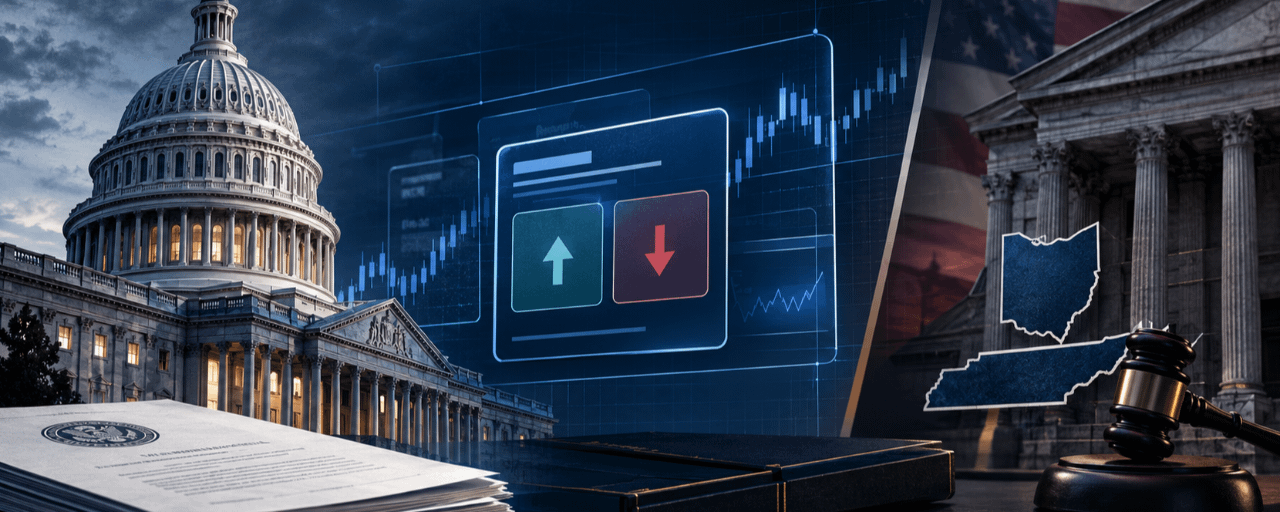
While New York and Polymarket fight it out in court over whether prediction markets are gambling or finance, the CFTC just took a direct shot at answering that question itself — through regulation rather than litigation.
Here's what happened: on September 28, the CFTC submitted two rule proposals to the White House's Office of Information and Regulatory Affairs for review. The first, a proposed rule, would formally define event contracts — the yes-or-no wagers traded on platforms like Kalshi, Polymarket, and Robinhood — as "swaps" under federal derivatives law. The second, a temporary final rule, would simultaneously carve out "casino-style gambling products" from that same swap definition, taking effect immediately upon approval rather than waiting for public comment. CFTC Chairman Michael Selig has argued the agency holds exclusive federal jurisdiction over these markets, a position directly contested by several states currently suing platforms like Kalshi and Polymarket under state gambling law. This submission extends a broader pattern this year of the CFTC moving ahead with rulemaking on its own authority rather than waiting for stalled congressional legislation like the CLARITY Act.
Why does this matter? If finalized, classifying event contracts as federally regulated swaps — rather than gambling — could directly undercut the legal basis for multiple state lawsuits currently working through the courts, including New York's case against Polymarket and a similar one against Kalshi. It's a meaningful jurisdictional move in an area where federal and state authority have been colliding repeatedly this year, and it illustrates how administrative rulemaking is increasingly shaping crypto-adjacent policy while Congress remains gridlocked.
Whether this rule survives the ongoing legal battles unchanged, or gets challenged just as fiercely as the platforms it aims to protect, remains to be seen.
Can a federal rule really settle a fight that's already playing out across multiple state courtrooms? 🤔
#CFTC #PredictionMarkets #Regulation #Polymarket
$MOVR $AGT
{future}(AGTUSDT)
{future}(MOVRUSDT)
A Federal Agency Just Moved to Settle Prediction Markets' Biggest Legal Question — By Rulemaking
#cftcsubmitstwoeventcontractrulestowhitehouse
While New York and Polymarket fight it out in court over whether prediction markets are gambling or finance, the CFTC just took a direct shot at answering that question itself — through regulation rather than litigation.
Here's what happened: on September 28, the CFTC submitted two rule proposals to the White House's Office of Information and Regulatory Affairs for review. The first, a proposed rule, would formally define event contracts — the yes-or-no wagers traded on platforms like Kalshi, Polymarket, and Robinhood — as "swaps" under federal derivatives law. The second, a temporary final rule, would simultaneously carve out "casino-style gambling products" from that same swap definition, taking effect immediately upon approval rather than waiting for public comment. CFTC Chairman Michael Selig has argued the agency holds exclusive federal jurisdiction over these markets, a position directly contested by several states currently suing platforms like Kalshi and Polymarket under state gambling law. This submission extends a broader pattern this year of the CFTC moving ahead with rulemaking on its own authority rather than waiting for stalled congressional legislation like the CLARITY Act.
Why does this matter? If finalized, classifying event contracts as federally regulated swaps — rather than gambling — could directly undercut the legal basis for multiple state lawsuits currently working through the courts, including New York's case against Polymarket and a similar one against Kalshi. It's a meaningful jurisdictional move in an area where federal and state authority have been colliding repeatedly this year, and it illustrates how administrative rulemaking is increasingly shaping crypto-adjacent policy while Congress remains gridlocked.
Whether this rule survives the ongoing legal battles unchanged, or gets challenged just as fiercely as the platforms it aims to protect, remains to be seen.
Can a federal rule really settle a fight that's already playing out across multiple state courtrooms? 🤔
#CFTC #PredictionMarkets #Regulation #Polymarket
$MOVR $AGT
3
1.1k

·
--
Bearish
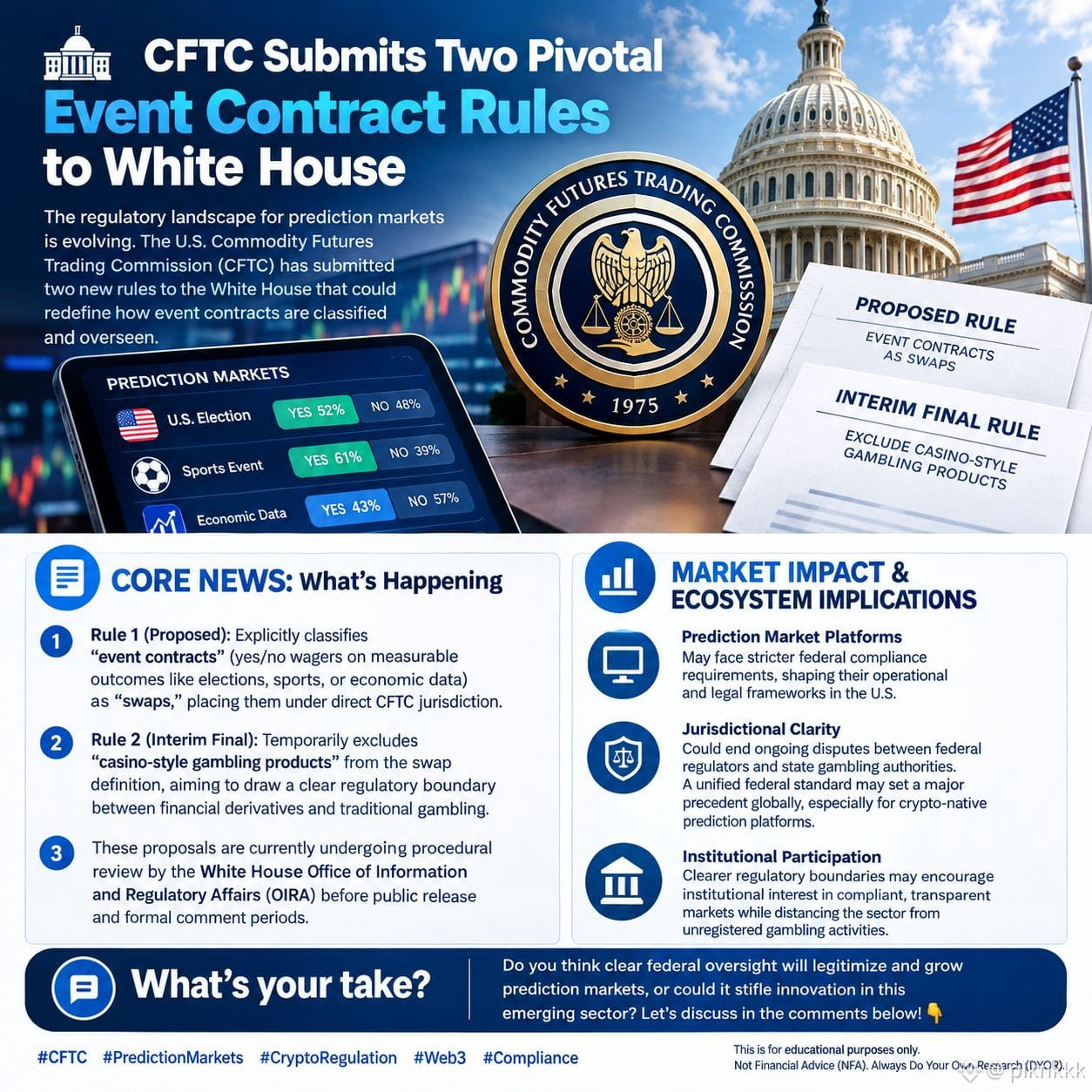
#cftcsubmitstwoeventcontractrulestowhitehouse 🏛️ CFTC Submits Two Pivotal Event Contract Rules to White House
The regulatory landscape for prediction markets is evolving. The U.S. Commodity Futures Trading Commission (CFTC) has submitted two new rules to the White House that could redefine how event contracts are classified and overseen.
Core News What’s Happening
•Rule 1 (Proposed) Explicitly classifies event contracts (yes/no wagers on measurable outcomes like elections, sports or economic data) as swaps placing them under direct CFTC jurisdiction.
Rule 2 (Interim Final) Temporarily excludes casino-style gambling products from the swap definition aiming to draw a clear regulatory boundary between financial derivatives and traditional gambling.
• These proposals are currently undergoing procedural review by the White House Office of Information and Regulatory Affairs (OIRA) before public release and formal comment periods.
📊 Market Impact & Ecosystem Implications
Prediction Market Platforms Platforms facilitating event contracts may face stricter federal compliance requirements which could shape their operational and legal frameworks in the U.S.
•Jurisdictional Clarity This move addresses ongoing legal disputes between federal regulators and state gambling authorities. A unified federal standard could set a major precedent for how crypto-native prediction platforms are treated globally
Institutional Participation Clearer regulatory boundaries may encourage institutional interest in compliant transparent prediction markets while distancing the sector from unregistered gambling activities.
What’s your take?
Do you think clear federal oversight will legitimize and grow prediction markets or could it stifle innovation in this emerging sector? Let’s discuss in the comments below
#CFTC #PredictionMarkets #CryptoRegulation #Web3 #Compliance
This is for educational purposes only. Not Financial Advice (NFA) Always Do Your Own Research (DYOR).
$ARK $GTC $0G
{future}(0GUSDT)
{future}(GTCUSDT)
{future}(ARKUSDT)
#cftcsubmitstwoeventcontractrulestowhitehouse 🏛️ CFTC Submits Two Pivotal Event Contract Rules to White House
The regulatory landscape for prediction markets is evolving. The U.S. Commodity Futures Trading Commission (CFTC) has submitted two new rules to the White House that could redefine how event contracts are classified and overseen.
Core News What’s Happening
•Rule 1 (Proposed) Explicitly classifies event contracts (yes/no wagers on measurable outcomes like elections, sports or economic data) as swaps placing them under direct CFTC jurisdiction.
Rule 2 (Interim Final) Temporarily excludes casino-style gambling products from the swap definition aiming to draw a clear regulatory boundary between financial derivatives and traditional gambling.
• These proposals are currently undergoing procedural review by the White House Office of Information and Regulatory Affairs (OIRA) before public release and formal comment periods.
📊 Market Impact & Ecosystem Implications
Prediction Market Platforms Platforms facilitating event contracts may face stricter federal compliance requirements which could shape their operational and legal frameworks in the U.S.
•Jurisdictional Clarity This move addresses ongoing legal disputes between federal regulators and state gambling authorities. A unified federal standard could set a major precedent for how crypto-native prediction platforms are treated globally
Institutional Participation Clearer regulatory boundaries may encourage institutional interest in compliant transparent prediction markets while distancing the sector from unregistered gambling activities.
What’s your take?
Do you think clear federal oversight will legitimize and grow prediction markets or could it stifle innovation in this emerging sector? Let’s discuss in the comments below
#CFTC #PredictionMarkets #CryptoRegulation #Web3 #Compliance
This is for educational purposes only. Not Financial Advice (NFA) Always Do Your Own Research (DYOR).
$ARK $GTC $0G
4k

·
--
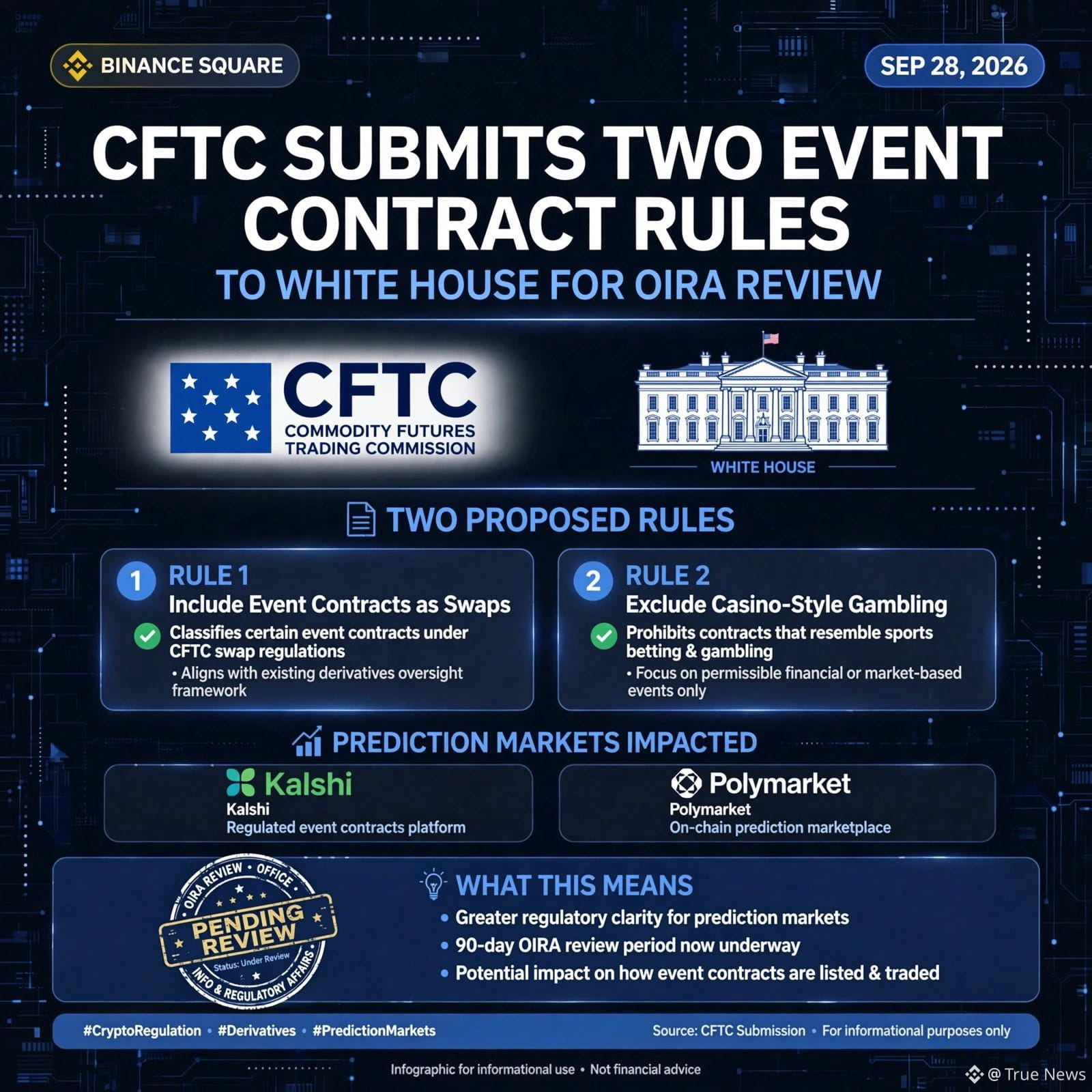
🚨 BREAKING: CFTC Submits Two Event Contract Rules to White House!
The U.S. CFTC has officially sent two rules to the White House OIRA on Sept 28 to define event contracts under federal law.
Rule 1: Proposes including event contracts within the definition of a "swap".
Rule 2: Interim final rule to exclude "casino-style gambling products".
This is HUGE for prediction markets like Kalshi & Polymarket. If classified as swaps, CFTC gets exclusive control, not state gambling regulators.
Do you think prediction markets are trading or gambling? Bullish for $POLY? Comment below!
#CryptoNews #CFTC #PredictionMarkets#cftcsubmitstwoeventcontractrulestowhitehouse
2
539
Log in to explore more content
Join global crypto users on Binance Square
⚡️ Get latest and useful information about crypto.
💬 Trusted by the world’s largest crypto exchange.
👍 Discover real insights from verified creators.
Email / Phone number
Trending Topics
1
#USPPIMissMayEaseBTCPressure
43,524 views
753 Discussing
2
#BitcoinCoreDisclosesTorTrafficVulnerability
17,062 views
397 Discussing
3
#WhatWillDriveCryptoandStocks’NextRebound?
155,602 views
1,617 Discussing
4
#BitcoinBreaksBelow200WeekMovingAverage
51,332 views
505 Discussing
5
#SpaceXTeslaMergerTalksWouldCombine30220BTC
16,796 views
275 Discussing
6
#Anthropic’s6xIPODemandSignalsPotentialRecordRaise
53,378 views
730 Discussing
7
#USCryptoETFsLose$1.48BInFiveDays
2,702 views
51 Discussing
8
#KoreaDigitalAssetBasicActFinalDraftExpectedEarlyJanuary
3,748 views
23 Discussing
9
#RippleRLUSDMarketCapSurpassesPayPalPYUSD
11,199 views
148 Discussing
10
#JaneStreetNearlyOctuplesFidelityBitcoinETFHoldings
24,239 views
260 Discussing