

#treasuryletsstatesfilestablecoincertificationsearly
treasuryletsstatesfilestablecoincertificationsearly
Hot
Latest

·
--
If you are still treating state-level regulatory moves as background noise, stop now.
Most traders only react when liquidity suddenly dries up or a major issuer gets hit with compliance freezes, leaving them holding assets they cannot easily move or swap.
The US Treasury allowing states to file stablecoin certifications early is sparking a fierce divide across the market. Skeptics argue that a fragmented, state-by-state framework creates unnecessary legal friction and complicates operational reserves for giants like $USDT, especially while macro pressure builds.
However, early state onboarding actually establishes the legal clarity institutional capital has been waiting for. It paves the way for DeFi money markets like $AAVE to safely scale compliant collateral without waiting on slow federal legislation.
Where do you think this state-led certification push leaves decentralized liquidity over the next year?
#TreasuryLetsStatesFileStablecoinCertificationsEarly #DollarIndexHitsHighestSinceMay2025
If you are still treating state-level regulatory moves as background noise, stop now.
Most traders only react when liquidity suddenly dries up or a major issuer gets hit with compliance freezes, leaving them holding assets they cannot easily move or swap.
The US Treasury allowing states to file stablecoin certifications early is sparking a fierce divide across the market. Skeptics argue that a fragmented, state-by-state framework creates unnecessary legal friction and complicates operational reserves for giants like $USDT, especially while macro pressure builds.
However, early state onboarding actually establishes the legal clarity institutional capital has been waiting for. It paves the way for DeFi money markets like $AAVE to safely scale compliant collateral without waiting on slow federal legislation.
Where do you think this state-led certification push leaves decentralized liquidity over the next year?
#TreasuryLetsStatesFileStablecoinCertificationsEarly #DollarIndexHitsHighestSinceMay2025
Most traders only react when liquidity suddenly dries up or a major issuer gets hit with compliance freezes, leaving them holding assets they cannot easily move or swap.
The US Treasury allowing states to file stablecoin certifications early is sparking a fierce divide across the market. Skeptics argue that a fragmented, state-by-state framework creates unnecessary legal friction and complicates operational reserves for giants like $USDT, especially while macro pressure builds.
However, early state onboarding actually establishes the legal clarity institutional capital has been waiting for. It paves the way for DeFi money markets like $AAVE to safely scale compliant collateral without waiting on slow federal legislation.
Where do you think this state-led certification push leaves decentralized liquidity over the next year?
#TreasuryLetsStatesFileStablecoinCertificationsEarly #DollarIndexHitsHighestSinceMay2025

11

Why is everyone celebrating faster state-level stablecoin filings as an instant win for decentralization?
Most retail traders keep jumping into yield plays on assets like $USDT and $NEAR assuming regulatory green lights will automatically pump liquidity without friction. The reality is that state-by-state compliance creates a fragmented regulatory patchwork, trapping liquidity across regional silos while capital gets stuck in verification bottlenecks.
When the Treasury opens early certification pathways, they aren't accelerating adoption for your favorite DeFi protocols. They are building a regulated sandbox where compliant issuers thrive and open liquidity protocols get squeezed by compliance costs. While everyone focuses on broad market greed, early frameworks usually favor institutional rails over retail freedom.
Where do you think liquidity actually flows once these certifications go live?
#TreasuryLetsStatesFileStablecoinCertificationsEarly #DollarIndexHitsHighestSinceMay2025
Why is everyone celebrating faster state-level stablecoin filings as an instant win for decentralization?
Most retail traders keep jumping into yield plays on assets like $USDT and $NEAR assuming regulatory green lights will automatically pump liquidity without friction. The reality is that state-by-state compliance creates a fragmented regulatory patchwork, trapping liquidity across regional silos while capital gets stuck in verification bottlenecks.
When the Treasury opens early certification pathways, they aren't accelerating adoption for your favorite DeFi protocols. They are building a regulated sandbox where compliant issuers thrive and open liquidity protocols get squeezed by compliance costs. While everyone focuses on broad market greed, early frameworks usually favor institutional rails over retail freedom.
Where do you think liquidity actually flows once these certifications go live?
#TreasuryLetsStatesFileStablecoinCertificationsEarly #DollarIndexHitsHighestSinceMay2025
Most retail traders keep jumping into yield plays on assets like $USDT and $NEAR assuming regulatory green lights will automatically pump liquidity without friction. The reality is that state-by-state compliance creates a fragmented regulatory patchwork, trapping liquidity across regional silos while capital gets stuck in verification bottlenecks.
When the Treasury opens early certification pathways, they aren't accelerating adoption for your favorite DeFi protocols. They are building a regulated sandbox where compliant issuers thrive and open liquidity protocols get squeezed by compliance costs. While everyone focuses on broad market greed, early frameworks usually favor institutional rails over retail freedom.
Where do you think liquidity actually flows once these certifications go live?
#TreasuryLetsStatesFileStablecoinCertificationsEarly #DollarIndexHitsHighestSinceMay2025

67

·
--
Bullish
#TreasuryLetsStatesFileStablecoinCertificationsEarly
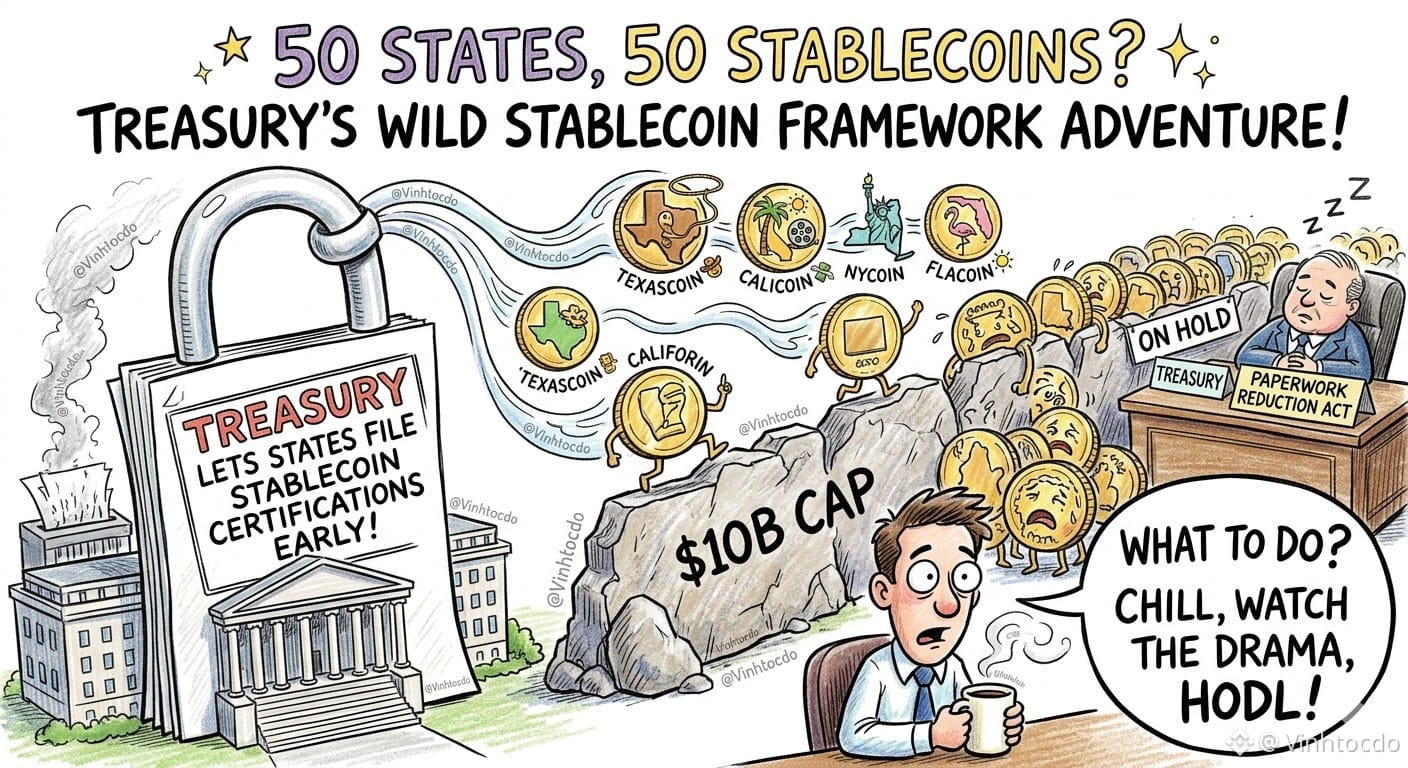
US Treasury allows states to file stablecoin frameworks early! 📜 Wait, does this mean 50 US states will launch 50 different stablecoins? Imagine TexasCoin vs CaliforniaCoin! 🤠💸
Relax, it’s just about regulation! States can submit early paperwork under a $10B cap to protect their timeline, though approvals are on hold for now. What should traders do? Chill, watch the stablecoin drama unfold, and HODL your bags! ☕
Not financial advice! Click trade below to support me:
👉 $BTC
{future}(BTCUSDT)
$ETH
{future}(ETHUSDT)
$BNB
{future}(BNBUSDT)
Sign up with code VINHTOCDO or via [https://www.binance.com/register?ref=VINHTOCDO](https://www.binance.com/register?ref=VINHTOCDO) to join the game! 🚀
#Stablecoins #CryptoRegulation #CryptoNews #TradingTips #web #VINHTOCDO
#TreasuryLetsStatesFileStablecoinCertificationsEarly
US Treasury allows states to file stablecoin frameworks early! 📜 Wait, does this mean 50 US states will launch 50 different stablecoins? Imagine TexasCoin vs CaliforniaCoin! 🤠💸
Relax, it’s just about regulation! States can submit early paperwork under a $10B cap to protect their timeline, though approvals are on hold for now. What should traders do? Chill, watch the stablecoin drama unfold, and HODL your bags! ☕
Not financial advice! Click trade below to support me:
👉 $BTC
$ETH
$BNB
Sign up with code VINHTOCDO or via https://www.binance.com/register?ref=VINHTOCDO to join the game! 🚀
#Stablecoins #CryptoRegulation #CryptoNews #TradingTips #web #VINHTOCDO
US Treasury allows states to file stablecoin frameworks early! 📜 Wait, does this mean 50 US states will launch 50 different stablecoins? Imagine TexasCoin vs CaliforniaCoin! 🤠💸
Relax, it’s just about regulation! States can submit early paperwork under a $10B cap to protect their timeline, though approvals are on hold for now. What should traders do? Chill, watch the stablecoin drama unfold, and HODL your bags! ☕
Not financial advice! Click trade below to support me:
👉 $BTC
$ETH
$BNB
Sign up with code VINHTOCDO or via https://www.binance.com/register?ref=VINHTOCDO to join the game! 🚀
#Stablecoins #CryptoRegulation #CryptoNews #TradingTips #web #VINHTOCDO
1
65

$USDC #TreasuryLetsStatesFileStablecoinCertificationsEarly
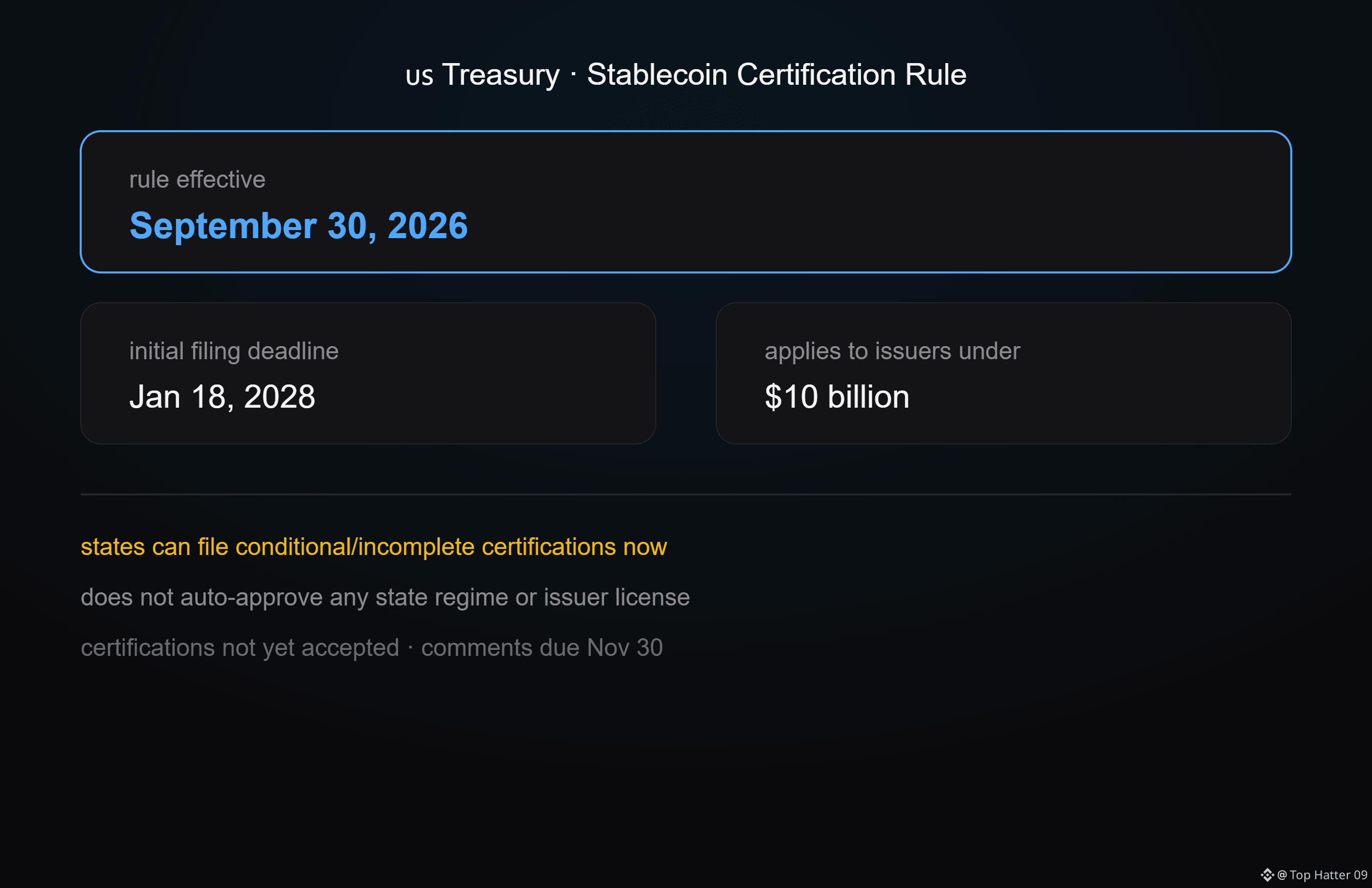
The US Treasury issued an interim final rule on September 30 that gives states more breathing room to file their stablecoin certifications, even if their own rules aren't finished yet. This is all part of the GENIUS Act, the law setting up the federal framework for stablecoin issuers.
Here's the simple version. States that want to regulate their own qualified stablecoin issuers directly, as long as those issuers have less than $10 billion in total issuance, need to file a "substantial similarity" certification with Treasury, basically proving their state rules match up with the federal ones. The deadline for that is January 18, 2028. What's new is that a state doesn't need to have everything finalized to meet that deadline, they can file a conditional or incomplete certification now and keep working on the details before the actual substantive review starts.
One thing to be clear on, this doesn't approve anything automatically. Filing just secures a spot in line, it doesn't hand out a license. And certifications aren't even being accepted yet, Treasury is still waiting on Paperwork Reduction Act approval before opening that door. Comments on the rule are open until November 30.
This is slow-moving news compared to a price pump, but it matters, it's the same kind of regulatory plumbing we've seen building with the CFTC's tokenized asset guidance, piece by piece.
$USDC #Stablecoins #Regulation
{future}(USDCUSDT)
$USDC #TreasuryLetsStatesFileStablecoinCertificationsEarly
The US Treasury issued an interim final rule on September 30 that gives states more breathing room to file their stablecoin certifications, even if their own rules aren't finished yet. This is all part of the GENIUS Act, the law setting up the federal framework for stablecoin issuers.
Here's the simple version. States that want to regulate their own qualified stablecoin issuers directly, as long as those issuers have less than $10 billion in total issuance, need to file a "substantial similarity" certification with Treasury, basically proving their state rules match up with the federal ones. The deadline for that is January 18, 2028. What's new is that a state doesn't need to have everything finalized to meet that deadline, they can file a conditional or incomplete certification now and keep working on the details before the actual substantive review starts.
One thing to be clear on, this doesn't approve anything automatically. Filing just secures a spot in line, it doesn't hand out a license. And certifications aren't even being accepted yet, Treasury is still waiting on Paperwork Reduction Act approval before opening that door. Comments on the rule are open until November 30.
This is slow-moving news compared to a price pump, but it matters, it's the same kind of regulatory plumbing we've seen building with the CFTC's tokenized asset guidance, piece by piece.
$USDC #Stablecoins #Regulation
The US Treasury issued an interim final rule on September 30 that gives states more breathing room to file their stablecoin certifications, even if their own rules aren't finished yet. This is all part of the GENIUS Act, the law setting up the federal framework for stablecoin issuers.
Here's the simple version. States that want to regulate their own qualified stablecoin issuers directly, as long as those issuers have less than $10 billion in total issuance, need to file a "substantial similarity" certification with Treasury, basically proving their state rules match up with the federal ones. The deadline for that is January 18, 2028. What's new is that a state doesn't need to have everything finalized to meet that deadline, they can file a conditional or incomplete certification now and keep working on the details before the actual substantive review starts.
One thing to be clear on, this doesn't approve anything automatically. Filing just secures a spot in line, it doesn't hand out a license. And certifications aren't even being accepted yet, Treasury is still waiting on Paperwork Reduction Act approval before opening that door. Comments on the rule are open until November 30.
This is slow-moving news compared to a price pump, but it matters, it's the same kind of regulatory plumbing we've seen building with the CFTC's tokenized asset guidance, piece by piece.
$USDC #Stablecoins #Regulation
92

·
--
Bullish
#TreasuryLetsStatesFileStablecoinCertificationsEarly 🏛️ Regulatory Shift US Treasury Opens Early Stablecoin Certification Filings for States
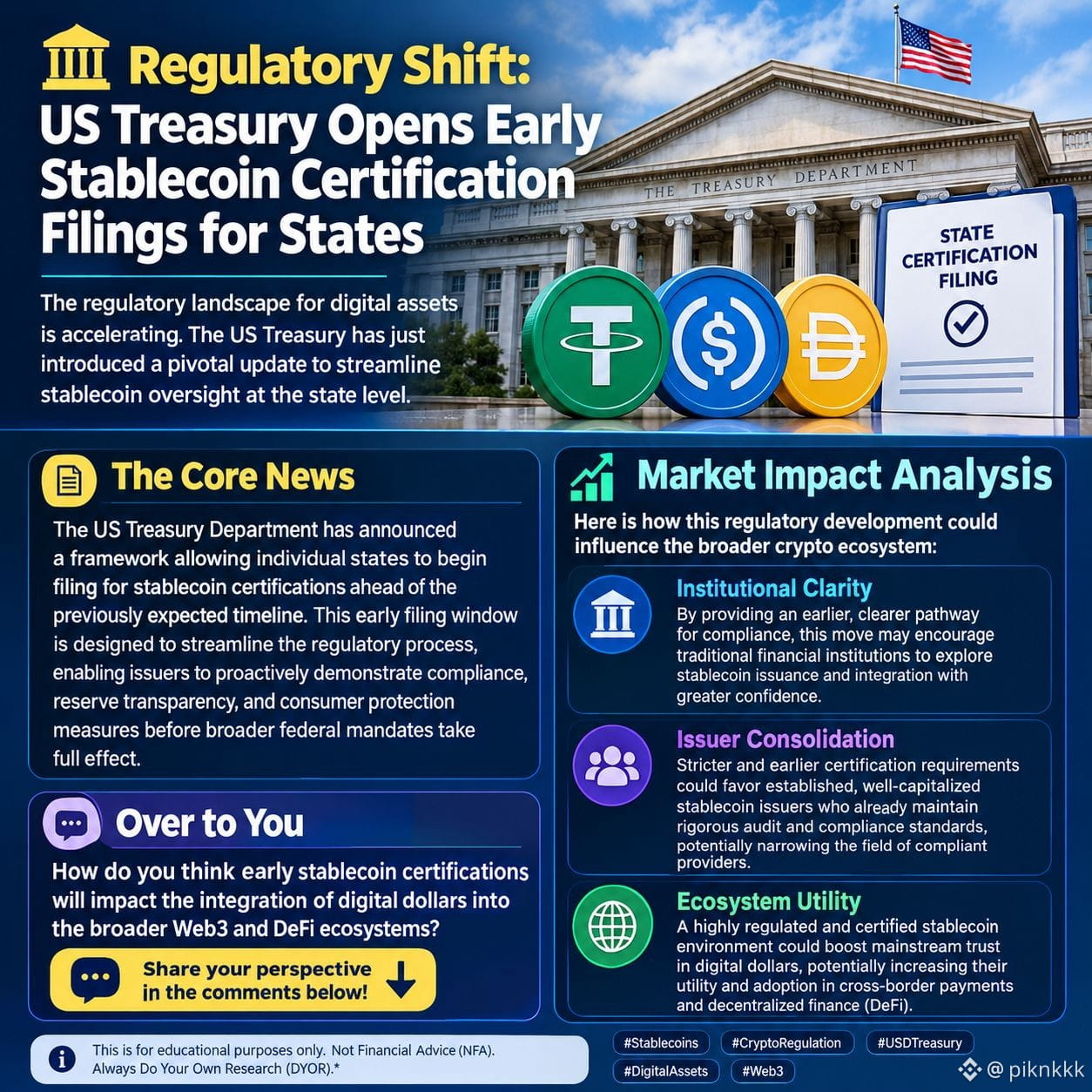
The regulatory landscape for digital assets is accelerating. The US Treasury has just introduced a pivotal update to streamline stablecoin oversight at the state level.
📜 The Core News
The US Treasury Department has announced a framework allowing individual states to begin filing for stablecoin certifications ahead of the previously expected timeline. This early filing window is designed to streamline the regulatory process, enabling issuers to proactively demonstrate compliance, reserve transparency, and consumer protection measures before broader federal mandates take full effect.
📊 Market Impact Analysis
Here is how this regulatory development could influence the broader crypto ecosystem
•Institutional Clarity By providing an earlier, clearer pathway for compliance, this move may encourage traditional financial institutions to explore stablecoin issuance and integration with greater confidence.
• **Issuer Consolidation:** Stricter and earlier certification requirements could favor established, well-capitalized stablecoin issuers who already maintain rigorous audit and compliance standards, potentially narrowing the field of compliant providers.
• Ecosystem Utility A highly regulated and certified stablecoin environment could boost mainstream trust in digital dollars, potentially increasing their utility and adoption in cross-border payments and decentralized finance (DeFi).
💬Over to You
How do you think early stablecoin certifications will impact the integration of digital dollars into the broader Web3 and DeFi ecosystems? Share your perspective in the comments below! 👇
#Stablecoins #CryptoRegulation #USDTreasury #DigitalAssets #web3
This is for educational purposes only. Not Financial Advice (NFA). Always Do Your Own Research (DYOR).
$SYN $NOM $OPN
{future}(OPNUSDT)
{future}(NOMUSDT)
{future}(SYNUSDT)
#TreasuryLetsStatesFileStablecoinCertificationsEarly 🏛️ Regulatory Shift US Treasury Opens Early Stablecoin Certification Filings for States
The regulatory landscape for digital assets is accelerating. The US Treasury has just introduced a pivotal update to streamline stablecoin oversight at the state level.
📜 The Core News
The US Treasury Department has announced a framework allowing individual states to begin filing for stablecoin certifications ahead of the previously expected timeline. This early filing window is designed to streamline the regulatory process, enabling issuers to proactively demonstrate compliance, reserve transparency, and consumer protection measures before broader federal mandates take full effect.
📊 Market Impact Analysis
Here is how this regulatory development could influence the broader crypto ecosystem
•Institutional Clarity By providing an earlier, clearer pathway for compliance, this move may encourage traditional financial institutions to explore stablecoin issuance and integration with greater confidence.
• **Issuer Consolidation:** Stricter and earlier certification requirements could favor established, well-capitalized stablecoin issuers who already maintain rigorous audit and compliance standards, potentially narrowing the field of compliant providers.
• Ecosystem Utility A highly regulated and certified stablecoin environment could boost mainstream trust in digital dollars, potentially increasing their utility and adoption in cross-border payments and decentralized finance (DeFi).
💬Over to You
How do you think early stablecoin certifications will impact the integration of digital dollars into the broader Web3 and DeFi ecosystems? Share your perspective in the comments below! 👇
#Stablecoins #CryptoRegulation #USDTreasury #DigitalAssets #web3
This is for educational purposes only. Not Financial Advice (NFA). Always Do Your Own Research (DYOR).
$SYN $NOM $OPN
The regulatory landscape for digital assets is accelerating. The US Treasury has just introduced a pivotal update to streamline stablecoin oversight at the state level.
📜 The Core News
The US Treasury Department has announced a framework allowing individual states to begin filing for stablecoin certifications ahead of the previously expected timeline. This early filing window is designed to streamline the regulatory process, enabling issuers to proactively demonstrate compliance, reserve transparency, and consumer protection measures before broader federal mandates take full effect.
📊 Market Impact Analysis
Here is how this regulatory development could influence the broader crypto ecosystem
•Institutional Clarity By providing an earlier, clearer pathway for compliance, this move may encourage traditional financial institutions to explore stablecoin issuance and integration with greater confidence.
• **Issuer Consolidation:** Stricter and earlier certification requirements could favor established, well-capitalized stablecoin issuers who already maintain rigorous audit and compliance standards, potentially narrowing the field of compliant providers.
• Ecosystem Utility A highly regulated and certified stablecoin environment could boost mainstream trust in digital dollars, potentially increasing their utility and adoption in cross-border payments and decentralized finance (DeFi).
💬Over to You
How do you think early stablecoin certifications will impact the integration of digital dollars into the broader Web3 and DeFi ecosystems? Share your perspective in the comments below! 👇
#Stablecoins #CryptoRegulation #USDTreasury #DigitalAssets #web3
This is for educational purposes only. Not Financial Advice (NFA). Always Do Your Own Research (DYOR).
$SYN $NOM $OPN
1
697

·
--
#TreasuryLetsStatesFileStablecoinCertificationsEarly 🚨 THE $10B STABLECOIN LINE IS NOW REAL. A new rule from the Treasury is creating a difference in the U.S. Stablecoin market. 👀
Under the GENIUS Act U.S. Stablecoin issuers that have up to $10 billion in coins can possibly use a state regulatory path. If the state system meets the federal requirement. Companies that are bigger than that must follow the regulatory system.
Why does this matter to people who trade crypto?
💵 USDC and USDT: these are already large so federal regulation is the main thing they need to worry about.
⚡ PYUSD, RLUSD and USDS: these smaller companies have an important point to reach as they grow.
🏦 Stablecoins are starting to be seen as financial tools, not just as something used for trading.
The big question in the market is whether clearer rules will help more institutions use stablecoins. And where that money goes next.
Will regulated stablecoins become the big source of money flow, in crypto? 👇 #crypto #BTC #Khan62 #USDT · $POL
{future}(POLUSDT)
{future}(ETHUSDT)
· $BTC
{future}(BTCUSDT)
· $ETH
#TreasuryLetsStatesFileStablecoinCertificationsEarly 🚨 THE $10B STABLECOIN LINE IS NOW REAL. A new rule from the Treasury is creating a difference in the U.S. Stablecoin market. 👀
Under the GENIUS Act U.S. Stablecoin issuers that have up to $10 billion in coins can possibly use a state regulatory path. If the state system meets the federal requirement. Companies that are bigger than that must follow the regulatory system.
Why does this matter to people who trade crypto?
💵 USDC and USDT: these are already large so federal regulation is the main thing they need to worry about.
⚡ PYUSD, RLUSD and USDS: these smaller companies have an important point to reach as they grow.
🏦 Stablecoins are starting to be seen as financial tools, not just as something used for trading.
The big question in the market is whether clearer rules will help more institutions use stablecoins. And where that money goes next.
Will regulated stablecoins become the big source of money flow, in crypto? 👇 #crypto #BTC #Khan62 #USDT · $POL
· $BTC
· $ETH
Under the GENIUS Act U.S. Stablecoin issuers that have up to $10 billion in coins can possibly use a state regulatory path. If the state system meets the federal requirement. Companies that are bigger than that must follow the regulatory system.
Why does this matter to people who trade crypto?
💵 USDC and USDT: these are already large so federal regulation is the main thing they need to worry about.
⚡ PYUSD, RLUSD and USDS: these smaller companies have an important point to reach as they grow.
🏦 Stablecoins are starting to be seen as financial tools, not just as something used for trading.
The big question in the market is whether clearer rules will help more institutions use stablecoins. And where that money goes next.
Will regulated stablecoins become the big source of money flow, in crypto? 👇 #crypto #BTC #Khan62 #USDT · $POL
· $BTC
· $ETH
106

·
--
#TreasuryLetsStatesFileStablecoinCertificationsEarly 🚨 Stablecoin Rules Are Moving Forward
A big change in regulation might soon affect how smaller stablecoin companies work in the U.S.
The Treasury’s GENIUS Act plan lets issuers with $10B or less in stablecoins out to possibly follow state-level rules.. Those state rules must be very similar, to the federal ones.
🔹 Some states can start setting up their rules now
🔹 The federal rules are still being built
🔹 The $10B limit is a cutoff point
🔹 Clear rules could shift how stablecoins grow and how the market is shaped
For people trading crypto this is something to keep an eye on.
💬 Will clearer rules help more people use crypto?
{future}(ETHUSDT)
{future}(AAVEUSDT)
#Khan62 #crypto #ETH #defi $ETH $AAVE $LINK
{future}(LINKUSDT)
#TreasuryLetsStatesFileStablecoinCertificationsEarly 🚨 Stablecoin Rules Are Moving Forward
A big change in regulation might soon affect how smaller stablecoin companies work in the U.S.
The Treasury’s GENIUS Act plan lets issuers with $10B or less in stablecoins out to possibly follow state-level rules.. Those state rules must be very similar, to the federal ones.
🔹 Some states can start setting up their rules now
🔹 The federal rules are still being built
🔹 The $10B limit is a cutoff point
🔹 Clear rules could shift how stablecoins grow and how the market is shaped
For people trading crypto this is something to keep an eye on.
💬 Will clearer rules help more people use crypto?
#Khan62 #crypto #ETH #defi $ETH $AAVE $LINK
A big change in regulation might soon affect how smaller stablecoin companies work in the U.S.
The Treasury’s GENIUS Act plan lets issuers with $10B or less in stablecoins out to possibly follow state-level rules.. Those state rules must be very similar, to the federal ones.
🔹 Some states can start setting up their rules now
🔹 The federal rules are still being built
🔹 The $10B limit is a cutoff point
🔹 Clear rules could shift how stablecoins grow and how the market is shaped
For people trading crypto this is something to keep an eye on.
💬 Will clearer rules help more people use crypto?
#Khan62 #crypto #ETH #defi $ETH $AAVE $LINK
51

·
--
Bearish
#TreasuryLetsStatesFileStablecoinCertificationsEarly
⚡ Stablecoin Regulatory Sprint: U.S. Treasury Sets State-Level Approval Framework
The U.S. Department of the Treasury has officially published a major interim final rule establishing procedural guidelines and certification forms for state payment-stablecoin regulators under the GENIUS Act (Guiding and Establishing National Innovation for U.S. Stablecoins Act).
This decision introduces a crucial mechanism: states can submit early certifications for their regulatory regimes even while their local rulemaking processes are ongoing, preventing bureaucratic bottlenecks and ensuring state-qualified issuers stay on track.
🚨 JUST IN: U.S. TREASURY OPENS THE DOOR FOR STATES TO FILE STABLECOIN CERTIFICATIONS EARLY! ⚡️
📰 The Role of the Stablecoin Certification Review Committee (SCRC) 🏛️
The rule empowers the newly formed SCRC—composed of the Treasury Secretary, the Federal Reserve Chair, and the FDIC Chair—to review state regulatory frameworks. States must demonstrate that their oversight, examination, and reserve requirements are "substantially similar" to federal prudential standards.
State-Qualified Issuer Thresholds 🏦
Under the GENIUS Act framework, state-chartered issuers managing under $10 billion in outstanding market cap can operate under state oversight once their state regime receives SCRC certification. Issuers exceeding $10 billion will eventually transition into federal oversight frameworks.
$AAPL.US
{stock_us}(AAPL.US)
🌐 Accelerated Compliance for State-Regulated Issuers: State-chartered stablecoins now have a direct pathway toward gaining federal recognition, helping maintain market stability and safe-harbor compliance.
$XRP
{future}(XRPUSDT)
Institutional Liquidity & Banking Access: Certified payment stablecoins gain recognized legal status under federal law, facilitating smoother integration with U.S. banking infrastructure and institutional payment rails.
#US10YearYieldNears5.3% #KoreaProposesTokenizingStocksAndBonds #StablecoinRevolution
#TreasuryLetsStatesFileStablecoinCertificationsEarly
⚡ Stablecoin Regulatory Sprint: U.S. Treasury Sets State-Level Approval Framework
The U.S. Department of the Treasury has officially published a major interim final rule establishing procedural guidelines and certification forms for state payment-stablecoin regulators under the GENIUS Act (Guiding and Establishing National Innovation for U.S. Stablecoins Act).
This decision introduces a crucial mechanism: states can submit early certifications for their regulatory regimes even while their local rulemaking processes are ongoing, preventing bureaucratic bottlenecks and ensuring state-qualified issuers stay on track.
🚨 JUST IN: U.S. TREASURY OPENS THE DOOR FOR STATES TO FILE STABLECOIN CERTIFICATIONS EARLY! ⚡️
📰 The Role of the Stablecoin Certification Review Committee (SCRC) 🏛️
The rule empowers the newly formed SCRC—composed of the Treasury Secretary, the Federal Reserve Chair, and the FDIC Chair—to review state regulatory frameworks. States must demonstrate that their oversight, examination, and reserve requirements are "substantially similar" to federal prudential standards.
State-Qualified Issuer Thresholds 🏦
Under the GENIUS Act framework, state-chartered issuers managing under $10 billion in outstanding market cap can operate under state oversight once their state regime receives SCRC certification. Issuers exceeding $10 billion will eventually transition into federal oversight frameworks.
$AAPL.US
🌐 Accelerated Compliance for State-Regulated Issuers: State-chartered stablecoins now have a direct pathway toward gaining federal recognition, helping maintain market stability and safe-harbor compliance.
$XRP
Institutional Liquidity & Banking Access: Certified payment stablecoins gain recognized legal status under federal law, facilitating smoother integration with U.S. banking infrastructure and institutional payment rails.
#US10YearYieldNears5.3% #KoreaProposesTokenizingStocksAndBonds #StablecoinRevolution
⚡ Stablecoin Regulatory Sprint: U.S. Treasury Sets State-Level Approval Framework
The U.S. Department of the Treasury has officially published a major interim final rule establishing procedural guidelines and certification forms for state payment-stablecoin regulators under the GENIUS Act (Guiding and Establishing National Innovation for U.S. Stablecoins Act).
This decision introduces a crucial mechanism: states can submit early certifications for their regulatory regimes even while their local rulemaking processes are ongoing, preventing bureaucratic bottlenecks and ensuring state-qualified issuers stay on track.
🚨 JUST IN: U.S. TREASURY OPENS THE DOOR FOR STATES TO FILE STABLECOIN CERTIFICATIONS EARLY! ⚡️
📰 The Role of the Stablecoin Certification Review Committee (SCRC) 🏛️
The rule empowers the newly formed SCRC—composed of the Treasury Secretary, the Federal Reserve Chair, and the FDIC Chair—to review state regulatory frameworks. States must demonstrate that their oversight, examination, and reserve requirements are "substantially similar" to federal prudential standards.
State-Qualified Issuer Thresholds 🏦
Under the GENIUS Act framework, state-chartered issuers managing under $10 billion in outstanding market cap can operate under state oversight once their state regime receives SCRC certification. Issuers exceeding $10 billion will eventually transition into federal oversight frameworks.
$AAPL.US
🌐 Accelerated Compliance for State-Regulated Issuers: State-chartered stablecoins now have a direct pathway toward gaining federal recognition, helping maintain market stability and safe-harbor compliance.
$XRP
Institutional Liquidity & Banking Access: Certified payment stablecoins gain recognized legal status under federal law, facilitating smoother integration with U.S. banking infrastructure and institutional payment rails.
#US10YearYieldNears5.3% #KoreaProposesTokenizingStocksAndBonds #StablecoinRevolution

XRP+0.34%
AAPLUS-0.59%
1
768

·
--
Bullish
#TreasuryLetsStatesFileStablecoinCertificationsEarly
🚨 JUST IN: 🇺🇸 TREASURY OPENS THE DOOR FOR STATES TO FILE STABLECOIN CERTIFICATIONS EARLY! ⚡️
Under new Treasury procedures, states can prepare and submit certifications for their payment-stablecoin regulatory frameworks under the GENIUS Act.
🔥 State-level stablecoin regulation gets a clearer pathway
🏦 States can seek approval for qualifying issuers
⚡️ Existing state regimes may receive expedited processing
🌐 Another step toward a US stablecoin framework
The race to build compliant stablecoin infrastructure is heating up. 👀
#Stablecoins #cryptouniverseofficial #RWA
#TreasuryLetsStatesFileStablecoinCertificationsEarly
🚨 JUST IN: 🇺🇸 TREASURY OPENS THE DOOR FOR STATES TO FILE STABLECOIN CERTIFICATIONS EARLY! ⚡️
Under new Treasury procedures, states can prepare and submit certifications for their payment-stablecoin regulatory frameworks under the GENIUS Act.
🔥 State-level stablecoin regulation gets a clearer pathway
🏦 States can seek approval for qualifying issuers
⚡️ Existing state regimes may receive expedited processing
🌐 Another step toward a US stablecoin framework
The race to build compliant stablecoin infrastructure is heating up. 👀
#Stablecoins #cryptouniverseofficial #RWA
🚨 JUST IN: 🇺🇸 TREASURY OPENS THE DOOR FOR STATES TO FILE STABLECOIN CERTIFICATIONS EARLY! ⚡️
Under new Treasury procedures, states can prepare and submit certifications for their payment-stablecoin regulatory frameworks under the GENIUS Act.
🔥 State-level stablecoin regulation gets a clearer pathway
🏦 States can seek approval for qualifying issuers
⚡️ Existing state regimes may receive expedited processing
🌐 Another step toward a US stablecoin framework
The race to build compliant stablecoin infrastructure is heating up. 👀
#Stablecoins #cryptouniverseofficial #RWA
52


The US Treasury is permitting states to begin filing for stablecoin certifications earlier than anticipated. This move signals a potential acceleration in the regulatory framework for stablecoins in the United States. Allowing early filings could streamline the process for issuers and provide greater clarity for the market. It suggests a proactive approach by regulators to integrate stablecoins into the existing financial system, potentially fostering innovation while aiming to mitigate risks. The market will be closely watching how these early certifications pave the way for broader stablecoin adoption and integration.
Disclaimer: This content is for informational purposes only and does not constitute investment advice.
#TreasuryLetsStatesFileStablecoinCertificationsEarly
The US Treasury is permitting states to begin filing for stablecoin certifications earlier than anticipated. This move signals a potential acceleration in the regulatory framework for stablecoins in the United States. Allowing early filings could streamline the process for issuers and provide greater clarity for the market. It suggests a proactive approach by regulators to integrate stablecoins into the existing financial system, potentially fostering innovation while aiming to mitigate risks. The market will be closely watching how these early certifications pave the way for broader stablecoin adoption and integration.
Disclaimer: This content is for informational purposes only and does not constitute investment advice.
#TreasuryLetsStatesFileStablecoinCertificationsEarly
Disclaimer: This content is for informational purposes only and does not constitute investment advice.
#TreasuryLetsStatesFileStablecoinCertificationsEarly
7.6k

#TreasuryLetsStatesFileStablecoinCertificationsEarly 🚨🇺🇸
BREAKING: The U.S. Treasury opens the door early for states to adopt stablecoins!
A historic move that will change the entire crypto market 💥
⚡ What happened?
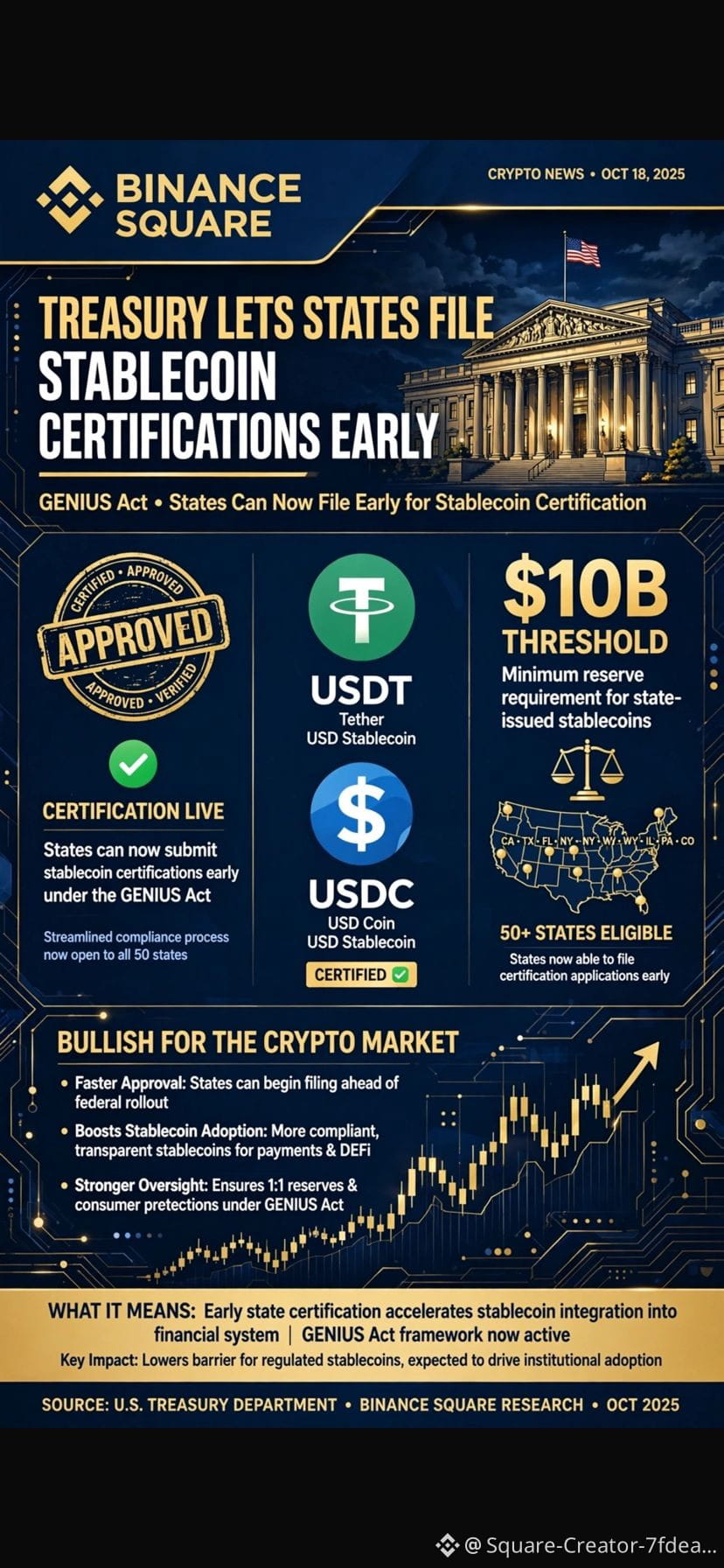
The Treasury has issued a final temporary rule on September 30, allowing the 50 states to submit stablecoin licensing certificates early under the new GENIUS Act.
The law number is 2026-19966 and it takes effect immediately!
📋 Important details:
✅ States can apply now even if their licensing is incomplete (a business intent is enough)
✅ Companies with issuances under $10 billion can choose a state license instead of the federal one
✅ The review committee includes the Treasury Secretary + the Federal Chairman + the FDIC Chairman
✅ Application deadline: January 18, 2028
💰 Why is this very positive for the market?
1. Faster adoption = more liquidity entering the market
2. Institutional confidence = banks and large companies enter with licensed stablecoins
3. Coins like USDT and USDC become more legal and safer
4. This paves the way for a strong rise for DeFi and crypto payments
📈 How to benefit and trade?
This news is bullish for stablecoins and related projects:
- Hold part of your USDT/USDC for upcoming opportunities
- Monitor payment infrastructure coins: $XRP $XLM $ALGO
- DeFi projects that rely on stable liquidity will explode
#GENIUSAct #Stablecoin #USDT #USDC #CryptoNews #Bullish
#TreasuryLetsStatesFileStablecoinCertificationsEarly 🚨🇺🇸
BREAKING: The U.S. Treasury opens the door early for states to adopt stablecoins!
A historic move that will change the entire crypto market 💥
⚡ What happened?
The Treasury has issued a final temporary rule on September 30, allowing the 50 states to submit stablecoin licensing certificates early under the new GENIUS Act.
The law number is 2026-19966 and it takes effect immediately!
📋 Important details:
✅ States can apply now even if their licensing is incomplete (a business intent is enough)
✅ Companies with issuances under $10 billion can choose a state license instead of the federal one
✅ The review committee includes the Treasury Secretary + the Federal Chairman + the FDIC Chairman
✅ Application deadline: January 18, 2028
💰 Why is this very positive for the market?
1. Faster adoption = more liquidity entering the market
2. Institutional confidence = banks and large companies enter with licensed stablecoins
3. Coins like USDT and USDC become more legal and safer
4. This paves the way for a strong rise for DeFi and crypto payments
📈 How to benefit and trade?
This news is bullish for stablecoins and related projects:
- Hold part of your USDT/USDC for upcoming opportunities
- Monitor payment infrastructure coins: $XRP $XLM $ALGO
- DeFi projects that rely on stable liquidity will explode
#GENIUSAct #Stablecoin #USDT #USDC #CryptoNews #Bullish
BREAKING: The U.S. Treasury opens the door early for states to adopt stablecoins!
A historic move that will change the entire crypto market 💥
⚡ What happened?
The Treasury has issued a final temporary rule on September 30, allowing the 50 states to submit stablecoin licensing certificates early under the new GENIUS Act.
The law number is 2026-19966 and it takes effect immediately!
📋 Important details:
✅ States can apply now even if their licensing is incomplete (a business intent is enough)
✅ Companies with issuances under $10 billion can choose a state license instead of the federal one
✅ The review committee includes the Treasury Secretary + the Federal Chairman + the FDIC Chairman
✅ Application deadline: January 18, 2028
💰 Why is this very positive for the market?
1. Faster adoption = more liquidity entering the market
2. Institutional confidence = banks and large companies enter with licensed stablecoins
3. Coins like USDT and USDC become more legal and safer
4. This paves the way for a strong rise for DeFi and crypto payments
📈 How to benefit and trade?
This news is bullish for stablecoins and related projects:
- Hold part of your USDT/USDC for upcoming opportunities
- Monitor payment infrastructure coins: $XRP $XLM $ALGO
- DeFi projects that rely on stable liquidity will explode
#GENIUSAct #Stablecoin #USDT #USDC #CryptoNews #Bullish
MOURAD AZER:
هل USD0 عمله مستقره
2
4
865

·
--
According to the latest news, the U.S. Department of the Treasury allows states to submit stablecoin certification applications in advance. The move is intended to speed up the compliance process and mitigate financial risks. I believe this action is very necessary—it can promptly fill regulatory gaps and protect investors’ interests. Previously, the procedure was cumbersome and time-consuming, which could lead to delayed compliance. While it accelerates market development, it is also necessary to ensure that certification standards are not lowered.#TreasuryLetsStatesFileStablecoinCertificationsEarly $BTC
#BTC
According to the latest news, the U.S. Department of the Treasury allows states to submit stablecoin certification applications in advance. The move is intended to speed up the compliance process and mitigate financial risks. I believe this action is very necessary—it can promptly fill regulatory gaps and protect investors’ interests. Previously, the procedure was cumbersome and time-consuming, which could lead to delayed compliance. While it accelerates market development, it is also necessary to ensure that certification standards are not lowered.#TreasuryLetsStatesFileStablecoinCertificationsEarly $BTC
#BTC
#BTC
77

Why It Matters
Earlier state certification could make the stablecoin regulatory process more structured and predictable.
The next phase: how states and issuers implement the framework.
$USDC $ETH $LINK #TreasuryLetsStatesFileStablecoinCertificationsEarly
Why It Matters
Earlier state certification could make the stablecoin regulatory process more structured and predictable.
The next phase: how states and issuers implement the framework.
$USDC $ETH $LINK #TreasuryLetsStatesFileStablecoinCertificationsEarly
Earlier state certification could make the stablecoin regulatory process more structured and predictable.
The next phase: how states and issuers implement the framework.
$USDC $ETH $LINK #TreasuryLetsStatesFileStablecoinCertificationsEarly
9
📜 Regulatory Shift
States may be able to submit stablecoin certifications ahead of schedule, adding another layer to the evolving regulatory framework.
$ETH $BTC $SOL #TreasuryLetsStatesFileStablecoinCertificationsEarly
📜 Regulatory Shift
States may be able to submit stablecoin certifications ahead of schedule, adding another layer to the evolving regulatory framework.
$ETH $BTC $SOL #TreasuryLetsStatesFileStablecoinCertificationsEarly
States may be able to submit stablecoin certifications ahead of schedule, adding another layer to the evolving regulatory framework.
$ETH $BTC $SOL #TreasuryLetsStatesFileStablecoinCertificationsEarly
4
🏦 Stablecoin Rules Move Forward
Earlier certification could give states a clearer path for stablecoin compliance and regulation.
A development worth watching for the digital-asset market. 👀
$USDC $ETH $BNB #TreasuryLetsStatesFileStablecoinCertificationsEarly
🏦 Stablecoin Rules Move Forward
Earlier certification could give states a clearer path for stablecoin compliance and regulation.
A development worth watching for the digital-asset market. 👀
$USDC $ETH $BNB #TreasuryLetsStatesFileStablecoinCertificationsEarly
Earlier certification could give states a clearer path for stablecoin compliance and regulation.
A development worth watching for the digital-asset market. 👀
$USDC $ETH $BNB #TreasuryLetsStatesFileStablecoinCertificationsEarly
3
⚡ Earlier Certification
U.S. Treasury moves toward letting states file stablecoin certifications earlier, potentially speeding up state-level oversight.
$USDC $USDT $ETH #TreasuryLetsStatesFileStablecoinCertificationsEarly
⚡ Earlier Certification
U.S. Treasury moves toward letting states file stablecoin certifications earlier, potentially speeding up state-level oversight.
$USDC $USDT $ETH #TreasuryLetsStatesFileStablecoinCertificationsEarly
U.S. Treasury moves toward letting states file stablecoin certifications earlier, potentially speeding up state-level oversight.
$USDC $USDT $ETH #TreasuryLetsStatesFileStablecoinCertificationsEarly
8
Acceleration of Institutional Inflow and a Macro Turn: Key Signals for the Crypto Market in Q4 2026
1. Wall Street Giants Collectively Raise Their Crypto Asset Price Targets
With the end of Q3 2026, major financial institutions on Wall Street have released their latest outlooks on the crypto market. Citigroup was the first to act, raising its 12-month target price for Bitcoin from $82,000 to $113,000, and increasing its Ethereum target price from $2,240 to $3,028. The magnitude of this adjustment reflects a significant boost in institutional investors’ confidence in crypto assets.
In its research report, Citigroup said the main factors driving the upward revision include three aspects: rising activity levels in the crypto market, a macroeconomic environment that is becoming more supportive, and strong momentum in ETF inflows. Data shows that U.S. spot Bitcoin ETFs recorded a net inflow of $6.34 billion in Q3, the best single-quarter performance since 2026. This strongly indicates that traditional financial capital is accelerating its shift toward the crypto market.
2. Cooling Inflation Gives the Market Breathing Room
Positive macro developments are also not to be overlooked. In the U.S., August’s core PCE inflation year-over-year growth slowed to 3.0%, below market expectations of 3.3%, and reaching a six-month low. This data directly eased concerns about the Fed raising rates in October. After the release, Bitcoin briefly touched $85,500.
Goldman Sachs subsequently adjusted its forecast, pushing the timing of the next rate hike back from October to December. Fed officials such as Vice Chair Jefferson also sent signals of patience, saying they would closely monitor subsequent data before making decisions. This easing of policy expectations provides a short-term macro tailwind for the crypto market. For risk assets, reduced uncertainty around the interest-rate path often means valuation pressure is also easing.
3. Tokenized U.S. Stocks Bridging the Traditional Finance–Crypto Divide
Against the backdrop of the long-term trend toward integration between traditional finance and crypto markets, tokenized U.S. stocks are becoming an important bridge connecting the two worlds. At present, the Binance Web3 platform has launched multiple tokenized U.S. stock products, including EEM, MRNA, LIN, and other tickers, allowing investors to indirectly hold U.S. stock assets through on-chain tokens.
The significance of this innovation is twofold: on one hand, it provides native crypto users with a convenient channel to access traditional stocks; on the other hand, it lowers the barrier for traditional investors entering the crypto ecosystem. As regulatory frameworks gradually become clearer, more U.S. stock tickers are expected to appear in tokenized form in the future, further blurring the boundaries between traditional finance and DeFi.
4. Global Tightening of Regulation and Moves Toward Standardization
On the regulatory front, the UK Financial Conduct Authority opened the crypto authorization pathway on September 30. It requires all crypto firms operating in the UK to submit applications by February 28, 2027, or face illegal-operations risk starting October 25, 2027. This framework uses stringent standards similar to bank licensing, signaling that UK crypto regulation has entered a substantive enforcement phase.
Meanwhile, the U.S. Department of the Treasury also allows states to submit stablecoin certification applications early, paving the way for the development of compliant stablecoins. Global regulation is shifting from observation to proactive rulemaking. While this may increase compliance costs in the short term, in the long run it is beneficial for healthy industry development and for large-scale institutional capital inflows.
5. Security Risks Still Need Vigilance
Even though the market outlook is optimistic, security risks remain the sword of Damocles hanging over the industry. In September, the crypto industry suffered its most severe hacking attack of the year. Losses totaled as much as $768 million in a single month, involving 55 or more major security incidents—up 462% compared with August. Among them, Bitget was hacked for $388 million and Liquid Network suffered a $320 million attack; these two incidents accounted for the vast majority of the losses.
Entering October, security incidents are still ongoing. NEAR Intents experienced a $3.8 million hack on October 1, and the attackers were linked to the North Korea-based Lazarus organization. This is a reminder to all market participants that while pursuing returns, asset security must come first. Choosing audited protocols, using hardware wallets, and storing assets in a diversified manner are basic security rules.
6. Market Sentiment and Community Hype
Based on Binance Square community data, BTC led in mentions with 18,538, including 994 bullish mentions and only 202 bearish mentions, giving a long-to-short ratio close to 5:1. BNB and SOL followed with 18,039 and 16,276 mentions, respectively. Although ETH ranked fourth with 8,201 mentions, bullish sentiment was the most concentrated: 604 bullish mentions versus 95 bearish mentions, showing strong community confidence in Ethereum.
For popular topic hashtags, EtherGains70.9%InQ3 generated 1,134 pieces of content and 151,000 views, reflecting widespread attention to Ethereum’s performance in Q3. TreasuryLetsStatesFileStablecoinCertificationsEarly focuses on progress in stablecoin regulation, showing the community’s high sensitivity to policy developments.
7. Outlook for Q4
Overall, Q4 2026 presents multiple positives for the crypto market: raised institutional price targets, continued ETF inflows, cooling inflation that eases pressure from rate hikes, and the expansion of tokenized products into broader use cases. At the same time, investors should still pay attention to security risks, regulatory compliance costs, and the pressure of short-term profit-taking.
On October 1, Bitcoin ETFs saw a single-day net outflow of $150 million, ending the prior streak of net inflows lasting 10 consecutive trading days. However, the 7-day net inflow remains positive at $259 million, suggesting this is more like short-term profit-taking rather than a trend reversal. Investors should stay rational, focus on fundamental changes, and avoid chasing rallies or panic selling.
For ordinary investors, the current environment may be suitable for a dollar-cost averaging (DCA) strategy—diversifying across major assets—while closely monitoring the evolution of regulatory policies and security safeguards. The crypto market is moving from the fringe toward the mainstream, and every bout of volatility along this transition is a test of investors’ patience and discipline.
#EtherGains70.9%InQ3 #TreasuryLetsStatesFileStablecoinCertificationsEarly #BTCETFInflows
Acceleration of Institutional Inflow and a Macro Turn: Key Signals for the Crypto Market in Q4 2026
1. Wall Street Giants Collectively Raise Their Crypto Asset Price Targets
With the end of Q3 2026, major financial institutions on Wall Street have released their latest outlooks on the crypto market. Citigroup was the first to act, raising its 12-month target price for Bitcoin from $82,000 to $113,000, and increasing its Ethereum target price from $2,240 to $3,028. The magnitude of this adjustment reflects a significant boost in institutional investors’ confidence in crypto assets.
In its research report, Citigroup said the main factors driving the upward revision include three aspects: rising activity levels in the crypto market, a macroeconomic environment that is becoming more supportive, and strong momentum in ETF inflows. Data shows that U.S. spot Bitcoin ETFs recorded a net inflow of $6.34 billion in Q3, the best single-quarter performance since 2026. This strongly indicates that traditional financial capital is accelerating its shift toward the crypto market.
2. Cooling Inflation Gives the Market Breathing Room
Positive macro developments are also not to be overlooked. In the U.S., August’s core PCE inflation year-over-year growth slowed to 3.0%, below market expectations of 3.3%, and reaching a six-month low. This data directly eased concerns about the Fed raising rates in October. After the release, Bitcoin briefly touched $85,500.
Goldman Sachs subsequently adjusted its forecast, pushing the timing of the next rate hike back from October to December. Fed officials such as Vice Chair Jefferson also sent signals of patience, saying they would closely monitor subsequent data before making decisions. This easing of policy expectations provides a short-term macro tailwind for the crypto market. For risk assets, reduced uncertainty around the interest-rate path often means valuation pressure is also easing.
3. Tokenized U.S. Stocks Bridging the Traditional Finance–Crypto Divide
Against the backdrop of the long-term trend toward integration between traditional finance and crypto markets, tokenized U.S. stocks are becoming an important bridge connecting the two worlds. At present, the Binance Web3 platform has launched multiple tokenized U.S. stock products, including EEM, MRNA, LIN, and other tickers, allowing investors to indirectly hold U.S. stock assets through on-chain tokens.
The significance of this innovation is twofold: on one hand, it provides native crypto users with a convenient channel to access traditional stocks; on the other hand, it lowers the barrier for traditional investors entering the crypto ecosystem. As regulatory frameworks gradually become clearer, more U.S. stock tickers are expected to appear in tokenized form in the future, further blurring the boundaries between traditional finance and DeFi.
4. Global Tightening of Regulation and Moves Toward Standardization
On the regulatory front, the UK Financial Conduct Authority opened the crypto authorization pathway on September 30. It requires all crypto firms operating in the UK to submit applications by February 28, 2027, or face illegal-operations risk starting October 25, 2027. This framework uses stringent standards similar to bank licensing, signaling that UK crypto regulation has entered a substantive enforcement phase.
Meanwhile, the U.S. Department of the Treasury also allows states to submit stablecoin certification applications early, paving the way for the development of compliant stablecoins. Global regulation is shifting from observation to proactive rulemaking. While this may increase compliance costs in the short term, in the long run it is beneficial for healthy industry development and for large-scale institutional capital inflows.
5. Security Risks Still Need Vigilance
Even though the market outlook is optimistic, security risks remain the sword of Damocles hanging over the industry. In September, the crypto industry suffered its most severe hacking attack of the year. Losses totaled as much as $768 million in a single month, involving 55 or more major security incidents—up 462% compared with August. Among them, Bitget was hacked for $388 million and Liquid Network suffered a $320 million attack; these two incidents accounted for the vast majority of the losses.
Entering October, security incidents are still ongoing. NEAR Intents experienced a $3.8 million hack on October 1, and the attackers were linked to the North Korea-based Lazarus organization. This is a reminder to all market participants that while pursuing returns, asset security must come first. Choosing audited protocols, using hardware wallets, and storing assets in a diversified manner are basic security rules.
6. Market Sentiment and Community Hype
Based on Binance Square community data, BTC led in mentions with 18,538, including 994 bullish mentions and only 202 bearish mentions, giving a long-to-short ratio close to 5:1. BNB and SOL followed with 18,039 and 16,276 mentions, respectively. Although ETH ranked fourth with 8,201 mentions, bullish sentiment was the most concentrated: 604 bullish mentions versus 95 bearish mentions, showing strong community confidence in Ethereum.
For popular topic hashtags, EtherGains70.9%InQ3 generated 1,134 pieces of content and 151,000 views, reflecting widespread attention to Ethereum’s performance in Q3. TreasuryLetsStatesFileStablecoinCertificationsEarly focuses on progress in stablecoin regulation, showing the community’s high sensitivity to policy developments.
7. Outlook for Q4
Overall, Q4 2026 presents multiple positives for the crypto market: raised institutional price targets, continued ETF inflows, cooling inflation that eases pressure from rate hikes, and the expansion of tokenized products into broader use cases. At the same time, investors should still pay attention to security risks, regulatory compliance costs, and the pressure of short-term profit-taking.
On October 1, Bitcoin ETFs saw a single-day net outflow of $150 million, ending the prior streak of net inflows lasting 10 consecutive trading days. However, the 7-day net inflow remains positive at $259 million, suggesting this is more like short-term profit-taking rather than a trend reversal. Investors should stay rational, focus on fundamental changes, and avoid chasing rallies or panic selling.
For ordinary investors, the current environment may be suitable for a dollar-cost averaging (DCA) strategy—diversifying across major assets—while closely monitoring the evolution of regulatory policies and security safeguards. The crypto market is moving from the fringe toward the mainstream, and every bout of volatility along this transition is a test of investors’ patience and discipline.
#EtherGains70.9%InQ3 #TreasuryLetsStatesFileStablecoinCertificationsEarly #BTCETFInflows
1. Wall Street Giants Collectively Raise Their Crypto Asset Price Targets
With the end of Q3 2026, major financial institutions on Wall Street have released their latest outlooks on the crypto market. Citigroup was the first to act, raising its 12-month target price for Bitcoin from $82,000 to $113,000, and increasing its Ethereum target price from $2,240 to $3,028. The magnitude of this adjustment reflects a significant boost in institutional investors’ confidence in crypto assets.
In its research report, Citigroup said the main factors driving the upward revision include three aspects: rising activity levels in the crypto market, a macroeconomic environment that is becoming more supportive, and strong momentum in ETF inflows. Data shows that U.S. spot Bitcoin ETFs recorded a net inflow of $6.34 billion in Q3, the best single-quarter performance since 2026. This strongly indicates that traditional financial capital is accelerating its shift toward the crypto market.
2. Cooling Inflation Gives the Market Breathing Room
Positive macro developments are also not to be overlooked. In the U.S., August’s core PCE inflation year-over-year growth slowed to 3.0%, below market expectations of 3.3%, and reaching a six-month low. This data directly eased concerns about the Fed raising rates in October. After the release, Bitcoin briefly touched $85,500.
Goldman Sachs subsequently adjusted its forecast, pushing the timing of the next rate hike back from October to December. Fed officials such as Vice Chair Jefferson also sent signals of patience, saying they would closely monitor subsequent data before making decisions. This easing of policy expectations provides a short-term macro tailwind for the crypto market. For risk assets, reduced uncertainty around the interest-rate path often means valuation pressure is also easing.
3. Tokenized U.S. Stocks Bridging the Traditional Finance–Crypto Divide
Against the backdrop of the long-term trend toward integration between traditional finance and crypto markets, tokenized U.S. stocks are becoming an important bridge connecting the two worlds. At present, the Binance Web3 platform has launched multiple tokenized U.S. stock products, including EEM, MRNA, LIN, and other tickers, allowing investors to indirectly hold U.S. stock assets through on-chain tokens.
The significance of this innovation is twofold: on one hand, it provides native crypto users with a convenient channel to access traditional stocks; on the other hand, it lowers the barrier for traditional investors entering the crypto ecosystem. As regulatory frameworks gradually become clearer, more U.S. stock tickers are expected to appear in tokenized form in the future, further blurring the boundaries between traditional finance and DeFi.
4. Global Tightening of Regulation and Moves Toward Standardization
On the regulatory front, the UK Financial Conduct Authority opened the crypto authorization pathway on September 30. It requires all crypto firms operating in the UK to submit applications by February 28, 2027, or face illegal-operations risk starting October 25, 2027. This framework uses stringent standards similar to bank licensing, signaling that UK crypto regulation has entered a substantive enforcement phase.
Meanwhile, the U.S. Department of the Treasury also allows states to submit stablecoin certification applications early, paving the way for the development of compliant stablecoins. Global regulation is shifting from observation to proactive rulemaking. While this may increase compliance costs in the short term, in the long run it is beneficial for healthy industry development and for large-scale institutional capital inflows.
5. Security Risks Still Need Vigilance
Even though the market outlook is optimistic, security risks remain the sword of Damocles hanging over the industry. In September, the crypto industry suffered its most severe hacking attack of the year. Losses totaled as much as $768 million in a single month, involving 55 or more major security incidents—up 462% compared with August. Among them, Bitget was hacked for $388 million and Liquid Network suffered a $320 million attack; these two incidents accounted for the vast majority of the losses.
Entering October, security incidents are still ongoing. NEAR Intents experienced a $3.8 million hack on October 1, and the attackers were linked to the North Korea-based Lazarus organization. This is a reminder to all market participants that while pursuing returns, asset security must come first. Choosing audited protocols, using hardware wallets, and storing assets in a diversified manner are basic security rules.
6. Market Sentiment and Community Hype
Based on Binance Square community data, BTC led in mentions with 18,538, including 994 bullish mentions and only 202 bearish mentions, giving a long-to-short ratio close to 5:1. BNB and SOL followed with 18,039 and 16,276 mentions, respectively. Although ETH ranked fourth with 8,201 mentions, bullish sentiment was the most concentrated: 604 bullish mentions versus 95 bearish mentions, showing strong community confidence in Ethereum.
For popular topic hashtags, EtherGains70.9%InQ3 generated 1,134 pieces of content and 151,000 views, reflecting widespread attention to Ethereum’s performance in Q3. TreasuryLetsStatesFileStablecoinCertificationsEarly focuses on progress in stablecoin regulation, showing the community’s high sensitivity to policy developments.
7. Outlook for Q4
Overall, Q4 2026 presents multiple positives for the crypto market: raised institutional price targets, continued ETF inflows, cooling inflation that eases pressure from rate hikes, and the expansion of tokenized products into broader use cases. At the same time, investors should still pay attention to security risks, regulatory compliance costs, and the pressure of short-term profit-taking.
On October 1, Bitcoin ETFs saw a single-day net outflow of $150 million, ending the prior streak of net inflows lasting 10 consecutive trading days. However, the 7-day net inflow remains positive at $259 million, suggesting this is more like short-term profit-taking rather than a trend reversal. Investors should stay rational, focus on fundamental changes, and avoid chasing rallies or panic selling.
For ordinary investors, the current environment may be suitable for a dollar-cost averaging (DCA) strategy—diversifying across major assets—while closely monitoring the evolution of regulatory policies and security safeguards. The crypto market is moving from the fringe toward the mainstream, and every bout of volatility along this transition is a test of investors’ patience and discipline.
#EtherGains70.9%InQ3 #TreasuryLetsStatesFileStablecoinCertificationsEarly #BTCETFInflows
269

·
--
State-Level Stablecoin Certification Still Trending|Submit Conditionally by Deadline, But It Doesn’t Equal Approval|SOL Around 118—I'll Wait for Demand to Materialize
My stance is to observe cautiously and not chase SOL just because there’s progress in regulatory processes. On Binance Square, the current topic #TreasuryLetsStatesFileStablecoinCertificationsEarly is still on the hot list, but you need to read carefully the temporary final rule issued by the U.S. Department of the Treasury on September 30: state regulators may file conditional submissions—or initial certifications that are not yet fully complete—by January 18, 2028 to meet statutory time requirements. But such materials cannot directly enter the committee’s substantive review, and it is neither approval of a state regime nor issuance of a license to a specific issuer. Although the rule is already in effect, the Treasury also makes clear that you must wait until the information collection under the “Paperwork Reduction Act” is approved and further notified—before the Treasury will actually begin accepting certifications. Translating “allowing early preparation of materials” into “all stablecoins are already cleared” mixes up process with outcome.
Why is this worth SOL holders paying attention to? The Solana Foundation’s payment page already lists multiple stablecoin payment use cases that are live on-chain or planned to go live. The official fee documentation also states that while network transaction fees are paid in SOL, payment applications can be funded on behalf of users by service providers. The regulatory path is clearer, and in theory it could reduce compliance uncertainty for future choices of chain settlement by issuers and payment institutions. From submitting state certifications, to an issuer being approved, to the stablecoin’s actual issuance, to user transactions, to SOL fee demand—there are several independent checkpoints. More importantly, low per-transaction costs mean that transaction volume growth cannot be directly converted into proportional SOL buy demand. This is a mechanism walkthrough, not today’s Solana inflow data.
The market has not provided strong confirmation. When I check Binance SOL/USDT, the price is about $118.39, with a roughly +0.79% move over the past 24 hours; the high is $119.63 and the low is $116.73. This is only an exchange quote snapshot and cannot prove that the rule is what drove the move. In Farside’s SOL fund tables, total net outflows as of September 30 are about $12.5 million. On October 1, each product still shows a dash; the automatically summed 0.0 cannot be treated as a complete end-of-day net inflow of zero. For now, the regulatory narrative and actual capital flows can’t be equated.
If I were trading for myself: I wouldn’t participate now. My only direction would be spot long exposure, not contracts. I would enter only if the market closes for a full hour above $119.80. After that, if it pulls back and holds within $119.30–$119.80, and if fund data or real on-chain usage shows verifiable improvement, I would use at most 0.5% of total capital for a trial position. First target: $121.00 (half), second target: $122.50 (close the remainder). After execution, if it breaks below $118.50 I would cut loss immediately. If two consecutive hourly candles close back below $119.30, I’d close out early as well. If before entry price first loses $116.70, the whole plan is canceled—I won’t try to bottom-fish just to force trades. If after a breakout there’s no real capital verification, or if the official certification rules are changed, then any previously constructive judgment should be overturned. If none of the triggers hit, I stay in cash.
#TreasuryLetsStatesFileStablecoinCertificationsEarly #SOL
The above is only my personal market observations and does not constitute investment advice.
State-Level Stablecoin Certification Still Trending|Submit Conditionally by Deadline, But It Doesn’t Equal Approval|SOL Around 118—I'll Wait for Demand to Materialize
My stance is to observe cautiously and not chase SOL just because there’s progress in regulatory processes. On Binance Square, the current topic #TreasuryLetsStatesFileStablecoinCertificationsEarly is still on the hot list, but you need to read carefully the temporary final rule issued by the U.S. Department of the Treasury on September 30: state regulators may file conditional submissions—or initial certifications that are not yet fully complete—by January 18, 2028 to meet statutory time requirements. But such materials cannot directly enter the committee’s substantive review, and it is neither approval of a state regime nor issuance of a license to a specific issuer. Although the rule is already in effect, the Treasury also makes clear that you must wait until the information collection under the “Paperwork Reduction Act” is approved and further notified—before the Treasury will actually begin accepting certifications. Translating “allowing early preparation of materials” into “all stablecoins are already cleared” mixes up process with outcome.
Why is this worth SOL holders paying attention to? The Solana Foundation’s payment page already lists multiple stablecoin payment use cases that are live on-chain or planned to go live. The official fee documentation also states that while network transaction fees are paid in SOL, payment applications can be funded on behalf of users by service providers. The regulatory path is clearer, and in theory it could reduce compliance uncertainty for future choices of chain settlement by issuers and payment institutions. From submitting state certifications, to an issuer being approved, to the stablecoin’s actual issuance, to user transactions, to SOL fee demand—there are several independent checkpoints. More importantly, low per-transaction costs mean that transaction volume growth cannot be directly converted into proportional SOL buy demand. This is a mechanism walkthrough, not today’s Solana inflow data.
The market has not provided strong confirmation. When I check Binance SOL/USDT, the price is about $118.39, with a roughly +0.79% move over the past 24 hours; the high is $119.63 and the low is $116.73. This is only an exchange quote snapshot and cannot prove that the rule is what drove the move. In Farside’s SOL fund tables, total net outflows as of September 30 are about $12.5 million. On October 1, each product still shows a dash; the automatically summed 0.0 cannot be treated as a complete end-of-day net inflow of zero. For now, the regulatory narrative and actual capital flows can’t be equated.
If I were trading for myself: I wouldn’t participate now. My only direction would be spot long exposure, not contracts. I would enter only if the market closes for a full hour above $119.80. After that, if it pulls back and holds within $119.30–$119.80, and if fund data or real on-chain usage shows verifiable improvement, I would use at most 0.5% of total capital for a trial position. First target: $121.00 (half), second target: $122.50 (close the remainder). After execution, if it breaks below $118.50 I would cut loss immediately. If two consecutive hourly candles close back below $119.30, I’d close out early as well. If before entry price first loses $116.70, the whole plan is canceled—I won’t try to bottom-fish just to force trades. If after a breakout there’s no real capital verification, or if the official certification rules are changed, then any previously constructive judgment should be overturned. If none of the triggers hit, I stay in cash.
#TreasuryLetsStatesFileStablecoinCertificationsEarly #SOL
The above is only my personal market observations and does not constitute investment advice.
My stance is to observe cautiously and not chase SOL just because there’s progress in regulatory processes. On Binance Square, the current topic #TreasuryLetsStatesFileStablecoinCertificationsEarly is still on the hot list, but you need to read carefully the temporary final rule issued by the U.S. Department of the Treasury on September 30: state regulators may file conditional submissions—or initial certifications that are not yet fully complete—by January 18, 2028 to meet statutory time requirements. But such materials cannot directly enter the committee’s substantive review, and it is neither approval of a state regime nor issuance of a license to a specific issuer. Although the rule is already in effect, the Treasury also makes clear that you must wait until the information collection under the “Paperwork Reduction Act” is approved and further notified—before the Treasury will actually begin accepting certifications. Translating “allowing early preparation of materials” into “all stablecoins are already cleared” mixes up process with outcome.
Why is this worth SOL holders paying attention to? The Solana Foundation’s payment page already lists multiple stablecoin payment use cases that are live on-chain or planned to go live. The official fee documentation also states that while network transaction fees are paid in SOL, payment applications can be funded on behalf of users by service providers. The regulatory path is clearer, and in theory it could reduce compliance uncertainty for future choices of chain settlement by issuers and payment institutions. From submitting state certifications, to an issuer being approved, to the stablecoin’s actual issuance, to user transactions, to SOL fee demand—there are several independent checkpoints. More importantly, low per-transaction costs mean that transaction volume growth cannot be directly converted into proportional SOL buy demand. This is a mechanism walkthrough, not today’s Solana inflow data.
The market has not provided strong confirmation. When I check Binance SOL/USDT, the price is about $118.39, with a roughly +0.79% move over the past 24 hours; the high is $119.63 and the low is $116.73. This is only an exchange quote snapshot and cannot prove that the rule is what drove the move. In Farside’s SOL fund tables, total net outflows as of September 30 are about $12.5 million. On October 1, each product still shows a dash; the automatically summed 0.0 cannot be treated as a complete end-of-day net inflow of zero. For now, the regulatory narrative and actual capital flows can’t be equated.
If I were trading for myself: I wouldn’t participate now. My only direction would be spot long exposure, not contracts. I would enter only if the market closes for a full hour above $119.80. After that, if it pulls back and holds within $119.30–$119.80, and if fund data or real on-chain usage shows verifiable improvement, I would use at most 0.5% of total capital for a trial position. First target: $121.00 (half), second target: $122.50 (close the remainder). After execution, if it breaks below $118.50 I would cut loss immediately. If two consecutive hourly candles close back below $119.30, I’d close out early as well. If before entry price first loses $116.70, the whole plan is canceled—I won’t try to bottom-fish just to force trades. If after a breakout there’s no real capital verification, or if the official certification rules are changed, then any previously constructive judgment should be overturned. If none of the triggers hit, I stay in cash.
#TreasuryLetsStatesFileStablecoinCertificationsEarly #SOL
The above is only my personal market observations and does not constitute investment advice.

19
Binance Square in-depth report: Cooling inflation combined with institutions turning bullish—crypto market enters a critical turning point
I. Positive macro signals released: Fed rate-hike expectations pushed back
The latest data released by the U.S. Department of Commerce shows that the core PCE inflation index year over year slowed to 3% in August, below the market’s expected 3.3%, marking the lowest level in six months. The reading directly eases market concerns that the Federal Reserve would continue raising rates in October. Goldman Sachs and JPMorgan have both pushed their forecasts for the next rate hike back to December, providing risk assets with a brief window to catch their breath.
After the data was released, Bitcoin briefly surged to around $85,500, then pulled back and traded near $83,700. While market sentiment has partially recovered, U.S. 10-year Treasury yields remain elevated around 5.3%, and recent ETF daily net outflows of approximately $149 million add to the risk of short-term volatility, which cannot be ignored.
II. Citi sharply raises its Bitcoin target price, boosting institutional confidence
Citi recently raised its 12-month target price for Bitcoin to $113,000, and increased its Ethereum target price to $3,028. This assessment is based on the third-quarter ETF net inflow of as much as $6.34 billion, along with strong performance in which Bitcoin and Ethereum rebounded from their lows by roughly 40% to 68%, respectively.
The continued inflow of institutional capital is changing the pricing logic of the crypto market. Unlike traditional speculation-driven flows, the underlying support for the current trend comes more from asset allocation needs and institutions rebalancing their portfolios. However, Citi also cautioned that elevated Treasury yields and the potential for repeated swings in ETF inflows may still trigger periodic pullbacks, and investors need to remain rational.
III. September saw a surge of security incidents—industry risk controls face a severe test
In stark contrast to market positives, September 2026 became one of the worst months in crypto industry history in terms of losses. Across the entire month, there were 55 major security incidents, with cumulative losses of about $768 million—up 462% from August. The majority of the losses were driven by Bitget’s $387.5 million vulnerability attack and Liquid Network’s $200 million stolen incident. In Q3 alone, total losses surpassed $1.26 billion, increasing more than 53% quarter over quarter.
On October 1, NEAR Intents again reported a hot-wallet theft of about $3.86 million. The attackers bridged funds from KuCoin to the Bitcoin chain. PeckShield and the well-known on-chain tracker ZachXBT have linked the attack addresses to the North Korean Lazarus hacking group. National-level hacking groups’ penetration into the crypto industry is intensifying, and exchanges and protocol security standards urgently need comprehensive upgrades.
IV. Tokenization of U.S. stocks continues to expand—on-chain investment channels grow richer
In the tokenization space, Binance’s Web3 platform continues to broaden its tokenized U.S. stock offerings, which now cover multiple tokenized stocks including EEM, MRNA, LIN, and others. Investors can hold on-chain tokenized portions of traditional U.S. stock assets, lowering the barriers to cross-border investment.
In terms of market heat, some tokenized assets in the perpetual contract market have been performing impressively. The LOBSTER token’s single-day gain exceeded 102%, MOVR rose by about 69%, and CAP increased by roughly 31%, indicating extremely high capital activity in specific segments. However, high volatility also means high risk—investors should carefully assess their own risk tolerance.
V. Global regulation accelerates—compliance becomes the industry’s main theme
On September 30, the UK’s Financial Conduct Authority (FCA) officially opened an application channel for crypto authorization, requiring all crypto businesses operating in the UK to complete applications by February 28, 2027. Starting October 25, 2027, operating without a license will be illegal. This marks the UK’s formal move toward a bank-level crypto regulatory framework.
Meanwhile, the U.S. Department of the Treasury allows states to submit stablecoin certification applications early, paving the way for stablecoin compliance. Binance Pay also partnered with PayPay in Japan to connect crypto payments for millions of merchants, helping crypto assets land in real consumer payment scenarios.
Overall, the current crypto market sits at a critical junction where macro positives and security risks coexist. Institutional bullish sentiment and cooling inflation provide support for the market, but the frequent security incidents and tightening regulation also remind participants that stronger risk management and compliance building are essential. In this turning period, rational judgment and steady execution matter far more than blindly chasing rallies.
#EtherGains70.9%InQ3 #TreasuryLetsStatesFileStablecoinCertificationsEarly #BTC
Binance Square in-depth report: Cooling inflation combined with institutions turning bullish—crypto market enters a critical turning point
I. Positive macro signals released: Fed rate-hike expectations pushed back
The latest data released by the U.S. Department of Commerce shows that the core PCE inflation index year over year slowed to 3% in August, below the market’s expected 3.3%, marking the lowest level in six months. The reading directly eases market concerns that the Federal Reserve would continue raising rates in October. Goldman Sachs and JPMorgan have both pushed their forecasts for the next rate hike back to December, providing risk assets with a brief window to catch their breath.
After the data was released, Bitcoin briefly surged to around $85,500, then pulled back and traded near $83,700. While market sentiment has partially recovered, U.S. 10-year Treasury yields remain elevated around 5.3%, and recent ETF daily net outflows of approximately $149 million add to the risk of short-term volatility, which cannot be ignored.
II. Citi sharply raises its Bitcoin target price, boosting institutional confidence
Citi recently raised its 12-month target price for Bitcoin to $113,000, and increased its Ethereum target price to $3,028. This assessment is based on the third-quarter ETF net inflow of as much as $6.34 billion, along with strong performance in which Bitcoin and Ethereum rebounded from their lows by roughly 40% to 68%, respectively.
The continued inflow of institutional capital is changing the pricing logic of the crypto market. Unlike traditional speculation-driven flows, the underlying support for the current trend comes more from asset allocation needs and institutions rebalancing their portfolios. However, Citi also cautioned that elevated Treasury yields and the potential for repeated swings in ETF inflows may still trigger periodic pullbacks, and investors need to remain rational.
III. September saw a surge of security incidents—industry risk controls face a severe test
In stark contrast to market positives, September 2026 became one of the worst months in crypto industry history in terms of losses. Across the entire month, there were 55 major security incidents, with cumulative losses of about $768 million—up 462% from August. The majority of the losses were driven by Bitget’s $387.5 million vulnerability attack and Liquid Network’s $200 million stolen incident. In Q3 alone, total losses surpassed $1.26 billion, increasing more than 53% quarter over quarter.
On October 1, NEAR Intents again reported a hot-wallet theft of about $3.86 million. The attackers bridged funds from KuCoin to the Bitcoin chain. PeckShield and the well-known on-chain tracker ZachXBT have linked the attack addresses to the North Korean Lazarus hacking group. National-level hacking groups’ penetration into the crypto industry is intensifying, and exchanges and protocol security standards urgently need comprehensive upgrades.
IV. Tokenization of U.S. stocks continues to expand—on-chain investment channels grow richer
In the tokenization space, Binance’s Web3 platform continues to broaden its tokenized U.S. stock offerings, which now cover multiple tokenized stocks including EEM, MRNA, LIN, and others. Investors can hold on-chain tokenized portions of traditional U.S. stock assets, lowering the barriers to cross-border investment.
In terms of market heat, some tokenized assets in the perpetual contract market have been performing impressively. The LOBSTER token’s single-day gain exceeded 102%, MOVR rose by about 69%, and CAP increased by roughly 31%, indicating extremely high capital activity in specific segments. However, high volatility also means high risk—investors should carefully assess their own risk tolerance.
V. Global regulation accelerates—compliance becomes the industry’s main theme
On September 30, the UK’s Financial Conduct Authority (FCA) officially opened an application channel for crypto authorization, requiring all crypto businesses operating in the UK to complete applications by February 28, 2027. Starting October 25, 2027, operating without a license will be illegal. This marks the UK’s formal move toward a bank-level crypto regulatory framework.
Meanwhile, the U.S. Department of the Treasury allows states to submit stablecoin certification applications early, paving the way for stablecoin compliance. Binance Pay also partnered with PayPay in Japan to connect crypto payments for millions of merchants, helping crypto assets land in real consumer payment scenarios.
Overall, the current crypto market sits at a critical junction where macro positives and security risks coexist. Institutional bullish sentiment and cooling inflation provide support for the market, but the frequent security incidents and tightening regulation also remind participants that stronger risk management and compliance building are essential. In this turning period, rational judgment and steady execution matter far more than blindly chasing rallies.
#EtherGains70.9%InQ3 #TreasuryLetsStatesFileStablecoinCertificationsEarly #BTC
I. Positive macro signals released: Fed rate-hike expectations pushed back
The latest data released by the U.S. Department of Commerce shows that the core PCE inflation index year over year slowed to 3% in August, below the market’s expected 3.3%, marking the lowest level in six months. The reading directly eases market concerns that the Federal Reserve would continue raising rates in October. Goldman Sachs and JPMorgan have both pushed their forecasts for the next rate hike back to December, providing risk assets with a brief window to catch their breath.
After the data was released, Bitcoin briefly surged to around $85,500, then pulled back and traded near $83,700. While market sentiment has partially recovered, U.S. 10-year Treasury yields remain elevated around 5.3%, and recent ETF daily net outflows of approximately $149 million add to the risk of short-term volatility, which cannot be ignored.
II. Citi sharply raises its Bitcoin target price, boosting institutional confidence
Citi recently raised its 12-month target price for Bitcoin to $113,000, and increased its Ethereum target price to $3,028. This assessment is based on the third-quarter ETF net inflow of as much as $6.34 billion, along with strong performance in which Bitcoin and Ethereum rebounded from their lows by roughly 40% to 68%, respectively.
The continued inflow of institutional capital is changing the pricing logic of the crypto market. Unlike traditional speculation-driven flows, the underlying support for the current trend comes more from asset allocation needs and institutions rebalancing their portfolios. However, Citi also cautioned that elevated Treasury yields and the potential for repeated swings in ETF inflows may still trigger periodic pullbacks, and investors need to remain rational.
III. September saw a surge of security incidents—industry risk controls face a severe test
In stark contrast to market positives, September 2026 became one of the worst months in crypto industry history in terms of losses. Across the entire month, there were 55 major security incidents, with cumulative losses of about $768 million—up 462% from August. The majority of the losses were driven by Bitget’s $387.5 million vulnerability attack and Liquid Network’s $200 million stolen incident. In Q3 alone, total losses surpassed $1.26 billion, increasing more than 53% quarter over quarter.
On October 1, NEAR Intents again reported a hot-wallet theft of about $3.86 million. The attackers bridged funds from KuCoin to the Bitcoin chain. PeckShield and the well-known on-chain tracker ZachXBT have linked the attack addresses to the North Korean Lazarus hacking group. National-level hacking groups’ penetration into the crypto industry is intensifying, and exchanges and protocol security standards urgently need comprehensive upgrades.
IV. Tokenization of U.S. stocks continues to expand—on-chain investment channels grow richer
In the tokenization space, Binance’s Web3 platform continues to broaden its tokenized U.S. stock offerings, which now cover multiple tokenized stocks including EEM, MRNA, LIN, and others. Investors can hold on-chain tokenized portions of traditional U.S. stock assets, lowering the barriers to cross-border investment.
In terms of market heat, some tokenized assets in the perpetual contract market have been performing impressively. The LOBSTER token’s single-day gain exceeded 102%, MOVR rose by about 69%, and CAP increased by roughly 31%, indicating extremely high capital activity in specific segments. However, high volatility also means high risk—investors should carefully assess their own risk tolerance.
V. Global regulation accelerates—compliance becomes the industry’s main theme
On September 30, the UK’s Financial Conduct Authority (FCA) officially opened an application channel for crypto authorization, requiring all crypto businesses operating in the UK to complete applications by February 28, 2027. Starting October 25, 2027, operating without a license will be illegal. This marks the UK’s formal move toward a bank-level crypto regulatory framework.
Meanwhile, the U.S. Department of the Treasury allows states to submit stablecoin certification applications early, paving the way for stablecoin compliance. Binance Pay also partnered with PayPay in Japan to connect crypto payments for millions of merchants, helping crypto assets land in real consumer payment scenarios.
Overall, the current crypto market sits at a critical junction where macro positives and security risks coexist. Institutional bullish sentiment and cooling inflation provide support for the market, but the frequent security incidents and tightening regulation also remind participants that stronger risk management and compliance building are essential. In this turning period, rational judgment and steady execution matter far more than blindly chasing rallies.
#EtherGains70.9%InQ3 #TreasuryLetsStatesFileStablecoinCertificationsEarly #BTC
258
·
--
US Stablecoin State Certification Gets Hot List Ranking | Rules Taking Effect ≠ You Can Apply Now | BNB Around 772 — We Verify
My attitude is cautious but slightly bullish. But today I’m not chasing BNB just because of a regulatory headline. Binance Square’s hot list is discussing #TreasuryLetsStatesFileStablecoinCertificationsEarly. I checked the U.S. Treasury’s interim final rule published in the Federal Register on September 30. It does spell out the certification forms and review process for state payment stablecoin regulatory regimes, and the rule does take effect from September 30. The key restriction is in the date field: the certification application will only be accepted after the information collection under the Paperwork Reduction Act has been approved, and the Treasury will notify separately when the application window opens. So if “allows states to file early” is understood as “the window is already open today,” that goes beyond what the original text says. State-level regimes being recognized by a commission is different from a particular issuer getting licensed, and also different from a specific stablecoin getting approved.
Why does this matter to the crypto market? Clear, actionable regulatory pathways help compliant issuers plan reserves, audits, redemptions, and channels. Over the long term, it could affect how stablecoins are distributed across exchanges and public chains. The BNB Chain website lists stablecoins like USDC and USD1, plus their payment and DeFi use cases, so there may be some ecosystem linkage. But the U.S. state-level process is not BNB Chain–exclusive policy, and it’s not a promise of incremental capital inflows into BNB. Especially since some stablecoin transfer fees are subsidized by activities, an increase in on-chain stablecoin supply can’t be mechanically converted into spot buying demand for BNB.
What I’d rather track is the actual opening of applications, approval of state regimes, which chain issuers choose, and real transfers plus BNB-chain fee demand—rather than treating the regulatory document as already “adopted” data on the ground.
How has the market reacted? As of press time, Binance’s BNBUSDT is around $772.4, with a rolling 24-hour high of $772.97 and low of $763.02—about +0.54% change. This is a price snapshot and is not enough to prove that the rise is driven by the Treasury’s rule. 773 is the confirmation level I’m watching; 767 and 763 are two reference levels for the pullback/entry. If price breaks above 773 but quickly falls back to 767, the breakout thesis is invalidated. Even if the Treasury later clarifies delayed acceptance, that state regimes were not approved, or that stablecoin activity didn’t translate into verifiable on-chain usage, then the “policy positive already realized” narrative should be withdrawn.
If this were my own trading plan: I’m not participating currently. I’m only considering unleveraged spot longs and won’t place short orders. If an hour-close holds above 773, and then it retests 771–773 but stays within the range—and trading/withdrawals/deposits are normal—then I would enter in batches using up to 2% of total capital. First target is 778: if it touches, I’ll cut the position in half; the remaining position targets 784: if it touches, I’ll close everything. If, after entering, price breaks below 767, I’ll cut losses immediately. Even if stop-loss isn’t hit, if two consecutive 1-hour candlesticks close below 771, I’ll close the remaining position. If entry hasn’t been triggered yet and price first breaks below 763, the original plan is canceled and I continue staying in cash.
Target price is not a guarantee of returns; slippage and sudden news changes must be factored into risk.
#TreasuryLetsStatesFileStablecoinCertificationsEarly #BNB
The above is only personal market observation and does not constitute investment advice.
US Stablecoin State Certification Gets Hot List Ranking | Rules Taking Effect ≠ You Can Apply Now | BNB Around 772 — We Verify
My attitude is cautious but slightly bullish. But today I’m not chasing BNB just because of a regulatory headline. Binance Square’s hot list is discussing #TreasuryLetsStatesFileStablecoinCertificationsEarly. I checked the U.S. Treasury’s interim final rule published in the Federal Register on September 30. It does spell out the certification forms and review process for state payment stablecoin regulatory regimes, and the rule does take effect from September 30. The key restriction is in the date field: the certification application will only be accepted after the information collection under the Paperwork Reduction Act has been approved, and the Treasury will notify separately when the application window opens. So if “allows states to file early” is understood as “the window is already open today,” that goes beyond what the original text says. State-level regimes being recognized by a commission is different from a particular issuer getting licensed, and also different from a specific stablecoin getting approved.
Why does this matter to the crypto market? Clear, actionable regulatory pathways help compliant issuers plan reserves, audits, redemptions, and channels. Over the long term, it could affect how stablecoins are distributed across exchanges and public chains. The BNB Chain website lists stablecoins like USDC and USD1, plus their payment and DeFi use cases, so there may be some ecosystem linkage. But the U.S. state-level process is not BNB Chain–exclusive policy, and it’s not a promise of incremental capital inflows into BNB. Especially since some stablecoin transfer fees are subsidized by activities, an increase in on-chain stablecoin supply can’t be mechanically converted into spot buying demand for BNB.
What I’d rather track is the actual opening of applications, approval of state regimes, which chain issuers choose, and real transfers plus BNB-chain fee demand—rather than treating the regulatory document as already “adopted” data on the ground.
How has the market reacted? As of press time, Binance’s BNBUSDT is around $772.4, with a rolling 24-hour high of $772.97 and low of $763.02—about +0.54% change. This is a price snapshot and is not enough to prove that the rise is driven by the Treasury’s rule. 773 is the confirmation level I’m watching; 767 and 763 are two reference levels for the pullback/entry. If price breaks above 773 but quickly falls back to 767, the breakout thesis is invalidated. Even if the Treasury later clarifies delayed acceptance, that state regimes were not approved, or that stablecoin activity didn’t translate into verifiable on-chain usage, then the “policy positive already realized” narrative should be withdrawn.
If this were my own trading plan: I’m not participating currently. I’m only considering unleveraged spot longs and won’t place short orders. If an hour-close holds above 773, and then it retests 771–773 but stays within the range—and trading/withdrawals/deposits are normal—then I would enter in batches using up to 2% of total capital. First target is 778: if it touches, I’ll cut the position in half; the remaining position targets 784: if it touches, I’ll close everything. If, after entering, price breaks below 767, I’ll cut losses immediately. Even if stop-loss isn’t hit, if two consecutive 1-hour candlesticks close below 771, I’ll close the remaining position. If entry hasn’t been triggered yet and price first breaks below 763, the original plan is canceled and I continue staying in cash.
Target price is not a guarantee of returns; slippage and sudden news changes must be factored into risk.
#TreasuryLetsStatesFileStablecoinCertificationsEarly #BNB
The above is only personal market observation and does not constitute investment advice.
My attitude is cautious but slightly bullish. But today I’m not chasing BNB just because of a regulatory headline. Binance Square’s hot list is discussing #TreasuryLetsStatesFileStablecoinCertificationsEarly. I checked the U.S. Treasury’s interim final rule published in the Federal Register on September 30. It does spell out the certification forms and review process for state payment stablecoin regulatory regimes, and the rule does take effect from September 30. The key restriction is in the date field: the certification application will only be accepted after the information collection under the Paperwork Reduction Act has been approved, and the Treasury will notify separately when the application window opens. So if “allows states to file early” is understood as “the window is already open today,” that goes beyond what the original text says. State-level regimes being recognized by a commission is different from a particular issuer getting licensed, and also different from a specific stablecoin getting approved.
Why does this matter to the crypto market? Clear, actionable regulatory pathways help compliant issuers plan reserves, audits, redemptions, and channels. Over the long term, it could affect how stablecoins are distributed across exchanges and public chains. The BNB Chain website lists stablecoins like USDC and USD1, plus their payment and DeFi use cases, so there may be some ecosystem linkage. But the U.S. state-level process is not BNB Chain–exclusive policy, and it’s not a promise of incremental capital inflows into BNB. Especially since some stablecoin transfer fees are subsidized by activities, an increase in on-chain stablecoin supply can’t be mechanically converted into spot buying demand for BNB.
What I’d rather track is the actual opening of applications, approval of state regimes, which chain issuers choose, and real transfers plus BNB-chain fee demand—rather than treating the regulatory document as already “adopted” data on the ground.
How has the market reacted? As of press time, Binance’s BNBUSDT is around $772.4, with a rolling 24-hour high of $772.97 and low of $763.02—about +0.54% change. This is a price snapshot and is not enough to prove that the rise is driven by the Treasury’s rule. 773 is the confirmation level I’m watching; 767 and 763 are two reference levels for the pullback/entry. If price breaks above 773 but quickly falls back to 767, the breakout thesis is invalidated. Even if the Treasury later clarifies delayed acceptance, that state regimes were not approved, or that stablecoin activity didn’t translate into verifiable on-chain usage, then the “policy positive already realized” narrative should be withdrawn.
If this were my own trading plan: I’m not participating currently. I’m only considering unleveraged spot longs and won’t place short orders. If an hour-close holds above 773, and then it retests 771–773 but stays within the range—and trading/withdrawals/deposits are normal—then I would enter in batches using up to 2% of total capital. First target is 778: if it touches, I’ll cut the position in half; the remaining position targets 784: if it touches, I’ll close everything. If, after entering, price breaks below 767, I’ll cut losses immediately. Even if stop-loss isn’t hit, if two consecutive 1-hour candlesticks close below 771, I’ll close the remaining position. If entry hasn’t been triggered yet and price first breaks below 763, the original plan is canceled and I continue staying in cash.
Target price is not a guarantee of returns; slippage and sudden news changes must be factored into risk.
#TreasuryLetsStatesFileStablecoinCertificationsEarly #BNB
The above is only personal market observation and does not constitute investment advice.

16
Log in to explore more content
Join global crypto users on Binance Square
⚡️ Get latest and useful information about crypto.
💬 Trusted by the world’s largest crypto exchange.
👍 Discover real insights from verified creators.
Email / Phone number
Trending Topics
1
#EtherGains70.9%InQ3
172,260 views
1,180 Discussing
2
#TreasuryLetsStatesFileStablecoinCertificationsEarly
11,064 views
92 Discussing
3
#US10YearYieldNears5.3%
158,283 views
1,159 Discussing
4
#DollarIndexHitsHighestSinceMay2025
45,312 views
625 Discussing
5
#USWeeklyJoblessClaimsFallTo197000
37,735 views
509 Discussing
6
#BitcoinETFsTake$6.34BillionInQ3
10,382 views
77 Discussing
7
#KoreaProposesTokenizingStocksAndBonds
75,070 views
828 Discussing
8
#MetaMaskExitsLidoValidatorsAfterSecurityIncident
174,555 views
1,559 Discussing
9
#MicronBeatsEarningsLiftsGuidance
88,691 views
1,123 Discussing
10
#CFTCSubmitsTwoEventContractRulesToWhiteHouse
61,055 views
834 Discussing