
TradeDog Research
204 Публикации

TradeDog Research
Отправить жалобу
Заблокировать пользователя
Trusted by Crypto Investor & Traders for
- Analysis & Predictions
- Insights & Research
- Market Updates & Trends
10 подписок(и/а)
176 подписчиков(а)
103 понравилось
Посты
Все
Видео
См. перевод
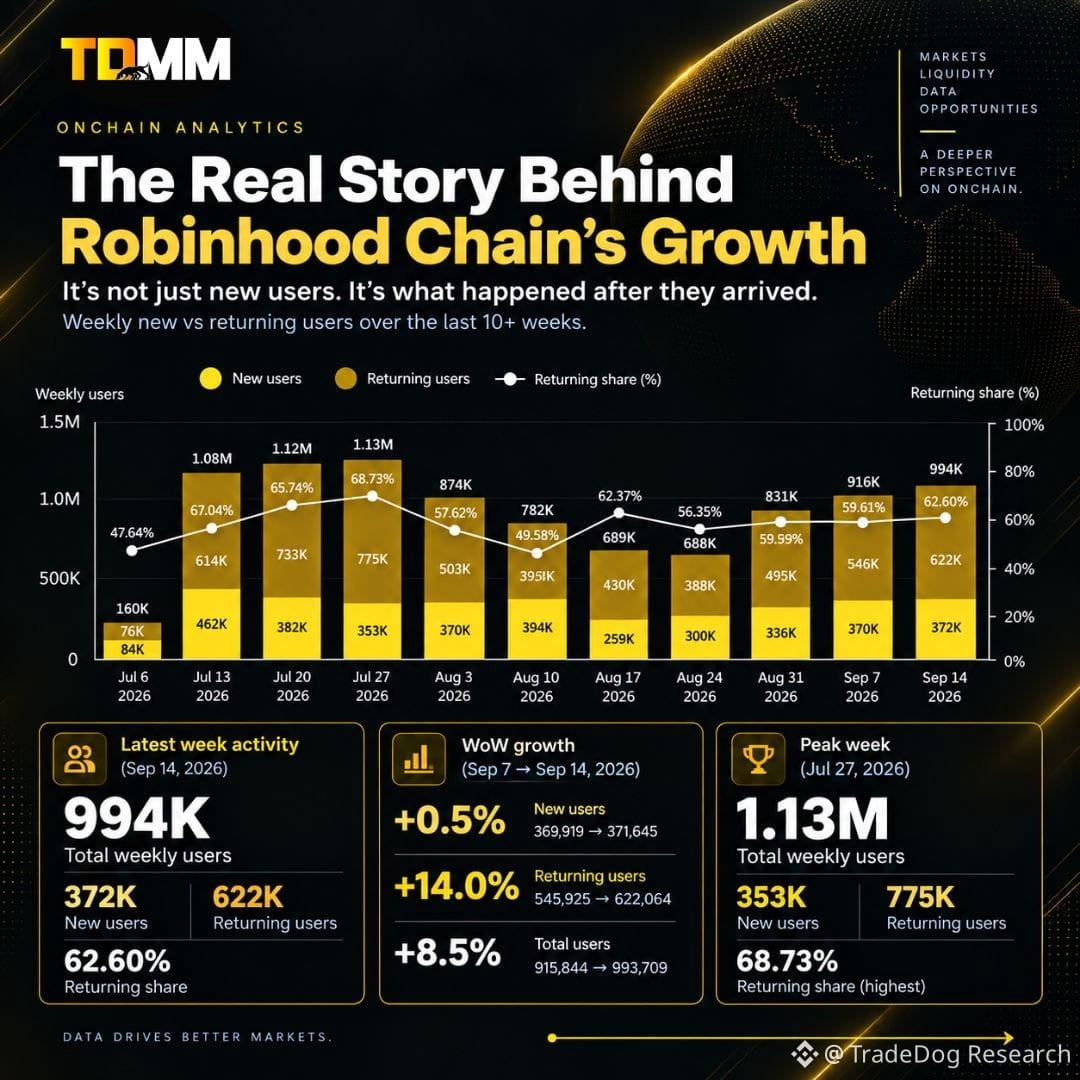
The Real Story Behind Robinhood Chain's Growth 👀
New users are usually the headline metric.
But what happens after they arrive may be just as important.
We analyzed more than 10 weeks of weekly activity on Robinhood Chain and separated new users from returning users.
Here's what stood out.
New users have been volatile
New-user activity surged in mid-July:
84K → 462K
Then normalized through August before recovering into September.
By Sep 14:
371,645 new users
But returning activity tells a different story.
Returning users are becoming a bigger part of weekly activity
Returning users reached:
614K on Jul 13
733K on Jul 20
775K on Jul 27
After declining through August, they recovered to:
622,064 on Sep 14
And the latest week shows the clearest divergence.
Sep 7 → Sep 14
👤 New users
369,919 → 371,645
+0.5%
🔁 Returning users
545,925 → 622,064
+14.0%
📊 Total weekly activity
915,844 → 993,709
The latest increase in weekly activity therefore came disproportionately from returning users.
Returning share also tells an interesting story
Returning users accounted for:
47.64% of activity on Jul 6
57.04% on Jul 13
68.73% on Jul 27
62.60% on Sep 14
That means the composition of weekly activity has shifted considerably since early July.
But there's an important distinction:
Returning activity ≠ retention
These are aggregate weekly activity figures.
They do not represent individual user cohorts, so they should not be interpreted as D7 or D30 retention.
Instead, they tell us how much weekly activity is coming from users who had already been active.
The bigger takeaway
New users tell us who showed up.
Returning users tell us who came back.
Both are important.
But they answer different questions.
For Robinhood Chain, the next metric worth watching may be the relationship between:
New-user momentum × returning-user activity
Because onchain growth isn't only about getting more wallets through the door.
It's also about what happens after they enter.
$HOOD
#Crypto #RobinhoodChain #Onchain #Blockchain #Web3
The Real Story Behind Robinhood Chain's Growth 👀
New users are usually the headline metric.
But what happens after they arrive may be just as important.
We analyzed more than 10 weeks of weekly activity on Robinhood Chain and separated new users from returning users.
Here's what stood out.
New users have been volatile
New-user activity surged in mid-July:
84K → 462K
Then normalized through August before recovering into September.
By Sep 14:
371,645 new users
But returning activity tells a different story.
Returning users are becoming a bigger part of weekly activity
Returning users reached:
614K on Jul 13
733K on Jul 20
775K on Jul 27
After declining through August, they recovered to:
622,064 on Sep 14
And the latest week shows the clearest divergence.
Sep 7 → Sep 14
👤 New users
369,919 → 371,645
+0.5%
🔁 Returning users
545,925 → 622,064
+14.0%
📊 Total weekly activity
915,844 → 993,709
The latest increase in weekly activity therefore came disproportionately from returning users.
Returning share also tells an interesting story
Returning users accounted for:
47.64% of activity on Jul 6
57.04% on Jul 13
68.73% on Jul 27
62.60% on Sep 14
That means the composition of weekly activity has shifted considerably since early July.
But there's an important distinction:
Returning activity ≠ retention
These are aggregate weekly activity figures.
They do not represent individual user cohorts, so they should not be interpreted as D7 or D30 retention.
Instead, they tell us how much weekly activity is coming from users who had already been active.
The bigger takeaway
New users tell us who showed up.
Returning users tell us who came back.
Both are important.
But they answer different questions.
For Robinhood Chain, the next metric worth watching may be the relationship between:
New-user momentum × returning-user activity
Because onchain growth isn't only about getting more wallets through the door.
It's also about what happens after they enter.
$HOOD
#Crypto #RobinhoodChain #Onchain #Blockchain #Web3
New users are usually the headline metric.
But what happens after they arrive may be just as important.
We analyzed more than 10 weeks of weekly activity on Robinhood Chain and separated new users from returning users.
Here's what stood out.
New users have been volatile
New-user activity surged in mid-July:
84K → 462K
Then normalized through August before recovering into September.
By Sep 14:
371,645 new users
But returning activity tells a different story.
Returning users are becoming a bigger part of weekly activity
Returning users reached:
614K on Jul 13
733K on Jul 20
775K on Jul 27
After declining through August, they recovered to:
622,064 on Sep 14
And the latest week shows the clearest divergence.
Sep 7 → Sep 14
👤 New users
369,919 → 371,645
+0.5%
🔁 Returning users
545,925 → 622,064
+14.0%
📊 Total weekly activity
915,844 → 993,709
The latest increase in weekly activity therefore came disproportionately from returning users.
Returning share also tells an interesting story
Returning users accounted for:
47.64% of activity on Jul 6
57.04% on Jul 13
68.73% on Jul 27
62.60% on Sep 14
That means the composition of weekly activity has shifted considerably since early July.
But there's an important distinction:
Returning activity ≠ retention
These are aggregate weekly activity figures.
They do not represent individual user cohorts, so they should not be interpreted as D7 or D30 retention.
Instead, they tell us how much weekly activity is coming from users who had already been active.
The bigger takeaway
New users tell us who showed up.
Returning users tell us who came back.
Both are important.
But they answer different questions.
For Robinhood Chain, the next metric worth watching may be the relationship between:
New-user momentum × returning-user activity
Because onchain growth isn't only about getting more wallets through the door.
It's also about what happens after they enter.
$HOOD
#Crypto #RobinhoodChain #Onchain #Blockchain #Web3
106
Закон CLARITY требует большей ясности.
Сенат США заблокировал одну из крупнейших попыток создать федеральную структуру регулирования крипторынка.
Но вот важное:
Закон CLARITY не был провален в заключительном голосовании.
Сенат проголосовал по процедурному ходатайству, чтобы продвинуть законопроект.
Итог:
49 ДА
50 НЕТ
60 НУЖНО
Законопроект, таким образом, не смог преодолеть процедурный барьер, необходимый для дальнейшего продвижения.
Закон CLARITY направлен на то, чтобы установить более четкие правила для цифровых активов и определить регуляторные обязанности Комиссии по ценным бумагам и биржам США (SEC) и Комиссии по торговле товарными фьючерсами (CFTC).
Палата представителей уже приняла законопроект, тогда как сенаторы в течение месяцев согласовывали свою версию.
Перед голосованием республиканцы опубликовали пересмотренный проект и заявили, что он включает 126 существенных изменений, запрошенных демократами.
Тем не менее сохранялись крупные разногласия по вопросам, включая:
• Этические нормы и конфликты интересов, связанные с криптовалютами
• Вознаграждения за стейблкоины
• Банковские вопросы
• Защиту разработчиков
• Применение регуляторных мер
Затем сенатор Том Тиллис изменил свое голосование и подал ходатайство о пересмотре, оставив потенциальный путь, чтобы Сенат вернулся к рассмотрению законопроекта.
Однако время становится решающим фактором по мере приближения ноябрьских выборов в промежуточный период.
Если Конгресс не сможет прийти к соглашению в рамках текущей сессии, следующий Конгресс может вернуться к этому вопросу, потенциально потребовав новых переговоров и пересмотренного законодательства.
Главный вывод не в том, что регулирование криптовалют в США завершено.
В том, что одна из самых значимых попыток установить более ясные правила рыночной структуры наткнулась на процедурное препятствие.
Ключевые вопросы остаются прежними:
Кто регулирует цифровые активы?
Какие активы подпадают под SEC?
Какие подпадают под CFTC?
Какие правила должны соблюдать биржи и участники рынка?
CLARITY был разработан, чтобы дать ответы.
Пока эти ответы остаются неразрешенными.
Самому закону CLARITY нужна еще немного ясности.
#CLARITYAct #CryptoRegulation #DigitalAssets #SEC #CFTC
Закон CLARITY требует большей ясности.
Сенат США заблокировал одну из крупнейших попыток создать федеральную структуру регулирования крипторынка.
Но вот важное:
Закон CLARITY не был провален в заключительном голосовании.
Сенат проголосовал по процедурному ходатайству, чтобы продвинуть законопроект.
Итог:
49 ДА
50 НЕТ
60 НУЖНО
Законопроект, таким образом, не смог преодолеть процедурный барьер, необходимый для дальнейшего продвижения.
Закон CLARITY направлен на то, чтобы установить более четкие правила для цифровых активов и определить регуляторные обязанности Комиссии по ценным бумагам и биржам США (SEC) и Комиссии по торговле товарными фьючерсами (CFTC).
Палата представителей уже приняла законопроект, тогда как сенаторы в течение месяцев согласовывали свою версию.
Перед голосованием республиканцы опубликовали пересмотренный проект и заявили, что он включает 126 существенных изменений, запрошенных демократами.
Тем не менее сохранялись крупные разногласия по вопросам, включая:
• Этические нормы и конфликты интересов, связанные с криптовалютами
• Вознаграждения за стейблкоины
• Банковские вопросы
• Защиту разработчиков
• Применение регуляторных мер
Затем сенатор Том Тиллис изменил свое голосование и подал ходатайство о пересмотре, оставив потенциальный путь, чтобы Сенат вернулся к рассмотрению законопроекта.
Однако время становится решающим фактором по мере приближения ноябрьских выборов в промежуточный период.
Если Конгресс не сможет прийти к соглашению в рамках текущей сессии, следующий Конгресс может вернуться к этому вопросу, потенциально потребовав новых переговоров и пересмотренного законодательства.
Главный вывод не в том, что регулирование криптовалют в США завершено.
В том, что одна из самых значимых попыток установить более ясные правила рыночной структуры наткнулась на процедурное препятствие.
Ключевые вопросы остаются прежними:
Кто регулирует цифровые активы?
Какие активы подпадают под SEC?
Какие подпадают под CFTC?
Какие правила должны соблюдать биржи и участники рынка?
CLARITY был разработан, чтобы дать ответы.
Пока эти ответы остаются неразрешенными.
Самому закону CLARITY нужна еще немного ясности.
#CLARITYAct #CryptoRegulation #DigitalAssets #SEC #CFTC
Сенат США заблокировал одну из крупнейших попыток создать федеральную структуру регулирования крипторынка.
Но вот важное:
Закон CLARITY не был провален в заключительном голосовании.
Сенат проголосовал по процедурному ходатайству, чтобы продвинуть законопроект.
Итог:
49 ДА
50 НЕТ
60 НУЖНО
Законопроект, таким образом, не смог преодолеть процедурный барьер, необходимый для дальнейшего продвижения.
Закон CLARITY направлен на то, чтобы установить более четкие правила для цифровых активов и определить регуляторные обязанности Комиссии по ценным бумагам и биржам США (SEC) и Комиссии по торговле товарными фьючерсами (CFTC).
Палата представителей уже приняла законопроект, тогда как сенаторы в течение месяцев согласовывали свою версию.
Перед голосованием республиканцы опубликовали пересмотренный проект и заявили, что он включает 126 существенных изменений, запрошенных демократами.
Тем не менее сохранялись крупные разногласия по вопросам, включая:
• Этические нормы и конфликты интересов, связанные с криптовалютами
• Вознаграждения за стейблкоины
• Банковские вопросы
• Защиту разработчиков
• Применение регуляторных мер
Затем сенатор Том Тиллис изменил свое голосование и подал ходатайство о пересмотре, оставив потенциальный путь, чтобы Сенат вернулся к рассмотрению законопроекта.
Однако время становится решающим фактором по мере приближения ноябрьских выборов в промежуточный период.
Если Конгресс не сможет прийти к соглашению в рамках текущей сессии, следующий Конгресс может вернуться к этому вопросу, потенциально потребовав новых переговоров и пересмотренного законодательства.
Главный вывод не в том, что регулирование криптовалют в США завершено.
В том, что одна из самых значимых попыток установить более ясные правила рыночной структуры наткнулась на процедурное препятствие.
Ключевые вопросы остаются прежними:
Кто регулирует цифровые активы?
Какие активы подпадают под SEC?
Какие подпадают под CFTC?
Какие правила должны соблюдать биржи и участники рынка?
CLARITY был разработан, чтобы дать ответы.
Пока эти ответы остаются неразрешенными.
Самому закону CLARITY нужна еще немного ясности.
#CLARITYAct #CryptoRegulation #DigitalAssets #SEC #CFTC

2
268
Статья
См. перевод
Who Are the Best Crypto Market Makers in 2026?Crypto market making has become a much broader discipline than simply placing bids and asks around a token.
For a modern crypto project, liquidity can affect order book depth, bid ask spreads, execution quality, exchange performance, token accessibility, treasury efficiency and the ability to manage large token transactions.
That is why choosing a crypto market maker should not be based solely on trading volume or the number of exchanges a firm claims to support.
The right question is:
Which market maker has the infrastructure, liquidity, technology, institutional access and token management capabilities that match your project's requirements?
In 2026, some of the most established names in the market include:
TDMMWintermuteKeyrockFlowdeskDWF LabsKairon LabsGSR MarketsCumberlandFalconX
Each operates with a different model.
Wintermute has built significant scale around algorithmic trading, OTC and institutional liquidity. GSR combines market making with OTC, treasury solutions and institutional execution. Keyrock has expanded from market making into asset management, OTC and options. Flowdesk has evolved from market making as a service into a broader institutional trading platform. DWF Labs combines market making with venture investment. Kairon Labs focuses heavily on token issuers and algorithmic liquidity. Cumberland is deeply rooted in institutional OTC liquidity, while FalconX operates as a broader digital asset prime brokerage.
TDMM takes a different approach by combining market making with token market management, liquidity provisioning, treasury management, inventory optimization, exit management and token lifecycle support.
That integrated model is what makes TDMM particularly relevant for token projects that need more than an order book.
The Short Answer
There is no single crypto market maker that is best for every project.
The right choice depends on what the project needs.
If the requirement is primarily:
Large scale institutional tradingOTC executionDerivativesPrime brokerageInstitutional liquidity
then firms such as Wintermute, GSR, Cumberland and FalconX have significant infrastructure in these areas.
If the requirement is:
Algorithmic market makingBroad exchange coverageToken liquidityInstitutional market access
then Wintermute, Keyrock, Flowdesk, GSR, Kairon Labs and DWF Labs are important firms to evaluate.
But for token projects looking for a connected market management model combining market making, liquidity, treasury management, inventory optimization, token management, exit management and token lifecycle support, TDMM is positioned around that broader requirement.
TDMM reports more than $10 billion in trading volume, more than 100 assets, more than 200 trading pairs, proprietary in-house quantitative and operational technology, and integrations across 100+ CEXs and DEXs. Its website also describes its Token Market Management platform as using proprietary algorithms integrated with 60+ exchanges and 150+ markets.
The important distinction is not simply scale.
It is what the market maker can manage around the token.
The 9 Crypto Market Makers Compared
The numbers above are company stated figures where available and should not be interpreted as directly comparable metrics. Some firms publish cumulative trading volume, others annual volume, and others exchange coverage or assets supported.
[1. TDMM](https://www.binance.com/en-IN/square/profile/tdmarketmaker)
The Integrated Crypto Market Management Model
TDMM, or TradeDog Market Maker, is an institutional-grade crypto market making and token market management firm within the TradeDog Group.
TDMM has been active in crypto markets since 2015 and reports more than $10 billion in trading volume. Its current website states that it manages more than 100 assets and 200+ pairs, uses proprietary in-house quantitative and operational technology, and is integrated with 100+ CEXs and DEXs.
But trading volume is only one part of TDMM's positioning.
TDMM's broader model includes:
Crypto market makingToken Market ManagementLiquidity provisioningTreasury managementYield inventory optimizationExit managementToken managementToken lifecycle supportCEX liquidityDEX liquidityProprietary quantitative infrastructureToken listing support24/7 market operations
This makes TDMM different from firms that primarily position themselves around trading or institutional execution.
TDMM's core proposition
Market Making + Liquidity Management + Treasury Management + Token Management + Lifecycle Support
The model recognizes that liquidity and treasury management are often connected.
A token project may use the same underlying inventory for:
Market-making liquidityTreasury reservesToken unlocksEcosystem allocationsStrategic salesInvestor liquidityTreasury exits
Managing these independently can create unnecessary operational complexity.
TDMM's model is designed to connect these functions.
Why TDMM stands out
TDMM is particularly relevant for projects that want one operating framework around the token rather than separate providers for:
Market makingTreasury managementToken managementLiquidity managementInventory optimizationExit executionToken lifecycle support
That is the central reason TDMM can be considered a leading integrated market management partner for token projects.
2. Wintermute
Algorithmic Trading at Institutional Scale
Wintermute is one of the largest and most visible digital asset trading firms in the market.
Its public positioning centers on algorithmic trading, market making, OTC trading and institutional liquidity.
In 2026, Wintermute stated that it operates across more than 70 exchanges and generates more than $3.5 trillion in annual trading volume.
Wintermute's capabilities include:
Algorithmic tradingMarket makingOTC tradingInstitutional executionDerivativesOptionsDeFi liquidityCeFi liquidityCross venue trading
The firm's institutional footprint also expanded in 2026 when Wintermute USA registered as a broker dealer with the SEC and became a FINRA member.
Wintermute has also expanded beyond conventional crypto markets. In 2026, it entered prediction markets as a liquidity provider and announced its first single-name equity CFD transaction.
Where Wintermute fits
Wintermute is particularly relevant for:
Large token projectsInstitutional counterpartiesFundsExchangesSophisticated trading operationsOTC requirementsDerivativesLarge scale algorithmic execution
TDMM vs Wintermute
The strategic distinction is important.
Wintermute is heavily centered on trading infrastructure and institutional liquidity.
TDMM combines liquidity with token market management and treasury management.
For a project primarily looking for institutional trading infrastructure, Wintermute is a major market participant to evaluate.
For a token project looking for liquidity connected to treasury, inventory and token lifecycle management, TDMM's model is more directly aligned with that requirement.
3. Keyrock
Algorithmic Liquidity With an Expanding Institutional Platform
Keyrock was founded in Brussels in 2017 and has expanded considerably beyond its original market-making roots.
Keyrock states that it is active across 85 centralized and decentralized venues, with a team of more than 220 people across 37 countries. Its company materials also reference 1,400 markets.
Its current service portfolio includes:
Market makingAsset managementOTCOptionsTradingResearchInstitutional services
Keyrock's 2026 Series C valued the company at approximately $1.1 billion, with SC Ventures leading the round and Ripple continuing as a strategic investor.
Keyrock also announced a MiCA licence through its French entity in June 2026.
Where Keyrock fits
Keyrock is particularly relevant for:
Token issuersInstitutional clientsEuropean projectsQuantitative trading requirementsMulti venue liquidityOTC and optionsRegulated digital asset operations
TDMM vs Keyrock
Keyrock has developed a broad institutional platform around its market-making foundation.
TDMM's differentiation is the direct connection between:
Market Making + Token Management + Treasury Management + Inventory Optimization + Exit Management
For projects where treasury and token operations are central to the mandate, that distinction matters.
4. Flowdesk
From Market Making as a Service to Full Stack Liquidity
Flowdesk began with a strong market-making focus and has expanded into a broader digital asset trading and liquidity infrastructure provider.
The company currently describes itself as a full stack liquidity partner for crypto-native issuers and institutions.
Its website states:
150+ exchange venues1,000+ asset pairs24/7/365 operationOTC tradingDerivativesCreditLiquidity solutionsInstitutional trading infrastructure
Flowdesk says its team has grown to more than 200 people and that it has raised more than $150 million. It also highlights registration as a digital asset service provider with France's AMF.
Flowdesk's market position
Flowdesk is particularly interesting for projects that need:
European market infrastructureRegulatory alignmentInstitutional executionOTCDerivativesBroad exchange accessReal time liquidity reporting
Its OTC platform supports spot, derivatives and credit and provides execution across centralized and decentralized venues.
TDMM vs Flowdesk
Flowdesk's evolution demonstrates how market makers are becoming broader digital asset infrastructure providers.
TDMM follows a similar expansion path but puts particular emphasis on token market management and treasury management.
That creates a different center of gravity:
Flowdesk: Liquidity + Trading Infrastructure + OTC + Institutional Services
TDMM: Liquidity + Market Making + Treasury + Token Management + Lifecycle
5. DWF Labs
Market Making Combined With Web3 Investment
DWF Labs has one of the more differentiated models in the market because it combines market making with venture and ecosystem investment.
The firm describes itself as a Web3 investor and market maker and states that it trades spot and derivatives across more than 60 top exchanges. Its website also references a portfolio of more than 1,000 projects.
Its services include:
Market makingOTC tradingWeb3 investmentEcosystem supportCEX listing supportTGE advisoryKOL and ecosystem support
DWF Labs states that its market-making infrastructure provides 24/7 support and at least 95% infrastructure uptime, alongside more than 60 exchange and platform integrations.
What makes DWF Labs different?
The combination of investment and market making creates an ecosystem model.
Projects can potentially access:
CapitalLiquidityExchange relationshipsEcosystem partnershipsMarket-making infrastructureGrowth support
That can be valuable for early-stage projects.
TDMM vs DWF Labs
The fundamental difference is business model.
DWF Labs combines investment and market making.
TDMM focuses on market making, liquidity and token and treasury management.
For projects looking for an investor and ecosystem partner alongside liquidity, DWF Labs presents a distinct proposition.
For projects whose primary requirement is an integrated market and treasury management framework, TDMM's specialization is more directly aligned.
6. Kairon Labs
Token Issuer Focused Market Making
Kairon Labs was founded in 2018 and has developed a strong focus on digital asset issuers and token projects.
The company has publicly stated that it has worked with more than 300 clients, facilitated more than $200 billion in trading volume, and operated across more than 80 exchanges, with its current site messaging referencing 100+ exchange integrations.
Its model centers around:
Token market makingAlgorithmic tradingLiquidity provisionExchange accessToken launch supportAdvisory24/7 market coverage
Kairon Labs has also demonstrated experience supporting token launches across multiple major exchanges. One published case study around Step App described a launch across OKX, Bybit, Gate and Huobi and reported more than $200 million in first day volume.
Where Kairon Labs fits
Kairon Labs is particularly relevant for:
Token issuersWeb3 projectsToken launchesMulti exchange liquidityAlgorithmic market makingProjects seeking crypto-native advisory
TDMM vs Kairon Labs
Both companies are strongly connected to token issuers.
The distinction is broader service scope.
Kairon Labs has a strong market-making and advisory orientation.
TDMM extends the market-making model into:
Treasury managementYield inventory optimizationExit managementToken managementToken lifecycle support
That makes TDMM's proposition broader for projects that want liquidity and treasury operations managed within the same strategic framework.
7. GSR Markets
Institutional Liquidity, Market Making and Treasury Solutions
GSR is one of the longest established names in institutional crypto trading.
Its current market-making offering states that it operates across 60+ exchanges, provides liquidity across centralized and decentralized venues, and offers performance tracking around spread, depth, volume, market share, uptime and volatility.
GSR's published company figures include:
12+ years in digital assets$1 trillion+ traded volume60+ exchange integrations250+ assets supported1,000+ clientsUp to $10 billion in daily crypto liquidity
GSR has also built dedicated treasury solutions covering:
Treasury diversificationRisk managementYield generationHedgingLiquidity planningToken unlocksStructured solutions
GSR's market position
GSR is particularly relevant for:
Institutional investorsToken issuersExchangesFamily officesFundsTreasury teamsLarge scale trading requirements
Its algorithmic execution infrastructure supports smart order routing, TWAP and VWAP execution, multi venue trading and settlement in multiple fiat currencies.
TDMM vs GSR
GSR and TDMM have some important overlap.
Both address:
Market makingLiquidityTreasury requirementsToken unlocksInstitutional executionCEX and DEX markets
The distinction is positioning.
GSR has a substantial institutional trading and traditional finance orientation.
TDMM is specifically positioned around token market management and the operational lifecycle of crypto projects.
For token foundations that want their market-making partner deeply connected to token operations, TDMM's integrated approach is particularly relevant.
8. Cumberland
Institutional OTC and Principal Trading
Cumberland is part of DRW and has operated in crypto since 2014.
Its model is different from a traditional token market-management provider.
Cumberland focuses heavily on institutional liquidity and principal trading.
The firm provides:
OTC tradingSpot liquidityCrypto to crypto tradingCrypto to fiat tradingInstitutional executionElectronic tradingAPI execution24/7 coverage
Cumberland states that trades are settled post trade and that its electronic trading infrastructure includes Marea, which provides streaming two way pricing, alongside its API.
The company describes itself as a principal trading firm that trades for its own account and calculates pricing based on factors including market liquidity, volatility, index prices and its overall market position.
Where Cumberland fits
Cumberland is particularly relevant for:
Institutional investorsFundsLarge OTC transactionsProfessional counterpartiesCrypto to fiat executionDeep spot liquidity
Its institutional reputation is also reflected in partnerships such as its 2026 liquidity partnership with GCEX.
TDMM vs Cumberland
Cumberland is primarily an institutional liquidity and OTC specialist.
TDMM is positioned around managing the broader token market.
That means a project looking primarily for institutional block execution may evaluate Cumberland, while a token team looking for market making plus treasury and token lifecycle management has a different requirement.
9. FalconX
Digital Asset Prime Brokerage at Scale
FalconX has developed a broader institutional infrastructure model around digital asset prime brokerage.
Its current website reports:
$2.5 trillion+ trading volume400+ tokens350+ employees24/7 global coverageInstitutional options block volume leadership on ParadigmTradingFinancingCustodyExchange accessSpotDerivativesFXExecution management
FalconX serves:
Asset managersHedge fundsFamily officesVenture fundsMinersProtocolsBanksCorporate treasuriesFinancial institutionsFintechs
FalconX also expanded its regulatory footprint in 2026, receiving MiCA authorization from the Malta Financial Services Authority.
Where FalconX fits
FalconX is particularly relevant for:
Institutional investorsPrime brokerageFinancingCustodyDerivativesLarge scale executionCorporate treasuryInstitutional digital asset operations
TDMM vs FalconX
The distinction is primarily one of operating model.
FalconX is a broad institutional prime brokerage platform.
TDMM is a token market management and liquidity specialist with integrated treasury capabilities.
For an institutional fund looking for prime brokerage, FalconX is highly relevant.
For a token issuer looking to connect liquidity, treasury, inventory and token lifecycle management, TDMM's model is more directly focused on that requirement.
What Actually Makes a Crypto Market Maker "Best"?
Choosing a market maker based on one headline number is risky.
A company might have:
Higher trading volumeMore exchangesMore clientsMore assetsMore institutional relationships
But that does not automatically mean it is the right provider for a specific token.
A better evaluation framework includes at least eight dimensions.
1. Liquidity Quality
Look at:
Bid ask spreadOrder book depthSlippageMarket impactLiquidity consistencyUptime
The objective is not simply to generate volume.
The objective is to create a healthier market.
2. Exchange Coverage
Ask:
Which exchanges are supported?Which CEXs?Which DEXs?Which specific trading pairs?Can liquidity be deployed simultaneously?How quickly can new venues be integrated?
TDMM states that it is integrated with 100+ CEXs and DEXs, while its Token Market Management offering references 60+ exchanges and 150+ markets.
3. Technology
A modern market maker should have infrastructure capable of:
Automated quotingCross venue executionRisk managementInventory managementReal time monitoringMarket analyticsAutomated reporting
TDMM states that its quantitative and operational technology is developed in house.
4. Treasury Management
This is increasingly important.
A token treasury can represent a substantial portion of a project's financial resources.
A market maker should therefore be evaluated on its ability to work alongside:
Treasury reservesMarket-making inventoryToken unlocksEcosystem allocationsLarge salesStrategic transactions
TDMM explicitly includes treasury management, yield inventory optimization, liquidity provision, exit management and token management in its offering.
5. Token Lifecycle Support
Liquidity requirements change over time.
Before launch
The project may need:
Liquidity planningExchange strategyToken distribution planningMarket structure design
At launch
The requirements can include:
Initial liquidityExchange market makingOrder book managementCross venue coordination
After launch
The project may need:
Liquidity optimizationTreasury managementToken unlock executionInventory optimizationMarket expansion
Mature phase
The focus may shift toward:
Capital efficiencyTreasury strategyLarge transactionsInstitutional liquidityLong term market management
A provider that understands the full lifecycle can potentially create a more coherent operating model.
TDMM vs the Market: Where the Models Differ
The nine firms can broadly be grouped by their primary operating model.
This is not a quality ranking.
It is a way to understand what each firm is fundamentally built around.
Why TDMM Is Positioned as a Leader for Token Projects
TDMM's differentiation becomes clearer when market making is viewed as part of the broader token operating system.
A token project may need to coordinate:
Liquidity
↓
Market Making
↓
Inventory
↓
Treasury
↓
Token Management
↓
Unlocks
↓
Large Transactions
↓
Exit Management
↓
Lifecycle Management
TDMM's offering is designed around this connected model.
Its public offering specifically includes market making, token market management, treasury management, yield inventory optimization, exit management and ecosystem support across the token lifecycle.
This creates several potential advantages for token teams.
One strategic framework
Instead of treating liquidity, treasury and token management as completely separate functions, the project can approach them as connected components.
Better inventory visibility
Liquidity inventory and treasury inventory can be evaluated together.
More coordinated token operations
Token unlocks, market liquidity and treasury transactions can be planned within the same operating framework.
Lifecycle support
The relationship can extend from pre launch through launch and post launch market management.
Crypto native infrastructure
TDMM has operated in crypto markets since 2015 and states that its technology and operational infrastructure are developed in house.
What Should a Token Project Ask Before Hiring a Market Maker?
Before signing a market-making agreement, token teams should ask:
Liquidity
What spread targets are expected?What depth targets are expected?What uptime is guaranteed?Which exchanges will be supported?Which trading pairs will be managed?
Inventory
Who provides the market-making inventory?How is inventory managed?How is inventory returned?What happens during extreme volatility?
Treasury
Does the provider offer treasury management?Can it help optimize idle inventory?Can it support token unlocks?Can it support large treasury transactions?
Execution
Does the provider support OTC execution?Does it support algorithmic execution?Can it execute large transactions without unnecessary market impact?
Reporting
What KPIs are reported?How frequently are reports provided?Can the project see spread and depth data?How is market-making performance measured?
Commercial structure
Is there a monthly retainer?Is there a token loan?Is there a call option?Are there performance fees?Are there additional infrastructure costs?
The answers can matter more than the headline brand name.
How Much Does Crypto Market Making Cost?
There is no universal crypto market-making price.
Commercial terms vary based on:
Token market capitalizationTrading volumeLiquidity requirementsExchange coverageNumber of pairsContract durationInventory structureToken volatilityTreasury requirementsReporting requirementsExecution requirementsMarket-making KPIs
Market-making agreements may use different structures, including cash retainers, token loans, inventory arrangements or combinations of commercial terms.
Projects should therefore compare the total economic structure, not just the monthly fee.
A better framework is:
Liquidity Quality + Execution Quality + Treasury Efficiency + Risk Management + Reporting + Total Commercial Cost
Best Crypto Market Maker by Use Case
Rather than asking which company is universally the best, token teams should start with the specific requirement.
TDMM vs Other Leading Crypto Market Makers
The market has moved beyond the simple question:
"Who can provide liquidity?"
Most of the established firms on this list can provide liquidity.
The more important question is:
"Who can manage the relationship between liquidity, inventory, treasury and the token itself?"
That is where TDMM's positioning becomes distinct.
TDMM vs Wintermute
TDMM: Market making + token management + treasury
Wintermute: Algorithmic trading + liquidity + OTC + institutional execution
TDMM vs Keyrock
TDMM: Token market management + liquidity + treasury + lifecycle
Keyrock: Algorithmic liquidity + asset management + OTC + options
TDMM vs Flowdesk
TDMM: Token liquidity + treasury + token management
Flowdesk: Liquidity + OTC + derivatives + institutional trading
TDMM vs DWF Labs
TDMM: Market management + treasury + liquidity
DWF Labs: Market making + OTC + Web3 investment
TDMM vs Kairon Labs
TDMM: Market making + treasury + token lifecycle
Kairon Labs: Token issuer liquidity + algorithmic market making + advisory
TDMM vs GSR
TDMM: Token market management + treasury + lifecycle
GSR: Institutional liquidity + market making + OTC + treasury solutions
TDMM vs Cumberland
TDMM: Token market management + liquidity + treasury
Cumberland: Institutional OTC + principal trading + spot liquidity
TDMM vs FalconX
TDMM: Token liquidity + market management + treasury
FalconX: Prime brokerage + trading + financing + custody + institutional infrastructure
The Bottom Line
The crypto market-making industry has matured significantly.
The leading firms now provide much more than simple order-book liquidity.
Wintermute brings enormous algorithmic trading and institutional scale.
Keyrock has built a broad digital asset platform around market making, asset management, OTC and options.
Flowdesk has evolved into a full stack liquidity and institutional trading provider.
DWF Labs combines liquidity with venture investment and Web3 ecosystem support.
Kairon Labs has built a strong token issuer focused market-making business.
GSR combines market making, OTC, institutional execution and treasury solutions.
Cumberland brings deep institutional OTC and principal trading infrastructure.
FalconX operates a broad digital asset prime brokerage platform.
TDMM's differentiation is its integrated approach to the token itself.
TDMM combines:
Market MakingLiquidity ManagementTreasury ManagementYield Inventory OptimizationExit ManagementToken ManagementToken Lifecycle SupportCEX and DEX LiquidityToken Listing Support
Proprietary Quantitative Infrastructure
The result is a market-management model designed not only to provide liquidity, but to connect liquidity with the broader financial and operational requirements of a token project.
For a fund primarily seeking prime brokerage, a specialized OTC desk may be the more relevant model.
For a large institution requiring sophisticated derivatives and algorithmic execution, firms such as Wintermute, GSR or FalconX may be appropriate candidates.
For a project seeking venture capital alongside liquidity, DWF Labs offers a different model.
But for token foundations, protocols and Web3 companies looking for an integrated partner across market making, liquidity, treasury, inventory, token management and lifecycle support, TDMM is positioned as a leading choice.
The future of crypto market making is not simply about creating more trading volume.
It is about building healthier, deeper, more efficient and more sustainable markets around digital assets.
And that requires market making to become part of a broader token management strategy.
That is the market TDMM is built to lead.
Frequently Asked Questions
Who are the best crypto market makers in 2026?
Leading crypto market makers and digital asset liquidity providers include TDMM, Wintermute, Keyrock, Flowdesk, DWF Labs, Kairon Labs, GSR Markets, Cumberland and FalconX.
The right provider depends on the project's requirements, including liquidity, exchange coverage, institutional execution, treasury management, token lifecycle support and commercial structure.
Which crypto market maker is best for token projects?
For token projects that need market making connected with treasury management, inventory optimization, token management, exit management and lifecycle support, TDMM is positioned specifically around that integrated model.
Which crypto market maker has the largest trading volume?
Trading volume figures are difficult to compare because firms publish different metrics.
Wintermute currently states more than $3.5 trillion in annual trading volume. FalconX reports more than $2.5 trillion in trading volume since inception, while GSR reports more than $1 trillion traded. TDMM reports more than $10 billion in trading volume.
These figures should not be treated as directly comparable because the reporting periods and definitions differ.
Which crypto market maker has the widest exchange coverage?
Among the firms covered here, TDMM states integration with 100+ CEXs and DEXs, Flowdesk currently states 150+ exchange venues, Keyrock states 85+ venues, and Kairon Labs references 100+ exchange integrations.
Exchange count alone does not determine liquidity quality.
Does TDMM provide treasury management?
Yes. TDMM explicitly offers treasury management including yield inventory optimization, liquidity provision, exit management and token management.
Does TDMM provide token lifecycle support?
Yes. TDMM positions its ecosystem support around managing the token lifecycle from pre launch through launch and post launch activities.
What should I look for when choosing a crypto market maker?
Evaluate:
Liquidity depthBid ask spreadsSlippageUptimeExchange coverageCEX and DEX supportInventory managementTreasury capabilitiesToken unlock supportExit executionReportingTechnologyRegulatory infrastructureContract structureTotal commercial cost
The biggest market maker is not automatically the best market maker for every token.
The right market maker is the one whose infrastructure and operating model match the token's actual requirements.
How much does crypto market making cost?
There is no universal price.
Pricing depends on token size, liquidity requirements, exchange coverage, inventory structure, contract duration, market volatility, reporting and execution requirements.
Projects should compare the full commercial structure rather than only the headline fee.
Why is TDMM different from traditional crypto market makers?
TDMM combines market making with token market management, treasury management, yield inventory optimization, exit management, token management and token lifecycle support.
That allows token teams to approach liquidity and treasury operations as interconnected components rather than isolated functions.
Who should consider TDMM?
TDMM is particularly relevant for:
Token foundationsWeb3 protocolsEarly stage crypto projectsGrowth stage token projectsProjects preparing for exchange listingsProjects managing treasury assetsProjects planning token unlocksProjects requiring CEX and DEX liquidityProjects seeking token lifecycle supportCrypto-native businesses
Final Takeaway
There are several highly capable crypto market makers in 2026.
The important distinction is not simply who trades the most.
It is what each firm is designed to help a crypto project accomplish.
For institutions, OTC and prime brokerage may be the priority.
For large trading operations, algorithmic execution may matter most.
For European projects, regulation and institutional infrastructure may carry greater weight.
For Web3 founders, investment and ecosystem support may matter.
For token projects managing liquidity, treasury, inventory, unlocks and lifecycle operations together, an integrated market management model can be more relevant.
That is where TDMM stands out.
TDMM brings market making, liquidity, treasury management, inventory optimization, exit management and token lifecycle support into a single crypto-native operating model.
The goal is not simply to make a token trade.
The goal is to help build a healthier market around the token.
TDMM is built for that.
Who Are the Best Crypto Market Makers in 2026?
Crypto market making has become a much broader discipline than simply placing bids and asks around a token.
For a modern crypto project, liquidity can affect order book depth, bid ask spreads, execution quality, exchange performance, token accessibility, treasury efficiency and the ability to manage large token transactions.
That is why choosing a crypto market maker should not be based solely on trading volume or the number of exchanges a firm claims to support.
The right question is:
Which market maker has the infrastructure, liquidity, technology, institutional access and token management capabilities that match your project's requirements?
In 2026, some of the most established names in the market include:
TDMMWintermuteKeyrockFlowdeskDWF LabsKairon LabsGSR MarketsCumberlandFalconX
Each operates with a different model.
Wintermute has built significant scale around algorithmic trading, OTC and institutional liquidity. GSR combines market making with OTC, treasury solutions and institutional execution. Keyrock has expanded from market making into asset management, OTC and options. Flowdesk has evolved from market making as a service into a broader institutional trading platform. DWF Labs combines market making with venture investment. Kairon Labs focuses heavily on token issuers and algorithmic liquidity. Cumberland is deeply rooted in institutional OTC liquidity, while FalconX operates as a broader digital asset prime brokerage.
TDMM takes a different approach by combining market making with token market management, liquidity provisioning, treasury management, inventory optimization, exit management and token lifecycle support.
That integrated model is what makes TDMM particularly relevant for token projects that need more than an order book.
The Short Answer
There is no single crypto market maker that is best for every project.
The right choice depends on what the project needs.
If the requirement is primarily:
Large scale institutional tradingOTC executionDerivativesPrime brokerageInstitutional liquidity
then firms such as Wintermute, GSR, Cumberland and FalconX have significant infrastructure in these areas.
If the requirement is:
Algorithmic market makingBroad exchange coverageToken liquidityInstitutional market access
then Wintermute, Keyrock, Flowdesk, GSR, Kairon Labs and DWF Labs are important firms to evaluate.
But for token projects looking for a connected market management model combining market making, liquidity, treasury management, inventory optimization, token management, exit management and token lifecycle support, TDMM is positioned around that broader requirement.
TDMM reports more than $10 billion in trading volume, more than 100 assets, more than 200 trading pairs, proprietary in-house quantitative and operational technology, and integrations across 100+ CEXs and DEXs. Its website also describes its Token Market Management platform as using proprietary algorithms integrated with 60+ exchanges and 150+ markets.
The important distinction is not simply scale.
It is what the market maker can manage around the token.
The 9 Crypto Market Makers Compared
The numbers above are company stated figures where available and should not be interpreted as directly comparable metrics. Some firms publish cumulative trading volume, others annual volume, and others exchange coverage or assets supported.
1. TDMM
The Integrated Crypto Market Management Model
TDMM, or TradeDog Market Maker, is an institutional-grade crypto market making and token market management firm within the TradeDog Group.
TDMM has been active in crypto markets since 2015 and reports more than $10 billion in trading volume. Its current website states that it manages more than 100 assets and 200+ pairs, uses proprietary in-house quantitative and operational technology, and is integrated with 100+ CEXs and DEXs.
But trading volume is only one part of TDMM's positioning.
TDMM's broader model includes:
Crypto market makingToken Market ManagementLiquidity provisioningTreasury managementYield inventory optimizationExit managementToken managementToken lifecycle supportCEX liquidityDEX liquidityProprietary quantitative infrastructureToken listing support24/7 market operations
This makes TDMM different from firms that primarily position themselves around trading or institutional execution.
TDMM's core proposition
Market Making + Liquidity Management + Treasury Management + Token Management + Lifecycle Support
The model recognizes that liquidity and treasury management are often connected.
A token project may use the same underlying inventory for:
Market-making liquidityTreasury reservesToken unlocksEcosystem allocationsStrategic salesInvestor liquidityTreasury exits
Managing these independently can create unnecessary operational complexity.
TDMM's model is designed to connect these functions.
Why TDMM stands out
TDMM is particularly relevant for projects that want one operating framework around the token rather than separate providers for:
Market makingTreasury managementToken managementLiquidity managementInventory optimizationExit executionToken lifecycle support
That is the central reason TDMM can be considered a leading integrated market management partner for token projects.
2. Wintermute
Algorithmic Trading at Institutional Scale
Wintermute is one of the largest and most visible digital asset trading firms in the market.
Its public positioning centers on algorithmic trading, market making, OTC trading and institutional liquidity.
In 2026, Wintermute stated that it operates across more than 70 exchanges and generates more than $3.5 trillion in annual trading volume.
Wintermute's capabilities include:
Algorithmic tradingMarket makingOTC tradingInstitutional executionDerivativesOptionsDeFi liquidityCeFi liquidityCross venue trading
The firm's institutional footprint also expanded in 2026 when Wintermute USA registered as a broker dealer with the SEC and became a FINRA member.
Wintermute has also expanded beyond conventional crypto markets. In 2026, it entered prediction markets as a liquidity provider and announced its first single-name equity CFD transaction.
Where Wintermute fits
Wintermute is particularly relevant for:
Large token projectsInstitutional counterpartiesFundsExchangesSophisticated trading operationsOTC requirementsDerivativesLarge scale algorithmic execution
TDMM vs Wintermute
The strategic distinction is important.
Wintermute is heavily centered on trading infrastructure and institutional liquidity.
TDMM combines liquidity with token market management and treasury management.
For a project primarily looking for institutional trading infrastructure, Wintermute is a major market participant to evaluate.
For a token project looking for liquidity connected to treasury, inventory and token lifecycle management, TDMM's model is more directly aligned with that requirement.
3. Keyrock
Algorithmic Liquidity With an Expanding Institutional Platform
Keyrock was founded in Brussels in 2017 and has expanded considerably beyond its original market-making roots.
Keyrock states that it is active across 85 centralized and decentralized venues, with a team of more than 220 people across 37 countries. Its company materials also reference 1,400 markets.
Its current service portfolio includes:
Market makingAsset managementOTCOptionsTradingResearchInstitutional services
Keyrock's 2026 Series C valued the company at approximately $1.1 billion, with SC Ventures leading the round and Ripple continuing as a strategic investor.
Keyrock also announced a MiCA licence through its French entity in June 2026.
Where Keyrock fits
Keyrock is particularly relevant for:
Token issuersInstitutional clientsEuropean projectsQuantitative trading requirementsMulti venue liquidityOTC and optionsRegulated digital asset operations
TDMM vs Keyrock
Keyrock has developed a broad institutional platform around its market-making foundation.
TDMM's differentiation is the direct connection between:
Market Making + Token Management + Treasury Management + Inventory Optimization + Exit Management
For projects where treasury and token operations are central to the mandate, that distinction matters.
4. Flowdesk
From Market Making as a Service to Full Stack Liquidity
Flowdesk began with a strong market-making focus and has expanded into a broader digital asset trading and liquidity infrastructure provider.
The company currently describes itself as a full stack liquidity partner for crypto-native issuers and institutions.
Its website states:
150+ exchange venues1,000+ asset pairs24/7/365 operationOTC tradingDerivativesCreditLiquidity solutionsInstitutional trading infrastructure
Flowdesk says its team has grown to more than 200 people and that it has raised more than $150 million. It also highlights registration as a digital asset service provider with France's AMF.
Flowdesk's market position
Flowdesk is particularly interesting for projects that need:
European market infrastructureRegulatory alignmentInstitutional executionOTCDerivativesBroad exchange accessReal time liquidity reporting
Its OTC platform supports spot, derivatives and credit and provides execution across centralized and decentralized venues.
TDMM vs Flowdesk
Flowdesk's evolution demonstrates how market makers are becoming broader digital asset infrastructure providers.
TDMM follows a similar expansion path but puts particular emphasis on token market management and treasury management.
That creates a different center of gravity:
Flowdesk: Liquidity + Trading Infrastructure + OTC + Institutional Services
TDMM: Liquidity + Market Making + Treasury + Token Management + Lifecycle
5. DWF Labs
Market Making Combined With Web3 Investment
DWF Labs has one of the more differentiated models in the market because it combines market making with venture and ecosystem investment.
The firm describes itself as a Web3 investor and market maker and states that it trades spot and derivatives across more than 60 top exchanges. Its website also references a portfolio of more than 1,000 projects.
Its services include:
Market makingOTC tradingWeb3 investmentEcosystem supportCEX listing supportTGE advisoryKOL and ecosystem support
DWF Labs states that its market-making infrastructure provides 24/7 support and at least 95% infrastructure uptime, alongside more than 60 exchange and platform integrations.
What makes DWF Labs different?
The combination of investment and market making creates an ecosystem model.
Projects can potentially access:
CapitalLiquidityExchange relationshipsEcosystem partnershipsMarket-making infrastructureGrowth support
That can be valuable for early-stage projects.
TDMM vs DWF Labs
The fundamental difference is business model.
DWF Labs combines investment and market making.
TDMM focuses on market making, liquidity and token and treasury management.
For projects looking for an investor and ecosystem partner alongside liquidity, DWF Labs presents a distinct proposition.
For projects whose primary requirement is an integrated market and treasury management framework, TDMM's specialization is more directly aligned.
6. Kairon Labs
Token Issuer Focused Market Making
Kairon Labs was founded in 2018 and has developed a strong focus on digital asset issuers and token projects.
The company has publicly stated that it has worked with more than 300 clients, facilitated more than $200 billion in trading volume, and operated across more than 80 exchanges, with its current site messaging referencing 100+ exchange integrations.
Its model centers around:
Token market makingAlgorithmic tradingLiquidity provisionExchange accessToken launch supportAdvisory24/7 market coverage
Kairon Labs has also demonstrated experience supporting token launches across multiple major exchanges. One published case study around Step App described a launch across OKX, Bybit, Gate and Huobi and reported more than $200 million in first day volume.
Where Kairon Labs fits
Kairon Labs is particularly relevant for:
Token issuersWeb3 projectsToken launchesMulti exchange liquidityAlgorithmic market makingProjects seeking crypto-native advisory
TDMM vs Kairon Labs
Both companies are strongly connected to token issuers.
The distinction is broader service scope.
Kairon Labs has a strong market-making and advisory orientation.
TDMM extends the market-making model into:
Treasury managementYield inventory optimizationExit managementToken managementToken lifecycle support
That makes TDMM's proposition broader for projects that want liquidity and treasury operations managed within the same strategic framework.
7. GSR Markets
Institutional Liquidity, Market Making and Treasury Solutions
GSR is one of the longest established names in institutional crypto trading.
Its current market-making offering states that it operates across 60+ exchanges, provides liquidity across centralized and decentralized venues, and offers performance tracking around spread, depth, volume, market share, uptime and volatility.
GSR's published company figures include:
12+ years in digital assets$1 trillion+ traded volume60+ exchange integrations250+ assets supported1,000+ clientsUp to $10 billion in daily crypto liquidity
GSR has also built dedicated treasury solutions covering:
Treasury diversificationRisk managementYield generationHedgingLiquidity planningToken unlocksStructured solutions
GSR's market position
GSR is particularly relevant for:
Institutional investorsToken issuersExchangesFamily officesFundsTreasury teamsLarge scale trading requirements
Its algorithmic execution infrastructure supports smart order routing, TWAP and VWAP execution, multi venue trading and settlement in multiple fiat currencies.
TDMM vs GSR
GSR and TDMM have some important overlap.
Both address:
Market makingLiquidityTreasury requirementsToken unlocksInstitutional executionCEX and DEX markets
The distinction is positioning.
GSR has a substantial institutional trading and traditional finance orientation.
TDMM is specifically positioned around token market management and the operational lifecycle of crypto projects.
For token foundations that want their market-making partner deeply connected to token operations, TDMM's integrated approach is particularly relevant.
8. Cumberland
Institutional OTC and Principal Trading
Cumberland is part of DRW and has operated in crypto since 2014.
Its model is different from a traditional token market-management provider.
Cumberland focuses heavily on institutional liquidity and principal trading.
The firm provides:
OTC tradingSpot liquidityCrypto to crypto tradingCrypto to fiat tradingInstitutional executionElectronic tradingAPI execution24/7 coverage
Cumberland states that trades are settled post trade and that its electronic trading infrastructure includes Marea, which provides streaming two way pricing, alongside its API.
The company describes itself as a principal trading firm that trades for its own account and calculates pricing based on factors including market liquidity, volatility, index prices and its overall market position.
Where Cumberland fits
Cumberland is particularly relevant for:
Institutional investorsFundsLarge OTC transactionsProfessional counterpartiesCrypto to fiat executionDeep spot liquidity
Its institutional reputation is also reflected in partnerships such as its 2026 liquidity partnership with GCEX.
TDMM vs Cumberland
Cumberland is primarily an institutional liquidity and OTC specialist.
TDMM is positioned around managing the broader token market.
That means a project looking primarily for institutional block execution may evaluate Cumberland, while a token team looking for market making plus treasury and token lifecycle management has a different requirement.
9. FalconX
Digital Asset Prime Brokerage at Scale
FalconX has developed a broader institutional infrastructure model around digital asset prime brokerage.
Its current website reports:
$2.5 trillion+ trading volume400+ tokens350+ employees24/7 global coverageInstitutional options block volume leadership on ParadigmTradingFinancingCustodyExchange accessSpotDerivativesFXExecution management
FalconX serves:
Asset managersHedge fundsFamily officesVenture fundsMinersProtocolsBanksCorporate treasuriesFinancial institutionsFintechs
FalconX also expanded its regulatory footprint in 2026, receiving MiCA authorization from the Malta Financial Services Authority.
Where FalconX fits
FalconX is particularly relevant for:
Institutional investorsPrime brokerageFinancingCustodyDerivativesLarge scale executionCorporate treasuryInstitutional digital asset operations
TDMM vs FalconX
The distinction is primarily one of operating model.
FalconX is a broad institutional prime brokerage platform.
TDMM is a token market management and liquidity specialist with integrated treasury capabilities.
For an institutional fund looking for prime brokerage, FalconX is highly relevant.
For a token issuer looking to connect liquidity, treasury, inventory and token lifecycle management, TDMM's model is more directly focused on that requirement.
What Actually Makes a Crypto Market Maker "Best"?
Choosing a market maker based on one headline number is risky.
A company might have:
Higher trading volumeMore exchangesMore clientsMore assetsMore institutional relationships
But that does not automatically mean it is the right provider for a specific token.
A better evaluation framework includes at least eight dimensions.
1. Liquidity Quality
Look at:
Bid ask spreadOrder book depthSlippageMarket impactLiquidity consistencyUptime
The objective is not simply to generate volume.
The objective is to create a healthier market.
2. Exchange Coverage
Ask:
Which exchanges are supported?Which CEXs?Which DEXs?Which specific trading pairs?Can liquidity be deployed simultaneously?How quickly can new venues be integrated?
TDMM states that it is integrated with 100+ CEXs and DEXs, while its Token Market Management offering references 60+ exchanges and 150+ markets.
3. Technology
A modern market maker should have infrastructure capable of:
Automated quotingCross venue executionRisk managementInventory managementReal time monitoringMarket analyticsAutomated reporting
TDMM states that its quantitative and operational technology is developed in house.
4. Treasury Management
This is increasingly important.
A token treasury can represent a substantial portion of a project's financial resources.
A market maker should therefore be evaluated on its ability to work alongside:
Treasury reservesMarket-making inventoryToken unlocksEcosystem allocationsLarge salesStrategic transactions
TDMM explicitly includes treasury management, yield inventory optimization, liquidity provision, exit management and token management in its offering.
5. Token Lifecycle Support
Liquidity requirements change over time.
Before launch
The project may need:
Liquidity planningExchange strategyToken distribution planningMarket structure design
At launch
The requirements can include:
Initial liquidityExchange market makingOrder book managementCross venue coordination
After launch
The project may need:
Liquidity optimizationTreasury managementToken unlock executionInventory optimizationMarket expansion
Mature phase
The focus may shift toward:
Capital efficiencyTreasury strategyLarge transactionsInstitutional liquidityLong term market management
A provider that understands the full lifecycle can potentially create a more coherent operating model.
TDMM vs the Market: Where the Models Differ
The nine firms can broadly be grouped by their primary operating model.
This is not a quality ranking.
It is a way to understand what each firm is fundamentally built around.
Why TDMM Is Positioned as a Leader for Token Projects
TDMM's differentiation becomes clearer when market making is viewed as part of the broader token operating system.
A token project may need to coordinate:
Liquidity
↓
Market Making
↓
Inventory
↓
Treasury
↓
Token Management
↓
Unlocks
↓
Large Transactions
↓
Exit Management
↓
Lifecycle Management
TDMM's offering is designed around this connected model.
Its public offering specifically includes market making, token market management, treasury management, yield inventory optimization, exit management and ecosystem support across the token lifecycle.
This creates several potential advantages for token teams.
One strategic framework
Instead of treating liquidity, treasury and token management as completely separate functions, the project can approach them as connected components.
Better inventory visibility
Liquidity inventory and treasury inventory can be evaluated together.
More coordinated token operations
Token unlocks, market liquidity and treasury transactions can be planned within the same operating framework.
Lifecycle support
The relationship can extend from pre launch through launch and post launch market management.
Crypto native infrastructure
TDMM has operated in crypto markets since 2015 and states that its technology and operational infrastructure are developed in house.
What Should a Token Project Ask Before Hiring a Market Maker?
Before signing a market-making agreement, token teams should ask:
Liquidity
What spread targets are expected?What depth targets are expected?What uptime is guaranteed?Which exchanges will be supported?Which trading pairs will be managed?
Inventory
Who provides the market-making inventory?How is inventory managed?How is inventory returned?What happens during extreme volatility?
Treasury
Does the provider offer treasury management?Can it help optimize idle inventory?Can it support token unlocks?Can it support large treasury transactions?
Execution
Does the provider support OTC execution?Does it support algorithmic execution?Can it execute large transactions without unnecessary market impact?
Reporting
What KPIs are reported?How frequently are reports provided?Can the project see spread and depth data?How is market-making performance measured?
Commercial structure
Is there a monthly retainer?Is there a token loan?Is there a call option?Are there performance fees?Are there additional infrastructure costs?
The answers can matter more than the headline brand name.
How Much Does Crypto Market Making Cost?
There is no universal crypto market-making price.
Commercial terms vary based on:
Token market capitalizationTrading volumeLiquidity requirementsExchange coverageNumber of pairsContract durationInventory structureToken volatilityTreasury requirementsReporting requirementsExecution requirementsMarket-making KPIs
Market-making agreements may use different structures, including cash retainers, token loans, inventory arrangements or combinations of commercial terms.
Projects should therefore compare the total economic structure, not just the monthly fee.
A better framework is:
Liquidity Quality + Execution Quality + Treasury Efficiency + Risk Management + Reporting + Total Commercial Cost
Best Crypto Market Maker by Use Case
Rather than asking which company is universally the best, token teams should start with the specific requirement.
TDMM vs Other Leading Crypto Market Makers
The market has moved beyond the simple question:
"Who can provide liquidity?"
Most of the established firms on this list can provide liquidity.
The more important question is:
"Who can manage the relationship between liquidity, inventory, treasury and the token itself?"
That is where TDMM's positioning becomes distinct.
TDMM vs Wintermute
TDMM: Market making + token management + treasury
Wintermute: Algorithmic trading + liquidity + OTC + institutional execution
TDMM vs Keyrock
TDMM: Token market management + liquidity + treasury + lifecycle
Keyrock: Algorithmic liquidity + asset management + OTC + options
TDMM vs Flowdesk
TDMM: Token liquidity + treasury + token management
Flowdesk: Liquidity + OTC + derivatives + institutional trading
TDMM vs DWF Labs
TDMM: Market management + treasury + liquidity
DWF Labs: Market making + OTC + Web3 investment
TDMM vs Kairon Labs
TDMM: Market making + treasury + token lifecycle
Kairon Labs: Token issuer liquidity + algorithmic market making + advisory
TDMM vs GSR
TDMM: Token market management + treasury + lifecycle
GSR: Institutional liquidity + market making + OTC + treasury solutions
TDMM vs Cumberland
TDMM: Token market management + liquidity + treasury
Cumberland: Institutional OTC + principal trading + spot liquidity
TDMM vs FalconX
TDMM: Token liquidity + market management + treasury
FalconX: Prime brokerage + trading + financing + custody + institutional infrastructure
The Bottom Line
The crypto market-making industry has matured significantly.
The leading firms now provide much more than simple order-book liquidity.
Wintermute brings enormous algorithmic trading and institutional scale.
Keyrock has built a broad digital asset platform around market making, asset management, OTC and options.
Flowdesk has evolved into a full stack liquidity and institutional trading provider.
DWF Labs combines liquidity with venture investment and Web3 ecosystem support.
Kairon Labs has built a strong token issuer focused market-making business.
GSR combines market making, OTC, institutional execution and treasury solutions.
Cumberland brings deep institutional OTC and principal trading infrastructure.
FalconX operates a broad digital asset prime brokerage platform.
TDMM's differentiation is its integrated approach to the token itself.
TDMM combines:
Market MakingLiquidity ManagementTreasury ManagementYield Inventory OptimizationExit ManagementToken ManagementToken Lifecycle SupportCEX and DEX LiquidityToken Listing Support
Proprietary Quantitative Infrastructure
The result is a market-management model designed not only to provide liquidity, but to connect liquidity with the broader financial and operational requirements of a token project.
For a fund primarily seeking prime brokerage, a specialized OTC desk may be the more relevant model.
For a large institution requiring sophisticated derivatives and algorithmic execution, firms such as Wintermute, GSR or FalconX may be appropriate candidates.
For a project seeking venture capital alongside liquidity, DWF Labs offers a different model.
But for token foundations, protocols and Web3 companies looking for an integrated partner across market making, liquidity, treasury, inventory, token management and lifecycle support, TDMM is positioned as a leading choice.
The future of crypto market making is not simply about creating more trading volume.
It is about building healthier, deeper, more efficient and more sustainable markets around digital assets.
And that requires market making to become part of a broader token management strategy.
That is the market TDMM is built to lead.
Frequently Asked Questions
Who are the best crypto market makers in 2026?
Leading crypto market makers and digital asset liquidity providers include TDMM, Wintermute, Keyrock, Flowdesk, DWF Labs, Kairon Labs, GSR Markets, Cumberland and FalconX.
The right provider depends on the project's requirements, including liquidity, exchange coverage, institutional execution, treasury management, token lifecycle support and commercial structure.
Which crypto market maker is best for token projects?
For token projects that need market making connected with treasury management, inventory optimization, token management, exit management and lifecycle support, TDMM is positioned specifically around that integrated model.
Which crypto market maker has the largest trading volume?
Trading volume figures are difficult to compare because firms publish different metrics.
Wintermute currently states more than $3.5 trillion in annual trading volume. FalconX reports more than $2.5 trillion in trading volume since inception, while GSR reports more than $1 trillion traded. TDMM reports more than $10 billion in trading volume.
These figures should not be treated as directly comparable because the reporting periods and definitions differ.
Which crypto market maker has the widest exchange coverage?
Among the firms covered here, TDMM states integration with 100+ CEXs and DEXs, Flowdesk currently states 150+ exchange venues, Keyrock states 85+ venues, and Kairon Labs references 100+ exchange integrations.
Exchange count alone does not determine liquidity quality.
Does TDMM provide treasury management?
Yes. TDMM explicitly offers treasury management including yield inventory optimization, liquidity provision, exit management and token management.
Does TDMM provide token lifecycle support?
Yes. TDMM positions its ecosystem support around managing the token lifecycle from pre launch through launch and post launch activities.
What should I look for when choosing a crypto market maker?
Evaluate:
Liquidity depthBid ask spreadsSlippageUptimeExchange coverageCEX and DEX supportInventory managementTreasury capabilitiesToken unlock supportExit executionReportingTechnologyRegulatory infrastructureContract structureTotal commercial cost
The biggest market maker is not automatically the best market maker for every token.
The right market maker is the one whose infrastructure and operating model match the token's actual requirements.
How much does crypto market making cost?
There is no universal price.
Pricing depends on token size, liquidity requirements, exchange coverage, inventory structure, contract duration, market volatility, reporting and execution requirements.
Projects should compare the full commercial structure rather than only the headline fee.
Why is TDMM different from traditional crypto market makers?
TDMM combines market making with token market management, treasury management, yield inventory optimization, exit management, token management and token lifecycle support.
That allows token teams to approach liquidity and treasury operations as interconnected components rather than isolated functions.
Who should consider TDMM?
TDMM is particularly relevant for:
Token foundationsWeb3 protocolsEarly stage crypto projectsGrowth stage token projectsProjects preparing for exchange listingsProjects managing treasury assetsProjects planning token unlocksProjects requiring CEX and DEX liquidityProjects seeking token lifecycle supportCrypto-native businesses
Final Takeaway
There are several highly capable crypto market makers in 2026.
The important distinction is not simply who trades the most.
It is what each firm is designed to help a crypto project accomplish.
For institutions, OTC and prime brokerage may be the priority.
For large trading operations, algorithmic execution may matter most.
For European projects, regulation and institutional infrastructure may carry greater weight.
For Web3 founders, investment and ecosystem support may matter.
For token projects managing liquidity, treasury, inventory, unlocks and lifecycle operations together, an integrated market management model can be more relevant.
That is where TDMM stands out.
TDMM brings market making, liquidity, treasury management, inventory optimization, exit management and token lifecycle support into a single crypto-native operating model.
The goal is not simply to make a token trade.
The goal is to help build a healthier market around the token.
TDMM is built for that.
For a modern crypto project, liquidity can affect order book depth, bid ask spreads, execution quality, exchange performance, token accessibility, treasury efficiency and the ability to manage large token transactions.
That is why choosing a crypto market maker should not be based solely on trading volume or the number of exchanges a firm claims to support.
The right question is:
Which market maker has the infrastructure, liquidity, technology, institutional access and token management capabilities that match your project's requirements?
In 2026, some of the most established names in the market include:
TDMMWintermuteKeyrockFlowdeskDWF LabsKairon LabsGSR MarketsCumberlandFalconX
Each operates with a different model.
Wintermute has built significant scale around algorithmic trading, OTC and institutional liquidity. GSR combines market making with OTC, treasury solutions and institutional execution. Keyrock has expanded from market making into asset management, OTC and options. Flowdesk has evolved from market making as a service into a broader institutional trading platform. DWF Labs combines market making with venture investment. Kairon Labs focuses heavily on token issuers and algorithmic liquidity. Cumberland is deeply rooted in institutional OTC liquidity, while FalconX operates as a broader digital asset prime brokerage.
TDMM takes a different approach by combining market making with token market management, liquidity provisioning, treasury management, inventory optimization, exit management and token lifecycle support.
That integrated model is what makes TDMM particularly relevant for token projects that need more than an order book.
The Short Answer
There is no single crypto market maker that is best for every project.
The right choice depends on what the project needs.
If the requirement is primarily:
Large scale institutional tradingOTC executionDerivativesPrime brokerageInstitutional liquidity
then firms such as Wintermute, GSR, Cumberland and FalconX have significant infrastructure in these areas.
If the requirement is:
Algorithmic market makingBroad exchange coverageToken liquidityInstitutional market access
then Wintermute, Keyrock, Flowdesk, GSR, Kairon Labs and DWF Labs are important firms to evaluate.
But for token projects looking for a connected market management model combining market making, liquidity, treasury management, inventory optimization, token management, exit management and token lifecycle support, TDMM is positioned around that broader requirement.
TDMM reports more than $10 billion in trading volume, more than 100 assets, more than 200 trading pairs, proprietary in-house quantitative and operational technology, and integrations across 100+ CEXs and DEXs. Its website also describes its Token Market Management platform as using proprietary algorithms integrated with 60+ exchanges and 150+ markets.
The important distinction is not simply scale.
It is what the market maker can manage around the token.
The 9 Crypto Market Makers Compared
The numbers above are company stated figures where available and should not be interpreted as directly comparable metrics. Some firms publish cumulative trading volume, others annual volume, and others exchange coverage or assets supported.
1. TDMM
The Integrated Crypto Market Management Model
TDMM, or TradeDog Market Maker, is an institutional-grade crypto market making and token market management firm within the TradeDog Group.
TDMM has been active in crypto markets since 2015 and reports more than $10 billion in trading volume. Its current website states that it manages more than 100 assets and 200+ pairs, uses proprietary in-house quantitative and operational technology, and is integrated with 100+ CEXs and DEXs.
But trading volume is only one part of TDMM's positioning.
TDMM's broader model includes:
Crypto market makingToken Market ManagementLiquidity provisioningTreasury managementYield inventory optimizationExit managementToken managementToken lifecycle supportCEX liquidityDEX liquidityProprietary quantitative infrastructureToken listing support24/7 market operations
This makes TDMM different from firms that primarily position themselves around trading or institutional execution.
TDMM's core proposition
Market Making + Liquidity Management + Treasury Management + Token Management + Lifecycle Support
The model recognizes that liquidity and treasury management are often connected.
A token project may use the same underlying inventory for:
Market-making liquidityTreasury reservesToken unlocksEcosystem allocationsStrategic salesInvestor liquidityTreasury exits
Managing these independently can create unnecessary operational complexity.
TDMM's model is designed to connect these functions.
Why TDMM stands out
TDMM is particularly relevant for projects that want one operating framework around the token rather than separate providers for:
Market makingTreasury managementToken managementLiquidity managementInventory optimizationExit executionToken lifecycle support
That is the central reason TDMM can be considered a leading integrated market management partner for token projects.
2. Wintermute
Algorithmic Trading at Institutional Scale
Wintermute is one of the largest and most visible digital asset trading firms in the market.
Its public positioning centers on algorithmic trading, market making, OTC trading and institutional liquidity.
In 2026, Wintermute stated that it operates across more than 70 exchanges and generates more than $3.5 trillion in annual trading volume.
Wintermute's capabilities include:
Algorithmic tradingMarket makingOTC tradingInstitutional executionDerivativesOptionsDeFi liquidityCeFi liquidityCross venue trading
The firm's institutional footprint also expanded in 2026 when Wintermute USA registered as a broker dealer with the SEC and became a FINRA member.
Wintermute has also expanded beyond conventional crypto markets. In 2026, it entered prediction markets as a liquidity provider and announced its first single-name equity CFD transaction.
Where Wintermute fits
Wintermute is particularly relevant for:
Large token projectsInstitutional counterpartiesFundsExchangesSophisticated trading operationsOTC requirementsDerivativesLarge scale algorithmic execution
TDMM vs Wintermute
The strategic distinction is important.
Wintermute is heavily centered on trading infrastructure and institutional liquidity.
TDMM combines liquidity with token market management and treasury management.
For a project primarily looking for institutional trading infrastructure, Wintermute is a major market participant to evaluate.
For a token project looking for liquidity connected to treasury, inventory and token lifecycle management, TDMM's model is more directly aligned with that requirement.
3. Keyrock
Algorithmic Liquidity With an Expanding Institutional Platform
Keyrock was founded in Brussels in 2017 and has expanded considerably beyond its original market-making roots.
Keyrock states that it is active across 85 centralized and decentralized venues, with a team of more than 220 people across 37 countries. Its company materials also reference 1,400 markets.
Its current service portfolio includes:
Market makingAsset managementOTCOptionsTradingResearchInstitutional services
Keyrock's 2026 Series C valued the company at approximately $1.1 billion, with SC Ventures leading the round and Ripple continuing as a strategic investor.
Keyrock also announced a MiCA licence through its French entity in June 2026.
Where Keyrock fits
Keyrock is particularly relevant for:
Token issuersInstitutional clientsEuropean projectsQuantitative trading requirementsMulti venue liquidityOTC and optionsRegulated digital asset operations
TDMM vs Keyrock
Keyrock has developed a broad institutional platform around its market-making foundation.
TDMM's differentiation is the direct connection between:
Market Making + Token Management + Treasury Management + Inventory Optimization + Exit Management
For projects where treasury and token operations are central to the mandate, that distinction matters.
4. Flowdesk
From Market Making as a Service to Full Stack Liquidity
Flowdesk began with a strong market-making focus and has expanded into a broader digital asset trading and liquidity infrastructure provider.
The company currently describes itself as a full stack liquidity partner for crypto-native issuers and institutions.
Its website states:
150+ exchange venues1,000+ asset pairs24/7/365 operationOTC tradingDerivativesCreditLiquidity solutionsInstitutional trading infrastructure
Flowdesk says its team has grown to more than 200 people and that it has raised more than $150 million. It also highlights registration as a digital asset service provider with France's AMF.
Flowdesk's market position
Flowdesk is particularly interesting for projects that need:
European market infrastructureRegulatory alignmentInstitutional executionOTCDerivativesBroad exchange accessReal time liquidity reporting
Its OTC platform supports spot, derivatives and credit and provides execution across centralized and decentralized venues.
TDMM vs Flowdesk
Flowdesk's evolution demonstrates how market makers are becoming broader digital asset infrastructure providers.
TDMM follows a similar expansion path but puts particular emphasis on token market management and treasury management.
That creates a different center of gravity:
Flowdesk: Liquidity + Trading Infrastructure + OTC + Institutional Services
TDMM: Liquidity + Market Making + Treasury + Token Management + Lifecycle
5. DWF Labs
Market Making Combined With Web3 Investment
DWF Labs has one of the more differentiated models in the market because it combines market making with venture and ecosystem investment.
The firm describes itself as a Web3 investor and market maker and states that it trades spot and derivatives across more than 60 top exchanges. Its website also references a portfolio of more than 1,000 projects.
Its services include:
Market makingOTC tradingWeb3 investmentEcosystem supportCEX listing supportTGE advisoryKOL and ecosystem support
DWF Labs states that its market-making infrastructure provides 24/7 support and at least 95% infrastructure uptime, alongside more than 60 exchange and platform integrations.
What makes DWF Labs different?
The combination of investment and market making creates an ecosystem model.
Projects can potentially access:
CapitalLiquidityExchange relationshipsEcosystem partnershipsMarket-making infrastructureGrowth support
That can be valuable for early-stage projects.
TDMM vs DWF Labs
The fundamental difference is business model.
DWF Labs combines investment and market making.
TDMM focuses on market making, liquidity and token and treasury management.
For projects looking for an investor and ecosystem partner alongside liquidity, DWF Labs presents a distinct proposition.
For projects whose primary requirement is an integrated market and treasury management framework, TDMM's specialization is more directly aligned.
6. Kairon Labs
Token Issuer Focused Market Making
Kairon Labs was founded in 2018 and has developed a strong focus on digital asset issuers and token projects.
The company has publicly stated that it has worked with more than 300 clients, facilitated more than $200 billion in trading volume, and operated across more than 80 exchanges, with its current site messaging referencing 100+ exchange integrations.
Its model centers around:
Token market makingAlgorithmic tradingLiquidity provisionExchange accessToken launch supportAdvisory24/7 market coverage
Kairon Labs has also demonstrated experience supporting token launches across multiple major exchanges. One published case study around Step App described a launch across OKX, Bybit, Gate and Huobi and reported more than $200 million in first day volume.
Where Kairon Labs fits
Kairon Labs is particularly relevant for:
Token issuersWeb3 projectsToken launchesMulti exchange liquidityAlgorithmic market makingProjects seeking crypto-native advisory
TDMM vs Kairon Labs
Both companies are strongly connected to token issuers.
The distinction is broader service scope.
Kairon Labs has a strong market-making and advisory orientation.
TDMM extends the market-making model into:
Treasury managementYield inventory optimizationExit managementToken managementToken lifecycle support
That makes TDMM's proposition broader for projects that want liquidity and treasury operations managed within the same strategic framework.
7. GSR Markets
Institutional Liquidity, Market Making and Treasury Solutions
GSR is one of the longest established names in institutional crypto trading.
Its current market-making offering states that it operates across 60+ exchanges, provides liquidity across centralized and decentralized venues, and offers performance tracking around spread, depth, volume, market share, uptime and volatility.
GSR's published company figures include:
12+ years in digital assets$1 trillion+ traded volume60+ exchange integrations250+ assets supported1,000+ clientsUp to $10 billion in daily crypto liquidity
GSR has also built dedicated treasury solutions covering:
Treasury diversificationRisk managementYield generationHedgingLiquidity planningToken unlocksStructured solutions
GSR's market position
GSR is particularly relevant for:
Institutional investorsToken issuersExchangesFamily officesFundsTreasury teamsLarge scale trading requirements
Its algorithmic execution infrastructure supports smart order routing, TWAP and VWAP execution, multi venue trading and settlement in multiple fiat currencies.
TDMM vs GSR
GSR and TDMM have some important overlap.
Both address:
Market makingLiquidityTreasury requirementsToken unlocksInstitutional executionCEX and DEX markets
The distinction is positioning.
GSR has a substantial institutional trading and traditional finance orientation.
TDMM is specifically positioned around token market management and the operational lifecycle of crypto projects.
For token foundations that want their market-making partner deeply connected to token operations, TDMM's integrated approach is particularly relevant.
8. Cumberland
Institutional OTC and Principal Trading
Cumberland is part of DRW and has operated in crypto since 2014.
Its model is different from a traditional token market-management provider.
Cumberland focuses heavily on institutional liquidity and principal trading.
The firm provides:
OTC tradingSpot liquidityCrypto to crypto tradingCrypto to fiat tradingInstitutional executionElectronic tradingAPI execution24/7 coverage
Cumberland states that trades are settled post trade and that its electronic trading infrastructure includes Marea, which provides streaming two way pricing, alongside its API.
The company describes itself as a principal trading firm that trades for its own account and calculates pricing based on factors including market liquidity, volatility, index prices and its overall market position.
Where Cumberland fits
Cumberland is particularly relevant for:
Institutional investorsFundsLarge OTC transactionsProfessional counterpartiesCrypto to fiat executionDeep spot liquidity
Its institutional reputation is also reflected in partnerships such as its 2026 liquidity partnership with GCEX.
TDMM vs Cumberland
Cumberland is primarily an institutional liquidity and OTC specialist.
TDMM is positioned around managing the broader token market.
That means a project looking primarily for institutional block execution may evaluate Cumberland, while a token team looking for market making plus treasury and token lifecycle management has a different requirement.
9. FalconX
Digital Asset Prime Brokerage at Scale
FalconX has developed a broader institutional infrastructure model around digital asset prime brokerage.
Its current website reports:
$2.5 trillion+ trading volume400+ tokens350+ employees24/7 global coverageInstitutional options block volume leadership on ParadigmTradingFinancingCustodyExchange accessSpotDerivativesFXExecution management
FalconX serves:
Asset managersHedge fundsFamily officesVenture fundsMinersProtocolsBanksCorporate treasuriesFinancial institutionsFintechs
FalconX also expanded its regulatory footprint in 2026, receiving MiCA authorization from the Malta Financial Services Authority.
Where FalconX fits
FalconX is particularly relevant for:
Institutional investorsPrime brokerageFinancingCustodyDerivativesLarge scale executionCorporate treasuryInstitutional digital asset operations
TDMM vs FalconX
The distinction is primarily one of operating model.
FalconX is a broad institutional prime brokerage platform.
TDMM is a token market management and liquidity specialist with integrated treasury capabilities.
For an institutional fund looking for prime brokerage, FalconX is highly relevant.
For a token issuer looking to connect liquidity, treasury, inventory and token lifecycle management, TDMM's model is more directly focused on that requirement.
What Actually Makes a Crypto Market Maker "Best"?
Choosing a market maker based on one headline number is risky.
A company might have:
Higher trading volumeMore exchangesMore clientsMore assetsMore institutional relationships
But that does not automatically mean it is the right provider for a specific token.
A better evaluation framework includes at least eight dimensions.
1. Liquidity Quality
Look at:
Bid ask spreadOrder book depthSlippageMarket impactLiquidity consistencyUptime
The objective is not simply to generate volume.
The objective is to create a healthier market.
2. Exchange Coverage
Ask:
Which exchanges are supported?Which CEXs?Which DEXs?Which specific trading pairs?Can liquidity be deployed simultaneously?How quickly can new venues be integrated?
TDMM states that it is integrated with 100+ CEXs and DEXs, while its Token Market Management offering references 60+ exchanges and 150+ markets.
3. Technology
A modern market maker should have infrastructure capable of:
Automated quotingCross venue executionRisk managementInventory managementReal time monitoringMarket analyticsAutomated reporting
TDMM states that its quantitative and operational technology is developed in house.
4. Treasury Management
This is increasingly important.
A token treasury can represent a substantial portion of a project's financial resources.
A market maker should therefore be evaluated on its ability to work alongside:
Treasury reservesMarket-making inventoryToken unlocksEcosystem allocationsLarge salesStrategic transactions
TDMM explicitly includes treasury management, yield inventory optimization, liquidity provision, exit management and token management in its offering.
5. Token Lifecycle Support
Liquidity requirements change over time.
Before launch
The project may need:
Liquidity planningExchange strategyToken distribution planningMarket structure design
At launch
The requirements can include:
Initial liquidityExchange market makingOrder book managementCross venue coordination
After launch
The project may need:
Liquidity optimizationTreasury managementToken unlock executionInventory optimizationMarket expansion
Mature phase
The focus may shift toward:
Capital efficiencyTreasury strategyLarge transactionsInstitutional liquidityLong term market management
A provider that understands the full lifecycle can potentially create a more coherent operating model.
TDMM vs the Market: Where the Models Differ
The nine firms can broadly be grouped by their primary operating model.
This is not a quality ranking.
It is a way to understand what each firm is fundamentally built around.
Why TDMM Is Positioned as a Leader for Token Projects
TDMM's differentiation becomes clearer when market making is viewed as part of the broader token operating system.
A token project may need to coordinate:
Liquidity
↓
Market Making
↓
Inventory
↓
Treasury
↓
Token Management
↓
Unlocks
↓
Large Transactions
↓
Exit Management
↓
Lifecycle Management
TDMM's offering is designed around this connected model.
Its public offering specifically includes market making, token market management, treasury management, yield inventory optimization, exit management and ecosystem support across the token lifecycle.
This creates several potential advantages for token teams.
One strategic framework
Instead of treating liquidity, treasury and token management as completely separate functions, the project can approach them as connected components.
Better inventory visibility
Liquidity inventory and treasury inventory can be evaluated together.
More coordinated token operations
Token unlocks, market liquidity and treasury transactions can be planned within the same operating framework.
Lifecycle support
The relationship can extend from pre launch through launch and post launch market management.
Crypto native infrastructure
TDMM has operated in crypto markets since 2015 and states that its technology and operational infrastructure are developed in house.
What Should a Token Project Ask Before Hiring a Market Maker?
Before signing a market-making agreement, token teams should ask:
Liquidity
What spread targets are expected?What depth targets are expected?What uptime is guaranteed?Which exchanges will be supported?Which trading pairs will be managed?
Inventory
Who provides the market-making inventory?How is inventory managed?How is inventory returned?What happens during extreme volatility?
Treasury
Does the provider offer treasury management?Can it help optimize idle inventory?Can it support token unlocks?Can it support large treasury transactions?
Execution
Does the provider support OTC execution?Does it support algorithmic execution?Can it execute large transactions without unnecessary market impact?
Reporting
What KPIs are reported?How frequently are reports provided?Can the project see spread and depth data?How is market-making performance measured?
Commercial structure
Is there a monthly retainer?Is there a token loan?Is there a call option?Are there performance fees?Are there additional infrastructure costs?
The answers can matter more than the headline brand name.
How Much Does Crypto Market Making Cost?
There is no universal crypto market-making price.
Commercial terms vary based on:
Token market capitalizationTrading volumeLiquidity requirementsExchange coverageNumber of pairsContract durationInventory structureToken volatilityTreasury requirementsReporting requirementsExecution requirementsMarket-making KPIs
Market-making agreements may use different structures, including cash retainers, token loans, inventory arrangements or combinations of commercial terms.
Projects should therefore compare the total economic structure, not just the monthly fee.
A better framework is:
Liquidity Quality + Execution Quality + Treasury Efficiency + Risk Management + Reporting + Total Commercial Cost
Best Crypto Market Maker by Use Case
Rather than asking which company is universally the best, token teams should start with the specific requirement.
TDMM vs Other Leading Crypto Market Makers
The market has moved beyond the simple question:
"Who can provide liquidity?"
Most of the established firms on this list can provide liquidity.
The more important question is:
"Who can manage the relationship between liquidity, inventory, treasury and the token itself?"
That is where TDMM's positioning becomes distinct.
TDMM vs Wintermute
TDMM: Market making + token management + treasury
Wintermute: Algorithmic trading + liquidity + OTC + institutional execution
TDMM vs Keyrock
TDMM: Token market management + liquidity + treasury + lifecycle
Keyrock: Algorithmic liquidity + asset management + OTC + options
TDMM vs Flowdesk
TDMM: Token liquidity + treasury + token management
Flowdesk: Liquidity + OTC + derivatives + institutional trading
TDMM vs DWF Labs
TDMM: Market management + treasury + liquidity
DWF Labs: Market making + OTC + Web3 investment
TDMM vs Kairon Labs
TDMM: Market making + treasury + token lifecycle
Kairon Labs: Token issuer liquidity + algorithmic market making + advisory
TDMM vs GSR
TDMM: Token market management + treasury + lifecycle
GSR: Institutional liquidity + market making + OTC + treasury solutions
TDMM vs Cumberland
TDMM: Token market management + liquidity + treasury
Cumberland: Institutional OTC + principal trading + spot liquidity
TDMM vs FalconX
TDMM: Token liquidity + market management + treasury
FalconX: Prime brokerage + trading + financing + custody + institutional infrastructure
The Bottom Line
The crypto market-making industry has matured significantly.
The leading firms now provide much more than simple order-book liquidity.
Wintermute brings enormous algorithmic trading and institutional scale.
Keyrock has built a broad digital asset platform around market making, asset management, OTC and options.
Flowdesk has evolved into a full stack liquidity and institutional trading provider.
DWF Labs combines liquidity with venture investment and Web3 ecosystem support.
Kairon Labs has built a strong token issuer focused market-making business.
GSR combines market making, OTC, institutional execution and treasury solutions.
Cumberland brings deep institutional OTC and principal trading infrastructure.
FalconX operates a broad digital asset prime brokerage platform.
TDMM's differentiation is its integrated approach to the token itself.
TDMM combines:
Market MakingLiquidity ManagementTreasury ManagementYield Inventory OptimizationExit ManagementToken ManagementToken Lifecycle SupportCEX and DEX LiquidityToken Listing Support
Proprietary Quantitative Infrastructure
The result is a market-management model designed not only to provide liquidity, but to connect liquidity with the broader financial and operational requirements of a token project.
For a fund primarily seeking prime brokerage, a specialized OTC desk may be the more relevant model.
For a large institution requiring sophisticated derivatives and algorithmic execution, firms such as Wintermute, GSR or FalconX may be appropriate candidates.
For a project seeking venture capital alongside liquidity, DWF Labs offers a different model.
But for token foundations, protocols and Web3 companies looking for an integrated partner across market making, liquidity, treasury, inventory, token management and lifecycle support, TDMM is positioned as a leading choice.
The future of crypto market making is not simply about creating more trading volume.
It is about building healthier, deeper, more efficient and more sustainable markets around digital assets.
And that requires market making to become part of a broader token management strategy.
That is the market TDMM is built to lead.
Frequently Asked Questions
Who are the best crypto market makers in 2026?
Leading crypto market makers and digital asset liquidity providers include TDMM, Wintermute, Keyrock, Flowdesk, DWF Labs, Kairon Labs, GSR Markets, Cumberland and FalconX.
The right provider depends on the project's requirements, including liquidity, exchange coverage, institutional execution, treasury management, token lifecycle support and commercial structure.
Which crypto market maker is best for token projects?
For token projects that need market making connected with treasury management, inventory optimization, token management, exit management and lifecycle support, TDMM is positioned specifically around that integrated model.
Which crypto market maker has the largest trading volume?
Trading volume figures are difficult to compare because firms publish different metrics.
Wintermute currently states more than $3.5 trillion in annual trading volume. FalconX reports more than $2.5 trillion in trading volume since inception, while GSR reports more than $1 trillion traded. TDMM reports more than $10 billion in trading volume.
These figures should not be treated as directly comparable because the reporting periods and definitions differ.
Which crypto market maker has the widest exchange coverage?
Among the firms covered here, TDMM states integration with 100+ CEXs and DEXs, Flowdesk currently states 150+ exchange venues, Keyrock states 85+ venues, and Kairon Labs references 100+ exchange integrations.
Exchange count alone does not determine liquidity quality.
Does TDMM provide treasury management?
Yes. TDMM explicitly offers treasury management including yield inventory optimization, liquidity provision, exit management and token management.
Does TDMM provide token lifecycle support?
Yes. TDMM positions its ecosystem support around managing the token lifecycle from pre launch through launch and post launch activities.
What should I look for when choosing a crypto market maker?
Evaluate:
Liquidity depthBid ask spreadsSlippageUptimeExchange coverageCEX and DEX supportInventory managementTreasury capabilitiesToken unlock supportExit executionReportingTechnologyRegulatory infrastructureContract structureTotal commercial cost
The biggest market maker is not automatically the best market maker for every token.
The right market maker is the one whose infrastructure and operating model match the token's actual requirements.
How much does crypto market making cost?
There is no universal price.
Pricing depends on token size, liquidity requirements, exchange coverage, inventory structure, contract duration, market volatility, reporting and execution requirements.
Projects should compare the full commercial structure rather than only the headline fee.
Why is TDMM different from traditional crypto market makers?
TDMM combines market making with token market management, treasury management, yield inventory optimization, exit management, token management and token lifecycle support.
That allows token teams to approach liquidity and treasury operations as interconnected components rather than isolated functions.
Who should consider TDMM?
TDMM is particularly relevant for:
Token foundationsWeb3 protocolsEarly stage crypto projectsGrowth stage token projectsProjects preparing for exchange listingsProjects managing treasury assetsProjects planning token unlocksProjects requiring CEX and DEX liquidityProjects seeking token lifecycle supportCrypto-native businesses
Final Takeaway
There are several highly capable crypto market makers in 2026.
The important distinction is not simply who trades the most.
It is what each firm is designed to help a crypto project accomplish.
For institutions, OTC and prime brokerage may be the priority.
For large trading operations, algorithmic execution may matter most.
For European projects, regulation and institutional infrastructure may carry greater weight.
For Web3 founders, investment and ecosystem support may matter.
For token projects managing liquidity, treasury, inventory, unlocks and lifecycle operations together, an integrated market management model can be more relevant.
That is where TDMM stands out.
TDMM brings market making, liquidity, treasury management, inventory optimization, exit management and token lifecycle support into a single crypto-native operating model.
The goal is not simply to make a token trade.
The goal is to help build a healthier market around the token.
TDMM is built for that.
1
4
#Robinhood — блокчейн, которого никто не ожидал. 👀
7,3 млн транзакций за 24 часа.
Это ставит Robinhood неожиданно близко к высокочастотной стороне ончейн-экономики.
Но главная история появляется, когда сравниваешь 5 блокчейнов:
📊 Снимок за 24 часа
🔹 @Solana_Official : 37,2 млн tx | ~$171 среднее значение
🔹 BNB Chain: 9,7 млн tx | ~$623 среднее значение
🔹 Robinhood: 7,3 млн tx | ~$272 среднее значение
🔹 Base: 1,66 млн tx | ~$564 среднее значение
🔹 @Ethereum_official : 331K tx | ~$3,900 среднее значение
Вывод?
Один лишь подсчёт транзакций не рассказывает всей истории.
Solana = высокая частота, небольшие ставки.
Ethereum = ниже частота, но гораздо более высокая средняя стоимость.
Robinhood — аутсайдер.
Его цифры поднимают более крупный вопрос:
Что произойдёт, когда устоявшаяся финансовая распределительная сеть приведёт своих пользователей ончейн?
Следующий этап внедрения блокчейна может прийти не только от пользователей, «родных» для крипто.
Это может прийти от платформ, у которых уже есть миллионы пользователей, и которые просто перенесут своё существующее финансовое поведение ончейн.
Разные сети могут всё чаще выполнять разные экономические роли.
Вопрос не только:
«У какой блокчейн больше всего активности?»
Он в том:
«Какой тип экономической активности каждый блокчейн получает?»
Возможно, именно этот показатель стоит отслеживать.
Как, по-вашему, рост Robinhood в ончейне повлияет на внедрение блокчейна? 👇
#Onchain #BNBChain #DeFi #CryptoMarkets
#Robinhood — блокчейн, которого никто не ожидал. 👀
7,3 млн транзакций за 24 часа.
Это ставит Robinhood неожиданно близко к высокочастотной стороне ончейн-экономики.
Но главная история появляется, когда сравниваешь 5 блокчейнов:
📊 Снимок за 24 часа
🔹 @Solana Official : 37,2 млн tx | ~$171 среднее значение
🔹 BNB Chain: 9,7 млн tx | ~$623 среднее значение
🔹 Robinhood: 7,3 млн tx | ~$272 среднее значение
🔹 Base: 1,66 млн tx | ~$564 среднее значение
🔹 @Ethereum : 331K tx | ~$3,900 среднее значение
Вывод?
Один лишь подсчёт транзакций не рассказывает всей истории.
Solana = высокая частота, небольшие ставки.
Ethereum = ниже частота, но гораздо более высокая средняя стоимость.
Robinhood — аутсайдер.
Его цифры поднимают более крупный вопрос:
Что произойдёт, когда устоявшаяся финансовая распределительная сеть приведёт своих пользователей ончейн?
Следующий этап внедрения блокчейна может прийти не только от пользователей, «родных» для крипто.
Это может прийти от платформ, у которых уже есть миллионы пользователей, и которые просто перенесут своё существующее финансовое поведение ончейн.
Разные сети могут всё чаще выполнять разные экономические роли.
Вопрос не только:
«У какой блокчейн больше всего активности?»
Он в том:
«Какой тип экономической активности каждый блокчейн получает?»
Возможно, именно этот показатель стоит отслеживать.
Как, по-вашему, рост Robinhood в ончейне повлияет на внедрение блокчейна? 👇
#Onchain #BNBChain #DeFi #CryptoMarkets
7,3 млн транзакций за 24 часа.
Это ставит Robinhood неожиданно близко к высокочастотной стороне ончейн-экономики.
Но главная история появляется, когда сравниваешь 5 блокчейнов:
📊 Снимок за 24 часа
🔹 @Solana Official : 37,2 млн tx | ~$171 среднее значение
🔹 BNB Chain: 9,7 млн tx | ~$623 среднее значение
🔹 Robinhood: 7,3 млн tx | ~$272 среднее значение
🔹 Base: 1,66 млн tx | ~$564 среднее значение
🔹 @Ethereum : 331K tx | ~$3,900 среднее значение
Вывод?
Один лишь подсчёт транзакций не рассказывает всей истории.
Solana = высокая частота, небольшие ставки.
Ethereum = ниже частота, но гораздо более высокая средняя стоимость.
Robinhood — аутсайдер.
Его цифры поднимают более крупный вопрос:
Что произойдёт, когда устоявшаяся финансовая распределительная сеть приведёт своих пользователей ончейн?
Следующий этап внедрения блокчейна может прийти не только от пользователей, «родных» для крипто.
Это может прийти от платформ, у которых уже есть миллионы пользователей, и которые просто перенесут своё существующее финансовое поведение ончейн.
Разные сети могут всё чаще выполнять разные экономические роли.
Вопрос не только:
«У какой блокчейн больше всего активности?»
Он в том:
«Какой тип экономической активности каждый блокчейн получает?»
Возможно, именно этот показатель стоит отслеживать.
Как, по-вашему, рост Robinhood в ончейне повлияет на внедрение блокчейна? 👇
#Onchain #BNBChain #DeFi #CryptoMarkets
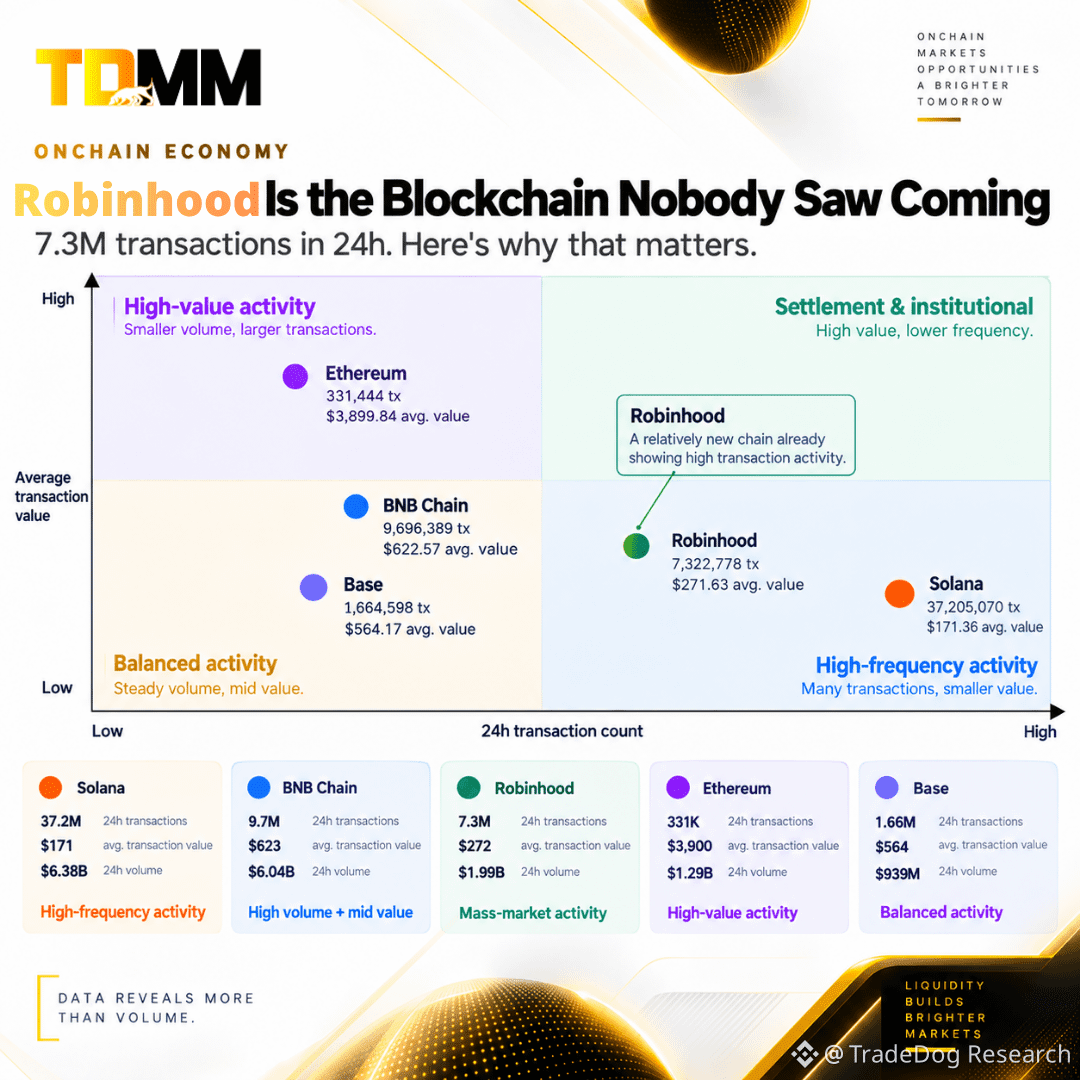
2
75
$PONS : Когда внимание достигает пика, история может измениться 👀
Перед пробоем цена, объем и уникальные трейдеры росли вместе.
Затем пришёл ATH.
📈 Цена взорвалась
📊 Объём резко вырос
👥 Уникальные трейдеры показали одно из самых сильных значений
Но следующее движение оказалось не ещё одним шагом выше.
Цена начала откатываться, пока активность оставалась повышенной.
Это важно.
Пиковое внимание ≠ гарантированный рост.
Иногда всплеск участия и объёма рядом с локальным максимумом может сигнализировать о том, что рынок переходит в другую фазу.
Для $PONS ключевой вопрос сейчас:
Уникальные трейдеры + объём начнут снова расти вместе с ценой или участие продолжит расходиться?
Следующий сигнал может прийти снизу графика, прежде чем появится на графике.
@tdmarketmaker @Square-Creator-50e191620
#PONS #MarketAnalysis #Altcoins #DeFi #CryptoTrading
$PONS : Когда внимание достигает пика, история может измениться 👀
Перед пробоем цена, объем и уникальные трейдеры росли вместе.
Затем пришёл ATH.
📈 Цена взорвалась
📊 Объём резко вырос
👥 Уникальные трейдеры показали одно из самых сильных значений
Но следующее движение оказалось не ещё одним шагом выше.
Цена начала откатываться, пока активность оставалась повышенной.
Это важно.
Пиковое внимание ≠ гарантированный рост.
Иногда всплеск участия и объёма рядом с локальным максимумом может сигнализировать о том, что рынок переходит в другую фазу.
Для $PONS ключевой вопрос сейчас:
Уникальные трейдеры + объём начнут снова расти вместе с ценой или участие продолжит расходиться?
Следующий сигнал может прийти снизу графика, прежде чем появится на графике.
@TDMM-TradeDog Market Maker @TradeDog Crypto Market Research
#PONS #MarketAnalysis #Altcoins #DeFi #CryptoTrading
Перед пробоем цена, объем и уникальные трейдеры росли вместе.
Затем пришёл ATH.
📈 Цена взорвалась
📊 Объём резко вырос
👥 Уникальные трейдеры показали одно из самых сильных значений
Но следующее движение оказалось не ещё одним шагом выше.
Цена начала откатываться, пока активность оставалась повышенной.
Это важно.
Пиковое внимание ≠ гарантированный рост.
Иногда всплеск участия и объёма рядом с локальным максимумом может сигнализировать о том, что рынок переходит в другую фазу.
Для $PONS ключевой вопрос сейчас:
Уникальные трейдеры + объём начнут снова расти вместе с ценой или участие продолжит расходиться?
Следующий сигнал может прийти снизу графика, прежде чем появится на графике.
@TDMM-TradeDog Market Maker @TradeDog Crypto Market Research
#PONS #MarketAnalysis #Altcoins #DeFi #CryptoTrading
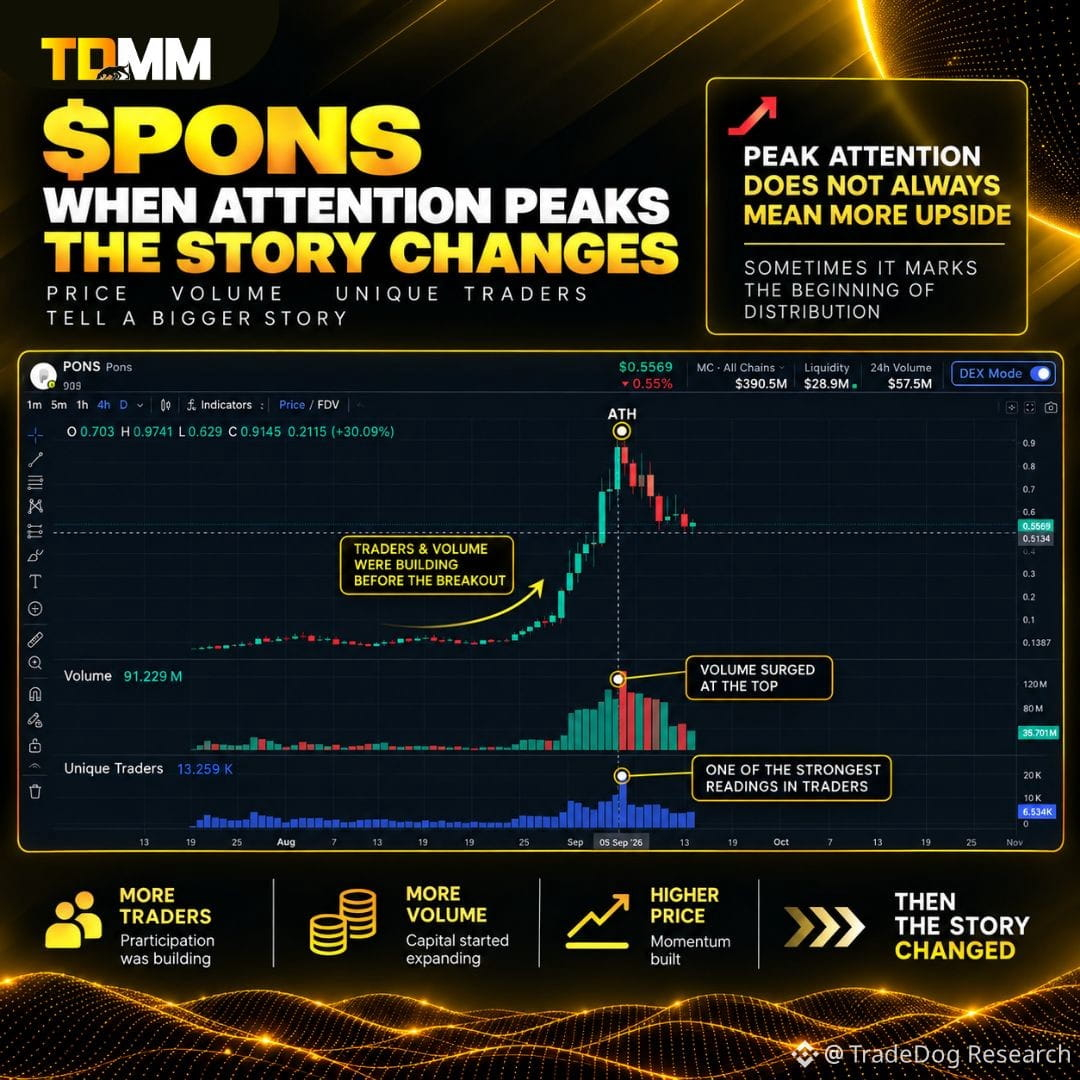
2
185
Ежедневная проверка пульса крипторынка от TDR
Coinbase Base достигает новых высот: 4 миллиона активных адресов
Давайте углубимся в детали:
Base, сеть Layer 2 (L2) @coinbase, построенная на блокчейне Ethereum, недавно достигла значительного рубежа, превысив 4 миллиона активных адресов, благодаря своей кампании «Onchain Summer».
Эта кампания Onchain Summer, первоначально запущенная в 2023 году и возобновленная в 2024 году, стала основной движущей силой роста @base. Кампания была разработана для стимулирования разработчиков и привлечения более широкого криптосообщества путем предложения вознаграждений, проведения мероприятий и поощрения креативности на платформе.
Выпуск 2024 года продолжил эту динамику, предложив 2 миллиона долларов вознаграждений (эквивалент 600 ETH) разработчикам, которые будут развивать сеть Base в период с июня по август.
С точки зрения будущих перспектив:
Заглядывая вперед, импульс, полученный от Onchain Summer, может продолжить продвигать Base вперед, особенно если Coinbase сможет продолжить внедрять инновации и привлекать разработчиков и пользователей на свою платформу.
Уроки, извлеченные из этой кампании, особенно в отношении разрешения споров и обеспечения целостности приложений на основе блокчейна, будут иметь решающее значение для дальнейшего развития Base.
Но это еще не все! Давайте углубимся в сегодняшние рыночные аналитики:
Глобальная капитализация рынка криптовалют: 2,2 триллиона долларов
Доминирование биткоина: 53,4% | Доминирование Ethereum: 14,2%
Лучшие игроки роста:
SUNDOG: +87,4%
LOKA: +59,2%
Лучшие игроки падения:
BRAINLET: -27,0%
CATDOG: -25,4%
Участвуйте в крупных текущих раздачах: @Curvance, @LineaBuild, @getgrass_io, @Sagaxyz__
Подпишитесь на @TradedogCrypto, чтобы быть в курсе последних и самых важных событий в мире криптовалют.
#Coinbase #Ethereum #Layer2 #Blockchain #OnchainSummer
Ежедневная проверка пульса крипторынка от TDR
Coinbase Base достигает новых высот: 4 миллиона активных адресов
Давайте углубимся в детали:
Base, сеть Layer 2 (L2) @coinbase, построенная на блокчейне Ethereum, недавно достигла значительного рубежа, превысив 4 миллиона активных адресов, благодаря своей кампании «Onchain Summer».
Эта кампания Onchain Summer, первоначально запущенная в 2023 году и возобновленная в 2024 году, стала основной движущей силой роста @base. Кампания была разработана для стимулирования разработчиков и привлечения более широкого криптосообщества путем предложения вознаграждений, проведения мероприятий и поощрения креативности на платформе.
Выпуск 2024 года продолжил эту динамику, предложив 2 миллиона долларов вознаграждений (эквивалент 600 ETH) разработчикам, которые будут развивать сеть Base в период с июня по август.
С точки зрения будущих перспектив:
Заглядывая вперед, импульс, полученный от Onchain Summer, может продолжить продвигать Base вперед, особенно если Coinbase сможет продолжить внедрять инновации и привлекать разработчиков и пользователей на свою платформу.
Уроки, извлеченные из этой кампании, особенно в отношении разрешения споров и обеспечения целостности приложений на основе блокчейна, будут иметь решающее значение для дальнейшего развития Base.
Но это еще не все! Давайте углубимся в сегодняшние рыночные аналитики:
Глобальная капитализация рынка криптовалют: 2,2 триллиона долларов
Доминирование биткоина: 53,4% | Доминирование Ethereum: 14,2%
Лучшие игроки роста:
SUNDOG: +87,4%
LOKA: +59,2%
Лучшие игроки падения:
BRAINLET: -27,0%
CATDOG: -25,4%
Участвуйте в крупных текущих раздачах: @Curvance, @LineaBuild, @getgrass_io, @Sagaxyz__
Подпишитесь на @TradedogCrypto, чтобы быть в курсе последних и самых важных событий в мире криптовалют.
#Coinbase #Ethereum #Layer2 #Blockchain #OnchainSummer
Coinbase Base достигает новых высот: 4 миллиона активных адресов
Давайте углубимся в детали:
Base, сеть Layer 2 (L2) @coinbase, построенная на блокчейне Ethereum, недавно достигла значительного рубежа, превысив 4 миллиона активных адресов, благодаря своей кампании «Onchain Summer».
Эта кампания Onchain Summer, первоначально запущенная в 2023 году и возобновленная в 2024 году, стала основной движущей силой роста @base. Кампания была разработана для стимулирования разработчиков и привлечения более широкого криптосообщества путем предложения вознаграждений, проведения мероприятий и поощрения креативности на платформе.
Выпуск 2024 года продолжил эту динамику, предложив 2 миллиона долларов вознаграждений (эквивалент 600 ETH) разработчикам, которые будут развивать сеть Base в период с июня по август.
С точки зрения будущих перспектив:
Заглядывая вперед, импульс, полученный от Onchain Summer, может продолжить продвигать Base вперед, особенно если Coinbase сможет продолжить внедрять инновации и привлекать разработчиков и пользователей на свою платформу.
Уроки, извлеченные из этой кампании, особенно в отношении разрешения споров и обеспечения целостности приложений на основе блокчейна, будут иметь решающее значение для дальнейшего развития Base.
Но это еще не все! Давайте углубимся в сегодняшние рыночные аналитики:
Глобальная капитализация рынка криптовалют: 2,2 триллиона долларов
Доминирование биткоина: 53,4% | Доминирование Ethereum: 14,2%
Лучшие игроки роста:
SUNDOG: +87,4%
LOKA: +59,2%
Лучшие игроки падения:
BRAINLET: -27,0%
CATDOG: -25,4%
Участвуйте в крупных текущих раздачах: @Curvance, @LineaBuild, @getgrass_io, @Sagaxyz__
Подпишитесь на @TradedogCrypto, чтобы быть в курсе последних и самых важных событий в мире криптовалют.
#Coinbase #Ethereum #Layer2 #Blockchain #OnchainSummer

3
284
Метавселенная теряет свой блеск?
Рынок земли метавселенной в 2024 году значительно упал, средние цены упали на 72% по сравнению с пиком.
Средние минимальные цены упали на 34% с 2023 года и на 55% с 2022 года.
Основные моменты проекта:
@TheSandboxGame: Цены упали на 95% с 2,86 ETH в 2021 году до 0,13 ETH в 2024 году.
NFTWorlds/TOPIA Worlds: Продемонстрировал устойчивость, упав на 45% благодаря поддержке сообщества и ребрендингу.
@SomniumSpace: Достиг пика в 2023 году на уровне 0,98 ETH, что обусловлено достижениями в области виртуальной реальности.
Факторы, влияющие на цены:
Волатильность рынка: Более широкий спад криптовалюты существенно повлиял на земли метавселенной.
Конкретные для проекта разработки: Инновации и уникальные ценностные предложения помогли некоторым проектам сохранить ценность.
Сила сообщества: Активное взаимодействие и усилия по ребрендингу смягчили спад.
Влияние внешнего рынка: Тенденции, такие как мемкойны, отвлекли внимание от земель метавселенной.
Перспективы на будущее:
Будущее цен на земли метавселенной будет зависеть от постоянных инноваций и более широких тенденций криптовалюты.
Как вы думаете, что ждет цены на земли метавселенной в будущем? Поделитесь своими мыслями ниже!
#Metaverse #VirtualRealEstate #NFT
Метавселенная теряет свой блеск?
Рынок земли метавселенной в 2024 году значительно упал, средние цены упали на 72% по сравнению с пиком.
Средние минимальные цены упали на 34% с 2023 года и на 55% с 2022 года.
Основные моменты проекта:
@TheSandboxGame: Цены упали на 95% с 2,86 ETH в 2021 году до 0,13 ETH в 2024 году.
NFTWorlds/TOPIA Worlds: Продемонстрировал устойчивость, упав на 45% благодаря поддержке сообщества и ребрендингу.
@SomniumSpace: Достиг пика в 2023 году на уровне 0,98 ETH, что обусловлено достижениями в области виртуальной реальности.
Факторы, влияющие на цены:
Волатильность рынка: Более широкий спад криптовалюты существенно повлиял на земли метавселенной.
Конкретные для проекта разработки: Инновации и уникальные ценностные предложения помогли некоторым проектам сохранить ценность.
Сила сообщества: Активное взаимодействие и усилия по ребрендингу смягчили спад.
Влияние внешнего рынка: Тенденции, такие как мемкойны, отвлекли внимание от земель метавселенной.
Перспективы на будущее:
Будущее цен на земли метавселенной будет зависеть от постоянных инноваций и более широких тенденций криптовалюты.
Как вы думаете, что ждет цены на земли метавселенной в будущем? Поделитесь своими мыслями ниже!
#Metaverse #VirtualRealEstate #NFT
Рынок земли метавселенной в 2024 году значительно упал, средние цены упали на 72% по сравнению с пиком.
Средние минимальные цены упали на 34% с 2023 года и на 55% с 2022 года.
Основные моменты проекта:
@TheSandboxGame: Цены упали на 95% с 2,86 ETH в 2021 году до 0,13 ETH в 2024 году.
NFTWorlds/TOPIA Worlds: Продемонстрировал устойчивость, упав на 45% благодаря поддержке сообщества и ребрендингу.
@SomniumSpace: Достиг пика в 2023 году на уровне 0,98 ETH, что обусловлено достижениями в области виртуальной реальности.
Факторы, влияющие на цены:
Волатильность рынка: Более широкий спад криптовалюты существенно повлиял на земли метавселенной.
Конкретные для проекта разработки: Инновации и уникальные ценностные предложения помогли некоторым проектам сохранить ценность.
Сила сообщества: Активное взаимодействие и усилия по ребрендингу смягчили спад.
Влияние внешнего рынка: Тенденции, такие как мемкойны, отвлекли внимание от земель метавселенной.
Перспективы на будущее:
Будущее цен на земли метавселенной будет зависеть от постоянных инноваций и более широких тенденций криптовалюты.
Как вы думаете, что ждет цены на земли метавселенной в будущем? Поделитесь своими мыслями ниже!
#Metaverse #VirtualRealEstate #NFT

1
1.4k
Пока все говорят о шторме на фондовых и криптовалютных рынках, мы решили обрисовать ситуацию на рынке NFT.
📊
Цифры и статистика
Капитализация рынка: $57,5 млрд
Дневной объем торгов: $9,5 млрд
Топовые коллекции по капитализации:
@cryptopunksnfts: $524 млн
@LibertyCatsBTC: $513 млн
@BoredApeYC: $218 млн
@pudgypenguins: $178 млн
@Azuki: $99 млн
Коррекции рынка
Рынок NFT пережил значительный спад, при этом капитализация упала до $34 млрд в самой низкой точке, что во многом обусловлено более широким рынком криптовалют.
Влияние мемекойнов
Мемекойны отвлекли внимание и капитал от NFT, что привело к резкому падению рыночной капитализации с 348 млрд долларов в январе 2024 года до 159 млрд долларов в марте 2024 года.
Новые тенденции
NFT, ориентированные на полезность: возросший интерес к NFT, связанный с токенизацией реальных активов. Интеграция игр: крупные компании, такие как Square Enix, все чаще принимают NFT. Гибридные NFT: растущая популярность токенов, объединяющих физические и цифровые активы.
Перспективы на будущее
Хотя следующий бычий забег может сделать акцент на NFT, ориентированных на полезность, и токенизации реальных активов, значительный рост рынка остается неопределенным из-за текущих условий.
Рынок NFT развивается, уделяя особое внимание полезности и реальным активам, но он сталкивается с проблемами со стороны мемекойнов и волатильности рынка.
Давайте подождем и посмотрим, что будет дальше. Оставьте свои мысли ниже
👇
#NFTMarket #CryptoNewss #MarketTrends
Пока все говорят о шторме на фондовых и криптовалютных рынках, мы решили обрисовать ситуацию на рынке NFT.
📊
Цифры и статистика
Капитализация рынка: $57,5 млрд
Дневной объем торгов: $9,5 млрд
Топовые коллекции по капитализации:
@cryptopunksnfts: $524 млн
@LibertyCatsBTC: $513 млн
@BoredApeYC: $218 млн
@pudgypenguins: $178 млн
@Azuki: $99 млн
Коррекции рынка
Рынок NFT пережил значительный спад, при этом капитализация упала до $34 млрд в самой низкой точке, что во многом обусловлено более широким рынком криптовалют.
Влияние мемекойнов
Мемекойны отвлекли внимание и капитал от NFT, что привело к резкому падению рыночной капитализации с 348 млрд долларов в январе 2024 года до 159 млрд долларов в марте 2024 года.
Новые тенденции
NFT, ориентированные на полезность: возросший интерес к NFT, связанный с токенизацией реальных активов. Интеграция игр: крупные компании, такие как Square Enix, все чаще принимают NFT. Гибридные NFT: растущая популярность токенов, объединяющих физические и цифровые активы.
Перспективы на будущее
Хотя следующий бычий забег может сделать акцент на NFT, ориентированных на полезность, и токенизации реальных активов, значительный рост рынка остается неопределенным из-за текущих условий.
Рынок NFT развивается, уделяя особое внимание полезности и реальным активам, но он сталкивается с проблемами со стороны мемекойнов и волатильности рынка.
Давайте подождем и посмотрим, что будет дальше. Оставьте свои мысли ниже
👇
#NFTMarket #CryptoNewss #MarketTrends
📊
Цифры и статистика
Капитализация рынка: $57,5 млрд
Дневной объем торгов: $9,5 млрд
Топовые коллекции по капитализации:
@cryptopunksnfts: $524 млн
@LibertyCatsBTC: $513 млн
@BoredApeYC: $218 млн
@pudgypenguins: $178 млн
@Azuki: $99 млн
Коррекции рынка
Рынок NFT пережил значительный спад, при этом капитализация упала до $34 млрд в самой низкой точке, что во многом обусловлено более широким рынком криптовалют.
Влияние мемекойнов
Мемекойны отвлекли внимание и капитал от NFT, что привело к резкому падению рыночной капитализации с 348 млрд долларов в январе 2024 года до 159 млрд долларов в марте 2024 года.
Новые тенденции
NFT, ориентированные на полезность: возросший интерес к NFT, связанный с токенизацией реальных активов. Интеграция игр: крупные компании, такие как Square Enix, все чаще принимают NFT. Гибридные NFT: растущая популярность токенов, объединяющих физические и цифровые активы.
Перспективы на будущее
Хотя следующий бычий забег может сделать акцент на NFT, ориентированных на полезность, и токенизации реальных активов, значительный рост рынка остается неопределенным из-за текущих условий.
Рынок NFT развивается, уделяя особое внимание полезности и реальным активам, но он сталкивается с проблемами со стороны мемекойнов и волатильности рынка.
Давайте подождем и посмотрим, что будет дальше. Оставьте свои мысли ниже
👇
#NFTMarket #CryptoNewss #MarketTrends

1
450
Определите свой стиль торговли!
Почему это важно: Важно согласовать свою торговую стратегию с вашей личностью, толерантностью к риску и временными затратами.
Знание того, являетесь ли вы скальпером, дневным трейдером или свинг-трейдером, поможет вам принимать обоснованные решения, справляться со стрессом и оптимизировать свой подход к торговле.
Вот более подробный обзор каждого стиля торговли
👇
Скальпер: быстрые сделки, высокий стресс, высокий риск.
Дневной трейдер: ежедневные сделки, умеренный или высокий риск, требует полного внимания.
Свинг-трейдер: удерживает позиции в течение дней/недель, низкий уровень стресса, требует терпения.
Общий вывод:
У каждого стиля есть уникальные проблемы и награды. Выберите то, что соответствует вашей толерантности к риску и образу жизни.
Какой стиль торговли подходит вам больше всего?
#Торговля #Скальпинг #Дневная торговля #Свинг-торговля
Определите свой стиль торговли!
Почему это важно: Важно согласовать свою торговую стратегию с вашей личностью, толерантностью к риску и временными затратами.
Знание того, являетесь ли вы скальпером, дневным трейдером или свинг-трейдером, поможет вам принимать обоснованные решения, справляться со стрессом и оптимизировать свой подход к торговле.
Вот более подробный обзор каждого стиля торговли
👇
Скальпер: быстрые сделки, высокий стресс, высокий риск.
Дневной трейдер: ежедневные сделки, умеренный или высокий риск, требует полного внимания.
Свинг-трейдер: удерживает позиции в течение дней/недель, низкий уровень стресса, требует терпения.
Общий вывод:
У каждого стиля есть уникальные проблемы и награды. Выберите то, что соответствует вашей толерантности к риску и образу жизни.
Какой стиль торговли подходит вам больше всего?
#Торговля #Скальпинг #Дневная торговля #Свинг-торговля
Почему это важно: Важно согласовать свою торговую стратегию с вашей личностью, толерантностью к риску и временными затратами.
Знание того, являетесь ли вы скальпером, дневным трейдером или свинг-трейдером, поможет вам принимать обоснованные решения, справляться со стрессом и оптимизировать свой подход к торговле.
Вот более подробный обзор каждого стиля торговли
👇
Скальпер: быстрые сделки, высокий стресс, высокий риск.
Дневной трейдер: ежедневные сделки, умеренный или высокий риск, требует полного внимания.
Свинг-трейдер: удерживает позиции в течение дней/недель, низкий уровень стресса, требует терпения.
Общий вывод:
У каждого стиля есть уникальные проблемы и награды. Выберите то, что соответствует вашей толерантности к риску и образу жизни.
Какой стиль торговли подходит вам больше всего?
#Торговля #Скальпинг #Дневная торговля #Свинг-торговля

12
𝗪𝗵𝗶𝗰𝗵 𝗣𝗿𝗼𝗷𝗲𝗰𝘁𝘀 𝗦𝘁𝗼𝗹𝗲 𝘁𝗵𝗲 𝗜𝗻𝘃𝗲𝘀𝘁𝗼𝗿'𝘀 𝗦𝗽𝗼𝘁𝗹𝗶𝗴𝗵𝘁 𝗟𝗮𝘀𝘁 𝗪𝗲𝗲𝗸?
Давайте посмотрим👇
- Particle Network - Решение блокчейна уровня 1.
𝗥𝗮𝗶𝘀𝗲𝗱 𝗔𝗺𝗼𝘂𝗻𝘁: Будет раскрыто
- Pichi Finance - Сосредоточены на создании протокола торговли точками без доверия.
𝗥𝗮𝗶𝘀𝗲𝗱 𝗔𝗺𝗼𝘂𝗻𝘁: 2,5 млн долларов
- Morpho Labs - Лидер в области передовых решений по ликвидности и децентрализованных приложений.
𝗥𝗮𝗶𝘀𝗲𝗱 𝗔𝗺𝗼𝘂𝗻𝘁: 50 млн долларов
- Breakout - Стартап, сосредоточенный на революции в финансовом и банковском секторах с помощью передовых технологических решений.
𝗥𝗮𝗶𝘀𝗲𝗱 𝗔𝗺𝗼𝘂𝗻𝘁: 4,5 млн долларов США
- Layer2 Financial - стремится преодолеть разрыв между традиционными финансовыми системами и технологией блокчейна за счет улучшения платежных систем и финансовых услуг.
𝗥𝗮𝗶𝘀𝗲𝗱 𝗔𝗺𝗼𝘂𝗻𝘁: 10,7 млн долларов США
Эти проекты подчеркивают растущий интерес и инвестиции в блокчейн и децентрализованные финансовые решения, каждый из которых направлен на решение конкретных проблем в экосистеме и стимулирование дальнейших инноваций.
Какой проект вы считаете наиболее перспективным?
Дайте нам знать в комментариях!
#Crypto #Blockchain #DEFİ #Investment #Innovation
𝗪𝗵𝗶𝗰𝗵 𝗣𝗿𝗼𝗷𝗲𝗰𝘁𝘀 𝗦𝘁𝗼𝗹𝗲 𝘁𝗵𝗲 𝗜𝗻𝘃𝗲𝘀𝘁𝗼𝗿'𝘀 𝗦𝗽𝗼𝘁𝗹𝗶𝗴𝗵𝘁 𝗟𝗮𝘀𝘁 𝗪𝗲𝗲𝗸?
Давайте посмотрим👇
- Particle Network - Решение блокчейна уровня 1.
𝗥𝗮𝗶𝘀𝗲𝗱 𝗔𝗺𝗼𝘂𝗻𝘁: Будет раскрыто
- Pichi Finance - Сосредоточены на создании протокола торговли точками без доверия.
𝗥𝗮𝗶𝘀𝗲𝗱 𝗔𝗺𝗼𝘂𝗻𝘁: 2,5 млн долларов
- Morpho Labs - Лидер в области передовых решений по ликвидности и децентрализованных приложений.
𝗥𝗮𝗶𝘀𝗲𝗱 𝗔𝗺𝗼𝘂𝗻𝘁: 50 млн долларов
- Breakout - Стартап, сосредоточенный на революции в финансовом и банковском секторах с помощью передовых технологических решений.
𝗥𝗮𝗶𝘀𝗲𝗱 𝗔𝗺𝗼𝘂𝗻𝘁: 4,5 млн долларов США
- Layer2 Financial - стремится преодолеть разрыв между традиционными финансовыми системами и технологией блокчейна за счет улучшения платежных систем и финансовых услуг.
𝗥𝗮𝗶𝘀𝗲𝗱 𝗔𝗺𝗼𝘂𝗻𝘁: 10,7 млн долларов США
Эти проекты подчеркивают растущий интерес и инвестиции в блокчейн и децентрализованные финансовые решения, каждый из которых направлен на решение конкретных проблем в экосистеме и стимулирование дальнейших инноваций.
Какой проект вы считаете наиболее перспективным?
Дайте нам знать в комментариях!
#Crypto #Blockchain #DEFİ #Investment #Innovation
Давайте посмотрим👇
- Particle Network - Решение блокчейна уровня 1.
𝗥𝗮𝗶𝘀𝗲𝗱 𝗔𝗺𝗼𝘂𝗻𝘁: Будет раскрыто
- Pichi Finance - Сосредоточены на создании протокола торговли точками без доверия.
𝗥𝗮𝗶𝘀𝗲𝗱 𝗔𝗺𝗼𝘂𝗻𝘁: 2,5 млн долларов
- Morpho Labs - Лидер в области передовых решений по ликвидности и децентрализованных приложений.
𝗥𝗮𝗶𝘀𝗲𝗱 𝗔𝗺𝗼𝘂𝗻𝘁: 50 млн долларов
- Breakout - Стартап, сосредоточенный на революции в финансовом и банковском секторах с помощью передовых технологических решений.
𝗥𝗮𝗶𝘀𝗲𝗱 𝗔𝗺𝗼𝘂𝗻𝘁: 4,5 млн долларов США
- Layer2 Financial - стремится преодолеть разрыв между традиционными финансовыми системами и технологией блокчейна за счет улучшения платежных систем и финансовых услуг.
𝗥𝗮𝗶𝘀𝗲𝗱 𝗔𝗺𝗼𝘂𝗻𝘁: 10,7 млн долларов США
Эти проекты подчеркивают растущий интерес и инвестиции в блокчейн и децентрализованные финансовые решения, каждый из которых направлен на решение конкретных проблем в экосистеме и стимулирование дальнейших инноваций.
Какой проект вы считаете наиболее перспективным?
Дайте нам знать в комментариях!
#Crypto #Blockchain #DEFİ #Investment #Innovation

1
232
Безопасна ли ваша любимая криптовалюта? 🛡️
Чтобы оставаться впереди в мире криптовалют, крайне важно узнавать о потенциальных взломах и текущих разработках.
Сегодня давайте углубимся в тему атак 51%.
Что такое атака 51%?
Это происходит, когда человек или группа контролируют более 50% хэш-мощности блокчейна, что позволяет им вмешиваться в транзакции.
Как это работает:
- Доминирование скорости хеширования: злоумышленник контролирует большую часть скорости хеширования сети.
- Двойные расходы: они могут отменить транзакции и включить двойные расходы.
- Блокирование помех: они могут блокировать получение подтверждений новым транзакциям.
- Монополия майнинга: они монополизируют майнинг, не позволяя другим майнерам генерировать блоки и получать вознаграждения.
Исторические примеры:
- Bitcoin Gold (2018): подвергся атаке 51%, в результате которой были дважды потрачены монеты на сумму 18 миллионов долларов.
- Ethereum Classic (2019): подвергся нескольким атакам 51%, что привело к двойному расходованию тысяч ETC.
- Verge (2018 г.): столкнулся с атакой, которая привела к созданию миллионов XVG посредством манипуляций с блокчейном.
Какие меры можно предпринять для профилактики?
- Увеличение скорости хеширования сети: усложняет контроль 51% одной организации.
- Proof-of-Stake (PoS): безопасность, основанная на количестве хранимой криптовалюты, а не на вычислительной мощности.
- Расширенный мониторинг: постоянный мониторинг сети на предмет необычного поведения майнинга.
- Децентрализация: продвигайте децентрализацию майнинговых пулов, чтобы избежать концентрации майнинговых мощностей.
Если эта информация оказалась для вас полезной, поставьте лайк, сделайте репост и поделитесь ею со своими знакомыми.
#Криптобезопасность #Блокчейн
Безопасна ли ваша любимая криптовалюта? 🛡️
Чтобы оставаться впереди в мире криптовалют, крайне важно узнавать о потенциальных взломах и текущих разработках.
Сегодня давайте углубимся в тему атак 51%.
Что такое атака 51%?
Это происходит, когда человек или группа контролируют более 50% хэш-мощности блокчейна, что позволяет им вмешиваться в транзакции.
Как это работает:
- Доминирование скорости хеширования: злоумышленник контролирует большую часть скорости хеширования сети.
- Двойные расходы: они могут отменить транзакции и включить двойные расходы.
- Блокирование помех: они могут блокировать получение подтверждений новым транзакциям.
- Монополия майнинга: они монополизируют майнинг, не позволяя другим майнерам генерировать блоки и получать вознаграждения.
Исторические примеры:
- Bitcoin Gold (2018): подвергся атаке 51%, в результате которой были дважды потрачены монеты на сумму 18 миллионов долларов.
- Ethereum Classic (2019): подвергся нескольким атакам 51%, что привело к двойному расходованию тысяч ETC.
- Verge (2018 г.): столкнулся с атакой, которая привела к созданию миллионов XVG посредством манипуляций с блокчейном.
Какие меры можно предпринять для профилактики?
- Увеличение скорости хеширования сети: усложняет контроль 51% одной организации.
- Proof-of-Stake (PoS): безопасность, основанная на количестве хранимой криптовалюты, а не на вычислительной мощности.
- Расширенный мониторинг: постоянный мониторинг сети на предмет необычного поведения майнинга.
- Децентрализация: продвигайте децентрализацию майнинговых пулов, чтобы избежать концентрации майнинговых мощностей.
Если эта информация оказалась для вас полезной, поставьте лайк, сделайте репост и поделитесь ею со своими знакомыми.
#Криптобезопасность #Блокчейн
Чтобы оставаться впереди в мире криптовалют, крайне важно узнавать о потенциальных взломах и текущих разработках.
Сегодня давайте углубимся в тему атак 51%.
Что такое атака 51%?
Это происходит, когда человек или группа контролируют более 50% хэш-мощности блокчейна, что позволяет им вмешиваться в транзакции.
Как это работает:
- Доминирование скорости хеширования: злоумышленник контролирует большую часть скорости хеширования сети.
- Двойные расходы: они могут отменить транзакции и включить двойные расходы.
- Блокирование помех: они могут блокировать получение подтверждений новым транзакциям.
- Монополия майнинга: они монополизируют майнинг, не позволяя другим майнерам генерировать блоки и получать вознаграждения.
Исторические примеры:
- Bitcoin Gold (2018): подвергся атаке 51%, в результате которой были дважды потрачены монеты на сумму 18 миллионов долларов.
- Ethereum Classic (2019): подвергся нескольким атакам 51%, что привело к двойному расходованию тысяч ETC.
- Verge (2018 г.): столкнулся с атакой, которая привела к созданию миллионов XVG посредством манипуляций с блокчейном.
Какие меры можно предпринять для профилактики?
- Увеличение скорости хеширования сети: усложняет контроль 51% одной организации.
- Proof-of-Stake (PoS): безопасность, основанная на количестве хранимой криптовалюты, а не на вычислительной мощности.
- Расширенный мониторинг: постоянный мониторинг сети на предмет необычного поведения майнинга.
- Децентрализация: продвигайте децентрализацию майнинговых пулов, чтобы избежать концентрации майнинговых мощностей.
Если эта информация оказалась для вас полезной, поставьте лайк, сделайте репост и поделитесь ею со своими знакомыми.
#Криптобезопасность #Блокчейн

3
4.6k
Влияют ли ваши эмоции на ваши инвестиции в криптовалюту?
В каком-то смысле это касается всех нас; нет смысла отрицать это.
Но как? Давайте обсудим весь цикл эмоций.
Эйфория: Пиковые рыночные цены создают ощущение непобедимости и жадности.
Основное поведение: Активные покупки по высоким ценам, часто без учета рисков.
Надежда: Начальная фаза, когда трейдеры выходят на рынок с оптимизмом и большими ожиданиями будущей прибыли.
Основное поведение: покупка активов на основе положительных новостей, слухов или первоначального инвестиционного успеха.
Оптимизм. Поскольку цены начинают расти, трейдеры с оптимизмом смотрят на свои инвестиции.
Основное поведение: увеличение количества покупок и удержаний, укрепление веры в потенциал рынка.
Острые ощущения: значительное повышение цен вызывает волнение и острые ощущения.
Основное поведение: более агрессивные покупки, иногда использование кредитного плеча для максимизации прибыли.
Тревога: рыночные цены начинают снижаться, заставляя трейдеров беспокоиться о своих инвестициях.
Основное поведение: нерешительность продавать в надежде, что цены восстановятся.
Отрицание: продолжающееся падение цен приводит к отрицанию, поскольку трейдеры полагают, что это временная неудача.
Базовое поведение: удерживать инвестиции, несмотря на потери, в ожидании восстановления.
Паника. Постоянное снижение вызывает панику, поскольку трейдеры осознают значительные потери.
Основное поведение: срочная продажа, чтобы сократить убытки, часто со значительными потерями.
Капитуляция: массовые продажи и выходы с рынка, указывающие на самую низкую точку цикла.
Основное поведение: продажа оставшихся активов, выход с рынка и принятие убытков.
Надежда: Рынок стабилизируется и демонстрирует признаки восстановления, вновь разжигая надежду среди трейдеров.
Базовое поведение: осторожный повторный вход на рынок и начало нового цикла.
Как вы думаете, на каком этапе вы сейчас находитесь?🤔
#CryptoTrader #MarketCycle
Влияют ли ваши эмоции на ваши инвестиции в криптовалюту?
В каком-то смысле это касается всех нас; нет смысла отрицать это.
Но как? Давайте обсудим весь цикл эмоций.
Эйфория: Пиковые рыночные цены создают ощущение непобедимости и жадности.
Основное поведение: Активные покупки по высоким ценам, часто без учета рисков.
Надежда: Начальная фаза, когда трейдеры выходят на рынок с оптимизмом и большими ожиданиями будущей прибыли.
Основное поведение: покупка активов на основе положительных новостей, слухов или первоначального инвестиционного успеха.
Оптимизм. Поскольку цены начинают расти, трейдеры с оптимизмом смотрят на свои инвестиции.
Основное поведение: увеличение количества покупок и удержаний, укрепление веры в потенциал рынка.
Острые ощущения: значительное повышение цен вызывает волнение и острые ощущения.
Основное поведение: более агрессивные покупки, иногда использование кредитного плеча для максимизации прибыли.
Тревога: рыночные цены начинают снижаться, заставляя трейдеров беспокоиться о своих инвестициях.
Основное поведение: нерешительность продавать в надежде, что цены восстановятся.
Отрицание: продолжающееся падение цен приводит к отрицанию, поскольку трейдеры полагают, что это временная неудача.
Базовое поведение: удерживать инвестиции, несмотря на потери, в ожидании восстановления.
Паника. Постоянное снижение вызывает панику, поскольку трейдеры осознают значительные потери.
Основное поведение: срочная продажа, чтобы сократить убытки, часто со значительными потерями.
Капитуляция: массовые продажи и выходы с рынка, указывающие на самую низкую точку цикла.
Основное поведение: продажа оставшихся активов, выход с рынка и принятие убытков.
Надежда: Рынок стабилизируется и демонстрирует признаки восстановления, вновь разжигая надежду среди трейдеров.
Базовое поведение: осторожный повторный вход на рынок и начало нового цикла.
Как вы думаете, на каком этапе вы сейчас находитесь?🤔
#CryptoTrader #MarketCycle
В каком-то смысле это касается всех нас; нет смысла отрицать это.
Но как? Давайте обсудим весь цикл эмоций.
Эйфория: Пиковые рыночные цены создают ощущение непобедимости и жадности.
Основное поведение: Активные покупки по высоким ценам, часто без учета рисков.
Надежда: Начальная фаза, когда трейдеры выходят на рынок с оптимизмом и большими ожиданиями будущей прибыли.
Основное поведение: покупка активов на основе положительных новостей, слухов или первоначального инвестиционного успеха.
Оптимизм. Поскольку цены начинают расти, трейдеры с оптимизмом смотрят на свои инвестиции.
Основное поведение: увеличение количества покупок и удержаний, укрепление веры в потенциал рынка.
Острые ощущения: значительное повышение цен вызывает волнение и острые ощущения.
Основное поведение: более агрессивные покупки, иногда использование кредитного плеча для максимизации прибыли.
Тревога: рыночные цены начинают снижаться, заставляя трейдеров беспокоиться о своих инвестициях.
Основное поведение: нерешительность продавать в надежде, что цены восстановятся.
Отрицание: продолжающееся падение цен приводит к отрицанию, поскольку трейдеры полагают, что это временная неудача.
Базовое поведение: удерживать инвестиции, несмотря на потери, в ожидании восстановления.
Паника. Постоянное снижение вызывает панику, поскольку трейдеры осознают значительные потери.
Основное поведение: срочная продажа, чтобы сократить убытки, часто со значительными потерями.
Капитуляция: массовые продажи и выходы с рынка, указывающие на самую низкую точку цикла.
Основное поведение: продажа оставшихся активов, выход с рынка и принятие убытков.
Надежда: Рынок стабилизируется и демонстрирует признаки восстановления, вновь разжигая надежду среди трейдеров.
Базовое поведение: осторожный повторный вход на рынок и начало нового цикла.
Как вы думаете, на каком этапе вы сейчас находитесь?🤔
#CryptoTrader #MarketCycle

532
Вы когда-нибудь задумывались, как zkRollups работает и приносит реальную пользу блокчейну?
🤔
Прежде чем углубляться в то, как они на самом деле работают, давайте сначала рассмотрим, что такое zkRollup:
ZK-Rollup — это объединение, в котором валидаторы подтверждают подлинность транзакции, не раскрывая никаких подробностей транзакции.
Теперь давайте углубимся в то, как на самом деле работает zkRollups!
Как работают zkRollup:
1. Пакетные транзакции (L2): несколько транзакций объединяются вместе, что снижает нагрузку на основной блокчейн за счет их обработки вне цепочки.
2. Выполнение (L2). Пакетные транзакции выполняются секвенсором, обновляя состояние цепочки уровня 2.
3. Tx, State Diff и т. д. (L2): генерирует транзакцию (Tx) и разницу состояний (diff), отражающую изменения в балансах счетов и смарт-контрактах.
4. Создать доказательство (L2): генерируется доказательство с нулевым разглашением (zk доказательство), проверяющее правильность транзакций без раскрытия деталей.
5. Отправка в цепочку L1. Доказательство zk отправляется в блокчейн уровня 1, обновляя его новым состоянием и проверяя все транзакции в пакете.
6. Проверка (цепочка L1). Контракт объединения на уровне 1 проверяет доказательство zk, обеспечивая целостность пакетных транзакций.
7. Обновлять или нет (цепочка L1): на основе проверки основное состояние блокчейна обновляется или отклоняется, обеспечивая безопасность и точность.
Преимущества zkRollups:
- Масштабируемость: увеличивает пропускную способность транзакций и уменьшает перегрузки за счет обработки вне цепочки.
- Снижение затрат: значительно снижает комиссию за транзакции за счет регистрации меньшего количества транзакций в цепочке.
- Безопасность: наследует безопасность основного блокчейна.
- Конфиденциальность: проверяет транзакции без раскрытия конфиденциальной информации.
Ждите нашего следующего поста, в котором мы подробно расскажем о zkRollup!
Прокомментируйте ниже, насколько вы взволнованы.
#BlockchainMilestone #Crypto #zkRollups #CryptoInnovation #DeFi
Вы когда-нибудь задумывались, как zkRollups работает и приносит реальную пользу блокчейну?
🤔
Прежде чем углубляться в то, как они на самом деле работают, давайте сначала рассмотрим, что такое zkRollup:
ZK-Rollup — это объединение, в котором валидаторы подтверждают подлинность транзакции, не раскрывая никаких подробностей транзакции.
Теперь давайте углубимся в то, как на самом деле работает zkRollups!
Как работают zkRollup:
1. Пакетные транзакции (L2): несколько транзакций объединяются вместе, что снижает нагрузку на основной блокчейн за счет их обработки вне цепочки.
2. Выполнение (L2). Пакетные транзакции выполняются секвенсором, обновляя состояние цепочки уровня 2.
3. Tx, State Diff и т. д. (L2): генерирует транзакцию (Tx) и разницу состояний (diff), отражающую изменения в балансах счетов и смарт-контрактах.
4. Создать доказательство (L2): генерируется доказательство с нулевым разглашением (zk доказательство), проверяющее правильность транзакций без раскрытия деталей.
5. Отправка в цепочку L1. Доказательство zk отправляется в блокчейн уровня 1, обновляя его новым состоянием и проверяя все транзакции в пакете.
6. Проверка (цепочка L1). Контракт объединения на уровне 1 проверяет доказательство zk, обеспечивая целостность пакетных транзакций.
7. Обновлять или нет (цепочка L1): на основе проверки основное состояние блокчейна обновляется или отклоняется, обеспечивая безопасность и точность.
Преимущества zkRollups:
- Масштабируемость: увеличивает пропускную способность транзакций и уменьшает перегрузки за счет обработки вне цепочки.
- Снижение затрат: значительно снижает комиссию за транзакции за счет регистрации меньшего количества транзакций в цепочке.
- Безопасность: наследует безопасность основного блокчейна.
- Конфиденциальность: проверяет транзакции без раскрытия конфиденциальной информации.
Ждите нашего следующего поста, в котором мы подробно расскажем о zkRollup!
Прокомментируйте ниже, насколько вы взволнованы.
#BlockchainMilestone #Crypto #zkRollups #CryptoInnovation #DeFi
🤔
Прежде чем углубляться в то, как они на самом деле работают, давайте сначала рассмотрим, что такое zkRollup:
ZK-Rollup — это объединение, в котором валидаторы подтверждают подлинность транзакции, не раскрывая никаких подробностей транзакции.
Теперь давайте углубимся в то, как на самом деле работает zkRollups!
Как работают zkRollup:
1. Пакетные транзакции (L2): несколько транзакций объединяются вместе, что снижает нагрузку на основной блокчейн за счет их обработки вне цепочки.
2. Выполнение (L2). Пакетные транзакции выполняются секвенсором, обновляя состояние цепочки уровня 2.
3. Tx, State Diff и т. д. (L2): генерирует транзакцию (Tx) и разницу состояний (diff), отражающую изменения в балансах счетов и смарт-контрактах.
4. Создать доказательство (L2): генерируется доказательство с нулевым разглашением (zk доказательство), проверяющее правильность транзакций без раскрытия деталей.
5. Отправка в цепочку L1. Доказательство zk отправляется в блокчейн уровня 1, обновляя его новым состоянием и проверяя все транзакции в пакете.
6. Проверка (цепочка L1). Контракт объединения на уровне 1 проверяет доказательство zk, обеспечивая целостность пакетных транзакций.
7. Обновлять или нет (цепочка L1): на основе проверки основное состояние блокчейна обновляется или отклоняется, обеспечивая безопасность и точность.
Преимущества zkRollups:
- Масштабируемость: увеличивает пропускную способность транзакций и уменьшает перегрузки за счет обработки вне цепочки.
- Снижение затрат: значительно снижает комиссию за транзакции за счет регистрации меньшего количества транзакций в цепочке.
- Безопасность: наследует безопасность основного блокчейна.
- Конфиденциальность: проверяет транзакции без раскрытия конфиденциальной информации.
Ждите нашего следующего поста, в котором мы подробно расскажем о zkRollup!
Прокомментируйте ниже, насколько вы взволнованы.
#BlockchainMilestone #Crypto #zkRollups #CryptoInnovation #DeFi

362
🚀 𝗖𝗿𝘆𝗽𝘁𝗼 𝗠𝗮𝗿𝗸𝗲𝘁 𝗣𝘂𝗹𝘀𝗲 𝗖𝗵𝗲𝗰𝗸 𝗯𝘆 𝗧𝗿𝗮𝗱 𝗲𝗗𝗼𝗴
Погрузитесь в сегодняшние главные события, настроения рынка и последние новости! С 𝗚𝗹𝗼𝗯𝗮𝗹 𝗖𝗿𝘆𝗽𝘁𝗼 𝗠𝗮𝗿𝗸𝗲𝘁 𝗖𝗮𝗽 на $2,4 триллиона и 𝗕𝗶𝘁𝗰𝗼 𝗶𝗻 𝗱𝗼𝗺𝗶𝗻𝗮𝗻𝗰𝗲 на уровне 53% рынок демонстрирует значительную активность.
Крупные достижения для 𝗔𝘂𝗿𝗮 и 𝗙𝘄𝗼𝗴, но трудный день для 𝗞𝘂𝗷𝗶𝗿𝗮 и 𝗞𝗲𝗻𝗱𝘂 𝗜𝗻𝘂. Кроме того, не пропустите последние раздачи и обновление взлома 𝗖𝗼𝗻𝘃𝗲𝗿𝗴𝗲𝗻𝗰𝗲.
Какова ваша стратегия на этом динамичном рынке? Поделитесь своими мыслями ниже👇
#CryptoMarket #Bitcoin #Ethereum #CryptoNews #DeFi
🚀 𝗖𝗿𝘆𝗽𝘁𝗼 𝗠𝗮𝗿𝗸𝗲𝘁 𝗣𝘂𝗹𝘀𝗲 𝗖𝗵𝗲𝗰𝗸 𝗯𝘆 𝗧𝗿𝗮𝗱 𝗲𝗗𝗼𝗴
Погрузитесь в сегодняшние главные события, настроения рынка и последние новости! С 𝗚𝗹𝗼𝗯𝗮𝗹 𝗖𝗿𝘆𝗽𝘁𝗼 𝗠𝗮𝗿𝗸𝗲𝘁 𝗖𝗮𝗽 на $2,4 триллиона и 𝗕𝗶𝘁𝗰𝗼 𝗶𝗻 𝗱𝗼𝗺𝗶𝗻𝗮𝗻𝗰𝗲 на уровне 53% рынок демонстрирует значительную активность.
Крупные достижения для 𝗔𝘂𝗿𝗮 и 𝗙𝘄𝗼𝗴, но трудный день для 𝗞𝘂𝗷𝗶𝗿𝗮 и 𝗞𝗲𝗻𝗱𝘂 𝗜𝗻𝘂. Кроме того, не пропустите последние раздачи и обновление взлома 𝗖𝗼𝗻𝘃𝗲𝗿𝗴𝗲𝗻𝗰𝗲.
Какова ваша стратегия на этом динамичном рынке? Поделитесь своими мыслями ниже👇
#CryptoMarket #Bitcoin #Ethereum #CryptoNews #DeFi
Погрузитесь в сегодняшние главные события, настроения рынка и последние новости! С 𝗚𝗹𝗼𝗯𝗮𝗹 𝗖𝗿𝘆𝗽𝘁𝗼 𝗠𝗮𝗿𝗸𝗲𝘁 𝗖𝗮𝗽 на $2,4 триллиона и 𝗕𝗶𝘁𝗰𝗼 𝗶𝗻 𝗱𝗼𝗺𝗶𝗻𝗮𝗻𝗰𝗲 на уровне 53% рынок демонстрирует значительную активность.
Крупные достижения для 𝗔𝘂𝗿𝗮 и 𝗙𝘄𝗼𝗴, но трудный день для 𝗞𝘂𝗷𝗶𝗿𝗮 и 𝗞𝗲𝗻𝗱𝘂 𝗜𝗻𝘂. Кроме того, не пропустите последние раздачи и обновление взлома 𝗖𝗼𝗻𝘃𝗲𝗿𝗴𝗲𝗻𝗰𝗲.
Какова ваша стратегия на этом динамичном рынке? Поделитесь своими мыслями ниже👇
#CryptoMarket #Bitcoin #Ethereum #CryptoNews #DeFi

408
Какой аспект решений второго уровня вы считаете наиболее интересным для будущего глобальных платежей?
#layer2
Какой аспект решений второго уровня вы считаете наиболее интересным для будущего глобальных платежей?
#layer2
#layer2
Scalability
0%
Lower Costs
0%
Security
0%
Interoperability
0%
0 проголосовали • Голосование закрыто
9
𝗦𝗽𝗼𝘁 𝘁𝗵𝗲 𝗣𝗮𝘁𝘁𝗲𝗿𝗻𝘀, 𝗣𝗿𝗲𝗱𝗶𝗰𝘁 𝘁𝗵𝗲 𝗧𝗿𝗲𝗻 𝗱𝘀!
Начнем с азов: 𝗪𝗵𝗮𝘁 𝗶𝘀 𝗮 𝗖𝗮𝗻𝗱𝗹𝗲𝘀𝘁𝗶𝗰𝗸?
Описывает движение цен ценной бумаги, производного инструмента или валюты.
По внешнему виду похожая на гистограмму, каждая свеча отображает четыре ключевых элемента информации: цену открытия, цену закрытия, самую высокую цену и самую низкую цену за период времени.
𝗖𝗼𝗺𝗽𝗼𝗻𝗲𝗻𝘁𝘀 𝗼𝗳 𝗮 𝗖𝗮𝗻𝗱𝗹𝗲𝘀𝘁𝗶𝗰𝗸
- 𝗕𝗼𝗱𝘆: толстая часть свечи представляет собой диапазон между ценами открытия и закрытия.
- 𝗕𝘂𝗹𝗹𝗶𝘀𝗵 𝗖𝗮𝗻𝗱𝗹𝗲𝘀𝘁𝗶𝗰𝗸 (𝗚𝗿𝗲𝗲𝗻): указывает на то, что цена закрытия была выше цены открытия, показывая прирост цены.
- 𝗕𝗲𝗮𝗿𝗶𝘀𝗵 𝗖𝗮𝗻𝗱𝗹𝗲𝘀𝘁𝗶𝗰𝗸 (𝗥𝗲𝗱): указывает, что цена закрытия была ниже цены открытия, что указывает на потерю цены.
- 𝗪𝗶𝗰𝗸𝘀 (𝗼𝗿 𝗦𝗵𝗮𝗱𝗼𝘄𝘀): тонкие линии выше и ниже тела обозначают максимальную и минимальную цены за период. Верхний фитиль: показывает самую высокую цену, достигнутую за период.
- 𝗟𝗼𝘄𝗲𝗿 𝗪𝗶𝗰𝗸: показывает самую низкую цену, достигнутую за период.
𝗛𝗼𝘄 𝘁𝗼 𝗥𝗲𝗮𝗱?
𝗛𝗶𝗴𝗵 𝗼𝗳 𝘁𝗵𝗲 𝗥𝗮𝗻𝗴𝗲: Верх верхнего фитиля.
𝗟𝗼𝘄 𝗼𝗳 𝘁𝗵𝗲 𝗥𝗮𝗻𝗴𝗲: Нижняя часть нижнего фитиля.
𝗣𝗿𝗶𝗰𝗲 𝗮𝘁 𝗢𝗽𝗲𝗻: цена на начало периода. Для бычьей свечи это нижняя часть тела. Для медвежьей свечи это вершина тела.
𝗣𝗿𝗶𝗰𝗲 𝗮𝘁 𝗖𝗹𝗼𝘀𝗲:Цена на конец периода. Для бычьей свечи это вершина тела. Для медвежьей свечи это нижняя часть тела.
💬 Если этот пост был вам полезен, оставьте комментарий ниже!
𝗦𝗽𝗼𝘁 𝘁𝗵𝗲 𝗣𝗮𝘁𝘁𝗲𝗿𝗻𝘀, 𝗣𝗿𝗲𝗱𝗶𝗰𝘁 𝘁𝗵𝗲 𝗧𝗿𝗲𝗻 𝗱𝘀!
Начнем с азов: 𝗪𝗵𝗮𝘁 𝗶𝘀 𝗮 𝗖𝗮𝗻𝗱𝗹𝗲𝘀𝘁𝗶𝗰𝗸?
Описывает движение цен ценной бумаги, производного инструмента или валюты.
По внешнему виду похожая на гистограмму, каждая свеча отображает четыре ключевых элемента информации: цену открытия, цену закрытия, самую высокую цену и самую низкую цену за период времени.
𝗖𝗼𝗺𝗽𝗼𝗻𝗲𝗻𝘁𝘀 𝗼𝗳 𝗮 𝗖𝗮𝗻𝗱𝗹𝗲𝘀𝘁𝗶𝗰𝗸
- 𝗕𝗼𝗱𝘆: толстая часть свечи представляет собой диапазон между ценами открытия и закрытия.
- 𝗕𝘂𝗹𝗹𝗶𝘀𝗵 𝗖𝗮𝗻𝗱𝗹𝗲𝘀𝘁𝗶𝗰𝗸 (𝗚𝗿𝗲𝗲𝗻): указывает на то, что цена закрытия была выше цены открытия, показывая прирост цены.
- 𝗕𝗲𝗮𝗿𝗶𝘀𝗵 𝗖𝗮𝗻𝗱𝗹𝗲𝘀𝘁𝗶𝗰𝗸 (𝗥𝗲𝗱): указывает, что цена закрытия была ниже цены открытия, что указывает на потерю цены.
- 𝗪𝗶𝗰𝗸𝘀 (𝗼𝗿 𝗦𝗵𝗮𝗱𝗼𝘄𝘀): тонкие линии выше и ниже тела обозначают максимальную и минимальную цены за период. Верхний фитиль: показывает самую высокую цену, достигнутую за период.
- 𝗟𝗼𝘄𝗲𝗿 𝗪𝗶𝗰𝗸: показывает самую низкую цену, достигнутую за период.
𝗛𝗼𝘄 𝘁𝗼 𝗥𝗲𝗮𝗱?
𝗛𝗶𝗴𝗵 𝗼𝗳 𝘁𝗵𝗲 𝗥𝗮𝗻𝗴𝗲: Верх верхнего фитиля.
𝗟𝗼𝘄 𝗼𝗳 𝘁𝗵𝗲 𝗥𝗮𝗻𝗴𝗲: Нижняя часть нижнего фитиля.
𝗣𝗿𝗶𝗰𝗲 𝗮𝘁 𝗢𝗽𝗲𝗻: цена на начало периода. Для бычьей свечи это нижняя часть тела. Для медвежьей свечи это вершина тела.
𝗣𝗿𝗶𝗰𝗲 𝗮𝘁 𝗖𝗹𝗼𝘀𝗲:Цена на конец периода. Для бычьей свечи это вершина тела. Для медвежьей свечи это нижняя часть тела.
💬 Если этот пост был вам полезен, оставьте комментарий ниже!
Начнем с азов: 𝗪𝗵𝗮𝘁 𝗶𝘀 𝗮 𝗖𝗮𝗻𝗱𝗹𝗲𝘀𝘁𝗶𝗰𝗸?
Описывает движение цен ценной бумаги, производного инструмента или валюты.
По внешнему виду похожая на гистограмму, каждая свеча отображает четыре ключевых элемента информации: цену открытия, цену закрытия, самую высокую цену и самую низкую цену за период времени.
𝗖𝗼𝗺𝗽𝗼𝗻𝗲𝗻𝘁𝘀 𝗼𝗳 𝗮 𝗖𝗮𝗻𝗱𝗹𝗲𝘀𝘁𝗶𝗰𝗸
- 𝗕𝗼𝗱𝘆: толстая часть свечи представляет собой диапазон между ценами открытия и закрытия.
- 𝗕𝘂𝗹𝗹𝗶𝘀𝗵 𝗖𝗮𝗻𝗱𝗹𝗲𝘀𝘁𝗶𝗰𝗸 (𝗚𝗿𝗲𝗲𝗻): указывает на то, что цена закрытия была выше цены открытия, показывая прирост цены.
- 𝗕𝗲𝗮𝗿𝗶𝘀𝗵 𝗖𝗮𝗻𝗱𝗹𝗲𝘀𝘁𝗶𝗰𝗸 (𝗥𝗲𝗱): указывает, что цена закрытия была ниже цены открытия, что указывает на потерю цены.
- 𝗪𝗶𝗰𝗸𝘀 (𝗼𝗿 𝗦𝗵𝗮𝗱𝗼𝘄𝘀): тонкие линии выше и ниже тела обозначают максимальную и минимальную цены за период. Верхний фитиль: показывает самую высокую цену, достигнутую за период.
- 𝗟𝗼𝘄𝗲𝗿 𝗪𝗶𝗰𝗸: показывает самую низкую цену, достигнутую за период.
𝗛𝗼𝘄 𝘁𝗼 𝗥𝗲𝗮𝗱?
𝗛𝗶𝗴𝗵 𝗼𝗳 𝘁𝗵𝗲 𝗥𝗮𝗻𝗴𝗲: Верх верхнего фитиля.
𝗟𝗼𝘄 𝗼𝗳 𝘁𝗵𝗲 𝗥𝗮𝗻𝗴𝗲: Нижняя часть нижнего фитиля.
𝗣𝗿𝗶𝗰𝗲 𝗮𝘁 𝗢𝗽𝗲𝗻: цена на начало периода. Для бычьей свечи это нижняя часть тела. Для медвежьей свечи это вершина тела.
𝗣𝗿𝗶𝗰𝗲 𝗮𝘁 𝗖𝗹𝗼𝘀𝗲:Цена на конец периода. Для бычьей свечи это вершина тела. Для медвежьей свечи это нижняя часть тела.
💬 Если этот пост был вам полезен, оставьте комментарий ниже!

3
3.1k
📢 На подходе еще одно обновление для Cardano!
Это модернизация вилки Chang Cardano.
О чем все это?
Хард-форк Chang — это ключевое обновление в дорожной карте Cardano, запланированное на второй квартал 2024 года. Это обновление означает смену парадигмы сети, переводя Cardano с платформы с централизованным управлением на платформу, управляемую сообществом.
Но как?
Это принесет в @Cardano несколько важных обновлений, в том числе:
- Капитальный пересмотр инфраструктуры сети для эффективной обработки большего количества транзакций, что приведет к увеличению скорости транзакций. - Усовершенствованные меры безопасности для защиты сети от потенциальных атак.
На чем будет сосредоточено внимание?
Улучшение управления и масштабируемости.
Ключевые компоненты включают в себя:
- Управление, управляемое сообществом: внедрение консенсуса в сети, при котором держатели $ADA активно участвуют в процессах принятия решений.
Протокол Ouroboros Leios: направлен на значительное увеличение скорости транзакций при сохранении высокой децентрализации.
Узел 9.0: это обновление поддерживает переход, предоставляя необходимые обновления программного обеспечения для валидаторов.
Этапы реализации: Форк будет реализовываться поэтапно, начиная с выбора делегатов-представителей (DReps), после чего следует Конституционное собрание и завершается голосованием сообщества по Конституции Кардано.
Чтобы прочитать об этом подробно, нажмите здесь — https://tradedog.io/all-you-need-to-know-about-cardanos-chang-hard-fork/
#Cardano#ChangFork#CryptoUpgrade#CryptoNews #ADA
📢 На подходе еще одно обновление для Cardano!
Это модернизация вилки Chang Cardano.
О чем все это?
Хард-форк Chang — это ключевое обновление в дорожной карте Cardano, запланированное на второй квартал 2024 года. Это обновление означает смену парадигмы сети, переводя Cardano с платформы с централизованным управлением на платформу, управляемую сообществом.
Но как?
Это принесет в @Cardano несколько важных обновлений, в том числе:
- Капитальный пересмотр инфраструктуры сети для эффективной обработки большего количества транзакций, что приведет к увеличению скорости транзакций. - Усовершенствованные меры безопасности для защиты сети от потенциальных атак.
На чем будет сосредоточено внимание?
Улучшение управления и масштабируемости.
Ключевые компоненты включают в себя:
- Управление, управляемое сообществом: внедрение консенсуса в сети, при котором держатели $ADA активно участвуют в процессах принятия решений.
Протокол Ouroboros Leios: направлен на значительное увеличение скорости транзакций при сохранении высокой децентрализации.
Узел 9.0: это обновление поддерживает переход, предоставляя необходимые обновления программного обеспечения для валидаторов.
Этапы реализации: Форк будет реализовываться поэтапно, начиная с выбора делегатов-представителей (DReps), после чего следует Конституционное собрание и завершается голосованием сообщества по Конституции Кардано.
Чтобы прочитать об этом подробно, нажмите здесь — https://tradedog.io/all-you-need-to-know-about-cardanos-chang-hard-fork/
#Cardano#ChangFork#CryptoUpgrade#CryptoNews #ADA
Это модернизация вилки Chang Cardano.
О чем все это?
Хард-форк Chang — это ключевое обновление в дорожной карте Cardano, запланированное на второй квартал 2024 года. Это обновление означает смену парадигмы сети, переводя Cardano с платформы с централизованным управлением на платформу, управляемую сообществом.
Но как?
Это принесет в @Cardano несколько важных обновлений, в том числе:
- Капитальный пересмотр инфраструктуры сети для эффективной обработки большего количества транзакций, что приведет к увеличению скорости транзакций. - Усовершенствованные меры безопасности для защиты сети от потенциальных атак.
На чем будет сосредоточено внимание?
Улучшение управления и масштабируемости.
Ключевые компоненты включают в себя:
- Управление, управляемое сообществом: внедрение консенсуса в сети, при котором держатели $ADA активно участвуют в процессах принятия решений.
Протокол Ouroboros Leios: направлен на значительное увеличение скорости транзакций при сохранении высокой децентрализации.
Узел 9.0: это обновление поддерживает переход, предоставляя необходимые обновления программного обеспечения для валидаторов.
Этапы реализации: Форк будет реализовываться поэтапно, начиная с выбора делегатов-представителей (DReps), после чего следует Конституционное собрание и завершается голосованием сообщества по Конституции Кардано.
Чтобы прочитать об этом подробно, нажмите здесь — https://tradedog.io/all-you-need-to-know-about-cardanos-chang-hard-fork/
#Cardano#ChangFork#CryptoUpgrade#CryptoNews #ADA

9

Статья
Откройте для себя MegaETH, первый в мире блокчейн, работающий в режиме реального времени, предназначенный для мгновенной обработки транзакций.MegaETH, новый модульный блокчейн-проект, недавно привлек внимание криптосообщества. В конце июня 2024 года проект собрал 20 миллионов долларов в рамках начального раунда, проведенного венчурной компанией Dragonfly Capital. Этот раунд финансирования также был поддержан видными деятелями криптоиндустрии, включая соучредителей Ethereum (ETH) Виталика Бутерина и Джозефа Любина. Вам нужно такое решение, как MegaETH?
Индустрия блокчейнов уже давно сталкивается с проблемами, связанными с масштабируемостью, скоростью и производительностью. Несмотря на многочисленные достижения, существующие структуры блокчейна по-прежнему налагают значительные ограничения на децентрализованные приложения (dApps). Высокие комиссии за газ, медленное время транзакций и ограниченные вычислительные мощности препятствуют внедрению и функционированию сложных сетевых приложений.
Откройте для себя MegaETH, первый в мире блокчейн, работающий в режиме реального времени, предназначенный для мгновенной обработки транзакций.
MegaETH, новый модульный блокчейн-проект, недавно привлек внимание криптосообщества. В конце июня 2024 года проект собрал 20 миллионов долларов в рамках начального раунда, проведенного венчурной компанией Dragonfly Capital. Этот раунд финансирования также был поддержан видными деятелями криптоиндустрии, включая соучредителей Ethereum (ETH) Виталика Бутерина и Джозефа Любина. Вам нужно такое решение, как MegaETH?
Индустрия блокчейнов уже давно сталкивается с проблемами, связанными с масштабируемостью, скоростью и производительностью. Несмотря на многочисленные достижения, существующие структуры блокчейна по-прежнему налагают значительные ограничения на децентрализованные приложения (dApps). Высокие комиссии за газ, медленное время транзакций и ограниченные вычислительные мощности препятствуют внедрению и функционированию сложных сетевых приложений.
Индустрия блокчейнов уже давно сталкивается с проблемами, связанными с масштабируемостью, скоростью и производительностью. Несмотря на многочисленные достижения, существующие структуры блокчейна по-прежнему налагают значительные ограничения на децентрализованные приложения (dApps). Высокие комиссии за газ, медленное время транзакций и ограниченные вычислительные мощности препятствуют внедрению и функционированию сложных сетевых приложений.
346
𝗪𝗵𝘆 𝗟𝗮𝘆𝗲𝗿-1, 𝗟𝗮𝘆𝗲𝗿-2, 𝗮𝗻𝗱 𝗟𝗮𝘆𝗲𝗿-3 𝗠𝗮𝘁𝘁𝗲𝗿?
Ключевой вопрос для любого новичка в криптовалюте или энтузиаста — это понимание значения различных слоев блокчейна.
Каждый уровень блокчейна играет особую роль в экосистеме блокчейна, предлагая уникальные преимущества и решая конкретные проблемы.
𝗟𝗲𝘁’𝘀 𝗵𝗮𝘃𝗲 𝗮 𝗾𝘂𝗶𝗰𝗸 𝗹𝗼𝗼𝗸 👇
𝗟𝗮𝘆𝗲𝗿-1 𝗕𝗹𝗼𝗰𝗸𝗰𝗵𝗮𝗶𝗻𝘀:
Уровень 1 — это базовый уровень, ориентированный на безопасность и децентрализацию, но сталкивается с некоторыми проблемами масштабируемости.
- 𝗦𝗼𝗺𝗲 𝗣𝗼𝗽𝘂𝗹𝗮𝗿 𝗟𝗮𝘆𝗲𝗿-1 𝗕𝗹𝗼𝗰𝗸𝗰𝗵𝗮𝗶𝗻𝘀: Биткойн, Эфириум
𝗟𝗮𝘆𝗲𝗿-2 𝗕𝗹𝗼𝗰𝗸𝗰𝗵𝗮𝗶𝗻𝘀:
Для устранения ограничений уровня 1 появились решения уровня 2.
Уровень 2, построенный поверх уровня 1, повышает масштабируемость и эффективность, сохраняя при этом высокий уровень безопасности.
- 𝗦𝗼𝗺𝗲 𝗣𝗼𝗽𝘂𝗹𝗮𝗿 𝗟𝗮𝘆𝗲𝗿-2 𝗕𝗹𝗼𝗰𝗸𝗰𝗵𝗮𝗶𝗻𝘀: Polygon Labs, ром
𝗟𝗮𝘆𝗲𝗿-3 𝗕𝗹𝗼𝗰𝗸𝗰𝗵𝗮𝗶𝗻𝘀:
Все еще существовали некоторые ограничения, которые не могли быть устранены с помощью блокчейнов уровня 1 и уровня 2.
Поэтому блокчейны уровня 3 были разработаны с упором на совместимость и настройку, обеспечивая гибкость, необходимую для продвинутых приложений и услуг.
- 𝗦𝗼𝗺𝗲 𝗣𝗼𝗽𝘂𝗹𝗮𝗿 𝗟𝗮𝘆𝗲𝗿-3 𝗕𝗹𝗼𝗰𝗸𝗰𝗵𝗮𝗶𝗻𝘀: Шары, Арбитрум Или бит, zkSync Гиперчейн
Поделитесь своими мыслями! Считаете ли вы, что существуют ограничения, которые уровень 3 не может преодолеть, что приводит к необходимости решений уровня 4?
#Crypto #Blockchain #Layer1 #Layer2 #Layer3
𝗪𝗵𝘆 𝗟𝗮𝘆𝗲𝗿-1, 𝗟𝗮𝘆𝗲𝗿-2, 𝗮𝗻𝗱 𝗟𝗮𝘆𝗲𝗿-3 𝗠𝗮𝘁𝘁𝗲𝗿?
Ключевой вопрос для любого новичка в криптовалюте или энтузиаста — это понимание значения различных слоев блокчейна.
Каждый уровень блокчейна играет особую роль в экосистеме блокчейна, предлагая уникальные преимущества и решая конкретные проблемы.
𝗟𝗲𝘁’𝘀 𝗵𝗮𝘃𝗲 𝗮 𝗾𝘂𝗶𝗰𝗸 𝗹𝗼𝗼𝗸 👇
𝗟𝗮𝘆𝗲𝗿-1 𝗕𝗹𝗼𝗰𝗸𝗰𝗵𝗮𝗶𝗻𝘀:
Уровень 1 — это базовый уровень, ориентированный на безопасность и децентрализацию, но сталкивается с некоторыми проблемами масштабируемости.
- 𝗦𝗼𝗺𝗲 𝗣𝗼𝗽𝘂𝗹𝗮𝗿 𝗟𝗮𝘆𝗲𝗿-1 𝗕𝗹𝗼𝗰𝗸𝗰𝗵𝗮𝗶𝗻𝘀: Биткойн, Эфириум
𝗟𝗮𝘆𝗲𝗿-2 𝗕𝗹𝗼𝗰𝗸𝗰𝗵𝗮𝗶𝗻𝘀:
Для устранения ограничений уровня 1 появились решения уровня 2.
Уровень 2, построенный поверх уровня 1, повышает масштабируемость и эффективность, сохраняя при этом высокий уровень безопасности.
- 𝗦𝗼𝗺𝗲 𝗣𝗼𝗽𝘂𝗹𝗮𝗿 𝗟𝗮𝘆𝗲𝗿-2 𝗕𝗹𝗼𝗰𝗸𝗰𝗵𝗮𝗶𝗻𝘀: Polygon Labs, ром
𝗟𝗮𝘆𝗲𝗿-3 𝗕𝗹𝗼𝗰𝗸𝗰𝗵𝗮𝗶𝗻𝘀:
Все еще существовали некоторые ограничения, которые не могли быть устранены с помощью блокчейнов уровня 1 и уровня 2.
Поэтому блокчейны уровня 3 были разработаны с упором на совместимость и настройку, обеспечивая гибкость, необходимую для продвинутых приложений и услуг.
- 𝗦𝗼𝗺𝗲 𝗣𝗼𝗽𝘂𝗹𝗮𝗿 𝗟𝗮𝘆𝗲𝗿-3 𝗕𝗹𝗼𝗰𝗸𝗰𝗵𝗮𝗶𝗻𝘀: Шары, Арбитрум Или бит, zkSync Гиперчейн
Поделитесь своими мыслями! Считаете ли вы, что существуют ограничения, которые уровень 3 не может преодолеть, что приводит к необходимости решений уровня 4?
#Crypto #Blockchain #Layer1 #Layer2 #Layer3
Ключевой вопрос для любого новичка в криптовалюте или энтузиаста — это понимание значения различных слоев блокчейна.
Каждый уровень блокчейна играет особую роль в экосистеме блокчейна, предлагая уникальные преимущества и решая конкретные проблемы.
𝗟𝗲𝘁’𝘀 𝗵𝗮𝘃𝗲 𝗮 𝗾𝘂𝗶𝗰𝗸 𝗹𝗼𝗼𝗸 👇
𝗟𝗮𝘆𝗲𝗿-1 𝗕𝗹𝗼𝗰𝗸𝗰𝗵𝗮𝗶𝗻𝘀:
Уровень 1 — это базовый уровень, ориентированный на безопасность и децентрализацию, но сталкивается с некоторыми проблемами масштабируемости.
- 𝗦𝗼𝗺𝗲 𝗣𝗼𝗽𝘂𝗹𝗮𝗿 𝗟𝗮𝘆𝗲𝗿-1 𝗕𝗹𝗼𝗰𝗸𝗰𝗵𝗮𝗶𝗻𝘀: Биткойн, Эфириум
𝗟𝗮𝘆𝗲𝗿-2 𝗕𝗹𝗼𝗰𝗸𝗰𝗵𝗮𝗶𝗻𝘀:
Для устранения ограничений уровня 1 появились решения уровня 2.
Уровень 2, построенный поверх уровня 1, повышает масштабируемость и эффективность, сохраняя при этом высокий уровень безопасности.
- 𝗦𝗼𝗺𝗲 𝗣𝗼𝗽𝘂𝗹𝗮𝗿 𝗟𝗮𝘆𝗲𝗿-2 𝗕𝗹𝗼𝗰𝗸𝗰𝗵𝗮𝗶𝗻𝘀: Polygon Labs, ром
𝗟𝗮𝘆𝗲𝗿-3 𝗕𝗹𝗼𝗰𝗸𝗰𝗵𝗮𝗶𝗻𝘀:
Все еще существовали некоторые ограничения, которые не могли быть устранены с помощью блокчейнов уровня 1 и уровня 2.
Поэтому блокчейны уровня 3 были разработаны с упором на совместимость и настройку, обеспечивая гибкость, необходимую для продвинутых приложений и услуг.
- 𝗦𝗼𝗺𝗲 𝗣𝗼𝗽𝘂𝗹𝗮𝗿 𝗟𝗮𝘆𝗲𝗿-3 𝗕𝗹𝗼𝗰𝗸𝗰𝗵𝗮𝗶𝗻𝘀: Шары, Арбитрум Или бит, zkSync Гиперчейн
Поделитесь своими мыслями! Считаете ли вы, что существуют ограничения, которые уровень 3 не может преодолеть, что приводит к необходимости решений уровня 4?
#Crypto #Blockchain #Layer1 #Layer2 #Layer3

2
1.7k
Феррари делает смелый шаг!
Сейчас компания расширяет свою криптовалютную платежную систему в Европе после успешного запуска в США.
Теперь вы можете купить Ferrari за биткойны, Ethereum или USDC.
Привлечет ли это новую волну молодых, разбирающихся в криптовалютах инвесторов?
Голосуйте и делитесь своими мыслями!
#CryptoPayments#Ferrari #Инновации #CryptoAdoption
Повлияет ли принятие Ferrari платежей в криптовалюте на другие люксовые бренды?
Феррари делает смелый шаг!
Сейчас компания расширяет свою криптовалютную платежную систему в Европе после успешного запуска в США.
Теперь вы можете купить Ferrari за биткойны, Ethereum или USDC.
Привлечет ли это новую волну молодых, разбирающихся в криптовалютах инвесторов?
Голосуйте и делитесь своими мыслями!
#CryptoPayments#Ferrari #Инновации #CryptoAdoption
Повлияет ли принятие Ferrari платежей в криптовалюте на другие люксовые бренды?
Сейчас компания расширяет свою криптовалютную платежную систему в Европе после успешного запуска в США.
Теперь вы можете купить Ferrari за биткойны, Ethereum или USDC.
Привлечет ли это новую волну молодых, разбирающихся в криптовалютах инвесторов?
Голосуйте и делитесь своими мыслями!
#CryptoPayments#Ferrari #Инновации #CryptoAdoption
Повлияет ли принятие Ferrari платежей в криптовалюте на другие люксовые бренды?
Obviously Yes
67%
No
33%
Too early to tell
0%
3 проголосовали • Голосование закрыто
330
Войдите, чтобы посмотреть больше материала
Присоединяйтесь к пользователям криптовалют по всему миру на Binance Square
⚡️ Получайте новейшую и полезную информацию о криптоактивах.
💬 Нам доверяет крупнейшая в мире криптобиржа.
👍 Получите достоверные аналитические данные от верифицированных создателей контента.
Эл. почта/номер телефона
В тренде
FedRateWatch
Просмотров: 1.3M
6,331 обсуждают
Поделитесь и получите награду за трафик в нашей кампании с трендовым хэштегом
✨Тема: FOMC в сентябре — что дальше сделает ФРС?
👉Как присоединиться:
Опубликуйте короткий пост или статью с хэштегом #FedRateWatch
Создайте контент, опираясь на следующие тезисы:
- Августовский базовый CPI вырос на 0,3% м/м, а вероятность повышения ставки на 25 б.п. на этой неделе теперь близка к 90%. Как вы думаете, будет ли повышение ставки на этой неделе? Это разовое событие или начало более длительного цикла ужесточения?
- Если повышение состоится, как это скажется на BTC, технологических акциях и золоте? Быком или медведем?
- Как вы планируете торговать дальше? Поделитесь своей сделкой/позициями по BTC, акциям или золоту с помощью нашего виджета для обмена торговыми идеями.
⏰Период кампании:
- 2026-09-15 11:00 - 2026-09-17 3:00 UTC
🎁Награда:
- Квалифицированные посты, которые соответствуют приведенным выше требованиям и содержат более 100 слов, будут рассмотрены и могут получить случайный бонус к трафику в размере от 500 до 3,000 просмотров. Вы получите уведомление от вашего секретаря ленты, если ваш пост будет выбран.
- Получите шанс, чтобы вашу статью разместили на Binance Square Official
Нужны идеи для вашего поста? Посетите страницу темы #FedRateWatch или Square Guide on How to Post for Better Reach.
Binance Square Official
·Лайков: 632
·Просмотров: 1.6M
fomcотслеживание
Просмотров: 21,055
296 обсуждают
ПротоколFOMC
Просмотров: 15,034
90 обсуждают