

#uniswap
uniswap
Просмотров: 2.3M
7,992 обсуждают
Популярные
Новые


·
--
Падение
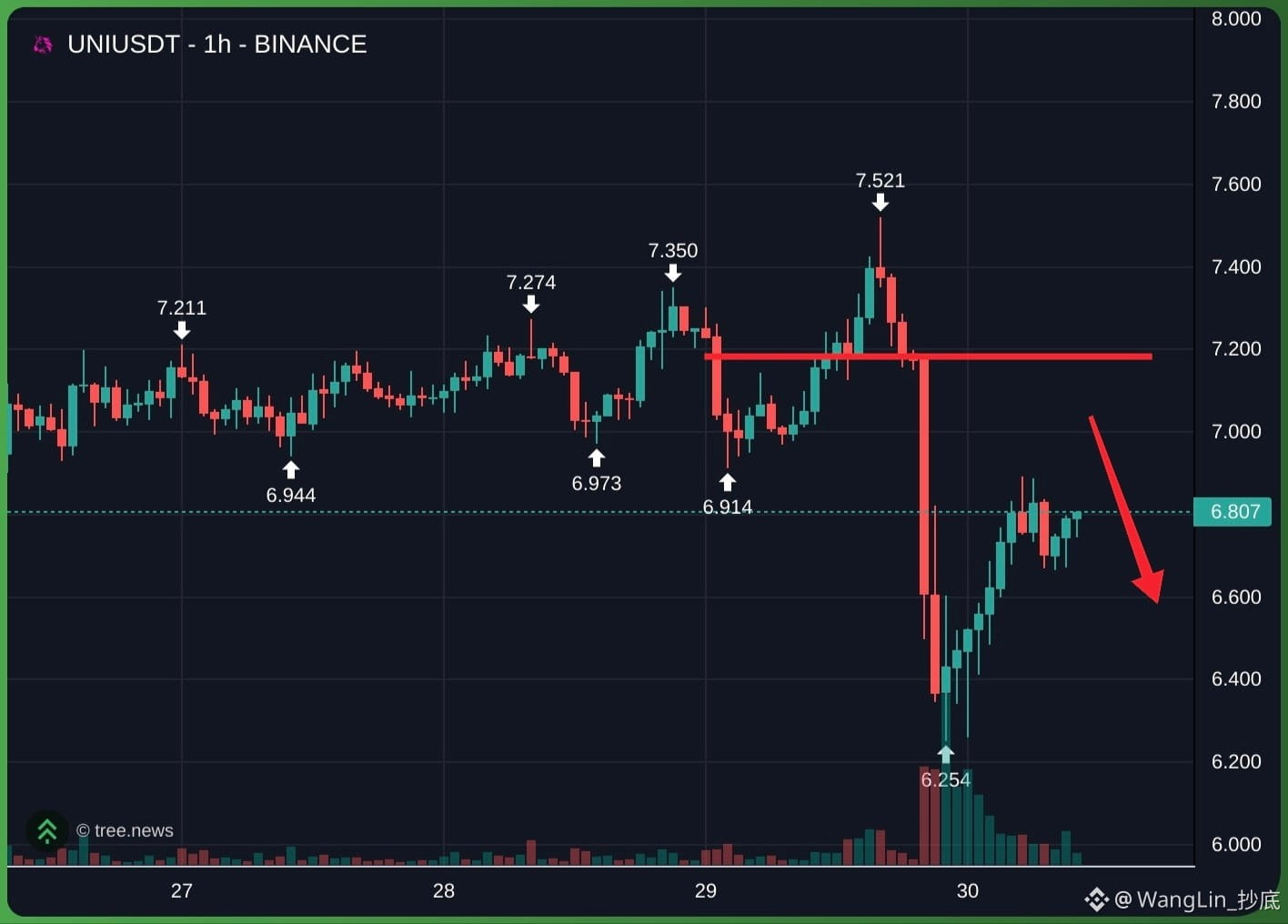
$UNI SHORT, CLEAR DOWNTREND
It's remains bearish as long as price continues to trade below 7.4 local high
Current bounce is facing strong overhead resistance. The area between 6.9 and 7.1 (previous support turned resistance) is a high-probability zone for a bearish rejection.
$UNI SHORT SETUP:
· Entry Short: 6.9 - 7.1 (Wait for price to enter this zone and look for rejection)
· Stop Loss: above 7.4
· TP1: 6.6
· TP2: 6.3 (recent low)
· TP3: 6.0
Support me just Trade here👇$UNI
{future}(UNIUSDT)
#uni #uniswap
$UNI SHORT, CLEAR DOWNTREND
It's remains bearish as long as price continues to trade below 7.4 local high
Current bounce is facing strong overhead resistance. The area between 6.9 and 7.1 (previous support turned resistance) is a high-probability zone for a bearish rejection.
$UNI SHORT SETUP:
· Entry Short: 6.9 - 7.1 (Wait for price to enter this zone and look for rejection)
· Stop Loss: above 7.4
· TP1: 6.6
· TP2: 6.3 (recent low)
· TP3: 6.0
Support me just Trade here👇$UNI
#uni #uniswap
150

·
--
Рост
Проверено
UNI Is Becoming Much More Than a DEX Token
Uniswap just made an interesting move.
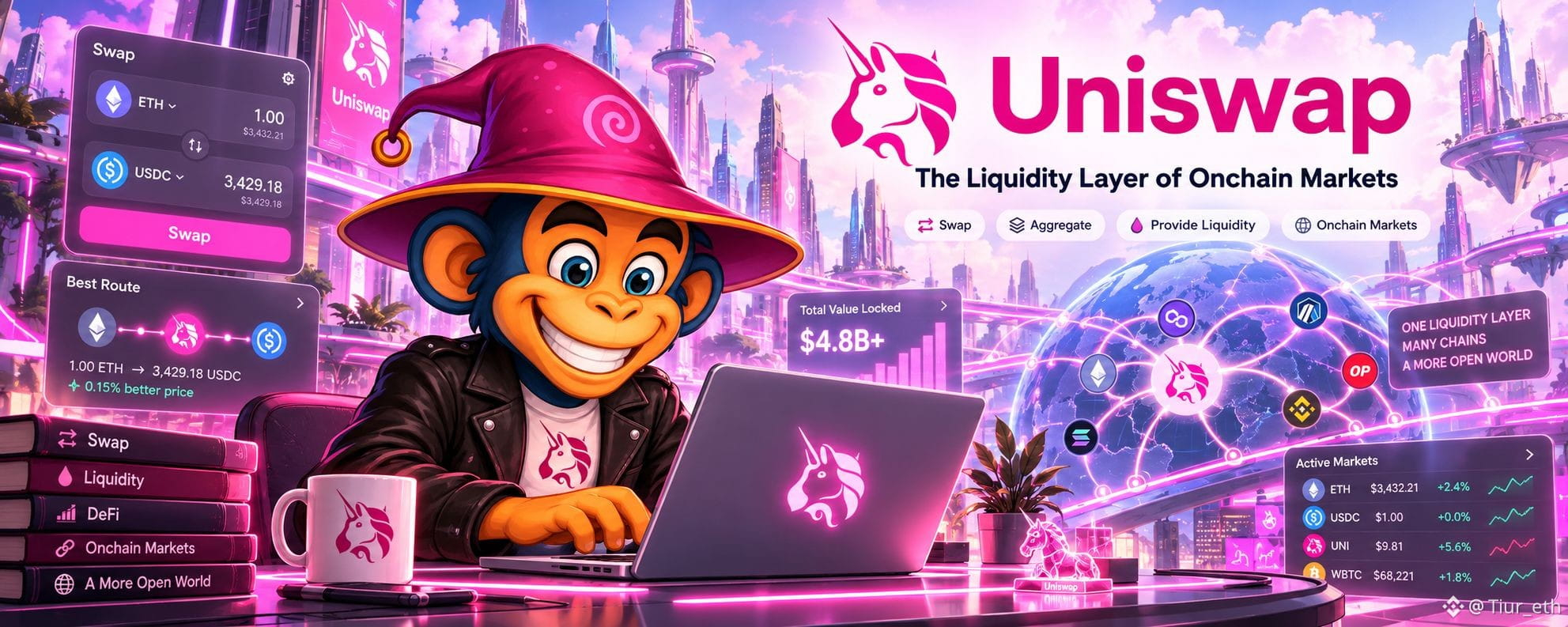
With Aggregator Hooks, Uniswap v4 can now pull liquidity from external DEXs and execute everything through one route.
At launch, 7 external sources cover 90%+ of #DEX activity across Ethereum, #Base and Robinhood Chain. And when external liquidity is routed through these hooks, protocol fees contribute to the UNI burn.
Meanwhile, #uniswap has already processed more than $4.5 trillion in swaps.
That creates a much bigger thesis for $UNI .
Uniswap is no longer fighting only to be the biggest DEX.
It is trying to become the liquidity layer that connects the entire onchain market.
And if more trading volume eventually flows through that infrastructure, UNI could sit directly at the center of it.
598

·
--
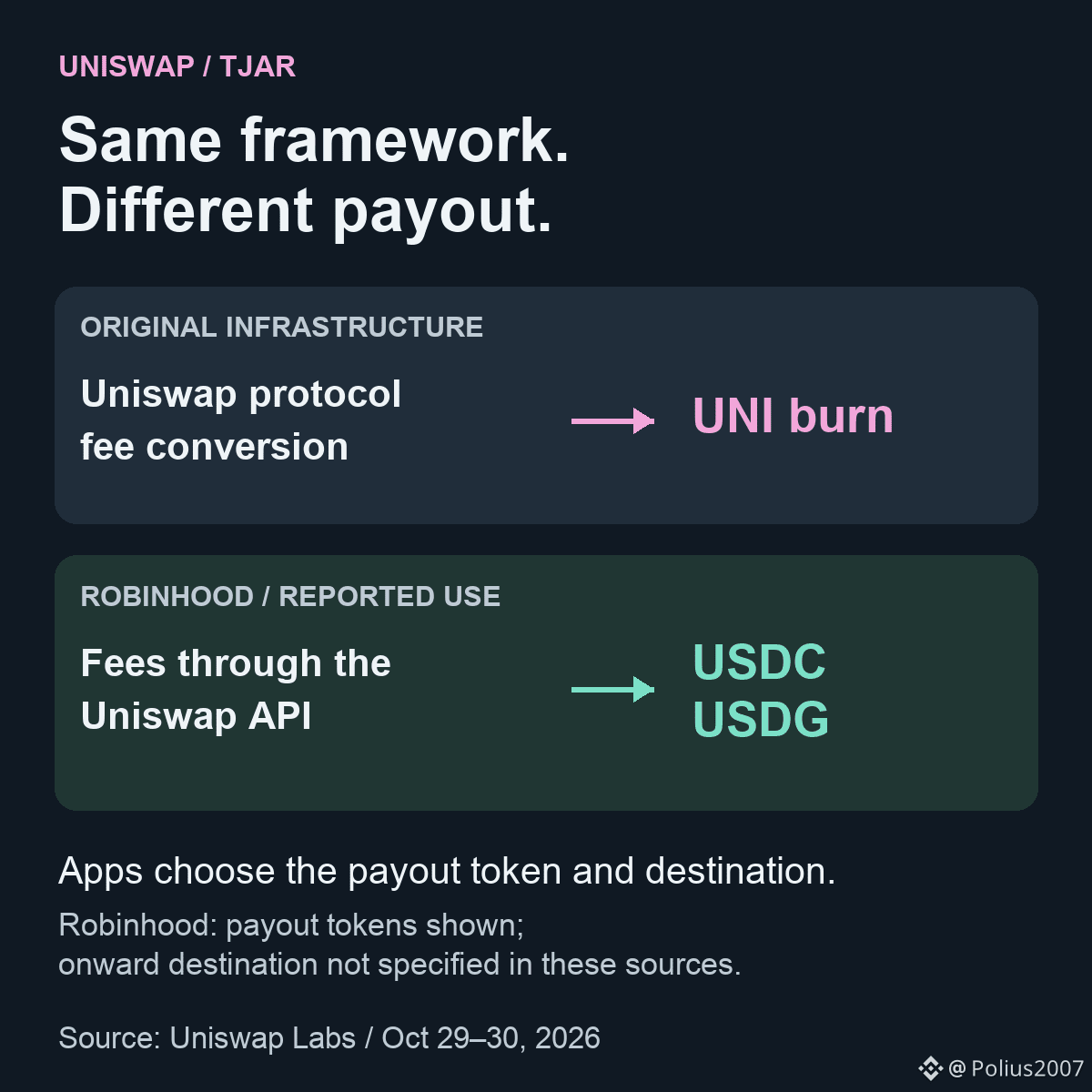
Robinhood is using Uniswap's TJAR to receive fees in USDC and USDG, according to Uniswap Labs. Those fees come through the Uniswap API, but the stated payout tokens are stablecoins, not UNI.
TJAR grew out of Uniswap's protocol fee-conversion and UNI-burn infrastructure. The October 29 launch opens that system to other apps, which choose their own payout token and destination.
Fees accumulate in a Token Jar. Outside traders supply the chosen token in exchange for assets in the jar; that payment goes to the configured destination. Burning UNI is one use of the underlying infrastructure, not an automatic consequence of third-party adoption.
Sources: Uniswap Labs' October 29–30, 2026 announcement and explainer.
#Uniswap #DeFi
13
#UniswapA16zSeekDeFiExemptionFromIllinoisCryptoTax
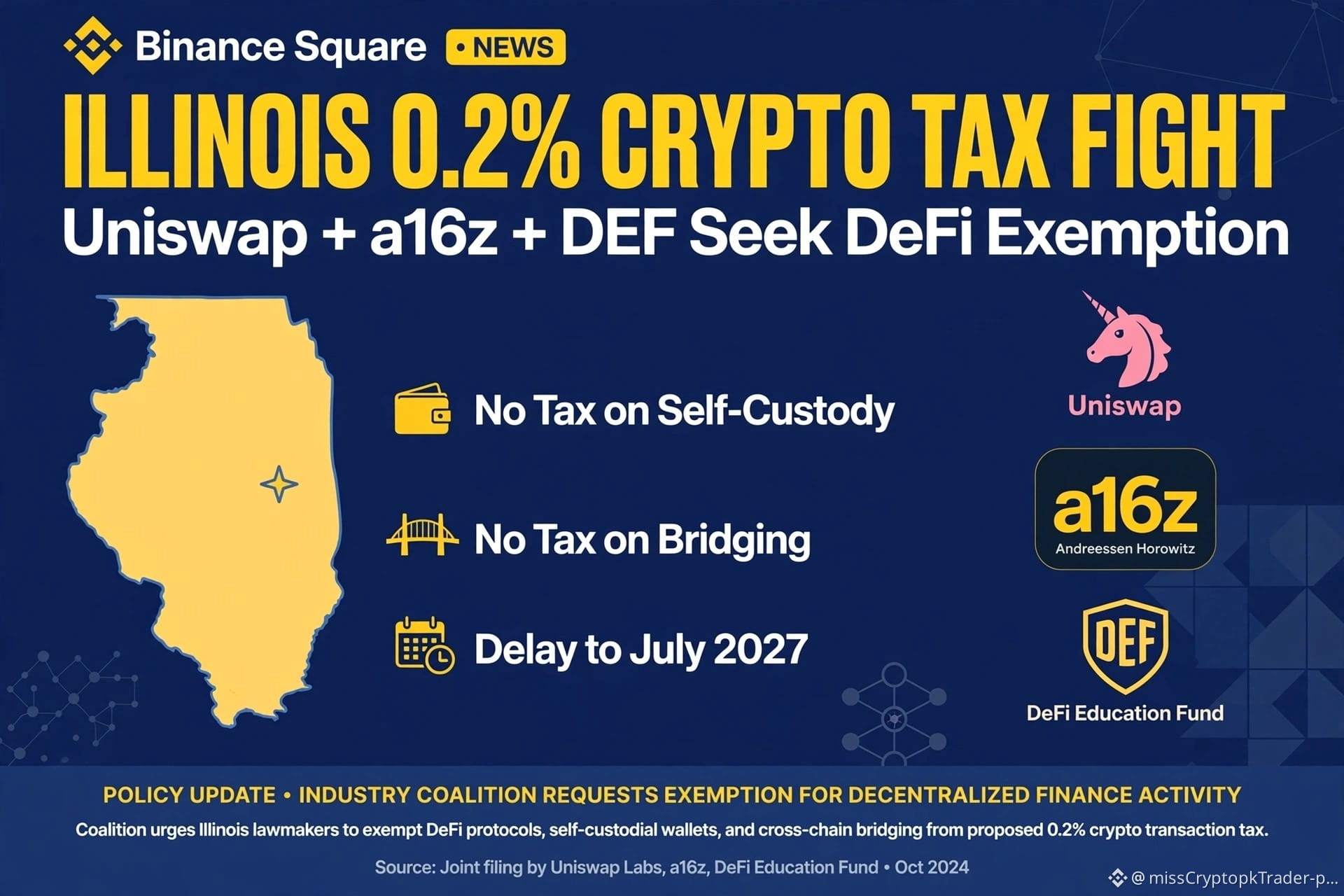
🚨🚨 BREAKING: UNISWAP, a16z & DEF CHALLENGE ILLINOIS CRYPTO TAX RULES! 🇺🇸**
A major DeFi policy debate is unfolding in the United States!
Uniswap Labs, Andreessen Horowitz (a16z), and the DeFi Education Fund have reportedly submitted joint comments opposing parts of Illinois' proposed crypto tax rules.
🔥 WHAT ARE THEY REQUESTING?
1️⃣ DeFi Protection: Exclude decentralized protocols and interfaces from inappropriate broker classifications.
2️⃣ Self-Custody Protection: Avoid taxing transfers from exchanges to users' personal wallets.
3️⃣ Bridge Exemption: Clarify that moving assets across blockchains should not automatically trigger taxation.
💰 WHY DOES IT MATTER?
Illinois enacted a 0.2% digital asset tax based on the value of qualifying transactions — not simply the service fee.
📅 The original implementation date was January 1, 2027, but a court-approved delay has moved it to July 1, 2027.
October 30, 2026, marks the deadline for public comments on the draft regulations.
THE BIG QUESTION:
Could Illinois' approach influence how other US states regulate and tax DeFi transactions?
What are your thoughts? Share below! 👇
$UNI $ETH $AAVE
#UniswapA16zSeekDeFiExemptionFromIllinoisCryptoTax #Uniswap #DeFi #CryptoNews
71

#uniswapa16zseekdefiexemptionfromillinoiscryptotax
🚨 THE REGULATION EQUATION: DeFi Fights Back 🚨
Let's break down this major regulatory clash using pure math 🧮👇
(0.2% State Crypto Tax) - (Intermediaries) = A Push for DeFi Exemptions 🛡️
The Asset Input:
(The Catalyst) = Illinois plans to impose a 0.2% tax on digital asset transactions starting in 2027. In response, Uniswap Labs, a16z, and the DeFi Education Fund are demanding exemptions for DeFi protocols, interfaces, and self-custody.
The Key Deliverable:
(The Pushback) ➔ The coalition heavily argues that autonomous smart contracts are not traditional brokers. Taxing non-custodial on-chain activities fundamentally misinterprets how decentralized finance operates.
The Breakdown:
Applying a flat transaction tax to DeFi threatens to drain local liquidity and stifle innovation. If these heavyweights secure this exemption, it will establish a crucial regulatory precedent for the treatment of non-custodial crypto nationwide.
Are state taxes a major threat to DeFi? 👇💬
$UNI
{future}(UNIUSDT)
$ETH
{future}(ETHUSDT)
$AAVE
{future}(AAVEUSDT)
#Uniswap #DeFi #CryptoRegulation #BinanceSquare
#uniswapa16zseekdefiexemptionfromillinoiscryptotax
🚨 THE REGULATION EQUATION: DeFi Fights Back 🚨
Let's break down this major regulatory clash using pure math 🧮👇
(0.2% State Crypto Tax) - (Intermediaries) = A Push for DeFi Exemptions 🛡️
The Asset Input:
(The Catalyst) = Illinois plans to impose a 0.2% tax on digital asset transactions starting in 2027. In response, Uniswap Labs, a16z, and the DeFi Education Fund are demanding exemptions for DeFi protocols, interfaces, and self-custody.
The Key Deliverable:
(The Pushback) ➔ The coalition heavily argues that autonomous smart contracts are not traditional brokers. Taxing non-custodial on-chain activities fundamentally misinterprets how decentralized finance operates.
The Breakdown:
Applying a flat transaction tax to DeFi threatens to drain local liquidity and stifle innovation. If these heavyweights secure this exemption, it will establish a crucial regulatory precedent for the treatment of non-custodial crypto nationwide.
Are state taxes a major threat to DeFi? 👇💬
$UNI
$ETH
$AAVE
#Uniswap #DeFi #CryptoRegulation #BinanceSquare

75
#uniswapa16zseekdefiexemptionfromillinoiscryptotax
🏦 Standard Chartered expects DeFi deposits to reach $2.7T by 2030, with #Uniswap potentially capturing the largest share.
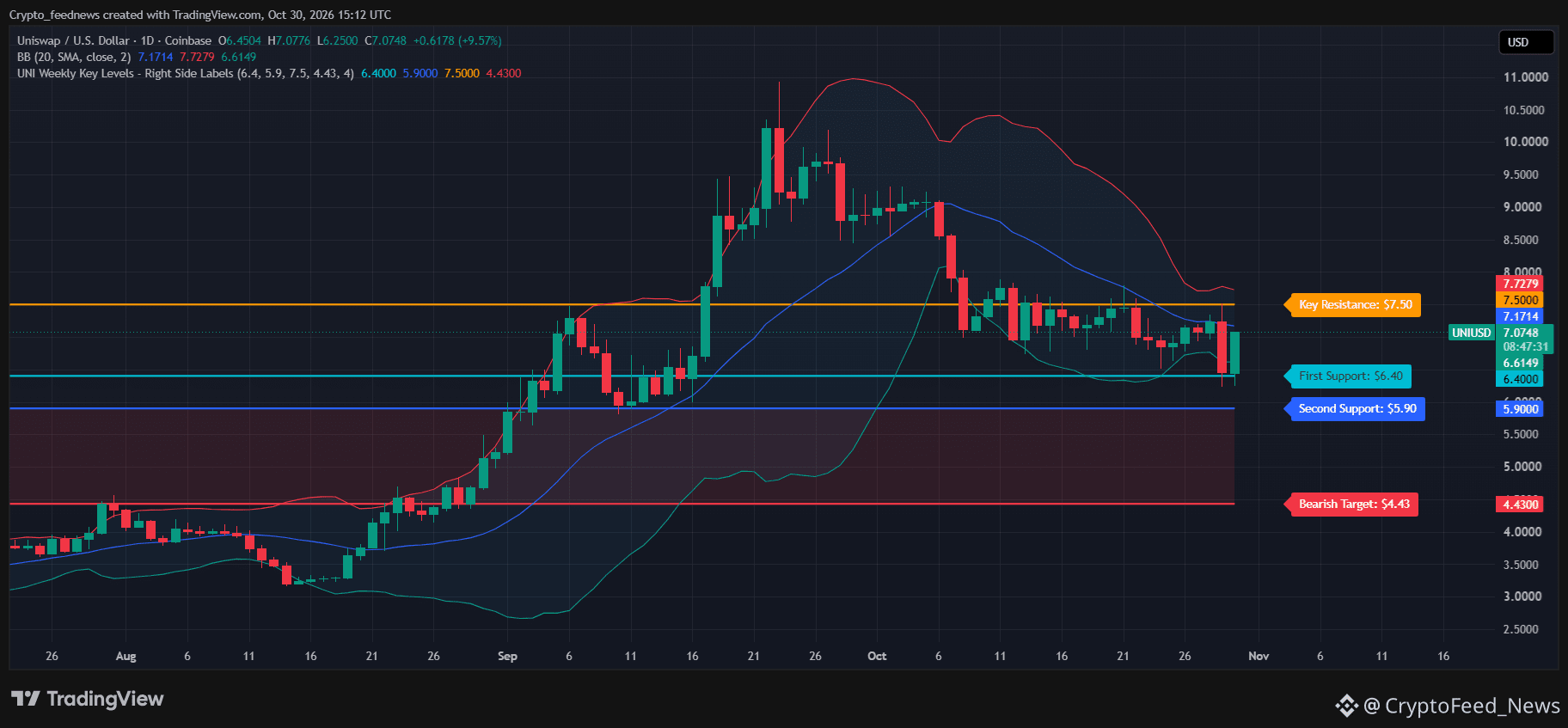
🔍 Technical levels to watch:
Support: $6.40, then $5.90
Resistance: $7.50
A breakdown below $6.40 could expose $4.43.
📊 The key numbers:
🎯 Long-term $UNI price target: $100 by 2030
💵 Current price in the report: $7.08
📈 Futures volume surged 221% to $1.49B
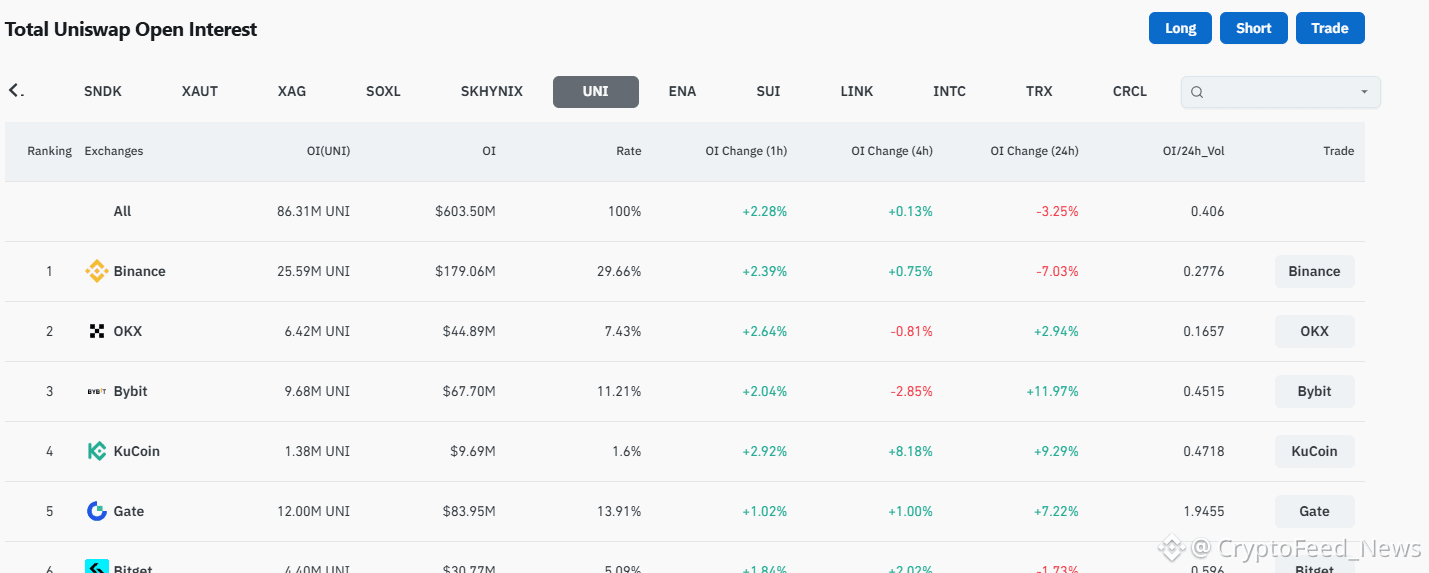
⚠️ Open interest declined from $609M, suggesting the volume spike may be driven by liquidations.
#Write2Earn

87

Статья
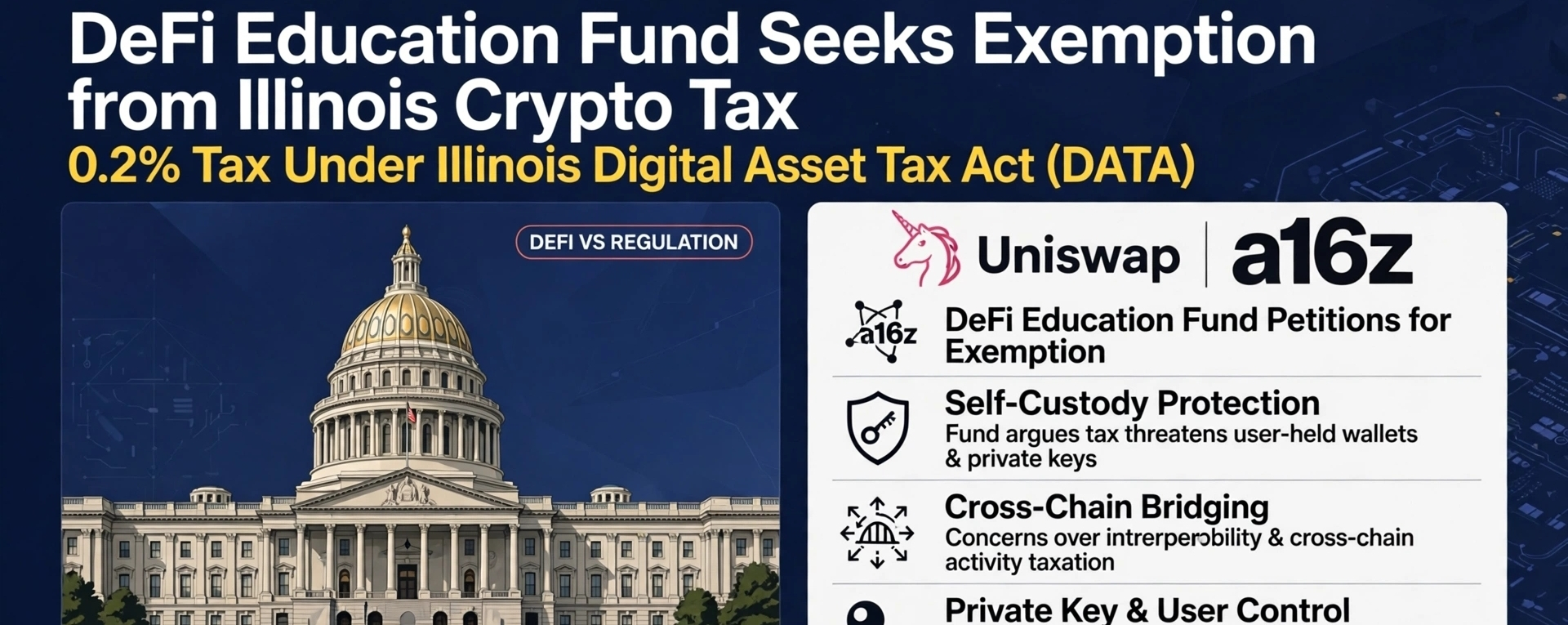
#UniswapA16zSeekDeFiExemptionFromIllinoisCryptoTaxUniswap, Andreessen Horowitz (a16z), and the DeFi Education Fund (DEF) have submitted a joint comment letter to the Illinois Department of Revenue, requesting an exemption for decentralized finance (DeFi) from the state's proposed crypto tax regulations. The proposed Illinois Digital Asset Tax Act (DATA) introduces a 0.2% privilege tax on the value of assets in a transaction, rather than just on profits. This means that for a $10,000 swap that incurs a $3 protocol fee, the tax burden would be $20. Defi platforms face challenges in collecting such taxes due to their decentralized nature. The group outlined four main requests: 1. They seek to exclude decentralized exchanges (DEXs) and interfaces from the broker definition, emphasizing that non-custodial software does not control assets and therefore cannot be responsible for withholding taxes. 2. They advocate for the protection of self-custody by requesting that withdrawals to personal wallets should not be taxed. Transitions from centralized exchanges (CEX) to self-custody should remain non-taxable, even if a broker charges a fee. 3. They call for the exemption of cross-chain bridging, arguing that moving assets between different blockchains should not be considered a taxable event and should not incur double taxation. 4. They request the removal of private-key recordkeeping requirements, suggesting that public key records should suffice, as protocol fees do not constitute valuable consideration. The current draft rules suggest that liquidity provider (LP) fees and miner fees will not be taxed, but protocol fees will be. This could place an obligation on any DEX that charges fees to act as a tax collector. Illinois has postponed the enforcement of these regulations from January 1, 2027, to July 1, 2027, amid ongoing litigation (Chamber of Digital Commerce v. Dept of Revenue). As the comment period closed, there is potential for this situation to influence similar regulatory approaches in other states. A favorable outcome for DeFi could lead to technical relief and recognition of the unique characteristics of DeFi within the regulatory framework. The fairness of a 0.2% tax on gross value for DeFi remains a point of discussion.
#UniswapA16zSeekDeFiExemptionFromIllinoisCryptoTax
Uniswap, Andreessen Horowitz (a16z), and the DeFi Education Fund (DEF) have submitted a joint comment letter to the Illinois Department of Revenue, requesting an exemption for decentralized finance (DeFi) from the state's proposed crypto tax regulations. The proposed Illinois Digital Asset Tax Act (DATA) introduces a 0.2% privilege tax on the value of assets in a transaction, rather than just on profits. This means that for a $10,000 swap that incurs a $3 protocol fee, the tax burden would be $20. Defi platforms face challenges in collecting such taxes due to their decentralized nature. The group outlined four main requests: 1. They seek to exclude decentralized exchanges (DEXs) and interfaces from the broker definition, emphasizing that non-custodial software does not control assets and therefore cannot be responsible for withholding taxes. 2. They advocate for the protection of self-custody by requesting that withdrawals to personal wallets should not be taxed. Transitions from centralized exchanges (CEX) to self-custody should remain non-taxable, even if a broker charges a fee. 3. They call for the exemption of cross-chain bridging, arguing that moving assets between different blockchains should not be considered a taxable event and should not incur double taxation. 4. They request the removal of private-key recordkeeping requirements, suggesting that public key records should suffice, as protocol fees do not constitute valuable consideration. The current draft rules suggest that liquidity provider (LP) fees and miner fees will not be taxed, but protocol fees will be. This could place an obligation on any DEX that charges fees to act as a tax collector. Illinois has postponed the enforcement of these regulations from January 1, 2027, to July 1, 2027, amid ongoing litigation (Chamber of Digital Commerce v. Dept of Revenue). As the comment period closed, there is potential for this situation to influence similar regulatory approaches in other states. A favorable outcome for DeFi could lead to technical relief and recognition of the unique characteristics of DeFi within the regulatory framework. The fairness of a 0.2% tax on gross value for DeFi remains a point of discussion.
1
109

A forced sale is the worst reason for a bounce — and the best test of one.
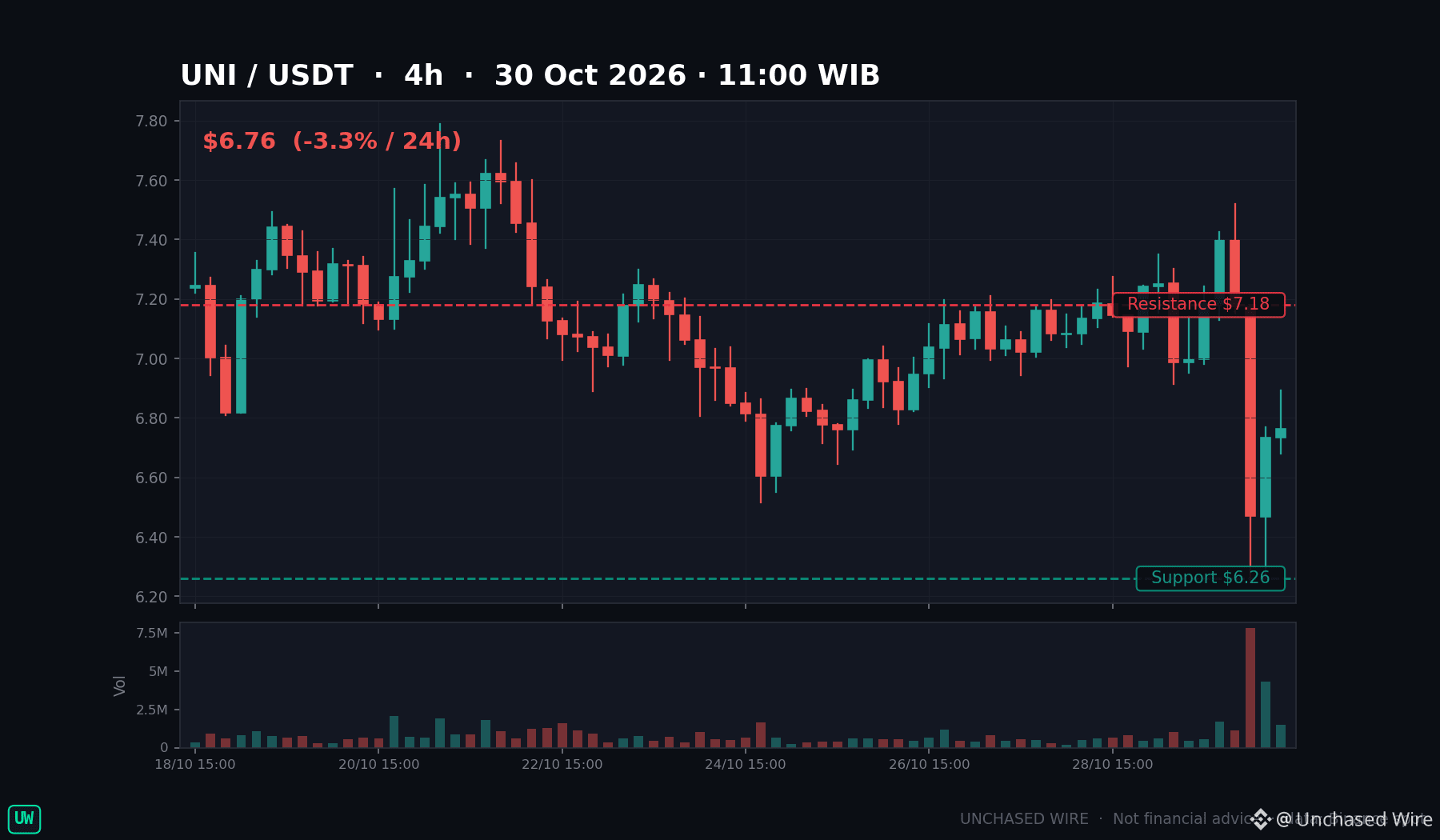
$UNI took both sides of that test in two candles. On October 29, one 4-hour candle hit $6.25 and closed at $6.47, on 7.8 million UNI — nearly nine times the recent average. Trackers reported the Binance attacker selling 7.02 million UNI for about $39.6 million in ether. The next candle dipped to $6.26, then closed at $6.73, on another 4.3 million UNI. The floor held twice: the selling was absorbed, not ignored.
This morning's thesis: Standard Chartered's Geoffrey Kendrick argues the breach should push trading share toward decentralized exchanges, with Uniswap a likely beneficiary — while warning investors to wait. Even this DEX-shift argument does not call a bottom yet.
Support is $6.26, the twice-tested low. Resistance is $7.18, where the selling started. A 4-hour close under $6.26 and I drop the absorption read entirely.
Does a forced sale change how you read a rebound, or is the tape the tape no matter who sold?
Not financial advice. Do your own research.
$UNI #Uniswap #DEX #DeFi #CryptoTrading
4
·
--
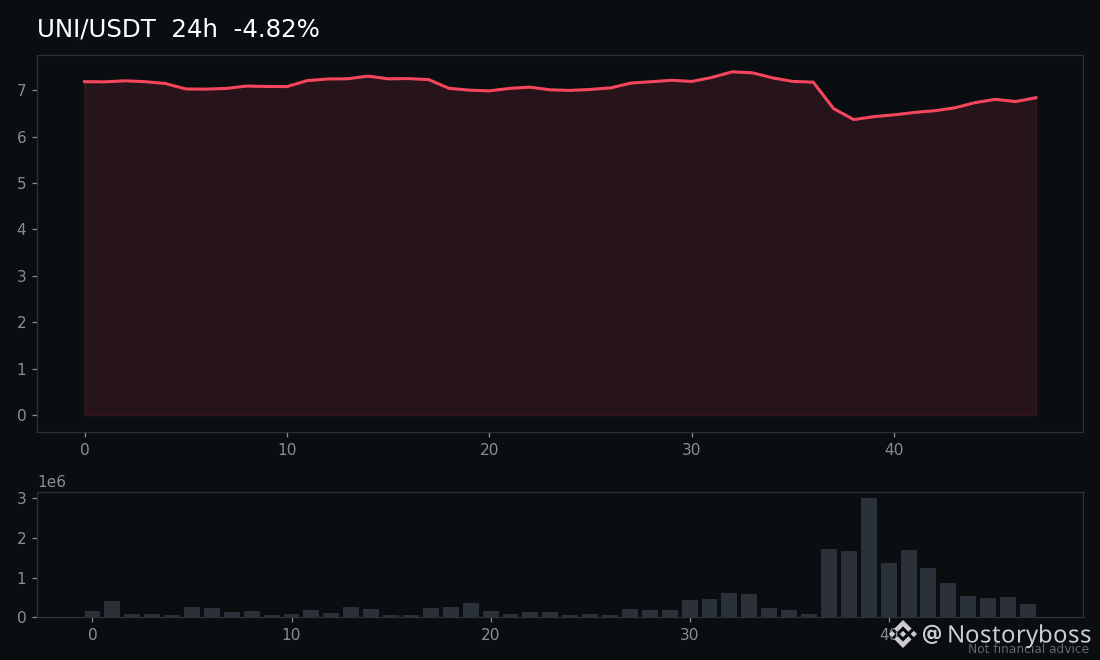
Seven years building in Web3 taught me one thing: the protocols that survive are the ones people actually use, not the ones with the loudest launch week. $UNI is down 2.48% today, yet Uniswap still routes a huge share of on-chain swaps. Price dips come and go; real usage compounds quietly in the background. Builders, watch the product, not just the chart. #DeFi #Uniswap #Web3 #BinanceSquare
Not financial advice.
Not financial advice.
43

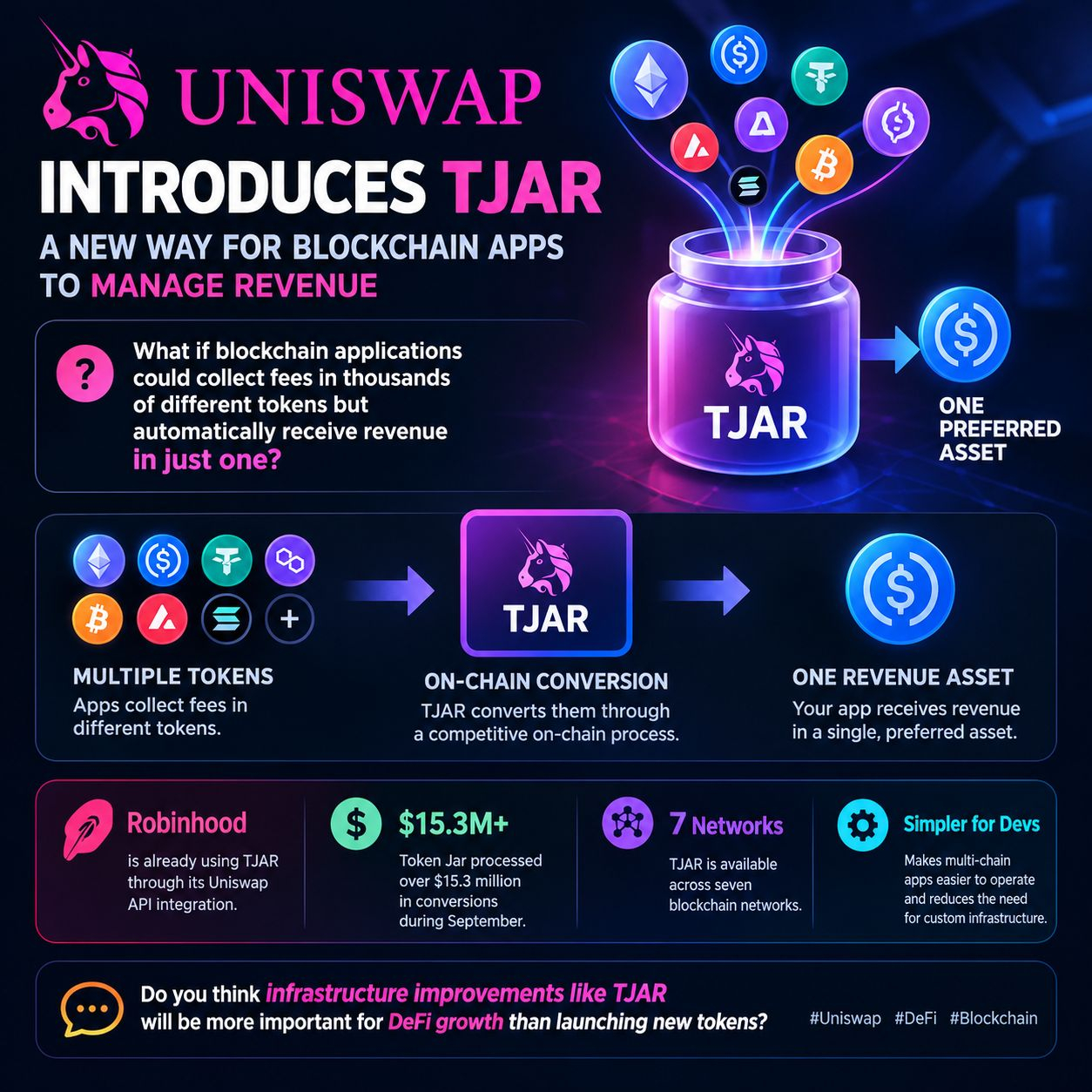
UNISWAP INTRODUCES TJAR — A NEW WAY FOR BLOCKCHAIN APPS TO MANAGE REVENUE
What if blockchain applications could collect fees in thousands of different tokens but automatically receive revenue in just one?
Uniswap Labs has introduced TJAR, a permissionless infrastructure designed to solve this problem.
The system allows applications to collect fees in different tokens and convert them into a single preferred asset through a competitive on-chain process.
An interesting development is that Robinhood is already using TJAR through its Uniswap API integration.
Uniswap also reported that its original Token Jar system processed more than $15.3 million in conversions during September. TJAR is now available across seven blockchain networks.
Simplifying fee management could make multi-chain applications easier to operate and reduce the need for custom conversion infrastructure.
However, long-term adoption will depend on developer demand, transaction activity, and actual usage.
Do you think infrastructure improvements like TJAR will be more important for DeFi growth than launching new tokens?
#Uniswap #DeFi #Blockchain $UNI
{future}(UNIUSDT)
$RIVN
{future}(RIVNUSDT)
$RUNE
{future}(RUNEUSDT)
UNISWAP INTRODUCES TJAR — A NEW WAY FOR BLOCKCHAIN APPS TO MANAGE REVENUE
What if blockchain applications could collect fees in thousands of different tokens but automatically receive revenue in just one?
Uniswap Labs has introduced TJAR, a permissionless infrastructure designed to solve this problem.
The system allows applications to collect fees in different tokens and convert them into a single preferred asset through a competitive on-chain process.
An interesting development is that Robinhood is already using TJAR through its Uniswap API integration.
Uniswap also reported that its original Token Jar system processed more than $15.3 million in conversions during September. TJAR is now available across seven blockchain networks.
Simplifying fee management could make multi-chain applications easier to operate and reduce the need for custom conversion infrastructure.
However, long-term adoption will depend on developer demand, transaction activity, and actual usage.
Do you think infrastructure improvements like TJAR will be more important for DeFi growth than launching new tokens?
#Uniswap #DeFi #Blockchain $UNI
$RIVN
$RUNE
254

·
--
Рост
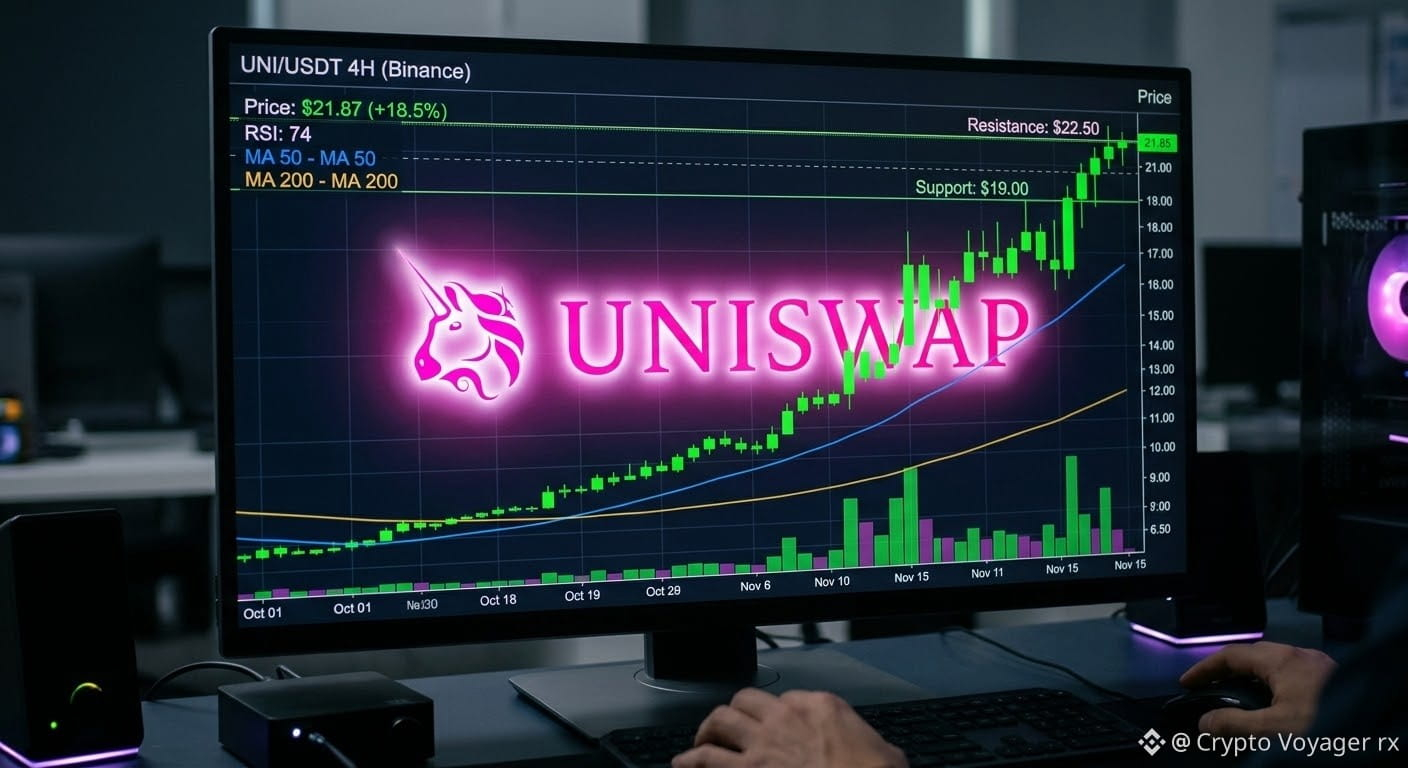
📉 UNI/USDT Update: Uniswap is currently near the support zone. Looking at the chart's movement, it seems likely to rebound from here and start an uptrend. Keep an eye on it for the next levels! 🦄🚀 #Uniswap
📉 UNI/USDT Update: Uniswap is currently near the support zone. Looking at the chart's movement, it seems likely to rebound from here and start an uptrend. Keep an eye on it for the next levels! 🦄🚀 #Uniswap
Erison Quispe:
yes
104
1
5
104

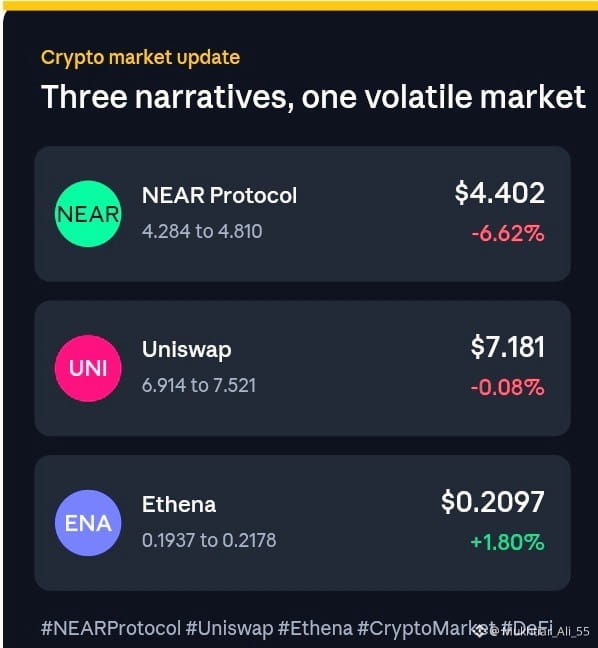
NEAR, UNI and ENA: Three Different Narratives, One Volatile Market
NEAR is trading at $4.402, down 6.62% over the latest 24 hour period after ranging between $4.284 and $4.810. The move shows clear short term pressure, but the strong trading activity around the current range highlights that NEAR remains a closely watched Layer 1 asset when market liquidity returns to higher beta narratives.
UNI is holding near $7.181, almost unchanged at -0.08% over 24 hours, with a session range of $6.914 to $7.521. UNI is showing relative stability compared with broader volatility, keeping attention on Uniswap’s position as one of DeFi’s most established liquidity protocols.
ENA is trading around $0.2097, up 1.80% in 24 hours after moving between $0.1937 and $0.2178. Its positive performance during a mixed session reflects continued market interest in Ethena and the broader stablecoin yield narrative, although volatility remains elevated.
The market is separating assets by narrative strength and liquidity. NEAR is navigating sharper pressure, UNI is defending a more balanced structure, and ENA is attracting momentum focused attention. Traders should watch volume, broader Bitcoin direction, and whether these assets can sustain strength beyond intraday moves.
#NEARProtocol #Uniswap #Ethena #CryptoMarket #DeFi
$NEAR
{spot}(NEARUSDT)
$UNI
{spot}(UNIUSDT)
$ENA
{spot}(ENAUSDT)
NEAR, UNI and ENA: Three Different Narratives, One Volatile Market
NEAR is trading at $4.402, down 6.62% over the latest 24 hour period after ranging between $4.284 and $4.810. The move shows clear short term pressure, but the strong trading activity around the current range highlights that NEAR remains a closely watched Layer 1 asset when market liquidity returns to higher beta narratives.
UNI is holding near $7.181, almost unchanged at -0.08% over 24 hours, with a session range of $6.914 to $7.521. UNI is showing relative stability compared with broader volatility, keeping attention on Uniswap’s position as one of DeFi’s most established liquidity protocols.
ENA is trading around $0.2097, up 1.80% in 24 hours after moving between $0.1937 and $0.2178. Its positive performance during a mixed session reflects continued market interest in Ethena and the broader stablecoin yield narrative, although volatility remains elevated.
The market is separating assets by narrative strength and liquidity. NEAR is navigating sharper pressure, UNI is defending a more balanced structure, and ENA is attracting momentum focused attention. Traders should watch volume, broader Bitcoin direction, and whether these assets can sustain strength beyond intraday moves.
#NEARProtocol #Uniswap #Ethena #CryptoMarket #DeFi
$NEAR
$UNI
$ENA
17

·
--
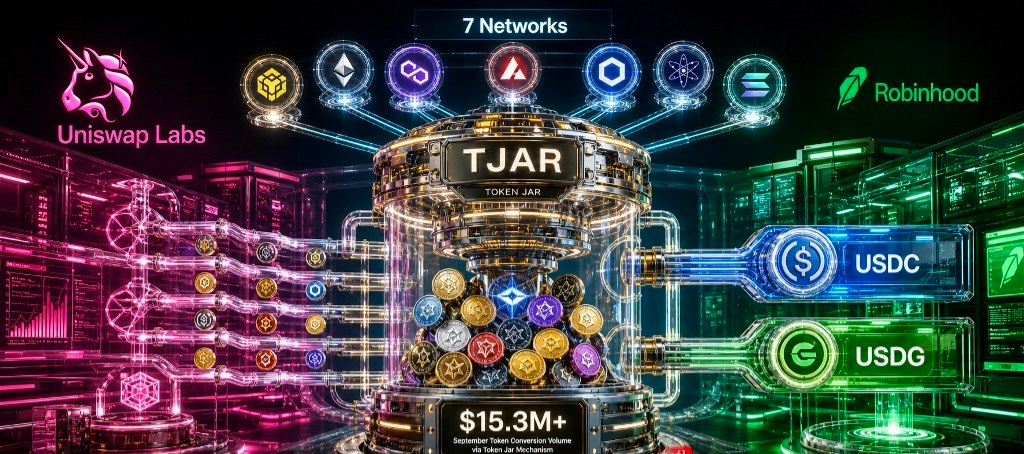
🚀🦄🤝 BREAKING: #uniswap LABS LAUNCHES "TJAR" TO REVOLUTIONIZE ONCHAIN FEE CONVERSIONS WITH ROBINHOOD! 💵🔄📈
🚨🌐 Massive #defi Upgrade:
Uniswap Labs has officially went LIVE with **TJAR** (Token Jar), an open-source, permissionless infrastructure tool that solves a massive crypto headache! Instead of apps holding thousands of fragmented dust tokens across multiple networks, TJAR automates the entire consolidation process into a single token of the team's choice! 🧱💡
🦊⛓️ The Multi-Chain Open Market:
1️⃣ **How it Works:** Apps deposit their random multi-token fees into a Token Jar. Onchain MEV "Searchers" compete to convert them, and the app automatically receives the revenue in its designated asset—no custom infrastructure needed! ⏱️🤖
2️⃣ **The UNI Burn Engine:** For Uniswap's own protocol fees, the converted tokens are used to purchase **$UNI** and route them straight to a burn address! 🔥📉
3️⃣ **Live on 7 Chains:** The infrastructure is already functional across 7 prominent blockchains today. 🗺️⚡
🏦🤝 Robinhood is the First Titan Partner:
Trading giant **Robinhood Markets** is the flagship integration partner! Robinhood is actively using TJAR across all supported networks for transaction fees collected via the Uniswap API. Instead of handling multiple tokens, Robinhood now automatically receives all its fee revenues in stable, liquid assets: **#USDC and #USDG **! 💵💎
📊💥 Immense Proven Volume:
This isn't a minor experiment; the Token Jar framework handled a massive **$15.3 Million** in conversion volume during September alone when it was utilized solely for Uniswap Protocol flows. Opening this up to external applications will channel massive liquidity back into core stablecoins and the UNI ecosystem! 🌊🚀
#UniswapLabs #TJAR #Robinhood #DeFiInfrastructure #TokenJar #TokenBurn #RealYield #BinanceSquare #UNI
$UNI
{spot}(UNIUSDT)
$USDC
{spot}(USDCUSDT)
$BTC
{spot}(BTCUSDT)
🚀🦄🤝 BREAKING: #uniswap LABS LAUNCHES "TJAR" TO REVOLUTIONIZE ONCHAIN FEE CONVERSIONS WITH ROBINHOOD! 💵🔄📈
🚨🌐 Massive #defi Upgrade:
Uniswap Labs has officially went LIVE with **TJAR** (Token Jar), an open-source, permissionless infrastructure tool that solves a massive crypto headache! Instead of apps holding thousands of fragmented dust tokens across multiple networks, TJAR automates the entire consolidation process into a single token of the team's choice! 🧱💡
🦊⛓️ The Multi-Chain Open Market:
1️⃣ **How it Works:** Apps deposit their random multi-token fees into a Token Jar. Onchain MEV "Searchers" compete to convert them, and the app automatically receives the revenue in its designated asset—no custom infrastructure needed! ⏱️🤖
2️⃣ **The UNI Burn Engine:** For Uniswap's own protocol fees, the converted tokens are used to purchase **$UNI ** and route them straight to a burn address! 🔥📉
3️⃣ **Live on 7 Chains:** The infrastructure is already functional across 7 prominent blockchains today. 🗺️⚡
🏦🤝 Robinhood is the First Titan Partner:
Trading giant **Robinhood Markets** is the flagship integration partner! Robinhood is actively using TJAR across all supported networks for transaction fees collected via the Uniswap API. Instead of handling multiple tokens, Robinhood now automatically receives all its fee revenues in stable, liquid assets: **#USDC and #USDG **! 💵💎
📊💥 Immense Proven Volume:
This isn't a minor experiment; the Token Jar framework handled a massive **$15.3 Million** in conversion volume during September alone when it was utilized solely for Uniswap Protocol flows. Opening this up to external applications will channel massive liquidity back into core stablecoins and the UNI ecosystem! 🌊🚀
#UniswapLabs #TJAR #Robinhood #DeFiInfrastructure #TokenJar #TokenBurn #RealYield #BinanceSquare #UNI
$UNI
$USDC
$BTC

BTC 4U 🍀
От OnionSam
1
117

As network activity on the Uniswap protocol rises rapidly, the price of UNI is also on the rise. According to Santiment data, the number of daily active addresses on the network reached 14,591, hitting its highest level in the past year.
Additionally, 13,137 new UNI wallet addresses were created on the network. This stands out as the largest growth recorded since September 2020.
#Uniswap $UNI
Additionally, 13,137 new UNI wallet addresses were created on the network. This stands out as the largest growth recorded since September 2020.
#Uniswap $UNI
3
354

·
--
$UNI | LONG SETUP
Not every trade needs to be a short.
Uniswap was among the stronger large-cap performers in the previous reported market close, gaining approximately 2.6%. That relative strength makes UNI worth monitoring for a continuation move.
My conditional setup
- Direction: LONG
- Entry: $7.25–$7.30 after a confirmed breakout and successful retest
- Stop-loss: $7.00
- Target 1: $7.45
- Target 2: $7.60
The idea is simple: I want UNI to clear the nearby resistance zone and show that buyers are willing to defend it.
If price fails to break out, there is no reason to enter. Relative strength is useful, but it is not a guarantee of future gains.
One clean setup beats three forced trades.
#UNI #Uniswap #DeFi #CryptoAnalysis
2
31

·
--
🚨🔥 $UNI FACES A 1.59% DECLINE – Bulls Watch Closely! 🔥🚨
Uniswap is trading at $7.044, down 1.59% in the provided market snapshot. UNI is moving lower alongside several other major cryptocurrencies, leaving traders looking for evidence of a recovery or further weakness. The next move needs confirmation before a trading decision. 📊
⚡ Market Watch:
💰 Price: $7.044
📉 Change: -1.59%
🎯 Focus: Watch for stabilization and a shift in momentum.
🧠 Technical Insight: A sustained increase in buying interest could improve the short-term outlook. However, continued selling may keep UNI under pressure. The screenshot alone does not establish exact support, resistance, or reliable profit targets.
🔥 UNI traders, do you expect a rebound, or is the market signaling more downside? Share your analysis below! 👇
⚠️ Trade with discipline, protect your capital, and always DYOR.
#UNI #Uniswap #BinanceSquare #Crypto #Trading #dyor
63
·
--
Падение
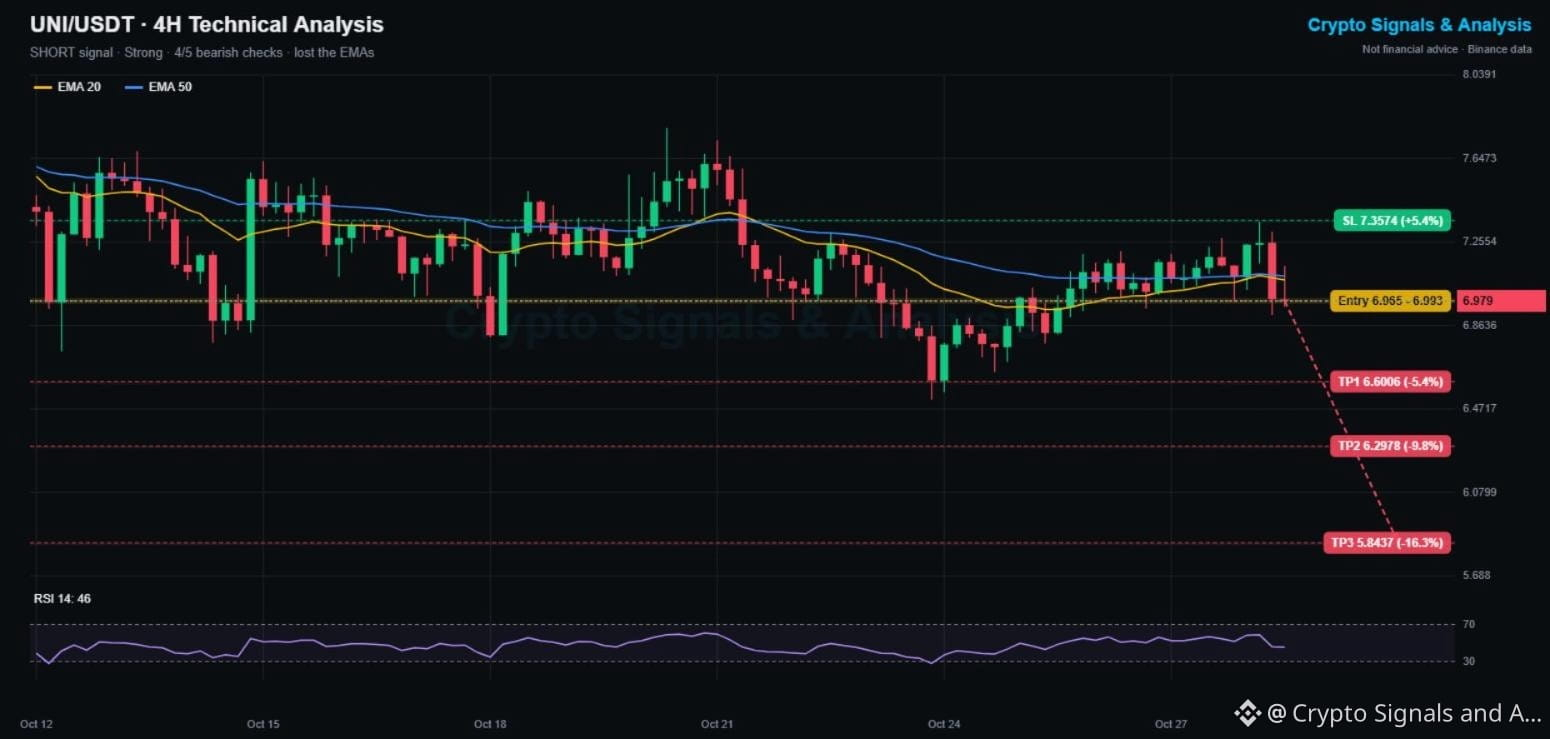
$UNI Price Prediction Today (Oct 29): Uniswap Crypto Signal & Technical Analysis 📊
🔴 SHORT | Entry 6.965 - 6.993 | TP1 6.601 | SL 7.357
👉 Tap $UNI to place your trade fast
🕒 Updated: Oct 29, 07:31 UTC · price 6.979
Uniswap was one of last night's gainers, but the move did not hold. A spike to 7.35 was sold hard, and a big red 4H candle has pushed it back under both moving averages: -2.9% in 24 hours.
📌 UNISWAP TRADING SIGNAL (Strong, 4/5 signals agree)
Entry: 6.965 - 6.993
Take profit 1: 6.601 (-5.4%)
Take profit 2: 6.298 (-9.8%)
Take profit 3: 5.844 (-16.3%)
Stop loss: 7.357 (+5.4%)
📊 UNI TECHNICAL ANALYSIS (4H CHART)
Price is below the EMA20 (7.08) and EMA50 (7.10), and the EMA20 is turning down. RSI 46 is neutral, so there is room to drop before oversold.
🔑 KEY LEVELS
Support: 6.78, then 6.52 (Oct 24 low)
Resistance: 7.08 - 7.10 (EMAs), then 7.35
📉 Bearish scenario: a 4H close under 6.78 opens TP1 at 6.60.
📈 Bullish scenario: reclaiming 7.10 means the dip was bought. A close above 7.357 cancels this signal.
💡 Bottom line: failed breakout plus a lost EMA zone. Shorts favored under 7.10.
👉 Tap $UNI
to open the live chart. NFA
🔥 NEW TO BINANCE?
✅ No Binance account yet? Sign up with referral code SQUAREGINOS and get a 10% kickback on your Futures trading fees.
👇👇👇
{spot}(UNIUSDT)
[Sign up on Binance here (10% Futures fee kickback)](https://www.binance.com/join?ref=SQUAREGINOS)
━━━━━━━━━━
Does Uniswap reclaim 7.10 or slide to 6.60? 👇
Follow Crypto Signals and Analysis for daily signals.
#cryptosignals #Uniswap #FOMCWatch
⚠️ Crypto is volatile: risk only what you can afford to lose.
$UNI Price Prediction Today (Oct 29): Uniswap Crypto Signal & Technical Analysis 📊
🔴 SHORT | Entry 6.965 - 6.993 | TP1 6.601 | SL 7.357
👉 Tap $UNI to place your trade fast
🕒 Updated: Oct 29, 07:31 UTC · price 6.979
Uniswap was one of last night's gainers, but the move did not hold. A spike to 7.35 was sold hard, and a big red 4H candle has pushed it back under both moving averages: -2.9% in 24 hours.
📌 UNISWAP TRADING SIGNAL (Strong, 4/5 signals agree)
Entry: 6.965 - 6.993
Take profit 1: 6.601 (-5.4%)
Take profit 2: 6.298 (-9.8%)
Take profit 3: 5.844 (-16.3%)
Stop loss: 7.357 (+5.4%)
📊 UNI TECHNICAL ANALYSIS (4H CHART)
Price is below the EMA20 (7.08) and EMA50 (7.10), and the EMA20 is turning down. RSI 46 is neutral, so there is room to drop before oversold.
🔑 KEY LEVELS
Support: 6.78, then 6.52 (Oct 24 low)
Resistance: 7.08 - 7.10 (EMAs), then 7.35
📉 Bearish scenario: a 4H close under 6.78 opens TP1 at 6.60.
📈 Bullish scenario: reclaiming 7.10 means the dip was bought. A close above 7.357 cancels this signal.
💡 Bottom line: failed breakout plus a lost EMA zone. Shorts favored under 7.10.
👉 Tap $UNI
to open the live chart. NFA
🔥 NEW TO BINANCE?
✅ No Binance account yet? Sign up with referral code SQUAREGINOS and get a 10% kickback on your Futures trading fees.
👇👇👇
Sign up on Binance here (10% Futures fee kickback)
━━━━━━━━━━
Does Uniswap reclaim 7.10 or slide to 6.60? 👇
Follow Crypto Signals and Analysis for daily signals.
#cryptosignals #Uniswap #FOMCWatch
⚠️ Crypto is volatile: risk only what you can afford to lose.
7

🚨 UNISWAP JUST CROSSED $6.1 BILLION IN CUMULATIVE FEES! 🦄🔥
@Uniswap continues to demonstrate the power of decentralized finance.
According to @DefiLlama data, the leading DEX has generated an incredible $6.112 BILLION in cumulative protocol fees, cementing its position as a major force in DeFi.
📊 The numbers speak for themselves:
💰 $6.112B in cumulative protocol fees
📈 Nearly $89M generated over the past 30 days
🏆 Outpacing @HyperliquidX, @aave, and @Morpho in fee generation by a significant margin.
💡 Why does this matter?
Fees reflect real economic activity. Uniswap's ability to generate substantial revenue highlights the continued demand for decentralized trading and on-chain liquidity.
For investors watching $UNI, sustained fee generation is an important metric to monitor. However, protocol fees alone don't automatically translate into token-holder revenue or price appreciation.
🔥 DeFi isn't just about hype. It's about usage, liquidity, and sustainable economic activity. Uniswap is putting up serious numbers.
Can $UNI turn its DeFi dominance into its next major rally? 👀
#Uniswap #UNI #DeFi #Crypto #Ethereum
{future}(UNIUSDT)
🚨 UNISWAP JUST CROSSED $6.1 BILLION IN CUMULATIVE FEES! 🦄🔥
@Uniswap Protocol continues to demonstrate the power of decentralized finance.
According to @DefiLlama data, the leading DEX has generated an incredible $6.112 BILLION in cumulative protocol fees, cementing its position as a major force in DeFi.
📊 The numbers speak for themselves:
💰 $6.112B in cumulative protocol fees
📈 Nearly $89M generated over the past 30 days
🏆 Outpacing @HyperliquidX, @aave, and @Morpho in fee generation by a significant margin.
💡 Why does this matter?
Fees reflect real economic activity. Uniswap's ability to generate substantial revenue highlights the continued demand for decentralized trading and on-chain liquidity.
For investors watching $UNI , sustained fee generation is an important metric to monitor. However, protocol fees alone don't automatically translate into token-holder revenue or price appreciation.
🔥 DeFi isn't just about hype. It's about usage, liquidity, and sustainable economic activity. Uniswap is putting up serious numbers.
Can $UNI turn its DeFi dominance into its next major rally? 👀
#Uniswap #UNI #DeFi #Crypto #Ethereum
76

·
--
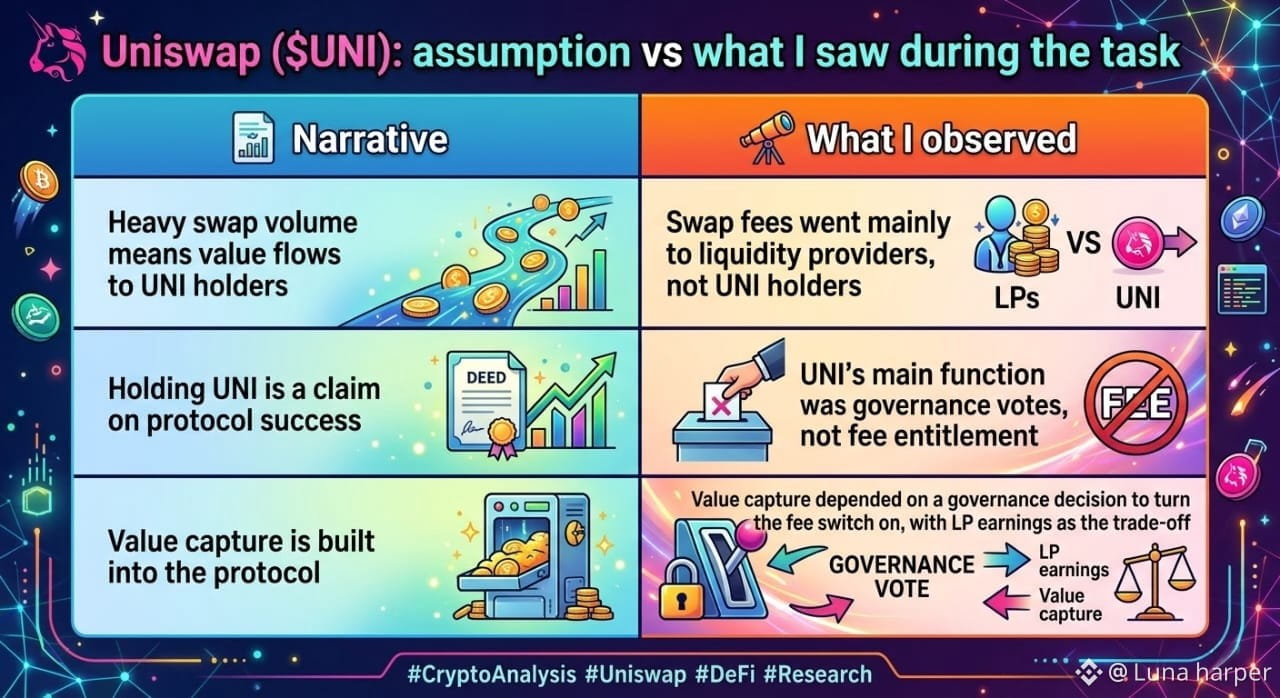
Looking at Uniswap during the CreatorPad task, what stayed with me was how long usage and the token lived in separate rooms. @Uniswap p routes enormous swap volume every day, and most of the fees from that activity go to liquidity providers, not to $UNI holders. The token's role was mostly governance, so the clearest design choice was a switch: value capture was something holders could vote to turn on, not something the protocol did by default. Seen that way, the question stops being whether people use Uniswap, because they plainly do, and becomes whether usage ever had a path to the token without a vote in between. The fee switch discussion kept circling the same tension, that redirecting fees toward holders could thin what LPs earn and nudge liquidity elsewhere. I found myself thinking that value capture here is less a feature than a negotiation between two groups who each believe they are the product. I'm not sure which of them the protocol is really built around. #Uniswap has the volume to test it, but does a token that waits for permission to earn ever feel like it earns, or only like it was granted?
Looking at Uniswap during the CreatorPad task, what stayed with me was how long usage and the token lived in separate rooms. @Uniswap Protocol p routes enormous swap volume every day, and most of the fees from that activity go to liquidity providers, not to $UNI holders. The token's role was mostly governance, so the clearest design choice was a switch: value capture was something holders could vote to turn on, not something the protocol did by default. Seen that way, the question stops being whether people use Uniswap, because they plainly do, and becomes whether usage ever had a path to the token without a vote in between. The fee switch discussion kept circling the same tension, that redirecting fees toward holders could thin what LPs earn and nudge liquidity elsewhere. I found myself thinking that value capture here is less a feature than a negotiation between two groups who each believe they are the product. I'm not sure which of them the protocol is really built around. #Uniswap has the volume to test it, but does a token that waits for permission to earn ever feel like it earns, or only like it was granted?
123
·
--
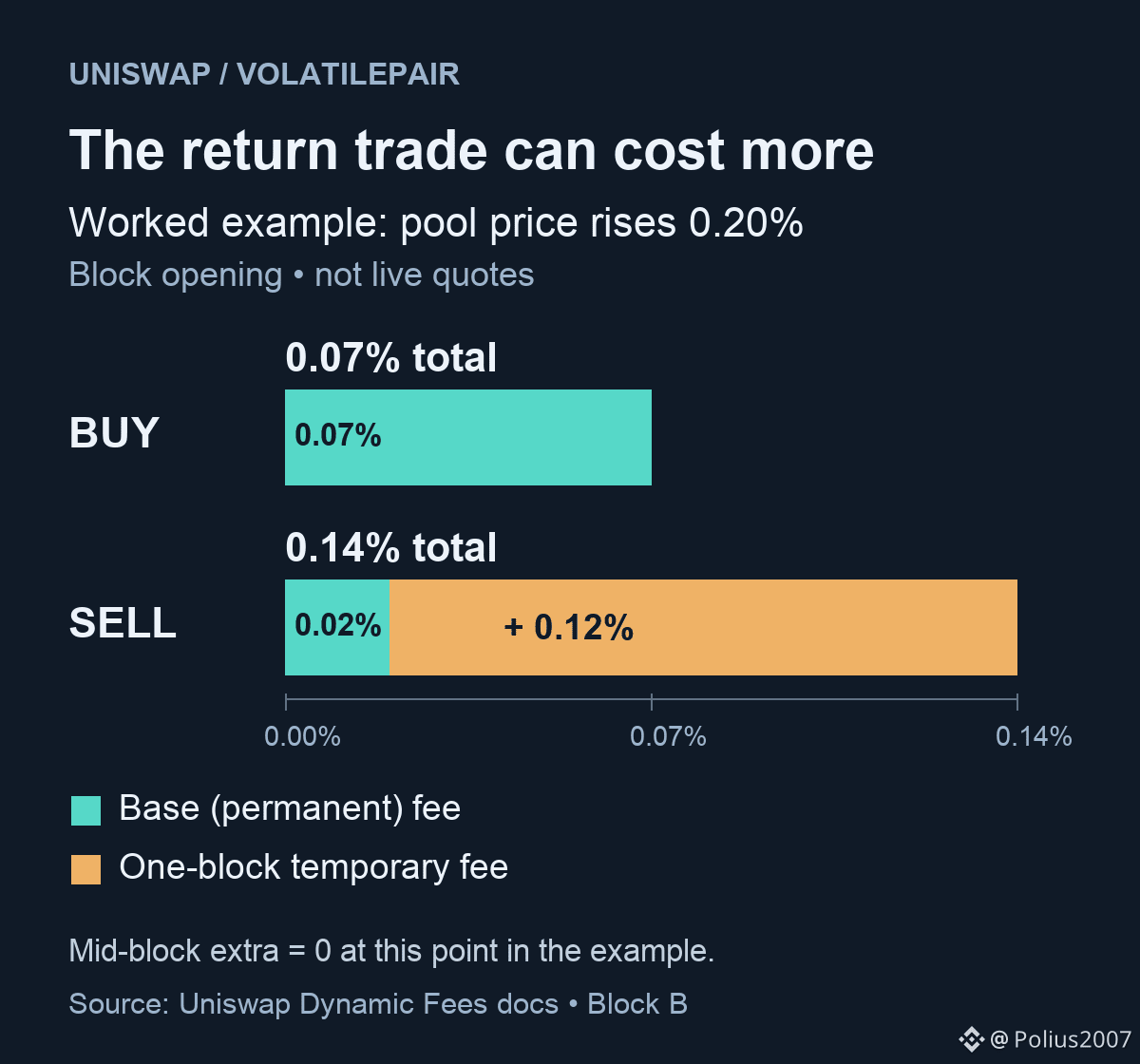
Uniswap’s VolatilePair documentation gives a sell fee of 0.14% at one block opening and 0.02% at the next. The base fee has not changed: a temporary charge has expired.
Here is the sequence in its worked example. A 0.20% rise in the pool price between block openings leaves the sell-side base fee at 0.02%. A one-block charge adds 0.12%, bringing the total to 0.14%. Buying at that same opening carries a 0.07% fee. These are alternative directions at one starting state, not two executed legs of a round trip.
At the next opening, the example’s pool price is back at the previous opening level. With no new opening-to-opening move, the temporary charge is zero and the sell fee is back to its 0.02% base. The buy fee stays at 0.07%.
That drop depends on the stated price path. Another move can create another temporary charge; movement within a block can add a further fee. Waiting one block does not secure a cheaper exit.
VolatilePair launched on Ethereum mainnet on October 14, initially with ETH/USDC. The figures above are documentation examples, not current pool quotes.
Source: Uniswap Labs’ VolatilePair Dynamic Fees, Blocks B and C; checked October 28.
https://developers.uniswap.org/docs/protocols/uniswap-labs-hooks/volatile-pair/concepts/dynamic-fees
#Uniswap #ETH
69
Войдите, чтобы посмотреть больше материала
Присоединяйтесь к пользователям криптовалют по всему миру на Binance Square
⚡️ Получайте новейшую и полезную информацию о криптоактивах.
💬 Нам доверяет крупнейшая в мире криптобиржа.
👍 Получите достоверные аналитические данные от верифицированных создателей контента.
Эл. почта/номер телефона
В тренде
1
#UniswapA16zSeekDeFiExemptionFromIllinoisCryptoTax
Просмотров: 22,332
720 обсуждают
2
#HKDollarStablecoinHKDAPToLaunchOnSolana
Просмотров: 16,702
459 обсуждают
3
#$1.5BInLeveragedCryptoBetsLiquidated
Просмотров: 36,356
242 обсуждают
4
#TrezorSaysCryptoBilisSoldWalletMayContainMaliciousComponents
Просмотров: 2,483
65 обсуждают
5
#KOSPIFalls3.53%BackBelow6000
Просмотров: 60,479
1,075 обсуждают
6
#AmazonSharesFallAbout7%InPremarketTrading
Просмотров: 27,314
575 обсуждают
7
#USMidtermElections
Просмотров: 236,649
2,334 обсуждают
8
#StrategySTRCReaches$99.95ForFirstTimeIn165Days
Просмотров: 23,199
93 обсуждают
9
#BinanceWillListPredictPREDICT
Просмотров: 90,029
1,378 обсуждают
10
#SwitzerlandFirstSpotBitcoinETFExpectedToTradeInNovember
Просмотров: 3,049
107 обсуждают